EP1259418B1 - Seal for a suction cup and method for accomodating large movements in a mooring system - Google Patents
Seal for a suction cup and method for accomodating large movements in a mooring system Download PDFInfo
- Publication number
- EP1259418B1 EP1259418B1 EP01908505A EP01908505A EP1259418B1 EP 1259418 B1 EP1259418 B1 EP 1259418B1 EP 01908505 A EP01908505 A EP 01908505A EP 01908505 A EP01908505 A EP 01908505A EP 1259418 B1 EP1259418 B1 EP 1259418B1
- Authority
- EP
- European Patent Office
- Prior art keywords
- mooring
- attachment element
- robot
- operating
- mooring system
- Prior art date
- Legal status (The legal status is an assumption and is not a legal conclusion. Google has not performed a legal analysis and makes no representation as to the accuracy of the status listed.)
- Expired - Lifetime
Links
- 238000000034 method Methods 0.000 title claims abstract description 40
- 238000007789 sealing Methods 0.000 claims description 10
- 239000013536 elastomeric material Substances 0.000 claims description 3
- 238000011017 operating method Methods 0.000 claims description 2
- 101100327917 Caenorhabditis elegans chup-1 gene Proteins 0.000 description 4
- 238000007792 addition Methods 0.000 description 3
- 230000004044 response Effects 0.000 description 2
- 238000005299 abrasion Methods 0.000 description 1
- 230000002411 adverse Effects 0.000 description 1
- 238000006073 displacement reaction Methods 0.000 description 1
- 230000007246 mechanism Effects 0.000 description 1
- 238000012986 modification Methods 0.000 description 1
- 230000004048 modification Effects 0.000 description 1
- 238000003032 molecular docking Methods 0.000 description 1
- 229920001084 poly(chloroprene) Polymers 0.000 description 1
- 230000008569 process Effects 0.000 description 1
- 230000000630 rising effect Effects 0.000 description 1
- XLYOFNOQVPJJNP-UHFFFAOYSA-N water Substances O XLYOFNOQVPJJNP-UHFFFAOYSA-N 0.000 description 1
Images

Classifications
-
- B—PERFORMING OPERATIONS; TRANSPORTING
- B63—SHIPS OR OTHER WATERBORNE VESSELS; RELATED EQUIPMENT
- B63B—SHIPS OR OTHER WATERBORNE VESSELS; EQUIPMENT FOR SHIPPING
- B63B21/00—Tying-up; Shifting, towing, or pushing equipment; Anchoring
-
- B—PERFORMING OPERATIONS; TRANSPORTING
- B63—SHIPS OR OTHER WATERBORNE VESSELS; RELATED EQUIPMENT
- B63B—SHIPS OR OTHER WATERBORNE VESSELS; EQUIPMENT FOR SHIPPING
- B63B21/00—Tying-up; Shifting, towing, or pushing equipment; Anchoring
- B63B2021/003—Mooring or anchoring equipment, not otherwise provided for
- B63B2021/006—Suction cups, or the like, e.g. for mooring, or for towing or pushing
Definitions
- the present invention relates to mooring devices for mooring vessels and, more particularly to a method and mooring system for accommodating large relative movements between two objects moored or secured together.
- a vacuum attachment cup assembly is fixed to the ship's hull.
- Mechanical means limits movement of mooring robot up and down over the full extent of the relative vertical travel. This possible movement necessitates a larger working area, with consequent complication and increased cost.
- Japanese patent abstract publication no.. 58206478 describes a mooring device and a method of changing the position of a vacuum cup fastening the device to the hull.
- the negative pressure in the vacuum cup is raised to a degree permitting the cup to slide without releasing from the hull.
- this passive method therefore offers greatly reduced mooring forces, making the moored vessel vulnerable to failure of the mooring in adverse conditions of weather and current.
- the seal of the vacuum cup also suffers from abrasion when the cup slides down the hull in this manner and so to avoid regular sliding movement during operation the mooring device is provided with increased mechanical travel in the vertical direction, with consequent added complication and expense.
- a still further object of the present invention is the provision of a seal for use in an attachment element for use on a mooring robot.
- each mooring robot has a robot arm with at least one attachment element for releasable engagement with a surface, wherein the operating method involves stepwise movements to re-position the attachment elements between respective starting and a finishing positions in which positions all attachment elements are fastened to the surface, the method including the steps:
- a seal for a vacuum attachment element which element can be secured against a surface
- said seal comprising a circumferential seal member of substantially constant cross-section, said member being mountable in a support frame rigidly fixed to the attachment element, the seal member being of elastomeric material and including:
- a seal for an attachment element substantially as described above, wherein the mooring robot releasably fastens to the surface, being a surface of a first moveable object, the mooring robot being mountable to a second object, said first object moving in response to the application of external forces, relative to the second object, which movement moves the first object from a pre-determined operating position, of the type as described in the co-pending application based upon New Zealand Patent application No. 501395.
- a method of operating a mooring system substantially as described above, wherein the mooring robots are mounted to a fixed or floating dock and the said surface is part of the freeboard of a ship's hull.
- the mooring robots may be mounted to a floating vessel for mooring to another vessel or a plate fixed to a fixed or floating dock.
- each mooring robot includes means for at least two translational degrees of freedom for positioning each attachment element.
- the mooring robot provides three-degrees of translational freedom for controlling of the position of each attachment element and each attachment element is pivotally fixed to the movement mechanism.
- a method of operating a mooring system substantially as described above, wherein the stepwise movement is performed in the vertical direction, allowing the mooring system to accommodate large vertical movements between a ship and its dock.
- One or two of the mooring robots may be at or approaching the limits of vertical travel before the stepwise movement is initiated.
- the stepwise movement may be performed in the horizontal direction for providing movement of the ship in the fore-and-aft direction.
- a method of operating a mooring system substantially as described above, wherein the method is performed with a mooring system which includes mooring robots as described in New Zealand Patent application No. 501395.
- a mooring system which includes mooring robots as described in New Zealand Patent application No. 501395.
- Four mooring robots, in first and second pairs are employed, the first pair performing the stepwise movement while the second pair remains fastened to the ship.
- both the first and second pairs may perform the stepwise movement together.
- one of the cups of the each mooring robot is sufficient to hold that portion of the ship moored, during the operation of the above described method.
- very large vertical movements of a vessel can be accommodated, without the need to re-moor a vessel and without risking the security of the mooring system.
- a device for performing the method of the present invention comprises the first preferred embodiment of a mooring system 500, as described in the co-pending PCT application based upon New Zealand Patent application No. 501395 is illustrated in plan view.
- the description of the mooring robot and mooring system in the co-pending application is hereby incorporated by reference.
- mooring system 500 wherein mooring robots 100 are fixed to the ship S allowing the ship S to be readily fastened to a bearing plate fixed to the dock 50 or to another ship S. It will be appreciated, however, that this as well as other robot type mooring devices may be employed for performing the method of the present invention.
- mooring robot 100 In the following description 100a, 100b have been used to refer to two specific examples of the mooring robot 100.
- Fig. 1 shows a first mooring robot 100a and a second mooring robot 100b fixed to the dock 50 for mooring a ship S.
- the mooring system 500 includes at least two pairs of mooring robots 100a, 100b at spaced positions along a mooring face of the dock 50.
- Each mooring robot 100 has two separate vacuum cups 1 pivotally fixed to a robot arm 10 and permitting accurate positional control of the vacuum cups I in three dimensions.
- the method of operating the mooring system 500 providing a stepwise movement is described below with reference to Fig. 2.
- the vacuum attachment cups 1 fixed to the hull are raised or lowered respectively. It will be appreciated, however, that the same stepwise movement method applies to other relative movement such as moving the vacuum attachment cups 1 from side-to-side in the longitudinal direction, so the following description should not be seen a limiting.
- each vacuum attachment cup 1 Before mooring the ship S, each vacuum attachment cup 1 is initially free (Figs. 1 and 4). From initial engagement each cup 1 moves through partial engagement (not shown) to complete engagement (Fig. 5) wherein both the seal 60 and the abutment member 61 are fully compressed.
- the vacuum attachment cups 1 of both mooring robots (100a, 100b) are fixed to the hull at approximately the same height H2 and the mooring robots (100a, 100b) are able to accommodate a limited degree of vertical travel either side of height H2, between an upper limit of travel at height H1 and a lower limit of travel at H3.
- the heights H1, H2, H3 are absolute heights relative to the fixed dock 50.
- the controls (not shown) of the mooring system 500 detects a requirement to raise the mooring robots 100, due to a mooring robot (100a, 100b) approaching the limit of its downward travel H3 (through either a falling tide or the addition of cargo) the stepwise movement of the vacuum attachment cups 1 is then initiated.
- Fig. 3 shows an intermediate stage during the process of raising the vacuum cups 1 from height H3 to height H4.
- the vacuum cups 1 of the first mooring robot 100a have been released and the vacuum cups 1 raised to height H4.
- the vacuum attachment cups 1 Before moving the vacuum attachment cups 1 they are completely released from engagement with the hull (to a position as shown in Fig. 4) thereby allowing the movement to be completed more quickly, as is desired.
- a first preferred embodiment of a seal 60 according to the present invention is shown in Fig. 6.
- the seal 60 provides a continuous seal around the circumference of each vacuum cup 1, to which it is rigidly fixed.
- the seal 60 is made from elastomeric material, preferably neoprene. It includes a first arcuate sealing face 62 between an inner sealing edge 63 and on outer sealing edge 61.
- the seal 60 is optionally used to form the perimeter of each vacuum cup 1 used in the method of the present invention. However, it will be appreciated by those skilled in the art that other seals may also be used without departing from the scope of the inventive method.
- This configuration of the seal 60 allows it to absorb irregularities in the surface to which cup is attached.
- an initial seal is attained with partial deformation of the outer sealing edge 61 at the partial engagement stage (nor shown) before the inner sealing edge 61 contacts the hull of the ship S.
- this seal 60 there has been found to be a predictable relationship between the amount of deformation at the partial engagement stage and the vacuum applied to the vacuum cups 1.
- the arcuate face 62 is readily adapted for sliding engagement with the hull of a ship S or another surface.
- a dock which may be either fixed or floating.
- the dock may be replaced by a vessel (so that there is vessel to vessel docking and relative movement).
- the mooring system, described herein as affixed to the dock may be fixed to the vessel. The operation is the same except that the surface is a surface affixed to the dock.
Landscapes
- Chemical & Material Sciences (AREA)
- Engineering & Computer Science (AREA)
- Combustion & Propulsion (AREA)
- Mechanical Engineering (AREA)
- Ocean & Marine Engineering (AREA)
- Manipulator (AREA)
- Automatic Assembly (AREA)
- Hooks, Suction Cups, And Attachment By Adhesive Means (AREA)
- Printers Or Recording Devices Using Electromagnetic And Radiation Means (AREA)
- Recording Measured Values (AREA)
- Electrical Discharge Machining, Electrochemical Machining, And Combined Machining (AREA)
- Auxiliary Devices For And Details Of Packaging Control (AREA)
- Control Of Vending Devices And Auxiliary Devices For Vending Devices (AREA)
- Sink And Installation For Waste Water (AREA)
- Ropes Or Cables (AREA)
- Gasket Seals (AREA)
- Massaging Devices (AREA)
- Ship Loading And Unloading (AREA)
- Lubricants (AREA)
- Cleaning In Electrography (AREA)
- Labeling Devices (AREA)
Abstract
Description
- The present invention relates to mooring devices for mooring vessels and, more particularly to a method and mooring system for accommodating large relative movements between two objects moored or secured together.
- One disadvantage of traditional mooring is the necessity to constantly adjust the mooring lines, particularly when a ship is secured to a fixed dock. This adjustment is to account for movement of the ship in response to winds, shifting tides, the addition or removal of cargo, and the like. The combination of high tidal movements and variations in ship displacement due to loading can result in a considerable vertical movement having to be accommodated by the mooring system.
- With a mooring device such as that described in the co-pending application based upon New Zealand Patent application No. 501395 (which specification is incorporated herein by reference), a vacuum attachment cup assembly is fixed to the ship's hull. Mechanical means limits movement of mooring robot up and down over the full extent of the relative vertical travel. This possible movement necessitates a larger working area, with consequent complication and increased cost.
- Japanese patent abstract publication no.. 58206478 describes a mooring device and a method of changing the position of a vacuum cup fastening the device to the hull. When the device reaches the limits of its vertical travel the negative pressure in the vacuum cup is raised to a degree permitting the cup to slide without releasing from the hull. At its limits of travel this passive method therefore offers greatly reduced mooring forces, making the moored vessel vulnerable to failure of the mooring in adverse conditions of weather and current. The seal of the vacuum cup also suffers from abrasion when the cup slides down the hull in this manner and so to avoid regular sliding movement during operation the mooring device is provided with increased mechanical travel in the vertical direction, with consequent added complication and expense.
- It is an object of the present invention to provide a mooring system and method of operating a mooring system for accommodating a large relative vertical movement of a ship when docked. It is a further objective of the present invention to provide a mooring system and method and system for accommodating a large relative vertical movement of a ship when docked which overcomes the problems of the prior art.
- A still further object of the present invention is the provision of a seal for use in an attachment element for use on a mooring robot.
- It is an object of the present invention to address the foregoing problems or at least to provide the public with a useful choice.
- Further aspects and advantages of the present invention will become apparent from the ensuing description which is given by way of example only.
- According to the invention of claim 1, there is provided, in particular, a method of operating a mooring system, which system includes at least a first and second mooring robot. It is envisaged that each mooring robot has a robot arm with at least one attachment element for releasable engagement with a surface, wherein the operating method involves stepwise movements to re-position the attachment elements between respective starting and a finishing positions in which positions all attachment elements are fastened to the surface, the method including the steps:
- (a) with respect the first mooring robot, releasing all respective first attachment elements from engagement with the surface;
- (b) moving all said first attachment elements, by operation of the first mooring robot, and re-fastening said elements in the respective finishing position on the surface;
- (c) with respect to the second mooring robot, releasing all respective second attachment elements from engagement with the surface; and
- (d) moving all said second attachment elements, by operation of the second mooring robot, and re-fastening the said elements in the respective finishing position on the surface.
- It is envisaged that there is provided a seal for a vacuum attachment element, which element can be secured against a surface, said seal comprising a circumferential seal member of substantially constant cross-section, said member being mountable in a support frame rigidly fixed to the attachment element, the seal member being of elastomeric material and including:
- a first sealing face which has an arcuate portion between inner and outer edges, wherein partial deformation of the said first scaling face is required before the said inner sealing edge contacts the surface.
- Further, there is provided a seal for an attachment element substantially as described above, wherein the attachment element is part of a mooring robot.
- According to another aspect there is provided a seal for an attachment element substantially as described above, wherein the mooring robot releasably fastens to the surface, being a surface of a first moveable object, the mooring robot being mountable to a second object, said first object moving in response to the application of external forces, relative to the second object, which movement moves the first object from a pre-determined operating position, of the type as described in the co-pending application based upon New Zealand Patent application No. 501395.
- According to a still further aspect of the present invention there is provided a method of operating a mooring system, substantially as described above, including the steps:
- (e) with respect to any further mooring robots releasing all respective attachment elements from engagement with the surface; and
- (f) moving all said respective attachment elements, by operation of the mooring robot, and re-fastening the said attachment elements in the respective finishing position on the surface.
- According to a still further aspect of the present invention there is provided a method of operating a mooring system, substantially as described above, wherein the steps are performed sequentially.
- According to a still further aspect of the present invention there is provided a method of operating a mooring system, substantially as described above, wherein the steps (a) and (c) and the steps (b) and (d) in respect of each mooring robot, are performed at the same time.
- According to a still further aspect of the present invention there is provided a method of operating a mooring system, substantially as described above, wherein the mooring robots are mounted to a fixed or floating dock and the said surface is part of the freeboard of a ship's hull. Alternatively, the mooring robots may be mounted to a floating vessel for mooring to another vessel or a plate fixed to a fixed or floating dock.
- According to a still further aspect of the present invention there is provided a method of operating a mooring system, substantially as described above, wherein each mooring robot includes means for at least two translational degrees of freedom for positioning each attachment element. Most preferably the mooring robot provides three-degrees of translational freedom for controlling of the position of each attachment element and each attachment element is pivotally fixed to the movement mechanism.
- According to a still further aspect of the present invention there is provided a method of operating a mooring system, substantially as described above, wherein the stepwise movement is performed in the vertical direction, allowing the mooring system to accommodate large vertical movements between a ship and its dock. One or two of the mooring robots may be at or approaching the limits of vertical travel before the stepwise movement is initiated. Alternatively, the stepwise movement may be performed in the horizontal direction for providing movement of the ship in the fore-and-aft direction.
- According to a still further aspect of the present invention there is provided a method of operating a mooring system, substantially as described above, wherein the method is performed with a mooring system which includes mooring robots as described in New Zealand Patent application No. 501395. Four mooring robots, in first and second pairs are employed, the first pair performing the stepwise movement while the second pair remains fastened to the ship. Alternatively both the first and second pairs may perform the stepwise movement together.
- According to a still further aspect of the present invention there is provided a method of operating a mooring system, substantially as described above, wherein the attachment element is an array of vacuum cups, each vacuum cup having a seal as described according to the first aspect above.
- It will be appreciated that one of the cups of the each mooring robot is sufficient to hold that portion of the ship moored, during the operation of the above described method. Thus very large vertical movements of a vessel can be accommodated, without the need to re-moor a vessel and without risking the security of the mooring system.
- Further aspects of the present invention will become apparent from the following description which is given by way of example only and with reference to the accompanying drawings in which:
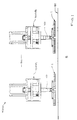
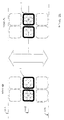
- Figure 1 is a plan view of a pair of mooring robots, being a first preferred arrangement for performing the stepwise movement method according to the present invention;
- Figure 2 is a front elevation illustrating the vertical travel of the vacuum cups of the mooring robots according to Fig. 1;
- Figure 3 is front elevation of the vacuum cups of Fig. 2 at an intermediate stage in the stepping movement of the present invention;
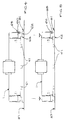
- Figure 4 is a sectional view of a vacuum cup provided with a seal according to the present invention in a released position, and
- Figure 5 is a sectional view of a vacuum cup provided with a seal according to the present invention fully engaged with a hull surface.
- Referring to Fig. 1 of the drawings, a device for performing the method of the present invention comprises the first preferred embodiment of a
mooring system 500, as described in the co-pending PCT application based upon New Zealand Patent application No. 501395 is illustrated in plan view. The description of the mooring robot and mooring system in the co-pending application is hereby incorporated by reference. - Other preferred embodiments (not illustrated) include a
mooring system 500 wherein mooringrobots 100 are fixed to the ship S allowing the ship S to be readily fastened to a bearing plate fixed to thedock 50 or to another ship S. It will be appreciated, however, that this as well as other robot type mooring devices may be employed for performing the method of the present invention. - In the following description 100a, 100b have been used to refer to two specific examples of the
mooring robot 100. Fig. 1 shows a first mooring robot 100a and a second mooring robot 100b fixed to thedock 50 for mooring a ship S. Themooring system 500 includes at least two pairs of mooring robots 100a, 100b at spaced positions along a mooring face of thedock 50. Eachmooring robot 100 has two separate vacuum cups 1 pivotally fixed to arobot arm 10 and permitting accurate positional control of the vacuum cups I in three dimensions. - The method of operating the
mooring system 500 providing a stepwise movement is described below with reference to Fig. 2. To accommodate a ship S falling or rising relative to the dock 50 (Fig. 1), the vacuum attachment cups 1 fixed to the hull are raised or lowered respectively. It will be appreciated, however, that the same stepwise movement method applies to other relative movement such as moving the vacuum attachment cups 1 from side-to-side in the longitudinal direction, so the following description should not be seen a limiting. - Before mooring the ship S, each vacuum attachment cup 1 is initially free (Figs. 1 and 4). From initial engagement each cup 1 moves through partial engagement (not shown) to complete engagement (Fig. 5) wherein both the seal 60 and the
abutment member 61 are fully compressed. - Referring to Figs. 2 & 3, the vacuum attachment cups 1 of both mooring robots (100a, 100b) are fixed to the hull at approximately the same height H2 and the mooring robots (100a, 100b) are able to accommodate a limited degree of vertical travel either side of height H2, between an upper limit of travel at height H1 and a lower limit of travel at H3. The heights H1, H2, H3 are absolute heights relative to the fixed
dock 50. - When the controls (not shown) of the
mooring system 500 detects a requirement to raise themooring robots 100, due to a mooring robot (100a, 100b) approaching the limit of its downward travel H3 (through either a falling tide or the addition of cargo) the stepwise movement of the vacuum attachment cups 1 is then initiated. - Fig. 3 shows an intermediate stage during the process of raising the vacuum cups 1 from height H3 to height H4. The vacuum cups 1 of the first mooring robot 100a have been released and the vacuum cups 1 raised to height H4. Before moving the vacuum attachment cups 1 they are completely released from engagement with the hull (to a position as shown in Fig. 4) thereby allowing the movement to be completed more quickly, as is desired.
- Next the vacuum cups 1 of the first mooring robot 100a are fully engaged (Fig. 5). On indication of complete engagement, the second mooring robot 100b is also raised to height H4 in the same manner.
- A first preferred embodiment of a seal 60 according to the present invention is shown in Fig. 6. The seal 60 provides a continuous seal around the circumference of each vacuum cup 1, to which it is rigidly fixed. The seal 60 is made from elastomeric material, preferably neoprene. It includes a first arcuate sealing
face 62 between aninner sealing edge 63 and on outer sealingedge 61. - The seal 60 is optionally used to form the perimeter of each vacuum cup 1 used in the method of the present invention. However, it will be appreciated by those skilled in the art that other seals may also be used without departing from the scope of the inventive method.
- This configuration of the seal 60 allows it to absorb irregularities in the surface to which cup is attached. During engagement of the seal 60, an initial seal is attained with partial deformation of the
outer sealing edge 61 at the partial engagement stage (nor shown) before theinner sealing edge 61 contacts the hull of the ship S. With this seal 60 there has been found to be a predictable relationship between the amount of deformation at the partial engagement stage and the vacuum applied to the vacuum cups 1. - In the partial engagement stage the
arcuate face 62 is readily adapted for sliding engagement with the hull of a ship S or another surface. - The above method of operating a mooring system has been described with reference to vessel moored to a dock, which may be either fixed or floating. However, it will be appreciated that the dock may be replaced by a vessel (so that there is vessel to vessel docking and relative movement). Also, it will be appreciated that the mooring system, described herein as affixed to the dock, may be fixed to the vessel. The operation is the same except that the surface is a surface affixed to the dock.
- Also, the above method of operating a mooring system has been described with reference to vessel moored to a dock. It will, however, be appreciated that another type of vessel or object may be moved relative to a second object, for example under water, etc without departing from the scope of the invention.
- Aspects of the present invention have been described by way of example only and it should be appreciated that modifications and additions may be made thereto without departing from the scope of the appended claims.
Claims (9)
- A method of operating a mooring system (500), the mooring system (500) including at least a first and a second mooring robot (100a, 100b) fixed relative to a first body, each mooring robot (100a, 100b) including a robot arm (10) with an attachment element for releasably fastening to a surface (51) of a second body moveable relative to said first body, the first robot (100a) having a first attachment element (1) and the second robot (100b) having a second attachment element (1), each mooring robot capable of displacing its respective attachment element between respective spaced apart surface fastened first and second limit of movement positions in which positions the attachment elements are fastened to the surface (51),wherein the operating method involves coordinated stepwise movements to re-position each attachment element on said surface the method being characterised in that it includes the steps of:a) firstly, while maintaining the second attachment element in its respective and surface fastened first limit of movement position, releasing the first attachment element from the surface (5);b) secondly, while maintaining the second attachment element in its respective and surface fastened first limit of movement position, actuating the first mooring robot (100a) to move the first attachment element and re-fasten the first attachment element in its respective and surface fastened second limit of movement position;c) thirdly, while maintaining the first attachment element in its respective and surface fastened second limit of movement position, releasing the second attachment element from the surface (51); andd) fourthly, while maintaining the first attachment element in its respective and surface fastened second limit of movement position, actuating the second mooring robot (100b) to move the second attachment element and re-fasten the second attachment element in its respective and surface fastened second limit of movement position.
- A method of operating a mooring system (500) as claimed in claim 1 wherein said first body is a fixed or floating dock (50).
- A method of operating a mooring system (500) as claimed in claims 1 or claim 2 wherein said surface (51) is part of the freeboard of a ship's hull (S).
- A method of operating a mooring system (500) as claimed in claim 1 wherein the first body is a floating vessel.
- A method of operating a mooring system (500) as claimed in any one of claims 1 to 4 wherein each mooring robot provides means for at least two-dimensional movement for positioning the attachment element.
- A method of operating a mooring system (500) as claimed in claim any one of claims 1 to 5 wherein each mooring robot supports each attractive element in a manner providing three-dimensional translational movement, the mooring robot (100a, 100b) allowing external forces to displace the second body relative to the first body and the attachment element engaged therewith, by a distance in the horizontal plane from a selected moored position; wherein, separate from its structural components, the mooring robot (100a, 100b) includes resilient restorative means which provide a restorative force acting to restore the attachment element to the selected moored position.
- A method of operating a mooring system (500) as claimed in any one of claims 1 to 6 wherein the stepwise movement is performed in the vertical direction.
- A method of operating a mooring system (500) as claimed in any one of claims 1 to 7 wherein in addition to the first and second mooring robots (100a, 100b) at least two additional mooring robots (100a, 100b) are employed, the attachment element of each additional mooring robot (100a, 100b) remaining fastened to the surface (51) throughout the stepwise movement of the first and second robots (100a, 100b).
- A method of operating a mooring system (500) as claimed in claim 1 wherein each attachment element includes an array of vacuum cups (1), each vacuum cup (1) having a circumferential seal member (60) of substantially constant cross-section, said member (60) being mountable in a support frame (65) rigidly fixed to the attachment element, the seal member (60) being of elastomeric material and including:a first sealing face which has an arcuate portion (62) between inner and outer edges (61, 63) wherein partial deformation of the said first sealing face (62) is required before the said inner sealing edge (63) contacts the surface (51).
Applications Claiming Priority (3)
| Application Number | Priority Date | Filing Date | Title |
|---|---|---|---|
| NZ50139500 | 2000-02-26 | ||
| NZ50139500 | 2000-02-26 | ||
| PCT/NZ2001/000025 WO2001062584A2 (en) | 2000-02-26 | 2001-02-26 | Seal for a suction cup and method for accommodating large movements in a mooring system |
Publications (3)
| Publication Number | Publication Date |
|---|---|
| EP1259418A2 EP1259418A2 (en) | 2002-11-27 |
| EP1259418B1 true EP1259418B1 (en) | 2006-06-14 |
| EP1259418B8 EP1259418B8 (en) | 2007-04-25 |
Family
ID=19927642
Family Applications (1)
| Application Number | Title | Priority Date | Filing Date |
|---|---|---|---|
| EP01908505A Expired - Lifetime EP1259418B8 (en) | 2000-02-26 | 2001-02-26 | Seal for a suction cup and method for accomodating large movements in a mooring system |
Country Status (13)
| Country | Link |
|---|---|
| US (1) | US7055448B2 (en) |
| EP (1) | EP1259418B8 (en) |
| JP (2) | JP5128744B2 (en) |
| AT (2) | ATE329822T1 (en) |
| AU (2) | AU2001236248B2 (en) |
| CA (1) | CA2401235C (en) |
| CY (1) | CY1106968T1 (en) |
| DE (2) | DE60120646T2 (en) |
| DK (1) | DK1259418T3 (en) |
| ES (2) | ES2266164T3 (en) |
| NO (1) | NO329874B1 (en) |
| PT (1) | PT1259418E (en) |
| WO (1) | WO2001062584A2 (en) |
Families Citing this family (6)
| Publication number | Priority date | Publication date | Assignee | Title |
|---|---|---|---|---|
| JP4768190B2 (en) | 2000-02-26 | 2011-09-07 | カボテック エムエスエル ホールディングス リミティド | Mooring equipment |
| US6938570B2 (en) | 2001-04-17 | 2005-09-06 | Mooring Systems Limited | Mooring robot |
| NZ520450A (en) * | 2002-07-30 | 2004-12-24 | Mooring Systems Ltd | Method of controlling a mooring system |
| WO2005097590A1 (en) * | 2004-04-08 | 2005-10-20 | Mooring Systems Limited | A mooring device for holding a floating vessel adjacent a mooring facility |
| US8408153B2 (en) * | 2007-09-26 | 2013-04-02 | Cavotec Moormaster Limited | Automated mooring method and mooring system |
| KR102890149B1 (en) * | 2019-11-28 | 2025-11-21 | 이팔코 비.브이. | mooring robot |
Family Cites Families (33)
| Publication number | Priority date | Publication date | Assignee | Title |
|---|---|---|---|---|
| US3227481A (en) * | 1963-02-07 | 1966-01-04 | Vacuum Concrete Corp Of Americ | Vacuum lifter |
| US3322091A (en) * | 1965-10-01 | 1967-05-30 | Stanwick Corp | Method and apparatus for maneuvering ships |
| US3463114A (en) * | 1968-04-24 | 1969-08-26 | Stanwick Corp The | Method for maneuvering a vessel with respect to its station |
| US3626890A (en) * | 1970-07-29 | 1971-12-14 | Heyl And Patterson Inc | Barge hauling apparatus |
| NL7414096A (en) * | 1973-11-06 | 1975-05-09 | Ishikawajima Harima Heavy Ind | MORE DETAILS. |
| US4055137A (en) * | 1974-12-23 | 1977-10-25 | Nippon Oil Company, Ltd. | Vessel mooring system |
| NO142486C (en) | 1975-06-17 | 1980-08-27 | Irving Brummenaes | FENDER SYSTEM. |
| JPS5239286A (en) * | 1975-09-25 | 1977-03-26 | Ishikawajima Harima Heavy Ind Co Ltd | Ship mooring apparatus using adsorption boards |
| US4008678A (en) * | 1975-10-20 | 1977-02-22 | Sun Shipbuilding And Dry Dock Co. | Ship mooring system |
| JPS5299590A (en) * | 1976-02-13 | 1977-08-20 | Ishikawajima Harima Heavy Ind Co Ltd | Attracting type mooring device |
| US4066030A (en) * | 1976-03-01 | 1978-01-03 | Louis Milone | Mechanical coupling for marine vehicles |
| JPS54177132U (en) * | 1978-06-02 | 1979-12-14 | ||
| JPS5544057A (en) | 1978-09-22 | 1980-03-28 | Ishikawajima Harima Heavy Ind Co Ltd | Ship mooring device |
| JPS5767896U (en) * | 1980-10-13 | 1982-04-23 | ||
| JPS58206478A (en) | 1982-05-22 | 1983-12-01 | Ishikawajima Zosen Kakoki Kk | How to change the adsorption position of adsorption type mooring equipment for ships |
| JPS58214487A (en) * | 1982-06-08 | 1983-12-13 | Ishikawajima Zosen Kakoki Kk | Adsorption system mooring apparatus |
| US4549835A (en) * | 1983-11-23 | 1985-10-29 | Hitachi Zosen Corporation | Docking apparatus for ships |
| US4532879A (en) * | 1984-06-04 | 1985-08-06 | Exxon Production Research Co. | Combination mooring system |
| JPS6175112A (en) * | 1984-09-20 | 1986-04-17 | Ishikawajima Harima Heavy Ind Co Ltd | Vessel berthing equipment |
| US4543070A (en) * | 1984-10-04 | 1985-09-24 | The United States Of America As Represented By The Secretary Of The Navy | Linked-spar motion-compensated lifting system |
| JPS61218495A (en) | 1985-03-23 | 1986-09-27 | Agency Of Ind Science & Technol | Sticking device for submarine operation robot |
| US4697538A (en) * | 1986-04-15 | 1987-10-06 | Day Robert C | Boat dock mooring device |
| NL8600973A (en) * | 1986-04-17 | 1987-11-16 | Swarttouw Frans Bv | Pontoon mooring for marine vessel - comprises arm hinging on horizontal axis with magnets or suction cups at end |
| US4852926A (en) * | 1988-01-11 | 1989-08-01 | Littell Edmund R | Vacuum cup construction |
| SE469790B (en) * | 1990-03-26 | 1993-09-13 | Norent Ab | Mooring system between a moving unit, eg a ship and a stationary unit, eg a berth |
| FR2672650B1 (en) | 1991-02-08 | 1993-08-27 | Devco Ingenierie | DYNAMIC SUCTION CUP. |
| DE9207648U1 (en) | 1992-06-05 | 1992-08-20 | Rohr GmbH, 6701 Otterstadt | Device for mooring gravel ships or tipping barges to a floating grab |
| JP2923174B2 (en) | 1993-07-14 | 1999-07-26 | 三菱重工業株式会社 | Ship mooring and berthing support equipment. |
| JPH0834388A (en) | 1994-07-21 | 1996-02-06 | Mitsubishi Heavy Ind Ltd | Sucking type towing connector |
| US5676085A (en) * | 1996-07-08 | 1997-10-14 | Northern Pacific Development Corp. | Vacuum operated boat mooring device |
| WO1998017868A1 (en) | 1996-10-21 | 1998-04-30 | John Mackay Hadcroft | Vacuum fastening pad |
| WO2001051345A1 (en) * | 2000-01-07 | 2001-07-19 | Fmc Corporation | Mooring systems with active force reacting systems and passive damping |
| JP4768190B2 (en) * | 2000-02-26 | 2011-09-07 | カボテック エムエスエル ホールディングス リミティド | Mooring equipment |
-
2001
- 2001-02-26 AU AU2001236248A patent/AU2001236248B2/en not_active Ceased
- 2001-02-26 CA CA002401235A patent/CA2401235C/en not_active Expired - Lifetime
- 2001-02-26 ES ES01908505T patent/ES2266164T3/en not_active Expired - Lifetime
- 2001-02-26 AT AT01908505T patent/ATE329822T1/en not_active IP Right Cessation
- 2001-02-26 JP JP2001561609A patent/JP5128744B2/en not_active Expired - Fee Related
- 2001-02-26 EP EP01908505A patent/EP1259418B8/en not_active Expired - Lifetime
- 2001-02-26 ES ES01908506T patent/ES2295136T3/en not_active Expired - Lifetime
- 2001-02-26 AT AT01908506T patent/ATE373600T1/en not_active IP Right Cessation
- 2001-02-26 DE DE60120646T patent/DE60120646T2/en not_active Expired - Lifetime
- 2001-02-26 WO PCT/NZ2001/000025 patent/WO2001062584A2/en not_active Ceased
- 2001-02-26 AU AU3624701A patent/AU3624701A/en active Pending
- 2001-02-26 PT PT01908505T patent/PT1259418E/en unknown
- 2001-02-26 DE DE60130542T patent/DE60130542T2/en not_active Expired - Lifetime
- 2001-02-26 DK DK01908505T patent/DK1259418T3/en active
- 2001-02-26 US US10/220,010 patent/US7055448B2/en not_active Expired - Lifetime
-
2002
- 2002-08-26 NO NO20024063A patent/NO329874B1/en not_active IP Right Cessation
-
2007
- 2007-10-30 CY CY20071101403T patent/CY1106968T1/en unknown
-
2011
- 2011-03-14 JP JP2011056007A patent/JP2011157069A/en active Pending
Also Published As
| Publication number | Publication date |
|---|---|
| CA2401235A1 (en) | 2001-08-30 |
| EP1259418A2 (en) | 2002-11-27 |
| HK1051019A1 (en) | 2003-07-18 |
| NO20024063D0 (en) | 2002-08-26 |
| AU3624701A (en) | 2001-09-03 |
| DE60130542T2 (en) | 2008-06-12 |
| WO2001062584A2 (en) | 2001-08-30 |
| DE60130542D1 (en) | 2007-10-31 |
| CA2401235C (en) | 2008-10-21 |
| US20050087118A1 (en) | 2005-04-28 |
| JP2004500276A (en) | 2004-01-08 |
| ATE373600T1 (en) | 2007-10-15 |
| CY1106968T1 (en) | 2012-09-26 |
| NO20024063L (en) | 2002-09-26 |
| ATE329822T1 (en) | 2006-07-15 |
| JP2011157069A (en) | 2011-08-18 |
| PT1259418E (en) | 2006-11-30 |
| EP1259418B8 (en) | 2007-04-25 |
| JP5128744B2 (en) | 2013-01-23 |
| US7055448B2 (en) | 2006-06-06 |
| DE60120646D1 (en) | 2006-07-27 |
| DK1259418T3 (en) | 2006-10-16 |
| AU2001236248B2 (en) | 2005-03-10 |
| HK1051020A1 (en) | 2003-07-18 |
| WO2001062584A3 (en) | 2002-01-03 |
| NO329874B1 (en) | 2011-01-17 |
| DE60120646T2 (en) | 2007-06-14 |
| ES2266164T3 (en) | 2007-03-01 |
| ES2295136T3 (en) | 2008-04-16 |
Similar Documents
| Publication | Publication Date | Title |
|---|---|---|
| AU2001236247B2 (en) | Seal for a suction cup and method for accommodating large movements in a mooring system | |
| AU2001236247A1 (en) | Seal for a suction cup and method for accommodating large movements in a mooring system | |
| JP2011157069A (en) | Method for adjusting substantial motion in mooring system | |
| AU2002341632B2 (en) | Mooring robot | |
| AU2002341632A1 (en) | Mooring robot | |
| CN109894720A (en) | A kind of thin-walled cylinder boxing system | |
| HK1051020B (en) | Seal for a suction cup and method for accomodating large movements in a mooring system | |
| NZ521551A (en) | Method for accommodating large movements in a mooring system | |
| AU5771886A (en) | A shiplifting device | |
| US5806455A (en) | Trim adjusting device for planing hull | |
| EP3763616A1 (en) | A system for charging a battery of an electrically driven ship | |
| KR20190136840A (en) | Mooring apparatus and ship comprising the same | |
| KR102083412B1 (en) | Mooring apparatus and ship comprising the same | |
| CN214776428U (en) | Hydraulic floating device for marine boarding ladder | |
| JPS58206478A (en) | How to change the adsorption position of adsorption type mooring equipment for ships | |
| CN208246321U (en) | It is a kind of with the product carrier for clamping function | |
| AU2001236248A1 (en) | Mooring device | |
| US20230070606A1 (en) | Helm station with adjustable seat base | |
| EP3929070B1 (en) | A monopile fastening device | |
| US12365275B2 (en) | Suspension component | |
| GB2427890A (en) | Mounting of an offshore structure on an offshore support base | |
| JPS6312185Y2 (en) | ||
| JPH0248295A (en) | Wooden block for dock | |
| JPS6120103Y2 (en) |
Legal Events
| Date | Code | Title | Description |
|---|---|---|---|
| PUAI | Public reference made under article 153(3) epc to a published international application that has entered the european phase |
Free format text: ORIGINAL CODE: 0009012 |
|
| 17P | Request for examination filed |
Effective date: 20020923 |
|
| AK | Designated contracting states |
Kind code of ref document: A2 Designated state(s): AT BE CH CY DE DK ES FI FR GB GR IE IT LI LU MC NL PT SE TR |
|
| AX | Request for extension of the european patent |
Free format text: AL;LT;LV;MK;RO;SI |
|
| RIN1 | Information on inventor provided before grant (corrected) |
Inventor name: MONTGOMERY, PETER JAMES Inventor name: HADCROFT, JOHN MACKAY |
|
| 17Q | First examination report despatched |
Effective date: 20040708 |
|
| GRAP | Despatch of communication of intention to grant a patent |
Free format text: ORIGINAL CODE: EPIDOSNIGR1 |
|
| GRAS | Grant fee paid |
Free format text: ORIGINAL CODE: EPIDOSNIGR3 |
|
| GRAA | (expected) grant |
Free format text: ORIGINAL CODE: 0009210 |
|
| AK | Designated contracting states |
Kind code of ref document: B1 Designated state(s): AT BE CH CY DE DK ES FI FR GB GR IE IT LI LU MC NL PT SE TR |
|
| PG25 | Lapsed in a contracting state [announced via postgrant information from national office to epo] |
Ref country code: IT Free format text: LAPSE BECAUSE OF FAILURE TO SUBMIT A TRANSLATION OF THE DESCRIPTION OR TO PAY THE FEE WITHIN THE PRESCRIBED TIME-LIMIT;WARNING: LAPSES OF ITALIAN PATENTS WITH EFFECTIVE DATE BEFORE 2007 MAY HAVE OCCURRED AT ANY TIME BEFORE 2007. THE CORRECT EFFECTIVE DATE MAY BE DIFFERENT FROM THE ONE RECORDED. Effective date: 20060614 Ref country code: LI Free format text: LAPSE BECAUSE OF FAILURE TO SUBMIT A TRANSLATION OF THE DESCRIPTION OR TO PAY THE FEE WITHIN THE PRESCRIBED TIME-LIMIT Effective date: 20060614 Ref country code: AT Free format text: LAPSE BECAUSE OF FAILURE TO SUBMIT A TRANSLATION OF THE DESCRIPTION OR TO PAY THE FEE WITHIN THE PRESCRIBED TIME-LIMIT Effective date: 20060614 Ref country code: CH Free format text: LAPSE BECAUSE OF FAILURE TO SUBMIT A TRANSLATION OF THE DESCRIPTION OR TO PAY THE FEE WITHIN THE PRESCRIBED TIME-LIMIT Effective date: 20060614 |
|
| REG | Reference to a national code |
Ref country code: GB Ref legal event code: FG4D |
|
| REG | Reference to a national code |
Ref country code: CH Ref legal event code: EP |
|
| REG | Reference to a national code |
Ref country code: IE Ref legal event code: FG4D |
|
| REF | Corresponds to: |
Ref document number: 60120646 Country of ref document: DE Date of ref document: 20060727 Kind code of ref document: P |
|
| REG | Reference to a national code |
Ref country code: SE Ref legal event code: TRGR |
|
| REG | Reference to a national code |
Ref country code: HK Ref legal event code: GR Ref document number: 1051020 Country of ref document: HK |
|
| REG | Reference to a national code |
Ref country code: DK Ref legal event code: T3 |
|
| REG | Reference to a national code |
Ref country code: GR Ref legal event code: EP Ref document number: 20060403209 Country of ref document: GR |
|
| REG | Reference to a national code |
Ref country code: PT Ref legal event code: SC4A Free format text: AVAILABILITY OF NATIONAL TRANSLATION Effective date: 20060913 |
|
| REG | Reference to a national code |
Ref country code: CH Ref legal event code: PL |
|
| ET | Fr: translation filed | ||
| PG25 | Lapsed in a contracting state [announced via postgrant information from national office to epo] |
Ref country code: MC Free format text: LAPSE BECAUSE OF NON-PAYMENT OF DUE FEES Effective date: 20070228 |
|
| REG | Reference to a national code |
Ref country code: ES Ref legal event code: FG2A Ref document number: 2266164 Country of ref document: ES Kind code of ref document: T3 |
|
| REG | Reference to a national code |
Ref country code: CH Ref legal event code: PK Free format text: DAS PRIORITAETSAKTENZEICHEN WURDE BERICHTIGT |
|
| PLBE | No opposition filed within time limit |
Free format text: ORIGINAL CODE: 0009261 |
|
| STAA | Information on the status of an ep patent application or granted ep patent |
Free format text: STATUS: NO OPPOSITION FILED WITHIN TIME LIMIT |
|
| 26N | No opposition filed |
Effective date: 20070315 |
|
| REG | Reference to a national code |
Ref country code: PT Ref legal event code: PD4A Owner name: CAVOTEC MSL HOLDINGS LIMITED, NZ Effective date: 20080415 |
|
| NLT1 | Nl: modifications of names registered in virtue of documents presented to the patent office pursuant to art. 16 a, paragraph 1 |
Owner name: CAVOTEC MSL HOLDINGS LIMITED |
|
| REG | Reference to a national code |
Ref country code: ES Ref legal event code: PC2A |
|
| REG | Reference to a national code |
Ref country code: FR Ref legal event code: CD |
|
| PG25 | Lapsed in a contracting state [announced via postgrant information from national office to epo] |
Ref country code: LU Free format text: LAPSE BECAUSE OF NON-PAYMENT OF DUE FEES Effective date: 20070226 Ref country code: CY Free format text: LAPSE BECAUSE OF FAILURE TO SUBMIT A TRANSLATION OF THE DESCRIPTION OR TO PAY THE FEE WITHIN THE PRESCRIBED TIME-LIMIT Effective date: 20060614 |
|
| REG | Reference to a national code |
Ref country code: NL Ref legal event code: SD Effective date: 20120514 |
|
| PGFP | Annual fee paid to national office [announced via postgrant information from national office to epo] |
Ref country code: IT Payment date: 20120207 Year of fee payment: 12 |
|
| PG25 | Lapsed in a contracting state [announced via postgrant information from national office to epo] |
Ref country code: IT Free format text: LAPSE BECAUSE OF NON-PAYMENT OF DUE FEES Effective date: 20130226 |
|
| REG | Reference to a national code |
Ref country code: FR Ref legal event code: PLFP Year of fee payment: 16 |
|
| REG | Reference to a national code |
Ref country code: FR Ref legal event code: PLFP Year of fee payment: 17 |
|
| REG | Reference to a national code |
Ref country code: FR Ref legal event code: PLFP Year of fee payment: 18 |
|
| PGFP | Annual fee paid to national office [announced via postgrant information from national office to epo] |
Ref country code: NL Payment date: 20190227 Year of fee payment: 19 |
|
| PGFP | Annual fee paid to national office [announced via postgrant information from national office to epo] |
Ref country code: ES Payment date: 20190301 Year of fee payment: 19 Ref country code: DE Payment date: 20190227 Year of fee payment: 19 Ref country code: FI Payment date: 20190128 Year of fee payment: 19 Ref country code: GB Payment date: 20190225 Year of fee payment: 19 Ref country code: IE Payment date: 20190225 Year of fee payment: 19 |
|
| PGFP | Annual fee paid to national office [announced via postgrant information from national office to epo] |
Ref country code: TR Payment date: 20190219 Year of fee payment: 19 Ref country code: BE Payment date: 20190222 Year of fee payment: 19 Ref country code: DK Payment date: 20190228 Year of fee payment: 19 Ref country code: SE Payment date: 20190222 Year of fee payment: 19 Ref country code: FR Payment date: 20190226 Year of fee payment: 19 Ref country code: GR Payment date: 20190225 Year of fee payment: 19 |
|
| PGFP | Annual fee paid to national office [announced via postgrant information from national office to epo] |
Ref country code: PT Payment date: 20190220 Year of fee payment: 19 |
|
| REG | Reference to a national code |
Ref country code: DE Ref legal event code: R119 Ref document number: 60120646 Country of ref document: DE |
|
| REG | Reference to a national code |
Ref country code: FI Ref legal event code: MAE |
|
| REG | Reference to a national code |
Ref country code: DK Ref legal event code: EBP Effective date: 20200229 |
|
| REG | Reference to a national code |
Ref country code: SE Ref legal event code: EUG |
|
| REG | Reference to a national code |
Ref country code: NL Ref legal event code: MM Effective date: 20200301 |
|
| GBPC | Gb: european patent ceased through non-payment of renewal fee |
Effective date: 20200226 |
|
| REG | Reference to a national code |
Ref country code: BE Ref legal event code: MM Effective date: 20200229 |
|
| PG25 | Lapsed in a contracting state [announced via postgrant information from national office to epo] |
Ref country code: PT Free format text: LAPSE BECAUSE OF NON-PAYMENT OF DUE FEES Effective date: 20200928 Ref country code: FI Free format text: LAPSE BECAUSE OF NON-PAYMENT OF DUE FEES Effective date: 20200226 Ref country code: SE Free format text: LAPSE BECAUSE OF NON-PAYMENT OF DUE FEES Effective date: 20200227 Ref country code: GR Free format text: LAPSE BECAUSE OF NON-PAYMENT OF DUE FEES Effective date: 20200909 |
|
| PG25 | Lapsed in a contracting state [announced via postgrant information from national office to epo] |
Ref country code: NL Free format text: LAPSE BECAUSE OF NON-PAYMENT OF DUE FEES Effective date: 20200301 |
|
| PG25 | Lapsed in a contracting state [announced via postgrant information from national office to epo] |
Ref country code: IE Free format text: LAPSE BECAUSE OF NON-PAYMENT OF DUE FEES Effective date: 20200226 Ref country code: DE Free format text: LAPSE BECAUSE OF NON-PAYMENT OF DUE FEES Effective date: 20200901 Ref country code: DK Free format text: LAPSE BECAUSE OF NON-PAYMENT OF DUE FEES Effective date: 20200229 Ref country code: GB Free format text: LAPSE BECAUSE OF NON-PAYMENT OF DUE FEES Effective date: 20200226 Ref country code: FR Free format text: LAPSE BECAUSE OF NON-PAYMENT OF DUE FEES Effective date: 20200229 |
|
| PG25 | Lapsed in a contracting state [announced via postgrant information from national office to epo] |
Ref country code: BE Free format text: LAPSE BECAUSE OF NON-PAYMENT OF DUE FEES Effective date: 20200229 |
|
| PG25 | Lapsed in a contracting state [announced via postgrant information from national office to epo] |
Ref country code: PT Free format text: LAPSE BECAUSE OF EXPIRATION OF PROTECTION Effective date: 20210308 |
|
| REG | Reference to a national code |
Ref country code: ES Ref legal event code: FD2A Effective date: 20210708 |
|
| PG25 | Lapsed in a contracting state [announced via postgrant information from national office to epo] |
Ref country code: ES Free format text: LAPSE BECAUSE OF NON-PAYMENT OF DUE FEES Effective date: 20200227 |
|
| PG25 | Lapsed in a contracting state [announced via postgrant information from national office to epo] |
Ref country code: TR Free format text: LAPSE BECAUSE OF NON-PAYMENT OF DUE FEES Effective date: 20200226 |
|
| PG25 | Lapsed in a contracting state [announced via postgrant information from national office to epo] |
Ref country code: PT Free format text: LAPSE BECAUSE OF NON-PAYMENT OF DUE FEES Effective date: 20200226 |
|
| PG25 | Lapsed in a contracting state [announced via postgrant information from national office to epo] |
Ref country code: PT Free format text: LAPSE BECAUSE OF NON-PAYMENT OF DUE FEES Effective date: 20200226 |