EP1253687B1 - Self-adjustable tunable filter - Google Patents
Self-adjustable tunable filter Download PDFInfo
- Publication number
- EP1253687B1 EP1253687B1 EP01123930A EP01123930A EP1253687B1 EP 1253687 B1 EP1253687 B1 EP 1253687B1 EP 01123930 A EP01123930 A EP 01123930A EP 01123930 A EP01123930 A EP 01123930A EP 1253687 B1 EP1253687 B1 EP 1253687B1
- Authority
- EP
- European Patent Office
- Prior art keywords
- signal
- filter
- optical
- modulated
- wavelength
- Prior art date
- Legal status (The legal status is an assumption and is not a legal conclusion. Google has not performed a legal analysis and makes no representation as to the accuracy of the status listed.)
- Expired - Lifetime
Links
- 230000003287 optical effect Effects 0.000 claims description 85
- 238000000034 method Methods 0.000 claims description 7
- 238000001228 spectrum Methods 0.000 claims description 7
- 230000010287 polarization Effects 0.000 claims description 6
- 230000001419 dependent effect Effects 0.000 claims description 4
- 238000001914 filtration Methods 0.000 claims description 2
- AVVWPBAENSWJCB-DHVFOXMCSA-N L-altrofuranose Chemical compound OC[C@H](O)[C@@H]1OC(O)[C@H](O)[C@H]1O AVVWPBAENSWJCB-DHVFOXMCSA-N 0.000 description 2
- 230000008878 coupling Effects 0.000 description 2
- 238000010168 coupling process Methods 0.000 description 2
- 238000005859 coupling reaction Methods 0.000 description 2
- 230000001902 propagating effect Effects 0.000 description 2
- 230000003595 spectral effect Effects 0.000 description 2
- 238000000411 transmission spectrum Methods 0.000 description 2
- 230000002411 adverse Effects 0.000 description 1
- 230000005540 biological transmission Effects 0.000 description 1
- 238000001514 detection method Methods 0.000 description 1
- 239000000835 fiber Substances 0.000 description 1
- 238000013178 mathematical model Methods 0.000 description 1
- 238000000926 separation method Methods 0.000 description 1
- 230000002269 spontaneous effect Effects 0.000 description 1
- 230000036962 time dependent Effects 0.000 description 1
Images

Classifications
-
- H—ELECTRICITY
- H01—ELECTRIC ELEMENTS
- H01S—DEVICES USING THE PROCESS OF LIGHT AMPLIFICATION BY STIMULATED EMISSION OF RADIATION [LASER] TO AMPLIFY OR GENERATE LIGHT; DEVICES USING STIMULATED EMISSION OF ELECTROMAGNETIC RADIATION IN WAVE RANGES OTHER THAN OPTICAL
- H01S5/00—Semiconductor lasers
- H01S5/06—Arrangements for controlling the laser output parameters, e.g. by operating on the active medium
- H01S5/068—Stabilisation of laser output parameters
- H01S5/0683—Stabilisation of laser output parameters by monitoring the optical output parameters
- H01S5/0687—Stabilising the frequency of the laser
-
- H—ELECTRICITY
- H01—ELECTRIC ELEMENTS
- H01S—DEVICES USING THE PROCESS OF LIGHT AMPLIFICATION BY STIMULATED EMISSION OF RADIATION [LASER] TO AMPLIFY OR GENERATE LIGHT; DEVICES USING STIMULATED EMISSION OF ELECTROMAGNETIC RADIATION IN WAVE RANGES OTHER THAN OPTICAL
- H01S5/00—Semiconductor lasers
- H01S5/005—Optical components external to the laser cavity, specially adapted therefor, e.g. for homogenisation or merging of the beams or for manipulating laser pulses, e.g. pulse shaping
-
- H—ELECTRICITY
- H01—ELECTRIC ELEMENTS
- H01S—DEVICES USING THE PROCESS OF LIGHT AMPLIFICATION BY STIMULATED EMISSION OF RADIATION [LASER] TO AMPLIFY OR GENERATE LIGHT; DEVICES USING STIMULATED EMISSION OF ELECTROMAGNETIC RADIATION IN WAVE RANGES OTHER THAN OPTICAL
- H01S5/00—Semiconductor lasers
- H01S5/50—Amplifier structures not provided for in groups H01S5/02 - H01S5/30
- H01S5/5045—Amplifier structures not provided for in groups H01S5/02 - H01S5/30 the arrangement having a frequency filtering function
Definitions
- the present invention relates to tunable filters.
- Tunable filters such as Fiber Fabry-Perot tunable filters (FFP-TFs)
- FFP-TFs Fiber Fabry-Perot tunable filters
- SSE source spontaneous emission
- the central wavelength in transmission spectrum of the tunable filter must well match with the wavelength of the laser signal in order not to unduly decrease optical power of the laser signal.
- the filter is therefore tuned in wavelength to ensure that the maximum of the tunable filter pass band is fixed to the frequency of the peak lasing intensity.
- a continuos adjustment might be required in order to correct for mismatches between filter and laser caused e.g. by tuning the laser frequency, thermal variations in the filter, or frequency drift in the laser.
- the central wavelength in the transmission spectrum of the tunable filter is periodically and minutely modulated.
- An error signal is generated for use in tracking the central wavelength of the filter to the wavelength of the laser by analyzing the modulated filter output.
- an amplitude modulated LED signal is used to tune an optical filter.
- the present invention for matching an optical filter characteristic of an (optical) first filter tunable in wavelength with a first optical signal, at least a part of the first optical signal is modulated with a modulation signal before being applied to the first filter.
- the modulated first optical signal after passing the first filter is analyzed in conjunction with the modulation signal.
- the first optical signal is preferably frequency or wavelength modulated, preferably in a frequency/wavelength range of at least a few percent of the FWHM (Full Width Half Maximum) frequency span of the underlying first filter characteristic.
- a second optical signal is applied to be filtered by the first filter.
- an initial optical signal is split up, divided or otherwise separated into the first signal and the second (preferably a part in a range of 95% of the initial optical signal) signal.
- the second signal is travelling to the first filter, and the first signal will be modulated with the modulation signal by a modulation unit before being applied to the first filter.
- the modulated first signal can be provided to the first filter having the same propagation direction as the second signal, it is preferred to direct the modulated first signal to the first filter with propagation direction opposite to the second signal.
- adequate direction controllers such as circulators or beam-splitters, are provided, preferably before and after the first filter (with respect to the propagation direction of the second signal).
- the modulated first signal can be passed through the first filter with opposite propagation direction as the second signal, and can be coupled out after passing the first filter without adversely affecting the source(s) of the optical signal(s).
- the second signal will not be affected by the modulation, thus avoiding the disadvantage in the aforementioned US-A-5,552,919 that the (main) optical signal is also modulated after passing the first filter.
- the second signal substantially representing the optical signal will only be filtered as desired but not be subjected to additional noise as resulting from the modulation.
- the incoming optical signal is split up by a first beamsplitter into the second signal directly applied to the first filter and the first signal to be modulated.
- a second beam splitter is provided after the first filter (with respect to the second signal) in a way that the filtered second signal will be coupled out by the second beam splitter while the modulated first signal provided at a different input of the second beamsplitter than the filtered second signal, so that the modulated first signal will be applied to the first filter with opposite propagation direction than the second signal.
- the filtered modulated first signal will be coupled out by the first beamsplitter.
- the first and second beamsplitters are provided as polarization dependent beamsplitters, so that the first and second signals travel with different states of polarization. This allows clearly separating the signals, so that e.g. an unwanted coupling back of the filtered modulated first signal to the source of the incoming optical signal can be efficiently avoided.
- the filtered modulated signal is converted into an electrical signal, preferably by detecting the optical power e.g. using a photodetector.
- the electrically converted filtered modulated signal together with the modulation signal are provided to an analyzer unit for deriving the control signal.
- Various algorithms or methods for further signal processing can be applied for achieving the control signal therefrom.
- a Lock-In Amplifier can be applied for generating the desired control signal.
- the invention By modulating the optical signal (instead of modulating the first filter characteristic), the invention allows to achieve significantly higher control speed for tuning the first filter. This is due the fact that in such control circuits as preferably applied the lower limit of the response time of the control signal is given by the inverse of the modulation frequency. Since modulation frequencies for optical signals can easily be in the order of a few GHz, the method allows for faster response times compared to systems, where the modulation is attained by the motion of moveable parts.
- the first optical signal (to be modulated) and the second optical signal (to be filtered only) are substantially independent from each other. This is in contrast to the first preferred embodiment wherein the first and second signals are both derived from an initial optical signal. In both cases, however, the first signal represents the optical signal to adjust the characteristic of the first filter to, so that the characteristic of first filter will be adjusted to the first signal.
- the first and second signals are first filtered by a preset filter preset to a desired wavelength, before being modulated and/or filtered by the first filter.
- the first and second signals are provided to the preset filter in opposite propagation directions.
- the first filter will 'automatically' follow the wavelength setting of the preset filter. This setup allows e.g. for setting up an optical spectrum analyzer, where the unwanted transverse modes of optical filters can be strongly suppressed, if the filter characteristics of the two optical filters are chosen to have a different transverse mode spectrum.
- control signal in particular for deriving the control signal, can be embodied or supported by one or more suitable software programs, which can be stored on or otherwise provided by any kind of data carrier, and which might be executed in or by any suitable data processing unit.
- an incoming optical signal 10 is split a by a splitting device 20 into a second optical signal 30 and a first optical signal 40.
- the second optical signal 30 is directed via a direction controller 50 to a first filter 60, and a filtered second optical signal 30' is applied to a second direction controller 70 and coupled out as an output signal 80.
- the first optical signal 40 is directed to a modulation unit 90 providing a frequency modulation thereto.
- a modulated first optical signal 100 is directed via the second direction controller 70 to the first filter 60, however, travelling through the first filter 60 with opposite propagation direction then the second optical signal 30.
- a filtered modulated first optical signal 110 is directed by the first direction controller 50 to a photodetector 120 converting the filtered modulated first optical signal 110 into an (electrical) modulated signal 130.
- a modulation signal 140 (generated e.g. by a local oscillator 142), as provided to the modulation unit 90 for modulating the first optical signal 40, is received together with the modulated signal 130 by an analysis unit 150.
- An optional phase shifting device 145 can be applied for phase adjustment of the modulation signal 140.
- the analysis unit 150 derives a control signal 160 by analyzing the modulation signal 140 together with the modulate signal 130.
- the control signal 160 is then applied to the first filter 60 for tuning its filter characteristic in wavelength, so that a maximum in the filter characteristic of the first filter 60 matches with the wavelength of the optical signal 10 or the therefrom derived second optical signal 30.
- wavelength of the optical signal has to be interpreted here in its broadest sense and shall cover in particular a spectral peak of or in the optical signal.
- the first filter when applying adequate algorithms for deriving the control signal, the first filter always adjusts its center wavelength to the spectral peak.
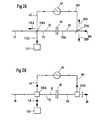
- the splitter 20 and the first direction controller 50 of Figure 1 are embodied as a first beamsplitter 250A.
- the second direction controller 70 is embodied as a second beamsplitter 270A.
- the optical signal 10 is split by the first beamsplitter 250A into the second optical signal 30 and the first optical signal 40.
- the returning filtered modulated first optical signal 110 is split by the first beam splitter 250A into the beam 110A directed towards the photodetector 120 but also into a portion 110B propagating into the direction of the source of the optical signal 10.
- the second beamsplitter 270A splits the modulated first optical signal 100 into the beam 100A directed towards the first filter 60 and a beam 100B.
- the filtered second optical signal 80 is split by the second beamsplitter 270A into the beams 80A and 80B, with beam 80B propagating towards the modulation unit 90 with opposite propagation direction than the beam 100.
- the beamsplitter 250A and 270A are replaced by polarization dependent beamsplitters 250B and 270B in order to clearly separate the modulated and the unmodulated optical signals.
- the polarization of the incoming optical signal 10 is adjusted with respect to the s (indicated as a point e.g. for the first beam 40) and p (indicated as an arrow e.g. for the output beam 80) polarization orientation of the beamsplitter 250A that the desired fraction ratio between the intensities of the signals 30 and 40 is obtained.
- Beamsplitter 270A can now be oriented to couple a desired fraction of signal 100 back into the first filter 60, respectively a desired fraction of signal 80 into the output.
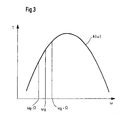
- Fig. 3 shows a schematic first filter curve represented by the function A ( ⁇ ), where T is the transmission and ⁇ is a frequency in the optical range.
- the detector response is calculated for frequency modulated light, which is modulated with a frequency ⁇ and a modulation amplitude ⁇ m .
- the function A ( ⁇ ) then exhibits a time dependency and can be expanded in a Taylor series, which can be truncated after the first order for small modulation amplitudes ⁇ m :
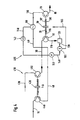
- Fig. 4 illustrates a second embodiment of the present invention. Whereas Figs. 1-2 derive the first optical signal 40 from the initial signal 10, the first optical signal 40 in the embodiment of Fig. 4 is independent from the initial signal 10. In any case, the first optical signal 40 represents the optical signal to adjust the characteristic of the first filter 60 to. Circuit 400 as the right part of Fig. 4 therefore substantially corresponds with Fig. 1, however already starting with the first and second optical signals 40 and 30.
- the circuit 400 also works in accordance with Fig. 1, so that the characteristic of first filter 60 will be adjusted to the first optical signal 40 (i.e. the characteristic of the first filter 60 matches with the first optical signal 40) as illustrated above.
- Circuit 410 - as the left part of Fig. 4 - illustrates a specific example for generating the first and second optical signals 40 and 30 to be applied then to the right part of Fig. 4, as explained above.
- a preset filter 420 is preset to a desired wavelength ⁇ D .
- the optical input signal 10 is filtered according to the filter characteristics of the preset filter 420.
- the reverse path through the preset filter 420 is illuminated by a beam 430, preferably provided by an optical broadband source.
- the filtered beam 430 represents the first optical signal 40 and exhibits the characteristics of the preset filter 420.
- Direction controllers 440 and 450 can be applied as explained above.
- the first optical signal 40 is now frequency modulated and can be fed through the reverse path of the first filter 60.
- the detection scheme then just follows the procedure already discussed above.
- first filter 60 will 'automatically' follow the wavelength setting ⁇ D of the preset filter 420.
- This setup of Fig. 4 allows e.g. for setting up an optical spectrum analyzer, where the unwanted transverse modes of optical filters can be strongly suppressed, if the filter characteristics of the two optical filters 420 and 60 are chosen to have a different transverse mode spectrum.
- the optical input signal 10 represents the signal to by analyzed.
- the beam 430 is provided by an optical broadband source in order to ensure that the first optical signal 40 with wavelength setting ⁇ D will be present (even if the optical input signal 10 does not contain that setting ⁇ D ).
Landscapes
- Physics & Mathematics (AREA)
- Condensed Matter Physics & Semiconductors (AREA)
- General Physics & Mathematics (AREA)
- Electromagnetism (AREA)
- Optics & Photonics (AREA)
- Optical Communication System (AREA)
- Mechanical Light Control Or Optical Switches (AREA)
Priority Applications (4)
| Application Number | Priority Date | Filing Date | Title |
|---|---|---|---|
| EP01123930A EP1253687B1 (en) | 2001-10-06 | 2001-10-06 | Self-adjustable tunable filter |
| DE60100503T DE60100503T2 (de) | 2001-10-06 | 2001-10-06 | Selbstjustierender verstimmbarer Filter |
| US10/225,038 US7136590B2 (en) | 2001-10-06 | 2002-08-21 | Self-adjustable tunable filter |
| JP2002292342A JP2003156695A (ja) | 2001-10-06 | 2002-10-04 | フィルタを自動調整させるためのシステム |
Applications Claiming Priority (1)
| Application Number | Priority Date | Filing Date | Title |
|---|---|---|---|
| EP01123930A EP1253687B1 (en) | 2001-10-06 | 2001-10-06 | Self-adjustable tunable filter |
Publications (2)
| Publication Number | Publication Date |
|---|---|
| EP1253687A1 EP1253687A1 (en) | 2002-10-30 |
| EP1253687B1 true EP1253687B1 (en) | 2003-07-23 |
Family
ID=8178872
Family Applications (1)
| Application Number | Title | Priority Date | Filing Date |
|---|---|---|---|
| EP01123930A Expired - Lifetime EP1253687B1 (en) | 2001-10-06 | 2001-10-06 | Self-adjustable tunable filter |
Country Status (4)
| Country | Link |
|---|---|
| US (1) | US7136590B2 (https=) |
| EP (1) | EP1253687B1 (https=) |
| JP (1) | JP2003156695A (https=) |
| DE (1) | DE60100503T2 (https=) |
Family Cites Families (6)
| Publication number | Priority date | Publication date | Assignee | Title |
|---|---|---|---|---|
| US5285059A (en) * | 1990-10-31 | 1994-02-08 | Canon Kabushiki Kaisha | Method for controlling a tunable filter and an apparatus therefor |
| JP3256713B2 (ja) * | 1992-06-27 | 2002-02-12 | キヤノン株式会社 | 波長可変フィルタ制御方式、制御装置及びそれを用いた光通信システム |
| GB9615302D0 (en) * | 1996-07-20 | 1996-09-04 | Northern Telecom Ltd | Etalon arrangement |
| US5982791A (en) * | 1998-01-14 | 1999-11-09 | Hewlett-Packard Company | Wavelength tracking in adjustable optical systems |
| NO313606B1 (no) * | 1999-11-09 | 2002-10-28 | Optoplan As | Bolgelengdekontrollert FBG-filter |
| US6674936B2 (en) * | 2001-08-31 | 2004-01-06 | International Business Machines Corporation | Polarization mode dispersion compensation using a wavelength locked loop |
-
2001
- 2001-10-06 EP EP01123930A patent/EP1253687B1/en not_active Expired - Lifetime
- 2001-10-06 DE DE60100503T patent/DE60100503T2/de not_active Expired - Fee Related
-
2002
- 2002-08-21 US US10/225,038 patent/US7136590B2/en not_active Expired - Fee Related
- 2002-10-04 JP JP2002292342A patent/JP2003156695A/ja active Pending
Also Published As
| Publication number | Publication date |
|---|---|
| DE60100503D1 (de) | 2003-08-28 |
| US7136590B2 (en) | 2006-11-14 |
| US20030067663A1 (en) | 2003-04-10 |
| EP1253687A1 (en) | 2002-10-30 |
| DE60100503T2 (de) | 2004-06-09 |
| JP2003156695A (ja) | 2003-05-30 |
Similar Documents
| Publication | Publication Date | Title |
|---|---|---|
| US7027743B1 (en) | System and method for optical heterodyne detection of an optical signal including optical pre-selection that is adjusted to accurately track a local oscillator signal | |
| US6735395B1 (en) | WDM communication system utilizing WDM optical sources with stabilized wavelengths and light intensity and method for stabilization thereof | |
| EP0235919B1 (en) | Frequency locking radiation beams | |
| JPH10190106A (ja) | レーザ周波数制御システム、レーザ周波数制御方法、信号処理システム、および信号処理方法 | |
| JP2005124192A (ja) | 波長可変デバイスの動作特性を局部発振器信号の波長と同期化するための方法及びシステム | |
| US20020088920A1 (en) | Method and apparatus for controlling optical wavelength based on optical frequency pulling | |
| US5544183A (en) | Variable wavelength light source | |
| JPH079386B2 (ja) | 光ファイバ分散特性測定方式 | |
| US20030002141A1 (en) | Semiconductor optical amplifiers using wavelength locked loop tuning and equalization | |
| US7062166B2 (en) | First and second derivative processing of wavelength multiplexed optical signals | |
| JP3231545B2 (ja) | 光周波数安定化装置 | |
| US5383210A (en) | Optical phase locked loop circuit | |
| JP2003121302A (ja) | 偏波モード分散測定装置、方法、記録媒体 | |
| US6724786B2 (en) | Variable optical attenuator using wavelength locked loop tuning | |
| EP1253687B1 (en) | Self-adjustable tunable filter | |
| US7068944B2 (en) | Multi-function optical performance monitor | |
| JP2001066250A (ja) | ガス検出装置 | |
| JPH10322284A (ja) | Fm変調装置 | |
| JPH10209973A (ja) | 光波長多重送信回路 | |
| JP2004037608A (ja) | 光クロック逓倍装置及び方法 | |
| JPH0653590A (ja) | 光fsk周波数変位量安定化方式 | |
| JPH1090740A (ja) | 光周波数掃引装置 | |
| JPH10173605A (ja) | 周波数変復調装置 | |
| JPS62219586A (ja) | レ−ザ波長安定化方法 | |
| JPH07260624A (ja) | 光パルス試験器 |
Legal Events
| Date | Code | Title | Description |
|---|---|---|---|
| PUAI | Public reference made under article 153(3) epc to a published international application that has entered the european phase |
Free format text: ORIGINAL CODE: 0009012 |
|
| AK | Designated contracting states |
Kind code of ref document: A1 Designated state(s): AT BE CH CY DE DK ES FI FR GB GR IE IT LI LU MC NL PT SE TR |
|
| AX | Request for extension of the european patent |
Free format text: AL;LT;LV;MK;RO;SI |
|
| 17P | Request for examination filed |
Effective date: 20020824 |
|
| GRAH | Despatch of communication of intention to grant a patent |
Free format text: ORIGINAL CODE: EPIDOS IGRA |
|
| GRAH | Despatch of communication of intention to grant a patent |
Free format text: ORIGINAL CODE: EPIDOS IGRA |
|
| GRAA | (expected) grant |
Free format text: ORIGINAL CODE: 0009210 |
|
| AK | Designated contracting states |
Designated state(s): DE FR GB |
|
| AKX | Designation fees paid |
Designated state(s): DE FR GB |
|
| REG | Reference to a national code |
Ref country code: GB Ref legal event code: FG4D |
|
| REG | Reference to a national code |
Ref country code: IE Ref legal event code: FG4D |
|
| REF | Corresponds to: |
Ref document number: 60100503 Country of ref document: DE Date of ref document: 20030828 Kind code of ref document: P |
|
| ET | Fr: translation filed | ||
| PLBE | No opposition filed within time limit |
Free format text: ORIGINAL CODE: 0009261 |
|
| STAA | Information on the status of an ep patent application or granted ep patent |
Free format text: STATUS: NO OPPOSITION FILED WITHIN TIME LIMIT |
|
| 26N | No opposition filed |
Effective date: 20040426 |
|
| REG | Reference to a national code |
Ref country code: IE Ref legal event code: MM4A |
|
| PGFP | Annual fee paid to national office [announced via postgrant information from national office to epo] |
Ref country code: GB Payment date: 20061025 Year of fee payment: 6 |
|
| PGFP | Annual fee paid to national office [announced via postgrant information from national office to epo] |
Ref country code: DE Payment date: 20071130 Year of fee payment: 7 |
|
| GBPC | Gb: european patent ceased through non-payment of renewal fee |
Effective date: 20071006 |
|
| REG | Reference to a national code |
Ref country code: FR Ref legal event code: ST Effective date: 20080630 |
|
| PGFP | Annual fee paid to national office [announced via postgrant information from national office to epo] |
Ref country code: FR Payment date: 20061017 Year of fee payment: 6 |
|
| PG25 | Lapsed in a contracting state [announced via postgrant information from national office to epo] |
Ref country code: GB Free format text: LAPSE BECAUSE OF NON-PAYMENT OF DUE FEES Effective date: 20071006 |
|
| PG25 | Lapsed in a contracting state [announced via postgrant information from national office to epo] |
Ref country code: FR Free format text: LAPSE BECAUSE OF NON-PAYMENT OF DUE FEES Effective date: 20071031 |
|
| PG25 | Lapsed in a contracting state [announced via postgrant information from national office to epo] |
Ref country code: DE Free format text: LAPSE BECAUSE OF NON-PAYMENT OF DUE FEES Effective date: 20090501 |