EP1251135A2 - High activity ruthenium or osmium metal carbene complexes for olefin metathesis reactions and synthesis thereof - Google Patents
High activity ruthenium or osmium metal carbene complexes for olefin metathesis reactions and synthesis thereof Download PDFInfo
- Publication number
- EP1251135A2 EP1251135A2 EP02016470A EP02016470A EP1251135A2 EP 1251135 A2 EP1251135 A2 EP 1251135A2 EP 02016470 A EP02016470 A EP 02016470A EP 02016470 A EP02016470 A EP 02016470A EP 1251135 A2 EP1251135 A2 EP 1251135A2
- Authority
- EP
- European Patent Office
- Prior art keywords
- alkyl
- alkoxy
- aryl
- halogen
- phenyl
- Prior art date
- Legal status (The legal status is an assumption and is not a legal conclusion. Google has not performed a legal analysis and makes no representation as to the accuracy of the status listed.)
- Withdrawn
Links
Classifications
-
- B—PERFORMING OPERATIONS; TRANSPORTING
- B01—PHYSICAL OR CHEMICAL PROCESSES OR APPARATUS IN GENERAL
- B01J—CHEMICAL OR PHYSICAL PROCESSES, e.g. CATALYSIS OR COLLOID CHEMISTRY; THEIR RELEVANT APPARATUS
- B01J31/00—Catalysts comprising hydrides, coordination complexes or organic compounds
- B01J31/16—Catalysts comprising hydrides, coordination complexes or organic compounds containing coordination complexes
- B01J31/22—Organic complexes
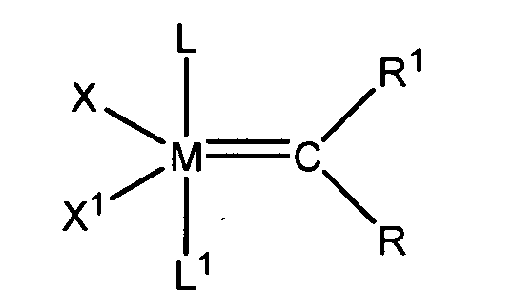
- B01J31/2265—Carbenes or carbynes, i.e.(image)
-
- B—PERFORMING OPERATIONS; TRANSPORTING
- B01—PHYSICAL OR CHEMICAL PROCESSES OR APPARATUS IN GENERAL
- B01J—CHEMICAL OR PHYSICAL PROCESSES, e.g. CATALYSIS OR COLLOID CHEMISTRY; THEIR RELEVANT APPARATUS
- B01J31/00—Catalysts comprising hydrides, coordination complexes or organic compounds
- B01J31/16—Catalysts comprising hydrides, coordination complexes or organic compounds containing coordination complexes
- B01J31/24—Phosphines, i.e. phosphorus bonded to only carbon atoms, or to both carbon and hydrogen atoms, including e.g. sp2-hybridised phosphorus compounds such as phosphabenzene, phosphole or anionic phospholide ligands
-
- B—PERFORMING OPERATIONS; TRANSPORTING
- B01—PHYSICAL OR CHEMICAL PROCESSES OR APPARATUS IN GENERAL
- B01J—CHEMICAL OR PHYSICAL PROCESSES, e.g. CATALYSIS OR COLLOID CHEMISTRY; THEIR RELEVANT APPARATUS
- B01J31/00—Catalysts comprising hydrides, coordination complexes or organic compounds
- B01J31/16—Catalysts comprising hydrides, coordination complexes or organic compounds containing coordination complexes
- B01J31/24—Phosphines, i.e. phosphorus bonded to only carbon atoms, or to both carbon and hydrogen atoms, including e.g. sp2-hybridised phosphorus compounds such as phosphabenzene, phosphole or anionic phospholide ligands
- B01J31/2404—Cyclic ligands, including e.g. non-condensed polycyclic ligands, the phosphine-P atom being a ring member or a substituent on the ring
-
- C—CHEMISTRY; METALLURGY
- C07—ORGANIC CHEMISTRY
- C07C—ACYCLIC OR CARBOCYCLIC COMPOUNDS
- C07C51/00—Preparation of carboxylic acids or their salts, halides or anhydrides
- C07C51/347—Preparation of carboxylic acids or their salts, halides or anhydrides by reactions not involving formation of carboxyl groups
- C07C51/353—Preparation of carboxylic acids or their salts, halides or anhydrides by reactions not involving formation of carboxyl groups by isomerisation; by change of size of the carbon skeleton
-
- C—CHEMISTRY; METALLURGY
- C07—ORGANIC CHEMISTRY
- C07C—ACYCLIC OR CARBOCYCLIC COMPOUNDS
- C07C67/00—Preparation of carboxylic acid esters
- C07C67/30—Preparation of carboxylic acid esters by modifying the acid moiety of the ester, such modification not being an introduction of an ester group
- C07C67/333—Preparation of carboxylic acid esters by modifying the acid moiety of the ester, such modification not being an introduction of an ester group by isomerisation; by change of size of the carbon skeleton
-
- C—CHEMISTRY; METALLURGY
- C07—ORGANIC CHEMISTRY
- C07C—ACYCLIC OR CARBOCYCLIC COMPOUNDS
- C07C67/00—Preparation of carboxylic acid esters
- C07C67/475—Preparation of carboxylic acid esters by splitting of carbon-to-carbon bonds and redistribution, e.g. disproportionation or migration of groups between different molecules
-
- C—CHEMISTRY; METALLURGY
- C07—ORGANIC CHEMISTRY
- C07F—ACYCLIC, CARBOCYCLIC OR HETEROCYCLIC COMPOUNDS CONTAINING ELEMENTS OTHER THAN CARBON, HYDROGEN, HALOGEN, OXYGEN, NITROGEN, SULFUR, SELENIUM OR TELLURIUM
- C07F15/00—Compounds containing elements of Groups 8, 9, 10 or 18 of the Periodic Table
- C07F15/0006—Compounds containing elements of Groups 8, 9, 10 or 18 of the Periodic Table compounds of the platinum group
- C07F15/002—Osmium compounds
-
- C—CHEMISTRY; METALLURGY
- C07—ORGANIC CHEMISTRY
- C07F—ACYCLIC, CARBOCYCLIC OR HETEROCYCLIC COMPOUNDS CONTAINING ELEMENTS OTHER THAN CARBON, HYDROGEN, HALOGEN, OXYGEN, NITROGEN, SULFUR, SELENIUM OR TELLURIUM
- C07F15/00—Compounds containing elements of Groups 8, 9, 10 or 18 of the Periodic Table
- C07F15/0006—Compounds containing elements of Groups 8, 9, 10 or 18 of the Periodic Table compounds of the platinum group
- C07F15/0046—Ruthenium compounds
-
- C—CHEMISTRY; METALLURGY
- C08—ORGANIC MACROMOLECULAR COMPOUNDS; THEIR PREPARATION OR CHEMICAL WORKING-UP; COMPOSITIONS BASED THEREON
- C08C—TREATMENT OR CHEMICAL MODIFICATION OF RUBBERS
- C08C19/00—Chemical modification of rubber
- C08C19/08—Depolymerisation
-
- C—CHEMISTRY; METALLURGY
- C08—ORGANIC MACROMOLECULAR COMPOUNDS; THEIR PREPARATION OR CHEMICAL WORKING-UP; COMPOSITIONS BASED THEREON
- C08F—MACROMOLECULAR COMPOUNDS OBTAINED BY REACTIONS ONLY INVOLVING CARBON-TO-CARBON UNSATURATED BONDS
- C08F10/00—Homopolymers and copolymers of unsaturated aliphatic hydrocarbons having only one carbon-to-carbon double bond
-
- C—CHEMISTRY; METALLURGY
- C08—ORGANIC MACROMOLECULAR COMPOUNDS; THEIR PREPARATION OR CHEMICAL WORKING-UP; COMPOSITIONS BASED THEREON
- C08F—MACROMOLECULAR COMPOUNDS OBTAINED BY REACTIONS ONLY INVOLVING CARBON-TO-CARBON UNSATURATED BONDS
- C08F32/00—Homopolymers and copolymers of cyclic compounds having no unsaturated aliphatic radicals in a side chain, and having one or more carbon-to-carbon double bonds in a carbocyclic ring system
-
- C—CHEMISTRY; METALLURGY
- C08—ORGANIC MACROMOLECULAR COMPOUNDS; THEIR PREPARATION OR CHEMICAL WORKING-UP; COMPOSITIONS BASED THEREON
- C08F—MACROMOLECULAR COMPOUNDS OBTAINED BY REACTIONS ONLY INVOLVING CARBON-TO-CARBON UNSATURATED BONDS
- C08F8/00—Chemical modification by after-treatment
- C08F8/50—Partial depolymerisation
-
- C—CHEMISTRY; METALLURGY
- C08—ORGANIC MACROMOLECULAR COMPOUNDS; THEIR PREPARATION OR CHEMICAL WORKING-UP; COMPOSITIONS BASED THEREON
- C08G—MACROMOLECULAR COMPOUNDS OBTAINED OTHERWISE THAN BY REACTIONS ONLY INVOLVING UNSATURATED CARBON-TO-CARBON BONDS
- C08G61/00—Macromolecular compounds obtained by reactions forming a carbon-to-carbon link in the main chain of the macromolecule
- C08G61/02—Macromolecular compounds containing only carbon atoms in the main chain of the macromolecule, e.g. polyxylylenes
- C08G61/04—Macromolecular compounds containing only carbon atoms in the main chain of the macromolecule, e.g. polyxylylenes only aliphatic carbon atoms
- C08G61/06—Macromolecular compounds containing only carbon atoms in the main chain of the macromolecule, e.g. polyxylylenes only aliphatic carbon atoms prepared by ring-opening of carbocyclic compounds
- C08G61/08—Macromolecular compounds containing only carbon atoms in the main chain of the macromolecule, e.g. polyxylylenes only aliphatic carbon atoms prepared by ring-opening of carbocyclic compounds of carbocyclic compounds containing one or more carbon-to-carbon double bonds in the ring
-
- C—CHEMISTRY; METALLURGY
- C08—ORGANIC MACROMOLECULAR COMPOUNDS; THEIR PREPARATION OR CHEMICAL WORKING-UP; COMPOSITIONS BASED THEREON
- C08G—MACROMOLECULAR COMPOUNDS OBTAINED OTHERWISE THAN BY REACTIONS ONLY INVOLVING UNSATURATED CARBON-TO-CARBON BONDS
- C08G61/00—Macromolecular compounds obtained by reactions forming a carbon-to-carbon link in the main chain of the macromolecule
- C08G61/12—Macromolecular compounds containing atoms other than carbon in the main chain of the macromolecule
-
- B—PERFORMING OPERATIONS; TRANSPORTING
- B01—PHYSICAL OR CHEMICAL PROCESSES OR APPARATUS IN GENERAL
- B01J—CHEMICAL OR PHYSICAL PROCESSES, e.g. CATALYSIS OR COLLOID CHEMISTRY; THEIR RELEVANT APPARATUS
- B01J2231/00—Catalytic reactions performed with catalysts classified in B01J31/00
- B01J2231/10—Polymerisation reactions involving at least dual use catalysts, e.g. for both oligomerisation and polymerisation
- B01J2231/14—Other (co) polymerisation, e.g. of lactides or epoxides
-
- B—PERFORMING OPERATIONS; TRANSPORTING
- B01—PHYSICAL OR CHEMICAL PROCESSES OR APPARATUS IN GENERAL
- B01J—CHEMICAL OR PHYSICAL PROCESSES, e.g. CATALYSIS OR COLLOID CHEMISTRY; THEIR RELEVANT APPARATUS
- B01J2231/00—Catalytic reactions performed with catalysts classified in B01J31/00
- B01J2231/50—Redistribution or isomerisation reactions of C-C, C=C or C-C triple bonds
- B01J2231/54—Metathesis reactions, e.g. olefin metathesis
- B01J2231/543—Metathesis reactions, e.g. olefin metathesis alkene metathesis
-
- B—PERFORMING OPERATIONS; TRANSPORTING
- B01—PHYSICAL OR CHEMICAL PROCESSES OR APPARATUS IN GENERAL
- B01J—CHEMICAL OR PHYSICAL PROCESSES, e.g. CATALYSIS OR COLLOID CHEMISTRY; THEIR RELEVANT APPARATUS
- B01J23/00—Catalysts comprising metals or metal oxides or hydroxides, not provided for in group B01J21/00
- B01J23/38—Catalysts comprising metals or metal oxides or hydroxides, not provided for in group B01J21/00 of noble metals
- B01J23/40—Catalysts comprising metals or metal oxides or hydroxides, not provided for in group B01J21/00 of noble metals of the platinum group metals
- B01J23/46—Ruthenium, rhodium, osmium or iridium
- B01J23/462—Ruthenium
-
- B—PERFORMING OPERATIONS; TRANSPORTING
- B01—PHYSICAL OR CHEMICAL PROCESSES OR APPARATUS IN GENERAL
- B01J—CHEMICAL OR PHYSICAL PROCESSES, e.g. CATALYSIS OR COLLOID CHEMISTRY; THEIR RELEVANT APPARATUS
- B01J23/00—Catalysts comprising metals or metal oxides or hydroxides, not provided for in group B01J21/00
- B01J23/38—Catalysts comprising metals or metal oxides or hydroxides, not provided for in group B01J21/00 of noble metals
- B01J23/40—Catalysts comprising metals or metal oxides or hydroxides, not provided for in group B01J21/00 of noble metals of the platinum group metals
- B01J23/46—Ruthenium, rhodium, osmium or iridium
- B01J23/466—Osmium
-
- B—PERFORMING OPERATIONS; TRANSPORTING
- B01—PHYSICAL OR CHEMICAL PROCESSES OR APPARATUS IN GENERAL
- B01J—CHEMICAL OR PHYSICAL PROCESSES, e.g. CATALYSIS OR COLLOID CHEMISTRY; THEIR RELEVANT APPARATUS
- B01J2531/00—Additional information regarding catalytic systems classified in B01J31/00
- B01J2531/80—Complexes comprising metals of Group VIII as the central metal
- B01J2531/82—Metals of the platinum group
- B01J2531/821—Ruthenium
-
- B—PERFORMING OPERATIONS; TRANSPORTING
- B01—PHYSICAL OR CHEMICAL PROCESSES OR APPARATUS IN GENERAL
- B01J—CHEMICAL OR PHYSICAL PROCESSES, e.g. CATALYSIS OR COLLOID CHEMISTRY; THEIR RELEVANT APPARATUS
- B01J2531/00—Additional information regarding catalytic systems classified in B01J31/00
- B01J2531/80—Complexes comprising metals of Group VIII as the central metal
- B01J2531/82—Metals of the platinum group
- B01J2531/825—Osmium
-
- C—CHEMISTRY; METALLURGY
- C07—ORGANIC CHEMISTRY
- C07C—ACYCLIC OR CARBOCYCLIC COMPOUNDS
- C07C2601/00—Systems containing only non-condensed rings
- C07C2601/06—Systems containing only non-condensed rings with a five-membered ring
- C07C2601/10—Systems containing only non-condensed rings with a five-membered ring the ring being unsaturated
-
- C—CHEMISTRY; METALLURGY
- C08—ORGANIC MACROMOLECULAR COMPOUNDS; THEIR PREPARATION OR CHEMICAL WORKING-UP; COMPOSITIONS BASED THEREON
- C08C—TREATMENT OR CHEMICAL MODIFICATION OF RUBBERS
- C08C19/00—Chemical modification of rubber
-
- C—CHEMISTRY; METALLURGY
- C08—ORGANIC MACROMOLECULAR COMPOUNDS; THEIR PREPARATION OR CHEMICAL WORKING-UP; COMPOSITIONS BASED THEREON
- C08F—MACROMOLECULAR COMPOUNDS OBTAINED BY REACTIONS ONLY INVOLVING CARBON-TO-CARBON UNSATURATED BONDS
- C08F210/00—Copolymers of unsaturated aliphatic hydrocarbons having only one carbon-to-carbon double bond
- C08F210/02—Ethene
-
- C—CHEMISTRY; METALLURGY
- C08—ORGANIC MACROMOLECULAR COMPOUNDS; THEIR PREPARATION OR CHEMICAL WORKING-UP; COMPOSITIONS BASED THEREON
- C08G—MACROMOLECULAR COMPOUNDS OBTAINED OTHERWISE THAN BY REACTIONS ONLY INVOLVING UNSATURATED CARBON-TO-CARBON BONDS
- C08G2261/00—Macromolecular compounds obtained by reactions forming a carbon-to-carbon link in the main chain of the macromolecule
- C08G2261/10—Definition of the polymer structure
- C08G2261/16—End groups
- C08G2261/164—End groups comprising organic end groups
- C08G2261/1642—End groups comprising organic end groups comprising reactive double bonds or triple bonds
-
- C—CHEMISTRY; METALLURGY
- C08—ORGANIC MACROMOLECULAR COMPOUNDS; THEIR PREPARATION OR CHEMICAL WORKING-UP; COMPOSITIONS BASED THEREON
- C08G—MACROMOLECULAR COMPOUNDS OBTAINED OTHERWISE THAN BY REACTIONS ONLY INVOLVING UNSATURATED CARBON-TO-CARBON BONDS
- C08G2261/00—Macromolecular compounds obtained by reactions forming a carbon-to-carbon link in the main chain of the macromolecule
- C08G2261/10—Definition of the polymer structure
- C08G2261/16—End groups
- C08G2261/164—End groups comprising organic end groups
- C08G2261/1644—End groups comprising organic end groups comprising other functional groups, e.g. OH groups, NH groups, COOH groups or boronic acid
-
- C—CHEMISTRY; METALLURGY
- C08—ORGANIC MACROMOLECULAR COMPOUNDS; THEIR PREPARATION OR CHEMICAL WORKING-UP; COMPOSITIONS BASED THEREON
- C08G—MACROMOLECULAR COMPOUNDS OBTAINED OTHERWISE THAN BY REACTIONS ONLY INVOLVING UNSATURATED CARBON-TO-CARBON BONDS
- C08G2261/00—Macromolecular compounds obtained by reactions forming a carbon-to-carbon link in the main chain of the macromolecule
- C08G2261/70—Post-treatment
- C08G2261/72—Derivatisation
-
- C—CHEMISTRY; METALLURGY
- C08—ORGANIC MACROMOLECULAR COMPOUNDS; THEIR PREPARATION OR CHEMICAL WORKING-UP; COMPOSITIONS BASED THEREON
- C08G—MACROMOLECULAR COMPOUNDS OBTAINED OTHERWISE THAN BY REACTIONS ONLY INVOLVING UNSATURATED CARBON-TO-CARBON BONDS
- C08G2261/00—Macromolecular compounds obtained by reactions forming a carbon-to-carbon link in the main chain of the macromolecule
- C08G2261/70—Post-treatment
- C08G2261/73—Depolymerisation
-
- Y—GENERAL TAGGING OF NEW TECHNOLOGICAL DEVELOPMENTS; GENERAL TAGGING OF CROSS-SECTIONAL TECHNOLOGIES SPANNING OVER SEVERAL SECTIONS OF THE IPC; TECHNICAL SUBJECTS COVERED BY FORMER USPC CROSS-REFERENCE ART COLLECTIONS [XRACs] AND DIGESTS
- Y10—TECHNICAL SUBJECTS COVERED BY FORMER USPC
- Y10S—TECHNICAL SUBJECTS COVERED BY FORMER USPC CROSS-REFERENCE ART COLLECTIONS [XRACs] AND DIGESTS
- Y10S525/00—Synthetic resins or natural rubbers -- part of the class 520 series
- Y10S525/938—Polymer degradation
Definitions
- This invention relates to highly active and stable ruthenium or osmium metal carbene complex compounds, synthesis methods thereof and their use as catalysts in olefin metathesis reactions.
- the present invention relates to ruthenium or osmium carbene compounds which are stable in the presence of a variety of functional groups and which can be used to catalyze olefin metathesis reactions on unstrained cyclic and acyclic olefins.
- the present invention relates to carbene compounds of the formula wherein:
- the hydrocarbon is selected from the group consisting of C 1 -C 5 alkyl, halogen, C 1 -C 5 alkoxy and a phenyl group.
- the hydrocarbon also may be substituted with a C 1 -C 5 alkyl halogen, C 1 -C 5 alkoxy, or a phenyl group.
- the phenyl group is optionally substituted with halogen, C 1 -C 5 alkyl or C 1 -C 5 alkoxy.
- all of the alkyl groups of the trialkyl phosphine are either a secondary alkyl or a cycloalkyl.
- the alkyl groups are either isopropyl, isobutyl, sec-butyl, neopentyl, neophenyl, cyclopentyl or cyclohexyl.
- L and L 1 ligands are alkyl phosphines where the carbon backbone of at least one alkyl group of the alkyl phosphine is a secondary alkyl or cycloalkyl have been found to possess higher metathesis activity, enabling these compounds to coordinate to and catalyze metathesis reactions between all types of olefins.
- previous metathesis catalysts were only able to catalyze metathesis reactions involving highly strained olefins.
- a broad array of metathesis reactions are enabled using the carbene compounds of the present invention that cannot be performed using less reactive catalysts.
- the present invention also relates to the synthesis of ruthenium or osmium carbene compounds which can be used to catalyze olefin metathesis reactions.
- carbene compounds of the present invention are the only Ru and Os carbene complexes known to date in which the metal is formally in the +2 oxidation state, have an electron count of 16, and are pentacoordinate. Unlike most metathesis catalysts presently known which are poisoned by functional groups, the carbene compounds of the present invention are stable in the presence of alcohol, thiol, ketone, aldehyde, ester, ether, amine, amide, nitro acid, carboxylic acid, disulfide, carbonate, carboalkoxy and halogen functional groups and may therefore be used in protic or aqueous solvent systems.
- the carbene compounds can be in the form wherein 2, 3 or 4 of the moieties X, X 1 , L, and L 1 can be taken together to form a chelating multidentate ligand.
- X, L, and L 1 can be taken together to form a cyclopentadienyl, indenyl, or fluorenyl moiety.
- the ruthenium or osmium carbene compounds may be prepared by reacting a compound of the formula (XX 1 ML n L 1 m ) p , in the presence of solvent, with a cyclopropene of the formula wherein:
- the hydrocarbon is substituted with C 1 -C 5 alkyl, halogen, C 1 -C 5 alkoxy or with a phenyl group.
- the phenyl group is substituted with halogen, C 1 -C 5 alkyl or C 1 -C 5 alkoxy.
- X, L, and L 1 are taken together to form a moiety selected from the group consisting of cyclopentadienyl, indenyl or fluorenyl, each optionally substituted with hydrogen; C 2 -C 20 alkenyl, C 2 -C 20 alkynyl, C 1 -C 20 alkyl, aryl, C 1 -C 20 carboxylate, C 1 -C 20 alkoxy, C 2 -C 20 alkenyloxy, C 2 -C 20 alkynyloxy, aryloxy, C 2 -C 20 alkoxycarbonyl, C 1 -C 20 alkylthio, C 1 -C 20 alkylsulfonyl, C 1 -C 20 alkylsulfinyl; each optionally substituted with C 1 -C 5 alkyl, halogen, C 1 -C 5 alkoxy or with a phenyl group optionally substituted with halogen, C 1 -
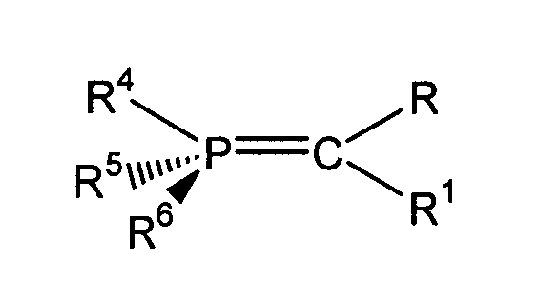
- a further method of preparing the compounds of this invention comprises reacting compound of the formula (XX 1 ML n L 1 m ) p in the presence of solvent with a phosphorane of the formula wherein:
- the present invention also pertains to a preferred method of preparing the aforementioned ruthenium and osmium compounds comprising reacting [(Ar) MX X 1 ] 2 dimer complex with two equivalents of a phosphine ligand and a cyclopropene of the formula in a one step synthesis wherein:
- Another embodiment of the present invention comprises preparing compounds of Formula II and Formula III from compound of Formula I comprising reacting said compound of Formula I, in the presence of solvent, with compound of the formula M 1 Y wherein:
- Another embodiment of the present invention is a method of preparing compounds of structures of Formula IV and Formula V from a compound of Formula I comprising reacting a compound of Formula I, in the presence of solvent, with L 2 wherein:
- the compounds of Formulae II, III, IV, and V are species of, i.e., fall within, the scope of compounds of Formula I.
- certain compounds of Formula I are used to form other compounds of Formula I by ligand exchange.
- X and X 1 in Formula I are other than the Y in Formulae II and III that replaces X.
- L and L 1 in Formula I are other than the L 2 in Formulae IV and V. If any 2 or 3 of X, X 1 , L, and L 1 form a multidentate ligand of Formula I, only the remaining ligand moieties would be available for ligand replacement.
- the present invention also relates to metathesis coupling of olefins catalyzed by the carbene compounds of the present invention.
- the high level metathesis activity of the ruthenium and osmium carbene compounds of the present invention enable these compounds to coordinate with and catalyze metathesis reactions between all types of olefins.
- previous non-carbene ruthenium and osmium metathesis catalysts are only able to catalyze metathesis reactions involving highly strained olefins.
- a broad array of metathesis reactions are enabled using the carbene compounds of the present invention that cannot be performed using less reactive catalysts.
- metathesis olefin coupling reactions enabled by the ruthenium and osmium carbene compounds of the present invention include, but are not limited to, ring-opening metathesis polymerization of strained and unstrained cyclic olefins, ring closing metathesis of acyclic dienes, cross metathesis reactions involving at least one acyclic or unstrained cyclic olefin and depolymerization of olefinic polymers.
- the present invention relates to new highly active and stable ruthenium or osmium carbene compounds which can be used to catalyze olefin metathesis reactions.
- the present invention relates to carbene compounds of the formula wherein:
- all of the alkyl groups of the trialkyl phosphine are either a secondary alkyl or a cycloalkyl.
- the alkyl groups are either isopropyl, isobutyl, sec-butyl, neopentyl, neophenyl, cyclopentyl or cyclohexyl.
- L and L 1 are alkyl phosphines where the carbon backbone of at least one alkyl group of the alkyl phosphine is a secondary alkyl or cycloalkyl. Substitution of the secondary alkyl and cycloalkyl with additional carbon moieties and/or other functional groups are intended to be included with the terms secondary alkyl and cycloalkyl.
- the ruthenium or osmium carbene complexes of the invention are useful for catalyzing olefin metathesis reactions.
- the propagating carbene moiety has been found to be stable and continues to polymerize additional aliquots of monomer for a period after the original amount of monomer has been consumed.
- the propagating carbene moiety has also been found to be stable in the presence of alcohol, thiol, ketone, aldehyde, ester, ether, amine, amide, nitro acid, carboxylic acid, disulfide, carbonate, carboalkoxy and halogen functional groups.
- aspects of this invention include the metal carbene compounds, methods for their synthesis, as well as their use as catalysts in a wide variety of olefin metathesis reactions.
- the intermediate compounds (XX 1 ML n L 1 m ) p are either available commercially or can be prepared by standard known methods.
- the phosphorane and cyclopropene reactants used in the present invention may be prepared in accordance with the following respective references. Schmidbaur, H., et al., Phosphorus and Sulfur , Vol. 18, pp. 167-170 (1983); Carter, F.L., Frampton, V.L., Chemical Reviews, Vol. 64, No. 5 (1964), which are incorporated herein by reference.
- the present invention also relates to metathesis coupling of olefins catalyzed by the carbene compounds of the present invention.
- the high level metathesis activity of the ruthenium or osmium carbene compounds of the present invention cause these compounds to coordinate with and catalyze metathesis reactions between all types of olefins.
- previous non-carbene ruthenium or osmium metathesis catalysts are only able to catalyze metathesis reactions involving strained olefins.
- a broad array of metathesis reactions are enabled using the carbene compounds of the present invention that cannot be performed using less reactive catalysts.
- Examples of reactions enabled by the ruthenium and osmium carbene compounds of the present invention include, but are not limited to, ring-opening metathesis polymerization of strained and unstrained cyclic olefins, ring closing metathesis of acyclic dienes, cross metathesis reactions involving at least one acyclic or unstrained cyclic olefin and depolymerization of olefinic polymers.
- the carbene compounds of the present invention are stable in the presence of a wide variety of functional groups including alcohol, thiol, ketone, aldehyde, ester, ether, amine, amide, nitro acid, carboxylic acid, disulfide, carbonate, carboalkoxy acid, carboxylic acid, disulfide, carbonate, isocyanate, carbodiimide carboalkoxy and halogen functional groups.
- these catalysts may be employed in protic and aqueous solvents as well as mixtures of protic, aqueous, and/or organic solvents.
- a neutral electron donor is any ligand which, when removed from a metal center in its closed shell electron configuration, has a neutral charge, i.e., is a Lewis base.
- halogen or halide, either alone or in compound words such as “haloalkyl”, denotes fluorine, chlorine, bromine or iodine.
- An anionic ligand is any ligand which when removed from a metal center in its closed shell electron configuration has a negative charge.
- An important feature of the carbene compounds of this invention is the presence of the ruthenium or osmium in the formal +2 oxidation state (the carbene fragment is considered to be neutral), an electron count of 16 and pentacoordination.
- a wide variety of ligand moieties X, X 1 , L, and L 1 can be present and the carbene compound will still exhibit its catalytic activity.
- a preferred embodiment of the carbene compounds of the present invention is a compound of the invention of Formula I wherein:
- any 2, 3, or 4 of X, X 1 , L, L 1 can be taken together to form a chelating multidentate ligand.
- bidentate ligands include, but are not limited to, bisphosphines, dialkoxides, alkyldiketonates, and aryldiketonates. Specific examples include Ph 2 PCH 2 CH 2 PPh 2 , Ph 2 AsCH 2 CH 2 AsPh 2 , Ph 2 PCH 2 CH 2 C(CF 3 ) 2 O-, binaphtholate dianions, pinacolate dianions, Me 2 P(CH 2 ) 2 PMe 2 and OC(CH 3 ) 2 (CH 3 ) 2 CO.
- Tridentate ligands include, but are not limited to, (CH 3 ) 2 NCH 2 CH 2 P(Ph)CH 2 CH 2 N(CH 3 ) 2 .
- Other preferred tridentate ligands are those in which X, L, and L 1 are taken together to be cyclopentadienyl, indenyl or fluorenyl, each optionally substituted with C 2 -C 20 alkenyl, C 2 -C 20 alkynyl, C 1 -C 20 alkyl, aryl, C 1 -C 20 carboxylate, C 1 -C 20 alkoxy, C 2 -C 20 alkenyloxy, C 2 -C 20 alkynyloxy, aryloxy, C 2 -C 20 alkoxycarbonyl, C 1 -C 20 alkylthio, C 1 -C 20 alkylsulfonyl, C 1 -C 20 alkylsulfinyl, each optionally substituted with C 1 -C
- X, L, and L 1 are taken together to be cyclopentadienyl or indenyl, each optionally substituted with hydrogen; vinyl, C 1 -C 10 alkyl, aryl, C 1 -C 10 carboxylate, C 2 -C 10 alkoxycarbonyl, C 1 -C 10 alkoxy, aryloxy, each optionally substituted with C 1 -C 5 alkyl, halogen, C 1 -C 5 alkoxy or with a phenyl group optionally substituted with halogen, C 1 -C 5 alkyl or C 1 -C 5 alkoxy.
- X, L, and L 1 are taken together to be cyclopentadienyl, optionally substituted with vinyl, hydrogen, Me or Ph.
- Tetradentate ligands include, but are not limited to O 2 C(CH 2 ) 2 P(Ph)(CH 2 ) 2 P(Ph)(CH 2 ) 2 CO 2 , phthalocyanines, and porphyrins.
- Carbene compounds of Formula I wherein L and L 1 are alkyl phosphines where at least one alkyl group is either a secondary alkyl or a cycloalkyl. These carbene compounds have been found to be more stable, more reactive to nonsterically strained cyclic alkenes and unreactive to a wider variety of substituents. (Nguyen, S., et al., J. Am. Chem. Soc. , 1993, 115 :9858-9859; Fu, G., et al., J. Am. Chem. Soc. , 1993, 115 :9856-9557.)
- carbene compounds wherein L and L 1 are triisopropyl phosphine or tricyclohexyl phosphine have been found to be stable in the presence of oxygen, moisture, adventitious impurities thereby enabling reactions to be conducted in reagent grade solvents in air (Fu, G., et al., J. Am. Chem. Soc. , 1993, 115 :9856-9857). Further these carbenes are stable in the presence of alcohol, thiol, ketone, aldehyde, ester, ether, amine, amide, nitro acid, carboxylic acid, disulfide, carbonate, carboalkoxy and halogen functional groups. In addition, these carbene can catalyze olefin metathesis reactions on acyclic oleinfs and strained cyclic olefins.
- the most preferred carbene compounds of the present invention include: wherein
- the compounds of the present invention can be prepared in several different ways, each of which is described below.
- the most general method for preparing the compounds of this invention comprises reacting (XX 1 ML n L 1 m ) p with a cyclopropene or phosphorane in the presence of a solvent to produce a carbene complex, as shown in the equations below: wherein:
- solvents examples include organic, protic, or aqueous solvents which are inert under the reaction conditions, such as: aromatic hydrocarbons, chlorinated hydrocarbons, ethers, aliphatic hydrocarbons, alcohols, water, or mixtures thereof.
- Preferred solvents include benzene, toluene, p -xylene, methylene chloride, dichloroethane, dichlorobenzene, chlorobenzene, tetrahydrofuran, diethylether, pentane, methanol, ethanol, water, or mixtures thereof.
- the solvent is benzene, toluene, p -xylene, methylene chloride, dichloroethane, dichlorobenzene, chlorobenzene, tetrahydrofuran, diethylether, pentane, methanol, ethanol, or mixtures thereof.
- the solvent is toluene or a mixture of benzene and methylene chloride.
- a suitable temperature range for the reaction is from about -20°C to about 125°C, preferably 35°C to 90°C, and more preferably 50°C to 65°C.
- Pressure is not critical but may depend on the boiling point of the solvent used, i.e., sufficient pressure is needed to maintain a solvent liquid phase. Reaction times are not critical, and can be from several minutes to 48 hours.
- the reactions are generally carried out in an inert atmosphere, most preferably nitrogen or argon.
- the reaction is usually carried out by dissolving the compound (XX 1 ML n L 1 m ) p , in a suitable solvent, adding the cyclopropene (preferably in a solvent) to a stirred solution of the compound, and optionally heating the mixture until the reaction is complete.
- the progress of the reaction can be monitored by any of several standard analytical techniques, such as infrared or nuclear magnetic resonance.
- Isolation of the product can be accomplished by standard procedures, such as evaporating the solvent, washing the solids (e.g., with alcohol or pentane), and then recrystallizing the desired carbene complex.
- moieties X, X 1 , L, or L 1 are (unidentate) ligands or taken together to form multidentate ligands will depend on the starting compound which simply carries these ligands over into the desired carbene complex.
- Reaction temperatures can range from 0°C to 100°C, and are preferably 25°C to 45°C.
- the ratio of catalyst to olefin is not critical, and can range from 1:5 to 1:30,000, preferably 1:10 to 1:6,000.
- carbene compounds mentioned above are stable in the presence of alcohol, thiol, ketone, aldehyde, ester, ether and halogen functional groups, these carbene compounds may be used to catalyze a wide variety of reaction substrates.
- the added stability also enables one to employ these catalysts in the presence of a protic solvents. This is very unusual among metathesis catalysts and provides a distinct advantage for the process of this invention over the processes of the prior art.
- Other advantages of the polymerization process of this invention derive from the fact that the carbene compounds are well-defined, stable Ru or Os carbene complexes providing high catalytic activity. Using such compounds as catalysts allows control of the rate of initiation, extent of initiation, and the amount of catalyst.
- the reaction is conducted in the presence of HgCl 2 , preferably 0.01 to 0.2 molar equivalents, more preferably 0.05 to 0.1 equivalents, based on XX 1 ML n L 1 m .
- the reaction temperature is preferably 15°C to 65°C.
- the reaction is conducted in the presence of ultraviolet radiation.
- the reaction temperature is preferably -20°C to 30°C.
- L and/or L 1 can be replaced by a neutral electron donor, L 2 , in compounds of Formula I by reacting L 2 with compounds of Formula I wherein L, L 1 , and L 2 are independently selected from phosphine, sulfonated phosphine, phosphite, phosphinite, phosphonite, arsine, stibine, ether, amine, amide, sulfoxide, carbonyl, nitrosyl, pyridine or thioether.
- L, L 1 , and L 2 are independently selected from phosphine, sulfonated phosphine, phosphite, phosphinite, phosphonite, arsine, stibine, ether, amine, amide, sulfoxide, carbonyl, nitrosyl, pyridine or thioether.
- X and/or X 1 can be replaced by an anionic ligand, Y, in compounds of Formula I by reacting M 1 Y with compounds of Formula I, wherein Y, X and X 1 are independently selected from halogen, hydrogen, diketonates, or C 1 -C 20 alkyl, aryl, C 1 -C 20 alkoxide, aryloxide, C 2 -C 20 alkoxycarbonyl, arylcarboxylate, C 1 -C 20 carboxylate, aryl or C 1 -C 20 alkylsulfonate, C 1 -C 20 alkylthio, C 1 -C 20 alkylsulfonyl, C 1 -C 20 alkylsulfinyl, each optionally substituted with C 1 -C 5 alkyl, halogen, C 1 -C 5 alkoxy or with a phenyl group optionally substituted with halogen, C 1 -C 5 alkyl or C 1
- the high level metathesis activity of the carbene compounds also make these compounds useful for catalyzing the ring-closing metathesis of acyclic dienes as described in Fu, G., et al., J. Am. Chem. Soc. , 1993, 115 :9856-9858 which is incorporated herein by reference.
- the carbene compounds may also be used for the preparation of telechelic polymers.
- Telechelic polymers are macromolecules with one or more reactive end-groups. Telechelic polymers are useful materials for chain extension processes, block copolymer synthesis, reaction injection molding, and network formation. Uses for telechelic polymers and their synthesis is described in Goethals, Telechelic Polymers: Synthesis and Applications (CRC Press: Boca Raton, FL, 1989).
- the carbene compounds of the present invention may also be prepared by a one step synthesis as shown in equation below wherein M, X, X 1 , R 2 and R 3 are as defined above.
- R 2 and R 3 are independently selected from the group consisting of C 1 -C 6 alkyl or phenyl.
- Ar represents an aromatic compound, preferably a di-, tri-, tetra- or hexa- substituted benzene, most preferably benzene, toluene, xylene, cymene, tetramethylbenzene and hexamethylbenzene.
- R 7 , R 8 and R 9 are independently selected from substituted and unsubstituted C 1 -C 10 alkyl, secondary alkyl, cycloalkyl and aryl.
- solvents for this reaction include benzene, toluene, xylene and cymene.
- a suitable temperature range for this reaction is from about 0°C to about 120°C, preferably 45°C to 90°C.
- the reaction may be conducted in the presence of oxygen. However, it is preferred that it is carried out under an inert atmosphere. The reaction is generally performed under atmospheric pressure. Monitoring the progression of the reaction and isolation of the product can be accomplished by any one of a variety of standard procedures known in the art as described above. Typical reaction conditions for this one step synthesis are provided in Example 1.
- the carbene compounds of the present invention may be employed in a variety of olefin metathesis reactions such as those described in U.S. Patent No. 5,312,940 which is incorporated by reference herein.
- a highly functionalized polymer i.e., a polymer where the number of functional groups per chain is 2 or greater.
- the catalyst used to form the telechelic polymer be stable in the presence of functional groups.
- acyclic olefins act as chain-transfer agents to regulate the molecular weight of polymers produced.
- ⁇ , ⁇ -difunctional olefins are employed as chain-transfer agents
- difunctional telechelic polymers can be synthesized.
- the chain-transfer reaction with a symmetric, ⁇ , ⁇ -difunctional olefin, the propagating alkylidene is terminated with a functional group, and the new functionally substituted alkylidene reacts with a monomer to initiate a new chain.
- Ring opening metathesis polymerization using W(CHAr)(NPh)[OCCH 3 (CF 3 ) 2 ] 2 (THF) has been shown to be a viable polymerization technique for well-defined telechelic polymers. Hillmyer, et al., Macromolecules, 1993, 26 :872. However, use of this carbene catalyst for telechelic polymer synthesis is limited by the instability of the tungsten catalyst in the presence of functional groups. The tungsten catalyst is also unstable in the presence of low concentrations of monomers.
- the stability of the carbene compounds of the present invention to a wide range of functional groups as well as the ability of these carbene compounds to catalyze ROMP reactions make these compounds particularly desirable for the synthesis of telechelic polymers.
- the high level metathesis activity of the carbene compounds enable a wider range of cyclic and acyclic olefins to be employed.
- the synthesis of hydroxytelechelic polybutadiene is described in Example 5.
- Me, Ph, i Pr, Cy and THF used in the following examples refer to methyl, phenyl, isopropyl, cyclohexyl and tetrahydrofuran, respectively.
- the carbene compounds of the present invention may be prepared in a one step synthesis as illustrated in the reaction sequence below.
- the activity of the carbene catalysts of the present invention has been found to be proportional to the number of secondary alkyl or cycloalkyl substituents on the phosphine.
- PR 3 Relative rate P i Pr 3 3.2 P i Pr 2 Ph 1.0 P i PrPh 2 0.0 the turnover rate per hour of the catalyst increases as the number of isopropyl substituents on the phosphine increases.
- a typical experimental protocol for performing ring-closing metathesis on the diene of entry 8 of Table 1 is as follows.
- the carbene compounds of the present invention may be used in the polymerization of nonstrained cyclic olefins such as cyclooctene as depicted in the reaction sequence below.
- cyclooctene nonstrained cyclic olefins
- a small vial was charged with 2.6 g of degassed 5-acetoxy-cyclooctene and a stirbar.
- the vial was capped and placed in an oil bath at about 48°C. After about 2.5 hours, the red-orange solution became noticeably viscous.
- the vial was removed from the oil bath and cooled to room temperature. The cap was removed from the vial and 100 ⁇ L of ethyl vinylether, 10 mL of chloroform and about 10 mg of 2,6-di- tert -butyl-4-methylphenol (butylated hydroxytoluene) were added to the vial to dissolve the solid, yielding a yellow-orange solution. After about 12 hours of stirring, an additional 20 mL of chloroform was added to the solution. The resulting solution was then poured into about 200 mL of methanol yielding an off-white precipitate. The off-white solid was stirred in the methanol until it appeared free of color. The resulting white solid was then isolated and dried under vacuum in 85% yield (2.2 g).
- the carbene compounds may also be used to synthesize telechlic polymers such as hydroxytelechelic polybutadiene as described below.
- Toluene (103.1 g) and 1,4-diacetoxy-cis-2-butene (11.4 g, 66.2 mmol, 255 equiv) were added to the reaction flask.
- a stopcock was placed in the neck of the flask and the reaction mixture was stirred, cooled to 0° C, and subjected to vacuum ( ⁇ 0.05 mm Hg) at 0° C for 30 minutes.
- the reaction mixture was back-filled with argon, and with a continuous argon flow, Cl 2 Ru(PCy 3 ) 2 (CHCHCPh 2 ) (0.245 g, 0.26 mmol, 1.0 equiv) was added as a solid to the reaction flask while stirring.
- the stopcock was replaced by a septum, and the system was subjected to vacuum ( ⁇ 0.05 mm Hg) at 0° C for 10 minutes.
- the dark red-orange reaction mixture was placed in an oil bath at 45-50° C and stirred for 44 h under a slow purge of argon. The light orange reaction mixture was allowed to warm to room temperature. Vinyl acetate (14 g, 15 mL, 163 mmol, 627 equiv) and BHT (2,6-di -tert -butyl-4-methylphenol) (15 mg) were added to the reaction mixture under argon. The mixture was stirred at room temperature for 0.5 h, placed in an oil bath at 45-50° C, and stirred for 7 h. The reaction mixture was allowed to cool to room temperature and poured into 800 mL of methanol. The mixture was stirred overnight and the polymer was isolated by centrifugation.
- the polymer was then redissolved in 400 mL tetrahydrofuran, cooled to 0° C and 100 mL of 0.7 M sodium methoxide in methanol (70 mmol sodium methoxide) was added at 0° C. The mixture was allowed to stir at 0° C for 3.5 h. Methanol (400 mL) was then added to the reaction mixture to precipitate the polymer. The reaction mixture was allowed to warm to room temperature, stirred overnight, and isolated by centrifugation.
- the tube was sealed, pressurized to 100 psi of ethylene, and then let stirred at room temperature for 12 hours. As illustrated in the reaction sequence below, an equilibrium mixture of metathesis products was produced.
- the tube was sealed, pressurized to 60 psi of ethylene, and then let stirred at room temperature for 24 h.
- an equilibrium mixture of 1,7-heptadiene and its ADMET oligomers was produced.
- a small Schlenk flask equipped with a small magnetic stir bar was charged with about 9.7 g of dicyclopentadiene (DCP) (Aldrich, 95%, inhibited with 200 ppm p-tert -butylcatechol (catalog # 11,279-8)).
- DCP dicyclopentadiene
- the flask was stoppered with a greased ground glass stopper and placed in an oil bath at about 38°C.
- the DCP flask was subjected to vacuum (a reduced pressure of about 0.05 mmHg) and stirred for 30 minutes. Next, the flask was cooled to about 0°C in an ice water bath for 5 minutes after which the DCP was solid.
- the stir bar was removed from the bottom of the flask with the aid of another magnet, and the temperature was raised to about 65°C while keeping the contents of the flask under vacuum.
- the temperature of the oil bath reached about 55°C (about 2 minutes after the heating was initiated)
- the contents of the flask became yellow-orange and appeared to be solid.
- the temperature of the oil bath was maintained at about 65°C for 1 hour.
- the flask was removed from the oil bath, back filled with air, broken, and the solid plug of polymer was removed. The polymer was washed with pentane and placed in an oven at about 130°C for 3 hours.
- the polymer was removed from the oven, cooled to room temperature, and weighed (8.3 g, 86%, [DCP]/[Ru] ⁇ 2900). (Losses due the removal of volatiles during the degassing were not taken into account in the calculation of the yield.)
- the solution is allowed to cool to room temperature under argon and filtered into another Schlenk flask via a cannula filter.
- the solvent is then removed in vacuo to give a solid.
- This solid is then washed with a solvent in which the by-product of the reaction is soluble but the desired product is not. After the washing the product, the supernatant is removed and the resulting solid powder is dried in vacuo overnight. Further purification via crystallization can be performed if necessary.
- the carbene complex which is the compound formed in the above example is stable in the presence of water, alcohol, acetic acid, HCl in ether and benzaldehyde.
- the Schlenk flask was then put under an argon atmosphere and the AgCF 3 CO 2 solution was added dropwise via a gas tight syringe over a period of 5 min to the solution of ruthenium compound while stirring. At the end of the addition, there was a lot of precipitate in the reaction mixture and the solution turned into a fluorescent lime green color. The supernatant was transferred into another 50 mL Schlenk flask under argon atmosphere with the use of a cannula filter. Subsequent solvent removal in vacuo and washing with pentane (10 mL) afforded the above depicted compound as a green powder.
- the crude product was extracted with diethyl ether, volatiles were removed from the filtrate under vacuum to afford a dark colored, oily solid.
- the crude product was further extracted with petroleum ether; volatiles were removed from the filtrate under vacuum to afford a very dark red-brown oil. Recrystalization from petroleum ether at -40°C afforded dark crystals.
Landscapes
- Chemical & Material Sciences (AREA)
- Organic Chemistry (AREA)
- Chemical Kinetics & Catalysis (AREA)
- Medicinal Chemistry (AREA)
- Polymers & Plastics (AREA)
- Health & Medical Sciences (AREA)
- Engineering & Computer Science (AREA)
- Inorganic Chemistry (AREA)
- Materials Engineering (AREA)
- General Chemical & Material Sciences (AREA)
- Oil, Petroleum & Natural Gas (AREA)
- Polyoxymethylene Polymers And Polymers With Carbon-To-Carbon Bonds (AREA)
- Catalysts (AREA)
- Organic Low-Molecular-Weight Compounds And Preparation Thereof (AREA)
Abstract
Description
- The U.S. Government has certain rights in this invention pursuant to Grant No. CHE-8922072 awarded by the National Science Foundation.
- This invention relates to highly active and stable ruthenium or osmium metal carbene complex compounds, synthesis methods thereof and their use as catalysts in olefin metathesis reactions.
- During the past two decades, research efforts have enabled an in-depth understanding of the olefin metathesis reaction as catalyzed by early transition metal complexes. In contrast, the nature of the intermediates and the reaction mechanism for Group VIII transition metal catalysts has remained elusive. In particular, the oxidation states and ligation of the ruthenium and osmium metathesis intermediates are not known.
- Many ruthenium and osmium metal carbenes have been reported in the literature (for example, see Burrell, A.K., Clark, G.R., Rickard, C.E.F., Roper, W.R., Wright, A.H., J. Chem. Soc., Dalton Trans., 1991, Issue 1, pp. 609-614). However, the discrete ruthenium and osmium carbene complexes isolated to date do not exhibit metathesis activity to unstrained olefins. (Ivin, Olefin Metathesis pp. 34-36, Academic Press: London, 1983).
- The present invention relates to ruthenium or osmium carbene compounds which are stable in the presence of a variety of functional groups and which can be used to catalyze olefin metathesis reactions on unstrained cyclic and acyclic olefins.
- Specifically, the present invention relates to carbene compounds of the formulawherein:
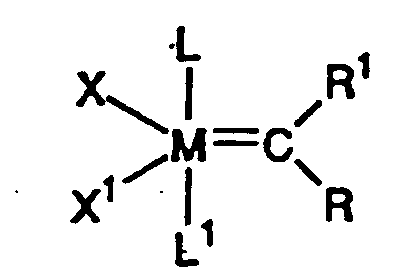
- M is Os or Ru;
- R and R1 are independently selected from hydrogen or a hydrocarbon selected from the group consisting of C2-C20 alkenyl, C2-C20 alkynyl, C1-C20 alkyl, aryl, C1-C20 carboxylate, C2-C20 alkoxy, C2-C20 alkenyloxy, C2-C20 alkynyloxy, aryloxy, C2-C20 alkoxycarbonyl, C1-C20 alkylthio, C1-C20 alkylsulfonyl and C1-C20 alkylsulfinyl;
- X and X1 are independently selected from any anionic ligand; and
- L and L1 are independently selected from any neutral electron donor, preferably phosphine, sulfonated phosphine, phosphite, phosphinite, phosphonite, arsine, stibine, ether, amine, amide, sulfoxide, carboxyl, nitrosyl, pyridine and thioether, most preferably trialkylphosphine ligands where at least one of the alkyl groups is a secondary alkyl or a cycloalkyl.
-
- In a preferred embodiment, the hydrocarbon is selected from the group consisting of C1-C5 alkyl, halogen, C1-C5 alkoxy and a phenyl group. The hydrocarbon also may be substituted with a C1-C5 alkyl halogen, C1-C5 alkoxy, or a phenyl group.
- In an alternative embodiment, the phenyl group is optionally substituted with halogen, C1-C5 alkyl or C1-C5 alkoxy.
- In a preferred embodiment, all of the alkyl groups of the trialkyl phosphine are either a secondary alkyl or a cycloalkyl. In a more preferred embodiment, the alkyl groups are either isopropyl, isobutyl, sec-butyl, neopentyl, neophenyl, cyclopentyl or cyclohexyl.
- Carbene compounds where L and L1 ligands are alkyl phosphines where the carbon backbone of at least one alkyl group of the alkyl phosphine is a secondary alkyl or cycloalkyl have been found to possess higher metathesis activity, enabling these compounds to coordinate to and catalyze metathesis reactions between all types of olefins. By contrast, previous metathesis catalysts were only able to catalyze metathesis reactions involving highly strained olefins. As a result, a broad array of metathesis reactions are enabled using the carbene compounds of the present invention that cannot be performed using less reactive catalysts.
- The present invention also relates to the synthesis of ruthenium or osmium carbene compounds which can be used to catalyze olefin metathesis reactions.
- Certain of the carbene compounds of the present invention are the only Ru and Os carbene complexes known to date in which the metal is formally in the +2 oxidation state, have an electron count of 16, and are pentacoordinate. Unlike most metathesis catalysts presently known which are poisoned by functional groups, the carbene compounds of the present invention are stable in the presence of alcohol, thiol, ketone, aldehyde, ester, ether, amine, amide, nitro acid, carboxylic acid, disulfide, carbonate, carboalkoxy and halogen functional groups and may therefore be used in protic or aqueous solvent systems.
- In another embodiment of the present invention, the carbene compounds can be in the form wherein 2, 3 or 4 of the moieties X, X1, L, and L1 can be taken together to form a chelating multidentate ligand. In one aspect of this embodiment, X, L, and L1 can be taken together to form a cyclopentadienyl, indenyl, or fluorenyl moiety.
- The ruthenium or osmium carbene compounds may be prepared by reacting a compound of the formula (XX1MLnL1 m)p, in the presence of solvent, with a cyclopropene of the formulawherein:
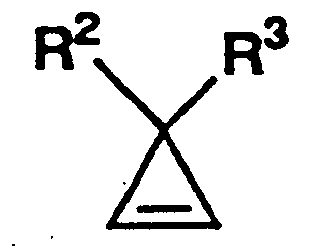
- M, X, X1, L, and L1 have the same meaning as indicated above;
- n and m are independently 0-4, provided n+m= 2, 3 or 4;
- p is an integer equal to or greater than 1; and
- R2 and R3 are independently selected from hydrogen or a hydrocarbon selected from the group consisting of C2-C18 alkyl, C2-C18 alkenyl, C2-C18 alkynyl, C2-C18 alkoxycarbonyl, aryl, C1-C18 carboxylate, C1-C18 alkenyloxy, C2-C18 alkynyloxy, C1-C18 alkoxy, aryloxy, C1-C18 alkylthio, C1-C18 alkylsulfonyl or C1-C18 alkylsulfinyl;
-
- In a preferred embodiment the hydrocarbon is substituted with C1-C5 alkyl, halogen, C1-C5 alkoxy or with a phenyl group.
- In a preferred embodiment the phenyl group is substituted with halogen, C1-C5 alkyl or C1-C5 alkoxy.
- In one embodiment of the process, X, L, and L1 are taken together to form a moiety selected from the group consisting of cyclopentadienyl, indenyl or fluorenyl, each optionally substituted with hydrogen; C2-C20 alkenyl, C2-C20 alkynyl, C1-C20 alkyl, aryl, C1-C20 carboxylate, C1-C20 alkoxy, C2-C20 alkenyloxy, C2-C20 alkynyloxy, aryloxy, C2-C20 alkoxycarbonyl, C1-C20 alkylthio, C1-C20 alkylsulfonyl, C1-C20 alkylsulfinyl; each optionally substituted with C1-C5 alkyl, halogen, C1-C5 alkoxy or with a phenyl group optionally substituted with halogen, C1-C5 alkyl or C1-C5 alkoxy.
- A further method of preparing the compounds of this invention comprises reacting compound of the formula (XX1MLnL1 m)p in the presence of solvent with a phosphorane of the formulawherein:
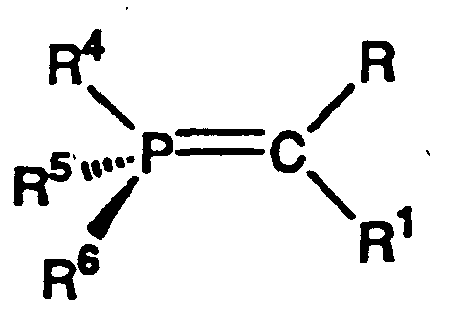
- M, X, X1, L, L1, n, m, p, R, and R1 have the same meaning as indicated above; and
- R4, R5 and R6 are independently selected from aryl, C1-C6 alkyl, C1-C6 alkoxy or phenoxy, each optionally substituted with halogen, C1-C3 alkyl, C1-C3 alkoxy, or with a phenyl group optionally substituted with halogen, C1-C5 alkyl or C1-C5 alkoxy.
-
- The present invention also pertains to a preferred method of preparing the aforementioned ruthenium and osmium compounds comprising reacting [(Ar) MX X1]2 dimer complex with two equivalents of a phosphine ligand and a cyclopropene of the formulain a one step synthesis wherein:
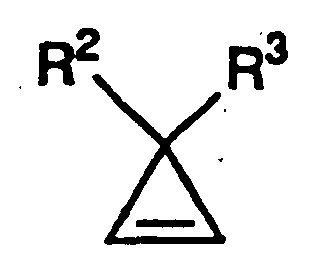
- M, X and X1 have the same meaning as indicated above;
- Ar is an aromatic compound, preferably a di-, tri-, tetra- or hexa- substituted benzene, most preferably selected from benzene, toluene, xylene, cymene, tetramethylbenzene or hexamethylbenzene; and phosphine ligand is represented by the formula PR7R8R9 wherein R7, R8 and R9 are independently selected from substituted and unsubstituted C1-C10 alkyl, secondary alkyl, cycloalkyl and aryl.
-
- Another embodiment of the present invention comprises preparing compounds of Formula IIand Formula III
 from compound of Formula I
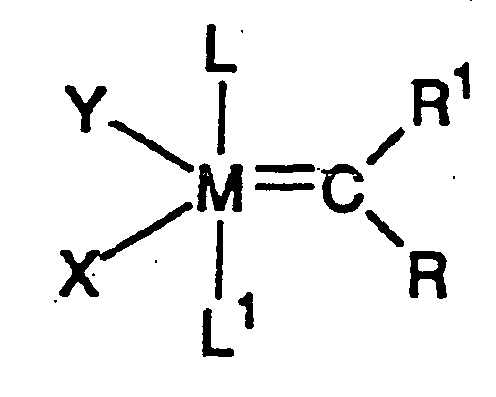 comprising reacting said compound of Formula I, in the presence of solvent, with compound of the formula M1Y wherein: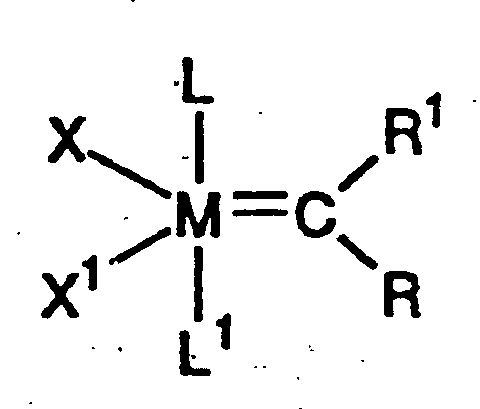
- M, R, R1 X, X1, L, and L1 have the same meaning as indicated above, and wherein:
- (1) M1 is Li, Na or K, and Y is C1-C10 alkoxide, arylalkoxide, amide or arylamide each optionally substituted with C1-C10 alkyl or halogen, diaryloxide; or
- (2) M1 is Na or Ag, and Y is ClO4, PF6, BF4, SbF6, halogen, B(aryl)4, C1-C10 alkyl sulfonate or aryl sulfonate.
-
- Another embodiment of the present invention is a method of preparing compounds of structures of Formula IVand Formula V
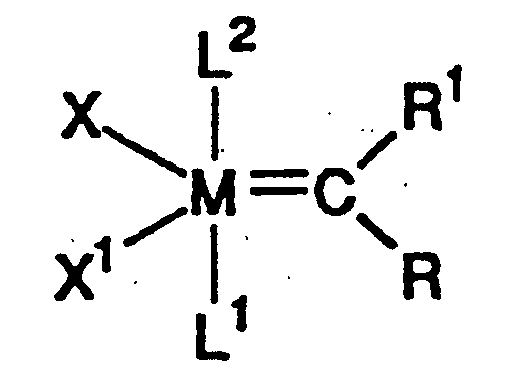 from a compound of Formula I
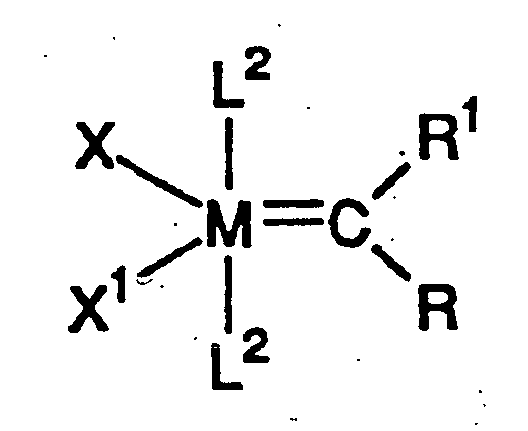 comprising reacting a compound of Formula I, in the presence of solvent, with L2 wherein:
- M, R, R1, X, and X1 have the same meaning as indicated above; and
- L, L1, and L2 are independently selected from any neutral electron donor, preferably secondary alkyl or cycloalkyl phosphine ligands.
-
- The compounds of Formulae II, III, IV, and V are species of, i.e., fall within, the scope of compounds of Formula I. In other words, certain compounds of Formula I are used to form other compounds of Formula I by ligand exchange. In this case, X and X1 in Formula I are other than the Y in Formulae II and III that replaces X. Similarly, L and L1 in Formula I are other than the L2 in Formulae IV and V. If any 2 or 3 of X, X1, L, and L1 form a multidentate ligand of Formula I, only the remaining ligand moieties would be available for ligand replacement.
- The reference above to X, X1, L, and L1 having the same meaning as indicated above refers to these moieties individually and taken together to form a multidentate ligand as described above.
- The present invention also relates to metathesis coupling of olefins catalyzed by the carbene compounds of the present invention. The high level metathesis activity of the ruthenium and osmium carbene compounds of the present invention enable these compounds to coordinate with and catalyze metathesis reactions between all types of olefins. By contrast, previous non-carbene ruthenium and osmium metathesis catalysts are only able to catalyze metathesis reactions involving highly strained olefins. As a result, a broad array of metathesis reactions are enabled using the carbene compounds of the present invention that cannot be performed using less reactive catalysts.
- Examples of metathesis olefin coupling reactions enabled by the ruthenium and osmium carbene compounds of the present invention include, but are not limited to, ring-opening metathesis polymerization of strained and unstrained cyclic olefins, ring closing metathesis of acyclic dienes, cross metathesis reactions involving at least one acyclic or unstrained cyclic olefin and depolymerization of olefinic polymers.
- The present invention relates to new highly active and stable ruthenium or osmium carbene compounds which can be used to catalyze olefin metathesis reactions.
- Specifically, the present invention relates to carbene compounds of the formulawherein:
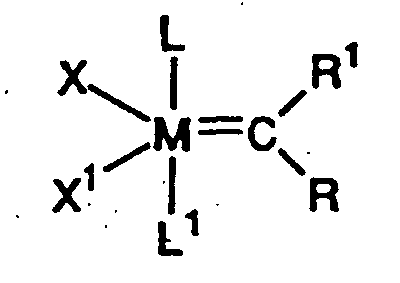
- M is Os or Ru;
- R and R1 are independently selected from hydrogen; C2-C20 alkenyl, C2-C20 alkynyl, C1-C20 alkyl, aryl, C1-C20 carboxylate, C2-C20 alkoxy, C2-C20 alkenyloxy, C1-C20 alkynyloxy, aryloxy, C2-C20 alkoxycarbonyl, C1-C20 alkylthio, C1-C20 alkylsulfonyl or C1-C20 alkylsulfinyl; each optionally substituted with C1-C5 alkyl, halogen, C1-C5 alkoxy or with a phenyl group optionally substituted with halogen, C1-C5 alkyl or C1-C5 alkoxy;
- X and X1 are independently selected from any anionic ligand; and
- L and L1 are independently selected from any neutral electron donor, preferably phosphine, sulfonated phosphine, phosphite, phosphinite, phosphonite, arsine, stibine, ether, amine, amide, sulfoxide, carboxyl, nitrosyl, pyridine and thioether, most preferably trialkylphosphine ligands where at least one of the alkyl groups is a secondary alkyl or a cycloalkyl.
-
- In a preferred embodiment, all of the alkyl groups of the trialkyl phosphine are either a secondary alkyl or a cycloalkyl. In a more preferred embodiment, the alkyl groups are either isopropyl, isobutyl, sec-butyl, neopentyl, neophenyl, cyclopentyl or cyclohexyl.
- The high level metathesis activity of the carbene compounds of the present invention is observed when L and L1 are alkyl phosphines where the carbon backbone of at least one alkyl group of the alkyl phosphine is a secondary alkyl or cycloalkyl. Substitution of the secondary alkyl and cycloalkyl with additional carbon moieties and/or other functional groups are intended to be included with the terms secondary alkyl and cycloalkyl.
- The ruthenium or osmium carbene complexes of the invention are useful for catalyzing olefin metathesis reactions. The propagating carbene moiety has been found to be stable and continues to polymerize additional aliquots of monomer for a period after the original amount of monomer has been consumed. The propagating carbene moiety has also been found to be stable in the presence of alcohol, thiol, ketone, aldehyde, ester, ether, amine, amide, nitro acid, carboxylic acid, disulfide, carbonate, carboalkoxy and halogen functional groups. Aspects of this invention include the metal carbene compounds, methods for their synthesis, as well as their use as catalysts in a wide variety of olefin metathesis reactions.
- The intermediate compounds (XX1MLnL1 m)p are either available commercially or can be prepared by standard known methods.
- The phosphorane and cyclopropene reactants used in the present invention may be prepared in accordance with the following respective references. Schmidbaur, H., et al., Phosphorus and Sulfur, Vol. 18, pp. 167-170 (1983); Carter, F.L., Frampton, V.L., Chemical Reviews, Vol. 64, No. 5 (1964), which are incorporated herein by reference.
- The present invention also relates to metathesis coupling of olefins catalyzed by the carbene compounds of the present invention. The high level metathesis activity of the ruthenium or osmium carbene compounds of the present invention cause these compounds to coordinate with and catalyze metathesis reactions between all types of olefins. By contrast, previous non-carbene ruthenium or osmium metathesis catalysts are only able to catalyze metathesis reactions involving strained olefins. As a result, a broad array of metathesis reactions are enabled using the carbene compounds of the present invention that cannot be performed using less reactive catalysts.
- Examples of reactions enabled by the ruthenium and osmium carbene compounds of the present invention include, but are not limited to, ring-opening metathesis polymerization of strained and unstrained cyclic olefins, ring closing metathesis of acyclic dienes, cross metathesis reactions involving at least one acyclic or unstrained cyclic olefin and depolymerization of olefinic polymers.
- The carbene compounds disclosed in the present invention, as well as those disclosed in U.S. Serial No. 863,606, filed April 3, 1992, are the only Ru and Os carbene complexes known to date in which the metal is formally in the +2 oxidation state (the carbene fragment is considered to be neutral), have an electron count of 16, and are pentacoordinate. Unlike most metathesis catalysts presently known which are poisoned by functional groups, the carbene compounds of the present invention are stable in the presence of a wide variety of functional groups including alcohol, thiol, ketone, aldehyde, ester, ether, amine, amide, nitro acid, carboxylic acid, disulfide, carbonate, carboalkoxy acid, carboxylic acid, disulfide, carbonate, isocyanate, carbodiimide carboalkoxy and halogen functional groups. As a result of their stability in the presence of functional groups, these catalysts may be employed in protic and aqueous solvents as well as mixtures of protic, aqueous, and/or organic solvents.
- With regard to compounds of Formula I:
- alkenyl can include vinyl, 1-propenyl, 2-propenyl; 3-propenyl and the different butenyl, pentenyl and hexenyl isomers, 1,3-hexadienyl and 2,4,6-heptatrienyl, and cycloalkenyl;
- alkenyloxy can include H2C=CHCH2O, (CH3)2C=CHCH2O, (CH3)CH=CHCH2O, CH3CH=CHCH2O, (CH3)CH=C(CH3)CH2O and CH2=CHCH2CH2O;
- alkoxide can include methoxide, t-butoxide and phenoxide;
- alkoxy can include methoxy, ethoxy, n-propyloxy, isopropyloxy and the different butoxy, pentoxy and hexyloxy isomers;
- cycloalkoxy can include cyclopentyloxy and cyclohexyloxy;
- alkoxyalkyl can include CH3OCH2, CH3OCH2CH2, CH3CH2OCH2, CH3CH2CH2CH2OCH2 and CH3CH2OCH2CH2; and
- alkoxycarbonyl can include CH3OC(=O); CH3CH2OC(=O), CH3CH2CH2OC(=O), (CH3)2CHOC(=O) and the different butoxy-, pentoxy- or hexyloxycarbonyl isomers;
- alkyl can include methyl, ethyl, n-propyl, i-propyl, or the several butyl, pentyl or hexyl isomers and primary, secondary and cycloalkyl isomers;
- alkylsulfinyl can include CH3SO, CH3CH2SO, CH3CH2CH2SO, (CH3)2CHSO and the different butylsulfinyl, pentylsulfinyl and hexylsulfinyl isomers;
- alkylsulfonyl can include CH3SO2, CH3CH2SO2, CH3CH2CH2SO2, (CH3)2CHSO2 and the different butylsulfonyl, pentylsulfonyl and hexylsulfonyl isomers;
- alkylthio can include, methylthio, ethylthio, and the several propylthio, butylthio, pentylthio and hexylthio isomers;
- alkynyl can include ethynyl, 1-propynyl, 3-propynyl and the several butynyl, pentynyl and hexynyl isomers, 2,7-octadiynyl and 2,5,8-decatriynyl;
- alkynyloxy can include HC=CCH2O, CH3C=CCH2O and CH3C=CCH2OCH2O;
- amide can include HC(=O)N(CH3)2 and (CH3)C(=O)N(CH3)2;
- amine can include tricyclohexylamine, triisopropylamine and trineopentylamine;
- arsine can include triphenylarsine,tricyclohexylarsine and triisopropylarsine;
- aryl can include phenyl, p-tolyl and p-fluorophenyl;
- carboxylate can include CH3CO2CH3CH2CO2, C6H5CO2, (C6H5)CH2CO2;
- cycloalkenyl can include cyclopentenyl and cyclohexenyl.
- cycloalkyl can include cyclopropyl, cyclobutyl, cyclopentyl and cyclohexyl;
- diketonates can include acetylacetonate and 2,4-hexanedionate;
- ether can include (CH3)3CCH2OCH2CH3, THF, (CH3)3COC(CH3)3, CH3OCH2CH2OCH3, and CH3OC6H5;
- phosphine can include triphenylphosphine, tricyclohexylphosphine, triisopropylphosphine, trineopentylphosphine and methyldiphenylphosphine;
- phosphinite can include triphenylphosphinite, tricyclohexylphosphinite, triisopropylphosphinite, and methyldiphenylphosphinite;
- phosphite can include triphenylphosphite, tricyclohexylphosphite, tri-t-butylphosphite, triisopropylphosphite and methyldiphenylphosphite;
- secondary alkyl includes ligands of the general formula -CHRR1 where R and R1 are carbon moieties;
- stibine can include triphenylstibine, tricyclohexylstibine and trimethylstibine;
- sulfonate can include trifluoromethanesulfonate, tosylate, and mesylate;
- sulfoxide can include CH3S(=O)CH3, (C6H5)2SO; and
- thioether can include CH3SCH3, C6H5SCH3, CH3OCH2CH2SCH3, and tetrahydrothiophene.
-
- A neutral electron donor is any ligand which, when removed from a metal center in its closed shell electron configuration, has a neutral charge, i.e., is a Lewis base.
- "halogen" or "halide", either alone or in compound words such as "haloalkyl", denotes fluorine, chlorine, bromine or iodine.
- An anionic ligand is any ligand which when removed from a metal center in its closed shell electron configuration has a negative charge. An important feature of the carbene compounds of this invention is the presence of the ruthenium or osmium in the formal +2 oxidation state (the carbene fragment is considered to be neutral), an electron count of 16 and pentacoordination. A wide variety of ligand moieties X, X1, L, and L1 can be present and the carbene compound will still exhibit its catalytic activity.
- A preferred embodiment of the carbene compounds of the present invention is a compound of the invention of Formula I wherein:
- R and R1 are independently selected from hydrogen, vinyl, C1-C10 alkyl, aryl, C1-C10 carboxylate, C2-C10 alkoxycarbonyl, C1-C10 alkoxy, aryloxy, each optionally substituted with C1-C5 alkyl, halogen, C1-C5 alkoxy or with a phenyl group optionally substituted with halogen, C1-C5 alkyl or C1-C5 alkoxy; and
- X and X1 are independently selected from halogen, hydrogen, diketonates, or C1-C20 alkyl, aryl, C1-C20 alkoxide, aryloxide, C2-C20 alkoxycarbonyl, arylcarboxylate, C1-C20 carboxylate, aryl or C1-C20 alkylsulfonate, C1-C20 alkylthio, C1-C20 alkylsulfonyl, C1-C20 alkylsulfinyl, each optionally substituted with C1-C5 alkyl, halogen, C1-C5 alkoxy or with a phenyl group optionally substituted with halogen, C1-C5 alkyl or C1-C5 alkoxy; and
- L and L1 are independently selected from phosphine, sulfonated phosphine, phosphite, phosphinite, phosphonite, arsine, stibine, ether, amine, amide, sulfoxide, carbonyl, nitrosyl, pyridine or thioether. A more preferred embodiment of the carbene compounds of the present invention is a compound of Formula I wherein:
- R and R1 are independently selected from hydrogen; vinyl, C1-C5 alkyl, phenyl, C2-C5 alkoxycarbonyl, C1-C5 carboxylate, C1-C5 alkoxy, phenoxy; each optionally substituted with C1-C5 alkyl, halogen, C1-C5 alkoxy or a phenyl group optionally substituted with halogen, C1-C5 alkyl or C1-C5 alkoxy;
- X and X1 are independently selected from Cl, Br, I, or benzoate, acetylacetonate, C1-C5 carboxylate, C1-C5 alkyl, phenoxy, C1-C5 alkoxy, C1-C5 alkylthio, aryl, and C1-C5 alkyl sulfonate; each optionally substituted with C1-C5 alkyl or a phenyl group optionally substituted with halogen, C1-C5 alkyl or C1-C5 alkoxy; and
- L and L1 are independently selected from aryl, C1-C5 alkyl, secondary alkyl or cycloalkylphosphine, aryl- or C1-C10 alkylsulfonated phosphine, aryl or C1-C10 alkylphosphinite, aryl- or C1-C10 alkylphosphonite, aryl- or C1-C10 alkylphosphite, aryl- or C1-C10 alkylarsine, aryl- or C1-C10 alkylamine, pyridine, aryl- or C1-C10 alkyl sulfoxide, aryl- or C1-C10 alkylether, or aryl- or C1-C10 alkylamide, each optionally substituted with a phenyl group optionally substituted with halogen, C1-C5 alkyl or C1-C5 alkoxy.
- R and R1 are independently vinyl, H, Me, Ph;
- X and X1 are independently Cl, CF3CO2, CH3CO2, CFH2CO2, (CH3)3CO, (CF3)2(CH3)CO, (CF3) (CH3)2CO, PhO, MeO, EtO, tosylate, mesylate, or trifluoromethanesulfonate; and
- L and L1 are independently PPh3, P(p-Tol)3, P(o-Tol)3, PPh(CH3)2, P(CF3)3, P(p-FC6H4)3, pyridine, P(p-CF3C6H4)3, (p-F)pyridine, (p-CF3)pyridine, P(C6H4-SO3Na)3, P(CH2C6H4-SO3Na)3, P(iPr)3, P(CHCH3(CH2CH3))3, P(cyclopentyl)3, P(cyclohexyl)3, P(neopentyl)3 and P(neophenyl)3.
-
- For any of the foregoing described preferred groups of compounds, any 2, 3, or 4 of X, X1, L, L1 can be taken together to form a chelating multidentate ligand. Examples of bidentate ligands include, but are not limited to, bisphosphines, dialkoxides, alkyldiketonates, and aryldiketonates. Specific examples include Ph2PCH2CH2PPh2, Ph2AsCH2CH2AsPh2, Ph2PCH2CH2C(CF3)2O-, binaphtholate dianions, pinacolate dianions, Me2P(CH2)2PMe2 and OC(CH3)2(CH3)2CO. Tridentate ligands include, but are not limited to, (CH3)2NCH2CH2P(Ph)CH2CH2N(CH3)2. Other preferred tridentate ligands are those in which X, L, and L1 are taken together to be cyclopentadienyl, indenyl or fluorenyl, each optionally substituted with C2-C20 alkenyl, C2-C20 alkynyl, C1-C20 alkyl, aryl, C1-C20 carboxylate, C1-C20 alkoxy, C2-C20 alkenyloxy, C2-C20 alkynyloxy, aryloxy, C2-C20 alkoxycarbonyl, C1-C20 alkylthio, C1-C20 alkylsulfonyl, C1-C20 alkylsulfinyl, each optionally substituted with C1-C5 alkyl, halogen, C1-C5 alkoxy or with a phenyl group optionally substituted with halogen, C1-C5 alkyl or C1-C5 alkoxy. More preferably in compounds of this type, X, L, and L1 are taken together to be cyclopentadienyl or indenyl, each optionally substituted with hydrogen; vinyl, C1-C10 alkyl, aryl, C1-C10 carboxylate, C2-C10 alkoxycarbonyl, C1-C10 alkoxy, aryloxy, each optionally substituted with C1-C5 alkyl, halogen, C1-C5 alkoxy or with a phenyl group optionally substituted with halogen, C1-C5 alkyl or C1-C5 alkoxy. Most preferably, X, L, and L1 are taken together to be cyclopentadienyl, optionally substituted with vinyl, hydrogen, Me or Ph. Tetradentate ligands include, but are not limited to O2C(CH2)2P(Ph)(CH2)2P(Ph)(CH2)2CO2, phthalocyanines, and porphyrins.
- Carbene compounds of Formula I wherein L and L1 are alkyl phosphines where at least one alkyl group is either a secondary alkyl or a cycloalkyl. These carbene compounds have been found to be more stable, more reactive to nonsterically strained cyclic alkenes and unreactive to a wider variety of substituents. (Nguyen, S., et al., J. Am. Chem. Soc., 1993, 115:9858-9859; Fu, G., et al., J. Am. Chem. Soc., 1993, 115:9856-9557.)
- Specifically, carbene compounds wherein L and L1 are triisopropyl phosphine or tricyclohexyl phosphine have been found to be stable in the presence of oxygen, moisture, adventitious impurities thereby enabling reactions to be conducted in reagent grade solvents in air (Fu, G., et al., J. Am. Chem. Soc., 1993, 115:9856-9857). Further these carbenes are stable in the presence of alcohol, thiol, ketone, aldehyde, ester, ether, amine, amide, nitro acid, carboxylic acid, disulfide, carbonate, carboalkoxy and halogen functional groups. In addition, these carbene can catalyze olefin metathesis reactions on acyclic oleinfs and strained cyclic olefins.
- The most preferred carbene compounds of the present invention include:wherein

- iPr = isopropyl
- Cy = cyclohexyl
-
- The compounds of the present invention can be prepared in several different ways, each of which is described below.
- The most general method for preparing the compounds of this invention comprises reacting (XX1MLnL1 m)p with a cyclopropene or phosphorane in the presence of a solvent to produce a carbene complex, as shown in the equations below:wherein:

- M, X, X1, L, L1, n, m, p, R2, R3, R4, R5, and R6 are as defined above. Preferably, R2, R3, R4, R5, and R6 are independently selected from the group consisting of C1-C6 alkyl or phenyl.
-
- Examples of solvents that may be used in this reaction include organic, protic, or aqueous solvents which are inert under the reaction conditions, such as: aromatic hydrocarbons, chlorinated hydrocarbons, ethers, aliphatic hydrocarbons, alcohols, water, or mixtures thereof. Preferred solvents include benzene, toluene, p-xylene, methylene chloride, dichloroethane, dichlorobenzene, chlorobenzene, tetrahydrofuran, diethylether, pentane, methanol, ethanol, water, or mixtures thereof. More preferably, the solvent is benzene, toluene, p-xylene, methylene chloride, dichloroethane, dichlorobenzene, chlorobenzene, tetrahydrofuran, diethylether, pentane, methanol, ethanol, or mixtures thereof. Most preferably, the solvent is toluene or a mixture of benzene and methylene chloride.
- A suitable temperature range for the reaction is from about -20°C to about 125°C, preferably 35°C to 90°C, and more preferably 50°C to 65°C. Pressure is not critical but may depend on the boiling point of the solvent used, i.e., sufficient pressure is needed to maintain a solvent liquid phase. Reaction times are not critical, and can be from several minutes to 48 hours. The reactions are generally carried out in an inert atmosphere, most preferably nitrogen or argon.
- The reaction is usually carried out by dissolving the compound (XX1MLnL1 m)p, in a suitable solvent, adding the cyclopropene (preferably in a solvent) to a stirred solution of the compound, and optionally heating the mixture until the reaction is complete. The progress of the reaction can be monitored by any of several standard analytical techniques, such as infrared or nuclear magnetic resonance. Isolation of the product can be accomplished by standard procedures, such as evaporating the solvent, washing the solids (e.g., with alcohol or pentane), and then recrystallizing the desired carbene complex. Whether the moieties X, X1, L, or L1 are (unidentate) ligands or taken together to form multidentate ligands will depend on the starting compound which simply carries these ligands over into the desired carbene complex.
- Under certain circumstances, no solvent is needed.
- Reaction temperatures can range from 0°C to 100°C, and are preferably 25°C to 45°C. The ratio of catalyst to olefin is not critical, and can range from 1:5 to 1:30,000, preferably 1:10 to 1:6,000.
- Because the carbene compounds mentioned above are stable in the presence of alcohol, thiol, ketone, aldehyde, ester, ether and halogen functional groups, these carbene compounds may be used to catalyze a wide variety of reaction substrates. The added stability also enables one to employ these catalysts in the presence of a protic solvents. This is very unusual among metathesis catalysts and provides a distinct advantage for the process of this invention over the processes of the prior art. Other advantages of the polymerization process of this invention derive from the fact that the carbene compounds are well-defined, stable Ru or Os carbene complexes providing high catalytic activity. Using such compounds as catalysts allows control of the rate of initiation, extent of initiation, and the amount of catalyst.
- In one variation of this general procedure, the reaction is conducted in the presence of HgCl2, preferably 0.01 to 0.2 molar equivalents, more preferably 0.05 to 0.1 equivalents, based on XX1MLnL1 m. In this variation, the reaction temperature is preferably 15°C to 65°C.
- In a second variation of the general procedure, the reaction is conducted in the presence of ultraviolet radiation. In this variation, the reaction temperature is preferably -20°C to 30°C.
- It is also possible to prepare carbene complexes of this invention by ligand exchange. For example, L and/or L1 can be replaced by a neutral electron donor, L2, in compounds of Formula I by reacting L2 with compounds of Formula I wherein L, L1, and L2 are independently selected from phosphine, sulfonated phosphine, phosphite, phosphinite, phosphonite, arsine, stibine, ether, amine, amide, sulfoxide, carbonyl, nitrosyl, pyridine or thioether. Similarly, X and/or X1 can be replaced by an anionic ligand, Y, in compounds of Formula I by reacting M1Y with compounds of Formula I, wherein Y, X and X1 are independently selected from halogen, hydrogen, diketonates, or C1-C20 alkyl, aryl, C1-C20 alkoxide, aryloxide, C2-C20 alkoxycarbonyl, arylcarboxylate, C1-C20 carboxylate, aryl or C1-C20 alkylsulfonate, C1-C20 alkylthio, C1-C20 alkylsulfonyl, C1-C20 alkylsulfinyl, each optionally substituted with C1-C5 alkyl, halogen, C1-C5 alkoxy or with a phenyl group optionally substituted with halogen, C1-C5 alkyl or C1-C5 alkoxy. These ligand exchange reactions are typically carried out in a solvent which is inert under the reaction conditions. Examples of solvents include those described above for the preparation of the carbene complex.
- The high level metathesis activity of the carbene compounds also make these compounds useful for catalyzing the ring-closing metathesis of acyclic dienes as described in Fu, G., et al., J. Am. Chem. Soc., 1993, 115:9856-9858 which is incorporated herein by reference.
- The carbene compounds may also be used for the preparation of telechelic polymers. Telechelic polymers are macromolecules with one or more reactive end-groups. Telechelic polymers are useful materials for chain extension processes, block copolymer synthesis, reaction injection molding, and network formation. Uses for telechelic polymers and their synthesis is described in Goethals, Telechelic Polymers: Synthesis and Applications (CRC Press: Boca Raton, FL, 1989).
- The carbene compounds of the present invention may also be prepared by a one step synthesis as shown in equation belowwherein M, X, X1, R2 and R3 are as defined above. Preferably, R2 and R3 are independently selected from the group consisting of C1-C6 alkyl or phenyl. Ar represents an aromatic compound, preferably a di-, tri-, tetra- or hexa- substituted benzene, most preferably benzene, toluene, xylene, cymene, tetramethylbenzene and hexamethylbenzene. R7, R8 and R9 are independently selected from substituted and unsubstituted C1-C10 alkyl, secondary alkyl, cycloalkyl and aryl.

- Examples of solvents for this reaction include benzene, toluene, xylene and cymene. A suitable temperature range for this reaction is from about 0°C to about 120°C, preferably 45°C to 90°C. The reaction may be conducted in the presence of oxygen. However, it is preferred that it is carried out under an inert atmosphere. The reaction is generally performed under atmospheric pressure. Monitoring the progression of the reaction and isolation of the product can be accomplished by any one of a variety of standard procedures known in the art as described above. Typical reaction conditions for this one step synthesis are provided in Example 1.
- The carbene compounds of the present invention may be employed in a variety of olefin metathesis reactions such as those described in U.S. Patent No. 5,312,940 which is incorporated by reference herein.
- For most applications, a highly functionalized polymer, i.e., a polymer where the number of functional groups per chain is 2 or greater, is required. Thus, it is desirable that the catalyst used to form the telechelic polymer be stable in the presence of functional groups.
- The reaction scheme for a ROMP telechelic polymer synthesis is provided below. In a ROMP telechelic polymer synthesis, acyclic olefins act as chain-transfer agents to regulate the molecular weight of polymers produced. When α,ω-difunctional olefins are employed as chain-transfer agents, difunctional telechelic polymers can be synthesized. As shown in the reaction sequence, the chain-transfer reaction with a symmetric, α,ω-difunctional olefin, the propagating alkylidene is terminated with a functional group, and the new functionally substituted alkylidene reacts with a monomer to initiate a new chain. This process preserves the number of active catalyst centers and leads to symmetric telechelic polymers with a functionality that approaches 2.0.The only polymer end-groups that do not contain residues from the chain-transfer agent are those from the initiating alkylidene and the end-capping reagent. In principle, these end-groups could be chosen to match the end-group from the chain-transfer agent.
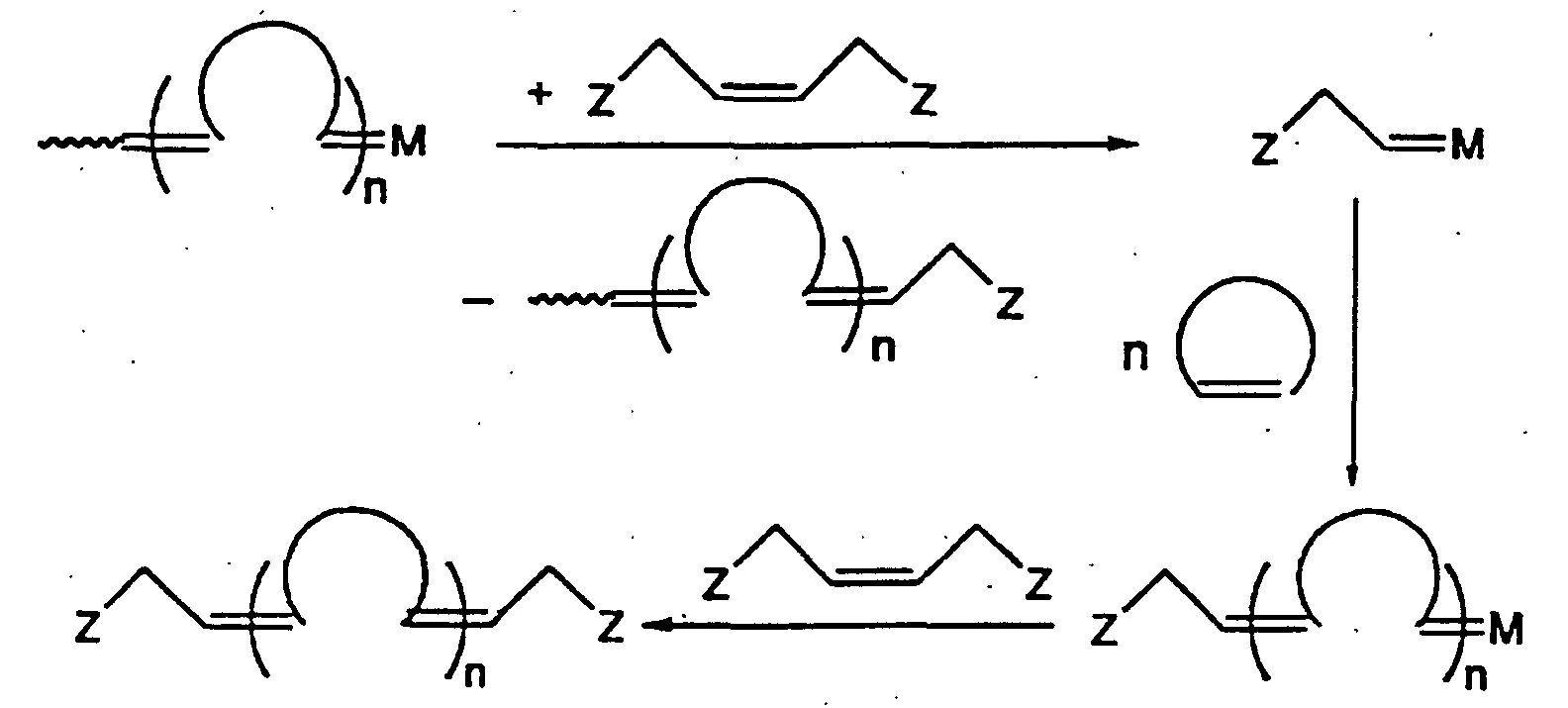
- Ring opening metathesis polymerization (ROMP) using W(CHAr)(NPh)[OCCH3(CF3)2]2(THF) has been shown to be a viable polymerization technique for well-defined telechelic polymers. Hillmyer, et al., Macromolecules, 1993, 26:872. However, use of this carbene catalyst for telechelic polymer synthesis is limited by the instability of the tungsten catalyst in the presence of functional groups. The tungsten catalyst is also unstable in the presence of low concentrations of monomers.
- The stability of the carbene compounds of the present invention to a wide range of functional groups as well as the ability of these carbene compounds to catalyze ROMP reactions make these compounds particularly desirable for the synthesis of telechelic polymers. The high level metathesis activity of the carbene compounds enable a wider range of cyclic and acyclic olefins to be employed. By way of example, the synthesis of hydroxytelechelic polybutadiene is described in Example 5.
- The following examples set forth the synthesis and application of the ruthenium and osmium carbene compounds of the present invention. The following examples also set forth the preferred embodiments of the present invention. Further objectives and advantages of the present invention other than those set forth above will become apparent from the examples which are not intended to limit the scope of the present invention.
- The abbreviations Me, Ph, iPr, Cy and THF used in the following examples refer to methyl, phenyl, isopropyl, cyclohexyl and tetrahydrofuran, respectively.
- The carbene compounds of the present invention may be prepared in a one step synthesis as illustrated in the reaction sequence below.

- In a typical reaction, [(Cymene)RuCl2]2 dimer complex (0.53g, 1.73 mmol Ru) and PCy3 (0.91 g, 2 equiv) were loaded under inert atmosphere into a 100 mL Sclenk flask equipped with a magnetic stirbar. Benzene (40 mL) was then added followed by 3,3-diphenylcyclopropene (0.33g, 1 equiv). The reaction flask was then attached to a reflux condenser under an inert atmosphere and heated in an oilbath at 83-85°C for 6 hours. The solvent was then removed to complete dryness in vacuo and the remaining red solid washed with pentane (4 x 25 mL) under inert atmosphere. The remaining red powder was dried under vacuum for 12 h and stored under an inert atmosphere yielding 1.4 g of Cl2Ru(PCy3)2(=CCH=CPh2) in 88% yield.
- The activity of the carbene catalysts of the present invention has been found to be proportional to the number of secondary alkyl or cycloalkyl substituents on the phosphine. For example, in the reaction

PR3 Relative rate PiPr3 3.2 PiPr2Ph 1.0 PiPrPh2 0.0 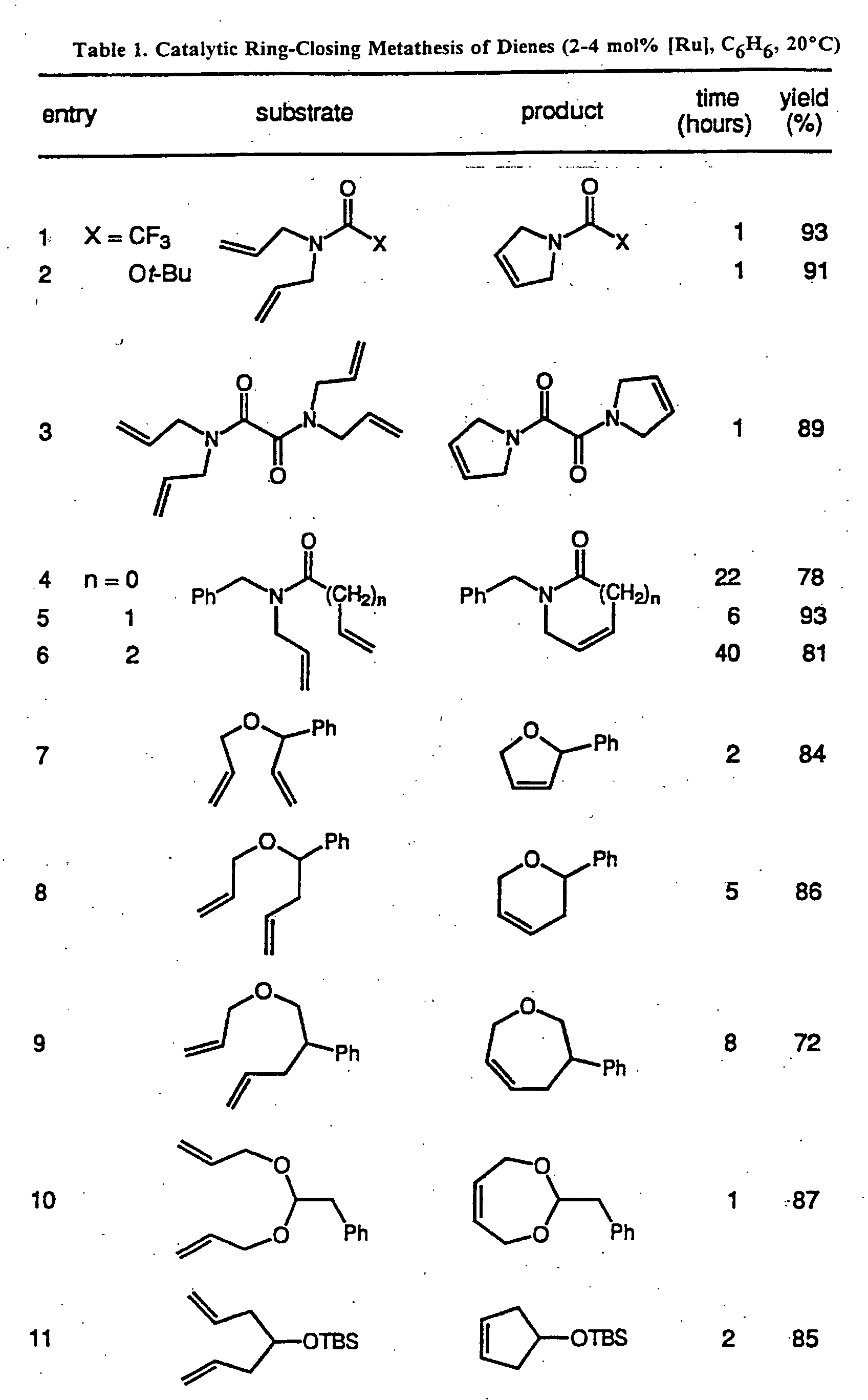
- Table 1 depicts the synthesis of several cycloalkenes from functionalized dienes using Cl2Ru(PCy3)2(=CCH=CPh2) wherein Cy is cyclohexyl. A typical experimental protocol for performing ring-closing metathesis on the diene of entry 8 of Table 1 is as follows.
- The diene of entry 8 (0.50 mmol) was added to a homogeneous orange-red solution of 0.01 mmol Cl2Ru(PCy3)2(=CCH=CPh2) in 15 mL of dry benzene under argon. The resulting mixture was then stirred at 20°C for 5 h, at which time thin layer chromatography showed the reaction to be complete. The reaction was then quenched by exposure to air (until greenish-black, 6 h), concentrated and purified by flash chromatography (0 -> 6% Et2O / hexane) to yield dihydropyran as a colorless oil in 86% yield.
- The carbene compounds of the present invention may be used in the polymerization of nonstrained cyclic olefins such as cyclooctene as depicted in the reaction sequence below.In order to polymerize 5-acetoxy-cyclooctene, a small vial was charged with 2.6 g of degassed 5-acetoxy-cyclooctene and a stirbar. A solution of 15 mg of Cl2Ru(PCy3)2(=CCH=CPh2) in 200 µL of CH2Cl2 was added to the vial under inert atmosphere. The vial was capped and placed in an oil bath at about 48°C. After about 2.5 hours, the red-orange solution became noticeably viscous. After about 5.5 hours, the contents of the vial were solid. After 24 hours, the vial was removed from the oil bath and cooled to room temperature. The cap was removed from the vial and 100 µL of ethyl vinylether, 10 mL of chloroform and about 10 mg of 2,6-di-tert-butyl-4-methylphenol (butylated hydroxytoluene) were added to the vial to dissolve the solid, yielding a yellow-orange solution. After about 12 hours of stirring, an additional 20 mL of chloroform was added to the solution. The resulting solution was then poured into about 200 mL of methanol yielding an off-white precipitate. The off-white solid was stirred in the methanol until it appeared free of color. The resulting white solid was then isolated and dried under vacuum in 85% yield (2.2 g).

- The carbene compounds may also be used to synthesize telechlic polymers such as hydroxytelechelic polybutadiene as described below. A one-neck, 500 mL, Schlenk flask, equipped with a magnetic stirbar, was charged with 1,5-cyclooctadiene (103.3 g, 955 mmol, 3673 equiv). Toluene (103.1 g) and 1,4-diacetoxy-cis-2-butene (11.4 g, 66.2 mmol, 255 equiv) were added to the reaction flask. A stopcock was placed in the neck of the flask and the reaction mixture was stirred, cooled to 0° C, and subjected to vacuum (∼0.05 mm Hg) at 0° C for 30 minutes. The reaction mixture was back-filled with argon, and with a continuous argon flow, Cl2Ru(PCy3)2(CHCHCPh2) (0.245 g, 0.26 mmol, 1.0 equiv) was added as a solid to the reaction flask while stirring. The stopcock was replaced by a septum, and the system was subjected to vacuum (∼0.05 mm Hg) at 0° C for 10 minutes. The dark red-orange reaction mixture was placed in an oil bath at 45-50° C and stirred for 44 h under a slow purge of argon. The light orange reaction mixture was allowed to warm to room temperature. Vinyl acetate (14 g, 15 mL, 163 mmol, 627 equiv) and BHT (2,6-di-tert-butyl-4-methylphenol) (15 mg) were added to the reaction mixture under argon. The mixture was stirred at room temperature for 0.5 h, placed in an oil bath at 45-50° C, and stirred for 7 h. The reaction mixture was allowed to cool to room temperature and poured into 800 mL of methanol. The mixture was stirred overnight and the polymer was isolated by centrifugation. The polymer was then redissolved in 400 mL tetrahydrofuran, cooled to 0° C and 100 mL of 0.7 M sodium methoxide in methanol (70 mmol sodium methoxide) was added at 0° C. The mixture was allowed to stir at 0° C for 3.5 h. Methanol (400 mL) was then added to the reaction mixture to precipitate the polymer. The reaction mixture was allowed to warm to room temperature, stirred overnight, and isolated by centrifugation.
- In a nitrogen-filled glove box, methyl oleate (3.2g, 2000 equiv) was added to a vial containing a solution of Cl2(PCy3)2Ru=CH-CH=CPh2 (5 mg in 0.1 mL CH2Cl2). The vial was then capped and stirred at room temperature for 4 days. As illustrated in the reaction sequence below, an equilibrium mixture of metathesis products was produced.

- In a nitrogen-filled glove box, oleic acid (0.3g, 200 equiv) was added to a vial containing a solution of Cl2(PCy3)2Ru=CH-CH=CPh2 (5 mg in 0.1 mL CH2Cl2). The vial was then capped and stirred at room temperature for 4 days. As illustrated in the reaction sequence below, an equilibrium mixture of metathesis products was produced.
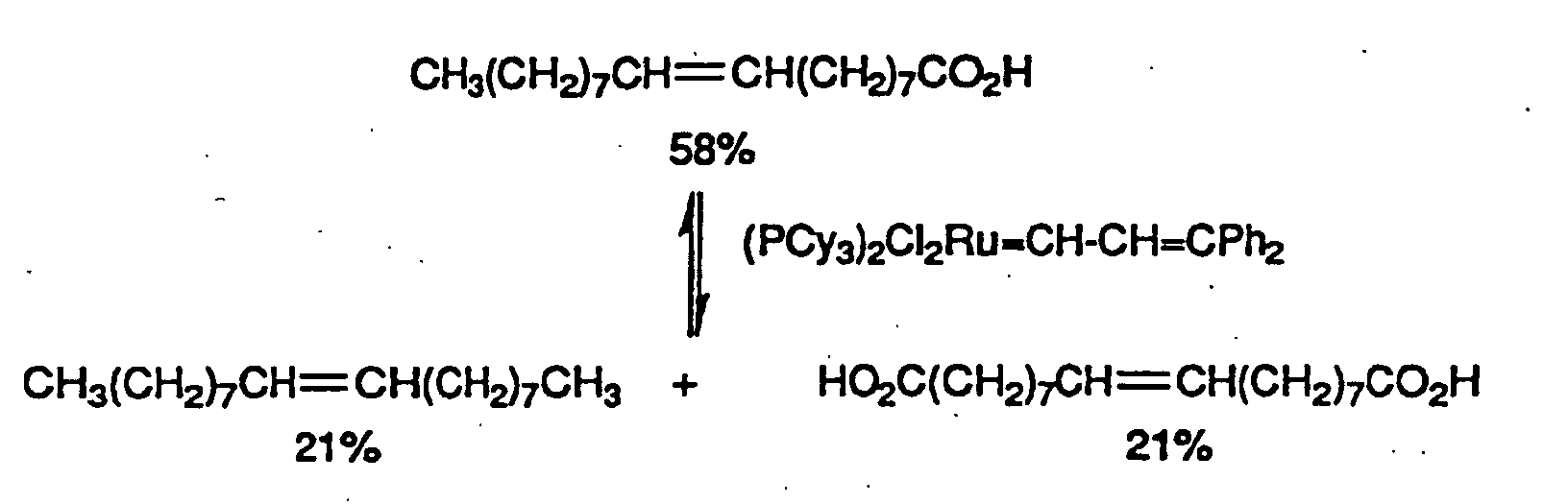
- In a nitrogen-filled glove box, methyl oleate (1 g, 152 equiv) was added to a Fisher-Porter tube containing a solution of Cl2(PCy3)2Ru=CH-CH=CPh2 (20 mg in 30 mL CH2Cl2). The tube was sealed, pressurized to 100 psi of ethylene, and then let stirred at room temperature for 12 hours. As illustrated in the reaction sequence below, an equilibrium mixture of metathesis products was produced.
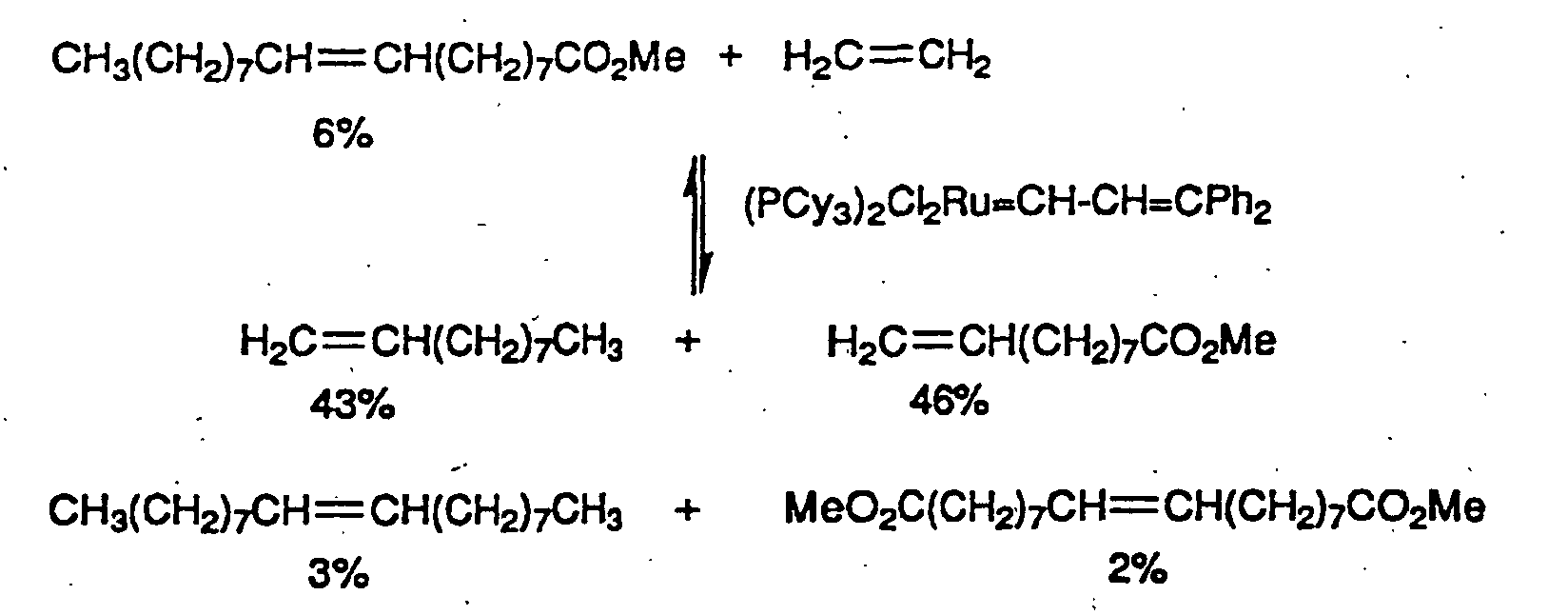
- In a nitrogen-filled glove box, oleate acid (0.91 g, 300 equiv) was added to a Fisher-Porter tube containing a solution of Cl2(PCy3)2Ru=CH-CH=CPh2 (10 mg in 150 mL CH2Cl2). The tube was sealed, pressurized to 100 psi of ethylene, and then let stirred at room temperature for 12 hours. As illustrated in the reaction sequence below, an equilibrium mixture of metathesis products was produced.
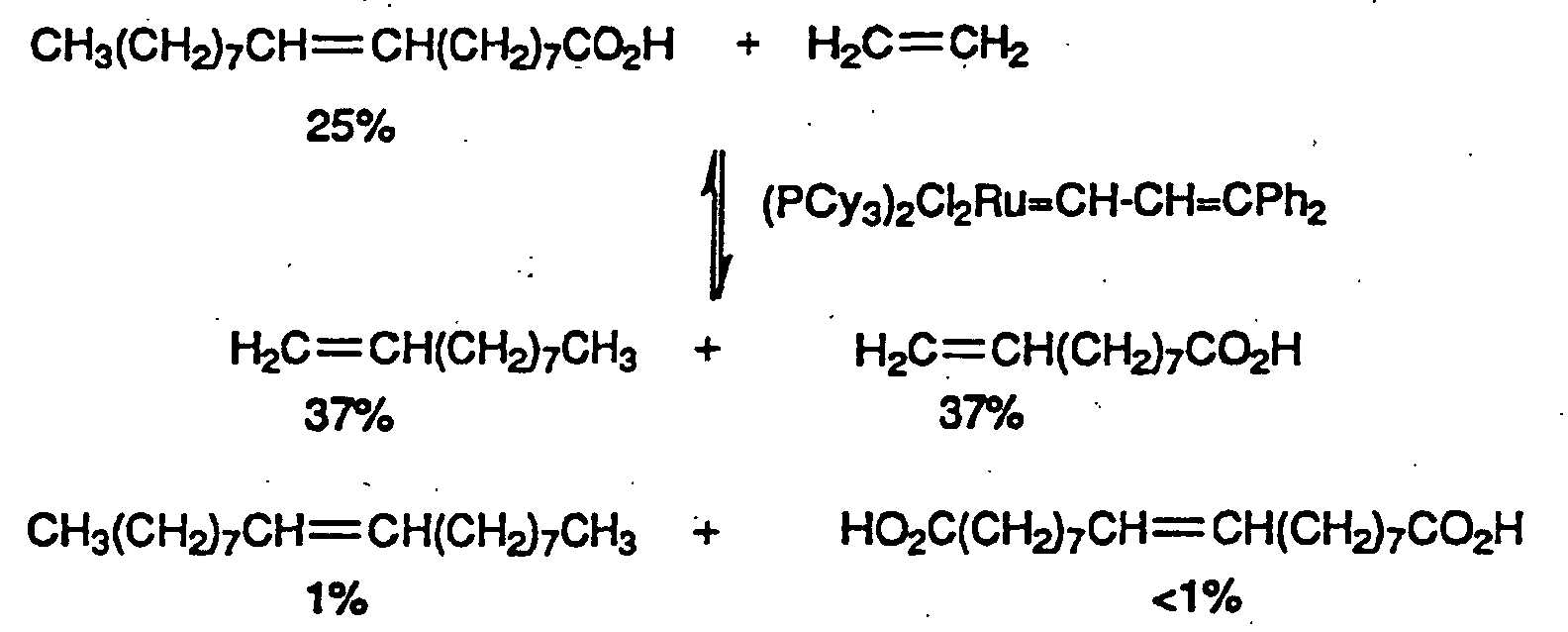
- In a nitrogen-filled glove box, polyheptene (0.3 g) was added to a Fisher-Porter tube containing a solution of Cl2(PCy3)2Ru=CH-CH=CPh2 (20 mg in 5 mL CH2Cl2). The tube was sealed, pressurized to 60 psi of ethylene, and then let stirred at room temperature for 24 hours. As illustrated in the reaction sequence below, an equilibrium mixture of 1,8-nonadiene and its ADMET oligomers was produced.

- In a nitrogen-filled glove box, cyclopentene (1 g, 680 equiv) was added to a Fisher-Porter tube containing a solution of Cl2(PCy3)2Ru=CH-CH=CPh2 (20 mg in 5 mL CCl4). The tube was sealed, pressurized to 60 psi of ethylene, and then let stirred at room temperature for 24 h. As illustrated in the reaction sequence below, an equilibrium mixture of 1,7-heptadiene and its ADMET oligomers was produced.

- A small Schlenk flask equipped with a small magnetic stir bar was charged with about 9.7 g of dicyclopentadiene (DCP) (Aldrich, 95%, inhibited with 200 ppm p-tert-butylcatechol (catalog # 11,279-8)). The flask was stoppered with a greased ground glass stopper and placed in an oil bath at about 38°C. The DCP flask was subjected to vacuum (a reduced pressure of about 0.05 mmHg) and stirred for 30 minutes. Next, the flask was cooled to about 0°C in an ice water bath for 5 minutes after which the DCP was solid. The flask was then back-filled with argon, the stopper was removed, and (PCy3)2Cl2Ru=CH-CH=CPh2(20 mg) was added as a solid (no special precautions were taken to avoid atmospheric oxygen). The stopper was replaced, and the solids were subjected to vacuum for 10 minutes at about 0°C. The flask was placed in an oil bath at about 38°C for 5 minutes while keeping its contents under vacuum. During this time the DCP liquefied, and the catalyst dissolved in the DCP to yield a non-viscous, red solution which appeared homogeneous. The stir bar was removed from the bottom of the flask with the aid of another magnet, and the temperature was raised to about 65°C while keeping the contents of the flask under vacuum. When the temperature of the oil bath reached about 55°C (about 2 minutes after the heating was initiated), the contents of the flask became yellow-orange and appeared to be solid. The temperature of the oil bath was maintained at about 65°C for 1 hour. The flask was removed from the oil bath, back filled with air, broken, and the solid plug of polymer was removed. The polymer was washed with pentane and placed in an oven at about 130°C for 3 hours. The polymer was removed from the oven, cooled to room temperature, and weighed (8.3 g, 86%, [DCP]/[Ru] ∼ 2900). (Losses due the removal of volatiles during the degassing were not taken into account in the calculation of the yield.)
- A 50 mL Schlenk flask equipped with a magnetic stirbar is charged with (MXX1LnL1 m)p (0.1 mmol) inside a nitrogen-filled drybox. Methylene chloride (2 mL) is added to dissolve the complex followed by 25 mL of benzene to dilute the solution. One equivalent of a cyclopropene is then added to the solution. The reaction flask is then capped with a stopper, removed from the box, attached to a reflux condenser under argon and heated at 55°C. The reaction is then monitored by NMR spectroscopy until all the reactants have been converted to the product. At the end of the reaction, the solution is allowed to cool to room temperature under argon and filtered into another Schlenk flask via a cannula filter. The solvent is then removed in vacuo to give a solid. This solid is then washed with a solvent in which the by-product of the reaction is soluble but the desired product is not. After the washing the product, the supernatant is removed and the resulting solid powder is dried in vacuo overnight. Further purification via crystallization can be performed if necessary.
- Representative compounds of the present invention which may be prepared in accordance with the procedure described above are exemplified in Table 2.

- These are representative examples of the ruthenium complexes. Analogous complexes can be made with osmium.
-
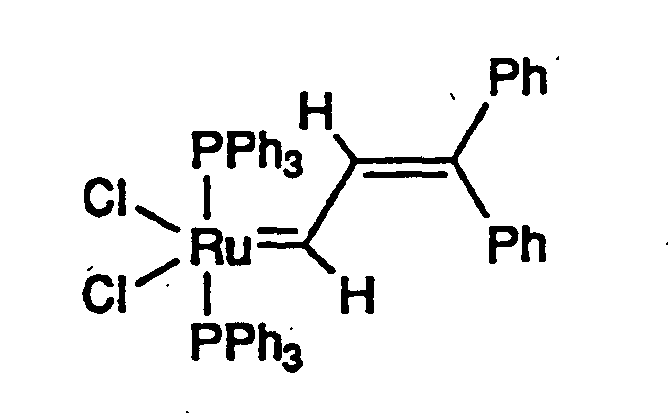
- In a typical reaction, a 200 mL Schlenk flask equipped with a magnetic stirbar was charged with RuCl2(PPh3)4 (6.00 g, 4.91 mmol) inside a nitrogen-filled drybox. Methylene chloride (40 mL) was added to dissolve the complex followed by 100 mL of benzene to dilute the solution. 3,3-Diphenylcyclopropene (954 mg, 1.01 equiv) was then added to the solution via pipette. The reaction flask was capped with a stopper, removed from the box, attached to a reflux condenser under argon and heated at 53°C for 11 h. After allowing the solution to cool to room temperature, all the solvent was removed in vacuo to give a dark yellow-brown solid. Benzene (10 mL) was added to the solid and subsequent swirling of the mixture broke the solid into a fine powder. Pentane (80 mL) was then slowly added to the mixture via cannula while stirring vigorously. The mixture was stirred at room temperature for 1 h and allowed to settle before the supernatant was removed via cannula filtration. This washing procedure was repeated twice more to ensure the complete removal of all phosphine by-products. The resulting solid was then dried under vacuum overnight to afford 4.28 g (98%) of Compound 1 as a yellow powder with a slight green tint. 1H NMR (C6D6):δ 17.94 (pseudo-quartet = two overlapping triplets, 1H, Ru=CH,JHH=10.2 Hz, JPH=9.7 Hz), 8.70 (d, 1H, CH=CPh2, JHH 10.2 Hz). 31P NMR (C6D6): δ 28.2 (s). 13C NMR (CD2Cl2): δ 288.9 (t, M = C, JCP=10.4 Hz) 149.9 (t, CH=CPh2', JCP=11.58 Hz).
- The carbene complex which is the compound formed in the above example is stable in the presence of water, alcohol, acetic acid, HCl in ether and benzaldehyde.
-

- A 50 mL Schlenk flask equipped with a magnetic stirbar was charged with OsCl2(PPh3)3 (100 mg, 0.095 mmol) inside a nitrogen-filled drybox. Methylene chloride (2 mL) was added to dissolve the complex followed by 25 mL of benzene to dilute the solution. 3,3-diphenylcyclopropene (18.53 mg, 1.01 equiv) was then added to the,solution via pipet. The reaction flask was capped with a stopper, removed from the box, attached to a reflux condenser under argon and heated at 55°C for 14 h. After allowing the solution to cool to room temperature, all the solvent was removed in vacuo to give a dark yellow-brown solid. Benzene (2 mL) was added to the solid and subsequent swirling of the mixture broke the solid into a fine powder. Pentane (30 mL) was then slowly added to the mixture via cannula while stirring vigorously. The mixture was stirred at room temperature for 1 h and allowed to settle before the supernatant was removed via cannula filtration. This washing procedure was repeated two more times to ensure the complete removal of all phosphine by-products. The resulting solid was then dried under vacuum overnight to afford 74.7 mg of Cl2(PPh3)2Os(=CHCH=CPh2) as a yellow powder (80%). 1H NMR (C6D6): δ 19.89 (pseudo-quartet = two overlapping triplets, 1H, Os = CH, JHH = 10.2 Hz), 8.23 (d, 1H, CH=CPh2, JHH = 10.2 Hz). 31P NMR (C6D6): δ 4.98 (s).
- A 50 mL Schlenk flask equipped with a magnetic stirbar was charged with RuCl2(PPh3)2(=CHCH=CPh2) (100 mg, 0.18 mmol) inside a nitrogen-filled drybox. Methylene chloride (10 mL) was added to dissolve the complex. AgCF3CO2 (24.9 mg., 1 equiv) was weighed into a 10 ml round-bottom flask, dissolved with 3 ml of THF. Both flasks were then capped with rubber septa and removed from the box. The Schlenk flask was then put under an argon atmosphere and the AgCF3CO2 solution was added dropwise to this solution via a gas-tight syringe over a period of 5 min while stirring. At the end of the addition, there was a lot of precipitate in the reaction mixture and the solution turned a fluorescent green color. The supernatant was transferred into another 50 mL Schlenk flask under argon atmosphere via the use of a cannula filter. Subsequent solvent removal in vacuo and washing with pentane (10 mL) afforded a green solid powder of the above depicted compound. Yield = 92.4 mg (85%). 1H NMR (2:2:1 CD2Cl2:C6D6:THF-d8): δ 18.77 (dt, 1H, Ru=CH, JHH=11.2 Hz, JPH=8.6 Hz), 8.40 (d, 1H), CH=CPh2, JHH=11.2 Hz). 31P NMR (2:2:1 CD2Cl2:C6D6:THF-d8):δ 29.4. 19F NMR (2:2:1 CD2Cl2:C6D6:THF-d8):δ 75.8.

-

- A 50 mL Schlenk flask equipped with a magnetic stirbar was charged with RuCl2(PPh3)2(=CH-CH=CPh2) (100 mg, 0.11 mmol) inside a nitrogen-filled drybox. Methylene chloride (10 mL) was added to dissolve the complex. AgCF3CO2 (49.8 mg, 2 equiv) was weighed into a 10 mL round-bottom flask, dissolved with 4 mL of THF. Both flasks were then capped with rubber septa and removed from the box. The Schlenk flask was then put under an argon atmosphere and the AgCF3CO2 solution was added dropwise via a gas tight syringe over a period of 5 min to the solution of ruthenium compound while stirring. At the end of the addition, there was a lot of precipitate in the reaction mixture and the solution turned into a fluorescent lime green color. The supernatant was transferred into another 50 mL Schlenk flask under argon atmosphere with the use of a cannula filter. Subsequent solvent removal in vacuo and washing with pentane (10 mL) afforded the above depicted compound as a green powder. Yield = 102 mg (87%) 1H NMR (2:2:1 CD2Cl2:C6D6:THF-d8) δ 1923 (dt, slightly overlapping) Ru=CH, JHH=11.5 Hz, JPH=5.4 Hz), 8.07 (d, 1H, CH=CPH2, JHH=11.5 Hz). 31P NMR (2:2:1 CD2Cl2:C6D6:THF-d8):δ 28.6. 19F NMR (2:2:1 CD2Cl2:C6D6:THF-d8):δ -75.7.
-
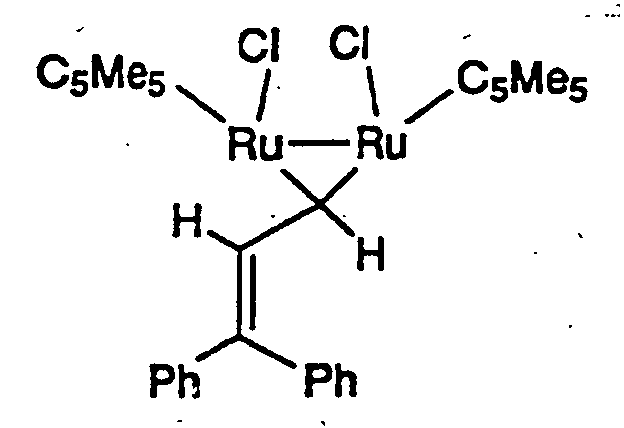
- The reaction between [Ru(C5Me5)Cl]4 and 3,3-diphenylcyclopropene was done under a nitrogen atmosphere. [Ru(C5Me5)Cl]4 (100 mg, 0.092 mmoL) was dissolved in 10 mL of tetrahydrofuran. To this solution was added 3,3-diphenylcyclopropene (350 mg, 1.82 mmol). The resulting solution was stirred at room temperature for 1 h. Petroleum ether (10 mL) was then added to the reaction mixture. The reaction was stirred for an additional 30 min, after which all volatile components were removed from the reaction mixture under vacuum. The crude product was extracted with diethyl ether, volatiles were removed from the filtrate under vacuum to afford a dark colored, oily solid. The crude product was further extracted with petroleum ether; volatiles were removed from the filtrate under vacuum to afford a very dark red-brown oil. Recrystalization from petroleum ether at -40°C afforded dark crystals. The NMR spectra of the product was consistent with the formulation [(C5Me5)RuCl]2 (=CH-CH=CPh2).
- (PPh3)2Cl2Ru=CH-CH=CPh2 catalyzed the polymerization of norbornene in a 1:8 mixture of CH2Cl2/C6H6 at room temperature to yield polynorbomene. A new signal, attributed to Hα of the propagating carbene, was observed by 1H NMR spectroscopy at 17.79 ppm. Its identity and stability was confirmed by preparing a block polymer with 2,3-dideuteronorbomene and perprotionorbornene. When 2,3-dideuteronorbomene was added to the propagating species, the new carbene signal vanished and then reappeared when perprotionorbomene was added for the third block.
- [(C5Me5)RuCl]2(=CH-CH-CPh2) (14 mg, 0.030 mmol) was dissolved in 1 mL of perdeuterated toluene under a nitrogen atmosphere. To this was added norbornene (109 mg, 1.16 mmol). The reaction mixture became viscous within minutes as the norbornene polymerized. After 20 h at room temperature a 1H NMR spectrum of the reaction mixture was taken, which showed polynorbornene and unreacted norbomene monomer in a ratio of 82:12.
-

- In a typical reaction, a 100 mL Schlenk flask equipped with a magnetic stirbar was charged with (Ph3P)2Cl2Ru=CH-CH=CPh2 (3.624 g, 4.08 mmol) and PCy3 (2.4 g, 2.1 equiv) inside a nitrogen-filled drybox. Methylene chloride (60 mL) was added to dissolve the mixture. The reaction flask was capped with a stopper, removed from the drybox, and stirred under argon overnight during which time the reaction mixture turned red. The reaction mixture was then cannula-filtered under argon into another Schlenk flask. The red filtrate was then concentrated under in vacuo to about 15 mL. Pentane (60 mL) was slowly added to the mixture via cannula while stirring vigorously. A flocculent green solid, consisting mostly starting material, begins to be separated out of the solution when about 40 mL of pentane is added. The red supernatant was quickly transferred into another Schlenk flask via cannula filtration and then evaporated to dryness under in vacuo. The remaining red solid was washed with pentane (3 x 40 mL). To ensure the complete removal of all phosphine by-products, each wash was stirred at room temperature for at least 30 minutes before the supernatant was cannula-filtered away. The resulting solid was then dried under vacuum overnight to afford 3.39 g (ca. 90%) of (Cy3P)2Cl2Ru=CH-CH=CPh2 as a red powder.
- While the present invention is disclosed by reference to the preferred embodiments and examples detailed above, it is to be understood that these examples are intended in an illustrative rather than limiting sense, and it is contemplated that modifications within the spirit and scope of the invention will readily occur to those skilled in the art, which modifications are intended to be encompassed within the scope of the appended claims.
Claims (15)
- A method of preparing a catalyst of the formulacomprising:
 reacting a compound of the formula (XX1MLnL1 m)p with a phosphorane of the formulawherein:
 M is Os or Ru;R and R1 are either the same or different and are(a) hydrogen,(b) a group selected from C2-C20 alkenyl, C2-C20 alkynyl, C1-C20 alkyl, aryl, C1-C20 carboxylate, C2-C20 alkoxy, C2-C20 alkenyloxy, C2-C20 alkynyloxy, aryloxy, C2-C20 alkoxycarbonyl, C1-C20 alkylthio, C1-C20 alkylsulfonyl, or C1-C20 alkylsulfinyl, or(c) one of the groups listed in (b) substituted with C1-C5 alkyl, halogen, C1-C5 alkoxy, unsubstituted phenyl, halogen substituted phenyl, C1-C5 alkyl substituted phenyl, or C1-C5 alkoxy substituted phenyl;R4, R5, and R6 are either the same or different and are each unsubstituted or substituted hydrocarbon wherein the hydrocarbon is selected from the group consisting of aryl, C1-C6 alkyl, C1-C6 alkoxy, and phenoxy and the hydrocarbon substitution is selected from the group consisting of halogen, C1-C3 alkyl, C1-C3 alkoxy, unsubstitutedL is any neutral electron donor;L1 is a trialkylphosphine ligand where at least one of the alkyl groups is a secondary alkyl or a cycloalkyl;n and m are independently 0-4, provided n+m=2, 3 or 4; andp is an integer equal to or greater than 1.
 - The method as in claim 1 wherein R4, R5, and R6 independently are each C1-C6 alkyl or phenyl.
- The method as any one of claim 1 or claim 2 wherein L and L1 are either the same or different and are P(isopropyl)3, P(cyclopentyl)3 and P(cyclohexyl)3.
- The method as in any one of claims 1 to 3 wherein the reaction is conducted in the presence of an organic, protic or aqueous solvent.
- The method according to claim 4 wherein the solvent is selected from the group consisting of benzene toluene, p-xylene, methylene chloride, dichloroethane, dichlorobenzene, chlorobenzene, tetrahydrofuran, diethylether, pentane, methanol, ethanol, water, or mixtures thereof.
- The method as claimed in claim 4 or claim 5 wherein the reaction is conducted at a temperature of between about -20°C and 125°C.
- The method according to claim 6 wherein the reaction is conducted at a temperature of between about 35°C and 90°C.
- The method as claimed in claim 3, wherein the catalyst has the formulawherein iPr is isopropyl and Cy is cyclohexyl.

- A method of preparing a catalyst of the formulacomprising:
 where one of L and L' is a trialkylphospine where at least one alkyl group is either a secondary alkyl or a cycloalkyl,reacting a compound of the formula (XX1MLnL1 m)p with a phosphorane of the formulawherein:
 M is Os or Ru;R and R1 are independently selected from hydrogen, vinyl, C1-C10 alkyl, aryl, C1-C10 carboxylate, C2-C10 alkoxycarbonyl, C1-C10 alkoxy, aryloxy, each optionally substituted with C1-C5 alkyl, halogen, C1-C5 alkoxy or a phenyl group optionally substituted with halogen, C1-C5 alkyl, or C1-C5 alkoxy; andX and X1 are independently selected from halogen, hydrogen, diketonates, or C1-C20 alkyl, aryl, C1-C20 alkoxide, aryloxide, C2-C20 alkoxycarbonyl, arylcarboxylate, C1-C20 carboxylate, aryl or C1-C20 alkylsulfonate, C1-C20 alkylthio, C1-C20 alkylsulfonyl, C1-C20 alkylsulfinyl, each optionally substituted with C1-C5 alkyl, halogen, C1-C5 alkoxy or with a phenyl group optionally substituted with halogen, C1-C5 alkyl or C1-C5 alkoxy; andL and L1 are independently selected from phosphine, sulfonated phosphine, phosphite, phosphinite, phosphonite, arsine, stibine, ether, amine, amide, sulfoxide, carbonyl, nitrosyl, pyridine or thioether;
R4, R5, and R6 are either the same or different and are each unsubstituted or substituted hydrocarbon wherein the hydrocarbon is selected from the group consisting of aryl, C1-C6 alkyl, C1-C6 alkoxy, and phenoxy and the hydrocarbon substitution is selected from the group consisting of halogen, C1-C3 alkyl, C1-C3 alkoxy, unsubstituted phenyl, halogen substituted phenyl, C1-C5 alkyl substituted phenyl, and C1-C5 alkoxy substituted phenyl; and
n and m are independently 0-4, provided n+m=2, 3 or 4; and
p is an integer equal to or greater than 1. - The method as claimed in claim 9, wherein:where one of L and L' is a trialkylphosphine where at least one alkyl group is either a secondary alkyl or a cycloalkyl.R and R1 are independently selected from hydrogen, vinyl, C1-C5 alkyl, phenyl, C2-C5 alkoxycarbonyl, C1-C5 carboxylate, C1-C5 alkoxy, phenoxy, each optionally substituted with C1-C5 alkyl, halogen, C1-C5 alkoxy or a phenyl group optionally substituted with halogen, C1-C5 alkyl, or C1-C5 alkoxy; andX and X1 are independently selected from Cl, Br, I, or benzoate, acetylacetonate, C1-C5 carboxylate, C1-C5 alkyl, phenoxy, C1-C5 alkoxy, C1-C5 alkylthio, aryl, and C1-C5 alkylsulfonate, each optionally substituted with C1-C5 alkyl or a phenyl group optionally substituted with halogen, C1-C5 alkyl or C1-C5 alkoxy; andL and L' are independently selected from aryl, C1-C5 alkyl, secondary alkyl or cycloalkylphosphine, aryl- or C1-C10 alkylsulfonated phosphine, aryl- or C1-C10 alkylphosphinite, aryl- or C1-C10 alkylphosphonite, aryl- or C1-C10 alkylphosphite, aryl- or C1-C10 alkylarsine, aryl- or C1-C10 alkylamine, pyridine, aryl- or C1-C10 alkylsulfoxide, aryl- or C1-C10 alkylether, or aryl- or C1-C10 alkylamide, each optionally substituted with a phenyl group optionally substituted with halogen, C1-C5 alkyl or C1-C5 alkoxy;
- The method as claimed in claim 9, wherein:R and R1 are independently selected from hydrogen, vinyl, C1-C5 alkyl, phenyl, C2-C5 alkoxycarbonyl, C1-C5 carboxylate, C1-C5 alkoxy, phenoxy, each optionally substituted with C1-C5 alkyl, halogen, C1-C5 alkoxy or a phenyl group optionally substituted with halogen, C1-C5 alkyl, or C1-C5 alkoxy; andX and X1 are independently selected from Cl, Br, I, or benzoate, acetylacetonate, C1-C5 carboxylate, C1-C5 alkyl, phenoxy, C1-C5 alkoxy, C1-C5 alkylthio, aryl, and C1-C5 alkylsulfonate, each optionally substituted with C1-C5 alkyl or a phenyl group optionally substituted with halogen, C1-C5 alkyl or C1-C5 alkoxy; andL is selected from aryl, C1-C5 alkyl, secondary alkyl or cycloalkylphosphine, aryl- or C1-C10 alkylsulfonated phosphine, aryl- or C1-C10 alkylphosphinite, aryl- or C1-C10 alkylphosphonite, aryl- or C1-C10 alkylphosphite, aryl- or C1-C10 alkylarsine, aryl- or C1-C10 alkylamine, pyridine, aryl- or C1-C10 alkylsulfoxide, aryl- or C1-C10 alkylether, or aryl- or C1-C10 alkylamide, each optionally substituted with a phenyl group optionally substituted with halogen, C1-C5 alkyl or C1-C5 alkoxy; andL1 is selected from C1-C5 alkyl, secondary alkyl or cycloalkylphosphine, C1-C10 alkylsulfonated phosphine, C1-C10 alkylphosphinite, C1-C10 alkylphosphonite, C1-C10 alkylphosphite, C1-C10 alkylarsine, C1-C10 alkylamine, pyridine, C1-C10 alkylsulfoxide, C1-C10 alkylether, or C1-C10 alkylamide, each optionally substituted with a phenyl group optionally substituted with halogen, C1-C5 alkyl or C1-C5 alkoxy.
- The method as claimed in claim 9, whereinwhere one of L and L' is a trialkylphosphine where at least one alkyl group is either a secondary alkyl or a cycloalkyl.R and R1 are independently selected from vinyl, H, Me, or Ph;X and X1 are independently selected from Cl, CF3CO2, CH3CO2, CFH2CO2, (CH3)3CO, (CF3)2(CH3)CO, (CF3)(CH3)2CO, PhO, MeO, EtO, tosylate, mesylate, or trifluoromethanesulfonate; andL and L' are independently selected from PPh3, P(p-Tol)3, P(o-Tol) 3, PPh(CH3)2, P(CF3)3, P(p-FC6H4)3, pyridine, P(p-CF3C6H4)3, (p-F)pyridine, (p-CF3)pyridine, P(C6H4-SO3Na)3, P(CH2C6H4-SO3Na)3, P(iPr)3, P(CHCH3(CH2CH3))3, P(cyclopentyl)3, P(cyclohexyl)3, P(neopentyl)3 or P(neophenyl)3;
- The method as claimed in claim 9, whereinR and R1 are independently selected from vinyl, H, Me, or Ph;X and X1 are independently selected from Cl, CF3CO2, CH3CO2, CFH2CO2, (CH3)3CO, (CF3)2(CH3)CO, (CF3)(CH3)2CO, PhO, MeO, EtO, tosylate, mesylate, or trifluoromethanesulfonate; andL is selected from PPh3, P(p-Tol)3, P(o-Tol)3, PPh(CH3)2, P(CF3)3, P(p-FC6H4) 3, pyridine, P(p-CF3C6H4)3, (p-F)pyridine, (p-CF3)pyridine, P(C6H4-SO3Na)3, P(CH2C6H4-SO3Na)3, P(iPr)3, P(CHCH3 (CH2CH3))3, P(cyclopentyl)3, P(cyclohexyl)3, P(neopentyl)3 or P(neophenyl)3; andL1 is selected from P(iPr)3, P(CHCH3 (CH2CH3))3, P(cyclopentyl)3, P(cyclohexyl)3, or P(neopentyl)3.
- A method of preparing a catalyst of the formulacomprising:
 reacting a compound of the formula (XX1MLnL1 m)p with a phosphorane of the formulawherein:
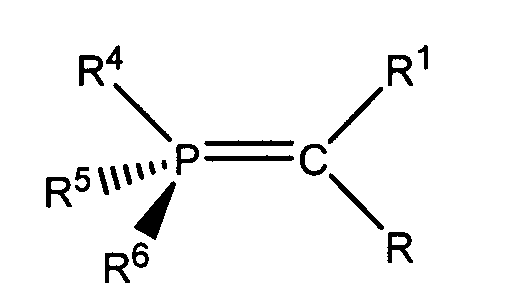 M is Os or Ru;R and R1 are either the same or different and are hydrogen;
a group selected from C2-C20 alkenyl, C2-C20 alkynyl, C1-C20 alkyl, aryl, C1-C20 carboxylate, C2-C20 alkoxy, C2-C20 alkenyloxy, C2-C20 alkynyloxy, aryloxy, C2-20 alkoxycarbonyl, C1-C20 alkylthio, C1-C20 alkylsulfonyl, or C1-C20 alkylsufinyl, or
one of the groups listed in (b) substituted with C1-C5 alkyl, halogen, C1-C5 alkoxy, unsubstituted phenyl, halogen substituted phenyl, C1-C5 alkyl substituted phenyl, or C1-C5 alkoxy substituted phenyl;R4, R5, and R6 are either the same or different and are each unsubstituted or substituted hydrocarbon wherein the hydrocarbon is selected from the group consisting of aryl, C1-C6 alkyl, C1-C6 alkoxy, and phenoxy and the hydrocarbon substitution is selected from the group consisting of halogen, C1-C3 alkyl, C1-C3 alkoxy, unsubstituted phenyl, halogen substituted phenyl, C1-C5 alkyl substituted phenyl and C1-C5 alkoxy substituted phenyl;
X and X1 are either the same or different and are any anionic ligand; L and L1 are either the same or different and are any neutral electron donor;
where one of L and L' is a trialkylphosphine where at least one alkyl group is either a secondary alkyl or a cycloalkyl;
n and m are independently 0-4, provided n+m=2, 3 or 4; andp is an integer equal to or greater than 1. - The method of claim 14 wherein the reaction occurs in the absence of a solvent.
Applications Claiming Priority (7)
| Application Number | Priority Date | Filing Date | Title |
|---|---|---|---|
| US07/863,606 US5312940A (en) | 1992-04-03 | 1992-04-03 | Ruthenium and osmium metal carbene complexes for olefin metathesis polymerization |
| US08/106,292 US5342909A (en) | 1992-04-03 | 1993-08-13 | Ruthenium and osmium metal carbene complexes for olefin metathesis polymerization |
| US28282694A | 1994-07-29 | 1994-07-29 | |
| US28282794A | 1994-07-29 | 1994-07-29 | |
| US282826 | 1994-07-29 | ||
| US282827 | 1994-07-29 | ||
| EP95929340A EP0773948A4 (en) | 1992-04-03 | 1995-07-28 | HIGH-ACTIVITY CARBENIC RUTHENIUM AND OSMIUM COMPLEXES FOR OLEFIN METATHESIS REACTIONS AND THEIR SYNTHESIS PROCESS |
Related Parent Applications (1)
| Application Number | Title | Priority Date | Filing Date |
|---|---|---|---|
| EP95929340A Division EP0773948A4 (en) | 1992-04-03 | 1995-07-28 | HIGH-ACTIVITY CARBENIC RUTHENIUM AND OSMIUM COMPLEXES FOR OLEFIN METATHESIS REACTIONS AND THEIR SYNTHESIS PROCESS |
Publications (2)
| Publication Number | Publication Date |
|---|---|
| EP1251135A2 true EP1251135A2 (en) | 2002-10-23 |
| EP1251135A3 EP1251135A3 (en) | 2004-01-02 |
Family
ID=40280696
Family Applications (3)
| Application Number | Title | Priority Date | Filing Date |
|---|---|---|---|
| EP02016469A Ceased EP1253156A3 (en) | 1992-04-03 | 1995-07-28 | High activity ruthenium or osmium metal carbene complexes for olefin metathesis reactions and synthesis and application thereof |
| EP95929340A Ceased EP0773948A4 (en) | 1992-04-03 | 1995-07-28 | HIGH-ACTIVITY CARBENIC RUTHENIUM AND OSMIUM COMPLEXES FOR OLEFIN METATHESIS REACTIONS AND THEIR SYNTHESIS PROCESS |
| EP02016470A Withdrawn EP1251135A3 (en) | 1992-04-03 | 1995-07-28 | High activity ruthenium or osmium metal carbene complexes for olefin metathesis reactions and synthesis thereof |
Family Applications Before (2)
| Application Number | Title | Priority Date | Filing Date |
|---|---|---|---|
| EP02016469A Ceased EP1253156A3 (en) | 1992-04-03 | 1995-07-28 | High activity ruthenium or osmium metal carbene complexes for olefin metathesis reactions and synthesis and application thereof |
| EP95929340A Ceased EP0773948A4 (en) | 1992-04-03 | 1995-07-28 | HIGH-ACTIVITY CARBENIC RUTHENIUM AND OSMIUM COMPLEXES FOR OLEFIN METATHESIS REACTIONS AND THEIR SYNTHESIS PROCESS |
Country Status (6)
| Country | Link |
|---|---|
| US (6) | US5880231A (en) |
| EP (3) | EP1253156A3 (en) |
| JP (2) | JP3067031B2 (en) |
| AU (1) | AU691645B2 (en) |
| CA (1) | CA2196061C (en) |
| WO (1) | WO1996004289A1 (en) |
Cited By (5)
| Publication number | Priority date | Publication date | Assignee | Title |
|---|---|---|---|---|
| WO2006067370A1 (en) * | 2004-12-23 | 2006-06-29 | Imperial Chemical Industries Plc | Olefin metathesis polymerisation |
| WO2008027269A3 (en) * | 2006-08-25 | 2008-04-24 | Dow Global Technologies Inc | Production of telechelic compounds by metathesis depolymerization |
| WO2010085712A3 (en) * | 2009-01-22 | 2010-09-16 | Draths Corporation | Methods for producing dodecanedioic acid and derivatives thereof |
| CN106947067A (en) * | 2017-04-28 | 2017-07-14 | 南京工业大学 | Preparation method of polyester |
| WO2020063293A1 (en) * | 2018-09-29 | 2020-04-02 | 诺维新材有限公司 | Polyhydroxyl-containing polymer, preparation method therefor and use thereof |
Families Citing this family (358)
| Publication number | Priority date | Publication date | Assignee | Title |
|---|---|---|---|---|
| US6235856B1 (en) * | 1994-12-23 | 2001-05-22 | Ciba Specialty Chemicals Corporation | Polymerization of dicyclopentadiene |
| US5831108A (en) * | 1995-08-03 | 1998-11-03 | California Institute Of Technology | High metathesis activity ruthenium and osmium metal carbene complexes |
| EP0856024B1 (en) | 1995-10-19 | 2003-11-19 | Ciba SC Holding AG | Polymerisable composition and polymerisation method |
| US5939504A (en) * | 1995-12-07 | 1999-08-17 | Advanced Polymer Technologies | Method for extending the pot life of an olefin metathesis polymerization reaction |
| US6020443A (en) * | 1996-02-08 | 2000-02-01 | Advanced Polymer Technologies, Inc. | Polymerization of low grade DCPD monomers using an olefin metathesis catalyst |
| ES2146452T3 (en) * | 1996-03-07 | 2000-08-01 | Ciba Sc Holding Ag | RETICULABLE COMPOSITION CONTAINING A CYCLOPENTADIENE DIELS-ALDER ADDUCT AND A LOAD OF FILLING. |
| JP2000513393A (en) * | 1996-04-04 | 2000-10-10 | チバ スペシャルティ ケミカルズ ホールディング インコーポレーテッド | Catalyst mixture and polymerizable composition |
| US6159890A (en) * | 1996-04-30 | 2000-12-12 | Bp Amoco Corporation | Ruthenium-containing catalyst system for olefin metathesis |
| EP0915816B1 (en) * | 1996-07-20 | 2000-10-25 | Basf Aktiengesellschaft | Process for preparing alcohols and/or aldehydes from olefins |
| US6060570A (en) * | 1996-08-12 | 2000-05-09 | Bp Amoco Corporation | Process for preparation of addition products of difunctional telechelic polyolefins from cyclic olefins by olefin metathesis reaction |
| ATE228140T1 (en) * | 1996-11-01 | 2002-12-15 | Ciba Sc Holding Ag | METHOD FOR PRODUCING CATALYSTS |
| US5917071A (en) * | 1996-11-15 | 1999-06-29 | California Institute Of Technology | Synthesis of ruthenium or osmium metathesis catalysts |
| CA2280268C (en) * | 1997-03-06 | 2007-11-20 | Ciba Specialty Chemicals Holding Inc. | New catalysts |
| US5916983A (en) * | 1997-05-27 | 1999-06-29 | Bend Research, Inc. | Biologically active compounds by catalytic olefin metathesis |
| AU8626698A (en) * | 1997-06-25 | 1999-01-19 | Ciba Specialty Chemicals Holding Inc. | Ruthenium and osmium carbene catalysts |
| ES2209185T3 (en) | 1997-06-27 | 2004-06-16 | Ciba Specialty Chemicals Holding Inc. | RUTENIUM AND OSMIO CATALYSTS. |
| DE19736609A1 (en) | 1997-08-22 | 1999-02-25 | Basf Ag | Production of ruthenium-alkylidene complexes |
| US6284852B1 (en) * | 1997-10-30 | 2001-09-04 | California Institute Of Technology | Acid activation of ruthenium metathesis catalysts and living ROMP metathesis polymerization in water |
| EP0921129A1 (en) * | 1997-12-03 | 1999-06-09 | Studiengesellschaft Kohle mbH | Highly active cationic ruthenium and osmium complexes for olefin metathesis reactions |
| EP1036081B1 (en) | 1997-12-04 | 2002-07-17 | Ciba SC Holding AG | Heterocyclyl ligand containing ruthenium and osmium catalysts |
| CA2256961C (en) * | 1997-12-29 | 2009-09-29 | Bayer Corporation | Polyurethane polyolefins and prepolymers based on hydroxy functional polybutadiene |
| US6121473A (en) * | 1998-02-19 | 2000-09-19 | Massachusetts Institute Of Technology | Asymmetric ring-closing metathesis reactions |
| US6465590B1 (en) * | 1998-03-30 | 2002-10-15 | California Institute Of Technology | Telechelic alkadiene polymers with crosslinkable end groups and methods for making the same |
| EP1070091B1 (en) * | 1998-03-31 | 2004-04-28 | Ciba Specialty Chemicals Holding Inc. | Ruthenium and osmium carbene carbonyl catalysts |
| DE19815275B4 (en) * | 1998-04-06 | 2009-06-25 | Evonik Degussa Gmbh | Alkylidene complexes of ruthenium with N-heterocyclic carbene ligands and their use as highly active, selective catalysts for olefin metathesis |
| AU3535599A (en) * | 1998-04-23 | 1999-11-08 | Hitachi Chemical Company, Ltd. | Curable molding material and method for producing molded article |
| DE19820652A1 (en) | 1998-05-08 | 1999-11-11 | Basf Ag | Cationic ruthenium complexes used as catalyst for metathesis reactions |
| KR100372985B1 (en) * | 1998-05-14 | 2003-02-25 | 히다치 가세고교 가부시끼가이샤 | Resin Composition and Process for Producing Cured Article Using the Same |
| US7285593B1 (en) | 1998-05-19 | 2007-10-23 | Advanced Polymer Technologies, Inc. | Polyolefin compositions optionally having variable toughness and/or hardness |
| US6346652B1 (en) * | 1998-07-13 | 2002-02-12 | Massachusetts Institute Of Technology | Asymmetric ring-closing metathesis reactions involving achiral and meso substrates |
| US6107420A (en) * | 1998-07-31 | 2000-08-22 | California Institute Of Technology | Thermally initiated polymerization of olefins using Ruthenium or osmium vinylidene complexes |
| US6383319B1 (en) | 1998-08-07 | 2002-05-07 | A.P.T. Aerospace, L.L.C. | Rocket fuels based on metal hydrides and poly-DCPD |
| US6166166A (en) * | 1998-08-26 | 2000-12-26 | Bayer Corporation | Composition and process for preparation of thermoplastic polyurethanes (TPU based on a polybutadiene soft segment) |
| US6696597B2 (en) | 1998-09-01 | 2004-02-24 | Tilliechem, Inc. | Metathesis syntheses of pheromones or their components |
| US6900347B2 (en) | 1998-09-01 | 2005-05-31 | Tilliechem, Inc. | Impurity inhibition in olefin metathesis reactions |
| US7507854B2 (en) | 1998-09-01 | 2009-03-24 | Materia, Inc. | Impurity reduction in Olefin metathesis reactions |
| DE19840107A1 (en) * | 1998-09-03 | 2000-03-09 | Bayer Ag | Process for the synthesis of alpha-substituted ring systems |
| US6376690B1 (en) | 1998-09-09 | 2002-04-23 | California Institute O Technology | Method of removing transition metals |
| DE69941219D1 (en) | 1998-09-10 | 2009-09-17 | Univ New Orleans Foundation | CATALYST COMPLEX WITH PHENYLINDENYLIDEN LIGAND |
| MY139405A (en) | 1998-09-28 | 2009-09-30 | Ibiden Co Ltd | Printed circuit board and method for its production |
| US6211315B1 (en) * | 1998-11-12 | 2001-04-03 | Iowa State University Research Foundation, Inc. | Lewis acid-catalyzed polymerization of biological oils and resulting polymeric materials |
| EP2000803A1 (en) | 1998-11-30 | 2008-12-10 | Nanosphere, Inc. | Nanoparticles with Polymer Shells |
| US20020015519A1 (en) * | 1998-12-11 | 2002-02-07 | Lord Corporation | Fiber substrate adhesion and coatings by contact metathesis polymerization |
| WO2000043343A2 (en) | 1999-01-26 | 2000-07-27 | California Institute Of Technology | Novel methods for cross-metathesis of terminal olefins |
| US6342621B1 (en) | 1999-01-29 | 2002-01-29 | Nippon Zeon Co., Ltd. | Ruthenium catalysts for metathesis reactions of olefins |
| DE60022322T2 (en) | 1999-02-05 | 2006-06-29 | Advanced Polymer Technologies Inc. | POLYOLEFIN COMPOSITIONS WITH IMPROVED UV AND OXIDATION RESISTANCE AND METHOD FOR THE PRODUCTION THEREOF AND USE |
| EP1196455B1 (en) * | 1999-02-05 | 2008-01-16 | Materia, Inc. | Metathesis-active adhesion agents and methods for enhancing polymer adhesion to surfaces |
| US20140088260A1 (en) | 1999-02-05 | 2014-03-27 | Materia, Inc. | Metathesis-active adhesion agents and methods for enhancing polymer adhesion to surfaces |
| EP1165630A4 (en) * | 1999-02-05 | 2004-07-07 | Materia Inc | Polyolefin compositions having variable density and methods for their production and use |
| DE19907519A1 (en) * | 1999-02-22 | 2000-08-31 | Basf Ag | Process for the preparation of substituted olefins |
| JP2000256218A (en) | 1999-03-05 | 2000-09-19 | Bayer Ag | Metathesis in presence of ionic liquid |
| ATE437903T1 (en) | 1999-03-18 | 2009-08-15 | California Inst Of Techn | NEW ABA TRIBLOCK AND DIBLOCK COPOLYMERS AND METHOD FOR THE PRODUCTION THEREOF |
| ATE398133T1 (en) | 1999-03-31 | 2008-07-15 | California Inst Of Techn | RUTHENIUM METAL-ALKYLIDE COMPLEXES COORDINATED WITH TRIAZOLYDINE LIGANDS THAT HAVE HIGH OLEFIN METATHESIS ACTIVITY |
| US6225488B1 (en) | 1999-04-02 | 2001-05-01 | Nippon Zeon Co., Ltd. | Ruthenium or osmium catalysts for olefin metathesis reactions |
| US7192713B1 (en) | 1999-05-18 | 2007-03-20 | President And Fellows Of Harvard College | Stabilized compounds having secondary structure motifs |
| US7329758B1 (en) | 1999-05-24 | 2008-02-12 | California Institute Of Technology | Imidazolidine-based metal carbene metathesis catalysts |
| WO2000073366A1 (en) * | 1999-05-31 | 2000-12-07 | Nippon Zeon Co., Ltd. | Process for producing hydrogenated ring-opening polymerization polymer of cycloolefin |
| US6211324B1 (en) | 1999-06-08 | 2001-04-03 | Bayer Corporation | Hydrophobic polyurethane elastomer |
| US6271315B1 (en) | 1999-06-17 | 2001-08-07 | Wisconsin Alumni Research Foundation | Methods for making multivalent arrays |
| CA2375248C (en) * | 1999-06-17 | 2009-11-24 | Wisconsin Alumni Research Foundation | Methods and reagents making multivalent arrays and combinatorial libraries of multivalent arrays |
| US6291616B1 (en) * | 1999-06-17 | 2001-09-18 | Wisconsin Alumni Research Foundation | Methods and reagents for capping ruthenium or osmium carbene-catalyzed ROMP products |
| JP2011017028A (en) * | 1999-09-01 | 2011-01-27 | Materia Inc | Metathesis polymerization catalyst liquid |
| JP4762396B2 (en) * | 1999-09-01 | 2011-08-31 | マテリア, インコーポレイテッド | Metathesis polymerization catalyst solution |
| IT1314204B1 (en) * | 1999-10-28 | 2002-12-06 | Sigea Srl | RUTHENIUM COMPLEXES WITH HIGH ANTI-TUMORAL ACTIVITY |
| CA2392049C (en) * | 1999-11-18 | 2012-01-31 | Richard L. Pederson | Metathesis syntheses of pheromones or their components |
| US6780957B1 (en) | 1999-12-29 | 2004-08-24 | Bayer Polymers Llc | Hydrophobic light stable polyurethane elastomer with improved mechanical properties |
| US20040248801A1 (en) * | 2000-03-21 | 2004-12-09 | Kiessling Laura L. | Methods and reagents for regulation of cellular responses in biological systems |
| WO2001071309A2 (en) * | 2000-03-21 | 2001-09-27 | Wisconsin Alumni Research Foundation | Methods and reagents for regulation of cellular responses in biological systems |
| US6395851B1 (en) | 2000-06-09 | 2002-05-28 | Eastman Chemical Company | Copolymerization of norbornene and functional norbornene monomers |
| CA2413852C (en) * | 2000-06-23 | 2012-06-05 | California Institute Of Technology | Synthesis of functionalized and unfunctionalized olefins via cross and ring-closing metathesis |
| WO2002006361A2 (en) * | 2000-07-14 | 2002-01-24 | Simon Fraser University | Novel photochromic polymers and methods of synthesizing same |
| US6921736B1 (en) * | 2000-07-17 | 2005-07-26 | University Of New Orleans Research And Technology Foundation, Inc. | Simply assembled and recyclable polymer-supported olefin metathesis catalysts |
| US6359129B1 (en) | 2000-08-15 | 2002-03-19 | University Of Kansas | Amino acid-derived, 7-membered cyclic sulfamides and methods of synthesizing the same |
| US6420592B1 (en) | 2000-08-15 | 2002-07-16 | University Of Kansas | Amino acid-derived phosponamidic anhydrides and methods of preparing the same |
| US6420586B1 (en) | 2000-08-15 | 2002-07-16 | University Of Kansas | Amino acid-derived cyclic phosphonamides and methods of synthesizing the same |
| AU2001288738A1 (en) | 2000-09-05 | 2002-03-22 | California Institute Of Technology | Highly active metathesis catalysts generated in situ from inexpensive and air stable precursors |
| JP2002137233A (en) * | 2000-11-02 | 2002-05-14 | Hitachi Chem Co Ltd | Method and apparatus for cast molding metathesis polymer |
| US6476167B2 (en) | 2000-12-14 | 2002-11-05 | Bayer Corporation | End-functionalized polyolefin prepared via ring opening metathesis polymerization in the presence of a novel chain transfer agent, and a process for the preparation of the end-functionalized polyolefin via ring opening metathesis polyermization |
| US6391978B1 (en) | 2000-12-14 | 2002-05-21 | Bayer Corporation | Process for the synthesis of hydroxyl-end group functionalized polybutadienes |
| MXPA02002378A (en) * | 2001-03-12 | 2002-09-24 | Ciba Sc Holding Ag | Romp with alkoxy ether groups. |
| US6759537B2 (en) | 2001-03-23 | 2004-07-06 | California Institute Of Technology | Hexacoordinated ruthenium or osmium metal carbene metathesis catalysts |
| US6838489B2 (en) | 2001-03-23 | 2005-01-04 | Cymetech, Llc | High activity metal carbene metathesis catalysts generated using a thermally activated N-heterocyclic carbene precursor |
| US20030083445A1 (en) * | 2001-03-23 | 2003-05-01 | Grubbs Robert H. | High activity metal carbene metathesis catalysts generated using a thermally activated N-heterocyclic carbene precursor |
| KR100898876B1 (en) | 2001-03-26 | 2009-05-25 | 다우 글로벌 테크놀로지스 인크. | Heterogeneous catalyst composition |
| WO2002079126A1 (en) * | 2001-03-30 | 2002-10-10 | California Institute Of Technology | Cross-metathesis reaction of functionalized and substituted olefins using group 8 transition metal carbene complexes as metathesis catalysts |
| CN100537495C (en) * | 2001-03-30 | 2009-09-09 | 加利福尼亚技术学院 | Selective ring-opening cross-metathesis of cycloolefins |
| US20030064884A1 (en) * | 2001-04-06 | 2003-04-03 | Qingwei Yao | Recyclable and reusable ruthenium catalyst for olefin metathesis |
| EP1395616B1 (en) | 2001-04-16 | 2019-05-22 | California Institute Of Technology | Group 8 transition metal carbene complexes as enantioselective olefin metathesis catalysts |
| US20030113740A1 (en) * | 2001-04-26 | 2003-06-19 | Mirkin Chad A. | Oligonucleotide-modified ROMP polymers and co-polymers |
| US6673881B2 (en) | 2001-06-12 | 2004-01-06 | Bayer Inc. | Process for the preparation of low molecular weight hydrogenated nitrile rubber |
| CA2350280A1 (en) | 2001-06-12 | 2002-12-12 | Bayer Inc. | Low molecular weight hydrogenated nitrile rubber |
| US6841623B2 (en) * | 2001-06-29 | 2005-01-11 | Bayer Inc. | Low molecular weight nitrile rubber |
| AU2002352148A1 (en) * | 2001-06-29 | 2003-03-03 | Abbott Gmnh & Co. Kg | Bis-aryl thiazole derivatives |
| US6818586B2 (en) | 2001-08-01 | 2004-11-16 | Cymetech, Llp | Hexacoordinated ruthenium or osmium metal carbene metathesis catalysts |
| CA2455893C (en) | 2001-08-01 | 2011-01-18 | California Institute Of Technology | Hexacoordinated ruthenium or osmium metal carbene metathesis catalysts |
| US6884859B2 (en) * | 2001-08-29 | 2005-04-26 | California Institute Of Technology | Ring-opening metathesis polymerization of bridged bicyclic and polycyclic olefins containing two or more heteroatoms |
| CA2458904C (en) * | 2001-08-30 | 2012-07-17 | Materia, Inc. | Infusion of cyclic olefin resins into porous materials |
| WO2003027079A1 (en) | 2001-09-20 | 2003-04-03 | Zeon Corporation | Ruthenium complexes, process for preparation thereof, and processes for producing open-ring polymers of cycloolefins and hydrogenation products thereof by using the complexes as catalyst |
| JP4138417B2 (en) | 2001-09-28 | 2008-08-27 | 積水化学工業株式会社 | Method for synthesizing organometallic compounds |
| WO2003044060A2 (en) * | 2001-11-15 | 2003-05-30 | Materia, Inc. | Chelating carbene ligand precursors and their use in the synthesis of metathesis catalysts |
| JP2005517774A (en) * | 2002-02-19 | 2005-06-16 | カリフォルニア インスティテュート オブ テクノロジー | Ring expansion of cyclic olefins by olefin metathesis reaction using acyclic dienes |
| US20050113540A1 (en) * | 2002-03-12 | 2005-05-26 | Weaver John D. | Linear ethylene/vinyl alcohol and ethylene/vinyl acetate polymers and process for making same |
| CN1659172B (en) * | 2002-04-05 | 2012-08-01 | 加州理工学院 | Cross-metathesis of olefins directly substituted with an electron-withdrawing group using transition metal carbene catalysts |
| CN100379716C (en) * | 2002-04-29 | 2008-04-09 | 陶氏环球技术公司 | Integrated chemical process for industrial application of seed oil |
| MXPA05000866A (en) | 2002-07-23 | 2005-04-19 | Ppg Ind Ohio Inc | Glass fiber sizing compositions, sized glass fibers, and polyolefin composites. |
| EP1543043B1 (en) * | 2002-08-01 | 2013-10-02 | California Institute Of Technology | Synthesis of macrocyclic polymers by ring insertion polymerization of cyclic olefin monomers |
| US7777055B2 (en) * | 2002-08-09 | 2010-08-17 | Switch Materials Inc. | Photochromic and electrochromic compounds and methods of synthesizing and using same |
| US7002049B2 (en) * | 2002-08-19 | 2006-02-21 | Eastman Chemical Company | Process for α,β-dihydroxyalkenes and derivatives |
| US6737531B1 (en) | 2002-12-17 | 2004-05-18 | Brookhaven Science Associates, Llc | Catalysts for hydrogenation and hydrosilylation, methods of making and using the same |
| US6911546B2 (en) * | 2002-12-26 | 2005-06-28 | International Business Machines Corporation | Catalytic depolymerization of polymers containing electrophilic linkages using nucleophilic reagents |
| CA2512815A1 (en) | 2003-01-13 | 2004-07-29 | Cargill, Incorporated | Method for making industrial chemicals |
| WO2004067630A1 (en) * | 2003-01-28 | 2004-08-12 | Cryovac, Inc. | Cycloolefinic copolymer for high modulus film |
| JP2004307455A (en) | 2003-02-17 | 2004-11-04 | Sekisui Chem Co Ltd | Method for synthesizing zero-valent transition metal complex and organometallic compound using the same as starting material |
| US7094898B2 (en) * | 2003-05-29 | 2006-08-22 | University Of Ottawa | Ruthenium compounds, their production and use |
| EP1855861A4 (en) * | 2003-07-18 | 2010-12-01 | Univ Northwestern | SURFACE AND LOCAL POLYMERIZATION THROUGH DIRECTORY LITHOGRAPH |
| EP1648943B1 (en) * | 2003-07-28 | 2010-03-31 | Firestone Polymers, LLC | Removing gelled unsaturated elastomers from polymerization equipment associated with their production |
| US20050040564A1 (en) * | 2003-08-18 | 2005-02-24 | Jones Oliver | Systems and methods for using norbornene based curable materials |
| DE102004036068B4 (en) * | 2003-08-18 | 2023-05-17 | Merck Patent Gmbh | Process for hydrogenation |
| CN1856522A (en) * | 2003-09-25 | 2006-11-01 | 西巴特殊化学品控股有限公司 | ROMP with fluorinated groups |
| CN100588638C (en) * | 2003-10-09 | 2010-02-10 | 陶氏环球技术公司 | Improved process for the synthesis of unsaturated alcohols |
| WO2005044839A2 (en) * | 2003-11-05 | 2005-05-19 | Dana-Farber Cancer Institute, Inc. | Stabilized alpha helical peptides and uses thereof |
| AU2005228434A1 (en) | 2004-03-29 | 2005-10-13 | California Institute Of Technology | Latent, high-activity olefin metathesis catalysts containing an N-heterocyclic carbene ligand |
| CA2569525C (en) * | 2004-06-09 | 2015-03-31 | University Technologies International Inc. | Transition metal carbene complexes containing a cationic substituent as catalysts of olefin metathesis reactions |
| DE102004033312A1 (en) * | 2004-07-08 | 2006-01-26 | Boehringer Ingelheim Pharma Gmbh & Co. Kg | Continuous metathesis process with ruthenium catalysts |
| EP1856208B1 (en) | 2005-01-10 | 2016-12-28 | Elevance Renewable Sciences, Inc. | Wax composition containing metathesis products and method for making an article by extrusion thereof |
| US8101697B2 (en) * | 2005-02-01 | 2012-01-24 | Bridgestone Corporation | Multi-functionalized high-trans elastomeric polymers |
| US8058351B2 (en) * | 2005-05-20 | 2011-11-15 | Bridgestone Corporation | Method for preparing low molecular weight polymers |
| CA2609887C (en) * | 2005-05-25 | 2015-12-29 | Switch Materials Inc. | Photochromic and electrochromic compounds and synthesis and use thereof |
| CA2610571C (en) | 2005-06-06 | 2014-01-28 | Dow Global Technologies Inc. | Metathesis process for preparing an .alpha.,.omega.-functionalized olefin |
| KR101269568B1 (en) | 2005-07-04 | 2013-06-04 | 자난 사이텍 컴퍼니 리미티드 | Ruthenium complex ligand, ruthenium complex, carried ruthenium complex catalyst and the preparing methods and the use thereof |
| EP1760093B1 (en) | 2005-08-30 | 2011-12-21 | LANXESS Deutschland GmbH | Use of catalysts for the metathesis degradation of nitrile rubber |
| WO2007081987A2 (en) * | 2006-01-10 | 2007-07-19 | Elevance Renewable Sciences, Inc. | Method of making hydrogenated metathesis products |
| FR2896500B1 (en) * | 2006-01-24 | 2010-08-13 | Inst Francais Du Petrole | PROCESS FOR CO-PRODUCTION OF OLEFINS AND DIESTERS OR DIACIDES BY HOMOMETATHESIS OF UNSATURATED FATTY BODIES IN NON-AQUEOUS IONIC LIQUIDS |
| CN101969771A (en) * | 2006-02-09 | 2011-02-09 | 埃莱文斯可更新科学公司 | Antimicrobial compositions, methods and systems |
| US7951232B2 (en) * | 2006-02-09 | 2011-05-31 | Elevance Renewable Sciences, Inc. | Surface coating compositions and methods |
| DE102006008521A1 (en) | 2006-02-22 | 2007-08-23 | Lanxess Deutschland Gmbh | Use of catalysts with increased activity for NBR metathesis |
| DE102006008520A1 (en) | 2006-02-22 | 2007-08-23 | Lanxess Deutschland Gmbh | New catalyst systems and their use for metathesis reactions |
| US20090306268A1 (en) * | 2006-03-01 | 2009-12-10 | James Pawlow | Polyester Compositions Containing Metathesis Polymers with Reduced Recycle Color |
| US8888908B2 (en) | 2006-03-07 | 2014-11-18 | Elevance Renewable Sciences, Inc. | Colorant compositions comprising metathesized unsaturated polyol esters |
| BRPI0708675B1 (en) | 2006-03-07 | 2017-04-04 | Elevance Renewable Sciences | compositions comprising metathesis unsaturated polyol esters and personal care articles comprising said compositions |
| US7534917B1 (en) * | 2006-04-27 | 2009-05-19 | The United States Of America As Represented By The Secretary Of Agriculture | Method of producing dicarboxylic acids |
| WO2007131084A2 (en) * | 2006-05-03 | 2007-11-15 | Wisconsin Alumni Research Foundation | Magnetic resonance imaging contrast agents synthesized using ring-opening metathesis polymerization |
| WO2008008420A1 (en) | 2006-07-12 | 2008-01-17 | Elevance Renewable Sciences, Inc. | Hot melt adhesive compositions comprising metathesized unsaturated polyol ester wax |
| EP2046719B1 (en) * | 2006-07-12 | 2013-09-04 | Elevance Renewable Sciences, Inc. | Ring opening cross-metathesis reaction of cyclic olefins with seed oils and the like |
| WO2008010961A2 (en) | 2006-07-13 | 2008-01-24 | Elevance Renewable Sciences, Inc. | Synthesis of terminal alkenes from internal alkenes and ethylene via olefin metathesis |
| WO2008027268A2 (en) * | 2006-08-25 | 2008-03-06 | Dow Global Technologies Inc. | Production of blockcopolymers by amorphous polymer segment interchange via metathesis |
| ES2391209T3 (en) * | 2006-08-25 | 2012-11-22 | Dow Global Technologies Llc | Production of randomized block copolymers by metathesis of high melting polymer segments |
| EP2057205B1 (en) | 2006-08-25 | 2017-02-08 | Dow Global Technologies LLC | Production of meta-block copolymers by polymer segment interchange |
| DE102006040569A1 (en) | 2006-08-30 | 2008-03-06 | Lanxess Deutschland Gmbh | Process for the metathesis degradation of nitrile rubbers |
| JP5296544B2 (en) * | 2006-08-31 | 2013-09-25 | 三井化学株式会社 | Polyolefin polymer containing both terminal vinyl groups and composition thereof |
| CN101558027B (en) | 2006-10-13 | 2013-10-16 | 埃莱文斯可更新科学公司 | Methods of making alpha, omega-dicarboxylic acid alkene derivatives by double decomposition |
| WO2008048520A2 (en) * | 2006-10-13 | 2008-04-24 | Elevance Renewable Sciences, Inc. | Methods of making organic compounds by metathesis and hydrocyanation |
| EP2074079B1 (en) | 2006-10-13 | 2011-08-10 | Elevance Renewable Sciences, Inc. | Metathesis methods involving hydrogenation and compositions relating to same |
| CN102123979A (en) * | 2006-10-13 | 2011-07-13 | 埃莱文斯可更新科学公司 | Process for the synthesis of terminal olefins from internal olefins by olefin metathesis |
| PL2118123T3 (en) | 2007-01-31 | 2016-06-30 | Dana Farber Cancer Inst Inc | Stabilized p53 peptides and uses thereof |
| JP5631201B2 (en) * | 2007-03-28 | 2014-11-26 | プレジデント アンド フェローズ オブ ハーバード カレッジ | Stitched polypeptide |
| US20080306230A1 (en) * | 2007-06-07 | 2008-12-11 | General Electric Company | Composition and Associated Method |
| FR2917406B1 (en) * | 2007-06-13 | 2012-08-03 | Arkema France | PROCESS FOR SYNTHESIZING DIACIDS OR DIESTERS FROM ACIDS AND / OR NATURAL FATTY ESTERS |
| US9284515B2 (en) | 2007-08-09 | 2016-03-15 | Elevance Renewable Sciences, Inc. | Thermal methods for treating a metathesis feedstock |
| DE102007039525A1 (en) * | 2007-08-21 | 2009-02-26 | Lanxess Deutschland Gmbh | Process for metathesis degradation of nitrile rubber |
| DE102007039527A1 (en) | 2007-08-21 | 2009-02-26 | Lanxess Deutschland Gmbh | New ruthenium- and osmium-carbene-complex catalysts, which are bonded with chiral carbon atoms or over double bonds at a catalyst base skeleton, useful e.g. in metathesis-reactions, preferably in ring closing metathesis reactions |
| EP2027920B1 (en) | 2007-08-21 | 2014-10-08 | LANXESS Deutschland GmbH | Catalysts for metathesis reactions |
| DE602007006480D1 (en) * | 2007-08-21 | 2010-06-24 | Lanxess Deutschland Gmbh | Metathesis of a nitrile rubber in the presence of transition metal complex catalysts |
| DE102007039526A1 (en) | 2007-08-21 | 2009-02-26 | Lanxess Deutschland Gmbh | Catalyst systems and their use for metathesis reactions |
| DE102007039695A1 (en) | 2007-08-22 | 2009-02-26 | Lanxess Deutschland Gmbh | New ruthenium- and osmium-carbene-complex catalysts, which are bonded with chiral carbon atoms or over double bonds at a catalyst base skeleton, useful e.g. in metathesis-reactions, preferably in ring closing metathesis reactions |
| CA2646056A1 (en) | 2007-12-21 | 2009-06-21 | Lanxess Deutschland Gmbh | A process for removing ruthenium-containing catalyst residues from optionally hydrogenated nitrile rubber |
| EP2072532A1 (en) | 2007-12-21 | 2009-06-24 | Lanxess Deutschland GmbH | A process for removing iron-residues, rhodium- and ruthenium-containing catalyst residues from optionally hydrogenated nitrile rubber |
| US8241575B2 (en) * | 2008-01-28 | 2012-08-14 | The Johns Hopkins University | Molecularly imprinted polymer sensor device |
| CN104474529A (en) | 2008-02-08 | 2015-04-01 | 爱勒让治疗公司 | Therapeutic peptidomimetic macrocycles |
| WO2009126292A2 (en) * | 2008-04-08 | 2009-10-15 | Aileron Therapeutics, Inc. | Biologically active peptidomimetic macrocycles |
| EP2260047B2 (en) | 2008-04-08 | 2016-07-20 | Evonik Degussa GmbH | Method for manufacturing ruthenium carbene complexes |
| US20110144303A1 (en) * | 2008-04-08 | 2011-06-16 | Aileron Therapeutics, Inc. | Biologically Active Peptidomimetic Macrocycles |
| JP5314753B2 (en) * | 2008-05-22 | 2013-10-16 | リミテッド・ライアビリティ・カンパニー・”ユナイテッド・リサーチ・アンド・デベロップメント・センター” | Dicyclopentadiene metathesis polymerization catalyst, its production method and polymerization method |
| RU2393171C1 (en) * | 2008-12-10 | 2010-06-27 | Общество с ограниченной ответственностью "Объединенный центр исследований и разработок" | Dicyclopentadiene metathesis polymerisation catalyst, preparation method thereof and polymerisation method |
| RU2375379C1 (en) * | 2008-05-22 | 2009-12-10 | Общество с ограниченной ответственностью "Объединенный центр исследований и разработок" | Catalyst for metathesis polymerisation of dicyclopentadiene, production method thereof (versions) and polymerisation method thereof |
| WO2009154849A1 (en) | 2008-06-20 | 2009-12-23 | 3M Innovative Properties Company | Molded microstructured articles and method of making same |
| US8372930B2 (en) | 2008-06-20 | 2013-02-12 | Exxonmobil Chemical Patents Inc. | High vinyl terminated propylene based oligomers |
| US8283419B2 (en) | 2008-06-20 | 2012-10-09 | Exxonmobil Chemical Patents Inc. | Olefin functionalization by metathesis reaction |
| KR20110033920A (en) * | 2008-06-20 | 2011-04-01 | 쓰리엠 이노베이티브 프로퍼티즈 컴파니 | Polymer molds and articles made therefrom |
| US8399725B2 (en) * | 2008-06-20 | 2013-03-19 | Exxonmobil Chemical Patents Inc. | Functionalized high vinyl terminated propylene based oligomers |
| US8802797B2 (en) | 2008-06-20 | 2014-08-12 | Exxonmobil Chemical Patents Inc. | Vinyl-terminated macromonomer oligomerization |
| US8283428B2 (en) | 2008-06-20 | 2012-10-09 | Exxonmobil Chemical Patents Inc. | Polymacromonomer and process for production thereof |
| EP2147721A1 (en) | 2008-07-08 | 2010-01-27 | Lanxess Deutschland GmbH | Catalyst systems and their use in metathesis reactions |
| EP2143489A1 (en) * | 2008-07-08 | 2010-01-13 | Lanxess Deutschland GmbH | Catalyst systems and their use in metathesis reactions |
| US20110144306A1 (en) * | 2008-07-23 | 2011-06-16 | President And Fellows Of Harvard College | Ligation of stapled polypeptides |
| CN102159603B (en) * | 2008-08-04 | 2014-05-07 | 费尔斯通聚合物有限责任公司 | Adducts of metathesis polymers and preparation thereof |
| EP2321363B1 (en) | 2008-08-21 | 2020-04-22 | Materia, Inc. | Telechelic olefin metathesis polymers from renewable feedstocks |
| EP2157076A1 (en) * | 2008-08-21 | 2010-02-24 | Cognis IP Management GmbH | Process for the preparation of unsaturated alpha, omega dicarboxylic acid diesters |
| CN104961795A (en) | 2008-09-22 | 2015-10-07 | 爱勒让治疗公司 | Methods for preparing purified polypeptide compositions |
| WO2010051268A1 (en) | 2008-10-31 | 2010-05-06 | Dow Global Technologies Inc. | Olefin metathesis process employing bimetallic ruthenium complex with bridging hydrido ligands |
| FR2939331B1 (en) | 2008-12-10 | 2012-08-10 | Inst Francais Du Petrole | CATALYTIC COMPOSITION AND METHOD FOR THE METATHESIS OF UNSATURATED BODY |
| US20100155998A1 (en) * | 2008-12-19 | 2010-06-24 | 3M Innovative Properties Company | Shape memory polymer |
| AU2010204648B2 (en) | 2009-01-14 | 2016-09-01 | Aileron Therapeutics, Inc. | Peptidomimetic macrocycles |
| EP2210870A1 (en) | 2009-01-23 | 2010-07-28 | Evonik Degussa GmbH | Hydroxy and aldehyde functional connections |
| DE102009005951A1 (en) | 2009-01-23 | 2010-07-29 | Evonik Degussa Gmbh | Aldehyde-functional compounds |
| EA020900B1 (en) * | 2009-05-05 | 2015-02-27 | Стипэн Компани | Composition for recovering oil, process for recovering oil from oil bearing formation and sulfonated derivative of internal olefins |
| BR112012000867A2 (en) | 2009-07-13 | 2019-09-24 | Harvard College | "Sewn bifunctional polypeptides and use thereof" |
| US8222469B2 (en) | 2009-07-15 | 2012-07-17 | Massachusetts Institute Of Technology | Catalysts and processes for the formation of terminal olefins by ethenolysis |
| US8895667B2 (en) | 2009-07-17 | 2014-11-25 | Tyco Electronics Corporation | Methods of making reversible crosslinked polymers and related methods |
| RU2409420C1 (en) * | 2009-08-21 | 2011-01-20 | ОТКРЫТОЕ АКЦИОНЕРНОЕ ОБЩЕСТВО "СИБУР Холдинг" | Ruthenium catalyst for metathesis polymerisation of dicyclopentadiene and method of preparing said catalyst |
| CA2771242A1 (en) | 2009-08-31 | 2011-03-03 | Lanxess Deutschland Gmbh | Vulcanizable polymer composition comprising a low molecular weight optionally hydrogenated nitrile rubber |
| EP2289623A1 (en) | 2009-08-31 | 2011-03-02 | LANXESS Deutschland GmbH | Metathesis of nitrile rubbers in the presence of transition metal catalysts |
| EP2289622A1 (en) | 2009-08-31 | 2011-03-02 | LANXESS Deutschland GmbH | Ruthenium based catalysts for the metathesis of nitrile rubbers |
| JP2013505300A (en) | 2009-09-22 | 2013-02-14 | エルロン・セラピューティクス・インコーポレイテッド | Peptidomimetic macrocycle |
| US8362311B2 (en) | 2009-09-30 | 2013-01-29 | Massachusetts Institute Of Technology | Highly Z-selective olefins metathesis |
| US9051519B2 (en) | 2009-10-12 | 2015-06-09 | Elevance Renewable Sciences, Inc. | Diene-selective hydrogenation of metathesis derived olefins and unsaturated esters |
| CA2800171C (en) | 2010-05-22 | 2018-02-20 | Stepan Company | Sulfonated internal olefin surfactant for enhanced oil recovery |
| EP2395034A1 (en) | 2010-06-14 | 2011-12-14 | LANXESS Deutschland GmbH | Blends from partially hydrated nitrile rubber and silicon rubber, vulcanisable mixtures based on same and vulcanisates |
| EP2418225A1 (en) | 2010-08-09 | 2012-02-15 | LANXESS Deutschland GmbH | Partially hydrated nitrile rubbers |
| KR102104762B1 (en) | 2010-08-13 | 2020-04-24 | 에일러론 테라퓨틱스 인코포레이티드 | Peptidomimetic macrocycles |
| JP2013541438A (en) | 2010-09-03 | 2013-11-14 | ビーエーエスエフ ソシエタス・ヨーロピア | Barrier coating from cycloolefin copolymer |
| EP2428269A1 (en) | 2010-09-08 | 2012-03-14 | Bergen Teknologioverføring AS | Novel olefin metathesis catalysts |
| WO2012040459A2 (en) | 2010-09-22 | 2012-03-29 | President And Fellows Of Harvard College | Beta-catenin targeting peptides and uses thereof |
| US8227371B2 (en) | 2010-09-24 | 2012-07-24 | Exxonmobil Chemical Patents Inc. | Class of olefin metathesis catalysts, methods of preparation, and processes for the use thereof |
| EP2484700B1 (en) | 2011-02-04 | 2013-10-09 | LANXESS Deutschland GmbH | Functionalised nitrile rubbers and their manufacture |
| EP2673304B1 (en) | 2011-02-11 | 2016-02-03 | Basf Se | Rubber material with barrier material formed from cycloolefin copolymers |
| US8790753B2 (en) | 2011-02-11 | 2014-07-29 | Basf Se | Rubber material with barrier material made of cycloolefin copolymers |
| US8846587B2 (en) | 2011-03-24 | 2014-09-30 | Elevance Renewable Sciences, Inc. | Functionalized monomers and polymers |
| US8669326B2 (en) | 2011-03-25 | 2014-03-11 | Exxonmobil Chemical Patents Inc. | Amine functionalized polyolefin and methods for preparation thereof |
| US8669330B2 (en) | 2011-03-25 | 2014-03-11 | Exxonmobil Chemical Patents Inc. | Olefin triblock polymers via ring-opening metathesis polymerization |
| US8841397B2 (en) | 2011-03-25 | 2014-09-23 | Exxonmobil Chemical Patents Inc. | Vinyl terminated higher olefin polymers and methods to produce thereof |
| US8455597B2 (en) | 2011-03-25 | 2013-06-04 | Exxonmobil Chemical Patents Inc. | Catalysts and methods of use thereof to produce vinyl terminated polymers |
| US8785562B2 (en) | 2011-03-25 | 2014-07-22 | Exxonmobil Chemical Patents Inc. | Amphiphilic block polymers prepared by alkene metathesis |
| US8399724B2 (en) | 2011-03-25 | 2013-03-19 | Exxonmobil Chemical Patents Inc. | Vinyl terminated higher olefin copolymers and methods to produce thereof |
| US8501894B2 (en) | 2011-03-25 | 2013-08-06 | Exxonmobil Chemical Patents Inc. | Hydrosilyation of vinyl macromers with metallocenes |
| US8835563B2 (en) | 2011-03-25 | 2014-09-16 | Exxonmobil Chemical Patents Inc. | Block copolymers from silylated vinyl terminated macromers |
| US8623974B2 (en) | 2011-03-25 | 2014-01-07 | Exxonmobil Chemical Patents Inc. | Branched vinyl terminated polymers and methods for production thereof |
| US8940839B2 (en) | 2011-03-25 | 2015-01-27 | Exxonmobil Chemical Patents Inc. | Diblock copolymers prepared by cross metathesis |
| US8426659B2 (en) | 2011-03-25 | 2013-04-23 | Exxonmobil Chemical Patents Inc. | Vinyl terminated higher olefin polymers and methods to produce thereof |
| US9315748B2 (en) | 2011-04-07 | 2016-04-19 | Elevance Renewable Sciences, Inc. | Cold flow additives |
| US8524930B2 (en) | 2011-05-31 | 2013-09-03 | Exxonmobil Chemical Patents Inc. | Class of olefin metathesis catalysts, methods of preparation, and processes for the use thereof |
| EP2714272A4 (en) | 2011-05-31 | 2015-03-04 | Exxonmobil Chem Patents Inc | NOVEL CLASS OF OLEFIN METATHESIS CATALYSTS, PREPARATION METHODS AND METHODS FOR THE USE THEREOF |
| WO2012174423A1 (en) | 2011-06-17 | 2012-12-20 | President And Fellows Of Harvard College | Stabilized polypeptides as regulators of rab gtpase function |
| US8993819B2 (en) | 2011-07-12 | 2015-03-31 | Basf Se | Process for preparing cycloheptene |
| CN103649027B (en) | 2011-07-12 | 2016-04-20 | 巴斯夫欧洲公司 | Prepare the method for suberene |
| US9181360B2 (en) | 2011-08-12 | 2015-11-10 | Exxonmobil Chemical Patents Inc. | Polymers prepared by ring opening / cross metathesis |
| CN103890133A (en) | 2011-09-30 | 2014-06-25 | 思维奇材料公司 | Photochromic and Electrochromic Diarylcyclopentene Derivatives as Optical Filters |
| RU2462308C1 (en) * | 2011-10-04 | 2012-09-27 | Общество с ограниченной ответственностью "Объединенный центр исследований и разработок" | Dicyclopentadiene polymerisation catalyst and preparation method thereof |
| EP2768518A4 (en) | 2011-10-18 | 2015-05-27 | Aileron Therapeutics Inc | PEPTIDOMIMETIC MACROCYCLES |
| WO2013056461A1 (en) | 2011-10-21 | 2013-04-25 | Lanxess Deutschland Gmbh | Catalyst compositions and their use for hydrogenation of nitrile rubber |
| WO2013056459A1 (en) | 2011-10-21 | 2013-04-25 | Lanxess Deutschland Gmbh | Catalyst compositions and their use for hydrogenation of nitrile rubber |
| US8604148B2 (en) | 2011-11-29 | 2013-12-10 | Exxonmobil Chemical Patents Inc. | Functionalization of vinyl terminated polymers by ring opening cross metathesis |
| CN104508101A (en) | 2011-12-28 | 2015-04-08 | 艾勒旺斯可再生科学公司 | Renewable fatty acid waxes and methods of making |
| WO2013098052A2 (en) | 2011-12-28 | 2013-07-04 | Lanxess Deutschland Gmbh | Metathesis of nitrile rubbers in the presence of transition metal complex catalysts |
| WO2013098056A1 (en) | 2011-12-28 | 2013-07-04 | Lanxess Deutschland Gmbh | Purification of optionally hydrogenated nitrile rubber |
| CA2864120A1 (en) | 2012-02-15 | 2013-08-22 | Aileron Therapeutics, Inc. | Triazole-crosslinked and thioether-crosslinked peptidomimetic macrocycles |
| RU2642299C2 (en) | 2012-02-15 | 2018-01-24 | Эйлерон Терапьютикс, Инк. | p53 PEPTIDOMIMETIC MACROCYCLES |
| US9012385B2 (en) | 2012-02-29 | 2015-04-21 | Elevance Renewable Sciences, Inc. | Terpene derived compounds |
| GB201204715D0 (en) | 2012-03-18 | 2012-05-02 | Croda Int Plc | Metathesis of olefins using ruthenium-based catalytic complexes |
| US8796376B2 (en) | 2012-03-26 | 2014-08-05 | Exxonmobil Chemical Patents Inc. | Functionalized polymers and oligomers |
| AU2013252874B2 (en) | 2012-04-24 | 2016-04-21 | Stepan Company | Unsaturated fatty alcohol alkoxylates from natural oil metathesis |
| CA2871312C (en) | 2012-04-24 | 2020-06-16 | Stepan Company | Unsaturated fatty alcohol derivatives from natural oil metathesis |
| EP2841407A1 (en) | 2012-04-24 | 2015-03-04 | Elevance Renewable Sciences, Inc. | Unsaturated fatty alcohol compositions and derivatives from natural oil metathesis |
| KR101424188B1 (en) * | 2012-04-25 | 2014-07-28 | 이원실 | anion receptors, electrolyte containing anion receptors, lithium ion battery and lithium ion capacitor using the same |
| US8940940B2 (en) | 2012-06-13 | 2015-01-27 | Basf Se | Process for preparing macrocyclic ketones |
| CN104583369A (en) | 2012-06-20 | 2015-04-29 | 埃莱万斯可再生能源科学股份有限公司 | Natural oil metathesis compositions |
| FR2992642B1 (en) | 2012-06-29 | 2015-06-19 | Novance | PROCESS FOR THE SYNTHESIS OF BIOSOURCES UNSATURATED ACIDS |
| WO2014022482A1 (en) | 2012-08-01 | 2014-02-06 | California Institute Of Technology | Solvent-free enyne metathesis polymerization |
| US9234985B2 (en) | 2012-08-01 | 2016-01-12 | California Institute Of Technology | Birefringent polymer brush structures formed by surface initiated ring-opening metathesis polymerization |
| BR112015003100A2 (en) | 2012-08-13 | 2017-07-04 | Basf Se | use of a copolymer, modified rubber material, and pneumatic process to modify a rubber material. |
| CN102875605A (en) * | 2012-09-24 | 2013-01-16 | 内蒙古大学 | Method for preparing olefin metathesis catalysts with high thermal stability and application of olefin metathesis catalysts with high thermal stability |
| RS61957B1 (en) | 2012-09-26 | 2021-07-30 | Harvard College | Proline-locked stapled peptides and uses thereof |
| US9207532B2 (en) | 2012-10-05 | 2015-12-08 | California Institute Of Technology | Photoinitiated olefin methathesis polymerization |
| BR112015009470A2 (en) | 2012-11-01 | 2019-12-17 | Aileron Therapeutics Inc | disubstituted amino acids and their methods of preparation and use |
| FR2999577B1 (en) * | 2012-12-14 | 2016-07-01 | Bostik Sa | HYDROCARBON POLYMERS WITH TERMINAL (2-OXO-1,3-DIOXOLAN-4-YL) METHYLOXYCARBONYL GROUPS |
| CN103936793B (en) | 2013-01-10 | 2017-02-08 | 光明创新(武汉)有限公司 | Catalyst containing carbene ligand, its preparation method and its application in double decomposition reaction |
| KR20150131244A (en) | 2013-03-13 | 2015-11-24 | 프레지던트 앤드 펠로우즈 오브 하바드 칼리지 | Stapled and stitched polypeptides and uses thereof |
| CN105189708A (en) | 2013-03-14 | 2015-12-23 | 埃莱万斯可再生能源科学股份有限公司 | Process for treating metathesized materials with metal alkoxides |
| CN105189525A (en) | 2013-03-14 | 2015-12-23 | 埃莱万斯可再生能源科学股份有限公司 | Alkenyl glycosides and their preparation |
| US20140284520A1 (en) | 2013-03-20 | 2014-09-25 | Elevance Renewable Sciences, Inc. | Acid catalyzed oligomerization of alkyl esters and carboxylic acids |
| CA2908383A1 (en) | 2013-04-09 | 2014-10-16 | Materia, Inc. | Preparation of surfactants via cross-metathesis |
| US9758445B2 (en) | 2013-04-09 | 2017-09-12 | Materia, Inc. | Preparation of surfactants via cross-metathesis |
| WO2014187830A1 (en) | 2013-05-24 | 2014-11-27 | Lanxess Deutschland Gmbh | Ruthenium-based complexes, their preparation and use as catalysts |
| CN105246905B (en) | 2013-05-24 | 2018-09-25 | 阿朗新科德国有限责任公司 | Novel transition metal complex, their preparation and use |
| BR112015031277A2 (en) | 2013-06-14 | 2017-09-19 | Harvard College | INSULIN RECEPTOR MODULATORS FROM STABILIZED POLYPEPTIDES, INSULIN ANALOGS, PHARMACEUTICAL COMPOSITIONS COMPRISING THE SAID POLYPEPTIDES AND METHODS OF PREPARATION AND USES THEREOF |
| FR3008982B1 (en) | 2013-07-23 | 2015-09-04 | Bostik Sa | HYDROCARBON POLYMERS WITH ALCOXYSILANE TERMINAL GROUP |
| FR3008980B1 (en) | 2013-07-23 | 2016-09-30 | Bostik Sa | HYDROCARBON POLYMERS WITH TWO ALCOXYSILANE TERMINAL GROUPS |
| EP2835381A1 (en) | 2013-08-09 | 2015-02-11 | Lanxess Elastomers B.V. | Functionalized olefinic copolymers |
| EP3063592B1 (en) | 2013-10-30 | 2021-04-07 | California Institute of Technology | Direct photopatterning of robust and diverse materials |
| FR3016362A1 (en) | 2014-01-16 | 2015-07-17 | Bostik Sa | HYDROCARBON POLYMERS COMPRISING A TERMINAL GROUP WITH 2-OXO-1,3-DIOXOLAN-4-YL TERMINAL, THEIR PREPARATION AND THEIR USE |
| RU2560151C1 (en) * | 2014-01-29 | 2015-08-20 | Открытое акционерное общество "Нефтяная компания Роснефть" | Ruthenium catalyst of metathesis dicyclopentadiene polymerisation in form of cationic complex and method of obtaining thereof |
| WO2015143562A1 (en) | 2014-03-27 | 2015-10-01 | Trent University | Metathesized triacylglycerol green polyols from palm oil for use in polyurethane applications and their related physical properties |
| US10000601B2 (en) | 2014-03-27 | 2018-06-19 | Trent University | Metathesized triacylglycerol polyols for use in polyurethane applications and their related properties |
| CA2981087A1 (en) | 2014-03-27 | 2015-10-01 | Trent University | Certain metathesized natural oil triacylglycerol polyols for use in polyurethane applications and their related physical properties |
| TWI666181B (en) | 2014-04-29 | 2019-07-21 | 美商康寧公司 | Method of shaping laminated glass structure and laminated glass structure |
| EP3145523A4 (en) | 2014-05-21 | 2018-02-21 | President and Fellows of Harvard College | Ras inhibitory peptides and uses thereof |
| US9765171B2 (en) | 2014-05-30 | 2017-09-19 | Pall Corporation | Self-assembling polymers—V |
| US9616395B2 (en) | 2014-05-30 | 2017-04-11 | Pall Corportaion | Membrane comprising self-assembled block copolymer and process for producing the same by spray coating (Ic) |
| US9604181B2 (en) | 2014-05-30 | 2017-03-28 | Pall Corporation | Membrane comprising self-assembled block copolymer and process for producing the same by spray coating (IIc) |
| US9441078B2 (en) | 2014-05-30 | 2016-09-13 | Pall Corporation | Self-assembling polymers—I |
| US9469733B2 (en) | 2014-05-30 | 2016-10-18 | Pall Corporation | Self-assembled structure and membrane comprising block copolymer and process for producing the same by spin coating (IVa) |
| US9593218B2 (en) | 2014-05-30 | 2017-03-14 | Pall Corporation | Self-assembled structure and membrane comprising block copolymer and process for producing the same by spin coating (IIIa) |
| US9593219B2 (en) | 2014-05-30 | 2017-03-14 | Pall Corporation | Membrane comprising self-assembled block copolymer and process for producing the same by spin coating (IIa) |
| US9328206B2 (en) | 2014-05-30 | 2016-05-03 | Pall Corporation | Self-assembling polymers—III |
| US9193835B1 (en) | 2014-05-30 | 2015-11-24 | Pall Corporation | Self-assembling polymers—IV |
| US9598543B2 (en) | 2014-05-30 | 2017-03-21 | Pall Corporation | Self-assembled structure and membrane comprising block copolymer and process for producing the same by spin coating (VIa) |
| US9163122B1 (en) | 2014-05-30 | 2015-10-20 | Pall Corporation | Self-assembling polymers—II |
| US9162189B1 (en) | 2014-05-30 | 2015-10-20 | Pall Corporation | Membrane comprising self-assembled block copolymer and process for producing the same by spin coating (Ia) |
| US9592477B2 (en) | 2014-05-30 | 2017-03-14 | Pall Corporation | Membrane comprising self-assembled block copolymer and process for producing the same by hybrid casting (Ib) |
| US9592476B2 (en) | 2014-05-30 | 2017-03-14 | Pall Corporation | Membrane comprising self-assembled block copolymer and process for producing the same by hybrid casting (IIb) |
| US9169361B1 (en) | 2014-05-30 | 2015-10-27 | Pall Corporation | Self-assembling polymers—VI |
| US9593217B2 (en) | 2014-05-30 | 2017-03-14 | Pall Corporation | Self-assembled structure and membrane comprising block copolymer and process for producing the same by spin coating (Va) |
| US9254466B2 (en) | 2014-06-30 | 2016-02-09 | Pall Corporation | Crosslinked cellulosic membranes |
| US9303133B2 (en) | 2014-06-30 | 2016-04-05 | Pall Corporation | Hydrophilic membranes and method of preparation thereof (IV) |
| US9962662B2 (en) | 2014-06-30 | 2018-05-08 | Pall Corporation | Fluorinated polymer and use thereof in the preparation of hydrophilic membranes (vi) |
| US9718924B2 (en) | 2014-06-30 | 2017-08-01 | Pall Corporation | Hydrophilic block copolymers and membranes prepared therefrom (II) |
| US9260569B2 (en) | 2014-06-30 | 2016-02-16 | Pall Corporation | Hydrophilic block copolymers and method of preparation thereof (III) |
| US9394407B2 (en) | 2014-06-30 | 2016-07-19 | Pall Corporation | Hydrophilic block copolymers and membranes prepared therefrom (I) |
| US9309367B2 (en) | 2014-06-30 | 2016-04-12 | Pall Corporation | Membranes comprising cellulosic material and hydrophilic block copolymer (V) |
| RU2674471C2 (en) | 2014-07-03 | 2018-12-11 | Гуан Мин Инновейшн Компани (Ухань) | Group 8 transition metal catalysts and method for making same and process for use of same in metathesis reaction |
| EP3197478A4 (en) | 2014-09-24 | 2018-05-30 | Aileron Therapeutics, Inc. | Peptidomimetic macrocycles and uses thereof |
| CN107106642B (en) | 2014-09-24 | 2021-02-26 | 艾瑞朗医疗公司 | Peptidomimetic macrocycles and formulations thereof |
| JP6633070B2 (en) | 2014-10-21 | 2020-01-22 | ストラタシス リミテッド | Three-dimensional inkjet printing using ring-opening metathesis polymerization |
| EP3034486A1 (en) | 2014-12-16 | 2016-06-22 | LANXESS Deutschland GmbH | 1,3-butadiene synthesis |
| FR3031517B1 (en) | 2015-01-08 | 2018-08-17 | Bostik Sa | HYDROCARBON POLYMERS WITH TWO ALCOXYSILANE TERMINAL GROUPS |
| FR3031979B1 (en) | 2015-01-22 | 2017-07-14 | Bostik Sa | HYDROCARBON POLYMERS WITH TWO ALCOXYSILANE TERMINAL GROUPS |
| US9777245B2 (en) | 2015-01-30 | 2017-10-03 | Trent University | Methods of fractionating metathesized triacylglycerol polyols and uses thereof |
| JP2018516844A (en) | 2015-03-20 | 2018-06-28 | エルロン・セラピューティクス・インコーポレイテッドAileron Therapeutics,Inc. | Peptidomimetic macrocycles and uses thereof |
| FR3034770B1 (en) | 2015-04-10 | 2017-05-12 | Bostik Sa | HYDROCARBON POLYMERS COMPRISING TWO EXO-VINYLENE CYCLOCARBONATE TERMINAL GROUPS |
| FR3036399B1 (en) | 2015-05-20 | 2017-06-16 | Bostik Sa | HYDROCARBON POLYMERS COMPRISING TWO TERMINAL GROUPS (2-THIONE-1,3-OXATHIOLAN-4-YL) ALKYLOXYCARBONYL |
| US10059741B2 (en) | 2015-07-01 | 2018-08-28 | Aileron Therapeutics, Inc. | Peptidomimetic macrocycles |
| EP3115368A1 (en) | 2015-07-10 | 2017-01-11 | Bergen Teknologioverforing AS | Improved olefin metathesis catalysts |
| EP3124580A1 (en) | 2015-07-31 | 2017-02-01 | Total Marketing Services | Branched diesters for use to reduce the fuel consumption of an engine |
| EP3124579A1 (en) | 2015-07-31 | 2017-02-01 | Total Marketing Services | Lubricant composition comprising branched diesters and viscosity index improver |
| EP3347372A4 (en) | 2015-09-10 | 2019-09-04 | Aileron Therapeutics, Inc. | PEPTIDOMIMETIC MACROCYCLES AS MODULATORS OF MCL-1 |
| CN105348442B (en) * | 2015-10-26 | 2017-06-06 | 中国科学院长春应用化学研究所 | Cyclic olefine copolymer and preparation method thereof |
| BR112018009370A8 (en) | 2015-11-13 | 2019-02-26 | Basf Se | aqueous composition, polymer powder, processes for producing a composition and coatings, polymer coating or laminate, and use of a composition. |
| WO2017134672A2 (en) | 2016-02-05 | 2017-08-10 | Stratasys Ltd. | Three-dimensional inkjet printing using polyamide-forming materials |
| WO2017134674A1 (en) | 2016-02-05 | 2017-08-10 | Stratasys Ltd. | Three-dimensional inkjet printing using ring-opening metathesis polymerization |
| EP3411218B1 (en) | 2016-02-07 | 2025-04-30 | Stratasys Ltd. | Three-dimensional printing combining ring-opening metathesis polymerization and free radical polymerization |
| US11118004B2 (en) | 2016-04-26 | 2021-09-14 | Stratasys Ltd. | Three-dimensional inkjet printing using ring-opening metathesis polymerization |
| FR3051471A1 (en) | 2016-05-17 | 2017-11-24 | Bostik Sa | HYDROCARBON POLYMERS WITH TWO ALCOXYSILANE TERMINAL GROUPS |
| WO2018002473A1 (en) | 2016-06-29 | 2018-01-04 | Bostik Sa | New hydrocarbon polymers comprising two alkoxysilane end groups, and methods for preparing same |
| FR3054235B1 (en) | 2016-07-19 | 2018-08-24 | Bostik Sa | HYDROCARBON POLYMERS WITH TWO AZLACTONE TERMINAL GROUPS |
| FR3055134B1 (en) | 2016-08-16 | 2018-08-24 | Bostik Sa | NOVEL HYDROCARBON POLYMERS WITH DITHIOCYCLOCARBONATE TERMINAL GROUPS |
| FR3055900B1 (en) | 2016-09-15 | 2018-08-31 | Bostik Sa | HYDROCARBON POLYMERS WITH TWO TERMINAL GROUPS 2-OXO-1,3-DIOXOLAN-4-CARBOXYLATE |
| FR3057269B1 (en) | 2016-10-07 | 2018-11-23 | Bostik Sa | NOVEL HYDROCARBON POLYMERS WITH EXO-VINYLENE CYCLOCARBONATE TERMINAL GROUPS |
| FR3066762B1 (en) | 2017-05-24 | 2019-06-28 | Bostik Sa | LIQUID HYDROCARBON COPOLYMERS WITH TWO ALCOXYSILANE TERMINAL GROUPS AND PROCESS FOR PREPARING THE SAME |
| FR3066763B1 (en) | 2017-05-24 | 2019-06-28 | Bostik Sa | NOVEL HYDROCARBON COPOLYMERS LIQUID TO TWO ALCOXYSILANE TERMINAL GROUPS AND PROCESS FOR PREPARING THE SAME |
| FR3071501A1 (en) | 2017-09-28 | 2019-03-29 | Bostik Sa | LIQUID HYDROCARBON COPOLYMERS WITH TWO TERMINAL GROUPS ETHER CYCLOCARBONATE |
| FR3071502B1 (en) | 2017-09-28 | 2020-06-19 | Bostik Sa | LIQUID HYDROCARBON COPOLYMERS WITH TWO ESTER CYCLOCARBONATE TERMINAL GROUPS |
| KR102261420B1 (en) * | 2017-10-31 | 2021-06-07 | 주식회사 엘지화학 | Cleaning solution composition and method for cleaning polymerization device using by the composition |
| EP3546495A1 (en) * | 2018-03-29 | 2019-10-02 | Evonik Degussa GmbH | Method for producing temperature-stable polyalkenamers |
| FR3087442B1 (en) | 2018-10-18 | 2020-10-02 | Bostik Sa | HYDROCARBON COPOLYMERS WITH ALTERNATE BLOCKS AND ALCOXYSILANE TERMINAL GROUPS |
| WO2020120207A2 (en) | 2018-12-12 | 2020-06-18 | Arlanxeo Deutschland Gmbh | Catalyst system containing a metathesis catalyst and at least one phenolic compound and a process for metathesis of nitrile-butadiene rubber (nbr) using the catalyst system |
| CN113227153B (en) | 2018-12-17 | 2023-11-14 | 阿朗新科德国有限责任公司 | Methods for preparing HNBR solutions using alternative solvents |
| JP2023527426A (en) | 2020-05-29 | 2023-06-28 | エクソンモービル ケミカル パテンツ インコーポレイテッド | Cyclic olefin production method from polymer and its repolymerization method |
| FR3115789B1 (en) | 2020-11-03 | 2024-04-12 | Bostik Sa | HYDROCARBON polymer with POLYETHER AND POLYOLEFINE blocks COMPRISING AT LEAST ONE terminal alkoxysilane group |
| US20230416445A1 (en) | 2020-11-12 | 2023-12-28 | 3M Innovative Properties Company | Curable composition and abrasive articles made using the same |
| US12466162B2 (en) | 2021-01-22 | 2025-11-11 | 3M Innovative Properties Company | Article and method of making the same |
| CN112876360A (en) * | 2021-01-25 | 2021-06-01 | 南京工业大学 | Vegetable oil polyalcohol and preparation method and application thereof |
| CA3208606A1 (en) | 2021-02-19 | 2022-10-13 | Cesaroni Aerospace Incorporated | Rocket motor |
| WO2022238774A1 (en) | 2021-05-14 | 2022-11-17 | 3M Innovative Properties Company | Monomer, polymerizable composition, and polymers derived therefrom |
| AU2022313268A1 (en) | 2021-07-21 | 2024-02-15 | Evolve Lubricants, Inc. | Multiple product pathway from renewable oils to petroleum alternatives and lubricants comprising same |
| JPWO2023048084A1 (en) | 2021-09-22 | 2023-03-30 | ||
| US20260008037A1 (en) * | 2022-07-12 | 2026-01-08 | The Regents Of The University Of California | Ruthenium catalysts and methods thereof |
| US12529019B2 (en) | 2022-10-03 | 2026-01-20 | G-3 Chickadee Purchaser, Llc | Reactor cleaning process and composition |
| WO2025133787A1 (en) | 2023-12-18 | 2025-06-26 | 3M Innovative Properties Company | Curable compositions, thermosetting polymers derived therefrom, and methods of making the same |
Family Cites Families (6)
| Publication number | Priority date | Publication date | Assignee | Title |
|---|---|---|---|---|
| US4883851A (en) * | 1988-07-25 | 1989-11-28 | California Institute Of Technology | Ring opening metathesis polymerization of strained cyclic ethers |
| US4945135A (en) * | 1988-07-25 | 1990-07-31 | California Institute Of Technology | Ring opening metathesis polymerization of strained cyclic ethers |
| US4945144A (en) * | 1988-07-25 | 1990-07-31 | California Institute Of Technology | Ring opening methathesis polymerization of strained cyclic ethers |
| US4945141A (en) * | 1988-07-25 | 1990-07-31 | California Institute Of Technology | Ring opening metathesis polymerization of strained cyclic ethers |
| US5198511A (en) * | 1991-12-20 | 1993-03-30 | Minnesota Mining And Manufacturing Company | Polymerizable compositions containing olefin metathesis catalysts and cocatalysts, and methods of use therefor |
| US5312940A (en) | 1992-04-03 | 1994-05-17 | California Institute Of Technology | Ruthenium and osmium metal carbene complexes for olefin metathesis polymerization |
-
1995
- 1995-07-28 EP EP02016469A patent/EP1253156A3/en not_active Ceased
- 1995-07-28 AU AU32728/95A patent/AU691645B2/en not_active Expired
- 1995-07-28 EP EP95929340A patent/EP0773948A4/en not_active Ceased
- 1995-07-28 CA CA002196061A patent/CA2196061C/en not_active Expired - Lifetime
- 1995-07-28 EP EP02016470A patent/EP1251135A3/en not_active Withdrawn
- 1995-07-28 JP JP8506676A patent/JP3067031B2/en not_active Expired - Lifetime
- 1995-07-28 WO PCT/US1995/009655 patent/WO1996004289A1/en not_active Ceased
- 1995-10-26 US US08/548,445 patent/US5880231A/en not_active Expired - Lifetime
- 1995-10-26 US US08/548,915 patent/US5922863A/en not_active Expired - Lifetime
- 1995-10-30 US US08/550,300 patent/US5728917A/en not_active Expired - Lifetime
-
1996
- 1996-08-29 US US08/705,064 patent/US5750815A/en not_active Expired - Lifetime
-
1997
- 1997-05-23 US US08/862,615 patent/US5969170A/en not_active Expired - Lifetime
- 1997-11-13 US US08/969,969 patent/US5849851A/en not_active Expired - Lifetime
-
1998
- 1998-09-10 JP JP25694398A patent/JP3352035B2/en not_active Expired - Lifetime
Non-Patent Citations (2)
| Title |
|---|
| FU, GREGORY C. ET AL: "Catalytic ring-closing metathesis of functionalized dienes by a ruthenium carbene complex" J. AM. CHEM. SOC. (1993), 115(21), 9856-7 CODEN: JACSAT;ISSN: 0002-7863, 1993, XP002067272 * |
| NGUYEN, S.T. ET AL.: "syntheses and activities of new single-component, ruthenium-based olefin metathesis catalysts" JOURNAL OF THE AMERICAN CHEMICAL SOCIETY, vol. 115, no. 21, 1993, pages 9858-9859, XP002067273 * |
Cited By (9)
| Publication number | Priority date | Publication date | Assignee | Title |
|---|---|---|---|---|
| WO2006067370A1 (en) * | 2004-12-23 | 2006-06-29 | Imperial Chemical Industries Plc | Olefin metathesis polymerisation |
| WO2008027269A3 (en) * | 2006-08-25 | 2008-04-24 | Dow Global Technologies Inc | Production of telechelic compounds by metathesis depolymerization |
| US7956132B2 (en) | 2006-08-25 | 2011-06-07 | Dow Global Technologies Llc | Production of telechelic compounds by metathesis depolymerization |
| CN101516916B (en) * | 2006-08-25 | 2011-09-28 | 陶氏环球技术公司 | Preparation of telechelic compounds by metathesis depolymerization |
| WO2010085712A3 (en) * | 2009-01-22 | 2010-09-16 | Draths Corporation | Methods for producing dodecanedioic acid and derivatives thereof |
| CN102498086A (en) * | 2009-01-22 | 2012-06-13 | 阿迈瑞斯公司 | Process for producing dodecanedioic acid and derivatives thereof |
| CN106947067A (en) * | 2017-04-28 | 2017-07-14 | 南京工业大学 | Preparation method of polyester |
| CN106947067B (en) * | 2017-04-28 | 2022-01-04 | 南京工业大学 | Preparation method of polyester |
| WO2020063293A1 (en) * | 2018-09-29 | 2020-04-02 | 诺维新材有限公司 | Polyhydroxyl-containing polymer, preparation method therefor and use thereof |
Also Published As
| Publication number | Publication date |
|---|---|
| US5922863A (en) | 1999-07-13 |
| US5728917A (en) | 1998-03-17 |
| JP3352035B2 (en) | 2002-12-03 |
| US5849851A (en) | 1998-12-15 |
| CA2196061A1 (en) | 1996-02-15 |
| EP1251135A3 (en) | 2004-01-02 |
| EP1253156A2 (en) | 2002-10-30 |
| AU3272895A (en) | 1996-03-04 |
| US5969170A (en) | 1999-10-19 |
| JPH09512828A (en) | 1997-12-22 |
| EP1253156A3 (en) | 2004-01-07 |
| WO1996004289A1 (en) | 1996-02-15 |
| AU691645B2 (en) | 1998-05-21 |
| JP3067031B2 (en) | 2000-07-17 |
| US5750815A (en) | 1998-05-12 |
| EP0773948A4 (en) | 1998-09-02 |
| JPH11262667A (en) | 1999-09-28 |
| CA2196061C (en) | 2000-06-13 |
| US5880231A (en) | 1999-03-09 |
| EP0773948A1 (en) | 1997-05-21 |
Similar Documents
| Publication | Publication Date | Title |
|---|---|---|
| AU691645B2 (en) | High activity ruthenium or osmium metal carbene complexes for olefin metathesis reactions and synthesis thereof | |
| US5710298A (en) | Method of preparing ruthenium and osmium carbene complexes | |
| US5312940A (en) | Ruthenium and osmium metal carbene complexes for olefin metathesis polymerization | |
| US7102047B2 (en) | High metathesis activity ruthenium and osmium metal carbene complexes | |
| US5939504A (en) | Method for extending the pot life of an olefin metathesis polymerization reaction | |
| US20030236377A1 (en) | Synthesis of A,B-alternating copolymers by olefin metathesis reactions of cyclic olefins or olefinic polymers with an acyclic diene | |
| EP1037897B1 (en) | Highly active cationic ruthenium and osmium complexes for olefin metathesis reactions | |
| EP1041078A2 (en) | Ruthenium or osmium catalysts for olefin metathesis reactions |
Legal Events
| Date | Code | Title | Description |
|---|---|---|---|
| PUAI | Public reference made under article 153(3) epc to a published international application that has entered the european phase |
Free format text: ORIGINAL CODE: 0009012 |
|
| AC | Divisional application: reference to earlier application |
Ref document number: 773948 Country of ref document: EP |
|
| AK | Designated contracting states |
Kind code of ref document: A2 Designated state(s): AT BE CH DE DK ES FR GB GR IE IT LI LU MC NL PT SE |
|
| PUAL | Search report despatched |
Free format text: ORIGINAL CODE: 0009013 |
|
| AK | Designated contracting states |
Kind code of ref document: A3 Designated state(s): AT BE CH DE DK ES FR GB GR IE IT LI LU MC NL PT SE |
|
| AKX | Designation fees paid | ||
| REG | Reference to a national code |
Ref country code: DE Ref legal event code: 8566 |
|
| STAA | Information on the status of an ep patent application or granted ep patent |
Free format text: STATUS: THE APPLICATION IS DEEMED TO BE WITHDRAWN |
|
| 18D | Application deemed to be withdrawn |
Effective date: 20040703 |