EP2260047B2 - Method for manufacturing ruthenium carbene complexes - Google Patents
Method for manufacturing ruthenium carbene complexes Download PDFInfo
- Publication number
- EP2260047B2 EP2260047B2 EP09730836.5A EP09730836A EP2260047B2 EP 2260047 B2 EP2260047 B2 EP 2260047B2 EP 09730836 A EP09730836 A EP 09730836A EP 2260047 B2 EP2260047 B2 EP 2260047B2
- Authority
- EP
- European Patent Office
- Prior art keywords
- general formula
- process according
- rux
- hydrogen
- metal salt
- Prior art date
- Legal status (The legal status is an assumption and is not a legal conclusion. Google has not performed a legal analysis and makes no representation as to the accuracy of the status listed.)
- Active
Links
Classifications
-
- B—PERFORMING OPERATIONS; TRANSPORTING
- B01—PHYSICAL OR CHEMICAL PROCESSES OR APPARATUS IN GENERAL
- B01J—CHEMICAL OR PHYSICAL PROCESSES, e.g. CATALYSIS OR COLLOID CHEMISTRY; THEIR RELEVANT APPARATUS
- B01J31/00—Catalysts comprising hydrides, coordination complexes or organic compounds
- B01J31/16—Catalysts comprising hydrides, coordination complexes or organic compounds containing coordination complexes
- B01J31/24—Phosphines, i.e. phosphorus bonded to only carbon atoms, or to both carbon and hydrogen atoms, including e.g. sp2-hybridised phosphorus compounds such as phosphabenzene, phosphole or anionic phospholide ligands
- B01J31/2404—Cyclic ligands, including e.g. non-condensed polycyclic ligands, the phosphine-P atom being a ring member or a substituent on the ring
- B01J31/2442—Cyclic ligands, including e.g. non-condensed polycyclic ligands, the phosphine-P atom being a ring member or a substituent on the ring comprising condensed ring systems
- B01J31/2447—Cyclic ligands, including e.g. non-condensed polycyclic ligands, the phosphine-P atom being a ring member or a substituent on the ring comprising condensed ring systems and phosphine-P atoms as substituents on a ring of the condensed system or on a further attached ring
-
- B—PERFORMING OPERATIONS; TRANSPORTING
- B01—PHYSICAL OR CHEMICAL PROCESSES OR APPARATUS IN GENERAL
- B01J—CHEMICAL OR PHYSICAL PROCESSES, e.g. CATALYSIS OR COLLOID CHEMISTRY; THEIR RELEVANT APPARATUS
- B01J31/00—Catalysts comprising hydrides, coordination complexes or organic compounds
- B01J31/16—Catalysts comprising hydrides, coordination complexes or organic compounds containing coordination complexes
- B01J31/22—Organic complexes
- B01J31/2265—Carbenes or carbynes, i.e.(image)
- B01J31/2269—Heterocyclic carbenes
-
- B—PERFORMING OPERATIONS; TRANSPORTING
- B01—PHYSICAL OR CHEMICAL PROCESSES OR APPARATUS IN GENERAL
- B01J—CHEMICAL OR PHYSICAL PROCESSES, e.g. CATALYSIS OR COLLOID CHEMISTRY; THEIR RELEVANT APPARATUS
- B01J31/00—Catalysts comprising hydrides, coordination complexes or organic compounds
- B01J31/16—Catalysts comprising hydrides, coordination complexes or organic compounds containing coordination complexes
- B01J31/22—Organic complexes
- B01J31/2265—Carbenes or carbynes, i.e.(image)
- B01J31/2269—Heterocyclic carbenes
- B01J31/2273—Heterocyclic carbenes with only nitrogen as heteroatomic ring members, e.g. 1,3-diarylimidazoline-2-ylidenes
-
- B—PERFORMING OPERATIONS; TRANSPORTING
- B01—PHYSICAL OR CHEMICAL PROCESSES OR APPARATUS IN GENERAL
- B01J—CHEMICAL OR PHYSICAL PROCESSES, e.g. CATALYSIS OR COLLOID CHEMISTRY; THEIR RELEVANT APPARATUS
- B01J31/00—Catalysts comprising hydrides, coordination complexes or organic compounds
- B01J31/16—Catalysts comprising hydrides, coordination complexes or organic compounds containing coordination complexes
- B01J31/22—Organic complexes
- B01J31/2265—Carbenes or carbynes, i.e.(image)
- B01J31/2278—Complexes comprising two carbene ligands differing from each other, e.g. Grubbs second generation catalysts
-
- B—PERFORMING OPERATIONS; TRANSPORTING
- B01—PHYSICAL OR CHEMICAL PROCESSES OR APPARATUS IN GENERAL
- B01J—CHEMICAL OR PHYSICAL PROCESSES, e.g. CATALYSIS OR COLLOID CHEMISTRY; THEIR RELEVANT APPARATUS
- B01J31/00—Catalysts comprising hydrides, coordination complexes or organic compounds
- B01J31/16—Catalysts comprising hydrides, coordination complexes or organic compounds containing coordination complexes
- B01J31/24—Phosphines, i.e. phosphorus bonded to only carbon atoms, or to both carbon and hydrogen atoms, including e.g. sp2-hybridised phosphorus compounds such as phosphabenzene, phosphole or anionic phospholide ligands
-
- B—PERFORMING OPERATIONS; TRANSPORTING
- B01—PHYSICAL OR CHEMICAL PROCESSES OR APPARATUS IN GENERAL
- B01J—CHEMICAL OR PHYSICAL PROCESSES, e.g. CATALYSIS OR COLLOID CHEMISTRY; THEIR RELEVANT APPARATUS
- B01J31/00—Catalysts comprising hydrides, coordination complexes or organic compounds
- B01J31/16—Catalysts comprising hydrides, coordination complexes or organic compounds containing coordination complexes
- B01J31/24—Phosphines, i.e. phosphorus bonded to only carbon atoms, or to both carbon and hydrogen atoms, including e.g. sp2-hybridised phosphorus compounds such as phosphabenzene, phosphole or anionic phospholide ligands
- B01J31/2404—Cyclic ligands, including e.g. non-condensed polycyclic ligands, the phosphine-P atom being a ring member or a substituent on the ring
-
- B—PERFORMING OPERATIONS; TRANSPORTING
- B01—PHYSICAL OR CHEMICAL PROCESSES OR APPARATUS IN GENERAL
- B01J—CHEMICAL OR PHYSICAL PROCESSES, e.g. CATALYSIS OR COLLOID CHEMISTRY; THEIR RELEVANT APPARATUS
- B01J31/00—Catalysts comprising hydrides, coordination complexes or organic compounds
- B01J31/16—Catalysts comprising hydrides, coordination complexes or organic compounds containing coordination complexes
- B01J31/24—Phosphines, i.e. phosphorus bonded to only carbon atoms, or to both carbon and hydrogen atoms, including e.g. sp2-hybridised phosphorus compounds such as phosphabenzene, phosphole or anionic phospholide ligands
- B01J31/2404—Cyclic ligands, including e.g. non-condensed polycyclic ligands, the phosphine-P atom being a ring member or a substituent on the ring
- B01J31/2409—Cyclic ligands, including e.g. non-condensed polycyclic ligands, the phosphine-P atom being a ring member or a substituent on the ring with more than one complexing phosphine-P atom
- B01J31/2414—Cyclic ligands, including e.g. non-condensed polycyclic ligands, the phosphine-P atom being a ring member or a substituent on the ring with more than one complexing phosphine-P atom comprising aliphatic or saturated rings
-
- B—PERFORMING OPERATIONS; TRANSPORTING
- B01—PHYSICAL OR CHEMICAL PROCESSES OR APPARATUS IN GENERAL
- B01J—CHEMICAL OR PHYSICAL PROCESSES, e.g. CATALYSIS OR COLLOID CHEMISTRY; THEIR RELEVANT APPARATUS
- B01J31/00—Catalysts comprising hydrides, coordination complexes or organic compounds
- B01J31/16—Catalysts comprising hydrides, coordination complexes or organic compounds containing coordination complexes
- B01J31/24—Phosphines, i.e. phosphorus bonded to only carbon atoms, or to both carbon and hydrogen atoms, including e.g. sp2-hybridised phosphorus compounds such as phosphabenzene, phosphole or anionic phospholide ligands
- B01J31/2404—Cyclic ligands, including e.g. non-condensed polycyclic ligands, the phosphine-P atom being a ring member or a substituent on the ring
- B01J31/2442—Cyclic ligands, including e.g. non-condensed polycyclic ligands, the phosphine-P atom being a ring member or a substituent on the ring comprising condensed ring systems
- B01J31/2461—Cyclic ligands, including e.g. non-condensed polycyclic ligands, the phosphine-P atom being a ring member or a substituent on the ring comprising condensed ring systems and phosphine-P atoms as ring members in the condensed ring system or in a further ring
- B01J31/248—Bridged ring systems, e.g. 9-phosphabicyclononane
-
- C—CHEMISTRY; METALLURGY
- C07—ORGANIC CHEMISTRY
- C07F—ACYCLIC, CARBOCYCLIC OR HETEROCYCLIC COMPOUNDS CONTAINING ELEMENTS OTHER THAN CARBON, HYDROGEN, HALOGEN, OXYGEN, NITROGEN, SULFUR, SELENIUM OR TELLURIUM
- C07F15/00—Compounds containing elements of Groups 8, 9, 10 or 18 of the Periodic Table
- C07F15/0006—Compounds containing elements of Groups 8, 9, 10 or 18 of the Periodic Table compounds of the platinum group
- C07F15/0046—Ruthenium compounds
-
- B—PERFORMING OPERATIONS; TRANSPORTING
- B01—PHYSICAL OR CHEMICAL PROCESSES OR APPARATUS IN GENERAL
- B01J—CHEMICAL OR PHYSICAL PROCESSES, e.g. CATALYSIS OR COLLOID CHEMISTRY; THEIR RELEVANT APPARATUS
- B01J2231/00—Catalytic reactions performed with catalysts classified in B01J31/00
- B01J2231/50—Redistribution or isomerisation reactions of C-C, C=C or C-C triple bonds
- B01J2231/54—Metathesis reactions, e.g. olefin metathesis
- B01J2231/543—Metathesis reactions, e.g. olefin metathesis alkene metathesis
-
- B—PERFORMING OPERATIONS; TRANSPORTING
- B01—PHYSICAL OR CHEMICAL PROCESSES OR APPARATUS IN GENERAL
- B01J—CHEMICAL OR PHYSICAL PROCESSES, e.g. CATALYSIS OR COLLOID CHEMISTRY; THEIR RELEVANT APPARATUS
- B01J2531/00—Additional information regarding catalytic systems classified in B01J31/00
- B01J2531/80—Complexes comprising metals of Group VIII as the central metal
- B01J2531/82—Metals of the platinum group
- B01J2531/821—Ruthenium
Definitions
- the present invention relates to a process for the preparation of carbene ruthenium complexes and arylalkylidene-ruthenium complexes which can be prepared on the basis of this process and which can be used, for example, as catalysts in metathesis reactions.
- the ligands L used are triphenylphosphine and substituted triphenylphosphine.
- the preparation takes place by reaction of RuCl 2 (PPh 3 ) 3 with suitable disubstituted cyclopropenes as carbene precursor.
- cyclopropenes are thermally unstable and not commercially available. They must therefore be prepared shortly before the synthesis in a complex process.
- Metathesis catalysts based on ruthenium-metal-carbene complexes are also described. They can be prepared by reacting RuCl 2 (PPh 3 ) 3 with diazoalkanes.
- the organometallic starting material of the formula RuCl 2 (PPh 3 ) 3 must be prepared using a large excess of triphenylphosphine (PPh 3 ) from RuCl 3 .
- PPh 3 triphenylphosphine
- WO 98/21214 describes the synthesis of the carbene complexes starting from the ruthenium-polyhydride RuHCl (H 2 ) x (PCy 3 ) 2 , PCy 3 being understood to mean tricyclohexylphosphane.
- the ruthenium polyhydride complex is difficult to access. In addition, long reaction times are required.
- the object of the invention is to provide a process for the preparation of ruthenium-carbene complexes which, in industrial application, is stable and, from an economic and ecological point of view, superior to the known preparation processes of the prior art.
- the two anionic ligands X are the same and the two neutral electron donor ligands L are also the same.
- R is hydrogen or a substituted (C 1 -C 12 ) -alkyl radical or a substituted (C 6 -C 10 ) -aryl radical.
- R is hydrogen
- R 1 is preferably hydrogen and R 2 is a substituted (C 6 -C 10 ) -aryl radical or a substituted (C 3 -C 10 ) -heteroaryl radical
- the neutral electron donor ligand L may be selected from the group of phosphanes, phosphinites, phosphonites or phosphites.
- the ligand L can be selected from the group consisting of triphenylphosphine, triisopropylphosphine, tricyclohexylphosphane and 9-cyclohexyl-9-phosphabicyclo [3.3.1] -nonane.
- the ligand L 2 can be selected from the group of bidentate ligands of the general formula wherein, L and L 'are the same or different selected from the group -PR 1 R 2 , -P (OR 1 ) (OR 2 ), -NR 1 R 2 or heterocyclic carbene, and Z is a bridge which covalently connects the two groups ., to be selected.
- a metallic reducing agent for example, magnesium may be used as a reducing agent in this case.
- an excess of basic ligand can be used as the base.
- the reaction B) can be carried out in the presence of water.
- reducing agent secondary alcohol preferably used as the reducing agent secondary alcohol.
- an amine can be used as the base.
- Triethylamine or 1,8-diazobicyclo [5.4.0] undec-7-ene can furthermore be used as the base.
- X can be a monovalent or X 2 is a single divalent anionic ligand, for example halogen, pseudohalogen, carboxylate, sulfate or diketonate.
- X is preferably a halogen, in particular bromine or chlorine, especially chlorine.
- any reducing agent can be used, preferred are hydrogen, formic acid, alcohols and metallic reducing agents. Particularly preferred are hydrogen, secondary alcohols and alkaline earth metals.
- a metallic reducing agent preferably in the presence of an alkali metal, alkaline earth metal or transition metal, such as zinc, which is in metallic form.
- the alkaline earth metals preferably magnesium, are preferably used in an activated form.
- the activation can be carried out, for example, by contacting with chloroalkane or bromoalkane.
- magnesium in a dilute chlorine-containing organic solvent for example dichloroethane
- an activation reaction preferably from one minute to one hour with the solvent, RuX3 and the ligand L under a hydrogen atmosphere.
- the role of the base can be taken over by excess of basic ligand L.
- the molar ratio of ligand L to ruthenium salt used is preferably 3 to 10: 1, more preferably 3 to 5: 1.
- the temperature in this reaction step can be 0 to 100.degree. C., preferably 40 to 80.degree.
- the pressure may be preferably 0.01 to 100 bar, more preferably 0.01 to 5 bar, in particular 0.01 to 1 bar.
- the solvents used can be, for example, aromatics, heteroaromatics, cyclic or acyclic ethers.
- Preferred solvents may include toluene, N-methyl-2-pyrolidone (NMP), tetrahydrofuran, dialkyl ethers, glycol ethers and dioxane. Particularly preferred is tetrahydrofuran.
- an alcohol preferably secondary or tertiary alcohol, such as isopropanol or tert-butyl alcohol, or with formic acid or its derivative, such as formic acid.
- Triethylamine complex be carried out.
- the inventive method is advantageously carried out so that a metal salt (RuX x N y ) of formula II, a base and a ligand and optionally a reducing agent, preferably formic acid, are suspended in an alcohol and / or inert solvent.
- a metal salt RuX x N y
- a base and a ligand and optionally a reducing agent preferably formic acid
- any inorganic and organic base preferably nitrogen base, or basic ligand L can be used.
- the temperature in this step is preferably 0 to 150 ° C, more preferably 20 to 100 ° C, especially 40 to 80 ° C.
- reaction B the reaction mixture is reacted at a temperature preferably in the range of -80 to 60 ° C, more preferably -30 to 20 ° C, with a silylalkyne of the general formula (II).
- the molar ratio of originally used ruthenium salt to silylalkyine may preferably be 1: 1 to 1: 4.
- the reaction is preferably carried out in the presence of an acid.
- Bronsted acids such as mineral acids, or water can be used. In the latter case, the acid is generated from the water and salt "in situ".
- the process according to the invention can advantageously be carried out in such a way that an alkene (V) is added to the resulting solution at the same time after reaction B with silylalkyne, it being advantageous to set the reaction temperature for this step in the range from -50.degree. C. to 40.degree , preferably -20 ° C to 30 ° C and more preferably from -10 ° C to 20 ° C ..
- the reaction may preferably be carried out in a period of 10 minutes to 48 hours, more preferably 30 minutes to 10 hours.
- the molar ratio of alkene (IV) to the ruthenium salt originally used may preferably be 1 to 20: 1, more preferably 2 to 10: 1.
- the ligands L 2 may be advantageous to use as chelating bidentate ligands.
- examples are diphosphanes and diphosphites.
- chelating ligand L 2 it may also be advantageous to use a bidentate ligand having different coordinating groups LZ-L.
- these are aminophosphines (VII), phosphine phosphites (VIII) and carbene phosphines (IX): wherein Z represents a bridge which covalently connects the two coordinating groups L and L '.
- each base (proton acceptor) and each acid (proton donor) are suitable.
- Preferred bases are those which have a greater basicity than water. Examples are nitrogen bases, metal hydroxides, metal alcoholates and phenolates.
- Preferred bases are pyridine, triethylamine, 1,8-diazabicyclo [5.4.0] undec-7-ene, KOH, NaOH, KO-t-butyl and NaO-methyl, in particular triethylamine and 1,8-diazabicyclo [5.4.0] undec-7-en (DBU).
- Preferred acids are Bronsted acids, particularly preferred are hydrohalic acids. Examples are selected from the group consisting of HF, HCl, HBr and H1, particularly preferred are HCl and HBr.
- N is a (C 2 -C 12 ) alkene, (C 3 -C 12 ) cycloalkene, (C 6 -C 14 ) arene, (C 3 -C 12 ) heteroarene, an ether Phosphine, a phosphite, an amine, an imine, a nitrile, an isonitrile, a dialkyl sulfoxide or water understood.
- cycloalkene examples include cyclopentene, cyclohexene, cycloheptene, cyclooctene, cyclododecene, cyclohexadiene, cycloheptadiene and the isomers of cyclooctadiene and cyclooctatetraene, bicycio [2.2.1] hepta-2,5-diene.
- the arenes and heteroarenes are, for example, benzene, p-cymene, biphenyl, naphthalene, anthracene, acenaphthene, fluorene, phenanthrene, furan, thiophene, cumarone, thionaphthene, dibenzofuran, dibenzothiophene, chromene or thlanthrene.
- the nitrogen bases are, for example, amines, nitrogen aromatics or guanidines.
- amines are ammonia, triethylamine, N, N-dimethylaniline, piperidine, N-methylpyrrolidine, 1,4-diazabicyclo [2.2.2] octane or 1,8-diazobicyclo [5..4.0] undec-7-ene.
- the nitrogenous aromatics are, for example, pyridine, pyrimidine, pyrazine, pyrrole, indole, carbazole, imidazole, pyrazole, benzimidazole, oxazole, thiazole, isoxazole, isothiazole, quinoline, isoquinoline, acridine, phenazine, phenoxazine, phenothiazine or triazine.
- guanidines are 1,1,3,3-tetramethylguanidine and 1,3-dimethylimidazolidin-2-imine.
- Imine is a group of chemical compounds in which the oxygen atom of an aldehyde or ketone is replaced by a nitrogen atom.
- the nitrogen atom also carries a hydrogen or other organic radical
- nitriles are acetonitrile and benzonitrile.
- isonitriles are n-butyl isonitrile, cyclohexyl isonitrile and benzyl isonitrile.
- ethers examples include dibutyl ether, tetrahydrofuran, dioxane, ethylene glycol monomethyl or dimethyl ether, Ethylene glycol monoethyl or diethyl ether, diethylene glycol diethyl ether and
- dialkyl sulfoxide examples include dimethyl sulfoxide, tetra- and pentamethylene sulfoxide.
- the phosphanes in the context of the present invention are compounds of the formula PR 1 R 2 R 3 , in R 1 , R 2 and R 3 are the same or different and selected from the group consisting of hydrogen, (C 1 -C 18 ) -alkyl, (C 3 -C 8 ) -cycloalkyl, (C 2 -C 7 ) -heterocycloalkyl, ( C 6 -C 14 ) -aryl or (C 3 -C 14 ) -Heteroaryl, where optionally the radicals R 1 , R 2 and R 3 may have one or more cyclic structures.
- the phosphinites in the context of the present invention are compounds of the formula PR 1 R 2 R 3 , in the R 1 , R 2, same or different, selected from the group consisting of (C 1 -C 18 ) -alkyl, (C 3 -C 8 ) -cycloalkyl, (C 2 -C 7 ) -heterocycloalkyl, (C 6 -C 1) 4 ) -aryl or (C 3 -C 14 ) -heteroaryl, and R 3 may be selected from the group -OH, (C 1 -C 8 ) -alkoxy, (C 6 -C 14 ) -acyloxy, where appropriate the radicals R 1 , R 2 and R 3 may have one or more cyclic structures.
- the phosphonites in the context of the present invention are compounds of the formula PR 1 R 2 R 3 , in the R 1 , R 2, identically or differently selected from the group consisting of (C 1 -C 8 ) -alkoxy, (C 6 -C 14 ) -aryloxy, and R 3 selected from the group consisting of (C 1 -C 18 ) -alkyl , (C 3 -C 3 ) -cycloalkyl, (C 2 -C 7 ) -heterocycloalkyl, (C 6 -C 14 ) -aryl or (C 3 -C 14 ) -heteroaryl, where appropriate the radicals R 1 , R 2 and R 3 may have one or more cyclic structures.
- the phosphites in the context of the present invention are compounds of the formula PR 1 R 2 R 3 , in which R 1 , R 2 and R 3 may be identical or different and may be selected from the group -OH, (C 1 -C 9 ) -alkoxy, (C 6 -C 14 ) -aryloxy, it being possible for the radicals R 1 , R 2 and R 3 may have one or more cyclic structures.
- (C 1 -C 18 ) -alkyl radicals methyl, ethyl, n-propyl, isopropyl, n-butyl, isobutyl, sec-butyl, tert-butyl, pentyl, hexyl, heptyl, octyl, nonanyl, decanyl, dodecanyl, or octadecanyl, together with all its binding isomers.
- the radical (C 1 -C 18) -alkoxy corresponds to the radical (C 1 C 18) alkyl with the proviso that this is bonded via an oxygen atom to the molecule.
- (C 3 -C 8 ) -cycloalkyl is meant cyclopropyl, cyclobutyl, cyclopentyl, cyclohexyl or cycloheptyl radicals, etc. These may be with one or more halogens and / or N, O, P, S, Si atom-containing radicals be substituted and / or have N, O, P, S atoms in the ring, such as. 1-, 2-, 3-, 4-piperidyl, 1-, 2-, 3-pyrrolidinyl, 2-, 3-tetrahydrofuryl, 2-, 3-, 4-morpholinyl.
- a (C 6 -C 14 ) -aryl radical is meant an aromatic radical having 6 to 14 C atoms.
- aromatic radicals include, in particular, compounds such as phenyl, naphthyl, anthryl, phenanthryl, biphenyl radicals or systems of the type described above, such as, for example, indenyl systems which are optionally substituted by halogen, (C 1 -C 8 ) -alkyl, (C 1 -C 8 ) -alkoxy, NH 2 , -NO, -NO 2 , NH (C 1 -C 8 ) -alkyl, -N ((C 1 C 8 ) -alkyl) 2 , -OH, -CF 3 , -C n F 2n + 1 , NH (C 1 -C 8 ) acyl, N ((C 1 -C 8 ) -acyl) 2 , (C 1 -C 8 ) -acyl, (C
- a (C 3 -C 14 ) heteroaryl radical in the context of the invention denotes a five-, six- or seven-membered aromatic ring system of 3 to 14 C atoms, which heteroatoms, such as. Having nitrogen, oxygen or sulfur in the ring.
- radicals are considered, such as 1-, 2-, 3-furyl, such as 1-, 2-, 3-pyrrolyl, 1-, 2-, 3-thienyl, 2-, 3-, 4-pyridyl, 2-, 3-, 4-, 5-, 6-, 7-indolyl, 3-, 4-, 5-pyrazolyl, 2-, 4-, 5-imidazolyl, acridinyl, quinolinyl, phenanthridinyl, 2-, 4- , 5-, 6-pyrimidinyl.
- This radical may be substituted with the same radicals as the abovementioned aryl radical.
- a carbene becomes general formulas in the R and R 'are identically or differently selected from the group consisting of hydrogen, (C 1 -C 18 ) -alkyl, (C 3 -C 8 ) -cycloalkyl, (C 2 -C 7 ) -heterocycloalkyl, (C 6 -C 14 ) -aryl or (C 3 -C 14 ) heteroaryl, X and Y independently of one another nitrogen or phosphorus atom and A part of a C 2 -C 4 bridge (saturated or unsaturated, optionally substituted, wherein bridged carbon atoms substituted by heteroatoms may be) understood.
- Suitable halogens are fluorine, chlorine, bromine and iodine.
- n is an integer from 2 to 5.
- Organosilyl groups are R'R "R"'Si radicals in which R', R “and R '" independently of one another are selected from the group consisting of hydrogen, (C 1 -C 8 ) -alkyl, (C 6 -C 18 ) - Aryl, (C 1 -C 8 ) alkoxy, (C 6 -C 18 ) -Aryloxy can mean.
- the inventive method has the advantage that the desired ruthenium-alkylidene complexes can be synthesized using readily available Ru salts and a silyl alkyne and optionally an alkene.
- the process can be carried out under normal pressure and in technical solvents. In addition, no thermally unstable cyclopropene or diazoalkane compounds are used.
Landscapes
- Chemical & Material Sciences (AREA)
- Organic Chemistry (AREA)
- Inorganic Chemistry (AREA)
- Engineering & Computer Science (AREA)
- Materials Engineering (AREA)
- Chemical Kinetics & Catalysis (AREA)
- Organic Low-Molecular-Weight Compounds And Preparation Thereof (AREA)
- Catalysts (AREA)
- Pyrrole Compounds (AREA)
- Low-Molecular Organic Synthesis Reactions Using Catalysts (AREA)
Description
Die vorliegende Erfindung betrifft ein Verfahren zur Herstellung von Carbenrutheniumkomplexen sowie auf Basis dieses Verfahrens herstellbare Arylalkyliden-Ruthenium-Komplexe, die beispielsweise als Katalysatoren in Metathesereaktionen eingesetzt werden können.The present invention relates to a process for the preparation of carbene ruthenium complexes and arylalkylidene-ruthenium complexes which can be prepared on the basis of this process and which can be used, for example, as catalysts in metathesis reactions.
In den letzten Jahren wurden vermehrtAnstrengungen unternommen, thermisch sowie Wasser und Luft stabile Homogenkatalysatoren für die Olefinmetathese herzustellen. Besonderes Interesse haben dabei spezielle Ruthenium-Alkylidenverbindungen gefunden.
Carbenrutheniumkomplexe sind äußerst wirkungsvolle Katalysatoren für die Olefinmetathese. Ihren einzigartigen Eigenschaften, z.B. der hohe Toleranz gegenüber Wasser, Luft und polaren funktionellen Gruppen, ist es zu verdanken, dass sie in immer stärkerem Maße in der organischen Synthese verwendet werden. Der immens gestiegene Bedarf und die vielfältigen Anwendungsmöglichkeiten für diese Katalysatoren haben zwangsläufig zur Suche nach alternativen Synthesewegen geführt.
Die Rutheniummetallcarbenkomplexe für die Olefinmetathesepolymerisation der allgemeine Struktur RuX2(=CH-CH=CR2)L2 sind zum Beispiel in den Patentanmeldungen
Carbenruthenium complexes are extremely effective catalysts for olefin metathesis. Thanks to their unique properties, such as the high tolerance to water, air and polar functional groups, they are increasingly being used in organic synthesis. The immensely increased demand and the diverse applications for these catalysts have inevitably led to the search for alternative synthetic routes.
The ruthenium metal carbene complexes for the olefin metathesis polymerization of the general structure RuX 2 (= CH-CH = CR 2 ) L 2 are disclosed, for example, in the patent applications
Die Cyclopropene sind jedoch thermisch instabil und nicht kommerziell erhältlich. Sie müssen deshalb kurz vor der Synthese in einem aufwendigen Verfahren hergestellt werden.However, the cyclopropenes are thermally unstable and not commercially available. They must therefore be prepared shortly before the synthesis in a complex process.
Ähnliche Umsetzungen mit [Ru(p-Cymen)Cl]2 sind in
In der
Der Umgang mit Diazoalkanen stellt jedoch, insbesondere bei der Durchführung des Verfahrens in technischem Maßstab, ein Sicherheitsrisiko dar.However, dealing with diazoalkanes presents a safety risk, especially when carrying out the process on an industrial scale.
Für beide Verfahren muss das eingesetzte metallorganische Startmaterial der Formel RuCl2(PPh3)3 unter Einsatz eines großen Überschusses an Triphenylphosphan (PPh3) aus RuCl3 hergestellt werden. Bei der Katalysatorsynthese selbst gehen jedoch nach dem Ligandenaustausch nochmals PPh3-Liganden verloren.For both processes, the organometallic starting material of the formula RuCl 2 (PPh 3 ) 3 must be prepared using a large excess of triphenylphosphine (PPh 3 ) from RuCl 3 . In the case of the catalyst synthesis itself, however, after the ligand exchange again PPh 3 ligands are lost.
Von Grünwald et al. [
Nachteilig ist, dass bei diesem Verfahren lange Reaktionszeiten und ein zweifacher Überschuss an Phosphan erforderlich sind.The disadvantage is that this process requires long reaction times and a two-fold excess of phosphine.
Nach einer im Patent
In
Der Ruthenium Polyhydrid-Komplex istjedoch schwer zugänglich. Zudem sind lange Reakionszeiten erforderlich.The ruthenium polyhydride complex, however, is difficult to access. In addition, long reaction times are required.
Die bekannten Synthesewege zur Herstellung von Metathesekatalysatoren des Typs RuX2(=CH-R)(PR'3)2 sind aus den genannten Gründen unwirtschaftlich. Das Patent
Der Umgang mit Acetylen stellt jedoch, besonders bei der Durchführung des Verfahrens in technischem Maßstab, ein Sicherheitsrisiko dar.However, handling acetylene poses a safety risk, especially when carrying out the process on an industrial scale.
Die Aufgabe der Erfindung ist die Bereitstellung eines Verfahrens zur Herstellung von Ruthenium-Carbenkomplexen, das in der technischen Anwendung stabil und unter ökonomischen wie ökologischen Gesichtspunkten gesehen den bekannten Herstellverfahren des Standes der Technik überlegen ist.The object of the invention is to provide a process for the preparation of ruthenium-carbene complexes which, in industrial application, is stable and, from an economic and ecological point of view, superior to the known preparation processes of the prior art.
Die Dissertation 
Ruthenium-Komplex der allgemeinen Formel X2L2Ru=CH-Ar, wobei die konkrete Verbindung 3b (S. 4812, Schema 2) die folgenden Merkmale aufweist: X = Cl, L = PCy3, Ar = Phenylindenyliden. Fürstner offenbart ferner Ringschlussmetathesereaktionen (RCM) in Gegenwart der Verbindung 3b (Tabelle 1, S.. 4813; Tabelle 2, S. 4814).Ruthenium complex of general formula X 2 L 2 Ru = CH-Ar, where the specific compound 3b (page 4812, Scheme 2) has the following characteristics: X = Cl, L = PCy 3 , Ar = phenylindenylidene. Furstner further discloses ring-closing metathesis reactions (RCM) in the presence of compound 3b (Table 1, p. 4813; Table 2, p. 4814).
Diese Aufgabe wird gelöst durch ein Verfahren zur Herstellung von Rutheniumkomplexen der allgemeinen Formel
Ru X2 (=CH-CH2R)L2 (I),
wobei
- X ein anionscher ligand ist,
- R Wasserstoff oder ein (C1-C18) - Alkylrest, (C3-C8)-Cycloalkyl-, (C2-C7)-Heterocycloalkyl-, (C6-C14)-Aryl-oder (C3-C4) - Heteroarylrest ist, und
- L ein neutraler Elektronendonor-Ligand ist, dadurch gekennzeichnet, dass man
- A) ein Ru-Metallsalz der allgemeinen Formel:
RuXxNy (II),
wobei- x ganze Zahlen größer oder gleich 2 ist und X die oben angegebenen Bedeutung hat,
- y ganzen Zahlen größer oder gleich 0 entsprechen, und bei y >= 1 ist,
- N gleiche oder verschiedene koordinierende Neutralliganden bedeutet;
- mit L in Anwesenheit einer Base und Reduktionsmitteln umsetzt und
- B) anschließend mit einem Silylalkin der allgemeinen Formel III
R-C≡CSiR'3 (III),
wobei- R die oben angegebenen Bedeutung hat,
- R' gleich oder verschieden wählbare Reste ausder Gruppe Wasserstoff, (C1-C8)-Alkyl, (C1-C8)-Alkoxy, (C6-C10)-Aryloxy, (C6-C10)-Aryl bedeuten, umsetzt.
- A) ein Ru-Metallsalz der allgemeinen Formel:
Ru X 2 (= CH-CH 2 R) L 2 (I),
in which
- X is an anionic ligand,
- R is hydrogen or a (C 1 -C 18 ) -alkyl radical, (C 3 -C 8 ) -cycloalkyl, (C 2 -C 7 ) -heterocycloalkyl, (C 6 -C 14 ) -aryl or (C 3 -C 4 ) - heteroaryl radical, and
- L is a neutral electron donor ligand, characterized in that
- A) a Ru metal salt of the general formula:
RuX x N y (II),
in which- x is integers greater than or equal to 2 and X has the meaning given above,
- y are integers greater than or equal to 0, and y> = 1,
- N represents the same or different coordinating neutral ligands;
- with L in the presence of a base and reducing agents and reacted
- B) subsequently with a silylalkyne of the general formula III
RC≡CSiR ' 3 (III),
in which- R has the meaning given above,
- R 'radicals which can be selected, identically or differently, from the group consisting of hydrogen, (C 1 -C 8 ) -alkyl, (C 1 -C 8 ) -alkoxy, (C 6 -C 10 ) -aryloxy, (C 6 -C 10 ) -aryl mean, implements.
- A) a Ru metal salt of the general formula:
In einer bevorzugten Ausführungsform sind die beiden anionischen Liganden X gleich und die beiden neutralen Elektronendonor-Liganden L sind ebenfalls gleich.In a preferred embodiment, the two anionic ligands X are the same and the two neutral electron donor ligands L are also the same.
Bevorzugt ist R Wasserstoff oder ein substituierter (C1-C12)-Alkylrest oder ein substituierter (C6-C10)-Arylrest.Preferably R is hydrogen or a substituted (C 1 -C 12 ) -alkyl radical or a substituted (C 6 -C 10 ) -aryl radical.
Besonders bevorzugt ist R Wasserstoff.More preferably, R is hydrogen.
Die erfindungsgemäße Aufgabe wird ebenfalls gelöst durch ein Verfahren zur Herstellung von Rutheniumkomplexen der allgemeinen Formel
RuX2(=CR1R2)L2,
worin
X und L die in Anspruch 1 angegebene Bedeutungen haben und R1 für Wasserstoff oder einen (C1-C10)-Alkylrest, (C3-C8)-Cycloalkyl-, (C2-C7)-Heterocycloalkyl, (C6-C14)-Arylrest oder (C3-C14)-Heteroarylrest und R2 für einen (C6-C14)-Arylrest oder (C3-C14)-Heteroarylrest stehen, gegebenenfalls die Reste R1 und R2 einen 5-7 gliedrigen Zyklus aufweisen können, dadurch gekennzeichnet, dass man.
- A) ein Ru-Metallsalz der allgemeinen Formel:
RuXxNy (II),
worin- X, N und die ganzen Zahlen x und y die in Anspruch 1 angegebene Bedeutungen haben;
- mit L in Anwesenheit einer Base und Reduktionsmitteln umsetzt und
- B) anschließend mit einem Silylalkin der allgemeinen Formel III
R-C≡CSiR'3 (III),
worin
R und R' die in Anspruch 1 angegebenen Bedeutungen haben, umsetzt und - C) anschließend mit einem Alken der allgemeinen Formel IV
H2C=CR1R2 (IV),
worin
R1 und R2 die oben angegebenen Bedeutung haben, umsetzt.
RuX 2 (= CR 1 R 2 ) L 2 ,
wherein
X and L have the meanings given in claim 1 and R 1 is hydrogen or a (C 1 -C 10 ) -alkyl radical, (C 3 -C 8 ) -cycloalkyl, (C 2 -C 7 ) -heterocycloalkyl, (C 6 -C 14 ) aryl radical or (C 3 -C 14 ) heteroaryl radical and R 2 represents a (C 6 -C 14 ) -Arylrest or (C 3 -C 14 ) heteroaryl radical, optionally the radicals R 1 and R 2 may have a 5-7 membered cycle, characterized in that.
- A) a Ru metal salt of the general formula:
RuX x N y (II),
wherein- X, N and the integers x and y are as defined in claim 1;
- with L in the presence of a base and reducing agents and reacted
- B) subsequently with a silylalkyne of the general formula III
RC≡CSiR ' 3 (III),
wherein
R and R 'have the meanings given in claim 1, and - C) subsequently with an alkene of the general formula IV
H 2 C = CR 1 R 2 (IV),
wherein
R 1 and R 2 have the meaning given above, reacted.
Bevorzugt ist R1 Wasserstoff und R2 ein substituierter (C6-C10)-Arylrest oder ein substituierter (C3-C10)- HeteroarylrestR 1 is preferably hydrogen and R 2 is a substituted (C 6 -C 10 ) -aryl radical or a substituted (C 3 -C 10 ) -heteroaryl radical
Der neutrale Elektronendonor-Ligand L kann aus der Gruppe der Phosphane, Phosphinite, Phosphonite oder Phosphite ausgewählt sein.The neutral electron donor ligand L may be selected from the group of phosphanes, phosphinites, phosphonites or phosphites.
Vorteilhafterweise kann der Ligand L aus der Gruppe Triphenylphosphan, Triisopropylphosphan, Tricyclohexylphosphan und 9-Cyclohexyl-9-phosphabicyclo-[3.3.1]-nonan ausgewählt sein.Advantageously, the ligand L can be selected from the group consisting of triphenylphosphine, triisopropylphosphine, tricyclohexylphosphane and 9-cyclohexyl-9-phosphabicyclo [3.3.1] -nonane.
Der Ligand L2 kann aus der Gruppe der bidentaten Liganden der allgemeinen Formel

L und L' gleich oder verschieden ausgewählt aus der Gruppe -PR1R2, -P(OR1) (OR2), -NR1R2 oder heterocyclisches Carben sind, und Z eine Brücke ist, welche die beide Gruppen kovalent verbindet., ausgewählt werden.The ligand L 2 can be selected from the group of bidentate ligands of the general formula
L and L 'are the same or different selected from the group -PR 1 R 2 , -P (OR 1 ) (OR 2 ), -NR 1 R 2 or heterocyclic carbene, and Z is a bridge which covalently connects the two groups ., to be selected.
Die Reduktion des Ru-Metallsalzes der allgemeinen Formel RuXxNy kann mit Wasserstoff in Gegenwart eines metallischen Reduktionsmittels durchführt werden, wenn x=3 und y=0 beträgt. Für diesen Fall kann beispielsweise Magnesium als Reduktionsmittel eingsetzt werden.The reduction of the Ru metal salt of the general formula RuX x N y can be carried out with hydrogen in the presence of a metallic reducing agent, when x = 3 and y = 0. For example, magnesium may be used as a reducing agent in this case.
Als Base kann ein Überschuss an basischem Ligand eingesetzt werden.As the base, an excess of basic ligand can be used.
Die Umsetzung B) kann in Gegenwart von Wasser durchgeführt werden.The reaction B) can be carried out in the presence of water.
Die Reduktion von Ru-Metallsalzen der allgemeinen Formel RuXxNy kann mit Alkohol oder dem Ameisensäure-Triethylamin-Komplex durchführt werden, wenn x>=2 und y>0 ist.. Für diesen Fall wird als Reduktionsmittel bevorzugt sekundärer Alkohol eingesetzt.The reduction of Ru metal salts of the general formula RuX x N y can be carried out with alcohol or the formic acid-triethylamine complex, if x> = 2 and y> 0 .. For this case, preferably used as the reducing agent secondary alcohol.
Als Base kann ein Amin eingesetzt werden.As the base, an amine can be used.
Als Base können weiterhin Triethylamin oder 1,8-Diazobicyclo[5.4.0]undec-7-en eingesetzt werden.Triethylamine or 1,8-diazobicyclo [5.4.0] undec-7-ene can furthermore be used as the base.
X kann ein einwertiger oder X2 ein einzelner zweiwertiger anionischer Ligand bedeuten, beispielsweise Halogen, Pseudohalogen, Carboxylat, Sulfat oder Diketonat. Bevorzugt ist X ein Halogen, insbesondere Brom oder Chlor, speziell Chlor.
Ru X2 (=CH-CH2 R)L2 (I)
in der X ein anionischer Ligand ist, R Wasserstoff oder ein gegebenenfalls substituierter (C1C18)-Alkylrest oder (C3-C8)-Cycloalkyl - oder (C2-C7)-Heterocycloalkyl-, (C6-C14)- Aryl- oder (C3-C14)-Heteroarylrest ist, und L neutraleX can be a monovalent or X 2 is a single divalent anionic ligand, for example halogen, pseudohalogen, carboxylate, sulfate or diketonate. X is preferably a halogen, in particular bromine or chlorine, especially chlorine.
Ru X 2 (= CH-CH 2 R) L 2 (I)
in which X is an anionic ligand, R is hydrogen or an optionally substituted (C 1 -C 18 ) -alkyl radical or (C 3 -C 8 ) -cycloalkyl or (C 2 -C 7 ) -heterocycloalkyl-, (C 6 -C 14 ) - aryl or (C 3 -C 14 ) heteroaryl radical, and L is neutral
Elektronendonor-Liganden sind, werden in dem erfindungsgemäßen Verfahren hergestellt, indem man zuerst ein Metallsalz der Formel II:
RuXxNy (II),
worin X die oben angegebenen Bedeutung hat, x ganzen Zahlen größer oder gleich 2 und y ganzen Zahlen größer oder gleich 0 entsprechen, bei y >= 1 N gleiche oder verschiedene koordinierende Neutralliganden bedeuten,;
in Anwesenheit einer Base und eines Reduktionsmittels und gegebenenfalls in Gegenwart von Wasserstoff mit L umsetzt (Umsetzung A) und anschließend ohne Isolierung von Zwischenstufen in Anwesenheit einer Säure mit einem Silylalkin der allgemeinen Formel III
R-C≡CSiR'3 (III),
in der R die oben angegebene Bedeutung hat und R' gleich oderverschieden wählbare Reste aus derGruppe Wasserstoff, (C1-C8)-Alkyl, (C1-C8)-Alkoxy, (C6-C10)-Aryloxy, (C6-C10)-Aryl bedeuten, umsetzt (Umsetzung B).Are electron donor ligands are prepared in the process according to the invention by first a metal salt of the formula II:
RuX x N y (II),
where X has the meaning given above, x integers greater than or equal to 2 and y integers greater than or equal to 0, if y> = 1 N mean identical or different coordinating neutral ligands ,;
in the presence of a base and a reducing agent and optionally in the presence of hydrogen with L (reaction A) and then without isolation of intermediates in the presence of an acid with a silylalkyne of the general formula III
RC≡CSiR ' 3 (III),
in which R has the abovementioned meaning and R 'radicals which are identical or different can be selected from the group consisting of hydrogen, (C 1 -C 8 ) -alkyl, (C 1 -C 8 ) -alkoxy, (C 6 -C 10 ) -aryloxy, ( C 6 -C 10 ) -aryl, reacted (reaction B).
Als Reduktionsmittel kann jedes Reduktionsmittel eingesetzt werden, bevorzugt sind Wasserstoff, Ameisensäure, Alkohole und metallische Reduktionsmitteln. Besonders bevorzugt sind Wasserstoff, sekundäre Alkohole und Erdalkalimetalle.As the reducing agent, any reducing agent can be used, preferred are hydrogen, formic acid, alcohols and metallic reducing agents. Particularly preferred are hydrogen, secondary alcohols and alkaline earth metals.
Die Reduktion von RuX3 (Formel II; x = 3, y = 0) kann vorzugsweise mit Wasserstoff in Gegenwart eines metallischen Reduktionsmittels, bevorzugt in Gegenwart eines Alkalimetalls, Erdalkalimetalls oder Übergangsmetalls, wie Zink, das in metallischer Form vorliegt, durchgeführt werden.The reduction of RuX3 (formula II, x = 3, y = 0) may preferably be carried out with hydrogen in the presence of a metallic reducing agent, preferably in the presence of an alkali metal, alkaline earth metal or transition metal, such as zinc, which is in metallic form.
Die Erdalkalimetalle, vorzugsweise Magnesium, werden vorzugsweise in einer aktivierten Form eingesetzt. Dabei kann die Aktivierung beispielsweise durch Kontaktieren mit Chlor- oder Bromalkan durchgeführt werden.The alkaline earth metals, preferably magnesium, are preferably used in an activated form. The activation can be carried out, for example, by contacting with chloroalkane or bromoalkane.
Beispielsweise kann in einer Eintopfreaktion unter Inertgasatmosphäre Magnesium in einem verdünnten chlorhaltigen organischen Lösungsmittel, beispielsweise Dichlorethan, vorgelegt und nach einer Aktivierungsreaktion vorzugsweise von einer Minute bis einer Stunde mit dem Lösungsmittel, RuX3 und dem Ligand L unter einer Wasserstoffatmosphäre umgesetzt werden.For example, in a one-pot reaction under inert gas atmosphere magnesium in a dilute chlorine-containing organic solvent, for example dichloroethane, presented and reacted after an activation reaction, preferably from one minute to one hour with the solvent, RuX3 and the ligand L under a hydrogen atmosphere.
Bei dieser Ausführung kann die Rolle der Base durch Überschuss an basischen Ligand L übernommen werden.In this embodiment, the role of the base can be taken over by excess of basic ligand L.
Dabei beträgt das molare Verhältnis von Ligand L zu eingesetztem Rutheniumsalz vorzugsweise 3 bis 10 : 1, besonders bevorzugt 3 bis 5 : 1.The molar ratio of ligand L to ruthenium salt used is preferably 3 to 10: 1, more preferably 3 to 5: 1.
Zunächst erfolgt die Umsetzung von RuX3 oder deren Hydrat mit dem Ligand L in einem inerten Lösungsmittel in Gegenwart eines Reduktionsmittels und von Wasserstoff.First, the reaction of RuX3 or its hydrate with the ligand L in an inert solvent in the presence of a reducing agent and hydrogen.
Dabei kann die Temperatur in diesem Umsetzungsschritt 0 bis 100°C, bevorzugt 40 bis 80°C betragen.In this case, the temperature in this reaction step can be 0 to 100.degree. C., preferably 40 to 80.degree.
Der Druck kann dabei bevorzugt 0,01 bis 100 bar, besonders bevorzugt 0,01 bis 5 bar, insbesondere 0,01 bis 1 bar betragen.The pressure may be preferably 0.01 to 100 bar, more preferably 0.01 to 5 bar, in particular 0.01 to 1 bar.
Als Lösungsmittel können beispielsweise Aromaten, Heteroaromaten, cyclische oder acyclische Ether eingesetzt werden.The solvents used can be, for example, aromatics, heteroaromatics, cyclic or acyclic ethers.
Bevorzugte Lösungsmittel können Toluol, N-Methyl-2-pyrolidon (NMP), Tetrahydrofuran, Dialkylether, Glykolether und Dioxan. Besonders bevorzugt ist Tetrahydrofuran sein.Preferred solvents may include toluene, N-methyl-2-pyrolidone (NMP), tetrahydrofuran, dialkyl ethers, glycol ethers and dioxane. Particularly preferred is tetrahydrofuran.
Die Reduktion von RuXxNy (Formel II; x >= 2, y >= 1) kann vorzugsweise mit einem Alkohol, bevorzugt sekundären oder tertiären Alkohol, wie Isopropanol oder tert-Butylalkohol, oder mit Ameisensäure oder deren Derivat, wie Ameisensäure-Triethylamin-Komplex, durchgeführt werden.The reduction of RuX x N y (formula II, x> = 2, y> = 1) can preferably be carried out with an alcohol, preferably secondary or tertiary alcohol, such as isopropanol or tert-butyl alcohol, or with formic acid or its derivative, such as formic acid. Triethylamine complex, be carried out.
Das erfindungsgemäße Verfahren wird vorteilhafterweise so durchgeführt, dass ein Metallsalz (RuXxNy) der Formel II, eine Base und ein Ligand und gegebenenfalls ein Reduktionsmittel, bevorzugt Ameisensäure, in einem Alkohol und/oder inerten Lösungsmittel suspendiert werden.The inventive method is advantageously carried out so that a metal salt (RuX x N y ) of formula II, a base and a ligand and optionally a reducing agent, preferably formic acid, are suspended in an alcohol and / or inert solvent.
Als Basen können dabei jede anorganische und organische Base, bevorzugt Stickstoffbase, oder basischer Ligand L eingesetzt werden.As bases, any inorganic and organic base, preferably nitrogen base, or basic ligand L can be used.
Dabei beträgt die Temperatur in diesem Schritt bevorzugt 0 bis 150°C, besonders bevorzugt 20 bis 100°C, insbesondere 40 bis 80°C.The temperature in this step is preferably 0 to 150 ° C, more preferably 20 to 100 ° C, especially 40 to 80 ° C.
Anschließend wird bei der Umsetzung B das Reaktionsgemisch bei einer Temperatur bevorzugt im Bereich von -80 bis 60 °C, besonders bevorzugt -30 bis 20°C, mit einem Silylalkin der allgemeinen Formel (II) umgesetzt. Dabei kann das molare Verhältnis von ursprünglich eingesetztem Rutheniumsalz zu Silylalkin vorzugsweise 1 : 1 bis 1 : 4 betragen.Subsequently, in the reaction B, the reaction mixture is reacted at a temperature preferably in the range of -80 to 60 ° C, more preferably -30 to 20 ° C, with a silylalkyne of the general formula (II). The molar ratio of originally used ruthenium salt to silylalkyine may preferably be 1: 1 to 1: 4.
Die Umsetzung erfolgt vorzugsweise in Gegenwart einer Säure.The reaction is preferably carried out in the presence of an acid.
Als Säuren können Brönsted-Säuren, wie Mineralsäuren, oder Wasser eingesetzt werden. In letzten Fall wird die Säure aus dem Wasser und Salz "in situ" generiert.As acids, Bronsted acids, such as mineral acids, or water can be used. In the latter case, the acid is generated from the water and salt "in situ".
Es ist vorteilhaft die anschließende Umsetzung (C) mit Verbindungen der allgemeinen Formel:
H2C=CR1R2 (IV)
durchzuführen, in der R1 für Wasserstoff oder ein, gegebenenfalls substituierter (C1-C18)-Alkylrest oder (C3-C8)-Cycloalkyl-, (C2-C7)-Heterocycloalkyl-, (C6-C14)-Arylrest oder (C3-C14)-Heteroarylrest ist, und R2 für ein (C6-C14)-Arylrest oder (C3-C14)-Heteroarylrest steht, und gegebenenfalls die Reste R1 und R2 einen 5-7 gliedrigen Zyklus aufweisen können; um die stabileren Ru-Arylalkylidenkomplexe der allgemeinen Formel:
RuX2(=CR1R2)L2 (V),
worin X, L, R1 und R2 die oben angegebenen Bedeutungen haben, ohne Isolierung von Ruthenium-alkylidenkomplexen (I) zu erhalten.It is advantageous to carry out the subsequent reaction (C) with compounds of the general formula:
H 2 C = CR 1 R 2 (IV)
in which R 1 is hydrogen or an optionally substituted (C 1 -C 18 ) -alkyl radical or (C 3 -C 8 ) -cycloalkyl, (C 2 -C 7 ) -heterocycloalkyl-, (C 6 -C 14 ) -aryl or (C 3 -C 14 ) -Heteroarylrest, and R 2 is a (C 6 -C 14 ) -aryl or (C 3 -C 14 ) -Heteroarylrest, and optionally the radicals R 1 and R 2 may have a 5-7 membered cycle; the more stable Ru-arylalkylidene complexes of the general formula:
RuX 2 (= CR 1 R 2 ) L 2 (V),
wherein X, L, R 1 and R 2 have the meanings given above, without isolation of ruthenium-alkylidene complexes (I).
Das erfindungsgemässe Verfahren kann vorteilhafterweise so durchgeführt werden, dass zugleich nach der Umsetzung B mit Silylalkin zu der erhaltenen Lösung ein Alken (V) hinzugefügt wird, wobei es vorteilhaft ist, die Reaktionstemperatur für diesen Schritt im Bereich von -50 °C bis 40°C, bevorzugt -20 °C bis 30 °C und besonders bevorzugt von -10°C bis 20 °C zu halten..The process according to the invention can advantageously be carried out in such a way that an alkene (V) is added to the resulting solution at the same time after reaction B with silylalkyne, it being advantageous to set the reaction temperature for this step in the range from -50.degree. C. to 40.degree , preferably -20 ° C to 30 ° C and more preferably from -10 ° C to 20 ° C ..
Die Umsetzung kann bevorzugt in einem Zeitraum von 10 Minuten bis 48 Stunden, besonders bevorzugt 30 Minuten bis 10 Stunden erfolgen.The reaction may preferably be carried out in a period of 10 minutes to 48 hours, more preferably 30 minutes to 10 hours.
Das Molverhältnis von Alken (IV) zum ursprünglich eingesetzten Rutheniumsalz kann bevorzugt 1 bis 20 : 1, besonders bevorzugt 2 bis 10 : 1 betragen.The molar ratio of alkene (IV) to the ruthenium salt originally used may preferably be 1 to 20: 1, more preferably 2 to 10: 1.
Die durch das erfindungsgemässe Verfahren hergestellten. Verbindungen eignen sich außerordentlich gut als Katalysatoren bei der Polymerisation von cyclischen Olefinen, bei der Kreuzmetathese von verschiedenen Olefinen sowie bei der ringschließenden Metathese (ring closing metathesis RCM) von Dienen.The produced by the inventive method. Compounds are exceptionally well suited as catalysts in the polymerization of cyclic olefins, in the cross-metathesis of various olefins, and in the ring-closing metathesis (RCM) of dienes.
Für das erfindungsgemässe Verfahren kann es vorteilhaft sein, die Liganden L2 als chelatisierende bidentate Liganden einzusetzen. Beispiele hierfür sind Diphosphane und Diphosphite.For the process according to the invention, it may be advantageous to use the ligands L 2 as chelating bidentate ligands. Examples are diphosphanes and diphosphites.
Bei dem chelatisierenden Liganden L2 kann es weiterhin vorteilhaft sein einen bidentaten Liganden ein mit unterschiedlichen koordinierenden Gruppen L-Z-L'einzusetzen. Beispiele hierfür sind Aminophosphane (VII), Phosphan-Phosphite (VIII) und Carben-Phosphane (IX) :

Im Rahmen der vorliegenden Erfindung ist jede Base (Protonenakzeptor) und jede Säure (Protonendonor) geeignet. Bevorzugte Basen sind solche, die eine stärkere Basizität als Wasser aufweisen. Beispiele sind Stickstoffbasen, Metallhydroxide, Metallalkoholate und - phenolate. Bevorzugte Basen sind Pyridin, Triethylamin, 1,8-Diazabicyclo[5.4.0] undec-7-en, KOH, NaOH, KO-t-Butyl und NaO-Methyl, insbesondere Triethylamin und 1,8-Diazabicyclo[5.4.0]undec-7-en (DBU).In the context of the present invention, each base (proton acceptor) and each acid (proton donor) are suitable. Preferred bases are those which have a greater basicity than water. Examples are nitrogen bases, metal hydroxides, metal alcoholates and phenolates. Preferred bases are pyridine, triethylamine, 1,8-diazabicyclo [5.4.0] undec-7-ene, KOH, NaOH, KO-t-butyl and NaO-methyl, in particular triethylamine and 1,8-diazabicyclo [5.4.0] undec-7-en (DBU).
Bevorzugte Säuren sind Brönsted-Säuren, besonders bevorzugt sind Halogenwasserstoffsäuren. Beispiele sind ausgewählt aus der Gruppe, bestehend aus HF, HCl, HBr und H1, besonders bevorzugt sind HCl und HBr.Preferred acids are Bronsted acids, particularly preferred are hydrohalic acids. Examples are selected from the group consisting of HF, HCl, HBr and H1, particularly preferred are HCl and HBr.
Unter einem Neutralliganden N wird ein (C2-C12)-Alken, (C3-C12)-Cycloalken, (C6-C14)-Aren, (C3-C12)-Heteroaren, ein Ether, ein Phosphan, ein Phosphit, ein Amin, ein Imin, ein Nitril, ein Isonitril, ein Dialkylsulfoxid oder Wasser verstanden.Under a neutral ligand N is a (C 2 -C 12 ) alkene, (C 3 -C 12 ) cycloalkene, (C 6 -C 14 ) arene, (C 3 -C 12 ) heteroarene, an ether Phosphine, a phosphite, an amine, an imine, a nitrile, an isonitrile, a dialkyl sulfoxide or water understood.
Beispiele für Cycloalken sind Cyclopenten, Cyclohexen, Cyclohepten, Cycloocten, Cyclododecen, Cyclohexadien, Cycloheptadien und die Isomeren von Cyclooctadien und Cyclooctatetraen, Bicycio[2.2,1]hepta-2,5-dien.Examples of cycloalkene are cyclopentene, cyclohexene, cycloheptene, cyclooctene, cyclododecene, cyclohexadiene, cycloheptadiene and the isomers of cyclooctadiene and cyclooctatetraene, bicycio [2.2.1] hepta-2,5-diene.
Bei den Arenen und Heteroarenen handelt es sich beispielsweise um Benzol, p-Cymen., Biphenyl, Naphthalin, Anthracen, Acenaphthen, Fluoren, Phenanthren, Furan, Thiophen, Cumaron, Thionaphthen, Dibenzofuran, Dibenzothiophen, Chromen, oder Thlanthren.The arenes and heteroarenes are, for example, benzene, p-cymene, biphenyl, naphthalene, anthracene, acenaphthene, fluorene, phenanthrene, furan, thiophene, cumarone, thionaphthene, dibenzofuran, dibenzothiophene, chromene or thlanthrene.
Bei den Stickstoffbasen handelt es sich beispielweise um Amine, Stickstoffaromaten oder Guanidine..The nitrogen bases are, for example, amines, nitrogen aromatics or guanidines.
Beispiele für Amine sind Ammoniak, Triethylamin, N,N-Dimethylanilin, Piperidin, N-Methylpyrrolidin, 1,4-Diazabicyclo[2.2.2]octan oder 1,8-Diazobicyclo[5..4.0]undec-7-en.Examples of amines are ammonia, triethylamine, N, N-dimethylaniline, piperidine, N-methylpyrrolidine, 1,4-diazabicyclo [2.2.2] octane or 1,8-diazobicyclo [5..4.0] undec-7-ene.
Bei den Stickstoffaromaten handelt es sich beispielweise um Pyridin, Pyrimidin, Pyrazin, Pyrrol, Indol, Carbazol, Imidazol, Pyrazol, Benzimidazol, Oxazol, Thiazol, Isoxazol, Isothiazol, Chinolin, Isochinolin, Acridin, Phenazin, Phenoxazin, Phenothiazin oder Triazin.The nitrogenous aromatics are, for example, pyridine, pyrimidine, pyrazine, pyrrole, indole, carbazole, imidazole, pyrazole, benzimidazole, oxazole, thiazole, isoxazole, isothiazole, quinoline, isoquinoline, acridine, phenazine, phenoxazine, phenothiazine or triazine.
Beispiele für Guanidine sind 1,1,3,3-Tetramethylguanidin und 1,3-Dimethylimidazolidin-2-imin.Examples of guanidines are 1,1,3,3-tetramethylguanidine and 1,3-dimethylimidazolidin-2-imine.
Imine ist eine Gruppe chemischer Verbindungen, bei denen das Sauerstoff-Atom eines Aldehyds oder Ketons durch ein Stickstoff-Atom ersetzt ist. Das Stickstoff-Atom trägt zudem noch ein Wasserstoff oder einen anderen organischen RestImine is a group of chemical compounds in which the oxygen atom of an aldehyde or ketone is replaced by a nitrogen atom. The nitrogen atom also carries a hydrogen or other organic radical
Beispiele für Nitrile sind Acetonitril und Benzonitril. Beispiele für Isonitrile sind n-Butylisonitril, Cyclohexylisonitril und Benzylisonitril.Examples of nitriles are acetonitrile and benzonitrile. Examples of isonitriles are n-butyl isonitrile, cyclohexyl isonitrile and benzyl isonitrile.
Beispiele für Ether sind Dibutylether, Tetrahydrofuran, Dioxan, Ethylenglykolmonomethyloder -dimethylether, Ethylenglykolmonoethyl- oder -diethylether, Diethylenglykoldiethylether undExamples of ethers are dibutyl ether, tetrahydrofuran, dioxane, ethylene glycol monomethyl or dimethyl ether, Ethylene glycol monoethyl or diethyl ether, diethylene glycol diethyl ether and
Triethylenglykoldimethylether.Triethylene.
Beispiele für Dialkylsulfoxid sind Dimethylsulfoxid, Tetra-und Pentamethylensulfoxid.Examples of dialkyl sulfoxide are dimethyl sulfoxide, tetra- and pentamethylene sulfoxide.
Bei den Phosphanen handelt es sich im Rahmen der vorliegenden Erfindung um Verbindungen der Formel PR1R2R3,
in der R1, R2 und R3 gleich oder verschieden, ausgewähltaus der Gruppe Wasserstoff, (C1-C18)-Alkyl, (C3-C8)-Cycloalkyl, (C2-C7)-Heterocycloalkyl, (C6-C14)-Aryl oder (C3-C14)-Heteroaryl, sein können, wobei gegebenenfalls die Reste R1, R2 und R3 ein oder mehrere zyklische Strukturen aufweisen können.The phosphanes in the context of the present invention are compounds of the formula PR 1 R 2 R 3 ,
in R 1 , R 2 and R 3 are the same or different and selected from the group consisting of hydrogen, (C 1 -C 18 ) -alkyl, (C 3 -C 8 ) -cycloalkyl, (C 2 -C 7 ) -heterocycloalkyl, ( C 6 -C 14 ) -aryl or (C 3 -C 14 ) -Heteroaryl, where optionally the radicals R 1 , R 2 and R 3 may have one or more cyclic structures.
Bei den Phosphiniten handelt es sich im Rahmen der vorliegenden Erfindung um Verbindungen der Formel PR1R2R3,
in der R1, R2 gleich oder verschieden, ausgewählt aus der Gruppe (C1-C18)-Alkyl, (C3-C8)-Cycloalkyl, (C2-C7)-Heterocycloalkyl, (C6-C14)-Aryl oder (C3-C14) -Heteroaryl, und R3 ausgewählt aus der Gruppe -OH, (C1-C8)-Alkoxy, (C6-C14)-Aryloxy, sein können, wobei gegebenenfalls die Reste R1, R2 und R3 ein oder mehrere zyklische Strukturen aufweisen können.The phosphinites in the context of the present invention are compounds of the formula PR 1 R 2 R 3 ,
in the R 1 , R 2, same or different, selected from the group consisting of (C 1 -C 18 ) -alkyl, (C 3 -C 8 ) -cycloalkyl, (C 2 -C 7 ) -heterocycloalkyl, (C 6 -C 1) 4 ) -aryl or (C 3 -C 14 ) -heteroaryl, and R 3 may be selected from the group -OH, (C 1 -C 8 ) -alkoxy, (C 6 -C 14 ) -acyloxy, where appropriate the radicals R 1 , R 2 and R 3 may have one or more cyclic structures.
Bei den Phosphoniten handelt es sich im Rahmen der vorliegenden Erfindung um Verbindungen der Formel PR1R2R3,
in der R1, R2 gleich oder verschieden ausgewählt aus der Gruppe (C1-C8)-Alkoxy, (C6-C14)-Aryloxy, und R3 ausgewählt aus der Gruppe (C1-C18)-Alkyl, (C3-C3)-Cycloalkyl, (C2-C7)-Heterocycloalkyl, (C6-C14)-Aryl oder (C3-C14)-Heteroaryl sein können, wobei gegebenenfalls die Reste R1, R2 und R3 ein oder mehrere zyklische Strukturen aufweisen können.The phosphonites in the context of the present invention are compounds of the formula PR 1 R 2 R 3 ,
in the R 1 , R 2, identically or differently selected from the group consisting of (C 1 -C 8 ) -alkoxy, (C 6 -C 14 ) -aryloxy, and R 3 selected from the group consisting of (C 1 -C 18 ) -alkyl , (C 3 -C 3 ) -cycloalkyl, (C 2 -C 7 ) -heterocycloalkyl, (C 6 -C 14 ) -aryl or (C 3 -C 14 ) -heteroaryl, where appropriate the radicals R 1 , R 2 and R 3 may have one or more cyclic structures.
Bei den Phosphiten handelt es sich im Rahmen der vorliegenden Erfindung um Verbindungen der Formel PR1R2R3,
in der R1, R2 und R3 gleich oder verschieden, ausgewählt aus der Gruppe -OH, (C1-C9)-Alkoxy, (C6-C14)-Aryloxy sein können, wobei gegebenenfalls die Reste R1, R2 und R3 ein oder mehrere zyklische Strukturen aufweisen können.The phosphites in the context of the present invention are compounds of the formula PR 1 R 2 R 3 ,
in which R 1 , R 2 and R 3 may be identical or different and may be selected from the group -OH, (C 1 -C 9 ) -alkoxy, (C 6 -C 14 ) -aryloxy, it being possible for the radicals R 1 , R 2 and R 3 may have one or more cyclic structures.
Als (C1-C18)-Alkylreste sind anzusehen Methyl, Ethyl, n-Propyl, Isopropyl, n-Butyl, Isobutyl, sec-Butyl, tert-Butyl, Pentyl, Hexyl, Heptyl, Octyl, Nonanyl, Decanyl, Dodecanyl, oder Octadecanyl samt aller ihrer Bindungsisomeren.As (C 1 -C 18 ) -alkyl radicals, methyl, ethyl, n-propyl, isopropyl, n-butyl, isobutyl, sec-butyl, tert-butyl, pentyl, hexyl, heptyl, octyl, nonanyl, decanyl, dodecanyl, or octadecanyl, together with all its binding isomers.
Der Rest (C1-C18)-Alkoxy entspricht dem Rest (C1C18)-Alkyl mit der Maßgabe, daß dieser über ein Sauerstoffatom an das Molekül gebunden ist.The radical (C 1 -C 18) -alkoxy corresponds to the radical (C 1 C 18) alkyl with the proviso that this is bonded via an oxygen atom to the molecule.
Unter (C3-C8)-Cycloalkyl versteht man Cyclopropyl, Cyclobutyl, Cyclopentyl, Cyclohexyl beziehungsweise Cycloheptylreste etc.. Diese können mit einem oder mehreren Halogenen und/oder N-, O-, P-, S-, Si-atomhaltigen Resten substituiert sein und/oder N-, O-, P-, S-Atome im Ring aufweisen, wie z. B. 1-, 2-, 3-, 4-Piperidyl, 1-, 2-, 3-Pyrrolidinyl, 2-, 3-Tetrahydrofuryl, 2-, 3-, 4-morpholinyl.By (C 3 -C 8 ) -cycloalkyl is meant cyclopropyl, cyclobutyl, cyclopentyl, cyclohexyl or cycloheptyl radicals, etc. These may be with one or more halogens and / or N, O, P, S, Si atom-containing radicals be substituted and / or have N, O, P, S atoms in the ring, such as. 1-, 2-, 3-, 4-piperidyl, 1-, 2-, 3-pyrrolidinyl, 2-, 3-tetrahydrofuryl, 2-, 3-, 4-morpholinyl.
Unter einem (C6-C14)-Arylrest wird ein aromatischer Rest mit 6 bis 14 C-Atomen verstanden. Insbesondere zählen hierzu Verbindungen, wie Phenyl-, Naphthyl-, Anthryl-, Phenanthryl-, Biphenylreste oder an das betreffende Molekül annelierte Systeme der vorbeschriebenen Art, wie z.B. Indenylsysteme, welche gegebenenfalls mit Halogen, (C1C8)-Alkyl, (C1-C8)-Alkoxy, NH2, -NO, -NO2, NH(C1-C8)-Alkyl, - N((C1C8)-Alkyl)2, -OH, -CF3, -CnF2n+1, NH (C1-C8)-Acyl, N((C1-C8)-Acyl)2, (C1-C8)-Acyl, (C1-C8)-Acyioxy, -S(O)2((C1-C8)-Alkoxy),- S(O)((C1-C8)-Alkoxy), -P(O) ((C1-C8)-Alkoxy) 2 oder-OP(O) ((C1-C8)-Alkoxy)2 substituiert sein können.By a (C 6 -C 14 ) -aryl radical is meant an aromatic radical having 6 to 14 C atoms. These include, in particular, compounds such as phenyl, naphthyl, anthryl, phenanthryl, biphenyl radicals or systems of the type described above, such as, for example, indenyl systems which are optionally substituted by halogen, (C 1 -C 8 ) -alkyl, (C 1 -C 8 ) -alkoxy, NH 2 , -NO, -NO 2 , NH (C 1 -C 8 ) -alkyl, -N ((C 1 C 8 ) -alkyl) 2 , -OH, -CF 3 , -C n F 2n + 1 , NH (C 1 -C 8 ) acyl, N ((C 1 -C 8 ) -acyl) 2 , (C 1 -C 8 ) -acyl, (C 1 -C 8 ) -Acyloxy, -S (O) 2 ((C 1 -C 8 ) -alkoxy), -S (O) ((C 1 -C 8 ) -alkoxy), -P (O) ((C 1 -C 8 ) -Alkoxy) 2 or -OP (O) ((C 1 -C 8 ) -alkoxy) 2 may be substituted.
Ein (C3-C14)-Heteroarylrest bezeichnet im Rahmen der Erfindung ein fünf-, sechs- oder siebengliedriges aromatisches Ringsystem aus 3 bis 14 C-Atomen, welches Heteroatome, wie z..B. Stickstoff, Sauerstoff oder Schwefel im Ring aufweist. Als solche Heteroaromaten werden insbesondere Reste angesehen, wie 1-, 2-, 3-Furyl, wie 1-, 2-, 3-Pyrrolyl, 1-, 2-, 3-Thienyl, 2-, 3-, 4-Pyridyl, 2-, 3-, 4-, 5-, 6-, 7-Indolyl, 3-, 4-, 5-Pyrazolyl, 2-, 4-, 5-Imidazolyl, Acridinyl, Chinolinyl, Phenanthridinyl, 2-, 4-, 5-, 6-Pyrimidinyl. Dieser Rest kann mit den gleichen Resten substituiert sein wie der oben genannte Arylrest.A (C 3 -C 14 ) heteroaryl radical in the context of the invention denotes a five-, six- or seven-membered aromatic ring system of 3 to 14 C atoms, which heteroatoms, such as. Having nitrogen, oxygen or sulfur in the ring. As such heteroaromatics, especially radicals are considered, such as 1-, 2-, 3-furyl, such as 1-, 2-, 3-pyrrolyl, 1-, 2-, 3-thienyl, 2-, 3-, 4-pyridyl, 2-, 3-, 4-, 5-, 6-, 7-indolyl, 3-, 4-, 5-pyrazolyl, 2-, 4-, 5-imidazolyl, acridinyl, quinolinyl, phenanthridinyl, 2-, 4- , 5-, 6-pyrimidinyl. This radical may be substituted with the same radicals as the abovementioned aryl radical.
Unter einem heterocyclyschen Carben wird ein Carben allgemeine Formeln

Als Halogene kommen Fluor, Chlor, Brom und lod in Frage.Suitable halogens are fluorine, chlorine, bromine and iodine.
Die in dieser Schrift genannten Literaturstellen gelten als in der Offenbarung enthalten.The references cited in this specification are considered to be included in the disclosure.
In der Gruppe CnF2n+1 bedeutet n eine ganze Zahl von 2 bis 5.In the group C n F 2n + 1 , n is an integer from 2 to 5.
Organosilylgruppen sind R'R"R"'Si-Reste, bei denen R', R" und R'" unabhängig voneinander ausgewählt aus der Gruppe Wasserstoff, (C1-C8)-Alkyl, (C6-C18)-Aryl, (C1-C8)-Alkoxy, (C6-C18)-Aryloxy bedeuten können.Organosilyl groups are R'R "R"'Si radicals in which R', R "and R '" independently of one another are selected from the group consisting of hydrogen, (C 1 -C 8 ) -alkyl, (C 6 -C 18 ) - Aryl, (C 1 -C 8 ) alkoxy, (C 6 -C 18 ) -Aryloxy can mean.
Die erfindungsgemässen Verfahren hatden Vorteil, dass die angestrebten Ruthenium-Alkylidenkomplexe unter Verwendung von leicht zugänglichen Ru-Salzen und eines Silylalkins und gegebenenfalls eines Alkens synthetisiert werden können.The inventive method has the advantage that the desired ruthenium-alkylidene complexes can be synthesized using readily available Ru salts and a silyl alkyne and optionally an alkene.
Das Verfahren kann bei normalem Druck und in technischen Lösungsmitteln durchgeführt werden. Außerdem werden keine thermisch instabilen Cyclopropen- oder Diazoalkan-Verbindungen verwendet.The process can be carried out under normal pressure and in technical solvents. In addition, no thermally unstable cyclopropene or diazoalkane compounds are used.
Im Vergleich zu der in
Außerdem wird das in
Im Vergleich zu der in
-
a) Eine Suspension von 2.7 g Mg in 100 ml THF wurde mit 2.8 ml 1,2-Dichlorethan versetzt.. Nach Beenden der heftigen Reaktion wurden 2.43 g von Rutheniumchlorid-Hydrat und 8.4 g von Tricyclohexylphosphan zugegeben, nach 10 min Rühren wurde das Schutzgas durch Wasserstoff mit 0,01 bar Überdruck ersetzt und die Reaktionsmischung wurde im geschlossenen Kolben 4 h auf 60°C erhitzt. Die resultierende orange Suspension wurde auf -40°C gekühlt und nach der Zugabe von 1.4 ml von Trimethylsilylacetylen innerhalb 30 min auf 5 °C erwärmt. Anschließend wurden 0.6 ml Wasser zugegeben und noch 30 min bei 0°C nachgerührt Zur Entfernung von überschüssigem Magnesium wurde filtriert und Filtrat bei 0°C im Vakuum eingeengt. Der Rückstand wurde mit kaltem MeOH verrührt. Das resultierende violette Pulver wurde mit kaltem Methanol gewaschen und im Vakuum getrocknet. Ausbeute 7.23 g (95%).
NMR in CDCI3 δ 31P 35.8; 1H δ 19.30 (q, J = 5.6, 1H), 2.60 (d, J = 5.5, 3H), 2.60-2.52 (m, 6H), 1.88-1.22 (m, 60H).a) A suspension of 2.7 g of Mg in 100 ml of THF was admixed with 2.8 ml of 1,2-dichloroethane. After the vigorous reaction had ended, 2.43 g of ruthenium chloride hydrate and 8.4 g of tricyclohexylphosphane were added, and the protective gas was stirred for 10 minutes replaced by hydrogen at 0.01 bar overpressure and the reaction mixture was heated in a closed flask to 60 ° C for 4 h. The resulting orange suspension was cooled to -40 ° C and heated to 5 ° C within 30 min after the addition of 1.4 ml of trimethylsilylacetylene. Subsequently, 0.6 ml of water was added and stirred for a further 30 min at 0 ° C. To remove excess magnesium was filtered and filtrate concentrated at 0 ° C in vacuo. The residue was stirred with cold MeOH. The resulting violet powder was washed with cold methanol and dried in vacuo. Yield 7.23 g (95%).
NMR in CDCl 3 δ 31 P 35.8; 1 H δ 19.30 (q, J = 5.6, 1H), 2.60 (d, J = 5.5, 3H), 2.60-2.52 (m, 6H), 1.88-1.22 (m, 60H). - b) Eine braune Suspension von RuCl2(1,5-Cyclooctadien) (560 mg; 2 mmol), 0.6 ml 1,8-Diazobicyclo[5..4.0]undec-7-em (DBU) und 1.18 g Tricyclohexylphosphin in 60 ml Isopropanolwurde 2 h bei 80 °C gerührt. Zu der resultierenden ziegelroten Suspension wurde 60 ml Toluol zugegeben und die Mischung weitere 90 min bei 80°C gerührt und auf -10 °C abgekühlt. Nach der Zugabe von 0.55 ml von Trimethylsilylacetylen wurde 10 ml 2 M HCl-Lösung in Diethylether zugefügt und, anschließend, 5 min gerührt. Das Rührgemisch wurde auf 0 °C erwärmt und 45 min gerührt. Nach Einengen im Hochvakuum bei 0°C der Rückstand wurde mit kaltem MeOH verrührt. Das resultierende violette Pulver wurde mit kaltem Methanol gewaschen und im Vakuum getrocknet. Ausbeute 1.40 g (92 %).b) A brown suspension of RuCl 2 (1,5-cyclooctadiene) (560 mg, 2 mmol), 0.6 ml of 1,8-diazobicyclo [5..4.0] undec-7-em (DBU) and 1.18 g of tricyclohexylphosphine in 60 ml Isopropanol was stirred at 80 ° C for 2 h. To the resulting brick red suspension was added 60 ml of toluene and the mixture was stirred at 80 ° C for a further 90 minutes and cooled to -10 ° C. After the addition of 0.55 ml of trimethylsilylacetylene, 10 ml of 2M HCl solution in diethyl ether was added and then stirred for 5 minutes. The stirring mixture was warmed to 0 ° C and stirred for 45 min. After concentration in a high vacuum at 0 ° C, the residue was stirred with cold MeOH. The resulting violet powder was washed with cold methanol and dried in vacuo. Yield 1.40 g (92%).
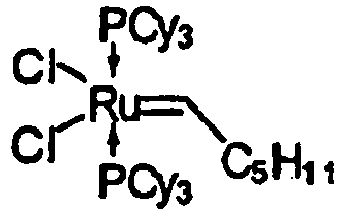
Unter Ar-Atmosphäre wurde Ru(cod)Cl2 (660 mg, 2.35 mmol) in iPrOH (20 ml) suspendiert. DBU (0.75 ml) und PCy3-Lösung (c = 20%, 0.77 M in Toluol, 7.7 ml) wurde zugegeben. Die erhaltene braune Suspension wurde 1 h bei 80°C gerührt, dann wurde Toluol (25 ml) zugegeben. Die Mischung wurde weitere 30 min bei 80°C gerührt.. Das Reaktionsgemisch wurde dann auf 0°C abgekühlt und 1-Trimethylsily-1-hexin (2.1 g) zugegeben. Nach 10 min Rühren wurde HCl-Lösung (c = 2 M in Et2O, 2.4 ml)bei 0°C zur Reaktionsmischung gegeben. Nach 1 h Rühren wurde das Reaktionsgemisch eingeengt. Zu dem Rückstand wurde MeOH (ca.30 ml) zugegeben. Nach Filtration wurde der Komplex 2 isoliert. Das NMR zeigt auch Nebenprodukte.
NMR in CDCl3 δ 31P 35.81 ppm. 1H δ 20.01 ppm.Under Ar atmosphere, Ru (cod) Cl 2 (660 mg, 2.35 mmol) was suspended in i PrOH (20 mL). DBU (0.75 ml) and PCy 3 solution (c = 20%, 0.77 M in toluene, 7.7 ml) was added. The resulting brown suspension was stirred at 80 ° C for 1 h, then toluene (25 mL) was added. The mixture was stirred for a further 30 minutes at 80 ° C. The reaction mixture was then cooled to 0 ° C and 1-trimethylsily-1-hexyne (2.1 g) was added. After stirring for 10 min, HCl solution (c = 2M in Et 2 O, 2.4 mL) was added to the reaction mixture at 0 ° C. After stirring for 1 h, the reaction mixture was concentrated. To the residue was added MeOH (about 30 ml). After filtration, the complex became 2 isolated. The NMR also shows by-products.
NMR in CDCl 3 δ 31 P 35.81 ppm. 1 H δ 20.01 ppm.
Cl2[P(C6H11)3]2Ru=CH-C6H5 (3) :
Cl2 [P (C6H11) 3] 2Ru = CH-C6H5 (3):
Eine Suspension von 12 g Mg in 100 ml THF wurde mit 8 ml 1,2-Dichlorethan versetzt. Nach Beenden der heftigen Reaktion wurde eine Lösung von 12.2 g Rutheniumchlorid-Hydrat und 42 g Tricyclohexylphosphan in 400 ml THF zugegeben, nach 10 min Rühren wurde das Schutzgas durch Wasserstoff mit 0,01 bar Überdruck ersetzt und die Reaktionsmischung wurde im geschlossenen Kolben 5 h auf 60°C erhitzt. Die resultierende orange Suspension wurde auf -40°C gekühlt und nach der Zugabe von 9.7 ml von Trimethylsilylacetylen innerhalb 30 min auf 5 °C erwärmt. Anschließend wurden 1.8 ml Wasser zugegeben und noch 30 min bei 0°C nachgerührt. Zur resultierenden Reaktionsmischung wurden 11.5 ml Styrol zugegeben. Nach 1 Stunde rühren bei Raumtemperatur wurde filtriert und das Filtrat im Vakuum eingeengt. Der Rückstand wurde mit kaltem MeOH verrührt. Das resultierende violette Pulver wurde mit kaltem Methanol gewaschen und im Vakuum getrocknet. Ausbeute 37.44 g (91%).To a suspension of 12 g of Mg in 100 ml of THF was added 8 ml of 1,2-dichloroethane. After completion of the vigorous reaction, a solution of 12.2 g of ruthenium chloride hydrate and 42 g of tricyclohexylphosphane in 400 ml of THF was added, after stirring for 10 min, the protective gas was replaced by hydrogen at 0.01 bar overpressure and the reaction mixture was in a closed flask for 5 h Heated to 60 ° C. The resulting orange suspension was cooled to -40 ° C and after the addition of 9.7 ml of trimethylsilylacetylene heated to 5 ° C within 30 min. Subsequently, 1.8 ml of water were added and stirred at 0 ° C for a further 30 min. To the resulting reaction mixture was added 11.5 ml of styrene. After 1 hour of stirring at room temperature was filtered and the filtrate concentrated in vacuo. The residue was stirred with cold MeOH. The resulting violet powder was washed with cold methanol and dried in vacuo. Yield 37.44 g (91%).

-
a) Unter Ar-Atmosphäre wurde Ru(cod)Cl2 (660 mg, 2.35 mmol) in iPrOH (20 ml) suspendiert. DBU (0..75 ml, 5 mmol) und PCy3-Lösung (c = 20%, 0.77 M in Toluol, 7..5 ml) wurden zugegeben. Die erhaltene braune Suspension wurde 1 h bei 80°C gerührt. Dann wurde THF (30 ml) zugegeben und die Mischung weitere 30 min bei 80°C gerührt. Das Reaktionsgemisch wurde dann auf 20°C abgekühlt und HCl-Lösung (c = 2 M in Et2O, 2.4 ml) zugegeben. Nach 5 min Rühren wurde Trimethylsilylacetylen (1.4 ml, 20.4 mmol) bei ca. 22°C zur Reaktionsmischung gegeben und diese 20 min gerührt. Anschließend wurde eine Lösung von 2-Vinylthiophen (c = ca. 50% in THF, 2.4 g) zugegeben. Nach 70 min Rühren bei Raumtemperatur wurde das Reaktionsgemisch im Rotationsverdampfer eingeengt. Der Rückstand wurde in DCM (ca. 5 ml) gelöst. Nach der Zugabe von MeOH (40 ml) wurde die erhaltene Suspension unter Ar-Atmosphäre ca. 15 min gerührt.. Nach Filtration wurde der Komplex 4 (1.15 g, 1.38 mmol, 59%) als dunkelvioletter Feststoff isoliert.
NMR in CDCl3 δ 31P 35.96 ppm; 1H δ 19.11 (s, 1H), 8.20 (s, br., 1H), 7.87 (s, br., 1H), 6.97 (t, J =4.3 Hz, 1H), 2.64 (m, 6H), 1.81-1..67 (m, 33H), 1.48-1.41 (m, 12H), 1.27-1.14 (m, 21 H) ppm. IR (ATR) λ-1 = 2919 (vs), 2848 (s), 2169 (w), 2051 (w), 1936 (w), 1901 (w), 1443 (m), 1403 (m), 1353 (m), 1263 (m), 1005 (m), 734 (vs) cm-1. MS(ESI) m/z = 828 (21) [M+], 793 (9), 281 (100).a) Under Ar atmosphere, Ru (cod) Cl 2 (660 mg, 2.35 mmol) was suspended in iPrOH (20 mL). DBU (0.75 mL, 5 mmol) and PCy 3 solution (c = 20%, 0.77 M in toluene, 7.5 mL) were added. The resulting brown suspension was stirred at 80 ° C for 1 h. Then, THF (30 ml) was added and the mixture was stirred at 80 ° C for a further 30 minutes. The reaction mixture was then cooled to 20 ° C and HCl solution (c = 2M in Et 2 O, 2.4 mL) added. After stirring for 5 minutes, trimethylsilylacetylene (1.4 ml, 20.4 mmol) was added to the reaction mixture at about 22 ° C. and stirred for 20 minutes. Subsequently, a solution of 2-vinylthiophene (c = about 50% in THF, 2.4 g) was added. After stirring at room temperature for 70 min, the reaction mixture was concentrated in a rotary evaporator. The residue was dissolved in DCM (about 5 ml). After the addition of MeOH (40 mL), the resulting suspension was stirred under Ar atmosphere for ca. 15 min. After filtration, complex 4 (1.15 g, 1.38 mmol, 59%) was isolated as a dark purple solid.
NMR in CDCl 3 δ 31 P 35.96 ppm; 1 H δ 19.11 (s, 1H), 8.20 (s, br., 1H), 7.87 (s, br., 1H), 6.97 (t, J = 4.3 Hz, 1H), 2.64 (m, 6H), 1.81 -1..67 (m, 33H), 1.48-1.41 (m, 12H), 1.27-1.14 (m, 21H) ppm. IR (ATR) λ -1 = 2919 (vs), 2848 (s), 2169 (w), 2051 (w), 1936 (w), 1901 (w), 1443 (m), 1403 (m), 1353 ( m), 1263 (m), 1005 (m), 734 (vs) cm -1 . MS (ESI) m / z = 828 (21) [M + ], 793 (9), 281 (100). - b) Zu einer Lösung von Cl2[P(C6H11)3]2Ru=CH-CH3 (1) (225 mg, 0.296 mmol) in Toluol (5 ml) wurde eine Lösung von 2-Vinylthiophen (c = ca. 50% in THF, 2.4 g) gegeben. Das Reaktionsgemisch wurde 2 h bei Raumtemperatur gerührt und anschließend das Lösungsmittel im Vakuum entfernt. Der Rückstand wurde in CH2Cl2 (ca. 1 ml) aufgenommen und mit MeOH (ca. 10 ml) gefällt. Filtrieren und waschen mit MeOH (ca. 3 ml) lieferte das Produkt 4 (170 mg, 0.21 mmol, 71%) als dunkelvioletten Feststoff.b) To a solution of Cl 2 [ P (C 6 H 11 ) 3 ] 2 Ru = CH-CH 3 (1) (225 mg, 0.296 mmol) in toluene (5 mL) was added a solution of 2-vinylthiophene (c = about 50% in THF, 2.4 g). The reaction mixture was stirred at room temperature for 2 h and then the solvent was removed in vacuo. The residue was taken up in CH 2 Cl 2 (about 1 ml) and precipitated with MeOH (about 10 ml). Filtration and washing with MeOH (ca 3 mL) afforded product 4 (170 mg, 0.21 mmol, 71%) as a dark purple solid.

-
a) Unter Ar-Atmosphäre wurde Ru(cod)Cl2 (1.32 g, 4.71 mmol) in 50 ml von Isopropanol suspendiert. DBU (1..5 ml, 10 mmol) und PCy3-Lösung (c = 20%, 0.77 M in Toluol, 15 ml, 11.6 mmol) wurden zugegeben. Die erhaltene braune Suspension wurde 1 h bei 80°C gerührt. Zu der resultierenden ziegelrote Suspension wurde 60 ml Toluol zugegeben und die Mischung weitere 90 min bei 80°C gerührt. Das Reaktionsgemisch wurde auf 5°C abgekühlt und Trimethylsilylacetylen (2.8 ml, 20.4 mmol) zugegeben. Nach 5 min Rühren wurde 4.8 ml 2 M HCl-Lösung (9.6 mmol) in Diethylether zugefügt und 20 min gerührt. Anschließend wurde eine Lösung von 2-Vinylnaphtalin (1 g, 6.5 mmol) in Toluol (4.5 ml) zugegeben. Nach 120 min Rühren bei Raumtemperatur wurde das Reaktionsgemisch im Rotationsverdampfer eingeengt. Der Rückstand wurde in Dichlormethan aufgenommen (ca. 7 ml). Nach der Zugabe von MeOH (120 ml) wurde die erhaltene Suspension ca. 15 min gerührt und auf -78°C abgekühlt. Nach Filtration wurde Komplex 5 (1.75 g, 43%) als violetter Feststoff isoliert.
NMR in CDCl3 δ 31P 37.43 ppm; 1H δ20.12 (s, 1H), 8.82 (s, br., 1H), 8..77 (d, J = 8.5 Hz, 1H), 8.06 (d, J = 8.1 Hz, 1 H), 7.74 (d, J = 8.1 Hz, 1 H), 7.71 (d, J = 8.4 Hz, 1 H), 7.67-7.63 (m, 1 H), 7.46-7.42 (m, 1 H), 2.63 (m, 6H), 1.90-1.60 (m, 33H), 1.46-1.37 (m, 12H), 1.30-1.10 (m, 21H) ppm. IR (ATR) λ-1 = 2922 (vs), 2848 (s), .2358 (w), 2003 (w), 1443 (m), 1265 (m), 1004 (m), 733 (vs) cm-1.a) Under Ar atmosphere Ru (cod) Cl 2 (1.32 g, 4.71 mmol) was suspended in 50 ml of isopropanol. DBU (1.5 mL, 10 mmol) and PCy 3 solution (c = 20%, 0.77 M in toluene, 15 mL, 11.6 mmol) were added. The resulting brown suspension was stirred at 80 ° C for 1 h. 60 ml of toluene were added to the resulting brick-red suspension, and the mixture was stirred at 80 ° C. for a further 90 minutes. The reaction mixture was cooled to 5 ° C and trimethylsilylacetylene (2.8 mL, 20.4 mmol) added. After stirring for 5 min, 4.8 ml of 2 M HCl solution (9.6 mmol) in diethyl ether were added and the mixture was stirred for 20 min. Subsequently, a solution of 2-vinylnaphthalene (1 g, 6.5 mmol) in toluene (4.5 ml) was added. After 120 min stirring at room temperature, the reaction mixture was concentrated in a rotary evaporator. The residue was taken up in dichloromethane (about 7 ml). After the addition of MeOH (120 ml), the resulting suspension was stirred for about 15 minutes and cooled to -78 ° C. After filtration, complex 5 (1.75 g, 43%) was isolated as a purple solid.
NMR in CDCl 3 δ 31 P 37.43 ppm; 1 H δ 20.12 (s, 1H), 8.82 (s, br., 1H), 8..77 (d, J = 8.5 Hz, 1H), 8.06 (d, J = 8.1 Hz, 1 H), 7.74 ( d, J = 8.1 Hz, 1H), 7.71 (d, J = 8.4 Hz, 1H), 7.67-7.63 (m, 1H), 7.46-7.42 (m, 1H), 2.63 (m, 6H) , 1.90-1.60 (m, 33H), 1.46-1.37 (m, 12H), 1.30-1.10 (m, 21H) ppm. IR (ATR) λ -1 = 2922 (vs), 2848 (s), .2358 (w), 2003 (w), 1443 (m), 1265 (m), 1004 (m), 733 (vs) cm - 1 . - b) Zu einer Lösung von Cl2[P(C6H11)3]2Ru=CH-CH3 (1) (340 mg, 0.45 mmol) in Toluol (5 ml) wurde eine Lösung von 2-Vinylnaphtalin (154 mg, 1 mmol) in Toluol (2 ml) bei -45°C und unter Argon-Atmosphäre gegeben. Das Reaktionsgemisch wurde 2 h bei Raumtemperatur gerührt. Anschließend wurde das Lösungsmittel im Vakuum abdestilliert. Der Rückstand wurde in CH2Cl2 (ca. ml) aufgenommen und mit MeOH (ca. 15 ml) gefällt. Das Produkt 5 als intensivvioletter Feststoff wurde abfiltriert und mit MeOH gewaschen (ca. 5 ml). Ausbeute 220 mg (56%).b) To a solution of Cl 2 [P (C 6 H 11 ) 3 ] 2 Ru = CH-CH 3 (1) (340 mg, 0.45 mmol) in toluene (5 ml) was added a solution of 2-vinylnaphthalene (154 mg, 1 mmol) in toluene (2 ml) at -45 ° C and under argon atmosphere. The reaction mixture was stirred for 2 h at room temperature. Subsequently, the solvent was distilled off in vacuo. The residue was taken up in CH 2 Cl 2 (ca ml) and precipitated with MeOH (ca 15 ml). The product 5 as an intense violet solid was filtered off and washed with MeOH (ca 5 ml). Yield 220 mg (56%).

Zu einer Lösung von Komplex 5 (873 mg, 1 mmol) in Toluol (20 ml) wurde unter Argon-Atmosphäre die 1,3-bis-(2,4,6-trimethylphenyl)imidazolin-2-yliden-Lösung (1.08 mmol in 4 ml Toluol) gegeben. Das Reaktionsgemisch wurde 2 h bei Raumtemperatur gerührt und, anschließend, mit Wasser (2 x 10 ml) gewaschen. Die organische Phase wurde eingeengt. Rückstand in 1 ml CH2Cl2 aufgenommen, mit 10 ml MeOH verdünnt und 2 h bei-18°C gekühlt.. Nach Filtration erhielt man das Produkt 6 (300 mg, 0.33 mmol, 33%) als dunkelbraune Kristalle.
NMR in CDCl3 δ 31P 32.89 (br.) ppm; 1H δ = 19.61 (s, 1H), 9.04 (s, br., 1H), 7.95 (d, J = 7.7 Hz, 1H), 7.70 (d, J = 7.8 Hz, 1H), 7.59 (t, br., J = 6.8 Hz, 1H), 7.51 (d, J = 8.8 Hz, 1H), 7.39 (t, br., J = 7.3 Hz, 1H), 7.06 (s, br., 2H), 6.97 (m, 1H), 6.94 (m, 1H), 6.69 (s, br., 1H), 5.62 (br., 1H), 2.50 (m 6H), 2.36 (s, 3H), 2.0-0.94 39H) ppm. IR (ATR)λ-1 = 2923 (vs), 2849 (s), 1444 (m), 1388 (m), 1314 (m), 1262 (m), 1004 (w, br.), 843 (m), 732 (m) cm-1. MS(ESI) m/z = 896 (100) [M+], 861 (3), 305 (43), 281 (31).To a solution of complex 5 (873 mg, 1 mmol) in toluene (20 mL) under argon atmosphere was added the 1,3-bis (2,4,6-trimethylphenyl) imidazolin-2-ylidene solution (1.08 mmol in 4 ml of toluene). The reaction mixture was stirred at room temperature for 2 h and then washed with water (2 x 10 mL). The organic phase was concentrated. The residue was taken up in 1 ml of CH 2 Cl 2 , diluted with 10 ml of MeOH and cooled at -18 ° C. for 2 h. After filtration, the product 6 (300 mg, 0.33 mmol, 33%) was obtained as dark-brown crystals.
NMR in CDCl 3 δ 31 P 32.89 (br.) Ppm; 1 H δ = 19.61 (s, 1H), 9.04 (s, br., 1H), 7.95 (d, J = 7.7 Hz, 1H), 7.70 (d, J = 7.8 Hz, 1H), 7.59 (t, br ., J = 6.8 Hz, 1H), 7.51 (d, J = 8.8 Hz, 1H), 7.39 (t, br., J = 7.3 Hz, 1H), 7.06 (s, br., 2H), 6.97 (m , 1H), 6.94 (m, 1H), 6.69 (s, br., 1H), 5.62 (br, 1H), 2.50 (m 6H), 2.36 (s, 3H), 2.0-0.94 39H) ppm. IR (ATR) λ -1 = 2923 (vs), 2849 (s), 1444 (m), 1388 (m), 1314 (m), 1262 (m), 1004 (w, br.), 843 (m) , 732 (m) cm -1 . MS (ESI) m / z = 896 (100) [M + ], 861 (3), 305 (43), 281 (31).

Zu einer Lösung von Komplex 5 (873 mg, 1 mmol) in getrocknetem Toluol (30 ml) wurde 4,5-Dimethyl-1,3-bis-(2,4,6-trimethylphenyl)imidazolin-2-yliden (400 mg,1.2 mmol) gegeben und 30 min bei Raumtemperatur unter Argon-Atmosphäre gerührt. Reaktionsgemisch wird im Vakuum eingeengt und mit MeOH (15 ml) verrührt. Die ausgefallenen Kristalle wurden abfiltriert und als Ausgangskomplex 5 identifiziert. Das Filtrat wurde auf die Hälfte eingeengt und im Kühlschrank kühl gelagert. Die dunkelbraun-violetten Kristalle reines Produktes 7 werden abfiltriert und im Vakuum getrocknet.
NMR in CDCl3 δ 31P 32.12 (br.) ppm; 1H δ = 20.12 und 19.59 (s, 1H), 9.62 und 9.05 (br, 1H), 7.94 (d, J = 8.0 Hz, 1H), 7.69 (d, J = 8.0 Hz, 1 H), 7.59 (t, br., J = 7.0 Hz, 1 H), 7.50 (d, J = 8.2 Hz, 1 H), 7.39 (t, br., J = 7.6 Hz, 1H), 7.06 (s, br., 2H), 6.69 (s, br., 1H), 5.58 (s, br., 1H), 2.35 (s, 3H), 2.21 (m, 3H), 1.74 (s, 3H), 1.65 (s, 3H), 2.6-0.8 (m, 45H) ppm. IR (ATR)λ-1 = 2921 (vs), 2847 (s), 1443 (m), 1361 (m), 1309 (m), 1259 (w), 1005 (w), 848 (m), 748 (m) cm-1.To a solution of complex 5 (873 mg, 1 mmol) in dried toluene (30 mL) was added 4,5-dimethyl-1,3-bis (2,4,6-trimethylphenyl) imidazolin-2-ylidene (400 mg , 1.2 mmol) and stirred for 30 min at room temperature under argon atmosphere. Reaction mixture is concentrated in vacuo and stirred with MeOH (15 ml). The precipitated crystals were filtered off and identified as starting complex 5 . The filtrate was concentrated by half and stored in the refrigerator in a cool place. The dark brown-purple crystals of pure product 7 are filtered off and dried in vacuo.
NMR in CDCl 3 δ 31 P 32.12 (br.) Ppm; 1 H δ = 20.12 and 19.59 (s, 1H), 9.62 and 9.05 (br, 1H), 7.94 (d, J = 8.0 Hz, 1H), 7.69 (d, J = 8.0 Hz, 1H), 7.59 (t , br., J = 7.0 Hz, 1 H), 7.50 (d, J = 8.2 Hz, 1 H), 7.39 (t, br., J = 7.6 Hz, 1H), 7.06 (s, br., 2H) , 6.69 (s, br., 1H), 5.58 (s, br., 1H), 2.35 (s, 3H), 2.21 (m, 3H), 1.74 (s, 3H), 1.65 (s, 3H), 2.6 -0.8 (m, 45H) ppm. IR (ATR) λ -1 = 2921 (vs), 2847 (s), 1443 (m), 1361 (m), 1309 (m), 1259 (w), 1005 (w), 848 (m), 748 ( m) cm -1 .

Unter Ar-Atmosphäre wurde Ru(cod)Cl2 (5.6 g, 20 mmol) in iPrOH (200 ml) suspendiert. DBU (6.6 ml, 44 mmol) und PCy3 (12.34 g, 44 mmol) wurden zugegeben. Die erhaltene braune Suspension wurde 1 h bei 80°C gerührt. Dann wurde THF (.100 ml) zugegeben und die Mischung weitere 30 min bei 80°C gerührt. Das Reaktionsgemisch wurde dann auf 10°C abgekühlt und HCl-Lösung (c = 2 M in Et2O, 24 ml) zugegeben. Nach 5 min Rühren wurdeTrimethylsilylacetylen (8.3 ml, 60 mmol) zur Reaktionsmischung gegeben und diese 20 min gerührt Anschließend wurde 2-Vinylfuran (9.4 g, 100 mmol) zugegeben. Nach 3h Rühren im Eis-Bad wurde der Komplex 8 als dunkelvioletter Feststoff isoliert, mit kaltem Methanol gründlich gewaschen und im Vakuum getrocknet. Ausbeute 13.9 g (85%)
NMR in CDCl3 δ 31P 37.03 ppm; 1H δ 18.79 (s, 1H), 8.12 (s, br., 1H), 7.74 (s, br., 1H), 6.43 (dd, J = 3.58 Hz, J = 1.74 1 H), 2.64 (m, 6H), 1.81-1.67 (m, 33H), 1.48-1.41 (m, 12H), 1.27-1.14 (m, 21 H) ppmUnder Ar atmosphere, Ru (cod) Cl 2 (5.6 g, 20 mmol) was suspended in iPrOH (200 mL). DBU (6.6 mL, 44 mmol) and PCy 3 (12.34 g, 44 mmol) were added. The resulting brown suspension was stirred at 80 ° C for 1 h. Then THF (.100 ml) was added and the mixture was stirred at 80 ° C for a further 30 min. The reaction mixture was then cooled to 10 ° C and HCl solution (c = 2M in Et 2 O, 24 mL) was added. After stirring for 5 min, trimethylsilylacetylene (8.3 mL, 60 mmol) was added to the reaction mixture and stirred for 20 min. Then 2-vinylfuran (9.4 g, 100 mmol) was added. After stirring for 3 h in the ice-bath, complex 8 was isolated as a dark purple solid, washed thoroughly with cold methanol and dried in vacuo. Yield 13.9 g (85%)
NMR in CDCl 3 δ 31 P 37.03 ppm; 1 H δ 18.79 (s, 1H), 8.12 (s, br., 1H), 7.74 (s, br., 1H), 6.43 (dd, J = 3.58 Hz, J = 1.74 1 H), 2.64 (m, 6H), 1.81-1.67 (m, 33H), 1.48-1.41 (m, 12H), 1.27-1.14 (m, 21H) ppm

Zu einer Lösung von Komplex 4 (8.3 g, 10 mmol) in Toluol (400 ml) wurde unter Argon-Atmosphäre die 1,3-bis-(2,4,6-trimethylphenyl)imidazolin-2-yliden-Lösung (16 mmol in 52 ml Toluol) gegeben. Das Reaktionsgemisch wurde 4 h bei Raumtemperatur gerührt und, anschließend, mit Wasser (2 x 100 ml) gewaschen. Die organische Phase wurde mit 50 ml Heptan versetzt und eingeengt. Nach Filtration, Waschen mit Hexan anschließend mit Methanol und Trocknung in Vakuum isoliert man das Produkt 9 (6.14 g, 72%) als dunkelvioletten Feststoff..
NMR in CDCl3 δ 31P 31.00 (40%) und 30.65 (60%) ppm; 1H δ = 18.63 und 18.52 (s, 1H), 8.65 und 7.78 (br. s, 1H), 7.45 und 6.73 (br. s, 1H), 7.04 und 7.00 (br. S, 2H), 6.98 (s, 1H), 6.97 (s, 1H), 6.83 und 6.80 (br. s, 2H), 6.10 und 6.08 (br. s, 1H), 2.51 (s, 3H), 2.34 (s, 6H), 2.27 (m, 6H), 2.08 (s, 3H), 1..96 und 1.90 (br. s, 3H), 1.60-0.85. (m, 30H) ppmTo a solution of complex 4 (8.3 g, 10 mmol) in toluene (400 mL) under argon atmosphere was added the 1,3-bis (2,4,6-trimethylphenyl) imidazolin-2-ylidene solution (16 mmol in 52 ml of toluene). The reaction mixture was stirred for 4 h at room temperature and then washed with water (2 x 100 ml). The organic phase was mixed with 50 ml of heptane and concentrated. After filtration, washing with hexane followed by methanol and drying in vacuo, the product 9 (6.14 g, 72%) is isolated as a dark purple solid.
NMR in CDCl 3 δ 31 P 31.00 (40%) and 30.65 (60%) ppm; 1 H δ = 18.63 and 18.52 (s, 1H), 8.65 and 7.78 (br s, 1H), 7.45 and 6.73 (br s, 1H), 7.04 and 7.00 (br, S, 2H), 6.98 (s, 1H), 6.97 (s, 1H), 6.83 and 6.80 (br s, 2H), 6.10 and 6.08 (br s, 1H), 2.51 (s, 3H), 2.34 (s, 6H), 2.27 (m, 6H), 2.08 (s, 3H), 1..96 and 1.90 (brs s, 3H), 1.60-0.85. (m, 30H) ppm

Zu einer Lösung von Komplex 4 (8.3 g, 10 mmol) in Toluol (400 ml) wurde unter Argon-Atmosphäre die 4,5-dimethyl-1,3-bis-(2,4,6-trimethylphenyl)imidazolin-2-yliden-Lösung (16 mmol in 52 ml Toluol) gegeben. Das Reaktionsgemisch wurde 4 h bei Raumtemperatur gerührt und, anschließend, mit Wasser (2 x 100 ml) gewaschen. Die organische Phase wurde mit 50 ml Heptan versetzt und eingeengt. Nach Filtration, Waschen mit Hexan, anschließend mit Methanol und Trocknung in Vakuum isoliert man das Produkt 10 (4.74 g, 54%) als dunkelvioletten Feststoff.
NMR in CDCl3 δ 31P 30.16 (37%) und 29.65 (63%) ppm; 1H δ = 18.64 und 18.52 (br. s., 1H), 8.66 und 7.76 (br. s, 1H), 7.42 und 6.72 (br. s, 1H), 7.03 und 6.99 (br. S, 2H), 6.82 und 6.79 (br. s, 2H), 6.07 und 6.05 (br.. s, 1H), 2.45 (s, 3H), 2..34 (s, 3H), 2.26 (m, 9H), 2.07 (s, 3H), 1.88 und 1.83 (s, 3H), 1.74 (s, 3H), 1.71 (s, 3H), 1.60-0.85. (m, 30H) ppm.To a solution of complex 4 (8.3 g, 10 mmol) in toluene (400 ml) under argon atmosphere was added 4,5-dimethyl-1,3-bis (2,4,6-trimethylphenyl) imidazoline-2 ylidene solution (16 mmol in 52 ml of toluene). The reaction mixture was stirred for 4 h at room temperature and then washed with water (2 x 100 ml). The organic phase was mixed with 50 ml of heptane and concentrated. After filtration, washing with hexane, then with methanol and drying in vacuo, the product 10 (4.74 g, 54%) is isolated as a dark purple solid.
NMR in CDCl 3 δ 31 P 30.16 (37%) and 29.65 (63%) ppm; 1 H δ = 18.64 and 18.52 (br, s, 1H), 8.66 and 7.76 (br s, 1H), 7.42 and 6.72 (br s, 1H), 7.03 and 6.99 (br, S, 2H), 6.82 and 6.79 (br s, 2H), 6.07 and 6.05 (br .. s, 1H), 2.45 (s, 3H), 2..34 (s, 3H), 2.26 (m, 9H), 2.07 (s, 3H), 1.88 and 1.83 (s, 3H), 1.74 (s, 3H), 1.71 (s, 3H), 1.60-0.85. (m, 30H) ppm.

Zu einer Lösung von Komplex 4 (829 mg, 1 mmol) in getrocknetem Toluol (20 ml) wurde 1,3,4-Triphenyl-4,5-dihydro-1H-1,2,4-triazol-5-yliden (450 mg, 1.5 mmol) gegeben und über Nacht bei Raumtemperatur unter Argon-Atmosphäre gerührt. Reaktionsgemisch wurde im Vakuum eingeengt und mit Hexan (15 ml) versetzt. Der ausgefallene Feststoff wurde abfiltriert mit kaltem Hexan gründlich gewaschen und im Vakuum getrocknet. Ausbeute 662 mg (78%). NMR in CDCl3 δ 31P 26.64 (40%) und 26.03 (60%) ppm; 1H δ = 18.66 (J = 5.07 Hz) und 18.47 (J = 3.0 Hz) (br. d, 1H), 8.56 und 7.85 (br. d, J = 6 Hz, 1H), 8.18 (d, J = 7.52 Hz, 1H), 7.8-7.1 (m,16H), 2.17 (br. m, 3H), 1.7-1.05 (br. m, 30H) ppmTo a solution of complex 4 (829 mg, 1 mmol) in dried toluene (20 ml) was added 1,3,4-triphenyl-4,5-dihydro-1H-1,2,4-triazol-5-ylidene (450 mg, 1.5 mmol) and stirred overnight at room temperature under argon atmosphere. Reaction mixture was concentrated in vacuo and hexane (15 ml) was added. The precipitated solid was filtered off, washed thoroughly with cold hexane and dried in vacuo. Yield 662 mg (78%). NMR in CDCl 3 δ 31 P 26.64 (40%) and 26.03 (60%) ppm; 1 H δ = 18.66 (J = 5.07 Hz) and 18.47 (J = 3.0 Hz) (br d, 1H), 8.56 and 7.85 (br d, J = 6 Hz, 1H), 8.18 (d, J = 7.52 Hz, 1H), 7.8-7.1 (m, 16H), 2.17 (br, m, 3H), 1.7-1.05 (br, m, 30H) ppm

Zu einer gekühlter Lösung von 1-Vinylcyclohexen (648 mg, 6 mmol) in getrocknetem THF (5 ml) wurde Komplex 1 (761 mg, 1 mmol) gegeben und über Nacht bei 4°C unter Argon-Atmosphäre gerührt. Reaktionsgemisch wurde mit MeOH (30 ml) versetzt.. Der ausgefallene Feststoff wurde abfiltriert mit kaltem MeOH gründlich gewaschen und im Vakuum getrocknet. Ausbeute 410 mg (50%).
NMR in C6D6 δ 31P 36.32 ppm; 1H δ = 19.08 (s, 1H), 7.21 (s, 1H), 2.87 (m, 2H), 2.60 (m, 6H), 1.95-1.11 (m, 66H) ppmTo a cooled solution of 1-vinylcyclohexene (648 mg, 6 mmol) in dried THF (5 mL) was added complex 1 (761 mg, 1 mmol) and stirred overnight at 4 ° C under an argon atmosphere. The reaction mixture was treated with MeOH (30 ml). The precipitated solid was filtered off, washed thoroughly with cold MeOH and dried in vacuo. Yield 410 mg (50%).
NMR in C 6 D 6 δ 31 P 36.32 ppm; 1 H δ = 19.08 (s, 1H), 7.21 (s, 1H), 2.87 (m, 2H), 2.60 (m, 6H), 1.95-1.11 (m, 66H) ppm

Zu einer gekühlter Lösung von 1-Vinylcyclopenten (470 mg, 5 mmol) in getrocknetem THF (5 ml) wurde Komplex 1 (761 mg, 1 mmol) gegeben und über Nacht bei 4°C unter Argon-Atmosphäre gerührt. Reaktionsgemisch wurde mit MeOH (30 ml) versetzt. Der ausgefallene Feststoff wurde abfiltriert mit kaltem MeOH gründlich gewaschen und im Vakuum getrocknet. Ausbeute 350 mg (43%).
NMR in C6D6 δ 31P 37.26 ppm; 1H δ = 19.30 (s, 1H), 6.97 (s, 1H), 3..14 (m, 2H), 2.60 (m, 6H), 1.95-1.11 (m, 64H) ppmTo a cooled solution of 1-vinylcyclopentene (470 mg, 5 mmol) in dried THF (5 mL) was added complex 1 (761 mg, 1 mmol) and stirred overnight at 4 ° C under an argon atmosphere. Reaction mixture was added with MeOH (30 ml). The precipitated solid was filtered off, washed thoroughly with cold MeOH and dried in vacuo. Yield 350 mg (43%).
NMR in C 6 D 6 δ 31 P 37.26 ppm; 1 H δ = 19.30 (s, 1H), 6.97 (s, 1H), 3..14 (m, 2H), 2.60 (m, 6H), 1.95-1.11 (m, 64H) ppm
Eine Lösung von N,N-Diallyl-p-toluolsulfonamid (0.350 mmol, 84 mg) in 17.5 ml Toluol wurde mit einem erfindungsgemäßen Ru-Carbenkomplex als Katalysator, unter Argon versetzt und bei 80°C gerührt. Dabei wurde Argon über ein Kapillar direkt in der Reaktionsmischung eingeleitet. 200 µL einer Aliquote Reaktionslösung wurden zu 500 µL von 2M Ethyl-vinyl-ether Lösung in Methylenchlorid zugegen und Mittels GC analysiert.A solution of N, N-diallyl-p-toluenesulfonamide (0.350 mmol, 84 mg) in 17.5 ml of toluene was treated with an Ru-carbene complex according to the invention as a catalyst under argon and stirred at 80 ° C. Argon was introduced via a capillary directly into the reaction mixture. 200 μL of an aliquot of reaction solution was added to 500 μL of 2M ethyl vinyl ether solution in methylene chloride and analyzed by GC.
In Gegenwart von Komplex 4 (0.1mol%) wurde 93% Umsatz nach 15 min beobachtet.In the presence of complex 4 (0.1 mol%), 93% conversion was observed after 15 min.
In Gegenwart von Komplex 5 (0.1mol%) wurde 99% Umsatz nach 40 min beobachtet.In the presence of complex 5 (0.1 mol%), 99% conversion was observed after 40 min.
In Gegenwart von Komplex 6 (0.05mol%) würde 98°C Umsatz nach 40 min beobachtet.In the presence of complex 6 (0.05 mol%), 98 ° C. conversion would be observed after 40 min.

Eine Lösung von Diethyl Diallylmalonat in Dichlormethan (c = 3M) wurde mit 0.1 Mol% der Katalysator 5 unter Argon versetzt und bei 40°C gerührt. 200 µL einer Aliquote Reaktionslösung wurden zu 500 µL von 2M Ethyl-vinyl-ether Lösung in Methylenchlorid zugegen und mittels GC analysiert. In Gegenwart von Komplex 5 wurde Umsatz von 99% nach 3 h beobachtet.A solution of diethyl diallylmalonate in dichloromethane (c = 3M) was admixed with 0.1 mol% of the catalyst 5 under argon and stirred at 40.degree. 200 μL of an aliquot of reaction solution was added to 500 μL of 2M ethyl vinyl ether solution in methylene chloride and analyzed by GC. In the presence of complex 5 , 99% conversion was observed after 3 hours.

Eine Lösung von N,N-Dimethallyl-p-toluolsulfonamid (2 mmol, 559 mg) in 100 ml Toluol wurde mit dem erfindungsgemäßen Ru-Carbenkomplex als Katalysator unter Argon versetzt und bei 80°C gerührt Dabei wurde Argon über ein Kapillar direkt in der Reaktionsmischung eingeleitet. 200 µL einer Aliquote Reaktionslösung wurden zu 500 µL von 2M Ethyl-vinyl-ether Lösung in Methylenchlorid zugegen und mittels GC analysiert.A solution of N, N-dimethallyl-p-toluenesulfonamide (2 mmol, 559 mg) in 100 ml of toluene was treated with the Ru-carbene complex according to the invention as a catalyst under argon and stirred at 80 ° C. In this process, argon was introduced via a capillary directly into the Initiated reaction mixture. 200 μL of an aliquot of reaction solution was added to 500 μL of 2M ethyl vinyl ether solution in methylene chloride and analyzed by GC.
In Gegenwart von Komplex 7 (0.5mol%) wurde 70% Umsatz nach 10 min beobachtet.In the presence of complex 7 (0.5 mol%), 70% conversion was observed after 10 min.
Claims (12)
- Process for preparing ruthenium complexes of the general formula
RuX2 (=CH-CH2R)L2 (I),
whereX is an anionic ligand,R is hydrogen or a (C1-C18)-alkyl, (C3-C8-) cycloalkyl, (C2-C7)-heterocycloalkyl, (C6-C14)-aryl or (C3-C14)-heteroaryl radical andL is an uncharged electron donor ligand, characterized in thatA) an Ru metal salt of the general formula:
RuXxNy (II),
wherex is an integer greater than or equal to 2 andX is as defined above,y is an integer greater than or equal to 0 and y >= 1,the ligands N are identical or different coordinating uncharged ligands;is reacted with L in the presence of a base and reducing agents andB) subsequently reacted with a silylalkyne of the general formula III
R-C≡CSiR'3 (III),
whereR is as defined above,the radicals R' are identical or different radicals which can be selected from the group consisting of hydrogen, (C1-C8)-alkyl, (C1-C8)-alkoxy, (C6-C10) -aryloxy, (C6-C10) -aryl. - Process for preparing ruthenium complexes of the general formula
RuX2(=CR1R2)L2,
whereX and L have the meanings given in Claim 1 andR1 is hydrogen or a (C1-C18)-alkyl or (C3-C8)-cycloalkyl or (C2-C7) -heterocycloalkyl, (C6-C14) -aryl or (C3-C14) -heteroaryl radical and R2 is a (C6-C14)-aryl or (C3-C14)-heteroaryl radical and the radicals R1 and R2 can have a 5-7-membered ring, characterized in thatA) an Ru metal salt of the general formula:
RuXxNy (II),
whereX, N and the integers x and y have the meanings given in Claim 1;is reacted with L in the presence of a base and reducing agents andB) subsequently reacted with a silylalkyne of the general formula III
R-C≡CSiR'3 (III),
where R and R' have the meanings given in Claim 1, andC) subsequently reacted with an alkene of the general formula IV
H2C=CR1R2 (IV),
where R1 and R2 have the meanings given above. - Process according to Claim 1 or 2, characterized in that the uncharged electron donor ligand L is selected from the group consisting of phosphanes, phosphinites, phosphonites and phosphites.
- Process according to Claim 3, characterized in that L is selected from the group consisting of triphenylphosphane, triisopropylphosphane, tricyclohexylphosphane and 9-cyclohexyl-9-phosphabicyclo[3.3.1]nonane.
- Process according to Claim 1 or 2, characterized in that L2 is selected from the group consisting of bidentate ligands of the general formula

L and L' can be identical or different and are selected from the group consisting of -PR1R2,-P(OR1)(OR2), -NR1R2 and heterocyclic carbene, and Z is a bridge which covalently links the two groups. - Process according to one or more of Claims 1 to 5, characterized in that x=3 and y=0 for the Ru metal salt of the general formula RuXxNy and that the reduction of the Ru metal salt is carried out by means of hydrogen in the presence of metallic reducing agent.
- Process according to Claim 6, characterized in that magnesium is used as reducing agent.
- Process according to one or more of Claims 1 to 7, characterized in that an excess of basic ligand is used as base.
- Process according to one or more of Claims 1 to 5, characterized in that x>=2 and y>0 for the Ru metal salt of the general formula RuXxNy and that the reduction of the Ru metal salt is carried out by means of alcohol or the formic acid-triethylamine complex.
- Process according to Claim 9, characterized in that a secondary alcohol is used as a reducing agent.
- Process according to one or more of Claims 1 to 10, characterized in that an amine is used as base.
- Process according to Claim 11, characterized in that triethylamine or 1,8-diazobicyclo[5.4.0]undec-7-ene is used as base.
Applications Claiming Priority (2)
| Application Number | Priority Date | Filing Date | Title |
|---|---|---|---|
| DE102008001054 | 2008-04-08 | ||
| PCT/EP2009/054248 WO2009124977A1 (en) | 2008-04-08 | 2009-04-08 | Method for manufacturing ruthenium carbene complexes |
Publications (3)
| Publication Number | Publication Date |
|---|---|
| EP2260047A1 EP2260047A1 (en) | 2010-12-15 |
| EP2260047B1 EP2260047B1 (en) | 2013-08-21 |
| EP2260047B2 true EP2260047B2 (en) | 2016-07-20 |
Family
ID=40743895
Family Applications (1)
| Application Number | Title | Priority Date | Filing Date |
|---|---|---|---|
| EP09730836.5A Active EP2260047B2 (en) | 2008-04-08 | 2009-04-08 | Method for manufacturing ruthenium carbene complexes |
Country Status (6)
| Country | Link |
|---|---|
| US (2) | US8501975B2 (en) |
| EP (1) | EP2260047B2 (en) |
| JP (1) | JP5787751B2 (en) |
| CN (1) | CN101990543B (en) |
| BR (1) | BRPI0911432B1 (en) |
| WO (1) | WO2009124977A1 (en) |
Families Citing this family (15)
| Publication number | Priority date | Publication date | Assignee | Title |
|---|---|---|---|---|
| GB201004732D0 (en) | 2010-03-22 | 2010-05-05 | Univ Aberdeen | Ruthenium complexes for use in olefin metathesis |
| PL216649B1 (en) | 2011-06-06 | 2014-04-30 | Univ Warszawski | New ruthenium complexes, process for the preparation thereof and the use thereof in olefin metathesis reactions |
| CN102826948B (en) * | 2011-06-17 | 2015-12-16 | 中国石油化工股份有限公司 | A kind of method of ethylene/butylene disproportionation reaction propylene |
| JP6032272B2 (en) | 2012-03-16 | 2016-11-24 | 日本ゼオン株式会社 | Method for producing ring-opening metathesis polymer hydride and resin composition |
| PL221841B1 (en) * | 2012-12-28 | 2016-06-30 | Inst Chemii Organicznej Pan | New ruthenium complexes, their preparation and their use in olefin metathesis |
| EP2778154A1 (en) | 2013-03-13 | 2014-09-17 | Evonik Industries AG | In situ generation of ruthenium catalysts for olefin metathesis |
| EP2933274A1 (en) | 2014-04-16 | 2015-10-21 | Evonik Degussa GmbH | Method for the production of polymers by means of ring-opening polymerisation |
| CN108473390B (en) | 2015-11-18 | 2022-08-09 | 普罗维维公司 | Production of aliphatic olefin derivatives by olefin metathesis |
| HUE053613T2 (en) | 2015-11-18 | 2021-07-28 | Provivi Inc | Microorganisms for the production of insect pheromones and related compounds |
| EP3202758A1 (en) | 2016-02-03 | 2017-08-09 | Evonik Degussa GmbH | Reductive alkylation of amines with orthocarboxylic acid esters |
| AR110606A1 (en) | 2016-06-06 | 2019-04-17 | Provivi Inc | SEMI-BIOSYNTHETIC PRODUCTION OF FATTY ALCOHOLS AND FAT ALDEHYDES |
| HUE073559T2 (en) | 2017-02-17 | 2026-01-28 | Provivi Inc | Synthesis of pheromones and related materials via olefin metathesis |
| CN108654695B (en) * | 2017-03-29 | 2021-04-06 | 天津大学 | Indole [3,2-a ] oxazolidine-labeled ruthenium carbene catalyst, and preparation method and application thereof |
| JP7216018B2 (en) | 2017-05-17 | 2023-01-31 | プロヴィヴィ インコーポレイテッド | Microorganisms and related compounds for production of insect pheromones |
| CN114149467B (en) * | 2020-09-08 | 2024-04-19 | 成都西岭源药业有限公司 | Method for preparing ruthenium-carbene compounds |
Citations (1)
| Publication number | Priority date | Publication date | Assignee | Title |
|---|---|---|---|---|
| EP1087838B1 (en) † | 1998-04-06 | 2005-05-25 | Degussa AG | Alkylidene complexes of ruthenium with n-heterocyclic carbene ligands and their use as catalysts for olefin metathesis |
Family Cites Families (9)
| Publication number | Priority date | Publication date | Assignee | Title |
|---|---|---|---|---|
| US5312940A (en) | 1992-04-03 | 1994-05-17 | California Institute Of Technology | Ruthenium and osmium metal carbene complexes for olefin metathesis polymerization |
| WO1996004289A1 (en) | 1992-04-03 | 1996-02-15 | California Institute Of Technology | High activity ruthenium or osmium metal carbene complexes for olefin metathesis reactions and synthesis thereof |
| US5831108A (en) | 1995-08-03 | 1998-11-03 | California Institute Of Technology | High metathesis activity ruthenium and osmium metal carbene complexes |
| ATE228140T1 (en) | 1996-11-01 | 2002-12-15 | Ciba Sc Holding Ag | METHOD FOR PRODUCING CATALYSTS |
| US5917071A (en) | 1996-11-15 | 1999-06-29 | California Institute Of Technology | Synthesis of ruthenium or osmium metathesis catalysts |
| DE19854869A1 (en) | 1998-11-27 | 2000-05-31 | Basf Ag | Process for the preparation of ruthenium complexes |
| DE19902439A1 (en) | 1999-01-22 | 2000-08-03 | Aventis Res & Tech Gmbh & Co | Homo- and heterobimetallic alkylidene complexes of ruthenium with N-heterocyclic carbene ligands and their use as highly active, selective catalysts for olefin metathesis |
| WO2005016522A1 (en) * | 2003-08-11 | 2005-02-24 | Merck Patent Gmbh | Immobilizable ruthenium catalysts having n-heterocyclic carbene ligands |
| DE102007020694A1 (en) | 2007-05-03 | 2008-11-06 | Evonik Degussa Gmbh | Sulfur-containing metathesis catalysts |
-
2009
- 2009-04-08 EP EP09730836.5A patent/EP2260047B2/en active Active
- 2009-04-08 CN CN200980112264.3A patent/CN101990543B/en active Active
- 2009-04-08 WO PCT/EP2009/054248 patent/WO2009124977A1/en not_active Ceased
- 2009-04-08 JP JP2011503439A patent/JP5787751B2/en active Active
- 2009-04-08 BR BRPI0911432-7A patent/BRPI0911432B1/en not_active IP Right Cessation
- 2009-04-08 US US12/937,046 patent/US8501975B2/en active Active
-
2013
- 2013-08-05 US US13/959,104 patent/US8816114B2/en active Active
Patent Citations (1)
| Publication number | Priority date | Publication date | Assignee | Title |
|---|---|---|---|---|
| EP1087838B1 (en) † | 1998-04-06 | 2005-05-25 | Degussa AG | Alkylidene complexes of ruthenium with n-heterocyclic carbene ligands and their use as catalysts for olefin metathesis |
Non-Patent Citations (4)
| Title |
|---|
| M. SCHOLL ET AL.: "Synthesis and Activity of a New Generation of Ruthenium-Based Olefin Metathesis Catalysts Coordinated with 1,3-Dimesityl-4,5-dihydroimidazol-2-ylidene Ligands§", ORGANIC LETTERS, vol. 1, no. 6, 1999, pages 953 - 956, XP000984756, DOI: doi:10.1021/ol990909q † |
| R. KADYRON ET AL.: "Olefin metathesis ruthenium catalysts with unsaturated NHC", CHIMICO OGGI/CHEMISTRY TODAY, vol. 27, no. 3, 2009, pages 24 - 26 † |
| R. KADYROV: "Low Catalyst Loading in Ring-Closing Metathesis Reactions", CHEMISTRY EUROPA JOURNAL, vol. 19, 2013, pages 1002 - 1012, XP055116466, DOI: doi:10.1002/chem.201202207 † |
| T.M. TRNKA ET AL.: "The Development of L²X²Ru=CHR Olefin Metathesis Catalysts: An Organometallic Success Story", ACCOUNTS OF CHEMICAL RESEARCH, vol. 34, no. 1, 2001, pages 18 - 29, XP002951799, DOI: doi:10.1021/ar000114f † |
Also Published As
| Publication number | Publication date |
|---|---|
| BRPI0911432A2 (en) | 2015-10-06 |
| EP2260047A1 (en) | 2010-12-15 |
| CN101990543A (en) | 2011-03-23 |
| JP2011516526A (en) | 2011-05-26 |
| WO2009124977A1 (en) | 2009-10-15 |
| US20110040099A1 (en) | 2011-02-17 |
| US20130338370A1 (en) | 2013-12-19 |
| JP5787751B2 (en) | 2015-09-30 |
| US8501975B2 (en) | 2013-08-06 |
| EP2260047B1 (en) | 2013-08-21 |
| CN101990543B (en) | 2014-11-12 |
| US8816114B2 (en) | 2014-08-26 |
| BRPI0911432B1 (en) | 2018-01-02 |
Similar Documents
| Publication | Publication Date | Title |
|---|---|---|
| EP2260047B2 (en) | Method for manufacturing ruthenium carbene complexes | |
| DE60306795T2 (en) | RUTHENIUM COMPLEXES AS (PRE) CATALYSTS FOR METATHERE REACTIONS | |
| DE69806053T2 (en) | HIGHLY EFFECTIVE CATIONIC RUTHENIUM AND OSMIUM COMPLEXES FOR METATHESIS ACTIONS | |
| EP2066443A1 (en) | Novel metathesis catalysts | |
| CN102834175B (en) | Preparation method of ruthenium-based carbene catalyst with chelated alkylene ligand | |
| EP2459579A2 (en) | Phosphine borane compounds comprising imidazol groups and method for producing phosphine borane compounds comprising imidazol groups | |
| WO2021001240A1 (en) | Hydrogenation of esters to alcohols in the presence of a ru-pnn complex | |
| DE19548399A1 (en) | Ruthenium complexes with a chiral, bidentate phosphinoxazoline ligand for the enantioselective transfer hydrogenation of prochiral ketones | |
| EP1414833B1 (en) | Novel transition-metal complexes and use thereof in transition-metal catalysed reactions | |
| EP1300410A2 (en) | Transition metal complexes comprising a diaminocarben ligand and their use in transition metal catalysed reactions | |
| EP1521745A1 (en) | Method for producing imidazolium salts | |
| EP1394190B1 (en) | Metathesis catalysts | |
| WO2014093687A1 (en) | Z-selective metathesis catalysts | |
| EP1371657A1 (en) | Transition-metal complexes and use thereof in transition-metal catalysed reactions.. | |
| EP1005476B1 (en) | Method for producing ruthenium complexes | |
| DE60206262T2 (en) | NEW METHOD FOR THE PRODUCTION OF METAL CARBIDE COMPLEXES | |
| EP2678344B1 (en) | Cyclopropenylidene-stabilised phosphenium cations | |
| EP1489106B1 (en) | Arene-ruthenium complexes immobilized on polymers, catalysts consisting of the complexes, and processes for organic syntheses with the same | |
| EP3455230A1 (en) | Cationic silicon (ii) compounds and method for the production thereof | |
| EP0688779B1 (en) | Palladocycles and process for their preparation | |
| Arena et al. | Half-sandwich ruthenium (II) and rhodium (III) complexes bearing chiral amino-phosphoramidite ligands: Synthesis, characterization and application in asymmetric transfer hydrogenation of acetophenone | |
| EP1409493A1 (en) | Method for producing non-chiral organic compounds containing optically active hydroxy groups | |
| WO2008101683A2 (en) | Fe(-II) CATALYST SYSTEMS |
Legal Events
| Date | Code | Title | Description |
|---|---|---|---|
| PUAI | Public reference made under article 153(3) epc to a published international application that has entered the european phase |
Free format text: ORIGINAL CODE: 0009012 |
|
| 17P | Request for examination filed |
Effective date: 20100916 |
|
| AK | Designated contracting states |
Kind code of ref document: A1 Designated state(s): AT BE BG CH CY CZ DE DK EE ES FI FR GB GR HR HU IE IS IT LI LT LU LV MC MK MT NL NO PL PT RO SE SI SK TR |
|
| AX | Request for extension of the european patent |
Extension state: AL BA RS |
|
| DAX | Request for extension of the european patent (deleted) | ||
| 17Q | First examination report despatched |
Effective date: 20110627 |
|
| REG | Reference to a national code |
Ref country code: DE Ref legal event code: R079 Ref document number: 502009007830 Country of ref document: DE Free format text: PREVIOUS MAIN CLASS: C07F0015000000 Ipc: B01J0031240000 |
|
| GRAP | Despatch of communication of intention to grant a patent |
Free format text: ORIGINAL CODE: EPIDOSNIGR1 |
|
| RIC1 | Information provided on ipc code assigned before grant |
Ipc: C07F 15/00 20060101ALI20130118BHEP Ipc: B01J 31/22 20060101ALI20130118BHEP Ipc: B01J 31/00 20060101ALI20130118BHEP Ipc: B01J 31/24 20060101AFI20130118BHEP |
|
| GRAP | Despatch of communication of intention to grant a patent |
Free format text: ORIGINAL CODE: EPIDOSNIGR1 |
|
| INTG | Intention to grant announced |
Effective date: 20130412 |
|
| GRAS | Grant fee paid |
Free format text: ORIGINAL CODE: EPIDOSNIGR3 |
|
| GRAA | (expected) grant |
Free format text: ORIGINAL CODE: 0009210 |
|
| AK | Designated contracting states |
Kind code of ref document: B1 Designated state(s): AT BE BG CH CY CZ DE DK EE ES FI FR GB GR HR HU IE IS IT LI LT LU LV MC MK MT NL NO PL PT RO SE SI SK TR |
|
| REG | Reference to a national code |
Ref country code: GB Ref legal event code: FG4D Free format text: NOT ENGLISH |
|
| REG | Reference to a national code |
Ref country code: CH Ref legal event code: EP |
|
| REG | Reference to a national code |
Ref country code: AT Ref legal event code: REF Ref document number: 627738 Country of ref document: AT Kind code of ref document: T Effective date: 20130915 |
|
| REG | Reference to a national code |
Ref country code: IE Ref legal event code: FG4D Free format text: LANGUAGE OF EP DOCUMENT: GERMAN |
|
| REG | Reference to a national code |
Ref country code: DE Ref legal event code: R096 Ref document number: 502009007830 Country of ref document: DE Effective date: 20131017 |
|
| REG | Reference to a national code |
Ref country code: NL Ref legal event code: T3 |
|
| REG | Reference to a national code |
Ref country code: LT Ref legal event code: MG4D |
|
| PG25 | Lapsed in a contracting state [announced via postgrant information from national office to epo] |
Ref country code: SE Free format text: LAPSE BECAUSE OF FAILURE TO SUBMIT A TRANSLATION OF THE DESCRIPTION OR TO PAY THE FEE WITHIN THE PRESCRIBED TIME-LIMIT Effective date: 20130821 Ref country code: HR Free format text: LAPSE BECAUSE OF FAILURE TO SUBMIT A TRANSLATION OF THE DESCRIPTION OR TO PAY THE FEE WITHIN THE PRESCRIBED TIME-LIMIT Effective date: 20130821 Ref country code: NO Free format text: LAPSE BECAUSE OF FAILURE TO SUBMIT A TRANSLATION OF THE DESCRIPTION OR TO PAY THE FEE WITHIN THE PRESCRIBED TIME-LIMIT Effective date: 20131121 Ref country code: IS Free format text: LAPSE BECAUSE OF FAILURE TO SUBMIT A TRANSLATION OF THE DESCRIPTION OR TO PAY THE FEE WITHIN THE PRESCRIBED TIME-LIMIT Effective date: 20131221 Ref country code: LT Free format text: LAPSE BECAUSE OF FAILURE TO SUBMIT A TRANSLATION OF THE DESCRIPTION OR TO PAY THE FEE WITHIN THE PRESCRIBED TIME-LIMIT Effective date: 20130821 Ref country code: CY Free format text: LAPSE BECAUSE OF FAILURE TO SUBMIT A TRANSLATION OF THE DESCRIPTION OR TO PAY THE FEE WITHIN THE PRESCRIBED TIME-LIMIT Effective date: 20130911 Ref country code: PT Free format text: LAPSE BECAUSE OF FAILURE TO SUBMIT A TRANSLATION OF THE DESCRIPTION OR TO PAY THE FEE WITHIN THE PRESCRIBED TIME-LIMIT Effective date: 20131223 |
|
| PG25 | Lapsed in a contracting state [announced via postgrant information from national office to epo] |
Ref country code: LV Free format text: LAPSE BECAUSE OF FAILURE TO SUBMIT A TRANSLATION OF THE DESCRIPTION OR TO PAY THE FEE WITHIN THE PRESCRIBED TIME-LIMIT Effective date: 20130821 Ref country code: PL Free format text: LAPSE BECAUSE OF FAILURE TO SUBMIT A TRANSLATION OF THE DESCRIPTION OR TO PAY THE FEE WITHIN THE PRESCRIBED TIME-LIMIT Effective date: 20130821 Ref country code: FI Free format text: LAPSE BECAUSE OF FAILURE TO SUBMIT A TRANSLATION OF THE DESCRIPTION OR TO PAY THE FEE WITHIN THE PRESCRIBED TIME-LIMIT Effective date: 20130821 Ref country code: GR Free format text: LAPSE BECAUSE OF FAILURE TO SUBMIT A TRANSLATION OF THE DESCRIPTION OR TO PAY THE FEE WITHIN THE PRESCRIBED TIME-LIMIT Effective date: 20131122 Ref country code: SI Free format text: LAPSE BECAUSE OF FAILURE TO SUBMIT A TRANSLATION OF THE DESCRIPTION OR TO PAY THE FEE WITHIN THE PRESCRIBED TIME-LIMIT Effective date: 20130821 |
|
| PG25 | Lapsed in a contracting state [announced via postgrant information from national office to epo] |
Ref country code: CY Free format text: LAPSE BECAUSE OF FAILURE TO SUBMIT A TRANSLATION OF THE DESCRIPTION OR TO PAY THE FEE WITHIN THE PRESCRIBED TIME-LIMIT Effective date: 20130821 |
|
| PG25 | Lapsed in a contracting state [announced via postgrant information from national office to epo] |
Ref country code: DK Free format text: LAPSE BECAUSE OF FAILURE TO SUBMIT A TRANSLATION OF THE DESCRIPTION OR TO PAY THE FEE WITHIN THE PRESCRIBED TIME-LIMIT Effective date: 20130821 Ref country code: SK Free format text: LAPSE BECAUSE OF FAILURE TO SUBMIT A TRANSLATION OF THE DESCRIPTION OR TO PAY THE FEE WITHIN THE PRESCRIBED TIME-LIMIT Effective date: 20130821 Ref country code: EE Free format text: LAPSE BECAUSE OF FAILURE TO SUBMIT A TRANSLATION OF THE DESCRIPTION OR TO PAY THE FEE WITHIN THE PRESCRIBED TIME-LIMIT Effective date: 20130821 Ref country code: RO Free format text: LAPSE BECAUSE OF FAILURE TO SUBMIT A TRANSLATION OF THE DESCRIPTION OR TO PAY THE FEE WITHIN THE PRESCRIBED TIME-LIMIT Effective date: 20130821 Ref country code: CZ Free format text: LAPSE BECAUSE OF FAILURE TO SUBMIT A TRANSLATION OF THE DESCRIPTION OR TO PAY THE FEE WITHIN THE PRESCRIBED TIME-LIMIT Effective date: 20130821 |
|
| PG25 | Lapsed in a contracting state [announced via postgrant information from national office to epo] |
Ref country code: IT Free format text: LAPSE BECAUSE OF FAILURE TO SUBMIT A TRANSLATION OF THE DESCRIPTION OR TO PAY THE FEE WITHIN THE PRESCRIBED TIME-LIMIT Effective date: 20130821 Ref country code: ES Free format text: LAPSE BECAUSE OF FAILURE TO SUBMIT A TRANSLATION OF THE DESCRIPTION OR TO PAY THE FEE WITHIN THE PRESCRIBED TIME-LIMIT Effective date: 20130821 |
|
| PLBI | Opposition filed |
Free format text: ORIGINAL CODE: 0009260 |
|
| PLAX | Notice of opposition and request to file observation + time limit sent |
Free format text: ORIGINAL CODE: EPIDOSNOBS2 |
|
| 26 | Opposition filed |
Opponent name: MATERIA, INC. Effective date: 20140521 |
|
| REG | Reference to a national code |
Ref country code: DE Ref legal event code: R026 Ref document number: 502009007830 Country of ref document: DE Effective date: 20140521 |
|
| PLBB | Reply of patent proprietor to notice(s) of opposition received |
Free format text: ORIGINAL CODE: EPIDOSNOBS3 |
|
| PG25 | Lapsed in a contracting state [announced via postgrant information from national office to epo] |
Ref country code: MC Free format text: LAPSE BECAUSE OF FAILURE TO SUBMIT A TRANSLATION OF THE DESCRIPTION OR TO PAY THE FEE WITHIN THE PRESCRIBED TIME-LIMIT Effective date: 20130821 Ref country code: LU Free format text: LAPSE BECAUSE OF FAILURE TO SUBMIT A TRANSLATION OF THE DESCRIPTION OR TO PAY THE FEE WITHIN THE PRESCRIBED TIME-LIMIT Effective date: 20140408 |
|
| REG | Reference to a national code |
Ref country code: FR Ref legal event code: ST Effective date: 20141231 |
|
| REG | Reference to a national code |
Ref country code: IE Ref legal event code: MM4A |
|
| PG25 | Lapsed in a contracting state [announced via postgrant information from national office to epo] |
Ref country code: FR Free format text: LAPSE BECAUSE OF NON-PAYMENT OF DUE FEES Effective date: 20140430 |
|
| PG25 | Lapsed in a contracting state [announced via postgrant information from national office to epo] |
Ref country code: IE Free format text: LAPSE BECAUSE OF NON-PAYMENT OF DUE FEES Effective date: 20140408 |
|
| APAH | Appeal reference modified |
Free format text: ORIGINAL CODE: EPIDOSCREFNO |
|
| APBM | Appeal reference recorded |
Free format text: ORIGINAL CODE: EPIDOSNREFNO |
|
| APBP | Date of receipt of notice of appeal recorded |
Free format text: ORIGINAL CODE: EPIDOSNNOA2O |
|
| PG25 | Lapsed in a contracting state [announced via postgrant information from national office to epo] |
Ref country code: MT Free format text: LAPSE BECAUSE OF FAILURE TO SUBMIT A TRANSLATION OF THE DESCRIPTION OR TO PAY THE FEE WITHIN THE PRESCRIBED TIME-LIMIT Effective date: 20130821 |
|
| APBU | Appeal procedure closed |
Free format text: ORIGINAL CODE: EPIDOSNNOA9O |
|
| PUAH | Patent maintained in amended form |
Free format text: ORIGINAL CODE: 0009272 |
|
| STAA | Information on the status of an ep patent application or granted ep patent |
Free format text: STATUS: PATENT MAINTAINED AS AMENDED |
|
| PG25 | Lapsed in a contracting state [announced via postgrant information from national office to epo] |
Ref country code: BG Free format text: LAPSE BECAUSE OF FAILURE TO SUBMIT A TRANSLATION OF THE DESCRIPTION OR TO PAY THE FEE WITHIN THE PRESCRIBED TIME-LIMIT Effective date: 20130821 |
|
| 27A | Patent maintained in amended form |
Effective date: 20160720 |
|
| AK | Designated contracting states |
Kind code of ref document: B2 Designated state(s): AT BE BG CH CY CZ DE DK EE ES FI FR GB GR HR HU IE IS IT LI LT LU LV MC MK MT NL NO PL PT RO SE SI SK TR |
|
| REG | Reference to a national code |
Ref country code: DE Ref legal event code: R102 Ref document number: 502009007830 Country of ref document: DE |
|
| PG25 | Lapsed in a contracting state [announced via postgrant information from national office to epo] |
Ref country code: HU Free format text: LAPSE BECAUSE OF FAILURE TO SUBMIT A TRANSLATION OF THE DESCRIPTION OR TO PAY THE FEE WITHIN THE PRESCRIBED TIME-LIMIT; INVALID AB INITIO Effective date: 20090408 Ref country code: TR Free format text: LAPSE BECAUSE OF FAILURE TO SUBMIT A TRANSLATION OF THE DESCRIPTION OR TO PAY THE FEE WITHIN THE PRESCRIBED TIME-LIMIT Effective date: 20130821 Ref country code: BE Free format text: LAPSE BECAUSE OF FAILURE TO SUBMIT A TRANSLATION OF THE DESCRIPTION OR TO PAY THE FEE WITHIN THE PRESCRIBED TIME-LIMIT Effective date: 20140430 |
|
| REG | Reference to a national code |
Ref country code: CH Ref legal event code: AELC |
|
| REG | Reference to a national code |
Ref country code: NL Ref legal event code: FP |
|
| PG25 | Lapsed in a contracting state [announced via postgrant information from national office to epo] |
Ref country code: MK Free format text: LAPSE BECAUSE OF FAILURE TO SUBMIT A TRANSLATION OF THE DESCRIPTION OR TO PAY THE FEE WITHIN THE PRESCRIBED TIME-LIMIT Effective date: 20130821 |
|
| REG | Reference to a national code |
Ref country code: DE Ref legal event code: R081 Ref document number: 502009007830 Country of ref document: DE Owner name: UMICORE AG & CO. KG, DE Free format text: FORMER OWNER: EVONIK DEGUSSA GMBH, 45128 ESSEN, DE |
|
| REG | Reference to a national code |
Ref country code: AT Ref legal event code: PC Ref document number: 627738 Country of ref document: AT Kind code of ref document: T Owner name: UMICORE AG & CO. KG, DE Effective date: 20211015 |
|
| REG | Reference to a national code |
Ref country code: CH Ref legal event code: PK Free format text: BERICHTIGUNGEN |
|
| REG | Reference to a national code |
Ref country code: GB Ref legal event code: 732E Free format text: REGISTERED BETWEEN 20230316 AND 20230322 |
|
| PGFP | Annual fee paid to national office [announced via postgrant information from national office to epo] |
Ref country code: NL Payment date: 20230314 Year of fee payment: 15 |
|
| P01 | Opt-out of the competence of the unified patent court (upc) registered |
Effective date: 20230602 |
|
| PGFP | Annual fee paid to national office [announced via postgrant information from national office to epo] |
Ref country code: AT Payment date: 20230327 Year of fee payment: 15 |
|
| REG | Reference to a national code |
Ref country code: NL Ref legal event code: MM Effective date: 20240501 |
|
| REG | Reference to a national code |
Ref country code: AT Ref legal event code: MM01 Ref document number: 627738 Country of ref document: AT Kind code of ref document: T Effective date: 20240408 |
|
| PG25 | Lapsed in a contracting state [announced via postgrant information from national office to epo] |
Ref country code: NL Free format text: LAPSE BECAUSE OF NON-PAYMENT OF DUE FEES Effective date: 20240501 |
|
| PG25 | Lapsed in a contracting state [announced via postgrant information from national office to epo] |
Ref country code: AT Free format text: LAPSE BECAUSE OF NON-PAYMENT OF DUE FEES Effective date: 20240408 |
|
| PG25 | Lapsed in a contracting state [announced via postgrant information from national office to epo] |
Ref country code: NL Free format text: LAPSE BECAUSE OF NON-PAYMENT OF DUE FEES Effective date: 20240501 Ref country code: AT Free format text: LAPSE BECAUSE OF NON-PAYMENT OF DUE FEES Effective date: 20240408 |
|
| PGFP | Annual fee paid to national office [announced via postgrant information from national office to epo] |
Ref country code: GB Payment date: 20250306 Year of fee payment: 17 |
|
| PGFP | Annual fee paid to national office [announced via postgrant information from national office to epo] |
Ref country code: DE Payment date: 20250305 Year of fee payment: 17 |
|
| PGFP | Annual fee paid to national office [announced via postgrant information from national office to epo] |
Ref country code: CH Payment date: 20250501 Year of fee payment: 17 |