EP1250164B1 - Coated implants - Google Patents
Coated implants Download PDFInfo
- Publication number
- EP1250164B1 EP1250164B1 EP01942570A EP01942570A EP1250164B1 EP 1250164 B1 EP1250164 B1 EP 1250164B1 EP 01942570 A EP01942570 A EP 01942570A EP 01942570 A EP01942570 A EP 01942570A EP 1250164 B1 EP1250164 B1 EP 1250164B1
- Authority
- EP
- European Patent Office
- Prior art keywords
- group
- polymer
- alkylene
- implant according
- implant
- Prior art date
- Legal status (The legal status is an assumption and is not a legal conclusion. Google has not performed a legal analysis and makes no representation as to the accuracy of the status listed.)
- Expired - Lifetime
Links
- 0 C[N-][N+](C)[N+](**O*(O)(O)OC)[O-] Chemical compound C[N-][N+](C)[N+](**O*(O)(O)OC)[O-] 0.000 description 1
Images



Classifications
-
- A—HUMAN NECESSITIES
- A61—MEDICAL OR VETERINARY SCIENCE; HYGIENE
- A61L—METHODS OR APPARATUS FOR STERILISING MATERIALS OR OBJECTS IN GENERAL; DISINFECTION, STERILISATION OR DEODORISATION OF AIR; CHEMICAL ASPECTS OF BANDAGES, DRESSINGS, ABSORBENT PADS OR SURGICAL ARTICLES; MATERIALS FOR BANDAGES, DRESSINGS, ABSORBENT PADS OR SURGICAL ARTICLES
- A61L31/00—Materials for other surgical articles, e.g. stents, stent-grafts, shunts, surgical drapes, guide wires, materials for adhesion prevention, occluding devices, surgical gloves, tissue fixation devices
- A61L31/14—Materials characterised by their function or physical properties, e.g. injectable or lubricating compositions, shape-memory materials, surface modified materials
- A61L31/16—Biologically active materials, e.g. therapeutic substances
-
- A—HUMAN NECESSITIES
- A61—MEDICAL OR VETERINARY SCIENCE; HYGIENE
- A61L—METHODS OR APPARATUS FOR STERILISING MATERIALS OR OBJECTS IN GENERAL; DISINFECTION, STERILISATION OR DEODORISATION OF AIR; CHEMICAL ASPECTS OF BANDAGES, DRESSINGS, ABSORBENT PADS OR SURGICAL ARTICLES; MATERIALS FOR BANDAGES, DRESSINGS, ABSORBENT PADS OR SURGICAL ARTICLES
- A61L27/00—Materials for grafts or prostheses or for coating grafts or prostheses
- A61L27/28—Materials for coating prostheses
- A61L27/34—Macromolecular materials
-
- A—HUMAN NECESSITIES
- A61—MEDICAL OR VETERINARY SCIENCE; HYGIENE
- A61L—METHODS OR APPARATUS FOR STERILISING MATERIALS OR OBJECTS IN GENERAL; DISINFECTION, STERILISATION OR DEODORISATION OF AIR; CHEMICAL ASPECTS OF BANDAGES, DRESSINGS, ABSORBENT PADS OR SURGICAL ARTICLES; MATERIALS FOR BANDAGES, DRESSINGS, ABSORBENT PADS OR SURGICAL ARTICLES
- A61L27/00—Materials for grafts or prostheses or for coating grafts or prostheses
- A61L27/50—Materials characterised by their function or physical properties, e.g. injectable or lubricating compositions, shape-memory materials, surface modified materials
- A61L27/54—Biologically active materials, e.g. therapeutic substances
-
- A—HUMAN NECESSITIES
- A61—MEDICAL OR VETERINARY SCIENCE; HYGIENE
- A61L—METHODS OR APPARATUS FOR STERILISING MATERIALS OR OBJECTS IN GENERAL; DISINFECTION, STERILISATION OR DEODORISATION OF AIR; CHEMICAL ASPECTS OF BANDAGES, DRESSINGS, ABSORBENT PADS OR SURGICAL ARTICLES; MATERIALS FOR BANDAGES, DRESSINGS, ABSORBENT PADS OR SURGICAL ARTICLES
- A61L31/00—Materials for other surgical articles, e.g. stents, stent-grafts, shunts, surgical drapes, guide wires, materials for adhesion prevention, occluding devices, surgical gloves, tissue fixation devices
- A61L31/04—Macromolecular materials
- A61L31/043—Proteins; Polypeptides; Degradation products thereof
-
- A—HUMAN NECESSITIES
- A61—MEDICAL OR VETERINARY SCIENCE; HYGIENE
- A61L—METHODS OR APPARATUS FOR STERILISING MATERIALS OR OBJECTS IN GENERAL; DISINFECTION, STERILISATION OR DEODORISATION OF AIR; CHEMICAL ASPECTS OF BANDAGES, DRESSINGS, ABSORBENT PADS OR SURGICAL ARTICLES; MATERIALS FOR BANDAGES, DRESSINGS, ABSORBENT PADS OR SURGICAL ARTICLES
- A61L31/00—Materials for other surgical articles, e.g. stents, stent-grafts, shunts, surgical drapes, guide wires, materials for adhesion prevention, occluding devices, surgical gloves, tissue fixation devices
- A61L31/08—Materials for coatings
- A61L31/10—Macromolecular materials
-
- A—HUMAN NECESSITIES
- A61—MEDICAL OR VETERINARY SCIENCE; HYGIENE
- A61L—METHODS OR APPARATUS FOR STERILISING MATERIALS OR OBJECTS IN GENERAL; DISINFECTION, STERILISATION OR DEODORISATION OF AIR; CHEMICAL ASPECTS OF BANDAGES, DRESSINGS, ABSORBENT PADS OR SURGICAL ARTICLES; MATERIALS FOR BANDAGES, DRESSINGS, ABSORBENT PADS OR SURGICAL ARTICLES
- A61L2300/00—Biologically active materials used in bandages, wound dressings, absorbent pads or medical devices
- A61L2300/20—Biologically active materials used in bandages, wound dressings, absorbent pads or medical devices containing or releasing organic materials
- A61L2300/252—Polypeptides, proteins, e.g. glycoproteins, lipoproteins, cytokines
-
- A—HUMAN NECESSITIES
- A61—MEDICAL OR VETERINARY SCIENCE; HYGIENE
- A61L—METHODS OR APPARATUS FOR STERILISING MATERIALS OR OBJECTS IN GENERAL; DISINFECTION, STERILISATION OR DEODORISATION OF AIR; CHEMICAL ASPECTS OF BANDAGES, DRESSINGS, ABSORBENT PADS OR SURGICAL ARTICLES; MATERIALS FOR BANDAGES, DRESSINGS, ABSORBENT PADS OR SURGICAL ARTICLES
- A61L2300/00—Biologically active materials used in bandages, wound dressings, absorbent pads or medical devices
- A61L2300/20—Biologically active materials used in bandages, wound dressings, absorbent pads or medical devices containing or releasing organic materials
- A61L2300/252—Polypeptides, proteins, e.g. glycoproteins, lipoproteins, cytokines
- A61L2300/256—Antibodies, e.g. immunoglobulins, vaccines
-
- A—HUMAN NECESSITIES
- A61—MEDICAL OR VETERINARY SCIENCE; HYGIENE
- A61L—METHODS OR APPARATUS FOR STERILISING MATERIALS OR OBJECTS IN GENERAL; DISINFECTION, STERILISATION OR DEODORISATION OF AIR; CHEMICAL ASPECTS OF BANDAGES, DRESSINGS, ABSORBENT PADS OR SURGICAL ARTICLES; MATERIALS FOR BANDAGES, DRESSINGS, ABSORBENT PADS OR SURGICAL ARTICLES
- A61L2300/00—Biologically active materials used in bandages, wound dressings, absorbent pads or medical devices
- A61L2300/20—Biologically active materials used in bandages, wound dressings, absorbent pads or medical devices containing or releasing organic materials
- A61L2300/258—Genetic materials, DNA, RNA, genes, vectors, e.g. plasmids
-
- A—HUMAN NECESSITIES
- A61—MEDICAL OR VETERINARY SCIENCE; HYGIENE
- A61L—METHODS OR APPARATUS FOR STERILISING MATERIALS OR OBJECTS IN GENERAL; DISINFECTION, STERILISATION OR DEODORISATION OF AIR; CHEMICAL ASPECTS OF BANDAGES, DRESSINGS, ABSORBENT PADS OR SURGICAL ARTICLES; MATERIALS FOR BANDAGES, DRESSINGS, ABSORBENT PADS OR SURGICAL ARTICLES
- A61L2300/00—Biologically active materials used in bandages, wound dressings, absorbent pads or medical devices
- A61L2300/60—Biologically active materials used in bandages, wound dressings, absorbent pads or medical devices characterised by a special physical form
- A61L2300/606—Coatings
-
- Y—GENERAL TAGGING OF NEW TECHNOLOGICAL DEVELOPMENTS; GENERAL TAGGING OF CROSS-SECTIONAL TECHNOLOGIES SPANNING OVER SEVERAL SECTIONS OF THE IPC; TECHNICAL SUBJECTS COVERED BY FORMER USPC CROSS-REFERENCE ART COLLECTIONS [XRACs] AND DIGESTS
- Y10—TECHNICAL SUBJECTS COVERED BY FORMER USPC
- Y10T—TECHNICAL SUBJECTS COVERED BY FORMER US CLASSIFICATION
- Y10T428/00—Stock material or miscellaneous articles
- Y10T428/31504—Composite [nonstructural laminate]
- Y10T428/31855—Of addition polymer from unsaturated monomers
Definitions
- the present invention relates to implants, especially stents, primarily for introduction into blood vessels, but which are also useful for introduction into other body lumens, which have a coating of a biocompatible hydrogel polymer, used as a reservoir from which drugs are delivered direct to the wall of the vessel in which the stent is positioned.
- polymers formed from ethylenically unsaturated monomers including a cationic monomer and a zwitterionic monomer useful for providing biocompatible coatings on various substrates.
- the cationic polymer attracts anionic mucopolysaccharide.
- a stent coated with the polymer may be used as a scavenging device to remove systemic heparin from the circulation of a patient.
- the device may be preloaded with, for instance, heparin to allow extended release of the drug into a circulation from an implanted stent.
- heparin is covalently bound to a stent using the Carmeda CH5 heparin coating system.
- Angiogenic compounds have been delivered from stents to treat stenotic lesions.
- angiogenic compounds are delivered following radiation treatment of the heart. Delivery may be from a stent coated with a polymer.
- an anionic hydrogel is coated on to a stent, a monovalently cationic compound, such as a benzalkonium compound, is coated over the hydrogel and heparin is contacted and electrostatically bound to the cationic compound.
- a monovalently cationic compound such as a benzalkonium compound
- Sense and anti-sense DNA have been delivered to smooth muscle cells, in conjunction with stent placement in WO-A-98/15575.
- the DNA may encode an angiogenic protein.
- nucleic acids and monoclonal antibodies delivered by squeezing them from a swollen hydrogel coating on a balloon catheter.
- the nucleic acids may be antisense oligonucleotides or viral vectors.
- the hydrogel may be a polycarboxylic acid such as polyacrylic acid. Nucleic acid is delivered to cells of the vessel wall.
- a new implant according to the invention has a coating on its external surface comprising:
- the nucleic acids may be DNA or RNA, and may be linear or circular, single or double stranded.
- the nucleic acid may encode a pharmaceutically useful polypeptide or protein, or it may be an anti-sense oligo-nucleotide, used to control the gene of interest in the cell to which the nucleic acid is delivered.
- a nucleic acid encoding a useful polypeptide or protein may include control regions, or other sequences to allow expression of the gene and/or its delivery into the cell and/or transport of the protein to its target. Oligo nucleotides conjugated to other actives eg for targeting purposes, are also usefully delivered by this invention.
- One particularly interesting class of gene delivered by the invention encodes angiogenic factors, such as vascular endothelial growth factors or fibroblast growth factors, or platelet derived growth factors.
- Suitable control sequences may direct expression in smooth muscle cells, specifically.
- the control sequences may be as described in WO-A-98/15575.
- Oligonucleotides which may be used in the present invention have, for instance, at least 5 bases, preferably at least 15 bases.
- the polymer matrix It is preferred, thought not essential for the polymer matrix to have a dry thickness of at least 0.1 ⁇ m. Furthermore it is preferred but not essential for the polymer matrix to be water swellable. We have found that anionic actives such as nucleic and proteins, especially those having molecular weights above IkD, primarily become adsorbed at the surface of a polymer having cationic groups and zwitterionic groups, with little being absorbed into the body of the polymer. For this reason the swellability and the thickness are of lesser importance.
- the implant is preferably a stent.
- the device is described in terms of stents, but it will be understood other implants may be substituted for stents.
- the crosslinking of the polymer matrix stabilises the coating on the stent, rendering it biostable. Adjustment of the crosslink density provides some control over the extent to which the polymer swells in a swelling solvent, generally aqueous in nature.
- the crosslink density furthermore effects the pore size of the polymer matrix. It is believed that the pore size, in turn, effects the maximum molecular size of pharmaceutically active compounds which may be absorbed into the matrix. It is preferred that the polymer be formed from ethylenically unsaturated monomers including less than 20% by mole of crosslinkable monomer.
- the polymer used in the present invention is preferably formed from ethylenically unsaturated monomers including
- Preferred reactive comonomers IV which are used to crosslink the comonomer are those in which Q 3 contains a crosslinkable cinnamyl, epoxy, -CHOHCH 2 Hal (in which Hal is a halogen atom), methylol, reactive silyl, an ethylenically unsaturated crosslinkable group, such as an acetylenic, diacetylenic, vinylic or divinylic group, or an acetoacetoxy or chloroalkyl sulfone, preferably chloroethyl sulphone, group.
- Q 3 contains a crosslinkable cinnamyl, epoxy, -CHOHCH 2 Hal (in which Hal is a halogen atom), methylol, reactive silyl, an ethylenically unsaturated crosslinkable group, such as an acetylenic, diacetylenic, vinylic or divinylic group, or an acetoacetoxy or chloroalkyl s
- a monomer including a reactive silyl group eg a group -SiR 4 3 in which each R 4 is a C 1-4 alkoxy group or a halogen atom
- a further monomer including a hydroxyl group eg having the formula IV Y 3 B 3 Q 4 in which Y 3 and B 3 are as defined in compound IV and Q 4 is a hydroxyl group.
- the ethylenically unsaturated monomers from which the polymer is formed may further include a termonomer of the formula III Y 2 B 2 Q 2 wherein B 2 is a bond or a straight or branched alkylene, alkylene-oxa-alkylene or alkylene-oligooxa-alkylene group, any of which may optionally include one or more fluorine substituents; Y 2 is an ethylenically unsaturated polymerisable group; and Q 2 is an organic group having a hydrophobic group selected from alkyl groups having at least six carbon atoms, fluorine substituted alkyl groups and alkyl groups having at least one siloxane substituent.
- the polymers preferably contain more than 10% by mole, more preferably more than 20% by mole such termonomer.
- the polymers may include diluent comonomer.
- diluent comonomer may be used in quantities up to 90 mol%, usually less than 50 mol%.
- Copolymerisable nonionic monomers may be used such as C 1-24 alkyl(meth)acrylates, and -(meth)acrylamides, and hydroxy C 1-24 alkyl(meth)acrylates and -(meth)acrylamides.
- the groups A of acrylate type ethylenically unsaturated groups of the zwitterionic, cationic and cross-linkable monomer and any termonomer are the same and are most preferably all -O-.
- the zwitterionic group X preferably has a phosphate ester group as the anion or the thioester analogue or amide analogue or a phosphonate.
- the cationic moiety is preferably a quaternary ammonium group, but may be a sulphonium or phosphonium group.
- the cationic group is at the end of the group X distant from the group B.
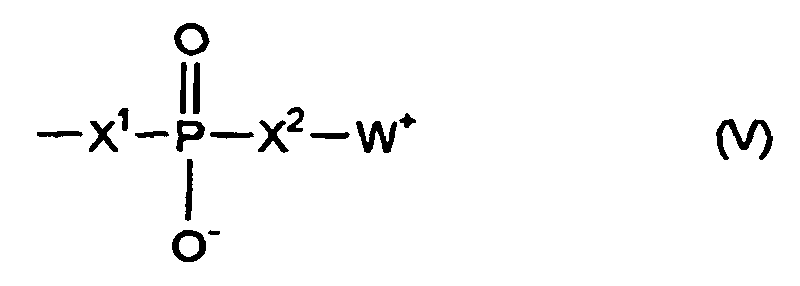
- X is a group of formula V in which the moieties X 1 and X 2 , which are the same or different, are -O-, -S-, -NH- or a valence bond, preferably -O-, and W + is a group comprising an ammonium, phosphonium or sulphonium cationic group and a group linking the anionic and cationic moieties which is preferably a C 1-12 -alkylene group.
- W contains as cationic group an ammonium group, more preferably a quaternary ammonium group.
- the group W + may for example be a group of formula -W 1 -N + R 6 3 , -W 1 -P + R 7 3 , -W 1 -S + R 7 2 or -W 1 -Het + in which:
- W 1 is a straight-chain alkylene group, most preferably 1,2-ethylene.
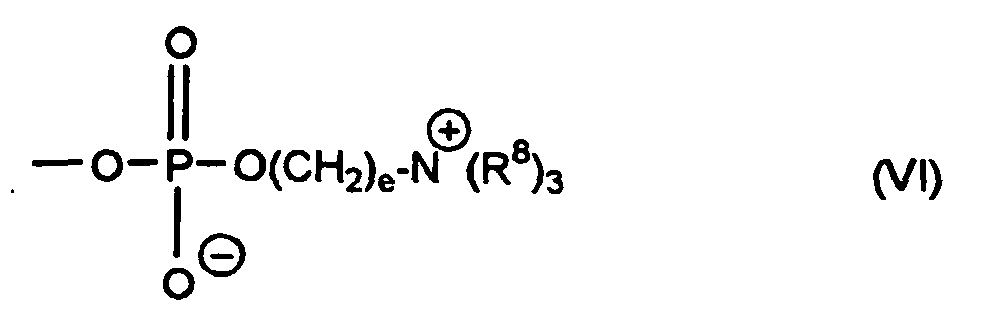
- Preferred groups X of the formula V are groups of formula VI.
- the groups of formula (VI) are: where the groups R 8 are the same or different and each is hydrogen or C 1-4 alkyl, and e is from 1 to 6.
- the groups R 8 are the same. It is also preferable that at least one of the groups R 8 is methyl, and more preferable that the groups R 8 are all methyl.
- e is 2 or 3, more preferably 2.
- B is a group of formula -(CR 9 2 )- or -(CR 9 2 ) 2 -, eg. -(CH 2 )- or -(CH 2 CH 2 )-.
- the zwitterionic monomer has the general formula VII wherein R, A and B are defined above, the groups R 3 are the same or different and each is hydrogen C 1-1 alkyl, aryl, alkaryl, aralkyl, or two or three of the groups R 3 with the nitrogen atom to which they are attached form a saturated or unsaturated hetero cyclic ring, and e is 1 to 6, preferably 2 to 4.
- a cationisable moiety in the group Q 1 is generally a group which can easily be protonated to render it cationic, for instance which is protonated in aqueous environments at pH7.
- the group Q 1 of the cationic monomer is preferably a group N + R 5 3 , P + R 5 3 or S + R 5 2 in which the groups R 5 are the same or different and are each hydrogen, C 1-4 -alkyl or aryl (preferably phenyl) or two of the groups R 5 together with the heteroatom to which they are attached from a saturated or unsaturated heterocyclic ring containing from 5 to 7 atoms.
- the group Q 1 is permanently cationic, that is each R 5 is other than hydrogen.
- Q 1 is N + R 5 3 in which each R 5 is C 1-4 -alkyl, preferably methyl.
- the relative ratios (equivalents) of zwitterionic to cationic pendant groups in the molecule of zwitterionic to cationic monomer in the range 1:100 to 100:1 (zwitterionic to ionic) preferably 1:10 to 10:1, more preferably 1:2 to 2:1.
- crosslinking is generally by heating, optionally in the presence of moisture, for instance at least 40°C, preferably at least 60°C, for instance around 70°C.
- the pharmaceutically active compound may be loaded into the polymer matrix by being co-coated from a composition containing both the compound and cross-linkable polymer.
- the drug is absorbed into or absorbed onto the matrix after the polymer is coated onto the stent and crosslinked thereon.
- This loading step is carried out by contacting the coated stent, optionally following a pre-swelling step, with an aqueous solution of the pharmaceutically active compound polymer is water.
- an aqueous solution of the pharmaceutically active compound polymer is water.
- the solvent for swellable so the aqueous solvent swells the polymer.
- the water may be removed from the swollen matrix containing pharmaceutical active, but may alternatively be retained in the polymer, for instance during storage or by immediately delivering the stent to the patient.
- Loading conditions are determined to achieve adequate loading of active.
- the temperature is selected so as to create suitable properties on the polymer. It is usually between room temperature to about 40°C, for instance 20 to 40°C, most preferably around 37°C.
- the stent may be sterilised before or after loading, for instance by gamma-irradiation.
- the polymer coating and the pharmaceutically active compound may be coated only onto the outside of the stent, from which the pharmaceutical active is delivered directly into the wall of the vessel in which the stent is implanted.
- the stent is provided with an overall coating of polymer, so that the lumenal surface of the stent is also provided with a coating, which may be thicker or, preferably, is thinner than the external coating.
- the stent may be a shape-memory metal stent, a self-expanding stent or a balloon expandable stent.
- a self-expanding stent may be a rolled sheet device or a braided device.
- the stent is an etched tube balloon-expandable stent.
- the stent may be loaded with drug in the invention when mounted on its delivery device.
- An overcoat of zwitterionic polymer may be applied over the defined coating to control release in use.
- the monomer ratios are on a weight basis based on the amount of monomers used in the polymerisations.
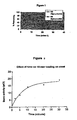
- the objective was to compare the loading of a single stranded oligonucleotide (ASON, c-myc ) as during onto polymer variants to assess the importance of hydrophobicity, hydrophilicity, crosslinking density and level of cationic charge upon the ASON loading of polymer film.
- ASON single stranded oligonucleotide
- the uptake of ASON in polymer 2.1 may be due to the interactions of the negative charge associated with the ASON molecule and the positive charge associated with the presence of Cm in the polymer coating.
- Samples 2.1 and 2.2 were subjected to a further one-hour sonication to determine if any more ASON was released. The results showed no difference to those observed after 20 minutes indicating that 1.6 and 1.8ug was probably the total loading.
- the results obtained confirmed previous findings in that the cationic polymer does absorb ASON but that changes in polymer composition do not seem to increase the degree of uptake in the polymer coating with the exception of a lower crosslinking polymer system.
- the hydrophilic copolymer may not be optimised in terms of coating property, resulting in its apparent failure to absorb drug.
- BiodivYsio stents were coated on the automated stent coating rig, which dips and removes the stent into the solution several times with intermediate drying, using the following conditions. Polymer 25 mg/ml in ethanol Number of dips x5 Air pressure (vacuum) 6 bar Dip speed 5 mm/s (25 V on power pack) Drying time under vacuum 2 minutes per dip cycle Stents were then cured at 70°C overnight.
- the stents were loaded with DSON. By immersion in a well containing DSON at a concentration of 1mg/ml in phosphate buffered saline (PBS). Each stent was loaded for 1 hour: Once the loading was complete the stent was removed from the well and the excess DSON removed by dabbing the stent very gently with tissue.
- PBS phosphate buffered saline
- the stents were placed in PBS (2 ml) and sonicated for 1 hour to remove the absorded/adsorbed DSON from the stents. Two methods were used to confirm the quantity of material loaded.
- BiodivYsio stents were loaded with ASON and DSON from a 1 mg/ml in PBS (50:50 water:PBS).
- the uptake onto a 15 mm BiodivYiso Stent coated with polymer 2.1 at approx 1-2 ⁇ m was: ASON - 5.3 ⁇ g (10 mg/ml - 52 ⁇ g) DSON - 5-10 ⁇ g
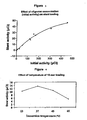
- the aim of this study plan was to determine the loading and drug release profiles of plasmid DNA (MW about 50 kDa) from polymer coated discs.
- a volume of 20 ⁇ l DNA-plasmid solution (2.325 ⁇ g/ ⁇ l) was added to one side of each disc. The discs were allowed to dry for 3 hours. This procedure was repeated on the other side.
- discs were overcoated. This was carried out by spray coating the polymer coated and loaded discs with a 20 mg/ml solution of polymer 1.5 in ethanol.
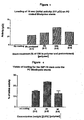
- the purpose of this study was to examine the feasibility of loading short DNA oligonucleotides onto 15 mm PC coated BiodivYsio Drug Delivery stents and optimize the various parameters that may influence drug loading.
- Total loading was assessed in a scintillation counter. All loading experiments were successful.
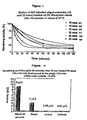
- Stents coated with polymers 2.1, 2.2 and 2.6 and loaded with 15 mer or 32 mer 32 P labelled oligomers (37°C, 30 mins, with or without presoak in deionised water, at 211 ⁇ Ci in 300 ⁇ l concentration in the soaking solution), were incubated in either human blood or DMEM cell culture medium at 37°C. Samples of the incubation medium were taken over a period and evaluated for radioactivity. The results were used to calculate the % oligomer remaining on the stent after periods of time.
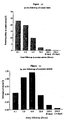
- Figure 8 shows the elution profile for 15 mer from stents coated with polymer 2.1 incubated in blood and cell culture medium.
- Figure 9 shows the elution profiles for 15 mer and 32 mer from stents coated with the different polymers and for polymer 2.1 presoaked in deionised water, upon incubation with blood.
- examples 7a)-c) show that oligonucleotides are released in vivo into the vessel wall surrounding the stent, with little detected in the tissue adjacent to the vessel in which the stent is implanted. Thus, in example 7c) there was very little radioactivity detected in the myocardium. The efficiency of delivery is much higher than using a local drug delivery catheter, the infiltrator (TM). Comparative results show that delivering a dose of 1680 ⁇ Ci 32 P labelled ODN results in the same level of label in the tissue at 3 and 6 hours as a dose of only 100 ⁇ G from a stent. Lower doses of these compounds may be used to delivery to target tissue.
- Stents coated with polymer 2.2 were loaded with a 15-mer c-myc antisense oligonucleotide AACGTTGAGGGGCAT (sequence ID 2) labelled with a fluorescence label by immersing them for 30 minutes in a 5 mg/ml solution of the DNA in physiological saline.
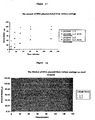
- the total loading was determined by placing 3 of the stents each into 3 ml PBS and sonicating for 30 minutes. The fluorescent label was quantified. The loading was found to be about 20 ⁇ g per stent. Release into PBS is shown in Figure 16.
- Polymer 2.1 - coated stents were loaded with the same oligonucleotide used in Example 7a.
- the stents were wick dried.
- Each stent was deployed in a 50 mm long section of poveine carotid artery by mounting on a balloon and inflation of the balloon in the section.
- the section of artery was then mounted onto cannulae in a chamber filled with culture medium. Further culture medium was coused to flow through a circuit of silicone tubing and thence through the section of artery at a rate of 60 ml min -1 . After 1, 6, 12 or 24 hours the stented section was removed from the circuit and the ends of the vessel proximal and distal from the stent removed for qualification of ODN.
- the stented segment of vessel was gently pulled away from the stent. All three vessel segments were snap frozen in liquid nitrogen, pulverised and incubated one night in lysis buffer. Following sonication and centrifugation the supernatants were measured for fluorescence to determine the concentration of label, presumed to remain associated with ODN. The results are shown in Figure 12. The level of fluorescence label in the circulating liquid was detected at the end of each experiment and found to be below the level of detection of the reader. One of the started sections of vessel was instead of being analysed for the total fluorescence label, sectioned and observed under confocal microscopy after ethidium bromide staining. The results show that oligonucleotide costains with ethidium bromide believed to indicate a nuclear location.
Landscapes
- Health & Medical Sciences (AREA)
- Life Sciences & Earth Sciences (AREA)
- Public Health (AREA)
- Epidemiology (AREA)
- Animal Behavior & Ethology (AREA)
- General Health & Medical Sciences (AREA)
- Veterinary Medicine (AREA)
- Medicinal Chemistry (AREA)
- Chemical & Material Sciences (AREA)
- Surgery (AREA)
- Heart & Thoracic Surgery (AREA)
- Vascular Medicine (AREA)
- Engineering & Computer Science (AREA)
- Biomedical Technology (AREA)
- Molecular Biology (AREA)
- Dermatology (AREA)
- Oral & Maxillofacial Surgery (AREA)
- Transplantation (AREA)
- Materials For Medical Uses (AREA)
Abstract
Description
X is an organic group having a zwitterionic moiety; and
Y is an ethylenically unsaturated polymerisable group;
Y1 is an ethylenically unsaturated polymerisable group; and
Q is an organic group having a cationic or cationisable moiety and C a crosslinkable monomer having the general formula IV:
Y3 is an ethylenically unsaturated polymerisable group; and
Q3 is an organic group having a reactive group capable of cross-linking the polymer.
Y2 is an ethylenically unsaturated polymerisable group; and
Q2 is an organic group having a hydrophobic group selected from alkyl groups having at least six carbon atoms, fluorine substituted alkyl groups and alkyl groups having at least one siloxane substituent.
wherein:


the groups R3 are the same or different and each is hydrogen C1-1 alkyl, aryl, alkaryl, aralkyl, or two or three of the groups R3 with the nitrogen atom to which they are attached form a saturated or unsaturated hetero cyclic ring, and e is 1 to 6, preferably 2 to 4.
in which the groups R5 are the same or different and are each hydrogen, C1-4-alkyl or aryl (preferably phenyl) or two of the groups R5 together with the heteroatom to which they are attached from a saturated or unsaturated heterocyclic ring containing from 5 to 7 atoms. Preferably the group Q1 is permanently cationic, that is each R5 is other than hydrogen. Preferably Q1 is N+R5 3 in which each R5 is C1-4-alkyl, preferably methyl.
| (1) Reference | |
| 1.1 Polymer of EP 99304140.9 | MPC29LM51HPM15XL5 |
| 1.2 Hydrophobic variant | MPC15LM65HPM15XL5 |
| 1.3 Hydrophilic variant | MPC45LM35HPM15XL5 |
| 1.4 Increased crosslinker | MPC30LM50HPM10XL10 |
| 1.5 Polymer of EP 99304092.2 | MPC37LM63 |
| (2) Invention | |
| 2.1 Standard | MPC29LM50CM5 HPM12XL4 |
| 2.2 Charge increase | MPC21.5LM42.5CM20HPM12XL4 |
| 2.3 Hydrophilic variant | MPC48LM30CM6HPM12XL4 |
| 2.4 Lower crosslinker | MPC25LM50CM6HPM14XL2 |
| 2.5 Hydrophilic polymer | MPC28LM20CM6HPM12XL4DMA30 |
| 2.6 High cationic | MPC18LM31CM35 HPM12XL4 |
| Fluorescence readings (Excitation 500nm Emission 525nm) | |
| Polymer Type | Drug Uptake (µg) |
| 1.2 | 0.0 |
| 1.3 | 0.0 |
| 1.1 | 0.0 |
| 1.4 | 0.0 |
| 2.1 | 1.8 |
| 2.2 | 1.6 |
| Polymer Type | Polymer Quantity µl | Drug Uptake (µg) |
| 1.1 | 200 | 0.0 |
| 1.1 | 500 | 0.0 |
| 1.1 | 800 | 0.0 |
| 2.1 | 200 | 3.8 |
| 2.1 | 500 | 6.3 |
| 2.1 | 800 | 9.8 |
| Polymer Type | Drug Uptake (ug) |
| 2.3 | 2.4 |
| 2.4 | 8.3 |
| 2.5 | 0.0 |
| 2.1 | 5.4 |
| | 25 mg/ml in ethanol |
| Number of dips | x5 |
| Air pressure (vacuum) | 6 |
| Dip speed | |
| 5 mm/s (25 V on power pack) | |
| Drying time under | 2 minutes per dip cycle |
Total Drug Loading
2mg/ml Solution (DSON in Water) : 4µg
1 mg/ml Solution (DSON in Water/PBS 50:50) : 5µg
Repeaf study - 1 mg/ml Solution (DSON in Water/PBS 50:50) : 6µg
Total Drug Loading
1 mg/ml Solution (DSON in PBS): 16µg (before filtration)
1 mg/ml Solution (DSON in PBS): 12µg (after filtration)
Claims (33)
- An implant having a coating on its external surface comprising:a) a crosslinked, biostable polymer matrix andb) a pharmaceutically active compound which is a nucleic acid, characterised in that the polymer has pendant zwitterionic groups and pendant cationic groups.
- An implant according to claim 1 in which the polymer is formed from ethylenically unsaturated monomers including less than 20 mole % cross-linkable monomer.
- An implant according to claim 1 or claim 2 in which the polymer is formed from ethylenically unsaturated monomers includingwherein B3 is a bond or a straight or branched alkylene, alkylene-oxa-alkylene or alkylene-oligooxa-alkylene group, any of which optionally includes one or more fluorine substituents;a) a zwitterionic monomer of the formula I
X is an organic group having a zwitterionic moiety; and
Y is an ethylenically unsaturated polymerisable group;b) a cationic monomer of the formula II
Y1 is an ethylenically unsaturated polymerisable group; and
Q is an organic group having a cationic or cationisable moiety andc) a crosslinkable monomer having the general formula IV:
Y3 is an ethylenically unsaturated polymerisable group; and
Q3 is an organic group having a reactive group capable of cross-linking the the polymer. - An implant according to claim 3 in which Q3 contains a crosslinkable cinnamyl, epoxy, -CHOHCH2Hal (in which Hal is a halogen atom), methylol, or reactive silyl group, an ethylenically unsaturated crosslinkable group, such as an acetylenic, diacetylenic, vinylic or divinylic group, or an acetoacetoxy or chloroalkyl sulfone group.
- An implant according to claim 4 in which Q3 is a group SiR4 3 in which each R4 is a C1-4 alkoxy group or a halogen atom.
- An implant according to claim 5 in which the monomers further include a compound having the formula IV'
- An implant according to any of claims 3 to 6 in which X is a group of formula Vin which the moieties X1 and X2, which are the same or different, are -O-, -S-, -NH- or a valence bond, and W+ is a group comprising an ammonium, phosphonium or sulphonium cationic group and a group linking the anionic and cationic moieties.
- An implant according to claim 7, in which X1 and X2 are each O and W1 is a C1-12-alkylene group.
- An implant according to claim 7 or claim 8 in which W1 is a straight-chain alkylene group.
- An implant according to any of claims 7 to 9 in which X is a group of formula VIwhere the groups R8 are the same or different and each is hydrogen or C1-4 alkyl, and e is from 1 to 6.

- An implant according to claim 10 in which each R8 is methyl and e is 2 or 3.
- An implant according to any of claims 3 to 11 in which Q1 is a group N+R5 3, P+R5 3 or S+R5 2
in which the groups R5 are the same or different and are each hydrogen, C1-4-alkyl or aryl or two of the groups R5 together with the heteroatom to which they are attached from a saturated or unsaturated heterocyclic ring containing from 5 to 7 atoms. - An implant according to any of claims 3 to 12 in which the monomers further include a termonomer of the formula III
Y2 is an ethylenically unsaturated polymerisable group; and
Q2 is an organic group having a hydrophobic group selected from alkyl groups having at least six carbon atoms, fluorine substituted alkyl groups and alkyl groups having at least one siloxane substituent. - An implant according to any of claims 3 to 13 in which Y, Y1, Y2, Y3 and/or Y3, as the case may be are independently selected from CH=CH-(C6H4)-K-, CH2=C(R)C(O)-A-, CH2=C(R)-CH2-O-, CH2=C(R)-CH2OC(O)-, CH2=C(R)OC(O)-, CH2=C(R)O-, and CH2=C(R)CH2OC(O)N(R1)-
wherein:R is hydrogen or a C1-C4 alkyl group;A is -0- or -NR1- where R1 is hydrogen or a C1-C4 alkyl group or R1 is -B-X, B1Q1, B2Q2 or B3Q3, as the case may be, where B, B1, B2, B3, Q1, Q2 and Q3 and X are as defined above in the respective one of the formula I to IV andK is a group -(CH2)pOC(O)-, -(CH2)pC(O)O-, -(CH2)pOC(O)O-, -(CH2)pNR2-, -(CH2)pNR2C(O)-, -(CH2)pC(P)NR2-, -(CH2)pNR2C(O)O-, -(CH2)pOC(O)NR2-, -(CH2)pNR2C(O)NR2-, (in which the groups R2 are the same or different) - (CH2)pO-, -(CH2)pSO3-, or, optionally in combination with B, a valence bond and p is from 1 to 12 and R2 is hydrogen or a C1-C4 alkyl group. - An implant according to claim 14 in which the ethylenically unsaturated groups of all monomers copolymerised together are either the acrylate type or are the styrene type (CH2=C(R)C(O)A- or
CH=CH-(C6H4)-K-). - An implant according to claim 15 in which each said ethylenically unsaturated group has the formula CH2=C(R)C(O)A in which R is H or CH3 and A is -NH or -O-.
- An implant according to claim 16 in which, in each ethylenically unsaturated group, A is -O-.
- An implant according to any of claims 3 to 17 in which the ratio of zwitterionic to cationic monomer used to form the polymer is in the range 1:10 to 10:1.
- An implant according to any preceding claim in which the polymer matrix has a dry thickness of at least 0.5µm.
- An implant according to any preceding claim in which the nucleic acid is DNA or RNA, and is linear or circular, and single or double stranded.
- An implant according to any preceding claim in which the nucleic acid has at least 15 bases.
- An implant according to any preceding claim which is a stent.
- A method of producing an implant according to any preceding claim in which an empty implant, having an empty (of pharmaceutical active) coating of cross-linked water-swellable polymer matrix on its external surface is contacted with an aqueous solution of a pharmaceutical active which is a nucleic acid whereby nucleic acid is absorbed into or adsorbed onto the polymer matrix.
- A method according to claim 23 in which the polymer matrix is water-swellable and the aqueous solution swells it in the method.
- A method according to claim 23 or 24 in which the polymer matrix is substantially free of solvent when it is contacted with the said aqueous solution.
- A method according to claim 23 or 24 in which the polymer matrix has been preswollen with a swelling liquid when it is contacted with the said aqueous solution.
- A method according to any of claims 23 to 26 in which the implant is contacted with the said solution by dipping it into a volume of the aqueous solution.
- A method according to claim 27 in which the implant is a stent.
- A method according to claim 28 in which the stent is mounted on a delivery device.
- A method according to any of claims 23 to 29 in which the contact time of the aqueous solution and the implant is at least 30s.
- A method according to any of claims 23 to 30 in which the said aqueous solution is at a temperature in the range of 20 to 40°C.
- A method according to claim 31 in which the temperature is about 37°C.
- A method according to any of claims 23 to 32 including the preliminary step of coating an implant with a cross-linkable polymer and cross-linking the polymer.
Priority Applications (1)
| Application Number | Priority Date | Filing Date | Title |
|---|---|---|---|
| EP01942570A EP1250164B1 (en) | 2000-01-24 | 2001-01-24 | Coated implants |
Applications Claiming Priority (4)
| Application Number | Priority Date | Filing Date | Title |
|---|---|---|---|
| EP00300509 | 2000-01-24 | ||
| PCT/GB2001/000281 WO2001052915A1 (en) | 2000-01-24 | 2001-01-24 | Coated implants |
| EP01942570A EP1250164B1 (en) | 2000-01-24 | 2001-01-24 | Coated implants |
| EP00300509 | 2001-01-24 |
Publications (2)
| Publication Number | Publication Date |
|---|---|
| EP1250164A1 EP1250164A1 (en) | 2002-10-23 |
| EP1250164B1 true EP1250164B1 (en) | 2005-11-23 |
Family
ID=8172662
Family Applications (1)
| Application Number | Title | Priority Date | Filing Date |
|---|---|---|---|
| EP01942570A Expired - Lifetime EP1250164B1 (en) | 2000-01-24 | 2001-01-24 | Coated implants |
Country Status (7)
| Country | Link |
|---|---|
| US (2) | US6746686B2 (en) |
| EP (1) | EP1250164B1 (en) |
| JP (1) | JP5000826B2 (en) |
| AT (1) | ATE310542T1 (en) |
| AU (1) | AU2001228653A1 (en) |
| DE (1) | DE60115203T2 (en) |
| WO (1) | WO2001052915A1 (en) |
Families Citing this family (67)
| Publication number | Priority date | Publication date | Assignee | Title |
|---|---|---|---|---|
| US6241762B1 (en) | 1998-03-30 | 2001-06-05 | Conor Medsystems, Inc. | Expandable medical device with ductile hinges |
| US7208011B2 (en) | 2001-08-20 | 2007-04-24 | Conor Medsystems, Inc. | Implantable medical device with drug filled holes |
| US20040254635A1 (en) * | 1998-03-30 | 2004-12-16 | Shanley John F. | Expandable medical device for delivery of beneficial agent |
| US7208010B2 (en) * | 2000-10-16 | 2007-04-24 | Conor Medsystems, Inc. | Expandable medical device for delivery of beneficial agent |
| WO2001001957A1 (en) * | 1999-05-27 | 2001-01-11 | Biocompatibles Limited | Local drug delivery |
| PT1328213E (en) | 2000-10-16 | 2005-10-31 | Conor Medsystems Inc | EXPANSIVE MEDICAL DEVICE FOR THE ADMINISTRATION OF A BENEFICIAL AGENT |
| GB0100761D0 (en) | 2001-01-11 | 2001-02-21 | Biocompatibles Ltd | Drug delivery from stents |
| US20040073294A1 (en) | 2002-09-20 | 2004-04-15 | Conor Medsystems, Inc. | Method and apparatus for loading a beneficial agent into an expandable medical device |
| US20040204756A1 (en) * | 2004-02-11 | 2004-10-14 | Diaz Stephen Hunter | Absorbent article with improved liquid acquisition capacity |
| US7682669B1 (en) * | 2001-07-30 | 2010-03-23 | Advanced Cardiovascular Systems, Inc. | Methods for covalently immobilizing anti-thrombogenic material into a coating on a medical device |
| US7056338B2 (en) | 2003-03-28 | 2006-06-06 | Conor Medsystems, Inc. | Therapeutic agent delivery device with controlled therapeutic agent release rates |
| US20040249443A1 (en) * | 2001-08-20 | 2004-12-09 | Shanley John F. | Expandable medical device for treating cardiac arrhythmias |
| US20040137066A1 (en) * | 2001-11-26 | 2004-07-15 | Swaminathan Jayaraman | Rationally designed therapeutic intravascular implant coating |
| US20030050648A1 (en) | 2001-09-11 | 2003-03-13 | Spiration, Inc. | Removable lung reduction devices, systems, and methods |
| US6592594B2 (en) | 2001-10-25 | 2003-07-15 | Spiration, Inc. | Bronchial obstruction device deployment system and method |
| BR0307544A (en) | 2002-02-01 | 2004-12-07 | Ariad Gene Therapeutics Inc | Phosphorus-containing compounds, components and composition as well as their use by treatment methods |
| US6929637B2 (en) | 2002-02-21 | 2005-08-16 | Spiration, Inc. | Device and method for intra-bronchial provision of a therapeutic agent |
| US20060235432A1 (en) * | 2002-02-21 | 2006-10-19 | Devore Lauri J | Intra-bronchial obstructing device that controls biological interaction with the patient |
| US20030181922A1 (en) | 2002-03-20 | 2003-09-25 | Spiration, Inc. | Removable anchored lung volume reduction devices and methods |
| US20030216769A1 (en) | 2002-05-17 | 2003-11-20 | Dillard David H. | Removable anchored lung volume reduction devices and methods |
| US7758636B2 (en) * | 2002-09-20 | 2010-07-20 | Innovational Holdings Llc | Expandable medical device with openings for delivery of multiple beneficial agents |
| AU2003291470A1 (en) * | 2002-11-08 | 2004-06-03 | Innovational Holdings, Llc | Expandable medical device and method for treating chronic total occlusions with local delivery of an angiogenic factor |
| AU2003285195A1 (en) * | 2002-11-08 | 2004-06-03 | Innovational Holdings, Llc | Method and apparatus for treating vulnerable artherosclerotic plaque |
| US20050079199A1 (en) * | 2003-02-18 | 2005-04-14 | Medtronic, Inc. | Porous coatings for drug release from medical devices |
| AU2004226327A1 (en) | 2003-03-28 | 2004-10-14 | Innovational Holdings, Llc | Implantable medical device with beneficial agent concentration gradient |
| US20050010170A1 (en) * | 2004-02-11 | 2005-01-13 | Shanley John F | Implantable medical device with beneficial agent concentration gradient |
| US7100616B2 (en) | 2003-04-08 | 2006-09-05 | Spiration, Inc. | Bronchoscopic lung volume reduction method |
| US7533671B2 (en) | 2003-08-08 | 2009-05-19 | Spiration, Inc. | Bronchoscopic repair of air leaks in a lung |
| WO2005027991A1 (en) * | 2003-09-19 | 2005-03-31 | Cambridge University Technical Services Ltd | Orthopaedic devices |
| US7785653B2 (en) | 2003-09-22 | 2010-08-31 | Innovational Holdings Llc | Method and apparatus for loading a beneficial agent into an expandable medical device |
| US20050100577A1 (en) * | 2003-11-10 | 2005-05-12 | Parker Theodore L. | Expandable medical device with beneficial agent matrix formed by a multi solvent system |
| WO2005075003A1 (en) * | 2004-01-21 | 2005-08-18 | Medtronic Vascular Inc. | Implantable medical devices for treating or preventing restenosis |
| US20050208093A1 (en) * | 2004-03-22 | 2005-09-22 | Thierry Glauser | Phosphoryl choline coating compositions |
| US20050287287A1 (en) * | 2004-06-24 | 2005-12-29 | Parker Theodore L | Methods and systems for loading an implantable medical device with beneficial agent |
| USD516723S1 (en) | 2004-07-06 | 2006-03-07 | Conor Medsystems, Inc. | Stent wall structure |
| GB2420976B (en) * | 2004-11-19 | 2006-12-20 | Zvi Finkelstein | Therapeutic implant |
| US9101949B2 (en) | 2005-08-04 | 2015-08-11 | Eilaz Babaev | Ultrasonic atomization and/or seperation system |
| US7896539B2 (en) | 2005-08-16 | 2011-03-01 | Bacoustics, Llc | Ultrasound apparatus and methods for mixing liquids and coating stents |
| US20070048349A1 (en) * | 2005-08-29 | 2007-03-01 | Bausch & Lomb Incorporated | Surface-modified medical devices and methods of making |
| US7691151B2 (en) | 2006-03-31 | 2010-04-06 | Spiration, Inc. | Articulable Anchor |
| US8568764B2 (en) * | 2006-05-31 | 2013-10-29 | Advanced Cardiovascular Systems, Inc. | Methods of forming coating layers for medical devices utilizing flash vaporization |
| US7997226B2 (en) * | 2006-10-18 | 2011-08-16 | Innovational Holdings Llc | Systems and methods for producing a medical device |
| WO2008070604A1 (en) * | 2006-12-04 | 2008-06-12 | Cree Led Lighting Solutions, Inc. | Lighting device and lighting method |
| WO2008130650A1 (en) * | 2007-04-19 | 2008-10-30 | University Of Massachusetts Medical School | Thermal responsive polymer siloxanes, compositions, and methods and applications related thereto |
| US8802184B2 (en) * | 2007-05-30 | 2014-08-12 | Abbott Cardiovascular Systems Inc. | Medical devices containing biobeneficial particles |
| US7753285B2 (en) | 2007-07-13 | 2010-07-13 | Bacoustics, Llc | Echoing ultrasound atomization and/or mixing system |
| US7780095B2 (en) | 2007-07-13 | 2010-08-24 | Bacoustics, Llc | Ultrasound pumping apparatus |
| US8043301B2 (en) | 2007-10-12 | 2011-10-25 | Spiration, Inc. | Valve loader method, system, and apparatus |
| EP2641572B1 (en) | 2007-10-12 | 2019-07-24 | Spiration Inc. | Valve loader method, system, and apparatus |
| WO2009124570A1 (en) * | 2008-04-09 | 2009-10-15 | Ruebben Alexander | Method for producing a bioactive surface on an endoprosthesis or on the balloon of a balloon catheter |
| AU2010256558B2 (en) | 2009-06-03 | 2013-10-03 | Forsight Labs, Llc | Anterior segment drug delivery |
| EP2380602B1 (en) * | 2010-04-14 | 2015-04-22 | Hans Kosak | Nucleic acids containing plastics in complexed form and method for producing same |
| US9295747B2 (en) | 2010-10-20 | 2016-03-29 | Nof Corporation | Contact lens care preparation and packaging solution |
| US8795241B2 (en) | 2011-05-13 | 2014-08-05 | Spiration, Inc. | Deployment catheter |
| RU2740680C2 (en) | 2011-09-14 | 2021-01-19 | Форсайт Вижн5, Инк. | Eye inserter device and methods |
| WO2013053483A1 (en) | 2011-10-11 | 2013-04-18 | Secutech International Pte. Ltd. | Method for producing plastics containing nucleic acids in complexed form |
| KR101797275B1 (en) * | 2012-03-02 | 2017-11-13 | 니치유 가부시키가이샤 | Contact lens care preparation and packaging solution |
| EP2911623B1 (en) | 2012-10-26 | 2019-08-14 | Forsight Vision5, Inc. | Ophthalmic system for sustained release of drug to eye |
| JP6111052B2 (en) * | 2012-11-22 | 2017-04-05 | 国立大学法人 東京大学 | Water-soluble surface treatment agent for imparting stain resistance, and surface treatment method |
| WO2014192731A1 (en) * | 2013-05-27 | 2014-12-04 | Jsr株式会社 | Surface treatment agent for surface configured from inorganic material, tool and device having modified surface, and method for manufacturing tool and device |
| US10647829B2 (en) | 2013-06-20 | 2020-05-12 | Sumitomo Rubber Industries, Ltd. | Surface modification method and surface modification body |
| JP6008213B2 (en) * | 2014-08-06 | 2016-10-19 | リューベン,アレクサンダー | Method for producing bioactive surface on endoprosthesis or balloon of balloon catheter |
| JP6371165B2 (en) * | 2014-09-02 | 2018-08-08 | 住友ゴム工業株式会社 | Metal medical tools |
| US20160296532A1 (en) | 2015-04-13 | 2016-10-13 | Forsight Vision5, Inc. | Ocular Insert Composition of a Semi-Crystalline or Crystalline Pharmaceutically Active Agent |
| JP6613692B2 (en) | 2015-08-03 | 2019-12-04 | 住友ゴム工業株式会社 | Surface modification method and surface modified elastic body |
| CA3027200A1 (en) | 2016-06-13 | 2017-12-21 | Massachusetts Institute Of Technology | Biocompatible zwitterionic polymer coatings and hydrogels for reducing foreign body response and fibrosis |
| WO2024110843A1 (en) * | 2022-11-21 | 2024-05-30 | Segena Corporation S.A. | Enhancing oligonucleotide immunomodulatory activity through dianophore long-lasting modification: methods and applications |
Family Cites Families (16)
| Publication number | Priority date | Publication date | Assignee | Title |
|---|---|---|---|---|
| US5674192A (en) | 1990-12-28 | 1997-10-07 | Boston Scientific Corporation | Drug delivery |
| WO1993001221A1 (en) | 1991-07-05 | 1993-01-21 | Biocompatibles Limited | Polymeric surface coatings |
| DK0818479T3 (en) * | 1991-08-08 | 2001-01-15 | Biocompatibles Ltd | Polymer surface coatings |
| US5342621A (en) | 1992-09-15 | 1994-08-30 | Advanced Cardiovascular Systems, Inc. | Antithrombogenic surface |
| CA2153158A1 (en) * | 1993-01-07 | 1994-07-21 | Andrew Zalewski | Antisense inhibition of c-myc to modulate the proliferation of smooth muscle cells |
| EP0754242A4 (en) | 1994-03-18 | 1997-06-11 | Lynx Therapeutics Inc | SYNTHESIS, COMPOUNDS, HYBRIDIZATION AND NUCLEASE RESISTANCE PROPERTIES OF OLIGONUCLEOTIDES HAVING N3'-m (7) P5 'PHOSPHORAMIDATES LINKS |
| US6090618A (en) * | 1996-10-07 | 2000-07-18 | Arch Development Corporation | DNA constructs and viral vectors comprising a smooth muscle promoter |
| US5876433A (en) | 1996-05-29 | 1999-03-02 | Ethicon, Inc. | Stent and method of varying amounts of heparin coated thereon to control treatment |
| WO1997047253A1 (en) | 1996-06-14 | 1997-12-18 | Kriton Medical, Inc. | Methods and devices for reducing angina, enhancing myocardial perfusion and increasing cardiac function |
| GB9624130D0 (en) * | 1996-11-20 | 1997-01-08 | Biocompatibles Ltd | Biocompatible compositions |
| CA2278586C (en) * | 1997-02-20 | 2009-09-22 | Cook Incorporated | Coated implantable medical device |
| DE19713214A1 (en) * | 1997-03-28 | 1998-12-10 | Ruebben Alexander Dr Med | Covered stent, e.g. for treating vascular stenosis or aneurysms |
| US6776792B1 (en) | 1997-04-24 | 2004-08-17 | Advanced Cardiovascular Systems Inc. | Coated endovascular stent |
| US6221425B1 (en) * | 1998-01-30 | 2001-04-24 | Advanced Cardiovascular Systems, Inc. | Lubricious hydrophilic coating for an intracorporeal medical device |
| AU760408B2 (en) * | 1998-04-27 | 2003-05-15 | Surmodics, Inc. | Bioactive agent release coating |
| WO2001001957A1 (en) | 1999-05-27 | 2001-01-11 | Biocompatibles Limited | Local drug delivery |
-
2001
- 2001-01-24 AU AU2001228653A patent/AU2001228653A1/en not_active Abandoned
- 2001-01-24 AT AT01942570T patent/ATE310542T1/en not_active IP Right Cessation
- 2001-01-24 EP EP01942570A patent/EP1250164B1/en not_active Expired - Lifetime
- 2001-01-24 WO PCT/GB2001/000281 patent/WO2001052915A1/en not_active Ceased
- 2001-01-24 US US09/937,224 patent/US6746686B2/en not_active Expired - Lifetime
- 2001-01-24 JP JP2001552962A patent/JP5000826B2/en not_active Expired - Fee Related
- 2001-01-24 DE DE60115203T patent/DE60115203T2/en not_active Expired - Lifetime
-
2003
- 2003-11-05 US US10/700,548 patent/US20040197585A1/en not_active Abandoned
Also Published As
| Publication number | Publication date |
|---|---|
| EP1250164A1 (en) | 2002-10-23 |
| US20040197585A1 (en) | 2004-10-07 |
| AU2001228653A1 (en) | 2001-07-31 |
| ATE310542T1 (en) | 2005-12-15 |
| JP5000826B2 (en) | 2012-08-15 |
| WO2001052915A1 (en) | 2001-07-26 |
| DE60115203D1 (en) | 2005-12-29 |
| DE60115203T2 (en) | 2006-08-03 |
| JP2003520107A (en) | 2003-07-02 |
| US6746686B2 (en) | 2004-06-08 |
| US20030086957A1 (en) | 2003-05-08 |
Similar Documents
| Publication | Publication Date | Title |
|---|---|---|
| US6746686B2 (en) | Coated implants | |
| US6872225B1 (en) | Local drug delivery | |
| EP1309360B1 (en) | Medicament incorporation matrix | |
| US6468304B1 (en) | Implantable device covered with polymer capable of releasing biologically active substances | |
| JP3954616B2 (en) | Method and system for providing a bioactive agent release coating | |
| JP2007532187A (en) | Coating composition for bioactive substances | |
| JP2006502136A (en) | Active agent delivery system comprising a hydrophilic polymer, a medical device, and a method | |
| JP2005535367A (en) | Bioactive agent release coating and controlled wetting method | |
| JP2013532211A (en) | Coating formulations for producing hydrophilic coatings | |
| CN101141948A (en) | Drug delivery compositions and related methods | |
| JP2007181691A (en) | Bioactive block copolymer | |
| US12214146B2 (en) | Controlled release of a hydrophilic agent from a coated surface | |
| US20240374879A1 (en) | Methods and compositions to reduce cellular deposition, and hydrocephalus shunt failure | |
| US20110153006A1 (en) | Biocorrodible implants having a functionalized coating | |
| US20100047313A1 (en) | Medical devices having a coating for electromagnetically-controlled release of therapeutic agents | |
| CN101209360B (en) | Method for preparing biological bracket | |
| US20060093647A1 (en) | Multiple layer coating composition | |
| JP2008535563A (en) | Coating composition for bioactive agents | |
| MXPA06004571A (en) | Method for preparing drug eluting medical devices and devices obtained therefrom |
Legal Events
| Date | Code | Title | Description |
|---|---|---|---|
| PUAI | Public reference made under article 153(3) epc to a published international application that has entered the european phase |
Free format text: ORIGINAL CODE: 0009012 |
|
| 17P | Request for examination filed |
Effective date: 20020502 |
|
| AK | Designated contracting states |
Kind code of ref document: A1 Designated state(s): AT BE CH CY DE DK ES FI FR GB GR IE IT LI LU MC NL PT SE TR |
|
| AX | Request for extension of the european patent |
Free format text: AL;LT;LV;MK;RO;SI |
|
| RAP1 | Party data changed (applicant data changed or rights of an application transferred) |
Owner name: BIOCOMPATIBLES UK LIMITED |
|
| 17Q | First examination report despatched |
Effective date: 20021219 |
|
| GRAP | Despatch of communication of intention to grant a patent |
Free format text: ORIGINAL CODE: EPIDOSNIGR1 |
|
| GRAS | Grant fee paid |
Free format text: ORIGINAL CODE: EPIDOSNIGR3 |
|
| GRAA | (expected) grant |
Free format text: ORIGINAL CODE: 0009210 |
|
| AK | Designated contracting states |
Kind code of ref document: B1 Designated state(s): AT BE CH CY DE DK ES FI FR GB GR IE IT LI LU MC NL PT SE TR |
|
| PG25 | Lapsed in a contracting state [announced via postgrant information from national office to epo] |
Ref country code: IT Free format text: LAPSE BECAUSE OF FAILURE TO SUBMIT A TRANSLATION OF THE DESCRIPTION OR TO PAY THE FEE WITHIN THE PRESCRIBED TIME-LIMIT;WARNING: LAPSES OF ITALIAN PATENTS WITH EFFECTIVE DATE BEFORE 2007 MAY HAVE OCCURRED AT ANY TIME BEFORE 2007. THE CORRECT EFFECTIVE DATE MAY BE DIFFERENT FROM THE ONE RECORDED. Effective date: 20051123 Ref country code: NL Free format text: LAPSE BECAUSE OF FAILURE TO SUBMIT A TRANSLATION OF THE DESCRIPTION OR TO PAY THE FEE WITHIN THE PRESCRIBED TIME-LIMIT Effective date: 20051123 Ref country code: AT Free format text: LAPSE BECAUSE OF FAILURE TO SUBMIT A TRANSLATION OF THE DESCRIPTION OR TO PAY THE FEE WITHIN THE PRESCRIBED TIME-LIMIT Effective date: 20051123 Ref country code: LI Free format text: LAPSE BECAUSE OF FAILURE TO SUBMIT A TRANSLATION OF THE DESCRIPTION OR TO PAY THE FEE WITHIN THE PRESCRIBED TIME-LIMIT Effective date: 20051123 Ref country code: FI Free format text: LAPSE BECAUSE OF FAILURE TO SUBMIT A TRANSLATION OF THE DESCRIPTION OR TO PAY THE FEE WITHIN THE PRESCRIBED TIME-LIMIT Effective date: 20051123 Ref country code: CH Free format text: LAPSE BECAUSE OF FAILURE TO SUBMIT A TRANSLATION OF THE DESCRIPTION OR TO PAY THE FEE WITHIN THE PRESCRIBED TIME-LIMIT Effective date: 20051123 Ref country code: BE Free format text: LAPSE BECAUSE OF FAILURE TO SUBMIT A TRANSLATION OF THE DESCRIPTION OR TO PAY THE FEE WITHIN THE PRESCRIBED TIME-LIMIT Effective date: 20051123 |
|
| REG | Reference to a national code |
Ref country code: GB Ref legal event code: FG4D |
|
| REG | Reference to a national code |
Ref country code: CH Ref legal event code: EP |
|
| REF | Corresponds to: |
Ref document number: 60115203 Country of ref document: DE Date of ref document: 20051229 Kind code of ref document: P |
|
| REG | Reference to a national code |
Ref country code: IE Ref legal event code: FG4D |
|
| PG25 | Lapsed in a contracting state [announced via postgrant information from national office to epo] |
Ref country code: LU Free format text: LAPSE BECAUSE OF NON-PAYMENT OF DUE FEES Effective date: 20060131 Ref country code: MC Free format text: LAPSE BECAUSE OF NON-PAYMENT OF DUE FEES Effective date: 20060131 |
|
| PG25 | Lapsed in a contracting state [announced via postgrant information from national office to epo] |
Ref country code: DK Free format text: LAPSE BECAUSE OF FAILURE TO SUBMIT A TRANSLATION OF THE DESCRIPTION OR TO PAY THE FEE WITHIN THE PRESCRIBED TIME-LIMIT Effective date: 20060223 Ref country code: GR Free format text: LAPSE BECAUSE OF FAILURE TO SUBMIT A TRANSLATION OF THE DESCRIPTION OR TO PAY THE FEE WITHIN THE PRESCRIBED TIME-LIMIT Effective date: 20060223 Ref country code: SE Free format text: LAPSE BECAUSE OF FAILURE TO SUBMIT A TRANSLATION OF THE DESCRIPTION OR TO PAY THE FEE WITHIN THE PRESCRIBED TIME-LIMIT Effective date: 20060223 |
|
| PG25 | Lapsed in a contracting state [announced via postgrant information from national office to epo] |
Ref country code: ES Free format text: LAPSE BECAUSE OF FAILURE TO SUBMIT A TRANSLATION OF THE DESCRIPTION OR TO PAY THE FEE WITHIN THE PRESCRIBED TIME-LIMIT Effective date: 20060306 |
|
| PG25 | Lapsed in a contracting state [announced via postgrant information from national office to epo] |
Ref country code: PT Free format text: LAPSE BECAUSE OF FAILURE TO SUBMIT A TRANSLATION OF THE DESCRIPTION OR TO PAY THE FEE WITHIN THE PRESCRIBED TIME-LIMIT Effective date: 20060424 |
|
| NLV1 | Nl: lapsed or annulled due to failure to fulfill the requirements of art. 29p and 29m of the patents act | ||
| REG | Reference to a national code |
Ref country code: CH Ref legal event code: PL |
|
| ET | Fr: translation filed | ||
| PLBE | No opposition filed within time limit |
Free format text: ORIGINAL CODE: 0009261 |
|
| STAA | Information on the status of an ep patent application or granted ep patent |
Free format text: STATUS: NO OPPOSITION FILED WITHIN TIME LIMIT |
|
| 26N | No opposition filed |
Effective date: 20060824 |
|
| PG25 | Lapsed in a contracting state [announced via postgrant information from national office to epo] |
Ref country code: TR Free format text: LAPSE BECAUSE OF FAILURE TO SUBMIT A TRANSLATION OF THE DESCRIPTION OR TO PAY THE FEE WITHIN THE PRESCRIBED TIME-LIMIT Effective date: 20051123 |
|
| PG25 | Lapsed in a contracting state [announced via postgrant information from national office to epo] |
Ref country code: CY Free format text: LAPSE BECAUSE OF FAILURE TO SUBMIT A TRANSLATION OF THE DESCRIPTION OR TO PAY THE FEE WITHIN THE PRESCRIBED TIME-LIMIT Effective date: 20051123 |
|
| REG | Reference to a national code |
Ref country code: DE Ref legal event code: R082 Ref document number: 60115203 Country of ref document: DE Representative=s name: MEISSNER BOLTE PATENTANWAELTE RECHTSANWAELTE P, DE Ref country code: DE Ref legal event code: R082 Ref document number: 60115203 Country of ref document: DE Representative=s name: MEISSNER, BOLTE & PARTNER GBR, DE |
|
| REG | Reference to a national code |
Ref country code: DE Ref legal event code: R082 Ref document number: 60115203 Country of ref document: DE Representative=s name: MEISSNER, BOLTE & PARTNER GBR, DE |
|
| REG | Reference to a national code |
Ref country code: FR Ref legal event code: PLFP Year of fee payment: 16 |
|
| REG | Reference to a national code |
Ref country code: FR Ref legal event code: PLFP Year of fee payment: 17 |
|
| REG | Reference to a national code |
Ref country code: FR Ref legal event code: PLFP Year of fee payment: 18 |
|
| PGFP | Annual fee paid to national office [announced via postgrant information from national office to epo] |
Ref country code: FR Payment date: 20181213 Year of fee payment: 19 |
|
| PGFP | Annual fee paid to national office [announced via postgrant information from national office to epo] |
Ref country code: NL Payment date: 20190116 Year of fee payment: 9 |
|
| PGFP | Annual fee paid to national office [announced via postgrant information from national office to epo] |
Ref country code: GB Payment date: 20200115 Year of fee payment: 20 Ref country code: IE Payment date: 20200109 Year of fee payment: 20 |
|
| REG | Reference to a national code |
Ref country code: DE Ref legal event code: R119 Ref document number: 60115203 Country of ref document: DE |
|
| PG25 | Lapsed in a contracting state [announced via postgrant information from national office to epo] |
Ref country code: FR Free format text: LAPSE BECAUSE OF NON-PAYMENT OF DUE FEES Effective date: 20200131 Ref country code: DE Free format text: LAPSE BECAUSE OF NON-PAYMENT OF DUE FEES Effective date: 20200801 |
|
| REG | Reference to a national code |
Ref country code: GB Ref legal event code: PE20 Expiry date: 20210123 |
|
| REG | Reference to a national code |
Ref country code: IE Ref legal event code: MK9A |
|
| PG25 | Lapsed in a contracting state [announced via postgrant information from national office to epo] |
Ref country code: IE Free format text: LAPSE BECAUSE OF EXPIRATION OF PROTECTION Effective date: 20210124 Ref country code: GB Free format text: LAPSE BECAUSE OF EXPIRATION OF PROTECTION Effective date: 20210123 |