EP1243644A1 - Verfahren zur Untersuchung von Zuständen in einem Behältnis - Google Patents
Verfahren zur Untersuchung von Zuständen in einem Behältnis Download PDFInfo
- Publication number
- EP1243644A1 EP1243644A1 EP01106958A EP01106958A EP1243644A1 EP 1243644 A1 EP1243644 A1 EP 1243644A1 EP 01106958 A EP01106958 A EP 01106958A EP 01106958 A EP01106958 A EP 01106958A EP 1243644 A1 EP1243644 A1 EP 1243644A1
- Authority
- EP
- European Patent Office
- Prior art keywords
- image
- container
- pixels
- area
- criterion
- Prior art date
- Legal status (The legal status is an assumption and is not a legal conclusion. Google has not performed a legal analysis and makes no representation as to the accuracy of the status listed.)
- Granted
Links
- 238000000034 method Methods 0.000 title claims abstract description 82
- 238000000855 fermentation Methods 0.000 claims abstract description 112
- 230000004151 fermentation Effects 0.000 claims abstract description 112
- 238000004519 manufacturing process Methods 0.000 claims abstract description 10
- 235000013361 beverage Nutrition 0.000 claims abstract description 8
- JVTAAEKCZFNVCJ-UHFFFAOYSA-N lactic acid Chemical compound CC(O)C(O)=O JVTAAEKCZFNVCJ-UHFFFAOYSA-N 0.000 claims abstract description 8
- 235000013405 beer Nutrition 0.000 claims abstract description 7
- 240000004808 Saccharomyces cerevisiae Species 0.000 claims abstract description 6
- 238000003860 storage Methods 0.000 claims abstract description 6
- 235000014655 lactic acid Nutrition 0.000 claims abstract description 4
- 239000004310 lactic acid Substances 0.000 claims abstract description 4
- 239000007921 spray Substances 0.000 claims description 23
- 239000011521 glass Substances 0.000 claims description 18
- 238000009795 derivation Methods 0.000 claims description 9
- 238000009423 ventilation Methods 0.000 claims description 7
- 235000013532 brandy Nutrition 0.000 claims description 5
- 238000004140 cleaning Methods 0.000 claims description 5
- 238000007654 immersion Methods 0.000 claims description 5
- 238000004590 computer program Methods 0.000 claims description 2
- 238000001454 recorded image Methods 0.000 claims description 2
- 238000005259 measurement Methods 0.000 abstract description 7
- 239000006260 foam Substances 0.000 description 19
- 239000007788 liquid Substances 0.000 description 5
- 230000003247 decreasing effect Effects 0.000 description 4
- 238000011835 investigation Methods 0.000 description 4
- 238000012546 transfer Methods 0.000 description 4
- 238000004458 analytical method Methods 0.000 description 2
- 238000004364 calculation method Methods 0.000 description 2
- 230000007423 decrease Effects 0.000 description 2
- 238000011161 development Methods 0.000 description 2
- 238000009826 distribution Methods 0.000 description 2
- 239000003595 mist Substances 0.000 description 2
- 238000012545 processing Methods 0.000 description 2
- 230000007704 transition Effects 0.000 description 2
- 241001136792 Alle Species 0.000 description 1
- 229910000831 Steel Inorganic materials 0.000 description 1
- 238000005273 aeration Methods 0.000 description 1
- 230000015572 biosynthetic process Effects 0.000 description 1
- 239000012459 cleaning agent Substances 0.000 description 1
- 230000003749 cleanliness Effects 0.000 description 1
- 238000009833 condensation Methods 0.000 description 1
- 230000005494 condensation Effects 0.000 description 1
- 238000011156 evaluation Methods 0.000 description 1
- 238000000227 grinding Methods 0.000 description 1
- 238000005286 illumination Methods 0.000 description 1
- 238000003672 processing method Methods 0.000 description 1
- 230000011514 reflex Effects 0.000 description 1
- 235000013599 spices Nutrition 0.000 description 1
- 239000010959 steel Substances 0.000 description 1
- 230000002123 temporal effect Effects 0.000 description 1
- XLYOFNOQVPJJNP-UHFFFAOYSA-N water Substances O XLYOFNOQVPJJNP-UHFFFAOYSA-N 0.000 description 1
Images


Classifications
-
- G—PHYSICS
- G01—MEASURING; TESTING
- G01N—INVESTIGATING OR ANALYSING MATERIALS BY DETERMINING THEIR CHEMICAL OR PHYSICAL PROPERTIES
- G01N33/00—Investigating or analysing materials by specific methods not covered by groups G01N1/00 - G01N31/00
- G01N33/02—Food
- G01N33/14—Beverages
-
- C—CHEMISTRY; METALLURGY
- C12—BIOCHEMISTRY; BEER; SPIRITS; WINE; VINEGAR; MICROBIOLOGY; ENZYMOLOGY; MUTATION OR GENETIC ENGINEERING
- C12C—BEER; PREPARATION OF BEER BY FERMENTATION; PREPARATION OF MALT FOR MAKING BEER; PREPARATION OF HOPS FOR MAKING BEER
- C12C11/00—Fermentation processes for beer
Definitions
- the invention relates to a method for examining at least one state in a container, as is the case with the production of beverages during propagation and / or fermentation used by / with organisms, e.g. a fermentation tank, yeast growing tank, biological lactic acid tank, storage tank or the like.
- the method can in particular be carried out in the production of beer.
- a method for controlling the fermentation process is known from DE 198 28 688 beverage production, in which optically recorded signals are generated and can be used to control the fermentation processes in a large number of fermentation vessels.
- This process involves a change in the color and structure of the surface of the fermenting Spice optically recorded and with known patterns or color histograms compared.
- the object of the present invention is to provide a method with which a large Number of possible conditions in a container, as is the case with beverage production is used, can be recognized and with high accuracy and good reproducibility.
- one or more areas of the image are selected by selecting pixels certainly.
- An area is determined by selecting a group of pixels of the image.
- the group of pixels can be contiguous or separated his.
- the selection is usually made by specifying coordinates that one too characterize the determining area. This can e.g. the endpoints of a line that Corner points of a rectangle or the radius and center point of a circle.
- a criterion is specified by means of which the pixels in the specific areas are analyzed. Analyzing describes checking whether a pixel fulfills a given criterion or not or how strongly a criterion is met. For this purpose, the pixels can also be combined in groups and, taken together, checked for the fulfillment of a criterion.
- the criterion can relate to specific color values or the derivation of specific color values along a specified direction. For example, one possible criterion is that the brightness of a pixel exceeds a minimum value.
- a measure is determined which results from the position of the pixels or from the number or the relative number of pixels within the specific area that meet the criterion.
- the position of the pixels is, for example, characteristic of a state in the container due to their position relative to a predetermined pixel.
- the position of pixels that meet the criterion relative to one another can also be characteristic of a state in the container.
- the criterion is, for example, the color
- the dimension can also be determined by determining how colored pixels are. This is done, for example, by determining the color as a percentage of the maximum value on a color scale.
- the number of pixels that meet a criterion are also characteristic of states in a container. For example, if there are many pixels, the minimum brightness criterion a dimension can be determined, which indicates the number of pixels, that are within the specified range and have the minimum brightness.
- the state in the container is finally concluded from the determined measurement.
- This conclusion can, for example, be the conclusion of the onset of fermentation or be at the end of fermentation.
- the conclusion can also be the conclusion on one Probability with which a condition (e.g. "end of fermentation") is present. Is too it is possible according to the invention to conclude that the surface of a medium has reached a certain height in the container.
- the condition in the container can be inferred from the determined dimension. It is advantageous to infer a state from the number of pixels which meet a criterion. This allows very fast processing times and enables quick adaptability to different operating conditions with different methods in one container, as is used in beverage production.
- the method according to the invention can be adapted for various different processes in a container, in particular when fermenting beer, which can occur with different types of beer.
- Another criterion that can advantageously be used is the color. This is defined as the sum of the absolute values of the differences between the R, G and B color values.
- the color values can be specified, for example, in scales from 0 to 255, where 255 corresponds to a maximum value of the color value.
- a criterion can furthermore advantageously relate to the overloading of pixels. Pixels are overdriven by the fact that both R and G and B color values exceed a predetermined value, which can be, for example, 90% of the maximum value.
- the easiest way to take a picture is to take the picture; however it is advantageously also possible to first process the recorded image further, e.g. a reference image of the captured image, in particular pixel by pixel is subtracted. This is from a captured image of each R, G and B color value of a pixel is the R, G and B color value of a pixel of a reference image subtracted and created the picture. It is also advantageously possible to use the image by creating a contrast that enhances or degrades a captured image, is increased or decreased in brightness and edited in terms of sharpness.
- the image is advantageously recorded from above in the direction of the lower part of the tank. So both the inside of the fermentation tank and the surface of the Medium, which is located in the fermentation tank. Furthermore, so can a picture of the spray ball will be taken. The analysis of every single image area is advantageous for the investigation of the various conditions in the fermentation tank.
- the preferred image areas concern the image of the cone, the spray head and the fire area.
- the cone is a conical area provided on the lower part of the fermentation tank, that can usually be found in the captured images approximately in the middle of the image is.
- the spray head is a device attached to the top of the fermentation tank, with which, for example, cleaning agents can be introduced into the fermentation tank.
- the Brandthef area is the area where during the fermentation process Foam has contact with the fermentation tank. In particular, this area remains after the Fermentation of a contaminated area (the fire area area).
- the image area according to the invention can advantageously have one or more individual ones Include sub-image areas.
- the specific image areas or the partial image areas can be selected by selection or omitting a circular, linear, square, rectangular, n-square or result in an irregularly shaped image area.
- Lines can, for example have a width of only 1 pixel, but a line can also have a width of several Have pixels. It is then advantageous to use the pixel values perpendicular to the line direction add up.
- a cylindrical fermentation tank For examinations of the image area of the cone, for example, it is advantageous for a cylindrical fermentation tank to determine a circular image area.
- the state of the sight glass, of fog in the Fermentation tank, the cleanliness after cleaning, filling, the level of the surface of a medium inside the fermentation tank, the ventilation, the immersion of a spray ball in a medium inside the fermentation tank, the empty fermentation tank, the fermentation such as the end of fermentation, transfer and / or main fermentation become.
- Each of these states is a state that is essential for fermentation Production for beer, is of the greatest interest.
- An advantageous embodiment of the method according to the invention consists in that the conclusion about the condition in the fermentation tank is made by determining of the existence of a state. Another advantageous embodiment is to infer a probability of a condition. By closing a probability, others can use the invention Examination results obtained can be consulted on to conclude a changed probability or to the definite existence of a Close condition.
- the measure that is determined is equated to a percentage, so that this measure is, for example, between 0 and 1 or between 0 and 100 lies. Accordingly, the conclusion can be drawn as to a probability for the existence of a state by equating the probability with the ascertained Measure.
- Another advantageous embodiment of the method according to the invention consists in specify the coordinates and / or the radius of the cone and / or a spray ball. This makes it easy and quick to determine areas of the image possible.
- An advantageous embodiment also consists in the contrast and brightness of the Image that is captured are given so that it can be changed Illumination conditions result in comparable evaluable images.
- a particularly advantageous embodiment of the method is the state of the sight glass by determining an image area in which at a clear and transparent sight glass shows a high difference in intensity. This is particularly in the area of the image of the spray head and a feed line to it Spray head possible. Areas that define the shape are advantageously determined here of lines and the criterion concerns the difference in intensity between the Intensities of the pixels of the lines of a line pair. It is also advantageous to analyze whether the intensity difference of certain pixels exceeds or exceeds a predetermined value. fall below and the criterion is considered fulfilled if not already at another pixel of the same line has shown that the predetermined value exceeds or is below.
- a dirty sight glass is usually a blurred one Picture is taken (the sight glass is out of focus of the Camera), the differences in brightness of the captured image are blurred, so that the determination of a large difference in brightness within the Image indicates that the sight glass is not soiled but is transparent.
- a further advantageous embodiment of the invention consists in that the criterion relates to the derivation of the intensity along the line direction for a predetermined number of lines and that the criterion is met for a pixel if the absolute value of the derivative of the intensity for this pixel for the pixels is one Line is maximum and exceeds a predetermined value.
- the presence of fog in the fermentation tank can be inferred from such information.
- the The criterion is that the color of the pixels in the particular area is a yellowish brown Have the color that is usually found for brandy yeast.
- the part of the inside of the fermentation tank that contains brandy is to be determined quantitatively, since the inside of a clean steel tank has a more metallic-gray hue.
- Another particularly advantageous embodiment of the method consists in determine several dimensions and based on several determined dimensions on the Close condition in the fermentation tank. By using several found Measurements, it is possible to make a more accurate and reliable statement about the condition win in the fermentation tank than just by taking a determined measure.
- a further advantageous embodiment of the method consists in that Probability for the transfer is concluded by the probability is concluded for the end of fermentation and on the probability for transfers equal to 1 minus the probability of the end of fermentation closed becomes.
- Another advantageous embodiment of the invention is that on the Radius of the image of the surface of the filling medium of the fermentation tank and preferably so that the level of the surface inside the fermentation tank is inferred.
- the criterion relates to the derivation of the intensity along the rays or circular segments.
- the outermost relative maximum of the derivative with at least one predetermined absolute value of the derivative is a measure of the Radius of the image of the surface along a specific direction or one specific beam or circle segment.
- the radius to be determined is the maximum value of the relative Frequency of a radius value of different rays results.
- a particularly advantageous embodiment of the invention is that the invention Investigation flows into the control of the system.
- a storage medium containing a computer program or a command sequence is also advantageous contains with which the inventive method can be implemented.
- Farther is a computer controlled device which contains means which the invention Carry out procedure, an advantage.
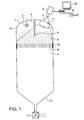
- Fig. 1 shows a fermentation tank 1 with a lighting 2, which with a medium 7 largely is filled.
- the medium 7 can be fermenting wort for example.
- Above the wort 7 is a foam blanket 8.
- fog 9 is shown, which occurs only temporarily in the fermentation tank.
- a Foam blanket 8 is certainly not always present in such a fermentation tank.
- the procedure can also be carried out if the medium 7 and / or the foam blanket 8 is missing and e.g. the purity of the fermentation tank to be examined.
- a spray ball 5 is shown together with a feed line to the spray ball 4.
- a fitting 11 is shown, which is temporarily on a such sight glass by condensation of e.g. Water can occur.
- a camera 3 is arranged so that it through the sight glass 6 into the interior of the Fermentation tanks 1 looks at 14.
- At the bottom of the fermentation tank is a cone 12, as is usually used in such fermentation tanks.
- On Valve 13 closes or opens an inlet or outlet of the fermentation tank.
- a computer controlled Device or a computer 28 contains means that the inventive Carry out procedure.
- Signal outputs 29 are also provided, via which the findings about the condition in the fermentation tank can be used to control the fermentation To control or regulate cleaning etc. of the fermentation tank.
- FIG. 2 shows various representations to explain the method.
- Fig. 2a is shown an image 15 in which the surface of the liquid 7 or Foam blanket 8, the spray ball 5 with the feed line 4 and the inside of the fermentation tank 1 can be seen.
- 2a is in sections and representative of the whole picture, how the picture is composed of pixels (17).
- certain areas 16 are shown as determined according to the invention. Both linear, circular, rectangular and other shaped ones Areas can be recognized.
- FIG. 2c shows how individual pixels 18 that lie within the specific ranges 16 and which are the criterion which the inventive Process used to meet. From the location or number of pixels 18 a measure can be determined that indicates a condition to be examined in the Fermentation tank closes.
- FIG. 3a A special method according to the invention is explained with reference to FIG. 3.
- Fig. 3a a created image is shown again, in which the spray ball 5 and the feed line 4 can be seen are.
- Such reflexes can be traces of grinding or welds Insert inside the fermentation tank.
- 3b shows that the outer region, the image of the inside of the fermentation tank represents, should be differently bright in comparison to the area that represents the surface of the liquid 7 / foam blanket 8. This is reflected, for example, in the fact that the I color value for the range of Fermentation tanks differ significantly from the l-color value of the area of the surface of the medium different.
- any other color value can be used instead of the I color value become.
- the specific regions 21a, 21b, 21c are shown, the linear ones Areas are.
- the specific areas 21a to 21c have a common one Origin, which is approximately in the center of the image of the surface of the liquid 7 / foam blanket 8 lies.
- the intensity is thus in the inner area of the lines near the origin of the lines have a different value compared to the outer area in which the Lines are in the area of the image of the inside of the fermentation tank.
- the derivative of the intensity is in Fig. 3c for the three lines 21a to 21c.
- the origin of the coordinates refers to the Line end, which lies in the center of the image in Fig. 3b.
- the criterion for analyzing a pixel is therefore that the derivative is on the position of the pixel exceeds a certain minimum value and that the pixel of those pixels where the derivative exceeds the minimum value is that is furthest outside (i.e. with the largest x value). (The same applies to the smallest x value, if the direction of the lines is reversed, see above ..)
- the pixel at which the derivative is a minimum value exceeds and is the outermost for a line and has the value r, twice occurred and the value r "once. Accordingly, there is an increased frequency at the value r.
- the condition in the fermentation tank is the one where the image of the surface appears with a radius r. From the radius r results the level of the medium in the fermentation tank or the height of the surface of the medium.
- the method described in FIG. 3 can be used, for example, for a predetermined amount of liquid to conclude the height of the foam blanket.
- the height of the foam blanket changes characteristically during the Fermentation process. It is therefore necessary to use the radius at different times close the image of the surface and thus the temporal course of the radius to obtain. If the radius decreases, i.e. if the surface of the foam cover sinks, so this can be seen as an indication that the fermentation is coming to an end, and thus the probability of declaring that the fermentation has ended can be increased become.
- FIG. 4a shows an image 15 in which a specific area 16 is determined.
- four pixels 17a, 17b, 17c, 17d are shown greatly enlarged.
- the different shading of the pixels 17a to 17d is intended to indicate possible differences in the RGB or HSI color values.
- the pixels 17a to 17d should have a decreasing intensity (I). Since only the pixels within the specific area 16 are analyzed in the method according to the invention, only the four pixels 17a to 17d will be dealt with as examples below.
- 4b shows the frequency y with which pixels with an intensity 1 occur.
- the frequency of the occurrence of an intensity is always 1 in this case, since there is exactly one pixel for each intensity.
- a criterion for analyzing the pixels could be, for example, that the intensity of the pixels should lie between the values I 1 and I 2 . It would also be conceivable to specify as a criterion that the pixels should have an intensity greater than I 1 or less I 2 or an intensity less than I 1 or greater I 2 or an intensity less than I 1 or an intensity greater than I 2 .
- the intensity does not necessarily have to be considered, but any other arbitrary color value, such as the color, or the derivation of the intensity for a pixel can be used to specify a comparable criterion.
- the pixels 17c and 17b meet the criterion. It can thus be established as a measure that 50% of the pixels within the specific area 16 meet the criterion.
- the determined dimension could be given, for example, with 50 corresponding to 50% or with 0.5.
- 4c shows a further possibility of specifying criteria with which the pixels in the specific area 16 are to be analyzed.
- the intensity I is plotted on one axis and the color value H (Hue) perpendicular to it on a second axis.
- the four pixels 17a to 17d are exemplarily entered in the two-dimensional coordinate system.
- the relative frequency of the pixels within of a certain area 16 meet a criterion the absolute number of pixels as Measure.
- the determined dimension would be 2, since the Pixels 17b and 17d meet the criterion.
- the S color values and / or each of the RGB color values to form further criteria are used, whereby, as in FIG. 4C, two color values are evaluated, three, four, five or even more color values are included in the criterion.
- the criterion of override can also be explained with reference to FIGS. 4b and 4c.
- the criterion of overdrive states that a pixel has an I color value greater than a predetermined value. This predetermined value should be relatively high up in the possible scale of the I-color values, ie approximately 90% of the maximum possible I-color value. If the value above which a pixel is referred to as overdriven is the value I 2 , then pixel 17a fulfills the criterion of overdriving.
- step 22 an image with a Camera 3 taken from inside a fermentation tank 1.
- the picture taken is processed in step 23. For example, it is possible to sharpen the image draw or subtract a reference image.
- Step 23 creates an image. Furthermore, it is also possible in step 23 to perform no operation on the recorded one Make picture so that creating the picture is the same as taking the picture Picture is.
- step 24 areas 16 of the image are determined (shown in dashed lines). Hereinafter only the pixels that lie within the specified area are considered.
- a criterion is specified that contains, for example, the RGB or HSI color value for forming a criterion. It is also possible to use the color, the oversaturation or the derivation for a pixel in order to form a criterion.
- the criterion can be, for example, that a color value or some other value that enables a characteristic statement for a pixel lies above, below or between values X 1 and X 2 .
- the differences between color values and other pixels can also be used to form criteria.
- the criterion can also only be the specification of a characteristic size, for example the color. According to the specification of the criterion 25, the pixels that lie within a specific area 16 and meet the criterion from step 25 are then determined.
- the dimension can be determined according to the invention from the position of the pixels, from the number of pixels or the relative number of pixels, ie based on the number of pixels in the specific area 16, and from the strength with which a criterion is given (eg the strength of the color).
- a conclusion is drawn from the determined measure from step 26, which may consist, for example, that a condition is good (+), satisfactory (0) or bad (-).
- a division into only good (+) and bad (-) is also possible.
- a probability P for the existence of a state instead of directly concluding that a state exists.
- Steps 24 to 27 can also be repeated several times on the basis of a created image become. For example, it is possible to first check whether the sight glass is dirty or whether there is fog in the tank and when closed in both cases If this is not the case, one can, starting with step 24 begin further investigation for another condition in the fermentation tank. It is too possible to repeat steps 24 to 27 to determine different dimensions, to get an overall probability by getting different probabilities to conclude for the presence of a condition. Can too after performing the method according to the invention once with the creation a new picture can be started.
- An image is, for example, used to investigate the state of the sight glass Record created.
- the areas that are determined are pairs of lines that are parallel run to each other and go through an area in the picture by at one clean sight glass there are strong differences in the brightness gradients (I-color value).
- the lines are very close together compared to their length. In the area in that the supply line 4 to the spray ball 5 appear in the picture are strong differences given the brightness gradients.
- the pixels of a line of a line pair are the Brightness curves of the other lines of the pair of lines subtracted. Because the The edges of the feed line 4 move closer together towards the center of the picture, which results in the Difference formation of the intensity color values strongly marked edges in the intensity difference curves, which are expressed in strong maxima and minima. If the maxima or minima exceed or fall below predetermined minimum values or maximum values, the determined dimension increases with each crossing of a line.
- the criterion is formulated in such a way that a pixel fulfills the criterion if the I color value of the pixel a difference in brightness to the corresponding pixel of the other line of the line pair, the difference in brightness has a minimum or maximum value does not exceed or fall below this and has not yet reached this for any other pixel on the same line Exceeding or falling below was determined. For each line, this can be exceeded be determined only once and the same applies to falling below.
- the determined dimension is the sum of the pixels that exceed or fall below exhibit.
- the maximum value for the determined dimension is therefore twice the number of Line pairs, as for each line pair for a line, once the above and once below can be found. From the ratio of the determined dimension to the maximum possible value (twice the number of line pairs) can be set to the Close the condition of the sight glass. If the determined dimension is approximately greater than 60% of the maximum possible value of the determined dimension, can be assumed that the sight glass is not dirty.
- An image is created by taking an image, and the area of the is determined, the area is outside a predetermined circle, the particular one Area includes the area of the image in which distilled brandy appears.
- the brandy yeast mainly forms in the area in which the foam 8 Has contact with the inner wall of the fermentation tank 1.
- Fig. 1 this is in Essentially relate to the outside areas of the image that the camera takes.
- the criterion is defined that the H, S and I color value in one for each Color value individually specified interval is the typical yellowish-brownish Burn the color specified. This is shown schematically in for only two instead of three color values Figure 4c shown.
- the measurement found is the number of pixels in the particular one Area meet the criterion. Again, it is possible to use a relative or absolute measure, depending on whether the number of pixels that meet the criterion is normalized to the number of pixels that lie in the specific area. If the number of pixels that meet the criterion is below a specified one Threshold value, it can be concluded that the tank is clean.
- the area 16 is determined as the area that is in an empty fermentation tank Has image of the cone. In the case of a cylindrical-conical fermentation tank, as shown in FIG. 1, this area appears circular, approximately in the center of the picture.
- RGB color value intervals are specified, within which the color values R, G and B should lie. It is also possible to view only one or two color values.
- the criterion is formulated such that the R, G and B color value of a pixel in one Interval must lie (as shown schematically for the H and I color value in Fig. 4c is).
- the measurement found here is also the number of pixels within the certain area meet the criterion.
- a threshold e.g. 50% of the maximum possible value can be from the determined measure to the quality ventilation during filling in the fermentation tank. So lies the proportion of pixels that meet the criterion, above the threshold, can conclude that there is good ventilation.
- a criterion By specifying a criterion using intervals for the H, S and I color values and Specifying a threshold value for the number of pixels that meet the criterion concluded on a foamless stain in the middle of the surface of the filling medium become.
- the specific area here is a circle which is the center of the image of the Cones includes, but not the entire area of the image of the cone.
- the Characteristic of the foamless stain in the middle is a characteristic of the end of fermentation.
- foam in the cone area can be concluded, which is another characteristic of the end of fermentation.
- Area is the area that shows an image of the cone when the tank is empty.
- the three characteristics of the foamless stain in the middle, the foam content in the cone and the reflections in the cone summarize to give a final probability that the fermentation is over. It can be stated here that if at least two Characteristics are met, it is concluded that the fermentation is complete.
- the state of transferring can be examined by looking at the probability for the state of the end of fermentation is closed and the Probability for the state of transferring from 1 minus the probability for the state of the end of fermentation.
- the state of the main fermentation can be examined by moving towards the radius is closed at different times. An increasing radius is a signal that that the main fermentation occurs.
- the state of immersion of the spray ball in, for example, the foam 8 can be examined by taking an image by taking a picture, an area is determined which contains or at least partially contains the image of the spray ball, and the override of pixels is specified as a criterion.
- the share of overdriven pixel is the measure that is determined to reflect the state of the pixel Immersing the spray ball to close. By specifying a threshold value, the immersion or the imminent immersion are concluded.
- the picture is taken by taking a picture and Subtract a reference image created.
- the reference picture is of an empty one and clean tank has been added.
- the criterion that is specified is an interval for the I color values.
- the specific area is a central area of the image, the fire area is left out.
- the determined dimension is the Number of pixels whose I-color value lies in the specified interval.
- the criterion is for the second characteristic for the state of the emptying of the fermentation tank the color of the pixels and the specific area the same as that of the first feature for the condition of the fermentation tank being empty. By specifying a threshold the color can also be concluded that the tank is empty. On third feature for examining the state of the empty fermentation tank gives as certain area the area that, when the fermentation tank is empty, the image of the cone reproduces.
- the criterion is the clipping of the pixels, and the ascertained Measure is the number of pixels that are overdriven. By specifying a threshold can be concluded from another characteristic for the state of the empty fermentation tank.
Landscapes
- Chemical & Material Sciences (AREA)
- Engineering & Computer Science (AREA)
- Food Science & Technology (AREA)
- Health & Medical Sciences (AREA)
- Life Sciences & Earth Sciences (AREA)
- Biochemistry (AREA)
- Organic Chemistry (AREA)
- General Health & Medical Sciences (AREA)
- General Physics & Mathematics (AREA)
- Genetics & Genomics (AREA)
- Physics & Mathematics (AREA)
- Immunology (AREA)
- Pathology (AREA)
- Bioinformatics & Cheminformatics (AREA)
- General Engineering & Computer Science (AREA)
- Analytical Chemistry (AREA)
- Medicinal Chemistry (AREA)
- Wood Science & Technology (AREA)
- Zoology (AREA)
- Apparatus Associated With Microorganisms And Enzymes (AREA)
- Measuring Or Testing Involving Enzymes Or Micro-Organisms (AREA)
- Analysing Materials By The Use Of Radiation (AREA)
Abstract
Description
- der Zustand des Schauglases, und/oder
- Nebel im Behältnis, und/oder
- der Reinigungszustand des Behältnisses, und/oder
- Befüllung, und/oder
- Höhe der Oberfläche eines Mediums innerhalb des Behältnisses, und/oder
- der Zustand der Belüftung, und/oder
- das Eintauchen einer Sprühkugel in ein Medium, das sich innerhalb des Behältnisses befindet, und/oder
- das Leersein des Behältnisses, und/oder
- der Zustand der Fermentation, wie
- das Ende der Gärung, und/oder
- das Überweissen und/oder
- der Zustand der Hauptgärung.
Das Kriterium kann spezielle Farbwerte oder die Ableitung bestimmter Farbwerte entlang einer spezifizierten Richtung betreffen. So ist ein mögliches Kriterium beispielsweise, dass die Helligkeit eines Pixels einen Mindestwert überschreitet.
Die Lage der Pixel ist beispielsweise durch ihre Lage relativ zu einem vorgegebenen Pixel charakteristisch für einen Zustand in dem Behältnis. Auch die Lage von Pixeln, die das Kriterium erfüllen, relativ zueinander kann charakteristisch für einen Zustand in dem Behältnis sein.
Ist das Kriterium z.B. die Farbigkeit, so kann das Feststellen des Maßes auch dadurch erfolgen, das festgestellt wird, wie farbig Pixel sind. Dies erfolgt beispielsweise durch Feststellen der Farbigkeit als Prozentzahl des Maximalwerts auf einer Farbigkeitsskala.
Weiter ist es durch Vorgabe eines oder mehrerer Kriterien möglich, verschiedenartigste Zustände in dem Behältnis sicher zu untersuchen.
Durch Festlegen verschiedener Kriterien und verschiedener Möglichkeiten aus dem festgestellten Maß auf den Zustand in dem Behältnis zu schließen, kann das erfindungsgemäße Verfahren für vielfältige verschiedenartige Vorgänge in einem Behältnis, insbesondere bei der Gärung von Bier, die bei verschiedenen Biersorten vorkommen können, angepasst werden.
Die Farbwerte können beispielsweise in Skalen von 0 bis 255 angegeben sein, wobei 255 ein Maximalwert des Farbwerts entspricht.
Vorteilhafterweise kann weiterhin ein Kriterium die Übersteuerung von Pixeln betreffen. Die Übersteuerung von Pixeln ist dadurch gegeben, dass sowohl R- als auch G- und B-Farbwert einen vorgegebenen Wert überschreiten, wobei dies beispielsweise 90 % des Maximalwerts sein kann.
Aus derartigen Informationen kann insbesondere auf das Vorhandensein von Nebel in dem Gärtank geschlossen werden.
- Fig.1
- eine schematische Zeichnung eines Gärtanks,
- Fig.2
- erstellte Bilder, sowie bestimmte Bereiche, und Pixel, die ein Kriterium erfüllen wie sie in dem erfindungsgemäßen Verfahren auftreten,
- Fig.3
- erstellte Bilder, bestimmte Bereiche, Kriterien und eine Häufigkeitsverteilung von Radien wie sie in dem erfindungsgemäßen Verfahren vorkommen.
- Fig.4
- schematische Zeichnungen zur Erläuterung von Bereichen die bestimmt wurden, Häufigkeitsverteilungen und Kriterien wie sie im erfindungsgemäßen Verfahren vorkommen.
- Fig.5
- Flussdiagramm zur Veranschaulichung der erfindungsgemäßen Verfahrensschritte.
Alternativ ist es ebenfalls möglich, statt direkt auf das Vorhandensein eines Zustandes zu schließen, auf eine Wahrscheinlichkeit P für das Vorliegen eines Zustandes zu schließen.
Claims (38)
- Verfahren zur Untersuchung mindestens eines Zustands in einem Behältnis (1), wie es bei der Getränkeherstellung bei der Vermehrung und/oder Vergärung von/mit Organismen verwendet wird, wie z.B. einem Gärtank, Hefereinzuchttank, biologischen Milchsäuretank, Lagertank oder dergleichen, insbesondere einem Gärtank (1) für Bier, das die folgenden Schritte umfasst:Erstellen (22,23) mindestens eines Bildes mit Pixeln,Bestimmung (24) mindestens eines Bereiches (16) des Bildes (15) durch Auswahl von Pixeln (17),Vorgeben (25) von mindestens einem Kriterium, an Hand dessen die Pixel (17) in dem bestimmten Bereich (16) des Bildes analysiert werden,Feststellen (26) mindestens eines Maßes aus der Lage der Pixel (18) und/oder aus der Anzahl der Pixel (18), die das mindestens eine Kriterium erfüllen und innerhalb des bestimmten Bereiches (16) liegen und/oder dem Verhältnis der Anzahl der Pixel (18), die das mindestens eine Kriterium erfüllen und innerhalb des bestimmten Bereiches (16) liegen zu der Anzahl der Pixel (17,18), die innerhalb des bestimmten Bereiches liegen, und/oder der Stärke mit der Pixel ein Kriterium erfüllen, undSchließen (27) auf den Zustand in dem Behältnis unter Berücksichtigung des festgestellten Maßes.
- Verfahren nach Anspruch 1 dadurch gekennzeichnet, dass das Behältnis (1) eine zlindro-konische Form mit mindestens einem Konus (12) hat.
- Verfahren nach einem der Ansprüche 1 oder 2, dadurch gekennzeichnet, dass ein Kriterium den R- und/oder G- und/oder B-Farbwert in RGB Farbsystem betrifft.
- Verfahren nach einem der Ansprüche 1 bis 3, dadurch gekennzeichnet, dass ein Kriterium den H- und/oder S- und/oder I Farbwert im HSI-Farbsystem betrifft.
- Verfahren nach einem der Ansprüche 1 bis 4, dadurch gekennzeichnet, dass ein Kriterium die Farbigkeit und/oder die Übersteuerung betrifft.
- Verfahren nach einem der Ansprüche 1 bis 5, dadurch gekennzeichnet, dass das Bild (15) durch Aufnehmen erstellt wird.
- Verfahren nach einem der Ansprüche 1 bis 6, dadurch gekennzeichnet, dass das Bild (15) dadurch erstellt wird, dass ein Bild (15) aufgenommen (22) und ein Referenzbild von diesem insbesondere pixelweise abgezogen wird (23).
- Verfahren nach einem der Ansprüche 6 oder 7, dadurch gekennzeichnet, dass das Bild (15) von oben in Richtung des unteren Teils (12) des Behältnisses (1) aufgenommen wird.
- Verfahren nach einem der Ansprüche 1 bis 8, dadurch gekennzeichnet, dass der bestimmte Bereich (16) des Bildes (15) das Abbild des Konuses (12) oder zumindest einen Teil des Abbildes des Konuses (12) umfasst bzw. aus dem Abbild des Konuses (12) besteht.
- Verfahren nach einem der Ansprüche 1 bis 9, dadurch gekennzeichnet, dass der bestimmte Bereich (16) des Bildes (15) das Abbild mindestens eines Sprühkopfes (5) oder zumindest einen Teil des Abbildes des Sprühkopfs (5) umfasst bzw. aus dem Abbild mindestens eines Sprühkopfes (5) besteht.
- Verfahren nach einem der Ansprüche 1 bis 10, dadurch gekennzeichnet, dass der bestimmte Bereich (16) des Bildes das Abbild des Brandthefebereichs (30 )oder zumindest einen Teil des Abbildes des Brandthefebereichs (30) umfasst bzw. aus dem Abbild des Brandthefebereichs (30) besteht.
- Verfahren nach einem der Ansprüche 1 bis 11, dadurch gekennzeichnet, dass der bestimmte Bildbereich (16) einen oder mehrere einzelne Teilbildbereiche umfasst.
- Verfahren nach einem der Ansprüche 1 bis 12 dadurch gekennzeichnet, dass der bestimmte Bildbereich (16) oder zumindest ein Teilbildbereich kreisförmig, linienförmig, quadratisch, rechteckig, n-eckig, oder unregelmäßig geformt ist.
- Verfahren nach einem der Ansprüche 1 bis 13 dadurch gekennzeichnet, dass der bestimmte Bildbereich (16) oder zumindest ein Teilbildbereich durch zumindest Weglassen eines kreisförmig, linienförmig, quadratisch, rechteckig, n-eckig, oder unregelmäßig geformten Bildgebiets gegeben ist.
- Verfahren nach einem der Ansprüche 1 bis 14, dadurch gekennzeichnet, dassuntersucht wird.der Zustand des Schauglases (6), und/oderder Zustand von Nebel im Behältnis (1), und/oderder Reinigungszustand des Behältnisses (1), und/oderder Zustand der Befüllung, und/oderder Zustand der Höhe der Oberfläche eines Medium (7,8) innerhalb des Behältnisses (1), und/oderder Zustand der Belüftung, und/oderder Zustand des Eintauchens einer Sprühkugel (5) in ein Medium (7,8) innerhalb des Behältnisses (1), und/oderder Zustand des Leerseins des Behältnisses (1), und/oderder Zustand der Fermentation, wieder Zustand des Endes der Gärung, und/oderder Zustand des Überweissens, und/oderder Zustand der Hauptgärung
- Verfahren nach einem der Ansprüche 1 bis 15 dadurch gekennzeichnet, dass der Schluss (27) auf den Zustand in dem Behältnis (1) in Form eines Feststellens des Vorliegens eines Zustandes oder einer Wahrscheinlichkeit für das Vorliegen eines Zustands erfolgt.
- Verfahren nach einem der Ansprüche 1 bis 16 dadurch gekennzeichnet, dass das Über- bzw. Unterschreiten des festgestellten Maßes über- bzw. unterhalb eines vorgegebenen Wertes den Schluss (27) auf den zu untersuchenden Zustand ergibt.
- Verfahren nach einem der Ansprüche 16 oder 17 dadurch gekennzeichnet, dass die Wahrscheinlichkeit für das Vorliegen eines Zustandes gleich dem festgestellten Maß ist.
- Verfahren nach einem der Ansprüche 1 bis 18 dadurch gekennzeichnet, dass die Untersuchung auf einen Zustandes in dem Behältnis (1) mit einem einzelnen Bild (15) erfolgt.
- Verfahren nach einem der Ansprüche 1 bis 19 dadurch gekennzeichnet, dass die Untersuchung auf den Zustand in dem Behältnis (1) mit mehreren aufeinanderfolgenden Bildern (15) und insbesondere auch deren zeitlichen Abfolge bzw. Abstand erfolgt.
- Verfahren nach einem der Ansprüche 1 bis 20 dadurch gekennzeichnet, dass die Koordinaten und/oder der Radius des Konuses (12) und/oder einer Sprühkugel (5) vorgegeben sind.
- Verfahren nach einem der Ansprüche 1 bis 21 dadurch gekennzeichnet, dass der Kontrast und die Helligkeit, mit der das Bild (15) aufgenommen wird, vorgegeben sind.
- Verfahren nach einem der Ansprüche 14 bis 22 dadurch gekennzeichnet, dass der Zustand des Schauglases (6) durch Bestimmung eines Bildbereiches (16) untersucht wird, in dem bei einem sauberen und durchsichtigen Schauglas (6) ein hoher Intensitätsunterschied vorzugsweise im Bereich des Abbildes eines Sprühkopfs (5) oder einer Zuleitung (4) zu dem Sprühkopf (5) auftritt.
- Verfahren nach Anspruch 23 dadurch gekennzeichnet, dass das Kriterium den Intensitätsunterschied zwischen den Intensitäten der Pixel (17) der Linien (16) eines Linienpaares für eine vorbestimmte Zahl von Linienpaaren betrifft.
- Verfahren nach Anspruch 24 dadurch gekennzeichnet, dass falls die Stärke des Intensitätsunterschiedes für ein Pixel (17) einen vorbestimmten Wert über- bzw. unterschreitet und kein anderes Pixel (17) derselben Linie (16) den vorbestimmten Wert über- bzw. unterschreitet das Kriterium von einem solchen Pixel (17) erfüllt ist.
- Verfahren nach einem der Ansprüche 1 bis 25 dadurch gekennzeichnet, dass zur Erstellung (23) eines Bildes (15) eine Schärfungsoperation eines aufgenommenen Bildes (15) durchgeführt wird.
- Verfahren nach einem der Ansprüche 1 bis 26 dadurch gekennzeichnet, dass das Kriterium die Ableitung der Intensität entlang der Linienrichtung für eine vorbestimmte Anzahl von Linien (16) als bestimmte Bereiche betrifft.
- Verfahren nach Anspruch 27 dadurch gekennzeichnet, dass das Kriterium von einem Pixel (17) erfüllt ist, falls der Absolutwert der Ableitung der Intensität bei diesem Pixel (17) maximal für die Pixel (17) einer Linie (16) ist und einen vorbestimmten Wert überschreitet.
- Verfahren nach einem der Ansprüche 15 bis 28 dadurch gekennzeichnet, dass das Kriterium darin besteht, dass die Farbe der Pixel (17) im Bereich der gelblich-braunen Farbtöne von Brandthefe liegen.
- Verfahren nach einem der Ansprüche 1 bis 29 dadurch gekennzeichnet, dass mehrere festgestellte Maße zum Schluss (27) auf einen Zustand herangezogen werden.
- Verfahren nach einem der Ansprüche 15 bis 30 dadurch gekennzeichnet, dass die Wahrscheinlichkeit für Überweissen gleich 1 minus der Wahrscheinlichkeit für das Ende der Gärung ist.
- Verfahren nach einem der Ansprüche 1 bis 31 dadurch gekennzeichnet, dass auf den Radius des Abbildes der Oberfläche eines Füllmediums (7,8) des Behältnisses (1) und vorzugsweise damit auf die Höhe der Oberfläche innerhalb des Behältnisses (1) geschlossen (27) wird.
- Verfahren nach Anspruch 32 dadurch gekennzeichnet, dass das Kriterium die Ableitung der Intensität entlang radialer vom Abbild der Konusmitte ausgehender Strahlen oder Kreissegmente betrifft.
- Verfahren nach Anspruch 33 dadurch gekennzeichnet, dass das am weitesten auβenliegende relative Maximum der Ableitung mit mindestens einem vorgegebenen Absolutwert der Ableitung ein Maß für den Radius des Abbildes der Oberfläche eines Füllmediums (7,8) des Behältnisses (1) entlang eines Strahl darstellt.
- Verfahren nach Anspruch 34 dadurch gekennzeichnet, dass aus der relativen Häufigkeit eines Wertes für den Radius für verschiedene Strahlen auf den Radius für das Abbild der Oberfläche eines Füllmediums (7,8) des Behältnisses (1) geschlossen wird, wobei vorzugsweise darauf geschlossen wird, dass der zu ermittelnde Radius gleich dem Maximum der relativen Häufigkeit eines Wertes für den Radius für verschiedene Strahlen ist.
- Verfahren nach einem der Ansprüche 1 bis 35 dadurch gekennzeichnet, dass der Schluss auf den Zustand in dem Behältnis (1) zur Steuerung bzw. Beendigung des Prozesses in dem Behältnis, zum Befüllen des Behältnisses oder zum Reinigung des Behältnisses verwendet wird.
- Speichermedium enthaltend ein Computerprogramm oder eine Befehlssequenz die ein Verfahren nach einem der Ansprüche 1 bis 36 realisiert.
- Rechnergesteuerte Vorrichtung (3,28,29) enthaltend Mittel, die ein Verfahren nach einem der Ansprüche 1 bis 36 ausführen.
Priority Applications (5)
| Application Number | Priority Date | Filing Date | Title |
|---|---|---|---|
| EP01106958A EP1243644B1 (de) | 2001-03-20 | 2001-03-20 | Verfahren zur Untersuchung von Zuständen in einem Behältnis und Vorrichtungen zur Durchführung des Verfahrens |
| AT01106958T ATE328062T1 (de) | 2001-03-20 | 2001-03-20 | Verfahren zur untersuchung von zuständen in einem behältnis und vorrichtungen zur durchführung des verfahrens |
| ES01106958T ES2264430T3 (es) | 2001-03-20 | 2001-03-20 | Procedimiento para examinar estados en un recipiente y dispositivo para la realizacion del procedimiento. |
| DE50109948T DE50109948D1 (de) | 2001-03-20 | 2001-03-20 | Verfahren zur Untersuchung von Zuständen in einem Behältnis und Vorrichtungen zur Durchführung des Verfahrens |
| PCT/EP2002/003133 WO2002074896A2 (de) | 2001-03-20 | 2002-03-20 | Verfahren zur untersuchung von zuständen in einem behältnis |
Applications Claiming Priority (1)
| Application Number | Priority Date | Filing Date | Title |
|---|---|---|---|
| EP01106958A EP1243644B1 (de) | 2001-03-20 | 2001-03-20 | Verfahren zur Untersuchung von Zuständen in einem Behältnis und Vorrichtungen zur Durchführung des Verfahrens |
Publications (2)
| Publication Number | Publication Date |
|---|---|
| EP1243644A1 true EP1243644A1 (de) | 2002-09-25 |
| EP1243644B1 EP1243644B1 (de) | 2006-05-31 |
Family
ID=8176856
Family Applications (1)
| Application Number | Title | Priority Date | Filing Date |
|---|---|---|---|
| EP01106958A Expired - Lifetime EP1243644B1 (de) | 2001-03-20 | 2001-03-20 | Verfahren zur Untersuchung von Zuständen in einem Behältnis und Vorrichtungen zur Durchführung des Verfahrens |
Country Status (5)
| Country | Link |
|---|---|
| EP (1) | EP1243644B1 (de) |
| AT (1) | ATE328062T1 (de) |
| DE (1) | DE50109948D1 (de) |
| ES (1) | ES2264430T3 (de) |
| WO (1) | WO2002074896A2 (de) |
Cited By (1)
| Publication number | Priority date | Publication date | Assignee | Title |
|---|---|---|---|---|
| WO2005003758A1 (de) * | 2003-06-25 | 2005-01-13 | Mir-Chem Gmbh | Verfahren und vorrichtung zum messen eines schaums |
Citations (3)
| Publication number | Priority date | Publication date | Assignee | Title |
|---|---|---|---|---|
| US4959537A (en) * | 1988-06-16 | 1990-09-25 | Matsushita Electric Works, Ltd. | Method and apparatus for inspecting transparent containers |
| DE19828688A1 (de) * | 1998-01-20 | 1999-07-29 | Steinecker Maschf Anton | Gärprozeß-Steuerung und Gärgefäß |
| DE19842989A1 (de) * | 1998-09-21 | 2000-03-23 | Hrch Huppmann Gmbh | Brauereianlage mit Kameraüberwachung |
-
2001
- 2001-03-20 AT AT01106958T patent/ATE328062T1/de not_active IP Right Cessation
- 2001-03-20 ES ES01106958T patent/ES2264430T3/es not_active Expired - Lifetime
- 2001-03-20 DE DE50109948T patent/DE50109948D1/de not_active Expired - Lifetime
- 2001-03-20 EP EP01106958A patent/EP1243644B1/de not_active Expired - Lifetime
-
2002
- 2002-03-20 WO PCT/EP2002/003133 patent/WO2002074896A2/de not_active Ceased
Patent Citations (3)
| Publication number | Priority date | Publication date | Assignee | Title |
|---|---|---|---|---|
| US4959537A (en) * | 1988-06-16 | 1990-09-25 | Matsushita Electric Works, Ltd. | Method and apparatus for inspecting transparent containers |
| DE19828688A1 (de) * | 1998-01-20 | 1999-07-29 | Steinecker Maschf Anton | Gärprozeß-Steuerung und Gärgefäß |
| DE19842989A1 (de) * | 1998-09-21 | 2000-03-23 | Hrch Huppmann Gmbh | Brauereianlage mit Kameraüberwachung |
Cited By (1)
| Publication number | Priority date | Publication date | Assignee | Title |
|---|---|---|---|---|
| WO2005003758A1 (de) * | 2003-06-25 | 2005-01-13 | Mir-Chem Gmbh | Verfahren und vorrichtung zum messen eines schaums |
Also Published As
| Publication number | Publication date |
|---|---|
| DE50109948D1 (de) | 2006-07-06 |
| WO2002074896A2 (de) | 2002-09-26 |
| ATE328062T1 (de) | 2006-06-15 |
| EP1243644B1 (de) | 2006-05-31 |
| WO2002074896A3 (de) | 2002-12-19 |
| ES2264430T3 (es) | 2007-01-01 |
Similar Documents
| Publication | Publication Date | Title |
|---|---|---|
| DE3047490C2 (de) | ||
| DE69501178T2 (de) | Optisches Messtechnikverfahren | |
| DE2952422C3 (de) | Verfahren und Vorrichtung zum Verarbeiten eines Röntgenbildes bei einem Röntgenbild-Kopiersystem | |
| AT501944B1 (de) | Verfahren zum segmentieren von leukozyten | |
| EP4046595B1 (de) | Verfahren zur festlegung einer zahnfarbe | |
| DE102009034994B3 (de) | Verfahren zum Erzeugen einer Darstellung eines OCT-Datensatzes und ein OCT-System zur Durchführung desselben | |
| DE112012004064T5 (de) | Diagnosesystem | |
| DE102010016630A1 (de) | Verfahren und Gerät zur Charakterisierung von Hautunregelmäßigkeiten und Verfahren zur Bewertung der Anti-Aging-Wirkung eines Kosmetikprodukts | |
| DE102008040807A1 (de) | Verfahren zur Korrektur von den Blutfluss darstellenden Bilddaten | |
| DE102007014413B4 (de) | Verfahren zum Auswerten von Fluoreszenzbildsätzen und Vorrichtung zu seiner Durchführung | |
| DE102021114291A1 (de) | Mikroskopiesystem und Verfahren zum Erzeugen eines virtuell eingefärbten Bildes | |
| WO2016107722A1 (de) | Verfahren zum bestimmen von partikeln | |
| DE19627848C2 (de) | Verfahren und Vorrichtung zum Perimetrieren des Gesichtsfeldes des menschlichen Auges | |
| DE2939940A1 (de) | Verfahren und vorrichtung zur darbietung von tests gegenueber einer person in verschiedenen abstaenden | |
| EP1243644B1 (de) | Verfahren zur Untersuchung von Zuständen in einem Behältnis und Vorrichtungen zur Durchführung des Verfahrens | |
| DE102015119258A1 (de) | Lichtmikroskop und Verfahren zum Bestimmen einer wellenlängenabhängigen Brechzahl eines Probenmediums | |
| DE602004001909T2 (de) | Verfahren und Instrument zur Kontrolle der Verbindung von Wänden einer wabenförmigen Struktur mit einem Substrat | |
| DE19957418A1 (de) | Verfahren zur lichtoptischen Abtastung eines Objekts und Rastermikroskop zur Anwendung des Verfahrens | |
| DE19754909A1 (de) | Verfahren und Vorrichtung zur Erfassung und Bearbeitung von Abbildungen biologischen Gewebes | |
| EP1284467A2 (de) | Verfahren zur Erstellung und Auswertung einer medizinischen Datenbank | |
| WO2004017034A1 (de) | Verfahren zur analyse von farbabweichungen von bildern mit einem bildsensor | |
| DE19752595C1 (de) | Gerät und Verfahren zum Bestimmen einer Vielzahl von Parametern einer gekrümmten Oberfläche, insbesondere einer Hornhautoberfläche | |
| EP1377813A1 (de) | Verfahren und vorrichtung zur qualitätsprüfung bzw. zur optischen charakterisierung von milch | |
| DE102014108357A1 (de) | Ganzkörperbildaufnahme- und Bildverarbeitungssystem sowie Verfahren zu dessen Betrieb | |
| DE102021133867A1 (de) | Mikroskopiesystem und Verfahren zur Reduzierung einer Bildvignettierung |
Legal Events
| Date | Code | Title | Description |
|---|---|---|---|
| PUAI | Public reference made under article 153(3) epc to a published international application that has entered the european phase |
Free format text: ORIGINAL CODE: 0009012 |
|
| AK | Designated contracting states |
Kind code of ref document: A1 Designated state(s): AT BE CH CY DE DK ES FI FR GB GR IE IT LI LU MC NL PT SE TR |
|
| AX | Request for extension of the european patent |
Free format text: AL;LT;LV;MK;RO;SI |
|
| 17P | Request for examination filed |
Effective date: 20030306 |
|
| AKX | Designation fees paid |
Designated state(s): AT BE CH CY DE DK ES FI FR GB GR IE IT LI LU MC NL PT SE TR |
|
| AXX | Extension fees paid |
Extension state: LV Payment date: 20030306 Extension state: SI Payment date: 20030306 Extension state: LT Payment date: 20030306 |
|
| 17Q | First examination report despatched |
Effective date: 20041005 |
|
| RTI1 | Title (correction) |
Free format text: METHOD FOR INVESTIGATING THE CONDITIONS IN A CONTAINER AND DEVICES FOR CARRYING OUT THE METHOD |
|
| GRAP | Despatch of communication of intention to grant a patent |
Free format text: ORIGINAL CODE: EPIDOSNIGR1 |
|
| GRAS | Grant fee paid |
Free format text: ORIGINAL CODE: EPIDOSNIGR3 |
|
| GRAA | (expected) grant |
Free format text: ORIGINAL CODE: 0009210 |
|
| AK | Designated contracting states |
Kind code of ref document: B1 Designated state(s): AT BE CH CY DE DK ES FI FR GB GR IE IT LI LU MC NL PT SE TR |
|
| AX | Request for extension of the european patent |
Extension state: LT LV SI |
|
| PG25 | Lapsed in a contracting state [announced via postgrant information from national office to epo] |
Ref country code: IT Free format text: LAPSE BECAUSE OF FAILURE TO SUBMIT A TRANSLATION OF THE DESCRIPTION OR TO PAY THE FEE WITHIN THE PRESCRIBED TIME-LIMIT;WARNING: LAPSES OF ITALIAN PATENTS WITH EFFECTIVE DATE BEFORE 2007 MAY HAVE OCCURRED AT ANY TIME BEFORE 2007. THE CORRECT EFFECTIVE DATE MAY BE DIFFERENT FROM THE ONE RECORDED. Effective date: 20060531 Ref country code: NL Free format text: LAPSE BECAUSE OF FAILURE TO SUBMIT A TRANSLATION OF THE DESCRIPTION OR TO PAY THE FEE WITHIN THE PRESCRIBED TIME-LIMIT Effective date: 20060531 Ref country code: IE Free format text: LAPSE BECAUSE OF FAILURE TO SUBMIT A TRANSLATION OF THE DESCRIPTION OR TO PAY THE FEE WITHIN THE PRESCRIBED TIME-LIMIT Effective date: 20060531 Ref country code: FI Free format text: LAPSE BECAUSE OF FAILURE TO SUBMIT A TRANSLATION OF THE DESCRIPTION OR TO PAY THE FEE WITHIN THE PRESCRIBED TIME-LIMIT Effective date: 20060531 |
|
| REG | Reference to a national code |
Ref country code: CH Ref legal event code: EP Ref country code: GB Ref legal event code: FG4D Free format text: NOT ENGLISH |
|
| GBT | Gb: translation of ep patent filed (gb section 77(6)(a)/1977) |
Effective date: 20060531 |
|
| RAP2 | Party data changed (patent owner data changed or rights of a patent transferred) |
Owner name: KRONES AKTIENGESELLSCHAFT |
|
| REG | Reference to a national code |
Ref country code: IE Ref legal event code: FG4D Free format text: LANGUAGE OF EP DOCUMENT: GERMAN |
|
| REF | Corresponds to: |
Ref document number: 50109948 Country of ref document: DE Date of ref document: 20060706 Kind code of ref document: P |
|
| NLT2 | Nl: modifications (of names), taken from the european patent patent bulletin |
Owner name: KRONES AKTIENGESELLSCHAFT Effective date: 20060621 |
|
| PG25 | Lapsed in a contracting state [announced via postgrant information from national office to epo] |
Ref country code: SE Free format text: LAPSE BECAUSE OF FAILURE TO SUBMIT A TRANSLATION OF THE DESCRIPTION OR TO PAY THE FEE WITHIN THE PRESCRIBED TIME-LIMIT Effective date: 20060831 Ref country code: DK Free format text: LAPSE BECAUSE OF FAILURE TO SUBMIT A TRANSLATION OF THE DESCRIPTION OR TO PAY THE FEE WITHIN THE PRESCRIBED TIME-LIMIT Effective date: 20060831 |
|
| PG25 | Lapsed in a contracting state [announced via postgrant information from national office to epo] |
Ref country code: PT Free format text: LAPSE BECAUSE OF FAILURE TO SUBMIT A TRANSLATION OF THE DESCRIPTION OR TO PAY THE FEE WITHIN THE PRESCRIBED TIME-LIMIT Effective date: 20061031 |
|
| NLV1 | Nl: lapsed or annulled due to failure to fulfill the requirements of art. 29p and 29m of the patents act | ||
| LTIE | Lt: invalidation of european patent or patent extension |
Effective date: 20060531 |
|
| ET | Fr: translation filed | ||
| REG | Reference to a national code |
Ref country code: ES Ref legal event code: FG2A Ref document number: 2264430 Country of ref document: ES Kind code of ref document: T3 |
|
| REG | Reference to a national code |
Ref country code: IE Ref legal event code: FD4D |
|
| PLBE | No opposition filed within time limit |
Free format text: ORIGINAL CODE: 0009261 |
|
| STAA | Information on the status of an ep patent application or granted ep patent |
Free format text: STATUS: NO OPPOSITION FILED WITHIN TIME LIMIT |
|
| 26N | No opposition filed |
Effective date: 20070301 |
|
| REG | Reference to a national code |
Ref country code: CH Ref legal event code: PL |
|
| PG25 | Lapsed in a contracting state [announced via postgrant information from national office to epo] |
Ref country code: MC Free format text: LAPSE BECAUSE OF NON-PAYMENT OF DUE FEES Effective date: 20070331 |
|
| PG25 | Lapsed in a contracting state [announced via postgrant information from national office to epo] |
Ref country code: CH Free format text: LAPSE BECAUSE OF NON-PAYMENT OF DUE FEES Effective date: 20070331 Ref country code: LI Free format text: LAPSE BECAUSE OF NON-PAYMENT OF DUE FEES Effective date: 20070331 |
|
| PG25 | Lapsed in a contracting state [announced via postgrant information from national office to epo] |
Ref country code: GR Free format text: LAPSE BECAUSE OF FAILURE TO SUBMIT A TRANSLATION OF THE DESCRIPTION OR TO PAY THE FEE WITHIN THE PRESCRIBED TIME-LIMIT Effective date: 20060901 |
|
| PG25 | Lapsed in a contracting state [announced via postgrant information from national office to epo] |
Ref country code: AT Free format text: LAPSE BECAUSE OF NON-PAYMENT OF DUE FEES Effective date: 20070320 |
|
| PG25 | Lapsed in a contracting state [announced via postgrant information from national office to epo] |
Ref country code: LU Free format text: LAPSE BECAUSE OF NON-PAYMENT OF DUE FEES Effective date: 20070320 Ref country code: CY Free format text: LAPSE BECAUSE OF FAILURE TO SUBMIT A TRANSLATION OF THE DESCRIPTION OR TO PAY THE FEE WITHIN THE PRESCRIBED TIME-LIMIT Effective date: 20060531 |
|
| PG25 | Lapsed in a contracting state [announced via postgrant information from national office to epo] |
Ref country code: TR Free format text: LAPSE BECAUSE OF FAILURE TO SUBMIT A TRANSLATION OF THE DESCRIPTION OR TO PAY THE FEE WITHIN THE PRESCRIBED TIME-LIMIT Effective date: 20060531 |
|
| PGFP | Annual fee paid to national office [announced via postgrant information from national office to epo] |
Ref country code: GB Payment date: 20120314 Year of fee payment: 12 |
|
| PGFP | Annual fee paid to national office [announced via postgrant information from national office to epo] |
Ref country code: ES Payment date: 20120419 Year of fee payment: 12 |
|
| PGFP | Annual fee paid to national office [announced via postgrant information from national office to epo] |
Ref country code: FR Payment date: 20130325 Year of fee payment: 13 |
|
| GBPC | Gb: european patent ceased through non-payment of renewal fee |
Effective date: 20130320 |
|
| PG25 | Lapsed in a contracting state [announced via postgrant information from national office to epo] |
Ref country code: GB Free format text: LAPSE BECAUSE OF NON-PAYMENT OF DUE FEES Effective date: 20130320 |
|
| REG | Reference to a national code |
Ref country code: ES Ref legal event code: FD2A Effective date: 20141010 |
|
| REG | Reference to a national code |
Ref country code: FR Ref legal event code: ST Effective date: 20141128 |
|
| PG25 | Lapsed in a contracting state [announced via postgrant information from national office to epo] |
Ref country code: ES Free format text: LAPSE BECAUSE OF NON-PAYMENT OF DUE FEES Effective date: 20130321 Ref country code: FR Free format text: LAPSE BECAUSE OF NON-PAYMENT OF DUE FEES Effective date: 20140331 |
|
| PGFP | Annual fee paid to national office [announced via postgrant information from national office to epo] |
Ref country code: DE Payment date: 20170314 Year of fee payment: 17 |
|
| PGFP | Annual fee paid to national office [announced via postgrant information from national office to epo] |
Ref country code: BE Payment date: 20180214 Year of fee payment: 18 |
|
| REG | Reference to a national code |
Ref country code: DE Ref legal event code: R119 Ref document number: 50109948 Country of ref document: DE |
|
| PG25 | Lapsed in a contracting state [announced via postgrant information from national office to epo] |
Ref country code: DE Free format text: LAPSE BECAUSE OF NON-PAYMENT OF DUE FEES Effective date: 20181002 |
|
| REG | Reference to a national code |
Ref country code: BE Ref legal event code: MM Effective date: 20190331 |
|
| PG25 | Lapsed in a contracting state [announced via postgrant information from national office to epo] |
Ref country code: BE Free format text: LAPSE BECAUSE OF NON-PAYMENT OF DUE FEES Effective date: 20190331 |