EP1243580A1 - Heterocyclic imino compounds and fungicides and insecticides for agricultural and horticultural use - Google Patents
Heterocyclic imino compounds and fungicides and insecticides for agricultural and horticultural use Download PDFInfo
- Publication number
- EP1243580A1 EP1243580A1 EP00985987A EP00985987A EP1243580A1 EP 1243580 A1 EP1243580 A1 EP 1243580A1 EP 00985987 A EP00985987 A EP 00985987A EP 00985987 A EP00985987 A EP 00985987A EP 1243580 A1 EP1243580 A1 EP 1243580A1
- Authority
- EP
- European Patent Office
- Prior art keywords
- substituted
- methyl
- phenyl
- alkyl
- alkoxy
- Prior art date
- Legal status (The legal status is an assumption and is not a legal conclusion. Google has not performed a legal analysis and makes no representation as to the accuracy of the status listed.)
- Withdrawn
Links
- 0 CC1=C(C)O**1=O Chemical compound CC1=C(C)O**1=O 0.000 description 19
- JDYMITVZCUMQGE-UHFFFAOYSA-N C=C1N=CSC1 Chemical compound C=C1N=CSC1 JDYMITVZCUMQGE-UHFFFAOYSA-N 0.000 description 1
- FICAKXQKKXJDHL-UHFFFAOYSA-N C=C1OCCN1 Chemical compound C=C1OCCN1 FICAKXQKKXJDHL-UHFFFAOYSA-N 0.000 description 1
- AZHDSUBDDSLFNL-UHFFFAOYSA-N C=C1SC(CCc2c3cccc2)=C3N1 Chemical compound C=C1SC(CCc2c3cccc2)=C3N1 AZHDSUBDDSLFNL-UHFFFAOYSA-N 0.000 description 1
- HAOOXLOWFGXQEQ-UHFFFAOYSA-N C=C1SC=CN1 Chemical compound C=C1SC=CN1 HAOOXLOWFGXQEQ-UHFFFAOYSA-N 0.000 description 1
- ZHIYBLGRHRAUAK-UHFFFAOYSA-N C=C1SC=CNN1 Chemical compound C=C1SC=CNN1 ZHIYBLGRHRAUAK-UHFFFAOYSA-N 0.000 description 1
- KLTDTHPNAOCIBC-UHFFFAOYSA-N C=C1SCC=N1 Chemical compound C=C1SCC=N1 KLTDTHPNAOCIBC-UHFFFAOYSA-N 0.000 description 1
- DKRSTBDIPNACQX-UHFFFAOYSA-N C=C1SCCCN1 Chemical compound C=C1SCCCN1 DKRSTBDIPNACQX-UHFFFAOYSA-N 0.000 description 1
- FMJHDDKEQLZCNQ-UHFFFAOYSA-N C=C1SCCNN1 Chemical compound C=C1SCCNN1 FMJHDDKEQLZCNQ-UHFFFAOYSA-N 0.000 description 1
- MSVNCGNMECDEEB-UHFFFAOYSA-N C=C1S[IH]NC1 Chemical compound C=C1S[IH]NC1 MSVNCGNMECDEEB-UHFFFAOYSA-N 0.000 description 1
- NTLWQSUTPXIYLO-UHFFFAOYSA-N CC#[N]C(NC=C)=C Chemical compound CC#[N]C(NC=C)=C NTLWQSUTPXIYLO-UHFFFAOYSA-N 0.000 description 1
- LYTJOKLUUNSCCG-UHFFFAOYSA-N CC(C/N=C(\C)/N)SC Chemical compound CC(C/N=C(\C)/N)SC LYTJOKLUUNSCCG-UHFFFAOYSA-N 0.000 description 1
- XJGWUOAPBIRDQE-UHFFFAOYSA-N CCC(CI)NCC1=CSC(C)NN1 Chemical compound CCC(CI)NCC1=CSC(C)NN1 XJGWUOAPBIRDQE-UHFFFAOYSA-N 0.000 description 1
Classifications
-
- C—CHEMISTRY; METALLURGY
- C07—ORGANIC CHEMISTRY
- C07D—HETEROCYCLIC COMPOUNDS
- C07D263/00—Heterocyclic compounds containing 1,3-oxazole or hydrogenated 1,3-oxazole rings
- C07D263/52—Heterocyclic compounds containing 1,3-oxazole or hydrogenated 1,3-oxazole rings condensed with carbocyclic rings or ring systems
- C07D263/62—Heterocyclic compounds containing 1,3-oxazole or hydrogenated 1,3-oxazole rings condensed with carbocyclic rings or ring systems having two or more ring systems containing condensed 1,3-oxazole rings
-
- A—HUMAN NECESSITIES
- A01—AGRICULTURE; FORESTRY; ANIMAL HUSBANDRY; HUNTING; TRAPPING; FISHING
- A01N—PRESERVATION OF BODIES OF HUMANS OR ANIMALS OR PLANTS OR PARTS THEREOF; BIOCIDES, e.g. AS DISINFECTANTS, AS PESTICIDES OR AS HERBICIDES; PEST REPELLANTS OR ATTRACTANTS; PLANT GROWTH REGULATORS
- A01N43/00—Biocides, pest repellants or attractants, or plant growth regulators containing heterocyclic compounds
- A01N43/02—Biocides, pest repellants or attractants, or plant growth regulators containing heterocyclic compounds having rings with one or more oxygen or sulfur atoms as the only ring hetero atoms
- A01N43/04—Biocides, pest repellants or attractants, or plant growth regulators containing heterocyclic compounds having rings with one or more oxygen or sulfur atoms as the only ring hetero atoms with one hetero atom
- A01N43/06—Biocides, pest repellants or attractants, or plant growth regulators containing heterocyclic compounds having rings with one or more oxygen or sulfur atoms as the only ring hetero atoms with one hetero atom five-membered rings
- A01N43/10—Biocides, pest repellants or attractants, or plant growth regulators containing heterocyclic compounds having rings with one or more oxygen or sulfur atoms as the only ring hetero atoms with one hetero atom five-membered rings with sulfur as the ring hetero atom
-
- A—HUMAN NECESSITIES
- A01—AGRICULTURE; FORESTRY; ANIMAL HUSBANDRY; HUNTING; TRAPPING; FISHING
- A01N—PRESERVATION OF BODIES OF HUMANS OR ANIMALS OR PLANTS OR PARTS THEREOF; BIOCIDES, e.g. AS DISINFECTANTS, AS PESTICIDES OR AS HERBICIDES; PEST REPELLANTS OR ATTRACTANTS; PLANT GROWTH REGULATORS
- A01N43/00—Biocides, pest repellants or attractants, or plant growth regulators containing heterocyclic compounds
- A01N43/02—Biocides, pest repellants or attractants, or plant growth regulators containing heterocyclic compounds having rings with one or more oxygen or sulfur atoms as the only ring hetero atoms
- A01N43/24—Biocides, pest repellants or attractants, or plant growth regulators containing heterocyclic compounds having rings with one or more oxygen or sulfur atoms as the only ring hetero atoms with two or more hetero atoms
- A01N43/26—Biocides, pest repellants or attractants, or plant growth regulators containing heterocyclic compounds having rings with one or more oxygen or sulfur atoms as the only ring hetero atoms with two or more hetero atoms five-membered rings
- A01N43/28—Biocides, pest repellants or attractants, or plant growth regulators containing heterocyclic compounds having rings with one or more oxygen or sulfur atoms as the only ring hetero atoms with two or more hetero atoms five-membered rings with two hetero atoms in positions 1,3
-
- A—HUMAN NECESSITIES
- A01—AGRICULTURE; FORESTRY; ANIMAL HUSBANDRY; HUNTING; TRAPPING; FISHING
- A01N—PRESERVATION OF BODIES OF HUMANS OR ANIMALS OR PLANTS OR PARTS THEREOF; BIOCIDES, e.g. AS DISINFECTANTS, AS PESTICIDES OR AS HERBICIDES; PEST REPELLANTS OR ATTRACTANTS; PLANT GROWTH REGULATORS
- A01N43/00—Biocides, pest repellants or attractants, or plant growth regulators containing heterocyclic compounds
- A01N43/34—Biocides, pest repellants or attractants, or plant growth regulators containing heterocyclic compounds having rings with one nitrogen atom as the only ring hetero atom
- A01N43/40—Biocides, pest repellants or attractants, or plant growth regulators containing heterocyclic compounds having rings with one nitrogen atom as the only ring hetero atom six-membered rings
-
- A—HUMAN NECESSITIES
- A01—AGRICULTURE; FORESTRY; ANIMAL HUSBANDRY; HUNTING; TRAPPING; FISHING
- A01N—PRESERVATION OF BODIES OF HUMANS OR ANIMALS OR PLANTS OR PARTS THEREOF; BIOCIDES, e.g. AS DISINFECTANTS, AS PESTICIDES OR AS HERBICIDES; PEST REPELLANTS OR ATTRACTANTS; PLANT GROWTH REGULATORS
- A01N43/00—Biocides, pest repellants or attractants, or plant growth regulators containing heterocyclic compounds
- A01N43/48—Biocides, pest repellants or attractants, or plant growth regulators containing heterocyclic compounds having rings with two nitrogen atoms as the only ring hetero atoms
- A01N43/54—1,3-Diazines; Hydrogenated 1,3-diazines
-
- A—HUMAN NECESSITIES
- A01—AGRICULTURE; FORESTRY; ANIMAL HUSBANDRY; HUNTING; TRAPPING; FISHING
- A01N—PRESERVATION OF BODIES OF HUMANS OR ANIMALS OR PLANTS OR PARTS THEREOF; BIOCIDES, e.g. AS DISINFECTANTS, AS PESTICIDES OR AS HERBICIDES; PEST REPELLANTS OR ATTRACTANTS; PLANT GROWTH REGULATORS
- A01N43/00—Biocides, pest repellants or attractants, or plant growth regulators containing heterocyclic compounds
- A01N43/48—Biocides, pest repellants or attractants, or plant growth regulators containing heterocyclic compounds having rings with two nitrogen atoms as the only ring hetero atoms
- A01N43/56—1,2-Diazoles; Hydrogenated 1,2-diazoles
-
- A—HUMAN NECESSITIES
- A01—AGRICULTURE; FORESTRY; ANIMAL HUSBANDRY; HUNTING; TRAPPING; FISHING
- A01N—PRESERVATION OF BODIES OF HUMANS OR ANIMALS OR PLANTS OR PARTS THEREOF; BIOCIDES, e.g. AS DISINFECTANTS, AS PESTICIDES OR AS HERBICIDES; PEST REPELLANTS OR ATTRACTANTS; PLANT GROWTH REGULATORS
- A01N43/00—Biocides, pest repellants or attractants, or plant growth regulators containing heterocyclic compounds
- A01N43/72—Biocides, pest repellants or attractants, or plant growth regulators containing heterocyclic compounds having rings with nitrogen atoms and oxygen or sulfur atoms as ring hetero atoms
- A01N43/74—Biocides, pest repellants or attractants, or plant growth regulators containing heterocyclic compounds having rings with nitrogen atoms and oxygen or sulfur atoms as ring hetero atoms five-membered rings with one nitrogen atom and either one oxygen atom or one sulfur atom in positions 1,3
-
- A—HUMAN NECESSITIES
- A01—AGRICULTURE; FORESTRY; ANIMAL HUSBANDRY; HUNTING; TRAPPING; FISHING
- A01N—PRESERVATION OF BODIES OF HUMANS OR ANIMALS OR PLANTS OR PARTS THEREOF; BIOCIDES, e.g. AS DISINFECTANTS, AS PESTICIDES OR AS HERBICIDES; PEST REPELLANTS OR ATTRACTANTS; PLANT GROWTH REGULATORS
- A01N43/00—Biocides, pest repellants or attractants, or plant growth regulators containing heterocyclic compounds
- A01N43/72—Biocides, pest repellants or attractants, or plant growth regulators containing heterocyclic compounds having rings with nitrogen atoms and oxygen or sulfur atoms as ring hetero atoms
- A01N43/74—Biocides, pest repellants or attractants, or plant growth regulators containing heterocyclic compounds having rings with nitrogen atoms and oxygen or sulfur atoms as ring hetero atoms five-membered rings with one nitrogen atom and either one oxygen atom or one sulfur atom in positions 1,3
- A01N43/78—1,3-Thiazoles; Hydrogenated 1,3-thiazoles
-
- A—HUMAN NECESSITIES
- A01—AGRICULTURE; FORESTRY; ANIMAL HUSBANDRY; HUNTING; TRAPPING; FISHING
- A01N—PRESERVATION OF BODIES OF HUMANS OR ANIMALS OR PLANTS OR PARTS THEREOF; BIOCIDES, e.g. AS DISINFECTANTS, AS PESTICIDES OR AS HERBICIDES; PEST REPELLANTS OR ATTRACTANTS; PLANT GROWTH REGULATORS
- A01N43/00—Biocides, pest repellants or attractants, or plant growth regulators containing heterocyclic compounds
- A01N43/72—Biocides, pest repellants or attractants, or plant growth regulators containing heterocyclic compounds having rings with nitrogen atoms and oxygen or sulfur atoms as ring hetero atoms
- A01N43/80—Biocides, pest repellants or attractants, or plant growth regulators containing heterocyclic compounds having rings with nitrogen atoms and oxygen or sulfur atoms as ring hetero atoms five-membered rings with one nitrogen atom and either one oxygen atom or one sulfur atom in positions 1,2
-
- A—HUMAN NECESSITIES
- A01—AGRICULTURE; FORESTRY; ANIMAL HUSBANDRY; HUNTING; TRAPPING; FISHING
- A01N—PRESERVATION OF BODIES OF HUMANS OR ANIMALS OR PLANTS OR PARTS THEREOF; BIOCIDES, e.g. AS DISINFECTANTS, AS PESTICIDES OR AS HERBICIDES; PEST REPELLANTS OR ATTRACTANTS; PLANT GROWTH REGULATORS
- A01N43/00—Biocides, pest repellants or attractants, or plant growth regulators containing heterocyclic compounds
- A01N43/72—Biocides, pest repellants or attractants, or plant growth regulators containing heterocyclic compounds having rings with nitrogen atoms and oxygen or sulfur atoms as ring hetero atoms
- A01N43/84—Biocides, pest repellants or attractants, or plant growth regulators containing heterocyclic compounds having rings with nitrogen atoms and oxygen or sulfur atoms as ring hetero atoms six-membered rings with one nitrogen atom and either one oxygen atom or one sulfur atom in positions 1,4
-
- A—HUMAN NECESSITIES
- A01—AGRICULTURE; FORESTRY; ANIMAL HUSBANDRY; HUNTING; TRAPPING; FISHING
- A01N—PRESERVATION OF BODIES OF HUMANS OR ANIMALS OR PLANTS OR PARTS THEREOF; BIOCIDES, e.g. AS DISINFECTANTS, AS PESTICIDES OR AS HERBICIDES; PEST REPELLANTS OR ATTRACTANTS; PLANT GROWTH REGULATORS
- A01N43/00—Biocides, pest repellants or attractants, or plant growth regulators containing heterocyclic compounds
- A01N43/72—Biocides, pest repellants or attractants, or plant growth regulators containing heterocyclic compounds having rings with nitrogen atoms and oxygen or sulfur atoms as ring hetero atoms
- A01N43/86—Biocides, pest repellants or attractants, or plant growth regulators containing heterocyclic compounds having rings with nitrogen atoms and oxygen or sulfur atoms as ring hetero atoms six-membered rings with one nitrogen atom and either one oxygen atom or one sulfur atom in positions 1,3
-
- A—HUMAN NECESSITIES
- A01—AGRICULTURE; FORESTRY; ANIMAL HUSBANDRY; HUNTING; TRAPPING; FISHING
- A01N—PRESERVATION OF BODIES OF HUMANS OR ANIMALS OR PLANTS OR PARTS THEREOF; BIOCIDES, e.g. AS DISINFECTANTS, AS PESTICIDES OR AS HERBICIDES; PEST REPELLANTS OR ATTRACTANTS; PLANT GROWTH REGULATORS
- A01N43/00—Biocides, pest repellants or attractants, or plant growth regulators containing heterocyclic compounds
- A01N43/72—Biocides, pest repellants or attractants, or plant growth regulators containing heterocyclic compounds having rings with nitrogen atoms and oxygen or sulfur atoms as ring hetero atoms
- A01N43/88—Biocides, pest repellants or attractants, or plant growth regulators containing heterocyclic compounds having rings with nitrogen atoms and oxygen or sulfur atoms as ring hetero atoms six-membered rings with three ring hetero atoms
-
- A—HUMAN NECESSITIES
- A01—AGRICULTURE; FORESTRY; ANIMAL HUSBANDRY; HUNTING; TRAPPING; FISHING
- A01N—PRESERVATION OF BODIES OF HUMANS OR ANIMALS OR PLANTS OR PARTS THEREOF; BIOCIDES, e.g. AS DISINFECTANTS, AS PESTICIDES OR AS HERBICIDES; PEST REPELLANTS OR ATTRACTANTS; PLANT GROWTH REGULATORS
- A01N47/00—Biocides, pest repellants or attractants, or plant growth regulators containing organic compounds containing a carbon atom not being member of a ring and having no bond to a carbon or hydrogen atom, e.g. derivatives of carbonic acid
- A01N47/08—Biocides, pest repellants or attractants, or plant growth regulators containing organic compounds containing a carbon atom not being member of a ring and having no bond to a carbon or hydrogen atom, e.g. derivatives of carbonic acid the carbon atom having one or more single bonds to nitrogen atoms
- A01N47/10—Carbamic acid derivatives, i.e. containing the group —O—CO—N<; Thio analogues thereof
- A01N47/20—N-Aryl derivatives thereof
-
- C—CHEMISTRY; METALLURGY
- C07—ORGANIC CHEMISTRY
- C07C—ACYCLIC OR CARBOCYCLIC COMPOUNDS
- C07C335/00—Thioureas, i.e. compounds containing any of the groups, the nitrogen atoms not being part of nitro or nitroso groups
- C07C335/30—Isothioureas
- C07C335/32—Isothioureas having sulfur atoms of isothiourea groups bound to acyclic carbon atoms
-
- C—CHEMISTRY; METALLURGY
- C07—ORGANIC CHEMISTRY
- C07D—HETEROCYCLIC COMPOUNDS
- C07D239/00—Heterocyclic compounds containing 1,3-diazine or hydrogenated 1,3-diazine rings
- C07D239/70—Heterocyclic compounds containing 1,3-diazine or hydrogenated 1,3-diazine rings condensed with carbocyclic rings or ring systems
- C07D239/72—Quinazolines; Hydrogenated quinazolines
- C07D239/78—Quinazolines; Hydrogenated quinazolines with hetero atoms directly attached in position 2
- C07D239/84—Nitrogen atoms
-
- C—CHEMISTRY; METALLURGY
- C07—ORGANIC CHEMISTRY
- C07D—HETEROCYCLIC COMPOUNDS
- C07D265/00—Heterocyclic compounds containing six-membered rings having one nitrogen atom and one oxygen atom as the only ring hetero atoms
- C07D265/04—1,3-Oxazines; Hydrogenated 1,3-oxazines
- C07D265/12—1,3-Oxazines; Hydrogenated 1,3-oxazines condensed with carbocyclic rings or ring systems
- C07D265/14—1,3-Oxazines; Hydrogenated 1,3-oxazines condensed with carbocyclic rings or ring systems condensed with one six-membered ring
- C07D265/18—1,3-Oxazines; Hydrogenated 1,3-oxazines condensed with carbocyclic rings or ring systems condensed with one six-membered ring with hetero atoms directly attached in position 2
-
- C—CHEMISTRY; METALLURGY
- C07—ORGANIC CHEMISTRY
- C07D—HETEROCYCLIC COMPOUNDS
- C07D277/00—Heterocyclic compounds containing 1,3-thiazole or hydrogenated 1,3-thiazole rings
- C07D277/02—Heterocyclic compounds containing 1,3-thiazole or hydrogenated 1,3-thiazole rings not condensed with other rings
- C07D277/20—Heterocyclic compounds containing 1,3-thiazole or hydrogenated 1,3-thiazole rings not condensed with other rings having two or three double bonds between ring members or between ring members and non-ring members
- C07D277/32—Heterocyclic compounds containing 1,3-thiazole or hydrogenated 1,3-thiazole rings not condensed with other rings having two or three double bonds between ring members or between ring members and non-ring members with hetero atoms or with carbon atoms having three bonds to hetero atoms with at the most one bond to halogen, e.g. ester or nitrile radicals, directly attached to ring carbon atoms
- C07D277/38—Nitrogen atoms
- C07D277/42—Amino or imino radicals substituted by hydrocarbon or substituted hydrocarbon radicals
-
- C—CHEMISTRY; METALLURGY
- C07—ORGANIC CHEMISTRY
- C07D—HETEROCYCLIC COMPOUNDS
- C07D277/00—Heterocyclic compounds containing 1,3-thiazole or hydrogenated 1,3-thiazole rings
- C07D277/60—Heterocyclic compounds containing 1,3-thiazole or hydrogenated 1,3-thiazole rings condensed with carbocyclic rings or ring systems
- C07D277/62—Benzothiazoles
- C07D277/68—Benzothiazoles with hetero atoms or with carbon atoms having three bonds to hetero atoms with at the most one bond to halogen, e.g. ester or nitrile radicals, directly attached in position 2
- C07D277/82—Nitrogen atoms
-
- C—CHEMISTRY; METALLURGY
- C07—ORGANIC CHEMISTRY
- C07D—HETEROCYCLIC COMPOUNDS
- C07D279/00—Heterocyclic compounds containing six-membered rings having one nitrogen atom and one sulfur atom as the only ring hetero atoms
- C07D279/04—1,3-Thiazines; Hydrogenated 1,3-thiazines
- C07D279/08—1,3-Thiazines; Hydrogenated 1,3-thiazines condensed with carbocyclic rings or ring systems
-
- C—CHEMISTRY; METALLURGY
- C07—ORGANIC CHEMISTRY
- C07D—HETEROCYCLIC COMPOUNDS
- C07D417/00—Heterocyclic compounds containing two or more hetero rings, at least one ring having nitrogen and sulfur atoms as the only ring hetero atoms, not provided for by group C07D415/00
- C07D417/02—Heterocyclic compounds containing two or more hetero rings, at least one ring having nitrogen and sulfur atoms as the only ring hetero atoms, not provided for by group C07D415/00 containing two hetero rings
- C07D417/04—Heterocyclic compounds containing two or more hetero rings, at least one ring having nitrogen and sulfur atoms as the only ring hetero atoms, not provided for by group C07D415/00 containing two hetero rings directly linked by a ring-member-to-ring-member bond
-
- C—CHEMISTRY; METALLURGY
- C07—ORGANIC CHEMISTRY
- C07D—HETEROCYCLIC COMPOUNDS
- C07D417/00—Heterocyclic compounds containing two or more hetero rings, at least one ring having nitrogen and sulfur atoms as the only ring hetero atoms, not provided for by group C07D415/00
- C07D417/02—Heterocyclic compounds containing two or more hetero rings, at least one ring having nitrogen and sulfur atoms as the only ring hetero atoms, not provided for by group C07D415/00 containing two hetero rings
- C07D417/12—Heterocyclic compounds containing two or more hetero rings, at least one ring having nitrogen and sulfur atoms as the only ring hetero atoms, not provided for by group C07D415/00 containing two hetero rings linked by a chain containing hetero atoms as chain links
-
- C—CHEMISTRY; METALLURGY
- C07—ORGANIC CHEMISTRY
- C07D—HETEROCYCLIC COMPOUNDS
- C07D471/00—Heterocyclic compounds containing nitrogen atoms as the only ring hetero atoms in the condensed system, at least one ring being a six-membered ring with one nitrogen atom, not provided for by groups C07D451/00 - C07D463/00
- C07D471/02—Heterocyclic compounds containing nitrogen atoms as the only ring hetero atoms in the condensed system, at least one ring being a six-membered ring with one nitrogen atom, not provided for by groups C07D451/00 - C07D463/00 in which the condensed system contains two hetero rings
- C07D471/04—Ortho-condensed systems
-
- C—CHEMISTRY; METALLURGY
- C07—ORGANIC CHEMISTRY
- C07D—HETEROCYCLIC COMPOUNDS
- C07D487/00—Heterocyclic compounds containing nitrogen atoms as the only ring hetero atoms in the condensed system, not provided for by groups C07D451/00 - C07D477/00
- C07D487/02—Heterocyclic compounds containing nitrogen atoms as the only ring hetero atoms in the condensed system, not provided for by groups C07D451/00 - C07D477/00 in which the condensed system contains two hetero rings
- C07D487/04—Ortho-condensed systems
-
- C—CHEMISTRY; METALLURGY
- C07—ORGANIC CHEMISTRY
- C07D—HETEROCYCLIC COMPOUNDS
- C07D513/00—Heterocyclic compounds containing in the condensed system at least one hetero ring having nitrogen and sulfur atoms as the only ring hetero atoms, not provided for in groups C07D463/00, C07D477/00 or C07D499/00 - C07D507/00
- C07D513/02—Heterocyclic compounds containing in the condensed system at least one hetero ring having nitrogen and sulfur atoms as the only ring hetero atoms, not provided for in groups C07D463/00, C07D477/00 or C07D499/00 - C07D507/00 in which the condensed system contains two hetero rings
- C07D513/04—Ortho-condensed systems
-
- C—CHEMISTRY; METALLURGY
- C07—ORGANIC CHEMISTRY
- C07F—ACYCLIC, CARBOCYCLIC OR HETEROCYCLIC COMPOUNDS CONTAINING ELEMENTS OTHER THAN CARBON, HYDROGEN, HALOGEN, OXYGEN, NITROGEN, SULFUR, SELENIUM OR TELLURIUM
- C07F7/00—Compounds containing elements of Groups 4 or 14 of the Periodic Table
- C07F7/02—Silicon compounds
- C07F7/08—Compounds having one or more C—Si linkages
- C07F7/0803—Compounds with Si-C or Si-Si linkages
- C07F7/081—Compounds with Si-C or Si-Si linkages comprising at least one atom selected from the elements N, O, halogen, S, Se or Te
Definitions
- the present invention relates to novel heterocyclic imino compounds and their salts, and plant disease and plant insect pest controlling agents containing at least one member selected from such heterocyclic imino compounds and their salts, as an active ingredient.
- the present inventors have conducted various studies to find out an excellent fungicide and insecticide and as a result, have found that the novel heterocyclic imino compounds and their salts have remarkable activities as plant disease and plant insect pest controlling agents and are safe to desired crop plants, and thus, they have arrived at the present invention.
- the present invention relates to the following (1) to (7).
- a hydrochloride, a hydrobromide, a hydroiodide, a formate, an acetate or an oxalate of the heterocyclic imino compound according to (1) (2) A hydrochloride, a hydrobromide, a hydroiodide, a formate, an acetate or an oxalate of the heterocyclic imino compound according to (1). (3) The heterocyclic imino compound and an agrochemically acceptable salt thereof, according to (1), wherein A is d represents the number of substituents and is from 0 to 2, e represents the number of substituents and is from 0 to 3, f represents the number of substituents and is from 0 to 4, g represents the number of substituents and is from 0 to 5, h represents the number of substituents and is from 0 to 6, i represents the number of substituents and is from 0 to 1, j represents the number of substituents and is from 0 to 7, and k represents the number of substituents and is from
- the present invention covers all of the respective isomers and their mixtures.
- Me represents a methyl group, Et an ethyl group, Pr a propyl group, Bu a butyl group, Pen a pentyl group, Hex a hexyl group, Hep a heptyl group, Oct an octyl group, Non a nonyl group, Dec a decyl group, Undec an undecanyl group, Dodec a dodecyl group, n normal, i iso, s secondary, t tertiary and c cyclo, respectively, and Ph represents a phenyl group, and in the representation of a phenyl group, e.g. 2-Cl-Ph represents a 2-chlorophenyl group, and 2-MeO-3-Me-Ph represents a 2-methoxy-3-methylphenyl group.
- the C 1 -C 6 alkyl in the definitions of R 1 , R 2 , R 3 , R 4 , R 5 , R 6 , R 7 , R 8 , R 9 , R 13 , R 14 , R a , X, U 1 and U 2 may, for example, be a linear or branched alkyl, such as, methyl, ethyl, n-propyl, i-propyl, n-butyl, i-butyl, t-butyl, s-butyl, n-pentyl, n-hexyl, 2-ethylpropyl, 2,2-dimethylpropyl, 1,2-dimethylpropyl, 1,1,2-trimethylpropyl, 1,2,2-trimethylpropyl, 1-ethyl-1-methylpropyl, 1-ethyl-2-methylpropyl, 1-methylbutyl, 2-methylbutyl, 3-methylbutyl, 1,1-dimethylbut
- the halogen atom in the definitions of R 5 , R 6 , R 8 , R 9 , R 10 , R 13 , R a , R b , R c , X and Y' may, for example, be a fluorine atom, a chlorine atom, a bromine atom and an iodine atom.
- the C 1 -C 6 haloalkyl in the definitions of R 1 , R 2 , R 3 , R 4 , R 5 , R 6 , R 7 , R 13 , R 14 , R a , X, U 1 and U 2 may, for example, be a linear or branched haloalkyl, such as fluoromethyl, chloromethyl, bromomethyl, iodomethyl, difluoromethyl, chlorodifluoromethyl, bromodifluoromethyl, trifluoromethyl, dichloromethyl, trichloromethyl, 1-chloroethyl, 1-bromoethyl, 1-iodoethyl, 1-fluoroethyl, 2-chloroethyl, 2-bromoethyl, 2-iodoethyl, 2-fluoroethyl, 2,2-difluoroethyl, 2,2,2-trifluoroethyl, 2,2,2-t
- the C 3 -C 6 cycloalkyl in the definitions of R 1 , R 2 , R 3 , R 4 , R 5 , R 6 , R 7 , R 13 , R 14 , R a , R b , U 1 and U 2 may, for example, be cyclopropyl, cyclobutyl, cyclopentyl and cyclohexyl.
- the C 1 -C 6 alkoxy in the definitions of R 5 , R 6 , R 7 , R 8 , R 9 , R a , R b and X may, for example, be a linear or branched alkoxy, such as methoxy, ethoxy, n-propoxy, i-propoxy, n-butoxy, i-butoxy, s-butoxy, t-butoxy, n-pentyloxy, n-hexyloxy, 1,1-dimethylpropoxy, 1,2-dimethylpropoxy, 2,2-dimethylpropoxy, 1-ethylpropoxy, 1,1,2-trimethylpropoxy, 1,2,2-trimethylpropoxy, 1-ethyl-1-methylpropoxy, 1-ethyl-2-methylpropoxy, 1-methylbutoxy, 2-methylbutoxy, 3-methylbutoxy, 1-ethylbutoxy, 2-ethylbutoxy, 1,1-dimethylbutoxy, 1,2-dimethylbutoxy, 1,3-dimethylbut
- the C 1 -C 6 haloalkoxy in the definitions of R 5 , R 6 , R a , R b and X may, for example, be a C 1 -C 6 linear or branched haloalkoxy, such as fluoromethoxy, chloromethoxy, bromomethoxy, iodomethoxy, dichloromethoxy, trichloromethoxy, difluoromethoxy, trifluoromethoxy, chlorodifluoromethoxy, bromodifluoromethoxy, dichlorofluoromethoxy, 1-chloroethoxy, 1-bromoethoxy, 1-iodoethoxy, 1-fluoroethoxy, 2-chloroethoxy, 2-bromoethoxy, 2-iodoethoxy, 2-fluoroethoxy, 2,2-difluoroethoxy, 2,2,2-trifluoroethoxy, 2,2,2-trichloroethoxy, pentafluoroethoxy
- the C 1 -C 6 alkylsulfenyl in the definitions of R 5 , R 6 , R 8 , R 9 , R a , R b and X may, for example, be a linear or branched alkylsulfenyl, such as methylthio, ethylthio, n-propylthio, i-propylthio, n-butylthio, i-butylthio, s-butylthio, t-butylthio, n-pentylthio and n-hexylthio.
- the C 1 -C 6 alkylsulfinyl in the definitions of R 5 , R 6 , R a and R b may, for example, a linear or branched alkylsulfinyl, such as methylsulfinyl, ethylsulfinyl, n-propylsulfinyl, i-propylsulfinyl, n-butylsulfinyl, i-butylsulfinyl, s-butylsulfinyl, t-butylsulfinyl, n-pentylsulfinyl and n-hexylsulfinyl.
- a linear or branched alkylsulfinyl such as methylsulfinyl, ethylsulfinyl, n-propylsulfinyl, i-propylsulfinyl,
- the C 1 -C 6 alkylsulfonyl in the definitions of R 5 , R 6 , R 7 , R a , R b , U 1 and U 2 may, for example, be a linear or branched alkylsulfonyl, such as methylsulfonyl, ethylsulfonyl, n-propylsulfonyl, i-propylsulfonyl, n-butylsulfonyl, i-butylsulfonyl, s-butylsulfonyl, t-butylsulfonyl, n-pentylsulfonyl and n-hexylsulfonyl.
- alkylsulfonyl such as methylsulfonyl, ethylsulfonyl, n-propylsulfonyl, i-propyls
- the C 1 -C 6 alkoxy C 1 -C 6 alkyl in the definitions of R 1 , R 2 , R 3 , R 4 , R 5 , R 6 , R 7 , R 13 , R a , U 1 and U 2 may, for example, be methoxymethyl, ethoxymethyl, n-propoxymethyl, i-propoxymethyl, n-butoxymethyl, i-butoxymethyl, s-butoxymethyl, t-butoxymethyl, n-pentyloxymethyl, 2-methoxyethyl, 3-ethoxypropyl and 3-methoxypropyl.
- the C 1 -C 6 alkoxy C 1 -C 6 alkoxy in the definition of R b may, for example, be methoxymethoxy, ethoxymethoxy, n-propoxymethoxy, i-propoxymethoxy, n-butoxymethoxy, i-butoxymethoxy, s-butoxymethoxy, t-butoxymethoxy, n-pentyloxymethoxy, 2-methoxyethoxy, 3-ethoxypropoxy and 3-methoxypropoxy.
- the C 1 -C 6 alkylsulfenyl C 1 -C 6 alkyl in the definitions of R 1 , R 2 , R 3 , R 4 , R 5 , R 6 , R 7 , R a , U 1 and U 2 may, for example, be a linear or branched alkylsulfenylalkyl, such as methylthiomethyl, ethylthiomethyl, n-propylthiomethyl, i-propylthiomethyl, n-butylthiomethyl, i-butylthiomethyl, s-butylthiomethyl, t-butylthiomethyl, n-pentylthiomethyl, 2-methylthioethyl, 3-ethylthiopropyl and 3-methylthiopropyl.
- the C 1 -C 6 alkylsulfenyl C 1 -C 6 alkoxy in the definition of R b may, for example, be methylthiomethoxy, ethylthiomethoxy, n-propylthiomethoxy, i-propylthiomethoxy, n-butylthiomethoxy, i-butylthiomethoxy, s-butylthiomethoxy, t-butylthiomethoxy, n-pentylthiomethoxy, 2-methylthioethoxy, 3-ethylthiopropoxy and 3-methylthiopropoxy.
- the C 1 -C 6 haloalkylsulfenyl in the definitions of R 5 , R 6 , R a and R b may, for example, be a linear or branched haloalkylthio, such as fluoromethylthio, chlorodifluoromethylthio, bromodifluoromethylthio, trifluoromethylthio, trichloromethylthio, 2,2,2-trifluoroethylthio, 1,1,2,2-tetrafluoroethylthio, 2-fluoroethylthio, pentafluoroethylthio and 1-fluoro-i-propylthio.
- haloalkylthio such as fluoromethylthio, chlorodifluoromethylthio, bromodifluoromethylthio, trifluoromethylthio, trichloromethylthio, 2,2,2-trifluoroethylthio, 1,1,2,2-tetra
- the C 1 -C 6 haloalkylsulfinyl in the definitions of R 5 , R 6 , R a and R b may, for example, be a linear or branched haloalkylsulfinyl, such as fluoromethylsulfinyl, chlorodifluoromethylsulfinyl, bromodifluoromethylsulfinyl, trifluoromethylsulfinyl, trichloromethylsulfinyl, 2,2,2-trifluoroethylsulfinyl, 1,1,2,2-tetrafluoroethylsulfinyl, 2-fluoroethylsulfinyl, pentafluoroethylsulfinyl and 1-fluoro-i-propylsulfinyl.
- haloalkylsulfinyl such as fluoromethylsulfinyl, chlorodifluoro
- the C 1 -C 6 haloalkylsulfonyl in the definitions of R 5 , R 6 , R 7 , R a , R b U 1 and U 2 may, for example, be a linear or branched haloalkylsulfonyl, such as fluoromethylsulfonyl, chlorodifluoromethylsulfonyl, bromodifluoromethylsulfonyl, trifluoromethylsulfonyl, trichloromethylsulfonyl, 2,2,2-trifluoroethylsulfonyl, 1,1,2,2-tetrafluoroethylsulfonyl, 2-fluoroethylsulfonyl, pentafluoroethylsulfonyl and 1-fluoro-i-propylsulfonyl.
- haloalkylsulfonyl such as fluoromethylsulfon
- the C 2 -C 6 alkenyl in the definitions of R 5 , R 6 , R 8 , R 9 , R 13 , R 14 and R a may, for example, be a linear or branched alkenyl such as ethenyl, 1-propenyl, 2-propenyl, 1-butenyl, 2-butenyl, 3-butenyl, 1-pentenyl, 2-pentenyl, 3-pentenyl, 4-pentenyl, 1-hexenyl, 2-hexenyl, 3-hexenyl, 4-hexenyl, 5-hexenyl, 1-methyl-2-propenyl, 2-methyl-2-propenyl, 1,1-dimethyl-2-propenyl, 1,2-dimethyl-2-propenyl, 1-ethyl-2-propenyl, 1-methyl-2-butenyl, 2-methyl-2-butenyl, 3-methyl-2-butenyl, 1-methyl-3-butenyl, 2-methyl-3-buten
- the C 2 -C 6 haloalkenyl in the definitions of R 5 , R 6 , R 14 and R a may, for example, be a linear or branched haloalkenyl, such as 2-chloroethenyl, 2-bromoethenyl, 2,2-dichloroethenyl, 3-chloro-2-propenyl, 3-fluoro-2-propenyl, 3-bromo-2-propenyl, 3-iodo-2-propenyl, 3,3-dichloro-2-propenyl, 3,3-difluoro-2-propenyl, 4-chloro-2-butenyl, 4,4-dichloro-3-butenyl and 4,4-difluoro-3-butenyl.
- the C 2 -C 6 alkenyloxy in the definitions of R 5 , R 6 , R a and R b may, for example, be a linear or branched alkenyloxy, such as 1-methylethenyloxy, 2-propenyloxy, 1-methyl-2-propenyloxy, 2-butenyloxy, 3-butenyloxy and 2-methyl-2-propenyloxy.
- the C 2 -C 6 haloalkenyloxy in the definitions of R 5 , R 6 , R a , R b and X may, for example, be a linear or branched haloalkenyloxy, such as 2-chloroethenyloxy, 2-bromoethenyloxy, 2,2-dichloroethenyloxy, 3-chloro-2-propenyloxy, 3-fluoro-2-propenyloxy, 3-bromo-2-propenyloxy, 3-iodo-2-propenyloxy, 3,3-dichloro-2-propenyloxy, 3,3-difluoro-2-propenyloxy, 4-chloro-2-butenyloxy, 4,4-dichloro-3-butenyloxy and 4,4-difluoro-3-butenyloxy.
- the C 2 -C 6 alkenylsulfenyl in the definitions of R 5 , R 6 , R a and R b may, for example, be a linear or branched alkenylsulfenyl, such as 1-methylethenylthio, 2-propenylthio, 1-methyl-2-propenylthio, 2-butenylthio, 3-butenylthio and 2-methyl-2-propenylthio.
- the C 2 -C 6 alkenylsulfinyl in the definitions of R 5 , R 6 , R a and R b may, for example, be a linear or branched alkenylsulfinyl, such as 1-methylethenylsulfinyl, 2-propenylsulfinyl, 1-methyl-2-propenylsulfinyl, 2-butenylsulfinyl, 3-butenylsulfinyl and 2-methyl-2-propenylsulfinyl.
- the C 2 -C 6 alkenylsulfonyl in the definitions of R 5 , R 6 , R a and R b may, for example, be a linear or branched alkenylsulfonyl, such as 1-methylethenylsulfonyl, 2-propenylsulfonyl, 1-methyl-2-propenylsulfonyl, 2-butenylsulfonyl, 3-butenylsulfonyl and 2-methyl-2-propenylsulfonyl.
- the C 2 -C 6 haloalkenylsulfenyl in the definitions of R 5 , R 6 , R a and R b may, for example, be a linear or branched haloalkenylsulfenyl, such as 2-chloroethenylthio, 2-bromoethenylthio, 2,2-dichloroethenylthio, 3-chloro-2-propenylthio, 3-fluoro-2-propenylthio, 3-bromo-2-propenylthio, 3-iodo-2-propenylthio, 3,3-dichloro-2-propenylthio, 3,3-difluoro-2-propenylthio, 4-chloro-2-butenylthio, 4,4-dichloro-3-butenylthio and 4,4-difluoro-3-butenylthio.
- 2-chloroethenylthio 2-bro
- the C 2 -C 6 haloalkenylsulfinyl in the definitions of R 5 , R 6 , R a and R b may, for example, be a linear or branched haloalkenylsulfinyl, such as 2-chloroethenylsulfinyl, 2-bromoethenylsulfinyl, 2,2-dichloroethenylsulfinyl, 3-chloro-2-propenylsulfinyl, 3-fluoro-2-propenylsulfinyl, 3-bromo-2-propenylsulfinyl, 3-iodo-2-propenylsulfinyl, 3,3-dichloro-2-propenylsulfinyl, 3,3-difluoro-2-propenylsulfinyl, 4-chloro-2-butenylsulfinyl, 4,4-dichloro
- the C 2 -C 6 haloalkenylsulfonyl in the definitions of R 5 , R 6 , R a and R b may, for example, be a linear or branched haloalkenylsulfonyl, such as 2-chloroethenylsulfonyl, 2-bromoethenylsulfonyl, 2,2-dichloroethenylsulfonyl, 3-chloro-2-propenylsulfonyl, 3-fluoro-2-propenylsulfonyl, 3-bromo-2-propenylsulfonyl, 3-iodo-2-propenylsulfonyl, 3,3-dichloro-2-propenylsulfonyl, 3,3-difluoro-2-propenylsulfonyl, 4-chloro-2-butenylsulfonyl, 4,4-dichloro
- the C 2 -C 6 alkynyl in the definitions of R 5 , R 6 , R 13 , R 14 and R a may, for example, be a linear or branched alkynyl, such as ethynyl, 1-propynyl, 2-propynyl, 1-methyl-2-propynyl, 1,1-dimethyl-2-propynyl, 1-methyl-1-ethyl-2-propynyl, 1-butynyl, 2-butynyl, 3-butynyl, 1-methyl-2-butynyl, 1-methyl-3-butynyl, 2-methyl-3-butynyl, 1,1-dimethyl-2-butynyl, 1,1-dimethyl-3-butynyl, 1,2-dimethyl-3-butynyl, 2,2-dimethyl-3-butynyl, 1-ethyl-2-butynyl, 1-ethyl-3-butynyl, 2-ethyl
- the C 2 -C 6 haloalkynyl in the definitions of R 5 , R 6 , R 14 and R a may, for example, be a linear or branched haloalkynyl, such as chloroethynyl, bromoethynyl, iodoethynyl, 3-chloro-2-propynyl, 3-bromo-2-propynyl, 3-iodo-2-propynyl, 4-bromo-3-butynyl, 4-iodo-3-butynyl and 6-iodo-5-hexynyl.
- haloalkynyl such as chloroethynyl, bromoethynyl, iodoethynyl, 3-chloro-2-propynyl, 3-bromo-2-propynyl, 3-iodo-2-propynyl, 4-bromo-3-butyn
- the C 2 -C 6 alkynyloxy in the definitions of R 5 , R 6 , R a and R b may, for example, be a linear or branched alkynyloxy, such as ethynyloxy, 2-propynyloxy, 1-methyl-2-propynyloxy, 1,1-dimethyl-2-propynyloxy, 1-methyl-1-ethyl-2-propynyloxy, 2-butynyloxy, 3-butynyloxy, 1-methyl-2-butynyloxy, 1,1-dimethyl-2-butynyloxy, 1-pentynyloxy, 2-pentynyloxy, 3-pentynyloxy, 4-pentynyloxy and hexynyloxy.
- alkynyloxy such as ethynyloxy, 2-propynyloxy, 1-methyl-2-propynyloxy, 1,1-dimethyl-2-propynyloxy
- the C 2 -C 6 haloalkynyloxy in the definitions of R 5 , R 6 , R a and R b may, for example, be a linear or branched haloalkynyloxy, such as chloroethynyloxy, bromoethynyloxy, iodoethynyloxy, 3-chloro-2-propynyloxy, 3-bromo-2-propynyloxy, 3-iodo-2-propynyloxy, 4-bromo-3-butynyloxy, 4-iodo-3-butynyloxy and 6-iodo-5-hexynyloxy.
- haloalkynyloxy such as chloroethynyloxy, bromoethynyloxy, iodoethynyloxy, 3-chloro-2-propynyloxy, 3-bromo-2-propynyloxy, 3-iod
- the C 2 -C 6 alkynylsulfenyl in the definitions of R 5 , R 6 , R a and R b may, for example, be a linear or branched alkynylsulfenyl, such as ethynylthio, 2-propynylthio, 1-methyl-2-propynylthio, 1,1-dimethyl-2-propynylthio, 1-methyl-1-ethyl-2-propynylthio, 2-butynylthio, 3-butynylthio, 1-methyl-2-butynylthio, 1,1-dimethyl-2-butynylthio, 1-pentynylthio, 2-pentynylthio, 3-pentynylthio, 4-pentynylthio and hexynylthio.
- alkynylsulfenyl such as ethynylthio, 2-propy
- the C 2 -C 6 alkynylsulfinyl in the definitions of R 5 , R 6 , R a and R b may, for example, be a linear or branched alkynylsulfinyl, such as ethynylsulfinyl, 2-propynylsulfinyl, 1-methyl-2-propynylsulfinyl, 1,1-dimethyl-2-propynylsulfinyl, 1-methyl-1-ethyl-2-propynylsulfinyl, 2-butynylsulfinyl, 3-butynylsulfinyl, 1-methyl-2-butynylsulfinyl, 1,1-dimethyl-2-butynylsulfinyl, 1-pentynylsulfinyl, 2-pentynylsulfinyl, 3-pentynylsulfinyl,
- the C 2 -C 6 alkynylsulfonyl in the definitions of R 5 , R 6 , R a and R b may, for example, be a linear or branched alkynylsulfonyl, such as ethynylsulfonyl, 2-propynylsulfonyl, 1-methyl-2-propynylsulfonyl, 1,1-dimethyl-2-propynylsulfonyl, 1-methyl-1-ethyl-2-propynylsulfonyl, 2-butynylsulfonyl, 3-butynylsulfonyl, 1-methyl-2-butynylsulfonyl, 1,1-dimethyl-2-butynylsulfonyl, 1-pentynylsulfonyl, 2-pentynylsulfonyl, 3-pentynylsulfonyl,
- the C 2 -C 6 haloalkynylsulfenyl in the definitions of R 5 , R 6 , R a and R b may, for example, be a linear or branched haloalkynylsulfenyl, such as chloroethynylthio, bromoethynylthio, iodoethynylthio, 3-chloro-2-propynylthio, 3-bromo-2-propynylthio, 3-iodo-2-propynylthio, 4-bromo-3-butynylthio, 4-iodo-3-butynylthio and 6-iodo-5-hexynylthio.
- haloalkynylsulfenyl such as chloroethynylthio, bromoethynylthio, iodoethynylthio, 3-chlor
- the C 2 -C 6 haloalkynylsulfinyl in the definitions of R 5 , R 6 , R a and R b may, for example, be a linear or branched haloalkynylsulfinyl, such as chloroethynylsulfinyl, bromoethynylsulfinyl, iodoethynylsulfinyl, 3-chloro-2-propynylsulfinyl, 3-bromo-2-propynylsulfinyl, 3-iodo-2-propynylsulfinyl, 4-bromo-3-butynylsulfinyl, 4-iodo-3-butynylsulfinyl and 6-iodo-5-hexynylsulfinyl.
- haloalkynylsulfinyl such as chloroeth
- the C 2 -C 6 haloalkynylsulfonyl in the definitions of R 5 , R 6 , R a and R b may, for example, be a linear or branched haloalkynylsulfonyl, such as chloroethynylsulfonyl, bromoethynylsulfonyl, iodoethynylsulfonyl, 3-chloro-2-propynylsulfonyl, 3-bromo-2-propynylsulfonyl, 3-iodo-2-propynylsulfonyl, 4-bromo-3-butynylsulfonyl, 4-iodo-3-butynylsulfonyl and 6-iodo-5-hexynylsulfonyl.
- haloalkynylsulfonyl such as chloroeth
- the C 1 -C 6 alkoxycarbonyl in the definitions of R 5 , R 6 , R 8 , R 9 , R 14 , R a , R b , X, U 1 and U 2 may, for example, be a linear or branched alkoxycarbonyl, such as methoxycarbonyl, ethoxycarbonyl, n-propoxycarbonyl, i-propoxycarbonyl, n-butoxycarbonyl, i-butoxycarbonyl, s-butoxycarbonyl, t-butoxycarbonyl, n-pentyloxycarbonyl and n-hexyloxycarbonyl.
- the C 1 -C 6 alkylcarbonyl in the definitions of R 5 , R 6 , R 7 , R 14 , R a , R b , X, U 1 and U 2 may, for example, be a linear or branched alkylcarbonyl, such as acetyl, propionyl, n-propylcarbonyl, i-propylcarbonyl, n-butylcarbonyl, i-butylcarbonyl, s-butylcarbonyl, t-butylcarbonyl, n-pentylcarbonyl and n-hexylcarbony.
- acetyl, propionyl such as acetyl, propionyl, n-propylcarbonyl, i-propylcarbonyl, n-butylcarbonyl, i-butylcarbonyl, s-butylcarbonyl, t-butylcarbonyl, n-
- the C 1 -C 6 haloalkylcarbonyl in the definitions of R 5 , R 6 , R 7 , R a , R b , X, U 1 and U 2 may, for example, be a linear or branched haloalkylcarbonyl, such as chloroacetyl, fluoroacetyl, chlorofluoroacetyl, chlorodifluoroacetyl, dichloroacetyl, difluoroacetyl, trifluoroacetyl, 3,3,3-trifluoropropionyl and pentafluoropropionyl.
- the C 1 -C 6 alkylcarbonyloxy in the definitions of R 5 , R 6 , R a , R b , X, U 1 and U 2 may, for example, be a linear or branched alkylcarbonyloxy, such as acetyloxy, propionyloxy, n-propylcarbonyloxy, i-propylcarbonyloxy, n-butylcarbonyloxy, i-butylcarbonyloxy, s-butylcarbonyloxy, t-butylcarbonyloxy, n-pentylcarbonyloxy and n-hexylcarbonyloxy.
- the phenyl C 1 -C 6 alkyl which may be substituted by R a in the definitions of R 1 , R 2 , R 3 , R 4 , R 5 , R 6 , R 7 and R c , may, for example, be a linear or branched phenylalkyl, such as benzyl, 2-chlorobenzyl, 3-bromobenzyl, 4-chlorobenzyl, 4-methylbenzyl, 4-t-butylbenzyl, 2-methylbenzyl, 2-methoxybenzyl, 1-phenylethyl, 1-(3-chlorophenyl)ethyl, 2-phenylethyl, 1-methyl-l-phenylethyl, 1-(4-chlorophenyl)-1-methylethyl, 1-(3-chlorophenyl)-1-methylethyl, 1-phenylpropyl, 2-phenylpropyl, 3-phenylpropyl, 1-phenylbuty
- the heteroaryl C 1 -C 6 alkyl which may be substituted by R a in the definitions of R 1 , R 2 , R 3 , R 4 , R 5 , R 6 , R 7 and R c , may, for example, be a linear or branched heteroarylalkyl, such as pyridin-2-ylmethyl, 5-chlorothiophen-2-ylmethyl, 1-methyl-3-chloropyrazol-5-ylmethyl, 2-(3-methylfuran-2-yl)ethyl, 3-(6-trifluoromethylpyridin-2-yl)propyl, 4-(pyrimidin-2-yl)butyl, 5-(1,2,4-triazol-1-yl)pentyl, 2-(pyrrol-1-yl)hexyl.
- heteroarylalkyl such as pyridin-2-ylmethyl, 5-chlorothiophen-2-ylmethyl, 1-methyl-3-chloropyrazol-5-ylmethyl,
- the phenyl which may be substituted by R a in the definitions of R 3 , R 5 , R 6 , R 7 , R b and R c may, for example, be Ph, 2-Cl-Ph, 3-Cl-Ph, 4-Cl-Ph, 2-F-Ph, 3-F-Ph, 4-F-Ph, 2-Me-Ph, 3-Me-Ph, 4-Me-Ph, 2-MeO-Ph.
- the heteroaryl which may be substituted by R a in the definitions of the heteroaryl which may be substituted by R a , the heteroarylsulfonyl which may be substituted by R a and the heteroarylcarbonyl which may be substituted by R a , in R 5 , R 6 , R 7 , R b and R c , may, for example, be 5-chlorothiophen-2-yl, 3,5-dimethylfuran-2-yl, 3-cyanopyrrol-1-yl, oxazol-2-yl, 2-methylsulfenyloxazol-4-yl, 4-methylthiazol-2-yl, 2-trifluoromethylimidazol-1-yl, isoxazol-3-yl, 3-chloroisoxazol-4-yl, 3-methylisothiazol-5-yl, 3-phenylpyrazol-1-yl, 1-methylpyrazol-5-yl, 2-methylsulfonyl-1,3,4-
- the phenyl which may be substituted by R a in the definitions of the phenylsulfonyl which may be substituted by R a and the phenylcarbonyl which may be substituted by R a , in R 5 , R 6 , R 7 , R b , R c and X, may, for example, be phenyl, 2-fluorophenyl, 3-fluorophenyl, 4-fluorophenyl, 2-chlorophenyl, 3-chlorophenyl, 4-chlorophenyl, 2-bromophenyl, 3-bromophenyl, 4-bromophenyl, 4-iodophenyl, 2,4-dichlorophenyl, 3,4-dichlorophenyl, 2,6-difluorophenyl, 2,6-dichlorophenyl, 2-fluoro-4-chlorophenyl, 2,3,4,5,6-pentafluorophenyl, 2-methylpheny
- the phenyl C 1 -C 6 alkyl which may be substituted by R a in the definitions of the phenyl C 1 -C 6 alkylsulfonyl which may be substituted by R a and the phenyl C 1 -C 6 alkylcarbonyl which may be substituted by R a , in R 5 , R 6 , R 7 , R b and R c , may, for example, be benzyl, 2-chlorobenzyl, 3-bromobenzyl, 4-chlorobenzyl, 4-methylbenzyl, 4-t-butylbenzyl, 2-methylbenzyl, 2-methoxybenzyl, 1-phenylethyl, 1-(3-chlorophenyl)ethyl, 2-phenylethyl, 1-methyl-1-phenylethyl, 1-(4-chlorophenyl)-1-methylethyl, 1-(3-chlorophenyl)-1-methylethyl,
- the phenoxy which may be substituted by R a in the definitions of the phenoxy which may be substituted by R a and the phenoxycarbonyl which may be substituted by R a , in R 7 , R b and R c , may, for example, be phenoxy, 2-fluorophenoxy, 3-fluorophenoxy, 4-fluorophenoxy, 2-chlorophenoxy, 3-chlorophenoxy, 4-chlorophenoxy, 2-bromophenoxy, 3-bromophenoxy, 4-bromophenoxy, 4-iodophenoxy, 2,4-dichlorophenoxy, 3,4-dichlorophenoxy, 2,6-difluorophenoxy, 2,6-dichlorophenoxy, 2-fluoro-4-chlorophenoxy, 2,3,4,5,6-pentafluorophenoxy, 2-methylphenoxy, 3-methylphenoxy, 4-methylphenoxy, 2,5-dimethylphenoxy, 4-methyl-2,3,5,6-tetrafluorophenoxy,
- the phenyl C 1 -C 6 alkoxy which may be substituted by R a in the definitions of R 7 , R b and R c may, for example, be a linear or branched phenylalkoxy, such as benzyloxy, 2-chlorobenzyloxy, 3-bromobenzyloxy, 4-chlorobenzyloxy, 4-methylbenzyloxy, 4-t-butylbenzyloxy, 2-methylbenzyloxy, 2-methoxybenzyloxy, 1-phenylethyloxy, 1-(3-chlorophenyl)ethyloxy, 2-phenylethyloxy, 1-methyl-1-phenylethyloxy, 1-(4-chlorophenyl)-1-methylethyloxy, 1-(3-chlorophenyl)-1-methylethyloxy, 1-phenylpropyloxy, 2-phenylpropyloxy, 3-phenylpropyloxy, 1-phenylbutyloxy, 2-
- the heteroaryloxy which may be substituted by R a in the definitions of the heteroaryloxy which may be substituted by R a and the heteroaryloxycarbonyl which may be substituted by R a , in R 7 , R b and R c , may, for example, be 5-chlorothiophen-2-yloxy, 3,5-dimethylfuran-2-yloxy, 3-cyano-pyrrol-1-yloxy, oxazol-2-yloxy, 2-methylsulfenyloxazol-4-yloxy, 4-methylthiazol-2-yloxy, 2-trifluoromethylimidazol-4-yloxy, isoxazol-3-yloxy, 3-chloroisoxazol-4-yloxy, 3-methylisothiazol-5-yloxy, 1-benzyl-3-phenylpyrazol-5-yloxy, 1-methylpyrazol-5-yloxy, 2-methylsulfonyl-1,3,4-oxadiazol-5-yl
- the phenyl which may be substituted by R a in the definitions of the phenylsulfenyl which may be substituted by R a , the phenylsulfinyl which may be substituted by R a and the phenylcarbonyloxy which may be substituted by R a , in R c may, for example, be phenyl, 2-fluorophenyl, 3-fluorophenyl, 4-fluorophenyl, 2-chlorophenyl, 3-chlorophenyl, 4-chlorophenyl, 2-bromophenyl, 3-bromophenyl, 4-bromophenyl, 4-iodophenyl, 2,4-dichlorophenyl, 3,4-dichlorophenyl, 2,6-difluorophenyl, 2,6-dichlorophenyl, 2-fluoro-4-chlorophenyl, 2,3,4,5,6-pentafluorophenyl, 2-
- the heteroaryl which may be substituted by R a in the definitions of the heteroarylsulfinyl which may be substituted by R a , the heteroarylsulfenyl which may be substituted by R a and the heteroarylcarboxyoxy which may be substituted by R a , in R c may, for example, be 5-chlorothiophen-2-yl, 3,5-dimethylfuran-2-yl, 3-cyanopyrrol-1-yl, oxazol-2-yl, 2-methylsulfenyloxazol-4-yl, 4-methylthiazol-2-yl, 2-trifluoromethylimidazol-1-yl, isoxazol-3-yl, 3-chloroisoxazol-4-yl, 3-methylisothiazol-5-yl, 3-phenylpyrazol-1-yl, 1-methylpyrazol-5-yl, 2-methylsulfonyl-1,3,4-oxadiazol-5-yl, 2-
- the heteroaryl C 1 -C 6 alkoxy which may be substituted by R a in the definition of R c may, for example, be a linear or branched heteroarylalkoxy, such as pyridin-2-ylmethyloxy, 5-chlorothiophen-2-ylmethyloxy, 1-methyl-3-chloropyrazol-5-ylmethyloxy, 2-(3-methylfuran-2-yl)ethyloxy, 3-(6-trifluoromethylpyridin-2-yl)propyloxy, 4-(pyrimidin-2-yl)butyloxy, 5-(triazol-1-yl)pentyloxy and 6-(pyrrol-1-yl)hexyloxy.
- a linear or branched heteroarylalkoxy such as pyridin-2-ylmethyloxy, 5-chlorothiophen-2-ylmethyloxy, 1-methyl-3-chloropyrazol-5-ylmethyloxy, 2-(3-methylfuran-2-yl)ethyl
- the phenyl which may be substituted by R c in the definitions of the phenyl which may be substituted by R c , the phenylsulfenyl which may be substituted by R c , the phenylsulfinyl which may be substituted by R c , the phenylsulfonyl which may be substituted by R c , the phenylcarbonyl which may be substituted by R c and the phenylcarbonyloxy which may be substituted by R c , in Y', may, for example, be Ph, 2-Cl-Ph, 3-Cl-Ph, 4-Cl-Ph, 2-F-Ph, 3-F-Ph, 4-F-Ph, 2-Me-Ph, 3-Me-Ph, 4-Me-Ph, 2-MeO-Ph, 3-MeO-Ph, 4-MeO-Ph, 4-Br-Ph, 2,4-Cl 2 -Ph,
- the phenyl C 1 -C 6 alkoxy which may be substituted by R c in the definition of Y', may, for example, be a linear or branched phenylalkoxy, such as benzyloxy, 2-chlorobenzyloxy, 3-bromobenzyloxy, 4-chlorobenzyloxy, 4-methylbenzyloxy, 4-t-butylbenzyloxy, 2-methylbenzyloxy, 2-methoxybenzyloxy, 1-phenylethyloxy, 1-(3-chlorophenyl)ethyloxy, 2-phenylethyloxy, 1-methyl-1-phenylethyloxy, 1-(4-chlorophenyl)-1-methylethyloxy, 1-(3-chlorophenyl)-1-methylethyloxy, 1-phenylpropyloxy, 2-phenylpropyloxy, 3-phenylpropyloxy, 1-phenylbutyloxy, 2-phenylbutyloxy, 3-
- the phenoxy which may substituted by R c in the definitions of the phenoxy which may be substituted by R c and the phenoxycarbonyl which may be substituted by R c , in Y', may, for example, be phenoxy, 2-fluorophenoxy, 3-fluorophenoxy, 4-fluorophenoxy, 2-chlorophenoxy, 3-chlorophenoxy, 4-chlorophenoxy, 2-bromophenoxy, 3-bromophenoxy, 4-bromophenoxy, 4-iodophenoxy, 2,4-dichlorophenoxy, 3,4-dichlorophenoxy, 2,6-difluorophenoxy, 2,6-dichlorophenoxy, 2-fluoro-4-chlorophenoxy, 2,3,4,5,6-pentafluorophenoxy, 2-methylphenoxy, 3-methylphenoxy, 4-methylphenoxy, 2,5-dimethylphenoxy, 4-methyl-2,3,5,6-tetrafluorophenoxy, 2-methoxyphenoxy, 3-meth
- the heteroaryl C 1 -C 6 alkoxy which may be substituted by R c in the definition of Y', may, for example, be a linear or branched heteroarylalkoxy, such as pyridin-2-ylmethyloxy, 5-chlorothiophen-2-ylmethyloxy, 1-methyl-3-chloropyrazol-5-ylmethyloxy, 2-(3-methylfuran-2-yl)ethyloxy, 3-(6-trifluoromethylpyridin-2-yl)propyloxy, 4-(pyrimidin-2-yl)butyloxy, 5-(triazol-1-yl)pentyloxy and 6-(pyrrol-1-yl)hexyloxy.
- a linear or branched heteroarylalkoxy such as pyridin-2-ylmethyloxy, 5-chlorothiophen-2-ylmethyloxy, 1-methyl-3-chloropyrazol-5-ylmethyloxy, 2-(3-methylfuran-2-yl)ethy
- the heteroaryloxy which may be substituted by R c in the definitions of the heteroaryloxy which may be substituted by R c and the heteroaryloxycarbonyl which may be substituted by R c , in Y', may, for example, be 5-chlorothiophen-2-yloxy, 3,5-dimethylfuran-2-yloxy, 3-cyano-1-methylpyrrol-1-yloxy, oxazol-2-yloxy, 2-methylsulfenyloxazol-4-yloxy, 4-methylthiazol-2-yloxy, 2-trifluoromethylimidazol-4-yloxy, isoxazol-3-yloxy, 3-chloroisoxazol-4-yloxy, 3-methylisothiazol-5-yloxy, 1-benzyl-3-phenylpyrazol-5-yloxy, 1-methylpyrazol-5-yloxy, 2-methylsulfonyl-1,3,4-oxadiazol-5-yloxy, 2-bromo-1
- the naphthyl in the definition of Y' may, for example, be 1-naphthyl and 2-naphthyl.
- the C 2 -C 6 alkenyl which may be substituted by R b in the definitions of the C 2 -C 6 alkenyloxy which may be substituted by R b , the C 2 -C 6 alkenylsulfenyl which may be substituted by R b , the C 2 -C 6 alkenylsulfinyl which may be substituted by R b and the C 2 -C 6 alkenylsulfonyl which may be substituted by R b , in R c and Y', may, for example, be a linear or branched alkenyl, such as ethenyl, 1-propenyl, 2-propenyl, 1-butenyl, 2-butenyl, 3-butenyl, 1-pentenyl, 2-pentenyl, 3-pentenyl, 4-pentenyl, 1-hexenyl, 2-hexenyl, 3-hexenyl, 4-hexenyl, 5-hexeny
- the C 1 -C 6 alkoxy which may be substituted by R b in the definition of the C 1 -C 6 alkoxycarbonyl which may be substituted by R b , in R c and Y', may, for example, be a linear or branched alkoxy, such as methoxy, ethoxy, n-propoxy, i-propoxy, n-butoxy, i-butoxy, s-butoxy, t-butoxy, n-pentyloxy, n-hexyloxy, 1,1-dimethylpropoxy, 1,2-dimethylpropoxy, 2,2-dimethylpropoxy, 1-ethylpropoxy, 1,1,2-trimethylpropoxy, 1,2,2-trimethylpropoxy, 1-ethyl-1-methylpropoxy, 1-ethyl-2-methylpropoxy, 1-methylbutoxy, 2-methylbutoxy, 3-methylbutoxy, 1-ethylbutoxy, 2-ethylbutoxy, 1,1-dimethylbutoxy, 1,2-dimethyl
- the C 1 -C 12 alkyl which may be substituted by R b in the definitions of R c and Y', may, for example, be a linear or branched alkyl, such as methyl, ethyl, n-propyl, i-propyl, n-butyl, i-butyl, t-butyl, s-butyl, n-pentyl, n-hexyl, n-heptyl, n-octyl, n-nonyl, n-decanyl, 2-ethylpropyl, 2,2-dimethylpropyl, 1,2-dimethylpropyl, 1,1,2-trimethylpropyl, 1,2,2-trimethylpropyl, 1-ethyl-1-methylpropyl, 1-ethyl-2-methylpropyl, 1-methylbutyl, 2-methylbutyl, 3-methylbutyl, 1,1-dimethylbutyl, 1,2-dimethylbut
- the C 1 -C 12 alkenyl which may be substituted by R b in the definitions of R c and Y', may, for example, be a linear or branched alkenyl, such as ethenyl, 1-propenyl, 2-propenyl, 1-butenyl, 2-butenyl, 3-butenyl, 1-pentenyl, 2-pentenyl, 3-pentenyl, 4-pentenyl, 1-hexenyl, 2-hexenyl, 3-hexenyl, 4-hexenyl, 5-hexenyl, 6-heptenyl, 7-octenyl, 8-nonenyl, 9-decenyl, 1-methyl-2-propenyl, 2-methyl-2-propenyl, 1,1-dimethyl-2-propenyl, 1,2-dimethyl-2-propenyl, 1-ethyl-2-propenyl, 1-methyl-2-butenyl, 2-methyl-2-butenyl, 3-
- the C 1 -C 12 alkynyl which may be substituted by R b in the definitions of R c and Y', may, for example, be a linear or branched alkynyl, such as ethynyl, 1-propynyl, 2-propynyl, 1-methyl-2-propynyl, 1,1-dimethyl-2-propynyl, l-methyl-1-ethyl-2-propynyl, 1-butynyl, 2-butynyl, 3-butynyl, 1-methyl-2-butynyl, 1-methyl-3-butynyl, 2-methyl-3-butynyl, 1,1-dimethyl-2-butynyl, 1,1-dimethyl-3-butynyl, 1,2-dimethyl-3-butynyl, 2,2-dimethyl-3-butynyl, 1-ethyl-2-butynyl, 1-ethyl-3-butynyl, 2-ethy
- the C 1 -C 12 alkoxy which may be substituted by R b in the definitions of R c and Y', may, for example, be a linear or branched alkoxy, such as methoxy, ethoxy, n-propoxy, i-propoxy, n-butoxy, i-butoxy, s-butoxy, t-butoxy, n-pentyloxy, n-hexyloxy, 1,1-dimethylpropoxy, 1,2-dimethylpropoxy, 2,2-dimethylpropoxy, 1-ethylpropoxy, 1,1,2-trimethylpropoxy, 1,2,2-trimethylpropoxy, 1-ethyl-1-methylpropoxy, 1-ethyl-2-methylpropoxy, 1-methylbutoxy, 2-methylbutoxy, 3-methylbutoxy, 1-ethylbutoxy, 2-ethylbutoxy, 1,1-dimethylbutoxy, 1,2-dimethylbutoxy, 1,3-dimethylbutoxy, 2,2-dimethylbutoxy, 2,3-d
- the C 1 -C 6 alkoxy C 1 -C 6 alkoxy which may be substituted by R b in the definitions of R c and Y', may, for example, be methoxymethoxy, ethoxymethoxy, n-propoxymethoxy, i-propoxymethoxy, n-butoxymethoxy, i-butoxymethoxy, s-butoxymethoxy, t-butoxymethoxy, n-pentyloxymethoxy, 2-methoxyethoxy, 3-ethoxypropoxy, 3-methoxypropoxy, cyanomethoxymethoxy, 2-(2-nitroethoxy)ethoxy, 3-(1-methylpyrazol-5-ylmethoxy)propyloxy, 4-(3-cyano-2-methylpropyloxy)butoxy, 5-benzyloxypentyloxy, and 5-(2-trifluoromethylthiazol-5-yl)methoxyhexyloxy.
- the 3- to 7-membered ring which may contain from 1 to 3 oxygen atoms, nitrogen atoms or sulfur atoms, formed by two Ys substituted on the same carbon atom of A, together with the carbon atom, in the definition of Y, may, for example, be cyclopropyl, 2,2-dichlorocyclopropyl, cyclobutyl, oxetane and cyclopentyl.
- the 3- to 7-membered ring which may contain from 1 to 4 hetero atoms selected from among oxygen atoms, nitrogen atoms and sulfur atoms, formed by R 2 and R 3 together, in the definition of R 2 and R 3 , may, for example, be aziridine, morpholine, hexamethyleneimine and 4-benzylpiperazine.
- the 3- to 7-membered ring which may contain from 1 to 4 hetero atoms selected from among oxygen atoms, nitrogen atoms and sulfur atoms, formed by U 1 and U 2 together, in the definition of U 1 and U 2 , may, for example, be aziridine, morpholine, hexamethyleneimine and 4-benzylpiperazine.
- A may, for example, be a 5-memebered cyclic hetero ring, a 6-membered cyclic hetero ring and a 7-membered cyclic hetero ring, preferably, more preferably particularly preferably wherein Y, d, e, f, g, h, i, j and k have the same meanings as above.
- R 1 may, for example, be preferably a hydrogen atom, methyl, ethyl, n-propyl, i-propyl, n-butyl, i-butyl, s-butyl, n-pentyl, 3-methylbutyl, n-hexyl and benzyl, more preferably methyl.
- R 2 may, for example, be preferably a hydrogen atom, methyl, ethyl, n-propyl, i-propyl, n-butyl, i-butyl, s-butyl, n-pentyl, 3-methylbutyl, n-hexyl and benzyl, more preferably methyl.
- R 3 may, for example, be preferably a hydrogen atom, methyl, ethyl, phenyl which may be substituted by R a and benzyl which may be substituted by R a , more preferably a hydrogen atom, phenyl which may be substituted by R a , and methyl.
- R 4 may, for example, be a hydrogen atom, methyl, ethyl and benzyl, more preferably methyl.
- R 5 may, for example, be a hydrogen atom, methyl, acetyl, phenyl and benzyl, more preferably methyl and acetyl.
- R 6 may, for example, be a hydrogen atom, a chlorine atom, methyl, ethyl, methoxycarbonyl, methylsulfenyl, phenyl which may be substituted by R a , and benzyl.
- R 7 may, for example, be phenyl which may be substituted by R a , heteroaryl which may be substituted by R a , a hydrogen atom, methyl, ethyl, methoxy, benzyloxy, acetyl, and benzyl which may be substituted by R a .
- R 8 and R 9 may, for example, be a hydrogen atom, a chlorine atom, methyl, ethyl and benzyl.
- R 10 may, for example, be a hydrogen atom, a chlorine atom, methyl and methoxy.
- R 11 may, for example, be a hydrogen atom, methyl and ethyl.
- R 12 may, for example, be a hydrogen atom and methyl.
- R 13 may, for example, be a hydrogen atom, a chlorine atom, a bromine atom, methyl and methoxy.
- R a may, for example, be preferably a halogen atom, a C 1 -C 6 alkyl, C 1 -C 6 alkoxy, C 1 -C 6 haloalkyl, C 1 -C 6 haloalkoxy, CN, nitro and C 1 -C 6 alkoxycarbonyl, more preferably Cl, F, Br, trifluoromethyl, methoxy, ethoxy, ethyl, propyl and methyl.
- R b may, for example, be preferably a halogen atom, C 1 -C 6 alkoxy, C 1 -C 6 alkylsulfenyl, phenyl which may be substituted by R a , heteroaryl which may be substituted by R a , CN, nitro and C 1 -C 6 alkoxycarbonyl.
- R c may, for example, be preferably a halogen atom, phenyl which may be substituted by R a , heteroaryl which may be substituted by R a , phenylcarbonyl which may be substituted by R a , phenylsulfonyl which may be substituted by R a , C 1 -C 6 alkyl which may be substituted by R b , C 2 -C 6 alkenyl which may be substituted by R b , C 2 -C 6 alkynyl which may be substituted by R b , C 1 -C 6 alkoxy which may be substituted by R b , C 1 -C 6 alkylsulfenyl which may be substituted by R b , CN, nitro, OH, SH, SCN and C 1 -C 6 alkoxycarbonyl.
- X may, for example, be preferably a halogen atom, C 1 -C 4 alkyl, C 1 -C 4 alkoxy, C 1 -C 2 haloalkyl, C 1 -C 2 haloalkoxy, CN, nitro, S-R, NU 1 U 2 , phenylcarbonyl which may be substituted by R a and C 1 -C 4 alkoxycarbonyl, more preferably Cl, F, I, Br, methoxy, ethyl, n-propyl, ethoxy, n-propoxy, chlorodifluoromethyl, trifluoromethyl, trifluoromethoxy, difluoromethoxy, methoxycarbonyl, pentafluoroethyl, ethoxycarbonyl, CN, acetyl and methyl.
- Y' may, for example, be preferably a hydrogen atom, a halogen atom, C 1 -C 6 alkyl which may be substituted by R b , C 1 -C 6 alkoxy which may be substituted by R b , phenyl which may be substituted by R c , phenoxy which may be substituted by R c , phenyl C 1 -C 6 alkyl which may be substituted by R c , heteroaryl which may be substituted by R c , CN, nitro and C 1 -C 6 alkoxycarbonyl.
- U 1 and U 2 may, for example, be preferably a hydrogen atom, C 1 -C 4 alkyl, C 1 -C 2 haloalkyl, phenyl, heteroaryl, C 1 -C 4 alkylcarbonyl and C 1 -C 4 alkoxycarbonyl, more preferably H, methyl, phenyl, benzyl, acetyl and methoxycarbonyl.
- G may, for example, be G 1 , G 2 , G 3 , G 4 , G 5 , G 6 , G 7 and G 8 , preferably G 1 , G 2 , G 3 and G 4 , more preferably G 1 .
- n is preferably 0, 1 or 2.
- p is preferably 0 or 1.
- the agrochemically acceptable salt of the heterocyclic imino compound of the present invention may, for example, be a hydrochloride, a hydrobromide, a hydroiodide, a formate, an acetate, an ammonium salt, an isopropylamine salt and an oxalate.
- plant diseases to be controlled by the compounds of the present invention include, for example:
- the compounds of the present invention effectively prevent various pests, which include, for example, so-called agricultural insect pests that injure agricultural and horticultural crops and trees, so-called livestock insect pests that live on livestock and poultry, so-called sanitary insect pests that have various negative influences on the human living environment including houses, so-called stored products insect pests that injure grains stored in storehouses, and also acarids, nematodes, molluscs and crustaceans that live in the same sites as above and injure those mentioned above.
- various pests include, for example, so-called agricultural insect pests that injure agricultural and horticultural crops and trees, so-called livestock insect pests that live on livestock and poultry, so-called sanitary insect pests that have various negative influences on the human living environment including houses, so-called stored products insect pests that injure grains stored in storehouses, and also acarids, nematodes, molluscs and crustaceans that live in the same sites as above and injure those mentioned
- Insect pests of Lepidoptera such as rice stem borer (Chilo suppressalis Walker), rice leafroller (Cnaphalocrocis medinalis Guenee), green rice caterpillar (Naranga aenescens Moore), rice skipper (Parnara guttata Bremer et Gvey), diamond back moths (Plutella xylostella Linne), cabbage armyworms (Mamestra brassicae Linnee), common white (Pieris rapae crucivora Boisduval), turnip moth (Agrotis segetum Denis et Schiffermuller), common cutworm (Spodptera litura Fabricius), beet armyworm (Spodoptera exigua Hubner), smaller tea tortrix (Adoxophyes s of Lepidoptera, such as rice stem borer (Chilo suppressalis Walker), rice leafroller (Cnaphalocrocis medinalis Guenee), green rice caterpillar (Naranga a
- Insect pests of Hemiptera such as green rice leafhopper (Nephotettix cincticeps Uhler), brown rice planthoppers (Nilaparvata lugens Stal), green peach aphid (Myzus persicae Sulzer), cotton aphid (Aphis gossypii Glover), greenhouse whitefly (Trialeurodes vaporariorum Westwood), sweetpotato white fly (Bemisia tabaci Gennadius), pear psylla (Psylla pyricola Forster), azalea lace bug (Stephanitis pyrioides Scott), arrowhead scale (Unaspis yanonensis Kuwana), comstock mealybug (Pseudococcus comstocki Kuwana), red wax scale (Ceroplastes rubens Maskell), brown-marmorated stinkbug (Halyomorpha mista Uhler), cabbage bug (Eur
- Insect pests of Coleoptera such as twenty-eight-spotted ladybird (Henosepilachna vigintioctopunctata Fabricius), cupreous chafers (Anomala cuprea Hope), ricewater weevil (Lissorhoptrus oryzophilus Kuschel), sweetpotato weevil (Cylas formicarius Fabricius), cucurbit leaf beetle (Aulacophora femoralis Motschulsky), striped flea beetle (Phyllotreta striolata Fablicius), white-spotted longicorn beetle (Anoplophora malasiaca Thomson), pine sawyers (Monochamus alternatus Hope), corn rootworms (Diabrotica spp.), rice weevil (Sitophilus zeamais Motschulsky), lesser rice weevil (Sitophilus oryzae Linne), granary weevils (Sitophilus granarius Linnee), red four
- Insect pests of Diptera such as legume leafminer (Liriomyza trifolii Burgess), seedcorn maggot (Delia platura Meigen), Hessia fly (Mayetiola destructor Say), melon fly (Dacus (Zengodacus) cucurbitae Coquillett), Mediterranear fruit fly (Ceratitis capitata Wiedemann), house flies (Musca domestica Linne), stable fly (Stomoxys calcitrans Linne), Sheep ked (Melophagus orinus), common cattle grub (Hypoderm lineatum devillers), nothern cattle grub (Hypoderma boris Linnee), sheep botfly (Oestrus ovis Linnee), tsetse fly (Golossina palpalis Robineau-Desvoidy), common gnat (Culex pipiens pallens Coquillett), yellow-fever mosquitoes (
- Insect pests of Hymenoptera such as cabbage sawfly (Athalis rosae ruficornis Jakovlev), pine sawfly (Neodiprion sertifer Geoffroy), chestnut sawfly (Apethymus kuri Takeuchi), etc.;
- Insect pests of Thysanoptera such as melon thrips (Thrips palmi Karny), onion thrips (Thrips tabaci Lindeman), western flower thrips (Frankliniella occidentalis Pergande), flower thrip (Frankliniella intonsa Trybom), yellow tea thrip (Scirtothrips dorsalis Hood), etc.;
- Insect pests of Dictyoptera such as smokybrown cockroache (Periplaneta fuliginosa Serville), Japanese cockroach (Periplaneta japonica Karny), German cockroaches (Blattella germanica Linne), etc.;
- Insect pests of Orthoptera such as oriental migratory locust (Locusta migratoria Linne), rice grasshopper (Oxya yezoensis Shiraki), desert locust (Schistocerca gregaria Forskal), etc.;
- Insect pests of Isoptera such as Formosan subterranean termit (Coptotermes formosanus Shiraki), (Reticulitermes (Leucotermes) speratus Kolbe), (Odontotermes formosanus Shirakif), etc.;
- Insect pests of Siphonaptera such as cat fleas (Ctenocephalides felis Bouche), human fleas (Pulex irritans Linne), oriental rat flea (Xenopsylla cheopis Rothschild), etc.;
- Insect pests of Mallophaga such as Chicken bodylouse (Menacanthus stramineus Nitsch), cattle biting louse (Bovicola bovis Linne), etc.;
- Insect pests of Anoplura such as short-nosed cattle louse (Haematopinus eurysternus Nitzsh), hog louse (Haematopinus suis Linne), longnosed cattle louse (Linognathus vituli Linne), little cattle louse (Solenopotes capillatus Enderlein), etc.
- Pests of TETRANYCHIDAE such as citrus red mite (Panonychus citri McGregor), European red mite (Panonychus ulmi Kock), two-spotted spider mite (Tetranychus urticae Koch), Kanzawa spinder mite (Tetranychus kanzawai Kishida), etc.;
- Pests of ERIOPHYDAE such as pink citrus rust mite (Aculops pelekassi Keifor), pear rust mite (Epitrimerus pyri Nalepa), dry bulb mite (Aceria tulipae Keiter), pink tea mite (Acaphylla theae watt), etc.;
- Pests of TARSONEMIDAE such as broad mites (Polyphagotarsonemus latus Banks), cyclamen mite, strawberry mite (Steneotarsonemus pallidus Banks), etc.;
- Pests of ACARIDAE such as mold mite, copra mite, forage mite (Tyrophagus putrescetiae Schrank), bulb mite (Rhizoglyphus robini Claparede), etc.;
- Pests of VARROIDAE such as bee brood mite (Varroa jacobsoni Oudemans), etc.;
- Pests of Ixodidae such as bull ticks (Boophilus microplus Canestrini), (Haemaphysalis longicornis Neumann), etc.;
- Nematodes such as southern root-knot nematode (Meloidogyne incognita Kofoid et White), northern root-knot nematode (Meloidogyne hapla Chitwood), Cobb root-lesion nematode (Pratylenchus penetraus Cobb), walnut root-lesion nematode (Pratylenchus vulnus Allen et Jensen), potato cyst nematode (Globodera rostochiensis Wollenweber), pine wood nematode (Bursaphelenchus xylophilus Steiner et Buhrer), etc.;
- Mollusca such as apple snail (Pomacea canaliculata Lamarck), (Incilaria pilineata Benson), (Acusta despecta sieboldiana Pfeiffer), (Euhadra peliomphala Pfeiffer), pillbug (Armadillidium vulgare Latreille), etc.;
- Crustaceans such as pillbug (Armadillidium vulgare Latreille), etc.
- the compounds of the present invention are effective in preventing the attachment of aquatic organisms, even at extremely low concentrations.
- Aquatic organisms to which the invention is directed are, for example, shellfishes and algae, such as mussel, barnacle, oyster, hydrozoan, hydra, Serpula, ascidian, seamoss, Bagula, mud pond snail, sea lettuce, green laver, Ectocarpus, etc.
- the compounds of the present invention can effectively exterminate various pests and phytopathogenic microbes of, for example, Orthoptera, Hemiptera, Lepidoptera, Coleoptera, Hymenoptera, Diptera, Temitidae, and also mites and louses, even when used at low concentrations.
- the compounds of the invention are effective in preventing the attachment of various aquatic organisms living in sea water and fresh water to aquatic constructions, etc.
- the compounds of the present invention contains useful compounds that have few negative influences on mammals, fishes, shellfishes and useful insects.
- G in the above formula (1) is represented by G 1 .
- a 1 and A 2 each independently is a 3- to 13-membered, mono-, di- or tri-cyclic ring which is composed of from 3 to 13 atoms arbitrarily selected from among carbon atoms, oxygen atoms, sulfur atoms and nitrogen atoms and which may be substituted by from 1 to 13 Ys and has a nitrogen atom at the ⁇ -position to the imino bond or a leaving group L1;
- X, n, Z, R 4 and A have the same meanings as above;
- L 1 is a good leaving group, such
- the nitrophenyl acetic acid compound of the formula (3) as the starting material can be produced by a known method disclosed in e.g. a published European patent application (EP-570817), Synthesis, p. 51 (1993), or J. Org. Chem., vol. 61, p.5994 (1996).
- a method for producing a compound of the formula (9) from the nitrophenyl acetic acid compound (3) a method disclosed in a published European patent application (EP-447118), Organic Functional Group Preparations, published by Academic Co., vol. 1, p. 313 (1968), J. Am Chem. Soc., vol. 54, p. 781 (1932), Chem. Rev., vol. 55, p. 181 (1955), etc.
- a reduction reaction of the nitrophenyl acetic acid compound (3) it is converted to an aminophenyl acetic acid compound (4), which is then reacted with carbon disulfide in the presence of a base and converted to a dithiocarbamic acid compound (5). Further, the dithiocarbamic acid compound (5) is reacted with an acid halide compound of the formula (6) and converted to an isothiocyanate compound (7). Then, the isothiocyanate compound (7) is reacted with an amine compound of the formula (8) to produce a thiourea compound (9). At that time, by using ammonia as the amine compound, a thiourea compound (18) may be produced in the same manner.
- the isothiocyanate compound (7) may also be produced by a method of reacting an aminophenyl acetic acid compound (4) with a thiocarbonyl compound of the formula (10).
- the thiourea compound (9) may also be produced by a method of reacting the aminophenyl acetic acid compound (4) with an isothiocyanate compound of the formula (11).
- the thiourea compound (9) may be converted to a carbodiimide compound (22) by a reaction with a sulfonic acid halide compound (21) by means of a method disclosed in Synth. Commun., vol. 25, No. 1, p. 43 (1995).
- the compounds (1-1) and (1-2) of the present invention can be produced by or in accordance with the method disclosed in Angew. Chem., vol. 80, p.799 (1968) using an aminophenyl acetic acid compound (4) as the starting material.
- the compound (1-1) of the present invention can be produced by preliminarily alkylating a compound of the formula (12) to obtain an ammonium salt of the formula (13) and reacting it with an aminophenyl acetic acid compound (4), if necessary in a solvent, in some cases in the presence of a catalyst.
- the compound (1-2) of the present invention can be produced by preliminarily alkylating a compound of the formula (14) to obtain an oxonium salt or a thioxonium salt of the formula (15) and reacting it with an aminophenyl acetic acid compound (4), if necessary in the presence of a solvent, in some cases in the presence of a catalyst.
- the solvent may be any solvent so long as it is inert to the reaction, and it may, for example, be a halogenated hydrocarbon such as dichloromethane, chloroform or 1,2-dichloroethane, an aromatic hydrocarbon such as benzene, xylene or toluene, an aliphatic hydrocarbon such as pentane, hexane or cyclohexane, or a solvent mixture thereof, preferably dichloromethane, chloroform, 1,2-dichloroethane or the like.
- a halogenated hydrocarbon such as dichloromethane, chloroform or 1,2-dichloroethane
- an aromatic hydrocarbon such as benzene, xylene or toluene
- an aliphatic hydrocarbon such as pentane, hexane or cyclohexane
- solvent mixture thereof preferably dichloromethane, chloroform, 1,2-dichloroethane or the like.
- the alkylating agent may, for example, be an alkyl halide such as methyl iodide, ethyl iodide or benzyl bromide, a sulfonate such as dimethyl sulfate, diethyl sulfate, methyl trifluoromethane sulfonate, or a trialkyloxonium salt such as trimethyloxonium tetrafluoroborate or triethyloxonium tetrafluoroborate, preferably trimethyloxonium tetrafluoroborate or the like.
- the catalyst may, for example, be silver oxide or silver trifluoromethane sulfonate.
- the reaction can be carried out within a temperature range of from -80°C to the boiling point of the solvent, preferably within a range of from 0°C to the boiling point of the solvent. With respect to the reaction time, it can be carried out within a range of from 5 minutes to 300 hours, preferably within a range of from 1 hour to 168 hours. With respect to the equivalents of the alkylating agent, it may be used within a range of from 0.5 to 50 equivalents, preferably within a range of from 1 to 20 equivalents, to (12) or (14). Further, with respect to the equivalents of the substrate, (13) or (15) is used within a range of from 0.5 to 50 equivalents, preferably within a range of from 1 to 20 equivalents, to (4).
- the compound (1-3) of the present invention can be produced by reacting a dithiocarbamic acid compound (5) with a ketone compound of the formula (16), if necessary in the presence of a solvent, in some cases in the presence of a base, in some cases in the presence of a catalyst, to convert it to a dithiocarbamate compound (17), and further reacting it with a dehydrating agent, if necessary in a solvent, in some cases in the presence of a catalyst.
- the solvent may be any solvent so long as it is inert to the reaction, and it may, for example, be a lower alcohol such as methanol or ethanol, an ether such as diethyl ether, tetrahydrofuran or dimethoxyethane, an aromatic hydrocarbon such as benzene, xylene or toluene, a halogenated hydrocarbon such as dichloromethane, chloroform or 1,2-dichloroethane, an ester such as ethyl acetate, a ketone such as acetone or methyl ethyl ketone, a nitrile such as acetonitrile or propionitrile, an amide such as dimethylformamide, dimethylacetamide, N-methylpyrrolidone or N,N'-dimethylimidazolidinone, an aliphatic hydrocarbon such as pentane, hexane or cyclohexane, dimethylsulfoxide or water, or
- the base may, for example, be an organic base such as triethylamine, tributylamine, pyridine, N-methylpiperidine or 4-dimethylaminopyridine, or an inorganic base such as potassium carbonate, sodium carbonate, sodium hydrogencarbonate, sodium hydroxide, potassium hydroxide or sodium hydride.
- an organic base such as triethylamine, tributylamine, pyridine, N-methylpiperidine or 4-dimethylaminopyridine
- an inorganic base such as potassium carbonate, sodium carbonate, sodium hydrogencarbonate, sodium hydroxide, potassium hydroxide or sodium hydride.
- tetra-N-butylammonium bromide may, for example, be used.
- the dehydrating agent concentrated sulfuric acid, dicyclohexylcarbodiimide, phosphorus pentachloride or phosphorus oxychloride may, for example, be employed. Further, concentrated sulfuric acid may also be used as the solvent.
- the reaction can be carried out within a range of from -80°C to the boiling point of the solvent, preferably within a range of from 0°C to the boiling point of the solvent.
- the reaction time the reaction can be carried out within a range of from 5 minutes to 100 hours, preferably within a range of from 1 hour to 48 hours.
- the equivalents of the base it can be used within a range of from 0.01 to 50 equivalents, preferably within a range of from 0.1 to 20 equivalents, to (5).
- the equivalents of the substrate (16) can be used within a range of from 0.5 to 50 equivalents, preferably within a range of from 1 to 20 equivalents, to (5).
- the equivalents of the dehydrating agent it can be used within a range of from 0.1 to 100 equivalents, preferably within a range of from 1 to 50 equivalents, to (17).
- the compound (1-4) of the present invention can be produced by reacting a thiourea compound (9) with a carbonyl compound of the formula (19), if necessary in a solvent, if necessary in the presence of a base, in some cases in the presence of a catalyst.
- the solvent may be any solvent so long as it is inert to the reaction, and it may, for example, be a lower alcohol such as methanol or ethanol, an ether such as diethyl ether, tetrahydrofuran or dimethoxyethane, an aromatic hydrocarbon such as benzene, xylene or toluene, a halogenated hydrocarbon such as dichloromethane, chloroform or 1,2-dichloroethane, an ester such as ethyl acetate, a ketone such as acetone or methyl ethyl ketone, a nitrile such as acetonitrile or propionitrile, an amide such as dimethylformamide, dimethylacetamide or N-methylpyrrolidone, an aliphatic hydrocarbon such as pentane, hexane or cyclohexane, dimethylsulfoxide or water, or a solvent mixture thereof, preferably ethanol, tetra
- the base may, for example, be an organic base such as triethylamine, tributylamine, pyridine, N-methylpiperidine or 4-dimethylaminopyridine, or an inorganic base such as potassium carbonate, sodium carbonate, sodium hydrogencarbonate, sodium hydroxide, potassium hydroxide or sodium hydride.
- an organic base such as triethylamine, tributylamine, pyridine, N-methylpiperidine or 4-dimethylaminopyridine
- an inorganic base such as potassium carbonate, sodium carbonate, sodium hydrogencarbonate, sodium hydroxide, potassium hydroxide or sodium hydride.
- tetra-N-butylammonium bromide may, for example, be employed.
- the reaction temperature the reaction can be carried out within a range of from -80°C to the boiling point of the solvent, preferably within a range of from 0°C to the boiling point of the solvent.
- the reaction can be carried out within a range of from 5 minutes to 100 hours, preferably within a range of from 1 hour to 48 hours.
- the equivalents of the base it can be used within a range of from 0.1 to 50 equivalents, preferably within a range of from 1 to 20 equivalents, to (9).
- the equivalents of the substrate (19) can be used within a range of from 0.5 to 50 equivalents, preferably within a range of from 1 to 20 equivalents, to (9).
- the compound (1-5) of the present invention can be produced by reacting a thiourea compound (9) with an acid halide compound of the formula (20), if necessary in a solvent, if necessary in the presence of a base, in some cases in the presence of a catalyst.
- the solvent may be any solvent so long as it is inert to the reaction, and it may, for example, be an ether such as diethyl ether, tetrahydrofuran or dimethoxyethane, an aromatic hydrocarbon such as benzene, xylene or toluene, a halogenated hydrocarbon such as dichloromethane, chloroform or 1,2-dichloroethane, an ester such as ethyl acetate, a ketone such as acetone or methyl ethyl ketone, a nitrile such as acetonitrile or propionitrile, an amide such as dimethylformamide, dimethylacetamide or N-methylpyrrolidone, an aliphatic hydrocarbon such as pentane, hexane or cyclohexane, dimethylsulfoxide or water, or a solvent mixture thereof, preferably tetrahydrofuran, chloroform, dimethylformamide or the like
- the base may, for example, be an organic base such as triethylamine, tributylamine, pyridine, N-methylpiperidine or 4-dimethylamidepyridine, or an inorganic base such as potassium carbonate, sodium carbonate, sodium hydrogencarbonate, sodium hydroxide, potassium hydroxide or sodium hydride.
- an organic base such as triethylamine, tributylamine, pyridine, N-methylpiperidine or 4-dimethylamidepyridine
- an inorganic base such as potassium carbonate, sodium carbonate, sodium hydrogencarbonate, sodium hydroxide, potassium hydroxide or sodium hydride.
- tetra-N-butylammonium bromide may, for example, be employed.
- the reaction temperature the reaction can be carried out within a range of from -80°C to the boiling point of the solvent, preferably within a range of from 0°C to the boiling point of the solvent.
- reaction time it can be carried out within a range of from 5 minutes to 100 hours, preferably within a range of from 1 hour to 48 hours.
- equivalents of the base it can be used within a range of from 0.1 to 50 equivalents, preferably within a range of from 1 to 20 equivalents, to (9).
- the equivalents of the substrate (20) can be used within a range of from 0.5 to 50 equivalents, preferably within a range of from 1 to 20 equivalents, to (9).
- the compound (1-6) of the present invention can be produced by reacting a carbodiimide compound (22) with a carbonyl compound (23), if necessary in a solvent, if necessary in the presence of a base, in some cases in the presence of a catalyst.
- the solvent may be any solvent so long as it is inert to the reaction, and it may, for example, be an ether such as diethyl ether, tetrahydrofuran or dimethoxyethane, an aromatic hydrocarbon such as benzene, xylene or toluene, a halogenated hydrocarbon such as dichloromethane, chloroform or 1,2-dichloroethane, an ester such as ethyl acetate, a ketone such as acetone or methyl ethyl ketone, a nitrile such as acetonitrile or propionitrile, an amide such as dimethylformamide, dimethylacetamide or N-methylpyrrolidone, an aliphatic hydrocarbon such as pentane, hexane or cyclohexane, dimethylsulfoxide or water, or a solvent mixture thereof, preferably dichloromethane, chloroform, 1,2-dichloroethane or
- the base may, for example, be an organic base such as triethylamine, tributylamine, pyridine, N-methylpiperidine or 4-dimethylaminopyridine, or an inorganic base such as potassium carbonate, sodium carbonate, sodium hydrogencarbonate, sodium hydroxide, potassium hydroxide or sodium hydride.
- an organic base such as triethylamine, tributylamine, pyridine, N-methylpiperidine or 4-dimethylaminopyridine
- an inorganic base such as potassium carbonate, sodium carbonate, sodium hydrogencarbonate, sodium hydroxide, potassium hydroxide or sodium hydride.
- tetra-N-butylammonium bromide may, for example, be employed.
- the reaction temperature the reaction can be carried out within a range of from -80°C to the boiling point of the solvent, preferably within a range of from 0°C to the boiling point of the solvent.
- the reaction can be carried out within a range of from 5 minutes to 100 hours, preferably within a range of from 1 hour to 48 hours.
- the equivalents of the base it can be used within a range of from 0.01 to 50 equivalents, preferably within a range of from 1 to 20 equivalents, to (22).
- the equivalents of the substrate (23) can be used within a range of from 0.5 to 50 equivalents, preferably within a range of from 1 to 20 equivalents, to (22).
- the compound (1-7) of the present invention can be obtained by reacting a thiourea compound (9) with an amide compound of the formula (24). Namely, by reacting the thiourea compound (9) with the amide compound of the formula (24), if necessary in a solvent, in some cases in the presence of a catalyst, it can be converted to a pseudothiourea compound (25). Further, the pseudothiourea compound (25) can be converted to an imidoyl chloride compound (26) by treating it with a halogenating agent, if necessary in a solvent, in some cases in the presence of catalyst.
- (26) can be converted to the compound (1-7) of the present invention by a reaction, if necessary in a solvent, if necessary in the presence of a base, in some cases in the presence of catalyst. Further, by using a base in the reaction of (25) with the halogenating agent, (1-7) can be obtained without isolating (26).
- the solvent may be any solvent so long as it is inert to the reaction, and it may, for example, be a lower alcohol such as methanol or ethanol, an ether such as diethyl ether, tetrahydrofuran or dimethoxyethane, an aromatic hydrocarbon such as benzene, xylene or toluene, a halogenated hydrocarbon such as dichloromethane, chloroform or 1,2-dichloroethane, an ester such as ethyl acetate, a ketone such as acetone or methyl ethyl ketone, a nitrile such as acetonitrile or propionitrile, an amide such as dimethylformamide, dimethylacetamide or N-methylpyrrolidone, an aliphatic hydrocarbon such as pentane, hexane or cyclohexane, dimethylsulfoxide or water, or a solvent mixture thereof,
- a lower alcohol such as
- the reaction can be carried out within a range of from -80°C to the boiling point of the solvent, preferably within a range of from 0°C to the boiling point of the solvent.
- the reaction time the reaction can be carried out within a range of from 5 minutes to 100 hours, preferably within a range of from 1 hour to 48 hours.
- the equivalents of the substrate (24) can be used within a range of from 0.5 to 50 equivalents, preferably within a range of from 1 to 20 equivalents, to (9).
- the solvent may be any solvent so long as it is inert to the reaction, and it may, for example, be a lower alcohol such as methanol or ethanol, an ether such as diethyl ether, tetrahydrofuran or dimethoxyethane, an aromatic hydrocarbon such as benzene, xylene or toluene, a halogenated hydrocarbon such as dichloromethane, chloroform, 1,2-dichloroethane, an ester such as ethyl acetate, a ketone such as acetone or methyl ethyl ketone, a nitrile such as acetonitrile or propionitrile, an amide such as dimethylformamide, dimethylacetamide, N-methylpyrrolidone or N,N'-dimethylimidazolidinone, an aliphatic hydrocarbon such as pentane, hexane or cyclohexane,
- a lower alcohol such as m
- the halogenating agent may, for example, be tetrachloroethane/triphenylphosphine, phosphorus oxychloride, phosphorus pentachloride, phosphorus trichloride, oxalyl chloride, chlorine or N-chlorosuccinimide.
- the reaction temperature the reaction can be carried out within a range of from -80°C to the boiling point of the solvent, preferably within a range of from 0°C to the boiling point of the solvent.
- the reaction time can be carried out within a range of from 5 minutes to 100 hours, preferably within a range of from 1 hour to 48 hours.
- the solvent may be any solvent so long as it is inert to the reaction, and it may, for example, be a lower alcohol such as methanol or ethanol, an ether such as diethyl ether, tetrahydrofuran or dimethoxyethane, an aromatic hydrocarbon such as benzene, xylene or toluene, a halogenated hydrocarbon such as dichloromethane, chloroform or 1,2-dichloroethane, an ester such as ethyl acetate, a ketone such as acetone or methyl ethyl ketone, a nitrile such as acetonitrile or propionitrile, an amide such as dimethylformamide, dimethylacetamide, N-
- the base may, for example, be an organic base such as triethylamine, tributylamine, pyridine, N-methylpiperidine or 4-dimethylaminopyridine, or an inorganic base such as potassium carbonate, sodium carbonate, sodium hydrogencarbonate, sodium hydroxide, potassium hydroxide or sodium hydride.
- the reaction temperature the reaction can be carried out within a range of from -80°C to the boiling point of the solvent, preferably within a range of from 0°C to the boiling point of the solvent.
- the reaction time can be carried out within a range of from 5 minutes to 100 hours, preferably within a range of from 1 hour to 48 hours.
- the equivalents of the base it can be used within a range of from 0.01 to 50 equivalents, preferably within a range of from 0.1 to 20 equivalents, to (26).
- the compound (1-10) of the present invention can be obtained by reacting a thiourea compound (9) with a ketone compound of the formula (16). Namely, by reacting the thiourea compound (9) with the ketone compound of the formula (16), if necessary in a solvent, in some cases in the presence of a catalyst, it can be converted to a pseudothiourea compound (27), Further, the pseudothiourea compound (27) can be converted to a hydroxythiazolidine compound (1-8) by a reaction, if necessary in a solvent, in the presence of an acidic or basic catalyst.
- (1-8) can be converted to the compound (1-9) of the present invention by treating it with a dehydrating agent, if necessary in a solvent, if necessary in the presence of a base, in some cases in the presence of a catalyst.
- (1-9) can be converted to a free compound (1-10) by treating it with a base, if necessary in a solvent.
- (1-9) can be obtained without isolating (27) or (1-8).
- (1-10) can be obtained without isolating (27), (1-8) or (1-9).
- (1-10) can be obtained without isolating (1-9). Further, it can be obtained also by treating a thiazolidine compound (31) obtained in the same manner from a thiourea compound (18) with alkylating agent, if necessary in a solvent, if necessary in the presence of a base, in some cases in the presence of a catalyst.
- the solvent may be any solvent so long as it is inert to the reaction, and it may, for example, be a lower alcohol such as methanol or ethanol, an ether such as diethyl ether, tetrahydrofuran or dimethoxyethane, an aromatic hydrocarbon such as benzene, xylene or toluene, a halogenated hydrocarbon such as dichloromethane, chloroform or 1,2-dichloroethane, an ester such as ethyl acetate, a ketone such as acetone or methyl ethyl ketone, a nitrile such as acetonitrile or propionitrile, an amide such as dimethylformamide, dimethylacetamide or N-methylpyrrolidone, an aliphatic hydrocarbon such as pentane, hexane or cyclohexane, dimethylsulfoxide or water, or a solvent mixture thereof
- a lower alcohol such as m
- the acidic catalyst may, for example, be hydrochloric acid, hydrobromic acid, hydroiodic acid, hydrofluoric acid, acetic acid or tetrafluoroboric acid.
- the basic catalyst may, for example, be an organic base such as triethylamine, tributylamine, pyridine, N-methylpiperidine or 4-dimethylaminopyridine, or an inorganic base such as potassium carbonate, sodium carbonate, sodium hydrogencarbonate, sodium hydroxide, potassium hydroxide or sodium hydride.
- the reaction can be carried out within a range of from -80°C to the boiling point of the solvent, preferably within a range of from 0°C to the boiling point of the solvent.
- the reaction can be carried out within a range of from 5 minutes to 100 hours, preferably within a range of from 1 hour to 48 hours.
- the equivalents of the substrate (16) can be used within a range of from 0.5 to 50 equivalents, preferably within a range of from 1 to 20 equivalents, to (9).
- the solvent may be any solvent so long as it is inert to the reaction, and it may, for example, be a lower alcohol such as methanol or ethanol, an ether such as diethyl ether, tetrahydrofuran or dimethoxyethane, an aromatic hydrocarbon such as benzene, xylene or toluene, a halogenated hydrocarbon such as dichloromethane, chloroform or 1,2-dichloroethane, an ester such as ethyl acetate, a ketone such as acetone or methyl ethyl ketone, a nitrile such as acetonitrile or propionitrile, an amide such as dimethylformamide, dimethylacetamide, N-methylpyrrolidone or N,N'-dimethylimidazolidinone, an aliphatic hydrocarbon such as pentane
- a lower alcohol such as methanol or ethanol
- an ether such as diethyl
- the base may, for example, be an organic base such as triethylamine, tributylamine, pyridine, N-methylpiperidine or 4-dimethylaminopyridine, or an inorganic base such as potassium carbonate, sodium carbonate, sodium hydrogencarbonate, sodium hydroxide, potassium hydroxide or sodium hydride. Further, pyridine or the like may also be used as the solvent. As the catalyst, tetra-N-butylammonium bromide may, for example, be employed.
- methanesulfonyl chloride, toluenesulfonyl chloride, trifluoromethanesulfonic anhydride, concentrated sulfuric acid, dicyclohexylcarbodiimide, phosphorus pentachloride or phosphorus oxychloride may, for example, be used.
- concentrated sulfuric acid may be used as a solvent.
- the reaction may be carried out by azeotropic dehydration by means of a solvent such as toluene, benzene or xylene.
- the reaction can be carried out within a range of from -80°C to the boiling point of the solvent, preferably within a range of from 0°C to the boiling point of the solvent.
- the reaction time the reaction can be carried out within a range of from 5 minutes to 100 hours, preferably within a range of from 1 hour to 48 hours.
- the equivalents of the base it can be used within a range of from 0.01 to 50 equivalents, preferably within a range of from 0.1 to 20 equivalents, to (1-8).
- the equivalents of the dehydrating agent it can be used within a range of from 0.1 to 100 equivalents, preferably within a range of from 1 to 50 equivalents, to (1-8).
- the solvent may be any solvent so long as it is inert to the reaction, and it may, for example, be a lower alcohol such as methanol or ethanol, an ether such as diethyl ether, tetrahydrofuran or dimethoxyethane, an aromatic hydrocarbon such as benzene, xylene or toluene, a halogenated hydrocarbon such as dichloromethane, chloroform or 1,2-dichloroethane, an ester such as ethyl acetate, a ketone such as acetone or methyl ethyl ketone, a nitrile such as acetonitrile or propionitrile, an amide such as dimethylformamide, dimethylacetamide, N-methylpyrrolidone or N,N'-dimethylimidazolidinone, an aliphatic hydrocarbon such as pentane, hexane or cyclohexane
- a lower alcohol such as methanol
- the base may, for example, be an organic base such as triethylamine, tributylamine, pyridine, N-methylpiperidine or 4-dimethylaminopyridine, or an inorganic base such as potassium carbonate, sodium carbonate, sodium hydrogencarbonate, sodium hydroxide, potassium hydroxide or sodium hydride.
- the reaction temperature the reaction can be carried out within a range of from -80°C to the boiling point of the solvent, preferably within a range of from 0°C to the boiling point of the solvent.
- the reaction time can be carried out within a range of from 5 minutes 100 hours, preferably within a range of from 1 hour to 48 hours.
- the solvent may be any solvent so long as it is inert to the reaction, and it may, for example, be a lower alcohol such as methanol or ethanol, an ether such as diethyl ether, tetrahydrofuran or dimethoxyethane, an aromatic hydrocarbon such as benzene, xylene or toluene, a halogenated hydrocarbon such as dichloromethane, chloroform or 1,2-dichloroethane, an ester such as ethyl acetate, a ketone such as acetone or methyl ethyl ketone, a nitrile such as acetonitrile or propionitrile, an amide such as dimethylformamide, dimethylacetamide, N-methylpyrrol
- the base may, for example, be an organic base such as triethylamine, tributylamine, pyridine, N-methylpiperidine or 4-dimethylaminopyridine, or an inorganic base such as potassium carbonate, sodium carbonate, sodium hydrogencarbonate, sodium hydroxide, potassium hydroxide or sodium hydride.
- organic base such as triethylamine, tributylamine, pyridine, N-methylpiperidine or 4-dimethylaminopyridine
- an inorganic base such as potassium carbonate, sodium carbonate, sodium hydrogencarbonate, sodium hydroxide, potassium hydroxide or sodium hydride.
- the alkylating agent may, for example, be an alkyl halide such as methyl iodide, ethyl iodide or benzyl bromide, a sulfonate such as dimethyl sulfate, diethyl sulfate, methyl trifluoromethane sulfonate, or a trialkyloxonium salt such as trimethyloxonium tetrafluoroborate or triethyloxonium tetrafluoroborate, preferably methyl trifluoromethane sulfonate.
- an alkyl halide such as methyl iodide, ethyl iodide or benzyl bromide
- a sulfonate such as dimethyl sulfate, diethyl sulfate, methyl trifluoromethane sulfonate
- a trialkyloxonium salt such as trimethyloxonium tetraflu
- the reaction can be carried out within a range of from -80°C to the boiling point of the solvent, preferably within a range of from 0°C to the boiling point of the solvent.
- the reaction time the reaction can be carried out within a range of from 5 minutes to 100 hours, preferably within a range of from 1 hour to 48 hours.
- the equivalents of the base it can be used within a range of from 0.01 to 50 equivalents, preferably within a range of from 0.1 to 20 equivalents, to (31).
- the equivalents of the alkylating agent it can be used within a range of from 0.01 to 50 equivalents, preferably within a range of from 0.1 to 20 equivalents, to (31).
- the compounds (1-11) and (1-12) of the present invention can be produced by the following method. Namely, by reacting an isothiocyanate compound (7) with a propargylamine compound of the formula (32), if necessary in a solvent, if necessary in the presence of a base, in some cases in the presence of a catalyst, it can be converted to a propargylthiourea compound of the formula (33). Further, (33) is treated with a radical-forming agent, if necessary in a solvent, whereby a mixture of (1-11) and (1-12) can be obtained.
- the solvent may be any solvent so long as it is inert to the reaction, and it may, for example, be a lower alcohol such as methanol or ethanol, an ether such as diethyl ether, tetrahydrofuran or dimethoxyethane, an aromatic hydrocarbon such as benzene, xylene or toluene, a halogenated hydrocarbon such as dichloromethane, chloroform or 1,2-dichloroethane, an ester such as ethyl acetate, a ketone such as acetone or methyl ethyl ketone, a nitrile such as acetonitrile or propionitrile, an amide such as dimethylformamide, dimethylacetamide or N-methylpyrrolidone, an aliphatic hydrocarbon such as pentane, hexane or cyclohexane, dimethylsulfoxide or water, or a solvent mixture thereof, preferably tetrahydrofur
- the base may, for example, be an organic base such as triethylamine, tributylamine, pyridine, N-methylpiperidine or 4-dimethylaminopyridine, or an inorganic base such as potassium carbonate, sodium carbonate, sodium hydrogencarbonate, sodium hydroxide, potassium hydroxide or sodium hydride.
- an organic base such as triethylamine, tributylamine, pyridine, N-methylpiperidine or 4-dimethylaminopyridine
- an inorganic base such as potassium carbonate, sodium carbonate, sodium hydrogencarbonate, sodium hydroxide, potassium hydroxide or sodium hydride.
- tetra-N-butylammonium bromide may, for example, be used.
- the radical-forming agent trifluoroacetic acid, oxygen, air, benzoyl peroxide or azobisisobutyronitrile, may, for example, be used. Further, trifluoroacetic acid may be used as a solvent.
- the reaction can be carried out within a range of from -80°C to the boiling point of the solvent, preferably within a range of from 0°C to the boiling point of the solvent.
- the reaction time the reaction can be carried out within a range of from 5 minutes to 100 hours, preferably within a range of from 1 hour to 48 hours.
- the equivalents of the base it can be used within a range of from 0.05 to 150 equivalents, preferably within a range of from 1 to 20 equivalents, to (7).
- the equivalents of the substrate (32) can be used within a range of from 0.5 to 50 equivalents, preferably within a range of from 1 to 20 equivalents, to (7).
- the compound (1-13) of the present invention can be produced by reacting the above-mentioned propargylthiourea compound (33) with a halogenating agent, if necessary, in a solvent, if necessary in the presence of a base, in some cases in the presence of a catalyst.
- the solvent may be any solvent so long as it is inert to the reaction, and it may, for example, be a lower alcohol such as methanol or ethanol, an ether such as diethyl ether, tetrahydrofuran or dimethoxyethane, an aromatic hydrocarbon such as benzene, xylene or toluene, a halogenated hydrocarbon such as dichloromethane, chloroform or 1,2-dichloroethane, an ester such as ethyl acetate, a ketone such as acetone or methyl ethyl ketone, a nitrile such as acetonitrile or propionitrile, an amide such as dimethylformamide, dimethylacetamide or N-methylpyrrolidone, an aliphatic hydrocarbon such as pentane, hexane or cyclohexane, dimethylsulfoxide or water, or a solvent mixture thereof, preferably dichloromethane, chlor
- the base may, for example, be an organic base such as triethylamine, tributylamine, pyridine, N-methylpiperidine or 4-dimethylaminopyridine, or an inorganic base such as potassium carbonate, sodium carbonate, sodium hydrogencarbonate, sodium hydroxide, potassium hydroxide or sodium hydride.
- an organic base such as triethylamine, tributylamine, pyridine, N-methylpiperidine or 4-dimethylaminopyridine
- an inorganic base such as potassium carbonate, sodium carbonate, sodium hydrogencarbonate, sodium hydroxide, potassium hydroxide or sodium hydride.
- tetra-N-butylammonium bromide may, for example, be used.
- halogenating agent iodine, bromine, N-bromosuccinimide, N-chlorosuccinimide, N-iodosuccinimide or tetrabutylammonium tribromide, may, for
- the reaction can be carried out within a range of from -80°C to the boiling point of the solvent, preferably within a range of from 0°C to the boiling point of the solvent.
- the reaction time the reaction can be carried out within a range of from 5 minutes to 100 hours, preferably within a range of from 1 hour to 48 hours.
- the equivalents of the base it can be used within a range of from 0.01 to 50 equivalents, preferably within a range of from 1 to 20 equivalents, to (33).
- the equivalents of the halogenating agent it can be used within a range of from 0.01 to 50 equivalents, preferably within a range of from 1 to 20 equivalents, to (33).
- the compound (1-14) of the present invention can be obtained by reacting the above (1-13) with an amine compound, an alcohol compound or a mercaptan compound of the formula (34), if necessary in a solvent, if necessary in the presence of a base, in some cases in the presence of a catalyst.
- the solvent may be any solvent so long as it is inert to the reaction, and it may, for example, be a lower alcohol such as methanol or ethanol, an ether such as diethyl ether, tetrahydrofuran or dimethoxyethane, an aromatic hydrocarbon such as benzene, xylene or toluene, a halogenated hydrocarbon such as dichloromethane, chloroform or 1,2-dichloroethane, an ester such as ethyl acetate, a ketone such as acetone or methyl ethyl ketone, a nitrile such as acetonitrile or propionitrile, an amide such as dimethylformamide, dimethylacetamide or N-methylpyrrolidone, an aliphatic hydrocarbon such as pentane, hexane or cyclohexane, dimethylsulfoxide or water, or a solvent mixture thereof, preferably tetrahydrofur
- the base may, for example, be an organic base such as triethylamine, tributylamine, pyridine, diazabicycloundecene, N-methylpiperidine or 4-dimethylaminopyridine, or an inorganic base such as cesium fluoride, potassium carbonate, sodium carbonate, sodium hydrogencarbonate, sodium hydroxide, potassium hydroxide or sodium hydride.
- an organic base such as triethylamine, tributylamine, pyridine, diazabicycloundecene, N-methylpiperidine or 4-dimethylaminopyridine
- an inorganic base such as cesium fluoride, potassium carbonate, sodium carbonate, sodium hydrogencarbonate, sodium hydroxide, potassium hydroxide or sodium hydride.
- tetra-N-butylammonium bromide may, for example, be used.
- the reaction temperature the reaction can be carried out within a range of from -80°C to the boiling point of the solvent, preferably
- the reaction can be carried out within a range of from 5 minutes to 100 hours, preferably within a range of from 1 hour to 48 hours.
- the equivalents of the base it can be used within a range of from 0.01 to 50 equivalents, preferably within a range of from 1 to 20 equivalents, to (1-13).
- the equivalents of the substrate (34) can be used within a range of from 0.5 to 50 equivalents, preferably within a range of from 1 to 20 equivalents, to (1-13).
- the compounds (1-15) and (1-16) of the present invention can be produced by the following method. Namely, by reacting an isothiocyanate compound (7) with an allylamine compound of the formula (35), if necessary in a solvent, if necessary in the presence of a base, in some cases in the presence of a catalyst, it can be converted to an allylthiourea compound of the formula (36). Further, (36) is treated with a radical-forming agent, to obtain the compound (1-15) of the present invention in the case where Y2 is phenyl, or to obtain the compound (1-16) of the present invention in the case where Y2 is other than phenyl.
- the solvent may be any solvent so long as it is inert to the reaction, and it may, for example, be a lower alcohol such as methanol or ethanol, an ether such as diethyl ether, tetrahydrofuran or dimethoxyethane, an aromatic hydrocarbon such as benzene, xylene or toluene, a halogenated hydrocarbon such as dichloromethane, chloroform or 1,2-dichloroethane, an ester such as ethyl acetate, a ketone such as acetone or methyl ethyl ketone, a nitrile such as acetonitrile or propionitrile, an amide such as dimethylformamide, dimethylacetamide or N-methylpyrrolidone, an aliphatic hydrocarbon such as pentane, hexane or cyclohexane, dimethylsulfoxide or water, or a solvent mixture thereof, preferably tetrahydrofur
- the base may, for example, be an organic base such as triethylamine, tributylamine, pyridine, N-methylpiperidine or 4-dimethylaminopyridine, or an inorganic base such as potassium carbonate, sodium carbonate, sodium hydrogencarbonate, sodium hydroxide, potassium hydroxide or sodium hydride.
- an organic base such as triethylamine, tributylamine, pyridine, N-methylpiperidine or 4-dimethylaminopyridine
- an inorganic base such as potassium carbonate, sodium carbonate, sodium hydrogencarbonate, sodium hydroxide, potassium hydroxide or sodium hydride.
- tetra-N-butylammonium bromide may, for example, be used.
- the radical-forming agent trifluoroacetic acid, oxygen, air, benzoyl peroxide or azobisisobutyronitrile, may, for example, be used. Further, trifluoroacetic acid may be used as a solvent.
- the reaction can be carried out within a range of from -80°C to the boiling point of the solvent, preferably within a range of from 0°C to the boiling point of the solvent.
- the reaction time the reaction can be carried out within a range of from 5 minutes to 100 hours, preferably within a range of from 1 hour to 48 hours.
- the equivalents of the base it can be used within a range of from 0.05 to 150 equivalents, preferably within a range of from 1 to 20 equivalents, to (7).
- the equivalents of the substrate (35) can be used within a range of from 0.5 to 50 equivalents, preferably within a range of from 1 to 20 equivalents, to (7).
- the compound (1-17) of the present invention can be produced by treating the above allylthiourea compound (36) with a halogenating agent, if necessary in a solvent, if necessary in the presence of a base, in some cases in the presence of a catalyst.
- the solvent may be any solvent so long as it is inert to the reaction, and it may, for example, be a lower alcohol such as methanol or ethanol, an ether such as diethyl ether, tetrahydrofuran or dimethoxyethane, an aromatic hydrocarbon such as benzene, xylene or toluene, a halogenated hydrocarbon such as dichloromethane, chloroform or 1,2-dichloroethane, an ester such as ethyl acetate, a ketone such as acetone or methyl ethyl ketone, a nitrile such as acetonitrile or propionitrile, an amide such as dimethylformamide, dimethylacetamide or N-methylpyrrolidone, an aliphatic hydrocarbon such as pentane, hexane or cyclohexane, dimethylsulfoxide or water, or a solvent mixture thereof, preferably dichloromethane, chlor
- the base may, for example, be an organic base such as triethylamine, tributylamine, pyridine, N-methylpiperidine or 4-dimethylaminopyridine, or an inorganic base such as potassium carbonate, sodium carbonate, sodium hydrogencarbonate, sodium hydroxide, potassium hydroxide or sodium hydride.
- an organic base such as triethylamine, tributylamine, pyridine, N-methylpiperidine or 4-dimethylaminopyridine
- an inorganic base such as potassium carbonate, sodium carbonate, sodium hydrogencarbonate, sodium hydroxide, potassium hydroxide or sodium hydride.
- tetra-N-butylammonium bromide may, for example, be used.
- halogenating agent iodine, bromine, N-bromosuccinimide or N-chlorosuccinimide may, for example, be used.
- the reaction can be carried out within a range of from -80°C to the boiling point of the solvent, preferably within a range of from 0°C to the boiling point of the solvent.
- the reaction time the reaction can be carried out within a range of from 5 minutes to 100 hours, preferably within a range of from 1 hour to 48 hours.
- the equivalents of the base it can be used within a range of from 0.01 to 50 equivalents, preferably within a range of from 1 to 20 equivalents, to (36).
- the equivalents of the halogenating agent it can be used within a range of from 0.01 to 50 equivalents, preferably within a range of from 1 to 20 equivalents, to (36).
- the compound (1-18) of the present invention can be obtained by reacting the above (1-17) with an amine compound, an alcohol compound or a mercaptan compound of the formula (34), if necessary in a solvent, if necessary in the presence of a base, in some cases in the presence of a catalyst.
- the solvent may be any solvent so long as it is inert to the reaction, and it may, for example, be a lower alcohol such as methanol or ethanol, an ether such as diethyl ether, tetrahydrofuran or dimethoxyethane, an aromatic hydrocarbon such as benzene, xylene or toluene, a halogenated hydrocarbon such as dichloromethane, chloroform or 1,2-dichloroethane, an ester such as ethyl acetate, a ketone such as acetone or methyl ethyl ketone, a nitrile such as acetonitrile or propionitrile, an amide such as dimethylformamide, dimethylacetamide or N-methylpyrrolidone, an aliphatic hydrocarbon such as pentane, hexane or cyclohexane, dimethylsulfoxide or water, or a solvent mixture thereof, preferably tetrahydrofur
- the base may, for example, be an organic base such as triethylamine, tributylamine, pyridine, diazabicycloundecene, N-methylpiperidine or 4-dimethylaminopyridine, or an inorganic base such as cesium fluoride, potassium carbonate, sodium carbonate, sodium hydrogencarbonate, sodium hydroxide, potassium hydroxide or sodium hydride.
- an organic base such as triethylamine, tributylamine, pyridine, diazabicycloundecene, N-methylpiperidine or 4-dimethylaminopyridine
- an inorganic base such as cesium fluoride, potassium carbonate, sodium carbonate, sodium hydrogencarbonate, sodium hydroxide, potassium hydroxide or sodium hydride.
- tetra-N-butylammonium bromide may, for example, be used.
- the reaction temperature the reaction can be carried out within a range of from -80°C to the boiling point of the solvent, preferably
- the reaction can be carried out within a range of from 5 minutes to 100 hours, preferably within a range of from 1 hour to 48 hours.
- the equivalents of the base it can be used within a range of from 0.01 to 50 equivalents, preferably within a range of from 1 to 20 equivalents, to (1-17).
- the equivalents of the substrate (34) can be used within a range of from 0.5 to 50 equivalents, preferably within a range of from 1 to 20 equivalents, to (1-17).
- the compound (1-19) of the present invention can be produced by or in accordance with the method disclosed in Synthesis, p. 896 (1981). Namely, it can be obtained by reacting an isothiocyanate compound (7) with an olefin compound of the formula (37), if necessary in a solvent, if necessary in the presence of a base, in some cases in the presence of a catalyst.
- the solvent may be any solvent so long as it is inert to the reaction, and it may, for example, be a lower alcohol such as methanol or ethanol, an ether such as diethyl ether, tetrahydrofuran or dimethoxyethane, an aromatic hydrocarbon such as benzene, xylene or toluene, a halogenated hydrocarbon such as dichloromethane, chloroform or 1,2-dichloroethane, an ester such as ethyl acetate, a ketone such as acetone or methyl ethyl ketone, a nitrile such as acetonitrile or propionitrile, an amide such as dimethylformamide, dimethylacetamide or N-methylpyrrolidone, an aliphatic hydrocarbon such as pentane, hexane or cyclohexane, dimethylsulfoxide or water, or a solvent mixture thereof, preferably tetrahydrofur
- the equivalents of the base it can be used with in a range of from 0.01 to 50 equivalents, preferably within a range of from 1 to 20 equivalents, to (7).
- the catalyst tetra-N-butylammonium bromide may, for example, be used.
- the reaction temperature the reaction can be carried out within a range of from -80°C to the boiling point of the solvent, preferably within a range of from 0°C to the boiling point of the solvent.
- the reaction time the reaction can be carried out within a range of from 5 minutes to 100 hours, preferably within a range of from 1 hour to 48 hours.
- the equivalents of the base it can be used within a range of from 0.01 to 50 equivalents, preferably within a range of from 1 to 20 equivalents, to (7).
- the equivalents of the substrate (37) can be used within a range of from 0.5 to 50 equivalents, preferably within a range of from 1 to 20 equivalents, to (7).
- the compound (1-20) of the present invention can be produced by or in accordance with the method disclosed in a published West German patent application (DE-3025559). Namely, by reacting an isothiocyanate compound (7) with a hydrazine compound of the formula (38), if necessary in a solvent, in some cases in the presence of a catalyst, it can be converted to a thiosemicarbazide compound (39). Further, by reacting it with a carbonyl compound of the formula (40), if necessary in a solvent, if necessary in the presence of a base, in some cases in the presence of a catalyst, it can be converted to an acylthiosemicarbazide compound (41). Further, the acylthiosemicarbazide compound (41) is treated with a dehydrating agent, if necessary in a solvent, in some cases in the presence of a catalyst, whereby the compound (1-20) of the present invention can be obtained.
- a dehydrating agent if necessary in a solvent, in some cases
- the solvent may be any solvent so long as it is inert to the reaction, and it may, for example, be a lower alcohol such as methanol or ethanol, an ether such as diethyl ether, tetrahydrofuran or dimethoxyethane, an aromatic hydrocarbon such as benzene, xylene or toluene, a halogenated hydrocarbon such as dichloromethane, chloroform or 1,2-dichloroethane, an ester such as ethyl acetate, a ketone such as acetone or methyl ethyl ketone, a nitrile such as acetonitrile or propionitrile, an amide such as dimethylformamide, dimethylacetamide or N-methylpyrrolidone, an aliphatic hydrocarbon such as pentane, hexane or cyclohe
- a lower alcohol such as methanol or ethanol
- an ether such as diethyl ether,
- tetra-N-butylammonium bromide may, for example, be used.
- the reaction temperature the reaction can be carried out within a range of from -80°C to the boiling point of the solvent, preferably within a range of from 0°C to the boiling point of the solvent.
- the reaction time the reaction can be carried out within a range of from 5 minutes to 100 hours, preferably within a range of from 1 hour to 48 hours.
- the equivalents of the substrate (38) can be used within a range of from 0.01 to 50 equivalents, preferably within a range of from 1 to 20 equivalents, to (7).
- the solvent may be any solvent so long as it is inert to the reaction, and it may, for example, be an ether such as diethyl ether, tetrahydrofuran or dimethoxyethane, an aromatic hydrocarbon such as benzene, xylene or toluene, a halogenated hydrocarbon such as dichloromethane, chloroform or 1,2-dichloroethane, an ester such as ethyl acetate, a ketone such as acetone or methyl ethyl ketone, a nitrile such as acetonitrile or propionitrile, an amide such as dimethylformamide, dimethylacetamide or N-methylpyrrolidone, an aliphatic hydrocarbon such as pentane, hexane or cyclohexane, or dimethyls
- an ether such as diethyl ether, tetrahydrofuran or dimethoxyethane
- the base may, for example, be an organic base such as triethylamine, tributylamine, pyridine, diazabicycloundecene, N-methylpiperidine or 4-dimethylaminopyridine, or an inorganic base such as cesium fluoride, potassium carbonate, sodium carbonate, sodium hydrogencarbonate, sodium hydroxide, potassium hydroxide or sodium hydride.
- an organic base such as triethylamine, tributylamine, pyridine, diazabicycloundecene, N-methylpiperidine or 4-dimethylaminopyridine
- an inorganic base such as cesium fluoride, potassium carbonate, sodium carbonate, sodium hydrogencarbonate, sodium hydroxide, potassium hydroxide or sodium hydride.
- tetra-N-butylammonium bromide may, for example, be used.
- the reaction temperature the reaction can be carried out within a range of from -80°C to the boiling point of the solvent, preferably
- the reaction can be carried out within a range of from 5 minutes to 100 hours, preferably within a range of from 1 hour to 48 hours.
- the equivalents of the base it can be used within a range of from 0.01 to 50 equivalents, preferably within a range of from 1 to 20 equivalents, to (39).
- the equivalents of the substrate (40) can be used within a range of from 0.01 to 50 equivalents, preferably within a range of from 1 to 20 equivalents, to (39).
- the solvent may be any solvent so long as it is inert to the reaction, and it may, for example, be a lower alcohol such as methanol or ethanol, an ether such as diethyl ether, tetrahydrofuran or dimethoxyethane, an aromatic hydrocarbon such as benzene, xylene or toluene, a halogenated hydrocarbon such as dichloromethane, chloroform or 1,2-dichloroethane, an ester such as ethyl acetate, a ketone such as acetone or methyl ethyl ketone, a nitrile such as acetonitrile or propionitrile, an amide such as dimethylformamide, dimethylacetamide or N-methylpyrrolidone, an aliphatic hydrocarbon such as pentane, hexane or cyclo
- a lower alcohol such as methanol or ethanol
- an ether such as diethyl ether, t
- tetra-N-butylammonium bromide may, for example, be used.
- the dehydrating agent concentrated sulfuric acid, dicyclohexylcarbodiimide, phosphorus pentachloride or phosphorus oxychloride, may, for example, be employed. Further, concentrated sulfuric acid may be used also as a solvent.
- the reaction temperature the reaction can be carried out within a range of from -80°C to the boiling point of the solvent, preferably within a range of from 0°C to the boiling point of the solvent.
- the reaction time the reaction can be carried out within a range of from 5 minutes to 100 hours, preferably within a range of from 1 hour to 48 hours.
- the equivalents of the dehydrating agent the dehydrating agent can be used within a range of from 0.01 to 50 equivalents, preferably within a range of from 1 to 20 equivalents, to (41).
- the compound (1-21) of the present invention can be produced by or in accordance with the method disclosed in a published West German patent application (DE-3025559). Namely, it can be obtained by reacting the above-mentioned acylthiosemicarbazide compound (41) with an alkylating agent, if necessary in a solvent, if necessary in the presence of a base, in some cases in the presence of a catalyst.
- the solvent may be any solvent so long as it is inert to the reaction, and it may, for example, be a lower alcohol such as methanol or ethanol, an ether such as diethyl ether, tetrahydrofuran or dimethoxyethane, an aromatic hydrocarbon such as benzene, xylene or toluene, a halogenated hydrocarbon such as dichloromethane, chloroform or 1,2-dichloroethane, an ester such as ethyl acetate, a ketone such as acetone or methyl ethyl ketone, a nitrile such as acetonitrile or propionitrile, an amide such as dimethylformamide, dimethylacetamide or N-methylpyrrolidone, an aliphatic hydrocarbon such as pentane, hexane or cyclohexane, dimethylsulfoxide or water, or a solvent mixture thereof, preferably ethanol, tetra
- the alkylating agent may, for example, be an alkyl halide such as methyl iodide, ethyl iodide or benzyl bromide, a sulfonate such as dimethyl sulfate, diethyl sulfate, methyl trifluoromethanesulfonate, or a trialkyloxonium salt such as trimethyloxonium tetrafluoroborate or triethyloxonium tetrafluoroborate.
- tetra-N-butylammonium bromide may, for example, be used.
- the reaction can be carried out within a range of from -80°C to the boiling point of the solvent, preferably within a range of from 0°C to the boiling point of the solvent.
- the reaction time the reaction can be carried out within a range of from 5 minutes to 100 hours, preferably within a range of from 1 hour to 48 hours.
- the equivalents of the alkylating agent the alkylating agent can be used within a range of from 0.01 to 50 equivalents, preferably within a range of from 1 to 20 equivalents, to (41).
- the compound (1-22) of the present invention can be obtained by reacting the above-mentioned thiosemicarbazide compound (39) with a ketone compound of the formula (16), if necessary in a solvent, if necessary in the presence of a base, in some cases in the presence of a catalyst.
- the solvent may be any solvent so long as it is inert to the reaction, and it may, for example, be a lower alcohol such as methanol or ethanol, an ether such as diethyl ether, tetrahydrofuran or dimethoxyethane, an aromatic hydrocarbon such as benzene, xylene or toluene, a halogenated hydrocarbon such as dichloromethane, chloroform or 1,2-dichloroethane, an ester such as ethyl acetate, a ketone such as acetone or methyl ethyl ketone, a nitrile such as acetonitrile or propionitrile, an amide such as dimethylformamide, dimethylacetamide or N-methylpyrrolidone, an aliphatic hydrocarbon such as pentane, hexane or cyclohexane, dimethylsulfoxide or water, or a solvent mixture thereof, preferably, ethanol, te
- the base may, for example, be an organic base such as triethylamine, tributylamine, pyridine, N-methylpiperidine or 4-dimethylaminopyridine, or an inorganic base such as potassium carbonate, sodium carbonate, sodium hydrogencarbonate, sodium hydroxide, potassium hydroxide or sodium hydride.
- an organic base such as triethylamine, tributylamine, pyridine, N-methylpiperidine or 4-dimethylaminopyridine
- an inorganic base such as potassium carbonate, sodium carbonate, sodium hydrogencarbonate, sodium hydroxide, potassium hydroxide or sodium hydride.
- tetra-N-butylammonium bromide may, for example, be used.
- the reaction temperature the reaction can be carried out within a range of from -80°C to the boiling point of the solvent, preferably within a range of from 0°C to the boiling point of the solvent.
- the reaction can be carried out within a range of from 5 minutes to 100 hours, preferably within a range of from 1 hour to 48 hours.
- the equivalents of the base it can be used within a range of from 0.05 to 150 equivalents, preferably within a range of from 1 to 20 equivalents, to (39).
- the equivalents of the substrate (16) can be used within a range of from 0.5 to 50 equivalents, preferably within a range of from 1 to 20 equivalents, to (39).
- the compound (1-23) of the present invention can be obtained by reacting an isothiocyanate compound (7) with a hydrazine compound of the formula (42), if necessary in a solvent, in some cases in the presence of a catalyst, to convert it to a thiosemicarbazide compound (43), and then further reacting it with a ketone compound of the formula (16), if necessary in a solvent, if necessary in the presence of a base, in some cases in the presence of a catalyst.
- the solvent may be any solvent so long as it is inert to the reaction, and it may, for example, be a lower alcohol such as methanol or ethanol, an ether such as diethyl ether, tetrahydrofuran or dimethoxyethane, an aromatic hydrocarbon such as benzene, xylene or toluene, a halogenated hydrocarbon such as dichloromethane, chloroform or 1,2-dichloroethane, an ester such as ethyl acetate, a ketone such as acetone or methyl ethyl ketone, a nitrile such as acetonitrile or propionitrile, an amide such as dimethylformamide, dimethylacetamide or N-methylpyrrolidone, an aliphatic hydrocarbon such as pentane, hexane or cyclohe
- a lower alcohol such as methanol or ethanol
- an ether such as diethyl ether,
- tetra-N-butylammonium bromide may, for example, be used.
- the reaction temperature the reaction can be carried out within a range of from -80°C to the boiling point of the solvent, preferably within a range of from 0°C to the boiling point of the solvent.
- the reaction time the reaction can be carried out within a range of from 5 minutes to 100 hours, preferably within a range of from 1 hour to 48 hours.
- the equivalents of the substrate (42) can be used within a range of from 0.01 to 50 equivalents, preferably within a range of from 1 to 20 equivalents, to (7).
- the solvent may be any solvent so long as it is inert to the reaction, and it may, for example, be a lower alcohol such as methanol or ethanol, an ether such as diethyl ether, tetrahydrofuran or dimethoxyethane, an aromatic hydrocarbon such as benzene, xylene or toluene, a halogenated hydrocarbon such as dichloromethane, chloroform or 1,2-dichloroethane, an ester such as ethyl acetate, a ketone such as acetone or methyl ethyl ketone, a nitrile such as acetonitrile or propionitrile, an amide such as dimethylformamide, dimethylacetamide or N-methylpyrrolidone, an aliphatic hydrocarbon such as pentane, hexane or cyclohex
- a lower alcohol such as methanol or ethanol
- an ether such as diethyl ether,
- the base may, for example, be an organic base such as triethylamine, tributylamine, pyridine, N-methylpiperidine or 4-dimethylaminopyridine, or an inorganic base such as potassium carbonate, sodium carbonate, sodium hydrogencarbonate, sodium hydroxide, potassium hydroxide or sodium hydride.
- an organic base such as triethylamine, tributylamine, pyridine, N-methylpiperidine or 4-dimethylaminopyridine
- an inorganic base such as potassium carbonate, sodium carbonate, sodium hydrogencarbonate, sodium hydroxide, potassium hydroxide or sodium hydride.
- tetra-N-butylammonium bromide may, for example, be used.
- the reaction temperature the reaction can be carried out within a range of from -80°C to the boiling of the solvent, preferably within a range of from 0°C to the boiling point of the solvent.
- the reaction can be carried out within a range of from 5 minutes to 100 hours, preferably within a range of from 1 hour to 48 hours.
- the equivalents of the base it can be used within a range of from 0.05 to 150 equivalents, preferably within a range of from 1 to 20 equivalents, to (43).
- the equivalents of the substrate (16) can be used within a range of from 0.5 to 50 equivalents, preferably within a range of from 1 to 20 equivalents, to (43).
- the compound (1-24) of the present invention can be produced by reacting the above-mentioned thiosemicarbazide compound (43) with a carbonyl compound of the formula (19), if necessary in a solvent, if necessary in the presence of a base, in some cases in the presence of a catalyst.
- the solvent may be any solvent so long as it is inert to the reaction, and it may, for example, be a lower alcohol such as methanol or ethanol, an ether such as diethyl ether, tetrahydrofuran or dimethoxyethane, an aromatic hydrocarbon such as benzene, xylene or toluene, a halogenated hydrocarbon such as dichloromethane, chloroform or 1,2-dichloroethane, an ester such as ethyl acetate, a ketone such as acetone or methyl ethyl ketone, a nitrile such as acetonitrile or propionitrile, an amide such as dimethylformamide, dimethylacetamide or N-methylpyrrolidone, an aliphatic hydrocarbon such as pentane, hexane or cyclohexane, dimethylsulfoxide or water, or a solvent mixture thereof, preferably ethanol, tetra
- the base may, for example, be an organic base such as triethylamine, tributylamine, pyridine, N-methylpiperidine or 4-dimethylaminopyridine, or an inorganic base such as potassium carbonate, sodium carbonate, sodium hydrogencarbonate, sodium hydroxide, potassium hydroxide or sodium hydride.
- an organic base such as triethylamine, tributylamine, pyridine, N-methylpiperidine or 4-dimethylaminopyridine
- an inorganic base such as potassium carbonate, sodium carbonate, sodium hydrogencarbonate, sodium hydroxide, potassium hydroxide or sodium hydride.
- tetra-N-butylammonium bromide may, for example, be used.
- the reaction temperature the reaction can be carried out within a range of from -80°C to the boiling point of the solvent, preferably within a range of from 0°C to the boiling point of the solvent.
- the reaction can be carried out within a range of from 5 minutes to 100 hours, preferably within a range of from 1 hour to 48 hours.
- the equivalents of the base it can be used within a range of from 0.1 to 50 equivalents, preferably within a range of from 1 to 20 equivalents, to (43).
- the equivalents of the substrate (19) can be used with in a range of from 0.5 to 50 equivalents, preferably within a range of from 1 to 20 equivalents, to (43).
- the compound (1-25) of the present invention can be produced by or in accordance with the method disclosed in Heterocycles, vol. 50, p. 195 (1999). Namely, by reacting an isothiocyanate compound (7) with a mercaptan compound of the formula (43), if necessary in a solvent, if necessary in the presence of a base, in some cases in the presence of a catalyst, to form a dithiocarbamate compound (44), followed by treatment with an alkylating agent, if necessary in a solvent, if necessary in the presence of a base, in some cases in the presence of a catalyst, to convert it to a dithioacetal compound (2-1).
- the dithioacetal compound (2-1) is reacted with a carbonyl compound of the formula (45), if necessary in a solvent, if necessary in the presence of a base, in some cases in the presence of a catalyst, to obtain a mixture of (2-2) and (1-25). Further, in the reaction to obtain (2-1) from (7), (2-1) can be obtained without isolating (44). Further, in the reaction to obtain (1-25) from (2-1), (1-25) can be obtained without isolating (2-2) by heating or reacting for a long time.
- the isolated (2-2) may be reacted or heat-treated, if necessary in a solvent, if necessary in the presence of a base, in some cases in the presence of a catalyst, to convert it to (1-25).
- the solvent may be any solvent so long as it is inert to the reaction, and it may, for example, be a lower alcohol such as methanol or ethanol, an ether such as diethyl ether, tetrahydrofuran or dimethoxyethane, an aromatic hydrocarbon such as benzene, xylene or toluene, a halogenated hydrocarbon such as dichloromethane, chloroform or 1,2-dichloroethane, an ester such as ethyl acetate, a ketone such as acetone or methyl ethyl ketone, a nitrile such as acetonitrile or propionitrile, an amide such as dimethylformamide, dimethylace
- the base may, for example, be an organic base such as triethylamine, tributylamine, pyridine, diazabicycloundecene, N-methylpiperidine or 4-dimethylaminopyridine, or an inorganic base such as potassium carbonate, sodium carbonate, sodium hydrogencarbonate, sodium hydroxide, potassium hydroxide or sodium hydride.
- organic base such as triethylamine, tributylamine, pyridine, diazabicycloundecene, N-methylpiperidine or 4-dimethylaminopyridine
- an inorganic base such as potassium carbonate, sodium carbonate, sodium hydrogencarbonate, sodium hydroxide, potassium hydroxide or sodium hydride.
- tetra-N-butylammonium bromide may, for example, be used.
- the alkylating agent may, for example, be an alkyl halide such as methyl iodide, ethyl iodide or benzyl bromide, a sulfonate such as dimethyl sulfate, diethyl sulfate, methyl trifluoromethanesulfonate, or a trialkyloxonium salt such as trimethyloxonium tetrafluoroborate or triethyloxonium tetrafluoroborate.
- the reaction temperature can be carried out within a range of from -80°C to the boiling point of the solvent, preferably within a range of from 0°C to the boiling point of the solvent.
- the reaction can be carried out within a range of from 5 minutes to 100 hours, preferably within a range of from 1 hour to 48 hours.
- the equivalents of the base it can be used within a range of from 0.01 to 50 equivalents, preferably within a range of from 1 to 20 equivalents, to (7). Further, it can be used within a range of from 0.01 to 50 equivalents, preferably within a range of from 1 to 20 equivalent, to (44).
- (43) can be used within a range of from 0.01 to 50 equivalents, preferably within a range of from 1 to 20 equivalents, to (7).
- the alkylating agent can be used within a range of from 0.01 to 50 equivalents, preferably within a range of from 1 to 20 equivalents, to (44).
- the solvent may be any solvent so long as it is inert to the reaction, and it may, for example, be a lower alcohol such as methanol or ethanol, an ether such as diethyl ether tetrahydrofuran or dimethoxyethane, an aromatic hydrocarbon such as benzene, xylene or toluene, a halogenated hydrocarbon such as dichloromethane, chloroform or 1,2-dichloroethane, an ester such as ethyl acetate, a ketone such as acetone or methyl ethyl ketone, a nitrile such as acetonitrile or propionitrile, an amide such as dimethylformamide, dimethylacetamide or N-methylpyrrolidone, an aliphatic hydrocarbon such as pentane, hexane or cyclohexane, or dimethylsulfoxide or a solvent mixture thereof,
- the base may, for example, be an organic base such as triethylamine, tributylamine, pyridine, diazabicycloundecene, N-methylpiperidine or 4-dimethylaminopyridine, or an inorganic base such as cesium fluoride, potassium carbonate, sodium carbonate, sodium hydrogencarbonate, sodium hydroxide, potassium hydroxide or sodium hydride.
- an organic base such as triethylamine, tributylamine, pyridine, diazabicycloundecene, N-methylpiperidine or 4-dimethylaminopyridine
- an inorganic base such as cesium fluoride, potassium carbonate, sodium carbonate, sodium hydrogencarbonate, sodium hydroxide, potassium hydroxide or sodium hydride.
- tetra-N-butylammonium bromide may, for example, be used.
- the reaction temperature the reaction can be carried out within a range of from -80°C to the boiling point of the solvent, preferably
- the reaction can be carried out within a range of from 5 minutes to 100 hours, preferably within a range of from 1 hour to 48 hours.
- the equivalents of the base it can be used within a range of from 0.01 to 50 equivalents, preferably within a range of from 1 to 20 equivalents, to (2-1).
- the equivalents of the substrate (45) can be used within a range of from 0.01 to 50 equivalents, preferably within a range of from 1 to 20 equivalents, to (2-1).
- the compound (1-26) of the present invention can be produced by or in accordance with the method disclosed in JP-A-55-108869 and Chemistry Letters, p. 1705 (1988). Namely, by reacting the isothiocyanate compound (7) with an amine compound of the formula (46), if necessary in a solvent, in some cases in the presence of a catalyst, it can be converted to a thiourea compound (47). Further, the thiourea compound (47) can be converted to a pseudothiourea compound (2-3) by reacting it with a ketone compound of the formula (16), if necessary in a solvent, if necessary in the presence of a base, in some cases in the presence of a catalyst.
- (2-3) can be converted to a free compound (2-4) by treating it with a base, if necessary in a solvent.
- (2-4) can be converted to the compound (1-26) of the present invention by treating it with an acid, if necessary in a solvent.
- (2-4) can be obtained without isolating (2-3) by using the base excessively in the reaction of the thiourea compound (47) with the ketone (16).
- (1-26) can be obtained without isolating (2-3) and (2-4) by heat treatment or reaction for a long time in the reaction of the thiourea compound (47) with the ketone (16).
- the solvent may be any solvent so long as it is inert to the reaction, and it may, for example, be a lower alcohol such as methanol or ethanol, an ether such as diethyl ether, tetrahydrofuran or dimethoxyethane, an aromatic hydrocarbon such as benzene, xylene or toluene, a halogenated hydrocarbon such as dichloromethane, chloroform or 1,2-dichloroethane, an ester such as ethyl acetate, a ketone such as acetone or methyl ethyl ketone, a nitrile such as acetonitrile or propionitrile, an amide such as dimethylformamide, dimethylacetamide or N-methylpyrrolidone, an aliphatic hydrocarbon such as pentane, hexane or cyclohexane,
- tetra-N-butylammonium bromide may, for example, be used.
- the reaction temperature the reaction can be carried out within a range of from -80°C to the boiling point of the solvent, preferably within a range of from 0°C to the boiling point of the solvent.
- the reaction time the reaction can be carried out within a range of from 5 minutes to 100 hours, preferably within a range of from 1 hour to 48 hours.
- the equivalents of the substrate (46) can be used within a range of from 0.01 to 50 equivalents, preferably within a range of from 1 to 20 equivalents, to (7).
- the solvent may be any solvent so long as it is inert to the reaction, and it may, for example, be a lower alcohol such as methanol or ethanol, an ether such as diethyl ether, tetrahydrofuran or dimethoxyethane, an aromatic hydrocarbon such as benzene, xylene or toluene, a halogenated hydrocarbon such as dichloromethane, chloroform or 1,2-dichloroethane, an ester such as ethyl acetate, a ketone such as acetone or methyl ethyl ketone, a nitrile such as acetonitrile or propionitrile, an amide such as dimethylformamide, dimethylacetamide or N-methylpyrrolidone, an aliphatic hydrocarbon such as pentane, hexane or cyclohexane, di
- the base may be an organic base such as triethylamine, tributylamine, pyridine, N-methylpiperidine or 4-dimethylaminopyridine, or an inorganic base such as potassium carbonate, sodium carbonate, sodium hydrogencarbonate, sodium hydroxide, potassium hydroxide or sodium hydride.
- an organic base such as triethylamine, tributylamine, pyridine, N-methylpiperidine or 4-dimethylaminopyridine
- an inorganic base such as potassium carbonate, sodium carbonate, sodium hydrogencarbonate, sodium hydroxide, potassium hydroxide or sodium hydride.
- tetra-N-butylammonium bromide may, for example, be used.
- the reaction temperature the reaction can be carried out within a range of from -80°C to the boiling point of the solvent, preferably within a range of from 0°C to the boiling point of the solvent.
- the reaction can be carried out within a range of from 5 minutes to 100 hours, preferably within a range of from 1 hour to 48 hours.
- the equivalents of the base it can be used within a range of from 0.05 to 150 equivalents, preferably within a range of from 1 to 20 equivalents, to (47).
- the equivalents of the substrate (16) can be used within a range of from 0.5 to 50 equivalents, preferably within a range of from 1 to 20 equivalents, to (47).
- the compound (1a) of the present invention can be converted to the compound (1b) of the present invention by reacting it with a formic acid halide compound, a formic acid ester compound or a formic acid amide compound of the formula (48) in a solvent in the presence of a base in some cases in the presence of a catalyst.
- (1b) can be converted to the compound (1c) of the present invention by reacting it with an alkyl halide or an alkyl sulfate of the formula (49), if necessary in a solvent, if necessary in the presence of a base, in some cases in the presence of a catalyst.
- the solvent may be any solvent so long as it is inert to the reaction, and it may, for example, be an ether such as diethyl ether, tetrahydrofuran or dimethoxyethane, an aromatic hydrocarbon such as benzene, xylene or toluene, a halogenated hydrocarbon such as dichloromethane, chloroform or 1,2-dichloroethane, an ester such as ethyl acetate, a ketone such as acetone or methyl ethyl ketone, a nitrile such as acetonitrile or propionitrile, an amide such as dimethylformamide, dimethylacetamide or N-methylpyrrolidone, an aliphatic hydrocarbon such as pentane, hexane or cyclohexane, dimethyl
- the base may, for example, be an organic base such as triethylamine, tributylamine, pyridine, N-methylpiperidine or 4-dimethylaminopyridine, or an inorganic base such as potassium carbonate, sodium carbonate, sodium hydrogencarbonate, sodium hydroxide, potassium hydroxide or sodium hydride.
- an organic base such as triethylamine, tributylamine, pyridine, N-methylpiperidine or 4-dimethylaminopyridine
- an inorganic base such as potassium carbonate, sodium carbonate, sodium hydrogencarbonate, sodium hydroxide, potassium hydroxide or sodium hydride.
- tetra-N-butylammonium bromide may, for example, be used.
- the reaction temperature the reaction can be carried out within a range of from -80°C to the boiling point of the solvent, preferably within a range of from 0°C to the boiling point of the solvent.
- the reaction can be carried out within a range of from 5 minutes to 100 hours, preferably within a range of from 1 hour to 48 hours.
- the equivalents of the base it can be used within a range of from 0.05 to 150 equivalents, preferably within a range of from 1 to 20 equivalents, to (1a).
- the equivalents of the substrate (48) can be used within a range of from 0.5 to 50 equivalents, preferably within a range of from 1 to 20 equivalents, to (1a).
- a compound of the formula (1) wherein G is one of the formulae G 2 to G 14 can be produced in the same manner by using, as the starting material, a compound having a group represented by one of the formulae G 2 to G 14 substituted at the ortho position of the nitrobenzene, instead of the phenylacetic acid compound as the starting material.
- the compound of the present invention can be obtained from the reaction solution by a usual method. However, when it is required to purify the compound of the present invention, it can be separated and purified by an optional purification method such as recrystallization or column chromatography.
- Me methyl group, Et: ethyl group, Pr: propyl group, Bu: butyl group, Pen: pentyl group, Hex: hexyl group, Hep: heptyl group, Oct: octyl group, Non: nonyl group, Dec: decyl group, Undec: undecanyl group, Dodec: dodecyl group, Ph: phenyl group, n: normal, i: iso, s: secondary, t: tertiary and c: cyclo.
- the compounds of the present invention are usually mixed with a suitable solid or liquid carrier, and if desired, a surfactant, a penetrating agent, a spreader, a thickener, an antifreezing agent, a binder, an anticaking agent, a disintegrator or a stabilizer may be added to prepare an optional formulation, such as a solution, an emulsifiable concentrate, a wettable powder, a water-soluble powder, a dry flowable, a water-soluble granule, a flowable, an emulsion, a suspoemulsion, a microemulsion, a dust, a granule or a gel.
- any of the above-mentioned formulations may be encapsulated in water-soluble capsules for use with a view to saving labor and improving the safety.
- the solid carrier for example, natural minerals such as quartz, kaolinate, pyrophyllite, sericite, talc, bentonite, acid clay, attapulgite, zeolite and diatomaceous earth, inorganic salts such as calcium carbonate, ammonium sulfate, sodium sulfate and potassium chloride, synthetic silicic acid and synthetic silicates, may be mentioned.
- natural minerals such as quartz, kaolinate, pyrophyllite, sericite, talc, bentonite, acid clay, attapulgite, zeolite and diatomaceous earth
- inorganic salts such as calcium carbonate, ammonium sulfate, sodium sulfate and potassium chloride, synthetic silicic acid and synthetic silicates
- liquid carrier for example, alcohols such as ethylene glycol, propylene glycol and isopropanol, aromatic hydrocarbons such as xylene, alkylbenzenes and alkylnaphthalenes, ethers such as butyl cellosolve, ketones such as cyclohexanone, esters such as ⁇ -butyrolactone, acid amides such as N-methylpyrrolidone and N-octylpyrrolidone, vegetable oils such as soybean oil, rapeseed oil, cottonseed oil and castor oil, and water, may be mentioned.
- alcohols such as ethylene glycol, propylene glycol and isopropanol
- aromatic hydrocarbons such as xylene, alkylbenzenes and alkylnaphthalenes
- ethers such as butyl cellosolve
- ketones such as cyclohexanone
- esters such as ⁇ -butyrolactone
- acid amides such as
- These solid and liquid carriers may be used singly or in combination.
- nonionic surfactants such as polyoxyethylene alkyl ether, polyoxyethylene alkyl aryl ether, polyoxyethylene styryl phenyl ether, polyoxyethylene polyoxypropylene block copolymer, polyoxyethylene fatty acid ester, sorbitan fatty acid ester and polyoxyethylene sorbitan fatty acid ester, anionic surfactants such as alkylsulfates, alkylbenzenesulfonates, lignin sulfonate, alkylsulfosuccinates, naphthalenesulfonates, alkylnaphthalenesulfonates, salts of naphthalenesulfonic acid-formalin condensate, salts of alkylnaphthalenesulfonic acid-formalin condensate, sulfate and phosphate of polyoxyethylene alkyl aryl ether, sulfate and phosphate of
- the amount of such a surfactant is not particularly limited, but it is usually preferred to be within a range of from 0.05 to 20 parts by weight per 100 parts by weight of the formulation of the present invention. These surfactants may be used singly or in combination.
- the compounds of the present invention when used as agricultural chemicals, they may be combined with other herbicides, various insecticides, miticides, nematocides, fungicides, plant growth regulators, synergists, fertilizers or soil conditioning materials at the time of formulating them or at the time of application, as the case requires.
- the compounds of the present invention can be combined with plural known agricultural chemicals simultaneously.
- the agricultural chemicals which may be used in combination with the compounds of the present invention may, for example, be compounds disclosed in Farm Chemicals Handbook (1999). Their common names may specifically be exemplified as follows, but it should be understood that useful agricultural chemicals are not limited thereto.
- Fungicides acibenzolar, ampropyfos, anilazine, azaconazole, azoxystrobin, benalaxyl, benodanil, benomyl, benzamacril, binapacryl, biphenyl, bitertanol, bethoxazine, bordeaux mixture, blasticidin-S, bromoconazole, bupirimate, buthiobate, calcium polysulfide, captafol, captan, copper oxychloride, carpropamid, carbendazim, carboxin, chinomethionat, chlobenthiazone, chlorfenazol, chloroneb, chlorothalonil, chlozolinate, cufraneb, cymoxanil, cyproconazol, cyprodinil, cyprofuram, debacarb, dichlorophen, diclobutrazol, dichlofluanid, diclomed
- Bactericides streptomycin, oxytetracycline, oxolinic acid, etc.
- Nematocides aldoxycarb, fosthiazate, fosthietan, oxamyl, fenamiphos, etc.
- Miticides amitraz, bromopropylate, chinomethionat, chlorobezilate, clofentezine, cyhexatine, dicofol, dienochlor, etoxazole, fenazaquin, fenbutatin oxide, fenpropathrin, fenproximate, halfenprox, hexythiazox, milbemectin, propargite, pyridaben, pyrimidifen, tebufenpyrad, etc.
- Insecticides abamectin, acephate, acetamipirid, azinphos-methyl, bendiocarb, benfuracarb, bensultap, bifenthrin, buprofezin, butocarboxim, carbaryl, carbofuran, carbosulfan, cartap, chlorfenapyr, chlorpyrifos, chlorfenvinphos, chlorfluazuron, clothianidin, chromafenozide, chlorpyrifos-methyl, cyfluthrin, beta-cyfluthrin, cypermethrin, cyromazine, cyhalothrin, lambda-cyhalothrin, deltamethrin, diafenthiuron, diazinon, diacloden, diflubenzuron, dimethylvinphos, diofenolan, disulfoton, dimethoate, EPN, es
- the dose of the compounds of the present invention varies depending upon the application site, the season for application, the manner of application, the type of crop plants or the like. However, it is usually within a range of from 0.005 to 50 kg per hectare (ha) as the amount of the active ingredient.
- Liquid formulation Compound of the present invention 0.01 - 70 parts Liquid carrier 20 - 99.99 parts Others 0 - 10 parts
- an anti-drifting agent for example, an anti-drifting agent, a stabilizer and the like may be mentioned.
- the above formulations may be applied by diluting it with water by from 1 to 10000 times or without dilution.
- the application method of the compound of the present invention may, for example, be foliage treatment, soil treatment or seed disinfection, but any method commonly used by those skilled in the art may effectively be employed.
- the obtained crude product was dissolved in 20 ml of acetone, and under cooling with ice, 2.32 g (16.8 mmol) of potassium carbonate and 4.60 g (28 mmol) of methyl trifluoromethane sulfonate, were added, followed by stirring for 2 hours under cooling with ice. After completion of the reaction, the solvent was distilled off. Then, water was added to the residue, followed by extraction with ethyl acetate. The organic layer was washed with a saturated sodium chloride aqueous solution and dried over anhydrous magnesium sulfate, followed by filtration. The solvent was distilled off under reduced pressure.
- the organic layer was washed with a 1N sodium hydroxide aqueous solution and then with a saturated sodium chloride aqueous solution, and then dried over anhydrous sodium sulfate, followed by filtration.
- the solvent was distilled off under reduced pressure, to obtain 3.01 g of 2-bromo-N-phenylacetamide.
- Crystals were collected by filtration under reduced pressure, and subjected to drying under reduced pressure, to obtain 117 g of the desired triethylammonium 2-(2-methoxy-2-oxoethyl)phenylcarbamodithioate as slightly yellow crystals.
- a mixed solution comprising 90 g (0.26 mol) of triethylammonium 2-(2-methoxy-2-oxoethyl)phenylcarbamodithioate, 26.6 g (0.26 mol) of triethylamine and 200 ml of chloroform, was cooled with ice, and 28.6 g (0.26 mol) of ethyl chloroformate was added.
- the reaction solution was returned to room temperature, followed by stirring for further 1.5 hours.
- 300 ml of a 1N sodium hydroxide aqueous solution was added. The organic layer and the aqueous layer were separated. The aqueous layer was extracted with chloroform, and the extract was added to the previous organic layer.
- emulsifiable concentrate is diluted from 50 to 20000 times and applied so that the amount of the active ingredient will be from 0.005 to 50 kg per hectare.
- FORMULATION EXAMPLE 2 Wettable powder Compound No. I-37 of the present invention 25 parts pyrophyllite 66 parts Sorpol 5039 (anionic surfactant, tradename, Toho Chemical Industry Co., Ltd.) 4 parts Carplex #80D (white carbon, tradename, Shionogi & Co., Ltd.) 3 parts Calcium ligninsulfonate 2 parts
- the above materials are uniformly mixed and pulverized to obtain a wettable powder.
- FORMULATION EXAMPLE 3 Dust Compound No. I-43 of the present invention 3 parts Carplex #80D (white carbon, tradename, Shionogi & Co., Ltd.) 0.5 part Kaolinite 95 parts Diisopropyl phosphate 1.5 parts
- I-70 of the present invention 25 parts Sorpol 3353 (nonionic surfactant, tradename, Toho Chemical Industry Co., Ltd.) 5 parts Lunox 1000C (anionic surfactant, tradename, Toho Chemical Industry Co., Ltd.) 0.5 part Xanthan gum (natural polymer) 0.2 part Sodium benzoate 0.4 part Propylene glycol 10 parts Water 58.9 parts
- Hitenol NE-15 anionic surfactant, tradename, Daiichi Kogyo Seiyaku Co., Ltd.
- Vanilex N anionic surfactant, tradename, Nippon Paper Industries Co., Ltd.
- Carplex #80D white carbon, tradename, Shionogi & Co., Ltd.
- the emulsifiable concentrate of the compound of the present invention was diluted with water to obtain a solution adjusted to 500 ppm, which was applied for irrigation treatment of 10 m per pot.
- Control value [1-(lesion area in treated section/lesion area in non-treated section)] ⁇ 100
- a 5% emulsifiable concentrate of the compound of the present invention (depending upon the compound, a 25% emulsifiable concentrate was tested) was diluted with water containing a spreader to obtain a solution having a concentration of 500 ppm.
- a rice foliage was dipped in an emulsified solution having a concentration of 500 ppm of the compound of the present invention, for about 10 seconds, and this foliage was put into a glass cylinder, and adults of green rice leaf hoppers showing resistance against organophosphorus insecticides, were released, and a perforated cover was put.
- the covered cylinder was put in a constant temperature chamber of 25°C.
- a kohlrabi leaf was dipped in an emulsified aqueous solution having a concentration of 500 ppm of the compound of the present invention, for about 10 seconds, and after drying it by air, it was put in a petri dish, wherein 10 larvae of diamond back moths of 2 old were released. A perforated cover was put thereon, and the petri dish was put in a constant temperature chamber of 25°C. Six days later, the number of dead larvae was investigated, and the mortality was obtained by the same calculation formula as in Test Example 7. The test was carried out in two sections. As a result, the following compounds showed a mortality of 70% or higher.
- a bean leaf was cut into a circular shape having a diameter of 3.0 cm by means of a leaf punch and put on a wet filter paper on a styrol cup having a diameter of 7 cm.
- a 5% emulsifiable concentrate of the compound of the present invention as described in the specification (depending upon the compound, a 25% emulsifiable concentrate was tested) was diluted with water containing a spreader, to obtain a solution having a concentration of 500 ppm. This solution was applied in an amount of 2 ml per styrol cut by means of a rotational applying column, and the cup was put in a constant temperature chamber of 25°C. Upon expiration of 96 hours, the mortality was obtained by the same calculation formula as in Test Example 7. The test was carried out in two sections. As a result, the following compounds showed a mortality of 70% or higher.
- These compounds of the present invention have excellent controlling effects against plant diseases and plant insect pests, and they are safe also against crop plants.
Landscapes
- Chemical & Material Sciences (AREA)
- Organic Chemistry (AREA)
- Life Sciences & Earth Sciences (AREA)
- Dentistry (AREA)
- Pest Control & Pesticides (AREA)
- Plant Pathology (AREA)
- Health & Medical Sciences (AREA)
- Engineering & Computer Science (AREA)
- Agronomy & Crop Science (AREA)
- General Health & Medical Sciences (AREA)
- Wood Science & Technology (AREA)
- Zoology (AREA)
- Environmental Sciences (AREA)
- Agricultural Chemicals And Associated Chemicals (AREA)
- Nitrogen And Oxygen Or Sulfur-Condensed Heterocyclic Ring Systems (AREA)
- Plural Heterocyclic Compounds (AREA)
Abstract
A heterocyclic imino compound of the formula (1) and
an agrochemically acceptable salt thereof; and an
agricultural chemical, fungicide and insecticide
containing at least one member selected from the group of
such compounds as an active ingredient:
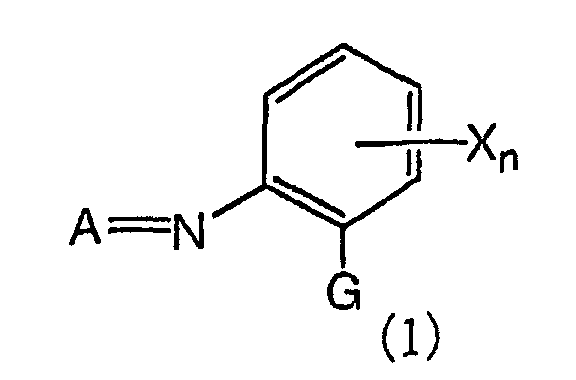 wherein G is
 or the like, A is a 3- to 13-membered, mono-, di- or tri-cyclic
ring which contains at least one hetero atom
selected from among oxygen atoms, sulfur atoms and
nitrogen atoms, which is composed of from 3 to 13 atoms
arbitrarily selected from among carbon atoms, oxygen
atoms, sulfur atoms and nitrogen atoms and which may be
substituted by from 1 to 13 Ys, provided that when A is a
quinolone ring, the nitrogen atom in the quinolone ring
is present at the α-position to the imino bond,
or the like, A is a 3- to 13-membered, mono-, di- or tri-cyclic
ring which contains at least one hetero atom
selected from among oxygen atoms, sulfur atoms and
nitrogen atoms, which is composed of from 3 to 13 atoms
arbitrarily selected from among carbon atoms, oxygen
atoms, sulfur atoms and nitrogen atoms and which may be
substituted by from 1 to 13 Ys, provided that when A is a
quinolone ring, the nitrogen atom in the quinolone ring
is present at the α-position to the imino bond,
Z is -OR1 or the like,
B is -CH2- or the like,
Y is Y'-D-(CH2)p- or the like,
D is a single bond or the like,
X is halogen or the like, and
R1 is a hydrogen atom, C1-C6 alkyl, C1-C6 haloalkyl or the like.
Z is -OR1 or the like,
B is -CH2- or the like,
Y is Y'-D-(CH2)p- or the like,
D is a single bond or the like,
X is halogen or the like, and
R1 is a hydrogen atom, C1-C6 alkyl, C1-C6 haloalkyl or the like.
Description
The present invention relates to novel heterocyclic
imino compounds and their salts, and plant disease and
plant insect pest controlling agents containing at least
one member selected from such heterocyclic imino
compounds and their salts, as an active ingredient.
Conventional fungicides and insecticides for
agricultural and horticultural use are not satisfactory
from the viewpoint of the effects or residual effects in
view of an increase of resistant strains or narrowness of
spectra of such conventional agents. Accordingly,
development of a plant disease and plant insect pest
controlling agent which is highly effective at a low dose
and which is highly safe to desired crop plants, is
desired.
Meanwhile, certain imino compounds are known in
publication of an international patent application (WO-95/27693)
and publication of an European patent
application (EP-254426), and their application as a
fungicide for agricultural and horticultural use, is
disclosed. Whereas, the heterocyclic imino compounds as
the compounds of the present invention, are novel
compounds not disclosed in literatures.
Under these circumstances, the present inventors
have conducted various studies to find out an excellent
fungicide and insecticide and as a result, have found
that the novel heterocyclic imino compounds and their
salts have remarkable activities as plant disease and
plant insect pest controlling agents and are safe to
desired crop plants, and thus, they have arrived at the
present invention.
Namely, the present invention relates to the
following (1) to (7).
(1) A heterocyclic imino compound of the formula (1) and an agrochemically acceptable salt thereof: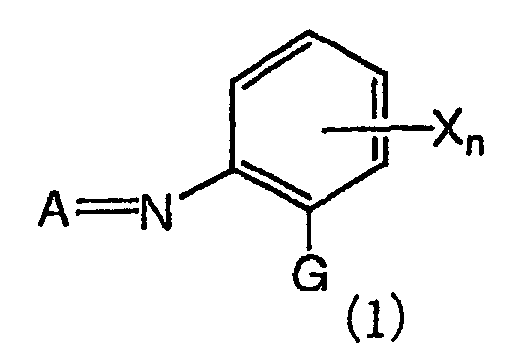 wherein G is a group selected from G1 to G14:


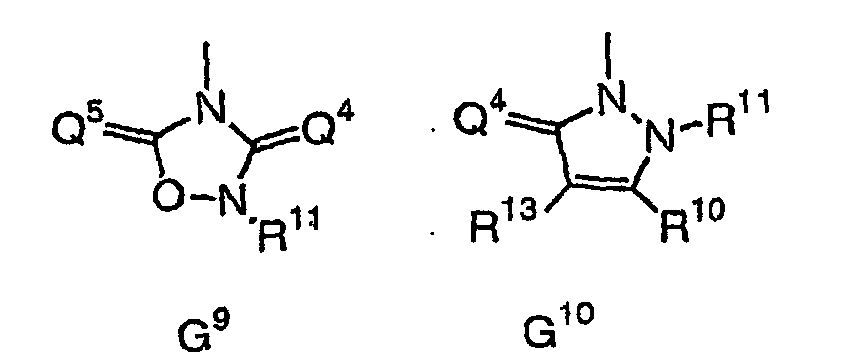
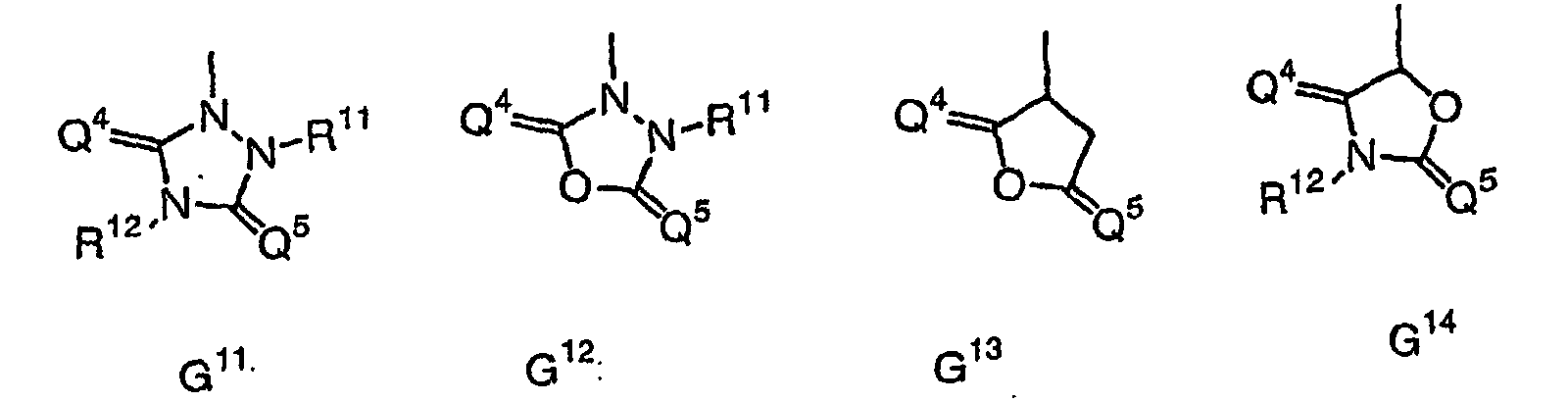
(1) A heterocyclic imino compound of the formula (1) and an agrochemically acceptable salt thereof:
A is a 3- to 13-membered, mono-, di- or tri-cyclic
ring which contains at least one hetero atom selected
from among oxygen atoms, sulfur atoms and nitrogen atoms,
which is composed of from 3 to 13 atoms arbitrarily
selected from among carbon atoms, oxygen atoms, sulfur
atoms and nitrogen atoms and which is substituted by from
0 to 13 Ys, provided that when A is a quinolone ring, the
nitrogen atom in the quinolone ring is present at the α-position
to the imino bond,
Z is -OR1, -SR1 or -NR2R3,
B is -CH2-, -C(=CH-OR4)- or -C(=N-OR4)-,
Y is Y'-D-(CH2)p- or =Q1 (provided that in the case of 2 or more Ys, they may be the same or different), or 2 Ys substituted on the same carbon atom of A, may, together with the carbon atom, form a 3- to 7-membered ring which may contain from 1 to 3 oxygen atoms, nitrogen atoms or sulfur atoms,
provided that when Y is a substituent on a carbon atom, Y may be a hydrogen atom,
D is a single bond, -NR5-, -C(=Q2)-, -C(=Q2)-C(=Q3)-, -CR6=N-, -N=CR6-, -CR6=N-N=CR6-, -N=CR6-O-N=CR6-, -CR6=N-O-, -CR6=N-O-CR6=N-O-, -O-N=CR6-CR6=N-O-, -CR6=N-NR5- or -O-N=CR6-CR6=N-NR5-,
Q1, Q2 and Q3, each independently is =O, =S, =N-R7 or =C(R8)(R9),
Q4 and Q5, each independently is =O or =S,
X is halogen, C1-C6 alkyl, C1-C6 haloalkyl, C1-C6 alkoxy, C1-C6 haloalkoxy, C1-C6 alkylthio, C1-C6 alkylamino, (C1-C6 alkyl)2 amino, NO2, CN, formyl, OH, SH, NU1U2, C1-C6 alkoxycarbonyl, C1-C6 alkylcarbonyl, C1-C6 haloalkylcarbonyl, phenylcarbonyl which may be substituted by Ra, or C1-C6 alkylcarbonyloxy (provided that in the case of two or more Xs substituted, they may be the same or different),
R1, R2 and R4, each independently is a hydrogen atom, C1-C6 alkyl, C1-C6 haloalkyl, C3-C6 cycloalkyl, C1-C6 alkoxy C1-C6 alkyl, C1-C6 alkylsulfenyl C1-C6 alkyl, phenyl C1-C6 alkyl which may be substituted by Ra, or heteroaryl C1-C6 alkyl which may be substituted by Ra,
R3 is a hydrogen atom, C1-C6 alkyl, C1-C6 haloalkyl, C3-C6 cycloalkyl, C1-C6 alkoxy C1-C6 alkyl, C1-C6 alkylsulfenyl C1-C6 alkyl, phenyl which may be substituted by Ra, phenyl C1-C6 alkyl which may be substituted by Ra, or heteroaryl C1-C6 alkyl which may be substituted by Ra,
R5 and R6, each independently is halogen, C1-C6 alkyl, C1-C6 haloalkyl, C3-C6 cycloalkyl, C1-C6 alkoxy, C1-C6 alkoxy C1-C6 alkyl, C1-C6 alkylsulfenyl C1-C6 alkyl, C1-C6 haloalkoxy, C1-C6 alkylsulfenyl, C1-C6 alkylsulfinyl, C1-C6 alkylsulfonyl, C1-C6 haloalkylsulfenyl, C1-C6 haloalkylsulfinyl, C1-C6 haloalkylsulfonyl, C2-C6 alkenyl, C2-C6 haloalkenyl, C2-C6 alkenyloxy, C2-C6 haloalkenyloxy, C2-C6 alkenylsulfenyl, C2-C6 alkenylsulfinyl, C2-C6 alkenylsulfonyl, C2-C6 haloalkenylsulfenyl, C2-C6 haloalkenylsulfinyl, C2-C6 haloalkenylsulfonyl, C2-C6 alkynyl, C2-C6 haloalkynyl, C2-C6 alkynyloxy, C2-C6 haloalkynyloxy, C2-C6 alkynylsulfenyl, C2-C6 alkynylsulfinyl, C2-C6 alkylsulfonyl, C2-C6 haloalkynylsulfenyl, C2-C6 haloalkynylsulfinyl, C2-C6 haloalkynylsulfonyl, NO2, CN, formyl, OH, SH, SCN, C1-C6 alkoxycarbonyl, C1-C6 haloalkoxycarbonyl, C1-C6 alkylcarbonyl, C1-C6 haloalkylcarbonyl, C1-C6 alkylcarbonyloxy, phenyl which may be substituted by Ra, phenyl C1-C6 alkyl which may be substituted by Ra, phenylsulfonyl which may be substituted Ra, phenyl C1-C6 alkylsulfonyl which may be substituted by Ra, heteroaryl which may be substituted by Ra, heteroaryl C1-C6 alkyl which may be substituted by Ra, heteroarylsulfonyl which may be substituted by Ra, phenylcarbonyl which may be substituted by Ra, phenyl C1-C6 alkylcarbonyl which may be substituted by Ra, heteroarylcarbonyl which may be substituted by Ra, or -NU1U2, provided that R6 may be a hydrogen atom,
R7 is hydrogen atom, C1-C6 alkyl, C1-C6 haloalkyl, C3-C6 cycloalkyl, C1-C6 alkoxy, C1-C6 alkoxy C1-C6 alkyl, C1-C6 alkylsulfenyl C1-C6 alkyl, C1-C6 alkylsulfonyl, C1-C6 haloalkylsulfonyl, C1-C6 alkylcarbonyl, C1-C6 haloalkylcarbonyl, phenyl which may be substituted by Ra, phenoxy which may be substituted by Ra, phenyl C1-C6 alkyl which may be substituted by Ra, phenyl C1-C6 alkoxy which may be substituted by Ra, phenylsulfonyl which may be substituted by Ra, phenyl C1-C6 alkylsulfonyl which may be substituted by Ra, heteroaryl which may be substituted by Ra, heteroaryloxy which may be substituted by Ra, heteroaryl C1-C6 alkyl which may be substituted by Ra, heteroarylsulfonyl which may be substituted by Ra, phenylcarbonyl which may be substituted by Ra, phenoxycarbonyl which may be substituted by Ra, phenyl C1-C6 alkylcarbonyl which may be substituted by Ra, heteroarylcarbonyl which may be substituted by Ra, heteroaryloxycarbonyl which may be substituted by Ra, or heteroaryl C1-C6 alkylcarbonyl which may be substituted by Ra,
R8 and R9, each independently is a hydrogen atom, halogen, C1-C6 alkyl, C1-C6 alkoxy, C1-C6 alkylsulfenyl, C2-C6 alkenyl, NO2, CN, formyl, or C1-C6 alkoxycarbonyl,
R10 is a hydrogen atom, halogen, R14 , -OR14, -SR14, -SOR14, or -SO2R14,
R11 is a hydrogen atom, R14 or CN,
R12 is a hydrogen atom or R14,
R13 is a hydrogen atom, halogen, C1-C6 alkyl, C1-C6 haloalkyl, C3-C6 cycloalkyl, C1-C6 alkoxy C1-C6 alkyl, C2-C6 alkenyl, or C2-C6 alkynyl,
R14 is C1-C6 alkyl, C1-C6 haloalkyl, C2-C6 alkenyl, C2-C6 haloalkenyl, C2-C6 alkynyl, C2-C6 haloalkynyl, C3-C6 cycloalkyl, C1-C6 alkylcarbonyl, or C1-C6 alkoxycarbonyl,
Y' is halogen, C1-C12 alkyl which may be substituted by Rb, C3-C6 cycloalkyl which may be substituted by Rb, C2-C12 alkenyl which may be substituted by Rb, C2-C12 alkynyl which may be substituted by Rb, C1-C12 alkoxy which may be substituted by Rb, C1-C6 alkoxy C1-C6 alkoxy which may be substituted by Rb, C2-C6 alkenyloxy which may be substituted by Rb, C2-C6 alkynyloxy which may be substituted by Rb, C1-C6 alkylsulfenyl which may be substituted by Rb, C2-C6 alkenylsulfenyl which may be substituted by Rb, C2-C6 alkynylsulfenyl which may be substituted by Rb, C1-C6 alkylsulfinyl which may be substituted by Rb, C2-C6 alkenylsulfinyl which may be substituted by Rb, C2-C6 alkynylsulfinyl which may be substituted by Rb, C1-C6 alkylsulfonyl which may be substituted by Rb, C2-C6 alkenylsulfonyl which may be substituted by Rb, C2-C6 alkynylsulfonyl which may be substituted by Rb, C1-C6 alkoxycarbonyl which may be substituted by Rb, C1-C6 alkylcarbonyl which may be substituted by Rb, C1-C6 alkylcarbonyloxy which may be substituted by Rb, phenyl which may be substituted by Rc, phenoxy which may be substituted by Rc, phenyl C1-C6 alkyl which may be substituted by Rc, phenyl C1-C6 alkoxy which may be substituted by Rc, phenylsulfonyl which may be substituted by Rc, phenylsulfinyl which may be substituted by Rc, phenylsulfenyl which may be substituted by Rc, phenyl C1-C6 alkylsulfenyl which may be substituted by Rc, phenyl C1-C6 alkylsulfinyl which may be substituted by Rc, phenyl C1-C6 alkylsulfonyl which may be substituted by Rc, heteroaryl which may be substituted by Rc, heteroaryloxy which may be substituted by Rc, heteroaryl C1-C6 alkyl which may be substituted by Rc, heteroaryl C1-C6 alkoxy which may be substituted by Rc, heteroarylsulfinyl which may be substituted by Rc, heteroarylsulfenyl which may be substituted by Rc, heteroarylsulfonyl which may be substituted by Rc, heteroaryl C1-C6 alkylsulfenyl which may be substituted by Rc, heteroaryl C1-C6 alkylsulfinyl which may be substituted by Rc, heteroaryl C1-C6 alkylsulfonyl which may be substituted by Rc, phenylcarbonyl which may be substituted by Rc, phenylcarbonylxoy which may be substituted by Rc, phenoxycarbonyl which may be substituted by Rc, phenyl C1-C6 alkylcarbonyl which may be substituted by Rc, phenyl C1-C6 alkylcarbonyloxy which may be substituted by Rc, heteroarylcarbonyl which may be substituted by Rc, heteroarylcarbonyloxy which may be substituted by Rc, heteroaryloxycarbonyl which may be substituted by Rc, heteroaryl C1-C6 alkylcarbonyl which may be substituted by Rc, heteroaryl C1-C6 alkylcarbonyloxy which may be substituted by Rc, NO2, CN, formyl, or naphthyl,
Ra is halogen, C1-C6 alkyl, C1-C6 haloalkyl, C3-C6 cycloalkyl, C1-C6 alkoxy, C1-C6 alkoxy C1-C6 alkyl, C1-C6 alkylsulfenyl C1-C6 alkyl, C1-C6 haloalkoxy, C1-C6 alkylsulfenyl, C1-C6 alkylsulfinyl, C1-C6 alkylsulfonyl, C1-C6 haloalkylsulfenyl, C1-C6 haloalkylsulfinyl, C1-C6 haloalkylsulfonyl, C2-C6 alkenyl, C2-C6 haloalkenyl, C2-C6 alkenyloxy, C2-C6 haloalkenyloxy, C2-C6 alkenylsulfenyl, C2-C6 alkenylsulfinyl, C2-C6 alkenylsulfonyl, C2-C6 haloalkenylsulfenyl, C2-C6 haloalkenylsulfinyl, C2-C6 haloalkenylsulfonyl, C2-C6 alkynyl, C2-C6 haloalkynyl, C2-C6 alkynyloxy, C2-C6 haloalkynyloxy, C2-C6 alkynylsulfenyl, C2-C6 alkynylsulfinyl, C2-C6 alkynylsulfonyl, C2-C6 haloalkynylsulfenyl, C2-C6 haloalkynylsulfinyl, C2-C6 haloalkynylsulfonyl, NO2, CN, formyl, SH, OH, SCN, C1-C6 alkoxycarbonyl, C1-C6 alkylcarbonyl, C1-C6 haloalkylcarbonyl, C1-C6 alkylcarbonyloxy, phenyl, or -NU1U2, the number of Ra for substitution being from 1 to 5 (provided that in the case of two or more Ra, they may be the same or different),
Rb is halogen, C3-C6 cycloalkyl, C1-C6 alkoxy, C1-C6 alkoxy C1-C6 alkoxy, C1-C6 alkylsulfenyl C1-C6 alkoxy, C1-C6 haloalkoxy, C1-C6 alkylsulfenyl, C1-C6 alkylsulfinyl, C1-C6 alkylsulfonyl, C1-C6 haloalkylsulfenyl, C1-C6 haloalkylsulfinyl, C1-C6 haloalkylsulfonyl, C2-C6 alkenyloxy, C2-C6 haloalkenyloxy, C2-C6 alkenylsulfenyl, C2-C6 alkenylsulfinyl, C2-C6 alkenylsulfonyl, C2-C6 haloalkenylsulfenyl, C2-C6 haloalkenylsulfinyl, C2-C6 haloalkenylsulfonyl, C2-C6 alkynyloxy, C2-C6 haloalkynyloxy, C2-C6 alkynylsulfenyl, C2-C6 alkynylsulfinyl, C2-C6 alkynylsulfonyl, C2-C6 haloalkynylsulfenyl, C2-C6 haloalkynylsulfinyl, C2-C6 haloalkynylsulfonyl, NO2, CN, formyl, OH, SH, SCN, C1-C6 alkoxycarbonyl, C1-C6 alkylcarbonyl, C1-C6 haloalkylcarbonyl, C1-C6 alkylcarbonyloxy, phenyl which may be substituted by Ra, phenoxy which may be substituted by Ra, phenyl C1-C6 alkoxy which may be substituted by Ra, phenylsulfonyl which may be substituted by Ra, phenyl C1-C6 alkylsulfonyl which may be substituted by Ra, heteroaryl which may be substituted by Ra, heteroaryloxy which may be substituted by Ra, heteroarylsulfonyl which may be substituted by Ra, phenylcarbonyl which may be substituted by Ra, phenoxycarbonyl which may be substituted by Ra, phenyl C1-C6 alkylcarbonyl which may be substituted by Ra, heteroarylcarbonyl which may be substituted by Ra, heteroaryloxycarbonyl which may be substituted by Ra, or heteroaryl C1-C6 alkylcarbonyl which may be substituted by Ra, or -NU1U2, or a 3- to 7-membered ring which may contain from 1 to 4 hetero atoms selected from among oxygen atoms, nitrogen atoms and sulfur atoms, the number of Rb for substitution being from 1 to 8 (provided that in the case of two or more Rb, they may be the same or different),
Rc is halogen, C1-C12 alkyl which may be substituted by Rb, C3-C6 cycloalkyl which may be substituted by Rb, C2-C12 alkenyl which may be substituted by Rb, C2-C12 alkynyl which may be substituted by Rb, C1-C12 alkoxy which may be substituted by Rb, C1-C6 alkoxy C1-C6 alkoxy which may be substituted by Rb, C2-C6 alkenyloxy which may be substituted by Rb, C2-C6 alkynyloxy which may be substituted by Rb, C1-C6 alkylsulfenyl which may be substituted by Rb, C2-C6 alkenylsulfenyl which may be substituted by Rb, C2-C6 alkynylsulfenyl which may be substituted by Rb, C1-C6 alkylsulfinyl which may be substituted by Rb, C2-C6 alkenylsulfinyl which may be substituted by Rb, C2-C6 alkynylsulfinyl which may be substituted by Rb, C1-C6 alkylsulfonyl which may be substituted by Rb, C2-C6 alkenylsulfonyl which may be substituted by Rb, C2-C6 alkynylsulfonyl which may be substituted by Rb, C1-C6 alkoxycarbonyl which may be substituted by Rb, C1-C6 alkylcarbonyl which may be substituted by Rb, C1-C6 alkylcarbonyloxy which may be substituted by Rb, NO2, CN, formyl, OH, SH, SCN, C1-C6 alkoxycarbonyl, C1-C6 alkylcarbonyl, C1-C6 haloalkylcarbonyl, C1-C6 alkylcarbonyloxy, phenyl which may be substituted by Ra, phenoxy which may be substituted by Ra, phenyl C1-C6 alkyl which may be substituted by Ra, phenyl C1-C6 alkoxy which may be substituted by Ra, phenylsulfonyl which may be substituted by Ra, phenylsulfinyl which may be substituted by Ra, phenylsulfenyl which may be substituted by Ra, phenyl C1-C6 alkylsulfenyl which may be substituted by Ra, phenyl C1-C6 alkylsulfinyl which may be substituted by Ra, phenyl C1-C6 alkylsulfonyl which may be substituted by Ra, heteroaryl which may be substituted by Ra, heteroaryloxy which may be substituted by Ra, heteroaryl C1-C6 alkyl which may be substituted by Ra, heteroaryl C1-C6 alkoxy which may be substituted by Ra, heteroarylsulfinyl which may be substituted by Ra, heteroarylsulfenyl which may be substituted by Ra, heteroarylsulfonyl which may be substituted by Ra, heteroaryl C1-C6 alkylsulfenyl which may be substituted by Ra, heteroaryl C1-C6 alkylsulfinyl which may be substituted by Ra, heteroaryl C1-C6 alkylsulfonyl which may be substituted by Ra, phenylcarbonyl which may be substituted by Ra, phenylcarbonyloxy which may be substituted by Ra, phenoxycarbonyl which may be substituted by Ra, phenyl C1-C6 alkylcarbonyl which may be substituted by Ra, phenyl C1-C6 alkylcarbonyloxy which may be substituted by Ra, heteroarylcarbonyl which may be substituted by Ra, heteroarylcarbonyloxy which may be substituted by Ra, heteroaryloxycarbonyl which may be substituted by Ra, heteroaryl C1-C6 alkylcarbonyl which may be substituted by Ra, heteroaryl C1-C6 alkylcarbonyloxy which may be substituted by Ra, or -NU1U2, the number of Rc for substitution being from 1 to 5 (provided that in the case of two or more Rc, they may be the same or different),
U1 and U2, each independently is a hydrogen atom, C1-C6 alkyl, C1-C6 haloalkyl, C3-C6 cycloalkyl, C1-C6 alkoxy C1-C6 alkyl, C1-C6 alkylsulfenyl C1-C6 alkyl, formyl, C1-C6 alkylsulfonyl, C1-C6 haloalkylsulfonyl, C1-C6 alkoxycarbonyl, C1-C6 alkylcarbonyl, or C1-C6 haloalkylcarbonyl, or U1 and U2 together form a 3- to 7-membered ring which may contain from 1 to 4 hetero atoms selected from among oxygen atoms, nitrogen atoms and sulfur atoms,
n represents the number of substituents and is from 0 to 4, and
p represents the number of repeating units and is from 0 to 2.
(2) A hydrochloride, a hydrobromide, a hydroiodide, a formate, an acetate or an oxalate of the heterocyclic imino compound according to (1).
(3) The heterocyclic imino compound and an agrochemically acceptable salt thereof, according to (1),
wherein A is








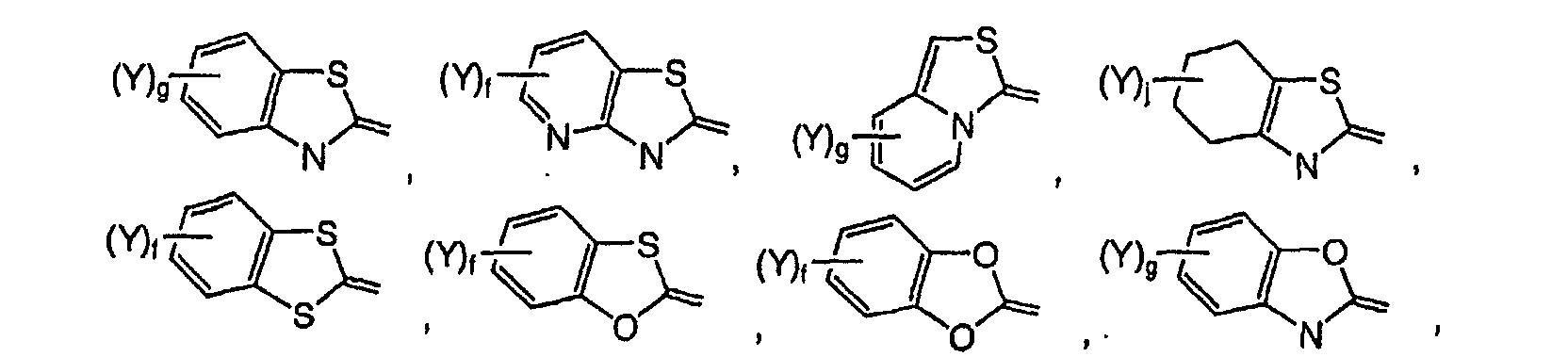


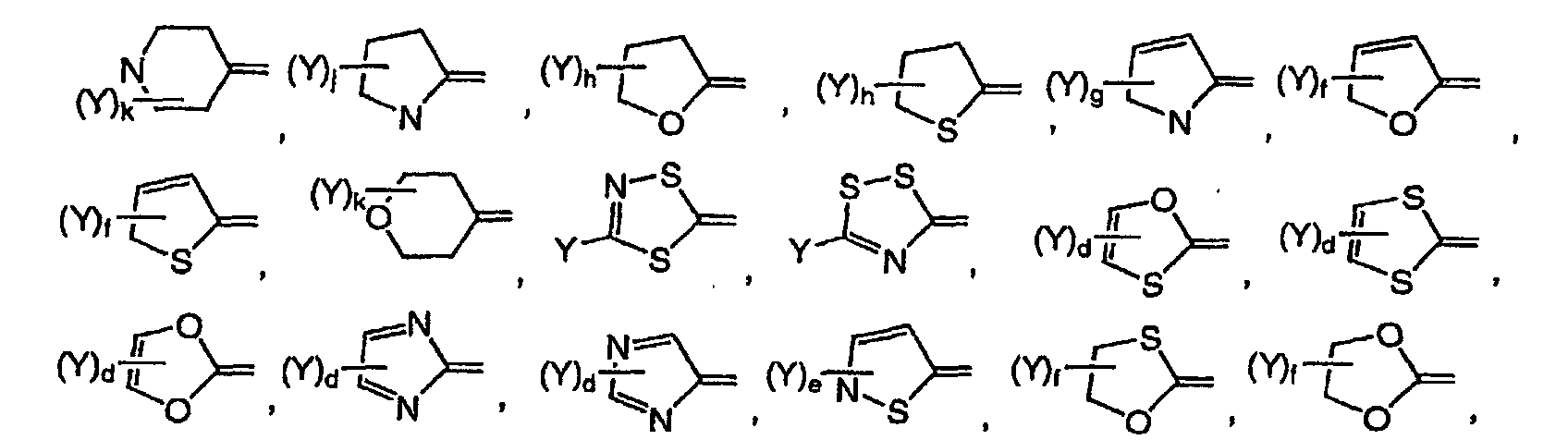


 d represents the number of substituents and is from
0 to 2,
d represents the number of substituents and is from
0 to 2,
e represents the number of substituents and is from 0 to 3,
f represents the number of substituents and is from 0 to 4,
g represents the number of substituents and is from 0 to 5,
h represents the number of substituents and is from 0 to 6,
i represents the number of substituents and is from 0 to 1,
j represents the number of substituents and is from 0 to 7, and
k represents the number of substituents and is from 0 to 8.
(4) The heterocyclic imino compound according to any one of (1) to (3), wherein G is G1.
(5) An agricultural chemical containing at least one member selected from the heterocyclic imino compound and an agrochemically acceptable salt thereof according to any one of (1) to (4), as an active ingredient.
(6) A fungicide containing at least one member selected from the heterocyclic imino compound and an agrochemically acceptable salt thereof according to any one of (1) to (4), as an active ingredient.
(7) An insecticide containing at least one member selected from the heterocyclic imino compound and an agrochemically acceptable salt thereof according to any one of (1) to (4), as an active ingredient.
Z is -OR1, -SR1 or -NR2R3,
B is -CH2-, -C(=CH-OR4)- or -C(=N-OR4)-,
Y is Y'-D-(CH2)p- or =Q1 (provided that in the case of 2 or more Ys, they may be the same or different), or 2 Ys substituted on the same carbon atom of A, may, together with the carbon atom, form a 3- to 7-membered ring which may contain from 1 to 3 oxygen atoms, nitrogen atoms or sulfur atoms,
provided that when Y is a substituent on a carbon atom, Y may be a hydrogen atom,
D is a single bond, -NR5-, -C(=Q2)-, -C(=Q2)-C(=Q3)-, -CR6=N-, -N=CR6-, -CR6=N-N=CR6-, -N=CR6-O-N=CR6-, -CR6=N-O-, -CR6=N-O-CR6=N-O-, -O-N=CR6-CR6=N-O-, -CR6=N-NR5- or -O-N=CR6-CR6=N-NR5-,
Q1, Q2 and Q3, each independently is =O, =S, =N-R7 or =C(R8)(R9),
Q4 and Q5, each independently is =O or =S,
X is halogen, C1-C6 alkyl, C1-C6 haloalkyl, C1-C6 alkoxy, C1-C6 haloalkoxy, C1-C6 alkylthio, C1-C6 alkylamino, (C1-C6 alkyl)2 amino, NO2, CN, formyl, OH, SH, NU1U2, C1-C6 alkoxycarbonyl, C1-C6 alkylcarbonyl, C1-C6 haloalkylcarbonyl, phenylcarbonyl which may be substituted by Ra, or C1-C6 alkylcarbonyloxy (provided that in the case of two or more Xs substituted, they may be the same or different),
R1, R2 and R4, each independently is a hydrogen atom, C1-C6 alkyl, C1-C6 haloalkyl, C3-C6 cycloalkyl, C1-C6 alkoxy C1-C6 alkyl, C1-C6 alkylsulfenyl C1-C6 alkyl, phenyl C1-C6 alkyl which may be substituted by Ra, or heteroaryl C1-C6 alkyl which may be substituted by Ra,
R3 is a hydrogen atom, C1-C6 alkyl, C1-C6 haloalkyl, C3-C6 cycloalkyl, C1-C6 alkoxy C1-C6 alkyl, C1-C6 alkylsulfenyl C1-C6 alkyl, phenyl which may be substituted by Ra, phenyl C1-C6 alkyl which may be substituted by Ra, or heteroaryl C1-C6 alkyl which may be substituted by Ra,
R5 and R6, each independently is halogen, C1-C6 alkyl, C1-C6 haloalkyl, C3-C6 cycloalkyl, C1-C6 alkoxy, C1-C6 alkoxy C1-C6 alkyl, C1-C6 alkylsulfenyl C1-C6 alkyl, C1-C6 haloalkoxy, C1-C6 alkylsulfenyl, C1-C6 alkylsulfinyl, C1-C6 alkylsulfonyl, C1-C6 haloalkylsulfenyl, C1-C6 haloalkylsulfinyl, C1-C6 haloalkylsulfonyl, C2-C6 alkenyl, C2-C6 haloalkenyl, C2-C6 alkenyloxy, C2-C6 haloalkenyloxy, C2-C6 alkenylsulfenyl, C2-C6 alkenylsulfinyl, C2-C6 alkenylsulfonyl, C2-C6 haloalkenylsulfenyl, C2-C6 haloalkenylsulfinyl, C2-C6 haloalkenylsulfonyl, C2-C6 alkynyl, C2-C6 haloalkynyl, C2-C6 alkynyloxy, C2-C6 haloalkynyloxy, C2-C6 alkynylsulfenyl, C2-C6 alkynylsulfinyl, C2-C6 alkylsulfonyl, C2-C6 haloalkynylsulfenyl, C2-C6 haloalkynylsulfinyl, C2-C6 haloalkynylsulfonyl, NO2, CN, formyl, OH, SH, SCN, C1-C6 alkoxycarbonyl, C1-C6 haloalkoxycarbonyl, C1-C6 alkylcarbonyl, C1-C6 haloalkylcarbonyl, C1-C6 alkylcarbonyloxy, phenyl which may be substituted by Ra, phenyl C1-C6 alkyl which may be substituted by Ra, phenylsulfonyl which may be substituted Ra, phenyl C1-C6 alkylsulfonyl which may be substituted by Ra, heteroaryl which may be substituted by Ra, heteroaryl C1-C6 alkyl which may be substituted by Ra, heteroarylsulfonyl which may be substituted by Ra, phenylcarbonyl which may be substituted by Ra, phenyl C1-C6 alkylcarbonyl which may be substituted by Ra, heteroarylcarbonyl which may be substituted by Ra, or -NU1U2, provided that R6 may be a hydrogen atom,
R7 is hydrogen atom, C1-C6 alkyl, C1-C6 haloalkyl, C3-C6 cycloalkyl, C1-C6 alkoxy, C1-C6 alkoxy C1-C6 alkyl, C1-C6 alkylsulfenyl C1-C6 alkyl, C1-C6 alkylsulfonyl, C1-C6 haloalkylsulfonyl, C1-C6 alkylcarbonyl, C1-C6 haloalkylcarbonyl, phenyl which may be substituted by Ra, phenoxy which may be substituted by Ra, phenyl C1-C6 alkyl which may be substituted by Ra, phenyl C1-C6 alkoxy which may be substituted by Ra, phenylsulfonyl which may be substituted by Ra, phenyl C1-C6 alkylsulfonyl which may be substituted by Ra, heteroaryl which may be substituted by Ra, heteroaryloxy which may be substituted by Ra, heteroaryl C1-C6 alkyl which may be substituted by Ra, heteroarylsulfonyl which may be substituted by Ra, phenylcarbonyl which may be substituted by Ra, phenoxycarbonyl which may be substituted by Ra, phenyl C1-C6 alkylcarbonyl which may be substituted by Ra, heteroarylcarbonyl which may be substituted by Ra, heteroaryloxycarbonyl which may be substituted by Ra, or heteroaryl C1-C6 alkylcarbonyl which may be substituted by Ra,
R8 and R9, each independently is a hydrogen atom, halogen, C1-C6 alkyl, C1-C6 alkoxy, C1-C6 alkylsulfenyl, C2-C6 alkenyl, NO2, CN, formyl, or C1-C6 alkoxycarbonyl,
R10 is a hydrogen atom, halogen, R14 , -OR14, -SR14, -SOR14, or -SO2R14,
R11 is a hydrogen atom, R14 or CN,
R12 is a hydrogen atom or R14,
R13 is a hydrogen atom, halogen, C1-C6 alkyl, C1-C6 haloalkyl, C3-C6 cycloalkyl, C1-C6 alkoxy C1-C6 alkyl, C2-C6 alkenyl, or C2-C6 alkynyl,
R14 is C1-C6 alkyl, C1-C6 haloalkyl, C2-C6 alkenyl, C2-C6 haloalkenyl, C2-C6 alkynyl, C2-C6 haloalkynyl, C3-C6 cycloalkyl, C1-C6 alkylcarbonyl, or C1-C6 alkoxycarbonyl,
Y' is halogen, C1-C12 alkyl which may be substituted by Rb, C3-C6 cycloalkyl which may be substituted by Rb, C2-C12 alkenyl which may be substituted by Rb, C2-C12 alkynyl which may be substituted by Rb, C1-C12 alkoxy which may be substituted by Rb, C1-C6 alkoxy C1-C6 alkoxy which may be substituted by Rb, C2-C6 alkenyloxy which may be substituted by Rb, C2-C6 alkynyloxy which may be substituted by Rb, C1-C6 alkylsulfenyl which may be substituted by Rb, C2-C6 alkenylsulfenyl which may be substituted by Rb, C2-C6 alkynylsulfenyl which may be substituted by Rb, C1-C6 alkylsulfinyl which may be substituted by Rb, C2-C6 alkenylsulfinyl which may be substituted by Rb, C2-C6 alkynylsulfinyl which may be substituted by Rb, C1-C6 alkylsulfonyl which may be substituted by Rb, C2-C6 alkenylsulfonyl which may be substituted by Rb, C2-C6 alkynylsulfonyl which may be substituted by Rb, C1-C6 alkoxycarbonyl which may be substituted by Rb, C1-C6 alkylcarbonyl which may be substituted by Rb, C1-C6 alkylcarbonyloxy which may be substituted by Rb, phenyl which may be substituted by Rc, phenoxy which may be substituted by Rc, phenyl C1-C6 alkyl which may be substituted by Rc, phenyl C1-C6 alkoxy which may be substituted by Rc, phenylsulfonyl which may be substituted by Rc, phenylsulfinyl which may be substituted by Rc, phenylsulfenyl which may be substituted by Rc, phenyl C1-C6 alkylsulfenyl which may be substituted by Rc, phenyl C1-C6 alkylsulfinyl which may be substituted by Rc, phenyl C1-C6 alkylsulfonyl which may be substituted by Rc, heteroaryl which may be substituted by Rc, heteroaryloxy which may be substituted by Rc, heteroaryl C1-C6 alkyl which may be substituted by Rc, heteroaryl C1-C6 alkoxy which may be substituted by Rc, heteroarylsulfinyl which may be substituted by Rc, heteroarylsulfenyl which may be substituted by Rc, heteroarylsulfonyl which may be substituted by Rc, heteroaryl C1-C6 alkylsulfenyl which may be substituted by Rc, heteroaryl C1-C6 alkylsulfinyl which may be substituted by Rc, heteroaryl C1-C6 alkylsulfonyl which may be substituted by Rc, phenylcarbonyl which may be substituted by Rc, phenylcarbonylxoy which may be substituted by Rc, phenoxycarbonyl which may be substituted by Rc, phenyl C1-C6 alkylcarbonyl which may be substituted by Rc, phenyl C1-C6 alkylcarbonyloxy which may be substituted by Rc, heteroarylcarbonyl which may be substituted by Rc, heteroarylcarbonyloxy which may be substituted by Rc, heteroaryloxycarbonyl which may be substituted by Rc, heteroaryl C1-C6 alkylcarbonyl which may be substituted by Rc, heteroaryl C1-C6 alkylcarbonyloxy which may be substituted by Rc, NO2, CN, formyl, or naphthyl,
Ra is halogen, C1-C6 alkyl, C1-C6 haloalkyl, C3-C6 cycloalkyl, C1-C6 alkoxy, C1-C6 alkoxy C1-C6 alkyl, C1-C6 alkylsulfenyl C1-C6 alkyl, C1-C6 haloalkoxy, C1-C6 alkylsulfenyl, C1-C6 alkylsulfinyl, C1-C6 alkylsulfonyl, C1-C6 haloalkylsulfenyl, C1-C6 haloalkylsulfinyl, C1-C6 haloalkylsulfonyl, C2-C6 alkenyl, C2-C6 haloalkenyl, C2-C6 alkenyloxy, C2-C6 haloalkenyloxy, C2-C6 alkenylsulfenyl, C2-C6 alkenylsulfinyl, C2-C6 alkenylsulfonyl, C2-C6 haloalkenylsulfenyl, C2-C6 haloalkenylsulfinyl, C2-C6 haloalkenylsulfonyl, C2-C6 alkynyl, C2-C6 haloalkynyl, C2-C6 alkynyloxy, C2-C6 haloalkynyloxy, C2-C6 alkynylsulfenyl, C2-C6 alkynylsulfinyl, C2-C6 alkynylsulfonyl, C2-C6 haloalkynylsulfenyl, C2-C6 haloalkynylsulfinyl, C2-C6 haloalkynylsulfonyl, NO2, CN, formyl, SH, OH, SCN, C1-C6 alkoxycarbonyl, C1-C6 alkylcarbonyl, C1-C6 haloalkylcarbonyl, C1-C6 alkylcarbonyloxy, phenyl, or -NU1U2, the number of Ra for substitution being from 1 to 5 (provided that in the case of two or more Ra, they may be the same or different),
Rb is halogen, C3-C6 cycloalkyl, C1-C6 alkoxy, C1-C6 alkoxy C1-C6 alkoxy, C1-C6 alkylsulfenyl C1-C6 alkoxy, C1-C6 haloalkoxy, C1-C6 alkylsulfenyl, C1-C6 alkylsulfinyl, C1-C6 alkylsulfonyl, C1-C6 haloalkylsulfenyl, C1-C6 haloalkylsulfinyl, C1-C6 haloalkylsulfonyl, C2-C6 alkenyloxy, C2-C6 haloalkenyloxy, C2-C6 alkenylsulfenyl, C2-C6 alkenylsulfinyl, C2-C6 alkenylsulfonyl, C2-C6 haloalkenylsulfenyl, C2-C6 haloalkenylsulfinyl, C2-C6 haloalkenylsulfonyl, C2-C6 alkynyloxy, C2-C6 haloalkynyloxy, C2-C6 alkynylsulfenyl, C2-C6 alkynylsulfinyl, C2-C6 alkynylsulfonyl, C2-C6 haloalkynylsulfenyl, C2-C6 haloalkynylsulfinyl, C2-C6 haloalkynylsulfonyl, NO2, CN, formyl, OH, SH, SCN, C1-C6 alkoxycarbonyl, C1-C6 alkylcarbonyl, C1-C6 haloalkylcarbonyl, C1-C6 alkylcarbonyloxy, phenyl which may be substituted by Ra, phenoxy which may be substituted by Ra, phenyl C1-C6 alkoxy which may be substituted by Ra, phenylsulfonyl which may be substituted by Ra, phenyl C1-C6 alkylsulfonyl which may be substituted by Ra, heteroaryl which may be substituted by Ra, heteroaryloxy which may be substituted by Ra, heteroarylsulfonyl which may be substituted by Ra, phenylcarbonyl which may be substituted by Ra, phenoxycarbonyl which may be substituted by Ra, phenyl C1-C6 alkylcarbonyl which may be substituted by Ra, heteroarylcarbonyl which may be substituted by Ra, heteroaryloxycarbonyl which may be substituted by Ra, or heteroaryl C1-C6 alkylcarbonyl which may be substituted by Ra, or -NU1U2, or a 3- to 7-membered ring which may contain from 1 to 4 hetero atoms selected from among oxygen atoms, nitrogen atoms and sulfur atoms, the number of Rb for substitution being from 1 to 8 (provided that in the case of two or more Rb, they may be the same or different),
Rc is halogen, C1-C12 alkyl which may be substituted by Rb, C3-C6 cycloalkyl which may be substituted by Rb, C2-C12 alkenyl which may be substituted by Rb, C2-C12 alkynyl which may be substituted by Rb, C1-C12 alkoxy which may be substituted by Rb, C1-C6 alkoxy C1-C6 alkoxy which may be substituted by Rb, C2-C6 alkenyloxy which may be substituted by Rb, C2-C6 alkynyloxy which may be substituted by Rb, C1-C6 alkylsulfenyl which may be substituted by Rb, C2-C6 alkenylsulfenyl which may be substituted by Rb, C2-C6 alkynylsulfenyl which may be substituted by Rb, C1-C6 alkylsulfinyl which may be substituted by Rb, C2-C6 alkenylsulfinyl which may be substituted by Rb, C2-C6 alkynylsulfinyl which may be substituted by Rb, C1-C6 alkylsulfonyl which may be substituted by Rb, C2-C6 alkenylsulfonyl which may be substituted by Rb, C2-C6 alkynylsulfonyl which may be substituted by Rb, C1-C6 alkoxycarbonyl which may be substituted by Rb, C1-C6 alkylcarbonyl which may be substituted by Rb, C1-C6 alkylcarbonyloxy which may be substituted by Rb, NO2, CN, formyl, OH, SH, SCN, C1-C6 alkoxycarbonyl, C1-C6 alkylcarbonyl, C1-C6 haloalkylcarbonyl, C1-C6 alkylcarbonyloxy, phenyl which may be substituted by Ra, phenoxy which may be substituted by Ra, phenyl C1-C6 alkyl which may be substituted by Ra, phenyl C1-C6 alkoxy which may be substituted by Ra, phenylsulfonyl which may be substituted by Ra, phenylsulfinyl which may be substituted by Ra, phenylsulfenyl which may be substituted by Ra, phenyl C1-C6 alkylsulfenyl which may be substituted by Ra, phenyl C1-C6 alkylsulfinyl which may be substituted by Ra, phenyl C1-C6 alkylsulfonyl which may be substituted by Ra, heteroaryl which may be substituted by Ra, heteroaryloxy which may be substituted by Ra, heteroaryl C1-C6 alkyl which may be substituted by Ra, heteroaryl C1-C6 alkoxy which may be substituted by Ra, heteroarylsulfinyl which may be substituted by Ra, heteroarylsulfenyl which may be substituted by Ra, heteroarylsulfonyl which may be substituted by Ra, heteroaryl C1-C6 alkylsulfenyl which may be substituted by Ra, heteroaryl C1-C6 alkylsulfinyl which may be substituted by Ra, heteroaryl C1-C6 alkylsulfonyl which may be substituted by Ra, phenylcarbonyl which may be substituted by Ra, phenylcarbonyloxy which may be substituted by Ra, phenoxycarbonyl which may be substituted by Ra, phenyl C1-C6 alkylcarbonyl which may be substituted by Ra, phenyl C1-C6 alkylcarbonyloxy which may be substituted by Ra, heteroarylcarbonyl which may be substituted by Ra, heteroarylcarbonyloxy which may be substituted by Ra, heteroaryloxycarbonyl which may be substituted by Ra, heteroaryl C1-C6 alkylcarbonyl which may be substituted by Ra, heteroaryl C1-C6 alkylcarbonyloxy which may be substituted by Ra, or -NU1U2, the number of Rc for substitution being from 1 to 5 (provided that in the case of two or more Rc, they may be the same or different),
U1 and U2, each independently is a hydrogen atom, C1-C6 alkyl, C1-C6 haloalkyl, C3-C6 cycloalkyl, C1-C6 alkoxy C1-C6 alkyl, C1-C6 alkylsulfenyl C1-C6 alkyl, formyl, C1-C6 alkylsulfonyl, C1-C6 haloalkylsulfonyl, C1-C6 alkoxycarbonyl, C1-C6 alkylcarbonyl, or C1-C6 haloalkylcarbonyl, or U1 and U2 together form a 3- to 7-membered ring which may contain from 1 to 4 hetero atoms selected from among oxygen atoms, nitrogen atoms and sulfur atoms,
n represents the number of substituents and is from 0 to 4, and
p represents the number of repeating units and is from 0 to 2.
(2) A hydrochloride, a hydrobromide, a hydroiodide, a formate, an acetate or an oxalate of the heterocyclic imino compound according to (1).
(3) The heterocyclic imino compound and an agrochemically acceptable salt thereof, according to (1),
wherein A is
e represents the number of substituents and is from 0 to 3,
f represents the number of substituents and is from 0 to 4,
g represents the number of substituents and is from 0 to 5,
h represents the number of substituents and is from 0 to 6,
i represents the number of substituents and is from 0 to 1,
j represents the number of substituents and is from 0 to 7, and
k represents the number of substituents and is from 0 to 8.
(4) The heterocyclic imino compound according to any one of (1) to (3), wherein G is G1.
(5) An agricultural chemical containing at least one member selected from the heterocyclic imino compound and an agrochemically acceptable salt thereof according to any one of (1) to (4), as an active ingredient.
(6) A fungicide containing at least one member selected from the heterocyclic imino compound and an agrochemically acceptable salt thereof according to any one of (1) to (4), as an active ingredient.
(7) An insecticide containing at least one member selected from the heterocyclic imino compound and an agrochemically acceptable salt thereof according to any one of (1) to (4), as an active ingredient.
However, when the present compounds have stereo
isomers, geometrical isomers, tautomeric isomers and
diastereomers, the present invention covers all of the
respective isomers and their mixtures.
Each substituent in the compound of the formula (1)
of the present invention will be exemplified below.
Here, abbreviations have the following meanings
respectively.
Me represents a methyl group, Et an ethyl group, Pr
a propyl group, Bu a butyl group, Pen a pentyl group, Hex
a hexyl group, Hep a heptyl group, Oct an octyl group,
Non a nonyl group, Dec a decyl group, Undec an undecanyl
group, Dodec a dodecyl group, n normal, i iso, s
secondary, t tertiary and c cyclo, respectively, and Ph
represents a phenyl group, and in the representation of a
phenyl group, e.g. 2-Cl-Ph represents a 2-chlorophenyl
group, and 2-MeO-3-Me-Ph represents a 2-methoxy-3-methylphenyl
group.
The C1-C6 alkyl in the definitions of R1, R2, R3, R4,
R5, R6, R7, R8, R9, R13, R14, Ra, X, U1 and U2, may, for
example, be a linear or branched alkyl, such as, methyl,
ethyl, n-propyl, i-propyl, n-butyl, i-butyl, t-butyl, s-butyl,
n-pentyl, n-hexyl, 2-ethylpropyl, 2,2-dimethylpropyl,
1,2-dimethylpropyl, 1,1,2-trimethylpropyl,
1,2,2-trimethylpropyl, 1-ethyl-1-methylpropyl, 1-ethyl-2-methylpropyl,
1-methylbutyl, 2-methylbutyl, 3-methylbutyl,
1,1-dimethylbutyl, 1,2-dimethylbutyl, 1,3-dimethylbutyl,
2,2-dimethylbutyl, 2,3-dimethylbutyl, 3,3-dimethylbutyl,
1-ethylbutyl, 2-ethylbutyl, 1-methylpentyl, 2-methylpentyl,
3-methylpentyl and 4-methylpentyl.
The halogen atom in the definitions of R5, R6, R8, R9,
R10, R13, Ra, Rb, Rc, X and Y', may, for example, be a
fluorine atom, a chlorine atom, a bromine atom and an
iodine atom.
The C1-C6 haloalkyl in the definitions of R1, R2, R3,
R4, R5, R6, R7, R13, R14, Ra, X, U1 and U2, may, for example,
be a linear or branched haloalkyl, such as fluoromethyl,
chloromethyl, bromomethyl, iodomethyl, difluoromethyl,
chlorodifluoromethyl, bromodifluoromethyl,
trifluoromethyl, dichloromethyl, trichloromethyl, 1-chloroethyl,
1-bromoethyl, 1-iodoethyl, 1-fluoroethyl, 2-chloroethyl,
2-bromoethyl, 2-iodoethyl, 2-fluoroethyl,
2,2-difluoroethyl, 2,2,2-trifluoroethyl, 2,2,2-trichloroethyl,
pentafluoroethyl, 2,2,2-trifluoro-1-chloroethyl,
3-fluoropropyl, 3-chloropropyl, 1-fluoro-i-propyl,
1-chloro-i-propyl, heptafluoropropyl,
1,1,2,2,3,3-hexafluoro-n-propyl, 4-chlorobutyl, 4-fluorobutyl,
5-chloropentyl, 5-fluoropentyl, 6-chlorohexyl
and 6-fluorohexyl.
The C3-C6 cycloalkyl in the definitions of R1, R2, R3,
R4, R5, R6, R7, R13, R14, Ra, Rb, U1 and U2, may, for example,
be cyclopropyl, cyclobutyl, cyclopentyl and cyclohexyl.
The C1-C6 alkoxy in the definitions of R5, R6, R7, R8,
R9, Ra, Rb and X, may, for example, be a linear or
branched alkoxy, such as methoxy, ethoxy, n-propoxy, i-propoxy,
n-butoxy, i-butoxy, s-butoxy, t-butoxy, n-pentyloxy,
n-hexyloxy, 1,1-dimethylpropoxy, 1,2-dimethylpropoxy,
2,2-dimethylpropoxy, 1-ethylpropoxy,
1,1,2-trimethylpropoxy, 1,2,2-trimethylpropoxy, 1-ethyl-1-methylpropoxy,
1-ethyl-2-methylpropoxy, 1-methylbutoxy,
2-methylbutoxy, 3-methylbutoxy, 1-ethylbutoxy, 2-ethylbutoxy,
1,1-dimethylbutoxy, 1,2-dimethylbutoxy, 1,3-dimethylbutoxy,
2,2-dimethylbutoxy, 2,3-dimethylbutoxy,
3,3-dimethylbutoxy, 1-methylpentyloxy, 2-methylpentyloxy,
3-methylpentyloxy and 4-methylpentyloxy.
The C1-C6 haloalkoxy in the definitions of R5, R6, Ra,
Rb and X, may, for example, be a C1-C6 linear or branched
haloalkoxy, such as fluoromethoxy, chloromethoxy,
bromomethoxy, iodomethoxy, dichloromethoxy,
trichloromethoxy, difluoromethoxy, trifluoromethoxy,
chlorodifluoromethoxy, bromodifluoromethoxy,
dichlorofluoromethoxy, 1-chloroethoxy, 1-bromoethoxy, 1-iodoethoxy,
1-fluoroethoxy, 2-chloroethoxy, 2-bromoethoxy,
2-iodoethoxy, 2-fluoroethoxy, 2,2-difluoroethoxy, 2,2,2-trifluoroethoxy,
2,2,2-trichloroethoxy, pentafluoroethoxy,
2,2,2-trifluoro-1-chloroethoxy, 1,1,2,2-tetrafluoroethoxy,
3-bromopropoxy, 1-fluoro-i-propoxy, 1-chloro-i-propoxy,
3-fluoropropoxy, 3-chloropropoxy, heptafluoropropoxy,
1,1,2,2,3,3-hexafluoropropoxy, 4-chlorobutoxy, 4-fluorobutoxy,
5-chloropentyloxy, 5-fluoropentyloxy, 6-chlorohexyloxy
and 6-fluorohexyloxy.
The C1-C6 alkylsulfenyl in the definitions of R5, R6,
R8, R9, Ra, Rb and X, may, for example, be a linear or
branched alkylsulfenyl, such as methylthio, ethylthio, n-propylthio,
i-propylthio, n-butylthio, i-butylthio, s-butylthio,
t-butylthio, n-pentylthio and n-hexylthio.
The C1-C6 alkylsulfinyl in the definitions of R5, R6,
Ra and Rb, may, for example, a linear or branched
alkylsulfinyl, such as methylsulfinyl, ethylsulfinyl, n-propylsulfinyl,
i-propylsulfinyl, n-butylsulfinyl, i-butylsulfinyl,
s-butylsulfinyl, t-butylsulfinyl, n-pentylsulfinyl
and n-hexylsulfinyl.
The C1-C6 alkylsulfonyl in the definitions of R5, R6,
R7, Ra, Rb, U1 and U2, may, for example, be a linear or
branched alkylsulfonyl, such as methylsulfonyl,
ethylsulfonyl, n-propylsulfonyl, i-propylsulfonyl, n-butylsulfonyl,
i-butylsulfonyl, s-butylsulfonyl, t-butylsulfonyl,
n-pentylsulfonyl and n-hexylsulfonyl.
The C1-C6 alkoxy C1-C6 alkyl in the definitions of R1,
R2, R3, R4, R5, R6, R7, R13, Ra, U1 and U2, may, for example,
be methoxymethyl, ethoxymethyl, n-propoxymethyl, i-propoxymethyl,
n-butoxymethyl, i-butoxymethyl, s-butoxymethyl,
t-butoxymethyl, n-pentyloxymethyl, 2-methoxyethyl,
3-ethoxypropyl and 3-methoxypropyl.
The C1-C6 alkoxy C1-C6 alkoxy in the definition of Rb,
may, for example, be methoxymethoxy, ethoxymethoxy, n-propoxymethoxy,
i-propoxymethoxy, n-butoxymethoxy, i-butoxymethoxy,
s-butoxymethoxy, t-butoxymethoxy, n-pentyloxymethoxy,
2-methoxyethoxy, 3-ethoxypropoxy and 3-methoxypropoxy.
The C1-C6 alkylsulfenyl C1-C6 alkyl in the definitions
of R1, R2, R3, R4, R5, R6, R7, Ra, U1 and U2, may, for
example, be a linear or branched alkylsulfenylalkyl, such
as methylthiomethyl, ethylthiomethyl, n-propylthiomethyl,
i-propylthiomethyl, n-butylthiomethyl, i-butylthiomethyl,
s-butylthiomethyl, t-butylthiomethyl, n-pentylthiomethyl,
2-methylthioethyl, 3-ethylthiopropyl and 3-methylthiopropyl.
The C1-C6 alkylsulfenyl C1-C6 alkoxy in the definition
of Rb, may, for example, be methylthiomethoxy,
ethylthiomethoxy, n-propylthiomethoxy, i-propylthiomethoxy,
n-butylthiomethoxy, i-butylthiomethoxy,
s-butylthiomethoxy, t-butylthiomethoxy, n-pentylthiomethoxy,
2-methylthioethoxy, 3-ethylthiopropoxy
and 3-methylthiopropoxy.
The C1-C6 haloalkylsulfenyl in the definitions of R5,
R6, Ra and Rb, may, for example, be a linear or branched
haloalkylthio, such as fluoromethylthio,
chlorodifluoromethylthio, bromodifluoromethylthio,
trifluoromethylthio, trichloromethylthio, 2,2,2-trifluoroethylthio,
1,1,2,2-tetrafluoroethylthio, 2-fluoroethylthio,
pentafluoroethylthio and 1-fluoro-i-propylthio.
The C1-C6 haloalkylsulfinyl in the definitions of R5,
R6, Ra and Rb, may, for example, be a linear or branched
haloalkylsulfinyl, such as fluoromethylsulfinyl,
chlorodifluoromethylsulfinyl, bromodifluoromethylsulfinyl,
trifluoromethylsulfinyl, trichloromethylsulfinyl, 2,2,2-trifluoroethylsulfinyl,
1,1,2,2-tetrafluoroethylsulfinyl,
2-fluoroethylsulfinyl, pentafluoroethylsulfinyl and 1-fluoro-i-propylsulfinyl.
The C1-C6 haloalkylsulfonyl in the definitions of R5,
R6, R7, Ra, Rb U1 and U2, may, for example, be a linear or
branched haloalkylsulfonyl, such as fluoromethylsulfonyl,
chlorodifluoromethylsulfonyl, bromodifluoromethylsulfonyl,
trifluoromethylsulfonyl, trichloromethylsulfonyl, 2,2,2-trifluoroethylsulfonyl,
1,1,2,2-tetrafluoroethylsulfonyl,
2-fluoroethylsulfonyl, pentafluoroethylsulfonyl and 1-fluoro-i-propylsulfonyl.
The C2-C6 alkenyl in the definitions of R5, R6, R8, R9,
R13, R14 and Ra, may, for example, be a linear or branched
alkenyl such as ethenyl, 1-propenyl, 2-propenyl, 1-butenyl,
2-butenyl, 3-butenyl, 1-pentenyl, 2-pentenyl, 3-pentenyl,
4-pentenyl, 1-hexenyl, 2-hexenyl, 3-hexenyl, 4-hexenyl,
5-hexenyl, 1-methyl-2-propenyl, 2-methyl-2-propenyl,
1,1-dimethyl-2-propenyl, 1,2-dimethyl-2-propenyl,
1-ethyl-2-propenyl, 1-methyl-2-butenyl, 2-methyl-2-butenyl,
3-methyl-2-butenyl, 1-methyl-3-butenyl,
2-methyl-3-butenyl, 3-methyl-3-butenyl, 1,1-dimethyl-2-butenyl,
1,1-dimethyl-3-butenyl, 1,2-dimethyl-2-butenyl,
1,2-dimethyl-3-butenyl, 1,3-dimethyl-2-butenyl, 1,3-dimethyl-3-butenyl,
2,3-dimethyl-2-butenyl, 2,3-dimethyl-3-butenyl,
1-ethyl-2-butenyl, 1-ethyl-3-butenyl, 2-ethyl-2-butenyl,
2-ethyl-3-butenyl, 1-methyl-2-pentenyl, 2-methyl-2-pentenyl,
3-methyl-2-pentenyl, 4-methyl-2-pentenyl,
1-methyl-3-pentenyl, 2-methyl-3-pentenyl, 3-methyl-3-pentenyl,
4-methyl-3-pentenyl, 1-methyl-4-pentenyl,
2-methyl-4-pentenyl, 3-methyl-4-pentenyl, 4-methyl-4-pentenyl,
1,1,2-trimethyl-2-propenyl and 1-ethyl-1-methyl-2-propenyl.
The C2-C6 haloalkenyl in the definitions of R5, R6,
R14 and Ra, may, for example, be a linear or branched
haloalkenyl, such as 2-chloroethenyl, 2-bromoethenyl,
2,2-dichloroethenyl, 3-chloro-2-propenyl, 3-fluoro-2-propenyl,
3-bromo-2-propenyl, 3-iodo-2-propenyl, 3,3-dichloro-2-propenyl,
3,3-difluoro-2-propenyl, 4-chloro-2-butenyl,
4,4-dichloro-3-butenyl and 4,4-difluoro-3-butenyl.
The C2-C6 alkenyloxy in the definitions of R5, R6, Ra
and Rb, may, for example, be a linear or branched
alkenyloxy, such as 1-methylethenyloxy, 2-propenyloxy, 1-methyl-2-propenyloxy,
2-butenyloxy, 3-butenyloxy and 2-methyl-2-propenyloxy.
The C2-C6 haloalkenyloxy in the definitions of R5, R6,
Ra, Rb and X, may, for example, be a linear or branched
haloalkenyloxy, such as 2-chloroethenyloxy, 2-bromoethenyloxy,
2,2-dichloroethenyloxy, 3-chloro-2-propenyloxy,
3-fluoro-2-propenyloxy, 3-bromo-2-propenyloxy,
3-iodo-2-propenyloxy, 3,3-dichloro-2-propenyloxy,
3,3-difluoro-2-propenyloxy, 4-chloro-2-butenyloxy,
4,4-dichloro-3-butenyloxy and 4,4-difluoro-3-butenyloxy.
The C2-C6 alkenylsulfenyl in the definitions of R5, R6,
Ra and Rb, may, for example, be a linear or branched
alkenylsulfenyl, such as 1-methylethenylthio, 2-propenylthio,
1-methyl-2-propenylthio, 2-butenylthio, 3-butenylthio
and 2-methyl-2-propenylthio.
The C2-C6 alkenylsulfinyl in the definitions of R5, R6,
Ra and Rb, may, for example, be a linear or branched
alkenylsulfinyl, such as 1-methylethenylsulfinyl, 2-propenylsulfinyl,
1-methyl-2-propenylsulfinyl, 2-butenylsulfinyl,
3-butenylsulfinyl and 2-methyl-2-propenylsulfinyl.
The C2-C6 alkenylsulfonyl in the definitions of R5, R6,
Ra and Rb, may, for example, be a linear or branched
alkenylsulfonyl, such as 1-methylethenylsulfonyl, 2-propenylsulfonyl,
1-methyl-2-propenylsulfonyl, 2-butenylsulfonyl,
3-butenylsulfonyl and 2-methyl-2-propenylsulfonyl.
The C2-C6 haloalkenylsulfenyl in the definitions of
R5, R6, Ra and Rb, may, for example, be a linear or
branched haloalkenylsulfenyl, such as 2-chloroethenylthio,
2-bromoethenylthio, 2,2-dichloroethenylthio, 3-chloro-2-propenylthio,
3-fluoro-2-propenylthio, 3-bromo-2-propenylthio,
3-iodo-2-propenylthio, 3,3-dichloro-2-propenylthio,
3,3-difluoro-2-propenylthio, 4-chloro-2-butenylthio,
4,4-dichloro-3-butenylthio and 4,4-difluoro-3-butenylthio.
The C2-C6 haloalkenylsulfinyl in the definitions of
R5, R6, Ra and Rb, may, for example, be a linear or
branched haloalkenylsulfinyl, such as 2-chloroethenylsulfinyl,
2-bromoethenylsulfinyl, 2,2-dichloroethenylsulfinyl,
3-chloro-2-propenylsulfinyl, 3-fluoro-2-propenylsulfinyl,
3-bromo-2-propenylsulfinyl, 3-iodo-2-propenylsulfinyl,
3,3-dichloro-2-propenylsulfinyl,
3,3-difluoro-2-propenylsulfinyl, 4-chloro-2-butenylsulfinyl,
4,4-dichloro-3-butenylsulfinyl and 4,4-difluoro-3-butenylsulfinyl.
The C2-C6 haloalkenylsulfonyl in the definitions of
R5, R6, Ra and Rb, may, for example, be a linear or
branched haloalkenylsulfonyl, such as 2-chloroethenylsulfonyl,
2-bromoethenylsulfonyl, 2,2-dichloroethenylsulfonyl,
3-chloro-2-propenylsulfonyl, 3-fluoro-2-propenylsulfonyl,
3-bromo-2-propenylsulfonyl, 3-iodo-2-propenylsulfonyl,
3,3-dichloro-2-propenylsulfonyl,
3,3-difluoro-2-propenylsulfonyl, 4-chloro-2-butenylsulfonyl,
4,4-dichloro-3-butenylsulfonyl and 4,4-difluoro-3-butenylsulfonyl.
The C2-C6 alkynyl in the definitions of R5, R6, R13,
R14 and Ra, may, for example, be a linear or branched
alkynyl, such as ethynyl, 1-propynyl, 2-propynyl, 1-methyl-2-propynyl,
1,1-dimethyl-2-propynyl, 1-methyl-1-ethyl-2-propynyl,
1-butynyl, 2-butynyl, 3-butynyl, 1-methyl-2-butynyl,
1-methyl-3-butynyl, 2-methyl-3-butynyl,
1,1-dimethyl-2-butynyl, 1,1-dimethyl-3-butynyl, 1,2-dimethyl-3-butynyl,
2,2-dimethyl-3-butynyl, 1-ethyl-2-butynyl,
1-ethyl-3-butynyl, 2-ethyl-3-butynyl, 1-pentynyl,
2-pentynyl, 3-pentynyl, 4-pentynyl, 1-methyl-3-pentynyl,
1-methyl-4-pentynyl, 2-methyl-3-pentynyl, 2-methyl-4-pentynyl,
3-methyl-4-pentynyl, 4-methyl-2-pentynyl and
hexynyl.
The C2-C6 haloalkynyl in the definitions of R5, R6,
R14 and Ra, may, for example, be a linear or branched
haloalkynyl, such as chloroethynyl, bromoethynyl,
iodoethynyl, 3-chloro-2-propynyl, 3-bromo-2-propynyl, 3-iodo-2-propynyl,
4-bromo-3-butynyl, 4-iodo-3-butynyl and
6-iodo-5-hexynyl.
The C2-C6 alkynyloxy in the definitions of R5, R6, Ra
and Rb, may, for example, be a linear or branched
alkynyloxy, such as ethynyloxy, 2-propynyloxy, 1-methyl-2-propynyloxy,
1,1-dimethyl-2-propynyloxy, 1-methyl-1-ethyl-2-propynyloxy,
2-butynyloxy, 3-butynyloxy, 1-methyl-2-butynyloxy,
1,1-dimethyl-2-butynyloxy, 1-pentynyloxy,
2-pentynyloxy, 3-pentynyloxy, 4-pentynyloxy
and hexynyloxy.
The C2-C6 haloalkynyloxy in the definitions of R5, R6,
Ra and Rb, may, for example, be a linear or branched
haloalkynyloxy, such as chloroethynyloxy, bromoethynyloxy,
iodoethynyloxy, 3-chloro-2-propynyloxy, 3-bromo-2-propynyloxy,
3-iodo-2-propynyloxy, 4-bromo-3-butynyloxy,
4-iodo-3-butynyloxy and 6-iodo-5-hexynyloxy.
The C2-C6 alkynylsulfenyl in the definitions of R5, R6,
Ra and Rb, may, for example, be a linear or branched
alkynylsulfenyl, such as ethynylthio, 2-propynylthio, 1-methyl-2-propynylthio,
1,1-dimethyl-2-propynylthio, 1-methyl-1-ethyl-2-propynylthio,
2-butynylthio, 3-butynylthio,
1-methyl-2-butynylthio, 1,1-dimethyl-2-butynylthio,
1-pentynylthio, 2-pentynylthio, 3-pentynylthio,
4-pentynylthio and hexynylthio.
The C2-C6 alkynylsulfinyl in the definitions of R5, R6,
Ra and Rb, may, for example, be a linear or branched
alkynylsulfinyl, such as ethynylsulfinyl, 2-propynylsulfinyl,
1-methyl-2-propynylsulfinyl, 1,1-dimethyl-2-propynylsulfinyl,
1-methyl-1-ethyl-2-propynylsulfinyl,
2-butynylsulfinyl, 3-butynylsulfinyl,
1-methyl-2-butynylsulfinyl, 1,1-dimethyl-2-butynylsulfinyl,
1-pentynylsulfinyl, 2-pentynylsulfinyl,
3-pentynylsulfinyl, 4-pentynylsulfinyl and
hexynylsulfinyl.
The C2-C6 alkynylsulfonyl in the definitions of R5, R6,
Ra and Rb, may, for example, be a linear or branched
alkynylsulfonyl, such as ethynylsulfonyl, 2-propynylsulfonyl,
1-methyl-2-propynylsulfonyl, 1,1-dimethyl-2-propynylsulfonyl,
1-methyl-1-ethyl-2-propynylsulfonyl,
2-butynylsulfonyl, 3-butynylsulfonyl,
1-methyl-2-butynylsulfonyl, 1,1-dimethyl-2-butynylsulfonyl,
1-pentynylsulfonyl, 2-pentynylsulfonyl,
3-pentynylsulfonyl, 4-pentynylsulfonyl and
hexynylsulfonyl.
The C2-C6 haloalkynylsulfenyl in the definitions of
R5, R6, Ra and Rb, may, for example, be a linear or
branched haloalkynylsulfenyl, such as chloroethynylthio,
bromoethynylthio, iodoethynylthio, 3-chloro-2-propynylthio,
3-bromo-2-propynylthio, 3-iodo-2-propynylthio,
4-bromo-3-butynylthio, 4-iodo-3-butynylthio
and 6-iodo-5-hexynylthio.
The C2-C6 haloalkynylsulfinyl in the definitions of
R5, R6, Ra and Rb, may, for example, be a linear or
branched haloalkynylsulfinyl, such as
chloroethynylsulfinyl, bromoethynylsulfinyl,
iodoethynylsulfinyl, 3-chloro-2-propynylsulfinyl, 3-bromo-2-propynylsulfinyl,
3-iodo-2-propynylsulfinyl, 4-bromo-3-butynylsulfinyl,
4-iodo-3-butynylsulfinyl and 6-iodo-5-hexynylsulfinyl.
The C2-C6 haloalkynylsulfonyl in the definitions of
R5, R6, Ra and Rb, may, for example, be a linear or
branched haloalkynylsulfonyl, such as
chloroethynylsulfonyl, bromoethynylsulfonyl,
iodoethynylsulfonyl, 3-chloro-2-propynylsulfonyl, 3-bromo-2-propynylsulfonyl,
3-iodo-2-propynylsulfonyl, 4-bromo-3-butynylsulfonyl,
4-iodo-3-butynylsulfonyl and 6-iodo-5-hexynylsulfonyl.
The C1-C6 alkoxycarbonyl in the definitions of R5, R6,
R8, R9, R14, Ra, Rb, X, U1 and U2, may, for example, be a
linear or branched alkoxycarbonyl, such as
methoxycarbonyl, ethoxycarbonyl, n-propoxycarbonyl, i-propoxycarbonyl,
n-butoxycarbonyl, i-butoxycarbonyl, s-butoxycarbonyl,
t-butoxycarbonyl, n-pentyloxycarbonyl and
n-hexyloxycarbonyl.
The C1-C6 alkylcarbonyl in the definitions of R5, R6,
R7, R14, Ra , Rb, X, U1 and U2, may, for example, be a
linear or branched alkylcarbonyl, such as acetyl,
propionyl, n-propylcarbonyl, i-propylcarbonyl, n-butylcarbonyl,
i-butylcarbonyl, s-butylcarbonyl, t-butylcarbonyl,
n-pentylcarbonyl and n-hexylcarbony.
The C1-C6 haloalkylcarbonyl in the definitions of R5,
R6, R7, Ra, Rb, X, U1 and U2, may, for example, be a linear
or branched haloalkylcarbonyl, such as chloroacetyl,
fluoroacetyl, chlorofluoroacetyl, chlorodifluoroacetyl,
dichloroacetyl, difluoroacetyl, trifluoroacetyl, 3,3,3-trifluoropropionyl
and pentafluoropropionyl.
The C1-C6 alkylcarbonyloxy in the definitions of R5,
R6, Ra, Rb, X, U1 and U2, may, for example, be a linear or
branched alkylcarbonyloxy, such as acetyloxy,
propionyloxy, n-propylcarbonyloxy, i-propylcarbonyloxy,
n-butylcarbonyloxy, i-butylcarbonyloxy, s-butylcarbonyloxy,
t-butylcarbonyloxy, n-pentylcarbonyloxy
and n-hexylcarbonyloxy.
The phenyl C1-C6 alkyl which may be substituted by Ra
in the definitions of R1, R2, R3, R4, R5, R6, R7 and Rc,
may, for example, be a linear or branched phenylalkyl,
such as benzyl, 2-chlorobenzyl, 3-bromobenzyl, 4-chlorobenzyl,
4-methylbenzyl, 4-t-butylbenzyl, 2-methylbenzyl,
2-methoxybenzyl, 1-phenylethyl, 1-(3-chlorophenyl)ethyl,
2-phenylethyl, 1-methyl-l-phenylethyl,
1-(4-chlorophenyl)-1-methylethyl, 1-(3-chlorophenyl)-1-methylethyl,
1-phenylpropyl, 2-phenylpropyl, 3-phenylpropyl,
1-phenylbutyl, 2-phenylbutyl, 3-phenylbutyl,
4-phenylbutyl, 1-methyl-1-phenylpropyl, 1-methyl-2-phenylpropyl,
1-methyl-3-phenylpropyl, 2-methyl-2-phenylpropyl,
2-(4-chlorophenyl)-2-methylpropyl, 2-methyl-2-(3-methylphenyl)propyl,
1-phenylpentyl, 2-phenylpentyl,
3-phenylpentyl, 4-phenylpentyl, 5-phenylpentyl,
1-methyl-1-phenylbutyl, 1-methyl-2-phenylbutyl,
1-methyl-3-phenylbutyl, 1-methyl-4-phenylbutyl,
2-methyl-2-phenylbutyl, 2-(4-chlorophenyl)-2-methylbutyl,
2-methyl-2-(3-methylphenyl)butyl, 1-phenylhexyl,
2-phenylhexyl, 3-phenylhexyl, 4-phenylhexyl,
5-phenylhexyl, 6-phenylhexyl, 1-methyl-1-phenylpentyl, 1-methyl-2-phenylpentyl,
1-methyl-3-phenylpentyl, 1-methyl-4-phenylpentyl,
2-methyl-2-phenylpentyl, 2-(4-chlorophenyl)-2-methylpentyl
and 2-methyl-2-(3-methylphenyl)pentyl.
The heteroaryl C1-C6 alkyl which may be substituted
by Ra in the definitions of R1, R2, R3, R4, R5, R6, R7 and
Rc, may, for example, be a linear or branched
heteroarylalkyl, such as pyridin-2-ylmethyl, 5-chlorothiophen-2-ylmethyl,
1-methyl-3-chloropyrazol-5-ylmethyl,
2-(3-methylfuran-2-yl)ethyl, 3-(6-trifluoromethylpyridin-2-yl)propyl,
4-(pyrimidin-2-yl)butyl,
5-(1,2,4-triazol-1-yl)pentyl, 2-(pyrrol-1-yl)hexyl.
The phenyl which may be substituted by Ra in the
definitions of R3, R5, R6, R7, Rb and Rc, may, for example,
be Ph, 2-Cl-Ph, 3-Cl-Ph, 4-Cl-Ph, 2-F-Ph, 3-F-Ph, 4-F-Ph,
2-Me-Ph, 3-Me-Ph, 4-Me-Ph, 2-MeO-Ph. 3-MeO-Ph, 4-MeO-Ph,
4-Br-Ph, 2,4-Cl2-Ph, 3,4-Cl2-Ph, 2,4,6-Cl3-Ph, 3,4-(MeO) 2-Ph,
2-Cl-4-Me-Ph, 2-MeO-4-Me-Ph, 2-Cl-4-i-PrO-Ph, 3-Cl-4-PhCH2O-Ph,
2,4-Me2-Ph, 2,5-Me2-Ph, 2,6-F2-Ph, 2,3,4,5,6-F5-Ph,
4-Et-Ph, 4-i-Pr-Ph, 4-n-Bu-Ph, 4-s-Bu-Ph, 4-t-Bu-Ph,
4-(t-BuCH2)-Ph, 4-Et(Me)2-Ph, 4-n-Hex-Ph, 4-((Me)2
(CN)C)-Ph, 4-(MeCH=CH)-Ph, 4-(MeC≡C)-Ph, 4-CF3-Ph, 4-CF3
CH2-Ph, 4-(Cl2C=CHCH2)-Ph, 4-(BrC=C)-Ph, 4-(2,2-F2-c-BuCH2)-Ph,
4-(1-Me-c-Pr)-Ph, 4-i-PrO-Ph, 4-t-BuO-Ph, 4-n-HexO-Ph,
4-MeCC(O)Ph, 4-(CH2=CHCH2O)-Ph, 4-CHF2O-Ph, 4-CBrF2O-Ph,
4-CF3O-Ph, 4-CF3CH2O-Ph, 4-(CF2=CHCH2CH2O)-Ph,
4-CCl3CCH2O-Ph, 4-MeS-Ph, 4-s-BuS-Ph, 4-EtSO-Ph, 4-MeSO2-Ph,
4-EtSO2-Ph, 4-i-PrSO2-Ph, 4-t-BuSO2-Ph, 4-(MeCH=CHCH2
S)-Ph. 4-(CH2=CHCH2SO)-Ph, 4-(ClCH=CHCH2SO2)-Ph, 4-(HC≡
CCH2S)-Ph, 4-(HC≡CCH2SO-Ph), 4-(HC≡CCH2SO2)-Ph, 4-CHF2S-Ph,
4-CBrF2S-Ph, 4-CF3S-Ph, 4-CF3CH2S-Ph, 4-CHF2CF2S-Ph, 4-CHF2SO-Ph,
4-CBrF2SO-Ph, 4-CF3SO-Ph, 4-CF3CH2SO2-Ph, 4-CHF2
CF2SO2-Ph, 4-CHF2SO2-Ph, 4-CBrF2SO2-Ph, 4-CF3SO2-Ph, 4-(Cl2
C=CHCH2S)-Ph, 4-(Cl2C=CHCH2SO)-Ph, 4-(Cl2C=CHCH2SO2)-Ph, 4-(BrO≡CCH2S)-Ph,
4-(BrC≡CCH2SO)-Ph, 4-(BrC≡CCH2SO2)-Ph,
4-CHO-Ph, 4-NO2-Ph, 3-CN-Ph, 4-CN-Ph, 4-(Me)2N-Ph, 4-Me(MeC(O))N-Ph,
4-PhN(Me)-Ph, 4-PhCH2(MeC(O))N-Ph, 4-MeC(O)-Ph,
4-EtC(O)-Ph, 4-n-PrC(O)-Ph, 4-i-PrC(O)-Ph, 4-i-BuC(O)-Ph,
4-t-BuC(O)-Ph, 4-i-BuCH2C(O)-Ph, 4-Et(Me)2
C(O)-Ph, 4-n-HexC(O)-Ph, 4-MeOCH2-Ph, 4-EtOCH2-Ph, 4-i-PrOCH2-Ph,
4-MeSCH2-Ph, 4-EtSCH2-Ph, 4-i-PrSCH2-Ph, 4-CF3
C(O)-Ph, 4-CF3CF2C(O)-Ph, 4-MeC(O)O-Ph, 4-EtC(O)O-Ph, 4-n-PrC(O)O-Ph,
4-i-PrC(O)O-Ph, 4-i-BuC(O)O-Ph, 4-t-BuC(O)O-Ph,
4-i-BuOH2C(O)O-Ph, 4-Et(Me)2C(O)O-Ph, 4-n-HexC(O)O-Ph,
4-CF3C(O)O-Ph, 4-CF3CF2C(O)O-Ph, 3,5-Cl2-Ph,
2,6-Cl2-Ph, 2,5-Cl2-Ph, 2,3-Cl2-Ph, 2,3-F2-Ph, 2,5-F2-Ph,
3,4-F2-Ph, 3,5-F2-Ph, 2,4-F2-Ph, 2-CF3-Ph, 3-(3-Cl-Ph, CH2
O)-Ph, 2-F-6-CF3-Ph, 2-F-6-Cl-Ph, 2-F-6-Me-Ph, 2-F-6-MeO-Ph,
2-F-6-OH-Ph, 2-F-6-MeS-Ph, 2-F-5-Cl-Ph, 2-F-5-CF3-Ph,
2-F-5-Me-Ph, 2-F-5-MeO-Ph, 2-F-5-OH-Ph, 2-F-5-MeS-Ph, 2-F-4-Cl-Ph,
2-F-4-CF3-Ph, 2-F-4-Me-Ph, 2-F-4-MeO-Ph, 2-F-3-Cl-Ph,
2-F-3-Me-Ph, 2-F-3-MeO-Ph, 3-F-2-Cl-Ph, 3-F-2-Me-Ph,
3-F-2-MeO-Ph, 3-F-4-Cl-Ph, 3-F-4-Me-Ph, 3-F-4-MeO-Ph,
3-F-5-Cl-Ph, 3-F-5-Me-Ph, 3-F-5-MeO-Ph, 3-F-6-Cl-Ph,
3-F-6-Me-Ph, 3-F-6-MeO-Ph, 4-F-2-Cl-Ph, 4-F-2-Me-Ph, 4-F-2-MeO-Ph,
4-F-3-Cl-Ph, 4-F-3-Me-Ph, 4-F-3-MeO-Ph, 2,4,6-F3-Ph,
2-OH-Ph, 4-I-Ph, 4-MeOC(O)-Ph, 4-MeNHC(O)-Ph, 2,6-Me2-Ph,
3-CF3-Ph, 2-Br-Ph, 3-Br-Ph, 2-MeO(O)-Ph, 2-I-Ph,
3-I-Ph, 4-c-Pr-Ph, 4-(2-Cl-c-Pr)-Ph, 4-(2,2-Cl2-c-Pr)-Ph,
4-(Ph-CH=CH)-Ph, 4-(Ph-C=O)-Ph, 4-PhS-Ph, 4-HO-Ph, 4-EtO-Ph,
4-PenO-Ph, 2-F-3-CF3-Ph, 2,3-Me2-Ph, 3,4-Me2-Ph,
3,5-Me2-Ph, 2,3-(MeO)2-Ph, 2,4-(MeO)2-Ph, 2,5-(MeO)2-Ph,
3,5-(MeO)2-Ph, 2-F-3-I-Ph, 2-F-4-I-Ph, 2-F-5-I-Ph, 2-F-6-I-Ph,
2-F-4-EtO-Ph, 2-F-4-PrO-Ph, 2-F-4-i-PrO-Ph, 2-F-4-BuO-Ph,
2-F-4-s-BuO-Ph, 2-F-4-i-BuO-Ph, 2-F-4-t-BuO-Ph,
2-F-4-PenO-Ph, 2-F-4-(2-Me-BuO)-Ph, 2-F-4-(2,2-Me2-PrO)-Ph,
2-F-4-HexO-Ph, 2-F-4-(2-Et-Hex)O-Ph, 2-F-4-Et-Ph, 2-F-4-Pr-Ph,
2-F-4-i-Pr-Ph, 2-F-4-Bu-Ph, 2-F-4-s-Bu-Ph, 2-F-4-i-Bu-Ph,
2-F-4-t-Bu-Ph, 2-F-4-Pen-Ph, 2-F-4-(2-Me-Bu)-Ph,
2-F-4-(2,2-Me2-Pr)-Ph, 2-F-4-Hex-Ph, 2-F-4-(2-Et-Hex)-Ph,
2-F-6-PhS-Ph, 2-F-6-Me2N-Ph, 2-F-6-MeNH-Ph, 2-F-6-Ph-Ph,
3,4-methylenedioxy-Ph, 3,4-ethylenedioxy-Ph, 2-F-3-Br-Ph,
2-F-4-Br-Ph, 2-F-5-Br-Ph, 2-F-6-Br-Ph, 3-F-2-Br-Ph,
3-F-4-Br-Ph, 3-F-5-Br-Ph, 3-F-6-Br-Ph, 4-F-2-Br-Ph,
4-F-3-Br-Ph, 2-Cl-3-Me-Ph, 2-Cl-4-Me-Ph, 2-Cl-S-Me-Ph, 2-Cl-6-Me-Ph,
3-Cl-2-Me-Ph, 3-Cl-4-Me-Ph, 3-Cl-5-Me-Ph, 3-Cl-6-Me-Ph,
4-Cl-2-Me-Ph, 4-Cl-3-Me-Ph, 2,3-F2-4-Me-Ph,
2,3-F2-5-Me-Ph, 2,3-F2-6-Me-Ph, 2,4-F2-3-Me-Ph, 2,4-F2-5-Me-Ph,
2,4-F2-6-Me-Ph, 2,5-F2-3-Me-Ph, 2,5-F2-4-Me-Ph,
2,5-F2-6-Me-Ph, 2,6-F2-3-Me-Ph, 2,6-F2-4-Me-Ph, 2,3-F2-4-Cl-Ph,
2,3-F2-5-Cl-Ph, 2,3-F2-6-Cl-Ph, 2,4-F2-3-Cl-Ph,
2,4-F2-5-Cl-Ph, 2,4-F2-6-Cl-Ph, 2,5-F2-3-Cl-Ph, 2,5-F2-4-Cl-Ph,
2,5-F2-6-Cl-Ph, 2,6-F2-3-Cl-Ph, 2,6-F2-4-Cl-Ph,
2,3-F2-4-MeO-Ph, 2,3-F2-5-MeO-Ph, 2,3-F2-6-MeO-Ph, 2,4-F2-3-MeO-Ph,
2,4-F2-5-MeO-Ph, 2,4-F2-6-MeO-Ph, 2,5-F2-3-MeO-Ph,
2,5-F2-4-MeO-Ph, 2,5-F2-6-MeO-Ph, 2,6-F2-3-MeO-Ph,
2,6-F2-4-MeO-Ph, 2,3-F2-4-EtO-Ph, 2,3-F2-5-EtO-Ph, 2,3-F2-6-EtO-Ph,
2,4-F2-3-EtO-Ph, 2,4-F2-5-EtO-Ph, 2,4-F2-6-EtO-Ph,
2,5-F2-3-EtO-Ph, 2,5-F2-4-EtO-Ph, 2,5-F2-6-EtO-Ph,
2,6-F2-3-EtO-Ph, 2,6-F2-4-EtO-Ph, 2,3-F2-4-Et-Ph, 2,3-F2-5-Et-Ph,
2,3-F2-6-Et-Ph, 2,4-F2-3-Et-Ph, 2,4-F2-5-Et-Ph,
2,4-F2-6-Et-Ph, 2,5-F2-3-Et-Ph, 2,5-F2-4-Et-Ph, 2,5-F2-6-Et-Ph,
2,6-F2-3-Et-Ph, 2,6-F2-4-Et-Ph, 2,3-F2-4-Br-Ph,
2,3-F2-5-Br-Ph, 2,3-F2-6-Br-Ph, 2,4-F2-3-Br-Ph, 2,4-F2-5-Br-Ph,
2,4-F2-6-Br-Ph, 2,5-F2-3-Br-Ph, 2,5-F2-4-Br-Ph,
2,5-F2-6-Br-Ph, 2,6-F2-3-Br-Ph, 2,6-F2-4-Br-Ph, 2,6-F2-4-Pr-Ph,
2,6-F2-4-i-Pr-Ph, 2,6-F2-4-c-Pr-Ph, 2,6-F2-4-Bu-Ph,
2,6-F2-4-i-Bu-Ph, 2,6-F2-4-s-Bu-Ph, 2,6-F2-4-t-Bu-Ph, 2,6-F2-4-Pen-Ph,
2,6-F2-4-Hex-Ph, 2,6-F2-4-Ph-Ph, 2,6-F2-4-PhCH2-Ph,
2,6-F2-4-PrO-Ph, 2,6-F2-4-i-PrO-Ph, 2,6-F2-4-c-PrO-Ph,
2,6-F2-4-BuO-Ph, 2,6-F2-4-i-BuO-Ph, 2,6-F2-4-s-BuO-Ph,
2,6-F2-4-t-BuO-Ph, 2,6-F2-4-PenO-Ph, 2,6-F2-4-HexO-Ph,
2,6-F2-4-PhO-Ph, 2,6-F2-4-PhCH2O-Ph, 2-F-6-Cl-3-MeO-Ph,
2-F-6-Cl-4-MeO-Ph, 2-F-6-Cl-5-MeO-Ph, 2-F-6-Cl-3-Me-Ph,
2-F-6-Cl-4-Me-Ph, 2-F-6-Cl-5-Me-Ph, 2-F-6-MeO-3-Cl-Ph,
2-F-6-MeO-4-Cl-Ph, 2-F-6-MeO-5-Cl-Ph, 2-F-6-MeO-3-Me-Ph,
2-F-6-MeO-4-Me-Ph, 2-F-6-MeO-5-Me-Ph, 2,4,6-Me3-Ph,
2-Cl-3-MeO-Ph, 2-Cl-4-MeO-Ph, 2-Cl-5-MeO-Ph, 2-Cl-6-MeO-Ph,
3-Cl-2-MeO-Ph, 3-Cl-4-MeO-Ph, 3-Cl-5-MeO-Ph, 3-Cl-6-MeO-Ph,
4-Cl-2-MeO-Ph, 4-Cl-3-MeO-Ph, 2-Me-3-MeO-Ph, 2-Me-4-MeO-Ph,
2-Me-5-MeO-Ph, 2-Me-6-MeO-Ph, 3-Me-2-MeO-Ph,
3-Me-4-MeO-Ph, 3-Me-5-MeO-Ph, 3-Me-g-MeO-Ph, 4-Me-3-MeO-Ph
and 2,6-(MeO)2-Ph.
The heteroaryl which may be substituted by Ra in the
definitions of the heteroaryl which may be substituted by
Ra, the heteroarylsulfonyl which may be substituted by Ra
and the heteroarylcarbonyl which may be substituted by Ra,
in R5, R6, R7, Rb and Rc, may, for example, be 5-chlorothiophen-2-yl,
3,5-dimethylfuran-2-yl, 3-cyanopyrrol-1-yl,
oxazol-2-yl, 2-methylsulfenyloxazol-4-yl,
4-methylthiazol-2-yl, 2-trifluoromethylimidazol-1-yl,
isoxazol-3-yl, 3-chloroisoxazol-4-yl, 3-methylisothiazol-5-yl,
3-phenylpyrazol-1-yl, 1-methylpyrazol-5-yl, 2-methylsulfonyl-1,3,4-oxadiazol-5-yl,
2-bromo-1,3,4-thiadiazol-2-yl,
1,2,4-oxadiazol-3-yl, 1,2,4-thiadiazol-5-yl,
1,2,4-triazol-1-yl, 1,2,3-thiadiazol-5-yl, 1,2,3-triazol-1-yl,
1,2,3,4-tetrazol-1-yl, 6-phenoxypyridin-2-yl,
6-methoxypyrimidin-2-yl, pyrazin-2-yl, pyridazin-3-yl,
1,3,5-triazin-2-yl and 1,2,4-triazin-6-yl.
The phenyl which may be substituted by Ra in the
definitions of the phenylsulfonyl which may be
substituted by Ra and the phenylcarbonyl which may be
substituted by Ra, in R5, R6, R7, Rb, Rc and X, may, for
example, be phenyl, 2-fluorophenyl, 3-fluorophenyl, 4-fluorophenyl,
2-chlorophenyl, 3-chlorophenyl, 4-chlorophenyl,
2-bromophenyl, 3-bromophenyl, 4-bromophenyl,
4-iodophenyl, 2,4-dichlorophenyl, 3,4-dichlorophenyl,
2,6-difluorophenyl, 2,6-dichlorophenyl, 2-fluoro-4-chlorophenyl,
2,3,4,5,6-pentafluorophenyl, 2-methylphenyl,
3-methylphenyl, 4-methylphenyl, 2,5-dimethylphenyl, 4-methyl-2,3,5,6-tetrafluorophenyl,
2-methoxyphenyl, 3-methoxyphenyl,
4-methoxyphenyl, 2,6-dimethoxyphenyl, 3,4-dimethoxyphenyl,
3,4,5-trimethoxyphenyl, 2-trifluoromethylphenyl,
3-trifluoromethylphenyl and 4-trifluoromethylphenyl.
The phenyl C1-C6 alkyl which may be substituted by Ra
in the definitions of the phenyl C1-C6 alkylsulfonyl
which may be substituted by Ra and the phenyl C1-C6
alkylcarbonyl which may be substituted by Ra, in R5, R6,
R7, Rb and Rc, may, for example, be benzyl, 2-chlorobenzyl,
3-bromobenzyl, 4-chlorobenzyl, 4-methylbenzyl, 4-t-butylbenzyl,
2-methylbenzyl, 2-methoxybenzyl, 1-phenylethyl,
1-(3-chlorophenyl)ethyl, 2-phenylethyl, 1-methyl-1-phenylethyl,
1-(4-chlorophenyl)-1-methylethyl,
1-(3-chlorophenyl)-1-methylethyl, 1-phenylpropyl, 2-phenylpropyl,
3-phenylpropyl, 1-phenylbutyl, 2-phenylbutyl,
3-phenylbutyl, 4-phenylbutyl, 1-methyl-1-phenylpropyl,
1-methyl-2-phenylpropyl, 1-methyl-3-phenylpropyl,
2-methyl-2-phenylpropyl, 2-(4-chlorophenyl)
-2-methylpropyl, 2-methyl-2-(3-methylphenyl)propyl,
1-phenylpentyl, 2-phenylpentyl, 3-phenylpentyl,
4-phenylpentyl, 5-phenylpentyl, 1-methyl-1-phenylbutyl,
1-methyl-2-phenylbutyl, 1-methyl-3-phenylbutyl,
1-methyl-4-phenylbutyl, 2-methyl-2-phenylbutyl,
2-(4-chlorophenyl)-2-methylbutyl, 2-methyl-2-(3-methylphenyl)butyl,
1-phenylhexyl, 2-phenylhexyl, 3-phenylhexyl,
4-phenylhexyl, 5-phenylhexyl, 6-phenylhexyl,
1-methyl-1-phenylpentyl, 1-methyl-2-phenylpentyl, 1-methyl-3-phenylpentyl,
1-methyl-4-phenylpentyl, 2-methyl-2-phenylpentyl,
2-(4-chlorophenyl)-2-methylpentyl and 2-methyl-2-(3-methylphenyl)pentyl.
The phenoxy which may be substituted by Ra in the
definitions of the phenoxy which may be substituted by Ra
and the phenoxycarbonyl which may be substituted by Ra,
in R7, Rb and Rc, may, for example, be phenoxy, 2-fluorophenoxy,
3-fluorophenoxy, 4-fluorophenoxy, 2-chlorophenoxy,
3-chlorophenoxy, 4-chlorophenoxy, 2-bromophenoxy,
3-bromophenoxy, 4-bromophenoxy, 4-iodophenoxy,
2,4-dichlorophenoxy, 3,4-dichlorophenoxy,
2,6-difluorophenoxy, 2,6-dichlorophenoxy, 2-fluoro-4-chlorophenoxy,
2,3,4,5,6-pentafluorophenoxy, 2-methylphenoxy,
3-methylphenoxy, 4-methylphenoxy, 2,5-dimethylphenoxy,
4-methyl-2,3,5,6-tetrafluorophenoxy, 2-methoxyphenoxy,
3-methoxyphenoxy, 4-methoxyphenoxy, 2,6-dimethoxyphenoxy,
3,4-dimethoxyphenoxy, 3,4,5-trimethoxyphenoxy,
2-trifluoromethylphenoxy, 3-trifluoromethylphenoxy
and 4-trifluoromethylphenoxy.
The phenyl C1-C6 alkoxy which may be substituted by
Ra in the definitions of R7, Rb and Rc, may, for example,
be a linear or branched phenylalkoxy, such as benzyloxy,
2-chlorobenzyloxy, 3-bromobenzyloxy, 4-chlorobenzyloxy,
4-methylbenzyloxy, 4-t-butylbenzyloxy, 2-methylbenzyloxy,
2-methoxybenzyloxy, 1-phenylethyloxy, 1-(3-chlorophenyl)ethyloxy,
2-phenylethyloxy, 1-methyl-1-phenylethyloxy,
1-(4-chlorophenyl)-1-methylethyloxy, 1-(3-chlorophenyl)-1-methylethyloxy,
1-phenylpropyloxy, 2-phenylpropyloxy,
3-phenylpropyloxy, 1-phenylbutyloxy, 2-phenylbutyloxy,
3-phenylbutyloxy, 4-phenylbutyloxy, 1-methyl-1-phenylpropyloxy,
1-methyl-2-phenylpropyloxy, 1-methyl-3-phenylpropyloxy,
2-methyl-2-phenylpropyloxy, 2-(4-chlorophenyl)-2-methyl-propyloxy,
2-methyl-2-(3-methylphenyl)propyloxy,
1-phenylpentyloxy, 2-phenylpentyloxy,
3-phenylpentyloxy, 4-phenylpentyloxy, 5-phenylpentyloxy,
1-methyl-1-phenylbutyloxy, 1-methyl-2-phenylbutyloxy,
1-methyl-3-phenylbutyloxy, 1-methyl-4-phenylbutyloxy,
2-methyl-2-phenylbutyloxy, 2-(4-chlorophenyl)-2-methylbutyloxy,
2-methyl-2-(3-methylphenyl)butyloxy,
1-phenylhexyloxy, 2-phenylhexyloxy,
3-phenylhexyloxy, 4-phenylhexyloxy, 5-phenylhexyloxy, 6-phenylhexyloxy,
1-methyl-l-phenylpentyloxy, 1-methyl-2-phenylpentylxoy,
1-methyl-3-phenylpentyloxy, 1-methyl-4-phenylpentyloxy,
2-methyl-2-phenylpentyloxy, 2-(4-chlorophenyl)-2-methylpentyloxy
and 2-methyl-2-(3-methylphenyl)pentyloxy.
The heteroaryloxy which may be substituted by Ra in
the definitions of the heteroaryloxy which may be
substituted by Ra and the heteroaryloxycarbonyl which may
be substituted by Ra, in R7, Rb and Rc, may, for example,
be 5-chlorothiophen-2-yloxy, 3,5-dimethylfuran-2-yloxy,
3-cyano-pyrrol-1-yloxy, oxazol-2-yloxy, 2-methylsulfenyloxazol-4-yloxy,
4-methylthiazol-2-yloxy, 2-trifluoromethylimidazol-4-yloxy,
isoxazol-3-yloxy, 3-chloroisoxazol-4-yloxy,
3-methylisothiazol-5-yloxy, 1-benzyl-3-phenylpyrazol-5-yloxy,
1-methylpyrazol-5-yloxy,
2-methylsulfonyl-1,3,4-oxadiazol-5-yloxy, 2-bromo-1,3,4-thiadiazol-2-yloxy,
1,2,4-oxadiazol-3-yloxy, 1,2,4-thiadiazol-5-yloxy,
1,2,4-triazol-3-yloxy, 1,2,3-thiadiazol-5-yloxy,
1,2,3-triazol-5-yloxy, 1,2,3,4-tetrazol-5-yloxy,
6-phenoxypyridin-2-yloxy, 6-methoxypyridin-2-yloxy,
pyrazin-2-yloxy, pyridazin-3-yloxy,
1,3,5-triazin-2-yloxy and 1,2,4-triazin-6-yloxy.
The phenyl which may be substituted by Ra in the
definitions of the phenylsulfenyl which may be
substituted by Ra, the phenylsulfinyl which may be
substituted by Ra and the phenylcarbonyloxy which may be
substituted by Ra, in Rc, may, for example, be phenyl, 2-fluorophenyl,
3-fluorophenyl, 4-fluorophenyl, 2-chlorophenyl,
3-chlorophenyl, 4-chlorophenyl, 2-bromophenyl,
3-bromophenyl, 4-bromophenyl, 4-iodophenyl,
2,4-dichlorophenyl, 3,4-dichlorophenyl, 2,6-difluorophenyl,
2,6-dichlorophenyl, 2-fluoro-4-chlorophenyl,
2,3,4,5,6-pentafluorophenyl, 2-methylphenyl,
3-methylphenyl, 4-methylphenyl, 2,5-dimethylphenyl, 4-methyl-2,3,5,6-tetrafluorophenyl,
2-methoxyphenyl, 3-methoxyphenyl,
4-methoxyphenyl, 2,6-dimethoxyphenyl, 3,4-dimethoxyphenyl,
3,4,5-trimethoxyphenyl, 2-trifluoromethylphenyl,
3-trifluoromethylphenyl and 4-trifluoromethylphenyl.
The phenyl C1-C6 alkyl which may be substituted by Ra
in the definitions of the phenyl C1-C6 alkylsulfenyl
which may be substituted by Ra, the phenyl C1-C6
alkylsulfinyl which may be substituted by Ra and the
phenyl C1-C6 alkylcarbonyloxy which may be substituted by
Ra, in Rc, may, for example, be a linear or branched
phenylalkyl, such as benzyl, 2-chlorobenzyl, 3-bromobenzyl,
4-chlorobenzyl, 4-methylbenzyl, 4-t-butylbenzyl,
2-methylbenzyl, 2-methoxybenzyl, 1-phenylethyl,
1-(3-chlorophenyl)ethyl, 2-phenylethyl, 1-methyl-1-phenylethyl,
1-(4-chlorophenyl)-1-methylethyl,
1-(3-chlorophenyl)-1-methylethyl, 1-phenylpropyl, 2-phenylpropyl,
3-phenylpropyl, 1-phenylbutyl, 2-phenylbutyl,
3-phenylbutyl, 4-phenylbutyl, 1-methyl-1-phenylpropyl,
1-methyl-2-phenylpropyl, 1-methyl-3-phenylpropyl,
2-methyl-2-phenylpropyl, 2-(4-chlorophenyl)-2-methylpropyl,
2-methyl-2-(3-methylphenyl)propyl,
1-phenylpentyl, 2-phenylpentyl, 3-phenylpentyl,
4-phenylpentyl, 5-phenylpentyl, 1-methyl-1-phenylbutyl,
1-methyl-2-phenylbutyl, 1-methyl-3-phenylbutyl,
1-methyl-4-phenylbutyl, 2-methyl-2-phenylbutyl,
2-(4-chlorophenyl)-2-methylbutyl, 2-methyl-2-(3-methylphenyl)butyl,
1-phenylhexyl, 2-phenylhexyl, 3-phenylhexyl,
4-phenylhexyl, 5-phenylhexyl, 6-phenylhexyl,
1-methyl-1-phenylpentyl, 1-methyl-2-phenylpentyl, 1-methyl-3-phenylpentyl,
1-methyl-4-phenylpentyl, 2-methyl-2-phenylpentyl,
2-(4-chlorophenyl)-2-methylpentyl and 2-methyl-2-
(3-methylphenyl)pentyl.
The heteroaryl which may be substituted by Ra in the
definitions of the heteroarylsulfinyl which may be
substituted by Ra, the heteroarylsulfenyl which may be
substituted by Ra and the heteroarylcarboxyoxy which may
be substituted by Ra, in Rc, may, for example, be 5-chlorothiophen-2-yl,
3,5-dimethylfuran-2-yl, 3-cyanopyrrol-1-yl,
oxazol-2-yl, 2-methylsulfenyloxazol-4-yl,
4-methylthiazol-2-yl, 2-trifluoromethylimidazol-1-yl,
isoxazol-3-yl, 3-chloroisoxazol-4-yl, 3-methylisothiazol-5-yl,
3-phenylpyrazol-1-yl, 1-methylpyrazol-5-yl, 2-methylsulfonyl-1,3,4-oxadiazol-5-yl,
2-bromo-1,3,4-thiadiazol-2-yl,
1,2,4-oxadiazol-3-yl, 1,2,4-thiadiazol-5-yl,
1,2,4-triazol-1-yl, 1,2,3-thiadiazol-5-yl, 1,2,3-triazol-1-yl,
1,2,3,4-tetrazol-1-yl, 6-phenoxypyrimidin-2-yl,
6-methoxypyrimidin-2-yl, pyrazin-2-yl, pyridazin-3-yl,
1,3,5-triazin-2-yl and 1,2,4-triazin-6-yl.
The heteroaryl C1-C6 alkoxy which may be substituted
by Ra in the definition of Rc, may, for example, be a
linear or branched heteroarylalkoxy, such as pyridin-2-ylmethyloxy,
5-chlorothiophen-2-ylmethyloxy, 1-methyl-3-chloropyrazol-5-ylmethyloxy,
2-(3-methylfuran-2-yl)ethyloxy,
3-(6-trifluoromethylpyridin-2-yl)propyloxy,
4-(pyrimidin-2-yl)butyloxy, 5-(triazol-1-yl)pentyloxy and
6-(pyrrol-1-yl)hexyloxy.
The heteroaryl C1-C6 alkyl which may be substituted
by Ra in the definitions of the heteroaryl C1-C6
alkylsulfenyl which may be substituted by Ra, the
heteroaryl C1-C6 alkylsulfinyl which may be substituted
by Ra, the heteroaryl C1-C6 alkylsulfonyl which may be
substituted by Ra, and the heteroaryl C1-C6
alkylcarbonyloxy which may be substituted by Ra, in Rc,
may, for example, be a linear or branched heteroarylalkyl,
such as pyridin-2-ylmethyl, 5-chlorothiophen-2-ylmethyl,
1-methyl-3-chloropyrazol-5-ylmethyl, 2-(3-methylfuran-2-yl)ethyl,
3-(6-trifluoromethylpyridin-2-yl)propyl, 4-(pyrimidin-2-yl)butyl,
5-(triazol-1-yl)pentyl and 6-(pyrrol-1-yl)hexyl.
The phenyl which may be substituted by Rc in the
definitions of the phenyl which may be substituted by Rc,
the phenylsulfenyl which may be substituted by Rc, the
phenylsulfinyl which may be substituted by Rc, the
phenylsulfonyl which may be substituted by Rc, the
phenylcarbonyl which may be substituted by Rc and the
phenylcarbonyloxy which may be substituted by Rc, in Y',
may, for example, be Ph, 2-Cl-Ph, 3-Cl-Ph, 4-Cl-Ph, 2-F-Ph,
3-F-Ph, 4-F-Ph, 2-Me-Ph, 3-Me-Ph, 4-Me-Ph, 2-MeO-Ph,
3-MeO-Ph, 4-MeO-Ph, 4-Br-Ph, 2,4-Cl2-Ph, 3,4-Cl2-Ph,
2,4,6-Cl3-Ph, 3,4-(MeO)2-Ph, 2-Cl-4-Me-Ph, 2-MeO-4-Me-Ph,
2-Cl-4-i-PrO-Ph, 3-Cl-4-PhCH2O-Ph, 2,4-Me2-Ph, 2,5-Me2-Ph,
2,6-F2-Ph, 2,3,4,5,6-F5-Ph, 4-Et-Ph, 4-i-Pr-Ph, 4-n-Bu-Ph,
4-s-Bu-Ph, 4-t-Bu-Ph, 4-(t-BuCH2)-Ph, 4-Et(Me)2-Ph, 4-n-Hex-Ph,
4-((Me)2(CN)C)-Ph, 4-PhCH2-Ph, 4-(4-F-Ph)(Me)2-Ph,
4-(MeCH=CH)-Ph, 4-(MeC≡C)-Ph, 4-CF3-Ph, 4-CF3CH2-Ph, 4-(Cl2C=CHCH2)-Ph,
4-(BrC≡C)-Ph, 4-(2,2-F2-c-BuCH2)-Ph, 4-(1-Me-c-Pr)-Ph,
4-i-PrO-Ph, 4-t-BuO-Ph, 4-n-HexO-Ph, 4-MeCC(O)Ph
, 4-(CH2=CHCH2O)-Ph, 4-CHF2O-Ph, 4-CBrF2O-Ph, 4-CF3O-Ph,
4-CF3CH2O-Ph, 4-(CF2=CHCH2CH2O)-Ph, 4-CCl3CCH2O-Ph,
4-MeS-Ph, 4-s-BuS-Ph, 4-EtSO-Ph, 4-MeSO2-Ph, 4-EtSO2-Ph,
4-i-PrSO2-Ph, 4-t-BuSO2-Ph, 4-(MeOH=CHCH2S)-Ph, 4-(CH2
=CHCH2SO)-Ph, 4- (ClCH=CHCH2SO2) -Ph, 4-(HC≡CCH2S)-Ph, 4-(HC≡CCH2SO-Ph),
4-(HC≡CCH2SO2)-Ph, 4-CHF2S-Ph, 4-CBrF2S-Ph,
4-CF3S-Ph, 4-CF3CH2S-Ph, 4-CHF2CF2S-Ph, 4-CHF2SO-Ph, 4-CBrF2SO-Ph,
4-CF3SO-Ph, 4-CF3CH2SO2-Ph, 4-CHF2CF2SO2-Ph, 4-CHF2SO2-Ph,
4-CBrF2SO2-Ph, 4-CF3SO2-Ph, 4-(Cl2C=CHCH2S)-Ph,
4-(Cl2C=CHCH2SO)-Ph, 4-(Cl2C=CHCH2SO2)-Ph, 4-(BrC≡CCH2S)-Ph,
4-(BrC≡CCH2SO)-Ph, 4-(BrC≡CCH2SO2)-Ph, 4-CHO-Ph, 4-NO2-Ph,
3-CN-Ph, 4-CN-Ph, 4-(Me)2N-Ph, 4-Me(MeC(O))N-Ph,
4-PhMeN-Ph, 4-PhCH2(MeO(O))N-Ph, 4-PhCH2O-Ph, 4-(2-Cl-Ph)CH2O-Ph,
4-(3-Cl-Ph)CH2O-Ph, 4-(4-Cl-Ph)CH2O-Ph, 4-(2-Me-Ph)CH2O-Ph,
4-(3-Me-Ph)CH2O-Ph, 4-(4-F-Ph)CH2O-Ph, 4-(4-Et-Ph)CH2O-Ph,
4-(2-Cl-Ph)CH2S-Ph, 4-(3-Cl-Ph)CH2S-Ph,
4-(4-Cl-Ph)CH2SO-Ph, 4-(2-Me-Ph)CH2S-Ph, 4-(3-Me-Ph)CH2
SO2-Ph, 4-(2,4-F2-Ph)CH2O-Ph, 3-(3,4-Cl2-Ph)CH2O-Ph, 4-(2,5-Me2-Ph)CH2O-Ph,
4-(2,3,5,6-F5-Ph)CH2O-Ph, 4-MeO(O)-Ph,
4-EtC(O)-Ph, 4-n-PrC(O)-Ph, 4-i-PrC(O)-Ph, 4-i-BuC(O)-Ph,
4-t-BuC(O)-Ph, 4-i-BuCH2C(O)-Ph, 4-Et(Me)2C(O)-Ph, 4-n-HexC(O)-Ph,
4-PhC(O)-Ph, 4-(2-Cl-Ph)C(O)- 4-(3-Br-Ph)C(O)-Ph,
4-(4-Cl-Ph)C(O)-Ph, 4-(2-Me-Ph)C(O)-Ph, 4-MeOCH2-Ph,
4-EtOCH2-Ph, 4-i-PrOCH2-Ph, 4-MeSCH2-Ph, 4-EtSCH2-Ph,
4-i-PrSCH2-Ph, 4-CF3C(O)-Ph, 4-CF3CF2C(O)-Ph,
4-MeC(O)O-Ph, 4-EtC(O)O-Ph, 4-n-PrC(O)O-Ph, 4-i-PrC(O)O-Ph,
4-i-BuC(O)O-Ph, 4-t-BuC(O)O-Ph, 4-i-BuCH2C(O)O-Ph, 4-Et(Me)2C(O)O-Ph,
4-n-HexC(O)O-Ph, 4-CF3C(O)O-Ph, 4-CF3CF2
C(O)O-Ph, 4-PhC(O)O-Ph, 3-Ph-Ph, 4-Ph-Ph, 4-(4-Cl-Ph)-Ph,
4-(2,5-Me2-Ph)-3-Me-Ph, 3-PhO-Ph, 4-PhO-Ph, 4-(4-Cl-Ph)O-Ph,
4-(4-Me-Ph)O-Ph, 4-(4-F-Ph)O-Ph, 4-(4-MeO-Ph)O-Ph, 4-(2,4-Cl2-Ph)O-Ph,
4-(3,4-Cl2-Ph)O-Ph, 4-(2-Pyridyl)-Ph,
4-(5-Cl-2-Pyridyl)-Ph, 2,3-Cl2-Ph, 3,5-Cl2-Ph, 2,6-Cl2-Ph,
2,5-Cl2-Ph, 2,3-F2-Ph, 2,5-F2-Ph, 3,4-F2-Ph, 3,5-F2-Ph,
2,4-F2-Ph, 2-CF3-Ph, 3-(3-Cl-PhCH2O)-Ph, 2-F-6-CF3-Ph, 2-F-6-Cl-Ph,
2-F-6-Me-Ph, 2-F-6-MeO-Ph, 2-F-6-OH-Ph, 2-F-6-MeS-Ph,
2-F-5-Cl-Ph, 2-F-5-CF3-Ph, 2-F-5-Me-Ph, 2-F-5-MeO-Ph,
2-F-5-OH-Ph, 2-F-5-MeS-Ph, 2-F-4-Cl-Ph, 2-F-4-CF
3-Ph, 2-F-4-Me-Ph, 2-F-4-MeO-Ph, 2-F-3-Cl-Ph, 2-F-3-Me-Ph,
2-F-3-MeO-Ph, 3-F-2-Cl-Ph, 3-F-2-Me-Ph, 3-F-2-MeO-Ph, 3-F-4-Cl-Ph,
3-F-4-Me-Ph, 3-F-4-MeO-Ph, 3-F-5-Cl-Ph, 3-F-5-Me-Ph,
3-F-5-MeO-Ph, 3-F-6-Cl-Ph, 3-F-6-Me-Ph, 3-F-6-MeO-Ph,
4-F-2-Cl-Ph, 4-F-2-Me-Ph, 4-F-2-MeO-Ph, 4-F-3-Cl-Ph,
4-F-3-Me-Ph, 4-F-3-MeO-Ph, 2,4,6-F3-Ph, 2-OH-Ph, 4-I-Ph,
4-MeOC(O)-Ph, 4-MeNHCO-Ph, 2,6-Me2-Ph, 2,6-(MeO)2-Ph, 4-(6-F-5-CF3-2-Pyridyl)-Ph,
4-(2-Pyridyl)O-Ph, 4-(5-Cl-2-Pyridyl)O-Ph,
4-(3-Cl-5-F-2-Pyridyl)O-Ph, 4-(5-Cl-2-Thienyl)O-Ph,
3-CF3-Ph, 2-Br-Ph, 3-Br-Ph, 2-MeC(O)-Ph, 2-I-Ph,
3-I-Ph, 4-c-Pr-Ph, 4-(2-Cl-c-Pr)-Ph, 4-(2,2-Cl2-c-Pr)-Ph,
4-(Ph-CH=CH)-Ph, 4-(Ph-C≡C)-Ph, 4-PhS-Ph, 4-HO-Ph,
4-EtO-Ph, 4-PenO-Ph, 2-F-3-CF3-Ph, 2,3-Me2-Ph, 3,4-Me2-Ph,
3,5-Me2-Ph, 2,3-(MeO)2-ph, 2,4-(MeO)2-Ph, 2,5-(MeO)2-Ph,
3,5-(MeO)2-Ph, 2-F-3-I-Ph, 2-F-4-I-Ph, 2-F-5-I-Ph,
2-F-6-I-Ph, 2-F-4-EtO-Ph, 2-F-4-PrO-Ph, 2-F-4-i-PrO-Ph,
2-F-4-BuO-Ph, 2-F-4-s-BuO-Ph, 2-F-4-i-BuO-Ph, 2-F-4-t-BuO-Ph,
2-F-4-PenO-Ph, 2-F-4-(2-Me-BuO)-Ph, 2-F-4-(2,2-Me2-PrO)-Ph,
2-F-4-HexO-Ph, 2-F-4-(2-Et-Hex)O-Ph, 2-F-4-Et-Ph,
2-F-4-Pr-Ph, 2-F-4-i-Pr-Ph, 2-F-4-Bu-Ph, 2-F-4-s-Bu-Ph,
2-F-4-i-Bu-Ph, 2-F-4-t-Bu-Ph, 2-F-4-Pen-Ph, 2-F-4-(2-Me-Bu)-Ph,
2-F-4-(2,2-Me2-Pr)-Ph, 2-F-4-Hex-Ph, 2-F-4-(2-Et-Hex)-Ph,
2-F-6-PhS-Ph, 2-F-6-Me2N-Ph, 2-F-6-MeNH-Ph,
2-F-6-Ph-Ph, 3,4-methylenedioxy-Ph, 3,4-ethylenedioxy-Ph,
2-F-3-Br-Ph, 2-F-4-Br-Ph, 2-F-5-Br-Ph,
2-F-6-Br-Ph, 3-F-2-Br-Ph, 3-F-4-Br-Ph, 3-F-5-Br-Ph, 3-F-6-Br-Ph,
4-F-2-Br-Ph, 4-F-3-Br-Ph, 2-Cl-3-Me-Ph, 2-Cl-4-Me-Ph,
2-Cl-5-Me-Ph, 2-Cl-6-Me-Ph, 3-Cl-2-Me-Ph, 3-C1-4-Me-Ph,
3-Cl-5-Me-Ph, 3-Cl-6-Me-Ph, 4-Cl-2-Me-Ph, 4-C1-3-Me-Ph,
2,3-F2-4-Me-Ph, 2,3-F2-5-Me-Ph, 2,3-F2-6-Me-Ph,
2,4-F2-3-Me-Ph, 2,4-F2-5-Me-Ph, 2,4-F2-6-Me-Ph, 2,5-F2-3-Me-Ph,
2,5-F2-4-Me-Ph, 2,5-F2-6-Me-Ph, 2,6-F2-3-Me-Ph,
2,6-F2-4-Me-Ph, 2,3-F2-4-Cl-Ph, 2,3-F2-5-Cl-Ph, 2,3-F2-6-Cl-Ph,
2,4-F2-3-Cl-Ph, 2,4-F2-5-Cl-Ph, 2,4-F2-6-Cl-Ph,
2,5-F2-3-Cl-Ph, 2,5-F2-4-Cl-Ph, 2,5-F2-6-Cl-Ph, 2,6-F2-3-Cl-Ph,
2,6-F2-4-Cl-Ph, 2,3-F2-4-MeO-Ph, 2,3-F2-5-MeO-Ph,
2,3-F2-6-MeO-Ph, 2, 4-F2-3-MeO-Ph, 2,4-F2-5-MeO-Ph, 2,4-F2-6-MeO-Ph,
2,5-F2-3-MeO-Ph, 2,5-F2-4-MeO-Ph, 2,5-F2-6-MeO-Ph,
2,6-F2-3-MeO-Ph, 2,6-F2-4-MeO-Ph, 2,3-F2-4-EtO-Ph,
2,3-F2-5-EtO-Ph, 2,3-F2-6-EtO-Ph, 2,4-F2-3-EtO-Ph, 2,4-F2-5-EtO-Ph,
2,4-F2-6-EtO-Ph, 2,5-F2-3-EtO-Ph, 2,5-F2-4-EtO-Ph,
2,5-F2-6-EtO-Ph, 2,6-F2-3-EtO-Ph, 2,6-F2-4-EtO-Ph,
2,3-F2-4-Et-Ph, 2,3-F2-5-Et-Ph, 2,3-F2-6-Et-Ph, 2,4-F2-3-Et-Ph,
2,4-F2-5-Et-Ph, 2,4-F2-6-Et-Ph, 2,5-F2-3-Et-Ph,
2,5-F2-4-Et-Ph, 2,5-F2-6-Et-Ph, 2,6-F2-3-Et-Ph, 2,6-F2-4-Et-Ph,
2,3-F2-4-Br-Ph, 2,3-F2-5-Br-Ph, 2,3-F2-6-Br-Ph,
2,4-F2-3-Br-Ph, 2,4-F2-5-Br-Ph, 2,4-F2-6-Br-Ph, 2,5-F2-3-Br-Ph,
2,5-F2-4-Br-Ph, 2,5-F2-6-Br-Ph, 2,6-F2-3-Br-Ph,
2,6-F2-4-Br-Ph, 2,6-F2-4-Pr-Ph, 2,6-F2-4-i-Pr-Ph, 2,6-F2-4-c-Pr-Ph,
2,6-F2-4-Bu-Ph, 2,6-F2-4-i-Bu-Ph, 2,6-F2-4-s-Bu-Ph,
2,6-F2-4-t-Bu-Ph, 2,6-F2-4-Pen-Ph, 2,6-F2-4-Hex-Ph,
2,6-F2-4-Ph-Ph, 2,6-F2-4-PhCH2-Ph, 2,6-F2-4-PrO-Ph,
2,6-F2-4-i-PrO-Ph, 2,6-F2-4-c-PrO-Ph, 2,6-F2-4-BuO-Ph, 2,6-F2-4-i-BuO-Ph,
2,6-F2-4-s-BuO-Ph, 2,6-F2-4-t-BuO-Ph, 2,6-F2-4-PenO-Ph,
2,6-F2-4-HexO-Ph, 2,6-F2-4-PhO-Ph, 2,6-F2-4-PhCH2O-Ph,
2-F-6-Cl-3-MeO-Ph, 2-F-6-Cl-4-MeO-Ph, 2-F-6-Cl-5-MeO-Ph,
2-F-6-Cl-3-Me-Ph, 2-F-6-Cl-4-Me-Ph, 2-F-6-Cl-5-Me-Ph,
2-F-6-MeO-3-Cl-Ph, 2-F-6-MeO-4-Cl-Ph, 2-F-6-MeO-5-Cl-Ph,
2-F-6-MeO-3-Me-Ph, 2-F-6-MeO-4-Me-Ph, 2-F-6-MeO-5-Me-Ph,
4-HepO-Ph, 4-OctO-Ph, 4-NonO-Ph, 4-DecO-Ph,
4-UndecO-Ph, 4-DodecO-Ph, 4-Hep-Ph, 4-Oct-Ph, 4-Non-Ph,
4-Dec-Ph, 4-Undec-Ph, 4-Dodec-Ph, 2-Cl-4-HepO-Ph, 2-C1-4-OctO-Ph,
2-Cl-4-NonO-Ph, 2-Cl-4-DecO-Ph, 2-Cl-4-UndecO-Ph,
2-Cl-4-DodecO-Ph, 2-Cl-4-Hep-Ph, 2-Cl-4-Oct-Ph, 2-C1-4-Non-Ph,
2-Cl-4-Dec-Ph, 2-Cl-4-Undec-Ph, 2-Cl-4-Dodec-Ph,
3-Cl-4-HepO-Ph, 3-Cl-4-OctO-Ph, 3-Cl-4-NonO-Ph, 3-Cl-4-DecO-Ph,
3-Cl-4-UndecO-Ph, 3-Cl-4-DodecO-Ph, 3-Cl-4-Hep-Ph,
3-Cl-4-Oct-Ph, 3-Cl-4-Non-Ph, 3-Cl-4-Dec-Ph, 3-C1-4-Undec-Ph,
3-Cl-4-Dodec-Ph, 2-F-4-HepO-Ph, 2-F-4-OctO-Ph,
2-F-4-NonO-Ph, 2-F-4-DecO-Ph, 2-F-4-UndecO-Ph, 2-F-4-DodecO-Ph,
2-F-4-Hep-Ph, 2-F-4-Oct-Ph, 2-F-4-Non-Ph, 2-F-4-Dec-Ph,
2-F-4-Undec-Ph, 2-F-4-Dodec-Ph, 3-F-4-HepO-Ph,
3-F-4-OctO-Ph, 3-F-4-NonO-Ph, 3-F-4-DecO-Ph, 3-F-4-UndecO-Ph,
3-F-4-DodecO-Ph, 3-F-4-Hep-Ph, 3-F-4-Oct-Ph,
3-F-4-Non-Ph, 2-Cl-3-MeO-Ph, 2-Cl-4-MeO-Ph, 2-Cl-5-MeO-Ph,
2-Cl-6-MeO-Ph, 3-Cl-2-MeO-Ph, 3-Cl-4-MeO-Ph, 3-Cl-5-MeO-Ph,
3-Cl-6-MeO-Ph, 4-Cl-2-MeO-Ph, 4-Cl-3-MeO-Ph, 2-Me-3-MeO-Ph,
2-Me-4-MeO-Ph, 2-Me-5-MeO-Ph, 2-Me-6-MeO-Ph, 3-Me-2-MeO-Ph,
3-Me-4-MeO-Ph, 3-Me-5-MeO-Ph, 3-Me-6-MeO-Ph,
4-Me-3-MeO-Ph, 3-F-4-Dec-Ph, 3-F-4-Undec-Ph, 3-F-4-Dodec-Ph
and 2,4,6-Me3-Ph.
The phenyl C1-C6 alkyl which may be substituted by Rc
in the definitions of the phenyl C1-C6 alkyl which may be
substituted by Rc, the phenyl C1-C6 alkylsulfenyl which
may be substituted by Rc, the phenyl C1-C6 alkylsulfinyl
which may be substituted by Rc, the phenyl C1-C6
alkylsulfonyl which may be substituted by Rc, the phenyl
C1-C6 alkylcarbonyl which may be substituted by Rc and the
phenyl C1-C6 alkylcarbonyloxy which may be substituted by
Rc, in Y', may, for example, be a linear or branched
phenylalkyl, such as benzyl, 2-chlorobenzyl, 3-bromobenzyl,
4-chlorobenzyl, 4-methylbenzyl, 4-t-butylbenzyl,
2-methylbenzyl, 2-methoxybenzyl, 1-phenylethyl,
1-(3-chlorophenyl)ethyl, 2-phenylethyl, 1-methyl-1-phenylethyl,
1-(4-chlorophenyl)-1-methylethyl,
1-(3-chlorophenyl)-1-methylethyl, 1-phenylpropyl, 2-phenylpropyl,
3-phenylpropyl, 1-phenylbutyl, 2-phenylbutyl,
3-phenylbutyl, 4-phenylbutyl, 1-methyl-1-phenylpropyl,
1-methyl-2-phenylpropyl, 1-methyl-3-phenylpropyl,
2-methyl-2-phenylpropyl, 2-(4-chlorophenyl)-2-methylpropyl,
2-methyl-2-(3-methylphenyl)propyl,
1-phenylpentyl, 2-phenylpentyl, 3-phenylpentyl,
4-phenylpentyl, 5-phenylpentyl, 1-methyl-1-phenylbutyl,
1-methyl-2-phenylbutyl, 1-methyl-3-phenylbutyl,
1-methyl-4-phenylbutyl, 2-methyl-2-phenylbutyl,
2-(4-chlorophenyl)-2-methylbutyl, 2-methyl-2-(3-methylphenyl)butyl,
1-phenylhexyl, 2-phenylhexyl, 3-phenylhexyl,
4-phenylhexyl, 5-phenylhexyl, 6-phenylhexyl,
1-methyl-l-phenylpentyl, 1-methyl-2-phenylpentyl, 1-methyl-3-phenylpentyl,
1-methyl-4-phenylpentyl, 2-methyl-2-phenylpentyl,
2-(4-chlorophenyl)-2-methylpentyl and 2-methyl-2-(3-methylphenyl)pentyl.
The phenyl C1-C6 alkoxy which may be substituted by
Rc in the definition of Y', may, for example, be a linear
or branched phenylalkoxy, such as benzyloxy, 2-chlorobenzyloxy,
3-bromobenzyloxy, 4-chlorobenzyloxy, 4-methylbenzyloxy,
4-t-butylbenzyloxy, 2-methylbenzyloxy,
2-methoxybenzyloxy, 1-phenylethyloxy, 1-(3-chlorophenyl)ethyloxy,
2-phenylethyloxy, 1-methyl-1-phenylethyloxy,
1-(4-chlorophenyl)-1-methylethyloxy, 1-(3-chlorophenyl)-1-methylethyloxy,
1-phenylpropyloxy, 2-phenylpropyloxy,
3-phenylpropyloxy, 1-phenylbutyloxy, 2-phenylbutyloxy,
3-phenylbutyloxy, 4-phenylbutyloxy, 1-methyl-1-phenylpropyloxy,
1-methyl-2-phenylpropyloxy, 1-methyl-3-phenylpropyloxy,
2-methyl-2-phenylpropyloxy, 2-(4-chlorophenyl)-2-methyl-propyloxy,
2-methyl-2-(3-methylphenyl)propyloxy,
1-phenylpentyloxy, 2-phenylpentyloxy,
3-phenylpentyloxy, 4-phenylpentyloxy, 5-phenylpentyloxy,
l-methyl-1-phenylbutyloxy, 1-methyl-2-phenylbutyloxy,
1-methyl-3-phenylbutyloxy, 1-methyl-4-phenylbutyloxy,
2-methyl-2-phenylbutyloxy, 2-(4-chlorophenyl)-2-methylbutyloxy,
2-methyl-2-(3-methylphenyl)butyloxy,
1-phenylhexyloxy, 2-phenylhexyloxy,
3-phenylhexyloxy, 4-phenylhexyloxy, 5-phenylhexyloxy, 6-phenylhexyloxy,
1-methyl-1-phenylpentyloxy, 1-methyl-2-phenylpentyloxy,
1-methyl-3-phenylpentyloxy, 1-methyl-4-phenylpentyloxy,
2-methyl-2-phenylpentyloxy, 2-(4-chlorophenyl)-2-methylpentyloxy
and 2-methyl-2-(3-methylphenyl)pentyloxy.
The phenoxy which may substituted by Rc in the
definitions of the phenoxy which may be substituted by Rc
and the phenoxycarbonyl which may be substituted by Rc,
in Y', may, for example, be phenoxy, 2-fluorophenoxy, 3-fluorophenoxy,
4-fluorophenoxy, 2-chlorophenoxy, 3-chlorophenoxy,
4-chlorophenoxy, 2-bromophenoxy, 3-bromophenoxy,
4-bromophenoxy, 4-iodophenoxy, 2,4-dichlorophenoxy,
3,4-dichlorophenoxy, 2,6-difluorophenoxy,
2,6-dichlorophenoxy, 2-fluoro-4-chlorophenoxy, 2,3,4,5,6-pentafluorophenoxy,
2-methylphenoxy, 3-methylphenoxy, 4-methylphenoxy,
2,5-dimethylphenoxy, 4-methyl-2,3,5,6-tetrafluorophenoxy,
2-methoxyphenoxy, 3-methoxyphenoxy,
4-methoxyphenoxy, 2,6-dimethoxyphenoxy, 3,4-dimethoxyphenoxy,
3,4,5-trimethoxyphenoxy, 2-trifluoromethylphenoxy,
3-trifluoromethylphenoxy and 4-trifluoromethylphenoxy.
The heteroaryl which may be substituted by Rc in the
definitions of the heteroaryl which may be substituted by
Rc, the heteroarylsulfinyl which may be substituted by Rc,
the heteroarylsulfenyl which may be substituted by Rc,
the heteroarylsulfonyl which may be substituted by Rc,
the heteroarylcarbonyl which may be substituted by Rc and
the heteroarylcarbonyloxy which may be substituted by Rc,
in Y', may, for example, be 2-fluorofuran-3-yl, 3-cyanopyrrol-1-yl,
oxazol-2-yl, 2-methylsulfenyloxazol-4-yl,
2-methylsulfonyl-1,3,4-oxadiazol-5-yl, 2-bromo-1,3,4-thiadiazol-5-yl,
1,2,4-oxadiazol-3-yl, 1,2,4-thiadiazol-5-yl,
1,2,4-triazol-1-yl, 1,2,3-triazol-1-yl, 1,2,3,4-tetrazol-1-yl,
6-methoxypyrimidin-2-yl, pyridazin-3-yl,
1,3,5-triazin-2-yl, 1,2,4-triazin-6-yl, 1-methylpyrazol-5-yl,
1-methylpyrazol-4-yl, 1-methylpyrazol-3-yl, 1-phenylpyrazol-5-yl,
1-phenylpyrazol-4-yl, 1-phenylpyrazol-3-yl,
1-methyl-4-fluoropyrazol-5-yl, 1-methyl-4-fluoropyrazol-3-yl,
1-methyl-3-fluoropyrazol-4-yl,
l-methyl-3-fuoropyrazol-5-yl, 1-methyl-5-fluoropyrazol-3-yl,
1-methyl-5-fluoropyrazol-4-yl, 1-methyl-4-chloropyrazol-5-yl,
1-methyl-4-chloropyrazol-3-yl,
1-methyl-3-chloropyrazol-4-yl, 1-methyl-3-chloropyrazol-5-yl,
1-methyl-5-chloropyrazol-3-yl, 1-methyl-5-chloropyrazol-4-yl,
1-methyl-3-bromopyrazol-4-yl,
1-methyl-3-phenylpyrazol-4-yl, 1-methyl-5-nitropyrazol-4-yl,
1-methyl-3-trifluoromethylpyrazol-4-yl, 1-methyl-3-difluorochloromethylpyrazol-4-yl,
1-methyl-3-trifluoromethyl-5-methoxypyrazol-4-yl,
1-methyl-5-trifluoromethylpyrazol-3-yl,
1-methyl-4-methoxycarbonylpyrazol-5-yl,
1-methyl-4-methoxycarbonylpyrazol-3-yl,
1-methyl-5-methoxycarbonylpyrazol-3-yl,
1-methyl-3-chloro-4-methoxycarbonylpyrazol-5-yl,
1-methyl-3-chloro-4-ethoxycarbonylpyrazol-5-yl,
1-methyl-4-ethoxycarbonylpyrazol-3-yl,
1,4-dimethylpyrazol-5-yl,
1,4-dimethylpyrzol-3-yl, 1,3-dimethylpyrazol-4-yl, 1,3-dimethylpyrazol-5-yl,
1,5-dimethylpyrazol-3-yl, 1/5-dimethylpyrazol-4-yl,
1,5-dimethyl-4-chloropyrazol-3-yl,
1,3-dimethyl-5-chloropyrazol-4-yl, 1,3-dimethyl-5-fluoropyrazol-4-yl,
1,3-dimethyl-5-methoxypyrazol-4-yl,
1,3,5-trimethylpyrazol-4-yl, 1,3-dimethyl-4-chloropyrazol-5-yl,
1,3-dimethyl-4-fluoropyrazol-5-yl,
1,3-dimethyl-4-nitropyrazol-5-yl, 1,3-dimethyl-4-methoxypyrazol-5-yl,
1-methyl-3,5-dichloropyrazol-4-yl,
1-methyl-3,5-difluoropyrazol-4-yl, 1-phenyl-3,5-dichloropyrazol-4-yl,
1-phenyl-3,5-difluoropyrazol-4-yl,
1-(2-pyridyl)-3,5-dichloropyrazol-4-yl, 1-phenyl-5-methylpyrazol-4-yl,
1-phenyl-5-trifluoromethylpyrazol-4-yl,
1-phenyl-5-difluorochloromethylpyrazol-4-yl, 1-t-butyl-5-methylpyrazol-4-yl,
1-methyl-3-chloro-5-methylthiopyrazol-4-yl,
1-methyl-pyrrol-2-yl, 1-methyl-pyrrol-3-yl,
1-methyl-4-trifluoromethylpyrrol-5-yl,
furan-2-yl, furan-3-yl, 5-methylfuran-2-yl, 5-phenylfuran-2-yl,
2,5-dimethylfuran-3-yl, 2,4-dimethylfuran-3-yl,
thiophen-2-yl, thiophen-3-yl, 5-phenylthiophen-2-yl,
5-methylthiophen-2-yl, 5-bromothiophen-2-yl,
3-bromothiophen-2-yl, 4,5-dibromothiophen-2-yl,
5-iodothiophen-2-yl, 5-chlorothiophen-2-yl,
5-phenyl-2-methylthiophen-3-yl, 5-nitrothiophen-3-yl,
3-methylthiophen-2-yl, 3-chlorothiophen-2-yl,
3-methoxythiophen-2-yl, 3-fluorothiophen-2-yl,
thiazol-4-yl, thiazol-5-yl, thiazol-2-yl,
2,4-dimethylthiazol-5-yl, 2-bromo-4-methylthiazol-5-yl,
2-chloro-4-methylthiazol-5-yl, 2-chloro-4-ethylthiazol-5-yl,
2-chloro-4-trifluoromethylthiazol-5-yl,
2-methyl-4-trifluoromethylthiazol-5-yl, 2-methyl-4-ethylthiazol-5-yl,
2-bromo-4-ethylthiazol-5-yl, 2-ethyl-4-methylthiazol-5-yl,
2-methoxy-4-methylthiazol-5-yl, 2-chloro-4-fluorothiazol-5-yl,
2-phenyl-4-ethoxycarbonylthiazol-5-yl,
2-chlorothiazol-4-yl, 2-methylthiazol-4-yl,
1-phenyl-5-methyloxazol-4-yl, 1,3-dimethyloxazol-5-yl,
3-methylisothiazol-5-yl, 3-benzyloxy-5-methylisothiazol-4-yl,
4-chloro-5-ethoxycarbonylisothiazol-3-yl,
isoxazol-5-yl, 3,5-dimethylisoxazol-4-yl,
5-methylisoxazol-3-yl, 3-phenyl-5-methylisoxazol-4-yl,
4-cyanoisoxazol-3-yl, 1-methylimidazol-5-yl,
1-methyl-4,5-dichloroimidazol-2-yl,
1,5-dimethyl-2-chloroimidazol-4-yl, 1-phenyl-5-methyl-1,2,3-triazol-4-yl,
1-phenyl-5-ethyl-1,2,3-triazol-4-yl,
1-phenyl-5-dibromomethyl-1,2,3-triazol-4-yl, 4-methyl-1,2,3-thiadiazol-5-yl,
4-ethyl-1,2,3-thiadiazol-5-yl,
1,2,3-thiadiazol-5-yl, 1,2,3-thiadiazol-4-yl, pyridin-2-yl,
pyridin-3-yl, pyridin-4-yl, 6-methylpyridin-3-yl, 6-chloropyridin-2-yl,
6-phenoxypyridin-2-yl, 2-chloropyridin-4-yl,
2-fluoropyridin-4-yl, 2,6-dichloropyridin-4-yl,
2-methoxypyridin-4-yl, 3,6-dichloropyridin-2-yl,
2-chloro-6-methylpyridin-4-yl, 3-fluoropyridin-2-yl,
3-fluoropyridin-4-yl, quinoxalin-2-yl,
6-chloroquinoxalin-2-yl, 6-fluoroquinoxalin-2-yl, 6-methoxyquinoxalin-2-yl,
5-chloroquinoxalin-2-yl, 5-fluoroquinoxalin-2-yl,
5-methoxyquinoxalin-2-yl, 1-methylindol-3-yl,
1-methyl-2-chloroindol-3-yl, 1-methyl-2-fluoroindol-3-yl,
benzothiazol-2-yl, 5-fluorobenzothiazol-2-yl,
6-fluorobenzothiazol-2-yl,
quinolin-4-yl, pyrazin-2-yl, 3-chloropyrazin-2-yl, 3-methylpyrazin-2-yl,
3-ethylpyrazin-2-yl, 2-phenyl-4-methylpyrimidin-5-yl,
2,4-dimethylpyrimidin-5-yl, 4-trifluoromethylpyrimidin-5-yl,
4-difluorochloromethylpyrimidin-5-yl,
4-pentafluoroethylpyrimidin-5-yl,
4-methylthiopyrimidin-5-yl,
4-bromodifluoromethylpyrimidin-5-yl and 2-methyl-4-chlorodifluoromethylpyrimidin-5-yl.
The heteroaryl C1-C6 alkoxy which may be substituted
by Rc in the definition of Y', may, for example, be a
linear or branched heteroarylalkoxy, such as pyridin-2-ylmethyloxy,
5-chlorothiophen-2-ylmethyloxy, 1-methyl-3-chloropyrazol-5-ylmethyloxy,
2-(3-methylfuran-2-yl)ethyloxy,
3-(6-trifluoromethylpyridin-2-yl)propyloxy,
4-(pyrimidin-2-yl)butyloxy, 5-(triazol-1-yl)pentyloxy and
6-(pyrrol-1-yl)hexyloxy.
The heteroaryl C1-C6 alkyl which may be substituted
by Rc in the definitions of the heteroaryl C1-C6 alkyl
which may be substituted by Rc, the heteroaryl C1-C6
alkylsulfenyl which may be substituted by Rc, the
heteroaryl C1-C6 alkylsulfinyl which may be substituted
by Rc, the heteroaryl C1-C6 alkylsulfonyl which may be
substituted by Rc, the heteroaryl C1-C6 alkylcarbonyl
which may be substituted by Rc and the heteroaryl C1-C6
alkylcarbonyloxy which may be substituted by Rc, in Y',
may, for example, be a linear or branched heteroarylalkyl,
such as pyridin-2-ylmethyl, 5-chlorothiophen-2-ylmethyl,
1-methyl-3-chloropyrazol-5-ylmethyl, 2-(3-methylfuran-2-yl)ethyl,
3-(6-trifluoromethylpyridin-2-yl)propyl, 4-(pyrimidin-2-yl)butyl,
5-(triazol-1-yl)pentyl and 6-(pyrrol-1-yl)hexyl.
The heteroaryloxy which may be substituted by Rc in
the definitions of the heteroaryloxy which may be
substituted by Rc and the heteroaryloxycarbonyl which may
be substituted by Rc, in Y', may, for example, be 5-chlorothiophen-2-yloxy,
3,5-dimethylfuran-2-yloxy, 3-cyano-1-methylpyrrol-1-yloxy,
oxazol-2-yloxy, 2-methylsulfenyloxazol-4-yloxy,
4-methylthiazol-2-yloxy, 2-trifluoromethylimidazol-4-yloxy,
isoxazol-3-yloxy, 3-chloroisoxazol-4-yloxy,
3-methylisothiazol-5-yloxy, 1-benzyl-3-phenylpyrazol-5-yloxy,
1-methylpyrazol-5-yloxy,
2-methylsulfonyl-1,3,4-oxadiazol-5-yloxy, 2-bromo-1,3,4-thiadiazol-5-yloxy,
1,2,4-oxadiazol-3-yloxy, 1,2,4-thiadiazol-5-yloxy,
1,2,4-triazol-3-yloxy, 1,2,3-thiadiazol-5-yloxy,
1,2,3-triazol-5-yloxy, 1,2,3,4-tetrazol-5-yloxy,
6-phenoxypyrimidin-2-yloxy, 6-methoxypyrimidin-2-yloxy,
pyrazin-2-yloxy, pyridazin-3-yloxy,
1,3,5-triazin-2-yloxy and 1,2,4-triazin-6-yloxy.
The naphthyl in the definition of Y', may, for
example, be 1-naphthyl and 2-naphthyl.
The C1-C6 alkyl which may be substituted by Rb in the
definitions of the C1-C6 alkylsulfenyl which may be
substituted by Rb, the C1-C6 alkylsulfinyl which may be
substituted by Rb, the C1-C6 alkylsulfonyl which may be
substituted by Rb, the C1-C6 alkylcarbonyl which may be
substituted by Rb and the C1-C6 alkylcarbonyloxy which may
be substituted by Rb, in Rc and Y', may, for example, be
a linear or branched alkyl, such as methyl, ethyl, n-propyl,
i-propyl, n-butyl, i-butyl, t-butyl, s-butyl, n-pentyl,
n-hexyl, 2-ethylpropyl, 2,2-dimethylpropyl, 1,2-dimethylpropyl,
1,1,2-trimethylpropyl, 1,2,2-trimethylpropyl,
1-ethyl-1-methylpropyl, 1-ethyl-2-methylpropyl,
1-methylbutyl, 2-methylbutyl, 3-methylbutyl,
1,1-dimethylbutyl, 1,2-dimethylbutyl, 1,3-dimethylbutyl,
2,2-dimethylbutyl, 2,3-dimethylbutyl, 3,3-dimethylbutyl,
1-ethylbutyl, 2-ethylbutyl, 1-methylpentyl, 2-methylpentyl,
3-methylpentyl, 4-methylpentyl,
fluoromethyl, chloromethyl, bromomethyl, iodomethyl,
difluoromethyl, chlorodifluoromethyl, bromodifluoromethyl,
trifluoromethyl, dichloromethyl, trichloromethyl, 1-chloroethyl,
1-bromoethyl, 1-iodoethyl, 1-fluoroethyl, 2-chloroethyl,
2-bromoethyl, 2-iodoethyl, 2-fluoroethyl,
2,2-difluoroethyl, 2,2,2-trifluoroethyl, 2,2,2-trichloroethyl,
pentafluoroethyl, 2,2,2-trifluoro-1-chloroethyl,
3-fluoropropyl, 3-chloropropyl, 1-fluoro-i-propyl,
1-chloro-i-propyl, heptafluoropropyl,
1,1,2,2,3,3-hexafluoropropyl, 4-chlorobutyl, 4-fluorobutyl,
5-chloropentyl, 5-fluoropentyl, 6-chlorohexyl,
6-fluorohexyl, methoxymethyl, ethoxymethyl,
n-propoxymethyl, i-propoxymethyl, n-butoxymethyl, i-butoxymethyl,
s-butoxymethyl, t-butoxymethyl, n-pentyloxymethyl,
2-methoxyethyl, 3-ethoxypropyl, 3-methoxypropyl,
methylthiomethyl, ethylthiomethyl, n-propylthiomethyl,
i-propylthiomethyl, n-butylthiomethyl,
i-butylthiomethyl, s-butylthiomethyl, t-butylthiomethyl,
n-pentylthiomethyl, 2-methylthioethyl, 3-ethylthiopropyl,
3-methylthiopropyl, benzyl, 2-chlorobenzyl, 3-bromobenzyl,
4-chlorobenzyl, 4-methylbenzyl, 4-t-butylbenzyl, 2-methylbenzyl,
2-methoxybenzyl, 1-phenylethyl, 1-(3-chlorophenyl)ethyl,
2-phenylethyl, 1-methyl-1-phenylethyl,
1-(4-chlorophenyl)-1-methylethyl, 1-(3-chlorophenyl)-1-methylethyl,
1-phenylpropyl, 2-phenylpropyl, 3-phenylpropyl,
1-phenylbutyl, 2-phenylbutyl, 3-phenylbutyl,
4-phenylbutyl, 1-methyl-1-phenylpropyl, 1-methyl-2-phenylpropyl,
1-methyl-3-phenylpropyl, 2-methyl-2-phenylpropyl,
2-(4-chlorophenyl)-2-methylpropyl, 2-methyl-2-(3-methylphenyl)propyl,
1-phenylpentyl, 2-phenylpentyl,
3-phenylpentyl, 4-phenylpentyl, 5-phenylpentyl,
1-methyl-1-phenylbutyl, 1-methyl-2-phenylbutyl,
1-methyl-3-phenylbutyl, 1-methyl-4-phenylbutyl,
2-methyl-2-phenylbutyl, 2-(4-chlorophenyl)-2-methylbutyl,
2-methyl-2-(3-methylphenyl)butyl, 1-phenylhexyl,
2-phenylhexyl, 3-phenylhexyl, 4-phenylhexyl,
5-phenylhexyl, 6-phenylhexyl, 1-methyl-1-phenylpentyl, 1-methyl-2-phenylpentyl,
1-methyl-3-phenylpentyl, 1-methyl-4-phenylpentyl,
2-methyl-2-phenylpentyl, 2-(4-chlorophenyl)-2-methylpentyl,
2-methyl-2-(3-methylphenyl)pentyl,
pyridin-2-ylmethyl, 5-chlorothiophen-2-ylmethyl,
1-methyl-3-chloropyrazol-5-ylmethyl,
2-(3-methylfuran-2-yl)ethyl, 3-(6-trifluoromethylpyridin-2-yl)propyl,
4-(pyrimidin-2-yl)butyl,
5-(triazol-1-yl)pentyl and 6-(pyrrol-1-yl)hexyl.
The C2-C6 alkenyl which may be substituted by Rb in
the definitions of the C2-C6 alkenyloxy which may be
substituted by Rb, the C2-C6 alkenylsulfenyl which may be
substituted by Rb, the C2-C6 alkenylsulfinyl which may be
substituted by Rb and the C2-C6 alkenylsulfonyl which may
be substituted by Rb, in Rc and Y', may, for example, be
a linear or branched alkenyl, such as ethenyl, 1-propenyl,
2-propenyl, 1-butenyl, 2-butenyl, 3-butenyl, 1-pentenyl,
2-pentenyl, 3-pentenyl, 4-pentenyl, 1-hexenyl, 2-hexenyl,
3-hexenyl, 4-hexenyl, 5-hexenyl, 1-methyl-2-propenyl, 2-methyl-2-propenyl,
1,1-dimethyl-2-propenyl, 1,2-dimethyl-2-propenyl,
1-ethyl-2-propenyl, 1-methyl-2-butenyl, 2-methyl-2-butenyl,
3-methyl-2-butenyl, 1-methyl-3-butenyl,
2-methyl-3-butenyl, 3-methyl-3-butenyl, 1,1-dimethyl-2-butenyl,
1,1-dimethyl-3-butenyl, 1,2-dimethyl-2-butenyl,
1,2-dimethyl-3-butenyl, 1,3-dimethyl-2-butenyl, 1,3-dimethyl-3-butenyl,
2,3-dimethyl-2-butenyl, 2,3-dimethyl-3-butenyl,
3,3-dimethyl-2-butenyl, 1-ethyl-2-butenyl, 1-ethyl-3-butenyl,
2-ethyl-2-butenyl, 2-ethyl-3-butenyl, 1-methyl-2-pentenyl,
2-methyl-2-pentenyl, 3-methyl-2-pentenyl,
4-methyl-2-pentenyl, 1-methyl-3-pentenyl, 2-methyl-3-pentenyl,
3-methyl-3-pentenyl, 4-methyl-3-pentenyl,
1-methyl-4-pentenyl, 2-methyl-4-pentenyl, 3-methyl-4-pentenyl,
4-methyl-4-pentenyl, 1,1,2-trimethyl-2-propenyl,
1-ethyl-1-methyl-2-propenyl, 2-chloroethenyl,
2-bromoethenyl, 2,2-dichloroethenyl, 3-chloro-2-propenyl,
3-fluoro-2-propenyl, 3-bromo-2-propenyl, 3-iodo-2-propenyl,
3,3-dichloro-2-propenyl, 3,3-difluoro-2-propenyl,
4-chloro-2-butenyl, 4,4-dichloro-3-butenyl and
4,4-difluoro-3-butenyl.
The C2-C6 alkynyl which may be substituted by Rb in
the definitions of the C2-C6 alkynyloxy which may be
substituted by Rb, the C2-C6 alkynylsulfenyl which may be
substituted by Rb, the C2-C6 alkynylsulfinyl which may be
substituted by Rb and the C2-C6 alkynylsulfonyl which may
be substituted by Rb, in Rc and Y', may, for example, be
a linear or branched alkynyl, such as ethynyl, 1-propynyl,
2-propynyl, 1-methyl-2-propynyl, 1,1-dimethyl-2-propynyl,
1-methyl-1-ethyl-2-propynyl, 1-butynyl, 2-butynyl, 3-butynyl,
1-methyl-2-butynyl, 1-methyl-3-butynyl, 2-methyl-3-butynyl,
1,1-dimethyl-2-butynyl, 1,1-dimethyl-3-butynyl,
1,2-dimethyl-3-butynyl, 2,2-dimethyl-3-butynyl,
1-ethyl-2-butynyl, 1-ethyl-3-butynyl, 2-ethyl-3-butynyl,
1-pentynyl, 2-pentynyl, 3-pentynyl, 4-pentynyl, 1-methyl-3-pentynyl,
1-methyl-4-pentynyl, 2-methyl-3-pentynyl, 2-methyl-4-pentynyl,
3-methyl-4-pentynyl, 4-methyl-2-pentynyl,
hexynyl, chloroethynyl, bromoethynyl,
iodoethynyl, 3-chloro-2-propynyl, 3-bromo-2-propynyl, 3-iodo-2-propynyl,
4-bromo-3-butynyl, 4-iodo-3-butynyl and
6-iodo-5-hexynyl.
The C1-C6 alkoxy which may be substituted by Rb in
the definition of the C1-C6 alkoxycarbonyl which may be
substituted by Rb, in Rc and Y', may, for example, be a
linear or branched alkoxy, such as methoxy, ethoxy, n-propoxy,
i-propoxy, n-butoxy, i-butoxy, s-butoxy, t-butoxy,
n-pentyloxy, n-hexyloxy, 1,1-dimethylpropoxy,
1,2-dimethylpropoxy, 2,2-dimethylpropoxy, 1-ethylpropoxy,
1,1,2-trimethylpropoxy, 1,2,2-trimethylpropoxy, 1-ethyl-1-methylpropoxy,
1-ethyl-2-methylpropoxy, 1-methylbutoxy,
2-methylbutoxy, 3-methylbutoxy, 1-ethylbutoxy, 2-ethylbutoxy,
1,1-dimethylbutoxy, 1,2-dimethylbutoxy, 1,3-dimethylbutoxy,
2,2-dimethylbutoxy, 2,3-dimethylbutoxy,
3,3-dimethylbutoxy, 1-methylpentyloxy, 2-methylpentyloxy,
3-methylpentyloxy, 4-methylpentyloxy, fluoromethoxy,
chloromethoxy, bromomethoxy, iodomethoxy, dichloromethoxy,
trichloromethoxy, difluoromethoxy, trifluoromethoxy,
chlorodifluoromethoxy, bromodifluoromethoxy,
dichlorofluoromethoxy, 1-chloroethoxy, 1-bromoethoxy, 1-iodoethoxy,
1-fluoroethoxy, 2-chloroethoxy, 2-bromoethoxy,
2-iodoethoxy, 2-fluoroethoxy, 2,2-difluoroethoxy, 2,2,2-trifluoroethoxy,
2,2,2-trichloroethoxy, pentafluoroethoxy,
2,2,2-trifluoro-1-chloroethoxy, 1,1,2,2-tetrafluoroethoxy,
3-bromopropoxy, 1-fluoro-i-propoxy, 1-chloro-i-propoxy,
3-fluoropropoxy, 3-chloropropoxy, heptafluoropropoxy,
1,1,2,2,3,3-hexafluoropropoxy, 4-chlorobutoxy, 4-fluorobutoxy,
5-chloropentyloxy, 5-fluoropentyloxy, 6-chlorohexyloxy,
6-fluorohexyloxy, benzyloxy, 2-chlorobenzyloxy,
3-bromobenzyloxy, 4-chlorobenzyloxy, 4-methylbenzyloxy,
4-t-butylbenzyloxy, 2-methylbenzyloxy,
2-methoxybenzyloxy, 1-phenylethyloxy, 1-(3-chlorophenyl)ethyloxy,
2-phenylethyloxy, 1-methyl-1-phenylethyloxy,
1-(4-chlorophenyl)-1-methylethyloxy, 1-(3-chlorophenyl)-1-methylethyloxy,
1-phenylpropyloxy, 2-phenylpropyloxy,
3-phenylpropyloxy, 1-phenylbutyloxy, 2-phenylbutyloxy,
3-phenylbutyloxy, 4-phenylbutyloxy, 1-metkyl-1-phenylpropyloxy,
1-methyl-2-phenylpropyloxy, 1-methyl-3-phenylpropyloxy,
2-methyl-2-phenylpropyloxy, 2-(4-chlorophenyl)-2-methylpropyloxy,
2-methyl-2-(3-methylphenyl)propyloxy,
1-phenylpentyloxy, 2-phenylpentyloxy,
3-penylpentyloxy, 4-phenylpentyloxy, 5-phenylpentyloxy,
1-methyl-1-phenylbutyloxy, 1-methyl-2-phenylbutyloxy,
1-methyl-3-phenylbutyloxy, 1-methyl-4-phenylbutyloxy,
2-methyl-2-phenylbutyloxy, 2-(4-chlorophenyl)-2-methylbutyloxy,
2-methyl-2-(3-methylphenyl)butyloxy,
1-phenylhexyloxy, 2-phenylhexyloxy,
3-phenylhexyloxy, 4-phenylhexyloxy, 5-phenylhexyloxy, 6-phenylhexyloxy,
1-methyl-1-phenylpentyloxy, 1-methyl-2-phenylpentyloxy,
1-methyl-3-phenylpentyloxy, 1-methyl-4-phenylpentyloxy,
2-methyl-2-phenylpentyloxy, 2-(4-chlorophenyl)-2-methylpentyloxy,
2-methyl-2-(3-methylphenyl)pentyloxy,
pyridin-2-ylmethyloxy, 5-chlorothiophen-2-ylmethyloxy,
1-methyl-3-chloropyrazol-5-ylmethyloxy,
2-(3-methylfuran-2-yl)ethyloxy, 3-(6-trifluoromethylpyridin-2-yl)propyloxy,
4-(pyrimidin-2-yl)butyloxy,
5-(1,2,4-triazol-1-yl)pentyloxy and 6-(pyrrol-1-yl)hexyloxy.
The C1-C12 alkyl which may be substituted by Rb in the
definitions of Rc and Y', may, for example, be a linear
or branched alkyl, such as methyl, ethyl, n-propyl, i-propyl,
n-butyl, i-butyl, t-butyl, s-butyl, n-pentyl, n-hexyl,
n-heptyl, n-octyl, n-nonyl, n-decanyl, 2-ethylpropyl,
2,2-dimethylpropyl, 1,2-dimethylpropyl,
1,1,2-trimethylpropyl, 1,2,2-trimethylpropyl, 1-ethyl-1-methylpropyl,
1-ethyl-2-methylpropyl, 1-methylbutyl, 2-methylbutyl,
3-methylbutyl, 1,1-dimethylbutyl, 1,2-dimethylbutyl,
1,3-dimethylbutyl, 2,2-dimethylbutyl, 2,3-dimethylbutyl,
3,3-dimethylbutyl, 1-ethylbutyl, 2-ethylbutyl,
1-methylpentyl, 2-methylpentyl, 3-methylpentyl,
4-methylpentyl, 2-ethylhexyl, fluoromethyl,
chloromethyl, bromomethyl, iodomethyl, difluoromethyl,
chlorodifluoromethyl, bromodifluoromethyl,
trifluoromethyl, dichloromethyl, trichloromethyl, 1-chloroethyl,
1-bromoethyl, 1-iodoethyl, 1-fluoroethyl, 2-chloroethyl,
2-bromoethyl, 2-iodoethyl, 2-fluoroethyl,
2,2-difluoroethyl, 2,2,2-trifluoroethyl, 2,2,2-trichloroethyl,
pentafluoroethyl, 2,2,2-trifluoro-1-chloroethyl,
3-fluoropropyl, 3-chloropropyl, 1-fluoro-i-propyl,
1-chloro-i-propyl, heptafluoropropyl,
1,1,2,2,3,3-hexafluoropropyl, 4-chlorobutyl, 4-fluorobutyl,
5-chloropentyl, 5-fluoropentyl, 6-chlorohexyl,
6-fluorohexyl, 7-fluoroheptyl, 8-chlorooctyl,
methoxymethyl, ethoxymethyl, n-propoxymethyl, i-propoxymethyl,
n-butoxymethyl, i-butoxymethyl, s-butoxymethyl,
t-butoxymethyl, n-pentyloxymethyl, 2-methoxyethyl,
3-ethoxypropyl, 3-methoxypropyl,
methylthiomethyl, ethylthiomethyl, n-propylthiomethyl, i-propylthiomethyl,
n-butylthiomethyl, i-butylthiomethyl,
s-butylthiomethyl, t-butylthiomethyl, n-pentylthiomethyl,
2-methylthioethyl, 3-ethylthiopropyl, 3-methylthiopropyl,
benzyl, 2-chlorobenzyl, 3-bromobenzyl, 4-chlorobenzyl, 4-methylbenzyl,
4-t-butylbenzyl, 2-methylbenzyl, 2-methoxybenzyl,
1-phenylethyl, 1-(3-chlorophenyl)ethyl, 2-phenylethyl,
1-methyl-1-phenylethyl, 1-(4-chlorophenyl)-1-methylethyl,
1-(3-chlorophenyl)-1-methylethyl, 1-phenylpropyl,
2-phenylpropyl, 3-phenylpropyl, 1-phenylbutyl,
2-phenylbutyl, 3-phenylbutyl, 4-phenylbutyl,
1-methyl-2-phenylpropyl, 1-methyl-2-phenylpropyl, 1-methyl-3-phenylpropyl,
2-methyl-2-phenylpropyl, 2-(4-chlorophenyl)-2-methylpropyl,
2-methyl-2-(3-methylphenyl)propyl,
1-phenylpentyl, 2-phenylpentyl, 3-phenylpentyl,
4-phenylpentyl, 5-phenylpentyl, 1-methyl-1-phenylbutyl,
1-methyl-2-phenylbutyl, 1-methyl-3-phenylbutyl,
1-methyl-4-phenylbutyl, 2-methyl-2-phenylbutyl,
2-(4-chlorophenyl)-2-methylbutyl, 2-methyl-2-(3-methylphenyl)butyl,
1-phenylhexyl, 2-phenylhexyl, 3-phenylhexyl,
4-phenylhexyl, 5-phenylhexyl, 6-phenylhexyl,
1-methyl-1-phenylpentyl, 1-methyl-2-phenylpentyl, 1-methyl-3-phenylpentyl,
1-methyl-4-phenylpentyl, 2-methyl-2-phenylpentyl,
2-(4-chlorophenyl)-2-methylpentyl, 2-methyl-2-(3-methylphenyl)pentyl,
pyridin-2-ylmethyl, 5-chlorothiophen-2-ylmethyl,
1-methyl-3-chloropyrazol-5-ylmethyl,
2-(3-methylfuran-2-yl)ethyl, 3-(6-trifluoromethylpyridin-2-yl)propyl,
4-(pyrimidin-2-yl)butyl,
5-(1,2,4-triazol-1-yl)pentyl, 6-(pyrrol-1-yl)hexyl,
cyclopropylmethyl, cyclobutylmethyl,
cyclopentylmethyl, cyclohexylmethyl, 2,2-dichlorocyclopropylmethyl,
1-phenylpyrazole-5-carboxymetyl,
tetrahydropyran-2-ylmethyl, imidazole-1-ylmethyl,
2-difluoromethoxyethyl, 2-methylsulfenylethyl,
3-cyanopropyl, 2-formyl-2-methylpropyl, 4-methoxycarbonyl-4-cyanobutyl,
5-(2-chlorophenyl)pentyl,
1-phenyl-1-methoxymethyl, 1-phenyl-1-ethoxymethyl, 1-(2-chlorophenyl)-1-methoxymethyl,
1-(3-chlorophenyl)-1-methoxymethyl,
1- (4-chlorophenyl)-1-methoxymethyl, 1-(2-fluorophenyl)-1-methoxymethyl,
1-(3-fluorophenyl)-1-methoxymethyl,
1- (4-fluorophenyl)-1-methoxymethyl, 1-(2-methylphenyl)-1-methoxymethyl,
1-(3-methylphenyl)-1-methoxymethyl,
1-(4-methylphenyl)-1-methoxymethyl, 1-phenyl-1-chloromethyl,
1-phenyl-1,1-dimethoxymethyl and
6-morpholinohexyl.
The C1-C12 alkenyl which may be substituted by Rb in
the definitions of Rc and Y', may, for example, be a
linear or branched alkenyl, such as ethenyl, 1-propenyl,
2-propenyl, 1-butenyl, 2-butenyl, 3-butenyl, 1-pentenyl,
2-pentenyl, 3-pentenyl, 4-pentenyl, 1-hexenyl, 2-hexenyl,
3-hexenyl, 4-hexenyl, 5-hexenyl, 6-heptenyl, 7-octenyl,
8-nonenyl, 9-decenyl, 1-methyl-2-propenyl, 2-methyl-2-propenyl,
1,1-dimethyl-2-propenyl, 1,2-dimethyl-2-propenyl,
1-ethyl-2-propenyl, 1-methyl-2-butenyl, 2-methyl-2-butenyl,
3-methyl-2-butenyl, 1-methyl-3-butenyl,
2-methyl-3-butenyl, 3-methyl-3-butenyl, 1,1-dimethyl-2-butenyl,
1,1-dimethyl-3-butenyl, 1,2-dimethyl-2-butenyl,
1,2-dimethyl-3-butenyl, 1,3-dimethyl-2-butenyl, 1,3-dimethyl-3-butenyl,
2,3-dimethyl-2-butenyl, 2,3-dimethyl-3-butenyl,
3,3-dimethyl-2-butenyl, 1-ethyl-2-butenyl, 1-ethyl-3-butenyl,
2-ethyl-2-butenyl, 2-ethyl-3-butenyl, 1-methyl-2-pentenyl,
2-methyl-2-pentenyl, 3-methyl-2-pentenyl,
4-methyl-2-pentenyl, 1-methyl-3-pentenyl, 2-methyl-3-pentenyl,
3-methyl-3-pentenyl, 4-methyl-3-pentenyl,
1-methyl-4-pentenyl, 2-methyl-4-pentenyl, 3-methyl-4-pentenyl,
4-methyl-4-pentenyl, 1,1,2-trimethyl-2-propenyl,
1-ethyl-1-methyl-2-propenyl, 2-chloroethenyl,
2-bromoethenyl, 2,2-dichloroethenyl, 3-chloro-2-propenyl,
3-fluoro-2-propenyl, 3-bromo-2-propenyl, 3-iodo-2-propenyl,
3,3-dichloro-2-propenyl, 3,3-difluoro-2-propenyl,
4-chloro-2-butenyl, 4,4-dichloro-3-butenyl,
4,4-difluoro-3-butenyl, 2-phenylethenyl, 3-cyano-2-propenyl,
4-(4-chlorophenyl)-4-ethoxycarbonyl-3-butenyl,
3-(thiazole-2-carbonyloxy)-4-methoxy-3-butenyl, 2-phenylethenyl,
2-(4-chlorophenyl)ethenyl, 2-(3-chlorophenyl)ethenyl,
2-(2-chlorophenyl)ethenyl, 2-(4-fluorophenyl)ethenyl,
2-(3-fluorophenyl)ethenyl, 2-(2-fluorophenyl)ethenyl,
2-(4-methylphenyl)ethenyl, 2-(3-methylphenyl)ethenyl,
2-(2-methylphenyl)ethenyl, 2-phenyl-1,2-dibromoethenyl
and 6-(pyrazol-1-yl)-3-hexenyl.
The C1-C12 alkynyl which may be substituted by Rb in
the definitions of Rc and Y', may, for example, be a
linear or branched alkynyl, such as ethynyl, 1-propynyl,
2-propynyl, 1-methyl-2-propynyl, 1,1-dimethyl-2-propynyl,
l-methyl-1-ethyl-2-propynyl, 1-butynyl, 2-butynyl, 3-butynyl,
1-methyl-2-butynyl, 1-methyl-3-butynyl, 2-methyl-3-butynyl,
1,1-dimethyl-2-butynyl, 1,1-dimethyl-3-butynyl,
1,2-dimethyl-3-butynyl, 2,2-dimethyl-3-butynyl,
1-ethyl-2-butynyl, 1-ethyl-3-butynyl, 2-ethyl-3-butynyl,
1-pentynyl, 2-pentynyl, 3-pentynyl, 4-pentynyl, 1-methyl-3-pentynyl,
1-methyl-4-pentynyl, 2-methyl-3-pentynyl, 2-methyl-4-pentynyl,
3-methyl-4-pentynyl, 4-methyl-2-pentynyl,
hexynyl, chloroethynyl, bromoethynyl,
iodoethynyl, 3-chloro-2-propynyl, 3-bromo-2-propynyl, 3-iodo-2-propynyl,
4-bromo-3-butynyl, 4-iodo-3-butynyl, 6-iodo-5-hexynyl,
4-(2-chlorothiazol-5-yl)-3-butynyl, 5-formyl-3-pentynyl,
6-methylsulfenyl-5-hexynyl, 2-phenylethynyl
and 3-cyano-5-hexynyl.
The C1-C12 alkoxy which may be substituted by Rb in
the definitions of Rc and Y', may, for example, be a
linear or branched alkoxy, such as methoxy, ethoxy, n-propoxy,
i-propoxy, n-butoxy, i-butoxy, s-butoxy, t-butoxy,
n-pentyloxy, n-hexyloxy, 1,1-dimethylpropoxy,
1,2-dimethylpropoxy, 2,2-dimethylpropoxy, 1-ethylpropoxy,
1,1,2-trimethylpropoxy, 1,2,2-trimethylpropoxy, 1-ethyl-1-methylpropoxy,
1-ethyl-2-methylpropoxy, 1-methylbutoxy,
2-methylbutoxy, 3-methylbutoxy, 1-ethylbutoxy, 2-ethylbutoxy,
1,1-dimethylbutoxy, 1,2-dimethylbutoxy, 1,3-dimethylbutoxy,
2,2-dimethylbutoxy, 2,3-dimethylbutoxy,
3,3-dimethylbutoxy, 1-methylpentyloxy, 2-methylpentyloxy,
3-methylpentyloxy, 4-methylpentyloxy, n-heptyloxy, n-octyloxy,
n-nonyloxy, n-decanyloxy, fluoromethoxy,
chloromethoxy, bromomethoxy, iodomethoxy, dichloromethoxy,
trichloromethoxy, difluoromethoxy, trifluoromethoxy,
chlorodifluoromethoxy, bromodifluoromethoxy,
dichlorofluoromethoxy, 1-chloroethoxy, 1-bromoethoxy, 1-iodoethoxy,
1-fluoroethoxy, 2-chloroethoxy, 2-bromoethoxy,
2-iodoethoxy, 2-fluoroethoxy, 2,2-difluoroethoxy, 2,2,2-trifluoroethoxy,
2,2,2-trichloroethoxy, pentafluoroethoxy,
2,2,2-trifluoro-1-chloroethoxy, 1,1,2,2-tetrafluoroethoxy,
3-bromopropoxy, 1-fluoro-i-propoxy, 1-chloro-i-propoxy,
3-fluoropropoxy, 3-chloropropoxy, heptafluoropropoxy,
1,1,2,2,3,3-hexafluoropropoxy, 4-chlorobutoxy, 4-fluorobutoxy,
5-chloropentyloxy, 5-fluoropentyloxy, 6-chlorohexyloxy,
6-fluorohexyloxy, benzyloxy, 2-chlorobenzyloxy,
3-bromobenzyloxy, 4-chlorobenzyloxy, 4-methylbenzyloxy,
4-t-butylbenzyloxy, 2-methylbenzyloxy,
2-methoxybenzyloxy, 1-phenylethyloxy, 1-(3-chlorophenyl)ethyloxy,
2-phenylethyloxy, 1-methyl-1-phenylethyloxy,
1-(4-chlorophenyl)-1-methylethyloxy, 1-(3-chlorophenyl)-1-methylethyloxy,
1-phenylpropyloxy, 2-phenylpropyloxy,
3-phenylpropyloxy, 1-phenylbutyloxy, 2-phenylbutyloxy,
3-phenylbutyloxy, 4-phenylbutyloxy, 1-methyl-1-phenylpropyloxy,
1-methyl-2-phenylpropyloxy, 1-methyl-3-phenylpropyloxy,
2-methyl-2-phenylpropyloxy, 2-(4-chlorophenyl)-2-methylpropyloxy,
2-methyl-2-(3-methylphenyl)propyloxy,
1-phenylpentyloxy, 2-phenylpentyloxy,
3-phenylpentyloxy, 4-phenylpentyloxy, 5-phenylpentyloxy,
1-methyl-1-phenylbutyloxy, 1-methyl-2-phenylbutyloxy,
1-methyl-3-phenylbutyloxy, 1-methyl-4-phenylbutyloxy,
2-methyl-2-phenylbutyloxy, 2-(4-chlorophenyl)-2-methylbutyloxy,
2-methyl-2-(3-methylphenyl)butyloxy,
1-phenylhexyloxy, 2-phenylhexyloxy,
3-phenylhexyloxy, 4-phenylhexyloxy, 5-phenylhexyloxy, 6-phenylhexyloxy,
1-methyl-l-phenylpentyloxy, 1-methyl-2-phenylpentyloxy,
1-methyl-3-phenylpentyloxy, 1-methyl-4-phenylpentyloxy,
2-methyl-2-phenylpentyloxy, 2-(4-chlorophenyl)-2-methylpentyloxy,
2-methyl-2-(3-methylphenyl)pentyloxy,
pyridin-2-ylmethyloxy, 5-chlorothiophen-2-ylmethyloxy,
1-methyl-3-chloropyrazol-5-ylmethyloxy,
2-(3-methylfuran-2-yl)ethyloxy, 3-(6-trifluoromethylpyridin-2-yl)propyloxy,
4-(pyrimidin-2-yl)butyloxy,
5-(triazol-1-yl)pentyloxy, 6-(pyrrol-1-yl)hexyloxy,
1-phenylpyrazole-5-carboxymethyloxy,
tetrahydropyran-2-ylmethyloxy, imidazol-1-ylmethyloxy, 2-difluoromethoxyethyloxy,
2-methylsulfenylethyloxy, 3-cyanopropyloxy,
2-formyl-2-methylpropyloxy, 4-methoxycarbonyl-4-cyanobutyloxy,
5-(2-chlorophenyl)pentyloxy
and 6-morpholinohexyloxy.
The C1-C6 alkoxy C1-C6 alkoxy which may be substituted
by Rb in the definitions of Rc and Y', may, for example,
be methoxymethoxy, ethoxymethoxy, n-propoxymethoxy, i-propoxymethoxy,
n-butoxymethoxy, i-butoxymethoxy, s-butoxymethoxy,
t-butoxymethoxy, n-pentyloxymethoxy, 2-methoxyethoxy,
3-ethoxypropoxy, 3-methoxypropoxy,
cyanomethoxymethoxy, 2-(2-nitroethoxy)ethoxy, 3-(1-methylpyrazol-5-ylmethoxy)propyloxy,
4-(3-cyano-2-methylpropyloxy)butoxy,
5-benzyloxypentyloxy, and 5-(2-trifluoromethylthiazol-5-yl)methoxyhexyloxy.
The 3- to 7-membered ring which may contain from 1
to 3 oxygen atoms, nitrogen atoms or sulfur atoms, formed
by two Ys substituted on the same carbon atom of A,
together with the carbon atom, in the definition of Y,
may, for example, be cyclopropyl, 2,2-dichlorocyclopropyl,
cyclobutyl, oxetane and cyclopentyl.
The 3- to 7-membered ring which may contain from 1
to 4 hetero atoms selected from among oxygen atoms,
nitrogen atoms and sulfur atoms, formed by R2 and R3
together, in the definition of R2 and R3, may, for
example, be aziridine, morpholine, hexamethyleneimine and
4-benzylpiperazine.
The 3- to 7-membered ring which may contain from 1
to 4 hetero atoms selected from among oxygen atoms,
nitrogen atoms and sulfur atoms, formed by U1 and U2
together, in the definition of U1 and U2, may, for
example, be aziridine, morpholine, hexamethyleneimine and
4-benzylpiperazine.
A may, for example, be a 5-memebered cyclic hetero
ring, a 6-membered cyclic hetero ring and a 7-membered
cyclic hetero ring, preferably,












 more preferably






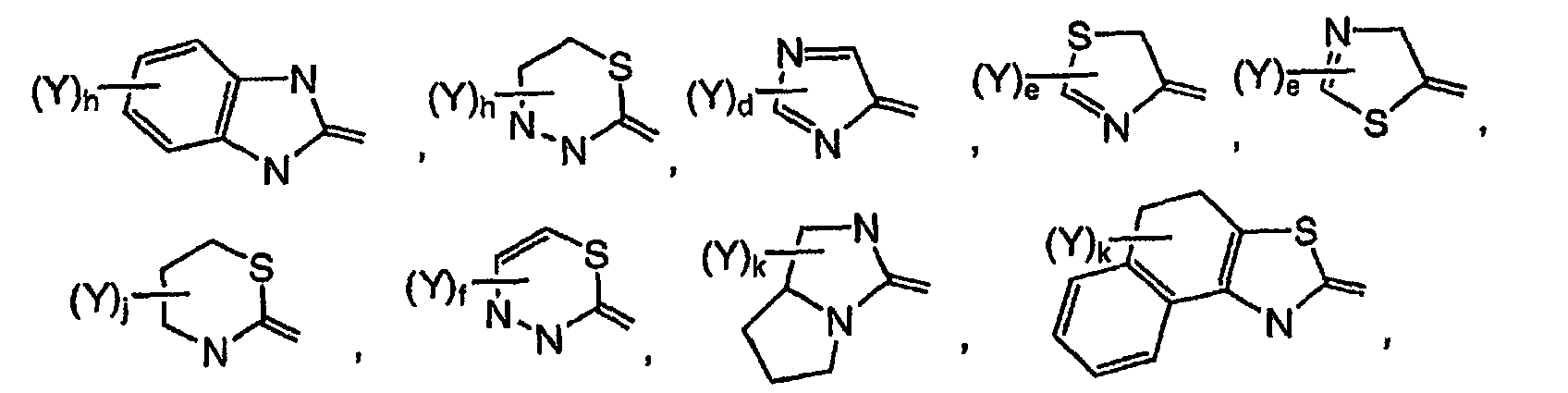
 particularly preferably





 wherein Y, d, e, f, g, h, i, j and k have the same
meanings as above.
wherein Y, d, e, f, g, h, i, j and k have the same
meanings as above.
B may, for example, be -CH2-, -C(=CH-OR4)- or
-C(N=OR4)-.
R1 may, for example, be preferably a hydrogen atom,
methyl, ethyl, n-propyl, i-propyl, n-butyl, i-butyl, s-butyl,
n-pentyl, 3-methylbutyl, n-hexyl and benzyl, more
preferably methyl.
R2 may, for example, be preferably a hydrogen atom,
methyl, ethyl, n-propyl, i-propyl, n-butyl, i-butyl, s-butyl,
n-pentyl, 3-methylbutyl, n-hexyl and benzyl, more
preferably methyl.
R3 may, for example, be preferably a hydrogen atom,
methyl, ethyl, phenyl which may be substituted by Ra and
benzyl which may be substituted by Ra, more preferably a
hydrogen atom, phenyl which may be substituted by Ra, and
methyl.
R4 may, for example, be a hydrogen atom, methyl,
ethyl and benzyl, more preferably methyl.
R5 may, for example, be a hydrogen atom, methyl,
acetyl, phenyl and benzyl, more preferably methyl and
acetyl.
R6 may, for example, be a hydrogen atom, a chlorine
atom, methyl, ethyl, methoxycarbonyl, methylsulfenyl,
phenyl which may be substituted by Ra, and benzyl.
R7 may, for example, be phenyl which may be
substituted by Ra, heteroaryl which may be substituted by
Ra, a hydrogen atom, methyl, ethyl, methoxy, benzyloxy,
acetyl, and benzyl which may be substituted by Ra.
R8 and R9 may, for example, be a hydrogen atom, a
chlorine atom, methyl, ethyl and benzyl.
R10 may, for example, be a hydrogen atom, a chlorine
atom, methyl and methoxy.
R11 may, for example, be a hydrogen atom, methyl and
ethyl.
R12 may, for example, be a hydrogen atom and methyl.
R13 may, for example, be a hydrogen atom, a chlorine
atom, a bromine atom, methyl and methoxy.
Ra may, for example, be preferably a halogen atom, a
C1-C6 alkyl, C1-C6 alkoxy, C1-C6 haloalkyl, C1-C6
haloalkoxy, CN, nitro and C1-C6 alkoxycarbonyl, more
preferably Cl, F, Br, trifluoromethyl, methoxy, ethoxy,
ethyl, propyl and methyl.
Rb may, for example, be preferably a halogen atom,
C1-C6 alkoxy, C1-C6 alkylsulfenyl, phenyl which may be
substituted by Ra, heteroaryl which may be substituted by
Ra, CN, nitro and C1-C6 alkoxycarbonyl.
Rc may, for example, be preferably a halogen atom,
phenyl which may be substituted by Ra, heteroaryl which
may be substituted by Ra, phenylcarbonyl which may be
substituted by Ra, phenylsulfonyl which may be
substituted by Ra, C1-C6 alkyl which may be substituted by
Rb, C2-C6 alkenyl which may be substituted by Rb, C2-C6
alkynyl which may be substituted by Rb, C1-C6 alkoxy which
may be substituted by Rb, C1-C6 alkylsulfenyl which may be
substituted by Rb, CN, nitro, OH, SH, SCN and C1-C6
alkoxycarbonyl.
X may, for example, be preferably a halogen atom, C1-C4
alkyl, C1-C4 alkoxy, C1-C2 haloalkyl, C1-C2 haloalkoxy,
CN, nitro, S-R, NU1U2, phenylcarbonyl which may be
substituted by Ra and C1-C4 alkoxycarbonyl, more
preferably Cl, F, I, Br, methoxy, ethyl, n-propyl, ethoxy,
n-propoxy, chlorodifluoromethyl, trifluoromethyl,
trifluoromethoxy, difluoromethoxy, methoxycarbonyl,
pentafluoroethyl, ethoxycarbonyl, CN, acetyl and methyl.
Y' may, for example, be preferably a hydrogen atom,
a halogen atom, C1-C6 alkyl which may be substituted by Rb,
C1-C6 alkoxy which may be substituted by Rb, phenyl which
may be substituted by Rc, phenoxy which may be
substituted by Rc, phenyl C1-C6 alkyl which may be
substituted by Rc, heteroaryl which may be substituted by
Rc, CN, nitro and C1-C6 alkoxycarbonyl.
U1 and U2 may, for example, be preferably a hydrogen
atom, C1-C4 alkyl, C1-C2 haloalkyl, phenyl, heteroaryl,
C1-C4 alkylcarbonyl and C1-C4 alkoxycarbonyl, more
preferably H, methyl, phenyl, benzyl, acetyl and
methoxycarbonyl.
D may, for example, be preferably a single bond,
-C(=Q2)- and -C(R6)=N-O-.
Q1, Q2 and Q3 may, for example, be preferably =O, =S,
=N-R7 and =CH2.
Q4 and Q5 may, for example, be preferably =O and =S.
G may, for example, be G1, G2 , G3 , G4 , G5 , G6 , G7 and
G8 , preferably G1, G2, G3 and G4 , more preferably G1.
n is preferably 0, 1 or 2.
p is preferably 0 or 1.
Further, the agrochemically acceptable salt of the
heterocyclic imino compound of the present invention may,
for example, be a hydrochloride, a hydrobromide, a
hydroiodide, a formate, an acetate, an ammonium salt, an
isopropylamine salt and an oxalate.
Now, plant diseases to be controlled by the
compounds of the present invention include, for example:
Even at low concentration, the compounds of the
present invention effectively prevent various pests,
which include, for example, so-called agricultural
insect pests that injure agricultural and
horticultural crops and trees, so-called livestock
insect pests that live on livestock and poultry, so-called
sanitary insect pests that have various
negative influences on the human living environment
including houses, so-called stored products insect
pests that injure grains stored in storehouses, and
also acarids, nematodes, molluscs and crustaceans
that live in the same sites as above and injure those
mentioned above.
Examples of insect pests, acarids, nematodes,
molluscs and crustaceans capable of being
exterminated by the compounds of the present
invention are mentioned below, which, however, are
not limitative. Insect pests of Lepidoptera, such as
rice stem borer (Chilo suppressalis Walker), rice
leafroller (Cnaphalocrocis medinalis Guenee), green
rice caterpillar (Naranga aenescens Moore), rice
skipper (Parnara guttata Bremer et Gvey), diamond
back moths (Plutella xylostella Linne), cabbage
armyworms (Mamestra brassicae Linnee), common white
(Pieris rapae crucivora Boisduval), turnip moth
(Agrotis segetum Denis et Schiffermuller), common
cutworm (Spodptera litura Fabricius), beet armyworm
(Spodoptera exigua Hubner), smaller tea tortrix
(Adoxophyes sp.), oriental tea tortrix (Homona
magnanima Diakonoff), peach fruit moth (Carposina
niponensis Walsingham), oriental fruit moth
(Grapholita molesta Busck), summer fruit tortrix
(Adoxophyes orana fasciata Walsingham), apple
leafminers (Phyllonorycter ringoniella Matsumura),
corn earworm (Helicoverpa zea Boddie), tobacco bad
worms (Heliothis virescens Fabricius), European corn
borer (Ostrinia nubilalis Hubner), fall armyworm
(Spodoptera frugiperda J. E. Smith), Codling moth
moth (Cydia pomonella Linnee), fall webworms
(Hyphantria cunea Drury), etc.;
Insect pests of Hemiptera, such as green rice
leafhopper (Nephotettix cincticeps Uhler), brown rice
planthoppers (Nilaparvata lugens Stal), green peach
aphid (Myzus persicae Sulzer), cotton aphid (Aphis
gossypii Glover), greenhouse whitefly (Trialeurodes
vaporariorum Westwood), sweetpotato white fly
(Bemisia tabaci Gennadius), pear psylla (Psylla
pyricola Forster), azalea lace bug (Stephanitis
pyrioides Scott), arrowhead scale (Unaspis yanonensis
Kuwana), comstock mealybug (Pseudococcus comstocki
Kuwana), red wax scale (Ceroplastes rubens Maskell),
brown-marmorated stinkbug (Halyomorpha mista Uhler),
cabbage bug (Eurydema rugosam Motschulsky), bed bug
(Cimex lectularius Linnee), etc.;
Insect pests of Coleoptera, such as twenty-eight-spotted
ladybird (Henosepilachna vigintioctopunctata
Fabricius), cupreous chafers (Anomala cuprea Hope),
ricewater weevil (Lissorhoptrus oryzophilus Kuschel),
sweetpotato weevil (Cylas formicarius Fabricius),
cucurbit leaf beetle (Aulacophora femoralis
Motschulsky), striped flea beetle (Phyllotreta
striolata Fablicius), white-spotted longicorn beetle
(Anoplophora malasiaca Thomson), pine sawyers
(Monochamus alternatus Hope), corn rootworms
(Diabrotica spp.), rice weevil (Sitophilus zeamais
Motschulsky), lesser rice weevil (Sitophilus oryzae
Linne), granary weevils (Sitophilus granarius Linnee),
red four beetle (Tribolium castaneum Herbst), etc.;
Insect pests of Diptera, such as legume leafminer
(Liriomyza trifolii Burgess), seedcorn maggot (Delia
platura Meigen), Hessia fly (Mayetiola destructor
Say), melon fly (Dacus (Zengodacus) cucurbitae
Coquillett), Mediterranear fruit fly (Ceratitis
capitata Wiedemann), house flies (Musca domestica
Linne), stable fly (Stomoxys calcitrans Linne), Sheep
ked (Melophagus orinus), common cattle grub (Hypoderm
lineatum devillers), nothern cattle grub (Hypoderma
boris Linnee), sheep botfly (Oestrus ovis Linnee),
tsetse fly (Golossina palpalis Robineau-Desvoidy),
common gnat (Culex pipiens pallens Coquillett),
yellow-fever mosquitoes (Aedes aegypti Linne),
Anopheles culicifacies), etc.
Insect pests of Hymenoptera, such as cabbage
sawfly (Athalis rosae ruficornis Jakovlev), pine
sawfly (Neodiprion sertifer Geoffroy), chestnut
sawfly (Apethymus kuri Takeuchi), etc.;
Insect pests of Thysanoptera, such as melon
thrips (Thrips palmi Karny), onion thrips (Thrips
tabaci Lindeman), western flower thrips
(Frankliniella occidentalis Pergande), flower thrip
(Frankliniella intonsa Trybom), yellow tea thrip
(Scirtothrips dorsalis Hood), etc.;
Insect pests of Dictyoptera, such as smokybrown
cockroache (Periplaneta fuliginosa Serville),
Japanese cockroach (Periplaneta japonica Karny),
German cockroaches (Blattella germanica Linne), etc.;
Insect pests of Orthoptera, such as oriental
migratory locust (Locusta migratoria Linne), rice
grasshopper (Oxya yezoensis Shiraki), desert locust
(Schistocerca gregaria Forskal), etc.;
Insect pests of Isoptera, such as Formosan
subterranean termit (Coptotermes formosanus Shiraki),
(Reticulitermes (Leucotermes) speratus Kolbe),
(Odontotermes formosanus Shirakif), etc.;
Insect pests of Siphonaptera, such as cat fleas
(Ctenocephalides felis Bouche), human fleas (Pulex
irritans Linne), oriental rat flea (Xenopsylla
cheopis Rothschild), etc.;
Insect pests of Mallophaga, such as Chicken
bodylouse (Menacanthus stramineus Nitsch), cattle
biting louse (Bovicola bovis Linne), etc.;
Insect pests of Anoplura, such as short-nosed
cattle louse (Haematopinus eurysternus Nitzsh), hog
louse (Haematopinus suis Linne), longnosed cattle
louse (Linognathus vituli Linne), little cattle louse
(Solenopotes capillatus Enderlein), etc.
Pests of TETRANYCHIDAE, such as citrus red mite
(Panonychus citri McGregor), European red mite
(Panonychus ulmi Kock), two-spotted spider mite
(Tetranychus urticae Koch), Kanzawa spinder mite
(Tetranychus kanzawai Kishida), etc.;
Pests of ERIOPHYDAE, such as pink citrus rust
mite (Aculops pelekassi Keifor), pear rust mite
(Epitrimerus pyri Nalepa), dry bulb mite (Aceria
tulipae Keiter), pink tea mite (Acaphylla theae watt),
etc.;
Pests of TARSONEMIDAE, such as broad mites
(Polyphagotarsonemus latus Banks), cyclamen mite,
strawberry mite (Steneotarsonemus pallidus Banks),
etc.;
Pests of ACARIDAE, such as mold mite, copra mite,
forage mite (Tyrophagus putrescetiae Schrank), bulb
mite (Rhizoglyphus robini Claparede), etc.;
Pests of VARROIDAE, such as bee brood mite
(Varroa jacobsoni Oudemans), etc.;
Pests of Ixodidae, such as bull ticks (Boophilus
microplus Canestrini), (Haemaphysalis longicornis
Neumann), etc.;
Pests of Sarcoptidae, such as sarcoptes mange
mite (Sarcaptes scabiei Linne), etc.;
Nematodes, such as southern root-knot nematode
(Meloidogyne incognita Kofoid et White), northern
root-knot nematode (Meloidogyne hapla Chitwood), Cobb
root-lesion nematode (Pratylenchus penetraus Cobb),
walnut root-lesion nematode (Pratylenchus vulnus
Allen et Jensen), potato cyst nematode (Globodera
rostochiensis Wollenweber), pine wood nematode
(Bursaphelenchus xylophilus Steiner et Buhrer), etc.;
Mollusca, such as apple snail (Pomacea
canaliculata Lamarck), (Incilaria pilineata Benson),
(Acusta despecta sieboldiana Pfeiffer), (Euhadra
peliomphala Pfeiffer), pillbug (Armadillidium vulgare
Latreille), etc.;
Crustaceans, such as pillbug (Armadillidium
vulgare Latreille), etc.
In addition, the compounds of the present
invention are effective in preventing the attachment
of aquatic organisms, even at extremely low
concentrations. Aquatic organisms to which the
invention is directed are, for example, shellfishes
and algae, such as mussel, barnacle, oyster,
hydrozoan, hydra, Serpula, ascidian, seamoss, Bagula,
mud pond snail, sea lettuce, green laver, Ectocarpus,
etc.
Specifically, the compounds of the present
invention can effectively exterminate various pests
and phytopathogenic microbes of, for example,
Orthoptera, Hemiptera, Lepidoptera, Coleoptera,
Hymenoptera, Diptera, Temitidae, and also mites and
louses, even when used at low concentrations. In
addition, the compounds of the invention are
effective in preventing the attachment of various
aquatic organisms living in sea water and fresh water
to aquatic constructions, etc. On the other hand, the
compounds of the present invention contains useful
compounds that have few negative influences on
mammals, fishes, shellfishes and useful insects.
Now, processes for producing compounds of the
present invention will be described, wherein G in the
above formula (1) is represented by G1.

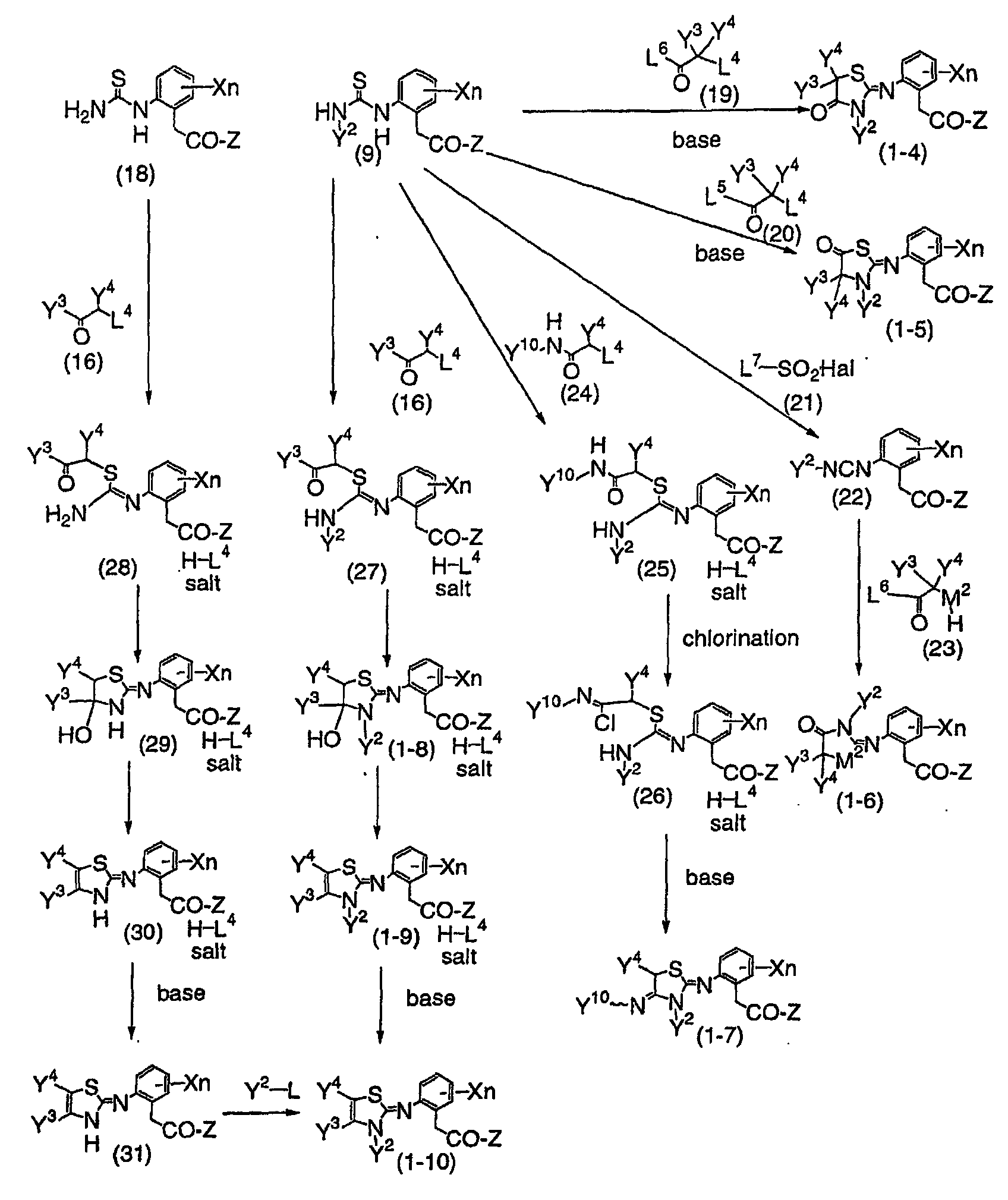


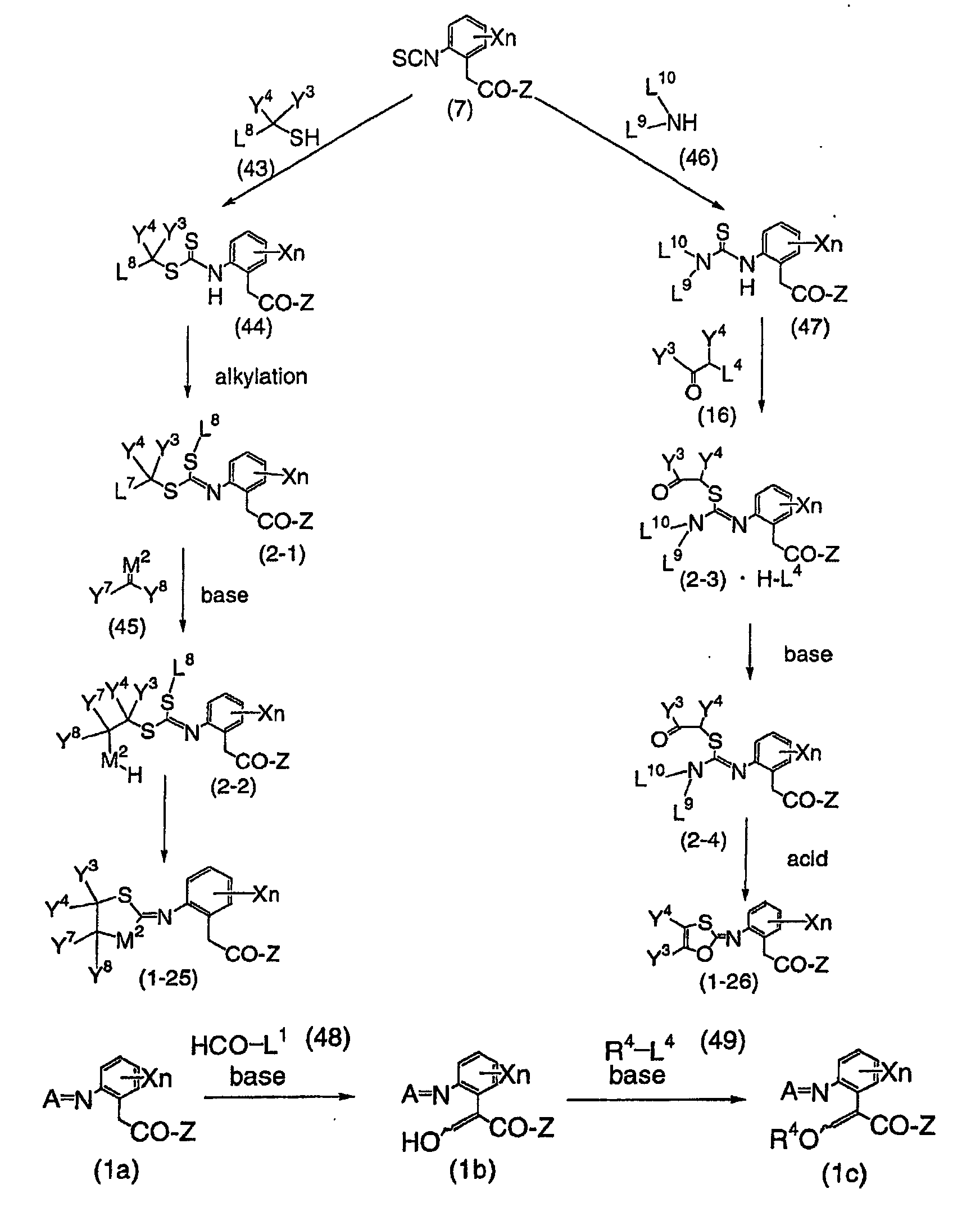
The nitrophenyl acetic acid compound of the formula
(3) as the starting material, can be produced by a known
method disclosed in e.g. a published European patent
application (EP-570817), Synthesis, p. 51 (1993), or J.
Org. Chem., vol. 61, p.5994 (1996). As the method for
producing a compound of the formula (9) from the
nitrophenyl acetic acid compound (3), a method disclosed
in a published European patent application (EP-447118),
Organic Functional Group Preparations, published by
Academic Co., vol. 1, p. 313 (1968), J. Am Chem. Soc.,
vol. 54, p. 781 (1932), Chem. Rev., vol. 55, p. 181
(1955), etc. Namely, by a reduction reaction of the
nitrophenyl acetic acid compound (3), it is converted to
an aminophenyl acetic acid compound (4), which is then
reacted with carbon disulfide in the presence of a base
and converted to a dithiocarbamic acid compound (5).
Further, the dithiocarbamic acid compound (5) is reacted
with an acid halide compound of the formula (6) and
converted to an isothiocyanate compound (7). Then, the
isothiocyanate compound (7) is reacted with an amine
compound of the formula (8) to produce a thiourea
compound (9). At that time, by using ammonia as the
amine compound, a thiourea compound (18) may be produced
in the same manner. Further, the isothiocyanate compound
(7) may also be produced by a method of reacting an
aminophenyl acetic acid compound (4) with a thiocarbonyl
compound of the formula (10). Further, the thiourea
compound (9) may also be produced by a method of reacting
the aminophenyl acetic acid compound (4) with an
isothiocyanate compound of the formula (11). Further,
the thiourea compound (9) may be converted to a
carbodiimide compound (22) by a reaction with a sulfonic
acid halide compound (21) by means of a method disclosed
in Synth. Commun., vol. 25, No. 1, p. 43 (1995).
The compounds (1-1) and (1-2) of the present
invention can be produced by or in accordance with the
method disclosed in Angew. Chem., vol. 80, p.799 (1968)
using an aminophenyl acetic acid compound (4) as the
starting material. Namely, the compound (1-1) of the
present invention can be produced by preliminarily
alkylating a compound of the formula (12) to obtain an
ammonium salt of the formula (13) and reacting it with an
aminophenyl acetic acid compound (4), if necessary in a
solvent, in some cases in the presence of a catalyst.
Likewise, the compound (1-2) of the present invention can
be produced by preliminarily alkylating a compound of the
formula (14) to obtain an oxonium salt or a thioxonium
salt of the formula (15) and reacting it with an
aminophenyl acetic acid compound (4), if necessary in the
presence of a solvent, in some cases in the presence of a
catalyst. The solvent may be any solvent so long as it
is inert to the reaction, and it may, for example, be a
halogenated hydrocarbon such as dichloromethane,
chloroform or 1,2-dichloroethane, an aromatic hydrocarbon
such as benzene, xylene or toluene, an aliphatic
hydrocarbon such as pentane, hexane or cyclohexane, or a
solvent mixture thereof, preferably dichloromethane,
chloroform, 1,2-dichloroethane or the like. The
alkylating agent may, for example, be an alkyl halide
such as methyl iodide, ethyl iodide or benzyl bromide, a
sulfonate such as dimethyl sulfate, diethyl sulfate,
methyl trifluoromethane sulfonate, or a trialkyloxonium
salt such as trimethyloxonium tetrafluoroborate or
triethyloxonium tetrafluoroborate, preferably
trimethyloxonium tetrafluoroborate or the like. The
catalyst may, for example, be silver oxide or silver
trifluoromethane sulfonate. The reaction can be carried
out within a temperature range of from -80°C to the
boiling point of the solvent, preferably within a range
of from 0°C to the boiling point of the solvent. With
respect to the reaction time, it can be carried out
within a range of from 5 minutes to 300 hours, preferably
within a range of from 1 hour to 168 hours. With respect
to the equivalents of the alkylating agent, it may be
used within a range of from 0.5 to 50 equivalents,
preferably within a range of from 1 to 20 equivalents, to
(12) or (14). Further, with respect to the equivalents
of the substrate, (13) or (15) is used within a range of
from 0.5 to 50 equivalents, preferably within a range of
from 1 to 20 equivalents, to (4).
The compound (1-3) of the present invention can be
produced by reacting a dithiocarbamic acid compound (5)
with a ketone compound of the formula (16), if necessary
in the presence of a solvent, in some cases in the
presence of a base, in some cases in the presence of a
catalyst, to convert it to a dithiocarbamate compound
(17), and further reacting it with a dehydrating agent,
if necessary in a solvent, in some cases in the presence
of a catalyst. The solvent may be any solvent so long as
it is inert to the reaction, and it may, for example, be
a lower alcohol such as methanol or ethanol, an ether
such as diethyl ether, tetrahydrofuran or dimethoxyethane,
an aromatic hydrocarbon such as benzene, xylene or
toluene, a halogenated hydrocarbon such as
dichloromethane, chloroform or 1,2-dichloroethane, an
ester such as ethyl acetate, a ketone such as acetone or
methyl ethyl ketone, a nitrile such as acetonitrile or
propionitrile, an amide such as dimethylformamide,
dimethylacetamide, N-methylpyrrolidone or N,N'-dimethylimidazolidinone,
an aliphatic hydrocarbon such as
pentane, hexane or cyclohexane, dimethylsulfoxide or
water, or a solvent mixture thereof, preferably
dichloromethane, chloroform, 1,2-dichloroethane or the
like. The base may, for example, be an organic base such
as triethylamine, tributylamine, pyridine, N-methylpiperidine
or 4-dimethylaminopyridine, or an
inorganic base such as potassium carbonate, sodium
carbonate, sodium hydrogencarbonate, sodium hydroxide,
potassium hydroxide or sodium hydride. As the catalyst,
tetra-N-butylammonium bromide may, for example, be used.
As the dehydrating agent, concentrated sulfuric acid,
dicyclohexylcarbodiimide, phosphorus pentachloride or
phosphorus oxychloride may, for example, be employed.
Further, concentrated sulfuric acid may also be used as
the solvent. With respect to the reaction temperature,
the reaction can be carried out within a range of from
-80°C to the boiling point of the solvent, preferably
within a range of from 0°C to the boiling point of the
solvent. With respect to the reaction time, the reaction
can be carried out within a range of from 5 minutes to
100 hours, preferably within a range of from 1 hour to 48
hours. With respect to the equivalents of the base, it
can be used within a range of from 0.01 to 50 equivalents,
preferably within a range of from 0.1 to 20 equivalents,
to (5). Further, with respect to the equivalents of the
substrate, (16) can be used within a range of from 0.5 to
50 equivalents, preferably within a range of from 1 to 20
equivalents, to (5). With respect to the equivalents of
the dehydrating agent, it can be used within a range of
from 0.1 to 100 equivalents, preferably within a range of
from 1 to 50 equivalents, to (17).
The compound (1-4) of the present invention can be
produced by reacting a thiourea compound (9) with a
carbonyl compound of the formula (19), if necessary in a
solvent, if necessary in the presence of a base, in some
cases in the presence of a catalyst. The solvent may be
any solvent so long as it is inert to the reaction, and
it may, for example, be a lower alcohol such as methanol
or ethanol, an ether such as diethyl ether,
tetrahydrofuran or dimethoxyethane, an aromatic
hydrocarbon such as benzene, xylene or toluene, a
halogenated hydrocarbon such as dichloromethane,
chloroform or 1,2-dichloroethane, an ester such as ethyl
acetate, a ketone such as acetone or methyl ethyl ketone,
a nitrile such as acetonitrile or propionitrile, an amide
such as dimethylformamide, dimethylacetamide or N-methylpyrrolidone,
an aliphatic hydrocarbon such as
pentane, hexane or cyclohexane, dimethylsulfoxide or
water, or a solvent mixture thereof, preferably ethanol,
tetrahydrofuran, chloroform, dimethylformamide or the
like. The base may, for example, be an organic base such
as triethylamine, tributylamine, pyridine, N-methylpiperidine
or 4-dimethylaminopyridine, or an
inorganic base such as potassium carbonate, sodium
carbonate, sodium hydrogencarbonate, sodium hydroxide,
potassium hydroxide or sodium hydride. As the catalyst,
tetra-N-butylammonium bromide may, for example, be
employed. With respect to the reaction temperature, the
reaction can be carried out within a range of from -80°C
to the boiling point of the solvent, preferably within a
range of from 0°C to the boiling point of the solvent.
With respect to the reaction time, the reaction can be
carried out within a range of from 5 minutes to 100 hours,
preferably within a range of from 1 hour to 48 hours.
With respect to the equivalents of the base, it can be
used within a range of from 0.1 to 50 equivalents,
preferably within a range of from 1 to 20 equivalents, to
(9). Further, with respect to the equivalents of the
substrate, (19) can be used within a range of from 0.5 to
50 equivalents, preferably within a range of from 1 to 20
equivalents, to (9).
The compound (1-5) of the present invention can be
produced by reacting a thiourea compound (9) with an acid
halide compound of the formula (20), if necessary in a
solvent, if necessary in the presence of a base, in some
cases in the presence of a catalyst. The solvent may be
any solvent so long as it is inert to the reaction, and
it may, for example, be an ether such as diethyl ether,
tetrahydrofuran or dimethoxyethane, an aromatic
hydrocarbon such as benzene, xylene or toluene, a
halogenated hydrocarbon such as dichloromethane,
chloroform or 1,2-dichloroethane, an ester such as ethyl
acetate, a ketone such as acetone or methyl ethyl ketone,
a nitrile such as acetonitrile or propionitrile, an amide
such as dimethylformamide, dimethylacetamide or N-methylpyrrolidone,
an aliphatic hydrocarbon such as
pentane, hexane or cyclohexane, dimethylsulfoxide or
water, or a solvent mixture thereof, preferably
tetrahydrofuran, chloroform, dimethylformamide or the
like. The base may, for example, be an organic base such
as triethylamine, tributylamine, pyridine, N-methylpiperidine
or 4-dimethylamidepyridine, or an
inorganic base such as potassium carbonate, sodium
carbonate, sodium hydrogencarbonate, sodium hydroxide,
potassium hydroxide or sodium hydride. As the catalyst,
tetra-N-butylammonium bromide may, for example, be
employed. With respect to the reaction temperature, the
reaction can be carried out within a range of from -80°C
to the boiling point of the solvent, preferably within a
range of from 0°C to the boiling point of the solvent.
With respect to the reaction time, it can be carried out
within a range of from 5 minutes to 100 hours, preferably
within a range of from 1 hour to 48 hours. With respect
to the equivalents of the base, it can be used within a
range of from 0.1 to 50 equivalents, preferably within a
range of from 1 to 20 equivalents, to (9). Further, with
respect to the equivalents of the substrate, (20) can be
used within a range of from 0.5 to 50 equivalents,
preferably within a range of from 1 to 20 equivalents, to
(9).
The compound (1-6) of the present invention can be
produced by reacting a carbodiimide compound (22) with a
carbonyl compound (23), if necessary in a solvent, if
necessary in the presence of a base, in some cases in the
presence of a catalyst. The solvent may be any solvent
so long as it is inert to the reaction, and it may, for
example, be an ether such as diethyl ether,
tetrahydrofuran or dimethoxyethane, an aromatic
hydrocarbon such as benzene, xylene or toluene, a
halogenated hydrocarbon such as dichloromethane,
chloroform or 1,2-dichloroethane, an ester such as ethyl
acetate, a ketone such as acetone or methyl ethyl ketone,
a nitrile such as acetonitrile or propionitrile, an amide
such as dimethylformamide, dimethylacetamide or N-methylpyrrolidone,
an aliphatic hydrocarbon such as
pentane, hexane or cyclohexane, dimethylsulfoxide or
water, or a solvent mixture thereof, preferably
dichloromethane, chloroform, 1,2-dichloroethane or the
like. The base may, for example, be an organic base such
as triethylamine, tributylamine, pyridine, N-methylpiperidine
or 4-dimethylaminopyridine, or an
inorganic base such as potassium carbonate, sodium
carbonate, sodium hydrogencarbonate, sodium hydroxide,
potassium hydroxide or sodium hydride. As the catalyst,
tetra-N-butylammonium bromide may, for example, be
employed. With respect to the reaction temperature, the
reaction can be carried out within a range of from -80°C
to the boiling point of the solvent, preferably within a
range of from 0°C to the boiling point of the solvent.
With respect to the reaction time, the reaction can be
carried out within a range of from 5 minutes to 100 hours,
preferably within a range of from 1 hour to 48 hours.
With respect to the equivalents of the base, it can be
used within a range of from 0.01 to 50 equivalents,
preferably within a range of from 1 to 20 equivalents, to
(22). Further, with respect to the equivalents of the
substrate, (23) can be used within a range of from 0.5 to
50 equivalents, preferably within a range of from 1 to 20
equivalents, to (22).
The compound (1-7) of the present invention can be
obtained by reacting a thiourea compound (9) with an
amide compound of the formula (24). Namely, by reacting
the thiourea compound (9) with the amide compound of the
formula (24), if necessary in a solvent, in some cases in
the presence of a catalyst, it can be converted to a
pseudothiourea compound (25). Further, the
pseudothiourea compound (25) can be converted to an
imidoyl chloride compound (26) by treating it with a
halogenating agent, if necessary in a solvent, in some
cases in the presence of catalyst. Further, (26) can be
converted to the compound (1-7) of the present invention
by a reaction, if necessary in a solvent, if necessary in
the presence of a base, in some cases in the presence of
catalyst. Further, by using a base in the reaction of
(25) with the halogenating agent, (1-7) can be obtained
without isolating (26). In the reaction to obtain (25)
from (9), the solvent may be any solvent so long as it is
inert to the reaction, and it may, for example, be a
lower alcohol such as methanol or ethanol, an ether such
as diethyl ether, tetrahydrofuran or dimethoxyethane, an
aromatic hydrocarbon such as benzene, xylene or toluene,
a halogenated hydrocarbon such as dichloromethane,
chloroform or 1,2-dichloroethane, an ester such as ethyl
acetate, a ketone such as acetone or methyl ethyl ketone,
a nitrile such as acetonitrile or propionitrile, an amide
such as dimethylformamide, dimethylacetamide or N-methylpyrrolidone,
an aliphatic hydrocarbon such as
pentane, hexane or cyclohexane, dimethylsulfoxide or
water, or a solvent mixture thereof, preferably ethanol,
tetrahydrofuran, chloroform, 1,2-dichloroethane, ethyl
acetate, acetone, acetonitrile, dimethylformamide, water
or the like. With respect to the reaction temperature,
the reaction can be carried out within a range of from
-80°C to the boiling point of the solvent, preferably
within a range of from 0°C to the boiling point of the
solvent. With respect to the reaction time, the reaction
can be carried out within a range of from 5 minutes to
100 hours, preferably within a range of from 1 hour to 48
hours. With respect to the equivalents of the substrate,
(24) can be used within a range of from 0.5 to 50
equivalents, preferably within a range of from 1 to 20
equivalents, to (9).
In the reaction to obtain (26) from (25), the
solvent may be any solvent so long as it is inert to the
reaction, and it may, for example, be a lower alcohol
such as methanol or ethanol, an ether such as diethyl
ether, tetrahydrofuran or dimethoxyethane, an aromatic
hydrocarbon such as benzene, xylene or toluene, a
halogenated hydrocarbon such as dichloromethane,
chloroform, 1,2-dichloroethane, an ester such as ethyl
acetate, a ketone such as acetone or methyl ethyl ketone,
a nitrile such as acetonitrile or propionitrile, an amide
such as dimethylformamide, dimethylacetamide, N-methylpyrrolidone
or N,N'-dimethylimidazolidinone, an
aliphatic hydrocarbon such as pentane, hexane or
cyclohexane, dimethylsulfoxide or water, or a solvent
mixture thereof, preferably dichloromethane, chloroform,
1,2-dichloroethane or the like. The halogenating agent
may, for example, be tetrachloroethane/triphenylphosphine,
phosphorus oxychloride, phosphorus pentachloride,
phosphorus trichloride, oxalyl chloride, chlorine or N-chlorosuccinimide.
With respect to the reaction
temperature, the reaction can be carried out within a
range of from -80°C to the boiling point of the solvent,
preferably within a range of from 0°C to the boiling
point of the solvent. With respect to the reaction time,
the reaction can be carried out within a range of from 5
minutes to 100 hours, preferably within a range of from 1
hour to 48 hours. With respect to the equivalents of the
chlorinating agent, it can be used within a range of from
0.01 to 50 equivalents, preferably within a range of from
0.1 to 20 equivalents, to (25). In the reaction to
obtain (1-7) from (26), the solvent may be any solvent so
long as it is inert to the reaction, and it may, for
example, be a lower alcohol such as methanol or ethanol,
an ether such as diethyl ether, tetrahydrofuran or
dimethoxyethane, an aromatic hydrocarbon such as benzene,
xylene or toluene, a halogenated hydrocarbon such as
dichloromethane, chloroform or 1,2-dichloroethane, an
ester such as ethyl acetate, a ketone such as acetone or
methyl ethyl ketone, a nitrile such as acetonitrile or
propionitrile, an amide such as dimethylformamide,
dimethylacetamide, N-methylpyrrolidone or N,N'-dimethylimidazolidinone,
an aliphatic hydrocarbon such as
pentane, hexane or cyclohexane, dimethylsulfoxide or
water, or a solvent mixture thereof. The base may, for
example, be an organic base such as triethylamine,
tributylamine, pyridine, N-methylpiperidine or 4-dimethylaminopyridine,
or an inorganic base such as
potassium carbonate, sodium carbonate, sodium
hydrogencarbonate, sodium hydroxide, potassium hydroxide
or sodium hydride. With respect to the reaction
temperature, the reaction can be carried out within a
range of from -80°C to the boiling point of the solvent,
preferably within a range of from 0°C to the boiling
point of the solvent. With respect to the reaction time,
the reaction can be carried out within a range of from 5
minutes to 100 hours, preferably within a range of from 1
hour to 48 hours. With respect to the equivalents of the
base, it can be used within a range of from 0.01 to 50
equivalents, preferably within a range of from 0.1 to 20
equivalents, to (26).
The compound (1-10) of the present invention can be
obtained by reacting a thiourea compound (9) with a
ketone compound of the formula (16). Namely, by reacting
the thiourea compound (9) with the ketone compound of the
formula (16), if necessary in a solvent, in some cases in
the presence of a catalyst, it can be converted to a
pseudothiourea compound (27), Further, the
pseudothiourea compound (27) can be converted to a
hydroxythiazolidine compound (1-8) by a reaction, if
necessary in a solvent, in the presence of an acidic or
basic catalyst. Further, (1-8) can be converted to the
compound (1-9) of the present invention by treating it
with a dehydrating agent, if necessary in a solvent, if
necessary in the presence of a base, in some cases in the
presence of a catalyst. Further, (1-9) can be converted
to a free compound (1-10) by treating it with a base, if
necessary in a solvent. Further, by treatment for a long
time or under heating, or treatment by means of a
catalyst in the reaction of (9) with (16), (1-9) can be
obtained without isolating (27) or (1-8). Further, by
using a base in the reaction of (9) with (16), (1-10) can
be obtained without isolating (27), (1-8) or (1-9).
Further, by using a base in the reaction of (1-8) with
the dehydrating agent, (1-10) can be obtained without
isolating (1-9). Further, it can be obtained also by
treating a thiazolidine compound (31) obtained in the
same manner from a thiourea compound (18) with alkylating
agent, if necessary in a solvent, if necessary in the
presence of a base, in some cases in the presence of a
catalyst.
In the reaction to obtain (1-8) from (9), the
solvent may be any solvent so long as it is inert to the
reaction, and it may, for example, be a lower alcohol
such as methanol or ethanol, an ether such as diethyl
ether, tetrahydrofuran or dimethoxyethane, an aromatic
hydrocarbon such as benzene, xylene or toluene, a
halogenated hydrocarbon such as dichloromethane,
chloroform or 1,2-dichloroethane, an ester such as ethyl
acetate, a ketone such as acetone or methyl ethyl ketone,
a nitrile such as acetonitrile or propionitrile, an amide
such as dimethylformamide, dimethylacetamide or N-methylpyrrolidone,
an aliphatic hydrocarbon such as
pentane, hexane or cyclohexane, dimethylsulfoxide or
water, or a solvent mixture thereof, preferably ethanol,
tetrahydrofuran, chloroform, 1,2-dichloroethane, ethyl
acetate, acetone, acetonitrile, dimethylformamide, water
or the like. The acidic catalyst may, for example, be
hydrochloric acid, hydrobromic acid, hydroiodic acid,
hydrofluoric acid, acetic acid or tetrafluoroboric acid.
The basic catalyst may, for example, be an organic base
such as triethylamine, tributylamine, pyridine, N-methylpiperidine
or 4-dimethylaminopyridine, or an
inorganic base such as potassium carbonate, sodium
carbonate, sodium hydrogencarbonate, sodium hydroxide,
potassium hydroxide or sodium hydride. With respect to
the reaction temperature, the reaction can be carried out
within a range of from -80°C to the boiling point of the
solvent, preferably within a range of from 0°C to the
boiling point of the solvent. With respect to the
reaction time, the reaction can be carried out within a
range of from 5 minutes to 100 hours, preferably within a
range of from 1 hour to 48 hours. With respect to the
equivalents of the substrate, (16) can be used within a
range of from 0.5 to 50 equivalents, preferably within a
range of from 1 to 20 equivalents, to (9). In the
reaction to obtain the compound (1-9) of the present
invention from the hydroxythiazolidine compound (1-8),
the solvent may be any solvent so long as it is inert to
the reaction, and it may, for example, be a lower alcohol
such as methanol or ethanol, an ether such as diethyl
ether, tetrahydrofuran or dimethoxyethane, an aromatic
hydrocarbon such as benzene, xylene or toluene, a
halogenated hydrocarbon such as dichloromethane,
chloroform or 1,2-dichloroethane, an ester such as ethyl
acetate, a ketone such as acetone or methyl ethyl ketone,
a nitrile such as acetonitrile or propionitrile, an amide
such as dimethylformamide, dimethylacetamide, N-methylpyrrolidone
or N,N'-dimethylimidazolidinone, an
aliphatic hydrocarbon such as pentane, hexane or
cyclohexane, dimethylsulfoxide or water, or a solvent
mixture thereof, preferably dichloromethane, chloroform,
1,2-dichloroethane or the like. The base may, for
example, be an organic base such as triethylamine,
tributylamine, pyridine, N-methylpiperidine or 4-dimethylaminopyridine,
or an inorganic base such as
potassium carbonate, sodium carbonate, sodium
hydrogencarbonate, sodium hydroxide, potassium hydroxide
or sodium hydride. Further, pyridine or the like may
also be used as the solvent. As the catalyst, tetra-N-butylammonium
bromide may, for example, be employed. As
the dehydrating agent, methanesulfonyl chloride,
toluenesulfonyl chloride, trifluoromethanesulfonic
anhydride, concentrated sulfuric acid,
dicyclohexylcarbodiimide, phosphorus pentachloride or
phosphorus oxychloride, may, for example, be used.
Further, concentrated sulfuric acid may be used as a
solvent. Further, the reaction may be carried out by
azeotropic dehydration by means of a solvent such as
toluene, benzene or xylene. With respect to the reaction
temperature, the reaction can be carried out within a
range of from -80°C to the boiling point of the solvent,
preferably within a range of from 0°C to the boiling
point of the solvent. With respect to the reaction time,
the reaction can be carried out within a range of from 5
minutes to 100 hours, preferably within a range of from 1
hour to 48 hours. With respect to the equivalents of the
base, it can be used within a range of from 0.01 to 50
equivalents, preferably within a range of from 0.1 to 20
equivalents, to (1-8). With respect to the equivalents
of the dehydrating agent, it can be used within a range
of from 0.1 to 100 equivalents, preferably within a range
of from 1 to 50 equivalents, to (1-8). In the reaction
to obtain (1-10) from (1-9), the solvent may be any
solvent so long as it is inert to the reaction, and it
may, for example, be a lower alcohol such as methanol or
ethanol, an ether such as diethyl ether, tetrahydrofuran
or dimethoxyethane, an aromatic hydrocarbon such as
benzene, xylene or toluene, a halogenated hydrocarbon
such as dichloromethane, chloroform or 1,2-dichloroethane,
an ester such as ethyl acetate, a ketone such as acetone
or methyl ethyl ketone, a nitrile such as acetonitrile or
propionitrile, an amide such as dimethylformamide,
dimethylacetamide, N-methylpyrrolidone or N,N'-dimethylimidazolidinone,
an aliphatic hydrocarbon such as
pentane, hexane or cyclohexane, dimethylsulfoxide or
water, or a solvent mixture thereof. The base may, for
example, be an organic base such as triethylamine,
tributylamine, pyridine, N-methylpiperidine or 4-dimethylaminopyridine,
or an inorganic base such as
potassium carbonate, sodium carbonate, sodium
hydrogencarbonate, sodium hydroxide, potassium hydroxide
or sodium hydride. With respect to the reaction
temperature, the reaction can be carried out within a
range of from -80°C to the boiling point of the solvent,
preferably within a range of from 0°C to the boiling
point of the solvent. With respect to the reaction time,
the reaction can be carried out within a range of from 5
minutes 100 hours, preferably within a range of from 1
hour to 48 hours. With respect to the equivalents of the
base, it can be used within a range of from 0.01 to 50
equivalents, preferably within a range of from 0.1 to 20
equivalents, to (1-9). In the reaction to obtain (1-10)
from (31), the solvent may be any solvent so long as it
is inert to the reaction, and it may, for example, be a
lower alcohol such as methanol or ethanol, an ether such
as diethyl ether, tetrahydrofuran or dimethoxyethane, an
aromatic hydrocarbon such as benzene, xylene or toluene,
a halogenated hydrocarbon such as dichloromethane,
chloroform or 1,2-dichloroethane, an ester such as ethyl
acetate, a ketone such as acetone or methyl ethyl ketone,
a nitrile such as acetonitrile or propionitrile, an amide
such as dimethylformamide, dimethylacetamide, N-methylpyrrolidone
or N,N'-dimethylimidazolidinone, an
aliphatic hydrocarbon such as pentane, hexane or
cyclohexane, dimethylsulfoxide or water, or a solvent
mixture thereof. The base may, for example, be an
organic base such as triethylamine, tributylamine,
pyridine, N-methylpiperidine or 4-dimethylaminopyridine,
or an inorganic base such as potassium carbonate, sodium
carbonate, sodium hydrogencarbonate, sodium hydroxide,
potassium hydroxide or sodium hydride. The alkylating
agent may, for example, be an alkyl halide such as methyl
iodide, ethyl iodide or benzyl bromide, a sulfonate such
as dimethyl sulfate, diethyl sulfate, methyl
trifluoromethane sulfonate, or a trialkyloxonium salt
such as trimethyloxonium tetrafluoroborate or
triethyloxonium tetrafluoroborate, preferably methyl
trifluoromethane sulfonate. With respect to the reaction
temperature, the reaction can be carried out within a
range of from -80°C to the boiling point of the solvent,
preferably within a range of from 0°C to the boiling
point of the solvent. With respect to the reaction time,
the reaction can be carried out within a range of from 5
minutes to 100 hours, preferably within a range of from 1
hour to 48 hours. With respect to the equivalents of the
base, it can be used within a range of from 0.01 to 50
equivalents, preferably within a range of from 0.1 to 20
equivalents, to (31). With respect to the equivalents of
the alkylating agent, it can be used within a range of
from 0.01 to 50 equivalents, preferably within a range of
from 0.1 to 20 equivalents, to (31).
The compounds (1-11) and (1-12) of the present
invention can be produced by the following method.
Namely, by reacting an isothiocyanate compound (7) with a
propargylamine compound of the formula (32), if necessary
in a solvent, if necessary in the presence of a base, in
some cases in the presence of a catalyst, it can be
converted to a propargylthiourea compound of the formula
(33). Further, (33) is treated with a radical-forming
agent, if necessary in a solvent, whereby a mixture of
(1-11) and (1-12) can be obtained. The solvent may be
any solvent so long as it is inert to the reaction, and
it may, for example, be a lower alcohol such as methanol
or ethanol, an ether such as diethyl ether,
tetrahydrofuran or dimethoxyethane, an aromatic
hydrocarbon such as benzene, xylene or toluene, a
halogenated hydrocarbon such as dichloromethane,
chloroform or 1,2-dichloroethane, an ester such as ethyl
acetate, a ketone such as acetone or methyl ethyl ketone,
a nitrile such as acetonitrile or propionitrile, an amide
such as dimethylformamide, dimethylacetamide or N-methylpyrrolidone,
an aliphatic hydrocarbon such as
pentane, hexane or cyclohexane, dimethylsulfoxide or
water, or a solvent mixture thereof, preferably
tetrahydrofuran, chloroform, acetone, acetonitrile or the
like. The base may, for example, be an organic base such
as triethylamine, tributylamine, pyridine, N-methylpiperidine
or 4-dimethylaminopyridine, or an
inorganic base such as potassium carbonate, sodium
carbonate, sodium hydrogencarbonate, sodium hydroxide,
potassium hydroxide or sodium hydride. As the solvent,
tetra-N-butylammonium bromide may, for example, be used.
As the radical-forming agent, trifluoroacetic acid,
oxygen, air, benzoyl peroxide or azobisisobutyronitrile,
may, for example, be used. Further, trifluoroacetic acid
may be used as a solvent. With respect to the reaction
temperature, the reaction can be carried out within a
range of from -80°C to the boiling point of the solvent,
preferably within a range of from 0°C to the boiling
point of the solvent. With respect to the reaction time,
the reaction can be carried out within a range of from 5
minutes to 100 hours, preferably within a range of from 1
hour to 48 hours. With respect to the equivalents of the
base, it can be used within a range of from 0.05 to 150
equivalents, preferably within a range of from 1 to 20
equivalents, to (7). Further, with respect to the
equivalents of the substrate, (32) can be used within a
range of from 0.5 to 50 equivalents, preferably within a
range of from 1 to 20 equivalents, to (7).
The compound (1-13) of the present invention can be
produced by reacting the above-mentioned
propargylthiourea compound (33) with a halogenating agent,
if necessary, in a solvent, if necessary in the presence
of a base, in some cases in the presence of a catalyst.
The solvent may be any solvent so long as it is inert to
the reaction, and it may, for example, be a lower alcohol
such as methanol or ethanol, an ether such as diethyl
ether, tetrahydrofuran or dimethoxyethane, an aromatic
hydrocarbon such as benzene, xylene or toluene, a
halogenated hydrocarbon such as dichloromethane,
chloroform or 1,2-dichloroethane, an ester such as ethyl
acetate, a ketone such as acetone or methyl ethyl ketone,
a nitrile such as acetonitrile or propionitrile, an amide
such as dimethylformamide, dimethylacetamide or N-methylpyrrolidone,
an aliphatic hydrocarbon such as
pentane, hexane or cyclohexane, dimethylsulfoxide or
water, or a solvent mixture thereof, preferably
dichloromethane, chloroform, 1,2-dichloroethane,
acetonitrile or the like. The base may, for example, be
an organic base such as triethylamine, tributylamine,
pyridine, N-methylpiperidine or 4-dimethylaminopyridine,
or an inorganic base such as potassium carbonate, sodium
carbonate, sodium hydrogencarbonate, sodium hydroxide,
potassium hydroxide or sodium hydride. As the catalyst,
tetra-N-butylammonium bromide may, for example, be used.
As the halogenating agent, iodine, bromine, N-bromosuccinimide,
N-chlorosuccinimide, N-iodosuccinimide
or tetrabutylammonium tribromide, may, for example, be
used. With respect to the reaction temperature, the
reaction can be carried out within a range of from -80°C
to the boiling point of the solvent, preferably within a
range of from 0°C to the boiling point of the solvent.
With respect to the reaction time, the reaction can be
carried out within a range of from 5 minutes to 100 hours,
preferably within a range of from 1 hour to 48 hours.
With respect to the equivalents of the base, it can be
used within a range of from 0.01 to 50 equivalents,
preferably within a range of from 1 to 20 equivalents, to
(33). With respect to the equivalents of the
halogenating agent, it can be used within a range of from
0.01 to 50 equivalents, preferably within a range of from
1 to 20 equivalents, to (33).
The compound (1-14) of the present invention can be
obtained by reacting the above (1-13) with an amine
compound, an alcohol compound or a mercaptan compound of
the formula (34), if necessary in a solvent, if necessary
in the presence of a base, in some cases in the presence
of a catalyst. The solvent may be any solvent so long as
it is inert to the reaction, and it may, for example, be
a lower alcohol such as methanol or ethanol, an ether
such as diethyl ether, tetrahydrofuran or dimethoxyethane,
an aromatic hydrocarbon such as benzene, xylene or
toluene, a halogenated hydrocarbon such as
dichloromethane, chloroform or 1,2-dichloroethane, an
ester such as ethyl acetate, a ketone such as acetone or
methyl ethyl ketone, a nitrile such as acetonitrile or
propionitrile, an amide such as dimethylformamide,
dimethylacetamide or N-methylpyrrolidone, an aliphatic
hydrocarbon such as pentane, hexane or cyclohexane,
dimethylsulfoxide or water, or a solvent mixture thereof,
preferably tetrahydrofuran, benzene, chloroform, 1,2-dichloroethane,
acetonitrile or the like. The base may,
for example, be an organic base such as triethylamine,
tributylamine, pyridine, diazabicycloundecene, N-methylpiperidine
or 4-dimethylaminopyridine, or an
inorganic base such as cesium fluoride, potassium
carbonate, sodium carbonate, sodium hydrogencarbonate,
sodium hydroxide, potassium hydroxide or sodium hydride.
As the catalyst, tetra-N-butylammonium bromide may, for
example, be used. With respect to the reaction
temperature, the reaction can be carried out within a
range of from -80°C to the boiling point of the solvent,
preferably within a range of from 0°C to the boiling
point of the solvent. With respect to the reaction time,
the reaction can be carried out within a range of from 5
minutes to 100 hours, preferably within a range of from 1
hour to 48 hours. With respect to the equivalents of the
base, it can be used within a range of from 0.01 to 50
equivalents, preferably within a range of from 1 to 20
equivalents, to (1-13). Further, with respect to the
equivalents of the substrate, (34) can be used within a
range of from 0.5 to 50 equivalents, preferably within a
range of from 1 to 20 equivalents, to (1-13).
The compounds (1-15) and (1-16) of the present
invention can be produced by the following method.
Namely, by reacting an isothiocyanate compound (7) with
an allylamine compound of the formula (35), if necessary
in a solvent, if necessary in the presence of a base, in
some cases in the presence of a catalyst, it can be
converted to an allylthiourea compound of the formula
(36). Further, (36) is treated with a radical-forming
agent, to obtain the compound (1-15) of the present
invention in the case where Y2 is phenyl, or to obtain
the compound (1-16) of the present invention in the case
where Y2 is other than phenyl. The solvent may be any
solvent so long as it is inert to the reaction, and it
may, for example, be a lower alcohol such as methanol or
ethanol, an ether such as diethyl ether, tetrahydrofuran
or dimethoxyethane, an aromatic hydrocarbon such as
benzene, xylene or toluene, a halogenated hydrocarbon
such as dichloromethane, chloroform or 1,2-dichloroethane,
an ester such as ethyl acetate, a ketone such as acetone
or methyl ethyl ketone, a nitrile such as acetonitrile or
propionitrile, an amide such as dimethylformamide,
dimethylacetamide or N-methylpyrrolidone, an aliphatic
hydrocarbon such as pentane, hexane or cyclohexane,
dimethylsulfoxide or water, or a solvent mixture thereof,
preferably tetrahydrofuran, chloroform, acetone,
acetonitrile or the like. The base may, for example, be
an organic base such as triethylamine, tributylamine,
pyridine, N-methylpiperidine or 4-dimethylaminopyridine,
or an inorganic base such as potassium carbonate, sodium
carbonate, sodium hydrogencarbonate, sodium hydroxide,
potassium hydroxide or sodium hydride. As the catalyst,
tetra-N-butylammonium bromide may, for example, be used.
As the radical-forming agent, trifluoroacetic acid,
oxygen, air, benzoyl peroxide or azobisisobutyronitrile,
may, for example, be used. Further, trifluoroacetic acid
may be used as a solvent. With respect to the reaction
temperature, the reaction can be carried out within a
range of from -80°C to the boiling point of the solvent,
preferably within a range of from 0°C to the boiling
point of the solvent. With respect to the reaction time,
the reaction can be carried out within a range of from 5
minutes to 100 hours, preferably within a range of from 1
hour to 48 hours. With respect to the equivalents of the
base, it can be used within a range of from 0.05 to 150
equivalents, preferably within a range of from 1 to 20
equivalents, to (7). Further, with respect to the
equivalents of the substrate, (35) can be used within a
range of from 0.5 to 50 equivalents, preferably within a
range of from 1 to 20 equivalents, to (7).
The compound (1-17) of the present invention can be
produced by treating the above allylthiourea compound
(36) with a halogenating agent, if necessary in a solvent,
if necessary in the presence of a base, in some cases in
the presence of a catalyst. The solvent may be any
solvent so long as it is inert to the reaction, and it
may, for example, be a lower alcohol such as methanol or
ethanol, an ether such as diethyl ether, tetrahydrofuran
or dimethoxyethane, an aromatic hydrocarbon such as
benzene, xylene or toluene, a halogenated hydrocarbon
such as dichloromethane, chloroform or 1,2-dichloroethane,
an ester such as ethyl acetate, a ketone such as acetone
or methyl ethyl ketone, a nitrile such as acetonitrile or
propionitrile, an amide such as dimethylformamide,
dimethylacetamide or N-methylpyrrolidone, an aliphatic
hydrocarbon such as pentane, hexane or cyclohexane,
dimethylsulfoxide or water, or a solvent mixture thereof,
preferably dichloromethane, chloroform, 1,2-dichloroethane,
acetonitrile or the like. The base may,
for example, be an organic base such as triethylamine,
tributylamine, pyridine, N-methylpiperidine or 4-dimethylaminopyridine,
or an inorganic base such as
potassium carbonate, sodium carbonate, sodium
hydrogencarbonate, sodium hydroxide, potassium hydroxide
or sodium hydride. As the catalyst, tetra-N-butylammonium
bromide may, for example, be used. As the
halogenating agent, iodine, bromine, N-bromosuccinimide
or N-chlorosuccinimide may, for example, be used. With
respect to the reaction temperature, the reaction can be
carried out within a range of from -80°C to the boiling
point of the solvent, preferably within a range of from
0°C to the boiling point of the solvent. With respect to
the reaction time, the reaction can be carried out within
a range of from 5 minutes to 100 hours, preferably within
a range of from 1 hour to 48 hours. With respect to the
equivalents of the base, it can be used within a range of
from 0.01 to 50 equivalents, preferably within a range of
from 1 to 20 equivalents, to (36). With respect to the
equivalents of the halogenating agent, it can be used
within a range of from 0.01 to 50 equivalents, preferably
within a range of from 1 to 20 equivalents, to (36).
The compound (1-18) of the present invention can be
obtained by reacting the above (1-17) with an amine
compound, an alcohol compound or a mercaptan compound of
the formula (34), if necessary in a solvent, if necessary
in the presence of a base, in some cases in the presence
of a catalyst. The solvent may be any solvent so long as
it is inert to the reaction, and it may, for example, be
a lower alcohol such as methanol or ethanol, an ether
such as diethyl ether, tetrahydrofuran or dimethoxyethane,
an aromatic hydrocarbon such as benzene, xylene or
toluene, a halogenated hydrocarbon such as
dichloromethane, chloroform or 1,2-dichloroethane, an
ester such as ethyl acetate, a ketone such as acetone or
methyl ethyl ketone, a nitrile such as acetonitrile or
propionitrile, an amide such as dimethylformamide,
dimethylacetamide or N-methylpyrrolidone, an aliphatic
hydrocarbon such as pentane, hexane or cyclohexane,
dimethylsulfoxide or water, or a solvent mixture thereof,
preferably tetrahydrofuran, benzene, chloroform, 1,2-dichloroethane,
acetonitrile or the like. The base may,
for example, be an organic base such as triethylamine,
tributylamine, pyridine, diazabicycloundecene, N-methylpiperidine
or 4-dimethylaminopyridine, or an
inorganic base such as cesium fluoride, potassium
carbonate, sodium carbonate, sodium hydrogencarbonate,
sodium hydroxide, potassium hydroxide or sodium hydride.
As the catalyst, tetra-N-butylammonium bromide may, for
example, be used. With respect to the reaction
temperature, the reaction can be carried out within a
range of from -80°C to the boiling point of the solvent,
preferably within a range of from 0°C to the boiling
point of the solvent. With respect to the reaction time,
the reaction can be carried out within a range of from 5
minutes to 100 hours, preferably within a range of from 1
hour to 48 hours. With respect to the equivalents of the
base, it can be used within a range of from 0.01 to 50
equivalents, preferably within a range of from 1 to 20
equivalents, to (1-17). Further, with respect to the
equivalents of the substrate, (34) can be used within a
range of from 0.5 to 50 equivalents, preferably within a
range of from 1 to 20 equivalents, to (1-17).
The compound (1-19) of the present invention can be
produced by or in accordance with the method disclosed in
Synthesis, p. 896 (1981). Namely, it can be obtained by
reacting an isothiocyanate compound (7) with an olefin
compound of the formula (37), if necessary in a solvent,
if necessary in the presence of a base, in some cases in
the presence of a catalyst. The solvent may be any
solvent so long as it is inert to the reaction, and it
may, for example, be a lower alcohol such as methanol or
ethanol, an ether such as diethyl ether, tetrahydrofuran
or dimethoxyethane, an aromatic hydrocarbon such as
benzene, xylene or toluene, a halogenated hydrocarbon
such as dichloromethane, chloroform or 1,2-dichloroethane,
an ester such as ethyl acetate, a ketone such as acetone
or methyl ethyl ketone, a nitrile such as acetonitrile or
propionitrile, an amide such as dimethylformamide,
dimethylacetamide or N-methylpyrrolidone, an aliphatic
hydrocarbon such as pentane, hexane or cyclohexane,
dimethylsulfoxide or water, or a solvent mixture thereof,
preferably tetrahydrofuran, benzene, chloroform, 1,2-dichloroethane,
acetonitrile or the like. With respect
to the equivalents of the base, it can be used with in a
range of from 0.01 to 50 equivalents, preferably within a
range of from 1 to 20 equivalents, to (7). As the
catalyst, tetra-N-butylammonium bromide may, for example,
be used. With respect to the reaction temperature, the
reaction can be carried out within a range of from -80°C
to the boiling point of the solvent, preferably within a
range of from 0°C to the boiling point of the solvent.
With respect to the reaction time, the reaction can be
carried out within a range of from 5 minutes to 100 hours,
preferably within a range of from 1 hour to 48 hours.
With respect to the equivalents of the base, it can be
used within a range of from 0.01 to 50 equivalents,
preferably within a range of from 1 to 20 equivalents, to
(7). Further, with respect to the equivalents of the
substrate, (37) can be used within a range of from 0.5 to
50 equivalents, preferably within a range of from 1 to 20
equivalents, to (7).
The compound (1-20) of the present invention can be
produced by or in accordance with the method disclosed in
a published West German patent application (DE-3025559).
Namely, by reacting an isothiocyanate compound (7) with a
hydrazine compound of the formula (38), if necessary in a
solvent, in some cases in the presence of a catalyst, it
can be converted to a thiosemicarbazide compound (39).
Further, by reacting it with a carbonyl compound of the
formula (40), if necessary in a solvent, if necessary in
the presence of a base, in some cases in the presence of
a catalyst, it can be converted to an
acylthiosemicarbazide compound (41). Further, the
acylthiosemicarbazide compound (41) is treated with a
dehydrating agent, if necessary in a solvent, in some
cases in the presence of a catalyst, whereby the compound
(1-20) of the present invention can be obtained.
In the reaction to obtain the thiosemicarbazide
compound (39) from the isothiocyanate compound (7), the
solvent may be any solvent so long as it is inert to the
reaction, and it may, for example, be a lower alcohol
such as methanol or ethanol, an ether such as diethyl
ether, tetrahydrofuran or dimethoxyethane, an aromatic
hydrocarbon such as benzene, xylene or toluene, a
halogenated hydrocarbon such as dichloromethane,
chloroform or 1,2-dichloroethane, an ester such as ethyl
acetate, a ketone such as acetone or methyl ethyl ketone,
a nitrile such as acetonitrile or propionitrile, an amide
such as dimethylformamide, dimethylacetamide or N-methylpyrrolidone,
an aliphatic hydrocarbon such as
pentane, hexane or cyclohexane, or dimethylsulfoxide, or
a solvent mixture thereof, preferably tetrahydrofuran,
chloroform, 1,2-dichloroethane, acetone, acetonitrile,
dimethylformamide or the like. As the catalyst, tetra-N-butylammonium
bromide may, for example, be used. With
respect to the reaction temperature, the reaction can be
carried out within a range of from -80°C to the boiling
point of the solvent, preferably within a range of from
0°C to the boiling point of the solvent. With respect to
the reaction time, the reaction can be carried out within
a range of from 5 minutes to 100 hours, preferably within
a range of from 1 hour to 48 hours. With respect to the
equivalents of the substrate, (38) can be used within a
range of from 0.01 to 50 equivalents, preferably within a
range of from 1 to 20 equivalents, to (7).
In the reaction to convert the thiosemicarbazide
compound (39) to the acylthiosemicarbazide compound (41),
the solvent may be any solvent so long as it is inert to
the reaction, and it may, for example, be an ether such
as diethyl ether, tetrahydrofuran or dimethoxyethane, an
aromatic hydrocarbon such as benzene, xylene or toluene,
a halogenated hydrocarbon such as dichloromethane,
chloroform or 1,2-dichloroethane, an ester such as ethyl
acetate, a ketone such as acetone or methyl ethyl ketone,
a nitrile such as acetonitrile or propionitrile, an amide
such as dimethylformamide, dimethylacetamide or N-methylpyrrolidone,
an aliphatic hydrocarbon such as
pentane, hexane or cyclohexane, or dimethylsulfoxide, or
a solvent mixture thereof, preferably tetrahydrofuran,
chloroform, 1,2-dichloroethane, acetone, acetonitrile,
dimethylacetamide or the like. The base may, for example,
be an organic base such as triethylamine, tributylamine,
pyridine, diazabicycloundecene, N-methylpiperidine or 4-dimethylaminopyridine,
or an inorganic base such as
cesium fluoride, potassium carbonate, sodium carbonate,
sodium hydrogencarbonate, sodium hydroxide, potassium
hydroxide or sodium hydride. As the catalyst, tetra-N-butylammonium
bromide may, for example, be used. With
respect to the reaction temperature, the reaction can be
carried out within a range of from -80°C to the boiling
point of the solvent, preferably within a range of from
0°C to the boiling point of the solvent. With respect to
the reaction time, the reaction can be carried out within
a range of from 5 minutes to 100 hours, preferably within
a range of from 1 hour to 48 hours. With respect to the
equivalents of the base, it can be used within a range of
from 0.01 to 50 equivalents, preferably within a range of
from 1 to 20 equivalents, to (39). With respect to the
equivalents of the substrate, (40) can be used within a
range of from 0.01 to 50 equivalents, preferably within a
range of from 1 to 20 equivalents, to (39).
In the reaction to obtain the compound (1-20) of the
present invention from the acylthiosemicarbazide compound
(41), the solvent may be any solvent so long as it is
inert to the reaction, and it may, for example, be a
lower alcohol such as methanol or ethanol, an ether such
as diethyl ether, tetrahydrofuran or dimethoxyethane, an
aromatic hydrocarbon such as benzene, xylene or toluene,
a halogenated hydrocarbon such as dichloromethane,
chloroform or 1,2-dichloroethane, an ester such as ethyl
acetate, a ketone such as acetone or methyl ethyl ketone,
a nitrile such as acetonitrile or propionitrile, an amide
such as dimethylformamide, dimethylacetamide or N-methylpyrrolidone,
an aliphatic hydrocarbon such as
pentane, hexane or cyclohexane, or dimethylsulfoxide, or
a solvent mixture thereof, preferably benzene, xylene,
chloroform or the like. As the catalyst, tetra-N-butylammonium
bromide may, for example, be used. As the
dehydrating agent, concentrated sulfuric acid,
dicyclohexylcarbodiimide, phosphorus pentachloride or
phosphorus oxychloride, may, for example, be employed.
Further, concentrated sulfuric acid may be used also as a
solvent. With respect to the reaction temperature, the
reaction can be carried out within a range of from -80°C
to the boiling point of the solvent, preferably within a
range of from 0°C to the boiling point of the solvent.
With respect to the reaction time, the reaction can be
carried out within a range of from 5 minutes to 100 hours,
preferably within a range of from 1 hour to 48 hours.
With respect to the equivalents of the dehydrating agent,
the dehydrating agent can be used within a range of from
0.01 to 50 equivalents, preferably within a range of from
1 to 20 equivalents, to (41).
The compound (1-21) of the present invention can be
produced by or in accordance with the method disclosed in
a published West German patent application (DE-3025559).
Namely, it can be obtained by reacting the above-mentioned
acylthiosemicarbazide compound (41) with an
alkylating agent, if necessary in a solvent, if necessary
in the presence of a base, in some cases in the presence
of a catalyst. The solvent may be any solvent so long as
it is inert to the reaction, and it may, for example, be
a lower alcohol such as methanol or ethanol, an ether
such as diethyl ether, tetrahydrofuran or dimethoxyethane,
an aromatic hydrocarbon such as benzene, xylene or
toluene, a halogenated hydrocarbon such as
dichloromethane, chloroform or 1,2-dichloroethane, an
ester such as ethyl acetate, a ketone such as acetone or
methyl ethyl ketone, a nitrile such as acetonitrile or
propionitrile, an amide such as dimethylformamide,
dimethylacetamide or N-methylpyrrolidone, an aliphatic
hydrocarbon such as pentane, hexane or cyclohexane,
dimethylsulfoxide or water, or a solvent mixture thereof,
preferably ethanol, tetrahydrofuran, chloroform, 1,2-dichloroethane,
dimethylacetamide or the like. The
alkylating agent may, for example, be an alkyl halide
such as methyl iodide, ethyl iodide or benzyl bromide, a
sulfonate such as dimethyl sulfate, diethyl sulfate,
methyl trifluoromethanesulfonate, or a trialkyloxonium
salt such as trimethyloxonium tetrafluoroborate or
triethyloxonium tetrafluoroborate. As the catalyst,
tetra-N-butylammonium bromide, may, for example, be used.
With respect to the reaction temperature, the reaction
can be carried out within a range of from -80°C to the
boiling point of the solvent, preferably within a range
of from 0°C to the boiling point of the solvent. With
respect to the reaction time, the reaction can be carried
out within a range of from 5 minutes to 100 hours,
preferably within a range of from 1 hour to 48 hours.
With respect to the equivalents of the alkylating agent,
the alkylating agent can be used within a range of from
0.01 to 50 equivalents, preferably within a range of from
1 to 20 equivalents, to (41).
The compound (1-22) of the present invention can be
obtained by reacting the above-mentioned
thiosemicarbazide compound (39) with a ketone compound of
the formula (16), if necessary in a solvent, if necessary
in the presence of a base, in some cases in the presence
of a catalyst. The solvent may be any solvent so long as
it is inert to the reaction, and it may, for example, be
a lower alcohol such as methanol or ethanol, an ether
such as diethyl ether, tetrahydrofuran or dimethoxyethane,
an aromatic hydrocarbon such as benzene, xylene or
toluene, a halogenated hydrocarbon such as
dichloromethane, chloroform or 1,2-dichloroethane, an
ester such as ethyl acetate, a ketone such as acetone or
methyl ethyl ketone, a nitrile such as acetonitrile or
propionitrile, an amide such as dimethylformamide,
dimethylacetamide or N-methylpyrrolidone, an aliphatic
hydrocarbon such as pentane, hexane or cyclohexane,
dimethylsulfoxide or water, or a solvent mixture thereof,
preferably, ethanol, tetrahydrofuran, chloroform, 1,2-dichloroethane,
acetone, acetonitrile, dimethylformamide
or the like. The base may, for example, be an organic
base such as triethylamine, tributylamine, pyridine, N-methylpiperidine
or 4-dimethylaminopyridine, or an
inorganic base such as potassium carbonate, sodium
carbonate, sodium hydrogencarbonate, sodium hydroxide,
potassium hydroxide or sodium hydride. As the catalyst,
tetra-N-butylammonium bromide may, for example, be used.
With respect to the reaction temperature, the reaction
can be carried out within a range of from -80°C to the
boiling point of the solvent, preferably within a range
of from 0°C to the boiling point of the solvent. With
respect to the reaction time, the reaction can be carried
out within a range of from 5 minutes to 100 hours,
preferably within a range of from 1 hour to 48 hours.
With respect to the equivalents of the base, it can be
used within a range of from 0.05 to 150 equivalents,
preferably within a range of from 1 to 20 equivalents, to
(39). Further, with respect to the equivalents of the
substrate, (16) can be used within a range of from 0.5 to
50 equivalents, preferably within a range of from 1 to 20
equivalents, to (39).
The compound (1-23) of the present invention can be
obtained by reacting an isothiocyanate compound (7) with
a hydrazine compound of the formula (42), if necessary in
a solvent, in some cases in the presence of a catalyst,
to convert it to a thiosemicarbazide compound (43), and
then further reacting it with a ketone compound of the
formula (16), if necessary in a solvent, if necessary in
the presence of a base, in some cases in the presence of
a catalyst. In the reaction to obtain the
thiosemicarbazide compound (43) from the isothiocyanate
compound (7), the solvent may be any solvent so long as
it is inert to the reaction, and it may, for example, be
a lower alcohol such as methanol or ethanol, an ether
such as diethyl ether, tetrahydrofuran or dimethoxyethane,
an aromatic hydrocarbon such as benzene, xylene or
toluene, a halogenated hydrocarbon such as
dichloromethane, chloroform or 1,2-dichloroethane, an
ester such as ethyl acetate, a ketone such as acetone or
methyl ethyl ketone, a nitrile such as acetonitrile or
propionitrile, an amide such as dimethylformamide,
dimethylacetamide or N-methylpyrrolidone, an aliphatic
hydrocarbon such as pentane, hexane or cyclohexane, or
dimethylsulfoxide, or a solvent mixture thereof,
preferably ethanol, tetrahydrofuran, chloroform,
acetonitrile or the like. As the catalyst, tetra-N-butylammonium
bromide may, for example, be used. With
respect to the reaction temperature, the reaction can be
carried out within a range of from -80°C to the boiling
point of the solvent, preferably within a range of from
0°C to the boiling point of the solvent. With respect to
the reaction time, the reaction can be carried out within
a range of from 5 minutes to 100 hours, preferably within
a range of from 1 hour to 48 hours. With respect to the
equivalents of the substrate, (42) can be used within a
range of from 0.01 to 50 equivalents, preferably within a
range of from 1 to 20 equivalents, to (7). In the
reaction to obtain the compound (1-23) of the present
invention from the thiosemicarbazide compound (43), the
solvent may be any solvent so long as it is inert to the
reaction, and it may, for example, be a lower alcohol
such as methanol or ethanol, an ether such as diethyl
ether, tetrahydrofuran or dimethoxyethane, an aromatic
hydrocarbon such as benzene, xylene or toluene, a
halogenated hydrocarbon such as dichloromethane,
chloroform or 1,2-dichloroethane, an ester such as ethyl
acetate, a ketone such as acetone or methyl ethyl ketone,
a nitrile such as acetonitrile or propionitrile, an amide
such as dimethylformamide, dimethylacetamide or N-methylpyrrolidone,
an aliphatic hydrocarbon such as
pentane, hexane or cyclohexane, dimethylsulfoxide or
water, or a solvent mixture thereof, preferably
tetrahydrofuran, benzene, xylene, chloroform,
dimethylacetamide, N-methylpyrrolidone or the like. The
base may, for example, be an organic base such as
triethylamine, tributylamine, pyridine, N-methylpiperidine
or 4-dimethylaminopyridine, or an
inorganic base such as potassium carbonate, sodium
carbonate, sodium hydrogencarbonate, sodium hydroxide,
potassium hydroxide or sodium hydride. As the catalyst,
tetra-N-butylammonium bromide may, for example, be used.
With respect to the reaction temperature, the reaction
can be carried out within a range of from -80°C to the
boiling of the solvent, preferably within a range of from
0°C to the boiling point of the solvent. With respect to
the reaction time, the reaction can be carried out within
a range of from 5 minutes to 100 hours, preferably within
a range of from 1 hour to 48 hours. With respect to the
equivalents of the base, it can be used within a range of
from 0.05 to 150 equivalents, preferably within a range
of from 1 to 20 equivalents, to (43). Further, with
respect to the equivalents of the substrate, (16) can be
used within a range of from 0.5 to 50 equivalents,
preferably within a range of from 1 to 20 equivalents, to
(43).
The compound (1-24) of the present invention can be
produced by reacting the above-mentioned
thiosemicarbazide compound (43) with a carbonyl compound
of the formula (19), if necessary in a solvent, if
necessary in the presence of a base, in some cases in the
presence of a catalyst. The solvent may be any solvent
so long as it is inert to the reaction, and it may, for
example, be a lower alcohol such as methanol or ethanol,
an ether such as diethyl ether, tetrahydrofuran or
dimethoxyethane, an aromatic hydrocarbon such as benzene,
xylene or toluene, a halogenated hydrocarbon such as
dichloromethane, chloroform or 1,2-dichloroethane, an
ester such as ethyl acetate, a ketone such as acetone or
methyl ethyl ketone, a nitrile such as acetonitrile or
propionitrile, an amide such as dimethylformamide,
dimethylacetamide or N-methylpyrrolidone, an aliphatic
hydrocarbon such as pentane, hexane or cyclohexane,
dimethylsulfoxide or water, or a solvent mixture thereof,
preferably ethanol, tetrahydrofuran, chloroform,
dimethylformamide or the like. The base may, for example,
be an organic base such as triethylamine, tributylamine,
pyridine, N-methylpiperidine or 4-dimethylaminopyridine,
or an inorganic base such as potassium carbonate, sodium
carbonate, sodium hydrogencarbonate, sodium hydroxide,
potassium hydroxide or sodium hydride. As the catalyst,
tetra-N-butylammonium bromide may, for example, be used.
With respect to the reaction temperature, the reaction
can be carried out within a range of from -80°C to the
boiling point of the solvent, preferably within a range
of from 0°C to the boiling point of the solvent. With
respect to the reaction time, the reaction can be carried
out within a range of from 5 minutes to 100 hours,
preferably within a range of from 1 hour to 48 hours.
With respect to the equivalents of the base, it can be
used within a range of from 0.1 to 50 equivalents,
preferably within a range of from 1 to 20 equivalents, to
(43). Further, with respect to the equivalents of the
substrate, (19) can be used with in a range of from 0.5
to 50 equivalents, preferably within a range of from 1 to
20 equivalents, to (43).
The compound (1-25) of the present invention can be
produced by or in accordance with the method disclosed in
Heterocycles, vol. 50, p. 195 (1999). Namely, by
reacting an isothiocyanate compound (7) with a mercaptan
compound of the formula (43), if necessary in a solvent,
if necessary in the presence of a base, in some cases in
the presence of a catalyst, to form a dithiocarbamate
compound (44), followed by treatment with an alkylating
agent, if necessary in a solvent, if necessary in the
presence of a base, in some cases in the presence of a
catalyst, to convert it to a dithioacetal compound (2-1).
Further, the dithioacetal compound (2-1)is reacted with a
carbonyl compound of the formula (45), if necessary in a
solvent, if necessary in the presence of a base, in some
cases in the presence of a catalyst, to obtain a mixture
of (2-2) and (1-25). Further, in the reaction to obtain
(2-1) from (7), (2-1) can be obtained without isolating
(44). Further, in the reaction to obtain (1-25) from (2-1),
(1-25) can be obtained without isolating (2-2) by
heating or reacting for a long time. Further, the
isolated (2-2) may be reacted or heat-treated, if
necessary in a solvent, if necessary in the presence of a
base, in some cases in the presence of a catalyst, to
convert it to (1-25). In the reaction to obtain (2-1)
from (7), the solvent may be any solvent so long as it is
inert to the reaction, and it may, for example, be a
lower alcohol such as methanol or ethanol, an ether such
as diethyl ether, tetrahydrofuran or dimethoxyethane, an
aromatic hydrocarbon such as benzene, xylene or toluene,
a halogenated hydrocarbon such as dichloromethane,
chloroform or 1,2-dichloroethane, an ester such as ethyl
acetate, a ketone such as acetone or methyl ethyl ketone,
a nitrile such as acetonitrile or propionitrile, an amide
such as dimethylformamide, dimethylacetamide or N-methylpyrrolidone,
an aliphatic hydrocarbon such as
pentane, hexane or cyclohexane, dimethylsulfoxide or
water, or a solvent mixture thereof, preferably,
tetrahydrofuran, benzene, toluene, dichloromethane,
chloroform, 1,2-dichloroethane, acetone, acetonitrile,
dimethylacetamide or the like. The base may, for example,
be an organic base such as triethylamine, tributylamine,
pyridine, diazabicycloundecene, N-methylpiperidine or 4-dimethylaminopyridine,
or an inorganic base such as
potassium carbonate, sodium carbonate, sodium
hydrogencarbonate, sodium hydroxide, potassium hydroxide
or sodium hydride. As the catalyst, tetra-N-butylammonium
bromide may, for example, be used. The
alkylating agent may, for example, be an alkyl halide
such as methyl iodide, ethyl iodide or benzyl bromide, a
sulfonate such as dimethyl sulfate, diethyl sulfate,
methyl trifluoromethanesulfonate, or a trialkyloxonium
salt such as trimethyloxonium tetrafluoroborate or
triethyloxonium tetrafluoroborate. With respect to the
reaction temperature, the reaction can be carried out
within a range of from -80°C to the boiling point of the
solvent, preferably within a range of from 0°C to the
boiling point of the solvent. With respect to the
reaction time, the reaction can be carried out within a
range of from 5 minutes to 100 hours, preferably within a
range of from 1 hour to 48 hours. With respect to the
equivalents of the base, it can be used within a range of
from 0.01 to 50 equivalents, preferably within a range of
from 1 to 20 equivalents, to (7). Further, it can be
used within a range of from 0.01 to 50 equivalents,
preferably within a range of from 1 to 20 equivalent, to
(44). With respect to the equivalents of the substrate,
(43) can be used within a range of from 0.01 to 50
equivalents, preferably within a range of from 1 to 20
equivalents, to (7). Further, the alkylating agent can
be used within a range of from 0.01 to 50 equivalents,
preferably within a range of from 1 to 20 equivalents, to
(44).
In the reaction to obtain (1-25) from (2-1), the
solvent may be any solvent so long as it is inert to the
reaction, and it may, for example, be a lower alcohol
such as methanol or ethanol, an ether such as diethyl
ether tetrahydrofuran or dimethoxyethane, an aromatic
hydrocarbon such as benzene, xylene or toluene, a
halogenated hydrocarbon such as dichloromethane,
chloroform or 1,2-dichloroethane, an ester such as ethyl
acetate, a ketone such as acetone or methyl ethyl ketone,
a nitrile such as acetonitrile or propionitrile, an amide
such as dimethylformamide, dimethylacetamide or N-methylpyrrolidone,
an aliphatic hydrocarbon such as
pentane, hexane or cyclohexane, or dimethylsulfoxide or a
solvent mixture thereof, preferably tetrahydrofuran,
xylene, toluene or the like. The base may, for example,
be an organic base such as triethylamine, tributylamine,
pyridine, diazabicycloundecene, N-methylpiperidine or 4-dimethylaminopyridine,
or an inorganic base such as
cesium fluoride, potassium carbonate, sodium carbonate,
sodium hydrogencarbonate, sodium hydroxide, potassium
hydroxide or sodium hydride. As the catalyst, tetra-N-butylammonium
bromide may, for example, be used. With
respect to the reaction temperature, the reaction can be
carried out within a range of from -80°C to the boiling
point of the solvent, preferably within a range of from
0°C to the boiling point of the solvent. With respect to
the reaction time, the reaction can be carried out within
a range of from 5 minutes to 100 hours, preferably within
a range of from 1 hour to 48 hours. With respect to the
equivalents of the base, it can be used within a range of
from 0.01 to 50 equivalents, preferably within a range of
from 1 to 20 equivalents, to (2-1). With respect to the
equivalents of the substrate, (45) can be used within a
range of from 0.01 to 50 equivalents, preferably within a
range of from 1 to 20 equivalents, to (2-1).
The compound (1-26) of the present invention can be
produced by or in accordance with the method disclosed in
JP-A-55-108869 and Chemistry Letters, p. 1705 (1988).
Namely, by reacting the isothiocyanate compound (7) with
an amine compound of the formula (46), if necessary in a
solvent, in some cases in the presence of a catalyst, it
can be converted to a thiourea compound (47). Further,
the thiourea compound (47) can be converted to a
pseudothiourea compound (2-3) by reacting it with a
ketone compound of the formula (16), if necessary in a
solvent, if necessary in the presence of a base, in some
cases in the presence of a catalyst. Further, (2-3) can
be converted to a free compound (2-4) by treating it with
a base, if necessary in a solvent. Further, (2-4) can be
converted to the compound (1-26) of the present invention
by treating it with an acid, if necessary in a solvent.
Further, (2-4) can be obtained without isolating (2-3) by
using the base excessively in the reaction of the
thiourea compound (47) with the ketone (16). Further,
(1-26) can be obtained without isolating (2-3) and (2-4)
by heat treatment or reaction for a long time in the
reaction of the thiourea compound (47) with the ketone
(16). In the reaction to obtain the thiourea compound
(47) from the isothiocyanate compound (7), the solvent
may be any solvent so long as it is inert to the reaction,
and it may, for example, be a lower alcohol such as
methanol or ethanol, an ether such as diethyl ether,
tetrahydrofuran or dimethoxyethane, an aromatic
hydrocarbon such as benzene, xylene or toluene, a
halogenated hydrocarbon such as dichloromethane,
chloroform or 1,2-dichloroethane, an ester such as ethyl
acetate, a ketone such as acetone or methyl ethyl ketone,
a nitrile such as acetonitrile or propionitrile, an amide
such as dimethylformamide, dimethylacetamide or N-methylpyrrolidone,
an aliphatic hydrocarbon such as
pentane, hexane or cyclohexane, or dimethylsulfoxide, or
a solvent mixture thereof, preferably, tetrahydrofuran,
chloroform, 1,2-dichloroethane, ethyl acetate,
acetonitrile, dimethylacetamide or the like. As the
catalyst, tetra-N-butylammonium bromide may, for example,
be used. With respect to the reaction temperature, the
reaction can be carried out within a range of from -80°C
to the boiling point of the solvent, preferably within a
range of from 0°C to the boiling point of the solvent.
With respect to the reaction time, the reaction can be
carried out within a range of from 5 minutes to 100 hours,
preferably within a range of from 1 hour to 48 hours.
With respect to the equivalents of the substrate, (46)
can be used within a range of from 0.01 to 50 equivalents,
preferably within a range of from 1 to 20 equivalents, to
(7). In the reaction to obtain the compound (1-26) of
the present invention from the thiourea compound (47),
the solvent may be any solvent so long as it is inert to
the reaction, and it may, for example, be a lower alcohol
such as methanol or ethanol, an ether such as diethyl
ether, tetrahydrofuran or dimethoxyethane, an aromatic
hydrocarbon such as benzene, xylene or toluene, a
halogenated hydrocarbon such as dichloromethane,
chloroform or 1,2-dichloroethane, an ester such as ethyl
acetate, a ketone such as acetone or methyl ethyl ketone,
a nitrile such as acetonitrile or propionitrile, an amide
such as dimethylformamide, dimethylacetamide or N-methylpyrrolidone,
an aliphatic hydrocarbon such as
pentane, hexane or cyclohexane, dimethylsulfoxide or
water, or a solvent mixture thereof, preferably,
tetrahydrofuran, chloroform, 1,2-dichloroethane, acetone,
acetonitrile, dimethylformamide or the like. The base
may be an organic base such as triethylamine,
tributylamine, pyridine, N-methylpiperidine or 4-dimethylaminopyridine,
or an inorganic base such as
potassium carbonate, sodium carbonate, sodium
hydrogencarbonate, sodium hydroxide, potassium hydroxide
or sodium hydride. As the catalyst, tetra-N-butylammonium
bromide may, for example, be used. With
respect to the reaction temperature, the reaction can be
carried out within a range of from -80°C to the boiling
point of the solvent, preferably within a range of from
0°C to the boiling point of the solvent. With respect to
the reaction time, the reaction can be carried out within
a range of from 5 minutes to 100 hours, preferably within
a range of from 1 hour to 48 hours. With respect to the
equivalents of the base, it can be used within a range of
from 0.05 to 150 equivalents, preferably within a range
of from 1 to 20 equivalents, to (47). Further, with
respect to the equivalents of the substrate, (16) can be
used within a range of from 0.5 to 50 equivalents,
preferably within a range of from 1 to 20 equivalents, to
(47).
The compound (1a) of the present invention can be
converted to the compound (1b) of the present invention
by reacting it with a formic acid halide compound, a
formic acid ester compound or a formic acid amide
compound of the formula (48) in a solvent in the presence
of a base in some cases in the presence of a catalyst.
Further, (1b) can be converted to the compound (1c) of
the present invention by reacting it with an alkyl halide
or an alkyl sulfate of the formula (49), if necessary in
a solvent, if necessary in the presence of a base, in
some cases in the presence of a catalyst. Further, (1c)
can be synthesized directly without isolating (1b) by
using the base excessively in the reaction to obtain (1b)
from (1a). The solvent may be any solvent so long as it
is inert to the reaction, and it may, for example, be an
ether such as diethyl ether, tetrahydrofuran or
dimethoxyethane, an aromatic hydrocarbon such as benzene,
xylene or toluene, a halogenated hydrocarbon such as
dichloromethane, chloroform or 1,2-dichloroethane, an
ester such as ethyl acetate, a ketone such as acetone or
methyl ethyl ketone, a nitrile such as acetonitrile or
propionitrile, an amide such as dimethylformamide,
dimethylacetamide or N-methylpyrrolidone, an aliphatic
hydrocarbon such as pentane, hexane or cyclohexane,
dimethylsulfoxide or water, or a solvent mixture thereof,
preferably tetrahydrofuran, benzene, xylene, toluene,
dichloromethane, chloroform, 1,2-dichloroethane,
acetonitrile, dimethylformamide or the like. The base
may, for example, be an organic base such as
triethylamine, tributylamine, pyridine, N-methylpiperidine
or 4-dimethylaminopyridine, or an
inorganic base such as potassium carbonate, sodium
carbonate, sodium hydrogencarbonate, sodium hydroxide,
potassium hydroxide or sodium hydride. As the catalyst,
tetra-N-butylammonium bromide may, for example, be used.
With respect to the reaction temperature, the reaction
can be carried out within a range of from -80°C to the
boiling point of the solvent, preferably within a range
of from 0°C to the boiling point of the solvent. With
respect to the reaction time, the reaction can be carried
out within a range of from 5 minutes to 100 hours,
preferably within a range of from 1 hour to 48 hours.
With respect to the equivalents of the base, it can be
used within a range of from 0.05 to 150 equivalents,
preferably within a range of from 1 to 20 equivalents, to
(1a). Further, with respect to the equivalents of the
substrate, (48) can be used within a range of from 0.5 to
50 equivalents, preferably within a range of from 1 to 20
equivalents, to (1a).
A compound of the formula (1) wherein G is one of
the formulae G2 to G14, can be produced in the same manner
by using, as the starting material, a compound having a
group represented by one of the formulae G2 to G14
substituted at the ortho position of the nitrobenzene,
instead of the phenylacetic acid compound as the starting
material.
The compound of the present invention can be
obtained from the reaction solution by a usual method.
However, when it is required to purify the compound of
the present invention, it can be separated and purified
by an optional purification method such as
recrystallization or column chromatography.
Now, examples of compounds covered by the present
invention will be shown in Tables 1 to 8. However, the
compounds of the present invention are not limited
thereto.
Abbreviations in the Tables have the following
meanings, respectively.
Me: methyl group, Et: ethyl group, Pr: propyl group,
Bu: butyl group, Pen: pentyl group, Hex: hexyl group,
Hep: heptyl group, Oct: octyl group, Non: nonyl group,
Dec: decyl group, Undec: undecanyl group, Dodec: dodecyl
group, Ph: phenyl group, n: normal, i: iso, s: secondary,
t: tertiary and c: cyclo.
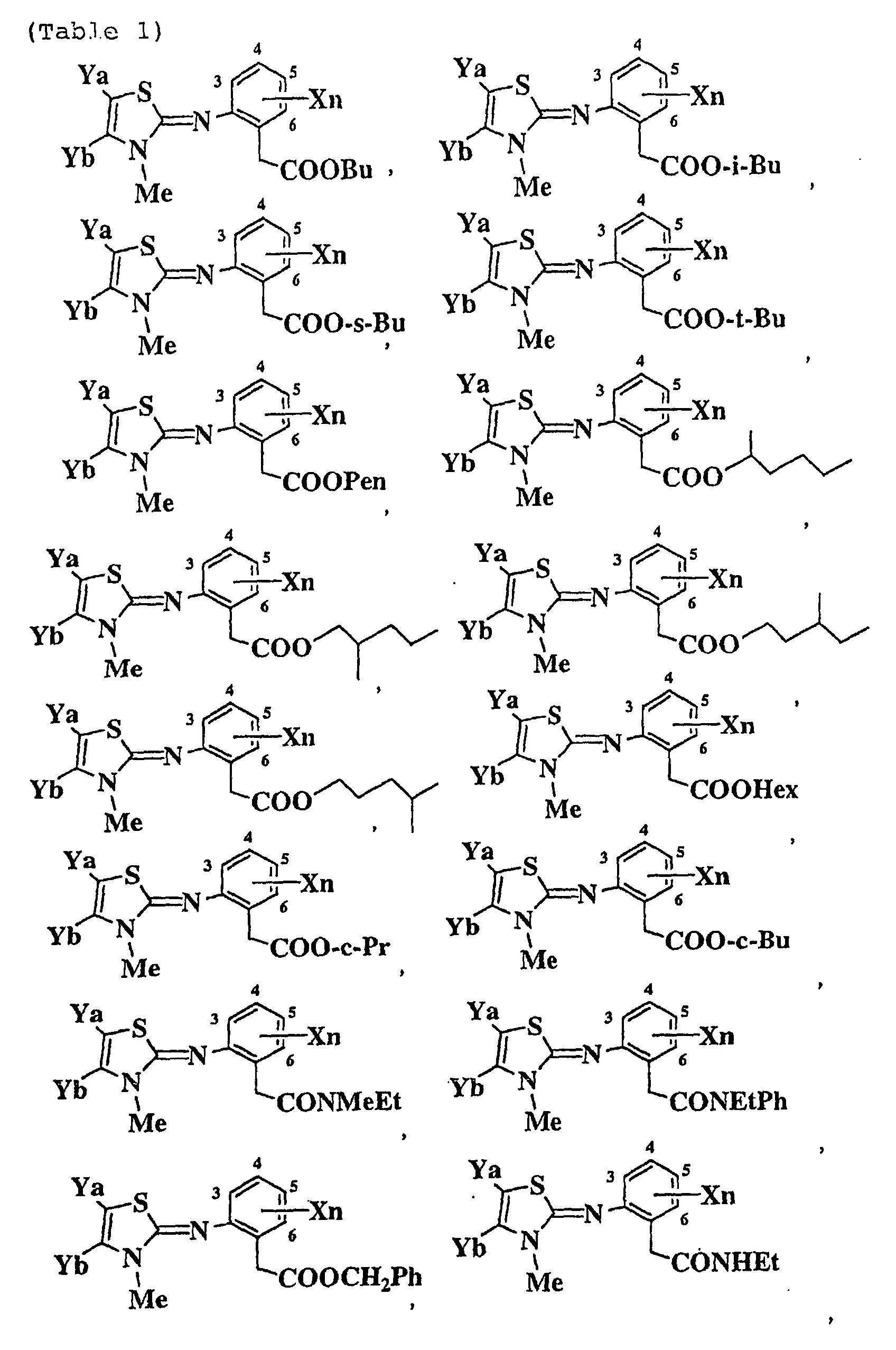
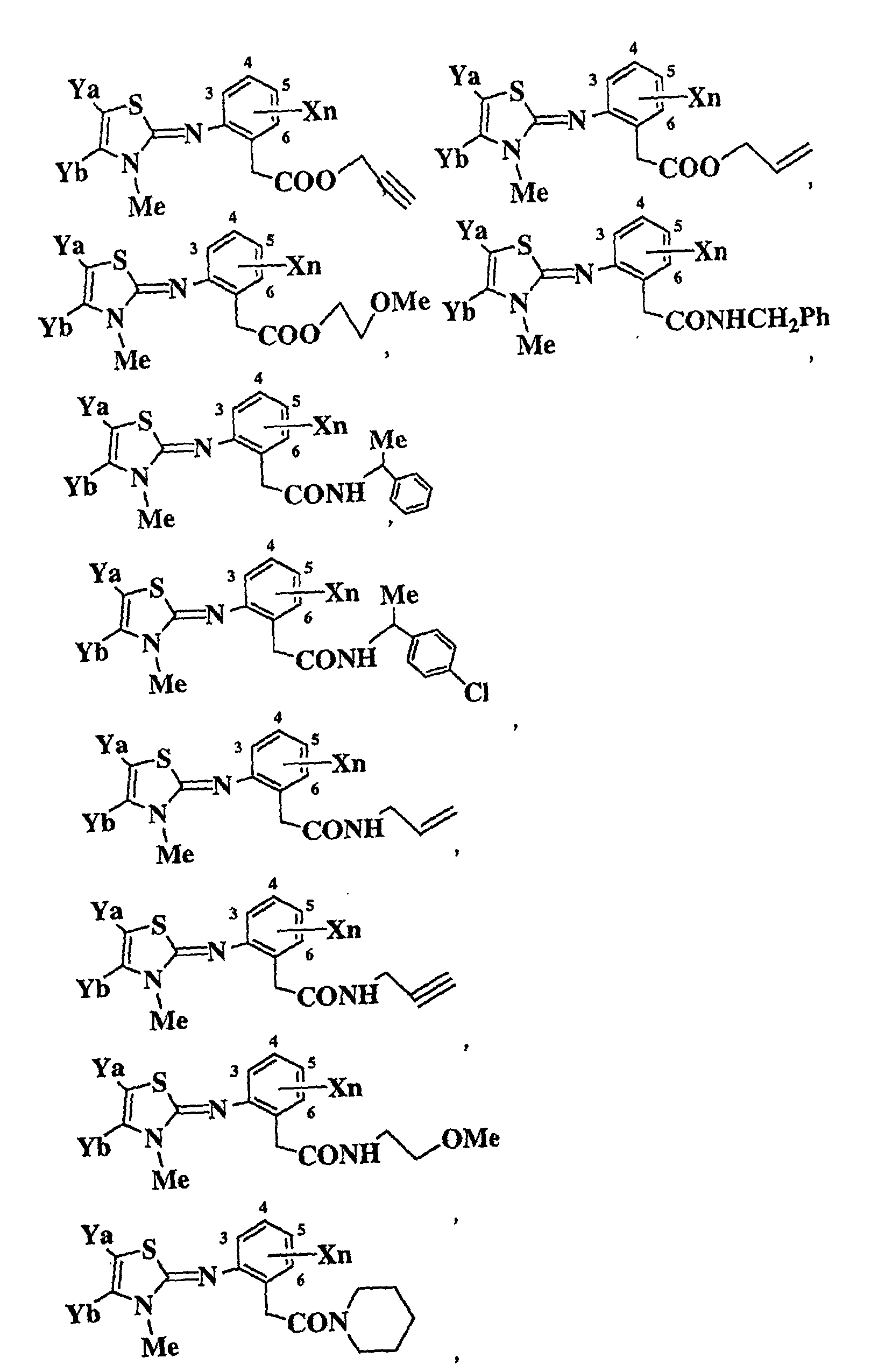
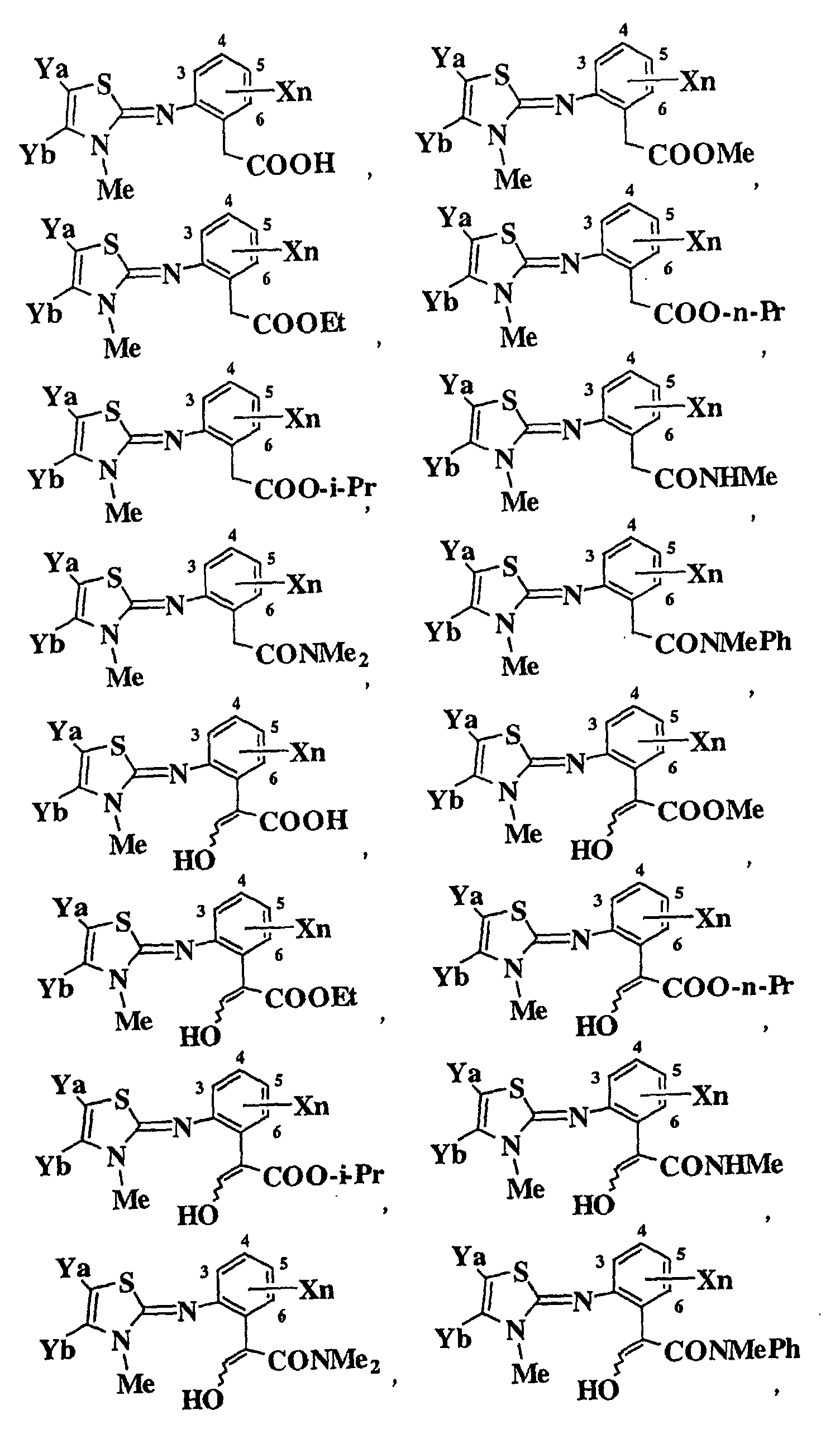
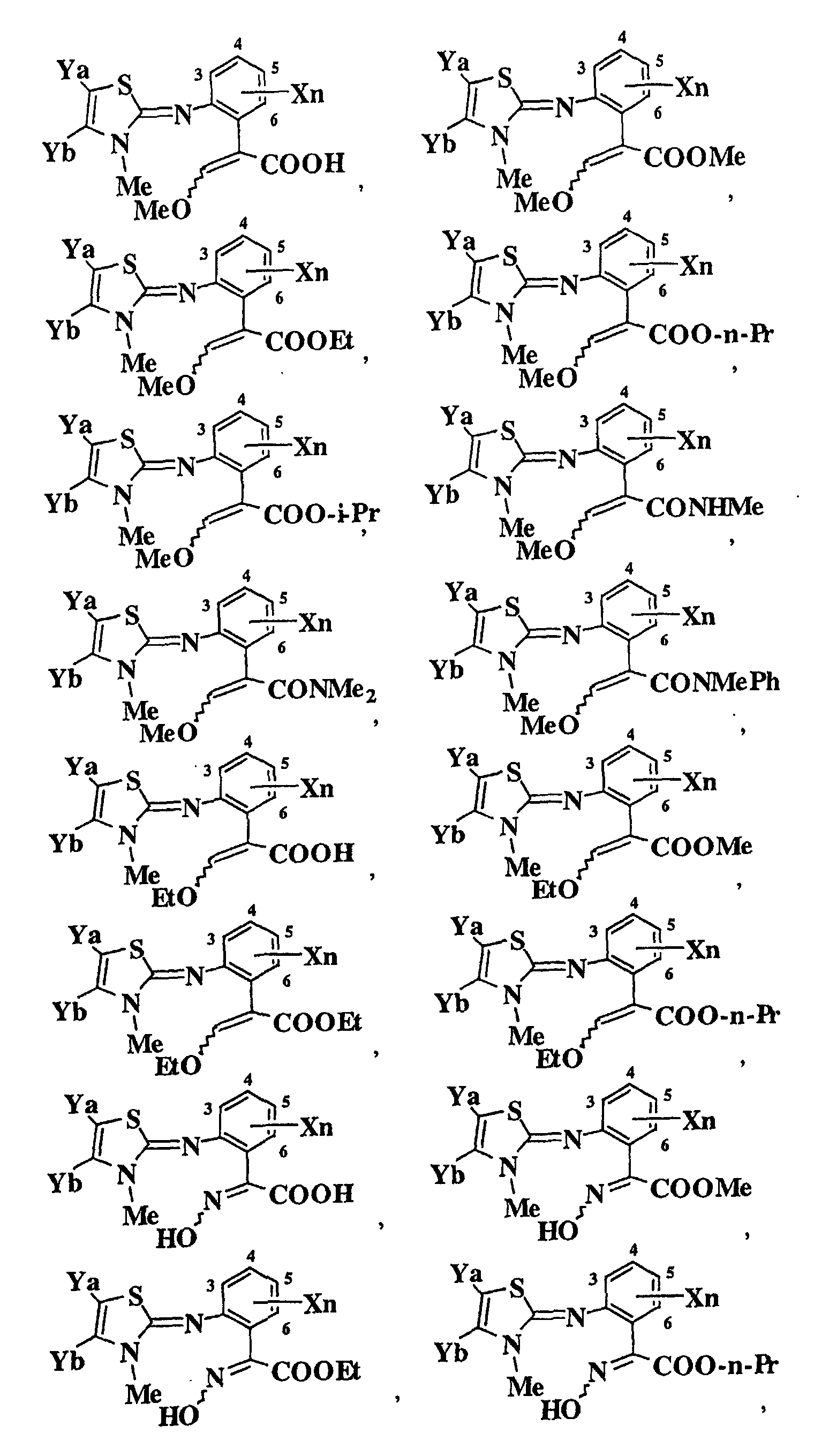

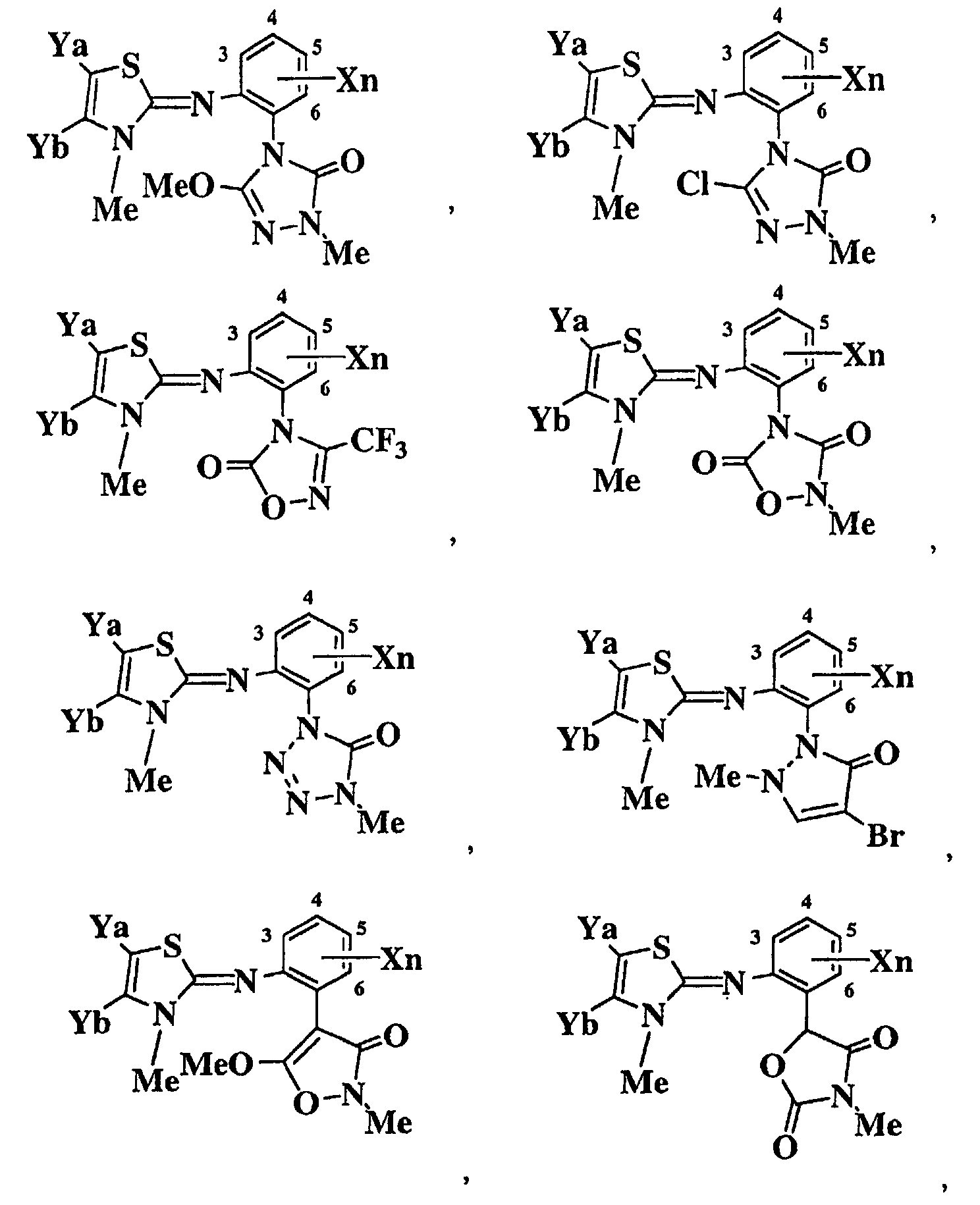
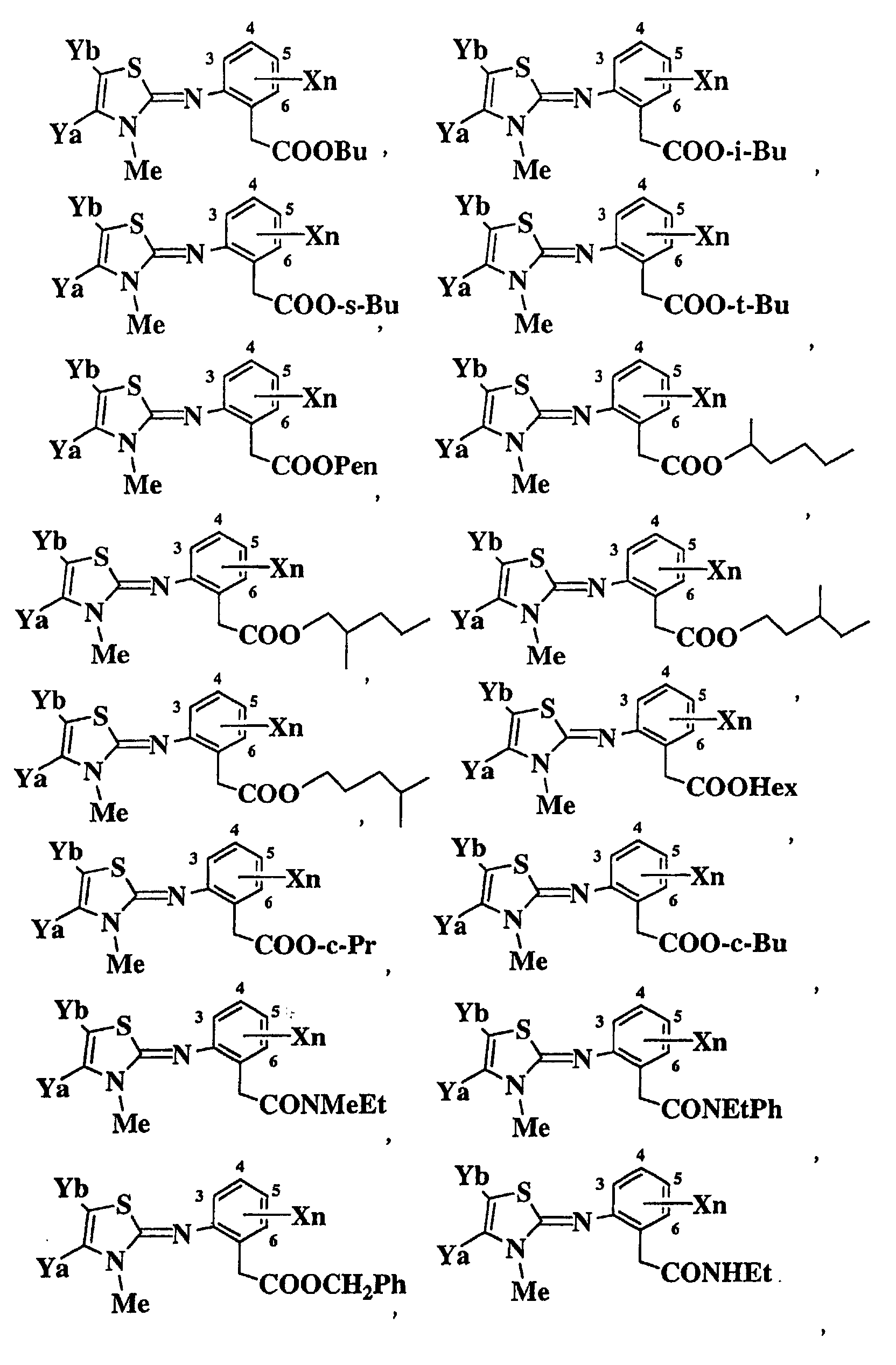


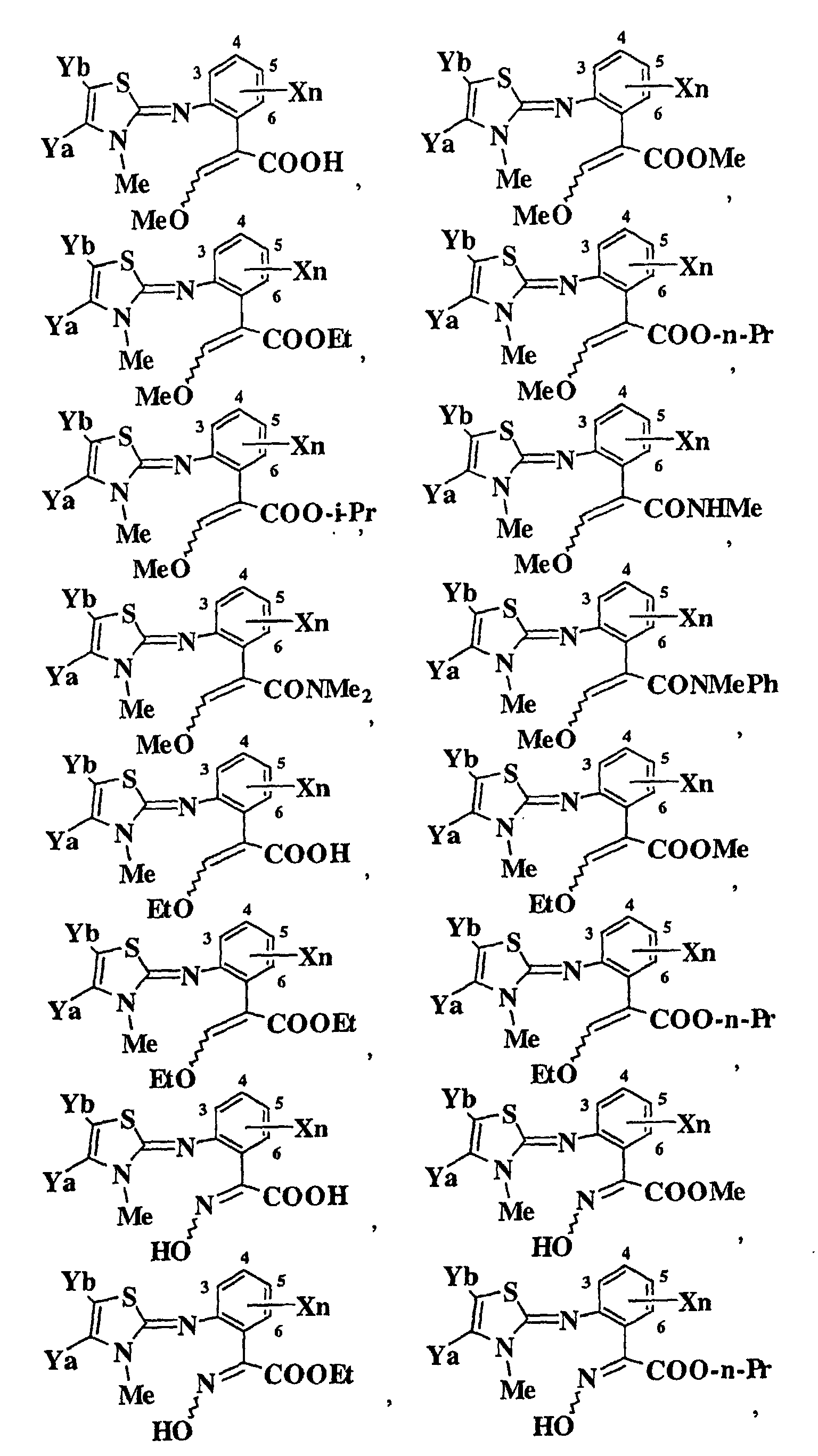

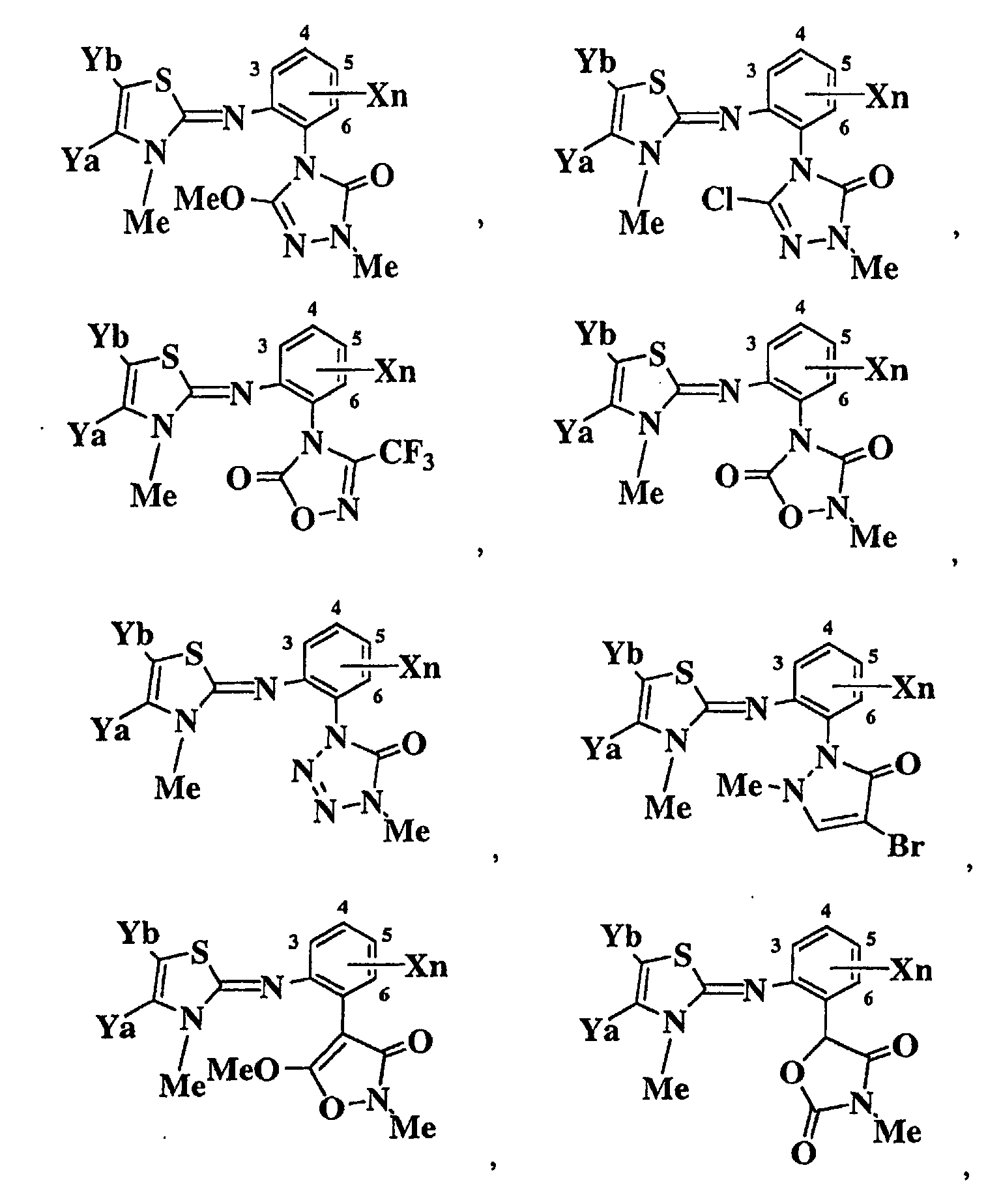


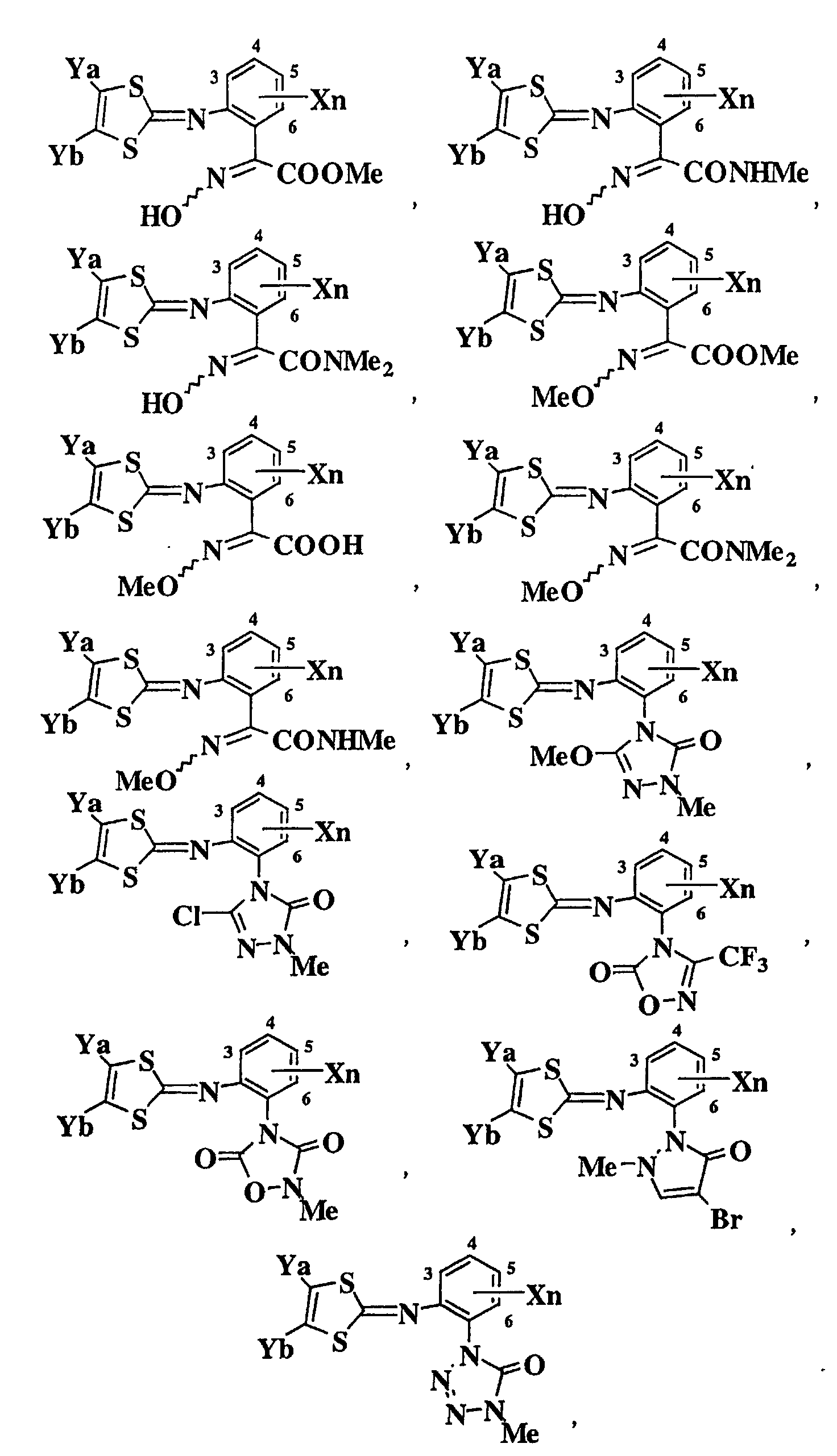

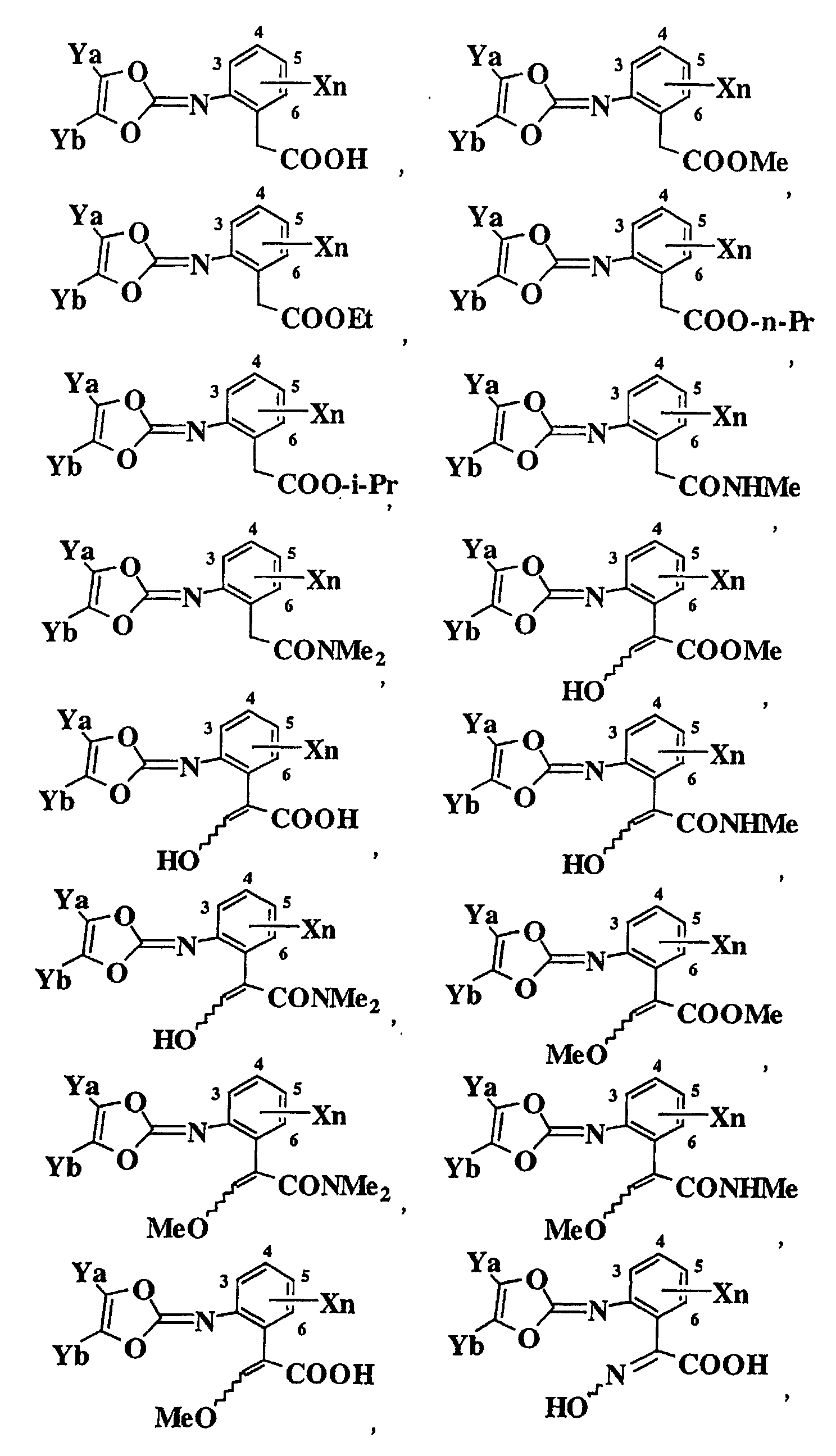

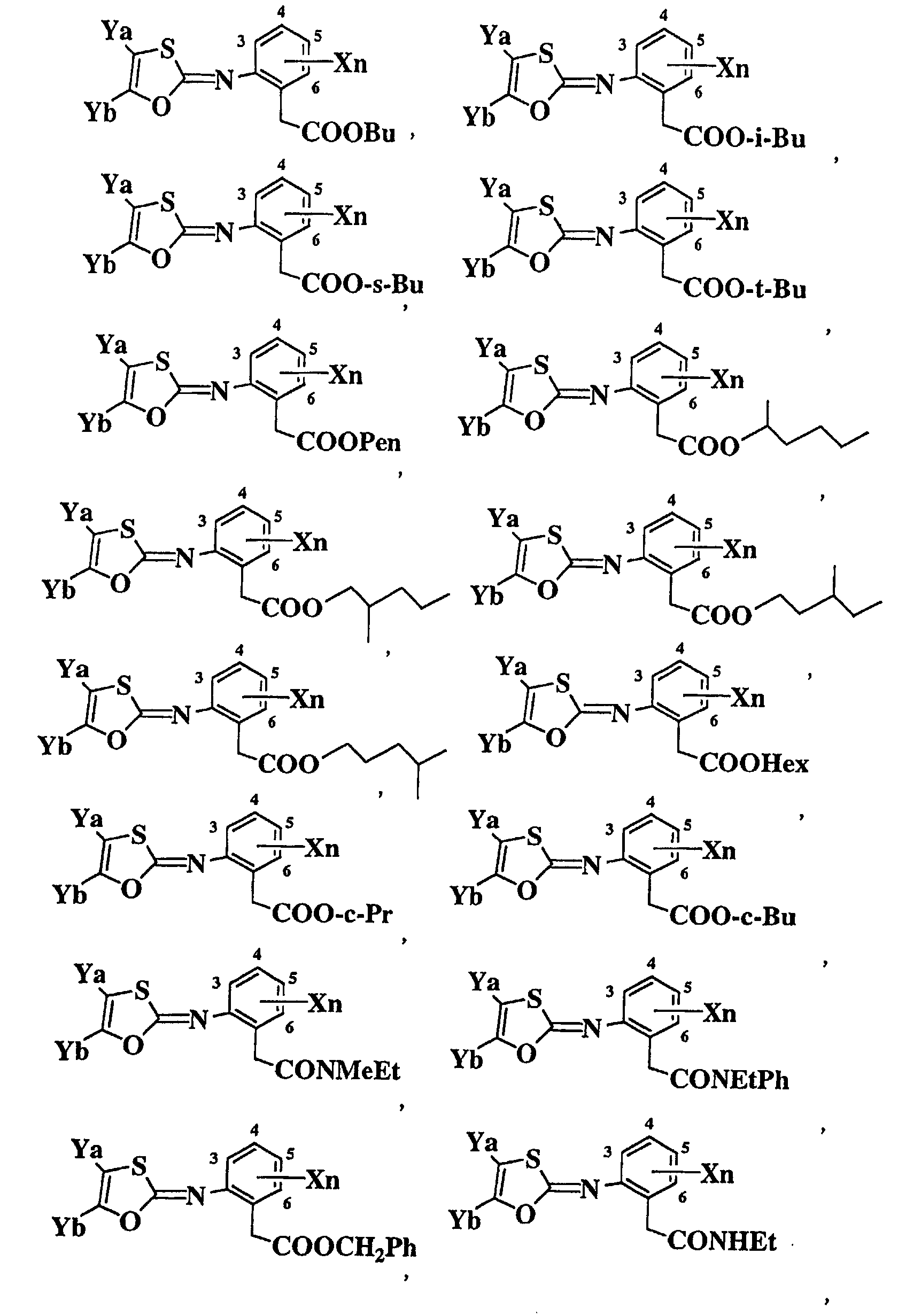

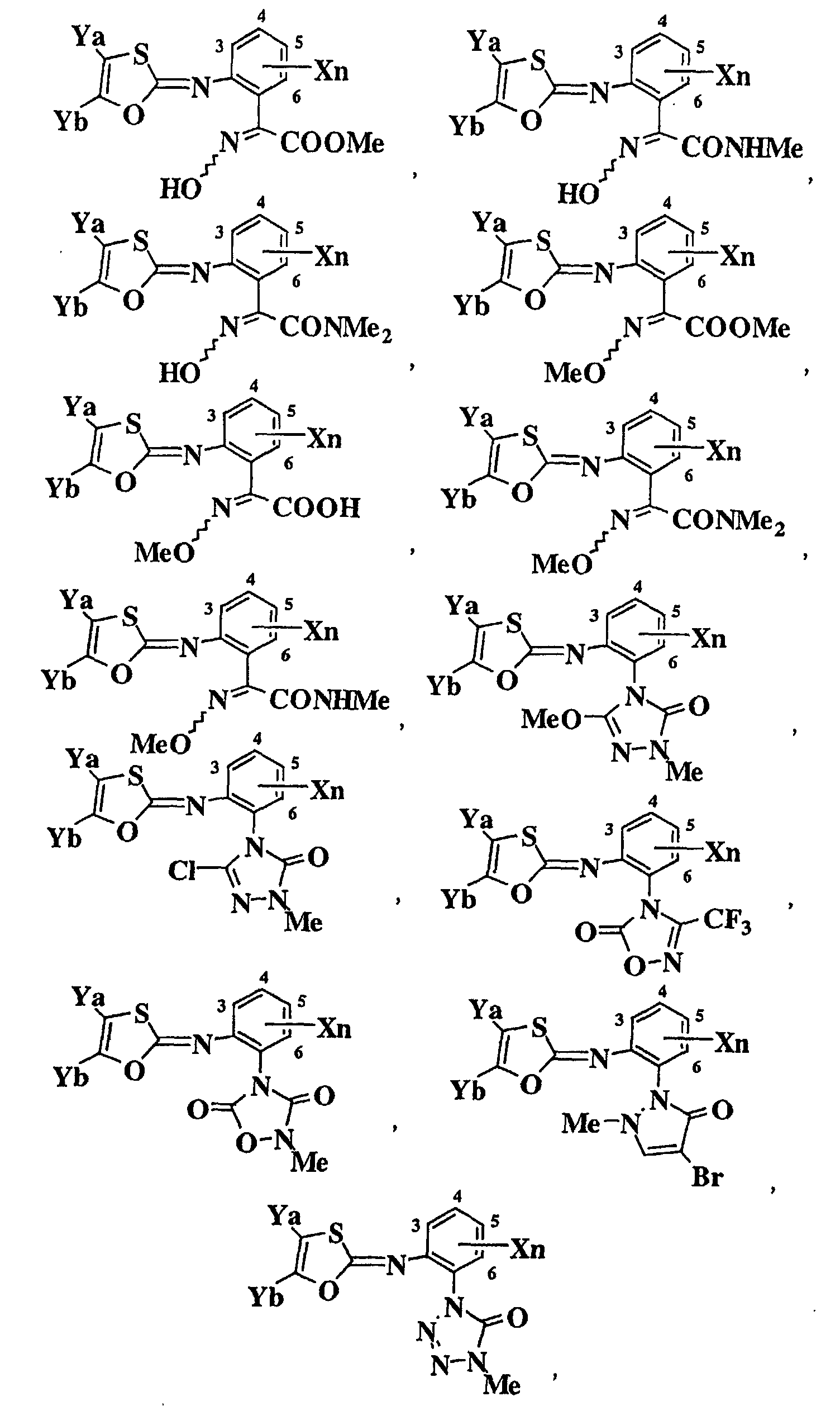

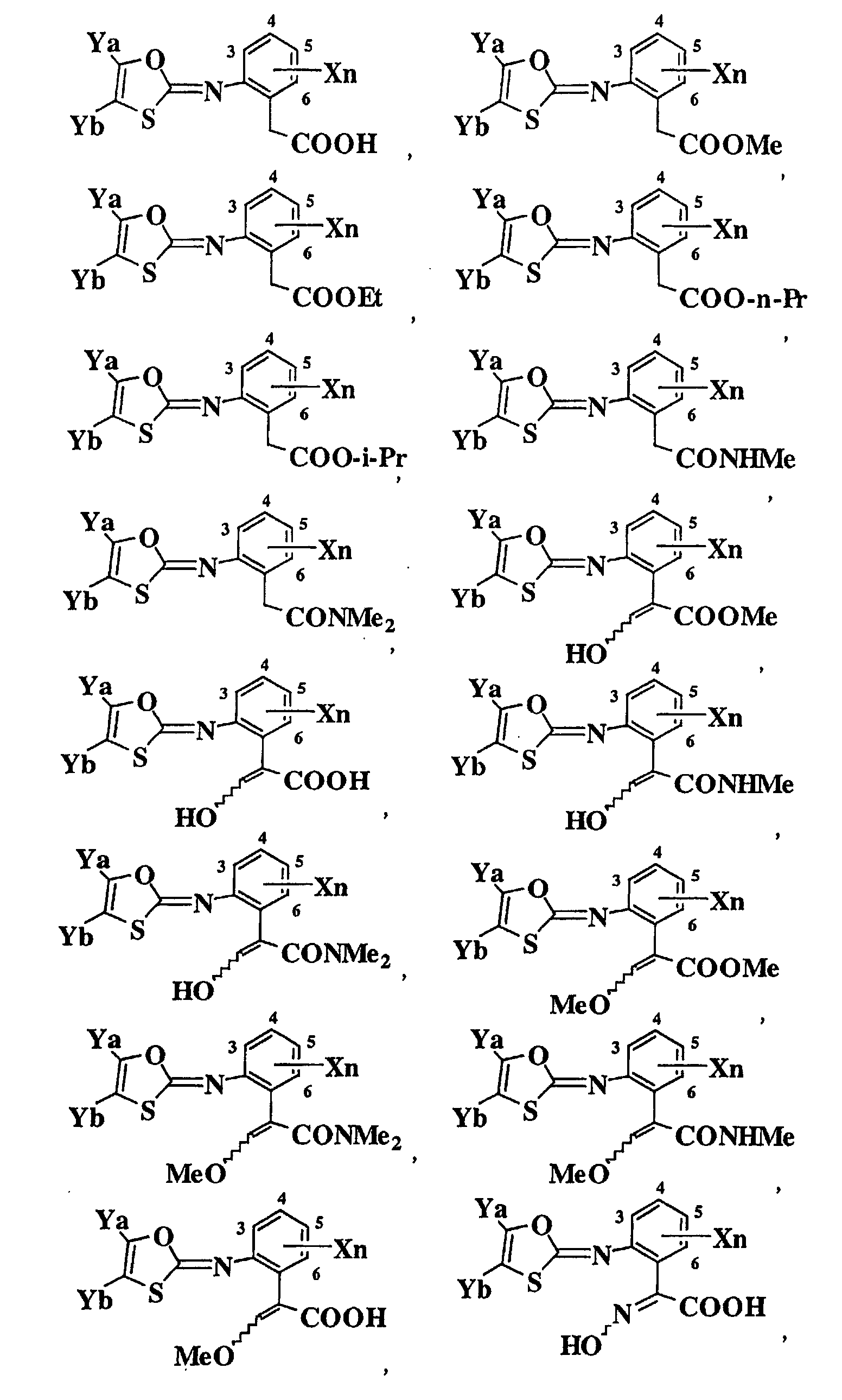


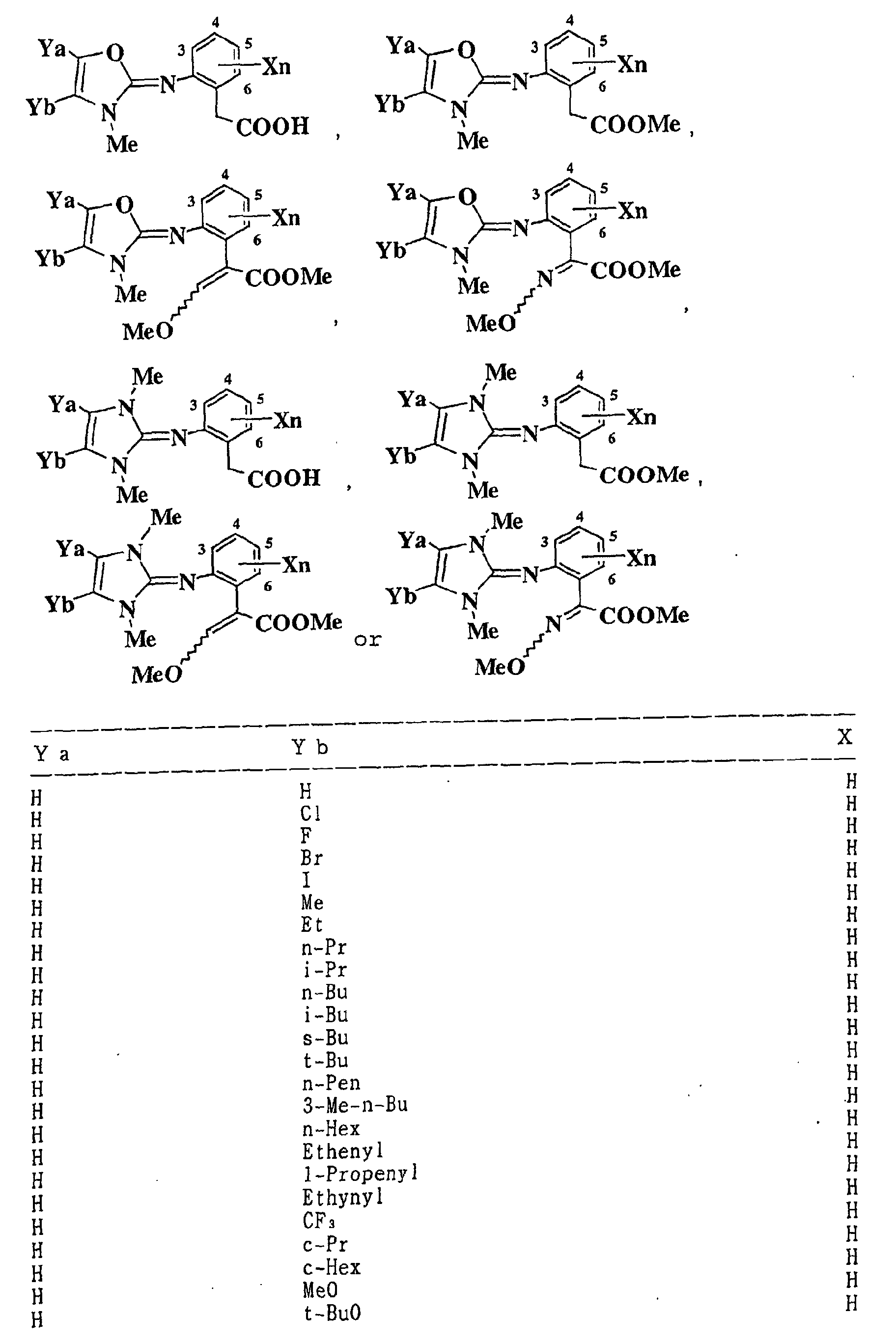
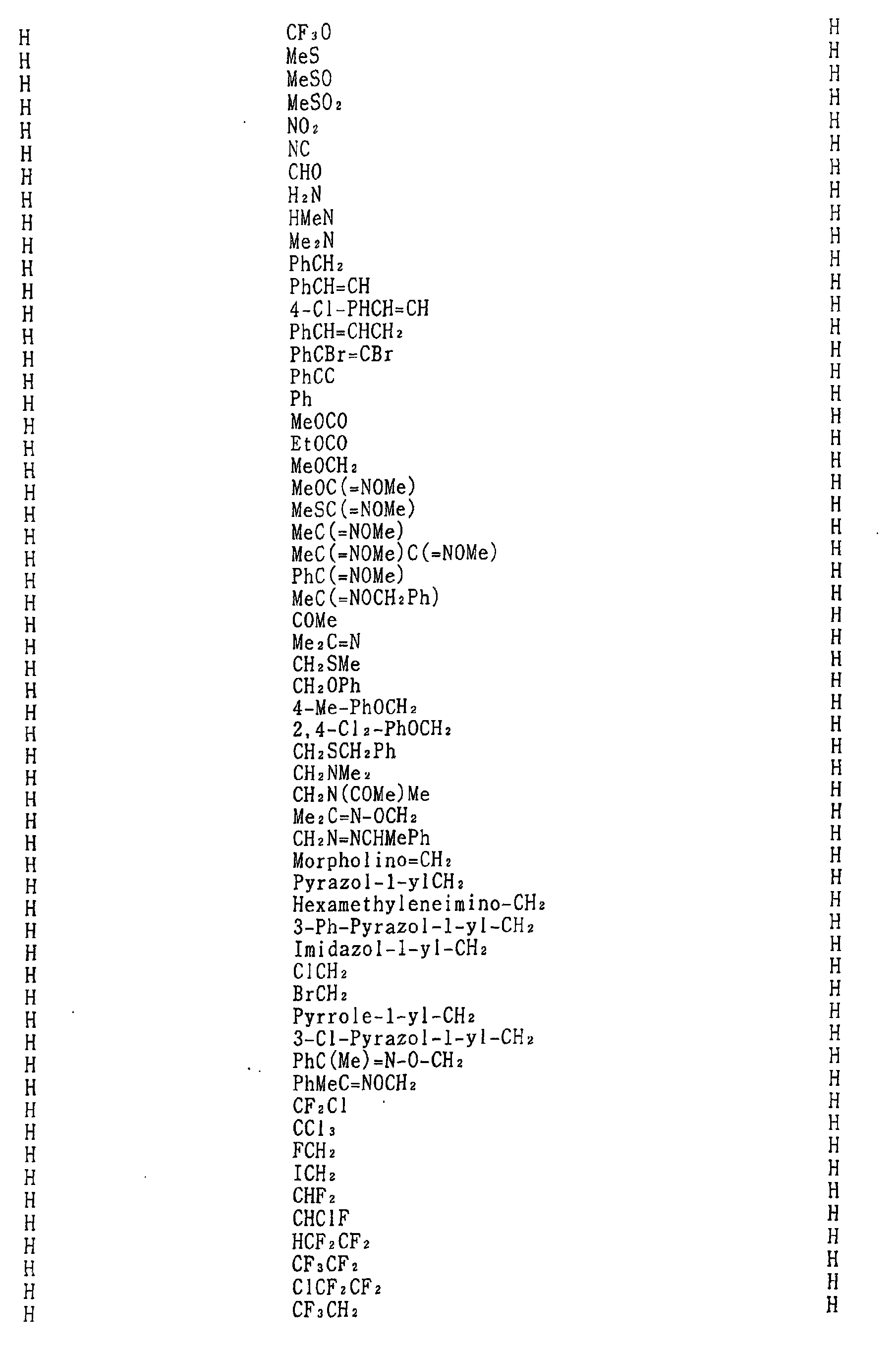

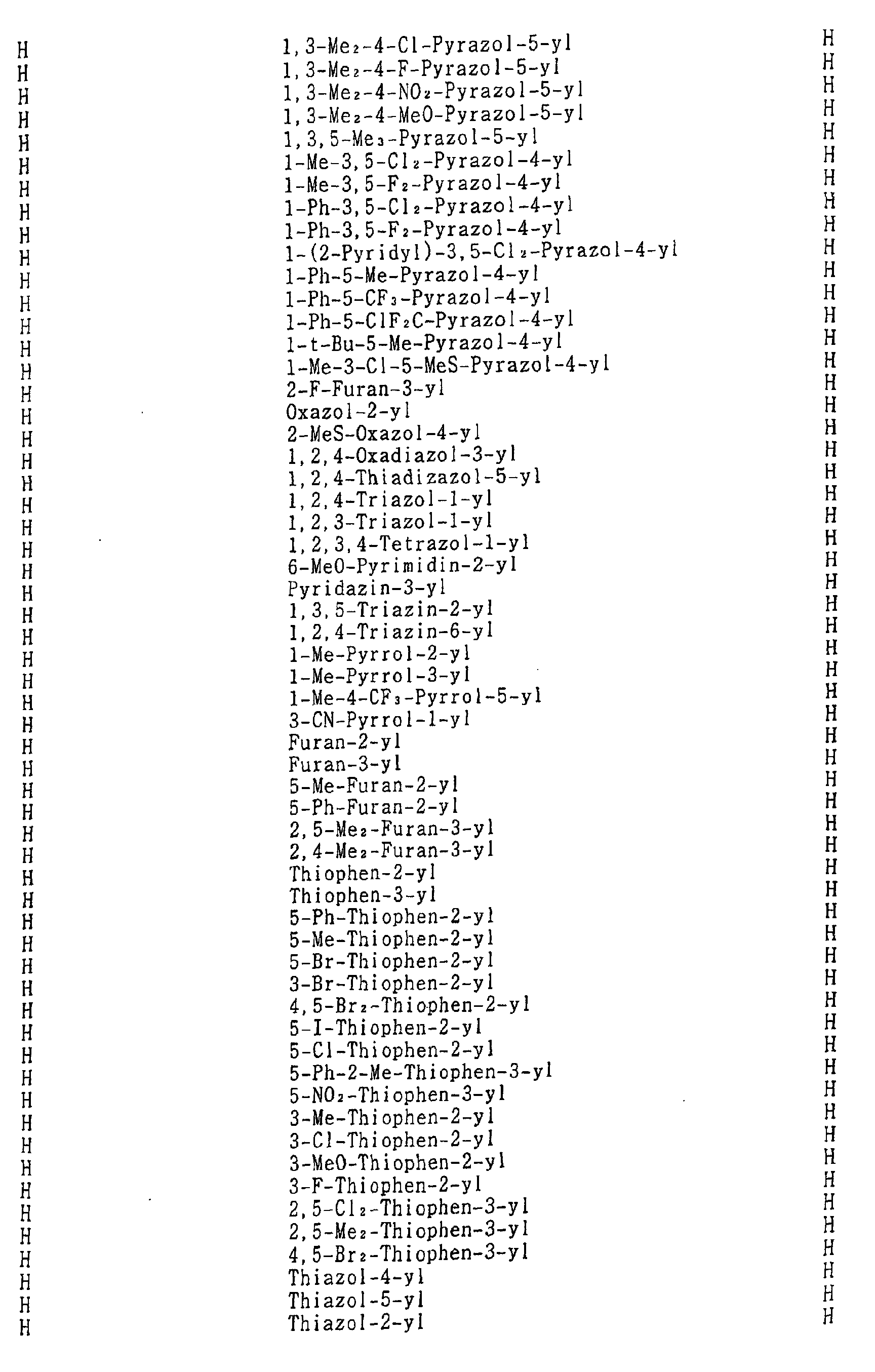
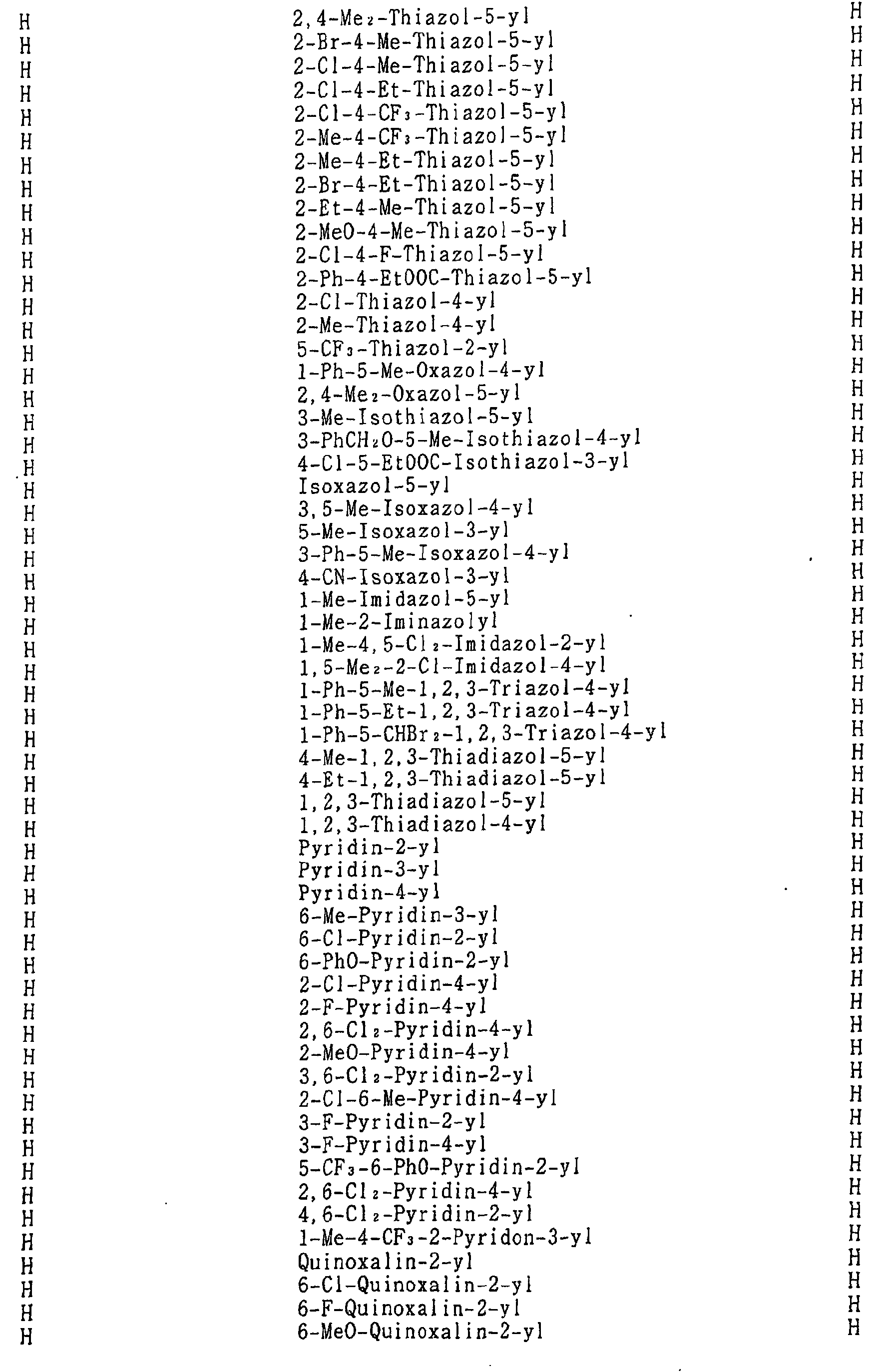

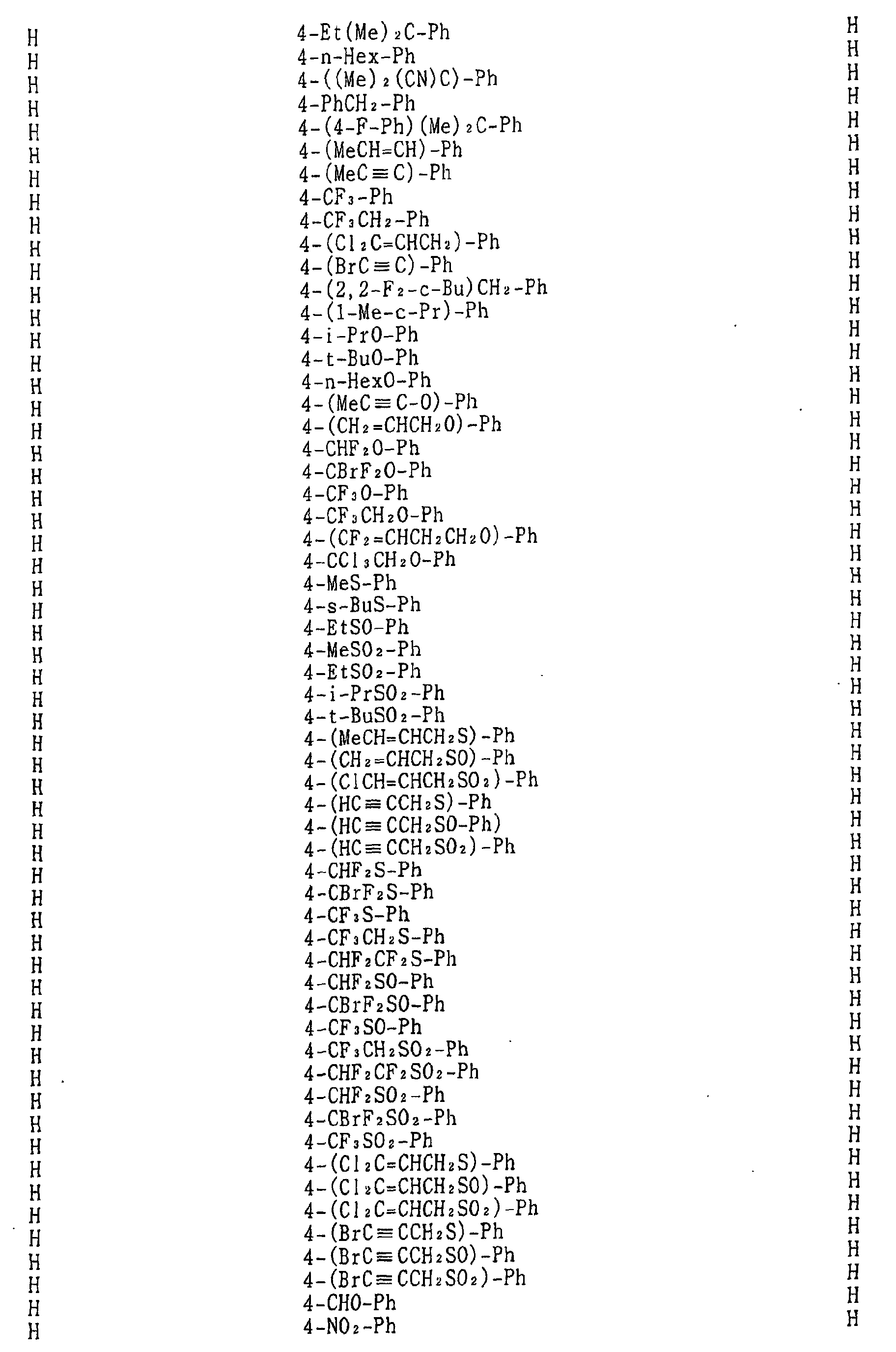

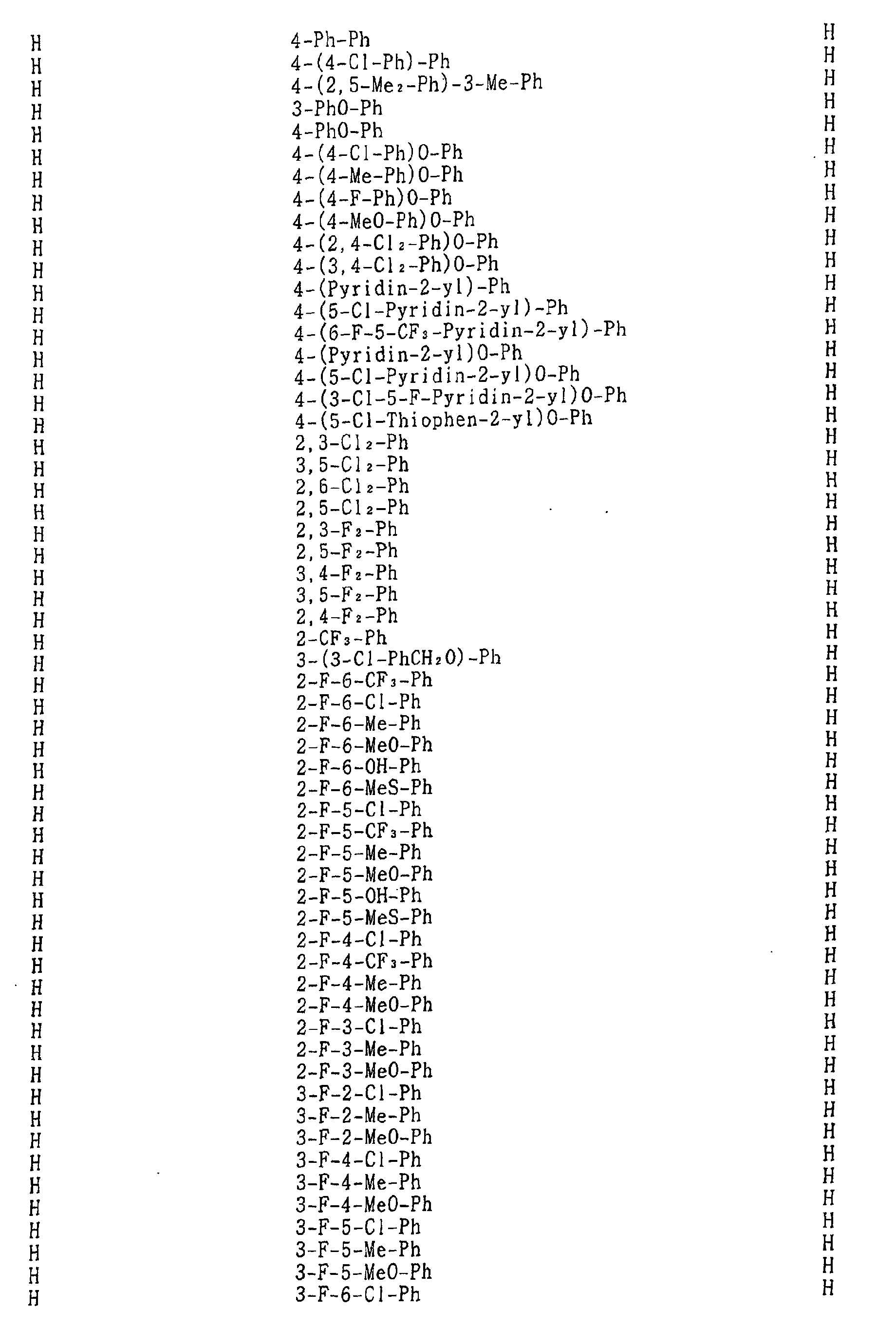
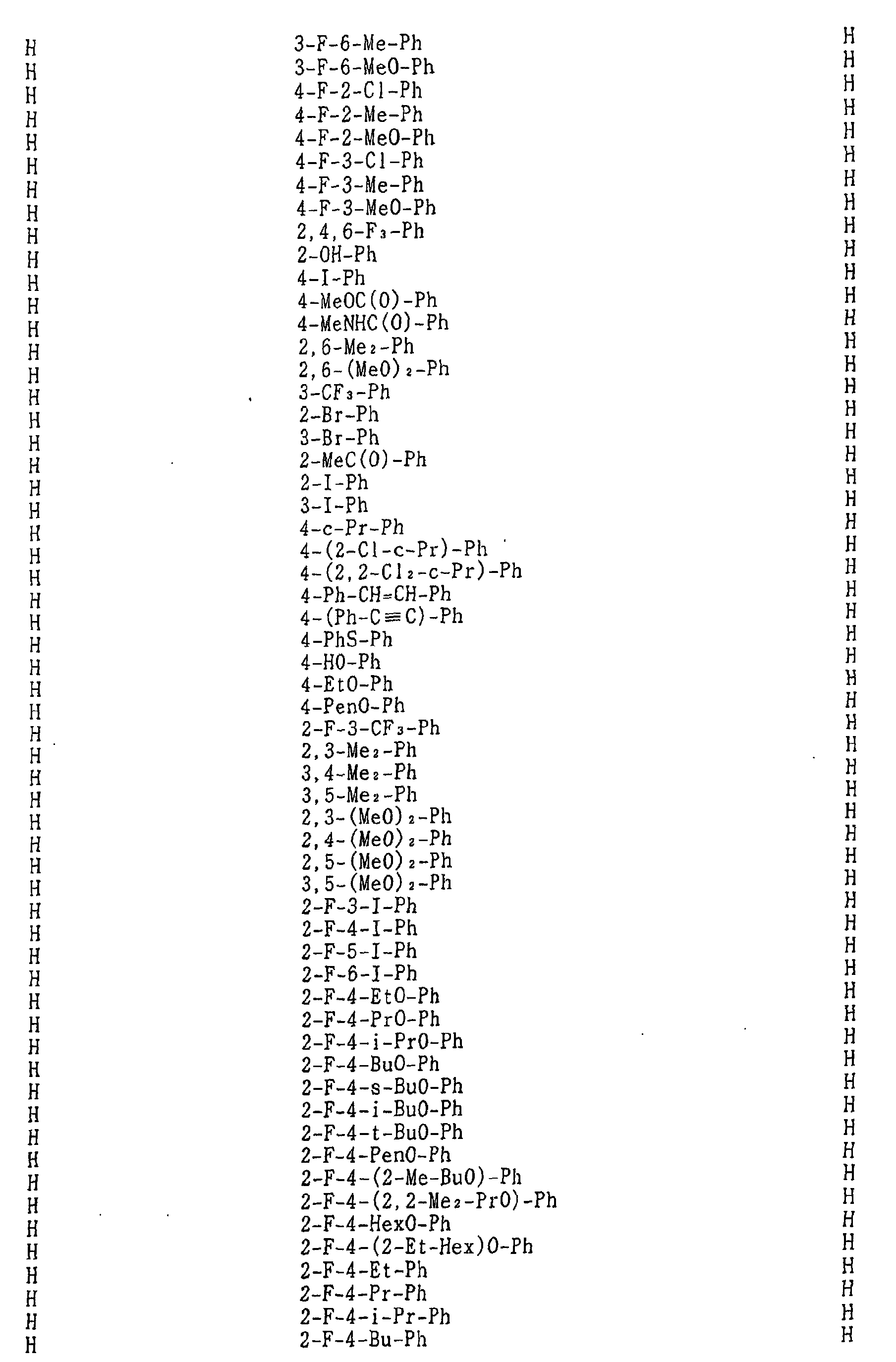
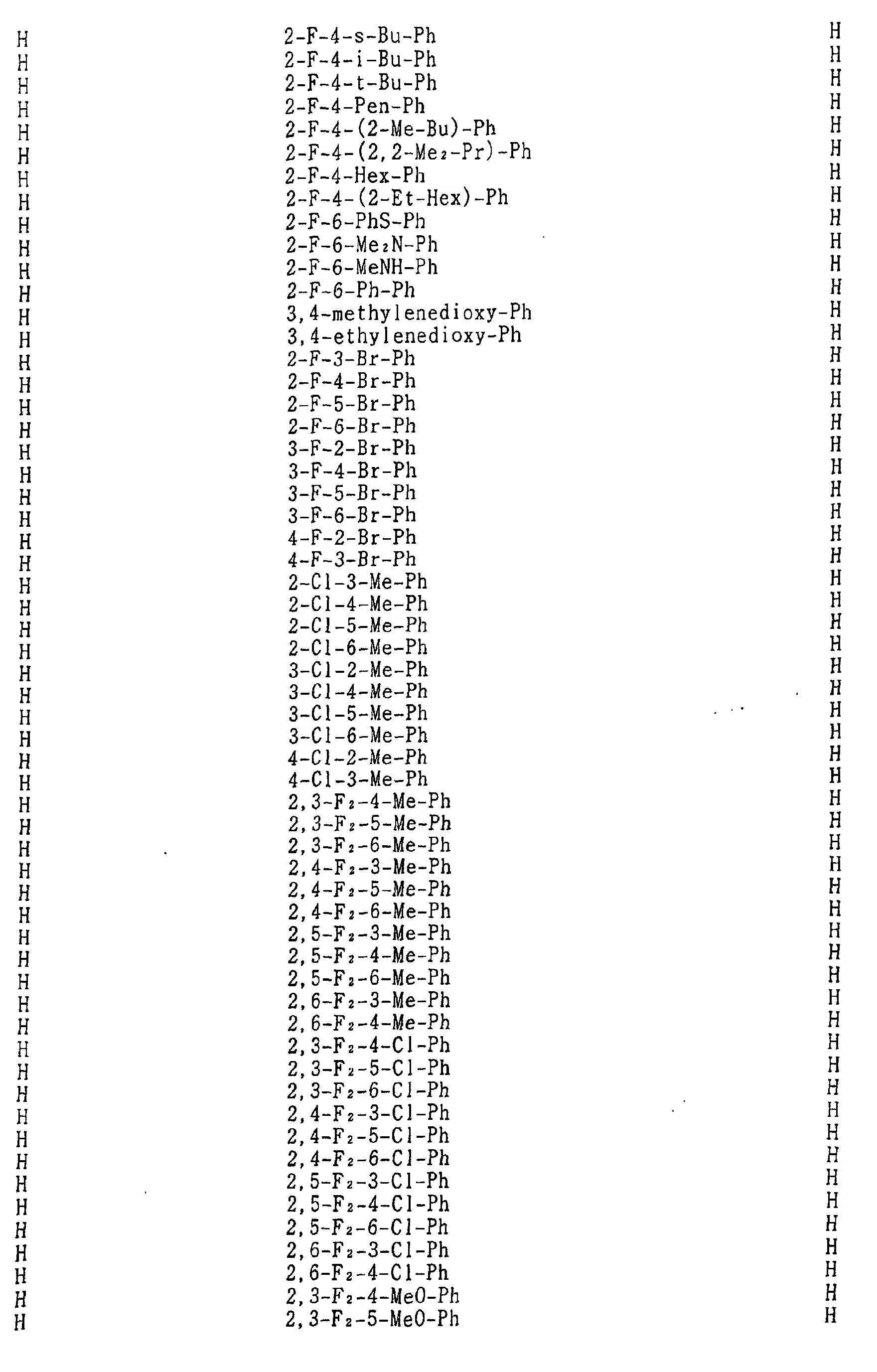


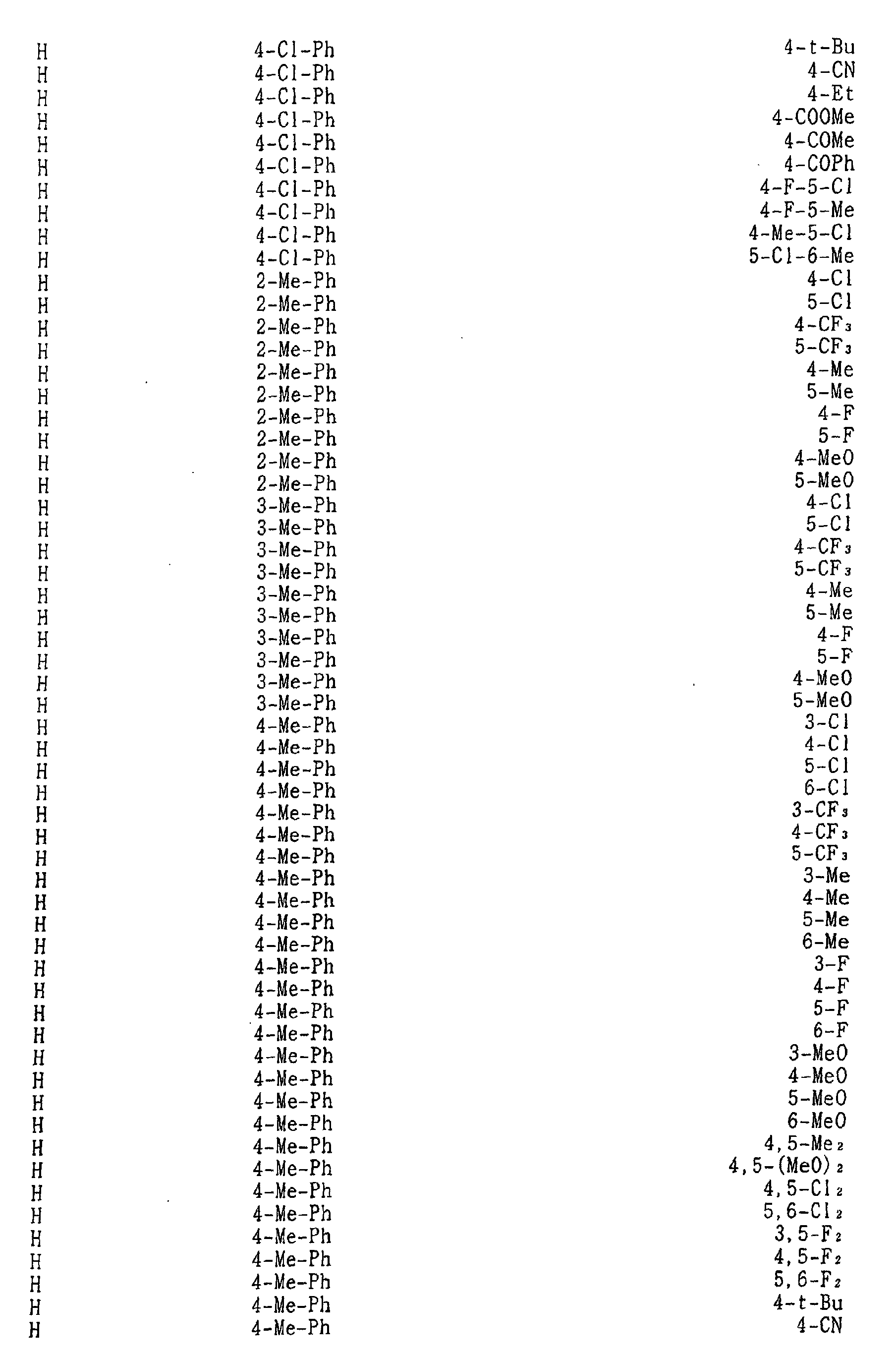

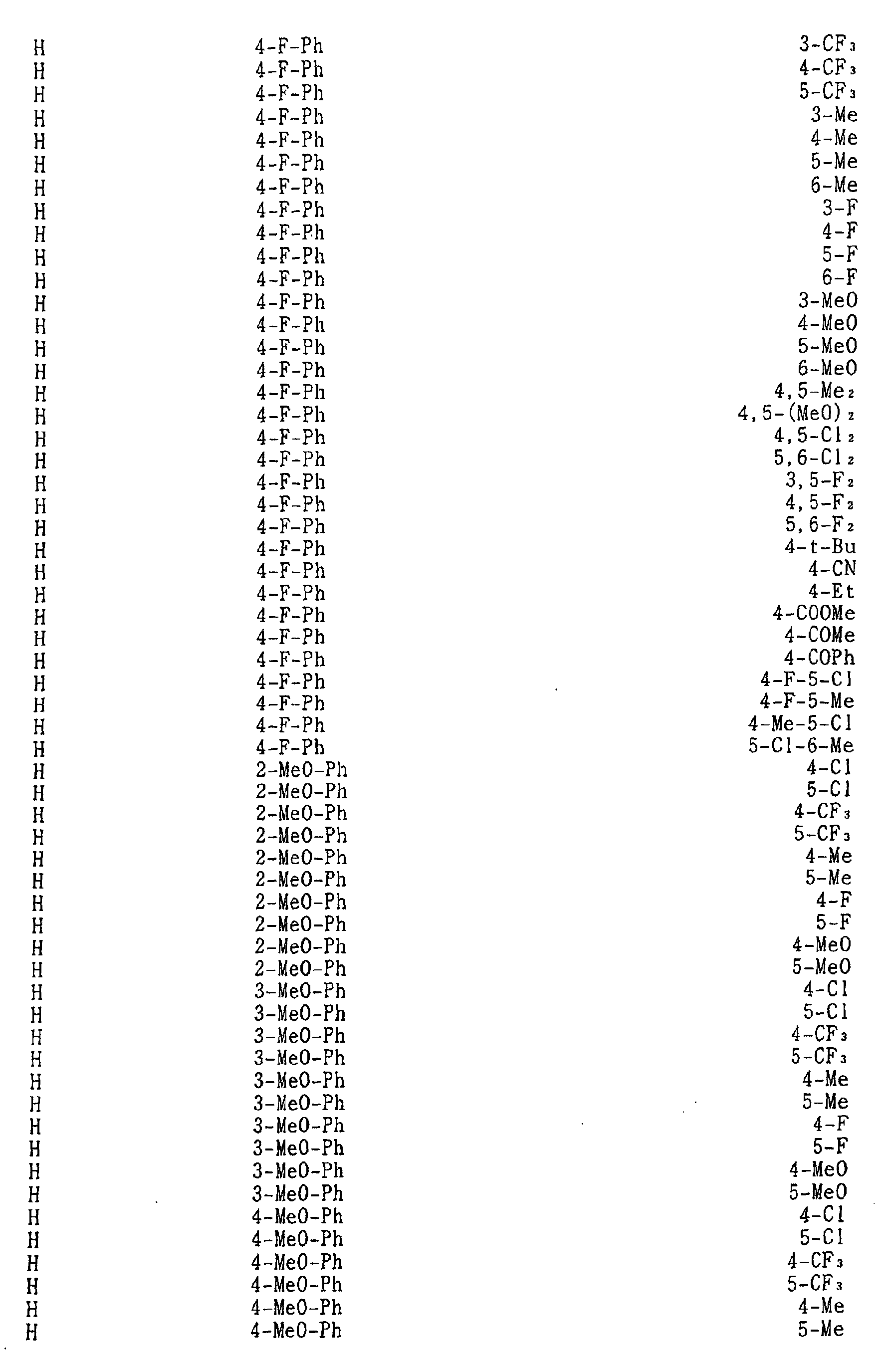

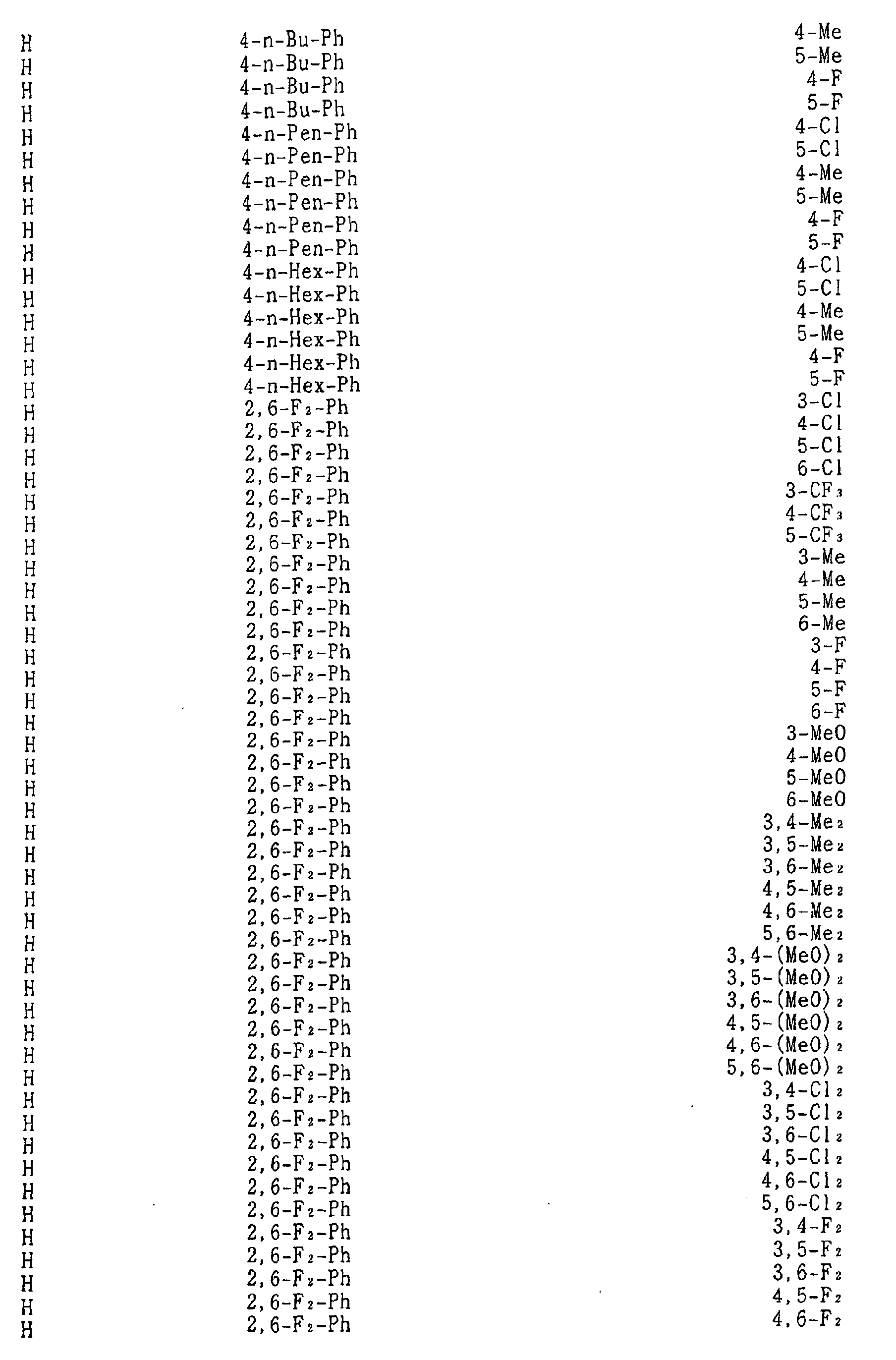
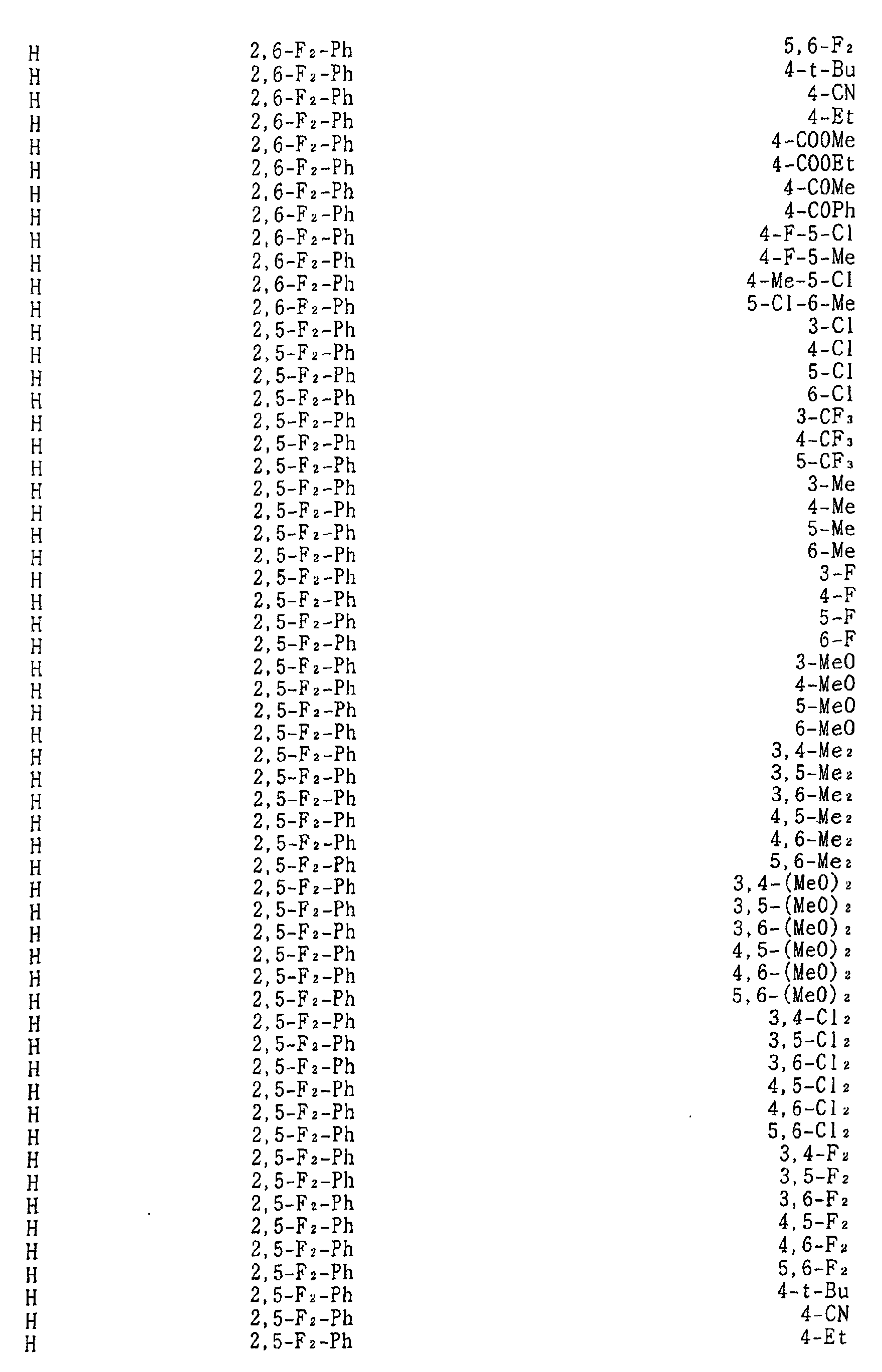
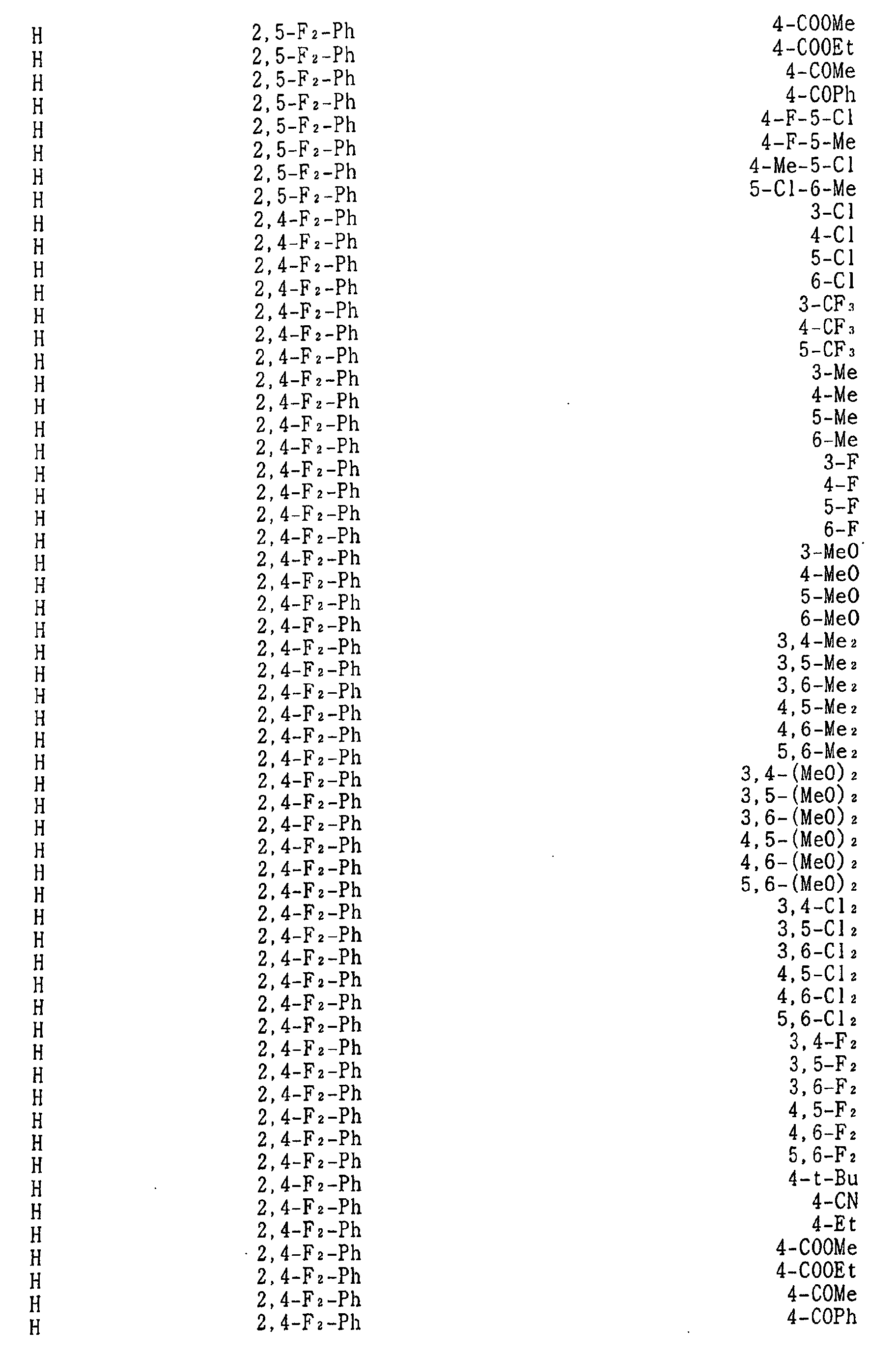
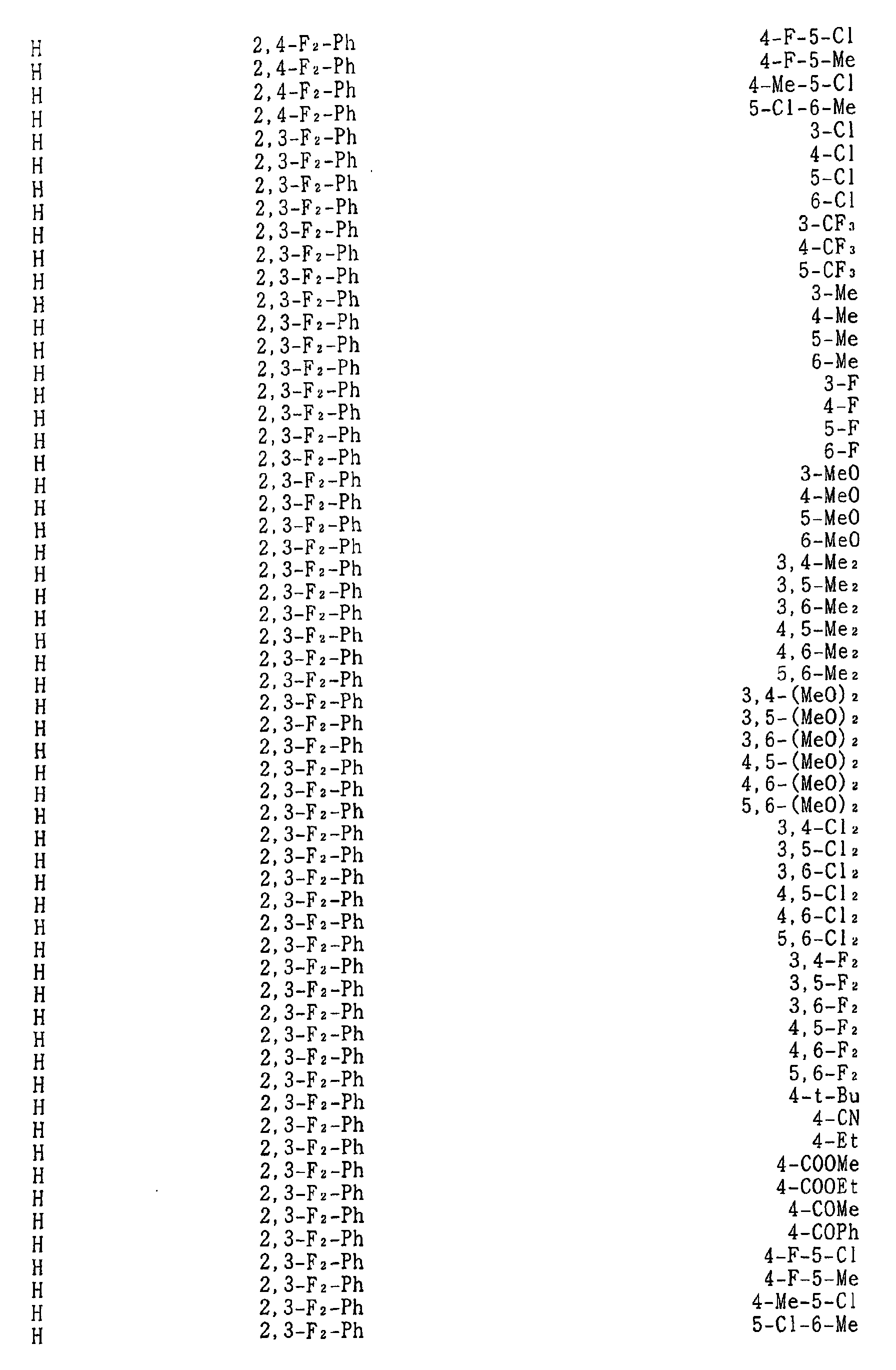
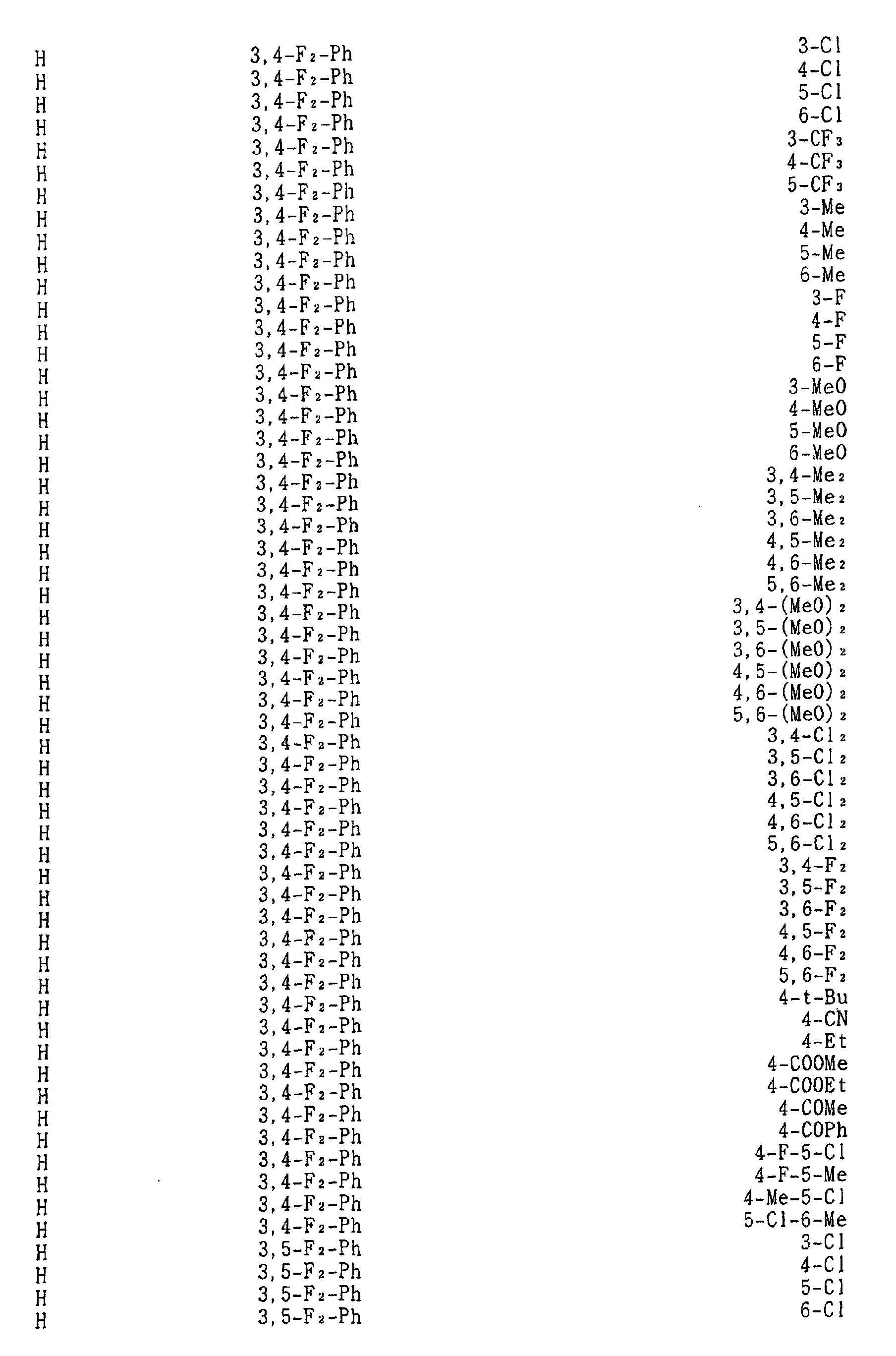


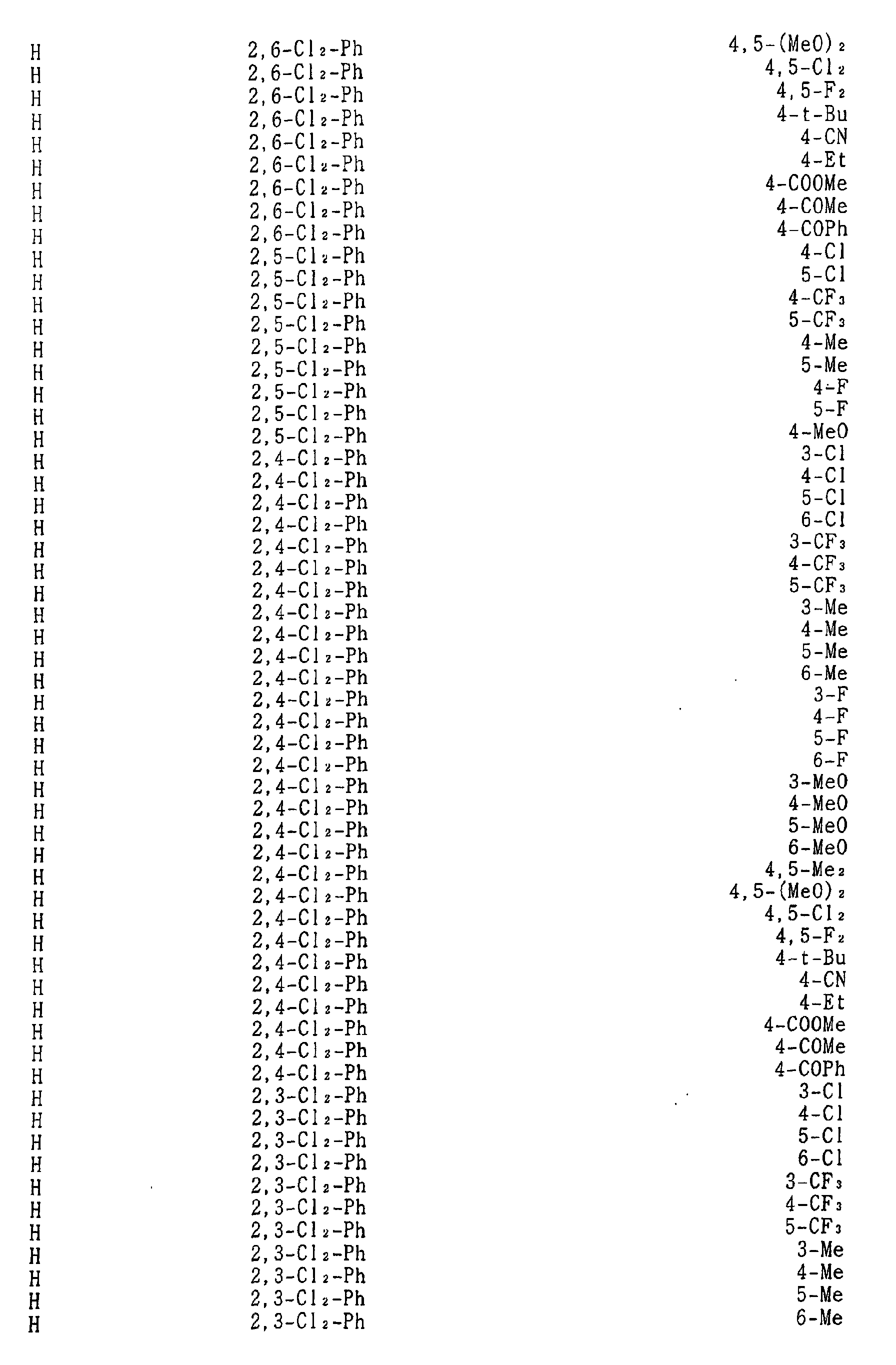

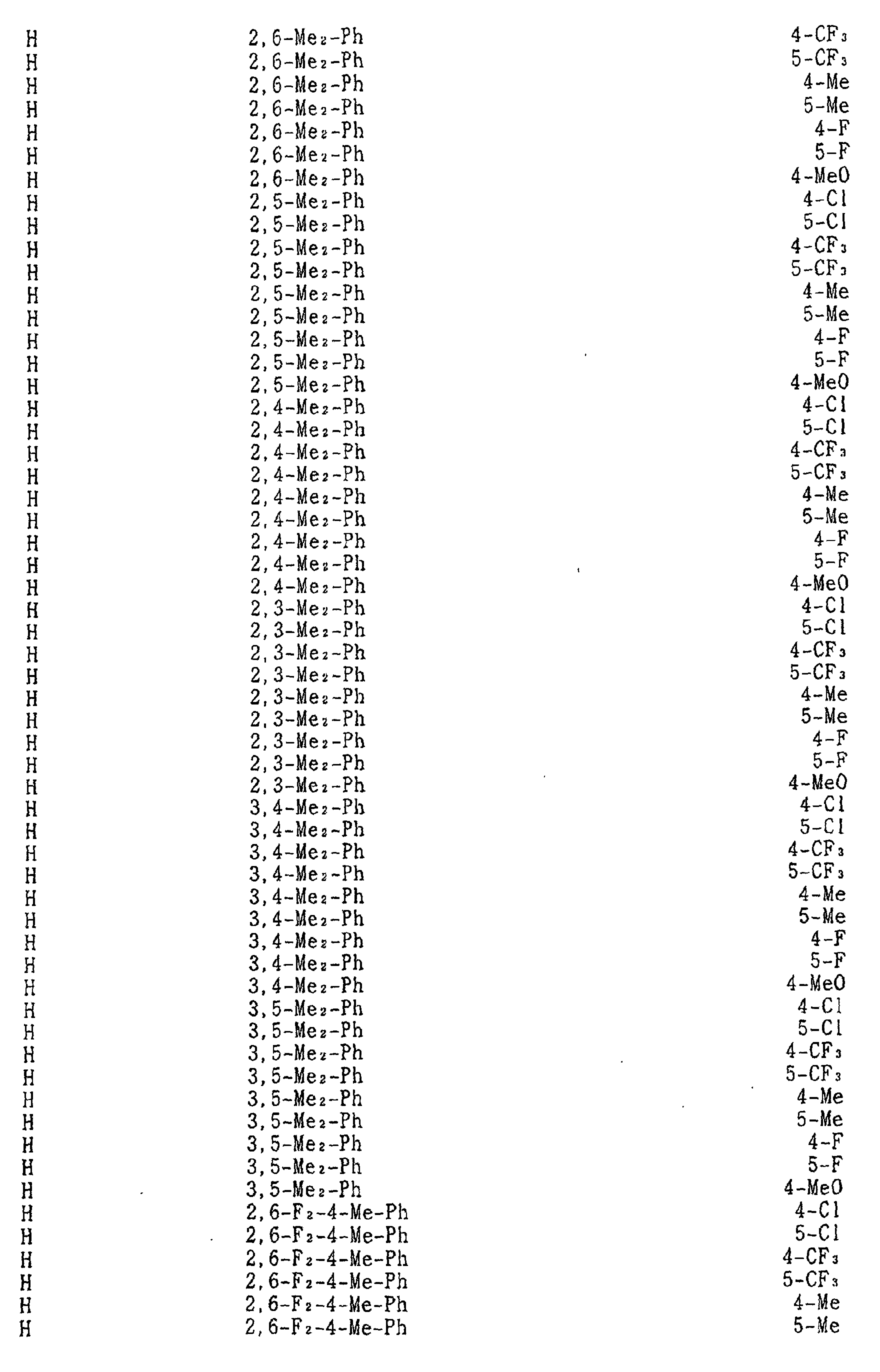
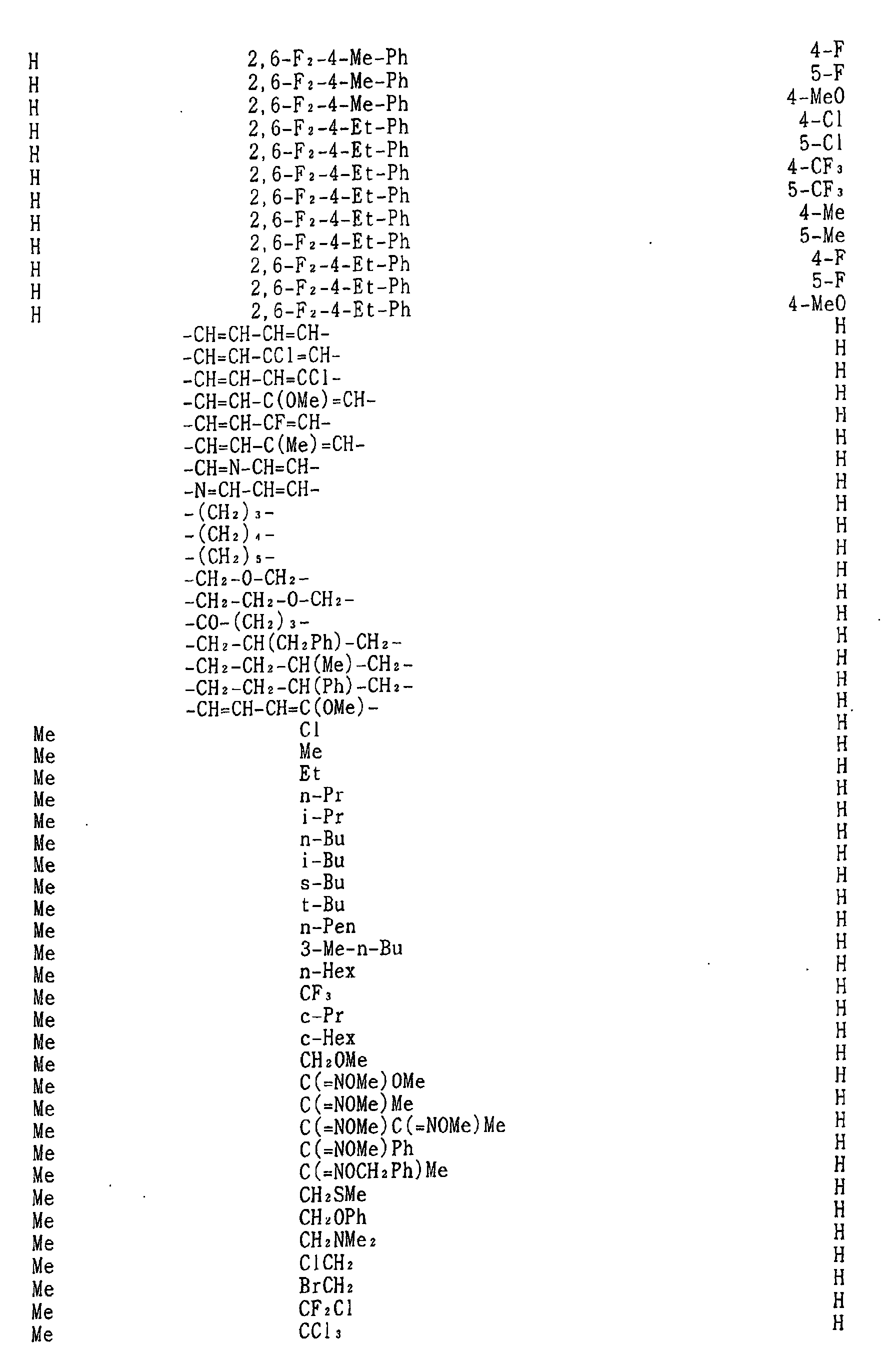

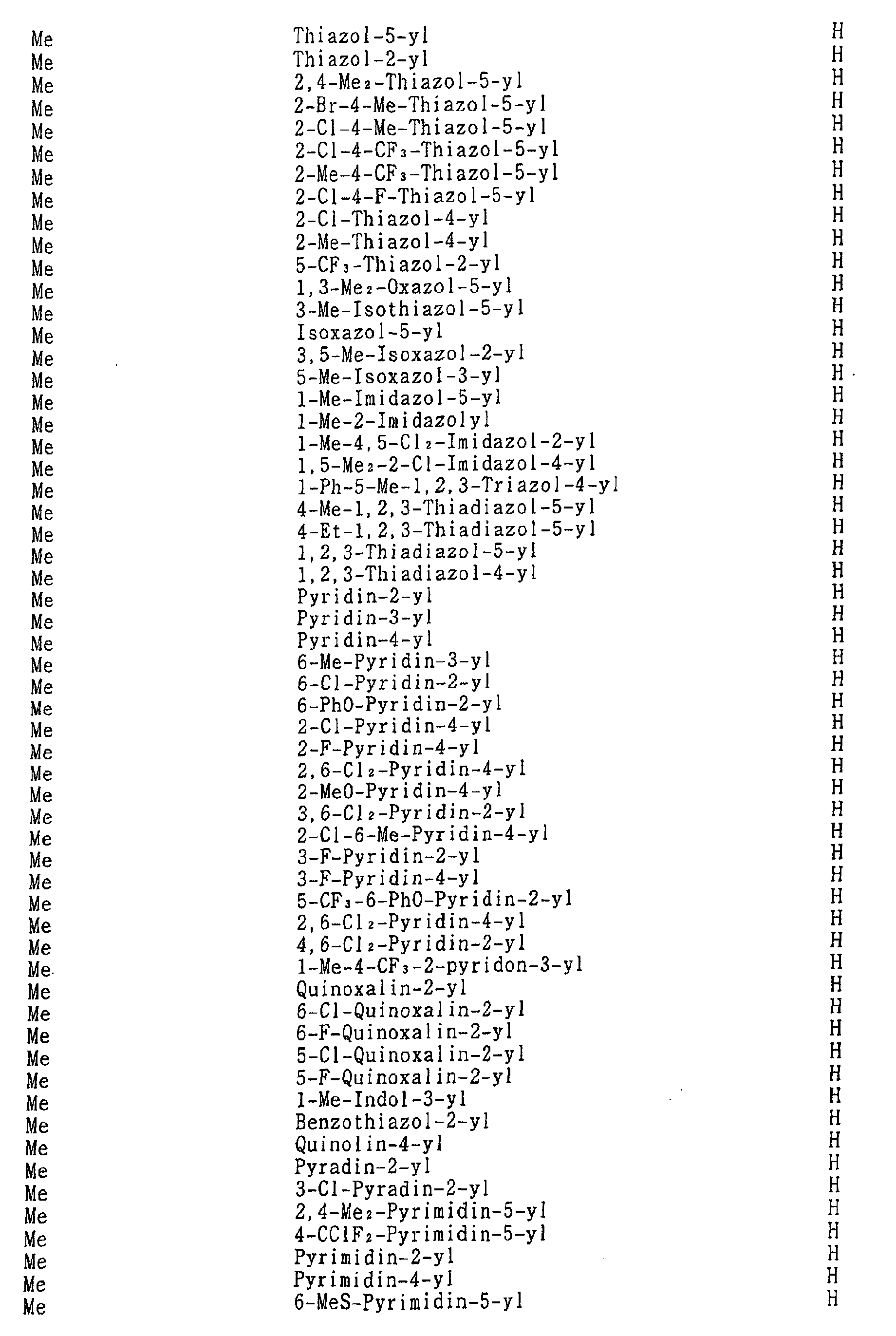
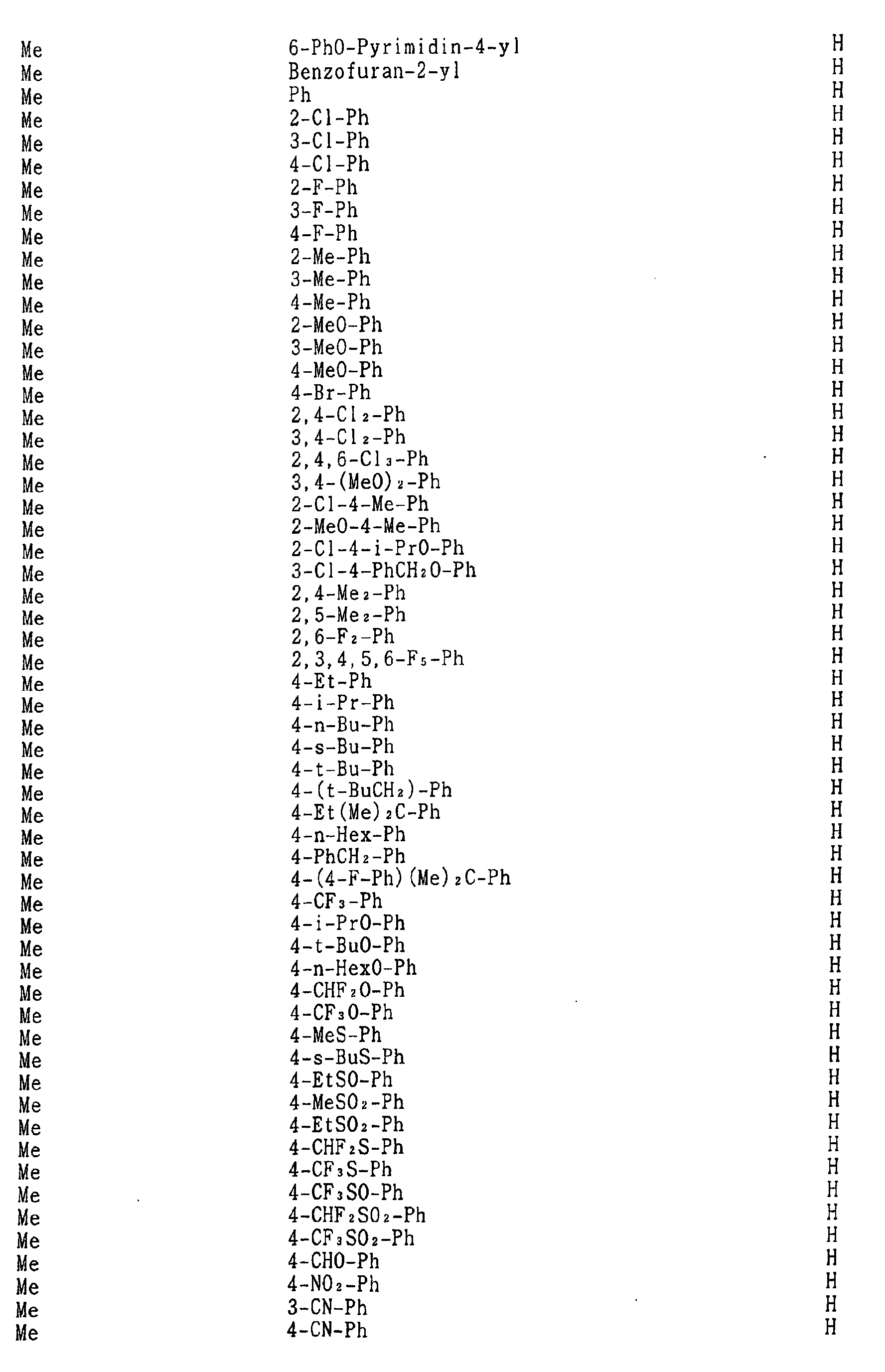


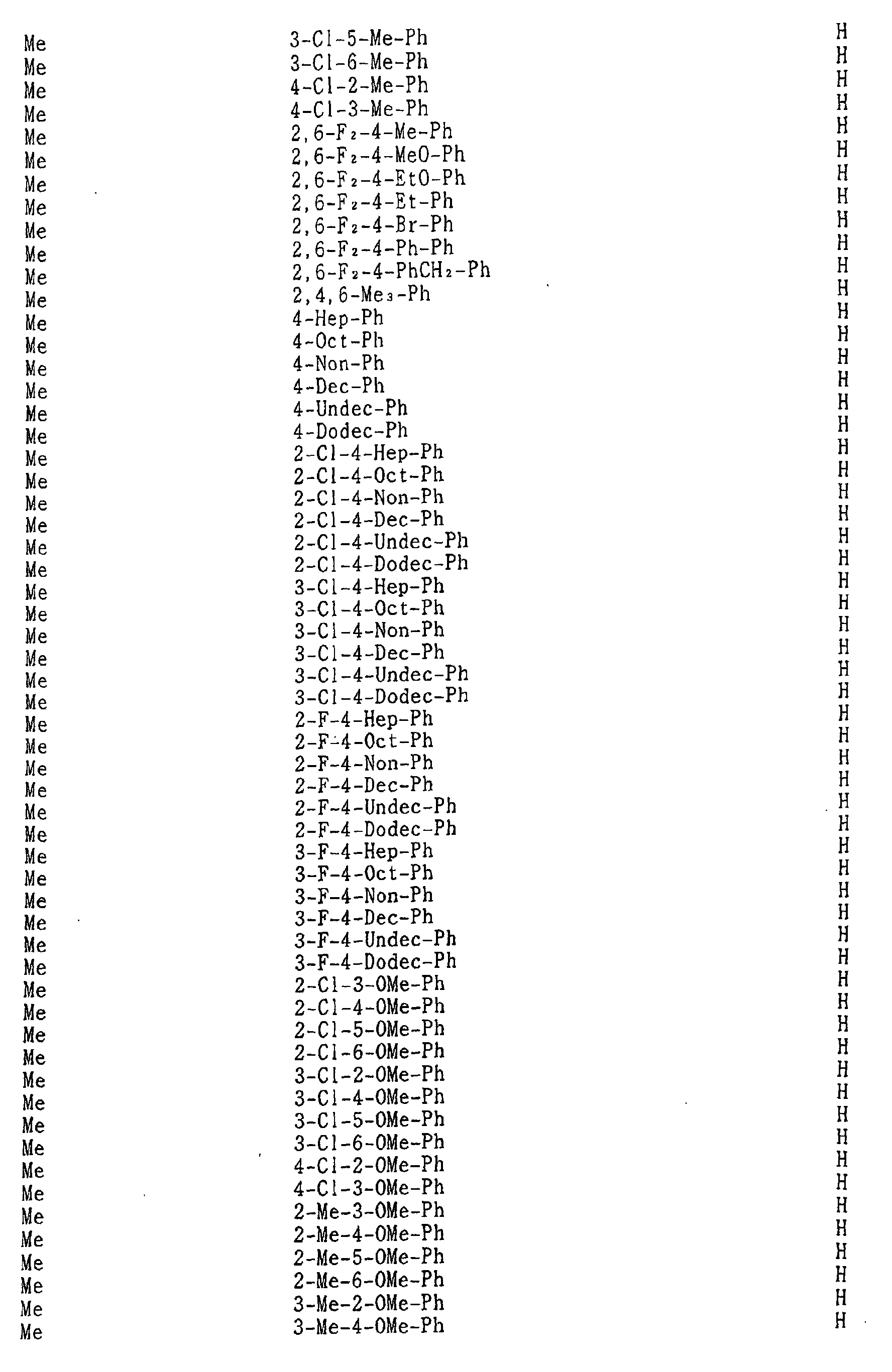
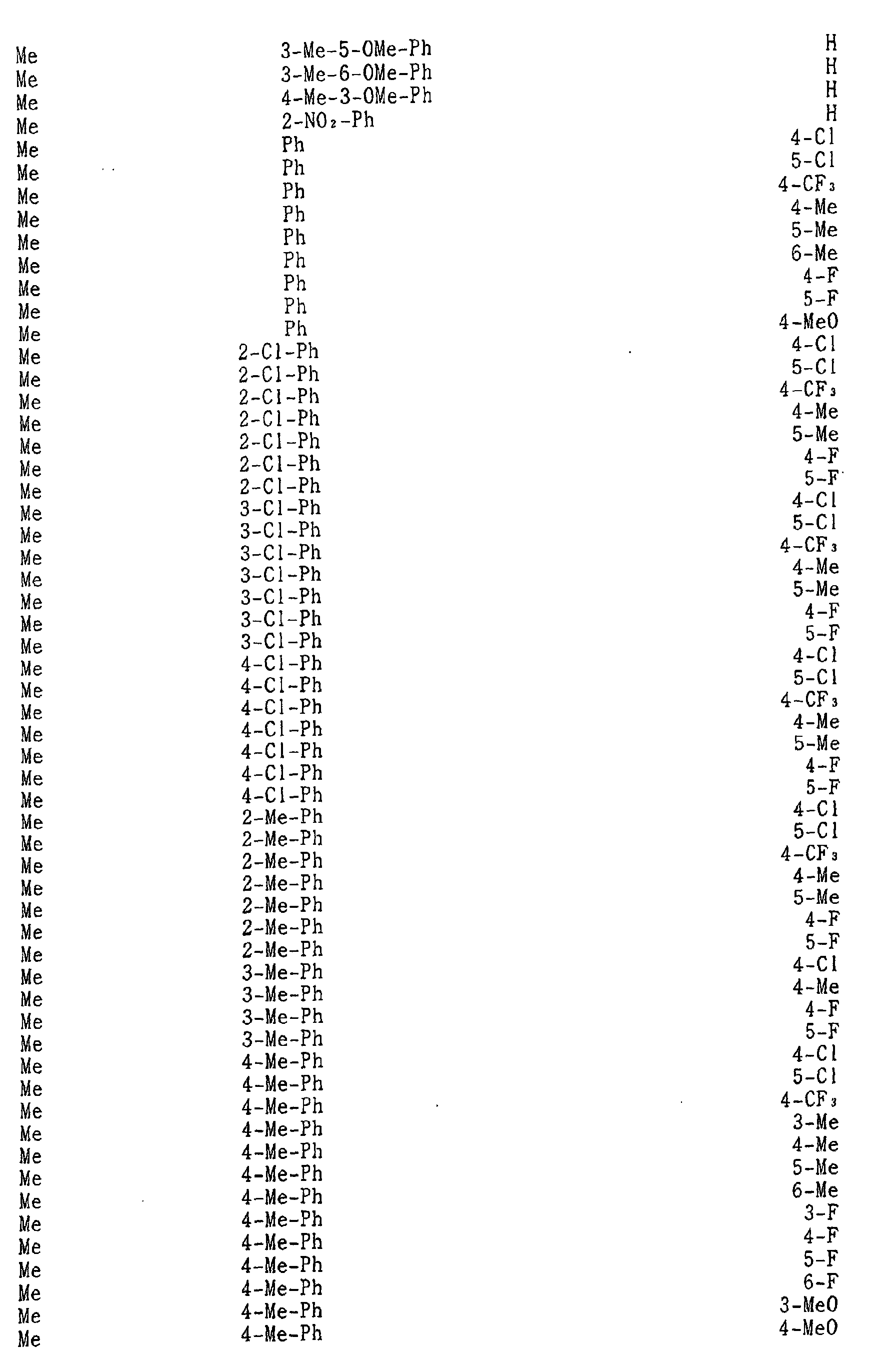
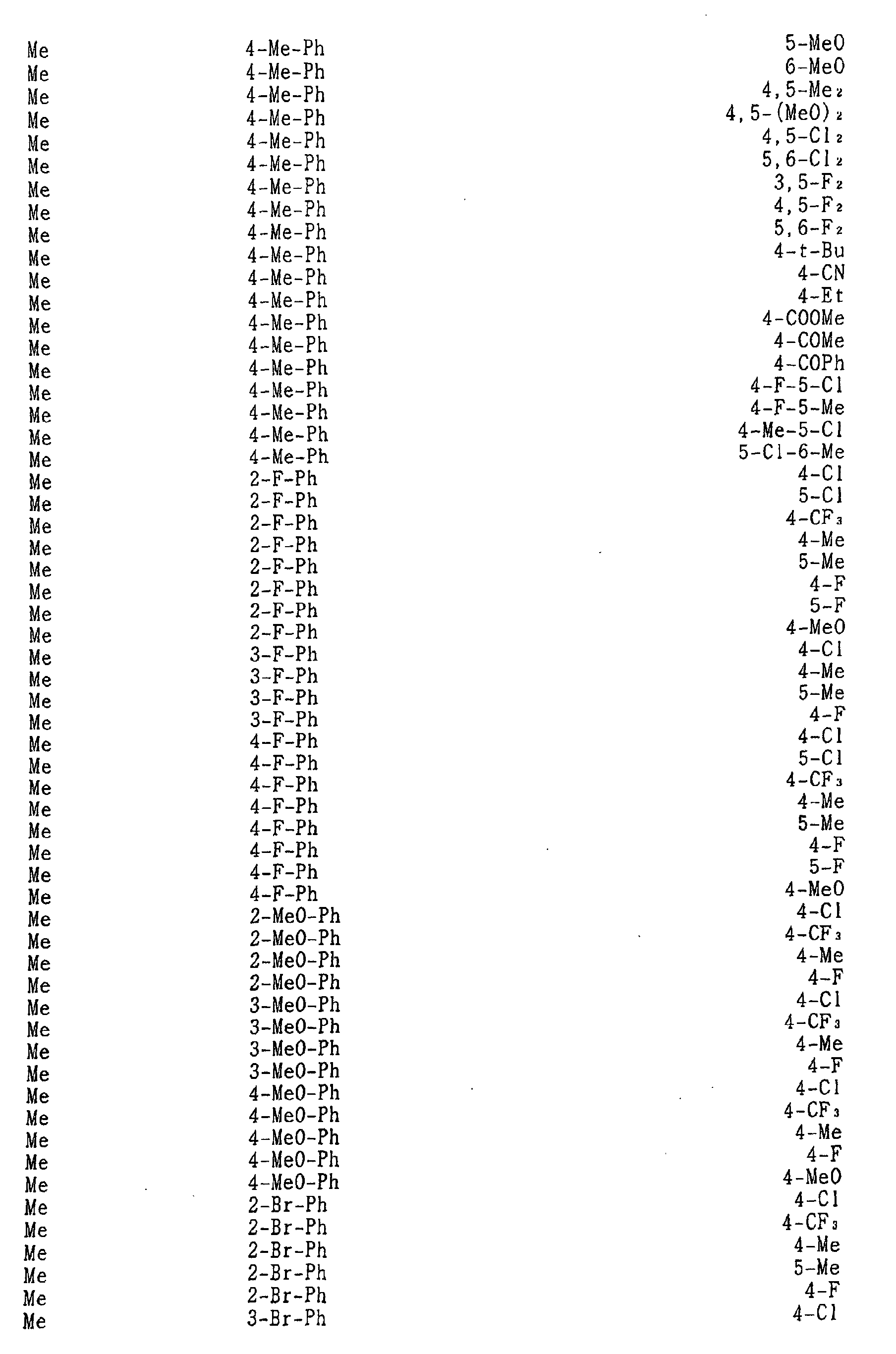
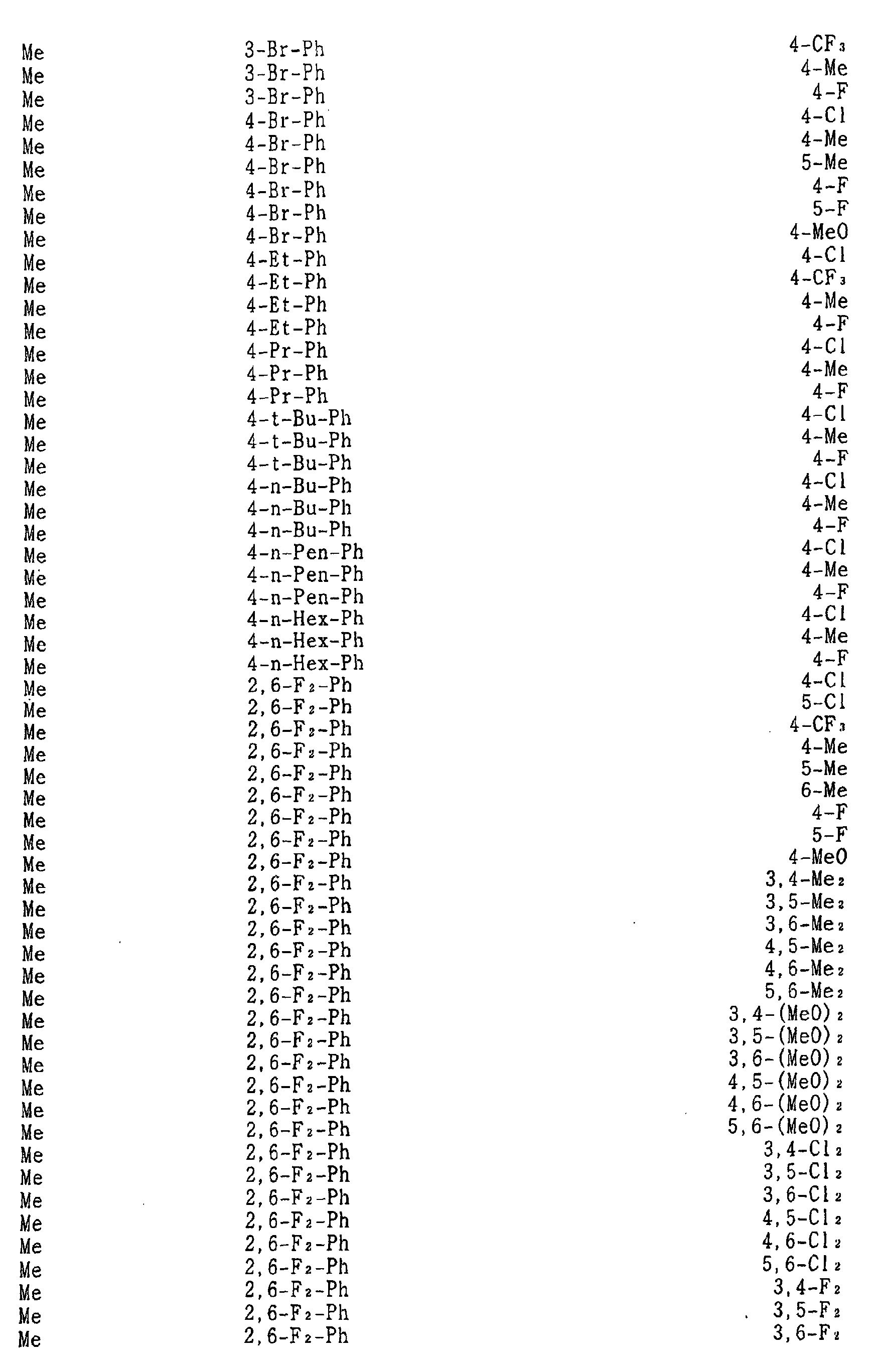
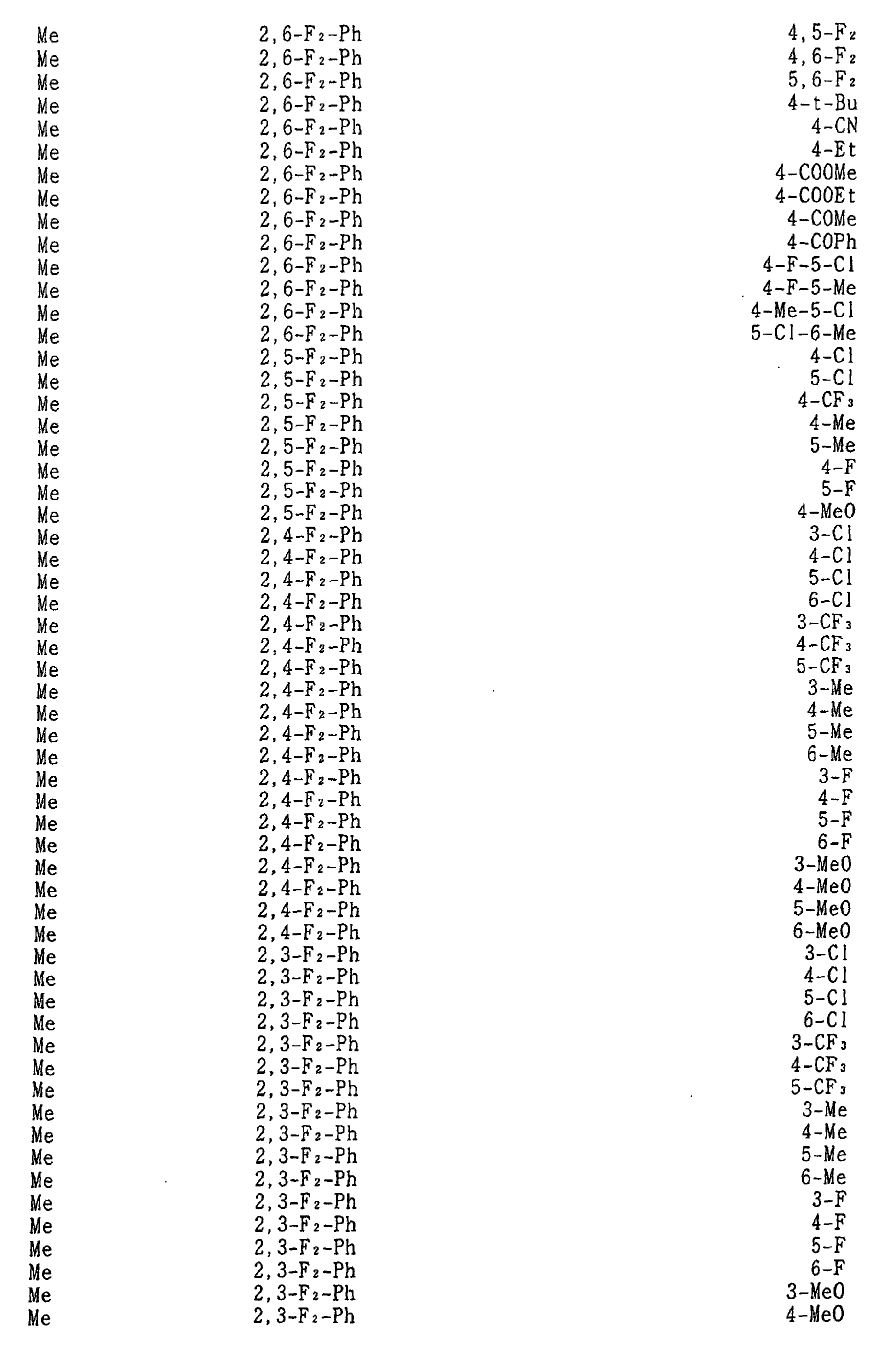
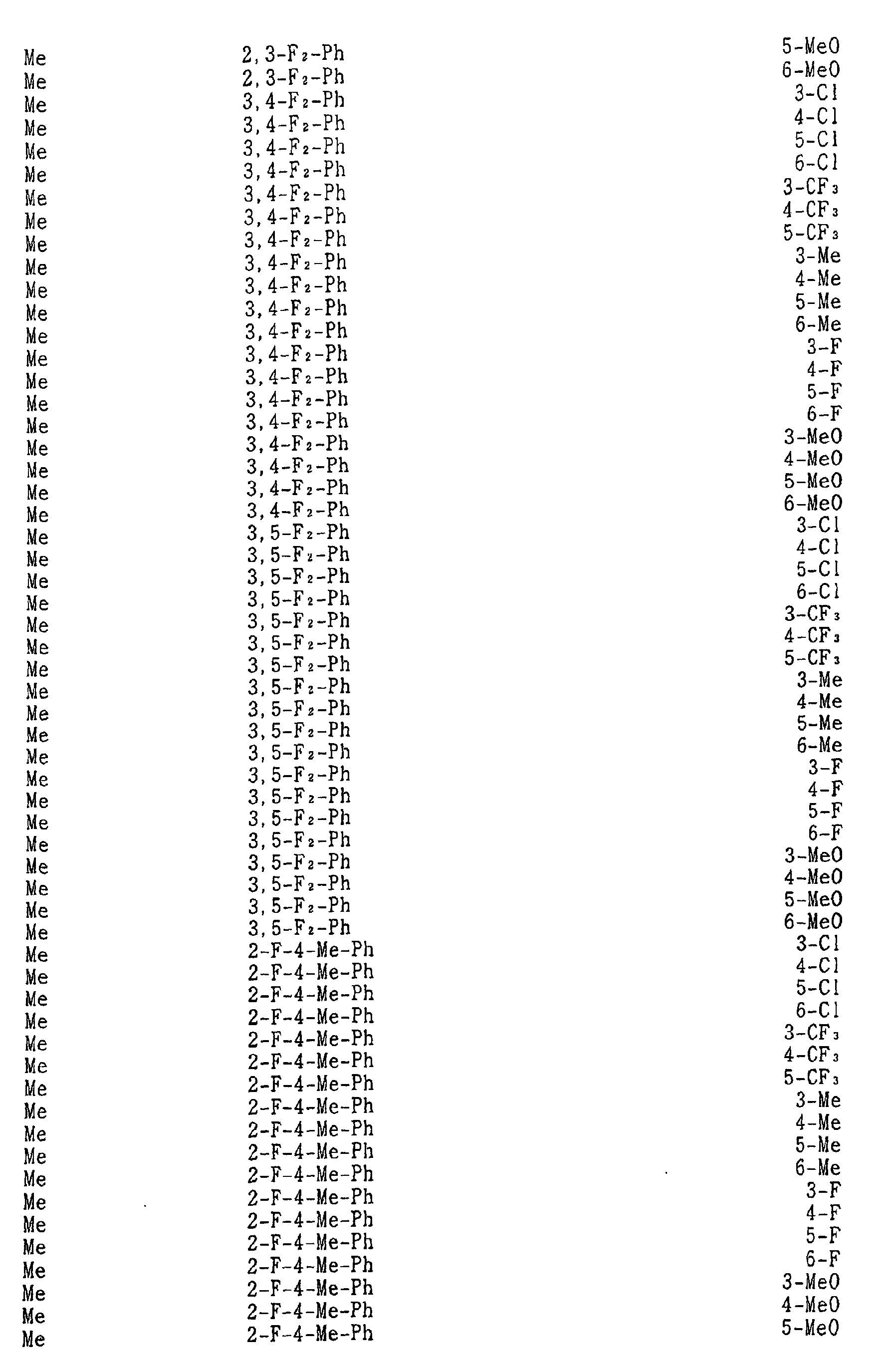


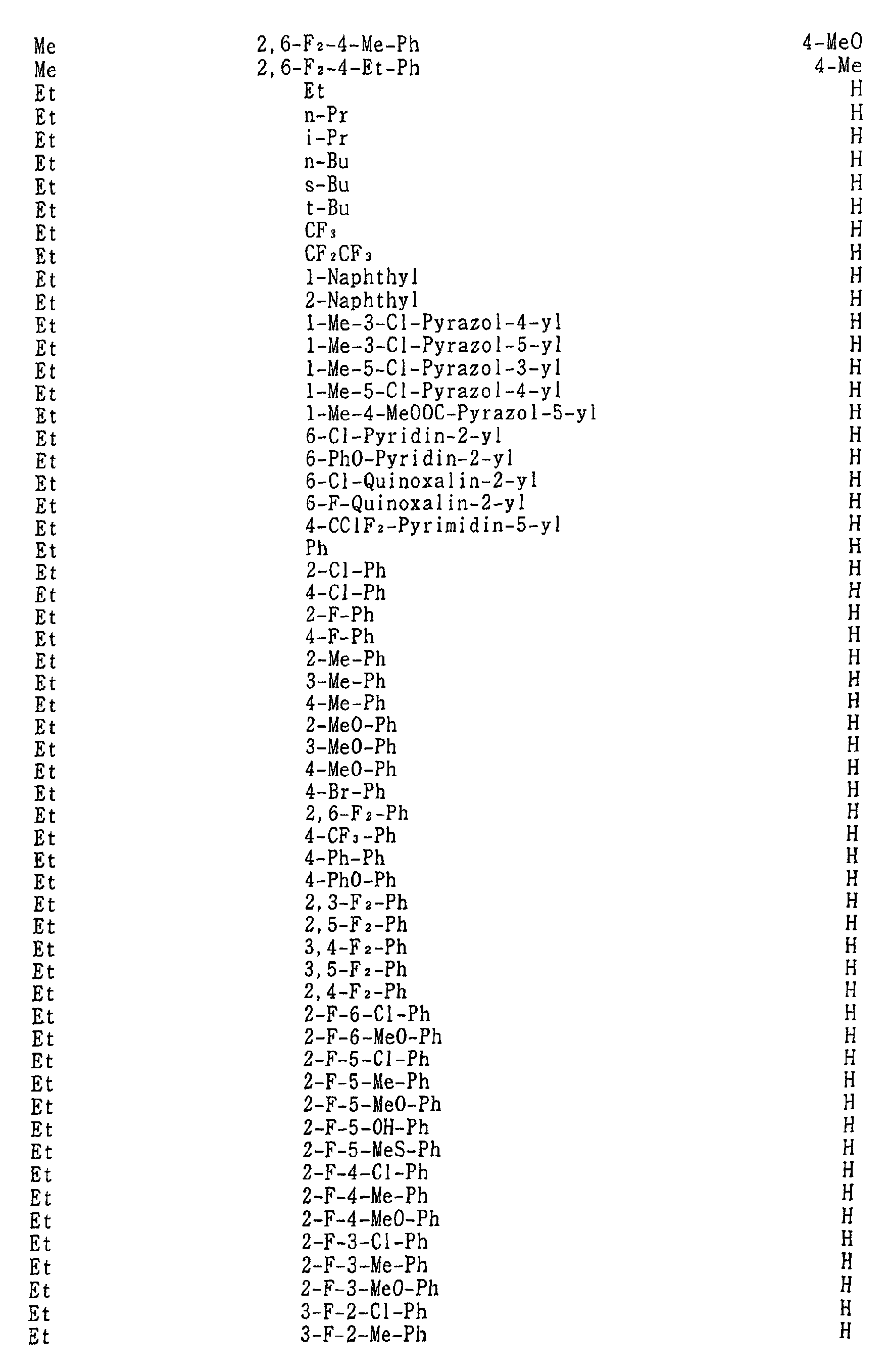
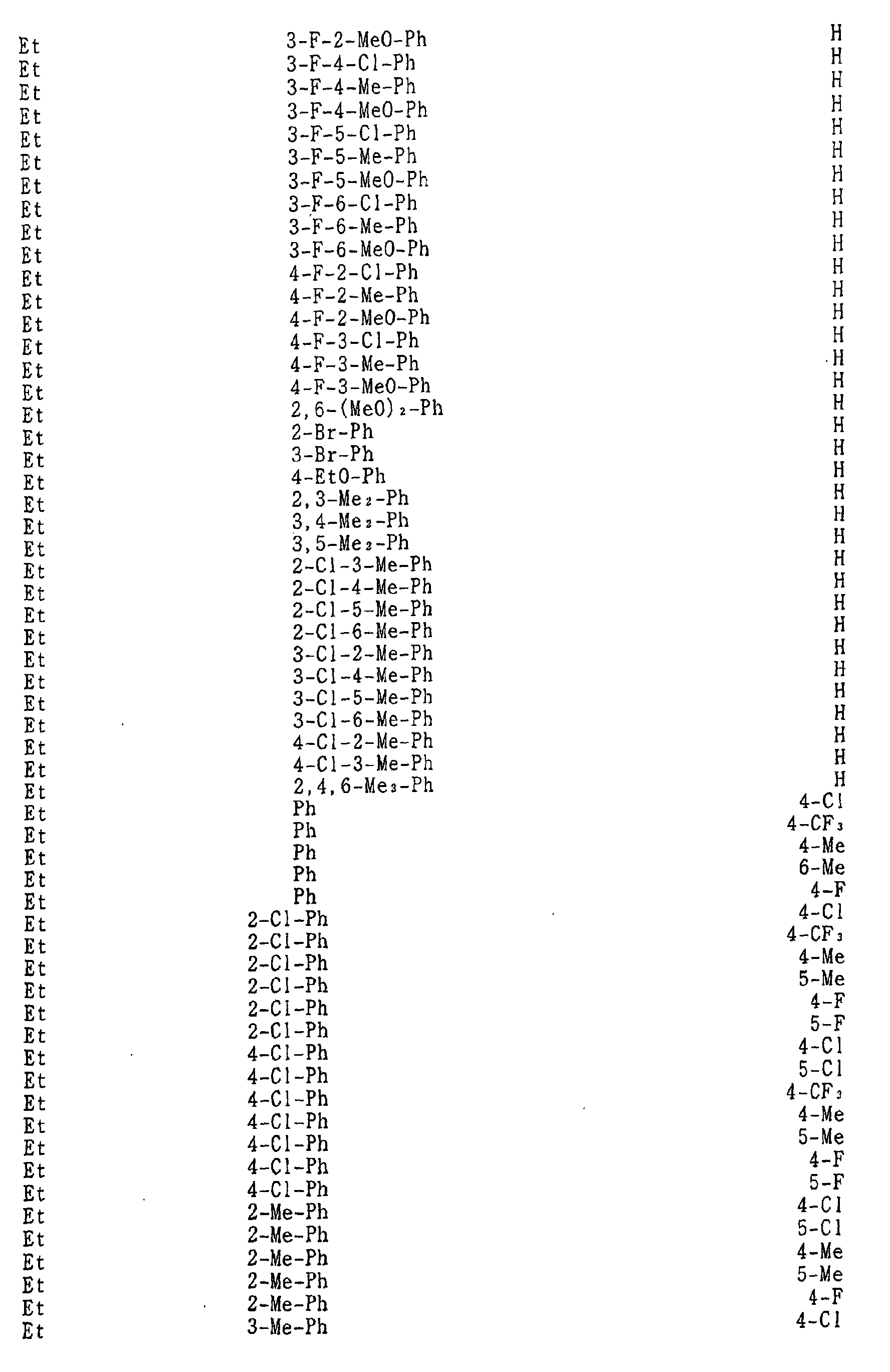
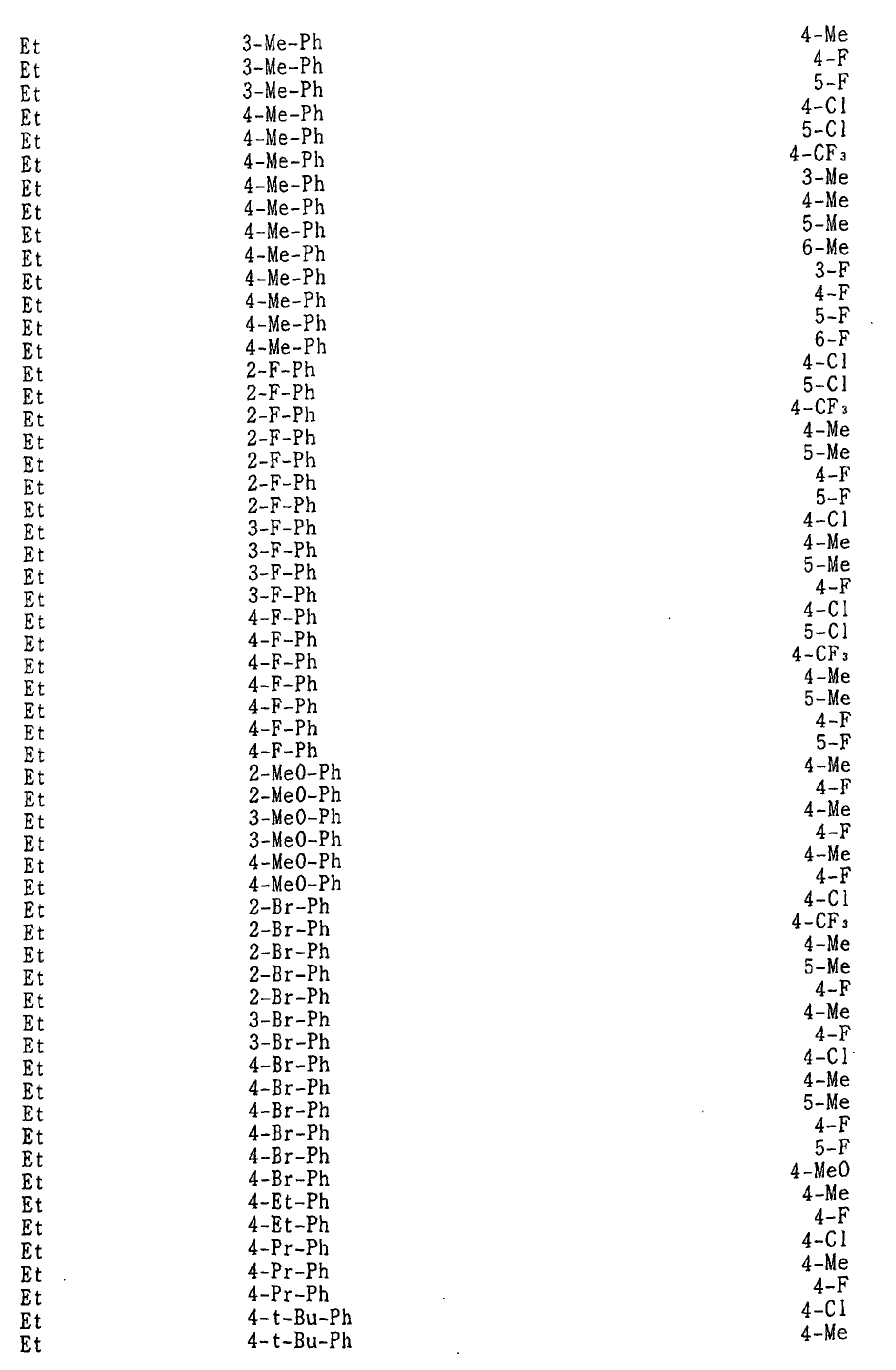
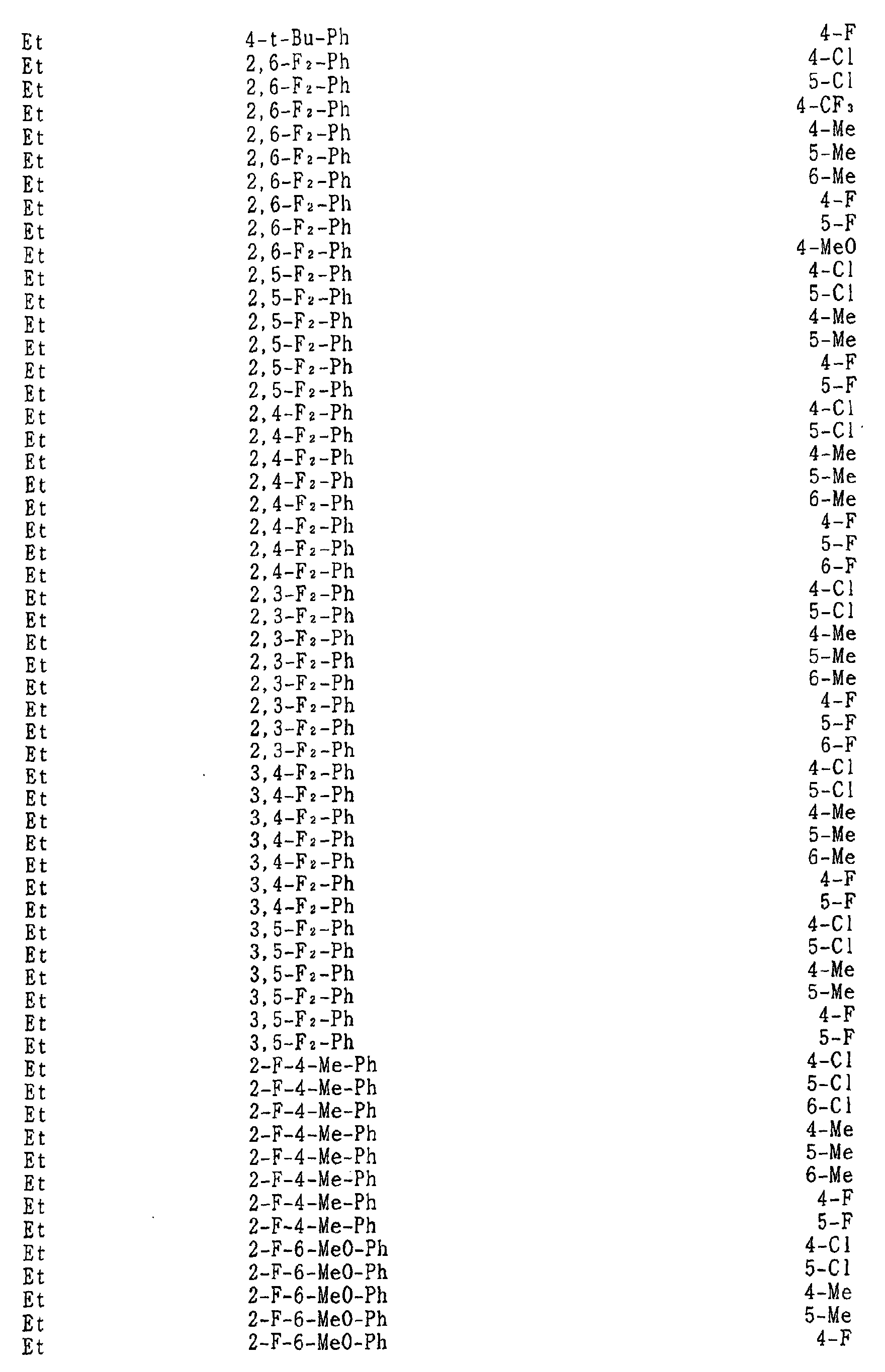


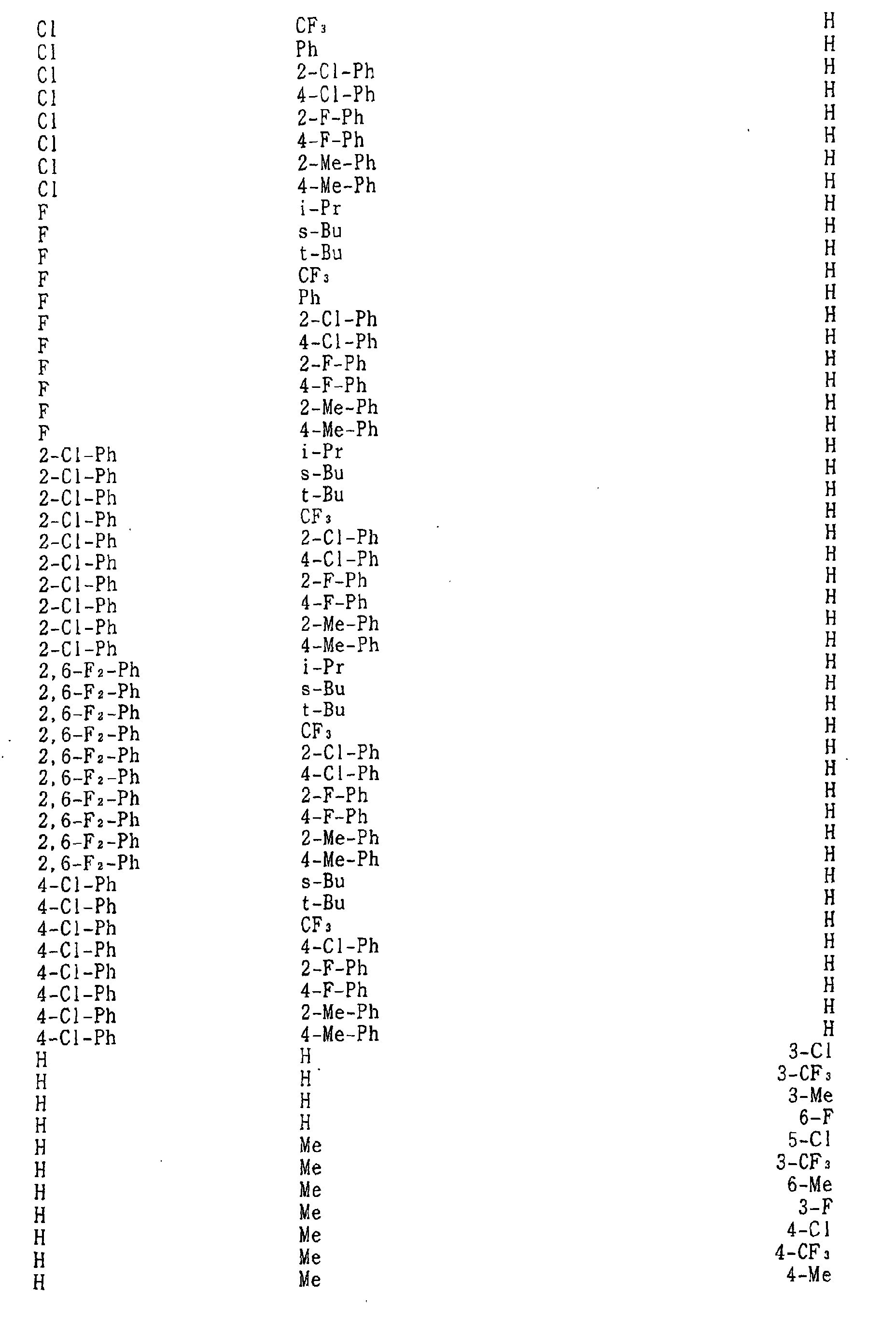



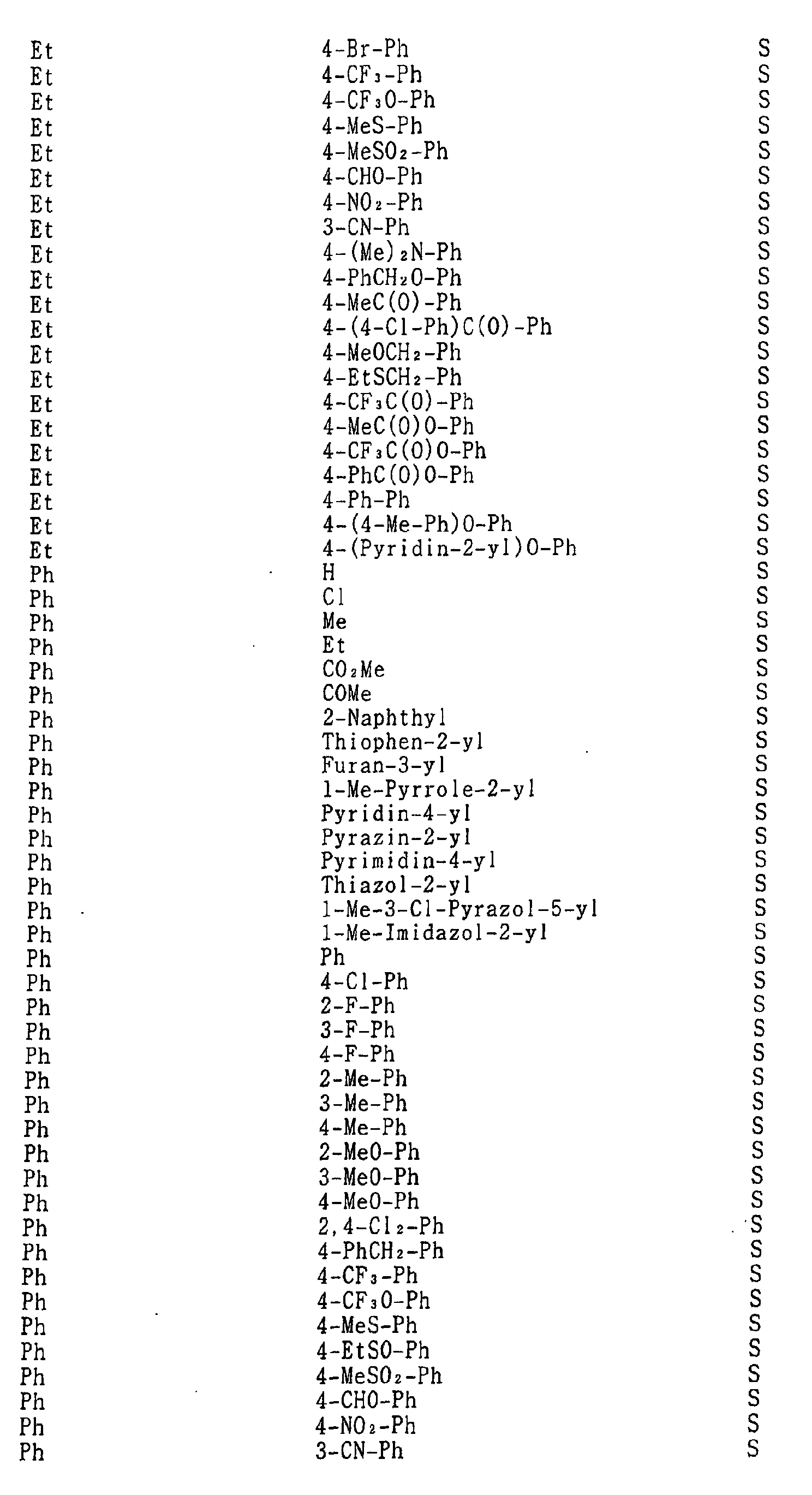
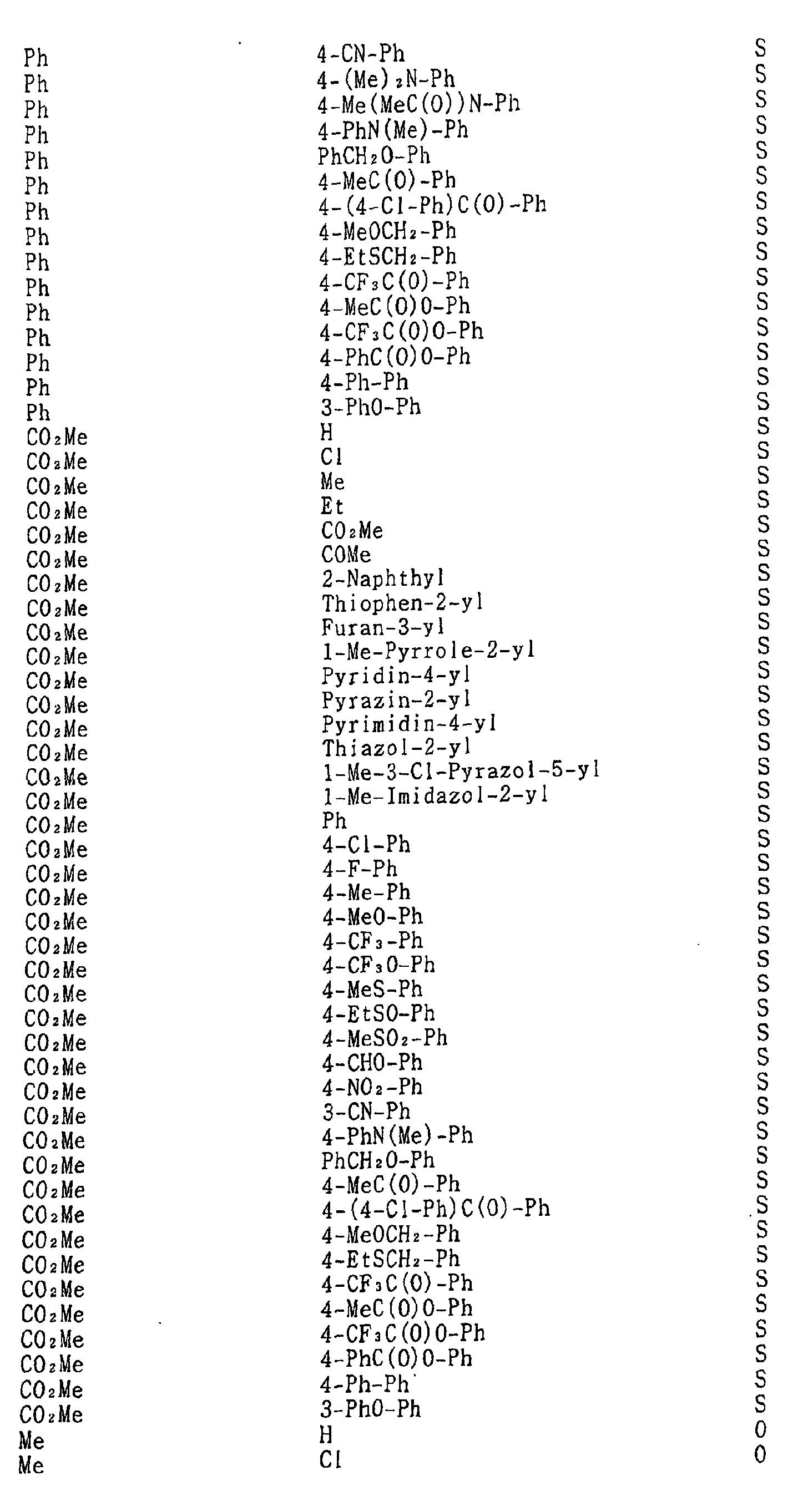
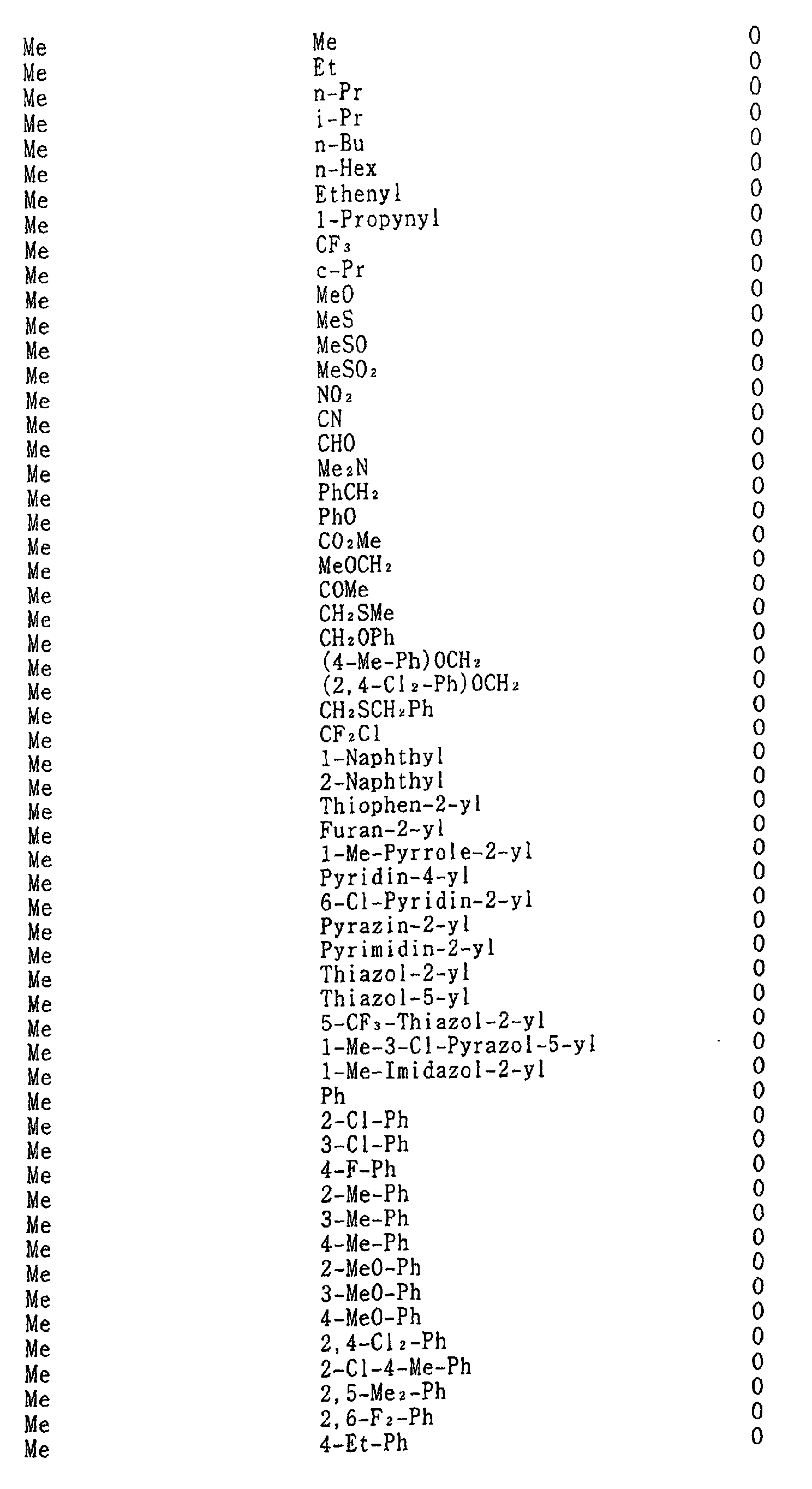

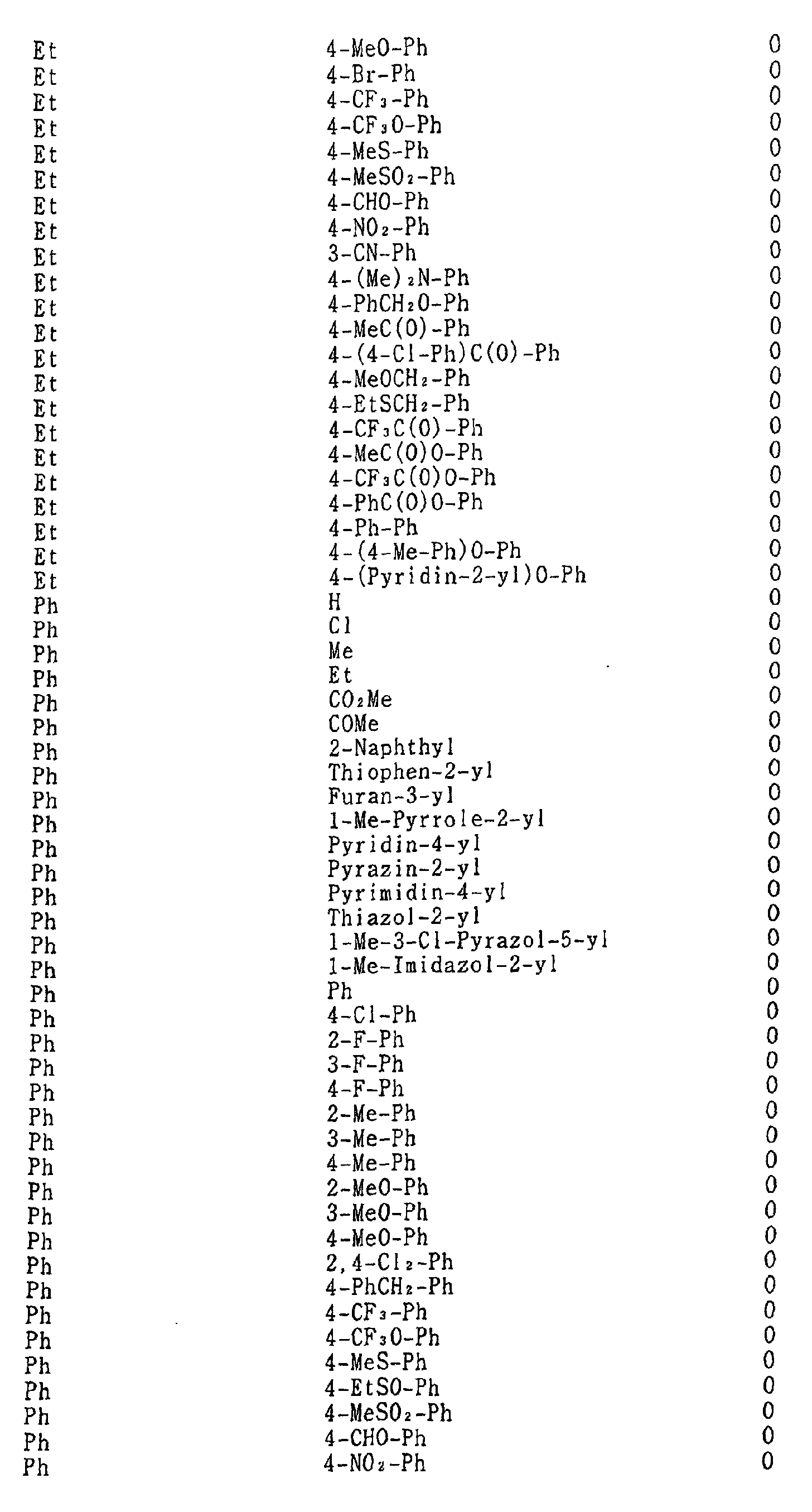


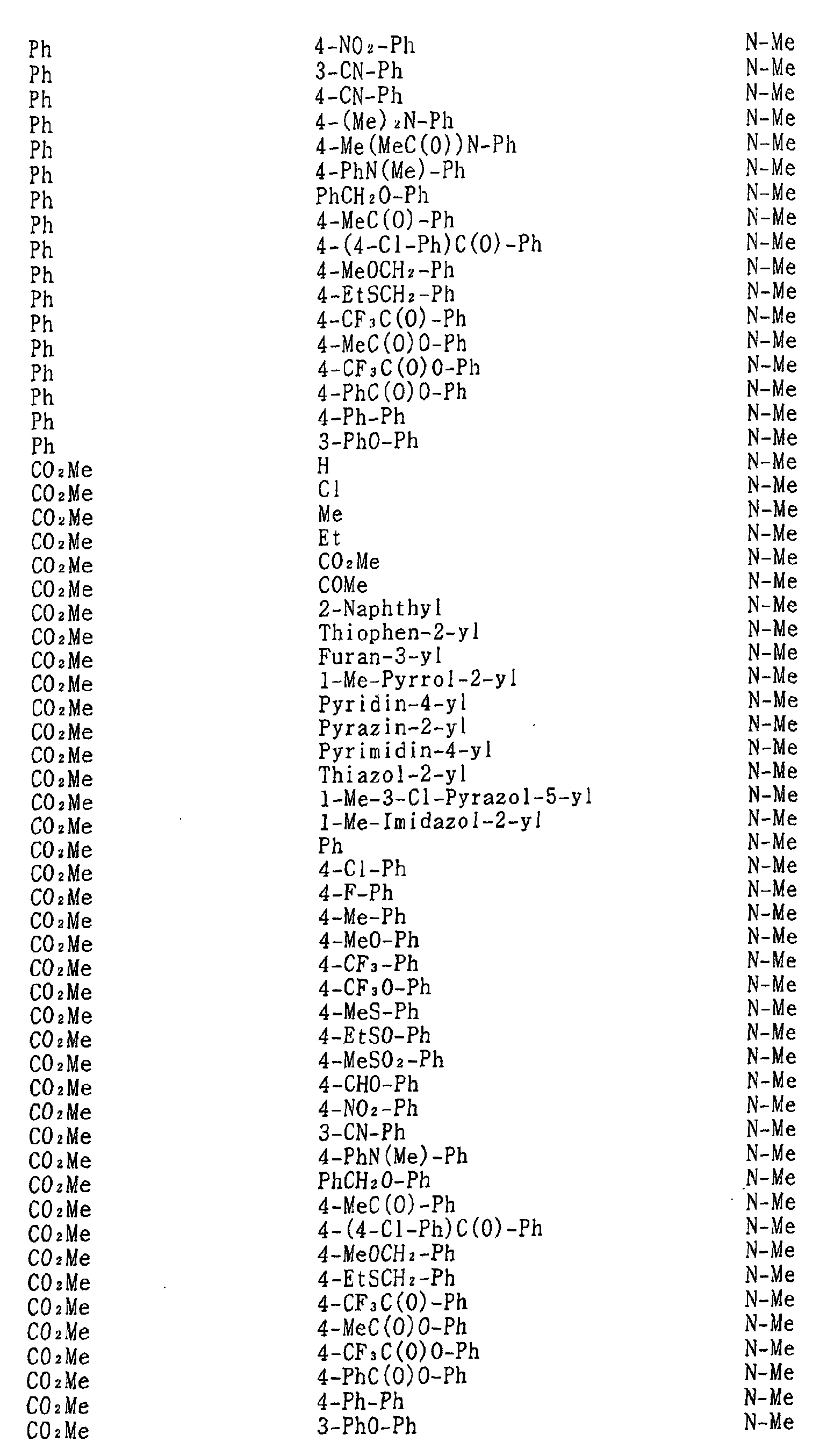
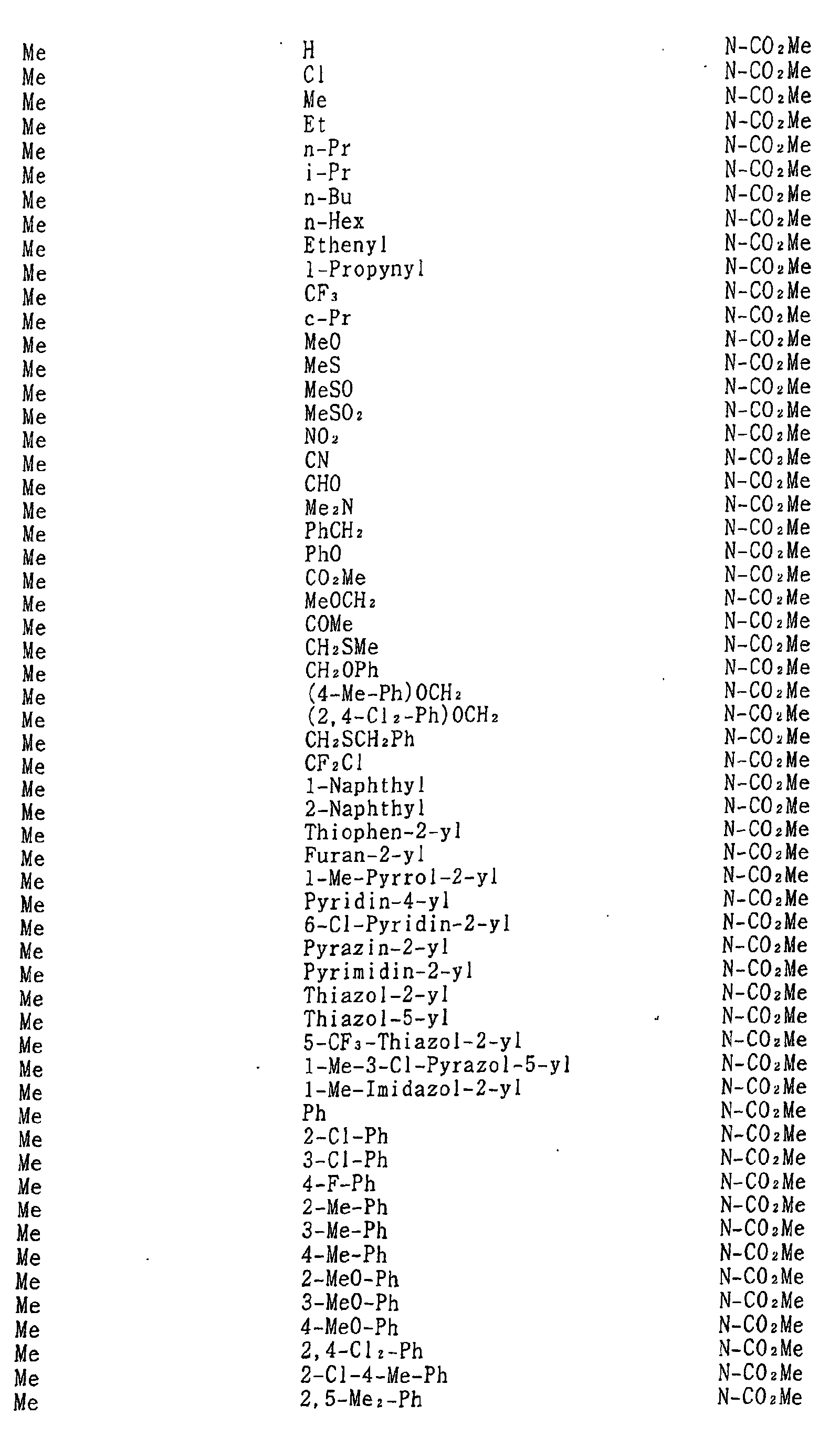
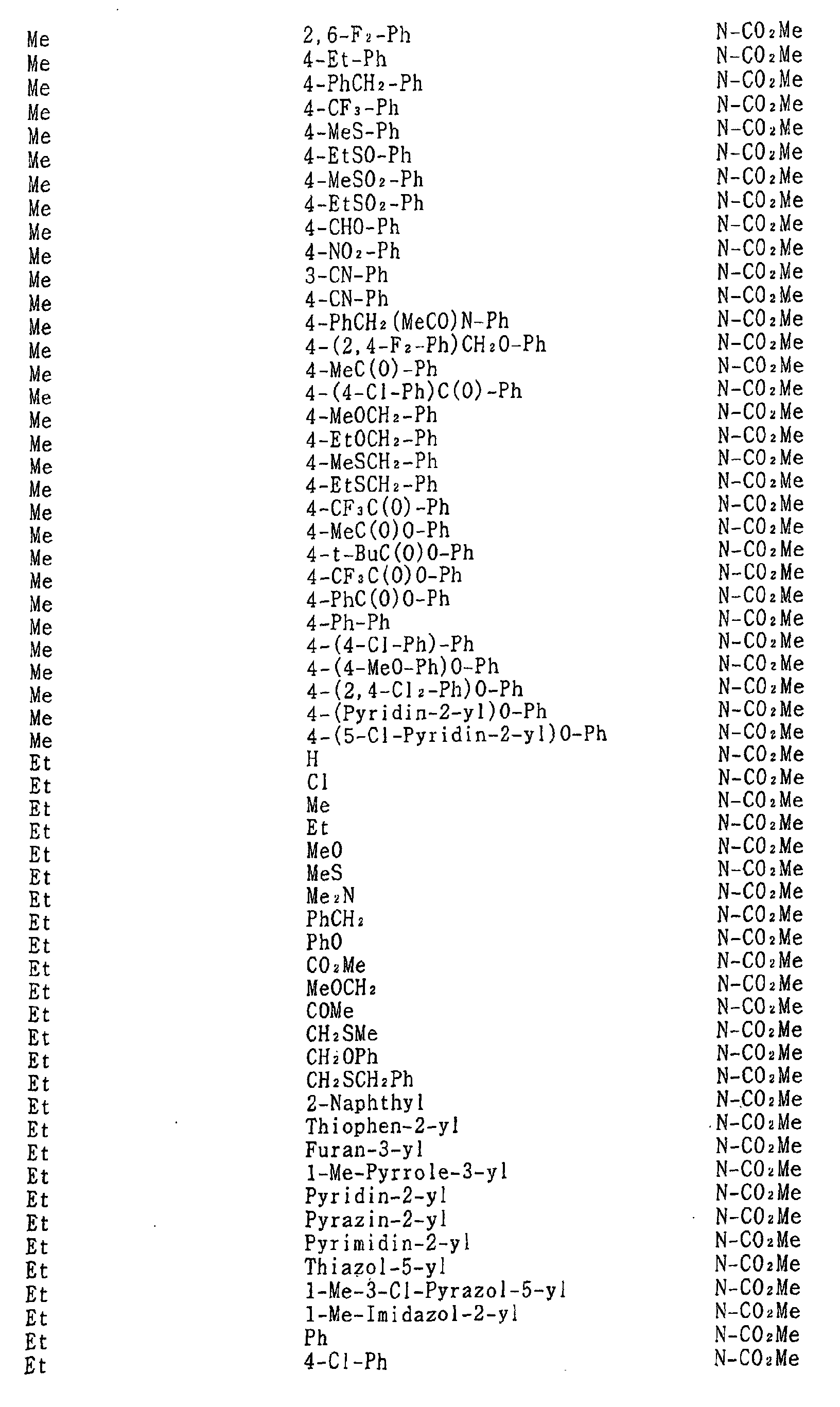
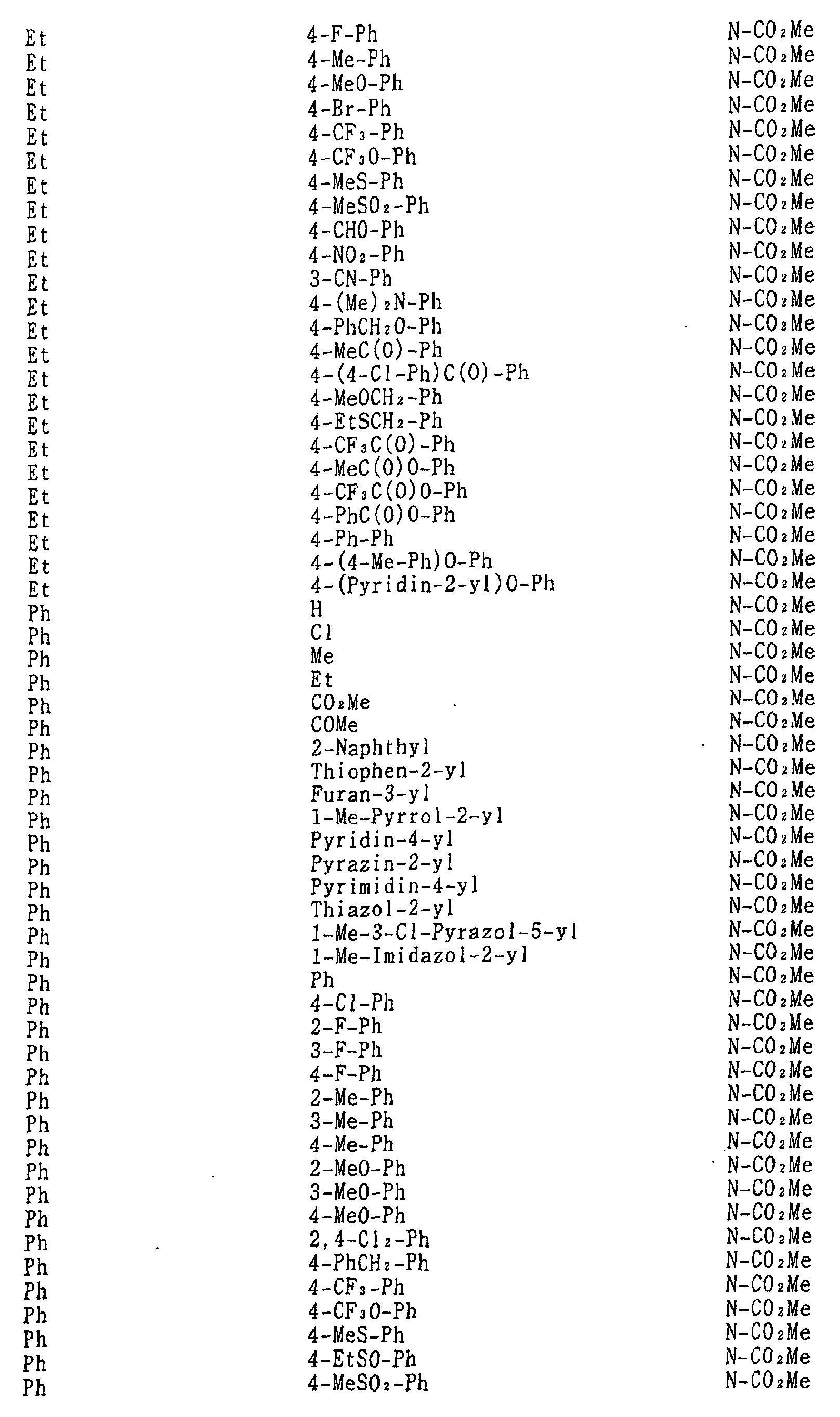
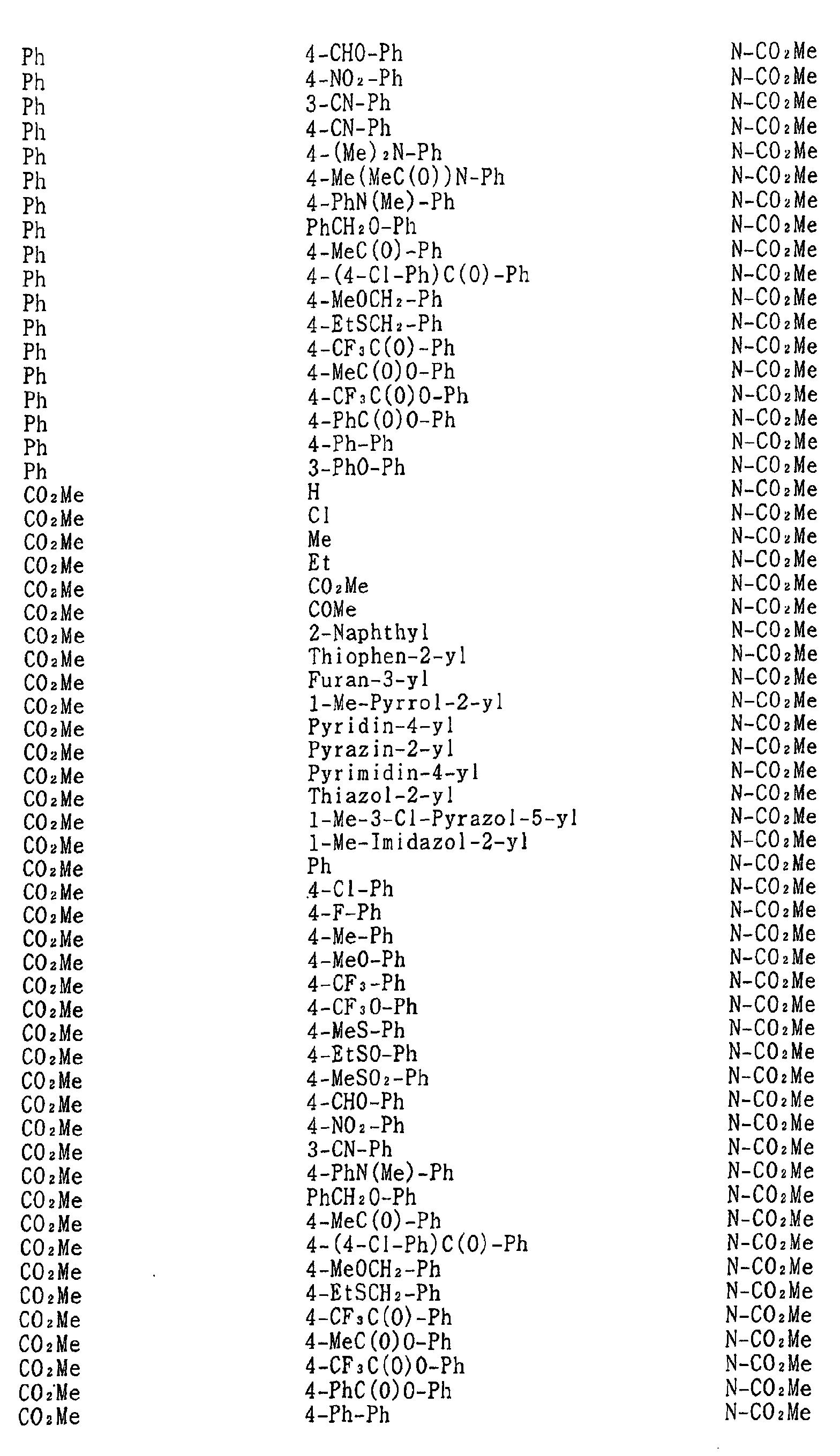
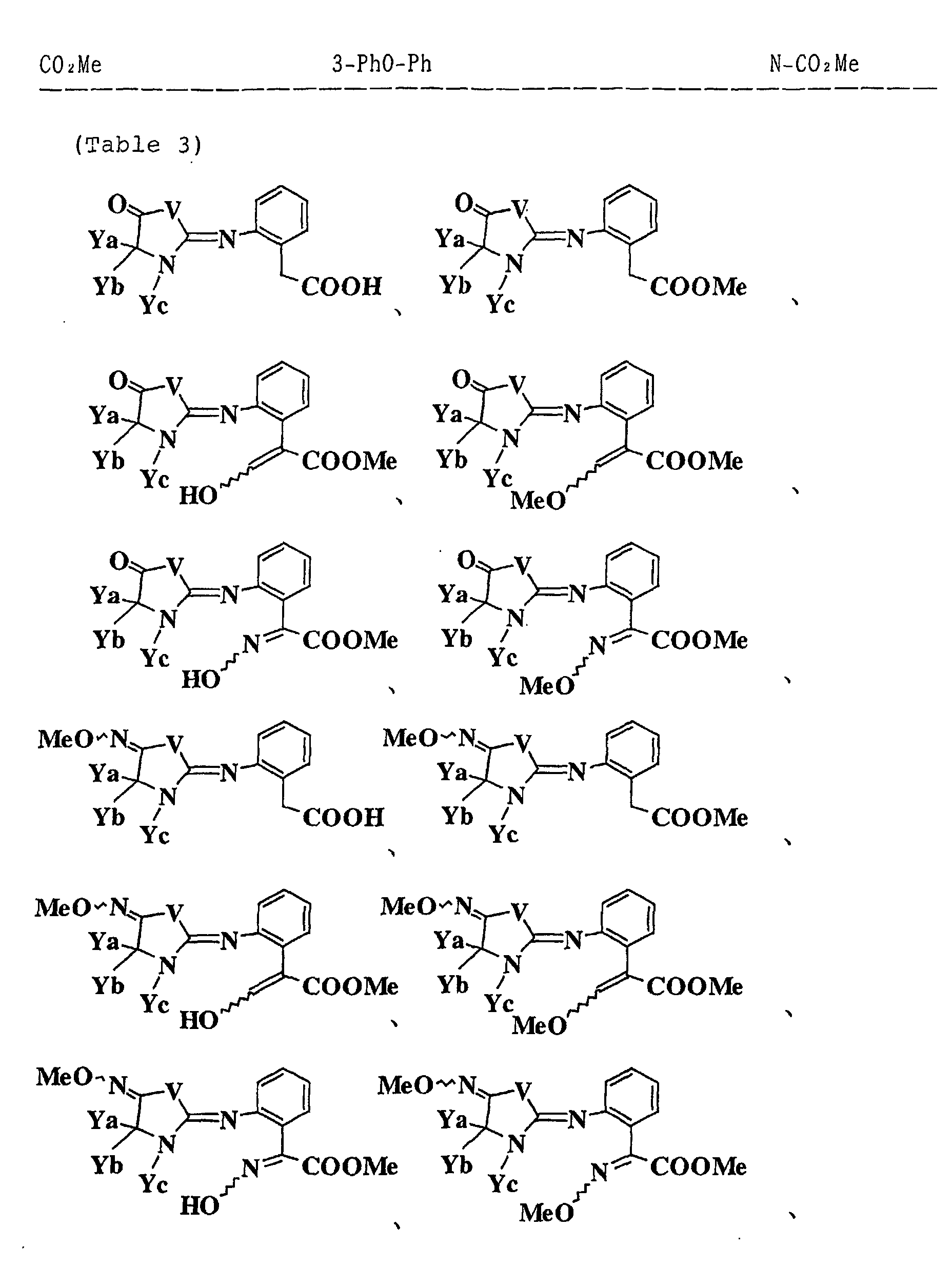

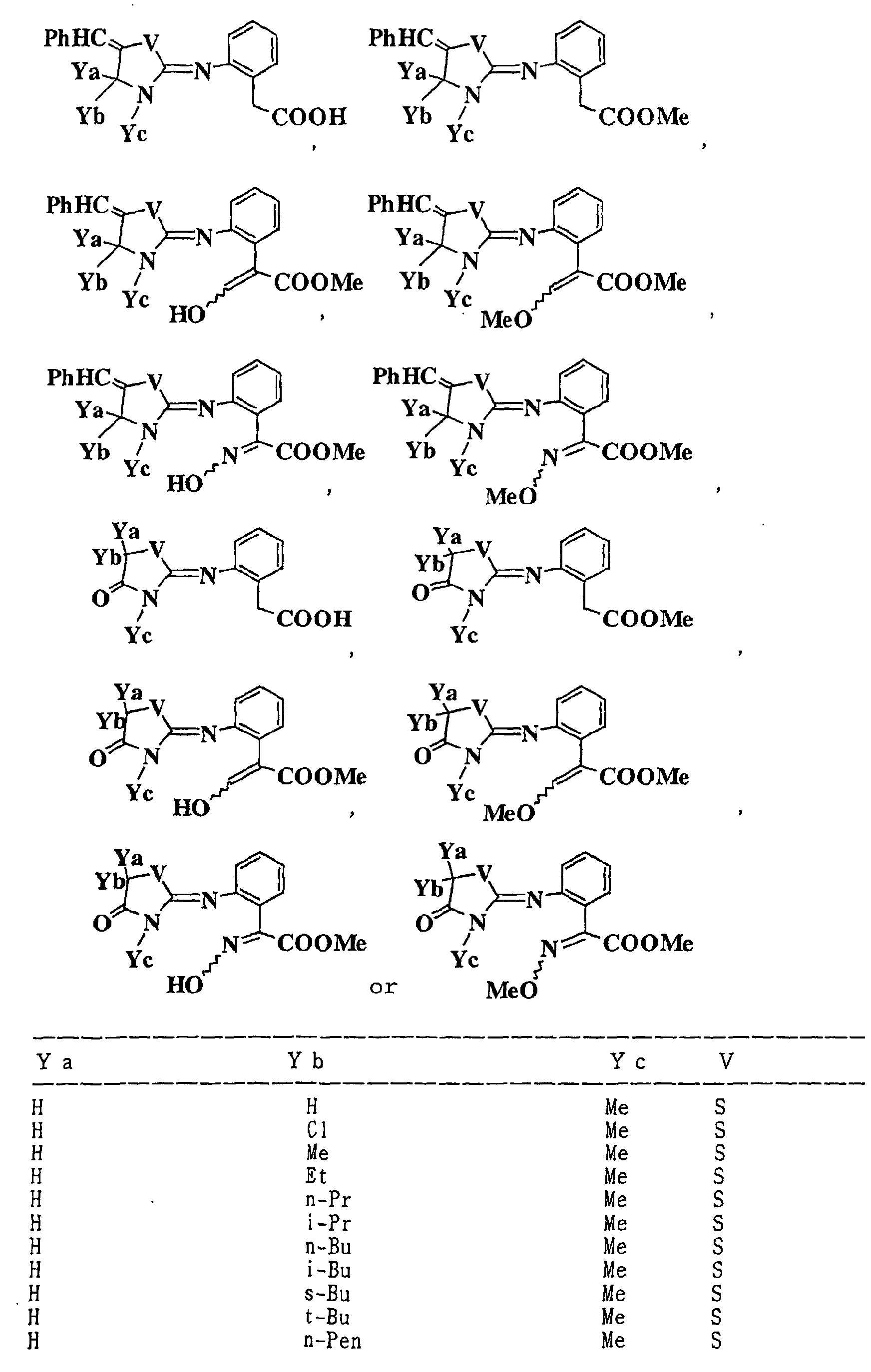
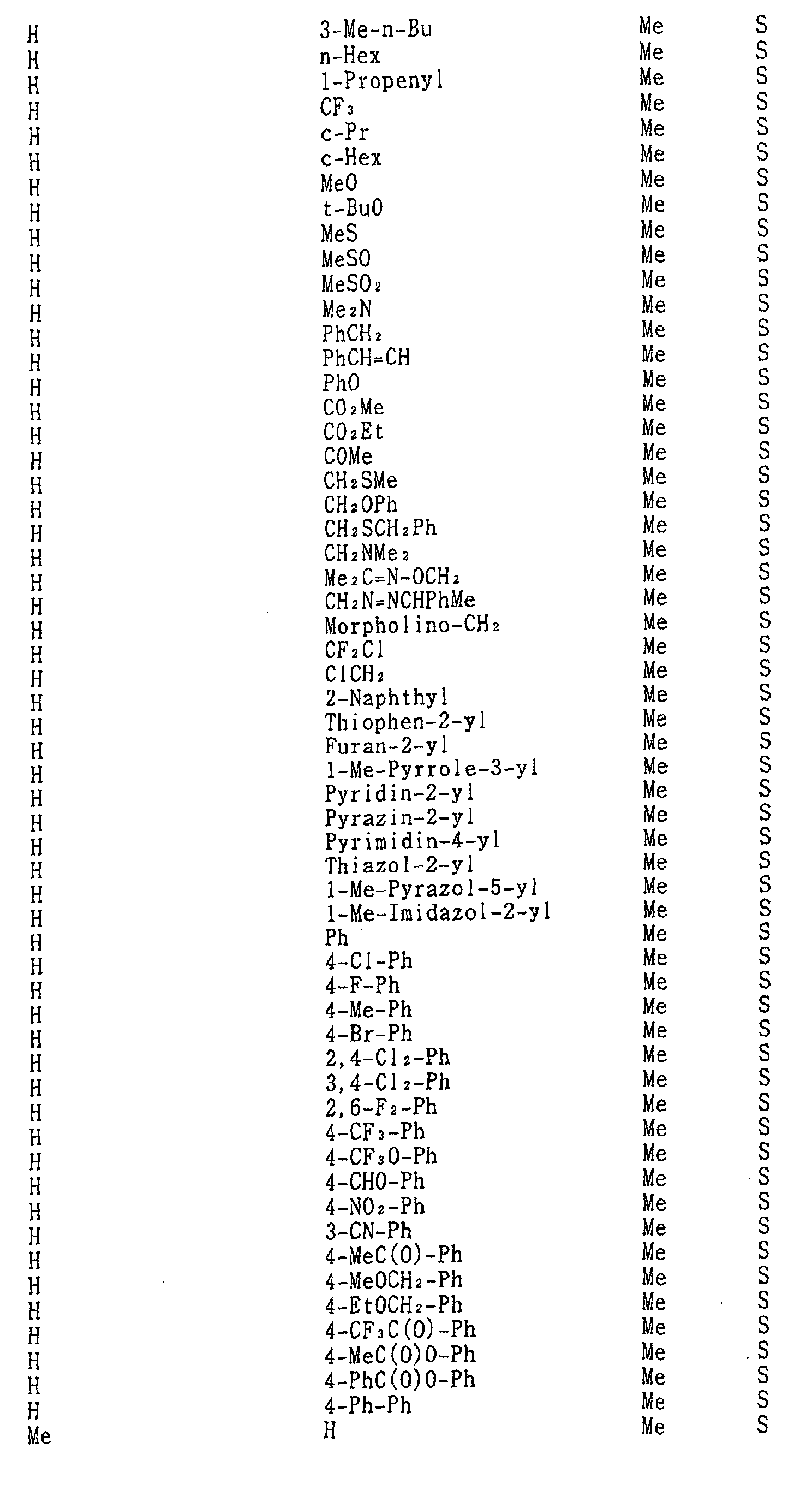
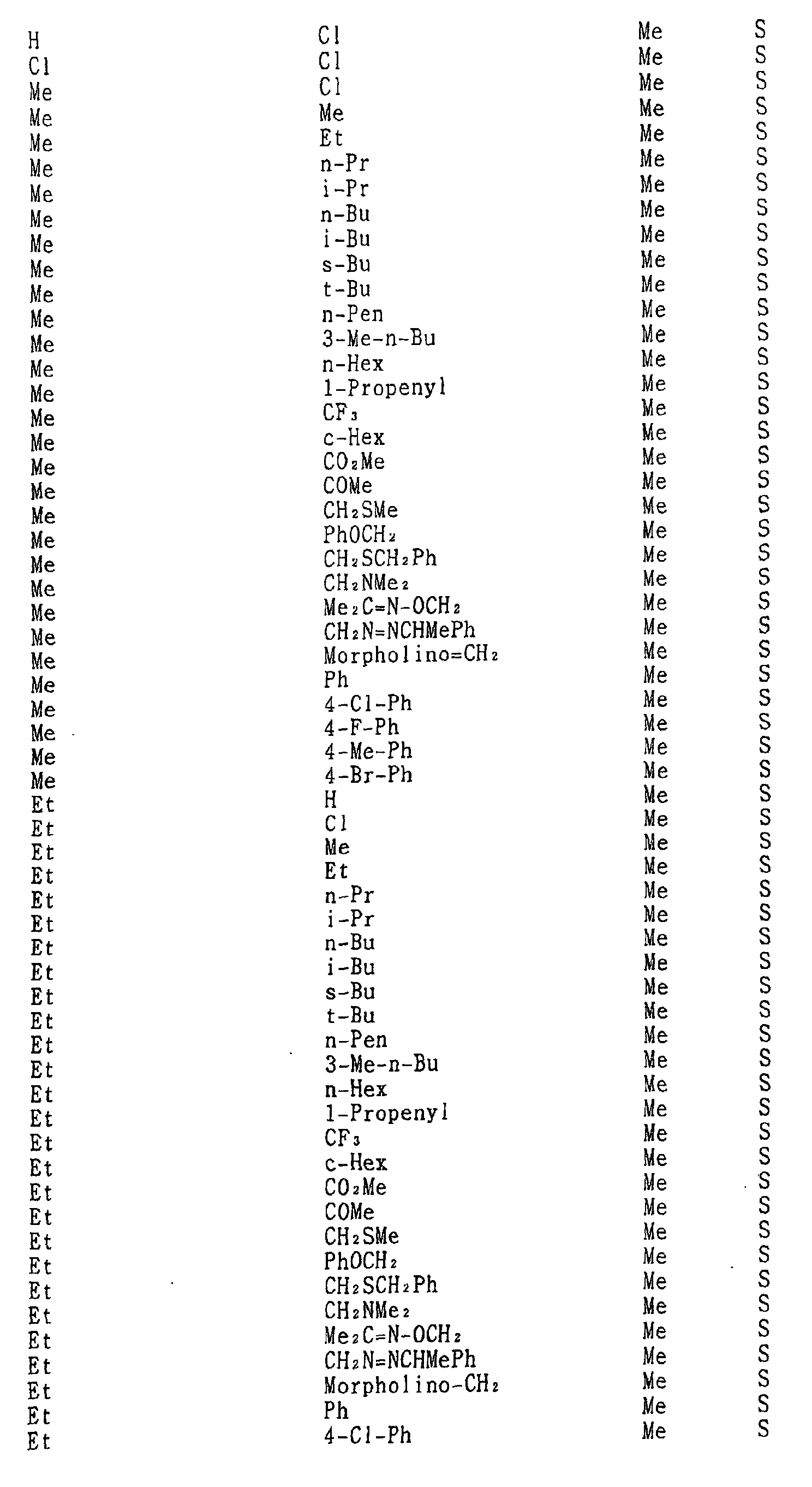


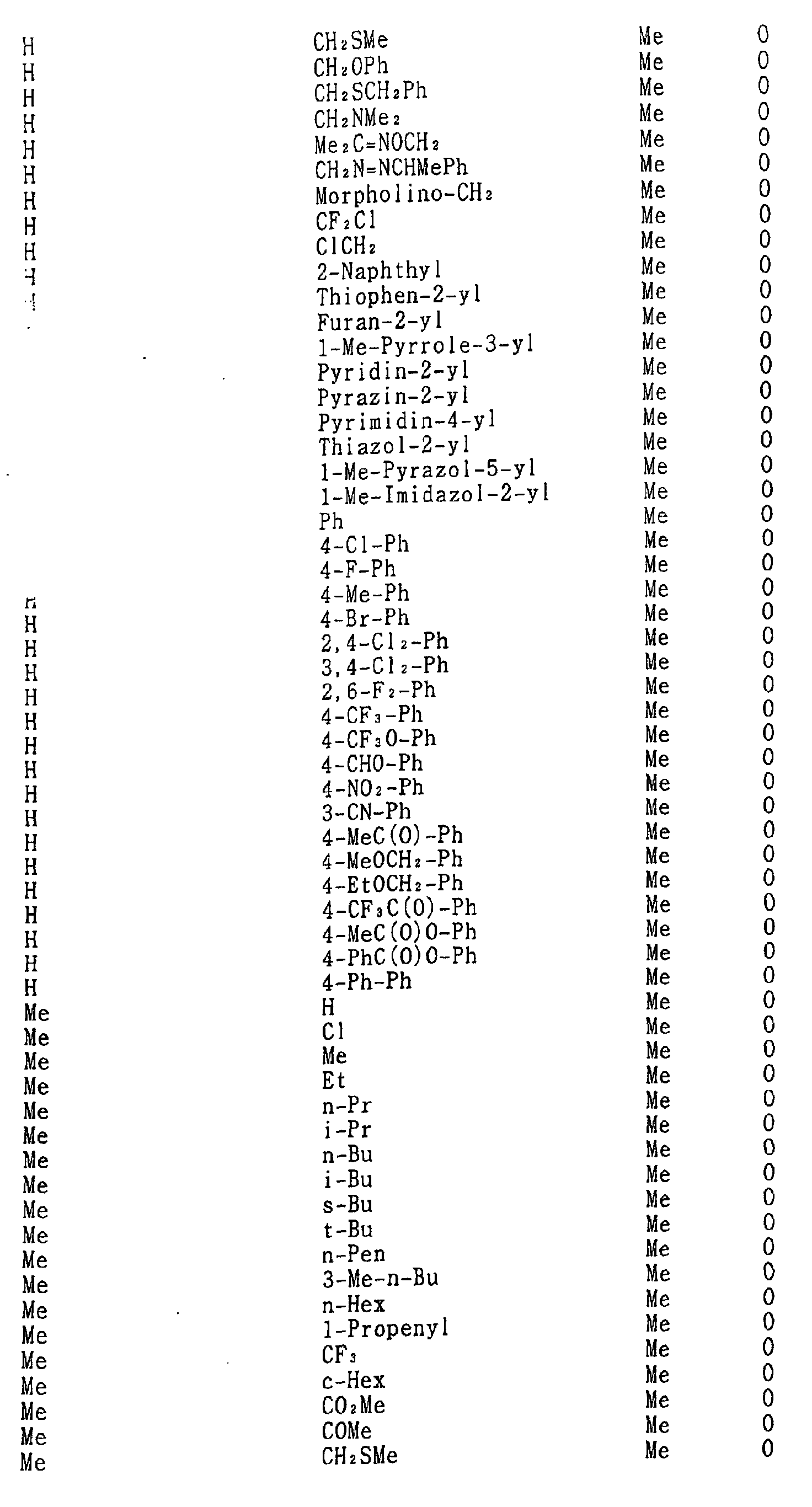

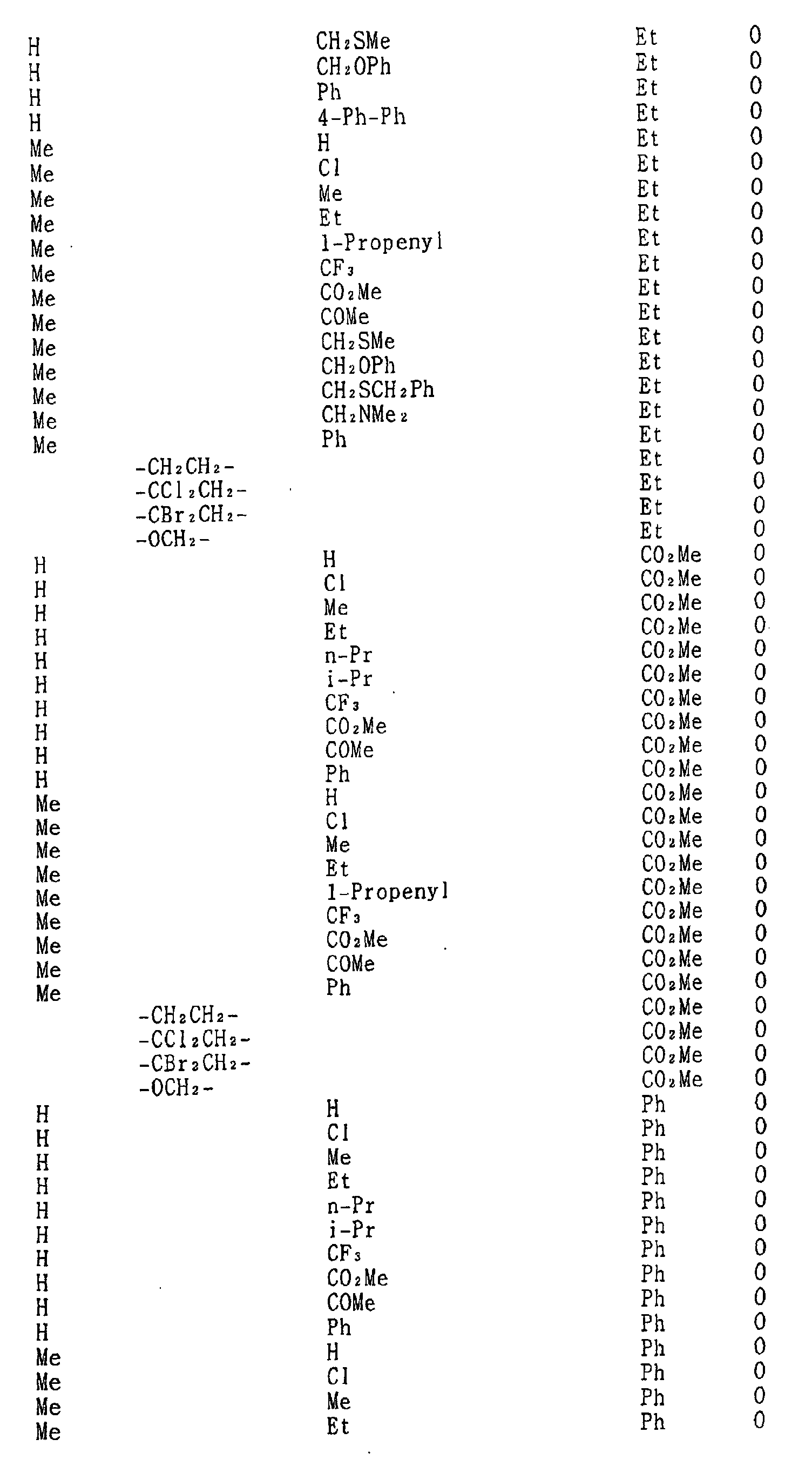


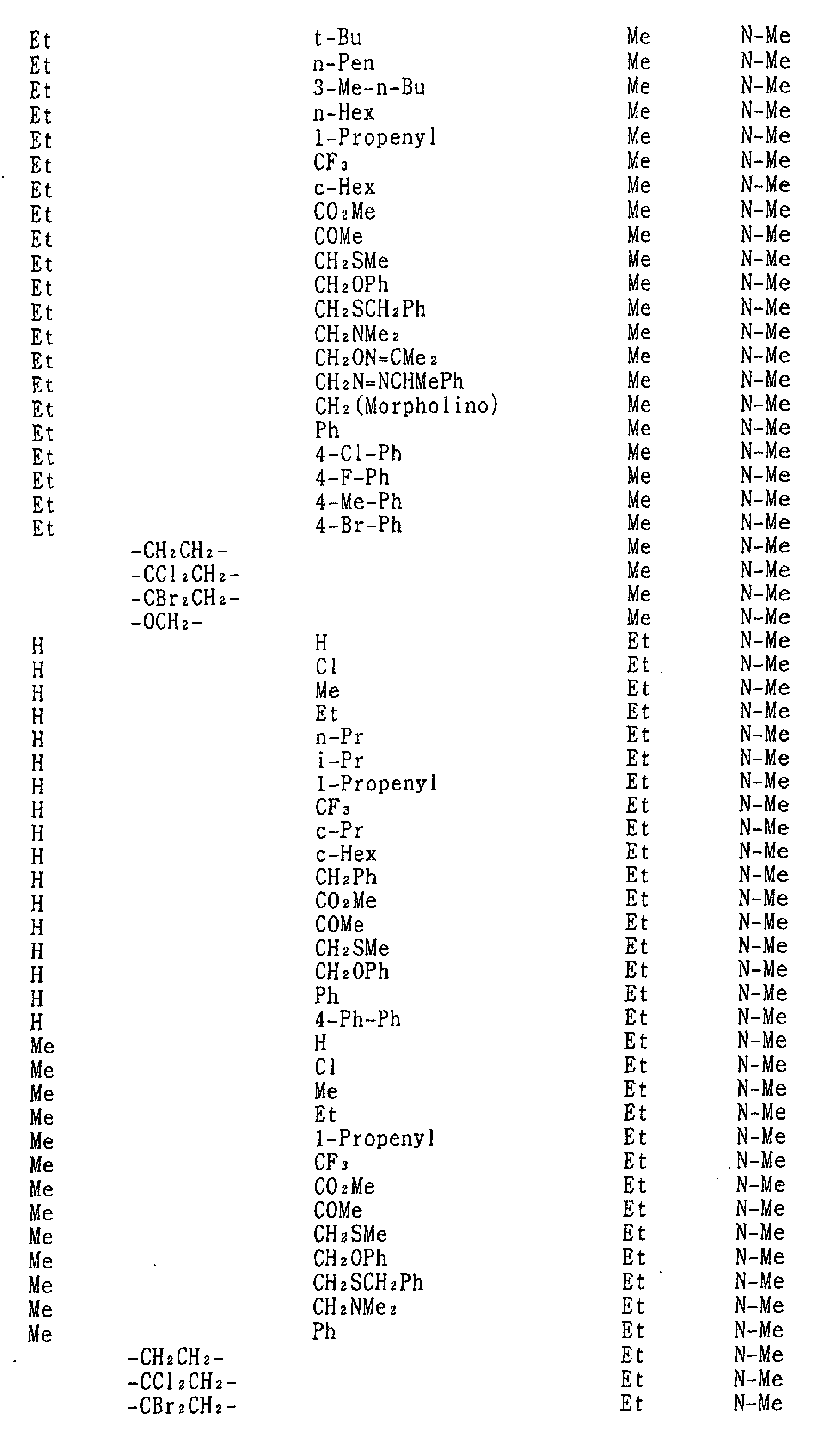

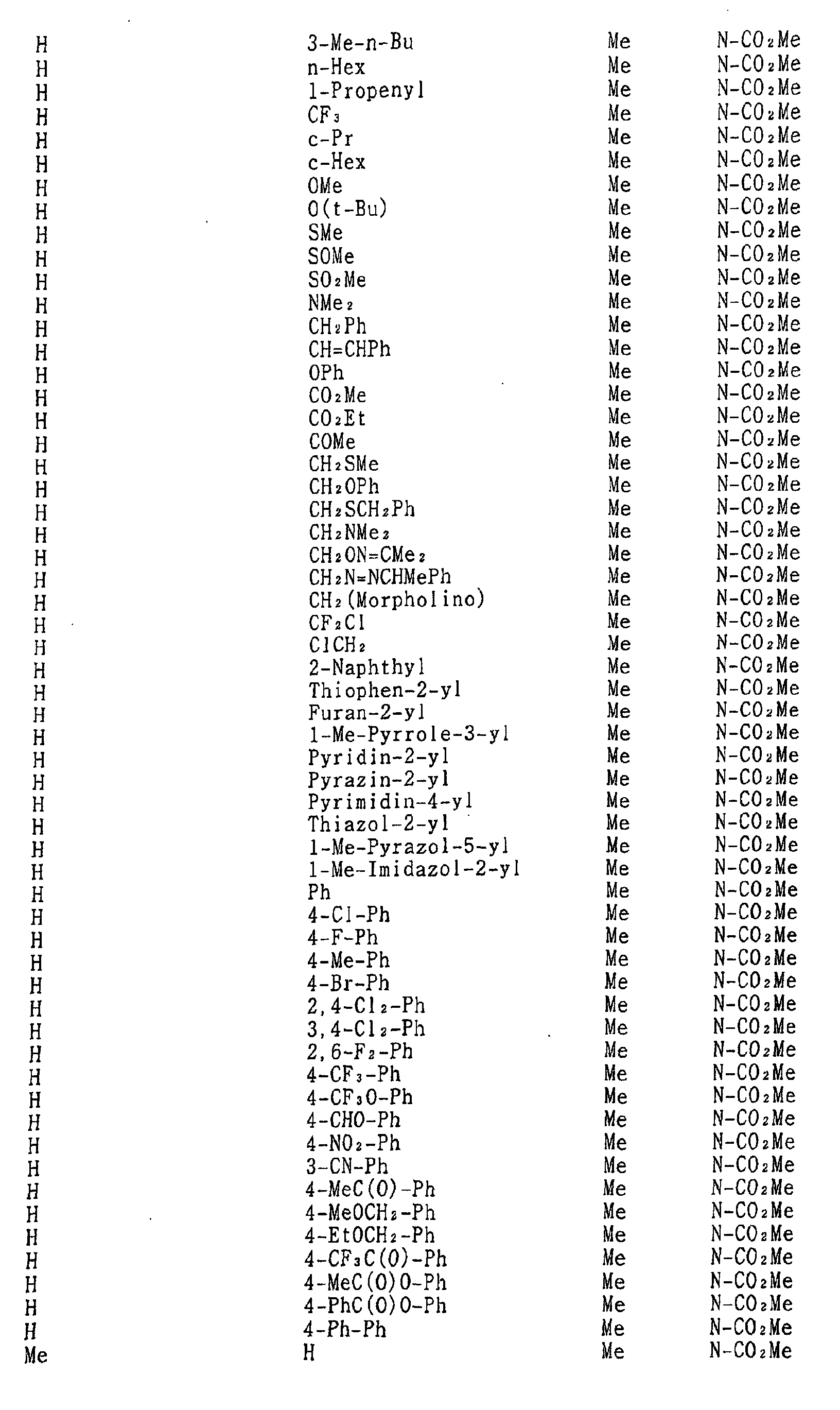
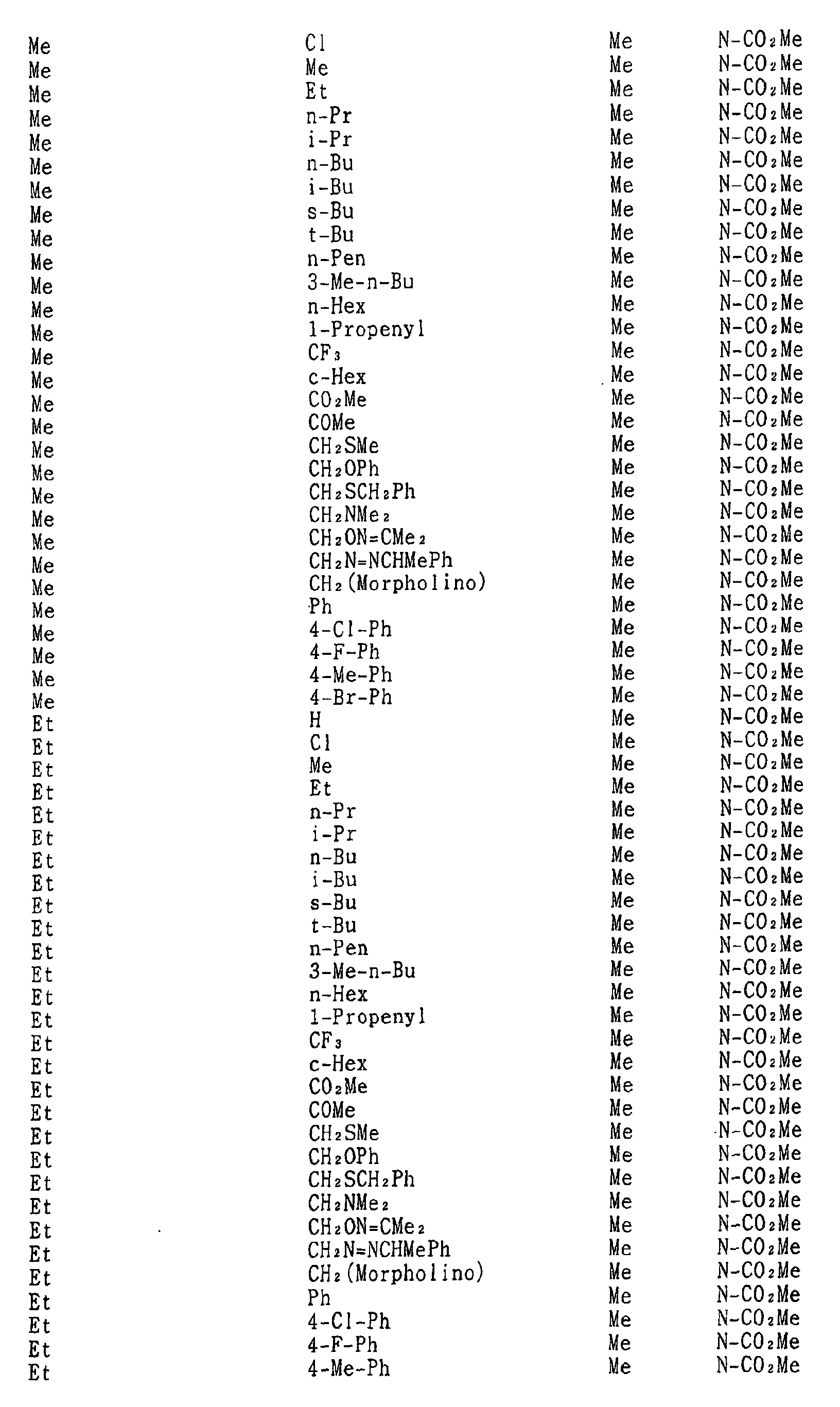
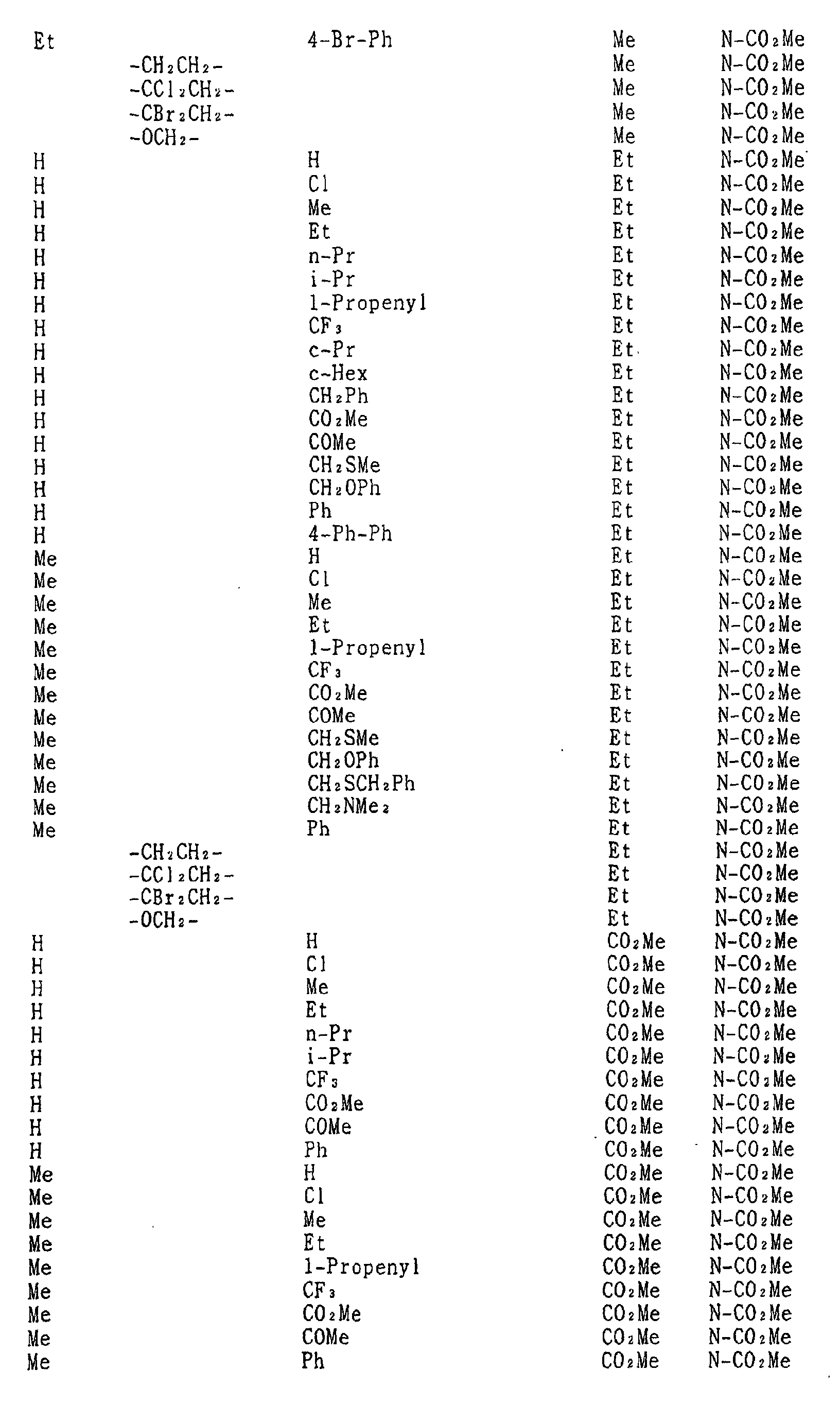
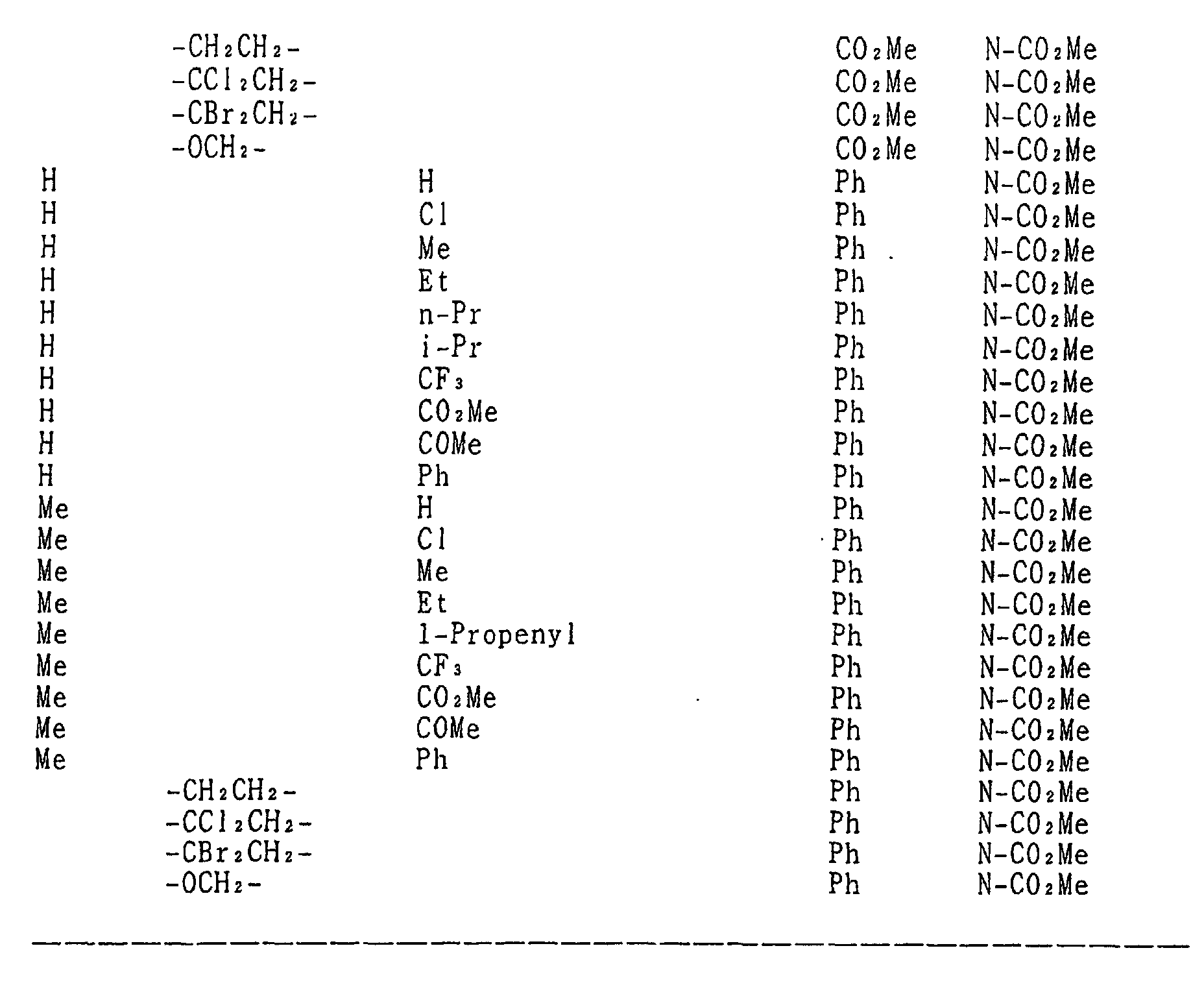
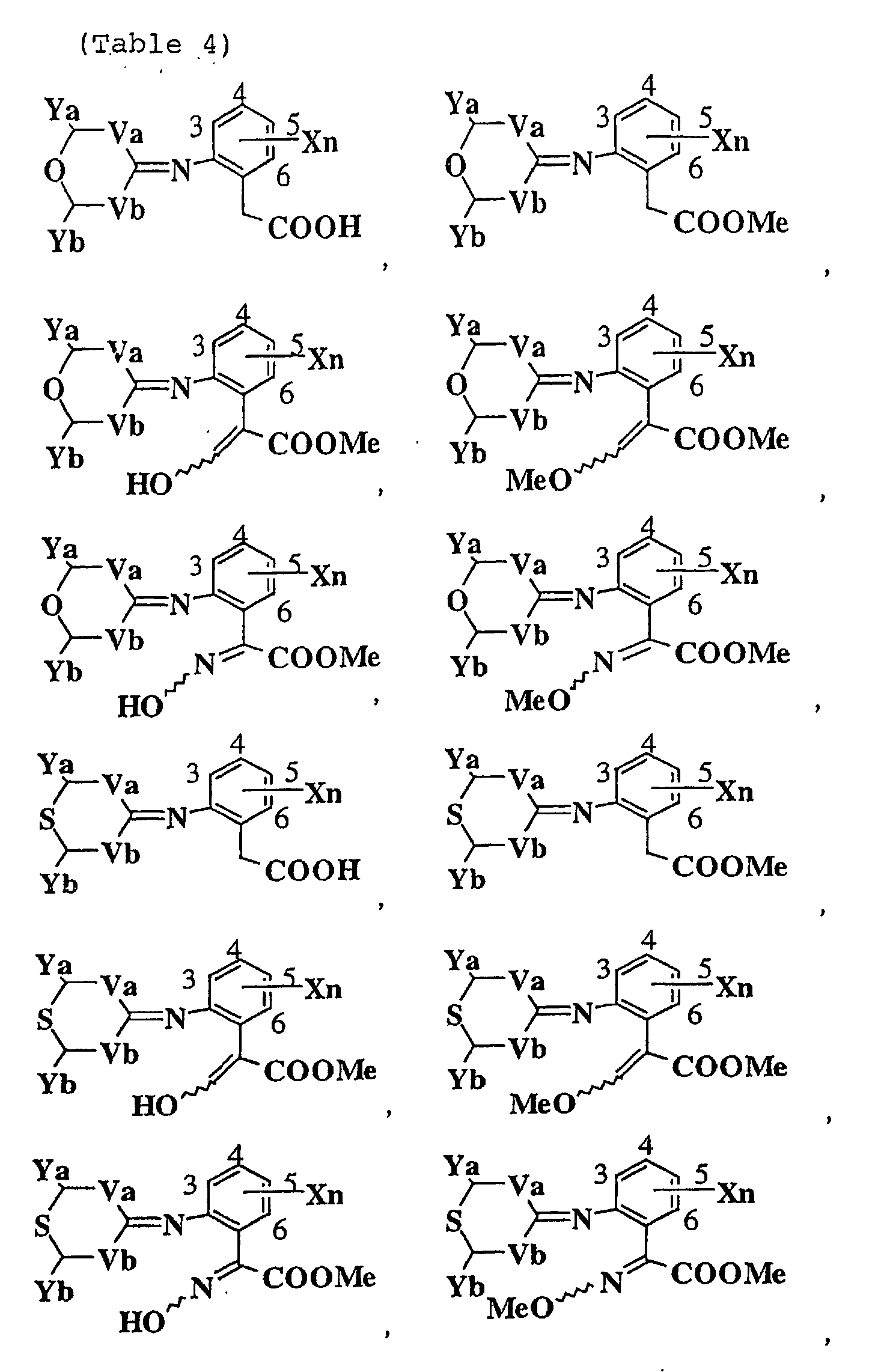
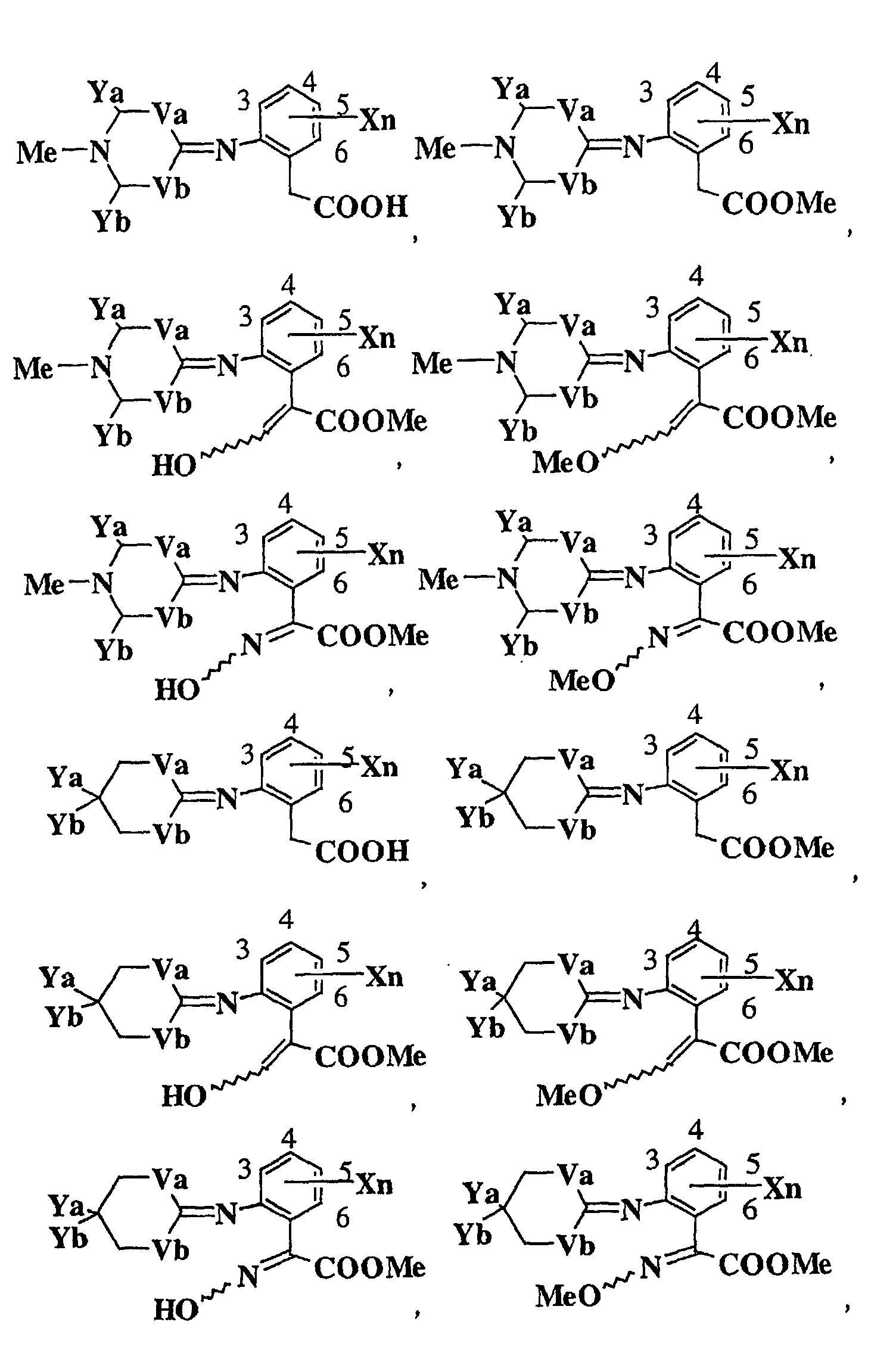
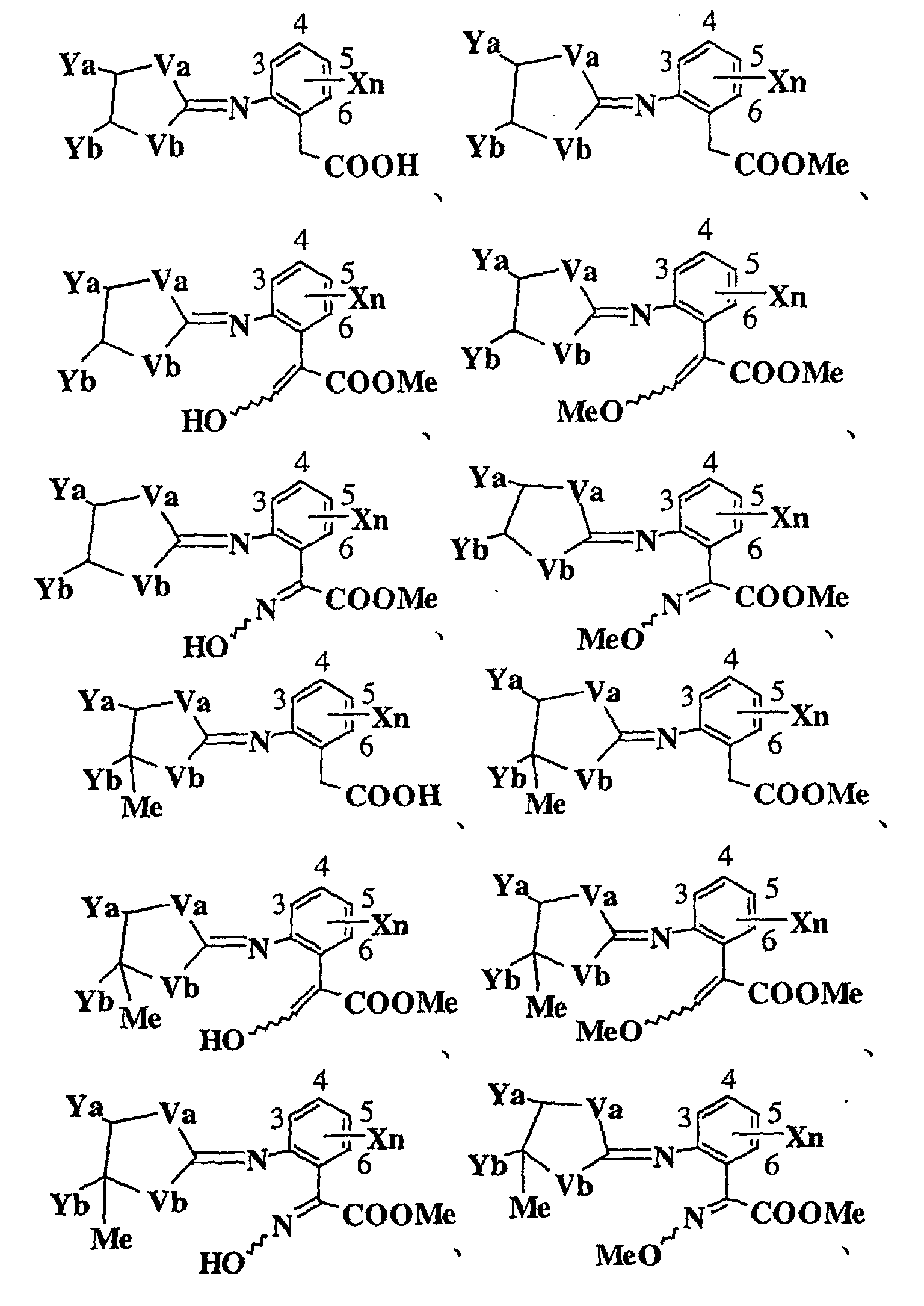

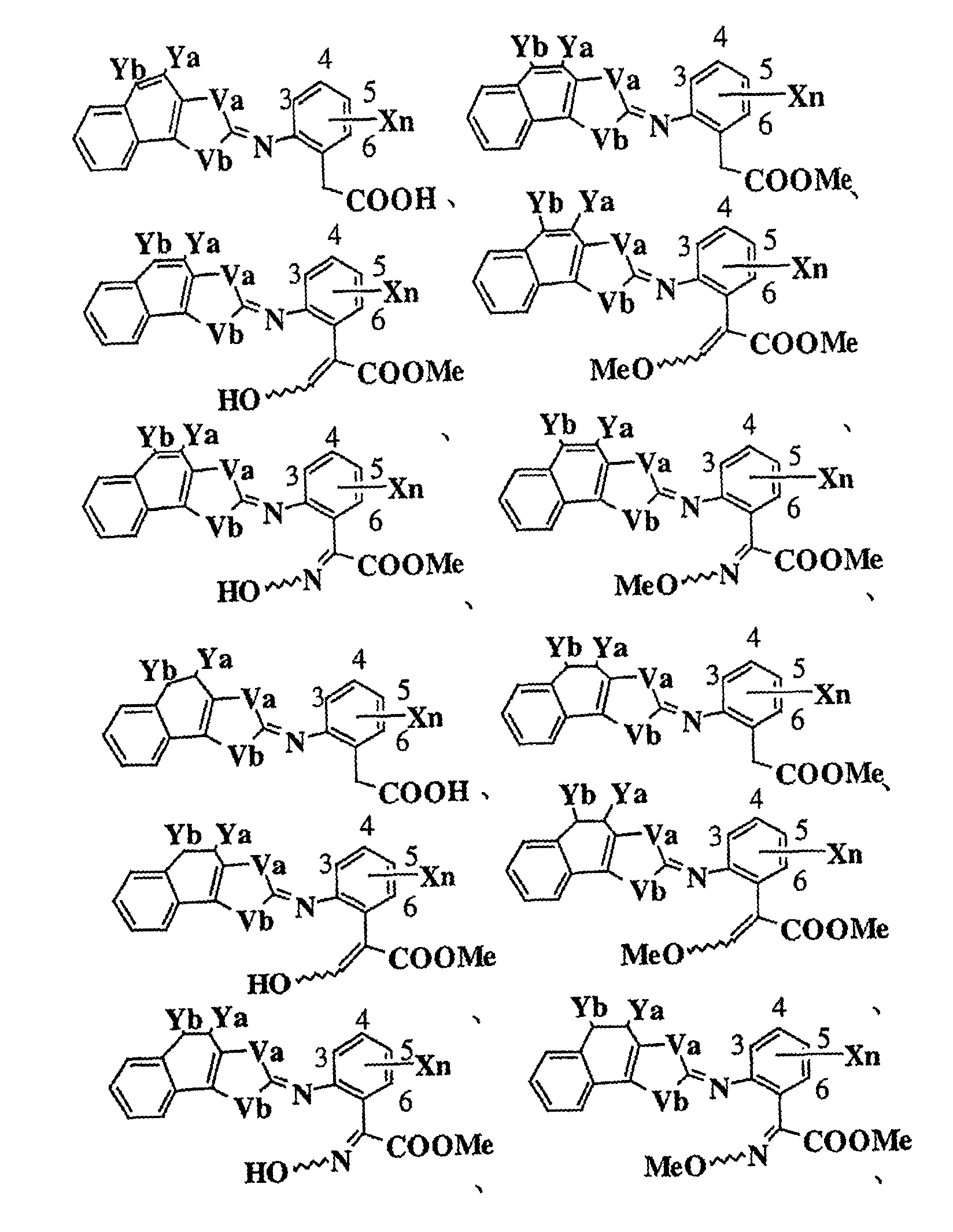
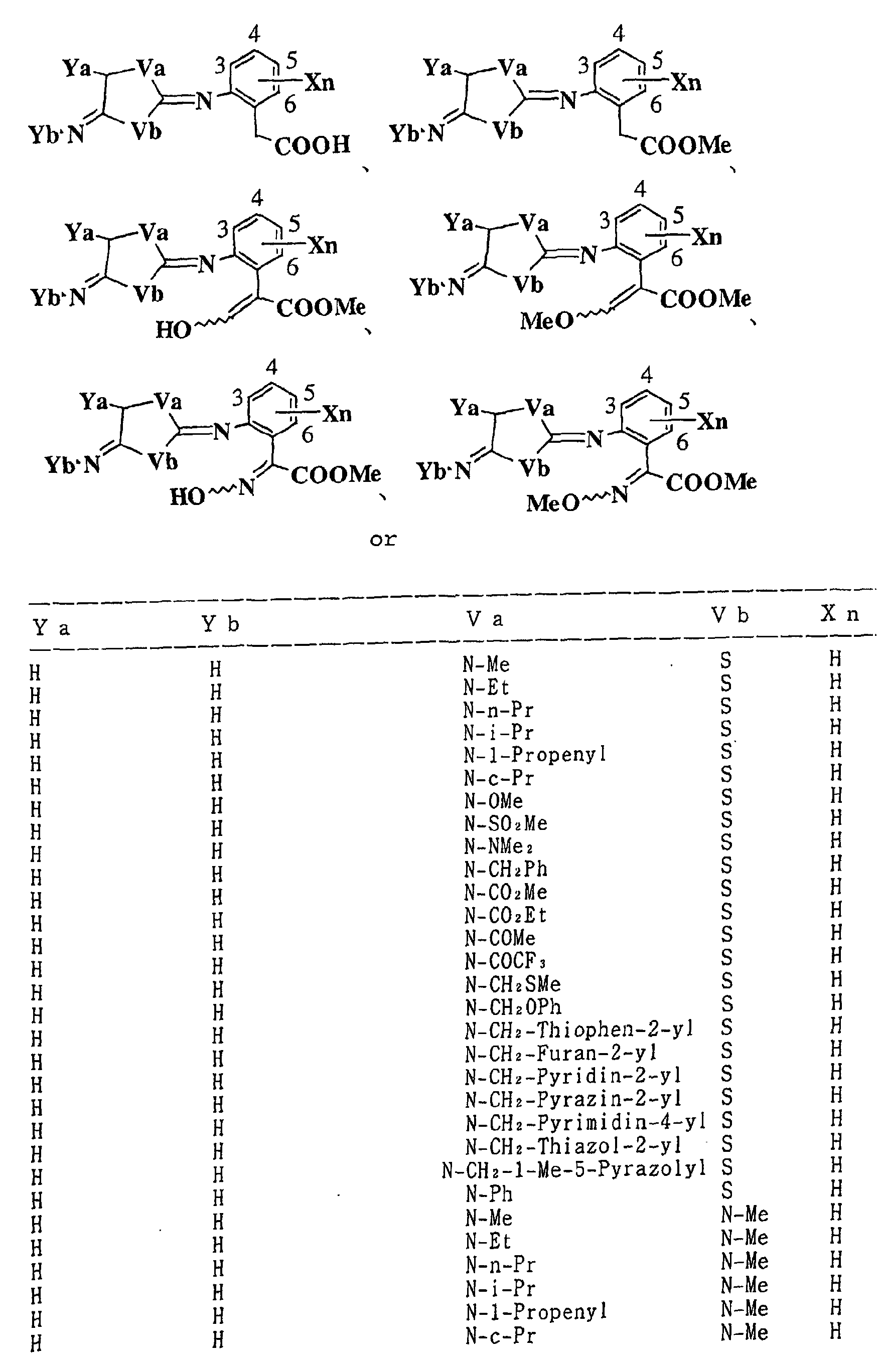
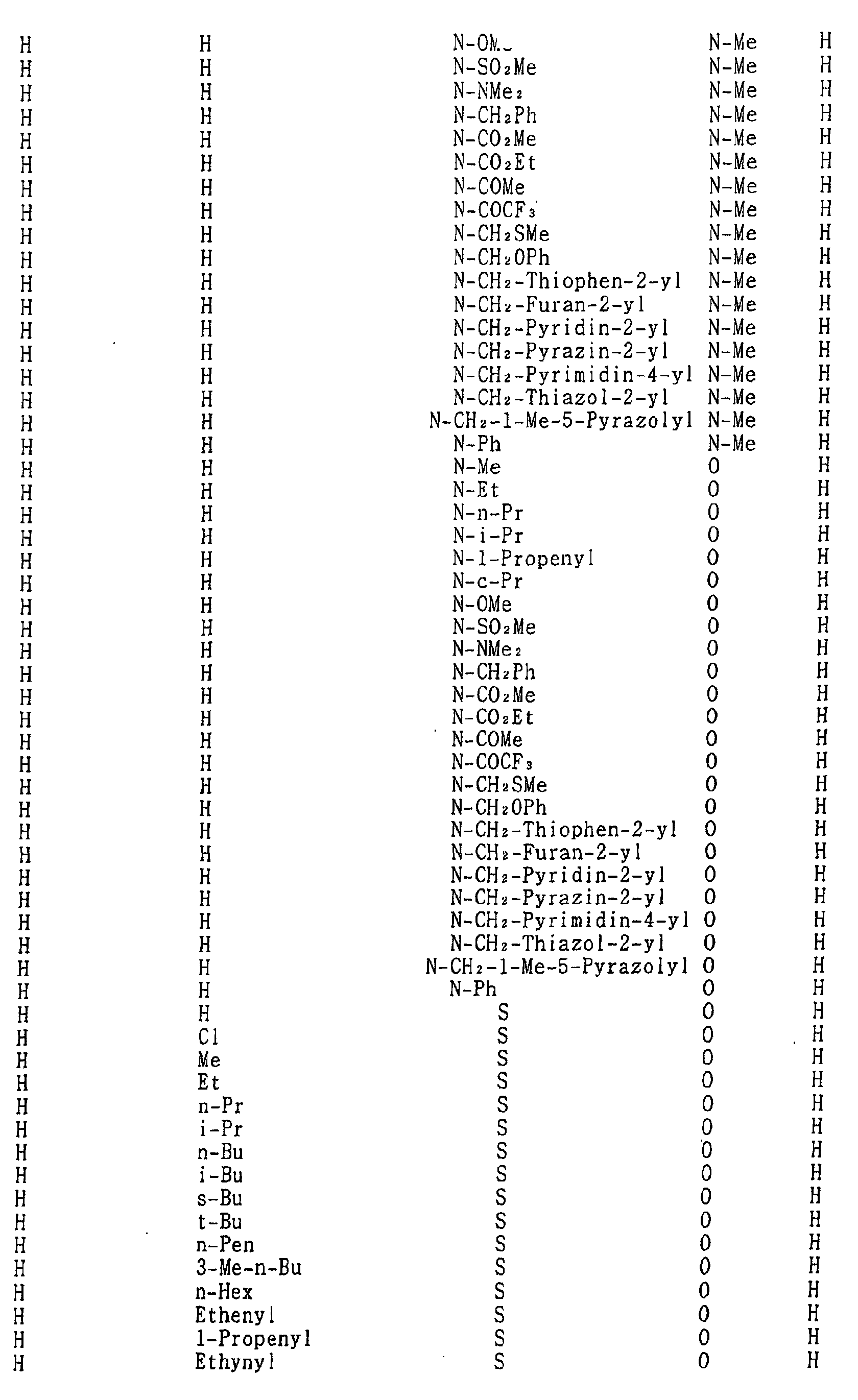
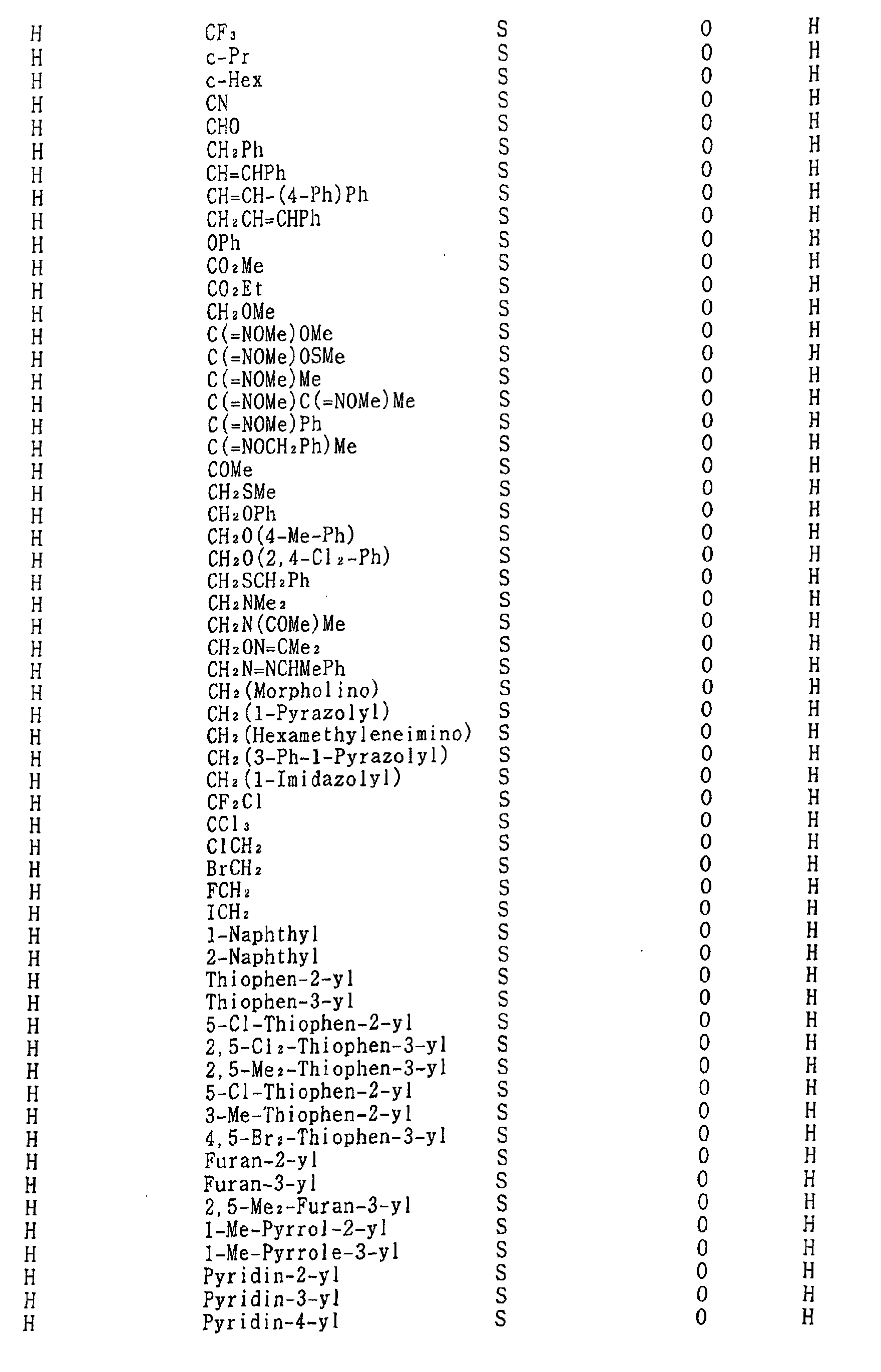
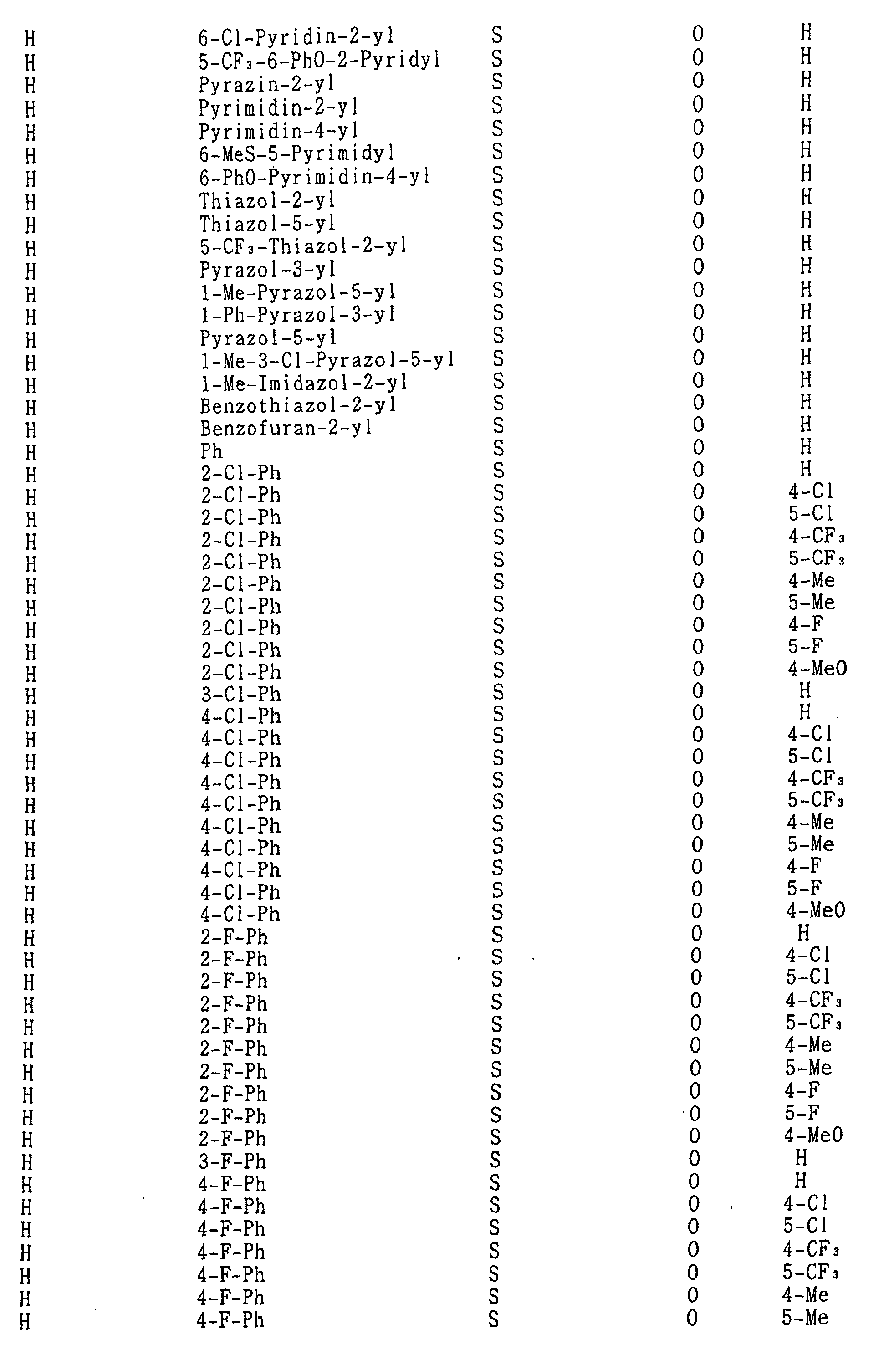
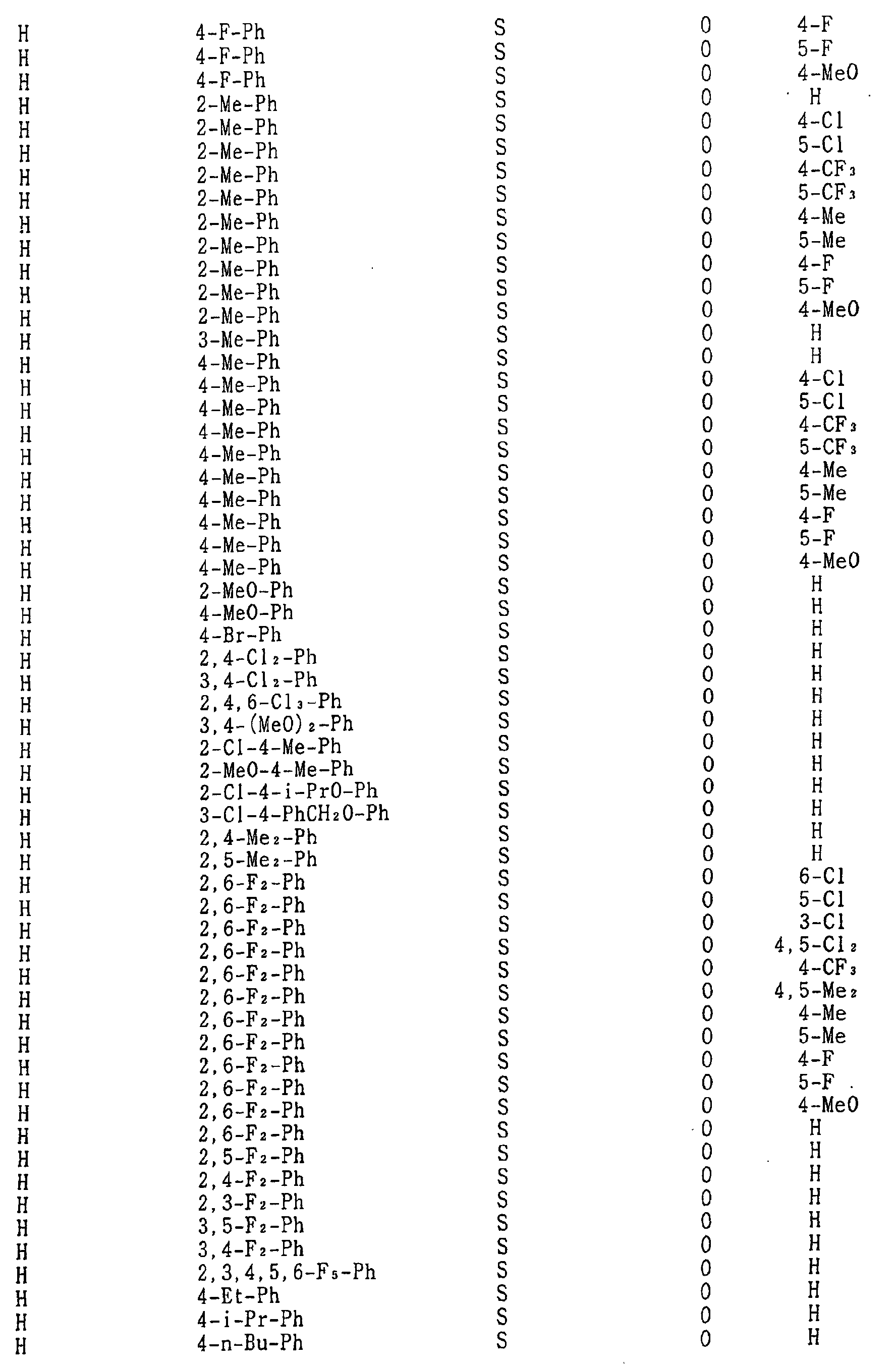
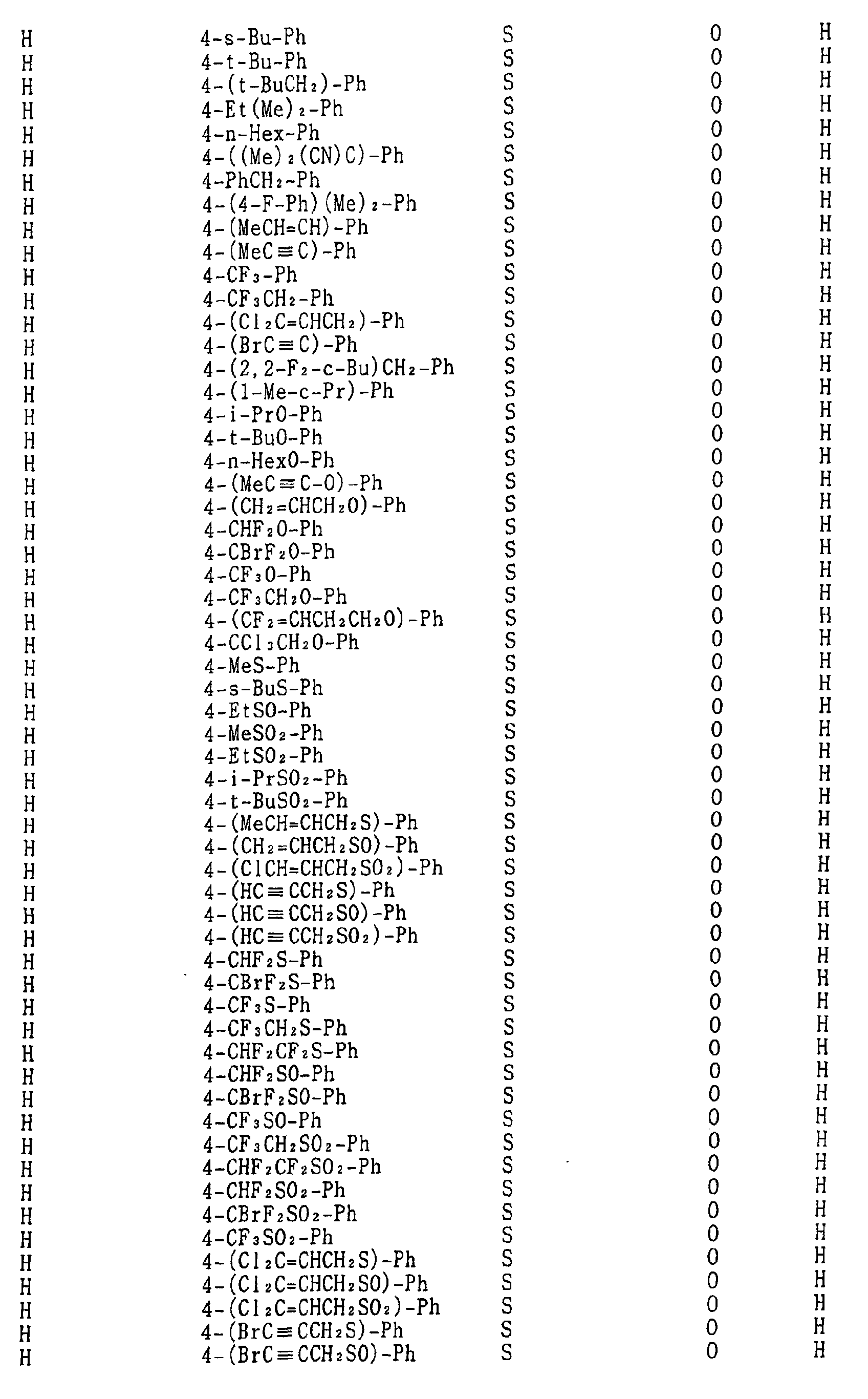


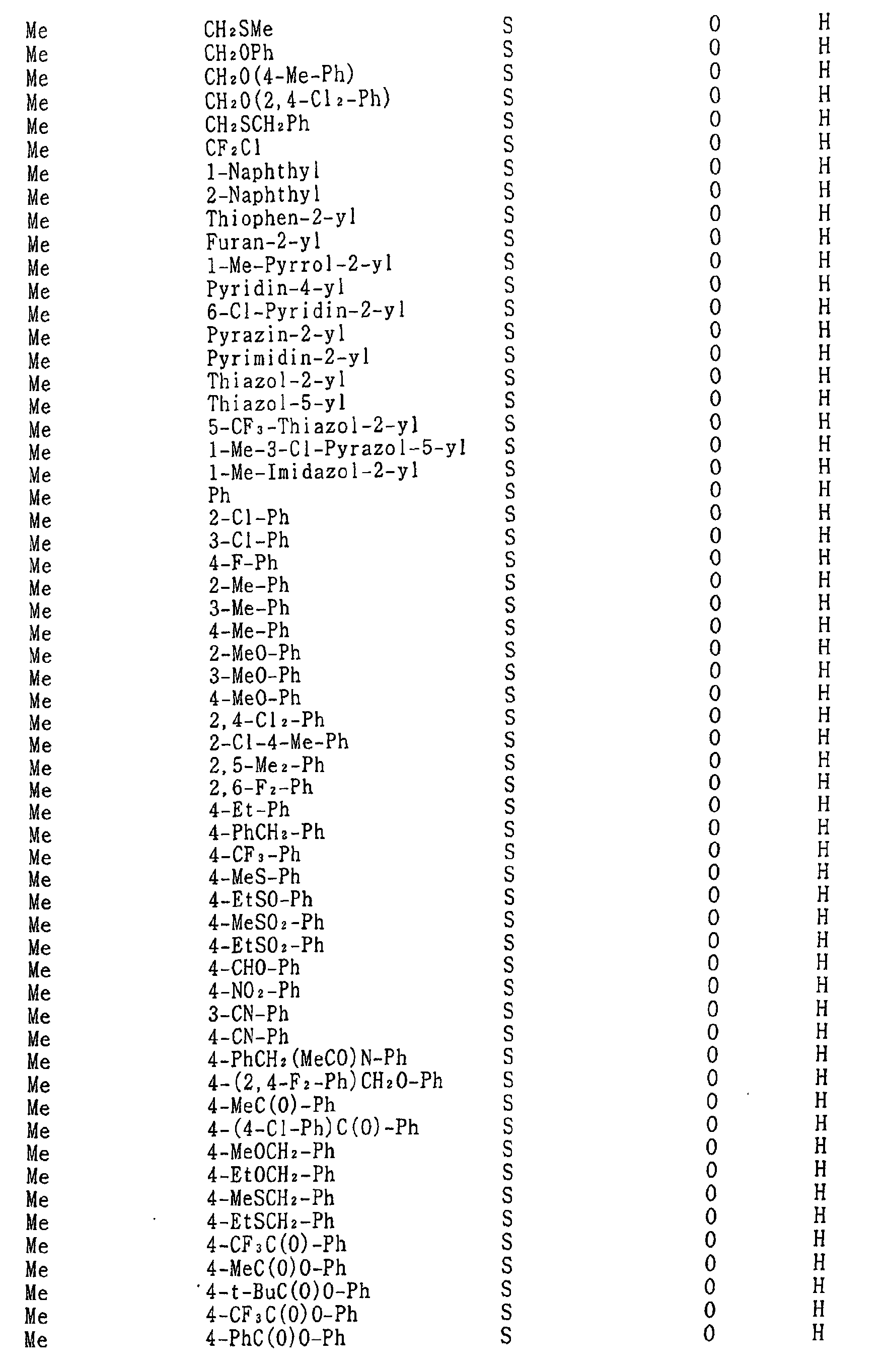


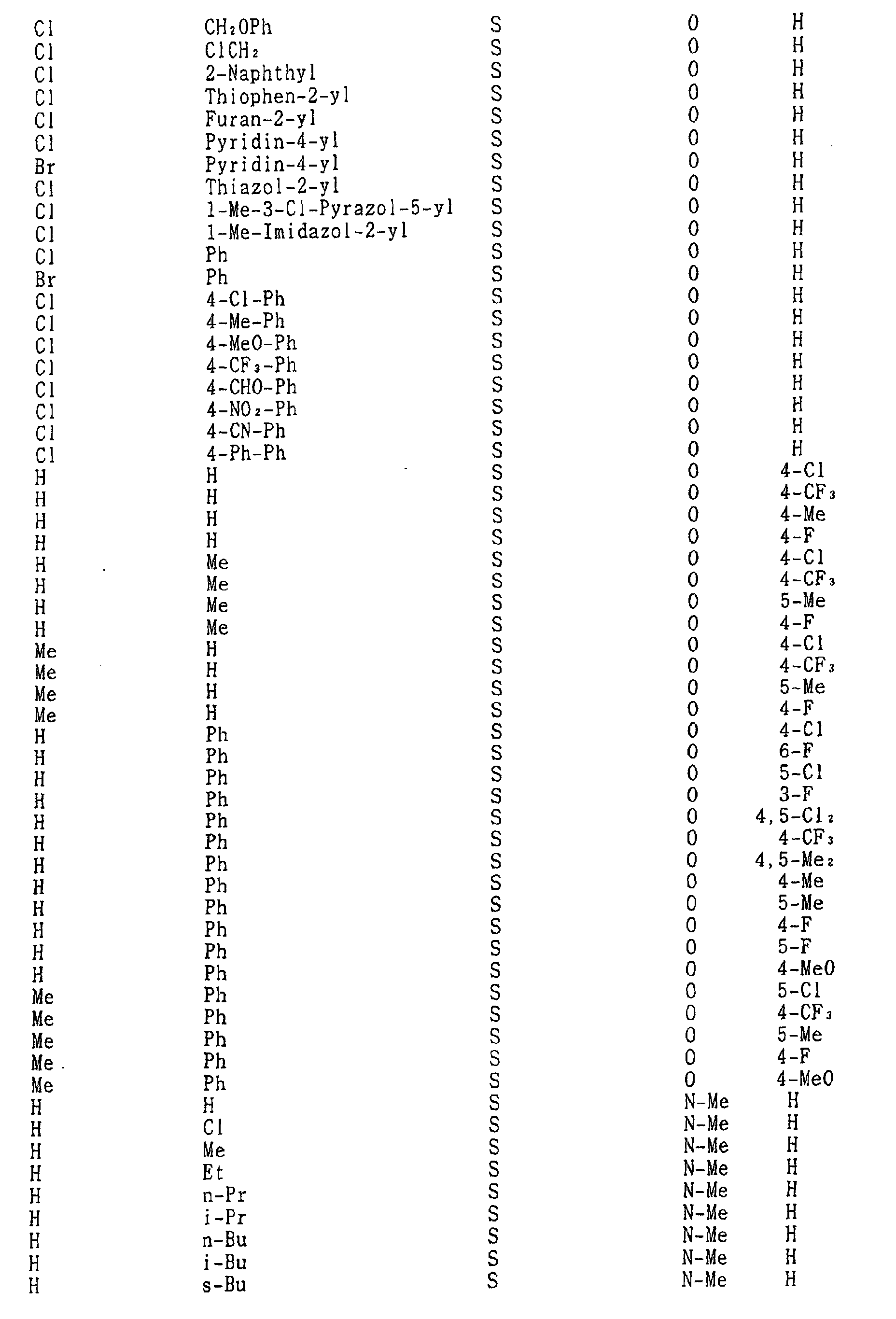
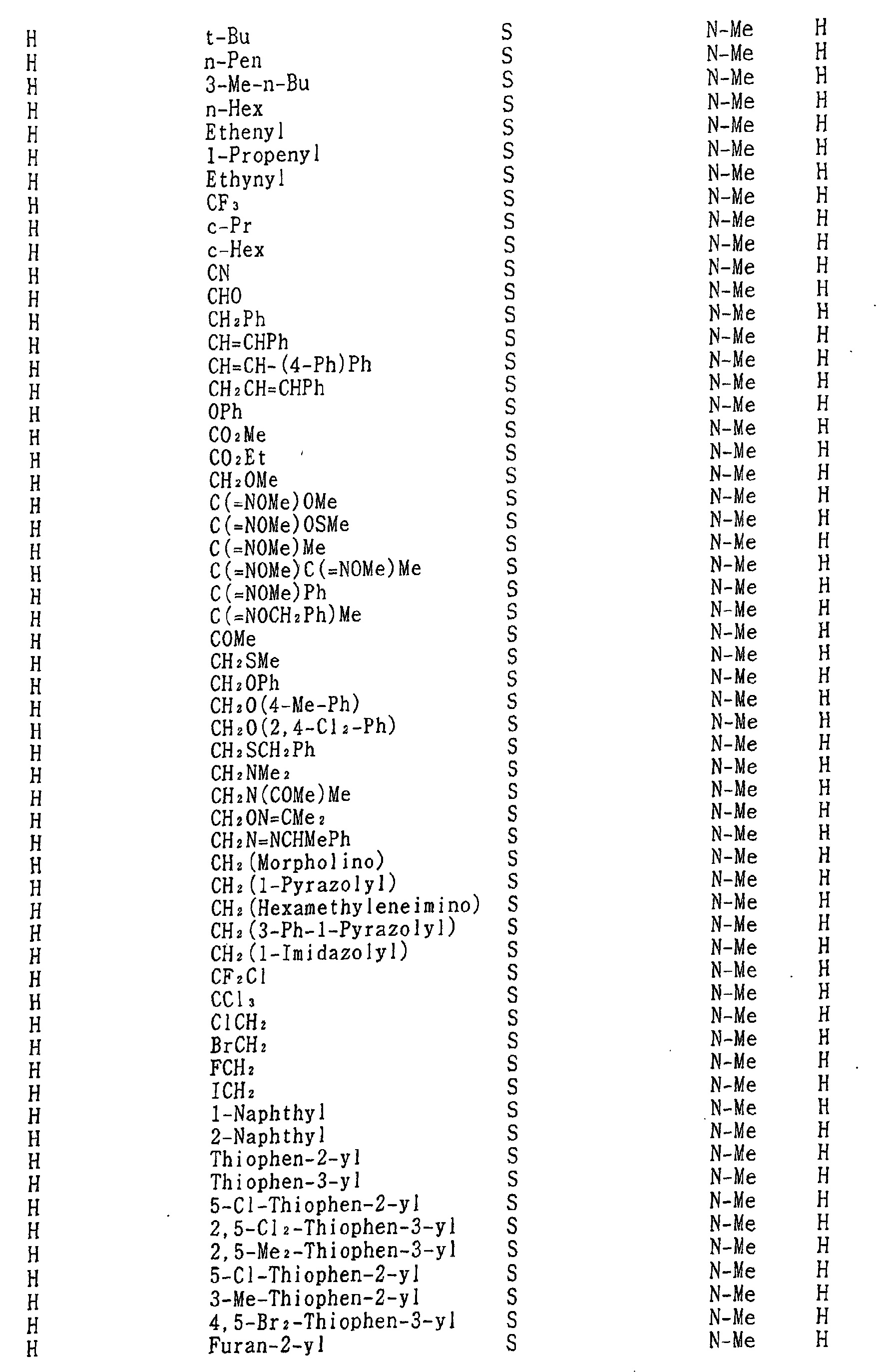

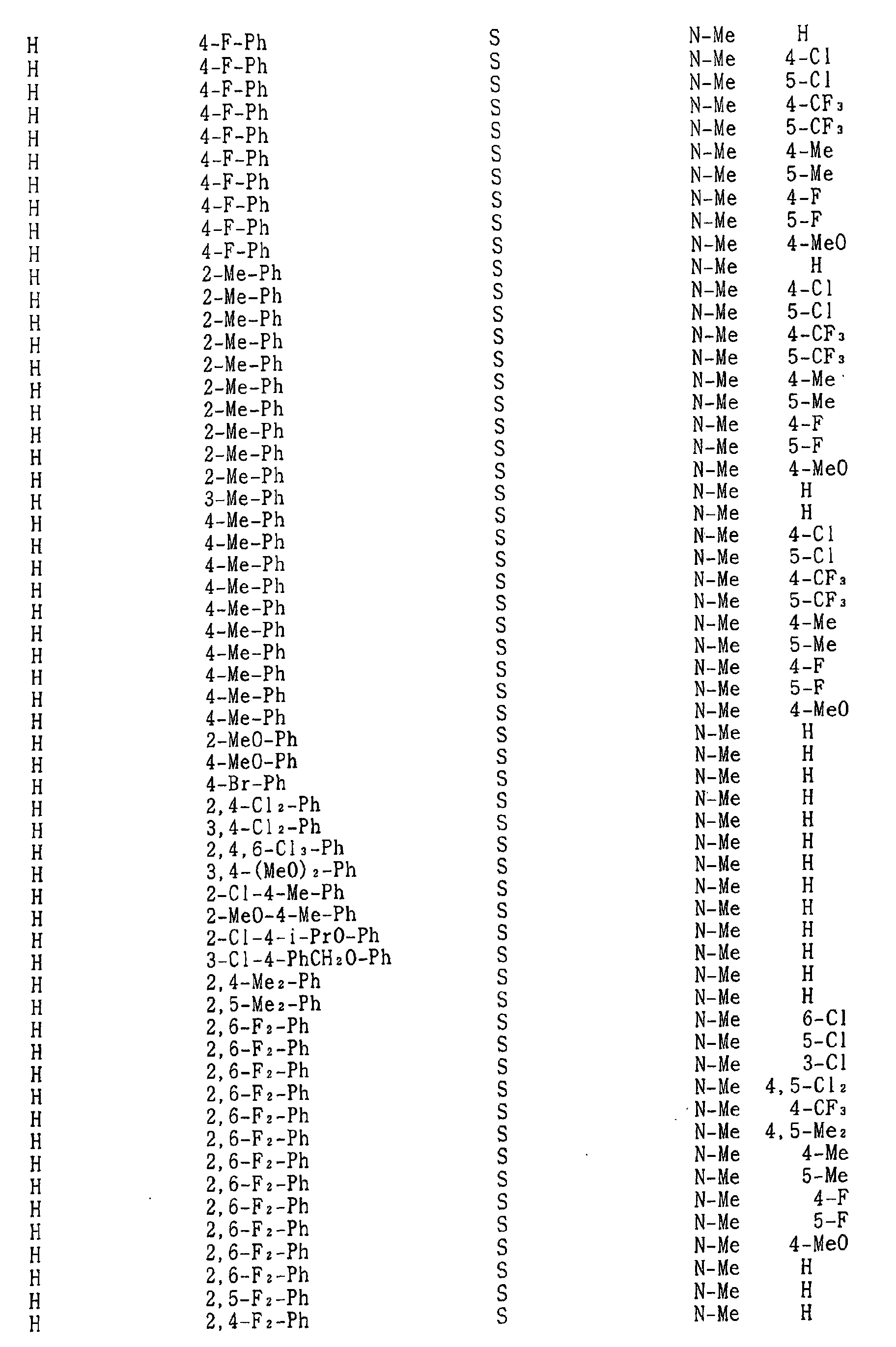


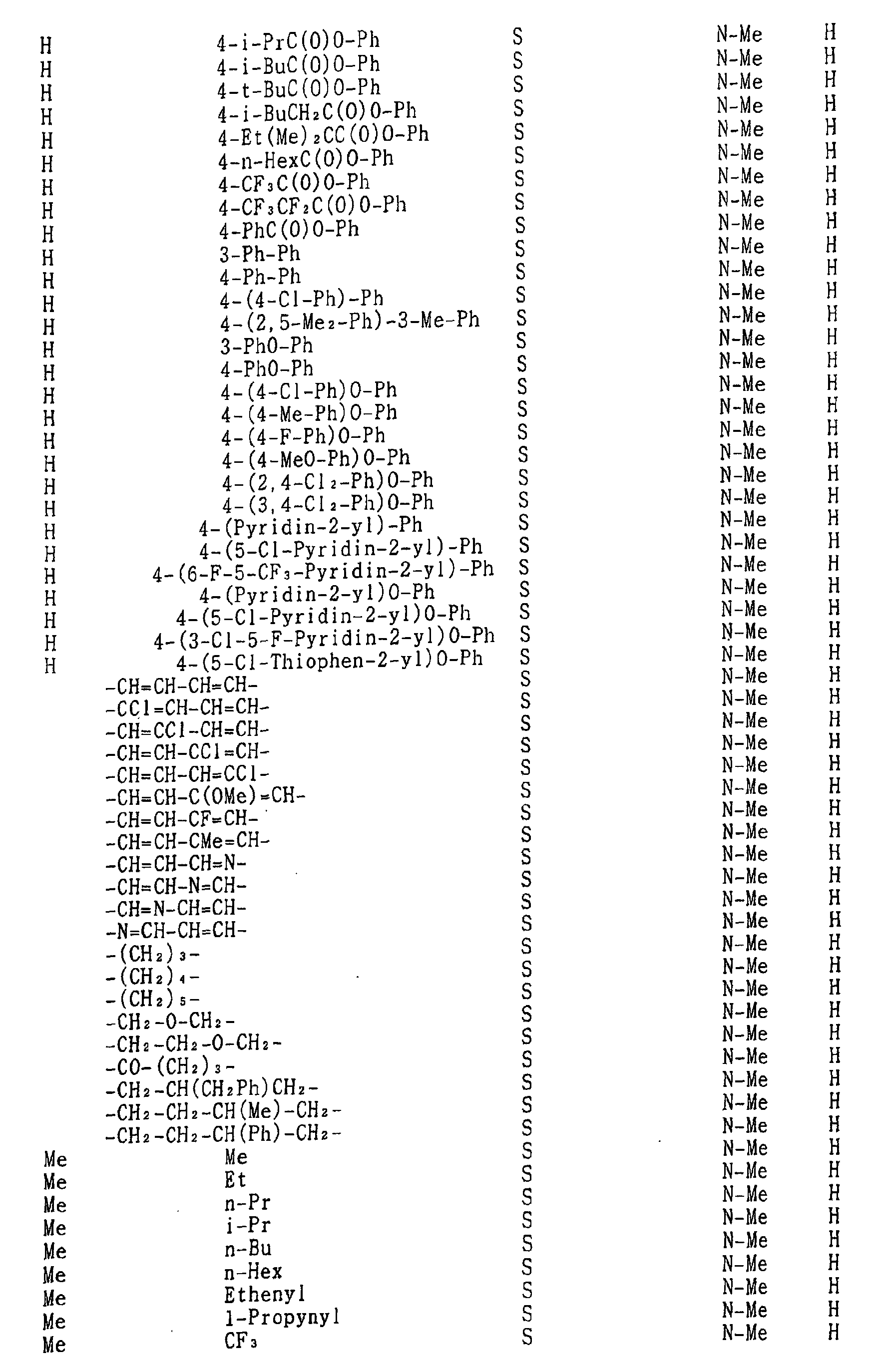


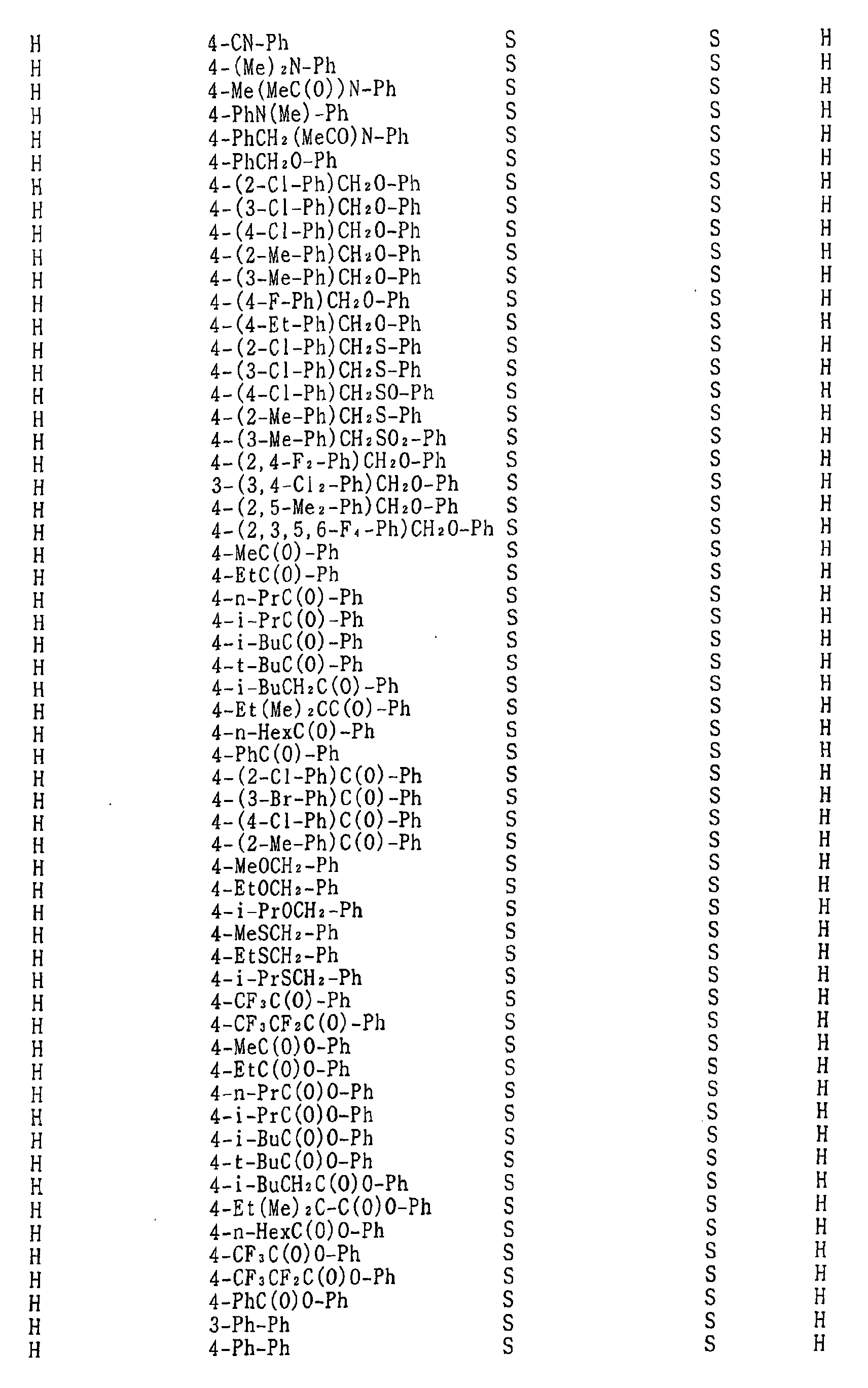

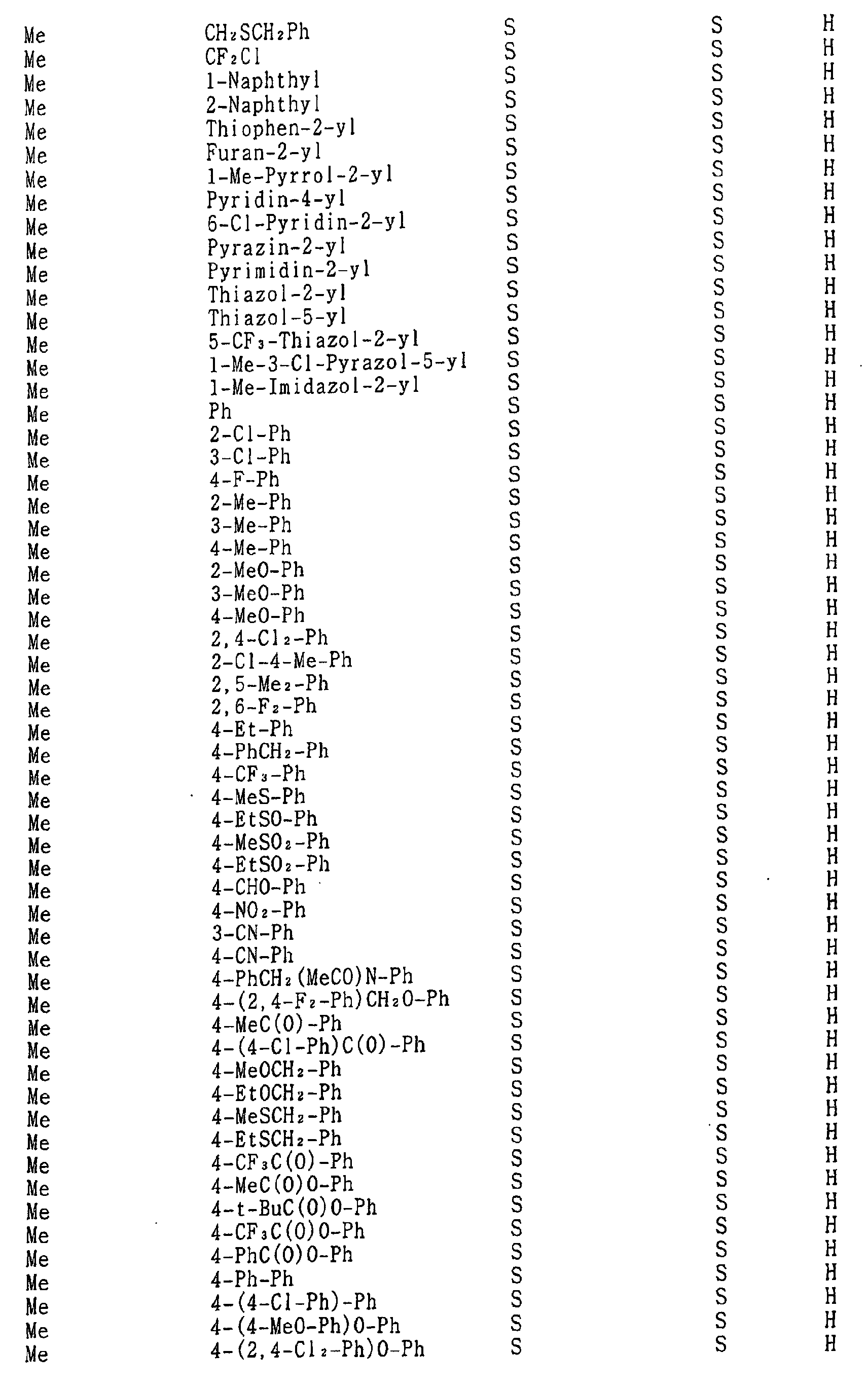

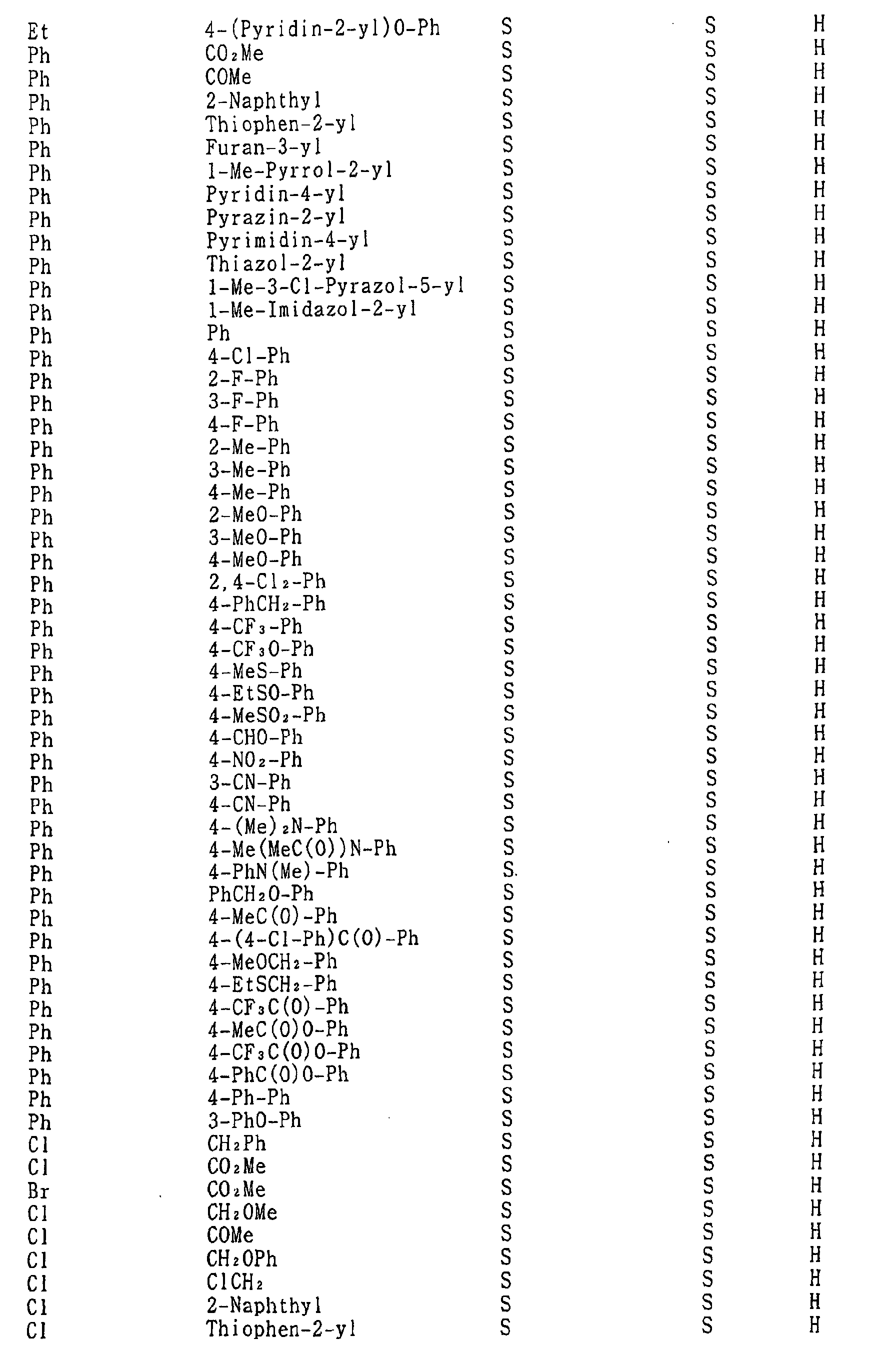

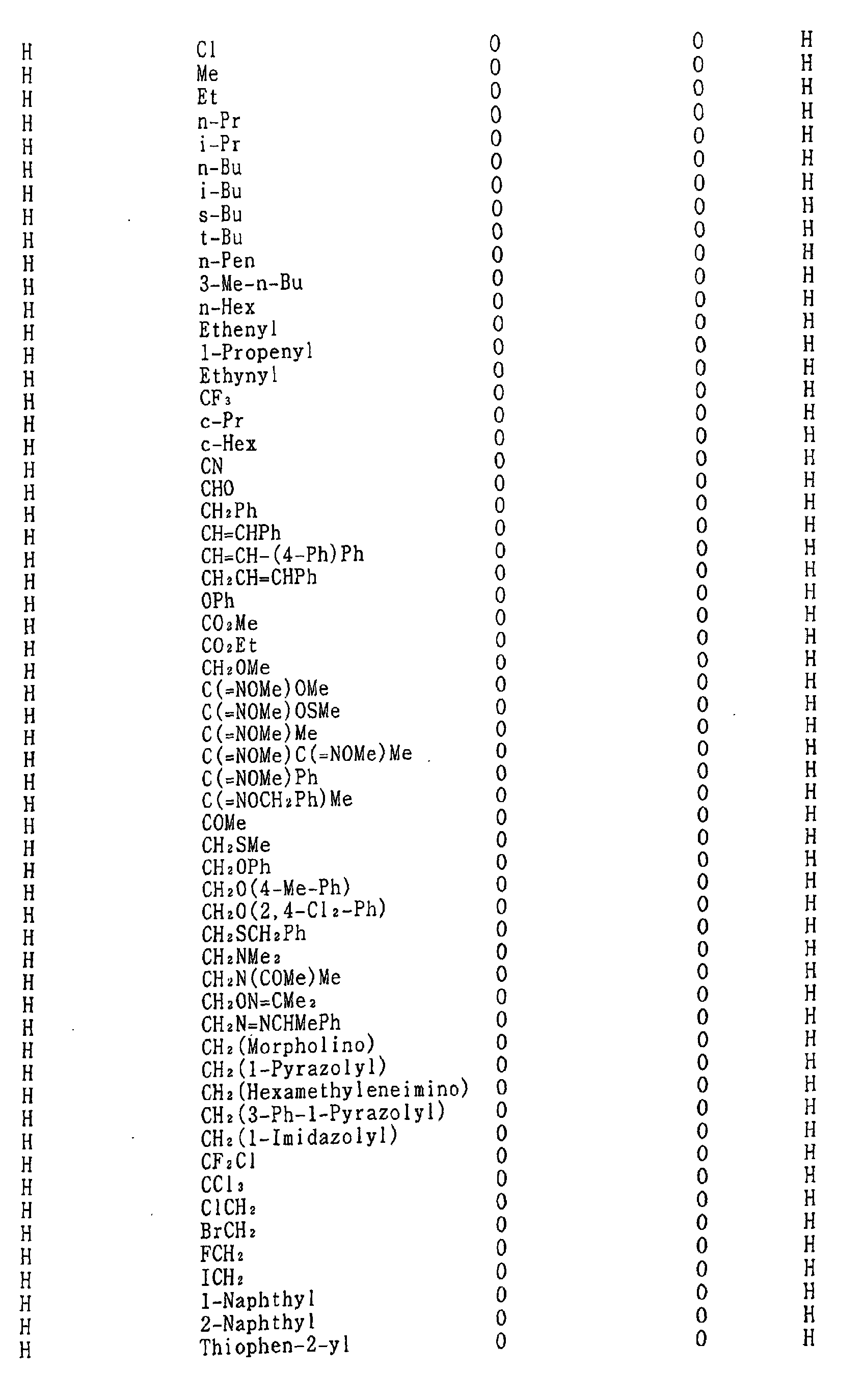


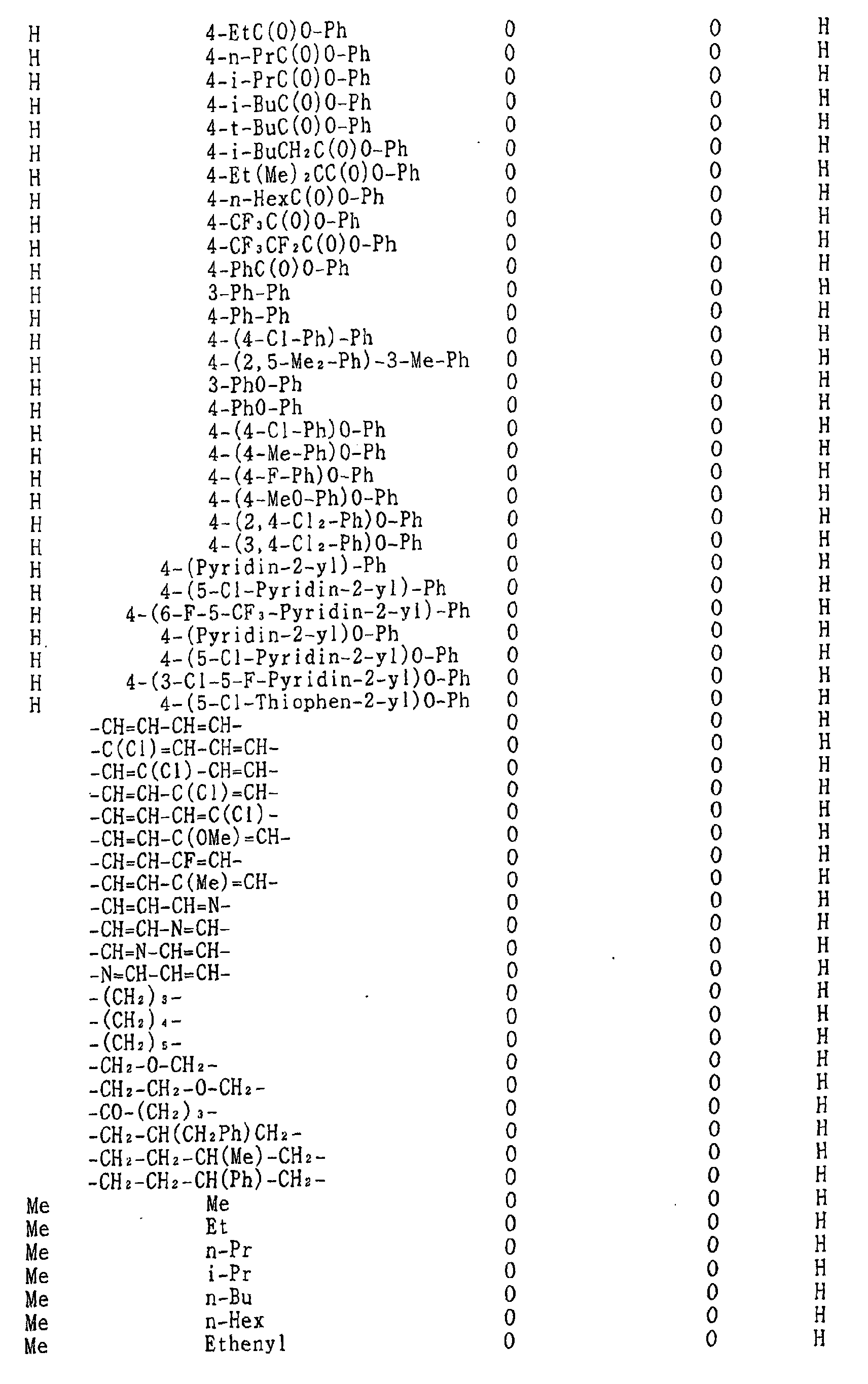
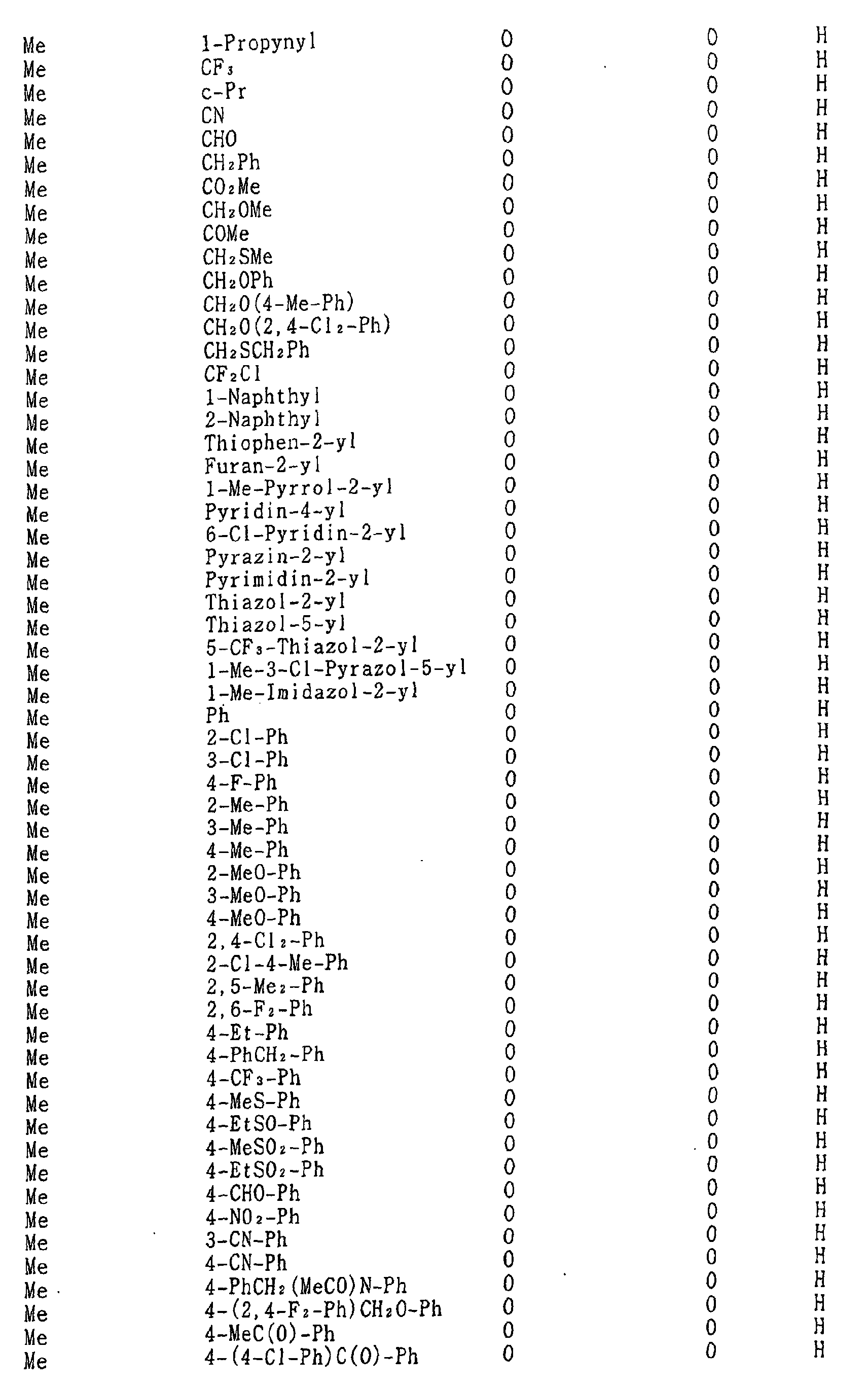
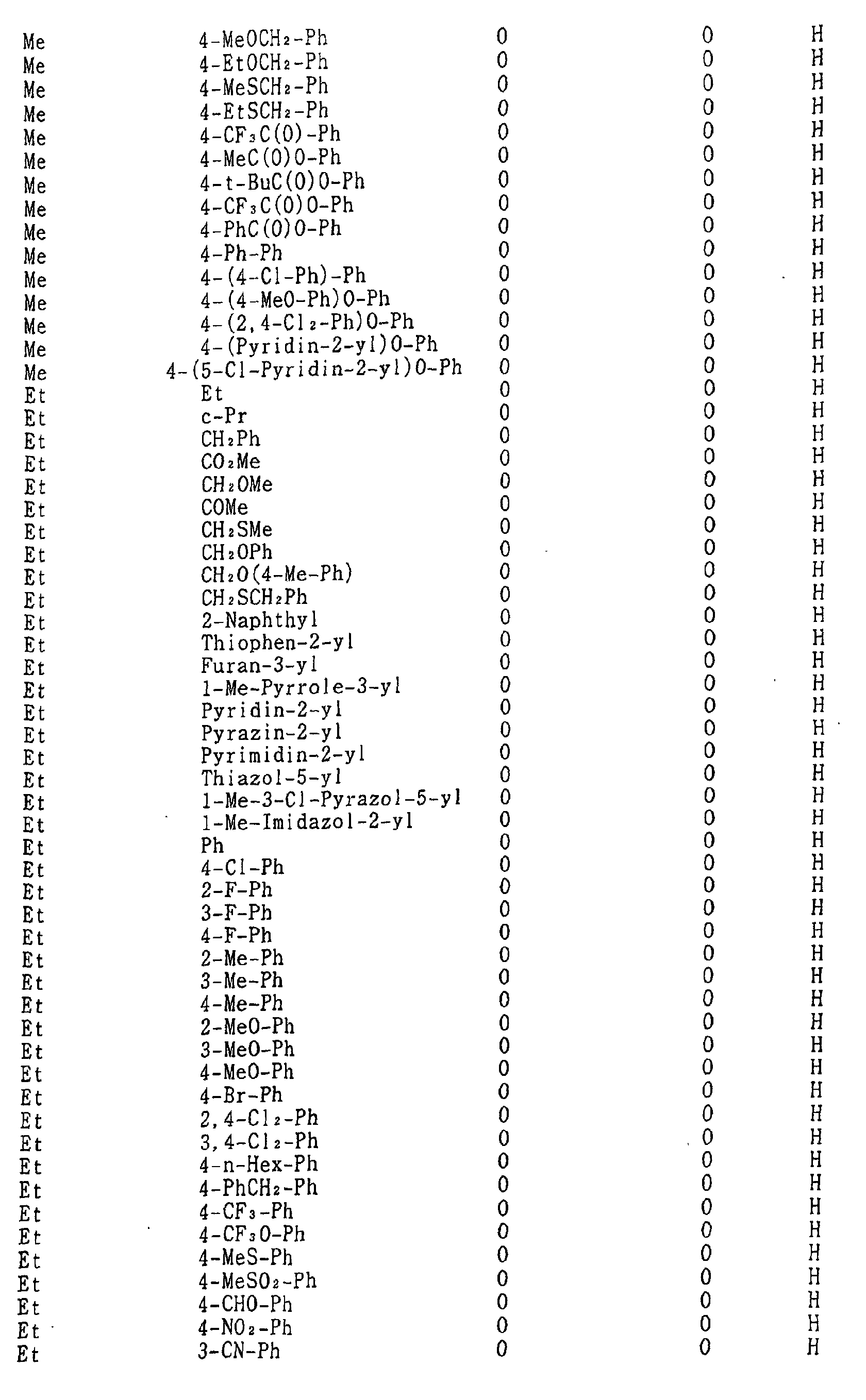
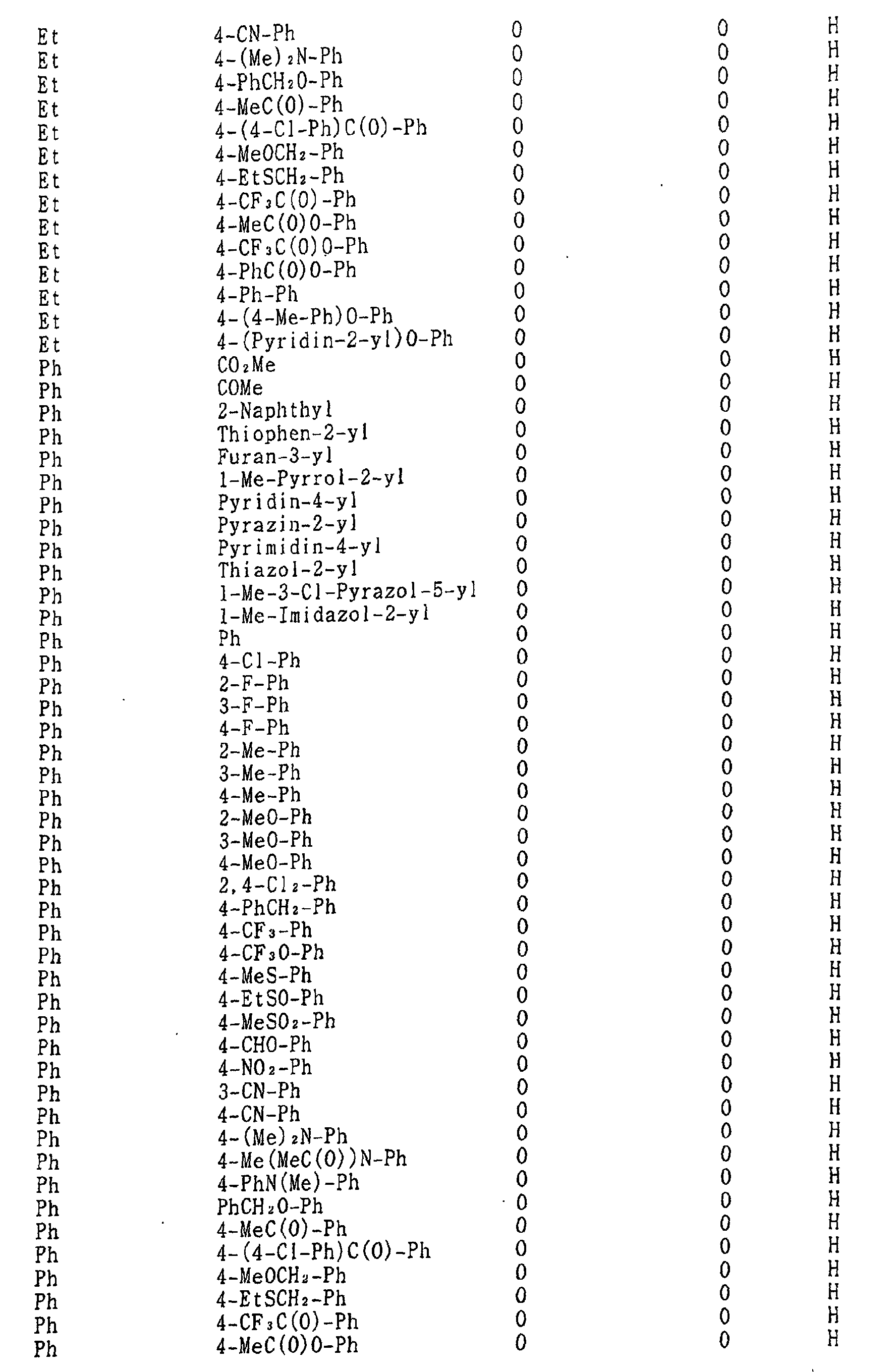
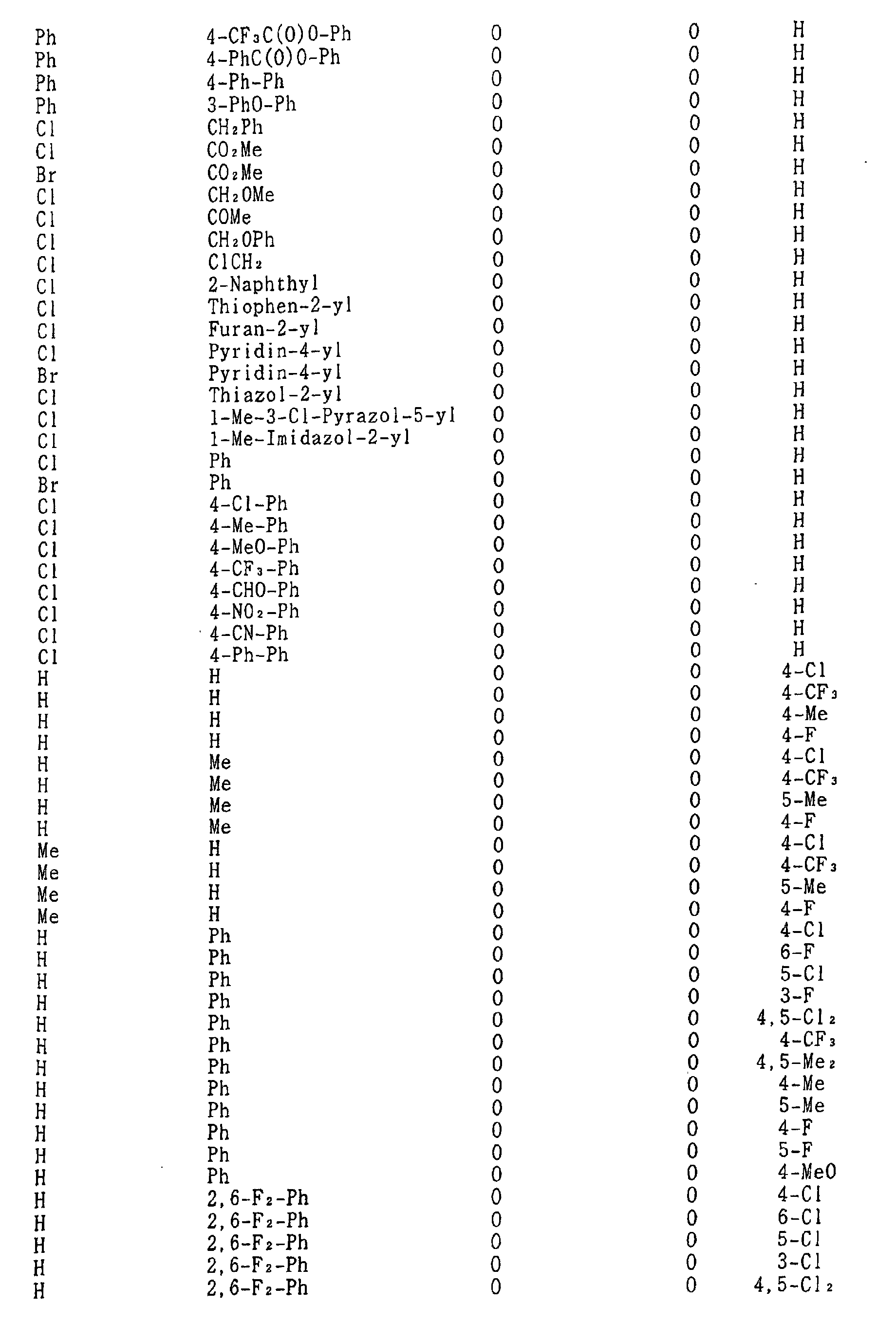

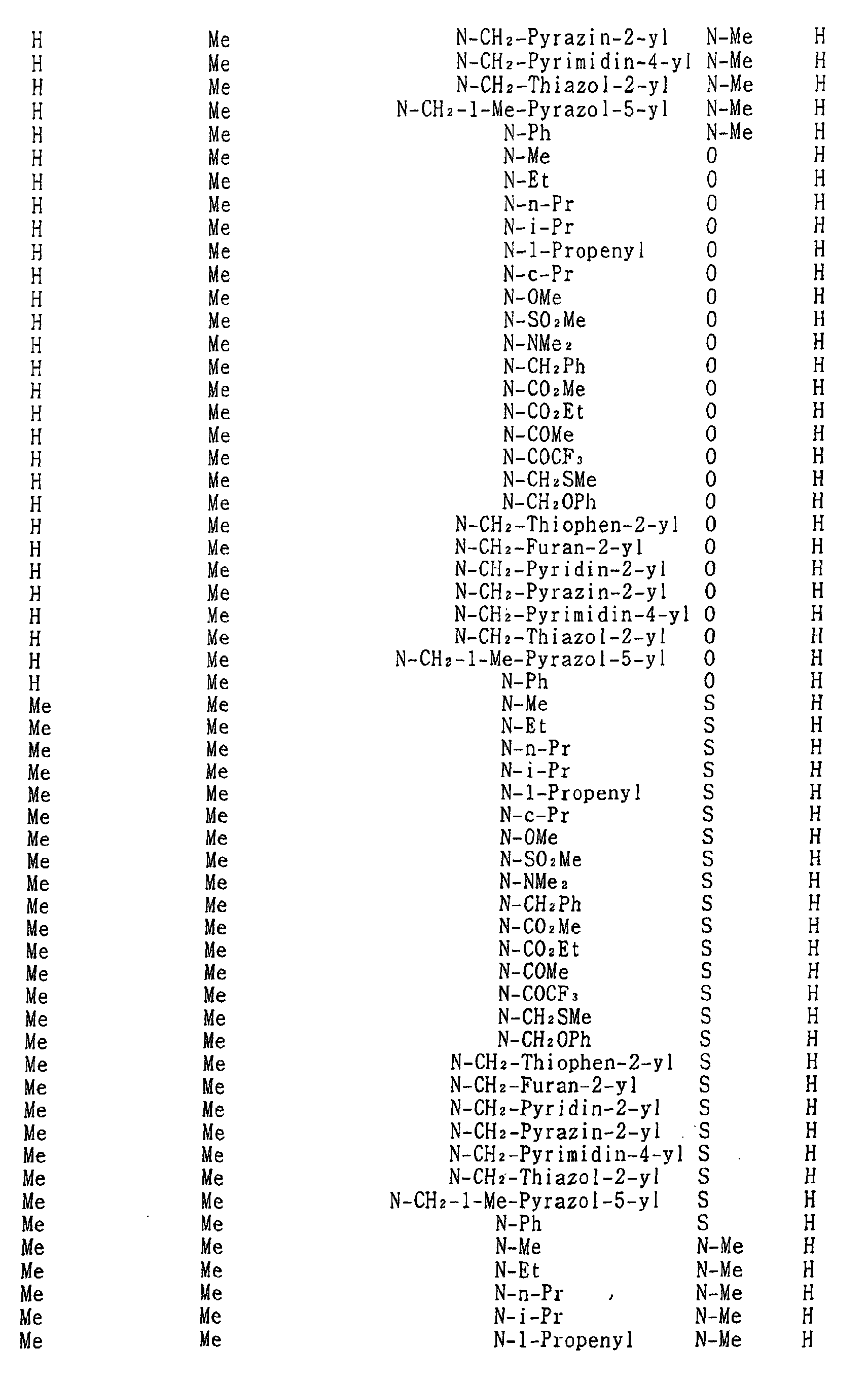
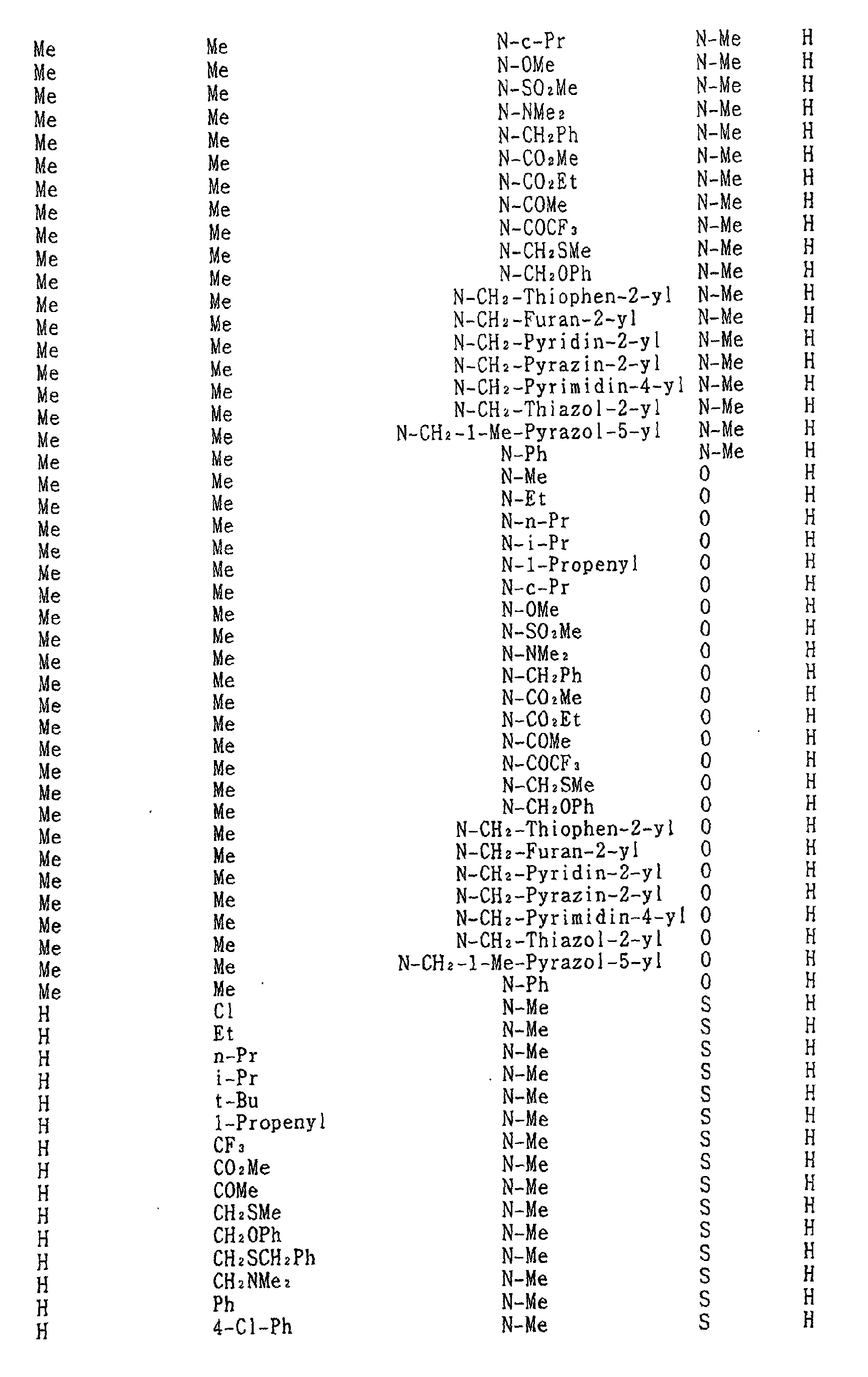


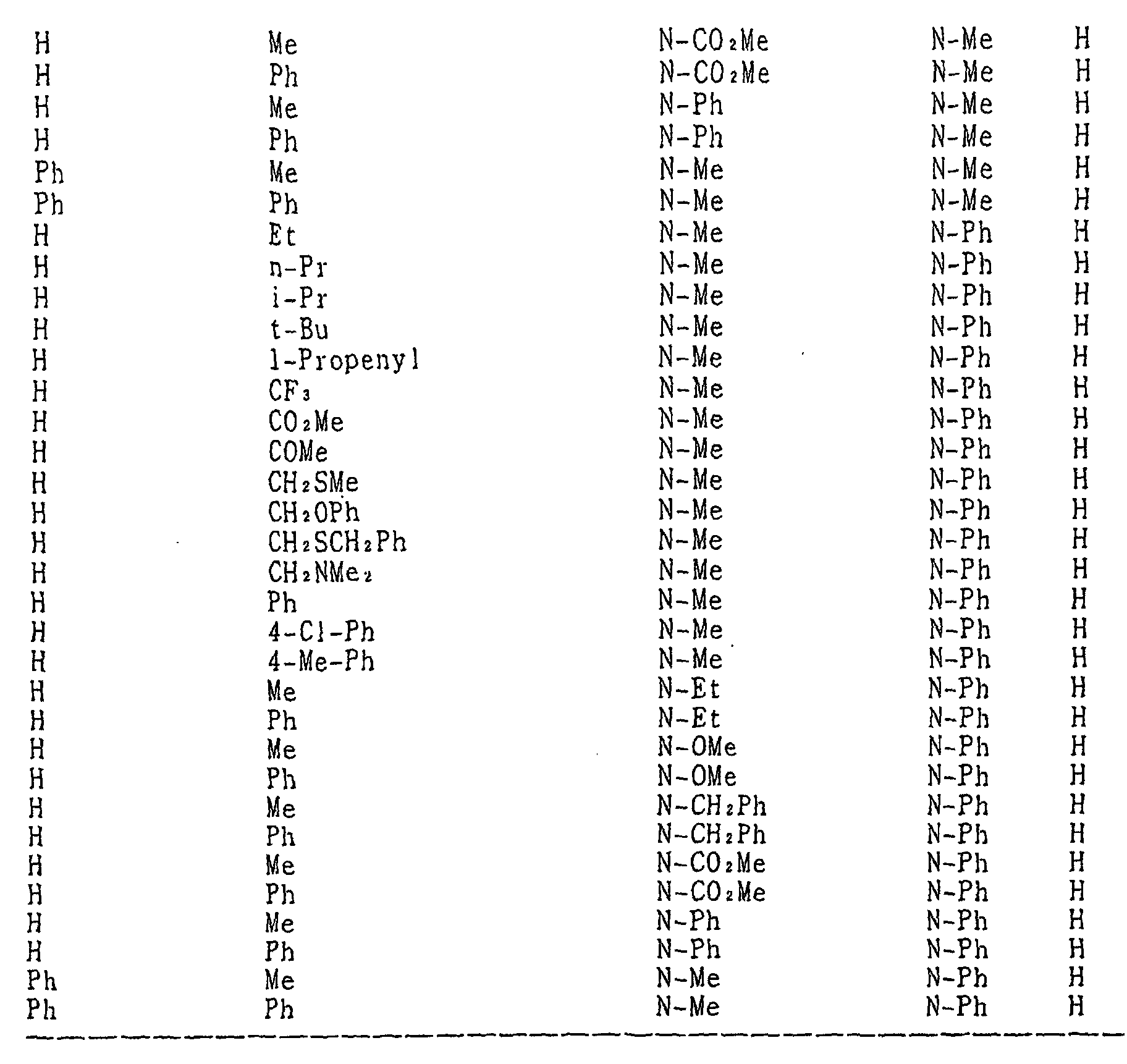


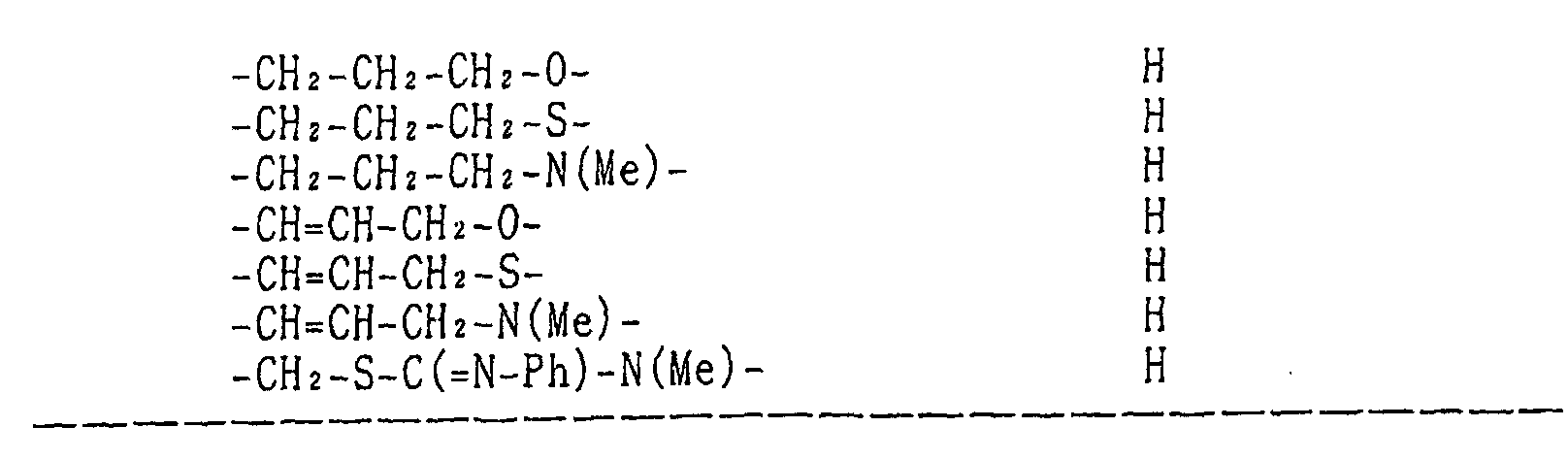
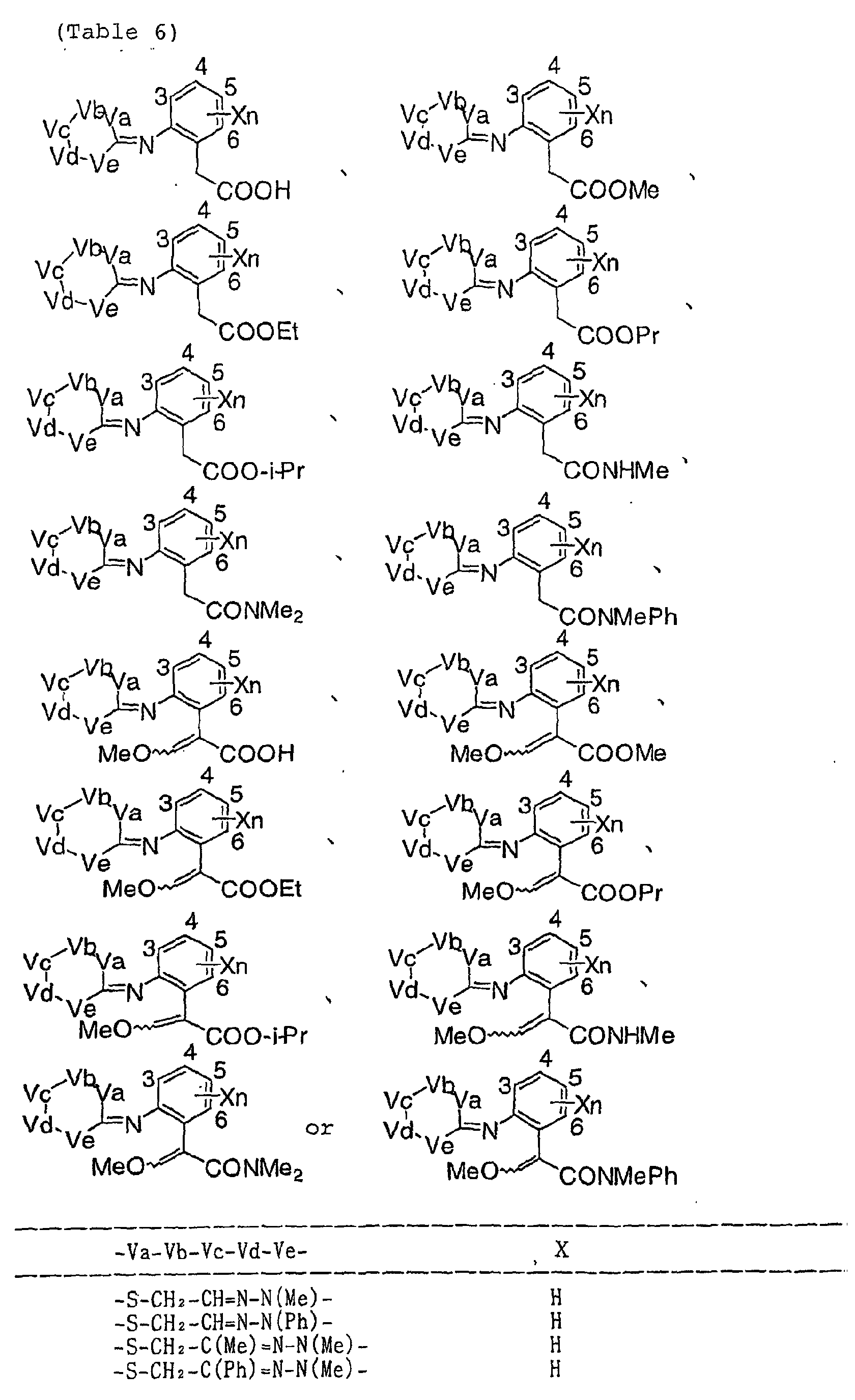
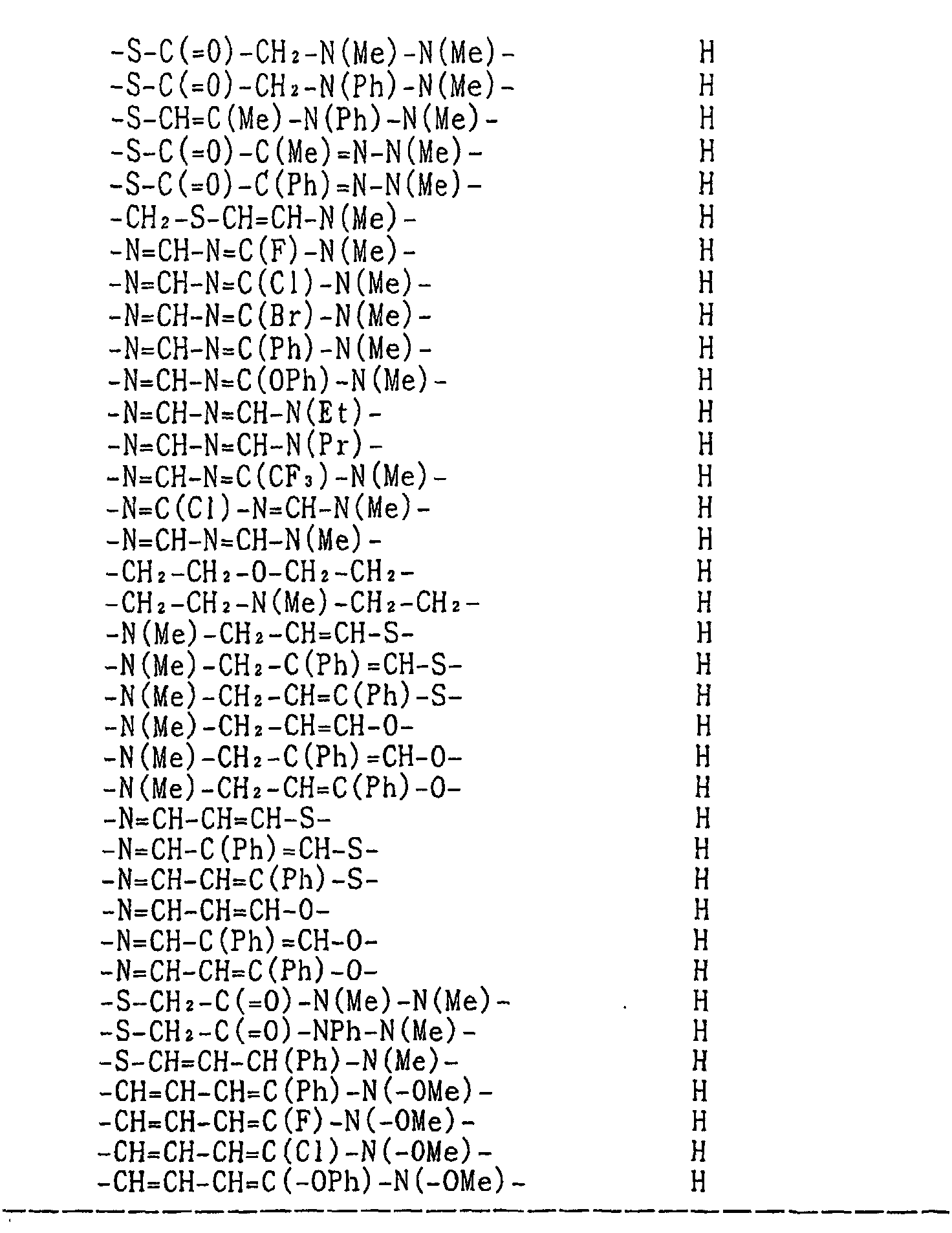
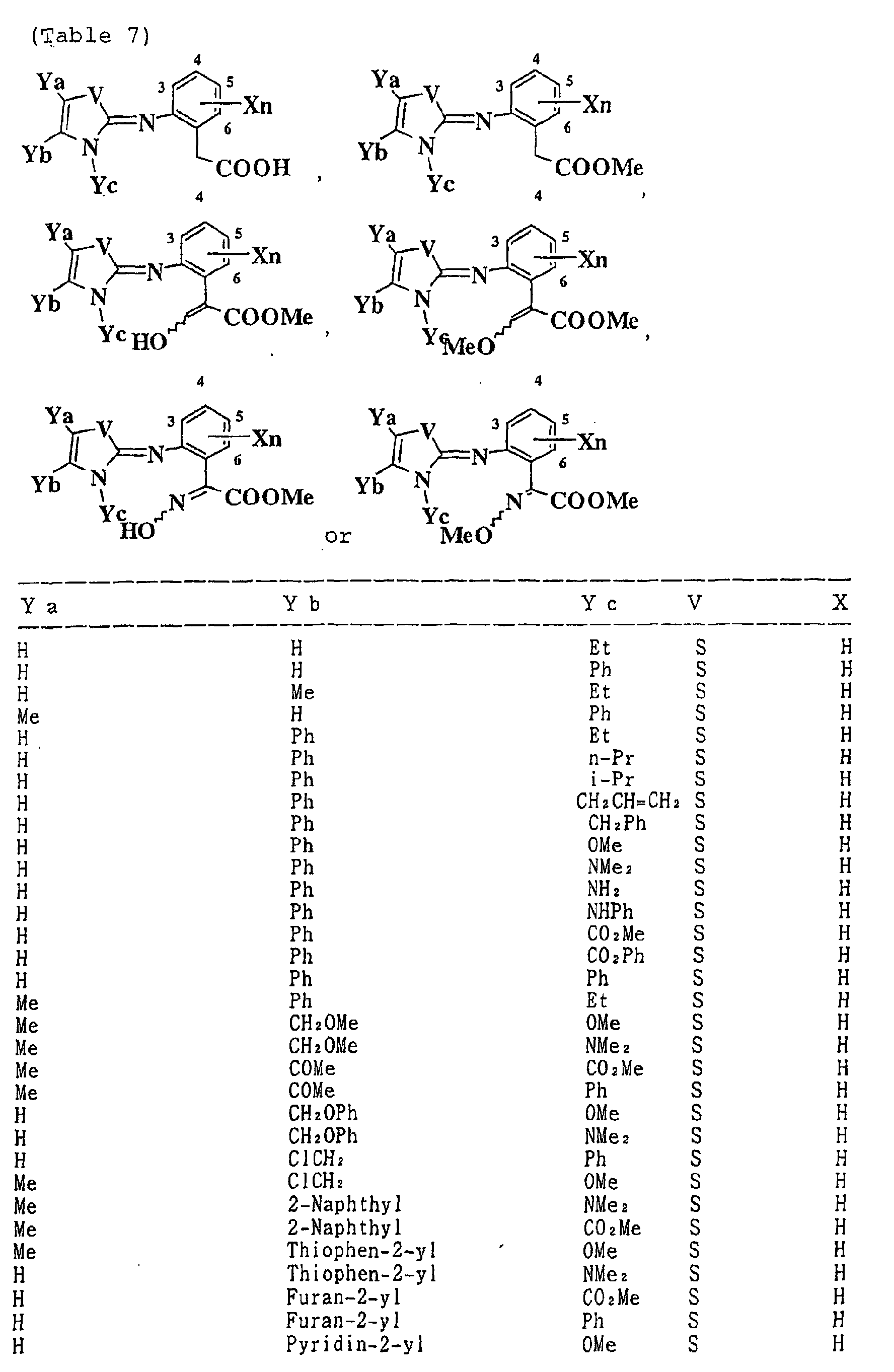
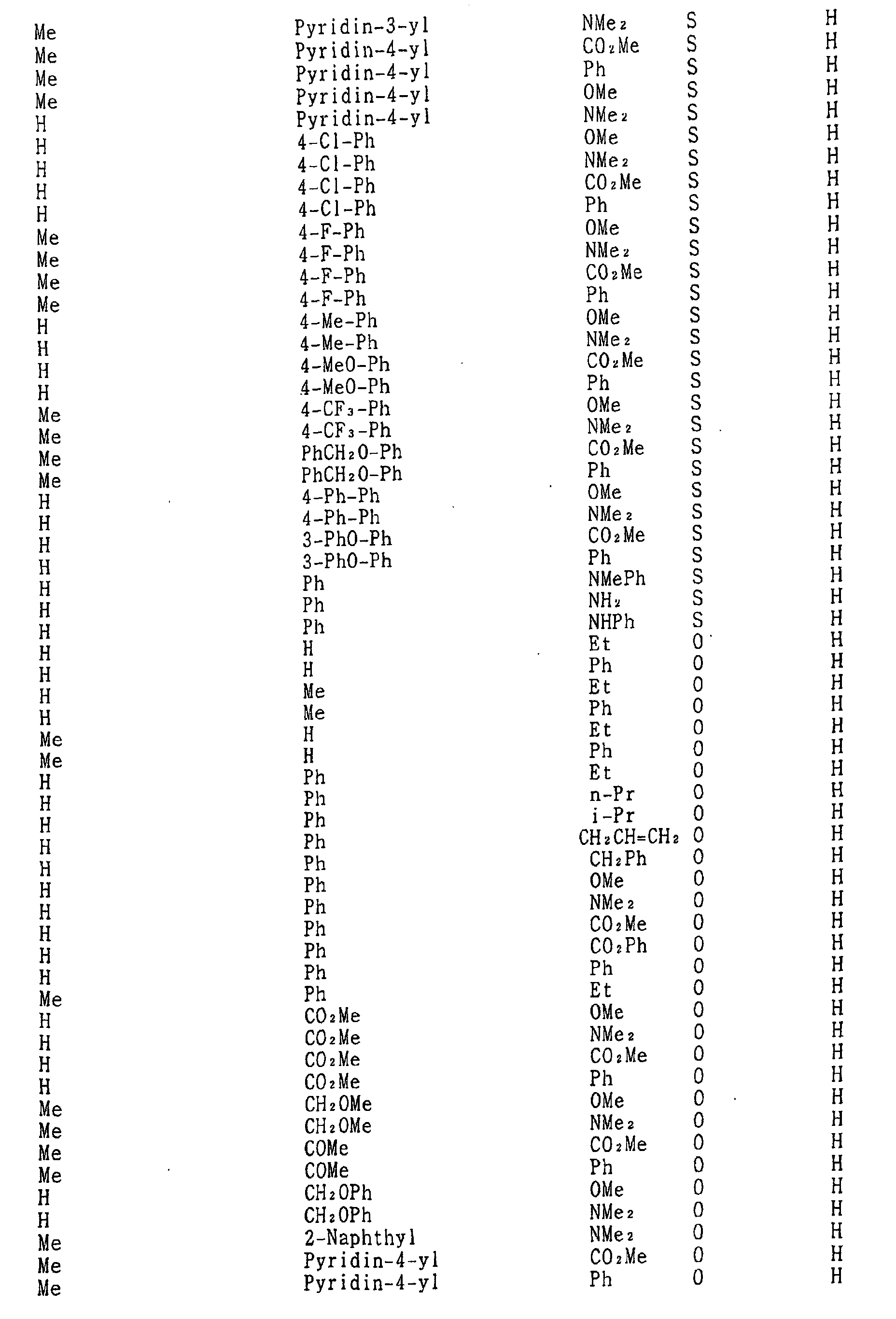


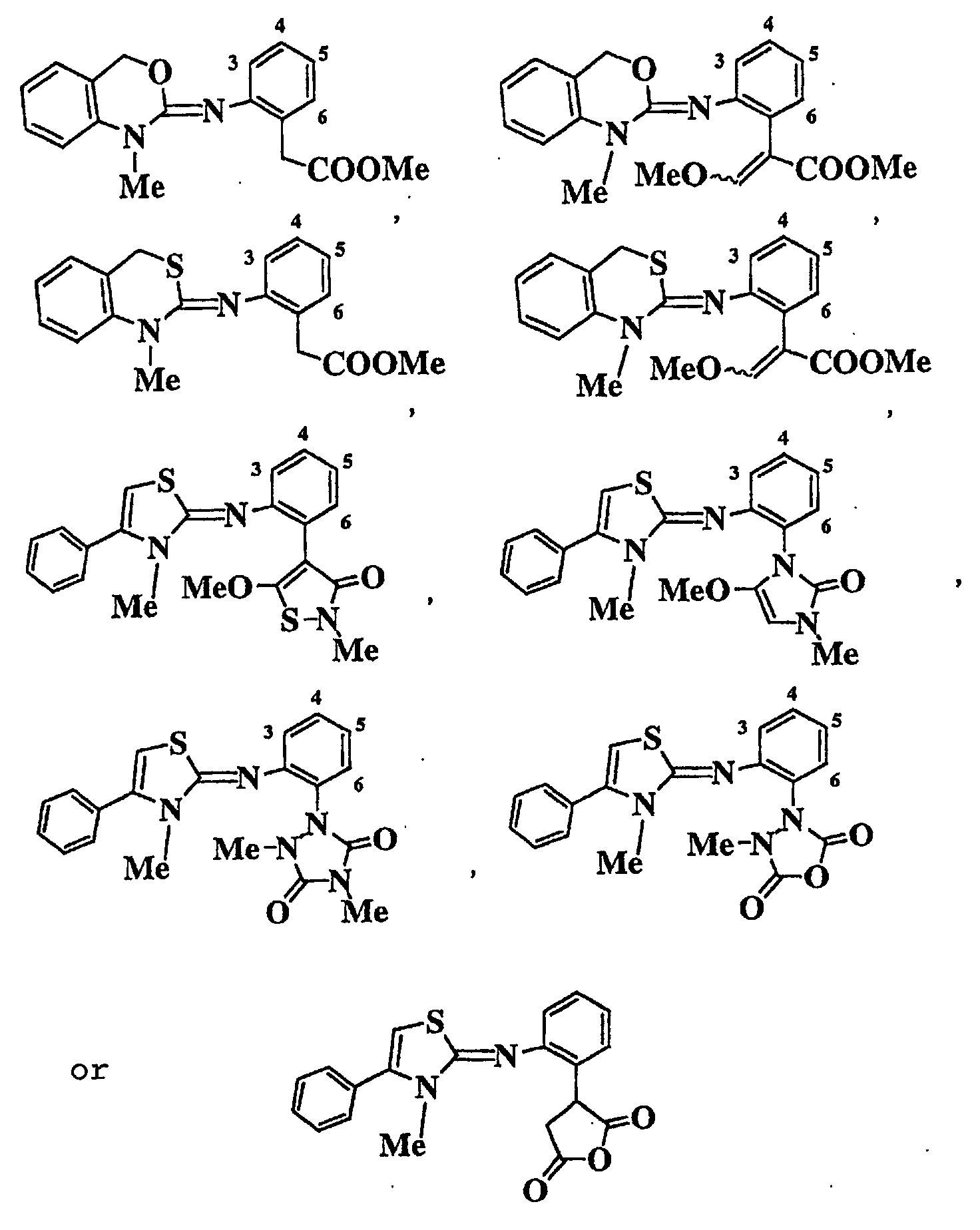
In the Tables, "Furan" represents furan, "Pyrrole"
pyrrole, "Oxazol" oxazole, "Oxadiazol" oxadiazole,
"Thiadiazol" thiadiazole, "Triazole" triazole, "Tetrazol"
tetrazole, "Pyrimidin" pyrimidine, "Pyridazin" pyridazine,
"Triazin" triazine, "Pyrazol" pyrazole, "Pyrrol" pyrrole,
"Thiophen" thiophene, "Thiazol" thiazole, "Oxazol"
oxazole, "Isotihazol" isthiazole, "Isoxazol" isoxazole,
"Imidazol" imidazole, "Pyridin" pyridine, "Quinoxalin"
quinoxaline, "Indol" indole, "Benzothiazol" benzothiazole,
"Beisofuran" benzofuran, "Quinolin" quinoline, "Pyrazin"
pyrazine, "y1" yl, "Ethenyl" ethenyl, "Ethynyl" ethynyl,
"Propenyl" propenyl, "Propynyl" propynyl, "Naphthyl"
naphthyl, "Hexamethyleneimino" hexamethyleneimino,
"Morphorino" morpholin-1-yl, "Piperidino" pipridin-1-yl,
"Pyrroridyl" pyrrolidyl, "methylenedioxy" methylenedioxy,
and "ethylenedioxy" ethylenedioxy.
When the compounds of the present invention are used
as plant disease and plant insect pest controlling agents,
they are usually mixed with a suitable solid or liquid
carrier, and if desired, a surfactant, a penetrating
agent, a spreader, a thickener, an antifreezing agent, a
binder, an anticaking agent, a disintegrator or a
stabilizer may be added to prepare an optional
formulation, such as a solution, an emulsifiable
concentrate, a wettable powder, a water-soluble powder, a
dry flowable, a water-soluble granule, a flowable, an
emulsion, a suspoemulsion, a microemulsion, a dust, a
granule or a gel. Further, any of the above-mentioned
formulations may be encapsulated in water-soluble
capsules for use with a view to saving labor and
improving the safety.
As the solid carrier, for example, natural minerals
such as quartz, kaolinate, pyrophyllite, sericite, talc,
bentonite, acid clay, attapulgite, zeolite and
diatomaceous earth, inorganic salts such as calcium
carbonate, ammonium sulfate, sodium sulfate and potassium
chloride, synthetic silicic acid and synthetic silicates,
may be mentioned.
As the liquid carrier, for example, alcohols such as
ethylene glycol, propylene glycol and isopropanol,
aromatic hydrocarbons such as xylene, alkylbenzenes and
alkylnaphthalenes, ethers such as butyl cellosolve,
ketones such as cyclohexanone, esters such as γ-butyrolactone,
acid amides such as N-methylpyrrolidone
and N-octylpyrrolidone, vegetable oils such as soybean
oil, rapeseed oil, cottonseed oil and castor oil, and
water, may be mentioned.
These solid and liquid carriers may be used singly or
in combination.
As the surfactant, for example, nonionic surfactants
such as polyoxyethylene alkyl ether, polyoxyethylene
alkyl aryl ether, polyoxyethylene styryl phenyl ether,
polyoxyethylene polyoxypropylene block copolymer,
polyoxyethylene fatty acid ester, sorbitan fatty acid
ester and polyoxyethylene sorbitan fatty acid ester,
anionic surfactants such as alkylsulfates,
alkylbenzenesulfonates, lignin sulfonate,
alkylsulfosuccinates, naphthalenesulfonates,
alkylnaphthalenesulfonates, salts of naphthalenesulfonic
acid-formalin condensate, salts of
alkylnaphthalenesulfonic acid-formalin condensate,
sulfate and phosphate of polyoxyethylene alkyl aryl ether,
sulfate and phosphate of polyoxyethylene styryl phenyl
ether, polycarboxylates and polystyrenesulfonates,
cationic surfactants such as alkylamine salts and
quaternary alkylammonium salts and amphoteric surfactants
of the amino acid type and the betaine type, may be
mentioned.
The amount of such a surfactant is not particularly
limited, but it is usually preferred to be within a range
of from 0.05 to 20 parts by weight per 100 parts by
weight of the formulation of the present invention.
These surfactants may be used singly or in combination.
Further, when the compounds of the present invention
are to be used as agricultural chemicals, they may be
combined with other herbicides, various insecticides,
miticides, nematocides, fungicides, plant growth
regulators, synergists, fertilizers or soil conditioning
materials at the time of formulating them or at the time
of application, as the case requires.
Particularly, their combined use with other
agricultural chemicals or plant hormones, is expected to
bring about cost reduction due to a reduction in the dose
and broadening of the fungicidal and insecticidal spectra
or higher pesticidal effects, due to synergistic effects
of the combined chemicals. In such a case, the compounds
of the present invention can be combined with plural
known agricultural chemicals simultaneously. The
agricultural chemicals which may be used in combination
with the compounds of the present invention, may, for
example, be compounds disclosed in Farm Chemicals
Handbook (1999). Their common names may specifically be
exemplified as follows, but it should be understood that
useful agricultural chemicals are not limited thereto.
Fungicides: acibenzolar, ampropyfos, anilazine,
azaconazole, azoxystrobin, benalaxyl, benodanil,
benomyl, benzamacril, binapacryl, biphenyl,
bitertanol, bethoxazine, bordeaux mixture,
blasticidin-S, bromoconazole,
bupirimate, buthiobate, calcium polysulfide, captafol, captan, copper oxychloride, carpropamid, carbendazim, carboxin, chinomethionat, chlobenthiazone, chlorfenazol, chloroneb, chlorothalonil, chlozolinate, cufraneb,
cymoxanil, cyproconazol, cyprodinil, cyprofuram, debacarb, dichlorophen, diclobutrazol, dichlofluanid, diclomedine, dicloran, diethofencarb, diclocymet, difenoconazole, diflumetorim, dimethirimol,
dimethomorph, diniconazole, diniconazole-M, dinocap, diphenylamine, dipyrithione, ditalimfos, dithianon, dodemorph, dodine, drazoxolon, edifenphos, epoxiconazole, etaconazole, ethirimol, etridiazole, famoxadone, fenarimol, febuconazole, fenfuram,
fenpiclonil, fenpropidin, fenpropimorph, fentin, ferbam, ferimzone, fluazinam, fludioxonil, fluoroimide, fluquinconazole, flusilazole, flusulfamide, flutolanil, flutriafol, folpet, fosetyl-aluminium, fuberidazole, furalaxyl, fenamidone, fenhexamid,
guazatine, hexachlorobenzene, hexaconazole, hymexazol, imazalil, imibenconazole, iminoctadine, ipconazole, iprobenfos, iprodione, isoprothiolane, iprovalicarb,
kasugamycin, kresoxim-methyl, mancopper, mancozeb, maneb, mepanipyrim, mepronil, metalaxyl, metconazole, metiram, metominostrobin, myclobutanil, nabam, nickel bis(dimethyldithiocarbamate), nitrothal-isopropyl, nuarimol, octhilinone, ofurace, oxadixyl, oxycarboxin, oxpoconazole fumarate,
pefurzoate, penconazole, pencycuron, phthalide, piperalin, polyoxins, probenazole, prochloraz, procymidone, propamocarb hydrochloride, propiconazole, propineb, pyrazophos, pyrifenox, pyrimethanil, pyroquilon, quinoxyfen, quintozene,
sulfur, spiroxamine, tebuconazole, tecnazene, tetraconazole, thiabendazole, thifluzamide, thiophanate-methyl, thiram, tolclofos-methyl, tolylfluanid,
triadimefon, triadimenol, triazoxide, tricyclazole, tridemorph, triflumizole, triforine, triticonazole, validamycin, vinclozolin, zineb, ziram, etc.
bupirimate, buthiobate, calcium polysulfide, captafol, captan, copper oxychloride, carpropamid, carbendazim, carboxin, chinomethionat, chlobenthiazone, chlorfenazol, chloroneb, chlorothalonil, chlozolinate, cufraneb,
cymoxanil, cyproconazol, cyprodinil, cyprofuram, debacarb, dichlorophen, diclobutrazol, dichlofluanid, diclomedine, dicloran, diethofencarb, diclocymet, difenoconazole, diflumetorim, dimethirimol,
dimethomorph, diniconazole, diniconazole-M, dinocap, diphenylamine, dipyrithione, ditalimfos, dithianon, dodemorph, dodine, drazoxolon, edifenphos, epoxiconazole, etaconazole, ethirimol, etridiazole, famoxadone, fenarimol, febuconazole, fenfuram,
fenpiclonil, fenpropidin, fenpropimorph, fentin, ferbam, ferimzone, fluazinam, fludioxonil, fluoroimide, fluquinconazole, flusilazole, flusulfamide, flutolanil, flutriafol, folpet, fosetyl-aluminium, fuberidazole, furalaxyl, fenamidone, fenhexamid,
guazatine, hexachlorobenzene, hexaconazole, hymexazol, imazalil, imibenconazole, iminoctadine, ipconazole, iprobenfos, iprodione, isoprothiolane, iprovalicarb,
kasugamycin, kresoxim-methyl, mancopper, mancozeb, maneb, mepanipyrim, mepronil, metalaxyl, metconazole, metiram, metominostrobin, myclobutanil, nabam, nickel bis(dimethyldithiocarbamate), nitrothal-isopropyl, nuarimol, octhilinone, ofurace, oxadixyl, oxycarboxin, oxpoconazole fumarate,
pefurzoate, penconazole, pencycuron, phthalide, piperalin, polyoxins, probenazole, prochloraz, procymidone, propamocarb hydrochloride, propiconazole, propineb, pyrazophos, pyrifenox, pyrimethanil, pyroquilon, quinoxyfen, quintozene,
sulfur, spiroxamine, tebuconazole, tecnazene, tetraconazole, thiabendazole, thifluzamide, thiophanate-methyl, thiram, tolclofos-methyl, tolylfluanid,
triadimefon, triadimenol, triazoxide, tricyclazole, tridemorph, triflumizole, triforine, triticonazole, validamycin, vinclozolin, zineb, ziram, etc.
Bactericides: streptomycin, oxytetracycline,
oxolinic acid, etc.
Nematocides: aldoxycarb, fosthiazate, fosthietan,
oxamyl, fenamiphos, etc.
Miticides: amitraz, bromopropylate,
chinomethionat, chlorobezilate, clofentezine,
cyhexatine, dicofol, dienochlor, etoxazole,
fenazaquin, fenbutatin oxide, fenpropathrin,
fenproximate, halfenprox, hexythiazox, milbemectin,
propargite, pyridaben, pyrimidifen, tebufenpyrad, etc.
Insecticides: abamectin, acephate, acetamipirid,
azinphos-methyl, bendiocarb, benfuracarb, bensultap,
bifenthrin, buprofezin, butocarboxim, carbaryl,
carbofuran, carbosulfan, cartap, chlorfenapyr,
chlorpyrifos, chlorfenvinphos, chlorfluazuron,
clothianidin, chromafenozide, chlorpyrifos-methyl,
cyfluthrin, beta-cyfluthrin, cypermethrin, cyromazine,
cyhalothrin, lambda-cyhalothrin, deltamethrin, diafenthiuron, diazinon, diacloden, diflubenzuron, dimethylvinphos, diofenolan, disulfoton, dimethoate, EPN, esfenvalerate, ethiofencarb, ethiprole, etofenprox, etrimfos, fenitrothion, fenobucarb, fenoxycarb, fenpropathrin, fenvalerate, fipronil, flucythrinate, flufenoxuron, flufenprox, taufluvalinate, fonophos, formetanate, formothion, furathiocarb,
halofenozide, hexaflumuron, hydramethylnon, imidacloprid, isofenphos, indoxacarb, isoprocarb, isoxathion, lufenuron, malathion, metaldehyde, methamidophos, methidathion, methacrifos, metalcarb, methomyl, methoprene, methoxychlor, methoxyfenozide, monocrotophos, muscalure, nitenpyram, omethoate, oxydemeton-methyl, oxamyl,
parathion, parathion-methyl, permethrin, phenthoate, phoxim, phorate, phosalone, phosmet, phosphamidon, pirimicarb, pirimiphos-methyl, profenofos, pymetrozine, pyraclofos, pyriproxyfen, rotenone, sulprofos, silafluofen, spinosad, sulfotep, tebfenozide, teflubenzuron, tefluthorin, terbufos, tetrachlorvinphos, thiodicarb, thiamethoxam, thiofanox, thiometon, tolfenpyrad, tralomethrin, trichlorfon, triazuron, triflumuron, vamidothion, etc.
cyhalothrin, lambda-cyhalothrin, deltamethrin, diafenthiuron, diazinon, diacloden, diflubenzuron, dimethylvinphos, diofenolan, disulfoton, dimethoate, EPN, esfenvalerate, ethiofencarb, ethiprole, etofenprox, etrimfos, fenitrothion, fenobucarb, fenoxycarb, fenpropathrin, fenvalerate, fipronil, flucythrinate, flufenoxuron, flufenprox, taufluvalinate, fonophos, formetanate, formothion, furathiocarb,
halofenozide, hexaflumuron, hydramethylnon, imidacloprid, isofenphos, indoxacarb, isoprocarb, isoxathion, lufenuron, malathion, metaldehyde, methamidophos, methidathion, methacrifos, metalcarb, methomyl, methoprene, methoxychlor, methoxyfenozide, monocrotophos, muscalure, nitenpyram, omethoate, oxydemeton-methyl, oxamyl,
parathion, parathion-methyl, permethrin, phenthoate, phoxim, phorate, phosalone, phosmet, phosphamidon, pirimicarb, pirimiphos-methyl, profenofos, pymetrozine, pyraclofos, pyriproxyfen, rotenone, sulprofos, silafluofen, spinosad, sulfotep, tebfenozide, teflubenzuron, tefluthorin, terbufos, tetrachlorvinphos, thiodicarb, thiamethoxam, thiofanox, thiometon, tolfenpyrad, tralomethrin, trichlorfon, triazuron, triflumuron, vamidothion, etc.
The dose of the compounds of the present invention
varies depending upon the application site, the season
for application, the manner of application, the type of
crop plants or the like. However, it is usually within a
range of from 0.005 to 50 kg per hectare (ha) as the
amount of the active ingredient.
Now, Examples of formulations in which the compounds
of the present invention are employed, will be given.
However, the formulation examples of the present
invention are by no means limited thereto. In the
following Formulation Examples, "parts" means "parts by
weight".
| [Wettable powder] | |
| Compound of the present invention | 0.1 - 80 parts |
| Solid carrier | 10 - 98.9 parts |
| Surfactant | 1 - 10 parts |
| Others | 0 - 5 parts |
As the others, for example, an anticaking agent, a
stabilizer and the like may be mentioned.
| [Emulsifiable concentrate] | |
| Compound of the present invention | 0.1 - 30 parts |
| Liquid carrier | 45 - 95 parts |
| Surfactant | 4.9 - 15 parts |
| Others | 0 - 10 parts |
As the others, for example, a spreader, a stabilizer
and the like may be mentioned.
| [Flowable] | |
| Compound of the present invention | 0.1 - 70 parts |
| Liquid carrier | 15- 98.89 parts |
| Surfactant | 1 - 12 parts |
| Others | 0.01 - 30 parts |
As the others, for example, an antifreezing agent, a
thickener and the like may be mentioned.
| [Dry flowable] | |
| Compound of the present invention | 0.1 - 90 parts |
| Solid carrier | 0 - 98.9 parts |
| Surfactant | 1 - 20 parts |
| Others | 0 - 10 parts |
As the others, for example, a binder, a stabilizer
and the like may be mentioned.
| [Liquid formulation] | |
| Compound of the present invention | 0.01 - 70 parts |
| Liquid carrier | 20 - 99.99 parts |
| Others | 0 - 10 parts |
As the others, for example, an antifreezing agent, a
spreader and the like may be mentioned.
| [Granule] | |
| Compound of the present invention | 0.01 - 80 parts |
| Solid carrier | 10 - 99.99 parts |
| Others | 0 - 10 parts |
As the others, for example, a binder, a stabilizer
and the like may be mentioned.
| [Dust] | |
| Compound of the present invention | 0.01 - 30 parts |
| Solid carrier | 65 - 99.99 parts |
| Others | 0 - 5 parts |
As the others, for example, an anti-drifting agent,
a stabilizer and the like may be mentioned.
In use, the above formulations may be applied by
diluting it with water by from 1 to 10000 times or
without dilution.
The application method of the compound of the
present invention may, for example, be foliage treatment,
soil treatment or seed disinfection, but any method
commonly used by those skilled in the art may effectively
be employed.
Now, Preparation Examples of the compounds of the
present invention will be given below as Working Examples,
but it should be understood that the present invention is
by no means restricted thereto.
4.76 g (20 mmol) of methyl 2-(2-(((methylamino)thioxomethyl)amino)phenyl)acetate
was
dissolved in 23 ml of N,N-dimethylformamide, and 3.98 g
(20 mmol) of phenacyl bromide was added thereto. After
heating and stirring the mixture at 115°C for 3 hours, 50
ml of water and 25 ml of a 1N sodium hydroxide aqueous
solution were added to the reaction mixture, followed by
extraction with ethyl acetate. The organic layer was
dried over anhydrous magnesium sulfate, followed by
filtration, and the solvent was distilled off under
reduced pressure. The obtained residue was purified by
silica gel column chromatography (chloroform) to obtain
6.6 g of the desired methyl 2-(2-(aza(5-methyl-4-phenyl-2,5-thiazolinylidene)methyl)phenyl
acetate, as a
colorless oil.
Refractive index: nD21.51.5600
Refractive index: nD21.51.5600
0.61 g (14 mmol) of 55% sodium hydride was suspended
in 10 ml of N,N-dimethylformamide, and a solution having
2 g (6 mmol) of methyl 2-(2-(aza(5-methyl-4-phenyl-2,5-thiazolinylidene)methyl)phenyl)acetate
and 3.6 g (60
mmol) of methyl formate dissolved in 40 ml of N,N-dimethylformamide,
was added thereto at room temperature,
followed by stirring for 12 hours. To this mixture, 8.28
g (60 mmol) of anhydrous potassium carbonate was added,
and then 1.51 g (12 mmol) of dimethyl sulfate was
dropwise added thereto. After stirring the mixture for
further 3 hours at room temperature, 150 ml of water was
added to the reaction mixture, followed by extraction
with ethyl acetate. Then, the organic layer was dried
over anhydrous magnesium sulfate. After filtration, the
solvent was distilled off, and the obtained residue was
purified by silica gel column chromatography (n-hexane:
ethyl acetate=1:1), whereby as a low polarity component,
0.84 g of E-isomer methyl 2-(2-(aza(5-methyl-4-phenyl-2,5-thiazolinylidene)methyl)phenyl)-3-methoxy-2-propenoate
and as a high polarity component, 0.24 g of Z-isomer
methyl 2-(2-(aza(5-methyl-4-phenyl-2,5-thiazolinylidene)methyl)phenyl)-3-methoxy-2-propenoate
were obtained, respectively, as colorless crystals.
E-isomer, melting point: 118-120°C
Z-isomer, melting point: 141-143°C
E-isomer, melting point: 118-120°C
Z-isomer, melting point: 141-143°C
0.44 g (7.4 mmol) of 1,1-dimethylhydrazine was
dissolved in 100 ml of tetrahydrofuran, and 1.53 g (7.4
mmol) of methyl 2-(2-isothiocyanatephenyl)acetate was
added thereto. After stirring it at room temperature for
1 hour, the solvent was distilled off under reduced
pressure. The obtained residue was washed with
diisopropyl ether to obtain 1.43 g of methyl 2-(2-((((dimethylamino)amino)thioxomethyl)amino)phenyl)acetate
as colorless crystals.
Melting point: 130-131°C
Melting point: 130-131°C
Then, 1.2 g (4.5 mmol) of the obtained methyl 2-(2-((((dimethylamino)amino)thioxomethyl)amino)phenyl)acetate
was dissolved in 5 ml of N,N-dimethylformamide, and 0.9 g
(4.5 mmol) of phenacyl bromide was added thereto. After
stirring the mixture at room temperature for 1 hour, 20
ml of water and 5 ml of a 1N sodium hydroxide aqueous
solution were added to the reaction mixture, followed by
extraction with ethyl acetate. The organic layer was
dried over anhydrous magnesium sulfate, followed by
filtration, and the solvent was distilled off under
reduced pressure. The obtained residue was washed with
diisopropyl ether to obtain 1.1 g of the desired methyl
2-(2-(aza(5-(dimethylamino)-4-phenyl-(2,5-thiazolinylidene))methyl)phenyl)acetate
as colorless
crystals.
Melting point: 88-89°C
Melting point: 88-89°C
0.27 (2 mmol) of N-phenyl-N-allylamine was dissolved
in 2 ml of tetrahydrofuran, and 0.41 g (2 mmol) of methyl
2-(2-isothiocyanatephenyl)acetate was added thereto.
After stirring it at room temperature for 16 hours, the
solvent was distilled off under reduced pressure. The
obtained residue was washed with diethyl ether to obtain
0.5 g of methyl 2-(2-(((methyl-2-propenylamino)thioxomethyl)amino)phenyl)acetate
as
colorless crystals.
Melting point: 72-73°C
Melting point: 72-73°C
Then, 0.4 g of methyl 2-(2-(((methyl-2-propenylamino)thioxomethyl)amino)phenyl)acetate
was
dissolved in 2 ml of trifluoroacetic acid, followed by
stirring at room temperature for 16 hours. Then, the
solvent was distilled off under reduced pressure to
obtain 0.33 g of the desired methyl 2-(2-(aza(6-phenyl(2,6-thiazaperhydroynylidene))methyl)phenyl)acetate
as a slightly yellow oil.
Refractive index: nD21.11.5728
Refractive index: nD21.11.5728
1.52 g (22 mmol) of N-methyl-N-propargylamine was
dissolved in 200 ml of tetrahydrofuran, and 4.14 g (20
mmol) of methyl 2-(2-isothiocyanatephenyl)acetate was
added thereto. After stirring the mixture at room
temperature for 2 hours, the solvent was distilled off
under reduced pressure. The obtained residue was washed
with diisopropyl ether to obtain 4.3 g of methyl 2-(2-(((methyl-2-propynylamino)thioxomethyl)amino)phenyl)-acetate
as colorless crystals.
Melting point: 83-84°C
Melting point: 83-84°C
Then, the obtained methyl 2-(2-(((methylpropynylamino)thioxomethyl)amino)phenyl)acetate
was left
to stand at room temperature for 2 weeks to obtain the
desired methyl 2-(2-(aza(5-methyl-3-methylene(2,5-thiazolinylidene)methyl)phenyl)acetate
as a slightly
yellow oil.
Refractive index: nD21.01.5078
Refractive index: nD21.01.5078
2.7 g (10 mmol) of methyl 2-(2-(((methylpropynylamino)thioxomethyl)amino)phenyl)acetate
obtained
in Example 5, was dissolved in 50 ml of chloroform, and
1.6 g (10 mmol) of bromine was added thereto. This
mixture was stirred at room temperature for 1 hour, and
then, the solvent was distilled off under reduced
pressure. The residue was washed with ethyl acetate to
obtain 2.6 g of the desired methyl 2-(2-(aza(5-methyl-3-(bromomethyl)-2,5-thiazolinylidene)methyl)phenyl)acetate
hydrobromide as colorless crystals.
Melting point: 180-183°C
Melting point: 180-183°C
1.56 g (22 mmol) of N-methyl-N-allylamine was
dissolved in 200 ml of tetrahydrofuran, and 4.14 g (20
mmol) of methyl 2-(2-isothiocyanatephenyl)acetate was
added thereto. After stirring the mixture at room
temperature for 2 hours, the solvent was distilled off
under reduced pressure. The obtained residue was washed
with diisopropyl ether, to obtain 3.9 g of methyl 2-(2-(((methyl-2-propenylamino)thioxomethyl)amino)phenyl)-acetate
as colorless crystals.
Melting point: 46-47°C
Melting point: 46-47°C
Then, 3.5 g (12.6 mmol) of the obtained methyl 2-(2-(((methyl-2-propenylamino)
thioxomethyl)amino) phenyl)-acetate
was dissolved in 130 ml of chloroform, and 2 g
(12.6 mmol) of bromine was added thereto. The mixture
was stirred at room temperature for 3 hours, and then,
the solvent was distilled off under reduced pressure.
The residue was washed with diethyl ether to obtain 5.4 g
of the desired methyl 2-(2-(aza(5-methyl-3-(bromomethyl)-2,5-thiazolidinylidene)methyl)phenyl)acetate
hydrobromide
as colorless crystals.
Melting point: 177-179°C
Melting point: 177-179°C
A solution having 1.5 g (6.3 mmol) of methyl 2-(2-(((methylamino)thioxomethyl)amino)phenyl)acetate
and 1.2
g (6.3 mmol) of 3-bromo-1,1,1-trifluoro-2-propanone
dissolved in 5 ml of N,N-dimethylformamide, was stirred
at room temperature for 2 hours. Water and a 1N sodium
hydroxide aqueous solution were added to the reaction
solution, followed by extraction with ethyl acetate. The
organic layer was washed with water and a saturated
sodium chloride aqueous solution and then dried over
anhydrous magnesium sulfate, followed by filtration. The
solvent was distilled off under reduced pressure. The
obtained residue was dissolved in 30 ml of
dichloromethane, and 3.13 g (39.6 mmol) of pyridine was
added thereto. Then, 1.67 g (8.0 mmol) of
trifluoroacetic anhydride was dropwise added thereto,
followed by stirring at room temperature for 1 hour.
After removing a precipitated salt by filtration, the
solvent was distilled off under reduced pressure. The
residue was purified by silica gel column chromatography
(n-hexane:ethyl acetate=2:1) to obtain 1.8 g of the
desired methyl 2-(2-(aza-(5-methyl-4-(trifluoromethyl)(2,5-thiazolinylidene))methyl)phenyl)-acetate
as a colorless oil.
Refractive index: nD21.51.5528
Refractive index: nD21.51.5528
0.45 g (3.03 mmol) of trimethyloxonium
tetrafluoroborate was suspended in 15 ml of 1,2-dichloroethane,
and 0.51 g (3.03 mmol) of 2-chlorobenzothiazole
was added thereto. This mixture was
heated and stirred at 60°C for 1.5 hours and then cooled
to room temperature. Further, 0.5 g (3.03 mmol) of
methyl 2-aminophenyl acetate dissolved in 2 ml of 1,2-dichloroethane,
was added, followed by stirring at room
temperature for 2 hours. To the reaction mixture, 50 ml
of a saturated sodium hydrogencarbonate aqueous solution
was added, followed by extraction with 1,2-dichloroethane.
Then, the organic layer was dried over anhydrous sodium
sulfate. After filtration, the solvent was distilled off,
and the obtained residue was purified by high performance
liquid chromatography (acetonitrile:water=4:1), followed
by thin layer chromatography (chloroform), to obtain 0.52
g of methyl 2-(2-(aza(3-methyl-3-hydrobenzothiazol-2-ylidene)methyl)phenyl)acetate
as a colorless oil.
Refractive index: nD21.51.5512
Refractive index: nD21.51.5512
0.45 g (3.03 mmol) of trimethyloxonium
tetrafluoroborate was suspended in 15 ml of 1,2-dichloroethane,
and 0.56 g (3.03 mmol) of 1,3-benzodithiol-2-thion
was added thereto. This mixture was
heated and stirred at 60°C for 30 minutes and then,
cooled to room temperature. Further, 0.5 g (3.03 mmol)
of methyl 2-aminophenyl acetate dissolved in 2 ml of 1,2-dichloroethane,
was added, followed by stirring at room
temperature for 2.5 hours. To the reaction mixture, 50
ml of a saturated sodium hydrogencarbonate aqueous
solution was added, followed by extraction with
chloroform. Then, the organic layer was dried over
anhydrous sodium sulfate. After filtration, the solvent
was distilled off, and the obtained residue was purified
by high performance liquid chromatography
(acetonitrile:water=4:1) to obtain 0.1 g of methyl 2-(2-(azabenzo[c]2,5-dithiolen-2-ylidenemethyl)phenyl)acetate
as a slightly yellow oil.
Refractive index: nD21.41.5032
Refractive index: nD21.41.5032
2.04 g (5.96 mmol) of triethylammonium 2-(2-methoxy-2-oxoethyl)phenylcarbamodithioate
was dissolved in 30 ml
of chloroform, and 0.13 g (1.28 mmol) of triethylamine
dissolved in 2 ml of chloroform, was added thereto. Then,
1.74 g (6.26 mmol) of 2-bromo-1-(4-bromophenyl)ethanone
was added. After stirring at room temperature for 4
hours, the reaction mixture was poured into 1N
hydrochloric acid and extracted with chloroform. The
organic layer was washed with a saturated sodium chloride
aqueous solution and dried over anhydrous sodium sulfate,
followed by filtration. The solvent was distilled off
under reduced pressure. The obtained residue was
purified by silica gel column chromatography (ethyl
acetate:hexane=1:2) to obtain 1.53 g of methyl 2-(2-(((2-oxo-2-(4-bromophenyl)ethylthio)thioxomethyl)amino)phenyl)acetate.
Then, 1.53 g of the obtained methyl 2-(2-(((2-oxo-2-(4-bromophenyl)ethylthio)thioxomethyl)amino)phenyl)-acetate
was dissolved in 15 ml of sulfuric acid. After
stirring at room temperature for 1 hour, the reaction
mixture was poured into ice water and extracted with
ethyl acetate. The organic layer was washed with a
saturated sodium chloride aqueous solution and dried over
anhydrous sodium sulfate, followed by filtration. The
solvent was distilled off under reduced pressure. The
obtained residue was purified by silica gel column
chromatography (ethyl acetate:hexane=1:3) to obtain 0.4 g
of the desired methyl 2-(2-(aza(3-(4-bromophenyl)(2,5-dithiolenylidene))methyl)phenyl)acetate
as colorless
crystals.
Melting point: 109-112°C
Melting point: 109-112°C
0.6 g (4 mmol) of sarcosineethyl ester hydrochloride
was suspended in 15 ml of chloroform, and 1.0 g (10 mmol)
of triethylamine was dropwise added thereto at room
temperature. This suspension mixture solution was cooled
with ice, and a solution of 0.8 g (4 mmol) of methyl (2-(((methylimino)methylene)amino)phenyl)acetate
in
chloroform (5 ml) was dropwise added thereto. The
reaction solution was returned to room temperature and
stirred for further 3 hours. Then, the reaction solution
was washed with water and a saturated sodium chloride
aqueous solution, and dried over anhydrous sodium sulfate,
followed by filtration. The solvent was distilled off
under reduced pressure. The obtained residue was
purified by silica gel column chromatography (n-hexane:ethyl
acetate=3:2) and then crystallized from
diisopropyl ether, to obtain 0.4 g of the desired methyl
(2-((1,3-dimethyl-4-oxo-2-imidazolidinylidene)amino)phenyl)acetate
as colorless
crystals.
Melting point: 57-59°C
Melting point: 57-59°C
2.86 g (13.8 mmol) of methyl (2-isothiocyanatephenyl)acetate
and 2 g (13.8 mmol) of N-(3-phenyl-2-propenylidene)methaneamine
were dissolved in 30
ml of benzene and stirred for 2 hours under heating and
refluxing. After completion of the reaction, the mixture
was returned to room temperature, and the solvent was
distilled off. Then, the residue was purified by silica
gel column chromatography (n-hexane:ethyl acetate=2:1) to
obtain 2.2 g of the desired methyl (2-((3-methyl-6-phenyl(3H-2,6-thiazinylidene)amino)phenyl)acetate
as a
colorless oil.
Refractive index: nD21.51.6292
Refractive index: nD21.51.6292
2.9 g (14 mmol) of methyl (2-isothiocyanatephenyl)acetate
and 1.68 g (14 mmol)
trimethylsilylmethanethiol were dissolved in 20 ml of
ethanol, and then a catalytic amount of 1,8-diazabicycio[5.4.0]undec-7-ene
was added, followed by
stirring at room temperature for 1 hour. After
completion of the reaction, the solvent was distilled off
under reduced pressure, and water was added. Extraction
was carried out with chloroform, and the organic layer
was washed with a saturated sodium chloride aqueous
solution and dried over anhydrous sodium sulfate,
followed by filtration. The solvent was distilled off
under reduced pressure to obtain 4.75 g of the desired
methyl 2-(2-(((2,2-dimethyl-2-silapropylthio)-2-methylthiovinyl)phenyl)acetate
as a crude product.
The obtained crude product was dissolved in 20 ml of
acetone, and under cooling with ice, 2.32 g (16.8 mmol)
of potassium carbonate and 4.60 g (28 mmol) of methyl
trifluoromethane sulfonate, were added, followed by
stirring for 2 hours under cooling with ice. After
completion of the reaction, the solvent was distilled off.
Then, water was added to the residue, followed by
extraction with ethyl acetate. The organic layer was
washed with a saturated sodium chloride aqueous solution
and dried over anhydrous magnesium sulfate, followed by
filtration. The solvent was distilled off under reduced
pressure. The obtained residue was purified by silica
gel column chromatography (n-hexane:ethyl acetate=5:1) to
obtain 4.5 g of the desired methyl 2-(2-(1-aza-2-(2,2-dimethyl-2-silapropylthio)-2-methylthiovinyl)phenyl)acetate
as a colorless oil.
Refractive index: nD21.01.5676
Refractive index: nD21.01.5676
1.03 g (3 mmol) of methyl 2-(2-(1-aza-2-(2,2-dimethyl-2-silapropylthio)-2-methylthiovinyl)phenyl)acetate,
3.18 g (30 mmol) of
benzaldehyde and 0.92 g (6.1 mmol) of cesium fluoride
were dissolved in N,N-dimethylformamide (6 ml) and
stirred at room temperature for 3 days in a nitrogen
atmosphere. After completion of the reaction, water was
added to the reaction solution, followed by extraction
with ethyl acetate. The organic layer was washed with a
saturated sodium chloride aqueous solution and dried over
anhydrous magnesium sulfate, followed by filtration. The
solvent was distilled off under reduced pressure. The
obtained residue was purified by silica gel column
chromatography (n-hexane:ethyl acetate=2:1) to obtain 0.3
g of methyl 2-(2-(1-aza-2-(2-hydroxy-2-phenylethylthio)-2-methylthiovinyl)phenyl)acetate.
0.3 g (0.8 mmol) of methyl 2-(2-(1-aza-2-(2-hydroxy-2-phenylethylthio)-2-methylthiovinyl)phenyl)acetate
was
dissolved in 10 ml of xylene and stirred for 1 hour under
heating and refluxing. After completion of the reaction,
the mixture was returned to room temperature, and the
solvent was distilled off under reduced pressure. Then,
the residue was purified by silica gel column
chromatography (n-hexane:ethyl acetate=2:1) to obtain 0.2
g of the desired methyl 2-(2-(aza(3-phenyl(2,5-oxathioranylidene))methyl)phenyl)acetate.
1HNMR (CDCl3 δ (ppm))
3.38(dd, J=9.1, 11.0Hz, 1H), 3.60-3.65(m, 1H), 3.65(s, 3H), 3.66(s, 2H), 5.63(dd, J=5.8, 9.1Hz, 1H), 6.96-7.46(m, 9H)
1HNMR (CDCl3 δ (ppm))
3.38(dd, J=9.1, 11.0Hz, 1H), 3.60-3.65(m, 1H), 3.65(s, 3H), 3.66(s, 2H), 5.63(dd, J=5.8, 9.1Hz, 1H), 6.96-7.46(m, 9H)
0.34 g (7.4 mmol) of methylhydrazine was dissolved
in 100 ml of tetrahydrofuran, and 1.53 g (7.4 mmol) of
methyl 2-(2-isothiocyanatephenyl)acetate was added
thereto. After stirring the mixture at room temperature
for 1 hour, the solvent was distilled off under reduced
pressure. The obtained residue was washed with
diisopropyl ether to obtain 1.4 g of methyl 2-(2-(((aminomethylamino)thioxomethyl)amino)phenyl)acetate
as
colorless crystals.
Melting point: 149-150°C
Melting point: 149-150°C
Then, 1.1 g (4.3 mmol) of the obtained methyl 2-(2-(((aminomethylamino)thioxomethyl)amino)phenyl)acetate
was
dissolved in 5 ml of N,N-dimethylformamide, and 0.87g
(4.3 mmol) of phenacyl bromide was added thereto. After
stirring the mixture at room temperature for 2 hours, 20
ml of water and 5 ml of a 1N sodium hydroxide aqueous
solution were added to the reaction mixture, followed by
extraction with ethyl acetate. The organic layer was
dried over anhydrous magnesium sulfate, followed by
filtration. The solvent was distilled off under reduced
pressure, and the obtained residue was washed with
diisopropyl ether, to obtain 1.4 g of the desired methyl
2-(2-(aza(6-methyl-4-phenyl(3H-2,5,6-thiadiazinylidene)methyl)phenyl)acetate
as colorless
crystals.
Melting point: 85-86°C
Melting point: 85-86°C
8 g (31.6 mmol) of methyl 2-(2-(((aminomethylamino)thioxomethyl)amino)phenyl)acetate
obtained in Example 17 was dissolved in 20 ml of pyridine,
and the mixture was cooled to 0°C. Then, 4.44 g (31.6
mmol) of benzoyl chloride was added. The reaction
mixture was heated to room temperature and further
stirred at room temperature for 2 hours. Then, the
solvent was distilled off under reduced pressure. To the
obtained residue, 50 ml of water and 1N hydrochloric acid
were added to bring the pH to 3, followed by extraction
with ethyl acetate. The organic layer was dried over
anhydrous magnesium sulfate, followed by filtration.
Then, the solvent was distilled off under reduced
pressure, and the obtained residue was washed with
diisopropyl ether to obtain 8.1 g of methyl 2-(2-(((methyl(phenylcarbonylamino)amino)thioxomethyl)amino)-phenyl)acetate
as colorless crystals.
Melting point: 148-150°C
Melting point: 148-150°C
Then, 5.36 g (15.4 mmol) of the obtained methyl 2-(2-(((methyl(phenylcarbonylamino)amino)thioxomethyl)-amino)phenyl)acetate
was gradually added to 25 ml of
concentrated sulfuric acid. The mixture was stirred at
room temperature for 2 hours and then poured into 20 ml
of ice water, followed by extraction with ethyl acetate.
The organic layer was dried over anhydrous magnesium
sulfate, followed by filtration. The solvent was
distilled off under reduced pressure, and the obtained
residue was washed with diisopropyl ether to obtain 3 g
of the desired methyl 2-(2-(aza(5-methyl-3-phenyl(2,4,5-thiadiazolinylidene))methyl)phenyl)acetate
as colorless
crystals.
Melting point: 76-77°C
Melting point: 76-77°C
3.8 g (10.6 mmol) of methyl 2-(2-(((methyl(phenylcarbonylamino)amino)thioxomethyl)amino)-phenyl)acetate
obtained in Example 18, was dissolved in
acetone. Then, 35 ml of a 1N potassium carbonate aqueous
solution and 2 ml of ethyl iodide were added, followed by
stirring at 60°C for 2 hours. Then, the solvent was
distilled off under reduced pressure. 20 ml of water was
added to the residue, and precipitated crystals were
collected by filtration. The obtained crystals were
dissolved in ethyl acetate and dried over anhydrous
magnesium sulfate, followed by filtration. The solvent
was distilled off under reduced pressure. The obtained
residue was washed with diisopropyl ether to obtain 2.4 g
of the desired methyl 2-(2-(aza(5-methyl-3-phenyl(2,4,5-oxadiazolinylidene))methyl)phenyl)acetate
as colorless
crystals.
Melting point: 97-99°C
Melting point: 97-99°C
0.4 g (1.59 mmol) of methyl 2-(2-(((dimethylamino)thioxomethyl)amino)phenyl)acetate
was
dissolved in 12 ml of 1,4-dioxane, and 0.37 g (1.59 mmol)
of 2-chlorophenacyl bromide was added thereto. After
stirring the mixture at room temperature for 6 hours,
precipitated crystals were collected by filtration and
washed with diethyl ether. The obtained crystals were
dissolved in 10 ml of a 1N sodium hydroxide aqueous
solution, followed by extraction with ethyl acetate. The
organic layer was dried over anhydrous magnesium sulfate.
After filtration, the solvent was distilled off under
reduced pressure, to obtain 0.38g of methyl 2-(2-(1-aza-2-(dimethylamino)-2-(2-(2-chlorophenyl)-2-oxoethylthio)vinyl)phenyl)acetate
as a colorless oil.
Refractive index: nD21.31.5364
Refractive index: nD21.31.5364
1 g (3.96 mmol) of methyl 2-(2-(((dimethylamino)thioxomethyl)amino)phenyl)acetate
was
dissolved in 20 ml of 1,4-dioxane, and 0.91 g (3.96 mmol)
of 2-methoxyphenacyl bromide was added thereto. After
carrying out heating and refluxing for 20 hours, 1,4-dioxane
was distilled off under reduced pressure. The
obtained reaction mixture was dissolved in 10 ml of a 1N
sodium hydroxide aqueous solution, followed by extraction
with ethyl acetate. Then, the organic layer was dried
over anhydrous magnesium sulfate. After filtration, the
solvent was distilled off under reduced pressure. The
obtained residue was purified by silica gel
chromatography (ethyl acetate:hexane=1:4) to obtain 0.9 g
of the desired methyl 2-(2-(aza(3-(2-methoxyphenyl)(2,5-oxathiolenylidene)methyl)phenyl)acetate
as a colorless
oil.
Refractive index: nD21.71.5262
Refractive index: nD21.71.5262
1.04 g (5 mmol) of methyl (2-isothiocyanatephenyl)acetate
and 3 g (44 mmol) of
imidazole were dissolved in 30 ml of dioxane, and 1.8 g
(10 mmol) of 1-bromo-4-methyl-2-pentanone was added,
followed by stirring at room temperature for 30 minutes.
To this reaction solution, 0.9 g (5 mmol) of 1-bromo-4-methyl-2-pentanone
was further added, followed by
stirring for 30 minutes, and this operation was carried
out twice. Then, the reaction solution was stirred for 3
hours under heating and refluxing, and then returned to
room temperature. The solvent was distilled off under
reduced pressure. To the obtained residue, a 1N sodium
hydroxide aqueous solution was added, followed by
extraction with ethyl acetate. The organic layer was
washed with a saturated sodium chloride aqueous solution
and then dried over anhydrous magnesium sulfate, followed
by filtration. Then, the solvent was distilled off under
reduced pressure. The obtained residue was purified
twice with silica gel column chromatography (n-hexane:ethyl
acetate=4:1, chloroform) to obtain 0.3 g of
the desired methyl 2-(2-(aza(3-(2-methylpropyl) (2,5-oxathiolenylidene)methyl)phenyl)acetate
as a colorless
oil.
Refractive index: nD21.51.5630
Refractive index: nD21.51.5630
0.45 g (3.03 mmol) of trimethyloxonium
tetrafluoroborate was suspended in 15 ml of 1,2-dichloroethane,
and 0.53 g (3.03 mmol) of 2-chloro-4,6-diemethoxypyrimidine
was added thereto. This mixture was
heated and stirred at 60°C for 1 hour and then cooled to
room temperature. Further, 0.5 g (3.03 mmol) of methyl
2-aminophenyl acetate dissolved in 2 ml of 1,2-dichloroethane,
was added, followed by stirring at room
temperature for 2.5 hours. To the reaction mixture, 50
ml of a saturated sodium hydrogencarbonate aqueous
solution was added, followed by extraction with
chloroform. Then, the organic layer was dried over
anhydrous sodium sulfate. After filtration, the solvent
was distilled off, and the obtained residue was purified
by high performance liquid chromatography
(acetonitrile:water=4:1) to obtain 60 mg of methyl 2-(2-(aza(2-methyl-3,5-dimethoxy-2,6-pyrimidinylidene)methyl)phenyl)acetate
as colorless
crystals.
Melting point: 122-123°C
Melting point: 122-123°C
0.45 g (3.03 mmol) of trimethyloxonium
tetrafluoroborate was suspended in 15 ml of 1,2-dichloroethane,
and 0.35 g (3.03 mmol) of 2,6-difluoropyridine
was added thereto. This mixture was
heated and stirred at 60°C for 2 hours and then cooled to
room temperature, and 0.5 g (3.03 mmol) of methyl 2-aminophenyl
acetate dissolved in 2 ml of 1,2-dichloroethane,
was added, followed by stirring at room
temperature for 6 days. To the reaction mixture, 50 ml
of a saturated sodium hydrogencarbonate aqueous solution
was added, followed by extraction with chloroform. The
organic layer was dried over anhydrous sodium sulfate.
After filtration, the solvent was distilled off, and the
obtained residue was purified by high performance liquid
chromatography (acetonitrile:water=4:1) to obtain 80 mg
of methyl 2-(2-(aza(2-methyl-3-fluoro-2-pyridinylidene)methyl)phenyl)acetate
as an orange colored
oil.
Refractive index: nD21.71.5286
Refractive index: nD21.71.5286
10 g (0.11 mol) of thioglycolamide and 11.2 g (0.11
mol) of triethylamine were suspended in methyl ethyl
ketone (100 ml), and 22 g (0.11 mol) of phenacyl bromide
was added under cooling with ice. The reaction solution
was heated and refluxed for 7 hours. The solution was
left to cool to room temperature, and then, the solvent
was distilled off under reduced pressure. Water was
added thereto, followed by extraction with ethyl acetate.
The organic layer was washed with a saturated sodium
chloride aqueous solution and dried over anhydrous
magnesium sulfate, followed by filtration. The solvent
was distilled off under reduced pressure. The residue
was crystallized from a mixed solution of diisopropyl
ether and diethyl ether, followed by filtration under
reduced pressure and drying, to obtain 20.6 g (0.1 mol)
of phenacyl thioacetamide.
Melting point: 106-107°C
Melting point: 106-107°C
To a suspension solution of 20.4 g (0.1 mol) of the
obtained phenacyl thioacetamide in 80 ml of toluene, a
catalytic amount of p-toluenesulfonic acid was added,
followed by heating and refluxing for 60 hours while
removing water. The solution was left to cool to room
temperature, and then, precipitated crystals were washed
with toluene and diethyl ether, followed by drying under
reduced pressure to obtain 17.4 g (91 mmol) of 5-phenyl-2H-1,4-thiazin-3(4H)-one.
Melting point: 150-155°C
Melting point: 150-155°C
Then, 13 g (68 mmol) of the obtained 5-phenyl-2H-1,4-thiazin-3(4H)-one
was dissolved in 300 ml of
acetonitrile, and 14.1 g (138 mmol) of potassium
carbonate and 38.7 g (273 mmol) of methyl iodide were
added, followed by heating and refluxing for 30 hours.
The reaction mixture was cooled, and the formed
precipitate was removed by filtration. The filtrate was
concentrated to dryness. The obtained residue was
separated to chloroform and water, and a syrup obtained
by concentrating the organic layer, was crystallized from
diisopropyl ether. The crystals were collected by
filtration, followed by drying under reduced pressure to
obtain 8 g (39 mmol) of 4-methyl-5-phenyl-2H-1,4-thiazin-3(4H)-one.
Melting point: 95-97°C
Melting point: 95-97°C
Then, 2.7 g (13.2 mmol) of the obtained 4-methyl-5-phenyl-2H-1,4-thiazin-3(4H)-one
was dissolved in 50 ml of
1,4-dioxane, and 3.9 g (9.6 mmol) of a Lawesson's Reagent
was added thereto, followed by stirring at 70°C for 5
hours. The mixture was left to cool to room temperature,
and insolubles were filtered off. The solvent was
distilled off under reduced pressure. The obtained
residue was crystallized from a small amount of ethanol.
The crystals were collected by filtration and dried under
reduced pressure to obtain 2.3 g (10.4 mmol) of 4-methyl-5-phenyl-2H-1,4-thiazin-3(4H)-thione.
Melting point: 83-85°C
Melting point: 83-85°C
Then, 2 g (9 mmol) of the obtained 4-methyl-5-phenyl-2H-1,4-thiazin-3(4H)-thione
was dissolved in
acetone (20 ml), and 4 g (28 mmol) of methyl iodide was
added, followed by heating and refluxing for 9 hours.
The mixture was left to cool to room temperature, and the
precipitate was collected by filtration and washed with
diisopropyl ether, followed by drying under reduced
pressure, to obtain 2.4 g (6.6 mmol) of 4-methyl-3-methylthio-5-phenyl-2H-1,4-thiazinium
iodide.
Melting point: 140-145°C (decomposed)
Melting point: 140-145°C (decomposed)
Then, 0.34 g (2.1 mmol) of methyl 2-aminophenyl
acetate was dissolved in 10 ml of 1,2-dichloroethane, and
0.5 g (1.4 mmol) of the obtained 4-methyl-3-methylthio-5-phenyl-2H-1,4-thiadinium
iodide was added, followed by
stirring at room temperature for 3 hours. After
completion of the reaction, a 1N sodium hydroxide aqueous
solution was added, followed by extraction with
chloroform. The organic layer was washed with a
saturated sodium chloride aqueous solution and dried over
anhydrous magnesium sulfate, followed by filtration. The
solvent was distilled off under reduced pressure. The
residue was purified by silica gel column chromatography
(n-hexane:ethyl acetate-2:1) to obtain 0.36 g (1 mmol) of
the desired methyl 2-(2-(aza(6-methyl-5-phenyl(2H-3,6-thiadinylidene))methyl)phenyl)acetate.
Refractive index: nD20.41.6251
Refractive index: nD20.41.6251
1.40 g (15.0 mmol) of aniline was dissolved in 40 ml
of tetrahydrofuran, and a solution having 2.50 g (15.9
mmol) of bromoacetyl chloride dissolved in 1 ml of
tetrahydrofuran, and a solution having 1.72 g (17.0 mmol)
of triethylamine dissolved in 2 ml of tetrahydrofuran,
were added thereto at room temperature, followed by
stirring for 4 hours. The reaction mixture was poured
into 1N hydrochloric acid, and extracted with ethyl
acetate. The organic layer was washed with a 1N sodium
hydroxide aqueous solution and then with a saturated
sodium chloride aqueous solution, and then dried over
anhydrous sodium sulfate, followed by filtration. The
solvent was distilled off under reduced pressure, to
obtain 3.01 g of 2-bromo-N-phenylacetamide.
1.59 g (7.43 mmol) of the obtained 2-bromo-N-phenylacetamide,
was dissolved in 30 ml of
tetrahydrofuran, and 1.61 g (6.76 mmol) of methyl 2-(2-(((methylamino)thioxomethyl)amino)phenyl)acetate
was
added thereto at room temperature, followed by stirring
for 4 hours and 30 minutes. A salt precipitated during
the reaction was collected by filtration to obtain 2.62 g
of methyl 2-(2-(1-aza-2-(methylamino)-2-(2-anilino-2-oxoethylthio)vinyl)phenyl)acetate
hydrobromide.
Then, 2.62 g (5.79 mmol) of the obtained methyl 2-(2-(1-aza-2-(methylamino)-2-(2-anilino-2-oxoethylthio)vinyl)phenyl)acetate
hydrobromide, was
dissolved in 30 ml of 1,2-dichloroethane. Then, a
solution having 0.66 g (6.52 mmol) of triethylamine
dissolved in 1 ml of 1,2-dichloroethane, a solution
having 2.00 g (13 nunol) of carbon tetrachloride dissolved
in 1 ml of 1,2-dichloroethane, and 3.66 g (12.8 mmol) of
triphenylphosphine, were added thereto at room
temperature, followed by stirring for 24 hours. To this
reaction mixture, water was added, followed by extraction
with chloroform. The organic layer was washed with a
saturated sodium chloride aqueous solution and dried over
anhydrous sodium sulfate, followed by filtration. Then,
the solvent was distilled off under reduced pressure.
The obtained residue was purified by silica gel column
chromatography (n-hexane:ethyl acetate=2:1), to obtain
0.10 g of the desired methyl 2-(2-(aza(4-(azaphenylmethylene)-5-methyl(2,5-thiazolidinylidene))methyl)phenyl)acetate.
Refractive index: nD20.71.5326
Refractive index: nD20.71.5326
18 g (0.1 mol) of 2-nitrophenylacetic acid was
dissolved in 400 ml of methanol, and 5 ml of concentrated
sulfuric acid was added thereto, followed by heating and
refluxing for 3 hours. Methanol was distilled off, and
then, 100 ml of ice water was added, followed by
extraction with ethyl acetate. The organic layer was
washed with a saturated sodium hydrogencarbonate aqueous
solution and dried over anhydrous magnesium sulfate.
After filtration, the solvent was distilled off to obtain
20 g of methyl 2-nitrophenyl acetate as a colorless oil.
Then, 15 g (75 mmol) of the obtained methyl 2-nitrophenyl
acetate was dissolved in methanol, and 0.5 g
of 5% palladium-active carbon was added thereto, followed
by stirring for 3 hours at room temperature in a hydrogen
atmosphere. The palladium-active carbon was filtered off,
and then, methanol was distilled off under reduced
pressure, to obtain 12.3 g of methyl 2-aminophenyl
acetate as a slightly yellow oil.
Then, 7 g (42.4 mmol) of the obtained methyl 2-aminophenyl
acetate was dissolved in 40 ml of anhydrous
tetrahydrofuran, and 3.1 g (42.4 mmol) of methyl
isothiocyanate, 4.3 g (42.4 mmol) of triethylamine and
0.5 g of 4-dimethylaminopyridine, were added thereto,
followed by stirring at room temperature. 96 Hours later,
the solvent was distilled off under reduced pressure, and
50 ml of water was added to the obtained reaction mixture,
followed by extraction with ethyl acetate. The organic
layer was washed with 1N hydrochloric acid, and then,
dried over anhydrous magnesium sulfate. After filtration,
the solvent was distilled off under reduced pressure, and
the obtained residue was washed with a solvent mixture of
diethyl ether and diisopropyl ether, to obtain 6.5 g of
methyl 2-(2-(((methylamino)thioxomethyl)amino)phenyl)-acetate
as colorless crystals.
Melting point: 99-100°C
Melting point: 99-100°C
A solution of 60.4 g (0.37 mol) of methyl (2-aminophenyl)acetate
in benzene (120 ml), was cooled with
ice, and 27.9 g (0.37 mol) of carbon disulfide and 37.1 g
(0.37 mol) of triethylamine were added. The mixture was
left to stand still for 1 week in a refrigerator. The
reaction solution was returned to room temperature, and
200 ml of diethyl ether was added, followed by stirring
for 30 minutes. Precipitated crystals were sedimented,
and the supernatant was removed. 200 ml of diethyl ether
was added again, followed by stirring for 30 minutes.
Crystals were collected by filtration under reduced
pressure, and subjected to drying under reduced pressure,
to obtain 117 g of the desired triethylammonium 2-(2-methoxy-2-oxoethyl)phenylcarbamodithioate
as slightly
yellow crystals.
A mixed solution comprising 90 g (0.26 mol) of
triethylammonium 2-(2-methoxy-2-oxoethyl)phenylcarbamodithioate,
26.6 g (0.26 mol) of
triethylamine and 200 ml of chloroform, was cooled with
ice, and 28.6 g (0.26 mol) of ethyl chloroformate was
added. The reaction solution was returned to room
temperature, followed by stirring for further 1.5 hours.
To the reaction solution, 300 ml of a 1N sodium hydroxide
aqueous solution was added. The organic layer and the
aqueous layer were separated. The aqueous layer was
extracted with chloroform, and the extract was added to
the previous organic layer. This organic layer was
washed with a saturated sodium chloride aqueous solution,
dried over anhydrous sodium sulfate, and then subjected
to filtration. The solvent was distilled off under
reduced pressure, to obtain 55.8 g of the desired methyl
(2-isothiocyanate phenyl)acetate as a slightly yellow oil.
Refractive index: nD21.41.5032
Refractive index: nD21.41.5032
2.38 g (10 mmol) of methyl 2-(2-(((methylamino)thioxomethyl)amino)phenyl)acetate,
3.03 g
(30 mmol) of triethylamine and 50 mg (0.4 mmol) of 4-(dimethylamino)pyridine,
were dissolved in 100 ml of
chloroform, and 2.29 g (20 mmol) of methanesulfonyl
chloride was dropwise added thereto at a temperature of
at most 25°C. After stirring for 1 hour at room
temperature, the reaction solution was washed with water,
dried over anhydrous sodium sulfate and then subjected to
filtration. The solvent was distilled off under reduced
pressure. The obtained residue was purified by silica
gel column chromatography (chloroform), to obtain 1.5 g
of the desired methyl (2-(((methylimino)methylene)amino)phenyl)acetate
as a
slightly yellow oil.
Refractive index: nD21.41.5032
Refractive index: nD21.41.5032
A solution of 5 g (24.2 mmol) of methyl (2-isothiocyanate
phenyl) acetate in 50 ml of
tetrahydrofuran, was cooled with ice, and 2.8 g (24.8
mmol) of dimethylamine (40% aqueous solution) was added.
The reaction solution was returned to room temperature,
followed by stirring for further 30 minutes. Then, the
solvent was distilled off under reduced pressure, and the
precipitated crystals were washed with diethyl ether and
dried under reduced pressure, to obtain 4.9 g of the
desired methyl (2-(((dimethylamino)thioxomethyl)amino)phenyl)acetate
as
colorless crystals.
Melting point: 110-113°C
Melting point: 110-113°C
Now, the physical properties, etc. of compounds of
the formula (1) prepared in accordance with these methods,
are shown in Tables 9 to 16. Here, abbreviations in the
Tables, are as mentioned above, or T1 to T8 represent the
followings.





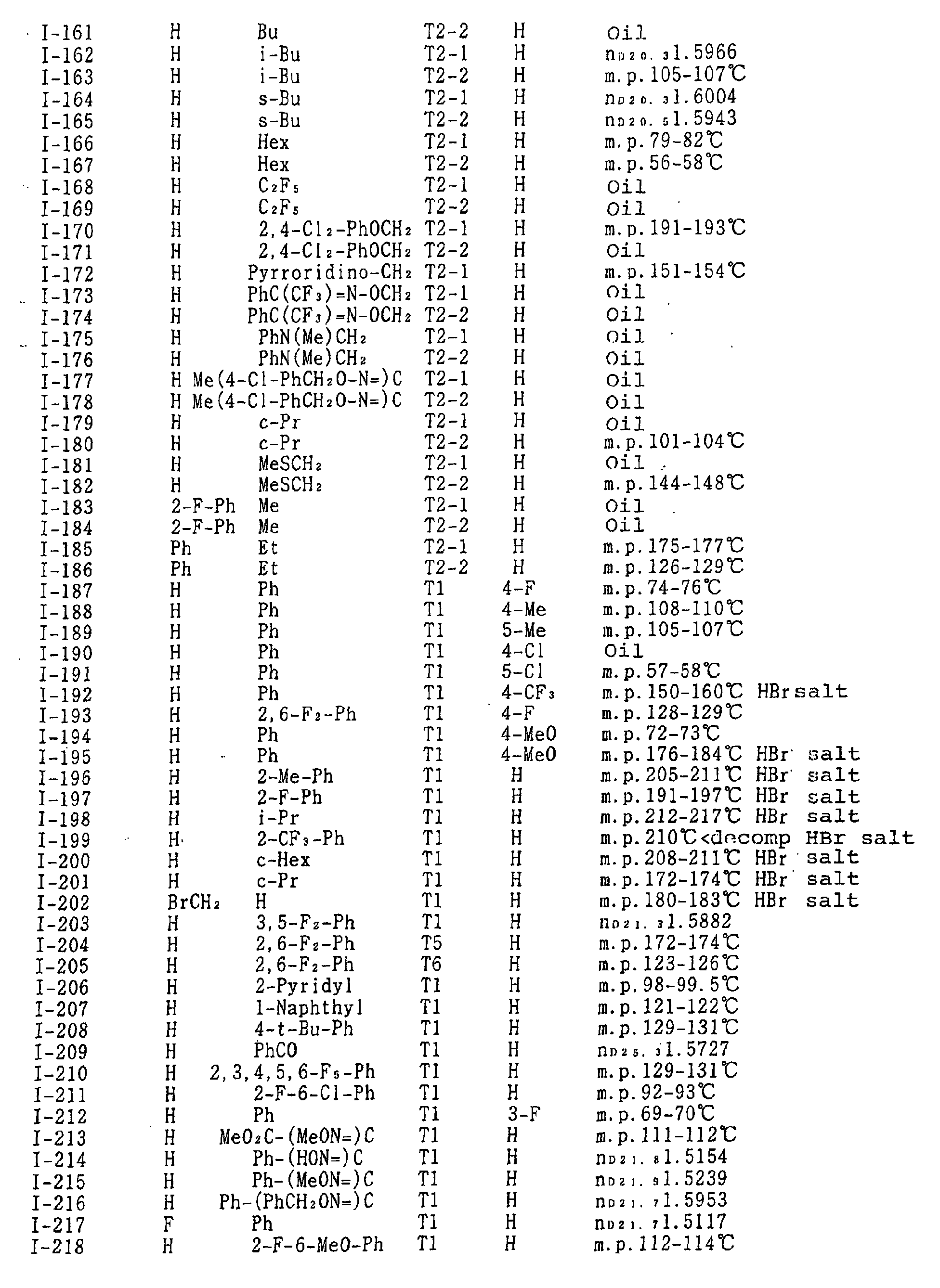
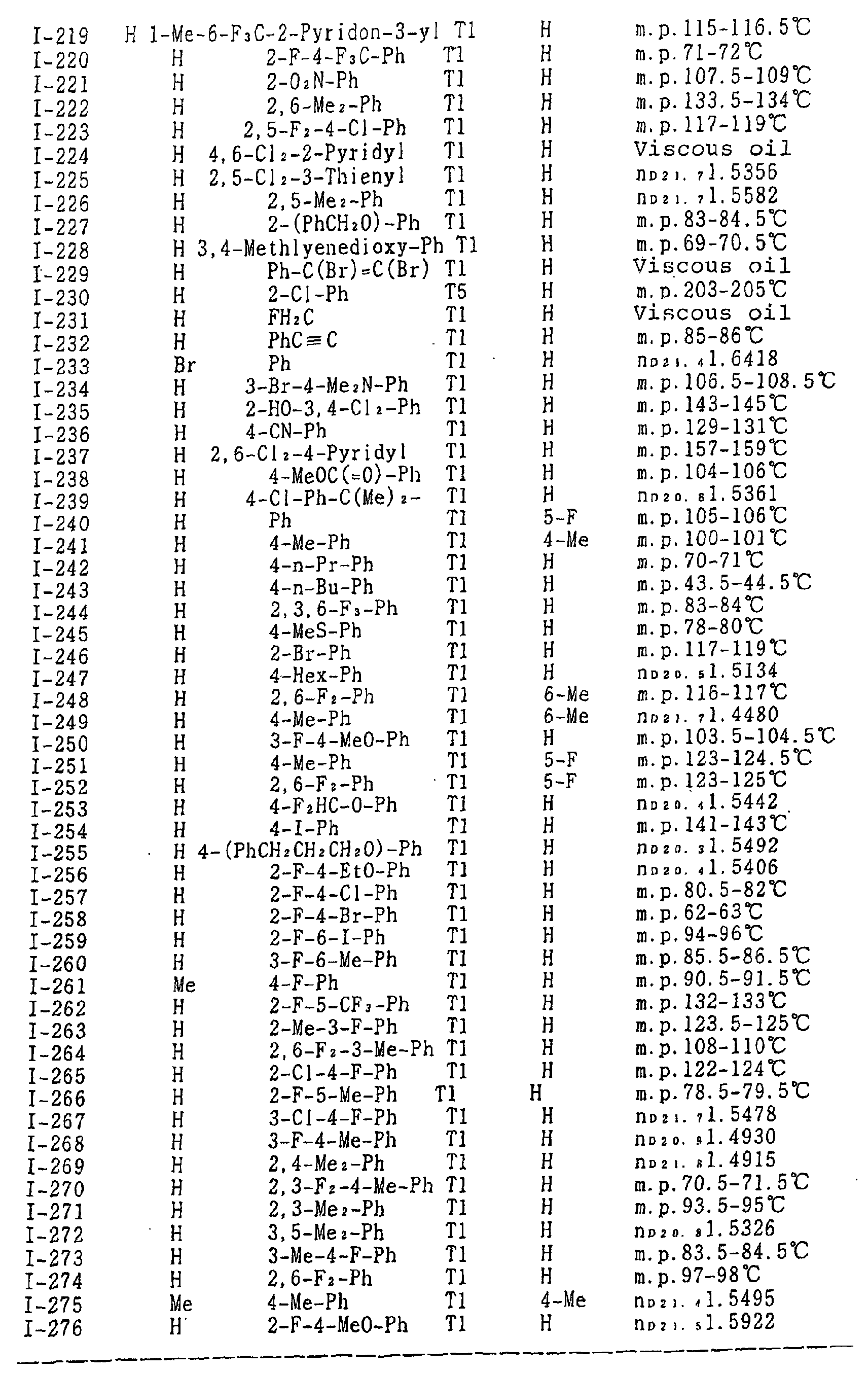

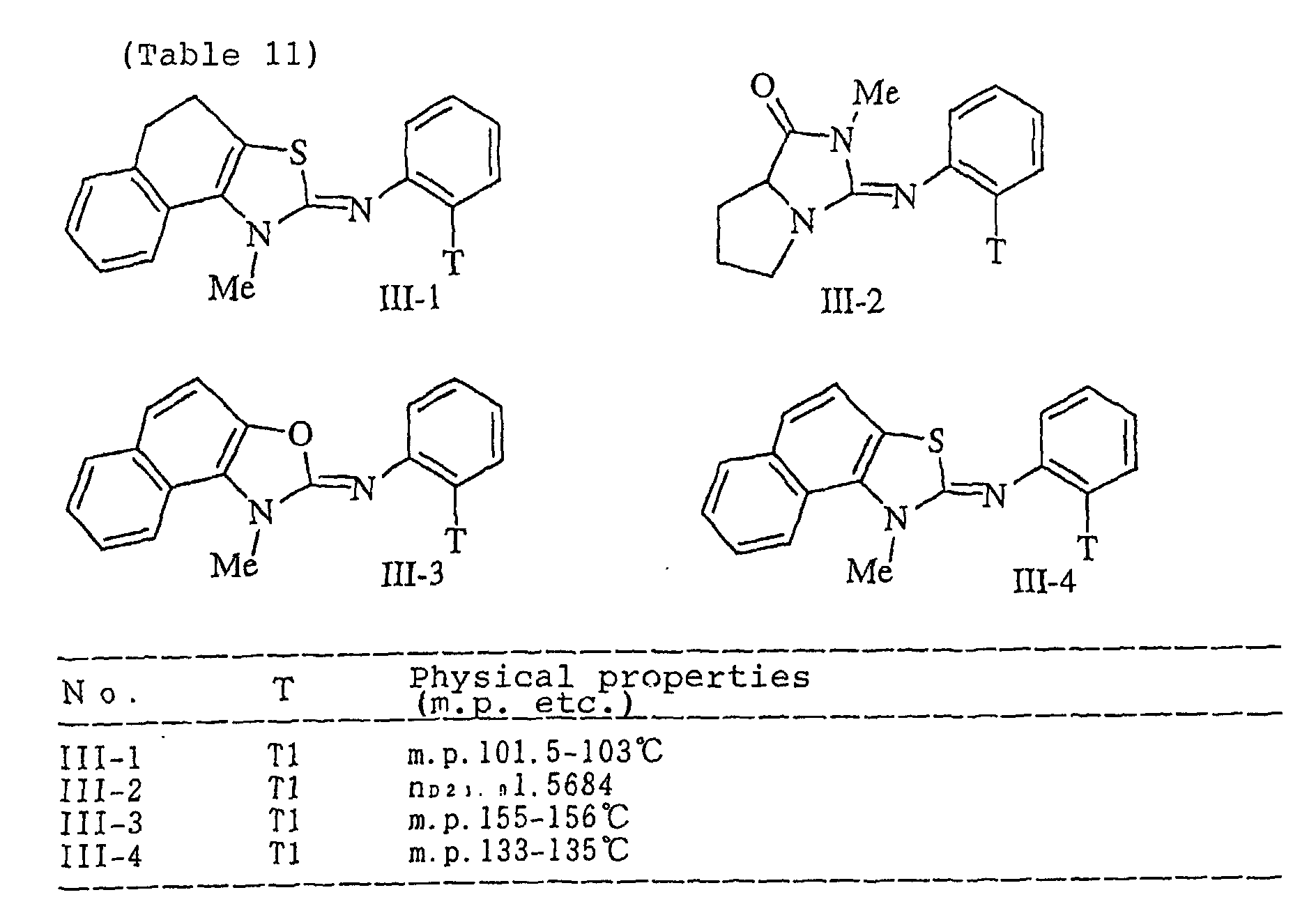
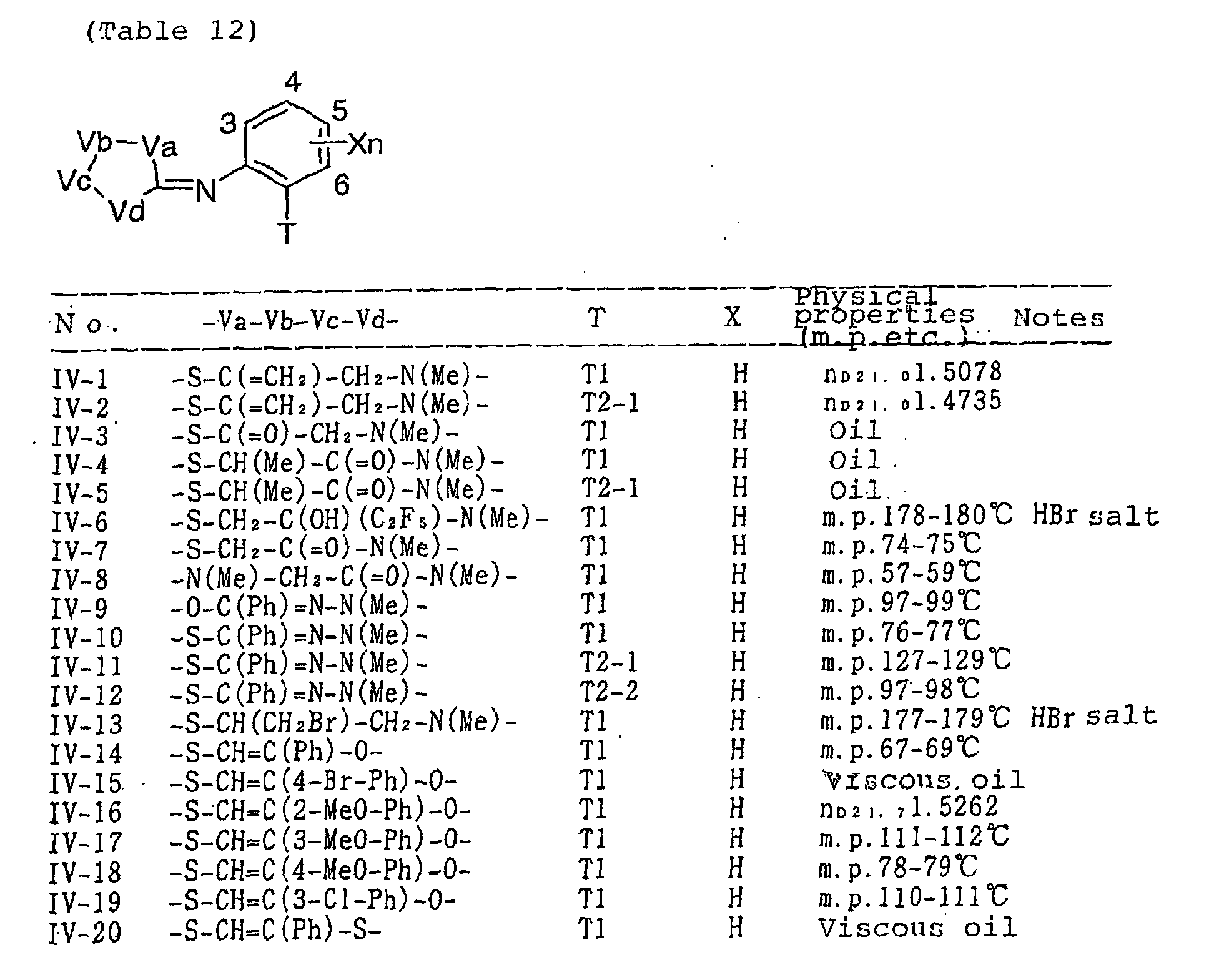
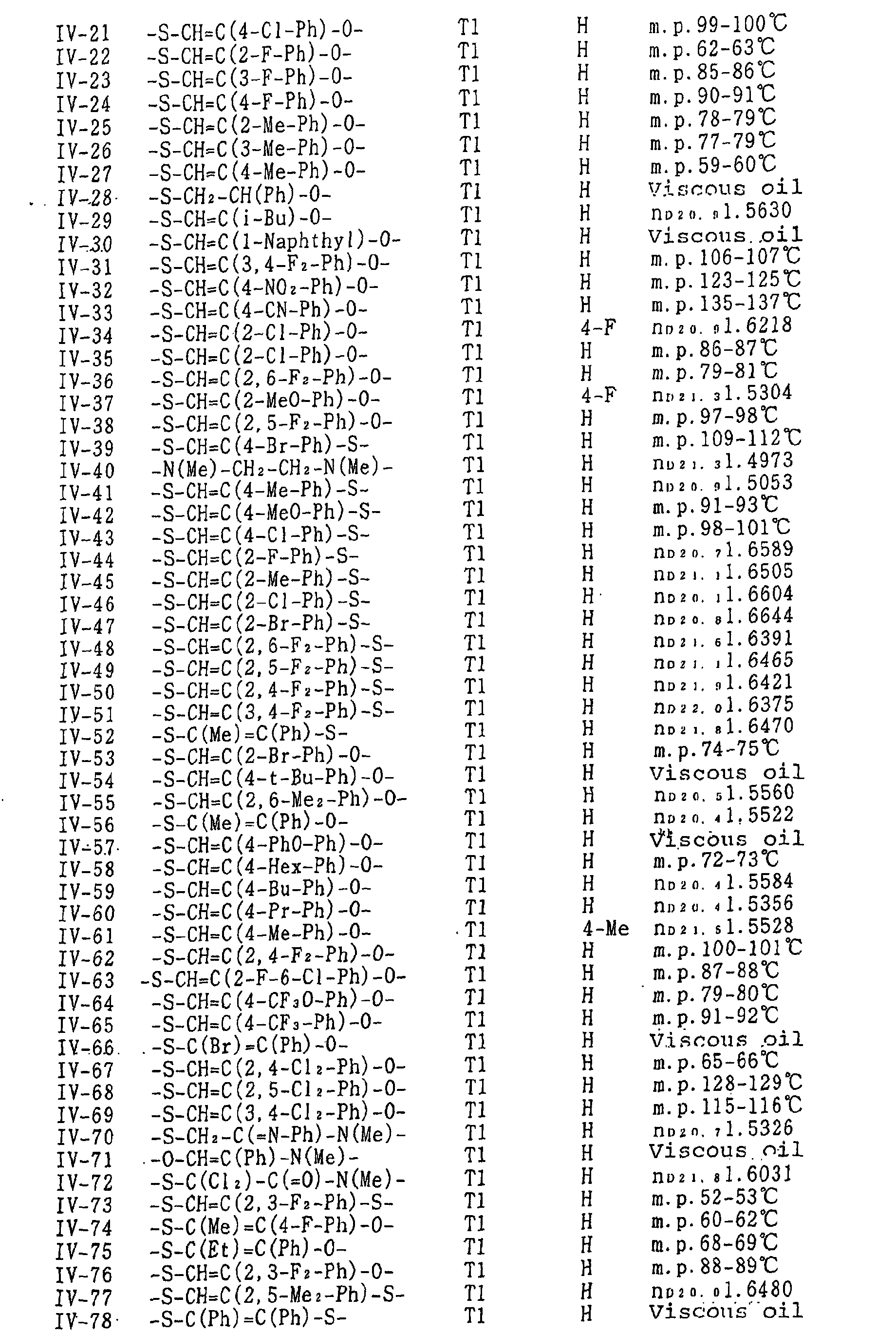
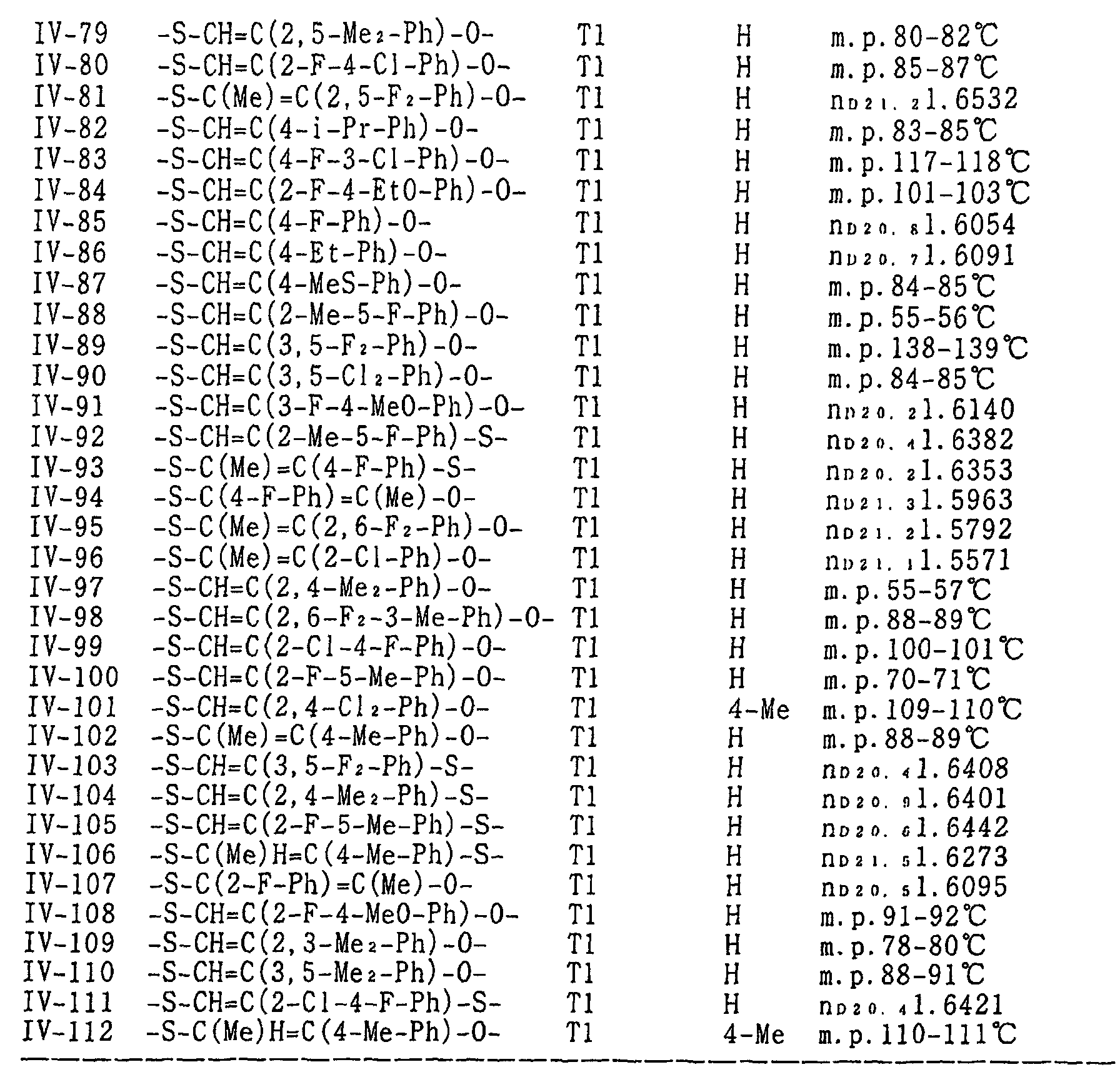
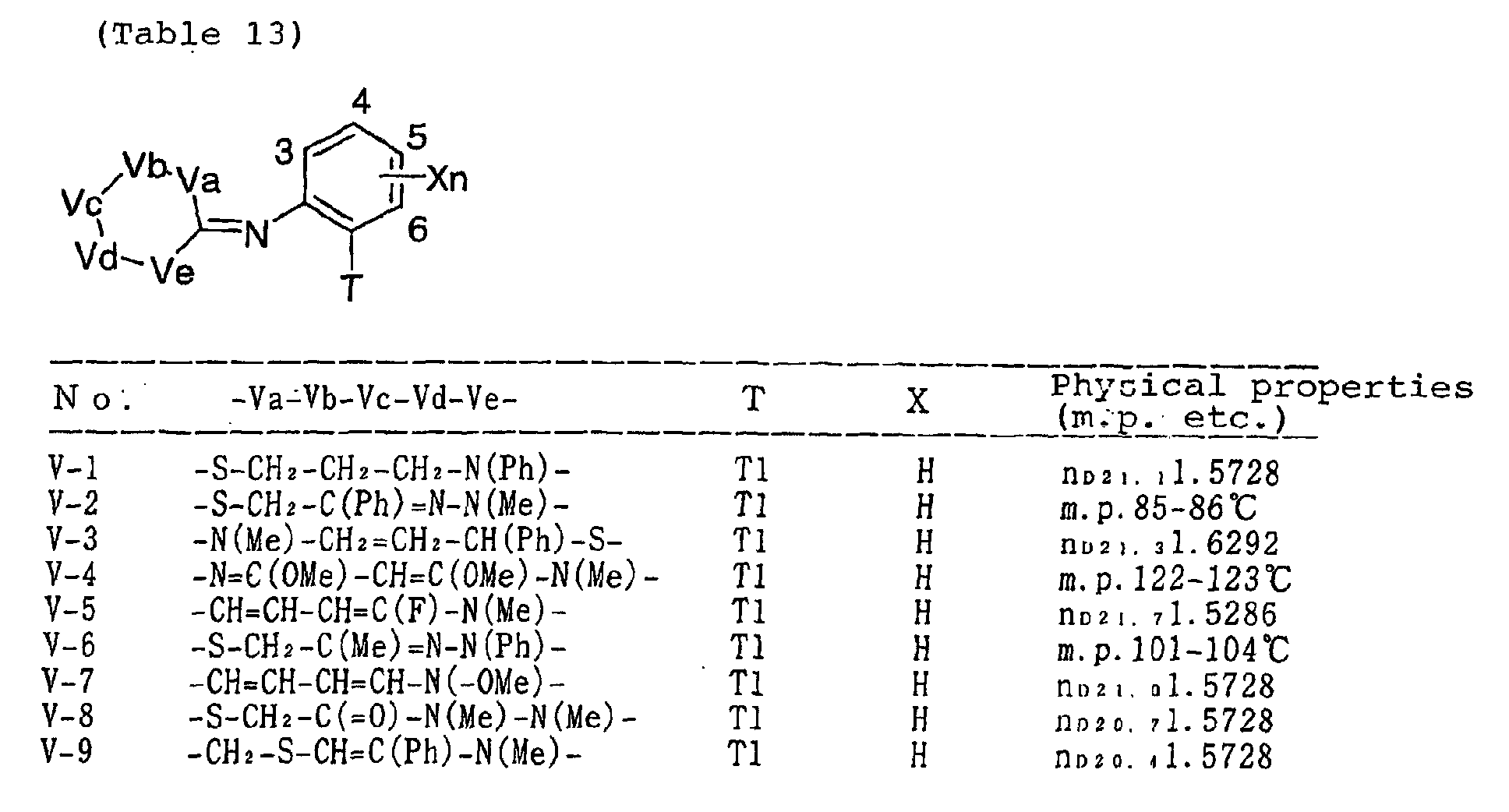
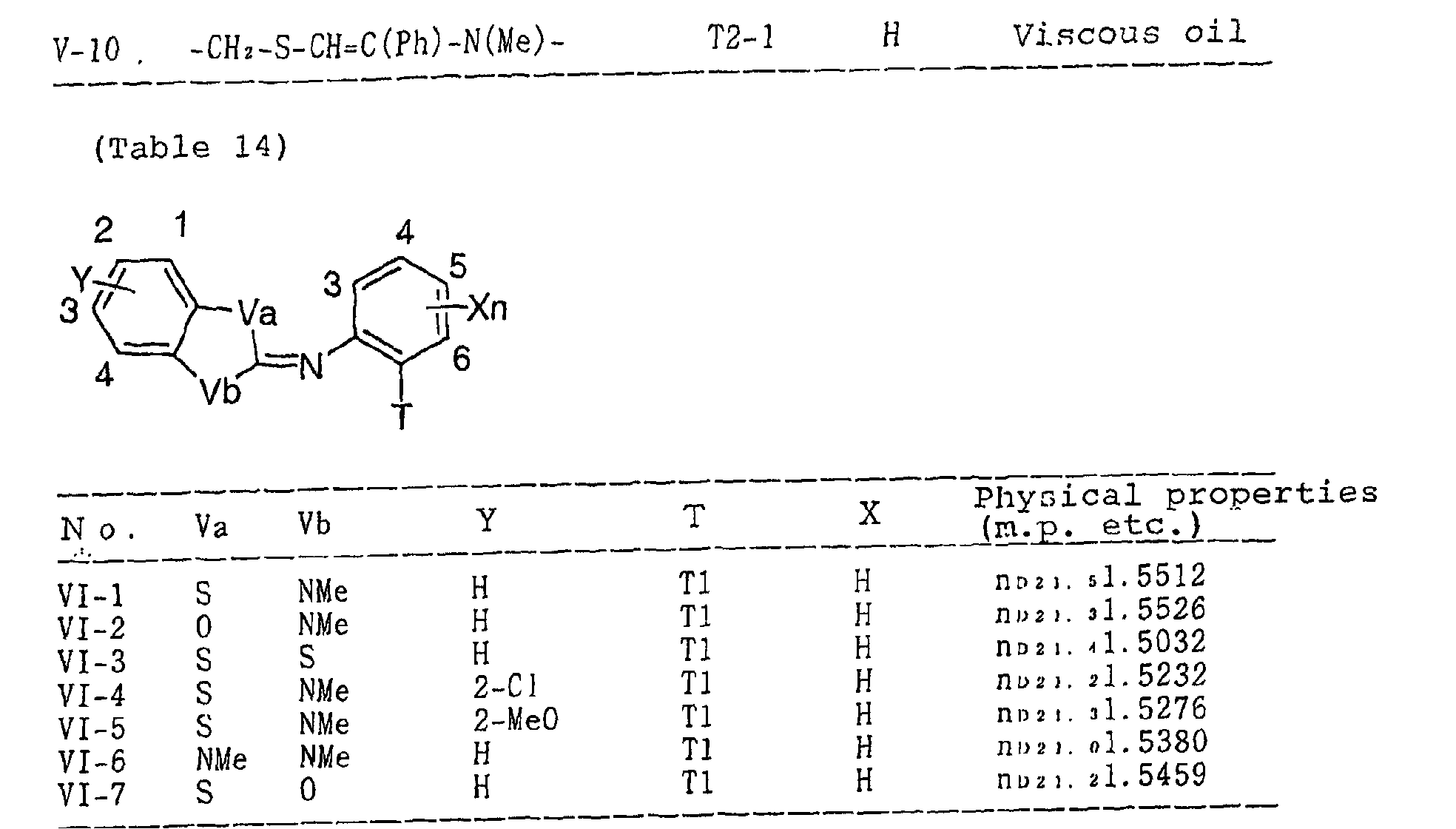


| No. | 1HNMR (CDCl3 δ (ppm)) |
| I-50 | 2.38(s, 3H), 3.26(s, 3H), 3.58(s, 3H), 3.73(s, 3H), |
| 5.71(s, 1H), 6.80-7.60(m, 9H) | |
| I-51 | 2.39(s, 3H), 3.28(s, 3H), 3.55(s, 3H), 3.85(s, 3H), |
| 5.70(s, 1H), 6.54(s, 1H), 6.90-7.40(m, 8H) | |
| I-52 | 3.23(s, 3H), 3.56(s, 3H), 3.74(s, 3H), 5.73(s, 1H), |
| 6.90-7.80(m, 9H) | |
| I-53 | 3.28(s, 3H), 3.59(s, 3H), 3.86(s, 3H), 5.75(s, 1H), |
| 6.56(s, 1H), 6.80-7.60(m, 8H) | |
| I-54 | 3.31(s, 3H), 3.59(s, 3H), 3.75(s, 3H), 5.79(s, 1H), |
| 7.10-7.85(m, 14H) | |
| I-58 | 3.30(s, 3H), 3.60(s, 3H), 3.90(s, 3H), 5.90(s, 1H), |
| 6.55(s, 1H), 7.00-8.15(m, 11H) | |
| I-59 | 3.38(s, 3H), 3.61(s, 3H), 3.78(s, 3H), 5.94(s, 1H), |
| 7.00-7.60(m, 8H) | |
| I-76 | 2.94(s, 3H), 3.32(s, 3H), 3.54(s, 3H), 3.82(s, 3H), |
| 4.20(s, 2H), 5.57(s, 1H), 6.49(s, 1H), 6.65-7.45(m, 9H) | |
| I-79 | 3.19(s, 3H), 3.61(s, 3H), 3.67(s, 2H), 5.85(s, 1H), |
| 7.00-7.80(m, 7H) | |
| I-118 | 3.24(s, 3H), 3.51(s, 3H), 3.76(s, 3H), 5.63(s, 1H), |
| 6.45(s, 1H), 6.60-7.60(m, 13H) | |
| I-I23 | 3.43(s, 3H), 3.55(s, 3H), 3.73(s, 3H), 6.00(s, 1H), |
| 6.35-6.65(m, 2H), 6.90-7.60(m, 6H) | |
| I-124 | 3.56(s, 3H), 3.63(s, 3H), 3.75(s, 3H), 6.28(s, 1H), |
| 7.10-7.45(m, 6H), 7.86(d, J=3.6Hz, 1H) | |
| I-129 | 3.22(s, 3H), 3.53(s, 3H), 3.72(s, 3H), 5.77(s, 1H), |
| 6.90-7.50(m, 8H) | |
| I-130 | 3.25(s, 3H), 3.54(s, 3H), 3.82(s, 3H), 5.77(s, 1H), |
| 6.49(s, 1H), 6.80-7.55(m, 7H) | |
| I-132 | 3.08(s, 3H), 3.52(s, 3H), 3.82(s, 3H), 5.82(s, 1H), |
| 6.53(s, 1H), 6.80-7.55(m, 7H) | |
| I-134 | 3.12(s, 3H), 3.52(s, 3H), 3.82(s, 3H), 5.75(s, 1H), |
| 6.50(s, 1H), 6.90-7.55(m, 7H) | |
| I-138 | 3.17(s, 3H), 3.60(s, 3H), 3.85(s, 3H), 6.53(s, 1H), |
| 6.85-7.75(m, 9H) | |
| 1-152 | 3.92(s, 3H), 3.35(s, 3H), 3.57(s, 3H), 3.61(s, 2H), |
| 4.20(s, 2H), 5.61(s, 1H), 6.75-7.45(m, 9H) | |
| I-161 | 0.94(t, J=5.4Hz, 3H), 1.20-1.75(m, 4H), 2.2-2.6(m, 2H), |
| 3.30(s, 3H), 3.49(s, 3H), 3.80(s, 3H), 5.42(s, 1H), | |
| 6.47(s, 1H), 6.85-7.35(m, 4H) | |
| I-168 | 3.44(s, 3H), 3.57(s, 3H), 3.76(s, 3H), 6.44(s, 1H), |
| 7.05-7.35(m, 4H), 7.38(s, 1H) | |
| I-169 | 3.47(s, 3H), 3.54(s, 3H), 3.87(s, 3H), 6.45(s, 1H), |
| 6.54(s, 1H), 7.05-7.35(m, 4H), | |
| 1-171 | 3.49(s, 3H), 3.53(s, 3H), 3.86(s, 3H), 4.85(s, 2H), |
| 5.98(s, 1H), 6.56(s, 1H), 6.90-7.55(m, 7H) | |
| 1-173 | 3.23(s, 3H), 3.44(s, 3H), 3.67(s, 3H), 4.91(s, 2H), |
| 5.91(s, 1H), 6.85-7.45(m, 10H) | |
| 1-174 | 3.31(s, 3H), 3.41(s, 3H), 3.86(s, 3H), 4.98(s, 2H), |
| 5.99(s, 1H), 6.53(s, 1H), 7.05-7.50(m, 9H) | |
| I-175 | 2.91(s, 3H), 3.30(s, 3H), 3.54(s, 3H), 3.72(s, 3H), |
| 4.17(s, 2H), 5.57(s, 1H), 6.70-7.45(m, 10H) | |
| I-177 | 2.10(s, 3H), 3.45(s, 3H), 3.55(s, 3H), 3.70(s, 3H), |
| 5.15(s, 2H), 6.00(s, 1H), 6.90-7.70(m, 9H) | |
| I-178 | 2.10(s, 3H), 3.50(s, 3H), 3.55(s, 3H), 3.90(s, 3H), |
| 5.20(s, 2H), 6.10(s, 1H), 6.90-7.50(m, 9H) | |
| I-179 | 0.55-1.15(m, 4H), 1.40-1.70(m, 1H), 3.43(s, 3H), |
| 3.54(s, 3H), 3.76(s, 3H), 5.43(s, 1H), 6.95-7.50(m, 5H) | |
| I-181 | 2.05(s, 3H), 3.38(s, 3H), 3.44(s, 2H), 3.55(s, 3H), |
| 3.75(s, 3H), 5.68(s, 1H), 6.95-7.37(m, 5H) | |
| 1-183 | 2.04(s, 3H), 3.37(s, 3H), 3.58(s, 3H). 3.74(s, 3H), |
| 6.85-7.65(m, 9H) | |
| I-184 | 2.03(s, 3H), 3.40(s, 3H), 3.56(s, 3H), 3.82(s, 3H), |
| 6.50(s, 1H), 6.90-7.45(m, 8H) | |
| I-190 | 3.30(s, 3H), 3.60(s, 3H), 3.62(s, 2H), 5.82(s, 1H). |
| 6.92-7.45(m, 8H) | |
| I-224 | 3.57(s, 8H), 6.16(s, 1H), 6.90-7.60(m, 6H) |
| I-231 | 3.48(s, 3H), 3.59(s, 3H). 3.63(s, 3H), |
| 5.12(d, J=48.4Hz, 2H), 6.06(d, J=6.6Hz, 1H), | |
| 7.00-7.10(m, 2H), 7.20-7.30(m, 2H) | |
| IV-3 | 3.09(s, 3H), 3.51(s, 2H), 3.61(s, 3H), 4.00(s, 2H), |
| 7.05-7.48(m, 4H) | |
| IV-4 | 1.61(d, J=7.2Hz, 3H), 3.30(s, 3H), 3.57(s, 2H), |
| 3.62(s, 3H), 4.08(q, J=7.2Hz, 1H), 6.90-7.45(m, 4H) | |
| IV-5 | 1.58(d, J=7.8Hz, 3H), 3.21(s, 3H), 3.63(s, 3H), |
| 3.77(s, 3H), 4.05(q, J=7.8Hz, 1H), 6.85-7.40(m, 5H) | |
| IV-15 | 3.62(s, 3H), 3.68(s, 2H), 6.42(s, 1H), 7.06-7.53(m, 8H) |
| IV-20 | 3.64(s, 3H), 3.64(s, 2H), 6.59(s, 0.4H), 6.68(s, 0.6H), |
| 7.04-7.32(m, 9H) | |
| IV-28 | 3.38(dd, J=9.1, 11.0Hz, 1H), 3.60-3.65(m, 1H), |
| 3.65(s, 3H), 3.66(s, 2H), 5.63(dd, J=5.8, 9.1Hz, 1H), | |
| 6.96-7.46(m, 9H) | |
| IV-30 | 3.66(s, 3H), 3.72(s, 2H), 6.37(s, 1H), 7.10-8.35(m, 11H) |
| IV-54 | 1.34(s, 9H), 3.62(s, 3H), 3.69(s, 2H), 6.33(s, 1H), |
| 7.05-7.65 (m, 8H) | |
| IV-57 | 3.61(s, 3H), 3.68(s, 2H), 6.27(s, 1H), 6.95-7.7(m, 13H) |
| IV-66 | 3.65(s, 3H), 3.68(s, 2H), 6.9-8.15(m, 9H) |
| IV-71 | 3.28(s, 3H), 3.64(s, 3H), 3.73(s, 2H), 6.81(s, 1H), |
| 6.95-7.5(m, 9H) | |
| IV-78 | 3.67(s, 2H), 3.70(s, 3H), 7.05-7.32(m, 14H) |
| V-10 | 3.03(s, 3H), 3.25(s, 2H), 3.69(s, 3H), 3.82(s, 3H), |
| 5.71(s, 1H), 6.79-7.41(m, 10H), 7.46(s, 1H) |
Now, Formulations Examples of fungicides and
insecticides for agricultural and horticultural use
containing the compounds of the present invention as
active ingredients, will be specifically given. However,
the present invention is not limited thereto. In the
following Formulation Examples, "parts" means "parts by
weight".
| FORMULATION EXAMPLE 1: Emulsifiable concentrate | |
| Compound No. I-1 of the present invention | 20 parts |
| Methyl naphthalene | 55 parts |
| Cyclohexanone | 20 parts |
| Sorpol 2680 (mixture of a nonionic | |
| surfactant and an anionic surfactant, | |
| tradename, Toho Chemical Industry Co., Ltd.) | 5 parts |
The above materials are uniformly mixed to obtain an
emulsifiable concentrate. In use, the above emulsifiable
concentrate is diluted from 50 to 20000 times and applied
so that the amount of the active ingredient will be from
0.005 to 50 kg per hectare.
| FORMULATION EXAMPLE 2: Wettable powder | |
| Compound No. I-37 of the present invention | 25 parts |
| pyrophyllite | 66 parts |
| Sorpol 5039 (anionic surfactant, | |
| tradename, Toho Chemical Industry Co., Ltd.) | 4 parts |
| Carplex #80D (white carbon, tradename, | |
| Shionogi & Co., Ltd.) | 3 parts |
| Calcium ligninsulfonate | 2 parts |
The above materials are uniformly mixed and
pulverized to obtain a wettable powder.
In use, the above wettable powder is diluted from 50
to 20000 times and applied so that the amount of the
active ingredient will be from 0.005 to 50 kg per hectare.
| FORMULATION EXAMPLE 3: Dust | |
| Compound No. I-43 of the present invention | 3 parts |
| Carplex #80D (white carbon, tradename, | |
| Shionogi & Co., Ltd.) | 0.5 part |
| Kaolinite | 95 parts |
| Diisopropyl phosphate | 1.5 parts |
The above materials are uniformly mixed to obtain a
dust. In use, the above dust is applied so that the
amount of the active ingredient will be from 0.005 to 50
kg per hectare.
| FORMULATION EXAMPLE 4: Granule | |
| Compound No. 1-53 of the present invention | 5 parts |
| Bentonite | 30 parts |
| Talc | 64 parts |
| Calcium ligninsulfonate | 1 part |
The above materials are uniformly mixed and
pulverized, and a small amount of water is added,
followed by stirring and mixing, and the mixture is
granulated by an extrusion granulator, followed by drying
to obtain a granule. In use, the above granule is
applied so that the amount of the active ingredient will
be from 0.005 to 50 kg per hectare.
| FORMULATION EXAMPLE 5: Flowable | |
| Compound No. I-70 of the present invention | 25 parts |
| Sorpol 3353 (nonionic surfactant, tradename, | |
| Toho Chemical Industry Co., Ltd.) | 5 parts |
| Lunox 1000C (anionic surfactant, tradename, | |
| Toho Chemical Industry Co., Ltd.) | 0.5 part |
| Xanthan gum (natural polymer) | 0.2 part |
| Sodium benzoate | 0.4 part |
| Propylene glycol | 10 parts |
| Water | 58.9 parts |
The above components except for the active
ingredient (the compound of the present invention) are
uniformly dissolved, then the compound of the present
invention is added, followed by stirring. Then, the
mixture is wet-pulverized by a sand mill to obtain a
flowable. In use, the flowable is diluted from 50 to
20000 times and applied so that the amount of the active
ingredient will be from 0.005 to 50 kg per hectare.
| FORMULATION EXAMPLE 6: Granular wettable powder (dry flowable) | |
| Compound No. II-1 of the present invention | 75 parts |
| Hitenol NE-15 (anionic surfactant, tradename, | |
| Daiichi Kogyo Seiyaku Co., Ltd.) | 5 parts |
| Vanilex N (anionic surfactant, tradename, | |
| Nippon Paper Industries Co., Ltd.) | 10 parts |
| Carplex #80D (white carbon, tradename, | |
| Shionogi & Co., Ltd.) | 10 parts |
The above materials are uniformly mixed and finely
pulverized, and a small amount of water was added,
followed by stirring and mixing. Then, the mixture is
granulated by an extrusion granulator and dried to obtain
a dry flowable. In use, it is diluted with water from 50
to 20000 times and applied so that the amount of the
active ingredient will be from 0.005 to 50 kg per hectare.
TEST EXAMPLES: The usefulness of the compounds of the
present invention will be described in detail with
reference to the following Test Examples. However, the
present invention is not limited thereto.
To rice (variety: Nihonbare) of 1.5 leaf stage
planted in a beaker pot of 1/20,000 are, the emulsifiable
concentrate of the compound of the present invention was
diluted with water to obtain a solution adjusted to 500
ppm, which was applied for irrigation treatment of 10 m
per pot.
After 7 days from the irrigation treatment, a
suspension of spores of blast (Pyricularia oryzae) (2×10⁵
spores/ml) was sprayed and inoculated to the treated rice.
The inoculated rice was put in an inoculation box at a
temperature of from 20 to 25°C under a humidity of at
least 95% for 1 day. Then, it was put in a greenhouse,
and after 7 days from the inoculation, the proportion of
the formed lesion area on the inoculated leaf, was
measured, and the control value was calculated in
accordance with the following formula.
Control value=
[1-(lesion area in treated section/lesion area in
non-treated section)]×100
As a result, the following compounds showed control
values of 70 or higher.
Compound Nos. of the present invention: I-1,I-2,
I-3,I-4,I-7,I-13,I-17,I-20,I-21,I-33,I-37,I-41,I-43,
I-44,I-45,I-47,I-50,I-51,I-52,I-54,I-55,I-56,I-57,I-58,I-59,I-64,I-66,I-68,I-70,I-71,I-72,I-73,I-75,I-80,
I-82,I-99,I-111,I-128,I-131,I-134,I-143,I-144,I-146,
I-151,I-160,I-162,I-164,I-166,I-167,I-168,I-169,I-175,
I-176,I-181,I-196,I-197,I-198,I-203,1-204,I-205,I-244,
I-246,II-4,II-10,II-11,II-12,II-19,IV-2,IV-3,IV-5,IV-16,
IV-17, IV-19, IV-20, IV-43, IV-44, IV-45,V-3,VII-18
To rice (variety: Nihonbare) of 3 leaf stage grown
in a pot having a diameter of 7 cm, a solution obtained
by diluting the emulsifiable concentrate of the compound
of the present invention with water to 500 ppm, was
sprayed in an amount of 20 ml per pot by means of a spray
gun.
One day after the spraying, a suspension of spores
of rice blast (Pyricularia oryzae) (2×10⁵ spores/ml) was
sprayed for inoculation. The inoculated rice was put in
an inoculation box at a temperature of 25°C under a
humidity of at least 95% for 1 day. Then, it was put in
a greenhouse, and after 7 days from inoculation, the
proportion of the formed lesion area on the inoculated
leaf, was measured, and the control value was calculated
in accordance with the following formula.
Control value=
[1-(lesion area in treated section/lesion area in
non-treated section)]×100
As a result, the following compounds showed control
values of 70 or higher.
Compound Nos. of the present invention: I-1,I-2,I-3,I-4,I-5,I-6,I-8,I-9,I-10,I-11,I-12,I-13,I-14,I-15,1-16,I-17,I-18,I-19,I-20,I-21,I-25,I-26,I-27,I-28,I-29,I-30,I-31,I-33,I-36,I-37,I-38,I-39,I-40,I-41,I-42,I-43,I-44,I-45,I-46,I-47,I-48,I-49,I-50,I-51,I-52,I-53,I-54,1-55,I-56,I-57,I-58,I-59,I-60,I-61,I-62,I-63,I-64,I-65,I-66,I-67,I-68,I-69,I-70,I-71,I-72,I-74,I-76,I-79,I-80,1-82,I-92,I-93,I-94,I-98,I-99,I-100,I-102,I-105,I-106,1-107,I-108,I-109,I-110,I-111,I-112,I-113,I-114,I-115,I-116,I-117,I-119,I-126,I-127,I-128,I-129,I-133,I-134,I-137,I-139,I-140,I-141,I-143,I-144,I-145,I-146,I-149,1-150,I-152,I-155,I-160,I-161,I-162,I-164,I-165,I-166,1-168,I-169,I-171,I-175,I-176,I-179,I-183,I-186,I-187,I-196,I-197,I-198,I-201,II-1,II-2,II-3,II-4,II-12,IV-10
To wheat (variety: Norin No. 61) of from 2.0 to 2.5
leaf stage grown in a pot having a diameter of 5.5 cm, a
solution prepared by diluting the emulsifiable
concentrate of the compound of the present invention with
water to 500 ppm, was applied in an amount of 20 ml per
pot by means of a spray gun.
After 1 day from the application, spores of wheat
powdery mildew (Erysiphe graminis) were directly
inoculated. Then, it was put in a greenhouse, and after
7 days from the inoculation, the proportion of the formed
lesion area on the inoculated leaf, was measured, and the
control value was calculated in accordance with the
following formula:
Control value=
[1-(lesion area in treated section/lesion area in
non-treated section)]×100
As a result, the following compounds showed control
values of 70 or higher.
Compound Nos. of the present invention: I-1,I-3,I-4,I-5,I-6,I-9,I-10,I-11,I-12,I-13,I-15,I-16,I-18,I-20,1-21,I-22,I-23,I-24,I-25,I-26,I-27,I-28,I-31,I-37,I-41,1-43,I-45,I-49,I-50,I-52,I-56,I-59,I-62,I-66,I-67,I-68,I-70,I-72,I-73,I-76,I-78,I-79,I-80,I-84,I-85,I-86,I-87,I-88,I-89,I-90,I-92,I-93,I-94,I-95,I-96,I-97,I-106,I-111,I-113,I-115,I-120,I-125,I-127,I-129,I-130,I-132,I-135,1-143,I-145,I-146,I-147,I-151,I-155,I-160,I-161,I-164,1-166,I-168,I-169,I-177,I-178,I-188,I-190,I-191,I-193,1-194,I-195,I-197,I-198,I-200,I-201,I-203,I-205,I-206,I-207,I-208,I-210,I-211,I-212,I-213,I-214,I-215,I-218,I-219,I-220,I-223,I-224,I-225,I-226,I-228,I-229,I-234,I-240,I-242,I-243,I-244,II-1,II-2,II-25,II-26,IV-1,IV-2,IV-5,IV-7,IV-14,IV-15,IV-16,IV-18,
IV-19,IV-20,IV-21,IV-22,IV-23,IV-24,IV-25,IV-26,IV-27,IV-28,IV-29,
IV-30,IV-31,IV-34,IV-35,IV-36,IV-37,IV-38,IV-39,IV-41,
IV-42,IV-43,IV-44,IV-45,IV-46,IV-47,IV-48,IV-49,IV-50,IV-51,IV-52,IV-53,IV-54,IV-55,IV-56,IV-57,IV-58,IV-59,IV-60,IV-61,IV-62,IV-63,IV-64,IV-65,IV-66,IV-67,
IV-68, IV-69,IV-70,IV-85,IV-86,VI-1,VI-3,VI-7,VII-1,VII-2,VII-3,VII-4,VII-5,VII-6,VII-8,VII-7,VII-9,VII-10,VII-11,VII-12,VII-13,VII-14,VII-16,VII-18,VII-22,VII-23,VII-24,VII-29
To wheat (variety: Norin No. 61) of from 2.0 to 2.5
leaf stage grown in a pot having a diameter of 5.5 cm, a
solution prepared by diluting the emulsifiable
concentrate of the compound of the present invention with
water to 500 ppm, was applied in an amount of 20 ml per
pot by means of a spray gun.
After 1 day from the application, a suspension of
spores of wheat scab (Puccinia recondita) (2×10⁵
spores/ml) was sprayed, and it was put in an inoculation
box at a temperature of from 20 to 25°C under a humidity
of at least 95% for 1 day. Then, it was put in a
greenhouse, and after 10 days from the inoculation, the
formed, lesion area was measured, and the control value
was calculated in accordance with the following formula:
Control value=
[1-(lesion area in treated section/lesion area in
non-treated section)]×100
As a result, the following compounds showed control
values of 70 or higher.
Compound Nos. of the present invention: I-1,I-2,I-3,I-4,I-5,I-6,I-7,I-8,I-9,I-10,I-11,I-12,I-13,I-14,I-15,I-16,I-18,I-19,I-20,I-21,I-24,I-25,I-26,I-27,I-28,I-29,I-30,I-31,I-33,I-35,I-36,I-37,I-38,I-39,I-40,I-41,I-42,I-43,I-44,I-45,I-46,I-47,I-48,I-49,I-50,I-51,I-52,I-53,I-54,I-55,I-56,I-57,I-59,I-60,I-62,I-63,I-64,I-65,I-66,I-67,I-68,I-69,I-70,I-71,I-72,I-73,I-74,I-76,I-77,I-78,I-79,I-80,I-82,I-83,I-84,I-85,I-86,I-87,I-88,I-89,I-91,I-92,I-93,I-94,I-95,I-96,I-97,I-98,I-99,I-100,I-102,I-104,I-105,I-106,I-107,I-108,I-109,I-110,I-111,I-112,I-114,I-115,I-116,I-117,I-118,I-119,I-120,I-121,I-123,I-124,I-125,I-126,I-127,I-128,I-129,I-130,I-131,I-132,I-133,I-134,I-135,I-136,I-137,I-139,I-143,I-144,I-145,I-146,I-147,I-148,I-149,I-151,I-152,I-153,I-155,I-160,I-161,I-162,I-163,I-164,I-165,I-166,I-167,I-168,I-170,1-171,I-173,I-174,I-175,I-176,I-177,I-178,I-179,I-180,1-181,I-182,I-183,I-187,I-188,I-189,I-190,I-191,I-193,1-194,I-195,I-196,I-197,I-198,I-199,I-200,I-203,I-205,I-206,I-207,I-208,I-209,I-211,I-212,I-214,I-215,I-216,I-217,I-218,I-219,I-220,I-221,I-223,I-224,I-225,I-226,I-227,I-228,I-229,I-230,I-232,I-233,I-234,I-236,I-238,I-239,I-240,I-241,I-242,I-243,I-244,I-245,I-246,I-247,II-1,II-2,II-4,II-5,II-12,II-16,II-17,II-18,II-22,II-23,II-25,II-26,II-28,III-1,IV-6,IV-14,IV-15,IV-16,IV-17,IV-18,IV-19,IV-20,IV-21,IV-22,IV-23,IV-24,IV-25,IV-26,IV-27,IV-28,IV-29,IV-30,IV-31,IV-32,IV-33,IV-34,IV-35,IV-36,IV-37,IV-38,IV-39,IV-42,IV-42,IV-43,IV-44,IV-45,
IV-46,IV-47,IV-48,IV-49,IV-50,IV-51,IV-52,IV-53,IV-54,IV-55,IV-56,IV-57,IV-58,IV-59,IV-60,IV-61,IV-62,IV-63,IV-64,IV-65,IV-66,IV-67,IV-68,IV-69,
IV-70,IV-85,IV-86,IV-87,V-10,VI-1,VI-2,VI-3,VI-5,VI-7,VII-1,VII-2,VII-3,VII-4,VII-5,VII-6,VII-7,VII-9,VII-10,VII-11,VII-12,VII-13,VII-14,VII-15,VII-16,VII-18,VII-19,VII-23,VII-24,VII-25,VII-26,VII-29
To wheat (variety: altria) of from 2.0 to 2.5 leaf
stage grown in a pot having a diameter of 5.5 cm, a
solution prepared by diluting the emulsifiable
concentrate of the compound of the present invention with
water to 500 ppm, was applied in an amount of 20 ml per
pot by means of a spray gun.
After 1 day from the application, a suspension of
spores of glume-blotch (Leptosphaera nodorum) (2×10⁵
spores/ml) was sprayed for inoculation. The inoculated
wheat was put in an inoculation box at a temperature of
from 18 to 20°C under a humidity of at least 95% for from
7 to 10 days to promote the disease. The proportion of
the formed lesion area on the inoculated leaf, was
measured, and the control value was calculated in
accordance with the following formula.
[1-(lesion area in treated section/lesion area in
non-treated section)]×100
As a result, the following compounds showed control
values of 70 or higher.
Compound Nos. of the present invention: I-1,I-2,
I-3,I-4,I-5,I-6,I-7,I-8,I-9,I-10,I-11,I-12,I-13,I-14,
I-15,I-16,I-17,I-18,I-19,I-20,I-21,I-22,I-23,I-24,I-2
5,I-26,I-27,I-28,I-31,I-33,I-34,I-36,I-37,I-39,I-40,
I-41,I-42,I-43,I-44,I-45,I-46,I-47,I-48,I-49,I-50,I-52,I-54,I-55,I-56,I-57,I-58,I-59,I-60,I-61,I-62,I-63,
I-64,I-65,I-66,I-67,I-68,I-69,I-70,I-71,I-73,I-74,I-7
5,I-76,I-78,I-79,I-80,I-82,I-83,I-84,I-85,I-86,I-87,
I-88,I-89,I-90,I-91,I-93,I-96,I-97,I-99,I-100,I-102,
I-103,I-105,I-106,I-107,I-108,I-109,I-110,I-112,I-113,
I-114,I-115,I-116,I-117,I-118,I-119,I-120,I-121,I-123,
I-125,I-126,I-127,I-128,I-129,I-130,I-132,I-133,I-134,
I-135,I-136,I-137,I-143,I-145,I-146,I-147,I-149,I-150,
I-153,I-155,I-160,I-161,I-162,I-164,I-165,I-166,I-167,
I-168,I-169,I-170,I-172,I-174,I-175,I-177,I-179,I-182,
I-183,I-187,I-188,I-189,I-190,I-191,I-193,I-194,I-195,
I-197,I-198,I-199,I-200,I-201,I-203,I-204,I-205,I-206,
I-207,I-208,I-209,I-210,I-211,I-212,I-215,I-216,I-217,
I-218,I-219,I-220,I-221,I-223,I-224,I-225,I-226,I-228,
I-229,I-230,I-231,I-232,I-233,I-234,I-235,I-236,I-239,
I-240,I-241,I-242,I-243,I-244,I-245,I-246,I-247,II-1,
II-2,II-3,II-4,II-5,II-12,II-14,II-16,II-19,II-22,II-23,II-25,II-26,II-28,IV-1,IV-5,IV-14,IV-15,IV-16,IV-1
7,IV-18,IV-19,IV-20,IV-21,IV-22,IV-23,IV-24,IV-25,IV-26,IV-27,IV-28,IV-35,IV-36,IV-37,IV-38,IV-39,IV-40,I
V-41,IV-42,IV-43, IV-44, IV-45, IV-46,IV-47, IV-48, IV-49,
IV-50,IV-51,IV-52,IV-53,IV-54,IV-55,IV-56,IV-57,IV-58,
IV-59,IV-60,IV-61, IV-62, IV-64,IV-65,IV-66, IV-67,IV-68,
IV-69,IV-70,IV-85,IV-86,IV-87,V-6,V-7,VI-1,VI-2,VI-3,
VI-4,VI-5,VI-7,VII-2,VII-3,VII-4,VII-5,VII-6,VII-7,VI
I-8,VII-9,VII-10,VII-11,VII-12,VII-13,VII-14,VII-15,V
II-16,VII-18,VII-19,VII-29
To cucumber (variety: Sagamihanjiro) of 1.5 leaf
stage grown in a pot having a diameter of 7 cm, a
solution prepared by diluting the emulsifiable
concentrate of the compound of the present invention with
water to 500 ppm, was applied in an amount of 20 ml per
pot by means of a spray gun.
After 1 day from the application, a suspension of
spores of cucumber downy mildew (Pseudoperonospora
cubensis) (2×10⁵ spores/ml) was sprayed, and it was put
in an inoculation box at a temperature of from 20 to 25°C
under a humidity of at least 95% for 1 day. Then, it was
put in a greenhouse, and after 7 days from the
inoculation, the proportion of the formed lesion area on
the inoculated leaf, was measured, and the control value
was calculated in accordance with the following formula.
[1-(lesion area in treated section/lesion area in
non-treated section)]×100
As a result, the following compounds showed control
values of 70 or higher.
Compound Nos. of the present invention: I-1,I-3,
I-6,I-9,I-10,I-11,I-12,I-13,I-16,I-17,I-18,I-19,I-20,
I-21,I-23,I-25,I-28,I-33,I-37,I-38,I-43,I-44,I-45,I-46,I-47,I-48,I-49,I-51,I-52,I-53,I-54,I-55,I-56,I-57,
I-59,I-62,I-64,I-65,I-66,I-68,I-70,I-71,I-72,I-74,I-76,I-80,I-81,I-87,I-89,I-91,I-92,I-102,I-107,I-109,I-110,I-111,I-113,I-114,I-115,I-117,I-118,I-119,I-120,I-125,I-127,I-128,I-129,I-131,I-133,I-134,I-135,I-136,
I-137,I-139,I-140,I-144,I-145,I-147,I-149,I-155,I-161,
I-162,I-163,I-164,I-165,I-166,I-167,I-168,I-169,I-171,
I-172,I-173,I-175,I-176,I-177,I-178,I-179,I-181,I-183,
I-187,I-188,I-189,I-190,I-191,I-194,I-195,I-197,I-198,
I-200,I-208,I-211,I-217,I-218,I-219,I-219,I-220,I-223,
I-225,I-228,I-229,I-232,I-236,I-239,I-240,I-241,I-244,
I-245,I-247,II-2,IV-2,IV-15,IV-16,IV-17,IV-18,IV-19,IV-20, IV-21, IV-22,IV-23, IV-24,IV-25, IV-26, IV-27, IV-35,
IV-38,IV-42,IV-46,IV-52,IV-53,IV-54,IV-56,IV-57,IV-60,
IV-61,IV-72,IV-86,IV-87,VI-3,VII-2,VII-25
A 5% emulsifiable concentrate of the compound of the
present invention (depending upon the compound, a 25%
emulsifiable concentrate was tested) was diluted with
water containing a spreader to obtain a solution having a
concentration of 500 ppm.
This solution was applied in a sufficient amount to
the foliage of rice planted in a pot of 1/20,000 are.
After drying it by air, a cylinder was put, and 10 larvae
of 2 old of brown rice plant hoppers were released per
pot. A cover was put, and the pot was stored in a
constant temperature chamber. An inspection was carried
out upon expiration of 6 days, and the mortality was
obtained by the following calculation formula. The test
was carried out in two sections.
Mortality (%) = [Number of dead larvae/
(Number of dead larvae + alive larvae)]×100
As a result, the following compounds showed a
mortality of 70% or higher.
Compound Nos. of the present invention: I-50,I-184
TEST EXAMPLE 8: Insecticidal test against green rice
leaf hoppers (Nephotellix cincticeps Vhler)
A rice foliage was dipped in an emulsified solution
having a concentration of 500 ppm of the compound of the
present invention, for about 10 seconds, and this foliage
was put into a glass cylinder, and adults of green rice
leaf hoppers showing resistance against organophosphorus
insecticides, were released, and a perforated cover was
put. The covered cylinder was put in a constant
temperature chamber of 25°C. Six days later, the number
of dead insects were investigated, and the mortality was
obtained by the same calculation formula as in Test
Example 7. The test was carried out in two sections. As
a result, the following compounds showed a mortality of
70% or higher.
Compound Nos. of the present invention: I-10,I-16,
I-37,I-45,I-47,I-50,I-52,I-54,I-55,I-68,I-72,I-83,I-89,I-91,I-109,I-113,I-137,I-160,I-162,I-166,I-168,I-197,II-5,IV-12
A kohlrabi leaf was dipped in an emulsified aqueous
solution having a concentration of 500 ppm of the
compound of the present invention, for about 10 seconds,
and after drying it by air, it was put in a petri dish,
wherein 10 larvae of diamond back moths of 2 old were
released. A perforated cover was put thereon, and the
petri dish was put in a constant temperature chamber of
25°C. Six days later, the number of dead larvae was
investigated, and the mortality was obtained by the same
calculation formula as in Test Example 7. The test was
carried out in two sections. As a result, the following
compounds showed a mortality of 70% or higher.
Compound Nos. of the present invention: I-37,I-47,
I-50,I-52,I-54,I-55,I-63,I-89,I-109,I-113,I-119,I-125,
I-229, I-137, I- 2 0 3 , I-208, I-220
A bean leaf was cut into a circular shape having a
diameter of 3.0 cm by means of a leaf punch and put on a
wet filter paper on a styrol cup having a diameter of 7
cm. Ten larvae per leaf, of larvae of two-spotted spider
mite, were inoculated thereto. A 5% emulsifiable
concentrate of the compound of the present invention as
described in the specification (depending upon the
compound, a 25% emulsifiable concentrate was tested) was
diluted with water containing a spreader, to obtain a
solution having a concentration of 500 ppm. This
solution was applied in an amount of 2 ml per styrol cut
by means of a rotational applying column, and the cup was
put in a constant temperature chamber of 25°C. Upon
expiration of 96 hours, the mortality was obtained by the
same calculation formula as in Test Example 7. The test
was carried out in two sections. As a result, the
following compounds showed a mortality of 70% or higher.
Compound Nos. of the present invention: I-37,I-45,
I-47,I-50,I-52,I-54,I-55,I-64,I-95,I-105,I-109,I-111,
I-113,I-115,I-117,I-125,I-126,I-127,I-128,I-129,I-131,
I-133,I-137,I-139,I-161,I-162,I-164,I-165,I-166,I-167,
I-168,I-169
These compounds of the present invention have
excellent controlling effects against plant diseases and
plant insect pests, and they are safe also against crop
plants.
Claims (7)
- A heterocyclic imino compound of the formula (1) and an agrochemically acceptable salt thereof:wherein G is a group selected from G1 to G14:


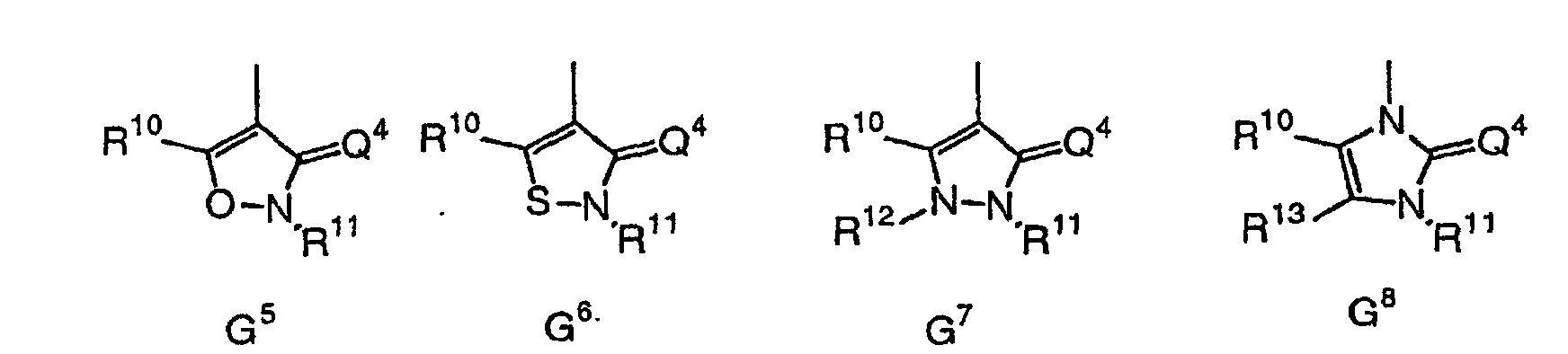
 A is a 3- to 13-membered, mono-, di- or tri-cyclic ring which contains at least one hetero atom selected from among oxygen atoms, sulfur atoms and nitrogen atoms, which is composed of from 3 to 13 atoms arbitrarily selected from among carbon atoms, oxygen atoms, sulfur atoms and nitrogen atoms and which is substituted by from 0 to 13 Ys, provided that when A is a quinolone ring, the nitrogen atom in the quinolone ring is present at the α-position to the imino bond,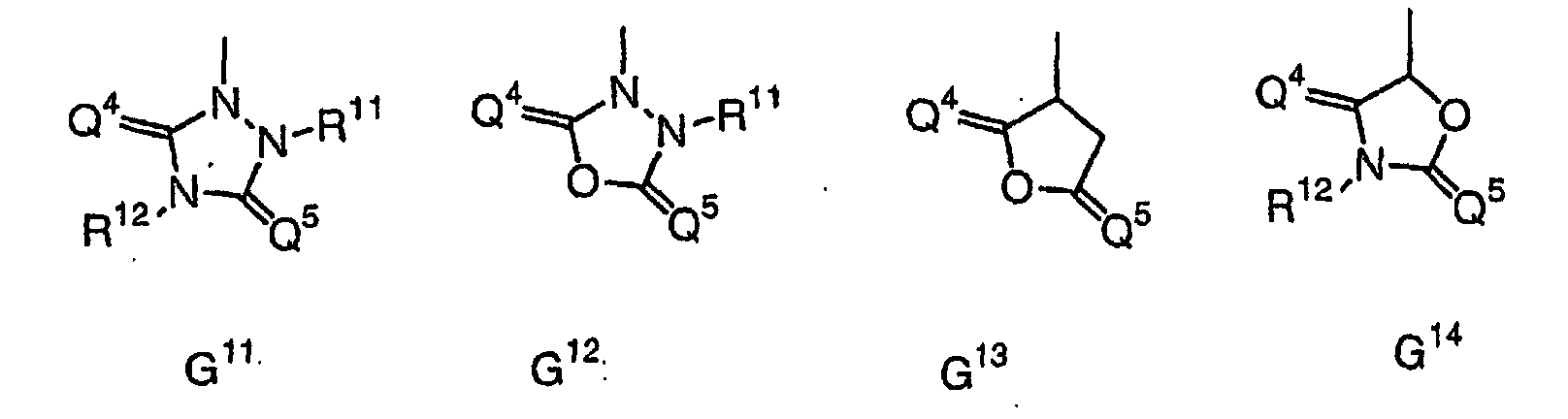
Z is -OR1, -SR1 or -NR2R3,
B is -CH2-, -C(=CH-OR4)- or -C(=N-OR4)-,
Y is Y'-D-(CH2)p- or =Q1 (provided that in the case of 2 or more Ys, they may be the same or different), or 2 Ys substituted on the same carbon atom of A, may, together with the carbon atom, form a 3- to 7-membered ring which may contain from 1 to 3 oxygen atoms, nitrogen atoms or sulfur atoms,
provided that when Y is a substituent on a carbon atom, Y may be a hydrogen atom,
D is a single bond, -NR5-, -C(=Q2)-, -C(=Q2)-C(=Q3)-, -CR6=N-, -N=CR 6-, -CR6=N-N=CR6-, -N=CR6-O-N=CR6-, -CR6=N-O-, -CR6=N-O-CR6=N-O-, -O-N=CR6-CR6=N-O-, -CR6=N-NR5- or -O-N=CR6-CR6=N-NR5-,
Q1, Q2 and Q3, each independently is =O, =S, =N-R7 or =C(R8)(R 9),
Q4 and Q5, each independently is =O or =S,
X is halogen, C1-C6 alkyl, C1-C6 haloalkyl, C1-C6 alkoxy, C1-C6 haloalkoxy, C1-C6 alkylthio, C1-C6 alkylamino, (C1-C6 alkyl)2 amino, NO2, CN, formyl, OH, SH, NU1U2, C1-C6 alkoxycarbonyl, C1-C6 alkylcarbonyl, C1-C6 haloalkylcarbonyl, phenylcarbonyl which may be substituted by Ra, or C1-C6 alkylcarbonyloxy (provided that in the case of two or more Xs substituted, they may be the same or different),
R1, R2 and R4, each independently is a hydrogen atom, C1-C6 alkyl, C1-C6 haloalkyl, C3-C6 cycloalkyl, C1-C6 alkoxy C1-C6 alkyl, C1-C6 alkylsulfenyl C1-C6 alkyl, phenyl C1-C6 alkyl which may be substituted by Ra, or heteroaryl C1-C6 alkyl which may be substituted by Ra,
R3 is a hydrogen atom, C1-C6 alkyl, C1-C6 haloalkyl, C3-C6 cycloalkyl, C1-C6 alkoxy C1-C6 alkyl, C1-C6 alkylsulfenyl C1-C6 alkyl, phenyl which may be substituted by Ra, phenyl C1-C6 alkyl which may be substituted by Ra, or heteroaryl C1-C6 alkyl which may be substituted by Ra,
R5 and R6, each independently is halogen, C1-C6 alkyl, C1-C6 haloalkyl, C3-C6 cycloalkyl, C1-C6 alkoxy, C1-C6 alkoxy C1-C6 alkyl, C1-C6 alkylsulfenyl C1-C6 alkyl, C1-C6 haloalkoxy, C1-C6 alkylsulfenyl, C1-C6 alkylsulfinyl, C1-C6 alkylsulfonyl, C1-C6 haloalkylsulfenyl, C1-C6 haloalkylsulfinyl, C1-C6 haloalkylsulfonyl, C2-C6 alkenyl, C2-C6 haloalkenyl, C2-C6 alkenyloxy, C2-C6 haloalkenyloxy, C2-C6 alkenylsulfenyl, C2-C6 alkenylsulfinyl, C2-C6 alkenylsulfonyl, C2-C6 haloalkenylsulfenyl, C2-C6 haloalkenylsulfinyl, C2-C6 haloalkenylsulfonyl, C2-C6 alkynyl, C2-C6 haloalkynyl, C2-C6 alkynyloxy, C2-C6 haloalkynyloxy, C2-C6 alkynylsulfenyl, C2-C6 alkynylsulfinyl, C2-C6 alkylsulfonyl, C2-C6 haloalkynylsulfenyl, C2-C6 haloalkynylsulfinyl, C2-C6 haloalkynylsulfonyl, NO2, CN, formyl, OH, SH, SCN, C1-C6 alkoxycarbonyl, C1-C6 haloalkoxycarbonyl, C1-C6 alkylcarbonyl, C1-C6 haloalkylcarbonyl, C1-C6 alkylcarbonyloxy, phenyl which may be substituted by Ra, phenyl C1-C6 alkyl which may be substituted by Ra, phenylsulfonyl which may be substituted Ra, phenyl C1-C6 alkylsulfonyl which may be substituted by Ra, heteroaryl which may be substituted by Ra, heteroaryl C1-C6 alkyl which may be substituted by Ra, heteroarylsulfonyl which may be substituted by Ra, phenylcarbonyl which may be substituted by Ra, phenyl C1-C6 alkylcarbonyl which may be substituted by Ra, heteroarylcarbonyl which may be substituted by Ra, or -NU1U2, provided that R6 may be a hydrogen atom,
R7 is hydrogen atom, C1-C6 alkyl, C1-C6 haloalkyl, C3-C6 cycloalkyl, C1-C6 alkoxy, C1-C6 alkoxy C1-C6 alkyl, C1-C6 alkylsulfenyl C1-C6 alkyl, C1-C6 alkylsulfonyl, C1-C6 haloalkylsulfonyl, C1-C6 alkylcarbonyl, C1-C6 haloalkylcarbonyl, phenyl which may be substituted by Ra, phenoxy which may be substituted by Ra, phenyl C1-C6 alkyl which may be substituted by Ra, phenyl C1-C6 alkoxy which may be substituted by Ra, phenylsulfonyl which may be substituted by Ra, phenyl C1-C6 alkylsulfonyl which may be substituted by Ra, heteroaryl which may be substituted by Ra, heteroaryloxy which may be substituted by Ra, heteroaryl C1-C6 alkyl which may be substituted by Ra, heteroarylsulfonyl which may be substituted by Ra, phenylcarbonyl which may be substituted by Ra, phenoxycarbonyl which may be substituted by Ra, phenyl C1-C6 alkylcarbonyl which may be substituted by Ra, heteroarylcarbonyl which may be substituted by Ra, heteroaryloxycarbonyl which may be substituted by Ra, or heteroaryl C1-C6 alkylcarbonyl which may be substituted by Ra,
R8 and R9, each independently is a hydrogen atom, halogen, C1-C6 alkyl, C1-C6 alkoxy, C1-C6 alkylsulfenyl, C2-C6 alkenyl, NO2, CN, formyl, or C1-C6 alkoxycarbonyl,
R10 is a hydrogen atom, halogen, R14, -OR14, -SR14, -SOR14, or -SO2R14,
R11 is a hydrogen atom, R14 or CN,
R12 is a hydrogen atom or R14,
R13 is a hydrogen atom, halogen, C1-C6 alkyl, C1-C6 haloalkyl, C3-C6 cycloalkyl, C1-C6 alkoxy C1-C6 alkyl, C2-C6 alkenyl, or C2-C6 alkynyl,
R14 is C1-C6 alkyl, C1-C6 haloalkyl, C2-C6 alkenyl, C2-C6 haloalkenyl, C2-C6 alkynyl, C2-C6 haloalkynyl, C3-C6 cycloalkyl, C1-C6 alkylcarbonyl, or C1-C6 alkoxycarbonyl,
Y' is halogen, C1-C12 alkyl which may be substituted by Rb, C3-C6 cycloalkyl which may be substituted by Rb, C2-C12 alkenyl which may be substituted by Rb, C2-C12 alkynyl which may be substituted by Rb, C1-C12 alkoxy which may be substituted by Rb, C1-C6 alkoxy C1-C6 alkoxy which may be substituted by Rb, C2-C6 alkenyloxy which may be substituted by Rb, C2-C6 alkynyloxy which may be substituted by Rb, C1-C6 alkylsulfenyl which may be substituted by Rb, C2-C6 alkenylsulfenyl which may be substituted by Rb, C2-C6 alkynylsulfenyl which may be substituted by Rb, C1-C6 alkylsulfinyl which may be substituted by Rb, C2-C6 alkenylsulfinyl which may be substituted by Rb, C2-C6 alkynylsulfinyl which may be substituted by Rb, C1-C6 alkylsulfonyl which may be substituted by Rb, C2-C6 alkenylsulfonyl which may be substituted by Rb, C2-C6 alkynylsulfonyl which may be substituted by Rb, C1-C6 alkoxycarbonyl which may be substituted by Rb, C1-C6 alkylcarbonyl which may be substituted by Rb, C1-C6 alkylcarbonyloxy which may be substituted by Rb, phenyl which may be substituted by Rc, phenoxy which may be substituted by Rc, phenyl C1-C6 alkyl which may be substituted by Rc, phenyl C1-C6 alkoxy which may be substituted by Rc, phenylsulfonyl which may be substituted by Rc, phenylsulfinyl which may be substituted by Rc, phenylsulfenyl which may be substituted by Rc, phenyl C1-C6 alkylsulfenyl which may be substituted by Rc, phenyl C1-C6 alkylsulfinyl which may be substituted by Rc, phenyl C1-C6 alkylsulfonyl which may be substituted by Rc, heteroaryl which may be substituted by Rc, heteroaryloxy which may be substituted by Rc, heteroaryl C1-C6 alkyl which may be substituted by Rc, heteroaryl C1-C6 alkoxy which may be substituted by Rc, heteroarylsulfinyl which may be substituted by Rc, heteroarylsulfenyl which may be substituted by Rc, heteroarylsulfonyl which may be substituted by Rc, heteroaryl C1-C6 alkylsulfenyl which may be substituted by Rc, heteroaryl C1-C6 alkylsulfinyl which may be substituted by Rc, heteroaryl C1-C6 alkylsulfonyl which may be substituted by Rc, phenylcarbonyl which may be substituted by Rc, phenylcarbonylxoy which may be substituted by Rc, phenoxycarbonyl which may be substituted by Rc, phenyl C1-C6 alkylcarbonyl which may be substituted by Rc, phenyl C1-C6 alkylcarbonyloxy which may be substituted by Rc, heteroarylcarbonyl which may be substituted by Rc, heteroarylcarbonyloxy which may be substituted by Rc, heteroaryloxycarbonyl which may be substituted by Rc, heteroaryl C1-C6 alkylcarbonyl which may be substituted by Rc, heteroaryl C1-C6 alkylcarbonyloxy which may be substituted by Rc, NO2, CN, formyl, or naphthyl,
Ra is halogen, C1-C6 alkyl, C1-C6 haloalkyl, C3-C6 cycloalkyl, C1-C6 alkoxy, C1-C6 alkoxy C1-C6 alkyl, C1-C6 alkylsulfenyl C1-C6 alkyl, C1-C6 haloalkoxy, C1-C6 alkylsulfenyl, C1-C6 alkylsulfinyl, C1-C6 alkylsulfonyl, C1-C6 haloalkylsulfenyl, C1-C6 haloalkylsulfinyl, C1-C6 haloalkylsulfonyl, C2-C6 alkenyl, C2-C6 haloalkenyl, C2-C6 alkenyloxy, C2-C6 haloalkenyloxy, C2-C6 alkenylsulfenyl, C2-C6 alkenylsulfinyl, C2-C6 alkenylsulfonyl, C2-C6 haloalkenylsulfenyl, C2-C6 haloalkenylsulfinyl, C2-C6 haloalkenylsulfonyl, C2-C6 alkynyl, C2-C6 haloalkynyl, C2-C6 alkynyloxy, C2-C6 haloalkynyloxy, C2-C6 alkynylsulfenyl, C2-C6 alkynylsulfinyl, C2-C6 alkynylsulfonyl, C2-C6 haloalkynylsulfenyl, C2-C6 haloalkynylsulfinyl, C2-C6 haloalkynylsulfonyl, NO2, CN, formyl, SH, OH, SCN, C1-C6 alkoxycarbonyl, C1-C6 alkylcarbonyl, C1-C6 haloalkylcarbonyl, C1-C6 alkylcarbonyloxy, phenyl, or -NU1U2, the number of Ra for substitution being from 1 to 5 (provided that in the case of two or more Ra, they may be the same or different),
Rb is halogen, C3-C6 cycloalkyl, C1-C6 alkoxy, C1-C6 alkoxy C1-C6 alkoxy, C1-C6 alkylsulfenyl C1-C6 alkoxy, C1-C6 haloalkoxy, C1-C6 alkylsulfenyl, C1-C6 alkylsulfinyl, C1-C6 alkylsulfonyl, C1-C6 haloalkylsulfenyl, C1-C6 haloalkylsulfinyl, C1-C6 haloalkylsulfonyl, C2-C6 alkenyloxy, C2-C6 haloalkenyloxy, C2-C6 alkenylsulfenyl, C2-C6 alkenylsulfinyl, C2-C6 alkenylsulfonyl, C2-C6 haloalkenylsulfenyl, C2-C6 haloalkenylsulfinyl, C2-C6 haloalkenylsulfonyl, C2-C6 alkynyloxy, C2-C6 haloalkynyloxy, C2-C6 alkynylsulfenyl, C2-C6 alkynylsulfinyl, C2-C6 alkynylsulfonyl, C2-C6 haloalkynylsulfenyl, C2-C6 haloalkynylsulfinyl, C2-C6 haloalkynylsulfonyl, NO2, CN, formyl, OH, SH, SCN, C1-C6 alkoxycarbonyl, C1-C6 alkylcarbonyl, C1-C6 haloalkylcarbonyl, C1-C6 alkylcarbonyloxy, phenyl which may be substituted by Ra, phenoxy which may be substituted by Ra, phenyl C1-C6 alkoxy which may be substituted by Ra, phenylsulfonyl which may be substituted by Ra, phenyl C1-C6 alkylsulfonyl which may be substituted by Ra, heteroaryl which may be substituted by Ra, heteroaryloxy which may be substituted by Ra, heteroarylsulfonyl which may be substituted by Ra, phenylcarbonyl which may be substituted by Ra, phenoxycarbonyl which may be substituted by Ra, phenyl C1-C6 alkylcarbonyl which may be substituted by Ra, heteroarylcarbonyl which may be substituted by Ra, heteroaryloxycarbonyl which may be substituted by Ra, or heteroaryl C1-C6 alkylcarbonyl which may be substituted by Ra, or -NU1U2, or a 3- to 7-membered ring which may contain from 1 to 4 hetero atoms selected from among oxygen atoms, nitrogen atoms and sulfur atoms, the number of Rb for substitution being from 1 to 8 (provided that in the case of two or more Rb, they may be the same or different),
Rc is halogen, C1-C12 alkyl which may be substituted by Rb, C3-C6 cycloalkyl which may be substituted by Rb, C2-C12 alkenyl which may be substituted by Rb, C2-C12 alkynyl which may be substituted by Rb, C1-C12 alkoxy which may be substituted by Rb, C1-C6 alkoxy C1-C6 alkoxy which may be substituted by Rb, C2-C6 alkenyloxy which may be substituted by Rb, C2-C6 alkynyloxy which may be substituted by Rb, C1-C6 alkylsulfenyl which may be substituted by Rb, C2-C6 alkenylsulfenyl which may be substituted by Rb, C2-C6 alkynylsulfenyl which may be substituted by Rb, C1-C6 alkylsulfinyl which may be substituted by Rb, C2-C6 alkenylsulfinyl which may be substituted by Rb, C2-C6 alkynylsulfinyl which may be substituted by Rb, C1-C6 alkylsulfonyl which may be substituted by Rb, C2-C6 alkenylsulfonyl which may be substituted by Rb, C2-C6 alkynylsulfonyl which may be substituted by Rb, C1-C6 alkoxycarbonyl which may be substituted by Rb, C1-C6 alkylcarbonyl which may be substituted by Rb, C1-C6 alkylcarbonyloxy which may be substituted by Rb, NO2, CN, formyl, OH, SH, SCN, C1-C6 alkoxycarbonyl, C1-C6 alkylcarbonyl, C1-C6 haloalkylcarbonyl, C1-C6 alkylcarbonyloxy, phenyl which may be substituted by Ra, phenoxy which may be substituted by Ra, phenyl C1-C6 alkyl which may be substituted by Ra, phenyl C1-C6 alkoxy which may be substituted by Ra, phenylsulfonyl which may be substituted by Ra, phenylsulfinyl which may be substituted by Ra, phenylsulfenyl which may be substituted by Ra, phenyl C1-C6 alkylsulfenyl which may be substituted by Ra, phenyl C1-C6 alkylsulfinyl which may be substituted by Ra, phenyl C1-C6 alkylsulfonyl which may be substituted by Ra, heteroaryl which may be substituted by Ra, heteroaryloxy which may be substituted by Ra, heteroaryl C1-C6 alkyl which may be substituted by Ra, heteroaryl C1-C6 alkoxy which may be substituted by Ra, heteroarylsulfinyl which may be substituted by Ra, heteroarylsulfenyl which may be substituted by Ra, heteroarylsulfonyl which may be substituted by Ra, heteroaryl C1-C6 alkylsulfenyl which may be substituted by Ra, heteroaryl C1-C6 alkylsulfinyl which may be substituted by Ra, heteroaryl C1-C6 alkylsulfonyl which may be substituted by Ra, phenylcarbonyl which may be substituted by Ra, phenylcarbonyloxy which may be substituted by Ra, phenoxycarbonyl which may be substituted by Ra, phenyl C1-C6 alkylcarbonyl which may be substituted by Ra, phenyl C1-C6 alkylcarbonyloxy which may be substituted by Ra, heteroarylcarbonyl which may be substituted by Ra, heteroarylcarbonyloxy which may be substituted by Ra, heteroaryloxycarbonyl which may be substituted by Ra, heteroaryl C1-C6 alkylcarbonyl which may be substituted by Ra, heteroaryl C1-C6 alkylcarbonyloxy which may be substituted by Ra, or -NU1U2, the number of Rc for substitution being from 1 to 5 (provided that in the case of two or more Rc, they may be the same or different),
U1 and U2' each independently is a hydrogen atom, C1-C6 alkyl, C1-C6 haloalkyl, C3-C6 cycloalkyl, C1-C6 alkoxy C1-C6 alkyl, C1-C6 alkylsulfenyl C1-C6 alkyl, formyl, C1-C6 alkylsulfonyl, C1-C6 haloalkylsulfonyl, C1-C6 alkoxycarbonyl, C1-C6 alkylcarbonyl, or C1-C6 haloalkylcarbonyl, or U1 and U2 together form a 3- to 7-membered ring which may contain from 1 to 4 hetero atoms selected from among oxygen atoms, nitrogen atoms and sulfur atoms,
n represents the number of substituents and is from 0 to 4, and
p represents the number of repeating units and is from 0 to 2. - A hydrochloride, a hydrobromide, a hydroiodide, a formate, an acetate or an oxalate of the heterocyclic imino compound according to Claim 1.
- The heterocyclic imino compound and an agrochemically acceptable salt thereof, according to Claim 1, wherein A is








 d represents the number of substituents and is from 0 to 2,
e represents the number of substituents and is from 0 to 3,
f represents the number of substituents and is from 0 to 4,
g represents the number of substituents and is from 0 to 5,
h represents the number of substituents and is from 0 to 6,
i represents the number of substituents and is from 0 to 1,
j represents the number of substituents and is from 0 to 7, and
k represents the number of substituents and is from 0 to 8. - The heterocyclic imino compound according to any one of Claims 1 to 3, wherein G is G1.
- An agricultural chemical containing at least one member selected from the heterocyclic imino compound and an agrochemically acceptable salt thereof according to any one of Claims 1 to 4, as an active ingredient.
- A fungicide containing at least one member selected from the heterocyclic imino compound and an agrochemically acceptable salt thereof according to any one of Claims 1 to 4, as an active ingredient.
- An insecticide containing at least one member selected from the heterocyclic imino compound and an agrochemically acceptable salt thereof according to any one of Claims 1 to 4, as an active ingredient.
Applications Claiming Priority (7)
| Application Number | Priority Date | Filing Date | Title |
|---|---|---|---|
| JP37404099 | 1999-12-28 | ||
| JP37404099 | 1999-12-28 | ||
| JP2000239624 | 2000-08-08 | ||
| JP2000239624 | 2000-08-08 | ||
| JP2000334442 | 2000-11-01 | ||
| JP2000334442 | 2000-11-01 | ||
| PCT/JP2000/009411 WO2001047888A1 (en) | 1999-12-28 | 2000-12-28 | Heterocyclic imino compounds and fungicides and insecticides for agricultural and horticultural use |
Publications (2)
| Publication Number | Publication Date |
|---|---|
| EP1243580A1 true EP1243580A1 (en) | 2002-09-25 |
| EP1243580A4 EP1243580A4 (en) | 2003-04-23 |
Family
ID=27341841
Family Applications (1)
| Application Number | Title | Priority Date | Filing Date |
|---|---|---|---|
| EP00985987A Withdrawn EP1243580A4 (en) | 1999-12-28 | 2000-12-28 | Heterocyclic imino compounds and fungicides and insecticides for agricultural and horticultural use |
Country Status (4)
| Country | Link |
|---|---|
| US (1) | US20030212116A1 (en) |
| EP (1) | EP1243580A4 (en) |
| AU (1) | AU2230501A (en) |
| WO (1) | WO2001047888A1 (en) |
Families Citing this family (4)
| Publication number | Priority date | Publication date | Assignee | Title |
|---|---|---|---|---|
| WO2003000659A1 (en) * | 2001-06-26 | 2003-01-03 | Nissan Chemical Industries, Ltd. | Heterocycloiminophenyl compounds and fungicides and insecticides for agricultural and horticultural use |
| JPWO2009131170A1 (en) * | 2008-04-25 | 2011-08-18 | 大日本住友製薬株式会社 | 5-membered ring compounds |
| US10161222B2 (en) * | 2014-11-05 | 2018-12-25 | Schlumberger Technology Corporation | Compositions and methods for servicing subterranean wells |
| US20160122620A1 (en) * | 2014-11-05 | 2016-05-05 | Schlumberger Technology Corporation | Compositions and Methods for Servicing Subterranean Wells |
Family Cites Families (16)
| Publication number | Priority date | Publication date | Assignee | Title |
|---|---|---|---|---|
| NL6818444A (en) * | 1967-12-29 | 1969-07-01 | ||
| US4231783A (en) * | 1978-11-15 | 1980-11-04 | Monsanto Company | Substituted 2-imino-1,3-dithio and 1,3-oxathio heterocyclic compounds as herbicidal antidotes |
| IL85066A0 (en) * | 1987-01-30 | 1988-06-30 | Schering Ag | 2-imino-1,3-dithietane derivatives and pesticidal compositions containing them |
| US5136054A (en) * | 1987-04-14 | 1992-08-04 | Sumitomo Chemical Company, Limited | Sulfone-containing azamethine compounds |
| US5220027A (en) * | 1987-04-14 | 1993-06-15 | Sumitomo Chemical Company, Limited | Sulfone-containing azamethide compounds with a nitrogen-containing aromatic ring of nitrogen containing aliphatic |
| US5028708A (en) * | 1987-04-14 | 1991-07-02 | Sumitomo Chemical Company, Limited | Azamethinyl quinoline derivatives |
| GB8903592D0 (en) * | 1989-02-16 | 1989-04-05 | Boots Co Plc | Therapeutic agents |
| US5021394A (en) * | 1989-06-15 | 1991-06-04 | Dai Nippon Insatsu Kabushiki Kaisha | Heat transfer sheet |
| US5028078A (en) * | 1990-02-05 | 1991-07-02 | The Pullman Company | Tube fitting with variable tube insertion |
| JP2684436B2 (en) * | 1990-02-23 | 1997-12-03 | 富士写真フイルム株式会社 | Thermal transfer dye donating material |
| DE69227192T2 (en) * | 1991-06-28 | 1999-04-15 | Nissan Chemical Industries, Ltd., Tokio/Tokyo | IMINOSULFONYL URINE DERIVATIVES AND HERBICIDES |
| JPH06157478A (en) * | 1992-11-18 | 1994-06-03 | Nissan Chem Ind Ltd | Pyrimidine derivative and pet controlling agent |
| JPH0753527A (en) * | 1993-08-09 | 1995-02-28 | Toa Boshoku Kk | Substituted pyrimidine derivative, its production and analgesic and anti-inflammatory agent |
| JPH07242665A (en) * | 1994-01-11 | 1995-09-19 | Nissan Chem Ind Ltd | Fluoropropyl thiazoline derivative and herbicide |
| WO1998051152A1 (en) * | 1997-05-15 | 1998-11-19 | Sagami Chemical Research Center | Insecticidal/acaricidal agents |
| DE19856965A1 (en) * | 1998-12-10 | 2000-06-15 | Bayer Ag | Substituted 2-imino-thiazolines |
-
2000
- 2000-12-28 US US10/168,968 patent/US20030212116A1/en not_active Abandoned
- 2000-12-28 EP EP00985987A patent/EP1243580A4/en not_active Withdrawn
- 2000-12-28 AU AU22305/01A patent/AU2230501A/en not_active Abandoned
- 2000-12-28 WO PCT/JP2000/009411 patent/WO2001047888A1/en not_active Ceased
Also Published As
| Publication number | Publication date |
|---|---|
| US20030212116A1 (en) | 2003-11-13 |
| WO2001047888A1 (en) | 2001-07-05 |
| EP1243580A4 (en) | 2003-04-23 |
| AU2230501A (en) | 2001-07-09 |
Similar Documents
| Publication | Publication Date | Title |
|---|---|---|
| KR102129658B1 (en) | Condensed heterocyclic compound and noxious organism control agent | |
| US6462049B1 (en) | Ethylene derivatives and pesticides containing said derivatives | |
| JP5827626B2 (en) | Heteroaryl piperidine and piperazine derivatives | |
| JP6133907B2 (en) | Fused ring pyrimidine compound and pest control agent containing the same | |
| JP2010532750A (en) | Heterocyclically substituted heterocyclic carboxylic acid derivatives | |
| EP4058450A2 (en) | 4-(4-(4,5-dihydroisoxazol-3-yl)thiazol-2-yl) piperidine sulfilimine and sulfoximine derivatives and related compounds as fungicides for crop protection | |
| JP2010513343A (en) | Bisoximes as fungicides | |
| JP4726373B2 (en) | Oxime O-ether compounds and agricultural and horticultural fungicides | |
| CA2341722A1 (en) | Thiazolylcinnamonitriles and pest controlling agents | |
| US20030212116A1 (en) | Heterocyclic imino compounds and fungicides and insecticides for agricultural and horitcultural use | |
| WO2003000659A1 (en) | Heterocycloiminophenyl compounds and fungicides and insecticides for agricultural and horticultural use | |
| JP2004035499A (en) | Phenylcarbamate compound and germicidal and insecticidal agent for agriculture and horticulture | |
| AU4116800A (en) | O-aryl dithiazole dioxides | |
| JPWO2001047888A1 (en) | Heterocyclic imino compounds and agricultural and horticultural fungicides and insecticides | |
| JP2000119256A (en) | Acrylonitrile compound | |
| JP2003012631A (en) | Acrylonitrile compound and agrochemical | |
| AU763640B2 (en) | Acrylonitrile compounds | |
| JP2002114784A (en) | Isoxazole derivative and controller against noxious organism | |
| KR100502516B1 (en) | Harmful biocontrol agents with ethylene derivatives and di derivatives | |
| CN101128413A (en) | Substituted oxyarene | |
| JP2002088067A (en) | Acrylonitrile compound and harmful pest-controlling agent | |
| JP2005255571A (en) | Acrylonitrile compound and harmful organism-controlling agent | |
| JP2004002250A (en) | Heterocyclic iminophenyl compound and fungicidal insecticide for agriculture and horticulture | |
| JP2004250362A (en) | Acrylonitrile compound and agrochemical | |
| JP2003081951A (en) | Aminocarbonyl heterocyclic imino compound and germicidal insecticide for agriculture and horticulture |
Legal Events
| Date | Code | Title | Description |
|---|---|---|---|
| PUAI | Public reference made under article 153(3) epc to a published international application that has entered the european phase |
Free format text: ORIGINAL CODE: 0009012 |
|
| 17P | Request for examination filed |
Effective date: 20020626 |
|
| AK | Designated contracting states |
Kind code of ref document: A1 Designated state(s): AT BE CH CY DE DK ES FI FR GB GR IE IT LI LU MC NL PT SE TR |
|
| AX | Request for extension of the european patent |
Free format text: AL;LT;LV;MK;RO;SI |
|
| A4 | Supplementary search report drawn up and despatched |
Effective date: 20030307 |
|
| 17Q | First examination report despatched |
Effective date: 20030428 |
|
| STAA | Information on the status of an ep patent application or granted ep patent |
Free format text: STATUS: THE APPLICATION IS DEEMED TO BE WITHDRAWN |
|
| 18D | Application deemed to be withdrawn |
Effective date: 20040925 |