EP1240833A2 - Agent for prevention of deterioration of milk-containing foods - Google Patents
Agent for prevention of deterioration of milk-containing foods Download PDFInfo
- Publication number
- EP1240833A2 EP1240833A2 EP02290660A EP02290660A EP1240833A2 EP 1240833 A2 EP1240833 A2 EP 1240833A2 EP 02290660 A EP02290660 A EP 02290660A EP 02290660 A EP02290660 A EP 02290660A EP 1240833 A2 EP1240833 A2 EP 1240833A2
- Authority
- EP
- European Patent Office
- Prior art keywords
- milk
- preventive agent
- deterioration preventive
- containing foods
- deterioration
- Prior art date
- Legal status (The legal status is an assumption and is not a legal conclusion. Google has not performed a legal analysis and makes no representation as to the accuracy of the status listed.)
- Withdrawn
Links
- 0 *c(cc(C=CC(O1)=O)c1c1*)c1O Chemical compound *c(cc(C=CC(O1)=O)c1c1*)c1O 0.000 description 1
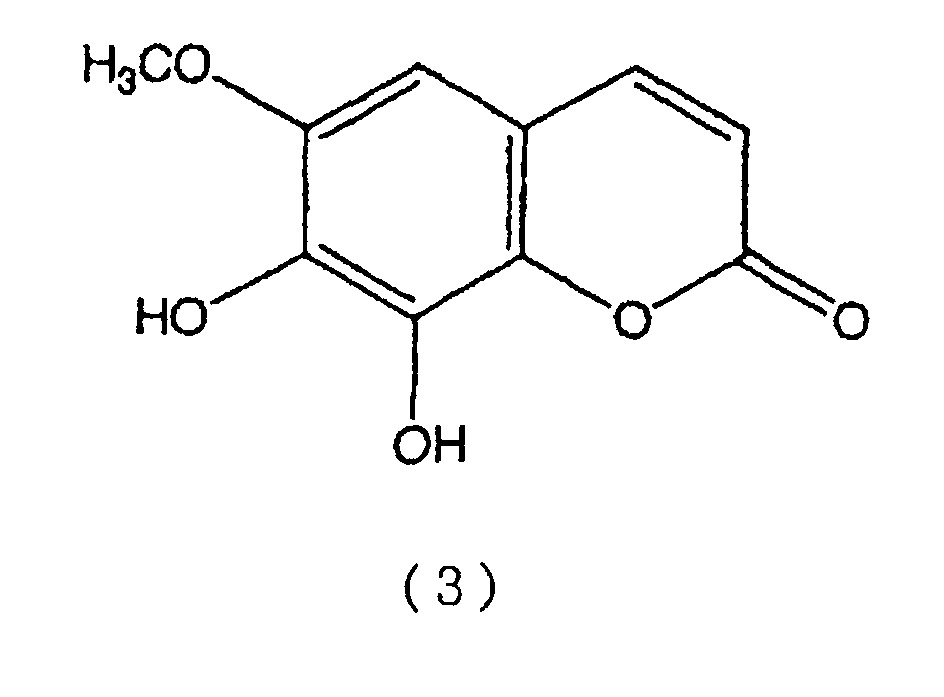
- HAVWRBANWNTOJX-UHFFFAOYSA-N COc(c(O)c1O)cc(C=C2)c1OC2=O Chemical compound COc(c(O)c1O)cc(C=C2)c1OC2=O HAVWRBANWNTOJX-UHFFFAOYSA-N 0.000 description 1
Classifications
-
- A—HUMAN NECESSITIES
- A23—FOODS OR FOODSTUFFS; TREATMENT THEREOF, NOT COVERED BY OTHER CLASSES
- A23G—COCOA; COCOA PRODUCTS, e.g. CHOCOLATE; SUBSTITUTES FOR COCOA OR COCOA PRODUCTS; CONFECTIONERY; CHEWING GUM; ICE-CREAM; PREPARATION THEREOF
- A23G3/00—Sweetmeats; Confectionery; Marzipan; Coated or filled products
- A23G3/34—Sweetmeats, confectionery or marzipan; Processes for the preparation thereof
- A23G3/36—Sweetmeats, confectionery or marzipan; Processes for the preparation thereof characterised by the composition containing organic or inorganic compounds
-
- A—HUMAN NECESSITIES
- A01—AGRICULTURE; FORESTRY; ANIMAL HUSBANDRY; HUNTING; TRAPPING; FISHING
- A01N—PRESERVATION OF BODIES OF HUMANS OR ANIMALS OR PLANTS OR PARTS THEREOF; BIOCIDES, e.g. AS DISINFECTANTS, AS PESTICIDES OR AS HERBICIDES; PEST REPELLANTS OR ATTRACTANTS; PLANT GROWTH REGULATORS
- A01N43/00—Biocides, pest repellants or attractants, or plant growth regulators containing heterocyclic compounds
- A01N43/02—Biocides, pest repellants or attractants, or plant growth regulators containing heterocyclic compounds having rings with one or more oxygen or sulfur atoms as the only ring hetero atoms
- A01N43/04—Biocides, pest repellants or attractants, or plant growth regulators containing heterocyclic compounds having rings with one or more oxygen or sulfur atoms as the only ring hetero atoms with one hetero atom
- A01N43/14—Biocides, pest repellants or attractants, or plant growth regulators containing heterocyclic compounds having rings with one or more oxygen or sulfur atoms as the only ring hetero atoms with one hetero atom six-membered rings
- A01N43/16—Biocides, pest repellants or attractants, or plant growth regulators containing heterocyclic compounds having rings with one or more oxygen or sulfur atoms as the only ring hetero atoms with one hetero atom six-membered rings with oxygen as the ring hetero atom
-
- A—HUMAN NECESSITIES
- A01—AGRICULTURE; FORESTRY; ANIMAL HUSBANDRY; HUNTING; TRAPPING; FISHING
- A01N—PRESERVATION OF BODIES OF HUMANS OR ANIMALS OR PLANTS OR PARTS THEREOF; BIOCIDES, e.g. AS DISINFECTANTS, AS PESTICIDES OR AS HERBICIDES; PEST REPELLANTS OR ATTRACTANTS; PLANT GROWTH REGULATORS
- A01N65/00—Biocides, pest repellants or attractants, or plant growth regulators containing material from algae, lichens, bryophyta, multi-cellular fungi or plants, or extracts thereof
- A01N65/08—Magnoliopsida [dicotyledons]
-
- A—HUMAN NECESSITIES
- A01—AGRICULTURE; FORESTRY; ANIMAL HUSBANDRY; HUNTING; TRAPPING; FISHING
- A01N—PRESERVATION OF BODIES OF HUMANS OR ANIMALS OR PLANTS OR PARTS THEREOF; BIOCIDES, e.g. AS DISINFECTANTS, AS PESTICIDES OR AS HERBICIDES; PEST REPELLANTS OR ATTRACTANTS; PLANT GROWTH REGULATORS
- A01N65/00—Biocides, pest repellants or attractants, or plant growth regulators containing material from algae, lichens, bryophyta, multi-cellular fungi or plants, or extracts thereof
- A01N65/08—Magnoliopsida [dicotyledons]
- A01N65/22—Lamiaceae or Labiatae [Mint family], e.g. thyme, rosemary, skullcap, selfheal, lavender, perilla, pennyroyal, peppermint or spearmint
-
- A—HUMAN NECESSITIES
- A23—FOODS OR FOODSTUFFS; TREATMENT THEREOF, NOT COVERED BY OTHER CLASSES
- A23B—PRESERVATION OF FOODS, FOODSTUFFS OR NON-ALCOHOLIC BEVERAGES; CHEMICAL RIPENING OF FRUIT OR VEGETABLES
- A23B2/00—Preservation of foods or foodstuffs, in general
- A23B2/70—Preservation of foods or foodstuffs, in general by treatment with chemicals
- A23B2/725—Preservation of foods or foodstuffs, in general by treatment with chemicals in the form of liquids or solids
- A23B2/729—Organic compounds; Microorganisms; Enzymes
- A23B2/733—Compounds of undetermined constitution obtained from animals or plants
-
- A—HUMAN NECESSITIES
- A23—FOODS OR FOODSTUFFS; TREATMENT THEREOF, NOT COVERED BY OTHER CLASSES
- A23B—PRESERVATION OF FOODS, FOODSTUFFS OR NON-ALCOHOLIC BEVERAGES; CHEMICAL RIPENING OF FRUIT OR VEGETABLES
- A23B70/00—Preservation of non-alcoholic beverages
- A23B70/10—Preservation of non-alcoholic beverages by addition of preservatives
-
- A—HUMAN NECESSITIES
- A23—FOODS OR FOODSTUFFS; TREATMENT THEREOF, NOT COVERED BY OTHER CLASSES
- A23G—COCOA; COCOA PRODUCTS, e.g. CHOCOLATE; SUBSTITUTES FOR COCOA OR COCOA PRODUCTS; CONFECTIONERY; CHEWING GUM; ICE-CREAM; PREPARATION THEREOF
- A23G3/00—Sweetmeats; Confectionery; Marzipan; Coated or filled products
- A23G3/34—Sweetmeats, confectionery or marzipan; Processes for the preparation thereof
- A23G3/346—Finished or semi-finished products in the form of powders, paste or liquids
-
- A—HUMAN NECESSITIES
- A23—FOODS OR FOODSTUFFS; TREATMENT THEREOF, NOT COVERED BY OTHER CLASSES
- A23G—COCOA; COCOA PRODUCTS, e.g. CHOCOLATE; SUBSTITUTES FOR COCOA OR COCOA PRODUCTS; CONFECTIONERY; CHEWING GUM; ICE-CREAM; PREPARATION THEREOF
- A23G3/00—Sweetmeats; Confectionery; Marzipan; Coated or filled products
- A23G3/34—Sweetmeats, confectionery or marzipan; Processes for the preparation thereof
- A23G3/36—Sweetmeats, confectionery or marzipan; Processes for the preparation thereof characterised by the composition containing organic or inorganic compounds
- A23G3/364—Sweetmeats, confectionery or marzipan; Processes for the preparation thereof characterised by the composition containing organic or inorganic compounds containing microorganisms or enzymes; containing paramedical or dietetical agents, e.g. vitamins
- A23G3/368—Sweetmeats, confectionery or marzipan; Processes for the preparation thereof characterised by the composition containing organic or inorganic compounds containing microorganisms or enzymes; containing paramedical or dietetical agents, e.g. vitamins containing vitamins, antibiotics
-
- A—HUMAN NECESSITIES
- A23—FOODS OR FOODSTUFFS; TREATMENT THEREOF, NOT COVERED BY OTHER CLASSES
- A23G—COCOA; COCOA PRODUCTS, e.g. CHOCOLATE; SUBSTITUTES FOR COCOA OR COCOA PRODUCTS; CONFECTIONERY; CHEWING GUM; ICE-CREAM; PREPARATION THEREOF
- A23G3/00—Sweetmeats; Confectionery; Marzipan; Coated or filled products
- A23G3/34—Sweetmeats, confectionery or marzipan; Processes for the preparation thereof
- A23G3/36—Sweetmeats, confectionery or marzipan; Processes for the preparation thereof characterised by the composition containing organic or inorganic compounds
- A23G3/48—Sweetmeats, confectionery or marzipan; Processes for the preparation thereof characterised by the composition containing organic or inorganic compounds containing plants or parts thereof, e.g. fruits, seeds, extracts
-
- A—HUMAN NECESSITIES
- A23—FOODS OR FOODSTUFFS; TREATMENT THEREOF, NOT COVERED BY OTHER CLASSES
- A23G—COCOA; COCOA PRODUCTS, e.g. CHOCOLATE; SUBSTITUTES FOR COCOA OR COCOA PRODUCTS; CONFECTIONERY; CHEWING GUM; ICE-CREAM; PREPARATION THEREOF
- A23G4/00—Chewing gum
- A23G4/06—Chewing gum characterised by the composition containing organic or inorganic compounds
-
- A—HUMAN NECESSITIES
- A23—FOODS OR FOODSTUFFS; TREATMENT THEREOF, NOT COVERED BY OTHER CLASSES
- A23G—COCOA; COCOA PRODUCTS, e.g. CHOCOLATE; SUBSTITUTES FOR COCOA OR COCOA PRODUCTS; CONFECTIONERY; CHEWING GUM; ICE-CREAM; PREPARATION THEREOF
- A23G4/00—Chewing gum
- A23G4/06—Chewing gum characterised by the composition containing organic or inorganic compounds
- A23G4/068—Chewing gum characterised by the composition containing organic or inorganic compounds containing plants or parts thereof, e.g. fruits, seeds, extracts
-
- A—HUMAN NECESSITIES
- A23—FOODS OR FOODSTUFFS; TREATMENT THEREOF, NOT COVERED BY OTHER CLASSES
- A23G—COCOA; COCOA PRODUCTS, e.g. CHOCOLATE; SUBSTITUTES FOR COCOA OR COCOA PRODUCTS; CONFECTIONERY; CHEWING GUM; ICE-CREAM; PREPARATION THEREOF
- A23G4/00—Chewing gum
- A23G4/06—Chewing gum characterised by the composition containing organic or inorganic compounds
- A23G4/12—Chewing gum characterised by the composition containing organic or inorganic compounds containing microorganisms or enzymes; containing paramedical or dietetical agents, e.g. vitamins
- A23G4/126—Chewing gum characterised by the composition containing organic or inorganic compounds containing microorganisms or enzymes; containing paramedical or dietetical agents, e.g. vitamins containing vitamins, antibiotics
-
- A—HUMAN NECESSITIES
- A61—MEDICAL OR VETERINARY SCIENCE; HYGIENE
- A61K—PREPARATIONS FOR MEDICAL, DENTAL OR TOILETRY PURPOSES
- A61K36/00—Medicinal preparations of undetermined constitution containing material from algae, lichens, fungi or plants, or derivatives thereof, e.g. traditional herbal medicines
- A61K36/18—Magnoliophyta (angiosperms)
- A61K36/185—Magnoliopsida (dicotyledons)
- A61K36/53—Lamiaceae or Labiatae (Mint family), e.g. thyme, rosemary or lavender
- A61K36/535—Perilla (beefsteak plant)
-
- A—HUMAN NECESSITIES
- A61—MEDICAL OR VETERINARY SCIENCE; HYGIENE
- A61K—PREPARATIONS FOR MEDICAL, DENTAL OR TOILETRY PURPOSES
- A61K36/00—Medicinal preparations of undetermined constitution containing material from algae, lichens, fungi or plants, or derivatives thereof, e.g. traditional herbal medicines
- A61K36/18—Magnoliophyta (angiosperms)
- A61K36/185—Magnoliopsida (dicotyledons)
- A61K36/63—Oleaceae (Olive family), e.g. jasmine, lilac or ash tree
-
- A—HUMAN NECESSITIES
- A61—MEDICAL OR VETERINARY SCIENCE; HYGIENE
- A61K—PREPARATIONS FOR MEDICAL, DENTAL OR TOILETRY PURPOSES
- A61K36/00—Medicinal preparations of undetermined constitution containing material from algae, lichens, fungi or plants, or derivatives thereof, e.g. traditional herbal medicines
- A61K36/18—Magnoliophyta (angiosperms)
- A61K36/185—Magnoliopsida (dicotyledons)
- A61K36/77—Sapindaceae (Soapberry family), e.g. lychee or soapberry
-
- A—HUMAN NECESSITIES
- A23—FOODS OR FOODSTUFFS; TREATMENT THEREOF, NOT COVERED BY OTHER CLASSES
- A23G—COCOA; COCOA PRODUCTS, e.g. CHOCOLATE; SUBSTITUTES FOR COCOA OR COCOA PRODUCTS; CONFECTIONERY; CHEWING GUM; ICE-CREAM; PREPARATION THEREOF
- A23G2200/00—COCOA; COCOA PRODUCTS, e.g. CHOCOLATE; SUBSTITUTES FOR COCOA OR COCOA PRODUCTS; CONFECTIONERY; CHEWING GUM; ICE-CREAM; PREPARATION THEREOF containing organic compounds, e.g. synthetic flavouring agents
-
- A—HUMAN NECESSITIES
- A23—FOODS OR FOODSTUFFS; TREATMENT THEREOF, NOT COVERED BY OTHER CLASSES
- A23G—COCOA; COCOA PRODUCTS, e.g. CHOCOLATE; SUBSTITUTES FOR COCOA OR COCOA PRODUCTS; CONFECTIONERY; CHEWING GUM; ICE-CREAM; PREPARATION THEREOF
- A23G2200/00—COCOA; COCOA PRODUCTS, e.g. CHOCOLATE; SUBSTITUTES FOR COCOA OR COCOA PRODUCTS; CONFECTIONERY; CHEWING GUM; ICE-CREAM; PREPARATION THEREOF containing organic compounds, e.g. synthetic flavouring agents
- A23G2200/04—COCOA; COCOA PRODUCTS, e.g. CHOCOLATE; SUBSTITUTES FOR COCOA OR COCOA PRODUCTS; CONFECTIONERY; CHEWING GUM; ICE-CREAM; PREPARATION THEREOF containing organic compounds, e.g. synthetic flavouring agents containing vitamins, antibiotics, other medicaments
-
- A—HUMAN NECESSITIES
- A23—FOODS OR FOODSTUFFS; TREATMENT THEREOF, NOT COVERED BY OTHER CLASSES
- A23G—COCOA; COCOA PRODUCTS, e.g. CHOCOLATE; SUBSTITUTES FOR COCOA OR COCOA PRODUCTS; CONFECTIONERY; CHEWING GUM; ICE-CREAM; PREPARATION THEREOF
- A23G2200/00—COCOA; COCOA PRODUCTS, e.g. CHOCOLATE; SUBSTITUTES FOR COCOA OR COCOA PRODUCTS; CONFECTIONERY; CHEWING GUM; ICE-CREAM; PREPARATION THEREOF containing organic compounds, e.g. synthetic flavouring agents
- A23G2200/14—COCOA; COCOA PRODUCTS, e.g. CHOCOLATE; SUBSTITUTES FOR COCOA OR COCOA PRODUCTS; CONFECTIONERY; CHEWING GUM; ICE-CREAM; PREPARATION THEREOF containing organic compounds, e.g. synthetic flavouring agents containing fruits, nuts, e.g. almonds, seeds, plants, plant extracts or essential oils
Definitions
- the present invention relates to a deterioration preventive agent for various milk-containing foods. Namely, the present invention relates to a deterioration preventive agent for milk-containing foods having as its active ingredient a coumarin analog, its glycoside or a plant extract containing the coumarin analog or its glycoside. In addition, the present invention relates to a quality retention method for milk-containing foods.
- Milk-containing foods are typically susceptible to the effects of light, heat, air and so forth during the manufacturing process, distribution stage and each stage of storage, causing them to lose their inherent flavor and aroma and generate a peculiar foul odor due to deterioration of internal ingredients over the course of time, and making them susceptible to the problem of the generation of a peculiar foul odor caused by what is called deterioration of the raw material.
- milk-containing foods lose gradually their satisfactory aroma and flavor, and their quality deteriorates over the course of time
- the present invention relates to the following:
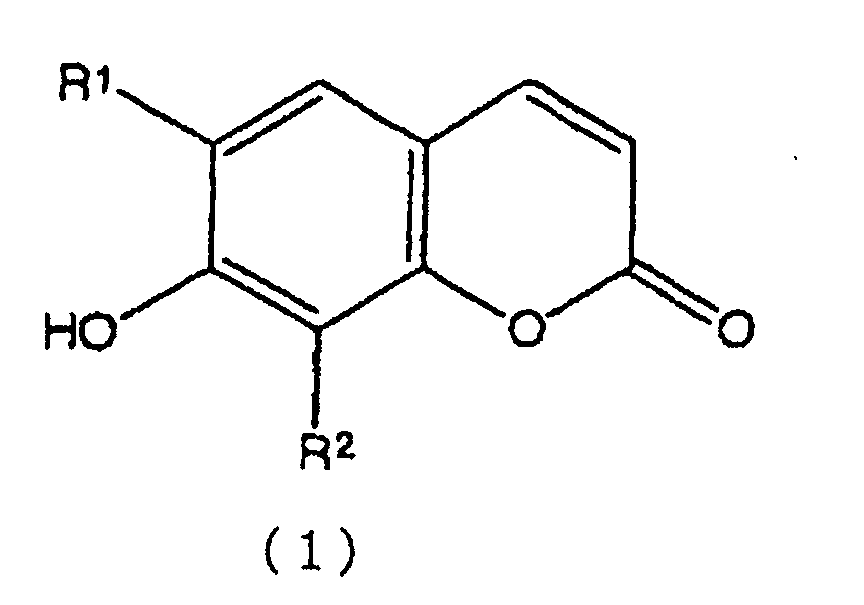
- the deterioration preventive agent for milk-containing foods referred to in the present invention has as its active ingredient the coumarin analog represented by the above-mentioned general formula (1), its glycoside, or a plant extract containing the coumarin analog or its glycoside.
- Glycosides of the above coumarin analogs are also effective as deterioration preventive agents for milk-containing foods.
- examples of these glycosides include esculin, fraxin and daphnin.
- a plant extract containing a coumarin analog or its glycoside may also be used as a deterioration preventive agent for milk-containing foods.
- deterioration preventive agents for milk-containing foods can be prepared and acquired in accordance with ordinary methods from plants containing large amounts of coumarin analogs or their glycosides.
- plant bodies containing large amounts of the above coumarin analogs or their glycosides that can be easily acquired include the bark and stem of ash trees (Fraxinus) and olive trees (Olea), the bark and roots of Japanese horse chestnut and horse chestnut trees (Aesculus), the leaves and stem of beefsteak plants (Perilla), the leaves, flowers, stem, bark or roots of Daphne trees and Zoisia macrostachya trees (Daphne), the tubers, leaves or stem of a potato plant, the flowers of Cytisus scoparus (Cytisus), the roots or rootstock of Scopolia plant or the roots and so forth of plants of the Oenanthajavanica family such as the Scopolia Rhizome(Scopolis and plants of the same species), parsley (Petroselium) and celery (Apium).
- examples of plants containing comparatively large amounts of the above compounds that can be used include the leaves of Pulicaria dysenterica, the leaves of Haplopappus multifolius, the above ground portions of Gochnatica argentina, the roots of Bupleurum fruticosum and the above ground portions of Pterocaulon purpurascens.
- the bark and leaves of olive trees (Olea), the leaves and bark of Japanese horse chestnut trees and the leaves and stem of beefsteak plant (Perilla) are particularly preferable examples of these plants.
- the above plant raw materials may be used alone or by combining two or more types. There are no particular restrictions on the site used provided it contains a large amount of the above compounds.
- plant raw materials are dried and cut to a suitable size.
- the plant raw materials are immersed in a solvent under fixed conditions followed by filtration and removal of plant raw materials from the solvent and concentration. Moreover, purification treatment is then performed to obtain the desired compound.
- one type or two or more types of solvents are preferably used that are selected from water, lower alcohols, water-containing lower alcohols, polyol-based organic solvents, petroleum ether, ethyl acetate, methyl acetate, chloroform and hydrocarbons.
- lower alcohols refer to alcohols having 1 to 4 carbons, and methanol and ethanol, etc. are particularly preferable.
- water-containing lower alcohols can be used having a moisture content of 10 to 75 wt%.
- polyol-based organic solvents include ethylene glycol and propylene glycol.
- Commercially available products are usually used for the petroleum ether, ethyl acetate, methyl acetate, chloroform, etc.
- hydrocarbon solvents include aliphatic hydrocarbons, alicyclic hydrocarbons and aromatic hydrocarbons that are a liquid at normal temperatures, aliphatic hydrocarbons and aromatic hydrocarbons that are a liquid at normal temperatures, and particularly hydrocarbons such as n-hexane (hereinafter referred to as hexane) and toluene, are preferred.
- extraction is usually carried out by immersing or gently stirring the plant in the above solvent at a temperature of room temperature to 80°C. Further, the use of an apparatus such as a Soxhlet extractor that was known prior to the present application allows an extract to be obtained efficiently.
- the amount of time required for extraction is generally about 30 minutes to 12 hours. Furthermore, a multi-stage extraction procedure known prior to the present application may also be used.
- extracts obtained by performing some form of treatment on said extracts such as a concentrate from which the solvent has been additionally removed from the extract, or what is called an extract in which a specific compound has been additionally removed from the extract, are also included in the extract of the present invention.
- extracts obtained by treating the extracts with various permeable membranes are included in the extract of the present invention.
- a fraction is obtained by treating the extract by chromatography.
- the solvent within the above extract may be first removed to increase viscosity, or a solvent may be further added to lower viscosity.
- the fraction is usually prepared such that the amount of solvent is 0.1 to 30 parts by volume, and preferably 0.5 to 20 parts by volume, relative to 1 part by weight of extract.
- the method used to obtain the fraction may be carried out in accordance with ordinary methods.
- a method should be employed in which the above extract or pre-treated extract is poured into a chromatography column fabricated and prepared in advance, an eluent composed of a solvent is poured in, and the extract allowed to be temporarily retained in the column is allowed to flow through the column with the solvent, and the solvent that flows out of the column is divided into several portions using known means.
- the column is flushed with hexane, ethyl acetate or a mixed solvent thereof.
- a mixed solvent there are no particular restrictions on the ratio of the amounts of each solvent. While elution is usually carried out at room temperature, it may be carried out at low temperature.
- the solvent that flows out of the column in accordance with the above method is divided using ordinary means to obtain fractions.
- Each fraction or a mixture of several fractions is subjected to reduced pressure to remove the solvent and obtain a concentrate.
- a purification procedure using high performance liquid chromatography is then repeated to allow the obtaining of the above coumarin analog.
- the above coumarin analog can also be obtained by freeze-drying the above concentrate, re-dissolving it in a solvent, filtering out the precipitate, re-concentrating the resulting solution and repeatedly purifying by high performance liquid chromatography.
- the quality of milk-containing foods can be retained by adding and blending a deterioration preventive agent for milk-containing foods prepared in this manner to a milk-containing food.
- milk-containing foods are foods that contain milk ingredients, specific examples of which include fermented milk products (such as hard yogurt, soft yogurt, yogurt drinks and frozen yogurt), milk-containing acidic beverages (such as lactobacillus drinks having a pH of 5.0 or lower, milk drinks containing fermented milk, carbonated beverages, alcoholic beverages and fruit juice drinks), frozen confections (such as ice cream and sherbet), milk-containing desserts (such as jelly, mousse, Bavarian cream, pudding and cream), dairy products (such as butter, margarine and cheese), milk-containing confections (such as pies, candy and gum) and various other stews, potage and gratin foods.
- fermented milk products such as hard yogurt, soft yogurt, yogurt drinks and frozen yogurt
- milk-containing acidic beverages such as lactobacillus drinks having a pH of 5.0 or lower
- milk drinks containing fermented milk carbonated beverages
- alcoholic beverages and fruit juice drinks such as lactobacillus drinks having a pH of 5.0 or lower
- frozen confections such as ice cream
- an amount of 0.1 ppb to 1 wt% is preferably added normally.
- the blending amount of 1 ppb to 0.1 wt% is more preferred.
- the above deterioration preventive agent for milk-containing foods may be added and blended directly into the above foods
- a method is normally used in which the deterioration preventive agent for milk-containing foods is preliminarily added to a solution or dispersion, after which this solution or dispersion is added and blended into the foods.
- Various additives such as thickeners, surfactants and antioxidants may be added in advance to this solution or dispersion.
- Examples of media used to obtain the above solution or dispersion include water, ethanol glycerin and other medium chain fatty acid esters, purified vegetable oils such as coconut oil and corn oil, and edible oils.
- the amount of the deterioration preventive agent for milk-containing foods to be added to the solvent varies considerably according to the food to which the agent is added and blended, and so forth, it is, for example, 10 ppm to 50 wt%.
- the quality of milk-containing foods can be retained for a long period of time by blending the deterioration preventive agent for milk-containing foods of the present invention into milk-containing foods. Especially an extinction of aroma and flavor existing in the milk-containing foods can be prevented for a long period of time by blending the deterioration preventive agent with the milk-containing foods. Moreover, since the deterioration preventive agent for milk-containing foods can be obtained at low cost and the amount of deterioration preventive agent blended is smaller, it is economically advantageous.
- esculetin was used as a deterioration preventive agent for milk-containing foods, and an ethanol solution containing 1 wt% of this deterioration preventive agent for milk-containing foods was prepared and used as a solution containing the deterioration preventive agent.
- the deterioration preventive agent for milk-containing foods was added and blended into milk in the amounts described in Table 2 to prepare evaluation samples.
- the "added concentration” refers to the concentration of the deterioration preventive agent for milk-containing foods in the sample on which the deterioration test was performed (and this shall apply similarly hereinafter). Effects on heat deterioration Added concentration (ppm) Sensory evaluation Comparative example 1 Additive-free - ⁇ Comparative example 6 Chlorogenic acid 100 ⁇ Example 2 Esculetin 1 o ⁇ 0.01 o ⁇ 0.001 ⁇ Example 8 Fraxetin 1 o ⁇ 0.01 o ⁇ 0.001 ⁇ Example 14 Daphnetin 1 o ⁇ 0.01 o ⁇ 0.001 ⁇ Example 20 Olive extract 1 o ⁇ 0.01 ⁇ 0.001 ⁇ Example 26 Japanese horse chestnut tree extract 1 o ⁇ 0.01 ⁇ 0.001 ⁇ Example 32 Beefsteak plant extract 1 o ⁇ 0.01 ⁇ 0.001 ⁇
- Example 2 The evaluation samples were evaluated in the same manner as in Example 2. Those results are shown in Table 2. Effect on changes over the course of time Added concentration (ppm) Sensory evaluation Comparative example 2 Additive-free - ⁇ Comparative Chlorogenic acid 100 ⁇ example 7 50 ⁇ Example 3 Esculetin 1 o ⁇ 0.01 o ⁇ 0.001 ⁇ Example 9 Fraxetin 1 o ⁇ 0.01 o ⁇ 0.001 ⁇ Example 15 Daphnetin 1 o ⁇ 0.01 o ⁇ 0.001 ⁇ Example 21 Olive extract 1 o ⁇ 0.01 ⁇ 0.001 ⁇ Example 27 Japanese horse chestnut tree extract 1 o ⁇ 0.01 ⁇ 0.001 ⁇ Example 33 Beefsteak plant extract 1 o ⁇ 0.01 ⁇ 0.001 ⁇
- the ability to prevent deterioration of the deterioration preventive agent for milk-containing foods of Example 1 was evaluated under the following conditions.
- Example 3 Effect on changes over the course of time Added concentration (ppm) Sensory evaluation Comparative example 3
- Additive-free - ⁇ Comparative example 8 Chlorogenic acid 100 ⁇ 50 ⁇
- Example 4 Esculetin 1 o ⁇ 0.01 o ⁇ 0.001 ⁇
- Example 10 Fraxetin 1 o ⁇ 0.01 o ⁇ 0.001 ⁇
- Example 16 Daphnetin 1 o ⁇ 0.01 o ⁇ 0.001 ⁇
- Example 22 Olive extract 1 o ⁇ 0.01 ⁇ 0.001 ⁇
- Example 28 Japanese horse chestnut tree extract 1 o ⁇ 0.01 ⁇ 0.001 ⁇
- Example 34 Beefsteak plant extract 1 o ⁇ 0.01 ⁇ 0.001 ⁇
- the ability to prevent deterioration of the deterioration preventive agent for milk-containing foods of Example 1 was evaluated under the following conditions.
- Example 5 Esculetin 1 o ⁇ 0.01 o ⁇ 0.001 ⁇
- Example 11 Fraxetin 1 o ⁇ 0.01 o ⁇ 0.001 ⁇
- Example 17 Daphnetin 1 o ⁇ 0.01 o ⁇ 0.001 ⁇
- Example 23 Olive extract 1 o ⁇ 0.01 ⁇ 0.001 ⁇
- Example 29 Japanese horse chestnut tree extract 1 o ⁇ 0.01 ⁇ 0.001 ⁇
- Example 35 Beefsteak plant extract 1 o ⁇ 0.01 ⁇ 0.001 ⁇
- the ability to prevent deterioration of the deterioration preventive agent for milk-containing foods of Example 1 was evaluated under the following conditions.
- fraxetin was used as a deterioration preventive agent for milk-containing foods, and an ethanol solution containing 1 wt% of this deterioration preventive agent for milk-containing foods was prepared to obtain a solution containing the deterioration preventive agent.
- Evaluation samples containing the deterioration preventive agent for milk-containing foods of Example 7 were prepared according to the same procedure as Examples 2 to 6. Next, evaluation samples were prepared were prepared according to the same methods as Examples 2 and 6. Those results are shown in Tables 1 through 5.
- daphnetin was used as a deterioration preventive agent for milk-containing foods, and an ethanol solution containing 1 wt% of this deterioration preventive agent for milk-containing foods was prepared to obtain a solution containing the deterioration preventive agent.
- Evaluation samples containing the deterioration preventive agent for milk-containing foods of Example 13 were prepared according to the same procedure as Examples 2 to 6. Next, evaluation samples were evaluated according to the same methods as Examples 2 and 6. Those results are shown in Tables 1 through 5.
- the yield was 18.0 wt% (relative to the dried olive leaves).
- Evaluation samples containing the deterioration preventive agent for milk-containing foods of Example 19 were prepared according to the same procedure as Examples 2 to 6. Next, evaluation samples were prepared according to the same methods as Examples 2 and 6. Those results are shown in Tables 1 through 5.
- a deterioration preventive agent for milk-containing foods was obtained by carrying out the same procedure as Example 19 with the exception of using dried Japanese horse chestnut bark and leaves instead of dried olive leaves. The yield was 15.6 wt% (relative to the dried Japanese horse chestnut bark and leaves). An ethanol solution containing 1 wt% of this deterioration preventive agent for milk-containing foods was prepared and used as a solution containing the deterioration preventive agent.
- Evaluation samples containing the deterioration preventive agent for milk-containing foods of Example 25 were prepared according to the same procedure as Examples 2 to 6. Next, evaluation samples were prepared according to the same methods as Examples 2 and 6. Those results are shown in Tables 1 through 5.
- a deterioration preventive agent for milk-containing foods was obtained by carrying out the same procedure as Example 19 with the exception of using dried beefsteak plant leaves and stems instead of dried olive leaves.
- the yield was 15.9 wt% (relative to the dried beefsteak plant leaves and stems).
- Evaluation samples containing the deterioration preventive agent for milk-containing foods of Example 31 were prepared according to the same procedure as Examples 2 to 6. Next, evaluation samples were prepared according to the same methods as Examples 2 and 6. Those results are shown in Tables 1 through 5.
Landscapes
- Life Sciences & Earth Sciences (AREA)
- Health & Medical Sciences (AREA)
- Engineering & Computer Science (AREA)
- Chemical & Material Sciences (AREA)
- Natural Medicines & Medicinal Plants (AREA)
- Food Science & Technology (AREA)
- Polymers & Plastics (AREA)
- General Health & Medical Sciences (AREA)
- Microbiology (AREA)
- Inorganic Chemistry (AREA)
- Biotechnology (AREA)
- Botany (AREA)
- Mycology (AREA)
- Zoology (AREA)
- Wood Science & Technology (AREA)
- Pharmacology & Pharmacy (AREA)
- Plant Pathology (AREA)
- Epidemiology (AREA)
- Animal Behavior & Ethology (AREA)
- Medical Informatics (AREA)
- Public Health (AREA)
- Veterinary Medicine (AREA)
- Alternative & Traditional Medicine (AREA)
- Agronomy & Crop Science (AREA)
- Medicinal Chemistry (AREA)
- Dentistry (AREA)
- Environmental Sciences (AREA)
- Nutrition Science (AREA)
- Pest Control & Pesticides (AREA)
- Food Preservation Except Freezing, Refrigeration, And Drying (AREA)
- Dairy Products (AREA)
- Seasonings (AREA)
Abstract

Description

| Milk | 25% |
| Solution containing deterioration preventive agent | Various concentrations |
| Distilled water | q.s. |
| 100% |
| Effects on changes over the course of time | |||
| Added concentration (ppm) | Sensory evaluation | ||
| Comparative example 1 | Additive-free | - | × |
| Comparative | Chlorogenic acid | 100 | ○ |
| example 6 | 50 | × | |
| Example 2 | Esculetin | 1 | o ○ |
| 0.01 | o ○ | ||
| 0.001 | ○ | ||
| Example 8 | Fraxetin | 1 | o ○ |
| 0.01 | o ○ | ||
| 0.001 | ○ | ||
| Example 14 | Daphnetin | 1 | o ○ |
| 0.01 | o ○ | ||
| 0.001 | ○ | ||
| Example 20 | Olive extract | 1 | o ○ |
| 0.01 | ○ | ||
| 0.001 | ○ | ||
| Example 26 | Japanese horse | 1 | o ○ |
| chestnut tree | 0.01 | ○ | |
| extract | 0.001 | ○ | |
| Example 32 | Beefsteak plant | 1 | o ○ |
| extract | 0.01 | ○ | |
| 0.001 | ○ |
| Effects on heat deterioration | |||
| Added concentration (ppm) | Sensory evaluation | ||
| Comparative example 1 | Additive-free | - | × |
| Comparative example 6 | Chlorogenic acid | 100 | × |
| Example 2 | Esculetin | 1 | o ○ |
| 0.01 | o ○ | ||
| 0.001 | ○ | ||
| Example 8 | Fraxetin | 1 | o ○ |
| 0.01 | o ○ | ||
| 0.001 | ○ | ||
| Example 14 | Daphnetin | 1 | o ○ |
| 0.01 | o ○ | ||
| 0.001 | ○ | ||
| Example 20 | Olive extract | 1 | o ○ |
| 0.01 | ○ | ||
| 0.001 | ○ | ||
| Example 26 | Japanese horse chestnut tree extract | 1 | o ○ |
| 0.01 | ○ | ||
| 0.001 | ○ | ||
| Example 32 | Beefsteak plant extract | 1 | o ○ |
| 0.01 | ○ | ||
| 0.001 | ○ |
| Whole milk powder | 3% |
| Solution containing deterioration preventive agent | Various concentrations |
| Distilled water | q.s. |
| 100% |
| Effect on changes over the course of time | |||
| Added concentration (ppm) | Sensory evaluation | ||
| Comparative example 2 | Additive-free | - | × |
| Comparative | Chlorogenic acid | 100 | ○ |
| example 7 | 50 | × | |
| Example 3 | Esculetin | 1 | o ○ |
| 0.01 | o ○ | ||
| 0.001 | ○ | ||
| Example 9 | Fraxetin | 1 | o ○ |
| 0.01 | o ○ | ||
| 0.001 | ○ | ||
| Example 15 | Daphnetin | 1 | o ○ |
| 0.01 | o ○ | ||
| 0.001 | ○ | ||
| Example 21 | Olive extract | 1 | o ○ |
| 0.01 | ○ | ||
| 0.001 | ○ | ||
| Example 27 | Japanese horse chestnut tree extract | 1 | o ○ |
| 0.01 | ○ | ||
| 0.001 | ○ | ||
| Example 33 | Beefsteak plant extract | 1 | o ○ |
| 0.01 | ○ | ||
| 0.001 | ○ |
| Added concentration (ppm) | Sensory evaluation | ||
| Comparative example 2 | Additive-free | - | × |
| Comparative example 7 | Chlorogenic acid | 100 | × |
| Example 3 | Esculetin | 1 | o ○ |
| 0.01 | o ○ | ||
| 0.001 | ○ | ||
| Example 9 | Fraxetin | 1 | o ○ |
| 0.01 | o ○ | ||
| 0.001 | ○ | ||
| Example 15 | Daphnetin | 1 | o ○ |
| 0.01 | o ○ | ||
| 0.001 | ○ | ||
| Example 21 | Olive extract | 1 | o ○ |
| 0.01 | ○ | ||
| 0.001 | ○ | ||
| Example 27 | Japanese horse chestnut tree extract | 1 | o ○ |
| 0.01 | ○ | ||
| 0.001 | ○ | ||
| Example 33 | Beefsteak plant extract | 1 | o ○ |
| 0.01 | ○ | ||
| 0.001 | ○ |
| Sweetened condensed milk | 7% |
| Skimmed milk powder | 3% |
| Emulsifying agent | 0.05% |
| Solution containing deterioration preventive agent | Various concentrations |
| Distilled water | q.s. |
| 100% |
| Effect on changes over the course of time | |||
| Added concentration (ppm) | Sensory evaluation | ||
| Comparative example 3 | Additive-free | - | × |
| Comparative example 8 | Chlorogenic acid | 100 | ○ |
| 50 | × | ||
| Example 4 | Esculetin | 1 | o ○ |
| 0.01 | o ○ | ||
| 0.001 | ○ | ||
| Example 10 | Fraxetin | 1 | o ○ |
| 0.01 | o ○ | ||
| 0.001 | ○ | ||
| Example 16 | Daphnetin | 1 | o ○ |
| 0.01 | o ○ | ||
| 0.001 | ○ | ||
| Example 22 | Olive extract | 1 | o ○ |
| 0.01 | ○ | ||
| 0.001 | ○ | ||
| Example 28 | Japanese horse chestnut tree extract | 1 | o ○ |
| 0.01 | ○ | ||
| 0.001 | ○ | ||
| Example 34 | Beefsteak plant extract | 1 | o ○ |
| 0.01 | ○ | ||
| 0.001 | ○ |
| Added concentration (ppm) | Sensory evaluation | ||
| Comparative example 3 | Additive-free | - | × |
| Comparative example 8 | Chlorogenic acid | 100 | × |
| Example 4 | Esculetin | 1 | o ○ |
| 0.01 | o ○ | ||
| 0.001 | ○ | ||
| Example 10 | Fraxetin | 1 | o ○ |
| 0.01 | o ○ | ||
| 0.001 | ○ | ||
| Example 16 | Daphnetin | 1 | o ○ |
| 0.01 | o ○ | ||
| 0.001 | ○ | ||
| Example 22 | Olive extract | 1 | o ○ |
| 0.01 | ○ | ||
| 0.001 | ○ | ||
| Example 28 | Japanese horse chestnut tree extract | 1 | o ○ |
| 0.01 | ○ | ||
| 0.001 | ○ | ||
| Example 34 | Beefsteak plant extract | 1 | o ○ |
| 0.01 | ○ | ||
| 0.001 | ○ |
| Cream | 2% |
| Skimmed milk powder | 3% |
| Emulsifying agent | 0.05% |
| Solution containing deterioration preventive agent | Various concentrations |
| Distilled water | q.s. |
| 100% |
| Effect on changes over the course of time | |||
| Added concentration (ppm) | Sensory evaluation | ||
| Comparative example 4 | Additive-free | - | × |
| Comparative example 9 | Chlorogenic acid | 100 | ○ |
| 50 | × | ||
| Example 5 | Esculetin | 1 | o ○ |
| 0.01 | o ○ | ||
| 0.001 | ○ | ||
| Example 11 | Fraxetin | 1 | o ○ |
| 0.01 | o ○ | ||
| 0.001 | ○ | ||
| Example 17 | Daphnetin | 1 | o ○ |
| 0.01 | o ○ | ||
| 0.001 | ○ | ||
| Example 23 | Olive extract | 1 | o ○ |
| 0.01 | ○ | ||
| 0.001 | ○ | ||
| Example 29 | Japanese horse chestnut tree extract | 1 | o ○ |
| 0.01 | ○ | ||
| 0.001 | ○ | ||
| Example 35 | Beefsteak plant extract | 1 | o ○ |
| 0.01 | ○ | ||
| 0.001 | ○ |
| Added concentration (ppm) | Sensory evaluation | ||
| Comparative example 4 | Additive-free | - | × |
| Comparative example 9 | Chlorogenic acid | 100 | × |
| Example 5 | Esculetin | 1 | o ○ |
| 0.01 | o ○ | ||
| 0.001 | ○ | ||
| Example 11 | Fraxetin | 1 | o ○ |
| 0.01 | o ○ | ||
| 0.001 | ○ | ||
| Example 17 | Daphnetin | 1 | o ○ |
| 0.01 | o ○ | ||
| 0.001 | ○ | ||
| Example 23 | Olive extract | 1 | o ○ |
| 0.01 | ○ | ||
| 0.001 | ○ | ||
| Example 29 | Japanese horse chestnut tree extract | 1 | o ○ |
| 0.01 | ○ | ||
| 0.001 | ○ | ||
| Example 35 | Beefsteak plant extract | 1 | o ○ |
| 0.01 | ○ | ||
| 0.001 | ○ |
| Commercially available plain yogurt | 93% |
| Solution containing deterioration preventive agent | Various concentrations |
| White superior soft sugar | q.s. |
| 100% |
| Added concentration (ppm) | Sensory evaluation | ||
| Comparative example 5 | Additive-free | - | × |
| Comparative example 10 | Chlorogenic acid | 100 | Δ |
| Example 6 | Esculetin | 1 | o ○ |
| 0.01 | o ○ | ||
| 0.001 | ○ | ||
| Example 12 | Fraxetin | 1 | o ○ |
| 0.01 | o ○ | ||
| 0.001 | ○ | ||
| Example 18 | Daphnetin | 1 | o ○ |
| 0.01 | o ○ | ||
| 0.001 | ○ | ||
| Example 24 | Olive extract | 1 | o ○ |
| 0.01 | ○ | ||
| 0.001 | ○ | ||
| Example 30 | Japanese horse | 1 | o ○ |
| chestnut tree | 0.01 | ○ | |
| extract | 0.001 | ○ | |
| Example 36 | Beefsteak plant | 1 | o ○ |
| extract | 0.01 | ○ | |
| 0.001 | ○ |
Claims (7)
- A deterioration preventive agent for milk-containing foods containing as active ingredient a coumarin analog represented by the general formula (1) below, a glycoside of that analog, or a plant extract containing the coumarin analog or its glycoside:(wherein R1 represents a hydrogen atom, a hydroxyl group or a methoxy group, R2 represents a hydrogen atom or a hydroxyl group, and R1 and R2 are not both hydrogen atoms).

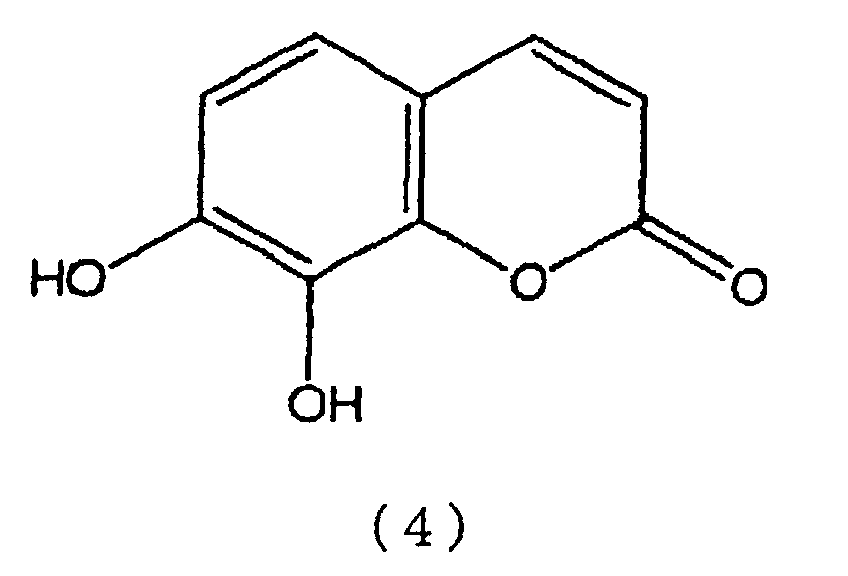
- The deterioration preventive agent for milk-containing foods according to claim 1, wherein the coumarin analog is a compound selected from esculetin, fraxetin and daphnetin.
- The deterioration preventive agent for milk-containing foods according to claim 1, wherein the plant extract containing a coumarin analog or its glycoside is an extract from an olive plant.
- The deterioration preventive agent for milk-containing foods according to claim 1, wherein the plant extract containing a coumarin analog or its glycoside is an extract from the bark or leaf of a Japanese horse chestnut tree.
- The deterioration preventive agent for milk-containing foods according to claim 1, wherein the plant extract containing a coumarin analog or its glycoside is an extract of a beefsteak plant.
- A quality retention method for milk-containing foods comprising the addition of at least one of the deterioration preventive agents for milk-containing foods as set forth in Claims 1 to 5 to a milk-containing food.
- A milk-containing food containing at least one of the deterioration preventive agents for milk-containing foods as set forth in Claims 1 to 5.
Applications Claiming Priority (2)
| Application Number | Priority Date | Filing Date | Title |
|---|---|---|---|
| JP2001073712 | 2001-03-15 | ||
| JP2001073712A JP3615151B2 (en) | 2001-03-15 | 2001-03-15 | Degradation inhibitor for milk-containing foods |
Publications (2)
| Publication Number | Publication Date |
|---|---|
| EP1240833A2 true EP1240833A2 (en) | 2002-09-18 |
| EP1240833A3 EP1240833A3 (en) | 2003-06-04 |
Family
ID=18931092
Family Applications (1)
| Application Number | Title | Priority Date | Filing Date |
|---|---|---|---|
| EP02290660A Withdrawn EP1240833A3 (en) | 2001-03-15 | 2002-03-15 | Agent for prevention of deterioration of milk-containing foods |
Country Status (3)
| Country | Link |
|---|---|
| US (1) | US6838103B2 (en) |
| EP (1) | EP1240833A3 (en) |
| JP (1) | JP3615151B2 (en) |
Families Citing this family (2)
| Publication number | Priority date | Publication date | Assignee | Title |
|---|---|---|---|---|
| US20090214712A1 (en) * | 2008-02-21 | 2009-08-27 | The Coca Cola Company | Milk-Based Beverage and Method for Preventing Off-Flavors in a Milk-Based Beverage |
| US9149045B2 (en) * | 2010-12-07 | 2015-10-06 | Kimberly-Clark Worldwide, Inc. | Wipe coated with a botanical emulsion having antimicrobial properties |
Family Cites Families (6)
| Publication number | Priority date | Publication date | Assignee | Title |
|---|---|---|---|---|
| US3810990A (en) | 1970-02-27 | 1974-05-14 | Us Agriculture | Inhibiting growth of bacteria |
| US4201639A (en) | 1977-03-03 | 1980-05-06 | International Flavors & Fragrances Inc. | Processes for preparing cyclohexadiene derivatives |
| JPS6115834A (en) | 1984-07-02 | 1986-01-23 | Osaka Chem Lab | Antiallergic food |
| JPH09262069A (en) | 1996-03-27 | 1997-10-07 | Yanagiya Honten:Kk | Inhibition of formation of heterocyclic amines and production process for boiled and dried fish utilizing the same |
| JP4082823B2 (en) | 1999-05-06 | 2008-04-30 | 日本メナード化粧品株式会社 | Phototoxicity inhibitor |
| JP3523166B2 (en) * | 1999-09-02 | 2004-04-26 | 高砂香料工業株式会社 | Food flavor deterioration inhibitor, food flavor deterioration prevention method, and food containing the food flavor deterioration inhibitor |
-
2001
- 2001-03-15 JP JP2001073712A patent/JP3615151B2/en not_active Expired - Fee Related
-
2002
- 2002-03-14 US US10/096,832 patent/US6838103B2/en not_active Expired - Fee Related
- 2002-03-15 EP EP02290660A patent/EP1240833A3/en not_active Withdrawn
Also Published As
| Publication number | Publication date |
|---|---|
| US6838103B2 (en) | 2005-01-04 |
| US20020197370A1 (en) | 2002-12-26 |
| EP1240833A3 (en) | 2003-06-04 |
| JP2002272365A (en) | 2002-09-24 |
| JP3615151B2 (en) | 2005-01-26 |
Similar Documents
| Publication | Publication Date | Title |
|---|---|---|
| US6475544B1 (en) | Anti-deterioration agent for food flavors, method for preventing deterioration of food flavors, and foods containing anti-deterioration agent for food flavors | |
| JP3805798B2 (en) | Cosmetics | |
| JP4201898B2 (en) | Antibacterial preparation | |
| JP5110673B2 (en) | Lipase inhibitor | |
| KR101917822B1 (en) | Production method of cirsimaritin fortified thistle concentrate using Lactobacillus plantarum KCCM 11322 strain | |
| JP2007185109A (en) | Beauty beverage and method for producing the same | |
| EP1334665A1 (en) | Taste enhancer; process for its production; food, drink, composition for the oral cavity comprising said taste enhancer; method of taste enhancement | |
| US6838103B2 (en) | Deterioration preventive agent for milk-containing foods | |
| EP2003988A1 (en) | Natural plant extract composition for prevention and recovery of hyperlipidemia and stroke, natural tea containing the same as active ingredient and method for preparing the natural tea | |
| JP4676727B2 (en) | Guava antibacterial substances | |
| JP4185317B2 (en) | Deteriorating odor production inhibitor for citral or citral-containing products | |
| JP4109818B2 (en) | Flavor degradation inhibitor | |
| JP3269737B2 (en) | Food preservative and method for producing the same | |
| da Silva et al. | Uses and technological prospects for the mangaba, a native fruit of Brazil | |
| JP3497655B2 (en) | Foods for preventing and eliminating bad breath, and agents for preventing and removing bad breath | |
| JP5091431B2 (en) | Flavor or fragrance degradation inhibitor, and flavor or fragrance degradation suppression method | |
| WO2000064286A1 (en) | Method of extracting from hovenia dulcis thunb, using method thereof and food containing extract | |
| KR100434035B1 (en) | The process method of icecream containing antibacterial undiluted solution which is extracted antibacterial undiluted solution to pinaceae and cryptomeriaceae and icecream containing lactic acid bacterium and upper antibacterial undiluted solution and thereof individually icecream | |
| KR20240020332A (en) | Method for preparing a composition for preserving meat food | |
| KR20180128598A (en) | Method for producing fermented solution, wine and healing vinegar using Dendropanax morbifera as main component | |
| US6752862B2 (en) | Color fading/discoloration preventive agent | |
| Ramezanian et al. | Pomegranates (Punica granatum L.) | |
| JP7817287B2 (en) | Method for producing the extract composition | |
| Devi et al. | Analysis of Antioxidants Butterfly Pea Flower Herbal Syrup as a Functional Beverage | |
| Bipinbhai et al. | Evaluation of Liquorice (Glycyrrhiza glabra) for enhancing shelf-life of ghee against oxidative deterioration |
Legal Events
| Date | Code | Title | Description |
|---|---|---|---|
| PUAI | Public reference made under article 153(3) epc to a published international application that has entered the european phase |
Free format text: ORIGINAL CODE: 0009012 |
|
| AK | Designated contracting states |
Kind code of ref document: A2 Designated state(s): AT BE CH CY DE DK ES FI FR GB GR IE IT LI LU MC NL PT SE TR |
|
| AX | Request for extension of the european patent |
Free format text: AL;LT;LV;MK;RO;SI |
|
| PUAL | Search report despatched |
Free format text: ORIGINAL CODE: 0009013 |
|
| RIC1 | Information provided on ipc code assigned before grant |
Ipc: 7A 23L 3/3481 B Ipc: 7A 23L 3/3562 B Ipc: 7A 23C 9/13 B Ipc: 7A 23C 3/08 B Ipc: 7A 23L 3/3544 B Ipc: 7A 23L 3/3472 A |
|
| AK | Designated contracting states |
Designated state(s): AT BE CH CY DE DK ES FI FR GB GR IE IT LI LU MC NL PT SE TR |
|
| AX | Request for extension of the european patent |
Extension state: AL LT LV MK RO SI |
|
| RIN1 | Information on inventor provided before grant (corrected) |
Inventor name: SAKAMOTO, KAZUMASA,TAKASAGO INTERN. CORP. Inventor name: MARUTA, YOSHIHIKO,TAKASAGO INTERN. CORP. Inventor name: KANEKO, NOBUTADA,TAKASAGO INTERN. CORP. Inventor name: SAIKI, KENJI,C/O TAKASAGO INTERN. CORP. Inventor name: HIRAMOTO, TADAHIRO,TAKSAGO INTERN. CORP. |
|
| 17P | Request for examination filed |
Effective date: 20031127 |
|
| AKX | Designation fees paid |
Designated state(s): AT BE CH CY DE DK ES FI FR GB GR IE IT LI LU MC NL PT SE TR |
|
| 17Q | First examination report despatched |
Effective date: 20040209 |
|
| STAA | Information on the status of an ep patent application or granted ep patent |
Free format text: STATUS: THE APPLICATION IS DEEMED TO BE WITHDRAWN |
|
| 18D | Application deemed to be withdrawn |
Effective date: 20090723 |