EP1239035A1 - Novel protein and gene - Google Patents
Novel protein and gene Download PDFInfo
- Publication number
- EP1239035A1 EP1239035A1 EP00981667A EP00981667A EP1239035A1 EP 1239035 A1 EP1239035 A1 EP 1239035A1 EP 00981667 A EP00981667 A EP 00981667A EP 00981667 A EP00981667 A EP 00981667A EP 1239035 A1 EP1239035 A1 EP 1239035A1
- Authority
- EP
- European Patent Office
- Prior art keywords
- protein
- gene
- seq
- amino acid
- screening
- Prior art date
- Legal status (The legal status is an assumption and is not a legal conclusion. Google has not performed a legal analysis and makes no representation as to the accuracy of the status listed.)
- Withdrawn
Links
Classifications
-
- C—CHEMISTRY; METALLURGY
- C07—ORGANIC CHEMISTRY
- C07K—PEPTIDES
- C07K14/00—Peptides having more than 20 amino acids; Gastrins; Somatostatins; Melanotropins; Derivatives thereof
- C07K14/435—Peptides having more than 20 amino acids; Gastrins; Somatostatins; Melanotropins; Derivatives thereof from animals; from humans
- C07K14/46—Peptides having more than 20 amino acids; Gastrins; Somatostatins; Melanotropins; Derivatives thereof from animals; from humans from vertebrates
- C07K14/47—Peptides having more than 20 amino acids; Gastrins; Somatostatins; Melanotropins; Derivatives thereof from animals; from humans from vertebrates from mammals
-
- A—HUMAN NECESSITIES
- A61—MEDICAL OR VETERINARY SCIENCE; HYGIENE
- A61P—SPECIFIC THERAPEUTIC ACTIVITY OF CHEMICAL COMPOUNDS OR MEDICINAL PREPARATIONS
- A61P21/00—Drugs for disorders of the muscular or neuromuscular system
-
- A—HUMAN NECESSITIES
- A01—AGRICULTURE; FORESTRY; ANIMAL HUSBANDRY; HUNTING; TRAPPING; FISHING
- A01K—ANIMAL HUSBANDRY; AVICULTURE; APICULTURE; PISCICULTURE; FISHING; REARING OR BREEDING ANIMALS, NOT OTHERWISE PROVIDED FOR; NEW BREEDS OF ANIMALS
- A01K2217/00—Genetically modified animals
- A01K2217/05—Animals comprising random inserted nucleic acids (transgenic)
-
- A—HUMAN NECESSITIES
- A01—AGRICULTURE; FORESTRY; ANIMAL HUSBANDRY; HUNTING; TRAPPING; FISHING
- A01K—ANIMAL HUSBANDRY; AVICULTURE; APICULTURE; PISCICULTURE; FISHING; REARING OR BREEDING ANIMALS, NOT OTHERWISE PROVIDED FOR; NEW BREEDS OF ANIMALS
- A01K2217/00—Genetically modified animals
- A01K2217/07—Animals genetically altered by homologous recombination
- A01K2217/075—Animals genetically altered by homologous recombination inducing loss of function, i.e. knock out
Definitions
- the present invention relates to novel proteins and genes thereof. More specifically, the present invention relates to proteins involved in amyotrophic lateral sclerosis, and genes encoding these proteins.
- ALS Amyotrophic lateral sclerosis
- ALS is a neuro-degenerative disease estimated to afflict about 5,000 people in Japan, in which motor neurocytes atrophy and decrease in number, and accompanying this, the muscles controlled by these nerves atrophy.
- ALS is a disease whose cause is unknown. However, if a factor which specifies the disease is found, it is thought that this factor per se or an inhibitor thereof can be a therapeutic agent against the disease. From this standpoint, identification of this factor is desired, but there is as yet no report that the factor has been cloned.
- the present inventors have purified RNA from the spinal marrow of ALS patients and normal individuals, and have isolated mRNA which specifically increases or decreases in ALS patients by using a molecular indexing. By cloning genes from these mRNA and conducting further examination, the present invention has been completed.
- the present invention provides the following:
- the proteins and genes of the present invention shows an expression or an inhibition of expression, which is specific to ALS patient, and therefore are thought to be involved in the cause and pathology of ALS. Therefore, there is a possibility that the progress of the disease can be halted and the disease can be directed toward improvement by inhibiting or increasing the expression or function of these proteins. That is, these proteins may be a target of therapeutic agents for ALS. Further, since these proteins play ALS patient-specifically, there is a possibility that these proteins become a target protein for easy diagnosis of ALS for which there is no decisive method of diagnosis at present.
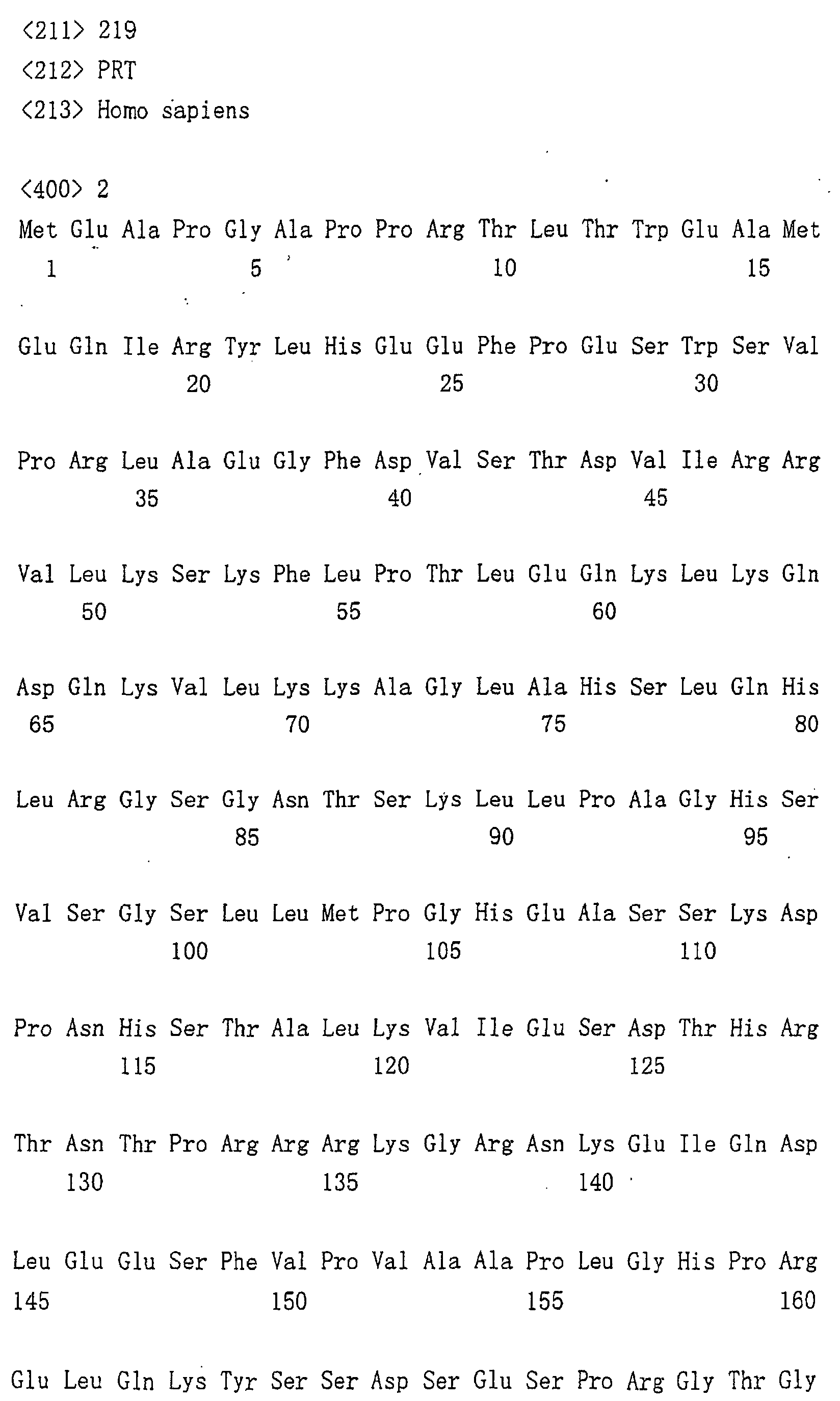
- the protein of the present invention is a protein having an amino acid sequence which is identical or substantially identical to the amino acid sequence shown by SEQ ID NO: 1 or SEQ ID NO: 2.
- the protein having an amino acid sequence which is substantially identical to the amino acid sequence shown by by SEQ ID NO: 1 or SEQ ID NO: 2 is one which has 70% or more, preferably 80% or more, more preferably 90% or more, or most preferably 95% or more identity to the amino acid sequence of SEQ ID NO: 1 or SEQ ID NO: 2, and either which is expressed specifically in ALS patients or the expression of which is inhibited specifically in ALS patients.
- the expression can be changed depending on the amino acid sequence of the protein. However, to the extent that such expression or inhibition of expression is ALS patient-specific, the amino acid sequence may be changed.
- the protein of the present invention includes fragments or analogs of the proteins having an amino acid sequence which has deletion, substitution or insertion of one or plural, preferably 1 to 10, more preferably 1 to 5, or further preferably, 1, 2, 3 or 4 amino acids in the amino acid sequences of SEQ ID NO: 1 or SEQ ID NO: 2.
- the fragments and analogs can be obtained by introducing deletion, substitution or insertion of amino acid sequences at a site which is not important for the function of the protein of the present invention. Amino acids at a site which is important for the function of the protein cannot be deleted or substituted. Also, it is not possible to alter sites involved in conservation of the overall structure of the protein in connection with its biological activity, by introducing deletion, substitution or insertion of amino acids.
- Amino acids which can be substituted are ones having a similar size or polarity. Examples thereof include mutual substitution between aliphatic amino acids, Ala, Val, Leu and Ile, mutual substitution between Ser and Thr which have hydroxyl group, mutual substitution between Asp and Glu which have acidic residue, substitution between Asn and Gin which have amide residue, substitution between Lys and Arg which have basic residue, and substitution between Phe and Tyr which have aromatic residue.
- a precursor of the protein of the present invention is also encompassed within the protein of the present invention, so long as it has the above described biological activity.
- Examples of such precursors include peptides of the present invention to which one or more amino acids are added to the N terminal side and/or C terminal side.
- a physiologically acceptable salt of the protein of the present invention or a precursor thereof is also encompassed by the present invention.
- a salt include acid addition salts including salts of inorganic acids such as hydrochloric acid, phosphoric acid or sulfuric acid, and salts of organic acids such as acetic acid, formic acid, fumaric acid, maleic acid, succinic acid, citric acid, tartaric acid, malic acid, benzoic acid, or benzenesulfonic acid.
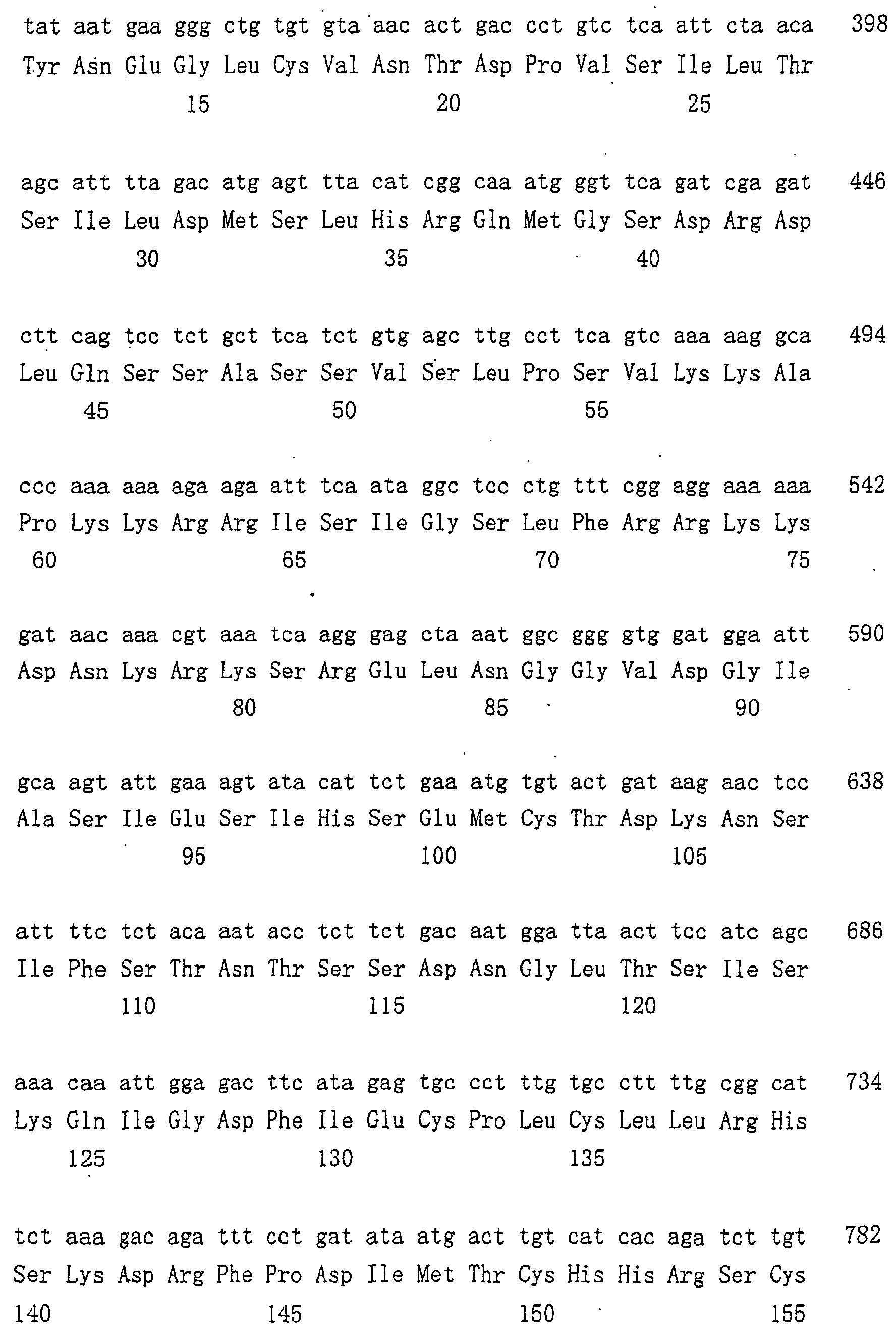
- the gene of the present invention includes a gene which encodes the above-mentioned protein, and specifically includes a gene having a nucleotide sequence shown by SEQ ID NO: 3, which is a gene encoding a protein having the amino acid sequence shown by SEQ ID NO: 1, or SEQ ID NO:4, which is a gene encoding a protein having the amino acid sequence shown by SEQ ID NO: 2. Further, a gene which hybridizes under stringent conditions with a gene comprising the nucleotide sequence of SEQ ID NO: 3 or SEQ ID NO: 4, is encompassed within the present invention.
- a gene which hybridizes under stringent conditions refers to, for example, a gene which hybridizes with a gene comprising the nucleotide sequence of SEQ ID NO: 3 or SEQ ID NO: 4 under conditions typically used for "probe hybridization.” These genes are cloned by hybridization with the gene of SEQ ID NO: 3 or SEQ ID NO: 4. Specific procedures such as cDNA library preparation, hybridization, positive colony selection, determination of nucleotide sequence, are known, and can be easily performed by reference to, for example, Molecular Cloning 2 nd Edt. Cold Spring Harbor Laboratory Press (1989).
- a partial peptide refers to a partial peptide composed of at least 6 amino acids among the amino acid sequence of the protein of the present invention.
- the limitation of "at least 6 amino acids” is due to the fact that 6 amino acids is the minimum size which can achieve a stable structure.
- a peptide having a length of 8 amino acids or more is preferred, and a peptide having a length of approximately 10 to 20 amino acids is more preferred. If the partial peptide is a short peptide of about 10 to 20 amino acids, it can be easily synthesized with a peptide synthesizer.
- the partial peptide is long, it can be obtained by expressing the peptide prepared according to ordinary gene engineering techniques (for example, by treatment with restriction enzymes, etc.) in animal cells and the like. It is possible to modify a peptide prepared in this manner by ordinary techniques. These partial peptides can be used for the preparation of antibodies as described later.
- a prokaryotic or eukaryotic host cell can be transformed by incorporating the gene encoding the protein of the present invention into a suitable vector.
- the expression vector may also contain a replication origin, a selective marker, a promoter, an RNA splice site, a polyadenylation signal and the like.
- the gene can be expressed in the respective host cell. Further, by ligating a gene encoding another polypeptide to a gene of interest to enable expression as a fusion protein, it is possible to simplify purification, increase the amount of expression, and by performing suitable processing in the purification step, excise a protein of interest.
- prokaryotic organism host cells include E. coli, Bacillus subtilis and the like.
- eukaryotic microorganism host cells include yeast, slime fungus and the like.
- Insect cells such as Sf9 may be used as a host cell.
- animal cell-derived host cells include COS cells, CHO cells and the like.
- the proteins which was produced by culturing the transformant transformed with the gene encoding the protein of the present invention as mentioned above, can be isolated intracellularly or extracellularly and can be purified.
- Ordinary methods used for isolating and purifying a protein can be used for isolation and purification of the protein. For example, various types of chromatography, ultrafiltration, salting out, dialysis and the like can be selected and combined as appropriate.
- an antibody is an antibody against either the protein of the present invention, or its partial peptide which can constitute an epitope.
- the antibody can be easily produced by immunizing an animal such as rabbit by normal methods such as the method described in Shinsaibokogakujikken Protocol p 210 Shujunsha (1993); Shin Seikagaku Jikken Koza 1, Tanpakushitu I , p.389-397 (1992), and the like.
- Antibodies include polyclonal antibodies and monoclonal antibodies, and methods for producing them are known to those skilled in the art. For example, monoclonal antibodies can easily be produced by using the method described in Protein Experimental Methods for Molecular Biological Research Chapter 4, Yodosha (1994).
- pseudo-humanized antibodies can be obtained according to Japanese Patent Application Laying-Open (Kokai) No. 62-296890. These antibodies can be used as diagnostic agents and experimental reagents used in various immunological assay methods including enzyme immunoassay such as ELISA, radio immunoassay and immunofluorescent methods, and also can be used in affinity chromatography, screening of cDNA library, and the like.
- the protein of the present invention can be used in the screening of a medicament for treatment of a neuro-degenerative disease, preferably ALS. That is, under conditions where a candidate compound for the medicament and the protein or partial peptide of the present invention can interact with each other , and in the presence of a second component which can provide a detectable signal depending on the interaction between the candidate compound and the protein or partial peptide of the present invention, the candidate compound and the protein or partial peptide of the present invention are allowed to interact, and by detecting the presence or absence of a signal produced by the interaction, a determination can be made as to whether or not the candidate compound inhibits or activates the activity of the protein or partial peptide of the present invention.
- a neuro-degenerative disease preferably ALS.
- a transgenic animal refers to what is known as a transgenic animal where the gene of the present invention has been artificially introduced into a chromosome of an animal other than a human, and what is known as a knock-out animal where the gene has been deleted from a chromosome thereof.
- transgenic animals can be easily produced by those skilled in the art based on known methods such as one regarding a disease model mouse (e.g. Molecular Medicine - Interim Edition, Nakayama Shoten (1994)).
- the transgenic animal is extremely useful as a model animal for the development of therapeutic agents for a neuro-degenerative disease, preferably, a therapeutic agent for ALS, and as a animal for screening for such therapeutic agents.
- the proteins and genes of the present invention shows an expression or an inhibition of expression, which is specific to ALS patient. Therefore, there is a possibility that the progress of the disease can be halted and the disease can be directed toward improvement by inhibiting or increasing the expression or function of these proteins. That is, these proteins are thought to be useful as therapeutic agents for ALS or in screening thereof. Further, an antibody against the protein of the present invention is thought to be useful in diagnosis of ALS patients.
Landscapes
- Health & Medical Sciences (AREA)
- Chemical & Material Sciences (AREA)
- Life Sciences & Earth Sciences (AREA)
- Organic Chemistry (AREA)
- Medicinal Chemistry (AREA)
- General Health & Medical Sciences (AREA)
- Biochemistry (AREA)
- Biophysics (AREA)
- Genetics & Genomics (AREA)
- Gastroenterology & Hepatology (AREA)
- Zoology (AREA)
- Molecular Biology (AREA)
- Toxicology (AREA)
- Proteomics, Peptides & Aminoacids (AREA)
- Chemical Kinetics & Catalysis (AREA)
- Animal Behavior & Ethology (AREA)
- Public Health (AREA)
- Veterinary Medicine (AREA)
- Pharmacology & Pharmacy (AREA)
- Nuclear Medicine, Radiotherapy & Molecular Imaging (AREA)
- General Chemical & Material Sciences (AREA)
- Physical Education & Sports Medicine (AREA)
- Orthopedic Medicine & Surgery (AREA)
- Neurology (AREA)
- Bioinformatics & Cheminformatics (AREA)
- Engineering & Computer Science (AREA)
- Peptides Or Proteins (AREA)
- Measuring Or Testing Involving Enzymes Or Micro-Organisms (AREA)
Abstract
Description





Claims (13)
- A protein having an amino acid sequence shown in SEQ ID NO:1 or SEQ ID NO:2, or an amino acid sequence having deletion, substitution or insertion of one or plural amino acids in said amino acid sequences; or a salt thereof.
- The protein or salt thereof according to claim 1, which is characterized in that its expression increases in an amyotrophic lateral sclerosis patient.
- A gene comprising the nucleotide sequence shown in SEQ ID NO: 3 or SEQ ID NO: 4, or a gene which hybridizes with said gene under stringent conditions and encodes a protein, the expression of which increases in an amyotrophic lateral sclerosis patient.
- A gene encoding the protein of claim 1.
- An expression vector comprising the gene of claim 3 or 4.
- A transformant transformed with the expression vector of claim 5.
- A partial peptide of the protein of claim 1 or 2; or a salt thereof.
- An antibody against any of the protein of claim 1 or 2 or the partial peptide of claim 7.
- A method for screening a compound for treatment of a neuro-degenerative disease, which is characterized in that the protein of claim 1 or 2 or the partial peptide of claim 7 is used.
- The method for screening of claim 9 wherein the neuro-degenerative disease is amyotrophic lateral sclerosis.
- A kit for the screening of a compounds for treatment of a neuro-degenerative disease, which is characterized in that the protein of claim 1 or 2 or the partial peptide of claim 7 is used.
- The kit for the screening of claim 11 wherein the neuro-degenerative disease is amyotrophic lateral sclerosis.
- A transgenic animal, wherein the gene of claim 3 or 4 is artificially introduced into a chromosome, or either gene is deleted from a chromosome.
Applications Claiming Priority (3)
| Application Number | Priority Date | Filing Date | Title |
|---|---|---|---|
| JP35924399 | 1999-12-17 | ||
| JP35924399 | 1999-12-17 | ||
| PCT/JP2000/008793 WO2001044468A1 (en) | 1999-12-17 | 2000-12-13 | Novel protein and gene |
Publications (2)
| Publication Number | Publication Date |
|---|---|
| EP1239035A1 true EP1239035A1 (en) | 2002-09-11 |
| EP1239035A4 EP1239035A4 (en) | 2005-04-06 |
Family
ID=18463500
Family Applications (1)
| Application Number | Title | Priority Date | Filing Date |
|---|---|---|---|
| EP00981667A Withdrawn EP1239035A4 (en) | 1999-12-17 | 2000-12-13 | PROTEIN AND GENE |
Country Status (3)
| Country | Link |
|---|---|
| US (1) | US20030187199A1 (en) |
| EP (1) | EP1239035A4 (en) |
| WO (1) | WO2001044468A1 (en) |
Family Cites Families (10)
| Publication number | Priority date | Publication date | Assignee | Title |
|---|---|---|---|---|
| US5843641A (en) * | 1993-02-26 | 1998-12-01 | Massachusetts Institute Of Technology | Methods for the daignosis, of familial amyotrophic lateral sclerosis |
| US5770690A (en) * | 1995-06-27 | 1998-06-23 | Neurex Corporation | Bax omega protein and methods |
| WO1998031818A2 (en) * | 1997-01-21 | 1998-07-23 | Human Genome Sciences, Inc. | Tace-like and matrilysin-like polypeptides |
| US20030175858A1 (en) * | 1997-03-07 | 2003-09-18 | Ruben Steven M. | 186 human secreted proteins |
| WO1998056804A1 (en) * | 1997-06-13 | 1998-12-17 | Human Genome Sciences, Inc. | 86 human secreted proteins |
| US7196164B2 (en) * | 1997-07-08 | 2007-03-27 | Human Genome Sciences, Inc. | Secreted protein HHTLF25 |
| US20030049618A1 (en) * | 1997-03-07 | 2003-03-13 | Ruben Steven M. | 186 human secreted proteins |
| US6420526B1 (en) * | 1997-03-07 | 2002-07-16 | Human Genome Sciences, Inc. | 186 human secreted proteins |
| CA2295474A1 (en) * | 1997-07-08 | 1999-01-21 | Human Genome Sciences, Inc. | 123 human secreted proteins |
| JP2000000095A (en) * | 1998-06-15 | 2000-01-07 | Saburo Sakoda | Protein p53 associated with amyotrophic lateral sclerosis, its gene and its use |
-
2000
- 2000-12-13 US US10/149,407 patent/US20030187199A1/en not_active Abandoned
- 2000-12-13 EP EP00981667A patent/EP1239035A4/en not_active Withdrawn
- 2000-12-13 WO PCT/JP2000/008793 patent/WO2001044468A1/en not_active Ceased
Also Published As
| Publication number | Publication date |
|---|---|
| EP1239035A4 (en) | 2005-04-06 |
| US20030187199A1 (en) | 2003-10-02 |
| WO2001044468A1 (en) | 2001-06-21 |
Similar Documents
| Publication | Publication Date | Title |
|---|---|---|
| US5525486A (en) | Process for constructing cDNA library, and novel polypeptide and DNA coding for the same | |
| JP2001512013A (en) | 5'EST of secreted protein expressed in prostate | |
| JP2002504818A (en) | NTN-2 members of the ligand family | |
| JP2001512014A (en) | 5 'EST of secreted protein identified from brain tissue | |
| JP2001512667A (en) | Human orphan receptor NTR-1 | |
| JP2003530088A (en) | New compound | |
| JP2002526099A (en) | NLK1-interacting protein | |
| US6368794B1 (en) | Detection of altered expression of genes regulating cell proliferation | |
| EP1283214B1 (en) | Novel collectins | |
| JP2003135077A (en) | New human genes and gene expression products | |
| JP2003523723A (en) | Hermansky-Padrack syndrome protein-interacting proteins and methods of use | |
| AU714793B2 (en) | Novel stress proteins | |
| US20030187199A1 (en) | Novel protein and gene | |
| EP1164190A1 (en) | Rheumatoid arthritis gene and method for diagnosing rheumatoid arthritis | |
| JP2004534525A (en) | Preparation of monospecific polyclonal antibodies against uPAR mutants del4, del5 and del4 + 5 and their use for diagnostic and therapeutic purposes | |
| EP1566386B1 (en) | A baldness related gene and the polypeptide encoded thereby, and uses thereof | |
| JPWO2001044468A1 (en) | Novel proteins and genes | |
| EP1445315B1 (en) | Human and mammalian stem cell-derived neuronal survival polypeptides | |
| JP2003516717A (en) | Full-length cDNA clone and protein encoding it | |
| US20020106777A1 (en) | Human PEC-60-like protein and DNA encoding this protein | |
| US6703201B1 (en) | Human PEC-60-like protein and DNA encoding this protein | |
| US6444443B1 (en) | Gene | |
| JP2002533072A (en) | Recombinant synthesis of β-lipotropin and other peptides | |
| JP2003523758A (en) | Novel transcription factor CARP-2 | |
| JPH09131191A (en) | Horse interleukin 1 peptide, DNA encoding the same, recombinant vector containing the DNA, transformant containing the recombinant vector, and method for producing anti-horse interleukin 1 antibody |
Legal Events
| Date | Code | Title | Description |
|---|---|---|---|
| PUAI | Public reference made under article 153(3) epc to a published international application that has entered the european phase |
Free format text: ORIGINAL CODE: 0009012 |
|
| 17P | Request for examination filed |
Effective date: 20020619 |
|
| AK | Designated contracting states |
Kind code of ref document: A1 Designated state(s): AT BE CH CY DE DK ES FI FR GB GR IE IT LI LU MC NL PT SE TR |
|
| RIC1 | Information provided on ipc code assigned before grant |
Ipc: 7C 07K 16/18 B Ipc: 7A 01K 67/027 B Ipc: 7A 61K 45/00 B Ipc: 7C 07K 14/705 B Ipc: 7C 12N 15/12 A Ipc: 7C 07K 14/47 B Ipc: 7A 61P 21/00 B Ipc: 7C 12N 5/10 B |
|
| A4 | Supplementary search report drawn up and despatched |
Effective date: 20050221 |
|
| 17Q | First examination report despatched |
Effective date: 20050510 |
|
| 17Q | First examination report despatched |
Effective date: 20050510 |
|
| STAA | Information on the status of an ep patent application or granted ep patent |
Free format text: STATUS: THE APPLICATION IS DEEMED TO BE WITHDRAWN |
|
| 18D | Application deemed to be withdrawn |
Effective date: 20061213 |