EP1237346A1 - Method and device for signalling a call or a message to its recipient - Google Patents
Method and device for signalling a call or a message to its recipient Download PDFInfo
- Publication number
- EP1237346A1 EP1237346A1 EP02290250A EP02290250A EP1237346A1 EP 1237346 A1 EP1237346 A1 EP 1237346A1 EP 02290250 A EP02290250 A EP 02290250A EP 02290250 A EP02290250 A EP 02290250A EP 1237346 A1 EP1237346 A1 EP 1237346A1
- Authority
- EP
- European Patent Office
- Prior art keywords
- user
- message
- parameter
- signaling
- transmitter
- Prior art date
- Legal status (The legal status is an assumption and is not a legal conclusion. Google has not performed a legal analysis and makes no representation as to the accuracy of the status listed.)
- Granted
Links
- 230000011664 signaling Effects 0.000 title claims abstract description 50
- 238000000034 method Methods 0.000 title claims abstract description 21
- 238000004891 communication Methods 0.000 claims description 8
- 230000003213 activating effect Effects 0.000 claims description 3
- 238000013475 authorization Methods 0.000 claims description 2
- 238000012550 audit Methods 0.000 abstract description 3
- 230000006978 adaptation Effects 0.000 description 4
- 238000001914 filtration Methods 0.000 description 2
- 238000012986 modification Methods 0.000 description 2
- 230000004048 modification Effects 0.000 description 2
- 241000543381 Cliftonia monophylla Species 0.000 description 1
- 238000012790 confirmation Methods 0.000 description 1
- 230000007613 environmental effect Effects 0.000 description 1
- 238000011156 evaluation Methods 0.000 description 1
- 238000012216 screening Methods 0.000 description 1
- 238000012163 sequencing technique Methods 0.000 description 1
- 230000003068 static effect Effects 0.000 description 1
- 238000012795 verification Methods 0.000 description 1
Images

Classifications
-
- H—ELECTRICITY
- H04—ELECTRIC COMMUNICATION TECHNIQUE
- H04M—TELEPHONIC COMMUNICATION
- H04M19/00—Current supply arrangements for telephone systems
- H04M19/02—Current supply arrangements for telephone systems providing ringing current or supervisory tones, e.g. dialling tone or busy tone
- H04M19/04—Current supply arrangements for telephone systems providing ringing current or supervisory tones, e.g. dialling tone or busy tone the ringing-current being generated at the substations
- H04M19/041—Encoding the ringing signal, i.e. providing distinctive or selective ringing capability
-
- H—ELECTRICITY
- H04—ELECTRIC COMMUNICATION TECHNIQUE
- H04M—TELEPHONIC COMMUNICATION
- H04M1/00—Substation equipment, e.g. for use by subscribers
- H04M1/57—Arrangements for indicating or recording the number of the calling subscriber at the called subscriber's set
- H04M1/575—Means for retrieving and displaying personal data about calling party
-
- H—ELECTRICITY
- H04—ELECTRIC COMMUNICATION TECHNIQUE
- H04M—TELEPHONIC COMMUNICATION
- H04M1/00—Substation equipment, e.g. for use by subscribers
- H04M1/72—Mobile telephones; Cordless telephones, i.e. devices for establishing wireless links to base stations without route selection
- H04M1/724—User interfaces specially adapted for cordless or mobile telephones
-
- H—ELECTRICITY
- H04—ELECTRIC COMMUNICATION TECHNIQUE
- H04M—TELEPHONIC COMMUNICATION
- H04M1/00—Substation equipment, e.g. for use by subscribers
- H04M1/72—Mobile telephones; Cordless telephones, i.e. devices for establishing wireless links to base stations without route selection
- H04M1/724—User interfaces specially adapted for cordless or mobile telephones
- H04M1/72403—User interfaces specially adapted for cordless or mobile telephones with means for local support of applications that increase the functionality
- H04M1/7243—User interfaces specially adapted for cordless or mobile telephones with means for local support of applications that increase the functionality with interactive means for internal management of messages
Definitions
- the present invention relates to the field of communications, in particular telecommunications, especially services related to the associated MMI (for Man Machine Interface) communication terminals, and relates to a method and a device for signaling a call or a sound message recipient.
- MMI Man Machine Interface
- a mobile phone can be programmed to warn the recipient via a vibrator when the latter has requested a discreet signaling mode (participation of the recipient in a meeting, concert or similar) or through a single sound, a repeated sound or a musical melody when the said recipient has requested a signaling mode generating a more warning easily perceptible (recipient present in a place not requiring a particular discretion).
- the object of the present invention is in particular to overcome this limitation.
- the dynamic selection can also take into account the state of at least one other parameter programmed by the user and / or the state of at least one parameter linked to the environment or to the state of said receiving terminal.
- an evolving parameter, relating to the issuer, taken into account with each new call or message is the number of calls or messages from the same issuer that remained unanswered, immediate or deferred, on the part of the recipient user, said parameter being modified, for example incremented, if there is no response to the audit new call or message, if applicable subject to authorization user correspondent.
- the parameter predetermined, relative to the issuer, taken into account corresponds to the identity of said transmitter.
- the programmed parameter (s) by the user of the receiving terminal is (are) selected from the group formed by a degree of priority or specific importance attached to different predefined transmitters, the current situation or state of user, and user preferences in terms of mode (s) and / or signaling and warning means (s) available.
- Different degrees of priority could, for example, be defined by authorizing only for certain transmitters only one modification of the degree of importance and the level of warning, in particular an increase in these, continuously or by discrete degrees, depending on the increase in the number of calls or messages from these transmitters that remained unanswered by the user recipient.
- transmitters known to the user may be seen assigned a degree or level of warning, fixed, low or high depending the importance that said user attaches to each of said transmitters.
- the parameter (s) linked to the environment or to the state of said receiving terminal can be chosen from the group formed by the level of surrounding noise, the degree of surrounding light, the remaining degree of autonomy for the receiving terminal and availability of the different possible signaling means, the value of this (these) last parameter (s) being likely to modify the mode of setting using the selected signaling means (s).
- the signaling process consists, on the occasion of each news receiving an incoming call or message, to be determined at least one mode and / or at least one signaling means or a combination of several modes and / or means of signaling, as well as possibly the degrees respective intensities of their implementation, by selection on the basis of a or more gradation scales, for example in terms of efficiency warning, said modes and / or means, each associated with a situation and / or current state of the user programmed by this last, and based on a warning value calculated from values of the scalable and / or non-scalable parameters attached to the transmitter caller or sender.
- said method consists in for each new incoming call or message, select a mode and / or a signaling means after, on the one hand, analysis of different types of parameters involved, on the other hand, taking into account their relative importance predefined by the user and, finally, verification of the existence of multi-parameter selection configurations preprogrammed by the user and, applying to said call or message entering.
- the present invention provides the user with the option of being notified of a telephone call or the receipt of a message or electronic mail (in English "e-mail") in different ways.
- the means used to signal the call or the reception of the message may thus differ as a function, on the one hand, of input parameters, linked to the transmitter, such as for example the identity of the sender, the number of unsuccessful calls from said sender or messages from said sender remaining unanswered by the recipient user, on the other hand, parameters programmed by the user, in particular the situation of this last when calling or receiving the message (in a meeting, at home, at work, do not disturb, on the road, ...), and, finally, any environmental or circumstantial parameters.
- the present invention also relates to a device for signaling an incoming call or electronic message coming from a caller by means of a given transmitting terminal, to the user of a receiving terminal, recipient of said call.
- said device can include, in addition, a history file automatically storing, for each message call, the number or address of the sender, as well that either the number of successive calls or messages made by each said transmitters and remained unanswered by the user of the receiving terminal, a simple indication of waiting for a response from the share of said issuers, said historical file being updated automatically with each new call or message, in increments the variable indicating the number of previous calls or messages from the transmitter considered remained unanswered, by activating an indicator waiting for a response from the issuer concerned, or by creation of a new location in said history file for the storage of the number or address of the sender and of the variable or the corresponding indicator.
- the dynamic selection module is suitable, after taking into account the number or address of the transmitter, to read the value of the variable or state of the indicator assigned to said transmitter in said file history, this information constituting a first relative evolutionary parameter to the latter.
- said device also includes a priority assignment file or of importance to given transmitters, an indication and configuration of the signaling means or means according to the values and / or state (s) of the parameters taken into account by the selection module dynamic, a file or a programmable variable indicating the situation or the current state of the user and a file containing values of parameters related to the environment or the state of the receiving terminal, these files and / or this variable being, together with the history file, viewed and their content used by the selection module dynamic for the controlled control of the means or signaling to generate a warning signal or message suitable for the user.
- the present invention therefore makes it possible to provide a configurable man / machine multimedia communication interface and with dynamic operation.
- the mode of implementation of the signaling means selected can be modified according to current characteristics the environment of the receiving terminal (e.g. measured using sensors adapted or derived from data entered by the user), stored in a file or predefined fields.
- the means of available signs may be more or less numerous and more or less varied natures.
- the identity of the sender person is primarily determined by a means 1 or by an adapted operation, of the selection module dynamic 2.
- a modification is then made to the history file 4 by incrementing a variable N_call assigned to said transmitter and whose value corresponds to the number of calls and / or messages from said sender remained unanswered by the user / recipient.
- variable N_call is reset to 0 when the user takes the call or responds to the sender with or through a deferred return call sending a return message.
- the historical file 4 can be advantageously consulted by the user.
- the latter has the possibility of knowing which person has tried to reach him while he was, for example, in a situation corresponding to a low warning level and that he could not take knowledge of the call or message received during this period (either because his attention was not attracted enough, either because he voluntarily decided not to act on it).
- selection module 2 When the issuer's number or email address has been transmitted to selection module 2, the latter begins a phase of treatment by first consulting the history file 4 (to find out the number of unanswered calls or messages for this sender), then by consulting file 7 indicating the current situation or state of the user according to the latest indications programmed by this latest.
- the selection module 2 consults the file 5 assigning priority levels of importance or preferably to given transmitters, corresponding to the current situation or state of the user.
- This file 5 determines which transmitters should be used account of the number of unanswered calls or messages, with a corresponding adaptation of the means and signaling mode of a new call or new message to the user.
- This adaptation may consist of a selection of means of signaling and modes of implementation presenting an efficiency increasing warning based on the increasing number of calls or unanswered messages.
- This distinction between the two types of aforementioned transmitters can, for example, be defined by a boolean flag called To_increment.
- Nb_limit indicating the threshold for passing a degree or level warning at the next warning level
- Nb_limit indicating the threshold for passing a degree or level warning at the next warning level
- a possible structure of file 5 is shown in the form of a table below: Transmitter To_increment Nb_limit or Ev 04.66.77.84.xx TRUE 5 01.69.63.24.xx TRUE 10 01.46.65.76.xx FALSE 0 titi@xxx.fr FALSE 1
- the selection module 2 After consulting this file, the selection module 2 knows exactly how to warn the user.
- said module 2 can consult a file 8 containing values parameters related to the environment and, depending on the information read, said module 2 can modify the characteristics of implementation of the or selected signaling means.
- the invention it is therefore possible to improve comfort use of a receiving terminal, by reducing the disadvantages of overly disturbing warning modes, especially depending on the user's situation, but avoiding simultaneously to neglect an efficient warning mode in the case a call or a message that may be important or urgent (for example call or message repeated frequently).
- the invention makes it possible to automate call screening, in limiting user intervention.
- This filtering can, moreover, be adapted flexibly to different circumstances and situations taking into account has a greater or lesser number of parameters linked to the transmitter or programmed by the user.
- the signaling method and device according to the invention can be implemented in different devices forming part of a communication network.
- the invention also relates, on the one hand, to a mobile radiocommunication terminal suitable for connection with a communication network and, on the other hand, to an automatic switch or a similar communication establishment device, characterized in that they include a signaling device and in that they implement a signaling method, as described above.
- the invention also relates to a communication network comprising in particular at least one network controller and a plurality of base stations, characterized in that said network controller includes a device and in that it implements a method such as described previously.
Landscapes
- Engineering & Computer Science (AREA)
- Signal Processing (AREA)
- Human Computer Interaction (AREA)
- Computer Networks & Wireless Communication (AREA)
- Business, Economics & Management (AREA)
- General Business, Economics & Management (AREA)
- Mobile Radio Communication Systems (AREA)
- Telephone Function (AREA)
Abstract
La présente invention a pour objet un procédé et un dispositif pour la signalisation d'un appel ou d'un message à son destinataire.The present invention relates to a method and a device for signaling a call or a message to its recipient.
Procédé de signalisation d'un appel ou d'un message électronique entrant provenant d'un émetteur donné, à l'utilisateur d'un terminal récepteur, destinataire dudit appel ou message, caractérisé en ce qu'il consiste à réaliser les étapes suivantes
- identification de l'émetteur,
- prise en compte d'au moins un paramètre évolutif ou prédéterminé relatif audit émetteur ;
- sélection dynamique d'au moins un mode et/ou d'au moins un moyen de signalisation (3) disponible au niveau dudit terminal récepteur en fonction de l'état dudit au moins un paramètre lié à l'émetteur.
- identification of the issuer,
- taking into account at least one evolving or predetermined parameter relating to said issuer;
- dynamic selection of at least one mode and / or at least one signaling means (3) available at said receiving terminal as a function of the state of said at least one parameter linked to the transmitter.
Description
La présente invention concerne le domaine des communications, en particulier des télécommunications, notamment les services en relation avec les MMI (pour Man Machine Interface : interface homme/machine) associés aux terminaux de communication, et a pour objet un procédé et un dispositif pour la signalisation d'un appel ou d'un message à son destinataire.The present invention relates to the field of communications, in particular telecommunications, especially services related to the associated MMI (for Man Machine Interface) communication terminals, and relates to a method and a device for signaling a call or a sound message recipient.
Il est déjà connu, notamment en relation avec les terminaux mobiles de radiocommunication, en particulier les téléphones portables ou cellulaires, de programmer le mode de signalisation d'un appel entrant à son destinataire en fonction de la situation de ce dernier.It is already known, especially in connection with terminals mobile radio, especially cell phones or to program the signaling mode of an incoming call to its recipient depending on the situation of the latter.
Ainsi, un téléphone mobile peut être programmé pour avertir le destinataire par l'intermédiaire d'un vibrateur lorsque ce dernier a sollicité un mode de signalisation discret (participation du destinataire à une réunion, à un concert ou analogue) ou par l'intermédiaire d'un son unique, d'un son répété ou d'une mélodie musicale lorsque ledit destinataire a sollicité un mode de signalisation générant un avertissement plus facilement perceptible (destinataire présent dans un lieu ne nécessitant pas une discrétion particulière).Thus, a mobile phone can be programmed to warn the recipient via a vibrator when the latter has requested a discreet signaling mode (participation of the recipient in a meeting, concert or similar) or through a single sound, a repeated sound or a musical melody when the said recipient has requested a signaling mode generating a more warning easily perceptible (recipient present in a place not requiring a particular discretion).
Néanmoins, une telle programmation du mode de signalisation d'un appel ou d'un message sur la base d'un seul critère présente une souplesse d'application très limitée et ne permet pas de réaliser un filtrage flexible des appels et/ou des messages entrants, qui serait susceptible d'autoriser une adaptation du degré d'attraction de l'attention du destinataire en fonction de l'importance à accorder auxdits appels et messages entrants, au moins partiellement en fonction d'une programmation préalable de l'utilisateur destinataire. However, such programming of the signaling of a call or a message on the basis of a single criterion has very limited application flexibility and does not allow perform flexible filtering of incoming calls and / or messages, which would be likely to allow an adaptation of the degree of attraction of the attention of the recipient according to the importance to be given to said incoming calls and messages, at least partially based on a prior programming of the recipient user.
La présente invention a notamment pour but de pallier cette limitation.The object of the present invention is in particular to overcome this limitation.
A cet effet, elle a pour objet un procédé de signalisation d'un appel ou d'un message électronique entrant provenant d'un émetteur donné, à l'utilisateur d'un terminal récepteur, destinataire dudit appel ou message, caractérisé en ce qu'il consiste à réaliser les étapes suivantes :
- identification de l'émetteur,
- prise en compte d'au moins un paramètre évolutif ou prédéterminé relatif audit émetteur ;
- sélection dynamique d'au moins un mode et/ou d'au moins un moyen de signalisation disponible au niveau dudit terminal récepteur en fonction de l'état dudit au moins un paramètre lié à l'émetteur.
- identification of the issuer,
- taking into account at least one evolving or predetermined parameter relating to said issuer;
- dynamic selection of at least one mode and / or at least one signaling means available at said receiving terminal as a function of the state of said at least one parameter linked to the transmitter.
Afin de pouvoir augmenter davantage encore la faculté d'adaptation et la finesse de la sélectivité du procédé selon l'invention, la sélection dynamique peut également tenir compte de l'état d'au moins un autre paramètre programmé par l'utilisateur et/ou de l'état d'au moins un paramètre lié à l'environnement ou à l'état dudit terminal récepteur.In order to be able to further increase the faculty adaptation and finesse of the selectivity of the process according to the invention, the dynamic selection can also take into account the state of at least one other parameter programmed by the user and / or the state of at least one parameter linked to the environment or to the state of said receiving terminal.
Conformément à une première caractéristique de l'invention, un paramètre évolutif, relatif à l'émetteur, pris en compte à chaque nouvel appel ou message correspond au nombre d'appels ou de messages antérieurs de la part du même émetteur restés sans réponse, immédiate ou différée, de la part de l'utilisateur destinataire, ledit paramètre étant modifié, par exemple incrémenté, en cas d'absence de réponse audit nouvel appel ou message, le cas échéant sous réserve d'une autorisation correspondante de l'utilisateur.In accordance with a first characteristic of the invention, an evolving parameter, relating to the issuer, taken into account with each new call or message is the number of calls or messages from the same issuer that remained unanswered, immediate or deferred, on the part of the recipient user, said parameter being modified, for example incremented, if there is no response to the audit new call or message, if applicable subject to authorization user correspondent.
Il peut également être prévu qu'un autre paramètre évolutif, relatif à l'émetteur, pris en compte correspond ; dans le cas d'un message électronique, au degré d'importance attaché audit message. It can also be expected that another evolutionary parameter, relating to the issuer, taken into account corresponds; in the case of a message electronic, to the degree of importance attached to said message.
Selon une autre caractéristique de l'invention, le paramètre prédéterminé, relatif à l'émetteur, pris en compte correspond à l'identité dudit émetteur.According to another characteristic of the invention, the parameter predetermined, relative to the issuer, taken into account corresponds to the identity of said transmitter.
De manière avantageuse, le ou les paramètres programmés par l'utilisateur du terminal récepteur est (sont) choisi(s) dans le groupe formé par un degré de priorité ou d'importance spécifique attaché à différents émetteurs prédéfinis, la situation ou l'état courant(e) de l'utilisateur, et les préférences de l'utilisateur en termes de mode(s) et/ou de moyen(s) de signalisation et d'avertissement disponible(s).Advantageously, the programmed parameter (s) by the user of the receiving terminal is (are) selected from the group formed by a degree of priority or specific importance attached to different predefined transmitters, the current situation or state of user, and user preferences in terms of mode (s) and / or signaling and warning means (s) available.
Des degrés de priorité différents pourront, par exemple, être définis en autorisant seulement pour certains émetteurs seulement une modification du degré d'importance et du niveau d'avertissement, notamment une augmentation de ces derniers, de manière continue ou par degrés discrets, en fonction de l'augmentation du nombre d'appels ou de messages de ces émetteurs restés sans réponse de la part de l'utilisateur destinataire.Different degrees of priority could, for example, be defined by authorizing only for certain transmitters only one modification of the degree of importance and the level of warning, in particular an increase in these, continuously or by discrete degrees, depending on the increase in the number of calls or messages from these transmitters that remained unanswered by the user recipient.
D'autres émetteurs, connus de l'utilisateur pourront se voir affectés un degré ou niveau d'avertissement, fixe, bas ou élevé en fonction de l'importance qu'accorde ledit utilisateur à chacun desdits émetteurs.Other transmitters known to the user may be seen assigned a degree or level of warning, fixed, low or high depending the importance that said user attaches to each of said transmitters.
Pour d'éventuels autres émetteurs encore, considérés comme non prioritaires, seule sera pris en compte l'état d'absence de réponse, et non pas le nombre d'appels ou de messages sans réponse. Il en découle que ces émetteurs se verront attribuer uniquement deux états : en attente d'une réponse (avec définition d'un moyen et d'un mode de signalisation) ou absence d'attente de réponse.For other possible transmitters, considered as not priority, only the state of absence of response will be taken into account, and not the number of unanswered calls or messages. It follows that these transmitters will be assigned only two states: pending of a response (with definition of a means and a signaling mode) or no waiting for a response.
En outre, le ou les paramètre(s) lié(s) à l'environnement ou à l'état dudit terminal récepteur peuvent être choisis dans le groupe formé par le niveau de bruit environnant, le degré de luminosité environnante, le degré d'autonomie restant pour le terminal récepteur et la disponibilité fonctionnelle des différents moyens de signalisation possibles, la valeur de ce(s) dernier(s) paramètre(s) étant susceptible de modifier le mode de mise en oeuvre du ou des moyen(s) de signalisation sélectionné(s).In addition, the parameter (s) linked to the environment or to the state of said receiving terminal can be chosen from the group formed by the level of surrounding noise, the degree of surrounding light, the remaining degree of autonomy for the receiving terminal and availability of the different possible signaling means, the value of this (these) last parameter (s) being likely to modify the mode of setting using the selected signaling means (s).
Conformément à un mode de réalisation préféré de l'invention, le procédé de signalisation consiste, à l'occasion de chaque nouvelle réception d'un appel ou message entrant, à déterminer au moins un mode et/ou au moins un moyen de signalisation ou une combinaison de plusieurs modes et/ou moyens de signalisation, ainsi qu'éventuellement les degrés d'intensités respectifs de leur mise en oeuvre, par sélection sur la base d'une ou de plusieurs échelles de gradation, par exemple en termes d'efficacité d'avertissement, desdits modes et/ou moyens, associées chacune à une situation et/ou à un état courant(e) de l'utilisateur programmé(e) par ce dernier, et en fonction d'une valeur d'avertissement calculé à partir des valeurs des paramètres évolutif(s) et/ou non évolutif(s) attaché à l'émetteur appelant ou expéditeur.In accordance with a preferred embodiment of the invention, the signaling process consists, on the occasion of each news receiving an incoming call or message, to be determined at least one mode and / or at least one signaling means or a combination of several modes and / or means of signaling, as well as possibly the degrees respective intensities of their implementation, by selection on the basis of a or more gradation scales, for example in terms of efficiency warning, said modes and / or means, each associated with a situation and / or current state of the user programmed by this last, and based on a warning value calculated from values of the scalable and / or non-scalable parameters attached to the transmitter caller or sender.
En variante, il peut être prévu que ledit procédé consiste à l'occasion de chaque nouvel appel ou message entrant, à sélectionner un mode et/ou un moyen de signalisation après, d'une part, analyse des différents types de paramètres impliqués, d'autre part, prise en compte de leur importance relative prédéfinie par l'utilisateur et, enfin, vérification de l'existence de configurations de sélection multiparamétriques préprogrammées par l'utilisateur et, s'appliquant audit appel ou message entrant.As a variant, it can be provided that said method consists in for each new incoming call or message, select a mode and / or a signaling means after, on the one hand, analysis of different types of parameters involved, on the other hand, taking into account their relative importance predefined by the user and, finally, verification of the existence of multi-parameter selection configurations preprogrammed by the user and, applying to said call or message entering.
Ainsi qu'il ressort de ce qui précède, la présente invention fournit à l'utilisateur la possibilité d'être averti d'un appel téléphonique ou de la réception d'un message ou courrier électronique (en anglais "e-mail") de différentes manières.As is apparent from the above, the present invention provides the user with the option of being notified of a telephone call or the receipt of a message or electronic mail (in English "e-mail") in different ways.
Le moyen utilisé pour signaler l'appel ou la réception du
message, ainsi que son mode de mise en oeuvre, pourront ainsi différer en
fonction, d'une part, de paramètres d'entrée, liés à l'émetteur, comme par
exemple l'identité de l'émetteur, le nombre d'appels infructueux dudit
émetteur ou de messages dudit émetteur restés sans réponse de la part de
l'utilisateur destinataire, d'autre part, de paramètres programmés par
l'utilisateur, notamment la situation de ce dernier au moment de l'appel ou
de la réception du message (en réunion, à la maison, au travail, ne pas
déranger, en déplacement, ...), et, enfin, d'éventuels paramètres
environnementaux ou circonstanciels.
La présente invention a également pour objet un dispositif pour la
signalisation d'un appel ou d'un message électronique entrant provenant
d'un appelant au moyen d'un terminal émetteur donné, à l'utilisateur d'un
terminal récepteur, destinataire dudit appel ou message, caractérisé en ce
qu'il comprend notamment, d'une part, un moyen d'identification du
numéro ou de l'adresse de l'émetteur et, d'autre part, un module de
sélection dynamique d'au moins un mode et/ou moyen de signalisation
disponible au niveau du terminal récepteur en fonction de l'état d'au moins
un paramètre, évolutif ou prédéterminé, relatif à l'émetteur et pris en
compte par ledit module, le cas échéant, en relation avec l'état d'au moins
un paramètre programmé par l'utilisateur et/ou l'état d'au moins un
paramètre lié(s) à l'environnement ou à l'état dudit terminal récepteur.The means used to signal the call or the reception of the message, as well as its mode of implementation, may thus differ as a function, on the one hand, of input parameters, linked to the transmitter, such as for example the identity of the sender, the number of unsuccessful calls from said sender or messages from said sender remaining unanswered by the recipient user, on the other hand, parameters programmed by the user, in particular the situation of this last when calling or receiving the message (in a meeting, at home, at work, do not disturb, on the road, ...), and, finally, any environmental or circumstantial parameters.
The present invention also relates to a device for signaling an incoming call or electronic message coming from a caller by means of a given transmitting terminal, to the user of a receiving terminal, recipient of said call. or message, characterized in that it comprises in particular, on the one hand, a means of identifying the number or address of the transmitter and, on the other hand, a dynamic selection module of at least one signaling mode and / or means available at the receiving terminal as a function of the state of at least one parameter, evolving or predetermined, relating to the transmitter and taken into account by said module, if necessary, in relation to the state of at least one parameter programmed by the user and / or the state of at least one parameter linked to the environment or to the state of said receiving terminal.
Selon une caractéristique de l'invention, ledit dispositif peut comprendre, en outre, un fichier historique stockant automatiquement, pour chaque appel de message, le numéro ou l'adresse de l'émetteur, ainsi que, soit le nombre d'appels ou de messages successifs émis par chacun desdits émetteurs et restés sans réponse de la part de l'utilisateur du terminal récepteur, soit une simple indication d'attente de réponse de la part desdits émetteurs, ledit fichier historique étant mis à jour automatiquement à chaque nouvel appel ou message, par incrémentation de la variable indiquant le nombre d'appels ou de messages antérieurs de l'émetteur considéré restés sans réponse, par activation d'un indicateur d'attente de réponse de la part de l'émetteur considéré, ou encore par création d'un nouvel emplacement dans ledit fichier historique pour le stockage du numéro ou de l'adresse de l'émetteur et de la variable ou de l'indicateur correspondant.According to a characteristic of the invention, said device can include, in addition, a history file automatically storing, for each message call, the number or address of the sender, as well that either the number of successive calls or messages made by each said transmitters and remained unanswered by the user of the receiving terminal, a simple indication of waiting for a response from the share of said issuers, said historical file being updated automatically with each new call or message, in increments the variable indicating the number of previous calls or messages from the transmitter considered remained unanswered, by activating an indicator waiting for a response from the issuer concerned, or by creation of a new location in said history file for the storage of the number or address of the sender and of the variable or the corresponding indicator.
A chaque nouvel appel ou à chaque nouvelle réception d'un message électronique, le module de sélection dynamique est apte, après prise en compte du numéro ou de l'adresse de l'émetteur, à lire la valeur de la variable ou l'état de l'indicateur affecté(e) audit émetteur dans ledit fichier historique, ces informations constituant un premier paramètre évolutif relatif à ce dernier.With each new call or each new reception of a electronic message, the dynamic selection module is suitable, after taking into account the number or address of the transmitter, to read the value of the variable or state of the indicator assigned to said transmitter in said file history, this information constituting a first relative evolutionary parameter to the latter.
Conformément à une autre caractéristique de l'invention, ledit dispositif comprend également un fichier d'affectation de degrés de priorité ou d'importance à des émetteurs donnés, un fichier d'indication et de configuration du ou des moyens de signalisation en fonction des valeurs et/ou état(s) des paramètres pris en compte par le module de sélection dynamique, un fichier ou une variable programmable indiquant la situation ou l'état courant(e) de l'utilisateur et un fichier contenant des valeurs de paramètres liés à l'environnement ou à l'état du terminal récepteur, ces fichiers et/ou cette variable étant, ensemble avec le fichier historique, consulté(e)(s) et leurs contenus exploités par le module de sélection dynamique en vue de la commande contrôlée du ou des moyens de signalisation pour générer un signal ou un message d'avertissement adapté pour l'utilisateur.According to another characteristic of the invention, said device also includes a priority assignment file or of importance to given transmitters, an indication and configuration of the signaling means or means according to the values and / or state (s) of the parameters taken into account by the selection module dynamic, a file or a programmable variable indicating the situation or the current state of the user and a file containing values of parameters related to the environment or the state of the receiving terminal, these files and / or this variable being, together with the history file, viewed and their content used by the selection module dynamic for the controlled control of the means or signaling to generate a warning signal or message suitable for the user.
La présente invention permet par conséquent de fournir une interface de communication multimédia homme/machine, configurable et à fonctionnement dynamique.The present invention therefore makes it possible to provide a configurable man / machine multimedia communication interface and with dynamic operation.
Elle trouve plus particulièrement une application comme interface entre un téléphone portable et son propriétaire ou utilisateur, autorisant une sélection multiparamétrique d'un moyen et d'un mode de signalisation ou d'avertissement d'un appel ou d'un message en tenant compte de faits antérieurs (fichier historique), de la situation actuelle de l'utilisateur, de choix ou de priorités préprogrammés par l'utilisateur (hiérarchie de possibles émetteurs identifiés, priorités de certains émetteurs en fonction de la situation de l'utilisateur, ...).In particular, it finds an application like interface between a mobile phone and its owner or user, authorizing a multi-parameter selection of a means and a mode of signaling or warning of a call or message while holding account of previous facts (historical file), of the current situation of the user, choices or priorities preprogrammed by the user (hierarchy of possible identified issuers, priorities of certain issuers depending on the user's situation, ...).
Une évaluation des différents paramètres précités permettra de définir un degré d'importance pour l'appel en cours ou le message venant d'arriver et, par corrélation, un niveau d'avertissement dont l'interprétation par l'intermédiaire de tables de correspondance (fichiers d'indication et de confiruation des moyens de signalisation), une table préprogrammée étant affectée à chaque situation possible pour l'utilisateur, permettra de déterminer le moyen et le mode de signalisation.An evaluation of the various parameters mentioned above will allow define a degree of importance for the current call or the message coming to arrive and, by correlation, a level of warning whose interpretation through correspondence tables (indication files and confirmation of the signaling means), a preprogrammed table being assigned to each possible situation for the user, will allow determine the means and mode of signaling.
Enfin, le mode de mise en oeuvre du moyen de signalisation sélectionné pourra être modifié en fonction des caractéristiques courantes de l'environnement du terminal récepteur (par exemple mesurées au moyen de capteurs adaptés ou déduites de données entrées par l'utilisateur), stockées dans un fichier ou des champs prédéfinis.Finally, the mode of implementation of the signaling means selected can be modified according to current characteristics the environment of the receiving terminal (e.g. measured using sensors adapted or derived from data entered by the user), stored in a file or predefined fields.
En fonction du type de terminal récepteur, les moyens de signalisation disponibles pourront être plus ou moins nombreux et de natures plus ou moins variées.Depending on the type of receiving terminal, the means of available signs may be more or less numerous and more or less varied natures.
Lorsque le terminal récepteur est un terminal mobile du type téléphone portable, ces moyens sont généralement de trois types :
- vibrateur (vibrations variables en intensité, dans leur séquencement et dans leur durée) ;
- générateur audio (bip, son unique, son prolongé ou mélodie musicale, message préenregistré ou synthétisé ; avec des niveaux sonores ajustables) ;
- afficheur ou écran graphique [affichage du numéro, de l'adresse ou de l'identité de l'émetteur en continu ou de manière clignotante, avec une présentation graphique variable (couleur, position sur l'écran, taille de l'affichage, ...) ; affichage de la photographie ou d'un signe de reconnaissance de l'appelant].
- vibrator (vibrations varying in intensity, in their sequencing and in their duration);
- audio generator (beep, single sound, extended sound or musical melody, prerecorded or synthesized message; with adjustable sound levels);
- graphic display or screen [display of the number, address or identity of the transmitter continuously or flashing, with a variable graphic presentation (color, position on the screen, size of the display,. ..); display of the caller's photograph or recognition].
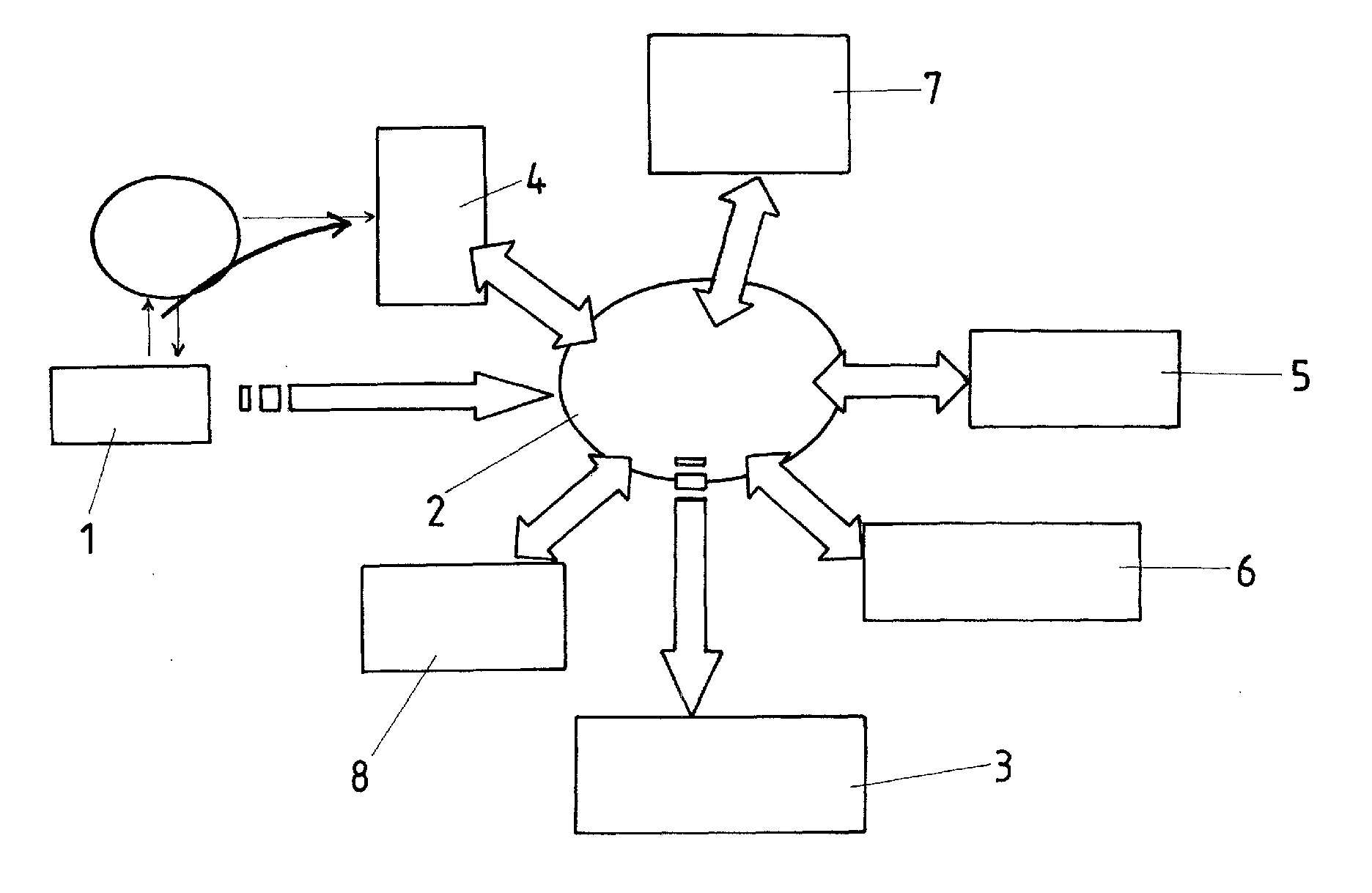
L'invention sera mieux comprise grâce à la description ci-après, qui se rapporte à un mode de réalisation préféré, donné à titre d'exemple non limitatif, et expliqué avec référence au dessin schématique annexé, dans lequel la figure unique représente de manière synoptique une possible réalisation d'un dispositif de signalisation selon l'invention, mettant en oeuvre le procédé décrit précédemment.The invention will be better understood thanks to the description below, which relates to a preferred embodiment, given by way of example non-limiting, and explained with reference to the attached schematic drawing, in which the single figure represents in a synoptic way a possible realization of a signaling device according to the invention, putting in implements the process described above.
A l'aide de la figure annexée, on procède ci-après à la description détaillée d'un exemple de mise en oeuvre du procédé selon l'invention dans le cas d'un téléphone mobile.Using the appended figure, the following is carried out: detailed description of an example of implementation of the method according to the invention in the case of a mobile telephone.
Lorsque ce dernier reçoit un nouvel appel ou un nouveau
message ou courrier électronique, l'identité de l'émetteur (personne
appelante ou émetteur du courrier) est tout d'abord déterminée par un
moyen 1 ou par une opération adaptée, du module de sélection
dynamique 2.When the latter receives a new call or a new
message or email, the identity of the sender (person
is primarily determined by a
means 1 or by an adapted operation, of the
Il est ensuite procédé à une modification du fichier historique 4
par incrémentation d'une variable N_call affectée audit émetteur et dont la
valeur correspond au nombre d'appels et/ou de messages de la part dudit
émetteur restés sans réponse de la part de l'utilisateur/destinataire.A modification is then made to the
Une structure possible d'un tel fichier historique est indiquée
sous forme de tableau ci-après.
La variable N_call est réinitialisée à 0 lorsque l'utilisateur prend l'appel ou répond à l'émetteur par un appel en retour différé ou en lui adressant un message en retour. The variable N_call is reset to 0 when the user takes the call or responds to the sender with or through a deferred return call sending a return message.
Le fichier historique 4 peut être avantageusement consulté par
l'utilisateur. Ainsi, ce dernier a la possibilité de savoir quelle personne a
essayé de le joindre pendant qu'il était, par exemple, dans une situation
correspondant à un niveau d'avertissement faible et qu'il n'a pas pu prendre
connaissance de l'appel ou du message reçu pendant cette période (soit
parce que son attention n'a pas été suffisamment attirée, soit parce qu'il a
décidé volontairement de ne pas y donner suite).The
Lorsque le numéro ou l'adresse électronique de l'émetteur a été
transmis(e) au module de sélection 2, ce dernier commence une phase de
traitement en consultant tout d'abord le fichier historique 4 (pour connaítre
le nombre d'appels ou de messages restés sans réponse pour cet émetteur),
puis en consultant le fichier 7 indiquant la situation ou l'état courant(e) de
l'utilisateur en fonction des dernières indications programmées par ce
dernier.When the issuer's number or email address has been
transmitted to
Il convient de noter que l'utilisateur peut, bien entendu, définir de nouvelles situations ou de nouveaux états.It should be noted that the user can, of course, define new situations or new states.
Ensuite, le module de sélection 2 consulte le fichier 5
d'affectation de degrés de priorité d'importance ou de préférence à des
émetteurs donnés, correspondant à la situation ou à l'état courant(e) de
l'utilisateur.Then, the
Ce fichier 5 détermine pour quels émetteurs il y a lieu de tenir
compte du nombre d'appels ou de messages restés sans réponse, avec une
adaptation correspondante des moyens et du mode de signalisation d'un
nouvel appel ou d'un nouveau message à l'utilisateur.This
Cette adaptation peut consister en une sélection de moyens de signalisation et de modes de mise en oeuvre présentant une efficacité d'avertissement croissante en fonction du nombre croissant d'appels ou de messages restés sans réponse. This adaptation may consist of a selection of means of signaling and modes of implementation presenting an efficiency increasing warning based on the increasing number of calls or unanswered messages.
Cette distinction entre les deux types d'émetteurs précités peut, par exemple, être définie par un indicateur booléen dénommé To_increment.This distinction between the two types of aforementioned transmitters can, for example, be defined by a boolean flag called To_increment.
En fonction de l'état de cet indicateur (VRAI ou FAUX), une variable Nb_limit, indiquant le seuil de passage d'un degré ou niveau d'avertissement au degré d'avertissement suivant, sera affectée à l'émetteur concerné (To_increment = VRAI), ou alors un champ default_Ev indiquant directement et de manière prédéfinie (statique) le degré d'avertissement attribué de manière fixe à l'émetteur concerné, ce quel que soit le nombre d'appels ou de messages sans réponse (To_increment = FAUX).Depending on the state of this indicator (TRUE or FALSE), a variable Nb_limit, indicating the threshold for passing a degree or level warning at the next warning level, will be assigned to the transmitter concerned (To_increment = TRUE), or a default_Ev field indicating directly and predefined (static) the degree of warning fixedly assigned to the issuer concerned, regardless of the number unanswered calls or messages (To_increment = FALSE).
Une structure possible du fichier 5 est représentée sous forme
de tableau ci-après :
Sur la base de ces informations, le module de sélection 2 est apte à calculer le degré d'avertissement (Ev) pour l'appel ou le message en instance. Ce calcul peut, par exemple, être effectué sur la base de la suite d'opérations algorythmiques suivantes :
- si To_increment = VRAI, alors Ev = E(N_call/Nb_limit) ;
- sinon Ev = default_Ev.
- if To_increment = TRUE, then Ev = E (N_call / Nb_limit);
- otherwise Ev = default_Ev.
Après consultation de ce fichier, le module de sélection 2 sait
exactement comment avertir l'utilisateur.After consulting this file, the
Toutefois, avant d'activer le moyen de signalisation 3
sélectionné, ledit module 2 peut consulter un fichier 8 contenant des valeurs
de paramètres liés à l'environnement et, en fonction des informations lues,
ledit module 2 peut modifier les caractéristiques de mise en oeuvre du ou
des moyens de signalisation sélectionnés.However, before activating the signaling means 3
selected, said
En conséquence, l'utilisateur est averti avec le moyen de signalisation et selon le mode d'avertissement les mieux appropriés aux circonstances courantes définies par les différents paramètres précités.Consequently, the user is warned with the means of signaling and according to the mode of warning best suited to current circumstances defined by the various parameters mentioned above.
Grâce à l'invention, il est donc possible d'améliorer le confort d'utilisation d'un terminal récepteur, en permettant de réduire les inconvénients liés à des modes d'avertissement trop dérangeants, notamment en fonction de la situation de l'utilisateur, mais en évitant simultanément de négliger un mode d'avertissement efficient dans le cas d'un appel ou d'un message pouvant se révéler important ou urgent (par exemple appel ou message répétés fréquemment).Thanks to the invention, it is therefore possible to improve comfort use of a receiving terminal, by reducing the disadvantages of overly disturbing warning modes, especially depending on the user's situation, but avoiding simultaneously to neglect an efficient warning mode in the case a call or a message that may be important or urgent (for example example call or message repeated frequently).
En outre, l'invention permet d'automatiser le filtrage d'appel, en limitant l'intervention de l'utilisateur. Ce filtrage peut, en outre, être adapté de manière souple à différentes circonstances et situations en prenant en compte un nombre plus ou moins élevé de paramètres liés à l'émetteur ou programmés par l'utilisateur.In addition, the invention makes it possible to automate call screening, in limiting user intervention. This filtering can, moreover, be adapted flexibly to different circumstances and situations taking into account has a greater or lesser number of parameters linked to the transmitter or programmed by the user.
Par ailleurs, il convient de noter que le procédé et le dispositif
de signalisation selon l'invention pourront être mis en oeuvre dans différents
appareils faisant partie d'un réseau de communication.
Ainsi, l'invention concerne également, d'une part, un terminal mobile de
radiocommunication adapté pour une connexion avec un réseau de
communication et, d'autre part, un autocommutateur ou un appareil de
mise en communication analogue, caractérisés en ce qu'ils comportent un
dispositif de signalisation et en ce qu'ils mettent en oeuvre un procédé de
signalisation, tels que décrits ci-dessus.Furthermore, it should be noted that the signaling method and device according to the invention can be implemented in different devices forming part of a communication network.
Thus, the invention also relates, on the one hand, to a mobile radiocommunication terminal suitable for connection with a communication network and, on the other hand, to an automatic switch or a similar communication establishment device, characterized in that they include a signaling device and in that they implement a signaling method, as described above.
Enfin, l'invention porte aussi sur un réseau de communication comprenant notamment au moins un contrôleur de réseau et une pluralité de stations de base, caractérisé en ce que ledit contrôleur de réseau comporte un dispositif et en ce qu'il met en oeuvre un procédé tels que décrits précédemment.Finally, the invention also relates to a communication network comprising in particular at least one network controller and a plurality of base stations, characterized in that said network controller includes a device and in that it implements a method such as described previously.
Bien entendu, l'invention n'est pas limitée au mode de réalisation décrit et représenté au dessin annexé. Des modifications restent possibles, notamment du point de vue de la constitution des divers éléments ou par substitution d'équivalents techniques, sans sortir pour autant du domaine de protection de l'invention.Of course, the invention is not limited to the mode of realization described and represented in the appended drawing. Changes remain possible, especially from the point of view of the constitution of the various elements or by substituting technical equivalents, without however leaving the protection field of the invention.
Claims (13)
Applications Claiming Priority (2)
| Application Number | Priority Date | Filing Date | Title |
|---|---|---|---|
| FR0102389 | 2001-02-22 | ||
| FR0102389A FR2821226B1 (en) | 2001-02-22 | 2001-02-22 | METHOD AND DEVICE FOR SIGNALING A CALL OR MESSAGE TO ITS ADDRESSEE |
Publications (2)
| Publication Number | Publication Date |
|---|---|
| EP1237346A1 true EP1237346A1 (en) | 2002-09-04 |
| EP1237346B1 EP1237346B1 (en) | 2005-11-23 |
Family
ID=8860299
Family Applications (1)
| Application Number | Title | Priority Date | Filing Date |
|---|---|---|---|
| EP02290250A Expired - Lifetime EP1237346B1 (en) | 2001-02-22 | 2002-02-04 | Method and device for signalling a call or a message to its recipient |
Country Status (7)
| Country | Link |
|---|---|
| US (1) | US7092700B2 (en) |
| EP (1) | EP1237346B1 (en) |
| JP (1) | JP2002300232A (en) |
| AT (1) | ATE311069T1 (en) |
| DE (1) | DE60207461T2 (en) |
| ES (1) | ES2250596T3 (en) |
| FR (1) | FR2821226B1 (en) |
Families Citing this family (11)
| Publication number | Priority date | Publication date | Assignee | Title |
|---|---|---|---|---|
| US7421661B1 (en) | 2002-04-30 | 2008-09-02 | Aol Llc | Instant messaging interface having an informational tool tip |
| US7281215B1 (en) * | 2002-04-30 | 2007-10-09 | Aol Llc | IM conversation counter and indicator |
| US7127685B2 (en) * | 2002-04-30 | 2006-10-24 | America Online, Inc. | Instant messaging interface having a tear-off element |
| DE10233459A1 (en) * | 2002-07-24 | 2004-02-05 | Agere Systems, Inc. | Call memory device |
| GB0307399D0 (en) * | 2003-03-31 | 2003-05-07 | British Telecomm | Sensory output devices |
| US20050033852A1 (en) * | 2003-07-14 | 2005-02-10 | Jouko Tenhunen | System, apparatus, and method for providing presence boosted message service reports |
| US7742586B1 (en) | 2004-06-14 | 2010-06-22 | Callwave, Inc. | Enhanced service levels for call-processing services |
| US8000455B1 (en) * | 2004-12-09 | 2011-08-16 | Callwave, Inc. | Methods and systems for call processing |
| US20070099601A1 (en) * | 2005-10-28 | 2007-05-03 | Tzung-Shian Yang | Method of varying the behavior of a mobile phone based on unhandled events on the mobile phone |
| FR2897496A1 (en) * | 2006-02-15 | 2007-08-17 | France Telecom | MANAGING COMMUNICATION BETWEEN A TELECOMMUNICATIONS SYSTEM AND A SERVER |
| US9461845B2 (en) | 2006-11-21 | 2016-10-04 | At&T Intellectual Property I, L.P. | Methods and apparatus to provide voice communication error notifications |
Citations (3)
| Publication number | Priority date | Publication date | Assignee | Title |
|---|---|---|---|---|
| WO1998005151A1 (en) * | 1996-07-29 | 1998-02-05 | Yozmot 33 Ltd. | Telephone identification calling apparatus and procedures |
| GB2324933A (en) * | 1997-03-18 | 1998-11-04 | Matsushita Electric Industrial Co Ltd | Radio communication apparatus having a plurality of functions |
| US5870684A (en) * | 1995-12-29 | 1999-02-09 | Nec Corporation | Radio communication apparatus with adjustable alert tone |
Family Cites Families (17)
| Publication number | Priority date | Publication date | Assignee | Title |
|---|---|---|---|---|
| US5557605A (en) * | 1994-11-03 | 1996-09-17 | Motorola, Inc. | Method for providing caller data in a time division multiplexed wireless communication system |
| US6018671A (en) * | 1995-12-29 | 2000-01-25 | Motorola, Inc. | Silent call accept |
| US5905794A (en) * | 1996-10-15 | 1999-05-18 | Multi-Tech Systems, Inc. | Caller identification interface using line reversal detection |
| JP3186643B2 (en) * | 1997-05-08 | 2001-07-11 | 日本電気株式会社 | Wireless device comprising a charger and a charger and a portable wireless device |
| US5995603A (en) * | 1997-05-23 | 1999-11-30 | At&T Corp | Telephone call screening device |
| US6334053B1 (en) * | 1998-03-25 | 2001-12-25 | Nokia Networks Oy | Procedure and system for providing an answering service |
| US6198812B1 (en) * | 1998-09-23 | 2001-03-06 | Effectrol Patent Trust | Incoming telephone call filter utilizing a duplicitous caller-ID recognition method and apparatus |
| US6549619B1 (en) * | 1999-12-01 | 2003-04-15 | Qwest Communications International Inc. | Method for screening calls |
| US6353663B1 (en) * | 1999-12-06 | 2002-03-05 | Alcatel Usa Sourcing, Lp | Method and apparatus for screening telephone calls |
| JP4167785B2 (en) * | 2000-01-07 | 2008-10-22 | 株式会社日立製作所 | Mobile phone |
| US6748068B1 (en) * | 2000-03-27 | 2004-06-08 | Sbc Properties, L.P. | Method and system for providing enhanced caller identification information |
| US6842622B2 (en) * | 2001-06-28 | 2005-01-11 | International Business Machines Corporation | User interface using speech generation to answer cellular phones |
| US6618473B1 (en) * | 2001-07-06 | 2003-09-09 | Dasym Technologies, Inc. | Telephone caller screening device |
| US20030032415A1 (en) * | 2001-08-13 | 2003-02-13 | Cho Han S. | Voice announced caller identification features and methods therefor |
| US20030078081A1 (en) * | 2001-10-19 | 2003-04-24 | Schmier Kenneth J. | Call announcement system and method |
| US20030096639A1 (en) * | 2001-11-16 | 2003-05-22 | Cluff Dean K. | Distinctive recordable ringer |
| US20040176083A1 (en) * | 2003-02-25 | 2004-09-09 | Motorola, Inc. | Method and system for reducing distractions of mobile device users |
-
2001
- 2001-02-22 FR FR0102389A patent/FR2821226B1/en not_active Expired - Fee Related
-
2002
- 2002-02-04 AT AT02290250T patent/ATE311069T1/en not_active IP Right Cessation
- 2002-02-04 DE DE60207461T patent/DE60207461T2/en not_active Expired - Fee Related
- 2002-02-04 EP EP02290250A patent/EP1237346B1/en not_active Expired - Lifetime
- 2002-02-04 ES ES02290250T patent/ES2250596T3/en not_active Expired - Lifetime
- 2002-02-12 US US10/072,947 patent/US7092700B2/en not_active Expired - Lifetime
- 2002-02-18 JP JP2002039620A patent/JP2002300232A/en active Pending
Patent Citations (3)
| Publication number | Priority date | Publication date | Assignee | Title |
|---|---|---|---|---|
| US5870684A (en) * | 1995-12-29 | 1999-02-09 | Nec Corporation | Radio communication apparatus with adjustable alert tone |
| WO1998005151A1 (en) * | 1996-07-29 | 1998-02-05 | Yozmot 33 Ltd. | Telephone identification calling apparatus and procedures |
| GB2324933A (en) * | 1997-03-18 | 1998-11-04 | Matsushita Electric Industrial Co Ltd | Radio communication apparatus having a plurality of functions |
Also Published As
| Publication number | Publication date |
|---|---|
| US7092700B2 (en) | 2006-08-15 |
| FR2821226B1 (en) | 2003-06-20 |
| DE60207461D1 (en) | 2005-12-29 |
| FR2821226A1 (en) | 2002-08-23 |
| EP1237346B1 (en) | 2005-11-23 |
| JP2002300232A (en) | 2002-10-11 |
| DE60207461T2 (en) | 2006-07-27 |
| ATE311069T1 (en) | 2005-12-15 |
| US20020160819A1 (en) | 2002-10-31 |
| ES2250596T3 (en) | 2006-04-16 |
Similar Documents
| Publication | Publication Date | Title |
|---|---|---|
| US8565397B2 (en) | Source audio identifiers for digital communications | |
| EP1237346B1 (en) | Method and device for signalling a call or a message to its recipient | |
| EP1610510B1 (en) | Wireless access control to telematics and voice services | |
| FR2729037A1 (en) | METHOD AND APPARATUS FOR SELECTING PERSONAL ATTRIBUTES HAVING DELAY MANAGEMENT | |
| WO2004068809A1 (en) | Method of presenting the status of a user using several communication devices | |
| US20060025159A1 (en) | System and method for context-based notification of a received transmission | |
| FR2821222A1 (en) | ANONYMOUS COMMUNICATION ESTABLISHMENT METHOD | |
| EP1457028B1 (en) | Method and system for multiple-channel automatic recall | |
| US8331539B2 (en) | Method and system for representing the attributes of an incoming call | |
| FR2729036A1 (en) | METHOD AND APPARATUS FOR SELECTING AND MANAGING PERSONAL ATTRIBUTES USING PREDICTION | |
| FR2835143A1 (en) | METHOD FOR SENDING AN "SMS" MESSAGE AND CORRESPONDING RADIO COMMUNICATION TERMINAL | |
| FR2811465A1 (en) | DEVICE AND METHOD FOR MODULATING THE BACKLIGHT OF A SELF-CONTAINED APPARATUS | |
| FR3071126A1 (en) | METHOD FOR TELEPHONE CONNECTION OF A MULTI-NUMBER COMMUNICATION TERMINAL | |
| EP1457031B1 (en) | Method and system for automatic telephone call forwarding | |
| EP1457027B1 (en) | Method and system for providing an intelligent directory service | |
| WO2022136775A1 (en) | Method for processing a request to set up a call | |
| FR2847753A1 (en) | Electronic mail server access controlling device for telecommunication network, has update module that communicates with control module recovering message transmission requests to update quota based on messages sent by users | |
| FR3102635A1 (en) | Method for processing an outgoing call sent by a communication terminal and terminal implementing this method. | |
| FR2662278A1 (en) | STRUCTURE OF A DATA PROCESSING AUTOMATON. | |
| EP2375718A1 (en) | Method for replying to a message received in a user terminal via a messaging application on a communications network | |
| FR2807607A1 (en) | INSTANTANEOUS DISPLAY OF MESSAGES MADE BY MOBILE TELEPHONE | |
| EP3476110A1 (en) | Method and device for processing a multimedia object | |
| EP2007119A1 (en) | System and method of managing the identification of the operator of the call number of a correspondent in the terminal of a computer | |
| FR2849978A1 (en) | Telephone call optional process/service activating and/or inhibiting system, has modification unit for modifying registered options in information storing unit for subscriber based on information acquired by acquisition unit | |
| EP2245839A1 (en) | Method for enrichment of an electronic directory triggered by a change in the associated telephone, and related device |
Legal Events
| Date | Code | Title | Description |
|---|---|---|---|
| PUAI | Public reference made under article 153(3) epc to a published international application that has entered the european phase |
Free format text: ORIGINAL CODE: 0009012 |
|
| AK | Designated contracting states |
Kind code of ref document: A1 Designated state(s): AT BE CH CY DE DK ES FI FR GB GR IE IT LI LU MC NL PT SE TR |
|
| AX | Request for extension of the european patent |
Free format text: AL;LT;LV;MK;RO;SI |
|
| 17P | Request for examination filed |
Effective date: 20030304 |
|
| AKX | Designation fees paid |
Designated state(s): AT BE CH CY DE DK ES FI FR GB GR IE IT LI LU MC NL PT SE TR |
|
| 17Q | First examination report despatched |
Effective date: 20040816 |
|
| GRAP | Despatch of communication of intention to grant a patent |
Free format text: ORIGINAL CODE: EPIDOSNIGR1 |
|
| GRAS | Grant fee paid |
Free format text: ORIGINAL CODE: EPIDOSNIGR3 |
|
| GRAA | (expected) grant |
Free format text: ORIGINAL CODE: 0009210 |
|
| AK | Designated contracting states |
Kind code of ref document: B1 Designated state(s): AT BE CH CY DE DK ES FI FR GB GR IE IT LI LU MC NL PT SE TR |
|
| PG25 | Lapsed in a contracting state [announced via postgrant information from national office to epo] |
Ref country code: AT Free format text: LAPSE BECAUSE OF FAILURE TO SUBMIT A TRANSLATION OF THE DESCRIPTION OR TO PAY THE FEE WITHIN THE PRESCRIBED TIME-LIMIT Effective date: 20051123 Ref country code: IE Free format text: LAPSE BECAUSE OF FAILURE TO SUBMIT A TRANSLATION OF THE DESCRIPTION OR TO PAY THE FEE WITHIN THE PRESCRIBED TIME-LIMIT Effective date: 20051123 Ref country code: NL Free format text: LAPSE BECAUSE OF FAILURE TO SUBMIT A TRANSLATION OF THE DESCRIPTION OR TO PAY THE FEE WITHIN THE PRESCRIBED TIME-LIMIT Effective date: 20051123 Ref country code: FI Free format text: LAPSE BECAUSE OF FAILURE TO SUBMIT A TRANSLATION OF THE DESCRIPTION OR TO PAY THE FEE WITHIN THE PRESCRIBED TIME-LIMIT Effective date: 20051123 |
|
| REG | Reference to a national code |
Ref country code: GB Ref legal event code: FG4D Free format text: NOT ENGLISH |
|
| REG | Reference to a national code |
Ref country code: CH Ref legal event code: EP |
|
| REF | Corresponds to: |
Ref document number: 60207461 Country of ref document: DE Date of ref document: 20051229 Kind code of ref document: P |
|
| REG | Reference to a national code |
Ref country code: IE Ref legal event code: FG4D Free format text: LANGUAGE OF EP DOCUMENT: FRENCH |
|
| GBT | Gb: translation of ep patent filed (gb section 77(6)(a)/1977) |
Effective date: 20060126 |
|
| PG25 | Lapsed in a contracting state [announced via postgrant information from national office to epo] |
Ref country code: GR Free format text: LAPSE BECAUSE OF FAILURE TO SUBMIT A TRANSLATION OF THE DESCRIPTION OR TO PAY THE FEE WITHIN THE PRESCRIBED TIME-LIMIT Effective date: 20060223 Ref country code: SE Free format text: LAPSE BECAUSE OF FAILURE TO SUBMIT A TRANSLATION OF THE DESCRIPTION OR TO PAY THE FEE WITHIN THE PRESCRIBED TIME-LIMIT Effective date: 20060223 Ref country code: DK Free format text: LAPSE BECAUSE OF FAILURE TO SUBMIT A TRANSLATION OF THE DESCRIPTION OR TO PAY THE FEE WITHIN THE PRESCRIBED TIME-LIMIT Effective date: 20060223 |
|
| PG25 | Lapsed in a contracting state [announced via postgrant information from national office to epo] |
Ref country code: LU Free format text: LAPSE BECAUSE OF NON-PAYMENT OF DUE FEES Effective date: 20060228 Ref country code: BE Free format text: LAPSE BECAUSE OF NON-PAYMENT OF DUE FEES Effective date: 20060228 Ref country code: MC Free format text: LAPSE BECAUSE OF NON-PAYMENT OF DUE FEES Effective date: 20060228 Ref country code: LI Free format text: LAPSE BECAUSE OF NON-PAYMENT OF DUE FEES Effective date: 20060228 Ref country code: CH Free format text: LAPSE BECAUSE OF NON-PAYMENT OF DUE FEES Effective date: 20060228 |
|
| PGFP | Annual fee paid to national office [announced via postgrant information from national office to epo] |
Ref country code: IT Payment date: 20060228 Year of fee payment: 5 |
|
| REG | Reference to a national code |
Ref country code: ES Ref legal event code: FG2A Ref document number: 2250596 Country of ref document: ES Kind code of ref document: T3 |
|
| PG25 | Lapsed in a contracting state [announced via postgrant information from national office to epo] |
Ref country code: PT Free format text: LAPSE BECAUSE OF FAILURE TO SUBMIT A TRANSLATION OF THE DESCRIPTION OR TO PAY THE FEE WITHIN THE PRESCRIBED TIME-LIMIT Effective date: 20060424 |
|
| NLV1 | Nl: lapsed or annulled due to failure to fulfill the requirements of art. 29p and 29m of the patents act | ||
| REG | Reference to a national code |
Ref country code: IE Ref legal event code: FD4D |
|
| PLBE | No opposition filed within time limit |
Free format text: ORIGINAL CODE: 0009261 |
|
| STAA | Information on the status of an ep patent application or granted ep patent |
Free format text: STATUS: NO OPPOSITION FILED WITHIN TIME LIMIT |
|
| REG | Reference to a national code |
Ref country code: CH Ref legal event code: PL |
|
| 26N | No opposition filed |
Effective date: 20060824 |
|
| PGFP | Annual fee paid to national office [announced via postgrant information from national office to epo] |
Ref country code: DE Payment date: 20070216 Year of fee payment: 6 Ref country code: GB Payment date: 20070216 Year of fee payment: 6 |
|
| PGFP | Annual fee paid to national office [announced via postgrant information from national office to epo] |
Ref country code: ES Payment date: 20070227 Year of fee payment: 6 |
|
| REG | Reference to a national code |
Ref country code: FR Ref legal event code: CD |
|
| BERE | Be: lapsed |
Owner name: ALCATEL Effective date: 20060228 |
|
| PGFP | Annual fee paid to national office [announced via postgrant information from national office to epo] |
Ref country code: FR Payment date: 20070212 Year of fee payment: 6 |
|
| PG25 | Lapsed in a contracting state [announced via postgrant information from national office to epo] |
Ref country code: TR Free format text: LAPSE BECAUSE OF FAILURE TO SUBMIT A TRANSLATION OF THE DESCRIPTION OR TO PAY THE FEE WITHIN THE PRESCRIBED TIME-LIMIT Effective date: 20051123 |
|
| GBPC | Gb: european patent ceased through non-payment of renewal fee |
Effective date: 20080204 |
|
| PG25 | Lapsed in a contracting state [announced via postgrant information from national office to epo] |
Ref country code: CY Free format text: LAPSE BECAUSE OF FAILURE TO SUBMIT A TRANSLATION OF THE DESCRIPTION OR TO PAY THE FEE WITHIN THE PRESCRIBED TIME-LIMIT Effective date: 20051123 |
|
| REG | Reference to a national code |
Ref country code: FR Ref legal event code: ST Effective date: 20081031 |
|
| PG25 | Lapsed in a contracting state [announced via postgrant information from national office to epo] |
Ref country code: DE Free format text: LAPSE BECAUSE OF NON-PAYMENT OF DUE FEES Effective date: 20080902 |
|
| PG25 | Lapsed in a contracting state [announced via postgrant information from national office to epo] |
Ref country code: FR Free format text: LAPSE BECAUSE OF NON-PAYMENT OF DUE FEES Effective date: 20080229 |
|
| REG | Reference to a national code |
Ref country code: ES Ref legal event code: FD2A Effective date: 20080205 |
|
| PG25 | Lapsed in a contracting state [announced via postgrant information from national office to epo] |
Ref country code: GB Free format text: LAPSE BECAUSE OF NON-PAYMENT OF DUE FEES Effective date: 20080204 |
|
| PG25 | Lapsed in a contracting state [announced via postgrant information from national office to epo] |
Ref country code: ES Free format text: LAPSE BECAUSE OF NON-PAYMENT OF DUE FEES Effective date: 20080205 |
|
| PG25 | Lapsed in a contracting state [announced via postgrant information from national office to epo] |
Ref country code: IT Free format text: LAPSE BECAUSE OF NON-PAYMENT OF DUE FEES Effective date: 20070204 |