EP1236785A2 - Liquid crystal composition, liquid crystal display device and liquid crystal displaying method - Google Patents
Liquid crystal composition, liquid crystal display device and liquid crystal displaying method Download PDFInfo
- Publication number
- EP1236785A2 EP1236785A2 EP02003898A EP02003898A EP1236785A2 EP 1236785 A2 EP1236785 A2 EP 1236785A2 EP 02003898 A EP02003898 A EP 02003898A EP 02003898 A EP02003898 A EP 02003898A EP 1236785 A2 EP1236785 A2 EP 1236785A2
- Authority
- EP
- European Patent Office
- Prior art keywords
- liquid crystal
- liquid
- state
- crystalline compound
- regulating agent
- Prior art date
- Legal status (The legal status is an assumption and is not a legal conclusion. Google has not performed a legal analysis and makes no representation as to the accuracy of the status listed.)
- Granted
Links
- 239000004973 liquid crystal related substance Substances 0.000 title claims abstract description 346
- 239000000203 mixture Substances 0.000 title claims abstract description 93
- 238000000034 method Methods 0.000 title claims abstract description 12
- 150000001875 compounds Chemical class 0.000 claims abstract description 168
- 239000007788 liquid Substances 0.000 claims abstract description 150
- 239000003795 chemical substances by application Substances 0.000 claims abstract description 80
- 239000012071 phase Substances 0.000 claims abstract description 62
- 230000005684 electric field Effects 0.000 claims abstract description 44
- 230000007704 transition Effects 0.000 claims abstract description 35
- 230000000694 effects Effects 0.000 claims abstract description 28
- 239000007791 liquid phase Substances 0.000 claims abstract description 27
- 230000001105 regulatory effect Effects 0.000 claims abstract description 11
- 229910052739 hydrogen Inorganic materials 0.000 claims description 17
- 239000001257 hydrogen Substances 0.000 claims description 17
- 238000001816 cooling Methods 0.000 claims description 8
- 125000002947 alkylene group Chemical group 0.000 claims description 5
- 125000004435 hydrogen atom Chemical group [H]* 0.000 claims description 2
- 125000000962 organic group Chemical group 0.000 claims description 2
- 230000000717 retained effect Effects 0.000 abstract description 17
- 239000000758 substrate Substances 0.000 description 16
- 238000000149 argon plasma sintering Methods 0.000 description 10
- YMWUJEATGCHHMB-UHFFFAOYSA-N Dichloromethane Chemical compound ClCCl YMWUJEATGCHHMB-UHFFFAOYSA-N 0.000 description 6
- 238000002834 transmittance Methods 0.000 description 4
- 239000000463 material Substances 0.000 description 3
- 239000000126 substance Substances 0.000 description 3
- 239000012780 transparent material Substances 0.000 description 3
- 125000004432 carbon atom Chemical group C* 0.000 description 2
- 238000011156 evaluation Methods 0.000 description 2
- 239000011521 glass Substances 0.000 description 2
- OXPDQFOKSZYEMJ-UHFFFAOYSA-N 2-phenylpyrimidine Chemical class C1=CC=CC=C1C1=NC=CC=N1 OXPDQFOKSZYEMJ-UHFFFAOYSA-N 0.000 description 1
- 239000004990 Smectic liquid crystal Substances 0.000 description 1
- 239000011248 coating agent Substances 0.000 description 1
- 238000000576 coating method Methods 0.000 description 1
- IGARGHRYKHJQSM-UHFFFAOYSA-N cyclohexylbenzene Chemical class C1CCCCC1C1=CC=CC=C1 IGARGHRYKHJQSM-UHFFFAOYSA-N 0.000 description 1
- WVIIMZNLDWSIRH-UHFFFAOYSA-N cyclohexylcyclohexane Chemical class C1CCCCC1C1CCCCC1 WVIIMZNLDWSIRH-UHFFFAOYSA-N 0.000 description 1
- ZUOUZKKEUPVFJK-UHFFFAOYSA-N diphenyl Chemical class C1=CC=CC=C1C1=CC=CC=C1 ZUOUZKKEUPVFJK-UHFFFAOYSA-N 0.000 description 1
- 238000002296 dynamic light scattering Methods 0.000 description 1
- 238000001704 evaporation Methods 0.000 description 1
- 239000003349 gelling agent Substances 0.000 description 1
- 238000010438 heat treatment Methods 0.000 description 1
- 239000002184 metal Substances 0.000 description 1
- 239000011347 resin Substances 0.000 description 1
- 229920005989 resin Polymers 0.000 description 1
Images
Classifications
-
- C—CHEMISTRY; METALLURGY
- C09—DYES; PAINTS; POLISHES; NATURAL RESINS; ADHESIVES; COMPOSITIONS NOT OTHERWISE PROVIDED FOR; APPLICATIONS OF MATERIALS NOT OTHERWISE PROVIDED FOR
- C09K—MATERIALS FOR MISCELLANEOUS APPLICATIONS, NOT PROVIDED FOR ELSEWHERE
- C09K19/00—Liquid crystal materials
- C09K19/52—Liquid crystal materials characterised by components which are not liquid crystals, e.g. additives with special physical aspect: solvents, solid particles
-
- C—CHEMISTRY; METALLURGY
- C09—DYES; PAINTS; POLISHES; NATURAL RESINS; ADHESIVES; COMPOSITIONS NOT OTHERWISE PROVIDED FOR; APPLICATIONS OF MATERIALS NOT OTHERWISE PROVIDED FOR
- C09K—MATERIALS FOR MISCELLANEOUS APPLICATIONS, NOT PROVIDED FOR ELSEWHERE
- C09K19/00—Liquid crystal materials
- C09K19/02—Liquid crystal materials characterised by optical, electrical or physical properties of the components, in general
-
- C—CHEMISTRY; METALLURGY
- C09—DYES; PAINTS; POLISHES; NATURAL RESINS; ADHESIVES; COMPOSITIONS NOT OTHERWISE PROVIDED FOR; APPLICATIONS OF MATERIALS NOT OTHERWISE PROVIDED FOR
- C09K—MATERIALS FOR MISCELLANEOUS APPLICATIONS, NOT PROVIDED FOR ELSEWHERE
- C09K2323/00—Functional layers of liquid crystal optical display excluding electroactive liquid crystal layer characterised by chemical composition
-
- C—CHEMISTRY; METALLURGY
- C09—DYES; PAINTS; POLISHES; NATURAL RESINS; ADHESIVES; COMPOSITIONS NOT OTHERWISE PROVIDED FOR; APPLICATIONS OF MATERIALS NOT OTHERWISE PROVIDED FOR
- C09K—MATERIALS FOR MISCELLANEOUS APPLICATIONS, NOT PROVIDED FOR ELSEWHERE
- C09K2323/00—Functional layers of liquid crystal optical display excluding electroactive liquid crystal layer characterised by chemical composition
- C09K2323/02—Alignment layer characterised by chemical composition
-
- C—CHEMISTRY; METALLURGY
- C09—DYES; PAINTS; POLISHES; NATURAL RESINS; ADHESIVES; COMPOSITIONS NOT OTHERWISE PROVIDED FOR; APPLICATIONS OF MATERIALS NOT OTHERWISE PROVIDED FOR
- C09K—MATERIALS FOR MISCELLANEOUS APPLICATIONS, NOT PROVIDED FOR ELSEWHERE
- C09K2323/00—Functional layers of liquid crystal optical display excluding electroactive liquid crystal layer characterised by chemical composition
- C09K2323/05—Bonding or intermediate layer characterised by chemical composition, e.g. sealant or spacer
-
- Y—GENERAL TAGGING OF NEW TECHNOLOGICAL DEVELOPMENTS; GENERAL TAGGING OF CROSS-SECTIONAL TECHNOLOGIES SPANNING OVER SEVERAL SECTIONS OF THE IPC; TECHNICAL SUBJECTS COVERED BY FORMER USPC CROSS-REFERENCE ART COLLECTIONS [XRACs] AND DIGESTS
- Y10—TECHNICAL SUBJECTS COVERED BY FORMER USPC
- Y10S—TECHNICAL SUBJECTS COVERED BY FORMER USPC CROSS-REFERENCE ART COLLECTIONS [XRACs] AND DIGESTS
- Y10S516/00—Colloid systems and wetting agents; subcombinations thereof; processes of
- Y10S516/90—Liquid crystal material of, or for, colloid system, e.g. g phase
Definitions
- the present invention relates to a liquid crystal composition, a liquid crystal display device and a liquid crystal displaying method making use of this liquid crystal display device.
- a liquid crystal display device serves to display the intended image by applying an electric field to a liquid crystal layer containing a liquid crystalline compound to control the state of molecular orientation of the liquid crystalline compound in the liquid crystal layer, and those of various systems have heretofore been known.
- the conventional liquid crystal display devices are such that the state of molecular orientation of the liquid crystalline compound is maintained in a state that the effect of the electric field is continued, whereby the displayed state is retained, while the state of molecular orientation of the liquid crystalline compound is not maintained when the effect of the electric field is ceased, whereby the displayed state is dissolved.
- the present invention has been made on the basis of the foregoing circumstances and has as its first object the provision of a liquid crystal composition by which the state of molecular orientation of a liquid crystalline compound can be stably maintained even when no electric field is effected, and moreover the state of molecular orientation of the liquid crystalline compound can be changed.
- the second object of the present invention is to provide a liquid crystal display device by which a displayed state can be stably retained even after the effect of an electric field is ceased, and moreover the displayed state can be dissolved with ease.
- the third object of the present invention is to provide a liquid crystal displaying method by which a displayed state can be stably retained even after the effect of an electric field is ceased, and moreover the displayed state can be dissolved with ease.
- a liquid crystal composition comprising a liquid crystalline compound and a liquid crystal orientation state-regulating agent for regulating the orientated state of the liquid crystalline compound by gelling, wherein a phase transition temperature between an isotropic liquid phase and a liquid crystal phase in the liquid crystalline compound is higher than a gelling temperature by the liquid crystal orientation state-regulating agent.
- the liquid crystal orientation state-regulating agent may preferably be one that forms fibrous aggregates oriented in the same direction as the liquid crystalline compound in a state that the liquid crystalline compound has been oriented in a direction.
- the liquid crystal orientation state-regulating agent may preferably be composed of a compound having at least one group capable of forming an intermolecular hydrogen bond and at least one alkylene group in its molecule.
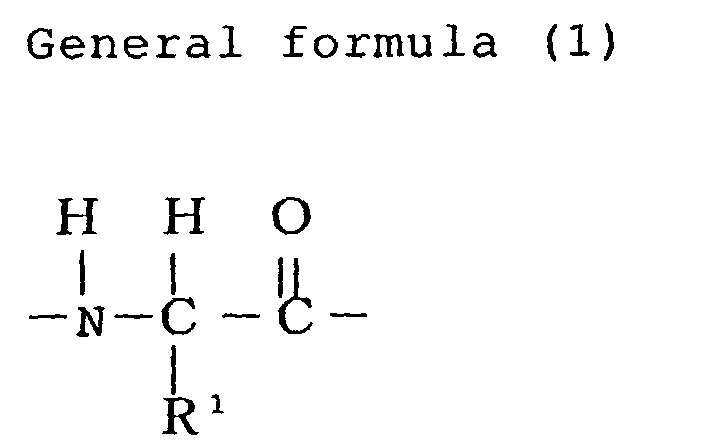
- the liquid crystal orientation state-regulating agent may preferably be composed of a compound having a group represented by the following general formula (1): wherein R 1 means a hydrogen atom or a monovalent organic group.
- the liquid crystal orientation state-regulating agent may preferably be contained in a proportion of 0.05 to 30.0 % by weight based on the total weight of the liquid crystal orientation state-regulating agent and the liquid crystalline compound.
- liquid crystal display device comprising a liquid crystal layer formed of the liquid crystal composition described above.
- a liquid crystal displaying method comprising; cooling a liquid crystal layer formed of the liquid crystal composition described above to a temperature not higher than a phase transition temperature between an isotropic liquid phase and a liquid crystal phase in the liquid crystalline compound in a state that the liquid crystalline compound is in the isotropic liquid phase while causing an electric field to effect on the liquid crystal layer in the thickness-wise direction thereof according to a display pattern, whereby the liquid crystalline compound is transformed from the isotropic liquid phase to the liquid crystal phase;, and cooling the liquid crystal layer in the state of the liquid crystal phase, to a temperature not higher than a gelling temperature by the liquid crystal orientation state-regulating agent, whereby the liquid crystal composition is gelled.
- the liquid crystal composition of the present invention is cooled to a temperature not higher than the phase transition temperature between the isotropic liquid phase and the liquid crystal phase in the liquid crystalline compound in a state heated to a temperature higher than the phase transition temperature while causing an electric field to effect on the liquid crystal composition or without causing an electric field to effect, whereby the state of molecular orientation of the liquid crystalline compound can be controlled.
- the liquid crystal composition is then cooled to a temperature not higher than the gelling temperature by the liquid crystal orientation state-regulating agent, whereby the fluidity of the liquid crystal composition is lost by the liquid crystal orientation state-regulating agent, and the state of molecular orientation of the liquid crystalline compound is regulated, so that the state of molecular orientation of the liquid crystalline compound can be stably retained even after the effect of the electric field is lost.
- the liquid crystal composition is heated again to a temperature higher than the phase transition temperature between the isotropic liquid phase and the liquid crystal phase in the liquid crystalline compound, whereby the liquid crystal composition turns into an optically isotropic liquid, so that the state of molecular orientation of the liquid crystalline compound can be changed.
- the liquid crystal layer which has been heated to a temperature higher than the phase transition temperature between the isotropic liquid phase and the liquid crystal phase in the liquid crystalline compound, is cooled to a temperature not higher than the phase transition temperature while causing an electric field to effect on the liquid crystal layer in the thickness-wise direction thereof according to a display pattern, whereby the liquid crystalline compound is transformed from the isotropic liquid phase to the liquid crystal phase, thereby forming light-transmitting portions and light-scattering portions in the liquid crystal layer to provide the intended display pattern.
- the liquid crystal layer in such a state is then cooled to a temperature not higher than the gelling temperature by the liquid crystal orientation state-regulating agent, thereby gelling the liquid crystal layer so that the display pattern formed in the liquid crystal layer is being fixed.
- the state of molecular orientation of the liquid crystalline compound is regulated by molecules of the liquid crystal orientation state-regulating agent, so that the state of molecular orientation of the liquid crystalline compound remains unchanged even after the effect of the electric field is ceased. Accordingly, the light-transmitting portions and light-scattering portions in the liquid crystal layer are retained as they are, so that the displayed state is stably retained.
- the liquid crystal layer is heated again to a temperature higher than the phase transition temperature between the isotropic liquid phase and the liquid crystal phase in the liquid crystalline compound, whereby the displayed state is dissolved.
- the liquid crystal composition according to the present invention comprises a liquid crystalline compound and a liquid crystal orientation state-regulating agent.
- liquid crystalline compound in the liquid crystal composition according to the present invention may be used various compounds heretofore used in liquid crystal display devices, for example, liquid crystalline compounds such as biphenyl compounds, phenylcyclohexane compounds, phenylpyrimidine compounds and cyclohexylcyclohexane compounds which are described in "Liquid Crystal Device Handbook" edited by No. 142 committee in the Japan Society for the Promotion of Science (1989), pp. 154-192 and pp. 715-722 and exhibit a nematic phase or smectic phase, or mixtures thereof.
- the liquid crystalline compound may be either positive or negative in anisotropy of dielectric constant.
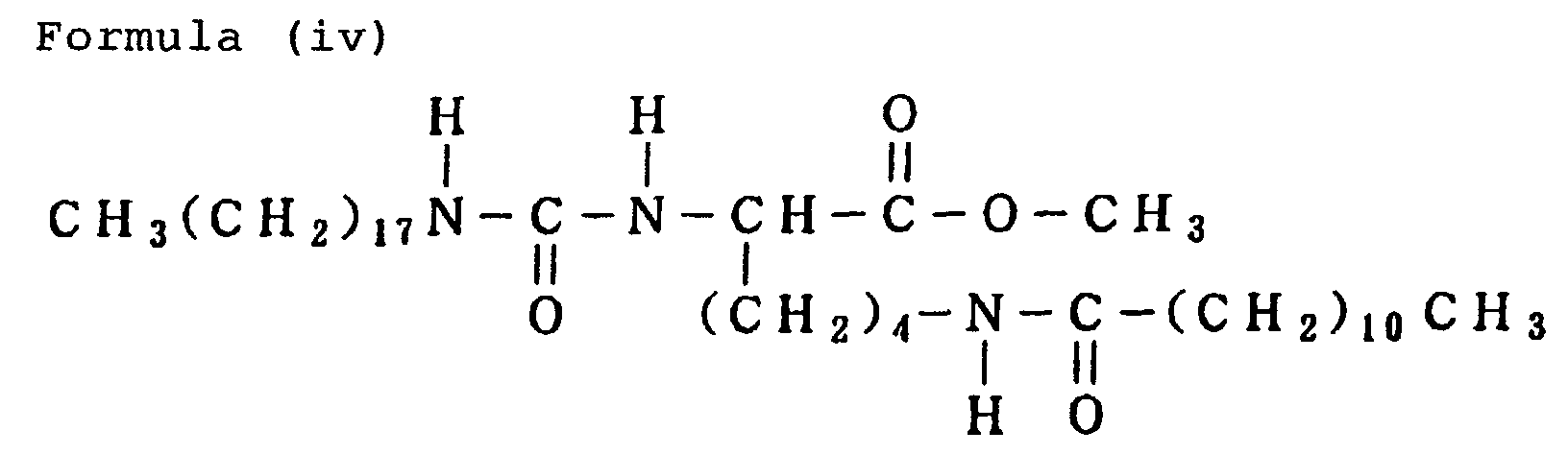
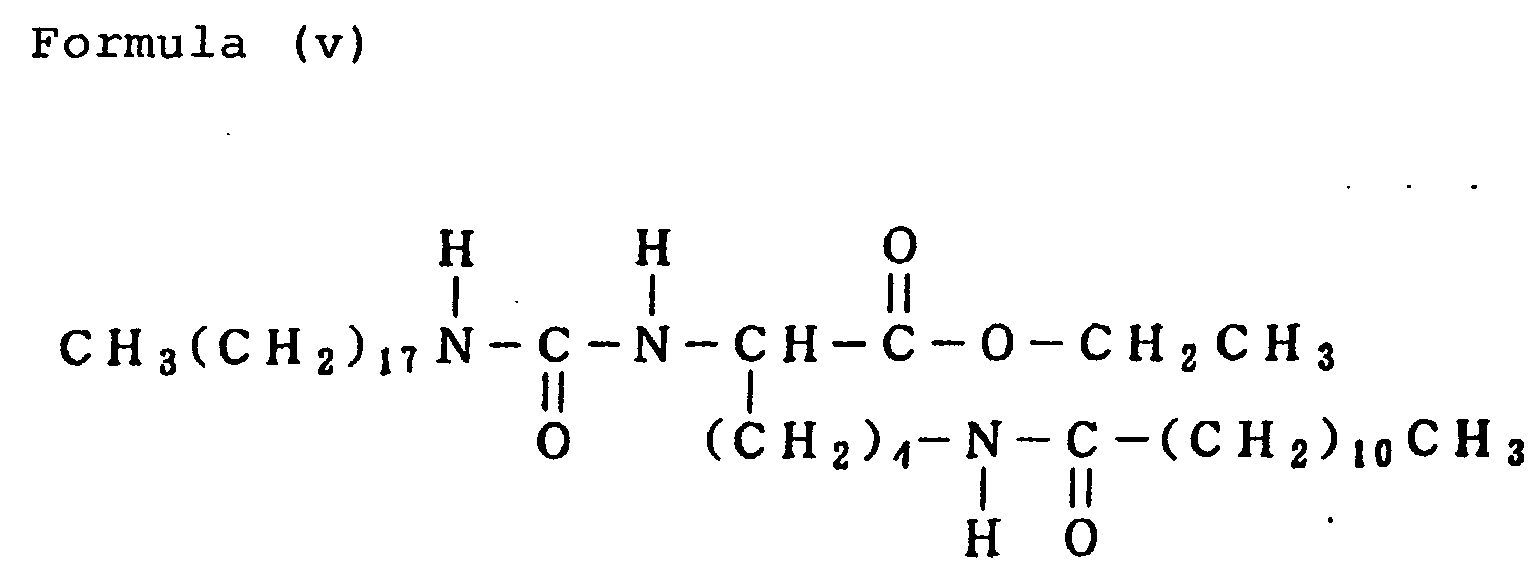
- liquid crystalline compounds may be mentioned compounds represented by the following formulae (i) to (iii) and "E7" and “E63” (products of Merck Co.).
- the liquid crystal orientation state-regulating agent in the liquid crystal composition according to the present invention is a substance having a nature that it is mixed into a liquid crystalline compound, whereby such a mixture is to be gelled, i.e., a substance having a function of gelling the liquid crystal composition, or a substance having a function as a gelling agent, by which the fluidity of the liquid crystal composition is substantially lost by gelling it, whereby the state of molecular orientation of the liquid crystalline compound in the liquid crystal composition is regulated.
- a liquid crystal orientation state-regulating agent is preferably used a compound having at least one group (hereinafter may also be referred to as "hydrogen bond-forming group") capable of forming an intermolecular hydrogen bond and at least one alkylene group in its molecule.
- a compound having at least two hydrogen bond-forming groups and at least two alkylene groups in its molecule is more preferred.
- Such a liquid crystal orientation state-regulating agent forms fibrous aggregates composed of a number of molecules fibrously aggregated by forming a hydrogen bond between molecules, whereby the oriented state of the liquid crystalline compound is regulated, and moreover the whole composition is gelled so that the fluidity of the composition is substantially lost.
- Examples of the hydrogen bond-forming group include an -NHCO- group and other groups composed of a combination of -NH- and -CO-.
- the alkylene group is preferable that having at least 4 carbon atoms, particularly, that having 6 to 20 carbon atoms.
- liquid crystal orientation state-regulating agent is preferably used a compound having a group represented by the general formula (1).
- a compound having 1 to 10 of the group represented by the general formula (1) in its molecule is more preferred, with a compound having 1 to 4 of the group represented by the general formula (1) in its molecule being particularly preferred.
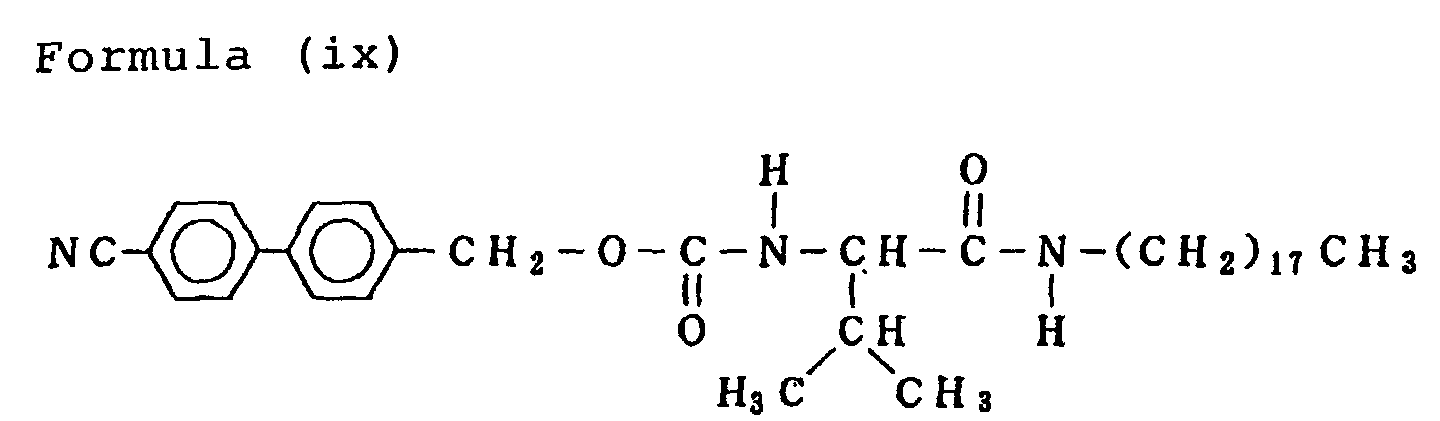
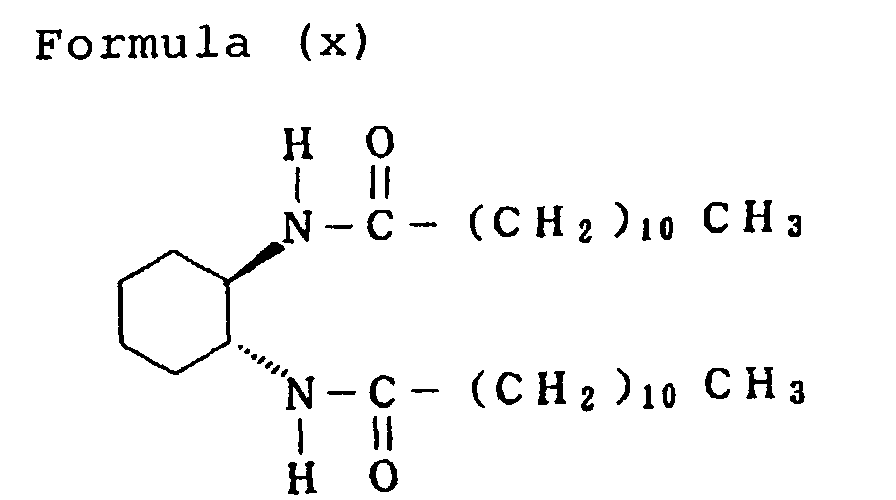
- liquid crystal orientation state-regulating agent examples include compounds represented by the following formulae (vi) to (xi):
- the liquid crystal composition according to the present invention contains such liquid crystalline compound and liquid crystal orientation state-regulating agent. Further, the phase transition temperature between an isotropic liquid phase and a liquid crystal phase in the liquid crystalline compound (hereinafter may also be referred to as "liquid-liquid crystal phase transition temperature”) is higher than the gelling temperature by the liquid crystal orientation state-regulating agent, i.e., the gelling temperature of a mixture of the liquid crystalline compound and the liquid crystal orientation state-regulating agent.
- gelling temperature means a temperature at the time the liquid crystal composition has been transformed from liquid to gel when the liquid crystal composition has been heated to a state that the liquid crystal composition becomes liquid, and the liquid crystal composition in this liquid state has been cooled at a cooling rate of 5°C/min.
- a difference (T 1 - T 2 ) between the liquid-liquid crystal phase transition temperature T 1 and the gelling temperature T 2 by the liquid crystal orientation state-regulating agent is preferably at least 5°C, more preferably 10 to 30°C. If the difference (T 1 - T 2 ) is less than 5°C, a temperature range in which the liquid crystalline compound exhibits a liquid crystal phase, and the whole composition is in a liquid state becomes narrow, so that it may be difficult in some cases to control the state of molecular orientation of the liquid crystalline compound.
- the gelling temperature by the liquid crystal orientation state-regulating agent is suitably selected in such a manner that the liquid crystal composition is in a gel state at normal temperature, and is preferably 30°C or more.
- the proportion of the liquid crystal orientation state-regulating agent contained in the liquid crystal composition according to the present invention varies according to the kind thereof and is preferably 0.05 to 30.0 % by weight, more preferably 0.05 to 10.0 % by weight, still more preferably 0.2 to 5.0 % by weight, particularly preferably 0.2 to 3.0 % by weight based on the total weight of the liquid crystal orientation state-regulating agent and the liquid crystalline compound. If this proportion is lower than 0.05 % by weight, the fluidity of the composition can not be lost enough, so that it may be difficult in some cases to regulate the state of molecular orientation of the liquid crystalline compound. If this proportion exceeds 30.0 % by weight on the other hand, the gelling temperature by the liquid crystal orientation state-regulating agent becomes too high, so that it may be difficult in some cases to control the state of the liquid crystalline compound.
- the liquid crystal orientation state-regulating agent in the liquid crystal composition according to the present invention is preferably one that forms fibrous aggregates oriented in the same direction as the liquid crystalline compound in a state that the liquid crystalline compound in the liquid crystal composition has been oriented in a direction.
- Such a liquid crystal orientation state-regulating agent scarcely affects the state of molecular orientation of the liquid crystalline compound upon gelling of the liquid crystal composition in a state that the liquid crystalline compound has been oriented in a direction.
- the state of molecular orientation of the liquid crystalline compound is more stably retained by the linear aggregates of the liquid crystal orientation state-regulating agent oriented in the same direction as the liquid crystalline compound.
- liquid crystal orientation state-regulating agent forms fibrous aggregates oriented in the same direction as the liquid crystalline compound or not is determined by, for example, its combination with a liquid crystalline compound used.
- specific compositions of the liquid crystalline compound and the liquid crystal orientation state-regulating agent include a combination of the liquid crystalline compound "E63" (product of Merck Co.) with the compound represented by the formula (vi), a combination of the liquid crystalline compound "E63” (product of Merck Co.) with the compound represented by the formula (viii), a combination of the liquid crystalline compound "E63” (product of Merck Co.) with the compound represented by the formula (ix), a combination of the liquid crystalline compound "E63” (product of Merck Co.) with the compound represented by the formula (x) and a combination of a mixture of the liquid crystalline compound represented by the formula (ii) and the liquid crystalline compound represented by the formula (iii) with the compound represented by the formula (vi).
- the present invention is not limited to these combinations.
- the liquid crystal composition according to the present invention comprises the liquid crystalline compound and the liquid crystal orientation state-regulating agent, and the liquid-liquid crystal phase transition temperature T 1 of the liquid crystalline compound is higher than the gelling temperature T 2 by the liquid crystal orientation state-regulating agent, the liquid crystal composition becomes an optically isotropic liquid when it is at a temperature higher than the liquid-liquid crystal phase transition temperature T 1 of the liquid crystalline compound; the liquid crystal composition becomes an optically anisotropic liquid (liquid crystal) when it is at a temperature higher than the gelling temperature T 2 by the liquid crystal orientation state-regulating agent, but not higher than the liquid-liquid crystal phase transition temperature T 1 of the liquid crystalline compound; or the liquid crystal composition becomes optically anisotropic gel (liquid crystal gel) due to substantial loss of its fluidity when it is at a temperature not higher than the gelling temperature T 2 by the liquid crystal orientation state-regulating agent.
- the liquid crystal composition of the present invention having such characteristics, the liquid crystal composition, which has been heated to a temperature higher than the liquid-liquid crystal phase transition temperature T 1 , is cooled to a temperature not higher than the liquid-liquid crystal phase transition temperature T 1 while causing an electric field to effect on the liquid crystal composition or without causing an electric field to effect, whereby the state of molecular orientation of the liquid crystalline compound can be controlled.
- the liquid crystal composition is then cooled to a temperature not higher than the gelling temperature T 2 by the liquid crystal orientation state-regulating agent, whereby the fluidity of the liquid crystal composition is lost by the liquid crystal orientation state-regulating agent, and the state of molecular orientation of the liquid crystalline compound is regulated, so that the state of molecular orientation of the liquid crystalline compound can be stably retained even after the effect of the electric field is lost.
- the liquid crystal composition is heated again to a temperature higher than the liquid-liquid crystal phase transition temperature T 1 , whereby the liquid crystal composition turns into an optically isotropic liquid, so that the state of molecular orientation of the liquid crystalline compound can be changed.
- liquid crystal display device No particular limitation is imposed on the specific structure of the liquid crystal display device according to the present invention so far as it has a liquid crystal layer formed of the above-described liquid crystal composition, and so any of structures of the conventionally known, various liquid crystal display devices can be adopted.
- the liquid crystal layer is generally formed between 2 substrates arranged in opposition to each other, and an electrode for causing an electric field to effect on the liquid crystal layer is provided on each of these 2 substrates.
- an orientation treatment for orienting molecules of the liquid crystalline compound, for example, in a thickness-wise direction of the liquid crystal layer is subjected on the inner surface of each substrate.
- the thickness of the liquid crystal layer is suitably selected according to the kinds of components in the liquid crystal composition, the end application intended of the liquid crystal display device, and/or the like, and it is preferably 1 to 50 ⁇ m, more preferably 5 to 25 ⁇ m from the viewpoint of providing a liquid crystal layer high in contrast between a light-scattering state and a light-transmitting state.
- One or both of the substrates between which the liquid crystal layer is formed are formed of a transparent material.
- Materials for forming the substrates may be either rigid materials such as glass plates and metal plates or flexible materials such as resin films.
- the electrodes provided on one or both of the substrates are formed of a transparent material.
- a transparent material may be used ITO.
- the liquid crystal layer can be formed by applying the above-described liquid crystal composition to the surface of the substrate by means of a coating device such as a spin coater, bar coater or roll coater in a state that the liquid crystal composition has been heated to a temperature higher than the gelling temperature T 2 by the liquid crystal orientation state-regulating agent.
- a coating device such as a spin coater, bar coater or roll coater in a state that the liquid crystal composition has been heated to a temperature higher than the gelling temperature T 2 by the liquid crystal orientation state-regulating agent.
- the liquid crystal layer in a state of an isotropic liquid phase by being heated to a temperature higher than the liquid-liquid crystal phase transition temperature T 1 , is cooled to a temperature not higher than the liquid-liquid crystal phase transition temperature T 1 while causing an electric field to effect on the liquid crystal layer in the thickness-wise direction thereof according to a display pattern, whereby the liquid crystalline compound is transformed from the isotropic liquid phase to the liquid crystal phase, thereby forming the intended display pattern in the liquid crystal layer.
- the liquid crystal layer in such a state is then cooled to a temperature not higher than the gelling temperature T 2 by the liquid crystal orientation state-regulating agent, thereby gelling the liquid crystal layer so that the display pattern formed in the liquid crystal layer is fixed. After such a manner, the intended image is displayed.
- a displaying method by a liquid crystal display device having a liquid crystal layer in which the anisotropy of dielectric constant of a liquid crystalline compound is positive, and a displaying method by a liquid crystal display device having a liquid crystal layer in which the anisotropy of dielectric constant of a liquid crystalline compound is negative will hereinafter be described specifically.
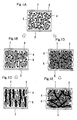
- liquid crystal layer 3 formed between substrates 1 and 2 When a liquid crystal layer 3 formed between substrates 1 and 2 is first heated to a temperature higher than the liquid-liquid crystal phase transition temperature T 1 of a liquid crystalline compound in the liquid crystal layer, the liquid crystalline compound in the liquid crystal layer 3 exhibits an isotropic liquid phase, so that molecules 4 of the liquid crystalline compound are in a state distributed without any order as illustrated in Fig. 1A.
- the temperature of a liquid crystal orientation state-regulating agent at this time is higher than the gelling temperature T 2 by the liquid crystal orientation state-regulating agent, no hydrogen bond by a hydrogen bond-forming group is formed among the molecules 5 of the liquid crystal orientation state-regulating agent, whereby the molecules 5 are in a state dispersed in the liquid crystal layer 3.
- the liquid crystal layer 3 is then cooled to a temperature not higher than the liquid-liquid crystal phase transition temperature T 1 of the liquid orystalline compound, but higher than the gelling temperature T 2 by the liquid crystal orientation state-regulating agent while causing an electric field to effect by means of electrodes (not illustrated) provided on the substrates 1 and 2 on the liquid crystal layer 3 in the thickness-wise direction thereof according to a display pattern to be formed.
- the liquid crystalline compound is transformed from the isotropic liquid phase to a liquid crystal phase in portions of the liquid crystal layer 3, on which the electric field has effected, in a state that the molecules 4 of the liquid crystalline compound have been oriented in the thickness-wise direction as illustrated in Fig.
- the liquid crystalline compound is transformed from the isotropic liquid phase to a liquid crystal phase in portions of the liquid crystal layer 3, on which no electric field has effected, in a state that the molecules 4 of the liquid crystalline compound have been remained distributed without any order as illustrated in Fig. 1D, whereby such portions become a light-scattering state by which light is scattered.
- the portions in the light-transmitting state (hereinafter may also be referred to as “light-transmitting portions”) and the portions in the light-scattering state (hereinafter may also be referred to as “light-scattering portions”) are formed in the liquid crystal layer 3, whereby the intended display pattern is formed.
- the molecules 5 of the liquid crystal orientation state-regulating agent remain dispersed in the liquid crystal layer 3 because they are at the temperature higher than the gelling temperature T 2 by the liquid crystal orientation state-regulating agent.
- the liquid crystal layer 3 in such a state is further cooled to a temperature not higher than the gelling temperature T 2 by the liquid crystal orientation state-regulating agent.
- fibrous aggregates 6 composed of the molecules of the liquid crystal orientation state-regulating agent fibrously aggregated by forming hydrogen bonds among the molecules are formed in a state oriented in the thickness-wise direction, i.e., the same direction as the molecules 4 of the liquid crystalline compound as illustrated in Fig. 1C.
- the oriented state of the liquid crystalline compound molecules 4 in the liquid crystal layer 3 is regulated by the linear aggregates 6 composed of the molecules of the liquid crystal orientation state-regulating agent, so that the oriented state of the liquid crystalline compound molecules 4 remains unchanged even after the effect of the electric field is ceased. Accordingly, the light-transmitting portions (portions to which the electric field has effected) and the light-scattering portions (portions to which no electric field has effected) in the liquid crystal layer 3 are maintained as they are, so that the displayed state is stably retained.
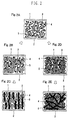
- liquid crystal layer 3 formed between substrates 1 and 2 When a liquid crystal layer 3 formed between substrates 1 and 2 is first heated to a temperature higher than the liquid-liquid crystal phase transition temperature T 1 of a liquid crystalline compound in the liquid crystal layer, the liquid crystalline compound in the liquid crystal layer 3 exhibits an isotropic liquid phase, so that molecules 4 of the liquid crystalline compound are in a state distributed without any order as illustrated in Fig. 2A.
- the temperature of a liquid crystal orientation state-regulating agent at this time is higher than the gelling temperature T 2 by the liquid crystal orientation state-regulating agent, no hydrogen bond by a hydrogen bond-forming group is formed among the molecules 5 of the liquid crystal orientation state-regulating agent, whereby the molecules 5 are in a state dispersed in the liquid crystal layer 3.
- the liquid crystal layer 3 is then cooled to a temperature not higher than the liquid-liquid crystal phase transition temperature T 1 of the liquid crystalline compound, but higher than the gelling temperature T 2 by the liquid crystal orientation state-regulating agent while causing an electric field to effect by means of electrodes (not illustrated) provided on the substrates 1 and 2 on the liquid crystal layer 3 in the thickness-wise direction thereof according to a display pattern to be formed.
- the liquid crystalline compound is transformed from the isotropic liquid phase to a liquid crystal phase in portions of the liquid crystal layer 3, on which no electric field has effected, in a state that the molecules 4 of the liquid crystalline compound have been oriented in the thickness-wise direction by, for example, orientation films (not illustrated) formed on the inner surfaces of the substrates 1 and 2 as illustrated in Fig. 2B, whereby such portions become a light-transmitting state that light is transmitted in the thickness-wise direction thereof.
- the liquid crystalline compound is transformed from the isotropic liquid phase to a liquid crystal phase in portions of the liquid crystal layer 3, on which the electric field has effected, in a state that the molecules 4 of the liquid crystalline compound have been caused to turbulently flow as illustrated in Fig. 2D, whereby such portions become a light-scattering state (dynamic light-scattering state) through which light is scattered.
- the light-transmitting portions and the light-scattering portions are formed in the liquid crystal layer 3, whereby the intended display pattern is formed.
- the molecules 5 of the liquid crystal orientation state-regulating agent remain dispersed in the liquid crystal layer 3 because they are at the temperature higher than the gelling temperature T 2 by the liquid crystal orientation state-regulating agent.
- the liquid crystal layer 3 in such a state is further cooled to a temperature not higher than the gelling temperature T 2 by the liquid crystal orientation state-regulating agent.
- fibrous aggregates 6 composed of the molecules of the liquid crystal orientation state-regulating agent fibrously aggregated by forming hydrogen bonds among the molecules are formed in a state oriented in the thickness-wise direction, i.e., the same direction as the molecules 4 of the liquid crystalline compound as illustrated in Fig. 2C.
- the oriented state of the liquid crystalline compound molecules 4 in the liquid crystal layer 3 is regulated by the linear aggregates 6 composed of the molecules of the liquid crystal orientation state-regulating agent, so that the oriented state of the liquid crystalline compound molecules 4 remains unchanged even after the effect of the electric field is ceased. Accordingly, the light-transmitting portions (portions to which by no electric field has effected) and the light-scattering portions (portions to which the electric field has effected) in the liquid crystal layer 3 are maintained as they are, so that the displayed state is stably retained.
- the liquid crystal layer 3 When the liquid crystal layer 3 is further heated to a temperature higher than the liquid-liquid crystal phase transition temperature T 1 of the liquid crystalline compound therein, the hydrogen bonds among the molecules of the liquid crystal orientation state-regulating agent in the linear aggregates 6 are broken, and moreover the liquid crystalline compound is transformed from the liquid crystal phase to the isotropic liquid phase, so that the liquid crystal layer 3 becomes a state illustrated in Fig. 2A, i.e., a state that the molecules 5 of the liquid crystal orientation state-regulating agent are dispersed, and the liquid crystalline compound molecules 4 are distributed without any order, whereby the displayed state is dissolved.
- a state illustrated in Fig. 2A i.e., a state that the molecules 5 of the liquid crystal orientation state-regulating agent are dispersed, and the liquid crystalline compound molecules 4 are distributed without any order, whereby the displayed state is dissolved.
- a liquid crystalline compound, "E63” (product of Merck Co.; liquid crystalline compound whose liquid-liquid crystal phase transition temperature T 1 is 87°C and whose anisotropy of dielectric constant is positive; 99.0 parts by weight) and a compound (1.0 part by weight) represented by the formula (iv) were dissolved in methylene chloride at room temperature. This solution was air-dried in a draft, thereby evaporating methylene chloride to prepare a liquid crystal composition of a gel state. The gelling temperature T 2 of this liquid crystal composition was measured and found to be 58°C.
- a liquid crystal composition was prepared in the same manner as in Example 1 except that the amount of the liquid crystalline compound, "E63” used was changed to 98.0 parts by weight, and the amount of the compound represented by the formula (iv) used was changed to 2.0 parts by weight to fabricate a liquid crystal display device.
- the gelling temperature T 2 of this liquid crystal composition was measured and found to be 59°C.
- a liquid crystal composition was prepared in the same manner as in Example 1 except that a compound represented by the formula (viii) was used in place of the compound represented by the formula (iv) to fabricate a liquid crystal display device.
- the gelling temperature T 2 of this liquid crystal composition was measured and found to be 64°C.
- a liquid crystal composition was prepared in the same manner as in Example 1 except that a compound represented by the formula (ix) was used in place of the compound represented by the formula (iv) to fabricate a liquid crystal display device.
- the gelling temperature T 2 of this liquid crystal composition was measured and found to be 40°C.
- a liquid crystal composition was prepared in the same manner as in Example 1 except that a compound represented by the formula (x) was used in place of the compound represented by the formula (iv) to fabricate a liquid crystal display device.
- the gelling temperature T 2 of this liquid crystal composition was measured and found to be 69°C.
- a liquid crystal composition was prepared in the same manner as in Example 1 except that a mixture of a compound (liquid crystalline compound whose anisotropy of dielectric constant is negative; 49.5 parts by weight) represented by the formula (ii) and a compound (liquid crystalline compound whose anisotropy of dielectric constant is negative; 49.5 parts by weight) represented by the formula (iii) was used in place of the liquid crystalline compound "E63" (99.0 parts by weight).
- a liquid crystal display device was fabricated in the same manner as in Example 1 except that this liquid crystal composition was used, and substrates on the inner surfaces of which an orientation treatment had been subjected were used.
- the liquid-liquid crystal phase transition temperature T 1 in the liquid crystalline compound mixture was measured and found to be 53°C
- the gelling temperature T 2 of the liquid crystal composition was measured and found to be 49°C.
- the state of molecular orientation of the liquid crystalline compound can be stably retained even when no electric field is caused to effect thereon, and moreover the state of molecular orientation of the liquid crystalline compound can be changed.
- the displayed state can be stably retained even after the effect of the electric field is ceased, and moreover the displayed state can be easily dissolved.
- the displayed state can be stably retained even after the effect of the electric field is ceased, and moreover the displayed state can be easily dissolved.
- a liquid crystal composition by which the state of molecular orientation of a liquid crystalline compound can be stably maintained even when no electric field is caused to effect on, and moreover the state of molecular orientation of the liquid crystalline compound can be changed, and a liquid crystal display device and a liquid crystal displaying method by which a displayed state can be stably retained even after the action of an electric field is ceased, and moreover the displayed state can be dissolved with ease.
- the liquid crystal composition contains a liquid crystalline compound and a liquid crystal orientation state-regulating agent for regulating the orientated state of the liquid crystalline compound by gelling, wherein a phase transition temperature between an isotropic liquid phase and a liquid crystal phase in the liquid crystalline compound is higher than a gelling temperature by the liquid crystal orientation state-regulating agent.
- the liquid crystal display device has a liquid crystal layer formed of the liquid crystal composition.
Landscapes
- Chemical & Material Sciences (AREA)
- Crystallography & Structural Chemistry (AREA)
- Engineering & Computer Science (AREA)
- Materials Engineering (AREA)
- Organic Chemistry (AREA)
- Liquid Crystal Substances (AREA)
- Liquid Crystal (AREA)
- Display Devices Of Pinball Game Machines (AREA)
Abstract
Description

cooling a liquid crystal layer formed of the liquid crystal composition described above to a temperature not higher than a phase transition temperature between an isotropic liquid phase and a liquid crystal phase in the liquid crystalline compound in a state that the liquid crystalline compound is in the isotropic liquid phase while causing an electric field to effect on the liquid crystal layer in the thickness-wise direction thereof according to a display pattern, whereby the liquid crystalline compound is transformed from the isotropic liquid phase to the liquid crystal phase;, and
cooling the liquid crystal layer in the state of the liquid crystal phase, to a temperature not higher than a gelling temperature by the liquid crystal orientation state-regulating agent, whereby the liquid crystal composition is gelled.





(1) Displaying method by the liquid crystal display device having the liquid crystal layer in which the anisotropy of dielectric constant of the liquid crystalline compound is positive:
(2) Displaying method by the liquid crystal display device having the liquid crystal layer in which the anisotropy of dielectric constant of the liquid crystalline compound is negative:

Claims (9)
- A liquid crystal composition comprising a liquid crystalline compound and a liquid crystal orientation state-regulating agent for regulating the orientated state of the liquid crystalline compound by gelling, wherein a phase transition temperature (T1) between an isotropic liquid phase and a liquid crystal phase in the liquid crystalline compound is higher than a gelling temperature (T2) by the liquid crystal orientation state-regulating agent.
- The liquid crystal composition according to Claim 1, wherein the liquid crystal orientation state-regulating agent is one that forms fibrous aggregates oriented in the same direction as the liquid crystalline compound in a state that the liquid crystalline compound has been oriented in a direction.
- The liquid crystal composition according to Claim 1 or 2, wherein the liquid crystal orientation state-regulating agent is composed of a compound having at least one group capable of forming an intermolecular hydrogen bond and at least one alkylene group in its molecule.
- The liquid crystal composition according to Claim 3, wherein the liquid crystal orientation state-regulating agent is composed of a compound having a group represented by the following general formula (1):wherein R1 means a hydrogen atom or a monovalent organic group.
- The liquid crystal composition according to Claim 1, wherein a difference (T1 - T2) between the phase transition temperature (T1) between the isotropic liquid phase and the liquid crystal phase in the liquid crystalline compound and the gelling temperature (T2) by the liquid crystal orientation state-regulating agent is at least 5°C.
- The liquid crystal composition according to Claim 1 or 5, wherein the gelling temperature by the liquid crystal orientation state-regulating agent is at least 30°C.
- The liquid crystal composition according to any one of Claims 1 to 6, wherein the liquid crystal orientation state-regulating agent is contained in a proportion of 0.05 to 30.0 % by weight based on the total weight of the liquid crystal orientation state-regulating agent and the liquid crystalline compound.
- A liquid crystal display device comprising a liquid crystal layer formed of the liquid crystal composition according to any one of Claims 1 to 7.
- A liquid crystal displaying method comprising;
cooling a liquid crystal layer formed of the liquid crystal composition according to any one of Claims 1 to 7 to a temperature not higher than a phase transition temperature between an isotropic liquid phase and a liquid crystal phase in the liquid crystalline compound in a state that the liquid crystalline compound is in the isotropic liquid phase while causing an electric field to effect on the liquid crystal layer in the thickness-wise direction thereof according to a display pattern, whereby the liquid crystalline compound is transformed from the isotropic liquid phase to the liquid crystal phase;, and
cooling the liquid crystal layer in the state of the liquid crystal phase, to a temperature not higher than the gelling temperature by the liquid crystal orientation state-regulating agent, whereby the liquid crystal composition is gelled.
Applications Claiming Priority (2)
| Application Number | Priority Date | Filing Date | Title |
|---|---|---|---|
| JP2001046447 | 2001-02-22 | ||
| JP2001046447A JP4828706B2 (en) | 2001-02-22 | 2001-02-22 | Liquid crystal composition, liquid crystal display element, and liquid crystal display method |
Publications (3)
| Publication Number | Publication Date |
|---|---|
| EP1236785A2 true EP1236785A2 (en) | 2002-09-04 |
| EP1236785A3 EP1236785A3 (en) | 2003-01-15 |
| EP1236785B1 EP1236785B1 (en) | 2006-06-07 |
Family
ID=18908070
Family Applications (1)
| Application Number | Title | Priority Date | Filing Date |
|---|---|---|---|
| EP02003898A Expired - Lifetime EP1236785B1 (en) | 2001-02-22 | 2002-02-21 | Liquid crystal composition, liquid crystal display device and liquid crystal displaying method |
Country Status (5)
| Country | Link |
|---|---|
| US (1) | US6682787B2 (en) |
| EP (1) | EP1236785B1 (en) |
| JP (1) | JP4828706B2 (en) |
| AT (1) | ATE328981T1 (en) |
| DE (1) | DE60211973T2 (en) |
Cited By (4)
| Publication number | Priority date | Publication date | Assignee | Title |
|---|---|---|---|---|
| EP1338639A1 (en) * | 2002-02-21 | 2003-08-27 | Takashi Kato | Photo-responsive liquid crystal composition, information-recording medium and information-recording process |
| EP1586618A1 (en) | 2004-03-30 | 2005-10-19 | Takashi Kato | Photo-responsive liquid crystal composition |
| CN101923241B (en) * | 2004-01-15 | 2012-05-09 | 夏普株式会社 | Display element |
| WO2013187531A1 (en) * | 2012-06-15 | 2013-12-19 | Ricoh Company, Ltd. | Recording medium, image recording device, and image recording set |
Families Citing this family (9)
| Publication number | Priority date | Publication date | Assignee | Title |
|---|---|---|---|---|
| JP4824220B2 (en) * | 2001-08-13 | 2011-11-30 | 住友化学株式会社 | Liquid crystal gel, liquid crystal element and optical element |
| JP4285935B2 (en) * | 2002-03-06 | 2009-06-24 | 株式会社リコー | Liquid crystal gel composition, display medium using the same, display device, and display body |
| JP4184050B2 (en) * | 2002-11-26 | 2008-11-19 | 隆史 加藤 | Liquid crystal composition, liquid crystal display element, manufacturing method thereof and control method thereof |
| JP2005316390A (en) * | 2004-03-31 | 2005-11-10 | Konica Minolta Holdings Inc | Liquid crystal display element and method for manufacturing the same |
| JP2007187789A (en) * | 2006-01-12 | 2007-07-26 | Konica Minolta Holdings Inc | Display medium and method for recording on the display medium |
| KR20130137404A (en) * | 2012-06-07 | 2013-12-17 | 삼성디스플레이 주식회사 | Liquid crsytal composition, method for forming optical isotropic phase of liqui cyrstal and liquid crystal display device |
| CN104317090A (en) * | 2014-11-03 | 2015-01-28 | 合肥鑫晟光电科技有限公司 | Bi-stable state liquid crystal light valve and operation method thereof |
| US12292665B2 (en) | 2014-11-06 | 2025-05-06 | Gauzy Ltd. | Bistable liquid crystal dispersion devices comprising metal-organic mesogens and applications thereof |
| CN107429164A (en) * | 2014-11-06 | 2017-12-01 | 哥兹有限公司 | Bistable liquid crystal comprising metallomesogen primitive disperses body device and its application |
Family Cites Families (12)
| Publication number | Priority date | Publication date | Assignee | Title |
|---|---|---|---|---|
| JPH1067987A (en) * | 1988-03-24 | 1998-03-10 | Denso Corp | Liquid crystal electro-optical device |
| JPH06186541A (en) * | 1992-12-17 | 1994-07-08 | Seiko Epson Corp | Display element and manufacturing method thereof |
| JPH10312711A (en) * | 1997-03-10 | 1998-11-24 | Dainippon Printing Co Ltd | Liquid crystalline charge transport material |
| KR100508053B1 (en) | 1997-06-30 | 2005-10-24 | 제이에스알 가부시끼가이샤 | Liquid Crystal Gel, Gelling Agent, Liquid Crystal Device and Process for Fabricating Liquid Crystal Device |
| JPH1152341A (en) * | 1997-08-07 | 1999-02-26 | Jsr Corp | Liquid crystal device |
| JP3994477B2 (en) * | 1997-06-30 | 2007-10-17 | Jsr株式会社 | Liquid crystal gel |
| JPH1160619A (en) | 1997-08-07 | 1999-03-02 | Jsr Corp | Liquid crystalline composition, cured product and method for producing the same |
| JPH11256164A (en) * | 1998-03-12 | 1999-09-21 | Jsr Corp | Gel-like substance and display device using the same |
| JP2000136385A (en) * | 1998-11-04 | 2000-05-16 | Canon Inc | Liquid crystal display device |
| JP3382580B2 (en) * | 1999-02-19 | 2003-03-04 | キヤノン株式会社 | Liquid crystal element |
| JP2000239663A (en) * | 1999-02-24 | 2000-09-05 | Jsr Corp | Liquid crystalline gel and liquid crystal device using the same |
| JP2001021924A (en) * | 1999-07-09 | 2001-01-26 | Matsushita Electric Ind Co Ltd | Liquid crystal display device and method of manufacturing the same |
-
2001
- 2001-02-22 JP JP2001046447A patent/JP4828706B2/en not_active Expired - Fee Related
-
2002
- 2002-02-20 US US10/077,885 patent/US6682787B2/en not_active Expired - Fee Related
- 2002-02-21 AT AT02003898T patent/ATE328981T1/en not_active IP Right Cessation
- 2002-02-21 EP EP02003898A patent/EP1236785B1/en not_active Expired - Lifetime
- 2002-02-21 DE DE60211973T patent/DE60211973T2/en not_active Expired - Lifetime
Cited By (6)
| Publication number | Priority date | Publication date | Assignee | Title |
|---|---|---|---|---|
| EP1338639A1 (en) * | 2002-02-21 | 2003-08-27 | Takashi Kato | Photo-responsive liquid crystal composition, information-recording medium and information-recording process |
| US6740255B2 (en) | 2002-02-21 | 2004-05-25 | Jsr Corporation | Photo-responsive liquid crystal composition, information-recording medium and information-recording process |
| CN101923241B (en) * | 2004-01-15 | 2012-05-09 | 夏普株式会社 | Display element |
| EP1586618A1 (en) | 2004-03-30 | 2005-10-19 | Takashi Kato | Photo-responsive liquid crystal composition |
| US7037444B2 (en) | 2004-03-30 | 2006-05-02 | Jsr Corporation | Photo-responsive liquid crystal composition |
| WO2013187531A1 (en) * | 2012-06-15 | 2013-12-19 | Ricoh Company, Ltd. | Recording medium, image recording device, and image recording set |
Also Published As
| Publication number | Publication date |
|---|---|
| JP2002249780A (en) | 2002-09-06 |
| US20020158228A1 (en) | 2002-10-31 |
| JP4828706B2 (en) | 2011-11-30 |
| DE60211973D1 (en) | 2006-07-20 |
| EP1236785A3 (en) | 2003-01-15 |
| ATE328981T1 (en) | 2006-06-15 |
| EP1236785B1 (en) | 2006-06-07 |
| US6682787B2 (en) | 2004-01-27 |
| DE60211973T2 (en) | 2006-12-28 |
Similar Documents
| Publication | Publication Date | Title |
|---|---|---|
| US20070228324A1 (en) | Composition comprising at least one type of liquid crystal | |
| EP1236785B1 (en) | Liquid crystal composition, liquid crystal display device and liquid crystal displaying method | |
| TW201000610A (en) | Liquid-crystalline medium | |
| KR20140002800A (en) | Liquid-crystal medium | |
| JP4355971B2 (en) | Nematic liquid crystal composition and liquid crystal display device using the same | |
| DE69313179T2 (en) | Liquid crystal device and apparatus | |
| DE3879102T2 (en) | OPTICALLY ACTIVE MESOMORPHIC CONNECTION AND THE LIQUID CRYSTALLINE COMPOSITION THEREOF. | |
| JPH0326785A (en) | Liquid crystal composition | |
| JP3951323B2 (en) | Nematic liquid crystal composition and liquid crystal display device using the same | |
| JPH05502260A (en) | Light modulating materials containing liquid crystals dispersed in polymers | |
| JP4228404B2 (en) | Nematic liquid crystal composition and liquid crystal display device using the same | |
| JP4131296B2 (en) | Nematic liquid crystal composition and liquid crystal display device using the same | |
| Mizoshita et al. | Nematic liquid-crystalline physical gels exhibiting faster responses to electric fields in twisted nematic cells | |
| JPH083559A (en) | Liquid crystal composition and liquid crystal display element | |
| JP4779182B2 (en) | Nematic liquid crystal composition and liquid crystal display device using the same | |
| EP0069387B1 (en) | Liquid crystal display device | |
| JP3841181B2 (en) | Nematic liquid crystal composition and liquid crystal display device using the same | |
| JP4258680B2 (en) | Nematic liquid crystal composition and liquid crystal display device using the same | |
| DE10140419A1 (en) | Low birefringence liquid crystalline medium | |
| KR20080113433A (en) | Composition containing at least one liquid crystal | |
| JP2953624B2 (en) | Ferroelectric liquid crystal composition | |
| JP3038923B2 (en) | Super twisted nematic liquid crystal display | |
| JP4427943B2 (en) | Liquid crystal composition | |
| JP2958046B2 (en) | Ferroelectric liquid crystal composition | |
| JP4792623B2 (en) | Liquid crystal composition |
Legal Events
| Date | Code | Title | Description |
|---|---|---|---|
| PUAI | Public reference made under article 153(3) epc to a published international application that has entered the european phase |
Free format text: ORIGINAL CODE: 0009012 |
|
| AK | Designated contracting states |
Kind code of ref document: A2 Designated state(s): AT BE CH CY DE DK ES FI FR GB GR IE IT LI LU MC NL PT SE TR |
|
| AX | Request for extension of the european patent |
Free format text: AL;LT;LV;MK;RO;SI |
|
| PUAL | Search report despatched |
Free format text: ORIGINAL CODE: 0009013 |
|
| AK | Designated contracting states |
Kind code of ref document: A3 Designated state(s): AT BE CH CY DE DK ES FI FR GB GR IE IT LI LU MC NL PT SE TR |
|
| AX | Request for extension of the european patent |
Free format text: AL;LT;LV;MK;RO;SI |
|
| 17P | Request for examination filed |
Effective date: 20030410 |
|
| AKX | Designation fees paid |
Designated state(s): AT BE CH CY DE DK ES FI FR GB GR IE IT LI LU MC NL PT SE TR |
|
| RAP1 | Party data changed (applicant data changed or rights of an application transferred) |
Owner name: JSR CORPORATION |
|
| 17Q | First examination report despatched |
Effective date: 20040517 |
|
| GRAP | Despatch of communication of intention to grant a patent |
Free format text: ORIGINAL CODE: EPIDOSNIGR1 |
|
| GRAS | Grant fee paid |
Free format text: ORIGINAL CODE: EPIDOSNIGR3 |
|
| GRAA | (expected) grant |
Free format text: ORIGINAL CODE: 0009210 |
|
| AK | Designated contracting states |
Kind code of ref document: B1 Designated state(s): AT BE CH CY DE DK ES FI FR GB GR IE IT LI LU MC NL PT SE TR |
|
| PG25 | Lapsed in a contracting state [announced via postgrant information from national office to epo] |
Ref country code: IT Free format text: LAPSE BECAUSE OF FAILURE TO SUBMIT A TRANSLATION OF THE DESCRIPTION OR TO PAY THE FEE WITHIN THE PRESCRIBED TIME-LIMIT;WARNING: LAPSES OF ITALIAN PATENTS WITH EFFECTIVE DATE BEFORE 2007 MAY HAVE OCCURRED AT ANY TIME BEFORE 2007. THE CORRECT EFFECTIVE DATE MAY BE DIFFERENT FROM THE ONE RECORDED. Effective date: 20060607 Ref country code: NL Free format text: LAPSE BECAUSE OF FAILURE TO SUBMIT A TRANSLATION OF THE DESCRIPTION OR TO PAY THE FEE WITHIN THE PRESCRIBED TIME-LIMIT Effective date: 20060607 Ref country code: FI Free format text: LAPSE BECAUSE OF FAILURE TO SUBMIT A TRANSLATION OF THE DESCRIPTION OR TO PAY THE FEE WITHIN THE PRESCRIBED TIME-LIMIT Effective date: 20060607 Ref country code: CH Free format text: LAPSE BECAUSE OF FAILURE TO SUBMIT A TRANSLATION OF THE DESCRIPTION OR TO PAY THE FEE WITHIN THE PRESCRIBED TIME-LIMIT Effective date: 20060607 Ref country code: BE Free format text: LAPSE BECAUSE OF FAILURE TO SUBMIT A TRANSLATION OF THE DESCRIPTION OR TO PAY THE FEE WITHIN THE PRESCRIBED TIME-LIMIT Effective date: 20060607 Ref country code: LI Free format text: LAPSE BECAUSE OF FAILURE TO SUBMIT A TRANSLATION OF THE DESCRIPTION OR TO PAY THE FEE WITHIN THE PRESCRIBED TIME-LIMIT Effective date: 20060607 Ref country code: AT Free format text: LAPSE BECAUSE OF FAILURE TO SUBMIT A TRANSLATION OF THE DESCRIPTION OR TO PAY THE FEE WITHIN THE PRESCRIBED TIME-LIMIT Effective date: 20060607 |
|
| REG | Reference to a national code |
Ref country code: GB Ref legal event code: FG4D |
|
| REG | Reference to a national code |
Ref country code: CH Ref legal event code: EP |
|
| REG | Reference to a national code |
Ref country code: IE Ref legal event code: FG4D |
|
| REF | Corresponds to: |
Ref document number: 60211973 Country of ref document: DE Date of ref document: 20060720 Kind code of ref document: P |
|
| PG25 | Lapsed in a contracting state [announced via postgrant information from national office to epo] |
Ref country code: SE Free format text: LAPSE BECAUSE OF FAILURE TO SUBMIT A TRANSLATION OF THE DESCRIPTION OR TO PAY THE FEE WITHIN THE PRESCRIBED TIME-LIMIT Effective date: 20060907 Ref country code: DK Free format text: LAPSE BECAUSE OF FAILURE TO SUBMIT A TRANSLATION OF THE DESCRIPTION OR TO PAY THE FEE WITHIN THE PRESCRIBED TIME-LIMIT Effective date: 20060907 |
|
| PG25 | Lapsed in a contracting state [announced via postgrant information from national office to epo] |
Ref country code: ES Free format text: LAPSE BECAUSE OF FAILURE TO SUBMIT A TRANSLATION OF THE DESCRIPTION OR TO PAY THE FEE WITHIN THE PRESCRIBED TIME-LIMIT Effective date: 20060918 |
|
| PG25 | Lapsed in a contracting state [announced via postgrant information from national office to epo] |
Ref country code: PT Free format text: LAPSE BECAUSE OF FAILURE TO SUBMIT A TRANSLATION OF THE DESCRIPTION OR TO PAY THE FEE WITHIN THE PRESCRIBED TIME-LIMIT Effective date: 20061107 |
|
| NLV1 | Nl: lapsed or annulled due to failure to fulfill the requirements of art. 29p and 29m of the patents act | ||
| REG | Reference to a national code |
Ref country code: CH Ref legal event code: PL |
|
| ET | Fr: translation filed | ||
| PG25 | Lapsed in a contracting state [announced via postgrant information from national office to epo] |
Ref country code: MC Free format text: LAPSE BECAUSE OF NON-PAYMENT OF DUE FEES Effective date: 20070228 |
|
| PLBE | No opposition filed within time limit |
Free format text: ORIGINAL CODE: 0009261 |
|
| STAA | Information on the status of an ep patent application or granted ep patent |
Free format text: STATUS: NO OPPOSITION FILED WITHIN TIME LIMIT |
|
| 26N | No opposition filed |
Effective date: 20070308 |
|
| PG25 | Lapsed in a contracting state [announced via postgrant information from national office to epo] |
Ref country code: IE Free format text: LAPSE BECAUSE OF NON-PAYMENT OF DUE FEES Effective date: 20070221 |
|
| PG25 | Lapsed in a contracting state [announced via postgrant information from national office to epo] |
Ref country code: GR Free format text: LAPSE BECAUSE OF FAILURE TO SUBMIT A TRANSLATION OF THE DESCRIPTION OR TO PAY THE FEE WITHIN THE PRESCRIBED TIME-LIMIT Effective date: 20060908 |
|
| PG25 | Lapsed in a contracting state [announced via postgrant information from national office to epo] |
Ref country code: LU Free format text: LAPSE BECAUSE OF NON-PAYMENT OF DUE FEES Effective date: 20070221 Ref country code: CY Free format text: LAPSE BECAUSE OF FAILURE TO SUBMIT A TRANSLATION OF THE DESCRIPTION OR TO PAY THE FEE WITHIN THE PRESCRIBED TIME-LIMIT Effective date: 20060607 |
|
| PG25 | Lapsed in a contracting state [announced via postgrant information from national office to epo] |
Ref country code: TR Free format text: LAPSE BECAUSE OF FAILURE TO SUBMIT A TRANSLATION OF THE DESCRIPTION OR TO PAY THE FEE WITHIN THE PRESCRIBED TIME-LIMIT Effective date: 20060607 |
|
| PGFP | Annual fee paid to national office [announced via postgrant information from national office to epo] |
Ref country code: GB Payment date: 20130218 Year of fee payment: 12 Ref country code: FR Payment date: 20130301 Year of fee payment: 12 Ref country code: DE Payment date: 20130219 Year of fee payment: 12 |
|
| REG | Reference to a national code |
Ref country code: DE Ref legal event code: R119 Ref document number: 60211973 Country of ref document: DE |
|
| GBPC | Gb: european patent ceased through non-payment of renewal fee |
Effective date: 20140221 |
|
| REG | Reference to a national code |
Ref country code: FR Ref legal event code: ST Effective date: 20141031 |
|
| REG | Reference to a national code |
Ref country code: DE Ref legal event code: R119 Ref document number: 60211973 Country of ref document: DE Effective date: 20140902 |
|
| PG25 | Lapsed in a contracting state [announced via postgrant information from national office to epo] |
Ref country code: DE Free format text: LAPSE BECAUSE OF NON-PAYMENT OF DUE FEES Effective date: 20140902 Ref country code: FR Free format text: LAPSE BECAUSE OF NON-PAYMENT OF DUE FEES Effective date: 20140228 Ref country code: GB Free format text: LAPSE BECAUSE OF NON-PAYMENT OF DUE FEES Effective date: 20140221 |