EP1236772A1 - Composition, methods of forming low-permittivity film from the composition, low-permittivity film, and electronic part having the low-permittivity film - Google Patents
Composition, methods of forming low-permittivity film from the composition, low-permittivity film, and electronic part having the low-permittivity film Download PDFInfo
- Publication number
- EP1236772A1 EP1236772A1 EP00961015A EP00961015A EP1236772A1 EP 1236772 A1 EP1236772 A1 EP 1236772A1 EP 00961015 A EP00961015 A EP 00961015A EP 00961015 A EP00961015 A EP 00961015A EP 1236772 A1 EP1236772 A1 EP 1236772A1
- Authority
- EP
- European Patent Office
- Prior art keywords
- polymer
- thermally decomposable
- low
- film
- siloxane oligomer
- Prior art date
- Legal status (The legal status is an assumption and is not a legal conclusion. Google has not performed a legal analysis and makes no representation as to the accuracy of the status listed.)
- Withdrawn
Links
Classifications
-
- C—CHEMISTRY; METALLURGY
- C08—ORGANIC MACROMOLECULAR COMPOUNDS; THEIR PREPARATION OR CHEMICAL WORKING-UP; COMPOSITIONS BASED THEREON
- C08L—COMPOSITIONS OF MACROMOLECULAR COMPOUNDS
- C08L33/00—Compositions of homopolymers or copolymers of compounds having one or more unsaturated aliphatic radicals, each having only one carbon-to-carbon double bond, and only one being terminated by only one carboxyl radical, or of salts, anhydrides, esters, amides, imides or nitriles thereof; Compositions of derivatives of such polymers
-
- C—CHEMISTRY; METALLURGY
- C08—ORGANIC MACROMOLECULAR COMPOUNDS; THEIR PREPARATION OR CHEMICAL WORKING-UP; COMPOSITIONS BASED THEREON
- C08L—COMPOSITIONS OF MACROMOLECULAR COMPOUNDS
- C08L101/00—Compositions of unspecified macromolecular compounds
-
- C—CHEMISTRY; METALLURGY
- C08—ORGANIC MACROMOLECULAR COMPOUNDS; THEIR PREPARATION OR CHEMICAL WORKING-UP; COMPOSITIONS BASED THEREON
- C08L—COMPOSITIONS OF MACROMOLECULAR COMPOUNDS
- C08L33/00—Compositions of homopolymers or copolymers of compounds having one or more unsaturated aliphatic radicals, each having only one carbon-to-carbon double bond, and only one being terminated by only one carboxyl radical, or of salts, anhydrides, esters, amides, imides or nitriles thereof; Compositions of derivatives of such polymers
- C08L33/04—Homopolymers or copolymers of esters
- C08L33/06—Homopolymers or copolymers of esters of esters containing only carbon, hydrogen and oxygen, which oxygen atoms are present only as part of the carboxyl radical
- C08L33/10—Homopolymers or copolymers of methacrylic acid esters
- C08L33/12—Homopolymers or copolymers of methyl methacrylate
-
- C—CHEMISTRY; METALLURGY
- C09—DYES; PAINTS; POLISHES; NATURAL RESINS; ADHESIVES; COMPOSITIONS NOT OTHERWISE PROVIDED FOR; APPLICATIONS OF MATERIALS NOT OTHERWISE PROVIDED FOR
- C09D—COATING COMPOSITIONS, e.g. PAINTS, VARNISHES OR LACQUERS; FILLING PASTES; CHEMICAL PAINT OR INK REMOVERS; INKS; CORRECTING FLUIDS; WOODSTAINS; PASTES OR SOLIDS FOR COLOURING OR PRINTING; USE OF MATERIALS THEREFOR
- C09D183/00—Coating compositions based on macromolecular compounds obtained by reactions forming in the main chain of the macromolecule a linkage containing silicon, with or without sulfur, nitrogen, oxygen, or carbon only; Coating compositions based on derivatives of such polymers
- C09D183/04—Polysiloxanes
-
- C—CHEMISTRY; METALLURGY
- C09—DYES; PAINTS; POLISHES; NATURAL RESINS; ADHESIVES; COMPOSITIONS NOT OTHERWISE PROVIDED FOR; APPLICATIONS OF MATERIALS NOT OTHERWISE PROVIDED FOR
- C09D—COATING COMPOSITIONS, e.g. PAINTS, VARNISHES OR LACQUERS; FILLING PASTES; CHEMICAL PAINT OR INK REMOVERS; INKS; CORRECTING FLUIDS; WOODSTAINS; PASTES OR SOLIDS FOR COLOURING OR PRINTING; USE OF MATERIALS THEREFOR
- C09D201/00—Coating compositions based on unspecified macromolecular compounds
-
- C—CHEMISTRY; METALLURGY
- C08—ORGANIC MACROMOLECULAR COMPOUNDS; THEIR PREPARATION OR CHEMICAL WORKING-UP; COMPOSITIONS BASED THEREON
- C08L—COMPOSITIONS OF MACROMOLECULAR COMPOUNDS
- C08L31/00—Compositions of homopolymers or copolymers of compounds having one or more unsaturated aliphatic radicals, each having only one carbon-to-carbon double bond, and at least one being terminated by an acyloxy radical of a saturated carboxylic acid, of carbonic acid or of a haloformic acid; Compositions of derivatives of such polymers
- C08L31/02—Homopolymers or copolymers of esters of monocarboxylic acids
- C08L31/04—Homopolymers or copolymers of vinyl acetate
-
- C—CHEMISTRY; METALLURGY
- C08—ORGANIC MACROMOLECULAR COMPOUNDS; THEIR PREPARATION OR CHEMICAL WORKING-UP; COMPOSITIONS BASED THEREON
- C08L—COMPOSITIONS OF MACROMOLECULAR COMPOUNDS
- C08L83/00—Compositions of macromolecular compounds obtained by reactions forming in the main chain of the macromolecule a linkage containing silicon with or without sulfur, nitrogen, oxygen or carbon only; Compositions of derivatives of such polymers
- C08L83/04—Polysiloxanes
Definitions
- the present invention relates to a composition, a method for forming a low-permittivity film using the composition, a low-permittivity film, and an electronic part having the low-permittivity film. More particularly, the present invention is concerned with a composition from which a low-permittivity film advantageously used as an interlayer insulating film for semiconductor device is formed, a method for forming a low-permittivity film using the composition, a low-permittivity film obtainable from the forming method, and an electronic part having the low-permittivity film, such as a semiconductor device or a multilayer printed circuit board.
- an SiO 2 film having a specific permittivity of about 4.2 formed by a CVD process has been used as an interlayer insulating film, and, for reducing the wiring capacitance of a device and improving the operation speed of LSI, a development of a film having a lower permittivity is desired.
- an SiOF film (CVD process) having a specific permittivity of about 3.5, an organic SOG (spin on glass) having a specific permittivity of 2.5 to 3.0, and an organic polymer have currently been put into practical use.
- materials having a specific permittivity of 2.5 or less which will be required in future fluororesins and porous films have been proposed, and a material having satisfactory properties as an interlayer insulating film for use in LSI has not yet been developed as of today.
- Fluororesins have a specific permittivity of about 2 and are therefore expected as a low-permittivity material.
- fluororesins have a Tg of 300°C or less, and hence, it is difficult to apply fluororesins as they are to interlayer insulating films for use in LSI.
- As a method for solving this problem it has been proposed to use a composite film comprising a fluororesin and polysiloxane as disclosed in Japanese Provisional Patent Publication No. 143420/1997.
- a porous film has attracted attention as a technique which can achieve a specific permittivity of 2.5 or less.
- Japanese Patent Publication No. 12790/1994 has proposed a method in which an organopolysiloxane coating solution containing an organic polymer, such as polystyrene and polyethylene, is applied and subjected to heat treatment
- Japanese Provisional Patent Publication No. 25359/1998 has proposed a method in which polymer particles are dispersed in a polysiloxane precursor.
- polymer particles are dispersed in a polysiloxane film, and then the polymer particles are removed from the film by heating.
- the wiring width in the future shrunk LSI is about 0.1 to 0.5 ⁇ m, and hence, a porous film having a pore size of 0.1 ⁇ m or more cannot be used as an interlayer insulating film.
- the treatment temperature of 450°C is permissible, but a heat treatment for a long time lowers the productivity.
- Cu is being used as a wiring material, but, when using a Cu wiring, the permissible treatment temperature is low (about 400°C) and this method is therefore difficult to apply to.
- a method for forming a low-permittivity film which has a specific permittivity of 2.5 or less and can be formed at about 400°C and applied to an interlayer insulating film for semiconductor device, such as LSI having finer wiring, and for multilayer printed circuit board, has not yet been found.
- composition from which a low-permittivity film having a specific permittivity of 2.5 or less wherein the film can be formed by heating at about 400°C and applied to an interlayer insulating film for semiconductor device, such as LSI having finer wiring, and for multilayer printed circuit board.
- a low-permittivity film having a specific permittivity of 2.5 or less which film can be applied to an interlayer insulating film for semiconductor device, such as LSI having finer wiring, and for multilayer printed circuit board.
- an electronic part having the low-permittivity film and having such high quality and high reliability that it causes less signal-propagation delay for example, a semi-conductor device, such as LSI having finer wiring, and a multilayer printed circuit board.
- the present invention is also directed to a composition
- a composition comprising
- the present invention is also directed to the above-mentioned composition wherein (b) the siloxane oligomer is a compound having a non-hydrolyzable organic group.
- the siloxane oligomer is a hydrolytic condensation product of an alkoxysilane represented by the following formula (I): wherein R 1 and R 2 each represent a non-hydrolyzable group which may be the same or different; R 3 represents an alkyl group having 1 to 6 carbon atoms; and each of m and n is an integer selected from 0 to 3 so that m and n satisfy the relationship: 0 ⁇ m + n ⁇ 3.
- the present invention is also directed to the above-mentioned composition wherein (a) the thermally decomposable polymer is a polymer which exhibits a weight loss at 250°C of less than 5% based on the weight at 150°C, as measured by a thermogravimetric analysis in which the temperature is elevated from 30°C or lower at a temperature elevation rate of 20°C/min under an air stream.
- the thermally decomposable polymer is a polymer which exhibits a weight loss at 250°C of less than 5% based on the weight at 150°C, as measured by a thermogravimetric analysis in which the temperature is elevated from 30°C or lower at a temperature elevation rate of 20°C/min under an air stream.
- the present invention is also directed to the above-mentioned composition wherein (a) the thermally decomposable polymer is a polymer which exhibits a weight loss at 400°C of 80% or more based on the weight at 150°C, as measured by a thermogravimetric analysis in which the temperature is elevated from 30°C or lower at a temperature elevation rate of 20°C/min under an air stream.
- the thermally decomposable polymer is a polymer which exhibits a weight loss at 400°C of 80% or more based on the weight at 150°C, as measured by a thermogravimetric analysis in which the temperature is elevated from 30°C or lower at a temperature elevation rate of 20°C/min under an air stream.
- the present invention is also directed to a method for forming a low-permittivity film, comprising: applying any one of the above-mentioned compositions to a substrate to form a composite film which comprises the thermally decomposable polymer and the siloxane oligomer evenly compatibilized therewith; and then heating the resulting film to condense the siloxane oligomer and remove the thermally decomposable polymer.
- the present invention is also directed to a low-permittivity film formed by any one of the above-mentioned methods for forming a low-permittivity film.
- the present invention is also directed to an electronic part having the above-mentioned low-permittivity film.
- thermally decomposable polymers examples include acrylic polymers, methacrylic polymers, polyester polymers, polyether polymers, vinyl polymers, polyimide polymers, vinylidene fluoride polymers, fluorine-containing vinyl polymers, and solvent-soluble perfluoropolymers. These are used individually or in combination.
- the decomposition temperature of (a) the thermally decomposable polymer can be confirmed by using a thermogravimetric analysis.
- the decomposition temperature of (a) the thermally decomposable polymer was confirmed by performing a thermogravimetric analysis with the following apparatus and conditions.
- the weight of it at 150°C in the course of the temperature elevation is used as the base weight for (a) the thermally decomposable polymer before starting decomposition.
- the weight loss at 150°C or lower is considered to be caused by removal of moisture adsorbed, i.e., factors other than the decomposition of (a) the thermally decomposable polymer.
- thermally decomposable polymers which exhibit a weight loss at 250°C of less than 5 % and exhibit a weight loss at 400°C of 80% or more include methacrylate polymers such as polymethyl methacrylate, acrylate polymers such as polymethyl acrylate; and polyethylene imine.
- methacrylate polymers and acrylate polymers such as polymethyl methacrylate and polymethyl acrylate exhibit a weight loss at 250°C of less than 2 % and exhibit a weight loss at 400°C of 90 % or more, and are therefore particularly excellent as (a) the thermally decomposable polymer to be used in the composition of the present invention.
- a fluororesin has a heat resistance at about 400°C, and, removal of the polymer by heating at about 400°C requires a long time, and thus the fluororesin is disadvantageous from a practical point of view. Therefore, as (a) the thermally decomposable polymer, it is preferred to use a fluorine-free polymer.
- the siloxane oligomer for example, there may be mentioned a hydrolytic condensation product of an alkoxysilane represented by the following formula (I): wherein R 1 and R 2 each represent a non-hydrolyzable group which may be the same or different; R 3 represents an alkyl group having 1 to 6 carbon atoms; and each of m and n is an integer selected from 0 to 3 so that m and n satisfy the relationship: 0 ⁇ m + n ⁇ 3.
- the hydrolytic condensation product may be either a condensation product partially hydrolyzed or a condensation product completely hydrolyzed.
- non-hydrolyzable groups having 1 to 4 carbon atoms are preferred from the viewpoint of availability with ease.
- non-hydrolyzable groups include organic groups having a reactive group such as a ⁇ -glycidoxypropyl group, a ⁇ -aminopropyl group, an aminophenyl group and an N-phenyl- ⁇ -aminopropyl group, alkyl groups such as a methyl group, an ethyl group, a propyl group and a butyl group, alkenyl groups such as a vinyl group, aryl groups such as a phenyl group and a tolyl group, and fluorine-containing alkyl groups such as a trifluoromethyl group, a trifluoropropyl group, a pentafluorobutyl group, a nonafluorohexyl group, a tridecafluorooctyl group, a heptade
- the resulting low-permittivity film can be improved in mechanical strength.
- tetraalkoxysilanes such as tetramethoxysilane, tetraethoxysilane and tetrapropoxysilane
- monoalkyltrialkoxysilanes such as methyltrimethoxysilane and methyltriethoxysilane
- monoaryltrialkoxysilanes such as phenyltrimethoxysilane and phenyltriethoxysilane
- monoalkenyltrialkoxysilanes such as vinyltrimethoxysilane and vinyltriethoxysilane
- fluorine-containing alkoxysilanes such as trifluoromethyltrimethoxysilane, trifluoropropyltrimethoxysilane, pentafluorobutyltrimethoxysilane, nonafluorohexyltrimethoxysilane, tridecafluorooctyltrimethoxysilane, heptadeca
- the condensation reaction of the alkoxysilane can be conducted by a conventional manner.
- a method in which water is added to the alkoxysilane in the presence of a solvent and a catalyst to effect a hydrolytic condensation reaction can be mentioned.
- the hydrolytic condensation product has a weight average molecular weight (as measured by gel permeation chromatography (GPC) using a calibration curve obtained by standard polystyrene) in the range of 500 to 10000 from the viewpoint of increasing compatibility of the hydrolytic condensation product with a thermally decomposable polymer and for facilitating dissolution of the hydrolytic condensation product in a solvent.
- GPC gel permeation chromatography
- a ratio of an amount of (b) the siloxane oligomer used to the amount of (a) the thermally decomposable polymer used can be arbitrarily adjusted depending on the purpose, and, generally, (b) the siloxane oligomer is preferably incorporated in an amount of 10 to 1000 parts by weight, more preferably 60 to 450 parts by weight based on 100 parts by weight of (a) the thermally decomposable polymer.
- the weight of (b) the siloxane oligomer is obtained by making calculation on the assumption that all the hydrolyzable groups are condensed to form Si-O-Si linkages.
- examples of (c) the organic solvents include alcohol solvents such as methanol, ethanol propanol and butanol, fluorine-containing alcohol solvents such as CF 3 CH 2 OH, CF 3 CF 2 CH 2 OH and CF 3 (CF 2 ) 3 CH 2 CH 2 OH, acetate solvents such as methyl acetate, ethyl acetate, propyl acetate and butyl acetate, lactone solvents such as ⁇ -lactone, glycol acetate solvents such as ethylene glycol monomethyl acetate and ethylene glycol diacetate, amide solvents such as N-methyl-2-pyrrolidone, and glycol ether solvents. These are used individually or in combination.
- alcohol solvents such as methanol, ethanol propanol and butanol
- fluorine-containing alcohol solvents such as CF 3 CH 2 OH, CF 3 CF 2 CH 2 OH and CF 3 (CF 2 ) 3 CH 2 CH 2 OH
- organic solvents it is preferred to use (c)' an organic solvent in which both of (a) the thermally decomposable polymer and (b) the siloxane oligomer are soluble.
- the amount of (c) the organic solvent to be used is appropriately selected depending on the desired solution viscosity or thickness of the coating film, but, for example, when a coating film having a thickness of 0.1 to 5 ⁇ m is to be obtained by a spin coating method, it is preferred to use the organic solvent in an amount such that the solid content of the resulting composition becomes 1 to 20% by weight.
- a low-permittivity film using the composition of the present invention can be achieved by, for example, applying the composition to a substrate to form a composite film which comprises (a) the thermally decomposable polymer and (b) the siloxane oligomer evenly compatibilized therewith, and then heating the resulting film to condense (b) the siloxane oligomer and remove (a) the thermally decomposable polymer.
- a siloxane oligomer having a non-hydrolyzable group As (b) the siloxane oligomer.
- a siloxane oligomer is heated without using a basic catalyst, condensation starts at 150°C or higher. Then, the condensation proceeds to form a network of polysiloxane, and the formation of the structure of the film is substantially completed at 250°C or higher.
- the thermally decomposable polymer preferably has a decomposition starting temperature of 150°C or higher, more preferably 250°C or higher. From such a point of view, it is preferred that (a) the thermally decomposable polymer is a polymer which exhibits a weight loss at 250°C of less than 5 %, and further which exhibits a weight loss at 400°C of 80 % or more, each based on the weight at 150°C, as measured by a thermogravimetric analysis in which the temperature is elevated from 30°C or lower at a temperature elevation rate of 20°C/min under an air stream.
- thermoly decomposable polymer is satisfactorily removed by heating.
- the removal of (a) the thermally decomposable polymer is incomplete, the low permittivity of the resulting film is tend to be impaired.
- the heating temperature employed varies depending on the type of the wiring material.
- the heating temperature when using a conventional Al wiring is 400 to 450°C, and it is expected that the heating temperature when using a Cu wiring in future will be expected to be about 380 to 430°C. Therefore, when the present invention is applied to an LSI using a Cu wiring, it is preferred that (a) the thermally decomposable polymer is satisfactorily removed'at 400°C or less. Further, also in an LSI using an Al wiring, it is preferred that (a) the thermally decomposable polymer is removed at 400°C or less from the viewpoint of reducing the change in permittivity with the heating temperature.
- Examples of coating methods for the composition of the present invention include a spin coating method, a dipping method, a potting method, a die coating method and a spray coating method, and the coating method may be appropriately selected depending on the form of the object to be coated and the film thickness needed.
- a spin coating method is preferred from the viewpoint of obtaining a narrow film thickness distribution.
- a die coating method as well as a spin coating are preferred as high yield methods.
- a coating film for volatilizing (c) the organic solvent and for condensing (b) the siloxane oligomer in a state such that (a) the thermally decomposable polymer is present in the film, it is preferred that the film is baked after application.
- the conditions for baking may be appropriately selected depending on the thickness of the coating film, but, from the viewpoint of facilitating drying the solvent, it is preferred that the baking is performed at 80 to 200°C, and, from the viewpoint of facilitating the condensation reaction of (b) the siloxane oligomer, it is preferred that the baking is performed at 200 to 350°C. Further, it is preferred to use a hot plate in the baking.
- the final curing is conducted at 350 to 500°C.
- the unreacted alkoxy group or silanol group per se causes the specific permittivity of the coating film to increase, and further can be a moisture-absorbing portion to cause the specific permittivity to increase due to the water absorbed. Therefore, it is desired that such groups do not remain in the coating film. It is preferred that the final curing is conducted using a hot plate or a furnace.
- the low-permittivity film formed from the composition of the present invention to an interlayer insulating film for semiconductor device and multilayer printed circuit board, it is possible to achieve excellent electrical properties such as low permittivity and high dielectric strength, and an improvement of performance such as reduction of the signal-propagation delay time. Further, the present invention can be applied also when the process temperature is lowered by using a Cu wiring in a semiconductor device.
- the semiconductor device mentioned in the present invention means discrete semiconductor devices such as a diode, a transistor, a compound semiconductor, a thermistor, a varistor and a thyristor, memory devices such as DRAM (dynamic random access memory), SRAM (static random access memory), EPROM (erasable programmable read-only memory), masked ROM (masked read-only memory), EEPROM (electrically erasable programmable read-only memory) and flash memory, theoretical circuit devices, such as a microprocessor, DSP (a digital signal processor) and ASIC (an application specific integrated circuit), integrated circuit devices of compound semiconductors such as MMIC (monolithic microwave integrated circuit), hybrid integrated circuits (hybrid IC), and photoelectric conversion devices such as a light emitting diode and a charge coupled device.
- DRAM dynamic random access memory
- SRAM static random access memory
- EPROM erasable programmable read-only memory
- masked ROM masked read-only memory
- EEPROM electrical
- the multilayer printed circuit board in the present invention includes a high-density circuit board such as MCM (a multi chip module).
- MCM a multi chip module
- Siloxane oligomer solution 2 ⁇ was prepared in substantially the same manner using propylene glycol monopropyl ether as a solvent. With respect to the resulting siloxane oligomer, a molecular weight was measured by GPC. As a result, it was found that the weight average molecular weight in terms of polystyrene was about 1500. After synthesis, the solution was stored in a freezer (at -18°C).
- coating films were formed by a spin coating method.
- a substrate a bare silicon wafer was used.
- the rotary speed for coating was adjusted per coating solution so that the thickness of the film after final curing (at 400 to 450°C) became about 4500 to 5000 ⁇ .
- the resulting film was baked by a hot plate at 150°C/30 sec and at 250°C/30 sec successively.
- the final curing was conducted by using a vertical furnace in a nitrogen gas atmosphere at 400, 425 and 450°C/1 hr.
- a specific permittivity was measured.
- the specific permittivity was determined by a method in which an Al electrode having a diameter of 2 mm was formed on a film, and a capacitance of the capacitor formed by the Al electrode and the silicon wafer was measured to calculate a specific permittivity from the thickness of the film and the area of the Al electrode.
- the measurement of capacitance was conducted using an impedance analyzer at 10 kHz.
- the thickness of a film was measured by using ellipsometry. The results of the measurement of specific permittivity are shown in Table 1.
- a low-permittivity film having a specific permittivity of 2.5 or less can be obtained with ease in high yield wherein the film can be formed by heating at about 400°C and applied to an interlayer insulating film for semiconductor device, such as LSI having finer wiring, and for multilayer printed circuit board.
- the low-permittivity film of the present invention has a specific permittivity of 2.5 or less, and can be applied to an interlayer insulating film for semiconductor device, such as LSI having finer wiring and for multilayer printed circuit board.
Landscapes
- Chemical & Material Sciences (AREA)
- Organic Chemistry (AREA)
- Chemical Kinetics & Catalysis (AREA)
- Health & Medical Sciences (AREA)
- Medicinal Chemistry (AREA)
- Polymers & Plastics (AREA)
- Life Sciences & Earth Sciences (AREA)
- Engineering & Computer Science (AREA)
- Materials Engineering (AREA)
- Wood Science & Technology (AREA)
- Formation Of Insulating Films (AREA)
- Manufacture Of Macromolecular Shaped Articles (AREA)
- Application Of Or Painting With Fluid Materials (AREA)
Abstract
The present invention provides a composition comprising (a)
a thermally decomposable polymer and (b) a siloxane
oligomer evenly dissolved in (c) an organic solvent; a
composition comprising (a) a thermally decomposable
polymer, (b) a siloxane oligomer, and (c)' an organic
solvent in which both of the ingredients (a) and (b) are
soluble; a method for forming a low-permittivity film
characterized by applying the composition to a substrate to
form a composite film comprising the thermally decomposable
polymer and the siloxane oligomer evenly compatibilized
therewith and then heating the resulting film to condense
the siloxane oligomer and remove the thermally decomposable
polymer; a method for forming a low-permittivity film
characterized by applying the composition to a substrate to
form a composite film comprising the thermally decomposable
polymer and the siloxane oligomer evenly compatibilized
therewith, subsequently conducting a first heating step in
which the siloxane oligomer is crosslinked while keeping
the thermally decomposable polymer remaining in the film,
and then conducting a second heating step in which the
thermally decomposable polymer is removed; a low-permittivity
film formed by either of the methods for low-permittivity
film formation; and an electronic part having the low-permittivity
film.
Description
The present invention relates to a composition, a
method for forming a low-permittivity film using the
composition, a low-permittivity film, and an electronic
part having the low-permittivity film. More particularly,
the present invention is concerned with a composition from
which a low-permittivity film advantageously used as an
interlayer insulating film for semiconductor device is
formed, a method for forming a low-permittivity film using
the composition, a low-permittivity film obtainable from
the forming method, and an electronic part having the low-permittivity
film, such as a semiconductor device or a
multilayer printed circuit board.
In accordance with the fine patterning of the wiring
for LSI having a high integration degree, a problem occurs
in that an increase in wiring capacitance causes the
signal-propagation delay time to increase.
Conventionally, an SiO2 film having a specific
permittivity of about 4.2 formed by a CVD process has been
used as an interlayer insulating film, and, for reducing
the wiring capacitance of a device and improving the
operation speed of LSI, a development of a film having a
lower permittivity is desired.
As low-permittivity films, an SiOF film (CVD process)
having a specific permittivity of about 3.5, an organic SOG
(spin on glass) having a specific permittivity of 2.5 to
3.0, and an organic polymer have currently been put into
practical use. On the other hand, as materials having a
specific permittivity of 2.5 or less which will be required
in future, fluororesins and porous films have been
proposed, and a material having satisfactory properties as
an interlayer insulating film for use in LSI has not yet
been developed as of today.
Fluororesins have a specific permittivity of about 2
and are therefore expected as a low-permittivity material.
However, fluororesins have a Tg of 300°C or less, and
hence, it is difficult to apply fluororesins as they are to
interlayer insulating films for use in LSI. As a method
for solving this problem, it has been proposed to use a
composite film comprising a fluororesin and polysiloxane as
disclosed in Japanese Provisional Patent Publication No.
143420/1997. According to this method, it is possible to
obtain an insulating film having a specific permittivity of
2.5 or less, but a thermal decomposition starting temperature
of the fluororesin is 400°C or less, so that there is
a problem that there is no wide margin in the processing
temperature even if the processing temperature for LSI will
be lowered in future.
A porous film has attracted attention as a technique
which can achieve a specific permittivity of 2.5 or less.
As a method for forming a porous film, Japanese Patent
Publication No. 12790/1994 has proposed a method in which
an organopolysiloxane coating solution containing an
organic polymer, such as polystyrene and polyethylene, is
applied and subjected to heat treatment, and Japanese
Provisional Patent Publication No. 25359/1998 has proposed
a method in which polymer particles are dispersed in a
polysiloxane precursor. However, in these methods, for
forming a porous film, polymer particles are dispersed in a
polysiloxane film, and then the polymer particles are
removed from the film by heating. Therefore, it is difficult
to control the size of the pores in the resulting
porous film to 0.1 µm or less. It is expected that the
wiring width in the future shrunk LSI is about 0.1 to 0.5
µm, and hence, a porous film having a pore size of 0.1 µm
or more cannot be used as an interlayer insulating film.
For solving the above problem, Japanese Provisional
Patent Publications Nos. 158012/1998 and 217458/1999 have
proposed a method in which a porous film is formed from a
composition in which both the organic polymer and the
polysiloxane are dissolved in a solvent. However, in the
method described in Japanese Provisional Patent Publication
No. 158012/1998, there is needed a step for gelation using
a basic catalyst at a low temperature after a solution of
the organic polymer and polysiloxane is applied to a
substrate. Therefore, the method poses problems in that
the number of steps increases and controlling of the film
quality is difficult. Further, in the method described in
Japanese Provisional Patent Publication No. 217458/1999, as
the organic polymer, a fluororesin having high heat
resistance is used. Therefore, for completely decomposing
the organic polymer, a heat treatment at a high temperature
(about 450°C) for a long time is required.
When using an Al wiring which has conventionally been
used as a wiring material, the treatment temperature of
450°C is permissible, but a heat treatment for a long time
lowers the productivity. Recently, Cu is being used as a
wiring material, but, when using a Cu wiring, the permissible
treatment temperature is low (about 400°C) and this
method is therefore difficult to apply to.
Thus, a method for forming a low-permittivity film,
which has a specific permittivity of 2.5 or less and can be
formed at about 400°C and applied to an interlayer
insulating film for semiconductor device, such as LSI
having finer wiring, and for multilayer printed circuit
board, has not yet been found.
In the present invention, there is provided a composition
from which a low-permittivity film having a specific
permittivity of 2.5 or less can be obtained wherein the
film can be formed by heating at about 400°C and applied to
an interlayer insulating film for semiconductor device,
such as LSI having finer wiring, and for multilayer printed
circuit board.
In addition, in the present invention, there is
provided a method for forming a low-permittivity film
having a specific permittivity of 2.5 or less with ease in
high yield wherein the film can be formed by heating at
about 400°C and applied to an interlayer insulating film
for semiconductor device, such as LSI having finer wiring,
and for multilayer printed circuit board.
Further, in the present invention, there is provided a
low-permittivity film having a specific permittivity of 2.5
or less, which film can be applied to an interlayer
insulating film for semiconductor device, such as LSI
having finer wiring, and for multilayer printed circuit
board.
Further, in the present invention, there is provided
an electronic part having the low-permittivity film and
having such high quality and high reliability that it
causes less signal-propagation delay, for example, a semi-conductor
device, such as LSI having finer wiring, and a
multilayer printed circuit board.
The present invention is directed to a composition
comprising (a) a thermally decomposable polymer and (b) a
siloxane oligomer evenly dissolved in (c) an organic
solvent.
The present invention is also directed to a composition
comprising
The present invention is also directed to the above-mentioned
composition wherein (b) the siloxane oligomer is
a compound having a non-hydrolyzable organic group.
The present invention is also directed to the above-mentioned
composition wherein (b) the siloxane oligomer is
a hydrolytic condensation product of an alkoxysilane
represented by the following formula (I):
 wherein R1 and R2 each represent a non-hydrolyzable
group which may be the same or different; R3
represents an alkyl group having 1 to 6 carbon
atoms; and each of m and n is an integer selected
from 0 to 3 so that m and n satisfy the relationship:
0 ≦ m + n ≦ 3.
wherein R1 and R2 each represent a non-hydrolyzable
group which may be the same or different; R3
represents an alkyl group having 1 to 6 carbon
atoms; and each of m and n is an integer selected
from 0 to 3 so that m and n satisfy the relationship:
0 ≦ m + n ≦ 3.
The present invention is also directed to the above-mentioned
composition wherein (a) the thermally decomposable
polymer is a polymer which exhibits a weight loss at
250°C of less than 5% based on the weight at 150°C, as
measured by a thermogravimetric analysis in which the
temperature is elevated from 30°C or lower at a temperature
elevation rate of 20°C/min under an air stream.
The present invention is also directed to the above-mentioned
composition wherein (a) the thermally decomposable
polymer is a polymer which exhibits a weight loss at
400°C of 80% or more based on the weight at 150°C, as
measured by a thermogravimetric analysis in which the
temperature is elevated from 30°C or lower at a temperature
elevation rate of 20°C/min under an air stream.
The present invention is also directed to the above-mentioned
composition wherein (a) the thermally decomposable
polymer is a fluorine-free polymer.
The present invention is also directed to the above-mentioned
composition wherein (a) the thermally decomposable
polymer is a methacrylic polymer or an acrylic
polymer.
The present invention is also directed to a method for
forming a low-permittivity film, comprising: applying any
one of the above-mentioned compositions to a substrate to
form a composite film which comprises the thermally decomposable
polymer and the siloxane oligomer evenly compatibilized
therewith; and then heating the resulting film to
condense the siloxane oligomer and remove the thermally
decomposable polymer.
The present invention is also directed to a method for
forming a low-permittivity film, comprising: applying any
one of the above-mentioned compositions to a substrate to
form a composite film which comprises the thermally decomposable
polymer and the siloxane oligomer evenly compatibilized
therewith; subsequently conducting a first heating
step in which the siloxane oligomer is crosslinked while
keeping the thermally decomposable polymer remaining in the
film; and then conducting a second heating step in which
the thermally decomposable polymer is removed.
The present invention is also directed to the method
for forming a low-permittivity film wherein the first
heating step is conducted at a temperature of 80 to 350°C,
and wherein the second heating step is conducted at a
temperature of 350 to 500°C.
The present invention is also directed to a low-permittivity
film formed by any one of the above-mentioned
methods for forming a low-permittivity film.
The present invention is also directed to an electronic
part having the above-mentioned low-permittivity film.
In the present invention, examples of (a) the thermally
decomposable polymers include acrylic polymers, methacrylic
polymers, polyester polymers, polyether polymers,
vinyl polymers, polyimide polymers, vinylidene fluoride
polymers, fluorine-containing vinyl polymers, and solvent-soluble
perfluoropolymers. These are used individually or
in combination.
The decomposition temperature of (a) the thermally
decomposable polymer can be confirmed by using a thermogravimetric
analysis. In the present invention, the decomposition
temperature of (a) the thermally decomposable
polymer was confirmed by performing a thermogravimetric
analysis with the following apparatus and conditions.
As the base weight for (a) the thermally decomposable
polymer before starting decomposition, the weight of it at
150°C in the course of the temperature elevation is used.
The weight loss at 150°C or lower is considered to be
caused by removal of moisture adsorbed, i.e., factors other
than the decomposition of (a) the thermally decomposable
polymer.
Examples of (a) the thermally decomposable polymers
which exhibit a weight loss at 250°C of 5 % or more include
polyether polymers such as tetramethylene oxide and
polyethylene glycol.
Examples of (a) the thermally decomposable polymers
which exhibit a weight loss at 250°C of less than 5%
include vinyl ester polymers such as polyvinyl acetate,
methacrylate polymers such as polymethyl methacrylate,
acrylate polymers such as polymethyl acrylate; polyvinyl
alcohol, polyethylene imine and fluororesins.
Examples of (a) the thermally decomposable polymers
which exhibit a weight loss at 250°C of less than 5 % and
exhibit a weight loss at 400°C of 80% or more include
methacrylate polymers such as polymethyl methacrylate,
acrylate polymers such as polymethyl acrylate; and
polyethylene imine.
Of these, methacrylate polymers and acrylate polymers
such as polymethyl methacrylate and polymethyl acrylate
exhibit a weight loss at 250°C of less than 2 % and exhibit
a weight loss at 400°C of 90 % or more, and are therefore
particularly excellent as (a) the thermally decomposable
polymer to be used in the composition of the present
invention.
A fluororesin has a heat resistance at about 400°C,
and, removal of the polymer by heating at about 400°C
requires a long time, and thus the fluororesin is disadvantageous
from a practical point of view. Therefore, as (a)
the thermally decomposable polymer, it is preferred to use
a fluorine-free polymer.
In the present invention, as (b) the siloxane
oligomer, for example, there may be mentioned a hydrolytic
condensation product of an alkoxysilane represented by the
following formula (I):
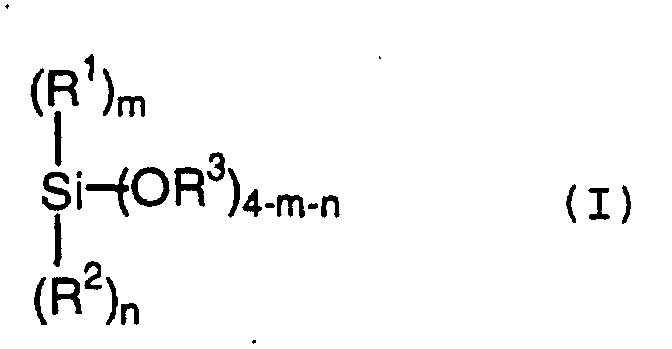 wherein R1 and R2 each represent a non-hydrolyzable
group which may be the same or different; R3 represents
an alkyl group having 1 to 6 carbon atoms;
and each of m and n is an integer selected from 0
to 3 so that m and n satisfy the relationship: 0 ≦
m + n ≦ 3.
wherein R1 and R2 each represent a non-hydrolyzable
group which may be the same or different; R3 represents
an alkyl group having 1 to 6 carbon atoms;
and each of m and n is an integer selected from 0
to 3 so that m and n satisfy the relationship: 0 ≦
m + n ≦ 3.
The hydrolytic condensation product may be either a condensation product partially hydrolyzed or a condensation product completely hydrolyzed.
The hydrolytic condensation product may be either a condensation product partially hydrolyzed or a condensation product completely hydrolyzed.
As the non-hydrolyzable group, non-hydrolyzable groups
having 1 to 4 carbon atoms are preferred from the viewpoint
of availability with ease. Examples of non-hydrolyzable
groups include organic groups having a reactive group such
as a γ-glycidoxypropyl group, a γ-aminopropyl group, an
aminophenyl group and an N-phenyl-γ-aminopropyl group,
alkyl groups such as a methyl group, an ethyl group, a
propyl group and a butyl group, alkenyl groups such as a
vinyl group, aryl groups such as a phenyl group and a tolyl
group, and fluorine-containing alkyl groups such as a
trifluoromethyl group, a trifluoropropyl group, a pentafluorobutyl
group, a nonafluorohexyl group, a tridecafluorooctyl
group, a heptadecafluorodecyl group and a
heptadecafluoroundecyl group. Among the above-mentioned
non-hydrolyzable groups, alkyl groups and aryl groups are
particularly preferred. Alkyl groups and aryl groups have
high heat resistance and are hydrophobic, and therefore, by
using these groups, a low-permittivity film having high
heat resistance and low moisture absorption property can be
obtained.
The hydrolytic condensation product in the present
invention is a hydrolytic condensation product or a mixture
of two or more hydrolytic condensation products selected
from the group consisting of the hydrolytic condensation
product wherein the relationship: m = n = 0 is satisfied in
the formula (I), the hydrolytic condensation product
wherein the relationship: m + n = 1 is satisfied, the
hydrolytic condensation product wherein the relationship: m
+ n = 2 is satisfied, and the hydrolytic condensation
product wherein the relationship: m + n = 3 is satisfied.
The alkoxysilane where m + n equals 3 has only one
hydrolyzable group in the molecule thereof, as a matter of
course, and it cannot solely form a hydrolytic condensation
product. Therefore, the m + n = 3 alkoxysilane is used in
combination with the alkoxysilane where m = n = 0, the
alkoxysilane where m + n = 1, or the alkoxysilane where m +
n = 2 for suppressing an excess reaction of a hydrolytic
condensation product of the alkoxysilane in a solution. It
is preferred that the alkoxysilane where m + n = 3 is
present in an amount of 10 mol% or less based on the total
mole of the alkoxysilane(s).
By adding an appropriate amount of the alkoxysilane
where m = n = 0 having no non-hydrolyzable group, the
resulting low-permittivity film can be improved in
mechanical strength. However, when the amount of the
alkoxysilane where m = n = 0 becomes large, the permittivity
of the resulting film becomes high and the moisture
absorption property is increased. Therefore, it is
preferred that the added amount of the alkoxysilane where m
= n = 0 is determined according to the balance between the
mechanical strength, the permittivity, and the moisture
absorption property of the film. The preferred amount of
the alkoxysilane where m = n = 0 added is 0.1 to 0.7 mol
based on 1 mol of the alkoxysilane having a non-hydrolyzable
group.
Specific examples of these alkoxysilanes are shown
below.
There may be mentioned tetraalkoxysilanes such as
tetramethoxysilane, tetraethoxysilane and tetrapropoxysilane,
monoalkyltrialkoxysilanes such as methyltrimethoxysilane
and methyltriethoxysilane, monoaryltrialkoxysilanes
such as phenyltrimethoxysilane and phenyltriethoxysilane,
monoalkenyltrialkoxysilanes such as vinyltrimethoxysilane
and vinyltriethoxysilane, fluorine-containing alkoxysilanes
such as trifluoromethyltrimethoxysilane, trifluoropropyltrimethoxysilane,
pentafluorobutyltrimethoxysilane, nonafluorohexyltrimethoxysilane,
tridecafluorooctyltrimethoxysilane,
heptadecafluorodecyltrimethoxysilane, heptadecafluorodecylmethyldimethoxysilane,
heptadecafluoroundecyltrimethoxysilane,
(4-perfluorobutylphenyl)trimethoxysilane,
(4-perfluorohexylphenyl)trimethoxysilane and (4-perfluorooctylphenyl)trimethoxysilane,
epoxysilanes such as γ-glycidoxypropyltrimethoxysilane
and γ-glycidoxypropyltriethoxysilane,
aliphatic aminosilanes such as γ-aminopropylmethyldiethoxysilane
and γ-aminopropyltriethoxysilane, and
aromatic ring-containing aminosilanes such as aminophenyltrimethoxysilane,
aminophenyltriethoxysilane and N-phenyl-γ-aminopropyltrimethoxysilane.
These alkoxysilanes are
used individually or in combination.
The condensation reaction of the alkoxysilane can be
conducted by a conventional manner. For example, there can
be mentioned a method in which water is added to the
alkoxysilane in the presence of a solvent and a catalyst to
effect a hydrolytic condensation reaction.
In this case, if desired, heating may be conducted.
As a catalyst, an inorganic acid such as hydrochloric acid, nitric acid and sulfuric acid, and an organic acid such as formic acid, oxalic acid and acetic acid can be used. In general, it is preferred that the hydrolytic condensation product has a weight average molecular weight (as measured by gel permeation chromatography (GPC) using a calibration curve obtained by standard polystyrene) in the range of 500 to 10000 from the viewpoint of increasing compatibility of the hydrolytic condensation product with a thermally decomposable polymer and for facilitating dissolution of the hydrolytic condensation product in a solvent. Then, if desired, water present in the system is removed by distillation, and further the catalyst may be removed using an ion-exchange resin.
As a catalyst, an inorganic acid such as hydrochloric acid, nitric acid and sulfuric acid, and an organic acid such as formic acid, oxalic acid and acetic acid can be used. In general, it is preferred that the hydrolytic condensation product has a weight average molecular weight (as measured by gel permeation chromatography (GPC) using a calibration curve obtained by standard polystyrene) in the range of 500 to 10000 from the viewpoint of increasing compatibility of the hydrolytic condensation product with a thermally decomposable polymer and for facilitating dissolution of the hydrolytic condensation product in a solvent. Then, if desired, water present in the system is removed by distillation, and further the catalyst may be removed using an ion-exchange resin.
With respect to the method for preparing a mixed
solution of (a) the thermally decomposable polymer and (b)
the siloxane oligomer; there is no particular limitation as
long as a uniform solution can be finally prepared, and, as
examples of methods, there may be mentioned the following
(1) to (3) methods.
A ratio of an amount of (b) the siloxane oligomer used
to the amount of (a) the thermally decomposable polymer
used can be arbitrarily adjusted depending on the purpose,
and, generally, (b) the siloxane oligomer is preferably
incorporated in an amount of 10 to 1000 parts by weight,
more preferably 60 to 450 parts by weight based on 100
parts by weight of (a) the thermally decomposable polymer.
The weight of (b) the siloxane oligomer is obtained by
making calculation on the assumption that all the hydrolyzable
groups are condensed to form Si-O-Si linkages.
When the amount of (b) the siloxane oligomer is too
small, the mechanical strength of the resulting low-permittivity
film tends to be lowered, and, when the amount
thereof is too large, the specific permittivity of the
resulting film tends to increase.
When a crosslinking reaction does not occur between
the functional group of (a) the thermally decomposable
polymer and the hydrolyzable group in (b) the siloxane
oligomer and the silanol group formed by the hydrolysis but
only an interaction occurs therebetween due to polarity of
the functional group, the compatibility of (a) the thermally
decomposable polymer with (b) the siloxane oligomer is
improved, so that a more uniform low-permittivity film can
be obtained.
In the present invention, examples of (c) the organic
solvents include alcohol solvents such as methanol, ethanol
propanol and butanol, fluorine-containing alcohol solvents
such as CF3CH2OH, CF3CF2CH2OH and CF3(CF2)3CH2CH2OH, acetate
solvents such as methyl acetate, ethyl acetate, propyl
acetate and butyl acetate, lactone solvents such as γ-lactone,
glycol acetate solvents such as ethylene glycol
monomethyl acetate and ethylene glycol diacetate, amide
solvents such as N-methyl-2-pyrrolidone, and glycol ether
solvents. These are used individually or in combination.
Among these (c) organic solvents, it is preferred to
use (c)' an organic solvent in which both of (a) the
thermally decomposable polymer and (b) the siloxane
oligomer are soluble.
The amount of (c) the organic solvent to be used is
appropriately selected depending on the desired solution
viscosity or thickness of the coating film, but, for example,
when a coating film having a thickness of 0.1 to 5 µm
is to be obtained by a spin coating method, it is preferred
to use the organic solvent in an amount such that the solid
content of the resulting composition becomes 1 to 20% by
weight.
The formation of a low-permittivity film using the
composition of the present invention can be achieved by,
for example, applying the composition to a substrate to
form a composite film which comprises (a) the thermally
decomposable polymer and (b) the siloxane oligomer evenly
compatibilized therewith, and then heating the resulting
film to condense (b) the siloxane oligomer and remove (a)
the thermally decomposable polymer.
In this method, in the heating step after application,
it is important that (b) the siloxane oligomer is condensed
in a state such that (a) the thermally decomposable polymer
is present in the film to form a network of polysiloxane.
When the decomposition of (a) the thermally decomposable
polymer starts before forming the network of polysiloxane,
the film suffers shrinkage due to the decomposition of
thermally decomposable polymer (a), so that the low permittivity
of the resulting film may possibly be deteriorated.
For obtaining a low-permittivity film having high heat
resistance and low moisture absorption property, it is
preferred to use a siloxane oligomer having a non-hydrolyzable
group as (b) the siloxane oligomer. When such (b) a
siloxane oligomer is heated without using a basic catalyst,
condensation starts at 150°C or higher. Then, the condensation
proceeds to form a network of polysiloxane, and the
formation of the structure of the film is substantially
completed at 250°C or higher. Therefore, in the present
invention, for obtaining a low-permittivity film having
high heat resistance and low moisture absorption property,
(a) the thermally decomposable polymer preferably has a
decomposition starting temperature of 150°C or higher, more
preferably 250°C or higher. From such a point of view, it
is preferred that (a) the thermally decomposable polymer is
a polymer which exhibits a weight loss at 250°C of less
than 5 %, and further which exhibits a weight loss at 400°C
of 80 % or more, each based on the weight at 150°C, as
measured by a thermogravimetric analysis in which the
temperature is elevated from 30°C or lower at a temperature
elevation rate of 20°C/min under an air stream.
Further, for obtaining a low-permittivity film by the
method of the present invention, it is preferred that (a)
the thermally decomposable polymer is satisfactorily
removed by heating. When the removal of (a) the thermally
decomposable polymer is incomplete, the low permittivity of
the resulting film is tend to be impaired.
When the present invention is applied to formation of
an interlayer insulating film for LSI, the heating temperature
employed varies depending on the type of the wiring
material. The heating temperature when using a conventional
Al wiring is 400 to 450°C, and it is expected that the
heating temperature when using a Cu wiring in future will
be expected to be about 380 to 430°C. Therefore, when the
present invention is applied to an LSI using a Cu wiring,
it is preferred that (a) the thermally decomposable polymer
is satisfactorily removed'at 400°C or less. Further, also
in an LSI using an Al wiring, it is preferred that (a) the
thermally decomposable polymer is removed at 400°C or less
from the viewpoint of reducing the change in permittivity
with the heating temperature.
Examples of coating methods for the composition of the
present invention include a spin coating method, a dipping
method, a potting method, a die coating method and a spray
coating method, and the coating method may be appropriately
selected depending on the form of the object to be coated
and the film thickness needed. When the composition of the
present invention is applied to an interlayer insulating
film for semiconductor device, a spin coating method is
preferred from the viewpoint of obtaining a narrow film
thickness distribution. When the composition is applied to
an interlayer insulating film for multilayer printed
circuit board, a die coating method as well as a spin
coating are preferred as high yield methods.
In the formation of a coating film, for volatilizing
(c) the organic solvent and for condensing (b) the siloxane
oligomer in a state such that (a) the thermally decomposable
polymer is present in the film, it is preferred that
the film is baked after application. The conditions for
baking may be appropriately selected depending on the
thickness of the coating film, but, from the viewpoint of
facilitating drying the solvent, it is preferred that the
baking is performed at 80 to 200°C, and, from the viewpoint
of facilitating the condensation reaction of (b) the
siloxane oligomer, it is preferred that the baking is
performed at 200 to 350°C. Further, it is preferred to use
a hot plate in the baking.
For advancing the condensation of (b) the siloxane
oligomer satisfactorily so that no unreacted alkoxy group
or silanol group remains in the film and for satisfactorily
removing (a) the thermally decomposable polymer, it is
preferred that the final curing is conducted at 350 to
500°C. The unreacted alkoxy group or silanol group per se
causes the specific permittivity of the coating film to
increase, and further can be a moisture-absorbing portion
to cause the specific permittivity to increase due to the
water absorbed. Therefore, it is desired that such groups
do not remain in the coating film. It is preferred that
the final curing is conducted using a hot plate or a
furnace.
By applying the low-permittivity film formed from the
composition of the present invention to an interlayer
insulating film for semiconductor device and multilayer
printed circuit board, it is possible to achieve excellent
electrical properties such as low permittivity and high
dielectric strength, and an improvement of performance such
as reduction of the signal-propagation delay time.
Further, the present invention can be applied also when the process temperature is lowered by using a Cu wiring in a semiconductor device.
Further, the present invention can be applied also when the process temperature is lowered by using a Cu wiring in a semiconductor device.
The semiconductor device mentioned in the present
invention means discrete semiconductor devices such as a
diode, a transistor, a compound semiconductor, a
thermistor, a varistor and a thyristor, memory devices such
as DRAM (dynamic random access memory), SRAM (static random
access memory), EPROM (erasable programmable read-only
memory), masked ROM (masked read-only memory), EEPROM
(electrically erasable programmable read-only memory) and
flash memory, theoretical circuit devices, such as a
microprocessor, DSP (a digital signal processor) and ASIC
(an application specific integrated circuit), integrated
circuit devices of compound semiconductors such as MMIC
(monolithic microwave integrated circuit), hybrid
integrated circuits (hybrid IC), and photoelectric
conversion devices such as a light emitting diode and a
charge coupled device.
The multilayer printed circuit board in the present
invention includes a high-density circuit board such as MCM
(a multi chip module). By using the coating film formed
from the composition of the present invention as an interlayer
insulating film as mentioned above, not only the
improvement of a device in performance such as reduction of
the signal-propagation delay time, but also the improvement
in reliability can be achieved.
In the following, the present invention will be
described with reference to the Examples.
Monomethyltrimethoxysilane, tetramethoxysilane and γ-butyrolactone
as a solvent were mixed with each other in a
flask, and acetic acid diluted with water was added
dropwise to the resulting mixture while stirring to effect
a reaction. In this instance, the temperature in the
laboratory was 23°C, and the temperature in the flask was
not controlled. The amount of the water added was equimolar
to the alkoxy group in the alkoxysilane used, and the
amount of the acetic acid added was made 0.01 mol based on
1.0 mol of the alkoxysilane. The concentration of the
coating solution was adjusted so that the nonvolatile
content became 20% by weight, thus obtaining Solution 1 ○.
The calculation for the nonvolatile content is made using
the weight obtained by calculation on the assumption that
all the hydrolyzable groups in the siloxane oligomer are
condensed to form Si-O-Si linkages, and the same calculation
method is employed in the following examples. After
completion of the dropwise addition of water and the
catalyst, the resulting mixture was stirred for about two
hours, and then transferred to a closed container and
allowed to stand at 23°C for two days. With respect to the
resulting siloxane oligomer, a molecular weight was measured
by GPC. As a result, it was found that the weight
average molecular weight in terms of polystyrene was about
1500. Then, the solution was stored in a freezer (at -18
°C).
Siloxane oligomer solution 2 ○ was prepared in substantially
the same manner using propylene glycol monopropyl
ether as a solvent. With respect to the resulting
siloxane oligomer, a molecular weight was measured by GPC.
As a result, it was found that the weight average molecular
weight in terms of polystyrene was about 1500. After
synthesis, the solution was stored in a freezer (at -18°C).
Polymethyl methacrylate (PMMA) having a weight average
molecular weight in terms of polystyrene of 120,000 was
dissolved in γ-butyrolactone to obtain Solution 3 ○ having a
polymer concentration of 10% by weight.
Polyvinyl acetate (PVAc) having a weight average
molecular weight in terms of polystyrene of 12,800 was
dissolved in propylene glycol monopropyl ether to obtain
Solution 4 ○ having a polymer concentration of 10% by
weight.
In a flask were mixed 100 g of Siloxane oligomer
solution 1 ○ and 133 g of Polymer solution 3 ○ together and
the mixture was stirred for one hour. Then, the resulting
mixture was allowed to stand at room temperature for one
day to obtain Solution A. The obtained composition has a
nonvolatile content of about 14% by weight, and the weight
ratio of the siloxane oligomer to the polymer is 150 parts
by weight of the siloxane oligomer based on 100 parts by
weight of the polymer.
In a flask were mixed 100 g of Siloxane oligomer
solution 1 ○ and 50 g of Polymer solution 3 ○ together and
the mixture was stirred for one hour. Then, the resulting
mixture was allowed to stand at room temperature for one
day to obtain Solution B. The obtained composition has a
nonvolatile content of about 17% by weight. The weight
ratio of the siloxane oligomer to the polymer is 400 parts
by weight of the siloxane oligomer based on 100 parts by
weight of the polymer.
In a flask were mixed 100 g of Siloxane oligomer
solution 2 ○ and 133 g of Polymer solution 4 ○ together and
the mixture was stirred for one hour. Then, the resulting
mixture was allowed to stand at room temperature for one
day to obtain Solution C. The obtained composition has a
nonvolatile content of about 14% by weight, and the weight
ratio of the siloxane oligomer to the polymer is 150 parts
by weight of the siloxane oligomer based on 100 parts by
weight of the polymer.
In a flask were mixed 100 g of Siloxane oligomer
solution 2 ○ and 50 g of Polymer solution 4 ○ together and
the mixture was stirred for one hour. Then, the resulting
mixture was allowed to stand at room temperature for one
day to obtain Solution D. The obtained composition has a
nonvolatile content of about 17% by weight. The weight
ratio of the siloxane oligomer to the polymer is 400 parts
by weight of the siloxane oligomer based on 100 parts by
weight of the polymer.
Using Siloxane oligomer solution 1 ○, Siloxane oligomer
solution 2 ○, Coating solution A, Coating solution B,
Coating solution C, and Coating solution D, coating films
were formed by a spin coating method. As a substrate, a
bare silicon wafer was used. The rotary speed for coating
was adjusted per coating solution so that the thickness of
the film after final curing (at 400 to 450°C) became about
4500 to 5000 Å. After completion of the spin coating, the
resulting film was baked by a hot plate at 150°C/30 sec and
at 250°C/30 sec successively. The final curing was
conducted by using a vertical furnace in a nitrogen gas
atmosphere at 400, 425 and 450°C/1 hr.
With respect to each of the obtained films, a specific
permittivity was measured. The specific permittivity was
determined by a method in which an Al electrode having a
diameter of 2 mm was formed on a film, and a capacitance of
the capacitor formed by the Al electrode and the silicon
wafer was measured to calculate a specific permittivity
from the thickness of the film and the area of the Al
electrode. The measurement of capacitance was conducted
using an impedance analyzer at 10 kHz. The thickness of a
film was measured by using ellipsometry. The results of
the measurement of specific permittivity are shown in Table
1.
| Used solution | Specific permittivity | |||
| 400°C | 425°C | 450°C | ||
| Comparative example 1 | Solution 1 ○ | 3.1 | 3.0 | 2.9 |
| Comparative example 2 | Solution 2 ○ | 3.1 | 3.0 | 2.9 |
| Example 5 | Solution A | 2.2 | 2.1 | 2.1 |
| Example 6 | Solution B | 2.6 | 2.5 | 2.5 |
| Example 7 | Solution C | 2.7 | 2.5 | 2.3 |
| Example 8 | Solution D | 3.0 | 2.7 | 2.6 |
With respect to each of PMMA and PVAc used in Polymer
solutions 3 ○ and 4 ○, a thermogravimetric analysis was
conducted. The conditions for the measurement are shown
below.
For avoiding the influence of the weight loss caused
by the factors other than the decomposition of the polymer,
a weight loss at 250°C and a weight loss at 400°C, each
based on the weight of the polymer at 150°C, were
calculated from the results of measurement. The results
are shown in Table 2.
| Polymer | Weight loss rate | |
| 250°C | 400°C | |
| PMMA | 0% | 93% |
| PVAc | 0% | 71% |
It was obtained a result that the relative permittivities
of the films prepared using Coating solutions A, B, C
and D in Examples 5 to 8 are lower than those of the films
prepared at the same temperature using Solutions 1 ○ and 2 ○
in Comparative examples 1 and 2. In addition, it was found
that the larger the amount ratio of the polymer to the
siloxane oligomer is, the lower the specific permittivity
of the film becomes.
It was obtained a result that, when comparison is made
between the case where PMMA was used as a thermally decomposable
polymer (Examples 5 and 6) and the case where PVAc
was used (Examples 7 and 8), the change in specific permittivity
with the final curing temperature in the case where
PMMA was used is smaller. Further, as can be seen from the
results of the thermogravimetric analysis shown in Table 2,
the weight loss at 400°C in the case where PMMA was used is
larger. Therefore, it is presumed that PMMA is removed at
a low temperature as compared to PVAc, and thus, the change
in specific permittivity with the curing temperature when
PMMA was used is smaller.
For confirming the influence of moisture absorption on
each of the films formed in Examples 5 to 8, a wafer having
formed thereon the film was allowed to stand for one week
in a room controlled at a temperature of 23°C at a humidity
of 40%, and then a specific permittivity was measured
again. As a result, it was found that the increase in
permittivity was 0.1 at maximum. This result indicates
that each of the obtained films has a low moisture
absorption property.
With respect to each of the films formed in Examples 5
to 8, a cross-section was observed through an electron
microscope at a magnification of 100,000 times. As a
result, it was found that definite pores seen in a film
called porous film are not observed in each film. There is
no means effective for observing micro-pores currently, but
it is presumed that, when pores are assumed to be formed in
each film, the pores have a size of 0.01 µm or less.
Therefore, the obtained films can be applied to shrunk LSI
having a wiring width as small as about 0.1 µm.
In Examples 5 to 8, there are shown examples in which
the siloxane oligomer solution and the thermally decomposable
polymer solution were separately prepared, and then
mixed together to prepare a coating solution. When an
alkoxysilane was subjected to hydrolytic condensation in a
solution having dissolved therein a thermally decomposable
polymer to prepare a coating solution, the same results
were obtained.
From the composition of the present invention, a low-permittivity
film having a specific permittivity of 2.5 or
less can be obtained wherein the film can be formed by
heating at about 400°C and applied to an interlayer
insulating film for semiconductor device, such as LSI
having finer wiring, and for multilayer printed circuit
board.
By the method for forming a low-permittivity film of
the present invention, a low-permittivity film having a
specific permittivity of 2.5 or less can be obtained with
ease in high yield wherein the film can be formed by
heating at about 400°C and applied to an interlayer
insulating film for semiconductor device, such as LSI
having finer wiring, and for multilayer printed circuit
board.
The low-permittivity film of the present invention has
a specific permittivity of 2.5 or less, and can be applied
to an interlayer insulating film for semiconductor device,
such as LSI having finer wiring and for multilayer printed
circuit board.
The electronic part of the present invention has the
low-permittivity film and has such high quality and high
reliability that it causes less signal-propagation delay.
Claims (23)
- A composition comprising (a) a thermally decomposable polymer and (b) a siloxane oligomer dissolved in (c) an organic solvent.
- The composition according to Claim 1, wherein (b) the siloxane oligomer is a compound having a non-hydrolyzable organic group.
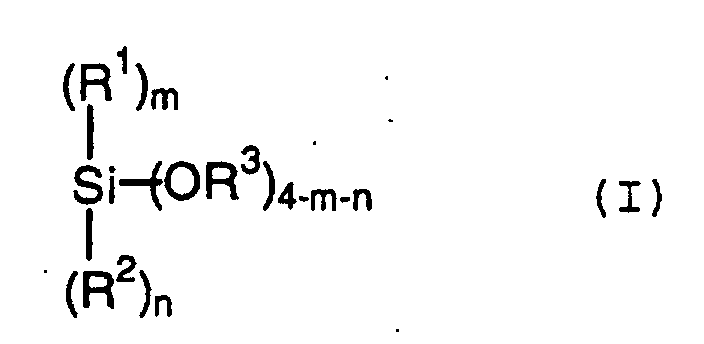
- The composition according to Claim 2, wherein (b) the siloxane oligomer is a hydrolytic condensation product of an alkoxysilane represented by the following formula (I):wherein R1 and R2 each represent a non-hydrolyzable group which may be the same or different; R3 represents an alkyl group having 1 to 6 carbon atoms; and each of m and n is an integer selected from 0 to 3 so that m and n satisfy the relationship: 0 ≦ m + n ≦ 3.
- The composition according to Claim 3, wherein (a) the thermally decomposable polymer is a polymer which exhibits a weight loss at 250°C of less than 5% based on the weight at 150°C as measured by a thermogravimetric analysis in which the temperature is elevated from 30°C or lower at a temperature elevation rate of 20°C/min under an air stream.
- The composition according to claim 4, wherein (a) the thermally decomposable polymer is a polymer which exhibits a weight loss at 400°C of 80% or more based on the weight at 150°C as measured by a thermogravimetric analysis in which the temperature is elevated from 30°C or lower at a temperature elevation rate of 20°C/min under an air stream.
- The composition according to Claim 5, wherein (a) the thermally decomposable polymer is a fluorine-free polymer.
- The composition according to claim 5, wherein (a) the thermally decomposable polymer is a methacrylate polymer or an acrylate polymer.
- A composition comprising(a) a thermally decomposable polymer,(b) a siloxane oligomer, and(c)' an organic solvent in which both of said components (a) and (b) are soluble.
- The composition according to Claim 8, wherein (b) the siloxane oligomer is a compound having a non-hydrolyzable organic group.
- The composition according to Claim 9, wherein (b) the siloxane oligomer is a hydrolytic condensation product of an alkoxysilane represented by the following formula (I):wherein R1 and R2 each represent a non-hydrolyzable group which may be the same or different; R3 represents an alkyl group having 1 to 6 carbon atoms; and each of m and n is an integer selected from 0 to 3 so that m and n satisfy the relationship: 0 ≦ m + n ≦ 3.

- The composition according to Claim 10, wherein (a) the thermally decomposable polymer is a polymer which exhibits a weight loss at 250°C of less than 5% based on the weight at 150°C, as measured by a thermogravimetric analysis in which the temperature is elevated from 30°C or lower at a temperature elevation rate of 20°C/min under an air stream.
- The composition according to Claim 11, wherein (a) the thermally decomposable polymer is a polymer which exhibits a weight loss at 400°C of 80% or more based on the weight at 150°C, as measured by a thermogravimetric analysis in which the temperature is elevated from 30°C or lower at a temperature elevation rate of 20°C/min under an air stream.
- The composition according to Claim 12, wherein (a) the thermally decomposable polymer is a fluorine-free polymer.
- The composition according to Claim 12, wherein (a) the thermally decomposable polymer is a methacrylate polymer or an acrylate polymer.
- A method for forming a low-permittivity film which comprises applying the composition according to any one of Claims 1 to 14 to a substrate to form a composite film comprising the thermally decomposable polymer and the siloxane oligomer evenly compatibilized therewith, and then heating the resulting film to condense the siloxane oligomer and remove the thermally decomposable polymer.
- A method for forming a low-permittivity film which comprises applying the composition according to any one of Claims 1 to 14 to a substrate to form a composite film comprising the thermally decomposable polymer and the siloxane oligomer evenly compatibilized therewith, subsequently conducting a first heating step in which the siloxane oligomer is crosslinked while keeping the thermally decomposable polymer remaining in the film, and then conducting a second heating step in which the thermally decomposable polymer is removed.
- The method according to Claim 16, wherein said first heating step is conducted at a temperature of 80 to 350°C, and wherein said second heating step is conducted at a temperature of 350 to 500°C.
- A low-permittivity film formed by the method according to Claim 15.
- A low-permittivity film formed by the method according to Claim 16.
- A low-permittivity film formed by the method according to Claim 17.
- An electronic part having the low-permittivity film according to Claim 18.
- An electronic part having the low-permittivity film according to Claim 19.
- An electronic part having the low-permittivity film according to Claim 20.
Applications Claiming Priority (3)
| Application Number | Priority Date | Filing Date | Title |
|---|---|---|---|
| JP26139199 | 1999-09-16 | ||
| JP26139199 | 1999-09-16 | ||
| PCT/JP2000/006304 WO2001019922A1 (en) | 1999-09-16 | 2000-09-14 | Composition, methods of forming low-permittivity film from the composition, low-permittivity film, and electronic part having the low-permittivity film |
Publications (2)
| Publication Number | Publication Date |
|---|---|
| EP1236772A1 true EP1236772A1 (en) | 2002-09-04 |
| EP1236772A4 EP1236772A4 (en) | 2005-03-23 |
Family
ID=17361219
Family Applications (1)
| Application Number | Title | Priority Date | Filing Date |
|---|---|---|---|
| EP00961015A Withdrawn EP1236772A4 (en) | 1999-09-16 | 2000-09-14 | COMPOSITION, PROCESS FOR PREPARING FILMS WITH LOW PERMEABILITY FROM THIS COMPOSITION, LOW-PERMEABLE FILMS AND ELECTRONIC PART WITH A LOW-PERMEABLE FILM |
Country Status (5)
| Country | Link |
|---|---|
| EP (1) | EP1236772A4 (en) |
| JP (1) | JP4734815B2 (en) |
| KR (1) | KR100732089B1 (en) |
| TW (1) | TWI260332B (en) |
| WO (1) | WO2001019922A1 (en) |
Families Citing this family (5)
| Publication number | Priority date | Publication date | Assignee | Title |
|---|---|---|---|---|
| US7687590B2 (en) | 2002-02-27 | 2010-03-30 | Hitachi Chemical Company, Ltd. | Composition for forming silica based coating film, silica based coating film and method for preparation thereof, and electronic parts |
| US7682701B2 (en) | 2002-02-27 | 2010-03-23 | Hitachi Chemical Co., Ltd. | Composition for forming silica based coating film, silica based coating film and method for preparation thereof, and electronic parts |
| KR100795251B1 (en) | 2002-02-27 | 2008-01-15 | 히다치 가세고교 가부시끼가이샤 | Silica based film forming composition, silica based film, manufacturing method and electronic parts |
| KR100869857B1 (en) * | 2008-05-09 | 2008-11-21 | 주식회사 삼우티씨씨 | Hybrid Composite Membrane for Separation and Recovery of Volatile Organic Compounds |
| KR102922552B1 (en) | 2020-04-24 | 2026-02-04 | 아이엠에스 나노패브릭케이션 게엠베하 | Chargedparticle source |
Family Cites Families (12)
| Publication number | Priority date | Publication date | Assignee | Title |
|---|---|---|---|---|
| JPH05294609A (en) * | 1992-04-17 | 1993-11-09 | Yoshio Imai | Polyimide-silica composite film and silica film formed therefrom |
| JPH0772722A (en) * | 1993-09-01 | 1995-03-17 | Hitachi Ltd | Electrophotographic apparatus and developing method |
| JPH0860081A (en) * | 1994-08-19 | 1996-03-05 | Nippon Synthetic Chem Ind Co Ltd:The | Coating composition |
| JP3487940B2 (en) * | 1995-01-24 | 2004-01-19 | 日本合成化学工業株式会社 | Adhesive composition |
| JPH09143420A (en) | 1995-09-21 | 1997-06-03 | Asahi Glass Co Ltd | Low dielectric constant resin composition |
| US5700844A (en) * | 1996-04-09 | 1997-12-23 | International Business Machines Corporation | Process for making a foamed polymer |
| JP3851393B2 (en) | 1996-11-25 | 2006-11-29 | 旭化成株式会社 | Method for producing porous silicon oxide film |
| JP3182107B2 (en) * | 1996-12-13 | 2001-07-03 | 松下電工株式会社 | Functional coatings, their production methods and applications |
| US5902851A (en) * | 1996-12-24 | 1999-05-11 | Matsushita Electric Works, Ltd. | Resinous composition for foul releasing coat and coating articles |
| JPH11217458A (en) * | 1998-02-04 | 1999-08-10 | Hitachi Chem Co Ltd | Porous membrane, method for producing the same, and article |
| JP2000044875A (en) * | 1998-05-18 | 2000-02-15 | Jsr Corp | Composition for forming film, method for forming film, and low-density film |
| JP2000038545A (en) * | 1998-05-18 | 2000-02-08 | Jsr Corp | Composition for forming film, method for forming film, and low-density film |
-
2000
- 2000-08-21 TW TW089116894A patent/TWI260332B/en not_active IP Right Cessation
- 2000-09-14 JP JP2001523695A patent/JP4734815B2/en not_active Expired - Fee Related
- 2000-09-14 KR KR1020027003454A patent/KR100732089B1/en not_active Expired - Fee Related
- 2000-09-14 WO PCT/JP2000/006304 patent/WO2001019922A1/en not_active Ceased
- 2000-09-14 EP EP00961015A patent/EP1236772A4/en not_active Withdrawn
Also Published As
| Publication number | Publication date |
|---|---|
| TWI260332B (en) | 2006-08-21 |
| KR20020031195A (en) | 2002-04-26 |
| WO2001019922A1 (en) | 2001-03-22 |
| KR100732089B1 (en) | 2007-06-27 |
| EP1236772A4 (en) | 2005-03-23 |
| JP4734815B2 (en) | 2011-07-27 |
Similar Documents
| Publication | Publication Date | Title |
|---|---|---|
| EP1245642B1 (en) | Siloxane-based resin and method for forming an insulating film between interconnecting layers in wafers | |
| US6623711B2 (en) | Siloxane-based resin and method for forming insulating film between interconnect layers in semiconductor devices by using the same | |
| EP1858996A1 (en) | Coating composition for dielectric insulating film, dielectric insulating film prepared therefrom, and electric or electronic device comprising the same | |
| KR100613682B1 (en) | Compositions for preparing low dielectric materials containing solvents | |
| JP2001098224A (en) | Silica-based film, method of forming silica-based film, and electronic component having silica-based film | |
| US7834119B2 (en) | Organic silicate polymer and insulation film comprising the same | |
| KR20040087888A (en) | Coating composition for insulating film production, preparation method of insulation film by using the same, insulation film for semi-conductor device prepared therefrom, and semi-conductor device comprising the same | |
| CN1326912C (en) | Organosilicate polymer and insulating film containing the same | |
| JP2001098218A (en) | Silica-base coating film, method of forming silica-base coating film and electronic component having silica-base coating film | |
| CN1759135B (en) | Organosiloxane resin and insulating film using the same | |
| US20040253462A1 (en) | Composition, methods for forming low-permittivity film using the composition, low-permittivity film, and electronic part having the low-permittivity film | |
| CN100419970C (en) | Composition for forming porous film, porous film and method for forming same, interlayer insulating film and semiconductor device | |
| KR100732089B1 (en) | Composition, a method of forming a low dielectric constant film using the composition, a low dielectric constant film and an electronic component having the low dielectric constant film | |
| JP2004307692A (en) | Composition for forming porous film, method for producing porous film, porous film, interlayer insulating film, and semiconductor device | |
| JP2000340651A (en) | Manufacturing method of low dielectric constant film | |
| JP2004307693A (en) | Composition for forming porous film, method for producing porous film, porous film, interlayer insulating film, and semiconductor device | |
| JPWO2001019922A1 (en) | COMPOSITION, METHOD FOR FORMING LOW DIELECTRIC CONSTANT FILM USING THE COMPOSITION, LOW DIELECTRIC CONSTANT FILM, AND ELECTRONIC COMPONENT HAVING THE LOW DIELECTRIC CONSTANT FILM | |
| JP2002201415A (en) | Application liquid for silica-based coating film formation, method for manufacturing silica-based coating film, and semiconductor device | |
| CN1671772A (en) | Organosiloxanes | |
| CN107129757B (en) | Composition for forming silicon dioxide layer, silicon dioxide layer and manufacturing method thereof, and electronic device comprising silicon dioxide layer | |
| JPH11217440A (en) | Fluoroalkyl group-containing polysiloxane, low dielectric constant resin composition and article | |
| JP4344903B2 (en) | Materials for forming interlayer insulation film for semiconductor elements | |
| CN1757445A (en) | Composition for preparing low dielectric material containing solvent | |
| JP2001279163A (en) | Coating fluid for forming siliceous coating film, method for producing siliceous coating film, siliceous coating film, semiconductor element using the same, and multi- layer printed wiring board using the same | |
| JPH06181202A (en) | Insulating film of semiconductor device |
Legal Events
| Date | Code | Title | Description |
|---|---|---|---|
| PUAI | Public reference made under article 153(3) epc to a published international application that has entered the european phase |
Free format text: ORIGINAL CODE: 0009012 |
|
| 17P | Request for examination filed |
Effective date: 20020411 |
|
| AK | Designated contracting states |
Kind code of ref document: A1 Designated state(s): AT BE CH CY DE DK ES FI FR GB GR IE IT LI LU MC NL PT SE |
|
| RBV | Designated contracting states (corrected) |
Designated state(s): AT BE CH DE FR GB LI |
|
| A4 | Supplementary search report drawn up and despatched |
Effective date: 20050207 |
|
| 17Q | First examination report despatched |
Effective date: 20050630 |
|
| STAA | Information on the status of an ep patent application or granted ep patent |
Free format text: STATUS: THE APPLICATION IS DEEMED TO BE WITHDRAWN |
|
| 18D | Application deemed to be withdrawn |
Effective date: 20090903 |