EP1234916A2 - Method for making column members - Google Patents
Method for making column members Download PDFInfo
- Publication number
- EP1234916A2 EP1234916A2 EP02003803A EP02003803A EP1234916A2 EP 1234916 A2 EP1234916 A2 EP 1234916A2 EP 02003803 A EP02003803 A EP 02003803A EP 02003803 A EP02003803 A EP 02003803A EP 1234916 A2 EP1234916 A2 EP 1234916A2
- Authority
- EP
- European Patent Office
- Prior art keywords
- column section
- load
- column
- bearing
- supportable
- Prior art date
- Legal status (The legal status is an assumption and is not a legal conclusion. Google has not performed a legal analysis and makes no representation as to the accuracy of the status listed.)
- Granted
Links
Images



Classifications
-
- E—FIXED CONSTRUCTIONS
- E02—HYDRAULIC ENGINEERING; FOUNDATIONS; SOIL SHIFTING
- E02D—FOUNDATIONS; EXCAVATIONS; EMBANKMENTS; UNDERGROUND OR UNDERWATER STRUCTURES
- E02D3/00—Improving or preserving soil or rock, e.g. preserving permafrost soil
- E02D3/12—Consolidating by placing solidifying or pore-filling substances in the soil
- E02D3/123—Consolidating by placing solidifying or pore-filling substances in the soil and compacting the soil
-
- E—FIXED CONSTRUCTIONS
- E02—HYDRAULIC ENGINEERING; FOUNDATIONS; SOIL SHIFTING
- E02D—FOUNDATIONS; EXCAVATIONS; EMBANKMENTS; UNDERGROUND OR UNDERWATER STRUCTURES
- E02D3/00—Improving or preserving soil or rock, e.g. preserving permafrost soil
- E02D3/02—Improving by compacting
- E02D3/08—Improving by compacting by inserting stones or lost bodies, e.g. compaction piles
-
- E—FIXED CONSTRUCTIONS
- E02—HYDRAULIC ENGINEERING; FOUNDATIONS; SOIL SHIFTING
- E02D—FOUNDATIONS; EXCAVATIONS; EMBANKMENTS; UNDERGROUND OR UNDERWATER STRUCTURES
- E02D7/00—Methods or apparatus for placing sheet pile bulkheads, piles, mouldpipes, or other moulds
- E02D7/02—Placing by driving
- E02D7/06—Power-driven drivers
- E02D7/14—Components for drivers inasmuch as not specially for a specific driver construction
Definitions
- the invention relates to a method for producing columns in floors with at least one non-load-bearing floor layer for the purpose of soil improvement or stabilization. It Various processes are known, according to which they are not sufficient load-bearing surface by installing in one Grid arranged pillars is improved. Come here different mechanisms of action. For one, by deep column bodies transfer the load to lower ones load-bearing layers take place; besides, through that Installation of the pillar body without prior excavation of soil compaction between the column bodies; finally can when using dry binder in the column bodies Soil water can be extracted from cohesive soils.
- the invention is based on the object propose a method of making columns that for deep-seated viable or at least supportive Layers and non-supportable surface layers or Intermediate layers for time and cost advantages in the application leads.
- the solution to this lies in a process for Manufacture of pillars in floors with at least one non-load-bearing one Soil layer for the purpose of soil improvement or stabilization, with the following process steps to manufacture one of the columns, a displacement device, in particular a deep vibrator with a lock tube or a displacement tube with closure, is from the floor surface through the at least one non-load-bearing floor layer up to shaken a stable or at least supportable layer of soil, one directly from an at least sustainable soil layer supported lower column section, in particular by means of the displacement device, from bottom to top built up of rolled material, a tubular or tubular one Wrapping is from the bottom surface, at least one non-supportive soil layer penetrating down to the bottom Sufficiently installed column section, the covering becomes an upper supported by the envelope Column section
- the main advantage of the method is so far just possible with conventional tamping or vibrating technology manufactured to use uncased column bodies, which in particular on one in a viable or at least sustainable Layer of embedded thickened column base can rest, and the stability of the column body by using a cover only to a depth from which down sufficient continuous support to the bottom End of the column.
- the present Stratification is due to previous exploratory drilling or others Determine site exploration methods.
- the columns of the invention are even when using only binder-free material, even with the expected Loads are dimensionally stable in that the wrapping in unstable floor area is designed so that it can be expected Stress states with possibly little radial deformation intercepts and thus the loads in the uncontaminated lower Column section and the column base entered without damage can be.
- the wrapping After a first procedure, the wrapping after first shaking and pulling the displacement device - After making the lower column section - on its lower end coaxially attached to this and at one second shaking of the displacement device to its intended Brought down depth.
- the process sequence poses This is initially the same as for the more common production Vibrating or stuffing columns, whereby, as already mentioned, when pulling the lower column section only up to a first Soft layer is prepared and the displacement device then pulled open leaving a displacement hole becomes. It may be necessary to add support fluid become.
- the wrapping is on the displacement device attached and in a second additional shaking process pulled into the open vibratory opening and partly in the already existing lower column section brought in. Then the displacement device with immediate filling of the casing and compression of the Filling material (contractor procedure) are drawn or without Filling material is pulled, which is then from the top of the casing (from the bottom surface) can be.
- binder rolling material - mortar, concrete - preferable, in particular if higher loads have to be removed and / or water exchange between different water-bearing layers is.
- Essentially dimensionally stable tubular bodies come as a covering, be it without breakthroughs, be it with breakthroughs, from the known ones Materials such as sheet steel, composite material or Plastic into consideration.
- Another approach can be used as wrapping a geotextile hose, be it with a non-woven composite component or are used without a nonwoven portion. In this case there is a necessary radial state of stress in the column body only as a result of a significant radial expansion of the hose body.
- the pipe jackets used are usually designed as a tube open at the bottom. In the Use of geotextiles can be closed below Hoses for easier removal are cheaper his.
- the present invention finds application wherever in the displacement or compaction of the soil when placing the necessary support tension of stuffing or vibrating columns or reaction stress in the upper soil layers - surface layers or intermediate layers - is not achieved and the floor is necessary for the functionality of the column radial support cannot build up or a horizontal one Run of the mortar or concrete when pouring cannot prevent it from hardening.
- the pillar In the floor layers immediately above the lower end of the column, in which there is sufficient radial throughout Support is given, the pillar will be known accordingly Techniques made without additional wrapping.
- binder-containing material By using binder-containing material, a vertical flow can be reduced or prevented, so that a connection between different groundwater levels remains prevented.
- the column is according to the invention with a covering consisting of pipes or geotextile hoses manufactured.
- the upper column section (with cover) can be independent of the design of the lower column section (without cover) with rolled material with or without added binding agents filled and stuffed, usually with gravel, crushed stone, Sand, mortar or concrete.
- the wrapper can also be used for an exchange or chemical reactions of the column material with the soil, the soil moisture to prevent the groundwater, for example a change in the pH value in the surrounding soil to reduce the incorporation of binders or entirely avoid.
- stable columns can be are produced immediately or after hardening of the if necessary used binder can be loaded. by virtue of their method of manufacture is only small settlements expected to be applied.
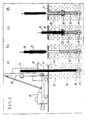
- FIG. 1 the production of a in four phases a) to d) shown column according to the invention.
- a vertically cut Soil with the surface 11 has a non-load-bearing and non-supportable top layer 12 (soft layer), below an at least supportable bottom layer 13 and finally underneath a well-bearing floor layer 14.
- a vibrator 17 is guided, which is a feed hopper 18 passes through for material introduction.
- the jogger tip is vibrated into the load-bearing floor layer 14.
- dashed lines is a thickened column base 19 shown, the optional in a first step Vibratory compaction or stuffing compaction from rolling material - with or without binder surcharge - can be generated.
- the vibrator 17 is already complete pulled, whereby - on the optional column base 19 - a lower column section using vibrating or tamping technology 20 is built from rolly material that extends into the load-bearing Bottom layer 14 extends radially directly from the bottom the supportable bottom layer 13 is supported.
- This lower one Column section 20 extends into the unsustainable top Bottom layer 12 slightly into it, while the rest Displacement hole 21 can be seen in this bottom layer.
- a tube 22 is coaxial which has inner drivers 24 at the lower end, that of driver pin 23 at the lower end of the vibrator can be taken.
- the illustration d) shows that the final Pulling the vibrator 17 the sheathing tube 22 over the vibrator has been filled with rolling material that is in suitable Dimensions can be compressed, creating an upper column section 26 arose with radial support through the sheathing tube 22 is.
- the cladding tube open here used below 22 could also be closed at the bottom by a cover Pipe set in the lower column section 20 become.
- the geotextile hose 27 to form an upper column section 28 with rolled material filled, the hose 27 by radial expansion Support forces can build up and the filling material essentially demarcated from the ground.
- FIG. 3 shows essentially the same device situation in three phases and the same soil stratification as in the figures 1 and 2 shown.
- the same details are the same Provide reference numbers.
- a solid sheathing tube is used 22 'during the first vibrating process of the vibrator 17 according to illustration a) at a distance from the vibrator tip pushed coaxially onto the vibrator and brought down into the ground.
- the corresponding driver means 23, 24 are located at a corresponding distance from the vibrator tip.
- the cladding tube 22 'already has reaches its intended position that the non-supportive Soil layer 12 penetrates and into the at least Sustainable bottom layer 13 protrudes.
- the vibrator 17 is already inside of the cladding tube 22 'withdrawn after being pulled a lower column section 20 in the area of at least Sustainable bottom layer 13 has generated the radially immediately is supported by the ground.
- the vibrator 17 is completely out of the Wrapping tube 22 'pulled up, the wrap tube 22 'to form an upper column section 28 is filled with rolly material that differs from the material here of the lower column section 20 differs.
- FIG. 4 is essentially the same terrain and equipment situation and the same sequence of processes as in FIG. 3 shown. The same details are given the same reference numbers Mistake. In this respect, reference is made to the description of FIG. 3 taken.
- a rigid cladding tube is here a less recognizable geotextile tube open at the bottom 27 'pulled over the middle section of the vibrator 17 and so far taken down that he was the unsustainable bottom layer 12 penetrates and with the lower end in the least Sustainable bottom layer 13 protrudes.
- the pillar foot 19 is already finished in the area of the load-bearing floor layer 14 posed.
- the common principle can be seen in the illustrations to reduce costs and reduce material consumption additional covering for the column material only in the area not at least supportable upper soil layers. This reduces the need for support bodies by length as well as the consumption of filling material in the area of non-supportive layers.
- the load is transferred via the entire column body into the lower layers of the floor, load transfer in the area of the lower column section via jacket friction in addition to the bearing load of the column base or as an exclusive force transmission into the ground becomes possible.
Landscapes
- Engineering & Computer Science (AREA)
- Structural Engineering (AREA)
- Life Sciences & Earth Sciences (AREA)
- Civil Engineering (AREA)
- General Life Sciences & Earth Sciences (AREA)
- Mining & Mineral Resources (AREA)
- Paleontology (AREA)
- General Engineering & Computer Science (AREA)
- Soil Sciences (AREA)
- Environmental & Geological Engineering (AREA)
- Agronomy & Crop Science (AREA)
- Investigation Of Foundation Soil And Reinforcement Of Foundation Soil By Compacting Or Drainage (AREA)
- Transition And Organic Metals Composition Catalysts For Addition Polymerization (AREA)
- Acyclic And Carbocyclic Compounds In Medicinal Compositions (AREA)
- Rod-Shaped Construction Members (AREA)
Abstract
Description
Die Erfindung betrifft ein Verfahren zum Herstellen von Säulen in Böden mit zumindest einer nicht-tragfähigen Bodenschicht zum Zweck der Baugrundverbesserung bzw. -stabilisierung. Es sind vielfältige Verfahren bekannt, nach denen nicht ausreichend tragfähiger Untergrund durch das Einbauen von in einem Raster angeordneten Säulen verbessert wird. Hierbei kommen verschiedene Wirkmechanismen zur Geltung. Zum einen kann durch tiefreichende Säulenkörper eine Lastabtragung in tiefer liegende tragfähige Schichten erfolgen; daneben kann durch das Einbauen der Säulenkörper ohne vorherigen Bodenaushub eine Bodenverdichtung zwischen den Säulenkörpern erfolgen; schließlich kann bei Verwendung von trockenem Bindemittel in den Säulenkörpern Bodenwasser aus bindigen Böden entzogen werden.The invention relates to a method for producing columns in floors with at least one non-load-bearing floor layer for the purpose of soil improvement or stabilization. It Various processes are known, according to which they are not sufficient load-bearing surface by installing in one Grid arranged pillars is improved. Come here different mechanisms of action. For one, by deep column bodies transfer the load to lower ones load-bearing layers take place; besides, through that Installation of the pillar body without prior excavation of soil compaction between the column bodies; finally can when using dry binder in the column bodies Soil water can be extracted from cohesive soils.
Aus Kosten- und Verfahrensgründen günstig sind unverrohrte Säulen, die in Stopf- oder Rütteltechnik mittels Tiefenrüttlern mit Schleusenrohr in einem kontinuierlichen Arbeitsgang auf einem Säulenfuß aufgebaut werden können. Diese Herstelltechnik kommt an ihre Grenzen oder versagt beim Vorliegen von Weichschichten, die keine ausreichenden radialen Stützkräfte aufbauen können, um den Säulenkörper bei Belastung durch Auflasten formstabil halten zu können, in folgenden nicht-stützfähigen Bodenschichten genannt. Uncased are inexpensive for cost and procedural reasons Columns in the tamping or vibrating technique using deep vibrators with lock tube in one continuous operation can be built on a pedestal. This manufacturing technique reaches its limits or fails when Soft layers that do not have sufficient radial support forces can build up around the column body when loaded by loads to be able to keep its shape in the following non-supportable Soil layers called.
Aus der DE 44 08 173 A1 und der EP 0 900 883 A1 ist es bekannt, Säulenkörper, die bis in eine tragfähige Bodenschicht hineinreichen, mit einer Umhüllung aus einem Rohr oder einem Geotextilmaterial zu versehen, wobei zunächst ein Aushub oder eine Verdrängung des Bodens erfolgt und dann Umhüllung und Füllmaterial eingebracht werden. Bei sehr tief liegenden tragfähigen Schichten ist das Verfahren, das eine zeitweilige Verrohrung erfordert, zu aufwendig.From DE 44 08 173 A1 and EP 0 900 883 A1 it is known Column body, which is in a stable floor layer reach in with a casing made of a pipe or a To provide geotextile material, initially excavation or a displacement of the soil occurs and then wrapping and Filling material can be introduced. With very deep, stable Layering is the process of temporary piping requires too expensive.
Hiervon ausgehend, liegt der Erfindung die Aufgabe zugrunde, ein Verfahren zur Herstellung von Säulen vorzuschlagen, das bei tiefliegenden tragfähigen oder zumindest stützfähigen Schichten und nicht-stützfähigen Oberflächenschichten oder Zwischenschichten zu Zeit- und Kostenvorteilen bei der Anwendung führt. Die Lösung hierfür besteht in einem Verfahren zum Herstellen von Säulen in Böden mit zumindest einer nicht-tragfähigen Bodenschicht zum Zweck der Baugrundverbesserung bzw. -stabilisierung, mit den folgenden Verfahrensschritten zur Herstellung einer der Säulen, ein Verdrängungsgerät, insbesondere ein Tiefenrüttler mit Schleusenrohr oder ein Verdrängungsrohr mit Verschluß, wird von der Bodenoberfläche aus durch die zumindest eine nicht-tragfähige Bodenschicht bis in eine tragfähige oder zumindest stützfähige Bodenschicht eingerüttelt, ein unmittelbar von einer zumindest stützfähigen Bodenschichten abgestützter unterer Säulenabschnitt wird, insbesondere mittels des Verdrängungsgerätes, von unten nach oben aus rolligem Material aufgebaut, eine rohr- oder schlauchförmige Umhüllung wird von der Bodenoberfläche aus, zumindest eine nicht-stützfähige Bodenschicht durchsetzend, bis in den unteren Säulenabschnitt hineinreichend eingebaut, die Umhüllung wird zur Bildung eines von der Umhüllung gestützten oberen Säulenabschnitts mit rolligem Material verfüllt. Dieses wird in der Umhüllung verdichtet.Proceeding from this, the invention is based on the object propose a method of making columns that for deep-seated viable or at least supportive Layers and non-supportable surface layers or Intermediate layers for time and cost advantages in the application leads. The solution to this lies in a process for Manufacture of pillars in floors with at least one non-load-bearing one Soil layer for the purpose of soil improvement or stabilization, with the following process steps to manufacture one of the columns, a displacement device, in particular a deep vibrator with a lock tube or a displacement tube with closure, is from the floor surface through the at least one non-load-bearing floor layer up to shaken a stable or at least supportable layer of soil, one directly from an at least sustainable soil layer supported lower column section, in particular by means of the displacement device, from bottom to top built up of rolled material, a tubular or tubular one Wrapping is from the bottom surface, at least one non-supportive soil layer penetrating down to the bottom Sufficiently installed column section, the covering becomes an upper supported by the envelope Column section filled with rolled material. This will compacted in the casing.
In günstiger Weiterbildung, insbesondere bei Vorliegen von tragfähigen Bodenschichten, wird zunächst ein verdickter Säulenfuß aus rolligem Material, insbesondere mittels des Verdrängungsgerätes, in der tragfähigen Bodenschicht eingebaut, auf dem dann der untere Säulenabschnitt aufgebaut wird.In low-priced further training, especially if load-bearing soil layers, initially becomes a thickened column base from rolled material, in particular by means of the displacement device, built into the load-bearing soil layer, on which the lower column section is then built.
Der wesentliche Vorteil des Verfahrens besteht also darin, soweit eben möglich in herkömmlicher Stopf- oder Rütteltechnik hergestellte unverrohrte Säulenkörper zu verwenden, die insbesondere auf einem in einer tragfähigen oder zumindest stützfähigen Schicht eingebetteten verdickten Säulenfuß ruhen können, und die Stabilität des Säulenkörpers durch Einsatz einer Umhüllung ausschließlich bis in eine Tiefe, von der aus nach unten eine ausreichende durchgehende Stützfähigkeit bis zum unteren Säulenende vorliegt, herzustellen. Die vorliegende Schichtung ist durch vorhergehende Aufschlußbohrungen oder andere Baugrunderkundungsmethoden zu ermitteln.The main advantage of the method is so far just possible with conventional tamping or vibrating technology manufactured to use uncased column bodies, which in particular on one in a viable or at least sustainable Layer of embedded thickened column base can rest, and the stability of the column body by using a cover only to a depth from which down sufficient continuous support to the bottom End of the column. The present Stratification is due to previous exploratory drilling or others Determine site exploration methods.
Die erfindungsgemäßen Säulen sind selbst bei Verwendung von ausschließlich bindemittelfreiem Material auch bei den zu erwartenden Auflasten dadurch formstabil, daß die Umhüllung im instabilen Bodenbereich so ausgelegt ist, daß sie die zu erwartenden Spannungszustände mit allenfalls geringer Radialverformung auffängt und damit die Lasten in den unverrohten unteren Säulenabschnitt und den Säulenfuß schadensfrei eingetragen werden können.The columns of the invention are even when using only binder-free material, even with the expected Loads are dimensionally stable in that the wrapping in unstable floor area is designed so that it can be expected Stress states with possibly little radial deformation intercepts and thus the loads in the uncontaminated lower Column section and the column base entered without damage can be.
Nach einer ersten Verfahrensdurchführung wird die Umhüllung nach einem ersten Einrütteln und Ziehen des Verdrängungsgerätes - nach Herstellung des unteren Säulenabschnitts - an dessen unterem Ende koaxial auf diesem befestigt und bei einem zweiten Einrütteln des Verdrängungsgerätes auf ihre bestimmungsgemäße Tiefe niedergebracht. Der Verfahrensablauf stellt sich hierbei zunächst genauso dar wie bei der Herstellung üblicher Rüttel- oder Stopfsäulen, wobei wie bereits erwähnt, beim Ziehen der untere Säulenabschnitt nur bis an eine erste Weichschicht heran hergestellt wird und das Verdrängungsgerät danach unter Offenlassen eines Verdrängungsloches gezogen wird. Hierbei kann das Einbringen von Stützflüssigkeit erforderlich werden. Danach wird die Umhüllung auf dem Verdrängungsgerät befestigt und in einem zweiten zusätzlichen Rüttelvorgang mit diesem in die vorhandene offene Rüttelöffnung eingezogen und teilweise in den bereits bestehenden unteren Säulenabschnitt eingebracht. Danach kann das Verdrängungsgerät unter sofortigem Auffüllen der Umhüllung und Verdichten des Füllmaterials (Kontraktorverfahren) gezogen werden oder ohne Einbringen von Füllmaterial gezogen werden, welches dann vom oberen Umhüllungsende (von der Bodenoberfläche aus) eingefüllt werden kann.After a first procedure, the wrapping after first shaking and pulling the displacement device - After making the lower column section - on its lower end coaxially attached to this and at one second shaking of the displacement device to its intended Brought down depth. The process sequence poses This is initially the same as for the more common production Vibrating or stuffing columns, whereby, as already mentioned, when pulling the lower column section only up to a first Soft layer is prepared and the displacement device then pulled open leaving a displacement hole becomes. It may be necessary to add support fluid become. After that, the wrapping is on the displacement device attached and in a second additional shaking process pulled into the open vibratory opening and partly in the already existing lower column section brought in. Then the displacement device with immediate filling of the casing and compression of the Filling material (contractor procedure) are drawn or without Filling material is pulled, which is then from the top of the casing (from the bottom surface) can be.
Nach einer zweiten vereinfachten Verfahrensführung wird die Umhüllung mit Abstand vom unteren Ende des Verdrängungsgerätes koaxial auf diesem befestigt und bereits bei einem ersten Einrütteln des Verdrängungsgerätes - vor dem Herstellen des unteren Säulenabschnitts - mit diesem niedergebracht und beim Ziehen von diesem getrennt. Das letztgenannte Trennen kann selbsttätig erfolgen, wenn in nur einer Richtung wirksame Mitnehmermittel verwendet werden. Es können auch besondere Kopplungsmittel, die von der 'Bodenoberfläche aus trennbar sind, vorgesehen sein. Bei dieser Verfahrensführung wird die Umhüllung auf die bestimmungsgemäße Tiefe gebracht, so daß sie bis in zumindest stützfähigen Bodenschichten hinunterreicht. Beim Ziehen des Verdrängungsgerätes kann das Material der Säule in einem einheitlichen Vorgang von unten nach oben eingebracht werden, wobei im oberen Bereich die radiale Abstützung durch die bereits eingebaute Umhüllung erfolgt. Ein beschleunigtes Ziehen des Verdrängungsgerätes im Bereich der Umhüllung und ein Einfüllen von Füllmaterial in den oberen Säulenabschnitt von der Bodenoberfläche aus ist hierbei weniger sinnvoll, jedoch nicht ausgeschlossen.After a second simplified procedure, the Wrapping at a distance from the lower end of the displacement device attached coaxially on this and already with a first shake of the displacement device - before making the lower one Column section - brought down with this and while pulling separated from this. The latter separation can take place automatically if there is effective driving means in only one direction be used. Special coupling agents, which are separable from the 'floor surface, be provided. This procedure involves the wrapping brought to the intended depth so that they up to reaches down into at least sustainable soil layers. At the Pulling the displacement device can pull the column material into introduced in a uniform process from bottom to top be, with the radial support in the upper area the wrapping already installed takes place. An accelerated Pull the displacement device in the area of the casing and filling material into the upper column section from the floor surface makes less sense, however not excluded.
Die Verwendung von bindemittelfreiem rolligem Material - Gestein, Schotter, Kies, Sand - bietet sich in solchen Fällen an, in denen die Säulen auch vertikale Dränwirkung haben sollen, d.h. wenn Wasserdurchlässigkeit in vertikaler Richtung garantiert sein soll, oder in denen selbiges nicht von Nachteil ist.The use of binder-free, rolling material - rock, Gravel, gravel, sand - in such cases in which the columns should also have a vertical drainage effect, i.e. if water permeability in the vertical direction should be guaranteed, or in which the same is not a disadvantage is.
In anderen Fällen ist die Verwendung von bindemittelhaltigem rolligem Material - Mörtel, Beton - vorzuziehen, insbesondere wenn höhere Auflasten abzutragen sind und/oder Wasseraustausch zwischen verschiedenen wasserführenden Schichten zu vermeiden ist.In other cases, the use of binder rolling material - mortar, concrete - preferable, in particular if higher loads have to be removed and / or water exchange between different water-bearing layers is.
Als Umhüllung kommen im wesentlichen formstabile Rohrkörper, sei es ohne Durchbrüche, sei es mit Durchbrüchen, aus den bekannten Materialen wie Stahlblech, Verbundwerkstoff oder Kunststoff in Betracht. Nach einem anderen Ansatz kann als Umhüllung ein Geotextilschlauch, sei es mit Vliesverbundanteil oder ohne Vliesanteil zur Verwendung kommen. In diesem Fall stellt sich ein notwendiger radialer Spannungszustand im Säulenkörper erst als Folge einer deutlichen radialen Aufweitung des Schlauchkörpers ein. Die verwendeten Rohrumhüllungen werden in der Regel als unten offenes Rohr ausgeführt. Bei der Verwendung von Geotextilien kann die Verwendung unten geschlossener Schläuche zum erleichterten Niederbringen günstiger sein.Essentially dimensionally stable tubular bodies come as a covering, be it without breakthroughs, be it with breakthroughs, from the known ones Materials such as sheet steel, composite material or Plastic into consideration. Another approach can be used as wrapping a geotextile hose, be it with a non-woven composite component or are used without a nonwoven portion. In this case there is a necessary radial state of stress in the column body only as a result of a significant radial expansion of the hose body. The pipe jackets used are usually designed as a tube open at the bottom. In the Use of geotextiles can be closed below Hoses for easier removal are cheaper his.
Die vorliegende Erfindung findet überall dort Anwendung, wo bei der Verdrängung bzw. Verdichtung des Bodens beim Einbringen von Stopf- oder Rüttelsäulen die erforderliche Stützspannung bzw. Reaktionsspannung in oberen Bodenschichten - Oberflächenschichten oder Zwischenschichten - nicht erreicht wird und der Boden die für die Funktionstüchtigkeit der Säule erforderliche radiale Stützung nicht aufbauen kann bzw. ein horizontalles Verlaufen des Mörtels oder Betons beim Einbringen vor dessen Erhärtung nicht verhindern kann.The present invention finds application wherever in the displacement or compaction of the soil when placing the necessary support tension of stuffing or vibrating columns or reaction stress in the upper soil layers - surface layers or intermediate layers - is not achieved and the floor is necessary for the functionality of the column radial support cannot build up or a horizontal one Run of the mortar or concrete when pouring cannot prevent it from hardening.
In den unmittelbar über dem unteren Säulenende liegenden Bodenschichten, in denen durchgehend eine ausreichende radiale Stützung gegeben ist, wird die Säule entsprechend bekannten Techniken ohne zusätzliche Umhüllung hergestellt.In the floor layers immediately above the lower end of the column, in which there is sufficient radial throughout Support is given, the pillar will be known accordingly Techniques made without additional wrapping.
Im Bereich der Lasteintragung über den unteren Säulenabschnitt muß eine ausreichend tragfähige oder zumindest stützfähige Schicht vorliegen, in der zunächst ein Säulenfuß aus rolligem Material ausgestopft werden kann. Üblicherweise werden Kies, Schotter, Sand, Mörtel oder Beton, d. h. anwendungsfallweise rolliges Material ohne oder mit Bindemittelzusatz vewendet.In the area of load entry via the lower column section must be sufficiently viable or at least sustainable Layer are present, in which initially a column base made of rolling Material can be stuffed. Usually gravel, Crushed stone, sand, mortar or concrete, d. H. use case example Rolly material without or with added binding agent.
Durch Verwendung von bindemittelhaltigem Material kann eine vertikale Durchströmung reduziert oder verhindert werden, so daß eine Verbindung zwischen unterschiedlichen Grundwasserstockwerken unterbunden bleibt.By using binder-containing material, a vertical flow can be reduced or prevented, so that a connection between different groundwater levels remains prevented.
In oberen Bodenschichten - Oberflächenschichten oder Zwischenschichten - , in denen eine ausreichende radiale Stützung der Säule nicht gewährleistet ist, wird die Säule erfindungsgemäß mit einer Umhüllung bestehend aus Rohren oder Geotextilschläuchen hergestellt.In upper soil layers - surface layers or intermediate layers - in which there is sufficient radial support for the Column is not guaranteed, the column is according to the invention with a covering consisting of pipes or geotextile hoses manufactured.
Der obere Säulenabschnitt (mit Umhüllung) kann unabhängig von der Ausführungsart des unteren Säulenabschnittes (ohne Umhüllung) mit rolligem Material ohne oder mit Bindemittelzusatz gefüllt und ausgestopft werden, üblicherweise mit Kies, Schotter, Sand , Mörtel oder Beton.The upper column section (with cover) can be independent of the design of the lower column section (without cover) with rolled material with or without added binding agents filled and stuffed, usually with gravel, crushed stone, Sand, mortar or concrete.
Wird eine Umhüllung aus einem Material verwendet, das bei Lastaufbringung eine nennenswerte Dehnung erfährt, also insbesondere bei einer Umhüllung aus Geotextil, ist es vorteilhaft, das Füllmaterial in der Umhüllung sofort bei der Säulenherstellung zu verdichten, so daß keine erheblichen zusätzlichen Dehnungen bei Lastaufbringung erfolgen und nur bauwerksverträgliche Setzungen später hinzunehmen sind.If an envelope is used made of a material that is used for Load application experiences a significant stretch, so in particular with a geotextile covering, it is advantageous the filling material in the cover immediately during column manufacture condense so that no significant additional Strains occur when the load is applied and are only compatible with the building Settlements have to be accepted later.
In Bodenschichten, in denen für unverrohrte Säulen, z. B. Schottersäulen, vermörtelte Stopfsäulen, Fertigmörtelstopfsäulen, Betonrüttelsäulen, erforderliche Stützspannungen nicht dauerhaft durch Verdrängung und Verdichtung des umgebenen Bodens erzeugt werden können, d. h. in denen der Boden nur in geringem Maße zur radialen Stützspannung beiträgt, muß diese daher zu einem wesentlichen Teil durch die Umfangsdehnung der Umhüllung beim Einbringen des Füllmaterials aufgebracht werden.In soil layers in which for uncased columns, e.g. B. Ballast columns, mortar-filled darning columns, ready-made mortar darning columns, Concrete vibrating columns, not required supporting tensions permanent through displacement and compaction of the surrounding soil can be generated, d. H. in which the floor is only in To a small extent contributes to the radial support tension, this must therefore to a large extent by the circumferential expansion of the Wrapping applied when introducing the filler material.
Die Umhüllung kann zusätzlich dazu dienen, einen Austausch oder chemische Reaktionen des Säulenmaterials mit dem Boden, der Bodenfeuchte, dem Grundwasser zu verhindern, beispielsweise eine Veränderung des pH-Wertes im umgebenden Boden durch das Einbringen von Bindemittel zu reduzieren oder gänzlich zu vermeiden.The wrapper can also be used for an exchange or chemical reactions of the column material with the soil, the soil moisture to prevent the groundwater, for example a change in the pH value in the surrounding soil to reduce the incorporation of binders or entirely avoid.
Mit dem erfindungsgemäßen Verfahren können tragfähige Säulen hergestellt werden, die sofort oder nach Erhärtung des gegebenenfalls verwendeten Bindemittels belastet werden können. Aufgrund ihrer Herstellungsweise sind nur geringe Setzungen bei einem Aufbringen von Lasten zu erwarten.With the method according to the invention, stable columns can be are produced immediately or after hardening of the if necessary used binder can be loaded. by virtue of their method of manufacture is only small settlements expected to be applied.
Vor der Herstellung des zu verbessernden Baugrundes ist ein detaillierter Baugrundaufschluß erforderlich; insbesondere zur Festlegung der erforderlichen Länge der Umhüllungen werden vorzugsweise in einem engen Raster Drucksondierungen ausgeführt, mit denen der Übergang von nicht-stützfähigen Bodenschichten zu stütz- bzw. tragfähigen Bodenschichten ermittelt wird. Die untere Grenzschicht der untersten nicht-stützfähigen Bodenschicht bestimmt die Tiefe der Umhüllung, die stütz- und tragfähigen Bodenschichten brauchen im wesentlichen nicht unterschieden zu werden. Das Verfahren ist ohne weiteres anwendbar, wenn unter den nicht-stützfähigen Bodenschichten ausschließlich gut tragfähige Bodenschichten liegen. Es ist sinngemäß jedoch auch anwendbar, wenn unter den nicht-stützfähigen Bodenschichten ausschließlich zumindest stützfähige Bodenschichten liegen und die Säulen in diesem Bereich ausreichend tief sind, um einen Lastabtrag vorwiegend über Mantelreibung zu bewirken.
Figur 1- zeigt ein erstes, zweistufiges erfindungsgemäßes Verfahren zur Herstellung von Säulen unter Verwendung einer Rohrumhüllung;
Figur 2- zeigt ein zweites, zweistufiges erfindungsgemäßes verfahren unter Verwendung einer Geotextilumhüllung;
- Figur 3
- zeigt ein drittes, einstufiges erfindungsgemäßes Verfahren unter Verwendung einer Rohrumhüllung;
- Figur 4
- zeigt ein viertes, einstufiges erfindungsgemäßes Verfahrend unter Verwendung einer Geotextilumhüllung.
- Figure 1
- shows a first, two-stage method according to the invention for the production of columns using a tubular casing;
- Figure 2
- shows a second, two-stage method according to the invention using a geotextile covering;
- Figure 3
- shows a third, one-step method according to the invention using a pipe jacket;
- Figure 4
- shows a fourth, one-step method according to the invention using a geotextile covering.
In Figur 1 ist in vier Phasen a) bis d) die Herstellung einer
erfindungsgemäßen Säule dargestellt. Ein vertikal geschnittener
Baugrund mit der Oberfläche 11 hat eine nicht-trag- und
nicht-stützfähige obere Bodenschicht 12 (Weichschicht), darunter
eine zumindest stützfähige Bodenschicht 13 und schließlich
darunter eine gut tragfähige Bodenschicht 14.In Figure 1, the production of a in four phases a) to d)
shown column according to the invention. A vertically cut
Soil with the
In der Darstellung a) ist ein auf der Oberfläche 11 in Stellung
gebrachtes Raupenfahrzeug 15 gezeigt, in dessen aufgestelltem
Mäkler 16 ein Rüttler 17 geführt ist, der einen Aufgabetrichter
18 zur Materialeinbringung durchfährt. Die Rüttlerspitze
ist bis in die tragfähige Bodenschicht 14 eingerüttelt.
Mit gestrichelten Linien ist ein verdickter Säulenfuß 19
gezeigt, der fakultativ in einem ersten Schritt durch
Rüttelverdichtung oder Stopfverdichtung aus rolligem Material
- mit oder ohne Bindemittelzuschlag - erzeugt werden kann.In illustration a), one is in position on
In der Darstellung b) ist der Rüttler 17 bereits vollständig
gezogen, wobei - auf dem fakultativ vorhandenen Säulenfuß 19 -
in Rütteltechnik oder Stopftechnik ein unterer Säulenabschnitt
20 aus rolligem Material aufgebaut ist, der bis in die tragfähige
Bodenschicht 14 reicht und radial unmittelbar vom Boden
der stützfähigen Bodenschicht 13 abgestützt wird. Dieser untere
Säulenabschnitt 20 ragt bis in die nicht-stützfähige obere
Bodenschicht 12 geringfügig hinein, während im übrigen das
Verdrängungsloch 21 in dieser Bodenschicht zu erkennen ist.
Auf das untere Ende des Rüttlers 17 ist ein Rohr 22 koaxial
aufgezogen, das über innere Mitnehmer 24 am unteren Ende verfügt,
die von Mitnehmerzapfen 23 am unteren Ende des Rüttlers
mitgenommen werden können.In the illustration b), the
In Darstellung c) ist gezeigt, daß der Rüttler 17 und mit ihm
das Umhüllungsrohr 22 in einem zweiten Einrüttelvorgang bis in
das obere Ende des unteren Säulenabschnitts 20, d. h. insbesondere
bis in die zumindest stützfähige Bodenschicht 13 hineinreichend
eingebracht sind. Der untere Säulenabschnitt 20
hat hierdurch eine obere Verdickung 25 erhalten.In illustration c) it is shown that the
In der Darstellung d) ist gezeigt, daß beim abschließenden
Ziehen des Rüttlers 17 das Umhüllungsrohr 22 über den Rüttler
mit rolligem Material gefüllt worden ist, das in geeignetem
Maße verdichtet sein kann, wodurch ein oberer Säulenabschnitt
26 mit radialer Abstützung durch das Umhüllungsrohr 22 entstanden
ist. Anstelle des hier verwendeten unten offenen Umhüllungsrohres
22 könnte auch ein unten durch einen Deckel abgeschlossenes
Rohr in den unteren Säulenabschnitt 20 eingestellt
werden.The illustration d) shows that the final
Pulling the
In Figur 2 sind gleiche Einzelheiten wie in Figur 1 mit gleichen Bezugsziffern versehen, die Verfahrensabfolge der Säulenherstellung ähnelt weitgehend der in Figur 1 in Einzelschritten dargestellten. Auf die dortige Beschreibung wird insoweit Bezug genommen.In Figure 2, the same details as in Figure 1 are the same Provide reference numbers, the process sequence of column manufacture largely similar to that in Figure 1 in individual steps shown. The description there is so far Referred.
Abweichend wird jedoch gemäß Darstellung b) nicht ein unten
offenes Umhüllungsrohr, sondern ein unten geschlossener
Schlauch 27 aus Geotextil beim zweiten Einrüttelvorgang vom
Rüttler 17 in das Rüttelloch 21 eingezogen.However, according to illustration b), one below does not deviate
open cladding tube, but a
Das Ergebnis dieses Einrüttelvorganges ist in Darstellung c)
erkennbar, wobei auch hier die Umhüllung 27 in den unteren
Säulenabschnitt 20 eingedrungen ist und eine Verbreiterung 25
am Kopf verursacht hat.The result of this vibrating process is shown in illustration c)
recognizable, here also the
Wie in Darstellung d) gezeigt, wird der Geotextilschlauch 27
zur Bildung eines oberen Säulenabschnittes 28 mit rolligem Material
verfüllt, wobei der Schlauch 27 durch radiales Aufweiten
Abstützkräfte aufbauen kann und das Füllmaterial im wesentlichen
gegen den anstehenden Boden abgrenzt.As shown in illustration d), the
In Figur 3 ist in drei Phasen im wesentlichen die gleiche Gerätesituation
und die gleiche Bodenschichtung wie in den Figuren
1 und 2 gezeigt. Gleiche Einzelheiten sind mit gleichen
Bezugsziffern versehen. Auf die dortige Beschreibung wird insoweit
Bezug genommen. Hierbei wird jedoch ein festes Umhüllungsrohr
22' bereits beim ersten Einrüttelvorgang des Rüttlers
17 gemäß Darstellung a) mit Abstand von der Rüttlerspitze
koaxial auf den Rüttler aufgeschoben und in den Boden niedergebracht.
Die entsprechenden Mitnehmermittel 23, 24 befinden
sich hierbei in entsprechendem Abstand von der Rüttlerspitze.
Auch hier ist mit gestrichelten Linien ein verdickter Säulenfuß
19 gezeigt, der fakultativ in der tragfähigen Bodenschicht
14 aufgebaut sein kann. Das Umhüllungsrohr 22' hat bereits
seine bestimmungsgemäße Position erreicht, das die nicht-stützfähige
Bodenschicht 12 durchdringt und in die zumindest
stützfähige Bodenschicht 13 hineinragt.3 shows essentially the same device situation in three phases
and the same soil stratification as in the figures
1 and 2 shown. The same details are the same
Provide reference numbers. The description there is so far
Referred. Here, however, a solid sheathing tube is used
22 'during the first vibrating process of the
In der Darstellung b) ist der Rüttler 17 bereits in das Innere
des Umhüllungsrohres 22' zurückgezogen, nachdem er beim Ziehen
einen unteren Säulenabschnitt 20 im Bereich der zumindest
stützfähigen Bodenschicht 13 erzeugt hat, der radial unmittelbar
vom Boden abgestützt wird.In illustration b), the
In der Darstellung c) ist der Rüttler 17 vollständig aus dem
Umhüllungsrohr 22' nach oben herausgezogen, wobei das Umhüllungsrohr
22' zur Bildung eines oberen Säulenabschnittes 28
mit rolligem Material verfüllt ist, das sich hier vom Material
des unteren Säulenabschnitts 20 unterscheidet.In the illustration c), the
In Figur 4 ist im wesentlichen die gleiche Gelände- und Gerätesituation
und die gleiche Verfahrensabfolge wie in Figur 3
gezeigt. Gleiche Einzelheiten sind mit gleichen Bezugsziffern
versehen. Auf die Beschreibung der Figur 3 wird insoweit Bezug
genommen. Anstelle eines starren Umhüllungsrohres ist hierbei
ein weniger gut erkennbarer unten offener Geotextilschlauch
27' über den Mittelabschnitt des Rüttlers 17 gezogen und soweit
nach unten mitgenommen, daß er die nicht-stützfähige Bodenschicht
12 durchdringt und mit dem unteren Ende in die zumindest
stützfähige Bodenschicht 13 hineinragt. Der Säulenfuß
19 ist im Bereich der tragfähigen Bodenschicht 14 bereits fertig
gestellt.In Figure 4 is essentially the same terrain and equipment situation
and the same sequence of processes as in FIG. 3
shown. The same details are given the same reference numbers
Mistake. In this respect, reference is made to the description of FIG. 3
taken. Instead of a rigid cladding tube is here
a less recognizable geotextile tube open at the bottom
27 'pulled over the middle section of the
Gemäß der Darstellung b) wird beim Ziehen des Rüttlers 17 der
hier aus gleichem Material wie der Säulenfuß 19 bestehende untere
Säulenabschnitt 20 hergestellt, der sich unmittelbar in
der unteren Bodenschicht 13 radial abstützt.According to the representation b) when pulling the
Gemäß der Darstellung c) ist nach dem vollständigen Ziehen des
Rüttlers 17 ein auf dem unteren Säulenabschnitt 20 aufbauender
oberer Säulenabschnitt 28 durch Auffüllen des Geotextilschlauches
27' mit wiederum gleichem Material entstanden. Die radialen
Stützkräfte für das Füllmaterial sind hierbei als Folge
eines radialen Aufweitens des Umhüllungsschlauches 27' erzeugt.According to the representation c) after the complete pulling of the
Vibrator 17 a based on the
In den Darstellungen ist das gemeinsame Prinzip erkennbar, das zur Verbilligung und Reduzierung des Materialverbrauches eine zusätzliche Umhüllung für das Säulenmaterial nur im Bereich nicht zumindest stützfähiger oberer Bodenschichten erfolgt. Hiermit reduziert sich der Bedarf an Stützkörpern nach Längenmetern sowie der Verbrauch von Füllmaterial im Bereich der nicht-stützfähigen Schichten. Die Lastabtragung erfolgt über den gesamten Säulenkörper in die unteren Bodenschichten hinein, wobei im Bereich des unteren Säulenabschnittes ein Lastabtrag über Mantelreibung zusätzlich zur Auflagerlast des Säulenfußes oder als ausschließliche Krafteinleitung in den Boden möglich wird. The common principle can be seen in the illustrations to reduce costs and reduce material consumption additional covering for the column material only in the area not at least supportable upper soil layers. This reduces the need for support bodies by length as well as the consumption of filling material in the area of non-supportive layers. The load is transferred via the entire column body into the lower layers of the floor, load transfer in the area of the lower column section via jacket friction in addition to the bearing load of the column base or as an exclusive force transmission into the ground becomes possible.
- 1111
- Bodenoberflächeground surface
- 1212
- nicht-stützfähige Bodenschichtnon-supportive soil layer
- 1313
- zumindest stützfähige Bodenschichtat least sustainable soil layer
- 1414
- tragfähige Bodenschichtload-bearing soil layer
- 1515
- Fahrzeugvehicle
- 1616
- Mäklerbroker
- 1717
- RüttlerJogger
- 1818
- Trichterfunnel
- 1919
- Säulenfußpedestal
- 2020
- unterer Säulenabschnittlower column section
- 2121
- RüttellochRüttelloch
- 2121
- Umhüllungsrohrcladding tube
- 2323
- Mitnehmer (17)Driver (17)
- 2424
- Mitnehmer (22)Driver (22)
- 2525
- Verdickungthickening
- 2626
- oberer Säulenabschnittupper column section
- 2727
- GeotextilumhüllungGeotextilumhüllung
Claims (17)
-stabilisierung, mit den folgenden Verfahrensschritten zur Herstellung einer der Säulen,
ein Verdrängungsgerät (17), insbesondere ein Tiefenrüttler mit Schleusenrohr oder ein Verdrängungsrohr mit Verschluß, wird von der Bodenoberfläche (11) aus durch die zumindest eine nicht-tragfähige Bodenschicht bis in eine tragfähige oder zumindest stützfähige Bodenschicht (13, 14) eingerüttelt,
ein unmittelbar von einer zumindest stützfähigen Bodenschicht (13, 14) abgestützter unterer Säulenabschnitt (20) wird, insbesondere mittels des Verdrängungsgerätes (17), von unten nach oben aus rolligem Material aufgebaut,
eine rohr- oder schlauchförmige Umhüllung (22, 27) wird von der Bodenoberfläche (11) aus, zumindest eine nicht-stützfähige Bodenschicht (12) durchsetzend, bis in den unteren Säulenabschnitt (20) hineinreichend eingebaut, die Umhüllung (22, 27) wird zur Bildung eines von der Umhüllung gestützten oberen Säulenabschnitts (26, 28) mit rolligem Material verfüllt. Method for producing pillars in soils with at least one non-load-bearing soil layer for the purpose of soil improvement or
stabilization, with the following process steps for producing one of the columns,
a displacement device (17), in particular a deep vibrator with lock tube or a displacement tube with closure, is shaken from the floor surface (11) through the at least one non-load-bearing floor layer into a load-bearing or at least supportable floor layer (13, 14),
a lower column section (20) is supported directly by an at least supportable bottom layer (13, 14), in particular by means of the displacement device (17), from bottom to top of rolled material,
a tubular or tubular casing (22, 27) is inserted from the bottom surface (11), penetrating at least one non-supportable bottom layer (12), into the lower column section (20), the casing (22, 27) to form an upper pillar section (26, 28) supported by the covering, filled with rolled material.
dadurch gekennzeichnet, daß zunächst ein verdickter Säulenfuß (19) aus rolligem Material, insbesondere mittels des Verdrängungsgerätes (17), in der tragfähigen oder zumindest stützfähigen Bodenschicht (13, 14) eingebaut wird, auf dem dann der untere Säulenabschnitt (20) aufgebaut wird.Method according to claim 1,
characterized in that first a thickened column base (19) made of rolled material, in particular by means of the displacement device (17), is installed in the load-bearing or at least supportable bottom layer (13, 14), on which the lower column section (20) is then built.
dadurch gekennzeichnet, daß die Umhüllung (22, 27) nach einem ersten Einrütteln und einem Ziehen des Verdrängungsgerätes (17) - nach dem Herstellen des unteren Säulenabschnitts - an dessen unterem Ende koaxial auf diesem befestigt wird und bei einem zweiten Einrütteln des Verdrängungsgerätes (17) auf ihre bestimmungsgemäße Tiefe niedergebracht wird.Method according to one of claims 1 or 2,
characterized in that the sheath (22, 27) after a first shaking and pulling of the displacement device (17) - after the manufacture of the lower column section - is coaxially fastened to the lower end thereof and upon a second shaking of the displacement device (17) is brought down to its intended depth.
dadurch gekennzeichnet, daß die Umhüllung (22, 27) mit Abstand vom unteren Ende des Verdrängungsgerätes (17) koaxial auf diesem befestigt wird und bei einem ersten Einrütteln des Verdrängungsgerätes (17) - vor dem Herstellen des unteren Säulenabschnitts - niedergebracht wird und sich beim Ziehen von diesem trennt bzw. von diesem getrennt wird.Method according to one of claims 1 or 2,
characterized in that the sheathing (22, 27) is fastened coaxially to the lower end of the displacement device (17) and when the displacement device (17) is shaken for the first time - prior to the manufacture of the lower column section - it is brought down and pulls out separates from it or is separated from it.
dadurch gekennzeichnet, daß bindemittelfreies rolliges Material- Gestein, Schotter, Kies, Sand - verwendet wird.Method according to one of claims 1 to 4,
characterized in that binder-free, rolling material - rock, gravel, gravel, sand - is used.
dadurch gekennzeichnet, daß bindemittelhaltiges rolliges Material - Mörtel, Beton - verwendet wird.Method according to one of claims 1 to 4,
characterized in that binder-containing, rolling material - mortar, concrete - is used.
dadurch gekennzeichnet, daß als Umhüllung ein Rohrkörper (22) - ohne Durchbrüche, mit Durchbrüchen; aus Stahlblech, aus Verbundwerkstoff, aus Kunststoff - verwendet wird.Method according to one of claims 1 to 6,
characterized in that a tubular body (22) as the covering - without openings, with openings; from sheet steel, from composite material, from plastic - is used.
dadurch gekennzeichnet, daß als Umhüllung ein Geotextilschlauch (27) - mit Vliesverbundanteil; ohne Vliesanteil - verwendet wird.Method according to one of claims 1 to 7,
characterized in that a geotextile tube (27) - with non-woven composite portion - is used as the covering; without fleece content - is used.
dadurch gekennzeichnet, daß eine unten geschlossene Umhüllung (22, 27) verwendet wird.Method according to one of claims 7 or 8,
characterized in that an envelope (22, 27) closed at the bottom is used.
einen unverrohrten unteren Säulenabschnitt (20), der in tragfähige bzw. zumindest radial stützfähige Bodenschichten (13, 14) eingebaut ist,
einen mit Umhüllung (22, 27) versehenen oberen Säulenabschnitt (26, 28), der zumindest eine nicht-stützfähige Bodenschicht (12) durchsetzt und mit seiner Umhüllung (22, 27) in den unteren Säulenabschnitt (20) hineinreicht.Column body in the soil to improve or stabilize soils with at least one non-load-bearing soil layer, comprising
an uncased lower column section (20) which is built into load-bearing or at least radially supportable floor layers (13, 14),
an upper column section (26, 28) provided with a covering (22, 27) which penetrates at least one non-supportable bottom layer (12) and extends with its covering (22, 27) into the lower column section (20).
gekennzeichnet durch
einen in einer tragfähigen oder zumindest stützfähigen Bodenschicht (13, 14) eingebetteten Säulenfuß (19), auf dem der untere Säulenabschnitt (20) aufgebaut ist.Column body according to claim 10,
marked by
a column base (19) embedded in a load-bearing or at least supportable floor layer (13, 14), on which the lower column section (20) is built.
dadurch gekennzeichnet, daß bindemittelhaltiges rolliges Material - Mörtel, Beton - verwendet wird.Column body according to one of claims 10 or 11,
characterized in that binder-containing, rolling material - mortar, concrete - is used.
dadurch gekennzeichnet, daß bindemittelhaltiges rolliges Material - Mörtel, Beton - verwendet wird.Column body according to one of claims 10 or 11,
characterized in that binder-containing, rolling material - mortar, concrete - is used.
dadurch gekennzeichnet, daß als Umhüllung ein Rohrkörper (22) - ohne Durchbrüche, mit Durchbrüchen; aus Stahlblech, aus Verbundwerkstoff, aus Kunststoff - verwendet wird.Column body according to one of claims 10 to 13,
characterized in that a tubular body (22) as the covering - without openings, with openings; from sheet steel, from composite material, from plastic - is used.
dadurch gekennzeichnet, daß als Umhüllung ein Geotextilschlauch (27) - mit Vliesfüllung, ohne Vliesanteil - verwendet wird.Column body according to one of claims 10 to 13,
characterized in that a geotextile tube (27) - with a fleece filling, without a fleece portion - is used as the covering.
dadurch gekennzeichnet, daß eine unten geschlossene Umhüllung (22, 27) verwendet wird.Column body according to one of claims 10 to 15,
characterized in that an envelope (22, 27) closed at the bottom is used.
Applications Claiming Priority (2)
| Application Number | Priority Date | Filing Date | Title |
|---|---|---|---|
| DE10108602 | 2001-02-22 | ||
| DE10108602A DE10108602A1 (en) | 2001-02-22 | 2001-02-22 | Method of making columns |
Publications (3)
| Publication Number | Publication Date |
|---|---|
| EP1234916A2 true EP1234916A2 (en) | 2002-08-28 |
| EP1234916A3 EP1234916A3 (en) | 2002-12-18 |
| EP1234916B1 EP1234916B1 (en) | 2006-05-24 |
Family
ID=7675158
Family Applications (1)
| Application Number | Title | Priority Date | Filing Date |
|---|---|---|---|
| EP02003803A Expired - Lifetime EP1234916B1 (en) | 2001-02-22 | 2002-02-20 | Method for making column members |
Country Status (3)
| Country | Link |
|---|---|
| EP (1) | EP1234916B1 (en) |
| AT (1) | ATE327389T1 (en) |
| DE (2) | DE10108602A1 (en) |
Cited By (13)
| Publication number | Priority date | Publication date | Assignee | Title |
|---|---|---|---|---|
| WO2006127571A2 (en) | 2005-05-20 | 2006-11-30 | Geopier Foundation Company, Inc. | Slotted mandrel for lateral displacement pier and method of use |
| WO2007041250A2 (en) | 2005-09-29 | 2007-04-12 | Geopier Foundation Company | Tamper heads and method of use |
| WO2011001297A1 (en) * | 2009-06-30 | 2011-01-06 | Russet Trading & Investment 24 (Pty) Ltd | A method for constructing a column |
| US8128319B2 (en) | 2008-07-29 | 2012-03-06 | Geopier Foundation Company, Inc. | Shielded tamper and method of use for making aggregate columns |
| WO2012037089A2 (en) | 2010-09-13 | 2012-03-22 | Geopier Foundation Company, Inc. | Extensible shells and related methods for constructing a support pier |
| CN102444119A (en) * | 2011-09-19 | 2012-05-09 | 刘清洁 | Method for constructing pipe-sinking cast-in-place pile in pebble layer, gravel layer and sand layer |
| WO2011098081A3 (en) * | 2010-02-09 | 2012-06-28 | Wilhelm Degen | Method for producing material columns and vibrating device having a reciprocating unit |
| US8562258B2 (en) | 2008-07-29 | 2013-10-22 | Geopier Foundation Company, Inc. | Shielded tamper and method of use for making aggregate columns |
| WO2013175208A3 (en) * | 2012-05-23 | 2014-01-30 | Scotrenewalables Tidal Power Limited | Anchor device |
| EP3118375A1 (en) | 2015-07-13 | 2017-01-18 | Dura Vermeer Beton & Waterbouw B.V. | Method for improving an inwards stability of a levee |
| US10513831B2 (en) | 2010-09-13 | 2019-12-24 | Geopier Foundation Company, Inc. | Open-end extensible shells and related methods for constructing a support pier |
| CN111851479A (en) * | 2020-07-30 | 2020-10-30 | 陕西龙海新创基础工程有限公司 | Method for constructing immersed tube rammed cast-in-place pile in sand layer or gravel layer |
| US10858796B2 (en) | 2015-07-27 | 2020-12-08 | Geopier Foundation Company, Inc. | Extensible shells and related methods for constructing a ductile support pier |
Families Citing this family (8)
| Publication number | Priority date | Publication date | Assignee | Title |
|---|---|---|---|---|
| US8152415B2 (en) | 2000-06-15 | 2012-04-10 | Geopier Foundation Company, Inc. | Method and apparatus for building support piers from one or more successive lifts formed in a soil matrix |
| DE20120859U1 (en) * | 2001-12-27 | 2003-05-08 | Kirchner, Martin E., 21357 Barum | Apparatus for manufacturing rubble columns in the ground with textile cladding |
| DE10218330A1 (en) * | 2002-04-24 | 2003-11-13 | Vibroflotation B V | Method and device for producing columns of material in the ground |
| DE10242264B4 (en) * | 2002-09-12 | 2005-02-24 | Josef Möbius Bau-Gesellschaft (GmbH & Co.) | Process for the production of an interactive support system made of geotextile coated sand pillars and the pending floors for the removal of building and traffic loads with unsustainable subsoil |
| DE10310727B4 (en) * | 2003-03-12 | 2007-09-13 | Bauer Spezialtiefbau Gmbh | filling pipe |
| DE10333613B4 (en) | 2003-07-24 | 2011-06-30 | Keller Grundbau GmbH, 63067 | Improvement of a soft layer |
| DE102005001227A1 (en) * | 2005-01-10 | 2006-07-20 | Keller Grundbau Gmbh | Method for improving a foundation in the ground comprises inserting columns having a lower bound section made from mortar or cement and an upper bound section made from ballast |
| DE102006033957B4 (en) * | 2006-07-22 | 2010-04-15 | Josef Möbius Bau-Aktiengesellschaft | Method for creating geotextile coated pillars of granular or rolling material |
Citations (2)
| Publication number | Priority date | Publication date | Assignee | Title |
|---|---|---|---|---|
| DE4408173A1 (en) | 1994-03-10 | 1995-09-14 | Moebius Josef Bau | Ground stabilisation method for road=building and other earthworks |
| EP0900883A1 (en) | 1997-09-04 | 1999-03-10 | JOSEF MÖBIUS BAUGESELLSCHAFT (GmbH & Co.) | Method and covering for making a column in the ground, which can carry loads from buildings or traffic |
Family Cites Families (5)
| Publication number | Priority date | Publication date | Assignee | Title |
|---|---|---|---|---|
| DE537358C (en) * | 1931-11-02 | Emil Gerbracht | Foundation process in soil with poor load-bearing capacity using concrete piles | |
| GB515120A (en) * | 1938-05-24 | 1939-11-27 | Alfred Hiley | Improved method of and means for forming concrete piles |
| AT296168B (en) * | 1968-11-05 | 1972-02-10 | Ignaz Dipl Ing Zeissl | Process for the production of an in-situ concrete pile produced in sections by means of a diesel pile hammer and a pile driver |
| SE506023C2 (en) * | 1992-10-09 | 1997-11-03 | Anders Mohss | Freestanding vertical molding for, for example, terminals and columns |
| DE29611427U1 (en) * | 1996-07-01 | 1996-09-05 | Josef Möbius Bau-Gesellschaft (GmbH & Co.), 22549 Hamburg | Tubular displacement body |
-
2001
- 2001-02-22 DE DE10108602A patent/DE10108602A1/en not_active Withdrawn
-
2002
- 2002-02-20 DE DE50206850T patent/DE50206850D1/en not_active Expired - Lifetime
- 2002-02-20 EP EP02003803A patent/EP1234916B1/en not_active Expired - Lifetime
- 2002-02-20 AT AT02003803T patent/ATE327389T1/en active
Patent Citations (2)
| Publication number | Priority date | Publication date | Assignee | Title |
|---|---|---|---|---|
| DE4408173A1 (en) | 1994-03-10 | 1995-09-14 | Moebius Josef Bau | Ground stabilisation method for road=building and other earthworks |
| EP0900883A1 (en) | 1997-09-04 | 1999-03-10 | JOSEF MÖBIUS BAUGESELLSCHAFT (GmbH & Co.) | Method and covering for making a column in the ground, which can carry loads from buildings or traffic |
Cited By (20)
| Publication number | Priority date | Publication date | Assignee | Title |
|---|---|---|---|---|
| EP1888848A4 (en) * | 2005-05-20 | 2009-12-23 | Geopier Found Co Inc | SLOTTED DORN FOR LATERAL MOVING COB AND USE PROCESS |
| WO2006127571A2 (en) | 2005-05-20 | 2006-11-30 | Geopier Foundation Company, Inc. | Slotted mandrel for lateral displacement pier and method of use |
| WO2007041250A2 (en) | 2005-09-29 | 2007-04-12 | Geopier Foundation Company | Tamper heads and method of use |
| EP1937900A4 (en) * | 2005-09-29 | 2008-10-15 | Geopier Foundation Company | Pyramidal or conical shaped tamper heads and method of use for making rammed aggregate piers |
| US7488139B2 (en) | 2005-09-29 | 2009-02-10 | Geopier Foundation Company, Inc. | Pyramidal or conical shaped tamper heads and method of use for making rammed aggregate piers |
| US8562258B2 (en) | 2008-07-29 | 2013-10-22 | Geopier Foundation Company, Inc. | Shielded tamper and method of use for making aggregate columns |
| US8128319B2 (en) | 2008-07-29 | 2012-03-06 | Geopier Foundation Company, Inc. | Shielded tamper and method of use for making aggregate columns |
| WO2011001297A1 (en) * | 2009-06-30 | 2011-01-06 | Russet Trading & Investment 24 (Pty) Ltd | A method for constructing a column |
| WO2011098081A3 (en) * | 2010-02-09 | 2012-06-28 | Wilhelm Degen | Method for producing material columns and vibrating device having a reciprocating unit |
| WO2012037089A2 (en) | 2010-09-13 | 2012-03-22 | Geopier Foundation Company, Inc. | Extensible shells and related methods for constructing a support pier |
| EP2616591A4 (en) * | 2010-09-13 | 2017-03-01 | Geopier Foundation Company, Inc. | Extensible shells and related methods for constructing a support pier |
| US10513831B2 (en) | 2010-09-13 | 2019-12-24 | Geopier Foundation Company, Inc. | Open-end extensible shells and related methods for constructing a support pier |
| CN102444119A (en) * | 2011-09-19 | 2012-05-09 | 刘清洁 | Method for constructing pipe-sinking cast-in-place pile in pebble layer, gravel layer and sand layer |
| WO2013175208A3 (en) * | 2012-05-23 | 2014-01-30 | Scotrenewalables Tidal Power Limited | Anchor device |
| EP3118375A1 (en) | 2015-07-13 | 2017-01-18 | Dura Vermeer Beton & Waterbouw B.V. | Method for improving an inwards stability of a levee |
| US10858796B2 (en) | 2015-07-27 | 2020-12-08 | Geopier Foundation Company, Inc. | Extensible shells and related methods for constructing a ductile support pier |
| US11479935B2 (en) | 2015-07-27 | 2022-10-25 | Geopier Foundation Company, Inc. | Extensible shells and related methods for constructing a ductile support pier |
| US12012715B2 (en) | 2015-07-27 | 2024-06-18 | Geopier Foundation Company, Inc. | Extensible shells and related methods for constructing a ductile support pier |
| CN111851479A (en) * | 2020-07-30 | 2020-10-30 | 陕西龙海新创基础工程有限公司 | Method for constructing immersed tube rammed cast-in-place pile in sand layer or gravel layer |
| WO2022021469A1 (en) * | 2020-07-30 | 2022-02-03 | 陕西龙海新创基础工程有限公司 | Method for constructing pipeline sinking rammed and expanded cast-in-situ pile in sand or gravel layer |
Also Published As
| Publication number | Publication date |
|---|---|
| EP1234916B1 (en) | 2006-05-24 |
| ATE327389T1 (en) | 2006-06-15 |
| EP1234916A3 (en) | 2002-12-18 |
| DE10108602A1 (en) | 2002-09-12 |
| DE50206850D1 (en) | 2006-06-29 |
Similar Documents
| Publication | Publication Date | Title |
|---|---|---|
| EP1234916B1 (en) | Method for making column members | |
| DE1634470A1 (en) | Foundation stake | |
| EP1009884B1 (en) | Method and sheathing for producing a ground column to support building or travelling loads | |
| DE4408173C2 (en) | Process for stabilizing the subsoil and for removing structural and traffic loads | |
| DE19518830B4 (en) | Method of stabilising underground below roads and buildings - involves column excavation replaced by geo-textile load-bearing casing for dewatering and compacting in-situ with resultant ground load absorption | |
| EP1134319A2 (en) | Method and apparatus for obtaining a cast in situ concrete pile | |
| EP0788572B1 (en) | Building underpinning process | |
| EP1688543B1 (en) | Soil improvement using hybrid piles | |
| DE3318050C2 (en) | ||
| DE10025966C2 (en) | Support tube columns | |
| DE102005029364B4 (en) | Precast pile and associated method for building foundation | |
| DE10242264B4 (en) | Process for the production of an interactive support system made of geotextile coated sand pillars and the pending floors for the removal of building and traffic loads with unsustainable subsoil | |
| DE102012004980A1 (en) | Method for stabilizing subsoil of road and building, for use in removal of e.g. building load in stable region, involves compressing and moving jacket tube to floor material installation site, while holding sheath at lower end of soil | |
| DE102021116487B3 (en) | Geotextile covered liquid soil columns | |
| EP1273713B1 (en) | Method for constructing material columns to improve soil consolidation | |
| DE3033715A1 (en) | Pile for reinforcing sub-soil - formed of coarse aggregate and binder hardening to open-pore cellular structure | |
| DE1910556A1 (en) | Process for the production of foundation piles from in-situ concrete with extensions of the pile shaft and the pile base, as well as internal formwork for carrying out the process | |
| DE102005008679A1 (en) | Pile driving by head-, internal-, or vibration driving of pile tube, employs double-walled pile tube with filling of sand in annulus between walls | |
| DE3324509A1 (en) | Method of producing bored piles having improved bearing capacity | |
| EP3789469B1 (en) | Method for producing a base module | |
| CH670669A5 (en) | Concrete foundation constructing method - uses hollow perforated drill to inject binder into sloping holes to form anchorage cores for lining blocks | |
| DE2303056A1 (en) | DEVICE FOR BUILDING FOUNDATIONS FROM CONCRETE PILES WITH BASE AND RIBS | |
| AT330095B (en) | DEVICE FOR MANUFACTURING AN IN-SITE CONCRETE POST | |
| DE10338171B4 (en) | Method for introducing a slender base pile and ground pile produced by this method | |
| DE2851619A1 (en) | Concrete post foundation hole prodn. - involves lowering pipe into ground using vibrator and core is removed using differential air pressure |
Legal Events
| Date | Code | Title | Description |
|---|---|---|---|
| PUAI | Public reference made under article 153(3) epc to a published international application that has entered the european phase |
Free format text: ORIGINAL CODE: 0009012 |
|
| AK | Designated contracting states |
Kind code of ref document: A2 Designated state(s): AT BE CH CY DE DK ES FI FR GB GR IE IT LI LU MC NL PT SE TR |
|
| AX | Request for extension of the european patent |
Free format text: AL;LT;LV;MK;RO;SI |
|
| RIN1 | Information on inventor provided before grant (corrected) |
Inventor name: TRUNK, ULRICH, DR. Inventor name: VOELZKE, BURKHARD Inventor name: ASCHENBRENNER, GABRIELE Inventor name: ZIMMERMANN, KAI-UWE |
|
| PUAL | Search report despatched |
Free format text: ORIGINAL CODE: 0009013 |
|
| AK | Designated contracting states |
Kind code of ref document: A3 Designated state(s): AT BE CH CY DE DK ES FI FR GB GR IE IT LI LU MC NL PT SE TR |
|
| AX | Request for extension of the european patent |
Free format text: AL;LT;LV;MK;RO;SI |
|
| RIC1 | Information provided on ipc code assigned before grant |
Free format text: 7E 02D 3/08 A, 7E 02D 5/38 B, 7E 02D 5/44 B, 7E 02D 5/48 B, 7E 02D 5/66 B |
|
| 17P | Request for examination filed |
Effective date: 20030215 |
|
| AKX | Designation fees paid |
Designated state(s): AT BE CH CY DE DK ES FI FR GB GR IE IT LI LU MC NL PT SE TR |
|
| AXX | Extension fees paid |
Extension state: SI Payment date: 20030312 |
|
| GRAP | Despatch of communication of intention to grant a patent |
Free format text: ORIGINAL CODE: EPIDOSNIGR1 |
|
| GRAS | Grant fee paid |
Free format text: ORIGINAL CODE: EPIDOSNIGR3 |
|
| GRAA | (expected) grant |
Free format text: ORIGINAL CODE: 0009210 |
|
| AK | Designated contracting states |
Kind code of ref document: B1 Designated state(s): AT BE CH CY DE DK ES FI FR GB GR IE IT LI LU MC NL PT SE TR |
|
| AX | Request for extension of the european patent |
Extension state: SI |
|
| PG25 | Lapsed in a contracting state [announced via postgrant information from national office to epo] |
Ref country code: IT Free format text: LAPSE BECAUSE OF FAILURE TO SUBMIT A TRANSLATION OF THE DESCRIPTION OR TO PAY THE FEE WITHIN THE PRESCRIBED TIME-LIMIT;WARNING: LAPSES OF ITALIAN PATENTS WITH EFFECTIVE DATE BEFORE 2007 MAY HAVE OCCURRED AT ANY TIME BEFORE 2007. THE CORRECT EFFECTIVE DATE MAY BE DIFFERENT FROM THE ONE RECORDED. Effective date: 20060524 Ref country code: IE Free format text: LAPSE BECAUSE OF FAILURE TO SUBMIT A TRANSLATION OF THE DESCRIPTION OR TO PAY THE FEE WITHIN THE PRESCRIBED TIME-LIMIT Effective date: 20060524 Ref country code: GB Free format text: LAPSE BECAUSE OF FAILURE TO SUBMIT A TRANSLATION OF THE DESCRIPTION OR TO PAY THE FEE WITHIN THE PRESCRIBED TIME-LIMIT Effective date: 20060524 Ref country code: FI Free format text: LAPSE BECAUSE OF FAILURE TO SUBMIT A TRANSLATION OF THE DESCRIPTION OR TO PAY THE FEE WITHIN THE PRESCRIBED TIME-LIMIT Effective date: 20060524 |
|
| REG | Reference to a national code |
Ref country code: GB Ref legal event code: FG4D Free format text: NOT ENGLISH |
|
| REG | Reference to a national code |
Ref country code: CH Ref legal event code: EP |
|
| REG | Reference to a national code |
Ref country code: IE Ref legal event code: FG4D Free format text: LANGUAGE OF EP DOCUMENT: GERMAN |
|
| REF | Corresponds to: |
Ref document number: 50206850 Country of ref document: DE Date of ref document: 20060629 Kind code of ref document: P |
|
| REG | Reference to a national code |
Ref country code: CH Ref legal event code: NV Representative=s name: PA ALDO ROEMPLER |
|
| PG25 | Lapsed in a contracting state [announced via postgrant information from national office to epo] |
Ref country code: SE Free format text: LAPSE BECAUSE OF FAILURE TO SUBMIT A TRANSLATION OF THE DESCRIPTION OR TO PAY THE FEE WITHIN THE PRESCRIBED TIME-LIMIT Effective date: 20060824 Ref country code: DK Free format text: LAPSE BECAUSE OF FAILURE TO SUBMIT A TRANSLATION OF THE DESCRIPTION OR TO PAY THE FEE WITHIN THE PRESCRIBED TIME-LIMIT Effective date: 20060824 |
|
| PG25 | Lapsed in a contracting state [announced via postgrant information from national office to epo] |
Ref country code: ES Free format text: LAPSE BECAUSE OF FAILURE TO SUBMIT A TRANSLATION OF THE DESCRIPTION OR TO PAY THE FEE WITHIN THE PRESCRIBED TIME-LIMIT Effective date: 20060904 |
|
| PG25 | Lapsed in a contracting state [announced via postgrant information from national office to epo] |
Ref country code: PT Free format text: LAPSE BECAUSE OF FAILURE TO SUBMIT A TRANSLATION OF THE DESCRIPTION OR TO PAY THE FEE WITHIN THE PRESCRIBED TIME-LIMIT Effective date: 20061024 |
|
| GBV | Gb: ep patent (uk) treated as always having been void in accordance with gb section 77(7)/1977 [no translation filed] |
Effective date: 20060524 |
|
| REG | Reference to a national code |
Ref country code: IE Ref legal event code: FD4D |
|
| PG25 | Lapsed in a contracting state [announced via postgrant information from national office to epo] |
Ref country code: MC Free format text: LAPSE BECAUSE OF NON-PAYMENT OF DUE FEES Effective date: 20070228 |
|
| PLBE | No opposition filed within time limit |
Free format text: ORIGINAL CODE: 0009261 |
|
| STAA | Information on the status of an ep patent application or granted ep patent |
Free format text: STATUS: NO OPPOSITION FILED WITHIN TIME LIMIT |
|
| 26N | No opposition filed |
Effective date: 20070227 |
|
| EN | Fr: translation not filed | ||
| BERE | Be: lapsed |
Owner name: KELLER GRUNDBAU G.M.B.H. Effective date: 20070228 |
|
| PG25 | Lapsed in a contracting state [announced via postgrant information from national office to epo] |
Ref country code: BE Free format text: LAPSE BECAUSE OF NON-PAYMENT OF DUE FEES Effective date: 20070228 |
|
| PG25 | Lapsed in a contracting state [announced via postgrant information from national office to epo] |
Ref country code: GR Free format text: LAPSE BECAUSE OF FAILURE TO SUBMIT A TRANSLATION OF THE DESCRIPTION OR TO PAY THE FEE WITHIN THE PRESCRIBED TIME-LIMIT Effective date: 20060825 Ref country code: FR Free format text: LAPSE BECAUSE OF FAILURE TO SUBMIT A TRANSLATION OF THE DESCRIPTION OR TO PAY THE FEE WITHIN THE PRESCRIBED TIME-LIMIT Effective date: 20070309 |
|
| REG | Reference to a national code |
Ref country code: CH Ref legal event code: PCAR Free format text: ALDO ROEMPLER PATENTANWALT;BRENDENWEG 11 POSTFACH 154;9424 RHEINECK (CH) |
|
| PG25 | Lapsed in a contracting state [announced via postgrant information from national office to epo] |
Ref country code: FR Free format text: LAPSE BECAUSE OF FAILURE TO SUBMIT A TRANSLATION OF THE DESCRIPTION OR TO PAY THE FEE WITHIN THE PRESCRIBED TIME-LIMIT Effective date: 20060524 |
|
| PG25 | Lapsed in a contracting state [announced via postgrant information from national office to epo] |
Ref country code: LU Free format text: LAPSE BECAUSE OF NON-PAYMENT OF DUE FEES Effective date: 20070220 Ref country code: CY Free format text: LAPSE BECAUSE OF FAILURE TO SUBMIT A TRANSLATION OF THE DESCRIPTION OR TO PAY THE FEE WITHIN THE PRESCRIBED TIME-LIMIT Effective date: 20060524 |
|
| PG25 | Lapsed in a contracting state [announced via postgrant information from national office to epo] |
Ref country code: TR Free format text: LAPSE BECAUSE OF FAILURE TO SUBMIT A TRANSLATION OF THE DESCRIPTION OR TO PAY THE FEE WITHIN THE PRESCRIBED TIME-LIMIT Effective date: 20060524 |
|
| REG | Reference to a national code |
Ref country code: DE Ref legal event code: R084 Ref document number: 50206850 Country of ref document: DE |
|
| PGFP | Annual fee paid to national office [announced via postgrant information from national office to epo] |
Ref country code: NL Payment date: 20200220 Year of fee payment: 19 Ref country code: DE Payment date: 20200229 Year of fee payment: 19 Ref country code: AT Payment date: 20200218 Year of fee payment: 19 |
|
| PGFP | Annual fee paid to national office [announced via postgrant information from national office to epo] |
Ref country code: CH Payment date: 20200224 Year of fee payment: 19 |
|
| REG | Reference to a national code |
Ref country code: DE Ref legal event code: R119 Ref document number: 50206850 Country of ref document: DE |
|
| REG | Reference to a national code |
Ref country code: AT Ref legal event code: MM01 Ref document number: 327389 Country of ref document: AT Kind code of ref document: T Effective date: 20210220 |
|
| PG25 | Lapsed in a contracting state [announced via postgrant information from national office to epo] |
Ref country code: CH Free format text: LAPSE BECAUSE OF NON-PAYMENT OF DUE FEES Effective date: 20210228 Ref country code: AT Free format text: LAPSE BECAUSE OF NON-PAYMENT OF DUE FEES Effective date: 20210220 Ref country code: LI Free format text: LAPSE BECAUSE OF NON-PAYMENT OF DUE FEES Effective date: 20210228 |
|
| REG | Reference to a national code |
Ref country code: NL Ref legal event code: MM Effective date: 20210301 |
|
| PG25 | Lapsed in a contracting state [announced via postgrant information from national office to epo] |
Ref country code: NL Free format text: LAPSE BECAUSE OF NON-PAYMENT OF DUE FEES Effective date: 20210301 |
|
| PG25 | Lapsed in a contracting state [announced via postgrant information from national office to epo] |
Ref country code: DE Free format text: LAPSE BECAUSE OF NON-PAYMENT OF DUE FEES Effective date: 20210901 |