EP1233429A2 - FeCoNiN-based soft magnetic thin film composition - Google Patents
FeCoNiN-based soft magnetic thin film composition Download PDFInfo
- Publication number
- EP1233429A2 EP1233429A2 EP01109955A EP01109955A EP1233429A2 EP 1233429 A2 EP1233429 A2 EP 1233429A2 EP 01109955 A EP01109955 A EP 01109955A EP 01109955 A EP01109955 A EP 01109955A EP 1233429 A2 EP1233429 A2 EP 1233429A2
- Authority
- EP
- European Patent Office
- Prior art keywords
- thin film
- soft magnetic
- feconin
- frequency
- magnetic thin
- Prior art date
- Legal status (The legal status is an assumption and is not a legal conclusion. Google has not performed a legal analysis and makes no representation as to the accuracy of the status listed.)
- Withdrawn
Links
Images




Classifications
-
- H—ELECTRICITY
- H01—ELECTRIC ELEMENTS
- H01F—MAGNETS; INDUCTANCES; TRANSFORMERS; SELECTION OF MATERIALS FOR THEIR MAGNETIC PROPERTIES
- H01F1/00—Magnets or magnetic bodies characterised by the magnetic materials therefor; Selection of materials for their magnetic properties
- H01F1/01—Magnets or magnetic bodies characterised by the magnetic materials therefor; Selection of materials for their magnetic properties of inorganic materials
- H01F1/03—Magnets or magnetic bodies characterised by the magnetic materials therefor; Selection of materials for their magnetic properties of inorganic materials characterised by their coercivity
- H01F1/12—Magnets or magnetic bodies characterised by the magnetic materials therefor; Selection of materials for their magnetic properties of inorganic materials characterised by their coercivity of soft-magnetic materials
- H01F1/14—Magnets or magnetic bodies characterised by the magnetic materials therefor; Selection of materials for their magnetic properties of inorganic materials characterised by their coercivity of soft-magnetic materials metals or alloys
-
- H—ELECTRICITY
- H01—ELECTRIC ELEMENTS
- H01F—MAGNETS; INDUCTANCES; TRANSFORMERS; SELECTION OF MATERIALS FOR THEIR MAGNETIC PROPERTIES
- H01F10/00—Thin magnetic films, e.g. of one-domain structure
- H01F10/08—Thin magnetic films, e.g. of one-domain structure characterised by magnetic layers
- H01F10/10—Thin magnetic films, e.g. of one-domain structure characterised by magnetic layers characterised by the composition
- H01F10/12—Thin magnetic films, e.g. of one-domain structure characterised by magnetic layers characterised by the composition being metals or alloys
- H01F10/13—Amorphous metallic alloys, e.g. glassy metals
- H01F10/132—Amorphous metallic alloys, e.g. glassy metals containing cobalt
-
- H—ELECTRICITY
- H01—ELECTRIC ELEMENTS
- H01F—MAGNETS; INDUCTANCES; TRANSFORMERS; SELECTION OF MATERIALS FOR THEIR MAGNETIC PROPERTIES
- H01F10/00—Thin magnetic films, e.g. of one-domain structure
- H01F10/08—Thin magnetic films, e.g. of one-domain structure characterised by magnetic layers
- H01F10/10—Thin magnetic films, e.g. of one-domain structure characterised by magnetic layers characterised by the composition
- H01F10/12—Thin magnetic films, e.g. of one-domain structure characterised by magnetic layers characterised by the composition being metals or alloys
- H01F10/13—Amorphous metallic alloys, e.g. glassy metals
- H01F10/138—Amorphous metallic alloys, e.g. glassy metals containing nanocrystallites, e.g. obtained by annealing
-
- H—ELECTRICITY
- H01—ELECTRIC ELEMENTS
- H01F—MAGNETS; INDUCTANCES; TRANSFORMERS; SELECTION OF MATERIALS FOR THEIR MAGNETIC PROPERTIES
- H01F10/00—Thin magnetic films, e.g. of one-domain structure
- H01F10/08—Thin magnetic films, e.g. of one-domain structure characterised by magnetic layers
- H01F10/10—Thin magnetic films, e.g. of one-domain structure characterised by magnetic layers characterised by the composition
- H01F10/12—Thin magnetic films, e.g. of one-domain structure characterised by magnetic layers characterised by the composition being metals or alloys
- H01F10/14—Thin magnetic films, e.g. of one-domain structure characterised by magnetic layers characterised by the composition being metals or alloys containing iron or nickel
- H01F10/147—Thin magnetic films, e.g. of one-domain structure characterised by magnetic layers characterised by the composition being metals or alloys containing iron or nickel with lattice under strain, e.g. expanded by interstitial nitrogen
-
- B—PERFORMING OPERATIONS; TRANSPORTING
- B82—NANOTECHNOLOGY
- B82Y—SPECIFIC USES OR APPLICATIONS OF NANOSTRUCTURES; MEASUREMENT OR ANALYSIS OF NANOSTRUCTURES; MANUFACTURE OR TREATMENT OF NANOSTRUCTURES
- B82Y25/00—Nanomagnetism, e.g. magnetoimpedance, anisotropic magnetoresistance, giant magnetoresistance or tunneling magnetoresistance
-
- Y—GENERAL TAGGING OF NEW TECHNOLOGICAL DEVELOPMENTS; GENERAL TAGGING OF CROSS-SECTIONAL TECHNOLOGIES SPANNING OVER SEVERAL SECTIONS OF THE IPC; TECHNICAL SUBJECTS COVERED BY FORMER USPC CROSS-REFERENCE ART COLLECTIONS [XRACs] AND DIGESTS
- Y10—TECHNICAL SUBJECTS COVERED BY FORMER USPC
- Y10S—TECHNICAL SUBJECTS COVERED BY FORMER USPC CROSS-REFERENCE ART COLLECTIONS [XRACs] AND DIGESTS
- Y10S428/00—Stock material or miscellaneous articles
- Y10S428/90—Magnetic feature
Definitions
- the present invention relates to a Fe-based soft magnetic thin film composition, and more particularly, to a FeCoNiN-based soft magnetic thin film composition, which is prepared by addition of nitrogen to a soft magnetic thin film mainly composed of three elements, Fe, Co and Ni using a reactive sputtering to provide excellent high-frequency characteristics in the frequency band of several hundreds of MHz as well as an excellent corrosion resistance characteristic.
- Examples of the conventional soft magnetic material include FeAlSi(sendust) alloy, NiFe(permalloy) alloy, and Co-based amorphous alloy.
- FeAlSi(sendust) alloy NiFe(permalloy) alloy
- Co-based amorphous alloy examples include FeAlSi(sendust) alloy, NiFe(permalloy) alloy, and Co-based amorphous alloy.
- these materials have low saturation magnetization and poor high-frequency characteristics, and hence limitations in use for high-frequency thin film magnetic devices.
- various magnetic thin films have recently been developed based on the Fe-based soft magnetic thin film having ultrafine crystals. These magnetic thin films entirely exhibit high saturation magnetization with poor high-frequency and corrosion characteristics and are disadvantageous in practical uses.
- the present inventors have studied on the FeCoNi-based thin film obtained by the sputtering method, which maintains high-frequency characteristics in the frequency band of up to 100 MHz and has a high saturation magnetization and excellent soft magnetic- properties.
- this thin film has such a low electrical resistivity and magnetic anisotropy as to abruptly decrease the value of effective permeability in the frequency region of greater than 100 MHz.
- an object of the present invention to solve the problem with the prior art and to provide a novel FeCoNiN-based thin film having an ultrafine crystalline structure obtained by the sputtering method without an additional heat treatment, wherein the thin film maintains a high saturation magnetization of more than 16 kG and has excellent soft magnetic properties at the high frequency band of above 100 MHz as well as a high corrosion resistance.
- the added amount of nitrogen is limited to 5 at% or less based on the total composition in order to provide an excellent corrosion characteristic and ultrafine crystals of the FeCoNi-based soft magnetic alloy. If the N 2 content exceeds the above value, soft magnetic properties such as saturation magnetization and effective permeability are undesirably deteriorated.
- the FeCoNiN-based soft magnetic thin film composition of the present invention is prepared by the sputtering method or other physical vapor deposition.
- sputtering was performed using the composite target, which consisted of small pieces of Co and Ni, and a Fe disc target.
- Working pressure was controlled under the gas atmosphere having the nitrogen (N 2 ) content in the sputtering gas (Ar gas) being within 1 to 10 % of the total amount of the gas.
- the thin film obtained was then measured in regard to magnetic properties as well as high-frequency and corrosion resistance characteristics without a separate heat treatment. As a result, it was found that the thin film comprised ultrafine crystals of ⁇ -FeCo, NiFe, and ⁇ -Co during the deposition process to provide excellent soft magnetic properties.
- Target Composite Target (Fe Target + Co, Ni Small Pieces) Substrate/Cooling Condition Si (100)/Water Cooling Vacuum Level ⁇ 1 x 10 -6 torr Distance between Target and Substrate 6.5 cm Radio-Frequency Input Power 450 W Total Gas Pressure (Argon + Nitrogen) 1 mtorr Nitrogen Partial Pressure (P N2 ) 1 ⁇ 10 % Thickness of Sample 500 ⁇ 100 nm
- a FeCoNiN-based thin film of various compositions was prepared in the thickness range of 500 to 600 nm with a radio-frequency two-electrode magnetron sputtering apparatus.
- Co and Ni small pieces were arranged in the pinhole form on a Fe target while varying the number of the small pieces to regulate the Fe, Co and Ni contents.
- the N 2 content was controlled by variation of the flow rate of N 2 mixed with the Ar gas in the reactive sputtering.
- the input power and the N 2 content in the mixed gas were controlled to obtain a thin film having a nano-sized ultrafine crystalline structure during the deposition.
- the thin film exhibited excellent soft magnetic properties due to the ultrafine crystalline structure.
- the input power was 450 W and the N 2 partial pressure was 1 to 10 %.
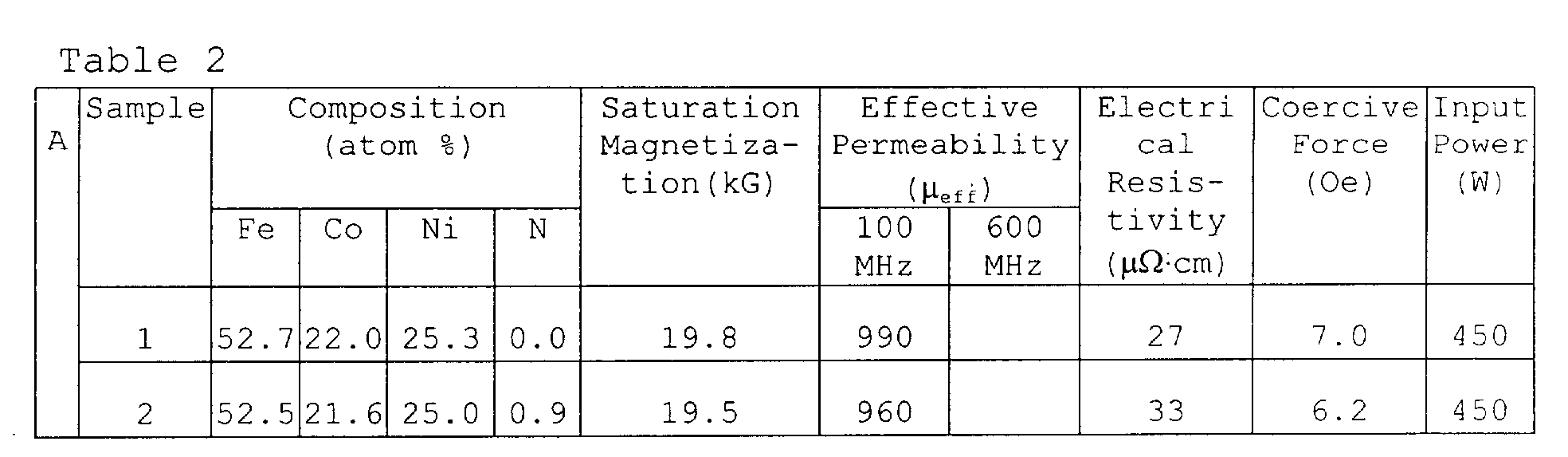
- the composition and the magnetic properties of the thin film sample thus obtained are presented in Table 2.
- the coercive force (H c ) and the saturation magnetization (M s ) were measured with a vibration sample magnetometer (VSM), and the effective permeability ( ⁇ eff ) being measured with a network analyzer and a high-frequency permeability meter capable of measuring the permeability up to 700 MHz using the s-parameter.
- the electrical resistivity was measured using a four probe method, and the composition of the thin film sample was analyzed with an electron probe microanalyzer.
- the thin film was found to have excellent soft magnetic properties and high-frequency characteristics when the N 2 partial pressure in the total gas input was in the range of 2 to 5 %.
- FIGS. 1 and 2 The variations of saturation magnetization and coercive force depending on the N 2 partial pressure are presented in FIGS. 1 and 2.
- the saturation magnetization decreases continuously with the increase of the N 2 partial pressure.
- the coercive force initially decreases with an increase in the N 2 partial pressure and reaches the minimum value at the N 2 partial pressure of 4%, and increase at the N 2 partial pressure above 4%.
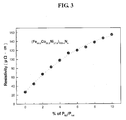
- FIG. 3 shows a variation of electrical resistivity versus N 2 partial pressure of the thin film, in which the electrical resistivity is abruptly increased with an increase in the N 2 partial pressure.
- the FeCoNiN-based thin film and the FeCoNi-based thin film were compared in regard to the high-frequency characteristic of the effective permeability.
- the effective permeability of the FeCoNiN-based thin film is more or less low at a frequency of less than 100 MHz but by far high at a frequency of more than 200 MHz.
- FIG. 5 shows a variation of corrosion resistance of the thin film depending on the N 2 partial pressure, in which E vs SCE represents a voltage at the saturated calomel electrode that is a reference electrode used in the measurement of corrosion resistance.
- E vs SCE represents a voltage at the saturated calomel electrode that is a reference electrode used in the measurement of corrosion resistance.
- FIG. 6 presents transmission electron microscopic pictures showing the ultrafine crystalline structure of the thin film at the N 2 partial pressure of 2% and 4%, respectively, in which BF represents the bright field image, DF the dark field image, SAD the selected area diffraction.
- the fine structure of the thin film according to the present invention has ⁇ -Co, ⁇ -FeCo, and NiFe crystalline structures of which the crystal size is ultrafine crystalline structure of 10 to 20.
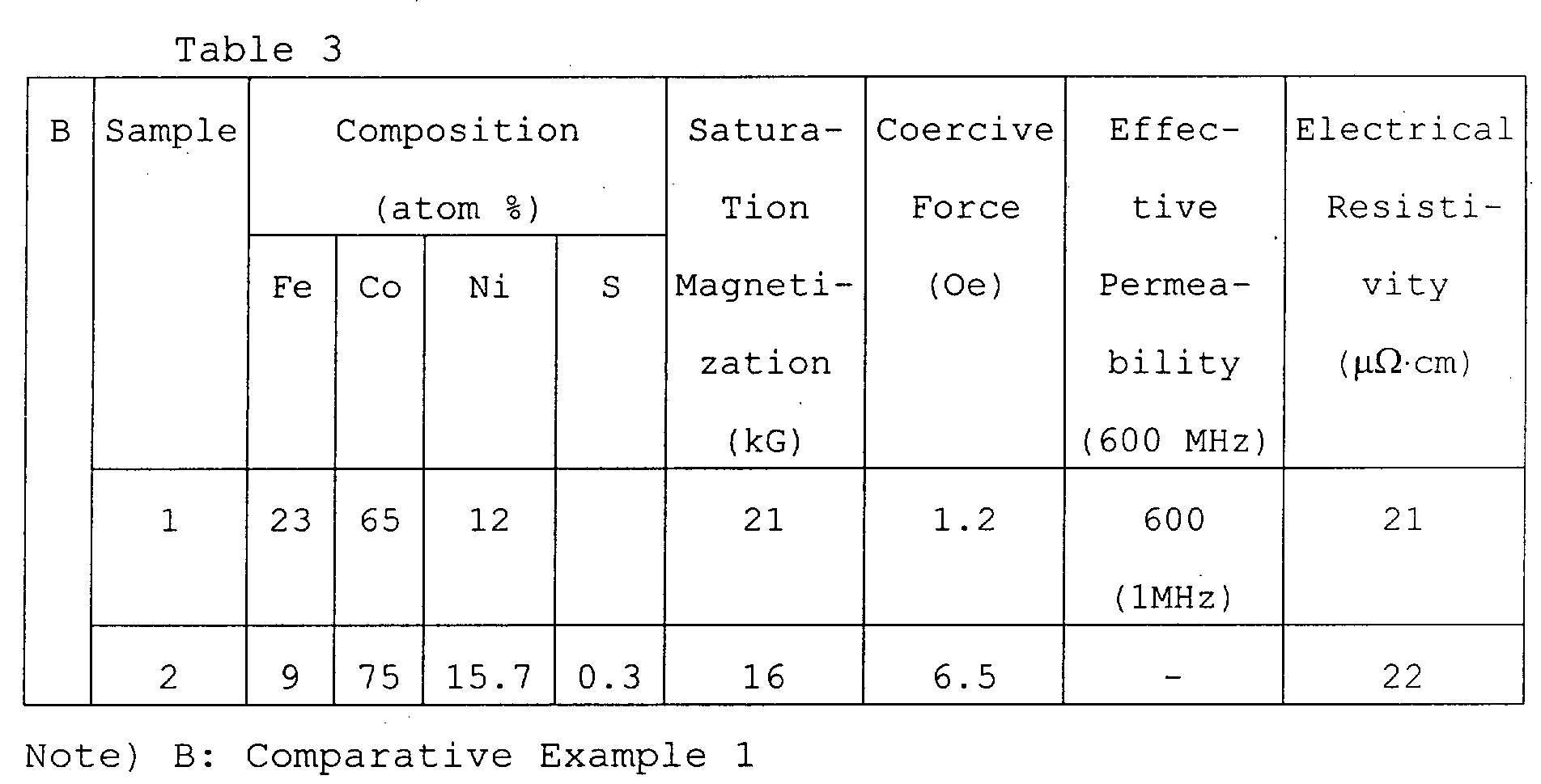
- a FeCoNi-based thin film having excellent soft magnetic properties was prepared by addition of a small amount of S to a basic composition of Fe, Co and Ni and deposition of the thin film using the electric plating method.
- the magnetic properties of the thin film are presented in Table 3.
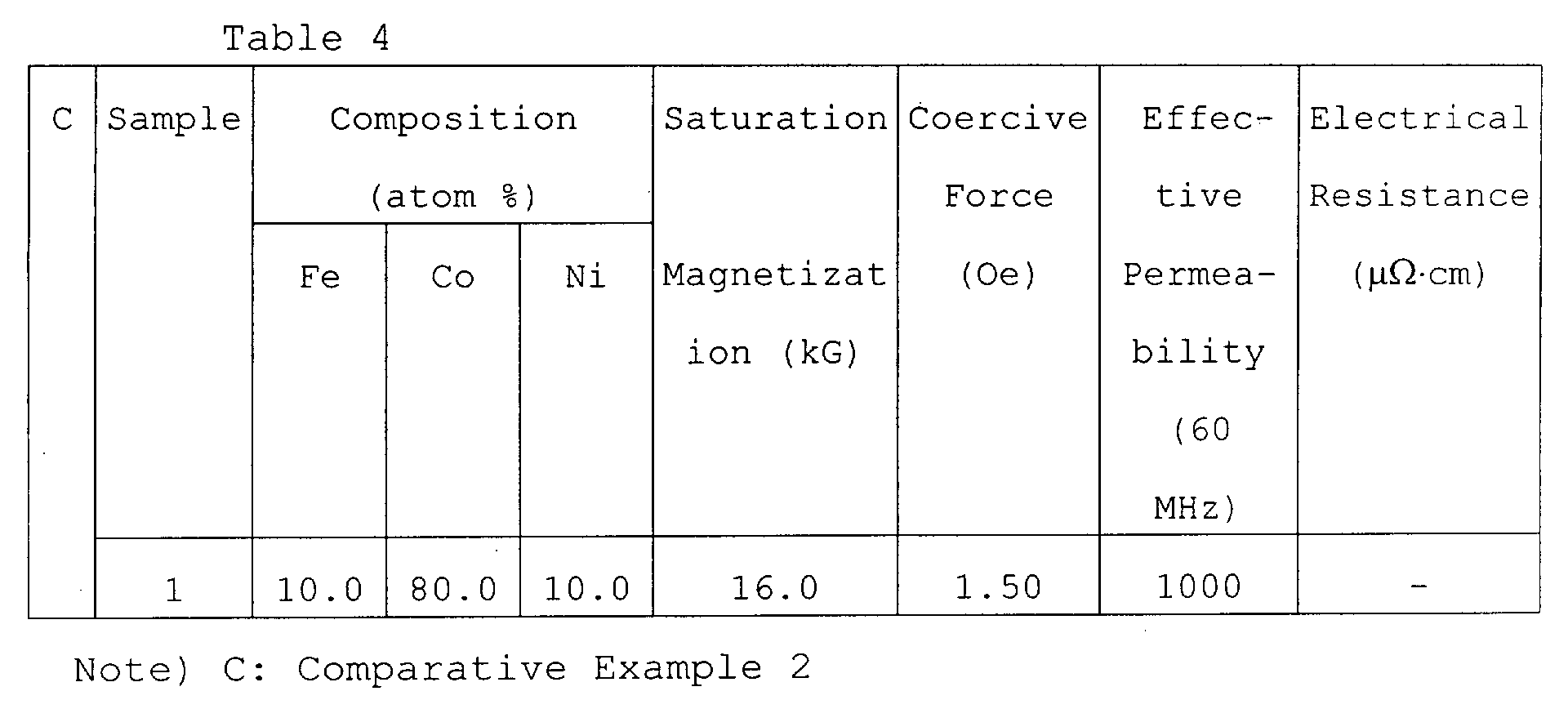
- a FeCoNi-based thin film having excellent magnetic properties was prepared from three elements, i.e., Fe, Co and Ni using an electrodeposition method.
- the magnetic characteristics of the thin film are presented in Table 4.
- Example 1 and Comparative Examples 1 and 2 that the effective permeability of the conventional FeCoNi-based thin film is maintained only in the frequency range of less than 10 MHz and deteriorated in the frequency range of more than 10 MHz.
- the FeCoNiN-based thin films of the present invention have excellent soft magnetic properties, i.e., a saturation magnetization of approximately 16 to 19 kG and a low coercive force of 1.5 to 3.0 Oe, and excellent high-frequency characteristics, i.e., a high effective permeability of more than 400 to 900 even at a high frequency of 600 MHz. Also, these thin films exhibit a very high corrosion resistance relative to the conventional FeCoNi-based thin film, thus enhancing the reliability in the fabrication process of devices.
- the FeCoNiN-based soft magnetic thin film of the present invention has very excellent high-frequency magnetic and corrosion characteristics and is widely used as a core material of various high-frequency thin film magnetic devices.
Landscapes
- Engineering & Computer Science (AREA)
- Power Engineering (AREA)
- Chemical & Material Sciences (AREA)
- Crystallography & Structural Chemistry (AREA)
- Inorganic Chemistry (AREA)
- Materials Engineering (AREA)
- Dispersion Chemistry (AREA)
- Thin Magnetic Films (AREA)
- Physical Vapour Deposition (AREA)
Abstract
Description
sputtering was performed using the composite target, which consisted of small pieces of Co and Ni, and a Fe disc target. Working pressure was controlled under the gas atmosphere having the nitrogen (N2) content in the sputtering gas (Ar gas) being within 1 to 10 % of the total amount of the gas. The thin film obtained was then measured in regard to magnetic properties as well as high-frequency and corrosion resistance characteristics without a separate heat treatment. As a result, it was found that the thin film comprised ultrafine crystals of α-FeCo, NiFe, and α-Co during the deposition process to provide excellent soft magnetic properties. These thin films were much superior in the high-frequency permeability to other soft magnetic thin films having the same grain size, which was because the thin film of the present invention contained N2 as an additive to abruptly increase the electrical resistivity and had a HCP structure of α-Co to increase the magnetic anisotropy energy. The sputtering conditions used in the present invention are presented in Table 1.
| Target | Composite Target (Fe Target + Co, Ni Small Pieces) |
| Substrate/Cooling Condition | Si (100)/Water Cooling |
| Vacuum Level | < 1 x 10⁻⁶ torr |
| Distance between Target and Substrate | 6.5 cm |
| Radio-Frequency Input Power | 450 W |
| Total Gas Pressure (Argon + Nitrogen) | 1 mtorr |
| Nitrogen Partial Pressure (PN2) | 1 ~ 10 % |
| Thickness of Sample | 500 ± 100 nm |

Claims (2)
- A FeCoNiN-based soft magnetic thin film composition having the formula FexCoyNizNv, wherein x, y, z and v are expressed in at% and satisfy 41 ≤ x ≤ 55, 18 ≤ y ≤ 27, 19 ≤ z ≤ 32, 0 < v ≤ 5, and x + y + z + v = 100.
- The FeCoNiN-based soft magnetic thin film as claimed in claim 1, wherein the thin film composition has a fine structure comprising nano-sized crystalline particles of α-Co, α-FeCo and NiFe.
Applications Claiming Priority (2)
| Application Number | Priority Date | Filing Date | Title |
|---|---|---|---|
| KR2001008522 | 2001-02-20 | ||
| KR10-2001-0008522A KR100394993B1 (en) | 2001-02-20 | 2001-02-20 | FeCoNiN Based Soft Magnetic Thin Films Compositions |
Publications (2)
| Publication Number | Publication Date |
|---|---|
| EP1233429A2 true EP1233429A2 (en) | 2002-08-21 |
| EP1233429A3 EP1233429A3 (en) | 2003-10-08 |
Family
ID=19706020
Family Applications (1)
| Application Number | Title | Priority Date | Filing Date |
|---|---|---|---|
| EP01109955A Withdrawn EP1233429A3 (en) | 2001-02-20 | 2001-04-24 | FeCoNiN-based soft magnetic thin film composition |
Country Status (4)
| Country | Link |
|---|---|
| US (1) | US6649286B2 (en) |
| EP (1) | EP1233429A3 (en) |
| JP (1) | JP2002260921A (en) |
| KR (1) | KR100394993B1 (en) |
Cited By (1)
| Publication number | Priority date | Publication date | Assignee | Title |
|---|---|---|---|---|
| EP1850334A1 (en) * | 2006-04-27 | 2007-10-31 | Heraeus, Inc. | Soft magnetic underlayer in magnetic media and soft magnetic alloy based sputter target |
Families Citing this family (10)
| Publication number | Priority date | Publication date | Assignee | Title |
|---|---|---|---|---|
| US6692619B1 (en) * | 2001-08-14 | 2004-02-17 | Seagate Technology Llc | Sputtering target and method for making composite soft magnetic films |
| JP3971697B2 (en) * | 2002-01-16 | 2007-09-05 | Tdk株式会社 | High-frequency magnetic thin film and magnetic element |
| US7817175B2 (en) * | 2005-08-30 | 2010-10-19 | Samsung Mobile Display Co., Ltd. | Laser induced thermal imaging apparatus and fabricating method of organic light emitting diode using the same |
| JP2007062354A (en) * | 2005-08-30 | 2007-03-15 | Samsung Sdi Co Ltd | Laser thermal transfer donor film, laser thermal transfer apparatus, laser thermal transfer method, and organic light emitting device manufacturing method |
| KR100711878B1 (en) * | 2005-08-30 | 2007-04-25 | 삼성에스디아이 주식회사 | Laser Thermal Transfer Device and Laser Thermal Transfer Method |
| JP2007128845A (en) * | 2005-11-04 | 2007-05-24 | Samsung Sdi Co Ltd | Laser thermal transfer apparatus and laser thermal transfer method |
| JP2007128844A (en) * | 2005-11-04 | 2007-05-24 | Samsung Sdi Co Ltd | Laser thermal transfer apparatus, laser thermal transfer method, and organic light emitting display element using the same |
| KR100700836B1 (en) * | 2005-11-16 | 2007-03-28 | 삼성에스디아이 주식회사 | Laser thermal transfer apparatus, laser thermal transfer method and manufacturing method of organic light emitting device using the same |
| JP5156939B2 (en) * | 2006-02-06 | 2013-03-06 | 国立大学法人 名古屋工業大学 | Method for producing high-frequency soft magnetic film |
| CN116732409B (en) * | 2023-04-28 | 2026-02-03 | 上海大学 | FeCoNiMo medium entropy alloy with high hardness and soft magnetic performance and preparation method thereof |
Family Cites Families (10)
| Publication number | Priority date | Publication date | Assignee | Title |
|---|---|---|---|---|
| JPS6334740A (en) * | 1986-07-30 | 1988-02-15 | Toray Ind Inc | Production of perpendicular magnetic recording medium |
| DE3882832T2 (en) * | 1987-06-30 | 1994-02-10 | Sony Corp | Soft iron magnet thin films. |
| US5147732A (en) * | 1988-09-28 | 1992-09-15 | Hitachi, Ltd. | Longitudinal magnetic recording media and magnetic memory units |
| JP2698813B2 (en) * | 1989-04-03 | 1998-01-19 | 富士写真フイルム株式会社 | Soft magnetic thin film |
| JPH03116516A (en) * | 1989-09-29 | 1991-05-17 | Ricoh Co Ltd | Magnetic film |
| JPH0543989A (en) * | 1991-08-08 | 1993-02-23 | Kanegafuchi Chem Ind Co Ltd | Hard magnetic material and manufacturing method thereof |
| JPH08306529A (en) * | 1995-05-01 | 1996-11-22 | Hitachi Ltd | Soft magnetic thin film, magnetic head and magnetic recording apparatus using the same |
| US6034847A (en) * | 1996-12-25 | 2000-03-07 | Hitachi, Ltd. | Apparatus and thin film magnetic head with magnetic membrane layers of different resistivity |
| JP3873375B2 (en) * | 1997-06-23 | 2007-01-24 | 株式会社日立製作所 | Ferromagnetic metal compound film |
| JP3843194B2 (en) * | 1999-05-19 | 2006-11-08 | アルプス電気株式会社 | Thin film magnetic head and method of manufacturing thin film magnetic head |
-
2001
- 2001-02-20 KR KR10-2001-0008522A patent/KR100394993B1/en not_active Expired - Fee Related
- 2001-04-20 US US09/838,244 patent/US6649286B2/en not_active Expired - Fee Related
- 2001-04-24 EP EP01109955A patent/EP1233429A3/en not_active Withdrawn
- 2001-05-08 JP JP2001137149A patent/JP2002260921A/en active Pending
Cited By (1)
| Publication number | Priority date | Publication date | Assignee | Title |
|---|---|---|---|---|
| EP1850334A1 (en) * | 2006-04-27 | 2007-10-31 | Heraeus, Inc. | Soft magnetic underlayer in magnetic media and soft magnetic alloy based sputter target |
Also Published As
| Publication number | Publication date |
|---|---|
| US20020160229A1 (en) | 2002-10-31 |
| JP2002260921A (en) | 2002-09-13 |
| US6649286B2 (en) | 2003-11-18 |
| KR100394993B1 (en) | 2003-08-19 |
| EP1233429A3 (en) | 2003-10-08 |
| KR20020068224A (en) | 2002-08-27 |
Similar Documents
| Publication | Publication Date | Title |
|---|---|---|
| Jin et al. | High frequency properties of Fe–Cr–Ta–N soft magnetic films | |
| US5104464A (en) | Soft magnetic alloy film | |
| US6649286B2 (en) | FeCoNiN-based soft magnetic thin film composition | |
| Ohnuma et al. | Noise suppression effect of nanogranular Co based magnetic thin films at gigahertz frequency | |
| US6822831B2 (en) | Magnetic thin film, magnetic thin film forming method, and recording head | |
| Chen et al. | Soft-magnetic properties of Fe–Co–B thin films for ultra-high-frequency applications | |
| Hasegawa et al. | Structural and soft magnetic properties of nanocrystalline (Fe, Co, Ni)-Ta-C films with high thermal stability | |
| JP2694110B2 (en) | Magnetic thin film and method of manufacturing the same | |
| Jin et al. | Fe-Cr-N soft magnetic thin films | |
| JPH10270246A (en) | Magnetic thin film | |
| US20020017341A1 (en) | Iron-based soft magnetic thin film alloy | |
| Ohnuma et al. | Noise Suppression Effect of Soft Magnetic Co–Pd–B–O Films With Large $ rho $ and Bs | |
| JPH04139707A (en) | Soft magnetic thin film having high saturation magnetic flux density | |
| JP3810881B2 (en) | High frequency soft magnetic film | |
| KR100596491B1 (en) | FeSMO-based soft magnetic thin film and method for manufacturing same | |
| Nitta et al. | Fabrication and Characterization CoZrO Films Deposited by Facing Targets Reactive Sputtering for Micromagnetic Inductors | |
| Liu et al. | Evolutions of magnetic and structural properties of FeAlN thin films via N doping | |
| Choi et al. | The effect of Cr addition on structure and corrosion resistance in FeTiN nanocrystalline soft magnetic thin films | |
| JPH10241938A5 (en) | ||
| JP3638291B2 (en) | Low loss core | |
| JP2884599B2 (en) | Soft magnetic amorphous film | |
| JP2675178B2 (en) | Soft magnetic alloy film | |
| JP2727274B2 (en) | Soft magnetic thin film | |
| JP2638739B2 (en) | Magnetic thin film and method of manufacturing the same | |
| JPH04275407A (en) | Soft magnetic film high in saturation magnetic flux density and its manufacture |
Legal Events
| Date | Code | Title | Description |
|---|---|---|---|
| PUAI | Public reference made under article 153(3) epc to a published international application that has entered the european phase |
Free format text: ORIGINAL CODE: 0009012 |
|
| 17P | Request for examination filed |
Effective date: 20010424 |
|
| AK | Designated contracting states |
Kind code of ref document: A2 Designated state(s): AT BE CH CY DE DK ES FI FR GB GR IE IT LI LU MC NL PT SE TR |
|
| AX | Request for extension of the european patent |
Free format text: AL;LT;LV;MK;RO;SI |
|
| PUAL | Search report despatched |
Free format text: ORIGINAL CODE: 0009013 |
|
| AK | Designated contracting states |
Kind code of ref document: A3 Designated state(s): AT BE CH CY DE DK ES FI FR GB GR IE IT LI LU MC NL PT SE TR |
|
| AX | Request for extension of the european patent |
Extension state: AL LT LV MK RO SI |
|
| STAA | Information on the status of an ep patent application or granted ep patent |
Free format text: STATUS: THE APPLICATION HAS BEEN WITHDRAWN |
|
| AKX | Designation fees paid |
Designated state(s): AT BE CH CY DE DK ES FI FR GB GR IE IT LI LU MC NL PT SE TR |
|
| 18W | Application withdrawn |
Effective date: 20040603 |