EP1233165A1 - Bestimmung einer Degradation einer Gasturbine - Google Patents
Bestimmung einer Degradation einer Gasturbine Download PDFInfo
- Publication number
- EP1233165A1 EP1233165A1 EP01810172A EP01810172A EP1233165A1 EP 1233165 A1 EP1233165 A1 EP 1233165A1 EP 01810172 A EP01810172 A EP 01810172A EP 01810172 A EP01810172 A EP 01810172A EP 1233165 A1 EP1233165 A1 EP 1233165A1
- Authority
- EP
- European Patent Office
- Prior art keywords
- measured values
- state
- state vector
- measured
- measured value
- Prior art date
- Legal status (The legal status is an assumption and is not a legal conclusion. Google has not performed a legal analysis and makes no representation as to the accuracy of the status listed.)
- Granted
Links
- 230000015556 catabolic process Effects 0.000 title claims abstract description 15
- 238000006731 degradation reaction Methods 0.000 title claims abstract description 15
- 239000013598 vector Substances 0.000 claims abstract description 49
- 238000005259 measurement Methods 0.000 claims abstract description 36
- 238000000034 method Methods 0.000 claims abstract description 36
- 238000004590 computer program Methods 0.000 claims abstract description 9
- 239000011159 matrix material Substances 0.000 claims description 9
- 239000000446 fuel Substances 0.000 claims description 7
- 230000002950 deficient Effects 0.000 description 4
- 238000002485 combustion reaction Methods 0.000 description 3
- 238000004458 analytical method Methods 0.000 description 2
- 238000004364 calculation method Methods 0.000 description 2
- 238000005260 corrosion Methods 0.000 description 2
- 230000007797 corrosion Effects 0.000 description 2
- 230000001419 dependent effect Effects 0.000 description 2
- 230000003628 erosive effect Effects 0.000 description 2
- 238000012545 processing Methods 0.000 description 2
- 230000001105 regulatory effect Effects 0.000 description 2
- 238000012935 Averaging Methods 0.000 description 1
- 238000002940 Newton-Raphson method Methods 0.000 description 1
- 230000005540 biological transmission Effects 0.000 description 1
- 238000010276 construction Methods 0.000 description 1
- 238000011109 contamination Methods 0.000 description 1
- 230000007547 defect Effects 0.000 description 1
- 230000000694 effects Effects 0.000 description 1
- 238000005516 engineering process Methods 0.000 description 1
- 238000001914 filtration Methods 0.000 description 1
- 238000012423 maintenance Methods 0.000 description 1
- 239000000203 mixture Substances 0.000 description 1
- 230000002441 reversible effect Effects 0.000 description 1
- 238000004088 simulation Methods 0.000 description 1
- 238000012360 testing method Methods 0.000 description 1
Images
Classifications
-
- G—PHYSICS
- G05—CONTROLLING; REGULATING
- G05B—CONTROL OR REGULATING SYSTEMS IN GENERAL; FUNCTIONAL ELEMENTS OF SUCH SYSTEMS; MONITORING OR TESTING ARRANGEMENTS FOR SUCH SYSTEMS OR ELEMENTS
- G05B23/00—Testing or monitoring of control systems or parts thereof
- G05B23/02—Electric testing or monitoring
- G05B23/0205—Electric testing or monitoring by means of a monitoring system capable of detecting and responding to faults
- G05B23/0218—Electric testing or monitoring by means of a monitoring system capable of detecting and responding to faults characterised by the fault detection method dealing with either existing or incipient faults
- G05B23/0243—Electric testing or monitoring by means of a monitoring system capable of detecting and responding to faults characterised by the fault detection method dealing with either existing or incipient faults model based detection method, e.g. first-principles knowledge model
- G05B23/0254—Electric testing or monitoring by means of a monitoring system capable of detecting and responding to faults characterised by the fault detection method dealing with either existing or incipient faults model based detection method, e.g. first-principles knowledge model based on a quantitative model, e.g. mathematical relationships between inputs and outputs; functions: observer, Kalman filter, residual calculation, Neural Networks
-
- F—MECHANICAL ENGINEERING; LIGHTING; HEATING; WEAPONS; BLASTING
- F02—COMBUSTION ENGINES; HOT-GAS OR COMBUSTION-PRODUCT ENGINE PLANTS
- F02C—GAS-TURBINE PLANTS; AIR INTAKES FOR JET-PROPULSION PLANTS; CONTROLLING FUEL SUPPLY IN AIR-BREATHING JET-PROPULSION PLANTS
- F02C9/00—Controlling gas-turbine plants; Controlling fuel supply in air- breathing jet-propulsion plants
-
- G—PHYSICS
- G01—MEASURING; TESTING
- G01D—MEASURING NOT SPECIALLY ADAPTED FOR A SPECIFIC VARIABLE; ARRANGEMENTS FOR MEASURING TWO OR MORE VARIABLES NOT COVERED IN A SINGLE OTHER SUBCLASS; TARIFF METERING APPARATUS; MEASURING OR TESTING NOT OTHERWISE PROVIDED FOR
- G01D3/00—Indicating or recording apparatus with provision for the special purposes referred to in the subgroups
- G01D3/08—Indicating or recording apparatus with provision for the special purposes referred to in the subgroups with provision for safeguarding the apparatus, e.g. against abnormal operation, against breakdown
-
- G—PHYSICS
- G05—CONTROLLING; REGULATING
- G05B—CONTROL OR REGULATING SYSTEMS IN GENERAL; FUNCTIONAL ELEMENTS OF SUCH SYSTEMS; MONITORING OR TESTING ARRANGEMENTS FOR SUCH SYSTEMS OR ELEMENTS
- G05B23/00—Testing or monitoring of control systems or parts thereof
- G05B23/02—Electric testing or monitoring
- G05B23/0205—Electric testing or monitoring by means of a monitoring system capable of detecting and responding to faults
- G05B23/0259—Electric testing or monitoring by means of a monitoring system capable of detecting and responding to faults characterized by the response to fault detection
- G05B23/0283—Predictive maintenance, e.g. involving the monitoring of a system and, based on the monitoring results, taking decisions on the maintenance schedule of the monitored system; Estimating remaining useful life [RUL]
-
- F—MECHANICAL ENGINEERING; LIGHTING; HEATING; WEAPONS; BLASTING
- F05—INDEXING SCHEMES RELATING TO ENGINES OR PUMPS IN VARIOUS SUBCLASSES OF CLASSES F01-F04
- F05D—INDEXING SCHEME FOR ASPECTS RELATING TO NON-POSITIVE-DISPLACEMENT MACHINES OR ENGINES, GAS-TURBINES OR JET-PROPULSION PLANTS
- F05D2200/00—Mathematical features
- F05D2200/10—Basic functions
- F05D2200/11—Sum
-
- F—MECHANICAL ENGINEERING; LIGHTING; HEATING; WEAPONS; BLASTING
- F05—INDEXING SCHEMES RELATING TO ENGINES OR PUMPS IN VARIOUS SUBCLASSES OF CLASSES F01-F04
- F05D—INDEXING SCHEME FOR ASPECTS RELATING TO NON-POSITIVE-DISPLACEMENT MACHINES OR ENGINES, GAS-TURBINES OR JET-PROPULSION PLANTS
- F05D2200/00—Mathematical features
- F05D2200/10—Basic functions
- F05D2200/14—Division
-
- F—MECHANICAL ENGINEERING; LIGHTING; HEATING; WEAPONS; BLASTING
- F05—INDEXING SCHEMES RELATING TO ENGINES OR PUMPS IN VARIOUS SUBCLASSES OF CLASSES F01-F04
- F05D—INDEXING SCHEME FOR ASPECTS RELATING TO NON-POSITIVE-DISPLACEMENT MACHINES OR ENGINES, GAS-TURBINES OR JET-PROPULSION PLANTS
- F05D2200/00—Mathematical features
- F05D2200/30—Mathematical features miscellaneous
- F05D2200/33—Mathematical features miscellaneous bigger or smaller
-
- F—MECHANICAL ENGINEERING; LIGHTING; HEATING; WEAPONS; BLASTING
- F05—INDEXING SCHEMES RELATING TO ENGINES OR PUMPS IN VARIOUS SUBCLASSES OF CLASSES F01-F04
- F05D—INDEXING SCHEME FOR ASPECTS RELATING TO NON-POSITIVE-DISPLACEMENT MACHINES OR ENGINES, GAS-TURBINES OR JET-PROPULSION PLANTS
- F05D2270/00—Control
-
- F—MECHANICAL ENGINEERING; LIGHTING; HEATING; WEAPONS; BLASTING
- F05—INDEXING SCHEMES RELATING TO ENGINES OR PUMPS IN VARIOUS SUBCLASSES OF CLASSES F01-F04
- F05D—INDEXING SCHEME FOR ASPECTS RELATING TO NON-POSITIVE-DISPLACEMENT MACHINES OR ENGINES, GAS-TURBINES OR JET-PROPULSION PLANTS
- F05D2270/00—Control
- F05D2270/40—Type of control system
- F05D2270/44—Type of control system active, predictive, or anticipative
-
- F—MECHANICAL ENGINEERING; LIGHTING; HEATING; WEAPONS; BLASTING
- F05—INDEXING SCHEMES RELATING TO ENGINES OR PUMPS IN VARIOUS SUBCLASSES OF CLASSES F01-F04
- F05D—INDEXING SCHEME FOR ASPECTS RELATING TO NON-POSITIVE-DISPLACEMENT MACHINES OR ENGINES, GAS-TURBINES OR JET-PROPULSION PLANTS
- F05D2270/00—Control
- F05D2270/50—Control logic embodiments
-
- F—MECHANICAL ENGINEERING; LIGHTING; HEATING; WEAPONS; BLASTING
- F05—INDEXING SCHEMES RELATING TO ENGINES OR PUMPS IN VARIOUS SUBCLASSES OF CLASSES F01-F04
- F05D—INDEXING SCHEME FOR ASPECTS RELATING TO NON-POSITIVE-DISPLACEMENT MACHINES OR ENGINES, GAS-TURBINES OR JET-PROPULSION PLANTS
- F05D2270/00—Control
- F05D2270/70—Type of control algorithm
- F05D2270/71—Type of control algorithm synthesized, i.e. parameter computed by a mathematical model
Definitions
- the invention relates to the field of control and measurement technology for Gas turbines. It relates to a procedure and a Computer program product for determining a degradation of a Gas turbine according to the preamble of claims 1 and 9.
- Such a method for determining a degradation of a gas turbine is, for example, from "An Object-Oriented Diagnostic Computer Program Suitable for Industrial Gas Turbines ", P.C. Escher et al, CIMAC Conference, Interlaken, Switzerland, 15-18 May, 1995, the contents of which are hereby incorporated into the Registration is included.
- a Degradation state of a gas turbine based on measurements during operation the gas turbine determined.
- the process called GPA ("Gas Path Analysis"), uses a mathematical replica or a model of a thermodynamic and aerodynamic operating behavior of the gas turbine.
- the Model allowed, from input variables such as Air inlet temperature and - Pressure, as well as from assumptions about state parameters, values of measurable Determine output variables.
- Such output variables are, for example Pressures, mass flows and temperatures at various points in the Gas path of the gas turbine, one fuel mass flow, one speed, one mechanical power output.
- Individual status parameters represent a degradation state of each component of the Gas turbine, for example contamination of compressor blades and Reduction of the ability of the compressor to swallow, erosion of Turbine blades or corrosion of machine parts.
- a state of degradation of the gas turbine is therefore determined of a set of measured values estimated several times, with each Estimation of at least one of the measured values is not taken into account.
- Another advantage is that the process uses a large amount of Information, i.e. Data from multiple sensors as well as information about one Behavior of the gas turbine used. This increases the quality of the Process in contrast to processes that isolate a sensor judge, i.e. only on the basis of his own measured values.
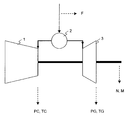
- a compressor 1 or compressor compresses Air which is mixed with fuel in a combustion chamber 2. The Mixture is burned, thereby driving a turbine 3.
- Turbine 3 and compressor 1 have a common rotor shaft.
- On the compressor an outlet pressure PC and an outlet temperature TC are measured the turbine 3 also becomes an outlet pressure PG and a Outlet temperature TG measured.
- Another measured variable is a speed N of the rotor shaft, a mechanical one that can be used by the rotor shaft Torque or a transmitted shaft power M, and a Mass flow of fuel F.
- at least one outlet pressure and one outlet temperature of another Turbine which of the turbine 3 and another combustion chamber downstream is measured.
- Measured values are recorded at a specific measurement time, that is to say the above-mentioned measured variables are recorded and, if necessary, processed by means of several suitable sensors, for example by filtering a chronological sequence of sensor values or by averaging sensor values from several redundant sensors. As a result, a measurement value is assigned to each sensor for the measurement instant and transmitted to a data processing unit.
- a mathematical simulation model of the thermodynamic and aerodynamic operating behavior of the gas turbine is available.
- the model is preferably structured on the basis of a physical modeling of the gas turbine, preferably on the basis of mass and energy balances, and is adapted to a specific concrete gas turbine on the basis of measurements.
- y f (x)
- the state vector x (x 1 , x 2 , ... x m ) contains m state parameters, each of which represents a degradation state of a component of the gas turbine.
- the function is non-linear and is m ⁇ n.
- the calculated measured values are partly dependent on the measured input variables of the gas turbine, such as the air inlet temperature and pressure. In connection with the present invention, these input variables are regarded as parameters of the model.
- the speed N or a mechanical power output of the gas turbine regulated.
- the speed N or a mechanical power output of the gas turbine regulated.
- This Control sets an operating state. For example, for a new gas turbine with a specified nominal power and Speed assigned nominal values for the fuel mass flow F and the pressures and temperatures at different measuring points of the gas turbine. These values correspond to a nominal state of the gas turbine, the for example by a compressor efficiency, a turbine efficiency, a compressor mass flow and a turbine mass flow is represented.
- Corrosion degrades, for example, the speed and power kept at assigned setpoints by the control. Because of deteriorated efficiencies increase e.g. the Mass flow of fuel and lower pressures at the outlet of the compressor. The other measured values change accordingly. These changes are an effect of the deteriorated state x of the gas turbine, which means the GPA is determined. If e.g. the speed is regulated, it delivers none Information and cannot be used in the method according to the invention
- the measured values y become the Degradation state x of the gas turbine or its components calculated.
- the function f is generally not closed reversible so that the state x preferably with a numeric Method is determined iteratively, for example with a multidimensional variant of the Newton-Raphson method.
- Deviations from the nominal operating point provides more precise values, starting from the nominal operating point, using a numerical procedure iteratively determines the state deviation dx which one existing measured value deviation dy. It is preferred assumed an estimated state in each iteration step and a Jacobi matrix and the corresponding measured values in this state calculated using the function f. A deviation from this calculated Measured values from the measured values are measured using the inverse Jacobi matrix multiplied and the estimated state according to this Product corrected. The corrected state serves as an estimated state for a next iteration step.
- yr (k) of the set of measured values
- At least one index k of a subset designates those measured values that are not contained in the subset.
- yr (PC) (TC, PG, TG, F, M)
- yr (TC) (PC, PG, TG, F, M)
- yr (PG) (PC, TC, TG, F, M)
- yr (TG) (PC, TC, PG, F, M)
- yr (F) (PC, TC, PG, TG, M)
- yr (N) (PC, TC, PG, TG, F).
- the associated state x should be determined for a given reduced measured value vector yr (k) or a corresponding reduced vector dyr (k) from deviations in the measured values.
- a reduced inverse Jr (k) -1 of a reduced jacobi matrix Jr (k) is determined.
- x (k) and dx (k) are the estimated state and the estimated deviation of the state from the nominal state, which do not take measurement k into account. It should be noted that x (k) and dx (k) have the same number of elements as x and dx.
- the nonlinear GPA method described above is used in an analogous manner using reduced measured value vectors and Jacobi matrices applied.
- At least one state vector is thus assigned to each measured value. For the case that there are several subsets which contain the measured value of the If sensors are not included, several state vectors are the measured value assigned.
- a measured value, its assigned state vector or assigned State vectors essentially from the assigned state vectors of the other measured values is diagnosed as faulty.
- the State vector or associated state vectors essentially from deviates from a state vector which takes all measured values into account as misdiagnosed. In both cases it is assumed that if a measurement is faulty, the at least one assigned State vector, which does not take this measurement into account, the best describes the actual condition of the machine. All other Estimated state vectors contain the erroneous measurement and thus deviate from the actual state. The at least one of the The state vector assigned to the measured value essentially deviates from from those state vectors that take this measured value into account.
- this deviation is determined by considering the deviation of the state vectors from the nominal state x 0 .
- dx is the estimated deviation of the state vector from the nominal state, which takes all measurements into account
- dx (k) is the estimated deviation of the state from the nominal state, which does not take measurement k into account.
- Dx i and dx i (k) are the i-th element of the corresponding vector. If measurements are always ignored individually, exactly one vector dx (k) is assigned to each measurement. Then there is a measure Q k for the quality of this measurement A measurement is preferably diagnosed as faulty if its quality measure is greater than at least approximately 30%.
- another quality measure is where the arctan function is calculated in radians.
- a measurement is preferably diagnosed as faulty if this further quality measure is greater than at least approximately 5%, 10% or 30%.
- a user by means of faulty measured values or defective sensors a user interface of a control system of the gas turbine is displayed, and / or incorrect measurement values in the control system are considered incorrect marked and not considered.
- a computer program product according to the invention comprises Computer program code means, which are preferably on a computer-readable medium are stored, and which are suitable at Execution on a computer the method according to the invention perform.
- the invention is with an essentially arbitrary number of sensors respectively measured values executable, provided that these measured values in the GPA are considered. Modeling performed for test purposes and GPA has approximately 30 measured values and status values.
Landscapes
- Engineering & Computer Science (AREA)
- Physics & Mathematics (AREA)
- General Physics & Mathematics (AREA)
- Automation & Control Theory (AREA)
- Combustion & Propulsion (AREA)
- Chemical & Material Sciences (AREA)
- Evolutionary Computation (AREA)
- Mathematical Physics (AREA)
- Artificial Intelligence (AREA)
- Mechanical Engineering (AREA)
- General Engineering & Computer Science (AREA)
- Testing Of Devices, Machine Parts, Or Other Structures Thereof (AREA)
- Testing And Monitoring For Control Systems (AREA)
- Measuring Volume Flow (AREA)
Abstract
Description


- 1
- Verdichter
- 2
- Brennkammer
- 3
- Turbine
- PC
- Verdichteraustrittsdruck
- TC
- Verdichteraustrittstemperatur
- PG
- Turbinenaustrittsdruck
- TG
- Turbinenaustrittstemperatur
- F
- Brennstoffmassenstrom
- N
- Drehzahl
- M
- Mechanische Leistung oder Drehmoment
Claims (9)
- Verfahren zur Bestimmung einer Degradation einer Gasturbine, in welchem zu einem Messzeitpunkt ein Satz von Messwerten y erfasst wird und aus diesem Satz von Messwerten ein Zustandsvektor x berechnet wird, der die Degradation der Gasturbine charakterisiert, dadurch gekennzeichnet,a) dass zur Bestimmung eines fehlerhaften Messwertes mehrere Untermengen des Satzes von Messwerten y gebildet werden,
wobei für jede der Untermengen der Zustandsvektor x aus den Messwerten der Untermenge berechenbar ist,b) dass jedem Messwert diejenigen Untermengen von Messwerten zugeordnet werden, welche diesen Messwert nicht enthalten,c) dass für jede Untermenge von Messwerten anhand der Messwerte dieser Untermenge ein Zustandsvektor berechnet und demjenigen Messwert zugeordnet wird, welcher der Untermenge zugeordnet ist.d) dass ein Messwert, dessen zugeordneter Zustandsvektor oder zugeordnete Zustandsvektoren im wesentlichen von Zustandsvektoren, welche diesen Messwert berücksichtigen, abweicht, als fehlerhaft diagnostiziert wird. - Verfahren gemäss Anspruch 1, dadurch gekennzeichnet, dass in einem Nennzustand der Gasturbine aus nominalen Messwerten y0 ein nominaler Zustandsvektor x0 resultiert, und für jede Untermenge von Messwerten der Zustandsvektor x berechnet wird, indem Abweichungen dy der Messwerte y von den nominalen Messwerten y0 bestimmt werden, und aus diese Abweichungen der Messwerte eine Abweichung dx des Zustandsvektors x vom Nominalzustand x0 bestimmt wird.
- Verfahren gemäss Anspruch 2, dadurch gekennzeichnet, dass eine Funktion y=f(x) zur Berechnung der Messwerte y aus dem Zustandsvektor x vorliegt, diese Funktion in einem Nominalzustand x0 linearisiert und eine Jacobi-Matrix J gebildet wird, und die Bestimmung der Abweichung dx des Zustandsvektors x durch Multiplikation einer Inversen J-1 der Jacobi-Matrix J mit den Abweichungen dy der Messwerte y durchgeführt wird.
- Verfahren gemäss Anspruch 1, dadurch gekennzeichnet, dass eine Funktion y=f(x) zur Berechnung der Messwerte y aus dem Zustandsvektor x vorliegt und die Bestimmung des Zustandsvektors x aus den Messwerten y iterativ mit einem numerischen Verfahren anhand der Funktion y=f(x) durchgeführt wird.
- Verfahren gemäss Anspruch 2, dadurch gekennzeichnet, dass eine Funktion y=f(x) zur Berechnung der Messwerte y aus dem Zustandsvektor x vorliegt und die Bestimmung der Abweichung dx des Zustandsvektors x aus den Abweichungen dy der Messwerte y iterativ mit einem numerischen Verfahren anhand der Funktion y=f(x) durchgeführt wird.
- Verfahren gemäss Anspruch 1, dadurch gekennzeichnet, dass ein Mass Qk für die Qualität eines k-ten Messwertes im wesentlichen gemässbestimmt wird, wobei m eine Anzahl von Zuständen respektive von Elementen eines Vektors dx = (dx1, dx2, ... dxm) von Abweichungen eines geschätzten Zustandes x von einem Nominalzustand x0 ist, der Vektor dx unter Berücksichtigung des k-ten Messwertes bestimmt wird, und der Vektor dx(k) ohne Berücksichtigung des k-ten Messwertes bestimmt wird.

- Verfahren gemäss Anspruch 1, dadurch gekennzeichnet, dass der Satz von Messwerten Messwerte eines Austrittsdrucks (PC) und einer Austrittstemperatur (TC) eines Verdichters, eines Austrittsdrucks (PG) und einer Austrittstemperatur (TG) einer Turbine sowie mindestens einen Messwert von einer mechanischen Leistung, einem mechanischen Moment oder einem Brennstoffmassenstrom der Gasturbine aufweist.
- Verfahren gemäss Anspruch 1, dadurch gekennzeichnet, dass die Untermengen der Messwerte aus dem Satz von Messwerten y gebildet werden, indem zyklisch genau ein Messwert weggelassen wird.
- Computerprogrammprodukt mit Computerprogrammcodemitteln, welche geeignet sind, bei Ausführung auf einem Computer das Verfahren gemäss einem der Ansprüche 1 bis 8 auszuführen.
Priority Applications (3)
| Application Number | Priority Date | Filing Date | Title |
|---|---|---|---|
| EP01810172A EP1233165B1 (de) | 2001-02-19 | 2001-02-19 | Bestimmung einer Degradation einer Gasturbine |
| AT01810172T ATE544106T1 (de) | 2001-02-19 | 2001-02-19 | Bestimmung einer degradation einer gasturbine |
| US10/072,989 US6684163B2 (en) | 2001-02-19 | 2002-02-12 | Determination of a degradation of a gas turbine |
Applications Claiming Priority (1)
| Application Number | Priority Date | Filing Date | Title |
|---|---|---|---|
| EP01810172A EP1233165B1 (de) | 2001-02-19 | 2001-02-19 | Bestimmung einer Degradation einer Gasturbine |
Publications (2)
| Publication Number | Publication Date |
|---|---|
| EP1233165A1 true EP1233165A1 (de) | 2002-08-21 |
| EP1233165B1 EP1233165B1 (de) | 2012-02-01 |
Family
ID=8183743
Family Applications (1)
| Application Number | Title | Priority Date | Filing Date |
|---|---|---|---|
| EP01810172A Expired - Lifetime EP1233165B1 (de) | 2001-02-19 | 2001-02-19 | Bestimmung einer Degradation einer Gasturbine |
Country Status (3)
| Country | Link |
|---|---|
| US (1) | US6684163B2 (de) |
| EP (1) | EP1233165B1 (de) |
| AT (1) | ATE544106T1 (de) |
Cited By (4)
| Publication number | Priority date | Publication date | Assignee | Title |
|---|---|---|---|---|
| EP1705542A1 (de) * | 2005-03-24 | 2006-09-27 | Abb Research Ltd. | Abschätzen der Zustandparameter oder Erscheinung eines alternden Systems |
| WO2012076427A1 (de) * | 2010-12-09 | 2012-06-14 | Basf Se | Verfahren und vorrichtung zur modellbasierten überwachung einer turbomaschine |
| US8280647B2 (en) | 2006-12-07 | 2012-10-02 | Abb Research Ltd | Method and system for monitoring process states of an internal combustion engine |
| WO2020182931A1 (de) * | 2019-03-13 | 2020-09-17 | Zf Friedrichshafen Ag | Verfahren zur zustandsüberwachung einer antriebsanordnung und antriebsanordnung |
Families Citing this family (25)
| Publication number | Priority date | Publication date | Assignee | Title |
|---|---|---|---|---|
| US6350369B1 (en) * | 1998-04-14 | 2002-02-26 | California Institute Of Technology | Method and system for determining analyte activity |
| JP2002526769A (ja) | 1998-10-02 | 2002-08-20 | カリフォルニア インスティチュート オブ テクノロジー | 導電性有機センサー、アレイおよび使用方法 |
| US6631333B1 (en) * | 1999-05-10 | 2003-10-07 | California Institute Of Technology | Methods for remote characterization of an odor |
| DE60026309T2 (de) * | 1999-05-10 | 2006-12-14 | California Institute Of Technology, Pasadena | Verwendung eines räumlich-zeitlichen reaktionsverhaltens in sensor-arrays zur detektion von analyten in fluiden |
| US6890715B1 (en) * | 1999-08-18 | 2005-05-10 | The California Institute Of Technology | Sensors of conducting and insulating composites |
| EP1343061A1 (de) * | 2002-03-08 | 2003-09-10 | Siemens Aktiengesellschaft | Verfahren zur Simulation eines technischen Systems und Simulator |
| US20050198967A1 (en) * | 2002-09-23 | 2005-09-15 | Siemens Westinghouse Power Corp. | Smart component for use in an operating environment |
| US20050150778A1 (en) * | 2002-11-18 | 2005-07-14 | Lewis Nathan S. | Use of basic polymers in carbon black composite vapor detectors to obtain enhanced sensitivity and classification performance for volatile fatty acids |
| US8742944B2 (en) * | 2004-06-21 | 2014-06-03 | Siemens Energy, Inc. | Apparatus and method of monitoring operating parameters of a gas turbine |
| US8010320B2 (en) * | 2006-11-17 | 2011-08-30 | United Technologies Corporation | Reducing gas turbine performance tracking estimation non-repeatability |
| US8797179B2 (en) * | 2007-11-08 | 2014-08-05 | Siemens Aktiengesellschaft | Instrumented component for wireless telemetry |
| US9071888B2 (en) * | 2007-11-08 | 2015-06-30 | Siemens Aktiengesellschaft | Instrumented component for wireless telemetry |
| US8519866B2 (en) | 2007-11-08 | 2013-08-27 | Siemens Energy, Inc. | Wireless telemetry for instrumented component |
| US8478473B2 (en) * | 2008-07-28 | 2013-07-02 | General Electric Company | Method and systems for controlling gas turbine engine temperature |
| US8090456B2 (en) * | 2008-11-03 | 2012-01-03 | United Technologies Corporation | System and method for design and control of engineering systems utilizing component-level dynamic mathematical model |
| US8668434B2 (en) * | 2009-09-02 | 2014-03-11 | United Technologies Corporation | Robust flow parameter model for component-level dynamic turbine system control |
| US8315741B2 (en) * | 2009-09-02 | 2012-11-20 | United Technologies Corporation | High fidelity integrated heat transfer and clearance in component-level dynamic turbine system control |
| US9325388B2 (en) | 2012-06-21 | 2016-04-26 | Siemens Energy, Inc. | Wireless telemetry system including an induction power system |
| US9494492B2 (en) * | 2013-03-15 | 2016-11-15 | United Technologies Corporation | Use of SS data trends in fault resolution process |
| US9423781B2 (en) | 2013-03-29 | 2016-08-23 | General Electric Company | Model based control with engine perturbation feedback |
| US9420356B2 (en) | 2013-08-27 | 2016-08-16 | Siemens Energy, Inc. | Wireless power-receiving assembly for a telemetry system in a high-temperature environment of a combustion turbine engine |
| US9915167B2 (en) * | 2015-11-20 | 2018-03-13 | Ansaldo Energia Switzerland AG | Detection of deficient sensors in a gas turbine system |
| US11513033B2 (en) | 2019-02-21 | 2022-11-29 | Rolls-Royce Corporation | Gas turbine engine system with health monitoring of fuel pump condition |
| US12258911B2 (en) | 2023-08-21 | 2025-03-25 | Rolls-Royce Corporation | Fuel unit health monitoring system |
| US12345211B2 (en) | 2023-08-21 | 2025-07-01 | Rolls-Royce North American Technologies, Inc. | Uncommanded or uncontrollable high thrust detection and mitigation |
Citations (1)
| Publication number | Priority date | Publication date | Assignee | Title |
|---|---|---|---|---|
| WO1999064736A1 (en) * | 1998-06-09 | 1999-12-16 | Otkritoe Aktsionernoe Obschestvo 'nauchno-Proizvodstvennoe Predpriyatie-Elektronno-Gidravlicheskaya Avtomatika' | Method for detecting sensor failures and for controlling the operation conditions of an object |
-
2001
- 2001-02-19 AT AT01810172T patent/ATE544106T1/de active
- 2001-02-19 EP EP01810172A patent/EP1233165B1/de not_active Expired - Lifetime
-
2002
- 2002-02-12 US US10/072,989 patent/US6684163B2/en not_active Expired - Fee Related
Patent Citations (2)
| Publication number | Priority date | Publication date | Assignee | Title |
|---|---|---|---|---|
| WO1999064736A1 (en) * | 1998-06-09 | 1999-12-16 | Otkritoe Aktsionernoe Obschestvo 'nauchno-Proizvodstvennoe Predpriyatie-Elektronno-Gidravlicheskaya Avtomatika' | Method for detecting sensor failures and for controlling the operation conditions of an object |
| EP1096122A1 (de) * | 1998-06-09 | 2001-05-02 | Otkritoe Aktsionernoe Obschestvo "Nauchno-Proizvodstvennoe Predpriyatie-Elektronno-Gidravlicheskaya Avtomatika" | Verfahren zum feststellen eines sensorausfalls und zur kontrolle der arbeitsbedingungen eines objekts |
Non-Patent Citations (2)
| Title |
|---|
| P.C.ESCHER ET AL.: ""An Object-Oriented Diagnostic Computer Program Suitable for Industrial Gas Turbines"", GPA(GAS PATH ANALYSIS), May 1995 (1995-05-01), CIMAC CONFERENCE,INTERLAKEN,SCHWEIZ, pages 15 - 18 |
| PATTON R J ET AL: "ROBUST FAULT DETECTION OF JET ENGINE SENSOR SYSTEMS USING EIGENSTRUCTURE ASSIGNMENT", JOURNAL OF GUIDANCE AND CONTROL AND DYNAMICS,US,AIAA. NEW YORK, vol. 15, no. 6, 1 November 1992 (1992-11-01), pages 1491 - 1497, XP000335320, ISSN: 0731-5090 * |
Cited By (7)
| Publication number | Priority date | Publication date | Assignee | Title |
|---|---|---|---|---|
| EP1705542A1 (de) * | 2005-03-24 | 2006-09-27 | Abb Research Ltd. | Abschätzen der Zustandparameter oder Erscheinung eines alternden Systems |
| CN1837767B (zh) * | 2005-03-24 | 2010-05-12 | Abb研究有限公司 | 降级系统的健康参数或症状的估计 |
| US7869928B2 (en) | 2005-03-24 | 2011-01-11 | Abb Research Ltd | Estimating health parameters or symptoms of a degrading system |
| US8050843B2 (en) | 2005-03-24 | 2011-11-01 | Abb Research Ltd | Estimating health parameters or symptoms of a degrading system |
| US8280647B2 (en) | 2006-12-07 | 2012-10-02 | Abb Research Ltd | Method and system for monitoring process states of an internal combustion engine |
| WO2012076427A1 (de) * | 2010-12-09 | 2012-06-14 | Basf Se | Verfahren und vorrichtung zur modellbasierten überwachung einer turbomaschine |
| WO2020182931A1 (de) * | 2019-03-13 | 2020-09-17 | Zf Friedrichshafen Ag | Verfahren zur zustandsüberwachung einer antriebsanordnung und antriebsanordnung |
Also Published As
| Publication number | Publication date |
|---|---|
| US20020143477A1 (en) | 2002-10-03 |
| ATE544106T1 (de) | 2012-02-15 |
| EP1233165B1 (de) | 2012-02-01 |
| US6684163B2 (en) | 2004-01-27 |
Similar Documents
| Publication | Publication Date | Title |
|---|---|---|
| EP1233165B1 (de) | Bestimmung einer Degradation einer Gasturbine | |
| DE3421522C2 (de) | Verfahren und Einrichtung zur Diagnose eines Wärmekraftwerks | |
| EP0789861B1 (de) | Verfahren zur analyse von prozessdaten einer technischen anlage | |
| DE69809453T2 (de) | Überwachungssystem | |
| DE69724555T2 (de) | Diagnostische Tendenzanalyse für Flugzeugtriebwerke | |
| DE60111262T2 (de) | Überwachungssysteme zum erkennen von sensorenfehlern | |
| EP3279756B1 (de) | Diagnoseeinrichtung und verfahren zur überwachung des betriebs einer technischen anlage | |
| DE3141225A1 (de) | Verfahren und vorrichtung zur bestimmung des massenflusses eines stroemenden mediums | |
| EP0789864B1 (de) | Überwachungssystem für eine technische anlage | |
| EP3232282B1 (de) | Diagnoseeinrichtung und verfahren zur überwachung des be-triebs einer technischen anlage | |
| EP2587328A1 (de) | Unterstützung der Fehlerdiagnose einer Industrieanlage | |
| EP1198739B1 (de) | Diagnoseverfahren und diagnosesystem für eine technische anlage | |
| DE112016006642T5 (de) | Eigenschaftsbewertungsvorrichtung für eine gasturbine und eigenschaftsbewertungsverfahren für eine gasturbine | |
| EP2047118A1 (de) | Verfahren zur fehlereingrenzung und diagnose an einer fluidischen anlage | |
| DE19729696C2 (de) | Verfahren und Vorrichtung zur Funktionsüberwachung einer Gas-Sonde | |
| DE4406723A1 (de) | Verfahren zur Überwachung des Betriebszustands einer Maschine oder Anlage | |
| EP1697687A1 (de) | Verfahren zur ermittlung schwankender brennstoffeigenschaften während des betriebs einer kraftwerksanlage | |
| DE102015119980A1 (de) | Einstell- und Steuersysteme, Computerprogrammprodukte und betreffende Verfahren für beeinträchtigte Gasturbinen | |
| EP3940463A1 (de) | Verfahren zur simulation von betriebs/ komponentenzuständen von anlagen, insbesondere von kraftwerksanlagen | |
| EP4182762B1 (de) | Stellungsregler für eine prozesstechnische anlage mit ventilstellgerät und entsprechendes diagnoseverfahren | |
| AT503956B1 (de) | Verfahren zur diagnose von fehlerhaften betriebszuständen | |
| DE102023207829A1 (de) | Verfahren und System zum Erkennen von Anomalien in einem Satz von Signalen | |
| DE102015118008B4 (de) | Verfahren zur Analyse und Bewertung von Messwerten eines Prüfsystems | |
| WO2021254935A1 (de) | Verfahren zur diagnose einer querschnittsverengung eines pfads in einem brennstoffzellensystem | |
| DE10305102A1 (de) | Mikrofluidik-Einrichtung |
Legal Events
| Date | Code | Title | Description |
|---|---|---|---|
| PUAI | Public reference made under article 153(3) epc to a published international application that has entered the european phase |
Free format text: ORIGINAL CODE: 0009012 |
|
| AK | Designated contracting states |
Kind code of ref document: A1 Designated state(s): AT BE CH CY DE DK ES FI FR GB GR IE IT LI LU MC NL PT SE TR |
|
| AX | Request for extension of the european patent |
Free format text: AL;LT;LV;MK;RO;SI |
|
| 17P | Request for examination filed |
Effective date: 20030120 |
|
| AKX | Designation fees paid |
Designated state(s): AT BE CH CY DE DK ES FI FR GB GR IE IT LI LU MC NL PT SE TR |
|
| 17Q | First examination report despatched |
Effective date: 20090915 |
|
| REG | Reference to a national code |
Ref country code: DE Ref legal event code: R079 Ref document number: 50116048 Country of ref document: DE Free format text: PREVIOUS MAIN CLASS: F02C0009000000 Ipc: G05B0023020000 |
|
| RIC1 | Information provided on ipc code assigned before grant |
Ipc: F02C 9/00 20060101ALI20110815BHEP Ipc: G05B 23/02 20060101AFI20110815BHEP Ipc: G01D 3/08 20060101ALI20110815BHEP |
|
| GRAP | Despatch of communication of intention to grant a patent |
Free format text: ORIGINAL CODE: EPIDOSNIGR1 |
|
| GRAS | Grant fee paid |
Free format text: ORIGINAL CODE: EPIDOSNIGR3 |
|
| GRAA | (expected) grant |
Free format text: ORIGINAL CODE: 0009210 |
|
| AK | Designated contracting states |
Kind code of ref document: B1 Designated state(s): AT BE CH CY DE DK ES FI FR GB GR IE IT LI LU MC NL PT SE TR |
|
| REG | Reference to a national code |
Ref country code: GB Ref legal event code: FG4D Free format text: NOT ENGLISH |
|
| REG | Reference to a national code |
Ref country code: AT Ref legal event code: REF Ref document number: 544106 Country of ref document: AT Kind code of ref document: T Effective date: 20120215 Ref country code: CH Ref legal event code: EP |
|
| REG | Reference to a national code |
Ref country code: DE Ref legal event code: R096 Ref document number: 50116048 Country of ref document: DE Effective date: 20120329 |
|
| REG | Reference to a national code |
Ref country code: NL Ref legal event code: VDEP Effective date: 20120201 |
|
| PG25 | Lapsed in a contracting state [announced via postgrant information from national office to epo] |
Ref country code: NL Free format text: LAPSE BECAUSE OF FAILURE TO SUBMIT A TRANSLATION OF THE DESCRIPTION OR TO PAY THE FEE WITHIN THE PRESCRIBED TIME-LIMIT Effective date: 20120201 |
|
| REG | Reference to a national code |
Ref country code: IE Ref legal event code: FD4D |
|
| BERE | Be: lapsed |
Owner name: ABB SCHWEIZ A.G. Effective date: 20120228 |
|
| PG25 | Lapsed in a contracting state [announced via postgrant information from national office to epo] |
Ref country code: FI Free format text: LAPSE BECAUSE OF FAILURE TO SUBMIT A TRANSLATION OF THE DESCRIPTION OR TO PAY THE FEE WITHIN THE PRESCRIBED TIME-LIMIT Effective date: 20120201 Ref country code: PT Free format text: LAPSE BECAUSE OF FAILURE TO SUBMIT A TRANSLATION OF THE DESCRIPTION OR TO PAY THE FEE WITHIN THE PRESCRIBED TIME-LIMIT Effective date: 20120601 Ref country code: GR Free format text: LAPSE BECAUSE OF FAILURE TO SUBMIT A TRANSLATION OF THE DESCRIPTION OR TO PAY THE FEE WITHIN THE PRESCRIBED TIME-LIMIT Effective date: 20120502 |
|
| PG25 | Lapsed in a contracting state [announced via postgrant information from national office to epo] |
Ref country code: CY Free format text: LAPSE BECAUSE OF FAILURE TO SUBMIT A TRANSLATION OF THE DESCRIPTION OR TO PAY THE FEE WITHIN THE PRESCRIBED TIME-LIMIT Effective date: 20120201 Ref country code: MC Free format text: LAPSE BECAUSE OF NON-PAYMENT OF DUE FEES Effective date: 20120229 |
|
| PG25 | Lapsed in a contracting state [announced via postgrant information from national office to epo] |
Ref country code: SE Free format text: LAPSE BECAUSE OF FAILURE TO SUBMIT A TRANSLATION OF THE DESCRIPTION OR TO PAY THE FEE WITHIN THE PRESCRIBED TIME-LIMIT Effective date: 20120201 Ref country code: DK Free format text: LAPSE BECAUSE OF FAILURE TO SUBMIT A TRANSLATION OF THE DESCRIPTION OR TO PAY THE FEE WITHIN THE PRESCRIBED TIME-LIMIT Effective date: 20120201 Ref country code: IE Free format text: LAPSE BECAUSE OF FAILURE TO SUBMIT A TRANSLATION OF THE DESCRIPTION OR TO PAY THE FEE WITHIN THE PRESCRIBED TIME-LIMIT Effective date: 20120201 |
|
| PLBE | No opposition filed within time limit |
Free format text: ORIGINAL CODE: 0009261 |
|
| STAA | Information on the status of an ep patent application or granted ep patent |
Free format text: STATUS: NO OPPOSITION FILED WITHIN TIME LIMIT |
|
| PG25 | Lapsed in a contracting state [announced via postgrant information from national office to epo] |
Ref country code: BE Free format text: LAPSE BECAUSE OF NON-PAYMENT OF DUE FEES Effective date: 20120228 |
|
| 26N | No opposition filed |
Effective date: 20121105 |
|
| GBPC | Gb: european patent ceased through non-payment of renewal fee |
Effective date: 20120501 |
|
| REG | Reference to a national code |
Ref country code: FR Ref legal event code: ST Effective date: 20130104 |
|
| PG25 | Lapsed in a contracting state [announced via postgrant information from national office to epo] |
Ref country code: FR Free format text: LAPSE BECAUSE OF NON-PAYMENT OF DUE FEES Effective date: 20120402 |
|
| REG | Reference to a national code |
Ref country code: DE Ref legal event code: R097 Ref document number: 50116048 Country of ref document: DE Effective date: 20121105 |
|
| REG | Reference to a national code |
Ref country code: AT Ref legal event code: MM01 Ref document number: 544106 Country of ref document: AT Kind code of ref document: T Effective date: 20120219 |
|
| PG25 | Lapsed in a contracting state [announced via postgrant information from national office to epo] |
Ref country code: ES Free format text: LAPSE BECAUSE OF FAILURE TO SUBMIT A TRANSLATION OF THE DESCRIPTION OR TO PAY THE FEE WITHIN THE PRESCRIBED TIME-LIMIT Effective date: 20120512 Ref country code: GB Free format text: LAPSE BECAUSE OF NON-PAYMENT OF DUE FEES Effective date: 20120501 |
|
| PG25 | Lapsed in a contracting state [announced via postgrant information from national office to epo] |
Ref country code: AT Free format text: LAPSE BECAUSE OF NON-PAYMENT OF DUE FEES Effective date: 20120219 |
|
| PG25 | Lapsed in a contracting state [announced via postgrant information from national office to epo] |
Ref country code: TR Free format text: LAPSE BECAUSE OF FAILURE TO SUBMIT A TRANSLATION OF THE DESCRIPTION OR TO PAY THE FEE WITHIN THE PRESCRIBED TIME-LIMIT Effective date: 20120201 |
|
| PG25 | Lapsed in a contracting state [announced via postgrant information from national office to epo] |
Ref country code: LU Free format text: LAPSE BECAUSE OF NON-PAYMENT OF DUE FEES Effective date: 20120219 |
|
| PGFP | Annual fee paid to national office [announced via postgrant information from national office to epo] |
Ref country code: IT Payment date: 20150219 Year of fee payment: 15 Ref country code: CH Payment date: 20150218 Year of fee payment: 15 Ref country code: DE Payment date: 20150219 Year of fee payment: 15 |
|
| REG | Reference to a national code |
Ref country code: DE Ref legal event code: R119 Ref document number: 50116048 Country of ref document: DE |
|
| REG | Reference to a national code |
Ref country code: CH Ref legal event code: PL |
|
| PG25 | Lapsed in a contracting state [announced via postgrant information from national office to epo] |
Ref country code: LI Free format text: LAPSE BECAUSE OF NON-PAYMENT OF DUE FEES Effective date: 20160229 Ref country code: CH Free format text: LAPSE BECAUSE OF NON-PAYMENT OF DUE FEES Effective date: 20160229 |
|
| PG25 | Lapsed in a contracting state [announced via postgrant information from national office to epo] |
Ref country code: IT Free format text: LAPSE BECAUSE OF NON-PAYMENT OF DUE FEES Effective date: 20160219 |
|
| PG25 | Lapsed in a contracting state [announced via postgrant information from national office to epo] |
Ref country code: DE Free format text: LAPSE BECAUSE OF NON-PAYMENT OF DUE FEES Effective date: 20160901 |