EP1229598A2 - Sintered nickel electrode for alkaline storage battery, method of forming the same, and alkaline storage battery - Google Patents
Sintered nickel electrode for alkaline storage battery, method of forming the same, and alkaline storage battery Download PDFInfo
- Publication number
- EP1229598A2 EP1229598A2 EP02002362A EP02002362A EP1229598A2 EP 1229598 A2 EP1229598 A2 EP 1229598A2 EP 02002362 A EP02002362 A EP 02002362A EP 02002362 A EP02002362 A EP 02002362A EP 1229598 A2 EP1229598 A2 EP 1229598A2
- Authority
- EP
- European Patent Office
- Prior art keywords
- alkaline storage
- storage battery
- sintered
- nickel
- electrode
- Prior art date
- Legal status (The legal status is an assumption and is not a legal conclusion. Google has not performed a legal analysis and makes no representation as to the accuracy of the status listed.)
- Withdrawn
Links
- PXHVJJICTQNCMI-UHFFFAOYSA-N Nickel Chemical compound [Ni] PXHVJJICTQNCMI-UHFFFAOYSA-N 0.000 title claims abstract description 93
- 229910052759 nickel Inorganic materials 0.000 title claims abstract description 46
- 238000000034 method Methods 0.000 title claims description 9
- BFDHFSHZJLFAMC-UHFFFAOYSA-L nickel(ii) hydroxide Chemical compound [OH-].[OH-].[Ni+2] BFDHFSHZJLFAMC-UHFFFAOYSA-L 0.000 claims abstract description 46
- 239000000758 substrate Substances 0.000 claims abstract description 33
- CMPGARWFYBADJI-UHFFFAOYSA-L tungstic acid Chemical compound O[W](O)(=O)=O CMPGARWFYBADJI-UHFFFAOYSA-L 0.000 claims abstract description 28
- 239000011149 active material Substances 0.000 claims abstract description 14
- 150000003657 tungsten Chemical class 0.000 claims description 13
- 239000007864 aqueous solution Substances 0.000 claims description 11
- WFKWXMTUELFFGS-UHFFFAOYSA-N tungsten Chemical compound [W] WFKWXMTUELFFGS-UHFFFAOYSA-N 0.000 claims description 7
- 229910052721 tungsten Inorganic materials 0.000 claims description 7
- 239000010937 tungsten Substances 0.000 claims description 7
- KPGXUAIFQMJJFB-UHFFFAOYSA-H tungsten hexachloride Chemical compound Cl[W](Cl)(Cl)(Cl)(Cl)Cl KPGXUAIFQMJJFB-UHFFFAOYSA-H 0.000 claims description 5
- 239000008151 electrolyte solution Substances 0.000 claims description 3
- UXVOMHPBSSIGNQ-UHFFFAOYSA-I tungsten(v) bromide Chemical compound Br[W](Br)(Br)(Br)Br UXVOMHPBSSIGNQ-UHFFFAOYSA-I 0.000 claims description 3
- WIDQNNDDTXUPAN-UHFFFAOYSA-I tungsten(v) chloride Chemical compound Cl[W](Cl)(Cl)(Cl)Cl WIDQNNDDTXUPAN-UHFFFAOYSA-I 0.000 claims description 3
- 230000000052 comparative effect Effects 0.000 description 11
- 239000011148 porous material Substances 0.000 description 11
- QVGXLLKOCUKJST-UHFFFAOYSA-N atomic oxygen Chemical compound [O] QVGXLLKOCUKJST-UHFFFAOYSA-N 0.000 description 7
- 239000001301 oxygen Substances 0.000 description 7
- 229910052760 oxygen Inorganic materials 0.000 description 7
- HEMHJVSKTPXQMS-UHFFFAOYSA-M Sodium hydroxide Chemical compound [OH-].[Na+] HEMHJVSKTPXQMS-UHFFFAOYSA-M 0.000 description 6
- IUVCFHHAEHNCFT-INIZCTEOSA-N 2-[(1s)-1-[4-amino-3-(3-fluoro-4-propan-2-yloxyphenyl)pyrazolo[3,4-d]pyrimidin-1-yl]ethyl]-6-fluoro-3-(3-fluorophenyl)chromen-4-one Chemical compound C1=C(F)C(OC(C)C)=CC=C1C(C1=C(N)N=CN=C11)=NN1[C@@H](C)C1=C(C=2C=C(F)C=CC=2)C(=O)C2=CC(F)=CC=C2O1 IUVCFHHAEHNCFT-INIZCTEOSA-N 0.000 description 5
- KBJMLQFLOWQJNF-UHFFFAOYSA-N nickel(ii) nitrate Chemical compound [Ni+2].[O-][N+]([O-])=O.[O-][N+]([O-])=O KBJMLQFLOWQJNF-UHFFFAOYSA-N 0.000 description 4
- KWYUFKZDYYNOTN-UHFFFAOYSA-M Potassium hydroxide Chemical compound [OH-].[K+] KWYUFKZDYYNOTN-UHFFFAOYSA-M 0.000 description 3
- 230000003247 decreasing effect Effects 0.000 description 3
- 238000007599 discharging Methods 0.000 description 3
- 238000012986 modification Methods 0.000 description 3
- 230000004048 modification Effects 0.000 description 3
- 238000006243 chemical reaction Methods 0.000 description 2
- 230000007423 decrease Effects 0.000 description 2
- 230000000694 effects Effects 0.000 description 2
- 238000007086 side reaction Methods 0.000 description 2
- 239000002002 slurry Substances 0.000 description 2
- 229920002134 Carboxymethyl cellulose Polymers 0.000 description 1
- UFHFLCQGNIYNRP-UHFFFAOYSA-N Hydrogen Chemical compound [H][H] UFHFLCQGNIYNRP-UHFFFAOYSA-N 0.000 description 1
- 229910003091 WCl6 Inorganic materials 0.000 description 1
- OSOVKCSKTAIGGF-UHFFFAOYSA-N [Ni].OOO Chemical compound [Ni].OOO OSOVKCSKTAIGGF-UHFFFAOYSA-N 0.000 description 1
- 239000011230 binding agent Substances 0.000 description 1
- 229910052793 cadmium Inorganic materials 0.000 description 1
- BDOSMKKIYDKNTQ-UHFFFAOYSA-N cadmium atom Chemical compound [Cd] BDOSMKKIYDKNTQ-UHFFFAOYSA-N 0.000 description 1
- OJIJEKBXJYRIBZ-UHFFFAOYSA-N cadmium nickel Chemical compound [Ni].[Cd] OJIJEKBXJYRIBZ-UHFFFAOYSA-N 0.000 description 1
- 239000001768 carboxy methyl cellulose Substances 0.000 description 1
- 235000010948 carboxy methyl cellulose Nutrition 0.000 description 1
- 239000008112 carboxymethyl-cellulose Substances 0.000 description 1
- 239000007789 gas Substances 0.000 description 1
- 230000005484 gravity Effects 0.000 description 1
- 239000001257 hydrogen Substances 0.000 description 1
- 229910052739 hydrogen Inorganic materials 0.000 description 1
- 229910052751 metal Inorganic materials 0.000 description 1
- 239000002184 metal Substances 0.000 description 1
- 229910052987 metal hydride Inorganic materials 0.000 description 1
- 229910000483 nickel oxide hydroxide Inorganic materials 0.000 description 1
- 239000004745 nonwoven fabric Substances 0.000 description 1
- 238000012856 packing Methods 0.000 description 1
- 238000001637 plasma atomic emission spectroscopy Methods 0.000 description 1
- 229920002647 polyamide Polymers 0.000 description 1
- 238000004080 punching Methods 0.000 description 1
- 230000009257 reactivity Effects 0.000 description 1
- 150000003839 salts Chemical class 0.000 description 1
- 238000005245 sintering Methods 0.000 description 1
Images
Classifications
-
- H—ELECTRICITY
- H01—ELECTRIC ELEMENTS
- H01M—PROCESSES OR MEANS, e.g. BATTERIES, FOR THE DIRECT CONVERSION OF CHEMICAL ENERGY INTO ELECTRICAL ENERGY
- H01M4/00—Electrodes
- H01M4/02—Electrodes composed of, or comprising, active material
- H01M4/24—Electrodes for alkaline accumulators
- H01M4/26—Processes of manufacture
- H01M4/28—Precipitating active material on the carrier
-
- H—ELECTRICITY
- H01—ELECTRIC ELEMENTS
- H01M—PROCESSES OR MEANS, e.g. BATTERIES, FOR THE DIRECT CONVERSION OF CHEMICAL ENERGY INTO ELECTRICAL ENERGY
- H01M4/00—Electrodes
- H01M4/02—Electrodes composed of, or comprising, active material
- H01M4/24—Electrodes for alkaline accumulators
- H01M4/32—Nickel oxide or hydroxide electrodes
-
- H—ELECTRICITY
- H01—ELECTRIC ELEMENTS
- H01M—PROCESSES OR MEANS, e.g. BATTERIES, FOR THE DIRECT CONVERSION OF CHEMICAL ENERGY INTO ELECTRICAL ENERGY
- H01M4/00—Electrodes
- H01M4/02—Electrodes composed of, or comprising, active material
- H01M4/62—Selection of inactive substances as ingredients for active masses, e.g. binders, fillers
-
- H—ELECTRICITY
- H01—ELECTRIC ELEMENTS
- H01M—PROCESSES OR MEANS, e.g. BATTERIES, FOR THE DIRECT CONVERSION OF CHEMICAL ENERGY INTO ELECTRICAL ENERGY
- H01M4/00—Electrodes
- H01M4/02—Electrodes composed of, or comprising, active material
- H01M2004/026—Electrodes composed of, or comprising, active material characterised by the polarity
- H01M2004/028—Positive electrodes
-
- Y—GENERAL TAGGING OF NEW TECHNOLOGICAL DEVELOPMENTS; GENERAL TAGGING OF CROSS-SECTIONAL TECHNOLOGIES SPANNING OVER SEVERAL SECTIONS OF THE IPC; TECHNICAL SUBJECTS COVERED BY FORMER USPC CROSS-REFERENCE ART COLLECTIONS [XRACs] AND DIGESTS
- Y02—TECHNOLOGIES OR APPLICATIONS FOR MITIGATION OR ADAPTATION AGAINST CLIMATE CHANGE
- Y02E—REDUCTION OF GREENHOUSE GAS [GHG] EMISSIONS, RELATED TO ENERGY GENERATION, TRANSMISSION OR DISTRIBUTION
- Y02E60/00—Enabling technologies; Technologies with a potential or indirect contribution to GHG emissions mitigation
- Y02E60/10—Energy storage using batteries
Definitions
- the present invention relates generally to a sintered nickel electrode for alkaline storage battery formed by filling nickel hydroxide as an active material into a porous sintered substrate, method of forming the same, and an alkaline storage battery using as its positive electrode such sintered nickel electrode for alkaline storage battery, and is particularly characterized in that the above-mentioned sintered nickel electrode for alkaline storage battery is modified to improve charge characteristic under high temperature conditions, thus to stably attain a high discharge capacity in the alkaline storage battery using as its positive electrode such sintered nickel electrode for alkaline storage battery.
- alkaline storage batteries including a nickel-metal hydride battery, nickel-cadmium battery, and the like
- a sintered nickel electrode for alkaline storage battery has been used as its positive electrode.
- the sintered nickel electrode for alkaline storage battery has been formed by chemically impregnating a porous sintered substrate which is obtained by sintering with salt as an active material, and then filling nickel hydroxide as the active material into the sintered substrate.
- Such nickel electrode for alkaline storage battery is superior in charge / discharge characteristic at high electric current because conductivity of the sintered substrate is high and close adherence between the active material and the sintered substrate is high.
- An object of the present invention is to modify characteristic of a sintered nickel electrode for alkaline storage battery formed by filling nickel hydroxide as an active material into a porous sintered substrate.
- Another object of the present invention is to prevent an oxygen evolution overvoltage of a positive electrode from decreasing, thus to restrain oxygen from evoluting in the positive electrode during charge, and hence to stably attain a sufficient discharge capacity under high temperature conditions, even in a case in which an alkaline storage battery using as its positive electrode the above-mentioned sintered nickel electrode for alkaline storage battery is charged under high temperature conditions.
- the sintered nickel electrode for alkaline storage battery according to the present invention is formed by filling nickel hydroxide as the active material into the porous sintered substrate, wherein tungstic acid is adhered to a surface of said nickel hydroxide.
- the sintered nickel electrode for alkaline storage battery when the tungstic acid is adhered to the surface of the nickel hydroxide filled into the porous sintered substrate, the oxygen evolution overvoltage of the positive electrode is increased for the effect of the above-mentioned tungstic acid.
- the sintered nickel electrode for alkaline storage battery is charged under high temperature conditions, an oxygen evolution reaction as a side reaction is prevented from occurring, thus charge characteristic of the alkaline storage battery under high temperature conditions is improved, and hence the sufficient discharge capacity is stably attained.
- a ratio of tungsten element in the tungstic acid based on the nickel hydroxide is preferably set in a range of 0.05 to 3 wt %.
- a hydrate of tungstic trioxide represented by a compositional formula WO 3 ⁇ nH 2 O can be used.
- the above-mentioned sintered nickel electrode for alkaline storage battery is formed by chemically filling the nickel hydroxide as the active material into the pore of the porous sintered substrate, then immersing the sintered substrate which is having the nickel hydroxide thus filled into an aqueous solution of tungsten salt so that the sintered substrate is impregnated with the tungsten salt, and finally immersing the sintered substrate thus impregnated with the tungsten salt into an alkaline aqueous solution so that the tungsten salt deposits as the tungstic acid on the surface of the nickel hydroxide.
- tungsten hexachloride WCl 6 As the above-mentioned tungsten salt, tungsten hexachloride WCl 6 , tungsten pentachloride WCl 5 , tungsten pentabromide WBr 5 , and the like can be used.
- the amount of the tungstic acid to be adhered to the surface of the nickel hydroxide is adjusted by changing number of times of the above-mentioned operation of impregnating the sintered substrate which is thus having the nickel hydroxide filled into the tungsten salt to deposit the tungsten salt thus impregnated on the surface of the nickel hydroxide as the tungstic acid, or by changing the time for which the sintered substrate having the nickel hydroxide filled is immersed in the above-mentioned aqueous solution of the tungsten salt.
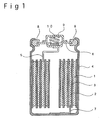
- Fig.1 is a schematic sectional view showing the internal structure of each of alkaline storage batteries fabricated in examples and comparative examples of the invention.
- the following examples specifically illustrate a sintered nickel electrode for an alkaline storage battery, method of forming the same, and an alkaline storage battery using as its positive electrode the nickel electrode for alkaline storage battery. Further, comparative examples will be taken to make it clear that in each of the alkaline storage batteries according to the examples, charge characteristic under high temperature conditions is improved. It should be appreciated that the sintered nickel electrode for alkaline storage battery, method of forming the same, and the alkaline storage battery according to the present invention are not particularly limited to those in the following examples, and various changes and modifications may be made in the invention without departing from the spirit and scope thereof.
- a sintered nickel electrode for alkaline storage battery was formed in the following manner.
- Nickel powder and carboxymethyl cellulose as a binding agent were mixed to prepare a slurry.
- the slurry thus prepared was applied to a punching metal having thickness of 50 ⁇ m, was dried, was burned for 20 minutes at a temperature of 900 °C in a hydrogen atmosphere to form a sintered substrate having a porosity of about 85 %, an average pore diameter of 10 ⁇ m, and thickness of 0.65 mm.
- the above-mentioned sintered substrate was immersed in a nickel nitrate Ni(NO 3 ) 2 aqueous solution in a specific gravity of 1.5 so that the nickel nitrate is adhered to pore of the sintered substrate.
- the sintered substrate was then immersed in 25 wt % of a sodium hydroxide aqueous solution to transform the nickel nitrate in the pore of the sintered substrate into the nickel hydroxide.
- the operation was repeated for six times to fill the nickel hydroxide into the pore of the sintered substrate.
- the sintered substrate thus having the nickel hydroxide filled into the pore was immersed in a tungsten hexachloride aqueous solution in a concentration of 0.1 mol / 1 for 30 minutes, was then dried at a temperature of 60 °C for 30 minutes.
- the sintered substrate was immersed in 30 wt % of the sodium hydroxide aqueous solution for 30 minutes, and was dried at a temperature of 60 °C for 30 minutes to form the sintered nickel electrode for alkaline storage battery in which the tungstic acid was adhered to the surface of the nickel hydroxide.
- the weight ratio of tungsten element in the tungstic acid based on the nickel hydroxide found by ICP was 0.2 wt %.
- the sintered nickel electrode for alkaline storage battery thus formed was used as the positive electrode while a paste type cadmium electrode which has been conventionally used as a negative electrode was used as the negative electrode.
- Polyamid non-woven fabric was used as a separator, and 30 wt % of a potassium hydroxide aqueous solution was used as an alkaline electrolyte solution.
- an alkaline storage battery of AA size of the example A1 as shown in Fig. 1 was fabricated.
- a separator 3 was interposed between a positive electrode 1 and a negative electrode 2, was wound up in a spiral shape, and was contained in a battery can 4. Thereafter, the alkaline electrolyte solution was poured into the battery can 4, to seal the battery can 4.
- the positive electrode 1 was connected to a positive electrode cover 6 through a positive electrode lead 5, and the negative electrode 2 was connected to the battery can 4 through a negative electrode lead 7.
- the battery can 4 and the positive electrode cover 6 were electrically separated by an insulating packing 8.
- a coil spring 10 was provided between the positive electrode cover 6 and a positive electrode external terminal 9. When the internal pressure of the battery was abnormally raised, the coil spring 10 was compressed so that gas inside the battery was released into the air.
- the sintered substrate having the nickel hydroxide filled into the pore was used as the sintered nickel electrode for alkaline storage battery, thus, the tungstic acid was not adhered to the surface of the nickel hydroxide.
- each of the alkaline storage batteries of the example 1 and the comparative example 1 was respectively charged at a charging current of 100 mA for 16 hours under a temperature condition of 25 °C, then was discharged to 1.0 V at a discharging current of 1000 mA.
- the charge / discharge was regarded as one cycle. Five cycles of the charge / discharge were performed to find a discharge capacity C5 at the fifth cycle of each of the alkaline storage batteries of the example 1 and comparative example 1.
- the discharge capacity C5 at the fifth cycle of the alkaline storage battery of the example 1 was set to 100, to find a relative index of the discharge capacity, which was regarded as a capacity index, of the alkaline storage battery of the comparative example 1.
- the results were shown in the following Table 1.
- each of the above-mentioned alkaline storage batteries to which five cycles of the charge / discharge were carried out was further charged at the charging current of 100 mA for 16 hours under a high temperature condition of 60 °C, then was discharged to 1.0 V at the discharging current of 1000 mA under the temperature condition of 25 °C to find the discharge capacity C6 at the sixth cycle.
- the results were shown in the following Table 1.
- the alkaline storage battery of the example 1 using the sintered nickel electrode for alkaline storage battery in which the tungstic acid was adhered to the surface of the nickel hydroxide as the active material presented a larger value of the above-mentioned ratio R and smaller decline in the discharge capacity in the case in which the battery was charged under high temperature conditions, thereby improving in the charge characteristic under high temperature conditions compared with the alkaline storage battery of the comparative example 1 using the sintered nickel electrode for alkaline storage battery in which the tungstic acid was not adhered to the surface of the nickel hydroxide.
- the nickel hydroxide was filled into the pore of the sintered substrate.
- the conditions were changed.
- the time for which the sintered substrate having the nickel hydroxide filled into the pore was immersed in the tungsten hexachloride aqueous solution in the concentration of 0.1 mol / 1 was respectively changed to 5 minutes in the example A1 and 10 minutes in the example A2.
- the same procedure as that in the example 1 was taken to form each of the sintered nickel electrodes for alkaline storage batteries in which the tungstic acid was adhered to the surface of the nickel hydroxide.
- the number of times of the operation for adhering the tungstic acid to the surface of the nickel hydroxide filled into the pore of the sintered substrate was respectively changed to 3 times in the example A3, 5 times in the example A4, 8 times in the example A5, and 10 times in the example A6 to form each of the sintered nickel electrodes for alkaline storage batteries in which the tungstic acid was adhered to the surface of the nickel hydroxide.
- the weight ratio of the tungsten element in the tungstic acid based on the nickel hydroxide was respectively 0.01 wt % in the example A1, 0.05 wt % in the example A2, 0.6 wt % in the example A3, 1 wt % in the example A4, 3 wt % in the example A5, and 4 wt % in the example A6 as shown in the following Table 2.
- each of the above-mentioned alkaline storage batteries was further charged at the charging current of 100 mA for 16 hours under the high temperature condition of 60 °C, then was discharged to 1.0 V at the discharging current of 1000 mA under a temperature condition of 25 °C to find the discharge capacity C6 at the sixth cycle in the same manner as the above-mentioned example 1.
- the discharge capacity C5 at the fifth cycle of the alkaline storage battery of the example 1 was set to 100, to find a capacity index of each of the alkaline storage batteries of the example A1 to A6.
- the results were shown in the following Table 2.
- ratio of W element base on nickel hydroxide (wt%) capacity index R (% ⁇ example A1 0.01 98 71 example A2 0.05 100 85 example 1 0.2 100 87 example A3 0.6 100 85 example A4 1 99 84 example A5 3 98 83 example A6 4 92 73
- each of the alkaline storage batteries of the examples 1 and A2 to A5 using the sintered nickel electrodes for alkaline storage batteries in which the ratio of the tungsten element in the tungstic acid based on the nickel hydroxide was in the rage of 0.05 to 3 wt % presented a larger value of the ratio R and smaller decline in the discharge capacity in a case in which the batteries were charged under high temperature conditions, thereby improving in the charge characteristics under high temperature conditions compared with the alkaline storage battery of the example A1 using the sintered nickel electrode for alkaline storage battery in which the ratio of the tungsten element based on the nickel hydroxide was 0.01 wt %, and the alkaline storage battery of the example A6 using the sintered nickel electrode for alkaline storage battery in which the ratio of the tungsten element based on the nickel hydroxide was 4 wt %.
Landscapes
- Chemical & Material Sciences (AREA)
- Chemical Kinetics & Catalysis (AREA)
- Electrochemistry (AREA)
- General Chemical & Material Sciences (AREA)
- Engineering & Computer Science (AREA)
- Manufacturing & Machinery (AREA)
- Battery Electrode And Active Subsutance (AREA)
- Secondary Cells (AREA)
Abstract
Description
- The present invention relates generally to a sintered nickel electrode for alkaline storage battery formed by filling nickel hydroxide as an active material into a porous sintered substrate, method of forming the same, and an alkaline storage battery using as its positive electrode such sintered nickel electrode for alkaline storage battery, and is particularly characterized in that the above-mentioned sintered nickel electrode for alkaline storage battery is modified to improve charge characteristic under high temperature conditions, thus to stably attain a high discharge capacity in the alkaline storage battery using as its positive electrode such sintered nickel electrode for alkaline storage battery.
- In alkaline storage batteries including a nickel-metal hydride battery, nickel-cadmium battery, and the like, a sintered nickel electrode for alkaline storage battery has been used as its positive electrode.
- The sintered nickel electrode for alkaline storage battery has been formed by chemically impregnating a porous sintered substrate which is obtained by sintering with salt as an active material, and then filling nickel hydroxide as the active material into the sintered substrate. Such nickel electrode for alkaline storage battery is superior in charge / discharge characteristic at high electric current because conductivity of the sintered substrate is high and close adherence between the active material and the sintered substrate is high.
- However, there have remained problems that when the alkaline storage battery using as its positive electrode the above-mentioned sintered nickel electrode for alkaline storage battery is charged under high temperature conditions, an oxygen evolution overvoltage of the positive electrode is decreased, thus in addition to a charge reactivity in which the nickel hydroxide is oxidized to nickel oxyhydroxide, an oxygen evolution reaction as a side reaction occurs, thus a sufficient discharge capacity is not attained, and hence charge characteristic under high temperature conditions is degraded.
- An object of the present invention is to modify characteristic of a sintered nickel electrode for alkaline storage battery formed by filling nickel hydroxide as an active material into a porous sintered substrate.
- Another object of the present invention is to prevent an oxygen evolution overvoltage of a positive electrode from decreasing, thus to restrain oxygen from evoluting in the positive electrode during charge, and hence to stably attain a sufficient discharge capacity under high temperature conditions, even in a case in which an alkaline storage battery using as its positive electrode the above-mentioned sintered nickel electrode for alkaline storage battery is charged under high temperature conditions.
- The sintered nickel electrode for alkaline storage battery according to the present invention is formed by filling nickel hydroxide as the active material into the porous sintered substrate, wherein tungstic acid is adhered to a surface of said nickel hydroxide.
- As the above-mentioned sintered nickel electrode for alkaline storage battery, when the tungstic acid is adhered to the surface of the nickel hydroxide filled into the porous sintered substrate, the oxygen evolution overvoltage of the positive electrode is increased for the effect of the above-mentioned tungstic acid. Thus, when the alkaline storage battery using as its positive electrode the sintered nickel electrode for alkaline storage battery is charged under high temperature conditions, an oxygen evolution reaction as a side reaction is prevented from occurring, thus charge characteristic of the alkaline storage battery under high temperature conditions is improved, and hence the sufficient discharge capacity is stably attained.
- In adhering the tungstic acid to the surface of the nickel hydroxide as the active material, when an amount of the tungstic acid based on the nickel hydroxide is too small, the oxygen evolution overvoltage of the sintered nickel electrode is not sufficiently increased, thus the charge characteristic of the alkaline storage battery is not sufficiently improved under high temperature conditions. On the other hand, when the amount of the tungstic acid is too large, current collectivity of the sintered nickel electrode is degraded for the effect of too much amount of the tungstic acid, thus utilization efficiency of the active material is decreased. Therefore, a ratio of tungsten element in the tungstic acid based on the nickel hydroxide is preferably set in a range of 0.05 to 3 wt %. As the above-mentioned tungstic acid, a hydrate of tungstic trioxide represented by a compositional formula WO3 ·nH2O can be used.
- The above-mentioned sintered nickel electrode for alkaline storage battery is formed by chemically filling the nickel hydroxide as the active material into the pore of the porous sintered substrate, then immersing the sintered substrate which is having the nickel hydroxide thus filled into an aqueous solution of tungsten salt so that the sintered substrate is impregnated with the tungsten salt, and finally immersing the sintered substrate thus impregnated with the tungsten salt into an alkaline aqueous solution so that the tungsten salt deposits as the tungstic acid on the surface of the nickel hydroxide.
- As the above-mentioned tungsten salt, tungsten hexachloride WCl6, tungsten pentachloride WCl5, tungsten pentabromide WBr5, and the like can be used.
- In forming the sintered nickel electrode for alkaline storage battery, the amount of the tungstic acid to be adhered to the surface of the nickel hydroxide is adjusted by changing number of times of the above-mentioned operation of impregnating the sintered substrate which is thus having the nickel hydroxide filled into the tungsten salt to deposit the tungsten salt thus impregnated on the surface of the nickel hydroxide as the tungstic acid, or by changing the time for which the sintered substrate having the nickel hydroxide filled is immersed in the above-mentioned aqueous solution of the tungsten salt.
- These and other objects, advantages and features of the invention will become apparent from the following description thereof taken in conjunction with the accompanying drawings which illustrate specific embodiment of the invention.
- Fig.1 is a schematic sectional view showing the internal structure of each of alkaline storage batteries fabricated in examples and comparative examples of the invention.
- The following examples specifically illustrate a sintered nickel electrode for an alkaline storage battery, method of forming the same, and an alkaline storage battery using as its positive electrode the nickel electrode for alkaline storage battery. Further, comparative examples will be taken to make it clear that in each of the alkaline storage batteries according to the examples, charge characteristic under high temperature conditions is improved. It should be appreciated that the sintered nickel electrode for alkaline storage battery, method of forming the same, and the alkaline storage battery according to the present invention are not particularly limited to those in the following examples, and various changes and modifications may be made in the invention without departing from the spirit and scope thereof.
- In the example 1, a sintered nickel electrode for alkaline storage battery was formed in the following manner.
- Nickel powder and carboxymethyl cellulose as a binding agent were mixed to prepare a slurry. The slurry thus prepared was applied to a punching metal having thickness of 50 µm, was dried, was burned for 20 minutes at a temperature of 900 °C in a hydrogen atmosphere to form a sintered substrate having a porosity of about 85 %, an average pore diameter of 10 µm, and thickness of 0.65 mm.
- The above-mentioned sintered substrate was immersed in a nickel nitrate Ni(NO3)2 aqueous solution in a specific gravity of 1.5 so that the nickel nitrate is adhered to pore of the sintered substrate. The sintered substrate was then immersed in 25 wt % of a sodium hydroxide aqueous solution to transform the nickel nitrate in the pore of the sintered substrate into the nickel hydroxide. The operation was repeated for six times to fill the nickel hydroxide into the pore of the sintered substrate.
- The sintered substrate thus having the nickel hydroxide filled into the pore was immersed in a tungsten hexachloride aqueous solution in a concentration of 0.1 mol / 1 for 30 minutes, was then dried at a temperature of 60 °C for 30 minutes.
- The sintered substrate was immersed in 30 wt % of the sodium hydroxide aqueous solution for 30 minutes, and was dried at a temperature of 60 °C for 30 minutes to form the sintered nickel electrode for alkaline storage battery in which the tungstic acid was adhered to the surface of the nickel hydroxide.
- In the sintered nickel electrode for alkaline storage battery thus formed, the weight ratio of tungsten element in the tungstic acid based on the nickel hydroxide found by ICP (Inductivity Coupled Plasma Emission Spectrometry) was 0.2 wt %.
- The sintered nickel electrode for alkaline storage battery thus formed was used as the positive electrode while a paste type cadmium electrode which has been conventionally used as a negative electrode was used as the negative electrode. Polyamid non-woven fabric was used as a separator, and 30 wt % of a potassium hydroxide aqueous solution was used as an alkaline electrolyte solution. Thus an alkaline storage battery of AA size of the example A1 as shown in Fig. 1 was fabricated.
- In the alkaline storage battery, a
separator 3 was interposed between apositive electrode 1 and anegative electrode 2, was wound up in a spiral shape, and was contained in a battery can 4. Thereafter, the alkaline electrolyte solution was poured into the battery can 4, to seal the battery can 4. Thepositive electrode 1 was connected to apositive electrode cover 6 through apositive electrode lead 5, and thenegative electrode 2 was connected to the battery can 4 through anegative electrode lead 7. The battery can 4 and thepositive electrode cover 6 were electrically separated by aninsulating packing 8. - A
coil spring 10 was provided between thepositive electrode cover 6 and a positive electrodeexternal terminal 9. When the internal pressure of the battery was abnormally raised, thecoil spring 10 was compressed so that gas inside the battery was released into the air. - In the comparative example 1, in forming the sintered nickel electrode for alkaline storage battery of the example 1, the sintered substrate having the nickel hydroxide filled into the pore was used as the sintered nickel electrode for alkaline storage battery, thus, the tungstic acid was not adhered to the surface of the nickel hydroxide.
- Except that the sintered nickel electrode for alkaline storage battery thus formed was used as the positive electrode, the same procedure as that in the example 1 was taken to fabricate an alkaline storage battery of the comparative example 1.
- Subsequently, each of the alkaline storage batteries of the example 1 and the comparative example 1 was respectively charged at a charging current of 100 mA for 16 hours under a temperature condition of 25 °C, then was discharged to 1.0 V at a discharging current of 1000 mA. The charge / discharge was regarded as one cycle. Five cycles of the charge / discharge were performed to find a discharge capacity C5 at the fifth cycle of each of the alkaline storage batteries of the example 1 and comparative example 1.
- The discharge capacity C5 at the fifth cycle of the alkaline storage battery of the example 1 was set to 100, to find a relative index of the discharge capacity, which was regarded as a capacity index, of the alkaline storage battery of the comparative example 1. The results were shown in the following Table 1.
- Further, each of the above-mentioned alkaline storage batteries to which five cycles of the charge / discharge were carried out was further charged at the charging current of 100 mA for 16 hours under a high temperature condition of 60 °C, then was discharged to 1.0 V at the discharging current of 1000 mA under the temperature condition of 25 °C to find the discharge capacity C6 at the sixth cycle.
- A ratio R (%) of the discharge capacity C6 at the sixth cycle based on the discharge capacity C5 at the fifth cycle of each of the alkaline storage batteries of the example 1 and the comparative example 1 was calculated by a formula R =(C6 / C5) × 100. The results were shown in the following Table 1.
ratio of W element base on nickel hydroxide (wt%) capacity index R (%) example 1 0.2 100 87 comparative example 1 - 98 70 - As apparent from the results, the alkaline storage battery of the example 1 using the sintered nickel electrode for alkaline storage battery in which the tungstic acid was adhered to the surface of the nickel hydroxide as the active material presented a larger value of the above-mentioned ratio R and smaller decline in the discharge capacity in the case in which the battery was charged under high temperature conditions, thereby improving in the charge characteristic under high temperature conditions compared with the alkaline storage battery of the comparative example 1 using the sintered nickel electrode for alkaline storage battery in which the tungstic acid was not adhered to the surface of the nickel hydroxide.
- In the examples A1 to A6, in forming the sintered nickel electrode for an alkaline storage battery, the nickel hydroxide was filled into the pore of the sintered substrate.
- In adhering the tungstic acid to the surface of the nickel hydroxide which was filled into the pore of the sintered substrate, the conditions were changed. In the examples A1 and A2, the time for which the sintered substrate having the nickel hydroxide filled into the pore was immersed in the tungsten hexachloride aqueous solution in the concentration of 0.1 mol / 1 was respectively changed to 5 minutes in the example A1 and 10 minutes in the example A2. Except for the above, the same procedure as that in the example 1 was taken to form each of the sintered nickel electrodes for alkaline storage batteries in which the tungstic acid was adhered to the surface of the nickel hydroxide.
- In the examples A3 to A6, the number of times of the operation for adhering the tungstic acid to the surface of the nickel hydroxide filled into the pore of the sintered substrate was respectively changed to 3 times in the example A3, 5 times in the example A4, 8 times in the example A5, and 10 times in the example A6 to form each of the sintered nickel electrodes for alkaline storage batteries in which the tungstic acid was adhered to the surface of the nickel hydroxide.
- In each of the nickel electrodes for alkaline storage batteries thus formed, the weight ratio of the tungsten element in the tungstic acid based on the nickel hydroxide was respectively 0.01 wt % in the example A1, 0.05 wt % in the example A2, 0.6 wt % in the example A3, 1 wt % in the example A4, 3 wt % in the example A5, and 4 wt % in the example A6 as shown in the following Table 2.
- Except that each of the nickel electrodes for alkaline storage batteries thus formed was used, the same procedure as that in the example 1 was taken to fabricate each of the alkaline storage batteries of the examples A1 to A6.
- Subsequently, the charge / discharge was performed repeatedly to each of the alkaline storage batteries of the examples A1 to A6 thus fabricated under the temperature condition of 25 °C, and the discharge capacity C5 at the fifth cycle was found. Further, each of the above-mentioned alkaline storage batteries was further charged at the charging current of 100 mA for 16 hours under the high temperature condition of 60 °C, then was discharged to 1.0 V at the discharging current of 1000 mA under a temperature condition of 25 °C to find the discharge capacity C6 at the sixth cycle in the same manner as the above-mentioned example 1.
- The discharge capacity C5 at the fifth cycle of the alkaline storage battery of the example 1 was set to 100, to find a capacity index of each of the alkaline storage batteries of the example A1 to A6. In addition, the ratio R of the discharge capacity C6 at the sixth cycle based on the discharge capacity C5 at the fifth cycle of each of the alkaline storage batteries was calculated by a formula R =(Q6 / Q5) × 100. The results were shown in the following Table 2.
ratio of W element base on nickel hydroxide (wt%) capacity index R (%} example A1 0.01 98 71 example A2 0.05 100 85 example 1 0.2 100 87 example A3 0.6 100 85 example A4 1 99 84 example A5 3 98 83 example A6 4 92 73 - As apparent from the results, each of the alkaline storage batteries of the examples 1 and A2 to A5 using the sintered nickel electrodes for alkaline storage batteries in which the ratio of the tungsten element in the tungstic acid based on the nickel hydroxide was in the rage of 0.05 to 3 wt % presented a larger value of the ratio R and smaller decline in the discharge capacity in a case in which the batteries were charged under high temperature conditions, thereby improving in the charge characteristics under high temperature conditions compared with the alkaline storage battery of the example A1 using the sintered nickel electrode for alkaline storage battery in which the ratio of the tungsten element based on the nickel hydroxide was 0.01 wt %, and the alkaline storage battery of the example A6 using the sintered nickel electrode for alkaline storage battery in which the ratio of the tungsten element based on the nickel hydroxide was 4 wt %.
- Although the present invention has been fully described by way of examples, it is to be noted that various changes and modifications will be apparent to those skilled in the art.
- Therefore, unless otherwise such changes and modifications depart from the scope of the present invention, they should be construed as being included therein.
Claims (6)
- A sintered nickel electrode for alkaline storage battery is provided with a porous sintered substrate and an active material consisting of nickel hydroxide to be filled into the porous sintered substrate, wherein
tungstic acid is adhered to a surface of said nickel hydroxide. - The sintered nickel electrode for alkaline storage battery according to claim 1, wherein
said tungstic acid is WO3 ·nH2O. - The sintered nickel electrode for alkaline storage battery according to claims 1 or 2, wherein
a weight ratio of a tungsten element in the tungstic acid based on said nickel hydroxide is in a range of 0.05 to 3 wt %. - A method of forming a sintered nickel electrode for alkaline storage battery comprising steps of :filling nickel hydroxide as an active material into a porous sintered substrate,immersing said sintered substrate having nickel hydroxide filled into an aqueous solution of tungsten salt to impregnate the tungsten salt therein, andimmersing said sintered substrate having the tungsten salt impregnated into an alkaline aqueous solution to deposit said tungsten salt on a surface of the nickel hydroxide as tungstic acid.
- The method of forming a sintered nickel electrode for alkaline storage battery according to claim 4, wherein
said tungsten salt is at least one type selected from a group consisting of tungsten hexachloride, tungsten pentachloride, and tungsten pentabromide. - An alkaline storage battery provided with a positive electrode, a negative electrode, and an alkaline electrolyte solution, wherein
said positive electrode is a sintered nickel electrode for alkaline storage battery according to claims 1 to 3.
Applications Claiming Priority (2)
| Application Number | Priority Date | Filing Date | Title |
|---|---|---|---|
| JP2001027983 | 2001-02-05 | ||
| JP2001027983A JP3953278B2 (en) | 2001-02-05 | 2001-02-05 | Sintered nickel electrode for alkaline storage battery, method for producing the same, and alkaline storage battery |
Publications (2)
| Publication Number | Publication Date |
|---|---|
| EP1229598A2 true EP1229598A2 (en) | 2002-08-07 |
| EP1229598A3 EP1229598A3 (en) | 2005-04-13 |
Family
ID=18892556
Family Applications (1)
| Application Number | Title | Priority Date | Filing Date |
|---|---|---|---|
| EP02002362A Withdrawn EP1229598A3 (en) | 2001-02-05 | 2002-01-31 | Sintered nickel electrode for alkaline storage battery, method of forming the same, and alkaline storage battery |
Country Status (3)
| Country | Link |
|---|---|
| US (1) | US6946222B2 (en) |
| EP (1) | EP1229598A3 (en) |
| JP (1) | JP3953278B2 (en) |
Families Citing this family (5)
| Publication number | Priority date | Publication date | Assignee | Title |
|---|---|---|---|---|
| JP5853799B2 (en) * | 2012-03-22 | 2016-02-09 | 三洋電機株式会社 | Alkaline storage battery |
| JP6024295B2 (en) * | 2012-08-30 | 2016-11-16 | 三洋電機株式会社 | Alkaline storage battery |
| JP6232722B2 (en) * | 2013-03-25 | 2017-11-22 | 三洋電機株式会社 | Nickel-cadmium storage battery |
| JP6263983B2 (en) * | 2013-11-25 | 2018-01-24 | 三洋電機株式会社 | Alkaline storage battery and method for manufacturing the same |
| CN116231112B (en) * | 2023-03-03 | 2025-05-27 | 中国长江三峡集团有限公司 | Aqueous secondary battery electrolyte, secondary battery and application thereof |
Citations (1)
| Publication number | Priority date | Publication date | Assignee | Title |
|---|---|---|---|---|
| EP1227530A1 (en) * | 2001-01-30 | 2002-07-31 | SANYO ELECTRIC Co., Ltd. | Nickel electrode for alkaline secondary battery and alkaline secondary battery |
Family Cites Families (6)
| Publication number | Priority date | Publication date | Assignee | Title |
|---|---|---|---|---|
| IN153057B (en) * | 1978-09-21 | 1984-05-26 | British Petroleum Co | |
| JPH0745282A (en) | 1993-07-29 | 1995-02-14 | Yuasa Corp | Nickel electrode for alkaline storage battery |
| JP3512128B2 (en) * | 1995-02-15 | 2004-03-29 | 日立マクセル株式会社 | Alkaline storage battery and method for manufacturing the same |
| EP0851515A3 (en) * | 1996-12-27 | 2004-10-27 | Canon Kabushiki Kaisha | Powdery material, electrode member, method for manufacturing same and secondary cell |
| JPH11238511A (en) * | 1998-02-23 | 1999-08-31 | Shin Kobe Electric Mach Co Ltd | Lead storage battery |
| JP2001217000A (en) * | 1999-02-26 | 2001-08-10 | Toshiba Battery Co Ltd | Nickel-hydrogen secondary battery |
-
2001
- 2001-02-05 JP JP2001027983A patent/JP3953278B2/en not_active Expired - Lifetime
-
2002
- 2002-01-31 EP EP02002362A patent/EP1229598A3/en not_active Withdrawn
- 2002-02-04 US US10/061,358 patent/US6946222B2/en not_active Expired - Lifetime
Patent Citations (1)
| Publication number | Priority date | Publication date | Assignee | Title |
|---|---|---|---|---|
| EP1227530A1 (en) * | 2001-01-30 | 2002-07-31 | SANYO ELECTRIC Co., Ltd. | Nickel electrode for alkaline secondary battery and alkaline secondary battery |
Also Published As
| Publication number | Publication date |
|---|---|
| US6946222B2 (en) | 2005-09-20 |
| EP1229598A3 (en) | 2005-04-13 |
| JP2002231240A (en) | 2002-08-16 |
| US20020164526A1 (en) | 2002-11-07 |
| JP3953278B2 (en) | 2007-08-08 |
Similar Documents
| Publication | Publication Date | Title |
|---|---|---|
| US6521377B2 (en) | Positive electrode active material for alkaline storage batteries, positive electrode for alkaline storage batteries, and alkaline storage battery | |
| JPH09180714A (en) | Anode and cathode for alkaline storage battery and method of manufacturing the same | |
| US6703165B2 (en) | Nickel electrode for alkaline storage battery, method of fabricating the same, and alkaline storage battery | |
| US6946222B2 (en) | Sintered nickel electrode for alkaline storage battery, method of forming the same, and alkaline storage battery | |
| US6579645B2 (en) | Hydrogen absorbing alloy for electrode, hydrogen absorbing alloy electrode and alkaline storage battery | |
| JP4127990B2 (en) | Nickel electrode for alkaline storage battery, method for producing nickel electrode for alkaline storage battery, and alkaline storage battery | |
| JP4215407B2 (en) | Hydrogen storage alloy electrode, manufacturing method thereof, and alkaline storage battery | |
| JP3954822B2 (en) | Nickel electrode for alkaline storage battery, method for producing nickel electrode for alkaline storage battery, and alkaline storage battery | |
| EP1116288A1 (en) | Nickel positive electrode plate for alkaline storage batteries and method for producing the same | |
| JP3895984B2 (en) | Nickel / hydrogen storage battery | |
| JP4115367B2 (en) | Hydrogen storage alloy for alkaline storage battery, method for producing the same, and alkaline storage battery | |
| JP3851022B2 (en) | Nickel electrode for alkaline storage battery and alkaline storage battery | |
| JP2000200612A (en) | Rectangular alkaline secondary battery | |
| JPH097591A (en) | Hydrogen storage alloy, method for producing the same, and hydrogen storage alloy electrode using the same | |
| JP4458749B2 (en) | Alkaline storage battery | |
| JP4357133B2 (en) | Hydrogen storage alloy for electrode, hydrogen storage alloy electrode and alkaline storage battery | |
| JP3789702B2 (en) | Positive electrode active material for alkaline storage battery and method for producing the same, positive electrode for alkaline storage battery and alkaline storage battery | |
| JP4530555B2 (en) | Hydrogen storage alloy for electrode, hydrogen storage alloy electrode and alkaline storage battery | |
| JP2005183339A (en) | Nickel electrode for alkaline storage battery and alkaline storage battery | |
| JP2005056679A (en) | Cylindrical alkaline storage battery | |
| JP2001006723A (en) | Alkaline secondary battery and manufacture of alkaline secondary battery | |
| JP2000200599A (en) | Alkaline secondary battery | |
| JP2000277102A (en) | Manufacture of alkaline secondary battery | |
| JP2004281240A (en) | Nickel-hydrogen storage battery | |
| JP2005116381A (en) | Alkaline storage battery |
Legal Events
| Date | Code | Title | Description |
|---|---|---|---|
| PUAI | Public reference made under article 153(3) epc to a published international application that has entered the european phase |
Free format text: ORIGINAL CODE: 0009012 |
|
| AK | Designated contracting states |
Kind code of ref document: A2 Designated state(s): AT BE CH CY DE DK ES FI FR GB GR IE IT LI LU MC NL PT SE TR |
|
| AX | Request for extension of the european patent |
Free format text: AL;LT;LV;MK;RO;SI |
|
| PUAL | Search report despatched |
Free format text: ORIGINAL CODE: 0009013 |
|
| AK | Designated contracting states |
Kind code of ref document: A3 Designated state(s): AT BE CH CY DE DK ES FI FR GB GR IE IT LI LU MC NL PT SE TR |
|
| AX | Request for extension of the european patent |
Extension state: AL LT LV MK RO SI |
|
| 17P | Request for examination filed |
Effective date: 20050913 |
|
| AKX | Designation fees paid |
Designated state(s): DE FR GB |
|
| 17Q | First examination report despatched |
Effective date: 20100928 |
|
| GRAP | Despatch of communication of intention to grant a patent |
Free format text: ORIGINAL CODE: EPIDOSNIGR1 |
|
| STAA | Information on the status of an ep patent application or granted ep patent |
Free format text: STATUS: GRANT OF PATENT IS INTENDED |
|
| INTG | Intention to grant announced |
Effective date: 20180424 |
|
| RIN1 | Information on inventor provided before grant (corrected) |
Inventor name: TOKUDA, MITSUNORI Inventor name: FUJITANI, SHIN Inventor name: MORIKAWA, YUKI Inventor name: YANO, MUTSUMI Inventor name: OGASAWARA, TAKESHI |
|
| STAA | Information on the status of an ep patent application or granted ep patent |
Free format text: STATUS: THE APPLICATION IS DEEMED TO BE WITHDRAWN |
|
| RIC1 | Information provided on ipc code assigned before grant |
Ipc: H01M 4/32 20060101AFI20020523BHEP Ipc: H01M 4/28 20060101ALI20020523BHEP Ipc: H01M 4/62 20060101ALI20020523BHEP |
|
| 18D | Application deemed to be withdrawn |
Effective date: 20180905 |