EP1229031A1 - Process for the preparation of 3,4-methylenedioxy-mandelic acid - Google Patents
Process for the preparation of 3,4-methylenedioxy-mandelic acid Download PDFInfo
- Publication number
- EP1229031A1 EP1229031A1 EP00966457A EP00966457A EP1229031A1 EP 1229031 A1 EP1229031 A1 EP 1229031A1 EP 00966457 A EP00966457 A EP 00966457A EP 00966457 A EP00966457 A EP 00966457A EP 1229031 A1 EP1229031 A1 EP 1229031A1
- Authority
- EP
- European Patent Office
- Prior art keywords
- acid
- preparing
- methylenedioxymandelic
- methylenedioxybenzene
- amount
- Prior art date
- Legal status (The legal status is an assumption and is not a legal conclusion. Google has not performed a legal analysis and makes no representation as to the accuracy of the status listed.)
- Granted
Links
Images
Classifications
-
- C—CHEMISTRY; METALLURGY
- C07—ORGANIC CHEMISTRY
- C07D—HETEROCYCLIC COMPOUNDS
- C07D317/00—Heterocyclic compounds containing five-membered rings having two oxygen atoms as the only ring hetero atoms
- C07D317/08—Heterocyclic compounds containing five-membered rings having two oxygen atoms as the only ring hetero atoms having the hetero atoms in positions 1 and 3
- C07D317/44—Heterocyclic compounds containing five-membered rings having two oxygen atoms as the only ring hetero atoms having the hetero atoms in positions 1 and 3 ortho- or peri-condensed with carbocyclic rings or ring systems
- C07D317/46—Heterocyclic compounds containing five-membered rings having two oxygen atoms as the only ring hetero atoms having the hetero atoms in positions 1 and 3 ortho- or peri-condensed with carbocyclic rings or ring systems condensed with one six-membered ring
- C07D317/48—Methylenedioxybenzenes or hydrogenated methylenedioxybenzenes, unsubstituted on the hetero ring
- C07D317/50—Methylenedioxybenzenes or hydrogenated methylenedioxybenzenes, unsubstituted on the hetero ring with only hydrogen atoms, hydrocarbon or substituted hydrocarbon radicals, directly attached to atoms of the carbocyclic ring
- C07D317/60—Radicals substituted by carbon atoms having three bonds to hetero atoms with at the most one bond to halogen, e.g. ester or nitrile radicals
Definitions
- the present invention relates to a process for preparing 3,4-methylenedioxymandelic acid from 1,2-methylenedioxybenzene.
- 3,4-Methylenedioxymandelic acid is a useful compound as a starting material for synthesis of medicines, agrochemicals, and the like, and as a starting material for heliotropin used as general cosmetics and perfumes.
- a process for preparing 3,4-methylenedioxymandelic acid by reacting 1,2-methylenedioxybenzene with glyoxylic acid in the presence of a strong acid such as sulfuric acid or phosphoric acid has already been known (for example, Japanese Provisional Patent Publication No. 95573/1979, Perfumer & Flavourist, vol. 14, p.13 (1989)).
- a strong acid such as sulfuric acid or phosphoric acid
- reaction is an exothermic reaction, so that when the reaction solution is made highly viscous or solidified, the whole of the reaction solution is hardly cooled, and the temperature of the solution is partially increased to cause formation of byproducts, thus reducing the selectivity of 3,4-methylenedioxymandelic acid. In particular, this phenomenon occurs significantly when the reaction is in a large scale.
- Japanese Provisional Patent Publication No. 95573/1979 supra describes that the reaction is carried out preferably in the absence of a solvent, and if necessary, addition of formic acid or acetic acid exerts an advantageous influence on the reaction.
- the type and effect of solvent are not described, and when an organic acid is used, the specific amount of the organic acid added is not described either. Accordingly, we made extensive study on this reaction and found that the problem described above can be solved by adding an organic solvent. Further, we unexpectedly found that when an organic acid is used, the formation rate and selectivity of 3,4-methylenedioxymandelic acid are significantly influenced by the amount of the organic acid added to 1,2-methylenedioxybenzene, and that there is the optimum amount of the organic acid added.
- An object of this invention is to provide an industrially preferable process for preparing 3,4-methylenedioxymandelic acid, which can produce 3,4-methylenedioxymandelic acid in high selectivity by reacting 1,2-methylenedioxybenzene with glyoxylic acid and which can also be applied to the reaction in a large scale.
- the present invention relates to a process for preparing 3,4-methylenedioxymandelic acid by reacting 1,2-methylenedioxybenzene with glyoxylic acid in the presence of a strong acid, characterized in that the reaction is carried out in the presence of at least one selected from the group consisting of an aprotic organic solvent and 100 to 1200 ml of an organic acid per kg of 1,2-methylenedioxybenzene.
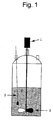
- Fig. 1 is a drawing showing one example of a reaction apparatus used in a process of the present invention.
- the strong acid used in the reaction of the present invention includes inorganic acids such as sulfuric acid and phosphoric acid, and organic acids having a pKa of 3 or less such as methanesulfonic acid, and preferably an inorganic acid, more preferably sulfuric acid is used. These strong acids are used in the form of 70 % by weight or more aqueous solution.
- the amount of the strong acid used is preferably 0.50 to 3.00 mol, more preferably 1.00 to 2.50 mol, per mol of 1,2-methylenedioxybenzene.
- Glyoxylic acid used in the reaction of the invention can be used not only in the form of solid (monohydrate) but also in the form of 40 % by weight or more aqueous solution.
- the amount of glyoxylic acid used is preferably 0.8 to 3.0 mol, more preferably 1.0 to 2.0 mol, per mol of 1,2-methylenedioxybenzene.
- the aprotic organic solvent used in the reaction of the present invention is not particularly limited insofar as it is stable under acidic conditions and does not inhibit the reaction, and examples thereof include ethers such as diethyl ether, diisopropyl ether, dibutyl ether and tetrahydrofuran; ketones such as acetone, 2-butanone, 2-pentanone, 3-pentanone, 4-methyl-2-pentanone, cyclopentanone and cyclohexanone; carboxylic acid esters such as ethyl formate, isopropyl formate, butyl formate, methyl acetate, ethyl acetate, isopropyl acetate, butyl acetate, methyl propionate, ethyl propionate, isopropyl propionate and butyl propionate; amides such as N,N-dimethylformamide, N,N-dimethylacetamide, hexamethyl phosphoric
- the amount of the aprotic organic solvent used is preferably 100 to 2000 ml, more preferably 100 to 1000 ml, per kg of 1,2-methylenedioxybenzene. These organic solvents may be used singly or in combination thereof.
- the organic acid used in the reaction of the present invention is not particularly limited insofar as it is stable under acidic conditions and does not inhibit the reaction, and examples thereof include aliphatic carboxylic acids such as formic acid, acetic acid, propionic acid, n-butyric acid, isobutyric acid and n-valeric acid; and halogenated aliphatic carboxylic acids such as trifluoroacetic acid and dichloroacetic acid, and preferably an aliphatic carboxylic acid, more preferably acetic acid is used. These organic acids may be used singly or in combination thereof.
- the amount of the organic acid used is 100 to 1200 ml, preferably 100 to 1000 ml and more preferably 100 to 500 ml, per kg of 1,2-methylenedioxybenzene.
- the amount of the organic acid used is less than 100 ml, there is the problem that the ability of the reaction solution to be stirred is significantly worsened, and the temperature of the solution is partially increased to cause formation of byproducts, thus reducing the selectivity of the desired product, while if the amount of the organic acid is greater than 1200 ml, there is the problem that the reaction rate is significantly reduced, the reaction requires a longer time, and the selectivity of the desired product is lowered.
- the reaction of this invention is carried out, for example, according to a method of adding 1,2-methylenedioxybenzene and a strong acid to a mixture of glyoxylic acid and an aprotic organic solvent and/or an organic acid (100 to 1200 ml per kg of 1,2-methylenedioxybenzene) in an atmosphere of an inert gas such as nitrogen or argon.
- the reaction temperature at this time is preferably -20 to 10°C, more preferably -10 to 5°C.
- the reaction is carried out usually at normal pressure but may also be carried out under pressure or under reduced pressure if necessary.
- the reaction time is usually 1 to 100 hours, preferably about 3 to 75 hours.
- the resulting product is neutralized by adding, e.g., a suitable amount of a base, then, extracted with a suitable solvent, separated and purified by general techniques such as column chromatography, distillation and recrystallization.
- FIG. 1 A flat bottom separable flask with an internal volume of 500 ml as shown in Fig. 1 was charged with 50.0 g (0.409 mol) of 1,2-methylenedioxybenzene and 25 ml of 4-methyl-2-pentanone (the amount of the organic solvent used was 500 ml per kg of 1,2-methylenedioxybenzene) in a nitrogen atmosphere, and the mixture was cooled to -5°C with stirring.
- the reference numeral 1 denotes a motor
- 2 denotes a thermometer
- 3 denotes a stirring blade, respectively.
- reaction solution was neutralized by adding 102.0 g (1.67 mol) of 28 % by weight aqueous ammonia little by little. Then, 100 ml of 2-butanone was added, then the mixture was heated to 60°C, and the formed 3,4-methylenedioxymandelic acid was extracted into a 2-butanone layer (an organic layer). Analysis of the organic layer by high performance liquid chromatography indicated that the conversion of 1,2-methylenedioxybenzene was 95%, and the selectivity of 3,4-methylenedioxymandelic acid was 92%.
- Example 1 Example Aprotic organic solvent Reaction temperature (°C) Reaction time (h) MDB Conversion (%) MDMA Selectivity (%) 2 3-Pentanone -5 23 94 91 3 Dimethyl carbonate 0 28 93 91 4 Acetonitrile 0 45 87 92 MDB: 1,2-Methylenedioxybenzene MDMA: 3,4-Methylenedioxymandleic acid
- Example 2 The reaction was carried out in the same manner as in Example 2 except that the organic solvent in Example 2 was not added.
- the reaction solution was made highly viscous during the reaction to permit only a part of the solution around the stirring blade to be stirred, thus failing to sufficiently stir the whole of the solution.
- the conversion of 1,2-methylenedioxybenzene was 94%
- the selectivity of 3,4-methylenedioxymandelic acid was 77%.
- a flat bottom separable flask with an internal volume of 7 L as shown in Fig. 1 was charged with 500.0 g (4.09 mol) of 1,2-methylenedioxybenzene and 250 ml of 4-methyl-2-pentanone (the amount of the organic solvent used was 500 ml per kg of 1,2-methylenedioxybenzene) in a nitrogen atmosphere, and the mixture was cooled to -10°C with stirring. Then, a mixture of 833.7 g (4.05 mol) of 40% by weight aqueous glyoxylic acid and 857.5 g (8.39 mol) of 96% by weight sulfuric acid was added slowly dropwise thereto, and the mixture was stirred at -5°C for 23 hours. Incidentally, the mixture could be stirred smoothly during the reaction.
- reaction solution was neutralized by adding 1030.0 g (16.93 mol) of 28 % by weight aqueous ammonia little by little. Then, 3000 ml of 4-methyl-2-pentanone was added, then the mixture was heated to 80°C, and the formed 3,4-methylenedioxymandelic acid was extracted into a 4-methyl-2-pentanone layer (an organic layer). Analysis of the organic layer by high performance liquid chromatography indicated that the conversion of 1,2-methylenedioxybenzene was 95%, and the selectivity of 3,4-methylenedioxymandelic acid was 90%.
- a flat bottom separable flask with an internal volume of 500 ml was charged with 50.0 g (0.409 mol) of 1,2-methylenedioxybenzene and 20 ml of acetic acid (the amount of acetic acid used was 400 ml per kg of 1,2-methylenedioxybenzene) in a nitrogen atmosphere, and the mixture was cooled to 0°C with stirring. Then, a mixture of 83.4 g (0.450 mol) of 40% by weight aqueous glyoxylic acid solution and 85.8 g (0.839 mol) of 96 % by weight sulfuric acid was added dropwise thereto, and the mixture was stirred at 0°C for 9 hours. Incidentally, the mixture could be stirred smoothly during the reaction.
- reaction solution was neutralized by adding 102.0 g (1.68 mol) of 28 % by weight aqueous ammonia little by little. Then, 100 ml of 2-butanone was added, then the mixture was heated to 60°C, and the formed 3,4-methylenedioxymandelic acid was extracted into a 2-butanone layer (an organic layer). Analysis of the organic layer by high performance liquid chromatography indicated that the conversion of 1,2-methylenedioxybenzene was 95%, and the selectivity of 3,4-methylenedioxymandelic acid was 91%.
- Example 6 The reaction was carried out in the same manner as in Example 6 except that the amount of acetic acid used for 1,2-methylenedioxybenzene, the reaction temperature and the reaction time in Example 6 were changed. The results are shown in Table 2.
- Example and Comparative example Amount of Acetic acid (ml/kg) Reaction temperature (°C) Reaction time (h) MDB Conversion (%) MDMA Selectivity (%) Example 7 100 0 5 93 91
- Example 8 200 0 7 96 91
- Example 9 300 0 7 94 90
- Example 10 500 0 12 95
- Example 11 800 0 21 97
- Example 12 1000 0 45 96 92
- Comparative example 2 50 0 7 95 82 Comparative example 3 1500 0 63 97 85
- an industrially preferable process for preparing 3,4-methylenedioxymandelic acid which can produce 3,4-methylenedioxymandelic acid in high selectivity by reacting 1,2-methylenedioxybenzene with glyoxylic acid and which can be also applied to the reaction in a large scale.
Landscapes
- Chemical & Material Sciences (AREA)
- Organic Chemistry (AREA)
- Organic Low-Molecular-Weight Compounds And Preparation Thereof (AREA)
- Low-Molecular Organic Synthesis Reactions Using Catalysts (AREA)
Abstract
Description
| Example | Aprotic organic solvent | Reaction temperature (°C) | Reaction time (h) | MDB Conversion (%) | MDMA Selectivity (%) |
| 2 | 3-Pentanone | -5 | 23 | 94 | 91 |
| 3 | Dimethyl carbonate | 0 | 28 | 93 | 91 |
| 4 | Acetonitrile | 0 | 45 | 87 | 92 |
| MDB: 1,2-Methylenedioxybenzene MDMA: 3,4-Methylenedioxymandleic acid |
| Example and Comparative example | Amount of Acetic acid (ml/kg) | Reaction temperature (°C) | Reaction time (h) | MDB Conversion (%) | MDMA Selectivity (%) |
| Example 7 | 100 | 0 | 5 | 93 | 91 |
| Example 8 | 200 | 0 | 7 | 96 | 91 |
| Example 9 | 300 | 0 | 7 | 94 | 90 |
| Example 10 | 500 | 0 | 12 | 95 | 90 |
| Example 11 | 800 | 0 | 21 | 97 | 90 |
| Example 12 | 1000 | 0 | 45 | 96 | 92 |
| Comparative example 2 | 50 | 0 | 7 | 95 | 82 |
| Comparative example 3 | 1500 | 0 | 63 | 97 | 85 |
Claims (16)
- A process for preparing 3,4-methylenedioxymandelic acid by reacting 1,2-methylenedioxybenzene with glyoxylic acid in the presence of a strong acid, characterized in that the reaction is carried out in the presence of at least one selected from the group consisting of an aprotic organic solvent and 100 to 1200 ml of an organic acid per kg of 1,2-methylenedioxybenzene.
- The process for preparing 3,4-methylenedioxymandelic acid according to Claim 1, wherein the strong acid is sulfuric acid.
- The process for preparing 3,4-methylenedioxymandelic acid according to Claim 1, wherein an amount of the strong acid to be used is 0.50 to 3.00 mol per mol of 1,2-methylenedioxybenzene.
- The process for preparing 3,4-methylenedioxymandelic acid according to Claim 1, wherein an amount of the strong acid to be used is 1.00 to 2.50 mol per mol of 1,2-methylenedioxybenzene.
- The process for preparing 3,4-methylenedioxymandelic acid according to Claim 1, wherein an amount of the glyoxylic acid to be used is 0.8 to 3.0 mol per mol of 1,2-methylenedioxybenzene.
- The process for preparing 3,4-methylenedioxymandelic acid according to Claim 1, wherein an amount of the glyoxylic acid to be used is 1.0 to 2.0 mol per mol of 1,2-methylenedioxybenzene.
- The process for preparing 3,4-methylenedioxymandelic acid according to any one of Claims 1 to 6, wherein the aprotic organic solvent is at least one selected from the group consisting of ethers, ketones, carboxylic acid esters, amides, ureas and carbonic acid esters.
- The process for preparing 3,4-methylenedioxymandelic acid according to any one of Claims 1 to 6, wherein the aprotic organic solvent is at least one selected from the group consisting of diethyl ether, diisopropyl ether, dibutyl ether, tetrahydrofuran, acetone, 2-butanone, 2-pentanone, 3-pentanone, 4-methyl-2-pentanone, cyclopentanone, cyclohexanone, ethyl formate, isopropyl formate, butyl formate, methyl acetate, ethyl acetate, isopropyl acetate, butyl acetate, methyl propionate, ethyl propionate, isopropyl propionate, butyl propionate, N,N-dimethylformamide, N,N-dimethylacetamide, hexamethyl phosphoric triamide, 1-methyl-2-pyrrolidone, 1,3-dimethyl-2-imidazolidone, dimethyl carbonate, diethyl carbonate and dimethyl sulfoxide.
- The process for preparing 3,4-methylenedioxymandelic acid according to any one of Claims 1 to 8, wherein the aprotic organic solvent is used in an amount of 100 to 2000 ml per kg of 1,2-methylenedioxybenzene.
- The process for preparing 3,4-methylenedioxymandelic acid according to any one of Claims 1 to 8, wherein the aprotic organic solvent is used in an amount of 100 to 1000 ml per kg of 1,2-methylenedioxybenzene.
- The process for preparing 3,4-methylenedioxymandelic acid according to any one of Claims 1 to 6, wherein the organic acid is at least one selected from the group consisting of aliphatic carboxylic acids and halogenated aliphatic carboxylic acids.
- The process for preparing 3,4-methylenedioxymandelic acid according to any one of Claims 1 to 6, wherein the organic acid is at least one selected from the group consisting of formic acid, acetic acid, propionic acid, n-butyric acid, isobutyric acid, n-valeric acid, trifluoroacetic acid and dichloroacetic acid.
- The process for preparing 3,4-methylenedioxymandelic acid according to any one of Claims 1 to 6, wherein the organic acid is acetic acid.
- The process for preparing 3,4-methylenedioxymandelic acid according to any one of Claims 1 to 6 and 12 to 13, wherein the organic acid is used in an amount of 100 to 1000 ml per kg of 1,2-methylenedioxybenzene.
- The process for preparing 3,4-methylenedioxymandelic acid according to any one of Claims 1 to 6 and 12 to 13, wherein the organic acid is used in an amount of 100 to 500 per kg of 1,2-methylenedioxybenzene.
- The process for preparing 3,4-methylenedioxymandelic acid according to any one of Claims 1 to 15, wherein the reaction is carried out at a reaction temperature of -20 to 10°C.
Applications Claiming Priority (5)
| Application Number | Priority Date | Filing Date | Title |
|---|---|---|---|
| JP29077499 | 1999-10-13 | ||
| JP29077499 | 1999-10-13 | ||
| JP32611699 | 1999-11-16 | ||
| JP32611699 | 1999-11-16 | ||
| PCT/JP2000/007103 WO2001027100A1 (en) | 1999-10-13 | 2000-10-13 | Process for the preparation of 3,4-methylenedioxy-mandelic acid |
Publications (3)
| Publication Number | Publication Date |
|---|---|
| EP1229031A1 true EP1229031A1 (en) | 2002-08-07 |
| EP1229031A4 EP1229031A4 (en) | 2003-04-16 |
| EP1229031B1 EP1229031B1 (en) | 2004-04-28 |
Family
ID=26558227
Family Applications (1)
| Application Number | Title | Priority Date | Filing Date |
|---|---|---|---|
| EP00966457A Expired - Lifetime EP1229031B1 (en) | 1999-10-13 | 2000-10-13 | Process for the preparation of 3,4-methylenedioxy-mandelic acid |
Country Status (7)
| Country | Link |
|---|---|
| US (1) | US6603024B1 (en) |
| EP (1) | EP1229031B1 (en) |
| KR (1) | KR100721598B1 (en) |
| CN (1) | CN1220689C (en) |
| NO (1) | NO327178B1 (en) |
| TW (1) | TWI226888B (en) |
| WO (1) | WO2001027100A1 (en) |
Cited By (1)
| Publication number | Priority date | Publication date | Assignee | Title |
|---|---|---|---|---|
| GR1008653B (en) * | 2014-12-23 | 2016-01-18 | ΦΑΡΜΑΤΕΝ ΑΝΩΝΥΜΟΣ ΒΙΟΜΗΧΑΝΙΚΗ ΚΑΙ ΕΜΠΟΡΙΚΗ ΕΤΑΙΡΕΙΑ ΦΑΡΜΑΚΕΥΤΙΚΩΝ ΙΑΤΡΙΚΩΝ ΚΑΙ ΚΑΛΛΥΝΤΙΚΩΝ ΠΡΟΪΟΝΤΩΝ με δ.τ. ΦΑΡΜΑΤΕΝ, | Method for the preparation of piperonal |
Families Citing this family (6)
| Publication number | Priority date | Publication date | Assignee | Title |
|---|---|---|---|---|
| TW200819420A (en) * | 2006-10-31 | 2008-05-01 | Univ Nat Chunghsing | The alkoxylation method applied to extend phenol compounds to have alkoxy functional group |
| TW200819421A (en) * | 2006-10-31 | 2008-05-01 | Univ Nat Chunghsing | The method of synthesizing biphenol A, BPA having di-alkoxyl group by using polycarbonate or its waste |
| CN104151285A (en) * | 2014-08-14 | 2014-11-19 | 江苏亚泰化工有限公司 | Method for preparing 3,4-methylenedioxy mandelic acid |
| CN105837552A (en) * | 2016-04-01 | 2016-08-10 | 衢州信步化工科技有限公司 | Treating method for synthesis reaction solution used for intermediate of heliotropin |
| CN105777705B (en) * | 2016-04-01 | 2018-09-21 | 福建仁宏医药化工有限公司 | A kind of heliotropin intermediate synthetic reaction post-processing method |
| CN110684008B (en) * | 2018-07-04 | 2023-01-20 | 天津大学 | Method and device for synthesizing 3, 4-methylenedioxymandelic acid by emulsification process |
Family Cites Families (4)
| Publication number | Priority date | Publication date | Assignee | Title |
|---|---|---|---|---|
| DE2754490A1 (en) | 1977-12-07 | 1979-06-13 | Haarmann & Reimer Gmbh | PROCESS FOR THE PREPARATION OF 3,4-METHYLENIOXYMANDEL ACID |
| DE2824407A1 (en) | 1978-06-03 | 1979-12-13 | Bayer Ag | METHOD FOR PRODUCING ARYLGLYOXYL ACIDS |
| JPH0859650A (en) * | 1994-08-12 | 1996-03-05 | Ube Ind Ltd | Method for producing 3,4-methylenedioxymandelic acid |
| CA2238976A1 (en) * | 1995-12-12 | 1997-06-19 | Merck & Co., Inc. | Process for the preparation of an endothelin antagonist |
-
2000
- 2000-10-04 TW TW089120625A patent/TWI226888B/en not_active IP Right Cessation
- 2000-10-13 US US10/110,263 patent/US6603024B1/en not_active Expired - Fee Related
- 2000-10-13 WO PCT/JP2000/007103 patent/WO2001027100A1/en not_active Ceased
- 2000-10-13 CN CNB008142203A patent/CN1220689C/en not_active Expired - Fee Related
- 2000-10-13 EP EP00966457A patent/EP1229031B1/en not_active Expired - Lifetime
- 2000-10-13 KR KR1020027004652A patent/KR100721598B1/en not_active Expired - Fee Related
-
2002
- 2002-04-12 NO NO20021727A patent/NO327178B1/en not_active IP Right Cessation
Cited By (1)
| Publication number | Priority date | Publication date | Assignee | Title |
|---|---|---|---|---|
| GR1008653B (en) * | 2014-12-23 | 2016-01-18 | ΦΑΡΜΑΤΕΝ ΑΝΩΝΥΜΟΣ ΒΙΟΜΗΧΑΝΙΚΗ ΚΑΙ ΕΜΠΟΡΙΚΗ ΕΤΑΙΡΕΙΑ ΦΑΡΜΑΚΕΥΤΙΚΩΝ ΙΑΤΡΙΚΩΝ ΚΑΙ ΚΑΛΛΥΝΤΙΚΩΝ ΠΡΟΪΟΝΤΩΝ με δ.τ. ΦΑΡΜΑΤΕΝ, | Method for the preparation of piperonal |
Also Published As
| Publication number | Publication date |
|---|---|
| CN1220689C (en) | 2005-09-28 |
| TWI226888B (en) | 2005-01-21 |
| EP1229031B1 (en) | 2004-04-28 |
| KR20020068520A (en) | 2002-08-27 |
| CN1379770A (en) | 2002-11-13 |
| WO2001027100A1 (en) | 2001-04-19 |
| KR100721598B1 (en) | 2007-05-25 |
| NO20021727L (en) | 2002-04-12 |
| US6603024B1 (en) | 2003-08-05 |
| EP1229031A4 (en) | 2003-04-16 |
| NO327178B1 (en) | 2009-05-04 |
| NO20021727D0 (en) | 2002-04-12 |
Similar Documents
| Publication | Publication Date | Title |
|---|---|---|
| EP2966071B1 (en) | Process for producing 1-triazole-2-butanol derivatives | |
| EP1229031B1 (en) | Process for the preparation of 3,4-methylenedioxy-mandelic acid | |
| JP4186404B2 (en) | Method for producing 3,4-methylenedioxymandelic acid | |
| US6720451B2 (en) | Method for producing N-methyl-N′-nitroguanidine | |
| ES2371063T3 (en) | METHOD FOR PRODUCING 2- (RENT) CICLOALQUENONA. | |
| KR100538958B1 (en) | Processes for the preparation of 4(5)-amino-5(4)-carboxamidoimidazoles and intermediates thereof | |
| JP4186405B2 (en) | Method for producing 3,4-methylenedioxymandelic acid | |
| JP2001206883A (en) | Process for producing 3,4-methylenedioxymandelic acid | |
| US4433162A (en) | Method for preparing an ester of nitroacetic acid | |
| US6268515B1 (en) | Process for producing 3-hydroxy-γ-butyrolactone derivatives | |
| US6509491B2 (en) | Aminohydroxylation of olefins in the presence of acetamide | |
| JPH0725745B2 (en) | Method for producing amine compound | |
| KR950013253B1 (en) | Method for preparing pyrazole sulfonylcarbamate derivative | |
| HUT68548A (en) | 3-imino-3-alkoxy-propionic acid-lactates, the acrylic acid-lactate tautomers thereof and process for producing the compounds | |
| JP3368957B2 (en) | Method for producing dipentaerythritol | |
| US5145988A (en) | Process for producing hydrazone derivatives | |
| JPH03258768A (en) | Preparation of 1,3,5-perhydrotriazine-2,4,6-trithione derivative | |
| KR100388108B1 (en) | New process for producing intermediates of cephalosporin antibiotics | |
| CN112645978A (en) | Use of heteropolyacids in the catalytic synthesis of a material compound | |
| CN112625063A (en) | Preparation method of material compound | |
| JP2005510566A (en) | Production of crystalline polymorphic form of fosinopril sodium | |
| CN115433252A (en) | Preparation method of delta 9 (11) -canrenone | |
| KR20050053622A (en) | Processes for the preparation of 4(5)-amino-5(4)-carboxamidoimidazoles and intermediates thereof | |
| JPH02256649A (en) | Production of 4-hydroxycyclopentenone derivative | |
| JP2003313175A (en) | Method for producing 4-alkyl-5-formylthiazole derivative |
Legal Events
| Date | Code | Title | Description |
|---|---|---|---|
| PUAI | Public reference made under article 153(3) epc to a published international application that has entered the european phase |
Free format text: ORIGINAL CODE: 0009012 |
|
| 17P | Request for examination filed |
Effective date: 20020506 |
|
| AK | Designated contracting states |
Kind code of ref document: A1 Designated state(s): AT BE CH CY DE DK ES FI FR GB GR IE IT LI LU MC NL PT SE |
|
| A4 | Supplementary search report drawn up and despatched |
Effective date: 20030227 |
|
| REG | Reference to a national code |
Ref country code: DE Ref legal event code: 8566 |
|
| GRAP | Despatch of communication of intention to grant a patent |
Free format text: ORIGINAL CODE: EPIDOSNIGR1 |
|
| GRAS | Grant fee paid |
Free format text: ORIGINAL CODE: EPIDOSNIGR3 |
|
| GRAA | (expected) grant |
Free format text: ORIGINAL CODE: 0009210 |
|
| AK | Designated contracting states |
Kind code of ref document: B1 Designated state(s): FR IT |
|
| REG | Reference to a national code |
Ref country code: IE Ref legal event code: FG4D |
|
| ET | Fr: translation filed | ||
| PLBE | No opposition filed within time limit |
Free format text: ORIGINAL CODE: 0009261 |
|
| STAA | Information on the status of an ep patent application or granted ep patent |
Free format text: STATUS: NO OPPOSITION FILED WITHIN TIME LIMIT |
|
| 26N | No opposition filed |
Effective date: 20050131 |
|
| PGFP | Annual fee paid to national office [announced via postgrant information from national office to epo] |
Ref country code: FR Payment date: 20121018 Year of fee payment: 13 |
|
| PGFP | Annual fee paid to national office [announced via postgrant information from national office to epo] |
Ref country code: IT Payment date: 20121009 Year of fee payment: 13 |
|
| REG | Reference to a national code |
Ref country code: FR Ref legal event code: ST Effective date: 20140630 |
|
| PG25 | Lapsed in a contracting state [announced via postgrant information from national office to epo] |
Ref country code: IT Free format text: LAPSE BECAUSE OF NON-PAYMENT OF DUE FEES Effective date: 20131013 Ref country code: FR Free format text: LAPSE BECAUSE OF NON-PAYMENT OF DUE FEES Effective date: 20131031 |