EP1227325A1 - Sensor for speed and vibration - Google Patents
Sensor for speed and vibration Download PDFInfo
- Publication number
- EP1227325A1 EP1227325A1 EP02250503A EP02250503A EP1227325A1 EP 1227325 A1 EP1227325 A1 EP 1227325A1 EP 02250503 A EP02250503 A EP 02250503A EP 02250503 A EP02250503 A EP 02250503A EP 1227325 A1 EP1227325 A1 EP 1227325A1
- Authority
- EP
- European Patent Office
- Prior art keywords
- component
- modulation
- vibration
- disc
- sensor
- Prior art date
- Legal status (The legal status is an assumption and is not a legal conclusion. Google has not performed a legal analysis and makes no representation as to the accuracy of the status listed.)
- Ceased
Links
- 238000001514 detection method Methods 0.000 claims abstract description 22
- 238000000034 method Methods 0.000 claims description 17
- 230000008859 change Effects 0.000 claims description 13
- 230000004044 response Effects 0.000 claims description 6
- 238000001228 spectrum Methods 0.000 claims description 4
- 239000013598 vector Substances 0.000 description 12
- 230000035699 permeability Effects 0.000 description 2
- 230000005355 Hall effect Effects 0.000 description 1
- 230000004075 alteration Effects 0.000 description 1
- 238000013459 approach Methods 0.000 description 1
- 238000001816 cooling Methods 0.000 description 1
- 238000013461 design Methods 0.000 description 1
- 238000006073 displacement reaction Methods 0.000 description 1
- 230000006870 function Effects 0.000 description 1
- 238000012423 maintenance Methods 0.000 description 1
- 230000007257 malfunction Effects 0.000 description 1
- 238000004519 manufacturing process Methods 0.000 description 1
- 239000000463 material Substances 0.000 description 1
- 238000005259 measurement Methods 0.000 description 1
- 238000000691 measurement method Methods 0.000 description 1
- 230000003287 optical effect Effects 0.000 description 1
- 238000013519 translation Methods 0.000 description 1
Images




Classifications
-
- G—PHYSICS
- G01—MEASURING; TESTING
- G01P—MEASURING LINEAR OR ANGULAR SPEED, ACCELERATION, DECELERATION, OR SHOCK; INDICATING PRESENCE, ABSENCE, OR DIRECTION, OF MOVEMENT
- G01P3/00—Measuring linear or angular speed; Measuring differences of linear or angular speeds
- G01P3/42—Devices characterised by the use of electric or magnetic means
- G01P3/44—Devices characterised by the use of electric or magnetic means for measuring angular speed
- G01P3/48—Devices characterised by the use of electric or magnetic means for measuring angular speed by measuring frequency of generated current or voltage
-
- G—PHYSICS
- G01—MEASURING; TESTING
- G01H—MEASUREMENT OF MECHANICAL VIBRATIONS OR ULTRASONIC, SONIC OR INFRASONIC WAVES
- G01H1/00—Measuring characteristics of vibrations in solids by using direct conduction to the detector
- G01H1/003—Measuring characteristics of vibrations in solids by using direct conduction to the detector of rotating machines
- G01H1/006—Measuring characteristics of vibrations in solids by using direct conduction to the detector of rotating machines of the rotor of turbo machines
-
- G—PHYSICS
- G01—MEASURING; TESTING
- G01P—MEASURING LINEAR OR ANGULAR SPEED, ACCELERATION, DECELERATION, OR SHOCK; INDICATING PRESENCE, ABSENCE, OR DIRECTION, OF MOVEMENT
- G01P3/00—Measuring linear or angular speed; Measuring differences of linear or angular speeds
- G01P3/42—Devices characterised by the use of electric or magnetic means
- G01P3/44—Devices characterised by the use of electric or magnetic means for measuring angular speed
- G01P3/48—Devices characterised by the use of electric or magnetic means for measuring angular speed by measuring frequency of generated current or voltage
- G01P3/481—Devices characterised by the use of electric or magnetic means for measuring angular speed by measuring frequency of generated current or voltage of pulse signals
Definitions
- the invention relates to vibration sensing.
- Gas turbine engines are commonly equipped with one, or more, accelerometers to detect vibration. Because the accelerometers sometimes malfunction, back-up accelerometers are often provided. The accelerometers add weight to the engine. They also increase costs of manufacturing, design, and maintenance. Further, some accelerometers are fragile, and easily damaged.
- One form of the invention detects vibration by analyzing an existing pulse train which is produced by an existing sensor, and presently used for speed measurement. Under the invention, the existing pulse train is used to indicate both speed and vibration.
- the invention utilizes a pulse train produced by a sensor. Numerous types of sensor can be used. For simplicity, this discussion will be framed in terms of a generic reluctance sensor.
- Figure 1 illustrates a prior-art system, including a toothed gear 4, a reluctance sensor 8, and an electronic circuit 12.
- the electronic circuit 12 detects passage of each tooth 16 past the reluctance sensor 8.
- the electronic circuit 12 produces a pulse (not shown) in response to each tooth 16, on output 17.
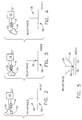
- Reluctance refers to magnetic reluctance. In general, magnetic reluctance depends on (1) the amount, and (2) magnetic permeability, of material located within dashed region 20. For example, tooth 16 in Figure 2 is positioned above a reference line 24. The reluctance seen by sensor 8 is indicated by point 28 in the plot 38.
- tooth 16 in Figure 3 is positioned at the reference 24.
- the reluctance is indicated by point 32.
- tooth 16 in Figure 4 is positioned below the reference 24.
- the reluctance is indicated by point 36.
- a generalized plot 39 of reluctance versus position is given in Figure 5. It is symmetrical about the reference 24, and has a minimum point 40, corresponding to point 32 in Figure 3.
- the electronic circuit 12 does not necessarily measure reluctance itself, but often measures a parameter related to the reluctance.
- Figure 6 shows a hatched tooth 16.
- the hatched tooth 16 passes the sensor 8, and moves to the position shown in Figure 7.
- the electronic circuit 12 produces a signal 41 resembling that in Figure 8. Because of the measurement technique utilized, signal 41 indicates more the slope of the reluctance plot 39 in Figure 5, rather than the reluctance itself.
- the plot of Figure 8 does not exactly indicate the slopes of every point of the plot 39 in Figure 5, but only general features.
- region 48 which is negative, corresponds to region 52 in Figure 5, which has a negative slope.
- a train 72 of pulses 74 is generated, as in Figure 9. If a reluctance sensor is used which measures actual reluctance, as opposed to the slope, then the train of pulses (not shown) will contain a sequence of the plots 39 of Figure 5.
- the pulses 74 within the train 72 in Figure 9 will be identical in shape, and the time intervals 76 between adjacent pulses will be identical.
- the ideal case requires the toothed gear 4 in Figure 7 to be perfectly symmetrical, perfectly homogeneous in magnetic permeability, and rotating at a constant speed about a fixed center 82 in Figure 6.
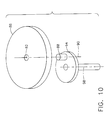
- Disc 86 represents the toothed gear 4 in Figure 6.
- Disc 86 in Figure 10 is supported by shaft 88, and rotates about axis 90. Center 82 is shown.
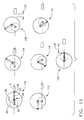
- FIG. 11 illustrates a sequence of positions which the components of Figure 10 will occupy during their combined rotation and orbiting.
- plot 100 indicates the relative arrangement of the components at an initial, reference time.
- Reluctance sensor 8 is shown, as is shaft 88.
- An arm 107 is superimposed, to illustrate the fact that disc 94 acts as a crank arm in supporting shaft 88. Arm 107 rotates about center 98.
- a second arm 105 is shown, to illustrate the fact that disc 86 acts as a crank arm in supporting reference square 106, which represents a tooth 16 of Figure 1.
- arm 105 rotates about shaft 88.
- Figure 11 shows seven plots. Table 1, below, indicates the amount of rotation occurring in each plot. A single amount of rotation is indicated in Table 1 for each plot, because, as stated above, both crank arms 105 and 107 rotate at the same angular speed, although about different centers.
- FIG. 11 (Degrees) 100 zero 104 30 108 60 112 90 116 120 120 150 124 180
- a second feature is that the velocity with which disc 86 passes the reluctance sensor 8 changes as the combined rotation and orbiting occurs.
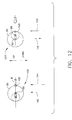
- Figure 12 illustrates this change, and contains copies of plots 100 and 124 from Figure 11. All rotation is counter-clockwise. To simplify the explanation, only the component of velocity in the vertical direction in Figure 12 will be considered. "Up” and “down” are labeled in the center of the Figure.
- vector 140 represents the velocity of shaft 88 in the vertical direction. Since shaft 88 is the axle about which disc 86 rotates, vector 140 also represents the translational velocity of the entire disc 86, in the upward direction. Since reference box 106 is attached to disc 86, vector 140 also represents one velocity component of box 106 in the upward direction.
- vector 144 represents the additional velocity of box 106, due to the rotation of disc 86 about shaft 88.
- the net velocity of box 106 in the upward direction is the vector sum of vectors 140 and 144.
- the net velocity is relatively high, compared with that of plot 124, which will now be considered.
- box 106 has a component of velocity in the upward direction, because of the rotation of disc 86 about shaft 88.
- Vector 152 indicates that component.
- the net velocity of box 106 in the vertical direction is the vector sum of vectors 148 and 152.
- the net velocity is relatively low, compared with that of plot 100, because vectors 148 and 152 for plot 124 oppose each other.
- vibration of disc 86 in Figure 10 can take the form of orbiting of shaft, or center, 88 about axis 98.
- Disc 86 represents the toothed gear 4 of Figure 6. The orbiting causes two events to occur in the parameter measured by the sensor 8 and electronic circuit 12 in Figure 6.
- the orbiting causes a change in the reluctance signal, because the orbiting causes the reluctance seen by sensor 8 to change.
- the second event is that the orbiting changes the tangential speed at which the circumference of disc 86 in Figure 11 passes the sensor 8. Since the teeth 16 in Figure 6 are located at that circumference, their speed will change as orbiting occurs.
- Figures 13 and 15 illustrate how these two events affect the pulse train 72 in Figure 9.
- Figure 13 shows a type of amplitude modulation: the amplitude at point 160 is larger than that at point 164.
- the amplitude change is caused by the movement of disc 86 in Figure 11 toward, and away from, sensor 8.
- the orbiting about center 98 causes the movement. Amplitude is measured from zero to a point such as 160.
- plots 170, 174, 175, and 179 show four successive positions of reference block 165. These four positions are superimposed together in plot 183, and labeled with their corresponding plot numbers.
- Plot 183 indicates that the path of the block 165 is not symmetrical about axis 24. This lack of symmetry is partly responsible for the lack of symmetry in Figure 13, about the zero-amplitude axis 163.
- point 160 in Figure 13 may correspond to the position of block 165 in plot 170 in Figure 14, where reluctance is somewhat high.
- Point 161 in Figure 13 may correspond to the position of block 165 in plot 179 in Figure 14, where reluctance is somewhat low.
- Plot 183 in Figure 14 illustrates the two positions in a single plot, more clearly showing the difference in reluctance.
- Figure 15 shows a type of frequency modulation: the frequency is higher at time 184 than at time 188.
- the higher frequency that is, a smaller time interval between adjacent pulses, would occur in, for example, plot 100 in Figure 11.
- tangential speed is relatively larger, as explained in connection with Figure 12.
- the second change involves the changes in tangential speed of the disc 86.
- the changes in speed causes frequency modulation, as shown in Figure 15.
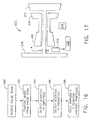
- Figure 16 is a flow chart of logic used to detect the amplitude and frequency modulations shown in Figures 13 and 15.
- Block 190 indicates that the pulse train, such as that of Figure 9, is received.
- the pulse train may, or may not, contain the amplitude modulation or frequency modulation shown in Figures 13 and 15.
- Block 192 in Figure 16 indicates that rotational speed of the toothed gear 4 in Figure 1 is computed. For example, assume that the spacing between gear teeth 16 is ten degrees. If 15 pulses are counted in 0.01 seconds, then rotational speed is computed as (15 x 10) degrees / 0.01 second.
- This quotient corresponds to 15,000 degrees per second, or roughly 41 rpm.
- Block 194 indicates that amplitude modulation is detected. Such detection is well known, and numerous different techniques can be used. As a simple example, the amplitude of each pulse 74 in Figure 9 can be stored in a stack memory. The stack memory may contain 1,000 memory locations. When the stack becomes filled, the earliest amplitudes stored in it become lost.
- amplitudes 1 through 1,000 may be stored in the stack, in sequence. At this time, the stack has become filled. When amplitude 1,001 is added, amplitude 1 becomes lost. When amplitude 1,002 is added, amplitude 2 becomes lost, and so on.
- a detection routine looks for deviations in the amplitudes stored in the stack. As a simple example, the detection routine may scan the stack, and find both the largest amplitude and the smallest amplitude. If the difference between them exceeds a threshold, then unacceptable vibration is inferred.
- Block 196 in Figure 16 indicates that frequency modulation is detected.
- detection is well known, and numerous different techniques can be used.
- a second stack may be used, containing the time intervals between each adjacent pair of the 1,000 amplitudes stored in the first stack.
- a detection routine may scan the second stack, looking for the largest and the smallest interval. If the difference between them exceeds a threshold, then unacceptable vibration is inferred.
- Block 198 indicates that a warning is issued if unacceptable vibration is found.
- a warning signal can be transmitted to the cockpit of an aircraft, if either amplitude modulation or frequency modulation exceeds a limit.
- one goal may be to detect excessive deviation, in frequency and amplitude, of a measured pulse train from an ideal pulse train.
- FFT Fast Fourier Transform
- the pulse train is an ideal pulse train, containing identical pulses, identically spaced, it will have a given distribution of Fourier terms. Further, if the pulses are true sine waves, a single Fourier term will exist.
- Modulation of the pulse train will alter the terms of the Fourier series. If the alteration exceeds a threshold, then unacceptable vibration will be inferred. As a simple example, if the base frequency term, plus the three lowest three harmonics, change by ten percent each, then unacceptable vibration will be inferred. More generally, if any of the first N harmonics change by X percent each, then unacceptable vibration will be inferred.
- FIG 17 illustrates one form of the invention.
- a turbofan aircraft engine 203 is shown, containing a high pressure compressor 200, a high pressure turbine 204, a fan 208, and a low pressure turbine 212.
- Toothed gear 4 is shown, and is used to measure speed of fan 208. Toothed gear 4 need not actually function as a gear, but can be used as a toothed wheel solely to produce pulses.
- Block 216 represents the reluctance sensor and associated electronics, which produces the pulse train 72 of Figure 9.
- the engine control 224 is known in the art. It measures various operating parameters, such as component speeds, airflows, and pressures. Based on those parameters, it schedules, or controls, other parameters, such as fuel-air ratio, blade cooling, and stator vane angle.
- the control 224 contains a microprocessor (not shown) which can perform the computations described in connection with Figure 16.
- a reluctance sensor is not required.
- Other sensors can produce the pulse train of Figure 9, in response to the passage of teeth on a wheel.
- the sensor used should produce pulses of different sizes, when distance to the teeth changes.
- the sensor should also produce pulses, in response to passage of teeth 16 in Figure 1, so that the pulse frequency changes, when the speed of passage of the teeth changes.
- Some examples of sensors are Hall Effect sensors, optical proximity sensors, and microwave proximity sensors.
Landscapes
- Physics & Mathematics (AREA)
- General Physics & Mathematics (AREA)
- Measurement Of Mechanical Vibrations Or Ultrasonic Waves (AREA)
- Transmission And Conversion Of Sensor Element Output (AREA)
Applications Claiming Priority (2)
| Application Number | Priority Date | Filing Date | Title |
|---|---|---|---|
| US770326 | 1996-12-20 | ||
| US09/770,326 US6445995B1 (en) | 2001-01-26 | 2001-01-26 | Vibration sensing in gas turbine engine |
Publications (1)
| Publication Number | Publication Date |
|---|---|
| EP1227325A1 true EP1227325A1 (en) | 2002-07-31 |
Family
ID=25088169
Family Applications (1)
| Application Number | Title | Priority Date | Filing Date |
|---|---|---|---|
| EP02250503A Ceased EP1227325A1 (en) | 2001-01-26 | 2002-01-25 | Sensor for speed and vibration |
Country Status (3)
| Country | Link |
|---|---|
| US (1) | US6445995B1 (enExample) |
| EP (1) | EP1227325A1 (enExample) |
| JP (1) | JP2002323369A (enExample) |
Cited By (4)
| Publication number | Priority date | Publication date | Assignee | Title |
|---|---|---|---|---|
| EP1398608A3 (en) * | 2002-09-06 | 2005-02-09 | General Electric Company | High resolution torque measurement on a rotating shaft |
| DE102009009714A1 (de) * | 2009-02-19 | 2010-12-02 | Mtu Aero Engines Gmbh | Vorrichtung und Verfahren zur Drehmomentmessung an einer Turbinenwelle |
| RU2428699C1 (ru) * | 2010-05-24 | 2011-09-10 | Российская Федерация, от имени которой выступает государственный заказчик - Министерство промышленности и торговли Российской Федерации | Датчик частоты вращения ротора газотурбинного авиадвигателя |
| EP3715821A1 (en) * | 2019-03-29 | 2020-09-30 | Hamilton Sundstrand Corporation | Prognostic monitoring and failure detection of rotating components |
Families Citing this family (34)
| Publication number | Priority date | Publication date | Assignee | Title |
|---|---|---|---|---|
| FR2840358B1 (fr) * | 2002-05-28 | 2006-09-15 | Snecma Moteurs | Procede et systeme de detection d'endommagement de rotor d'un moteur d'aeronef |
| US6909948B2 (en) * | 2003-04-30 | 2005-06-21 | General Electric Company | Accelerometer configuration |
| US6983199B2 (en) * | 2003-04-30 | 2006-01-03 | General Electric Company | Vibration measurement and recording system and method |
| JP2006057817A (ja) * | 2004-08-24 | 2006-03-02 | Ntn Corp | センサ付車輪用軸受装置 |
| US7253614B2 (en) * | 2005-03-21 | 2007-08-07 | Allegro Microsystems, Inc. | Proximity detector having a sequential flow state machine |
| US7532969B2 (en) * | 2006-03-09 | 2009-05-12 | Pratt & Whitney Canada Corp. | Gas turbine speed detection |
| US8818683B2 (en) * | 2006-04-21 | 2014-08-26 | General Electric Company | Method and apparatus for operating a gas turbine engine |
| US20070245746A1 (en) * | 2006-04-21 | 2007-10-25 | Mollmann Daniel E | Methods and systems for detecting rotor assembly speed oscillation in turbine engines |
| DE102006033461A1 (de) * | 2006-07-19 | 2008-01-31 | Siemens Ag | Radialspaltmessung an Turbinen |
| US8313279B2 (en) * | 2008-04-21 | 2012-11-20 | General Electric Company | Dual rotor vibration monitoring |
| FR2932850B1 (fr) * | 2008-06-23 | 2010-08-13 | Snecma | Procede et systeme de determination de la position angulaire d'un rotor de turboreacteur. |
| US7941281B2 (en) * | 2008-12-22 | 2011-05-10 | General Electric Company | System and method for rotor blade health monitoring |
| JP2010185838A (ja) * | 2009-02-13 | 2010-08-26 | Chugoku Electric Power Co Inc:The | 回転機軸振動検出装置 |
| US8752394B2 (en) * | 2010-03-15 | 2014-06-17 | Rolls-Royce Corporation | Determining fan parameters through pressure monitoring |
| US9574570B2 (en) | 2010-11-03 | 2017-02-21 | Hamilton Sundstard Corporation | Shaft speed and vibration sensor apparatus |
| US8854052B2 (en) | 2010-11-22 | 2014-10-07 | General Electric Company | Sensor assembly and method of measuring the proximity of a machine component to a sensor |
| US8531191B2 (en) | 2010-11-22 | 2013-09-10 | General Electric Company | Sensor assembly and methods of measuring a proximity of a machine component to a sensor |
| US8624603B2 (en) | 2010-11-22 | 2014-01-07 | General Electric Company | Sensor assembly and methods of adjusting the operation of a sensor |
| US8593156B2 (en) | 2010-11-22 | 2013-11-26 | General Electric Company | Sensor assembly and microwave emitter for use in a sensor assembly |
| US8482456B2 (en) | 2010-12-16 | 2013-07-09 | General Electric Company | Sensor assembly and method of measuring the proximity of a machine component to an emitter |
| US9217662B2 (en) | 2011-08-31 | 2015-12-22 | Hamilton Sundstrand Corporation | Vibration signal compensation |
| EP2594946A1 (en) * | 2011-11-18 | 2013-05-22 | Hamilton Sundstrand Corporation | Shaft speed and vibration sensor apparatus |
| US8742319B2 (en) | 2011-12-13 | 2014-06-03 | General Electric Company | Sensor and inspection system deploying an optical conduit |
| US9417258B2 (en) | 2012-09-10 | 2016-08-16 | United Technologies Corporation | Sensor and tooth arrangement for shaft speed detection |
| DE102012222202A1 (de) * | 2012-12-04 | 2014-06-05 | Robert Bosch Gmbh | Verfahren zur Überwachung einer Rotation eines Verdichterrades |
| US9863845B2 (en) | 2013-05-21 | 2018-01-09 | Konecranes Global Corporation | Techniques for monitoring gear condition |
| US9140718B2 (en) | 2013-10-04 | 2015-09-22 | Hamilton Sundstrand Corporation | Speed sensor identification |
| US9840935B2 (en) | 2014-03-31 | 2017-12-12 | United Technologies Corporation | Rotating machinery monitoring system |
| FR3040493B1 (fr) * | 2015-08-31 | 2019-06-07 | Safran Landing Systems | Procede pour mesurer la vitesse de rotation d'une roue de vehicule |
| US10228304B2 (en) | 2016-01-18 | 2019-03-12 | Pratt & Whitney Canada Corp. | Shaft shear detection through shaft oscillation |
| US10228305B2 (en) * | 2016-01-18 | 2019-03-12 | Pratt & Whitney Canada Corp. | Shaft shear detection through shaft oscillation |
| DE102018108827B3 (de) * | 2018-04-13 | 2019-05-29 | Trumpf Schweiz Ag | Verfahren zur Steuerung von zumindest einem Radialgebläse in einer Kälteanlage sowie Radialgebläse |
| EP3791048B1 (en) | 2018-05-09 | 2024-03-27 | ABB Schweiz AG | Valve position control |
| GB201904123D0 (en) * | 2019-03-26 | 2019-05-08 | Rolls Royce Plc | Methods of monitoring vibration and trim balance using speed probes |
Citations (5)
| Publication number | Priority date | Publication date | Assignee | Title |
|---|---|---|---|---|
| US3488581A (en) * | 1967-10-03 | 1970-01-06 | Reliance Electric & Eng Co | Surface interruption calibrated non-contact transducer system |
| US3680363A (en) * | 1969-10-07 | 1972-08-01 | Snecma | Devices for detecting and processing vibrations occurring in the moving blades of a rotary compressor or similar apparatus |
| US4482859A (en) * | 1981-05-15 | 1984-11-13 | S.N.E.C.M.A. | Object displacement sensor and device for measuring the rotation speed and vibration frequency of a rotor |
| GB2312958A (en) * | 1996-05-09 | 1997-11-12 | Rotadata Ltd | Method and apparatus for analysing variations in rotary motion |
| EP0980001A1 (en) * | 1998-08-13 | 2000-02-16 | Eaton Corporation | Driveline vibration analyzer |
Family Cites Families (5)
| Publication number | Priority date | Publication date | Assignee | Title |
|---|---|---|---|---|
| US3898439A (en) * | 1970-10-20 | 1975-08-05 | Westinghouse Electric Corp | System for operating industrial gas turbine apparatus and gas turbine electric power plants preferably with a digital computer control system |
| JPS5938422B2 (ja) * | 1971-10-15 | 1984-09-17 | ウエスチングハウス・エレクトリツク・コーポレーシヨン | ガスタ−ビン式パワ−・プラント |
| US3866108A (en) * | 1971-12-06 | 1975-02-11 | Westinghouse Electric Corp | Control system and method for controlling dual fuel operation of industrial gas turbine power plants, preferably employing a digital computer |
| US5252860A (en) * | 1989-12-11 | 1993-10-12 | Westinghouse Electric Corp. | Gas turbine control system having maximum instantaneous load-pickup limiter |
| US6191513B1 (en) * | 1997-10-27 | 2001-02-20 | Mohawk Innovative Technology, Inc. | Stator-controlled magnetic bearing |
-
2001
- 2001-01-26 US US09/770,326 patent/US6445995B1/en not_active Expired - Lifetime
-
2002
- 2002-01-25 EP EP02250503A patent/EP1227325A1/en not_active Ceased
- 2002-01-25 JP JP2002016272A patent/JP2002323369A/ja not_active Withdrawn
Patent Citations (5)
| Publication number | Priority date | Publication date | Assignee | Title |
|---|---|---|---|---|
| US3488581A (en) * | 1967-10-03 | 1970-01-06 | Reliance Electric & Eng Co | Surface interruption calibrated non-contact transducer system |
| US3680363A (en) * | 1969-10-07 | 1972-08-01 | Snecma | Devices for detecting and processing vibrations occurring in the moving blades of a rotary compressor or similar apparatus |
| US4482859A (en) * | 1981-05-15 | 1984-11-13 | S.N.E.C.M.A. | Object displacement sensor and device for measuring the rotation speed and vibration frequency of a rotor |
| GB2312958A (en) * | 1996-05-09 | 1997-11-12 | Rotadata Ltd | Method and apparatus for analysing variations in rotary motion |
| EP0980001A1 (en) * | 1998-08-13 | 2000-02-16 | Eaton Corporation | Driveline vibration analyzer |
Non-Patent Citations (1)
| Title |
|---|
| ANDRENELLI L ET AL: "LARGE-BANDWIDTH REFLECTION FIBER-OPTIC SENSORS FOR TURBOMACHINERY ROTOR BLADE DIAGNOSTICS", SENSORS AND ACTUATORS A, ELSEVIER SEQUOIA S.A., LAUSANNE, CH, vol. A32, no. 1 / 3, 1 April 1992 (1992-04-01), pages 539 - 542, XP000287371, ISSN: 0924-4247 * |
Cited By (6)
| Publication number | Priority date | Publication date | Assignee | Title |
|---|---|---|---|---|
| EP1398608A3 (en) * | 2002-09-06 | 2005-02-09 | General Electric Company | High resolution torque measurement on a rotating shaft |
| KR100831478B1 (ko) * | 2002-09-06 | 2008-05-22 | 제너럴 일렉트릭 캄파니 | 토크 측정 장치 및 회전 가능한 샤프트의 비틀림 변위를 결정하는 방법 |
| DE102009009714A1 (de) * | 2009-02-19 | 2010-12-02 | Mtu Aero Engines Gmbh | Vorrichtung und Verfahren zur Drehmomentmessung an einer Turbinenwelle |
| RU2428699C1 (ru) * | 2010-05-24 | 2011-09-10 | Российская Федерация, от имени которой выступает государственный заказчик - Министерство промышленности и торговли Российской Федерации | Датчик частоты вращения ротора газотурбинного авиадвигателя |
| EP3715821A1 (en) * | 2019-03-29 | 2020-09-30 | Hamilton Sundstrand Corporation | Prognostic monitoring and failure detection of rotating components |
| US11148236B2 (en) | 2019-03-29 | 2021-10-19 | Hamilton Sundstrand Corporation | Prognostic monitoring and failure detection of rotating components |
Also Published As
| Publication number | Publication date |
|---|---|
| US6445995B1 (en) | 2002-09-03 |
| JP2002323369A (ja) | 2002-11-08 |
Similar Documents
| Publication | Publication Date | Title |
|---|---|---|
| EP1227325A1 (en) | Sensor for speed and vibration | |
| EP0654162B1 (en) | Process for detecting fouling of an axial compressor | |
| US4955269A (en) | Turbine blade fatigue monitor | |
| US4896537A (en) | Shrouded turbine blade vibration monitor | |
| KR100304466B1 (ko) | 축류압축기의진동들뜸을모니터하기위한프로세스및장치 | |
| KR100296671B1 (ko) | 압축기의제어와모니터링을위한장치및공정 | |
| US6904371B2 (en) | Method and apparatus for measuring rotor unbalance | |
| JPH0264206A (ja) | タービン羽根の振動をモニターする方法及び装置 | |
| US20050122095A1 (en) | Rotation sensor and method | |
| US8497676B2 (en) | Method and system for determining the angular position of a turbojet engine rotor | |
| GB2455798A (en) | Monitoring a rotating shaft in a gas turbine | |
| CA2762744A1 (en) | Determination of a vibrational frequency of a wind turbine rotor blade with a sensor device being placed at a structural component being assigned to and/or being part of the rotor | |
| EP1273763A3 (en) | An apparatus and method for detecting a damaged rotary machine aerofoil | |
| US20180371915A1 (en) | Devices and methods for balancing a high-pressure spool of a gas turbine engine | |
| EP3686606B1 (en) | Shaft monitoring system | |
| WO2003060453A1 (en) | Method and system for balancing a rotating machinery operating at resonance | |
| EP2073020A1 (en) | Method and apparatus for monitoring the rotational speed of the shaft of a gas turbine | |
| CN113139244B (zh) | 预兆感测装置以及预兆感测方法 | |
| Courrech et al. | Condition monitoring of machinery | |
| JP2572530B2 (ja) | 振動スペクトルモニタリング装置、並びにヘルスモニタリング方法及び装置 | |
| CN116519121A (zh) | 发动机整机旋转叶片非接触式测振装置及方法 | |
| RU2229104C1 (ru) | Способ определения параметров колебаний лопаток турбомашин | |
| Murray III et al. | Detection of rotor forced response vibrations using stationary pressure transducers in a multistage axial compressor | |
| RU2207524C1 (ru) | Способ определения амплитуд колебаний лопаток турбомашин | |
| Liska et al. | Measurement and evaluation of shaft torsional vibrations using shaft instantaneous angular velocity |
Legal Events
| Date | Code | Title | Description |
|---|---|---|---|
| PUAI | Public reference made under article 153(3) epc to a published international application that has entered the european phase |
Free format text: ORIGINAL CODE: 0009012 |
|
| AK | Designated contracting states |
Kind code of ref document: A1 Designated state(s): AT BE CH CY DE DK ES FI FR GB GR IE IT LI LU MC NL PT SE TR |
|
| AX | Request for extension of the european patent |
Free format text: AL;LT;LV;MK;RO;SI |
|
| 17P | Request for examination filed |
Effective date: 20030131 |
|
| AKX | Designation fees paid |
Designated state(s): DE FR GB IT |
|
| 17Q | First examination report despatched |
Effective date: 20040927 |
|
| STAA | Information on the status of an ep patent application or granted ep patent |
Free format text: STATUS: THE APPLICATION HAS BEEN REFUSED |
|
| 18R | Application refused |
Effective date: 20061106 |