EP1227115A2 - Crosslinkable polymer material of low relative permittivity, and films, substrates and electronic units formed of it - Google Patents
Crosslinkable polymer material of low relative permittivity, and films, substrates and electronic units formed of it Download PDFInfo
- Publication number
- EP1227115A2 EP1227115A2 EP02001609A EP02001609A EP1227115A2 EP 1227115 A2 EP1227115 A2 EP 1227115A2 EP 02001609 A EP02001609 A EP 02001609A EP 02001609 A EP02001609 A EP 02001609A EP 1227115 A2 EP1227115 A2 EP 1227115A2
- Authority
- EP
- European Patent Office
- Prior art keywords
- polymer material
- relative permittivity
- low relative
- acrylate
- film
- Prior art date
- Legal status (The legal status is an assumption and is not a legal conclusion. Google has not performed a legal analysis and makes no representation as to the accuracy of the status listed.)
- Granted
Links
- 239000002861 polymer material Substances 0.000 title claims abstract description 57
- 239000000758 substrate Substances 0.000 title claims description 32
- 239000000178 monomer Substances 0.000 claims abstract description 25
- 150000005690 diesters Chemical group 0.000 claims abstract description 20
- NIXOWILDQLNWCW-UHFFFAOYSA-M Acrylate Chemical compound [O-]C(=O)C=C NIXOWILDQLNWCW-UHFFFAOYSA-M 0.000 claims abstract description 17
- 239000004593 Epoxy Chemical group 0.000 claims abstract description 16
- 239000000203 mixture Substances 0.000 claims abstract description 7
- 238000007334 copolymerization reaction Methods 0.000 claims abstract description 4
- 125000004432 carbon atom Chemical group C* 0.000 claims description 7
- 125000000217 alkyl group Chemical group 0.000 claims description 6
- 125000002947 alkylene group Chemical group 0.000 claims description 6
- 125000000753 cycloalkyl group Chemical group 0.000 claims description 5
- 125000003118 aryl group Chemical group 0.000 claims description 3
- 229910052751 metal Inorganic materials 0.000 abstract description 12
- 239000002184 metal Substances 0.000 abstract description 12
- 239000004020 conductor Substances 0.000 abstract description 6
- 238000009413 insulation Methods 0.000 abstract description 5
- 239000010408 film Substances 0.000 description 32
- 238000004519 manufacturing process Methods 0.000 description 18
- UHOVQNZJYSORNB-UHFFFAOYSA-N Benzene Chemical compound C1=CC=CC=C1 UHOVQNZJYSORNB-UHFFFAOYSA-N 0.000 description 15
- 229920001577 copolymer Polymers 0.000 description 13
- 229920000642 polymer Polymers 0.000 description 13
- 238000000034 method Methods 0.000 description 12
- 239000002904 solvent Substances 0.000 description 8
- 238000004891 communication Methods 0.000 description 7
- 229920006254 polymer film Polymers 0.000 description 6
- 239000003505 polymerization initiator Substances 0.000 description 6
- 238000004132 cross linking Methods 0.000 description 5
- RPQRDASANLAFCM-UHFFFAOYSA-N oxiran-2-ylmethyl prop-2-enoate Chemical compound C=CC(=O)OCC1CO1 RPQRDASANLAFCM-UHFFFAOYSA-N 0.000 description 5
- 230000005855 radiation Effects 0.000 description 5
- 229920005989 resin Polymers 0.000 description 5
- 239000011347 resin Substances 0.000 description 5
- OZAIFHULBGXAKX-UHFFFAOYSA-N 2-(2-cyanopropan-2-yldiazenyl)-2-methylpropanenitrile Chemical compound N#CC(C)(C)N=NC(C)(C)C#N OZAIFHULBGXAKX-UHFFFAOYSA-N 0.000 description 4
- RYGMFSIKBFXOCR-UHFFFAOYSA-N Copper Chemical compound [Cu] RYGMFSIKBFXOCR-UHFFFAOYSA-N 0.000 description 4
- 230000000052 comparative effect Effects 0.000 description 4
- 229910052802 copper Inorganic materials 0.000 description 4
- 239000010949 copper Substances 0.000 description 4
- 125000003700 epoxy group Chemical group 0.000 description 4
- 239000003822 epoxy resin Substances 0.000 description 4
- LNEPOXFFQSENCJ-UHFFFAOYSA-N haloperidol Chemical compound C1CC(O)(C=2C=CC(Cl)=CC=2)CCN1CCCC(=O)C1=CC=C(F)C=C1 LNEPOXFFQSENCJ-UHFFFAOYSA-N 0.000 description 4
- 239000000463 material Substances 0.000 description 4
- 229920000647 polyepoxide Polymers 0.000 description 4
- 238000006116 polymerization reaction Methods 0.000 description 4
- OKKJLVBELUTLKV-UHFFFAOYSA-N Methanol Chemical compound OC OKKJLVBELUTLKV-UHFFFAOYSA-N 0.000 description 3
- -1 dimethyladamantyl groups Chemical group 0.000 description 3
- 239000003365 glass fiber Substances 0.000 description 3
- 239000011810 insulating material Substances 0.000 description 3
- 229920001721 polyimide Polymers 0.000 description 3
- 239000009719 polyimide resin Substances 0.000 description 3
- BWJUFXUULUEGMA-UHFFFAOYSA-N propan-2-yl propan-2-yloxycarbonyloxy carbonate Chemical compound CC(C)OC(=O)OOC(=O)OC(C)C BWJUFXUULUEGMA-UHFFFAOYSA-N 0.000 description 3
- 239000007870 radical polymerization initiator Substances 0.000 description 3
- 229920006337 unsaturated polyester resin Polymers 0.000 description 3
- ZFFMLCVRJBZUDZ-UHFFFAOYSA-N 2,3-dimethylbutane Chemical group CC(C)C(C)C ZFFMLCVRJBZUDZ-UHFFFAOYSA-N 0.000 description 2
- WYGWHHGCAGTUCH-UHFFFAOYSA-N 2-[(2-cyano-4-methylpentan-2-yl)diazenyl]-2,4-dimethylpentanenitrile Chemical compound CC(C)CC(C)(C#N)N=NC(C)(C#N)CC(C)C WYGWHHGCAGTUCH-UHFFFAOYSA-N 0.000 description 2
- DPTGFYXXFXSRIR-UHFFFAOYSA-N 7-oxabicyclo[4.1.0]heptan-4-ylmethyl prop-2-enoate Chemical compound C1C(COC(=O)C=C)CCC2OC21 DPTGFYXXFXSRIR-UHFFFAOYSA-N 0.000 description 2
- IJGRMHOSHXDMSA-UHFFFAOYSA-N Atomic nitrogen Chemical compound N#N IJGRMHOSHXDMSA-UHFFFAOYSA-N 0.000 description 2
- PPBRXRYQALVLMV-UHFFFAOYSA-N Styrene Chemical compound C=CC1=CC=CC=C1 PPBRXRYQALVLMV-UHFFFAOYSA-N 0.000 description 2
- 150000001252 acrylic acid derivatives Chemical class 0.000 description 2
- 239000003708 ampul Substances 0.000 description 2
- 230000015572 biosynthetic process Effects 0.000 description 2
- 238000005266 casting Methods 0.000 description 2
- 239000003054 catalyst Substances 0.000 description 2
- 230000002349 favourable effect Effects 0.000 description 2
- 238000005227 gel permeation chromatography Methods 0.000 description 2
- 239000011521 glass Substances 0.000 description 2
- 238000010030 laminating Methods 0.000 description 2
- 125000002950 monocyclic group Chemical group 0.000 description 2
- 150000001451 organic peroxides Chemical class 0.000 description 2
- 239000003960 organic solvent Substances 0.000 description 2
- 238000005476 soldering Methods 0.000 description 2
- YAAYJRKCGZQWCB-UHFFFAOYSA-N 2-(1-cyanopropyldiazenyl)butanenitrile Chemical compound CCC(C#N)N=NC(CC)C#N YAAYJRKCGZQWCB-UHFFFAOYSA-N 0.000 description 1
- XMNIXWIUMCBBBL-UHFFFAOYSA-N 2-(2-phenylpropan-2-ylperoxy)propan-2-ylbenzene Chemical compound C=1C=CC=CC=1C(C)(C)OOC(C)(C)C1=CC=CC=C1 XMNIXWIUMCBBBL-UHFFFAOYSA-N 0.000 description 1
- MGTVNFGFEXMEBM-UHFFFAOYSA-N 4-ethenyltriazine Chemical compound C=CC1=CC=NN=N1 MGTVNFGFEXMEBM-UHFFFAOYSA-N 0.000 description 1
- NIJZFHNDUJXJMR-UHFFFAOYSA-N 7-oxabicyclo[4.1.0]heptan-4-ylmethanol Chemical compound C1C(CO)CCC2OC21 NIJZFHNDUJXJMR-UHFFFAOYSA-N 0.000 description 1
- 239000004342 Benzoyl peroxide Substances 0.000 description 1
- OMPJBNCRMGITSC-UHFFFAOYSA-N Benzoylperoxide Chemical compound C=1C=CC=CC=1C(=O)OOC(=O)C1=CC=CC=C1 OMPJBNCRMGITSC-UHFFFAOYSA-N 0.000 description 1
- 229920000298 Cellophane Polymers 0.000 description 1
- 239000004801 Chlorinated PVC Substances 0.000 description 1
- IAYPIBMASNFSPL-UHFFFAOYSA-N Ethylene oxide Chemical compound C1CO1 IAYPIBMASNFSPL-UHFFFAOYSA-N 0.000 description 1
- 206010073306 Exposure to radiation Diseases 0.000 description 1
- CERQOIWHTDAKMF-UHFFFAOYSA-M Methacrylate Chemical compound CC(=C)C([O-])=O CERQOIWHTDAKMF-UHFFFAOYSA-M 0.000 description 1
- 239000004721 Polyphenylene oxide Substances 0.000 description 1
- GOOHAUXETOMSMM-UHFFFAOYSA-N Propylene oxide Chemical compound CC1CO1 GOOHAUXETOMSMM-UHFFFAOYSA-N 0.000 description 1
- KYIKRXIYLAGAKQ-UHFFFAOYSA-N abcn Chemical compound C1CCCCC1(C#N)N=NC1(C#N)CCCCC1 KYIKRXIYLAGAKQ-UHFFFAOYSA-N 0.000 description 1
- 125000005073 adamantyl group Chemical group C12(CC3CC(CC(C1)C3)C2)* 0.000 description 1
- 239000000853 adhesive Substances 0.000 description 1
- 230000001070 adhesive effect Effects 0.000 description 1
- 239000004411 aluminium Substances 0.000 description 1
- 229910052782 aluminium Inorganic materials 0.000 description 1
- XAGFODPZIPBFFR-UHFFFAOYSA-N aluminium Chemical compound [Al] XAGFODPZIPBFFR-UHFFFAOYSA-N 0.000 description 1
- 235000019400 benzoyl peroxide Nutrition 0.000 description 1
- 230000005540 biological transmission Effects 0.000 description 1
- 229920001400 block copolymer Polymers 0.000 description 1
- 239000003990 capacitor Substances 0.000 description 1
- 238000012663 cationic photopolymerization Methods 0.000 description 1
- 229920000457 chlorinated polyvinyl chloride Polymers 0.000 description 1
- 239000011248 coating agent Substances 0.000 description 1
- 238000000576 coating method Methods 0.000 description 1
- 229920001688 coating polymer Polymers 0.000 description 1
- 150000001875 compounds Chemical class 0.000 description 1
- 229920006037 cross link polymer Polymers 0.000 description 1
- 125000000113 cyclohexyl group Chemical group [H]C1([H])C([H])([H])C([H])([H])C([H])(*)C([H])([H])C1([H])[H] 0.000 description 1
- 125000001511 cyclopentyl group Chemical group [H]C1([H])C([H])([H])C([H])([H])C([H])(*)C1([H])[H] 0.000 description 1
- 238000007872 degassing Methods 0.000 description 1
- 238000011161 development Methods 0.000 description 1
- 230000018109 developmental process Effects 0.000 description 1
- 150000001989 diazonium salts Chemical class 0.000 description 1
- 125000003438 dodecyl group Chemical group [H]C([H])([H])C([H])([H])C([H])([H])C([H])([H])C([H])([H])C([H])([H])C([H])([H])C([H])([H])C([H])([H])C([H])([H])C([H])([H])C([H])([H])* 0.000 description 1
- 150000002148 esters Chemical class 0.000 description 1
- 125000001495 ethyl group Chemical group [H]C([H])([H])C([H])([H])* 0.000 description 1
- 238000001704 evaporation Methods 0.000 description 1
- 239000005357 flat glass Substances 0.000 description 1
- 238000010528 free radical solution polymerization reaction Methods 0.000 description 1
- 125000003055 glycidyl group Chemical group C(C1CO1)* 0.000 description 1
- VOZRXNHHFUQHIL-UHFFFAOYSA-N glycidyl methacrylate Chemical compound CC(=C)C(=O)OCC1CO1 VOZRXNHHFUQHIL-UHFFFAOYSA-N 0.000 description 1
- 125000005843 halogen group Chemical group 0.000 description 1
- 125000004051 hexyl group Chemical group [H]C([H])([H])C([H])([H])C([H])([H])C([H])([H])C([H])([H])C([H])([H])* 0.000 description 1
- XMBWDFGMSWQBCA-UHFFFAOYSA-N hydrogen iodide Chemical class I XMBWDFGMSWQBCA-UHFFFAOYSA-N 0.000 description 1
- 239000011261 inert gas Substances 0.000 description 1
- 230000000977 initiatory effect Effects 0.000 description 1
- 125000001449 isopropyl group Chemical group [H]C([H])([H])C([H])(*)C([H])([H])[H] 0.000 description 1
- 239000012263 liquid product Substances 0.000 description 1
- QSHDDOUJBYECFT-UHFFFAOYSA-N mercury Chemical compound [Hg] QSHDDOUJBYECFT-UHFFFAOYSA-N 0.000 description 1
- 229910052753 mercury Inorganic materials 0.000 description 1
- 150000002734 metacrylic acid derivatives Chemical class 0.000 description 1
- 150000002739 metals Chemical class 0.000 description 1
- 238000010295 mobile communication Methods 0.000 description 1
- 238000012986 modification Methods 0.000 description 1
- 230000004048 modification Effects 0.000 description 1
- 238000000465 moulding Methods 0.000 description 1
- 125000004108 n-butyl group Chemical group [H]C([H])([H])C([H])([H])C([H])([H])C([H])([H])* 0.000 description 1
- 125000004123 n-propyl group Chemical group [H]C([H])([H])C([H])([H])C([H])([H])* 0.000 description 1
- 229910052757 nitrogen Inorganic materials 0.000 description 1
- 125000001400 nonyl group Chemical group [H]C([*])([H])C([H])([H])C([H])([H])C([H])([H])C([H])([H])C([H])([H])C([H])([H])C([H])([H])C([H])([H])[H] 0.000 description 1
- 125000001147 pentyl group Chemical group C(CCCC)* 0.000 description 1
- 125000001997 phenyl group Chemical group [H]C1=C([H])C([H])=C(*)C([H])=C1[H] 0.000 description 1
- 125000003367 polycyclic group Chemical group 0.000 description 1
- 239000002685 polymerization catalyst Substances 0.000 description 1
- 229920000098 polyolefin Polymers 0.000 description 1
- 229920001955 polyphenylene ether Polymers 0.000 description 1
- 229920006380 polyphenylene oxide Polymers 0.000 description 1
- 238000010526 radical polymerization reaction Methods 0.000 description 1
- 229920005604 random copolymer Polymers 0.000 description 1
- 230000007261 regionalization Effects 0.000 description 1
- 238000007151 ring opening polymerisation reaction Methods 0.000 description 1
- 125000002914 sec-butyl group Chemical group [H]C([H])([H])C([H])([H])C([H])(*)C([H])([H])[H] 0.000 description 1
- 230000035945 sensitivity Effects 0.000 description 1
- 229920002379 silicone rubber Polymers 0.000 description 1
- 239000004945 silicone rubber Substances 0.000 description 1
- 239000007787 solid Substances 0.000 description 1
- 239000000126 substance Substances 0.000 description 1
- 125000000999 tert-butyl group Chemical group [H]C([H])([H])C(*)(C([H])([H])[H])C([H])([H])[H] 0.000 description 1
- CIHOLLKRGTVIJN-UHFFFAOYSA-N tert‐butyl hydroperoxide Chemical compound CC(C)(C)OO CIHOLLKRGTVIJN-UHFFFAOYSA-N 0.000 description 1
- 238000010998 test method Methods 0.000 description 1
- 125000000383 tetramethylene group Chemical group [H]C([H])([*:1])C([H])([H])C([H])([H])C([H])([H])[*:2] 0.000 description 1
- 229920005992 thermoplastic resin Polymers 0.000 description 1
- 229920001187 thermosetting polymer Polymers 0.000 description 1
- 239000010409 thin film Substances 0.000 description 1
- 238000007738 vacuum evaporation Methods 0.000 description 1
- 125000000391 vinyl group Chemical group [H]C([*])=C([H])[H] 0.000 description 1
- 229920002554 vinyl polymer Polymers 0.000 description 1
- 125000002348 vinylic group Chemical group 0.000 description 1
- 238000005406 washing Methods 0.000 description 1
Classifications
-
- C—CHEMISTRY; METALLURGY
- C08—ORGANIC MACROMOLECULAR COMPOUNDS; THEIR PREPARATION OR CHEMICAL WORKING-UP; COMPOSITIONS BASED THEREON
- C08F—MACROMOLECULAR COMPOUNDS OBTAINED BY REACTIONS ONLY INVOLVING CARBON-TO-CARBON UNSATURATED BONDS
- C08F222/00—Copolymers of compounds having one or more unsaturated aliphatic radicals, each having only one carbon-to-carbon double bond, and at least one being terminated by a carboxyl radical and containing at least one other carboxyl radical in the molecule; Salts, anhydrides, esters, amides, imides, or nitriles thereof
- C08F222/10—Esters
-
- H—ELECTRICITY
- H01—ELECTRIC ELEMENTS
- H01B—CABLES; CONDUCTORS; INSULATORS; SELECTION OF MATERIALS FOR THEIR CONDUCTIVE, INSULATING OR DIELECTRIC PROPERTIES
- H01B3/00—Insulators or insulating bodies characterised by the insulating materials; Selection of materials for their insulating or dielectric properties
- H01B3/18—Insulators or insulating bodies characterised by the insulating materials; Selection of materials for their insulating or dielectric properties mainly consisting of organic substances
- H01B3/30—Insulators or insulating bodies characterised by the insulating materials; Selection of materials for their insulating or dielectric properties mainly consisting of organic substances plastics; resins; waxes
- H01B3/44—Insulators or insulating bodies characterised by the insulating materials; Selection of materials for their insulating or dielectric properties mainly consisting of organic substances plastics; resins; waxes vinyl resins; acrylic resins
- H01B3/448—Insulators or insulating bodies characterised by the insulating materials; Selection of materials for their insulating or dielectric properties mainly consisting of organic substances plastics; resins; waxes vinyl resins; acrylic resins from other vinyl compounds
-
- C—CHEMISTRY; METALLURGY
- C08—ORGANIC MACROMOLECULAR COMPOUNDS; THEIR PREPARATION OR CHEMICAL WORKING-UP; COMPOSITIONS BASED THEREON
- C08F—MACROMOLECULAR COMPOUNDS OBTAINED BY REACTIONS ONLY INVOLVING CARBON-TO-CARBON UNSATURATED BONDS
- C08F220/00—Copolymers of compounds having one or more unsaturated aliphatic radicals, each having only one carbon-to-carbon double bond, and only one being terminated by only one carboxyl radical or a salt, anhydride ester, amide, imide or nitrile thereof
- C08F220/02—Monocarboxylic acids having less than ten carbon atoms; Derivatives thereof
- C08F220/10—Esters
- C08F220/26—Esters containing oxygen in addition to the carboxy oxygen
- C08F220/32—Esters containing oxygen in addition to the carboxy oxygen containing epoxy radicals
- C08F220/325—Esters containing oxygen in addition to the carboxy oxygen containing epoxy radicals containing glycidyl radical, e.g. glycidyl (meth)acrylate
-
- C—CHEMISTRY; METALLURGY
- C08—ORGANIC MACROMOLECULAR COMPOUNDS; THEIR PREPARATION OR CHEMICAL WORKING-UP; COMPOSITIONS BASED THEREON
- C08F—MACROMOLECULAR COMPOUNDS OBTAINED BY REACTIONS ONLY INVOLVING CARBON-TO-CARBON UNSATURATED BONDS
- C08F222/00—Copolymers of compounds having one or more unsaturated aliphatic radicals, each having only one carbon-to-carbon double bond, and at least one being terminated by a carboxyl radical and containing at least one other carboxyl radical in the molecule; Salts, anhydrides, esters, amides, imides, or nitriles thereof
- C08F222/10—Esters
- C08F222/12—Esters of phenols or saturated alcohols
- C08F222/14—Esters having no free carboxylic acid groups, e.g. dialkyl maleates or fumarates
Definitions
- the present invention relates to a novel, patternable polymer material of low relative permittivity, and to films, substrates and electronic units formed of it. More precisely, the invention relates to such a polymer material of low relative permittivity, which has good electric properties of low relative permittivity and low dielectric loss tangent in a high-frequency band, and which has good heat resistance even at high temperatures and good bondability and good adhesiveness to metal leaf, and has the ability to form thin-film patterns.
- a build-up method of laminating a number of insulating layers on a substrate, apart from a method of fabricating multi-layered laminate boards employed is a build-up method of laminating a number of insulating layers on a substrate, apart from a method of fabricating multi-layered laminate boards.
- the polymer materials to be used in such a build-up method must be patternable in order that via-holes may be formed through their layers.
- thermoplastic resins such as polyolefins, chlorinated polyvinyl chloride resins and fluororesins
- thermosetting resins such as unsaturated polyester resins, polyimide resins, epoxy resins, vinyltriazine resins (BT resins), crosslinkable polyphenylene oxides and curable polyphenylene ethers.
- photosensitive unsaturated polyester resins are proposed for other patternable materials having good electric properties.
- photosensitive polyimide resins are proposed for other patternable materials having good electric properties.
- photosensitive epoxy resins are practicable for the intended purpose, and they are generally photo-cured for pattern formation.
- the object of the present invention is to provide a polymer material of low relative permittivity, of which the advantages are that it bonds and adheres well to metal conductor layers, it has the ability to form patterns through crosslinking, it has good electric properties of low relative permittivity, low dielectric loss tangent and good electric insulation, and it has good heat resistance, high film strength and good workability.
- Another object of the invention is to provide a substrate fabricated by coating polymer material of low relative permittivity or by laminating a film of that polymer material onto an insulating substrate base, of which the advantage is that the substrate is well workable to form patterns thereon through crosslinking of the polymer material. Further the object of the invention is to provide an electronic unit formed of the polymer material of low relative permittivity that is favorable for use in a high-frequency region.
- the invention provides a polymer material of low relative permittivity obtained through copolymerization of a monomer composition that contains, as monomers, a fumaric diester and an epoxy group-having (meth)acrylate.
- (meth)acrylate referred in the invention is meant to indicate an acrylate or a methacrylate.
- one monomer, fumaric diester is preferably represented by the following formula (I): wherein R 1 represents an alkyl group or a cycloalkyl group; R 2 represents an alkyl group, a cycloalkyl group or an aryl group; and R 1 and R 2 may be the same or different.
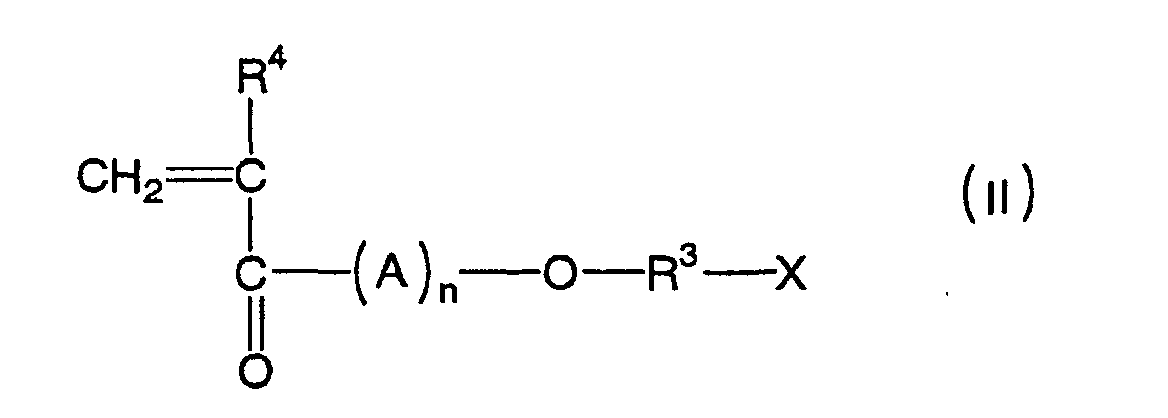
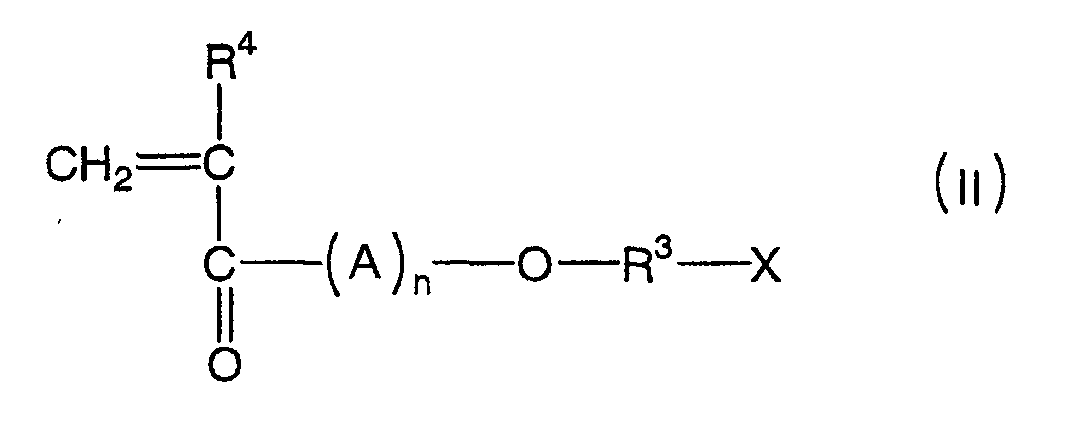
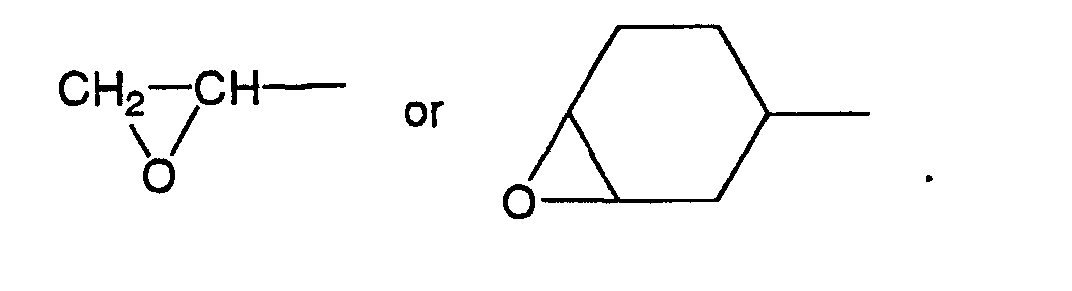
- the other monomer, epoxy group-having (meth)acrylate is preferably represented by following formula (II): wherein R 3 represents an alkylene group having from 1 to 4 carbon atoms; R 4 represents H or CH 3 ; A represents an alkylene oxide having from 2 to 4 carbon atoms; n indicates an integer from 0 to 2; and X represents
- the polymer material of low relative permittivity of the invention is obtained through copolymerization of such fumaric diester and such an epoxy group-having (meth)acrylate, and its advantages are that it is patternable through crosslinking, it forms films well and is resistant to heat, and it bonds and adheres well to metal conductor layers. Its other advantages are that the polymer material has good electric properties of low relative permittivity, low dielectric loss tangent and good electric insulation even in a high-frequency band level of megahertz to gigahertz.
- polymer material of low relative permittivity of the invention realizes easy and simple formation of electric-insulating films of good adhesion to metal conductor layers, and realizes multi-layered substrates of good workability to form patterns, and further realizes electronic units suitable for use in a high-frequency region.
- the polymer material of low relative permittivity of the invention is obtained by copolymerizing a monomer composition that contains, as monomers, fumaric diester and an epoxy group-having (meth)acrylate, and this is a copolymer containing epoxy groups in the molecule.
- the fumaric diester used to form the polymer material of the invention is not specifically limited and may be any one provided it has the ability to lower the relative permittivity of the polymer material and to make the polymer material resistant to heat.
- the fumaric diester for use in the invention is represented by formula (I) mentioned above.
- the alkyl group for R 1 and R 2 preferably has from 2 to 12 carbon atoms, and it may be linear or branched, and may be substituted with halogen atom(s), etc. Concretely, it includes, for example, ethyl, n-propyl, isopropyl, n-butyl, sec-butyl, tert-butyl, pentyl, hexyl, nonyl and dodecyl groups.
- the cycloalkyl group for R 1 and R 2 preferably has from 3 to 14 carbon atoms, and it may be monocyclic or crosslinked, and may be substituted with alkyl group(s), etc. Concretely, it includes, for example, cyclopentyl, cyclohexyl, adamantyl and dimethyladamantyl groups.
- the aryl group for R 2 preferably has from 6 to 18 carbon atoms. It may be polycyclic, but is preferably monocyclic; and it may be substituted. One concrete example of it is a phenyl group.
- the fumaric diester are diisopropyl fumaric diester, dicyclohexyl fumaric diester and di-sec-butyl fumaric diester. Of those, more preferred is dicyclohexyl fumaric diester of the following formula (IV):
- the epoxy group-having (meth)acrylate for use in the invention is not specifically limited and may be any one having epoxy group(s) in the molecule.
- Preferred for use herein are (meth)acrylates of formula (II) mentioned above.
- the alkylene group represented as R 3 may be linear or branched. Concretely, it includes, for example, methylene, ethylene, trimethylene, propylene and tetramethylene groups.
- R 4 is H or CH 3 .
- the esters of formula (II) are acrylates; and in case where R 4 is CH 3 , they are methacrylates.
- the alkylene oxide for A is not indispensable, but including, for example, ethylene oxide and propylene oxide.
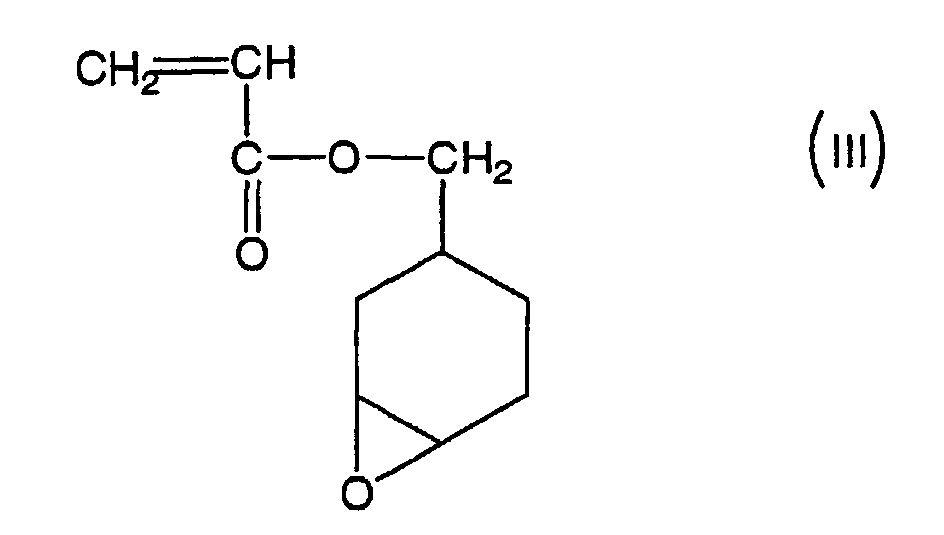
- epoxy group-having (meth)acrylate are glycidyl (meth)acrylate, and 3,4-epoxycyclohexylmethanol (meth)acrylate. Of those, more preferred is 3,4-epoxycyclohexylmethanol acrylate of the following formula (III):
- the epoxy group-having (meth)acrylate monomer is to make the polymer material have the ability to form patterns.
- the blend ratio of the monomer to form the polymer material is not specifically determined, and may be determined depending on the site where the polymer material is to be used and on the profile of the patterns to be formed. In general, however, the blend ratio of the monomer preferably falls between 5 mol% and 60 mol% of all the monomer component to form the polymer material.
- the polymer material of the invention comprises the copolymer of a fumaric diester and an epoxy group-having (meth)acrylate as in the above, and the copolymer may be in any form of random copolymers, alternate copolymers and block copolymers.
- the monomer composition for use herein generally comprises, as monomers, the fumaric diester and the epoxy group-having (meth)acrylate as above, but may optionally contain any other vinyl monomers not overstepping the scope and the sprit of the invention.
- the molecular weight of the polymer material of low relative permittivity of the invention is not specifically defined.
- the polymer material when the polymer material is to form layers on an insulating substrate in a build-up process, the polymer layers formed could be well supported by the insulating substrate since the mechanical strength of the substrate is relatively high.
- the polymer material after the substrate has been coated with the polymer material or after a film of the polymer material has been adhered to the substrate, the polymer material is crosslinked and therefore the mechanical strength of the thus-crosslinked polymer layer could be increased.
- the mechanical strength of the polymer material itself need not be so high like that of the insulating substrate, and the molecular weight thereof also need not be so high like that of the insulating substrate.
- the molecular weight of the polymer material may be enough for film formation, for example, at least 1000 in terms of the number-average molecular weight thereof.
- any ordinary method of radical polymerization can be employed.
- the polymerization initiator to be used for it must not be heated too much for protecting the epoxy group in the monomer.
- one or more of organic peroxides and azo compounds are used for the polymerization initiator, having a half-life temperature of not higher than 80°C.
- the polymerization initiator of that type includes, for example, organic peroxides such as benzoyl peroxide, diisopropyl peroxydicarbonate, t-butylperoxy di-2-ethylhexanoate, cumene peroxide, t-butylhydroperoxide; and azo compounds such as 2,2'-azobisbutyronitrile, azobis(2,4-dimethylvaleronitrile), 1,1'-azobis(cyclohexane-1-carbonitrile), 2,2'-azobis(2,4-dimethylvaleronitrile).
- the amount of the polymerization initiator to be used is preferably at most 10 parts by weight, more preferably at most 5 parts by weight relative to 100 parts by weight of the starting monomer component.
- the polymerization may be effected in any ordinary manner.
- the monomer component may be polymerized in a mode of solution polymerization in the presence of an inert gas, at a temperature falling between 30°C and 100°C for a period of time falling between 10 hours and 72 hours, though depending on the type of the polymerization initiator used. In that condition, the monomer component is polymerized to give a predetermined high-molecular polymer.
- the polymer material of the invention thus obtained, has the ability to form patterns through crosslinking, and its relative permittivity is low.
- the other advantages of the polymer materials are that its film-forming ability is good, its adhesiveness to metals is good, and its mechanical properties are good. ⁇
- the polymer material of low relative permittivity of the invention is dissolved in an organic solvent and formed into a film by removing the solvent.
- the polymer material may be readily and simply formed into an electric-insulating film or layer having good adhesiveness to metal conductors.
- an epoxy ring-opening polymerization catalyst is added to the organic solvent, the epoxy group in the polymer formed may be readily crosslinked through exposure of the polymer film to heat or radiation.
- the mechanical properties of the polymer film formed may be further improved.
- the non-cured part of the polymer film may be removed by washing it with a solvent, and the polymer film may be patterned in any desired manner.
- the radiation employable in the method includes, for example, IR (infrared) rays, UV (ultraviolet) rays and electron rays. Of those, generally used are UV rays in view of the exposure sensitivity of the polymer material and of the line width of the patterns formed.
- the epoxy polymerization initiation catalyst may be any and every one having the ability to initiate epoxy polymerization through exposure to radiation. In general, it may be a cationic photopolymerization catalyst, including, for example, diazonium compounds, iodonium compounds, metal complexes, and aluminium complex/allylcyanol compounds.
- the polymer material of low relative permittivity of the invention may be used in various forms. For example, it may be formed into a film or may be applied onto a substrate, as so mentioned hereinabove, or it may be formed into bulks or moldings. Accordingly, the polymer material of the invention has many applications, for example, for substrates for various electronic units such as high-frequency oscillators, filters, capacitors, inductors and antennas; supports for chips such as filters (e.g., C filters for multi-layered substrates), oscillators (e.g., triplate oscillators) and dielectric oscillators; housings and casings for various substrates and electronic units; and coating materials for them.
- substrates for various electronic units such as high-frequency oscillators, filters, capacitors, inductors and antennas
- supports for chips such as filters (e.g., C filters for multi-layered substrates), oscillators (e.g., triplate oscillators) and dielectric oscillators
- the film of the invention may be formed of the polymer material of low relative permittivity alone, or may be formed by infiltrating the polymer material into glass fibers.
- a casting method that comprises uniformly dissolving the polymer material in a solvent followed by casting the resulting polymer solution onto a mold of, for example, sheet glass, silicone rubber plate or metal plate and evaporating the solvent to thereby form a uniform film on the mold.
- the solution of the polymer material of low relative permittivity is infiltrated into glass fibers and then the solvent is evaporated away.
- the substrate includes, for example, on-board substrates for mounting chips thereon, and copper-clad laminate substrates, further including substrates with built-in circuits therein, and antenna substrates (e.g., patch antennas).
- on-board substrates for mounting chips thereon and copper-clad laminate substrates, further including substrates with built-in circuits therein, and antenna substrates (e.g., patch antennas).
- antenna substrates e.g., patch antennas
- the films may be laminated into a laminate to have the desired thickness, and then dried.
- the solvent may be removed from the film laminate, and the resulting film laminate with intended substrate having the desired thickness can be obtained.
- the films to be laminated may be optionally pressed.
- a metal conductor layer of, for example, copper may be sandwiched between the films to be laminated into the intended, multi-layered substrate.
- the polymer material of low relative permittivity of the invention is especially favorable for photosensitive layers in laminate boards such as copper-clad laminate boards.
- the substrate of the invention encompasses laminate boards of any type having, for example, a metal layer of copper or the like on an insulating substrate base and having thereon a photosensitive layer of the polymer material of low relative permittivity.
- a copolymer was produced in the same manner as in Production Example 1, for which, however, glycidyl methacrylate (GMA) was used in place of GAA.
- GAA glycidyl methacrylate
- a copolymer was produced in the same manner as in Production Example 1, for which, however, 3,4-epoxycyclohexylmethanol acrylate (ECHMA, Daicel Chemical Industries' CYCLOMER A200TM) was used in place of GAA.
- EHMA 3,4-epoxycyclohexylmethanol acrylate
- a copolymer was produced in the same manner as in Production Example 1, for which, however, 10 parts by weight of diisopropyl fumaric diester (di-iPF), 70 parts by weight of di-CHF and 20 parts by weight of GAA were used, and 0.1 parts by weight of a radical polymerization initiator, diisopropyl peroxydicarbonate (IPP) was used.
- di-iPF diisopropyl fumaric diester
- IPP diisopropyl peroxydicarbonate
- a copolymer was produced in the same manner as in Production Example 1, for which, however, 5 parts by weight of di-iPF, 60 parts by weight of di-CHF and 35 parts by weight of ECHMA were used, and 0.1 parts by weight of a radical polymerization initiator, diisopropyl peroxydicarbonate (IPP) was used.
- IPP diisopropyl peroxydicarbonate
- a polymer of di-iPF was produced in the same manner as in Production Example 1, for which, however, 100 parts by weight of di-iPF alone was used.
- a polymer of di-CHF was produced in the same manner as in Production Example 1, for which, however, 100 parts by weight of di-CHF alone was used.
- 0.5 g of the polymer obtained in any of Production Examples 1 to 5 or Comparative Examples 1 and 2 was dissolved in 50 ml of benzene, to which was added 0.5 % by weight, relative to the solid content of the polymer, of a polymerization initiator (Asahi Denka Kogyo's Adekaoptomer SP-150TM).
- the resulting solution was cast into a laboratory dish having a smooth surface and having a diameter of about 20 cm, and then benzene was gradually evaporated away to form a film in the dish.
- the film was exposed to UV rays to a degree of accumulated radiation energy of 20 J/cm 2 , using a high-pressure mercury lamp (80 W x 1), and the resin properties of the thus-exposed film were measured.
- the data are given in Table 1.
- the films of the polymer material of Production Examples 1 to 5 of the invention changed insoluble in benzene and in THF, after exposed to UV rays. This confirms the pattern formability of these films.
- the films well adhered to metal, and had good heat resistance in soldering.
- the films had a specific dielectric constant ( ⁇ ) falling between 2.1 and 2.7 and a dielectric loss tangent (tan ⁇ ) falling between 0.0024 and 0.0035 in high-frequency band level of from 1GHz to 5GHz.
- ⁇ dielectric constant
- tan ⁇ dielectric loss tangent
Landscapes
- Chemical & Material Sciences (AREA)
- Polymers & Plastics (AREA)
- Health & Medical Sciences (AREA)
- Spectroscopy & Molecular Physics (AREA)
- Chemical Kinetics & Catalysis (AREA)
- Medicinal Chemistry (AREA)
- Physics & Mathematics (AREA)
- Organic Chemistry (AREA)
- Addition Polymer Or Copolymer, Post-Treatments, Or Chemical Modifications (AREA)
- Laminated Bodies (AREA)
- Epoxy Resins (AREA)
- Organic Insulating Materials (AREA)
- Manufacture Of Macromolecular Shaped Articles (AREA)
Abstract
Description



- Soldering heat resistance: Measured according to JIS
C0054, at 260°C for 120 seconds.
- A indicates excellent samples; B indicates good samples;
- C indicates average samples; and D indicate bad samples.
Claims (7)
- A polymer material of low relative permittivity obtained through copolymerization of a monomer composition that contains, as monomers, a fumaric diester and an epoxy group-having (meth)acrylate.
- The polymer material of low relative permittivity as claimed in claim 1, wherein one monomer, fumaric diester is represented by the following formula (I):wherein R1 represents an alkyl group or a cycloalkyl group; R2 represents an alkyl group, a cycloalkyl group or an aryl group; and R1 and R2 may be the same or different.

- The polymer material of low relative permittivity as claimed in claim 1 or 2, wherein the other monomer, epoxy group-having (meth)acrylate is represented by following formula (II):wherein R3 represents an alkylene group having from 1 to 4 carbon atoms; R4 represents H or CH3; A represents an alkylene oxide having from 2 to 4 carbon atoms; n indicates an integer of from 0 to 2; and X represents
- The polymer material of low relative permittivity as claimed in claim 3, wherein the epoxy group-having (meth)acrylate is represented by following formula (III):
- A film of the polymer material of low relative permittivity of any one of claims 1 to 4.
- A substrate formed of the polymer material of low relative permittivity of any one of claims 1 to 4.
- An electronic unit formed of the polymer material of low relative permittivity of any one of claims 1 to 4.
Applications Claiming Priority (2)
| Application Number | Priority Date | Filing Date | Title |
|---|---|---|---|
| JP2001016364A JP2002220423A (en) | 2001-01-24 | 2001-01-24 | Crosslinkable low dielectric polymer material and film, substrate and electronic component using the same |
| JP2001016364 | 2001-01-24 |
Publications (3)
| Publication Number | Publication Date |
|---|---|
| EP1227115A2 true EP1227115A2 (en) | 2002-07-31 |
| EP1227115A3 EP1227115A3 (en) | 2002-11-20 |
| EP1227115B1 EP1227115B1 (en) | 2005-11-16 |
Family
ID=18882753
Family Applications (1)
| Application Number | Title | Priority Date | Filing Date |
|---|---|---|---|
| EP02001609A Expired - Lifetime EP1227115B1 (en) | 2001-01-24 | 2002-01-23 | Crosslinkable polymer material of low relative permittivity, and films, substrates and electronic units formed of it |
Country Status (7)
| Country | Link |
|---|---|
| US (1) | US6713581B2 (en) |
| EP (1) | EP1227115B1 (en) |
| JP (1) | JP2002220423A (en) |
| KR (1) | KR100478132B1 (en) |
| CN (1) | CN1234743C (en) |
| DE (1) | DE60207313T2 (en) |
| TW (1) | TWI265938B (en) |
Cited By (2)
| Publication number | Priority date | Publication date | Assignee | Title |
|---|---|---|---|---|
| US7264482B2 (en) | 2004-03-10 | 2007-09-04 | J.S.T. Mfg. Co., Ltd. | Anisotropic conductive sheet |
| CN101284891B (en) * | 2007-04-09 | 2011-06-15 | 比亚迪股份有限公司 | Film-forming resin and heat reactive resin compositions with the film-resin forming |
Families Citing this family (10)
| Publication number | Priority date | Publication date | Assignee | Title |
|---|---|---|---|---|
| TW592030B (en) * | 2003-04-29 | 2004-06-11 | Quanta Comp Inc | Functional module and manufacturing method thereof |
| DE602004025022D1 (en) * | 2003-10-06 | 2010-02-25 | Kaneka Corp | ADHESIVE AGENTS |
| JP2006249318A (en) * | 2005-03-11 | 2006-09-21 | Tosoh Corp | Optical film for display |
| JP4529696B2 (en) * | 2005-01-13 | 2010-08-25 | 東ソー株式会社 | Fumaric acid diester copolymer |
| TWI337186B (en) | 2005-01-13 | 2011-02-11 | Tosoh Corp | Fumaric diester copolymer |
| DE102008062129A1 (en) * | 2008-12-16 | 2010-06-17 | Tesa Se | Self-adhesive base polymer for electroluminescent materials |
| KR101044054B1 (en) | 2009-06-19 | 2011-06-23 | 주식회사 해산콘스텍 | Waterproof flooring using fiber sheet coated with plasma polymer and its construction method |
| CN103951967B (en) * | 2014-04-30 | 2016-02-24 | 苏州久鋐电子有限公司 | Insulation high-pressure-resistant membrane material |
| JP6969291B2 (en) * | 2017-03-31 | 2021-11-24 | 東ソー株式会社 | Insulation material compositions, insulation layers and organic transistors |
| CN117157337A (en) * | 2021-03-30 | 2023-12-01 | 东曹株式会社 | Fumaric acid diester resin, film and polarizing plate |
Family Cites Families (2)
| Publication number | Priority date | Publication date | Assignee | Title |
|---|---|---|---|---|
| JPS51125115A (en) * | 1974-11-11 | 1976-11-01 | Dainippon Ink & Chem Inc | Thermosetting resin composition for use in powder coating |
| JP3238064B2 (en) | 1996-02-05 | 2001-12-10 | ティーディーケイ株式会社 | Method of using low dielectric polymer material and method of using film, substrate and electronic component using the same |
-
2001
- 2001-01-24 JP JP2001016364A patent/JP2002220423A/en not_active Withdrawn
- 2001-12-28 TW TW090132846A patent/TWI265938B/en not_active IP Right Cessation
-
2002
- 2002-01-11 KR KR10-2002-0001684A patent/KR100478132B1/en not_active Expired - Fee Related
- 2002-01-23 CN CNB021023557A patent/CN1234743C/en not_active Expired - Fee Related
- 2002-01-23 EP EP02001609A patent/EP1227115B1/en not_active Expired - Lifetime
- 2002-01-23 DE DE60207313T patent/DE60207313T2/en not_active Expired - Fee Related
- 2002-01-24 US US10/056,119 patent/US6713581B2/en not_active Expired - Fee Related
Cited By (2)
| Publication number | Priority date | Publication date | Assignee | Title |
|---|---|---|---|---|
| US7264482B2 (en) | 2004-03-10 | 2007-09-04 | J.S.T. Mfg. Co., Ltd. | Anisotropic conductive sheet |
| CN101284891B (en) * | 2007-04-09 | 2011-06-15 | 比亚迪股份有限公司 | Film-forming resin and heat reactive resin compositions with the film-resin forming |
Also Published As
| Publication number | Publication date |
|---|---|
| CN1234743C (en) | 2006-01-04 |
| KR100478132B1 (en) | 2005-03-22 |
| JP2002220423A (en) | 2002-08-09 |
| US6713581B2 (en) | 2004-03-30 |
| US20020137867A1 (en) | 2002-09-26 |
| KR20020062812A (en) | 2002-07-31 |
| DE60207313D1 (en) | 2005-12-22 |
| EP1227115B1 (en) | 2005-11-16 |
| EP1227115A3 (en) | 2002-11-20 |
| TWI265938B (en) | 2006-11-11 |
| DE60207313T2 (en) | 2006-08-10 |
| CN1367185A (en) | 2002-09-04 |
Similar Documents
| Publication | Publication Date | Title |
|---|---|---|
| EP4183843B1 (en) | Composition and cured body | |
| EP1227115B1 (en) | Crosslinkable polymer material of low relative permittivity, and films, substrates and electronic units formed of it | |
| US6756441B2 (en) | Low dielectric loss tangent resin composition, curable film and cured product, electrical part using the same and method for production thereof | |
| JP3238064B2 (en) | Method of using low dielectric polymer material and method of using film, substrate and electronic component using the same | |
| CN115996843A (en) | Resin composition, prepreg, resin-coated film, resin-coated metal foil, metal-clad laminate, and wiring board | |
| WO2022054867A1 (en) | Resin composition, prepreg, resin-coated film, resin-coated metal foil, metal-cladded laminate board, and wiring board | |
| CN113490715A (en) | Resin composition, prepreg, metal foil-clad laminate, resin composite sheet, and printed wiring board | |
| CN115803352A (en) | Resin composition, prepreg, film with resin, metal foil with resin, metal-clad laminate, and wiring board | |
| KR20240034183A (en) | New polymers, resin compositions containing them, and molded articles thereof | |
| TW202241979A (en) | Fluorine-containing thermosetting resin, production method thereof, and fluorine-containing thermosetting resin composition | |
| JP4550324B2 (en) | Low dielectric loss tangent resin composition, cured product thereof, and prepreg, laminate and multilayer printed board using the composition | |
| JP2002145940A (en) | Crosslinkable low dielectric polymer material and film, substrate and electronic component using the same | |
| KR102549927B1 (en) | Method for forming adhesive layer of the copper foil surface-treated by click reaction | |
| WO2023286714A1 (en) | Novel (meth)acrylamide polymer, resin composition containing same, and molded body thereof | |
| TW202241978A (en) | Fluorine-containing thermosetting resin, method for producing same, and fluorine-containing thermosetting resin composition | |
| JP7445092B2 (en) | Multilayer structure including insulating layer | |
| JP2002363232A (en) | Curable composition, polymer insulating material, manufacturing method and substrate | |
| WO2025142541A1 (en) | Resin composition, and prepreg, resin-coated film, resin-coated metal foil, metal-clad laminate, and wiring board each obtained using same | |
| CN117597371A (en) | Novel polymer, resin composition containing the same, and molded article thereof | |
| JP2024179852A (en) | Resin composition, prepreg, resin film, metal-clad laminate, printed wiring board, and semiconductor package | |
| JP2026053260A (en) | Resin compositions, cured products, dry films, films, laminated sheets, prepregs, printed circuit boards, and electronic equipment. | |
| CN120202251A (en) | Resin composition, and prepreg, resin-coated film, resin-coated metal foil, metal foil-clad laminate, and wiring board using the same | |
| JP2002371163A (en) | Resin composition for materials exhibiting low dielectric constant and low dielectric loss tangent in high frequency band, and cured product thereof |
Legal Events
| Date | Code | Title | Description |
|---|---|---|---|
| PUAI | Public reference made under article 153(3) epc to a published international application that has entered the european phase |
Free format text: ORIGINAL CODE: 0009012 |
|
| AK | Designated contracting states |
Kind code of ref document: A2 Designated state(s): AT BE CH CY DE DK ES FI FR GB GR IE IT LI LU MC NL PT SE TR |
|
| AX | Request for extension of the european patent |
Free format text: AL;LT;LV;MK;RO;SI |
|
| PUAL | Search report despatched |
Free format text: ORIGINAL CODE: 0009013 |
|
| AK | Designated contracting states |
Kind code of ref document: A3 Designated state(s): AT BE CH CY DE DK ES FI FR GB GR IE IT LI LU MC NL PT SE TR |
|
| AX | Request for extension of the european patent |
Free format text: AL;LT;LV;MK;RO;SI |
|
| 17P | Request for examination filed |
Effective date: 20030513 |
|
| AKX | Designation fees paid |
Designated state(s): DE FR GB |
|
| 17Q | First examination report despatched |
Effective date: 20031121 |
|
| GRAP | Despatch of communication of intention to grant a patent |
Free format text: ORIGINAL CODE: EPIDOSNIGR1 |
|
| GRAS | Grant fee paid |
Free format text: ORIGINAL CODE: EPIDOSNIGR3 |
|
| GRAA | (expected) grant |
Free format text: ORIGINAL CODE: 0009210 |
|
| AK | Designated contracting states |
Kind code of ref document: B1 Designated state(s): DE FR GB |
|
| REG | Reference to a national code |
Ref country code: GB Ref legal event code: FG4D |
|
| REF | Corresponds to: |
Ref document number: 60207313 Country of ref document: DE Date of ref document: 20051222 Kind code of ref document: P |
|
| ET | Fr: translation filed | ||
| PLBE | No opposition filed within time limit |
Free format text: ORIGINAL CODE: 0009261 |
|
| STAA | Information on the status of an ep patent application or granted ep patent |
Free format text: STATUS: NO OPPOSITION FILED WITHIN TIME LIMIT |
|
| 26N | No opposition filed |
Effective date: 20060817 |
|
| PGFP | Annual fee paid to national office [announced via postgrant information from national office to epo] |
Ref country code: GB Payment date: 20070115 Year of fee payment: 6 |
|
| PGFP | Annual fee paid to national office [announced via postgrant information from national office to epo] |
Ref country code: DE Payment date: 20070319 Year of fee payment: 6 |
|
| PGFP | Annual fee paid to national office [announced via postgrant information from national office to epo] |
Ref country code: FR Payment date: 20070109 Year of fee payment: 6 |
|
| GBPC | Gb: european patent ceased through non-payment of renewal fee |
Effective date: 20080123 |
|
| PG25 | Lapsed in a contracting state [announced via postgrant information from national office to epo] |
Ref country code: DE Free format text: LAPSE BECAUSE OF NON-PAYMENT OF DUE FEES Effective date: 20080801 |
|
| REG | Reference to a national code |
Ref country code: FR Ref legal event code: ST Effective date: 20081029 |
|
| PG25 | Lapsed in a contracting state [announced via postgrant information from national office to epo] |
Ref country code: GB Free format text: LAPSE BECAUSE OF NON-PAYMENT OF DUE FEES Effective date: 20080123 |
|
| PG25 | Lapsed in a contracting state [announced via postgrant information from national office to epo] |
Ref country code: FR Free format text: LAPSE BECAUSE OF NON-PAYMENT OF DUE FEES Effective date: 20080131 |