EP1227076A2 - Hyperbranched fluorinated multifunctional alcohols and derivatives - Google Patents
Hyperbranched fluorinated multifunctional alcohols and derivatives Download PDFInfo
- Publication number
- EP1227076A2 EP1227076A2 EP02001749A EP02001749A EP1227076A2 EP 1227076 A2 EP1227076 A2 EP 1227076A2 EP 02001749 A EP02001749 A EP 02001749A EP 02001749 A EP02001749 A EP 02001749A EP 1227076 A2 EP1227076 A2 EP 1227076A2
- Authority
- EP
- European Patent Office
- Prior art keywords
- multifunctional
- fluorinated
- alcohol
- multifunctional alcohol
- oxyalkylene
- Prior art date
- Legal status (The legal status is an assumption and is not a legal conclusion. Google has not performed a legal analysis and makes no representation as to the accuracy of the status listed.)
- Granted
Links
Classifications
-
- C—CHEMISTRY; METALLURGY
- C07—ORGANIC CHEMISTRY
- C07C—ACYCLIC OR CARBOCYCLIC COMPOUNDS
- C07C69/00—Esters of carboxylic acids; Esters of carbonic or haloformic acids
- C07C69/62—Halogen-containing esters
- C07C69/63—Halogen-containing esters of saturated acids
-
- C—CHEMISTRY; METALLURGY
- C07—ORGANIC CHEMISTRY
- C07C—ACYCLIC OR CARBOCYCLIC COMPOUNDS
- C07C69/00—Esters of carboxylic acids; Esters of carbonic or haloformic acids
- C07C69/62—Halogen-containing esters
- C07C69/65—Halogen-containing esters of unsaturated acids
- C07C69/653—Acrylic acid esters; Methacrylic acid esters; Haloacrylic acid esters; Halomethacrylic acid esters
-
- C—CHEMISTRY; METALLURGY
- C07—ORGANIC CHEMISTRY
- C07C—ACYCLIC OR CARBOCYCLIC COMPOUNDS
- C07C69/00—Esters of carboxylic acids; Esters of carbonic or haloformic acids
- C07C69/76—Esters of carboxylic acids having a carboxyl group bound to a carbon atom of a six-membered aromatic ring
Definitions
- the invention is directed to a class of hyperbranched fluorinated multifunctional alcohols and their derivatives such as acrylates and methacrylates, collectively referred to herein as acrylates, epoxies and vinyl ethers.
- acrylates, epoxies and vinyl ethers are used in optical coatings and waveguide devices. Upon curing by thermal or photo initiation, these materials provide coatings of high crosslinking density, low surface tension, low birefringence, low refractive index, high optical clarity and high thermal stability.
- fluorine-containing polymers may be used for coating applications. See, for example, A.A. Wall, Fluoropolymers, Wiley-Interscience, 1972, and T. Deisenroth, Proc. Fluorine in Coatings II, Kunststoff, 1997.
- the fluorinated polymers offer unique properties such as excellent chemical and thermal stability, good weathering and humidity resistance, low surface tension, low refractive index, and low absorption in the electromagnetic spectral region from 1300 to 1610 nm.
- the 1300-1610 nm region of the electromagnetic spectrum is particularly useful for fiber optic telecommunication networks.
- fluorinated photosensitive acrylates have been used to coat optical fibers as well as to fabricate optical waveguides.
- UV curable compositions containing fluorinated monomers, oligomers and polymers have been widely reported. See, for example, US patents 4,508,916; 4,511,209; 4,914,171; 5,024,507; 5,062,680; 5,223,593; 5,822,489; European patent 333,464A1; and publications including J. Pacansky, Progress in Organic Coatings, 18 (1990) 79 and R. Bongiovanni, Progress in Organic Coatings, 36 (1999) 70; all of which are herein incorporated by reference. These compositions comprise fluorinated mono- or multi-functional acrylates and at least one photoinitiator.
- Some fluorinated acrylate compositions in the prior art contain low molecular weight and mono-functional acrylates, however there are several drawbacks with these types of materials.
- the monomers do not have the minimum viscosity required to form a uniform coating having a certain thickness.
- the high volatility of low molecular weight monomers impairs production of waveguides and other coatings.
- the high volatility monomer not only contaminates the curing chamber but also makes it difficult to achieve consistent material properties, including refractive index, after curing.
- the low molecular weight of the monomers leads to very high shrinkage (up to 20%) upon curing. The high shrinkage causes high residual stress.
- Some fluorinated high molecular weight acrylates have been synthesized to overcome the above-mentioned problems.
- One example is the use of a urethane linkage to extend the molecular chain.
- the chain-extended molecules have two acrylate groups per molecule. It is difficult to achieve fast curing and high cross-linking density when the acrylate groups are separated by a long molecular chain.
- an acrylate composition having high viscosity, low volatility, fast curing, high cross-linking density, low absorption in the wavelength region from 1300 to 1610 nm, low birefringence and low shrinkage upon curing.
- One object of this invention is to provide new fluorinated multifunctional alcohols synthesized from a core molecule having at least three equivalents of hydroxy-reacting functional groups and a fluorinated molecule containing at least two hydroxyl groups.
- Another object of the invention is to provide new fluorinated multifunctional acrylates synthesized from the fluorinated multifunctional alcohols of the present invention.
- Still another object of this invention is to provide a method for producing an optical coating comprising (I) forming a coating composition comprising at least one acrylate and at least one free radical initiator; (II) coating the composition into a film on a substrate having a substantially uniform thickness; and (III) curing the coating composition by exposure to an actinic radiation or heat depending on the type of the initiator.
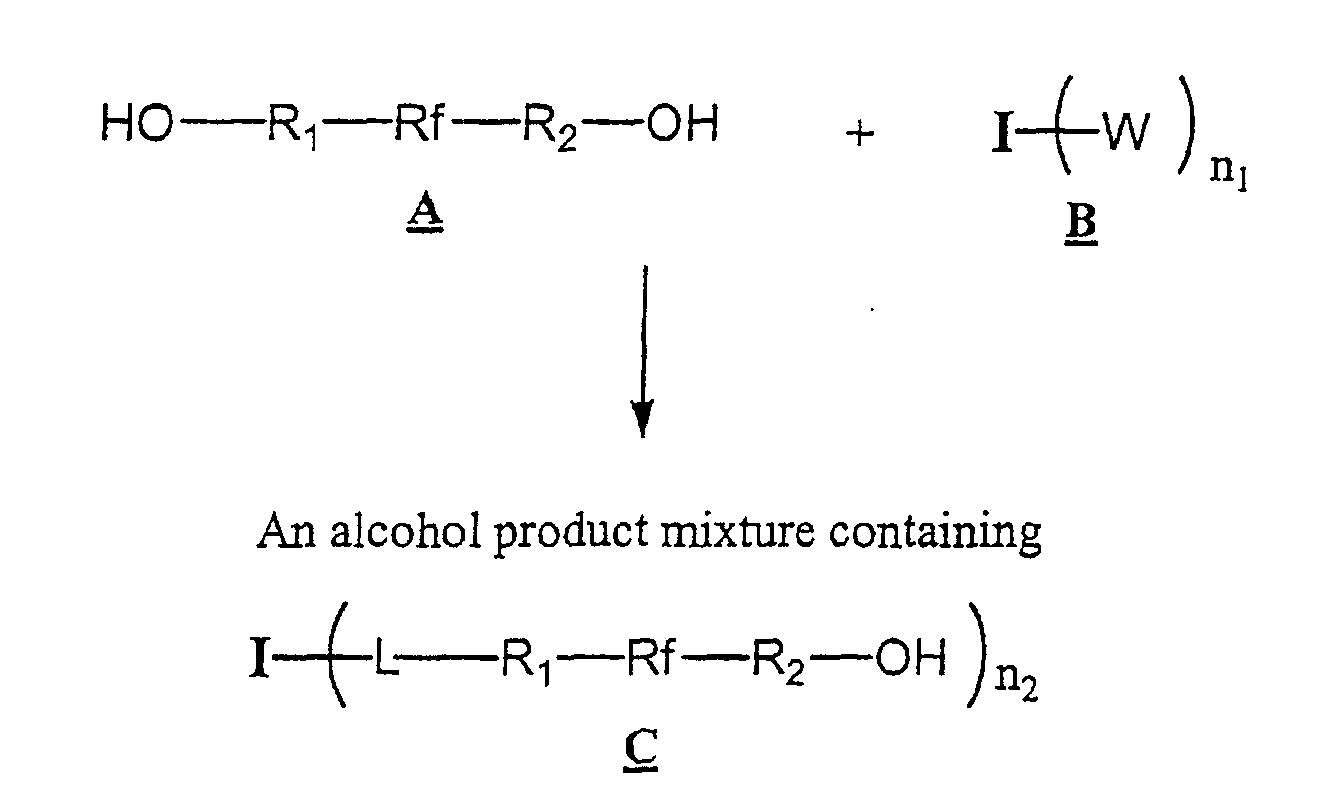
- Fluorinated multifunctional alcohols are synthesized from a core molecule having at least 3 equivalents of hydroxy-reacting functional groups and a fluorinated molecule containing at least 2 hydroxyl groups. There are at least 1.5 equivalents of hydroxyl groups for every equivalent of hydroxy-reacting group.
- A is a fluorinated monomer or polymer having 2 hydroxyl groups, Rf is a perfluorinated moiety
- B is a multifunctional molecule having a core I wherein W stands for one equivalent of hydroxy-reacting group, and n 1 is at least 3
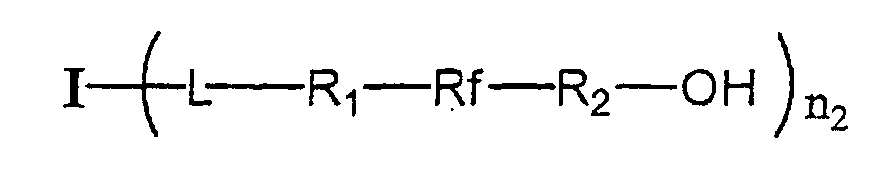
- C is the product mixture from A and B, wherein L is preferably an ether, ester or urethane link, and n 2 is at least 3.
- the ratio of A to B is controlled so that there is a sufficient amount of alcohol A to prevent gelling and to form hydroxy terminated molecules.
- W hydroxy-reacting group
- One equivalent of W herein means the amount of W required to consume each hydroxyl group.
- a carboxylic acid group has one equivalent of hydroxy-reacting group while an anhydride group has two equivalents of hydroxy-reacting groups.
- the molecular weight, molecular weight distribution and viscosity of the product can be tailored by changing the A/B ratio as will be understood by those skilled in the art.
- the molecular structure given in the product C is the simplest form of the fluorinated multifunctional alcohols of the present invention.
- the product C is a mixture of alcohols. Their molecular weight distribution and molecular structure depend on the ratio between A and B as well as the reaction conditions. For example, some of the alcohol molecules produced contain multiple core units I due to di-, tri- or poly-condensation.
- the following generalized structures give examples of such products. These structures arise for three different values of n 1 .
- each free end of Rf is terminated with a hydroxyl group.
- the multifunctional alcohol product mixture C may also contain residual A . A can be either removed or retained depending on end uses.
- A is a fluorinated diol, wherein Rf is a monomeric or polymeric perfluorinated alkylenediyl, oxyalkylene, arylene, oxyarylene, and mixtures thereof; R 1 and R 2 are monomeric or polymeric divalent moieties such as alkylenediyl, oxyalkylene, alkylene sulfide, arylene, oxyarylene, arylene sulfide, siloxane and mixtures thereof.
- fluorinated diols include, but are not limited to, 1H, 1H, 9H, 9H-perfluoro-1,9-nonanediol, 1H, 2H, 3H, 3H-perfluorononane-1,2-diol, 1H, 1H, 10H, 10H-perfluoro-1,10-decanediol, 1H, 1H, 12H, 12H-perfluoro-1,12-dodecanediol, 1H, 1H, 16H, 16H-perfluoro-1,16-hexadecanediol, 1H, 1H, 8H, 8H-perfluorotetraethyleneglycol, fluoropoly(alkylene) diol, ethoxylated fluoropoly(alkylene) diols, fluoropoly(oxyalkylene) diols having the following structures: HOCH 2 CF 2 O(CF 2 CF 2
- B is a multifunctional "core" molecule, wherein I is an aliphatic or aromatic moiety, W is a hydroxy-reacting functional group, such as a carboxylic acid and an alkyl halide, and n is at least 3 and preferably 3-6.
- W is a hydroxy-reacting functional group, such as a carboxylic acid and an alkyl halide
- n is at least 3 and preferably 3-6.
- ester link B is chosen from multifunctional carboxylic compounds such as carboxylic acids, acid chlorides, anhydrides, esters and other compounds known to those skilled in the art. These compounds react with diols, A, to form polyesters C with hydroxy end groups.
- Suitable "core" compounds, B include, but are not limited to, multifunctional acids such as 1,3,5-cyclohexanetricarboxylic acid, Kemp's triacid, 1,2,3-benzenetricarboxylic acid, 1,2,4-benzenetricarboxylic acid, 1,3,5-benzenetricarboxylic acid, 5-(4-carboxy-2-nitrophenoxy)-isophthalic acid, 1,2,3,4-butanetetracarboxylic acid, tetrahydrofuran-2,3,4,5-tetracarboxylic acid, 2,2',2",2"'-[1,2-ethanediylidene-tetrakis(thio)]-tetrakisacetic acid, cyclobutanetetracarboxylic acid, 1,2,4,5-benzenetetracarboxylic acid, mellitic acid, 1,4,5,8-naphthalene tetracarboxylic acid, and 1,2,3,4,5,6-cyclo
- B is chosen from halides or other compounds that react with alcohols to form ether linkages such as those known to the skilled in the art.
- halides include ⁇ , ⁇ ,2,3,5,6-hexachloro-p-xylene, 1,3-dichloro-2-(chloromethyl)-2-methylpropane, 1,1,1-tris(chloromethyl)-propane, 2,4,6-tris(bromomethyl) mesitylene, pentaerythrityl tetrachloride, pentaerythrityl tetrabromide, 1,2,4,5-tetrakis(bromomethyl)-benzene and hexakis(bromomethyl)benzene.
- the multifunctional acrylates are synthesized from the fluorinated multifunctional alcohols of the present invention.
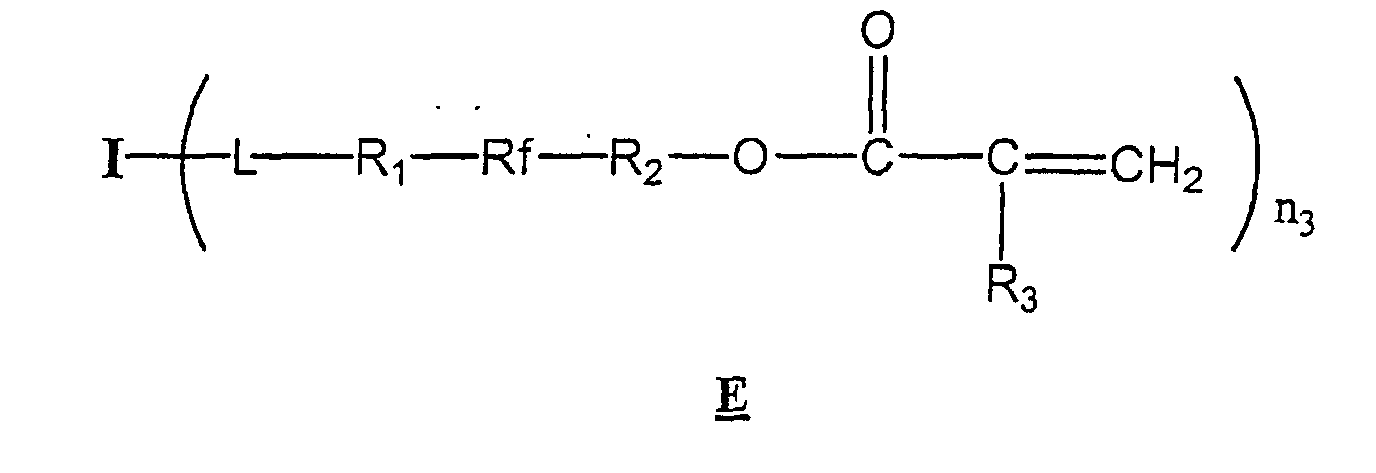
- the following non-exclusive reaction illustrates the synthesis of the multifunctional acrylates.
- the alcohol product mixture of the present invention may contain one or more structures resulting from di-, tri- or poly-condensation. Such structures may contain 2, 3 or more core, I , units.
- the acrylate mixture produced may contain one or more structures containing 2, 3 or more core, I, units.
- the fluorinated alcohol C is converted into an acrylate E with acryloyl chloride using a tertiary amine.
- a hindered tertiary amine containing at least one tertiary or quaternary carbon atom is used.
- the hindered amine provides several advantages, as compared to commonly used triethylamine, such as reducing the yellowness of the products and eliminating the water washing process to remove ammonium salts formed during the acryloylation reaction.
- suitable hindered amines include N,N-dimethylisopropylamine, N,N-diisopropylethylamine, triisobutylamine, Julolidine, iminodibenzyl, 2-methylpyridine, 2,6-lutidine, 2,4,6-collidine, and mixtures thereof.
- the fluorinated multifunctional acrylate has a number average molecular weight of at least 500 and more preferably at least 1000.
- the high molecular weight of the acrylate provides several advantages. First, the high molecular weight lowers shrinkage upon curing due to the relatively low volume fraction of the acrylate group. It is known in the art that low molecular weight acrylates can have shrinkage of up to 20% when cured leading to high residual stress. High residual stress causes problems such as birefringence, delamination, cracking, and light scattering. The acrylate composition of this invention has shrinkage of 5% or lower, preferably 2% or lower. Second, the high molecular weight corresponds with low volatility. Low volatility is important to reduce environmental and health risks and allows for a stable coating composition. Third, high molecular weight provides high viscosity. It is known in the art that a coating composition must have a minimum viscosity to yield high quality coatings with certain thickness.
- the acrylates produced are star shaped or hyper-branched.
- the star-shaped or hyper-branched molecules allow for isotropic films with low birefringence.
- acrylate derivatives of the fluorinated multifunctional alcohol are described, other derivatives such as, but not limited to, epoxies and vinyl ethers can be synthesized from the same multifunctional alcohols.
- the invention also provides a method of producing an optical coating comprising (1) forming a coating composition including at least one acrylate of this invention and at least one free radical initiator; (2) coating the composition into a film on a substrate having a substantially uniform thickness; and (3) curing the coating composition by exposure to an actinic radiation or heat, depending on the type of the initiator.
- the coating composition is formed by thoroughly mixing the multifunctional acrylate of this invention with a free radical initiator and optionally other components such as, but not limited to, other acrylates and additives.
- the initiator can be either a photoinitiator, which generates free radicals when exposed to sufficient actinic radiation, or a thermal initiator, which generates free radicals when heated to a sufficient temperature.
- a composition containing a photoinitiator is herein called a photo-curable composition.
- a composition containing a thermal initiator is herein called a thermal curable composition.
- the photo-curable composition contains at least one photoinitiator having a weight percentage of 0.1-12%, preferably 0.2-6.0% and more preferably 0.5-2.0%.
- the chosen photoinitiator is preferably thermally inactive below about 50°C.
- suitable photoinitiators include, but are not limited to, aromatic ketones, benzil ketals, benzoin, benzoin ethers, and phosphine oxides such as benzophenone, benzyl dimethyl ketal, benzoin alkylyl ethers, 1-hydroxy-cyclohexyl-phenyl ketone, benzodimethyl ketal, ⁇ , ⁇ -dimethyloxy- ⁇ -hydroxy acetophenone, 1-[4-(2-hydroxyethoxy)phenyl]-2-hydroxy-2-methyl-propan-1-one, 2-methyl-1-[4-methylthio)phenyl]-2-morpholino-propan-1-one, 2-benzyl-2-dimethylamino-1-(4
- the preferred photoinitiator composition is a mixture of at least two photoinitiators with different extinction coefficients and absorption maxima.
- Such mixed photoinitiator composition enables high photo contrast as well as fast curing speed.
- examples of such mixtures include, but are not limited to, benzodimethyl ketal with ⁇ , ⁇ -dimethyloxy- ⁇ -hydroxy acetophenone and 2,4,6-trimethylbenzoyldiphenylphosphine oxide with ⁇ , ⁇ -dimethyloxy- ⁇ -hydroxy acetophenone.
- the thermal curable composition contains at least one thermal initiator at a weight percentage of 0.1-12%, preferably 0.2-6.0%, more preferably 0.5-2.0%.
- Suitable thermal polymerization initiators nonexclusively include peroxides such as benzoyl peroxide (BPO), di(sec-butyl)peroxydicarbonate, t-butyl peroxy-2-ethylhexanoate, t-butyl peroxyisobutyrate, 1,1-di-(amylperoxy)-cyclohexane, ⁇ -cumyl peroxyneodecanoate, t-amyl peroxyneodecanoate, laurolyl peroxide, dipropylperoxydicarbonate, decanoyl peroxide, cumene hydroperoxide, t-butyl cumyl peroxide, dicumyl peroxide, di-t-butyl peroxide, t-butyl hydroperoxide, di-
- Optional additives may be added to the thermo-curable or photo-curable composition of this invention to enhance certain properties such as thermal stability, chemical stability, coating quality, and photo contrast.
- the additives include, but are not limited to, surfactants, contrast enhancers, photo stabilizers, UV absorbers, antioxidants, and dyes.
- surfactants include fluorinated surfactants such as Fluorad from 3M of St. Paul, MN and polyethers such as BYK-3500 from BYK Chemie USA of Wallingford, CT.
- Suitable contrast enhancers include free radical scavengers particularly photo bleachable free radical scavengers such as the nitrones reported in US Patent 6,162,579.
- Photo stabilizers include hindered amines such as Cyasorb TJV3346 from Cytec Industries of West Paterson, NJ and TINUVIN 123S from Ciba Specialty Chemicals of Tarrytown, NY.
- UV absorbers include benzotriazoles such as TINUVIN 234 from Ciba Specialty Chemicals and benzophenone derivatives such as UVINUL from BASF of Mount Olive, NJ.
- Antioxidants include for example hindered phenols such as Irganox 1010 from Ciba Specialty Chemicals.
- Dyes include methylene green, methylene blue and the like.
- the resulting composition may be formed into thin films on a variety of substrates using methods well known in the art, including, but not limited to, spin coating, slot coating, dip coating and spray coating.
- Suitable substrates include, but are not limited to, silicon, glass, quartz, plastic, and metal.
- the polymer coating demonstrates high cross-linking density, high optical clarity, low birefringence, good thermal stability, low glass transition temperature and good adhesion to the substrates.
- the photo curable composition is cured with an actinic radiation.
- the actinic radiation used can be any light in the visible and ultraviolet regions of the spectrum as well as electron beam.
- the actinic radiation is UV light.
- the UV sources, wavelengths, intensity, and exposure procedures may be varied to achieve the desired curing degree.
- Useful UV sources are high pressure xenon or mercury-xenon arc lamps fitted with appropriate optical filters.
- the thermal curable composition is cured by heating the coating to a sufficiently high temperature to generate free radicals from the thermal initiators.
- the molecular structures in the alcohol mixture, F , and the acrylate mixture, G are for illustration only and only represent the structures of one of the molecules in the product mixtures.
- some alcohols in F can contain more than one 1,3,5-benzenetricarbonyl core and more than three fluorinated tetraethylene oxide segments (as shown in the following structure).
- Rf is -CF 2 O(CF 2 CF 2 O) 2 CF 2 -.
- Example 1 One equivalent of 1,3,5-benzenetricarbonyl trichloride and 4.5 equivalents of 1H, 1H, 8H, 8H-perfluorotetraethyleneglycol were dissolved in anhydrous ether (0.2 M 1,3,5-benzenetricarbonyl trichloride solution) in a cooled, argon-inerted three-neck flask while stirring. The flask was cooled with an ice-water bath. 3 equivalents of anhydrous triethylamine were dropwise added to this reaction mixture. After the addition of the triethylamine, the mixture was stirred for 2 hours at room temperature. The mixture was filtered through Celite to remove salt. The filtrate was concentrated to yield a fluorinated liquid alcohol.
- anhydrous ether 0.2 M 1,3,5-benzenetricarbonyl trichloride solution
- Example 2 The alcohol prepared in Example 1 and 200 ppm hydroquinone were mixed in anhydrous t-butylmethylether (at 0.5 M hydroxyl group) in an argon-inerted three neck flask. To this reaction mixture, 1.2 equivalents of acryloyl chloride for each equivalent of hydroxyl group were added. Then 1.15 equivalents of anhydrous diisopropylethylamine was added dropwise while stirring. The reaction mixture was stirred for 10 h at room temperature. The reaction mixture was then quenched with 0.3 equivalent of methanol and stirred for 2 h to neutralize excess acryloyl chloride. The mixture was filtered through Celite/silica to remove salt. The filtrate solution was concentrated and pumped under vacuum at 60°C to yield a liquid acrylate. The crude product was then treated with 2% activated carbon to remove a light yellow color.
- Example 3 One equivalent of 1,3,5-benzenetricarbonyl trichloride and 4.5 equivalents of Fluorolink D10, a fluorinated polyether diol commercially available from Ausimont USA, were dissolved in anhydrous t-butylmethylether (0.08 M 1,3,5-benzenetricarbonyl trichloride) in an argon-inerted three-neck flask while stirring in an ice-water bath. 3 equivalents of anhydrous diisopropylethylamine were added dropwise to the reaction mixture. After addition of the diisopropylethylamine, the mixture was stirred for 2 h at room temperature.
- Fluorolink D10 a fluorinated polyether diol commercially available from Ausimont USA
- Example 4 One equivalent of isophthaloyl dichloride and 2 equivalents of fluorinated tetraethylene glycol, available from Exfluor-Research, were dissolved in anhydrous ether (0.2 M isophthaloyl dichloride) in a cooled, argon-inerted three-neck flask while stirring. The flask was cooled with an ice-water bath. 3 equivalents of anhydrous triethylamine were dropwise added to the reaction mixture. After the addition of the triethylamine, the mixture was stirred for 2 h at room temperature. The mixture was then filtered through Celite to remove salt. The filtrate was concentrated to yield a viscous fluorinated liquid alcohol.
- Example 5 The fluorinated alcohol prepared in Example 4 and 200 ppm hydroquinone were mixed with anhydrous t-butyl methyl ether (at 0.5 M hydroxyl group) in an argon-inerted three neck flask. To this reaction mixture were added 1.2 equivalents of acryloyl chloride for each equivalent of hydroxyl group. Then 1.15 equivalents of anhydrous diisopropylethylamine were added dropwise while stirring. The reaction mixture was stirred for an additional 10 h at room temperature. The reaction mixture was then quenched with 0.3 equivalent of methanol and stirred for 2 h to neutralize excess acryloyl chloride.
- Example 6 One equivalent of 1,3,5-benzenetricarbonyl trichloride and 4.5 equivalents of Fluorolink D10 were dissolved in anhydrous ether (0.2 M 1,3,5-benzenetricarbonyl Trichloride) in an argon-inerted three-neck flask while stirring in an ice-water bath. To this reaction mixture was added dropwise 3 equivalents of anhydrous triethylamine. After the addition of the triethylamine the mixture was stirred for 2 h at room temperature. Then the mixture was filtered through Celite to remove salt. The filtrate was concentrated to yield a viscous fluorinated liquid alcohol.
- anhydrous ether 0.2 M 1,3,5-benzenetricarbonyl Trichloride
- Example 7 One equivalent of trimethyl-1,3,5-benzenetricarboxylate, 0.06 equivalent sodium methoxide and 4.5 equivalents of Fluorolink D10 were mixed in an argon-inerted three-neck flask while stirring. The reaction mixture was heated to 115°C for about 20 h. Reduced pressure (100 mmHg) was used to remove the methanol generated during the reaction. Concentrated HC1 in ethyl acetate was added to neutralize excess base. The solution was dried over MgSO 4 , filtered and concentrated to yield a viscous fluorinated liquid alcohol with a slight yellow color.
- Example 8 The alcohol prepared in Examples 6-7 and 200 ppm hydroquinone were mixed with anhydrous t-butyl methyl ether (at 0.5 M hydroxyl group) in an argon-inerted three neck flask. To this reaction mixture were added 1.2 equivalents of acryloyl chloride for each equivalent of hydroxyl group. Then 1.15 equivalents of anhydrous diisopropylethylamine were added dropwise while stirring. The reaction mixture was stirred for 10 h at room temperature. The reaction mixture was quenched with 0.3 equivalent of methanol, stirred for 2 h to neutralize excess acryloyl chloride, and filtered through Celite/silica to remove salt. The filtrate solution was concentrated and pumped under vacuum at 60°C to yield a liquid acrylate. The crude product was then treated with 2% activated carbon to remove a light yellow color.
- Example 9 One equivalent of 1,2,4-benzenetricarboxylic acid, Amberlyst-15 ion-exchange resin (40wt% of the 1,2,4-benzenetricarboxylic acid) and 4.5 equivalents of Fluorolink D10 were mixed in a three-neck flask, which was fitted with a water collecting apparatus, a nitrogen gas inlet and a gas outlet. The reaction mixture was heated to 200°C until the expected amount of water had been collected. The mixture was then cooled to room temperature and filtered through Celite. A viscous fluorinated liquid alcohol was obtained.
- Example 10 The alcohol prepared in Example 9 and 200 ppm hydroquinone were mixed with anhydrous t-butyl methyl ether (at 0.5 M hydroxyl group) in an argon-inerted three neck flask. To this reaction mixture was added 1.2 equivalents of acryloyl chloride for each equivalent of hydroxyl group. 1.15 equivalents of anhydrous diisopropylethylamine were added dropwise while stirring. The reaction mixture was stirred for 10 h at room temperature. Finally the reaction mixture was quenched with 0.3 equivalent of methanol, stirred for 2 h to neutralize excess acryloyl chloride, and filtered through Celite/silica to remove salt. The filtrate solution was concentrated and pumped under vacuum at 60°C to yield a liquid acrylate. The crude product was then treated with 2% activated carbon to remove a light yellow color.
- Example 11 One equivalent of tetraethyl-1,1,2,2-ethanetetracarboxylate, 0.08 equivalent of sodium ethoxide and 4.5 equivalents of Fluorolink D10 were mixed in an argon-inerted three-neck flask with a magnetic stirring bar. The reaction mixture was heated to 100°C for 2 h to remove the ethanol generated. Vacuum (50 mmHg) was then applied for 4 h to drive the reaction to completion. Concentrated HC1 in ethyl acetate was added to neutralize excess base. The solution was dried over MgSO 4 , filtered and concentrated to yield a viscous fluorinated liquid alcohol with a slight yellow color.
- Example 12 The alcohol prepared in Example 11 and 200 ppm hydroquinone were mixed with anhydrous t-butyl methyl ether (at a 0.5 M of hydroxyl group) in an argon-inerted three neck flask. 1.11 equivalents of acryloyl chloride for each equivalent of hydroxyl group was added to the reaction mixture. 1.1 equivalents of anhydrous diisopropylethylamine were added dropwise while stirring. This reaction mixture was stirred for 10 h at room temperature. The reaction mixture was quenched with 0.4 equivalent of methanol, stirred for 2 h to neutralize excess acryloyl chloride, and filtered through Celite/silica to remove salt. The filtrate solution was concentrated and pumped under vacuum at 60°C to yield a liquid acrylate. The crude product was then treated with 2% activated carbon to remove a light yellow color.
- Example 13 One equivalent of 1,2,3,4-butanetetracarboxylic acid, Amberlyst-15 ion-exchange resin (40 wt% of the 1,2,3,4-butanetetracarboxylic acid) and 6 equivalents of Fluorolink D10 were mixed in a three-neck flask, which was fitted with a water collecting apparatus. The reaction mixture was heated to 210°C until the expected amount of water had been collected. The mixture was cooled to room temperature and filtered through Celite to yield a viscous fluorinated liquid alcohol with a slight yellow color.
- Example 14 The alcohol prepared in Example 13 and 200 ppm hydroquinone was mixed with anhydrous t-butyl methyl ether (at a 0.5 M of hydroxyl group) in an argon-inerted three neck flask. 1.11 equivalents of acryloyl chloride for each equivalent of hydroxyl group was added to the reaction mixture. 1.1 equivalents of anhydrous diisopropylethylamine were added dropwise while stirring. This reaction mixture was stirred for 10 h at room temperature. The reaction mixture was quenched with 0.4 equivalent of methanol, stirred for 2h to neutralize excess acryloyl chloride, and filtered through Celite/silica to remove salt. The filtrate solution was concentrated and pumped under vacuum at 60°C to yield a liquid acrylate. The crude product was then treated with 2% activated carbon to remove a light yellow color.
- Example 15 One equivalent of 1,2,4,5-benzenetetracarboxylic dianhydride, Amberlyst-15 ion-exchange resin (40wt% of the 1,2,4,5-benzenetetracarboxylic dianhydride) and 6 equivalents of Fluorolink D10 were mixed in a three-neck flask, which was fitted with a water collecting apparatus. The reaction mixture was heated to 230°C until the expected amount of water had been collected. The mixture was cooled to room temperature and filtered through Celite to yield a viscous fluorinated liquid alcohol with.a slight yellow color.
- Example 16 The alcohol prepared in Example 15 and 200 ppm hydroquinone was mixed with anhydrous t-butyl methyl ether (at a 0.5 M of hydroxyl group) in an argon-inerted three neck flask. To the reaction mixture were added 1.11 equivalents of acryloyl chloride for each equivalent of hydroxyl group. 1.1 equivalents of anhydrous diisopropylethylamine were added dropwise while stirring. This reaction mixture was stirred for 10 h at room temperature. The reaction mixture was quenched with 0.4 equivalent of methanol, stirred for 2 h to neutralize excess acryloyl chloride, and filtered through Celite/silica to remove salt. The filtrate solution was concentrated and pumped under vacuum at 60°C to yield a liquid acrylate. The crude product was treated with 2% activated carbon to remove a light yellow color.
- Example 17 The acrylate of Example 2 was mixed with 0.5% Darocur 4265, a free radical photoinitiator from Ciba Specialty Chemicals, to form a photosensitive composition.
- the photosensitive composition was coated on a glass substrate and exposed to 500 mJ UV at 365 nm using a 1000W mercury xenon lamp to form a thin polymer coating. The coating was clear and colorless.
- Example 18 The acrylate of Example 2 was mixed with 0.5% benzoyl peroxide (BPO), a free radical initiator, to form a thermo-curable composition.
- BPO benzoyl peroxide
- the composition was coated on a silicon substrate and heated at 90°C for 2 h to form a thin solid film. The coating was clear and colorless.
Landscapes
- Chemical & Material Sciences (AREA)
- Organic Chemistry (AREA)
- Macromonomer-Based Addition Polymer (AREA)
- Paints Or Removers (AREA)
- Organic Low-Molecular-Weight Compounds And Preparation Thereof (AREA)
Abstract
Description




Claims (21)
- A fluorinated multifunctional alcohol synthesized from at least one core molecule having at least three equivalents of hydroxy-reacting functional groups and at least one fluorinated molecule having at least two hydroxyl groups.
- The multifunctional alcohol of Claim 1 wherein there are at least 1.5 equivalents of hydroxyl groups from the-fluorinated molecule for every hydroxy-reacting group from the core molecule.
- The multifunctional alcohol of Claim 1 synthesized using the reaction scheme:wherein A is a fluorinated monomer or polymer having two hydroxyl groups, wherein Rf is a monomeric or polymeric perfluorinated alkylenediyl, oxyalkylene, arylenediyl, oxyarylene, and mixtures thereof, and R1 and R2 are monomeric or polymeric divalent moieties such as alkylenediyl, oxyalkylene, alkylene sulfide, arylenediyl, oxyarylene, arylene sulfide, siloxane, and mixtures thereof; B is a multifunctional molecule wherein I is a core moiety, W stands for one equivalent of hydroxy-reacting group and n1 is at least 3; C is the multifunctional alcohol product mixture from A and B, wherein L is an ether, ester or urethane link and n2 is at least 3.

- The multifunctional alcohol of Claim 3 wherein n1 and n2 range from 3 to 6.
- The multifunctional alcohol of Claim 3 wherein there are at least 2.5 OH groups from A for every equivalent of hydroxy-reacting group, W, from B.
- The multifunctional alcohol of Claim 3 wherein L is an ester link.
- The multifunctional alcohol of Claim 3 having the formula ofwherein n2 ranges from 3 to 6.
- The multifunctional alcohol of Claim 3 wherein Rf is a perfluorinated polymethylene moiety having at least 4 carbon atoms.
- The multifunctional alcohol of Claim 3 wherein Rf is a perfluorinated poly(oxyalkylene) moiety having at least 4 carbon atoms.
- The multifunctional alcohol of Claim 3 wherein B is selected from a group consisting of multifunctional carboxylic acid, acid chloride, ester, and anhydride.
- The multifunctional alcohol of Claim 3 wherein B is selected from 1,3,5-benzenetricarbonyl trichloride, trimethyl-1,3,5-benzenetricarboxylate and 1,2,4-benzenetricarboxylic acid.
- The multifunctional alcohol of Claim 3 wherein B is selected from 1,2,3,4-butanetetracarboxylic acid and tetraethylrimethyl-1,1,2,2-ethanetetracarboxylate.
- A multifunctional acrylate prepared from the fluorinated multifunctional alcohol of Claim 1.
- A multifunctional acrylate prepared from the fluorinated multifunctional alcohol of Claim 3.
- The fluorinated multifunctional acrylate of Claim 13 having a number average molecular weight of at least 500.
- A multifunctional acrylate prepared from the fluorinated multifunctional alcohol of Claim 7.
- A polymer coating composition containing at least one acrylate of Claim 13.
- A multifunctional glycidyl ether prepared from the fluorinated multifunctional alcohol of Claim 1.
- The multifunctional glycidyl ether of Claim 18 having the formula ofwherein I is a multivalent radical; L is selected from a group of ether, ester and urethane links; R1 and R2 are monomeric or polymeric divalent radicals such as alkylenediyl, oxyalkylene, alkylene sulfide, arylenediyl, oxyarylene, arylene sulfide, siloxane, and mixtures thereof; Rf is a monomeric or polymeric perfluorinated alkylenediyl, oxyalkylene, arylenediyl, oxyarylene, and mixtures thereof; and n4 ranges from 3 to 6.

- A multifunctional vinyl ether prepared from the fluorinated multifunctional alcohol of Claim 1.
- The multifunctional vinyl ether of Claim 20 having the formula ofwherein I is a multivalent radical; L is selected from a group of ether, ester and urethane links; R1 and R2 are monomeric or polymeric divalent radicals such as alkylenediyl, oxyalkylene, alkylene sulfide, arylenediyl, oxyarylene, arylene sulfide, siloxane, and mixtures thereof; Rf is a monomeric or polymeric perfluorinated alkylenediyl, oxyalkylene, arylenediyl, oxyarylene, and mixtures thereof; and n5 ranges from 3 to 6.

Applications Claiming Priority (4)
| Application Number | Priority Date | Filing Date | Title |
|---|---|---|---|
| US26420001P | 2001-01-25 | 2001-01-25 | |
| US264200P | 2001-01-25 | ||
| US50184P | 2002-01-18 | ||
| US10/050,184 US20020115820A1 (en) | 2001-01-25 | 2002-01-18 | Hyperbranched fluorinated multifunctional alcohols and derivatives |
Publications (3)
| Publication Number | Publication Date |
|---|---|
| EP1227076A2 true EP1227076A2 (en) | 2002-07-31 |
| EP1227076A3 EP1227076A3 (en) | 2003-10-15 |
| EP1227076B1 EP1227076B1 (en) | 2006-09-06 |
Family
ID=26727976
Family Applications (1)
| Application Number | Title | Priority Date | Filing Date |
|---|---|---|---|
| EP02001749A Expired - Lifetime EP1227076B1 (en) | 2001-01-25 | 2002-01-25 | Hyperbranched fluorinated multifunctional alcohols and derivatives |
Country Status (4)
| Country | Link |
|---|---|
| US (1) | US20020115820A1 (en) |
| EP (1) | EP1227076B1 (en) |
| AT (1) | ATE338742T1 (en) |
| DE (1) | DE60214446T2 (en) |
Cited By (4)
| Publication number | Priority date | Publication date | Assignee | Title |
|---|---|---|---|---|
| EP1229352A3 (en) * | 2001-02-01 | 2003-05-28 | E.I. du Pont de Nemours & Company | Photosensitive acrylate composition and waveguide device |
| WO2005113642A1 (en) * | 2004-05-07 | 2005-12-01 | 3M Innovative Properties Company | Perfluoropolyether containing acrylat groups |
| US7288619B2 (en) | 2004-05-07 | 2007-10-30 | 3M Innovative Properties Company | Fluorinated polyether polyamine and method of making the same |
| EP1984433A4 (en) * | 2006-02-13 | 2009-05-13 | 3M Innovative Properties Co | Optical articles from curable compositions |
Families Citing this family (14)
| Publication number | Priority date | Publication date | Assignee | Title |
|---|---|---|---|---|
| UA67739C2 (en) * | 1997-04-25 | 2004-07-15 | Ісіхара Сангіо Кайся Лтд. | Composition for controlling harmful bio-organisms and method for struugle against harmful bio-organisms using such composition |
| US20050249940A1 (en) * | 2004-05-07 | 2005-11-10 | 3M Innovative Properties Company | Fluoropolyether poly(meth)acryl compounds |
| US7101618B2 (en) * | 2004-05-07 | 2006-09-05 | 3M Innovative Properties Company | Article comprising fluorochemical surface layer |
| EP1758959A1 (en) * | 2004-05-07 | 2007-03-07 | 3M Innovative Properties Company | Stain repellent optical hard coating |
| CA2593694A1 (en) * | 2004-12-30 | 2006-07-13 | 3M Innovative Properties Company | Articles comprising a fluorochemical surface layer and related methods |
| CN101103083B (en) * | 2004-12-30 | 2012-03-28 | 3M创新有限公司 | Stain-resistant fluorochemical compositions |
| US20060216524A1 (en) | 2005-03-23 | 2006-09-28 | 3M Innovative Properties Company | Perfluoropolyether urethane additives having (meth)acryl groups and hard coats |
| WO2009029438A1 (en) | 2007-08-31 | 2009-03-05 | 3M Innovative Properties Company | Hardcoats |
| CN102149667B (en) * | 2008-09-19 | 2014-06-25 | Lg化学株式会社 | Fluorine-based compounds and coating compositions comprising the same |
| JP5654050B2 (en) * | 2010-02-04 | 2015-01-14 | エルジー・ケム・リミテッド | NOVEL FLUORINE COMPOUND, COMPOSITION CONTAINING THE SAME, MOLDED BODY USING THE SAME, AND METHOD FOR PRODUCING MOLDED BODY |
| KR101369381B1 (en) * | 2011-11-04 | 2014-03-06 | 에스케이이노베이션 주식회사 | Coating composition for low refractive layer comprising fluorine-containing compound, anti-reflection film using the same, polarizer and image displaying device comprising said anti-reflection film |
| CN105658699B (en) * | 2013-10-18 | 2017-06-23 | 旭硝子株式会社 | Fluorine-containing compound, composition for forming hard coat layer, and article with hard coat layer |
| EP3659964A1 (en) | 2018-11-28 | 2020-06-03 | Hysilabs, SAS | Catalysed process of production of hydrogen from silylated derivatives as hydrogen carrier compounds |
| CN120888232B (en) * | 2025-09-30 | 2026-03-20 | 山东应强新材料科技有限公司 | A fluorinated coating for ultra-weather-resistant wrapping tape and its preparation method |
Family Cites Families (12)
| Publication number | Priority date | Publication date | Assignee | Title |
|---|---|---|---|---|
| US4508916A (en) * | 1979-04-11 | 1985-04-02 | Minnesota Mining And Manufacturing Company | Curable substituted urethane acrylates |
| CA1221795A (en) * | 1982-02-24 | 1987-05-12 | Bolesh J. Skutnik | Optical fiber cladding |
| CA1294470C (en) * | 1986-07-26 | 1992-01-21 | Toshihiro Suzuki | Process for the production of optical elements |
| US4914171A (en) * | 1988-10-26 | 1990-04-03 | Allied-Signal Inc. | Fluorinated diacrylates |
| US5062680A (en) * | 1989-09-27 | 1991-11-05 | Nippon Telegraph And Telephone Corporation | Plate plastics optical waveguide |
| US5024507A (en) * | 1990-05-10 | 1991-06-18 | Polaroid Corporation | Photopolymerizable composition for cladding optical fibers |
| US5223593A (en) * | 1991-08-08 | 1993-06-29 | Minnesota Mining And Manufacturing Company | Fluorine containing plastic optical fiber cores |
| US6162579A (en) * | 1996-04-19 | 2000-12-19 | Corning Incorporated | Nitrone compounds as photopolymer polymerization inhibitors and contrast enhancing additives |
| US5822489A (en) * | 1996-12-31 | 1998-10-13 | Lucent Technologies, Inc. | Low refractive index photo-curable composition for waveguide applications |
| US6323361B1 (en) * | 1997-04-17 | 2001-11-27 | Corning Inc. | Photocurable halofluorinated acrylates |
| US6306563B1 (en) * | 1999-06-21 | 2001-10-23 | Corning Inc. | Optical devices made from radiation curable fluorinated compositions |
| US7078445B2 (en) * | 2001-02-01 | 2006-07-18 | E. I. Du Pont De Nemours And Company | Photosensitive acrylate composition and waveguide device |
-
2002
- 2002-01-18 US US10/050,184 patent/US20020115820A1/en not_active Abandoned
- 2002-01-25 EP EP02001749A patent/EP1227076B1/en not_active Expired - Lifetime
- 2002-01-25 AT AT02001749T patent/ATE338742T1/en not_active IP Right Cessation
- 2002-01-25 DE DE60214446T patent/DE60214446T2/en not_active Expired - Lifetime
Cited By (5)
| Publication number | Priority date | Publication date | Assignee | Title |
|---|---|---|---|---|
| EP1229352A3 (en) * | 2001-02-01 | 2003-05-28 | E.I. du Pont de Nemours & Company | Photosensitive acrylate composition and waveguide device |
| WO2005113642A1 (en) * | 2004-05-07 | 2005-12-01 | 3M Innovative Properties Company | Perfluoropolyether containing acrylat groups |
| US7288619B2 (en) | 2004-05-07 | 2007-10-30 | 3M Innovative Properties Company | Fluorinated polyether polyamine and method of making the same |
| US7342080B2 (en) | 2004-05-07 | 2008-03-11 | 3M Innovative Properties Company | Polymerizable compositions, methods of making the same, and composite articles therefrom |
| EP1984433A4 (en) * | 2006-02-13 | 2009-05-13 | 3M Innovative Properties Co | Optical articles from curable compositions |
Also Published As
| Publication number | Publication date |
|---|---|
| EP1227076B1 (en) | 2006-09-06 |
| US20020115820A1 (en) | 2002-08-22 |
| EP1227076A3 (en) | 2003-10-15 |
| DE60214446D1 (en) | 2006-10-19 |
| DE60214446T2 (en) | 2007-09-13 |
| ATE338742T1 (en) | 2006-09-15 |
Similar Documents
| Publication | Publication Date | Title |
|---|---|---|
| EP1227076B1 (en) | Hyperbranched fluorinated multifunctional alcohols and derivatives | |
| US6689900B2 (en) | Fluorinated crosslinker and composition | |
| US7078445B2 (en) | Photosensitive acrylate composition and waveguide device | |
| US6778753B2 (en) | Halogenated optical polymer composition | |
| EP1227114A2 (en) | Fluorinated photopolymer composition and waveguide device | |
| TW200535147A (en) | Fluorine containing photocurable composition | |
| JP4634004B2 (en) | Low optical loss polymer | |
| JP4530565B2 (en) | Monoacrylate fluorene compound, composition containing the compound, and cured product thereof | |
| KR101335524B1 (en) | UV curable fluorinated copolymer with improved adhesion property and a composition containing same, and their films containing same | |
| KR101936282B1 (en) | UV curable per-fluorinated copolymer and an antifouling photo-curable resin composition containing same | |
| JP2010241831A (en) | Fluorine-containing polyether carboxylic acid ester | |
| JP2002069037A (en) | Fluorine-containing polyether carboxylic ester | |
| JP2003268042A (en) | Polymerizable compound and its polymer | |
| KR102733164B1 (en) | Polymers of haloalkyl and haloalkenyl ether (meth)acrylates | |
| KR101057734B1 (en) | Acrylate having high refractive index and manufacturing method thereof | |
| JPH02258819A (en) | New polymerizable monomer | |
| WO2009123013A1 (en) | Polyfunctional fluorine-containing compound and method for producing the compound | |
| JP5071612B2 (en) | Fluorine-containing curable composition | |
| JP4192600B2 (en) | Fluorine-containing optical waveguide material | |
| KR101219517B1 (en) | A mixure for Antifouling transparent coating with low refractive index and a compositions containing same | |
| JP4702918B2 (en) | Low refractive index resin composition and cured product thereof | |
| Kwon et al. | Polarizing group attached acrylates and polymers viewing high refractive index | |
| JP4521799B2 (en) | Fluorinated ester compound, low refractive index resin composition containing the same, and cured product thereof | |
| EP1942091A1 (en) | Novel fluoroadamantane derivative, fluorine-containing polymer and production method | |
| BR112020005943B1 (en) | HALOALKYL ETHER (METH)ACRYLATES POLYMERS, ARTICLE OF MANUFACTURE, CURED COMPOSITION AND METHOD FOR PRODUCING POLYMER |
Legal Events
| Date | Code | Title | Description |
|---|---|---|---|
| PUAI | Public reference made under article 153(3) epc to a published international application that has entered the european phase |
Free format text: ORIGINAL CODE: 0009012 |
|
| AK | Designated contracting states |
Kind code of ref document: A2 Designated state(s): AT BE CH CY DE DK ES FI FR GB GR IE IT LI LU MC NL PT SE TR |
|
| AX | Request for extension of the european patent |
Free format text: AL;LT;LV;MK;RO;SI |
|
| RAP1 | Party data changed (applicant data changed or rights of an application transferred) |
Owner name: E.I. DU PONT DE NEMOURS & COMPANY |
|
| PUAL | Search report despatched |
Free format text: ORIGINAL CODE: 0009013 |
|
| AK | Designated contracting states |
Kind code of ref document: A3 Designated state(s): AT BE CH CY DE DK ES FI FR GB GR IE IT LI LU MC NL PT SE TR |
|
| AX | Request for extension of the european patent |
Extension state: AL LT LV MK RO SI |
|
| 17P | Request for examination filed |
Effective date: 20040415 |
|
| AKX | Designation fees paid |
Designated state(s): AT BE CH CY DE DK ES FI FR GB GR IE IT LI LU MC NL PT SE TR |
|
| 17Q | First examination report despatched |
Effective date: 20050428 |
|
| GRAP | Despatch of communication of intention to grant a patent |
Free format text: ORIGINAL CODE: EPIDOSNIGR1 |
|
| GRAS | Grant fee paid |
Free format text: ORIGINAL CODE: EPIDOSNIGR3 |
|
| GRAA | (expected) grant |
Free format text: ORIGINAL CODE: 0009210 |
|
| AK | Designated contracting states |
Kind code of ref document: B1 Designated state(s): AT BE CH CY DE DK ES FI FR GB GR IE IT LI LU MC NL PT SE TR |
|
| PG25 | Lapsed in a contracting state [announced via postgrant information from national office to epo] |
Ref country code: IT Free format text: LAPSE BECAUSE OF FAILURE TO SUBMIT A TRANSLATION OF THE DESCRIPTION OR TO PAY THE FEE WITHIN THE PRESCRIBED TIME-LIMIT;WARNING: LAPSES OF ITALIAN PATENTS WITH EFFECTIVE DATE BEFORE 2007 MAY HAVE OCCURRED AT ANY TIME BEFORE 2007. THE CORRECT EFFECTIVE DATE MAY BE DIFFERENT FROM THE ONE RECORDED. Effective date: 20060906 Ref country code: AT Free format text: LAPSE BECAUSE OF FAILURE TO SUBMIT A TRANSLATION OF THE DESCRIPTION OR TO PAY THE FEE WITHIN THE PRESCRIBED TIME-LIMIT Effective date: 20060906 Ref country code: NL Free format text: LAPSE BECAUSE OF FAILURE TO SUBMIT A TRANSLATION OF THE DESCRIPTION OR TO PAY THE FEE WITHIN THE PRESCRIBED TIME-LIMIT Effective date: 20060906 Ref country code: CH Free format text: LAPSE BECAUSE OF FAILURE TO SUBMIT A TRANSLATION OF THE DESCRIPTION OR TO PAY THE FEE WITHIN THE PRESCRIBED TIME-LIMIT Effective date: 20060906 Ref country code: BE Free format text: LAPSE BECAUSE OF FAILURE TO SUBMIT A TRANSLATION OF THE DESCRIPTION OR TO PAY THE FEE WITHIN THE PRESCRIBED TIME-LIMIT Effective date: 20060906 Ref country code: LI Free format text: LAPSE BECAUSE OF FAILURE TO SUBMIT A TRANSLATION OF THE DESCRIPTION OR TO PAY THE FEE WITHIN THE PRESCRIBED TIME-LIMIT Effective date: 20060906 Ref country code: FI Free format text: LAPSE BECAUSE OF FAILURE TO SUBMIT A TRANSLATION OF THE DESCRIPTION OR TO PAY THE FEE WITHIN THE PRESCRIBED TIME-LIMIT Effective date: 20060906 |
|
| REG | Reference to a national code |
Ref country code: GB Ref legal event code: FG4D |
|
| REG | Reference to a national code |
Ref country code: CH Ref legal event code: EP |
|
| REG | Reference to a national code |
Ref country code: IE Ref legal event code: FG4D |
|
| REF | Corresponds to: |
Ref document number: 60214446 Country of ref document: DE Date of ref document: 20061019 Kind code of ref document: P |
|
| PG25 | Lapsed in a contracting state [announced via postgrant information from national office to epo] |
Ref country code: SE Free format text: LAPSE BECAUSE OF FAILURE TO SUBMIT A TRANSLATION OF THE DESCRIPTION OR TO PAY THE FEE WITHIN THE PRESCRIBED TIME-LIMIT Effective date: 20061206 Ref country code: DK Free format text: LAPSE BECAUSE OF FAILURE TO SUBMIT A TRANSLATION OF THE DESCRIPTION OR TO PAY THE FEE WITHIN THE PRESCRIBED TIME-LIMIT Effective date: 20061206 |
|
| PG25 | Lapsed in a contracting state [announced via postgrant information from national office to epo] |
Ref country code: ES Free format text: LAPSE BECAUSE OF FAILURE TO SUBMIT A TRANSLATION OF THE DESCRIPTION OR TO PAY THE FEE WITHIN THE PRESCRIBED TIME-LIMIT Effective date: 20061217 |
|
| PG25 | Lapsed in a contracting state [announced via postgrant information from national office to epo] |
Ref country code: IE Free format text: LAPSE BECAUSE OF NON-PAYMENT OF DUE FEES Effective date: 20070125 |
|
| PG25 | Lapsed in a contracting state [announced via postgrant information from national office to epo] |
Ref country code: MC Free format text: LAPSE BECAUSE OF NON-PAYMENT OF DUE FEES Effective date: 20070131 |
|
| PG25 | Lapsed in a contracting state [announced via postgrant information from national office to epo] |
Ref country code: PT Free format text: LAPSE BECAUSE OF FAILURE TO SUBMIT A TRANSLATION OF THE DESCRIPTION OR TO PAY THE FEE WITHIN THE PRESCRIBED TIME-LIMIT Effective date: 20070219 |
|
| NLV1 | Nl: lapsed or annulled due to failure to fulfill the requirements of art. 29p and 29m of the patents act | ||
| REG | Reference to a national code |
Ref country code: CH Ref legal event code: PL |
|
| ET | Fr: translation filed | ||
| PLBE | No opposition filed within time limit |
Free format text: ORIGINAL CODE: 0009261 |
|
| STAA | Information on the status of an ep patent application or granted ep patent |
Free format text: STATUS: NO OPPOSITION FILED WITHIN TIME LIMIT |
|
| 26N | No opposition filed |
Effective date: 20070607 |
|
| PG25 | Lapsed in a contracting state [announced via postgrant information from national office to epo] |
Ref country code: GR Free format text: LAPSE BECAUSE OF FAILURE TO SUBMIT A TRANSLATION OF THE DESCRIPTION OR TO PAY THE FEE WITHIN THE PRESCRIBED TIME-LIMIT Effective date: 20061207 |
|
| PG25 | Lapsed in a contracting state [announced via postgrant information from national office to epo] |
Ref country code: LU Free format text: LAPSE BECAUSE OF NON-PAYMENT OF DUE FEES Effective date: 20070125 Ref country code: CY Free format text: LAPSE BECAUSE OF FAILURE TO SUBMIT A TRANSLATION OF THE DESCRIPTION OR TO PAY THE FEE WITHIN THE PRESCRIBED TIME-LIMIT Effective date: 20060906 |
|
| PG25 | Lapsed in a contracting state [announced via postgrant information from national office to epo] |
Ref country code: TR Free format text: LAPSE BECAUSE OF FAILURE TO SUBMIT A TRANSLATION OF THE DESCRIPTION OR TO PAY THE FEE WITHIN THE PRESCRIBED TIME-LIMIT Effective date: 20060906 |
|
| REG | Reference to a national code |
Ref country code: GB Ref legal event code: 732E Free format text: REGISTERED BETWEEN 20131205 AND 20131211 |
|
| REG | Reference to a national code |
Ref country code: FR Ref legal event code: TP Owner name: ENABLENCE TECHNOLOGIES INC., CA Effective date: 20140210 |
|
| PGFP | Annual fee paid to national office [announced via postgrant information from national office to epo] |
Ref country code: DE Payment date: 20140129 Year of fee payment: 13 |
|
| PGFP | Annual fee paid to national office [announced via postgrant information from national office to epo] |
Ref country code: FR Payment date: 20140220 Year of fee payment: 13 |
|
| PGFP | Annual fee paid to national office [announced via postgrant information from national office to epo] |
Ref country code: GB Payment date: 20140127 Year of fee payment: 13 |
|
| REG | Reference to a national code |
Ref country code: DE Ref legal event code: R119 Ref document number: 60214446 Country of ref document: DE |
|
| GBPC | Gb: european patent ceased through non-payment of renewal fee |
Effective date: 20150125 |
|
| PG25 | Lapsed in a contracting state [announced via postgrant information from national office to epo] |
Ref country code: GB Free format text: LAPSE BECAUSE OF NON-PAYMENT OF DUE FEES Effective date: 20150125 Ref country code: DE Free format text: LAPSE BECAUSE OF NON-PAYMENT OF DUE FEES Effective date: 20150801 |
|
| REG | Reference to a national code |
Ref country code: FR Ref legal event code: ST Effective date: 20150930 |
|
| PG25 | Lapsed in a contracting state [announced via postgrant information from national office to epo] |
Ref country code: FR Free format text: LAPSE BECAUSE OF NON-PAYMENT OF DUE FEES Effective date: 20150202 |