EP1225329A1 - Pinion assembly - Google Patents
Pinion assembly Download PDFInfo
- Publication number
- EP1225329A1 EP1225329A1 EP02250371A EP02250371A EP1225329A1 EP 1225329 A1 EP1225329 A1 EP 1225329A1 EP 02250371 A EP02250371 A EP 02250371A EP 02250371 A EP02250371 A EP 02250371A EP 1225329 A1 EP1225329 A1 EP 1225329A1
- Authority
- EP
- European Patent Office
- Prior art keywords
- starter motor
- pinion assembly
- pinion
- shaft
- projections
- Prior art date
- Legal status (The legal status is an assumption and is not a legal conclusion. Google has not performed a legal analysis and makes no representation as to the accuracy of the status listed.)
- Withdrawn
Links
- 239000007858 starting material Substances 0.000 claims abstract description 30
- 230000004888 barrier function Effects 0.000 claims description 9
- 230000006835 compression Effects 0.000 claims description 8
- 238000007906 compression Methods 0.000 claims description 8
- 239000011358 absorbing material Substances 0.000 claims description 5
- 238000002485 combustion reaction Methods 0.000 claims description 5
- 239000000463 material Substances 0.000 claims description 2
- 239000013536 elastomeric material Substances 0.000 claims 2
- 238000010521 absorption reaction Methods 0.000 description 1
- 238000010276 construction Methods 0.000 description 1
- 239000000356 contaminant Substances 0.000 description 1
- 238000007789 sealing Methods 0.000 description 1
Images

Classifications
-
- H—ELECTRICITY
- H02—GENERATION; CONVERSION OR DISTRIBUTION OF ELECTRIC POWER
- H02K—DYNAMO-ELECTRIC MACHINES
- H02K7/00—Arrangements for handling mechanical energy structurally associated with dynamo-electric machines, e.g. structural association with mechanical driving motors or auxiliary dynamo-electric machines
- H02K7/10—Structural association with clutches, brakes, gears, pulleys or mechanical starters
- H02K7/116—Structural association with clutches, brakes, gears, pulleys or mechanical starters with gears
-
- F—MECHANICAL ENGINEERING; LIGHTING; HEATING; WEAPONS; BLASTING
- F02—COMBUSTION ENGINES; HOT-GAS OR COMBUSTION-PRODUCT ENGINE PLANTS
- F02N—STARTING OF COMBUSTION ENGINES; STARTING AIDS FOR SUCH ENGINES, NOT OTHERWISE PROVIDED FOR
- F02N15/00—Other power-operated starting apparatus; Component parts, details, or accessories, not provided for in, or of interest apart from groups F02N5/00 - F02N13/00
- F02N15/02—Gearing between starting-engines and started engines; Engagement or disengagement thereof
- F02N15/04—Gearing between starting-engines and started engines; Engagement or disengagement thereof the gearing including disengaging toothed gears
- F02N15/06—Gearing between starting-engines and started engines; Engagement or disengagement thereof the gearing including disengaging toothed gears the toothed gears being moved by axial displacement
- F02N15/062—Starter drives
- F02N15/063—Starter drives with resilient shock absorbers
-
- F—MECHANICAL ENGINEERING; LIGHTING; HEATING; WEAPONS; BLASTING
- F16—ENGINEERING ELEMENTS AND UNITS; GENERAL MEASURES FOR PRODUCING AND MAINTAINING EFFECTIVE FUNCTIONING OF MACHINES OR INSTALLATIONS; THERMAL INSULATION IN GENERAL
- F16H—GEARING
- F16H55/00—Elements with teeth or friction surfaces for conveying motion; Worms, pulleys or sheaves for gearing mechanisms
- F16H55/02—Toothed members; Worms
- F16H55/14—Construction providing resilience or vibration-damping
Definitions
- This invention relates to electric starter motors and in particular, to the pinion assembly of the starter motor.
- a starter motor is an electric motor which is used to turn an internal combustion engine to start it.
- the starter motor has a pinion arranged to engage a ring gear fitted to the engine and fitted to its drive shaft in such a way that when the starter motor is turned off, the pinion is disengaged from the ring gear.
- the starter motor is turned on, the pinion moves along the shaft and engages the ring gear to turn the engine.
- the pinion may be moved by a solenoid or by helical splines on the shaft effected by inertia.
- the present invention reduces the impact loading on the pinion by providing a cushioning between the pinion and the drive plate.
- the present invention provides a cushioned pinion for use with a starter motor, the pinion comprising:
- At least one of the first and second parts has a radially inner barrier for containing radially inward movement of the third part during compression.
- At least one of the first and second parts has a radially outer barrier for containing radially outward movement of the third part during compression.
- the third part is a disc with cutouts receiving the projections of the first and second parts.
- the third part is an annular ring with radially extending fingers located between and separating the projections of the first part and the projections of the second part.
- the third part substantially fills the gaps between the projections of the first and second parts.
- the energy absorbing material is rubber.
- the present invention also provides a starter motor for an internal combustion engine comprising: an electric motor having a housing supporting a stator, an output shaft, a wound rotor fitted to the shaft and located to interact with the stator, a pinion assembly mounted on the shaft, engagement means for moving the pinion assembly along the shaft between an engaged position where in use, the pinion assembly engages a ring gear of the engine and a disengaged position, wherein the pinion assembly has a first part coupled to the shaft to be driven thereby a second part having pinion teeth for engaging the ring gear and a third part of compressible material disposed between the first and second parts, wherein the first and second parts have axially extending projections which are axially aligned and circumferentially spaced whereby the second part is driven by the first part through the third part.
- Starter motors are well known and will not be described in detail here for the sake of brevity.
- the pinion drive shown in Figures 1 and 2 is designed for use with a clutchless inertia drive type starter motor in which the pinion drive is adapted to directly engage helical splines on the starter motor shaft and is moved along the shaft against the force of a return spring due to inertia when the starter motor is turned on.
- the drive pinion 10 shown in Figures 1 and 2 comprises three parts, a first part being the drive plate 12, a second part being the pinion 14 and a third part being the energy absorbing member 16.
- the drive plate 12 has three main sections, a collar 18, a flange 20 formed at one end of the collar and projections 22 extending axially from a face of the flange remote from the collar. In the embodiment of Figure 1 and 2, the drive plate 12 has only two projections 22.
- the collar 18 has a central bore 24 with an inner surface arranged to engage a helical spline of the motor shaft.
- the pinion 14 is of a similar construction to the drive plate 12. It has a collar 26 with a central opening 28. The inner surface of the collar 26 is adapted to slide along the shaft and does not engage the splines on the shaft. The radially outer surface of the collar 26 has a plurality of gear teeth 30 adapted to engage gear teeth of a ring gear or flywheel of the engine. A flange 32 is formed at one end of the collar 26 and projections 34 extend axially from a face of the flange 32 remote from the collar 26. In this example, there are two projections 34.
- the energy absorbing member 16 is a rubber block or disc in the form of an annular ring with four equally spaced radially extending fingers 36.
- the thickness of the rubber disc is greater than the length of the projections 22, 34 on the drive plate 12 and the pinion 14.
- the fingers 36 are interposed between and separate the projections 22, 34.
- the rubber disc allows cushioned or restrained relative rotational movement between the drive plate 12 and pinion 14. It also allows the two parts to be pressed axially together.
- the pinion drive assembly is mounted on the shaft of the starter motor and held together by a return spring, the drive plate being engaged with helical splines on the shaft.
- the starter motor is turned on, the shaft rotates but due to the inertia of the drive pinion assembly 10, the assembly does not initially rotate with the shaft but is moved axially along the shaft by the helical splines.
- the pinion drive assembly 10 by this axial movement engages the teeth of the ring gear causing the splines to push the pinion drive assembly 10 axially to the fully engaged position where the motor now has to rotate the pinion with the shaft, causing the engine to rotate for starting.
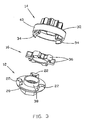
- Figure 3 illustrates a second embodiment shown in exploded form.
- This embodiment has three projections 22 on the drive plate flange 20 and three projections 34 on the pinion flange 32 and the energy absorbing member 16 has six fingers 36.
- the drive plate flange 20 also has an inner tubular extension forming an inner skirt 38 and the pinion flange 32 has an outer tubular projection forming an outer skirt 40.
- the two skirts 38, 40 form compression barriers for limiting the deformation of the energy absorbing member 16.
- the outer skirt 40 also provides a degree of sealing preventing contaminants from entering the space between the drive plate 12 and the pinion 14.
- the pinion device could be used with more complicated designs including positive engagement, inertia assisted positive engagement arrangements and with models incorporating an overrunning clutch assembly.
- the first part is connected to the splines of the motor shaft via the clutch assembly.
Landscapes
- Engineering & Computer Science (AREA)
- General Engineering & Computer Science (AREA)
- Mechanical Engineering (AREA)
- Chemical & Material Sciences (AREA)
- Combustion & Propulsion (AREA)
- Power Engineering (AREA)
- Connection Of Motors, Electrical Generators, Mechanical Devices, And The Like (AREA)
Abstract
A drive pinion assembly 10 for a starter motor has a drive plate 12 adapted to be
driven by a shaft of the motor. The drive plate has axially extending projections 22
which co-operate with corresponding projections 34 on a pinion 14, The projections
are separated circumferentially by fingers 36 of a resiliently compressible member 16
to reduce impact loading on the pinion 14 as it engages teeth of a ring gear.
Description
- This invention relates to electric starter motors and in particular, to the pinion assembly of the starter motor.
- A starter motor is an electric motor which is used to turn an internal combustion engine to start it. The starter motor has a pinion arranged to engage a ring gear fitted to the engine and fitted to its drive shaft in such a way that when the starter motor is turned off, the pinion is disengaged from the ring gear. When the starter motor is turned on, the pinion moves along the shaft and engages the ring gear to turn the engine. The pinion may be moved by a solenoid or by helical splines on the shaft effected by inertia.
- In either arrangement, when the pinion strikes the ring gear, there is considerable impact. This impact causes wear on the ring gear and on the pinion eventually leading to the failure of the starter motor. Hence, there is a need to reduce the impact loading on the pinion so as to increase the life expectancy of the starter motor.
- The present invention reduces the impact loading on the pinion by providing a cushioning between the pinion and the drive plate.
- Accordingly, the present invention provides a cushioned pinion for use with a starter motor, the pinion comprising:
- a first part adapted for being driven in connection with a drive shaft of the starter motor,
- a second part having gear teeth adapted to engage a ring gear of an internal combustion engine, and
- a third part comprising energy absorbing material disposed between the first and second parts, wherein the first and second parts have axially extending projections which are circumferentially offset and engage the energy absorbing material therebetween so as to allow only slight relative motion therebetween about a common axis.
-
- Preferably, at least one of the first and second parts has a radially inner barrier for containing radially inward movement of the third part during compression.
- Preferably, at least one of the first and second parts has a radially outer barrier for containing radially outward movement of the third part during compression.
- Preferably, the third part is a disc with cutouts receiving the projections of the first and second parts.
- Alternatively, the third part is an annular ring with radially extending fingers located between and separating the projections of the first part and the projections of the second part.
- Preferably, the third part substantially fills the gaps between the projections of the first and second parts.
- Preferably, the energy absorbing material is rubber.
- The present invention also provides a starter motor for an internal combustion engine comprising: an electric motor having a housing supporting a stator, an output shaft, a wound rotor fitted to the shaft and located to interact with the stator, a pinion assembly mounted on the shaft, engagement means for moving the pinion assembly along the shaft between an engaged position where in use, the pinion assembly engages a ring gear of the engine and a disengaged position, wherein the pinion assembly has a first part coupled to the shaft to be driven thereby a second part having pinion teeth for engaging the ring gear and a third part of compressible material disposed between the first and second parts, wherein the first and second parts have axially extending projections which are axially aligned and circumferentially spaced whereby the second part is driven by the first part through the third part.
- Two preferred examples of a cushioned pinion drive will now be described by way of example only, in which:
- Figure 1 is a side view of a pinion drive according to a first embodiment;
- Figure 2 is an exploded view of the pinion of Figure 1; and
- Figure 3 is an exploded view of a pinion according to a second embodiment.
-
- Starter motors are well known and will not be described in detail here for the sake of brevity. The pinion drive shown in Figures 1 and 2 is designed for use with a clutchless inertia drive type starter motor in which the pinion drive is adapted to directly engage helical splines on the starter motor shaft and is moved along the shaft against the force of a return spring due to inertia when the starter motor is turned on.
- The
drive pinion 10 shown in Figures 1 and 2 comprises three parts, a first part being thedrive plate 12, a second part being thepinion 14 and a third part being theenergy absorbing member 16. - The
drive plate 12 has three main sections, acollar 18, aflange 20 formed at one end of the collar andprojections 22 extending axially from a face of the flange remote from the collar. In the embodiment of Figure 1 and 2, thedrive plate 12 has only twoprojections 22. Thecollar 18 has acentral bore 24 with an inner surface arranged to engage a helical spline of the motor shaft. - The
pinion 14 is of a similar construction to thedrive plate 12. It has acollar 26 with acentral opening 28. The inner surface of thecollar 26 is adapted to slide along the shaft and does not engage the splines on the shaft. The radially outer surface of thecollar 26 has a plurality ofgear teeth 30 adapted to engage gear teeth of a ring gear or flywheel of the engine. Aflange 32 is formed at one end of thecollar 26 andprojections 34 extend axially from a face of theflange 32 remote from thecollar 26. In this example, there are twoprojections 34. - The
energy absorbing member 16 is a rubber block or disc in the form of an annular ring with four equally spaced radially extendingfingers 36. The thickness of the rubber disc is greater than the length of theprojections drive plate 12 and thepinion 14. Thefingers 36 are interposed between and separate theprojections drive plate 12 andpinion 14. It also allows the two parts to be pressed axially together. - In use, the pinion drive assembly is mounted on the shaft of the starter motor and held together by a return spring, the drive plate being engaged with helical splines on the shaft. When the starter motor is turned on, the shaft rotates but due to the inertia of the
drive pinion assembly 10, the assembly does not initially rotate with the shaft but is moved axially along the shaft by the helical splines. Thepinion drive assembly 10, by this axial movement engages the teeth of the ring gear causing the splines to push thepinion drive assembly 10 axially to the fully engaged position where the motor now has to rotate the pinion with the shaft, causing the engine to rotate for starting. - As can be expected, there is considerable force applied axially and rotationally to the
drive plate 12 and these forces are transmitted to thepinion 14 by therubber member 16. The axial force results in therubber member 16 being squashed axially allowing some absorption of the axial force applied to thepinion 14 to reduce the impact loading on the pinion and ring gear. Torque is transmitted from thedrive plate 12 to thepinion 14 by squeezing thefingers 36 of therubber member 16 between theprojections 22 on thedrive plate 12 and theprojections 34 on thepinion 14. This compression of thefingers 36 reduces the impact force between theteeth 30 of thepinion 14 and the teeth of the ring gear. The compression also allows a slight rotation between thedrive plate 12 and thepinion 14 allowing for better engagement before full torque is applied between the pinion and the ring gear. - Figure 3 illustrates a second embodiment shown in exploded form. This embodiment has three
projections 22 on thedrive plate flange 20 and threeprojections 34 on thepinion flange 32 and theenergy absorbing member 16 has sixfingers 36. Thedrive plate flange 20 also has an inner tubular extension forming aninner skirt 38 and thepinion flange 32 has an outer tubular projection forming anouter skirt 40. The two skirts 38, 40 form compression barriers for limiting the deformation of theenergy absorbing member 16. Theouter skirt 40 also provides a degree of sealing preventing contaminants from entering the space between thedrive plate 12 and thepinion 14. - Although a simple starter motor has been used as the basis for this example, the pinion device could be used with more complicated designs including positive engagement, inertia assisted positive engagement arrangements and with models incorporating an overrunning clutch assembly. When used with a clutch assembly, the first part is connected to the splines of the motor shaft via the clutch assembly.
Claims (15)
- A pinion assembly for use with a starter motor comprising:characterised by a third part 16 comprising energy absorbing material disposed between the first part 12 and the second part 14,a first part 12 adapted for being driven by a drive shaft of the starter motor, anda second part 14 having gear teeth 30 adapted to engage a ring gear of an internal combustion engine,
wherein the first part 12 and the second part 14 have axially extending projections 22, 34 which axially overlap but circumferentially spaced so as to engage the energy absorbing material 16 therebetween so as to allow only slight relative motion between the first part 12 and the second part 14 about a common axis. - A pinion assembly according to claim 1 wherein, one of the first part 12 and the second part 14 has a radially inner barrier 38 for containing radially inward movement of the third part 16 during compression.
- A pinion assembly according to claim 1 or 2 wherein, one of the first part 12 and the second part 14 has a radially outer barrier 40 for containing radially outward movement of the third part 16 during compression.
- A pinion assembly according to claim 1 wherein, the first and second parts 12, 14 have radially inner and outer barriers 38, 40 for restricting radial movement of the third part 16 during compression.
- A pinion assembly of claim 4 wherein, the barriers 38, 40 are axially extending skirts forming a compartment for containing the third part 16.
- The pinion assembly according to any one of the preceding claims wherein, the third part 16 is a block of elastomeric material with cut-outs for receiving the projections 22, 34.
- A pinion assembly according to any one of claims 1 to 5 wherein, the third part 16 comprises a ring with radially extending fingers 36, the fingers 36 being located between adjacent projections 22, 34 of the first and second parts 12, 14.
- A starter motor for an internal combustion engine comprising:wherein the pinion assembly has a first part 12 coupled to the shaft to be driven thereby, a second part 14 having pinion teeth 30 for engaging the ring gearan electric motor having a housing supporting a stator,an output shaft,a wound rotor fitted to the shaft and located to interact with the stator,a pinion assembly mounted on the shaft,engagement means for moving the pinion assembly along the shaft between an engaged position where in use, the pinion assembly engages a ring gear of the engine and a disengaged position,
characterised in that a third part 16 of compressible material 16 disposed between the first and second parts 12, 14 and the first and second parts 12, 14 have axially extending projections 22, 34 which are axially aligned and circumferentially spaced whereby the second part 14 is driven by the first part 12 through the third part 16. - A starter motor according to claim 8 wherein, the projections 22, 34 of the first and second parts 12, 14 have a common radius.
- A starter motor according to claim 8 or 9 wherein, the third part 16 is a ring of elastomeric material having radially extending fingers 36 which separate adjacent projections 22, 34 of the first and second parts 12, 14.
- A starter motor according to claim 8, 9 or 10 wherein, the pinion assembly has radially inner and outer barriers 38, 40 for restricting radial movement of the third part 16 when the third part 16 is being compressed by the first and second parts 12, 14.
- A starter motor according to claim 11 wherein, the inner and outer barriers 38, 40 are axially extending skirts.
- A starter motor according to claim 12 wherein, the axially extending skirts 38, 40 form a compartment containing the third part 16.
- A starter motor according to any one of claims 8 to 13 wherein, the shaft has a spline and the first part 12 has an inner bore surface arranged to engage the spline for driving the pinion assembly.
- A starter motor according to claim 14 wherein, the spline on the shaft is a helical spline and the helical spline causes the first part 12 to axially compress the third part 16 against the second part 14 during operation of the starter motor.
Applications Claiming Priority (2)
| Application Number | Priority Date | Filing Date | Title |
|---|---|---|---|
| US765360 | 2001-01-22 | ||
| US09/765,360 US20020096885A1 (en) | 2001-01-22 | 2001-01-22 | Pinion assembly |
Publications (1)
| Publication Number | Publication Date |
|---|---|
| EP1225329A1 true EP1225329A1 (en) | 2002-07-24 |
Family
ID=25073364
Family Applications (1)
| Application Number | Title | Priority Date | Filing Date |
|---|---|---|---|
| EP02250371A Withdrawn EP1225329A1 (en) | 2001-01-22 | 2002-01-19 | Pinion assembly |
Country Status (3)
| Country | Link |
|---|---|
| US (1) | US20020096885A1 (en) |
| EP (1) | EP1225329A1 (en) |
| CN (1) | CN1367330A (en) |
Cited By (3)
| Publication number | Priority date | Publication date | Assignee | Title |
|---|---|---|---|---|
| FR2901005A1 (en) * | 2006-05-12 | 2007-11-16 | Valeo Systemes Thermiques | HIGH STOP FOR ROTARY VALVE |
| WO2008128513A1 (en) * | 2007-04-18 | 2008-10-30 | Neumayer Tekfor Holding Gmbh | Composite body |
| DE102005061669B4 (en) * | 2004-12-27 | 2016-01-21 | Denso Corporation | Shock-absorbing engine starter |
Families Citing this family (19)
| Publication number | Priority date | Publication date | Assignee | Title |
|---|---|---|---|---|
| JP2006230087A (en) * | 2005-02-17 | 2006-08-31 | Hitachi Ltd | Electric motor, compressor and air conditioner |
| US9259274B2 (en) | 2008-09-30 | 2016-02-16 | Intuitive Surgical Operations, Inc. | Passive preload and capstan drive for surgical instruments |
| US9339342B2 (en) | 2008-09-30 | 2016-05-17 | Intuitive Surgical Operations, Inc. | Instrument interface |
| US7913791B2 (en) * | 2009-05-04 | 2011-03-29 | Robert Bosch Gmbh | Energy storage system for a hybrid vehicle |
| CN102345546A (en) * | 2010-08-02 | 2012-02-08 | 德昌电机(深圳)有限公司 | Starter |
| CN103006104A (en) * | 2011-09-26 | 2013-04-03 | 德昌电机(深圳)有限公司 | Food treating machine, motor assembly and bread machine |
| DE102013209622A1 (en) * | 2013-05-23 | 2014-11-27 | Robert Bosch Gmbh | Electric machine and method for manufacturing and / or operating the electric machine |
| US10932868B2 (en) | 2013-08-15 | 2021-03-02 | Intuitive Surgical Operations, Inc. | Variable instrument preload mechanism controller |
| KR102731855B1 (en) | 2013-08-15 | 2024-11-20 | 인튜어티브 서지컬 오퍼레이션즈 인코포레이티드 | Preloaded surgical instrument interface |
| JP6674377B2 (en) | 2013-08-15 | 2020-04-01 | インテュイティブ サージカル オペレーションズ, インコーポレイテッド | Apparatus with proximal and distal driven discs |
| WO2015023853A1 (en) | 2013-08-15 | 2015-02-19 | Intuitive Surgical Operations, Inc. | Robotic instrument driven element |
| EP3033031B1 (en) * | 2013-08-15 | 2019-03-20 | Intuitive Surgical Operations, Inc. | Actuator interface to instrument sterile adapter |
| WO2015023834A1 (en) | 2013-08-15 | 2015-02-19 | Intuitive Surgical Operations, Inc. | Instrument sterile adapter drive features |
| DE102013221147A1 (en) * | 2013-10-17 | 2015-04-23 | Robert Bosch Gmbh | Transmission device and comfort drive with a transmission device |
| CN103836151A (en) * | 2014-03-14 | 2014-06-04 | 陕西法士特齿轮有限责任公司 | Flexible shock-absorption and noise-reduction gear |
| CN105134980B (en) * | 2015-09-28 | 2017-08-15 | 伯特利阀门集团有限公司 | High-performance impacts angle valve |
| US11890070B2 (en) | 2016-07-14 | 2024-02-06 | Intuitive Surgical Operations, Inc. | Instrument release |
| EP3722631B1 (en) * | 2019-04-08 | 2021-10-20 | Ningbo Geely Automobile Research & Development Co. Ltd. | Transmission arrangement and method for assembling said transmission arrangement |
| CN111835889B (en) * | 2019-04-19 | 2022-12-06 | 荣耀终端有限公司 | Terminal |
Citations (6)
| Publication number | Priority date | Publication date | Assignee | Title |
|---|---|---|---|---|
| US1625793A (en) * | 1920-11-16 | 1927-04-26 | Ind Res Corp | Gas-engine starter |
| GB530533A (en) * | 1938-06-21 | 1940-12-13 | Louis Farion | Improvements relating to engine starters |
| JPS5495844A (en) * | 1978-01-12 | 1979-07-28 | Hitachi Ltd | Starter |
| JPS62240472A (en) * | 1986-04-10 | 1987-10-21 | Nippon Denso Co Ltd | Inertia jump-in type starter |
| JPH04255570A (en) * | 1991-02-06 | 1992-09-10 | Mitsuba Electric Mfg Co Ltd | Starter |
| FR2754857A1 (en) * | 1996-10-23 | 1998-04-24 | Valeo Equip Electr Moteur | Torsion-damped automobile engine starter without free-wheel |
-
2001
- 2001-01-22 US US09/765,360 patent/US20020096885A1/en not_active Abandoned
-
2002
- 2002-01-19 EP EP02250371A patent/EP1225329A1/en not_active Withdrawn
- 2002-01-22 CN CN02106503.9A patent/CN1367330A/en active Pending
Patent Citations (6)
| Publication number | Priority date | Publication date | Assignee | Title |
|---|---|---|---|---|
| US1625793A (en) * | 1920-11-16 | 1927-04-26 | Ind Res Corp | Gas-engine starter |
| GB530533A (en) * | 1938-06-21 | 1940-12-13 | Louis Farion | Improvements relating to engine starters |
| JPS5495844A (en) * | 1978-01-12 | 1979-07-28 | Hitachi Ltd | Starter |
| JPS62240472A (en) * | 1986-04-10 | 1987-10-21 | Nippon Denso Co Ltd | Inertia jump-in type starter |
| JPH04255570A (en) * | 1991-02-06 | 1992-09-10 | Mitsuba Electric Mfg Co Ltd | Starter |
| FR2754857A1 (en) * | 1996-10-23 | 1998-04-24 | Valeo Equip Electr Moteur | Torsion-damped automobile engine starter without free-wheel |
Non-Patent Citations (3)
| Title |
|---|
| PATENT ABSTRACTS OF JAPAN vol. 12, no. 113 (M - 683) 9 April 1988 (1988-04-09) * |
| PATENT ABSTRACTS OF JAPAN vol. 17, no. 34 (M - 1357) 22 January 1993 (1993-01-22) * |
| PATENT ABSTRACTS OF JAPAN vol. 3, no. 120 (M - 75) 9 October 1979 (1979-10-09) * |
Cited By (5)
| Publication number | Priority date | Publication date | Assignee | Title |
|---|---|---|---|---|
| DE102005061669B4 (en) * | 2004-12-27 | 2016-01-21 | Denso Corporation | Shock-absorbing engine starter |
| FR2901005A1 (en) * | 2006-05-12 | 2007-11-16 | Valeo Systemes Thermiques | HIGH STOP FOR ROTARY VALVE |
| WO2007131942A1 (en) * | 2006-05-12 | 2007-11-22 | Valeo Systemes Thermiques | High stop for a rotary valve |
| WO2008128513A1 (en) * | 2007-04-18 | 2008-10-30 | Neumayer Tekfor Holding Gmbh | Composite body |
| US8595934B2 (en) | 2007-04-18 | 2013-12-03 | Neumayer Tekfor Holding Gmbh | Method of producing a composite body |
Also Published As
| Publication number | Publication date |
|---|---|
| US20020096885A1 (en) | 2002-07-25 |
| CN1367330A (en) | 2002-09-04 |
Similar Documents
| Publication | Publication Date | Title |
|---|---|---|
| EP1225329A1 (en) | Pinion assembly | |
| JP4174820B2 (en) | Starter | |
| JP4165362B2 (en) | Starter | |
| US5596902A (en) | Starter drive clutch | |
| US4304140A (en) | Starter | |
| JP3603508B2 (en) | Starter | |
| US6633099B2 (en) | Engagement and disengagement mechanism for a coaxial starter motor assembly | |
| US7520190B2 (en) | Structure of engine starter equipped with planetary gear speed reducer | |
| EP0649984B1 (en) | Starter with epicycle reduction gear | |
| US9004035B2 (en) | Starter motor | |
| US5241871A (en) | Torque limiting starter drive clutch assembly | |
| US4651859A (en) | Clutch driven plate assembly with a two-part hub | |
| US5237882A (en) | Engine starter gearing with laminated cushion washers | |
| US4627299A (en) | Engine starter gearing | |
| US4524629A (en) | Compact engine starter drive | |
| JPH01203655A (en) | Starter gear device for engine | |
| US4744258A (en) | Non-indexing engine starter gearing | |
| US3114270A (en) | Starter drive | |
| WO2006121743A1 (en) | Pawl drive for coupling torque between two rotatable elements | |
| JP2018105497A (en) | Pulley with isolation | |
| KR20080085171A (en) | Torque transmission device | |
| US5513540A (en) | Engine starter gearing having improved grease retention | |
| GB2091949A (en) | Electric starters for internal combustion engines | |
| EP1028251B1 (en) | Seal for a starter motor drive | |
| JPS6128756A (en) | Starter with planet gear reduction mechanism |
Legal Events
| Date | Code | Title | Description |
|---|---|---|---|
| PUAI | Public reference made under article 153(3) epc to a published international application that has entered the european phase |
Free format text: ORIGINAL CODE: 0009012 |
|
| AK | Designated contracting states |
Kind code of ref document: A1 Designated state(s): AT BE CH CY DE DK ES FI FR GB GR IE IT LI LU MC NL PT SE TR |
|
| AX | Request for extension of the european patent |
Free format text: AL;LT;LV;MK;RO;SI |
|
| AKX | Designation fees paid | ||
| REG | Reference to a national code |
Ref country code: DE Ref legal event code: 8566 |
|
| STAA | Information on the status of an ep patent application or granted ep patent |
Free format text: STATUS: THE APPLICATION IS DEEMED TO BE WITHDRAWN |
|
| 18D | Application deemed to be withdrawn |
Effective date: 20030125 |