EP1219359A2 - Metallic plate material for electric/electronic instrument and electric/electronic instrument using same - Google Patents
Metallic plate material for electric/electronic instrument and electric/electronic instrument using same Download PDFInfo
- Publication number
- EP1219359A2 EP1219359A2 EP01130272A EP01130272A EP1219359A2 EP 1219359 A2 EP1219359 A2 EP 1219359A2 EP 01130272 A EP01130272 A EP 01130272A EP 01130272 A EP01130272 A EP 01130272A EP 1219359 A2 EP1219359 A2 EP 1219359A2
- Authority
- EP
- European Patent Office
- Prior art keywords
- metallic plate
- resin
- plate material
- electric
- mass
- Prior art date
- Legal status (The legal status is an assumption and is not a legal conclusion. Google has not performed a legal analysis and makes no representation as to the accuracy of the status listed.)
- Granted
Links
Images

Classifications
-
- H—ELECTRICITY
- H05—ELECTRIC TECHNIQUES NOT OTHERWISE PROVIDED FOR
- H05K—PRINTED CIRCUITS; CASINGS OR CONSTRUCTIONAL DETAILS OF ELECTRIC APPARATUS; MANUFACTURE OF ASSEMBLAGES OF ELECTRICAL COMPONENTS
- H05K9/00—Screening of apparatus or components against electric or magnetic fields
- H05K9/0073—Shielding materials
- H05K9/0081—Electromagnetic shielding materials, e.g. EMI, RFI shielding
- H05K9/0088—Electromagnetic shielding materials, e.g. EMI, RFI shielding comprising a plurality of shielding layers; combining different shielding material structure
-
- C—CHEMISTRY; METALLURGY
- C23—COATING METALLIC MATERIAL; COATING MATERIAL WITH METALLIC MATERIAL; CHEMICAL SURFACE TREATMENT; DIFFUSION TREATMENT OF METALLIC MATERIAL; COATING BY VACUUM EVAPORATION, BY SPUTTERING, BY ION IMPLANTATION OR BY CHEMICAL VAPOUR DEPOSITION, IN GENERAL; INHIBITING CORROSION OF METALLIC MATERIAL OR INCRUSTATION IN GENERAL
- C23C—COATING METALLIC MATERIAL; COATING MATERIAL WITH METALLIC MATERIAL; SURFACE TREATMENT OF METALLIC MATERIAL BY DIFFUSION INTO THE SURFACE, BY CHEMICAL CONVERSION OR SUBSTITUTION; COATING BY VACUUM EVAPORATION, BY SPUTTERING, BY ION IMPLANTATION OR BY CHEMICAL VAPOUR DEPOSITION, IN GENERAL
- C23C26/00—Coating not provided for in groups C23C2/00 - C23C24/00
-
- B—PERFORMING OPERATIONS; TRANSPORTING
- B05—SPRAYING OR ATOMISING IN GENERAL; APPLYING FLUENT MATERIALS TO SURFACES, IN GENERAL
- B05D—PROCESSES FOR APPLYING FLUENT MATERIALS TO SURFACES, IN GENERAL
- B05D7/00—Processes, other than flocking, specially adapted for applying liquids or other fluent materials to particular surfaces or for applying particular liquids or other fluent materials
- B05D7/14—Processes, other than flocking, specially adapted for applying liquids or other fluent materials to particular surfaces or for applying particular liquids or other fluent materials to metal, e.g. car bodies
- B05D7/16—Processes, other than flocking, specially adapted for applying liquids or other fluent materials to particular surfaces or for applying particular liquids or other fluent materials to metal, e.g. car bodies using synthetic lacquers or varnishes
-
- C—CHEMISTRY; METALLURGY
- C09—DYES; PAINTS; POLISHES; NATURAL RESINS; ADHESIVES; COMPOSITIONS NOT OTHERWISE PROVIDED FOR; APPLICATIONS OF MATERIALS NOT OTHERWISE PROVIDED FOR
- C09D—COATING COMPOSITIONS, e.g. PAINTS, VARNISHES OR LACQUERS; FILLING PASTES; CHEMICAL PAINT OR INK REMOVERS; INKS; CORRECTING FLUIDS; WOODSTAINS; PASTES OR SOLIDS FOR COLOURING OR PRINTING; USE OF MATERIALS THEREFOR
- C09D133/00—Coating compositions based on homopolymers or copolymers of compounds having one or more unsaturated aliphatic radicals, each having only one carbon-to-carbon double bond, and at least one being terminated by only one carboxyl radical, or of salts, anhydrides, esters, amides, imides, or nitriles thereof; Coating compositions based on derivatives of such polymers
- C09D133/04—Homopolymers or copolymers of esters
- C09D133/06—Homopolymers or copolymers of esters of esters containing only carbon, hydrogen and oxygen, the oxygen atom being present only as part of the carboxyl radical
- C09D133/08—Homopolymers or copolymers of acrylic acid esters
-
- C—CHEMISTRY; METALLURGY
- C09—DYES; PAINTS; POLISHES; NATURAL RESINS; ADHESIVES; COMPOSITIONS NOT OTHERWISE PROVIDED FOR; APPLICATIONS OF MATERIALS NOT OTHERWISE PROVIDED FOR
- C09D—COATING COMPOSITIONS, e.g. PAINTS, VARNISHES OR LACQUERS; FILLING PASTES; CHEMICAL PAINT OR INK REMOVERS; INKS; CORRECTING FLUIDS; WOODSTAINS; PASTES OR SOLIDS FOR COLOURING OR PRINTING; USE OF MATERIALS THEREFOR
- C09D133/00—Coating compositions based on homopolymers or copolymers of compounds having one or more unsaturated aliphatic radicals, each having only one carbon-to-carbon double bond, and at least one being terminated by only one carboxyl radical, or of salts, anhydrides, esters, amides, imides, or nitriles thereof; Coating compositions based on derivatives of such polymers
- C09D133/24—Homopolymers or copolymers of amides or imides
- C09D133/26—Homopolymers or copolymers of acrylamide or methacrylamide
-
- C—CHEMISTRY; METALLURGY
- C09—DYES; PAINTS; POLISHES; NATURAL RESINS; ADHESIVES; COMPOSITIONS NOT OTHERWISE PROVIDED FOR; APPLICATIONS OF MATERIALS NOT OTHERWISE PROVIDED FOR
- C09D—COATING COMPOSITIONS, e.g. PAINTS, VARNISHES OR LACQUERS; FILLING PASTES; CHEMICAL PAINT OR INK REMOVERS; INKS; CORRECTING FLUIDS; WOODSTAINS; PASTES OR SOLIDS FOR COLOURING OR PRINTING; USE OF MATERIALS THEREFOR
- C09D163/00—Coating compositions based on epoxy resins; Coating compositions based on derivatives of epoxy resins
-
- Y—GENERAL TAGGING OF NEW TECHNOLOGICAL DEVELOPMENTS; GENERAL TAGGING OF CROSS-SECTIONAL TECHNOLOGIES SPANNING OVER SEVERAL SECTIONS OF THE IPC; TECHNICAL SUBJECTS COVERED BY FORMER USPC CROSS-REFERENCE ART COLLECTIONS [XRACs] AND DIGESTS
- Y10—TECHNICAL SUBJECTS COVERED BY FORMER USPC
- Y10T—TECHNICAL SUBJECTS COVERED BY FORMER US CLASSIFICATION
- Y10T428/00—Stock material or miscellaneous articles
- Y10T428/12—All metal or with adjacent metals
- Y10T428/12007—Component of composite having metal continuous phase interengaged with nonmetal continuous phase
-
- Y—GENERAL TAGGING OF NEW TECHNOLOGICAL DEVELOPMENTS; GENERAL TAGGING OF CROSS-SECTIONAL TECHNOLOGIES SPANNING OVER SEVERAL SECTIONS OF THE IPC; TECHNICAL SUBJECTS COVERED BY FORMER USPC CROSS-REFERENCE ART COLLECTIONS [XRACs] AND DIGESTS
- Y10—TECHNICAL SUBJECTS COVERED BY FORMER USPC
- Y10T—TECHNICAL SUBJECTS COVERED BY FORMER US CLASSIFICATION
- Y10T428/00—Stock material or miscellaneous articles
- Y10T428/12—All metal or with adjacent metals
- Y10T428/12493—Composite; i.e., plural, adjacent, spatially distinct metal components [e.g., layers, joint, etc.]
- Y10T428/12535—Composite; i.e., plural, adjacent, spatially distinct metal components [e.g., layers, joint, etc.] with additional, spatially distinct nonmetal component
- Y10T428/12556—Organic component
- Y10T428/12569—Synthetic resin
-
- Y—GENERAL TAGGING OF NEW TECHNOLOGICAL DEVELOPMENTS; GENERAL TAGGING OF CROSS-SECTIONAL TECHNOLOGIES SPANNING OVER SEVERAL SECTIONS OF THE IPC; TECHNICAL SUBJECTS COVERED BY FORMER USPC CROSS-REFERENCE ART COLLECTIONS [XRACs] AND DIGESTS
- Y10—TECHNICAL SUBJECTS COVERED BY FORMER USPC
- Y10T—TECHNICAL SUBJECTS COVERED BY FORMER US CLASSIFICATION
- Y10T428/00—Stock material or miscellaneous articles
- Y10T428/26—Web or sheet containing structurally defined element or component, the element or component having a specified physical dimension
- Y10T428/263—Coating layer not in excess of 5 mils thick or equivalent
- Y10T428/264—Up to 3 mils
- Y10T428/265—1 mil or less
-
- Y—GENERAL TAGGING OF NEW TECHNOLOGICAL DEVELOPMENTS; GENERAL TAGGING OF CROSS-SECTIONAL TECHNOLOGIES SPANNING OVER SEVERAL SECTIONS OF THE IPC; TECHNICAL SUBJECTS COVERED BY FORMER USPC CROSS-REFERENCE ART COLLECTIONS [XRACs] AND DIGESTS
- Y10—TECHNICAL SUBJECTS COVERED BY FORMER USPC
- Y10T—TECHNICAL SUBJECTS COVERED BY FORMER US CLASSIFICATION
- Y10T428/00—Stock material or miscellaneous articles
- Y10T428/26—Web or sheet containing structurally defined element or component, the element or component having a specified physical dimension
- Y10T428/269—Web or sheet containing structurally defined element or component, the element or component having a specified physical dimension including synthetic resin or polymer layer or component
-
- Y—GENERAL TAGGING OF NEW TECHNOLOGICAL DEVELOPMENTS; GENERAL TAGGING OF CROSS-SECTIONAL TECHNOLOGIES SPANNING OVER SEVERAL SECTIONS OF THE IPC; TECHNICAL SUBJECTS COVERED BY FORMER USPC CROSS-REFERENCE ART COLLECTIONS [XRACs] AND DIGESTS
- Y10—TECHNICAL SUBJECTS COVERED BY FORMER USPC
- Y10T—TECHNICAL SUBJECTS COVERED BY FORMER US CLASSIFICATION
- Y10T428/00—Stock material or miscellaneous articles
- Y10T428/31504—Composite [nonstructural laminate]
- Y10T428/31511—Of epoxy ether
- Y10T428/31529—Next to metal
-
- Y—GENERAL TAGGING OF NEW TECHNOLOGICAL DEVELOPMENTS; GENERAL TAGGING OF CROSS-SECTIONAL TECHNOLOGIES SPANNING OVER SEVERAL SECTIONS OF THE IPC; TECHNICAL SUBJECTS COVERED BY FORMER USPC CROSS-REFERENCE ART COLLECTIONS [XRACs] AND DIGESTS
- Y10—TECHNICAL SUBJECTS COVERED BY FORMER USPC
- Y10T—TECHNICAL SUBJECTS COVERED BY FORMER US CLASSIFICATION
- Y10T428/00—Stock material or miscellaneous articles
- Y10T428/31504—Composite [nonstructural laminate]
- Y10T428/31551—Of polyamidoester [polyurethane, polyisocyanate, polycarbamate, etc.]
- Y10T428/31605—Next to free metal
-
- Y—GENERAL TAGGING OF NEW TECHNOLOGICAL DEVELOPMENTS; GENERAL TAGGING OF CROSS-SECTIONAL TECHNOLOGIES SPANNING OVER SEVERAL SECTIONS OF THE IPC; TECHNICAL SUBJECTS COVERED BY FORMER USPC CROSS-REFERENCE ART COLLECTIONS [XRACs] AND DIGESTS
- Y10—TECHNICAL SUBJECTS COVERED BY FORMER USPC
- Y10T—TECHNICAL SUBJECTS COVERED BY FORMER US CLASSIFICATION
- Y10T428/00—Stock material or miscellaneous articles
- Y10T428/31504—Composite [nonstructural laminate]
- Y10T428/31678—Of metal
-
- Y—GENERAL TAGGING OF NEW TECHNOLOGICAL DEVELOPMENTS; GENERAL TAGGING OF CROSS-SECTIONAL TECHNOLOGIES SPANNING OVER SEVERAL SECTIONS OF THE IPC; TECHNICAL SUBJECTS COVERED BY FORMER USPC CROSS-REFERENCE ART COLLECTIONS [XRACs] AND DIGESTS
- Y10—TECHNICAL SUBJECTS COVERED BY FORMER USPC
- Y10T—TECHNICAL SUBJECTS COVERED BY FORMER US CLASSIFICATION
- Y10T428/00—Stock material or miscellaneous articles
- Y10T428/31504—Composite [nonstructural laminate]
- Y10T428/31678—Of metal
- Y10T428/31692—Next to addition polymer from unsaturated monomers
Definitions
- the resin-coated metallic thin plate In forming performed in that case, it has become general to use volatile press oil in order to omit a process of cleaning after press-molding. Therefore, it is required that the resin-coated metallic thin plate should have good formabilities. In some cases, press-molding is preformed using ordinary press oil, and in that case, solvent degreasing needs to be performed after press-molding. Therefore, it is also required that the metallic thin plate having a surface coating should have resistance to solvents.
- the surface of the metallic thin plate having a surface coating should have good sliding properties.
- the casing in order that the appearance of a casing may not be deteriorated by fingerprints and flaws when an instrument is assembled, it is required that the casing should have resistance to fingerprints and resistance to scraches.
- a resin-coated metallic thin plate having a surface coating used for producing a casing for an electric/electronic instrument needs to be good in formabilities, resistance to solvents, sliding properties, resistance to fingerprints, resistance to scratches, etc.
- a resin-coated metallic plate material is used.
- a resin coating is insulator. Therefore, a casing made of a resin-coated metallic plate material cannot be earthed, and cannot satisfactorily exhibits a shield function properties against electromagnetic waves from electric/electronic circuits of parts of an electric/electronic instrument contained in the casing.
- an electrically-conductive agent such as metallic powder contained in a resin coating may fall off by the resin coating, which forms a surface of the metallic plate material, being rubbed by a molding machine, and/or by the plate material being transformed.
- the metallic powder that has fallen off may come into electric circuits or precision drive portions of parts of an electric/electronic instrument in a casing, and make the electric/electronic instrument malfunction.
- the resin coating of this type has electrical conductivity only at the places where the electrically-conductive agent exists. Since the shape and distribution of the electrically-conductive agent affects the electrical conductivity, the electrical conductivity varies to a large degree, according to the place. Therefore, the casing made of this plate material does not allow an electric/electronic instrument to be earthed at every desired place. The electric/electronic instrument may not be able to be earthed at some place of the casing.
- An object of the present invention is to provide a metallic plate material coated with an electrically-conductive resin coating which does not contain an electrically-conductive agent in the form of particles, and which is good in earthing properties , shield properties against electromagnetic waves, formabilities, sliding properties and resistance to solvents, and provide an electric/electronic instrument using this metallic plate material.
- the present invention provides a metallic plate material for an electric/electronic instrument comprising a resin-coated metallic plate material, wherein the resin coating contains, as resin, at least one substance chosen from a group consisting of acrylic-based resin, epoxy-based resin, and urethane-based resin, and contains water in the amount of 1 to 50 mass % and a lubricant in the amount of 0.1 to 20 mass %, and the resin coating has a thickness of 0.05 to 5 ⁇ m.
- the present invention provides an electric/electronic instrument using this metallic plate material.
- an electrically-conductive agent as mentioned above is not mixed into a resin coating that coats a surface of a metallic plate.
- the resin coating itself has electrical conductivity.
- it has also good formabilities and good sliding properties.
- the coefficient of friction that represents lubricity of the surface of a resin coating 2 is adopted as an index of formabilities. As shown in FIG. 1, the coefficient of friction is measured with a Bauden test instrument.
- a contactor 3 which is an SUS globe of 3 mm in diameter is compressed against the surface of a resin coating 2 of a metallic plate material with a load of 100 gf.
- force F (gf) required to move the contactor 3 in a direction indicated by an arrow is measured, and a value F/100 is obtained as a coefficient of friction ( ⁇ k).
- ⁇ k coefficient of friction
- the shield properties against electromagnetic waves and earthing properties of a resin-coated metallic plate material can be evaluated by the electrical conductivity of the resin coating, and the electrical conductivity of the resin coating 2 is evaluated by the contact electrical resistance measured with a device shown in FIG. 2.
- the shield properties against electromagnetic waves and earthing properties of a resin-coated metallic plate material can be evaluated by the electrical conductivity of the resin coating, and the abovesaid contact electrical resistance is measured with a tester 5 in a state that a steel probe 4 having an end of 5mm in radius is compressed against the surface of a resin coating 2 of a metallic plate material with a load of 500 gf and that a current is made to flow between a metallic plate 1 and the steel probe 4.
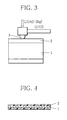
- the sliding properties of a resin coating 2 are evaluated by the coefficient of friction after sliding measured with a device shown in FIG. 3.
- the contactor 3 shown in FIG. 1 is compressed against the surface of a resin coating 2 with a load of 20 gf, and in that state, the contactor 3 is made to go and come back five times at a speed of 5 mm/s. Then, the coefficient of friction is measured to thereby evaluate the sliding properties.
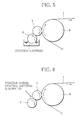
- FIG. 4 shows an example of the metallic plate material according to the present invention.
- the illustrated metallic plate material has a structure wherein each surface of a metallic plate 1 as a substrate is coated with a resin coating 2 which will be described later.
- the material for the metallic plate 1 and the size and shape thereof are not restricted to any special ones. They are chosen appropriately, in accordance with the use for the to-be-produced metallic plate material.
- a galvanized steel plate, a stainless steel plate, an aluminum plate, a variety of aluminum alloy plates, a copper plate, a copper alloy plate etc. can be used.
- the resin coating 2 needs to contain, as essential components, resin, water and a lubricant, which will be described later.
- the thickness of the resin coating 2 needs to be 0.05 to 5 ⁇ m.
- the resin consists of any one of acrylic-based resins, epoxy-based resins and urethane-based resins, or a mixture of two or more of those resins.
- acrylic-based resin for example, acrylate resin, methacrylate resin, methyl methacrylate resin, isopropyl methacrylate resin, etc.
- epoxy-based resin for example, bisphenol A epoxy resin, acrylic modified epoxy resin, bisphenol F epoxy resin, etc. can be used.
- urethane-based resin for example, polyether urethane resin, polycarbonate urethane resin, etc. can be used.
- the resin coating 2 contains water.
- the water is a component for ensuring that the resin coating 2 has electrical conductivity.
- the amount of water contained in the resin coating 2 is arranged to be 1 to 50 mass %.
- the desirable amount of water contained in the resin coating is 1 to 50 mass %.
- a lubricant which is another essential component, is a component for improving the formabilities of the produced metallic plate material.
- the amount of the lubricant contained in the resin coating 2 is arranged to be 0.1 to 20 mass %.
- the coefficient of friction ( ⁇ k) of the resin coating 2 is larger than 0.3, which means that the above-mentioned beneficial effect is not obtained satisfactorily.
- the amount of the lubricant contained in the resin coating 2 is more than 20 mass %, the contact electrical resistance (an average of resistances measured at 100 places) is over 100 ⁇ , which means that the electrical conductivity of the resin coating 2 is worse, so that the shield properties against electromagnetic waves or the earthing properties cannot be obtained satisfactorily.
- the desirable amount of the lubricant contained in the resin coating 2 is 0.5 to 10 mass %.
- a lubricant that dissolves in water, or a lubricant that is dispersed in water by using a suitable emulsifying agent to form an emulsion is desirable.
- a suitable emulsifying agent to form an emulsion for example, polyethylene wax, carnauba wax, lanolin, paraffin wax, microcrystalline wax, polytetrafluoroethylene, polyvinyl fluoride, etc. can be mentioned.
- the thickness of the resin coating 2 is arranged to be 0.05 to 5 ⁇ m.
- the coefficient of friction measured with the device shown in FIG. 3 is larger than 0.5, which means that the sliding properties of the surface of the produced metallic plate material are worse.
- the contact electrical resistance of the resin coating 2 is over 100 ⁇ , which means that the electrical conductivity of the resin coating 2 is worse, so that the shield properties against electromagnetic waves or the earthing properties cannot be obtained satisfactorily.
- the desirable thickness of the resin coating 2 is 0.1 to 2 ⁇ m.
- the resin coating 2 further contains one or more substances chosen from acrylamide, polyacrylamide and acrylamide compounds as mentioned below. In that case, the electrical conductivity of the resin coating 2 further improves.
- the amount of such substance contained in the resin coating 2 is 5 mass % or more, because when it is less than 5 mass %, the above-mentioned beneficial effect cannot be obtained satisfactorily.
- the more desirable amount of such substance contained in the resin coating 2 is 30 mass % or more.
- acrylamide compounds for example, one or more acrylamide compounds chosen from methylene bisacrylamide, 2-acrylamide-2-methylpropane sulfonate, N-methylolacrylamide, N-methylene sulfonate acrylamide, N-isopropylacrylamide, etc. can be used.
- the resin coating 2 may further contain a surface-active agent, because it also can improve the electrical conductivity of the resin coating 2.
- the amount of the surface-active agent contained in the resin coating 2 is in the range of 0.5 to 30 mass %. When it is less than 0.5 mass %, the above-mentioned beneficial effect cannot be obtained satisfactorily. When it is more than 30 mass %, the resistance to solvents is worse.
- the resin coating dissolves in trichlene, so that the resin coating decreases by 10 mass % or more.
- the more desirable amount of the surface-active agent contained in the resin coating is 3 to 20 mass %.
- nonionic surface-active agents such as alkylphenol ethylene adducts and higher alcohol ethylene oxide adducts; anion surface-active agents such as higher alcohol ester sulfate, alkylbenzene sulfonate, and higher alcohol phosphate; and cationic surface-active agents such as higher alkyl amine, alkyltrimethyl ammonium salt and sepamine type quaternary ammonium salt; etc.
- anion surface-active agent or a cationic surface-active agent because the anion surface-active agents and the cationic surface-active agents are ionized in water to thereby improve the electrical conductivity.
- the metallic plate material according to the present invention is produced by applying a coating material including the components for forming a resin coating as mentioned above, onto the surface of the metallic plate 1, with a thickness of 0.5 to 5 ⁇ m.
- the coating material is a water thinnable coating material, which means a coating material wherein components such as the above-explained resin, lubricant, and surface-active agent (if needed), and resin-forming components such as a curing agent for curing the resin are dissolved or dispersed in water.
- a water thinnable coating material is an emulsion coating material wherein each of the above-mentioned components is dispersed as emulsion particles in water as a continuous phase.
- the water thinnable coating material is applied onto the metallic plate.
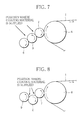
- a bottom-up method (reverse rotation) shown in FIG. 5 a top-feed method (natural rotation) shown in FIG. 6, another top-feed method (reverse rotation) shown in FIG. 7, another top-feed method (natural rotation) shown in FIG. 8, etc. can be adopted appropriately. It is desirable to adopt a top-feed method among these application methods.
- the amount of each of the components is determined so that the amounts of water, the lubricant and the surface-active agent contained in the resin coating (layer) formed by applying the water thinnable coating material onto the metallic plate may be 1 to 50 mass %, 0.1 to 20 mass %, and 0.5 to 30 mass %, respectively.
- the resin, the lubricant, the surface-active agent, etc. form the solid component of the prepared water thinnable coating material. It is desirable that the amount of the solid component of the water thinnable coating material is 3 to 40 mass %.
- the amount of the solid component of the water thinnable coating material is fixed in the range of 6 to 27 mass %.
- the viscosity of the water thinnable coating material at the temperature of 20°C is in the range of 5 to 40 seconds in terms of efflux time measured using a No. 4 Ford cup specified in JIS K 5400, i.e. , the time required for all the water thinnable coating material to flow out from the No. 4 Ford cup.
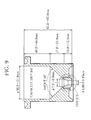
- FIG. 9 shows the dimensions of the No. 4 Ford cup used for measuring the viscosity.
- the viscosity is measured as follows:
- a sample of a to-be-measured water thinnable coating material and the No. 4 Ford cup are kept at 20 ⁇ 1°C in advance.
- the measurement is performed also at 20 ⁇ 1°C.
- the No. 4 Ford cup is set on a rest, a glass plate is set on the cup, and the cup is kept horizontal. Under the cup is placed a vessel for receiving the water thinnable coating material.
- a rubber plate is pressed on an orifice of the cup so that the body temperature may be free to the orifice, and the water thinnable coating material is poured to fill the cup in a manner that bubbles may not be produced in the water thinnable coating material. Then, the glass plate is slid on the upper edge of the cup from the side horizontally, to thereby scrape off excess water thinnable coating material. Then, the rubber plate is taken off.
- a stopwatch is started at the same time the glass plate is taken off the upper edge of the cup, and stopped at the time a continuous flow of the water thinnable coating material through the orifice stops.
- the time required for the water thinnable coating material to flow out is obtained up to one decimal place and rounded to a whole number in second.
- the viscosity is expressed in this efflux time.
- the water thinnable coating material showing an efflux time shorter than 5 seconds is too low in viscosity.
- the gap between the rolls as shown in FIGS. 5 to 8 needs to be made larger. This makes it difficult to form a uniform resin coating and leads to positional variation in electrical conductivity of the resin coating.
- the water thinnable coating material showing an efflux time longer than 40 seconds is too high in viscosity, and causes a problem that the resin coating is formed with too large a thickness, even if the gap between the rolls is made narrower.
- the more desirable viscosity of the water thinnable coating material is 6 to 30 seconds in terms of efflux time.
- the metallic plate undergoes pre-treatment such as rinse chromate treatment such as phosphate chromate or chromic chromate, non-rinse chromate treatment wherein resin containing chromium is applied, or non-chromium treatment wherein zirconium or titanium is used in place of chrome.
- pre-treatment such as rinse chromate treatment such as phosphate chromate or chromic chromate, non-rinse chromate treatment wherein resin containing chromium is applied, or non-chromium treatment wherein zirconium or titanium is used in place of chrome.
- Each of the different coating materials shown in tables 1 and 2 was prepared using the components specified in tables 1 and 2, where water or a solvent was used so that the amount of the solid component might be that specified in tables 1 and 2 (mass %).
- the resin in each coating material shown in tables 1 and 2 consists of a base resin and an acrylamide substance.
- the amount of a base resin and the amount of an acrylamide substance are shown by mass % where the amount of the whole resin, which are part of the solid component of each coating material, is considered 100.
- the amount of a lubricant as well as the amount of a surface-active agent in tables 1 and 2 is shown by mass % where the amount of the solid component in each coating material is considered 100.
- the metallic plates of various kinds shown in tables 3 and 4 were first degreased using a degreasing agent that was on the market. Then, the coating materials shown in tables 1 and 2 were applied onto the metallic plates with various thicknesses by the application methods of various kinds shown in tables 3 and 4. Then, the metallic plates were baked and thereby dried. Thus, the metallic plate materials each coated with a dried resin coating were obtained. In each dried resin coating, the solid component (containing resin, a lubricant, and a surface-active agent) of each coating material had been cured.
- the mass (M) of a resin coating of a sample piece was measured. Then, the sample piece was heated in an oven at the temperature of 105 °C for 1 hour, and then the mass (M') of the resin coating of the sample piece was measured and the value of an expression (M-M') ⁇ 100/M was calculated. Since it can be considered that all the water contained in the resin coating had flown away during heating, the value of the expression can be considered as the amount of water that had been contained in the resin coating (expressed in mass %).
- the amount of a lubricant contained in each resin coating corresponds to the amount of the lubricant contained in the solid component of a used coating material (shown in tables 1 and 2).
- the obtained metallic plate materials were measured and evaluated in electrical conductivity, formabilities, lubricity, sliding properties, and resistance to solvents, in the following ways.
- contact resistance was measured at 100 places of each resin coating 2, using the device shown in FIG. 2, and an average of those measured values was obtained.
- 3030-10 HiTESTER produced by Hioki E.E. Corporation
- Molding speed 20 mm/sec
- Punch diameter 40 mm
- Die diameter 42.4 mm
- Blank diameter 84 mm.
- the forming height of 6 mm or higher was considered very good (o ⁇ ), that of 5.5 mm or higher and lower than 6 mm was considered good ( ⁇ ), and that lower than 5 mm was considered bad ( ⁇ ).
- a sample piece of 100 mm square was cut from each metallic plate material and soaked in boiled trichlene for 5 minutes. Then, the decrease in mass, which was caused by the resin coating dissolving in trichlene, was measured, and the dissolving rate (%) was calculated.
- the dissolving rate of 5 % or lower was considered very good (o ⁇ ), that of 10 % or lower and higher than 5 % was considered good ( ⁇ ), and that of 10% or higher was considered bad ( ⁇ ).
- the metallic plate materials are good in electrical conductivity, formabilities, lubricity, sliding properties, etc. Thus, they have enough properties to be plate materials for an electric/electronic instrument.
- Embodiment 4 was a little worse in resistance to solvents because the amount of water contained in the resin coating was a little larger.
- Embodiment 5 was a little worse in formabilities because the amount of the lubricant contained in the coating material 1 was small.
- Embodiment 18 was a little worse in contact resistance, because the amount of the solid component and the viscosity of the coating material 13 were a little larger and the thickness of coating became a little thicker.
- Embodiment 20 was a little worse in resistance to solvents, because the amount of the surface-active agent contained in the coating material 12 was a little larger.
- Embodiments 21 and 22 were a little worse in contact resistance, because not water thinnable coating materials were used.
- the resin coating that forms a surface of the metallic plate material does not contain an electrically-conductive agent such as metallic powder, unlike the resin coating of the conventional metallic plate material.
- the metallic plate material according to the present invention is good in earthing properties, shield properties against electromagnetic waves, formabilities, lubricity, sliding properties, resistance to solvents etc. Therefore, as a material for a casing for containing parts of various electric/electronic instruments, the metallic plate material according to the present invention has a very high industrial value.
Landscapes
- Chemical & Material Sciences (AREA)
- Engineering & Computer Science (AREA)
- Wood Science & Technology (AREA)
- Life Sciences & Earth Sciences (AREA)
- Organic Chemistry (AREA)
- Materials Engineering (AREA)
- Electromagnetism (AREA)
- Microelectronics & Electronic Packaging (AREA)
- Physics & Mathematics (AREA)
- Metallurgy (AREA)
- Mechanical Engineering (AREA)
- Chemical Kinetics & Catalysis (AREA)
- Laminated Bodies (AREA)
- Paints Or Removers (AREA)
- Application Of Or Painting With Fluid Materials (AREA)
- Lubricants (AREA)
- Other Surface Treatments For Metallic Materials (AREA)
- Shielding Devices Or Components To Electric Or Magnetic Fields (AREA)
Abstract
Description


Claims (9)
- A metallic plate material for an electric/electronic instrument, comprising:a resin-coated metallic plate material, whereinsaid resin coating contains, as resin, at least one substance chosen from a group consisting of acryl-based resin, epoxy-based resin, and urethane-based resin,contains water in the amount of 1 to 50 mass % and a lubricant in the amount of 0.1 to 20 mass %, andhas a thickness of 0.05 to 5 µm.
- The metallic plate material for an electric/electronic instrument according to claim 1, wherein
said resin coating further contains at least one acrylamide substance chosen from a group of acrylamide, polyacrylamide and acrylamide compounds in the amount of 5 mass % or more. - The metallic plate material for an electric/electronic instrument according to claim 1 or 2, wherein
said resin coating contains a surface-active agent in the amount of 0.5 to 30 mass %. - The metallic plate material for an electric/electronic instrument according to claim 1, wherein
said resin coating is a layer formed by applying a water thinnable coating material, wherein
said water thinnable coating material contains, as resin, at least one substance chosen from a group consisting of acryl-based resin, epoxy-based resin and urethane-based resin, and a lubricant in the amount of 0.1 to 20 mass %, and
said layer is so formed by applying said water thinnable coating material as to contain water in the amount of 1 to 50 mass %. - The metallic plate material for an electric/electronic instrument according to claim 4, wherein
the solid component of said water thinnable coating material includes at least one acrylamide substance chosen from a group of acrylamide, polyacrylamide and acrylamide compounds in the amount of 5 mass % or more. - The metallic plate material for an electric/electronic instrument according to claim 4 or 5, wherein
the solid component of said water thinnable coating material includes a surface-active agent in the amount of 0.5 to 30 mass %. - The metallic plate material for an electric/electronic instrument according to any of claims 4 to 6, wherein
the amount of the solid component of said water thinnable coating material is 3 to 40 mass %, and said water thinnable coating material has a viscosity of 5 to 40 seconds in efflux time measured using a No. 4 Ford cup specified in JIS K5400, at a temperature of 20°C. - The metallic plate material for an electric/electronic instrument according to any of claims 4 to 7, wherein
said layer is formed by applying said water thinnable coating material in a top-feed method. - An electric/electric instrument using the metallic plate material according to any of claims 1 to 8.
Applications Claiming Priority (4)
| Application Number | Priority Date | Filing Date | Title |
|---|---|---|---|
| JP2000389514 | 2000-12-21 | ||
| JP2000389514 | 2000-12-21 | ||
| JP2001376363 | 2001-12-10 | ||
| JP2001376363A JP2002275656A (en) | 2000-12-21 | 2001-12-10 | Metal plate material for electrical and electronic equipment, and electrical and electronic equipment using it |
Publications (3)
| Publication Number | Publication Date |
|---|---|
| EP1219359A2 true EP1219359A2 (en) | 2002-07-03 |
| EP1219359A3 EP1219359A3 (en) | 2003-05-07 |
| EP1219359B1 EP1219359B1 (en) | 2006-08-02 |
Family
ID=26606316
Family Applications (1)
| Application Number | Title | Priority Date | Filing Date |
|---|---|---|---|
| EP20010130272 Expired - Lifetime EP1219359B1 (en) | 2000-12-21 | 2001-12-20 | Metallic plate material for electric/electronic instrument and electric/electronic instrument using same |
Country Status (9)
| Country | Link |
|---|---|
| US (1) | US6797407B2 (en) |
| EP (1) | EP1219359B1 (en) |
| JP (1) | JP2002275656A (en) |
| KR (1) | KR100499187B1 (en) |
| CN (1) | CN1240262C (en) |
| DE (1) | DE60121908T2 (en) |
| MY (1) | MY129211A (en) |
| SG (1) | SG113400A1 (en) |
| TW (1) | TW561076B (en) |
Families Citing this family (16)
| Publication number | Priority date | Publication date | Assignee | Title |
|---|---|---|---|---|
| JP2005089780A (en) * | 2003-09-12 | 2005-04-07 | Nippon Steel Corp | Lubricated surface-treated metal substrate with excellent formability and weldability |
| DE502004006191D1 (en) * | 2004-06-01 | 2008-03-27 | Applied Materials Gmbh & Co Kg | Measuring device for measuring the transmittance of a coating |
| JP2006092987A (en) * | 2004-09-27 | 2006-04-06 | Matsushita Electric Ind Co Ltd | switch |
| JP3944505B2 (en) * | 2004-10-26 | 2007-07-11 | 三菱電機株式会社 | Rotating electric machine and manufacturing method thereof |
| JP4104637B2 (en) * | 2005-11-22 | 2008-06-18 | 古河スカイ株式会社 | Pre-coated metal plate for slot-in drive case |
| JP4221039B2 (en) * | 2007-06-27 | 2009-02-12 | 古河スカイ株式会社 | Pre-coated metal plate for drive case |
| JP2009034973A (en) * | 2007-07-09 | 2009-02-19 | Sumitomo Light Metal Ind Ltd | Conductive pre-coated aluminum alloy plate |
| JP5028178B2 (en) * | 2007-07-26 | 2012-09-19 | 住友軽金属工業株式会社 | Conductive pre-coated aluminum alloy plate |
| JP5237080B2 (en) * | 2008-12-19 | 2013-07-17 | 古河スカイ株式会社 | Pre-coated metal sheet for electronic and electrical equipment |
| EP3202681B1 (en) * | 2009-07-24 | 2021-04-21 | Dow Global Technologies LLC | Method of making a coated container device |
| JP5079037B2 (en) * | 2010-02-26 | 2012-11-21 | 住友軽金属工業株式会社 | Conductive pre-coated aluminum alloy plate for electrical or electronic equipment housing |
| JP5671402B2 (en) * | 2011-04-18 | 2015-02-18 | 株式会社神戸製鋼所 | Pre-coated aluminum plate for electronic equipment |
| WO2012157325A1 (en) * | 2011-05-17 | 2012-11-22 | 関西ペイント株式会社 | Aqueous coating composition for preventing frost formation in heat exchanger fin, method for forming coating film for frost formation prevention purposes, and heat exchanger fin equipped with coating film for frost formation prevention purposes |
| JP6302367B2 (en) * | 2014-06-24 | 2018-03-28 | ニチアス株式会社 | Coating agent |
| CN105273799B (en) * | 2015-12-02 | 2018-06-05 | 国家电网公司 | A kind of electric force compounded grease and preparation method thereof |
| CN113617611A (en) * | 2021-07-27 | 2021-11-09 | 歌尔光学科技有限公司 | Preparation method of electromagnetic shielding cover, electromagnetic shielding cover and electronic equipment |
Family Cites Families (19)
| Publication number | Priority date | Publication date | Assignee | Title |
|---|---|---|---|---|
| US3908050A (en) * | 1974-06-19 | 1975-09-23 | Continental Can Co | Metal coating compositions prepared from aqueous dispersions of carboxyl containing polyester resins |
| US5082698A (en) * | 1987-05-11 | 1992-01-21 | Morton Coatings, Inc. | Aqueous epoxy resin compositions and metal substrates coated therewith |
| JPH03219086A (en) * | 1990-01-23 | 1991-09-26 | Nippon Parkerizing Co Ltd | Composition for metal surface treatment excellent in lubricity |
| JPH05320685A (en) | 1992-05-20 | 1993-12-03 | Kobe Steel Ltd | Aluminum plate coated with solid lubricant, excellent in formability, ease of degreasing, adhesiveness and solderability |
| US5456953A (en) | 1993-02-26 | 1995-10-10 | Armco Steel Company, L.P. | Method for coating bake hardenable steel with a water based chromium bearing organic resin |
| US5578669A (en) * | 1993-12-24 | 1996-11-26 | Nippon Paint Co., Ltd. | Water-based polyurethane coating composition |
| US5674627A (en) | 1994-08-19 | 1997-10-07 | Kawasaki Steel Corporation | Aluminum alloy sheet having excellent press formability and spot weldability |
| JP3590685B2 (en) * | 1994-12-27 | 2004-11-17 | 本田技研工業株式会社 | Manufacturing method of aluminum alloy sheet for automobile outer panel |
| JP3185659B2 (en) | 1996-03-19 | 2001-07-11 | 昭栄化学工業株式会社 | Conductive composition |
| JP3133719B2 (en) | 1997-02-03 | 2001-02-13 | 古河電気工業株式会社 | Resin-coated aluminum alloy sheet |
| JP3388160B2 (en) | 1997-11-10 | 2003-03-17 | オリジン電気株式会社 | Conductive paint composition |
| EP1152018A1 (en) * | 1999-04-01 | 2001-11-07 | Nihon Parkerizing Co., Ltd. | Aqueous coating composition for metal sheets, use thereof, surface-treated metal sheets and surface treating method |
| KR100368240B1 (en) * | 1998-12-23 | 2003-03-17 | 주식회사 포스코 | Lubricating resin solution manufacturing method with excellent deep workability and chemical resistance and steel plate surface treatment method using the same |
| AU779227B2 (en) * | 1999-03-04 | 2005-01-13 | Henkel Corporation | Composition and process for treating metal surfaces |
| EP1095989B1 (en) | 1999-10-26 | 2005-04-13 | Furukawa-Sky Aluminum Corp. | Resin-coated metal sheet for parts of electronic machinery and tools and production method thereof |
| JP2001140080A (en) * | 1999-11-12 | 2001-05-22 | Nippon Steel Corp | Lubricated stainless steel sheet, lubricated stainless steel pipe, and method for producing lubricated stainless steel pipe |
| WO2001098392A1 (en) | 2000-06-22 | 2001-12-27 | Pohang Iron & Steel Co., Ltd. | Preparation of aqueous urethane resin composition |
| CA2354665C (en) * | 2000-08-09 | 2006-10-31 | Nippon Steel Corporation | Soluble lubricating surface-treated stainless steel sheet with excellent shapability for fuel tank and method for manufacturing fuel tank |
| US6514619B2 (en) * | 2000-08-30 | 2003-02-04 | Dainippon Ink And Chemicals, Inc. | Aqueous resin composition and coated metal material having cured coating of the same |
-
2001
- 2001-12-10 JP JP2001376363A patent/JP2002275656A/en active Pending
- 2001-12-19 TW TW90131530A patent/TW561076B/en not_active IP Right Cessation
- 2001-12-20 SG SG200108059A patent/SG113400A1/en unknown
- 2001-12-20 DE DE2001621908 patent/DE60121908T2/en not_active Expired - Lifetime
- 2001-12-20 MY MYPI20015779A patent/MY129211A/en unknown
- 2001-12-20 KR KR10-2001-0081660A patent/KR100499187B1/en not_active Expired - Fee Related
- 2001-12-20 EP EP20010130272 patent/EP1219359B1/en not_active Expired - Lifetime
- 2001-12-20 US US10/029,607 patent/US6797407B2/en not_active Expired - Lifetime
- 2001-12-21 CN CNB011437715A patent/CN1240262C/en not_active Expired - Lifetime
Also Published As
| Publication number | Publication date |
|---|---|
| JP2002275656A (en) | 2002-09-25 |
| DE60121908D1 (en) | 2006-09-14 |
| KR20020050725A (en) | 2002-06-27 |
| US20020127424A1 (en) | 2002-09-12 |
| DE60121908T2 (en) | 2007-03-15 |
| KR100499187B1 (en) | 2005-07-01 |
| EP1219359A3 (en) | 2003-05-07 |
| CN1383357A (en) | 2002-12-04 |
| TW561076B (en) | 2003-11-11 |
| SG113400A1 (en) | 2005-08-29 |
| MY129211A (en) | 2007-03-30 |
| EP1219359B1 (en) | 2006-08-02 |
| US6797407B2 (en) | 2004-09-28 |
| CN1240262C (en) | 2006-02-01 |
Similar Documents
| Publication | Publication Date | Title |
|---|---|---|
| EP1219359B1 (en) | Metallic plate material for electric/electronic instrument and electric/electronic instrument using same | |
| Zhu et al. | Comparative study on Ti/Zr/V and chromate conversion treated aluminum alloys: Anti-corrosion performance and epoxy coating adhesion properties | |
| KR930001015B1 (en) | Organic coated zinc alloy plated corrosion resistant steel plate and manufacturing method | |
| KR100473517B1 (en) | An aluminium plate having a film and an electronic device member using the same | |
| CN109520828B (en) | Elastic modulus testing method of film | |
| Orouji et al. | Fabrication of protective silane coating on mild steel: The role of hydrogen peroxide in acid treatment solution | |
| EP0426328B1 (en) | Coating composition and process for the production of coated metal article | |
| KR101279287B1 (en) | Precoating aluminum plate for electronic equipment | |
| CN102762313B (en) | Conductive precoated aluminum alloy sheet | |
| Thieme et al. | Ultrahydrophobic aluminium surfaces: properties and EIS measurements of different oxidic and thin-film coated states | |
| JP2004017454A (en) | Resin-coated metal sheet, electric and electronic equipment using it | |
| JP2004068042A (en) | Conductive pre-coated aluminum alloy plate | |
| Stojadinović et al. | Prediction of removal rates in chemical–mechanical polishing (CMP) using tribocorrosion modeling | |
| EP1095989B1 (en) | Resin-coated metal sheet for parts of electronic machinery and tools and production method thereof | |
| JPH09228074A (en) | Surface-treated steel sheet having excellent fingerprint resistance and method for producing the same | |
| JP2001205730A (en) | Resin-coated metal sheet for electronic equipment parts having excellent conductivity, method of manufacturing the same, and electronic equipment parts using the same | |
| Jing | Corrosion resistance of Mg-Mn-Ce magnesium alloy modified by polymer plating | |
| JP3872234B2 (en) | Aluminum paint plate for electronic and electrical equipment | |
| JP5671402B2 (en) | Pre-coated aluminum plate for electronic equipment | |
| JP2010143137A (en) | Precoated metal sheet for electronic and electric appliance | |
| Marcolin et al. | Influence of the polyethyleneglycol plasticizer on the mechanical and electrochemical properties of siloxane hybrid films applied on tinplate | |
| El-Sherbiny et al. | Initial wear rates of soft metallic films | |
| Georgieva | Electroless Deposition of Cu-Ni-P Alloy Coatings on a Dielectric Surface for Application in Electronic | |
| Kitada et al. | Effect on mold releasability on EDM finished surface using powder mixed working fluid | |
| KR100244644B1 (en) | Evaluation method of plating adhesion of surface treated steel sheet and apparatus |
Legal Events
| Date | Code | Title | Description |
|---|---|---|---|
| PUAI | Public reference made under article 153(3) epc to a published international application that has entered the european phase |
Free format text: ORIGINAL CODE: 0009012 |
|
| AK | Designated contracting states |
Kind code of ref document: A2 Designated state(s): AT BE CH CY DE DK ES FI FR GB GR IE IT LI LU MC NL PT SE TR |
|
| AX | Request for extension of the european patent |
Free format text: AL;LT;LV;MK;RO;SI |
|
| PUAL | Search report despatched |
Free format text: ORIGINAL CODE: 0009013 |
|
| AK | Designated contracting states |
Designated state(s): AT BE CH CY DE DK ES FI FR GB GR IE IT LI LU MC NL PT SE TR |
|
| AX | Request for extension of the european patent |
Extension state: AL LT LV MK RO SI |
|
| RIC1 | Information provided on ipc code assigned before grant |
Ipc: 7B 05D 7/16 A |
|
| 17P | Request for examination filed |
Effective date: 20030820 |
|
| AKX | Designation fees paid |
Designated state(s): DE FR |
|
| 17Q | First examination report despatched |
Effective date: 20040804 |
|
| RAP1 | Party data changed (applicant data changed or rights of an application transferred) |
Owner name: FURUKAWA-SKY ALUMINUM CORP. |
|
| GRAP | Despatch of communication of intention to grant a patent |
Free format text: ORIGINAL CODE: EPIDOSNIGR1 |
|
| GRAS | Grant fee paid |
Free format text: ORIGINAL CODE: EPIDOSNIGR3 |
|
| RAP1 | Party data changed (applicant data changed or rights of an application transferred) |
Owner name: FURUKAWA-SKY ALUMINUM CORP. |
|
| GRAA | (expected) grant |
Free format text: ORIGINAL CODE: 0009210 |
|
| AK | Designated contracting states |
Kind code of ref document: B1 Designated state(s): DE FR |
|
| REF | Corresponds to: |
Ref document number: 60121908 Country of ref document: DE Date of ref document: 20060914 Kind code of ref document: P |
|
| ET | Fr: translation filed | ||
| PLBE | No opposition filed within time limit |
Free format text: ORIGINAL CODE: 0009261 |
|
| STAA | Information on the status of an ep patent application or granted ep patent |
Free format text: STATUS: NO OPPOSITION FILED WITHIN TIME LIMIT |
|
| 26N | No opposition filed |
Effective date: 20070503 |
|
| REG | Reference to a national code |
Ref country code: FR Ref legal event code: PLFP Year of fee payment: 15 |
|
| REG | Reference to a national code |
Ref country code: FR Ref legal event code: PLFP Year of fee payment: 16 |
|
| REG | Reference to a national code |
Ref country code: FR Ref legal event code: PLFP Year of fee payment: 17 |
|
| PGFP | Annual fee paid to national office [announced via postgrant information from national office to epo] |
Ref country code: FR Payment date: 20201112 Year of fee payment: 20 Ref country code: DE Payment date: 20201208 Year of fee payment: 20 |
|
| REG | Reference to a national code |
Ref country code: DE Ref legal event code: R071 Ref document number: 60121908 Country of ref document: DE |