EP1215602A2 - Verfahren zum Bereitstellen von Zweckinformationen eines Dienstanbieters an Dienstnutzer - Google Patents
Verfahren zum Bereitstellen von Zweckinformationen eines Dienstanbieters an Dienstnutzer Download PDFInfo
- Publication number
- EP1215602A2 EP1215602A2 EP01125498A EP01125498A EP1215602A2 EP 1215602 A2 EP1215602 A2 EP 1215602A2 EP 01125498 A EP01125498 A EP 01125498A EP 01125498 A EP01125498 A EP 01125498A EP 1215602 A2 EP1215602 A2 EP 1215602A2
- Authority
- EP
- European Patent Office
- Prior art keywords
- information
- service
- algorithms
- service provider
- services
- Prior art date
- Legal status (The legal status is an assumption and is not a legal conclusion. Google has not performed a legal analysis and makes no representation as to the accuracy of the status listed.)
- Ceased
Links
Images
Classifications
-
- G—PHYSICS
- G06—COMPUTING OR CALCULATING; COUNTING
- G06Q—INFORMATION AND COMMUNICATION TECHNOLOGY [ICT] SPECIALLY ADAPTED FOR ADMINISTRATIVE, COMMERCIAL, FINANCIAL, MANAGERIAL OR SUPERVISORY PURPOSES; SYSTEMS OR METHODS SPECIALLY ADAPTED FOR ADMINISTRATIVE, COMMERCIAL, FINANCIAL, MANAGERIAL OR SUPERVISORY PURPOSES, NOT OTHERWISE PROVIDED FOR
- G06Q30/00—Commerce
- G06Q30/02—Marketing; Price estimation or determination; Fundraising
Definitions
- the invention relates to a method for providing Purpose information, e.g. travel, booking or payment information and their respective processes, one Service provider to service users using an electronic Data processing (EDP).
- Purpose information e.g. travel, booking or payment information and their respective processes
- EDP electronic Data processing
- service users e.g. a Software on a notebook computer of a traveler
- Service providers e.g. the software on a computer server an airline to find out about the exact nature of the service have to agree.
- the service user in the example, the travel customer's notebook computer
- API interface Application Programming Interface
- the object of the invention is to provide a more flexible method To provide the provision of services of a service provider, so that it becomes possible to offer the skills expand without the service users the new skills need to know in advance and without any programming relevant coordination between service provider and service users and therefore a high standardization effort is required become.
- this object is achieved in that the service provider, which as a software on a EDP device with communication skills is pronounced, by means of Helper services to a service user, which as software pronounced on a computer with communication skills is, algorithms and / or algorithm calls and / or information provides that these algorithms and / or Algorithm calls and / or information from the service user retrieve demand information that is on a the EDP device assigned to the service user concerned are that this need information the further Control the sequence of the algorithms and / or algorithm calls and that these algorithms and / or algorithm calls and / or information to the service user Purpose information and / or triggering one or more to provide purpose information, e.g. from travel, Booking or payment information and their respective Initiate processes, necessary processes.
- purpose information e.g. from travel, Booking or payment information and their respective Initiate processes, necessary processes.
- the method according to the invention offers the advantage that through the use of helper services the ability of Service provider is expandable in the future, although the users The service provider does not necessarily have these skills need to know in advance.
- the helper services describe you Service at a higher level of abstraction than classic Do API calls.
- the service provider advantageously takes part in a look-up method part and carries out helper services assigned to him there on.
- the information from the service provider will be more appropriate Offered to service users via beacons, with which a service user using a mobile device wirelessly using radio, infrared or ultrasonic signals or wired can communicate.
- the helper services offered by the beacon can described, executed and designated as such services that describe a way to a goal and / or intermediate goal.
- the helper services offered can also be used as services describe, execute and designate what status information change and update the service user.
- the information that can be changed by the algorithms can the route / s to be taken by a traveling person, maps, Arrival times of vehicles (taxi, bus, train, etc.) in where there is a mobile device, the current position the beacon or mobile device, timetables and routes from Transportation or information about events, restaurants and hotels in the area, tourist information, tourist offices, Petrol stations, shops, offices, hospitals and the like.
- An advantageous development of the method according to the invention is that the intended look-up procedure using an operating system with standardized architecture, works in particular in accordance with JINI TM technology, which enables a provider of services with subscribers to couple over a common network.
- the distribution of the algorithms and / or algorithm calls and / or information on different computing units can by means of RMI (Remote Method Invocation), e.g. from JAVA TM, or for example using JINI TM be made. So these algorithms don't have to run exclusively on the mobile device, but can on the beacon and / or further processing units connected to it and mobile devices run distributed. In the extreme Case, the algorithm is only started by the mobile device and then no longer runs on this.
- RMI Remote Method Invocation
- helper service Show the way to the destination, which is stored in the IT device of the service user is ".
- the helper service Show the way to the destination, which is in the The service user's computer device is stored "can do the following can be understood in an analogy: imagine before, a person asks a local in a foreign city People for the best way to the airport. Such The question is better than these people about their whereabouts to ask and then take the next steps independently to determine. It could be that the local Person knows about a bus service to the airport.
- the service Show the way to the goal, which is stored in the mobile device
- Service is registered by the service provider in a look-up service, along with an algorithm that the service user here in this example, a mobile phone can be.
- This algorithm now searches on the mobile phone after a destination entered there, e.g. according to the travel destination the user of the mobile phone, or after one the intermediate goal to be reached, which the helper service "Show the way to the destination, which is in the EDP device the service user is saved "is known.
- the goal is in a manner known to the service provider and Saved and represented in a manner, e.g. in a memory cell with the name "Destination”.
- the intermediate goals stored as a list or field in memory, for example with a name like "IntermediateDestinationList”.
- the Algorithm can now be connected to the service provider step and from this the necessary information to reach of the (intermediate) destination. This can e.g. a Directions and / or a map.
- the "help" service should serve as a helper service.
- This service is provided by a service provider for a look-up service entered, together with an algorithm from the service user, in this example a mobile device, which is implemented as a mobile phone can.
- This algorithm now searches on the mobile phone for a status object stored there that shows the status represented by the user. This can e.g. the actual Position, a topological representation of the planned Destination and the way there and the means of transport provided his.
- the status object represents that the human users want to travel from A to C by Bus from A to B, and walk from B to C, and further where the user is currently, or that this place is unknown.
- the form of the status object is the service provider known and can be from an object-oriented Programming in a known manner, e.g. as inherited object, its data field names, interfaces and Methods are known.
- the algorithm is able to search the status object and the entries with certain known to the algorithm Compare fields. This can e.g. by linear Search the status object contents or by calling one Method of the status object happen, taking the parameters are set equal to the searched terms.
- the Method of the status object as a classic database query executed, the status object forming the database and in the database (status object) according to the transmitted to it Parameters (search terms) is searched for.
- the algorithm transmitted by the service provider is, as was exemplified above, in the Able to view this object with its contents and properties detect. In particular, it recognizes those known to the service provider Goals A, B and C in this object and communicated by radio and / or wired now with the service provider, to learn from him that there is a bus directly from A according to C. This is in the status object along with the Travel times of the bus noted on the mobile phone. The corresponding instructions are communicated to the user.
- the changing intervention on the status object can e.g. by means of Method call of the status object happen, whereby the Parameters of the method call, the target address and new content of the status object.
- the changing intervention the status object could also be accessed through direct write to the memory that holds the status object.
- a less efficient service provider would have been maybe only the current time in the status object on the mobile phone can add because the corresponding algorithm, who belongs to the service provider is capable of this Placeholders, e.g. "Current_time" in the status object and find the current time there.
- the status object can be entirely or partially on a further computing unit with which the mobile phone can be stored communicates.
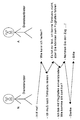
- a service user asks N, e.g. one especially for such a form of service communication trained mobile phone, with the formulation "Help me!” a service provider A, e.g. by means of a Radio beacon is available to provide special assistance with a Travel problem. Service provider A answers the question “How can I help?" Thereupon the Service users N again the initiative with the wording "I have to go to Timbuktu.”
- the service provider A then replies with the wording "I'm sorry, I don't know Timbuktu, but you could drive to the airport ". Then the Service user N "I agree with the airport” and added immediately the question "How do I get there?" The service provider A then provides the information "Take the train ....! "Thereupon the service user N thanks the wording "thank you” and service provider A ended the help procedure with the phrase "please”.
Landscapes
- Business, Economics & Management (AREA)
- Engineering & Computer Science (AREA)
- Accounting & Taxation (AREA)
- Development Economics (AREA)
- Strategic Management (AREA)
- Finance (AREA)
- Game Theory and Decision Science (AREA)
- Entrepreneurship & Innovation (AREA)
- Economics (AREA)
- Marketing (AREA)
- Physics & Mathematics (AREA)
- General Business, Economics & Management (AREA)
- General Physics & Mathematics (AREA)
- Theoretical Computer Science (AREA)
- Management, Administration, Business Operations System, And Electronic Commerce (AREA)
Abstract
Description
- Der Diensteanbieter kann seinen Dienst oder seine Dienste über ein Look-Up-Verfahren bei einen Look-Up-Dienst eintragen, zusammen mit allen Informationen und Algorithmen, die zur Nutzung der Dienste des Dienstes notwendig sind.
- Dieser Look-Up-Dienst ist wiederum ein Algorithmus, der frei wählbar auf dem EDV-Gerät des Dienstenutzers oder des Diensteanbieters oder auf einer weiteren EDV-Anlage ausgeführt werden kann.
- Alternativ zu diesem Look-Up-Verfahren kann der Dienstenutzer auch direkt das Diensteangebot des Diensteanbieters in Erfahrung bringen, z.B. durch direkte Anfrage beim Diensteanbieter nach einer angebotenen Diensteliste, oder per Definition annehmen, daß ein Diensteanbieter einen ganz bestimmten Dienst anbietet. Wenn der Dienstenutzer auf diesem Wege einen Dienst ausgesucht hat, kann er alle Informationen und Algorithmen, die zur Nutzung der Dienste des Dienstes notwendig sind, vom Diensteanbieter anfordern.
- Diese Informationen und Algorithmen, die zur Nutzung der Dienste des Diensteanbieters notwendig sind, können Algorithmen und zugehörige Daten sein, welche auf dem EDV-Gerät des Dienstenutzers als Algorithmus ablaufen und von dort die notwendigen Kommunikationsanfragen an den Diensteanbieter steuern. Diese Algorithmen und zugehörigen Daten sind diensteanbieterspezifisch, denn sie implizieren Fähigkeiten der Diensteanbieter, die jedoch dem Dienstenutzer nicht, weder teilweise noch vollständig, bekannt sein müssen.
- Diese Algorithmen und zugehörigen Daten sind in der Lage, Informationen, die auf dem EDV-Gerät des Dienstenutzers gespeichert oder dort verfügbar sind, oder Dienste, die dem Dienstenutzer zur Verfügung stehen, z.B. Kommunikationsdienste, zu erkennen und/oder zu bearbeiten und/oder zu benutzen. Dies setzt eine gewisse Standardisierung dieser Informationen voraus. Diese Informationen können physikalisch im Speicher des EDV-Geräts des Dienstenutzers oder in einer mit dieser verbundenen weiteren EDV-Einheit stehen.
- Diese Algorithmen müssen physikalisch nicht ausschließlich auf dem EDV-Gerät des Dienstenutzers ablaufen, sondern können auf dem EDV-Gerät des Dienstenutzers und/oder mit ihm verbundenen weiteren Recheneinheiten und EDV-Geräten des Diensteanbieters verteilt ablaufen. Die Verwaltung dieser Aufteilung kann mittels RMI (Remote Method Invocation) beispielsweise von JAVA™ oder z.B. mittels Jini™ durchgeführt und überwacht werden.
- Die vom Diensteanbieter angebotenen Dienste sind auf einem hohen Abstraktionsniveau definiert und werden hier als Helferdienste bezeichnet. Beispielhafte Namen solcher hochabstrahierter Helferdienste können sein: "Zeige den Weg an das Ziel, welches im EDV-Gerät des Dienstenutzers gespeichert ist" oder "Ergänze den Status des Dienstenutzers" oder einfach "Helfe". Eine diesbezügliche Erläuterung anhand von Beispielen ist in einem noch nachfolgenden Teil der Beschreibung des Verfahrens nach der Erfindung enthalten. Diese Helferdienste werden von Anfang an namentlich definiert, nicht jedoch ihre genaue Realisierung und Verwendung, und nicht zwingend ihr Zweck.
- Die Dienstenutzer, welche die Dienste nutzen wollen, müssen nur in der Lage sein, die entsprechenden Look-Up-Dienste zu finden, um die dort eingetragenen Dienste in Anspruch zu nehmen, d.h. die dort eingetragenen Helferdienste interpretieren zu können.
Claims (10)
- Verfahren zur Bereitstellung von Zweckinformationen, z.B. von Reise-, Buchungs- oder Zahlungsinformationen sowie von deren jeweiligen Vorgängen, eines Diensteanbieters an Dienstenutzer unter Verwendung einer elektronischen Datenverarbeitung (EDV), dadurch gekennzeichnet, daß der Diensteanbieter (A), welcher als eine Software auf einem EDV-Gerät mit Kommunikationsfähigkeit ausgeprägt ist, mittels Helferdiensten einem Dienstenutzer (N), welcher als eine Software auf einem EDV-Gerät mit Kommunikationsfähigkeit ausgeprägt ist, Algorithmen und/oder Algorithmenaufrufe und/oder Informationen zur Verfügung stellt, daß diese Algorithmen und/oder Algorithmenaufrufe und/oder Informationen beim Dienstenutzer ein Abrufen von Bedarfsinformationen bewirken, welche auf einem dem betreffenden Dienstenutzer zugeordneten EDV-Gerät gespeichert sind, daß diese Bedarfsinformationen den weiteren Ablauf der Algorithmen und/oder Algorithmenaufrufe steuern und daß diese Algorithmen und/oder Algorithmenaufrufe und/oder Informationen beim Dienstenutzer einen Zugewinn an Zweckinformation und/oder das Auslösen eines oder mehrerer zur Bereitstellung von Zweckinformationen, also z.B. von Reise-, Buchungs- oder Zahlungsinformationen und von deren jeweiligen Vorgängen, notwendiger Prozesse veranlassen.
- Verfahren nach Anspruch 1, dadurch gekennzeichnet, daß der Diensteanbieter (A) an einem Look-Up-Verfahren teilnimmt und dort ihm zugeordnete Helferdienste einträgt.
- Verfahren nach Anspruch 1 oder 2, dadurch gekennzeichnet, daß die Algorithmen und/oder Algorithmenaufrufe und/oder Informationen die Steuerung des Diensteanbieters (A) übernehmen.
- Verfahren nach Anspruch 3, dadurch gekennzeichnet, daß die Algorithmen und/oder Algorithmenaufrufe und/oder Informationen die Steuerung des Diensteanbieters (A) durch Kommunikation mit dem Diensteanbieter übernehmen.
- Verfahren nach einem der vorhergehenden Ansprüche, dadurch gekennzeichnet, daß die Informationen des Diensteanbieters (A) den Dienstenutzern (N) über Baken angeboten werden, mit welchen ein Dienstenutzer mit Hilfe eines mobilen Geräts drahtlos mittels Funk-, Infrarot- oder Ultraschallsignalen oder drahtgebunden kommunizieren kann.
- Verfahren nach Anspruch 5, dadurch gekennzeichnet, daß die Helferdienste, die von der Bake angeboten werden, als solche Dienste beschrieben, ausgeführt und bezeichnet werden können, die einen Weg zu einem Ziel und/oder Zwischenziel beschreiben.
- Verfahren nach einem der Ansprüche 1 bis 5, dadurch gekennzeichnet, daß die Helferdienste, die angeboten werden, als Dienste beschrieben, ausgeführt und bezeichnet werden können, welche Status-Informationen beim Dienstenutzer (N) verändern und aktualisieren.
- Verfahren nach einem der vorhergehenden Ansprüche unter Einschluß von Anspruch 5, dadurch gekennzeichnet, daß die von den Algorithmen veränderbaren Informationen die von einer reisenden Person zu nehmende/n Wegroute/n, Karten, Ankunftszeiten von Fahrzeugen (Taxi, Bus, Bahn usw.), in denen sich ein mobiles Gerät befindet, die aktuelle Position der Bake oder des mobilen Geräts, Fahrpläne und Routen von Verkehrsmitteln oder Hinweise zu Veranstaltungen, Restaurants und Hotels in der Umgebung, zu Touristeninformationen, Fremdenverkehrsämtern, Tankstellen, Geschäften, Ämtern, Krankenhäusern und dergleichen sind.
- Verfahren nach einem der vorhergehenden Ansprüche unter Einschluß von Anspruch 2, dadurch gekennzeichnet, daß das Look-Up-Verfahren mittels eines Betriebssystem mit standardisierter Architektur, insbesondere entsprechend der JINI™-Technologie, arbeitet, die es ermöglicht, einen Anbieter von Diensten mit Teilnehmern über ein gemeinsames Netzwerk zu koppeln.
- Verfahren nach einem der vorhergehenden Ansprüche, dadurch gekennzeichnet, daß die Verteilung der Algorithmen und/oder Algorithmenaufrufe und/oder Informationen auf verschiedene Recheneinheiten, d.h. beispielsweise das EDV-Gerät des Diensteanbieters (A) oder das EDV-Gerät des Dienstenutzers (N), mittels RMI (Remote Method Invocation), z.B. von JAVA™, oder beispielsweise mittels JINI™ vorgenommen wird.
Applications Claiming Priority (2)
| Application Number | Priority Date | Filing Date | Title |
|---|---|---|---|
| DE10056209 | 2000-11-13 | ||
| DE2000156209 DE10056209C2 (de) | 2000-11-13 | 2000-11-13 | Verfahren zur Bereitstellung von Zweckinformationen eines Diensteanbieters an Dienstenutzer |
Publications (2)
| Publication Number | Publication Date |
|---|---|
| EP1215602A2 true EP1215602A2 (de) | 2002-06-19 |
| EP1215602A3 EP1215602A3 (de) | 2002-12-11 |
Family
ID=7663135
Family Applications (1)
| Application Number | Title | Priority Date | Filing Date |
|---|---|---|---|
| EP01125498A Ceased EP1215602A3 (de) | 2000-11-13 | 2001-11-07 | Verfahren zum Bereitstellen von Zweckinformationen eines Dienstanbieters an Dienstnutzer |
Country Status (2)
| Country | Link |
|---|---|
| EP (1) | EP1215602A3 (de) |
| DE (1) | DE10056209C2 (de) |
Family Cites Families (5)
| Publication number | Priority date | Publication date | Assignee | Title |
|---|---|---|---|---|
| DE4335317C2 (de) * | 1993-10-15 | 1998-02-12 | Deutsche Telekom Mobil | Verfahren zur Erfassung und zum Austausch von Daten |
| DE19619803B4 (de) * | 1996-05-15 | 2006-06-14 | Siemens Ag | Diensterstellungssystem |
| KR100248007B1 (ko) * | 1997-12-03 | 2000-10-02 | 윤종용 | 이동통신단말장치및그소프트웨어플랫폼 |
| US6216158B1 (en) * | 1999-01-25 | 2001-04-10 | 3Com Corporation | System and method using a palm sized computer to control network devices |
| DE19918705A1 (de) * | 1999-04-26 | 2000-11-23 | Deutsch Zentr Luft & Raumfahrt | System zum verbesserten Versorgen eines Reisenden mit Reiseinformationen |
-
2000
- 2000-11-13 DE DE2000156209 patent/DE10056209C2/de not_active Expired - Fee Related
-
2001
- 2001-11-07 EP EP01125498A patent/EP1215602A3/de not_active Ceased
Also Published As
| Publication number | Publication date |
|---|---|
| DE10056209C2 (de) | 2002-10-10 |
| DE10056209A1 (de) | 2002-05-23 |
| EP1215602A3 (de) | 2002-12-11 |
Similar Documents
| Publication | Publication Date | Title |
|---|---|---|
| DE202013012418U1 (de) | Reiseplanung im öffentlichen Personenverkehr | |
| EP1162560A2 (de) | Elektronischer Terminplaner | |
| EP1128163B1 (de) | Reiseroutenplanungs- und Reiseroutenführungssystem | |
| WO1998021703A1 (de) | Verfahren und vorrichtung zum steuern einer flotte aus land- und/oder wasserfahrzeugen | |
| EP1173821B1 (de) | System zum verbesserten versorgen eines reisenden mit reiseinformationen | |
| DE202006005089U1 (de) | Gerät zur Übermittlung und Genehmigung eines Flugplans | |
| DE102017206887A1 (de) | Berechnungssystem und Verfahren zum Betrieb eines Berechnungssystems | |
| EP2183549A1 (de) | Verfahren zum betrieb einer navigationseinrichtung | |
| DE19636379C1 (de) | Verfahren zur Steuerung des Transport- und Reiseverkehrs | |
| EP3900265B1 (de) | Verfahren zum betreiben eines fahrzeuges beim auslagern von rechenleistung aus dem fahrzeug an mindestens einen edge-cloud-computer | |
| EP1215602A2 (de) | Verfahren zum Bereitstellen von Zweckinformationen eines Dienstanbieters an Dienstnutzer | |
| EP1022705B1 (de) | Verfahren zur Fahrgastinformation bezüglich Ankunfts- und/oder Abfahrtszeiten | |
| DE102013207583A1 (de) | Verfahren und Vorrichtung zum Betreiben einer Mehrzahl von Parkeinrichtungen | |
| DE10119426A1 (de) | Transportsystem, Transportverfahren, Befehlsterminal für Transportfahrzeug, Auftragsterminal und Auftragsempfangsserver | |
| EP3196841A1 (de) | Back-end server-einrichtung und verfahren zur automatischen ermittlung der nutzung eines verkehrsnetzes, sowie entsprechendes mobilgerät und verfahren zur übertragung von positionsmeldungen eines verkehrsteilnehmers | |
| EP1207477B1 (de) | Verfahren zum Bereitstellen von Zweckinformationen eines Dienstanbieters an Dienstnutzer | |
| EP1211656B1 (de) | Kommunikationsfähige Navigationsbake | |
| DE102004026359B4 (de) | Drahtloses Informationssystem mit mobilen Endgeräten und Verfahren zum Betrieb dieses Informationssystems | |
| EP1215630B1 (de) | Verfahren zum Durchführen eines Check-In-Vorgangs in Flughäfen | |
| Gupta et al. | Mobile kontextabhängige Multimediadienste. | |
| EP3391355A1 (de) | Infrastrukturausbau | |
| EP3038062A1 (de) | Verfahren und Fahrzeugeinrichtungen zur DSRC-Kommunikation | |
| EP1298549A1 (de) | Reiseüberwachung | |
| EP1087356A2 (de) | System und Verfahren zum Lokalisieren von Anbieteeinheiten durch Nachfrageeinheiten | |
| EP1298550A1 (de) | Reiseplan- und -ablaufspezifische Bedienschnittstellenmechanismen zum Abruf von Informationen und Diensten während der Reise |
Legal Events
| Date | Code | Title | Description |
|---|---|---|---|
| PUAI | Public reference made under article 153(3) epc to a published international application that has entered the european phase |
Free format text: ORIGINAL CODE: 0009012 |
|
| AK | Designated contracting states |
Kind code of ref document: A2 Designated state(s): AT BE CH CY DE DK ES FI FR GB GR IE IT LI LU MC NL PT SE TR |
|
| AX | Request for extension of the european patent |
Free format text: AL;LT;LV;MK;RO;SI |
|
| PUAL | Search report despatched |
Free format text: ORIGINAL CODE: 0009013 |
|
| AK | Designated contracting states |
Kind code of ref document: A3 Designated state(s): AT BE CH CY DE DK ES FI FR GB GR IE IT LI LU MC NL PT SE TR |
|
| AX | Request for extension of the european patent |
Free format text: AL;LT;LV;MK;RO;SI |
|
| 17P | Request for examination filed |
Effective date: 20030603 |
|
| AKX | Designation fees paid |
Designated state(s): AT BE CH CY DE DK ES FI FR GB GR IE IT LI LU MC NL PT SE TR |
|
| 17Q | First examination report despatched |
Effective date: 20050216 |
|
| STAA | Information on the status of an ep patent application or granted ep patent |
Free format text: STATUS: THE APPLICATION HAS BEEN REFUSED |
|
| 18R | Application refused |
Effective date: 20130524 |