EP1215084A2 - Vehicle door trim panel comprising sealing means - Google Patents
Vehicle door trim panel comprising sealing means Download PDFInfo
- Publication number
- EP1215084A2 EP1215084A2 EP01310101A EP01310101A EP1215084A2 EP 1215084 A2 EP1215084 A2 EP 1215084A2 EP 01310101 A EP01310101 A EP 01310101A EP 01310101 A EP01310101 A EP 01310101A EP 1215084 A2 EP1215084 A2 EP 1215084A2
- Authority
- EP
- European Patent Office
- Prior art keywords
- trim panel
- vehicle door
- bezel
- vertical shaft
- vehicle
- Prior art date
- Legal status (The legal status is an assumption and is not a legal conclusion. Google has not performed a legal analysis and makes no representation as to the accuracy of the status listed.)
- Granted
Links
- 238000007789 sealing Methods 0.000 title claims abstract description 19
- XLYOFNOQVPJJNP-UHFFFAOYSA-N water Substances O XLYOFNOQVPJJNP-UHFFFAOYSA-N 0.000 description 42
- 239000000565 sealant Substances 0.000 description 8
- 239000005357 flat glass Substances 0.000 description 7
- 230000004888 barrier function Effects 0.000 description 5
- 239000011324 bead Substances 0.000 description 5
- 239000012528 membrane Substances 0.000 description 2
- 229920003023 plastic Polymers 0.000 description 2
- 239000004033 plastic Substances 0.000 description 2
- 239000000853 adhesive Substances 0.000 description 1
- 230000001070 adhesive effect Effects 0.000 description 1
- 238000003466 welding Methods 0.000 description 1
Images


Classifications
-
- B—PERFORMING OPERATIONS; TRANSPORTING
- B60—VEHICLES IN GENERAL
- B60R—VEHICLES, VEHICLE FITTINGS, OR VEHICLE PARTS, NOT OTHERWISE PROVIDED FOR
- B60R13/00—Elements for body-finishing, identifying, or decorating; Arrangements or adaptations for advertising purposes
- B60R13/02—Internal Trim mouldings ; Internal Ledges; Wall liners for passenger compartments; Roof liners
- B60R13/0237—Side or rear panels
- B60R13/0243—Doors
-
- B—PERFORMING OPERATIONS; TRANSPORTING
- B60—VEHICLES IN GENERAL
- B60R—VEHICLES, VEHICLE FITTINGS, OR VEHICLE PARTS, NOT OTHERWISE PROVIDED FOR
- B60R13/00—Elements for body-finishing, identifying, or decorating; Arrangements or adaptations for advertising purposes
- B60R13/06—Sealing strips
-
- B—PERFORMING OPERATIONS; TRANSPORTING
- B60—VEHICLES IN GENERAL
- B60R—VEHICLES, VEHICLE FITTINGS, OR VEHICLE PARTS, NOT OTHERWISE PROVIDED FOR
- B60R13/00—Elements for body-finishing, identifying, or decorating; Arrangements or adaptations for advertising purposes
- B60R13/02—Internal Trim mouldings ; Internal Ledges; Wall liners for passenger compartments; Roof liners
- B60R2013/0287—Internal Trim mouldings ; Internal Ledges; Wall liners for passenger compartments; Roof liners integrating other functions or accessories
Definitions
- the present invention relates to vehicle doors, in particular to inside handles and sill buttons located on the trim panels of vehicle doors, where the inside handles and sill buttons are used to operate the vehicle door latch.
- Known vehicle doors are generally manufactured by welding an inner door panel to an outer door panel. This provides the structure of the vehicle door, with the upper section of the vehicle door comprising an aperture in which the window glass is housed, and the lower section of the vehicle door being used to house additional components such as door latches.
- a trim panel is fixed to the inner door panel for aesthetic purposes.
- the trim panel is used to mount components such as an inside door release handle and a sill button. Consequently some form of mechanical connection is required between these components and the door latch, which requires various apertures to be created in the inner door panel.
- some form of water management device such as a plastic membrane is used as a barrier and thus defines a 'wet' area on its outboard side and a 'dry' area on its inboard side with the door trim being on the dry side and the window glass being on the wet side.
- This barrier thus prevents water from entering the interior of the vehicle through the vehicle door.
- it can be difficult to assembly such plastics membranes due to their flexible nature and they can easily be displaced, allowing moisture to pass to the 'dry' side of the door.
- An object of the present invention is to provide a vehicle door which includes an improved inside handle arrangement thus enabling the inside handle arrangement to be sealed relative to a trim panel.
- Another object of the present invention is to provide a vehicle door which includes an improved sill button arrangement thus enabling the sill button arrangement to be sealed relative to a trim panel.
- a vehicle door including a manually actuable element, a latch mechanism, the latch mechanism being operated by the manually actuable element, and a trim panel, in which means are provided to seal the manually actuable element relative to the trim panel.
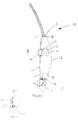
- a vehicle door 10 including an inner door panel 27, a trim panel 12, a latch mechanism 14, a manually actuable element, in the form of an inside handle arrangement 16, an operating lever 17, a window glass 18, and a sill 11 of a vehicle 19 (only part of which is shown).
- the operating lever 17 is connected at one end to the inside handle arrangement 16, and connected at the via a linkage L (shown schematically) to a latch mechanism 14.
- the inner door panel 27 is a one piece pressing and includes a front facing surface (not shown), a rear facing surface (not shown), an upper facing surface (not shown), and a bottom facing surface 33.
- the vehicle 19 includes a door aperture 28, in which the vehicle door 10 locates.
- the door aperture 28 includes a door seal 29(only part of which is shown) which forms a seal between the vehicle door 10 and the door aperture 28.
- the door seal 29 acts to prevent water entering the vehicle between the door aperture 28 and the vehicle door 10.
- the door seal 29 comprises four sections, a front edge seal (not shown) which seals between the front facing surface of the inner door panel 27 and the door aperture 28, a rear edge seal (not shown) which seals between the rear facing surface of the inner door panel 27 and the door aperture 28, an upper edge seal (not shown) which seals between the upper facing surface of the inner door panel 27 and the door aperture 28, and a lower edge seal 15 which seals between the bottom facing surface 33 of the door inner panel 27 and the door aperture 28.
- the lower edge seal 15 is located on the sill 11.
- a seal S is provided between the door outer skin 13 and the window glass 18, Whilst the seal keeps the majority of any rain water out, nevertheless some water can enter the interior of the door i.e. the wet space W.
- the trim panel 12 defines the barrier between the wet space W and the dry space in this case the interior I of a vehicle.
- the trim panel 12 has a periphery 12A which is sealed to the inner door panel 27 to prevent water from entering the area between the trim panel 12 and the inner door panel 27 from the wet space W. Consequently water cannot enter the interior I of the vehicle from the wet space W.
- the trim panel 112 is not sealed to the inner door panel 127 and water can enter the area between the trim panel and the inner door panel from the wet space. Under these circumstances the periphery of the trim panel 190 is located outboard of the lower edge seal 115, and thus water between the trim panel and the door panel will exit the vehicle outboard of the lower edge seal and cannot enter the interior of the vehicle.
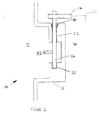
- the inside handle arrangement 16 of Figure 1 includes a blind hole 20 and a through hole 22.
- the inside handle arrangement 16 includes an inside handle 32 (shown schematically), and a vertical shaft 24.
- the lower section of the vertical shaft 24 locates in the blind hole 20 of the trim panel 12.
- the upper section of the vertical shaft 24 passes through the through hole 22 of the trim panel 12.
- the vertical shaft 24 is free to rotate in the blind hole 20 and in the through hole 22.
- the inside handle 32 is rotationally fixed to the vertical shaft 24, the vertical shaft 24 being rotationally fixed to an operating lever 17.
- An o-ring 30 is located on the vertical shaft 24 in the area of the through hole 22 of the trim panel 12.
- the o-ring 30 provides a water tight seal between the trim panel and the vertical shaft 24 thus preventing water from entering the interior of the vehicle from the wet region via the vertical shaft 24.
- the only possible water entry point is via the vertical shaft 24 which transcends the wet space W and the interior I of the vehicle, i.e. where the vertical shaft 24 passes through the through hole 22 of trim panel 12.
- the position of the o-ring 30 thus locally defines the dry/wet barrier.
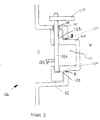
- FIG. 3 there is shown an alternative inside handle arrangement 116 of Figure 1 and trim panel 112.
- the trim panel 112 includes an aperture 115.
- the inside handle arrangement 116 includes a handle bezel 140, the handle bezel 140 locating inside the aperture 115 of the trim panel 112.
- the handle bezel 140 includes a blind hole 120 and a through hole 122.
- the inside handle arrangement 116 includes an inside handle 132, and a vertical shaft 124.
- the trim panel 112 also includes a through hole 121 which is aligned axially with the through hole 122 of the handle bezel 140.
- the lower section of the vertical shaft 124 locates in the blind hole 120 of the handle bezel 140.
- the upper section of the vertical shaft 124 passes through the through hole 122 of the handle bezel 140 and the through hole 121 of the trim panel 112.
- the vertical shaft 124 is free to rotate in the blind hole 120 and in the through holes 121 and 122.
- the inside handle 132 is rotationally fixed to the vertical shaft 124, the vertical shaft 124 being rotationally fixed to an operating lever 117.
- the features to locate the vertical shaft 124 i.e. the through hole and blind hole are situated in the handle bezel, as opposed to the previous embodiment where the features to locate the vertical shaft are integrated within the trim panel.
- An o-ring 130 is located on the vertical shaft 124 in the area of the through hole 121 of the trim panel 112.
- the o-ring 130 provides a water tight seal between the trim panel 112 and the vertical shaft 124 thus preventing water from entering the interior of the vehicle via the vertical shaft 124.
- Sealing is required between the handle bezel 140 and the edge 115A of aperture 115 of trim panel 112 in this case a continuous bead B of sealant has been used.
- the vertical shaft 124 is sealed to the trim panel 112 through the use of the o-ring 130, and the handle bezel is sealed to the trim panel 112 through the use of the sealant.
- water is prevented from entering the interior I of the vehicle via the vertical shaft 124 and via the aperture 115.
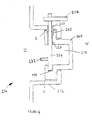
- FIG. 4 there is shown an alternative inside handle arrangement 216 of Figure 1 and a trim panel 212. Components perform the same function as handle arrangement 116 and are labelled 100 greater.
- the o-ring 230 is located on the vertical shaft 224 in the area of the through hole 222 of the handle bezel 240.
- the o-ring 230 provides a water tight seal between the handle bezel 240 and the vertical shaft 224 thus preventing water from entering the interior of the vehicle via the vertical shaft 224.
- Bead D also acts to prevent water entering via the aperture 215 in the trim panel 212. Note that in this embodiment, the positioning of bead D eliminates the need for an equivalent bead B as shown in Figure 3.
- FIG. 5 there is shown an alternative inside handle arrangement 316 of Figure 1 and a trim panel 312. Components perform the same function as handle arrangement 216 and are labelled 100 greater.
- the o-ring 330 is located on the vertical shaft 324 in the area between the through hole 322 of the handle bezel 240 and the through hole 321 of the trim panel 312.
- the o-ring 330 provides a water tight seal between the vertical shaft 324 and the trim panel 312 and a water tight seal between the vertical shaft 324 and the handle bezel 340.
- the o-ring 330 provides a water tight seal between the handle bezel 340 and the trim panel 312.
- Bead E is only additional sealing required to seal the handle bezel 340 to the trim panel 312.
- this embodiment requires the minimum additional sealant, the position of the o-ring between the handle bezel and the trim panel could be advantageous towards ease of assembly and potential replacement of the o-ring.
- a vehicle door 410 including an inner door panel 427 a trim panel 412, a latch mechanism 414, a manually actuable element, in the form of a sill button arrangement 416, a window glass 418, and a sill 11 of a vehicle 19.
- the sill 11. and the vehicle 19 have the same features as described in the embodiment of Figure 1.
- the trim panel 412 has a periphery 412A which is sealed to the inner door panel 427 to prevent water from entering the area between the trim panel 412 and the inner door panel 427 from the wet space W. Consequently water cannot enter the interior I of the vehicle from the wet space W.
- the trim panel is not sealed to the inner door panel and water can enter the area between the trim panel and the inner door panel from the wet space. Under these circumstances the periphery of the trim panel is located outboard of the lower edge seal, and thus water between the trim panel and the door panel will exit the vehicle outboard of the lower edge seal and cannot enter the interior of the vehicle.
- the sill button arrangement includes an operating rod 417 which is connected at one end to the sill button 432, and connected at the opposite end to a latch mechanism 414.
- the trim panel 412 defines the barrier between the wet space W and the dry space, in this case the interior I of a vehicle.
- the trim panel 412 includes a through hole 422.
- the sill button arrangement 416 includes a sill button 432, and operating rod 417.
- the operating rod 417 passes through the through hole 422 of the trim panel 412.
- An o-ring 430 is located on the operating rod 417 in the area of the through hole 422 of the trim panel 412.
- the o-ring 430 provides a water tight seal between the trim panel and the operating rod 417 thus preventing water and moisture from entering the interior of the vehicle via the hole 422.
- the only possible water entry point is via the vertical shaft 424 which transcends the wet space W and the interior I of the vehicle, i.e. where the vertical shaft 424 passes through the through hole 422 of trim panel 412.
- the position of the o-ring 30 thus prevents water entering the interior I of the vehicle from the wet space W.
- the trim panel 512 includes an aperture 515.
- the inside handle arrangement 516 includes a bezel 540, the bezel 540 locating inside the aperture 515 of the trim panel 512.
- the bezel 540 includes a through hole 522.
- the sill button arrangement 516 includes an sill button 532, and an operating rod 517.
- An o-ring 530 is located on the operating rod 517 in the area of the through hole 522 of the bezel 540.
- the o-ring 530 provides a water tight seal between the bezel 540 and the operating rod 517 thus preventing water from entering the interior of the vehicle via the operating rod 522.
- Scaling is required between the bezel 540 and the trim panel 512 and is provided in the form of o-ring G.
- the operating rod 517 is sealed to the trim panel 512 through the use of the o-ring 530, and the bezel 540 is sealed to the trim panel 512 through the use of o-ring G.
- water is prevented from entering the interior I of the vehicle via the hole 522 and via the aperture 515.
- the trim panel 612 includes an aperture 615.
- the trim panel has an inside surface 625.
- the inside handle arrangement 616 includes a subassembly 618, the subassembly 618 being located in the aperture 615.
- the subassembly 618 includes a handle bezel 640, a manually actuable element in the form of an inside handle 632, a vertical shaft 624, an o-ring 630 and an operating lever 617.
- the inside handle 632 is rotationally fixed to the vertical shaft 624, the vertical shaft 624 being rotationally fixed to the operating lever 617.
- the handle bezel 640 has a bezel surface 627.
- the bezel surface 627 is substantially flush with the inside surface 625 of the trim panel 612. Note that in other embodiments the bezel surface could sit proud of the inside surface of the trim panel.
- the handle bezel 640 includes a blind hole 620 and a through hole 622.
- the lower section of the vertical shaft 624 locates in the blind hole 620 of the handle bezel 640.
- the upper section of the vertical shaft 624 passes through the through hole 622 of the handle bezel 640.
- the vertical shaft 624 is free to rotate in blind holes 620 and 622.
- the handle bezel 640 includes an o-ring 630 located on the vertical shaft 624 in the area of the through hole 622, providing a water tight seal between the handle bezel 640 and the vertical shaft 624.
- a suitable sealant bead H is applied between the subassembly 618 and the trim panel 612, thus preventing water from passing through aperture 615 and entering the interior I of the vehicle.
- the subassembly 618 can be supplied and assembled into the trim panel 612 as a complete assembly.
- the subassembly 618 is secured to the trim panel 612 by a suitable fixing means (not shown) such as a clip.
- the fixing means may be a screw which passes through the bezel 640 and into the trim panel 612.
- the screw and the trim panel 612 would need to be sealed relative to each other since the screw would penetrate into the wet zone. It would be possible for the screw to engage in a blind hole of the trim panel 612 and thus eliminate the need for sealing between the screw and the trim panel 612.
- subassembly 618 can be assembled independently, and this allows door manufacturers to buy in pre assembled subassemblies.
- the subassembly is then mounted on the trim panel with a suitable sealant applied between the subassembly and the trim panel.
- the subassembly need not be mounted on the trim panel.
- the subassembly could be mounted on a portion of the door, such as an inner panel pressing or a window regulator frame carrier. With the subassembly mounted on said portion of the door, a suitable sealant is applied between the subassembly and the trim panel when the trim panel is fixed to the door.
- o-rings 30, 130, 230, 330, 430, 530 and 630 can remain stationary relative to the trim panel/bezel (with the shaft/operating rod moving relative to them) or they could remain stationary relative to the shaft/operating rod (and hence move relative to the trim panel/bezel).
- alternative forms of seals could be used.
Landscapes
- Engineering & Computer Science (AREA)
- Mechanical Engineering (AREA)
- Lock And Its Accessories (AREA)
- Seal Device For Vehicle (AREA)
Abstract
Description
- The present invention relates to vehicle doors, in particular to inside handles and sill buttons located on the trim panels of vehicle doors, where the inside handles and sill buttons are used to operate the vehicle door latch.
- Known vehicle doors, are generally manufactured by welding an inner door panel to an outer door panel. This provides the structure of the vehicle door, with the upper section of the vehicle door comprising an aperture in which the window glass is housed, and the lower section of the vehicle door being used to house additional components such as door latches.
- In addition, a trim panel is fixed to the inner door panel for aesthetic purposes. The trim panel is used to mount components such as an inside door release handle and a sill button. Consequently some form of mechanical connection is required between these components and the door latch, which requires various apertures to be created in the inner door panel.
- It is notoriously difficult to form a perfect waterproof seal between the outer door panel and the window glass, and consequently water running down the window glass can penetrate this seal and enter the area between the inner door panel and the outer door panel. This is a problem since water can run through the apertures in the inner door panel and into the vehicle via the trim panel.
- Hence, in known vehicle doors, some form of water management device, such as a plastic membrane is used as a barrier and thus defines a 'wet' area on its outboard side and a 'dry' area on its inboard side with the door trim being on the dry side and the window glass being on the wet side. This barrier thus prevents water from entering the interior of the vehicle through the vehicle door. However, it can be difficult to assembly such plastics membranes due to their flexible nature and they can easily be displaced, allowing moisture to pass to the 'dry' side of the door.
- An object of the present invention is to provide a vehicle door which includes an improved inside handle arrangement thus enabling the inside handle arrangement to be sealed relative to a trim panel.
- Another object of the present invention is to provide a vehicle door which includes an improved sill button arrangement thus enabling the sill button arrangement to be sealed relative to a trim panel.
- Thus, according to the present invention there is provided a vehicle door including a manually actuable element, a latch mechanism, the latch mechanism being operated by the manually actuable element, and a trim panel, in which means are provided to seal the manually actuable element relative to the trim panel.
- The invention will now be described, by way of example only, with reference to the accompanying drawings in which:-
- Figure 1 is a side view of a rear edge of a vehicle door according to the present invention,
- Figure 2 is a cross section view of the inside door handle arrangement of Figure 1,
- Figure 3 is a cross section view of an alternative inside door handle arrangement of Figure 1,
- Figure 4 is a cross section view of an alternative inside door handle arrangement of Figure 1,
- Figure 5 is a cross section view of an alternative inside door handle of arrangement Figure 1,
- Figure 6 is a view of a rear edge of a further embodiment of a vehicle door according to the present invention,
- Figure 7 is a view of a rear edge view of an inside sill button arrangement of Figure 6,
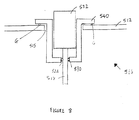
- Figure 8 is a cross section view of an alternative inside sill button arrangement of Figure 6, and
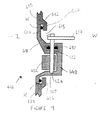
- Figure 9 is a cross section view of a further embodiment of a vehicle door according to the present invention.
-
- With reference to Figure 1 there is shown a
vehicle door 10 including aninner door panel 27, atrim panel 12, alatch mechanism 14, a manually actuable element, in the form of aninside handle arrangement 16, anoperating lever 17, awindow glass 18, and asill 11 of a vehicle 19 (only part of which is shown). - The
operating lever 17 is connected at one end to theinside handle arrangement 16, and connected at the via a linkage L (shown schematically) to alatch mechanism 14. - The
inner door panel 27 is a one piece pressing and includes a front facing surface (not shown), a rear facing surface (not shown), an upper facing surface (not shown), and abottom facing surface 33. - The
vehicle 19 includes adoor aperture 28, in which thevehicle door 10 locates. - The
door aperture 28 includes a door seal 29(only part of which is shown) which forms a seal between thevehicle door 10 and thedoor aperture 28. The door seal 29 acts to prevent water entering the vehicle between thedoor aperture 28 and thevehicle door 10. - The door seal 29 comprises four sections, a front edge seal (not shown) which seals between the front facing surface of the
inner door panel 27 and thedoor aperture 28, a rear edge seal (not shown) which seals between the rear facing surface of theinner door panel 27 and thedoor aperture 28, an upper edge seal (not shown) which seals between the upper facing surface of theinner door panel 27 and thedoor aperture 28, and alower edge seal 15 which seals between thebottom facing surface 33 of the doorinner panel 27 and thedoor aperture 28. - The
lower edge seal 15 is located on thesill 11. - A seal S is provided between the door
outer skin 13 and thewindow glass 18, Whilst the seal keeps the majority of any rain water out, nevertheless some water can enter the interior of the door i.e. the wet space W. Thetrim panel 12 defines the barrier between the wet space W and the dry space in this case the interior I of a vehicle. - Note that the
trim panel 12, has a periphery 12A which is sealed to theinner door panel 27 to prevent water from entering the area between thetrim panel 12 and theinner door panel 27 from the wet space W. Consequently water cannot enter the interior I of the vehicle from the wet space W. - Alternatively (see Figure 1A) the
trim panel 112 is not sealed to the inner door panel 127 and water can enter the area between the trim panel and the inner door panel from the wet space. Under these circumstances the periphery of the trim panel 190 is located outboard of the lower edge seal 115, and thus water between the trim panel and the door panel will exit the vehicle outboard of the lower edge seal and cannot enter the interior of the vehicle. - With reference to Figure 2, there is shown the
inside handle arrangement 16 of Figure 1 and thetrim panel 12. Thetrim panel 12 includes ablind hole 20 and a throughhole 22. Theinside handle arrangement 16 includes an inside handle 32 (shown schematically), and avertical shaft 24. - The lower section of the
vertical shaft 24 locates in theblind hole 20 of thetrim panel 12. The upper section of thevertical shaft 24 passes through the throughhole 22 of thetrim panel 12. Thevertical shaft 24 is free to rotate in theblind hole 20 and in the throughhole 22. - The
inside handle 32 is rotationally fixed to thevertical shaft 24, thevertical shaft 24 being rotationally fixed to anoperating lever 17. - An o-
ring 30 is located on thevertical shaft 24 in the area of the throughhole 22 of thetrim panel 12. The o-ring 30 provides a water tight seal between the trim panel and thevertical shaft 24 thus preventing water from entering the interior of the vehicle from the wet region via thevertical shaft 24. - Note in this embodiment that the only possible water entry point is via the
vertical shaft 24 which transcends the wet space W and the interior I of the vehicle, i.e. where thevertical shaft 24 passes through the throughhole 22 oftrim panel 12. The position of the o-ring 30 thus locally defines the dry/wet barrier. - With reference to Figure 3, there is shown an alternative inside
handle arrangement 116 of Figure 1 andtrim panel 112. In this embodiment thetrim panel 112 includes an aperture 115. Theinside handle arrangement 116 includes ahandle bezel 140, thehandle bezel 140 locating inside the aperture 115 of thetrim panel 112. - The
handle bezel 140 includes ablind hole 120 and a throughhole 122. Theinside handle arrangement 116 includes an inside handle 132, and avertical shaft 124. - The
trim panel 112 also includes a throughhole 121 which is aligned axially with thethrough hole 122 of thehandle bezel 140. - The lower section of the
vertical shaft 124 locates in theblind hole 120 of thehandle bezel 140. The upper section of thevertical shaft 124 passes through the throughhole 122 of thehandle bezel 140 and the throughhole 121 of thetrim panel 112. Thevertical shaft 124 is free to rotate in theblind hole 120 and in the throughholes - The inside handle 132 is rotationally fixed to the
vertical shaft 124, thevertical shaft 124 being rotationally fixed to an operating lever 117. - Note that in this embodiment the features to locate the
vertical shaft 124 i.e. the through hole and blind hole are situated in the handle bezel, as opposed to the previous embodiment where the features to locate the vertical shaft are integrated within the trim panel. - An o-
ring 130 is located on thevertical shaft 124 in the area of the throughhole 121 of thetrim panel 112. The o-ring 130 provides a water tight seal between thetrim panel 112 and thevertical shaft 124 thus preventing water from entering the interior of the vehicle via thevertical shaft 124. - However in this embodiment further sealing is required to prevent water entering the interior I of the vehicle. In the previous embodiment the only possible water entry point is where the
vertical shaft 24 passes through the throughhole 22 oftrim panel 12. In this embodiment the aperture 115 in thetrim panel 112 requires further sealing. - Sealing is required between the
handle bezel 140 and the edge 115A of aperture 115 oftrim panel 112 in this case a continuous bead B of sealant has been used. Thevertical shaft 124 is sealed to thetrim panel 112 through the use of the o-ring 130, and the handle bezel is sealed to thetrim panel 112 through the use of the sealant. Thus water is prevented from entering the interior I of the vehicle via thevertical shaft 124 and via the aperture 115. - With reference to Figure 4, there is shown an alternative inside
handle arrangement 216 of Figure 1 and atrim panel 212. Components perform the same function ashandle arrangement 116 and are labelled 100 greater. - However in this embodiment the o-
ring 230 is located on thevertical shaft 224 in the area of the throughhole 222 of thehandle bezel 240. - The o-
ring 230 provides a water tight seal between thehandle bezel 240 and thevertical shaft 224 thus preventing water from entering the interior of the vehicle via thevertical shaft 224. - As the o-
ring 230 is located between thehandle bezel 240 and thevertical shaft 224, there is no longer a seal between thetrim panel 212 and thevertical shaft 224 as provided by the previous embodiment. Hence water can enter the interior I of the vehicle via the throughhole 221 of thetrim panel 212. A suitable sealant bead D is required to prevent water passing through the throughhole 221 from entering the interior I of the vehicle. - Bead D also acts to prevent water entering via the
aperture 215 in thetrim panel 212. Note that in this embodiment, the positioning of bead D eliminates the need for an equivalent bead B as shown in Figure 3. - With reference to Figure 5, there is shown an alternative inside
handle arrangement 316 of Figure 1 and a trim panel 312. Components perform the same function ashandle arrangement 216 and are labelled 100 greater. - However in this embodiment the o-
ring 330 is located on thevertical shaft 324 in the area between the throughhole 322 of thehandle bezel 240 and the throughhole 321 of the trim panel 312. - Thus, the o-
ring 330 provides a water tight seal between thevertical shaft 324 and the trim panel 312 and a water tight seal between thevertical shaft 324 and thehandle bezel 340. In addition the o-ring 330 provides a water tight seal between thehandle bezel 340 and the trim panel 312. - Bead E is only additional sealing required to seal the
handle bezel 340 to the trim panel 312. - Apart from the fact that this embodiment requires the minimum additional sealant, the position of the o-ring between the handle bezel and the trim panel could be advantageous towards ease of assembly and potential replacement of the o-ring.
- With reference to Figure 6 there is shown a vehicle door 410 including an inner door panel 427 a
trim panel 412, alatch mechanism 414, a manually actuable element, in the form of asill button arrangement 416, awindow glass 418, and asill 11 of avehicle 19. - The
sill 11. and thevehicle 19 have the same features as described in the embodiment of Figure 1. - Note that the
trim panel 412, has a periphery 412A which is sealed to theinner door panel 427 to prevent water from entering the area between thetrim panel 412 and theinner door panel 427 from the wet space W. Consequently water cannot enter the interior I of the vehicle from the wet space W. - Alternatively the trim panel is not sealed to the inner door panel and water can enter the area between the trim panel and the inner door panel from the wet space. Under these circumstances the periphery of the trim panel is located outboard of the lower edge seal, and thus water between the trim panel and the door panel will exit the vehicle outboard of the lower edge seal and cannot enter the interior of the vehicle.
- The sill button arrangement includes an operating
rod 417 which is connected at one end to thesill button 432, and connected at the opposite end to alatch mechanism 414. - The
trim panel 412 defines the barrier between the wet space W and the dry space, in this case the interior I of a vehicle. - With reference to Figure 7, there is shown the
sill button arrangement 416 of Figure 6 and thetrim panel 412. Thetrim panel 412 includes a throughhole 422. Thesill button arrangement 416 includes asill button 432, and operatingrod 417. The operatingrod 417 passes through the throughhole 422 of thetrim panel 412. - An o-ring 430 is located on the operating
rod 417 in the area of the throughhole 422 of thetrim panel 412. The o-ring 430 provides a water tight seal between the trim panel and the operatingrod 417 thus preventing water and moisture from entering the interior of the vehicle via thehole 422. - Note in this embodiment that the only possible water entry point is via the
vertical shaft 424 which transcends the wet space W and the interior I of the vehicle, i.e. where thevertical shaft 424 passes through the throughhole 422 oftrim panel 412. The position of the o-ring 30 thus prevents water entering the interior I of the vehicle from the wet space W. - With reference to Figure 8, there is shown an alternative
sill button arrangement 516 of Figure 6 and atrim panel 512. In this embodiment thetrim panel 512 includes anaperture 515. Theinside handle arrangement 516 includes abezel 540, thebezel 540 locating inside theaperture 515 of thetrim panel 512. - The
bezel 540 includes a throughhole 522. Thesill button arrangement 516 includes ansill button 532, and anoperating rod 517. - An o-
ring 530 is located on the operatingrod 517 in the area of the throughhole 522 of thebezel 540. The o-ring 530 provides a water tight seal between thebezel 540 and the operatingrod 517 thus preventing water from entering the interior of the vehicle via theoperating rod 522. - However in this embodiment further sealing is required to prevent water entering the interior I of the vehicle. In the previous embodiment the only possible water entry point is where the
vertical shaft 424 passes through the throughhole 422 oftrim panel 412. In this embodiment theaperture 515 in thetrim panel 512 requires further sealing. - Scaling is required between the
bezel 540 and thetrim panel 512 and is provided in the form of o-ring G. The operatingrod 517 is sealed to thetrim panel 512 through the use of the o-ring 530, and thebezel 540 is sealed to thetrim panel 512 through the use of o-ring G. Thus water is prevented from entering the interior I of the vehicle via thehole 522 and via theaperture 515. - With reference to Figure 9, there is shown an alternative inside
handle arrangement 616 and a trim panel 612. - The trim panel 612 includes an
aperture 615. The trim panel has aninside surface 625. - The
inside handle arrangement 616 includes asubassembly 618, thesubassembly 618 being located in theaperture 615. - The
subassembly 618 includes ahandle bezel 640, a manually actuable element in the form of aninside handle 632, avertical shaft 624, an o-ring 630 and anoperating lever 617. Theinside handle 632 is rotationally fixed to thevertical shaft 624, thevertical shaft 624 being rotationally fixed to the operatinglever 617. - The
handle bezel 640 has abezel surface 627. Thebezel surface 627 is substantially flush with theinside surface 625 of the trim panel 612. Note that in other embodiments the bezel surface could sit proud of the inside surface of the trim panel. - The
handle bezel 640 includes a blind hole 620 and a through hole 622. - The lower section of the
vertical shaft 624 locates in the blind hole 620 of thehandle bezel 640. The upper section of thevertical shaft 624 passes through the through hole 622 of thehandle bezel 640. Thevertical shaft 624 is free to rotate in blind holes 620 and 622. - The
handle bezel 640 includes an o-ring 630 located on thevertical shaft 624 in the area of the through hole 622, providing a water tight seal between thehandle bezel 640 and thevertical shaft 624. - It can be seen that the
vertical shaft 624 does not penetrate through the trim panel 612 and thus does not require sealing against the trim panel 612. - A suitable sealant bead H is applied between the
subassembly 618 and the trim panel 612, thus preventing water from passing throughaperture 615 and entering the interior I of the vehicle. - It can be seen in this embodiment that since the
vertical shaft 624 does not penetrate through the trim panel 612 thesubassembly 618 can be supplied and assembled into the trim panel 612 as a complete assembly. - The
subassembly 618 is secured to the trim panel 612 by a suitable fixing means (not shown) such as a clip. - Alternatively the fixing means may be a screw which passes through the
bezel 640 and into the trim panel 612. In this case the screw and the trim panel 612 would need to be sealed relative to each other since the screw would penetrate into the wet zone. It would be possible for the screw to engage in a blind hole of the trim panel 612 and thus eliminate the need for sealing between the screw and the trim panel 612. - It would also be possible to secure the
subassembly 618 to the trim panel 612 by use of a suitable adhesive which could also act as a sealant. - It will also be appreciated that advantageously the
subassembly 618 can be assembled independently, and this allows door manufacturers to buy in pre assembled subassemblies. The subassembly is then mounted on the trim panel with a suitable sealant applied between the subassembly and the trim panel. - In further embodiments the subassembly need not be mounted on the trim panel. The subassembly could be mounted on a portion of the door, such as an inner panel pressing or a window regulator frame carrier. With the subassembly mounted on said portion of the door, a suitable sealant is applied between the subassembly and the trim panel when the trim panel is fixed to the door.
- Note that the o-rings 30, 130, 230, 330, 430, 530 and 630 can remain stationary relative to the trim panel/bezel (with the shaft/operating rod moving relative to them) or they could remain stationary relative to the shaft/operating rod (and hence move relative to the trim panel/bezel). In further embodiments alternative forms of seals could be used.
Claims (19)
- A vehicle door including a manually actuable element, a latch mechanism, the latch mechanism being operated by the manually actuable element, and a trim panel, in which sealing means are provided to seal the manually operable element relative to the trim panel.
- A vehicle door according to Claim 1 in which the sealing means is provided by sealing the manually actuable element to the trim panel
- A vehicle door according to Claim 1 or 2 in which the manually actuable element is located by a bezel, the bezel being secured to the trim panel.
- A vehicle door according to Claim 3 in which the sealing means are provided by sealing the manually actuable element to the bezel, and sealing the bezel to the trim panel.
- A vehicle door according to Claim 4 in which the manually actuable element, the bezel and a portion of the sealing means are provided as a subassembly, with the manually actuable element being sealed to the bezel by the portion of the sealing means
- A vehicle door according to any preceding claim in which the manually actuable element is an inside door handle arrangement.
- A vehicle door according to Claim 6 in which the inside door handle arrangement includes an inside door handle and a substantially vertical shaft.
- A vehicle door according to Claim 7 in which the inside door handle is integral with the substantially vertical shaft.
- A vehicle door according to Claim 7 or 8 which the substantially vertical shaft is connected to an operating lever, the operating lever operating the latch mechanism.
- A vehicle door according to Claims 7 to 9 in which the substantially vertical shaft is sealed relative to the trim panel.
- A vehicle door according to Claims 7 to 11 when dependant on Claim 3 in which the substantially vertical shaft is sealed relative to the bezel.
- A vehicle door according to Claims 1 to 4 in which the manually actuable element is a sill button arrangement.
- A vehicle door according to Claim 12 in which the sill button arrangement includes a sill button and an operating rod.
- A vehicle door according to Claim 13 in which the sill button is integral with the operating rod.
- A vehicle door according to Claims 13 or 14 in which the operating rod is sealed relative to the trim panel.
- A vehicle door according to Claims 13 to 14 when dependant on Claim 3 in which the operating rod is sealed relative to the bezel.
- A vehicle door according to any preceding claim in which the sealing means includes an o-ring.
- A vehicle door according to any preceding claim in which the periphery of the trim panel is sealed to said vehicle door.
- A vehicle including a door aperture having a lower edge seal mounted thereon, and including a vehicle door as described in any preceding claim mounted in the door aperture, in which the periphery of the trim panel is outboard of the lower edge seal which is mounted on the door aperture.
Applications Claiming Priority (2)
| Application Number | Priority Date | Filing Date | Title |
|---|---|---|---|
| GB0030527 | 2000-12-14 | ||
| GBGB0030527.6A GB0030527D0 (en) | 2000-12-14 | 2000-12-14 | Vehicle door |
Publications (3)
| Publication Number | Publication Date |
|---|---|
| EP1215084A2 true EP1215084A2 (en) | 2002-06-19 |
| EP1215084A3 EP1215084A3 (en) | 2004-02-11 |
| EP1215084B1 EP1215084B1 (en) | 2005-08-24 |
Family
ID=9905095
Family Applications (1)
| Application Number | Title | Priority Date | Filing Date |
|---|---|---|---|
| EP01310101A Expired - Lifetime EP1215084B1 (en) | 2000-12-14 | 2001-12-03 | Vehicle door trim panel comprising sealing means |
Country Status (5)
| Country | Link |
|---|---|
| US (1) | US20020084674A1 (en) |
| EP (1) | EP1215084B1 (en) |
| DE (1) | DE60112879T2 (en) |
| ES (1) | ES2248246T3 (en) |
| GB (1) | GB0030527D0 (en) |
Cited By (4)
| Publication number | Priority date | Publication date | Assignee | Title |
|---|---|---|---|---|
| US6966594B2 (en) | 2004-03-01 | 2005-11-22 | Lear Corporation | Vehicle trim panel and method of reducing BSR |
| US7131685B2 (en) | 2005-04-01 | 2006-11-07 | Lear Corporation | Automotive door trim panel having an integrated seal |
| US7198315B2 (en) | 2005-03-23 | 2007-04-03 | Lear Corporation | Connector for automotive interior trim |
| US7364218B2 (en) | 2004-08-25 | 2008-04-29 | International Automotive Components Group North America, Inc. | Automotive hardware carrier and method of making same |
Families Citing this family (7)
| Publication number | Priority date | Publication date | Assignee | Title |
|---|---|---|---|---|
| DE102004011136A1 (en) * | 2004-03-08 | 2005-09-29 | Lisa Dräxlmaier GmbH | Door structure and method for its production |
| US20060061134A1 (en) * | 2004-09-21 | 2006-03-23 | Delong Aaron M | Connector having an integrated gasket and method of making the same |
| FR2885872B1 (en) * | 2005-05-18 | 2007-08-03 | Renault Sas | DEVICE FOR MOUNTING AN OPENING ON THE BODY OF A MOTOR VEHICLE |
| US20060265963A1 (en) * | 2005-05-23 | 2006-11-30 | Jay Winborn | Manipulable engagement assemblies for barrier panels |
| US20060261633A1 (en) * | 2005-05-23 | 2006-11-23 | Jay Winborn | Automobile door assemblies |
| US10435922B2 (en) * | 2017-07-05 | 2019-10-08 | Nissan North America, Inc. | Vehicle handle bezel assembly having a movable cover |
| JP7124302B2 (en) * | 2017-11-30 | 2022-08-24 | トヨタ紡織株式会社 | vehicle door |
Family Cites Families (7)
| Publication number | Priority date | Publication date | Assignee | Title |
|---|---|---|---|---|
| US4083589A (en) * | 1977-04-07 | 1978-04-11 | Henry Palmerino | Vehicle security system |
| DE3217640A1 (en) * | 1982-03-12 | 1983-11-17 | Brose Fahrzeugteile GmbH & Co KG, 8630 Coburg | VEHICLE DOOR |
| US5095659A (en) * | 1989-05-02 | 1992-03-17 | Atoma International, A Magna International Company | Automobile door modular assembly |
| DE19524232A1 (en) * | 1994-11-15 | 1996-05-23 | Volkswagen Ag | Vehicle door assembly via subassembly on module carrier |
| DE19509282A1 (en) * | 1995-03-15 | 1996-11-14 | Brose Fahrzeugteile | Vehicle door |
| DE19654956B4 (en) * | 1996-06-04 | 2005-06-23 | Brose Fahrzeugteile Gmbh & Co. Kommanditgesellschaft, Coburg | Motor vehicle door |
| US6296296B1 (en) * | 2000-01-27 | 2001-10-02 | Paccar Inc | Door trim panel with integrated defrost duct and substructure |
-
2000
- 2000-12-14 GB GBGB0030527.6A patent/GB0030527D0/en not_active Ceased
-
2001
- 2001-12-03 EP EP01310101A patent/EP1215084B1/en not_active Expired - Lifetime
- 2001-12-03 DE DE60112879T patent/DE60112879T2/en not_active Expired - Fee Related
- 2001-12-03 ES ES01310101T patent/ES2248246T3/en not_active Expired - Lifetime
- 2001-12-18 US US10/020,869 patent/US20020084674A1/en not_active Abandoned
Non-Patent Citations (1)
| Title |
|---|
| None |
Cited By (4)
| Publication number | Priority date | Publication date | Assignee | Title |
|---|---|---|---|---|
| US6966594B2 (en) | 2004-03-01 | 2005-11-22 | Lear Corporation | Vehicle trim panel and method of reducing BSR |
| US7364218B2 (en) | 2004-08-25 | 2008-04-29 | International Automotive Components Group North America, Inc. | Automotive hardware carrier and method of making same |
| US7198315B2 (en) | 2005-03-23 | 2007-04-03 | Lear Corporation | Connector for automotive interior trim |
| US7131685B2 (en) | 2005-04-01 | 2006-11-07 | Lear Corporation | Automotive door trim panel having an integrated seal |
Also Published As
| Publication number | Publication date |
|---|---|
| US20020084674A1 (en) | 2002-07-04 |
| EP1215084B1 (en) | 2005-08-24 |
| DE60112879T2 (en) | 2006-06-14 |
| EP1215084A3 (en) | 2004-02-11 |
| ES2248246T3 (en) | 2006-03-16 |
| GB0030527D0 (en) | 2001-01-31 |
| DE60112879D1 (en) | 2005-09-29 |
Similar Documents
| Publication | Publication Date | Title |
|---|---|---|
| EP1215084B1 (en) | Vehicle door trim panel comprising sealing means | |
| CA1245875A (en) | Lock and handle module for vehicle door | |
| US6185872B1 (en) | Vehicle door | |
| US5724769A (en) | Motor vehicle window construction with pull-pull cable system | |
| US5724771A (en) | Window assembly with unitary anti-theft projection | |
| US4956943A (en) | Automobile side door assembly | |
| US8678487B2 (en) | Glazed roof of a motor vehicle, corresponding method of assembly and corresponding vehicle | |
| US20090033104A1 (en) | Vehicle Door Latch Assembly | |
| US4157201A (en) | Pick-up truck camper door assembly | |
| GB2149726A (en) | Motor vehicle door assembly | |
| US5775029A (en) | Remote manual drive system for modular rear-mounted window assembly | |
| GB2299309A (en) | Motor vehicle door lock module with anti-theft shield | |
| US20060265963A1 (en) | Manipulable engagement assemblies for barrier panels | |
| JP2002370626A (en) | Back door device | |
| EP1172242A1 (en) | Door module | |
| US6158789A (en) | Anti-theft protection device for a motor vehicle | |
| US5390975A (en) | Vehicle window shade | |
| GB2397609A (en) | Adhesively mounted trim strip | |
| WO2010014897A2 (en) | Cross arm module for vehicle door | |
| EP1606129A1 (en) | Sealing, trimming and guiding strips | |
| JPH04317819A (en) | tractor door | |
| JP5144455B2 (en) | Sunshade device mounting structure | |
| EP1045948A1 (en) | Slam latch | |
| JPH1111347A (en) | Cabin for tractor | |
| JPS6310972Y2 (en) |
Legal Events
| Date | Code | Title | Description |
|---|---|---|---|
| PUAI | Public reference made under article 153(3) epc to a published international application that has entered the european phase |
Free format text: ORIGINAL CODE: 0009012 |
|
| AK | Designated contracting states |
Kind code of ref document: A2 Designated state(s): AT BE CH CY DE DK ES FI FR GB GR IE IT LI LU MC NL PT SE TR |
|
| AX | Request for extension of the european patent |
Free format text: AL;LT;LV;MK;RO;SI |
|
| RAP1 | Party data changed (applicant data changed or rights of an application transferred) |
Owner name: ARVINMERITOR LIGHT VEHICLE SYSTEMS-FRANCE |
|
| PUAL | Search report despatched |
Free format text: ORIGINAL CODE: 0009013 |
|
| AK | Designated contracting states |
Kind code of ref document: A3 Designated state(s): AT BE CH CY DE DK ES FI FR GB GR IE IT LI LU MC NL PT SE TR |
|
| AX | Request for extension of the european patent |
Extension state: AL LT LV MK RO SI |
|
| RIC1 | Information provided on ipc code assigned before grant |
Ipc: 7E 05B 65/20 B Ipc: 7B 60R 13/08 B Ipc: 7B 60J 10/00 B Ipc: 7B 60J 5/04 B Ipc: 7B 60R 13/02 A |
|
| 17P | Request for examination filed |
Effective date: 20040127 |
|
| 17Q | First examination report despatched |
Effective date: 20040317 |
|
| AKX | Designation fees paid |
Designated state(s): DE ES FR GB IT |
|
| GRAP | Despatch of communication of intention to grant a patent |
Free format text: ORIGINAL CODE: EPIDOSNIGR1 |
|
| GRAS | Grant fee paid |
Free format text: ORIGINAL CODE: EPIDOSNIGR3 |
|
| GRAA | (expected) grant |
Free format text: ORIGINAL CODE: 0009210 |
|
| AK | Designated contracting states |
Kind code of ref document: B1 Designated state(s): DE ES FR GB IT |
|
| REG | Reference to a national code |
Ref country code: GB Ref legal event code: FG4D |
|
| REF | Corresponds to: |
Ref document number: 60112879 Country of ref document: DE Date of ref document: 20050929 Kind code of ref document: P |
|
| PG25 | Lapsed in a contracting state [announced via postgrant information from national office to epo] |
Ref country code: GB Free format text: LAPSE BECAUSE OF NON-PAYMENT OF DUE FEES Effective date: 20051203 |
|
| REG | Reference to a national code |
Ref country code: ES Ref legal event code: FG2A Ref document number: 2248246 Country of ref document: ES Kind code of ref document: T3 |
|
| ET | Fr: translation filed | ||
| PLBE | No opposition filed within time limit |
Free format text: ORIGINAL CODE: 0009261 |
|
| STAA | Information on the status of an ep patent application or granted ep patent |
Free format text: STATUS: NO OPPOSITION FILED WITHIN TIME LIMIT |
|
| 26N | No opposition filed |
Effective date: 20060526 |
|
| GBPC | Gb: european patent ceased through non-payment of renewal fee |
Effective date: 20051203 |
|
| PGFP | Annual fee paid to national office [announced via postgrant information from national office to epo] |
Ref country code: DE Payment date: 20061207 Year of fee payment: 6 |
|
| PGFP | Annual fee paid to national office [announced via postgrant information from national office to epo] |
Ref country code: FR Payment date: 20061208 Year of fee payment: 6 |
|
| PGFP | Annual fee paid to national office [announced via postgrant information from national office to epo] |
Ref country code: IT Payment date: 20061231 Year of fee payment: 6 |
|
| PGFP | Annual fee paid to national office [announced via postgrant information from national office to epo] |
Ref country code: ES Payment date: 20070122 Year of fee payment: 6 |
|
| PG25 | Lapsed in a contracting state [announced via postgrant information from national office to epo] |
Ref country code: DE Free format text: LAPSE BECAUSE OF NON-PAYMENT OF DUE FEES Effective date: 20080701 |
|
| REG | Reference to a national code |
Ref country code: FR Ref legal event code: ST Effective date: 20081020 |
|
| REG | Reference to a national code |
Ref country code: ES Ref legal event code: FD2A Effective date: 20071204 |
|
| PG25 | Lapsed in a contracting state [announced via postgrant information from national office to epo] |
Ref country code: FR Free format text: LAPSE BECAUSE OF NON-PAYMENT OF DUE FEES Effective date: 20071231 Ref country code: ES Free format text: LAPSE BECAUSE OF NON-PAYMENT OF DUE FEES Effective date: 20071204 |
|
| PG25 | Lapsed in a contracting state [announced via postgrant information from national office to epo] |
Ref country code: IT Free format text: LAPSE BECAUSE OF NON-PAYMENT OF DUE FEES Effective date: 20071203 |