EP1213775A2 - Solid State Dye Sensitized Solar Cell - Google Patents
Solid State Dye Sensitized Solar Cell Download PDFInfo
- Publication number
- EP1213775A2 EP1213775A2 EP01310265A EP01310265A EP1213775A2 EP 1213775 A2 EP1213775 A2 EP 1213775A2 EP 01310265 A EP01310265 A EP 01310265A EP 01310265 A EP01310265 A EP 01310265A EP 1213775 A2 EP1213775 A2 EP 1213775A2
- Authority
- EP
- European Patent Office
- Prior art keywords
- transport layer
- photoelectric conversion
- layer
- conversion element
- electron transport
- Prior art date
- Legal status (The legal status is an assumption and is not a legal conclusion. Google has not performed a legal analysis and makes no representation as to the accuracy of the status listed.)
- Granted
Links
Images




Classifications
-
- H—ELECTRICITY
- H01—ELECTRIC ELEMENTS
- H01G—CAPACITORS; CAPACITORS, RECTIFIERS, DETECTORS, SWITCHING DEVICES, LIGHT-SENSITIVE OR TEMPERATURE-SENSITIVE DEVICES OF THE ELECTROLYTIC TYPE
- H01G9/00—Electrolytic capacitors, rectifiers, detectors, switching devices, light-sensitive or temperature-sensitive devices; Processes of their manufacture
- H01G9/20—Light-sensitive devices
- H01G9/2027—Light-sensitive devices comprising an oxide semiconductor electrode
- H01G9/2031—Light-sensitive devices comprising an oxide semiconductor electrode comprising titanium oxide, e.g. TiO2
-
- H—ELECTRICITY
- H10—SEMICONDUCTOR DEVICES; ELECTRIC SOLID-STATE DEVICES NOT OTHERWISE PROVIDED FOR
- H10F—INORGANIC SEMICONDUCTOR DEVICES SENSITIVE TO INFRARED RADIATION, LIGHT, ELECTROMAGNETIC RADIATION OF SHORTER WAVELENGTH OR CORPUSCULAR RADIATION
- H10F10/00—Individual photovoltaic cells, e.g. solar cells
-
- H—ELECTRICITY
- H01—ELECTRIC ELEMENTS
- H01M—PROCESSES OR MEANS, e.g. BATTERIES, FOR THE DIRECT CONVERSION OF CHEMICAL ENERGY INTO ELECTRICAL ENERGY
- H01M14/00—Electrochemical current or voltage generators not provided for in groups H01M6/00 - H01M12/00; Manufacture thereof
-
- H—ELECTRICITY
- H10—SEMICONDUCTOR DEVICES; ELECTRIC SOLID-STATE DEVICES NOT OTHERWISE PROVIDED FOR
- H10K—ORGANIC ELECTRIC SOLID-STATE DEVICES
- H10K30/00—Organic devices sensitive to infrared radiation, light, electromagnetic radiation of shorter wavelength or corpuscular radiation
- H10K30/10—Organic devices sensitive to infrared radiation, light, electromagnetic radiation of shorter wavelength or corpuscular radiation comprising heterojunctions between organic semiconductors and inorganic semiconductors
- H10K30/15—Sensitised wide-bandgap semiconductor devices, e.g. dye-sensitised TiO2
- H10K30/151—Sensitised wide-bandgap semiconductor devices, e.g. dye-sensitised TiO2 the wide bandgap semiconductor comprising titanium oxide, e.g. TiO2
-
- H—ELECTRICITY
- H10—SEMICONDUCTOR DEVICES; ELECTRIC SOLID-STATE DEVICES NOT OTHERWISE PROVIDED FOR
- H10K—ORGANIC ELECTRIC SOLID-STATE DEVICES
- H10K30/00—Organic devices sensitive to infrared radiation, light, electromagnetic radiation of shorter wavelength or corpuscular radiation
- H10K30/50—Photovoltaic [PV] devices
-
- H—ELECTRICITY
- H10—SEMICONDUCTOR DEVICES; ELECTRIC SOLID-STATE DEVICES NOT OTHERWISE PROVIDED FOR
- H10K—ORGANIC ELECTRIC SOLID-STATE DEVICES
- H10K85/00—Organic materials used in the body or electrodes of devices covered by this subclass
- H10K85/30—Coordination compounds
- H10K85/341—Transition metal complexes, e.g. Ru(II)polypyridine complexes
-
- Y—GENERAL TAGGING OF NEW TECHNOLOGICAL DEVELOPMENTS; GENERAL TAGGING OF CROSS-SECTIONAL TECHNOLOGIES SPANNING OVER SEVERAL SECTIONS OF THE IPC; TECHNICAL SUBJECTS COVERED BY FORMER USPC CROSS-REFERENCE ART COLLECTIONS [XRACs] AND DIGESTS
- Y02—TECHNOLOGIES OR APPLICATIONS FOR MITIGATION OR ADAPTATION AGAINST CLIMATE CHANGE
- Y02E—REDUCTION OF GREENHOUSE GAS [GHG] EMISSIONS, RELATED TO ENERGY GENERATION, TRANSMISSION OR DISTRIBUTION
- Y02E10/00—Energy generation through renewable energy sources
- Y02E10/50—Photovoltaic [PV] energy
- Y02E10/542—Dye sensitized solar cells
-
- Y—GENERAL TAGGING OF NEW TECHNOLOGICAL DEVELOPMENTS; GENERAL TAGGING OF CROSS-SECTIONAL TECHNOLOGIES SPANNING OVER SEVERAL SECTIONS OF THE IPC; TECHNICAL SUBJECTS COVERED BY FORMER USPC CROSS-REFERENCE ART COLLECTIONS [XRACs] AND DIGESTS
- Y02—TECHNOLOGIES OR APPLICATIONS FOR MITIGATION OR ADAPTATION AGAINST CLIMATE CHANGE
- Y02E—REDUCTION OF GREENHOUSE GAS [GHG] EMISSIONS, RELATED TO ENERGY GENERATION, TRANSMISSION OR DISTRIBUTION
- Y02E10/00—Energy generation through renewable energy sources
- Y02E10/50—Photovoltaic [PV] energy
- Y02E10/549—Organic PV cells
Definitions
- the present invention relates to a photoelectric conversion element.
- CuI is used as a constituent material of the p-type semiconductor.
- the solar cell employing the CuI has a problem in that a generated current is lowered due to its deterioration caused by the increase in the crystal grain size of CuI and the like.
- the present invention is directed to a photoelectric conversion element, which comprises a first electrode; a second electrode arranged opposite to the first electrode; an electron transport layer arranged between the first electrode and the second electrode, at least a part of the electron transport layer being formed into porous; a dye layer which is in contact with the electron transport layer; a hole transport layer arranged between the electron transport layer and the second electrode; and short-circuit preventing means for preventing or suppressing short-circuit between the first electrode and the hole transport layer.
- the short-circuit preventing means includes a barrier layer having a porosity smaller than the porosity of the electron transport layer. This makes it possible to more reliably prevent or suppress short-circuiting caused by electrical contact or the like between the first electrode and the hole transport layer, thereby enabling to effectively prevent the photoelectric conversion efficiency of the photoelectrical conversion element from being lowered.
- the porosity of the barrier layer is defined by A% and the porosity of the electron transport layer is defined by B%, the value of B/A is equal to or greater than 1.1. This makes it possible for the barrier layer and the electron transport layer to exhibit respective functions more appropriately.
- the porosity of the barrier layer is set to be equal to or less than 20%. This makes it possible to prevent or suppress the short-circuiting between the first electrode and the hole transport layer more reliably.
- the ratio of the thickness of the barrier layer with respect to the thickness of the electron transport layer is in the range of 1:99 to 60:40. This also makes it possible to prevent or suppress the short-circuiting between the first electrode and the hole transport layer more reliably. Further, it is also possible to effectively prevent the amount of light to be reached to the dye layer from being reduced.
- the average thickness of the barrier layer is in the range of 0.01 to 10 ⁇ m. This also makes it possible to effectively prevent the amount of light to be reached to the dye layer from being reduced.
- the barrier layer has electric conductivity which is substantially the same as that of the electron transport layer. This makes it possible to effectively move electrons from the electron transport layer to the barrier layer.
- the barrier layer is mainly constituted from titanium oxide. This also makes it possible to effectively move electrons from the electron transport layer to the barrier layer.
- the barrier layer is formed by means of a MOD method including a metal organic deposition and a metal organic decomposition. This makes it possible to easily and reliably obtain a barrier layer having a dense structure, that is having a desired porosity.
- the barrier layer is formed using a barrier layer material when the barrier layer is formed by means of the MOD method, in which the barrier layer material contains a metal alkoxide and an additive having a function for stabilizing the metal alkoxide.
- the additive is a hydrolysis suppressing agent that suppresses hydrolysis of the metal alkoxide by being replaced with alkoxyl group of the metal alkoxide and coordinated with the metallic atoms of the metal alkoxide.
- the resistance value in the thickness direction of the total of the barrier layer and the electron transport layer is equal to or greater than 100k ⁇ /cm 2 . This makes it possible to prevent or suppress the short-circuiting between the first electrode and the hole transport layer more reliably.
- the barrier layer is disposed between the barrier layer and the electron transport layer. This also makes it possible to prevent or suppress the short-circuiting between the first electrode and the hole transport layer even more reliably.
- the boundary between the barrier layer and the electron transport layer is unclear. This makes it possible to reliably move electrons between the electron transport layer and the barrier layer.
- barrier layer and the electron transport layer are integrally formed with each other. This also makes it possible to reliably move electrons between the electron transport layer and the barrier layer.
- the electron transport layer functions as the barrier layer. This also makes it possible to reliably move electrons between the electron transport layer and the barrier layer.
- the short-circuit preventing means is a spacer which defines a space between the fist electrode and the hole transport layer. This makes it possible to more reliably prevent or suppress short-circuiting caused by electrical contact or the like between the first electrode and the hole transport layer, thereby enabling to effectively prevent the photoelectric conversion efficiency of the photoelectrical conversion element from being lowered.
- the average thickness of the spacer is defined by H ⁇ m
- the maximum thickness of the hole transport layer is defined by h1 ⁇ m
- the total thickness of the electron transfer layer and the dye layer is defined by h2 ⁇ m
- the dye layer functions as a light receiving layer which generates electrons and holes when receiving light.
- a dye layer is most preferable to the present invention.
- the electron transport layer has an outer surface and a number of holes each having an inner surface, and the dye layer is formed on the outer surface of the electron transport layer as well as along the inner surfaces of the holes. This makes it possible to transport the electrons generated in the dye layer to the electron transport layer effectively.
- the electron transport layer has at least a function that transports the electrons generated in the dye layer. Such an electron transport layer is most preferable to the present invention.
- the electron transport layer is formed into a film-like shape. This makes it possible to form the element into a thinner structure and to reduce its manufacturing cost.
- the average thickness of the electron transport layer is in the range of 0.1 to 300 ⁇ m. This makes it possible to form the element into a thinner structure with maintaining the photoelectric conversion efficiency of the photoelectric conversion element appropriately.
- the porosity of the electron transport layer is in the range of 5 to 90%. This makes it possible to sufficiently enlarge the formation area of the dye layer. As a result, the dye layer enables to generate sufficient amount of electrons, and transport them to the electron transport layer with high efficiency.
- At least a part of the electron transport layer is formed of an electron transport layer material in the form of powder having the average particle size of 1nm to 1 ⁇ m. This makes it possible to obtain a porous electron transport layer more easily and reliably.
- At least a part of the electron transport layer is formed of an electron transport layer material by means of a sol-gel method employing a sol liquid containing powder having the average particle size of 1nm to 1 ⁇ m. This also makes it possible to obtain a porous electron transport layer more easily and reliably.
- the content of the powder of the electron transport material in the sol liquid is in the range of 0.1 to 10wt%. This makes it possible to set the porosity of the electron transport layer appropriately.
- the electron transport layer is mainly formed of titanium dioxide. This enables the electron transport layer to enhance its electron transporting ability, and the electron transport layer itself becomes to generate electrons.
- the hole transport layer is mainly formed of a substance having ion conductive property. This makes it possible for the hole transport layer to transport holes generated in the dye layer effectively.
- the substance having the ion conductive property is a metal halide compound.
- the metal halide compound includes a metal iodide compound. This also makes it possible for the hole transport layer to transport holes generated in the dye layer furthermore effectively.
- the hole transport layer is formed by applying the hole transport material containing the substance having the ion conductive property onto the dye layer by means of a coating method. This enables to increase the contact area between the dye layer and the hole transport layer so that the hole transport layer can transport holes more effectively.
- the hole transport layer is formed by applying the hole transport layer material onto the dye layer while the dye layer is being heated. This makes it possible to form the hole transport layer in a short time.
- the hole transport layer material contains a crystal size coarse suppressing substance which suppresses increase in the crystal size of the substance having the ion conductive property when the substance crystallizes.
- the content of the crystal size coarse suppressing substance in the hole transport layer material is in the range of 1 ⁇ 10 -6 to 10wt%.
- the crystal size coarse suppressing substance includes thiocyanic acid salt, ammonium halide, or cyanoethylate.
- the crystal size coarse suppressing substance suppresses the increase in the crystal size of the metal iodide compound when the metal iodide compound crystallizes by being bonded to the metallic atoms of the metal iodide compound.
- the hole transport layer material contains a hole transport efficiency enhancing substance that enhances the transport efficiency of the holes. This makes it possible for the hole transport layer to have enhanced hole transfer efficiency and improved electrical conductivity.
- the content of the hole transport efficiency enhancing substance in the hole transport layer material is in the range of 1 ⁇ 10 -4 to 1 ⁇ 10 -1 wt%. This makes it possible to further enhance the hole transfer efficiency.
- the hole transport efficiency enhancing substance includes a halide. More preferably, the halide is ammonium halide. This also makes it possible to further enhance the hole transfer efficiency.
- the photoelectric conversion element further comprises a substrate for supporting the first electrode.
- the first electrode and the second electrode are applied with a positive and a negative voltage, respectively, with their difference being 0.5V, its resistance is larger than about 100 ⁇ /cm 2 .
- the photoelectric conversion element has such a characteristic as mentioned above means that occurrence of short-circuiting between the first electrode and the hole transport layer is effectively prevented or suppressed. Therefore, such a photoelectric conversion element can have more improved photoelectric conversion efficiency.
- the ratio R 52 /R 90 is larger than 0.8.
- the photoelectric conversion element can have such a characteristic as mentioned above means that the photoelectric conversion element has a low directivity for light, that is, it is isotropic to light. Accordingly, such a photoelectric conversion element can generate power more efficiently over almost entire range of shining period of the sun, if such a photoelectric conversion element is used outdoor.
- the photoelectric conversion element of the present invention is preferably applied to a solar cell.
- the photoelectric conversion element of the present invention may be applied to various devices or apparatuses, it is particularly preferably applied to a solar cell.
- Fig. 1 is a cross sectional view of a part of a first embodiment of the present invention which is a case that the photoelectric conversion element of the present invention is applied to a solar cell.
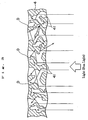
- Fig. 2 is an enlarged cross-sectional view which shows a cross section in the vicinity of the central part of the solar cell of the first embodiment along with its thickness direction.
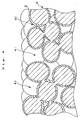
- Fig. 3 is an enlarged cross-sectional view which shows the cross section of the electron transport layer in which a dye layer is formed.
- Fig. 4 is a schematic view which shows the structure of the electron transport layer and the dye layer.
- Fig. 5 is a schematic illustration which shows the principle of the solar cell.
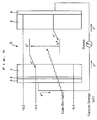
- Fig. 6 is a diagram which shows an equivalent circuit of the circuit used in the solar cell shown in Fig. 1.
- Fig. 7 is an illustration for explaining other manufacturing method of the solar cell of the first embodiment (that is, an enlarged cross sectional view which shows a state before the electron transport layer formed with the dye layer and the hole transport layer are joined).
- Fig. 8 is a cross sectional view which shows a structure of the solar cell of a second embodiment according to the present invention.
- Fig. 9 is an illustration for explaining other manufacturing method of the solar cell of the second embodiment (that is, an enlarged cross sectional view which shows a state before the electron transport layer formed with the dye layer and the hole transport layer are joined).
- Fig. 1 is a partial cross sectional view which shows a first embodiment which is a case that the photoelectric conversion element of the present invention is applied to a solar cell
- Fig. 2 is an enlarged cross sectional view which shows the cross-section of the first embodiment of the solar cell in the vicinity of the central part in its thickness direction
- Fig. 3 is a partially enlarged view which shows the cross-section of an electron transport layer formed with a dye layer
- Fig. 4 is a schematic diagram which shows the constitution of the electron transport layer and the dye layer
- Fig. 5 is a schematic diagram which shows the principle of the solar cell
- Fig. 6 is a diagram showing an equivalent circuit of the solar cell circuit shown in Fig. 1.
- a solar cell 1A shown in Fig. 1 is a type that does not require an electrolytic solution, and it is referred as a so-called dry solar cell.
- the solar cell 1A has a first electrode 3, a second electrode 6 arranged facing the first electrode 3, an electron transport layer 4 arranged between these electrodes, a dye layer D which is in contact with the electron transfer layer 4, a hole transport layer which is arranged between the electron transport layer 4 and the second electrode 6 and is in contact with the dye layer D, and a barrier layer 8, and these elements are provided on a substrate 2.
- each constitutive element in which the upper side and the lower side of each layer (member) in Fig. 1 and Fig. 2 will be referred to as a top face and a bottom face, respectively.
- the substrate 2 is provided for supporting the first electrode 3, the barrier layer 8, the electron transport layer 4, the dye layer D, the hole transport layer 5 and the second electrode 6, and it is formed from a plate-like member.
- the solar cell 1A of this embodiment is used by receiving light, for example, sunlight (hereinafter, referred to simply as "light") from the side of the substrate 2 and the first electrode 3, that is, by being illuminated with the light from the side of the substrate 2 and the first electrode 3.
- light for example, sunlight (hereinafter, referred to simply as "light") from the side of the substrate 2 and the first electrode 3, that is, by being illuminated with the light from the side of the substrate 2 and the first electrode 3.
- the substrate 2 and the electrode 3 are respectively substantially transparent.
- light can be made to arrive at the dye layer D with high efficiency.
- the substantially transparent is that it may be either one of achromatically transparent, chromatically transparent or semitransparent.
- Examples of the constituent material of the substrate 2 include various kinds of glass material, various kinds of ceramic material, various kinds of resin material such as polycarbonate (PC) and polyethylene terephthalate (PET), or various kinds of metallic material such as aluminum.
- various kinds of glass material various kinds of ceramic material
- various kinds of resin material such as polycarbonate (PC) and polyethylene terephthalate (PET)
- various kinds of metallic material such as aluminum.
- the average thickness of the substrate 2 is appropriately set depending upon the material, usage or the like, and is not particularly limited, but it may be set, for example, as follows.
- the substrate 2 is formed of, for example, a hard material such as a glass material, it is preferable that its average thickness is about 0.1 to 1.5mm, and more preferably about 0.8 to 1.2mm.
- the substrate 2 is formed of a flexible raw material such as polyethylene terephthalate (PET), for example, it is preferable that its average thickness is about 0.5 to 150 ⁇ m, and more preferably about 10 to 75 ⁇ m.
- PET polyethylene terephthalate
- the substrate 2 may be omitted as needed.
- a layer-form (plate-like) first electrode 3 On the top face of the substrate 2, there is provided a layer-form (plate-like) first electrode 3.
- the electrode 3 is installed on the side of the light-receiving face of the electron transport layer 4 on which the dye layer D that will be described later is formed so as to cover the light-receiving face.
- the electrode 3 receives electrons generated in the dye layer D via the electron transport layer 4 and the barrier layer 8, and transmits them to an external circuit 100 connected thereto.
- the constituent material for the first electrode 3 is not particularly limited.
- the constituent material include metal oxides such as indium-tin oxide (ITO), fluorine-doped tin oxide (FTO), indium oxide (IO) and tin oxide (SnO 2 ), metals such as aluminum, nickel, cobalt, platinum, silver, gold, copper, molybdenum, titanium, and tantalum or their alloys, or various kinds of carbon materials such as graphite may be mentioned, and one kind or a combination of two or more kinds of these materials may be used.
- ITO indium-tin oxide
- FTO fluorine-doped tin oxide
- IO indium oxide
- SnO 2 tin oxide
- metals such as aluminum, nickel, cobalt, platinum, silver, gold, copper, molybdenum, titanium, and tantalum or their alloys, or various kinds of carbon materials such as graphite may be mentioned, and one kind or a combination of two or more kinds of these materials may be used.
- the average thickness of the first electrode 3 is appropriately set depending upon the material, usage and the like, and is not particularly limited, but it may be set, for example, as in the following.
- the first electrode 3 is formed of a metallic oxide, namely, of a transparent conductive metallic oxide, it is preferable that its average thickness is about 0.05 to 5 ⁇ m, and more preferably about 0.1 to 1.5 ⁇ m.
- the first electrode 3 is formed of a metal in the above or its alloy or one of the various kinds of carbon materials, it is preferable that its average thickness is about 0.01 to 1 ⁇ m, and more preferably about 0.03 to 0.1 ⁇ m.
- the first electrode 3 is not limited to the structure shown in the figure, and it may be formed into a shape, for example, which has a plurality of comb teeth. In this case, since light arrives at the dye layer D by passing the spaces between the plurality of comb teeth, the first electrode 3 need not be transparent. This choice of the shape extends the latitude of selection of the constituent material for the first electrode 3 and its manufacturing method. Moreover, in this case, the average thickness of the electrode 3 is not particularly limited, but it is preferable that it is about 1 to 5 m.
- the first electrode 3 it is possible to use a combination of comb-teeth-like electrode and a transparent electrode made of ITO, FTO or the like as the first electrode 3.
- comb-teeth-like electrode and a transparent electrode made of ITO, FTO or the like As the first electrode 3.
- they may be laminated with each other, for example.
- a film-like barrier layer 8 is provided on the top face of the first electrode 3.
- the barrier layer 8 acts as preventing means against short-circuiting, and the details of the barrier layer 8 will be described later.
- the barrier layer 8 On the top face of the barrier layer 8, there are provided a porous electron transport layer 4 and the dye layer D which is in contact with the electron transport layer 4.
- the electron transport layer 4 has at least a function of transporting electrons generated in the dye layer D.
- the constituent material of the electron transport layer 4 examples include n-type oxide semiconductor materials such as titanium oxides (e.g. titanium dioxide (TiO 2 ). titanium monoxide (TiO), titanium trioxide (TI 2 O 3 ), and the like); zinc oxide (ZnO); tin oxide (SnO 2 ), and other n-type semiconductor materials.
- titanium oxides e.g. titanium dioxide (TiO 2 ). titanium monoxide (TiO), titanium trioxide (TI 2 O 3 ), and the like); zinc oxide (ZnO); tin oxide (SnO 2 ), and other n-type semiconductor materials.
- titanium oxides, in particular titanium dioxide are especially preferred as the constituent material for the electron transfer layer 4. That is, it is preferable that the electron transport layer 4 is composed of titanium dioxide.
- Titanium dioxide is superior in particular in the transport performance of electrons. Moreover, since titanium dioxide has a high sensitivity to light, the electron transport layer 4 is capable of generating electrons by itself. As a result, the solar cell 1A can further enhance the photoelectric conversion efficiency (power generation efficiency).
- the electron transport layer 4 having titanium dioxide as the principal material has an advantage that it has a small secular change (deterioration) and therefore is capable of continuously providing a stable performance for a long period of time even when it is exposed to a severe environment.
- its crystal structure may be either one of the anatase-type, the rutile-type, or a mixture of the anatase-type and the rutile-type.
- the electron transport layer 4 having titanium dioxide with anatase-type crystal structure has an advantage that it can transport electrons with higher efficiency.
- the mixing ratio is not particularly limited, but it is preferable that it is about 95:5 to 5:95 in weight, and more preferably about 80:20 to 20:80.
- the electron transport layer 4 has a number of holes (pores) 41.
- Fig. 3 which illustrates schematically the state of incidence of light on the electron transport layer 4
- light passed through the barrier layer 8 penetrates to the interior of the electron transport layer 4, and passes through the electron transport layer 4 or is reflected (irregularly, diffused or the like) within the holes 41.
- light makes contact with the dye layer D, and it can generate electrons and holes in the dye layer D with a high frequency.
- the porosity of the electron transport layer 4 is not limited particularly, but it is preferable that it is about 5 to 90%, more preferably about 15 to 50%, and even more preferably about 20 to 40%.
- the formation area of the dye layer D formed along the outer face of the electron transport layer 4 and the inner face of the holes 41 can also be enlarged sufficiently. Because of this, the dye layer D can generate sufficient quantity of electrons. Moreover, the dye layer D can transport these electrons to the electron transport layer 4 with high efficiency. As a result, the solar cell 1A can further enhance the power generation efficiency (photoelectric conversion efficiency).
- the electron transport layer 4 may have a relatively large thickness, but it is preferable that it has a film-like shape. With this choice, it will be advantageous in thinning (miniaturization) and reduction in the manufacturing cost of the solar cell 1A.
- the average thickness of the electron transport layer 4 is not limited particularly, but it is preferable that it is about 0.1 to 300 ⁇ m, and more preferably about 1 to 25 ⁇ m.
- the electron transport layer 4 is formed so as to make contact with the dye layer D.
- the dye layer D is formed so that a dye is adsorbed or bonded (covalently bonded, coordination bonded or the like) to the electron transport layer 4.
- the dye layer D is a light- receiving layer that generates the pairs of electron and hole by receiving light, and as shown in Fig. 4, it is formed along the outer face of the electron transport layer 4 and the inner face of the holes 41. In this way, electrons generated in the dye layer D can be transported to the electron transport layer 4 with high efficiency.
- the dye constituting the dye layer D is not particularly limited, but pigments, dyes or the like can be mentioned, and these may be used independently or in combination. Of these, from the viewpoint of small secular change and degradation, it is preferable to use pigments as the dye. On the other hand, from the view point of excellence in adsorption to (bonding with) the electron transport layer 4, it is preferable to use dyes as the coloring matter.
- the pigment to be used is not particularly limited to a specific one, and various pigments such as organic pigments and inorganic pigments can be used.
- the organic pigment include phthalocyanine pigments such as phthalocyanine green, phthalocyanine blue and the like; azo pigments such as arylide yellow, diarylide yellow, disazo condensation yellow, benzimidazolone yellow, dinitroaniline orange, benzimidazolone orange, toluidine red, permanent carmine, permanent red, naphthol red, disazo condensation red, benzimidazolone carmine, benzimidazolone brown and the like; anthraquinone pigments such as anthrapyrimidine yellow, anthraquinonyl red and the like; azomethine type pigments such as, azomethine yellow (copper) and the like; quinophthalone pigments such as quinophthalone yellow and the like; isoindoline pigments such as isoindoline yellow and the like;
- Example of the inorganic pigment include carbon pigments such as carbon black, lamp black, furnace black, ivory black, graphite, fullerene, and the like; chromate pigments such as chrome yellow, molybdate orange, and the like; sulfide pigments such as cadmium yellow, cadmium lithopone yellow, cadmium orange, cadmium lithopone orange, vermilion, cadmium red, cadmium lithopone red, and the like; oxide pigments such as ochre, titanium yellow, titanium-barium-nickel yellow, red iron oxide, red lead, umber, brown iron oxide, zinc iron chromite brown spinel, chromium oxide, cobalt green, cobalt chromite green spinel, cobalt titanate green spinel, cobalt blue, cerulean blue, cobalt-alminum-chromium blue, black iron oxide, manganese ferrite black, cobalt ferrite black, copper chromite black spinel, copper chromite
- the dye is also not particularly limited to a specific one.
- the dye include metal complex dye such as RuL 2 (SCN) 2 , RuL 2 Cl 2 , RuL 2 (CN) 2 , Rutenium535-bisTBA (manufactured and sold by Solaronics, Inc.), and [RuL 2 (NCS) 2 ] 2 H 2 O, rutenium tris(bipyridyl), and the like; cyan dye; xanthene dye; azo dye; hibiscus color; black berry color; raspberry color; pomegranate juice color; andchlorophyll.
- one kind of these dyes or a mixture of two or more kinds of these dyes may be employed.
- "L” in the chemical formula described above indicates 2,2'-bipyridine or the derivatives thereof.
- a layer-like hole transport layer 5 is provided on the top face of the electron transport layer 4 formed with the dye layer D.
- the hole transport layer 5 is provided facing the first electrode 3 via the electron transport layer 4 formed with the dye layer D.
- the hole transport layer 5 has a function of capturing and transporting the holes generated in the dye layer D. That is, the hole transport layer 5 has a function of transporting the holes to the external circuit 100 via the second electrode 6 or the hole transport layer 5 itself acting as an electrode.
- the average thickness of the hole transport layer 5 is not particularly limited, but it is preferable that it is about 1 to 500 ⁇ m, more preferably about 10 to 300 ⁇ m, and even more preferably about 10 to 30 ⁇ m.
- the constituent material of the hole transport layer 5 is not particularly limited, and various kinds of material can be used.
- a material include materials having ion conductive property; various kinds of p-type semiconductor materials such as triphenyldiamines (monomers, polymers and the like), polyanilines, polypyrroles, polythiophenes, phthalocyanine compounds (e.g. copper phthalocyanine) and there derivatives; and metals such as aluminum, nickel, cobalt, platinum, silver, gold, copper, molybdenum, titanium and tantalum, or alloys containing any one or more of these metals. Further, one kind or a combination of two or more kinds of these materials may be used.
- the materials having ion conductive property are particularly preferred as the constituent material for the hole transport layer 5.
- the hole transport layer 5 is mainly composed of a material having ion conductive property. With this choice, the hole transport layer 5 can transport the holes generated in the dye layer D with high efficiency.
- the materials having ion conductive property no particular limitations exist, but metal halides such as CuI and AgI, and metal bromifde such as AgBr, and metal thiocyanides such as CuSCN, for example, may be mentioned. In this case, one kind or a combination of two or more kinds of these materials may be used. Among these materials, one kind or a combination of two or more kinds of metal iodides such as CuI and AgI are particularly preferred for the materials having ion conductive property. These metal iodides are particularly excellent in ion conductive property. Therefore, the use of a metal iodide can enhance the photoelectric conversion efficiency (energy conversion efficiency) of the solar cell 1A.
- the hole transport layer 5 is formed such that it enters the holes 41 of the electron transport layer 4 which is formed with the dye layer D. Since the contact area of the dye layer D and the hole transport layer 5 can be increased in this way, the holes generated in the dye layer D can be transported into the hole transport layer 5 with higher efficiency. As a result, the solar cell 1A can further enhance the power generation efficiency.
- the layer-form second electrode 6 is provided on the top face of the hole transport layer 5.
- the average thickness of the second electrode 6 is appropriately set depending upon its material, use or the like, and is not limited particularly.
- the constituent material of the second electrode 6 is not particularly limited, but metals such as aluminum, nickel, cobalt, platinum, silver, gold, copper, molybdenum, titanium and tantalum, or alloys including any one or more of these metals, or various kinds of carbon materials such as graphite may be mentioned. In this case, one kind or a combination of two or more of these metals may be used.
- the second electrode 6 may be omitted depending upon the requirement.
- the values of the vacuum energy shown in Fig. 5 show an example of the case where the electron transport layer 4 and the barrier layer 8 are formed of titanium dioxide, and the hole transport layer 5 is formed of CuI.
- This situation can be represented by an equivalent circuit shown in Fig. 6, in which a current circulation circuit having a diode 200 is formed.
- the feature of the present invention resides in the provision of a short-circuit (or leak) preventing means that prevents or suppresses short-circuit between the first electrode 3 and the hole transport layer 5.
- a film-like barrier layer 8 is provided between the first electrode 3 and the electron transport layer 4 as the short-circuit preventing means.
- the barrier layer 8 is formed so as to have a porosity smaller than that of the electron transport layer 4.
- the material for the hole transport layer is coated by a coating method, for example, on the top face of the electron transport layer 4 which is formed with dye layer D, as will be described later.
- a solar cell which is not provided with the barrier layer 8 there is a case that the material for the hole transport layer penetrates into the holes 41 of the electron transport layer 4 with formed dye layer D and may reach the first electrode 3 if the porosity of the electron transport layer 4 is made large.
- a solar cell that is not provided with the barrier layer 8 there may occur a short-circuiting by electrical contact between the electrode 3 and the hole transport layer 5. Therefore, a solar cell that is not provided with the barrier layer 8 has a larger leakage current, thus leasing to the case that the power generation efficiency, namely, photoelectric conversion efficiency will be reduced.
- the solar cell 1A of this embodiment provided with the barrier layer 8, it is possible to prevent disadvantages as described in the above, so that the reduction in the power generation efficiency can be satisfactorily prevented or suppressed.
- the porosity of the barrier layer 8 is called A[%]and the porosity of the electron transport layer 4 is called B[%]
- the ratio B/A is larger than about 1.1, more preferably larger than about 5, and even more preferably larger than about 10.
- the porosity of the barrier layer 8 is somewhat smaller than 20%, more preferably somewhat smaller than 5%, and even more preferably somewhat smaller than 2%. In other words, it is preferable that the barrier layer 8 is formed into a dense layer. By so choosing, the effect in the above can further be enhanced.
- the ratio of the thickness of the barrier layer 8 and the electron transport layer 4 is not limited particularly, but it is preferable that it is about 1:99 to 60:40, and more preferably 10:90 to 40:60. In other words, it is preferable that the ratio of the thickness of the barrier layer 8 with respect to the total thickness of the barrier layer 8 and the electron transport layer 4 is about 1 to 60%, and more preferably about 10 to 40%.
- the barrier layer 8 can more surely prevent or suppress the short-circuiting due to contact or the like between the electrode 3 and the hole transport layer 5.
- such a barrier layer 8 can favorably prevent reduction in the reaching rate of light to the dye layer D.
- the average thickness (film thickness) of the barrier layer 8 is about 0.01 to 10 ⁇ m, more preferably about 0.1 to 5 ⁇ m, and even more preferably about 0.5 to 2 ⁇ m. With this choice, it is possible to furthermore enhance the effect described in the above.
- the constituent material of the barrier layer 8 is not limited particularly, but in addition to titanium oxide which is the principal material for the electron transport layer 4, various kinds of metallic oxide, such as SrTiO 3 , ZnO, SiO 2 , Al 2 O 3 and SnO 2 , and various kinds of metallic compounds such as CdS, CdSe, TiC, Si 3 N 4 , SiC, B 4 N and BN, for example, may be used. In this case, one kind or a combination of two or more kinds of these materials may be used. Among these materials, a material having electrical conductivity equivalent to that of the electron transport layer 4 is particularly preferred for the constituent material for the barrier layer 8, and a material having titanium oxide as its principal constituent is more preferred. By constituting the barrier layer 8 with such a material, it is possible to transmit electrons generated in the dye layer D to the barrier layer 8 with high efficiency. As a result, the power generation efficiency of the solar cell 1A can further be enhanced.
- various kinds of metallic oxide such as SrTiO 3 , ZnO
- the resistance in the thickness direction of the barrier layer 8 and the electron transport layer 4 are not limited particularly, it is preferable that the resistance in the thickness direction of the barrier layer 8 and the electron transport layer 4, that is the resistance in the thickness direction of a laminate of the barrier layer 8 and the electron transport layer 4 is larger than about 100 ⁇ /cm 2 , and more preferably larger than about 1k ⁇ /cm 2 .
- the resistance in the thickness direction of the barrier layer 8 and the electron transport layer 4 is larger than about 100 ⁇ /cm 2 , and more preferably larger than about 1k ⁇ /cm 2 .
- the boundary between the barrier layer 8 and the electron transport layer 4 may be either unclear or clear, it is preferable that it is unclear. Namely, it is preferable that the barrier layer 8 and the electron transport layer 4 are formed integrally with being overlapped partially. As a result, the transmission of electrons between the layers can be performed more reliably, that is with high efficiency.
- the barrier layer 8 and the electron transport layer 4 may be formed of the identical material (for example, using titanium dioxide as their principal material) with only their porosities different. In other words, it may be given a constitution in which a part of the electron transport layer 4 functions as the barrier layer 8.
- the electron transport layer 4 has a dense portion and a coarse portion in the thickness direction thereof, and the dense portion functions as the barrier layer 8.
- the dense portion is formed on the side of the electrode 3 of the electron transport layer 4, it may be formed at an arbitrary position in the thickness direction thereof.
- the electron transport layer 4 may have a structure in which the coarse portion is surrounded by the dense portions or vice versa.
- the ratio R 52 /R 90 is larger than about 0.8, and more preferably larger than about 0.85.
- the case that such a condition is satisfied means that the electron transport layer 4 formed with the dye layer D has a low directivity for light, that is, it is isotropic to light. Accordingly, such a solar cell 1A can generate power more efficiently over almost entire range of shining period of the sun.
- the solar cell 1A when the first electrode 3 and the second electrode 6 are applied with a positive and a negative voltage, respectively, with their difference being 0.5V, it is preferable that the solar cell 1A has a property that its resistance is larger than about 100 ⁇ /cm 2 , and more preferably larger than about 1k ⁇ /cm 2 . That fact that it has such a property means that short-circuiting due to electrical contact or the like between the electrode 3 and the hole transport layer 5 is properly prevented or suppressed in the solar cell 1A. Accordingly, such a solar cell 1A can further enhance the power generation efficiency.
- Such a solar cell 1A can be manufactured in the following manner. First, a substrate 2 made of soda glass or the like is prepared. For the substrate 2, a glass board with uniform thickness and no warp is used preferentially.
- the first electrode 3 is formed on the top face of the substrate 2.
- the first electrode 3 can be formed by employing, for example, evaporation method, sputtering method, printing method or the like that uses the material for the electrode 3 such as FTO.
- the barrier layer 8 is formed on the top face of the first electrode 3.
- the barrier layer 8 can be formed, for example, by the sol-gel method, evaporation (vacuum evaporation) method, sputtering method such as high frequency sputtering method or DC sputtering method, spray thermal decomposition method, jet molding (plasma spraying) method, CVD method or the like. Among these methods, it is preferable to form the barrier layer 8 by the sol-gel method.
- the operation of the sol-gel method is extremely simple, and it may be used in combination with various kinds of coating method such as dipping, dripping, doctor blading, spin-coating, brushing, spraying, and roll coating. With this choice, it is possible to form a film-like (thick or thin film) barrier layer 8 properly without involving a large scale apparatus.
- a barrier layer 8 of a desired shape when the coating method is used, it is possible to easily form a barrier layer 8 of a desired shape by performing masking using a mask or the like.
- sol-gel method examples include a method which prevents or does not permit the occurrence of reactions such as hydrolysis and condensation-polymerization in an organic or inorganic titanium compounds as will be described later, and a method which permits the occurrence of these reactions.
- the former type will be referred to as metal organic deposition method or metal organic decomposition method (MOD) method.
- the MOD method is particularly preferred for the sol-gel method.
- the stability of the organic or inorganic titanium compounds in the barrier layer 8 can be secured. Moreover, according to the MOD method, it is possible to make the barrier layer 8 dense more easily and reliably, that is, to regulate the porosity within the prescribed range more easily with high reproducibility.
- such a dense TiO 2 barrier layer 8 of this embodiment by using an organic titanium compound, in particular using a chemically extremely unstable (decomposable) titanium alkoxide (metal alkoxide) such as titanium tetraisopropoxide (TPT), titanium tetramethoxide, titanium tetraethoxide or titanium tetrabutoxide, the MOD method is optimally suited.
- metal alkoxide such as titanium tetraisopropoxide (TPT), titanium tetramethoxide, titanium tetraethoxide or titanium tetrabutoxide
- organic titanium compounds of titanium alkoxides such as titanium tetraisopropoxide (TPT), titanium tetramethoxide, titanium tetraethoxide and titanium tetra butoxide
- metal aloxides such as titanium tetraisopropoxide (TPT), titanium tetramethoxide, titanium tetraethoxide and titanium tetra butoxide
- organic titanium compound is first dissolved in an organic solvent such as ethanol anhydride, 2-butanol, 2-propanol, 2-n-butoxyethanol or a mixed solvent of these to obtain a solution.
- the viscosity of the obtained material for the barrier layer is regulated by adjusting the concentration of the organic titanium compound in the solution which is set, for example, at about 0.1 to 10mol/L.
- the viscosity of the barrier layer material is appropriately determined depending upon the kind of the coating method or the like. In this case, the viscosity is not limited to a specific value, but when the spin coating is adopted as the method of coating, it is preferable that the viscosity of the barrier layer material is set at a relatively high level of about 0.5 to 20cP (at normal temperature). When the spray coating is adopted as the method of coating, it is preferable that the viscosity is set at a relatively low level of about 0.1 to 2cP (at normal temperature).
- titanium alkoxide metal alkoxide
- an additive that has a function for stabilizing the titanium alkoxide such as titanium tetrachloride, acetic acid, acetylacetone, triethanolamine and diethanolamine is added to the solution.
- the additive is replaced with the alkoxide (alkoxyl group) that is coordinated with the titanium atoms in the titanium alkoxide, so that it is coordinated with the titanium atoms.
- alkoxide alkoxyl group
- these additives function as a hydrolysis suppressing agent that suppresses hydrolysis of the titanium alkoxide.
- the compounding ratio of the additive and the titanium alkoxide is not limited particularly, it is preferable that it is about 1:2 to 8:1 in molar ratio.
- diethanolamine when diethanolamine is made to be coordinated with the titanium alkoxide, it replaces the alkoxyl group in the titanium alkoxide, and two molecules of diethanolamin are coordinated with a titanium atom.
- This compound replaced by diethanolamine is more stable in generating titanium dioxide than the titanium alkoxide.
- Other combinations are also acceptable.
- an inorganic titanium compound such as titanium tetrachloride (TTC)
- TTC titanium tetrachloride
- an organic solvent such as ethanol anhydride, 2-butanol, 2-propanol or 2-n-butoxyethanol, or a mixed solvent of these, to obtain a solution.
- an organic solvent is coordinated with titanium atoms of the inorganic titanium compound, and forms a stable compound without addition of any additive.
- a stable barrier layer material can be obtained by mere dissolving of the organic titanium compound in an organic solvent because the organic titanium conpound is stable on its own.
- the barrier layer 8 when the barrier layer 8 is formed by the MOD method, it is most preferable to use a solution, among the three solutions described in the above, prepared by the following method. Namely, it is best suited to use a solution prepared by a method in which an organic titanium compound such as titanium alkoxide represented by titanium tetraisopropoxide (TPT), titanium tetramethoxide, titanium tetraethoxide or titanium tetrabutoxide, or a solution containing such compound is dissolved or diluted by a solvent above, and to add an additive to the solution obtained in this way such as titanium tetrachloride, acetic acid, acetylacetone, triethanolamine or diethanolamine. According to this method, it is possible to obtain a compound that can stably generate titanium dioxide by causing the additive to be coordinated with the titanium atoms of the titanium alkoxide.
- TPT titanium tetraisopropoxide
- an additive such as titanium tetrachloride,
- the chemically unstable titanium alkoxide can be turned into a chemically stable compound.
- a compound is extremely useful in forming the barrier layer 8 of this embodiment, namely, a dense barrier layer 8 having titanium dioxide as the principal material.
- the barrier layer material is formed in film-form by a coating method such as spin-coating.
- a coating method such as spin-coating.
- such a coating film is subjected to a heat treatment to remove the organic solvent by evaporation.
- the conditions of the heat treatment are at a temperature of about 50 to 250°C for about 1 to 60min, and more preferably at about 100 to 200°C for about 5 to 30min.
- Such a heat treatment can be done in the air or in nitrogen gas, or may be done in a nonoxidizing atmosphere of various kinds of inert gas, vacuum, or a reduced pressure of about 10 -1 to 10 -6 Torr.
- the coating of the barrier layer material to the top face of the first electrode 3 may be done while heating the electrode3.
- the coating film is subjected to a heat treatment at a temperature higher than that of the heat treatment in the above to remove the organic components left in the coating film.
- titanium dioxide is sintered to form a barrier layer 8 composed of titanium dioxide of amorphous or anatase-type crystal structure.
- the conditions of the heat treatment are preferably at about a temperature of 300 to 700°C for about 1 to 70min, and more preferable at about 400 to 550°C and for 5 to 45min.
- the atmosphere of this heat treatment may be made the same as that of the heat treatment in the above.
- Operations as described in the above are repeated preferably for about 1 to 20 times, and more preferably for about 1 to 10 times, to form a barrier layer 8 of average thickness as described in the above.
- the thickness of the coating film obtainable in one time of operation is smaller than about 100nm, and more preferably smaller than about 50nm.
- the thickness of the coating film obtainable in one time of operation is smaller than about 100nm, and more preferably smaller than about 50nm.
- organic substances attached to the top face of the first electrode 3 may be removed by an O 2 plasma treatment, EB treatment, or cleaning with an organic solvent such as ethanol or acetone.
- the top face of the first electrode 3 is masked by a mask layer, excluding the region for the formation of the barrier layer 8.
- the mask layer may be removed after formation of the barrier layer 8 or removed after completion of the solar cell 1A.
- the electron transport layer 4 is formed on the top face of the barrier layer 8.
- the electron transport layer 4 may be formed using, for example, the sol-gel method, evaporation method or sputtering method. Among these methods, the sol-gel method is particularly preferable for the electron transport layer 4.
- the sol-gel method has an extremely simple operation, and may be used in combination with various kinds of coating method such as dipping, dripping, doctor blading, spin coating, brushing, spray coating and roll coating. In this way, the electron transport layer 4 can be formed satisfactorily in film-form (thick or thin film) without requiring a large scale apparatus.
- an electron transport layer 4 with a desired pattern can be obtained easily by carrying out masking using a mask or the like.
- the electron transport layer 4 For the formation of the electron transport layer 4, it is preferable to use a sol liquid containing powder of the electron transport layer material. With this arrangement, the electron transport layer 4 can be made porous easily and surely.
- the average particle diameter of the powder of the electron transport layer material is not limited particularly, it is preferable that it is about 1nm to 1 m, and more preferably 5 to 50nm.
- the average particle diameter of the powder of the electron transport layer material is set in the above range, it is possible to improve the uniformity of the powder of the electron transport layer material in the sol liquid.
- the average particle diameter of the electron transport layer material it is possible to increase the surface area (specific surface area) of the obtained electron transport layer 4. With this arrangement, the formation region of the dye layer D can be enlarged, which can contribute to the enhancement of the power generation efficiency of the solar cell 1A.
- Powder of the rutile-type titanium dioxide and powder of the anatase-type titanium dioxide are combined and mixed in advance at a prescribed combining ratio.
- the average particle diameters of the rutile-type and the anastase-type titanium dioxide powders may be different or equal, but it is preferable that they are different.
- the average particle diameter of the titanium dioxide as a whole is in the range stated in the above.
- titanium alkoxides e.g. titanium tetraisopropoxide (TPT), titanium tetramethoxide, titanium tetraethoxide, and titanium tetrabutoxide
- titanium oxyacetyl acetonate(TOA) titanium oxyacetyl acetonate
- TTC titanium tetrachloride
- the concentration of the organic titanium compounds or the inorganic titanium compounds in the solution is not particularly limited, but it is preferable that it is about 0.1 to 3mol/L.
- the combining ratio of the additive and the titanium alkoxide is not limited particularly, but it is preferable that it is about 1:2 to 8:1 in molar ratio.
- water such as distilled water, ultra-pure water, ion-exchanged water or RO water is added to the solution.
- the combining ratio of the water and the organic or inorganic titanium compound is preferable to be about 1:4 to 4:1 in molar ratio.
- the titanium oxide powder prepared in the process ⁇ 3-A0> is mixed with the solution in the above to obtain a suspended (dispersed) liquid.
- the suspension is diluted with an organic solvent or a mixed solvent in the above to prepare a sol liquid.
- the dilution factor is preferable to be about 1.2 to 3.5, for example.
- the content of the titanium oxide powder (powder of the electron transport layer material) in the sol liquid is not limited particularly, but it is preferable that it is about 0.1 to 10wt%, and more preferably 0.5 to 5wt%. This makes it possible to satisfactorily set the porosity of the electron transport layer 4 within the range stated above.
- the sol liquid is coated on the top face of the barrier layer 8 by a coating method (e.g. dripping or the like), preferably while heating the layer 8, to obtain a film-like body (coating film).
- the heating temperature is not limited particularly, but it is preferable that it is about 80 to 180°C, and more preferably about 100 to 160°C.
- the operation in the above is repeated preferably for about 1 to 10 times, and more preferably for about 5 to 7 times to form the electron transport layer 4 with the average thickness described above.
- the electron transport layer 4 may be subjected to a heat treatment such as sintering as needed.
- the conditions of the heat treatment are, for example, at a temperature of about 250 to 500°C and for about 0.5 to 3 hours.
- the electron transport layer 4 obtained in the previous process ⁇ 3-A5> may be subjected to post-treatments as needed.
- the electron transport layer 4 may be formed, for example, in the following manner.
- a description will be made with regard to the post-treatment. In this connection, it should be noted that the following description is focused to the differences from the above formation method, and similar matters are omitted.
- ⁇ 3-B1> an appropriate amount of titanium oxide powder prepared in the above process is suspended in water.
- the water for this purpose include distilled water, ultra-pure water, ion-exchanged water or RO water.
- a stabilizer such as nitric acid is added to the suspension, and the mixture is thoroughly kneaded in a mortar made of agate or alumina.
- the combining ratio of the stabilizer and water is preferably about 10:90 to 40:60 in volume ratio, and more preferably about 15:85 to 30:70, and the viscosity of the suspension is made about 0.2 to 30cP (at normal temperature).
- a surfactant is added to the suspension so as to obtain a final concentration of about 0.01 to 5wt%, and the suspension is kneaded. In this way, a coating liquid (electron transfer layer material) is prepared.
- the surfactant may be any type of cationic, anionic, amphoteric or nonionic, it is preferable to use a nonionic one.
- a surface modifying reagent of titanium oxide such as acetic acid or acetylacetone may be used in place of nitric acid.
- additive such as a binder like a polyethylene glycol, a plasticizer and an antioxidant may be added as necessary to the coating liquid (electron transfer layer material)
- the coating liquid is coated on the top face of the first electrode 3 by a coating method such as dipping and dried to form a film-like body (coating film).
- the operation of coating and drying may be repeated for plural times to obtain a laminate. In this way, the electron transport layer 4 is obtained.
- the electron transport layer 4 may be subjected to a heat treatment such as sintering depending upon the need.
- the conditions of the heat treatment is set, for example, at a temperature of about 250 to 500°C and for a duration of about 0.5 to 3 hours.
- the electron transport layer 4 is obtained.
- the electron transport layer 4 and the liquid containing a dye as described above are brought into contact by, for example, dipping or coating.
- the dye layer D is formed by allowing the dye to be adsorbed or bonded to the outer faces of the electron transport layer 4 and on the inner surface of the holes 41.
- the liquid containing the dye a solution in which the dye is dissolved or a suspension suspending the dye can be mentioned.
- the laminate of the substrate 2, the first electrode 3, the barrier layer 8 and the electron transport layer 4 into the liquid containing the dye, it is possible to easily form the dye layer D on the outer faces and on the inner surface of the holes 41.
- the solvent (liquid) for dissolving or suspending (dispersing) the dye is not particularly limited, various kinds of water, methanol, ethanol, isopropyl alcohol, acetonitrile, ethyl acetate, ether, methylene chloride, NMP (N-methyl-2-pyrrolidone) or the like may be mentioned, and one kind or a combination of two or more kinds of these may be used.
- the laminate is taken out of the solution or the suspension, and the solvent is removed by natural drying or a method of blowing a gas such as air or nitrogen gas at the laminate or the like.
- the laminate may be dried in a clean oven or the like at a temperature of about 60 to 100°C for about 0.5 to 2 hours as needed. With this process, it is possible to let the dye adsorbed or bonded to the electron transport layer 4 more firmly.
- the hole transport layer 5 is formed on the top face of the dye layer D (the electron transport layer 4 formed with the dye layer D).
- the hole transport layer 5 is formed by coating a hole transport layer material (electrode material) containing a substance having ion conductive property such as CuI on the top face of the electron transport layer 4 formed with the dye layer D by a coating method such as dipping, dripping, doctor blading, spin coating, brushing, spraying or roll coating.
- a coating method such as dipping, dripping, doctor blading, spin coating, brushing, spraying or roll coating.
- the coating film may be subjected to a heat treatment.
- the coating of the hole transport layer material to the top face of the electron transport layer 4 formed with the dye layer D is preferable to be carried out while heating the dye layer D (the electron transport layer formed with the dye layer D). This arrangement is advantageous for forming the hole transport layer 5 more quickly, that is, for shortening the manufacturing time of the solar cell 1A.
- the temperature of the heating is set to be about 50 to 150°C.
- drying of the coating film may be given before the heat treatment.
- the above operation may be repeated for two or more times.
- the laminate of the substrate 2, the first electrode 3, the barrier layer 8 and the electron transport layer 4 formed with the dye layer D is placed on a hot plate heated to about 80°C.
- the hole transport layer material is dripped onto the top face of the electron transport layer 4 formed with the dye layer D, and then it is dried. This operation is repeated for two or more times to form the hole transport layer 5 with the average thickness as mentioned above.
- the solvent to be used for the hole transport layer material is not particularly limited, but an organic solvent such as acetonitrile, ethanol, methanol and isopropyl alcohol, various kinds of water or the like may be used, and one kind or a combination of two or more kinds of these may be used.
- an organic solvent such as acetonitrile, ethanol, methanol and isopropyl alcohol, various kinds of water or the like may be used, and one kind or a combination of two or more kinds of these may be used.
- acetonitrile As the solvent for dissolving a substance having ion conductive property, acetonitrile can be preferably used.
- cyanoethylate such as a cyano resin in the acetonitrile solution of CuI as a binder of CuI.
- the amount of the cyanoethylate with respect to CuI is in the range of the weight ratio of 5 to 0.5wt%.
- the hole transport layer material contain a substance which enhances the transport efficiency of the holes.
- a substance which enhances the transport efficiency of the holes When such a substance is included in the hole transport layer material, the carrier mobility in the hole transport layer 5 becomes higher due to enhancement of ion conductivity. As a result, the electrical conductivity at the hole transport layer 5 is enhanced.
- Such a substance for enhancing the transport efficiency of the holes is not particularly limited, but a halide such as ammonium halide, for example, may be used, and the use of an ammonium halide such as tetrapropyl- ammonium iodide (TPAI) is especially preferable.
- TPAI tetrapropyl- ammonium iodide
- the content of the substance for enhancing the transport efficiency of the holes in the hole transport layer material is not particularly limited to a specific value, but it should preferably lie in the range of 1 ⁇ 10 -4 to 1 ⁇ 10 -1 wt%, and more preferably lie in the range of 1 ⁇ 10 -4 to 1 ⁇ 10 -2 wt%. If the content is in the range mentioned above, the above described effect becomes further conspicuous.
- the hole transport layer 5 is formed of a material containing the substance having the ion conductive property as its main constituent, it is preferred that the hole transport layer material contains a crystal size coarse suppressing substance which suppresses the increase in the crystal size when the substance having the ion conductive property crystallizes, which has the following effect.
- the crystal size coarse suppressing substance is not particularly limited to a specific one, and it may include thiocyanic acid salt (rhodanide) besides the cyanoethylate and the hole transport efficiency enhancing substance mentioned above. Further, one kind or a combination of two or more kinds of these substances may be used as the crystal size coarse suppressing substance.
- thiocyanic acid salt examples include sodium thiocyanate (NaSCN), potassium thiocyanate (KSCN), copper thiocyanate (CuSCN), ammonium thiocyanate (NH4SCN), and the like.
- the ammonium halide is particularly preferable.
- the ammonium halide has an especially excellent function that suppresses the increase in the crystal size of the substance having the ion conductive property.
- the hole transport layer material does not contain such a crystal size coarse suppressing substance, its crystal size may become too large upon crystallization of the substance having the ion conductive property depending on the kind of the substance having the ion conductive property, heating temperature or the like, which may result in the case that the volume expansion proceeds exceedingly.
- crystallization takes place within the holes (minute pores) of the barrier layer 8, cracks may develop in the barrier layer 8, and as a result, it may lead to local short-circuiting due to partial contact or the like between hole transport layer 5 and the first electrode 3.
- the crystal size of the substance having the ion conductive property becomes large, there is a case that contact with the electron transport layer formed with the dye layer D becomes poor depending on the kind of the substance having the ion conductive property or the like. As a result, there is a case that the substance having the ion conductive property, that is the hole transport layer 5 is peeled off from the electron transport layer 4 formed with the dye layer D.
- the hole transport layer material contains such a crystal size coarse suppressing substance, the increase in the crystal size of the substance having the ion conductive property is suppressed and its crystal size remains to be relatively small.
- thiocyanic acid salt when thiocyanic acid salt is added into an acetonitrile solution of CuI, thiocyanic ions (SCN-) are adsorbed to the Cu atoms in CuI which is dissolved in a saturated state, and Cu-S(Sulfor) bonding occurs. This prevents bonding of CuI molecules dissolved in a saturated state, so that the crystal growth of the CuI can be prevented, thereby enabling to obtain a finely grown CuI crystal.
- SCN- thiocyanic ions
- the content of the crystal size coarse suppressing substance in the hole transport layer material is not particularly limited, and it is preferable that it is about 1 ⁇ 10 -6 to 10wt%, and more preferably about 1 ⁇ 10 -4 to 10 -2 wt%. Within such a range of the numerical value, the effect described in the above becomes more conspicuous.
- the hole transport layer material is prepared by dissolving or suspending the p-type semiconductor material in various kinds of organic solvent such as acetone, isopropyl alcohol (IPA) or ethanol or a mixed solvent containing these. Using such a hole transport layer material, the hole transport layer 5 is formed in a manner similar to the above.
- organic solvent such as acetone, isopropyl alcohol (IPA) or ethanol or a mixed solvent containing these.
- the second electrode 6 is formed on the top face of the hole transport layer 5.
- the second electrode 6 may be formed of a material composed of platinum or the like by using evaporation method, sputtering method, printing method or the like.
- the solar cell 1A can be manufactured according to the processes described in the above.
- Fig. 7 is a diagram illustrating another method for manufacturing the solar cell according to the first embodiment (enlarged sectional view showing the state before joining the electron transport layer formed with the dye layer D and the hole transport layer).
- the upper side and the lower side of each layer (member) in Fig. 7 will be referred to as a top face and a bottom face, respectively.
- the solar cell 1A is manufactured by joining a laminate 12A in which the hole transport layer material is coated on the bottom face of the second electrode 6, and a laminate 11A of the substrate 2, the first electrode 3 and the electron transport layer 4 formed with the dye layer D so that the dye layer D is brought into contact with the coating of the hole transport layer material, as shown in Fig. 7.
- a hole transport layer material is coated on one face of the second electrode 6 composed of, for example, platinum.
- This process can be carried out similarly to the above process ⁇ 5>. In this case, heat treatment of the coating is omitted, so that the coating of the hole transport layer material is in an unsolidified state. In this way, the laminate 12A is obtained.
- the hole transport layer material with the coating in an unsolidified state will be called as the hole transport layer 5.
- the hole transport layer 5 when the laminate 12A is made to approach the laminate 11A, the hole transport layer 5 also proceeds to cave in the electron transport layer 4 formed wit the dye layer D to the holes 41 with the projections 51 at the front. However, as soon as the hole transport layer 5 reaches the barrier layer 8, it is prevented by the barrier layer 8 from making further approach to the first electrode 3.
- such a solar cell 1A can prevent or suppress the leakage current, and its power generation efficiency can be improved.
- Fig. 8 is a sectional view showing the solar cell of the second embodiment
- Fig. 9 is a diagram for describing the method of manufacturing the solar cell of the second embodiment (enlarged sectional view before joining the electron transport layer formed with the dye layer D with the hole transport layer).
- the upper side and the lower side of each layer (member) in Fig. 8 and Fig. 9 will be referred to as a top face and a bottom face, respectively.
- a solar cell 1B shown in Fig. 8 will be described by focusing to the differences from the first embodiment, and description about similar matters will be omitted.
- the solar cell 1B of the second embodiment has the same structure as that of the solar cell 1A of the first embodiment excepting that a spacer is provided as a short-circuit preventing means instead of the barrier layer.
- a spacer 7 is arranged so as to surround the electron transport layer 4 formed with the dye layer D and the hole transport layer 5.
- the spacer 7 is provided for regulating the space between the first electrode 3 and the hole transport layer 5, that is, to hold the space between them constant.
- Such a spacer 7 is formed of an insulating material.
- the insulating material is not particularly limited, but a photosetting resin such as a UV-curing resin, a heatsetting resin such as an epoxy resin may be mentioned, and one kind or a combination of two or more kinds of these may be used.
- the spacer 7 need not have a constitution to cover the electron transport layer 4 formed with the dye layer D and the hole transport layer 5, and may be given a constitution in which spherical bodies, bar-like bodies or the like are disposed around these layers, so long as it can regulate the space between the first electrode 3 and the hole transport layer 5.
- the bar-like body may have a circular, elliptical, or polygonal, such as triangular, rectangular, or the like, sectional form.
- the solar cell 1B may be formed by almost the same manufacturing processes (see another manufacturing method of the first embodiment) for the first solar cell 1A of the first embodiment.
- a laminate 11B consisting of the substrate 2, the first electrode 3, the electron transport layer 4 formed with the dye layer D and the spacer 7, and a laminate 12B consisting of a coating of a hole transport layer material (the hole transport layer 5) and the second electrode 6 are joined so that the dye layer D is brought into contact with the coating of the hole transport layer material.
- the hole transport layer 5 intrudes so as to cave into the holes 41 of the electron transport layer 4 formed with the dye layer D with the projections 51 at the front. Further, the hole transport layer 5 then penetrates the electron transport layer 4 formed with the dye layer D, thus leading to a case that almost all of the projections 51 make contact with the first electrode 3. As a result, such a solar cell has a large leakage current, and its power generation efficiency is deteriorated.
- the hole transport layer 5 since the solar cell 1B is provided with the spacer 7 which is a short-circuit preventing means, when the laminate 11B is made to approach the laminate 12B, the hole transport layer 5 also intrudes into the electron transport layer 4 formed with the dye layer D so as to cause the projections 51 to cave in the holes 41. However, as soon as the top face of the spacer 7 and the bottom face of the second electrode 6 abut on with each other, further approach between the laminate 11B and the laminate 12B is blocked. At this time, the hole transport layer 5 is in a state in which it has caved in sufficiently to the electron transport layer 4 formed with the dye layer D, namely, in a sufficiently penetrated state.
- the average thickness of the spacer 7 (length H in Fig. 9) is set at a size so that the hole transport layer 5 (projection 51) does not make contact with the first electrode 3.
- the contact of the hole transport layer 5 with the first electrode 3 is prevented or suppressed.
- the leakage current is prevented or suppressed, and its power generation efficiency is improved.
- the average thickness H of the spacer 7, the maximum thickness (h1 in Fig. 9) of the hole transport layer 5 and the maximum thickness (h2 in Fig. 9) of the sum of the thicknesses of the electron transport layer 4 and the dye layer D (thickness of the electron transport layer with formed dye layer D) satisfy the condition h1 + h2 > H ⁇ h1, and more preferably 1.1h1 ⁇ H ⁇ h1.
- the solar cell according to the present invention has been described based on each illustrated embodiment, but the invention is not limited to these structures.
- Each part constituting the solar cell may be replaced by a part of an arbitrary constitution that can exhibit similar function.
- the solar cell according to the present invention may be one obtained by a combination of arbitrary two or more constitutions among the first and second embodiments.
- the photoelectric conversion device according to the present invention is applicable not only to the solar cell, but also to various kinds of devices (light receiving devices), such as an optical sensor and an optical switch, that convert received optical energy into electrical energy.
- the light incidence direction may be in the opposite direction, different from that shown in the figures, that is, their light incidence direction may be arbitrary.
- a solar cell (photoelectric conversion element) shown in Fig. 1 was manufactured as follows.
- a soda glass substrate having the size of 30mm (length) ⁇ 35mm (width) ⁇ 1.0mm (thickness) was prepared. Then, this soda glass substrate was subjected to cleaning by immersing it into a cleaning solution (a mixed solution of sulfuric acid and hydrogen peroxide to clean its surface.
- a cleaning solution a mixed solution of sulfuric acid and hydrogen peroxide
- an electrode made of FTO (first electrode) having the size of 30mm (length) ⁇ 35mm (width) ⁇ 1.0mm (thickness) was formed on the top surface of the soda glass substrate by means of deposition.
- a barrier layer was formed on the region of the FTO electrode having the size of 30mm (length) ⁇ 30mm (width). This barrier layer was formed as follows.
- titanium tetraisopropoxide organic titanium compound
- diethanolamine additive
- titanium tetraisopropoxide 2:1 in molar ratio
- the viscosity of the barrier layer material was 3Cp (at a room temperature).
- the barrier layer material was coated onto the FTO electrode by means of spin coating (one of coating methods) to obtain a coating.
- the spin coating was carried out through a rotation speed of 1500rpm.
- a laminate comprised of the soda glass substrate, the FTO electrode and the coating was placed on a hot plate, and it was subjected to a heat treatment at a temperature of 160°C for 10 minutes, thereby drying the coating.
- the laminate was subjected to another heat treatment in an oven at a temperature of 480°C for 30 minutes to remove the organic component remaining in the coating.
- the average thickness of the barrier layer was 0.9 ⁇ m.
- a titanium oxide layer (which is an electron transport layer) was formed on the entire of the top face of the barrier layer. This was carried out as follows.
- a powder of titanium oxide comprised of a mixture of rutile-type titanium dioxide and anatase-type titanium dioxide was prepared.
- the average particle diameter of the titanium oxide powder was 40nm
- the mixing ratio of the rutile-type titanium dioxide with respect to the anatase-type titanium dioxide was 60:40 in weight.
- titanium tetraisopropoxide was dissolved in an organic solvent of 2-propanol so that its concentration be 1mol/L to obtain a solution.
- acetic acid (additive) and distilled water were added to the solution.
- the combining ratio between the acetic acid and the titanium tetraisopropoxide was 1:1 in molar ratio and the combining ratio between the distilled water and the titanium tetraisopropoxide was 1:1 in molar ratio.
- the laminate comprised of the soda glass substrate, the FTO electrode and the barrier layer was placed on a hot plate which was being heated at a temperature of 140°C, and in this state the sol liquid (which is a titanium oxide layer material) was dropped (one of the coating methods) on the top surface of the barrier layer, and then it was dried. This operation was repeated for seven times to form a laminate.
- the sol liquid which is a titanium oxide layer material
- the average thickness of the titanium oxide layer was 7.2 ⁇ m.
- the resistance value in the thickness direction of the total of the barrier layer and the titanium oxide layer was equal to or greater than 1k ⁇ /cm 2 .
- the laminate comprised of the soda glass substrate, the FTO electrode, the barrier layer and the titanium oxide layer was immersed into a saturated ethanol solution of rutenium tris(bipyridyl) (organic dye). Thereafter, the laminate was taken out from the ethanol solution, and then it was naturally dried to volatilize the ethanol. Further, this laminate was dried by a clean oven at a temperature of 80°C for 0.5hour, and then it was being left for one night. In this way, a dye layer D was formed onto the outer surfaces of the titanium oxide layer as well as the inner surfaces of the holes thereof.
- the laminate comprised of the soda glass substrate, the FTO electrode, the barrier layer and the titanium oxide layer formed with the dye layer D was placed on a hot plate which was being heated at a temperature of 80°C, and in this state an acetonitrile solution of CuI (which is a hole transport layer material) was dropped on the top surface of the titanium oxide layer formed with the dye layer D, and then it was dried.
- This operation was repeated to form a laminate so that a CuI layer (which is a hole transport layer) having the size of 30mm (length) ⁇ 35mm (width) ⁇ 30 ⁇ m (thickness) was formed.
- tetrapropyl- ammonium iodide was added to the acetonitrile solution as a hole transport efficiency enhancing substance so that its content be 1 ⁇ 10 -3 wt%.
- a cyano resin (cyanoethylate) was added as a binder for CuI so that the weight ratio of the CuI with respect to the cyano resin is 97:3.
- sodium thiocyanate NaSCN was added as a crystal size coarse suppressing substance so that its content be 1 ⁇ 10 -3 wt%.
- a platinum electrode (which is a second electrode) having the size of 30mm (length) ⁇ 35mm (width) ⁇ 0.1mm (thickness) was formed on the top surface of the CuI layer by means of deposition.
- a solar cell was manufactured in the same manner as the Example 1 excepting that the operation for forming the barrier layer was repeated twice using barrier layer materials of different compositions.
- titanium tetrachloride (which is an inorganic titanium compound) was dissolved in ethanol anhydride so that its concentration be 1.0mol/L.
- the viscosity of the obtained barrier layer material was 0.9cP (at a room temperature).
- the porosity of the obtained barrier layer was less than 1%, and the average thickness thereof was 2.1 ⁇ m.
- the porosity of the titanium oxide layer was 35%, and the average thickness thereof was 7.4 ⁇ m.
- the resistance value in the thickness direction of the total of the barrier layer and the titanium oxide layer was equal to or greater than 1k ⁇ /cm 2 .
- a solar cell was manufactured in the same manner as the Example 1 excepting that the operation for forming the barrier layer was repeated for three times using barrier layer materials of different compositions.
- titanium oxyacetonate (which is an organic titanium compound) was dissolved in 2-butanol so that its concentration be 1.5mol/L.
- the viscosity of the obtained barrier layer material was 1.3cP (at a room temperature).
- the porosity of the obtained barrier layer was less than 1%, and the average thickness thereof was 3.1 ⁇ m.
- the porosity of the titanium oxide layer was 33%, and the average thickness thereof was 6.9 ⁇ m.
- the resistance value in the thickness direction of the total of the barrier layer and the titanium oxide layer was equal to or greater than 1k ⁇ /cm 2 .
- a solar cell was manufactured in the same manner as the Example 1 excepting that the operation for forming the barrier layer was repeated for five times using barrier layer materials of different compositions.
- titanium tetraisopropoxide was dissolved in an organic solvent of 2-propanol so that its concentration be 2.0mol/L to obtain a solution.
- the viscosity of the obtained barrier layer material was 1.9cP (at a room temperature).
- the porosity of the obtained barrier layer was less than 1%, and the average thickness thereof was 4.7 ⁇ m.
- the porosity of the titanium oxide layer was 35%, and the average thickness thereof was 7.3 ⁇ m.
- the resistance value in the thickness direction of the total of the barrier layer and the titanium oxide layer was equal to or greater than 1k ⁇ /cm 2 .
- a solar cell (photoelectric conversion element) shown in Fig. 8 which was equipped with a spacer instead of the barrier layer was manufactured in the same manner as the Example 1.
- a titanium oxide layer (which is an electron transport layer) was formed on the region having the size of 30mm ⁇ 30mm in the top face of the formed FTO electrode. This was carried out as is the same with the process (3) of the Example 1.
- the resistance value in the thickness direction of the total of the barrier layer and the titanium oxide layer was equal to or greater than 20k ⁇ /cm 2 .
- a dye layer D was formed onto the outer surfaces of the titanium oxide layer as well as the inner surfaces of the holes thereof. This was carried out as is the same with the process (4) of the Example 1.
- the maximum thickness of the total of the titanium oxide layer and the dye layer was 10.1 ⁇ m.
- the average thickness of the laminate was 31.1 ⁇ m.
- the maximum thickness of the CuI layer was 29.6 ⁇ m.
- a solar cell was manufactured in the same manner as the Example 1 excepting that the barrier layer (short-circuit preventing means) was omitted and that the titanium oxide layer (electron transport layer) was manufactured as follows.
- a powder of titanium oxide comprised of a mixture of rutile-type titanium dioxide and anatase-type titanium dioxide was prepared.
- the average particle diameter of the titanium oxide powder was 1.2 ⁇ m
- the mixing ratio of the rutile-type titanium dioxide with respect to the anatase-type titanium dioxide was 60:40 in weight.
- the prepared titanium oxide powder of 50g was added to a distilled water of 100mL.
- nitric acid which is a stabilizer
- distilled water of 100mL was added to the suspension and then it was further kneaded.
- the amount of the added distilled water was determined so that the final ratio of the nitric acid with respect to the water became 20:80 in volume ratio.
- the viscosity of the suspension was 5cP (at a room temperature).
- a nonionic surfactant produced by ICN Biomedical Co., Ltd. Under the product name of "Triton-X 100" was added to the suspension so that the final concentration be about 10wt%, and then the suspension was kneaded. In this way, a coating liquid (titanium oxide layer material) was prepared.
- the titanium oxide layer material was applied by dipping (one of the coating methods), and then it was subjected to sintering (heat treatment) at a temperature of 450°C for two hours.
- the average thickness of the titanium oxide layer was 9.9 ⁇ m. Further, the resistance value in the thickness direction of the titanium oxide layer was 20k ⁇ /cm 2 .
- a solar cell was manufactured in the same manner as the Example 1 excepting that the titanium oxide layer (electron transport layer) was omitted.
- the operation for forming the barrier layer in the Example 1 was repeatedly carried out against a region on the top surface of the FTO electrode having the size of 30mm ⁇ 30mm.
- the average thickness of the barrier layer was 10.2 ⁇ m.
- rutile-type titanium dioxide and anatase-type titanium dioxide were existed with the ratio of 65:35. Furthermore, the resistance value in the thickness direction of the barrier layer was equal to or greater than 1k ⁇ /cm 2 .
- each of the solar cells of the Examples 1 to 5 the value of R 52 /R 90 and R 52 was equal to or greater than 0.85. This shows that each of these solar cells of the Examples 1 to 5 had a lower directivity for light.
- the present invention is provided with the short-circuit preventing means, it is possible to effectively prevent or suppress occurrence of short-circuit caused by electrical contact between the first electrode and the hole transport layer and thereby to generate electrons with high efficiency, so that extremely excellent photoelectric conversion efficiency can be accomplished.
- the sol-gel method employing a sol liquid containing powder of the electron transport layer material, it is possible to form an electron transport layer more easily and reliably.
- the present invention by using the MOD method in providing the barrier layer as the short-circuit preventing means, it is possible to form a barrier layer more easily and reliably. Moreover, the photoelectric conversion element of the present invention can be manufactured easily at a low cost.
Landscapes
- Engineering & Computer Science (AREA)
- Power Engineering (AREA)
- Chemical & Material Sciences (AREA)
- Inorganic Chemistry (AREA)
- Physics & Mathematics (AREA)
- Electromagnetism (AREA)
- Microelectronics & Electronic Packaging (AREA)
- Chemical Kinetics & Catalysis (AREA)
- Electrochemistry (AREA)
- General Chemical & Material Sciences (AREA)
- Hybrid Cells (AREA)
- Photovoltaic Devices (AREA)
Abstract
Description
Claims (47)
- A photoelectric conversion element, comprising:a first electrode;a second electrode arranged opposite to the first electrode;an electron transport layer arranged between the first electrode and the second electrode, at least a part of the electron transport layer being formed into porous;a dye layer which is in contact with the electron transport layer;a hole transport layer arranged between the electron transport layer and the second electrode; andshort-circuit preventing means for preventing or suppressing short-circuit between the first electrode and the hole transport layer.
- The photoelectric conversion element as claimed in claim 1, wherein the short-circuit preventing means includes a barrier layer having a porosity smaller than the porosity of the electron transport layer.
- The photoelectric conversion element as claimed in claim 1, wherein when the porosity of the barrier layer is defined by A% and the porosity of the electron transport layer is defined by B%, the value of B/A is equal to or greater than 1.1.
- The photoelectric conversion element as claimed in claim 2, wherein the porosity of the barrier layer is equal to or less than 20%.
- The photoelectric conversion element as claimed in claim 2, wherein the ratio of the thickness of the barrier layer with respect to the thickness of the electron transport layer is in the range of 1:99 to 60:40.
- The photoelectric conversion element as claimed in claim 2, wherein the average thickness of the barrier layer is in the range of 0.01 to 10µm.
- The photoelectric conversion element as claimed in claim 2, wherein the barrier layer has electric conductivity which is substantially the same as that of the electron transport layer.
- The photoelectric conversion element as claimed in claim 2, wherein the barrier layer is mainly constituted from titanium oxide.
- The photoelectric conversion element as claimed in claim 2, wherein the barrier layer is formed by means of a MOD method including a metal organic deposition and a metal organic decomposition.
- The photoelectric conversion element as claimed in claim 9, wherein the barrier layer is formed using a barrier layer material when the barrier layer is formed by means of the MOD method, in which the barrier layer material contains a metal alkoxide and an additive having a function for stabilizing the metal alkoxide.
- The photoelectric conversion element as claimed in claim 10, wherein the additive is a hydrolysis suppressing agent that suppresses hydrolysis of the metal alkoxide by being replaced with alkoxyl group of the metal alkoxide and coordinated with the metallic atoms of the metal alkoxide.
- The photoelectric conversion element as claimed in claim 2, wherein the resistance value in the thickness direction of the total of the barrier layer and the electron transport layer is equal to or greater than 100kΩ/cm2.
- The photoelectric conversion element as claimed in claim 2, wherein the barrier layer is disposed between the barrier layer and the electron transport layer.
- The photoelectric conversion element as claimed in claim 13, wherein the boundary between the barrier layer and the electron transport layer is unclear.
- The photoelectric conversion element as claimed in claim 13, wherein the barrier layer and the electron transport layer are integrally formed with each other.
- The photoelectric conversion element as claimed in claim 2, wherein a part of the electron transport layer functions as the barrier layer.
- The photoelectric conversion element as claimed in claim 1, wherein the short-circuit preventing means is a spacer which defines a space between the fist electrode and the hole transport layer.
- The photoelectric conversion element as claimed in claim 13, wherein when the average thickness of the spacer is defined by H µm, the maximum thickness of the hole transport layer is defined by h1 µm, and the total thickness of the electron transfer layer and the dye layer is defined by h2 µm, they are configured so as to satisfy the relationship represented by the formula of h1 + h2 > H ≥ h1.
- The photoelectric conversion element as claimed in claim 1, wherein the dye layer functions as a light receiving layer which generates electrons and holes when receiving light.
- The photoelectric conversion element as claimed in claim 1, wherein the electron transport layer has an outer surface and a number of holes each having an inner surface, and the dye layer is formed on the outer surface of the electron transport layer as well as along the inner surfaces of the holes.
- The photoelectric conversion element as claimed in claim 18, wherein the electron transport layer has at least a function that transports the electrons generated in the dye layer.
- The photoelectric conversion element as claimed in claim 1, wherein the electron transport layer is formed into a film-like shape.
- The photoelectric conversion element as claimed in claim 18, wherein the average thickness of the electron transport layer is in the range of 0.1 to 300µm.
- The photoelectric conversion element as claimed in claim 1, wherein the porosity of the electron transport layer is in the range of 5 to 90%.
- The photoelectric conversion element as claimed in claim 1, wherein at least a part of the electron transport layer is formed of an electron transport layer material in the form of powder having the average particle size of 1nm to 1µm.
- The photoelectric conversion element as claimed in claim 1, wherein at least a part of the electron transport layer is formed of an electron transport layer material by means of a sol-gel method employing a sol liquid containing powder having the average particle size of 1nm to 1µm.
- The photoelectric conversion element as claimed in claim 26, wherein the content of the powder of the electron transport material in the sol liquid is in the range of 0.1 to 10wt%.
- The photoelectric conversion element as claimed in claim 1, wherein the electron transport layer is mainly formed of titanium dioxide.
- The photoelectric conversion element as claimed in claim 1, wherein the hole transport layer is mainly formed of a substance having ion conductive property.
- The photoelectric conversion element as claimed in claim 29, wherein the substance having the ion conductive property is a metal halide compound.
- The photoelectric conversion element as claimed in claim 30, wherein the metal halide compound includes a metal iodide compound.
- The photoelectric conversion element as claimed in claim 29, wherein the hole transport layer is formed by applying the hole transport material containing the substance having the ion conductive property onto the dye layer by means of a coating method.
- The photoelectric conversion element as claimed in claim 32, wherein the hole transport layer is formed by applying the hole transport layer material onto the dye layer while the dye layer is being heated.
- The photoelectric conversion element as claimed in claim 32, wherein the hole transport layer material contains a crystal size coarse suppressing substance which suppresses increase in the crystal size of the substance having the ion conductive property when the substance crystallizes.
- The photoelectric conversion element as claimed in claim 34, wherein the content of the crystal size coarse suppressing substance in the hole transport layer material is in the range of 1 × 10⁻⁶ to 10wt%.
- The photoelectric conversion element as claimed in claim 34, wherein the crystal size coarse suppressing substance includes thiocyanic acid salt.
- The photoelectric conversion element as claimed in claim 34, wherein the crystal size coarse suppressing substance includes ammonium halide.
- The photoelectric conversion element as claimed in claim 34, wherein the crystal size coarse suppressing substance includes cyanoethylate.
- The photoelectric conversion element as claimed in claim 34, wherein the crystal size coarse suppressing substance suppresses the increase in the crystal size of the metal iodide compound when the metal iodide compound crystallizes by being bonded to the metallic atoms of the metal iodide compound.
- The photoelectric conversion element as claimed in claim 32, wherein the hole transport layer material contains a hole transport efficiency enhancing substance that enhances the transport efficiency of the holes.
- The photoelectric conversion element as claimed in claim 40, wherein the content of the hole transport efficiency enhancing substance in the hole transport layer material is in the range of 1 × 10⁻⁴ to 1 × 10⁻¹wt%.
- The photoelectric conversion element as claimed in claim 40, wherein the hole transport efficiency enhancing substance includes a halide.
- The photoelectric conversion element as claimed in claim 42, wherein the halide is ammonium halide.
- The photoelectric conversion element as claimed in claim 1, further comprising a substrate for supporting the first electrode.
- The photoelectric conversion element as claimed in claim 1, wherein when the first electrode and the second electrode are applied with a positive and a negative voltage, respectively, with their difference being 0.5V, its resistance is larger than about 100Ω/cm2.
- The photoelectric conversion element as claimed in claim 1, wherein when the photoelectric conversion efficiency for the angle of incidence of light on the dye layer of 90 and 52 are designated by R90 and R52, respectively, the ratio R52/R90 is larger than 0.8.
- The photoelectric conversion element as claimed in any one of claims 1 to 46, wherein the photoelectric conversion element is a solar cell.
Applications Claiming Priority (8)
| Application Number | Priority Date | Filing Date | Title |
|---|---|---|---|
| JP2000373590 | 2000-12-07 | ||
| JP2000373590 | 2000-12-07 | ||
| JP2001163412 | 2001-05-30 | ||
| JP2001163412 | 2001-05-30 | ||
| JP2001278807 | 2001-09-13 | ||
| JP2001278807 | 2001-09-13 | ||
| JP2001346708 | 2001-11-12 | ||
| JP2001346708A JP4461656B2 (en) | 2000-12-07 | 2001-11-12 | Photoelectric conversion element |
Publications (3)
| Publication Number | Publication Date |
|---|---|
| EP1213775A2 true EP1213775A2 (en) | 2002-06-12 |
| EP1213775A3 EP1213775A3 (en) | 2003-12-10 |
| EP1213775B1 EP1213775B1 (en) | 2009-04-15 |
Family
ID=27481855
Family Applications (1)
| Application Number | Title | Priority Date | Filing Date |
|---|---|---|---|
| EP01310265A Expired - Lifetime EP1213775B1 (en) | 2000-12-07 | 2001-12-07 | Solid State Dye Sensitized Solar Cell |
Country Status (8)
| Country | Link |
|---|---|
| US (1) | US6683244B2 (en) |
| EP (1) | EP1213775B1 (en) |
| JP (1) | JP4461656B2 (en) |
| KR (1) | KR100475527B1 (en) |
| CN (1) | CN1193434C (en) |
| AU (1) | AU777931B2 (en) |
| DE (1) | DE60138355D1 (en) |
| TW (1) | TW516242B (en) |
Cited By (13)
| Publication number | Priority date | Publication date | Assignee | Title |
|---|---|---|---|---|
| WO2004025747A3 (en) * | 2002-09-05 | 2004-06-24 | Siemens Ag | Organic photovoltaic component and method for production thereof |
| EP1471585A1 (en) * | 2003-04-23 | 2004-10-27 | Türkiye Sise Ve Cam Fabrikalari A.S. | Production method of organic dye solar cells |
| WO2005060008A1 (en) * | 2003-12-18 | 2005-06-30 | Dyesol Ltd | Method for electrolytic engineering of nano-particulate layers |
| WO2004053905A3 (en) * | 2002-12-11 | 2005-06-30 | Gen Electric | Dye sensitized solar cells having foil electrodes |
| EP1550742A4 (en) * | 2002-10-10 | 2007-01-03 | Kansai Paint Co Ltd | Method for forming semiconductor film and use of semiconductor film |
| WO2007020485A1 (en) | 2005-08-12 | 2007-02-22 | Turkiye Sise Ve Cam Fabrikalari A.S. | A method of producing titanium oxide films at low temperatures for photocatalytic and photovoltaic applications |
| AU2004298829B2 (en) * | 2003-12-18 | 2009-01-22 | Dyesol Ltd | Method for electrolytic engineering of nano-particulate layers |
| EP1630883A3 (en) * | 2004-07-28 | 2010-02-24 | General Electric Company | Molecular photovoltaics |
| EP1914765A3 (en) * | 2006-10-12 | 2011-07-06 | Fraunhofer-Gesellschaft zur Förderung der angewandten Forschung e.V. | Solar cell |
| EP1540741A4 (en) * | 2002-09-05 | 2011-12-28 | Nanosys Inc | PHOTOVOLTAIC COMPOSITIONS AND DEVICES BASED ON NANOSTRUCTURES AND NANOCOMPOSITES |
| US20120207947A1 (en) * | 2011-02-14 | 2012-08-16 | Imec | Electron transporting titanium oxide layer |
| CN103346018A (en) * | 2013-06-26 | 2013-10-09 | 中国科学院青岛生物能源与过程研究所 | Iodide solar cell prepared through solid-liquid reactions and provided with perovskite structures |
| CN109545559A (en) * | 2018-11-01 | 2019-03-29 | 三峡大学 | A kind of nitrogen, iodine codope titanium dioxide barrier layer preparation method |
Families Citing this family (124)
| Publication number | Priority date | Publication date | Assignee | Title |
|---|---|---|---|---|
| US6649824B1 (en) * | 1999-09-22 | 2003-11-18 | Canon Kabushiki Kaisha | Photoelectric conversion device and method of production thereof |
| US7022910B2 (en) * | 2002-03-29 | 2006-04-04 | Konarka Technologies, Inc. | Photovoltaic cells utilizing mesh electrodes |
| US7186911B2 (en) * | 2002-01-25 | 2007-03-06 | Konarka Technologies, Inc. | Methods of scoring for fabricating interconnected photovoltaic cells |
| SE0103740D0 (en) * | 2001-11-08 | 2001-11-08 | Forskarpatent I Vaest Ab | Photovoltaic element and production methods |
| WO2002001667A1 (en) * | 2000-06-29 | 2002-01-03 | Nippon Kayaku Kabushiki Kaisha | Dye-sensitized photoelectric transducer |
| US6677516B2 (en) * | 2001-01-29 | 2004-01-13 | Sharp Kabushiki Kaisha | Photovoltaic cell and process for producing the same |
| US7469558B2 (en) * | 2001-07-10 | 2008-12-30 | Springworks, Llc | As-deposited planar optical waveguides with low scattering loss and methods for their manufacture |
| US7404877B2 (en) * | 2001-11-09 | 2008-07-29 | Springworks, Llc | Low temperature zirconia based thermal barrier layer by PVD |
| US20070107776A1 (en) * | 2002-01-25 | 2007-05-17 | Konarka Technologies, Inc., A Delaware Corporation | Photovoltaic powered multimedia greeting cards and smart cards |
| US20030175142A1 (en) * | 2002-03-16 | 2003-09-18 | Vassiliki Milonopoulou | Rare-earth pre-alloyed PVD targets for dielectric planar applications |
| US7378356B2 (en) * | 2002-03-16 | 2008-05-27 | Springworks, Llc | Biased pulse DC reactive sputtering of oxide films |
| US6884327B2 (en) | 2002-03-16 | 2005-04-26 | Tao Pan | Mode size converter for a planar waveguide |
| TWI234885B (en) * | 2002-03-26 | 2005-06-21 | Fujikura Ltd | Electroconductive glass and photovoltaic cell using the same |
| US20070251570A1 (en) * | 2002-03-29 | 2007-11-01 | Konarka Technologies, Inc. | Photovoltaic cells utilizing mesh electrodes |
| JP2003303629A (en) * | 2002-04-11 | 2003-10-24 | Sony Corp | Dye-sensitized solar cells |
| US8394522B2 (en) * | 2002-08-09 | 2013-03-12 | Infinite Power Solutions, Inc. | Robust metal film encapsulation |
| US8445130B2 (en) * | 2002-08-09 | 2013-05-21 | Infinite Power Solutions, Inc. | Hybrid thin-film battery |
| US7993773B2 (en) | 2002-08-09 | 2011-08-09 | Infinite Power Solutions, Inc. | Electrochemical apparatus with barrier layer protected substrate |
| US8236443B2 (en) * | 2002-08-09 | 2012-08-07 | Infinite Power Solutions, Inc. | Metal film encapsulation |
| US8431264B2 (en) * | 2002-08-09 | 2013-04-30 | Infinite Power Solutions, Inc. | Hybrid thin-film battery |
| US8021778B2 (en) * | 2002-08-09 | 2011-09-20 | Infinite Power Solutions, Inc. | Electrochemical apparatus with barrier layer protected substrate |
| US8404376B2 (en) | 2002-08-09 | 2013-03-26 | Infinite Power Solutions, Inc. | Metal film encapsulation |
| US20070264564A1 (en) | 2006-03-16 | 2007-11-15 | Infinite Power Solutions, Inc. | Thin film battery on an integrated circuit or circuit board and method thereof |
| JP4269595B2 (en) * | 2002-08-23 | 2009-05-27 | トヨタ自動車株式会社 | Oxide semiconductor electrode and manufacturing method thereof |
| AU2003261463A1 (en) * | 2002-08-27 | 2004-03-19 | Symmorphix, Inc. | Optically coupling into highly uniform waveguides |
| JP2004103374A (en) * | 2002-09-09 | 2004-04-02 | Sony Corp | Photoelectric conversion element |
| WO2004029323A1 (en) * | 2002-09-30 | 2004-04-08 | Incoat Gmbh | Composite material |
| US7145071B2 (en) * | 2002-12-11 | 2006-12-05 | General Electric Company | Dye sensitized solar cell having finger electrodes |
| US7205662B2 (en) * | 2003-02-27 | 2007-04-17 | Symmorphix, Inc. | Dielectric barrier layer films |
| EP1606846B1 (en) * | 2003-03-24 | 2010-10-27 | Konarka Technologies, Inc. | Photovoltaic cell with mesh electrode |
| US8728285B2 (en) * | 2003-05-23 | 2014-05-20 | Demaray, Llc | Transparent conductive oxides |
| US7238628B2 (en) * | 2003-05-23 | 2007-07-03 | Symmorphix, Inc. | Energy conversion and storage films and devices by physical vapor deposition of titanium and titanium oxides and sub-oxides |
| US7597927B2 (en) * | 2003-06-25 | 2009-10-06 | The Trustees Of Princeton Univeristy | Solar cells |
| US20050039792A1 (en) * | 2003-08-22 | 2005-02-24 | National University Corporation Kanazawa University | Organic solar cell and its production process |
| US7812251B2 (en) * | 2003-10-17 | 2010-10-12 | Sharp Kabushiki Kaisha | Photosensitizing transition metal complex and its use for photovoltaic cell |
| US20050183769A1 (en) * | 2003-11-10 | 2005-08-25 | Hiroki Nakagawa | Method of producing substrate for dye-sensitized solar cell and dye-sensitized solar cell |
| WO2005114748A2 (en) * | 2004-04-13 | 2005-12-01 | Solaris Nanosciences, Inc. | Plasmon enhanced sensitized photovoltaic cells |
| US7419846B2 (en) * | 2004-04-13 | 2008-09-02 | The Trustees Of Princeton University | Method of fabricating an optoelectronic device having a bulk heterojunction |
| KR101042959B1 (en) * | 2004-06-03 | 2011-06-20 | 삼성에스디아이 주식회사 | Solar cell and manufacturing method |
| US8466004B2 (en) * | 2004-06-24 | 2013-06-18 | The Trustees Of Princeton University | Solar cells |
| US20060005877A1 (en) * | 2004-07-06 | 2006-01-12 | General Electric Company | Passivated, dye-sensitized oxide semiconductor electrode, solar cell using same, and method |
| EP1624472A3 (en) * | 2004-07-08 | 2011-03-16 | Sumitomo Chemical Company, Limited | Porous Electrodes, Devices including the Porous Electrodes, and Methods for their Production |
| JP4856069B2 (en) * | 2004-07-20 | 2012-01-18 | コーニンクレッカ フィリップス エレクトロニクス エヌ ヴィ | Three-phase solar converter circuit and method |
| DE102004036793A1 (en) * | 2004-07-29 | 2006-03-23 | Konarka Technologies, Inc., Lowell | Nanoporous fullerene layers and their use in organic photovoltaics |
| EP1667246A1 (en) * | 2004-12-03 | 2006-06-07 | ETeCH AG | A multi-colour sensitive device for colour image sensing |
| US7989694B2 (en) * | 2004-12-06 | 2011-08-02 | Semiconductor Energy Laboratory Co., Ltd. | Photoelectric conversion element, solar battery, and photo sensor |
| KR101127370B1 (en) * | 2004-12-08 | 2012-03-29 | 인피니트 파워 솔루션스, 인크. | Deposition of licoo2 |
| US7959769B2 (en) * | 2004-12-08 | 2011-06-14 | Infinite Power Solutions, Inc. | Deposition of LiCoO2 |
| JP4972921B2 (en) * | 2005-01-14 | 2012-07-11 | セイコーエプソン株式会社 | Method for manufacturing photoelectric conversion element |
| KR101117690B1 (en) * | 2005-01-24 | 2012-02-29 | 삼성전자주식회사 | Photoreceptive layer comprising metal oxide of core-shell structure and solar cells using the same |
| JP4244941B2 (en) * | 2005-02-25 | 2009-03-25 | セイコーエプソン株式会社 | LIGHT EMITTING ELEMENT, LIGHT EMITTING DEVICE, AND ELECTRONIC DEVICE |
| US20070169816A1 (en) * | 2005-03-17 | 2007-07-26 | The Regents Of The University Of California | Passivating layer for photovoltaic cells |
| US20060211272A1 (en) * | 2005-03-17 | 2006-09-21 | The Regents Of The University Of California | Architecture for high efficiency polymer photovoltaic cells using an optical spacer |
| US20070224464A1 (en) * | 2005-03-21 | 2007-09-27 | Srini Balasubramanian | Dye-sensitized photovoltaic cells |
| JP2006269599A (en) * | 2005-03-23 | 2006-10-05 | Sony Corp | Pattern forming method, organic field effect transistor manufacturing method, and flexible printed circuit board manufacturing method |
| CN101667493B (en) * | 2005-03-30 | 2012-09-26 | 大日本印刷株式会社 | Oxide semiconductor electrode, dye-sensitized solar cell, and, method of producing the same |
| US20060219294A1 (en) * | 2005-03-30 | 2006-10-05 | Dai Nippon Printing Co., Ltd. | Oxide semiconductor electrode, dye-sensitized solar cell, and, method of producing the same |
| JP4534875B2 (en) * | 2005-06-10 | 2010-09-01 | セイコーエプソン株式会社 | LIGHT EMITTING ELEMENT, LIGHT EMITTING ELEMENT MANUFACTURING METHOD, ELECTRONIC DEVICE, AND ELECTRONIC DEVICE |
| KR101381508B1 (en) * | 2005-07-15 | 2014-04-04 | 메르크 파텐트 게엠베하 | Diffraction foils |
| JP4966525B2 (en) * | 2005-08-10 | 2012-07-04 | 株式会社エンプラス | Dye-sensitized solar cell, its photoelectrode substrate, and method for producing the photoelectrode substrate |
| KR100658730B1 (en) * | 2005-11-30 | 2006-12-15 | 삼성에스디아이 주식회사 | Solar cell |
| US20070193621A1 (en) * | 2005-12-21 | 2007-08-23 | Konarka Technologies, Inc. | Photovoltaic cells |
| EP1974386A4 (en) * | 2006-01-04 | 2010-11-17 | Univ California | PASSIVATION LAYER USED IN FLEXIBLE ELECTRONIC DEVICES |
| US20070215195A1 (en) * | 2006-03-18 | 2007-09-20 | Benyamin Buller | Elongated photovoltaic cells in tubular casings |
| KR101369961B1 (en) * | 2006-08-24 | 2014-03-07 | 도요세이칸 그룹 홀딩스 가부시키가이샤 | Dye-sensitized solar cell |
| KR100822356B1 (en) * | 2006-09-04 | 2008-04-17 | 광주과학기술원 | Manufacturing method of organic based solar cell inducing molecular arrangement using brush |
| JP2008066437A (en) * | 2006-09-06 | 2008-03-21 | Mitsubishi Heavy Ind Ltd | Manufacturing method of solar cell panel |
| WO2008060716A2 (en) * | 2006-09-14 | 2008-05-22 | The Regents Of The University Of California | Photovoltaic devices in tandem architecture |
| CN101523571A (en) * | 2006-09-29 | 2009-09-02 | 无穷动力解决方案股份有限公司 | Masking and material confinement of a battery layer deposited on a flexible substrate |
| US8197781B2 (en) | 2006-11-07 | 2012-06-12 | Infinite Power Solutions, Inc. | Sputtering target of Li3PO4 and method for producing same |
| WO2008066933A2 (en) | 2006-12-01 | 2008-06-05 | The Regents Of The University Of California | Enhancing performance characteristics of organic semiconducting films by improved solution processing |
| EP1936644A3 (en) * | 2006-12-22 | 2011-01-05 | Sony Deutschland Gmbh | A photovoltaic cell |
| KR20080067586A (en) * | 2007-01-16 | 2008-07-21 | 에스케이에너지 주식회사 | Dye-Sensitized Solar Cell with Separator and Manufacturing Method Thereof |
| JP5649954B2 (en) * | 2007-04-02 | 2015-01-07 | メルク パテント ゲーエムベーハー | Articles configured as photovoltaic cells |
| KR100921476B1 (en) * | 2007-08-29 | 2009-10-13 | 한국과학기술연구원 | Dye-sensitized solar cell having a metal oxide layer containing metal oxide nanoparticles by electrospinning and a method of manufacturing the same |
| JP5217342B2 (en) * | 2007-10-04 | 2013-06-19 | 島根県 | Electrode provided with short-circuit preventing layer and dye-sensitized solar cell provided with the electrode |
| TW200919728A (en) * | 2007-10-19 | 2009-05-01 | Iner Aec Executive Yuan | Multi-layer thin film electrode structure and method of forming same |
| US8227691B2 (en) * | 2007-10-31 | 2012-07-24 | The Regents Of The University Of California | Processing additives for fabricating organic photovoltaic cells |
| US8268488B2 (en) | 2007-12-21 | 2012-09-18 | Infinite Power Solutions, Inc. | Thin film electrolyte for thin film batteries |
| CN101903560B (en) * | 2007-12-21 | 2014-08-06 | 无穷动力解决方案股份有限公司 | Method for sputter targets for electrolyte films |
| JP4951497B2 (en) * | 2007-12-27 | 2012-06-13 | 株式会社日立製作所 | Organic thin film solar cell and method for producing the same |
| US8518581B2 (en) | 2008-01-11 | 2013-08-27 | Inifinite Power Solutions, Inc. | Thin film encapsulation for thin film batteries and other devices |
| US20090194167A1 (en) * | 2008-02-05 | 2009-08-06 | Konarka Technologies, Inc. | Methods of Forming Photoactive Layer |
| WO2009124191A2 (en) * | 2008-04-02 | 2009-10-08 | Infinite Power Solutions, Inc. | Passive over/under voltage control and protection for energy storage devices associated with energy harvesting |
| EP2280433A1 (en) * | 2008-04-28 | 2011-02-02 | Sumitomo Chemical Company, Limited | Organic photoelectric conversion element and manufacturing method thereof |
| KR101332526B1 (en) * | 2008-06-20 | 2013-11-22 | 오사까 가스 가부시키가이샤 | Titanium oxide structure and porous titanium oxide composition |
| JP2010034465A (en) * | 2008-07-31 | 2010-02-12 | Sumitomo Chemical Co Ltd | Photoelectric conversion element |
| JP2012500610A (en) | 2008-08-11 | 2012-01-05 | インフィニット パワー ソリューションズ, インコーポレイテッド | Energy device with integrated collector surface and method for electromagnetic energy acquisition |
| US20100043873A1 (en) * | 2008-08-25 | 2010-02-25 | Yong Hyup Kim | Semiconducting devices and methods of making the same |
| KR101011717B1 (en) * | 2008-09-01 | 2011-01-28 | 삼성전기주식회사 | Electrode of flexible dye-sensitized solar cell, manufacturing method thereof and flexible dye-sensitized solar cell |
| CN102150185B (en) * | 2008-09-12 | 2014-05-28 | 无穷动力解决方案股份有限公司 | Energy device with integral conductive surface for data communication via electromagnetic energy and method thereof |
| WO2010042594A1 (en) * | 2008-10-08 | 2010-04-15 | Infinite Power Solutions, Inc. | Environmentally-powered wireless sensor module |
| CN102265453B (en) | 2008-10-29 | 2014-10-01 | 富士胶片株式会社 | Dye, photoelectric conversion element using the same, photoelectrochemical cell, and method for producing the dye |
| US20100139753A1 (en) * | 2008-12-05 | 2010-06-10 | Applied Materials, Inc. | Semiconductor device and method of producing a semiconductor device |
| TW201025702A (en) * | 2008-12-22 | 2010-07-01 | Taiwan Textile Res Inst | Dye-sensitized solar cell, cathode thereof, and method of manufacturing the same |
| JP5485544B2 (en) * | 2008-12-25 | 2014-05-07 | 積水化学工業株式会社 | Solar cell and method for manufacturing the same |
| CN102439778B (en) * | 2009-05-20 | 2016-02-10 | 萨普拉斯特研究有限责任公司 | For electrochemical device to be integrated within fixation means or on method |
| CN102576828B (en) | 2009-09-01 | 2016-04-20 | 萨普拉斯特研究有限责任公司 | Printed circuit board with integrated thin-film battery |
| US20110048493A1 (en) * | 2009-09-02 | 2011-03-03 | Electronics And Telecommunications Research Institute | Solar cell |
| JP5620081B2 (en) | 2009-09-28 | 2014-11-05 | 富士フイルム株式会社 | Method for manufacturing photoelectric conversion element |
| JP5524557B2 (en) | 2009-09-28 | 2014-06-18 | 富士フイルム株式会社 | Method for producing photoelectric conversion element, photoelectric conversion element, and photoelectrochemical cell |
| KR101705705B1 (en) * | 2010-05-04 | 2017-02-13 | 삼성전자 주식회사 | Organic solar cell |
| EP2577777B1 (en) | 2010-06-07 | 2016-12-28 | Sapurast Research LLC | Rechargeable, high-density electrochemical device |
| KR101137983B1 (en) | 2010-06-09 | 2012-04-20 | 건국대학교 산학협력단 | Manufacturing method of high efficiency organic photovoltaic cells |
| KR101091375B1 (en) * | 2010-09-16 | 2011-12-07 | 엘지이노텍 주식회사 | Solar cell and manufacturing method thereof |
| US9356172B2 (en) | 2010-09-16 | 2016-05-31 | Lg Innotek Co., Ltd. | Solar cell and method for manufacturing same |
| US20120312370A1 (en) * | 2011-06-07 | 2012-12-13 | Mcgill University | Hybrid dye-sensitized solar cell photoanodes based on aqueous synthesized titanium dioxide |
| US9159939B2 (en) | 2011-07-21 | 2015-10-13 | Semiconductor Energy Laboratory Co., Ltd. | Photoelectric conversion device |
| JP2013058562A (en) | 2011-09-07 | 2013-03-28 | Semiconductor Energy Lab Co Ltd | Photoelectric conversion device |
| US20130074935A1 (en) * | 2011-09-23 | 2013-03-28 | Warner Babcock Institute for Green Chemistry | Dye formulation for fabricating dye sensitized electronic devices |
| US9663382B2 (en) * | 2011-09-26 | 2017-05-30 | Nanyang Technological University | Method of synthesizing anatase TiO2 nanosheets |
| TWI443846B (en) * | 2011-11-01 | 2014-07-01 | Ind Tech Res Inst | Transparent conductive layer structure |
| KR101371609B1 (en) * | 2012-05-24 | 2014-03-07 | 서울대학교산학협력단 | Organic small molecular solar cells with a double interfacial layer |
| JP5900177B2 (en) * | 2012-06-15 | 2016-04-06 | コニカミノルタ株式会社 | Dye-sensitized photoelectric conversion element and solar cell using the same |
| US10944018B2 (en) | 2012-07-20 | 2021-03-09 | Asahi Kasei Kabushiki Kaisha | Semiconductor film and semiconductor element |
| JP6106130B2 (en) * | 2013-07-31 | 2017-03-29 | 富士フイルム株式会社 | Photoelectric conversion element and solar cell |
| CN103779101A (en) * | 2014-01-07 | 2014-05-07 | 浙江大学 | Hybrid solid solar cell and preparation method thereof |
| CN103943692B (en) * | 2014-04-22 | 2016-06-01 | 淮阴师范学院 | Mix the preparation method of cobalt amorphous carbon-film/silicon photovoltaic device |
| KR102002580B1 (en) * | 2016-03-09 | 2019-07-22 | 주식회사 엘지화학 | Method for preparation of electron transport layer of solar cell |
| US20180337298A1 (en) * | 2017-05-16 | 2018-11-22 | AlphaBio Centrix LLC | Patch and manufacturing method thereof |
| JP2019207907A (en) * | 2018-05-28 | 2019-12-05 | 株式会社日本マイクロニクス | Secondary battery and manufacturing method of the same |
| WO2020184016A1 (en) * | 2019-03-12 | 2020-09-17 | パナソニックIpマネジメント株式会社 | Imaging element, imaging element manufacturing method, and imaging device |
| CN114512617A (en) * | 2020-11-17 | 2022-05-17 | 京东方科技集团股份有限公司 | Light-emitting device, display device and manufacturing method of light-emitting device |
| US20240023348A1 (en) * | 2022-07-16 | 2024-01-18 | Board Of Trustees Of Michigan State University | Graphene Nanoribbon Photovoltaics |
Family Cites Families (19)
| Publication number | Priority date | Publication date | Assignee | Title |
|---|---|---|---|---|
| CH674596A5 (en) | 1988-02-12 | 1990-06-15 | Sulzer Ag | |
| ES2080313T3 (en) | 1990-04-17 | 1996-02-01 | Ecole Polytech | PHOTOVOLTAIC CELLS. |
| GB9206732D0 (en) | 1992-03-27 | 1992-05-13 | Sandoz Ltd | Photovoltaic cells |
| JPH0651113A (en) | 1992-04-15 | 1994-02-25 | Nec Corp | Optical band pass filter module |
| JPH07176773A (en) * | 1993-12-20 | 1995-07-14 | Matsushita Electric Ind Co Ltd | Photoelectric conversion element and manufacturing method thereof |
| WO1996029715A1 (en) * | 1995-03-23 | 1996-09-26 | Ecole Polytechnique Federale De Lausanne (Epfl) | Method of manufacturing a module of photoelectrochemical cells with long-term stability |
| US6071977A (en) * | 1996-10-31 | 2000-06-06 | Ck Witco Corporation | Hydrosilation in high boiling natural vegetable oils |
| JPH11185836A (en) | 1997-12-16 | 1999-07-09 | Fuji Photo Film Co Ltd | Photoelectric conversion element and photoregeneration type photoelectrochemical cell |
| JP4176200B2 (en) * | 1998-08-31 | 2008-11-05 | 日揮触媒化成株式会社 | Photoelectric cell |
| JP4097786B2 (en) * | 1998-06-02 | 2008-06-11 | 株式会社リコー | Solar cell |
| DE19905694A1 (en) | 1998-11-27 | 2000-08-17 | Forschungszentrum Juelich Gmbh | Component |
| SE518454C2 (en) * | 1999-01-15 | 2002-10-08 | Forskarpatent I Uppsala Ab | Method for making an electrochemical cell and electrochemical cell |
| JP4026266B2 (en) * | 1999-02-19 | 2007-12-26 | 富士ゼロックス株式会社 | Semiconductor electrode and photovoltaic cell |
| US6291763B1 (en) * | 1999-04-06 | 2001-09-18 | Fuji Photo Film Co., Ltd. | Photoelectric conversion device and photo cell |
| DE19927981A1 (en) | 1999-06-18 | 2001-01-04 | Fraunhofer Ges Forschung | Spatial permeation of porous, insulating or semiconductor structure with conducting synthetic resin, useful for making photovoltaic solid state cell, involves impregnation with monomer solution containing oxidant and evaporating solvent |
| EP1075005B1 (en) * | 1999-08-04 | 2006-04-26 | Fuji Photo Film Co., Ltd. | Electrolyte composition, and photo-electro-chemical cell |
| EP1180774B1 (en) * | 2000-08-15 | 2006-10-11 | Fuji Photo Film Co., Ltd. | Photoelectric conversion device and method for producing same |
| DE60033038T2 (en) * | 2000-11-24 | 2007-08-23 | Sony Deutschland Gmbh | Hybrid solar cell with thermally deposited semiconductor oxide layer |
| EP1837930A1 (en) * | 2001-09-04 | 2007-09-26 | Sony Deutschland GmbH | Photovoltaic device and method for preparing the same |
-
2001
- 2001-11-12 JP JP2001346708A patent/JP4461656B2/en not_active Expired - Fee Related
- 2001-12-04 TW TW090130020A patent/TW516242B/en not_active IP Right Cessation
- 2001-12-05 KR KR10-2001-0076531A patent/KR100475527B1/en not_active Expired - Fee Related
- 2001-12-05 US US10/002,112 patent/US6683244B2/en not_active Expired - Fee Related
- 2001-12-07 AU AU97147/01A patent/AU777931B2/en not_active Ceased
- 2001-12-07 DE DE60138355T patent/DE60138355D1/en not_active Expired - Lifetime
- 2001-12-07 EP EP01310265A patent/EP1213775B1/en not_active Expired - Lifetime
- 2001-12-07 CN CNB011456876A patent/CN1193434C/en not_active Expired - Fee Related
Cited By (18)
| Publication number | Priority date | Publication date | Assignee | Title |
|---|---|---|---|---|
| EP1540741A4 (en) * | 2002-09-05 | 2011-12-28 | Nanosys Inc | PHOTOVOLTAIC COMPOSITIONS AND DEVICES BASED ON NANOSTRUCTURES AND NANOCOMPOSITES |
| WO2004025747A3 (en) * | 2002-09-05 | 2004-06-24 | Siemens Ag | Organic photovoltaic component and method for production thereof |
| US7511298B2 (en) | 2002-10-10 | 2009-03-31 | Kansai Paint Co., Ltd. | Method for forming semiconductor film and use of semiconductor film |
| EP1550742A4 (en) * | 2002-10-10 | 2007-01-03 | Kansai Paint Co Ltd | Method for forming semiconductor film and use of semiconductor film |
| WO2004053905A3 (en) * | 2002-12-11 | 2005-06-30 | Gen Electric | Dye sensitized solar cells having foil electrodes |
| CN100521017C (en) * | 2002-12-11 | 2009-07-29 | 通用电气公司 | Dye sensitized solar cells having foil electrodes |
| EP1471585A1 (en) * | 2003-04-23 | 2004-10-27 | Türkiye Sise Ve Cam Fabrikalari A.S. | Production method of organic dye solar cells |
| CN100477287C (en) * | 2003-12-18 | 2009-04-08 | 戴索有限公司 | Method for electrolytic engineering of nano-particulate layers |
| AU2004298829B2 (en) * | 2003-12-18 | 2009-01-22 | Dyesol Ltd | Method for electrolytic engineering of nano-particulate layers |
| US8002960B2 (en) | 2003-12-18 | 2011-08-23 | Dyesol Ltd. | Method for electrolytic engineering of nano-particulate layers |
| WO2005060008A1 (en) * | 2003-12-18 | 2005-06-30 | Dyesol Ltd | Method for electrolytic engineering of nano-particulate layers |
| EP1630883A3 (en) * | 2004-07-28 | 2010-02-24 | General Electric Company | Molecular photovoltaics |
| WO2007020485A1 (en) | 2005-08-12 | 2007-02-22 | Turkiye Sise Ve Cam Fabrikalari A.S. | A method of producing titanium oxide films at low temperatures for photocatalytic and photovoltaic applications |
| EP1914765A3 (en) * | 2006-10-12 | 2011-07-06 | Fraunhofer-Gesellschaft zur Förderung der angewandten Forschung e.V. | Solar cell |
| US20120207947A1 (en) * | 2011-02-14 | 2012-08-16 | Imec | Electron transporting titanium oxide layer |
| CN103346018A (en) * | 2013-06-26 | 2013-10-09 | 中国科学院青岛生物能源与过程研究所 | Iodide solar cell prepared through solid-liquid reactions and provided with perovskite structures |
| CN103346018B (en) * | 2013-06-26 | 2016-08-17 | 中国科学院青岛生物能源与过程研究所 | Be there is the iodide solaode of perovskite structure by solid-liquid reaction preparation |
| CN109545559A (en) * | 2018-11-01 | 2019-03-29 | 三峡大学 | A kind of nitrogen, iodine codope titanium dioxide barrier layer preparation method |
Also Published As
| Publication number | Publication date |
|---|---|
| AU9714701A (en) | 2002-06-13 |
| JP4461656B2 (en) | 2010-05-12 |
| JP2003163359A (en) | 2003-06-06 |
| KR20020045545A (en) | 2002-06-19 |
| EP1213775B1 (en) | 2009-04-15 |
| AU777931B2 (en) | 2004-11-04 |
| EP1213775A3 (en) | 2003-12-10 |
| KR100475527B1 (en) | 2005-03-10 |
| US6683244B2 (en) | 2004-01-27 |
| US20020108649A1 (en) | 2002-08-15 |
| TW516242B (en) | 2003-01-01 |
| CN1363959A (en) | 2002-08-14 |
| DE60138355D1 (en) | 2009-05-28 |
| CN1193434C (en) | 2005-03-16 |
Similar Documents
| Publication | Publication Date | Title |
|---|---|---|
| EP1213775B1 (en) | Solid State Dye Sensitized Solar Cell | |
| KR100589323B1 (en) | Dye-Sensitized Solar Cell with Extended Light Absorption Wavelength and Manufacturing Method Thereof | |
| JP4461657B2 (en) | Photoelectric conversion element | |
| WO2015159192A1 (en) | Process for the production of a solid dye-sensitized solar cell or a perovskite solar cell | |
| KR20050030759A (en) | Dye-sensitized solar cell | |
| JP5493369B2 (en) | Composition for forming underlayer, method for producing underlayer, method for producing photoelectrode, and method for producing solar cell | |
| JP4312991B2 (en) | Method for producing dye-sensitized solar cell | |
| JP2004235240A (en) | Method for manufacturing photoelectric conversion element | |
| US20110220188A1 (en) | Dye Sensitized Photovoltaic Cell | |
| JP2003092417A (en) | Photoelectric conversion element | |
| JP2003234486A (en) | Photoelectric conversion element | |
| JP2009065216A (en) | Photoelectric conversion element | |
| JP2002314108A (en) | Solar cell | |
| JP4925605B2 (en) | Photoelectric conversion device and photovoltaic device using the same | |
| JP2003264304A (en) | Photoelectric conversion element | |
| JP2003123856A (en) | Photoelectric conversion element | |
| JP2003234485A (en) | Photoelectric conversion element | |
| JP2002175844A (en) | Solar cell | |
| JP2004146664A (en) | Photoelectric conversion element | |
| JP2003331937A (en) | Method for manufacturing photoelectric conversion element | |
| JP2002252359A (en) | Light receiving layer and solar cell | |
| JP4239460B2 (en) | Photoelectric conversion element | |
| JP2004146663A (en) | Photoelectric conversion element | |
| JP2003218371A (en) | Method for manufacturing photoelectric conversion element | |
| JP2003234488A (en) | Method for manufacturing photoelectric conversion element |
Legal Events
| Date | Code | Title | Description |
|---|---|---|---|
| PUAI | Public reference made under article 153(3) epc to a published international application that has entered the european phase |
Free format text: ORIGINAL CODE: 0009012 |
|
| AK | Designated contracting states |
Kind code of ref document: A2 Designated state(s): AT BE CH CY DE DK ES FI FR GB GR IE IT LI LU MC NL PT SE TR |
|
| AX | Request for extension of the european patent |
Free format text: AL;LT;LV;MK;RO;SI |
|
| RIC1 | Information provided on ipc code assigned before grant |
Ipc: 7H 01L 51/20 A Ipc: 7H 01G 9/20 B |
|
| PUAL | Search report despatched |
Free format text: ORIGINAL CODE: 0009013 |
|
| AK | Designated contracting states |
Kind code of ref document: A3 Designated state(s): AT BE CH CY DE DK ES FI FR GB GR IE IT LI LU MC NL PT SE TR |
|
| AX | Request for extension of the european patent |
Extension state: AL LT LV MK RO SI |
|
| 17P | Request for examination filed |
Effective date: 20040525 |
|
| AKX | Designation fees paid |
Designated state(s): CH DE FR GB LI NL |
|
| 17Q | First examination report despatched |
Effective date: 20060607 |
|
| GRAP | Despatch of communication of intention to grant a patent |
Free format text: ORIGINAL CODE: EPIDOSNIGR1 |
|
| GRAS | Grant fee paid |
Free format text: ORIGINAL CODE: EPIDOSNIGR3 |
|
| RIC1 | Information provided on ipc code assigned before grant |
Ipc: H01L 51/44 20060101AFI20090113BHEP |
|
| GRAA | (expected) grant |
Free format text: ORIGINAL CODE: 0009210 |
|
| AK | Designated contracting states |
Kind code of ref document: B1 Designated state(s): CH DE FR GB LI NL |
|
| REG | Reference to a national code |
Ref country code: CH Ref legal event code: EP Ref country code: GB Ref legal event code: FG4D |
|
| REF | Corresponds to: |
Ref document number: 60138355 Country of ref document: DE Date of ref document: 20090528 Kind code of ref document: P |
|
| NLV1 | Nl: lapsed or annulled due to failure to fulfill the requirements of art. 29p and 29m of the patents act | ||
| PG25 | Lapsed in a contracting state [announced via postgrant information from national office to epo] |
Ref country code: NL Free format text: LAPSE BECAUSE OF FAILURE TO SUBMIT A TRANSLATION OF THE DESCRIPTION OR TO PAY THE FEE WITHIN THE PRESCRIBED TIME-LIMIT Effective date: 20090415 |
|
| PLBE | No opposition filed within time limit |
Free format text: ORIGINAL CODE: 0009261 |
|
| STAA | Information on the status of an ep patent application or granted ep patent |
Free format text: STATUS: NO OPPOSITION FILED WITHIN TIME LIMIT |
|
| 26N | No opposition filed |
Effective date: 20100118 |
|
| REG | Reference to a national code |
Ref country code: CH Ref legal event code: PL |
|
| PG25 | Lapsed in a contracting state [announced via postgrant information from national office to epo] |
Ref country code: CH Free format text: LAPSE BECAUSE OF NON-PAYMENT OF DUE FEES Effective date: 20091231 Ref country code: LI Free format text: LAPSE BECAUSE OF NON-PAYMENT OF DUE FEES Effective date: 20091231 |
|
| PGFP | Annual fee paid to national office [announced via postgrant information from national office to epo] |
Ref country code: DE Payment date: 20141202 Year of fee payment: 14 Ref country code: GB Payment date: 20141203 Year of fee payment: 14 |
|
| PGFP | Annual fee paid to national office [announced via postgrant information from national office to epo] |
Ref country code: FR Payment date: 20141208 Year of fee payment: 14 |
|
| REG | Reference to a national code |
Ref country code: DE Ref legal event code: R119 Ref document number: 60138355 Country of ref document: DE |
|
| GBPC | Gb: european patent ceased through non-payment of renewal fee |
Effective date: 20151207 |
|
| REG | Reference to a national code |
Ref country code: FR Ref legal event code: ST Effective date: 20160831 |
|
| PG25 | Lapsed in a contracting state [announced via postgrant information from national office to epo] |
Ref country code: DE Free format text: LAPSE BECAUSE OF NON-PAYMENT OF DUE FEES Effective date: 20160701 Ref country code: GB Free format text: LAPSE BECAUSE OF NON-PAYMENT OF DUE FEES Effective date: 20151207 |
|
| PG25 | Lapsed in a contracting state [announced via postgrant information from national office to epo] |
Ref country code: FR Free format text: LAPSE BECAUSE OF NON-PAYMENT OF DUE FEES Effective date: 20151231 |