EP1211563A1 - Resist stripper - Google Patents
Resist stripper Download PDFInfo
- Publication number
- EP1211563A1 EP1211563A1 EP01128335A EP01128335A EP1211563A1 EP 1211563 A1 EP1211563 A1 EP 1211563A1 EP 01128335 A EP01128335 A EP 01128335A EP 01128335 A EP01128335 A EP 01128335A EP 1211563 A1 EP1211563 A1 EP 1211563A1
- Authority
- EP
- European Patent Office
- Prior art keywords
- quaternary ammonium
- resist
- resist stripper
- ammonium salt
- stripper according
- Prior art date
- Legal status (The legal status is an assumption and is not a legal conclusion. Google has not performed a legal analysis and makes no representation as to the accuracy of the status listed.)
- Granted
Links
Classifications
-
- G—PHYSICS
- G03—PHOTOGRAPHY; CINEMATOGRAPHY; ANALOGOUS TECHNIQUES USING WAVES OTHER THAN OPTICAL WAVES; ELECTROGRAPHY; HOLOGRAPHY
- G03F—PHOTOMECHANICAL PRODUCTION OF TEXTURED OR PATTERNED SURFACES, e.g. FOR PRINTING, FOR PROCESSING OF SEMICONDUCTOR DEVICES; MATERIALS THEREFOR; ORIGINALS THEREFOR; APPARATUS SPECIALLY ADAPTED THEREFOR
- G03F7/00—Photomechanical, e.g. photolithographic, production of textured or patterned surfaces, e.g. printing surfaces; Materials therefor, e.g. comprising photoresists; Apparatus specially adapted therefor
- G03F7/26—Processing photosensitive materials; Apparatus therefor
- G03F7/42—Stripping or agents therefor
-
- C—CHEMISTRY; METALLURGY
- C11—ANIMAL OR VEGETABLE OILS, FATS, FATTY SUBSTANCES OR WAXES; FATTY ACIDS THEREFROM; DETERGENTS; CANDLES
- C11D—DETERGENT COMPOSITIONS; USE OF SINGLE SUBSTANCES AS DETERGENTS; SOAP OR SOAP-MAKING; RESIN SOAPS; RECOVERY OF GLYCEROL
- C11D7/00—Compositions of detergents based essentially on non-surface-active compounds
- C11D7/22—Organic compounds
- C11D7/32—Organic compounds containing nitrogen
- C11D7/3227—Ethers thereof
-
- C—CHEMISTRY; METALLURGY
- C11—ANIMAL OR VEGETABLE OILS, FATS, FATTY SUBSTANCES OR WAXES; FATTY ACIDS THEREFROM; DETERGENTS; CANDLES
- C11D—DETERGENT COMPOSITIONS; USE OF SINGLE SUBSTANCES AS DETERGENTS; SOAP OR SOAP-MAKING; RESIN SOAPS; RECOVERY OF GLYCEROL
- C11D1/00—Detergent compositions based essentially on surface-active compounds; Use of these compounds as a detergent
- C11D1/38—Cationic compounds
- C11D1/62—Quaternary ammonium compounds
-
- C—CHEMISTRY; METALLURGY
- C11—ANIMAL OR VEGETABLE OILS, FATS, FATTY SUBSTANCES OR WAXES; FATTY ACIDS THEREFROM; DETERGENTS; CANDLES
- C11D—DETERGENT COMPOSITIONS; USE OF SINGLE SUBSTANCES AS DETERGENTS; SOAP OR SOAP-MAKING; RESIN SOAPS; RECOVERY OF GLYCEROL
- C11D3/00—Other compounding ingredients of detergent compositions covered in group C11D1/00
- C11D3/39—Organic or inorganic per-compounds
- C11D3/3947—Liquid compositions
-
- C—CHEMISTRY; METALLURGY
- C11—ANIMAL OR VEGETABLE OILS, FATS, FATTY SUBSTANCES OR WAXES; FATTY ACIDS THEREFROM; DETERGENTS; CANDLES
- C11D—DETERGENT COMPOSITIONS; USE OF SINGLE SUBSTANCES AS DETERGENTS; SOAP OR SOAP-MAKING; RESIN SOAPS; RECOVERY OF GLYCEROL
- C11D7/00—Compositions of detergents based essentially on non-surface-active compounds
- C11D7/02—Inorganic compounds
-
- C—CHEMISTRY; METALLURGY
- C11—ANIMAL OR VEGETABLE OILS, FATS, FATTY SUBSTANCES OR WAXES; FATTY ACIDS THEREFROM; DETERGENTS; CANDLES
- C11D—DETERGENT COMPOSITIONS; USE OF SINGLE SUBSTANCES AS DETERGENTS; SOAP OR SOAP-MAKING; RESIN SOAPS; RECOVERY OF GLYCEROL
- C11D7/00—Compositions of detergents based essentially on non-surface-active compounds
- C11D7/22—Organic compounds
- C11D7/26—Organic compounds containing oxygen
- C11D7/263—Ethers
-
- C—CHEMISTRY; METALLURGY
- C11—ANIMAL OR VEGETABLE OILS, FATS, FATTY SUBSTANCES OR WAXES; FATTY ACIDS THEREFROM; DETERGENTS; CANDLES
- C11D—DETERGENT COMPOSITIONS; USE OF SINGLE SUBSTANCES AS DETERGENTS; SOAP OR SOAP-MAKING; RESIN SOAPS; RECOVERY OF GLYCEROL
- C11D7/00—Compositions of detergents based essentially on non-surface-active compounds
- C11D7/22—Organic compounds
- C11D7/26—Organic compounds containing oxygen
- C11D7/265—Carboxylic acids or salts thereof
-
- C—CHEMISTRY; METALLURGY
- C11—ANIMAL OR VEGETABLE OILS, FATS, FATTY SUBSTANCES OR WAXES; FATTY ACIDS THEREFROM; DETERGENTS; CANDLES
- C11D—DETERGENT COMPOSITIONS; USE OF SINGLE SUBSTANCES AS DETERGENTS; SOAP OR SOAP-MAKING; RESIN SOAPS; RECOVERY OF GLYCEROL
- C11D7/00—Compositions of detergents based essentially on non-surface-active compounds
- C11D7/22—Organic compounds
- C11D7/32—Organic compounds containing nitrogen
- C11D7/3209—Amines or imines with one to four nitrogen atoms; Quaternized amines
-
- G—PHYSICS
- G03—PHOTOGRAPHY; CINEMATOGRAPHY; ANALOGOUS TECHNIQUES USING WAVES OTHER THAN OPTICAL WAVES; ELECTROGRAPHY; HOLOGRAPHY
- G03F—PHOTOMECHANICAL PRODUCTION OF TEXTURED OR PATTERNED SURFACES, e.g. FOR PRINTING, FOR PROCESSING OF SEMICONDUCTOR DEVICES; MATERIALS THEREFOR; ORIGINALS THEREFOR; APPARATUS SPECIALLY ADAPTED THEREFOR
- G03F7/00—Photomechanical, e.g. photolithographic, production of textured or patterned surfaces, e.g. printing surfaces; Materials therefor, e.g. comprising photoresists; Apparatus specially adapted therefor
- G03F7/26—Processing photosensitive materials; Apparatus therefor
- G03F7/42—Stripping or agents therefor
- G03F7/422—Stripping or agents therefor using liquids only
- G03F7/425—Stripping or agents therefor using liquids only containing mineral alkaline compounds; containing organic basic compounds, e.g. quaternary ammonium compounds; containing heterocyclic basic compounds containing nitrogen
-
- C—CHEMISTRY; METALLURGY
- C11—ANIMAL OR VEGETABLE OILS, FATS, FATTY SUBSTANCES OR WAXES; FATTY ACIDS THEREFROM; DETERGENTS; CANDLES
- C11D—DETERGENT COMPOSITIONS; USE OF SINGLE SUBSTANCES AS DETERGENTS; SOAP OR SOAP-MAKING; RESIN SOAPS; RECOVERY OF GLYCEROL
- C11D2111/00—Cleaning compositions characterised by the objects to be cleaned; Cleaning compositions characterised by non-standard cleaning or washing processes
- C11D2111/10—Objects to be cleaned
- C11D2111/14—Hard surfaces
- C11D2111/22—Electronic devices, e.g. PCBs or semiconductors
-
- H—ELECTRICITY
- H10—SEMICONDUCTOR DEVICES; ELECTRIC SOLID-STATE DEVICES NOT OTHERWISE PROVIDED FOR
- H10P—GENERIC PROCESSES OR APPARATUS FOR THE MANUFACTURE OR TREATMENT OF DEVICES COVERED BY CLASS H10
- H10P70/00—Cleaning of wafers, substrates or parts of devices
- H10P70/10—Cleaning before device manufacture, i.e. Begin-Of-Line process
- H10P70/15—Cleaning before device manufacture, i.e. Begin-Of-Line process by wet cleaning only
-
- H—ELECTRICITY
- H10—SEMICONDUCTOR DEVICES; ELECTRIC SOLID-STATE DEVICES NOT OTHERWISE PROVIDED FOR
- H10P—GENERIC PROCESSES OR APPARATUS FOR THE MANUFACTURE OR TREATMENT OF DEVICES COVERED BY CLASS H10
- H10P70/00—Cleaning of wafers, substrates or parts of devices
- H10P70/20—Cleaning during device manufacture
- H10P70/27—Cleaning during device manufacture during, before or after processing of conductive materials, e.g. polysilicon or amorphous silicon layers
- H10P70/273—Cleaning during device manufacture during, before or after processing of conductive materials, e.g. polysilicon or amorphous silicon layers the processing being a delineation of conductive layers, e.g. by RIE
Definitions
- the present invention relates to a stripper to strip a photoresist layer and a titanium oxide in production process of e.g. semiconductor integrated circuits, printed wiring boards and liquid crystals.
- a semiconductor integrated circuit is produced by such a method that a photoresist is coated on a substrate, followed by exposure and development, then etching is carried out to form a circuit, and then the photoresist is stripped from the substrate, or ashing is carried out after formation of the circuit, the resist is removed, and then the remaining resist residue is stripped.
- various resist strippers have conventionally been proposed.
- JP-A-62-49355 discloses a resist stripping liquid composition employing an alkanolamine.
- the stripping liquid composition employing an alkanolamine is insufficient for stripping of a resist residue degenerated to have inorganic properties by a treatment such as dry etching, ashing or ion implantation.
- a metal material containing e.g. TiN or TiSi is used, but in a case of using such a metal material, a stable by-product such as a titanium oxide tends to form during the treatment. A titanium oxide could not be stripped with a conventionally used alkanolamine.
- JP-A-4-289866 proposes a resist stripping liquid composition containing hydroxylamine and an alkanolamine
- JP-A-6-266119 proposes a resist stripping liquid composition containing hydroxylamine, an alkanolamine and catechol.
- this resist stripping composition containing hydroxylamine provides excellent titanium oxide stripping properties, it is an unstable compound, and accordingly there is a risk or e.g. decomposition or explosion.
- a resist stripper by a combination of hydrogen peroxide and an acid has also been proposed (e.g. JP-A-64-15740).
- a titanium oxide is generally known to dissolve in hydrogen peroxide in an acidic condition, however, combination of hydrogen peroxide and an acid is not optimal for stripping of an alkali development type photoresist which is likely to be stripped in a basic condition.
- resist strippers have insufficient stripping properties, particularly stripping properties of a titanium oxide, and with which there is a risk of decomposition or explosion. Accordingly, it is an object of the present invention to provide a resist stripper containing no hydroxylamine having a high risk of explosion and providing excellent resist stripping properties and titanium oxide stripping properties.
- a resist stripper comprising a peroxide and a quaternary ammonium salt is useful as a resist stripper having excellent resist stripping properties and titanium oxide stripping properties.
- the present invention resides in a resist stripper comprising a peroxide and a quaternary ammonium salt.
- stripping is to remove a resist or a resist residue remaining after formation of a circuit, obtained by coating a photoresist on a substrate, followed by exposure and development, then carrying out a treatment such as etching.
- a treatment such as etching.
- development is removal of a resist solubilized in liquid by exposure of a photoresist
- stripping is removal of a portion remaining after the development or a portion which becomes hardly soluble in liquid by means of a treatment such as etching or ashing.
- the resist stripper of the present invention is useful to strip a photoresist or its residue. Namely, a photoresist is coated on a substrate, followed by exposure and development, and then a treatment such as etching is carried out to form a circuit, and then the photoresist is stripped by the stripper of the present invention. Otherwise, after formation of the circuit, ashing is carried out to remove the resist, and then the remaining resist residue is stripped by the stripper of the present invention.
- the resist stripper of the present invention strips a titanium oxide which is a by-product in formation of a circuit, as well as the resist.
- a titanium oxide, particularly a tetravalent titanium oxide is an extremely stable compound and is hardly soluble in water.
- the titanium oxide one having various valency such as tetravalent, trivalent or bivalent may be mentioned, and it is the tetravalent titanium oxide (titanium dioxide) that is most insoluble.
- a most soluble titanium species is Ti 2+ , and a solid phase titanium oxide is known to easily be dissolved by reduction in an acidic region.
- the resist stripper of the present invention reduces and dissolves, and strips various titanium oxides including titanium dioxide which is most insoluble in an alkaline region at which the resist can be stripped.
- Essential components of the resist stripper of the present invention are a peroxide and a quaternary ammonium salt.
- the peroxide to be used in the resist stripper of the present invention acts as a reducing agent.
- the peroxide to be used in the resist stripper of the present invention is at least one member selected from hydrogen peroxide, a persulfate, a perborate, a percarbonate, an organic peracid and an organic hydroperoxide.
- hydrogen peroxide is industrially preferred since it is available at a lowest cost.
- Hydrogen peroxide may be used as an anhydride or an aqueous solution, or as a peroxyhydrate of e.g. urea or a quaternary ammonium salt (one having hydrogen peroxide coordinated to urea or a quaternary ammonium salt, such as water in water of crystallization).
- a peroxyhydrate of e.g. urea or a quaternary ammonium salt one having hydrogen peroxide coordinated to urea or a quaternary ammonium salt, such as water in water of crystallization.
- the inorganic per salt such as persulfate, perborate or percarbonate is used preferably as a salt with ammonia or an amine or as a quaternary ammonium salt.
- Other salts such as sodium salt or potassium salt may be used, however, removal of metal ions is required, such being unfavorable industrially.
- the organic peracid is not particularly limited so long as it is stable when mixed with a quaternary ammonium salt, and it may, for example, be performic acid, peracetic acid, benzoyl peroxide or m-chloroperbenzoic acid.
- the organic hydroperoxide is a compound represented by a general formula R-OOH (wherein R is an alkyl or aryl) and examples of which include butyl hydroperoxide and cumyl hydroperoxide.
- the quaternary ammonium salt to be used for the resist stripper of the present invention may be any one showing alkalinity.
- Examples of the quaternary ammonium salt include quaternary ammonium hydroxide, a quaternary ammonium carbonate, a quaternary ammonium carboxylate and a quaternary ammonium peroxycarboxylate. They are all alkaline substances and they may be used alone or as a mixture. Among these quaternary ammonium salts, particularly preferred is hydroxide or a carboxylate.
- a carboxylic acid either aliphatic carboxylic acid or aromatic carboxylic acid may be used, but an aromatic carboxylic acid is preferred industrially since it has a good stability.
- the aromatic carboxylic acid may, for example, be benzoic acid, salicylic acid or phthalic acid.
- the aliphatic carboxylic acid may, for example, be acetic acid, lactic acid, adipic acid or propionic acid.
- the cation moiety in the quaternary ammonium salt to be used for the resist stripper of the present invention may be a tetraalkylammonium such as tetramethylammonium, tetraethylammonium, tetra n-propylammonium, triethylmethylammonium or dodecyltrimethylammonium, a benzyl trialkylammonium such as benzyl trimethylammonium, or an alkyl-hydroxyalkylammonium such as trimethyl-2-hydroxyethylammonium (choline).
- a tetraalkylammonium such as tetramethylammonium, tetraethylammonium, tetra n-propylammonium, triethylmethylammonium or dodecyltrimethylammonium
- a benzyl trialkylammonium such as benzyl trimethylammonium
- At least one member selected from an amine, a water soluble organic solvent and water may be added.
- an amine to be added to the resist stripper an amine which is conventionally used as a resist stripper may be added.
- an amine examples include alkanolamines such as monoethanolamine, diethanolamine, triethanolamine, 2-(2-aminoethoxy)ethanol, N-(2-aminoethyl)ethanolamine, N,N-dimethylethanolamine, N,N-diethylethanolamine, N,N-dibutylethanolamine, N-methylethanolamine, N-ethylethanolamine, N-butylethanolamine, N-methyldiethanolamine, N-ethyldiethanolamine, monoisopropanolamine, diisopropanolamine, triisopropanolamine, N-(2-hydroxyethyl)piperazine and N-(2-hydroxyethyl)morpholine, ethyleneamines such as ethylenediamine, diethylenetriamine, triethylenetetramine, tetraethylenepentamine, pentaethylenehexamine, piperazine, N-(2-aminoethyl)piperazine and triethylenediamine, N-alkyl
- the water soluble organic solvent to be used in the present invention may be one which is conventionally used as a resist stripper.
- the water soluble organic solvent include sulfoxides such as dimethylsulfoxide, sulfones such as dimethylsulfone and diethylsulfone, amides such as N,N-dimethylformamide, N,N-diethylformamide, N,N-dimethylacetamide and N,N-diethylacetamide, lactams such as N-methyl-2-pyrrolidone, N-ethyl-2-pyrrolidone, N-propyl-2-pyrrolidone and N-hydroxyethyl-2-pyrrolidone, imidazolidinones such as 1,3-dimethyl-2-imidazolidinone, glycols such as ethylene glycol, diethylene glycol, triethylene glycol, propylene glycol, dipropylene glycol and tripropylene glycol, and glycol ethers such as
- the anticorrosive may, for example, be a carboxylic acid such as formic acid, acetic acid, propionic acid, octylic acid, adipic acid, pimelic acid, sebacic acid, suberic acid, azelaic acid, benzoic acid, salicylic acid or phthalic acid, an aminopolycarboxylic acid such as nitrilo triacetic acid, ethylenediaminetetraacetic acid or diethylenetriaminepentaacetic acid, an aromatic hydroxyl group-containing compound such as phenol, resorcinol, pyrocatechol or pyrogallol, an azole such as pyrrole, imidazole, triazole or tetrazole, or a sugar such as glucose, sucrose or fructose.
- carboxylic acid such as formic acid, acetic acid, propionic acid, octylic acid, adipic acid, pimelic acid, sebacic acid, sube
- proportions of the peroxide, the quaternary ammonium salt, water, the amine and the water soluble organic solvent vary depending upon the compounds to be used and thereby be hardly limited.
- the hydrogen peroxide is from 0.1 to 30 wt%
- the quaternary ammonium salt is from 1 to 50 wt%
- water is from 1 to 90 wt%
- the amine is from 1 to 50 wt%
- the water soluble organic solvent is from 1 to 50 wt%.
- the hydrogen peroxide is from 0.5 to 25 wt%
- the quaternary ammonium salt is from 5 to 50 wt%
- water is from 1 to 90 wt%
- the amine is from 1 to 40 wt%
- the water soluble organic solvent is from 1 to 50 wt%.
- the peroxide is from 1 to 25 wt%
- the quaternary ammonium salt is from 5 to 40 wt%
- water is from 1 to 90 wt%
- the amine is from 1 to 30 wt%
- the water soluble organic solvent is from 1 to 50 wt%.
- the resist stripper of the present invention may be used by adding each component when the resist is stripped, or the components may be preliminarily mixed.
- the quaternary ammonium salt and the peroxide to be used for the resist stripper of the present invention may be present in a form of a mere mixture or in a form of one having the peroxide coordinated to the quaternary ammonium salt, such as a peroxyhydrate of a quaternary ammonium salt.
- the peroxyhydrate having hydrogen peroxide coordinated to a quaternary ammonium salt is a stable compound, and it is possible to isolate it in the form of crystals in the air at room temperature.
- a method to produce the peroxyhydrate of a quaternary ammonium salt a conventional method for producing a peroxyhydrate can be employed, and the method is not particularly limited.
- an enzyme, a metal salt or a metal thereto to decompose excess hydrogen peroxide, or a method of gradually adding hydrogen peroxide in an equivalent amount or less to a quaternary ammonium salt may, for example, be mentioned. Further, it is allowed to use a solvent other than water for production.
- hydrogen peroxide is coordinated to the quaternary ammonium salt to form a peroxyhydrate, even when the peroxyhydrate is mixed with an organic substance such as an amine which is easily oxidized with hydrogen peroxide, it does not react with the peroxyhydrate and is stable, and handling tends to be easy.
- the resist stripper of the present invention can be utilized for a resist which can be developed with an aqueous alkali solution.
- the resist stripper of the present invention is useful to strip a photoresist membrane coated on an inorganic substrate, a photoresist layer remaining after dry etching of a photoresist membrane coated on an inorganic substrate, or a photoresist residue remaining after ashing is carried out after dry etching, and to strip by-products such as titanium oxide.
- stripping may be accelerated by heating or ultrasonic waves.
- the resist stripper of the present invention is used usually by an immersion method, but other methods may also be employed.
- a commercially available positive photoresist was coated in a thickness of 2 ⁇ m on a silicon wafer, followed by prebaking. Then, exposure by means of a mask pattern and development with tetramethylammonium hydroxide were carried out. Etching was carried out, and then plasma ashing treatment was carried out.
- This silicon wafer was immersed in a stripping solution as identified in Table 1 at 80°C for 30 minutes, then washed with water and dried. The surface was observed by a scanning electron microscope to examine stripping properties of the resist degenerated membrane and stripping properties of a titanium oxide.
- each of stripping solutions in Examples was prepared by adding a peroxide to a quaternary ammonium salt aqueous solution at 30°C, removing excess water and then adding an amine and a water soluble organic solvent.
- a peroxide a 35% aqueous hydrogen peroxide solution was used, and the aqueous hydrogen peroxide solution was added to a quaternary ammonium salt aqueous solution at 80°C.
- the compositions are shown in Tables 1 and 2, and the rest consists of water in each Example.
- a resist stripping solution employing a peroxyhydrate of a quaternary ammonium salt was examined in the same manner as in Examples 1 to 27.
- the compositions and results are shown in Table 3.
- This peroxyhydrate of tetramethylammonium hydroxide was dissolved in water, and an amine and a water soluble organic solvent were added thereto to prepare a resist stripping solution.
- TMAH-H Peroxyhydrate of tetramethylammonium hydroxide
- TEAH-H Peroxyhydrate of tetraethylammonium hydroxide
- TPAH-H Peroxyhydrate of tetra-n-propylammonium hydroxide
- TMHEAH-H Peroxyhydrate of trimethyl-2-hydroxyethylammonium hydroxide
- the resist stripper of the present invention contains no hydroxylamine which is unstable and is highly hazardous, and is useful as a resist stripper showing excellent resist stripping properties and titanium oxide stripping properties.
Landscapes
- Chemical & Material Sciences (AREA)
- Oil, Petroleum & Natural Gas (AREA)
- Life Sciences & Earth Sciences (AREA)
- Engineering & Computer Science (AREA)
- Chemical Kinetics & Catalysis (AREA)
- Wood Science & Technology (AREA)
- Organic Chemistry (AREA)
- Emergency Medicine (AREA)
- Health & Medical Sciences (AREA)
- Inorganic Chemistry (AREA)
- Physics & Mathematics (AREA)
- General Physics & Mathematics (AREA)
- Photosensitive Polymer And Photoresist Processing (AREA)
- Exposure Of Semiconductors, Excluding Electron Or Ion Beam Exposure (AREA)
Abstract
Description
- The present invention relates to a stripper to strip a photoresist layer and a titanium oxide in production process of e.g. semiconductor integrated circuits, printed wiring boards and liquid crystals.
- A semiconductor integrated circuit is produced by such a method that a photoresist is coated on a substrate, followed by exposure and development, then etching is carried out to form a circuit, and then the photoresist is stripped from the substrate, or ashing is carried out after formation of the circuit, the resist is removed, and then the remaining resist residue is stripped. To strip the photoresist from the substrate, or to strip the resist residue from the substrate, various resist strippers have conventionally been proposed.
- For example, JP-A-62-49355 discloses a resist stripping liquid composition employing an alkanolamine. However, the stripping liquid composition employing an alkanolamine is insufficient for stripping of a resist residue degenerated to have inorganic properties by a treatment such as dry etching, ashing or ion implantation. Further, in a latest submicron treatment technique, a metal material containing e.g. TiN or TiSi is used, but in a case of using such a metal material, a stable by-product such as a titanium oxide tends to form during the treatment. A titanium oxide could not be stripped with a conventionally used alkanolamine.
- Accordingly, as a resist stripping liquid composition having more excellent stripping properties, one containing hydroxylamine has been proposed in recent years. For example, JP-A-4-289866 proposes a resist stripping liquid composition containing hydroxylamine and an alkanolamine, and JP-A-6-266119 proposes a resist stripping liquid composition containing hydroxylamine, an alkanolamine and catechol. Although this resist stripping composition containing hydroxylamine provides excellent titanium oxide stripping properties, it is an unstable compound, and accordingly there is a risk or e.g. decomposition or explosion.
- In addition to the above amine type resist stripper showing basicity, a resist stripper by a combination of hydrogen peroxide and an acid has also been proposed (e.g. JP-A-64-15740). A titanium oxide is generally known to dissolve in hydrogen peroxide in an acidic condition, however, combination of hydrogen peroxide and an acid is not optimal for stripping of an alkali development type photoresist which is likely to be stripped in a basic condition.
- As described above, conventionally proposed resist strippers have insufficient stripping properties, particularly stripping properties of a titanium oxide, and with which there is a risk of decomposition or explosion. Accordingly, it is an object of the present invention to provide a resist stripper containing no hydroxylamine having a high risk of explosion and providing excellent resist stripping properties and titanium oxide stripping properties.
- This object could be achieved on the basis of the finding that a resist stripper comprising a peroxide and a quaternary ammonium salt is useful as a resist stripper having excellent resist stripping properties and titanium oxide stripping properties.
- Namely, the present invention resides in a resist stripper comprising a peroxide and a quaternary ammonium salt.
- Now, the present invention will be described in detail with reference to the preferred embodiments.
- In the present invention, stripping is to remove a resist or a resist residue remaining after formation of a circuit, obtained by coating a photoresist on a substrate, followed by exposure and development, then carrying out a treatment such as etching. Namely, development is removal of a resist solubilized in liquid by exposure of a photoresist, and stripping is removal of a portion remaining after the development or a portion which becomes hardly soluble in liquid by means of a treatment such as etching or ashing.
- The resist stripper of the present invention is useful to strip a photoresist or its residue. Namely, a photoresist is coated on a substrate, followed by exposure and development, and then a treatment such as etching is carried out to form a circuit, and then the photoresist is stripped by the stripper of the present invention. Otherwise, after formation of the circuit, ashing is carried out to remove the resist, and then the remaining resist residue is stripped by the stripper of the present invention.
- The resist stripper of the present invention strips a titanium oxide which is a by-product in formation of a circuit, as well as the resist. A titanium oxide, particularly a tetravalent titanium oxide is an extremely stable compound and is hardly soluble in water. As the titanium oxide, one having various valency such as tetravalent, trivalent or bivalent may be mentioned, and it is the tetravalent titanium oxide (titanium dioxide) that is most insoluble. On the other hand, a most soluble titanium species is Ti2+, and a solid phase titanium oxide is known to easily be dissolved by reduction in an acidic region. However, the resist stripper of the present invention reduces and dissolves, and strips various titanium oxides including titanium dioxide which is most insoluble in an alkaline region at which the resist can be stripped.
- Essential components of the resist stripper of the present invention are a peroxide and a quaternary ammonium salt.
- The peroxide to be used in the resist stripper of the present invention acts as a reducing agent.
- The peroxide to be used in the resist stripper of the present invention is at least one member selected from hydrogen peroxide, a persulfate, a perborate, a percarbonate, an organic peracid and an organic hydroperoxide. Among them, hydrogen peroxide is industrially preferred since it is available at a lowest cost.
- Hydrogen peroxide may be used as an anhydride or an aqueous solution, or as a peroxyhydrate of e.g. urea or a quaternary ammonium salt (one having hydrogen peroxide coordinated to urea or a quaternary ammonium salt, such as water in water of crystallization).
- The inorganic per salt such as persulfate, perborate or percarbonate is used preferably as a salt with ammonia or an amine or as a quaternary ammonium salt. Other salts such as sodium salt or potassium salt may be used, however, removal of metal ions is required, such being unfavorable industrially.
- The organic peracid is not particularly limited so long as it is stable when mixed with a quaternary ammonium salt, and it may, for example, be performic acid, peracetic acid, benzoyl peroxide or m-chloroperbenzoic acid.
- The organic hydroperoxide is a compound represented by a general formula R-OOH (wherein R is an alkyl or aryl) and examples of which include butyl hydroperoxide and cumyl hydroperoxide.
- The quaternary ammonium salt to be used for the resist stripper of the present invention may be any one showing alkalinity. Examples of the quaternary ammonium salt include quaternary ammonium hydroxide, a quaternary ammonium carbonate, a quaternary ammonium carboxylate and a quaternary ammonium peroxycarboxylate. They are all alkaline substances and they may be used alone or as a mixture. Among these quaternary ammonium salts, particularly preferred is hydroxide or a carboxylate. As a carboxylic acid, either aliphatic carboxylic acid or aromatic carboxylic acid may be used, but an aromatic carboxylic acid is preferred industrially since it has a good stability. The aromatic carboxylic acid may, for example, be benzoic acid, salicylic acid or phthalic acid. The aliphatic carboxylic acid may, for example, be acetic acid, lactic acid, adipic acid or propionic acid.
- The cation moiety in the quaternary ammonium salt to be used for the resist stripper of the present invention, i.e. the quaternary ammonium, may be a tetraalkylammonium such as tetramethylammonium, tetraethylammonium, tetra n-propylammonium, triethylmethylammonium or dodecyltrimethylammonium, a benzyl trialkylammonium such as benzyl trimethylammonium, or an alkyl-hydroxyalkylammonium such as trimethyl-2-hydroxyethylammonium (choline).
- To the resist stripper of the present invention, in addition to the peroxide and the quaternary ammonium salt, at least one member selected from an amine, a water soluble organic solvent and water may be added. As an amine to be added to the resist stripper, an amine which is conventionally used as a resist stripper may be added. Specific examples of an amine include alkanolamines such as monoethanolamine, diethanolamine, triethanolamine, 2-(2-aminoethoxy)ethanol, N-(2-aminoethyl)ethanolamine, N,N-dimethylethanolamine, N,N-diethylethanolamine, N,N-dibutylethanolamine, N-methylethanolamine, N-ethylethanolamine, N-butylethanolamine, N-methyldiethanolamine, N-ethyldiethanolamine, monoisopropanolamine, diisopropanolamine, triisopropanolamine, N-(2-hydroxyethyl)piperazine and N-(2-hydroxyethyl)morpholine, ethyleneamines such as ethylenediamine, diethylenetriamine, triethylenetetramine, tetraethylenepentamine, pentaethylenehexamine, piperazine, N-(2-aminoethyl)piperazine and triethylenediamine, N-alkylethyleneamines such as N,N,N',N'-tetramethylethylenediamine, N,N,N',N",N"-pentamethyldiethylenetriamine, N-methylpiperazine and N,N,N'-trimethylaminoethylpiperazine, diamines other than ethyleneamine, such as propanediamine, butanediamine and hexamethylenediamine, imidazoles such as imidazole, 1-methylimidazole, 2-methylimidazole, 1,2-dimethylimidazole, 1,2,4,5-tetramethylimidazole and 2-ethyl-4-methylimidazole, monoamines such as morpholine, cyclohexylamine, 2-ethyl-hexylamine, benzylamine and aniline, and alkylamines such as triethylamine, tripropylamine and tributylamine. Further, a hydroxylamine may be added although it is not preferred in view of corrosion or risk. These amines may be used alone or in combination as a mixture of at least two.
- The water soluble organic solvent to be used in the present invention may be one which is conventionally used as a resist stripper. Examples of the water soluble organic solvent include sulfoxides such as dimethylsulfoxide, sulfones such as dimethylsulfone and diethylsulfone, amides such as N,N-dimethylformamide, N,N-diethylformamide, N,N-dimethylacetamide and N,N-diethylacetamide, lactams such as N-methyl-2-pyrrolidone, N-ethyl-2-pyrrolidone, N-propyl-2-pyrrolidone and N-hydroxyethyl-2-pyrrolidone, imidazolidinones such as 1,3-dimethyl-2-imidazolidinone, glycols such as ethylene glycol, diethylene glycol, triethylene glycol, propylene glycol, dipropylene glycol and tripropylene glycol, and glycol ethers such as ethylene glycol monomethyl ether, ethylene glycol monoethyl ether, ethylene glycol monobutyl ether, diethylene glycol monomethyl ether, diethylene glycol monoethyl ether, diethylene glycol monobutyl ether, propylene glycol monomethyl ether, propylene glycol monoethyl ether, propylene glycol monobutyl ether, dipropylene glycol monomethyl ether, dipropylene glycol monoethyl ether and dipropylene glycol monobutyl ether. These water soluble organic solvents may be used alone or in combination as a mixture of at least two.
- To the resist stripper of the present invention, a conventionally used anticorrosive may be added. The anticorrosive may, for example, be a carboxylic acid such as formic acid, acetic acid, propionic acid, octylic acid, adipic acid, pimelic acid, sebacic acid, suberic acid, azelaic acid, benzoic acid, salicylic acid or phthalic acid, an aminopolycarboxylic acid such as nitrilo triacetic acid, ethylenediaminetetraacetic acid or diethylenetriaminepentaacetic acid, an aromatic hydroxyl group-containing compound such as phenol, resorcinol, pyrocatechol or pyrogallol, an azole such as pyrrole, imidazole, triazole or tetrazole, or a sugar such as glucose, sucrose or fructose.
- In the resist stripper of the present invention, proportions of the peroxide, the quaternary ammonium salt, water, the amine and the water soluble organic solvent vary depending upon the compounds to be used and thereby be hardly limited. However, the hydrogen peroxide is from 0.1 to 30 wt%, the quaternary ammonium salt is from 1 to 50 wt%, water is from 1 to 90 wt%, the amine is from 1 to 50 wt% and the water soluble organic solvent is from 1 to 50 wt%. Preferably, the hydrogen peroxide is from 0.5 to 25 wt%, the quaternary ammonium salt is from 5 to 50 wt%, water is from 1 to 90 wt%, the amine is from 1 to 40 wt% and the water soluble organic solvent is from 1 to 50 wt%. More preferably, the peroxide is from 1 to 25 wt%, the quaternary ammonium salt is from 5 to 40 wt%, water is from 1 to 90 wt%, the amine is from 1 to 30 wt% and the water soluble organic solvent is from 1 to 50 wt%. These compounds may be used beyond the above ranges, but the stripping properties of the resist and stability tend to decrease.
- The resist stripper of the present invention may be used by adding each component when the resist is stripped, or the components may be preliminarily mixed.
- The quaternary ammonium salt and the peroxide to be used for the resist stripper of the present invention may be present in a form of a mere mixture or in a form of one having the peroxide coordinated to the quaternary ammonium salt, such as a peroxyhydrate of a quaternary ammonium salt.
- The peroxyhydrate having hydrogen peroxide coordinated to a quaternary ammonium salt, such as water in water of crystallization, is a stable compound, and it is possible to isolate it in the form of crystals in the air at room temperature. As a method to produce the peroxyhydrate of a quaternary ammonium salt, a conventional method for producing a peroxyhydrate can be employed, and the method is not particularly limited. A method of adding hydrogen peroxide in an equivalent amount or more to an aqueous solution of a quaternary ammonium salt, followed by heating to decompose excess hydrogen peroxide, a method of similarly adding hydrogen peroxide in an equivalent amount or more to an aqueous solution of a quaternary ammonium salt, then adding e.g. an enzyme, a metal salt or a metal thereto to decompose excess hydrogen peroxide, or a method of gradually adding hydrogen peroxide in an equivalent amount or less to a quaternary ammonium salt, may, for example, be mentioned. Further, it is allowed to use a solvent other than water for production. When hydrogen peroxide is coordinated to the quaternary ammonium salt to form a peroxyhydrate, even when the peroxyhydrate is mixed with an organic substance such as an amine which is easily oxidized with hydrogen peroxide, it does not react with the peroxyhydrate and is stable, and handling tends to be easy. Namely, when a peroxide is coordinated to a quaternary ammonium salt, in a case where another component is added to the resist stripper of the present invention, reaction of the peroxide with the additive and the reaction of the quaternary ammonium salt with the additive are suppressed, whereby wider ranges of substances can be used as an additive.
- The resist stripper of the present invention can be utilized for a resist which can be developed with an aqueous alkali solution.
- The resist stripper of the present invention is useful to strip a photoresist membrane coated on an inorganic substrate, a photoresist layer remaining after dry etching of a photoresist membrane coated on an inorganic substrate, or a photoresist residue remaining after ashing is carried out after dry etching, and to strip by-products such as titanium oxide. At the time of its use, stripping may be accelerated by heating or ultrasonic waves.
- The resist stripper of the present invention is used usually by an immersion method, but other methods may also be employed.
- Now, the present invention will be explained in further detail with reference to Examples and Comparative Examples. However, it should be understood that the present invention is by no means restricted to such specific Examples.
- A commercially available positive photoresist was coated in a thickness of 2 µm on a silicon wafer, followed by prebaking. Then, exposure by means of a mask pattern and development with tetramethylammonium hydroxide were carried out. Etching was carried out, and then plasma ashing treatment was carried out. This silicon wafer was immersed in a stripping solution as identified in Table 1 at 80°C for 30 minutes, then washed with water and dried. The surface was observed by a scanning electron microscope to examine stripping properties of the resist degenerated membrane and stripping properties of a titanium oxide.
- Further, corrosiveness of a metal was evaluated from weight change and surface observation after test specimen of each metal (copper, aluminum) were immersed in a resist stripper as identified in Table 2 at 50°C for 30 minutes.
- Here, each of stripping solutions in Examples was prepared by adding a peroxide to a quaternary ammonium salt aqueous solution at 30°C, removing excess water and then adding an amine and a water soluble organic solvent. In a case of hydrogen peroxide, a 35% aqueous hydrogen peroxide solution was used, and the aqueous hydrogen peroxide solution was added to a quaternary ammonium salt aqueous solution at 80°C. The compositions are shown in Tables 1 and 2, and the rest consists of water in each Example.
- Stripping properties of the resist degenerated membrane and stripping properties of the titanium oxide were evaluated on the basis of the following standards:
- ○: Good stripping properties
- Δ: Some remained
- ×: Most remained
-
- Corrosiveness against copper and aluminum was evaluated on the basis of the following standards (no test could be conducted with respect to hydroxylamine, since it decomposed when contacted with copper):
- ○: No corrosion
- Δ: Some corrosion observed
- ×: Severe corrosion observed
-
- Here, the following abbreviations were used to simplify the description in Tables 1 and 2.
- TMAH:
- Tetramethylammonium hydroxide
- TEAH:
- Tetraethylammonium hydroxide
- TPAH:
- Tetra-n-propylammonium hydroxide
- TMHEAH:
- Trimethyl-2-hydroxyethylammonium hydroxide
- TMAC:
- Tetramethylammonium carbonate
- TPAC:
- Tetra-n-propylammonium carbonate
- TMHEAC:
- Trimethyl-2-hydroxyethylammonium carbonate
- BTMAC:
- Benzyltrimethylammonium carbonate
- TMAA:
- Tetramethylammonium acetate
- TMAAP:
- Tetramethylammonium peracetate
- TMAS:
- Tetramethylammonium salicylate
- TMAB:
- Tetramethylammonium benzoate
- TMAL:
- Tetramethylammonium lactate
- TPAP:
- Tetra-n-propylammonium propionate
- BTMAA:
- Benzyltrimethylammonium adipate
- MEA:
- Monoethanolamine
- HA:
- Hydroxylamine
- TETA:
- Triethylenetetramine
- HPO:
- Hydrogen peroxide
- APS:
- Ammonium persulfate
- APB:
- Ammonium perborate
- APC:
- Ammonium percarbonate
- BPO:
- Benzoyl peroxide
- TBHPO:
- Tertiary butyl hydroperoxide
- NMP:
- N-methyl-2-pyrrolidone
- DMSO:
- Dimethylsulfoxide
- A resist stripping solution employing a peroxyhydrate of a quaternary ammonium salt was examined in the same manner as in Examples 1 to 27. The compositions and results are shown in Table 3.
- Production Example of peroxyhydrate of tetramethylammonium hydroxide is shown below, and peroxyhydrates of other quaternary ammonium salts were produced in the same manner.
- 590 g (0.97 mol) of a 15% tetramethylammonium hydroxide was heated to 80°C, and 150 g (1.54 mol) of a 35% aqueous hydrogen peroxide solution was dropwise added thereto. The mixture was heated until blowing due to decomposition of excess hydrogen peroxide disappeared, and then water was distilled off under reduced pressure to obtain peroxyhydrate of tetramethylammonium hydroxide.
- IR of the peroxyhydrate of tetramethylammonium hydroxide (KBr tablet): 1489, 1404, 949 cm-1
- This peroxyhydrate of tetramethylammonium hydroxide was dissolved in water, and an amine and a water soluble organic solvent were added thereto to prepare a resist stripping solution.
- Here, the following abbreviations were used to simplify the description.
TMAH-H: Peroxyhydrate of tetramethylammonium hydroxide
TEAH-H: Peroxyhydrate of tetraethylammonium hydroxide
TPAH-H: Peroxyhydrate of tetra-n-propylammonium hydroxide
TMHEAH-H: Peroxyhydrate of trimethyl-2-hydroxyethylammonium hydroxide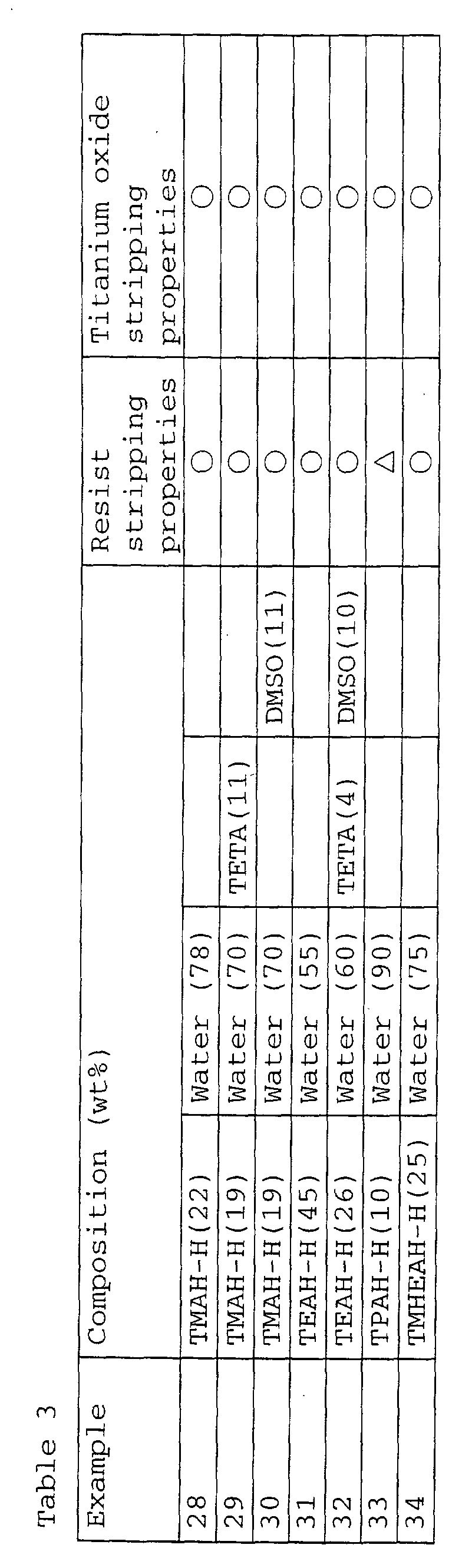
- The resist stripper of the present invention contains no hydroxylamine which is unstable and is highly hazardous, and is useful as a resist stripper showing excellent resist stripping properties and titanium oxide stripping properties.
- The entire disclosures of Japanese Patent Application No. 2000-369625 filed on November 30, 2000, Japanese Patent Application No. 2000-399153 filed on December 27, 2000, Japanese Patent Application No. 2000-399154 filed on December 27, 2000, Japanese Patent Application No. 2001-070360 filed on March 13, 2001 and Japanese Patent Application No. 2001-123252 filed on April 20, 2001 including specifications, claims and summaries are incorporated herein by reference in their entireties.


Claims (11)
- A resist stripper which comprises a peroxide and a quaternary ammonium salt.
- The resist stripper according to Claim 1, wherein the quaternary ammonium salt is at least one member selected from quaternary ammonium hydroxide, a quaternary ammonium carbonate, a quaternary ammonium carboxylate and a quaternary ammonium peroxycarboxylate.
- The resist stripper according to Claim 2, wherein the carboxylic acid in the quaternary ammonium carboxylate is an aromatic carboxylic acid.
- The resist stripper according to Claim 2 or 3, wherein the carboxylic acid in the quaternary ammonium carboxylate is at least one member selected from benzoic acid, salicylic acid and phthalic acid.
- The resist stripper according to any one of Claims 1 to 4, wherein the quaternary ammonium in the quaternary ammonium salt is at least one member selected from a tetraalkyl ammonium, a benzyltrialkyl ammonium and an alkyl-hydroxyalkyl ammonium.
- The resist stripper according to any one of Claims 1 to 5, wherein the peroxide is at least one member selected from hydrogen peroxide, a persulfate, a perborate, a percarbonate, an organic peracid and an organic hydroperoxide.
- The resist stripper according to any one of Claims 1 to 6, wherein the peroxide and the quaternary ammonium salt are a peroxyhydrate of the quaternary ammonium salt.
- The resist stripper according to any one of Claims 1 to 7, which has at least one member selected from an amine, a water soluble organic solvent and water added to the peroxide and the quaternary ammonium salt.
- The resist stripper according to any one of Claims 1 to 8, wherein the water soluble organic solvent is at least one member selected from a sulfoxide, a sulfone, an amide, a lactam, an imidazolidinone, a glycol and a glycol ether.
- The resist stripper according to any one of Claims 1 to 9, for stripping of a titanium oxide.
- The resist stripper according to any one of Claims 1 to 10, for stripping of a resist or a resist residue remaining after development of a photoresist and formation of a circuit.
Applications Claiming Priority (10)
| Application Number | Priority Date | Filing Date | Title |
|---|---|---|---|
| JP2000369625 | 2000-11-30 | ||
| JP2000369625 | 2000-11-30 | ||
| JP2000399154 | 2000-12-27 | ||
| JP2000399153 | 2000-12-27 | ||
| JP2000399153A JP4572466B2 (en) | 2000-12-27 | 2000-12-27 | Resist stripper |
| JP2000399154 | 2000-12-27 | ||
| JP2001070360 | 2001-03-13 | ||
| JP2001070360 | 2001-03-13 | ||
| JP2001123252 | 2001-04-20 | ||
| JP2001123252 | 2001-04-20 |
Publications (2)
| Publication Number | Publication Date |
|---|---|
| EP1211563A1 true EP1211563A1 (en) | 2002-06-05 |
| EP1211563B1 EP1211563B1 (en) | 2011-12-21 |
Family
ID=27531731
Family Applications (1)
| Application Number | Title | Priority Date | Filing Date |
|---|---|---|---|
| EP01128335A Expired - Lifetime EP1211563B1 (en) | 2000-11-30 | 2001-11-29 | Resist stripper composition |
Country Status (4)
| Country | Link |
|---|---|
| US (1) | US6797682B2 (en) |
| EP (1) | EP1211563B1 (en) |
| KR (1) | KR100822236B1 (en) |
| TW (1) | TW554258B (en) |
Cited By (20)
| Publication number | Priority date | Publication date | Assignee | Title |
|---|---|---|---|---|
| EP1488286A4 (en) * | 2002-03-25 | 2005-09-28 | Advanced Tech Materials | Ph buffered compositions for cleaning semiconductor substrates |
| WO2008092688A1 (en) * | 2007-01-31 | 2008-08-07 | Lonza Inc. | Disinfectant formulations containing quaternary ammonium compounds and hydrogen peroxide |
| AU2004243559B2 (en) * | 2003-05-28 | 2009-06-04 | Lonza Inc. | Use of quaternary ammonium carbonates and bicarbonates as anticorrosive agents, method for inhibiting corrosion and anticorrosive coatings using these agents |
| US7611588B2 (en) | 2004-11-30 | 2009-11-03 | Ecolab Inc. | Methods and compositions for removing metal oxides |
| EP2034365A3 (en) * | 2002-06-07 | 2009-11-11 | Mallinckrodt Baker, Inc. | Microelectronic cleaning compositions containing oxidizers and organic solvents |
| EP1959303A4 (en) * | 2005-12-01 | 2010-01-27 | Mitsubishi Gas Chemical Co | CLEANING SOLUTION FOR SEMICONDUCTOR DEVICE OR DISPLAY DEVICE AND CLEANING METHOD |
| CN1690865B (en) * | 2004-04-19 | 2010-06-16 | 东友Fine-Chem株式会社 | Photoresist stripper |
| EP1965618A4 (en) * | 2005-12-20 | 2010-08-04 | Mitsubishi Gas Chemical Co | COMPOSITION FOR REMOVING RESIDUES ON CONNECTION GRIDS AND CLEANING METHOD |
| WO2010127942A1 (en) * | 2009-05-07 | 2010-11-11 | Basf Se | Resist stripping compositions and methods for manufacturing electrical devices |
| WO2010127941A1 (en) * | 2009-05-07 | 2010-11-11 | Basf Se | Resist stripping compositions and methods for manufacturing electrical devices |
| EP1844367A4 (en) * | 2005-01-07 | 2011-08-31 | Advanced Tech Materials | Composition useful for removal of post-etch photoresist and bottom anti-reflection coatings |
| US8697345B2 (en) | 2001-12-27 | 2014-04-15 | Tokyo Ohka Kogyo Co., Ltd. | Photoresist stripping solution and a method of stripping photoresists using the same |
| WO2015047741A1 (en) * | 2013-09-27 | 2015-04-02 | Dynaloy, Llc | Aqueous solution and process for removing substances from substrates |
| US9069259B2 (en) | 2005-10-28 | 2015-06-30 | Dynaloy, Llc | Dynamic multi-purpose compositions for the removal of photoresists and method for its use |
| US9158202B2 (en) | 2012-11-21 | 2015-10-13 | Dynaloy, Llc | Process and composition for removing substances from substrates |
| US9243218B2 (en) | 2005-10-28 | 2016-01-26 | Dynaloy, Llc | Dynamic multipurpose composition for the removal of photoresists and method for its use |
| US9329486B2 (en) | 2005-10-28 | 2016-05-03 | Dynaloy, Llc | Dynamic multi-purpose composition for the removal of photoresists and method for its use |
| CN106966939A (en) * | 2017-05-15 | 2017-07-21 | 北京长江脉医药科技有限责任公司 | A kind of tetraalkyl carboxylic acid peroxide ammonium salt compound and preparation method and application |
| US10073352B2 (en) | 2016-04-12 | 2018-09-11 | Versum Materials Us, Llc | Aqueous solution and process for removing substances from substrates |
| WO2020146748A1 (en) | 2019-01-11 | 2020-07-16 | Versum Materials Us, Llc | Hafnium oxide corrosion inhibitor |
Families Citing this family (49)
| Publication number | Priority date | Publication date | Assignee | Title |
|---|---|---|---|---|
| JP3738996B2 (en) * | 2002-10-10 | 2006-01-25 | 東京応化工業株式会社 | Cleaning liquid for photolithography and substrate processing method |
| KR100438015B1 (en) * | 2001-10-10 | 2004-06-30 | 엘지.필립스 엘시디 주식회사 | Cu-compatible Resist removing composition |
| KR100469160B1 (en) * | 2001-12-27 | 2005-01-29 | 엘지.필립스 엘시디 주식회사 | Photolithography progress for Metal Line used by Al containing Metal Material |
| US20030148624A1 (en) * | 2002-01-31 | 2003-08-07 | Kazuto Ikemoto | Method for removing resists |
| US20040011386A1 (en) * | 2002-07-17 | 2004-01-22 | Scp Global Technologies Inc. | Composition and method for removing photoresist and/or resist residue using supercritical fluids |
| US20040050406A1 (en) * | 2002-07-17 | 2004-03-18 | Akshey Sehgal | Compositions and method for removing photoresist and/or resist residue at pressures ranging from ambient to supercritical |
| JP4282054B2 (en) * | 2002-09-09 | 2009-06-17 | 東京応化工業株式会社 | Cleaning liquid used in dual damascene structure forming process and substrate processing method |
| US8236485B2 (en) | 2002-12-20 | 2012-08-07 | Advanced Technology Materials, Inc. | Photoresist removal |
| US20050032657A1 (en) * | 2003-08-06 | 2005-02-10 | Kane Sean Michael | Stripping and cleaning compositions for microelectronics |
| PL1664935T3 (en) * | 2003-08-19 | 2008-01-31 | Avantor Performance Mat Inc | Stripping and cleaning compositions for microelectronics |
| US8338087B2 (en) * | 2004-03-03 | 2012-12-25 | Advanced Technology Materials, Inc | Composition and process for post-etch removal of photoresist and/or sacrificial anti-reflective material deposited on a substrate |
| WO2005109108A1 (en) * | 2004-05-07 | 2005-11-17 | Dongjin Semichem Co., Ltd. | Composition for removing a (photo) resist |
| KR101082018B1 (en) * | 2004-05-07 | 2011-11-10 | 주식회사 동진쎄미켐 | Composition for removing a (photo)resist |
| US20060003910A1 (en) * | 2004-06-15 | 2006-01-05 | Hsu Jiun Y | Composition and method comprising same for removing residue from a substrate |
| US8030263B2 (en) * | 2004-07-01 | 2011-10-04 | Air Products And Chemicals, Inc. | Composition for stripping and cleaning and use thereof |
| US9217929B2 (en) * | 2004-07-22 | 2015-12-22 | Air Products And Chemicals, Inc. | Composition for removing photoresist and/or etching residue from a substrate and use thereof |
| US20060016463A1 (en) * | 2004-07-22 | 2006-01-26 | Dober Chemical Corporation | Composition and process for removing titanium dioxide residues from surfaces |
| US20060033084A1 (en) * | 2004-08-10 | 2006-02-16 | Tosoh Corporation | Composition for dissolving titanium oxide and dissolution method using it |
| US20060063687A1 (en) * | 2004-09-17 | 2006-03-23 | Minsek David W | Composition and process for ashless removal of post-etch photoresist and/or bottom anti-reflective material on a substrate |
| US7923423B2 (en) * | 2005-01-27 | 2011-04-12 | Advanced Technology Materials, Inc. | Compositions for processing of semiconductor substrates |
| TWI538033B (en) * | 2005-01-27 | 2016-06-11 | 安堤格里斯公司 | Semiconductor substrate processing composition |
| US7923424B2 (en) * | 2005-02-14 | 2011-04-12 | Advanced Process Technologies, Llc | Semiconductor cleaning using superacids |
| US20060183654A1 (en) * | 2005-02-14 | 2006-08-17 | Small Robert J | Semiconductor cleaning using ionic liquids |
| JP4678673B2 (en) * | 2005-05-12 | 2011-04-27 | 東京応化工業株式会社 | Photoresist stripping solution |
| JP2008543060A (en) * | 2005-05-26 | 2008-11-27 | アドバンスド テクノロジー マテリアルズ,インコーポレイテッド | Copper-inactivated chemical mechanical post-polishing cleaning composition and method of use |
| US20070243773A1 (en) * | 2005-10-28 | 2007-10-18 | Phenis Michael T | Dynamic multi-purpose composition for the removal of photoresists and method for its use |
| US7674755B2 (en) * | 2005-12-22 | 2010-03-09 | Air Products And Chemicals, Inc. | Formulation for removal of photoresist, etch residue and BARC |
| TWI323391B (en) * | 2006-03-21 | 2010-04-11 | Daxin Material Corp | Remover solution composition and use thereof |
| US7591956B2 (en) * | 2006-05-03 | 2009-09-22 | OMG Electronic Chemicals, Inc. | Method and composition for selectively stripping nickel from a substrate |
| US8551682B2 (en) * | 2007-08-15 | 2013-10-08 | Dynaloy, Llc | Metal conservation with stripper solutions containing resorcinol |
| KR20090073376A (en) * | 2007-12-31 | 2009-07-03 | 삼성전자주식회사 | Phase reversal mask cleaning composition, phase reversal mask cleaning method and phase reversal mask manufacturing method |
| TWI450052B (en) * | 2008-06-24 | 2014-08-21 | 黛納羅伊有限責任公司 | Stripping solution for efficient post-stage process |
| JP5279921B2 (en) * | 2009-11-26 | 2013-09-04 | エルジー・ケム・リミテッド | Photoresist stripper composition and photoresist stripping method using the same |
| TWI539493B (en) | 2010-03-08 | 2016-06-21 | 黛納羅伊有限責任公司 | Method and composition for doping a germanium substrate having a molecular monolayer |
| US8058221B2 (en) * | 2010-04-06 | 2011-11-15 | Samsung Electronics Co., Ltd. | Composition for removing a photoresist and method of manufacturing semiconductor device using the composition |
| EP2407529A1 (en) * | 2010-07-12 | 2012-01-18 | Solvay SA | Peroxygen composition |
| KR101453340B1 (en) * | 2011-11-02 | 2014-10-21 | 주식회사 지에이티 | Cleaning agent composition for APR mask and equipment |
| US8987181B2 (en) | 2011-11-08 | 2015-03-24 | Dynaloy, Llc | Photoresist and post etch residue cleaning solution |
| US20130200040A1 (en) * | 2012-01-04 | 2013-08-08 | International Business Machines Corporation | Titanium nitride removal |
| US9070625B2 (en) | 2012-01-04 | 2015-06-30 | International Business Machines Corporation | Selective etch chemistry for gate electrode materials |
| KR101375100B1 (en) * | 2012-08-31 | 2014-03-17 | 주식회사 이엔에프테크놀로지 | Stripper composition for thick negative photoresist |
| US9029268B2 (en) | 2012-11-21 | 2015-05-12 | Dynaloy, Llc | Process for etching metals |
| JP6464578B2 (en) * | 2013-08-01 | 2019-02-06 | 三菱瓦斯化学株式会社 | Method for manufacturing printed wiring board |
| KR102340516B1 (en) * | 2013-08-30 | 2021-12-21 | 엔테그리스, 아이엔씨. | Compositions and methods for selectively etching titanium nitride |
| KR102028006B1 (en) * | 2014-01-16 | 2019-10-02 | 동우 화인켐 주식회사 | Cleaning composition for electronic material |
| KR102091544B1 (en) * | 2014-01-22 | 2020-03-20 | 동우 화인켐 주식회사 | Resist stripper composition and method of stripping resist using the same |
| US9650594B2 (en) | 2015-01-22 | 2017-05-16 | Dynaloy, Llc | Solutions and processes for removing substances from substrates |
| US10683439B2 (en) * | 2018-03-15 | 2020-06-16 | Rohm And Haas Electronic Materials Cmp Holdings, Inc. | Polishing composition and method of polishing a substrate having enhanced defect inhibition |
| KR102933956B1 (en) | 2021-05-03 | 2026-03-04 | 삼성전자주식회사 | Composition for removing photoresist and methods of manufacturing semiconductor device and semiconductor package |
Citations (15)
| Publication number | Priority date | Publication date | Assignee | Title |
|---|---|---|---|---|
| JPH04289866A (en) | 1990-11-05 | 1992-10-14 | Ekc Technol Inc | Composition and method for removing anti-corrosive membrane from supporting body |
| EP0597100A1 (en) * | 1991-07-02 | 1994-05-18 | OHMI, Tadahiro | Developing solution and developing method |
| EP0608545A1 (en) * | 1992-12-28 | 1994-08-03 | Mitsubishi Gas Chemical Company, Inc. | Method for preparing aqueous quaternary ammonium hydroxide solution |
| JPH06266119A (en) | 1992-07-09 | 1994-09-22 | Ekc Technol Inc | Cleaning agent containing nucleophilic amine compound provided with reduction and oxidation potential |
| WO1995004372A1 (en) * | 1993-07-30 | 1995-02-09 | Semitool, Inc. | Methods for processing semiconductors to reduce surface particles |
| JPH07118885A (en) * | 1993-10-19 | 1995-05-09 | Mitsubishi Gas Chem Co Inc | Method for producing quaternary ammonium hydroxide aqueous solution |
| JPH08124888A (en) * | 1994-10-19 | 1996-05-17 | Mitsubishi Gas Chem Co Inc | Method for cleaning semiconductor substrate with ozone |
| US5840127A (en) * | 1994-01-28 | 1998-11-24 | Wako Pure Chemical Industries, Ltd. | Surface treating agents and treating process for semiconductors |
| WO1999001530A1 (en) * | 1997-07-02 | 1999-01-14 | The Procter & Gamble Company | Bleach compatible alkoxylated polyalkyleneimines |
| WO1999002637A1 (en) * | 1997-07-11 | 1999-01-21 | The Procter & Gamble Company | Alkaline detergent compositions comprising a specific cellulase |
| WO1999041345A1 (en) * | 1998-02-11 | 1999-08-19 | Rhodia Chimie | Solid detergent compositions based on sodium silicate and amine silicone |
| WO1999060448A1 (en) * | 1998-05-18 | 1999-11-25 | Mallinckrodt Inc. | Silicate-containing alkaline compositions for cleaning microelectronic substrates |
| US6030491A (en) * | 1997-08-19 | 2000-02-29 | Micron Technology, Inc. | Processing compositions and methods of using same |
| EP1001012A1 (en) * | 1998-11-10 | 2000-05-17 | The Procter & Gamble Company | Disinfecting and cleaning compositions |
| EP1005072A1 (en) * | 1998-11-19 | 2000-05-31 | Wacker Siltronic Gesellschaft für Halbleitermaterialien Aktiengesellschaft | Method for wet-chemical treatment of semiconductor substrates |
Family Cites Families (8)
| Publication number | Priority date | Publication date | Assignee | Title |
|---|---|---|---|---|
| US4655975A (en) * | 1986-01-27 | 1987-04-07 | The Dow Chemical Company | Solid chelating poly(carboxylate and/or sulfonate)peroxyhydrate bleaches |
| FR2623395B1 (en) * | 1987-11-24 | 1990-04-20 | Oreal | PHARMACEUTICAL AND COSMETIC COMPOSITIONS BASED ON BENZOYL PEROXIDE AND QUATERNARY AMMONIUM LIPOPHILIC SALICYLATES AND THEIR USE, ESPECIALLY IN THE TREATMENT OF ACNE |
| US5466389A (en) * | 1994-04-20 | 1995-11-14 | J. T. Baker Inc. | PH adjusted nonionic surfactant-containing alkaline cleaner composition for cleaning microelectronics substrates |
| DE69636618T2 (en) * | 1995-07-27 | 2007-08-30 | Mitsubishi Chemical Corp. | METHOD FOR THE TREATMENT OF A SUBSTRATE SURFACE AND TREATMENT THEREFOR |
| US5911836A (en) * | 1996-02-05 | 1999-06-15 | Mitsubishi Gas Chemical Company, Inc. | Method of producing semiconductor device and rinse for cleaning semiconductor device |
| US5989353A (en) * | 1996-10-11 | 1999-11-23 | Mallinckrodt Baker, Inc. | Cleaning wafer substrates of metal contamination while maintaining wafer smoothness |
| JP4224652B2 (en) * | 1999-03-08 | 2009-02-18 | 三菱瓦斯化学株式会社 | Resist stripping solution and resist stripping method using the same |
| US6428387B1 (en) * | 1999-08-04 | 2002-08-06 | Texas Instruments Incorporated | Method for chemical mechanical polishing using a high selective slurry |
-
2001
- 2001-11-29 KR KR1020010074906A patent/KR100822236B1/en not_active Expired - Fee Related
- 2001-11-29 EP EP01128335A patent/EP1211563B1/en not_active Expired - Lifetime
- 2001-11-29 TW TW090129563A patent/TW554258B/en not_active IP Right Cessation
- 2001-11-30 US US09/996,773 patent/US6797682B2/en not_active Expired - Fee Related
Patent Citations (15)
| Publication number | Priority date | Publication date | Assignee | Title |
|---|---|---|---|---|
| JPH04289866A (en) | 1990-11-05 | 1992-10-14 | Ekc Technol Inc | Composition and method for removing anti-corrosive membrane from supporting body |
| EP0597100A1 (en) * | 1991-07-02 | 1994-05-18 | OHMI, Tadahiro | Developing solution and developing method |
| JPH06266119A (en) | 1992-07-09 | 1994-09-22 | Ekc Technol Inc | Cleaning agent containing nucleophilic amine compound provided with reduction and oxidation potential |
| EP0608545A1 (en) * | 1992-12-28 | 1994-08-03 | Mitsubishi Gas Chemical Company, Inc. | Method for preparing aqueous quaternary ammonium hydroxide solution |
| WO1995004372A1 (en) * | 1993-07-30 | 1995-02-09 | Semitool, Inc. | Methods for processing semiconductors to reduce surface particles |
| JPH07118885A (en) * | 1993-10-19 | 1995-05-09 | Mitsubishi Gas Chem Co Inc | Method for producing quaternary ammonium hydroxide aqueous solution |
| US5840127A (en) * | 1994-01-28 | 1998-11-24 | Wako Pure Chemical Industries, Ltd. | Surface treating agents and treating process for semiconductors |
| JPH08124888A (en) * | 1994-10-19 | 1996-05-17 | Mitsubishi Gas Chem Co Inc | Method for cleaning semiconductor substrate with ozone |
| WO1999001530A1 (en) * | 1997-07-02 | 1999-01-14 | The Procter & Gamble Company | Bleach compatible alkoxylated polyalkyleneimines |
| WO1999002637A1 (en) * | 1997-07-11 | 1999-01-21 | The Procter & Gamble Company | Alkaline detergent compositions comprising a specific cellulase |
| US6030491A (en) * | 1997-08-19 | 2000-02-29 | Micron Technology, Inc. | Processing compositions and methods of using same |
| WO1999041345A1 (en) * | 1998-02-11 | 1999-08-19 | Rhodia Chimie | Solid detergent compositions based on sodium silicate and amine silicone |
| WO1999060448A1 (en) * | 1998-05-18 | 1999-11-25 | Mallinckrodt Inc. | Silicate-containing alkaline compositions for cleaning microelectronic substrates |
| EP1001012A1 (en) * | 1998-11-10 | 2000-05-17 | The Procter & Gamble Company | Disinfecting and cleaning compositions |
| EP1005072A1 (en) * | 1998-11-19 | 2000-05-31 | Wacker Siltronic Gesellschaft für Halbleitermaterialien Aktiengesellschaft | Method for wet-chemical treatment of semiconductor substrates |
Non-Patent Citations (2)
| Title |
|---|
| DATABASE WPI Section Ch Week 199527, Derwent World Patents Index; Class A60, AN 1995-204353, XP002192035 * |
| DATABASE WPI Section Ch Week 199630, Derwent World Patents Index; Class E16, AN 1996-293098, XP002192036 * |
Cited By (27)
| Publication number | Priority date | Publication date | Assignee | Title |
|---|---|---|---|---|
| US8697345B2 (en) | 2001-12-27 | 2014-04-15 | Tokyo Ohka Kogyo Co., Ltd. | Photoresist stripping solution and a method of stripping photoresists using the same |
| EP1488286A4 (en) * | 2002-03-25 | 2005-09-28 | Advanced Tech Materials | Ph buffered compositions for cleaning semiconductor substrates |
| EP2034365A3 (en) * | 2002-06-07 | 2009-11-11 | Mallinckrodt Baker, Inc. | Microelectronic cleaning compositions containing oxidizers and organic solvents |
| AU2004243559B2 (en) * | 2003-05-28 | 2009-06-04 | Lonza Inc. | Use of quaternary ammonium carbonates and bicarbonates as anticorrosive agents, method for inhibiting corrosion and anticorrosive coatings using these agents |
| CN1690865B (en) * | 2004-04-19 | 2010-06-16 | 东友Fine-Chem株式会社 | Photoresist stripper |
| US7611588B2 (en) | 2004-11-30 | 2009-11-03 | Ecolab Inc. | Methods and compositions for removing metal oxides |
| EP2482134A3 (en) * | 2005-01-07 | 2012-11-07 | Advanced Technology Materials, Inc. | Composition useful for removal of post-etch photoresist and bottom anti-reflection coatings |
| EP1844367A4 (en) * | 2005-01-07 | 2011-08-31 | Advanced Tech Materials | Composition useful for removal of post-etch photoresist and bottom anti-reflection coatings |
| US9243218B2 (en) | 2005-10-28 | 2016-01-26 | Dynaloy, Llc | Dynamic multipurpose composition for the removal of photoresists and method for its use |
| US9329486B2 (en) | 2005-10-28 | 2016-05-03 | Dynaloy, Llc | Dynamic multi-purpose composition for the removal of photoresists and method for its use |
| US9069259B2 (en) | 2005-10-28 | 2015-06-30 | Dynaloy, Llc | Dynamic multi-purpose compositions for the removal of photoresists and method for its use |
| US7998914B2 (en) | 2005-12-01 | 2011-08-16 | Mitsubishi Gas Chemical Company, Inc. | Cleaning solution for semiconductor device or display device, and cleaning method |
| EP1959303A4 (en) * | 2005-12-01 | 2010-01-27 | Mitsubishi Gas Chemical Co | CLEANING SOLUTION FOR SEMICONDUCTOR DEVICE OR DISPLAY DEVICE AND CLEANING METHOD |
| EP1965618A4 (en) * | 2005-12-20 | 2010-08-04 | Mitsubishi Gas Chemical Co | COMPOSITION FOR REMOVING RESIDUES ON CONNECTION GRIDS AND CLEANING METHOD |
| WO2008092688A1 (en) * | 2007-01-31 | 2008-08-07 | Lonza Inc. | Disinfectant formulations containing quaternary ammonium compounds and hydrogen peroxide |
| WO2010127942A1 (en) * | 2009-05-07 | 2010-11-11 | Basf Se | Resist stripping compositions and methods for manufacturing electrical devices |
| WO2010127941A1 (en) * | 2009-05-07 | 2010-11-11 | Basf Se | Resist stripping compositions and methods for manufacturing electrical devices |
| US9005367B2 (en) | 2009-05-07 | 2015-04-14 | Basf Se | Resist stripping compositions and methods for manufacturing electrical devices |
| US9158202B2 (en) | 2012-11-21 | 2015-10-13 | Dynaloy, Llc | Process and composition for removing substances from substrates |
| US9291910B2 (en) | 2013-09-27 | 2016-03-22 | Dynaloy, Llc | Aqueous solution and process for removing substances from substrates |
| WO2015047741A1 (en) * | 2013-09-27 | 2015-04-02 | Dynaloy, Llc | Aqueous solution and process for removing substances from substrates |
| US10073352B2 (en) | 2016-04-12 | 2018-09-11 | Versum Materials Us, Llc | Aqueous solution and process for removing substances from substrates |
| CN106966939A (en) * | 2017-05-15 | 2017-07-21 | 北京长江脉医药科技有限责任公司 | A kind of tetraalkyl carboxylic acid peroxide ammonium salt compound and preparation method and application |
| CN106966939B (en) * | 2017-05-15 | 2021-04-02 | 北京长江脉医药科技有限责任公司 | Tetraalkylammonium peroxycarboxylate compound and preparation method and application thereof |
| WO2020146748A1 (en) | 2019-01-11 | 2020-07-16 | Versum Materials Us, Llc | Hafnium oxide corrosion inhibitor |
| EP3909068A4 (en) * | 2019-01-11 | 2022-09-28 | Versum Materials US, LLC | HAFNIUM OXIDE CORROSION INHIBITOR |
| US11946148B2 (en) | 2019-01-11 | 2024-04-02 | Versum Materials Us, Llc | Hafnium oxide corrosion inhibitor |
Also Published As
| Publication number | Publication date |
|---|---|
| KR100822236B1 (en) | 2008-04-16 |
| EP1211563B1 (en) | 2011-12-21 |
| US20020128164A1 (en) | 2002-09-12 |
| US6797682B2 (en) | 2004-09-28 |
| TW554258B (en) | 2003-09-21 |
| KR20020042490A (en) | 2002-06-05 |
Similar Documents
| Publication | Publication Date | Title |
|---|---|---|
| US6797682B2 (en) | Resist stripper | |
| US6773873B2 (en) | pH buffered compositions useful for cleaning residue from semiconductor substrates | |
| US7456140B2 (en) | Compositions for cleaning organic and plasma etched residues for semiconductor devices | |
| US7361631B2 (en) | Compositions for the removal of organic and inorganic residues | |
| US6777380B2 (en) | Compositions for cleaning organic and plasma etched residues for semiconductor devices | |
| US6110881A (en) | Cleaning solutions including nucleophilic amine compound having reduction and oxidation potentials | |
| US7144848B2 (en) | Cleaning compositions containing hydroxylamine derivatives and processes using same for residue removal | |
| JP4073596B2 (en) | Resist removing composition and resist removing method using the same | |
| JP2003005383A (en) | Resist stripper | |
| JP2004510204A (en) | Photoresist remover / wash solution containing aromatic acid inhibitor | |
| KR20090037088A (en) | Resist stripper composition and method of peeling resist using same | |
| CN113741158A (en) | Aqueous stripping liquid composition and use method thereof | |
| JP2003098691A (en) | Resist removing composition and resist removing method using the same | |
| US20040067860A1 (en) | Cleaning compositions and methods of use thereof | |
| KR20090121650A (en) | Resist stripper composition and method of peeling resist using same | |
| JP3431074B2 (en) | Release agent composition and release method | |
| JP2002202617A (en) | Resist stripping composition | |
| CN115280244B (en) | substrate cleaning method | |
| US7387130B2 (en) | Cleaning solutions including nucleophilic amine compound having reduction and oxidation potentials | |
| KR20020053718A (en) | Remover composition | |
| US20060094612A1 (en) | Post etch cleaning composition for use with substrates having aluminum | |
| KR100511083B1 (en) | Photoresist and polymer remover composition, and exfoliation and the washing method of a semiconductor element used it | |
| TW202313951A (en) | Composition for photoresist stripper and preparation method thereof | |
| JP2002318455A (en) | Stabilization method | |
| JP4572466B2 (en) | Resist stripper |
Legal Events
| Date | Code | Title | Description |
|---|---|---|---|
| PUAI | Public reference made under article 153(3) epc to a published international application that has entered the european phase |
Free format text: ORIGINAL CODE: 0009012 |
|
| AK | Designated contracting states |
Kind code of ref document: A1 Designated state(s): AT BE CH CY DE DK ES FI FR GB GR IE IT LI LU MC NL PT SE TR |
|
| AX | Request for extension of the european patent |
Free format text: AL;LT;LV;MK;RO;SI |
|
| 17P | Request for examination filed |
Effective date: 20021120 |
|
| AKX | Designation fees paid |
Designated state(s): DE FR GB IT |
|
| 17Q | First examination report despatched |
Effective date: 20100618 |
|
| RTI1 | Title (correction) |
Free format text: RESIST STRIPPER COMPOSITION |
|
| GRAP | Despatch of communication of intention to grant a patent |
Free format text: ORIGINAL CODE: EPIDOSNIGR1 |
|
| GRAS | Grant fee paid |
Free format text: ORIGINAL CODE: EPIDOSNIGR3 |
|
| GRAA | (expected) grant |
Free format text: ORIGINAL CODE: 0009210 |
|
| AK | Designated contracting states |
Kind code of ref document: B1 Designated state(s): DE FR GB IT |
|
| REG | Reference to a national code |
Ref country code: GB Ref legal event code: FG4D |
|
| REG | Reference to a national code |
Ref country code: DE Ref legal event code: R096 Ref document number: 60145819 Country of ref document: DE Effective date: 20120308 |
|
| PLBE | No opposition filed within time limit |
Free format text: ORIGINAL CODE: 0009261 |
|
| STAA | Information on the status of an ep patent application or granted ep patent |
Free format text: STATUS: NO OPPOSITION FILED WITHIN TIME LIMIT |
|
| 26N | No opposition filed |
Effective date: 20120924 |
|
| REG | Reference to a national code |
Ref country code: DE Ref legal event code: R097 Ref document number: 60145819 Country of ref document: DE Effective date: 20120924 |
|
| REG | Reference to a national code |
Ref country code: FR Ref legal event code: PLFP Year of fee payment: 15 |
|
| PGFP | Annual fee paid to national office [announced via postgrant information from national office to epo] |
Ref country code: IT Payment date: 20151124 Year of fee payment: 15 Ref country code: DE Payment date: 20151125 Year of fee payment: 15 Ref country code: GB Payment date: 20151125 Year of fee payment: 15 |
|
| PGFP | Annual fee paid to national office [announced via postgrant information from national office to epo] |
Ref country code: FR Payment date: 20151008 Year of fee payment: 15 |
|
| REG | Reference to a national code |
Ref country code: DE Ref legal event code: R119 Ref document number: 60145819 Country of ref document: DE |
|
| GBPC | Gb: european patent ceased through non-payment of renewal fee |
Effective date: 20161129 |
|
| REG | Reference to a national code |
Ref country code: FR Ref legal event code: ST Effective date: 20170731 |
|
| PG25 | Lapsed in a contracting state [announced via postgrant information from national office to epo] |
Ref country code: IT Free format text: LAPSE BECAUSE OF NON-PAYMENT OF DUE FEES Effective date: 20161129 Ref country code: FR Free format text: LAPSE BECAUSE OF NON-PAYMENT OF DUE FEES Effective date: 20161130 |
|
| PG25 | Lapsed in a contracting state [announced via postgrant information from national office to epo] |
Ref country code: GB Free format text: LAPSE BECAUSE OF NON-PAYMENT OF DUE FEES Effective date: 20161129 Ref country code: DE Free format text: LAPSE BECAUSE OF NON-PAYMENT OF DUE FEES Effective date: 20170601 |