EP1206363B1 - Sealing and guiding strip for a window - Google Patents
Sealing and guiding strip for a window Download PDFInfo
- Publication number
- EP1206363B1 EP1206363B1 EP00953277A EP00953277A EP1206363B1 EP 1206363 B1 EP1206363 B1 EP 1206363B1 EP 00953277 A EP00953277 A EP 00953277A EP 00953277 A EP00953277 A EP 00953277A EP 1206363 B1 EP1206363 B1 EP 1206363B1
- Authority
- EP
- European Patent Office
- Prior art keywords
- channel
- lip
- side wall
- wall
- channel according
- Prior art date
- Legal status (The legal status is an assumption and is not a legal conclusion. Google has not performed a legal analysis and makes no representation as to the accuracy of the status listed.)
- Expired - Lifetime
Links
- 238000007789 sealing Methods 0.000 title claims description 15
- 239000005357 flat glass Substances 0.000 claims description 12
- 239000000463 material Substances 0.000 claims description 7
- 238000001125 extrusion Methods 0.000 claims description 3
- 239000000853 adhesive Substances 0.000 claims 1
- 230000001070 adhesive effect Effects 0.000 claims 1
- 230000007423 decrease Effects 0.000 claims 1
- 244000144992 flock Species 0.000 description 2
- 239000011521 glass Substances 0.000 description 2
- 239000002184 metal Substances 0.000 description 2
- 238000000034 method Methods 0.000 description 2
- 239000004033 plastic Substances 0.000 description 2
- 229920003023 plastic Polymers 0.000 description 2
- 230000001419 dependent effect Effects 0.000 description 1
- 238000011161 development Methods 0.000 description 1
- 230000018109 developmental process Effects 0.000 description 1
- 230000000694 effects Effects 0.000 description 1
- 238000011065 in-situ storage Methods 0.000 description 1
- 238000007373 indentation Methods 0.000 description 1
Images

Classifications
-
- B—PERFORMING OPERATIONS; TRANSPORTING
- B60—VEHICLES IN GENERAL
- B60J—WINDOWS, WINDSCREENS, NON-FIXED ROOFS, DOORS, OR SIMILAR DEVICES FOR VEHICLES; REMOVABLE EXTERNAL PROTECTIVE COVERINGS SPECIALLY ADAPTED FOR VEHICLES
- B60J10/00—Sealing arrangements
- B60J10/70—Sealing arrangements specially adapted for windows or windscreens
- B60J10/74—Sealing arrangements specially adapted for windows or windscreens for sliding window panes, e.g. sash guides
-
- B—PERFORMING OPERATIONS; TRANSPORTING
- B60—VEHICLES IN GENERAL
- B60J—WINDOWS, WINDSCREENS, NON-FIXED ROOFS, DOORS, OR SIMILAR DEVICES FOR VEHICLES; REMOVABLE EXTERNAL PROTECTIVE COVERINGS SPECIALLY ADAPTED FOR VEHICLES
- B60J10/00—Sealing arrangements
- B60J10/20—Sealing arrangements characterised by the shape
- B60J10/21—Sealing arrangements characterised by the shape having corner parts or bends
Definitions
- the invention relates to a window sealing and guiding channel for a window opening having a sharp corner, comprising a channel base and first and second integral channel side walls made of flexible material, each side wall having a lip extending along its distal edge, the lip on the first side wall being separated from that side wall over a region extending along a portion of the channel including the sharp corner, the separated lip smoothly bridging across the sharp corner, the lip on the second side wall being separated from that side wall at the corner and mitre-cut there to form a mitre joint matching the sharp angle, an insert being secured between the separated lip of the first side wall and the remainder of that side wall over the said region.
- Such a channel is shown for example in GB-A-2 311 799.
- the insert which may be separately manufactured, may present a slightly different appearance as compared with the channel walls.
- the channel as first set forth above is characterised in that the channel further comprises a third wall extending from the channel base adjacent the first side wall and made of flexible material, the third wall having a lip extending along its distal edge which is separated from that side wall at the corner and which follows a smooth curve between the mitre joint of the second side wall lip and the curve of the first side wall lip and which thereby substantially overlies the said insert.
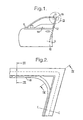
- Figure 1 shows a vehicle door 10 carrying a window frame 12.
- a pane of window glass 14 is slidable in a vertical direction in the window frame 12 and can be raised from and lowered into the lower part of the door 10.
- the window frame 12 is produced from metal or other stiff material and is formed to produce a sharp corner 16.
- the window frame 12 is of channel-shape in cross-section and supports a sealing and guiding strip 18 produced from flexible material such as plastics or rubber and in which the window glass 14 slides.
- the sealing and guiding channel 18 is designed to provide a weather-proof seal for the edge of the window glass and also to impose low friction on the movement of the glass.
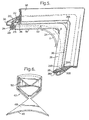
- Figures 2 and 5 show, to an enlarged scale, the window frame 12 and the sealing and guiding channel 18 in the region II of Figure 1.
- the window frame 12 which will be described in more detail with reference to Figures 3 and 4, defines a stiff mounting channel 20 (Fig. 5) in which is supported the sealing and guiding channel 18.
- the channel 18 has a base 22 and side walls 24 and 26. Each of these side walls 24,26 terminates in a respective lip 28,30, the lips having portions 28A and 30A which overlap the respective distal edges of the side walls of the mounting channel 20.
- a third wall 25 extends from the channel base 22 adjacent the side wall 24.
- the wall 25 has a lip 29 which has a portion 29A which abuts (but is not connected to) the lip 28 of the wall 24.
- the lips 29 and 30 also have portions 29B and 30B which extend partway across the mouth of the sealing and guiding channel 18.
- the longitudinal extension of the lip 30 matches the sharp corner 16 of the window frame 12.
- the longitudinal extension of the lip 28 is shaped differently and bridges across the sharp corner 16 in a smooth radius, as indicated over the region A in Figure 5.
- the side wall 24 has to be extended, of course, as indicated at 24A.
- the smooth radius region A is positioned on the inside of the window glass 14.
- the longitudinal extension of the lip 29 bridges across the sharp corner 16 in a smooth radius. This is indicated over region B of Figure 5. It will be seen that the radius B is shorter than radius A and that the smooth curve of the lip 29 follows a path between the smooth curve of the lip 28 and the sharp corner of the lip 30.
- the channel 18 is produced by an extrusion process from plastics or rubber.
- Figure 3 shows a cross-section through the extruded channel 18 at the line III-III of Figure 2.
- Figure 3 also shows the window frame 12 in more detail.
- the window frame 12 comprises channel-shaped metal producing the mounting channel 20, a frame member 36 supporting the channel 20, and an outer trim strip 38.
- the latter is bent to attach it to one of the walls of the mounting channel 20 and to one of the edges (not shown) of the outer frame member 36.
- the latter is bent over the opposite distal edge of the mounting channel 20.
- the window channel 18 defines shoulders 40 and 42 on the outsides of the side walls 24,26 and positioned near the base 22 of the channel. These shoulders 40,42 engage indentations formed in the mounting channel 20 and thus locate the window channel 18 securely in position.
- Figure 3 also shows that the window channel 18 includes a lip 44 at the base of the channel against which the edge of the window glass abuts when the window is fully closed.
- the outwardly facing surface of the lip 44 is covered with flock 46 to provide improved sealing and low friction.
- the lip surfaces 28B and 29B are bent inwardly to allow passage of the window glass.
- the surfaces of the lip portions 28B and 29B which contact the glass are also covered with the flock 46.
- the channel 18 is produced to have the cross-section shown in Figure 3 and a length equal to that from points S and X in Figure 1.
- a cut is made through the side wall 24 of the channel of the position indicated by the line 27 to sever the lip 28 from the remainder of the side wall. This cut starts at the point U in Figure 1 and continues to the point T on the other side of the corner. It will be appreciated that, although the start and end points of this cut are indicated on Figure 1, the cut is in fact made before the channel 18 is mounted on the frame.
- An insert 47 ( Figure 6) is then placed in position as will now be described. This insert produces the required sharp corner in the channel walls 25 and 26 and the lip 30 and the required extended side wall 24A over the region A.
- the insert may be previously moulded and adhesively secured to the channel or may be moulded in situ after the extruded channel has been cut.
- Figure 4 shows a section through the channel 18 at a position after the beginning U of the cut. As shown in Figure 4, the side wall 24 has been cut through and a moulded portion 48 of the insert 47 has been inserted. The moulded portion 48 provides the desired increase in the length of the side wall 24.
- the moulded portion 48 smoothly increases in size towards the corner 16, thus progressively increasing the length of the side wall 24 as shown in Figure 6 and thereby producing the extended side wall portion 24A.
- the moulded portion 48 merges with a channel-shaped moulded portion 50 which is also shown in Figure 4, being a cross-section at the corner 16.
- the side walls 25 and 26 and the lip 30 are cut away to accommodate the channel-shaped portion 50.
- the sealing and guiding channel 18 can be given a sharp radius to match the sharp corner 16 of the frame on the outside of the window and a smooth radius on the inside of the window.
- the portion 48 of the insert 47 may be hidden from view by the lip 29 of the wall 25. This is shown most clearly in Figure 4 where it will be noted that the lip portion 29A is in contact with the side wall 24 approximately at the point where it is secured to the distal edge 49 of the moulded portion 48 of the insert 47.
- the wall 25 completely hides the moulded portion 48 from view. This is advantageous because it means that the sheen and colour of the moulded insert 47 need not match that of the sealing and guiding strip 18.
- the effect of the smooth radius for the lip 29 over the region A means that the lip 29 follows a shorter path than the lips 28 and 30; which follow the sharp corner 16.
- the excess length of the lip 29 is removed by making a cut at 52, removing the excess length and rejoining the ends.
- the cut 52 could be made at any point along the arc A.
Landscapes
- Engineering & Computer Science (AREA)
- Mechanical Engineering (AREA)
- Seal Device For Vehicle (AREA)
- Specific Sealing Or Ventilating Devices For Doors And Windows (AREA)
Description
Claims (16)
- A window sealing and guiding channel for a window opening having a sharp corner, comprising a channel base (22) and first and second integral channel side walls (24,26) made of flexible material, each side wall (24,26) having a lip (28,30) extending along its distal edge, the lip (28) on the first side wall (24) being separated from that side wall (24) over a region extending along a portion of the channel including the sharp corner, the separated lip smoothly bridging across the sharp corner, the lip (30) on the second side wall (26) being separated from that side wall at the corner and mitre-cut there to form a mitre joint matching the sharp angle, an insert (47, 48) being secured between the separated lip (28) of the first side wall (24) and the remainder of that side wall (24) over the said region, characterised in that the channel further comprises a third wall (25) extending from the channel base (22) adjacent the first side wall (24) and made of flexible material, the third wall (25) having a lip (29) extending along its distal edge which is separated from that side wall (25) at the corner and which follows a smooth curve between the mitre joint of the second side wall lip (26) and the curve of the first side wall lip (28) and which thereby substantially overlies the said insert.
- A channel according to claim 1, characterised in that the base (22) and at least parts of the walls (24,25,26) are removed at the sharp corner and replaced by corresponding parts of the said insert (47,48), the corresponding parts being secured in position in the channel.
- A channel according to claim 1 or 2, characterised in that the lip (28) of the said first side wall (24) is separated from that side wall (24) not only over the said region but also to an end of the channel, the separated lip (28) being re-secured to the first side wall (24) outside the said region.
- A channel according to any preceding claim, characterised in that the lip (29) of the third wall (25) is separated from that wall (25) not only over the said region but also to an end of the channel, the separated lip (29) being re-secured to the third wall (25) outside the said region.
- A channel according to any preceding claim, characterised in that the insert (47) is a moulded insert.
- A channel according to any preceding claim, characterised in that the insert (47) is secured using an adhesive material.
- A channel according to any of claims 1 to 5, characterised in that the insert (47) is secured by being moulded onto the channel base (22) and walls (24,25,26).
- A channel according to any preceding claim characterised in that the channel base (22), side walls (24,25,26) and lips (28,29,30) are produced by extrusion.
- A channel according to any preceding claim, characterised in that the lip (28) is separated from the first wall (24) by a cut through the side wall (24) to separate its distal edge portion including the lip (28) from the remainder of the wall (24), the cut extending along the length of the wall (24) from a first position on one side of the sharp corner and through the sharp corner.
- A channel according to claim 9, characterised in that the lip (30) is separated from the second wall (26) by a cut through the side wall (26) at the sharp corner to separate a distal edge portion thereof including the respective lip (30) from the remainder of that wall (26), the distal edge portion of the second wall (26) being itself cut through at the sharp corner to form the said mitred joint therein.
- A channel according to claim 9 or 10, characterised in that the insert (47,48) has a size which from the said first position to the sharp corner progressively increases the spacing between the distal edge portion of the first wall (24) and the remainder thereof and thereafter progressively decreases that spacing to zero at a second position on the opposite side of the sharp corner to the first position.
- A channel according to any preceding claim, characterised in that it receives a window glass for the opening.
- A channel according to claim 12, characterised in that the window glass is a slidable window glass in a motor vehicle.
- A channel according to claim 13, characterised in that it is mounted in a rigid frame (12,20) carried by the door of the motor vehicle.
- A channel according to any one of claims 12 to 14, characterised in that the respective lips (28,29) of the first and third walls (24,25) partially bridge across the mouth of the channel for contacting and sealing against opposite sides of the window glass.
- A channel according to any one of claims 12 to 15, characterised by a lip (44) within the channel and incliningly extending from the base (22) thereof for engaging an edge of the window glass.
Applications Claiming Priority (3)
| Application Number | Priority Date | Filing Date | Title |
|---|---|---|---|
| GB9920394 | 1999-08-27 | ||
| GB9920394A GB2353553B (en) | 1999-08-27 | 1999-08-27 | Sealing and guiding strips |
| PCT/GB2000/002975 WO2001015926A1 (en) | 1999-08-27 | 2000-08-02 | Sealing and guiding strip for a window |
Publications (2)
| Publication Number | Publication Date |
|---|---|
| EP1206363A1 EP1206363A1 (en) | 2002-05-22 |
| EP1206363B1 true EP1206363B1 (en) | 2005-01-05 |
Family
ID=10859983
Family Applications (1)
| Application Number | Title | Priority Date | Filing Date |
|---|---|---|---|
| EP00953277A Expired - Lifetime EP1206363B1 (en) | 1999-08-27 | 2000-08-02 | Sealing and guiding strip for a window |
Country Status (10)
| Country | Link |
|---|---|
| US (1) | US6996936B1 (en) |
| EP (1) | EP1206363B1 (en) |
| JP (1) | JP2003508288A (en) |
| CN (1) | CN1137828C (en) |
| AU (1) | AU6579500A (en) |
| CZ (1) | CZ2002678A3 (en) |
| DE (1) | DE60017268T2 (en) |
| ES (1) | ES2235928T3 (en) |
| GB (1) | GB2353553B (en) |
| WO (1) | WO2001015926A1 (en) |
Families Citing this family (29)
| Publication number | Priority date | Publication date | Assignee | Title |
|---|---|---|---|---|
| GB2372529B (en) * | 2001-02-27 | 2004-08-25 | Gencorp Property Inc | Sealing and guiding strips |
| DE10115124C2 (en) * | 2001-03-27 | 2003-02-20 | Porsche Ag | Security device for a door window of a motor vehicle |
| ITTO20020183A1 (en) * | 2002-03-05 | 2003-09-05 | Metzeler Automotive Profile | SEALING SYSTEM FOR A MOTOR VEHICLE WINDOW. |
| EP1567382B8 (en) * | 2002-12-04 | 2008-08-13 | Henniges Automotive Sealing Systems North America, Inc. | Window sealing and guiding arrangements |
| DE10347221A1 (en) * | 2003-10-10 | 2005-05-04 | Bayerische Motoren Werke Ag | Sealing system for a motor vehicle door |
| JP4257194B2 (en) * | 2003-12-10 | 2009-04-22 | 片山工業株式会社 | Vehicle door sash and manufacturing method thereof |
| US20060059820A1 (en) * | 2004-08-17 | 2006-03-23 | Intek Plastics, Inc. | Weather seal construction including a weather-strip |
| GB0423875D0 (en) * | 2004-10-27 | 2004-12-01 | Gdx North America Inc | Sealing or guiding assemblies and methods of making them |
| US8128143B2 (en) * | 2004-11-18 | 2012-03-06 | Cooper-Standard Automotive Inc. | Inner garnish assembly |
| GB2425142A (en) * | 2005-04-04 | 2006-10-18 | Gdx North America Inc | Sealing or guiding assemblies and methods of making them |
| US8001728B2 (en) * | 2006-12-27 | 2011-08-23 | Toyoda Gosei Co., Ltd. | Glass run and its attaching structure |
| JP5003384B2 (en) * | 2007-09-27 | 2012-08-15 | 豊田合成株式会社 | Automotive glass run |
| JP5034872B2 (en) * | 2007-10-30 | 2012-09-26 | 豊田合成株式会社 | Glass run |
| USD599490S1 (en) * | 2008-07-07 | 2009-09-01 | Endura Products, Inc. | Corner weatherstrip seal |
| US8474189B1 (en) | 2008-10-02 | 2013-07-02 | Intek Plastics, Inc. | Weather strip for use with frame structures having sharp corners |
| EP2454432B1 (en) * | 2009-07-17 | 2020-03-11 | Cooper-Standard Automotive, Inc. | Co-extruded u-channel with integrated glassrun |
| FR2962087B1 (en) * | 2010-06-29 | 2012-08-03 | Renault Sa | DEVICE AND METHOD FOR SEALING A HORSE OPENING ON TWO AUTOMOBILE BODYWORK SURFACES FORMING AN ANGLE |
| CA2806334A1 (en) * | 2010-07-28 | 2012-02-02 | Press-Seal Gasket Corporation | Trailer door seal |
| US8661736B2 (en) | 2010-09-09 | 2014-03-04 | GM Global Technology Operations LLC | Vehicle glass run channel |
| JP5339217B2 (en) * | 2010-09-30 | 2013-11-13 | 豊田合成株式会社 | Automotive glass run |
| JP5693170B2 (en) * | 2010-11-18 | 2015-04-01 | 鬼怒川ゴム工業株式会社 | Glass run |
| FR2972141B1 (en) * | 2011-03-04 | 2013-03-29 | Peugeot Citroen Automobiles Sa | SLIDING GASKET FOR MOBILE DOOR GLASS FOR MOTOR VEHICLE DOOR AND DOOR WITH FRAME EQUIPPED WITH SUCH SLIDING GASKET |
| US8567130B2 (en) * | 2011-07-13 | 2013-10-29 | John Winston Rhodes | One piece corner fitting |
| US9032668B2 (en) | 2012-09-07 | 2015-05-19 | Press-Seal Gasket Corporation | Seal with primary and secondary sealing lobes for use in roll-up door applications |
| CN105636811B (en) * | 2013-09-03 | 2018-02-27 | 东海兴业株式会社 | Guide groove |
| US9151107B2 (en) | 2013-09-24 | 2015-10-06 | Press-Seal Gasket Corporation | Trailer door seal |
| US9694660B2 (en) * | 2015-06-03 | 2017-07-04 | Nishikawa Rubber Co., Ltd. | Glass run |
| CN105835672B (en) * | 2016-04-11 | 2017-11-28 | 重庆长安汽车股份有限公司 | Sealing structure on automobile front door between gusset and window frame |
| DE102016117957A1 (en) * | 2016-09-23 | 2018-03-29 | Cooper Standard GmbH | Sealing arrangement for a motor vehicle window, sealing compound and method for producing a seal composite |
Family Cites Families (17)
| Publication number | Priority date | Publication date | Assignee | Title |
|---|---|---|---|---|
| US5042201A (en) * | 1990-01-18 | 1991-08-27 | The Standard Products Company | One-piece weatherstrip with constant cross-section at corner bends |
| US5010689A (en) * | 1990-03-19 | 1991-04-30 | The Standard Products Company | Glass run channel |
| JPH0813622B2 (en) * | 1990-04-12 | 1996-02-14 | 豊田合成株式会社 | Molding and connecting method for weather strip |
| JPH0717559Y2 (en) * | 1990-05-17 | 1995-04-26 | 豊田合成株式会社 | Car door glass run |
| US5269101A (en) * | 1991-07-29 | 1993-12-14 | Toyoda Gosei Co., Ltd. | Automotive weatherstrip |
| JP2621700B2 (en) * | 1991-07-29 | 1997-06-18 | 豊田合成株式会社 | Automotive weather strip |
| GB2273951B (en) * | 1992-12-29 | 1996-04-24 | Draftex Ind Ltd | Sealing or guiding strip,window frame assembly,and method of making window frame assembly |
| GB9303678D0 (en) * | 1993-02-24 | 1993-04-14 | Schlegel Uk Holdings | Coloured extruded strips |
| GB2285471B (en) * | 1994-01-11 | 1997-02-12 | Draftex Ind Ltd | Sealing or guiding assemblies and methods of making them |
| US5398451A (en) * | 1994-01-21 | 1995-03-21 | The Standard Products Company | Vehicle glass run channel with corner insert |
| US5493814A (en) * | 1994-04-18 | 1996-02-27 | The Standard Products Company | Weatherstrip assembly including a glass run channel and belt weatherstrip with decorative cover |
| JP3281197B2 (en) * | 1994-10-28 | 2002-05-13 | 鬼怒川ゴム工業株式会社 | Door glass run corner joint structure |
| JP2923233B2 (en) * | 1995-09-19 | 1999-07-26 | 鬼怒川ゴム工業株式会社 | Corner connection structure of car door glass run |
| GB2311799A (en) * | 1996-04-03 | 1997-10-08 | Draftex Ind Ltd | Sealing and guiding strip for the sharp corner of a vehicle window |
| GB2321268B (en) | 1997-01-17 | 2000-06-21 | Draftex Ind Ltd | Sealing or guiding assemblies and methods of making them |
| JPH11129836A (en) * | 1997-10-30 | 1999-05-18 | Kinugawa Rubber Ind Co Ltd | Sash structure for automobile |
| US6185869B1 (en) * | 1998-05-28 | 2001-02-13 | Katsunori Kawai | Door glass run for a motor vehicle |
-
1999
- 1999-08-27 GB GB9920394A patent/GB2353553B/en not_active Expired - Fee Related
-
2000
- 2000-08-02 CN CNB008149453A patent/CN1137828C/en not_active Expired - Fee Related
- 2000-08-02 CZ CZ2002678A patent/CZ2002678A3/en unknown
- 2000-08-02 WO PCT/GB2000/002975 patent/WO2001015926A1/en not_active Ceased
- 2000-08-02 ES ES00953277T patent/ES2235928T3/en not_active Expired - Lifetime
- 2000-08-02 DE DE60017268T patent/DE60017268T2/en not_active Expired - Lifetime
- 2000-08-02 JP JP2001520314A patent/JP2003508288A/en active Pending
- 2000-08-02 EP EP00953277A patent/EP1206363B1/en not_active Expired - Lifetime
- 2000-08-02 US US10/069,650 patent/US6996936B1/en not_active Expired - Fee Related
- 2000-08-02 AU AU65795/00A patent/AU6579500A/en not_active Abandoned
Also Published As
| Publication number | Publication date |
|---|---|
| EP1206363A1 (en) | 2002-05-22 |
| GB2353553B (en) | 2003-05-21 |
| JP2003508288A (en) | 2003-03-04 |
| AU6579500A (en) | 2001-03-26 |
| GB2353553A (en) | 2001-02-28 |
| DE60017268D1 (en) | 2005-02-10 |
| DE60017268T2 (en) | 2005-06-02 |
| WO2001015926A1 (en) | 2001-03-08 |
| CZ2002678A3 (en) | 2002-06-12 |
| CN1137828C (en) | 2004-02-11 |
| US6996936B1 (en) | 2006-02-14 |
| CN1384789A (en) | 2002-12-11 |
| GB9920394D0 (en) | 1999-11-03 |
| ES2235928T3 (en) | 2005-07-16 |
Similar Documents
| Publication | Publication Date | Title |
|---|---|---|
| EP1206363B1 (en) | Sealing and guiding strip for a window | |
| EP0788913B1 (en) | Sealing arrangements | |
| US6240677B1 (en) | Sealing or guiding assemblies and methods of making them | |
| US5095656A (en) | Integral trim and glass run channel | |
| CN101087702B (en) | Sealing or guiding assembly and method of making it | |
| GB2432870A (en) | Sealing assemblies and methods of making them | |
| US4627145A (en) | Window glass mounting arrangements | |
| GB2327699A (en) | A sealing strip which is longitudinally compressed to match the curves of its aperture before mounting. | |
| EP1567382B1 (en) | Window sealing and guiding arrangements | |
| EP0605092B1 (en) | Sealing or guiding strip, window frame assembly, and method of making window frame assembly | |
| US5163248A (en) | One-piece modular door frame glass run channel | |
| EP0799735A1 (en) | Sealing and guiding strips | |
| US20040134132A1 (en) | Sealing and guiding strips | |
| GB2393751A (en) | Joint in weather strip using both moulding and heat activated material | |
| GB2109042A (en) | Sealing strips | |
| EP1805051B1 (en) | Sealing or guiding assembly and method of making it | |
| US5233758A (en) | Method of making a one-piece modular door frame glass run channel | |
| GB2221238A (en) | Sealing and guiding strip for windows | |
| US4015398A (en) | Channel-shaped sealing, finishing and guiding strips | |
| EP0625446B1 (en) | Sealing, trimming and finishing strips | |
| EP0885778A2 (en) | Sealing corner | |
| GB2150966A (en) | Window glass sealing or guiding arrangements | |
| WO2006123241A1 (en) | Sealing or guiding assembly and corresponding assembly methiod | |
| WO2006106433A9 (en) | Sealing or guiding assemblies for windows and mounting method | |
| JPH0639897A (en) | Weather strip molding method |
Legal Events
| Date | Code | Title | Description |
|---|---|---|---|
| PUAI | Public reference made under article 153(3) epc to a published international application that has entered the european phase |
Free format text: ORIGINAL CODE: 0009012 |
|
| 17P | Request for examination filed |
Effective date: 20020226 |
|
| AX | Request for extension of the european patent |
Free format text: AL;LT;LV;MK;RO;SI |
|
| 17Q | First examination report despatched |
Effective date: 20040213 |
|
| RBV | Designated contracting states (corrected) |
Designated state(s): DE ES FR IT |
|
| GRAP | Despatch of communication of intention to grant a patent |
Free format text: ORIGINAL CODE: EPIDOSNIGR1 |
|
| GRAS | Grant fee paid |
Free format text: ORIGINAL CODE: EPIDOSNIGR3 |
|
| GRAA | (expected) grant |
Free format text: ORIGINAL CODE: 0009210 |
|
| RAP1 | Party data changed (applicant data changed or rights of an application transferred) |
Owner name: GDX NORTH AMERICA INC. |
|
| AK | Designated contracting states |
Kind code of ref document: B1 Designated state(s): DE ES FR IT |
|
| REG | Reference to a national code |
Ref country code: IE Ref legal event code: FG4D |
|
| REF | Corresponds to: |
Ref document number: 60017268 Country of ref document: DE Date of ref document: 20050210 Kind code of ref document: P |
|
| REG | Reference to a national code |
Ref country code: ES Ref legal event code: FG2A Ref document number: 2235928 Country of ref document: ES Kind code of ref document: T3 |
|
| PLBE | No opposition filed within time limit |
Free format text: ORIGINAL CODE: 0009261 |
|
| STAA | Information on the status of an ep patent application or granted ep patent |
Free format text: STATUS: NO OPPOSITION FILED WITHIN TIME LIMIT |
|
| ET | Fr: translation filed | ||
| 26N | No opposition filed |
Effective date: 20051006 |
|
| PGFP | Annual fee paid to national office [announced via postgrant information from national office to epo] |
Ref country code: FR Payment date: 20060808 Year of fee payment: 7 |
|
| PGFP | Annual fee paid to national office [announced via postgrant information from national office to epo] |
Ref country code: IT Payment date: 20060831 Year of fee payment: 7 |
|
| PGFP | Annual fee paid to national office [announced via postgrant information from national office to epo] |
Ref country code: ES Payment date: 20060921 Year of fee payment: 7 |
|
| REG | Reference to a national code |
Ref country code: FR Ref legal event code: ST Effective date: 20080430 |
|
| PG25 | Lapsed in a contracting state [announced via postgrant information from national office to epo] |
Ref country code: FR Free format text: LAPSE BECAUSE OF NON-PAYMENT OF DUE FEES Effective date: 20070831 |
|
| REG | Reference to a national code |
Ref country code: ES Ref legal event code: FD2A Effective date: 20070803 |
|
| PG25 | Lapsed in a contracting state [announced via postgrant information from national office to epo] |
Ref country code: ES Free format text: LAPSE BECAUSE OF NON-PAYMENT OF DUE FEES Effective date: 20070803 |
|
| PG25 | Lapsed in a contracting state [announced via postgrant information from national office to epo] |
Ref country code: IT Free format text: LAPSE BECAUSE OF NON-PAYMENT OF DUE FEES Effective date: 20070802 |
|
| PGFP | Annual fee paid to national office [announced via postgrant information from national office to epo] |
Ref country code: DE Payment date: 20090827 Year of fee payment: 10 |
|
| REG | Reference to a national code |
Ref country code: DE Ref legal event code: R119 Ref document number: 60017268 Country of ref document: DE Effective date: 20110301 |
|
| PG25 | Lapsed in a contracting state [announced via postgrant information from national office to epo] |
Ref country code: DE Free format text: LAPSE BECAUSE OF NON-PAYMENT OF DUE FEES Effective date: 20110301 |