EP1204157A2 - Electrolyte for non-aqueous batteries and secondary battery using the same - Google Patents
Electrolyte for non-aqueous batteries and secondary battery using the same Download PDFInfo
- Publication number
- EP1204157A2 EP1204157A2 EP01309286A EP01309286A EP1204157A2 EP 1204157 A2 EP1204157 A2 EP 1204157A2 EP 01309286 A EP01309286 A EP 01309286A EP 01309286 A EP01309286 A EP 01309286A EP 1204157 A2 EP1204157 A2 EP 1204157A2
- Authority
- EP
- European Patent Office
- Prior art keywords
- group
- electrolyte
- phosphorofluoridate
- battery
- phosphorochloridate
- Prior art date
- Legal status (The legal status is an assumption and is not a legal conclusion. Google has not performed a legal analysis and makes no representation as to the accuracy of the status listed.)
- Granted
Links
Images

Classifications
-
- H—ELECTRICITY
- H01—ELECTRIC ELEMENTS
- H01M—PROCESSES OR MEANS, e.g. BATTERIES, FOR THE DIRECT CONVERSION OF CHEMICAL ENERGY INTO ELECTRICAL ENERGY
- H01M10/00—Secondary cells; Manufacture thereof
- H01M10/05—Accumulators with non-aqueous electrolyte
- H01M10/056—Accumulators with non-aqueous electrolyte characterised by the materials used as electrolytes, e.g. mixed inorganic/organic electrolytes
- H01M10/0564—Accumulators with non-aqueous electrolyte characterised by the materials used as electrolytes, e.g. mixed inorganic/organic electrolytes the electrolyte being constituted of organic materials only
- H01M10/0566—Liquid materials
- H01M10/0567—Liquid materials characterised by the additives
-
- H—ELECTRICITY
- H01—ELECTRIC ELEMENTS
- H01M—PROCESSES OR MEANS, e.g. BATTERIES, FOR THE DIRECT CONVERSION OF CHEMICAL ENERGY INTO ELECTRICAL ENERGY
- H01M10/00—Secondary cells; Manufacture thereof
- H01M10/05—Accumulators with non-aqueous electrolyte
- H01M10/052—Li-accumulators
-
- H—ELECTRICITY
- H01—ELECTRIC ELEMENTS
- H01M—PROCESSES OR MEANS, e.g. BATTERIES, FOR THE DIRECT CONVERSION OF CHEMICAL ENERGY INTO ELECTRICAL ENERGY
- H01M6/00—Primary cells; Manufacture thereof
- H01M6/14—Cells with non-aqueous electrolyte
- H01M6/16—Cells with non-aqueous electrolyte with organic electrolyte
- H01M6/162—Cells with non-aqueous electrolyte with organic electrolyte characterised by the electrolyte
- H01M6/164—Cells with non-aqueous electrolyte with organic electrolyte characterised by the electrolyte by the solvent
-
- Y—GENERAL TAGGING OF NEW TECHNOLOGICAL DEVELOPMENTS; GENERAL TAGGING OF CROSS-SECTIONAL TECHNOLOGIES SPANNING OVER SEVERAL SECTIONS OF THE IPC; TECHNICAL SUBJECTS COVERED BY FORMER USPC CROSS-REFERENCE ART COLLECTIONS [XRACs] AND DIGESTS
- Y02—TECHNOLOGIES OR APPLICATIONS FOR MITIGATION OR ADAPTATION AGAINST CLIMATE CHANGE
- Y02E—REDUCTION OF GREENHOUSE GAS [GHG] EMISSIONS, RELATED TO ENERGY GENERATION, TRANSMISSION OR DISTRIBUTION
- Y02E60/00—Enabling technologies; Technologies with a potential or indirect contribution to GHG emissions mitigation
- Y02E60/10—Energy storage using batteries
Definitions
- the present invention relates to a non-aqueous electrolyte having excellent cycle characteristics, electric capacity, and high-temperature storage properties during charging, as well as a non-aqueous secondary battery using the electrolyte.
- a non-aqueous electrolyte-containing secondary battery using an alkaline metal, such as lithium (Li) or sodium (Na), for its negative electrode has a high electromotive force and is expected to have a higher energy density than those of conventional nickel-cadmium storage battery and lead acid battery.
- an alkaline metal such as lithium (Li) or sodium (Na)
- an alkaline metal for the negative electrode causes dendrite formation in the process of charging, and the resulting battery is liable to be short-circuited and has low reliability.
- One proposed technique uses an alloy of Li and aluminum (A1) or lead (Pb) for the negative electrode.
- the discharge potential of this alloy is, however, high by approximately 0.5 V relative to the discharge potential of metal lithium. This leads to a decrease in voltage of the battery by 0.5 V and lowers the energy density of the battery.
- Some proposed techniques add a phosphoric ester to the electrolyte from the viewpoint of improving the flame retardant properties and autolysis of the non-aqueous electrolyte-containing secondary battery or especially of the electrolyte and thereby enhancing the stability of the non-aqueous electrolyte-containing secondary battery (for example, JAPANESE PATENT LAID-OPEN PUBLICATION No. 4-184870, No. 8-111238, No. 9-180721, and No. 10-55819).
- a non-aqueous electrolyte-containing secondary battery in which a large quantity of a tri-substituted phosphoric ester having a substituent of 4 or less carbon atoms is included in the electrolyte.
- an electrolyte containing a large quantity of a general phosphoric ester such as triethyl phosphoric ester improves the stability of the battery, because of the flame retardant properties of the electrolyte.
- Such a phosphoric ester tends to be easily reduced and decomposed on the negative electrode.
- the type and content of the phosphoric ester may adversely affect the performances of the battery using the phosphoric ester, for example, the energy density, the cycle characteristics, the high-efficiency discharge characteristics, and the high-temperature storage properties.
- one proposed technique restricts the quantity of a phosphoric ester added to the electrolyte (JAPANESE PATENT LAID-OPEN PUBLICATION No. 8-22839).
- the material for the negative electrode having a greater capacity than the carbon material such as graphite has given the non-aqueous electrolyte-containing secondary battery having a large discharge characteristic.
- the electrode accordingly accumulates the greater quantity of electricity per unit weight or unit volume. With a progress of the charge-discharge cycle, the non-aqueous electrolyte is decomposed to form a passive film on either the positive electrode or the negative electrode, which gradually lowers the discharge capacity.
- the decomposition reaction of the non-aqueous electrolyte arises on either the negative electrode or the positive electrode at high temperatures, because of the high voltage of the battery. There is also deterioration due to the thermal reaction of the non-aqueous electrolyte, which significantly lowers the properties of the battery after storage at high temperatures.
- the inventors of the present invention have intensively studied the phosphoric ester to be included in the non-aqueous electrolyte and have found that application of a non-aqueous electrolyte including a halogen atom-containing phosphoric ester derivative to a non-aqueous secondary battery significantly improves the cycle characteristics and the high-temperature storage characteristics.
- An aim of the present invention is thus to enhance the electrochemical stability of a non-aqueous electrolyte and suppress a side reaction on either of a positive electrode and a negative electrode by making a phosphoric ester derivative included in the non-aqueous electrolyte.
- the aim of the present invention is to provide an electrolyte for a non-aqueous battery and a non-aqueous secondary battery, which effectively prevents deterioration due to the thermal reaction of the non-aqueous electrolyte, thereby reducing a decrease in discharge capacity with a progress of the charge-discharge cycle and deterioration of the high-temperature storage characteristics.
- the present invention is thus directed to an electrolyte for a non-aqueous battery, comprising:
- X represents a fluorine atom.
- the electrolyte contains 0.001 to 10% by weight of the phosphoric ester derivative.
- the non-aqueous solvent comprises a cyclic carbonate and a chain carbonate, and the solute is a Li salt.
- the present invention is also directed to a non-aqueous secondary battery comprising a rechargeable (chargeable and dischargeable) positive electrode, a rechargeable negative electrode, and the electrolyte discussed above.
- the rechargeable negative electrode contains at least one active material selected from the group consisting of graphite, metal lithium, Li alloys and Li compounds, the alloy and compounds containing at least one of Sn, Si, Al, and In.
- Fig. 1 is a vertical sectional view illustrating the structure of a cylindrical battery manufactured in one embodiment of the present invention.
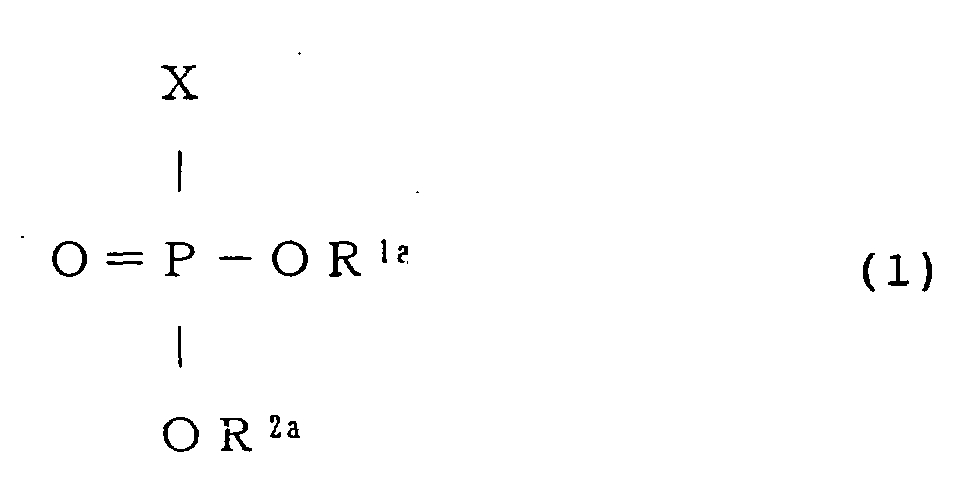
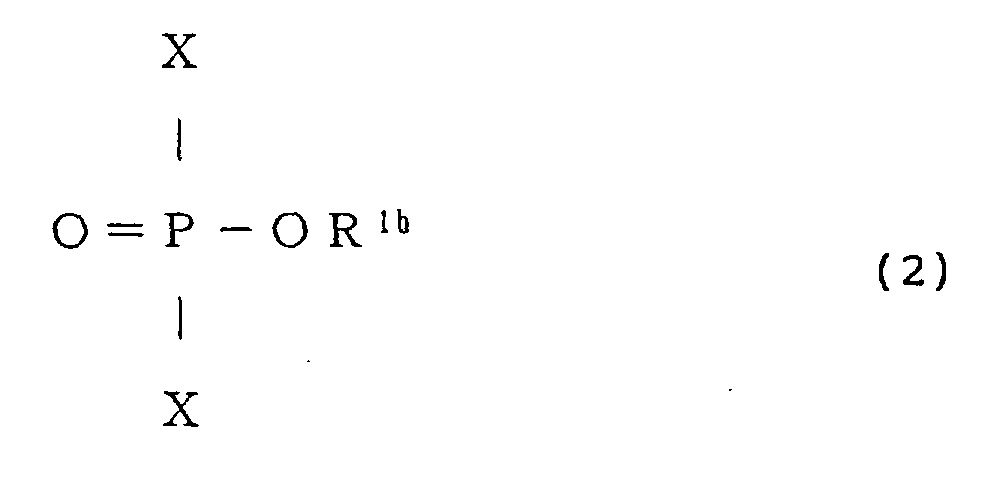
- the main characteristic of the present invention is that the electrolyte for the non-aqueous battery contains at least one selected from the group consisting of phosphoric ester derivatives expressed by Formulae (1) and (2) given above.
- the introduction of a halogen atom as a substituent group of the phosphoric ester enhances the electrochemical stability of the electrolyte.
- the decomposition reaction of the non-aqueous electrolyte can be suppressed particularly on the positive electrode.
- the decomposition reaction of the phosphoric ester on the negative electrode which has been the problem in the prior art battery, can be suppressed without damaging the electric conductivity of lithium ion. This further prevents a decrease in discharge capacity of the resulting battery with a progress of the charge-discharge cycle, thereby significantly improving the discharge characteristics of the battery after storage at high temperatures.
- Typical examples of the aliphatic hydrocarbon groups (residues) having 1 to 12 carbon atoms expressed by R 1a and R 2a in Formula (1) and by R 1b in Formula (2) include linear aliphatic hydrocarbon groups such as methyl group, ethyl group, propyl group, butyl group, pentyl group, hexyl group, heptyl group, oxtyl group, nonyl group, decyl group, undecyl group and dodecyl group, aliphatic hydrocarbon groups having a branched structure such as isopropyl group, tert-butyl group, 2-methylhexyl group and 2-ethylhexyl group, and alicyclic aliphatic hydrocarbon groups.
- R 1a , R 2a , and R 1b may be identical with one another or different from one another.
- the halogen atom expressed by X in Formulae (1) and (2) is selected from F, Cl, Br and I.
- F and Cl are preferable since they can reduce the content of the phosphoric ester in the non-aqueous electrolyte.
- phosphoric ester derivative expressed by Formula (1) examples include dimethyl phosphorofluoridate, diethyl phosphorofluoridate, ethyl methyl phosphorofluoridate, dipropyl phosphorofluoridate, diisopropyl phosphorofluoridate, dibutyl phosphorofluoridate, dihexyl phosphorofluoridate, dimethyl phosphorochloridate, diethyl phosphorochloridate, ethyl methyl phosphorochloridate, dipropyl phosphorochloridate, diisopropyl phosphorochloridate, dibutyl phosphorochloridate, and dihexyl phosphorochloridate.
- Concrete examples of the phosphoric ester derivative expressed by Formula (2) include methyl phosphorodifluoridate, ethyl phosphorodifluoridate, propyl phosphorodifluoridate, isopropyl phosphorodifluoridate, butyl phosphorodifluoridate, hexyl phosphorodifluoridate, methyl phosphorodichloridate, ethyl phosphorodichloridate, propyl phosphorodichloridate, isopropyl phosphorodichloridate, butyl phosphorodichloridate, and hexyl phosphorodichloridate.
- the non-aqueous electrolyte may contain only one phosphoric ester derivative. It is, however, preferable that the non-aqueous electrolyte contains two or more phosphoric ester derivatives having different structures because the total content of the phosphoric ester derivatives in the non-aqueous electrolyte can be reduced.
- the electrolyte of the present invention contains the phosphoric ester derivative in the range of 0.001 to 10% by weight. If the content of the phosphoric ester is less than 0.001% by weight, chemical and electrochemical stability effects and thermal stability of the non-aqueous electrolyte tend to become insufficient. If the content of the phosphoric ester is greater than 10% by weight, on the other hand, some properties such as ionic conductivity of the non-aqueous electrolyte tends to be damaged and the cycle characteristics and the high-temperature storage characteristics tend to be reduced.
- the content of the phosphoric ester derivative ranges 0.001 to 5% by weight.
- Known compounds may be used for the non-aqueous solvent in the non-aqueous electrolyte of the present invention.
- known compounds include cyclic carbonates such as propylene carbonate, ethylene carbonate, butylene carbonate and vinylene carbonate, chain carbonates such as dimethyl carbonate, diethyl carbonate, and ethyl methyl carbonate, 1,2-dimethoxyethane, ⁇ -butyrolactone, tetrahydrofuran, 2-methyltetrahydrofuran, dimethyl sulfoxide, dioxolane, 1,3-dioxolane, formamide, dimethylformamide, nitromethane, acetonitrile, methyl formate, methyl acetate, methyl propionate, phosphoric triester, trimethoxymethane, dioxolane derivatives, sulfolane, 3-methyl-2-oxazolidinone, propylene carbonate derivatives, tetrahydrofuran derivatives,
- the cyclic carbonates and chain carbonates are especially preferable for the non-aqueous solvent included in the non-aqueous electrolyte, since they give the high ionic conductivity in the resulting non-aqueous secondary battery of the present invention.
- the cyclic carbonate is at least one selected from the group consisting of ethylene carbonate, propylene carbonate, butylene carbonate and vinylene carbonate. It is also preferable that the chain carbonate is at least one selected from the group consisting of dimethyl carbonate, ethyl methyl carbonate and diethyl carbonate.
- the solute (salt) included in the non-aqueous electrolyte may be any of those conventionally used for the non-aqueous batteries, for example, LiClO 4 , LiBF 4 , LiPF 6 , LiCF 3 SO 3 , LiN(C 2 F 5 SO 2 ) 2 , LiN(CF 3 CO 2 ) 2 , LiCF 3 CO 2 , LiAsF 6 , LiSbF 6 , LiB 10 Cl 10 , lithium salts of lower aliphatic carboxylic acids, LiAlCl 4 , LiSCN, LiCl, LiBr, LiI, chroroborane lithium, and lithium tetraphenylborate.
- LiPF 6 LiPF 6 . It is preferable that any of such salts is dissolved in the non-aqueous solvent at the total concentration of 0.5 to 1.5 mol/1.
- the secondary battery of the present invention includes the non-aqueous electrolyte discussed above.
- the constituents other than the electrolyte are not specifically restricted. Any of conventional constituents can be used, although some preferable examples are given below.
- a lithium-containing transition metal compound which can receive lithium ion as the guest, may be used for the active material of the rechargeable positive electrode.
- 'x' represents one prior to start of charging or discharging and thus varies by charging or discharging.
- transition metal chalcogens lithium compounds of vanadium oxides
- lithium compounds of niobium oxides lithium compounds of niobium oxides.
- a plurality of different positive electrode active materials may be mixed for use.
- the average particle diameter of the positive electrode active material is not specifically restricted but is preferably in the range of 1 to 30 ⁇ m.
- the positive electrode may be a positive electrode plate obtained by applying a positive electrode mixture comprising a positive electrode active material, a conductive agent and a binder on a current collector.
- the rechargeable negative electrode used in the present invention includes at least one selected from the group consisting of carbon, metal lithium, Li alloys and Li compounds, the alloys and compounds containing at least one of Sn, Si, Al and In, as the active material, since they give the large discharge capacity and high voltage.
- Li alloys include lithium-tin alloys and lithium-silicon alloys
- Li compounds include lithium-tin oxides and lithium-silicon oxides.
- the negative electrode may be a negative electrode plate obtained by applying a negative electrode mixture comprising a negative electrode active material, a conductive agent, and a binder on a current collector.
- the conductive materials used for the positive electrode mixture and the negative electrode mixture are not specifically restricted to those mentioned in Examples below, but may be any electron conductive materials that do not adversely affect the performances of the battery. Available examples include carbon materials such as graphite and low crystalline carbon and carbon materials containing other elements such as B, P, N, S, H or F.
- binding agent used for the positive electrode examples include polyacrylic acid, carboxymethylcellulose, polytetrafluoroethylene, polyvinylidene fluoride, vinylidene fluoride-hexafluoropropylene copolymer, polyvinyl alcohol, starch, diacetylcellulose, hydroxypropylcellulose, polyvinyl chloride, polyvinyl pyrrolidone, polyethylene, polypropylene, SBR, EPDM, EPDM sulfonate, fluorinated rubber, polybutadiene, and polyethylene oxide.
- polyvinylidene fluoride polyvinylidene fluoride-hexafluoropropylene copolymer, polytetrafluoroethylene, polyacrylic acid, carboxymethylcellulose, and SBR. These are also preferable in the structure of the negative electrode.
- the current collector of the positive electrode may be composed of aluminum, stainless steel, nickel, titanium, or any of these alloys.
- the preferable form of the current collector may be foil, expanded metal sheet, punched metal sheet, or metal net. Especially preferable is aluminum foil.
- the current collector of the negative electrode may be composed of copper, stainless steel, nickel, titanium, or any of these alloys.
- the preferable form of the current collector for the negative electrode may be foil, expanded metal sheet, punched metal sheet, or metal net. Especially preferable is copper foil.
- a separator used in the present invention is required to have a large ionic permeability, a predetermined mechanical strength, insulating ability, absorbing and holding abilities of the electrolyte, and porosity.
- the separator may be composed of a polymer.
- the separator preferably has the function of closing pores at temperatures of not less than a preset level to enhance the resistance.
- the separator may be a sheet, unwoven fabric, or woven fabric of a single olefin polymer such as polypropylene or polyethylene or a mixture of plural olefin polymers, or a sheet, unwoven fabric, or woven fabric of glass fibers.
- the diameter of pores in the separator is preferably in a specific range that does not allow transmission of the positive electrode material, the negative electrode material, the binder, and the conductive agent released from the electrode plate, for example, in the range of 0.01 to 1 ⁇ m.
- the thickness of the separator is generally in the range of 10 to 300 ⁇ m.
- the porosity depends upon the electronic and ionic permeability, the material, and the film pressure, but is preferable in the range of 30 to 80% in general.
- the battery may be constructed by mixing the positive electrode mixture and the negative electrode mixture with a polymer material that absorbs and holds an organic electrolyte composed of a solvent and a lithium salt dissolved in the solvent and by integrating a porous separator composed of a polymer that absorbs and holds the organic electrolyte with the positive electrode and the negative electrode.
- the polymer material is required to absorb and hold the organic electrolyte, and an especially preferable example is vinylidene fluoride-hexafluoropropylene copolymer.
- the shape of the battery may be coin-shaped, button-shaped, sheet, laminate, cylinder, flat, cubic, rectangular parallelepiped or the like.
- the battery may be a large-sized battery mounted on, for example, electric vehicles.
- the non-aqueous electrolyte-containing secondary battery of the present invention may be used, for example, portable information terminals, portable electronic appliances, small-sized power storage apparatuses for domestic use, motorcycles, electric vehicles, and hybrid vehicles, although application is not restricted to these examples.
- Fig. 1 is a vertical sectional view illustrating the structure of a cylindrical non-aqueous electrolyte-containing secondary battery according to the present invention.
- the secondary battery shown in Fig. 1 is manufactured according to the following procedure. In first, a finely porous polypropylene separator 3 having a greater width than both electrode plates is interposed between a positive electrode plate 1 having a positive electrode lead 4, which is fixed by spot welding and is composed of the same material as the core material, and a negative electrode plate 2 having a negative electrode lead 5 to form a laminate. Then, the laminate is wound in a spiral form to obtain an electrode body.
- polypropylene insulators 6 and 7 are arranged above and below the electrode body to obtain an assembly and the assembly is inserted in a battery case 8 and a step is formed on the upper portion of the battery case 8. Then, the non-aqueous electrolyte is poured into the battery case 8, and one charge-discharge cycle is carried out while the top of the battery case 8 is kept in the open state to release a gas produced by the reaction. And, the battery case 8 is sealed with a sealing plate 9 having a positive electrode terminal 10.
- Each of the batteries manufactured in Examples and Comparative Examples is iteratively subjected to 10 charge-discharge cycles, where each cycle charges the battery to 4.2 V and discharges it to 3 V with a constant current of 50 mA at 20°C. After 11th charge, the battery is stored at 85°C for 7 days.
- Capacity maintenance rate (%) after storage at high temperatures 100 ⁇ (discharge capacity at 11th cycle / discharge capacity at 10th cycle)
- Capacity recovery rate (%) 100 ⁇ (discharge capacity at 12th cycle / discharge capacity at 10th cycle)
- LiCoO 2 classified to 100 mesh or less as the positive electrode active material was mixed with 5 g of carbon powder as the conductive agent and 8 g of polytetrafluoroethylene as the binder, and a petroleum solvent was added thereto, followed by stirring to obtain a paste.
- the paste was applied on a titanium core member, and the core member was dried with the paste, rolled and cut to give a positive electrode plate containing 5 g of the positive electrode active material.
- LiPF 6 was dissolved in an equal volume solution mixture of ethylene carbonate and ethyl methyl carbonate to obtain 1 mol/l LiPF 6 solution.
- phosphorofluoridates and phosphorochloridates shown in Table 1 was added to the LiPF 6 solution followed by stirring to give 14 different non-aqueous electrolytes containing 1% by weight of the phosphorofluoridate or phosphorochloridate.
- the negative electrode plate, the positive electrode plate and the diverse non-aqueous electrolytes were assembled into cylindrical non-aqueous electrolyte-containing secondary batteries shown in Fig. 1.
- the volume of the non-aqueous electrolyte was 2.6 ml.
- the battery of Comparative Example 1 was assembled according to the same procedure as that of Example 1, except that none of the phosphorofluoridates and phosphorochloridates was added to the non-aqueous electrolyte.
- the results of the charge-discharge cycle test and the high-temperature storage test of Comparative Example 1 are also shown in Table 1.
- the battery of Comparative Example 2 was assembled according to the same procedure as that of Example 1, except that the non-aqueous electrolyte contained 1% by weight of trimethyl phosphorate.
- the results of the charge-discharge cycle test and the high-temperature storage test of Comparative Example 2 are also shown in Table 1.
- Table 1 shows that the batteries of the respective Examples, where any of the phosphorofluoridates and phosphorochloridates was added to the non-aqueous electrolyte, had significantly improved capacity maintenance rate at the 100th cycle, capacity maintenance rate after storage at high temperatures, and capacity recovery rate after storage at high temperatures, compared with the battery of Comparative Example 1, where none of the phosphorofluoridates and phosphorochloridates was added to the electrolyte. This proves that the phosphorofluoridates and phosphorochloridates have effects of suppressing a decrease in capacity.
- the batteries of the respective Examples have significantly improved capacity maintenance rate at the 100th cycle, capacity maintenance rate after storage at high temperatures, and capacity recovery rate after storage at high temperatures.
- Addition of any of the phosphorofluoridates and phosphorochloridates to the non-aqueous electrolyte enhances the electrochemical stability of the non-aqueous electrolyte and thereby suppresses the decomposition reaction of the non-aqueous electrolyte on either the positive electrode or the negative electrode in the charged state. Similar results are obtained in the range of the carbon atoms of 1 to 12, irrespective of the substituent.
- ethyl methyl phosphorofluoridate, methyl phosphorodifluoridate, ethyl methyl phosphorochloridate and ethyl phosphorodichloridate were added respectively to the non-aqueous electrolyte to make the concentration of 1% by weight, and the batteries were assembled according to the same procedure as that of Example 1.
- the batteries were stored at high temperatures and evaluated under the same conditions as those of Example 1, while the charging voltage was varied from 4.1 V, 4.15 V or 4.2 V.
- the results of the charge-discharge cycle test and the high-temperature storage test of the respective batteries are shown in Table 2.
- the battery of Comparative Example 3 was assembled according to the same procedure as that of Example 17, except that none of ethyl methyl phosphorofluoridate, methyl phosphorodifluoridate, ethyl methyl phosphorochloridate, and ethyl phosphorodichloridate was added to the non-aqueous electrolyte.
- the results of the charge-discharge cycle test and the high-temperature storage test of Comparative Example 3 are also shown in Table 2.
- Capacity maintenance rate (%) Capacity recovery rate (%) Charging voltage prior to storage at high temperatures 4.1 V 4.15 V 4.2 V 4.1 V 4.15 V 4.2 V Ex.17 Ethyl methyl phosphorofluoridate 98 92 88 90 89 89 Ex.18 Methyl phosphorodifluoridate 98 92 83 90 89 84 Ex.19 Ethyl methyl phosphorochloridate 93 88 83 86 85 82 Ex.20 Ethyl phosphorodichloridate 93 88 79 86 85 78 Com. Ex.3 - 77 67 50 65 57 52
- Table 2 shows that the batteries of the respective Examples, where ethyl methyl phosphorofluoridate, methyl phosphorodifluoridate, ethyl methyl phosphorochloridate, and ethyl phosphorodichloridate were respectively added to the non-aqueous electrolyte, have significantly improved capacity maintenance rate and capacity recovery rate after storage at high temperatures at the charging voltages of 4.1 V, 4.15 V, and 4.2 V, compared with the battery of Comparative Example 3, where none of the phosphoric ester derivatives was added.
- the batteries were assembled according to the same procedure as that of Example 1, except that the content of ethyl methyl phosphorofluoridate in the non-aqueous electrolyte was varied in the range of 0.0005 to 20% by weight, and evaluated at the charging voltage of 4.2 V.
- the results of the charge-discharge cycle test and the high-temperature storage test of the respective batteries are shown in Table 3. Content of ethyl methyl phosphorofluoridate Capacity maintenance rate (%) Capacity recovery rate (%) At 100th cycle After storage at high temps.
- Table 3 shows that the batteries have high capacity maintenance rate at the 100th cycle, high capacity maintenance rate after storage at high temperatures and high capacity recovery rate after storage at high temperatures when the content of ethyl methyl phosphorofluoridate in the non-aqueous electrolyte is in the range of 0.001 to 10% by weight.
- the content of lower than 0.001% by weight does not exert the sufficient effects of suppressing the reaction of the non-aqueous electrolyte with the positive electrode or the negative electrode in the charging state and of enhancing the electrochemical stability of the non-aqueous electrolyte.
- the content of greater than 10% by weight damages the ionic conductivity of the non-aqueous electrolyte. Phosphoric ester derivatives other than those mentioned above had similar results.
- the batteries were assembled according to the same procedure as that of Example 1, except that two of phosphorofluoridates and phosphorodifluoridates shown in Table 4 were added, by 0.2% by weight each, to the non-aqueous electrolyte, and the assembled batteries were evaluated at the charging voltage of 4.2 V.
- the results of the charge-discharge cycle test and the high-temperature storage test of the respective batteries are shown in Table 4.
- Phosphoric ester derivatives Capacity maintenance rate (%) Capacity recovery rate (%) At 100th cycle After storage at high temps.
- Table 4 shows that addition of two of the phosphorofluoridates and phosphorodifluoridates to the non-aqueous electrolyte attained high capacity maintenance rate at the 100 th cycle, high capacity maintenance rate after storage at high temperatures, and high capacity recovery rate after storage at high temperatures by the less content than the content of a single phosphorofluoridate.
- the two phosphoric ester derivatives are not restricted to the above examples. Addition of three or more phosphoric ester derivatives having different structures led to the similar results.
- the present invention gives the non-aqueous electrolyte-containing secondary battery, which has the high energy density and effectively reduces a decrease in discharge capacity of the battery with a progress of the charge-discharge cycle and deterioration of the properties of the battery after storage at high temperatures.
Landscapes
- Chemical & Material Sciences (AREA)
- Engineering & Computer Science (AREA)
- Manufacturing & Machinery (AREA)
- Chemical Kinetics & Catalysis (AREA)
- Electrochemistry (AREA)
- General Chemical & Material Sciences (AREA)
- Physics & Mathematics (AREA)
- Condensed Matter Physics & Semiconductors (AREA)
- General Physics & Mathematics (AREA)
- Inorganic Chemistry (AREA)
- Secondary Cells (AREA)
- Battery Electrode And Active Subsutance (AREA)
Abstract
Description
| Phosphoric ester derivatives | Capacity maintenance rate (%) | Capacity recovery rate (%) | ||
| At 100th cycle | After storage at high temps | |||
| Ex.1 | Dimethyl phosphorofluoridate | 95 | 87 | 86 |
| Ex.2 | Diethyl phosphorofluoridate | 94 | 85 | 85 |
| Ex.3 | Ethyl methyl phosphorofluoridate | 95 | 88 | 89 |
| Ex.4 | Dipropyl phosphorofluoridate | 95 | 85 | 84 |
| Ex.5 | Dibutyl phosphorofluoridate | 93 | 84 | 83 |
| Ex.6 | Dihexyl phosphorofluoridate | 94 | 83 | 83 |
| Ex.7 | Dodecyl phosphorofluoridate | 93 | 82 | 84 |
| Ex.8 | Methyl phosphorodifluoridate | 93 | 83 | 84 |
| Ex.9 | Ethyl phosphorodifluoridate | 94 | 83 | 83 |
| Ex.10 | Hexyl phosphorodifluoridate | 89 | 80 | 81 |
| Ex.11 | Dodecyl phosphorodifluoridate | 88 | 83 | 82 |
| Ex.12 | Dimethyl phosphorochloridate | 89 | 80 | 78 |
| Ex.13 | Diethyl phosphorochloridate | 89 | 80 | 77 |
| Ex.14 | Dihexyl phosphorochloridate | 90 | 79 | 78 |
| Ex.15 | Methyl phosphorodichloridate | 89 | 78 | 77 |
| Ex.16 | Ethyl phosphorodichloridate | 90 | 79 | 78 |
| Com. Ex.1 | - | 65 | 50 | 52 |
| Com. Ex.2 | Trimethyl phosphorate | 63 | 52 | 54 |
| Capacity maintenance rate (%) | Capacity recovery rate (%) | ||||||
| Charging voltage prior to storage at high temperatures | 4.1 V | 4.15 V | 4.2 V | 4.1 V | 4.15 V | 4.2 V | |
| Ex.17 | Ethyl methyl phosphorofluoridate | 98 | 92 | 88 | 90 | 89 | 89 |
| Ex.18 | Methyl phosphorodifluoridate | 98 | 92 | 83 | 90 | 89 | 84 |
| Ex.19 | Ethyl methyl phosphorochloridate | 93 | 88 | 83 | 86 | 85 | 82 |
| Ex.20 | Ethyl phosphorodichloridate | 93 | 88 | 79 | 86 | 85 | 78 |
| Com. Ex.3 | - | 77 | 67 | 50 | 65 | 57 | 52 |
| Content of ethyl methyl phosphorofluoridate | Capacity maintenance rate (%) | Capacity recovery rate (%) | ||
| At 100th cycle | After storage at high temps. | |||
| Ex.21 | 0.0005 | 51 | 60 | 64 |
| Ex.22 | 0.001 | 85 | 82 | 84 |
| Ex.23 | 0.01 | 86 | 82 | 85 |
| Ex.24 | 0.5 | 91 | 85 | 88 |
| Ex.25 | 1 | 95 | 85 | 88 |
| Ex.26 | 5 | 88 | 81 | 86 |
| Ex.27 | 10 | 83 | 80 | 84 |
| Ex.28 | 20 | 55 | 60 | 67 |
| Com. Ex.1 | - | 65 | 50 | 52 |
| Phosphoric ester derivatives | Capacity maintenance rate (%) | Capacity recovery rate (%) | ||
| At 100th cycle | After storage at high temps. | |||
| Ex.29 | Dimethyl phosphorofluoridate Diethyl phosphorofluoridate | 93 | 83 | 84 |
| Ex.30 | Dimethyl phosphorofluoridate Ethyl methyl phosphorofluoridate | 94 | 81 | 83 |
| Ex.31 | Diethyl phosphorofluoridate Ethyl methyl phosphorofluoridate | 92 | 83 | 82 |
| Ex.32 | Methyl phosphorodifluoridate Ethyl phosphorodifluoridate | 94 | 82 | 83 |
| Ex.33 | Methyl phosphorofluoridate Eethyl phosphorodifluoridate | 93 | 84 | 83 |
| Ex.1 | Dimethyl phosphorofluoridate | 95 | 87 | 86 |
Although the present invention has been described in terms of the presently preferred embodiments, it is to be understood that such disclosure is not to be interpreted as limiting. Various alterations and modifications will no doubt become apparent to those skilled in the art to which the present invention pertains, after having read the above disclosure. Accordingly, it is intended that the appended claims be interpreted as covering all alterations and modifications as fall within the true spirit and scope of the invention.
Claims (9)
- An electrolyte for a non-aqueous battery, comprising:a non-aqueous solvent;a solute; andat least one selected from the group consisting of phosphoric ester derivatives expressed by Formula (1)where R1a and R2a independently denote aliphatic hydrocarbon groups having 1 to 12 carbon atoms and X denotes a halogen atom, and by Formula (2)
 where R1b denotes an aliphatic hydrocarbon group having 1 to 12 carbon atoms and X denotes a halogen atom.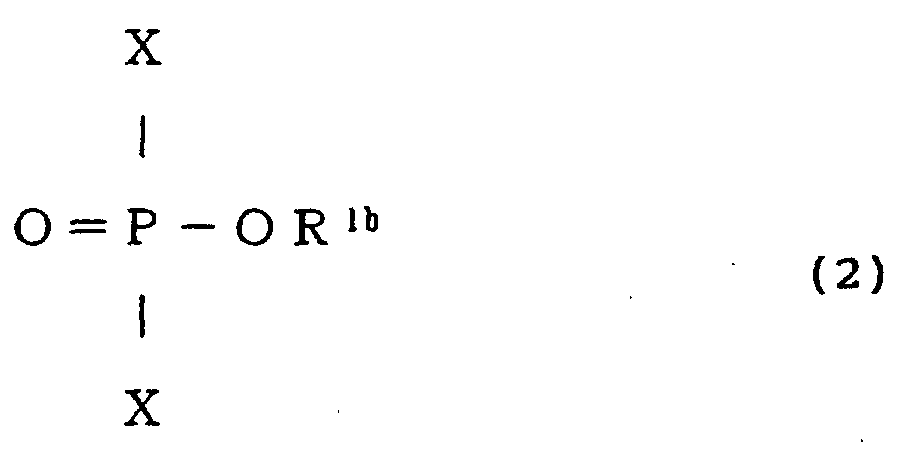
- The electrolyte for a non-aqueous battery in accordance with claim 1, wherein each X independently represents a fluorine or chlorine atom.
- The electrolyte according to claim 2, wherein each X is fluorine.
- The electrolyte according to any preceding claim, wherein R1a, R1b and R2a are each independently selected from linear aliphatic hydrocarbon groups such as methyl group, ethyl group, propyl group, butyl group, pentyl group, hexyl group, heptyl group, oxtyl group, nonyl group, decyl group, undecyl group and dodecyl group, aliphatic hydrocarbon groups having a branched structure such as isopropyl group, tert-butyl group, 2-methylhexyl group and 2-ethylhexyl group, and alicyclic aliphatic hydrocarbon groups.
- The electrolyte according to any preceding claim, selected from dimethyl phosphorofluoridate, diethyl phosphorofluoridate, ethyl methyl phosphorofluoridate, dipropyl phosphorofluoridate, diisopropyl phosphorofluoridate, dibutyl phosphorofluoridate, dihexyl phosphorofluoridate, dimethyl phosphorochloridate, diethyl phosphorochloridate, ethyl methyl phosphorochloridate, dipropyl phosphorochloridate, diisopropyl phosphorochloridate, dibutyl phosphorochloridate, dihexyl phosphorochloridate, methyl phosphorodifluoridate, ethyl phosphorodifluoridate, propyl phosphorodifluoridate, isopropyl phosphorodifluoridate, butyl phosphorodifluoridate, hexyl phosphorodifluoridate, methyl phosphorodichloridate, ethyl phosphorodichloridate, propyl phosphorodichloridate, isopropyl phosphorodichloridate, butyl phosphorodichloridate, and hexyl phosphorodichloridate.
- The electrolyte for a non-aqueous battery in accordance with claim 1, wherein said electrolyte contains 0.001 to 10% by weight of said phosphoric ester derivative.
- The electrolyte for a non-aqueous battery in accordance with any preceding claim, wherein said non-aqueous solvent comprises a cyclic carbonate and a chain carbonate, and said solute is a Li salt.
- A non-aqueous secondary battery comprising a rechargeable positive electrode, a rechargeable negative electrode, and an electrolyte as defined in any preceding claim.
- The non-aqueous secondary battery in accordance with claim 8, wherein said rechargeable negative electrode comprises at least one active material selected from the group consisting of graphite, metal lithium, Li alloys and Li compounds, said alloys and compounds containing at least one of Sn, Si, Al and In.
Applications Claiming Priority (2)
| Application Number | Priority Date | Filing Date | Title |
|---|---|---|---|
| JP2000335092A JP3422769B2 (en) | 2000-11-01 | 2000-11-01 | Electrolyte for non-aqueous battery and secondary battery using the same |
| JP2000335092 | 2000-11-01 |
Publications (3)
| Publication Number | Publication Date |
|---|---|
| EP1204157A2 true EP1204157A2 (en) | 2002-05-08 |
| EP1204157A3 EP1204157A3 (en) | 2005-04-27 |
| EP1204157B1 EP1204157B1 (en) | 2010-03-24 |
Family
ID=18810902
Family Applications (1)
| Application Number | Title | Priority Date | Filing Date |
|---|---|---|---|
| EP01309286A Expired - Lifetime EP1204157B1 (en) | 2000-11-01 | 2001-11-01 | Electrolyte for non-aqueous batteries and secondary battery using the same |
Country Status (4)
| Country | Link |
|---|---|
| US (1) | US6682857B2 (en) |
| EP (1) | EP1204157B1 (en) |
| JP (1) | JP3422769B2 (en) |
| DE (1) | DE60141620D1 (en) |
Cited By (6)
| Publication number | Priority date | Publication date | Assignee | Title |
|---|---|---|---|---|
| US6682857B2 (en) * | 2000-11-01 | 2004-01-27 | Matsushita Electric Industrial Co., Ltd. | Electrolyte for non-aqueous batteries and secondary battery using the same |
| EP1798792A4 (en) * | 2004-10-05 | 2009-02-11 | Bridgestone Corp | Nonaqueous electrolyte solution, and nonaqueous electrolyte battery having same |
| EP1739784A4 (en) * | 2004-04-19 | 2010-01-27 | Bridgestone Corp | Nonaqueous electrolyte solution for battery and nonaqueous electrolyte battery using same |
| EP1742237A4 (en) * | 2004-04-27 | 2010-05-05 | Bridgestone Corp | Additive for non-aqueous electrolyte solution of electric double layer capacitor, non-aqueous electrolyte solution for electric double layer capacitor and non-aqueous electrolyte solution electric double layer capacitor |
| KR20200070802A (en) | 2018-12-10 | 2020-06-18 | 에스케이이노베이션 주식회사 | Electrolyte for Secondary Battery and Lithium Secondary Battery Containing the Same |
| EP4213264A4 (en) * | 2021-11-17 | 2023-08-23 | Contemporary Amperex Technology Co., Limited | ELECTROLYTE, SECONDARY BATTERY, BATTERY MODULE, BATTERY PACK AND ELECTRICAL DEVICE |
Families Citing this family (20)
| Publication number | Priority date | Publication date | Assignee | Title |
|---|---|---|---|---|
| JP4407237B2 (en) * | 2002-12-24 | 2010-02-03 | 三菱化学株式会社 | Non-aqueous electrolyte and non-aqueous electrolyte secondary battery using the same |
| KR100537613B1 (en) * | 2003-06-20 | 2005-12-19 | 삼성에스디아이 주식회사 | Anode composition of lithium battery, and anode and lithium battery employing the same |
| US7846574B2 (en) * | 2004-08-27 | 2010-12-07 | Panosonic Corporation | Positive electrode plate for alkaline storage battery and method for producing the same |
| JP4703156B2 (en) * | 2004-10-01 | 2011-06-15 | 株式会社ブリヂストン | Non-aqueous electrolyte secondary battery |
| JP5134770B2 (en) * | 2004-11-26 | 2013-01-30 | 株式会社ブリヂストン | Non-aqueous electrolyte for secondary battery and non-aqueous electrolyte secondary battery including the same |
| US20080254361A1 (en) * | 2005-03-31 | 2008-10-16 | Bridgestone Corporation | Non-Aqueous Electrolyte for Battery and Non-Aqueous Electrolyte Secondary Battery Comprising the Same |
| JP4953605B2 (en) * | 2005-09-14 | 2012-06-13 | 株式会社ブリヂストン | Polymer gel electrolyte for secondary battery and polymer secondary battery using the same |
| WO2011099580A1 (en) | 2010-02-10 | 2011-08-18 | Necエナジーデバイス株式会社 | Nonaqueous electrolyte solution, and lithium ion secondary battery using same |
| WO2012090855A1 (en) | 2010-12-27 | 2012-07-05 | Necエナジーデバイス株式会社 | Gel electrolyte for lithium ion secondary batteries, and lithium ion secondary battery |
| WO2012118179A1 (en) | 2011-03-03 | 2012-09-07 | Necエナジーデバイス株式会社 | Lithium ion battery |
| KR102355703B1 (en) * | 2014-07-08 | 2022-01-27 | 솔브레인 주식회사 | Electrolyte and lithium secondary battery with the same |
| JP6342287B2 (en) * | 2014-10-08 | 2018-06-13 | 住友電気工業株式会社 | Electrolyte for sodium ion secondary battery and sodium ion secondary battery |
| WO2017111087A1 (en) * | 2015-12-25 | 2017-06-29 | ステラケミファ株式会社 | Monofluorophosphate ester salt, method for producing same, and fluorine ion-releasing composition |
| JP7116311B2 (en) * | 2017-12-12 | 2022-08-10 | セントラル硝子株式会社 | Electrolyte for non-aqueous electrolyte battery and non-aqueous electrolyte battery using the same |
| JP7116312B2 (en) * | 2018-11-26 | 2022-08-10 | セントラル硝子株式会社 | Electrolyte for non-aqueous electrolyte battery and non-aqueous electrolyte battery using the same |
| WO2019117101A1 (en) * | 2017-12-12 | 2019-06-20 | セントラル硝子株式会社 | Electrolyte solution for nonaqueous electrolyte batteries and nonaqueous electrolyte battery using same |
| WO2020203148A1 (en) * | 2019-03-29 | 2020-10-08 | 株式会社村田製作所 | Electrolytic solution for secondary cell, and secondary cell |
| CN115315839A (en) | 2020-03-19 | 2022-11-08 | 三菱化学株式会社 | Nonaqueous electrolyte solution and energy device using same |
| CN115448947A (en) * | 2021-06-08 | 2022-12-09 | 恒大新能源技术(深圳)有限公司 | Halogenated phosphate containing branched chain, preparation method and application thereof |
| CN114899484B (en) * | 2022-04-02 | 2023-10-27 | 远景动力技术(江苏)有限公司 | A kind of non-aqueous electrolyte and its lithium-ion battery |
Family Cites Families (10)
| Publication number | Priority date | Publication date | Assignee | Title |
|---|---|---|---|---|
| JP3131905B2 (en) | 1990-11-19 | 2001-02-05 | 三菱化学株式会社 | Flame retardant for electrolyte for lithium battery |
| JP2908719B2 (en) | 1994-03-19 | 1999-06-21 | 日立マクセル株式会社 | Organic electrolyte secondary battery |
| JP3369310B2 (en) | 1994-07-07 | 2003-01-20 | 三井化学株式会社 | Non-aqueous electrolyte and non-aqueous electrolyte battery |
| CA2153478C (en) * | 1994-07-07 | 1999-03-09 | Keiichi Yokoyama | Non-aqueous electrolytic solutions and non-aqueous electrolyte cells comprising the same |
| JPH09180721A (en) | 1995-12-28 | 1997-07-11 | Mitsui Petrochem Ind Ltd | Electrode for lithium battery, manufacturing method thereof, electrochemical device and manufacturing method thereof |
| US5830600A (en) * | 1996-05-24 | 1998-11-03 | Sri International | Nonflammable/self-extinguishing electrolytes for batteries |
| JPH1055819A (en) | 1996-08-08 | 1998-02-24 | Kao Corp | Non-aqueous electrolyte for secondary batteries |
| JPH10189038A (en) | 1996-12-25 | 1998-07-21 | Mitsui Chem Inc | Nonaqueous electrolyte and nonaqueous electrolytic secondary battery |
| JP3422769B2 (en) * | 2000-11-01 | 2003-06-30 | 松下電器産業株式会社 | Electrolyte for non-aqueous battery and secondary battery using the same |
| US6746794B2 (en) * | 2001-06-12 | 2004-06-08 | Tech Drive, Inc | Thermal runaway inhibitors |
-
2000
- 2000-11-01 JP JP2000335092A patent/JP3422769B2/en not_active Expired - Lifetime
-
2001
- 2001-10-29 US US09/984,159 patent/US6682857B2/en not_active Expired - Lifetime
- 2001-11-01 EP EP01309286A patent/EP1204157B1/en not_active Expired - Lifetime
- 2001-11-01 DE DE60141620T patent/DE60141620D1/en not_active Expired - Lifetime
Cited By (9)
| Publication number | Priority date | Publication date | Assignee | Title |
|---|---|---|---|---|
| US6682857B2 (en) * | 2000-11-01 | 2004-01-27 | Matsushita Electric Industrial Co., Ltd. | Electrolyte for non-aqueous batteries and secondary battery using the same |
| EP1739784A4 (en) * | 2004-04-19 | 2010-01-27 | Bridgestone Corp | Nonaqueous electrolyte solution for battery and nonaqueous electrolyte battery using same |
| US7947399B2 (en) | 2004-04-19 | 2011-05-24 | Bridgestone Corporation | Non-aqueous electrolyte for battery and non-aqueous electrolyte battery comprising the same |
| EP1742237A4 (en) * | 2004-04-27 | 2010-05-05 | Bridgestone Corp | Additive for non-aqueous electrolyte solution of electric double layer capacitor, non-aqueous electrolyte solution for electric double layer capacitor and non-aqueous electrolyte solution electric double layer capacitor |
| US7820065B2 (en) | 2004-04-27 | 2010-10-26 | Bridgestone Corporation | Additive for non-aqueous electrolyte of electric double layer capacitor, non-aqueous electrolyte for electric double layer capacitor and non-aqueous electrolyte electric double layer capacitor |
| EP1798792A4 (en) * | 2004-10-05 | 2009-02-11 | Bridgestone Corp | Nonaqueous electrolyte solution, and nonaqueous electrolyte battery having same |
| KR20200070802A (en) | 2018-12-10 | 2020-06-18 | 에스케이이노베이션 주식회사 | Electrolyte for Secondary Battery and Lithium Secondary Battery Containing the Same |
| EP4213264A4 (en) * | 2021-11-17 | 2023-08-23 | Contemporary Amperex Technology Co., Limited | ELECTROLYTE, SECONDARY BATTERY, BATTERY MODULE, BATTERY PACK AND ELECTRICAL DEVICE |
| US12418047B2 (en) | 2021-11-17 | 2025-09-16 | Contemporary Amperex Technology (Hong Kong) Limited | Electrolyte, secondary battery, battery module, battery pack, and power consuming device |
Also Published As
| Publication number | Publication date |
|---|---|
| US20020081497A1 (en) | 2002-06-27 |
| JP2002141110A (en) | 2002-05-17 |
| EP1204157B1 (en) | 2010-03-24 |
| DE60141620D1 (en) | 2010-05-06 |
| JP3422769B2 (en) | 2003-06-30 |
| US6682857B2 (en) | 2004-01-27 |
| EP1204157A3 (en) | 2005-04-27 |
Similar Documents
| Publication | Publication Date | Title |
|---|---|---|
| US6682857B2 (en) | Electrolyte for non-aqueous batteries and secondary battery using the same | |
| US11183711B2 (en) | Non-aqueous electrolyte solution for lithium secondary battery and lithium secondary battery including the same | |
| US11309583B2 (en) | Non-aqueous electrolyte solution for lithium secondary battery and lithium secondary battery including the same | |
| US8313866B2 (en) | Non-aqueous electrolytes and electrochemical devices including the same | |
| KR102784736B1 (en) | Non-aqueous electrolyte solution and lithium secondary battery comprising the same | |
| US7179565B2 (en) | Lithium ion secondary cell | |
| US9472830B2 (en) | Lithium secondary battery having improved lifespan characteristics | |
| US20030170549A1 (en) | Non-aqueous electrolyte battery | |
| US11876177B2 (en) | Non-aqueous electrolyte solution for lithium secondary battery and lithium secondary battery including the same | |
| JP7321629B2 (en) | Non-aqueous electrolyte for lithium secondary battery and lithium secondary battery containing the same | |
| KR102255398B1 (en) | Electrolyte for lithium secondary battery and lithium secondary battery comprising the same | |
| US12609354B2 (en) | Non-aqueous electrolyte solution comprising a dialkylenenitrile-containing pyridine additive for lithium secondary battery and lithium secondary battery comprising same | |
| US20260112698A1 (en) | Lithium Secondary Battery | |
| US12195431B2 (en) | Non-aqueous electrolyte solution additive, and non-aqueous electrolyte solution for lithium secondary battery and lithium secondary battery which include the same | |
| US20260045551A1 (en) | Non-Aqueous Electrolyte and Lithium Secondary Battery Including the Same | |
| US20260074286A1 (en) | Electrolyte additive for secondary battery, non-aqueous electrolyte for lithium secondary battery including same and lithium secondary battery including same | |
| US20240250303A1 (en) | Non-Aqueous Electrolyte Including Additive for Non-Aqueous Electrolyte, and Lithium Secondary Battery Including the Non-Aqueous Electrolyte | |
| KR20060116423A (en) | Non-aqueous electrolyte and lithium secondary battery comprising same | |
| US20230246234A1 (en) | Lithium secondary battery | |
| US20220311052A1 (en) | Non-Aqueous Electrolyte Solution for Lithium Secondary Battery and Lithium Secondary Battery Comprising Same | |
| KR102954249B1 (en) | Additive for lithium secondary battery, electrolyte for lithium secondary battery and lithium secondary batter including the same | |
| KR102809140B1 (en) | Additive for lithium secondary battery, electrolyte for lithium secondary battery including the same and lithium secondary batter including the same | |
| KR102858333B1 (en) | Additive for lithium secondary battery, electrolyte for lithium secondary battery including the same and lithium secondary batter including the same | |
| KR102645681B1 (en) | Disulfonyl-based additive for lithium secondary battery, electrolyte for lithium secondary battery including the same and lithium secondary batter including the same | |
| KR100804979B1 (en) | Lithium ion secondary battery |
Legal Events
| Date | Code | Title | Description |
|---|---|---|---|
| PUAI | Public reference made under article 153(3) epc to a published international application that has entered the european phase |
Free format text: ORIGINAL CODE: 0009012 |
|
| AK | Designated contracting states |
Kind code of ref document: A2 Designated state(s): AT BE CH CY DE DK ES FI FR GB GR IE IT LI LU MC NL PT SE TR |
|
| AX | Request for extension of the european patent |
Free format text: AL;LT;LV;MK;RO;SI |
|
| PUAL | Search report despatched |
Free format text: ORIGINAL CODE: 0009013 |
|
| AK | Designated contracting states |
Kind code of ref document: A3 Designated state(s): AT BE CH CY DE DK ES FI FR GB GR IE IT LI LU MC NL PT SE TR |
|
| AX | Request for extension of the european patent |
Extension state: AL LT LV MK RO SI |
|
| 17P | Request for examination filed |
Effective date: 20050525 |
|
| AKX | Designation fees paid |
Designated state(s): DE FR GB |
|
| 17Q | First examination report despatched |
Effective date: 20060410 |
|
| RAP1 | Party data changed (applicant data changed or rights of an application transferred) |
Owner name: PANASONIC CORPORATION |
|
| GRAP | Despatch of communication of intention to grant a patent |
Free format text: ORIGINAL CODE: EPIDOSNIGR1 |
|
| GRAS | Grant fee paid |
Free format text: ORIGINAL CODE: EPIDOSNIGR3 |
|
| GRAA | (expected) grant |
Free format text: ORIGINAL CODE: 0009210 |
|
| AK | Designated contracting states |
Kind code of ref document: B1 Designated state(s): DE FR GB |
|
| REG | Reference to a national code |
Ref country code: GB Ref legal event code: FG4D |
|
| REF | Corresponds to: |
Ref document number: 60141620 Country of ref document: DE Date of ref document: 20100506 Kind code of ref document: P |
|
| PLBE | No opposition filed within time limit |
Free format text: ORIGINAL CODE: 0009261 |
|
| STAA | Information on the status of an ep patent application or granted ep patent |
Free format text: STATUS: NO OPPOSITION FILED WITHIN TIME LIMIT |
|
| 26N | No opposition filed |
Effective date: 20101228 |
|
| GBPC | Gb: european patent ceased through non-payment of renewal fee |
Effective date: 20101101 |
|
| REG | Reference to a national code |
Ref country code: FR Ref legal event code: ST Effective date: 20110801 |
|
| PG25 | Lapsed in a contracting state [announced via postgrant information from national office to epo] |
Ref country code: FR Free format text: LAPSE BECAUSE OF NON-PAYMENT OF DUE FEES Effective date: 20101130 |
|
| PG25 | Lapsed in a contracting state [announced via postgrant information from national office to epo] |
Ref country code: GB Free format text: LAPSE BECAUSE OF NON-PAYMENT OF DUE FEES Effective date: 20101101 |
|
| PGFP | Annual fee paid to national office [announced via postgrant information from national office to epo] |
Ref country code: DE Payment date: 20201020 Year of fee payment: 20 |
|
| REG | Reference to a national code |
Ref country code: DE Ref legal event code: R071 Ref document number: 60141620 Country of ref document: DE |