EP1201678A1 - Novel bicyclonucleoside analogues - Google Patents
Novel bicyclonucleoside analogues Download PDFInfo
- Publication number
- EP1201678A1 EP1201678A1 EP00949882A EP00949882A EP1201678A1 EP 1201678 A1 EP1201678 A1 EP 1201678A1 EP 00949882 A EP00949882 A EP 00949882A EP 00949882 A EP00949882 A EP 00949882A EP 1201678 A1 EP1201678 A1 EP 1201678A1
- Authority
- EP
- European Patent Office
- Prior art keywords
- group
- amino
- nucleic acid
- protected
- acid synthesis
- Prior art date
- Legal status (The legal status is an assumption and is not a legal conclusion. Google has not performed a legal analysis and makes no representation as to the accuracy of the status listed.)
- Granted
Links
Images

Classifications
-
- C—CHEMISTRY; METALLURGY
- C07—ORGANIC CHEMISTRY
- C07H—SUGARS; DERIVATIVES THEREOF; NUCLEOSIDES; NUCLEOTIDES; NUCLEIC ACIDS
- C07H19/00—Compounds containing a hetero ring sharing one ring hetero atom with a saccharide radical; Nucleosides; Mononucleotides; Anhydro-derivatives thereof
- C07H19/02—Compounds containing a hetero ring sharing one ring hetero atom with a saccharide radical; Nucleosides; Mononucleotides; Anhydro-derivatives thereof sharing nitrogen
- C07H19/04—Heterocyclic radicals containing only nitrogen atoms as ring hetero atom
- C07H19/06—Pyrimidine radicals
-
- C—CHEMISTRY; METALLURGY
- C07—ORGANIC CHEMISTRY
- C07H—SUGARS; DERIVATIVES THEREOF; NUCLEOSIDES; NUCLEOTIDES; NUCLEIC ACIDS
- C07H19/00—Compounds containing a hetero ring sharing one ring hetero atom with a saccharide radical; Nucleosides; Mononucleotides; Anhydro-derivatives thereof
- C07H19/02—Compounds containing a hetero ring sharing one ring hetero atom with a saccharide radical; Nucleosides; Mononucleotides; Anhydro-derivatives thereof sharing nitrogen
- C07H19/04—Heterocyclic radicals containing only nitrogen atoms as ring hetero atom
-
- A—HUMAN NECESSITIES
- A61—MEDICAL OR VETERINARY SCIENCE; HYGIENE
- A61P—SPECIFIC THERAPEUTIC ACTIVITY OF CHEMICAL COMPOUNDS OR MEDICINAL PREPARATIONS
- A61P17/00—Drugs for dermatological disorders
-
- A—HUMAN NECESSITIES
- A61—MEDICAL OR VETERINARY SCIENCE; HYGIENE
- A61P—SPECIFIC THERAPEUTIC ACTIVITY OF CHEMICAL COMPOUNDS OR MEDICINAL PREPARATIONS
- A61P17/00—Drugs for dermatological disorders
- A61P17/06—Antipsoriatics
-
- A—HUMAN NECESSITIES
- A61—MEDICAL OR VETERINARY SCIENCE; HYGIENE
- A61P—SPECIFIC THERAPEUTIC ACTIVITY OF CHEMICAL COMPOUNDS OR MEDICINAL PREPARATIONS
- A61P31/00—Antiinfectives, i.e. antibiotics, antiseptics, chemotherapeutics
- A61P31/04—Antibacterial agents
-
- A—HUMAN NECESSITIES
- A61—MEDICAL OR VETERINARY SCIENCE; HYGIENE
- A61P—SPECIFIC THERAPEUTIC ACTIVITY OF CHEMICAL COMPOUNDS OR MEDICINAL PREPARATIONS
- A61P31/00—Antiinfectives, i.e. antibiotics, antiseptics, chemotherapeutics
- A61P31/12—Antivirals
-
- A—HUMAN NECESSITIES
- A61—MEDICAL OR VETERINARY SCIENCE; HYGIENE
- A61P—SPECIFIC THERAPEUTIC ACTIVITY OF CHEMICAL COMPOUNDS OR MEDICINAL PREPARATIONS
- A61P31/00—Antiinfectives, i.e. antibiotics, antiseptics, chemotherapeutics
- A61P31/12—Antivirals
- A61P31/14—Antivirals for RNA viruses
- A61P31/16—Antivirals for RNA viruses for influenza or rhinoviruses
-
- A—HUMAN NECESSITIES
- A61—MEDICAL OR VETERINARY SCIENCE; HYGIENE
- A61P—SPECIFIC THERAPEUTIC ACTIVITY OF CHEMICAL COMPOUNDS OR MEDICINAL PREPARATIONS
- A61P31/00—Antiinfectives, i.e. antibiotics, antiseptics, chemotherapeutics
- A61P31/12—Antivirals
- A61P31/14—Antivirals for RNA viruses
- A61P31/18—Antivirals for RNA viruses for HIV
-
- A—HUMAN NECESSITIES
- A61—MEDICAL OR VETERINARY SCIENCE; HYGIENE
- A61P—SPECIFIC THERAPEUTIC ACTIVITY OF CHEMICAL COMPOUNDS OR MEDICINAL PREPARATIONS
- A61P35/00—Antineoplastic agents
-
- A—HUMAN NECESSITIES
- A61—MEDICAL OR VETERINARY SCIENCE; HYGIENE
- A61P—SPECIFIC THERAPEUTIC ACTIVITY OF CHEMICAL COMPOUNDS OR MEDICINAL PREPARATIONS
- A61P43/00—Drugs for specific purposes, not provided for in groups A61P1/00-A61P41/00
-
- C—CHEMISTRY; METALLURGY
- C07—ORGANIC CHEMISTRY
- C07H—SUGARS; DERIVATIVES THEREOF; NUCLEOSIDES; NUCLEOTIDES; NUCLEIC ACIDS
- C07H19/00—Compounds containing a hetero ring sharing one ring hetero atom with a saccharide radical; Nucleosides; Mononucleotides; Anhydro-derivatives thereof
- C07H19/02—Compounds containing a hetero ring sharing one ring hetero atom with a saccharide radical; Nucleosides; Mononucleotides; Anhydro-derivatives thereof sharing nitrogen
- C07H19/04—Heterocyclic radicals containing only nitrogen atoms as ring hetero atom
- C07H19/16—Purine radicals
-
- C—CHEMISTRY; METALLURGY
- C07—ORGANIC CHEMISTRY
- C07H—SUGARS; DERIVATIVES THEREOF; NUCLEOSIDES; NUCLEOTIDES; NUCLEIC ACIDS
- C07H21/00—Compounds containing two or more mononucleotide units having separate phosphate or polyphosphate groups linked by saccharide radicals of nucleoside groups, e.g. nucleic acids
-
- Y—GENERAL TAGGING OF NEW TECHNOLOGICAL DEVELOPMENTS; GENERAL TAGGING OF CROSS-SECTIONAL TECHNOLOGIES SPANNING OVER SEVERAL SECTIONS OF THE IPC; TECHNICAL SUBJECTS COVERED BY FORMER USPC CROSS-REFERENCE ART COLLECTIONS [XRACs] AND DIGESTS
- Y02—TECHNOLOGIES OR APPLICATIONS FOR MITIGATION OR ADAPTATION AGAINST CLIMATE CHANGE
- Y02P—CLIMATE CHANGE MITIGATION TECHNOLOGIES IN THE PRODUCTION OR PROCESSING OF GOODS
- Y02P20/00—Technologies relating to chemical industry
- Y02P20/50—Improvements relating to the production of bulk chemicals
- Y02P20/55—Design of synthesis routes, e.g. reducing the use of auxiliary or protecting groups
Definitions
- This invention relates to novel bicyclonucleoside analogues which are useful for synthesis of non-natural oligonucleotide analogues which exhibit excellent anti-sense or anti-gene activity and in vivo stability.
- This invention relates to novel oligonucleotide analogues which have one or more of said bicyclonucleoside moieties. Further, this invention relates to novel modified bicyclonucleoside analogues which exhibit anti-AIDS activity.
- Oligonucleotides having excellent anti-sense or anti-gene activities and in vivo stability have been expected to be useful medicaments.
- oligonucleotide analogues have been synthesized, and it has been tried to develop them as medicaments.
- oligonucleotides wherein the oxygen atom binding to the phosphorus atom of the phosphodiester linkage is substituted by a sulfur atom, a methyl group, or a boron atom are known.
- oligonucleotides whose sugar and/or base moieties are chemically modified are also known.
- ISIS Co. has developed a thioate oligonucleotide, ISIS2922, as a therapeutic agent for retinitis infected by human cytomegalovirus and this has been sold as Vitravene (trade name) in the United States.
- any non-natural oligonucleotide analogues described above have not been fully satisfactory due to their insufficient potency of anti-sense or anti-gene activity, (i.e ., ability to form complementary strands with mRNA or DNA) and stability to various nucleases, and due to side effects caused by non-selective binding to various proteins in vivo.
- non-natural oligonucleotide analogues having more potent anti-sense or anti-gene activities, in vivo stability, and fewer side effects.
- WO98/39352 Compounds having a dioxabicyclo[2,2,1]heptane moiety which is related to that of the present invention and which is shown below are described in WO98/39352. These compounds differ from the compounds of the present invention in the substituent at the 3' position of ribose. Further, it has not been known that these compounds exhibit anti-AIDS activity.
- B° indicates pyrimidine or purine nucleic acid base or their analogues
- X and Y are the same or different and each represents a hydrogen atom, an alkyl group, an alkenyl group, an alkynyl group, a cycloalkyl group, an aralkyl group, an aryl group, an acyl group or a silyl group.
- An objective of the present invention is to provide novel bicyclonucleoside analogues which are useful for synthesis of non-natural oligonucleotides which exhibit excellent anti-sense or anti-gene activity and in vivo stability.
- An objective of the present invention is also to provide novel oligonucleotide analogues having 1 or more relevant bicyclonucleoside moieties.
- Another objective of the present invention is to provide novel bicyclonucleoside analogues having anti-AIDS activity.
- novel bicyclonucleoside analogues having a 2'-O,4'-C-methylene moiety are important intermediate compounds to synthesize non-natural oligonucleotides which have excellent anti-sense or anti-gene activity, as well as in vivo stability. Further, the present inventors found that the novel oligonucleotide analogues having one or more of said bicyclonucleoside moieties exhibit excellent anti-sense or anti-gene activity as well as in vivo stability. Further, said bicyclonucleoside analogues have excellent anti-AIDS activity. Thus the present inventors have completed the present invention.
- R 1 is selected from the above 2) to 4) and R 2 is selected from the above 5) to 7) and B is selected from the above 8) or 9) are also preferred.
- Compounds where R 1 is selected from 2), R 2 is selected from 5), and B is selected from 8), and where R 1 is selected from 3), R 2 is selected from 6), and B is selected from 8), and where R 1 is selected from 4), R 2 is selected from 6), and B is selected from 9) are particularly preferred.
- novel oligonucleotide analogues of the present invention are:-
- protecting group for a hydroxy group in nucleic acid synthesis in the definition of above R 1 has no limitation, as far as the protecting group can protect the hydroxy group stably in nucleic acid synthesis.
- protecting groups are "An aliphatic acyl group", for example, an alkylcarbonyl group such as formyl, acetyl, propionyl, butyryl, isobutyryl, pentanoyl, pivaloyl, valeryl, isovaleryl, octanoyl, decanoyl, 8-methylnonanoyl, 3-ethyloctanoyl, 3,7-dimethyloctanoyl, undecanoyl, tridecanoyl, hexadecanoyl, 14-methylpentadecanoyl, 13,13-dimethyltetradecanoyl, 1-methylheptadecanoyl, nonadecanoyl, eicosanoy
- Preferred protecting groups are an aliphatic acyl group, an aromatic acyl group, a methyl group substituted by 1 to 3 aryl groups, a methyl group substituted by 1 to 3 aryl groups wherein the aryl ring is substituted by lower-alkyl, lower-alkoxy group, halogen atom or cyano group, or a silyl group. More preferred protecting groups are acetyl group, benzoyl group, benzyl group, p-methoxybenzyl group, dimethoxytrityl group, monomethoxytrityl group or tert-butyldiphenylsilyl group.
- Protecting groups in nucleic acid synthesis described as "a phosphoric acid group protected with a protecting group in nucleic acid synthesis" in the above definition of R 1 and R 3 have no limitation, as far as the protecting group can protect phosphoric acid group in nucleic acid synthesis.
- Examples of the protecting groups are "a lower-alkyl group” such as methyl, ethyl, n-propyl, isopropyl, n-butyl, isobutyl, s-butyl, tert-butyl, n-pentyl, isopentyl, 2-methylbutyl, neopentyl, 1-ethylpropyl, n-hexyl, isohexyl, 4-methylpentyl, 3-methylpentyl, 2-methylpentyl, 1-methylpentyl, 3,3-dimethylbutyl, 2,2-dimethylbutyl, 1,1-dimethylbutyl, 1,2-dimethylbutyl, 1,3-dimethylbutyl, 2,3-dimethylbutyl, and 2-ethylbutyl; "a cyanated lower-alkyl group” such as 2-cyanoethyl, and 2-cyano-1,1-dimethylethyl; "
- Preferred protecting groups are "a lower alkyl group”, “a lower-alkyl group substituted by a cyano group”, “an aralkyl group”, “an aralkyl group wherein the aryl ring is substituted by nitro group and/or halogen atom”, or "an aryl group substituted by lower-alkyl group, halogen atom, and/or nitro group”.
- More preferred groups are a 2-cyanoethyl group, a 2,2,2-trichloroethyl group, a benzyl group, a 2-chlorophenyl group or a 4-chlorophenyl group.
- "Alkyl groups having 1-6 carbon atoms" in the definition of the above ⁇ group are, for example, straight or branched chain alkyl groups having 1-6 carbon atoms such as methyl, ethyl, n-propyl, isopropyl, n-butyl, isobutyl, s-butyl, tert-butyl, pentyl, and hexyl.
- Preferred groups are alkyl groups having 1-4 carbon atoms, and more preferred alkyl groups are alkyl groups having 1-2 carbon atoms, and the most preferred group is a methyl group.
- protecting group for an amino group in nucleic acid synthesis has no limitation, as far as it can protect amino groups in nucleic acid synthesis.
- These protecting groups are, "An aliphatic acyl group” for example, an alkylcarbonyl group such as formyl, acetyl, propionyl, butyryl, isobutyryl, pentanoyl, pivaloyl, valeryl, isovaleryl, octanoyl, decanoyl, 8-methylnonanoyl, 3-ethyloctanoyl, 3,7-dimethyloctanoyl, undecanoyl, tridecanoyl, hexadecanoyl, 14-methylpentadecanoyl, 13,13-dimethyltetradecanoyl, 1-methylheptadecanoyl, nonadecanoyl, eicosanoyl and henicosano
- preferred groups are "an aliphatic acyl group", “an aromatic acyl group”, or “an aralkyloxycarbonyl group wherein the aryl ring may be substituted by 1-2 lower-alkoxy or nitro groups”.
- More preferred groups are "an aliphatic acyl group” or "an aralkyloxycarbonyl group wherein the aryl ring may be substituted by 1-2 lower-alkoxy or nitro groups”.
- a particularly preferred group is a trifluoroacetyl group or benzyloxycarbonyl group.
- Phosphoramidite group described above represents a group of formula -P(OR 3a ) (NR 3b ) (wherein R 3a represents an alkyl group having 1-6 carbon atoms or cyanoalkyl group having 1-7 carbon atoms, while R 3b represents an alkyl group having 1-6 carbon atoms).
- Preferred groups are those represented by the formula - P(OC 2 H 4 CN)(NCH(CH 3 ) 2 ) or the formula -P(OCH 3 )(NCH(CH 3 ) 2 ).
- Halogen atom described in the above definition of the ⁇ group is a fluorine, chlorine, bromine, or iodine atom, and preferred atoms are fluorine or chlorine atoms.
- Alkyl group having 1-6 carbon atoms described in the above definition of R 4a , R 4b and ⁇ group is, for example, a straight or branched chain alkyl group having 1-6 carbon atoms, such as methyl, ethyl, n-propyl, isopropyl, n-butyl, isobutyl, s-butyl, tert-butyl, pentyl and hexyl.
- Preferred groups are methyl or ethyl groups.
- “Hydroxy group protected with a protecting group in nucleic acid synthesis” described in the above definition of R 4a , R 4b and ⁇ group is a similar group to that described previously in the "protecting group for a hydroxy group in nucleic acid synthesis” in the above definition of R 1 .
- Preferred groups are "an aliphatic acyl group” and “an aromatic acyl group”, and the most preferred group is a benzoyl group.
- Mercapto group protected with a protecting group in nucleic acid synthesis described in the above definitions of R 4a , R 4b and ⁇ group is, for example, "a disulfide-forming group", for example an alkylthio group such as methylthio, ethylthio and tert-butylthio, and an arylthio group such as benzylthio, in addition to the groups described in the "protecting group for a hydroxy group in nucleic acid synthesis" in the definition of R 1 .
- a disulfide-forming group for example an alkylthio group such as methylthio, ethylthio and tert-butylthio
- arylthio group such as benzylthio
- preferred groups are "an aliphatic acyl group” or “an aromatic acyl group”, and the most preferred group is a benzoyl group.
- amino group protected with a protecting group in nucleic acid synthesis is a similar group to those described in the "protecting group for an amino group in nucleic acid synthesis", which has been already described in the definition of R 2 .
- Preferred groups are "aliphatic acyl groups” or “aromatic acyl groups”, and the most preferred group is a benzoyl group.
- Alkoxy group having 1-6 carbon atoms described in the above definitions of R 4a , R 4b and ⁇ group is, for example, a straight or branched chain alkoxy group having 1-6 carbon atoms, such as methoxy, ethoxy, n-propoxy, isopropoxy, n-butoxy, isobutoxy, s-butoxy, tert-butoxy, pentyloxy, and hexyloxy.
- Preferred groups are methoxy or ethoxy groups.
- Alkylthio group having 1-6 carbon atoms described in the above definitions of R 4a , R 4b and ⁇ group is, for example, a methylthio, ethylthio, propylthio, isopropylthio, butylthio, isobutylthio, s-butylthio, tert-butylthio, pentylthio or hexylthio group.
- Preferred groups are methylthio or ethylthio groups.
- Alkylamino group substituted by an alkyl group having 1-6 carbon atoms is, for example, a methylamino, ethylamino, propylamino, isopropylamino, butylamino, isobutylamino, s-butylamino, tert-butylamino, pentylamino, hexylamino, dimethylamino, diethylamino, dipropylamino, diisopropylamino, dibutylamino, diisobutylamino, di(s-butyl)amino, di(tert-butyl)amino, dipentylamino, or dihexylamino group.
- Preferred groups are methylamino, ethylamino, dimethylamino or diethylamino groups.
- Cyanoalkoxy group having 1-7 carbon atoms described in the above definition of R 4a and R 4b is, for example, a cyanomethoxy, cyanoethoxy, cyanopropyloxy, cyanobutyloxy, cyanopentyloxy, or cyanohexyloxy group, and the preferred group is a 2-cyanoethoxy group.
- preferred salts are, for example, metal salts such as alkali metal salts, e.g., sodium salts, potassium salts, lithium salts; alkaline earth metal salts, e.g. calcium salts and magnesium salts; aluminium salts, iron salts, zinc salts, copper salts, nickel salts and cobalt salts; amine salts such as inorganic salts, e.g.
- organic salts e.g., t-octylamine salts, dibenzylamine salts, morpholine salts, glucosamine salts, phenylglycine alkyl ester salts, ethylenediamine salts, N-methylglucamine salts, guanidine salts, diethylamine salts, triethylamine salts, dicyclohexylamine salts, N,N'-dibenzylethylenediamine salts, chloroprocaine salts, procaine salts, diethanolamine salts, N-benzyl-phenethylamine salts, piperazine salts, tetramethylammonium salts and tris(hydroxymethyl)aminomethane salts; inorganic acid salts such as hydrohalogenic acid salts, e.g., hydrofluoric acid salts, hydrochloric acid salts, hydrobromic acid salts and hydroiodic acid salts; n
- sodium salt, potassium salt and triethylamine salt are preferred for oligonucleotide analogues containing nucleoside structure (1a), and the free form of nucleoside is preferred for nucleoside analogues (1).
- Nucleoside analogues (1) and oligonucleotide analogues having the above structure (1a) in the present invention absorb or adsorb water to form hydrates when they are left in atmosphere. These salts are included in the present invention.
- Nucleoside analogues (1) and oligonucleotide analogues involving the above structure (1a) in the present invention absorb certain solvents to form solvates. These salts are included in the present invention.
- Tables 1 and 2 Some typical examples of compound (1) of the present invention can be exemplified by Tables 1 and 2. Abbreviations used in Table 1 and Table 2 are as follows; Bn: a benzyl group, Bz: a benzoyl group, Me: a methyl group, PMBn: a p-methoxybenzyl group, MMTr: a 4-methoxytriphenylmethyl group, DMTr: a 4,4'-dimethoxytriphenylmethyl group, TMTr: a 4,4'4''-trimethoxytriphenylmethyl group, TMS: a trimethylsilyl group, TBDMS: a tert-butyldimethylsilyl group, TBDPS: a tert-butyldiphenylsilyl group.
- Bn a benzyl group
- Bz a benzoyl group
- Me a methyl group
- PMBn a p-methoxybenzyl group
- preferred compounds are as follows (Exemplification compound numbers): 1-3, 1-4, 1-7, 1-9, 1-10, 1-16, 1-17, 1-19, 1-20, 1-21, 1-22, 1-23, 1-27, 1-28, 1 to 31, 1 to 33, 1 to 34, 1-40, 1-41, 1-43, 1-44, 1-45, 1-46, 1-47, 1-49, 1-50, 1-56, 1-57, 1-82, 1-83, 2-3, 2-4, 2-5, 2-6, 2-7, 2-8, 2-9, 2-10, 2-13, 2-14, 2-15, 2-16, 2-17, 2-18, 2-19, 2-20, 2-21, 2-22, 2-48, 2-59, 2-60, and 2-61.
- More preferred compounds are as follows (Exemplification compound numbers): 1-4, 1-22, 1-28, 1-46, 1-49, 1-50, 1-56, 1-57, 1-82, 1-83, 2-3, 2-4, 2-6, 2-13, 2-14, 2-16, 2-21, 2-22, 2-48, 2-59, 2-60, and 2-61. Particularly preferred compounds are as follows (Exemplification compound numbers):
- the compounds of the present invention can be synthesized in accordance with method A described below.
- R 1 , R 2 and B are as defined previously.
- R 7 represents a protecting group for a hydroxy group
- preferred groups are aromatic acyl groups, for example, aryl carbonyl groups such as benzoyl, ⁇ -naphthoyl, and ⁇ -naphthoyl; lower-alkylated-arylcarbonyl groups such as 2,4,6-trimethylbenzoyl, and 4-toluoyl, and arylated-arylcarbonyl groups such as 4-phenylbenzoyl.
- the most preferred group is a benzoyl group.
- R 8 represents a protecting group for a hydroxy group and preferred groups are "silyl groups", for example, a tri-lower-alkylsilyl group such as trimethylsilyl, triethylsilyl, isopropyldimethylsilyl, t-butyldimethylsilyl, methyldiisopropylsilyl, methyldi-t-butylsilyl and triisopropylsilyl; and a tri-lower-alkylsilyl group substituted by 1-2 aryl groups such as diphenylmethylsilyl, t-butyldiphenylsilyl, diphenylisopropylsilyl and phenyldiisopropylsilyl; "a methyl group substituted by 1 to 3 aryl groups” such as benzyl, ⁇ -naphthylmethyl, ⁇ -naphthylmethyl, diphenylmethyl, triphenylmethyl
- More preferred groups are a trimethylsilyl group, a t-butyldimethylsilyl group, a t-butyldiphenylsilyl group, a benzyl group, a triphenylmethyl group, a 4-methoxybenzyl group, a 4-methoxyphenyldiphenylmethyl group, a 4,4'-dimethoxytriphenylmethyl group or a 4,4',4''-trimethoxytriphenylmethyl group.
- R 9 represents a leaving group and preferred groups are a lower-alkylsulfonyl group such as methanesulfonyl and ethanesulfonyl groups, a lower-alkylsulfonyl group substituted by halogen atoms such as trifluoromethanesulfonyl group, and an arylsulfonyl group such as p-toluenesulfonyl group.
- a lower-alkylsulfonyl group such as methanesulfonyl and ethanesulfonyl groups
- a lower-alkylsulfonyl group substituted by halogen atoms such as trifluoromethanesulfonyl group
- an arylsulfonyl group such as p-toluenesulfonyl group.
- Among these groups more preferred groups are methanesulfonyl group or p-toluenesulfonyl group.
- R 10 represents a protecting group for a hydroxy group and preferred groups are "aliphatic acyl groups", for example, alkylcarbonyl groups such as formyl, acetyl, propionyl, butyryl, isobutyryl, pentanoyl, pivaloyl, valeryl, isovaleryl, octanoyl, decanoyl, 1-methylheptadecanoyl, nonadecanoyl, eicosanoyl and henicosanoyl, carboxylated alkylcarbonyl groups such as succinoyl, glutaroyl and adipoyl groups, halogeno-lower-alkylcarbonyl groups such as chloroacetyl, dichloroacetyl, trichloroacetyl and trifluoroacetyl groups, lower-alkoxy-lower-alkylcarbonyl groups such as a methoxyacetyl group, and unsaturated al
- aliphatic acyl groups More preferred groups are "aliphatic acyl groups" and a particularly preferred group is an acetyl group.
- B 1 represents purine-9-yl or 2-oxo-1,2-dihydropyrimidin-1-yl group which may have 1 or more substituents selected from ⁇ 1 group below. ( ⁇ 1 group)
- Method A is a process to synthesize the compounds of formulae (1a), (1b) and (1c) from the starting compound (2) through introduction of a substitutent B and ring closure.
- the starting compound (2) is synthesized from commercially available diacetone-D-glucose using a similar method to that described in the literature (O. T. Schmidt, Methods in Carbohydr. Chem., 4, 318 (1964); J. S. Brimacombe and O. A. Ching, Carbhyd. Res., 8, 82 (1968); T.F. Tam and B. Fraser-Reid, Can. J. Chem., 57, 2818 (1979); S. A. Suzhkov, Nucleosides & Nucleotides, 13, 2283 (1994)].
- a compound (3) is prepared in this step, which comprises deprotection of a primary alcohol protecting group of starting compound (2) in the presence of a base in an inert solvent.
- the solvent employed has no limitation, insofar as the solvent is one normally used for hydrolysis, and can be water; organic solvents, for example alcohols such as methanol, ethanol and n-propanol, and ethers such as tetrahydrofuran and dioxane; or a mixture of water and the organic solvents described above.
- Preferred solvents are alcohols.
- the base employed has no limitation unless it affects other moieties of the compound.
- Preferred bases are metal alkoxides such as sodium methoxide; alkali metal carbonates such as sodium carbonate, potassium carbonate and lithium carbonate; alkali metal hydroxides such as sodium hydroxide, potassium hydroxide, lithium hydroxide and barium hydroxide, or ammonia such as aqueous ammonia solution and concentrated ammonia-methanol.
- Preferred bases are alkali metal carbonates.
- reaction temperature and reaction time depend upon the starting material, solvent and base employed and have no limitation. Ordinarily the reaction temperature is between 0°C and 15°C and the reaction time is from 1hr to 10 hrs.
- the desired compound (3) is collected from the reaction mixture by conventional methods. For example, the reaction mixture is neutralized and concentrated, and to the residue is added water and an organic solvent immiscible with water, such as ethyl acetate. After washing with water, the organic phase including the desired compound is isolated, and dried over anhydrous sodium sulfate or the like. The desired compound is obtained by evaporation of the solvents.
- the compound obtained is, if necessary, purified by conventional methods, such as recrystallization and/or silica gel column chromatography.
- a compound (4) is prepared in this process which comprises reaction of compound (3) obtained in process A-1 with a hydroxy-protecting agent in the presence of a base in an inert solvent.
- the solvent employed has no limitation, as far as it does not inhibit the reaction and dissolves the starting materials to some extent and is, for example, an aliphatic hydrocarbon such as hexane and heptane; an aromatic hydrocarbon such as benzene, toluene and xylene; a halogenated hydrocarbon such as methylene chloride, chloroform, carbon tetrachloride, dichloroethane, chlorobenzene and dichlorobenzene; an ester such as ethyl formate, ethyl acetate, propyl acetate, butyl acetate and diethyl carbonate; an ether such as diethyl ether, diisopropyl ether, tetrahydrofuran, dioxane, dimethoxyethane and diethylene glycol dimethyl ether; a nitrile such as acetonitrile and isobutyronitrile; an amide such as formamide, N,N-
- the base employed has no limitation, as far as it is used as a base in conventional reactions.
- it can be an organic base such as N-methylmorpholine, triethylamine, tributylamine, diisopropylethylamine, dicyclohexylamine, N-methylpiperidine, pyridine, 4-pyrolidinopyridine, picoline, 4-(N,N-dimethylamino) pyridine, 2,6-di(tert-butyl)-4-methylpyridine, quinoline, N,N-dimethylaniline and N,N-diethylaniline.
- the preferred base is triethylamine.
- the hydroxyl-protecting reagents employed are, for example, silyl halides such as t-butyldimethylsilyl chloride, trimethylsilyl chloride, triethylsilyl chloride, triethylsilyl bromide, triisopropylsilyl chloride, dimethylisopropylsilyl chloride, diethylisopropylsilyl chloride, t-butyldiphenylsilyl chloride, diphenylmethylsilyl chloride, and triphenylsilyl chloride; tritylhalides such as 4-methoxytriphenylmethyl chloride, 4,4'-dimethoxytriphenylmethyl chloride and 4,4',4''-trimethoxytriphenylmethyl chloride; and aralkyl halides such as benzyl chloride, benzyl bromide and p-methoxybenzyl bromide.
- silyl halides such
- the reaction temperature is usually between -20°C and the reflux temperature of the solvent employed.
- the preferred temperature is between 0°C and the reflux temperature of the solvent employed.
- the reaction time depends upon mainly the reaction temperature, the starting compound, the base and the solvent employed. Ordinarily it is from 10 min to 3 days, and the preferred reaction time is from 1 hr to 24 hrs.
- the desired compound (4) in the present reaction is collected from the reaction mixture, according to conventional methods.
- the reaction mixture is neutralized, and water and an organic solvent immiscible with water, such as ethyl acetate, are added to the neutralized reaction mixture.
- the organic phase including the desired compound is separated, and dried over anhydrous sodium sulfate or the like.
- the desired compound is obtained by evaporation of the solvent.
- the compound obtained is, if necessary, and particularly if a product in which R 8 is introduced to the hydroxy group at undesired positions is obtained, further purified by conventional methods, such as recrystallization and silica gel column chromatography.
- a compound (5) is prepared in this process which comprises reaction of compound (4) obtained in process A-2 with a leaving-group introducing reagent in the presence of base in an inert solvent.
- the solvent employed is, for example, an aliphatic hydrocarbon such as hexane, heptane, ligroin and petroleum ether; an aromatic hydrocarbon such as benzene, toluene and xylene; a halogenated hydrocarbon such as methylene chloride, chloroform, carbon tetrachloride, dichloroethane, chlorobenzene and dichlorobenzene; an ester such as ethyl formate, ethyl acetate, propyl acetate, butyl acetate and diethyl carbonate; an ether such as diethyl ether, diisopropyl ether, tetrahydrofuran, dioxane, dimethoxyethane, and diethylene glycol dimethyl ether; a ketone such as acetone, methyl ethyl ketone and methyl isobutyl ketone, isophorone, and cyclohexanone;
- the preferred solvent is methylene chloride.
- Preferred basic catalysts employed are bases such as triethylamine, pyridine and dimethylaminopyridine.
- the leaving-group introducing reagent employed is, for example, an alkylsulfonyl halide such as methanesulfonyl chloride and ethanesulfonyl bromide; or an arylsulfonyl halide such as p-toluenesulfonyl chloride.
- Preferred leaving-group introducing reagents are methanesulfonyl chloride and p-toluenesulfonyl chloride.
- the reaction temperature depends upon the starting compound, solvent, leaving-group introducing reagent and base employed. Usually the temperature is between 0°C and 50°C, and the preferred temperature is between 10°C and 40°C.
- reaction time depends upon the starting compound, solvent, leaving-group introducing reagent and base employed. Usually the reaction time is from 10 min to 24 hrs, and the preferred reaction time is from 1 hr to 15 hrs.
- the desired compound (5) of this reaction is collected from the reaction mixture according to conventional methods. For example, the reaction mixture is neutralized and concentrated. Water and an organic solvent immiscible with water, such as ethyl acetate, are added to the residue. After washing with water, the organic phase including the desired compound is separated, dried over anhydrous sodium sulfate or the like, and then the desired compound can be obtained by evaporation of the solvents.
- an organic solvent immiscible with water such as ethyl acetate
- the compound obtained is, if necessary, purified by conventional methods, such as recrystallization, silica gel column chromatography and the like.
- a compound (6) is prepared in this process which comprises reaction of compound (5) obtained in process A-3 with an acid anhydride in the presence of an acid catalyst in a solvent.
- the solvent employed is, for example, an ether such as diethylether, dioxane and tetrahydrofuran; a nitrile such as acetonitrile and isobutyronitrile; an amide such as formamide, N,N-dimethylformamide, N,N-dimethyl-acetamide, N-methyl-2-pyrrolidone, N-methylpyrrolidinone and hexamethylphosphorotriamide; or an organic acid such as acetic acid.
- the preferred solvent is acetic acid.
- the acid catalyst employed in process A-4 is, for example, an inorganic acid such as hydrochloric acid, sulfuric acid, or nitric acid.
- the preferred acid is sulfuric acid (particularly concentrated sulfuric acid).
- the acid anhydride employed is, for example, a lower-aliphatic acid anhydride such as acetic acid anhydride, propionic acid anhydride and the like.
- the preferred acid anhydride is acetic anhydride.
- reaction temperature depends upon the starting compound, solvent, acid catalyst and acid anhydride employed. Usually the reaction temperature is between 0°C and 50°C, and the preferred reaction temperature is between 10°C and 40°C.
- reaction time depends upon the starting compound, solvent, acid catalyst, acid anhydride and the reaction temperature employed. Usually the reaction time is from 10 min to 12 hrs, and the preferred reaction time is from 30 min to 6 hrs.
- the desired compound (6) of this reaction is collected from the reaction mixture according to conventional methods. For example, water and an organic solvent immiscible with water, such as ethyl acetate, is added to the reaction mixture. After washing with water, the organic phase including the desired compound is isolated, dried over anhydrous sodium sulfate or the like, and then the desired compound can be obtained by evaporation of the solvent.
- water and an organic solvent immiscible with water such as ethyl acetate
- the compound obtained is, if necessary, further purified by conventional methods, such as recrystallization, silica gel column chromatography and the like.
- a compound of (7) is prepared in this process which comprises reaction of compound (6) obtained in process A-4 with a trimethylsilyl derivative of an optionally substituted purine or pyrimidine, which is prepared in accordance with the literature (H. Vorbrueggen, K. Krolikiewicz and B. Bennua, Chem Ber., 114, 1234-1255 (1981)), in the presence of an acid catalyst in an inert solvent.
- the solvent employed is an aromatic hydrocarbon such as benzene, toluene and xylene; a halogenated hydrocarbon such as methylene chloride, chloroform, carbon tetrachloride, 1,2-dichloroethane, chlorobenzene and dichlorobenzene; a nitrile such as acetonitrile and isobutyronitrile; an amide such as formamide, N,N-dimethylformamide, N,N-dimethylacetamide, N-methyl-2-pyrrolidone, N-methyl-pyrrolidinone and hexamethylphosphorotriamide; or carbon disulfide.
- the preferred solvent is 1,2-dichloroethane.
- the acid catalyst employed is, for example, a Lewis acid catalyst such as AlCl 3 , SnCl 4 , TiCl 4 , ZnCl 2 , BF 3 and trimethylsilyl trifluoromethanesulfonate.
- the preferred acid catalyst is tin tetrachloride (SnCl 4 ).
- reaction temperature depends upon the starting compound, solvent and acid catalyst employed. Usually the reaction temperature is between 0°C and 100°C, and the preferred reaction temperature is between 30°C and 80°C.
- reaction time depends upon the starting compound, solvent, acid catalyst, and reaction temperature employed. Usually the reaction time is from 1 hr to 3 days, and the preferred reaction time is from 1 hr to 2 days.
- the desired compound (7) of this reaction is collected from the reaction mixture according to conventional methods.
- the reaction mixture is neutralized, and water and an organic solvent immiscible with water, such as ethyl acetate or methylene chloride, is added to the resulting mixture.
- an organic solvent immiscible with water such as ethyl acetate or methylene chloride
- the organic phase including the desired compound is separated, dried over anhydrous sodium sulfate or the like, and then the desired compound can be obtained by evaporation of the solvent.
- the compound obtained is, if necessary, purified by conventional methods, for example recrystallization, silica gel column chromatography, and the like.
- a compound (1c) is prepared in this process which comprises a cyclization reaction of compound (7) obtained in process A-5 in the presence of a basic catalyst in an inert solvent.
- the solvent employed has no limitation as far as it does not inhibit the reaction and it dissolves the starting compound to some extent.
- Preferred solvents are alcohols such as methanol, ethanol, n-propanol, isopropanol, n-butanol, isobutanol, t-butanol, isoamyl alcohol, diethylene glycol, glycerin, octanol, cyclohexanol and methyl cellosolve.
- the most preferred solvent is methanol.
- the basic catalyst employed is, for example, an alkali metal hydroxide such as sodium hydroxide and potassium hydoxide; an alkali metal carbonate such as sodium carbonate and potassium carbonate; an alkali metal alkoxide such as sodium methoxide and sodium ethoxide; or aqueous ammonia solution and the like.
- Preferred basic catalysts are alkaline metal carbonates and the most preferred basic catalyst is sodium carbonate.
- reaction temperature depends upon the starting compound, solvent, and basic catalyst employed. Usually the reaction temperature is between 0°C and 50°C, and the preferred reaction temperature is between 10°C and 30°C.
- the reaction time depends upon the starting compound, solvent, basic catalyst, and the reaction temperature employed. Usually the reaction time is from 1 hr to 3 days, and the preferred reaction time is from 3 hr to 2 days.
- the desired compound (1a) of this reaction is collected from the reaction mixture according to conventional methods.
- the reaction mixture is concentrated, and water and an organic solvent immiscible with water, such as ethyl acetate, are added to the residue.
- the organic phase including the desired compound is separated, dried over anhydrous sodium sulfate or the like, and then the desired compound can be obtained by evaporation of the solvent.
- the compound obtained is, if necessary, purified by conventional methods, for example, recrystallization, silica gel column chromatography, and the like.
- a compound (1b) is prepared in this process which comprises reaction of compound (1a) obtained in process A-6 with a deprotecting agent in an inert solvent. In the case that deprotection is unnecessary, the next process can be conducted without this process.
- the process of deprotection depends upon the protecting groups employed, and the deprotecting reagent has no limitation unless it has an adverse effect on the reaction.
- the deprotection can be carried out according to methods described in the literature of "Protective Groups in Organic Synthesis” (Theodora W. Greene, 1981, A Wiley-Interscience Publication).
- the protecting groups are (1) “aliphatic acyl or aromatic acyl groups", (2) “a methyl group substituted by 1 to 3 aryl groups” or a “methyl groups substituted by 1 to 3 aryl rings wherein the aryl ring is substituted by lower-alkyl, lower-alkoxy, cyano group or halogen atom", (3) “silyl groups”, the protecting groups can be deprotected with the following methods.
- the reaction is, in some cases, accelerated by addition of an organic acid such as formic acid, acetic acid or propionic acid.
- the solvents used have no limitation as far as they do not inhibit the reaction and they dissolve the starting materials to some extent.
- preferred solvents are ethers such as diethyl ether, diisopropylether, tetrahydrofuran, dioxane, dimethoxyethane and diethylene glycol dimethyl ether; nitriles such as acetonitrile and isobutyronitrile; water; organic acids such as acetic acid, and mixtures of these solvents described above.
- the reaction temperature is between 0°C and 100°C, and the preferred reaction temperature is between 20°C to 70°C.
- the reaction time is from 5 min. to 48 hrs. and the preferred reaction time is from 1 to 24 hrs.
- the desired compound (1b) of this reaction is collected from the reaction mixture according to conventional methods. For example, the solvents are evaporated and then the compound is purified by silica gel column chromatography.
- a compound (1c) is prepared in this process which comprises catalytic reduction of the azido group in compound (1b) obtained in process A-7 to an amino group in the presence of hydrogen and a catalyst in an inert solvent and, if necessary, protection of the amino group.
- solvents employed have no limitation as far as they do not have an adverse effect on this reaction.
- Preferred solvents are alcohols such as methanol, ethanol and isopropanol; ethers such as diethylether, tetrahydrofuran and dioxane; aromatic hydrocarbons such as toluene, benzene and xylene; aliphatic hydrocarbons such as hexane and cyclohexane; esters such as ethyl acetate and propyl acetate; amides such as formamide, dimethylformamide, dimethylacetamide, N-methyl-2-pyrrolidone and hexamethylphosphorotriamide; aliphatic acids such as formic acid and acetic acid; water; or mixtures of these solvents described above.
- the catalysts employed have no limitation if they are usually used in catalytic reductions.
- Preferred catalysts are palladium on carbon, palladium black, Raney nickel, platinum oxide, platinum black, rhodium-aluminium oxide, triphenylphosphine-rhodium chloride, palladium-barium sulfate.
- the reaction pressure has no limitation, but is usually between 1 and 10 atmospheres.
- reaction temperature and reaction time depends upon the starting compound, solvent, and catalyst employed. Usually the reaction temperature is between 0°C and 100°C (preferred reaction temperature is between 20°C and 40°C), and the reaction time is from 5 min. to 48 hrs. (preferred reaction time is from 30 min. to 10 hrs.).
- the desired compound (1c) of this reaction is collected from the reaction mixture according to conventional methods.
- the desired compound can be obtained through removal of the catalysts by filtration and by evaporation of solvent from the filtrate.
- amino group can be protected in accordance with the methods described in the above literature (Protective Groups in Organic Synthesis).
- a N3'-P5' type oligonucleotide analogue of this invention in which the nitrogen atom at 3' position and the oxygen atom at 5' position are combined through phosphoric acid can be prepared using compound (1d) of this invention according to method B described below.
- B 1 and R 8 are as defined previously. However B 1 in the formula (1d) and B 1 in the formula (8) may be the same or different.
- R 11 represents a resin such as succinyl Controlled Pore Glass or Tentagel, which is usually employed for the synthesis of oligonucleotides.
- CEO represents a 2-cyanoethoxy group.
- a compound (9) is prepared in this process which comprises an oxidative phosphorylation coupling reaction of compound (1d) with compound (8). This process is performed as described in the literature (1) (Nucleic Acids Research, Vol. 23, No. 14, pp. 2661-2668, 1995).
- the compound (8) can be prepared from the compound (1c) obtained in "Process A-8", in accordance with the literature (1).
- This process is to produce an oligonucleotide from compound (9) obtained in the "Process B-1".
- the process comprises deprotection of the hydroxyl-protecting group R 8 of compound (9) by a procedure of process A-7, phosphorylation in accordance with the literature (1), reaction with compound (1d) in a method similar to that described in the Process B-1, followed by repetition of these reactions to give the desired oligonucleotide.
- sequence length of the oligonucleotides obtained is usually 2-50 nucleoside units, and the preferred length is 10-30 nucleoside units.
- the oligonucleotide analogues obtained are resistant to various nucleases. Thus they remain in the body for a long time after administration. Further, the oligonucleotide analogues, for instance, form stable double strands with mRNA, and inhibit biosynthesis of proteins which contribute to pathogenesis, or inhibit transcription to mRNA by forming triplets with the DNA double strands in genomes, or inhibit proliferation of viruses.
- oligonucleotide analogues of the present invention can supress specified genome functions, and are expected to be therapeutic agents used for the treatment of diseases, such as anti-neoplasm agents, anti-viral agents, or the like.
- Non-oral formulations or liposome formulations of the oligonucleotide analogues of this invention can be prepared, for instance, by addition of conventional adjuvants such as buffers and/or stabilizers.
- the nucleotide analogues may be blended with conventional pharmaceutical carriers to prepare ointments, creams, liquids or plasters.
- the lowest dose of the oligonucleotide analogue is 0.001 mg/kg of the body weight (preferably 0.01 mg/kg of the body weight), and the highest dose is 100 mg/kg of the body weight (preferably 10 mg/kg of the body weight) as a single dose. It is desirable to administer from one to several times throughout the day depending on the symptoms of the patient.
- Potassium carbonate (41 mg, 0.29 mmol) was added to a methanol solution (7 ml) of the compound obtained in Reference example 5 (200 mg, 0.27 mmol) at 0°C and the mixture was stirred for 4.5 hrs at room temperature. Further potassium carbonate (34 mg, 0.25 mmol) was added to the mixture, which was stirred for 23 hrs. After the methanol was evaporated, the residue was partitioned between ethyl acetate and water. The extract was washed with saturated aqueous sodium chloride solution. The organic phase was dried over anhydrous sodium sulfate.
- Dimethoxytritylchloride (415 mg, 1.22 mmol) and dimethylaminopyridine (12.5 mg, 0.10 mmol) was added to a pyridine solution (6 ml) of the compound obtained in Example 2 (300 mg, 1.02 mmol) in a stream of nitrogen gas and the solution was stirred for 20.5 hr at room temperature. Saturated aqueous sodium hydrogen carbonate solution was added to the reaction mixture and the resulting mixture was extracted with dichloromethane. The organic phase was washed with water and saturated aqueous sodium chloride solution, and dried over anhydrous sodium sulfate.
- Tetrahydrofuran (0.2 ml) was added to an acetonitrile solution (0.6 ml) of the compound obtained in Example 8 (10.0 mg, 11 ⁇ mol) and diisopropylammonium tetrazolide (15.5 mg, 77 ⁇ mol), then 2-cyanoethyldiisopropylchlorophosphoroamidite (39.8 mg, 132 ⁇ mol), were added in a stream of nitrogen gas and the solution was stirred for 25 hrs at room temperature. The solvent was evaporated under reduced pressure.
- oligonucleotides were automatically synthesized in 0.2 ⁇ mol scale. Solvents and concentrations of reagents and phosphoramidite in each process of the production are identical to those in production of natural oligonucleotides.
- the solvents, reagents and phosphoramidites of natural nucleosides employed were those supplied from Pharmacia.
- the DMTr group of Universal QCPG (0.2 ⁇ mol, manufactured by Glen Research) was deprotected with trichloroacetic acid, and the hydroxy group produced was treated with the compound obtained in Example 9 or amidites used in the synthesis of natural nucleotides. This condensation process was repeated to obtain oligonucleotide analogues of desired sequences.
- the synthetic cycle was as follows; Synthesis Cycle
- the oligomer was purified by reverse phase HPLC and the desired oligonucleotide was obtained.
- oligonucleotide analogue 5'-ttttttttttnt-3' sequence number 1 in the sequence table
- n in base number 11 was 3'-amino-3'deoxy-2'-0,4'-C-methylene-5-methyluridine
- oligonucleotide analogues were purified by reverse phase HPLC (HPLC : Model 302, column manufactured by GILSON; CHEMCO CHEMCOBOND 5-ODS-H (7.8 ⁇ 300 mm); 0.1 M aqueous triethylamine acetate solution (TEAA), pH7; 10 ⁇ 12.5%CH 3 CN / 40 min, linear gradient; 50°C; 2.5 ml/min; 254 nm), and the fraction eluted at 25.4 min was collected.
- HPLC HPLC : Model 302, column manufactured by GILSON; CHEMCO CHEMCOBOND 5-ODS-H (7.8 ⁇ 300 mm
- TEAA triethylamine acetate solution
- oligonucleotide (2) was obtained (yield 7.1 nmol, 3.5%).
- the modified oligonucleotide analogue which was obtained was purified with reverse phase HPLC (HPLC: Model 302, Column manufactured by GILSON; CHEMCO CHEMCOBOND 5-ODS-H (7.8 ⁇ 300 mm); 0.1 M aqueous solution of triethylamine acetate (TEAA), pH7; 10 ⁇ 12%CH 3 CN / 40 min, linear gradient; 50°C; 2.5 ml/min; 254 nm), and the fraction eluted at 22.5 min was collected.
- HPLC reverse phase HPLC
- HPLC Model 302, Column manufactured by GILSON; CHEMCO CHEMCOBOND 5-ODS-H (7.8 ⁇ 300 mm
- TEAA triethylamine acetate
- Triethylamine (3.5 g, 4.82 ml, 34.6 mmol) and t-butyldiphenylsilyl chloride (9.75 g, 9.22 ml, 35.46 mmol) were added to an anhydrous methylene chloride solution (73 ml) of the compound obtained in Reference Example 1 (2.56 mg, 10.5 mmol) and the solution was stirred for 24 hrs at room temperature. Then saturated aqueous sodium hydrogen carbonate solution was added to the reaction mixture, and the resulting mixture was extracted with ethyl acetate and the extracts washed with saturated aqueous sodium chloride solution. The organic phase was dried over anhydrous sodium sulfate.
- Triethylamine (137 mg, 180 ⁇ l, 1.29 mmol), p-toluenesulfonyl chloride (63.3 mg, 0.33 mmol) and 4-dimethylaminopyridine (4 mg, 0.03 mmol) were added to an anhydrous methylene chloride solution (2 ml) of the compound obtained in Reference Example 2 (100 mg, 0.21 mmol) at 0°C in a stream of nitrogen gas, and the solution was stirred for 14 hrs at room temperature. Then saturated aqueous sodium hydrogen carbonate solution was added to the reaction mixture, the resulting mixture was extracted with ethyl acetate and the extracts washed with saturated sodium chloride solution.
- Acetic anhydride (406 mg, 375 ⁇ l, 3.98 mmol) and concentrated sulfuric acid (6.5 mg, 3.5 ⁇ l, 0.066 mmol) were added to an acetic acid solution (3.5 ml) of the compound obtained in Reference Example 3 (230 mg, 0.36 mmol) in a stream of nitrogen gas and the solution was stirred for 5 hrs at room temperature. Then ice-water was added to the reaction mixture, and after stirring for 30 min, saturated aqueous sodium chloride solution was added. The resulting mixture was extracted with ethyl acetate. The organic phase was dried over anhydrous sodium sulfate.
- Chlorodiisopropylaminomethoxyphosphine (69.2 mg, 0.35 mmol) was added over 5 min to a dichloromethane solution (2 ml) of 3'-O-(tert-butyldimethylsilyl)thymidine (100 mg, 0.28 mmol) in a stream of nitrogen gas, and the solution was stirred for 1 hrs at room temperature. Then, an acetonitrile solution (2 ml) of tetrazole (56.0 mg, 0.80 mmol) was added and the solution was stirred for 40 min at room temperature.
- oligonucleotide (3) a natural oligonucleotide which forms a triplet, with the sequence of 5'tttttmtttmtmtmt-3', in which m is 5-methyl-2'deoxycytidine (hereinafter called as "oligonucleotide (3)") was used.
- the Figure demonstrates the time course of changes in the amount of oligonucleotide in the presence of nucleases.
- the Ordinate indicates ratio (%) of the amount of oligonucleotide remaining to the amount at 0 min.
- the Abscissa indicates time (min) after the beginning of the reaction.
- the hybrid forming activity and anti-HIV activity of the oligonucleotide analogues of the present invention were able to be determined by using the following methods.
- Tm values The melting temperatures (Tm values) of the annealing products between antisense strands, which were the various oligonucleotide analogues obtained, and natural DNA- or RNA-based sense strands were measured to investigate the hybridizing ability of the oligonucleotide analogues of the present invention for complementary DNA and RNA.
- Each sample solution 500 ⁇ l
- the sample solution in a cell chamber of a spectrophotometer (UV-2100PC, manufactured by Shimadzu Cor.,) was gradually cooled to 5° C, kept at 5°C for a further period of 20 minutes, and then the measurement was started, in a stream of nitrogen gas in order to prevent condensation of moisture.
- the sample temperature was raised at a rate of 0.2°C/minute until 90°C, and the ultraviolet absorption at 260 nm was measured at intervals of 0.1°C.
- a cell with a cover was used, and a drop of a mineral oil was applied on the surface of the sample solution during measurement.
- Anti-HIV activities of the oligonucleotide analogues of the present invention were determined by a similar method to that described by R. Pauwel et al. (J. Virological Method, 20 , p. 309-321 (1988)).
- the cell precipitate was suspended in RPMI-1640 medium which did not contain serum.
- To the suspension was added HIV and the mixture was incubated at 37°C for 1 hour. At the end of this time the resulting mixture was washed with RPMI-1640 medium containing 10% fetal bovine serum (hereinafter called "serum medium”) and centrifuged (1000 x g, 5 min).
- the HIV infected cell thus obtained and HIV non-infected cells were suspended in the serum medium so as to have a concentration of 4 x 10 5 /ml, respectively. After 100 ⁇ l of the suspension was placed in each well of a 96-well plate for tissue culture, they were incubated for 5 days at 37°C in the presence of carbon dioxide gas without stirring. HIV infected cells and non-infected cells without test compounds were similarly incubated. After the incubation, the living cells were counted by using MTT (3-(4,5-dimethylthiazol-2-yl)-2,5-diphenyltetrazolium bromide) and cell injury inhibitory activities of test compounds were determined. It was confirmed that Mycoplasma was not contained in the cell solution and virus solution incubated.
- MTT 3-(4,5-dimethylthiazol-2-yl)-2,5-diphenyltetrazolium bromide
- Inhibitory activity of cell injury in HIV non-infected cells without a test compound was expressed as 100%, and inhibitory activity of cell injury in HIV infected cells without a test compound was expressed as 0%.
- the concentration of the compound to inhibit cell injury by 50% (EC 50 ) was determined.
- Novel bicyclonucleoside analogues of the present invention exhibit excellent anti-sense or anti-gene activities and are useful as intermediates for producing oligonucleotide analogues with in vivo stability.
- novel oligonucleotide analogues of the present invention are stable in vivo and useful as an anti-sense or anti-gene agents.
- novel bicyclonucleoside analogues have anti-HIV activity and are useful as a therapeutic or prophylactic agents for AIDS.
Landscapes
- Health & Medical Sciences (AREA)
- Chemical & Material Sciences (AREA)
- Life Sciences & Earth Sciences (AREA)
- Organic Chemistry (AREA)
- General Health & Medical Sciences (AREA)
- Molecular Biology (AREA)
- Engineering & Computer Science (AREA)
- Biochemistry (AREA)
- General Chemical & Material Sciences (AREA)
- Medicinal Chemistry (AREA)
- Nuclear Medicine, Radiotherapy & Molecular Imaging (AREA)
- Chemical Kinetics & Catalysis (AREA)
- Pharmacology & Pharmacy (AREA)
- Animal Behavior & Ethology (AREA)
- Public Health (AREA)
- Veterinary Medicine (AREA)
- Biotechnology (AREA)
- Genetics & Genomics (AREA)
- Virology (AREA)
- Communicable Diseases (AREA)
- Oncology (AREA)
- Bioinformatics & Cheminformatics (AREA)
- Dermatology (AREA)
- Pulmonology (AREA)
- Tropical Medicine & Parasitology (AREA)
- AIDS & HIV (AREA)
- Pharmaceuticals Containing Other Organic And Inorganic Compounds (AREA)
- Peptides Or Proteins (AREA)
- Medicines That Contain Protein Lipid Enzymes And Other Medicines (AREA)
- Amplifiers (AREA)
- Saccharide Compounds (AREA)
- Bakery Products And Manufacturing Methods Therefor (AREA)
- Analogue/Digital Conversion (AREA)
- Silicon Polymers (AREA)
- Networks Using Active Elements (AREA)
Abstract

R2 represents an azido group or an optionally protected amino group or the like,
B represents a purin-9-yl or a 2-oxo-1,2-dihydropyrimidin-1-yl group which are optionally substituted with substituents selected from α group shown below.
(α group)
halogen atom, alkyl group having 1-6 carbon atoms, hydroxy group, mercapto group, amino group, and the like.
Description
- This invention relates to novel bicyclonucleoside analogues which are useful for synthesis of non-natural oligonucleotide analogues which exhibit excellent anti-sense or anti-gene activity and in vivo stability.
- This invention relates to novel oligonucleotide analogues which have one or more of said bicyclonucleoside moieties.
Further, this invention relates to novel modified bicyclonucleoside analogues which exhibit anti-AIDS activity. - Oligonucleotides having excellent anti-sense or anti-gene activities and in vivo stability have been expected to be useful medicaments.
- However, it is well known that natural oligonucleotides are rapidly decomposed by various nucleases in the blood or cells.
- To solve these problems, numerous non-natural oligonucleotide analogues have been synthesized, and it has been tried to develop them as medicaments. For example, oligonucleotides wherein the oxygen atom binding to the phosphorus atom of the phosphodiester linkage is substituted by a sulfur atom, a methyl group, or a boron atom, are known. Further, oligonucleotides whose sugar and/or base moieties are chemically modified are also known.
- More concretely, ISIS Co. has developed a thioate oligonucleotide, ISIS2922, as a therapeutic agent for retinitis infected by human cytomegalovirus and this has been sold as Vitravene (trade name) in the United States.
- Any non-natural oligonucleotide analogues described above, however, have not been fully satisfactory due to their insufficient potency of anti-sense or anti-gene activity, (i.e., ability to form complementary strands with mRNA or DNA) and stability to various nucleases, and due to side effects caused by non-selective binding to various proteins in vivo. Thus it has been desired to develop non-natural oligonucleotide analogues having more potent anti-sense or anti-gene activities, in vivo stability, and fewer side effects.
- Compounds having a dioxabicyclo[2,2,1]heptane moiety which is related to that of the present invention and which is shown below are described in WO98/39352. These compounds differ from the compounds of the present invention in the substituent at the 3' position of ribose. Further, it has not been known that these compounds exhibit anti-AIDS activity.wherein B° indicates pyrimidine or purine nucleic acid base or their analogues, X and Y are the same or different and each represents a hydrogen atom, an alkyl group, an alkenyl group, an alkynyl group, a cycloalkyl group, an aralkyl group, an aryl group, an acyl group or a silyl group.

- An objective of the present invention is to provide novel bicyclonucleoside analogues which are useful for synthesis of non-natural oligonucleotides which exhibit excellent anti-sense or anti-gene activity and in vivo stability.
- An objective of the present invention is also to provide novel oligonucleotide analogues having 1 or more relevant bicyclonucleoside moieties.
- Furthermore, another objective of the present invention is to provide novel bicyclonucleoside analogues having anti-AIDS activity.
- The present inventors have performed painstaking research to complete these objectives, and found that novel bicyclonucleoside analogues having a 2'-O,4'-C-methylene moiety are important intermediate compounds to synthesize non-natural oligonucleotides which have excellent anti-sense or anti-gene activity, as well as in vivo stability. Further, the present inventors found that the novel oligonucleotide analogues having one or more of said bicyclonucleoside moieties exhibit excellent anti-sense or anti-gene activity as well as in vivo stability. Further, said bicyclonucleoside analogues have excellent anti-AIDS activity. Thus the present inventors have completed the present invention.
-
- 1) The novel bicyclonucleoside analogues are the compounds
represented by the general formula (1) or their
pharmaceutically acceptable salts,
[Wherein R1 is the same or different, and each represents a hydrogen atom, a protecting group for a hydroxy group in nucleic acid synthesis, a phosphoric acid group, a phosphoric acid group protected with a protecting group in nucleic acid synthesis, or a group represented by the formula -P(R4a)R4b (wherein R4a and R4b are the same or different and each represents a hydroxy group, a hydroxy group protected with a protecting group in nucleic acid synthesis, a mercapto group, a mercapto group protected with a protecting group in nucleic acid synthesis, an amino group, an amino group protected with a protecting group in nucleic acid synthesis, an alkoxy group having 1-6 carbon atoms, an alkylthio group having 1-6 carbon atoms, a cyanoalkoxy group having 1-7 carbon atoms, or an amino group substituted by an alkyl group having 1-6 carbon atoms),

R2 represents an azido group, an amino group, or a group represented by the formula -NH-R3 (wherein R3 is the same or different and each represents a protecting group for an amino group in nucleic acid synthesis, a phosphoric acid group, a phosphoric acid group protected with a protecting group in nucleic acid synthesis, or a group represented by the formula -P(R4a)R4b (wherein R4a and R4b are the same or different and each represents a hydroxy group, a hydroxy group protected with a protecting group in nucleic acid synthesis, a mercapto group, a mercapto group protected with a protecting group in nucleic acid synthesis , an amino group, an amino group protected with a protecting group in nucleic acid synthesis, an alkoxy group having 1-6 carbon atoms, an alkylthio group having 1-6 carbon atoms, a cyanoalkoxy group having 1-7 carbon atoms or an amino group substituted by an alkyl group having 1-6 carbon atoms).
B represents a purine-9-yl group or a 2-oxo-1,2-dihydropyrimidin-1-yl group each of which is optionally substituted with 1 or more substituents selected from the following α group].
(α Group) - a hydroxy group,
- a hydroxy group protected with a protecting group in nucleic acid synthesis,
- an alkoxy group having 1-6 carbon atoms,
- a mercapto group,
- a mercapto group protected with a protecting group in nucleic acid synthesis,
- an alkylthio group having 1-6 carbon atoms,
- an amino group,
- an amino group protected with a protecting group in nucleic acid synthesis,
- an amino group substituted by an alkyl group having 1-6 carbon atoms,
- an alkyl group having 1-6 carbon atoms, and
- halogen atom. Among the compounds of the present invention, preferred compounds are as follows;
- 2) Compounds wherein R1 represents a hydrogen atom, an aliphatic acyl group, an aromatic acyl group, a silyl group, a methyl group substituted by 1 to 3 aryl groups, or a methyl group substituted by 1 to 3 aryl groups wherein the aryl rings are substituted by a lower-alkyl group, a lower-alkoxy group, a halogen atom or a cyano group.
- 3) Compounds wherein R1 represents a hydrogen atom, a silyl group, a methyl group substituted by 1 to 3 aryl groups, or a methyl group substituted by 1 to 3 aryl groups wherein the aryl rings are substituted by a lower-alkyl group, a lower-alkoxy group, a halogen atom or a cyano group.
- 4) Compounds wherein R1 represents a hydrogen atom, a trimethylsilyl group, a t-butyldimethylsilyl group, a t-butyldiphenylsilyl group, a benzyl group, a triphenylmethyl group, a 4-methoxybenzyl group, a 4-methoxyphenyldiphenylmethyl group, a 4,4'-dimethoxytriphenylmethyl group, or a 4,4',4''-trimethoxytriphenylmethyl group.
- 5) Compounds wherein R2 represents an azido group, an amino group, or a group represented by the formula -NH-R3 (wherein R3 represents an aliphatic acyl group, an aromatic acyl group, a methyl group substituted by 1 to 3 aryl groups, a methyl group substituted by 1 to 3 aryl groups wherein the aryl rings are substituted by lower-alkyl group, lower-alkoxy group, halogen atom, or cyano group, a silyl group, a phosphoroamidite group, a phosphonyl group, a phosphoric acid group or a phosphoric acid group substituted by a protecting group in nucleic acid synthesis),
- 6) Compounds wherein R2 represents an azido group, an amino group, or a group represented by the formula -NH-R3 (wherein R3 represents an acetyl group, a trifluoroacetyl group, a benzoyl group, a benzyl group, a p-methoxybenzyl group, a tert-butyldiphenylsilyl group, a group represented by the formula -P(OC2H4CN)(NCH(CH3)2), a group represented by a formula -P(OCH3)(NCH(CH3)2), a phosphonyl group, or a 2-chlorophenyl- or a 4-chlorophenylphosphoric acid group),
- 7) Compounds wherein R2 represents an azido group or an amino group,
- 8) Compounds where B represents 6-aminopurin-9-yl (i.e., adeninyl), 6-amino-purin-9-yl wherein the amino group is protected with a protecting group in nucleic acid synthesis, 2,6-diaminopurin-9-yl wherein one or both amino group(s) are protected with a protecting group in nucleic acid synthesis, 2-amino-6-chloropurin-9-yl, 2-amino-6-chloropurin-9-yl wherein the amino group is protected with a protecting group in nucleic acid synthesis, 2-amino-6-fluoropurin-9-yl, 2-amino-6-fluoropurine-9-yl wherein the amino group is protected with a protecting group in nucleic acid synthesis, 2-amino-6-bromopurine-9-yl, 2-amino-6-bromopurin-9-yl wherein the amino group is protected with a protecting group in nucleic acid synthesis, 2-amino-6-hydroxypurin-9-yl (i.e., guaninyl), 2-amino-6-hydroxypurin-9-yl wherein the amino group is protected with a protecting group in nucleic acid synthesis, 6-amino-2-methoxypurin-9-yl, 6-amino-2-methoxypurin-9-yl wherein the amino group is protected with a protecting group in nucleic acid synthesis, 6-amino-2-chloropurin-9-yl, 6-amino-2-chloropurin-9-yl wherein the amino group is protected with a protecting group in nucleic acid synthesis, 6-amino-2-fluoropurin-9-yl, 6-amino-2-fluoropurin-9-yl wherein the amino group is protected with a protecting group in nucleic acid synthesis, 2,6-dimethoxypurin-9-yl, 2,6-dichloropurin-9-yl, 6-mercaptopurin-9-yl, 6-mercaptopurine-9-yl wherein the mercapto group is protected with a protecting group in nucleic acid synthesis, 2-oxo-4-amino-1,2-dihydropyrimidin-1-yl (i.e., cytosinyl), 2-oxo-4-amino-1,2-dihydropyrimidin-1-yl wherein the amino group is protected with a protecting group in nucleic acid synthesis, 4-amino-2-oxo-5-fluoro-1,2-dihydropyrimidin-1-yl, 4-amino-2-oxo-5-fluoro-1,2-dihydropyrimidin-1-yl wherein the amino group is protected with a protecting group in nucleic acid synthesis, 4-amino-2-oxo-5-chloro-1,2-dihydropyrimidin-1-yl, 4-amino-2-oxo-5-chloro-1,2-dihydropyrimidin-1-yl wherein the amino group is protected with a protecting group in nucleic acid synthesis, 2-oxo-4-methoxy-1,2-dihydropyrimidin-1-yl, 2-oxo-4-mercapto-1,2-dihydropyrimidin-1-yl, 2-oxo-4-mercapto-1,2-dihydropyrimidin-1-yl wherein the mercapto group is protected with a protecting group in nucleic acid synthesis , 2,4-dihydroxypyrimidin-1-yl (i.e., uracilyl), 2,4-dihydroxy-5-methylpyrimidin-1-yl (i.e., thyminyl), 4-amino-5-methyl-2-oxo-1,2-dihydropyrimidin-1-yl, or 4-amino-5-methyl-2-oxo-1,2-dihydropyrimidin-1-yl group wherein the amino group is protected with a protecting group in nucleic acid synthesis ,
- 9) Compounds wherein B represents 6-benzoylaminopurin-9-yl, adeninyl, 2-benzoylamino-6-hydroxypurin-9-yl, guaninyl, 2-oxo-4-benzoylamino-1,2-dihydropyrimidin-1-yl, cytosinyl, uracilyl or thyminyl.
-
- Compounds in which R1 is selected from the above 2) to 4) and R2 is selected from the above 5) to 7) and B is selected from the above 8) or 9) are also preferred. Compounds where R1 is selected from 2), R2 is selected from 5), and B is selected from 8), and where R1 is selected from 3), R2 is selected from 6), and B is selected from 8), and where R1 is selected from 4), R2 is selected from 6), and B is selected from 9) are particularly preferred.
- The novel oligonucleotide analogues of the present invention are:-
- (1) Oligonucleotide analogues and pharmacetuically
acceptable salts thereof having 1 or more structural units of
formula (1a), provided that when an oligonucleotide has two or
more structural units of formula (1a), each B is the same or
different.
[wherein,

B represents a purin-9-yl group or a 2-oxo-1,2-dihydropyrimidin-1-yl group which may be substituted with substituents selected from α group below.].
(α group) - a hydroxy group,
- a hydroxy group protected with a protecting group in nucleic acid synthesis ,
- an alkoxy group having 1-6 carbon atoms,
- a mercapto group,
- a mercapto group protected with a protecting group in nucleic acid synthesis,
- an alkylthio group having 1-6 carbon atoms,
- an amino group,
- an amino group protected with a protecting group in nucleic acid synthesis,
- an amino group substituted by alkyl group having 1-6 carbon atoms,
- an alkyl group having 1-6 carbon atoms, and
- halogen atom. Herein, "oligonucleotide analogues" represent non-natural oligonucleotides in which nucleoside units of a natural oligonucleotide are substituted with 1 or more nucleoside moieties having above structure (1a). For example, the oligonucleotide analogues involve modified sugar derivatives, thioate derivatives in which phosphodiester-binding sites are thioated, esters in which the phosphoric acid moiety is esterified, and amide derivatives in which an amino group in a purine base is amidated as other nucleoside or nucleotide moieties.Among the novel oligonucleotide analogues of the present invention, preferred oligonucleotide analogues are compounds and their pharmaceutically acceptable salts , wherein:
- 2) B is a 6-aminopurin-9-yl group (i.e., an adeninyl group), a 6-aminopurin-9-yl group wherein the amino group is protected with a protecting group in nucleic acid synthesis, a 2,6-diaminopurin-9-yl group, a 2-amino-6-chloropurin-9-yl group, a 2-amino-6-chloropurin-9-yl group wherein the amino group is protected with a protecting group in nucleic acid synthesis, a 2-amino-6-fluoropurin-9-yl group, a 2-amino-6-fluoropurin-9-yl group wherein the amino group is protected with a protecting group in nucleic acid synthesis, a 2-amino-6-bromopurin-9-yl group, a 2-amino-6-bromopurin-9-yl group wherein the amino group is protected with a protecting group in nucleic acid synthesis, a 2-amino-6-hydroxypurin-9-yl group (i.e., a guaninyl group), a 2-amino-6-hydroxypurin-9-yl group wherein the amino group is protected with a protecting group in nucleic acid synthesis, a 2-amino-6-hydroxypurin-9-yl group wherein the amino group and hydroxy group are protected with a protecting group in nucleic acid synthesis, a 6-amino-2-methoxypurin-9-yl group, a 6-amino-2-chloropurin-9-yl group, a 6-amino-2-fluoropurin-9-yl group, a 2,6-dimethoxypurin-9-yl group, a 2,6-dichloropurin-9-yl group, a 6-mercaptopurin-9-yl group, a 2-oxo-4-amino-1,2-dihydropyrimidin-1-yl group (i.e., a cytosinyl group), a 2-oxo-4-amino-1,2-dihydropyrimidin-1-yl group wherein the amino group is protected with a protecting group in nucleic acid synthesis, a 2-oxo-4-amino-5-fluoro-1,2-dihydropyrimidin-1-yl group, a 2-oxo-4-amino-5-fluoro-1,2-dihydropyrimidin-1-yl group wherein the amino group is protected with a protecting group in nucleic acid synthesis, a 4-amino-2-oxo-5-chloro-1,2-dihydropyrimidin-1-yl group, a 2-oxo-4-methoxy-1,2-dihydropyrimidin-1-yl group, a 2-oxo-4-mercapto-1,2-dihydropyrimidin-1-yl group, a 2-oxo-4-hydroxy-1,2-dihydropyrimidin-1-yl group (i.e., an uracinyl group), a 2-oxo-4-hydroxy-5-methyl-1,2-dihydropyrimidin-1-yl group (i.e., a thyminyl group), a 4-amino-5-methyl-2-oxo-1,2-dihydropyrimidin-1-yl group (i.e., a 5-methylcytosinyl group), or a 4-amino-5-methyl-2-oxo-1,2-dihydropyrimidin-1-yl group wherein the amino group is protected with a protecting group in nucleic acid synthesis, and
- 3) compounds and their pharmaceutically acceptable salts in which B is a 6-benzoylaminopurin-9-yl group, an adeninyl group, a 2-isobutyrylamino-6-hydroxypurin-9-yl group, a guaninyl group, a 2-oxo-4-benzoylamino-1,2-dihydropyrimidin-1-yl group, a cytosinyl group, a 2-oxo-5-methyl-4-benzoylamino-1,2-dihydropyrimidin-l-yl group, a 5-methylcytosinyl group, an uracinyl group or a thyminyl group.
-
- The "protecting group for a hydroxy group in nucleic acid synthesis " in the definition of above R1 has no limitation, as far as the protecting group can protect the hydroxy group stably in nucleic acid synthesis. Examples of protecting groups are
"An aliphatic acyl group", for example, an alkylcarbonyl group such as formyl, acetyl, propionyl, butyryl, isobutyryl, pentanoyl, pivaloyl, valeryl, isovaleryl, octanoyl, decanoyl, 8-methylnonanoyl, 3-ethyloctanoyl, 3,7-dimethyloctanoyl, undecanoyl, tridecanoyl, hexadecanoyl, 14-methylpentadecanoyl, 13,13-dimethyltetradecanoyl, 1-methylheptadecanoyl, nonadecanoyl, eicosanoyl and henicosanoyl, a carboxylated alkylcarbonyl group such as succinoyl, glutaroyl, and adipoyl, a halogeno-lower-alkylcarbonyl group such as chloroacetyl, dichloroacetyl, trichloroacetyl, and trifluoroacetyl, a lower-alkoxy-lower-alkylcarbonyl group such as methoxyacetyl, and an unsaturated alkylcarbonyl group such as (E)-2-methyl-2-butenoyl;
"an aromatic acyl group",for example, an arylcarbonyl group such as benzoyl, α-naphthoyl, and β-naphthoyl, a halogenoarylcarbonyl group such as 2-bromobenzoyl, 4-chlorobenzoyl, a lower-alkylated-arylcarbonyl group such as 2,4,6-trimethylbenzoyl, and 4-toluoyl, a lower-alkoxylated arylcarbonyl group such as 4-anisoyl, a carboxylated arylcarbonyl group such as 2-carboxybenzoyl, 3-carboxybenzoyl, and 4-carboxybenzoyl, a nitrated arylcarbonyl group such as 4-nitrobenzoyl, and 2-nitrobenzoyl; a lower-alkoxycarbonylated arylcarbonyl group such as 2-(methoxycarbonyl)benzoyl, an arylated arylcarbonyl group such as 4-phenylbenzoyl;
"a tetrahydropyranyl or tetrahydrothiopyranyl group" such as tetrahydropyran-2-yl, 3-bromotetrahydropyran-2-yl, 4-methoxytetrahydropyran-4-yl, tetrahydrothiopyran-2-yl, and 4-methoxytetrahydrothiopyran-4-yl;
"a tetrahydrofuranyl or a tetrahydrothiofuranyl group" such as tetrahydrofuran-2-yl, and tetrahydrothiofuran-2-yl;
"silyl groups", for example, a tri-lower-alkyl silyl group such as trimethylsilyl, triethylsilyl, isopropyldimethylsilyl, t-butyldimethylsilyl, methyldiisopropylsilyl, methyldi-t-butylsilyl, and triisopropylsilyl, a tri-lower-alkyl silyl group substituted by 1-2 aryl groups such as diphenylmethylsilyl, t-butyldiphenylsilyl, diphenylisopropylsilyl, and phenyldiisopropylsilyl;
"a lower-alkoxymethyl group" such as methoxymethyl, 1,1-dimethyl-1-methoxymethyl, ethoxymethyl, propoxymethyl, isopropoxymethyl, butoxymethyl, and t-butoxymethyl;
"a lower-alkoxylated lower-alkoxymethyl group" such as 2-methoxyethoxymethyl;
"a halogeno-lower-alkoxymethyl group" such as 2,2,2-trichloroethoxymethyl, and bis(2-chloroethoxy)methyl;
"a lower-alkoxylated ethyl group" such as 1-ethoxyethyl, and 1-(isopropoxy)ethyl;
"a halogenated ethyl group" such as 2,2,2-trichloroethyl;
"a methyl group substituted by 1 to 3 aryl groups" such as benzyl, α-naphthylmethyl, β-naphthylmethyl, diphenylmethyl, triphenylmethyl, α-naphthyldiphenylmethyl, and 9-anthrylmethyl;
"a methyl group substituted by 1 to 3 aryl groups wherein the aryl ring is substituted by lower-alkyl, lower-alkoxy, halogen or cyano groups" such as 4-methylbenzyl, 2,4,6-trimethylbenzyl, 3,4,5-trimethylbenzyl, 4-methoxybenzyl, 4-methoxyphenyldiphenylmethyl, 4,4'-dimethoxytriphenylmethyl, 4,4',4''-trimethoxytriphenylmethyl, 2-nitrobenzyl, 4-nitrobenzyl, 4-chlorobenzyl, 4-bromobenzyl, and 4-cyanobenzyl;
"a lower-alkoxycarbonyl group" such as methoxycarbonyl, ethoxycarbonyl, t-butoxycarbonyl, and isobutoxycarbonyl;
"a lower-alkoxycarbonyl group substituted by a halogen atom or a tri-lower-alkylsilyl group" such as 2,2,2-trichloroethoxycarbonyl, and 2-trimethylsilylethoxycarbonyl, "an alkenyloxycarbonyl group" such as vinyloxycarbonyl, and aryloxycarbonyl; "an aralkyloxycarbonyl group wherein the aryl ring may be substituted by 1 or 2 lower-alkoxy or nitro groups" such as benzyloxycarbonyl, 4-methoxybenzyloxycarbonyl, 3,4-dimethoxydibenzyloxycarbonyl, 2-nitrobenzyloxycarbonyl, and 4-nitrobenzyloxycarbonyl. - Preferred protecting groups are an aliphatic acyl group, an aromatic acyl group, a methyl group substituted by 1 to 3 aryl groups, a methyl group substituted by 1 to 3 aryl groups wherein the aryl ring is substituted by lower-alkyl, lower-alkoxy group, halogen atom or cyano group, or a silyl group. More preferred protecting groups are acetyl group, benzoyl group, benzyl group, p-methoxybenzyl group, dimethoxytrityl group, monomethoxytrityl group or tert-butyldiphenylsilyl group.
- Protecting groups in nucleic acid synthesis described as "a phosphoric acid group protected with a protecting group in nucleic acid synthesis" in the above definition of R1 and R3 have no limitation, as far as the protecting group can protect phosphoric acid group in nucleic acid synthesis. Examples of the protecting groups are "a lower-alkyl group" such as methyl, ethyl, n-propyl, isopropyl, n-butyl, isobutyl, s-butyl, tert-butyl, n-pentyl, isopentyl, 2-methylbutyl, neopentyl, 1-ethylpropyl, n-hexyl, isohexyl, 4-methylpentyl, 3-methylpentyl, 2-methylpentyl, 1-methylpentyl, 3,3-dimethylbutyl, 2,2-dimethylbutyl, 1,1-dimethylbutyl, 1,2-dimethylbutyl, 1,3-dimethylbutyl, 2,3-dimethylbutyl, and 2-ethylbutyl; "a cyanated lower-alkyl group" such as 2-cyanoethyl, and 2-cyano-1,1-dimethylethyl; "an ethyl group substituted by a silyl group" such as 2-methyldiphenylsilylethyl, 2-trimethylsilylethyl, and 2-triphenylsilylethyl; "a halogenated lower-alkyl group" such as 2,2,2-trichloroethyl, 2,2,2-tribromoethyl, 2,2,2-trifluoroethyl, and 2,2,2-trichloro-1,1-dimethylethyl; "a lower-alkenyl group" such as ethenyl, 1-propenyl, 2-propenyl, 1-methyl-2-propenyl, 1-methyl-1-propenyl, 2-methyl-1-propenyl, 2-methyl-2-propenyl, 2-ethyl-2-propenyl, 1-butenyl, 2-butenyl, 1-methyl-2-butenyl, 1-methyl-1-butenyl, 3-methyl-2-butenyl, 1-ethyl-2-butenyl, 3-butenyl, 1-methyl-3-butenyl, 2-methyl-3-butenyl, 1-ethyl-3-butenyl, 1-pentenyl, 2-pentenyl, 1-methyl-2-pentenyl, 2-methyl-2-pentenyl, 3-pentenyl, 1-methyl-3-pentenyl, 2-methyl-3-pentenyl, 4-pentenyl, 1-methyl-4-pentenyl, 2-methyl-4-pentenyl, 1-hexenyl, 2-hexenyl, 3-hexenyl, 4-hexenyl, and 5-hexenyl; "a cycloalkyl group" such as cyclopropyl, cyclobutyl, cyclopentyl, cyclohexyl, cycloheptyl, norbornyl, and adamantyl;
"a cyanated lower-alkenyl group" such as 2-cyanobutenyl;
"an aralkyl group" such as benzyl, α-naphthylmethyl, β-naphthylmethyl, indenylmethyl, phenanthrenylmethyl, anthracenylmethyl, diphenylmethyl, triphenylmethyl, 1-phenethyl, 2-phenethyl, 1-naphthylethyl, 2-naphthylethyl, 1-phenylpropyl, 2-phenylpropyl, 3-phenylpropyl, 1-naphthylpropyl, 2-naphthylpropyl, 3-naphthylpropyl, 1-phenylbutyl, 2-phenylbutyl, 3-phenylbutyl, 4-phenylbutyl, 1-naphthylbutyl, 2-naphthylbutyl, 3-naphthylbutyl, 4-naphthylbutyl, 1-phenylpentyl, 2-phenylpentyl, 3-phenylpentyl, 4-phenylpentyl, 5-phenylpentyl, 1-naphthylpentyl, 2-naphthylpentyl, 3-naphthylpentyl, 4-naphthylpentyl, 5-naphthylpentyl, 1-phenylhexyl, 2-phenylhexyl, 3-phenylhexyl, 4-phenylhexyl, 5-phenylhexyl, 6-phenylhexyl, 1-naphthylhexyl, 2-naphthylhexyl, 3-naphthylhexyl, 4-naphthylhexyl, 5-naphthylhexyl, and 6-naphthylhexyl, "an aralkyl group wherein the aryl ring is substituted by nitro group, and/or halogen atom" such as 4-chlorobenzyl, 2-(4-nitrophenyl)ethyl, o-nitrobenzyl, 4-nitrobenzyl, and 2,4-dinitrobenzyl, 4-chloro-2-nitrobenzyl,
"an aryl group" such as phenyl, indenyl, naphthyl, phenanthrenyl, and anthracenyl;
"an aryl group substituted by lower-alkyl group, halogen atom, and/or nitro group" such as 2-methylphenyl, 2,6-dimethylphenyl, 2-chlorophenyl, 4-chlorophenyl, 2,4-dichlorophenyl, 2,5-dichlorophenyl, 2-bromophenyl, 4-nitrophenyl, 4-chloro-2-nitrophenyl. - Preferred protecting groups are "a lower alkyl group", "a lower-alkyl group substituted by a cyano group", "an aralkyl group", "an aralkyl group wherein the aryl ring is substituted by nitro group and/or halogen atom", or "an aryl group substituted by lower-alkyl group, halogen atom, and/or nitro group".
- More preferred groups are a 2-cyanoethyl group, a 2,2,2-trichloroethyl group, a benzyl group, a 2-chlorophenyl group or a 4-chlorophenyl group.
"Alkyl groups having 1-6 carbon atoms" in the definition of the above α group are, for example, straight or branched chain alkyl groups having 1-6 carbon atoms such as methyl, ethyl, n-propyl, isopropyl, n-butyl, isobutyl, s-butyl, tert-butyl, pentyl, and hexyl. Preferred groups are alkyl groups having 1-4 carbon atoms, and more preferred alkyl groups are alkyl groups having 1-2 carbon atoms, and the most preferred group is a methyl group. - The "protecting group for an amino group in nucleic acid synthesis" described in the definition of R2 above has no limitation, as far as it can protect amino groups in nucleic acid synthesis. These protecting groups are,
"An aliphatic acyl group"
for example, an alkylcarbonyl group such as formyl, acetyl, propionyl, butyryl, isobutyryl, pentanoyl, pivaloyl, valeryl, isovaleryl, octanoyl, decanoyl, 8-methylnonanoyl, 3-ethyloctanoyl, 3,7-dimethyloctanoyl, undecanoyl, tridecanoyl, hexadecanoyl, 14-methylpentadecanoyl, 13,13-dimethyltetradecanoyl, 1-methylheptadecanoyl, nonadecanoyl, eicosanoyl and henicosanoyl; a carboxylated-alkylcarbonyl group such as succinoyl, glutaroyl, and adipoyl; a halogeno-lower-alkylcarbonyl group such as chloroacetyl, dichloroacetyl, trichloroacetyl, and trifluoroacetyl; a lower-alkoxy-lower-alkylcarbonyl group such as methoxyacetyl, an unsaturated-alkylcarbonyl group such as (E)-2-methyl-2-butenoyl;
"An aromatic acyl group", for example, an arylcarbonyl group such as benzoyl, α-naphthoyl, and β-naphthoyl; a halogenoarylcarbonyl group such as 2-bromobenzoyl, and 4-chlorobenzoyl; a lower-alkylated-arylcarbonyl group such as 2,4,6-trimethylbenzoyl, and 4-toluoyl;
a lower-alkoxylated-arylcarbonyl group such as 4-anisoyl;
a carboxylated-arylcarbonyl group such as 2-carboxybenzoyl, 3-carboxybenzoyl, and 4-carboxybenzoyl; a nitrated-arylcarbonyl group such as 4-nitrobenzoyl, and 2-nitrobenzoyl; a lower-alkoxycarbonylated-arylcarbonyl group such as 2-(methoxycarbonyl)benzoyl, an arylated-arylcarbonyl group such as 4-phenylbenzoyl;
"a lower-alkoxycarbonyl group" such as methoxycarbonyl, ethoxycarbonyl, t-butoxycarbonyl, and isobutoxycarbonyl;
"a lower-alkoxycarbonyl group substituted by halogen atom or tri-lower-alkylsilyl group" such as 2,2,2-trichloroethoxycarbonyl, and 2-trimethylsilylethoxycarbonyl;
"an alkenyloxycarbonyl group" such as vinyloxycarbonyl, and aryloxycarbonyl;
"an aralkyloxycarbonyl group wherein the aryl ring may be substituted by 1-2 lower-alkoxy or nitro groups" such as benzyloxycarbonyl, 4-methoxybenzyloxycarbonyl, 3,4-dimethoxybenzyloxycarbonyl, 2-nitrobenzyloxycarbonyl and 4-nitrobenzyloxycarbonyl. - Among these, preferred groups are "an aliphatic acyl group", "an aromatic acyl group", or "an aralkyloxycarbonyl group wherein the aryl ring may be substituted by 1-2 lower-alkoxy or nitro groups".
- More preferred groups are "an aliphatic acyl group" or "an aralkyloxycarbonyl group wherein the aryl ring may be substituted by 1-2 lower-alkoxy or nitro groups".
- A particularly preferred group is a trifluoroacetyl group or benzyloxycarbonyl group.
- "Phosphoramidite group" described above represents a group of formula -P(OR3a) (NR3b) (wherein R3a represents an alkyl group having 1-6 carbon atoms or cyanoalkyl group having 1-7 carbon atoms, while R3b represents an alkyl group having 1-6 carbon atoms).
- Preferred groups are those represented by the formula - P(OC2H4CN)(NCH(CH3)2) or the formula -P(OCH3)(NCH(CH3)2).
- "Halogen atom" described in the above definition of the α group is a fluorine, chlorine, bromine, or iodine atom, and preferred atoms are fluorine or chlorine atoms.
- "Alkyl group having 1-6 carbon atoms" described in the above definition of R4a, R4b and α group is, for example, a straight or branched chain alkyl group having 1-6 carbon atoms, such as methyl, ethyl, n-propyl, isopropyl, n-butyl, isobutyl, s-butyl, tert-butyl, pentyl and hexyl. Preferred groups are methyl or ethyl groups.
- "Hydroxy group protected with a protecting group in nucleic acid synthesis" described in the above definition of R4a, R4b and α group is a similar group to that described previously in the "protecting group for a hydroxy group in nucleic acid synthesis" in the above definition of R1. Preferred groups are "an aliphatic acyl group" and "an aromatic acyl group", and the most preferred group is a benzoyl group.
- "Mercapto group protected with a protecting group in nucleic acid synthesis" described in the above definitions of R4a, R4b and α group is, for example, "a disulfide-forming group", for example an alkylthio group such as methylthio, ethylthio and tert-butylthio, and an arylthio group such as benzylthio, in addition to the groups described in the "protecting group for a hydroxy group in nucleic acid synthesis" in the definition of R1.
- Among these, preferred groups are "an aliphatic acyl group" or "an aromatic acyl group", and the most preferred group is a benzoyl group.
- The "amino group protected with a protecting group in nucleic acid synthesis" described in the above definitions of R4a, R4b and α group is a similar group to those described in the "protecting group for an amino group in nucleic acid synthesis", which has been already described in the definition of R2. Preferred groups are "aliphatic acyl groups" or "aromatic acyl groups", and the most preferred group is a benzoyl group.
- "Alkoxy group having 1-6 carbon atoms" described in the above definitions of R4a, R4b and α group is, for example, a straight or branched chain alkoxy group having 1-6 carbon atoms, such as methoxy, ethoxy, n-propoxy, isopropoxy, n-butoxy, isobutoxy, s-butoxy, tert-butoxy, pentyloxy, and hexyloxy. Preferred groups are methoxy or ethoxy groups.
- "Alkylthio group having 1-6 carbon atoms" described in the above definitions of R4a, R4b and α group is, for example, a methylthio, ethylthio, propylthio, isopropylthio, butylthio, isobutylthio, s-butylthio, tert-butylthio, pentylthio or hexylthio group. Preferred groups are methylthio or ethylthio groups.
- "Alkylamino group substituted by an alkyl group having 1-6 carbon atoms" described in the above definitions of R4a, R4b and α group is, for example, a methylamino, ethylamino, propylamino, isopropylamino, butylamino, isobutylamino, s-butylamino, tert-butylamino, pentylamino, hexylamino, dimethylamino, diethylamino, dipropylamino, diisopropylamino, dibutylamino, diisobutylamino, di(s-butyl)amino, di(tert-butyl)amino, dipentylamino, or dihexylamino group. Preferred groups are methylamino, ethylamino, dimethylamino or diethylamino groups.
- "Cyanoalkoxy group having 1-7 carbon atoms" described in the above definition of R4a and R4b is, for example, a cyanomethoxy, cyanoethoxy, cyanopropyloxy, cyanobutyloxy, cyanopentyloxy, or cyanohexyloxy group, and the preferred group is a 2-cyanoethoxy group.
- "pharmaceutically acceptable salts thereof" described above indicates the salts of the oligonucleoside analogues (1) and the oligonucleotide analogues having the above chemical structure (1a). Among these salts, preferred salts are, for example, metal salts such as alkali metal salts, e.g., sodium salts, potassium salts, lithium salts; alkaline earth metal salts, e.g. calcium salts and magnesium salts; aluminium salts, iron salts, zinc salts, copper salts, nickel salts and cobalt salts; amine salts such as inorganic salts, e.g. ammonium salts; organic salts, e.g., t-octylamine salts, dibenzylamine salts, morpholine salts, glucosamine salts, phenylglycine alkyl ester salts, ethylenediamine salts, N-methylglucamine salts, guanidine salts, diethylamine salts, triethylamine salts, dicyclohexylamine salts, N,N'-dibenzylethylenediamine salts, chloroprocaine salts, procaine salts, diethanolamine salts, N-benzyl-phenethylamine salts, piperazine salts, tetramethylammonium salts and tris(hydroxymethyl)aminomethane salts; inorganic acid salts such as hydrohalogenic acid salts, e.g., hydrofluoric acid salts, hydrochloric acid salts, hydrobromic acid salts and hydroiodic acid salts; nitric acid salts, perchloric acid salts, sulfuric acid salts and phosphoric acid salts; organic acid salts such as lower alkanesulfonic acid salts, e.g., methanesulfonic acid salts, trifluoromethanesulfonic acid salts and ethanesulfonic acid salts; arylsulfonic acid salts, e.g., benzenesulfonic acid salts and p-toluenesulfonic acid salts; acetic acid salts, malic acid salts, fumaric acid salts, succinic acid salts, citric acid salts, tartaric acid salts, oxalic acid salts and maleic acid salts; and amino acid salts such as glycine salts, lysine salts, arginine salts, ornithine salts, glutamic acid salts and aspartic acid salts.
- Among these salts, sodium salt, potassium salt and triethylamine salt are preferred for oligonucleotide analogues containing nucleoside structure (1a), and the free form of nucleoside is preferred for nucleoside analogues (1).
- Nucleoside analogues (1) and oligonucleotide analogues having the above structure (1a) in the present invention absorb or adsorb water to form hydrates when they are left in atmosphere. These salts are included in the present invention.
- Nucleoside analogues (1) and oligonucleotide analogues involving the above structure (1a) in the present invention absorb certain solvents to form solvates. These salts are included in the present invention.
- Some typical examples of compound (1) of the present invention can be exemplified by Tables 1 and 2.
Abbreviations used in Table 1 and Table 2 are as follows;
Bn: a benzyl group, Bz: a benzoyl group, Me: a methyl group, PMBn: a p-methoxybenzyl group, MMTr: a 4-methoxytriphenylmethyl group, DMTr: a 4,4'-dimethoxytriphenylmethyl group, TMTr: a 4,4'4''-trimethoxytriphenylmethyl group, TMS: a trimethylsilyl group, TBDMS: a tert-butyldimethylsilyl group, TBDPS: a tert-butyldiphenylsilyl group.
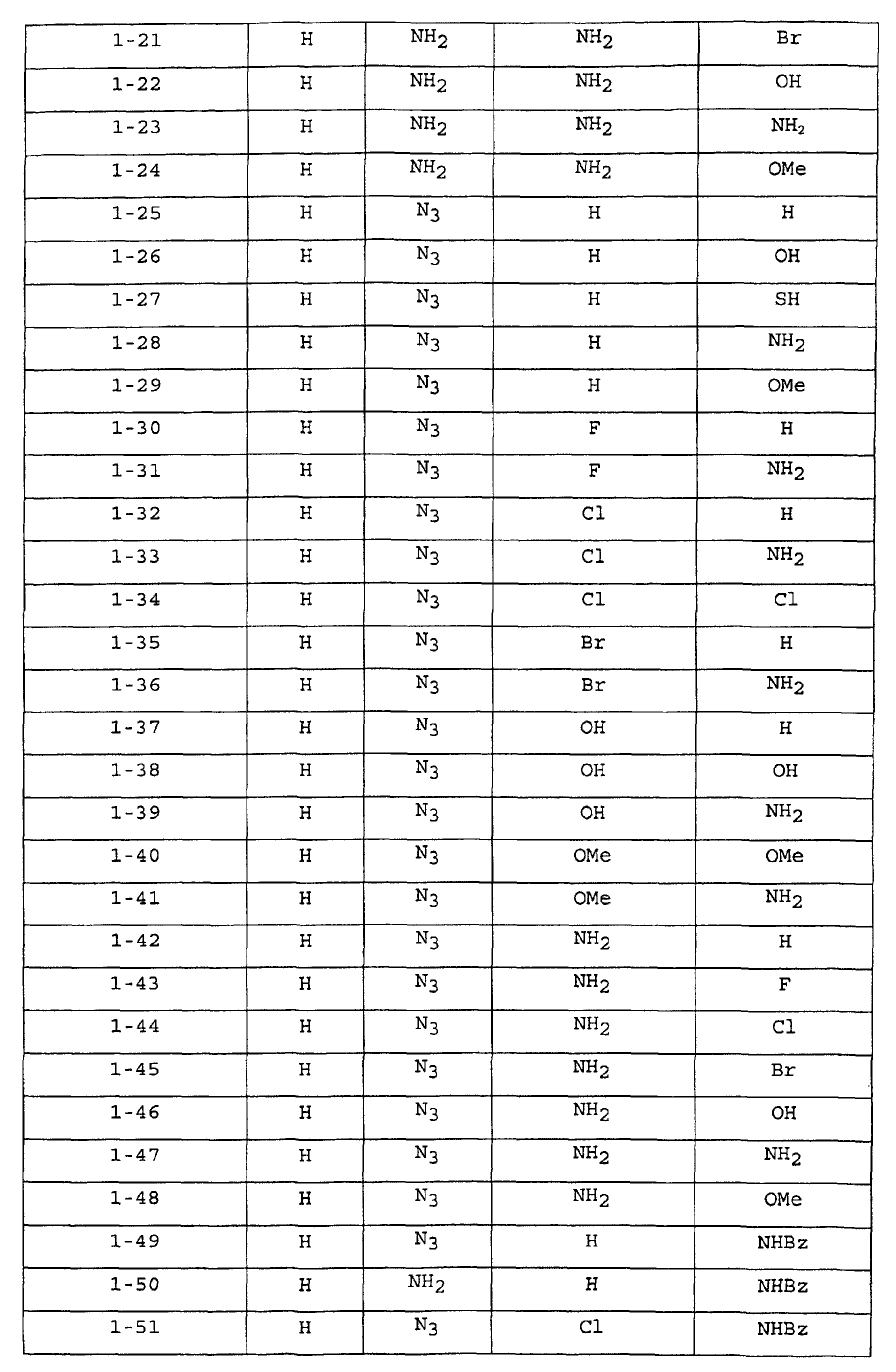


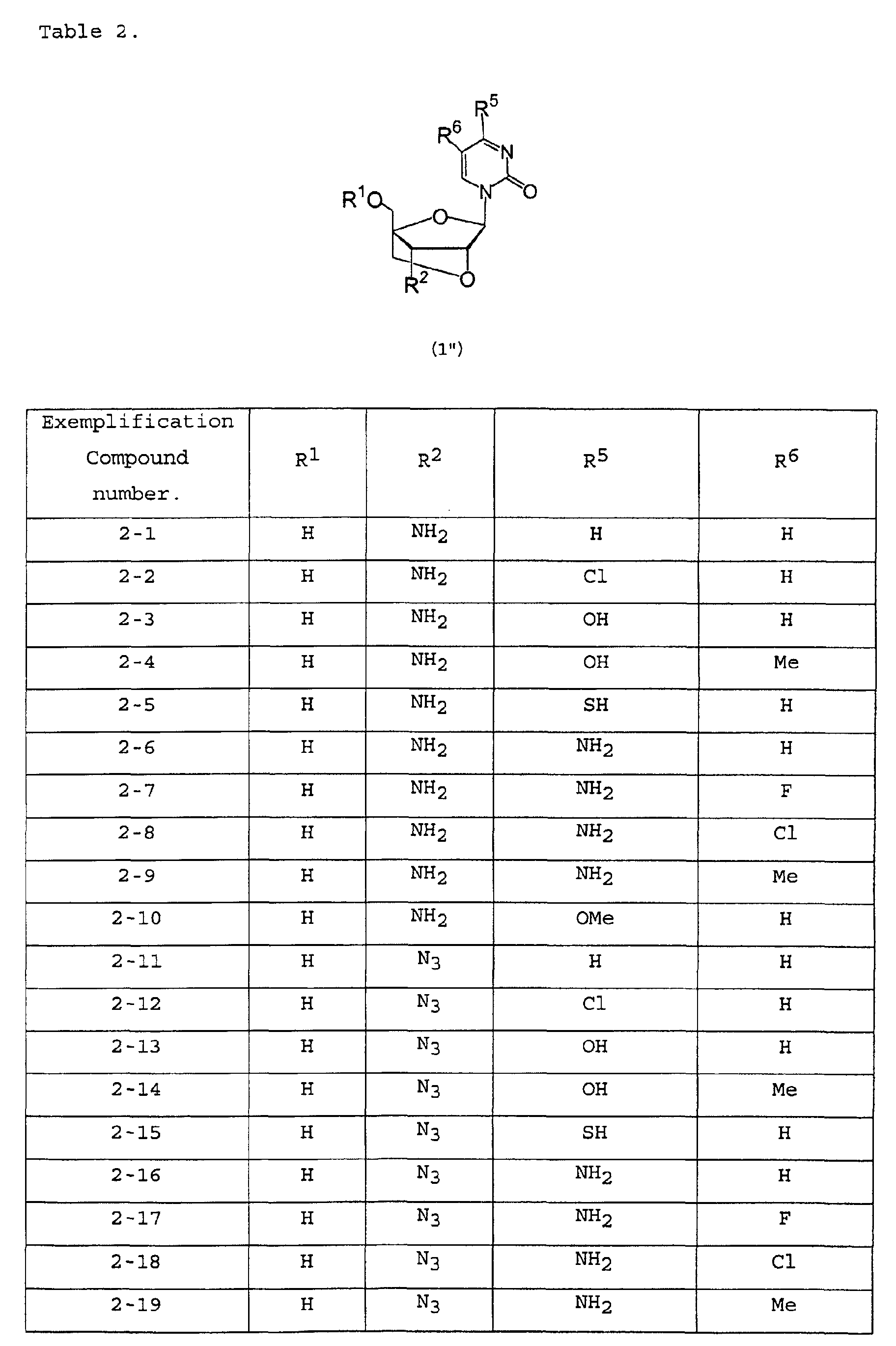
 Among the compounds listed in these Tables, preferred compounds are as follows (Exemplification compound numbers): 1-3, 1-4, 1-7, 1-9, 1-10, 1-16, 1-17, 1-19, 1-20, 1-21, 1-22, 1-23, 1-27, 1-28, 1 to 31, 1 to 33, 1 to 34, 1-40, 1-41, 1-43, 1-44, 1-45, 1-46, 1-47, 1-49, 1-50, 1-56, 1-57, 1-82, 1-83, 2-3, 2-4, 2-5, 2-6, 2-7, 2-8, 2-9, 2-10, 2-13, 2-14, 2-15, 2-16, 2-17, 2-18, 2-19, 2-20, 2-21, 2-22, 2-48, 2-59, 2-60, and 2-61.
More preferred compounds are as follows (Exemplification compound numbers):
1-4, 1-22, 1-28, 1-46, 1-49, 1-50, 1-56, 1-57, 1-82, 1-83, 2-3, 2-4, 2-6, 2-13, 2-14, 2-16, 2-21, 2-22, 2-48, 2-59, 2-60, and 2-61.
Particularly preferred compounds are as follows (Exemplification compound numbers): - 2-4: 3'-amino-3'-deoxy-2'-O,4'-C-methylene-5-methyluridine,
- 2-14: 3'-azido-3'-deoxy-2'-O,4'-C-methylene-5-methyluridine,
- 2-36: 3'-azido-3'-deoxy-5'-O-(4,4'-dimethoxytrityl)-2'-O,4'-C-methylene-5-methyluridine,
- 2-48: 3'-azido-5'-O-tert-butyldiphenylsilyl-3'-deoxy-2'-O,4'-C-methylene-5-methyluridine and
- 2-60: 3'-amino-3'-deoxy-5'-O-(4,4'-dimethoxytrityl)-2'-O,4'-C-methylene-5-methyluridine.
-
- The compounds of the present invention can be synthesized in accordance with method A described below.

- In the processes described above, R1, R2 and B are as defined previously.
- R7 represents a protecting group for a hydroxy group, and preferred groups are aromatic acyl groups, for example, aryl carbonyl groups such as benzoyl, α-naphthoyl, and β-naphthoyl; lower-alkylated-arylcarbonyl groups such as 2,4,6-trimethylbenzoyl, and 4-toluoyl, and arylated-arylcarbonyl groups such as 4-phenylbenzoyl. The most preferred group is a benzoyl group.
- R8 represents a protecting group for a hydroxy group and preferred groups are
"silyl groups", for example, a tri-lower-alkylsilyl group such as trimethylsilyl, triethylsilyl, isopropyldimethylsilyl, t-butyldimethylsilyl, methyldiisopropylsilyl, methyldi-t-butylsilyl and triisopropylsilyl; and a tri-lower-alkylsilyl group substituted by 1-2 aryl groups such as diphenylmethylsilyl, t-butyldiphenylsilyl, diphenylisopropylsilyl and phenyldiisopropylsilyl;
"a methyl group substituted by 1 to 3 aryl groups" such as benzyl, α-naphthylmethyl, β-naphthylmethyl, diphenylmethyl, triphenylmethyl, α-naphthyldiphenylmethyl and 9-anthrylmethyl;
"a methyl group substituted by 1 to 3 aryl groups wherein the aryl ring is substituted by lower-alkyl, lower-alkoxy, a halogen atom or cyano group" such as 4-methylbenzyl, 2,4,6-trimethylbenzyl, 3,4,5-trimethylbenzyl, 4-methoxybenzyl, 4-methoxyphenyldiphenylmethyl, 4,4'-dimethoxytriphenylmethyl, 4,4',4''-trimethoxytriphenylmethyl, 2-nitorobenzyl, 4-nitrobenzyl, 4-chlorobenzyl, 4-bromobenzyl and 4-cyanobenzyl. - More preferred groups are a trimethylsilyl group, a t-butyldimethylsilyl group, a t-butyldiphenylsilyl group, a benzyl group, a triphenylmethyl group, a 4-methoxybenzyl group, a 4-methoxyphenyldiphenylmethyl group, a 4,4'-dimethoxytriphenylmethyl group or a 4,4',4''-trimethoxytriphenylmethyl group.
- R9 represents a leaving group and preferred groups are a lower-alkylsulfonyl group such as methanesulfonyl and ethanesulfonyl groups, a lower-alkylsulfonyl group substituted by halogen atoms such as trifluoromethanesulfonyl group, and an arylsulfonyl group such as p-toluenesulfonyl group.
- Among these groups more preferred groups are methanesulfonyl group or p-toluenesulfonyl group.
- R10 represents a protecting group for a hydroxy group and preferred groups are
"aliphatic acyl groups", for example, alkylcarbonyl groups such as formyl, acetyl, propionyl, butyryl, isobutyryl, pentanoyl, pivaloyl, valeryl, isovaleryl, octanoyl, decanoyl, 1-methylheptadecanoyl, nonadecanoyl, eicosanoyl and henicosanoyl, carboxylated alkylcarbonyl groups such as succinoyl, glutaroyl and adipoyl groups, halogeno-lower-alkylcarbonyl groups such as chloroacetyl, dichloroacetyl, trichloroacetyl and trifluoroacetyl groups, lower-alkoxy-lower-alkylcarbonyl groups such as a methoxyacetyl group, and unsaturated alkylcarbonyl groups such as a (E)-2-methyl-2-butenoyl group;
"aromatic acyl groups", for example, arylcarbonyl groups such as benzoyl, α-naphthoyl and β-naphthoyl, halogenoarylcarbonyl groups such as 2-bromobenzoyl and 4-chlorobenzoyl groups, lower-alkylated arylcarbonyl groups such as 2,4,6-trimethylbenzoyl and 4-toluoyl groups, lower-alkoxylated arylcarbonyl groups such as 4-anisoyl group, carboxylated arylcarbonyl groups such as 2-carboxybenzoyl, 3-carboxybenzoyl and 4-carboxybenzoyl groups, nitrated arylcarbonyl groups such as 4-nitrobenzoyl and 2-nitrobenzoyl groups, lower-alkoxycarbonylated arylcarbonyl groups such as 2-(methoxycarbonyl)benzoyl group,and arylated arylcarbonyl groups such as 4-phenylbenzoyl group. - Among these groups, more preferred groups are "aliphatic acyl groups" and a particularly preferred group is an acetyl group.
- B1 represents purine-9-yl or 2-oxo-1,2-dihydropyrimidin-1-yl group which may have 1 or more substituents selected from α1 group below.
(α1 group) - a hydroxy group,
- a hydroxy group protected with a protecting group in nucleic acid synthesis,
- an alkoxy groups having 1-6 carbon atoms,
- a mercapto group,
- a mercapto group protected with a protecting group in nucleic acid synthesis,
- an alkylthio group having 1-6 carbon atoms,
- an amino group protected with a protecting group in nucleic acid synthesis,
- an amino groups substituted by an alkyl group having 1-6 carbon atoms,
- an alkyl group having 1-6 carbon atoms and
- halogen atoms.
-
- Method A is a process to synthesize the compounds of formulae (1a), (1b) and (1c) from the starting compound (2) through introduction of a substitutent B and ring closure.
- Here the starting compound (2) is synthesized from commercially available diacetone-D-glucose using a similar method to that described in the literature (O. T. Schmidt, Methods in Carbohydr. Chem., 4, 318 (1964); J. S. Brimacombe and O. A. Ching, Carbhyd. Res., 8, 82 (1968); T.F. Tam and B. Fraser-Reid, Can. J. Chem., 57, 2818 (1979); S. A. Suzhkov, Nucleosides & Nucleotides, 13, 2283 (1994)].
- Details of each process of method A will be described below.
- A compound (3) is prepared in this step, which comprises deprotection of a primary alcohol protecting group of starting compound (2) in the presence of a base in an inert solvent.
- The solvent employed has no limitation, insofar as the solvent is one normally used for hydrolysis, and can be water; organic solvents, for example alcohols such as methanol, ethanol and n-propanol, and ethers such as tetrahydrofuran and dioxane; or a mixture of water and the organic solvents described above. Preferred solvents are alcohols.
- The base employed has no limitation unless it affects other moieties of the compound. Preferred bases are metal alkoxides such as sodium methoxide; alkali metal carbonates such as sodium carbonate, potassium carbonate and lithium carbonate; alkali metal hydroxides such as sodium hydroxide, potassium hydroxide, lithium hydroxide and barium hydroxide, or ammonia such as aqueous ammonia solution and concentrated ammonia-methanol. Preferred bases are alkali metal carbonates.
- The reaction temperature and reaction time depend upon the starting material, solvent and base employed and have no limitation. Ordinarily the reaction temperature is between 0°C and 15°C and the reaction time is from 1hr to 10 hrs.
- After termination of the reaction, the desired compound (3) is collected from the reaction mixture by conventional methods. For example, the reaction mixture is neutralized and concentrated, and to the residue is added water and an organic solvent immiscible with water, such as ethyl acetate. After washing with water, the organic phase including the desired compound is isolated, and dried over anhydrous sodium sulfate or the like. The desired compound is obtained by evaporation of the solvents.
- The compound obtained is, if necessary, purified by conventional methods, such as recrystallization and/or silica gel column chromatography.
- A compound (4) is prepared in this process which comprises reaction of compound (3) obtained in process A-1 with a hydroxy-protecting agent in the presence of a base in an inert solvent.
- The solvent employed has no limitation, as far as it does not inhibit the reaction and dissolves the starting materials to some extent and is, for example, an aliphatic hydrocarbon such as hexane and heptane; an aromatic hydrocarbon such as benzene, toluene and xylene;
a halogenated hydrocarbon such as methylene chloride, chloroform, carbon tetrachloride, dichloroethane, chlorobenzene and dichlorobenzene; an ester such as ethyl formate, ethyl acetate, propyl acetate, butyl acetate and diethyl carbonate; an ether such as diethyl ether, diisopropyl ether, tetrahydrofuran, dioxane, dimethoxyethane and diethylene glycol dimethyl ether; a nitrile such as acetonitrile and isobutyronitrile; an amide such as formamide, N,N-dimethylformamide, N,N-dimethylacetamide, N-methyl-2-pyrrolidone N-methyl-pyrrolidinone, and hexamethylphosphorotriamide. The preferred solvent is methylene chloride. - The base employed has no limitation, as far as it is used as a base in conventional reactions. For example, it can be an organic base such as N-methylmorpholine, triethylamine, tributylamine, diisopropylethylamine, dicyclohexylamine, N-methylpiperidine, pyridine, 4-pyrolidinopyridine, picoline, 4-(N,N-dimethylamino) pyridine, 2,6-di(tert-butyl)-4-methylpyridine, quinoline, N,N-dimethylaniline and N,N-diethylaniline. The preferred base is triethylamine.
- The hydroxyl-protecting reagents employed are, for example, silyl halides such as t-butyldimethylsilyl chloride, trimethylsilyl chloride, triethylsilyl chloride, triethylsilyl bromide, triisopropylsilyl chloride, dimethylisopropylsilyl chloride, diethylisopropylsilyl chloride, t-butyldiphenylsilyl chloride, diphenylmethylsilyl chloride, and triphenylsilyl chloride; tritylhalides such as 4-methoxytriphenylmethyl chloride, 4,4'-dimethoxytriphenylmethyl chloride and 4,4',4''-trimethoxytriphenylmethyl chloride; and
aralkyl halides such as benzyl chloride, benzyl bromide and p-methoxybenzyl bromide. The preferred hydroxyl-protecting reagent is t-butyldiphenylsilyl chloride. - The reaction temperature is usually between -20°C and the reflux temperature of the solvent employed. The preferred temperature is between 0°C and the reflux temperature of the solvent employed.
- The reaction time depends upon mainly the reaction temperature, the starting compound, the base and the solvent employed. Ordinarily it is from 10 min to 3 days, and the preferred reaction time is from 1 hr to 24 hrs.
- After the reaction is terminated, the desired compound (4) in the present reaction is collected from the reaction mixture, according to conventional methods. For example, the reaction mixture is neutralized, and water and an organic solvent immiscible with water, such as ethyl acetate, are added to the neutralized reaction mixture. After washing with water, the organic phase including the desired compound is separated, and dried over anhydrous sodium sulfate or the like. The desired compound is obtained by evaporation of the solvent.
- The compound obtained is, if necessary, and particularly if a product in which R8 is introduced to the hydroxy group at undesired positions is obtained, further purified by conventional methods, such as recrystallization and silica gel column chromatography.
- A compound (5) is prepared in this process which comprises reaction of compound (4) obtained in process A-2 with a leaving-group introducing reagent in the presence of base in an inert solvent.
- The solvent employed is, for example, an aliphatic hydrocarbon such as hexane, heptane, ligroin and petroleum ether; an aromatic hydrocarbon such as benzene, toluene and xylene; a halogenated hydrocarbon such as methylene chloride, chloroform, carbon tetrachloride, dichloroethane, chlorobenzene and dichlorobenzene; an ester such as ethyl formate, ethyl acetate, propyl acetate, butyl acetate and diethyl carbonate; an ether such as diethyl ether, diisopropyl ether, tetrahydrofuran, dioxane, dimethoxyethane, and diethylene glycol dimethyl ether; a ketone such as acetone, methyl ethyl ketone and methyl isobutyl ketone, isophorone, and cyclohexanone; a nitro compound such as nitroethane and nitrobenzene; a nitrile such as acetonitrile and isobutyronitrile; an amide such as formamide, N,N-dimethylformamide, N,N-dimethylacetamide, N-methyl-2-pyrrolidone, N-methylpyrrolidinone, and hexamethylphosphorotriamide;
a sulfoxide such as sulfolane; or a pyridine. - Among these solvents, the preferred solvent is methylene chloride.
- Preferred basic catalysts employed are bases such as triethylamine, pyridine and dimethylaminopyridine.
- The leaving-group introducing reagent employed is, for example, an alkylsulfonyl halide such as methanesulfonyl chloride and ethanesulfonyl bromide; or an arylsulfonyl halide such as p-toluenesulfonyl chloride.
- Preferred leaving-group introducing reagents are methanesulfonyl chloride and p-toluenesulfonyl chloride.
- The reaction temperature depends upon the starting compound, solvent, leaving-group introducing reagent and base employed. Usually the temperature is between 0°C and 50°C, and the preferred temperature is between 10°C and 40°C.
- The reaction time depends upon the starting compound, solvent, leaving-group introducing reagent and base employed. Usually the reaction time is from 10 min to 24 hrs, and the preferred reaction time is from 1 hr to 15 hrs.
- After termination of the reaction, the desired compound (5) of this reaction is collected from the reaction mixture according to conventional methods. For example, the reaction mixture is neutralized and concentrated. Water and an organic solvent immiscible with water, such as ethyl acetate, are added to the residue. After washing with water, the organic phase including the desired compound is separated, dried over anhydrous sodium sulfate or the like, and then the desired compound can be obtained by evaporation of the solvents.
- The compound obtained is, if necessary, purified by conventional methods, such as recrystallization, silica gel column chromatography and the like.
- A compound (6) is prepared in this process which comprises reaction of compound (5) obtained in process A-3 with an acid anhydride in the presence of an acid catalyst in a solvent.
- The solvent employed is, for example, an ether such as diethylether, dioxane and tetrahydrofuran; a nitrile such as acetonitrile and isobutyronitrile; an amide such as formamide, N,N-dimethylformamide, N,N-dimethyl-acetamide, N-methyl-2-pyrrolidone, N-methylpyrrolidinone and hexamethylphosphorotriamide; or an organic acid such as acetic acid. The preferred solvent is acetic acid.
- The acid catalyst employed in process A-4 is, for example, an inorganic acid such as hydrochloric acid, sulfuric acid, or nitric acid. The preferred acid is sulfuric acid (particularly concentrated sulfuric acid).
- The acid anhydride employed is, for example, a lower-aliphatic acid anhydride such as acetic acid anhydride, propionic acid anhydride and the like. The preferred acid anhydride is acetic anhydride.
- The reaction temperature depends upon the starting compound, solvent, acid catalyst and acid anhydride employed. Usually the reaction temperature is between 0°C and 50°C, and the preferred reaction temperature is between 10°C and 40°C.
- The reaction time depends upon the starting compound, solvent, acid catalyst, acid anhydride and the reaction temperature employed. Usually the reaction time is from 10 min to 12 hrs, and the preferred reaction time is from 30 min to 6 hrs.
- After termination of the reaction, the desired compound (6) of this reaction is collected from the reaction mixture according to conventional methods. For example, water and an organic solvent immiscible with water, such as ethyl acetate, is added to the reaction mixture. After washing with water, the organic phase including the desired compound is isolated, dried over anhydrous sodium sulfate or the like, and then the desired compound can be obtained by evaporation of the solvent.
- The compound obtained is, if necessary, further purified by conventional methods, such as recrystallization, silica gel column chromatography and the like.
- A compound of (7) is prepared in this process which comprises reaction of compound (6) obtained in process A-4 with a trimethylsilyl derivative of an optionally substituted purine or pyrimidine, which is prepared in accordance with the literature (H. Vorbrueggen, K. Krolikiewicz and B. Bennua, Chem Ber., 114, 1234-1255 (1981)), in the presence of an acid catalyst in an inert solvent.
- The solvent employed is an aromatic hydrocarbon such as benzene, toluene and xylene; a halogenated hydrocarbon such as methylene chloride, chloroform, carbon tetrachloride, 1,2-dichloroethane, chlorobenzene and dichlorobenzene; a nitrile such as acetonitrile and isobutyronitrile; an amide such as formamide, N,N-dimethylformamide, N,N-dimethylacetamide, N-methyl-2-pyrrolidone, N-methyl-pyrrolidinone and hexamethylphosphorotriamide; or carbon disulfide. The preferred solvent is 1,2-dichloroethane.
- The acid catalyst employed is, for example, a Lewis acid catalyst such as AlCl3, SnCl4, TiCl4, ZnCl2, BF3 and trimethylsilyl trifluoromethanesulfonate. The preferred acid catalyst is tin tetrachloride (SnCl4).
- The reaction temperature depends upon the starting compound, solvent and acid catalyst employed. Usually the reaction temperature is between 0°C and 100°C, and the preferred reaction temperature is between 30°C and 80°C.
- The reaction time depends upon the starting compound, solvent, acid catalyst, and reaction temperature employed. Usually the reaction time is from 1 hr to 3 days, and the preferred reaction time is from 1 hr to 2 days.
- After termination of the reaction, the desired compound (7) of this reaction is collected from the reaction mixture according to conventional methods. For example, the reaction mixture is neutralized, and water and an organic solvent immiscible with water, such as ethyl acetate or methylene chloride, is added to the resulting mixture. After washing with water, the organic phase including the desired compound is separated, dried over anhydrous sodium sulfate or the like, and then the desired compound can be obtained by evaporation of the solvent.
- The compound obtained is, if necessary, purified by conventional methods, for example recrystallization, silica gel column chromatography, and the like.
- A compound (1c) is prepared in this process which comprises a cyclization reaction of compound (7) obtained in process A-5 in the presence of a basic catalyst in an inert solvent.
- The solvent employed has no limitation as far as it does not inhibit the reaction and it dissolves the starting compound to some extent. Preferred solvents are alcohols such as methanol, ethanol, n-propanol, isopropanol, n-butanol, isobutanol, t-butanol, isoamyl alcohol, diethylene glycol, glycerin, octanol, cyclohexanol and methyl cellosolve. The most preferred solvent is methanol.
- The basic catalyst employed is, for example, an alkali metal hydroxide such as sodium hydroxide and potassium hydoxide; an alkali metal carbonate such as sodium carbonate and potassium carbonate;
an alkali metal alkoxide such as sodium methoxide and sodium ethoxide; or aqueous ammonia solution and the like. Preferred basic catalysts are alkaline metal carbonates and the most preferred basic catalyst is sodium carbonate. - The reaction temperature depends upon the starting compound, solvent, and basic catalyst employed. Usually the reaction temperature is between 0°C and 50°C, and the preferred reaction temperature is between 10°C and 30°C.
- The reaction time depends upon the starting compound, solvent, basic catalyst, and the reaction temperature employed. Usually the reaction time is from 1 hr to 3 days, and the preferred reaction time is from 3 hr to 2 days.
- After termination of the reaction, the desired compound (1a) of this reaction is collected from the reaction mixture according to conventional methods. For example, the reaction mixture is concentrated, and water and an organic solvent immiscible with water, such as ethyl acetate, are added to the residue. After washing with water, the organic phase including the desired compound is separated, dried over anhydrous sodium sulfate or the like, and then the desired compound can be obtained by evaporation of the solvent.
- The compound obtained is, if necessary, purified by conventional methods, for example, recrystallization, silica gel column chromatography, and the like.
- A compound (1b) is prepared in this process which comprises reaction of compound (1a) obtained in process A-6 with a deprotecting agent in an inert solvent. In the case that deprotection is unnecessary, the next process can be conducted without this process.
- The process of deprotection depends upon the protecting groups employed, and the deprotecting reagent has no limitation unless it has an adverse effect on the reaction. For instance, the deprotection can be carried out according to methods described in the literature of "Protective Groups in Organic Synthesis" (Theodora W. Greene, 1981, A Wiley-Interscience Publication).
- When different kinds of protecting groups exist, some of these methods are appropriately combined and each of these carried out in turn.
- Particularly when the protecting groups are (1) "aliphatic acyl or aromatic acyl groups", (2) "a methyl group substituted by 1 to 3 aryl groups" or a "methyl groups substituted by 1 to 3 aryl rings wherein the aryl ring is substituted by lower-alkyl, lower-alkoxy, cyano group or halogen atom", (3) "silyl groups", the protecting groups can be deprotected with the following methods.
- (1) When the protecting groups are aliphatic acyl or aromatic acyl groups, they are usually deprotected by reaction with bases in inert solvents. The solvents employed have no limitation as far as they are usually used in hydrolysis. For instance, water; organic solvents, for example, alcohols such as methanol, ethanol, and n-propanol; ethers such as tetrahydrofuran and dioxane, or a mixture of water and above organic solvents are used. The preferred solvents are alcohols.The bases employed have no limitation unless they affect other moieties of the compounds. Preferred bases are metal alkoxides such as sodium methoxide; alkali metal carbonates such as sodium carbonate, potassium carbonate and lithium carbonate; alkali metal hydroxides such as sodium hydroxide, potassium hydoxide, lithium hydroxide and barium hydroxide; or ammonia such as aqueous ammonia solutions and concentrated ammonium-ethanol. Preferred bases are alkali metal carbonates.The reaction temperature and the reaction time depend upon the starting compound, solvent, base employed. Usually the reaction temperature is between 0°C and 150°C and the reaction time is from 1 hr. to 10 hrs. in order to suppress production of by-products.After termination of the reaction, the desired compound (1b) of this reaction is collected from the reaction mixture according to conventional methods. For example, the reaction mixture is concentrated, and water and an organic solvent immiscible with water, such as ethyl acetate, are added to the residue. After washing with water, the organic phase including the desired compound is separated, dried over anhydrous sodium sulfate or the like, and then the desired compound can be obtained by evaporation of the solvent.The compound obtained is, if necessary, purified by conventional methods, for example recrystallization, silica gel column chromatography and the like.
- (2) In the case that the protecting group is "a methyl group
substituted by 1 to 3 aryl groups" or " a methyl group
substituted by 1 to 3 aryl groups wherein aryl ring is
substituted by lower-alkyl, lower-alkoxy group, halogen atom
or a cyano group", deprotection is carried out by a reducing
reagent in an inert solvent.
Preferred solvents employed are alcohols such as
methanol, ethanol and isopropanol; ethers such as diethyl
ether, tetrahydrofuran and dioxane; aromatic hydrocarbons such
as toluene, benzene and xylene; aliphatic hydrocarbons such as
hexane and cyclohexane; esters such as ethyl acetate and
propyl acetate; organic acids such as acetic acid; or mixtures
of these organic solvents and water.The reducing reagents employed have no limitation if
they are usually used in catalytic reactions. Preferred
reducing agents are palladium-carbon, Raney nickel, platinum
oxide, platinum black, rhodium-aluminium oxide,
triphenylphosphine-rhodium chloride and palladium-barium
sulfate.The reaction pressure has no limitation. Usually this
process is performed under 1 to 10 atmosphere.The reaction temperature is between 0°C and 60°C, and
the preferred reaction temperature is between 20°C and 40°C.The reaction time is from 10 min. to 24 hrs. and the
preferred reaction time is from 1 to 3 hrs.After termination of the reaction, the desired compound
(1b) of this reaction is collected from the reaction mixture
according to conventional methods. For example, the reducing
reagent is removed, and water and an organic solvent
immiscible with water, such as ethyl acetate, are added to the
reaction mixture. After washing with water, the organic phase
including the desired compound is separated, dried over
anhydrous sodium sulfate or the like, and then the desired
compound can be obtained by evaporation of the solvent. The compound obtained is, if necessary, further purified
by conventional methods, for example recrystallization, silica
gel column chromatography and the like.When the protecting group is "a methyl group substituted
by 3 aryl groups", i.e., when the protecting group is a trityl
group, deprotection can also be carried out using an acid.In this case, the following solvents are used, for
example,
aromatic hydrocarbons such as benzene, toluene and xylene; halogenated hydrocarbons such as methylene chloride, chloroform, carbon tetrachloride, 1,2-dichloroethane, chlorobenzene and dichlorobenzene; alcohols such as methanol, ethanol, isopropanol and tert-butanol; nitriles such as acetonitrile and isobutyronitrile; amides such as formamide, N,N-dimethyl formamide, N,N-dimethylacetamide, N-methyl-2-pyrrolidone, N-methyl-pyrrolidinone, and hexamethylphosophorotriamide; and organic acids such as acetic acid. Preferred solvents are organic acids (particularly acetic acid) and alcohols (particularly tert-butanol).The preferred acid to use is acetic acid or trifluoroacetic acid.The reaction temperature is between 0°C and 60°C, and the preferred reaction temperature is between 20°C and 40°C.The reaction time is from 10 min to 24 hrs and the preferred reaction time is from 1 to 3 hrs.After termination of the reaction, the desired compound (1b) of this reaction is collected from the reaction mixture according to conventional methods. For example, the reaction mixture is neutralized, and water and an organic solvent immiscible with water, such as ethyl acetate, are added to the resulting mixture. After washing with water, the organic phase including the desired compound is separated, dried over anhydrous sodium sulfate or the like, and then the desired compound can be obtained by evaporation of the solvent.The compound obtained is, if necessary, further purified by conventional methods, for example recrystallization, silica gel column chromatography and the like. - (3) In the case that the protecting group is "a silyl group", the protecting group is usually deprotected by treatment with compounds which produce fluorine anion, such as tetrabutylammonium fluoride, hydrofluoric acid, hydrofluoric acid-pyridine, and potassium fluoride, or organic acids such as acetic acid, methanesulfonic acid, para-toluenesulfonic acid, trifluoroacetic acid, and trifluoromethanesulfonic acid, or inorganic acids such as hydrochloric acid.
-
- When the protecting group is deprotected with fluorine anion, the reaction is, in some cases, accelerated by addition of an organic acid such as formic acid, acetic acid or propionic acid.
- The solvents used have no limitation as far as they do not inhibit the reaction and they dissolve the starting materials to some extent. However, preferred solvents are ethers such as diethyl ether, diisopropylether, tetrahydrofuran, dioxane, dimethoxyethane and diethylene glycol dimethyl ether; nitriles such as acetonitrile and isobutyronitrile; water; organic acids such as acetic acid, and mixtures of these solvents described above.
- The reaction temperature is between 0°C and 100°C, and the preferred reaction temperature is between 20°C to 70°C.
- The reaction time is from 5 min. to 48 hrs. and the preferred reaction time is from 1 to 24 hrs.
- After termination of the reaction, the desired compound (1b) of this reaction is collected from the reaction mixture according to conventional methods. For example, the solvents are evaporated and then the compound is purified by silica gel column chromatography.
- A compound (1c) is prepared in this process which comprises catalytic reduction of the azido group in compound (1b) obtained in process A-7 to an amino group in the presence of hydrogen and a catalyst in an inert solvent and, if necessary, protection of the amino group.
- The solvents employed have no limitation as far as they do not have an adverse effect on this reaction. Preferred solvents are alcohols such as methanol, ethanol and isopropanol; ethers such as diethylether, tetrahydrofuran and dioxane; aromatic hydrocarbons such as toluene, benzene and xylene; aliphatic hydrocarbons such as hexane and cyclohexane; esters such as ethyl acetate and propyl acetate; amides such as formamide, dimethylformamide, dimethylacetamide, N-methyl-2-pyrrolidone and hexamethylphosphorotriamide; aliphatic acids such as formic acid and acetic acid; water; or mixtures of these solvents described above.
- The catalysts employed have no limitation if they are usually used in catalytic reductions. Preferred catalysts are palladium on carbon, palladium black, Raney nickel, platinum oxide, platinum black, rhodium-aluminium oxide, triphenylphosphine-rhodium chloride, palladium-barium sulfate.
- The reaction pressure has no limitation, but is usually between 1 and 10 atmospheres.
- The reaction temperature and reaction time depends upon the starting compound, solvent, and catalyst employed. Usually the reaction temperature is between 0°C and 100°C (preferred reaction temperature is between 20°C and 40°C), and the reaction time is from 5 min. to 48 hrs. (preferred reaction time is from 30 min. to 10 hrs.).
- After termination of the reaction, the desired compound (1c) of this reaction is collected from the reaction mixture according to conventional methods. For example, the desired compound can be obtained through removal of the catalysts by filtration and by evaporation of solvent from the filtrate.
- If desired, the amino group can be protected in accordance with the methods described in the above literature (Protective Groups in Organic Synthesis).
- A N3'-P5' type oligonucleotide analogue of this invention in which the nitrogen atom at 3' position and the oxygen atom at 5' position are combined through phosphoric acid can be prepared using compound (1d) of this invention according to method B described below.

- In the processes described above, B1 and R8 are as defined previously. However B1 in the formula (1d) and B1 in the formula (8) may be the same or different.
- R11 represents a resin such as succinyl Controlled Pore Glass or Tentagel, which is usually employed for the synthesis of oligonucleotides.
- CEO represents a 2-cyanoethoxy group.
- Each process of method B will be described below in detail.
- A compound (9) is prepared in this process which comprises an oxidative phosphorylation coupling reaction of compound (1d) with compound (8). This process is performed as described in the literature (1) (Nucleic Acids Research, Vol. 23, No. 14, pp. 2661-2668, 1995).
- The hydroxy group at the 5' position of the compound (1d) is protected in compound (1c) in Process A-8, and if an amino group exists in the base B, said amino group of compound (1d) is protected.
- Further, the compound (8) can be prepared from the compound (1c) obtained in "Process A-8", in accordance with the literature (1).
- This process is to produce an oligonucleotide from compound (9) obtained in the "Process B-1".
- The process comprises deprotection of the hydroxyl-protecting group R8 of compound (9) by a procedure of process A-7, phosphorylation in accordance with the literature (1), reaction with compound (1d) in a method similar to that described in the Process B-1, followed by repetition of these reactions to give the desired oligonucleotide.
- The sequence length of the oligonucleotides obtained is usually 2-50 nucleoside units, and the preferred length is 10-30 nucleoside units.
- The oligonucleotide analogues obtained are resistant to various nucleases. Thus they remain in the body for a long time after administration. Further, the oligonucleotide analogues, for instance, form stable double strands with mRNA, and inhibit biosynthesis of proteins which contribute to pathogenesis, or inhibit transcription to mRNA by forming triplets with the DNA double strands in genomes, or inhibit proliferation of viruses.
- Thus the oligonucleotide analogues of the present invention can supress specified genome functions, and are expected to be therapeutic agents used for the treatment of diseases, such as anti-neoplasm agents, anti-viral agents, or the like.
- Non-oral formulations or liposome formulations of the oligonucleotide analogues of this invention can be prepared, for instance, by addition of conventional adjuvants such as buffers and/or stabilizers. The nucleotide analogues may be blended with conventional pharmaceutical carriers to prepare ointments, creams, liquids or plasters.
- Their doses are different according to the symptoms of the disease, the age of the patient, and the route of administration. For instance, the lowest dose of the oligonucleotide analogue is 0.001 mg/kg of the body weight (preferably 0.01 mg/kg of the body weight), and the highest dose is 100 mg/kg of the body weight (preferably 10 mg/kg of the body weight) as a single dose. It is desirable to administer from one to several times throughout the day depending on the symptoms of the patient.
- The present invention will be described below in more detail by way of the following Examples and Reference examples. However, the present invention is not limited to those examples.
- Potassium carbonate (41 mg, 0.29 mmol) was added to a methanol solution (7 ml) of the compound obtained in Reference example 5 (200 mg, 0.27 mmol) at 0°C and the mixture was stirred for 4.5 hrs at room temperature. Further potassium carbonate (34 mg, 0.25 mmol) was added to the mixture, which was stirred for 23 hrs. After the methanol was evaporated, the residue was partitioned between ethyl acetate and water. The extract was washed with saturated aqueous sodium chloride solution. The organic phase was dried over anhydrous sodium sulfate. The solvents were evaporated and the residue was purified by silica gel column chromatography (ethyl acetate: n-hexane = 2:1) to give the title compound as colorless crystals (142 mg, 0.27 mmol, 100%).
mp 93-95°C.
IR νmax (KBr) : 3169, 3047, 2956, 2888, 2859, 2117, 1696, 1275, 1109 cm-1.
1H-NMR (CDCl3) δ: 1.12 (9H, s), 1.65 (3H, s), 3.78, 3.84 (2H, AB, J = 8 Hz), 3.90, 4.08 (2H, AB, J = 12.5 Hz), 4.02 (1H, s), 4.67 (1H, s), 5.67 (1H, s), 7.54 (1H, s), 7.39-7.48 (6H, m), 7.67-7.71 (4H, m), 8.46 (1H, br s).
13C-NMR (CDCl3) δ: 12.3, 19.5, 27.0, 58.7, 60.3, 71.4, 77.2, 78.6, 87.2, 90.1, 110.8, 128.0, 130.1, 130.2, 131.7, 132.3, 133.7, 135.1, 135.4, 149.6, 163.6. - Anhydrous tetrabutylammonium fluoride (10 M in THF, 290 µl, 0.29 mmol) was added to an anhydrous tetrahydrofuran solution (5 ml) of the compound obtained in Example 1 (140 mg, 0.26 mmol) in a stream of nitrogen gas and the solution was stirred for 1 hr at room temperature. The solvent was evaporated and the residue was purified by silica gel column chromatography (ethyl acetate: n-hexane = 25:1) and the title compound was obtained as a white powder (65.7 mg, 0.22 mmol, 85%).
mp 94-96°C.
IR νmax (KBr): 3163, 3046, 2118, 1692, 1468, 1273, 1062 cm-1. 1H-NMR (CD3OD) δ: 1.89 (3H, s), 3.76, 3.86 (2H, AB, J = 8 Hz), 3.85, 3.95 (2H, AB, J = 13 Hz), 4.03 (1H, s), 4.58 (1H, s), 5.58 (1H, s), 7.70 (1H, s).
13C-NMR (CD3OD) δ: 12.8, 57.3, 61.2, 72.4, 79.8, 88.3, 91.0, 110.8, 136.3, 151.5, 166.1. - An ethanol solution (3 ml) of the compound obtained in Example 2 (64 mg, 0.22 mmol) was added to 10% palladium-carbon (28 mg) suspended in anhydrous tetrahydrofuran solution (5 ml) in a stream of hydrogen gas, and the mixture was stirred for 0.5 hr at room temperature. The reaction mixture was filtered and the solvent of the filtrate was evaporated and the title compound was obtained as a white powder (59 mg, 0.22 mmol, 100%).
mp 243-246°C.
IR νmax (KBr): 3459, 3365, 1699, 1447, 1273, 1054 cm-1.
1H-NMR (C5D5N) δ: 1.83 (3H, s), 3.62 (1H, s), 3.92, 4.14 (2H, AB, J = 8 Hz), 4.24 (2H, s), 4.54 (1H, s), 5.97 (1H, s), 7.90 (1H, s).
13C-NMR (C5D5N) δ: 12.8, 54.2, 57.2, 71.6, 81.4, 91.1, 109.5, 150.8, 164.3. - Dimethoxytritylchloride (415 mg, 1.22 mmol) and dimethylaminopyridine (12.5 mg, 0.10 mmol) was added to a pyridine solution (6 ml) of the compound obtained in Example 2 (300 mg, 1.02 mmol) in a stream of nitrogen gas and the solution was stirred for 20.5 hr at room temperature. Saturated aqueous sodium hydrogen carbonate solution was added to the reaction mixture and the resulting mixture was extracted with dichloromethane. The organic phase was washed with water and saturated aqueous sodium chloride solution, and dried over anhydrous sodium sulfate. The solvent was evaporated under reduced pressure and the residue was purified by silica gel column chromatography (n-hexane: ethyl acetate = 2 : 1 → 1:1) and the title compound was obtained as a pale yellow foam (462 mg, 0.78 mmol, 76%).
mp 125-128°C.
1H-NMR (CDCl3) δ: 1.66 (3H, s), 3.32, 3.65 (2H, ABq, J = 11 Hz), 3.78 (2H, s), 3.80 (6H, s), 4.13 (1H, s), 4.63 (1H, s), 5.67 (1H, s), 6.86 (4H, dd, J = 2 Hz, 9 Hz), 7.23-7.45 (9H, m) , 7.73 (1H, s), 8.04 (1H, brs). - Triphenylphosphine (94.0 ml, 0.36 mmol) was added to a pyridine solution (2.5 ml) of the compound obtained in Example 4 (110 mg, 0.18 mmol) in a stream of nitrogen and the mixture was stirred for 3.5 hr at room temperature. 28% solution of aqueous ammonia (5.5 ml) was added to the reaction mixture which was stirred for 24 hrs at room temperature. The solvent was evaporated under reduced pressure and the crude product was purified by silica gel column chromatography (chloroform : ethanol = 20 : 1) and the title compound was obtained as a pale yellow foam (462 mg, 0.78 mmol, 76%).
mp 131-134°C.
1H-NMR (Pyridine-d5) δ: 1.89 (3H, s), 3.71 (6H, s), 3.77 (1H, s), 3.84 (2H, s), 3.99, 4.10 (2H, ABq, J = 8 Hz), 4.69 (1H, s), 6.04 (1H, s), 7.03-7.87 (13H, m), 8.58 (1H, s). - A carbon tetrachloride solution (0.3 ml) of the compound obtained in Example 5 (10.0 mg, 18 µmol), and a solution of triethylamine (0.05 ml, 0.36 mmol) in acetonitrile (0.2 ml), were added to an acetonitrile solution (0.3 ml) of the compound obtained in Reference Example 6 (14.5 mg, 0.28 µmol) in a stream of nitrogen gas, and the solution was stirred for 14.5 hr at room temperature. The solvent was evaporated under reduced pressure and the crude product was purified by silica gel column chromatography (n-hexane : ethyl acetate = 1:1→0:1) and the title compound was obtained as a white powder (13.0 mg, 12.5 µmol, 71%).
mp 101-105°C.
31P-NMR (CDCl3) δ: 7.68, 8.24. Mass (FAB) : m/z 1043 (M++H). - A carbon tetrachloride solution (0.3 ml) of the compound obtained in Example 5 (10.0 mg, 18 µmol), and a solution of triethylamine (0.05 ml, 0.36 mmol) in acetonitrile (0.2 ml), were added to an acetonitrile solution (0.3 ml) of the compound obtained in Reference Example 7 (22.1 mg, 51 µmol) in a stream of nitrogen gas, and the solution was stirred for 18 hrs at room temperature. Water was added to the reaction mixture and the resulting mixture was extracted with ethyl acetate. The organic phase was washed with saturated aqueous sodium chloride solution and dried over anhydrous sodium sulfate. The solvent was evaporated under reduced pressure and the crude product was purified by silica gel column chromatography (dichloromethane : methanol = 20:1, 30:1) and the title compound was obtained as a white powder (6.9 mg, 6.87 µmol, 39%).
mp 118-122°C.
31P-NMR (CDCl3) δ: 11.20, 11.30. Mass(FAB): m/z 1026(M++Na). - A tetrahydrofuran solution of tetrabutylammonium fluoride (1.0 M, 15 µl, 15 µmol) was added to tetrahydrofuran solution (1 ml) of the compound obtained in Example 7 (13.9 mg, 14 µmol) in a stream of nitrogen gas, and the solution was stirred for 3 hrs at room temperature. The solvent was evaporated under reduced pressure and the crude product was purified by silica gel column chromatography (ethyl acetate : ethanol = 5:1) and the title compound was obtained as a colorless powder (9.7 mg, 10.9 µmol, 78%).
mp 157-160°C.
31P-NMR (CDCl3) δ: 11.20, 11.30. Mass(FAB): m/z 1026(M++Na). - Tetrahydrofuran (0.2 ml) was added to an acetonitrile solution (0.6 ml) of the compound obtained in Example 8 (10.0 mg, 11 µmol) and diisopropylammonium tetrazolide (15.5 mg, 77 µmol), then 2-cyanoethyldiisopropylchlorophosphoroamidite (39.8 mg, 132 µmol), were added in a stream of nitrogen gas and the solution was stirred for 25 hrs at room temperature. The solvent was evaporated under reduced pressure. The residue compound was purified by silica gel column chromatography (ethyl acetate: triethylamine = 99:1→ethyl acetate : ethanol : triethylamine = 100 : 10 : 1). The product was reprecipitated with dichloroethane and n-hexane and the title compound was obtained as a white powder (3.8 mg, 3.5 µmol, 31%).
mp 113-116°C.
31P-NMR (CD3OD) δ: 8.67, 8.77, 9.07, 9.28, 148.53, 148.93, 148.99, 149.03. - By using a DNA synthesizer (manufactured by Pharmacia Co., Gene Assembler Plus), oligonucleotides were automatically synthesized in 0.2 µmol scale. Solvents and concentrations of reagents and phosphoramidite in each process of the production are identical to those in production of natural oligonucleotides. The solvents, reagents and phosphoramidites of natural nucleosides employed were those supplied from Pharmacia. The DMTr group of Universal QCPG (0.2 µmol, manufactured by Glen Research) was deprotected with trichloroacetic acid, and the hydroxy group produced was treated with the compound obtained in Example 9 or amidites used in the synthesis of natural nucleotides. This condensation process was repeated to obtain oligonucleotide analogues of desired sequences. The synthetic cycle was as follows;
Synthesis Cycle - 1) Detritylation trichloroacetate / dichloromethane; 60 sec.
- 2) Coupling phosphoramidite (25 eq) tetrazole / acetonitrile; 2 min or 30 min.
- 3) Capping 1-methylimidazole / acetonitrile, anhydrous acetic acid / 2,4,6-collidine/acetonitrle; 36 sec.
- 4) Oxidation iodine / water / pyridine / acetonitrile; 60 sec. When the compound obtained in Example 10 was reacted in the above cycle 2, the reaction time was 30 min, and when other phosphoramidites were employed, the reaction time was 2 min. After the oligonucleotide having the desired sequence was synthesized, the synthetic cycle was conducted until
-
- The oligomer was purified by reverse phase HPLC and the desired oligonucleotide was obtained.
- According to this method, the oligonucleotide analogue 5'-ttttttttttnt-3' (
sequence number 1 in the sequence table), of which n in base number 11 was 3'-amino-3'deoxy-2'-0,4'-C-methylene-5-methyluridine (hereinafter called "oligonucleotide (1)") was obtained.
(yield 8.5 nmol, 4.3%) - The obtained oligonucleotide analogues were purified by reverse phase HPLC (HPLC : Model 302, column manufactured by GILSON; CHEMCO CHEMCOBOND 5-ODS-H (7.8 × 300 mm); 0.1 M aqueous triethylamine acetate solution (TEAA), pH7; 10→12.5%CH3CN / 40 min, linear gradient; 50°C; 2.5 ml/min; 254 nm), and the fraction eluted at 25.4 min was collected.
- By using 5'O-dimethoxytrityl-N-4-benzoyl-5-methyl-2'deoxycytidine -3'-O-(2-cyanoethyl)N,N-diisopropylphosphoramidite (manufactured by Pharmacia CO.), a nucleotide analogue having the sequence represented as 5'-tttttmtntmtmtmt-3' (sequence number 2 in the sequence table), in which m represents 5-methyl 2'-deoxycytidine and n represents 3'-amino-3'-deoxy-2'-O,4'-C-methylene-5-methyluridine, (hereinafter called "oligonucleotide (2)" was obtained (yield 7.1 nmol, 3.5%).
- The modified oligonucleotide analogue which was obtained was purified with reverse phase HPLC (HPLC: Model 302, Column manufactured by GILSON; CHEMCO CHEMCOBOND 5-ODS-H (7.8 × 300 mm); 0.1 M aqueous solution of triethylamine acetate (TEAA), pH7; 10→12%CH3CN / 40 min, linear gradient; 50°C; 2.5 ml/min; 254 nm), and the fraction eluted at 22.5 min was collected.
- Potassium carbonate (380 mg, 2.75 mmol) and water (15 ml) were added to a methanol solution (85 ml) of 3-azido-4-benzoyloxymethyl-5-O-benzoyl-3-deoxy-1,2-O-isopropylidene-α-D-ribofuranose (4.13 g, 9.15 mmol) prepared in accordance with the literature (Surzhykov S.A., Krayevsky A.A., Nucleosides Nucleotides, 13, 2283-2305 (1994)) at 0°C, and the mixture was stirred for 4.5 hrs at 0°C. Then the reaction mixture was neutralized with 10% hydrochloric acid solution at 0°C, and the methanol was evaporated. Water was added to the residue, then, after extraction with ethyl acetate, the extracts were washed with saturated aqueous sodium chloride solution. The organic phase was dried over anhydrous sodium sulfate. The solvent was evaporated. The white solid obtained was washed with cold n-hexane and the desired compound was obtained as a white powder (1.93 g, 7.87 mmol, 86%).
mp 113-115°C (toluene).
IR νmax (KBr): 3460, 3417, 2989, 2951, 2907, 2111 cm-1.
1H-NMR (CDCl3) δ: 1.62 (3H, s), 1.35 (3H, s) 2.65 (2H, br s), 3.81, 3.65 (2H, AB, J = 12 Hz), 3.59, 4.00 (2H, AB, J = 12.5 Hz), 4.28 (1H, d, J = 5.5 Hz), 4.82 (1H, dd, J = 4 Hz, 5.5 Hz), 5.85 (1H, d, J = 4 Hz).
13C-NMR (CDCl3) δ: 25.7, 26.2, 61.9, 62.1, 63.2, 79.9, 87.3, 104.4, 113.6. - Triethylamine (3.5 g, 4.82 ml, 34.6 mmol) and t-butyldiphenylsilyl chloride (9.75 g, 9.22 ml, 35.46 mmol) were added to an anhydrous methylene chloride solution (73 ml) of the compound obtained in Reference Example 1 (2.56 mg, 10.5 mmol) and the solution was stirred for 24 hrs at room temperature. Then saturated aqueous sodium hydrogen carbonate solution was added to the reaction mixture, and the resulting mixture was extracted with ethyl acetate and the extracts washed with saturated aqueous sodium chloride solution. The organic phase was dried over anhydrous sodium sulfate. After the solvent was evaporated, the residue was purified by silica gel column chromatography (ethyl acetate: n-hexane = 1:6). The desired compound was obtained as a white powder (3.13 g, 6.47 mmol, 62%).
mp 99.5-100.5°C (n-hexane).
IR νmax (KBr) : 3504, 2936, 2852, 2111 cm-1.
1H-NMR (CDCl3) δ: 1.07 (9H, s), 1.36 (3H, s), 1.62 (3H, s), 3.62, 3.92 (2H, AB, J = 12 Hz), 4.38 (1H, d, J = 6 Hz), 4.84 (1H, dd, J = 4 Hz, 5.5 Hz), 3.82, 3.70 (2H, AB, J = 11 Hz), 4.84 (1H, dd, J = 4 Hz, 5.5 Hz), 5.86 (1H, d, J = 4 Hz), 7.36-7.44 (6H, m), 7.64-7.67 (4H, m).
13C-NMR (CDCl3) δ: 19.2, 26.1, 26.3, 26.8, 62.2, 62.3, 65.2, 80.4, 88.0, 104.5, 113.7, 127.7, 127.8, 129.8, 129.9, 132.7, 132.8, 135.5. - Triethylamine (137 mg, 180 µl, 1.29 mmol), p-toluenesulfonyl chloride (63.3 mg, 0.33 mmol) and 4-dimethylaminopyridine (4 mg, 0.03 mmol) were added to an anhydrous methylene chloride solution (2 ml) of the compound obtained in Reference Example 2 (100 mg, 0.21 mmol) at 0°C in a stream of nitrogen gas, and the solution was stirred for 14 hrs at room temperature. Then saturated aqueous sodium hydrogen carbonate solution was added to the reaction mixture, the resulting mixture was extracted with ethyl acetate and the extracts washed with saturated sodium chloride solution. The organic phase was dried over anhydrous sodium sulfate. After the solvent was evaporated, the residue was purified by silica gel column chromatography (ethylacetate: n-hexane = 1:6). The desired compound was obtained as a white powder (130 mg, 0.20 mmol, 98%).
mp 122-124°C(ethyl acetate-n-hexane).
IR νmax (KBr): 3069, 2935, 2114, 1366, 1183, 1109 cm-1.
1H-NMR (CDCl3) δ: 1.03 (9H, s), 1.27 (3H, s), 1.31 (3H, s), 2.41 (3H, s), 3.60, 3.72 (2H, AB, J = 10.5 Hz), 4.33, 4.40 (2H, AB, J = 10 Hz), 4.55 (1H, d, J = 5.5 Hz), 5.00 (1H, dd, J = 3.7 Hz, 5.5 Hz), 5.82 (1H, d, J = 3.7 Hz), 7.23 (2H, d, J = 8.5 Hz), 7.36-7.45 (6H, m), 7.61-7.63 (4H, m), 7.72 (2H, d, J = 8.5 Hz).
13C-NMR (CDCl3) δ: 19.1, 21.5, 25.9, 26.0, 26.7, 63.1, 64.7, 68.9, 80.1, 85.6, 104.4, 113.8, 127.8, 128.0, 129.6, 129.9, 132.4, 132.5, 135.4, 144.6. - Acetic anhydride (406 mg, 375 µl, 3.98 mmol) and concentrated sulfuric acid (6.5 mg, 3.5 µl, 0.066 mmol) were added to an acetic acid solution (3.5 ml) of the compound obtained in Reference Example 3 (230 mg, 0.36 mmol) in a stream of nitrogen gas and the solution was stirred for 5 hrs at room temperature. Then ice-water was added to the reaction mixture, and after stirring for 30 min, saturated aqueous sodium chloride solution was added. The resulting mixture was extracted with ethyl acetate. The organic phase was dried over anhydrous sodium sulfate. After the solvent was evaporated, the residue was purified by silica gel column chromatography (ethyl acetate: n-hexane = 4:1). The desired compound, which is a mixture of α:β = approximately 3:7, was obtained as a colorless oil (230 mg, 0.34 mmol, 94%).
IR νmax (KBr): 3048, 2935, 2864, 2117, 1756.cm-1.
1H-NMR (CDCl3) [β form] δ: 1.06 (9H, s), 1.83 (3H, s), 2.08 (3H, s), 2.40 (3H, s), 3.54, 3.80 (2H, AB, J = 11 Hz), 4.12, 4.26 (2H, AB, J = 10 Hz), 4.37 (1H, d, J = 5.5 Hz), 5.32 (1H, d, J = 5.5 Hz), 5.98 (1H, s), 7.29 (2H, d, J = 8 Hz), 7.37-7.46 (6H, m), 7.59-7.65 (4H, m), 7.76 (2H, d, J = 8 Hz). [α form] δ: 1.05 (9H, s) , 2.02 (3H, s), 2.13(3H, s), 2.39 (3H, s), 3.51, 3.68 (2H, AB, J = 11 Hz), 4.12, 4.21 (2H, AB, J = 10.5 Hz), 4.40 (1H, d, J = 7 Hz), 5.32 (1H, m), 6.31 (1H, d, J = 4.5 Hz), 7.25 (2H, d, J = 8.5 Hz), 7.37-7.46 (6H, m), 7.59-7.65 (4H, m), 7.70 (2H, d, J = 8.5 Hz).
13C-NMR (CDCl3) δ: 19.0, 19.1, 20.0, 20.6, 20.9, 21.1, 21.5, 26.6, 61.0, 63.2, 65.1, 68.4, 68.8, 72.2, 75.5, 85.4, 86.5, 93.6, 96.0, 97.3, 127.8, 127.9, 128.0, 129.6, 129.9, 130.0, 132.0, 132.3, 132.4, 135.4, 144.7, 168.5, 169.2, 169.3, 169.4. - O,O'-Bis(trimethylsilyl)thymine (240 mg, 0.93 mmol) and tin tetrachloride (253 mg, 114 µl, 0.97 mmol) were added to an
anhydrous 1,2-dichloroethane solution (6 ml) of the compound obtained in Reference Example 4 (300 mg, 0.44 mmol) at 0°C in a stream of nitrogen gas, and the solution was stirred for 43 hrs at room temperature. After the reaction mixture was diluted with dichloromethane in an ice bath, saturated aqueous sodium hydrogen carbonate solution was added to the reaction mixture, which was then extracted with dichloromethane. The extracts were washed with saturated aqueous sodium chloride solution. After the organic phase was dried over anhydrous sodium sulfate, the solvent was evaporated and the residue was purified by silica gel column chromatography (ethyl acetate: n-hexane = 1:2-1:0). The desired compound was obtained as a white powder (300 mg, 0.4 mmol, 91%).
mp 158.5-159.5°C (ethyl acetate-n-hexane).
1H-NMR (CDCl3) δ: 1.11 (9H, s), 1.59 (3H, s), 2.15 (3H, s), 2.41 (3H, s), 3.80, 3.84 (2H, AB, J = 11.5 Hz), 4.04, 4.10 (2H, AB, J = 11 Hz), 4.47 (1H, d, J = 6 Hz), 5.53 (1H, t, J = 6.5 Hz), 5.94 (1H, d, J = 7 Hz), 7.18 (1H, s), 7.28 (2H, d, J = 7.5 Hz), 7.37-7.47 (6H, m), 7.61-7.65 (4H, m), 7.71 (2H, d, J = 7.5 Hz), 9.68 (1H, br s).
13C-NMR (CDCl3) δ: 11.8, 19.2, 20.9, 21.5, 26.9, 62.3, 65.9, 68.3, 74.2, 84.8, 86.1, 118.9, 127.9, 128.0, 129.7, 130.1, 131.5, 132.2, 135.2, 135.3, 135.5, 145.0, 150.4, 163.6, 169.9. - 2-Cyanoethyltetraisopropylphosphorodiamidite (132 mg, 0.44 mmol) was added over 5 min to an acetonitrile solution (4 ml) of 3'-O-(tert-butyldimethylsilyl)thymidine (described in K.M. Fries, C. Joswing and R.F. Borch, J. Med. Chem., 38, 2672 (1995)) (100 mg, 0.34 mmol) in a stream of nitrogen gas and the solution was stirred for 2.2 hrs at room temperature. Then, an acetonitrile solution (0.88 ml) of tetrazole (30.8 mg, 0.44 mmol) was added and the solution was stirred for 1.5 hr at room temperature. Water was added to the reaction mixture, which was extracted with dichloroethane. The organic phase was washed with saturated aqueous sodium chloride solution, and then dried over anhydrous sodium sulfate. The solvent was evaporated under reduced pressure and the crude product was purified by silica gel column chromatography (chloroform: methanol = 30:1, n-hexane:ethyl acetate=1:5→0:1). The title compound was obtained as a colorless oil (98.4 mg, 0.21 mmol, 70%).
1H-NMR (CDCl3) δ: 0.10 (6H, s), 0.90 (9H, s), 1.96 (3H, s), 2.16-2.28 (2H, m), 2.77-2.82 (2H, m), 4.09-4.41 (6H, m), 6.28 (1H, dd, J = 7 Hz, 11 Hz), 6.98 (1H, d, J = 720 Hz), 7.36 (1H, d, J = 8 Hz), 8.20(1H, brs). 31P-NMR (CDCl3) δ: 7.70, 8.94. - Chlorodiisopropylaminomethoxyphosphine (69.2 mg, 0.35 mmol) was added over 5 min to a dichloromethane solution (2 ml) of 3'-O-(tert-butyldimethylsilyl)thymidine (100 mg, 0.28 mmol) in a stream of nitrogen gas, and the solution was stirred for 1 hrs at room temperature. Then, an acetonitrile solution (2 ml) of tetrazole (56.0 mg, 0.80 mmol) was added and the solution was stirred for 40 min at room temperature. Water was added to the reaction mixture, which was extracted with dichloroethane, and the organic phase was washed with saturated aqueous sodium chloride solution and was dried over anhydrous sodium sulfate. The solvent was evaporated under reduced pressure and the crude product was purified by silica gel column chromatography (n-hexane:ethyl acetate = 1:1→0:1, n-hexane: ethyl acetate = 1:4). The title compound was obtained as a colorless oil (109 mg, 0.25 mmol, 91%).
31P-NMR (CDCl3) δ: 9.13, 10.07. - A sample solution of equimolar amounts of oligonucleotide (2), which forms a triplet, and a natural oligonucleotide with double stranded DNA (final concentration of each nucleotide is 1.5 µM) in 7 mM sodium phosphate buffer solution (pH 7.0) containing 140 mM KCl and 10 mM MgCl2 (or a solution without 10 mM MgCl2) was immersed in a boiling water bath. Then the solution was cooled slowly to room temperature over 12 hrs, and further cooled to 4°C and left at 4°C for 1 hr. The sample solution in a cell of a spectrophotometer (Du650 manufactured by Beckman Instrument Inc.) was warmed gradually from 5°C to 85°C (0.5°C/min) and the ultraviolet absorption of the sample was determined at 260 nm.
Natural oligonucleotides which have double stranded DNA with the sequence of 5'-gctaaaaagaaagagagatcg-3' (sequence number 3 in the sequence table) and its complementary strand with the sequence of 5'-cgatctctctttctttttagc-3' were used.
Further, a natural oligonucleotide which forms a triplet, with the sequence of 5'tttttmtttmtmtmt-3', in which m is 5-methyl-2'deoxycytidine (hereinafter called as "oligonucleotide (3)") was used. - The results of Tm measurements of double stranded DNA with oligonucleotide (2) and (3) are shown in Table 3.
Tm (°C)
Oligonucleotide (2)
Obtained in Example 11Oligonucleotide (3) With MgCl2 55 44 Without MgCl2 44 32 - 0.2 µg of 3'-exonuclease (phosphodiesterase from Crotalus durissus (Boehringer Mannheim)) was added to 320 µl of buffer solution (50 mM Tris (pH 8.0) and 10 mM MgCl2) containing various oligonucleotides (10µg) and the mixture was kept at 37°C. After a predetermined time, the enzyme activity was quenched by heating (90°C) a portion of the resulting mixture for 2 min. The remaining amount of oligonucleotide in the resulting mixture was determined by reverse phase HPLC and the change in the amount of oligonucleotide over time was determined in the presence of nucleases. The results are shown in Figure 1.
- The Figure demonstrates the time course of changes in the amount of oligonucleotide in the presence of nucleases.
The Ordinate indicates ratio (%) of the amount of oligonucleotide remaining to the amount at 0 min.
The Abscissa indicates time (min) after the beginning of the reaction. -
- 1. Oligonucleotide (1) obtained in Example 10.
- 2. The nucleotide with a sequence of 5'-ttttttttttnt-3'
(
sequence number 1 in the sequence table) in which n is 2'O,4-C-methylene-5-methyluridine (hereinafter called as "oligonucleotide (4)"). - 3. Natural oligonucleotide with a sequence of 5'-tttttttttttt-3' (sequence number 6 in the sequence table) (hereinafter called as "oligonucleotide (5)"). Oligonucleotide analogues of the present invention demonstrated remarkable nuclease resistance compared to the natural oligonucleotide analogues. Further, the oligonucleotide analogues of this invention were shown to exert more potent resistance to nucleases than known non-natural oligonucleotide analogues.
-
- The hybrid forming activity and anti-HIV activity of the oligonucleotide analogues of the present invention were able to be determined by using the following methods.
- The melting temperatures (Tm values) of the annealing products between antisense strands, which were the various oligonucleotide analogues obtained, and natural DNA- or RNA-based sense strands were measured to investigate the hybridizing ability of the oligonucleotide analogues of the present invention for complementary DNA and RNA.
Each sample solution (500 µl) with final concentrations of 100 mM sodium chloride, 10 mM sodium phosphate buffer (pH 7.2), 4 µM antisense strand, and 4 µM sense strand, respectively, was heated in a boiling water bath, and slowly cooled to room temperature over 10 hours. The sample solution in a cell chamber of a spectrophotometer (UV-2100PC, manufactured by Shimadzu Cor.,) was gradually cooled to 5° C, kept at 5°C for a further period of 20 minutes, and then the measurement was started, in a stream of nitrogen gas in order to prevent condensation of moisture. The sample temperature was raised at a rate of 0.2°C/minute until 90°C, and the ultraviolet absorption at 260 nm was measured at intervals of 0.1°C. In order to prevent changes of the sample concentration with increases in the temperature, a cell with a cover was used, and a drop of a mineral oil was applied on the surface of the sample solution during measurement. - Anti-HIV activities of the oligonucleotide analogues of the present invention were determined by a similar method to that described by R. Pauwel et al. (J. Virological Method, 20, p. 309-321 (1988)). The cell precipitate was suspended in RPMI-1640 medium which did not contain serum. To the suspension was added HIV and the mixture was incubated at 37°C for 1 hour. At the end of this time the resulting mixture was washed with RPMI-1640 medium containing 10% fetal bovine serum (hereinafter called "serum medium") and centrifuged (1000 x g, 5 min). The HIV infected cell thus obtained and HIV non-infected cells were suspended in the serum medium so as to have a concentration of 4 x 10⁵/ml, respectively. After 100 µl of the suspension was placed in each well of a 96-well plate for tissue culture, they were incubated for 5 days at 37°C in the presence of carbon dioxide gas without stirring. HIV infected cells and non-infected cells without test compounds were similarly incubated. After the incubation, the living cells were counted by using MTT (3-(4,5-dimethylthiazol-2-yl)-2,5-diphenyltetrazolium bromide) and cell injury inhibitory activities of test compounds were determined. It was confirmed that Mycoplasma was not contained in the cell solution and virus solution incubated.
- Inhibitory activity of cell injury in HIV non-infected cells without a test compound was expressed as 100%, and inhibitory activity of cell injury in HIV infected cells without a test compound was expressed as 0%. The concentration of the compound to inhibit cell injury by 50% (EC50) was determined.
- Novel bicyclonucleoside analogues of the present invention exhibit excellent anti-sense or anti-gene activities and are useful as intermediates for producing oligonucleotide analogues with in vivo stability.
- Further, novel oligonucleotide analogues of the present invention are stable in vivo and useful as an anti-sense or anti-gene agents.
- Moreover, novel bicyclonucleoside analogues have anti-HIV activity and are useful as a therapeutic or prophylactic agents for AIDS.
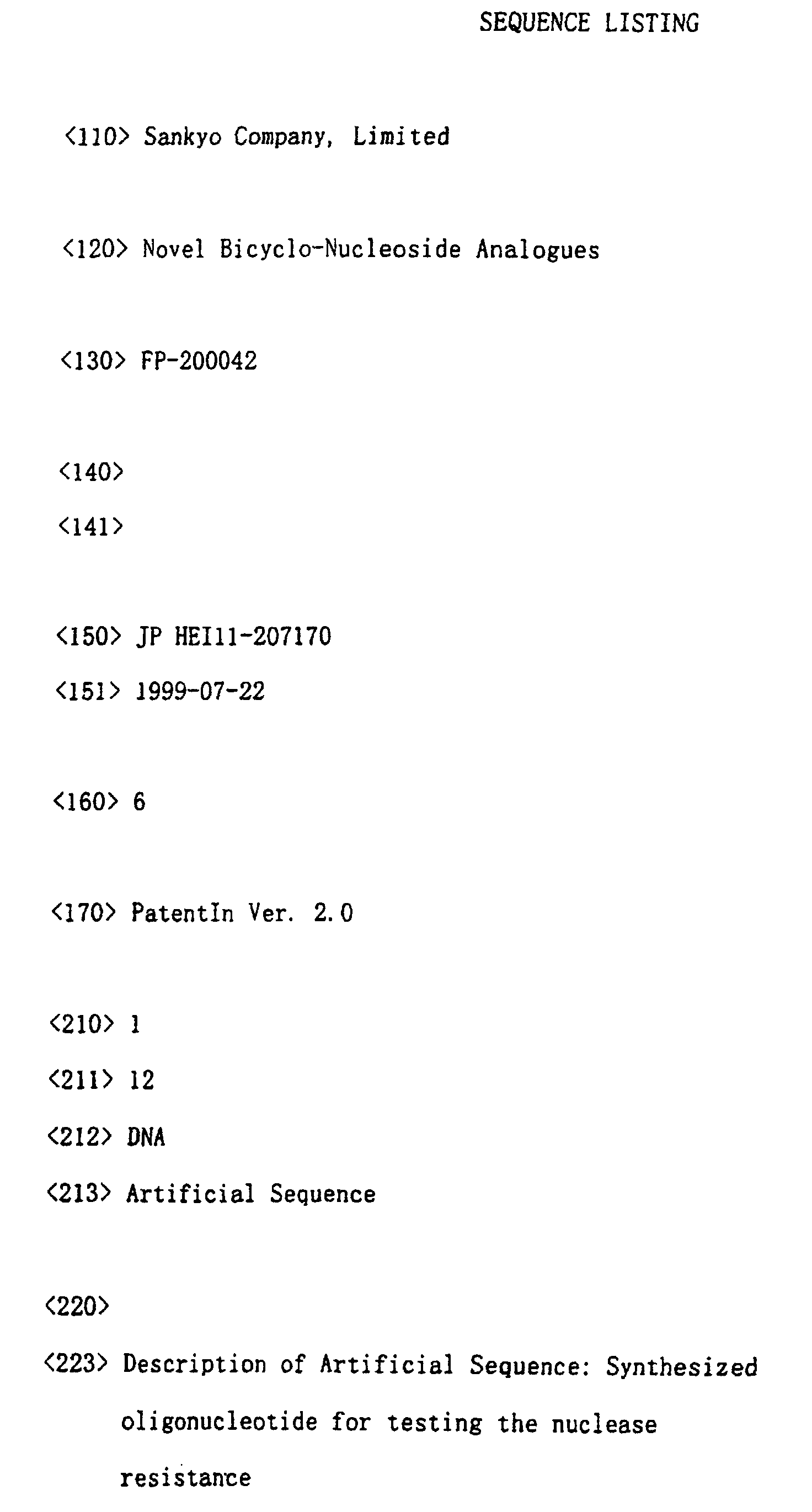

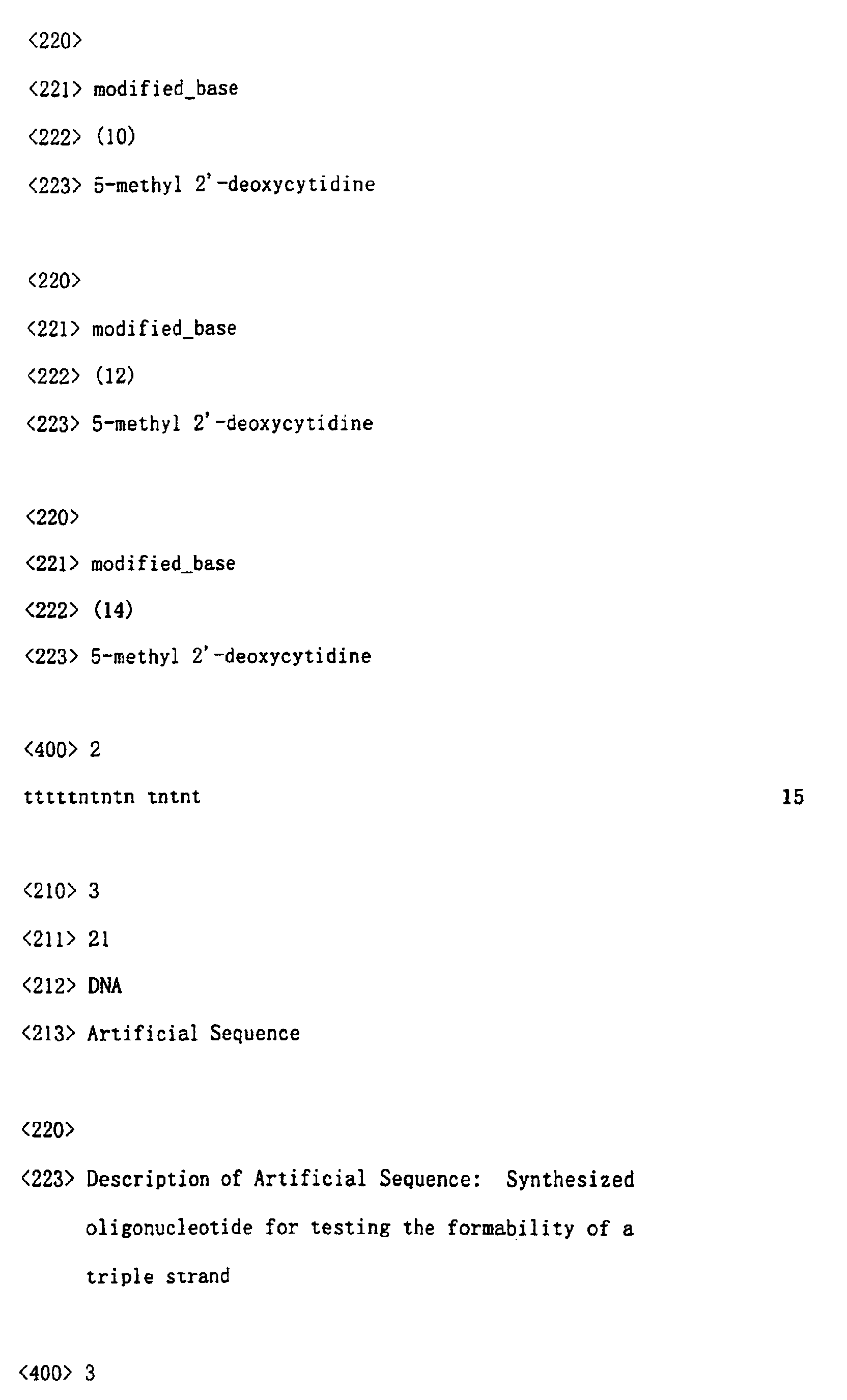



Claims (13)
- A compound of general formula (1) or a pharmaceutically acceptable salt thereof,[wherein, R1 is the same or different, and each represents a hydrogen atom, a protecting group for a hydroxy group in nucleic acid synthesis, a phosphoric acid group, a phosphoric acid group protected with a protecting group in nucleic acid synthesis, or a group represented by the formula -P(R4a)R4b (wherein R4a and R4b are the same or different and each represents a hydroxy group, a hydroxy group protected with a protecting group in nucleic acid synthesis, a mercapto group, a mercapto group protected with a protecting group in nucleic acid synthesis, an amino group, an amino group protected with a protecting group in nucleic acid synthesis, an alkoxy group having 1-6 carbon atoms, an alkylthio group having 1-6 carbon atoms, a cyanoalkoxy group having 1-7 carbon atoms, or an amino group substituted by an alkyl group having 1-6 carbon atoms),

R2 represents an azido group, an amino group, or a group represented by the formula -NH-R3 (wherein, R3 is the same or different and each represents a protecting group for an amino group in nucleic acid synthesis, a phosphoric acid group, a phosphoric acid group protected with a protecting group in nucleic acid synthesis, or a group represented by the formula -P(R4a)R4b (wherein R4a and R4b is the same or different and each represents a hydroxy group, a hydroxy group protected with a protecting group in nucleic acid synthesis, a mercapto group, a mercapto group protected with a protecting group in nucleic acid synthesis , an amino group, an amino group protected with a protecting group in nucleic acid synthesis , an alkoxy group having 1-6 carbon atoms, an alkylthio group having 1-6 carbon atoms, a cyanoalkoxy group having 1-7 carbon atoms or an amino group substituted by an alkyl group having 1-6 carbon atoms).
B represents a purin-9-yl group or a 2-oxo-1,2-dihydropyrimidin-1-yl group each of which is optionally substituted with 1 or more substituents selected from the following α-group].
(α-Group)a hydroxy group,a hydroxy group protected with a protecting group in nucleic acid synthesis,an alkoxy group having 1-6 carbon atoms,a mercapto group,a mercapto group protected with a protecting group in nucleic acid synthesis,an alkylthio group having 1-6 carbon atoms,an amino group,an amino group protected with a protecting group in nucleic acid synthesis,an amino group substituted by an alkyl group having 1-6 carbon atoms,an alkyl group having 1-6 carbon atoms, andhalogen atom. - A compound according to Claim 1, wherein R1 represents a hydrogen atom, an aliphatic acyl group, an aromatic acyl group, a silyl group, a methyl group substituted by 1 to 3 aryl groups, or a methyl group substituted by 1 to 3 aryl groups wherein the aryl rings are substituted by a lower-alkyl group, lower-alkoxy group, halogen atom or a cyano group.
- A compound according to Claim 1, wherein R1 represents a hydrogen atom, a silyl group, a methyl group substituted by 1 to 3 aryl groups, or a methyl group substituted by 1 to 3 aryl groups wherein the aryl rings are substituted by a lower-alkyl group, lower-alkoxy group, halogen atom or cyano group.
- A compound according to Claim 1, wherein R1 represents a hydrogen atom, trimethylsilyl group, t-butyldimethylsilyl group, t-butyldiphenylsilyl group, benzyl group, triphenylmethyl group, 4-methoxybenzyl group, 4-methoxyphenyldiphenylmethyl group, a 4,4'-dimethoxytriphenylmethyl group, or 4,4',4''-trimethoxytriphenylmethyl group.
- A compound according to Claim 1, wherein R2 represents an azido group, an amino group, or a group represented by the formula -NH-R3 (wherein R3 represents an aliphatic acyl group, an aromatic acyl group, a methyl group substituted by 1 to 3 aryl groups, a methyl group substituted by 1 to 3 aryl groups wherein the aryl rings are substituted by lower-alkyl group, lower-alkoxy group, halogen atom, or cyano group, a silyl group, a phosphoramidite group, a phosphonyl group, a phosphoric acid group or a phosphoric acid group protected with a protecting group in nucleic acid synthesis).
- A compound according to Claim 1, wherein R2 represents an azido group, an amino group, or a group represented by the formula -NH-R3 (wherein R3 represents an acetyl group, trifluoroacetyl group, benzoyl group, benzyl group, p-methoxybenzyl group, tert-butyldiphenylsilyl group, a group represented by the formula -P(OC2H4CN)(NCH(CH3)2), a group represented by the formula -P(OCH3)(NCH(CH3)2), a phosphonyl group, or a 2-chlorophenyl- or a 4-chlorophenylphosphonic acid group).
- A compound according to Claim 1, wherein R2 represents an azido group or an amino group.
- A compound according to Claim 1, wherein B represents 6-aminopurin-9-yl (i.e., adeninyl), 6-amino-purin-9-yl wherein the amino group is protected with a protecting group in nucleic acid synthesis, 2,6-diaminopurin-9-yl wherein one or both amino group(s) are protected with a protecting group in nucleic acid synthesis, 2-amino-6-chloropurin-9-yl, 2-amino-6-chloropurin-9-yl wherein the amino group is protected with a protecting group in nucleic acid synthesis, 2-amino-6-fluoropurin-9-yl, 2-amino-6-fluoropurin-9-yl wherein the amino group is protected with a protecting group in nucleic acid synthesis, 2-amino-6-bromopurin-9-yl, 2-amino-6-bromopurin-9-yl wherein the amino group is protected with a protecting group in nucleic acid synthesis, 2-amino-6-hydroxypurin-9-yl (i.e., guaninyl), 2-amino-6-hydroxypurin-9-yl wherein the amino group is protected with a protecting group in nucleic acid synthesis, 6-amino-2-methoxypurin-9-yl, 6-amino-2-methoxypurin-9-yl wherein the amino group is protected with a protecting group in nucleic acid synthesis, 6-amino-2-chloropurin-9-yl, 6-amino-2-chloropurin-9-yl wherein the amino group is protected with a protecting group in nucleic acid synthesis, 6-amino-2-fluoropurin-9-yl, 6-amino-2-fluoropurin-9-yl wherein the amino group is protected with a protecting group in nucleic acid synthesis, 2,6-dimethoxypurin-9-yl, 2,6-dichloropurin-9-yl, 6-mercaptopurin-9-yl, 6-mercaptopurin-9-yl wherein the mercapto group is protected with a protecting group in nucleic acid synthesis , 2-oxo-4-amino-1,2-dihydropyrimidin-1-yl (i.e., cytosinyl), 2-oxo-4-amino-1,2-dihydropyrimidin-1-yl wherein the amino group is protected with a protecting group in nucleic acid synthesis, 4-amino-2-oxo-5-fluoro-1,2-dihydropyrimidin-1-yl, 4-amino-2-oxo-5-fluoro-1,2-dihydropyrimidin-1-yl wherein the amino group is protected with a protecting group in nucleic acid synthesis, 4-amino-2-oxo-5-chloro-1,2-dihydropyrimidin-1-yl, 4-amino-2-oxo-5-chloro-1,2-dihydropyrimidin-1-yl wherein the amino group is protected with a protecting group in nucleic acid synthesis, 2-oxo-4-methoxy-1,2-dihydropyrimidin-1-yl, 2-oxo-4-mercapto-1,2-dihydropyrimidin-1-yl, 2-oxo-4-mercapto-1,2-dihydropyrimidin-1-yl wherein the mercapto group is protected with a protecting group in nucleic acid synthesis , 2,4-dihydroxypyrimidin-1-yl (i.e., uracilyl), 2,4-dihydroxy-5-methylpyrimidin-1-yl (i.e., thyminyl), 4-amino-5-methyl-2-oxo-1,2-dihydropyrimidin-1-yl, or 4-amino-5-methyl-2-oxo-1,2-dihydropyrimidin-1-yl group wherein the amino group is protected with a protecting group in nucleic acid synthesis.
- A compound according to Claim 1, wherein B represents 6-benzoylaminopurin-9-yl, adeninyl, 2-benzoylamino-6-hydroxypurin-9-yl, guaninyl, 2-oxo-4-benzoylamino-1,2-dihydropyrimidin-1-yl, cytosinyl, uracilyl or thyminyl.
- A compound according to Claim 1, which is selected from the following:3'-amino-3'deoxy-2'-O,4'-C-methylene-5-methyluridine,3'-azido-3'deoxy-2'-O,4'-C-methylene-5-methyluridine,3'-azido-5'-O-tert-butyldiphenylsilyl-3'-deoxy-2'-O,4'-C-methylene-5-methyluridine,3'-azido-3'deoxy-5'-O-(4,4'-dimethoxytrityl)-2'-O,4'-C-methylene-5-methyluridine and3'-amino-3'-deoxy-5'-O-(4,4'-dimethoxytrityl)-2'-O,4'-C-methylene-5-methyluridine.
- An oligonucleotide analogue or a pharmaceutically acceptable salt thereof having 1 or more structural units represented by the following general formula (1a),provided that when the oligonucleotide has two or more structural units of formula (1a), each B is the same or different.

[wherein, B represents a purin-9-yl group or a 2-oxo-1,2-dihydropyrimidin-1-yl group which are optionally substituted with substitutents selected from α group below.].
(α group)a hydroxy group,a hydroxy group protected with a protecting group in nucleic acid synthesis ,an alkoxy group having 1-6 carbon atoms,a mercapto group,a mercapto group protected with a protecting group in nucleic acid synthesis,an alkylthio group having 1-6 carbon atoms,an amino group,an amino group protected with a protecting group in nucleic acid synthesis,an amino group substituted by an alkyl group having 1-6 carbon atoms,an alkyl group having 1-6 carbon atoms, anda halogen atom. - An oligonucleotide analogue or a pharmaceutically acceptable salt thereof according to Claim 11, wherein B represents 6-aminopurin-9-yl (i.e., adeninyl), 6-aminopurin-9-yl wherein the amino group is protected with a protecting group in nucleic acid synthesis , 2,6-diaminopurin-9-yl, 2-amino-6-chloropurin-9-yl, 2-amino-6-chloropurin-9-yl wherein the amino group is protected with a protecting group in nucleic acid synthesis, 2-amino-6-fluoropurin-9-yl, 2-amino-6-fluoropurin-9-yl wherein the amino group is protected with a protecting group in nucleic acid synthesis , 2-amino-6-bromopurin-9-yl, 2-amino-6-bromopurin-9-yl wherein the amino group is protected with a protecting group in nucleic acid synthesis , 2-amino-6-hydroxypurin-9-yl (i.e., guaninyl), 2-amino-6-hydroxypurin-9-yl wherein the amino and hydroxyl groups are protected with a protecting group in nucleic acid synthesis , 6-amino-2-methoxypurin-9-yl, 6-amino-2-chloropurin-9-yl, 6-amino-2-fluoropurin-9-yl, 2,6-dimethoxypurin-9-yl, 2,6-dichloropurin-9-yl, 6-mercaptopurin-9-yl, 2-oxo-4-amino-1,2-dihydropyrimidin-1-yl (i.e., cytosinyl), 2-oxo-4-amino-1,2-dihydropyrimidin-1-yl wherein the amino group is protected with a protecting group in nucleic acid synthesis, 2-oxo-4-amino-5-fluoro-1,2-dihydropyrimidin-1-yl, 4-amino-2-oxo-5-fluoro-1,2-dihydropyrimidin-1-yl wherein the amino group is protected with a protecting group in nucleic acid synthesis, 4-amino-2-oxo-5-chloro-1,2-dihydropyrimidin-l-yl, 2-oxo-4-methoxy-1,2-dihydropyrimidin-1-yl, 2-oxo-4-mercapto-1,2-dihydropyrimidin-1-yl, 2-oxo-4-hydroxy-1,2-dihydropyrimidin-l-yl (i.e., uracinyl), 2-oxo-4-hydroxy-5-methyl-1,2-dihydropyrimidin-1-yl (i.e., thyminyl), 4-amino-5-methyl-2-oxo-1,2-dihydropyrimidin-1-yl (i.e., 5-methylcytosinyl), or 4-amino-5-methyl-2-oxo-1,2-dihydropyrimidin-1-yl wherein the amino group is protected with a protecting group in nucleic acid synthesis.
- An oligonucleotide analogue or a pharmaceutically acceptable salt thereof according to Claim 11, wherein B represents 6-benzoylaminopurin-9-yl, adeninyl, 2-isobutylamino-6-hydroxypurin-9-yl, guaninyl, 2-oxo-4-benzoylamino-1,2-dihydropyrimidin-1-yl, cytosinyl, 2-oxo-5-methyl-4-benzoylamino-1,2-dihydropyrimidin-1-yl, 5-methylcytosinyl, uracinyl or thyminyl.
Priority Applications (1)
| Application Number | Priority Date | Filing Date | Title |
|---|---|---|---|
| DK00949882T DK1201678T3 (en) | 1999-07-22 | 2000-07-21 | New bicyclonucleoside analogues |
Applications Claiming Priority (3)
| Application Number | Priority Date | Filing Date | Title |
|---|---|---|---|
| JP20717099 | 1999-07-22 | ||
| JP20717099 | 1999-07-22 | ||
| PCT/JP2000/004902 WO2001007455A1 (en) | 1999-07-22 | 2000-07-21 | Novel bicyclonucleoside analogues |
Publications (3)
| Publication Number | Publication Date |
|---|---|
| EP1201678A1 true EP1201678A1 (en) | 2002-05-02 |
| EP1201678A4 EP1201678A4 (en) | 2002-10-02 |
| EP1201678B1 EP1201678B1 (en) | 2004-09-22 |
Family
ID=16535402
Family Applications (1)
| Application Number | Title | Priority Date | Filing Date |
|---|---|---|---|
| EP00949882A Expired - Lifetime EP1201678B1 (en) | 1999-07-22 | 2000-07-21 | Novel bicyclonucleoside analogues |
Country Status (23)
| Country | Link |
|---|---|
| US (2) | US7217805B2 (en) |
| EP (1) | EP1201678B1 (en) |
| JP (1) | JP4151751B2 (en) |
| KR (1) | KR20020092894A (en) |
| CN (1) | CN1376161A (en) |
| AT (1) | ATE277066T1 (en) |
| AU (1) | AU766656B2 (en) |
| BR (1) | BR0012646A (en) |
| CA (1) | CA2380205C (en) |
| CZ (1) | CZ2002132A3 (en) |
| DE (1) | DE60014104T2 (en) |
| DK (1) | DK1201678T3 (en) |
| ES (1) | ES2226891T3 (en) |
| HU (1) | HUP0202812A3 (en) |
| IL (1) | IL147595A0 (en) |
| MX (1) | MXPA02000826A (en) |
| NO (1) | NO20020305L (en) |
| NZ (1) | NZ516653A (en) |
| PL (1) | PL352682A1 (en) |
| PT (1) | PT1201678E (en) |
| RU (1) | RU2227143C2 (en) |
| WO (1) | WO2001007455A1 (en) |
| ZA (1) | ZA200200398B (en) |
Families Citing this family (148)
| Publication number | Priority date | Publication date | Assignee | Title |
|---|---|---|---|---|
| PT1152009E (en) | 1999-02-12 | 2005-03-31 | Sankyo Co | NEW ANALYSIS OF NUCLEOSIDES AND OLIGONUCLEOTIDES |
| JP4148662B2 (en) * | 2000-08-10 | 2008-09-10 | 第一三共株式会社 | Nucleic acid reagents and pharmaceuticals containing nucleosides and oligonucleotide analogs |
| EP1317466B1 (en) * | 2000-09-07 | 2005-02-23 | Avecia Biotechnology, Inc. | Synthons for oligonucleotide synthesis |
| KR20020069627A (en) * | 2001-02-27 | 2002-09-05 | 동부한농화학 주식회사 | Phosphorothioate oligonucleotides containing modified nucleotides with six-membered azasugars and use for aids therapy thereof |
| EP1481983A4 (en) * | 2002-02-13 | 2008-04-02 | Takeshi Imanishi | Nucleoside analogues and oligonucleotide derivative comprising nucleotide analogue thereof |
| US20040219565A1 (en) | 2002-10-21 | 2004-11-04 | Sakari Kauppinen | Oligonucleotides useful for detecting and analyzing nucleic acids of interest |
| ATE553216T1 (en) | 2003-06-20 | 2012-04-15 | Exiqon As | PROBE, LIBRARIES AND KITS FOR ANALYZING NUCLEIC ACID MIXTURES AND METHODS FOR THEIR CONSTRUCTION |
| US8415100B2 (en) | 2003-08-14 | 2013-04-09 | Case Western Reserve University | Methods and compositions for detecting gastrointestinal and other cancers |
| EP1660683B1 (en) * | 2003-08-14 | 2017-04-19 | Case Western Reserve University | Methods and compositions for detecting colon cancers |
| ATE404697T1 (en) * | 2003-11-07 | 2008-08-15 | Daiichi Sankyo Co Ltd | METHOD FOR DETECTING GENETIC POLYMORPHISM |
| US8192937B2 (en) | 2004-04-07 | 2012-06-05 | Exiqon A/S | Methods for quantification of microRNAs and small interfering RNAs |
| US20070099196A1 (en) | 2004-12-29 | 2007-05-03 | Sakari Kauppinen | Novel oligonucleotide compositions and probe sequences useful for detection and analysis of micrornas and their target mRNAs |
| US20070065840A1 (en) * | 2005-03-23 | 2007-03-22 | Irena Naguibneva | Novel oligonucleotide compositions and probe sequences useful for detection and analysis of microRNAS and their target mRNAS |
| US7569686B1 (en) | 2006-01-27 | 2009-08-04 | Isis Pharmaceuticals, Inc. | Compounds and methods for synthesis of bicyclic nucleic acid analogs |
| ES2351674T3 (en) | 2006-01-27 | 2011-02-09 | Isis Pharmaceuticals, Inc. | MODIFIED BICYCLIC NUCLEIC ACID ANALOGUES IN POSITION 6. |
| DK2021472T3 (en) | 2006-05-05 | 2011-09-19 | Isis Pharmaceuticals Inc | Compounds and Methods for Modeling Gene Expression |
| EP2505648A1 (en) | 2006-05-05 | 2012-10-03 | Isis Pharmaceuticals, Inc. | Compounds and methods for modulating expression of PTP1B |
| CA2651453C (en) | 2006-05-11 | 2014-10-14 | Isis Pharmaceuticals, Inc. | 5'-modified bicyclic nucleic acid analogs |
| US7666854B2 (en) * | 2006-05-11 | 2010-02-23 | Isis Pharmaceuticals, Inc. | Bis-modified bicyclic nucleic acid analogs |
| CA2667055C (en) | 2006-10-18 | 2017-05-09 | Isis Pharmaceuticals, Inc. | Antisense compounds |
| WO2008046911A2 (en) | 2006-10-20 | 2008-04-24 | Exiqon A/S | Novel human micrornas associated with cancer |
| US8188255B2 (en) | 2006-10-20 | 2012-05-29 | Exiqon A/S | Human microRNAs associated with cancer |
| EP2455471A3 (en) * | 2006-11-27 | 2012-09-12 | Isis Pharmaceuticals, Inc. | Methods for treating hypercholesterolemia |
| US8093222B2 (en) | 2006-11-27 | 2012-01-10 | Isis Pharmaceuticals, Inc. | Methods for treating hypercholesterolemia |
| US20090137504A1 (en) * | 2006-12-21 | 2009-05-28 | Soren Morgenthaler Echwald | Microrna target site blocking oligos and uses thereof |
| EP3536788A1 (en) | 2006-12-21 | 2019-09-11 | QIAGEN GmbH | Microrna target site blocking oligos and uses thereof |
| US8048998B2 (en) | 2007-01-19 | 2011-11-01 | Exiqon A/S | Mediated cellular delivery of LNA oligonucleotides |
| EP2170917B1 (en) | 2007-05-30 | 2012-06-27 | Isis Pharmaceuticals, Inc. | N-substituted-aminomethylene bridged bicyclic nucleic acid analogs |
| EP2173760B2 (en) | 2007-06-08 | 2015-11-04 | Isis Pharmaceuticals, Inc. | Carbocyclic bicyclic nucleic acid analogs |
| EP2176280B2 (en) * | 2007-07-05 | 2015-06-24 | Isis Pharmaceuticals, Inc. | 6-disubstituted bicyclic nucleic acid analogs |
| WO2009067647A1 (en) * | 2007-11-21 | 2009-05-28 | Isis Pharmaceuticals, Inc. | Carbocyclic alpha-l-bicyclic nucleic acid analogs |
| US10365224B2 (en) | 2007-12-06 | 2019-07-30 | Genalyte, Inc. | Label-free optical sensors |
| WO2009100320A2 (en) * | 2008-02-07 | 2009-08-13 | Isis Pharmaceuticals, Inc. | Bicyclic cyclohexitol nucleic acid analogs |
| WO2009124238A1 (en) * | 2008-04-04 | 2009-10-08 | Isis Pharmaceuticals, Inc. | Oligomeric compounds comprising neutrally linked terminal bicyclic nucleosides |
| US8222221B2 (en) | 2008-06-04 | 2012-07-17 | The Board Of Regents Of The University Of Texas System | Modulation of gene expression through endogenous small RNA targeting of gene promoters |
| CA2732343C (en) | 2008-07-29 | 2017-05-09 | The Board Of Regents Of The University Of Texas System | Selective inhibition of polyglutamine protein expression |
| US8501805B2 (en) * | 2008-09-24 | 2013-08-06 | Isis Pharmaceuticals, Inc. | Substituted alpha-L-bicyclic nucleosides |
| ES2939310T3 (en) | 2008-10-27 | 2023-04-20 | Genalyte Inc | Biosensors based on optical probing and detection |
| US8815586B2 (en) | 2009-04-24 | 2014-08-26 | The Board Of Regents Of The University Of Texas System | Modulation of gene expression using oligomers that target gene regions downstream of 3′ untranslated regions |
| US20120108800A1 (en) | 2009-06-23 | 2012-05-03 | Shumpei Murata | Method for synthesizing nucleic acid |
| WO2011010706A1 (en) | 2009-07-23 | 2011-01-27 | 武田薬品工業株式会社 | Fgf21 cis-element binding substance |
| US9012421B2 (en) | 2009-08-06 | 2015-04-21 | Isis Pharmaceuticals, Inc. | Bicyclic cyclohexose nucleic acid analogs |
| WO2011053994A1 (en) | 2009-11-02 | 2011-05-05 | Alnylam Pharmaceuticals, Inc. | Modulation of ldl receptor gene expression with double-stranded rnas targeting the ldl receptor gene promoter |
| WO2011085102A1 (en) | 2010-01-11 | 2011-07-14 | Isis Pharmaceuticals, Inc. | Base modified bicyclic nucleosides and oligomeric compounds prepared therefrom |
| WO2011097388A1 (en) | 2010-02-03 | 2011-08-11 | Alnylam Pharmaceuticals, Inc. | Selective inhibition of polyglutamine protein expression |
| WO2011115818A1 (en) | 2010-03-17 | 2011-09-22 | Isis Pharmaceuticals, Inc. | 5'-substituted bicyclic nucleosides and oligomeric compounds prepared therefrom |
| EP2601204B1 (en) | 2010-04-28 | 2016-09-07 | Ionis Pharmaceuticals, Inc. | Modified nucleosides and oligomeric compounds prepared therefrom |
| EP2563935B1 (en) | 2010-04-30 | 2014-04-16 | Exiqon A/S | In situ hybridization method and buffer. |
| WO2011156278A1 (en) | 2010-06-07 | 2011-12-15 | Isis Pharmaceuticals, Inc. | Bicyclic nucleosides and oligomeric compounds prepared therefrom |
| EP3733866B1 (en) | 2010-11-05 | 2023-11-15 | Genalyte, Inc. | Optical analyte detection systems and methods of use |
| EP3067421B1 (en) | 2011-02-08 | 2018-10-10 | Ionis Pharmaceuticals, Inc. | Oligomeric compounds comprising bicyclic nucleotides and uses thereof |
| EP2495336B8 (en) | 2011-03-04 | 2014-07-23 | Roche Diagnostics GmbH | A new type of universal probes for the detection of genomic variants |
| US10202599B2 (en) | 2011-08-11 | 2019-02-12 | Ionis Pharmaceuticals, Inc. | Selective antisense compounds and uses thereof |
| WO2013090457A2 (en) | 2011-12-12 | 2013-06-20 | Oncoimmunin Inc. | In vivo delivery of oligonucleotides |
| EP2825885B1 (en) | 2012-03-12 | 2021-05-12 | The Board of Trustees of the University of Illinois | Optical analyte detection systems with magnetic enhancement |
| WO2013148283A1 (en) | 2012-03-30 | 2013-10-03 | Isis Pharmaceuticals, Inc. | Compositions and methods for modulating tau expression for reducing seizure and modifying a neurodegenerative syndrome |
| EP2850092B1 (en) | 2012-04-09 | 2017-03-01 | Ionis Pharmaceuticals, Inc. | Tricyclic nucleic acid analogs |
| WO2013154799A1 (en) | 2012-04-09 | 2013-10-17 | Isis Pharmaceuticals, Inc. | Tricyclic nucleosides and oligomeric compounds prepared therefrom |
| EP2839006B1 (en) | 2012-04-20 | 2018-01-03 | Ionis Pharmaceuticals, Inc. | Oligomeric compounds comprising bicyclic nucleotides and uses thereof |
| WO2014045126A2 (en) | 2012-09-18 | 2014-03-27 | Uti Limited Partnership | Treatment of pain by inhibition of usp5 de-ubiquitinase |
| JP6048982B2 (en) * | 2012-09-21 | 2016-12-21 | 国立大学法人大阪大学 | Artificial nucleosides and oligonucleotides with guanidine bridges |
| CA2886334C (en) | 2012-09-28 | 2021-12-21 | Bna Inc. | Bna clamp method |
| WO2014059353A2 (en) | 2012-10-11 | 2014-04-17 | Isis Pharmaceuticals, Inc. | Oligomeric compounds comprising bicyclic nucleosides and uses thereof |
| US9029335B2 (en) | 2012-10-16 | 2015-05-12 | Isis Pharmaceuticals, Inc. | Substituted 2′-thio-bicyclic nucleosides and oligomeric compounds prepared therefrom |
| EP2909222B1 (en) | 2012-10-22 | 2021-05-26 | Idenix Pharmaceuticals LLC | 2',4'-bridged nucleosides for hcv infection |
| WO2014093291A1 (en) | 2012-12-10 | 2014-06-19 | Advandx, Inc. | Use of probes for mass spectrometric identification of microorganisms or cells and associated conditions of interest |
| US20150337002A1 (en) * | 2013-01-15 | 2015-11-26 | Shionogi & Co., Ltd. | Nucleoside and nucleotide having sulfonamide structure |
| WO2014134144A1 (en) | 2013-02-28 | 2014-09-04 | The General Hospital Corporation | Mirna profiling compositions and methods of use |
| EP2961853B1 (en) | 2013-02-28 | 2018-09-19 | The Board of Regents of The University of Texas System | Methods for classifying a cancer as susceptible to tmepai-directed therapies and treating such cancers |
| US9273349B2 (en) | 2013-03-14 | 2016-03-01 | Affymetrix, Inc. | Detection of nucleic acids |
| CN111254145A (en) | 2013-03-14 | 2020-06-09 | Ionis制药公司 | Compositions and methods for modulating TAU expression |
| CA2921162A1 (en) | 2013-05-01 | 2014-11-06 | Ionis Pharmaceuticals, Inc. | Conjugated antisense compounds and their use |
| TWI657819B (en) | 2013-07-19 | 2019-05-01 | 美商Ionis製藥公司 | Composition for regulating the expression of tau protein |
| US11162096B2 (en) | 2013-10-14 | 2021-11-02 | Ionis Pharmaceuticals, Inc | Methods for modulating expression of C9ORF72 antisense transcript |
| MY192634A (en) | 2014-04-01 | 2022-08-29 | Biogen Ma Inc | Compositions for modulating sod-1 expression |
| WO2015168172A1 (en) | 2014-04-28 | 2015-11-05 | Isis Pharmaceuticals, Inc. | Linkage modified oligomeric compounds |
| US10280423B2 (en) | 2014-05-01 | 2019-05-07 | Ionis Pharmaceuticals, Inc. | Compositions and methods for modulating complement factor B expression |
| GB201410693D0 (en) | 2014-06-16 | 2014-07-30 | Univ Southampton | Splicing modulation |
| EP3201339A4 (en) | 2014-10-03 | 2018-09-19 | Cold Spring Harbor Laboratory | Targeted augmentation of nuclear gene output |
| EP3234141A4 (en) | 2014-12-18 | 2018-06-20 | Alnylam Pharmaceuticals, Inc. | Reversir tm compounds |
| US9688707B2 (en) | 2014-12-30 | 2017-06-27 | Ionis Pharmaceuticals, Inc. | Bicyclic morpholino compounds and oligomeric compounds prepared therefrom |
| WO2016112132A1 (en) | 2015-01-06 | 2016-07-14 | Ionis Pharmaceuticals, Inc. | Compositions for modulating expression of c9orf72 antisense transcript |
| WO2016167780A1 (en) | 2015-04-16 | 2016-10-20 | Ionis Pharmaceuticals, Inc. | Compositions for modulating expression of c9orf72 antisense transcript |
| DK3324980T3 (en) | 2015-07-17 | 2022-02-14 | Alnylam Pharmaceuticals Inc | MULTI-TARGETED SIMPLICITY CONJUGATES |
| AU2016334804B2 (en) | 2015-10-09 | 2022-03-31 | University Of Southampton | Modulation of gene expression and screening for deregulated protein expression |
| US11058709B1 (en) | 2015-12-04 | 2021-07-13 | Ionis Pharmaceuticals, Inc. | Methods of treating breast cancer |
| ES2882500T3 (en) | 2015-12-14 | 2021-12-02 | Cold Spring Harbor Laboratory | Antisense oligomers for the treatment of Dravet syndrome |
| US11096956B2 (en) | 2015-12-14 | 2021-08-24 | Stoke Therapeutics, Inc. | Antisense oligomers and uses thereof |
| EP4678748A2 (en) | 2015-12-21 | 2026-01-14 | Novartis AG | Compositions and methods for decreasing tau expression |
| WO2017111137A1 (en) | 2015-12-22 | 2017-06-29 | 味の素株式会社 | Oligonucleotide manufacturing method |
| WO2017161168A1 (en) | 2016-03-16 | 2017-09-21 | Ionis Pharmaceuticals, Inc. | Modulation of dyrk1b expression |
| EP3429690A4 (en) | 2016-03-16 | 2019-10-23 | Ionis Pharmaceuticals, Inc. | METHODS FOR MODULATING KEAP1 |
| CA3023514A1 (en) | 2016-06-17 | 2017-12-21 | Ionis Pharmaceuticals, Inc. | Modulation of gys1 expression |
| EP3507367A4 (en) | 2016-07-05 | 2020-03-25 | Aduro BioTech, Inc. | Locked nucleic acid cyclic dinucleotide compounds and uses thereof |
| TWI769177B (en) | 2016-09-14 | 2022-07-01 | 美商艾洛斯生物製藥公司 | Modified oligonucleotides and methods of use |
| ES2963428T3 (en) | 2016-09-29 | 2024-03-27 | Biogen Ma Inc | Compounds and methods to reduce Tau expression |
| US11033570B2 (en) | 2016-12-02 | 2021-06-15 | Cold Spring Harbor Laboratory | Modulation of Lnc05 expression |
| US11180756B2 (en) | 2017-03-09 | 2021-11-23 | Ionis Pharmaceuticals | Morpholino modified oligomeric compounds |
| AU2018318231A1 (en) | 2017-08-18 | 2020-02-13 | Ionis Pharmaceuticals, Inc. | Modulation of the notch signaling pathway for treatment of respiratory disorders |
| SI3673080T1 (en) | 2017-08-25 | 2024-03-29 | Stoke Therapeutics, Inc. | Antisense oligomers for treatment of conditions and diseases |
| US10517889B2 (en) | 2017-09-08 | 2019-12-31 | Ionis Pharmaceuticals, Inc. | Modulators of SMAD7 expression |
| SG11202002149XA (en) | 2017-09-14 | 2020-04-29 | Janssen Biopharma Inc | Galnac derivatives |
| BR112020018365A2 (en) | 2018-03-13 | 2020-12-29 | Janssen Pharmaceutica Nv | MODIFIED OLIGONUCLEOTIDS AND METHODS FOR USE IN TAUOPATHIES |
| WO2019213525A1 (en) | 2018-05-04 | 2019-11-07 | Stoke Therapeutics, Inc. | Methods and compositions for treatment of cholesteryl ester storage disease |
| EP3790970A1 (en) | 2018-05-07 | 2021-03-17 | Alnylam Pharmaceuticals Inc. | Extrahepatic delivery |
| EP3846824B1 (en) | 2018-09-07 | 2025-06-18 | The General Hospital Corporation | Compositions and methods for immune checkpoint inhibition |
| JP7470107B2 (en) | 2018-09-28 | 2024-04-17 | アルナイラム ファーマシューティカルズ, インコーポレイテッド | Transthyretin (TTR) iRNA Compositions and Methods of Use Thereof for Treating or Preventing TTR-Related Eye Diseases - Patent application |
| TW202028222A (en) | 2018-11-14 | 2020-08-01 | 美商Ionis製藥公司 | Modulators of foxp3 expression |
| EA202191342A1 (en) | 2018-11-15 | 2021-08-10 | Айонис Фармасьютикалз, Инк. | IRF5 EXPRESSION MODULATORS |
| WO2020139871A1 (en) | 2018-12-26 | 2020-07-02 | Twist Bioscience Corporation | Highly accurate de novo polynucleotide synthesis |
| MX2021008918A (en) | 2019-01-31 | 2021-08-24 | Ionis Pharmaceuticals Inc | Modulators of yap1 expression. |
| WO2020176771A1 (en) | 2019-02-27 | 2020-09-03 | Ionis Pharmaceuticals, Inc. | Modulators of malat1 expression |
| KR20210134003A (en) | 2019-02-27 | 2021-11-08 | 스톡 테라퓨틱스, 인크. | Antisense oligomers for the treatment of conditions and diseases |
| AU2020268798A1 (en) | 2019-05-03 | 2021-11-04 | Dicerna Pharmaceuticals, Inc. | Double-stranded nucleic acid inhibitor molecules with shortened sense strands |
| US20220211743A1 (en) | 2019-05-17 | 2022-07-07 | Alnylam Pharmaceuticals, Inc. | Oral delivery of oligonucleotides |
| ES3048358T3 (en) | 2019-07-26 | 2025-12-10 | Ionis Pharmaceuticals Inc | Compounds and methods for modulating gfap |
| KR20220062517A (en) | 2019-08-15 | 2022-05-17 | 아이오니스 파마수티컬즈, 인코포레이티드 | Linkage-modified oligomeric compounds and uses thereof |
| EP4055165A1 (en) | 2019-11-06 | 2022-09-14 | Alnylam Pharmaceuticals, Inc. | Transthyretin (ttr) irna compositions and methods of use thereof for treating or preventing ttr-associated ocular diseases |
| AU2020378414A1 (en) | 2019-11-06 | 2022-05-26 | Alnylam Pharmaceuticals, Inc. | Extrahepatic delivery |
| EP4706689A2 (en) | 2019-12-19 | 2026-03-11 | Entrada Therapeutics, Inc. | Compositions for delivery of antisense compounds |
| CN115843299A (en) | 2020-03-31 | 2023-03-24 | 詹森生物制药有限公司 | Synthesis of oligonucleotides and related compounds |
| BR112022022889A2 (en) | 2020-05-11 | 2023-04-04 | Stoke Therapeutics Inc | OPA1 ANTI-SENSE OLIGOMERS FOR TREATMENT OF CONDITIONS AND DISEASES |
| WO2022147214A2 (en) | 2020-12-31 | 2022-07-07 | Alnylam Pharmaceuticals, Inc. | Cyclic-disulfide modified phosphate based oligonucleotide prodrugs |
| EP4271695A2 (en) | 2020-12-31 | 2023-11-08 | Alnylam Pharmaceuticals, Inc. | 2'-modified nucleoside based oligonucleotide prodrugs |
| US20250243244A1 (en) | 2021-03-31 | 2025-07-31 | Entrada Therapeutics, Inc. | Cyclic cell penetrating peptides |
| AU2022271873A1 (en) | 2021-05-10 | 2024-01-04 | Entrada Therapeutics, Inc. | Compositions and methods for intracellular therapeutics |
| EP4337261A2 (en) | 2021-05-10 | 2024-03-20 | Entrada Therapeutics, Inc. | Compositions and methods for modulating mrna splicing |
| WO2022240721A1 (en) | 2021-05-10 | 2022-11-17 | Entrada Therapeutics, Inc. | Compositions and methods for modulating interferon regulatory factor-5 (irf-5) activity |
| GEAP202416440A (en) | 2021-06-23 | 2024-04-25 | Entrada Therapeutics Inc | Antisense compounds and methods for targeting cug repeats |
| WO2023283403A2 (en) | 2021-07-09 | 2023-01-12 | Alnylam Pharmaceuticals, Inc. | Bis-rnai compounds for cns delivery |
| KR20240036041A (en) | 2021-07-21 | 2024-03-19 | 알닐람 파마슈티칼스 인코포레이티드 | Metabolic Disorder-Associated Target Gene iRNA Composition and Methods of Using Same |
| EP4395829A1 (en) | 2021-09-01 | 2024-07-10 | Entrada Therapeutics, Inc. | Compounds and methods for skipping exon 44 in duchenne muscular dystrophy |
| IL311864A (en) | 2021-10-15 | 2024-06-01 | Alnylam Pharmaceuticals Inc | Extra-hepatic delivery irna compositions and methods of use thereof |
| EP4446434A4 (en) | 2021-12-10 | 2025-04-02 | Nitto Boseki Co., Ltd. | METHOD FOR DETECTING A MUTATION IN A TARGET BASE SEQUENCE OF A NUCLEIC ACID, METHOD FOR SELECTIVELY INHIBITING NUCLEIC ACID AMPLIFICATION, AND KITS FOR CARRYING OUT THE SAME |
| EP4446435A4 (en) | 2021-12-10 | 2025-04-02 | Nitto Boseki Co., Ltd. | METHOD FOR DETECTING MUTATIONS IN AN OBJECT BASE SEQUENCE IN A NUCLEIC ACID, METHOD FOR SELECTIVELY INHIBITING NUCLEIC ACID AMPLIFICATION, AND KIT FOR CARRYING OUT THESE METHODS |
| JP7394301B2 (en) | 2021-12-10 | 2023-12-08 | 日東紡績株式会社 | Double-stranded nucleic acid melting temperature increasing agent and its uses |
| JP2025516680A (en) | 2022-05-13 | 2025-05-30 | アルナイラム ファーマシューティカルズ, インコーポレイテッド | Single-stranded loop oligonucleotide |
| EP4547683A2 (en) | 2022-06-30 | 2025-05-07 | Alnylam Pharmaceuticals, Inc. | Cyclic-disulfide modified phosphate based oligonucleotide prodrugs |
| WO2024040041A1 (en) | 2022-08-15 | 2024-02-22 | Dicerna Pharmaceuticals, Inc. | Regulation of activity of rnai molecules |
| JP2025527531A (en) | 2022-08-18 | 2025-08-22 | アルナイラム ファーマシューティカルズ, インコーポレイテッド | Universal non-targeting SIRNA compositions and methods of use thereof |
| JP2025532985A (en) | 2022-09-30 | 2025-10-03 | アルナイラム ファーマシューティカルズ, インコーポレイテッド | Modified double-stranded RNA agents |
| AU2024217843A1 (en) | 2023-02-09 | 2025-07-31 | Alnylam Pharmaceuticals, Inc. | Reversir molecules and methods of use thereof |
| CN121816199A (en) | 2023-04-12 | 2026-04-07 | 阿尔尼拉姆制药公司 | Extrahepatic delivery of double stranded RNA agents |
| CN121079412A (en) | 2023-04-28 | 2025-12-05 | 比姆医疗股份有限公司 | Modified guide RNAs |
| WO2024233864A2 (en) | 2023-05-10 | 2024-11-14 | Dicerna Pharmaceuticals, Inc. | Galnac-conjugated rnai oligonucleotides |
| CN121729491A (en) | 2023-05-12 | 2026-03-24 | 阿尔尼拉姆制药公司 | Single-stranded loop oligonucleotides |
| WO2025054459A1 (en) | 2023-09-08 | 2025-03-13 | Dicerna Pharmaceuticals, Inc. | Rnai oligonucleotide conjugates |
| IL326940A (en) | 2023-09-21 | 2026-05-01 | Alnylam Pharmaceuticals Inc | Activin a receptor type 1c (acvr1c) irna compositions and methods of use thereof |
Family Cites Families (36)
| Publication number | Priority date | Publication date | Assignee | Title |
|---|---|---|---|---|
| US3687808A (en) | 1969-08-14 | 1972-08-29 | Univ Leland Stanford Junior | Synthetic polynucleotides |
| NZ209840A (en) | 1983-10-17 | 1988-11-29 | Kaji Akira | A method of inhibiting viral propagation by hybridising dna with the viral rna thus blocking its action |
| US5194428A (en) | 1986-05-23 | 1993-03-16 | Worcester Foundation For Experimental Biology | Inhibition of influenza virus replication by oligonucleotide phosphorothioates |
| US4806463A (en) | 1986-05-23 | 1989-02-21 | Worcester Foundation For Experimental Biology | Inhibition of HTLV-III by exogenous oligonucleotides |
| US5004810A (en) | 1988-09-30 | 1991-04-02 | Schering Corporation | Antiviral oligomers |
| US5457189A (en) | 1989-12-04 | 1995-10-10 | Isis Pharmaceuticals | Antisense oligonucleotide inhibition of papillomavirus |
| US5591623A (en) | 1990-08-14 | 1997-01-07 | Isis Pharmaceuticals, Inc. | Oligonucleotide modulation of cell adhesion |
| US5620963A (en) | 1991-10-15 | 1997-04-15 | Isis Pharmaceuticals, Inc. | Oligonucleotides for modulating protein kinase C having phosphorothioate linkages of high chiral purity |
| US5514577A (en) | 1990-02-26 | 1996-05-07 | Isis Pharmaceuticals, Inc. | Oligonucleotide therapies for modulating the effects of herpes viruses |
| US5248670A (en) | 1990-02-26 | 1993-09-28 | Isis Pharmaceuticals, Inc. | Antisense oligonucleotides for inhibiting herpesviruses |
| US5166195A (en) | 1990-05-11 | 1992-11-24 | Isis Pharmaceuticals, Inc. | Antisense inhibitors of the human immunodeficiency virus phosphorothioate oligonucleotides |
| US6111094A (en) | 1990-08-14 | 2000-08-29 | Isis Pharmaceuticals Inc. | Enhanced antisense modulation of ICAM-1 |
| US5580767A (en) | 1990-08-14 | 1996-12-03 | Isis Pharmaceuticals, Inc. | Inhibition of influenza viruses by antisense oligonucleotides |
| US5442049A (en) | 1992-11-19 | 1995-08-15 | Isis Pharmaceuticals, Inc. | Oligonucleotides for modulating the effects of cytomegalovirus infections |
| WO1992003456A1 (en) | 1990-08-16 | 1992-03-05 | Isis Pharmaceuticals, Inc. | Oligonucleotides for modulating the effects of cytomegalovirus infections |
| US5691461A (en) | 1990-08-16 | 1997-11-25 | Isis Pharmaceuticals, Inc. | Oligonucleotides inhibiting candida germ tube formation |
| RU2131436C1 (en) * | 1990-09-13 | 1999-06-10 | Санофи | Nuclease-resistant oligonucleosides, method of preparing thereof, and nuclease-resistant nucleoside dimer |
| US5242906A (en) | 1991-04-22 | 1993-09-07 | University Of North Carolina At Chapel Hill | Antisense oligonucleotides against Epstein-Barr virus |
| WO1994008003A1 (en) | 1991-06-14 | 1994-04-14 | Isis Pharmaceuticals, Inc. | ANTISENSE OLIGONUCLEOTIDE INHIBITION OF THE ras GENE |
| WO1992022651A1 (en) | 1991-06-14 | 1992-12-23 | Isis Pharmaceuticals, Inc. | Antisense oligonucleotide inhibition of the ras gene |
| US5582986A (en) | 1991-06-14 | 1996-12-10 | Isis Pharmaceuticals, Inc. | Antisense oligonucleotide inhibition of the ras gene |
| US5607923A (en) | 1991-10-15 | 1997-03-04 | Isis Pharmaceuticals, Inc. | Oligonucleotides for modulating cytomegalovirus having phosphorothioate linkages of high chiral purity |
| US5661134A (en) | 1991-10-15 | 1997-08-26 | Isis Pharmaceuticals, Inc. | Oligonucleotides for modulating Ha-ras or Ki-ras having phosphorothioate linkages of high chiral purity |
| US5681747A (en) | 1992-03-16 | 1997-10-28 | Isis Pharmaceuticals, Inc. | Nucleic acid sequences encoding protein kinase C and antisense inhibition of expression thereof |
| IL107150A0 (en) | 1992-09-29 | 1993-12-28 | Isis Pharmaceuticals Inc | Oligonucleotides having a conserved g4 core sequence |
| US5985558A (en) | 1997-04-14 | 1999-11-16 | Isis Pharmaceuticals Inc. | Antisense oligonucleotide compositions and methods for the inibition of c-Jun and c-Fos |
| ES2153097T3 (en) | 1995-04-07 | 2001-02-16 | Mogens Havsteen Jakobsen | PHOTOCHEMICAL IMMOBILIZATION PROCEDURE OF LIGANDS USING QUINONAS. |
| US5684143A (en) * | 1996-02-21 | 1997-11-04 | Lynx Therapeutics, Inc. | Oligo-2'-fluoronucleotide N3'->P5' phosphoramidates |
| US6127533A (en) | 1997-02-14 | 2000-10-03 | Isis Pharmaceuticals, Inc. | 2'-O-aminooxy-modified oligonucleotides |
| JP3756313B2 (en) * | 1997-03-07 | 2006-03-15 | 武 今西 | Novel bicyclonucleosides and oligonucleotide analogues |
| US5877309A (en) | 1997-08-13 | 1999-03-02 | Isis Pharmaceuticals, Inc. | Antisense oligonucleotides against JNK |
| US7572582B2 (en) | 1997-09-12 | 2009-08-11 | Exiqon A/S | Oligonucleotide analogues |
| CA2303299C (en) | 1997-09-12 | 2016-02-23 | Exiqon A/S | Oligonucleotide analogues |
| US6794499B2 (en) | 1997-09-12 | 2004-09-21 | Exiqon A/S | Oligonucleotide analogues |
| US5955443A (en) | 1998-03-19 | 1999-09-21 | Isis Pharmaceuticals Inc. | Antisense modulation of PECAM-1 |
| PT1152009E (en) * | 1999-02-12 | 2005-03-31 | Sankyo Co | NEW ANALYSIS OF NUCLEOSIDES AND OLIGONUCLEOTIDES |
-
2000
- 2000-07-19 JP JP2000218496A patent/JP4151751B2/en not_active Expired - Fee Related
- 2000-07-21 DE DE60014104T patent/DE60014104T2/en not_active Expired - Lifetime
- 2000-07-21 WO PCT/JP2000/004902 patent/WO2001007455A1/en not_active Ceased
- 2000-07-21 DK DK00949882T patent/DK1201678T3/en active
- 2000-07-21 RU RU2002101317/04A patent/RU2227143C2/en not_active IP Right Cessation
- 2000-07-21 AU AU63135/00A patent/AU766656B2/en not_active Ceased
- 2000-07-21 KR KR1020027000872A patent/KR20020092894A/en not_active Withdrawn
- 2000-07-21 CN CN00813279A patent/CN1376161A/en active Pending
- 2000-07-21 PL PL00352682A patent/PL352682A1/en not_active Application Discontinuation
- 2000-07-21 MX MXPA02000826A patent/MXPA02000826A/en unknown
- 2000-07-21 EP EP00949882A patent/EP1201678B1/en not_active Expired - Lifetime
- 2000-07-21 CA CA002380205A patent/CA2380205C/en not_active Expired - Fee Related
- 2000-07-21 BR BR0012646-2A patent/BR0012646A/en not_active IP Right Cessation
- 2000-07-21 AT AT00949882T patent/ATE277066T1/en active
- 2000-07-21 PT PT00949882T patent/PT1201678E/en unknown
- 2000-07-21 CZ CZ2002132A patent/CZ2002132A3/en unknown
- 2000-07-21 ES ES00949882T patent/ES2226891T3/en not_active Expired - Lifetime
- 2000-07-21 IL IL14759500A patent/IL147595A0/en unknown
- 2000-07-21 NZ NZ516653A patent/NZ516653A/en unknown
- 2000-07-21 HU HU0202812A patent/HUP0202812A3/en unknown
-
2002
- 2002-01-16 ZA ZA200200398A patent/ZA200200398B/en unknown
- 2002-01-21 NO NO20020305A patent/NO20020305L/en not_active Application Discontinuation
- 2002-01-22 US US10/054,300 patent/US7217805B2/en not_active Expired - Fee Related
-
2007
- 2007-01-31 US US11/700,361 patent/US7994145B2/en not_active Expired - Fee Related
Non-Patent Citations (2)
| Title |
|---|
| OBIKA, SATOSHI ET AL: "3'-Amino-2',4'-BNA: novel bridged nucleic acids having an N3'->P5' phosphoramidate linkage" CHEMICAL COMMUNICATIONS (CAMBRIDGE, UNITED KINGDOM) , vol. 19, 2001, pages 1992-1993, XP002208099 * |
| See also references of WO0107455A1 * |
Also Published As
Similar Documents
| Publication | Publication Date | Title |
|---|---|---|
| EP1201678B1 (en) | Novel bicyclonucleoside analogues | |
| US7427672B2 (en) | Artificial nucleic acids of n-o bond crosslinkage type | |
| US7615619B2 (en) | Nucleoside analogues and oligonucleotide derivative comprising nucleotide analogue thereof | |
| KR100573231B1 (en) | New Nucleoside and Oligonucleotide Analogues | |
| WO2010150789A1 (en) | Method for synthesizing nucleic acid | |
| JP4255227B2 (en) | 2 ', 4'-BNA oligonucleotide with N3'-P5' linkage | |
| EP4108670A1 (en) | Bridged nucleoside and nucleotide using same | |
| JP7818760B2 (en) | Method for producing nucleoside derivatives | |
| HK1044776B (en) | Novel bicyclonucleoside analogues | |
| WO2025033545A1 (en) | Nucleoside derivative having 4'-position branched substituent group | |
| JP2002284793A (en) | Nucleic acid reagent containing new bicyclonucleoside analog | |
| JP2004307464A (en) | New artificial nucleic acid with saccharide s-type conformation | |
| JPWO2003068794A1 (en) | Nucleoside analogues in which the nucleic acid sugar moiety is constrained to S-type and oligonucleotide derivatives containing the nucleotide analogues thereof |
Legal Events
| Date | Code | Title | Description |
|---|---|---|---|
| PUAI | Public reference made under article 153(3) epc to a published international application that has entered the european phase |
Free format text: ORIGINAL CODE: 0009012 |
|
| 17P | Request for examination filed |
Effective date: 20020115 |
|
| AK | Designated contracting states |
Kind code of ref document: A1 Designated state(s): AT BE CH CY DE DK ES FI FR GB GR IE IT LI LU MC NL PT SE |
|
| RIC1 | Information provided on ipc code assigned before grant |
Free format text: 7C 07H 19/167 A, 7C 07H 19/067 B, 7C 07H 21/00 B, 7A 61K 31/70 B |
|
| A4 | Supplementary search report drawn up and despatched |
Effective date: 20020821 |
|
| AK | Designated contracting states |
Kind code of ref document: A4 Designated state(s): AT BE CH CY DE DK ES FI FR GB GR IE IT LI LU MC NL PT SE |
|
| GRAP | Despatch of communication of intention to grant a patent |
Free format text: ORIGINAL CODE: EPIDOSNIGR1 |
|
| GRAS | Grant fee paid |
Free format text: ORIGINAL CODE: EPIDOSNIGR3 |
|
| GRAA | (expected) grant |
Free format text: ORIGINAL CODE: 0009210 |
|
| AK | Designated contracting states |
Kind code of ref document: B1 Designated state(s): AT BE CH CY DE DK ES FI FR GB GR IE IT LI LU MC NL PT SE |
|
| REG | Reference to a national code |
Ref country code: GB Ref legal event code: FG4D |
|
| REG | Reference to a national code |
Ref country code: CH Ref legal event code: EP |
|
| REG | Reference to a national code |
Ref country code: DK Ref legal event code: T3 |
|
| REG | Reference to a national code |
Ref country code: SE Ref legal event code: TRGR |
|
| REG | Reference to a national code |
Ref country code: IE Ref legal event code: FG4D |
|
| REF | Corresponds to: |
Ref document number: 60014104 Country of ref document: DE Date of ref document: 20041028 Kind code of ref document: P |
|
| REG | Reference to a national code |
Ref country code: CH Ref legal event code: NV Representative=s name: A. BRAUN, BRAUN, HERITIER, ESCHMANN AG PATENTANWAE |
|
| REG | Reference to a national code |
Ref country code: GR Ref legal event code: EP Ref document number: 20040403407 Country of ref document: GR |
|
| REG | Reference to a national code |
Ref country code: PT Ref legal event code: SC4A Free format text: AVAILABILITY OF NATIONAL TRANSLATION Effective date: 20040923 |
|
| REG | Reference to a national code |
Ref country code: HK Ref legal event code: GR Ref document number: 1044776 Country of ref document: HK |
|
| REG | Reference to a national code |
Ref country code: ES Ref legal event code: FG2A Ref document number: 2226891 Country of ref document: ES Kind code of ref document: T3 |
|
| ET | Fr: translation filed | ||
| PLBE | No opposition filed within time limit |
Free format text: ORIGINAL CODE: 0009261 |
|
| STAA | Information on the status of an ep patent application or granted ep patent |
Free format text: STATUS: NO OPPOSITION FILED WITHIN TIME LIMIT |
|
| 26N | No opposition filed |
Effective date: 20050623 |
|
| REG | Reference to a national code |
Ref country code: CH Ref legal event code: PFA Owner name: SANKYO COMPANY, LIMITED Free format text: SANKYO COMPANY, LIMITED#5-1, NIHONBASHI HONCHO 3-CHOME, CHUO-KU#TOKYO 103-8426 (JP) -TRANSFER TO- SANKYO COMPANY, LIMITED#5-1, NIHONBASHI HONCHO 3-CHOME, CHUO-KU#TOKYO 103-8426 (JP) |
|
| REG | Reference to a national code |
Ref country code: PT Ref legal event code: PC4A Owner name: DAIICHI SANKYO COMPANY, LIMITED, JP Effective date: 20081007 |
|
| REG | Reference to a national code |
Ref country code: CH Ref legal event code: PUE Owner name: DAIICHI SANKYO COMPANY, LIMITED Free format text: SANKYO COMPANY, LIMITED#5-1, NIHONBASHI HONCHO 3-CHOME, CHUO-KU#TOKYO 103-8426 (JP) -TRANSFER TO- DAIICHI SANKYO COMPANY, LIMITED#3-5-1, NIHONBASHI HONCHO#CHUO-KU, TOKYO 103-8426 (JP) Ref country code: CH Ref legal event code: PUE Owner name: DR. TAKESHI IMANISHI Free format text: DAIICHI SANKYO COMPANY, LIMITED#3-5-1, NIHONBASHI HONCHO#CHUO-KU, TOKYO 103-8426 (JP) -TRANSFER TO- DR. TAKESHI IMANISHI#2-18, CHIYOGAOKA 2-CHOME NARA-SHI#NARA 631-0045 (JP) |
|
| REG | Reference to a national code |
Ref country code: GB Ref legal event code: 732E Free format text: REGISTERED BETWEEN 20090115 AND 20090121 |
|
| BECA | Be: change of holder's address |
Owner name: DR. TAKESHI IMANISHI2-18, CHIYOGAOKA 2-CHOME, NARA Effective date: 20090211 |
|
| BECH | Be: change of holder |
Owner name: DR. TAKESHI IMANISHI Effective date: 20090211 |
|
| NLS | Nl: assignments of ep-patents |
Owner name: DAIICHI SANKYO COMPANY, LIMITED Effective date: 20090114 Owner name: TAKESHI IMANISHI Effective date: 20090114 |
|
| REG | Reference to a national code |
Ref country code: PT Ref legal event code: PC4A Owner name: DR. TAKESH IMANISHI, JP Effective date: 20090305 |
|
| REG | Reference to a national code |
Ref country code: FR Ref legal event code: TP |
|
| REG | Reference to a national code |
Ref country code: ES Ref legal event code: PC2A |
|
| PGFP | Annual fee paid to national office [announced via postgrant information from national office to epo] |
Ref country code: CY Payment date: 20100720 Year of fee payment: 11 |
|
| PGFP | Annual fee paid to national office [announced via postgrant information from national office to epo] |
Ref country code: DK Payment date: 20110727 Year of fee payment: 12 Ref country code: CH Payment date: 20110726 Year of fee payment: 12 |
|
| PGFP | Annual fee paid to national office [announced via postgrant information from national office to epo] |
Ref country code: LU Payment date: 20120727 Year of fee payment: 13 |
|
| PGFP | Annual fee paid to national office [announced via postgrant information from national office to epo] |
Ref country code: GB Payment date: 20120718 Year of fee payment: 13 Ref country code: IE Payment date: 20120817 Year of fee payment: 13 Ref country code: FI Payment date: 20120724 Year of fee payment: 13 Ref country code: SE Payment date: 20120726 Year of fee payment: 13 Ref country code: MC Payment date: 20120724 Year of fee payment: 13 |
|
| PGFP | Annual fee paid to national office [announced via postgrant information from national office to epo] |
Ref country code: GR Payment date: 20120725 Year of fee payment: 13 |
|
| PGFP | Annual fee paid to national office [announced via postgrant information from national office to epo] |
Ref country code: IT Payment date: 20120726 Year of fee payment: 13 Ref country code: FR Payment date: 20120823 Year of fee payment: 13 Ref country code: ES Payment date: 20120730 Year of fee payment: 13 Ref country code: BE Payment date: 20120723 Year of fee payment: 13 Ref country code: DE Payment date: 20120725 Year of fee payment: 13 |
|
| PGFP | Annual fee paid to national office [announced via postgrant information from national office to epo] |
Ref country code: NL Payment date: 20120717 Year of fee payment: 13 Ref country code: PT Payment date: 20120123 Year of fee payment: 13 |
|
| PGFP | Annual fee paid to national office [announced via postgrant information from national office to epo] |
Ref country code: AT Payment date: 20120726 Year of fee payment: 13 |
|
| REG | Reference to a national code |
Ref country code: PT Ref legal event code: MM4A Free format text: LAPSE DUE TO NON-PAYMENT OF FEES Effective date: 20140121 |
|
| BERE | Be: lapsed |
Owner name: DR. TAKESHI IMANISHI Effective date: 20130731 |
|
| REG | Reference to a national code |
Ref country code: NL Ref legal event code: V1 Effective date: 20140201 |
|
| REG | Reference to a national code |
Ref country code: DK Ref legal event code: EBP Effective date: 20130731 |
|
| PG25 | Lapsed in a contracting state [announced via postgrant information from national office to epo] |
Ref country code: MC Free format text: LAPSE BECAUSE OF NON-PAYMENT OF DUE FEES Effective date: 20130731 |
|
| REG | Reference to a national code |
Ref country code: CH Ref legal event code: PL |
|
| REG | Reference to a national code |
Ref country code: SE Ref legal event code: EUG |
|
| REG | Reference to a national code |
Ref country code: AT Ref legal event code: MM01 Ref document number: 277066 Country of ref document: AT Kind code of ref document: T Effective date: 20130721 |
|
| GBPC | Gb: european patent ceased through non-payment of renewal fee |
Effective date: 20130721 |
|
| REG | Reference to a national code |
Ref country code: GR Ref legal event code: ML Ref document number: 20040403407 Country of ref document: GR Effective date: 20140204 |
|
| REG | Reference to a national code |
Ref country code: IE Ref legal event code: MM4A |
|
| REG | Reference to a national code |
Ref country code: DE Ref legal event code: R119 Ref document number: 60014104 Country of ref document: DE Effective date: 20140201 |
|
| REG | Reference to a national code |
Ref country code: FR Ref legal event code: ST Effective date: 20140331 |
|
| PG25 | Lapsed in a contracting state [announced via postgrant information from national office to epo] |
Ref country code: NL Free format text: LAPSE BECAUSE OF NON-PAYMENT OF DUE FEES Effective date: 20140201 Ref country code: DE Free format text: LAPSE BECAUSE OF NON-PAYMENT OF DUE FEES Effective date: 20140201 Ref country code: GB Free format text: LAPSE BECAUSE OF NON-PAYMENT OF DUE FEES Effective date: 20130721 Ref country code: LI Free format text: LAPSE BECAUSE OF NON-PAYMENT OF DUE FEES Effective date: 20130731 Ref country code: BE Free format text: LAPSE BECAUSE OF NON-PAYMENT OF DUE FEES Effective date: 20130731 Ref country code: FI Free format text: LAPSE BECAUSE OF NON-PAYMENT OF DUE FEES Effective date: 20130721 Ref country code: SE Free format text: LAPSE BECAUSE OF NON-PAYMENT OF DUE FEES Effective date: 20130722 Ref country code: CH Free format text: LAPSE BECAUSE OF NON-PAYMENT OF DUE FEES Effective date: 20130731 |
|
| PG25 | Lapsed in a contracting state [announced via postgrant information from national office to epo] |
Ref country code: CY Free format text: LAPSE BECAUSE OF NON-PAYMENT OF DUE FEES Effective date: 20130721 Ref country code: FR Free format text: LAPSE BECAUSE OF NON-PAYMENT OF DUE FEES Effective date: 20130731 Ref country code: GR Free format text: LAPSE BECAUSE OF NON-PAYMENT OF DUE FEES Effective date: 20140204 Ref country code: IT Free format text: LAPSE BECAUSE OF NON-PAYMENT OF DUE FEES Effective date: 20130721 Ref country code: AT Free format text: LAPSE BECAUSE OF NON-PAYMENT OF DUE FEES Effective date: 20130721 |
|
| PG25 | Lapsed in a contracting state [announced via postgrant information from national office to epo] |
Ref country code: PT Free format text: LAPSE BECAUSE OF NON-PAYMENT OF DUE FEES Effective date: 20140121 |
|
| PG25 | Lapsed in a contracting state [announced via postgrant information from national office to epo] |
Ref country code: IE Free format text: LAPSE BECAUSE OF NON-PAYMENT OF DUE FEES Effective date: 20130721 |
|
| PG25 | Lapsed in a contracting state [announced via postgrant information from national office to epo] |
Ref country code: DK Free format text: LAPSE BECAUSE OF NON-PAYMENT OF DUE FEES Effective date: 20130731 |
|
| REG | Reference to a national code |
Ref country code: ES Ref legal event code: FD2A Effective date: 20141010 |
|
| PG25 | Lapsed in a contracting state [announced via postgrant information from national office to epo] |
Ref country code: ES Free format text: LAPSE BECAUSE OF NON-PAYMENT OF DUE FEES Effective date: 20130722 |
|
| PG25 | Lapsed in a contracting state [announced via postgrant information from national office to epo] |
Ref country code: LU Free format text: LAPSE BECAUSE OF NON-PAYMENT OF DUE FEES Effective date: 20130721 |