EP1199369A2 - Verwendung der Acetylaminosäureracemase aus Amycolatopsis orientalis zur Racemisierung von Carbamoylaminosäuren - Google Patents
Verwendung der Acetylaminosäureracemase aus Amycolatopsis orientalis zur Racemisierung von Carbamoylaminosäuren Download PDFInfo
- Publication number
- EP1199369A2 EP1199369A2 EP01123744A EP01123744A EP1199369A2 EP 1199369 A2 EP1199369 A2 EP 1199369A2 EP 01123744 A EP01123744 A EP 01123744A EP 01123744 A EP01123744 A EP 01123744A EP 1199369 A2 EP1199369 A2 EP 1199369A2
- Authority
- EP
- European Patent Office
- Prior art keywords
- racemization
- amino acids
- acids
- carbamoyl
- amycolatopsis orientalis
- Prior art date
- Legal status (The legal status is an assumption and is not a legal conclusion. Google has not performed a legal analysis and makes no representation as to the accuracy of the status listed.)
- Granted
Links
Classifications
-
- C—CHEMISTRY; METALLURGY
- C12—BIOCHEMISTRY; BEER; SPIRITS; WINE; VINEGAR; MICROBIOLOGY; ENZYMOLOGY; MUTATION OR GENETIC ENGINEERING
- C12N—MICROORGANISMS OR ENZYMES; COMPOSITIONS THEREOF; PROPAGATING, PRESERVING, OR MAINTAINING MICROORGANISMS; MUTATION OR GENETIC ENGINEERING; CULTURE MEDIA
- C12N9/00—Enzymes; Proenzymes; Compositions thereof; Processes for preparing, activating, inhibiting, separating or purifying enzymes
- C12N9/90—Isomerases (5.)
-
- C—CHEMISTRY; METALLURGY
- C12—BIOCHEMISTRY; BEER; SPIRITS; WINE; VINEGAR; MICROBIOLOGY; ENZYMOLOGY; MUTATION OR GENETIC ENGINEERING
- C12P—FERMENTATION OR ENZYME-USING PROCESSES TO SYNTHESISE A DESIRED CHEMICAL COMPOUND OR COMPOSITION OR TO SEPARATE OPTICAL ISOMERS FROM A RACEMIC MIXTURE
- C12P41/00—Processes using enzymes or microorganisms to separate optical isomers from a racemic mixture
- C12P41/006—Processes using enzymes or microorganisms to separate optical isomers from a racemic mixture by reactions involving C-N bonds, e.g. nitriles, amides, hydantoins, carbamates, lactames, transamination reactions, or keto group formation from racemic mixtures
- C12P41/009—Processes using enzymes or microorganisms to separate optical isomers from a racemic mixture by reactions involving C-N bonds, e.g. nitriles, amides, hydantoins, carbamates, lactames, transamination reactions, or keto group formation from racemic mixtures by reactions involving hydantoins or carbamoylamino compounds
Definitions
- the present invention is directed to use an N-acetylamino acid racemase (AAR) in one process for the racemization of N-carbamoylamino acids.
- AAR N-acetylamino acid racemase
- Optically pure amino acids are for chemical synthesis as well as the parenteral nutrition important raw materials. Those skilled in the art are familiar with the production of optically pure amino acids many possibilities known. Et al offer themselves in this regard enzymatic processes because they are catalytic work and on the other hand the amino acids with very high Allow enantiomeric enrichments to be prepared.
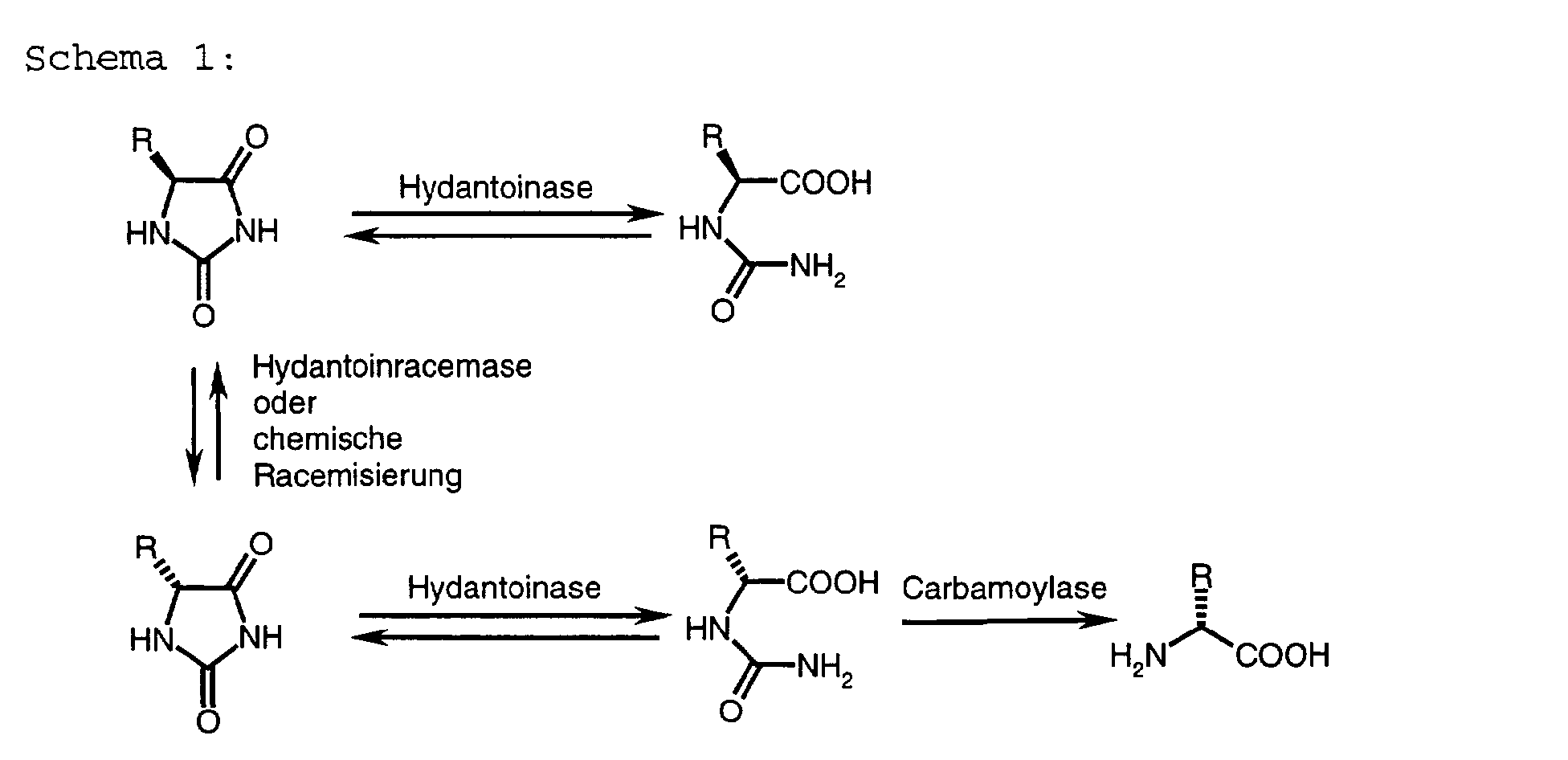
- a known enzymatic process is based on racemic hydantoins, which are transformed into N-carbamoyl-protected amino acids by means of hydantoinases. These are then converted into the amino acids by carbamoylases.
- the racemates occurring in this reaction sequence are preferably separated on the basis of the N-carbamoyl-protected amino acids, since both L- and D-selective carbamoylases are available (Park et al., Biotechnol. Prog. 2000, 16, 564-570; May et al., Nat Biotechnol. 2000, 18, 317-20; Pietzsch et al., J. Chromatogr. B Biomed. Sci. Appl.
- the object of the present invention was therefore to use an N-acetylamino acid racemase compared to the State of the art improved racemization of N-carbamoyl amino acids specify.
- This racemase should be in a process for the production of optically pure amino acid on an industrial scale starting from racemic hydantoins be used advantageously.
- N-carbamoylamino acids N-acetylamino acid racemases (AAR) from Amycolatopsis orientalis subsp. Lurida (Seq. 2) used, is obtained due to the surprisingly increased Activity of the AAR used according to the invention the TS-1-60 with regard to the racemization of N-carbamoylamino acids the opportunity in an improved Procedure for the equilibration of optical antipodes of N-carbamoyl-protected To perform amino acids.
- AAR N-acetylamino acid racemases
- the recombinant method is preferably used for the racemization process produced variant of the AAR from Amycolatopsis o. sp. lurida used according to DE19935268. From the DE19935268 is known to have a relatively low level Heavy metal ion dependency (especially in relation to on cobalt ions) and low amino acid inhibition. There is also their generation as a recombinant Enzyme explained.
- the method according to the invention is carried out in an overall process for the production of enantiomerically enriched Amino acids or their derivatives based on hydantoins or N-carbamoylamino acids used advantageously.
- you in the case of the hydantoins it is preferred that to convert racemic hydantoins into the corresponding ones using hydantoinases cleaves racemic N-carbamoylamino acids and then by L- or D-specific carbamoylases converted to the optically active L or D amino acids.
- the optical antipodes of the N-carbamoylamino acids are set by adding the AAR according to the invention equilibrium and can therefore also the racemic Convert hydantoin entirely into optically pure amino acids.
- This process is preferably carried out in an enzyme membrane reactor (DE 199 10 691.6).
- the enzymes mentioned can be purified in a free form as homogeneously Compounds or as recombinantly produced Enzymes can be used together or sequentially. Farther the enzymes can also be part of a host organism (Whole cell catalyst as used in US09 / 407062) be or in connection with the digested cell mass of the host organism. Use is also possible of the enzymes in immobilized form (Bhavender P. Sharma, Lorraine F. Bailey and Ralph A. Messing, "Immobilized Biomaterials - Techniques and Applications ", Angew. Chem. 1982, 94, 836-852). This is advantageously carried out Immobilization by lyophilization (Dordick et al. J. Am. Chem. Soc.
- Lyophilization is very particularly preferred in the presence of surface-active substances, such as Aerosol OT or polyvinyl pyrrolidone or polyethylene glycol (PEG) or Brij 52 (diethylene glycol monocetyl ether) (Goto et al. Biotechnol. Techniques 1997, 11, 375-378.
- Aerosol OT or polyvinyl pyrrolidone or polyethylene glycol (PEG) or Brij 52 (diethylene glycol monocetyl ether) (Goto et al. Biotechnol. Techniques 1997, 11, 375-378.
- microorganism Amycolatopsis orientalis subsp. lurida is with the German Collection under number DSM43134 deposited for microorganisms.
- enantiomerically enriched refers to this one optical antipode mixed with the other in > 50%.
- amino acid is understood to mean a natural or unnatural ⁇ -amino acid, ie the residue on the ⁇ -C atom of the ⁇ -amino acid is a natural amino acid, as described in Beyer-Walter, Textbook of Organic Chemistry, p. Hirzel Verlag Stuttgart, 22nd edition, 1991, p.822f. shown, can derive or also from corresponding ⁇ -residues of unnatural ⁇ -amino acids, which are listed for example in DE19903268.8.
- the assay was composed as follows: Tris / HCl buffer 50 mM (pH 8.0) substratum 25 mM cobalt chloride 6 mM AAR approx. 150 ⁇ g of purified protein final volume 1 ml
- N-acylamino acid racemase from A. TS-1-60 has with N-carbamoyl-D-Met an activity of 100 mU / mg as substrate. This specific activity is 35% lower than that of the racemase from A. orientalis subsp. lurida.
Landscapes
- Chemical & Material Sciences (AREA)
- Life Sciences & Earth Sciences (AREA)
- Organic Chemistry (AREA)
- Wood Science & Technology (AREA)
- Zoology (AREA)
- Engineering & Computer Science (AREA)
- Health & Medical Sciences (AREA)
- Bioinformatics & Cheminformatics (AREA)
- Genetics & Genomics (AREA)
- General Engineering & Computer Science (AREA)
- Microbiology (AREA)
- Biotechnology (AREA)
- General Health & Medical Sciences (AREA)
- Biochemistry (AREA)
- Medicinal Chemistry (AREA)
- Molecular Biology (AREA)
- Biomedical Technology (AREA)
- Analytical Chemistry (AREA)
- Chemical Kinetics & Catalysis (AREA)
- General Chemical & Material Sciences (AREA)
- Preparation Of Compounds By Using Micro-Organisms (AREA)
- Enzymes And Modification Thereof (AREA)
- Organic Low-Molecular-Weight Compounds And Preparation Thereof (AREA)
- Peptides Or Proteins (AREA)
- Medicines That Contain Protein Lipid Enzymes And Other Medicines (AREA)
Abstract
Description
Vorzugsweise erfolgt die Trennung der in dieser Reaktionssequenz auftretenden Racemate auf der Basis der N-carbamoylgeschützten Aminosäuren, da sowohl L- als auch D-selektive Carbamoylasen zur Verfügung stehen (Park et al., Biotechnol. Prog. 2000, 16, 564-570; May et al., Nat Biotechnol. 2000, 18, 317-20; Pietzsch et al., J. Chromatogr. B Biomed. Sci. Appl. 2000, 737, 179-86; Chao et al., Biotechnol. Prog. 1999, 15, 603-7; Wilms et al., J. Biotechnol. 1999, 68, 101-13; Batisse et al., Appl. Environ. Microbiol. 1997, 63, 763-6; Buson et al., FEMS Microbiol. Lett. 1996, 145, 55-62).
Um einen vollständigen Umsatz der eingesetzten Hydantoine in optisch reine Aminosäuren zu gewährleisten, geschieht die dazu notwendige Racemisierung bisher auf der Basis der Hydantoine in chemischer oder enzymatischer Art und Weise (EP 745678; EP 542098; Schema 1).


| Puffer Tris/HCl | 50 mM (pH 8,0) |
| Substrat | 25 mM |
| Cobaltchlorid | 6 mM |
| AAR | ca. 150 µg gereinigtes Protein |
| Endvolumen | 1 ml |
| Auflistung der getesteten Substrate und der entsprechenden spezifischen Aktivität der AAR. | |
| Substrat | Spezifische Aktivität |
| N-Carbamoyl-D-Met | 155 mU/mg |
| N-Carbamoyl-D-Phe | 20 mU/mg |
| N-Carbamoyl-L-Abs | 15 mU/mg |
| N-Carbamoyl-L-Leu | 20 mU/mg |
| N-Carbamoyl-L-Met | 118 mU/mg |
| N-Carbamoyl-L-Tyr | 62 mU/mg |
| N-Carbamoyl-L-Val | 20 mU/mg |
Claims (3)
- Verwendung von N-Acetylaminosäureracemasen (AAR) aus Amycolatopsis orientalis subspecies lurida in einem Verfahren zur Racemisierung von N-Carbamoylaminosäuren.
- Verwendung nach Anspruch 1 in einem Prozeß zur Herstellung von enantiomer angereicherten Aminosäuren oder deren Derivaten ausgehend von Hydantoinen oder N-Carbamoylaminosäuren.
- Verwendung nach einem der vorhergehenden Ansprüche, dadurch gekennzeichnet, daß
man den Prozeß in einem Enzym-Membran-Reaktor durchführt.
Applications Claiming Priority (2)
| Application Number | Priority Date | Filing Date | Title |
|---|---|---|---|
| DE10050124 | 2000-10-11 | ||
| DE10050124A DE10050124A1 (de) | 2000-10-11 | 2000-10-11 | Verwendung der Acetylaminosäureracemase aus Amycolatopsis orientalis Racemisierung von Carbamoylaminosäuren |
Publications (3)
| Publication Number | Publication Date |
|---|---|
| EP1199369A2 true EP1199369A2 (de) | 2002-04-24 |
| EP1199369A3 EP1199369A3 (de) | 2002-08-07 |
| EP1199369B1 EP1199369B1 (de) | 2008-02-13 |
Family
ID=7659257
Family Applications (1)
| Application Number | Title | Priority Date | Filing Date |
|---|---|---|---|
| EP01123744A Expired - Lifetime EP1199369B1 (de) | 2000-10-11 | 2001-10-04 | Verwendung der Acetylaminosäureracemase aus Amycolatopsis orientalis zur Racemisierung von Carbamoylaminosäuren |
Country Status (6)
| Country | Link |
|---|---|
| US (1) | US6767725B2 (de) |
| EP (1) | EP1199369B1 (de) |
| JP (1) | JP2002142794A (de) |
| AT (1) | ATE386136T1 (de) |
| CA (1) | CA2358853A1 (de) |
| DE (2) | DE10050124A1 (de) |
Families Citing this family (1)
| Publication number | Priority date | Publication date | Assignee | Title |
|---|---|---|---|---|
| WO2004111227A2 (en) * | 2003-06-06 | 2004-12-23 | Degussa Ag | Screening process for hydantoin racemases |
Family Cites Families (8)
| Publication number | Priority date | Publication date | Assignee | Title |
|---|---|---|---|---|
| US4981799A (en) * | 1987-08-21 | 1991-01-01 | Takeda Chemical Industries, Ltd. | Acylamino acid racemase, production and use thereof |
| US5525501A (en) * | 1990-09-14 | 1996-06-11 | Takeda Chemical Industries, Ltd. | DNA Fragment encoding acylamino acid racemase |
| CA2038202A1 (en) * | 1990-09-14 | 1992-03-15 | Masaharu Tokuyama | Dna and use thereof |
| DE4137581A1 (de) | 1991-11-15 | 1993-05-19 | Degussa | Verfahren zur chemischen racemisierung von 5-monosubstituierten hydantoinen, vorrichtung zur durchfuehrung des verfahrens und verwendung der hydantoine |
| DE19519717C1 (de) | 1995-05-30 | 1996-08-22 | Degussa | Neuer Mikroorganismus, dessen Verwendung und Verfahren zur Herstellung von L-alpha-Aminosäuren |
| DE19903268A1 (de) | 1999-01-28 | 2000-08-03 | Degussa | Verfahren zur Decarbamoylierung von N-carbamoylgeschützten Verbindungen, neue Carbonsäureanhydride und deren Verwendung |
| DE10003110A1 (de) | 1999-03-11 | 2000-09-14 | Degussa | Polymervergrößerte Katalysatoren |
| DE19935268A1 (de) | 1999-07-27 | 2001-02-08 | Degussa | N-Acetylaminosäureracemase |
-
2000
- 2000-10-11 DE DE10050124A patent/DE10050124A1/de not_active Ceased
-
2001
- 2001-10-04 DE DE50113583T patent/DE50113583D1/de not_active Expired - Lifetime
- 2001-10-04 AT AT01123744T patent/ATE386136T1/de not_active IP Right Cessation
- 2001-10-04 EP EP01123744A patent/EP1199369B1/de not_active Expired - Lifetime
- 2001-10-09 JP JP2001311652A patent/JP2002142794A/ja active Pending
- 2001-10-10 CA CA002358853A patent/CA2358853A1/en not_active Abandoned
- 2001-10-11 US US09/973,712 patent/US6767725B2/en not_active Expired - Fee Related
Also Published As
| Publication number | Publication date |
|---|---|
| DE10050124A1 (de) | 2002-04-25 |
| US6767725B2 (en) | 2004-07-27 |
| JP2002142794A (ja) | 2002-05-21 |
| ATE386136T1 (de) | 2008-03-15 |
| DE50113583D1 (de) | 2008-03-27 |
| EP1199369B1 (de) | 2008-02-13 |
| US20020106752A1 (en) | 2002-08-08 |
| EP1199369A3 (de) | 2002-08-07 |
| CA2358853A1 (en) | 2002-04-11 |
Similar Documents
| Publication | Publication Date | Title |
|---|---|---|
| EP0885962B1 (de) | Mikroorganismen und Verfahren zur fermentativen Herstellung von L-Cystein, L-Cystin, N-Acetyl-Serin oder Thiazolindinderivaten | |
| EP0801683B1 (de) | Racematspaltung primärer und sekundärer heteroatomsubstituierter amine durch enzym-katalysierte acylierung | |
| EP0186035B1 (de) | Neue D-Aminosäure-Transaminase und ihre Verwendung | |
| EP0625571A2 (de) | Neue Mikroorganismen, deren Verwendung und Verfahren zur Herstellung von L-Alpha-Aminosäuren | |
| DE3875953T2 (de) | Verfahren zur herstellung von organischen chemischen verbindungen. | |
| EP0347374B1 (de) | Verfahren zur Herstellung von Hydroxysäuren | |
| EP1197563B1 (de) | Verfahren zur Herstellung von Aminosäuren | |
| EP1199369B1 (de) | Verwendung der Acetylaminosäureracemase aus Amycolatopsis orientalis zur Racemisierung von Carbamoylaminosäuren | |
| EP1200601B1 (de) | Verfahren zur herstellung von l-aminosäuren aus ihren racemischen n-acetyl-d,l-derivaten durch enzymatische racemat-spaltung mittels isolierter, rekombinanter enzyme | |
| DE10251184A1 (de) | Mutanten zur Herstellung von D-Aminosäuren | |
| EP1367129B1 (de) | Verfahren zur enzymatischen Herstellung enantiomerenangereicherter Beta-Aminosäuren | |
| DE69811677T2 (de) | Verfahren zur präparation von enantiomer-angereicherten, n-derivatisierten laktamen. | |
| EP0377083B1 (de) | Verfahren zur Herstellung von L-alpha-Aminosäuren | |
| EP2641972A1 (de) | Verfahren zur asymmetrischen Aminierung von Ketonen unter Verwendung von omega-Transamminasen in organischen Lösungsmitteln | |
| EP0890649B1 (de) | Verfahren zur Herstellung von acylierten Aminosäureestern und Racematspaltung von Aminosäureestern durch Enzym-katalysierte Acylierung | |
| EP0374651A1 (de) | Verfahren zur Herstellung von L-Phosphinothricin | |
| DE19529211C2 (de) | Verfahren zur Herstellung von (R)-tertiär-Leucin | |
| DE10115000C2 (de) | Verfahren zur Herstellung von enantiomerenangereicherten alpha-substituierten Carbonsäuren | |
| DE69600978T2 (de) | Verfahren zur Herstellung von D-Aminosäuren | |
| DE19523151A1 (de) | Racematspaltung primärer und sekundärer heteroatomsubstituierter Amine durch Enzym-katalysierte Acylierung | |
| DE4330678A1 (de) | Verfahren zur Herstellung von zyklischen N-Carbamoyl-D-Aminosäuren | |
| EP0529601B1 (de) | Verfahren zur Herstellung von optisch aktivem Vinylglycin in freier oder geschützter Form über eine enzymatische, enantioselektive Hydrolyse | |
| DE10260891A1 (de) | Screening-Verfahren zur Identifikation wirksamer Substanzen gegen Halitosis, Gingivitis oder Parodontitis | |
| EP1083170A1 (de) | Verfahren zur Herstellung von D-(3'-Pyridyl)-alanin | |
| DE10037115A1 (de) | Verfahren zur fermentativen Herstellung von L-Allysinacetal |
Legal Events
| Date | Code | Title | Description |
|---|---|---|---|
| PUAI | Public reference made under article 153(3) epc to a published international application that has entered the european phase |
Free format text: ORIGINAL CODE: 0009012 |
|
| 17P | Request for examination filed |
Effective date: 20011004 |
|
| AK | Designated contracting states |
Kind code of ref document: A2 Designated state(s): AT BE CH CY DE DK ES FI FR GB GR IE IT LI LU MC NL PT SE TR |
|
| AX | Request for extension of the european patent |
Free format text: AL;LT;LV;MK;RO;SI |
|
| PUAL | Search report despatched |
Free format text: ORIGINAL CODE: 0009013 |
|
| AK | Designated contracting states |
Kind code of ref document: A3 Designated state(s): AT BE CH CY DE DK ES FI FR GB GR IE IT LI LU MC NL PT SE TR |
|
| AX | Request for extension of the european patent |
Free format text: AL;LT;LV;MK;RO;SI |
|
| AKX | Designation fees paid |
Designated state(s): AT BE CH CY DE DK ES FI FR GB GR IE IT LI LU MC NL PT SE TR |
|
| RAP1 | Party data changed (applicant data changed or rights of an application transferred) |
Owner name: DEGUSSA GMBH |
|
| GRAP | Despatch of communication of intention to grant a patent |
Free format text: ORIGINAL CODE: EPIDOSNIGR1 |
|
| RIC1 | Information provided on ipc code assigned before grant |
Ipc: C12P 41/00 20060101AFI20070918BHEP Ipc: C12N 9/90 20060101ALI20070918BHEP |
|
| RAP1 | Party data changed (applicant data changed or rights of an application transferred) |
Owner name: EVONIK DEGUSSA GMBH |
|
| GRAS | Grant fee paid |
Free format text: ORIGINAL CODE: EPIDOSNIGR3 |
|
| GRAA | (expected) grant |
Free format text: ORIGINAL CODE: 0009210 |
|
| AK | Designated contracting states |
Kind code of ref document: B1 Designated state(s): AT BE CH CY DE DK ES FI FR GB GR IE IT LI LU MC NL PT SE TR |
|
| REG | Reference to a national code |
Ref country code: GB Ref legal event code: FG4D Free format text: NOT ENGLISH |
|
| REG | Reference to a national code |
Ref country code: CH Ref legal event code: EP |
|
| REG | Reference to a national code |
Ref country code: IE Ref legal event code: FG4D Free format text: LANGUAGE OF EP DOCUMENT: GERMAN |
|
| REF | Corresponds to: |
Ref document number: 50113583 Country of ref document: DE Date of ref document: 20080327 Kind code of ref document: P |
|
| PG25 | Lapsed in a contracting state [announced via postgrant information from national office to epo] |
Ref country code: FI Free format text: LAPSE BECAUSE OF FAILURE TO SUBMIT A TRANSLATION OF THE DESCRIPTION OR TO PAY THE FEE WITHIN THE PRESCRIBED TIME-LIMIT Effective date: 20080213 Ref country code: ES Free format text: LAPSE BECAUSE OF FAILURE TO SUBMIT A TRANSLATION OF THE DESCRIPTION OR TO PAY THE FEE WITHIN THE PRESCRIBED TIME-LIMIT Effective date: 20080524 |
|
| RAP2 | Party data changed (patent owner data changed or rights of a patent transferred) |
Owner name: EVONIK DEGUSSA GMBH |
|
| ET | Fr: translation filed | ||
| NLT2 | Nl: modifications (of names), taken from the european patent patent bulletin |
Owner name: EVONIK DEGUSSA GMBH Effective date: 20080806 |
|
| PG25 | Lapsed in a contracting state [announced via postgrant information from national office to epo] |
Ref country code: SE Free format text: LAPSE BECAUSE OF FAILURE TO SUBMIT A TRANSLATION OF THE DESCRIPTION OR TO PAY THE FEE WITHIN THE PRESCRIBED TIME-LIMIT Effective date: 20080513 Ref country code: PT Free format text: LAPSE BECAUSE OF FAILURE TO SUBMIT A TRANSLATION OF THE DESCRIPTION OR TO PAY THE FEE WITHIN THE PRESCRIBED TIME-LIMIT Effective date: 20080714 Ref country code: DK Free format text: LAPSE BECAUSE OF FAILURE TO SUBMIT A TRANSLATION OF THE DESCRIPTION OR TO PAY THE FEE WITHIN THE PRESCRIBED TIME-LIMIT Effective date: 20080213 |
|
| PLBE | No opposition filed within time limit |
Free format text: ORIGINAL CODE: 0009261 |
|
| STAA | Information on the status of an ep patent application or granted ep patent |
Free format text: STATUS: NO OPPOSITION FILED WITHIN TIME LIMIT |
|
| 26N | No opposition filed |
Effective date: 20081114 |
|
| PG25 | Lapsed in a contracting state [announced via postgrant information from national office to epo] |
Ref country code: MC Free format text: LAPSE BECAUSE OF NON-PAYMENT OF DUE FEES Effective date: 20081031 |
|
| REG | Reference to a national code |
Ref country code: CH Ref legal event code: PL |
|
| GBPC | Gb: european patent ceased through non-payment of renewal fee |
Effective date: 20081004 |
|
| PG25 | Lapsed in a contracting state [announced via postgrant information from national office to epo] |
Ref country code: CY Free format text: LAPSE BECAUSE OF FAILURE TO SUBMIT A TRANSLATION OF THE DESCRIPTION OR TO PAY THE FEE WITHIN THE PRESCRIBED TIME-LIMIT Effective date: 20080213 |
|
| PG25 | Lapsed in a contracting state [announced via postgrant information from national office to epo] |
Ref country code: CH Free format text: LAPSE BECAUSE OF NON-PAYMENT OF DUE FEES Effective date: 20081031 Ref country code: LI Free format text: LAPSE BECAUSE OF NON-PAYMENT OF DUE FEES Effective date: 20081031 |
|
| PG25 | Lapsed in a contracting state [announced via postgrant information from national office to epo] |
Ref country code: GB Free format text: LAPSE BECAUSE OF NON-PAYMENT OF DUE FEES Effective date: 20081004 |
|
| PG25 | Lapsed in a contracting state [announced via postgrant information from national office to epo] |
Ref country code: AT Free format text: LAPSE BECAUSE OF NON-PAYMENT OF DUE FEES Effective date: 20081004 |
|
| PGFP | Annual fee paid to national office [announced via postgrant information from national office to epo] |
Ref country code: DE Payment date: 20091026 Year of fee payment: 9 Ref country code: IE Payment date: 20091028 Year of fee payment: 9 |
|
| PGFP | Annual fee paid to national office [announced via postgrant information from national office to epo] |
Ref country code: NL Payment date: 20091016 Year of fee payment: 9 |
|
| PGFP | Annual fee paid to national office [announced via postgrant information from national office to epo] |
Ref country code: FR Payment date: 20091110 Year of fee payment: 9 Ref country code: IT Payment date: 20091023 Year of fee payment: 9 |
|
| PGFP | Annual fee paid to national office [announced via postgrant information from national office to epo] |
Ref country code: BE Payment date: 20091130 Year of fee payment: 9 |
|
| PG25 | Lapsed in a contracting state [announced via postgrant information from national office to epo] |
Ref country code: LU Free format text: LAPSE BECAUSE OF NON-PAYMENT OF DUE FEES Effective date: 20081004 |
|
| PG25 | Lapsed in a contracting state [announced via postgrant information from national office to epo] |
Ref country code: TR Free format text: LAPSE BECAUSE OF FAILURE TO SUBMIT A TRANSLATION OF THE DESCRIPTION OR TO PAY THE FEE WITHIN THE PRESCRIBED TIME-LIMIT Effective date: 20080213 |
|
| PG25 | Lapsed in a contracting state [announced via postgrant information from national office to epo] |
Ref country code: GR Free format text: LAPSE BECAUSE OF FAILURE TO SUBMIT A TRANSLATION OF THE DESCRIPTION OR TO PAY THE FEE WITHIN THE PRESCRIBED TIME-LIMIT Effective date: 20080514 |
|
| BERE | Be: lapsed |
Owner name: EVONIK DEGUSSA G.M.B.H. Effective date: 20101031 |
|
| REG | Reference to a national code |
Ref country code: NL Ref legal event code: V1 Effective date: 20110501 |
|
| PG25 | Lapsed in a contracting state [announced via postgrant information from national office to epo] |
Ref country code: FR Free format text: LAPSE BECAUSE OF NON-PAYMENT OF DUE FEES Effective date: 20101102 |
|
| REG | Reference to a national code |
Ref country code: FR Ref legal event code: ST Effective date: 20110630 |
|
| PG25 | Lapsed in a contracting state [announced via postgrant information from national office to epo] |
Ref country code: BE Free format text: LAPSE BECAUSE OF NON-PAYMENT OF DUE FEES Effective date: 20101031 Ref country code: NL Free format text: LAPSE BECAUSE OF NON-PAYMENT OF DUE FEES Effective date: 20110501 |
|
| REG | Reference to a national code |
Ref country code: DE Ref legal event code: R119 Ref document number: 50113583 Country of ref document: DE Effective date: 20110502 |
|
| PG25 | Lapsed in a contracting state [announced via postgrant information from national office to epo] |
Ref country code: IE Free format text: LAPSE BECAUSE OF NON-PAYMENT OF DUE FEES Effective date: 20101004 |
|
| PG25 | Lapsed in a contracting state [announced via postgrant information from national office to epo] |
Ref country code: IT Free format text: LAPSE BECAUSE OF NON-PAYMENT OF DUE FEES Effective date: 20101004 |
|
| PG25 | Lapsed in a contracting state [announced via postgrant information from national office to epo] |
Ref country code: DE Free format text: LAPSE BECAUSE OF NON-PAYMENT OF DUE FEES Effective date: 20110502 |