EP1198073A2 - Vorrichtung und Verfahren zum Schätzen eines Kanals zwischen einem Sender und einem Empfänger - Google Patents
Vorrichtung und Verfahren zum Schätzen eines Kanals zwischen einem Sender und einem Empfänger Download PDFInfo
- Publication number
- EP1198073A2 EP1198073A2 EP01124447A EP01124447A EP1198073A2 EP 1198073 A2 EP1198073 A2 EP 1198073A2 EP 01124447 A EP01124447 A EP 01124447A EP 01124447 A EP01124447 A EP 01124447A EP 1198073 A2 EP1198073 A2 EP 1198073A2
- Authority
- EP
- European Patent Office
- Prior art keywords
- channel
- estimate
- coarse
- fine
- message
- Prior art date
- Legal status (The legal status is an assumption and is not a legal conclusion. Google has not performed a legal analysis and makes no representation as to the accuracy of the status listed.)
- Withdrawn
Links
Images


Classifications
-
- H—ELECTRICITY
- H04—ELECTRIC COMMUNICATION TECHNIQUE
- H04B—TRANSMISSION
- H04B1/00—Details of transmission systems, not covered by a single one of groups H04B3/00 - H04B13/00; Details of transmission systems not characterised by the medium used for transmission
- H04B1/69—Spread spectrum techniques
- H04B1/707—Spread spectrum techniques using direct sequence modulation
- H04B1/7097—Interference-related aspects
- H04B1/7103—Interference-related aspects the interference being multiple access interference
- H04B1/7105—Joint detection techniques, e.g. linear detectors
Definitions
- the present invention relates to data transmission and in particular on data transmission via a variable channel, which must be estimated.
- the channel impulse response the result of an inverse Fourier transform the channel transmission function, known at all times his. This applies all the more to the construction process a connection between a transmitter and a receiver over the channel.
- MMSE channel estimation known reference sequence used.
- This reference sequence will transmitted via an unknown channel h.
- the recipient then receives a reception sequence, which in the case of an ideal Channel would correspond directly to the send reference sequence.
- the channel and thus the amount and the phase frequency response of the channel is estimated by the equalizer to be able to control such that the distortions of the Channel can be compensated.
- a channel exhibits amplitude distortion Form of constant damping with a factor of 1/2, see above this factor would be determined by a channel estimate to be an equalizer with the inverse of this factor, to be able to control with the factor 2.
- this frequency response of the Channel can be determined using a channel estimate, to be able to control the equalizer in such a way that it low frequencies does nothing, but at high frequencies inversely distorted to the damping factor of the equalizer. Lies a phase-distorting channel, it becomes a channel estimate determine the phase frequency response of the channel, such that an equalizer with the inverse of this phase frequency response can be controlled to the distortion of the channel undo.
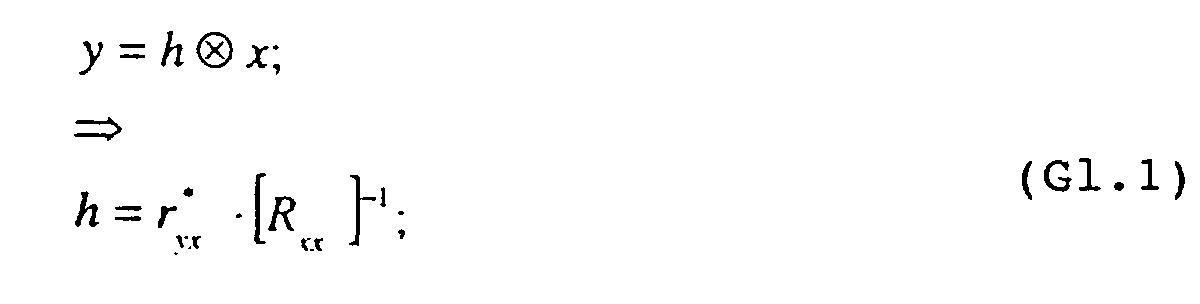
- Equation 1 shows the system-theoretical relationship between the known input sequence x and the known output sequence y, where h represents the channel impulse response.
- the output sequence y results from the convolution of the channel impulse response with the input sequence.
- the channel impulse response can then be calculated by changing the system equation as follows:
- Equation 1 The circled cross in Equation 1 represents the convolution operation.
- R yx * is the conjugate cross correlation between the output sequence y and the input sequence x.
- R xx is the autocorrelation matrix of the known input sequence x.
- the channel is very timely change quickly and very sustainably so that the use of long reference sequences only makes sense to a limited extent, since the MMSE method allows a very precise channel estimation, the channel, however, in the time when the exact channel estimate has been calculated, changed again so that no benefit remains.
- WO 00/48332 discloses an MMSE-based channel estimator in a mobile communication system.
- the channel estimator uses a two-step process for Channel estimation, starting with a channel estimation using is performed by known symbols. The values of this Channel estimates are then filtered in a filter so that a more refined channel estimate is created. The filter will by multiplying the cross covariance of the channel and the first channel estimate with the inverse of cross covariance the first channel estimate.
- the object of the present invention is a fast and less complex concept for estimating a Channel between a transmitter and a receiver as well as a to create fast and bandwidth-saving receivers.
- This task is accomplished through a method of estimating a Channel according to claim 1, by a device for Estimating a channel according to claim 10 and by solved a receiver according to claim 11.
- the present invention is based on the knowledge that the one-step known channel estimation must be abandoned in order to achieve the most accurate possible channel estimation despite short reference sequences.
- a rough channel estimation with a preferably short reference sequence is carried out using any known channel estimation method.
- the result of this coarse channel estimate is in turn interpreted as an input sequence in a "transmission filter" which transforms the coarse channel estimate into a fine channel estimate.
- a filter which maps x to y can always be determined for a given input sequence x and a given output sequence y.
- the inverse of the autocorrelation matrix of the input sequence exists, ie R xx is not singular.
- a filter h can always be determined under the condition just mentioned, with which the imprecise estimate or rough channel estimate x can be mapped to y.
- this coarse-fine transformation filter can only be determined if y, ie the true channel impulse response, is known (or the cross-correlated r yx )
- a further assumption must be made. This assumption is based on the fact that the estimate x is already close to the true size y. Under this condition, the unknown cross-correlated r yx * can be replaced by the auto-correlated of the true channel impulse response r yy *. This autocorrelated r yy * of the channel impulse response can be determined independently of the method used for the rough channel estimation.
- the basis for this is the fact that the absolute frequency response of the channel regardless of the reference data sequence can be estimated, and the better the more the variance, d. H. the signal power of the transmitted Signal is known. Especially with digital transmission channels is the signal power of the transmitted Signal known, even if the transmitted signal itself is not known.
- usual transmission methods or The aim of modulation methods is always that the Transmission power independent of the user data if possible is constant to the transmitter amplifier always in the range of to be able to operate optimal efficiency, and in order to transmit secondary channels due to non-linear transmit amplifiers to keep as low as possible.
- the coarse-fine transformation filter by which the channel coarse estimate is transformed into the channel fine estimate is determined by multiplying the conjugate complex autocorrelation function of the channel impulse response and the autocorrelation matrix R xx of the channel coarse estimate, which still has to be inverted before the multiplication.
- the fine estimate for the channel y is then obtained by folding the impulse response of the coarse-fine transformation filter with the rough channel estimate. On the basis of the data obtained in this way, an equalizer can then be controlled in order to equalize the unknown channel.
- the concept according to the invention allows an improvement in Estimation accuracy based on an additional Channel autocorrelated estimate.
- An advantage of the invention The concept is that it requires relatively little computation is because the coarse-fine transform filter is only a few can have few coefficients, making it extremely efficient and thus quick calculation of the coefficients of the Coarse-fine transformation filter is possible, which in particular then essential if a quick Processing is required in conjunction with short Reference consequences for the estimation of time over time changing channels is necessary.
- a system-theoretical derivation of the two-stage estimation method according to the present invention is given.
- a filter can always be determined which maps x to y.
- This filter is commonly referred to as h.
- the prerequisite for this is that the inverse of the autocorrelation matrix of the input sequence x exists, ie that R xx , that is to say the autocorrelation matrix of the sequence x, is not singular.
- Equation 2 and Equation 3 are generally known, so that at this point on a mathematical proof can be dispensed with.
- Equation 3 provides a way to replace the cross-correlated R yx * with the auto-correlated of the true channel impulse response, i.e. r yy *.
- the determination equation for the coarse-fine transformation filter h is therefore:
- the auto-correlated r yy * of the channel impulse response in the case of digital transmission can be determined independently of the method used for channel estimation.
- the basis for this is provided by the fact that the absolute frequency response of the channel can be estimated independently of the reference data sequence, provided that the variance, ie the signal power, of the transmitted signal is known.
- the estimate of the channel's frequency response is independent of the reference data sequence can be carried out, for example as described in K. D. Kammeyer, K. Kroschel, "Digitale Signal Processing: Filtering and Spectral Analysis ", Teubner-Verlag, 1998.
- Other known methods to estimate the amount frequency response of the channel independently of the reference data sequence can of course can also be used.
- Equation 5 Sy means the spectral power of each output process, while ⁇ x 2 represents the spectral power density of the input process.
- the frequency response of the channel is marked.
- 2 is obtained by the Fourier transform of the conjugate complex autocorrelated r yy * of the channel impulse response.
- the estimate of the magnitude frequency response or the spectral Power density or the channel auto-correlated can thus with one of the standard methods for channel estimation already mentioned can be achieved.
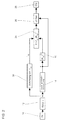
- FIG. 1 shows a device according to the invention for estimating a channel.
- This device is composed of a transmitter 10 which is designated TX.
- This transmitter 10 sends a message via a channel y, which is identified by reference number 12.
- the receiver-side output data of the channel are received by means of a device 14 for rough channel estimation in order to carry out a rough channel estimation using the input data sequence which is known to the device 14 for channel estimation. It should be pointed out that it is not imperative that a known reference data sequence is used, but that a rough channel estimation can also be carried out on the basis of an unknown transmitted message, as has already been explained at the beginning.
- the rough channel estimation x is fed to a device 16 which supplies the inverse of the autocorrelation matrix R xx of the rough channel estimation.
- the output data of channel y is subjected to a Fourier transformation by means of a transformation device 18, which can be carried out in any manner and only converts the time domain data into a spectral representation thereof.
- a transformation device 20 the spectral power density of the channel is determined using a standard method, such as. B. the least squares method.
- the result is transformed back into the time domain by means of a device for converting into a temporal representation, which is designated IFFT 22, in order to obtain the autocorrelated R yy of the channel.
- the coarse-fine transformation filter h can be calculated (24) in order to then filter the channel coarse estimate x with the coarse-fine transformation filter h (26), so that a more accurate one Estimated value, ie a fine estimate, which gives true channel transfer function y.
- This data can then be used to control an equalizer 28 in a known manner in order to compensate for the channel distortion.
- the alternative exemplary embodiments of the present invention shown in FIGS. 2 and 3 differ only in how the autocorrelated r yy of the channel is obtained using the known signal power of the transmission sequence emitted by the transmitter Tx. While the spectral power density of the channel has been estimated in FIG. 1 by means of the device 20, and before a Fourier transformation and subsequently an inverse Fourier transformation are carried out, in the exemplary embodiment shown in FIG. 2 the auto-correlated r yy des Channel immediately estimated.
- the invention is also used as in the case of FIG. 1 shown first embodiment of the present invention a fast Fourier transform 18 and an inverse fast Fourier transform 22 performed, where however, the spectral power density of the channel using a two-stage process is won, namely initially with an estimate of the amount of the channel transfer function by means of a device 32 and a subsequent one Squaring device 34.
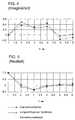
- 4 and 5 show the comparison between a standard estimation method, the results of which are drawn with a circle, and the inventive method, the results of which with a Are marked with a cross and the true channel impulse response, which are drawn solid in FIGS. 4 and 5 is. 4 in particular represents the imaginary part of the channel impulse response 5, while Fig. 5 illustrates the real part.
- a coarse-fine transformation filter includes a discrepancy between the estimated value and the true value almost no longer is noticeable.
- the concept according to the invention is therefore very robust and especially suitable for short reference sequences. Furthermore it should be noted that the coarse-fine transformation filter has only a few coefficients. In the in the 4 and 5 simulation were only three coefficients of the coarse-fine transformation filter h is determined. This fact enables an efficient calculation of the coefficients of the transformation filter.
- the concept according to the invention allows a significant improvement the estimation accuracy, regardless of which Procedure a rough canal estimation has been carried out is.
- the inventive concept can for a variety of Modulation methods are used, of which only for example the PAM, the PSK, the QAM or the DMT are.
Landscapes
- Engineering & Computer Science (AREA)
- Computer Networks & Wireless Communication (AREA)
- Signal Processing (AREA)
- Cable Transmission Systems, Equalization Of Radio And Reduction Of Echo (AREA)
- Mobile Radio Communication Systems (AREA)
Abstract
Description
- (a)
- Um die gewünschte Kanalimpulsantwort h zu bestimmen, muß die Eingangsfolge x empfangsseitig bekannt sein.
- (b)
- Der Schätzfehler wird um so kleiner, je länger die Referenzfolge x ist.
- (a)
- Mit steigender Länge der Referenzfolge sinkt die effektive Bandbreite der Übertragung.
- (b)
- Die Inversion der Autokorrelationsmatrix, welche aufgrund von Gleichung 1 nötig ist, ist bei langen Referenzfolgen problematisch.
- Fig. 1
- eine Vorrichtung zum Schätzen eines Kanals gemäß einem ersten Ausführungsbeispiel der vorliegenden Erfindung;
- Fig. 2
- eine Vorrichtung zum Schätzen eines Kanals gemäß einem zweiten Ausführungsbeispiel der vorliegenden Erfindung;
- Fig. 3
- eine Vorrichtung zum Schätzen eines Kanals gemäß einem dritten Ausführungsbeispiel der vorliegenden Erfindung;
- Fig. 4
- ein Simulationsergebnis zum Vergleichen des erfindungsgemäßen Konzepts mit einem Standardverfahren bezüglich des Imaginärteils der Kanalimpulsantwort; und
- Fig. 5
- ein Simulationsergebnis zum Vergleich des erfindungsgemäßen Konzepts mit einem Standardverfahren bezüglich des Realteils der Kanalimpulsantwort.

Claims (12)
- Verfahren zum Schätzen eines Kanals (12) zwischen einem Sender (10) und einem Empfänger, mit folgenden Schritten:Senden (10) einer Nachricht über den Kanal (12);Durchführen (14) einer Kanalgrobabschätzung, um eine grobe Kanalschätzung (x) zu erhalten;Bilden (16) der inversen Autokorrelationsmatrix (Rxx -1) der groben Kanalschätzung (x);Ermitteln (18, 20, 22; 30; 18, 32, 34, 22) der Autokorrelierten (ryy) des Kanals unter Verwendung der gesendeten Nachricht;Berechnen (24) eines Grob-Fein-Transformationsfilters (h) durch Multiplizieren der konjugiert Komplexen der Autokorrelierten (ryy) des Kanals (y) mit der inversen Autokorrelationsmatrix (Rxx -1) der groben Kanalschätzung; undFiltern (26) der groben Kanalschätzung (x) mit dem Grob-Fein-Transformationsfilter (h), um eine Feinabschätzung des Kanals (y) zu erhalten.
- Verfahren nach Anspruch 1,bei dem im Schritt des Sendens einer Nachricht eine bekannte Nachricht oder eine Nachricht, von der zumindest die Signalleistung bekannt ist, gesendet wird; undbei dem im Schritt des Durchführens einer Kanalgrobabschätzung ein Ausgangssignal des Kanals als Reaktion auf die gesendete Nachricht ermittelt wird, und der Kanal unter Verwendung der bekannten Nachricht oder der bekannten Signalleistung und des Ausgangssignals des Kanals grob geschätzt wird.
- Verfahren nach Anspruch 1, bei dem der Schritt des Durchführens einer Kanalgrobabschätzung (14) durch ein referenzfolgenfreies Schätzverfahren durchgeführt wird.
- Verfahren nach einem der vorhergehenden Ansprüche,bei dem der Schritt des Ermittelns der Autokorrelierten (ryy) des Kanals folgende Schritte aufweist:Transformieren (18) eines Ausgangssignals des Kanals in den Frequenzbereich;Schätzen (20) der spektralen Leistungsdichte des Kanals; undRücktransformieren (22) der geschätzten spektralen Leistungsdichte in den Zeitbereich, um die Autokorrelierte (ryy) des Kanals zu erhalten.
- Verfahren nach einem der Ansprüche 1 bis 3, bei dem der Schritt des Ermittelns der Autokorrelierten (ryy) des Kanals folgende Schritte aufweist:Transformieren (18) eines Ausgangssignals des Kanals in den Frequenzbereich;Schätzen (32) des Betrags der Kanalübertragungsfunktion;Quadrieren (34) des geschätzten Betrags der Kanalübertragungsfunktion; undRücktransformieren des quadrierten geschätzten Betrags der Kanalübertragungsfunktion in den Zeitbereich, um die Autokorrelierte (ryy ) des Kanals (y) zu erhalten.
- Verfahren nach einem der vorhergehenden Ansprüche, bei dem im Schritt des Sendens eine digitale Nachricht gesendet wird.
- Verfahren nach einem der vorhergehenden Ansprüche, bei dem im Schritt des Ermittelns der Autokorrelierten (ryy) des Kanals (y) ein MMSE-Verfahren verwendet wird.
- Verfahren nach einem der vorhergehenden Ansprüche, bei das Grob-Fein-Transformationsfilter (h) weniger als sechs und vorzugsweise lediglich drei Filterkoeffizienten hat.
- Verfahren nach einem der vorhergehenden Ansprüche, bei dem die gesendete Nachricht PAM-, PSK-, QAM- oder DMT- moduliert ist.
- Vorrichtung zum Schätzen eines Kanals (12) zwischen einem Sender (10) und einem Empfänger, mit folgenden Merkmalen:einer Einrichtung zum Senden (10) einer Nachricht über den Kanal (12);einer Einrichtung zum Durchführen (14) einer Kanalgrobabschätzung, um eine grobe Kanalschätzung (x) zu erhalten;einer Einrichtung zum Bilden (16) der inversen Autokorrelationsmatrix (Rxx -1) der groben Kanalschätzung (x);einer Einrichtung zum Ermitteln (18, 20, 22; 30; 18, 32, 34, 22) der Autokorrelierten (ryy) des Kanals unter Verwendung der gesendeten Nachricht;einer Einrichtung zum Berechnen (24) eines Grob-Fein-Transformationsfilters (h) durch Multiplizieren der konjugiert Komplexen der Autokorrelierten des Kanals (y) mit der inversen Autokorrelationsmatrix (Rxx -1) der groben Kanalschätzung; undeiner Einrichtung zum Filtern (26) der groben Kanalschätzung (x) mit dem Grob-Fein-Transformationsfilter (h), um eine Feinabschätzung des Kanals (y) zu erhalten.
- Empfänger mit folgenden Merkmalen:einer Einrichtung zum Empfangen einer Nachricht;einer Einrichtung zum Schätzen eines Kanals (12) zwischen einem Sender (10) und dem Empfänger, mit folgenden Merkmalen:einer Einrichtung zum Durchführen (14) einer Kanalgrobabschätzung, um eine grobe Kanalschätzung (x) zu erhalten;einer Einrichtung zum Bilden (16) der inversen Autokorrelationsmatrix (Rxx -1) der groben Kanalschätzung (x);einer Einrichtung zum Ermitteln (18, 20, 22; 30; 18, 32, 34, 22) der Autokorrelierten (ryy) des Kanals unter Verwendung der von der Einrichtung zum Empfangen empfangenen Nachricht;einer Einrichtung zum Berechnen (24) eines Grob-Fein-Transformationsfilters (h) durch Multiplizieren der konjugiert Komplexen der Autokorrelierten des Kanals (y) mit der inversen Autokorrelationsmatrix (Rxx -1) der groben Kanalschätzung; undeiner Einrichtung zum Filtern (26) der groben Kanalschätzung (x) mit dem Grob-Fein-Transformationsfilter (h), um eine Feinabschätzung des Kanals (y) zu erhalten.
- Empfänger nach Anspruch 11, der ferner folgendes Merkmal aufweist:einen Entzerrer (28), der mit der Feinabschätzung des Kanals (y) angesteuert wird, um durch den Kanal bewirkte Verzerrungen zumindest teilweise zu kompensieren.
Applications Claiming Priority (2)
| Application Number | Priority Date | Filing Date | Title |
|---|---|---|---|
| DE2000150341 DE10050341C1 (de) | 2000-10-11 | 2000-10-11 | Vorrichtung und Verfahren zum Schätzen eines Kanals zwischen einem Sender und einem Empfänger und Empfänger |
| DE10050341 | 2000-10-11 |
Publications (2)
| Publication Number | Publication Date |
|---|---|
| EP1198073A2 true EP1198073A2 (de) | 2002-04-17 |
| EP1198073A3 EP1198073A3 (de) | 2004-02-11 |
Family
ID=7659406
Family Applications (1)
| Application Number | Title | Priority Date | Filing Date |
|---|---|---|---|
| EP01124447A Withdrawn EP1198073A3 (de) | 2000-10-11 | 2001-10-11 | Vorrichtung und Verfahren zum Schätzen eines Kanals zwischen einem Sender und einem Empfänger |
Country Status (2)
| Country | Link |
|---|---|
| EP (1) | EP1198073A3 (de) |
| DE (1) | DE10050341C1 (de) |
Family Cites Families (2)
| Publication number | Priority date | Publication date | Assignee | Title |
|---|---|---|---|---|
| US5414734A (en) * | 1993-01-06 | 1995-05-09 | Glenayre Electronics, Inc. | Compensation for multi-path interference using pilot symbols |
| US6542562B1 (en) * | 1999-02-09 | 2003-04-01 | Telefonaktiebolaget Lm Ericsson (Publ) | Approximated MMSE-based channel estimator in a mobile communication system |
-
2000
- 2000-10-11 DE DE2000150341 patent/DE10050341C1/de not_active Expired - Fee Related
-
2001
- 2001-10-11 EP EP01124447A patent/EP1198073A3/de not_active Withdrawn
Also Published As
| Publication number | Publication date |
|---|---|
| EP1198073A3 (de) | 2004-02-11 |
| DE10050341C1 (de) | 2002-06-27 |
Similar Documents
| Publication | Publication Date | Title |
|---|---|---|
| DE69228842T2 (de) | Anordnung und Verfahren zur Kanalschätzung für COFDM-Übertragungssystem | |
| EP1330885B1 (de) | Signalstärkeausgleich fur stark zeitvariante mobilfunkkänale | |
| DE69329893T2 (de) | Verfahren und Einrichtung zur Kompensation von Mehrwegeschwund und von Gleichwellenstörungen in einem Funksignal | |
| EP2191294A2 (de) | Adaptive berechnung von pulskompressions-filterkoeffizienten für ein radar-signal | |
| DE60311067T2 (de) | OFDM-Symbolsynchronisierung | |
| DE2321111A1 (de) | Automatisch adaptierender transversalentzerrer | |
| DE2101076A1 (de) | Digitales Datenubertragungssystem rmt hoher Arbeitsgeschwindigkeit | |
| DE69217518T2 (de) | Iteratives Verfahren zur Verminderung von Nachbarsymbolstörungen, sowie entsprechende Empfangsvorrichtung und Anwendung | |
| EP1051822B1 (de) | Entscheidungsrückgekoppelter entzerrer mit rauschvorhersagen | |
| DE69520084T2 (de) | Verfahren und Vorrichtung für die Entzerrung von digitalen Signalen im Frequenzbereich | |
| DE19701011C1 (de) | Verfahren und Anordnung zur Kanalschätzung von Mobilfunkkanälen | |
| DE69824898T2 (de) | Schätzung der kanalimpulsantwort mittels der streuung vom empfangenen signal | |
| DE10050341C1 (de) | Vorrichtung und Verfahren zum Schätzen eines Kanals zwischen einem Sender und einem Empfänger und Empfänger | |
| EP0545159A2 (de) | Digitales Funk-Nachrichtenübertragungsverfahren mit Schätzung der Kanalimpulsantwort | |
| DE10205742C1 (de) | Vorrichtung und Verfahren zum Schätzen einer Kanalimpulsantwort eines Übertragungskanals oder zum Entzerren eines Empfangssignals | |
| DE3730399A1 (de) | Verfahren und vorrichtung zur uebertragung eines digitalsignals | |
| DE19523327A1 (de) | Verfahren zur verbesserten Schätzung der Impulsantwort eines Übertragungskanals | |
| DE10225662B4 (de) | Empfänger | |
| DE102020133732A1 (de) | Signalverarbeitungsverfahren sowie Signalverarbeitungsmodul | |
| DE60034306T2 (de) | Verfahren und Empfänger zur Schätzung von Kanalstossantworten für die Entzerrung digitaler Signale | |
| EP1578074A1 (de) | Verfahren zum Codieren und Decodieren eines Informationssymbols | |
| EP0654925B1 (de) | Verfahren und Vorrichtung zur Nachführung der Stossantwort eines frequenzselektiven Kanals | |
| DE4402512C1 (de) | Verfahren zur schnellen und störsicheren Übertragung von Nutzdaten zwischen zwei Datenpumpen | |
| DE102004010874B4 (de) | Verfahren und Vorrichtung zum Ermitteln von Übertragungsparametern | |
| DE10348205A1 (de) | Verfahren zur Kanalschätzung bei Verwendung verschiedener Modulationsverfahren innerhalb eines Signalintervalls |
Legal Events
| Date | Code | Title | Description |
|---|---|---|---|
| PUAI | Public reference made under article 153(3) epc to a published international application that has entered the european phase |
Free format text: ORIGINAL CODE: 0009012 |
|
| AK | Designated contracting states |
Kind code of ref document: A2 Designated state(s): AT BE CH CY DE DK ES FI FR GB GR IE IT LI LU MC NL PT SE TR |
|
| AX | Request for extension of the european patent |
Free format text: AL;LT;LV;MK;RO;SI |
|
| RAP1 | Party data changed (applicant data changed or rights of an application transferred) |
Owner name: FRAUNHOFER-GESELLSCHAFT ZUR FOERDERUNG DERANGEWAND |
|
| PUAL | Search report despatched |
Free format text: ORIGINAL CODE: 0009013 |
|
| AK | Designated contracting states |
Kind code of ref document: A3 Designated state(s): AT BE CH CY DE DK ES FI FR GB GR IE IT LI LU MC NL PT SE TR |
|
| AX | Request for extension of the european patent |
Extension state: AL LT LV MK RO SI |
|
| AKX | Designation fees paid | ||
| REG | Reference to a national code |
Ref country code: DE Ref legal event code: 8566 |
|
| STAA | Information on the status of an ep patent application or granted ep patent |
Free format text: STATUS: THE APPLICATION IS DEEMED TO BE WITHDRAWN |
|
| 18D | Application deemed to be withdrawn |
Effective date: 20040812 |