EP1196590B1 - Verfahren zur trennung von epoxid-enantiomergemischen mittels epoxidhydrolaseproduzierenden mikroorganismen - Google Patents
Verfahren zur trennung von epoxid-enantiomergemischen mittels epoxidhydrolaseproduzierenden mikroorganismen Download PDFInfo
- Publication number
- EP1196590B1 EP1196590B1 EP00945955A EP00945955A EP1196590B1 EP 1196590 B1 EP1196590 B1 EP 1196590B1 EP 00945955 A EP00945955 A EP 00945955A EP 00945955 A EP00945955 A EP 00945955A EP 1196590 B1 EP1196590 B1 EP 1196590B1
- Authority
- EP
- European Patent Office
- Prior art keywords
- epoxide
- streptomyces
- epoxide hydrolase
- dsm
- homogenate
- Prior art date
- Legal status (The legal status is an assumption and is not a legal conclusion. Google has not performed a legal analysis and makes no representation as to the accuracy of the status listed.)
- Expired - Lifetime
Links
- 102000005486 Epoxide hydrolase Human genes 0.000 title claims abstract description 64
- 108020002908 Epoxide hydrolase Proteins 0.000 title claims abstract description 64
- 238000000034 method Methods 0.000 title claims abstract description 24
- 239000000203 mixture Substances 0.000 title claims abstract description 18
- 230000008569 process Effects 0.000 title claims abstract description 11
- 244000005700 microbiome Species 0.000 title claims description 25
- 238000000926 separation method Methods 0.000 title abstract description 5
- 230000000694 effects Effects 0.000 claims abstract description 20
- 241000187747 Streptomyces Species 0.000 claims abstract description 17
- 238000001514 detection method Methods 0.000 claims abstract description 14
- 230000007062 hydrolysis Effects 0.000 claims abstract description 13
- 238000006460 hydrolysis reaction Methods 0.000 claims abstract description 13
- 241000894006 Bacteria Species 0.000 claims abstract description 9
- 238000012216 screening Methods 0.000 claims abstract description 8
- 150000002924 oxiranes Chemical class 0.000 claims description 42
- 238000006243 chemical reaction Methods 0.000 claims description 36
- AWMVMTVKBNGEAK-UHFFFAOYSA-N Styrene oxide Chemical group C1OC1C1=CC=CC=C1 AWMVMTVKBNGEAK-UHFFFAOYSA-N 0.000 claims description 27
- 239000000758 substrate Substances 0.000 claims description 24
- 241000186988 Streptomyces antibioticus Species 0.000 claims description 20
- UKGCFMYYDATGNN-UHFFFAOYSA-N 6,6a-dihydro-1ah-indeno[1,2-b]oxirene Chemical class C12=CC=CC=C2CC2C1O2 UKGCFMYYDATGNN-UHFFFAOYSA-N 0.000 claims description 10
- 241000187438 Streptomyces fradiae Species 0.000 claims description 8
- ZWVMLYRJXORSEP-LURJTMIESA-N (2s)-hexane-1,2,6-triol Chemical compound OCCCC[C@H](O)CO ZWVMLYRJXORSEP-LURJTMIESA-N 0.000 claims description 6
- LFQSCWFLJHTTHZ-UHFFFAOYSA-N EtOH Substances CCO LFQSCWFLJHTTHZ-UHFFFAOYSA-N 0.000 claims description 6
- 241001147852 Streptomyces arenae Species 0.000 claims description 6
- 241000187392 Streptomyces griseus Species 0.000 claims description 6
- 241000187177 Streptomyces thermovulgaris Species 0.000 claims description 6
- 239000012491 analyte Substances 0.000 claims description 5
- 150000001875 compounds Chemical class 0.000 claims description 5
- 238000003776 cleavage reaction Methods 0.000 claims description 4
- 238000002360 preparation method Methods 0.000 claims description 4
- 239000011541 reaction mixture Substances 0.000 claims description 4
- 230000007017 scission Effects 0.000 claims description 4
- YBRDBYGCEIDLBX-UHFFFAOYSA-N 2-[(4-nitrophenyl)methyl]pyridine Chemical compound C1=CC([N+](=O)[O-])=CC=C1CC1=CC=CC=N1 YBRDBYGCEIDLBX-UHFFFAOYSA-N 0.000 claims description 3
- 230000003301 hydrolyzing effect Effects 0.000 claims description 3
- 102000004169 proteins and genes Human genes 0.000 claims description 2
- 108090000623 proteins and genes Proteins 0.000 claims description 2
- 125000001495 ethyl group Chemical group [H]C([H])([H])C([H])([H])* 0.000 claims 2
- 239000000049 pigment Substances 0.000 claims 2
- 150000004679 hydroxides Chemical class 0.000 claims 1
- 230000002255 enzymatic effect Effects 0.000 abstract description 2
- 150000002118 epoxides Chemical class 0.000 abstract 2
- IAZDPXIOMUYVGZ-UHFFFAOYSA-N Dimethylsulphoxide Chemical compound CS(C)=O IAZDPXIOMUYVGZ-UHFFFAOYSA-N 0.000 description 26
- CSCPPACGZOOCGX-UHFFFAOYSA-N Acetone Chemical compound CC(C)=O CSCPPACGZOOCGX-UHFFFAOYSA-N 0.000 description 20
- ZMXDDKWLCZADIW-UHFFFAOYSA-N N,N-Dimethylformamide Chemical compound CN(C)C=O ZMXDDKWLCZADIW-UHFFFAOYSA-N 0.000 description 18
- 210000004027 cell Anatomy 0.000 description 18
- 239000000243 solution Substances 0.000 description 11
- FAPWRFPIFSIZLT-UHFFFAOYSA-M Sodium chloride Chemical compound [Na+].[Cl-] FAPWRFPIFSIZLT-UHFFFAOYSA-M 0.000 description 10
- 238000010521 absorption reaction Methods 0.000 description 10
- 102000004190 Enzymes Human genes 0.000 description 9
- 108090000790 Enzymes Proteins 0.000 description 9
- XEKOWRVHYACXOJ-UHFFFAOYSA-N Ethyl acetate Chemical compound CCOC(C)=O XEKOWRVHYACXOJ-UHFFFAOYSA-N 0.000 description 9
- ZMANZCXQSJIPKH-UHFFFAOYSA-N Triethylamine Chemical compound CCN(CC)CC ZMANZCXQSJIPKH-UHFFFAOYSA-N 0.000 description 9
- 229940088598 enzyme Drugs 0.000 description 9
- 241000588724 Escherichia coli Species 0.000 description 8
- 241000187180 Streptomyces sp. Species 0.000 description 8
- AWMVMTVKBNGEAK-QMMMGPOBSA-N (R)-styrene oxide Chemical compound C1O[C@@H]1C1=CC=CC=C1 AWMVMTVKBNGEAK-QMMMGPOBSA-N 0.000 description 6
- 238000003556 assay Methods 0.000 description 6
- 239000000872 buffer Substances 0.000 description 6
- 239000006184 cosolvent Substances 0.000 description 6
- 238000000855 fermentation Methods 0.000 description 6
- 230000004151 fermentation Effects 0.000 description 6
- PWMWNFMRSKOCEY-MRVPVSSYSA-N (1s)-1-phenylethane-1,2-diol Chemical compound OC[C@@H](O)C1=CC=CC=C1 PWMWNFMRSKOCEY-MRVPVSSYSA-N 0.000 description 5
- RTZKZFJDLAIYFH-UHFFFAOYSA-N Diethyl ether Chemical compound CCOCC RTZKZFJDLAIYFH-UHFFFAOYSA-N 0.000 description 5
- KCXVZYZYPLLWCC-UHFFFAOYSA-N EDTA Chemical compound OC(=O)CN(CC(O)=O)CCN(CC(O)=O)CC(O)=O KCXVZYZYPLLWCC-UHFFFAOYSA-N 0.000 description 5
- 239000011780 sodium chloride Substances 0.000 description 5
- -1 bromine monosubstituted styrene oxide Chemical class 0.000 description 4
- 238000004587 chromatography analysis Methods 0.000 description 4
- 150000002009 diols Chemical class 0.000 description 4
- 239000000047 product Substances 0.000 description 4
- 238000001228 spectrum Methods 0.000 description 4
- 238000012360 testing method Methods 0.000 description 4
- AZUYLZMQTIKGSC-UHFFFAOYSA-N 1-[6-[4-(5-chloro-6-methyl-1H-indazol-4-yl)-5-methyl-3-(1-methylindazol-5-yl)pyrazol-1-yl]-2-azaspiro[3.3]heptan-2-yl]prop-2-en-1-one Chemical compound ClC=1C(=C2C=NNC2=CC=1C)C=1C(=NN(C=1C)C1CC2(CN(C2)C(C=C)=O)C1)C=1C=C2C=NN(C2=CC=1)C AZUYLZMQTIKGSC-UHFFFAOYSA-N 0.000 description 3
- WQZGKKKJIJFFOK-GASJEMHNSA-N Glucose Natural products OC[C@H]1OC(O)[C@H](O)[C@@H](O)[C@@H]1O WQZGKKKJIJFFOK-GASJEMHNSA-N 0.000 description 3
- 244000286779 Hansenula anomala Species 0.000 description 3
- 239000007789 gas Substances 0.000 description 3
- 238000004817 gas chromatography Methods 0.000 description 3
- 239000008103 glucose Substances 0.000 description 3
- 230000009257 reactivity Effects 0.000 description 3
- 239000002904 solvent Substances 0.000 description 3
- ZAMOUSCENKQFHK-UHFFFAOYSA-N Chlorine atom Chemical compound [Cl] ZAMOUSCENKQFHK-UHFFFAOYSA-N 0.000 description 2
- 241000186249 Corynebacterium sp. Species 0.000 description 2
- 102000016943 Muramidase Human genes 0.000 description 2
- 108010014251 Muramidase Proteins 0.000 description 2
- 108010062010 N-Acetylmuramoyl-L-alanine Amidase Proteins 0.000 description 2
- GXCLVBGFBYZDAG-UHFFFAOYSA-N N-[2-(1H-indol-3-yl)ethyl]-N-methylprop-2-en-1-amine Chemical compound CN(CCC1=CNC2=C1C=CC=C2)CC=C GXCLVBGFBYZDAG-UHFFFAOYSA-N 0.000 description 2
- 241000316848 Rhodococcus <scale insect> Species 0.000 description 2
- 239000007984 Tris EDTA buffer Substances 0.000 description 2
- 239000007983 Tris buffer Substances 0.000 description 2
- 238000004458 analytical method Methods 0.000 description 2
- 238000013459 approach Methods 0.000 description 2
- 230000001580 bacterial effect Effects 0.000 description 2
- 238000002306 biochemical method Methods 0.000 description 2
- 239000003054 catalyst Substances 0.000 description 2
- 238000002474 experimental method Methods 0.000 description 2
- 229910052736 halogen Inorganic materials 0.000 description 2
- 150000002367 halogens Chemical class 0.000 description 2
- 229960000274 lysozyme Drugs 0.000 description 2
- 239000004325 lysozyme Substances 0.000 description 2
- 235000010335 lysozyme Nutrition 0.000 description 2
- 238000012986 modification Methods 0.000 description 2
- 230000004048 modification Effects 0.000 description 2
- 239000013642 negative control Substances 0.000 description 2
- 239000012074 organic phase Substances 0.000 description 2
- 125000001997 phenyl group Chemical group [H]C1=C([H])C([H])=C(*)C([H])=C1[H] 0.000 description 2
- 238000000746 purification Methods 0.000 description 2
- 239000012429 reaction media Substances 0.000 description 2
- 239000012064 sodium phosphate buffer Substances 0.000 description 2
- 239000000725 suspension Substances 0.000 description 2
- 238000003786 synthesis reaction Methods 0.000 description 2
- 230000009897 systematic effect Effects 0.000 description 2
- JOXIMZWYDAKGHI-UHFFFAOYSA-N toluene-4-sulfonic acid Chemical compound CC1=CC=C(S(O)(=O)=O)C=C1 JOXIMZWYDAKGHI-UHFFFAOYSA-N 0.000 description 2
- YFNKIDBQEZZDLK-UHFFFAOYSA-N triglyme Chemical compound COCCOCCOCCOC YFNKIDBQEZZDLK-UHFFFAOYSA-N 0.000 description 2
- LENZDBCJOHFCAS-UHFFFAOYSA-N tris Chemical compound OCC(N)(CO)CO LENZDBCJOHFCAS-UHFFFAOYSA-N 0.000 description 2
- 238000002604 ultrasonography Methods 0.000 description 2
- PWMWNFMRSKOCEY-UHFFFAOYSA-N 1-Phenyl-1,2-ethanediol Chemical compound OCC(O)C1=CC=CC=C1 PWMWNFMRSKOCEY-UHFFFAOYSA-N 0.000 description 1
- XNWFRZJHXBZDAG-UHFFFAOYSA-N 2-METHOXYETHANOL Chemical compound COCCO XNWFRZJHXBZDAG-UHFFFAOYSA-N 0.000 description 1
- KPICIOOAGPZSKI-UHFFFAOYSA-N 2-benzyl-4-nitropyridine Chemical compound [O-][N+](=O)C1=CC=NC(CC=2C=CC=CC=2)=C1 KPICIOOAGPZSKI-UHFFFAOYSA-N 0.000 description 1
- WSBIFEWCZKMOFS-UHFFFAOYSA-N 2-methyldodec-2-ene-3,4-diol Chemical compound CCCCCCCCC(O)C(O)=C(C)C WSBIFEWCZKMOFS-UHFFFAOYSA-N 0.000 description 1
- HBAQYPYDRFILMT-UHFFFAOYSA-N 8-[3-(1-cyclopropylpyrazol-4-yl)-1H-pyrazolo[4,3-d]pyrimidin-5-yl]-3-methyl-3,8-diazabicyclo[3.2.1]octan-2-one Chemical class C1(CC1)N1N=CC(=C1)C1=NNC2=C1N=C(N=C2)N1C2C(N(CC1CC2)C)=O HBAQYPYDRFILMT-UHFFFAOYSA-N 0.000 description 1
- 241000589155 Agrobacterium tumefaciens Species 0.000 description 1
- 108700028369 Alleles Proteins 0.000 description 1
- 241000228245 Aspergillus niger Species 0.000 description 1
- 241000193830 Bacillus <bacterium> Species 0.000 description 1
- 239000002028 Biomass Substances 0.000 description 1
- BTBUEUYNUDRHOZ-UHFFFAOYSA-N Borate Chemical compound [O-]B([O-])[O-] BTBUEUYNUDRHOZ-UHFFFAOYSA-N 0.000 description 1
- 101710144188 Epoxide hydrolase A Proteins 0.000 description 1
- JCXJVPUVTGWSNB-UHFFFAOYSA-N Nitrogen dioxide Chemical class O=[N]=O JCXJVPUVTGWSNB-UHFFFAOYSA-N 0.000 description 1
- 241000187562 Rhodococcus sp. Species 0.000 description 1
- 238000006202 Sharpless epoxidation reaction Methods 0.000 description 1
- VYPSYNLAJGMNEJ-UHFFFAOYSA-N Silicium dioxide Chemical compound O=[Si]=O VYPSYNLAJGMNEJ-UHFFFAOYSA-N 0.000 description 1
- PMZURENOXWZQFD-UHFFFAOYSA-L Sodium Sulfate Chemical compound [Na+].[Na+].[O-]S([O-])(=O)=O PMZURENOXWZQFD-UHFFFAOYSA-L 0.000 description 1
- 238000009825 accumulation Methods 0.000 description 1
- 239000013543 active substance Substances 0.000 description 1
- 238000001042 affinity chromatography Methods 0.000 description 1
- 239000003905 agrochemical Substances 0.000 description 1
- 150000004808 allyl alcohols Chemical class 0.000 description 1
- BFNBIHQBYMNNAN-UHFFFAOYSA-N ammonium sulfate Chemical compound N.N.OS(O)(=O)=O BFNBIHQBYMNNAN-UHFFFAOYSA-N 0.000 description 1
- 229910052921 ammonium sulfate Inorganic materials 0.000 description 1
- 235000011130 ammonium sulphate Nutrition 0.000 description 1
- 150000001450 anions Chemical class 0.000 description 1
- 239000008346 aqueous phase Substances 0.000 description 1
- 239000012431 aqueous reaction media Substances 0.000 description 1
- 230000003851 biochemical process Effects 0.000 description 1
- 230000015572 biosynthetic process Effects 0.000 description 1
- GDTBXPJZTBHREO-UHFFFAOYSA-N bromine Chemical compound BrBr GDTBXPJZTBHREO-UHFFFAOYSA-N 0.000 description 1
- 239000012159 carrier gas Substances 0.000 description 1
- 239000013592 cell lysate Substances 0.000 description 1
- 238000005119 centrifugation Methods 0.000 description 1
- 230000008859 change Effects 0.000 description 1
- 239000007795 chemical reaction product Substances 0.000 description 1
- 239000012069 chiral reagent Substances 0.000 description 1
- 229910052801 chlorine Inorganic materials 0.000 description 1
- 239000000460 chlorine Substances 0.000 description 1
- 238000004140 cleaning Methods 0.000 description 1
- 239000000287 crude extract Substances 0.000 description 1
- 210000004748 cultured cell Anatomy 0.000 description 1
- 238000012258 culturing Methods 0.000 description 1
- YSRSBDQINUMTIF-UHFFFAOYSA-N decane-1,2-diol Chemical compound CCCCCCCCC(O)CO YSRSBDQINUMTIF-UHFFFAOYSA-N 0.000 description 1
- 230000029087 digestion Effects 0.000 description 1
- ASQQEOXYFGEFKQ-UHFFFAOYSA-N dioxirane Chemical compound C1OO1 ASQQEOXYFGEFKQ-UHFFFAOYSA-N 0.000 description 1
- 238000006911 enzymatic reaction Methods 0.000 description 1
- 238000011067 equilibration Methods 0.000 description 1
- 238000011156 evaluation Methods 0.000 description 1
- 239000000284 extract Substances 0.000 description 1
- 238000001914 filtration Methods 0.000 description 1
- 239000012634 fragment Substances 0.000 description 1
- 239000005350 fused silica glass Substances 0.000 description 1
- 238000005227 gel permeation chromatography Methods 0.000 description 1
- OTGHWLKHGCENJV-UHFFFAOYSA-N glycidic acid Chemical compound OC(=O)C1CO1 OTGHWLKHGCENJV-UHFFFAOYSA-N 0.000 description 1
- 238000000265 homogenisation Methods 0.000 description 1
- 150000002432 hydroperoxides Chemical class 0.000 description 1
- 230000005764 inhibitory process Effects 0.000 description 1
- 238000004255 ion exchange chromatography Methods 0.000 description 1
- 230000002427 irreversible effect Effects 0.000 description 1
- 238000001155 isoelectric focusing Methods 0.000 description 1
- 238000002955 isolation Methods 0.000 description 1
- 238000004811 liquid chromatography Methods 0.000 description 1
- 238000005259 measurement Methods 0.000 description 1
- 239000003863 metallic catalyst Substances 0.000 description 1
- 230000002906 microbiologic effect Effects 0.000 description 1
- 238000002156 mixing Methods 0.000 description 1
- 125000000449 nitro group Chemical group [O-][N+](*)=O 0.000 description 1
- 230000003287 optical effect Effects 0.000 description 1
- 230000001717 pathogenic effect Effects 0.000 description 1
- 150000004965 peroxy acids Chemical class 0.000 description 1
- 239000008363 phosphate buffer Substances 0.000 description 1
- 238000001556 precipitation Methods 0.000 description 1
- 239000012063 pure reaction product Substances 0.000 description 1
- 238000004445 quantitative analysis Methods 0.000 description 1
- 230000035484 reaction time Effects 0.000 description 1
- 238000011084 recovery Methods 0.000 description 1
- 230000009467 reduction Effects 0.000 description 1
- 239000007858 starting material Substances 0.000 description 1
- 239000011550 stock solution Substances 0.000 description 1
- 239000000126 substance Substances 0.000 description 1
- 125000001424 substituent group Chemical group 0.000 description 1
- 239000008399 tap water Substances 0.000 description 1
- 235000020679 tap water Nutrition 0.000 description 1
- 230000002123 temporal effect Effects 0.000 description 1
- 229910052723 transition metal Inorganic materials 0.000 description 1
- 150000003624 transition metals Chemical class 0.000 description 1
- 230000007306 turnover Effects 0.000 description 1
- 238000010200 validation analysis Methods 0.000 description 1
- 238000010626 work up procedure Methods 0.000 description 1
Images


Classifications
-
- C—CHEMISTRY; METALLURGY
- C12—BIOCHEMISTRY; BEER; SPIRITS; WINE; VINEGAR; MICROBIOLOGY; ENZYMOLOGY; MUTATION OR GENETIC ENGINEERING
- C12Q—MEASURING OR TESTING PROCESSES INVOLVING ENZYMES, NUCLEIC ACIDS OR MICROORGANISMS; COMPOSITIONS OR TEST PAPERS THEREFOR; PROCESSES OF PREPARING SUCH COMPOSITIONS; CONDITION-RESPONSIVE CONTROL IN MICROBIOLOGICAL OR ENZYMOLOGICAL PROCESSES
- C12Q1/00—Measuring or testing processes involving enzymes, nucleic acids or microorganisms; Compositions therefor; Processes of preparing such compositions
- C12Q1/34—Measuring or testing processes involving enzymes, nucleic acids or microorganisms; Compositions therefor; Processes of preparing such compositions involving hydrolase
-
- C—CHEMISTRY; METALLURGY
- C12—BIOCHEMISTRY; BEER; SPIRITS; WINE; VINEGAR; MICROBIOLOGY; ENZYMOLOGY; MUTATION OR GENETIC ENGINEERING
- C12N—MICROORGANISMS OR ENZYMES; COMPOSITIONS THEREOF; PROPAGATING, PRESERVING, OR MAINTAINING MICROORGANISMS; MUTATION OR GENETIC ENGINEERING; CULTURE MEDIA
- C12N9/00—Enzymes; Proenzymes; Compositions thereof; Processes for preparing, activating, inhibiting, separating or purifying enzymes
- C12N9/14—Hydrolases (3)
-
- C—CHEMISTRY; METALLURGY
- C12—BIOCHEMISTRY; BEER; SPIRITS; WINE; VINEGAR; MICROBIOLOGY; ENZYMOLOGY; MUTATION OR GENETIC ENGINEERING
- C12P—FERMENTATION OR ENZYME-USING PROCESSES TO SYNTHESISE A DESIRED CHEMICAL COMPOUND OR COMPOSITION OR TO SEPARATE OPTICAL ISOMERS FROM A RACEMIC MIXTURE
- C12P41/00—Processes using enzymes or microorganisms to separate optical isomers from a racemic mixture
-
- C—CHEMISTRY; METALLURGY
- C12—BIOCHEMISTRY; BEER; SPIRITS; WINE; VINEGAR; MICROBIOLOGY; ENZYMOLOGY; MUTATION OR GENETIC ENGINEERING
- C12P—FERMENTATION OR ENZYME-USING PROCESSES TO SYNTHESISE A DESIRED CHEMICAL COMPOUND OR COMPOSITION OR TO SEPARATE OPTICAL ISOMERS FROM A RACEMIC MIXTURE
- C12P7/00—Preparation of oxygen-containing organic compounds
- C12P7/02—Preparation of oxygen-containing organic compounds containing a hydroxy group
Definitions
- a first object of the invention was therefore to provide novel epoxide hydrolases with extended substrate spectrum and / or improved reactivity and / or improved enantioselectivity.
- the novel Epoxidhydrolasen should be more accessible, in particular by being isolatable from non-pathogenic, easily cultivated organisms and also, if appropriate, have good molecular biology accessibility.
- a second object of the invention was to provide a method for faster and easier detection of epoxide hydrolase, which should also allow for improved screening for epoxide hydrolase-producing microorganisms.
- An "improved reactivity" in the sense of the invention means that the reaction takes place with a higher space-time yield.
- enzyme enrichment is carried out using standard biochemical techniques, such as described by TG Cooper in Biochemical Methods, Verlag Walter de Gruyter, Berlin, New York, (1981). For example, cleaning methods, such as precipitation, z. With ammonium sulfate, ion exchange chromatography, gel chromatography, affinity chromatography, e.g. B. Immunoaffinity chromatography and isoelectric focusing, as well as combinations of such methods.
- the invention also relates to the use of functional analogs of the abovementioned enzymes, such as variants, alleles and mutants, which possess epoxide hydrolase activity and, preferably, have at least one of the abovementioned advantageous properties.
- Suitable analytes are in principle suitable microorganisms per se, such as samples from a freshly grown culture of a bacterium, cell homogenates thereof or fractions of these cell homogenates after purification.
- the test is preferably carried out with whole cells or after disruption of the cells, for example with ultrasound or lysozyme.
- the method is applicable to the detection of epoxide hydrolase in bacteria of the genus Streptomyces.
- the invention also relates to screening methods for the detection of microorganisms with Epoxidhydrolaseepttician and / or with the ability for the enantioselective hydrolysis of epoxides, comprising the detection method described above. This is particularly suitable for the systematic examination of strain collections or by so-called "directed evolution" generated mutant libraries on Epoxidhydrolaseepttician.
- E. coli DH5a An epoxide hydrolase-free organism (E. coli DH5a) was cultured in 2 ml cultures and digested. In each case 100 .mu.l of the cell digestions obtained were distributed on 4 wells of a microtiter plate. To the cell digest was added 50 ⁇ l of acetone with various amounts of styrene oxide (1.3 mol / l (stock solution), 0.65 mol / l, 0.32 mol / l, 0.16 mol / l, 0.08 mol / l) , The solution was incubated for 2 hours at 30 ° C.
- Example 1a was repeated except that the substrate used was indene oxide. Again, there was a linearity between the absorption and the remaining amount of unhydrolyzed epoxide.
- the cultured cells were separated by filtration or centrifugation and washed twice with phosphate buffer (0.1 mol / l NaCl, 10 mmol / l EDTA). Subsequently, a suspension (10% w / v) in the same buffer with an additional 10 mg / ml lysozyme was prepared. The suspension was incubated for 1 hour at 30 ° C and then twice per 5 minutes, between 1 minute break, in the ice bath with ultrasound digested (Branson Sonifier W250, Output 80W). The resulting solution was spun down for 60 minutes at 32,500 ⁇ g and filtered (0.22 mm Sterivex-GP filter, Millipore).
- phosphate buffer 0.1 mol / l NaCl, 10 mmol / l EDTA
- a suspension (10% w / v) in the same buffer with an additional 10 mg / ml lysozyme was prepared. The suspension was incubated for 1 hour at 30 °
- the activity of the individual fractions was investigated with the NBP assay.
- 150 ⁇ l from the fractions were added to the wells of a 96-well microtiter plate and the NBP assay was carried out with the Biomek 2000 pipetting robot as described above.
- 50 ⁇ l of acetone solution with styrene oxide (2.6 mol / l) was used to reduce the amount of acetone, since the addition of acetone in a relatively large amount may lead to a decrease in enzyme activity.
- the remainder of the experiment was carried out analogously to the procedure described above. In the enrichment, the entire epoxide hydrolase activity could be detected in a fraction.
- Example 5 Reaction of styrene oxide with epoxide hydrolase from S. antibioticus Tü4
- FIG. 2 The temporal course of the reaction is enclosed FIG. 2 shown.
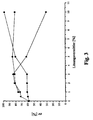
- Example 6 was repeated except that S. antibioticus Tü4 was used as a microorganism, and DMSO, DMF and acetone were added in different amounts to the reaction mixtures. The results are in FIG. 3 shown. 10% DMSO, 5% acetone and 1-3% DMF led to an increase in the enantiomeric excess and thus the enantioselectivity.
- Example 7 Hydrolysis of 3-penylethyl glycidate (3-PEG) and n-decane-1,2-oxide by epoxide hydrolase from S. antibioticus Tü4
- Example 5 was repeated, using instead of styrene oxide 3-PEG or n-decane-1,2-oxide as a substrate.
- decane-1,2-diol was derivatized with acetone and p-toluenesulfonic acid as a catalyst in ethyl acetate.
- Isopropylidene-decane-1,2-diol was analyzed at 120 ° C under the conditions given in Example 5.
Landscapes
- Chemical & Material Sciences (AREA)
- Organic Chemistry (AREA)
- Life Sciences & Earth Sciences (AREA)
- Zoology (AREA)
- Wood Science & Technology (AREA)
- Engineering & Computer Science (AREA)
- Health & Medical Sciences (AREA)
- Genetics & Genomics (AREA)
- Bioinformatics & Cheminformatics (AREA)
- Microbiology (AREA)
- Biochemistry (AREA)
- General Health & Medical Sciences (AREA)
- General Engineering & Computer Science (AREA)
- Biotechnology (AREA)
- Chemical Kinetics & Catalysis (AREA)
- Proteomics, Peptides & Aminoacids (AREA)
- General Chemical & Material Sciences (AREA)
- Analytical Chemistry (AREA)
- Molecular Biology (AREA)
- Biomedical Technology (AREA)
- Medicinal Chemistry (AREA)
- Physics & Mathematics (AREA)
- Biophysics (AREA)
- Immunology (AREA)
- Enzymes And Modification Thereof (AREA)
- Micro-Organisms Or Cultivation Processes Thereof (AREA)
- Preparation Of Compounds By Using Micro-Organisms (AREA)
- Measuring Or Testing Involving Enzymes Or Micro-Organisms (AREA)
Description
- Die Erfindung betrifft ein neues Verfahren zur enzymatischen Trennung von Epoxid-Enantiomerengemischen, ein neuartiges Nachweisverfahren für Epoxidhydrolaseaktivität, ein Screening-Verfahren zum Nachweis von Epoxidhydrolaseaktivität und die Verwendung von Bakterien der Gattung Streptomyces sp. und der daraus gewonnenen Epoxidhydrolasen zur enantioselektiven Epoxidhydrolyse.
- Die zunehmende Bedeutung enantiomerenreiner Verbindungen vor allem in der pharmazeutischen und der agrochemischen Industrie erfordert einen sicheren und wirtschaftlichen Zugang zu optisch aktiven Substanzen. Für die Darstellung von enantiomerenreinen Diolen und Epoxiden steht eine Reihe von Methoden zur Verfügung:
- Bei der asymmetrischen chemischen Synthese von Epoxiden geht man von einer prochiralen Verbindung aus. Durch Verwendung eines chiralen Reagens, beispielsweise einer chiralen Persäure, eines chiralen Dioxirans bzw. Oxaziridins oder eines chiralen Borats, eines chiralen Auxiliars oder eines chiralen, metallischen oder nicht-metallischen, Katalysators wird ein chirales Epoxid gebildet. Der bekannteste Weg zur Darstellung chiraler Epoxide ist die Sharpless-Epoxidierung von Alkenolen, z.B. von Allylalkoholen, mit Hydroperoxiden in Gegenwart von Übergangsmetallkatalysatoren.
- Auch die Herstellung von enantiomerenreinen Diolen auf biochemischem Weg ist bekannt. Mikroorganismen mit Epoxidhydrolaseaktivität katalysieren die regio- und enantiospezifische Hydrolyse von Epoxiden. Sie spalten die Etherbindung in Epoxiden unter Bildung von Diolen. Es wurden bereits einige Bakterienstämme beschrieben, die es ermöglichen, eine breite Auswahl an racemischen Epoxiden enantioselektiv zu hydrolysieren. Die Zahl der bekannten Epoxidhydrolasen und ihre Anwendung für die organische Synthese ist jedoch bislang begrenzt. Bekannte Stämme mit Epoxidhydrolaseaktivität sind beispielsweise Aspergillus niger LCP521, Bacillus sulfurescens ATCC 7159, Rhodococcus species NCIMB 11216 und andere.
- Die bekannten Stämme mit Epoxidhydrolaseaktivität weisen jedoch oft ein begrenztes Substratspektrum und geringe Reaktionsgeschwindigkeiten auf. Auch sind die mit diesen Stämmen erreichbaren Enantioselektivitäten vielfach zu gering [Grogan, G., et al., FEMS Microbiology Lett. 141 (1996), 239 - 243; Kroutil, W., et al., Tetrahedron Lett. (1996), 8379 - 8382]. Die bekannten Stämme sind genetisch schlecht zugänglich und teilweise schwierig kultivierbar. Deshalb liegen bisher nur zwei Epoxidhydrolasen [Corynebacterium sp. C12, (Misawa, E., et al., Eur. J. Biochem. 253 (1998), 173 - 183) und Agrobacterium radiobacter AD1 (Rink, R., et al., J.Biol.Chem. 272 (1997), 14650 - 14657)] rekombinant in E.coli vor. Auch die Reinigung der aus den Mikroorganismen erhaltenen Epoxidhydrolasen wurde bisher nur bei Rhodococcus species NCIMB 11216 [Faber, K., et al., Biotechnology Lett. 17 (1995), 893 - 898] und Norcardia EH 1 [Kroutil, W., et al J. Biotechnol. 61 (1998), 143 - 150] beschrieben. Sie war in beiden Fällen sehr aufwendig. Die Anreicherung von Epoxidhydrolase aus Corynebacterium sp. C12 wird von Misawa, E., et al., Eur. J. Biochem. 253,(1998) 173-183 beschrieben.
- Zusätzlich erschwert wird die Suche nach neuen epoxidhydrolase-haltigen Mikroorganismen dadurch, daß das Screening, d.h. die systematische Suche, nach neuen Epoxidhydrolase produzierenden Mikroorganismen, z.B. in mikrobiologischen Stammsammlungen, bisher sehr zeitaufwendig war. Dies liegt daran, daß zum Screening üblicherweise Verfahren eingesetzt werden, bei denen die einzelnen Ansätze aufgearbeitet und einzeln gas- bzw. flüssigkeitschromatographisch untersucht werden müssen.
- Eine erste Aufgabe der Erfindung war es daher, neue Epoxidhydrolasen mit erweitertem Substratspektrum und/oder verbesserter Reaktivität und/oder verbesserter Enantioselektivität bereitzustellen. Außerdem sollten die neuen Epoxidhydrolasen insbesondere dadurch besser zugänglich sein, daß sie aus nicht-pathogenen, leicht kultivierbaren Organismen isolierbar sind und außerdem gegebenenfalls eine gute molekularbiologische Zugänglichkeit aufweisen.
- Eine zweite Aufgabe der Erfindung war die Bereitstellung eines Verfahrens zum schnelleren und einfacheren Nachweis von Epoxidhydrolase, was auch ein verbessertes Screening auf Epoxidhydrolase produzierende Mikroorganismen ermöglichen sollte.
- Eine dritte Aufgabe der Erfindung war die Bereitstellung eines verbesserten biochemischen Verfahrens zur Trennung von Epoxid-Enantiomerengemischen und damit eines verbesserten Verfahrens zur enantioselektiven Umsetzung von Epoxiden, das einen einfacheren Zugang zur enantiomerenreinen Diolen und/oder Epoxiden ermöglicht.
- Eine vierte Aufgabe der Erfindung bestand darin, neue Epoxidhydrolase produzierende Mikroorganismen bereitzustellen.
- Die vorliegende Erfindung basiert unter anderen auf der Verwendung von Epoxidhydrolasen (E.C. 3.3.2.3) aus Mikroorganismen der Gattung Streptomyces sp. Epoxidhydrolase-Aktivität wurde in Mikroorganismen dieser Gattung bisher nicht beschrieben.
- Die erfindungsgemäß Verwendeten Epoxidhydrolasen besitzen wenigstens eine der folgenden vorteilhaften Eigenschaften im Vergleich zu bisher bekannten Epoxidhydrolasen:
- verbesserte Enantioselektivität bei der Spaltung von enantiomerer Epoxide;
- verbessertes (erweitertes) Substratspektrum;
- verbesserte Reaktivität;
- bessere molekularbiologische Zugänglichkeit;
- bessere biochemische Zugänglichkeit aufgrund leichterer Kultivierbarkeit der Mikroorganismen.
- Eine "verbesserte Enantioselektivität" im Sinne der Erfindung ist gegeben, wenn bei im wesentlichen gleichem Umsatz ein höherer Enantiomerenüberschuß erzielbar ist.
- Ein "erweitertes Substratspektrum" in Sinne der Erfindung bedeutet, daß racemische Gemische mehrerer Epoxide umgesetzt werden.
- Eine "verbesserte Reaktivität" im Sinne der Erfindung bedeutet, daß die Umsetzung mit höherer Raum-Zeit-Ausbeute erfolgt.
- Die Erfindung basiert insbesondere auf solchen Epoxidhydrolasen aus Streptomyces, die wenigstens eine der folgenden Eigenschaften aufweisen:
- a) hydrolytische Epoxidspaltung eines Styroloxids, wie z.B. Styroloxid oder eines am Phenylring oder Epoxidring ein- oder mehrfach substituierten Derivats davon, wie insbesondere einem in meta- oder para-Stellung durch Nitro oder Halogen, insbesondere Chlor oder Brom, monosubstituierten Styroloxids, und wenigstens einer weiteren Verbindung ausgewählt unter 3-Phenyl-ethylglycidat, n-Hexan-1,2-oxid, n-Decan-1,2-oxid und Indenoxid, welche gegebenenfalls ein- oder mehrfach durch Substituenten, vorzugsweise gemäß obiger Definition, substituiert sein können;
- b) Umsetzung eines Racemats von Styroloxid mit einer Enantioselktivität E ≥ 2, wie z.B. ≥ 10, wie etwa 10 bis 100, zu (S)-Phenyl-1,2-ethanol gemäß der im folgenden angegebenen Reaktionsgleichung (A), wobei diese Umsetzung mit ganzen Zellen oder einem Zellhomogenat oder einem angereicherten oder gereinigten Enzympräparat durchführbar ist und bevorzugt in Gegenwart eines Cosolvens, wie 5 bis 10% (v/v) DMSO erfolgt.
- Gemäß einer bevorzugten Ausführungsform werden Epoxidhydrolasen eingesetzt, welche aus Bakterien der Gattung Streptomyces sp., insbesondere aus der Art S. griseus, S. thermovulgaris, S. antibioticus, S. arenae und S. fradiae, vorzugsweise aus den Stämmen Streptomyces griseus (DSM 40236 und DSM 13447), Streptomyces thermovulgaris (DSM 40444 und DSM 13448), Steptomyces arenae Tü 495 (DSM 40737 und DSM 12134) Streptomyces antibioticus Tü 4 (DSM 12925) oder Streptomyces fradiae Tü 27 (DSM 12131) isolierbar sind.
- Besonders bevorzugt ist die aus Streptomyces antibioticus Tü 4 (DSM 12925) isolierbare Epoxidhydrolase. Dieses Enzym ist durch seine ausgeprägte Enantioselektivität bei der Umsetzung von (R/S)-Styroloxid (I) gemäß folgender Reaktionsgleichung (A)

- Die Isolierung des Enzyms wird in den Ausführungsbeispielen näher beschrieben. Soweit keine näheren Angaben gemacht werden, erfolgt die Enzym-Anreicherung mit Hilfe biochemischer Standardverfahren, wie z.B. beschrieben von T.G. Cooper in Biochemische Arbeitsmethoden, Verlag Walter de Gruyter, Berlin, New York, (1981). Beispielsweise eignen sich Reinigungsverfahren, wie Fällung, z. B. mit Ammoniumsulfat, Ionenaustauschchromatographie, Gelchromatographie, Affinitätschromatographie, z. B. Immunoaffinitätschromatographie und isoelektrische Fokussierung, sowie Kombinationen solcher Verfahren.
- Die Erfindung basiert auch auf der Verwendung des Streptomyces-Stamms mit der Bezeichnung Streptomyces antibioticus Tü 4, hinterlegt bei der DSMZ unter der Hinterlegungsnummer DSM 12925 und Varianten und Mutanten dieses Stammes.
- Gegenstand der Erfindung sind ebenfalls die Verwendung funktionaler Analoga der oben erwähnten Enzyme, wie Varianten, Allele und Mutanten, welche Epoxydhydrolase-Aktivität besitzen und, vorzugsweise, wenigstens eine der obengenannten vorteilhaften Eigenschaften aufweisen.
- Obige zweite Aufgabe konnte überraschenderweise gelöst werden durch Bereitstellung eines optischen Nachweisverfahrens für Epoxidhydrolase, wobei man
- a) einen Analyten, z.B. eine Mikroorganismenkultur, in welchen man Epoxidhydrolaseaktivität vermutet, mit einem epoxidhaltigen Substrat für die Epoxidhydrolase unter Reaktionsbedingungen inkubiert;
- b) nicht umgesetztes Epoxid mit 4-Nitrobenzylpyridin (NBP) unter Bildung eines bei 560nm absorbierenden Farbstoffs chemisch umsetzt; und
- c) den Ansatz aus Schritt b) auf Abnahme der Farbstoffkonzentration, relativ zu einem Epoxidhydrolase-freien Kontrollansatz analysiert.
- Das erfindungsgemäße Nachweisverfahren ist qualitativ, z.B. als Spottest, oder quantitativ durchführbar. Beim quantitativen Verfahren bestimmt man zunächst quantitativ die relative Abnahme der Farbstoffkonzentration, z.B. photometrisch durch Bestimmung der Absorption bei 560 nm, und ermittelt daraus die Epoxidhydrolaseaktiviät im Analyten.
- Als Analyt sind grundsätzlich geeignet Mikroorganismen per se, wie z.B. Proben aus einer frisch gezogenen Kultur eines Bakteriums, Zellhomogenisate davon oder Fraktionen dieser Zellhomogenisate nach einer Aufreinigung. Vorzugsweise wird der Test mit ganzen Zellen oder nach Aufschluß der Zellen, z.B. mit Ultraschall oder Lysozym, durchgeführt.
- Beispielsweise ist das Verfahren anwendbar auf den Nachweis von Epoxidhydrolase in Bakterien aus der Gattung Streptomyces.
- Vorzugsweise wird das Nachweisverfahren so durchgeführt, daß man einer frisch gezogenen Kultur des Mikroorganismus eine Probe entnimmt, diese aufschließt, von Zellfragmenten befreit und mit einem Epoxid, welches ein Substrat für das zu testende Enzym unfasst, zugibt und mischt. Erforderlichenfalls kann man in dem Ansatz die Reaktionsbedingungen durch übliche Maßnahmen, wie z.B. durch Zugabe von Puffer, Einstellen der Reaktionstemperatur und dergleichen, optimieren. Bevorzugt verwendet man zur Verbesserung der Löslichkeit des Epoxids im wässerigen Reaktionsmedium ein Cosolvens. Geeignete Cosolventien sind z.B. Dimethylsulfoxid (DMSO), Dimethylformamid (DMF), Ethanol oder Aceton. Optimale Reaktionsbedingungen für Epoxidhydrolasen aus Streptomyces umfassen:
Reaktionsmedium: Natriumphosphatpuffer pH 8,0, 0,1 M, 10% (v/v) DMSO pH-Bereich: 6-8 Temperatur: 30-37 °C Reaktionsdauer: 2-20 Stunden Substratkonzentration: 0,1 bis 0,8 molar - Vorzugsweise verwendet man als Substrat Styroloxid, 3-Phenylglycidat, Hexan-1,2-oxid, Decan-1,2-oxid und/oder Indenoxid in enantiomerenreiner Form oder als Enantiomerengemisch.
- Zur Entwicklung der Farbreaktion wird anschließend der pH-Wert durch Zugabe einer Base, wie z.B. Triethylamin, eingestellt. Anschließend gibt man NBP, z.B. in einer Konzentration im Bereich von etwa 3 bis 10 , vorzugsweise etwa 5 % (w/v) in Methoxyethanol, hinzu. Als Lösungsvermittler für den gebildeten Farbstoff gibt man z.B. Triethylenglycoldimethylether in ausreichender Menge hinzu. Den Ansatz inkubiert man schließlich bei etwa 35 bis 45, vorzugsweise 39°C und bestimmt anschließend die Absorption bei 560 nm, vorzugsweise gegen eine Referenz bei 650 nm. Aus einem Vergleich mit einem enzymfreien Kontrollansatz kann man die Abnahme der Absorption und damit die Abnahme von Epoxid quantitativ bestimmen.
- Gegenstand der Erfindung sind auch Screening-Verfahren zum Nachweis von Mikroorganismen mit Epoxidhydrolaseaktivität und/oder mit der Befähigung zur enantioselektiven Hydrolyse von Epoxiden, umfassend das oben beschriebene Nachweisverfahren. Dieses eignet sich besonders zur systematischen Untersuchung von Stammsammlungen oder durch sog. "directed evolution" erzeugte Mutantenbanken auf Epoxidhydrolaseaktivität.
- Obige dritte Aufgabe konnte überraschenderweise gelöst werden durch Bereitstellung eines Verfahrens zur Trennung von Epoxid-Enantiomerengemischen, das dadurch gekennzeichnet ist, daß man
- a) ein Epoxid-Enantiomerengemisch, welches ein Epoxydhydrolase-Substrat umfasst, mit einer erfindungsgemäßen Epoxydhydrolase, einem Mikroorganismus der Gattung Streptomyces sp., einem Epoxidhydrolase-haltigen Homogenat davon oder einer Fraktion dieses Homogenates unter Reaktionsbedingungen inkubiert;
- b) das Enantiomerengemisch, vorzugsweise bis zum Erreichen von 50 %-igem Umsatz, umsetzt; und
- c) das im Reaktionsgemisch verbleibende Enantiomer vom Umsetzungsprodukt trennt und das im wesentlichen enantiomerenreine umsetzungsprodukt und/oder das verbleibende im wesentlichen enantiomerenreine Edukt reinigt.
- Vorzugsweise setzt man Enantiomerengemische eines der folgenden Epoxide um: Styroloxid, 3-Phenylglycidat, He-xan-1,2-oxid, Decan-1,2-oxid und Indenoxid oder substituierte Analoga dieser Oxide gemäß obiger Definition.
- Ein weiterer Gegenstand der Erfindung betrifft ein Verfahren zur Gewinnung von Epoxydhydrolasen (E.C. 3.3.2.3), dadurch gekennzeichnet, daß man
- a) aus einer Kultur eines Mikroorganismus der Gattung Streptomyces sp. ein Zellhomogenat herstellt;
- b) das Homogenat fraktioniert, wobei man die erhaltenen Fraktionen auf Epoxidhydrolase-Aktivität, vorzugsweise unter Anwendung eine Nachweisverfahren basierend auf der Farbreaktion von unumgesetztem Epoxid mit NBP gemäß obiger Definition, testet; und
- c) Fraktionen mit Epoxidhydrolase-Aktivität vereinigt und gegebenenfalls weiter fraktioniert.
- Ein letzter Gegenstand der Erfindung betrifft die Verwendung einer erfindungsgemäßen Epoxidhydrolase, eines Mikroorganismus der Gattung Streptomyces sp., eines Epoxidhydrolase-haltigen Homogenates davon oder einer Fraktion dieses Homogenates zur enantioselektiven Hydrolyse von Epoxiden.
- Die Erfindung wird durch die nachfolgenden Beispiele und unter Bezugnahme auf die beiliegenden Figuren näher erläutert. Dabei zeigt:
- Figur 1
- Meßergebnisse für die Farbstoffbildung aus NBP und Epoxid bei verschiedenen Styroloxidkonzentrationen. Aufgetragen ist die Absorptionsänderung in Ansätzen in Gegenwart von E. coli DH5a nach dem NBP-Assay (schwarze Kreise), ohne E. coli DH5a-Zelle und ohne NBP (schwarze Quadrate) und mit Zelllysat von E. coli DH5a nach NBP-Assay (schwarze Dreiecke), jeweils nach 45 Minuten bei den angegebenen Styroloxidkonzentrationen.
- Figur 2
- den zeitlichen Verlauf der Racematspaltung von Styroloxid durch die Epoxidhydrolase aus S. antibioticus Tü4 (DSM 12925). ee[%] (R)-Styroloxid (schwarze Quadrate); ee[%] (S)-Phenyl-1,2-ethandiol (schwarze Krei-se); Umsatz[%] (schwarze Dreiecke);
- Figur 3
- den Einfluß verschiedener Cosolventien auf die Hydrolyse von Styroloxid durch Epoxidhydrolase aus S. antibioticus Tü4 (DSM 12925); aufgetragen ist ee[%] (R)-Styroloxid in Abhängigkeit von der Cosolvenskonzentration (%(v/v)); Aceton (schwarze Quadrate); DMSO (schwarze Kreise); DMF (schwarze Dreiecke).
- Ein Epoxidhydrolase-freier Organismen (E. coli DH5a) wurden in 2 ml Kulturen kultiviert und aufgeschlossen. Jeweils 100 µl der erhaltenen Zellaufschlüsse wurden auf 4 Vertiefungen einer Mikrotiterplatte verteilt. Zu dem Zellaufschluß wurden 50 µl Aceton mit verschiedenen Styroloxidmengen (1,3 mol/l (Stammlösung), 0,65 mol/l, 0,32 mol/l, 0,16 mol/l, 0,08 mol/l) hinzugegeben. Die Lösung wurde 2 Stunden bei 30°C inkubiert. Nach Zugabe von 25 µl Triethylamin (TE), 50 µl p-Nitrobenzylpyridin (NBP, 5 Vol.-%) und 50 µl Triethylenglykoldimethylether wurde nochmals 45 Minuten bei 39°C inkubiert und anschließend die Absorption bei 560 nm gegen eine Referenz bei 650 nm gemessen.
- Die Ergebnisse sind in
Figur 1 dargestellt. Die Absorption nahm linear zur eingesetzten Styroloxidmenge zu. Deshalb zeigt die Verringerung der Absorption das Vorhandensein einer Epoxidhydrolaseaktivität an. - Beispiel 1a) wurde mit der Abänderung wiederholt, daß als Substrat 3-Phenylglycidat verwendet wurde. Auch hier fand sich eine Linearität zwischen der Absorption und der verbleibenden Menge an nicht hydrolysiertem Epoxid.
- Beispiel 1a) wurde mit der Abänderung wiederholt, daß als Substrat Hexan-1,2-oxid verwendet wurde. Auch hier fand sich eine Linearität zwischen der Absorption und der verbleibenden Menge an nicht hydrolysiertem Epoxid.
- Beispiel 1a) wurde mit der Abänderung wiederholt, daß als Substrat Indenoxid verwendet wurde. Auch hier fand sich eine Linearität zwischen der Absorption und der verbleibenden Menge an nicht hydrolysiertem Epoxid.
- Analog zu Beispiel 1 wurden verschiedene hinterlegte Streptomyces-Stämme sowie als negative Kontrolle ein Bakterienstamm der Gattung Rhodococcus sp. (NCIMB 11216) getestet. Diejenigen Vertiefungen der Mikrotiterplatte welche die negative Kontrolle enthielten zeigten eine intensive Farbreaktion (Blaufärbung) während in Vertiefungen mit Streptomyces antibioticus Tü4 (DSM 12925) und Streptomyces fradiae Tü27 (DSM 12131) die höchste Epoxidhydrolase-Aktivität nachweisbar war (Ergebnisse nicht gezeigt).
- Die Kultivierungen wurden sowohl in 250 ml Schüttelkolben als auch in einem 30 1 Fermenter durchgeführt, wobei der pH-Wert nicht kontrolliert wurde.
- a) 250 ml Fermentation: Die Kultivierungsdauer betrug im 250 ml Maßstab zwischen 48 und 72 Stunden bei 30°C.
- b) 30 1 Fermentation: 2 Schüttelkolben mit je 1 1 Malzmedium [10 g Malzextrakt, 4 g Hefe, auf 1 1 mit Leitungswasser aufgefüllt und autoklaviert, sterilfiltrierte Glucose (4g/l Endkonzentration) wurde nach dem Autoklavieren hinzugegeben] wurden mit Sporen von Streptomyces antibioticus Tü4 angeimpft; anschließend wurde 48 Stunden geschüttelt (30°C, 210 U/min). Mit 2 1 dieser Vorkultur wurden 20 1 Malzmedium (Zugabe von 0,5 1 20 gew.-%ige Glucoselösung zu 20 1 Malzextrakt/Hefelösung) angeimpft, wobei sich für ein möglichst disperses Wachstum der Kolonie die vorherige Homogenisierung (Glashomogenisator, Braun Chemie) empfiehlt. Es wurde im 30 1-Fermenter bei 30°C 24 Stunden gerührt (17 l/min 02, 200 U/ min), dann wurde die Fermentation abgebrochen. Die Zellen wurden bei 4000 U/min 30 Minuten abzentrifugiert und mit TE-Puffer (pH 7,3, 1 mmol/l EDTA) gewaschen. Die Biofeuchtmasse betrug 318 g. Die Zellen wurden in 400 ml TE-Puffer (pH 7,3, mmol/l EDTA) resuspendiert.
- Für die Versuche mit aufgeschlossenen Zellen wurden die kultivierten Zellen durch Filtration oder Zentrifugation abgetrennt und zweimal mit Phosphatpuffer (0,1 mol/l NaCl, 10 mmol/l EDTA) gewaschen. Anschließend wurde eine Suspension (10% w/v) im gleichen Puffer mit zusätzlich 10 mg/ml Lysozym hergestellt. Die Suspension wurde 1 Stunde bei 30°C inkubiert und anschließend zweimal je 5 Minuten, dazwischen 1 Minute Pause, im Eisbad mit Ultraschall aufgeschlossen (Branson Sonifier W250, Output 80W). Die erhaltene Lösung wurde 60 Minuten bei 32 500 x g abzentrifugiert und filtriert (0,22mm Sterivex-GP Filter, Millipore)
- Eine mit einem Anionenaustauscher gefüllte Säule (Super Q 650M, Toso Haas, 60 ml Volumen) wurde mit 25 ml Tris/HCl-Puffer (pH 8,1) äquilibriert, dann wurden 15 ml des Rohextraktes aufgebracht. Es wurde mit 2 mol/l NaCl-Lösung mit folgenden Gradienten eluiert:
- 1. Gradient: 30 ml NaCl-Lösung (0-12 Gew.-% ),
- 2. Gradient: 60 ml NaCl-Lösung (12 - 35 Gew.-%),
- Spülung mit 25 ml NaCl-Lösung (100 Gew.-%), Reäquilibrierung mit 60 ml Tris/HCl-Puffer.
- Durchlauf: 4 ml/min, Fraktionsgröße 4 ml. Die Proteinbestimmung wurde bei 280 nm durchgeführt.
- Die Aktivität der einzelnen Fraktionen wurde mit dem NBP-Assay untersucht. Hierzu wurden 150 µl aus den Fraktionen in die Vertiefungen einer 96er Mikrotiterplatte gegeben und der NBP-Assay mit dem Biomek 2000 Pipettierroboter wie zuvor beschrieben durchgeführt. Es wurden 50 µl Acetonlösung mit Styroloxid (2,6 mol/l) verwendet, um die Acetonmenge zu verkleinern, da die Zugabe von Aceton in einer relativ zu großen Menge zu einer Verringerung der Enzymaktivität führen kann. Die restliche Versuchsdurchführung erfolgte analog zu der vorstehend beschriebenen Vorgehensweise.
In der Anreicherung konnte in einer Fraktion die gesamte Epoxidhydrolaseaktivität detektiert werden. - Zu 250 ml des Zellaufschlusses aus Beispiel 4 mit 12,5 ml DMSO als Lösungsvermittler wurden 500 µg Styroloxid gegeben. Es wurde bei 30°C und gleichmäßigem Schütteln (250 U/min) inkubiert.
- Nach 24 Stunden wurde die Reaktion durch Zugabe von 30 ml Essigsäureethylester abgebrochen, und die wäßrige Phase wurde extrahiert. Die organische Phase wurde im Vakuum eingeengt. Die gaschromatographische Analyse ergab einen Enantiomerenüberschuß des Substrats von (ees[%]) von 100 und des Produkts (eep[%]) von 14.
- Die Enantiomerenreinheit einer chiralen Substanz, welche in (R)-und in (S)-Form auftritt, wird über den Parameter ee (Enantiomerenüberschuß) ausgedrückt. Dieser ist durch folgende allgemeine Gleichung definiert:

worin XA und XB für den Molenbruch von Enantiomer A bzw. B stehen. - Die Analyse der Enantiomerenüberschüsse erfolgte durch chirale Gaschomatographie unter folgenden Bedingungen: 75°C isotherm, 130 kPa, auf einer FS-Cyclodex β-I/P CS-Fused Silica Kapillarsäule (CS-Chromatographie Service GmbH, Langerwehe) (H2 Trägergas, Split 1:100, 0,25 mm x 50 mm).
- Die Analyse des Produkts Phenyl-1,2-ethandiol erfolgte unter folgenden Bedingungen: 140°C isotherm unter ansonsten gleichen Bedingungen.
- Die Enantioselektivität E einer enzymatischen Reaktion ist eine von Substratkonzentration und Umsatz unabhängige Konstante für ein Enzym und bei irreversibler Reaktion ohne Produktinhibition nach folgender Formel zu berechnen:

- Die Auswertung erfolgte gemäß Chen, C.S., et al., (1982) J.Am.Chem.Soc. 104, 7294.
- Für die Verfolgung des Reaktionsverlaufs wurden 1,5 ml Ansätze des Zellaufschlusses mit 75 ml DMSO und 7 ml Styroloxid in verschraubbaren 2 ml Reaktionsgefäßen bei 30°C geschüttelt und nach vorgegebenen Zeiten mit 300 ml Essigsäureethylester extrahiert. Tabelle 1 zeigt die Ergebnisse.
Tabelle 1: Zeit [h] ees%[%] eep[%] Umsatz [%] 0,5 - - - 1 11 66 15 3,5 23 26 47 5 33 22 59 7 91 21 82 24 100 14 87 - Der zeitliche Verlauf der Reaktion ist in beiliegender
Figur 2 dargestellt. - Ganze Zellen einer 250 ml Kultur des Organismus wurden in 200 ml Natriumphosphatpuffer (0,1 M, pH 8) resuspendiert. Dazu gab man 500 µl Styroloxid und 10% (v/v) DMSO. Der Reaktionsansatz wurde bei 30°C mit 210 Upm in einem geschlossenen Erlenmeyerkolben geschüttelt. Proben (1,5 ml) wurden in verschiedenen Zeitintervallen zur Kontrolle des Reaktionsverlaufs gezogen, bei 14000 Upm 3 Minuten zentrifugiert und mit 300 µl Diethylether extrahiert. Die organischen Phasen wurden mit wasserfreien Natriumsulfat getrocknet und gaschromatographisch zur Bestimmung des Enantiomerenüberschusses, des Umsatzes und der Enantioselektivität wie oben beschrieben analysiert. Die Ergebnisse sind in folgender Tabelle 2 zusammengefaßt:
Tabelle 2: Stamm Enantiomerenüberschuß Umsatz Dauer ees a [%] eep b[%] [%] [h] Tü27 70 23 75 48 Tü495 52 38 60 24 a (R)-Styroloxid
b (S)-Phenyl-1,2-ethandiol - Beispiel 6 wurde wiederholt, wobei jedoch S. antibioticus Tü4 als Mikroorganismus verwendet wurde, und DMSO, DMF bzw. Aceton in verschiedenen Mengen zu den Reaktionsansätzen gegeben wurden. Die Ergebnisse sind in
Figur 3 dargestellt. 10 % DMSO, 5 % Acteon und 1-3 % DMF führten zu einer Zunahme des Enantiomerenüberschusses und damit der Enantioselektivität. - Beispiel 5 wurde wiederholt, wobei anstelle von Styroloxid 3-PEG bzw. n-Decan-1,2-oxid als Substrat eingesetzt wurde.
- Im Unterschied zu Beispiel 5 erfolgte die gaschromatographische Analyse von 3-PEG bei 60kPa, 130°C (60 min), 180°C (5 min), 10 °C/min
- Das gebildete Decan-1,2-diol wurde mit Aceton und p-Toluolsulfonsäure als Katalysator in Ethylacetat derivatisiert. Isopropyliden-decan-1,2-diol wurde bei 120 °C unter den in Beispiel 5 angegebenen Bedingungen analysiert.
Claims (14)
- Verfahren zur Trennung von Epoxid-Enantiomerengemischen, dadurch gekennzeichnet, daß mana) ein Epoxid-Enantiomerengemisch, welches ein Epoxidhydrolase-Substrat umfasst, mit einem eine Epoxidhydrolase (E.C. 3.3.2.3) produzierenden Mikroorganismus der Gattung Streptomyces sp., einem Epoxidhydrolase-haltigen Homogenat davon oder einer Fraktion dieses Homogenates inkubiert;b) das Enantiomerengemisch, vorzugsweise bis zur Einstellung des Reaktionsgleichgewichtes, umsetzt; undc) das Reaktionsgemisch auftrennt.
- Verfahren nach Anspruch 1, dadurch gekennzeichnet, daß man ein Enantiomerengemisch eines Epoxids umsetzt, das ausgewählt ist unter Styroloxiden, 3-Phenylglycidaten, Hexan-1,2-oxiden, Decan-1,2-oxiden und Indenoxiden.
- Verfahren nach Anspruch 1 oder 2, wobei der Mikroorganismus ein Bakterium der Gattung Streptomyces sp., insbesondere aus der Art S. griseus, S. thermovulgaris, S. antibioticus, S. arenae und S. fradiae, vorzugsweise aus den Stämmen Streptomyces griseus (DSM 13447), Streptomyces thermovulgaris (DSM 13448), Streptomyces arenae Tü495 (DSM 12134), Streptomyces antibioticus Tü 4 (DSM 12925) oder Streptomyces fradiae Tü 27 (DSM 12131), ist.
- Verfahren nach einem der Ansprüche 1 bis 3, wobei die Epoxidhydrolase durch wenigstens eine der folgenden Eigenschaften gekennzeichnet ist:a) hydrolytische Epoxidspaltung eines Styroloxids, und wenigstens einer weiteren Verbindung ausgewählt unter 3-Phenyl-ethylglycidaten, n-Hexan-1,2-oxiden, n-Decan-1,2-oxiden und Indenoxiden;b) Umsetzung eines Racemats von Styroloxid mit einer Enantioeselektivität E ≥ 2 zu (S)-Phenyl-1,2-ethanol.
- Nachweisverfahren für Epoxidhydrolase, wobei mana) einen Analyten, in welchen man Epoxidhydrolaseaktivität vermutet, mit einem epoxidhaltigen Substrat für die Epoxidhydrolase unter Reaktionsbedingungen inkubiert, wobei der Analyt ein Bakterium aus der Gattung Streptomyces sp., ein Homogenat davon oder eine Fraktion dieses Homogenates ist;b) mit nicht umgesetztem Epoxid in Anwesenheit von 4-Nitrobenzylpyridin (NBP) eine Farbreaktion durchführt; undc) den Ansatz aus Schritt b) auf Abnahme der Farbstoffkonzentration, relativ zu einem Epoxidhydrolase-freien Kontrollansatz analysiert.
- Verfahren nach Anspruch 5, dadurch gekennzeichnet, daß man die relative Abnahme der Farbstoffkonzentration quantitativ bestimmt und daraus die Epoxidhydrolaseaktiviät im Analyten ermittelt.
- Verfahren nach einem der Ansprüche 5 und 6, dadurch gekennzeichnet, daß das epoxidhaltige Substrat Styroloxid, 3-Phenylglycidat, Hexan-1,2-oxid und/oder Indenoxid in enantiomerenreiner Form oder ein Enantiomerengemisch davon ist.
- Screening-Verfahren zum Nachweis von Mikroorganismen mit Epoxidhydrolaseaktivität und/oder mit der Befähigung zur enantioselektiven Hydrolyse von Epoxiden, umfassend ein Nachweisverfahren nach einem der Ansprüche 5 bis 7.
- Verwendung eines Mikroorganismus der Gattung Streptomyces sp., eines Epoxidhydrolase-haltigen Homogenates davon oder einer Fraktion dieses Homogenates zur enantioselektiven Hydrolyse von Epoxiden.
- Verwendung eines Mikroorganismus der Gattung Streptomyces sp., eines Epoxidhydrolase-haltigen Homogenates davon oder einer Fraktion dieses Homogenates zur enantioselektiven Herstellung von Hydroxiden aus den korrespondierenden Epoxiden.
- Verfahren zur Gewinnung einer Epoxydhydrolase (E.C. 3.3.2.3) enthaltenden Proteinfraktion, dadurch gekennzeichnet, daß mana) aus einer Kultur eines Mikroorganismus der Gattung Streptomyces sp. ein Zellhomogenat herstellt;b) das Homogenat fraktioniert, wobei man die erhaltenen Fraktionen auf Epoxidhydrolase-Aktivität, gegebenenfalls unter Anwendung eines Nachweisverfahrens gemäß einem der Ansprüche 5 bis 7, testet; undc) Fraktionen mit Epoxidhydrolase-Aktivität vereinigt und gegebenenfalls weiter fraktioniert.
- Verwendung eines Mikroorganismus der Gattung Streptomyces sp. zur Gewinnung einer Epoxidhydrolase (E.C. 3.3.2.3).
- Verwendung nach Anspruch 12, wobei die Epoxidhydrolase durch wenigstens eine der folgenden Eigenschaften gekennzeichnet ist:a) hydrolytische Epoxidspaltung eines Styroloxids, und wenigstens einer weiteren Verbindung ausgewählt unter 3-Phenyl-ethylglycidaten, n-Hexan-1,2-oxiden, n-Decan-1,2-oxiden und Indenoxiden;b) Umsetzung eines Racemats von Styroloxid mit einer Enantioeselektivität E ≥ 2 zu (S)-Phenyl-1,2-ethanol.
- Verwendung nach Anspruch 12 oder 13, wobei die Epoxidhydrolase aus Bakterien der Gattung Streptomyces sp., insbesondere aus der Art S. griseus, S. thermovulgaris, S. antibioticus, S. arenae und S. fradiae, vorzugsweise aus den Stämmen Streptomyces griseus (DSM 13447), Streptomyces thermovulgaris (DSM 13448), Streptomyces arenae Tü495 (DSM 12134) Streptomyces antibioticus Tü 4 (DSM 12925) oder Streptomyces fradiae Tü 27 (DSM 12131), gewonnen wird.
Applications Claiming Priority (3)
| Application Number | Priority Date | Filing Date | Title |
|---|---|---|---|
| DE19935113 | 1999-07-27 | ||
| DE19935113A DE19935113A1 (de) | 1999-07-27 | 1999-07-27 | Epoxidhydrolasen aus Streptomyces |
| PCT/EP2000/007211 WO2001007623A1 (de) | 1999-07-27 | 2000-07-26 | Epoxidhydrolasen aus streptomyces |
Publications (2)
| Publication Number | Publication Date |
|---|---|
| EP1196590A1 EP1196590A1 (de) | 2002-04-17 |
| EP1196590B1 true EP1196590B1 (de) | 2008-07-09 |
Family
ID=7916140
Family Applications (1)
| Application Number | Title | Priority Date | Filing Date |
|---|---|---|---|
| EP00945955A Expired - Lifetime EP1196590B1 (de) | 1999-07-27 | 2000-07-26 | Verfahren zur trennung von epoxid-enantiomergemischen mittels epoxidhydrolaseproduzierenden mikroorganismen |
Country Status (11)
| Country | Link |
|---|---|
| US (1) | US6828115B1 (de) |
| EP (1) | EP1196590B1 (de) |
| JP (1) | JP2003505086A (de) |
| CN (2) | CN1376199A (de) |
| AT (1) | ATE400657T1 (de) |
| AU (1) | AU783236B2 (de) |
| CA (1) | CA2380185C (de) |
| DE (2) | DE19935113A1 (de) |
| ES (1) | ES2306663T3 (de) |
| NO (1) | NO20020379L (de) |
| WO (1) | WO2001007623A1 (de) |
Families Citing this family (8)
| Publication number | Priority date | Publication date | Assignee | Title |
|---|---|---|---|---|
| CA2456229A1 (en) | 2001-08-03 | 2003-02-13 | Diversa Corporation | Epoxide hydrolases, nucleic acids encoding them and methods for making and using them |
| US6943001B2 (en) | 2001-08-03 | 2005-09-13 | Diversa Corporation | Epoxide hydrolases, nucleic acids encoding them and methods for making and using them |
| CN101140235B (zh) * | 2007-09-06 | 2010-05-26 | 浙江工业大学 | 一种环氧化物水解酶产生菌的荧光检测方法 |
| EP2748303B1 (de) | 2011-08-26 | 2018-10-03 | Council Of Scientific & Industrial Research | Achromobacter sp. mtcc 5605 und daraus isolierte hoch enantioselektive epoxidhydrolase |
| BR102016026341A2 (pt) * | 2016-11-10 | 2018-05-29 | Universidade Estadual De Campinas - Unicamp | Vetor, micro-organismo recombinante, método de obtenção de enzima epóxido-hidrolase recombinante, enzima epôxido- hidrolase recombinante e uso da mesma |
| CN108588051A (zh) * | 2018-05-10 | 2018-09-28 | 浙江海洋大学 | 一种用于制备手性苯基乙二醇的环氧化物水解酶的制备方法 |
| EP3877519B1 (de) | 2018-11-09 | 2026-03-11 | Ginkgo Bioworks, Inc. | Biosynthese von mogrosiden |
| CN112592847B (zh) * | 2020-12-09 | 2021-12-17 | 陕西省微生物研究所 | 沙场链霉菌及其生防菌剂的制备方法与应用 |
Family Cites Families (1)
| Publication number | Priority date | Publication date | Assignee | Title |
|---|---|---|---|---|
| EP0879890A1 (de) * | 1997-05-21 | 1998-11-25 | Rijksuniversiteit te Groningen | Enantioselektive Epoxid-Hydrolasen und dafür kodierende Gene |
-
1999
- 1999-07-27 DE DE19935113A patent/DE19935113A1/de not_active Withdrawn
-
2000
- 2000-07-26 CN CN00813375A patent/CN1376199A/zh active Pending
- 2000-07-26 ES ES00945955T patent/ES2306663T3/es not_active Expired - Lifetime
- 2000-07-26 EP EP00945955A patent/EP1196590B1/de not_active Expired - Lifetime
- 2000-07-26 US US10/031,702 patent/US6828115B1/en not_active Expired - Lifetime
- 2000-07-26 CA CA2380185A patent/CA2380185C/en not_active Expired - Lifetime
- 2000-07-26 DE DE50015259T patent/DE50015259D1/de not_active Expired - Lifetime
- 2000-07-26 WO PCT/EP2000/007211 patent/WO2001007623A1/de not_active Ceased
- 2000-07-26 AU AU59871/00A patent/AU783236B2/en not_active Ceased
- 2000-07-26 CN CNA2008102136405A patent/CN101363015A/zh active Pending
- 2000-07-26 JP JP2001512890A patent/JP2003505086A/ja active Pending
- 2000-07-26 AT AT00945955T patent/ATE400657T1/de not_active IP Right Cessation
-
2002
- 2002-01-24 NO NO20020379A patent/NO20020379L/no not_active Application Discontinuation
Also Published As
| Publication number | Publication date |
|---|---|
| CA2380185C (en) | 2011-09-13 |
| EP1196590A1 (de) | 2002-04-17 |
| CN101363015A (zh) | 2009-02-11 |
| DE50015259D1 (de) | 2008-08-21 |
| ES2306663T3 (es) | 2008-11-16 |
| CA2380185A1 (en) | 2001-02-01 |
| US6828115B1 (en) | 2004-12-07 |
| AU5987100A (en) | 2001-02-13 |
| WO2001007623A1 (de) | 2001-02-01 |
| NO20020379L (no) | 2002-03-19 |
| NO20020379D0 (no) | 2002-01-24 |
| CN1376199A (zh) | 2002-10-23 |
| ATE400657T1 (de) | 2008-07-15 |
| DE19935113A1 (de) | 2001-02-01 |
| AU783236B2 (en) | 2005-10-06 |
| JP2003505086A (ja) | 2003-02-12 |
Similar Documents
| Publication | Publication Date | Title |
|---|---|---|
| DE69815038T2 (de) | Universales testsystem und verfahren zu seiner verwendung zur identifizierung diverse familien von mikroorganismen | |
| DE69519760T2 (de) | Fructosyl-Aminosäureoxidase und Verfahren zu deren Herstellung | |
| EP0599159B1 (de) | Heterogenes Proteingemisch mit alpha-L-rhamnosidase Aktivität, Verfahren zu ihrer Herstellung und ihre Verwendung. | |
| EP1196590A1 (de) | Epoxidhydrolasen aus streptomyces | |
| EP0164573B1 (de) | Verfahren zur Herstellung von Cyclopropancarbonsäuren | |
| DE69120489T2 (de) | Hochsensitives Testverfahren für Myo-Inositol und Komposition zur Ausführung davon | |
| DE69710744T2 (de) | Verfahren zur biotransformation von colchicinoid-verbindungen in die entsprechenden 3-glycosylderivate | |
| DE69735015T2 (de) | Neue Creatin-amidinohydrolase, ihre Herstellung und Verwendung | |
| DE4445084A1 (de) | Neue Kreatinamidinohydrolase und Verfahren zu ihrer Herstellung | |
| JPH05227953A (ja) | カンジダ感染の検出方法 | |
| EP0431548B1 (de) | Fructose-1,6-bisphosphat-Aldolase, Verfahren zur Herstellung derselben und deren Verwendung | |
| DE3850589T2 (de) | Cytochrom-P-450-Enzyme. | |
| EP1067195A2 (de) | Verfahren zur Reduktion von Ketogruppen enthaltende Verbindungen | |
| EP0291055A2 (de) | Stabile Creatinamidinohydrolase-Mutanten | |
| DE69814067T2 (de) | Dna, welche für eine chitin-synthase aus arthropoden kodiert | |
| EP0474116B1 (de) | Stabile 6-Phosphogluconolactonase, Verfahren zu deren Gewinnung sowie Verwendung des Enzyms | |
| JPH07274978A (ja) | 紅麹色素の製造方法 | |
| EP1244791B1 (de) | Verfahren zur herstellung von 6-o-alpha-d-glucopyranosyl-d-sorbit | |
| Zarevúcka et al. | Enzymic synthesis and hydrolytic resolution of alkyl β-d-glucopyranosides | |
| DE69620954T2 (de) | Verfahren zur Herstellung von Derivaten des Dimethylolcarbonsäure | |
| JPH0789914B2 (ja) | エンド型糖脂質分解酵素 | |
| EP0609244B1 (de) | Verfahren zur herstellung von halogenierten hydroxyphenylessigsäuren | |
| EP0217840A1 (de) | Verfahren zur herstellung von 1-methyl-1,4-androstadien-3,17-dion. | |
| RU2041948C1 (ru) | СПОСОБ ПОЛУЧЕНИЯ КОМПЛЕКСНОГО ФЕРМЕНТНОГО ПРЕПАРАТА, СОДЕРЖАЩЕГО β -1,3-ГЛЮКАНАЗУ И ХИТИНАЗУ | |
| DE10155764A1 (de) | Neue Sulfatasen und ihre Verwendung |
Legal Events
| Date | Code | Title | Description |
|---|---|---|---|
| PUAI | Public reference made under article 153(3) epc to a published international application that has entered the european phase |
Free format text: ORIGINAL CODE: 0009012 |
|
| 17P | Request for examination filed |
Effective date: 20020125 |
|
| AK | Designated contracting states |
Kind code of ref document: A1 Designated state(s): AT BE CH CY DE DK ES FI FR GB GR IE IT LI LU MC NL PT SE |
|
| 17Q | First examination report despatched |
Effective date: 20040408 |
|
| RTI1 | Title (correction) |
Free format text: PROCESS OF SEPARATION OF EPOXIDE-ENANTIOMER MIXTURES BY EPOXIDE-HYDROLASE PRODUCING MICROORGANISMS |
|
| GRAP | Despatch of communication of intention to grant a patent |
Free format text: ORIGINAL CODE: EPIDOSNIGR1 |
|
| RTI1 | Title (correction) |
Free format text: PROCESS OF SEPARATION OF EPOXIDE-ENANTIOMER MIXTURES BY EPOXIDE-HYDROLASE PRODUCING MICROORGANISMS |
|
| RAP1 | Party data changed (applicant data changed or rights of an application transferred) |
Owner name: BASF SE |
|
| GRAS | Grant fee paid |
Free format text: ORIGINAL CODE: EPIDOSNIGR3 |
|
| GRAA | (expected) grant |
Free format text: ORIGINAL CODE: 0009210 |
|
| AK | Designated contracting states |
Kind code of ref document: B1 Designated state(s): AT BE CH CY DE DK ES FI FR GB GR IE IT LI LU MC NL PT SE |
|
| REG | Reference to a national code |
Ref country code: GB Ref legal event code: FG4D Free format text: NOT ENGLISH |
|
| REG | Reference to a national code |
Ref country code: CH Ref legal event code: EP |
|
| REF | Corresponds to: |
Ref document number: 50015259 Country of ref document: DE Date of ref document: 20080821 Kind code of ref document: P |
|
| REG | Reference to a national code |
Ref country code: IE Ref legal event code: FG4D Free format text: LANGUAGE OF EP DOCUMENT: GERMAN |
|
| REG | Reference to a national code |
Ref country code: ES Ref legal event code: FG2A Ref document number: 2306663 Country of ref document: ES Kind code of ref document: T3 |
|
| NLV1 | Nl: lapsed or annulled due to failure to fulfill the requirements of art. 29p and 29m of the patents act | ||
| PG25 | Lapsed in a contracting state [announced via postgrant information from national office to epo] |
Ref country code: NL Free format text: LAPSE BECAUSE OF FAILURE TO SUBMIT A TRANSLATION OF THE DESCRIPTION OR TO PAY THE FEE WITHIN THE PRESCRIBED TIME-LIMIT Effective date: 20080709 Ref country code: PT Free format text: LAPSE BECAUSE OF FAILURE TO SUBMIT A TRANSLATION OF THE DESCRIPTION OR TO PAY THE FEE WITHIN THE PRESCRIBED TIME-LIMIT Effective date: 20081209 |
|
| PG25 | Lapsed in a contracting state [announced via postgrant information from national office to epo] |
Ref country code: FI Free format text: LAPSE BECAUSE OF FAILURE TO SUBMIT A TRANSLATION OF THE DESCRIPTION OR TO PAY THE FEE WITHIN THE PRESCRIBED TIME-LIMIT Effective date: 20080709 |
|
| REG | Reference to a national code |
Ref country code: IE Ref legal event code: FD4D |
|
| PG25 | Lapsed in a contracting state [announced via postgrant information from national office to epo] |
Ref country code: MC Free format text: LAPSE BECAUSE OF NON-PAYMENT OF DUE FEES Effective date: 20080731 |
|
| PG25 | Lapsed in a contracting state [announced via postgrant information from national office to epo] |
Ref country code: IE Free format text: LAPSE BECAUSE OF FAILURE TO SUBMIT A TRANSLATION OF THE DESCRIPTION OR TO PAY THE FEE WITHIN THE PRESCRIBED TIME-LIMIT Effective date: 20080709 Ref country code: DK Free format text: LAPSE BECAUSE OF FAILURE TO SUBMIT A TRANSLATION OF THE DESCRIPTION OR TO PAY THE FEE WITHIN THE PRESCRIBED TIME-LIMIT Effective date: 20080709 |
|
| PLBE | No opposition filed within time limit |
Free format text: ORIGINAL CODE: 0009261 |
|
| STAA | Information on the status of an ep patent application or granted ep patent |
Free format text: STATUS: NO OPPOSITION FILED WITHIN TIME LIMIT |
|
| 26N | No opposition filed |
Effective date: 20090414 |
|
| PG25 | Lapsed in a contracting state [announced via postgrant information from national office to epo] |
Ref country code: AT Free format text: LAPSE BECAUSE OF NON-PAYMENT OF DUE FEES Effective date: 20080726 |
|
| PG25 | Lapsed in a contracting state [announced via postgrant information from national office to epo] |
Ref country code: SE Free format text: LAPSE BECAUSE OF FAILURE TO SUBMIT A TRANSLATION OF THE DESCRIPTION OR TO PAY THE FEE WITHIN THE PRESCRIBED TIME-LIMIT Effective date: 20081009 |
|
| PG25 | Lapsed in a contracting state [announced via postgrant information from national office to epo] |
Ref country code: LU Free format text: LAPSE BECAUSE OF NON-PAYMENT OF DUE FEES Effective date: 20080726 Ref country code: BE Free format text: LAPSE BECAUSE OF NON-PAYMENT OF DUE FEES Effective date: 20080731 Ref country code: CY Free format text: LAPSE BECAUSE OF FAILURE TO SUBMIT A TRANSLATION OF THE DESCRIPTION OR TO PAY THE FEE WITHIN THE PRESCRIBED TIME-LIMIT Effective date: 20080709 |
|
| PG25 | Lapsed in a contracting state [announced via postgrant information from national office to epo] |
Ref country code: GR Free format text: LAPSE BECAUSE OF FAILURE TO SUBMIT A TRANSLATION OF THE DESCRIPTION OR TO PAY THE FEE WITHIN THE PRESCRIBED TIME-LIMIT Effective date: 20081010 |
|
| REG | Reference to a national code |
Ref country code: FR Ref legal event code: PLFP Year of fee payment: 17 |
|
| REG | Reference to a national code |
Ref country code: FR Ref legal event code: PLFP Year of fee payment: 18 |
|
| REG | Reference to a national code |
Ref country code: FR Ref legal event code: PLFP Year of fee payment: 19 |
|
| PGFP | Annual fee paid to national office [announced via postgrant information from national office to epo] |
Ref country code: FR Payment date: 20180726 Year of fee payment: 19 Ref country code: ES Payment date: 20180828 Year of fee payment: 19 Ref country code: IT Payment date: 20180725 Year of fee payment: 19 |
|
| PGFP | Annual fee paid to national office [announced via postgrant information from national office to epo] |
Ref country code: CH Payment date: 20180726 Year of fee payment: 19 Ref country code: GB Payment date: 20180731 Year of fee payment: 19 |
|
| PGFP | Annual fee paid to national office [announced via postgrant information from national office to epo] |
Ref country code: DE Payment date: 20180928 Year of fee payment: 19 |
|
| REG | Reference to a national code |
Ref country code: DE Ref legal event code: R119 Ref document number: 50015259 Country of ref document: DE |
|
| REG | Reference to a national code |
Ref country code: CH Ref legal event code: PL |
|
| GBPC | Gb: european patent ceased through non-payment of renewal fee |
Effective date: 20190726 |
|
| PG25 | Lapsed in a contracting state [announced via postgrant information from national office to epo] |
Ref country code: GB Free format text: LAPSE BECAUSE OF NON-PAYMENT OF DUE FEES Effective date: 20190726 Ref country code: DE Free format text: LAPSE BECAUSE OF NON-PAYMENT OF DUE FEES Effective date: 20200201 |
|
| PG25 | Lapsed in a contracting state [announced via postgrant information from national office to epo] |
Ref country code: CH Free format text: LAPSE BECAUSE OF NON-PAYMENT OF DUE FEES Effective date: 20190731 Ref country code: LI Free format text: LAPSE BECAUSE OF NON-PAYMENT OF DUE FEES Effective date: 20190731 |
|
| PG25 | Lapsed in a contracting state [announced via postgrant information from national office to epo] |
Ref country code: FR Free format text: LAPSE BECAUSE OF NON-PAYMENT OF DUE FEES Effective date: 20190731 |
|
| PG25 | Lapsed in a contracting state [announced via postgrant information from national office to epo] |
Ref country code: IT Free format text: LAPSE BECAUSE OF NON-PAYMENT OF DUE FEES Effective date: 20190726 |
|
| REG | Reference to a national code |
Ref country code: ES Ref legal event code: FD2A Effective date: 20201130 |
|
| PG25 | Lapsed in a contracting state [announced via postgrant information from national office to epo] |
Ref country code: ES Free format text: LAPSE BECAUSE OF NON-PAYMENT OF DUE FEES Effective date: 20190727 |