EP1195834A2 - Electrolyte for electrochemical device - Google Patents
Electrolyte for electrochemical device Download PDFInfo
- Publication number
- EP1195834A2 EP1195834A2 EP01123577A EP01123577A EP1195834A2 EP 1195834 A2 EP1195834 A2 EP 1195834A2 EP 01123577 A EP01123577 A EP 01123577A EP 01123577 A EP01123577 A EP 01123577A EP 1195834 A2 EP1195834 A2 EP 1195834A2
- Authority
- EP
- European Patent Office
- Prior art keywords
- group
- electrolyte
- ion
- ion conductor
- lithium
- Prior art date
- Legal status (The legal status is an assumption and is not a legal conclusion. Google has not performed a legal analysis and makes no representation as to the accuracy of the status listed.)
- Granted
Links
- PAQDBBQZEOTLCK-UHFFFAOYSA-N O=C(C(O1)=O)O[B]1(F)F Chemical compound O=C(C(O1)=O)O[B]1(F)F PAQDBBQZEOTLCK-UHFFFAOYSA-N 0.000 description 1
Classifications
-
- C—CHEMISTRY; METALLURGY
- C07—ORGANIC CHEMISTRY
- C07F—ACYCLIC, CARBOCYCLIC OR HETEROCYCLIC COMPOUNDS CONTAINING ELEMENTS OTHER THAN CARBON, HYDROGEN, HALOGEN, OXYGEN, NITROGEN, SULFUR, SELENIUM OR TELLURIUM
- C07F5/00—Compounds containing elements of Groups 3 or 13 of the Periodic Table
- C07F5/02—Boron compounds
- C07F5/022—Boron compounds without C-boron linkages
-
- H—ELECTRICITY
- H01—ELECTRIC ELEMENTS
- H01G—CAPACITORS; CAPACITORS, RECTIFIERS, DETECTORS, SWITCHING DEVICES, LIGHT-SENSITIVE OR TEMPERATURE-SENSITIVE DEVICES OF THE ELECTROLYTIC TYPE
- H01G11/00—Hybrid capacitors, i.e. capacitors having different positive and negative electrodes; Electric double-layer [EDL] capacitors; Processes for the manufacture thereof or of parts thereof
- H01G11/54—Electrolytes
- H01G11/58—Liquid electrolytes
-
- H—ELECTRICITY
- H01—ELECTRIC ELEMENTS
- H01G—CAPACITORS; CAPACITORS, RECTIFIERS, DETECTORS, SWITCHING DEVICES, LIGHT-SENSITIVE OR TEMPERATURE-SENSITIVE DEVICES OF THE ELECTROLYTIC TYPE
- H01G11/00—Hybrid capacitors, i.e. capacitors having different positive and negative electrodes; Electric double-layer [EDL] capacitors; Processes for the manufacture thereof or of parts thereof
- H01G11/54—Electrolytes
- H01G11/58—Liquid electrolytes
- H01G11/62—Liquid electrolytes characterised by the solute, e.g. salts, anions or cations therein
-
- H—ELECTRICITY
- H01—ELECTRIC ELEMENTS
- H01M—PROCESSES OR MEANS, e.g. BATTERIES, FOR THE DIRECT CONVERSION OF CHEMICAL ENERGY INTO ELECTRICAL ENERGY
- H01M10/00—Secondary cells; Manufacture thereof
- H01M10/05—Accumulators with non-aqueous electrolyte
- H01M10/052—Li-accumulators
-
- H—ELECTRICITY
- H01—ELECTRIC ELEMENTS
- H01M—PROCESSES OR MEANS, e.g. BATTERIES, FOR THE DIRECT CONVERSION OF CHEMICAL ENERGY INTO ELECTRICAL ENERGY
- H01M10/00—Secondary cells; Manufacture thereof
- H01M10/05—Accumulators with non-aqueous electrolyte
- H01M10/056—Accumulators with non-aqueous electrolyte characterised by the materials used as electrolytes, e.g. mixed inorganic/organic electrolytes
- H01M10/0564—Accumulators with non-aqueous electrolyte characterised by the materials used as electrolytes, e.g. mixed inorganic/organic electrolytes the electrolyte being constituted of organic materials only
- H01M10/0566—Liquid materials
- H01M10/0568—Liquid materials characterised by the solutes
-
- H—ELECTRICITY
- H01—ELECTRIC ELEMENTS
- H01G—CAPACITORS; CAPACITORS, RECTIFIERS, DETECTORS, SWITCHING DEVICES, LIGHT-SENSITIVE OR TEMPERATURE-SENSITIVE DEVICES OF THE ELECTROLYTIC TYPE
- H01G11/00—Hybrid capacitors, i.e. capacitors having different positive and negative electrodes; Electric double-layer [EDL] capacitors; Processes for the manufacture thereof or of parts thereof
- H01G11/54—Electrolytes
- H01G11/56—Solid electrolytes, e.g. gels; Additives therein
-
- H—ELECTRICITY
- H01—ELECTRIC ELEMENTS
- H01G—CAPACITORS; CAPACITORS, RECTIFIERS, DETECTORS, SWITCHING DEVICES, LIGHT-SENSITIVE OR TEMPERATURE-SENSITIVE DEVICES OF THE ELECTROLYTIC TYPE
- H01G11/00—Hybrid capacitors, i.e. capacitors having different positive and negative electrodes; Electric double-layer [EDL] capacitors; Processes for the manufacture thereof or of parts thereof
- H01G11/54—Electrolytes
- H01G11/58—Liquid electrolytes
- H01G11/60—Liquid electrolytes characterised by the solvent
-
- H—ELECTRICITY
- H01—ELECTRIC ELEMENTS
- H01M—PROCESSES OR MEANS, e.g. BATTERIES, FOR THE DIRECT CONVERSION OF CHEMICAL ENERGY INTO ELECTRICAL ENERGY
- H01M10/00—Secondary cells; Manufacture thereof
- H01M10/05—Accumulators with non-aqueous electrolyte
- H01M10/052—Li-accumulators
- H01M10/0525—Rocking-chair batteries, i.e. batteries with lithium insertion or intercalation in both electrodes; Lithium-ion batteries
-
- H—ELECTRICITY
- H01—ELECTRIC ELEMENTS
- H01M—PROCESSES OR MEANS, e.g. BATTERIES, FOR THE DIRECT CONVERSION OF CHEMICAL ENERGY INTO ELECTRICAL ENERGY
- H01M10/00—Secondary cells; Manufacture thereof
- H01M10/05—Accumulators with non-aqueous electrolyte
- H01M10/056—Accumulators with non-aqueous electrolyte characterised by the materials used as electrolytes, e.g. mixed inorganic/organic electrolytes
- H01M10/0564—Accumulators with non-aqueous electrolyte characterised by the materials used as electrolytes, e.g. mixed inorganic/organic electrolytes the electrolyte being constituted of organic materials only
- H01M10/0565—Polymeric materials, e.g. gel-type or solid-type
-
- H—ELECTRICITY
- H01—ELECTRIC ELEMENTS
- H01M—PROCESSES OR MEANS, e.g. BATTERIES, FOR THE DIRECT CONVERSION OF CHEMICAL ENERGY INTO ELECTRICAL ENERGY
- H01M6/00—Primary cells; Manufacture thereof
- H01M6/14—Cells with non-aqueous electrolyte
- H01M6/16—Cells with non-aqueous electrolyte with organic electrolyte
-
- H—ELECTRICITY
- H01—ELECTRIC ELEMENTS
- H01M—PROCESSES OR MEANS, e.g. BATTERIES, FOR THE DIRECT CONVERSION OF CHEMICAL ENERGY INTO ELECTRICAL ENERGY
- H01M6/00—Primary cells; Manufacture thereof
- H01M6/14—Cells with non-aqueous electrolyte
- H01M6/18—Cells with non-aqueous electrolyte with solid electrolyte
- H01M6/181—Cells with non-aqueous electrolyte with solid electrolyte with polymeric electrolytes
-
- Y—GENERAL TAGGING OF NEW TECHNOLOGICAL DEVELOPMENTS; GENERAL TAGGING OF CROSS-SECTIONAL TECHNOLOGIES SPANNING OVER SEVERAL SECTIONS OF THE IPC; TECHNICAL SUBJECTS COVERED BY FORMER USPC CROSS-REFERENCE ART COLLECTIONS [XRACs] AND DIGESTS
- Y02—TECHNOLOGIES OR APPLICATIONS FOR MITIGATION OR ADAPTATION AGAINST CLIMATE CHANGE
- Y02E—REDUCTION OF GREENHOUSE GAS [GHG] EMISSIONS, RELATED TO ENERGY GENERATION, TRANSMISSION OR DISTRIBUTION
- Y02E60/00—Enabling technologies; Technologies with a potential or indirect contribution to GHG emissions mitigation
- Y02E60/10—Energy storage using batteries
-
- Y—GENERAL TAGGING OF NEW TECHNOLOGICAL DEVELOPMENTS; GENERAL TAGGING OF CROSS-SECTIONAL TECHNOLOGIES SPANNING OVER SEVERAL SECTIONS OF THE IPC; TECHNICAL SUBJECTS COVERED BY FORMER USPC CROSS-REFERENCE ART COLLECTIONS [XRACs] AND DIGESTS
- Y02—TECHNOLOGIES OR APPLICATIONS FOR MITIGATION OR ADAPTATION AGAINST CLIMATE CHANGE
- Y02E—REDUCTION OF GREENHOUSE GAS [GHG] EMISSIONS, RELATED TO ENERGY GENERATION, TRANSMISSION OR DISTRIBUTION
- Y02E60/00—Enabling technologies; Technologies with a potential or indirect contribution to GHG emissions mitigation
- Y02E60/13—Energy storage using capacitors
Definitions
- the present invention relates to an electrolyte, an ion conductor including the electrolyte, and electrochemical devices including the electrolyte, such as lithium cells, lithium ion cells, electrical double-layer capacitors.
- electrochemical devices utilizing electrochemical phenomena, such as cells for use as their power supplies and capacitors.
- electrochromic devices in which a color change occurs due to an electrochemical reaction, are examples of electrochemical devices for uses other than power supplies.
- electrochemical devices are typically composed of a pair of electrodes and an ion conductor filled between them.
- the ion conductor contains a salt (AB) as an electrolyte, which is dissolved in a solvent, polymer or mixture thereof such that the salt is dissociated into cations (A + ) and anions (B - ), resulting in ionic conduction.
- AB salt
- a + cations
- B - anions
- electrolytes having sufficient solubility for use in lithium cells are only LiClO 4 , LiPF 6 , LiBF 4 , LiAsF 6 , LiN(SO 2 CF 3 ) 2 , LiN(SO 2 C 2 F 5 ) 2 , LiN(SO 2 CF 3 )(SO 2 C 4 F 9 ) and LiCF 3 SO 3 .
- the cation type of the electrolyte is frequently limited by the device as is the case with the lithium ion of lithium cells, any anion can be used for the electrolyte provided it satisfies the condition of having high solubility.
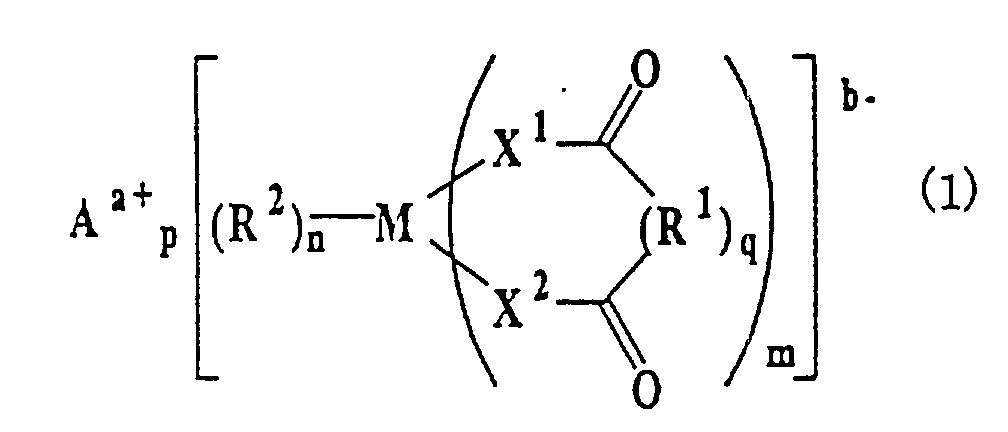
- an electrolyte for an electrochemical device comprises a first compound that is an ionic metal complex represented by the general formula (1), wherein
- an ion conductor for an electrochemical device comprises the electrolyte; and a member selected from the group consisting of a nonaqueous solvent, a polymer and a mixture thereof, said member dissolving therein said electrolyte.
- an electrochemical device comprising (a) first and second electrodes; and (b) the ion conductor receiving therein said first and second electrodes.
- the alkyl groups, halogenated alkyl groups, aryl groups, halogenated aryl groups, alkylene groups, halogenated alkylene groups, arylene groups and halogenated arylene groups which are contained in the ionic metal complex and the raw materials for synthesizing the same, may be branched and/or may have other functional groups such as hydroxyl groups and ether bonds.
- lithium ion is indicated as an example of A a+ of the general formula (1)
- examples of other cations that can be used other than lithium ion include sodium ion, potassium ion, magnesium ion, calcium ion, barium ion, cesium ion, silver ion, zinc ion, copper ion, cobalt ion, iron ion, nickel ion, manganese ion, titanium ion, lead ion, chromium ion, vanadium ion, ruthenium ion, yttrium ion, lanthanoid ion, actinoid ion, tetrabutylammonium ion, tetraethylammonium ion, tetramethylammonium ion, triethylmethylammonium ion, triethylammonium ion, pyridinium ion, imidazolium ion, hydrogen
- the valency (valence) of the A a+ cation is preferably from 1 to 3. If the valency is larger than 3, the problem occurs in which it becomes difficult to dissolve the ionic metal complex in solvent due to the increase in crystal lattice energy. Consequently, in the case of requiring solubility of the ionic metal complex, a valency of 1 is preferable.
- the valency (b - ) of the anion is similarly preferably from 1 to 3, and a valency of 1 is particularly preferable.
- the constant p expresses the ratio of the valency of the anion to the valency of the cation, namely b/a.
- M at the center of the ionic metal complex of the present invention is selected from elements of groups 3-15 of the periodic table. It is preferably Al, B, V, Ti, Si, Zr, Ge, Sn, Cu, Y, Zn, Ga, Nb, Ta, Bi, P, As, Sc, Hf or Sb, and more preferably Al, B or P. Although it is possible to use various elements for the M other than these preferable examples, synthesis is relatively easy in the case of using Al, B, V, Ti, Si, Zr, Ge, Sn, Cu, Y, Zn, Ga, Nb, Ta, Bi, P, As, Sc, Hf or Sb. In addition to ease of synthesis, the ionic metal complex has excellent properties in terms of low toxicity, stability and production cost in the case of using Al, B or P.
- the organic or inorganic portion bonded to M is referred to as the ligand.
- R 1 is selected from C 1 -C 10 alkylene groups, C 1 -C 10 halogenated alkylene groups, C 4 -C 20 arylene groups and C 4 -C 20 halogenated arylene groups.
- These alkylene and arylene groups may have substituents and hetero atoms in their structures.
- the alkylene and arylene groups may have structures in which hydrogen has been replaced with a substituent selected from halogens, chain-like or cyclic alkyl groups, aryl groups, alkenyl groups, alkoxy groups, aryloxy groups, sulfonyl groups, amino groups, cyano groups, carbonyl groups, acyl groups, amide groups and hydroxyl group.
- R 1 may have structures in which carbon has been replaced with a substituent selected from nitrogen, sulfur and oxygen.
- R 1 may be bonded together.
- a ligand such as ethylenediaminetetraacetic acid can be cited.
- R 2 is selected from halogens, C 1 -C 10 alkyl groups, C 1 -C 10 halogenated alkyl groups, C 4 -C 20 aryl groups, C 4 -C 20 halogenated aryl groups and X 3 R 3 . Similar to R 1 , these alkyl and aryl groups may have substituents and hetero atoms in their structures. When R 2 exist in the plural number, they may be bonded together to form a ring. R 2 is preferably an electron attracting group, particularly fluorine. When R 2 is fluorine, the degree of dissociation of the electrolyte is improved due to its strong electron attraction. Furthermore, mobility of the electrolyte is also improved due to the reduced size of the anionic moiety of the electrolyte. Therefore, the ionic conductivity becomes very high when R 2 is fluorine.
- each of X 1 , X 2 and X 3 in the general formula (1) independently represents O, S or NR 4 .
- the ligands are bonded to M with an interposal of these hetero atoms (O, S and N) therebetween.
- O, S and N hetero atoms
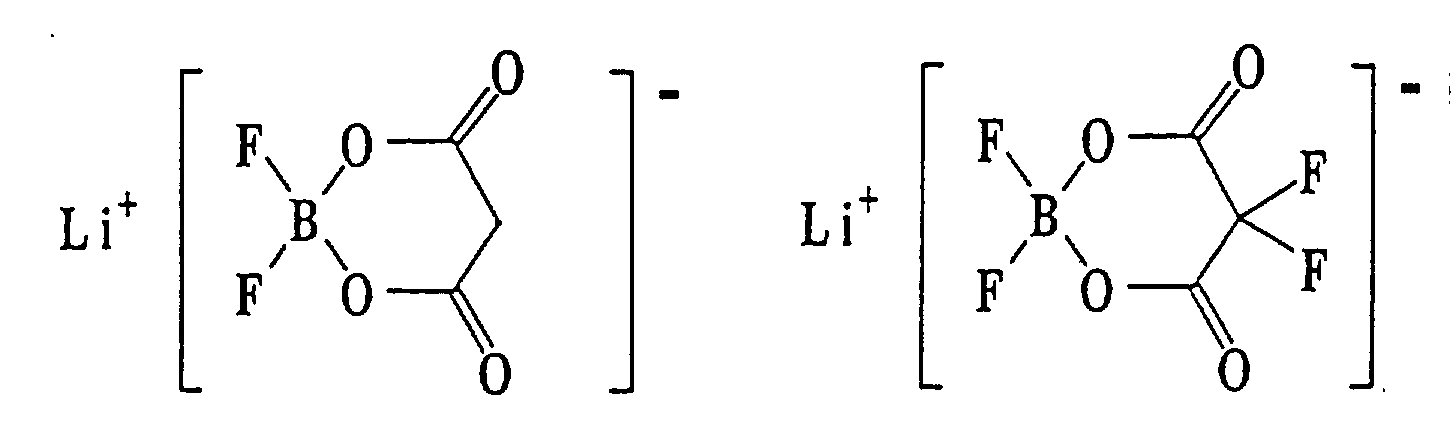
- the ionic metal complex represented by the general formula (1) is characterized by these ligands forming a chelate structure with M since there is bonding with M by X 1 and X 2 within the same ligand.
- the heat resistance, chemical stability and hydrolysis resistance of the ionic metal complex are improved.
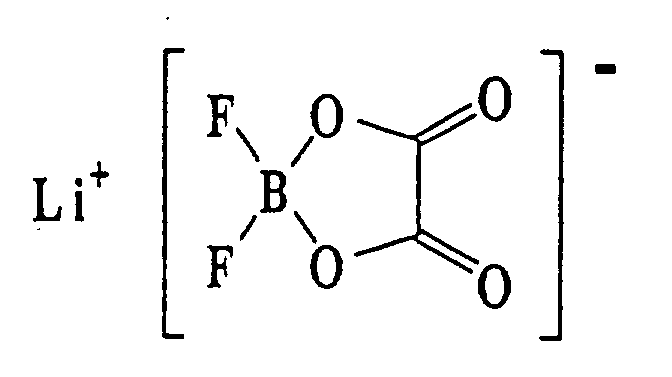
- constant q in this ligand is either 0 or 1, in the case of 0 in particular, since the chelate ring becomes a five-member ring, chelating effects are demonstrated most prominently, making this preferable due to the resulting increase in stability.
- each of R 3 and R 4 independently represents a halogen, C 1 -C 10 alkyl group, C 1 -C 10 halogenated alkyl group, C 4 -C 20 aryl group, or C 4 -C 20 halogenated aryl group. These alkyl and aryl groups optionally have substituents and hetero atoms.
- R 3 and R 4 are each exist in the plural number, each of R 3 and R 4 may be formed into a ring.
- the values of the constants m and n relating to the number of the above-mentioned ligands depend on the type of the central M.
- m is preferably from 1 to 4
- n is preferably from 1 to 8.
- This is extremely important in the case of using as the electrolyte of an electrochemical device.
- electrolytes Although there are an almost infinite number of salts referred to as electrolytes, the majority dissolve and dissociate in water, and thereby are ion conductive. Many of such salts do not even dissolve in organic solvents and so forth other than water. Such aqueous solutions are used as an electrolytic solution of electrochemical devices.
- Complexes of organic substances and metals are typically susceptible to hydrolysis and there are many that are chemically unstable. Since the electrolyte of the present invention, however, has a chelate structure, it is extremely stable and resistant to hydrolysis and so forth.
- that having fluorine within the chemical structure represented by the general formula (1) is particularly preferable since it further increases chemical stability such as oxidation resistance due to the effect of the fluorine.
- electrolyte of the present invention is used as the electrolyte of electrochemical devices such as lithium cells (cells), lithium ion cells (cells) and electrical double-layer capacitors
- electrochemical devices such as lithium cells (cells), lithium ion cells (cells) and electrical double-layer capacitors
- examples of its other applications include catalysts of organic synthesis reactions, polymerization catalysts and co-catalysts (auxiliary catalysts) of olefin polymerization.
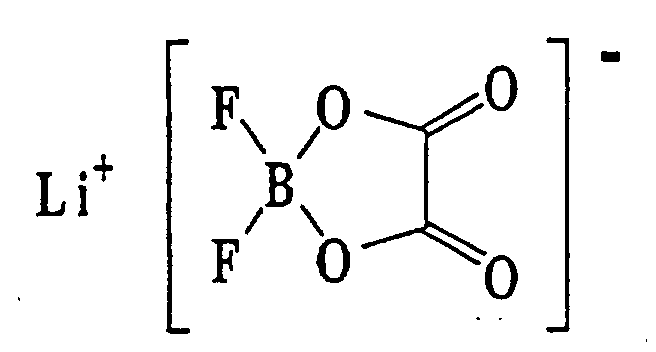
- an ionic metal complex having the following formula can be synthesized by reacting in a nonaqueous solvent LiBF 4 with a lithium alkoxide in an amount (by mole) that is twice that of LiBF 4 , followed by addition of oxalic acid, thereby replacing the alkoxide bonded to boron with oxalic acid.
- the electrolyte contains the ionic metal complex represented by the general formula (1).
- This electrolyte can be superior in heat resistance and hydrolysis resistance as compared with conventional electrolytes. Thus, it can advantageously be used for electrochemical devices such as lithium cell, lithium ion cell and electrical double-layer capacitor.
- the electrolyte contains the ionic metal complex (first compound) represented by the general formula (1) and another component that is at least one compound selected from second to sixth compounds respectively represented by the general formulas A a+ (PF 6 - ) a , A a+ (ClO 4 - ) a , A a+ (BF 4 - ) a , A a+ (AsF 6 - ) a , and A a+ (SbF 6 - ) a .
- a a+ is preferably the same ion as that in the general formula (1).
- the anion(s) tends to be pyrolyzed at a high temperature of 60°C or higher, thereby generating a Lewis acid(s).
- This Lewis acid decomposes the solvent and makes the electrochemical device inferior in performance and lifetime.
- the omission of the ionic metal complex causes hydrolysis of the anion(s) when the electrolyte is contaminated with a very small amount of water. This hydrolysis generates an acid(s) that makes the electrochemical device inferior in performance and lifetime.
- the above-mentioned pyrolysis and hydrolysis can unexpectedly be prevented by using a mixture of the ionic metal complex and the another component. The reason of this is not clear. It is, however, assumed that the properties of the solution as a whole change somehow to achieve this prevention by a certain interaction between the ionic metal complex and the another component.
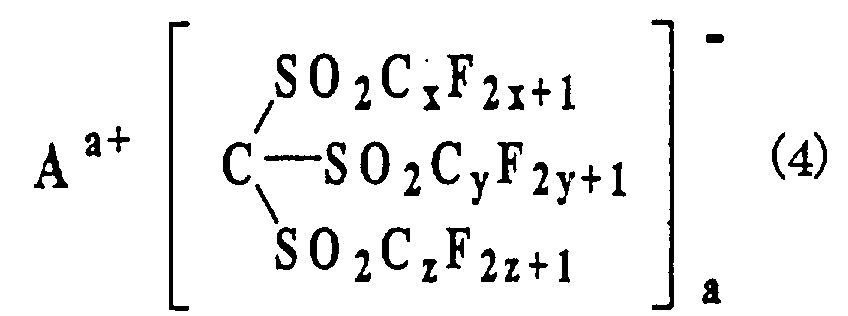
- the electrolyte contains the ionic metal complex (first compound) represented by the general formula (1) and another component that is at least one compound selected from seventh to ninth compounds represented by the general formulas (2), (3) and (4).
- these compounds are LiCF 3 SO 3 , LiN(SO 2 CF 3 ) 2 , LiN(SO 2 C 2 F 5 ) 2 , LiN(SO 2 CF 3 )(SO 2 C 4 F 9 ) and LiC(SO 2 CF 3 ) 3 .
- the ionic metal complex is omitted in the third preferred embodiment, the following problem occurs. That is, the another component corrodes the aluminum collector inside the cell when a potential is applied.
- the aluminum collector corrosion can unexpectedly be prevented by using a mixture of the ionic metal complex and the another component. The reason of this is not clear. It is, however, assumed that the ionic metal complex is slightly decomposed on the electrode surface and that a film of the ionic metal complex's ligand is formed on the aluminum surface, thereby preventing the aluminum collector corrosion.
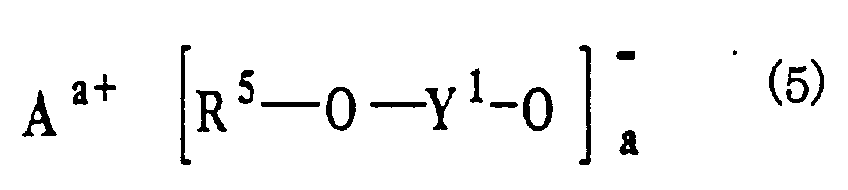
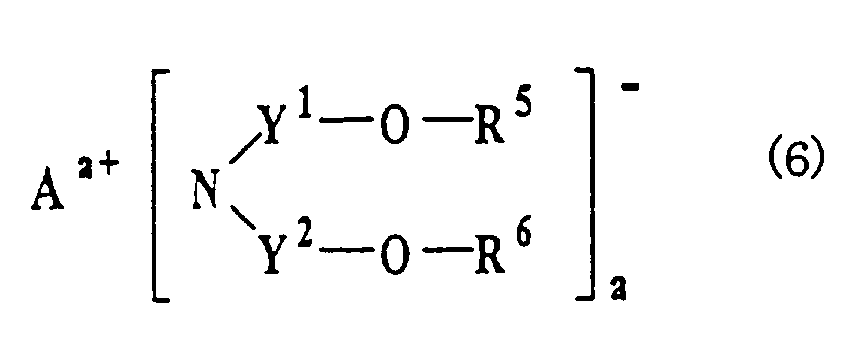
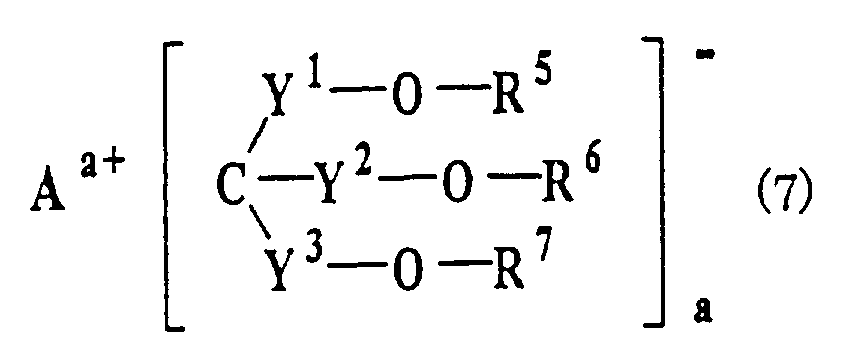
- the electrolyte contains the ionic metal complex (first compound) represented by the general formula (1) and another component that is at least one compound selected from the above-mentioned tenth to twelfth compounds represented by the general formulas (5), (6) and (7).
- Examples of these compounds are CF 3 CH 2 OSO 3 Li, (CF 3 ) 2 CHOSO 3 Li, (CF 3 CH 2 OSO 2 ) 2 NLi, ((CF 3 ) 2 CHOSO 2 ) 2 NLi, (CF 3 CH 2 OSO 2 )((CF 3 ) 2 CHOSO 2 )NLi, ((CF 3 ) 2 COSO 2 ) 2 NLi, and ((CF 3 ) 2 CHOSO 2 ) 3 CLi.
- Further examples are polymers and oligomers such as [N(Li)SO 2 OCH 2 (CF 2 ) 4 CH 2 OSO 2 ] n where n is a number of 2-1,000. If the ionic metal complex is omitted in the fourth preferred embodiment, the following problem occurs.
- the another component corrodes the aluminum collector inside the cell when a potential is applied. With this, the capacity is lowered by repeating the charge and discharge cycle.
- the aluminum collector corrosion can unexpectedly be prevented by using a mixture of the ionic metal complex and the another component. The reason of this is not clear. It is, however, assumed that the ionic metal complex is slightly decomposed on the electrode surface and that a film of the ionic metal complex's ligand is formed on the aluminum surface, thereby preventing the aluminum collector corrosion.
- the electrolytes according to the second to fourth preferred embodiments can be superior in cycle characteristics and shelf life as compared with conventional electrolytes. Thus, they can advantageously be used for electrochemical devices such as lithium cell, lithium ion cell and electrical double-layer capacitor.
- the molar ratio of the ionic metal complex (first compound) to the at least one compound selected from the second to twelfth compounds is preferably 1:99 to 99:1 (or a range from 5:95 to 95:5), more preferably 20:80 to 80:20 (or a range from 30:70 to 70:30), in view of improving the electrochemical device in cycle characteristics and shelf life. If this ratio is less than 1:99 (or 5:95), it may become insufficient to prevent the above-mentioned aluminum corrosion and/or the above-mentioned pyrolysis and hydrolysis, thereby making the electrolyte inferior in cycle characteristics and shelf life. If the ratio is greater than 99:1 (or 95:5), advantages of adding the at least one compound to increase ionic conductivity and electrochemical stability may become insufficient.
- a mixture of electrolyte and non-aqueous solvent or polymer is used as the ion conductor. If a non-aqueous solvent is used, the resulting ion conductor is typically referred to as an electrolytic solution, while if a polymer is used, it is typically referred to as a polymer solid electrolyte. Non-aqueous solvent may also be contained as plasticizer in polymer solid electrolytes.
- non-aqueous solvent is an aprotic solvent that is able to dissolve an electrolyte of the present invention
- examples of this non-aqueous solvent that can be used include carbonates, esters, ethers, lactones, nitriles, amides and sulfones.
- the solvent can either be used alone or in the form of a mixture of two or more types of solvent.
- the solvent include propylene carbonate, ethylene carbonate, diethyl carbonate, dimethyl carbonate, methylethyl carbonate, dimethoxyethane, acetonitrile, propionitrile, tetrahydrofuran, 2-methyltetrahydrofuran, dioxane, nitromethane, N,N-dimethylformamide, dimethylsulfoxide, sulfolane and ⁇ -butyrolactone.
- the non-aqueous solvent of an electrolytic solution is preferably a mixture of a first aprotic solvent having a dielectric constant of 20 or greater and a second aprotic solvent having a dielectric constant of 10 or less.
- lithium salt has a low solubility in the second aprotic solvent (e.g., diethyl ether and dimethyl carbonate). Therefore, it may be difficult to obtain a sufficient ionic conductivity by using only the second aprotic solvent.
- lithium salt has a high solubility in the first aprotic solvent. The resulting solution is, however, high in viscosity.
- the polymer to be mixed with the electrolytes of the invention is an aprotic polymer.
- examples of such polymer include polymers having polyethylene oxide on their main chain or side chain, homopolymers or copolymers of polyvinylidene fluoride, methacrylate polymers and polyacrylonitrile.
- the above-mentioned aprotic non-aqueous solvent can be used.
- the total concentration of the electrolytes of the present invention in these ion conductors is preferably 0.1 mol/dm 3 or more up to the saturated concentration, and more preferably from 0.5 mol/dm 3 to 1.5 mol/dm 3 . If the concentration is lower than 0.1 mol/dm 3 , ion conductivity may become too low.
- the negative electrode material for preparing an electrochemical device there are no particular restrictions on the negative electrode material for preparing an electrochemical device.
- lithium cell lithium metal (metallic lithium) or an alloy of lithium and another metal can be used.
- a lithium ion cell it is possible to use an intercalation compound containing lithium atoms in a matrix of another material, such as carbon, natural graphite or metal oxide. This carbon can be obtained by baking polymer, organic substance, pitch or the like.
- electrical double-layer capacitor it is possible to use activated carbon, porous metal oxide, porous metal, conductive polymer and so forth.
- lithium-containing oxides such as LiCoO 2 , LiNiO 2 , LiMnO 2 and LiMn 2 O 4 ; oxides such as TiO 2 , V 2 O 5 and MoO 3 ; sulfides such as TiS 2 and FeS; and electrically conductive polymers such as polyacetylene, polyparaphenylene, polyaniline or polypyrrole can be used.
- electrical double-layer capacitor activated carbon, porous metal oxide, porous metal, electrically conductive polymer and so forth can be used.
- Examples 1-1 to 1-4 are illustrative of the above-mentioned first preferred embodiment
- Examples 2-1 to 2-5 are illustrative of the above-mentioned second preferred embodiment
- Examples 3-1 to 3-5 are illustrative of the above-mentioned third preferred embodiment
- Examples 4-1 to 4-4 are illustrative of the above-mentioned fourth preferred embodiment.
- EC ethylene carbonate
- DMC dimethyl carbonate
- the above-mentioned electrolyte was placed in a container made of fluororesin. When stored for 1 month at 100°C as a heat resistance test, there was no discoloration or other deterioration of the electrolytic solution. In addition, when water was added to this electrolytic solution, it was found by NMR that the electrolytic solution had not been subjected to hydrolysis at all.
- a corrosion test of an aluminum collector was performed using the above-mentioned electrolytic solution.
- a beaker type cell was used for the test cell, using aluminum for the working electrode, and lithium metal (metallic lithium) for the counter electrode and reference electrode.
- the working electrode was held at 5 V (Li/Li + ), there was no flow of current whatsoever.
- SEM surface of the working electrode was observed by SEM, there were no changes observed in comparison with that before testing.
- a charging and discharging test of an actual cell was performed using the above-mentioned electrolytic solution of Example 1-2.
- the test cell was prepared in the manner described below.
- the positive electrode was prepared by mixing together 90 wt% of an LiCoO 2 powder, 5 wt% of polyvinylidene fluoride (PVDF) as a binder, and 5 wt% of acetylene black as a conductor, followed by the addition of N,N-dimethylformamide to form a paste. This paste was applied to an aluminum foil and allowed to dry to obtain the test positive electrode. Lithium metal was used for the negative electrode.
- a glass fiber filter as a separator was impregnated with the electrolytic solution of Example 1-2, thereby assembling the cell.
- a charging and discharging test of an actual cell was conducted using the electrolytic solution of Example 1-2.
- the test cell (half cell) was prepared in the manner described below. 10 wt% of polyvinylidene fluoride (PVDF) as a binder were mixed with 90 wt% of natural graphite powder followed by the addition of N,N-dimethylformamide to prepare a slurry. This slurry was applied to a nickel mesh and allowed to dry for 12 hours at 150°C to prepare a test negative electrode. Lithium metal was used for a counter electrode. A glass fiber filter as a separator was impregnated with the above-mentioned electrolytic solution, thereby assembling the half cell.
- PVDF polyvinylidene fluoride
- this electrolytic solution was placed in a fluororesin container, and, when subjected to a heat resistance test by storing for 1 month at 100°C, the electrolytic solution changed to have a yellow color.
- EC ethylene carbonate
- DMC dimethyl carbonate
- a corrosion test of an aluminum separator was conducted using this electrolyte.
- a beaker type cell was used for the test cell, using aluminum for the working electrode, and lithium metal for the counter electrode and reference electrode. When the working electrode was held at 5 V (Li/Li + ), current flowed and the current value increased with time. Following testing, when the surface of the working electrode was observed by SEM, severe corrosion pits were found in the aluminum surface.
- EC ethylene carbonate
- DMC dimethyl carbonate
- the test cell was prepared in the manner described below.
- the positive electrode of LiCoO 2 was prepared by mixing 5 parts by weight of polyvinylidene fluoride (PVDF) as a binder and 5 parts by weight of acetylene black as a conductor with 90 parts by weight of a LiCoO 2 powder followed by the addition of N,N-dimethylformamide to form a paste. This paste was applied to an aluminum foil and allowed to dry to obtain the test positive electrode.
- PVDF polyvinylidene fluoride
- the negative electrode of natural graphite was prepared by mixing 10 parts by weight of polyvinylidene fluoride (PVDF) as a binder with 90 parts by weight of a natural graphite powder followed by the addition of N,N-dimethylformamide to form a slurry. This slurry was applied to an copper foil and allowed to dry at 150°C for 12 hr to obtain the test negative electrode. A polyethylene separator was impregnated with the electrolytic solution, thereby assembling the cell.
- PVDF polyvinylidene fluoride
- PC propylene carbonate
- DEC diethyl carbonate
- the test cell was prepared in the same manner as that of Example 2-1, and a constant current charging and discharging test was conducted in the same manner as that of Example 2-1. As a result, although charging and discharging were repeated 500 times, results were obtained in which the capacity of the 500 th cycle was 83% of the initial capacity.
- EC ethylene carbonate
- DMC dimethyl carbonate
- the test cell was prepared in the same manner as that of Example 2-1, and a constant current charging and discharging test was conducted in the same manner as that of Example 2-1. As a result, although charging and discharging were repeated 500 times, results were obtained in which the capacity of the 500 th cycle was 80% of the initial capacity.
- EC ethylene carbonate
- DMC dimethyl carbonate
- the test cell was prepared in the same manner as that of Example 2-1, and a constant current charging and discharging test was conducted in the same manner as that of Example 2-1. As a result, although charging and discharging were repeated 500 times, results were obtained in which the capacity of the 500 th cycle was 85% of the initial capacity.
- a solution was prepared by adding acetonitrile to 80 parts by weight of a polyethylene oxide (average molecular weight: 10,000). Then, 10 parts by weight of the lithium borate derivative of Example 2-1, and 10 parts by weight of LiPF 6 were added to the solution. The resulting mixture was cast on a glass, followed by drying to remove the acetonitrile. With this, a polymer solid electrolyte film was prepared.
- the test cell was prepared in the same manner as that of Example 2-1 except in that the polymer solid electrolyte film was used in place of the electrolytic solution and the separator.
- LiCoO 2 was used as a positive electrode material
- natural graphite was used as a negative electrode material.
- a constant current charging and discharging test was conducted at 70°C under the following conditions. The current density was 0.1 mA/cm 2 for both charging and discharging, while charging was performed until 4.2 V and discharging until 3.0 V (vs. Li/Li + ). As a result, the initial discharge capacity was 120 mAh/g (the positive electrode capacity). Although charging and discharging were repeated 500 times, results were obtained in which the capacity of the 500 th cycle was 87% of the initial capacity.
- EC ethylene carbonate
- DMC dimethyl carbonate
- the test cell was prepared in the same manner as that of Example 2-1, and a constant current charging and discharging test was conducted in the same manner as that of Example 2-1.
- the capacity of the 500 th cycle was 64% of the initial capacity.
- EC ethylene carbonate
- DMC dimethyl carbonate
- the test cell was prepared in the same manner as that of Example 2-1, and a constant current charging and discharging test was conducted in the same manner as that of Example 2-1.
- the capacity of the 500 th cycle was 46% of the initial capacity.
- a corrosion test of an aluminum collector was performed in the same manner as that of Example 1-2.
- the working electrode was held at 5 V (Li/Li + ), there was no flow of current whatsoever.
- the surface of the working electrode was observed by SEM, there were no changes observed in comparison with that before testing.
- the test cell half cell was prepared in the manner described below.
- the positive electrode was prepared by mixing 5 parts by weight of polyvinylidene fluoride (PVDF) as a binder and 5 parts by weight of acetylene black as a conductor with 90 parts by weight of a LiCoO 2 powder followed by the addition-of N,N-dimethylformamide to form a paste. This paste was applied to an aluminum foil and allowed to dry to obtain the test positive electrode. Lithium metal was used for the negative electrode.
- a glass fiber filter as a separator was impregnated with the electrolytic solution, thereby assembling the cell.
- a corrosion test of an aluminum collector was performed in the same manner as that of Example 1-2.
- the working electrode was held at 5 V (Li/Li + ), there was no flow of current whatsoever.
- the surface of the working electrode was observed by SEM, there were no changes observed in comparison with that before testing.
- the test cell (half cell) was prepared in the same manner as that of Example 3-1, and a constant current charging and discharging test was conducted in the same manner as that of Example 3-1.
- the initial discharge capacity was 115 mAh/g (the positive electrode capacity).
- charging and discharging were repeated 100 times, results were obtained in which the capacity of the 100 th cycle was 88% of the initial capacity.
- a corrosion test of an aluminum collector was performed in the same manner as that of Example 1-2.
- the working electrode was held at 5 V (Li/Li + ), there was no flow of current whatsoever.
- the surface of the working electrode was observed by SEM, there were no changes observed in comparison with that before testing.
- the test cell (half cell) was prepared in the same manner as that of Example 3-1, and a constant current charging and discharging test was conducted in the same manner as that of Example 3-1.
- the initial discharge capacity was 120 mAh/g (the positive electrode capacity).
- charging and discharging were repeated 100 times, results were obtained in which the capacity of the 100 th cycle was 91% of the initial capacity.
- a corrosion test of an aluminum collector was performed in the same manner as that of Example 1-2.
- the working electrode was held at 5 V (Li/Li + ), there was no flow of current whatsoever.
- the surface of the working electrode was observed by SEM, there were no changes observed in comparison with that before testing.
- the test cell (half cell) was prepared in the same manner as that of Example 3-1, and a constant current charging and discharging test was conducted in the same manner as that of Example 3-1.
- the initial discharge capacity was 120 mAh/g (the positive electrode capacity).
- charging and discharging were repeated 100 times, results were obtained in which the capacity of the 100 th cycle was 93% of the initial capacity.
- a solution was prepared by adding acetonitrile to 70 parts by weight of a polyethylene oxide (average molecular weight: 10,000). Then, 5 parts by weight of the lithium borate derivative of Example 2-1 and 25 parts by weight of LiN(SO 2 CF 3 )(SO 2 C 4 F 9 ) were added to the solution. The resulting mixture was cast on a glass, followed by drying to remove the acetonitrile. With this, a polymer solid electrolyte film was prepared.
- a corrosion test of an aluminum collector was performed using a laminate including the solid electrolyte film interposed between an aluminum electrode (working electrode) and a lithium electrode. This laminate was prepared by press welding. When the working electrode was held at 5 V (Li/Li + ), there was no flow of current whatsoever. Following testing, although the surface of the working electrode was observed by SEM, there were no changes observed in comparison with that before testing.
- the test cell was prepared in the same manner as that of Example 3-1 except in that the polymer solid electrolyte film was used in place of the electrolytic solution and the separator. In fact, LiCoO 2 was used as a positive electrode material to prepare a half cell.
- a constant current charging and discharging test was conducted at 70°C under the following conditions. The current density was 0.1 mA/cm 2 for both charging and discharging, while charging was performed until 4.2 V and discharging until 3.0 V (vs. Li/Li + ). As a result, the initial discharge capacity was 120 mAh/g (the positive electrode capacity). Although charging and discharging were repeated 100 times, results were obtained in which the capacity of the 100 th cycle was 91% of the initial capacity.
- EC ethylene carbonate
- DMC dimethyl carbonate
- a corrosion test of an aluminum collector was performed in the same manner as that of Example 1-2.
- the working electrode was held at 5 V (Li/Li + )
- corrosion current was observed.
- the surface of the working electrode was observed by SEM. With this, many pits were observed on its surface. It is assumed that these pits were caused by corrosion.
- the test cell (half cell) was prepared in the same manner as that of Example 3-1, and a constant current charging and discharging test was conducted in the same manner as that of Example 3-1.
- the initial discharge capacity was 117 mAh/g (the positive electrode capacity).
- charging and discharging were repeated 100 times, results were obtained in which the capacity of the 100 th cycle was 69% of the initial capacity.
- a corrosion test of an aluminum collector was performed in the same manner as that of Example 1-2.
- the working electrode was held at 5 V (Li/Li + )
- corrosion current was observed.
- the surface of the working electrode was observed by SEM. With this, many pits were observed on its surface. It is assumed that these pits were caused by corrosion.
- the test cell (half cell) was prepared in the same manner as that of Example 3-1, and a constant current charging and discharging test was conducted in the same manner as that of Example 3-1.
- the initial discharge capacity was 112 mAh/g (the positive electrode capacity).
- charging and discharging were repeated 100 times, results were obtained in which the capacity of the 100 th cycle was 67% of the initial capacity.
- EC ethylene carbonate
- DMC dimethyl carbonate
- a corrosion test of an aluminum collector was performed in the same manner as that of Example 1-2.
- the working electrode was held at 5 V (Li/Li + )
- corrosion current was observed.
- the surface of the working electrode was observed by SEM. With this, many pits were observed on its surface. It is assumed that these pits were caused by corrosion.
- the test cell (half cell) was prepared in the same manner as that of Example 3-1, and a constant current charging and discharging test was conducted in the same manner as that of Example 3-1.
- the initial discharge capacity was 118 mAh/g (the positive electrode capacity).
- charging and discharging were repeated 100 times, results were obtained in which the capacity of the 100 th cycle was 74% of the initial capacity.
- EC ethylene carbonate
- DMC dimethyl carbonate
- a corrosion test of an aluminum collector was performed in the same manner as that of Example 1-2.
- the working electrode was held at 5 V (Li/Li + ), there was no flow of current whatsoever.
- the surface of the working electrode was observed by SEM, there were no changes observed in comparison with that before testing.
- the test cell was prepared by the same manner as that of Example 2-1.
- a constant current charging and discharging test was conducted by the same manner as that of Example 2-1, except that the test was conducted at an environmental temperature of 25°C.
- the capacity of the 500 th cycle was 87% of the initial capacity.
- EC ethylene carbonate
- DEC diethyl carbonate
- a corrosion test of an aluminum collector was performed in the same manner as that of Example 1-2.
- the working electrode was held at 5 V (Li/Li + ), there was no flow of current whatsoever.
- the surface of the working electrode was observed by SEM, there were no changes observed in comparison with that before testing.
- the test cell was prepared by the same manner as that of Example 2-1.
- a constant current charging and discharging test was conducted by the same manner as that of Example 2-1, except that the test was conducted at an environmental temperature of 60°C.
- the capacity of the 500 th cycle was 84% of the initial capacity.
- EC ethylene carbonate
- EMC ethylmethyl carbonate
- a corrosion test of an aluminum collector was performed in the same manner as that of Example 1-2.
- the working electrode was held at 5 V (Li/Li + ), there was no flow of current whatsoever.
- the surface of the working electrode was observed by SEM, there were no changes observed in comparison with that before testing.
- the test cell was prepared by the same manner as that of Example 2-1.
- a constant current charging and discharging test was conducted by the same manner as that of Example 2-1, except that the test was conducted at an environmental temperature of 60°C.
- the capacity of the 500 th cycle was 89% of the initial capacity.
- a solution was prepared by adding acetonitrile to 70 parts by weight of a polyethylene oxide (average molecular weight: 10,000). Then, 5 parts by weight of the lithium borate derivative of Example 2-1, and 25 parts by weight of ((CF 3 ) 2 CHOSO 2 ) 2 NLi were added to the solution. The resulting mixture was cast on a glass, followed by drying to remove the acetonitrile. With this, a polymer solid electrolyte film was prepared.
- a corrosion test of an aluminum collector was performed in the same manner as that of Example 3-5.
- the working electrode was held at 5 V (Li/Li + ), there was no flow of current whatsoever.
- the surface of the working electrode was observed by SEM, there were no changes observed in comparison with that before testing.
- the test cell was prepared in the same manner as that of Example 2-1 except in that the polymer solid electrolyte film was used in place of the electrolytic solution and the separator.
- LiCoO 2 was used as a positive electrode material
- a lithium metal foil was used as a negative electrode material.
- Example 2-5 A constant current charging and discharging test was conducted in the same manner as that of Example 2-5 except that charging and discharging were repeated 100 times. As a result, the initial discharge capacity was 120 mAh/g (the positive electrode capacity). The capacity of the 100 th cycle was 92% of the initial capacity.
- EC ethylene carbonate
- DMC dimethyl carbonate
- a corrosion test of an aluminum collector was performed in the same manner as that of Example 1-2.
- the working electrode was held at 5 V (Li/Li + )
- corrosion current was observed.
- the surface of the working electrode was observed by SEM. With this, many pits were observed on its surface. It is assumed that these pits were caused by corrosion.
- the test cell was prepared in the same manner as that of Example 2-1, and a constant current charging and discharging test was conducted in the same manner as that of Example 2-1, except that the test was conducted at an environmental temperature of 25°C.
- the capacity of the 500 th cycle was 62% of the initial capacity.
- a corrosion test of an aluminum collector was performed in the same manner as that of Example 1-2.
- the working electrode was held at 5 V (Li/Li + )
- corrosion current was observed.
- the surface of the working electrode was observed by SEM. With this, many pits were observed on its surface. It is assumed that these pits were caused by corrosion.
- the test cell was prepared in the same manner as that of Example 2-1, and a constant current charging and discharging test was conducted in the same manner as that of Example 2-1, except that the test was conducted at an environmental temperature of 60°C.
- the capacity of the 500 th cycle was 58% of the initial capacity.
- EC ethylene carbonate
- EMC ethylmethyl carbonate
- the test cell was prepared in the same manner as that of Example 2-1, and a constant current charging and discharging test was conducted in the same manner as that of Example 2-1, except that the test was conducted at an environmental temperature of 60°C.
- the capacity of the 500 th cycle was 65% of the initial capacity.
Landscapes
- Chemical & Material Sciences (AREA)
- Chemical Kinetics & Catalysis (AREA)
- Electrochemistry (AREA)
- Engineering & Computer Science (AREA)
- Power Engineering (AREA)
- Microelectronics & Electronic Packaging (AREA)
- Organic Chemistry (AREA)
- Manufacturing & Machinery (AREA)
- General Chemical & Material Sciences (AREA)
- Physics & Mathematics (AREA)
- Condensed Matter Physics & Semiconductors (AREA)
- General Physics & Mathematics (AREA)
- Inorganic Chemistry (AREA)
- Secondary Cells (AREA)
- Electric Double-Layer Capacitors Or The Like (AREA)
Abstract

Description






10.4 ppm(s)
-15.7 ppm(s)
164.7 ppm

Claims (19)
- An electrolyte for an electrochemical device, said electrolyte comprising a first compound that is an ionic metal complex represented by the general formula (1),wherein
 M is a transition metal selected from the group consisting of elements of groups 3-11 of the periodic table, or an element selected from the group consisting of elements of groups 12-15 of the periodic table;Aa+ represents a metal ion, onium ion or hydrogen ion;a represents a number from 1 to 3; b represents a number from 1 to 3; p is b/a; m represents a number from 1 to 4; n represents a number from 0 to 8; q is 0 or 1;R1 represents a C1-C10 alkylene group, C1-C10 halogenated alkylene group, C4-C20 arylene group or C4-C20 halogenated arylene group, these alkylene and arylene groups of said R1 optionally having substituents and hetero atoms, one of said R1 being optionally bonded with another of said R1;R2 represents a halogen, C1-C10 alkyl group, C1-C10 halogenated alkyl group, C4-C20 aryl group, C4-C20 halogenated aryl group or X3R3, these alkyl and aryl groups of said R2 optionally having substituents and hetero atoms, one of said R2 being optionally bonded with another of said R2 to form a ring;each of X1, X2 and X3 independently represents O, S or NR4; andeach of R3 and R4 independently represents a halogen, C1-C10 alkyl group, C1-C10 halogenated alkyl group, C4-C20 aryl group, or C4-C20 halogenated aryl group, these alkyl and aryl groups of said R3 and R4 optionally having substituents and hetero atoms, one of said R3 being optionally bonded with another of said R3 to form a ring, one of said R4 being optionally bonded with another of said R4 to form a ring.
 - An electrolyte according to claim 1, wherein said M is an element selected from the group consisting of Al, B, V, Ti, Si, Zr, Ge, Sn, Cu, Y, Zn, Ga, Nb, Ta, Bi, P, As, Sc, Hf, and Sb.
- An electrolyte according to claim 2, wherein said M is an element selected from the group consisting of Al, B and P.
- An electrolyte according to claim 1, wherein said Aa+ is a lithium ion, quaternary ammonium ion or hydrogen ion.
- An electrolyte according to claim 1, further comprising at least one compound selected from the group consisting of second to sixth compounds respectively represented by the general formulas Aa+(PF6 -)a, Aa+(ClO4 -)a, Aa+(BF4 -)a, Aa+(AsF6 -)a, and Aa+(SbF6 -)a, and seventh to twelfth compounds respectively represented by the general formulas (2) to (7),


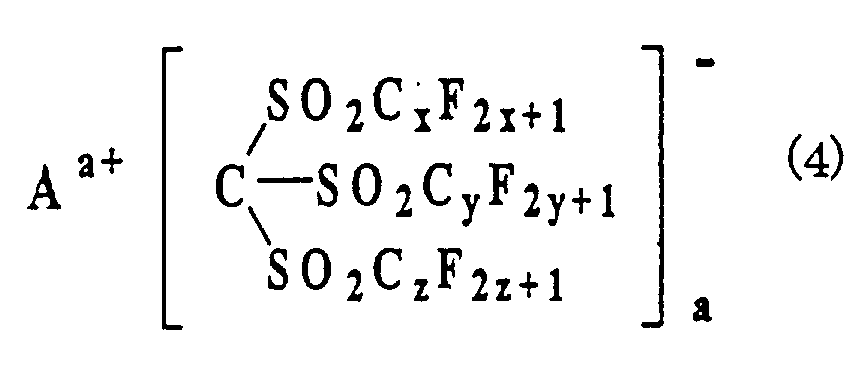

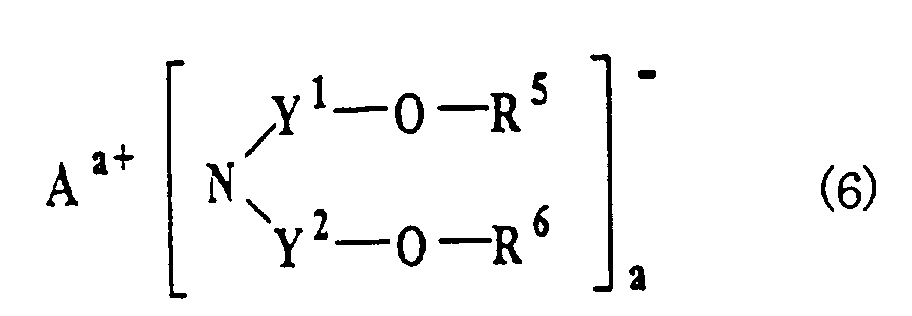 wherein
 Aa+ and a are defined as in the general formula (1);each of x, y and z independently represents a number from 1 to 8;each of Y1, Y2 and Y3 independently represents a SO2 group or CO group; andeach of R5, R6 and R7 independently represents an electron-attractive organic substituent optionally having a substituent or a hetero atom, at least two of said R5, R6 and R7 being optionally bonded together to form a ring, at least one of said R5, R6 and R7 being optionally bonded with an adjacent molecule to form a polymer.
 - An electrolyte according to claim 5, wherein said at least one compound is selected from the group consisting of said second to sixth compounds.
- An electrolyte according to claim 5, wherein said at least one compound is selected from the group consisting of said seventh to ninth compounds.
- An electrolyte according to claim 5, wherein said at least one compound is selected from the group consisting of said tenth to twelfth compounds.
- An electrolyte according to claim 5, wherein a molar ratio of said first compound to said at least one compound is 1:99 to 99:1.
- An ion conductor for an electrochemical device, said ion conductor comprising:an electrolyte according to claim 1; anda member selected from the group consisting of a nonaqueous solvent, a polymer and a mixture thereof, said member dissolving therein said electrolyte.
- An ion conductor according to claim 10, wherein said nonaqueous solvent is an aprotic solvent, and thereby said ion conductor is an electrolytic solution.
- An ion conductor according to claim 11, wherein said nonaqueous solvent is a mixture of a first aprotic solvent having a dielectric constant of 20 or greater and a second aprotic solvent having a dielectric constant of 10 or less.
- An ion conductor according to claim 10, wherein said Aa+ is a lithium ion.
- An ion conductor according to claim 10, wherein said polymer is an aprotic polymer, and thereby said ion conductor is a solid electrolyte.
- An ion conductor according to claim 10, which has a concentration of said electrolyte within a range of from 0.1 mol/dm3 to a saturated concentration.
- An ion conductor according to claim 15, wherein said concentration is within a range of from 0.5 mol/dm3 to 1.5 mol/dm3.
- An electrochemical device comprising:(a) first and second electrodes; and(b) an ion conductor receiving therein said first and second electrodes, said ion conductor comprising:(1) an electrolyte according to claim 1; and(2) a member selected from the group consisting of a nonaqueous solvent, a polymer and a mixture thereof, said member dissolving therein said electrolyte.
- An electrochemical device according to claim 17, which is a cell or an electrical double-layer capacitor.
- An electrochemical device according to claim 18, wherein said cell is a lithium cell or a lithium ion cell.
Applications Claiming Priority (8)
| Application Number | Priority Date | Filing Date | Title |
|---|---|---|---|
| JP2000303437A JP3722685B2 (en) | 2000-10-03 | 2000-10-03 | Electrolyte for electrochemical device and battery using the same |
| JP2000303437 | 2000-10-03 | ||
| JP2000376730A JP3730860B2 (en) | 2000-12-12 | 2000-12-12 | Electrolytes for electrochemical devices, electrolytes or solid electrolytes thereof, and batteries |
| JP2000376730 | 2000-12-12 | ||
| JP2000376731A JP3730861B2 (en) | 2000-12-12 | 2000-12-12 | Electrolytes for electrochemical devices, electrolytes or solid electrolytes thereof, and batteries |
| JP2000376731 | 2000-12-12 | ||
| JP2001177867A JP4076738B2 (en) | 2001-06-13 | 2001-06-13 | Lithium battery and electrolyte for lithium ion battery, electrolyte solution or solid electrolyte thereof, and lithium battery or lithium ion battery |
| JP2001177867 | 2001-06-13 |
Publications (3)
| Publication Number | Publication Date |
|---|---|
| EP1195834A2 true EP1195834A2 (en) | 2002-04-10 |
| EP1195834A3 EP1195834A3 (en) | 2005-08-31 |
| EP1195834B1 EP1195834B1 (en) | 2010-09-15 |
Family
ID=27481674
Family Applications (1)
| Application Number | Title | Priority Date | Filing Date |
|---|---|---|---|
| EP01123577A Expired - Lifetime EP1195834B1 (en) | 2000-10-03 | 2001-10-01 | Electrolyte for electrochemical device |
Country Status (3)
| Country | Link |
|---|---|
| US (1) | US6783896B2 (en) |
| EP (1) | EP1195834B1 (en) |
| DE (1) | DE60143070D1 (en) |
Cited By (13)
| Publication number | Priority date | Publication date | Assignee | Title |
|---|---|---|---|---|
| WO2003084968A1 (en) * | 2002-03-29 | 2003-10-16 | Nitto Denko Corporation | Polydioxaborines, their monomers and their preparation |
| US6849752B2 (en) | 2001-11-05 | 2005-02-01 | Central Glass Company, Ltd. | Process for synthesizing ionic metal complex |
| EP2031690A1 (en) * | 2007-08-23 | 2009-03-04 | Air Products and Chemicals, Inc. | Electrolytes, cells and methods of forming passivation layers |
| WO2010097678A1 (en) * | 2009-02-24 | 2010-09-02 | Toyota Jidosha Kabushiki Kaisha | Lithium-ion secondary battery and manufacture method therefor |
| DE102012220793A1 (en) | 2011-11-14 | 2013-05-16 | Chemetall Gmbh | Process for the preparation of metal difluorochelato borates and use as battery electrolytes or additives in galvanic cells |
| CN103265569A (en) * | 2013-05-17 | 2013-08-28 | 太原理工大学 | Lithium difluoro(oxalato)borate synthesis method |
| CN103483368A (en) * | 2013-09-17 | 2014-01-01 | 上海璞泰来新材料技术有限公司 | A kind of preparation method of lithium difluorooxalate borate |
| KR20140040283A (en) * | 2011-08-31 | 2014-04-02 | 샌트랄 글래스 컴퍼니 리미티드 | Electrolytic solution for nonaqueous electrolytic solution cell, and nonaqueous electrolytic solution cell |
| CN103943884A (en) * | 2014-04-08 | 2014-07-23 | 陈琛 | Lithium ion battery electrolyte solution |
| CN104821236A (en) * | 2015-04-03 | 2015-08-05 | 安徽江威精密制造有限公司 | Electrode material improving battery capacity of supercapacitor and preparation method thereof |
| CN104867694A (en) * | 2015-04-03 | 2015-08-26 | 安徽江威精密制造有限公司 | High-porosity long hole straw based composite electrode material and preparation method thereof |
| CN104882292A (en) * | 2015-04-02 | 2015-09-02 | 安徽江威精密制造有限公司 | Nitrogen-coated waste PVC-based composite electrode material for super capacitor and method of preparation |
| CN105119018A (en) * | 2015-08-19 | 2015-12-02 | 芜湖市汽车产业技术研究院有限公司 | Electrolyte of lithium ion battery and lithium ion battery |
Families Citing this family (70)
| Publication number | Priority date | Publication date | Assignee | Title |
|---|---|---|---|---|
| AU7557200A (en) * | 1999-10-08 | 2001-04-23 | Seimi Chemical Co., Ltd. | Lithium-cobalt composite oxide, method for preparing the same, positive electrode for lithium secondary cell and lithium secondary cell using the same |
| TW529199B (en) * | 2001-11-28 | 2003-04-21 | Merck Patent Gmbh | Phosphorus-borates with low melting points |
| CN1564805A (en) * | 2002-04-24 | 2005-01-12 | 日清纺织株式会社 | Ionic Liquid, Dehydration Method, Double Layer Capacitor, and Secondary Battery |
| US7172834B1 (en) | 2002-07-29 | 2007-02-06 | The United States Of America As Represented By The Secretary Of The Army | Additive for enhancing the performance of electrochemical cells |
| US7718321B2 (en) * | 2004-02-04 | 2010-05-18 | Quallion Llc | Battery having electrolyte including organoborate salt |
| US20070065728A1 (en) * | 2003-03-20 | 2007-03-22 | Zhengcheng Zhang | Battery having electrolyte with mixed solvent |
| JP4186115B2 (en) * | 2003-06-11 | 2008-11-26 | ソニー株式会社 | Lithium ion secondary battery |
| JP2005005117A (en) * | 2003-06-11 | 2005-01-06 | Sony Corp | battery |
| JP2006173302A (en) * | 2004-12-15 | 2006-06-29 | Sanyo Electric Co Ltd | Electric double layer capacitor |
| US20060216612A1 (en) * | 2005-01-11 | 2006-09-28 | Krishnakumar Jambunathan | Electrolytes, cells and methods of forming passivation layers |
| US20080193852A1 (en) * | 2006-02-03 | 2008-08-14 | Sanyo Electric Co., Ltd. | Nonaqueous Electrolyte Secondary Battery |
| US7820323B1 (en) * | 2006-09-07 | 2010-10-26 | The United States Of America As Represented By The Secretary Of The Army | Metal borate synthesis process |
| US8187752B2 (en) * | 2008-04-16 | 2012-05-29 | Envia Systems, Inc. | High energy lithium ion secondary batteries |
| JP5315971B2 (en) * | 2008-12-16 | 2013-10-16 | セントラル硝子株式会社 | Method for producing difluorobis (oxalato) lithium phosphate solution |
| US10056644B2 (en) * | 2009-07-24 | 2018-08-21 | Zenlabs Energy, Inc. | Lithium ion batteries with long cycling performance |
| US8993177B2 (en) * | 2009-12-04 | 2015-03-31 | Envia Systems, Inc. | Lithium ion battery with high voltage electrolytes and additives |
| US8765306B2 (en) * | 2010-03-26 | 2014-07-01 | Envia Systems, Inc. | High voltage battery formation protocols and control of charging and discharging for desirable long term cycling performance |
| US9083062B2 (en) | 2010-08-02 | 2015-07-14 | Envia Systems, Inc. | Battery packs for vehicles and high capacity pouch secondary batteries for incorporation into compact battery packs |
| EE05629B1 (en) | 2010-09-06 | 2013-02-15 | O� Skeleton Technologies | Method for the preparation of an electrochemical system of a high power and energy density supercapacitor, a corresponding supercapacitor and a method for making it |
| US9166222B2 (en) | 2010-11-02 | 2015-10-20 | Envia Systems, Inc. | Lithium ion batteries with supplemental lithium |
| KR20120063163A (en) * | 2010-12-07 | 2012-06-15 | 삼성전자주식회사 | Lithium air battery |
| CN102260282B (en) * | 2011-06-22 | 2013-08-21 | 常州市国亚新能源科技有限公司 | A kind of preparation method of difluorooxalate lithium borate electrolyte salt |
| US9159990B2 (en) | 2011-08-19 | 2015-10-13 | Envia Systems, Inc. | High capacity lithium ion battery formation protocol and corresponding batteries |
| US9780358B2 (en) | 2012-05-04 | 2017-10-03 | Zenlabs Energy, Inc. | Battery designs with high capacity anode materials and cathode materials |
| US10553871B2 (en) | 2012-05-04 | 2020-02-04 | Zenlabs Energy, Inc. | Battery cell engineering and design to reach high energy |
| US10411299B2 (en) | 2013-08-02 | 2019-09-10 | Zenlabs Energy, Inc. | Electrolytes for stable cycling of high capacity lithium based batteries |
| WO2015024004A1 (en) | 2013-08-16 | 2015-02-19 | Envia Systems, Inc. | Lithium ion batteries with high capacity anode active material and good cycling for consumer electronics |
| CN105765779B (en) * | 2013-09-30 | 2019-05-28 | 株式会社Lg化学 | Electrolyte containing phthalate phosphine-based anion, additive for secondary battery containing same, and secondary battery containing same |
| US10050306B2 (en) * | 2013-10-04 | 2018-08-14 | Asahi Kasei Kabushiki Kaisha | Electrolyte and lithium-ion secondary battery |
| KR101629066B1 (en) * | 2013-10-07 | 2016-06-09 | 주식회사 엘지화학 | Dye and color filter manufactured by the same |
| KR101683211B1 (en) * | 2013-11-14 | 2016-12-06 | 삼성에스디아이 주식회사 | Electrolyte for rechargeable lithium battery, and rechargeable lithium battery including the same |
| JP6440331B2 (en) | 2014-05-08 | 2018-12-19 | 三星エスディアイ株式会社Samsung SDI Co., Ltd. | Organic electrolyte and lithium battery employing this electrolyte |
| JP2016027028A (en) | 2014-07-02 | 2016-02-18 | セントラル硝子株式会社 | Ionic complex, electrolyte for nonaqueous electrolyte battery, nonaqueous electrolyte battery and ionic complex synthesis method |
| KR102380512B1 (en) | 2015-01-16 | 2022-03-31 | 삼성에스디아이 주식회사 | Electrolyte solution for lithium battery and lithium battery using the same |
| JP6007994B2 (en) | 2015-01-23 | 2016-10-19 | セントラル硝子株式会社 | Non-aqueous electrolyte secondary battery electrolyte and non-aqueous electrolyte secondary battery using the same |
| WO2016117279A1 (en) | 2015-01-23 | 2016-07-28 | セントラル硝子株式会社 | Electrolyte solution for nonaqueous electrolyte solution cell and nonaqueous electrolyte solution cell |
| JP2016149312A (en) * | 2015-02-13 | 2016-08-18 | ソニー株式会社 | Secondary battery, battery pack, electric vehicle, power storage system, electric tool and electronic device |
| KR102436423B1 (en) * | 2015-03-12 | 2022-08-25 | 삼성에스디아이 주식회사 | Electrolyte for lithium battery and lithium battery including the electrolyte |
| CN104851602A (en) * | 2015-04-03 | 2015-08-19 | 安徽江威精密制造有限公司 | Straw-based composite material convenient to process and preparation method thereof |
| CN104867691A (en) * | 2015-04-03 | 2015-08-26 | 安徽江威精密制造有限公司 | Indium-tin-oxide-doped straw based carbon composite electrode material and preparation method thereof |
| JP6098684B2 (en) | 2015-08-12 | 2017-03-22 | セントラル硝子株式会社 | Non-aqueous electrolyte secondary battery electrolyte and non-aqueous electrolyte secondary battery using the same |
| US10450329B2 (en) | 2016-02-05 | 2019-10-22 | Gotion Inc. | Preparation of difluoro chelato borate salts |
| JP6245312B2 (en) | 2016-05-30 | 2017-12-13 | セントラル硝子株式会社 | Non-aqueous electrolyte secondary battery electrolyte and non-aqueous electrolyte secondary battery using the same |
| JP6260735B1 (en) | 2016-07-06 | 2018-01-17 | セントラル硝子株式会社 | Non-aqueous electrolyte and non-aqueous electrolyte secondary battery using the same |
| WO2018135395A1 (en) * | 2017-01-20 | 2018-07-26 | 富士フイルム株式会社 | Electrolytic solution for non-aqueous secondary batteries, non-aqueous secondary battery, and metal complex |
| PL3512027T3 (en) * | 2017-03-17 | 2021-08-30 | Lg Chem, Ltd. | Electrolyte additive composition, as well as electrolyte and lithium secondary battery comprising the same |
| WO2018169369A1 (en) * | 2017-03-17 | 2018-09-20 | 주식회사 엘지화학 | Electrolyte additive and lithium secondary battery electrolyte comprising same |
| KR102453271B1 (en) * | 2017-03-17 | 2022-10-12 | 주식회사 엘지에너지솔루션 | Electrolyte for lithium secondary battery and lithium secondary battery comprising the same |
| KR20190007904A (en) | 2017-07-14 | 2019-01-23 | 에스케이케미칼 주식회사 | Novel bicyclic boron derivatives compounds, method for preparing the same and electrolyte for secondary battery comprising the same |
| KR102488601B1 (en) | 2017-09-05 | 2023-01-12 | 삼성에스디아이 주식회사 | Rechargeable lithium battery |
| KR102488602B1 (en) | 2017-09-06 | 2023-01-12 | 삼성에스디아이 주식회사 | Non-electrolyte for rechargeable lithium battery and rechargeable lithium battery including same |
| KR102449844B1 (en) | 2017-09-06 | 2022-09-29 | 삼성에스디아이 주식회사 | Rechargeable lithium battery and rechargeable lithium battery including same |
| KR20190027188A (en) | 2017-09-06 | 2019-03-14 | 삼성에스디아이 주식회사 | Non-electrolyte for rechargeable lithium battery and rechargeable lithium battery including same |
| JP7116314B2 (en) | 2017-12-06 | 2022-08-10 | セントラル硝子株式会社 | Electrolyte for non-aqueous electrolyte battery and non-aqueous electrolyte battery using the same |
| JP7168851B2 (en) | 2017-12-06 | 2022-11-10 | セントラル硝子株式会社 | Electrolyte for non-aqueous electrolyte battery and non-aqueous electrolyte battery using the same |
| US11094925B2 (en) | 2017-12-22 | 2021-08-17 | Zenlabs Energy, Inc. | Electrodes with silicon oxide active materials for lithium ion cells achieving high capacity, high energy density and long cycle life performance |
| WO2020190076A1 (en) * | 2019-03-21 | 2020-09-24 | 주식회사 엘지화학 | Non-aqueous electrolyte for lithium secondary battery and lithium secondary battery comprising same |
| US11973178B2 (en) | 2019-06-26 | 2024-04-30 | Ionblox, Inc. | Lithium ion cells with high performance electrolyte and silicon oxide active materials achieving very long cycle life performance |
| KR102164920B1 (en) | 2019-09-18 | 2020-10-13 | (주)켐트로스 | Process for Preparing Lithium Difluorobis(oxalato)phosphate |
| US12592395B2 (en) | 2020-03-25 | 2026-03-31 | Panasonic Intellectual Property Management Co., Ltd. | Lithium primary battery and liquid non-aqueous electrolyte for lithium primary battery |
| KR102311311B1 (en) | 2020-04-16 | 2021-10-13 | (주)켐트로스 | Lithium Difluorobis(oxalato)phosphate 1,4-Dioxane Solvate, Process for Preparing the Same, and Electrolyte Composition Including the Same |
| US12355079B2 (en) | 2020-07-02 | 2025-07-08 | Ionblox, Inc. | Lithium ion cells with silicon based active materials and negative electrodes with water-based binders having good adhesion and cohesion |
| KR102209974B1 (en) | 2020-09-08 | 2021-02-02 | (주)켐트로스 | Process for Preparing Lithium Tetrafluoro(oxalato)phosphate |
| US11942599B2 (en) * | 2020-10-28 | 2024-03-26 | Enevate Corporation | Symmetrical or asymmetrical alkylsulfonyl imide or cyclic alkylene sulfonylimide salts as cathode additives, electrolyte additives, or SI anode additives for SI anode-based li-ion cells |
| JP7698980B2 (en) | 2021-05-26 | 2025-06-26 | Tdk株式会社 | Lithium-ion secondary battery |
| JP7698471B2 (en) | 2021-05-26 | 2025-06-25 | Tdk株式会社 | Lithium-ion secondary battery |
| JP7724637B2 (en) | 2021-05-26 | 2025-08-18 | Tdk株式会社 | Lithium-ion secondary battery |
| JP2024079151A (en) * | 2022-11-30 | 2024-06-11 | パナソニックIpマネジメント株式会社 | Liquid component for electrolytic capacitor and electrolytic capacitor |
| GB2626595A (en) | 2023-01-27 | 2024-07-31 | Sumitomo Chemical Co | Compound |
| GB2626596A (en) | 2023-01-27 | 2024-07-31 | Sumitomo Chemical Co | Electrolyte |
Family Cites Families (6)
| Publication number | Priority date | Publication date | Assignee | Title |
|---|---|---|---|---|
| DE19829030C1 (en) * | 1998-06-30 | 1999-10-07 | Metallgesellschaft Ag | Lithium bisoxalatoborate used as conducting salt in lithium ion batteries |
| DE19910968A1 (en) * | 1999-03-12 | 2000-11-09 | Merck Patent Gmbh | Use of additives in electrolytes for electrochemical cells |
| JP3498905B2 (en) | 1999-08-02 | 2004-02-23 | セントラル硝子株式会社 | Electrolyte for electrochemical devices |
| JP3824465B2 (en) | 1999-08-02 | 2006-09-20 | セントラル硝子株式会社 | Synthesis of ionic complexes |
| US20010033964A1 (en) * | 1999-12-10 | 2001-10-25 | Merck Patent Gesellschaft Mit Beschrankter Haftung | Alkylspiroborate salts for use in electrochemical cells |
| DE19959722A1 (en) * | 1999-12-10 | 2001-06-13 | Merck Patent Gmbh | Alkyl spiroborate salts for use in electrochemical cells |
-
2001
- 2001-10-01 EP EP01123577A patent/EP1195834B1/en not_active Expired - Lifetime
- 2001-10-01 DE DE60143070T patent/DE60143070D1/en not_active Expired - Lifetime
- 2001-10-03 US US09/969,127 patent/US6783896B2/en not_active Expired - Lifetime
Cited By (23)
| Publication number | Priority date | Publication date | Assignee | Title |
|---|---|---|---|---|
| US6849752B2 (en) | 2001-11-05 | 2005-02-01 | Central Glass Company, Ltd. | Process for synthesizing ionic metal complex |
| US6916894B2 (en) | 2002-03-29 | 2005-07-12 | Nitto Denko Corporation | Polydioxaborines |
| WO2003084968A1 (en) * | 2002-03-29 | 2003-10-16 | Nitto Denko Corporation | Polydioxaborines, their monomers and their preparation |
| EP2031690A1 (en) * | 2007-08-23 | 2009-03-04 | Air Products and Chemicals, Inc. | Electrolytes, cells and methods of forming passivation layers |
| WO2010097678A1 (en) * | 2009-02-24 | 2010-09-02 | Toyota Jidosha Kabushiki Kaisha | Lithium-ion secondary battery and manufacture method therefor |
| CN103797634A (en) * | 2011-08-31 | 2014-05-14 | 中央硝子株式会社 | Electrolytic solution for nonaqueous electrolytic solution cell, and nonaqueous electrolytic solution cell |
| US10777847B2 (en) | 2011-08-31 | 2020-09-15 | Central Glass Company, Limited | Electrolytic solution for nonaqueous electrolytic solution cell, and nonaqueous electrolytic solution cell |
| CN103797634B (en) * | 2011-08-31 | 2016-05-04 | 中央硝子株式会社 | Electrolyte and battery with nonaqueous electrolyte for battery with nonaqueous electrolyte |
| EP2750237A4 (en) * | 2011-08-31 | 2015-05-13 | Central Glass Co Ltd | ELECTROLYTIC SOLUTION FOR NONAQUEOUS ELECTROLYTIC SOLUTION CELL AND NONAQUEOUS ELECTROLYTIC SOLUTION CELL |
| KR20140040283A (en) * | 2011-08-31 | 2014-04-02 | 샌트랄 글래스 컴퍼니 리미티드 | Electrolytic solution for nonaqueous electrolytic solution cell, and nonaqueous electrolytic solution cell |
| DE102012220793A1 (en) | 2011-11-14 | 2013-05-16 | Chemetall Gmbh | Process for the preparation of metal difluorochelato borates and use as battery electrolytes or additives in galvanic cells |
| CN104185636A (en) * | 2011-11-14 | 2014-12-03 | 罗克伍德锂有限责任公司 | Process for preparing metal difluorochelatoborates and use as battery electrolytes or additives in electrochemical cells |
| US9260456B2 (en) | 2011-11-14 | 2016-02-16 | Rockwood Lithium GmbH | Process for preparing metal difluorochelatoborates and use as battery electrolytes or additives in electrochemical cells |
| CN104185636B (en) * | 2011-11-14 | 2016-08-17 | 罗克伍德锂有限责任公司 | Metal difluoro chelates boratory preparation method and as cell electrolyte or the purposes of additive in galvanic element |
| WO2013072359A1 (en) | 2011-11-14 | 2013-05-23 | Chemetall Gmbh | Process for preparing metal difluorochelatoborates and use as battery electrolytes or additives in electrochemical cells |
| CN103265569A (en) * | 2013-05-17 | 2013-08-28 | 太原理工大学 | Lithium difluoro(oxalato)borate synthesis method |
| CN103483368A (en) * | 2013-09-17 | 2014-01-01 | 上海璞泰来新材料技术有限公司 | A kind of preparation method of lithium difluorooxalate borate |
| CN103943884A (en) * | 2014-04-08 | 2014-07-23 | 陈琛 | Lithium ion battery electrolyte solution |
| CN104882292A (en) * | 2015-04-02 | 2015-09-02 | 安徽江威精密制造有限公司 | Nitrogen-coated waste PVC-based composite electrode material for super capacitor and method of preparation |
| CN104821236A (en) * | 2015-04-03 | 2015-08-05 | 安徽江威精密制造有限公司 | Electrode material improving battery capacity of supercapacitor and preparation method thereof |
| CN104867694A (en) * | 2015-04-03 | 2015-08-26 | 安徽江威精密制造有限公司 | High-porosity long hole straw based composite electrode material and preparation method thereof |
| CN105119018A (en) * | 2015-08-19 | 2015-12-02 | 芜湖市汽车产业技术研究院有限公司 | Electrolyte of lithium ion battery and lithium ion battery |
| CN105119018B (en) * | 2015-08-19 | 2018-07-24 | 芜湖市汽车产业技术研究院有限公司 | A kind of electrolyte and lithium ion battery of lithium ion battery |
Also Published As
| Publication number | Publication date |
|---|---|
| US20020081496A1 (en) | 2002-06-27 |
| EP1195834A3 (en) | 2005-08-31 |
| EP1195834B1 (en) | 2010-09-15 |
| US6783896B2 (en) | 2004-08-31 |
| DE60143070D1 (en) | 2010-10-28 |
Similar Documents
| Publication | Publication Date | Title |
|---|---|---|
| US6783896B2 (en) | Electrolyte for electrochemical device | |
| US6787267B2 (en) | Electrolyte for electrochemical device | |
| US6485868B1 (en) | Electrolyte for electrochemical device | |
| JP3722685B2 (en) | Electrolyte for electrochemical device and battery using the same | |
| JP5544748B2 (en) | Electrolytes for electrochemical devices, electrolytes using the same, and nonaqueous electrolyte batteries | |
| JP3463926B2 (en) | Electrolyte for electrochemical devices | |
| US6461773B1 (en) | Electrolyte for electrochemical device | |
| JP4728598B2 (en) | Lithium ion secondary battery | |
| JP2007018945A (en) | Non-aqueous electrolyte and lithium secondary battery | |
| JP3730861B2 (en) | Electrolytes for electrochemical devices, electrolytes or solid electrolytes thereof, and batteries | |
| JP3730855B2 (en) | Electrolytes for electrochemical devices, electrolytes or solid electrolytes thereof, and batteries | |
| JP3730860B2 (en) | Electrolytes for electrochemical devices, electrolytes or solid electrolytes thereof, and batteries | |
| JP2002260734A (en) | Electrolyte for electrochemical device, its electrolyte solution or solid electrolyte and battery | |
| JP2004146071A (en) | Electrolyte for electrochemical device, its electrolyte solution or solid electrolyte and battery | |
| JP2001325989A (en) | Electrolyte for electrochemistry device, its electrolyte solution, and cell | |
| JP4190207B2 (en) | Electrolytes for electrochemical devices, electrolytes or solid electrolytes thereof, and batteries | |
| JP2002373703A (en) | Electrolyte for electrochemical device, its electrolyte or solid electrolyte, and battery | |
| JP3712358B2 (en) | Electrolyte for electrochemical device, electrolyte or solid electrolyte thereof, and battery | |
| JP3730856B2 (en) | Electrolytes for electrochemical devices, electrolytes or solid electrolytes thereof, and batteries | |
| JP4190206B2 (en) | Electrolytes for electrochemical devices, electrolytes or solid electrolytes thereof, and batteries | |
| JP4175798B2 (en) | Electrolytes for electrochemical devices, electrolytes or solid electrolytes thereof, and batteries | |
| JP2002260727A (en) | Electrolyte for electrochemical device, its electrolyte solution or solid electrolyte and battery | |
| JP2002252029A (en) | Electrolyte for electrochemistry device, its electrolytic solution or solid electrolyte and battery | |
| JP2002313421A (en) | Electrolyte for electrochemical device, electrolytic solution thereof or solid electrolyte, and battery |
Legal Events
| Date | Code | Title | Description |
|---|---|---|---|
| PUAI | Public reference made under article 153(3) epc to a published international application that has entered the european phase |
Free format text: ORIGINAL CODE: 0009012 |
|
| AK | Designated contracting states |
Kind code of ref document: A2 Designated state(s): AT BE CH CY DE DK ES FI FR GB GR IE IT LI LU MC NL PT SE TR |
|
| AX | Request for extension of the european patent |
Free format text: AL;LT;LV;MK;RO;SI |
|
| PUAL | Search report despatched |
Free format text: ORIGINAL CODE: 0009013 |
|
| AK | Designated contracting states |
Kind code of ref document: A3 Designated state(s): AT BE CH CY DE DK ES FI FR GB GR IE IT LI LU MC NL PT SE TR |
|
| AX | Request for extension of the european patent |
Extension state: AL LT LV MK RO SI |
|
| 17P | Request for examination filed |
Effective date: 20060201 |
|
| AKX | Designation fees paid |
Designated state(s): DE FR GB |
|
| 17Q | First examination report despatched |
Effective date: 20070125 |
|
| GRAP | Despatch of communication of intention to grant a patent |
Free format text: ORIGINAL CODE: EPIDOSNIGR1 |
|
| RIC1 | Information provided on ipc code assigned before grant |
Ipc: H01M 10/0525 20100101ALN20100209BHEP Ipc: H01M 10/0565 20100101ALN20100209BHEP Ipc: H01M 6/16 20060101ALN20100209BHEP Ipc: H01M 6/18 20060101ALN20100209BHEP Ipc: C07F 5/02 20060101ALI20100209BHEP Ipc: H01G 9/038 20060101ALI20100209BHEP Ipc: H01M 10/0568 20100101ALI20100209BHEP Ipc: H01M 10/052 20100101AFI20100209BHEP |
|
| GRAS | Grant fee paid |
Free format text: ORIGINAL CODE: EPIDOSNIGR3 |
|
| GRAA | (expected) grant |
Free format text: ORIGINAL CODE: 0009210 |
|
| AK | Designated contracting states |
Kind code of ref document: B1 Designated state(s): DE FR GB |
|
| REG | Reference to a national code |
Ref country code: GB Ref legal event code: FG4D |
|
| REF | Corresponds to: |
Ref document number: 60143070 Country of ref document: DE Date of ref document: 20101028 Kind code of ref document: P |
|
| PLBE | No opposition filed within time limit |
Free format text: ORIGINAL CODE: 0009261 |
|
| STAA | Information on the status of an ep patent application or granted ep patent |
Free format text: STATUS: NO OPPOSITION FILED WITHIN TIME LIMIT |
|
| 26N | No opposition filed |
Effective date: 20110616 |
|
| REG | Reference to a national code |
Ref country code: DE Ref legal event code: R097 Ref document number: 60143070 Country of ref document: DE Effective date: 20110616 |
|
| REG | Reference to a national code |
Ref country code: FR Ref legal event code: PLFP Year of fee payment: 15 |
|
| REG | Reference to a national code |
Ref country code: FR Ref legal event code: PLFP Year of fee payment: 16 |
|
| REG | Reference to a national code |
Ref country code: FR Ref legal event code: PLFP Year of fee payment: 17 |
|
| REG | Reference to a national code |
Ref country code: FR Ref legal event code: PLFP Year of fee payment: 18 |
|
| PGFP | Annual fee paid to national office [announced via postgrant information from national office to epo] |
Ref country code: GB Payment date: 20200923 Year of fee payment: 20 Ref country code: FR Payment date: 20200812 Year of fee payment: 20 |
|
| PGFP | Annual fee paid to national office [announced via postgrant information from national office to epo] |
Ref country code: DE Payment date: 20200916 Year of fee payment: 20 |
|
| REG | Reference to a national code |
Ref country code: DE Ref legal event code: R071 Ref document number: 60143070 Country of ref document: DE |
|
| REG | Reference to a national code |
Ref country code: GB Ref legal event code: PE20 Expiry date: 20210930 |
|
| PG25 | Lapsed in a contracting state [announced via postgrant information from national office to epo] |
Ref country code: GB Free format text: LAPSE BECAUSE OF EXPIRATION OF PROTECTION Effective date: 20210930 |