EP1192172B1 - Verdrängungsreagenzien mit niedrigem molekulargewicht und hoher affinität zur reinigung von oligonukleotiden - Google Patents
Verdrängungsreagenzien mit niedrigem molekulargewicht und hoher affinität zur reinigung von oligonukleotiden Download PDFInfo
- Publication number
- EP1192172B1 EP1192172B1 EP00943241A EP00943241A EP1192172B1 EP 1192172 B1 EP1192172 B1 EP 1192172B1 EP 00943241 A EP00943241 A EP 00943241A EP 00943241 A EP00943241 A EP 00943241A EP 1192172 B1 EP1192172 B1 EP 1192172B1
- Authority
- EP
- European Patent Office
- Prior art keywords
- displacer
- oligonucleotide
- anionic
- anion
- sulfonate
- Prior art date
- Legal status (The legal status is an assumption and is not a legal conclusion. Google has not performed a legal analysis and makes no representation as to the accuracy of the status listed.)
- Expired - Lifetime
Links
- 108091034117 Oligonucleotide Proteins 0.000 title claims abstract description 84
- 238000000746 purification Methods 0.000 title description 10
- 238000000034 method Methods 0.000 claims abstract description 38
- 238000005349 anion exchange Methods 0.000 claims abstract description 31
- 125000000129 anionic group Chemical group 0.000 claims abstract description 18
- -1 polycyclic aromatic compounds Chemical class 0.000 claims abstract description 13
- 230000005526 G1 to G0 transition Effects 0.000 claims description 31
- HEMHJVSKTPXQMS-UHFFFAOYSA-M Sodium hydroxide Chemical compound [OH-].[Na+] HEMHJVSKTPXQMS-UHFFFAOYSA-M 0.000 claims description 18
- 235000009328 Amaranthus caudatus Nutrition 0.000 claims description 16
- 240000001592 Amaranthus caudatus Species 0.000 claims description 16
- 235000012735 amaranth Nutrition 0.000 claims description 16
- 239000004178 amaranth Substances 0.000 claims description 16
- 238000010828 elution Methods 0.000 claims description 14
- BDHFUVZGWQCTTF-UHFFFAOYSA-M sulfonate Chemical compound [O-]S(=O)=O BDHFUVZGWQCTTF-UHFFFAOYSA-M 0.000 claims description 10
- FAPWRFPIFSIZLT-UHFFFAOYSA-M Sodium chloride Chemical compound [Na+].[Cl-] FAPWRFPIFSIZLT-UHFFFAOYSA-M 0.000 claims description 8
- QAOWNCQODCNURD-UHFFFAOYSA-L Sulfate Chemical compound [O-]S([O-])(=O)=O QAOWNCQODCNURD-UHFFFAOYSA-L 0.000 claims description 7
- JCVAGGLLUIBFSY-UHFFFAOYSA-H hexasodium 5-[(1,8-dihydroxy-3,6-disulfonatonaphthalen-2-yl)diazenyl]-4-hydroxy-3-[(8-hydroxy-3,6-disulfonatonaphthalen-1-yl)diazenyl]naphthalene-2,7-disulfonate Chemical group [Na+].[Na+].[Na+].[Na+].[Na+].[Na+].Oc1cc(cc2cc(c(N=Nc3cc(cc4cc(c(N=Nc5cc(cc6cc(cc(O)c56)S([O-])(=O)=O)S([O-])(=O)=O)c(O)c34)S([O-])(=O)=O)S([O-])(=O)=O)c(O)c12)S([O-])(=O)=O)S([O-])(=O)=O JCVAGGLLUIBFSY-UHFFFAOYSA-H 0.000 claims description 7
- WEVYAHXRMPXWCK-UHFFFAOYSA-N Acetonitrile Chemical compound CC#N WEVYAHXRMPXWCK-UHFFFAOYSA-N 0.000 claims description 6
- 229910019142 PO4 Inorganic materials 0.000 claims description 6
- 150000007942 carboxylates Chemical group 0.000 claims description 6
- NBIIXXVUZAFLBC-UHFFFAOYSA-K phosphate Chemical compound [O-]P([O-])([O-])=O NBIIXXVUZAFLBC-UHFFFAOYSA-K 0.000 claims description 6
- 239000010452 phosphate Substances 0.000 claims description 6
- UEZVMMHDMIWARA-UHFFFAOYSA-M phosphonate Chemical compound [O-]P(=O)=O UEZVMMHDMIWARA-UHFFFAOYSA-M 0.000 claims description 6
- 125000001273 sulfonato group Chemical group [O-]S(*)(=O)=O 0.000 claims description 6
- 150000001491 aromatic compounds Chemical group 0.000 claims description 5
- 125000003118 aryl group Chemical group 0.000 claims description 5
- 238000011068 loading method Methods 0.000 claims description 5
- 125000003367 polycyclic group Chemical group 0.000 claims description 4
- 239000011780 sodium chloride Substances 0.000 claims description 4
- XLYOFNOQVPJJNP-UHFFFAOYSA-N water Substances O XLYOFNOQVPJJNP-UHFFFAOYSA-N 0.000 claims description 4
- 150000007824 aliphatic compounds Chemical group 0.000 claims description 3
- 239000002773 nucleotide Substances 0.000 claims description 2
- 125000003729 nucleotide group Chemical group 0.000 claims description 2
- KXDAEFPNCMNJSK-UHFFFAOYSA-N Benzamide Chemical compound NC(=O)C1=CC=CC=C1 KXDAEFPNCMNJSK-UHFFFAOYSA-N 0.000 claims 4
- 125000004178 (C1-C4) alkyl group Chemical group 0.000 claims 2
- JCXJVPUVTGWSNB-UHFFFAOYSA-N Nitrogen dioxide Chemical compound O=[N]=O JCXJVPUVTGWSNB-UHFFFAOYSA-N 0.000 claims 2
- BEBCJVAWIBVWNZ-UHFFFAOYSA-N glycinamide Chemical compound NCC(N)=O BEBCJVAWIBVWNZ-UHFFFAOYSA-N 0.000 claims 2
- 229910052736 halogen Inorganic materials 0.000 claims 2
- 150000002367 halogens Chemical class 0.000 claims 2
- 125000002887 hydroxy group Chemical group [H]O* 0.000 claims 2
- 125000000449 nitro group Chemical group [O-][N+](*)=O 0.000 claims 2
- 125000001997 phenyl group Chemical group [H]C1=C([H])C([H])=C(*)C([H])=C1[H] 0.000 claims 2
- 125000001424 substituent group Chemical group 0.000 claims 2
- JLCPHMBAVCMARE-UHFFFAOYSA-N [3-[[3-[[3-[[3-[[3-[[3-[[3-[[3-[[3-[[3-[[3-[[5-(2-amino-6-oxo-1H-purin-9-yl)-3-[[3-[[3-[[3-[[3-[[3-[[5-(2-amino-6-oxo-1H-purin-9-yl)-3-[[5-(2-amino-6-oxo-1H-purin-9-yl)-3-hydroxyoxolan-2-yl]methoxy-hydroxyphosphoryl]oxyoxolan-2-yl]methoxy-hydroxyphosphoryl]oxy-5-(5-methyl-2,4-dioxopyrimidin-1-yl)oxolan-2-yl]methoxy-hydroxyphosphoryl]oxy-5-(6-aminopurin-9-yl)oxolan-2-yl]methoxy-hydroxyphosphoryl]oxy-5-(6-aminopurin-9-yl)oxolan-2-yl]methoxy-hydroxyphosphoryl]oxy-5-(6-aminopurin-9-yl)oxolan-2-yl]methoxy-hydroxyphosphoryl]oxy-5-(6-aminopurin-9-yl)oxolan-2-yl]methoxy-hydroxyphosphoryl]oxyoxolan-2-yl]methoxy-hydroxyphosphoryl]oxy-5-(5-methyl-2,4-dioxopyrimidin-1-yl)oxolan-2-yl]methoxy-hydroxyphosphoryl]oxy-5-(4-amino-2-oxopyrimidin-1-yl)oxolan-2-yl]methoxy-hydroxyphosphoryl]oxy-5-(5-methyl-2,4-dioxopyrimidin-1-yl)oxolan-2-yl]methoxy-hydroxyphosphoryl]oxy-5-(5-methyl-2,4-dioxopyrimidin-1-yl)oxolan-2-yl]methoxy-hydroxyphosphoryl]oxy-5-(6-aminopurin-9-yl)oxolan-2-yl]methoxy-hydroxyphosphoryl]oxy-5-(6-aminopurin-9-yl)oxolan-2-yl]methoxy-hydroxyphosphoryl]oxy-5-(4-amino-2-oxopyrimidin-1-yl)oxolan-2-yl]methoxy-hydroxyphosphoryl]oxy-5-(4-amino-2-oxopyrimidin-1-yl)oxolan-2-yl]methoxy-hydroxyphosphoryl]oxy-5-(4-amino-2-oxopyrimidin-1-yl)oxolan-2-yl]methoxy-hydroxyphosphoryl]oxy-5-(6-aminopurin-9-yl)oxolan-2-yl]methoxy-hydroxyphosphoryl]oxy-5-(4-amino-2-oxopyrimidin-1-yl)oxolan-2-yl]methyl [5-(6-aminopurin-9-yl)-2-(hydroxymethyl)oxolan-3-yl] hydrogen phosphate Polymers Cc1cn(C2CC(OP(O)(=O)OCC3OC(CC3OP(O)(=O)OCC3OC(CC3O)n3cnc4c3nc(N)[nH]c4=O)n3cnc4c3nc(N)[nH]c4=O)C(COP(O)(=O)OC3CC(OC3COP(O)(=O)OC3CC(OC3COP(O)(=O)OC3CC(OC3COP(O)(=O)OC3CC(OC3COP(O)(=O)OC3CC(OC3COP(O)(=O)OC3CC(OC3COP(O)(=O)OC3CC(OC3COP(O)(=O)OC3CC(OC3COP(O)(=O)OC3CC(OC3COP(O)(=O)OC3CC(OC3COP(O)(=O)OC3CC(OC3COP(O)(=O)OC3CC(OC3COP(O)(=O)OC3CC(OC3COP(O)(=O)OC3CC(OC3COP(O)(=O)OC3CC(OC3COP(O)(=O)OC3CC(OC3COP(O)(=O)OC3CC(OC3CO)n3cnc4c(N)ncnc34)n3ccc(N)nc3=O)n3cnc4c(N)ncnc34)n3ccc(N)nc3=O)n3ccc(N)nc3=O)n3ccc(N)nc3=O)n3cnc4c(N)ncnc34)n3cnc4c(N)ncnc34)n3cc(C)c(=O)[nH]c3=O)n3cc(C)c(=O)[nH]c3=O)n3ccc(N)nc3=O)n3cc(C)c(=O)[nH]c3=O)n3cnc4c3nc(N)[nH]c4=O)n3cnc4c(N)ncnc34)n3cnc4c(N)ncnc34)n3cnc4c(N)ncnc34)n3cnc4c(N)ncnc34)O2)c(=O)[nH]c1=O JLCPHMBAVCMARE-UHFFFAOYSA-N 0.000 abstract description 31
- 238000002086 displacement chromatography Methods 0.000 abstract description 27
- 239000000203 mixture Substances 0.000 abstract description 15
- 238000000926 separation method Methods 0.000 abstract description 15
- 125000000542 sulfonic acid group Chemical group 0.000 abstract description 2
- 238000006073 displacement reaction Methods 0.000 description 27
- 238000004587 chromatography analysis Methods 0.000 description 13
- 239000000047 product Substances 0.000 description 12
- RYYWUUFWQRZTIU-UHFFFAOYSA-K thiophosphate Chemical compound [O-]P([O-])([O-])=S RYYWUUFWQRZTIU-UHFFFAOYSA-K 0.000 description 12
- 239000012071 phase Substances 0.000 description 10
- 230000008929 regeneration Effects 0.000 description 9
- 238000011069 regeneration method Methods 0.000 description 9
- 150000003839 salts Chemical class 0.000 description 9
- 239000000243 solution Substances 0.000 description 9
- 150000001875 compounds Chemical class 0.000 description 8
- 238000005342 ion exchange Methods 0.000 description 8
- 102000004169 proteins and genes Human genes 0.000 description 8
- 108090000623 proteins and genes Proteins 0.000 description 8
- 238000002474 experimental method Methods 0.000 description 7
- 150000004713 phosphodiesters Chemical group 0.000 description 7
- 238000001962 electrophoresis Methods 0.000 description 6
- 239000012535 impurity Substances 0.000 description 6
- 239000002253 acid Substances 0.000 description 5
- 239000002777 nucleoside Substances 0.000 description 5
- FPVGTPBMTFTMRT-UHFFFAOYSA-L disodium;2-amino-5-[(4-sulfonatophenyl)diazenyl]benzenesulfonate Chemical compound [Na+].[Na+].C1=C(S([O-])(=O)=O)C(N)=CC=C1N=NC1=CC=C(S([O-])(=O)=O)C=C1 FPVGTPBMTFTMRT-UHFFFAOYSA-L 0.000 description 4
- 235000019233 fast yellow AB Nutrition 0.000 description 4
- 238000004255 ion exchange chromatography Methods 0.000 description 4
- 230000014759 maintenance of location Effects 0.000 description 4
- 229920000867 polyelectrolyte Polymers 0.000 description 4
- 230000008569 process Effects 0.000 description 4
- CQPFMGBJSMSXLP-UHFFFAOYSA-M acid orange 7 Chemical compound [Na+].OC1=CC=C2C=CC=CC2=C1N=NC1=CC=C(S([O-])(=O)=O)C=C1 CQPFMGBJSMSXLP-UHFFFAOYSA-M 0.000 description 3
- 238000004458 analytical method Methods 0.000 description 3
- 239000000074 antisense oligonucleotide Substances 0.000 description 3
- 238000012230 antisense oligonucleotides Methods 0.000 description 3
- 238000004128 high performance liquid chromatography Methods 0.000 description 3
- 230000003993 interaction Effects 0.000 description 3
- 125000003835 nucleoside group Chemical group 0.000 description 3
- 230000000717 retained effect Effects 0.000 description 3
- 239000000126 substance Substances 0.000 description 3
- WEPNHBQBLCNOBB-FZJVNAOYSA-N sucrose octasulfate Chemical compound OS(=O)(=O)O[C@@H]1[C@H](OS(O)(=O)=O)[C@H](COS(=O)(=O)O)O[C@]1(COS(O)(=O)=O)O[C@@H]1[C@H](OS(O)(=O)=O)[C@@H](OS(O)(=O)=O)[C@@H](OS(O)(=O)=O)[C@@H](COS(O)(=O)=O)O1 WEPNHBQBLCNOBB-FZJVNAOYSA-N 0.000 description 3
- FWMNVWWHGCHHJJ-SKKKGAJSSA-N 4-amino-1-[(2r)-6-amino-2-[[(2r)-2-[[(2r)-2-[[(2r)-2-amino-3-phenylpropanoyl]amino]-3-phenylpropanoyl]amino]-4-methylpentanoyl]amino]hexanoyl]piperidine-4-carboxylic acid Chemical compound C([C@H](C(=O)N[C@H](CC(C)C)C(=O)N[C@H](CCCCN)C(=O)N1CCC(N)(CC1)C(O)=O)NC(=O)[C@H](N)CC=1C=CC=CC=1)C1=CC=CC=C1 FWMNVWWHGCHHJJ-SKKKGAJSSA-N 0.000 description 2
- RYYWUUFWQRZTIU-UHFFFAOYSA-N Thiophosphoric acid Chemical class OP(O)(S)=O RYYWUUFWQRZTIU-UHFFFAOYSA-N 0.000 description 2
- 238000003556 assay Methods 0.000 description 2
- 230000008033 biological extinction Effects 0.000 description 2
- 238000011109 contamination Methods 0.000 description 2
- 230000001186 cumulative effect Effects 0.000 description 2
- 238000012217 deletion Methods 0.000 description 2
- 230000037430 deletion Effects 0.000 description 2
- 239000003814 drug Substances 0.000 description 2
- 238000001727 in vivo Methods 0.000 description 2
- 238000010829 isocratic elution Methods 0.000 description 2
- 238000002275 isocratic elution chromatography Methods 0.000 description 2
- 239000000463 material Substances 0.000 description 2
- 150000003833 nucleoside derivatives Chemical class 0.000 description 2
- 238000002360 preparation method Methods 0.000 description 2
- 239000002904 solvent Substances 0.000 description 2
- IHZXTIBMKNSJCJ-UHFFFAOYSA-N 3-{[(4-{[4-(dimethylamino)phenyl](4-{ethyl[(3-sulfophenyl)methyl]amino}phenyl)methylidene}cyclohexa-2,5-dien-1-ylidene)(ethyl)azaniumyl]methyl}benzene-1-sulfonate Chemical compound C=1C=C(C(=C2C=CC(C=C2)=[N+](C)C)C=2C=CC(=CC=2)N(CC)CC=2C=C(C=CC=2)S([O-])(=O)=O)C=CC=1N(CC)CC1=CC=CC(S(O)(=O)=O)=C1 IHZXTIBMKNSJCJ-UHFFFAOYSA-N 0.000 description 1
- PTKWYSNDTXDBIZ-UHFFFAOYSA-N 9,10-dioxoanthracene-1,2-disulfonic acid Chemical compound C1=CC=C2C(=O)C3=C(S(O)(=O)=O)C(S(=O)(=O)O)=CC=C3C(=O)C2=C1 PTKWYSNDTXDBIZ-UHFFFAOYSA-N 0.000 description 1
- HMFHBZSHGGEWLO-SOOFDHNKSA-N D-ribofuranose Chemical group OC[C@H]1OC(O)[C@H](O)[C@@H]1O HMFHBZSHGGEWLO-SOOFDHNKSA-N 0.000 description 1
- 102000008192 Lactoglobulins Human genes 0.000 description 1
- 108010060630 Lactoglobulins Proteins 0.000 description 1
- UMQAIKKJIZYHQC-UHFFFAOYSA-M Milling yellow 3G Chemical compound ClC=1C=CC(=C(C=1)S(=O)(=O)[O-])N1N=C(C(=C1O)N=NC1=CC=C(C=C1)OS(=O)(=O)C1=CC=C(C=C1)C)C.[Na+] UMQAIKKJIZYHQC-UHFFFAOYSA-M 0.000 description 1
- 229910002651 NO3 Inorganic materials 0.000 description 1
- 101710163270 Nuclease Proteins 0.000 description 1
- OAICVXFJPJFONN-UHFFFAOYSA-N Phosphorus Chemical compound [P] OAICVXFJPJFONN-UHFFFAOYSA-N 0.000 description 1
- ZXGIHDNEIWPDFW-UHFFFAOYSA-M acid red 4 Chemical compound [Na+].COC1=CC=CC=C1N=NC1=CC(S([O-])(=O)=O)=C(C=CC=C2)C2=C1O ZXGIHDNEIWPDFW-UHFFFAOYSA-M 0.000 description 1
- 150000007513 acids Chemical class 0.000 description 1
- 230000009471 action Effects 0.000 description 1
- 239000003463 adsorbent Substances 0.000 description 1
- 239000003957 anion exchange resin Substances 0.000 description 1
- 239000003242 anti bacterial agent Substances 0.000 description 1
- 230000000692 anti-sense effect Effects 0.000 description 1
- 229940088710 antibiotic agent Drugs 0.000 description 1
- WXLFIFHRGFOVCD-UHFFFAOYSA-L azophloxine Chemical compound [Na+].[Na+].OC1=C2C(NC(=O)C)=CC(S([O-])(=O)=O)=CC2=CC(S([O-])(=O)=O)=C1N=NC1=CC=CC=C1 WXLFIFHRGFOVCD-UHFFFAOYSA-L 0.000 description 1
- 239000011324 bead Substances 0.000 description 1
- 229960000074 biopharmaceutical Drugs 0.000 description 1
- 230000015572 biosynthetic process Effects 0.000 description 1
- 239000000872 buffer Substances 0.000 description 1
- 239000007853 buffer solution Substances 0.000 description 1
- HNBQFKZSMFFZQY-UHFFFAOYSA-L chembl1559341 Chemical compound [Na+].[Na+].C1=CC(C)=CC=C1S(=O)(=O)OC1=CC=C(N=NC=2C(=CC(=CC=2)C=2C=C(C)C(N=NC=3C4=C(C=C(C=C4C=CC=3O)S([O-])(=O)=O)S([O-])(=O)=O)=CC=2)C)C=C1 HNBQFKZSMFFZQY-UHFFFAOYSA-L 0.000 description 1
- BEQIIZJSZSVJJK-UHFFFAOYSA-M chembl2028372 Chemical compound [Na+].OC1=CC=C(S([O-])(=O)=O)C=C1N=NC1=C(O)C=CC2=CC=CC=C12 BEQIIZJSZSVJJK-UHFFFAOYSA-M 0.000 description 1
- WPWNIQBSYQVEKJ-UHFFFAOYSA-M chembl2028451 Chemical compound [Na+].CC1=CC(S([O-])(=O)=O)=CC=C1N=NC1=C(O)C=CC2=CC=CC=C12 WPWNIQBSYQVEKJ-UHFFFAOYSA-M 0.000 description 1
- 238000006243 chemical reaction Methods 0.000 description 1
- 239000012141 concentrate Substances 0.000 description 1
- 239000012043 crude product Substances 0.000 description 1
- 238000003795 desorption Methods 0.000 description 1
- 238000010790 dilution Methods 0.000 description 1
- 239000012895 dilution Substances 0.000 description 1
- 201000010099 disease Diseases 0.000 description 1
- 208000037265 diseases, disorders, signs and symptoms Diseases 0.000 description 1
- JBGACYCWOALKCS-UHFFFAOYSA-L disodium 3-[(2,4-dimethylphenyl)diazenyl]-4-hydroxynaphthalene-2,7-disulfonate Chemical compound CC1=CC(=C(C=C1)N=NC2=C(C=C3C=C(C=CC3=C2[O-])S(=O)(=O)[O-])S(=O)(=O)O)C.[Na+].[Na+] JBGACYCWOALKCS-UHFFFAOYSA-L 0.000 description 1
- QCWPZYSLMIXIHM-UHFFFAOYSA-L disodium 4-amino-5-hydroxy-3-[(3-nitrophenyl)diazenyl]-6-phenyldiazenylnaphthalene-2,7-disulfonate Chemical compound [Na+].[Na+].Nc1c(N=Nc2cccc(c2)[N+]([O-])=O)c(cc2cc(c(N=Nc3ccccc3)c(O)c12)S([O-])(=O)=O)S([O-])(=O)=O QCWPZYSLMIXIHM-UHFFFAOYSA-L 0.000 description 1
- JCEBMROGCIEFRX-UHFFFAOYSA-L disodium 5-[(2-hydroxynaphthalen-1-yl)diazenyl]-2-[4-[(2-hydroxynaphthalen-1-yl)diazenyl]-2-sulfonatophenyl]benzenesulfonate Chemical compound OC1=C(C2=CC=CC=C2C=C1)N=NC=1C=C(C(=CC=1)C1=CC=C(C=C1S(=O)(=O)[O-])N=NC1=C(C=CC2=CC=CC=C12)O)S(=O)(=O)[O-].[Na+].[Na+] JCEBMROGCIEFRX-UHFFFAOYSA-L 0.000 description 1
- HRMOLDWRTCFZRP-UHFFFAOYSA-L disodium 5-acetamido-3-[(4-acetamidophenyl)diazenyl]-4-hydroxynaphthalene-2,7-disulfonate Chemical compound [Na+].OC1=C(C(=CC2=CC(=CC(=C12)NC(C)=O)S(=O)(=O)[O-])S(=O)(=O)[O-])N=NC1=CC=C(C=C1)NC(C)=O.[Na+] HRMOLDWRTCFZRP-UHFFFAOYSA-L 0.000 description 1
- FTZLWXQKVFFWLY-UHFFFAOYSA-L disodium;2,5-dichloro-4-[3-methyl-5-oxo-4-[(4-sulfonatophenyl)diazenyl]-4h-pyrazol-1-yl]benzenesulfonate Chemical compound [Na+].[Na+].CC1=NN(C=2C(=CC(=C(Cl)C=2)S([O-])(=O)=O)Cl)C(=O)C1N=NC1=CC=C(S([O-])(=O)=O)C=C1 FTZLWXQKVFFWLY-UHFFFAOYSA-L 0.000 description 1
- UHXQPQCJDDSMCB-UHFFFAOYSA-L disodium;3-[[9,10-dioxo-4-(2,4,6-trimethyl-3-sulfonatoanilino)anthracen-1-yl]amino]-2,4,6-trimethylbenzenesulfonate Chemical compound [Na+].[Na+].CC1=CC(C)=C(S([O-])(=O)=O)C(C)=C1NC(C=1C(=O)C2=CC=CC=C2C(=O)C=11)=CC=C1NC1=C(C)C=C(C)C(S([O-])(=O)=O)=C1C UHXQPQCJDDSMCB-UHFFFAOYSA-L 0.000 description 1
- ZRYQXQUPWQNYSX-UHFFFAOYSA-L disodium;5-[(3-methyl-5-oxo-1-phenyl-4h-pyrazol-4-yl)diazenyl]-2-[4-[(3-methyl-5-oxo-1-phenyl-4h-pyrazol-4-yl)diazenyl]-2-sulfonatophenyl]benzenesulfonate Chemical compound [Na+].[Na+].CC1=NN(C=2C=CC=CC=2)C(=O)C1N=NC(C=C1S([O-])(=O)=O)=CC=C1C(C(=C1)S([O-])(=O)=O)=CC=C1N=NC(C1=O)C(C)=NN1C1=CC=CC=C1 ZRYQXQUPWQNYSX-UHFFFAOYSA-L 0.000 description 1
- VSSMQLIMSVAUDK-UHFFFAOYSA-L disodium;5-[(4-ethoxyphenyl)diazenyl]-2-[4-[(4-ethoxyphenyl)diazenyl]-2-sulfonatophenyl]sulfanylbenzenesulfonate Chemical compound [Na+].[Na+].C1=CC(OCC)=CC=C1N=NC(C=C1S([O-])(=O)=O)=CC=C1SC1=CC=C(N=NC=2C=CC(OCC)=CC=2)C=C1S([O-])(=O)=O VSSMQLIMSVAUDK-UHFFFAOYSA-L 0.000 description 1
- BOXAUJCFZBSNKZ-UHFFFAOYSA-L disodium;5-butyl-2-[[4-(4-butyl-2-sulfonatoanilino)-9,10-dioxoanthracen-1-yl]amino]benzenesulfonate Chemical compound [Na+].[Na+].[O-]S(=O)(=O)C1=CC(CCCC)=CC=C1NC(C=1C(=O)C2=CC=CC=C2C(=O)C=11)=CC=C1NC1=CC=C(CCCC)C=C1S([O-])(=O)=O BOXAUJCFZBSNKZ-UHFFFAOYSA-L 0.000 description 1
- FPAYXBWMYIMERV-UHFFFAOYSA-L disodium;5-methyl-2-[[4-(4-methyl-2-sulfonatoanilino)-9,10-dioxoanthracen-1-yl]amino]benzenesulfonate Chemical compound [Na+].[Na+].[O-]S(=O)(=O)C1=CC(C)=CC=C1NC(C=1C(=O)C2=CC=CC=C2C(=O)C=11)=CC=C1NC1=CC=C(C)C=C1S([O-])(=O)=O FPAYXBWMYIMERV-UHFFFAOYSA-L 0.000 description 1
- BMYUQZABARGLAD-UHFFFAOYSA-L disodium;8-(4-methylanilino)-5-[[4-[(3-sulfonatophenyl)diazenyl]naphthalen-1-yl]diazenyl]naphthalene-1-sulfonate Chemical compound [Na+].[Na+].C1=CC(C)=CC=C1NC(C1=C(C=CC=C11)S([O-])(=O)=O)=CC=C1N=NC(C1=CC=CC=C11)=CC=C1N=NC1=CC=CC(S([O-])(=O)=O)=C1 BMYUQZABARGLAD-UHFFFAOYSA-L 0.000 description 1
- XPRMZBUQQMPKCR-UHFFFAOYSA-L disodium;8-anilino-5-[[4-[(3-sulfonatophenyl)diazenyl]naphthalen-1-yl]diazenyl]naphthalene-1-sulfonate Chemical compound [Na+].[Na+].[O-]S(=O)(=O)C1=CC=CC(N=NC=2C3=CC=CC=C3C(N=NC=3C4=CC=CC(=C4C(NC=4C=CC=CC=4)=CC=3)S([O-])(=O)=O)=CC=2)=C1 XPRMZBUQQMPKCR-UHFFFAOYSA-L 0.000 description 1
- 229940079593 drug Drugs 0.000 description 1
- 229940000406 drug candidate Drugs 0.000 description 1
- 230000009881 electrostatic interaction Effects 0.000 description 1
- 238000011067 equilibration Methods 0.000 description 1
- 230000036541 health Effects 0.000 description 1
- 230000002209 hydrophobic effect Effects 0.000 description 1
- 238000001802 infusion Methods 0.000 description 1
- 125000005647 linker group Chemical group 0.000 description 1
- SXQCTESRRZBPHJ-UHFFFAOYSA-M lissamine rhodamine Chemical compound [Na+].C=12C=CC(=[N+](CC)CC)C=C2OC2=CC(N(CC)CC)=CC=C2C=1C1=CC=C(S([O-])(=O)=O)C=C1S([O-])(=O)=O SXQCTESRRZBPHJ-UHFFFAOYSA-M 0.000 description 1
- 229920002521 macromolecule Polymers 0.000 description 1
- 238000013178 mathematical model Methods 0.000 description 1
- 230000005012 migration Effects 0.000 description 1
- 238000013508 migration Methods 0.000 description 1
- 230000004048 modification Effects 0.000 description 1
- 238000012986 modification Methods 0.000 description 1
- 229940048276 new coccine Drugs 0.000 description 1
- 108020004707 nucleic acids Proteins 0.000 description 1
- 150000007523 nucleic acids Chemical class 0.000 description 1
- 102000039446 nucleic acids Human genes 0.000 description 1
- 125000004430 oxygen atom Chemical group O* 0.000 description 1
- 239000002245 particle Substances 0.000 description 1
- 238000005192 partition Methods 0.000 description 1
- 229910052698 phosphorus Inorganic materials 0.000 description 1
- 239000011574 phosphorus Substances 0.000 description 1
- 229920001282 polysaccharide Polymers 0.000 description 1
- 229920003053 polystyrene-divinylbenzene Polymers 0.000 description 1
- 235000012731 ponceau 4R Nutrition 0.000 description 1
- 230000003389 potentiating effect Effects 0.000 description 1
- 238000011106 process-scale chromatography Methods 0.000 description 1
- 235000012739 red 2G Nutrition 0.000 description 1
- 239000012492 regenerant Substances 0.000 description 1
- 230000001172 regenerating effect Effects 0.000 description 1
- DHHGSXPASZBLGC-VPMNAVQSSA-L remazole orange-3R Chemical compound [Na+].[Na+].OC=1C2=CC(NC(=O)C)=CC=C2C=C(S([O-])(=O)=O)C=1\N=N\C1=CC=C(S(=O)(=O)CCOS([O-])(=O)=O)C=C1 DHHGSXPASZBLGC-VPMNAVQSSA-L 0.000 description 1
- 238000011160 research Methods 0.000 description 1
- 239000011347 resin Substances 0.000 description 1
- 229920005989 resin Polymers 0.000 description 1
- QERXHBDEEFLTOL-UHFFFAOYSA-M sodium 1-[[4-[(4-sulfophenyl)diazenyl]phenyl]diazenyl]naphthalen-2-olate Chemical compound [Na+].Oc1ccc2ccccc2c1N=Nc1ccc(cc1)N=Nc1ccc(cc1)S([O-])(=O)=O QERXHBDEEFLTOL-UHFFFAOYSA-M 0.000 description 1
- JJOZGUHSYVEZEB-UHFFFAOYSA-M sodium;2-[4-[[4-(benzenesulfonyloxy)-3-methylphenyl]diazenyl]anilino]-5-nitrobenzenesulfonate Chemical compound [Na+].CC1=CC(N=NC=2C=CC(NC=3C(=CC(=CC=3)[N+]([O-])=O)S([O-])(=O)=O)=CC=2)=CC=C1OS(=O)(=O)C1=CC=CC=C1 JJOZGUHSYVEZEB-UHFFFAOYSA-M 0.000 description 1
- WYLWMAWLDZBLRN-UHFFFAOYSA-M sodium;4-[3-methyl-4-[[4-methyl-3-(phenylsulfamoyl)phenyl]diazenyl]-5-oxo-4h-pyrazol-1-yl]benzenesulfonate Chemical compound [Na+].CC1=NN(C=2C=CC(=CC=2)S([O-])(=O)=O)C(=O)C1N=NC(C=1)=CC=C(C)C=1S(=O)(=O)NC1=CC=CC=C1 WYLWMAWLDZBLRN-UHFFFAOYSA-M 0.000 description 1
- 238000010532 solid phase synthesis reaction Methods 0.000 description 1
- 241000894007 species Species 0.000 description 1
- 238000006467 substitution reaction Methods 0.000 description 1
- 229910052717 sulfur Inorganic materials 0.000 description 1
- 125000004434 sulfur atom Chemical group 0.000 description 1
- 238000003786 synthesis reaction Methods 0.000 description 1
- YWCAPYLKURBDGO-UHFFFAOYSA-J tetrapotassium 2-(3-hydroxy-5,7-disulfonato-1H-indol-2-yl)-3-oxoindole-5,7-disulfonate Chemical compound [K+].[K+].[K+].[K+].Oc1c([nH]c2c(cc(cc12)S([O-])(=O)=O)S([O-])(=O)=O)C1=Nc2c(cc(cc2S([O-])(=O)=O)S([O-])(=O)=O)C1=O YWCAPYLKURBDGO-UHFFFAOYSA-J 0.000 description 1
- AUIINJJXRXMPGT-UHFFFAOYSA-K trisodium 3-hydroxy-4-[(2-hydroxy-4-sulfonatonaphthalen-1-yl)diazenyl]naphthalene-2,7-disulfonate Chemical compound [Na+].[Na+].[Na+].Oc1cc(c2ccccc2c1N=Nc1c(O)c(cc2cc(ccc12)S([O-])(=O)=O)S([O-])(=O)=O)S([O-])(=O)=O AUIINJJXRXMPGT-UHFFFAOYSA-K 0.000 description 1
- SWGJCIMEBVHMTA-UHFFFAOYSA-K trisodium;6-oxido-4-sulfo-5-[(4-sulfonatonaphthalen-1-yl)diazenyl]naphthalene-2-sulfonate Chemical compound [Na+].[Na+].[Na+].C1=CC=C2C(N=NC3=C4C(=CC(=CC4=CC=C3O)S([O-])(=O)=O)S([O-])(=O)=O)=CC=C(S([O-])(=O)=O)C2=C1 SWGJCIMEBVHMTA-UHFFFAOYSA-K 0.000 description 1
- 230000004304 visual acuity Effects 0.000 description 1
Images






Classifications
-
- C—CHEMISTRY; METALLURGY
- C12—BIOCHEMISTRY; BEER; SPIRITS; WINE; VINEGAR; MICROBIOLOGY; ENZYMOLOGY; MUTATION OR GENETIC ENGINEERING
- C12N—MICROORGANISMS OR ENZYMES; COMPOSITIONS THEREOF; PROPAGATING, PRESERVING, OR MAINTAINING MICROORGANISMS; MUTATION OR GENETIC ENGINEERING; CULTURE MEDIA
- C12N15/00—Mutation or genetic engineering; DNA or RNA concerning genetic engineering, vectors, e.g. plasmids, or their isolation, preparation or purification; Use of hosts therefor
- C12N15/09—Recombinant DNA-technology
- C12N15/10—Processes for the isolation, preparation or purification of DNA or RNA
- C12N15/1003—Extracting or separating nucleic acids from biological samples, e.g. pure separation or isolation methods; Conditions, buffers or apparatuses therefor
- C12N15/1006—Extracting or separating nucleic acids from biological samples, e.g. pure separation or isolation methods; Conditions, buffers or apparatuses therefor by means of a solid support carrier, e.g. particles, polymers
- C12N15/101—Extracting or separating nucleic acids from biological samples, e.g. pure separation or isolation methods; Conditions, buffers or apparatuses therefor by means of a solid support carrier, e.g. particles, polymers by chromatography, e.g. electrophoresis, ion-exchange, reverse phase
-
- B—PERFORMING OPERATIONS; TRANSPORTING
- B01—PHYSICAL OR CHEMICAL PROCESSES OR APPARATUS IN GENERAL
- B01D—SEPARATION
- B01D15/00—Separating processes involving the treatment of liquids with solid sorbents; Apparatus therefor
- B01D15/08—Selective adsorption, e.g. chromatography
- B01D15/42—Selective adsorption, e.g. chromatography characterised by the development mode, e.g. by displacement or by elution
- B01D15/422—Displacement mode
Definitions
- the present invention relates to displacement chromatography of oligonucleotides using low molecular weight, high affinity anionic displacers.
- Oligonucleotides have generated significant interest as drug candidates for a wide variety of diseases, in particular as antisense therapeutics and as potent antibiotics.
- oligonucleotide drugs are currently undergoing human clinical trials, and many others are in a preclinical phase.
- Oligonucleotides are single strands of nucleic acids with DNA or RNA bases, ranging in length from two to 50 bases or nucleotides.
- Phosphorothioate derivatives of oligonucleotides have also been utilized because of their higher in vivo stability compared to the parent phosphodiester compounds. In the phosphorothioate derivatives, a non-bridging oxygen atom in the phosphodiester backbone is replaced with a sulfur atom. This substitution enhances nuclease resistance and thus, in vivo stability.
- Solid-phase synthesis methods are now available for large-scale preparation of oligonucleotides.
- Solid-state synthesis of an oligonucleotide results in a crude product containing not only the desired full-length ( n -length or n- mer) oligonucleotide, but also multiple, closely-related deletion or "failure sequences," primarily of length n-1 .
- failure sequences arise by failure to add a base at the necessary position. Such failures or deletions can arise at multiple positions along the chain. Multiple failure sequences, of length ( n-1, n-2, n-x ), are also present for any given length.
- ( n+1 )mers may be present. Therefore, purification methods that operate on a preparative scale are needed.
- oligonucleotides exhibit an extremely high binding affinity for anion-exchange chromatographic resins as compared to molecules typically encountered in biopharmaceutical purification (for example, proteins).
- the failure sequences present are so closely-related to the desired product that the components are difficult to separate.
- oligonucleotides exhibit several centers of isomerism leading to the possibility of considerable heterogeneity of the mixtures of product and failure sequences.
- a chromatographic system can be operated in one of two major modes, elution (including linear gradient, step gradient, and isocratic elution) or displacement.
- elution including linear gradient, step gradient, and isocratic elution
- displacement may be distinguished both in theory and in practice.
- elution chromatography a solution of the sample to be purified is applied to a stationary phase, commonly in a column.
- a mobile phase is chosen such that the sample is neither irreversibly adsorbed nor totally unadsorbed, but rather binds reversibly.
- an equilibrium is established between the mobile phase and the stationary phase whereby components of the sample pass along the column at speeds which reflects their affinity for the stationary phase relative to the other components that may occur in the original sample.
- the differential migration process is outlined schematically in Figure 1, and a typical chromatogram is shown in Figure 2.
- the eluting solvent front, or zero column volume in isocratic elution always precedes the sample off the column.
- step changes in the mobile phase salt concentration and/or pH are employed to elute or desorb materials such as, for example, proteins.
- FIG. 3 A schematic illustrating the operation of a chromatographic system in displacement mode is shown in Figure 3.
- the column is initially equilibrated with a buffer in which most of the components to be separated have a relatively high affinity for the stationary phase.
- a feed mixture containing the components to be separated is introduced into the column and is then followed by a constant infusion of the displacer solution.
- a displacer is selected such that it has a higher affinity for the stationary phase than any of the feed components.
- the displacer can effectively drive the feed components off the column ahead of its front.
- the displacer induces the feed components to develop into adjacent "squarewave" zones of highly concentrated, often pure material.
- the displacer emerges from the column following the zones of purified components. After the breakthrough of the displacer with the column effluent, the column is regenerated and is ready for another cycle.
- displacement chromatography and elution chromatography
- desorbents including salts for ion-exchange chromatography
- displacement chromatography move through the feed zones
- displacement chromatography the displacer front always remains behind the adjacent feed zones in the displacement train. This distinction is important because relatively large separation factors are generally required to achieve satisfactory resolution in elution chromatography, while displacement chromatography can potentially purify components from mixtures having low separation factors.
- a key operational feature which distinguishes displacement chromatography from elution chromatography is the use of a displacer molecule.
- the eluant In elution chromatography, the eluant usually has a lower affinity for the stationary phase than any of the components in the mixture to be separated, whereas in displacement chromatography, the eluant, which is the displacer, has a higher affinity.
- Displacement chromatography has some particularly advantageous characteristics for process scale chromatography of biological macromolecules such as oligonucleotides.
- displacement chromatography can concentrate components from mixtures. By comparison, isocratic elution chromatography results in product dilution during separation.
- displacement chromatography can achieve product separation and concentration in a single step. Further, since the displacement process operates in the nonlinear region of the equilibrium isotherm, high column loadings are possible. This allows for improved column utilization compared to elution chromatography.
- displacement chromatography can purify components from mixtures having low separation factors, while relatively large separation factors are required for satisfactory resolution in desorption chromatography.
- Preparative ion-exchange chromatography operated in the displacement mode is, therefore, a potentially attractive method for purifying oligonucleotides because of the high resolution and high throughput that can be obtained.
- displacement chromatography as it is traditionally known, has a number of drawbacks compared to elution chromatography for the purification of oligonucleotides.
- Two of the major problems are difficulty in regeneration of the column and the presence of displacer in some of the purified fractions.
- the displacement process uses a high affinity compound as the displacer, the time for regeneration and reequilibration can be long compared to elution chromatography.
- the second problem that of contamination by the displacer, has arisen because a common characteristic of displacers used in ion-exchange systems has been their relatively high molecular weight.
- the art has taught the use of high molecular weight polyelectrolyte displacers on the assumption that it is necessary to have a large polyelectrolyte in order to ensure a higher binding coefficient than the biomolecule that is to be displaced.
- the present invention relates to methods for purifying an oligonucleotide, or several oligonucleotides, comprising:
- the molecular weight of the displacer is less than about 5,000. More preferably, the molecular weight of the displacer is less than about 2,500.
- a preferred composition for the displacer is a substituted or unsubstituted aromatic compound having at least one anionic substituent.
- Another preferred composition for the displacer is a substituted or unsubstituted aliphatic compound having at least one anionic substituent.
- Preferred anionic substitutents are sulfate, sulfonate, phosphate, phosphonate and carboxylate groups. More preferred anionic substitutents are sulfonate groups.
- a preferred aromatic compound is a substituted or unsubstituted polycyclic aromatic compound having at least one anionic substituent.
- Preferred polycyclic aromatic sulfonates are amaranth and calcion.
- the method of the present invention relates to separation and purification of oligonucleotides by ion-exchange chromatography operated in the displacement mode.
- a low molecular weight anionic displacer having higher affinity for the stationary phase than the oligonucleotides to be separated or purified is utilized.
- the oligonucleotide to be purified is dissolved in a solvent and loaded onto an anion-exchange column having a stationary phase.
- the oligonucleotide is eluted with an anionic displacer which displaces the oligonucleotide from the anion-exchange column.
- low molecular weight means a molecular weight of less than 10,000.
- a displacer used in the method of the present invention has a molecular weight of less than 5,000. More preferably, the displacer has a molecular weight of less than 2,500.
- SMA Steric Mass Action
- the SMA ion-exchange model is capable of predicting complex behavior in ion-exchange systems.
- This model has three solute parameters: characteristic charge ⁇ is the number of salt counterions displaced by the solute when it binds to the stationary phase surface; steric factor ⁇ is the number of salt counterion sites on the surface which are shielded by the adsorbed solute and hence unavailable for exchange with any other solute molecules; and equilibrium constant ⁇ is that for the exchange reaction between the salt counterions and the solute.
- Dynamic affinity K ⁇ 1 v wherein ⁇ is the dynamic affinity, ⁇ is the displacer partition ratio, and ⁇ and ⁇ are as defined above.
- ⁇ is equal to Q d /C d , where Q d and C d are the displacer concentrations in the stationary phase and mobile phase, respectively.
- the value of parameter ⁇ varies with the operating conditions for the displacement, which include the concentrations of displacer and salt.
- Affinity of the displacer for the stationary phase of an anion-exchange system higher than that of the oligonucleotides to be separated or purified for the same stationary phase is defined with reference to the SMA model.
- Higher affinity means that the displacer has a greater dynamic affinity ⁇ than that of the oligonucleotides.
- Dynamic affinity of the displacer and the oligonucleotides can be readily determined by constructing a plot of log ⁇ versus ⁇ for the displacer and oligonucleotides. This is called a dynamic affinity plot. The slope of the line is the dynamic affinity ⁇ of the compound or mixture of compounds.
- the displacer has higher affinity for the stationary phase under those operating conditions than does the oligonucleotide or mixture of oligonucleotides.
- the plot is, therefore, used to determine the ability of a displacer to displace a given oligonucleotide under the operating conditions for the displacement.
- FIG. 4 An exemplary dynamic affinity plot is shown in Figure 4.
- the values of log ⁇ and ⁇ are plotted for a typical phosphorothioate antisense oligonucleotide, a typical protein and several potential displacers. Viewed in a counterclockwise direction, that is, in order of increasing slopes, starting with the line for a typical protein, this plot shows increasing affinity of the solutes under the experimental conditions. It is evident that even the highest affinity low molecular weight displacer previously identified for anion-exchange, sucrose octasulfate, did not possess enough affinity to displace this oligonucleotide. In fact, the oligonucleotide has an equilibrium constant that is several orders of magnitude higher than that of a typical anionic protein, ⁇ -lactoglobulin A, as shown in Figure 4.
- the three SMA parameters, ⁇ , ⁇ , and ⁇ may be determined experimentally.
- the characteristic charge and equilibrium constant of the oligonucleotides to be purified may be determined using linear gradient elution retention data with different slopes of the linear gradient (Shukla et al., Ind. Eng. Chem. Res., 1998 , 37 , 4090-4098, which is herein incorporated by reference).
- the steric factor of the oligonucleotides may then be determined from the capacities obtained from frontal experiments at two or more displacer concentrations (Gadam et al, J. Chromatogr. , 1993, 630, 37-52), which is herein incorporated by reference).
- the magnitude of the induced gradient obtained during these frontal experiments can provide an independent measure for the characteristic charge ⁇ .
- a slightly different procedure may also be employed to obtain the SMA parameters of the displacer.
- Isocratic experiments may be conducted at different mobile phase salt concentrations, and a plot of log k' vs. log (salt concentration), where k' is the dimensionless retention time of a solute at a specific mobile phase salt concentration, may be made.
- the values of the slope and intercept of the line are used to calculate the characteristic charge ⁇ and the equilibrium constant ⁇ , respectively (Gadam et al., J. Chromatogr., 1993 , 630, 37-52).
- the frontal experiments described above may be used to determine the steric factor and an independent measure of ⁇ .
- the retention process in ion-exchange is not solely determined by electrostatic interactions but may be greatly enhanced by non-specific interactions.
- One of the dominant factors which can play a major role in governing retention on an anion-exchange resin are hydrophobic interactions.
- aromatic compounds having multiple sulfonic acid functionalities may be effective displacers for oligonucleotides.
- an anionic displacer having higher affinity for a stationary phase of an anion-exchange system may be an aromatic, substituted aromatic aliphatic or substituted aliphatic compound containing at least one anionic substituent.
- Preferred anionic substituents are sulfate, sulfonate, phosphate, phosphonate and carboxylate groups. More preferred is a substituted or unsubstituted aromatic anionic displacer containing at least one sulfonate group.
- the anionic displacer may also be a polycyclic aromatic or substituted polycyclic aromatic compound containing at least one anionic substituent.
- Preferred anionic substituents are sulfate, sulfonate, phosphate, phosphonate and carboxylate groups.
- a preferred substituted or unsubstituted polycyclic aromatic anionic displacer contains at least one sulfonate group.
- polycyclic aromatic sulfonate displacers having higher affinity for a stationary phase than an oligonucleotide are amaranth (I) and calcion (II), both available from Aldrich Chemical Company. The structures of I and II are shown below.
- exemplary aromatic sulfonates which may exhibit higher affinity for a stationary phase of an anion-exchange system than an oligonucleotide to be purified under the operating conditions of the system are New Coccine, Ponceau S, Ponceau SS, Hydroxy Naphthol Blue, Brilliant Black, Anthraquinone Disulfonic Acid, Potassium Indigotetrasulfonate, Sulfazo III, Reactive Orange 16, Acid Alizarin Violet N, Acid Black 24, Acid Blue 29, Acid Blue 80, Acid Blue 92, Acid Blue 113, Acid Blue 120, Acid Green 25, Acid Green 27, Acid Orange 8, Acid Orange 51, Acid Orange 63, Acid Orange 74, Acid Red 1, Acid Red 4, Acid Red 8, Acid Red 97, Acid Red 106, Acid Red 114, Acid Red 151, Acid Red183, Acid Violet 5, Acid Violet 7, Acid Yellow 17, Acid Yellow 25, Acid Yellow 29, Acid Yellow 34, Acid Yellow 38, Acid Yellow 40, Acid Yellow 42, Acid Yellow 65, Acid Yellow 76, and Acid Yellow 99. All of these compounds are commercially available from
- the method of the present invention may be used with conventional anion-exchange systems and conventional displacement chromatography procedures.
- An example of a useful anion-exchange column is a Poros HQ/M column, which has a stationary phase composed of a rigid polystyrene-divinylbenzene bead covered with a hydrophilic layer.
- the column is available from PerSeptive Biosystems, Inc.
- Displacement chromatography operations are typically carried out by initially equilibrating the column with carrier solution and then sequentially perfusing with feed, displacer, and regenerant solutions. The feed and the displacer solutions are commonly prepared in the same buffer solution as the carrier.
- oligonucleotide includes oligomers containing two or more nucleoside subunits having phosphorus internucleoside linking moieties.
- Nucleoside subunits according to the invention have a ribofuranose moiety attached to a nucleobase through a glycosyl bond.
- Oligonucleotides according to the present invention preferably comprise from about 5 to about 50 nucleosides. It is more preferred that such compounds comprise from about 8 to about 30 nucleosides. It is most preferred that such compounds comprise from about 15 to about 25 nucleosides.
- Figure 4 shows a Dynamic Affinity plot for preferred displacers for a typical phosphorothioate oligonucleotide, amaranth (I) and calcion (II), in comparison to a disaccaride bearing eight sulfate groups, sucrose octasulfate.
- the line for sucrose octasulfate falls below that of the oligonucleotide, while those for amaranth and calcion fall counterclockwise (above) to that of the oligonucleotide. Therefore, both amaranth and calcion have higher affinity for the stationary phase than the oligonucleotide.
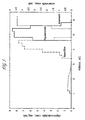
- Figure 5 shows a histogram of a displacement separation of SEQ ID NO: 1, a 20-mer phosphorothioate antisense oligonucleotide, using amaranth as a displacer on a Poros HQ/M column (4.6 x 100mm I.D., 20 ⁇ m particles), at a flow rate of 0.2 mL/min.
- the carrier solution and mobile phase was a 20 mM NaOH/500 mM NaCl solution.
- the feed and displacer solution were prepared from the carrier solution and the feed consisted of 11.98 mg oligonucleotide.
- An effective displacement was demonstrated with a sharp boundary between zones containing the impurities and the desired oligonucleotide, and between zones containing the oligonucleotide and the amaranth displacer.
- the histogram demonstrates the resolving power of amaranth in displacement chromatography of oligonucleotides.
- the displacement histogram depicted in Figure 5 was prepared using the separation parameters listed above and the general procedure illustrated below. One fractions per minute was collected and analyzed by analytical anion-exchange assay to determine the concentration of the components and their purities. Standard curves for the peak area versus the oligonucleotide concentration and the peak area versus the displacer concentration were generated using the sample of pure oligonucleotide and a sample of known concentration for the displacer, respectively. The concentration of oligonucleotide and amaranth in each of the fractions was then determined by using this standard curve to calculate a value of the extinction coefficient (peak area per unit concentration).
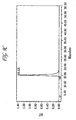
- FIG. 8 shows an HPLC chromatogram with the breakthrough curves for nitrate ions before and after the column had been put through several successive displacement steps as illustrated in Example 1. As can be seen, the breakthrough curves overlay each other signifying an effective column regeneration using standard protocols. The 4 step regeneration protocol is shown below.
- Example 2 The column that was regenerated after about 3 displacement runs in Example 2 was used to purify SEQ ID NO: 1 as a Phosphodiester.
- the general procedure illustrated in Example 1 was followed. High temperature anion-exchange analysis of the feed mixture for this separation is shown in Figure 9a. The mixture contained several lower retained impurities which appear as shoulders on the main product peak.
- the displacement chromatogram resulting from the displacement of this oligonucleotide using amaranth is shown in Figure 9B. Again, an effective separation was achieved resulting in a yield of 69.7% at 99% purity by the anion-exchange assay.
- the analytical capillary gel electropherogram of the purified pool of the purified phosphodiester is shown in Figure 9c.
- Figure 10 shows the displacement chromatogram.
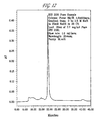
- Figure 11 shows the anion-exchange chromatogram and
- Figure 12 shows the anion-exchange chromatogram of the purified pool.
Landscapes
- Chemical & Material Sciences (AREA)
- Health & Medical Sciences (AREA)
- Engineering & Computer Science (AREA)
- Life Sciences & Earth Sciences (AREA)
- Analytical Chemistry (AREA)
- Biomedical Technology (AREA)
- Genetics & Genomics (AREA)
- Zoology (AREA)
- Bioinformatics & Cheminformatics (AREA)
- Organic Chemistry (AREA)
- Biotechnology (AREA)
- General Engineering & Computer Science (AREA)
- Wood Science & Technology (AREA)
- Microbiology (AREA)
- Plant Pathology (AREA)
- Molecular Biology (AREA)
- Physics & Mathematics (AREA)
- Crystallography & Structural Chemistry (AREA)
- Chemical Kinetics & Catalysis (AREA)
- Biochemistry (AREA)
- General Health & Medical Sciences (AREA)
- Biophysics (AREA)
- Saccharide Compounds (AREA)
- Pharmaceuticals Containing Other Organic And Inorganic Compounds (AREA)
- Detergent Compositions (AREA)
Claims (19)
- Verfahren zum Reinigen eines Oligonukleotids, umfassend:(a) das Laden des Oligonukleotids auf die stationäre Phase einer Anionenaustauschsäule, und(b) das Verdrängen des Oligonukleotids von der stationären Phase durch ein anionisches Verdrängungsmittel mit einem Molekulargewicht von weniger als 10 000 Dalton, wobei das anionische Verdrängungsmittel eine höhere Affinität zu der stationären Phase als das Oligonukleotid aufweist.
- Verfahren nach Anspruch 1, wobei das anionische Verdrängungsmittel ein Molekulargewicht von weniger als 5000 Dalton aufweist.
- Verfahren nach Anspruch 2, wobei das anionische Verdrängungsmittel ein Molekulargewicht von weniger als 2500 Dalton aufweist.
- Verfahren nach Anspruch 1, wobei das anionische Verdrängungsmittel eine aromatische Verbindung ist, welche mindestens einen anionischen Substituenten aufweist, wobei die aromatische Verbindung gegebenenfalls ein oder mehrere Substituenten, ausgewählt aus C1-C4 Alkyl, Halogen, Hydroxyl, Methoxy, Ethoxy, Phenyl, Amino, Acetamid (-N(H)Ac), Benzamid (-C(=O)N(H)Phenyl) und Nitro (-NO2), einschließt.
- Verfahren nach Anspruch 4, wobei der anionische Substituent aus der Gruppe, bestehend aus Sulfat-, Sulfonat-, Phosphat-, Phosphonat- und Carboxylatgruppen, ausgewählt ist.
- Verfahren nach Anspruch 5, wobei der anionische Substituent eine Sulfonatgruppe ist.
- Verfahren nach Anspruch 4, wobei das anionische Verdrängungsmittel eine polycyclische aromatische Verbindung ist, welche mindestens einen anionischen Substituenten aufweist, wobei die polycyclische aromatische Verbindung gegebenenfalls einen oder mehrere Substituenten, ausgewählt aus C1-C4 Alkyl, Halogen, Hydroxyl, Methoxy, Ethoxy, Phenyl, Amino, Acetamid (-N(H)Ac), Benzamid (-C(=O)N(H)Phenyl) und Nitro (-NO2), einschließt.
- Verfahren nach Anspruch 7, wobei der anionische Substituent aus der Gruppe, bestehend aus Sulfat-, Sulfonat-, Phosphat-, Phosphonat- und Carboxylatgruppen, ausgewählt ist.
- Verfahren nach Anspruch 8, wobei der anionische Substituent eine Sulfonatgruppe ist.
- Verfahren nach Anspruch 9, wobei das Verdrängungsmittel Amaranth ist.
- Verfahren nach Anspruch 9, wobei das Verdrängungsmittel Calcion ist.
- Verfahren nach Anspruch 1, wobei das anionische Verdrängungsmittel eine aliphatische Verbindung ist, welche mindestens einen anionischen Substituenten aufweist.
- Verfahren nach Anspruch 12, wobei der anionische Substituent aus der Gruppe, bestehend aus Sulfat-, Sulfonat-, Phosphat-, Phosphonat- und Carboxylatgruppen, ausgewählt ist.
- Verfahren nach Anspruch 13, wobei der anionische Substituent eine Sulfonatgruppe ist.
- Verfahren nach Anspruch 1, wobei das Oligonukleotid von 10 bis 40 Nukleotidbasen umfaßt.
- Verfahren nach Anspruch 1, weiter umfassend:- das Eluieren der Anionenaustauschsäule mit etwa 5 Systemvolumina von 2,5 M NaCl und 20 mM NaOH,- das Eluieren der Anionenaustauschsäule mit etwa 5 Systemvolumina Wasser,- das Eluieren der Anionenaustauschsäule mit etwa 5 Systemvolumina von 25% v/v Acetonitril und 20 mM NaOH, und- das Eluieren der Anionen-Austauschsäule mit etwa 5 Systemvolumina Wasser.
- Verfahren zum Reinigen eines Oligonukleotids, umfassend:(a) das Laden des Oligonukleotids in einer geeigneten mobilen Phase auf eine stationäre Phase eines Anionenaustauschsystems, und(b) das Verdrängen des Oligonukleotids von dem Anionenaustauschsystem durch Elution mit einem polycyclischen aromatischen Sulfonat-Verdrängungsmittel.
- Verfahren nach Anspruch 17, wobei das polycyclische aromatische Sulfonat-Verdrängungsmittel Amaranth umfaßt.
- Verfahren nach Anspruch 17, wobei das polycyclische aromatische Sulfonat-Verdrängungsmittel Calcion umfaßt.
Applications Claiming Priority (3)
| Application Number | Priority Date | Filing Date | Title |
|---|---|---|---|
| US343006 | 1999-06-29 | ||
| US09/343,006 US6573373B1 (en) | 1999-06-29 | 1999-06-29 | High affinity, low molecular weight displacers for oligonucleotide purification |
| PCT/US2000/017750 WO2001000642A1 (en) | 1999-06-29 | 2000-06-28 | High affinity, low molecular weight displacers for oligonucleotide purification |
Publications (3)
| Publication Number | Publication Date |
|---|---|
| EP1192172A1 EP1192172A1 (de) | 2002-04-03 |
| EP1192172A4 EP1192172A4 (de) | 2002-08-28 |
| EP1192172B1 true EP1192172B1 (de) | 2007-05-02 |
Family
ID=23344283
Family Applications (1)
| Application Number | Title | Priority Date | Filing Date |
|---|---|---|---|
| EP00943241A Expired - Lifetime EP1192172B1 (de) | 1999-06-29 | 2000-06-28 | Verdrängungsreagenzien mit niedrigem molekulargewicht und hoher affinität zur reinigung von oligonukleotiden |
Country Status (7)
| Country | Link |
|---|---|
| US (2) | US6573373B1 (de) |
| EP (1) | EP1192172B1 (de) |
| JP (1) | JP2003503418A (de) |
| AT (1) | ATE361308T1 (de) |
| AU (1) | AU5774000A (de) |
| DE (1) | DE60034676T2 (de) |
| WO (1) | WO2001000642A1 (de) |
Families Citing this family (9)
| Publication number | Priority date | Publication date | Assignee | Title |
|---|---|---|---|---|
| US6573373B1 (en) * | 1999-06-29 | 2003-06-03 | Isis Pharmaceuticals, Inc. | High affinity, low molecular weight displacers for oligonucleotide purification |
| AU2003213642A1 (en) | 2002-02-28 | 2003-09-16 | Rensselaer Polytechnic Institute | High-affinity, low-molecular-mass displacers for ion-exchange chromatography |
| US8080560B2 (en) * | 2004-12-17 | 2011-12-20 | 3M Innovative Properties Company | Immune response modifier formulations containing oleic acid and methods |
| WO2006116064A2 (en) * | 2005-04-22 | 2006-11-02 | Waters Investments Limited | Apparatus and methods for mass-spectrometric directed purification of biopolymers |
| US7994220B2 (en) | 2005-09-28 | 2011-08-09 | Cypress Bioscience, Inc. | Milnacipran for the long-term treatment of fibromyalgia syndrome |
| KR101408026B1 (ko) | 2005-12-02 | 2014-06-20 | 사켐,인코포레이티드 | 음이온-교환 치환 크로마토그래피 공정 및 음이온-교환치환 크로마토그래피 공정에서 디스플레이서 화합물들로서사용하기 위한 음이온성 유기 화합물들 |
| GB201115218D0 (en) * | 2011-09-02 | 2011-10-19 | Glaxo Group Ltd | Novel process |
| TWI432499B (zh) | 2011-12-26 | 2014-04-01 | Ind Tech Res Inst | 複合原料、碳纖維材料及其形成方法 |
| EP4070102A1 (de) * | 2019-12-05 | 2022-10-12 | Waters Technologies Corporation | Polyphosphonsäuren zur verbesserung der rückgewinnung und minimierung des systemverlustes |
Family Cites Families (7)
| Publication number | Priority date | Publication date | Assignee | Title |
|---|---|---|---|---|
| IT1232311B (it) | 1989-09-04 | 1992-01-28 | Sclavo Spa | Metodo di purificazione di composti a struttura peptidica o pseudo peptidica a basso peso molecolare. |
| US5866429A (en) * | 1991-04-03 | 1999-02-02 | Bloch; Will | Precision and accuracy of anion-exchange separation of nucleic acids |
| CA2106612C (en) | 1993-09-21 | 2001-02-06 | Diana Pliura | Displacement chromatography process |
| US5478924A (en) | 1994-02-16 | 1995-12-26 | Cramer; Steven M. | Displacement chromatography of proteins using low molecular weight displacers |
| US5427686A (en) | 1994-04-05 | 1995-06-27 | Sri International | Process for separating material from mixture using displacement chromatography |
| US6329145B1 (en) | 1999-02-09 | 2001-12-11 | Gilead Science, Inc. | Determining non-nucleic acid molecule binding to target by competition with nucleic acid ligand |
| US6573373B1 (en) * | 1999-06-29 | 2003-06-03 | Isis Pharmaceuticals, Inc. | High affinity, low molecular weight displacers for oligonucleotide purification |
-
1999
- 1999-06-29 US US09/343,006 patent/US6573373B1/en not_active Expired - Fee Related
-
2000
- 2000-06-28 WO PCT/US2000/017750 patent/WO2001000642A1/en not_active Ceased
- 2000-06-28 AT AT00943241T patent/ATE361308T1/de not_active IP Right Cessation
- 2000-06-28 AU AU57740/00A patent/AU5774000A/en not_active Abandoned
- 2000-06-28 JP JP2001507049A patent/JP2003503418A/ja active Pending
- 2000-06-28 DE DE60034676T patent/DE60034676T2/de not_active Expired - Fee Related
- 2000-06-28 EP EP00943241A patent/EP1192172B1/de not_active Expired - Lifetime
-
2002
- 2002-05-15 US US10/146,266 patent/US6828436B2/en not_active Expired - Fee Related
Non-Patent Citations (1)
| Title |
|---|
| None * |
Also Published As
| Publication number | Publication date |
|---|---|
| WO2001000642A9 (en) | 2002-07-25 |
| JP2003503418A (ja) | 2003-01-28 |
| US6828436B2 (en) | 2004-12-07 |
| AU5774000A (en) | 2001-01-31 |
| US20020156267A1 (en) | 2002-10-24 |
| WO2001000642A1 (en) | 2001-01-04 |
| ATE361308T1 (de) | 2007-05-15 |
| US6573373B1 (en) | 2003-06-03 |
| EP1192172A1 (de) | 2002-04-03 |
| DE60034676T2 (de) | 2008-01-17 |
| DE60034676D1 (de) | 2007-06-14 |
| EP1192172A4 (de) | 2002-08-28 |
Similar Documents
| Publication | Publication Date | Title |
|---|---|---|
| JP3195039B2 (ja) | 核酸のアニオン−交換分離の精度及び正確度の改良 | |
| US20060035224A1 (en) | Purification methods for oligonucleotides and their analogs | |
| US5811538A (en) | Process for the purification of oligomers | |
| Liao et al. | High performance displacement chromatography of proteins: Separation of β-lactoglobulins a and b | |
| Li et al. | Impurity profiling of siRNA by two-dimensional liquid chromatography-mass spectrometry with quinine carbamate anion-exchanger and ion-pair reversed-phase chromatography | |
| US5801237A (en) | Method for the purification of short nucleic acids | |
| JP2005520547A (ja) | オリゴヌクレオチド及びその類似体のための精製方法 | |
| CS231161B2 (en) | Method of separating of nucleid acid mixtures | |
| EP1192172B1 (de) | Verdrängungsreagenzien mit niedrigem molekulargewicht und hoher affinität zur reinigung von oligonukleotiden | |
| JP2001521729A (ja) | ポリヌクレオチドの高分離の液体クロマトグラフィー分離方法 | |
| Warren et al. | Principles and methods for the analysis and purification of synthetic deoxyribonucleotides by high-performance liquid chromatography | |
| Tugcu et al. | Purification of an oligonucleotide at high column loading by high affinity, low-molecular-mass displacers | |
| Gerstner et al. | Gram-scale purification of phosphorothioate oligonucleotides using ion-exchange displacement chromatography | |
| US7781573B2 (en) | Multi layer chromatography of nucleic acids | |
| WO2017115652A1 (ja) | 分離分析方法 | |
| Deshmukh et al. | Purification of antisense oligonucleotides | |
| EP1578968B1 (de) | Isolierung von antisense-oligonukleotiden | |
| US20070056908A1 (en) | Nucleic acids in the form of specific novel chiral selectors | |
| WO2007114762A1 (en) | Method of separation of deoxyribonucleic acids | |
| Frazer | The impact of various chromatographic conditions on the separation of modified and unmodified oligonucleotides | |
| US20080287670A1 (en) | Systems and methods for the purification of synthetic trityl-on oligonucleotides | |
| Edwardson et al. | Purification of homo-and hetero-oligonucleotides using high-performance charge-transfer chromatography | |
| Li | Isolation and purification of oligonucleotides by ion-exchange: Studies on the mechanism of separation | |
| Sheikhavandi et al. | Purification of Synthetic Oligonucleotides-Utilizing Denaturing High Performance Liquid Chromatography (dHPLC) |
Legal Events
| Date | Code | Title | Description |
|---|---|---|---|
| PUAI | Public reference made under article 153(3) epc to a published international application that has entered the european phase |
Free format text: ORIGINAL CODE: 0009012 |
|
| 17P | Request for examination filed |
Effective date: 20020111 |
|
| AK | Designated contracting states |
Kind code of ref document: A1 Designated state(s): AT BE CH CY DE DK ES FI FR GB GR IE IT LI LU MC NL PT SE |
|
| AX | Request for extension of the european patent |
Free format text: AL;LT;LV;MK;RO;SI |
|
| RIC1 | Information provided on ipc code assigned before grant |
Free format text: 7C 07H 21/00 A, 7C 07H 21/02 B, 7C 07H 21/04 B, 7C 12N 15/10 B |
|
| A4 | Supplementary search report drawn up and despatched |
Effective date: 20020712 |
|
| AK | Designated contracting states |
Kind code of ref document: A4 Designated state(s): AT BE CH CY DE DK ES FI FR GB GR IE IT LI LU MC NL PT SE |
|
| RAP1 | Party data changed (applicant data changed or rights of an application transferred) |
Owner name: ISIS PHARMACEUTICALS, INC. Owner name: RENSSELAER POLYTECHNIC INSTITUTE |
|
| 17Q | First examination report despatched |
Effective date: 20050221 |
|
| RAP1 | Party data changed (applicant data changed or rights of an application transferred) |
Owner name: RENSSELAER POLYTECHNIC INSTITUTE Owner name: ISIS PHARMACEUTICALS, INC. |
|
| 17Q | First examination report despatched |
Effective date: 20050221 |
|
| GRAC | Information related to communication of intention to grant a patent modified |
Free format text: ORIGINAL CODE: EPIDOSCIGR1 |
|
| GRAP | Despatch of communication of intention to grant a patent |
Free format text: ORIGINAL CODE: EPIDOSNIGR1 |
|
| GRAS | Grant fee paid |
Free format text: ORIGINAL CODE: EPIDOSNIGR3 |
|
| GRAA | (expected) grant |
Free format text: ORIGINAL CODE: 0009210 |
|
| AK | Designated contracting states |
Kind code of ref document: B1 Designated state(s): AT BE CH CY DE DK ES FI FR GB GR IE IT LI LU MC NL PT SE |
|
| PG25 | Lapsed in a contracting state [announced via postgrant information from national office to epo] |
Ref country code: FI Free format text: LAPSE BECAUSE OF FAILURE TO SUBMIT A TRANSLATION OF THE DESCRIPTION OR TO PAY THE FEE WITHIN THE PRESCRIBED TIME-LIMIT Effective date: 20070502 |
|
| REG | Reference to a national code |
Ref country code: GB Ref legal event code: FG4D |
|
| REG | Reference to a national code |
Ref country code: CH Ref legal event code: EP |
|
| REG | Reference to a national code |
Ref country code: IE Ref legal event code: FG4D |
|
| REF | Corresponds to: |
Ref document number: 60034676 Country of ref document: DE Date of ref document: 20070614 Kind code of ref document: P |
|
| PG25 | Lapsed in a contracting state [announced via postgrant information from national office to epo] |
Ref country code: SE Free format text: LAPSE BECAUSE OF FAILURE TO SUBMIT A TRANSLATION OF THE DESCRIPTION OR TO PAY THE FEE WITHIN THE PRESCRIBED TIME-LIMIT Effective date: 20070802 |
|
| PG25 | Lapsed in a contracting state [announced via postgrant information from national office to epo] |
Ref country code: ES Free format text: LAPSE BECAUSE OF FAILURE TO SUBMIT A TRANSLATION OF THE DESCRIPTION OR TO PAY THE FEE WITHIN THE PRESCRIBED TIME-LIMIT Effective date: 20070813 |
|
| PGFP | Annual fee paid to national office [announced via postgrant information from national office to epo] |
Ref country code: IE Payment date: 20070813 Year of fee payment: 8 |
|
| PGFP | Annual fee paid to national office [announced via postgrant information from national office to epo] |
Ref country code: DE Payment date: 20070816 Year of fee payment: 8 |
|
| NLV1 | Nl: lapsed or annulled due to failure to fulfill the requirements of art. 29p and 29m of the patents act | ||
| ET | Fr: translation filed | ||
| PG25 | Lapsed in a contracting state [announced via postgrant information from national office to epo] |
Ref country code: AT Free format text: LAPSE BECAUSE OF FAILURE TO SUBMIT A TRANSLATION OF THE DESCRIPTION OR TO PAY THE FEE WITHIN THE PRESCRIBED TIME-LIMIT Effective date: 20070502 |
|
| PGFP | Annual fee paid to national office [announced via postgrant information from national office to epo] |
Ref country code: CH Payment date: 20070815 Year of fee payment: 8 |
|
| PGFP | Annual fee paid to national office [announced via postgrant information from national office to epo] |
Ref country code: GB Payment date: 20070815 Year of fee payment: 8 |
|
| PG25 | Lapsed in a contracting state [announced via postgrant information from national office to epo] |
Ref country code: PT Free format text: LAPSE BECAUSE OF FAILURE TO SUBMIT A TRANSLATION OF THE DESCRIPTION OR TO PAY THE FEE WITHIN THE PRESCRIBED TIME-LIMIT Effective date: 20071002 Ref country code: DK Free format text: LAPSE BECAUSE OF FAILURE TO SUBMIT A TRANSLATION OF THE DESCRIPTION OR TO PAY THE FEE WITHIN THE PRESCRIBED TIME-LIMIT Effective date: 20070502 Ref country code: NL Free format text: LAPSE BECAUSE OF FAILURE TO SUBMIT A TRANSLATION OF THE DESCRIPTION OR TO PAY THE FEE WITHIN THE PRESCRIBED TIME-LIMIT Effective date: 20070502 Ref country code: MC Free format text: LAPSE BECAUSE OF NON-PAYMENT OF DUE FEES Effective date: 20070630 |
|
| PGFP | Annual fee paid to national office [announced via postgrant information from national office to epo] |
Ref country code: BE Payment date: 20070925 Year of fee payment: 8 |
|
| PLBE | No opposition filed within time limit |
Free format text: ORIGINAL CODE: 0009261 |
|
| STAA | Information on the status of an ep patent application or granted ep patent |
Free format text: STATUS: NO OPPOSITION FILED WITHIN TIME LIMIT |
|
| 26N | No opposition filed |
Effective date: 20080205 |
|
| PG25 | Lapsed in a contracting state [announced via postgrant information from national office to epo] |
Ref country code: IT Free format text: LAPSE BECAUSE OF FAILURE TO SUBMIT A TRANSLATION OF THE DESCRIPTION OR TO PAY THE FEE WITHIN THE PRESCRIBED TIME-LIMIT Effective date: 20070502 Ref country code: GR Free format text: LAPSE BECAUSE OF FAILURE TO SUBMIT A TRANSLATION OF THE DESCRIPTION OR TO PAY THE FEE WITHIN THE PRESCRIBED TIME-LIMIT Effective date: 20070803 |
|
| PGFP | Annual fee paid to national office [announced via postgrant information from national office to epo] |
Ref country code: FR Payment date: 20070828 Year of fee payment: 8 |
|
| BERE | Be: lapsed |
Owner name: ISIS PHARMACEUTICALS, INC. Effective date: 20080630 Owner name: RENSSELAER POLYTECHNIC INSTITUTE Effective date: 20080630 |
|
| REG | Reference to a national code |
Ref country code: CH Ref legal event code: PL |
|
| GBPC | Gb: european patent ceased through non-payment of renewal fee |
Effective date: 20080628 |
|
| PG25 | Lapsed in a contracting state [announced via postgrant information from national office to epo] |
Ref country code: BE Free format text: LAPSE BECAUSE OF NON-PAYMENT OF DUE FEES Effective date: 20080630 |
|
| REG | Reference to a national code |
Ref country code: FR Ref legal event code: ST Effective date: 20090228 |
|
| PG25 | Lapsed in a contracting state [announced via postgrant information from national office to epo] |
Ref country code: IE Free format text: LAPSE BECAUSE OF NON-PAYMENT OF DUE FEES Effective date: 20080630 Ref country code: DE Free format text: LAPSE BECAUSE OF NON-PAYMENT OF DUE FEES Effective date: 20090101 |
|
| PG25 | Lapsed in a contracting state [announced via postgrant information from national office to epo] |
Ref country code: LI Free format text: LAPSE BECAUSE OF NON-PAYMENT OF DUE FEES Effective date: 20080630 Ref country code: CH Free format text: LAPSE BECAUSE OF NON-PAYMENT OF DUE FEES Effective date: 20080630 Ref country code: GB Free format text: LAPSE BECAUSE OF NON-PAYMENT OF DUE FEES Effective date: 20080628 |
|
| PG25 | Lapsed in a contracting state [announced via postgrant information from national office to epo] |
Ref country code: CY Free format text: LAPSE BECAUSE OF FAILURE TO SUBMIT A TRANSLATION OF THE DESCRIPTION OR TO PAY THE FEE WITHIN THE PRESCRIBED TIME-LIMIT Effective date: 20070502 |
|
| PG25 | Lapsed in a contracting state [announced via postgrant information from national office to epo] |
Ref country code: LU Free format text: LAPSE BECAUSE OF NON-PAYMENT OF DUE FEES Effective date: 20070628 Ref country code: FR Free format text: LAPSE BECAUSE OF NON-PAYMENT OF DUE FEES Effective date: 20080630 |