EP1186405A1 - Koextrudierte, biaxial orientierte Polyesterfolie mit guter Metallhaftung, Verfahren zu ihrer Herstellung und ihre Verwendung - Google Patents
Koextrudierte, biaxial orientierte Polyesterfolie mit guter Metallhaftung, Verfahren zu ihrer Herstellung und ihre Verwendung Download PDFInfo
- Publication number
- EP1186405A1 EP1186405A1 EP01118336A EP01118336A EP1186405A1 EP 1186405 A1 EP1186405 A1 EP 1186405A1 EP 01118336 A EP01118336 A EP 01118336A EP 01118336 A EP01118336 A EP 01118336A EP 1186405 A1 EP1186405 A1 EP 1186405A1
- Authority
- EP
- European Patent Office
- Prior art keywords
- range
- layer
- polyester film
- film
- metal
- Prior art date
- Legal status (The legal status is an assumption and is not a legal conclusion. Google has not performed a legal analysis and makes no representation as to the accuracy of the status listed.)
- Granted
Links
- 229910052751 metal Inorganic materials 0.000 title claims abstract description 46
- 239000002184 metal Substances 0.000 title claims abstract description 46
- 229920006267 polyester film Polymers 0.000 title claims abstract description 23
- 238000000034 method Methods 0.000 title claims description 17
- 238000004519 manufacturing process Methods 0.000 title claims description 12
- 230000008569 process Effects 0.000 title claims description 11
- 239000000853 adhesive Substances 0.000 claims abstract description 28
- LYCAIKOWRPUZTN-UHFFFAOYSA-N Ethylene glycol Chemical group OCCO LYCAIKOWRPUZTN-UHFFFAOYSA-N 0.000 claims description 18
- 239000003795 chemical substances by application Substances 0.000 claims description 18
- 229920001634 Copolyester Polymers 0.000 claims description 15
- LZFNKJKBRGFWDU-UHFFFAOYSA-N 3,6-dioxabicyclo[6.3.1]dodeca-1(12),8,10-triene-2,7-dione Chemical group O=C1OCCOC(=O)C2=CC=CC1=C2 LZFNKJKBRGFWDU-UHFFFAOYSA-N 0.000 claims description 11
- LLLVZDVNHNWSDS-UHFFFAOYSA-N 4-methylidene-3,5-dioxabicyclo[5.2.2]undeca-1(9),7,10-triene-2,6-dione Chemical compound C1(C2=CC=C(C(=O)OC(=C)O1)C=C2)=O LLLVZDVNHNWSDS-UHFFFAOYSA-N 0.000 claims description 11
- 239000002245 particle Substances 0.000 claims description 11
- 229920000642 polymer Polymers 0.000 claims description 9
- 238000000576 coating method Methods 0.000 claims description 7
- 238000001125 extrusion Methods 0.000 claims description 7
- 239000000654 additive Substances 0.000 claims description 6
- 239000011888 foil Substances 0.000 claims description 6
- 239000011248 coating agent Substances 0.000 claims description 5
- 239000000049 pigment Substances 0.000 claims description 5
- 239000003381 stabilizer Substances 0.000 claims description 5
- 238000009459 flexible packaging Methods 0.000 claims description 3
- 239000000155 melt Substances 0.000 claims description 3
- 238000004806 packaging method and process Methods 0.000 claims description 3
- 239000011164 primary particle Substances 0.000 claims description 3
- 238000001816 cooling Methods 0.000 claims description 2
- 229910001220 stainless steel Inorganic materials 0.000 claims description 2
- 239000010935 stainless steel Substances 0.000 claims description 2
- 239000002699 waste material Substances 0.000 claims description 2
- 239000012535 impurity Substances 0.000 claims 1
- 239000010410 layer Substances 0.000 description 109
- 239000010408 film Substances 0.000 description 72
- 230000001070 adhesive effect Effects 0.000 description 18
- -1 polyethylene Polymers 0.000 description 16
- 239000000203 mixture Substances 0.000 description 8
- 229920000139 polyethylene terephthalate Polymers 0.000 description 8
- 239000005020 polyethylene terephthalate Substances 0.000 description 8
- 230000007704 transition Effects 0.000 description 8
- 229920000728 polyester Polymers 0.000 description 7
- 229910004298 SiO 2 Inorganic materials 0.000 description 6
- KKEYFWRCBNTPAC-UHFFFAOYSA-N Terephthalic acid Chemical compound OC(=O)C1=CC=C(C(O)=O)C=C1 KKEYFWRCBNTPAC-UHFFFAOYSA-N 0.000 description 6
- 150000001991 dicarboxylic acids Chemical class 0.000 description 6
- 238000005809 transesterification reaction Methods 0.000 description 6
- 239000003054 catalyst Substances 0.000 description 5
- QQVIHTHCMHWDBS-UHFFFAOYSA-N isophthalic acid Chemical compound OC(=O)C1=CC=CC(C(O)=O)=C1 QQVIHTHCMHWDBS-UHFFFAOYSA-N 0.000 description 5
- 239000002131 composite material Substances 0.000 description 4
- 150000002009 diols Chemical class 0.000 description 4
- 239000000543 intermediate Substances 0.000 description 4
- 239000011572 manganese Substances 0.000 description 4
- 238000005259 measurement Methods 0.000 description 4
- 229910052755 nonmetal Inorganic materials 0.000 description 4
- XEKOWRVHYACXOJ-UHFFFAOYSA-N Ethyl acetate Chemical compound CCOC(C)=O XEKOWRVHYACXOJ-UHFFFAOYSA-N 0.000 description 3
- VYPSYNLAJGMNEJ-UHFFFAOYSA-N Silicium dioxide Chemical compound O=[Si]=O VYPSYNLAJGMNEJ-UHFFFAOYSA-N 0.000 description 3
- 125000001931 aliphatic group Chemical group 0.000 description 3
- MTHSVFCYNBDYFN-UHFFFAOYSA-N diethylene glycol Chemical compound OCCOCCO MTHSVFCYNBDYFN-UHFFFAOYSA-N 0.000 description 3
- RXOHFPCZGPKIRD-UHFFFAOYSA-N naphthalene-2,6-dicarboxylic acid Chemical compound C1=C(C(O)=O)C=CC2=CC(C(=O)O)=CC=C21 RXOHFPCZGPKIRD-UHFFFAOYSA-N 0.000 description 3
- 238000006068 polycondensation reaction Methods 0.000 description 3
- 238000012360 testing method Methods 0.000 description 3
- NEQFBGHQPUXOFH-UHFFFAOYSA-N 4-(4-carboxyphenyl)benzoic acid Chemical compound C1=CC(C(=O)O)=CC=C1C1=CC=C(C(O)=O)C=C1 NEQFBGHQPUXOFH-UHFFFAOYSA-N 0.000 description 2
- 229910002021 Aerosil® TT 600 Inorganic materials 0.000 description 2
- OYPRJOBELJOOCE-UHFFFAOYSA-N Calcium Chemical compound [Ca] OYPRJOBELJOOCE-UHFFFAOYSA-N 0.000 description 2
- VTYYLEPIZMXCLO-UHFFFAOYSA-L Calcium carbonate Chemical compound [Ca+2].[O-]C([O-])=O VTYYLEPIZMXCLO-UHFFFAOYSA-L 0.000 description 2
- OKTJSMMVPCPJKN-UHFFFAOYSA-N Carbon Chemical compound [C] OKTJSMMVPCPJKN-UHFFFAOYSA-N 0.000 description 2
- 239000004594 Masterbatch (MB) Substances 0.000 description 2
- NBIIXXVUZAFLBC-UHFFFAOYSA-N Phosphoric acid Chemical compound OP(O)(O)=O NBIIXXVUZAFLBC-UHFFFAOYSA-N 0.000 description 2
- 239000004698 Polyethylene Substances 0.000 description 2
- GWEVSGVZZGPLCZ-UHFFFAOYSA-N Titan oxide Chemical compound O=[Ti]=O GWEVSGVZZGPLCZ-UHFFFAOYSA-N 0.000 description 2
- HCHKCACWOHOZIP-UHFFFAOYSA-N Zinc Chemical compound [Zn] HCHKCACWOHOZIP-UHFFFAOYSA-N 0.000 description 2
- 239000002253 acid Substances 0.000 description 2
- 239000002390 adhesive tape Substances 0.000 description 2
- ADCOVFLJGNWWNZ-UHFFFAOYSA-N antimony trioxide Chemical compound O=[Sb]O[Sb]=O ADCOVFLJGNWWNZ-UHFFFAOYSA-N 0.000 description 2
- TZCXTZWJZNENPQ-UHFFFAOYSA-L barium sulfate Chemical compound [Ba+2].[O-]S([O-])(=O)=O TZCXTZWJZNENPQ-UHFFFAOYSA-L 0.000 description 2
- 230000004888 barrier function Effects 0.000 description 2
- 229910052791 calcium Inorganic materials 0.000 description 2
- 239000011575 calcium Substances 0.000 description 2
- OSGAYBCDTDRGGQ-UHFFFAOYSA-L calcium sulfate Chemical compound [Ca+2].[O-]S([O-])(=O)=O OSGAYBCDTDRGGQ-UHFFFAOYSA-L 0.000 description 2
- 239000003086 colorant Substances 0.000 description 2
- 230000000052 comparative effect Effects 0.000 description 2
- JXTHNDFMNIQAHM-UHFFFAOYSA-N dichloroacetic acid Chemical compound OC(=O)C(Cl)Cl JXTHNDFMNIQAHM-UHFFFAOYSA-N 0.000 description 2
- 239000006185 dispersion Substances 0.000 description 2
- 239000007788 liquid Substances 0.000 description 2
- PQXKHYXIUOZZFA-UHFFFAOYSA-M lithium fluoride Chemical compound [Li+].[F-] PQXKHYXIUOZZFA-UHFFFAOYSA-M 0.000 description 2
- 150000002696 manganese Chemical class 0.000 description 2
- 239000011104 metalized film Substances 0.000 description 2
- 238000001465 metallisation Methods 0.000 description 2
- 239000000178 monomer Substances 0.000 description 2
- 230000000704 physical effect Effects 0.000 description 2
- 229920000573 polyethylene Polymers 0.000 description 2
- YPFDHNVEDLHUCE-UHFFFAOYSA-N propane-1,3-diol Chemical compound OCCCO YPFDHNVEDLHUCE-UHFFFAOYSA-N 0.000 description 2
- 239000002994 raw material Substances 0.000 description 2
- 210000003934 vacuole Anatomy 0.000 description 2
- 239000011701 zinc Substances 0.000 description 2
- 229910052725 zinc Inorganic materials 0.000 description 2
- PXGZQGDTEZPERC-UHFFFAOYSA-N 1,4-cyclohexanedicarboxylic acid Chemical compound OC(=O)C1CCC(C(O)=O)CC1 PXGZQGDTEZPERC-UHFFFAOYSA-N 0.000 description 1
- YHNCEEAUZFKPHN-UHFFFAOYSA-N 1-bromonaphthalene;diiodomethane Chemical compound ICI.C1=CC=C2C(Br)=CC=CC2=C1 YHNCEEAUZFKPHN-UHFFFAOYSA-N 0.000 description 1
- YZTJKOLMWJNVFH-UHFFFAOYSA-N 2-sulfobenzene-1,3-dicarboxylic acid Chemical compound OC(=O)C1=CC=CC(C(O)=O)=C1S(O)(=O)=O YZTJKOLMWJNVFH-UHFFFAOYSA-N 0.000 description 1
- VPWNQTHUCYMVMZ-UHFFFAOYSA-N 4,4'-sulfonyldiphenol Chemical class C1=CC(O)=CC=C1S(=O)(=O)C1=CC=C(O)C=C1 VPWNQTHUCYMVMZ-UHFFFAOYSA-N 0.000 description 1
- NIXOWILDQLNWCW-UHFFFAOYSA-M Acrylate Chemical compound [O-]C(=O)C=C NIXOWILDQLNWCW-UHFFFAOYSA-M 0.000 description 1
- 239000005995 Aluminium silicate Substances 0.000 description 1
- 229930185605 Bisphenol Natural products 0.000 description 1
- 229920002799 BoPET Polymers 0.000 description 1
- WHXSMMKQMYFTQS-UHFFFAOYSA-N Lithium Chemical compound [Li] WHXSMMKQMYFTQS-UHFFFAOYSA-N 0.000 description 1
- FYYHWMGAXLPEAU-UHFFFAOYSA-N Magnesium Chemical compound [Mg] FYYHWMGAXLPEAU-UHFFFAOYSA-N 0.000 description 1
- OFOBLEOULBTSOW-UHFFFAOYSA-N Malonic acid Chemical compound OC(=O)CC(O)=O OFOBLEOULBTSOW-UHFFFAOYSA-N 0.000 description 1
- ALQSHHUCVQOPAS-UHFFFAOYSA-N Pentane-1,5-diol Chemical compound OCCCCCO ALQSHHUCVQOPAS-UHFFFAOYSA-N 0.000 description 1
- 239000004793 Polystyrene Substances 0.000 description 1
- 150000007513 acids Chemical class 0.000 description 1
- 239000002313 adhesive film Substances 0.000 description 1
- 239000012790 adhesive layer Substances 0.000 description 1
- 150000001335 aliphatic alkanes Chemical class 0.000 description 1
- 229910000147 aluminium phosphate Inorganic materials 0.000 description 1
- 235000012211 aluminium silicate Nutrition 0.000 description 1
- QVGXLLKOCUKJST-UHFFFAOYSA-N atomic oxygen Chemical compound [O] QVGXLLKOCUKJST-UHFFFAOYSA-N 0.000 description 1
- 229910052788 barium Inorganic materials 0.000 description 1
- DSAJWYNOEDNPEQ-UHFFFAOYSA-N barium atom Chemical compound [Ba] DSAJWYNOEDNPEQ-UHFFFAOYSA-N 0.000 description 1
- AYJRCSIUFZENHW-DEQYMQKBSA-L barium(2+);oxomethanediolate Chemical compound [Ba+2].[O-][14C]([O-])=O AYJRCSIUFZENHW-DEQYMQKBSA-L 0.000 description 1
- 230000015572 biosynthetic process Effects 0.000 description 1
- 230000000903 blocking effect Effects 0.000 description 1
- 229910000019 calcium carbonate Inorganic materials 0.000 description 1
- 239000001506 calcium phosphate Substances 0.000 description 1
- 229910000389 calcium phosphate Inorganic materials 0.000 description 1
- 235000011010 calcium phosphates Nutrition 0.000 description 1
- 125000004432 carbon atom Chemical group C* 0.000 description 1
- 239000006229 carbon black Substances 0.000 description 1
- 238000011109 contamination Methods 0.000 description 1
- 229920001577 copolymer Polymers 0.000 description 1
- QYQADNCHXSEGJT-UHFFFAOYSA-N cyclohexane-1,1-dicarboxylate;hydron Chemical class OC(=O)C1(C(O)=O)CCCCC1 QYQADNCHXSEGJT-UHFFFAOYSA-N 0.000 description 1
- PDXRQENMIVHKPI-UHFFFAOYSA-N cyclohexane-1,1-diol Chemical class OC1(O)CCCCC1 PDXRQENMIVHKPI-UHFFFAOYSA-N 0.000 description 1
- VKONPUDBRVKQLM-UHFFFAOYSA-N cyclohexane-1,4-diol Chemical compound OC1CCC(O)CC1 VKONPUDBRVKQLM-UHFFFAOYSA-N 0.000 description 1
- 229960005215 dichloroacetic acid Drugs 0.000 description 1
- NZZFYRREKKOMAT-UHFFFAOYSA-N diiodomethane Chemical compound ICI NZZFYRREKKOMAT-UHFFFAOYSA-N 0.000 description 1
- 230000032050 esterification Effects 0.000 description 1
- 238000005886 esterification reaction Methods 0.000 description 1
- 230000002349 favourable effect Effects 0.000 description 1
- 239000000945 filler Substances 0.000 description 1
- 239000000796 flavoring agent Substances 0.000 description 1
- 235000019634 flavors Nutrition 0.000 description 1
- 239000011521 glass Substances 0.000 description 1
- 239000003292 glue Substances 0.000 description 1
- 238000009998 heat setting Methods 0.000 description 1
- XXMIOPMDWAUFGU-UHFFFAOYSA-N hexane-1,6-diol Chemical compound OCCCCCCO XXMIOPMDWAUFGU-UHFFFAOYSA-N 0.000 description 1
- 230000006872 improvement Effects 0.000 description 1
- 239000010954 inorganic particle Substances 0.000 description 1
- NLYAJNPCOHFWQQ-UHFFFAOYSA-N kaolin Chemical compound O.O.O=[Al]O[Si](=O)O[Si](=O)O[Al]=O NLYAJNPCOHFWQQ-UHFFFAOYSA-N 0.000 description 1
- 238000003475 lamination Methods 0.000 description 1
- 229910052744 lithium Inorganic materials 0.000 description 1
- 229910001386 lithium phosphate Inorganic materials 0.000 description 1
- 229910052749 magnesium Inorganic materials 0.000 description 1
- 239000011777 magnesium Substances 0.000 description 1
- ZLNQQNXFFQJAID-UHFFFAOYSA-L magnesium carbonate Chemical compound [Mg+2].[O-]C([O-])=O ZLNQQNXFFQJAID-UHFFFAOYSA-L 0.000 description 1
- 239000001095 magnesium carbonate Substances 0.000 description 1
- 229910000021 magnesium carbonate Inorganic materials 0.000 description 1
- GVALZJMUIHGIMD-UHFFFAOYSA-H magnesium phosphate Chemical compound [Mg+2].[Mg+2].[Mg+2].[O-]P([O-])([O-])=O.[O-]P([O-])([O-])=O GVALZJMUIHGIMD-UHFFFAOYSA-H 0.000 description 1
- 239000004137 magnesium phosphate Substances 0.000 description 1
- 229910000157 magnesium phosphate Inorganic materials 0.000 description 1
- 229960002261 magnesium phosphate Drugs 0.000 description 1
- 235000010994 magnesium phosphates Nutrition 0.000 description 1
- 239000000463 material Substances 0.000 description 1
- 239000011159 matrix material Substances 0.000 description 1
- 238000002844 melting Methods 0.000 description 1
- 230000008018 melting Effects 0.000 description 1
- 150000002739 metals Chemical class 0.000 description 1
- 238000002156 mixing Methods 0.000 description 1
- KYTZHLUVELPASH-UHFFFAOYSA-N naphthalene-1,2-dicarboxylic acid Chemical class C1=CC=CC2=C(C(O)=O)C(C(=O)O)=CC=C21 KYTZHLUVELPASH-UHFFFAOYSA-N 0.000 description 1
- 150000002843 nonmetals Chemical class 0.000 description 1
- 238000011022 operating instruction Methods 0.000 description 1
- 230000003287 optical effect Effects 0.000 description 1
- 239000011146 organic particle Substances 0.000 description 1
- TWNQGVIAIRXVLR-UHFFFAOYSA-N oxo(oxoalumanyloxy)alumane Chemical compound O=[Al]O[Al]=O TWNQGVIAIRXVLR-UHFFFAOYSA-N 0.000 description 1
- 229910052760 oxygen Inorganic materials 0.000 description 1
- 239000001301 oxygen Substances 0.000 description 1
- 239000000123 paper Substances 0.000 description 1
- 150000003014 phosphoric acid esters Chemical class 0.000 description 1
- 150000003018 phosphorus compounds Chemical class 0.000 description 1
- XNGIFLGASWRNHJ-UHFFFAOYSA-N phthalic acid Chemical class OC(=O)C1=CC=CC=C1C(O)=O XNGIFLGASWRNHJ-UHFFFAOYSA-N 0.000 description 1
- 229920003023 plastic Polymers 0.000 description 1
- 239000004033 plastic Substances 0.000 description 1
- 229920002959 polymer blend Polymers 0.000 description 1
- 229920002223 polystyrene Polymers 0.000 description 1
- 230000036316 preload Effects 0.000 description 1
- 238000002360 preparation method Methods 0.000 description 1
- 230000001698 pyrogenic effect Effects 0.000 description 1
- 230000009467 reduction Effects 0.000 description 1
- 238000005096 rolling process Methods 0.000 description 1
- 230000035945 sensitivity Effects 0.000 description 1
- 238000007873 sieving Methods 0.000 description 1
- 238000007711 solidification Methods 0.000 description 1
- 230000008023 solidification Effects 0.000 description 1
- 239000002904 solvent Substances 0.000 description 1
- 239000000126 substance Substances 0.000 description 1
- 239000002344 surface layer Substances 0.000 description 1
- 239000000454 talc Substances 0.000 description 1
- 229910052623 talc Inorganic materials 0.000 description 1
- 238000009864 tensile test Methods 0.000 description 1
- KKEYFWRCBNTPAC-UHFFFAOYSA-L terephthalate(2-) Chemical compound [O-]C(=O)C1=CC=C(C([O-])=O)C=C1 KKEYFWRCBNTPAC-UHFFFAOYSA-L 0.000 description 1
- 229920001169 thermoplastic Polymers 0.000 description 1
- 239000004416 thermosoftening plastic Substances 0.000 description 1
- 150000003608 titanium Chemical class 0.000 description 1
- 239000004408 titanium dioxide Substances 0.000 description 1
- QORWJWZARLRLPR-UHFFFAOYSA-H tricalcium bis(phosphate) Chemical compound [Ca+2].[Ca+2].[Ca+2].[O-]P([O-])([O-])=O.[O-]P([O-])([O-])=O QORWJWZARLRLPR-UHFFFAOYSA-H 0.000 description 1
- TWQULNDIKKJZPH-UHFFFAOYSA-K trilithium;phosphate Chemical compound [Li+].[Li+].[Li+].[O-]P([O-])([O-])=O TWQULNDIKKJZPH-UHFFFAOYSA-K 0.000 description 1
Classifications
-
- C—CHEMISTRY; METALLURGY
- C08—ORGANIC MACROMOLECULAR COMPOUNDS; THEIR PREPARATION OR CHEMICAL WORKING-UP; COMPOSITIONS BASED THEREON
- C08J—WORKING-UP; GENERAL PROCESSES OF COMPOUNDING; AFTER-TREATMENT NOT COVERED BY SUBCLASSES C08B, C08C, C08F, C08G or C08H
- C08J5/00—Manufacture of articles or shaped materials containing macromolecular substances
- C08J5/18—Manufacture of films or sheets
-
- B—PERFORMING OPERATIONS; TRANSPORTING
- B29—WORKING OF PLASTICS; WORKING OF SUBSTANCES IN A PLASTIC STATE IN GENERAL
- B29C—SHAPING OR JOINING OF PLASTICS; SHAPING OF MATERIAL IN A PLASTIC STATE, NOT OTHERWISE PROVIDED FOR; AFTER-TREATMENT OF THE SHAPED PRODUCTS, e.g. REPAIRING
- B29C55/00—Shaping by stretching, e.g. drawing through a die; Apparatus therefor
- B29C55/02—Shaping by stretching, e.g. drawing through a die; Apparatus therefor of plates or sheets
- B29C55/023—Shaping by stretching, e.g. drawing through a die; Apparatus therefor of plates or sheets using multilayered plates or sheets
-
- B—PERFORMING OPERATIONS; TRANSPORTING
- B32—LAYERED PRODUCTS
- B32B—LAYERED PRODUCTS, i.e. PRODUCTS BUILT-UP OF STRATA OF FLAT OR NON-FLAT, e.g. CELLULAR OR HONEYCOMB, FORM
- B32B27/00—Layered products comprising a layer of synthetic resin
- B32B27/36—Layered products comprising a layer of synthetic resin comprising polyesters
-
- B—PERFORMING OPERATIONS; TRANSPORTING
- B29—WORKING OF PLASTICS; WORKING OF SUBSTANCES IN A PLASTIC STATE IN GENERAL
- B29K—INDEXING SCHEME ASSOCIATED WITH SUBCLASSES B29B, B29C OR B29D, RELATING TO MOULDING MATERIALS OR TO MATERIALS FOR MOULDS, REINFORCEMENTS, FILLERS OR PREFORMED PARTS, e.g. INSERTS
- B29K2067/00—Use of polyesters or derivatives thereof, as moulding material
-
- C—CHEMISTRY; METALLURGY
- C08—ORGANIC MACROMOLECULAR COMPOUNDS; THEIR PREPARATION OR CHEMICAL WORKING-UP; COMPOSITIONS BASED THEREON
- C08J—WORKING-UP; GENERAL PROCESSES OF COMPOUNDING; AFTER-TREATMENT NOT COVERED BY SUBCLASSES C08B, C08C, C08F, C08G or C08H
- C08J2367/00—Characterised by the use of polyesters obtained by reactions forming a carboxylic ester link in the main chain; Derivatives of such polymers
- C08J2367/02—Polyesters derived from dicarboxylic acids and dihydroxy compounds
-
- Y—GENERAL TAGGING OF NEW TECHNOLOGICAL DEVELOPMENTS; GENERAL TAGGING OF CROSS-SECTIONAL TECHNOLOGIES SPANNING OVER SEVERAL SECTIONS OF THE IPC; TECHNICAL SUBJECTS COVERED BY FORMER USPC CROSS-REFERENCE ART COLLECTIONS [XRACs] AND DIGESTS
- Y10—TECHNICAL SUBJECTS COVERED BY FORMER USPC
- Y10S—TECHNICAL SUBJECTS COVERED BY FORMER USPC CROSS-REFERENCE ART COLLECTIONS [XRACs] AND DIGESTS
- Y10S428/00—Stock material or miscellaneous articles
- Y10S428/91—Product with molecular orientation
-
- Y—GENERAL TAGGING OF NEW TECHNOLOGICAL DEVELOPMENTS; GENERAL TAGGING OF CROSS-SECTIONAL TECHNOLOGIES SPANNING OVER SEVERAL SECTIONS OF THE IPC; TECHNICAL SUBJECTS COVERED BY FORMER USPC CROSS-REFERENCE ART COLLECTIONS [XRACs] AND DIGESTS
- Y10—TECHNICAL SUBJECTS COVERED BY FORMER USPC
- Y10T—TECHNICAL SUBJECTS COVERED BY FORMER US CLASSIFICATION
- Y10T428/00—Stock material or miscellaneous articles
- Y10T428/24—Structurally defined web or sheet [e.g., overall dimension, etc.]
- Y10T428/24942—Structurally defined web or sheet [e.g., overall dimension, etc.] including components having same physical characteristic in differing degree
- Y10T428/2495—Thickness [relative or absolute]
-
- Y—GENERAL TAGGING OF NEW TECHNOLOGICAL DEVELOPMENTS; GENERAL TAGGING OF CROSS-SECTIONAL TECHNOLOGIES SPANNING OVER SEVERAL SECTIONS OF THE IPC; TECHNICAL SUBJECTS COVERED BY FORMER USPC CROSS-REFERENCE ART COLLECTIONS [XRACs] AND DIGESTS
- Y10—TECHNICAL SUBJECTS COVERED BY FORMER USPC
- Y10T—TECHNICAL SUBJECTS COVERED BY FORMER US CLASSIFICATION
- Y10T428/00—Stock material or miscellaneous articles
- Y10T428/24—Structurally defined web or sheet [e.g., overall dimension, etc.]
- Y10T428/24942—Structurally defined web or sheet [e.g., overall dimension, etc.] including components having same physical characteristic in differing degree
- Y10T428/2495—Thickness [relative or absolute]
- Y10T428/24967—Absolute thicknesses specified
-
- Y—GENERAL TAGGING OF NEW TECHNOLOGICAL DEVELOPMENTS; GENERAL TAGGING OF CROSS-SECTIONAL TECHNOLOGIES SPANNING OVER SEVERAL SECTIONS OF THE IPC; TECHNICAL SUBJECTS COVERED BY FORMER USPC CROSS-REFERENCE ART COLLECTIONS [XRACs] AND DIGESTS
- Y10—TECHNICAL SUBJECTS COVERED BY FORMER USPC
- Y10T—TECHNICAL SUBJECTS COVERED BY FORMER US CLASSIFICATION
- Y10T428/00—Stock material or miscellaneous articles
- Y10T428/24—Structurally defined web or sheet [e.g., overall dimension, etc.]
- Y10T428/24942—Structurally defined web or sheet [e.g., overall dimension, etc.] including components having same physical characteristic in differing degree
- Y10T428/2495—Thickness [relative or absolute]
- Y10T428/24967—Absolute thicknesses specified
- Y10T428/24975—No layer or component greater than 5 mils thick
-
- Y—GENERAL TAGGING OF NEW TECHNOLOGICAL DEVELOPMENTS; GENERAL TAGGING OF CROSS-SECTIONAL TECHNOLOGIES SPANNING OVER SEVERAL SECTIONS OF THE IPC; TECHNICAL SUBJECTS COVERED BY FORMER USPC CROSS-REFERENCE ART COLLECTIONS [XRACs] AND DIGESTS
- Y10—TECHNICAL SUBJECTS COVERED BY FORMER USPC
- Y10T—TECHNICAL SUBJECTS COVERED BY FORMER US CLASSIFICATION
- Y10T428/00—Stock material or miscellaneous articles
- Y10T428/25—Web or sheet containing structurally defined element or component and including a second component containing structurally defined particles
-
- Y—GENERAL TAGGING OF NEW TECHNOLOGICAL DEVELOPMENTS; GENERAL TAGGING OF CROSS-SECTIONAL TECHNOLOGIES SPANNING OVER SEVERAL SECTIONS OF THE IPC; TECHNICAL SUBJECTS COVERED BY FORMER USPC CROSS-REFERENCE ART COLLECTIONS [XRACs] AND DIGESTS
- Y10—TECHNICAL SUBJECTS COVERED BY FORMER USPC
- Y10T—TECHNICAL SUBJECTS COVERED BY FORMER US CLASSIFICATION
- Y10T428/00—Stock material or miscellaneous articles
- Y10T428/26—Web or sheet containing structurally defined element or component, the element or component having a specified physical dimension
-
- Y—GENERAL TAGGING OF NEW TECHNOLOGICAL DEVELOPMENTS; GENERAL TAGGING OF CROSS-SECTIONAL TECHNOLOGIES SPANNING OVER SEVERAL SECTIONS OF THE IPC; TECHNICAL SUBJECTS COVERED BY FORMER USPC CROSS-REFERENCE ART COLLECTIONS [XRACs] AND DIGESTS
- Y10—TECHNICAL SUBJECTS COVERED BY FORMER USPC
- Y10T—TECHNICAL SUBJECTS COVERED BY FORMER US CLASSIFICATION
- Y10T428/00—Stock material or miscellaneous articles
- Y10T428/26—Web or sheet containing structurally defined element or component, the element or component having a specified physical dimension
- Y10T428/269—Web or sheet containing structurally defined element or component, the element or component having a specified physical dimension including synthetic resin or polymer layer or component
-
- Y—GENERAL TAGGING OF NEW TECHNOLOGICAL DEVELOPMENTS; GENERAL TAGGING OF CROSS-SECTIONAL TECHNOLOGIES SPANNING OVER SEVERAL SECTIONS OF THE IPC; TECHNICAL SUBJECTS COVERED BY FORMER USPC CROSS-REFERENCE ART COLLECTIONS [XRACs] AND DIGESTS
- Y10—TECHNICAL SUBJECTS COVERED BY FORMER USPC
- Y10T—TECHNICAL SUBJECTS COVERED BY FORMER US CLASSIFICATION
- Y10T428/00—Stock material or miscellaneous articles
- Y10T428/28—Web or sheet containing structurally defined element or component and having an adhesive outermost layer
-
- Y—GENERAL TAGGING OF NEW TECHNOLOGICAL DEVELOPMENTS; GENERAL TAGGING OF CROSS-SECTIONAL TECHNOLOGIES SPANNING OVER SEVERAL SECTIONS OF THE IPC; TECHNICAL SUBJECTS COVERED BY FORMER USPC CROSS-REFERENCE ART COLLECTIONS [XRACs] AND DIGESTS
- Y10—TECHNICAL SUBJECTS COVERED BY FORMER USPC
- Y10T—TECHNICAL SUBJECTS COVERED BY FORMER US CLASSIFICATION
- Y10T428/00—Stock material or miscellaneous articles
- Y10T428/28—Web or sheet containing structurally defined element or component and having an adhesive outermost layer
- Y10T428/2804—Next to metal
-
- Y—GENERAL TAGGING OF NEW TECHNOLOGICAL DEVELOPMENTS; GENERAL TAGGING OF CROSS-SECTIONAL TECHNOLOGIES SPANNING OVER SEVERAL SECTIONS OF THE IPC; TECHNICAL SUBJECTS COVERED BY FORMER USPC CROSS-REFERENCE ART COLLECTIONS [XRACs] AND DIGESTS
- Y10—TECHNICAL SUBJECTS COVERED BY FORMER USPC
- Y10T—TECHNICAL SUBJECTS COVERED BY FORMER US CLASSIFICATION
- Y10T428/00—Stock material or miscellaneous articles
- Y10T428/28—Web or sheet containing structurally defined element or component and having an adhesive outermost layer
- Y10T428/2813—Heat or solvent activated or sealable
-
- Y—GENERAL TAGGING OF NEW TECHNOLOGICAL DEVELOPMENTS; GENERAL TAGGING OF CROSS-SECTIONAL TECHNOLOGIES SPANNING OVER SEVERAL SECTIONS OF THE IPC; TECHNICAL SUBJECTS COVERED BY FORMER USPC CROSS-REFERENCE ART COLLECTIONS [XRACs] AND DIGESTS
- Y10—TECHNICAL SUBJECTS COVERED BY FORMER USPC
- Y10T—TECHNICAL SUBJECTS COVERED BY FORMER US CLASSIFICATION
- Y10T428/00—Stock material or miscellaneous articles
- Y10T428/28—Web or sheet containing structurally defined element or component and having an adhesive outermost layer
- Y10T428/2813—Heat or solvent activated or sealable
- Y10T428/2817—Heat sealable
-
- Y—GENERAL TAGGING OF NEW TECHNOLOGICAL DEVELOPMENTS; GENERAL TAGGING OF CROSS-SECTIONAL TECHNOLOGIES SPANNING OVER SEVERAL SECTIONS OF THE IPC; TECHNICAL SUBJECTS COVERED BY FORMER USPC CROSS-REFERENCE ART COLLECTIONS [XRACs] AND DIGESTS
- Y10—TECHNICAL SUBJECTS COVERED BY FORMER USPC
- Y10T—TECHNICAL SUBJECTS COVERED BY FORMER US CLASSIFICATION
- Y10T428/00—Stock material or miscellaneous articles
- Y10T428/28—Web or sheet containing structurally defined element or component and having an adhesive outermost layer
- Y10T428/2813—Heat or solvent activated or sealable
- Y10T428/2817—Heat sealable
- Y10T428/2826—Synthetic resin or polymer
-
- Y—GENERAL TAGGING OF NEW TECHNOLOGICAL DEVELOPMENTS; GENERAL TAGGING OF CROSS-SECTIONAL TECHNOLOGIES SPANNING OVER SEVERAL SECTIONS OF THE IPC; TECHNICAL SUBJECTS COVERED BY FORMER USPC CROSS-REFERENCE ART COLLECTIONS [XRACs] AND DIGESTS
- Y10—TECHNICAL SUBJECTS COVERED BY FORMER USPC
- Y10T—TECHNICAL SUBJECTS COVERED BY FORMER US CLASSIFICATION
- Y10T428/00—Stock material or miscellaneous articles
- Y10T428/31504—Composite [nonstructural laminate]
- Y10T428/31678—Of metal
-
- Y—GENERAL TAGGING OF NEW TECHNOLOGICAL DEVELOPMENTS; GENERAL TAGGING OF CROSS-SECTIONAL TECHNOLOGIES SPANNING OVER SEVERAL SECTIONS OF THE IPC; TECHNICAL SUBJECTS COVERED BY FORMER USPC CROSS-REFERENCE ART COLLECTIONS [XRACs] AND DIGESTS
- Y10—TECHNICAL SUBJECTS COVERED BY FORMER USPC
- Y10T—TECHNICAL SUBJECTS COVERED BY FORMER US CLASSIFICATION
- Y10T428/00—Stock material or miscellaneous articles
- Y10T428/31504—Composite [nonstructural laminate]
- Y10T428/31678—Of metal
- Y10T428/31681—Next to polyester, polyamide or polyimide [e.g., alkyd, glue, or nylon, etc.]
-
- Y—GENERAL TAGGING OF NEW TECHNOLOGICAL DEVELOPMENTS; GENERAL TAGGING OF CROSS-SECTIONAL TECHNOLOGIES SPANNING OVER SEVERAL SECTIONS OF THE IPC; TECHNICAL SUBJECTS COVERED BY FORMER USPC CROSS-REFERENCE ART COLLECTIONS [XRACs] AND DIGESTS
- Y10—TECHNICAL SUBJECTS COVERED BY FORMER USPC
- Y10T—TECHNICAL SUBJECTS COVERED BY FORMER US CLASSIFICATION
- Y10T428/00—Stock material or miscellaneous articles
- Y10T428/31504—Composite [nonstructural laminate]
- Y10T428/31786—Of polyester [e.g., alkyd, etc.]
Definitions
- the invention relates to a coextruded, biaxially oriented polyester film with high Metal adhesion consisting of a base layer B and at least one on the Base layer applied top layer A.
- the invention further includes a Process for the production of the film and its use.
- films with a copolyester coating are based of isophthalic acid, aliphatic dicarboxylic acid and sulfoisophthalic acid, that already have good adhesion to metals. For certain applications this metal adhesion is still room for improvement.
- EP-A-0 035 835 describes a polyester film which has a sealable one Contains top layer based on isophthalate units. The high layer thickness this cover layer of ⁇ 2 ⁇ m leads to cracks after the metallization form in the metal layer, which lead to a loss of barrier properties and are therefore not acceptable.
- the object of the present invention was to provide a biaxially oriented polyester film to provide with high metal adhesion, the disadvantages of the films mentioned does not have according to the prior art and is also characterized by a economical production good processability with otherwise constant or improved optical properties.
- the film is therefore ideal for use in flexible Packaging, especially where a high metal adhesion fully for Wear comes.
- These are, for example, so-called “bag-in-box packaging", in which a multilayer composite made of metallized PET film and on both sides of it laminated polyethylene film is used.
- the film according to the present invention shows an extremely high Adhesion to metallic coatings and surprisingly no cracks in the metal layer applied to the cover layer A.
- the film according to the invention has at least two layers and comprises in it Embodiment as layers the base layer B and the metal adhesive Covering layer A.
- a “metal-adhering" covering layer A is according to the invention to understand a cover layer, which consists of a plastic, the ground its chemical composition has a particularly high affinity for metal and therefore has particularly good adhesive properties to metal.
- the film according to the invention is particularly preferably three-layer and then also comprises an additional cover layer C, which is the same or different from the metal adhesive cover layer A can be.
- the base layer B of the film preferably consists of at least 90% by weight a thermoplastic polyester.
- Polyesters which are at least 90 mol% preferred at least 95 mol%, from ethylene glycol and terephthalic acid units or from Ethylene glycol and naphthalene-2,6-dicarboxylic acid units exist.
- the remaining Monomer units come from other aliphatic, cycloaliphatic or aromatic diols or dicarboxylic acids, as they are also in layer A (or Layer C) can occur.
- Suitable other aliphatic diols are, for example, diethylene glycol, triethylene glycol, aliphatic glycols of the general formula HO- (CH 2 ) n -OH, where n represents an integer from 3 to 6 (in particular propane-1,3-diol, butane-1,4) diol, pentane-1,5-diol and hexane-1,6-diol) or branched aliphatic glycols with up to 6 carbon atoms.
- cyclohexanediols in particular cyclohexane-1,4-diol
- cyclohexanediols in particular cyclohexane-1,4-diol
- Suitable other aromatic diols correspond, for example, to the formula HO-C 6 H 4 -XC 6 H 4 -OH, where X is -CH 2 -, -C (CH 3 ) 2 -, -C (CF 3 ) 2 -, -O -, -S- or -SO 2 - stands.
- bisphenols of the formula HO-C 6 H 4 -C 6 H 4 -OH are also very suitable.
- aromatic dicarboxylic acids are preferably benzenedicarboxylic acids, naphthalenedicarboxylic acids (for example naphthalene-1,4-or 1,6-dicarboxylic acid), biphenyl-x, x'-dicarboxylic acids (in particular biphenyl-4,4'-dicarboxylic acid), diphenylacetylene-x, x ' -dicarboxylic acids (especially diphenylacetylene-4,4'-dicarboxylic acid) or stilbene-x, x'-dicarboxylic acids.
- naphthalenedicarboxylic acids for example naphthalene-1,4-or 1,6-dicarboxylic acid
- biphenyl-x, x'-dicarboxylic acids in particular biphenyl-4,4'-dicarboxylic acid
- diphenylacetylene-x, x ' -dicarboxylic acids especially diphenylacetylene
- cyclohexanedicarboxylic acids (in particular cyclohexane-1,4-dicarboxylic acid) should be mentioned.
- aliphatic dicarboxylic acids the (C 3 -C 19 ) alkanedioic acids are particularly suitable, the alkane fraction being straight-chain or branched.
- the production of the polyesters can e.g. according to the transesterification process. It is based on dicarboxylic acid esters and diols, which with the usual Transesterification catalysts such as zinc, calcium, lithium, magnesium and Manganese salts.
- the intermediates are then in the presence generally conventional polycondensation catalysts, such as antimony trioxide or Titanium salts, polycondensed.
- Production can also be carried out using the direct esterification process take place in the presence of polycondensation catalysts. Here one starts directly from the dicarboxylic acids and the diols.
- Metal adhesive top layer A is
- the metal adhesive which is preferably applied to the base layer B by coextrusion Cover layer A is based on copolyesters and contains in Essentially those copolyesters that consist predominantly of isophthalic and terephthalic acid units and are composed of ethylene glycol units. The remaining monomer units come from other aliphatic, cycloaliphatic or aromatic diols or dicarboxylic acids, as also in the base layer can occur.
- the preferred copolyesters that are desired Providing metal adhesion properties are those derived from ethylene terephthalate and ethylene isophthalate units and are composed of ethylene glycol units.
- the proportion of ethylene terephthalate is in the range from 40 to 99 mol% and corresponding proportion of ethylene isophthalate in the range from 60 to 1 mol%.
- Preferred are copolyesters in which the proportion of ethylene terephthalate is in the range from 50 to 95 mol% and the corresponding proportion of ethylene isophthalate in Range is from 50 to 5 mol%, and such copolyesters are very preferred which the proportion of ethylene terephthalate in the range of 60 to 85 mol% and the corresponding proportion of ethylene isophthalate is in the range from 40 to 15 mol%.
- Non-metal adhesive top layer C is
- non-metal adhesive cover layer C or for any existing one Intermediate layers can in principle be the same polyester used were previously described for the base layer B.
- cover layer C also the same polymers as used for the cover layer A.
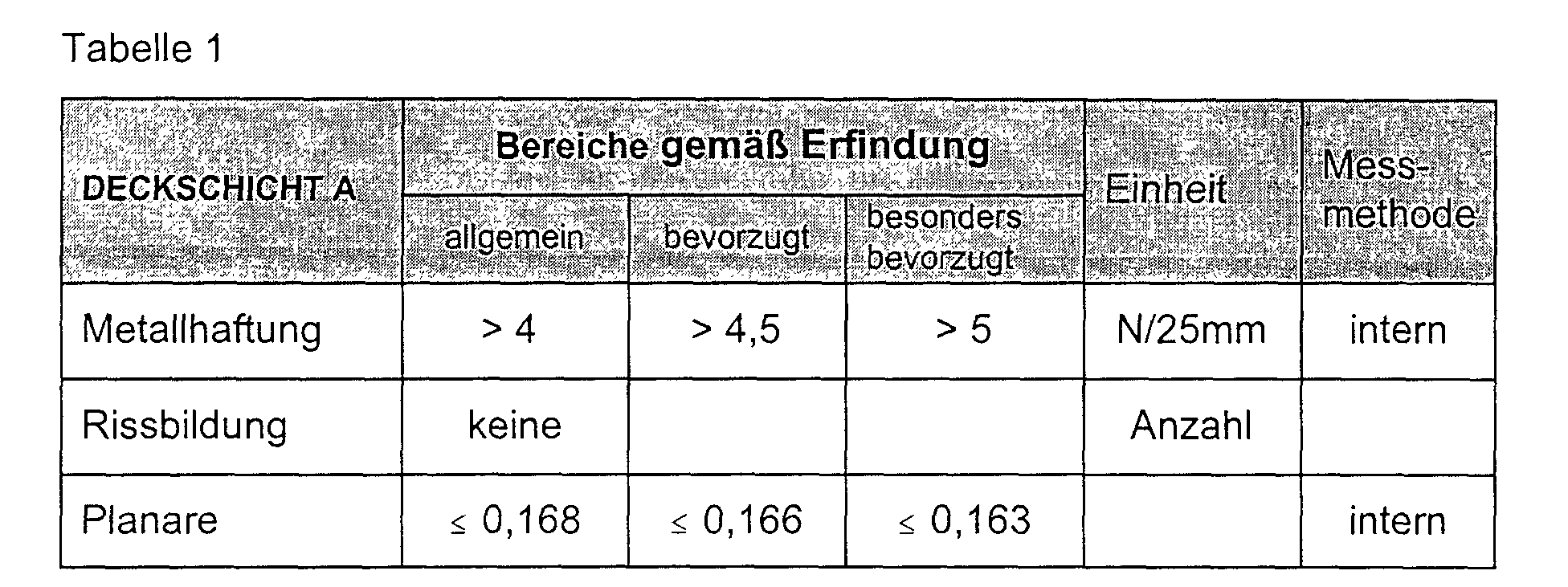
- the desired metal adhesion properties and the desired quality of the Metal layer (no cracks) of the film according to the invention are formed from the combination the properties of the copolyester used for the metal adhesive Top layer A and the setting of a layer thickness in the range of ⁇ 1.6 ⁇ m, preferably obtained from ⁇ 1.2 ⁇ m, particularly preferably from ⁇ 0.8 ⁇ m.
- the metal adhesion of ⁇ 4 N / 25 mm is achieved if for the metal adhesive Cover layer A, the copolymers described in more detail above can be used.
- the metal adhesive can be used to handle the film and processability Top layer A can be modified. This is done cheaply with the help of suitable ones Antiblocking agents with a selected grain size, in a certain amount be added to the metal adhesive layer in such a way that on the one hand the blocking is minimized and on the other hand the metal adhesion is not essential deteriorate.
- the metal adhesion is essentially independent of the layer thickness Top layer. However, it was observed that too high a layer thickness led to cracks in the metallized metal layer. It was surprisingly found that foils with cover layers in the range of> 1.6 ⁇ m clearly lead to crack formation tend.
- the thickness of the metal-adhesive cover layer A of the film according to the invention is therefore to be set less than or equal to 1.6 ⁇ m. These cracks can be visually e.g. in one Light box or in the light beam of a slide projector are recognized and lead to a reduction in the barrier properties of the metallized film Atmospheric oxygen and flavors.
- the base layer B can additionally contain additives, such as stabilizers and / or antiblocking agents contain. Contain the other two top layers A and C. additional additives such as stabilizers and / or antiblocking agents.
- the additives will be Expediently the polymer or the polymer mixture before melting added. Examples of stabilizers used are phosphorus compounds, such as phosphoric acid or phosphoric acid ester used.
- Typical antiblocking agents (sometimes in this context also as pigments are) inorganic and / or organic particles, for example Calcium carbonate, amorphous silica, talc, magnesium carbonate, barium carbonate, Calcium sulfate, barium sulfate, lithium phosphate, calcium phosphate, magnesium phosphate, Aluminum oxide, LiF, calcium, barium, zinc or manganese salts the dicarboxylic acids, carbon black, titanium dioxide, kaolin or cross-linked polystyrene or acrylate particles.
- Antiblocking agents or mixtures of antiblocking agents of the same composition can also be used as antiblocking agents
- Antiblocking agents or mixtures of antiblocking agents of the same composition but different grain sizes can be selected.
- the particles can be the individual Layers in the respective advantageous amounts, e.g. than glycolic Dispersion during polycondensation or via masterbatches at Extrusion can be added.
- Preferred particles are SiO 2 in colloidal and in chain-like form. These particles are very well integrated into the polymer matrix and only slightly generate vacuoles. Vacuoles generally cause turbidity and should therefore be avoided. In principle, the particle diameters of the particles used are not restricted.
- these last-described particles should not have an average particle diameter that is greater than 5 ⁇ m.
- the amount of antiblocking agent in the base layer B to be chosen lower than in the two outer layers A and C. With one three-layer film of the type mentioned is the amount in the base layer B.
- the grain size of the antiblocking agents used in the base layer B is in principle not restricted, however antiblocking agents with a medium one Grain size greater than or equal to 1 ⁇ m is particularly preferred.
- the cover layers have to set the mentioned property profile of the film A and C in a particularly favorable embodiment, more pigments (i.e. higher amounts of antiblocking agents) than the base layer B.
- the Pigment concentration in these top layers A and C is in the range from 0.0 to 1.0% by weight, advantageously from 0.02 to 0.8% by weight, in particular from 0.03 to 0.6 Wt .-%.
- Both top layers A and C can have the same amount of antiblocking agent contain or the amount in the metal-adhesive cover layer A may be less be selected as in the non-metal adhesive cover layer C to the desired properties to improve or the processing behavior further to optimize.
- the film consists of three layers, the Base layer B and cover layers applied to this base layer B on both sides A and C.
- an intermediate layer may also be arranged.
- This can be used for the Base layer B polymers exist. In one particularly preferred embodiment, it consists of that for the base layer B. used polyester. You can also the additives also described contain.
- the thickness of the intermediate layer is generally 0.3 ⁇ m or greater and is preferably in the range from 0.5 to 15 ⁇ m, in particular in the range from 1.0 to 10 ⁇ m, particularly preferably in the range from 1.0 to 5 ⁇ m.
- the thickness of the cover layer C is in the range greater than or equal to 0.1 ⁇ m, preferably in the range from 0.2 to 4.0 ⁇ m, advantageously in the range from 0.2 to 3.5 um, in particular in the range from 0.3 to 3 ⁇ m, very particularly preferably in Range from 0.3 to 2.5 ⁇ m, with the top layers A and C being equal to or can be of different thickness.
- the total thickness of the polyester film according to the invention can be within certain Limits vary.
- the total thickness of the film is in the range from 3 to 80 ⁇ m, in particular from 4 to 50 ⁇ m, preferably from 5 to 30 ⁇ m, with the Base layer B a relative proportion of preferably 5 to 95% of the total thickness the film is omitted.
- the polymers for the base layer B and the cover layers A and C become three fed to separate extruders. Any foreign bodies or contamination can be made from the polymer melt before extrusion by suitable Remove filter.
- the melts then become flat in a multi-layer nozzle Melt films formed and layered on top of each other. Then the Multi-layer film using an internally cooled cooling roller made of polished stainless steel and optionally further rollers are drawn off and form an amorphous pre-film solidified.
- the invention further relates to a method for producing the invention Polyester film according to the known coextrusion process.
- This procedure is carried out in such a way that the individual Melts corresponding to layers of the film through a slot die be coextruded, the film thus obtained for solidification on one or is pulled off several rollers, the film is then stretched biaxially (oriented), the biaxially stretched film is then heat-set and optionally on the surface layer intended for treatment is corona or flame treated becomes.
- the biaxial stretching (orientation) is generally consecutive performed, the successive biaxial stretching, at the first lengthways (in the machine direction) and then transversely (perpendicular to the machine direction) is stretched, is preferred. This leads to an orientation of the molecular chains.
- the stretching in the longitudinal direction can be done with the help of two target stretch ratio rotating at different speeds Carry out rolling. A corresponding one is used for cross-stretching Tenter frame.
- the temperature at which the stretching is carried out can be in a relative vary widely and depends on the desired properties of the Foil.
- the longitudinal stretching is carried out at a temperature in the range of 80 to 130 ° C and the transverse stretching in the range of 80 to 150 ° C.
- the longitudinal stretching ratio is generally in the range from 2.5: 1 to 6: 1, preferably from 3: 1 to 5.5: 1.
- the transverse stretching ratio is generally in the range from 3.0: 1 to 5.0: 1, preferably from 3.5: 1 to 4.5: 1.
- After longitudinal stretching and before transverse stretching can one or both surface (s) of the film according to known Process in-line coating.
- the in-line coating can, for example, too an improved adhesion of a possibly applied printing ink, but also to improve the antistatic behavior or processing behavior serve.
- the planar orientation ⁇ p of the film is not so is chosen large. It should then be in the range ⁇ p ⁇ 0.168, preferably ⁇ p ⁇ 0.166 and particularly preferably ⁇ p ⁇ 0.163. In this case, the strength of the Film in the thickness direction so large that the high metal adhesion fully to the film can be transferred without the film tearing and tearing.
- the process parameters include in particular the stretching ratios in the longitudinal and transverse directions ( ⁇ MD and ⁇ TD ), the stretching temperatures in the longitudinal and transverse directions (T MD and T TD ), the film web speed and the type of stretching, in particular that in the longitudinal direction of the Machine.
- the film web speed was 340 m / min and the SV value of the material was about 730.
- the temperatures given relate to the respective roll temperatures in the longitudinal stretching and to the film temperatures measured in the transverse stretching, which were measured by means of IR.
- the film is over a period of about Maintained at a temperature in the range of 150 to 250 ° C for 0.1 to 10 s.
- the film is then wound up in the usual way.
- the film can also be used to set other desired properties be coated.
- Typical coatings are adhesive, antistatic, slip-improving or other layers that promote adhesion. It offers itself on these additional layers via inline coating using aqueous dispersions to be applied to the film in the transverse direction before the stretching step.
- the film according to the invention is distinguished by excellent metal adhesion, very good handling and very good processing behavior.
- the film is therefore ideal for use in flexible Packaging, especially where excellent metal adhesion is full comes into play.
- flexible Packaging especially where excellent metal adhesion is full comes into play.
- bags-in-boxes Packaging ", in which a multilayer composite of metallized PET and polyethylene film laminated on both sides is used.
- Table 1 summarizes the most important film properties according to the invention.
- the standard viscosity SV (DCE), based on DIN 53726, is measured at 25 ° C in dichloroacetic acid.
- the film sample (300 mm long x 180 mm transverse) according to the present invention is placed on a smooth cardboard (200 mm long x 180 mm transverse; approx. 400 g / m 2 , bleached, outer layers coated), the protruding film ends are to be turned over on the back and fixed with adhesive tape.
- the film according to the present invention is bonded to a standard polyester film 12 ⁇ m thick (for example Melinex 800) using a doctoring device and doctor rod No. 3 from Erichsen, about 1.5 ml of adhesive (Novacote NC 275 + CA 12; Mixing ratio: 4/1 + 7 parts of ethyl acetate) is applied to the top layer A of the film according to the present invention.
- the standard polyester film is laminated onto the outer layer A of the film according to the present invention using a metal roller (width 200 mm, diameter 90 mm, mass 10 kg, in accordance with DIN EN 20 535).
- the parameters of the lamination are: amount of adhesive 5 +/- 1 g / m 2 Ventilate after applying the adhesive 4 min +/- 15 s Squeegee strength (Erichsen) 3 Squeegee speed level approx. 133 mm / s Hardening time of the bond 2 h at 70 ° C in a forced air oven
- test specimens are to be affixed to the entire surface of a carrier sheet using double-sided adhesive tape with the back of the film according to the present invention (base layer B or cover layer C).
- base layer B or cover layer C The plate with the bonded composite is clamped into the lower jaw of the tensile testing machine (type: Zwick) (clamping distance 100 mm).
- the non-laminated end of the film is clamped in the upper jaw so that a peel angle of 180 ° results.
- the average peeling force in N / 25 mm is required to separate the bond at a take-off speed of 100 mm / min, rounded to one decimal place.
- sample width 25 mm
- Pre-load 0.1 N measuring length 25 mm
- Test movement 40 mm sensitivity 0.01 N off speed 100 mm / min
- the measurement result for the peeling force is equivalent to the minimum adhesive force between the layers, since the adhesive force between the glue and the standard film is significantly larger.
- the friction was determined according to DIN 53 375.
- the sliding friction number became 14 Measured days after production.
- sample preparation Sample size and sample length 60 to 100 mm sample width corresponds to prism width of 10 mm
- the sample to be measured must be cut out of the film, in which the running edge of the sample must exactly match the TD direction.
- the sample to be measured must be cut out of the film, in which the running edge of the sample must match the MD direction exactly.
- the refractive index of the mixture must be greater than 1.685.
- the sample cut out in the TD direction is first placed on top of it, so that the entire prism surface is covered. With the help of a paper handkerchief, the foil is now firmly ironed onto the prism so that the foil lies firmly and smoothly. The excess liquid must be sucked off. Then a little of the measuring liquid is dripped onto the film. The second prism is folded down and pressed firmly. Now use the right thumbscrew to turn the display scale until a transition from light to dark can be seen in the viewing window in the range 1.62 to 1.68.
- the colors are brought together using the upper knurled screw so that only a light and a dark zone is visible.
- the sharp transition line is brought into the intersection of the two (in the eyepiece) diagonal lines with the help of the lower knurled screw.
- the value now displayed in the measurement scale is read and entered in the measurement log. This is the refractive index in the machine direction n MD . Now the scale with the lower knurled screw is turned so far that the visible range between 1.49 and 1.50 can be seen.
- the refractive index in n a or n z (in the thickness direction of the film) is determined.
- a polarizing film is placed on the eyepiece so that the transition is only slightly visible. This should be turned until the transition is clearly visible. The same applies as for the determination of n MD. , If the transition from light to dark is not sharp (colored), the colors are brought together using the upper knurled screw so that a sharp transition can be seen. This sharp transition line is brought into the intersection of the two diagonal lines with the help of the lower knurled screw and the value shown on the scale is read and entered in the table.
- the strip is turned over and the values for the B side are measured.
- the values for the A side and the B side are combined to mean refractive values.
- Polyethylene terephthalate chips (produced by the transesterification process with Mn as transesterification catalyst, Mn concentration: 100 ppm) were at a Dried temperature of 150 ° C to a residual moisture of below 100 ppm and fed to the extruder for the base layer B. Chips were also made Polyethylene terephthalate and a filler the extruder for the non-metal adhesive Top layer C fed.
- chips were made from a linear polyester made from a amorphous copolyester with 78 mol% ethylene terephthalate and 22 mol% ethylene isophthalate (made by the transesterification process with Mn as Transesterification catalyst, Mn concentration: 100 ppm).
- the copolyester was at a temperature of 100 ° C to a residual moisture of below 200 ppm dried and fed to the extruder for the metal-adhesive cover layer A.
- Top layer A mixture of:
- Top layer C mixture of:
- the manufacturing conditions in the individual process steps were: extrusion temperatures A layer 270 ° C B-layer 290 ° C C layer 290 ° C Die width 2.5 mm Pull roller temperature 30 ° C longitudinal stretching temperature 80-125 ° C Longitudinal stretching ratio 4.2 transverse stretching temperature 80-135 ° C Transverse stretching ratio 4.0 fixation temperature 230 ° C duration 3 s
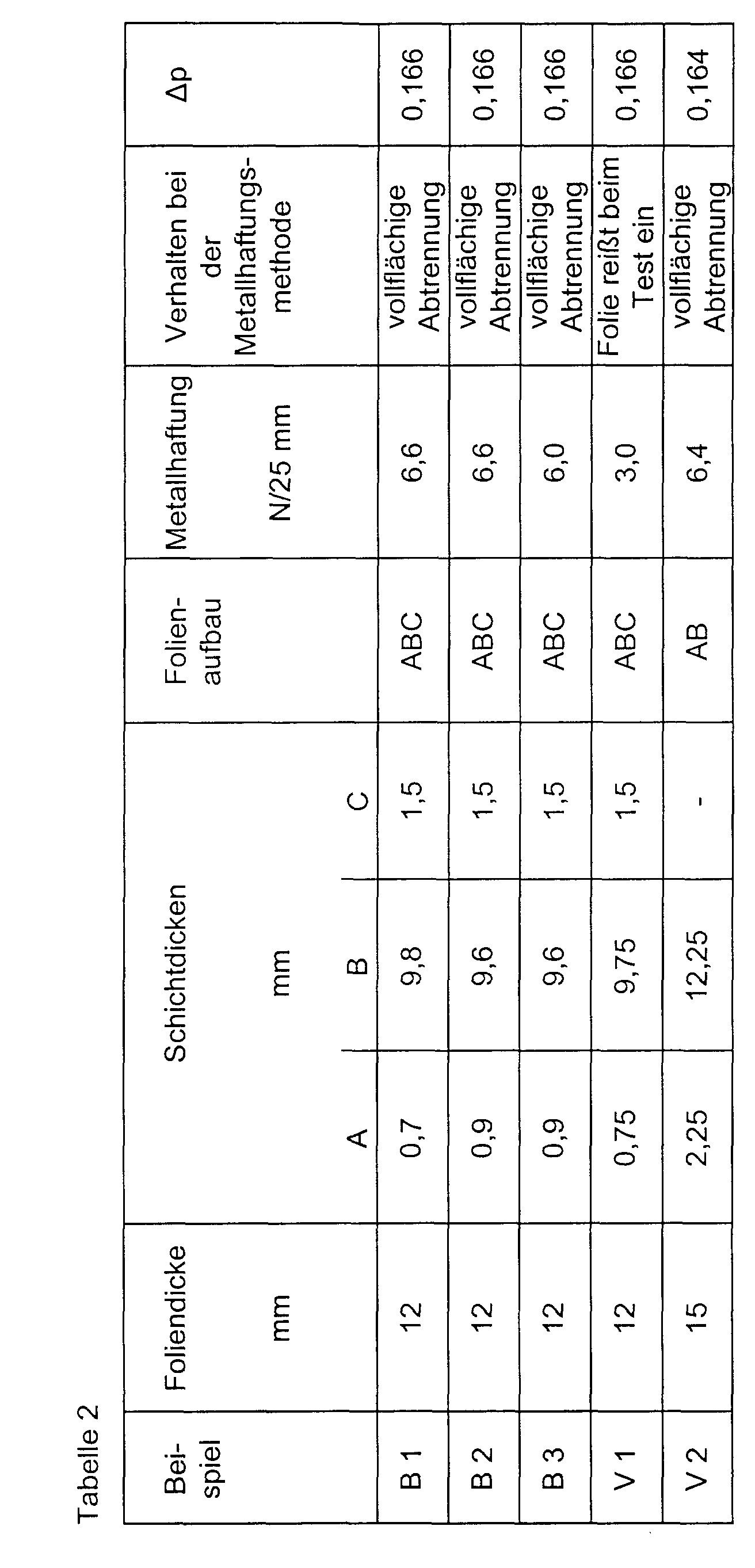
- the film had a metal adhesion of 6.6 N / 25 mm and shows the desired one Handling and the desired processing behavior.
- the film structure and the Properties achieved in films produced in this way are shown in Tables 2 and 3 shown.
- the thickness of the metal-adhesive cover layer A elevated.
- the metal adhesion remained good, but there were first cracks in the light box can be recognized in the metallized metal layer.
- the copolyester was made with a different molar ratio of 60 mol% ethylene terephthalate and 40 mol% ethylene isophthalate units used. As a result, the metal adhesion deteriorated slightly and was 6.0 N / 25 mm.
- Example 1 from EP-A-0 144 878 was reproduced.
- the metal adhesion of the film was 3.0 N / 25 mm
- Example 1 from EP-A-0 035 838 was reproduced.
- Polyethylene terephthalate was used in the base layer, a polymer with 82 mol% ethylene terephthalate and 18 mol% ethylene isophthalate as the acid component in the top layer.
- SiO 2 with a weight-average diameter of 1 ⁇ m was introduced into the cover layer in a concentration of 0.25% by weight, based on the weight of the cover layer.
- the cover layer had a thickness of 2.25 ⁇ m with a total film thickness of 15 ⁇ m. Cracks could be seen in the light box in the metallized metal layer.
Landscapes
- Engineering & Computer Science (AREA)
- Chemical & Material Sciences (AREA)
- Manufacturing & Machinery (AREA)
- Medicinal Chemistry (AREA)
- Health & Medical Sciences (AREA)
- Chemical Kinetics & Catalysis (AREA)
- Materials Engineering (AREA)
- Polymers & Plastics (AREA)
- Organic Chemistry (AREA)
- Mechanical Engineering (AREA)
- Laminated Bodies (AREA)
- Wrappers (AREA)
- Extrusion Moulding Of Plastics Or The Like (AREA)
- Shaping By String And By Release Of Stress In Plastics And The Like (AREA)
Abstract
Description
| Klebstoffmenge | 5+/- 1 g/m2 |
| Lüften nach Auftrag des Klebers | 4 min +/- 15 s |
| Rakelstärke (Erichsen) | 3 |
| Geschwindigkeitsstufe des Rakels | ca. 133 mm/s |
| Aushärtzeit des Verbundes | 2 h bei 70 °C in einem Umluftofen |
| Probenbreite | 25 mm |
| Vorkraft | 0,1 N |
| Messlänge | 25 mm |
| Abzugsgeschwindigkeit bis Vorkraft | 25 mm/min |
| Vorweg | 5 mm |
| Prüfweg | 40 mm |
| Empfindlichkeit | 0,01 N |
| Abzugsgeschwindigkeit | 100 mm/min |
| Probenvorbereitung | |
| Probengröße und Probenlänge | 60 bis 100 mm |
| Probenbreite | entspricht Prismenbreite von 10 mm |
Δn=nMD - nTD Δp = (nMD + nTD)/2 - nz nav = (nMD + nTD + nz)/3
- 97,0 Gew.-%
- Copolyester mit einem SV-Wert von 800
- 3,0 Gew.-%
- Masterbatch aus 97,75 Gew.-% Copolyester (SV-Wert von 800) und 1,0 Gew.-% ® Sylobloc 44 H (synthetisches SiO2 der Fa. Grace) und 1,25 Gew.-% ® Aerosil TT 600 (pyrogenes SiO2 der Fa. Degussa)
- 100,0 Gew.-%
- Polyethylenterephthalat mit einem SV-Wert von 800
- 88 Gew.-%
- Polyethylenterephthalat mit einem SV-Wert von 800
- 12 Gew.-%
- Masterbatch aus 97,75 Gew.-% Copolyester (SV-Wert von 800) und 1,0 Gew.-% Sylobloc 44 H (synthetisches SiO2 der Fa. Grace) und 1,25 Gew.-% Aerosil TT 600 (pyrogenes SiO2 der Fa. Degussa)
| Extrusion | Temperaturen | A-Schicht | 270 °C |
| B-Schicht | 290 °C | ||
| C-Schicht | 290°C | ||
| Düsenspaltweite | 2,5 mm | ||
| Temperatur der Abzugswalze | 30 °C | ||
| Längsstreckung | Temperatur | 80-125 °C | |
| Längsstreckverhältnis | 4,2 | ||
| Querstreckung | Temperatur | 80-135 °C | |
| Querstreckverhältnis | 4,0 | ||
| Fixierung | Temperatur | 230 °C | |
| Dauer | 3 s |
Claims (13)
- Koextrudierte, biaxial orientierte Polyesterfolie mit hoher Metallhaftung aus einer Basisschicht B und mindestens einer auf der Basisschicht B aufgebrachten, metallhaftenden Deckschicht A, dadurch gekennzeichnet, dass die metallhaftende Deckschicht A eine Metallhaftung von ≥ 4 N/25 mm aufweist und eine Schichtdicke von ≤ 1,6 µm, bevorzugt ≤ 1,2 µm, insbesondere bevorzugt ≤ 0,8µm.
- Polyesterfolie nach Anspruch 1, dadurch gekennzeichnet, dass die metallhaftende Deckschicht A einen amorphen Copolyester enthält, der aus Ethylenterephthalat- und Ethylenisophthalat-Einheiten und aus Ethylenglykol-Einheiten aufgebaut ist.
- Polyesterfolie Anspruch 1 oder 2, dadurch gekennzeichnet, dass der amorphe Copolyester der metallhaftenden Deckschicht A Ethylenterephthalat in einem Anteil von 40 bis 99 mol-% und Ethylenisophthalat in einem Anteil von 60 bis 1 mol-% enthält, bevorzugt Ethylenterephthalat in einem Anteil von 50 bis 95 mol-% und Ethylenisophthalat in einem Anteil von 50 bis 5 mol-%, besonders bevorzugt Ethylenterephthalat in einem Anteil von 60 bis 85 mol-% und Ethylenisophthalat in einem Anteil von 40 bis 15 mol-%.
- Polyesterfolie nach einem oder mehreren der Ansprüche 1 bis 3, dadurch gekennzeichnet, dass die Folie einen dreischichtigen Aufbau mit einer Basisschicht B, einer metallhaftenden Deckschicht A und einer weiteren Deckschicht C besitzt, wobei die Deckschicht C gleich oder verschieden zur Deckschicht A sein kann.
- Polyesterfolie nach einem oder mehreren der Ansprüche 1 bis 4, dadurch gekennzeichnet, dass die Basisschicht B zusätzlich Additive, wie Stabilisatoren und/oder Antiblockmittel enthält, dass die Menge an Antiblockmittel in der Basisschicht B im Bereich von 0 bis 0,15 Gew.-% liegt, vorzugsweise von 0 bis 0,12 Gew.-%, insbesondere von 0 bis 0,10 Gew.-% und dass die mittlere Korngröße der Antiblockmittel in der Basisschicht B im Bereich von größer/gleich 1 µm liegt.
- Polyesterfolie nach einem oder mehreren der Ansprüche 1 bis 5, dadurch gekennzeichnet, dass die Deckschichten A und C zusätzlich Additive, wie Stabilisatoren und/oder Antiblockmittel enthalten, dass als Antiblockmittel Teilchen mit einem mittleren Primärpartikeldurchmesser im Bereich von größer/gleich 1 µm, bevorzugt von größer/gleich 1,5 µm, besonders bevorzugt von größer/gleich 2 µm eingesetzt werden und dass die Deckschichten A und C mehr Pigmente als die Basisschicht B enthalten, wobei die Pigmentkonzentration in den Deckschichten A und C im Bereich von 0,0 bis 1,0 Gew.-% liegt, vorteilhaft von 0,02 bis 0,8Gew.- %, insbesondere von 0,03 bis 0,6 Gew.-%.
- Polyesterfolie nach einem oder mehreren der Ansprüche 1 bis 6, dadurch gekennzeichnet, dass die Schichtdicke der Deckschicht C im Bereich größer/gleich 0,1 µm liegt, vorzugsweise von 0,2 bis 4,0 µm, vorteilhaft von 0,2 bis 3,5 µm, insbesondere von 0,3 bis 3 µm, ganz besonders bevorzugt im Bereich von 0,3 bis 2,5 µm, wobei die Schichtdicken der Deckschichten A und C gleich oder verschieden sein können.
- Polyesterfolie nach einem oder mehreren der Ansprüche 1 bis 7, dadurch gekennzeichnet, dass die Gesamtdicke der Folie im Bereich von 3 bis 80 µm liegt, insbesondere von 4 bis 50 µm, vorzugsweise von 5 bis 30 µm, wobei auf die Basisschicht B ein relativer Anteil im Bereich von vorzugsweise 5 bis 95 % an der Gesamtdicke der Folie entfällt.
- Polyesterfolie nach einem oder mehreren der Ansprüche 1 bis 8, dadurch gekennzeichnet, dass die planare Orientierung Δp der Folie im Bereich Δp ≤ 0,168 liegt, bevorzugt Δp ≤ 0,166 und besonders bevorzugt Δp ≤ 0,163.
- Verfahren zum Herstellen einer Polyesterfolie nach einem oder mehreren der Ansprüche 1 bis 9, bei dem die Polymeren für die Basisschicht B und die Deckschichten A und C drei getrennten Extrudern zugeführt, etwa vorhandene Fremdkörper oder Verunreinigungen aus der Polymerschmelze vor der Extrusion durch geeignete Filter entfernt, die Schmelzen dann in einer Mehrschichtdüse zu flachen Schmelzefilmen ausgeformt und übereinander geschichtet werden, der Mehrschichtfilm dann mit Hilfe einer innengekühlten Kühlwalze aus poliertem Edelstahl und gegebenenfalls weiteren Walzen abgezogen und zu einer amorphen Vorfolie verfestigt und die Vorfolie anschließend biaxial gestreckt, thermofixiert und aufgewickelt wird, dadurch gekennzeichnet, dass die Längsstreckung bei einer Temperatur im Bereich von 80 bis 130 °C und die Querstreckung im Bereich von 80 bis 150 °C durchgeführt wird und dass das Längsstreckverhältnis in einem Bereich von 2,5:1 bis 6:1, bevorzugt von 3:1 bis 5,5:1, und das Querstreckverhältnis in einem Bereich von 3,0:1 bis 5,0:1, bevorzugt von 3,5:1 bis 4,5:1, eingestellt wird.
- Verfahren nach Anspruch 10, dadurch gekennzeichnet, dass nach dem Längsstrecken und vor dem Querstrecken eine oder beide Oberfläche(n) der Folie In-line beschicht werden und dass die In-Line-Beschichtung zu einer verbesserten Haftung oder zur Verbesserung des antistatischen Verhaltens oder des Verarbeitungsverhaltens der Polyesterfolie führt.
- Verfahren nach Anspruch 10 oder 11, dadurch gekennzeichnet, dass bei der Herstellung der Folie anfallendes Verschnittmaterial als Regenerat in einer Menge im Bereich von 20 bis 60 Gew.-%, bezogen auf das Gesamtgewicht der Folie, wieder der Extrusion zugeführt wird.
- Verwendung einer Polyesterfolie nach einem oder mehreren der Ansprüche 1 bis 9 für den Einsatz in der flexiblen Verpackung, insbesondere in Bag-in-box Verpackungen.
Applications Claiming Priority (2)
| Application Number | Priority Date | Filing Date | Title |
|---|---|---|---|
| DE10038131 | 2000-08-04 | ||
| DE10038131A DE10038131A1 (de) | 2000-08-04 | 2000-08-04 | Koextrudierte, biaxial orientierte Polyesterfolie mit guter Metallhaftung, Verfahren zu ihrer Herstellung und ihre Verwendung |
Publications (2)
| Publication Number | Publication Date |
|---|---|
| EP1186405A1 true EP1186405A1 (de) | 2002-03-13 |
| EP1186405B1 EP1186405B1 (de) | 2004-04-07 |
Family
ID=7651350
Family Applications (1)
| Application Number | Title | Priority Date | Filing Date |
|---|---|---|---|
| EP01118336A Expired - Lifetime EP1186405B1 (de) | 2000-08-04 | 2001-07-27 | Koextrudierte, biaxial orientierte Polyesterfolie mit guter Metallhaftung, Verfahren zu ihrer Herstellung und ihre Verwendung |
Country Status (5)
| Country | Link |
|---|---|
| US (1) | US6607815B2 (de) |
| EP (1) | EP1186405B1 (de) |
| JP (1) | JP2002103546A (de) |
| KR (1) | KR100835346B1 (de) |
| DE (2) | DE10038131A1 (de) |
Families Citing this family (20)
| Publication number | Priority date | Publication date | Assignee | Title |
|---|---|---|---|---|
| DE10144123A1 (de) * | 2001-09-08 | 2003-03-27 | Mitsubishi Polyester Film Gmbh | Biaxial orientierte Polyesterfolie mit guter Metallhaftung, Verfahren zu ihrer Herstellung und ihre Verwendung |
| US20040185281A1 (en) * | 2003-03-17 | 2004-09-23 | Toray Saehan Inc. | Polyester color film |
| EP1872935B1 (de) * | 2005-03-28 | 2013-05-29 | Toray Industries, Inc. | Biaxial ausgerichtete polyesterfolie und metallartige laminierte folien |
| US9186593B2 (en) | 2006-06-07 | 2015-11-17 | Toray Plastics (America), Inc. | Stretchable and formable lighter than air balloons made from a biaxially oriented polyester film |
| US7799399B2 (en) * | 2006-06-07 | 2010-09-21 | Toray Plastics (America), Inc. | High barrier laminate and process |
| US8399080B2 (en) | 2006-06-07 | 2013-03-19 | Toray Plastics (America), Inc. | Lighter than air balloon made from a biaxially oriented polyester film |
| DE102009021714A1 (de) * | 2009-05-18 | 2010-11-25 | Mitsubishi Polyester Film Gmbh | Niedrigsiegelnde Polyesterfolie für unpolare Substrate |
| CA2774653C (en) * | 2009-10-02 | 2015-05-19 | Toray Plastics (America), Inc. | Biodegradable composite barrier film |
| US10137625B2 (en) | 2011-07-08 | 2018-11-27 | Toray Plastics (America), Inc. | Biaxially oriented bio-based polyester films and laminates |
| US9561676B2 (en) | 2011-07-08 | 2017-02-07 | Toray Plastics (America), Inc. | Biaxially oriented bio-based polyester thin films and laminates for thermal transfer printing |
| EP2756108B1 (de) | 2011-09-16 | 2024-10-16 | Ball Corporation | Verfahren zur herstellung von fliessgepressten behälter aus recycling-aluminiumschrott |
| US9630385B2 (en) * | 2012-11-08 | 2017-04-25 | Toray Plastics (America), Inc. | Releasable polyester metal transfer film |
| US10099462B2 (en) | 2013-06-28 | 2018-10-16 | Toray Plastics (America), Inc. | Releasable polyester high gloss metal transfer film |
| CN105774152B (zh) * | 2014-12-19 | 2018-10-16 | 浙江蓝天环保氟材料有限公司 | 一种三层共挤聚氟乙烯薄膜的制备方法 |
| DE102016205913A1 (de) * | 2016-04-08 | 2017-10-12 | Mitsubishi Polyester Film Gmbh | Biaxial orientierte Polyesterfolie für die Metalllaminierung |
| US20170368807A1 (en) | 2016-06-28 | 2017-12-28 | Toray Plastics (America), Inc. | Formable polyester films |
| KR102349063B1 (ko) * | 2021-02-01 | 2022-01-10 | 조익래 | 열 부착 pet 필름 |
| KR102644796B1 (ko) * | 2022-01-03 | 2024-03-06 | 강용제 | 이종 금속판 복합재 및 그 제조방법 |
| KR102785387B1 (ko) * | 2022-01-03 | 2025-03-21 | 강용제 | 금속판 접합용 pet 필름 |
| KR102804311B1 (ko) * | 2024-09-04 | 2025-05-08 | 주식회사금아스틸 | 저온 열부착 인테리어용 필름 |
Citations (4)
| Publication number | Priority date | Publication date | Assignee | Title |
|---|---|---|---|---|
| US4687699A (en) * | 1984-04-16 | 1987-08-18 | Hoechst Aktiengesellschaft | Abrasion-resistant, copolyester carrier film for magnetic information media |
| JPH0257339A (ja) * | 1988-08-22 | 1990-02-27 | Toyobo Co Ltd | 金属缶内装用ポリエステルフィルム及び金属缶 |
| EP0580404A2 (de) * | 1992-07-22 | 1994-01-26 | Teijin Limited | Biaxial orentierter, mehrschichtiger Polyesterfilm, geeignet zum Kleben auf Metallblech |
| EP1055515A2 (de) * | 1999-05-26 | 2000-11-29 | Mitsubishi Polyester Film GmbH | Sammelpacksystem enthaltend eine siegelfähige Polyesterfolie |
Family Cites Families (12)
| Publication number | Priority date | Publication date | Assignee | Title |
|---|---|---|---|---|
| EP0035835B1 (de) | 1980-03-12 | 1984-03-14 | Imperial Chemical Industries Plc | Verbundstoffe aus Polyesterfilmen |
| US4643925A (en) * | 1982-09-07 | 1987-02-17 | The Goodyear Tire & Rubber Company | Multi-layer polyisophthalate and polyterephthalate articles and process therefor |
| US4605591A (en) * | 1983-10-27 | 1986-08-12 | Toyo Boseki Kabushiki Kaisha | Thermoplastic resin film laminate and production thereof |
| US4493872A (en) | 1983-12-05 | 1985-01-15 | American Hoechst Corporation | Polyester film coated with metal adhesion promoting copolyester |
| FR2628359B1 (fr) * | 1988-03-09 | 1990-09-07 | Rhone Poulenc Films | Films polyester composites a adherence amelioree et leur procede d'obtention |
| JPH07119279B2 (ja) * | 1988-12-28 | 1995-12-20 | 鐘紡株式会社 | ポリエステル共重合体及び該ポリエステル共重合体を下引層として有するポリエステルフィルム |
| US5093064A (en) * | 1989-06-13 | 1992-03-03 | Diafoil Company, Ltd. | Low-shrinkage polyester film and preparation thereof |
| US5380587A (en) * | 1992-10-20 | 1995-01-10 | Mobil Oil Corporation | Multilayer film structure |
| JP3189551B2 (ja) * | 1994-01-21 | 2001-07-16 | 東レ株式会社 | 金属板ラミネート用ポリエステルフイルム |
| JPH07304885A (ja) * | 1994-05-09 | 1995-11-21 | Toray Ind Inc | 金属貼り合わせ成形加工用フイルム |
| KR100215479B1 (ko) * | 1995-11-24 | 1999-08-16 | 장용균 | 이축연신 폴리에스테르 필름 |
| JPH1060131A (ja) * | 1996-08-19 | 1998-03-03 | Unitika Ltd | 金属ラミネート用白色ポリエステルフィルムとその製造法 |
-
2000
- 2000-08-04 DE DE10038131A patent/DE10038131A1/de not_active Withdrawn
-
2001
- 2001-07-18 US US09/908,160 patent/US6607815B2/en not_active Expired - Fee Related
- 2001-07-27 DE DE50101889T patent/DE50101889D1/de not_active Expired - Lifetime
- 2001-07-27 EP EP01118336A patent/EP1186405B1/de not_active Expired - Lifetime
- 2001-08-03 KR KR1020010047057A patent/KR100835346B1/ko not_active Expired - Fee Related
- 2001-08-03 JP JP2001236574A patent/JP2002103546A/ja not_active Withdrawn
Patent Citations (4)
| Publication number | Priority date | Publication date | Assignee | Title |
|---|---|---|---|---|
| US4687699A (en) * | 1984-04-16 | 1987-08-18 | Hoechst Aktiengesellschaft | Abrasion-resistant, copolyester carrier film for magnetic information media |
| JPH0257339A (ja) * | 1988-08-22 | 1990-02-27 | Toyobo Co Ltd | 金属缶内装用ポリエステルフィルム及び金属缶 |
| EP0580404A2 (de) * | 1992-07-22 | 1994-01-26 | Teijin Limited | Biaxial orentierter, mehrschichtiger Polyesterfilm, geeignet zum Kleben auf Metallblech |
| EP1055515A2 (de) * | 1999-05-26 | 2000-11-29 | Mitsubishi Polyester Film GmbH | Sammelpacksystem enthaltend eine siegelfähige Polyesterfolie |
Non-Patent Citations (1)
| Title |
|---|
| PATENT ABSTRACTS OF JAPAN vol. 014, no. 228 (M - 0973) 15 May 1990 (1990-05-15) * |
Also Published As
| Publication number | Publication date |
|---|---|
| US6607815B2 (en) | 2003-08-19 |
| US20020051872A1 (en) | 2002-05-02 |
| JP2002103546A (ja) | 2002-04-09 |
| DE50101889D1 (de) | 2004-05-13 |
| KR20020011939A (ko) | 2002-02-09 |
| EP1186405B1 (de) | 2004-04-07 |
| DE10038131A1 (de) | 2002-02-14 |
| KR100835346B1 (ko) | 2008-06-04 |
Similar Documents
| Publication | Publication Date | Title |
|---|---|---|
| EP1197327B1 (de) | Koextrudierte, zumindest einseitig matte, biaxial orientierte Polyesterfolie | |
| EP1186405B1 (de) | Koextrudierte, biaxial orientierte Polyesterfolie mit guter Metallhaftung, Verfahren zu ihrer Herstellung und ihre Verwendung | |
| EP1197326B1 (de) | Matte, pigmentierte, biaxial orientierte Polyesterfolie | |
| EP1068949B1 (de) | Weisse, biaxial orientierte Polyesterfolie mit Cycloolefincopolymer (COC), Verfahren zu ihrer Herstellung und ihre Verwendung | |
| EP1176005B1 (de) | Mehrschichtige, transparente, biaxial orientierte Polyesterfolie | |
| DE10051082A1 (de) | Matte, koextrudierte, biaxial orientierte Polyesterfolie | |
| EP1138480A2 (de) | Siegelfähige biaxial orientierte Polyesterfolie | |
| EP1842663B1 (de) | Mehrschichtige, weisse Polyesterfolie | |
| EP1234848B1 (de) | Transparent, biaxial orientierte Polyesterfolie | |
| EP1380414A1 (de) | Mehrschichtige, transparente, siegelfähige, biaxial orientierte Polyesterfolie, Verfahren zu ihrer Herstellung und ihre Verwendung | |
| EP1442876A1 (de) | Einseitig matte, biaxial orientierte Polyesterfolie mit charakteristischen Schrumpfeigenschaften, Verfahren zu ihrer Herstellung und ihre Verwendung | |
| EP1274579B1 (de) | Einseitig matte, siegelfähige, uv stabilisierte, koextrudierte, biaxial orientierte folie, verfahren zu ihrer herstellung und verwendung | |
| EP1268205B1 (de) | Einseitig matte, siegelfähige, flammhemmend ausgerüstete, koextrudierte, biaxial orientierte folie, verfahren zu ihrer herstellung und verwendung | |
| EP1442875B1 (de) | Einseitig matte, biaxial orientierte Polyesterfolie, Verfahren zu ihrer Herstellung und ihre Verwendung | |
| EP1219413B1 (de) | Einseitig matte, siegelfähige, biaxial orientierte Polyesterfolie | |
| EP1236568A1 (de) | Mehrschichtige transparente, biaxial orientierte Polyesterfolie | |
| DE10039366A1 (de) | Mindestens dreischichtige transparente Polyesterfolie, Verfahren zu ihrer Herstellung und ihre Verwendung | |
| EP2337685A1 (de) | Siegelfähige, biaxial orientierte polyesterfolie | |
| EP1440116A1 (de) | Matte, biaxial orientierte polyesterfolie, verfahren zu ihrer herstellung und ihre verwendung | |
| EP1291168B1 (de) | Biaxial orientierte Polyesterfolie mit guter Metallhaftung, Verfahren zu ihrer Herstellung und ihre Verwendung | |
| EP1176163B1 (de) | Transparente, biaxial orientierte Polyesterfolie | |
| EP1674507A1 (de) | Biaxial orientierte Polyesterfolie, die Siliziumdioxid und Titandioxid enthält | |
| DE102005058917A1 (de) | Mehrschichtige, weiße, biaxial orientierte Polyesterfolie | |
| DE10022946A1 (de) | Weisse, zumindest einseitig matte, biaxial orientierte, UV-stabilisierte und schwer entflammbare Polyesterfolie mit Cycloolefincopolymer (COC), Verfahren zu ihrer Herstellung und ihre Verwendung |
Legal Events
| Date | Code | Title | Description |
|---|---|---|---|
| PUAI | Public reference made under article 153(3) epc to a published international application that has entered the european phase |
Free format text: ORIGINAL CODE: 0009012 |
|
| AK | Designated contracting states |
Kind code of ref document: A1 Designated state(s): AT BE CH CY DE DK ES FI FR GB GR IE IT LI LU MC NL PT SE TR Kind code of ref document: A1 Designated state(s): DE FR GB IT LU NL |
|
| AX | Request for extension of the european patent |
Free format text: AL;LT;LV;MK;RO;SI |
|
| 17P | Request for examination filed |
Effective date: 20020913 |
|
| AKX | Designation fees paid |
Free format text: DE FR GB IT LU NL |
|
| 17Q | First examination report despatched |
Effective date: 20021120 |
|
| GRAP | Despatch of communication of intention to grant a patent |
Free format text: ORIGINAL CODE: EPIDOSNIGR1 |
|
| GRAS | Grant fee paid |
Free format text: ORIGINAL CODE: EPIDOSNIGR3 |
|
| GRAA | (expected) grant |
Free format text: ORIGINAL CODE: 0009210 |
|
| RBV | Designated contracting states (corrected) |
Designated state(s): DE GB IT |
|
| AK | Designated contracting states |
Kind code of ref document: B1 Designated state(s): DE GB IT |
|
| REG | Reference to a national code |
Ref country code: GB Ref legal event code: FG4D Free format text: NOT ENGLISH |
|
| REF | Corresponds to: |
Ref document number: 50101889 Country of ref document: DE Date of ref document: 20040513 Kind code of ref document: P |
|
| REG | Reference to a national code |
Ref country code: IE Ref legal event code: FG4D Free format text: GERMAN |
|
| GBT | Gb: translation of ep patent filed (gb section 77(6)(a)/1977) |
Effective date: 20040709 |
|
| REG | Reference to a national code |
Ref country code: IE Ref legal event code: FD4D |
|
| PLBE | No opposition filed within time limit |
Free format text: ORIGINAL CODE: 0009261 |
|
| STAA | Information on the status of an ep patent application or granted ep patent |
Free format text: STATUS: NO OPPOSITION FILED WITHIN TIME LIMIT |
|
| 26N | No opposition filed |
Effective date: 20050110 |
|
| PG25 | Lapsed in a contracting state [announced via postgrant information from national office to epo] |
Ref country code: IT Free format text: LAPSE BECAUSE OF NON-PAYMENT OF DUE FEES Effective date: 20080727 |
|
| PGRI | Patent reinstated in contracting state [announced from national office to epo] |
Ref country code: IT Effective date: 20091001 |
|
| PGFP | Annual fee paid to national office [announced via postgrant information from national office to epo] |
Ref country code: IT Payment date: 20100726 Year of fee payment: 10 Ref country code: DE Payment date: 20100726 Year of fee payment: 10 |
|
| PGFP | Annual fee paid to national office [announced via postgrant information from national office to epo] |
Ref country code: GB Payment date: 20100726 Year of fee payment: 10 |
|
| GBPC | Gb: european patent ceased through non-payment of renewal fee |
Effective date: 20110727 |
|
| PG25 | Lapsed in a contracting state [announced via postgrant information from national office to epo] |
Ref country code: DE Free format text: LAPSE BECAUSE OF NON-PAYMENT OF DUE FEES Effective date: 20120201 |
|
| REG | Reference to a national code |
Ref country code: DE Ref legal event code: R119 Ref document number: 50101889 Country of ref document: DE Effective date: 20120201 |
|
| PG25 | Lapsed in a contracting state [announced via postgrant information from national office to epo] |
Ref country code: IT Free format text: LAPSE BECAUSE OF NON-PAYMENT OF DUE FEES Effective date: 20110727 |
|
| PG25 | Lapsed in a contracting state [announced via postgrant information from national office to epo] |
Ref country code: GB Free format text: LAPSE BECAUSE OF NON-PAYMENT OF DUE FEES Effective date: 20110727 |