EP1186156B1 - Adaptability to multiple hands-free communication accessories - Google Patents
Adaptability to multiple hands-free communication accessories Download PDFInfo
- Publication number
- EP1186156B1 EP1186156B1 EP00931266A EP00931266A EP1186156B1 EP 1186156 B1 EP1186156 B1 EP 1186156B1 EP 00931266 A EP00931266 A EP 00931266A EP 00931266 A EP00931266 A EP 00931266A EP 1186156 B1 EP1186156 B1 EP 1186156B1
- Authority
- EP
- European Patent Office
- Prior art keywords
- hands
- self
- identifying information
- settings
- free adapter
- Prior art date
- Legal status (The legal status is an assumption and is not a legal conclusion. Google has not performed a legal analysis and makes no representation as to the accuracy of the status listed.)
- Expired - Lifetime
Links
- 238000004891 communication Methods 0.000 title claims description 25
- 238000000034 method Methods 0.000 claims description 30
- 230000006978 adaptation Effects 0.000 claims description 14
- 230000008878 coupling Effects 0.000 claims 1
- 238000010168 coupling process Methods 0.000 claims 1
- 238000005859 coupling reaction Methods 0.000 claims 1
- 230000003044 adaptive effect Effects 0.000 description 16
- 230000001413 cellular effect Effects 0.000 description 10
- 238000012545 processing Methods 0.000 description 8
- 230000004044 response Effects 0.000 description 7
- 238000013459 approach Methods 0.000 description 6
- 230000005540 biological transmission Effects 0.000 description 5
- 230000006870 function Effects 0.000 description 5
- 230000008569 process Effects 0.000 description 5
- 238000009434 installation Methods 0.000 description 4
- 230000005236 sound signal Effects 0.000 description 4
- 230000008859 change Effects 0.000 description 3
- 238000010586 diagram Methods 0.000 description 3
- 230000000694 effects Effects 0.000 description 3
- 230000007246 mechanism Effects 0.000 description 3
- 230000008901 benefit Effects 0.000 description 2
- 230000003111 delayed effect Effects 0.000 description 2
- 238000013461 design Methods 0.000 description 2
- 238000010295 mobile communication Methods 0.000 description 2
- 230000009471 action Effects 0.000 description 1
- 238000012790 confirmation Methods 0.000 description 1
- 238000012937 correction Methods 0.000 description 1
- 230000001934 delay Effects 0.000 description 1
- 238000011143 downstream manufacturing Methods 0.000 description 1
- 238000002592 echocardiography Methods 0.000 description 1
- 238000005516 engineering process Methods 0.000 description 1
- 238000001914 filtration Methods 0.000 description 1
- 230000000116 mitigating effect Effects 0.000 description 1
- 230000002062 proliferating effect Effects 0.000 description 1
- 230000001902 propagating effect Effects 0.000 description 1
- 230000035945 sensitivity Effects 0.000 description 1
- 230000003068 static effect Effects 0.000 description 1
- 230000001629 suppression Effects 0.000 description 1
Images
Classifications
-
- H—ELECTRICITY
- H04—ELECTRIC COMMUNICATION TECHNIQUE
- H04M—TELEPHONIC COMMUNICATION
- H04M1/00—Substation equipment, e.g. for use by subscribers
- H04M1/60—Substation equipment, e.g. for use by subscribers including speech amplifiers
- H04M1/6033—Substation equipment, e.g. for use by subscribers including speech amplifiers for providing handsfree use or a loudspeaker mode in telephone sets
- H04M1/6041—Portable telephones adapted for handsfree use
- H04M1/6075—Portable telephones adapted for handsfree use adapted for handsfree use in a vehicle
- H04M1/6083—Portable telephones adapted for handsfree use adapted for handsfree use in a vehicle by interfacing with the vehicle audio system
- H04M1/6091—Portable telephones adapted for handsfree use adapted for handsfree use in a vehicle by interfacing with the vehicle audio system including a wireless interface
Definitions
- the present invention relates telecommunications and other audio devices, and more particularly to the use of hands-free accessories in conjunction with telecommunications and other audio devices.
- a cellular telephone's microphone might be mounted on the sun visor, while the loudspeaker may be a dash-mounted unit, or may be one that is associated with the car's stereo equipment.
- the loudspeaker may be a dash-mounted unit, or may be one that is associated with the car's stereo equipment.
- a cellular telephone user may carry on a conversation without having to hold the cellular unit or its handset.
- personal computers often have microphones and loudspeakers mounted, for example, in a monitor in relatively close proximity to each other.
- One problem with a hands-free arrangement is that the microphone tends to pick up sound from the nearby loudspeaker, in addition to the voice of the user of the hands-free equipment (the so-called "near-end user"). This is also a problem in some non-hands-free devices, such as handheld mobile telephones, which are becoming CONFIRMATION COPY smaller and smaller. (Because of the small size, a mobile telephone's microphone cannot entirely be shielded from the sound emitted by its loudspeaker.) This sensing by the microphone of sound generated by the loudspeaker can cause problems in many types of applications.
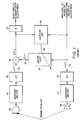
- FIG. 1 an exemplary "hands-free" mobile telephone, having a conventional echo canceler in the form of an adaptive filter arrangement, is depicted in FIG. 1 .
- a hands-free communications environment may be, for example, an automotive interior in which the mobile telephone is installed. Such an environment can cause effects on an acoustic signal propagating therein, which effects are typically unknown. Henceforth, this type of environment will be referred to throughout this specification as an unknown system H(z).
- the hands-free mobile telephone includes a loudspeaker 109 for supplying far-end acoustic audio signals to the near-end user.
- the hands-free mobile telephone also includes a microphone 105 for converting near-end acoustic signals (usually generated by the near-end user) into an electrical or other signal for transmission to the far-end user.
- a digital input audio signal 112 representing, say, a far-end user's voice is provided to a digital-to-analog (D/A) converter 115.
- the resultant analog signal is suitably amplified by a loudspeaker amplifier 117 before being supplied to the loudspeaker 109.
- the microphone 105 receives acoustic energy and converts this into an analog signal.
- This signal is suitably amplified by microphone amplifier 119, and then converted into a series of digital samples by analog-to-digital converter 121. (It is noted that in the exemplary embodiment, most of the processing is performed on digital signals, hence the need for the D/A and A/D converters 115, 121.
- the microphone 105 is intended for detecting a user's voice, but may also have the undesired effect of detecting audio signals emanating from the loudspeaker 109. It is this undesired action that introduces the echo signal into the system.
- Circuitry for reducing, if not eliminating, the echo includes an adaptive filter 101, such as an adaptive Finite Impulse Response (FIR) or Infinite Impulse Response (IIR) filter, an adaptation unit 103, such as a least mean square (LMS) cross correlator, and a subtractor 107.
- an adaptive filter 101 such as an adaptive Finite Impulse Response (FIR) or Infinite Impulse Response (IIR) filter
- an adaptation unit 103 such as a least mean square (LMS) cross correlator
- LMS least mean square
- the echo estimate signal 102 may be formed as the convolution of the far-end signal 112, and a sequence of m filter weighting coefficients ( h i ) of the filter 101 (See Equation 1).
- the adaptive filter 101 When the weighting coefficients are set correctly, the adaptive filter 101 produces an impulse response that is approximately equal to the response produced by the loudspeaker 109 within the unknown system H(z).
- any echo response from the unknown system H(z), introduced by the loudspeaker 109, is removed from the digitized echo signal 126 by the subtraction of the echo estimate signal 102. Consequently, when the digitized echo signal 126 also includes signal components attributable to the intended near-end user, the resulting difference signal should ideally include only these near-end user components.
- the number of weighting coefficients (henceforth referred to as "coefficients") required for effectively canceling an echo will depend on the application. For handheld phones, fewer than one hundred coefficients may be adequate. For a hands-free telephone in an automobile, about 200 to 400 coefficients will be required. A large room may require a filter utilizing over 1000 coefficients in order to provide adequate echo cancellation.
- the effectiveness of the echo canceler is directly related to how well the adaptive filter 101 is able to replicate the impulse response of the unknown system H(z). This, in turn, is directly related to the set of coefficients, h i , maintained by the filter 101.
- the update information produced by the LMS process e (n) ⁇ x (n) is used to determine the value of a coefficient in a next sample.
- x(n) is an nth sample of the digitized input signal 112
- h i ( n ) is a filter weighting coefficient
- i designates a particular coefficient
- m the number of coefficients
- n the sample number
- ⁇ is a step or update gain parameter.
- the LMS method is very common in real-time applications due to its efficiency and simplicity. It produces information in incremental portions each of which portions may have a positive or a negative value.
- the information produced by the LMS process can be provided to the adaptive filter 101 to update the filter's coefficients.
- the exemplary conventional echo cancellation circuit includes a filter adaptation unit 103 in the form of an LMS cross correlator for providing coefficient update information 104 to the filter 101.
- the filter adaptation unit 103 monitors the error signal e ( n ) that represents the digitized echo signal 126 minus the echo estimate signal 102 generated by the filter 101.
- the echo estimate signal 102 is generated, as described above, with the use of update information 104 provided to the adaptive filter 101 by the filter adaptation unit 103.
- the coefficients, h i of the adaptive filter 101 accumulate the update information 104 as shown by Eq. (3).
- the signals generated for further processing may very often still include echo and/or other noise components. This may occur, for example, because the adaptive filter has not yet converged to a fully adapted state, or even after such convergence whenever the unknown environment H(z) changes, thereby requiring the adaptation process to be repeated.
- the presence of strong echo signal components in the signal can cause degraded or even faulty operation of the down-stream processing components, since these echo signal components may be mistaken for near-end speech. For these reasons, particular applications may set requirements for echo return loss enhancement (ERLE).
- ERLE echo return loss enhancement
- the typical (linear) echo cancellation arrangement described above has problems fulfilling the ERLE requirements, which are quite high for delayed systems such as the Global System for Mobile communications (GSM) and the Digital Advanced Mobile Phone System (DAMPS).
- the required ERLE figure can be as high as 40-50 dB in these cases.
- With good audio components it might be possible to achieve 30-35 dB ERLE by means of the linear echo canceler alone.
- an additional noise suppressor (NS) 123 may be provided in the system to handle more serious noise and echo components in the signal to be transmitted to the far-end user.
- the designers of such equipment can optimize various parameters to suit the particular type and arrangement of the hands-free components. For example, the respective gains of the microphone and loudspeaker amplifiers 119, 117 can be set to levels that are appropriate for the particular components selected for these functions.
- the echo canceling algorithm can be optimized (e.g., by choosing a suitable number of taps for the filter 101, an appropriate adaptation rate of the adaptation unit 103, and so on) to suit not only the particular microphone 105 and loudspeaker 109 to be used, but also to take account of their physical relationship with respect to one another and the type of environment (e.g., automobile passenger compartment, large/small office) into which they will be placed.
- the type of environment e.g., automobile passenger compartment, large/small office
- the hands-free arrangement is connected as an accessory to the main device.
- the main device in this example
- Hands-free adapters for existing mobile communication and other devices are thus proliferating.
- the particular hands-free equipment owned and operated by the user may be any of a variety of makes and models, each with its own operating/performance characteristics.
- loudspeakers are more efficient than others, and therefore require, for a given acoustic power output, an input signal having a lower power level than is required by a less efficient speaker.
- some loudspeakers generate more distortion than others, and therefore require different approaches to echo cancellation. It is similarly true that microphones differ from one another in characteristics such as sensitivity and directionality.
- the hands-free components are always mounted in the same way with respect to one another (e.g., whether the loudspeaker and microphone are always separated by a particular distance, and oriented in a particular direction with respect to one another) or whether this can vary.
- the loudspeaker is fixed while the microphone may be one that is clipped to an article of clothing worn by the user.
- the physical relationship between the loudspeaker and the microphone can vary greatly, and will certainly be unpredictable at the time that the user's main device (e.g., the mobile telephone) is being designed.
- U.S. Patent No. 5,036,532 discloses a portable telephone capable of discriminating between four different external accessories with power capabilities, one of which is a duplex hands-free adapter. When the telephone determines that a hands-free adapter is connected, it can change some of the settings of the telephone, such as the transmitter power level. No mention is made, however, of any capability for distinguishing between different hands-free adapters, each with its own operating characteristics. Thus, the telephone described by this reference is not capable of optimizing the performance of the telephone to suit the particular hands-free adapter being utilized.
- U.S. Patent No. 5,349,698 discloses a radio communication apparatus that is capable of using a plurality of terminal units, and is capable of detecting what kind of terminal is being used. If the apparatus detects that a hands-free terminal is being used, it is capable of making corrections, such as volume adjustments. Again, however, there is no mention of any capability for distinguishing between different hands-free adapters, each with its own operating characteristics. Thus, the telephone described by this reference is not capable of optimizing the performance of the telephone to suit the particular hands-free adapter being utilized.
- German Patent Publication No. DE 197 15 596 A1 discloses an adapter for adapting between a mobile telephone and a hands-free unit.
- the adapter includes means for adjusting parameters, such as voltage levels, to be correct for different types of telephones.
- this document does not disclose any capability of distinguishing between different types of hands-free adapters, and making different adjustments as a result of this determination.
- U.S. Patent No. 5,535,274 discloses a universal connection for a cellular telephone interface.
- the connection provides the capability to identify the type of telephone being used, and for downloading function-related parameters to a host assembly.
- the document fails to disclose, however, permitting the telephone to detect what type of hands-free adapter is connected, and making suitable adjustments based on that determination.
- U.S. Patent No. 5,479,479 discloses a car kit controller that determines the model of the cellular telephone that it is connected to, and adjusts some of its operating characteristics in response. Consequently, the car kit controller is capable of operating in conjunction with any of a number of different cellular telephones. This does not help the situation of the cellular telephone however, which must still be designed to work with a wide variety of hands-free adapter kits, which means that the design of the phone must assume that the lowest quality hands-free adapter will be connected. This means inefficient operation and sub-optimal performance.
- a main device receives self-identifying information from a hands-free adapter, wherein the self-identifying information distinguishes the hands-free adapter from at least one other hands-free adapter.
- the main device determines one or more settings as a function of the self-identifying information. Then, one or more components are adjusted in accordance with the one or more settings.
- the self-identifying information may be make and model information.
- the self-identifying information may indicate one of a number of predefined performance classes, each of which is associated with a particular set of hands-free performance characteristics.
- the self-identifying information may indicate particular performance characteristics of the hands-free adapter.
- receiving self-identifying information from the hands-free adapter comprises retrieving the self-identifying information from one or more pins of a connector that links the apparatus and the hands-free adapter.
- receiving self-identifying information from the hands-free adapter may comprise receiving the self-identifying information from a wireless link between the apparatus and the hands-free adapter. In either case, this may further include establishing a serial communications link between the hands-free adapter and the apparatus; and receiving the self-identifying information via the serial communications link.
- adjusting one or more components in accordance with the one or more settings comprises any one or more of the following: adjusting a gain of a microphone amplifier; adjusting a gain of a loudspeaker amplifier; adjusting one or more echo cancellation components in accordance with the one or more settings; adjusting a length of a filter that is used for echo cancellation; adjusting a filter adaptation rate of a filter that is used for echo cancellation; adjusting operation of a noise canceler in the apparatus; adjusting operation of a near-end voice detector in the apparatus; adjusting operation of a communication filter in the apparatus; setting the apparatus to operate in a full duplex mode; and setting the apparatus to operate in a semi-duplex mode.
- the hands-free adapter includes an interface and means for supplying self-identifying information to the interface.
- the means for supplying self-identifying information to the interface may be a collection of one or more connector pins that are hard-wired to represent the self-identifying information.
- the means for supplying self-identifying information to the interface may be a programmable controller.
- hands-free adaptors are provided with a capability of supplying self-identifying information to a main device, wherein the self-identifying information distinguishes the hands-free adapter from at least one other hands-free adapter.
- the self-identifying information may be generated by including within the hands-free adaptor dedicated lines that are hardwired to predefined digital values (i.e., one's and zeroes) or alternatively by including within the hands-free adaptor a processor that generates the self-identifying information dynamically.
- the self-identifying information may be communicated to the main device by means of a physical connection, or via wireless means.
- the main device uses the hands-free adaptor's self-identifying information to determine one or more settings to which elements of the main device are adjusted.
- the main device is a mobile telephone.
- the main device could be a different type of equipment, such as a personal computer running a communications program or even a speech recognition program.
- the principles of receiving the hands-free adaptor's self-identifying information and making suitable adjustments to components of the main device are equally applicable, even if the particular components to be adjusted and the particulars of the adjustments are different from those typically found in a mobile telephone. Accordingly, the invention is not to be considered limited to the exemplary embodiments described herein.
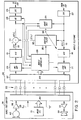
- a mobile telephone 203 is shown with a connector 213 that enables a bus 207 on the mobile telephone 203 to be coupled to a bus 205 located in a hands-free adapter 201.
- the mobile telephone 203 permits a near-end user to hear and speak to a far-end user by means of its own microphone and loudspeaker/earphone (not shown). These may be automatically disconnected using any of a number of well-known techniques, however, when the hands-free adapter 201 is connected to the connector 213.
- the hands-free adapter 201 includes a loudspeaker 109 for reproducing audio generated by a far-end user.
- the hands-free adapter 201 further includes a microphone 105 to convert the nearby acoustic sounds into a corresponding signal that may be processed and transmitted to the far-end user.
- the hands-free adapter 201 very commonly also includes a power amplifier 231 for the loudspeaker 109. This is a requirement in those embodiments that employ a wireless connection between the hands-free adapter 201 and the mobile telephone 203.
- the hands-free adapter 201 also very commonly includes a microphone preamplifier 229.
- the mobile telephone In order to generate a loudspeaker signal having an appropriate power level, the mobile telephone includes a speaker amplifier 217 having an adjustable gain.
- the mobile telephone 203 also includes a microphone amplifier 219 having an adjustable gain that permits a microphone signal to be generated at a suitable level, as will be described in greater detail below.
- the mobile telephone 203 further includes echo cancellation components including an adaptive filter 215, filter adaptation unit 221, and subtractor 107 arranged to generate an estimated echo signal 102 that is subtracted from a digital microphone signal 126, as described earlier.
- the mobile telephone 203 may further include a noise suppression unit 223, although this is not required.
- a near-end audio signal is supplied to a speech encoder 225, which generates an encoded speech signal that is supplied to other transmitter components (not shown) for transmission to the far-end user.
- the far-end signal (from which is derived a signal to be supplied to the loudspeaker) is received by receiver components (not shown) in the mobile telephone 203.
- the far-end signal is supplied to a speech decoder 227, which generates the digital input signal 112 which is processed as described earlier.
- the hands-free adapter 201 supplies self-identifying information to the mobile telephone 203, wherein the self-identifying information distinguishes the hands-free adapter from at least one other hands-free adapter.
- This information may take on many different forms, depending on the particular application.
- the self-identifying information may be in the form of make and model identifying information.
- the mobile telephone 203 in this case needs to store a table so that it can look up the particular make and mode and determine what steps to take.
- This approach has a drawback, however, in that if the mobile telephone's table is static, it may fail to recognize later-developed makes and models.
- an alternative embodiment of the information may be used, in which the information includes detailed performance information about the particular microphone, loudspeaker and other components included in the hands-free adapter 201.
- An advantage of this approach is that the information can be as precise and detailed as desired.
- a disadvantage is that it may require a mechanism that permits a larger quantity of information to be communicated between the hands-free adapter 201 and the mobile telephone 203.
- the self-identifying information may identify one of a number of predefined performance classes of hands-free adapters.
- the performance classes may be predefined to describe a range of hands-free adapters of varying quality, ranging from very low-en models (usually of lower quality) to very high-end models (usually of very high quality).
- This approach avoids the problem of the mobile telephone 203 not recognizing a later-developed model of hands-free adapter 201, since even later developed models can be assigned a performance class that competently describes their performance characteristics.
- This approach further permits the pertinent information to be communicated between the hands-free adapter 201 and the mobile telephone 203 by means of very few bits (i.e., binary digits), since the information is essentially encoded.
- a hands-free adapter 201 may not be exactly described by any of the predefined performance classes.
- a solution can be employed in which the hands-free adapter 201 communicates performance class information in combination with additional information.
- the communicated performance class may correspond to the performance class that most closely describes the hands-free adapter 201.
- the additional information can be just that information necessary to specify how the hands-free adapter 201 differs from the predefined performance class.
- one or more pins on the connector 213 may be dedicated to representing the information.
- some pins would be tied to, say, a high voltage level (e.g., V CC , or car battery voltage) in order to represent a binary '1', while other ones of the dedicated pins would be tied to ground for the purpose of representing a binary '0'.
- V CC high voltage level
- the combination of '1's and '0's may represent, say, the performance class that best describes the hands-free adapter 201.
- the hands-free adapter 201 may include a micro-controller 211 or other processor that generates the self-identifying information and transmits this to a mobile controller 209 or other processor in the mobile telephone 203.
- This communication is preferably performed by means of a serial communications link between the hands-free adapter 201 and the mobile telephone 203, although alternative techniques can also be used.
- the communications link itself can be by means of one or more dedicated lines on the connector 213.
- a wireless connection is established between the hands-free adapter 201 and the mobile telephone 203, instead of the illustrated connector 213.
- a wireless connection can be established and used in accordance with Bluetooth technology, which is a publicly available open specification for wireless communication of data and voice.
- Bluetooth specifications specify a system solution comprising hardware, software and interoperability requirements.
- Bluetooth equipment operates in a globally available 2.4 Ghz Industrial, Scientific and Medical (ISM) radiofrequency band, ensuring communication compatibility worldwide. Connections between Bluetooth-compatible devices are established almost-instantaneously, and are maintained even when devices are not within line of sight.
- ISM Industrial, Scientific and Medical
- the range of each radio is approximately 10 meters, but it can be extended to approximately 100 meters with an optional amplifier.
- the hands-free adapter 201 provides self-identifying information to the mobile telephone 203.
- the self-identifying information is sufficient to permit the mobile telephone 203 to determine pertinent performance characteristics of the hands-free adapter 201.
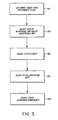
- Another aspect of the invention relates to what the mobile telephone 203 does with this information. This aspect of the invention will be described with reference to the exemplary mobile telephone 203 depicted in FIG. 2 in conjunction with the flow chart depicted in FIG. 3 .
- the hands-free adapter communicates a performance class identifier to the mobile controller 209 located in the mobile telephone 203.
- the self-identifying information could take any of a number of alternative forms, as described earlier.
- the mobile controller 209 receives the hands-free adapter's self-identifying information in the form of a hands-free adapter performance class identifier.
- the mobile controller 209 uses this to optimize a number of settings in the mobile telephone 203 so that the most efficient settings can be used to attain the peak performance from this particular hands-free adapter 201.
- step 303 the mobile controller 209 adjusts the gain of the microphone amplifier 219 and of the loudspeaker amplifier 217. These settings, which are determined in advance for this particular performance class of hands-free equipment, ensure optimal performance with respect to saturation, interference and distortion associated with the microphone 105 and the loudspeaker 109.
- step 305 the length of the filter (i.e., the number of taps) is adjusted to best suit the performance class of hands-free equipment indicated by the hands-free adapter's self-identifying information. This step is performed out of recognition that lower quality hands-free equipment may require more filtering processing (i.e., more taps) than higher quality hands-free equipment.
- the mobile controller 209 adjusts the filter algorithm so that it will do no more than what is required. For example, a performance class indicative of an office-based hands-free accessory will require a greater echo cancellation filter length than will be required for a performance class indicative of a headset.
- this filter length adjustment may comprise selecting or de-selecting physically implemented taps of a filter, or it may alternatively be an adjustment to one or more parameters stored in a memory, which parameters control the operation of a filtering program that is run on the mobile controller 209 or another processor located in the mobile telephone 203.
- step 307 the rate of filter adaptation (performed by the filter adaptation unit 221) is adjusted to suit the particular hands-free adapter 201. Again, this is performed because different hands-free adapter's have different echo characteristics. These differences arise not only from the quality differences between different kinds of microphones and different kinds of loudspeakers, but also because of installation distances that different hands-free adapter kits impose between microphone and loudspeaker, between microphone and mouth, and between loudspeaker and ear.
- step 309 other algorithms/components are adjusted to best suit the particular hands-free adapter 201 that is to operate with the mobile telephone 203.
- Such other algorithms/components include, but are not limited to, noise canceler, near-end voice detectors, other communication filters (uplink and downlink).
- the type of hands-free adapter 201 (which may always be associated with installation in a particular type of acoustic environment) may also cause the mobile telephone 203 to change from a full duplex hands-free operation, in which the microphone 105 and loudspeaker 109 are always active at the same time, to semi-duplex hands-free operation, in which the loudspeaker 109 and microphone 105 take turns at being activated.
- the mobile controller 209 (or other controller/processor in the mobile telephone 203) may sense whether a far-end speech signal or a near-end speech signal has higher energy, and block transmission of the weaker signal.
- the main device is a mobile telephone.
- this is not an essential feature of the invention. Rather, the invention can be practiced in any type of device that is capable of utilizing any of a variety of hands-free adapters.
- the invention addresses these problems by permitting the main device to dynamically optimize internal settings to suit the particular hands-free adapter being employed.
- a range of main devices can be offered to the public, which main devices are associated with different qualities of performance.
- main devices e.g., different models of mobile telephones
- a low-end mobile telephone can be designed to disable noise cancellation components unless it detects that it is connected to the highest-quality hands-free adapter 201.
- a high-end mobile telephone can have the noise cancellation components always enabled, regardless of the type of hands-free adapter being employed.
- hands-free adapters 201 include, but are not limited to: portable hands-free adapters (e.g., headsets), both wire and wireless; vehicle hands-free adapters, ranging from inexpensive easy-to-install kits up to more expensive fixed-mounted high-end kits; and office hands-free adapters, ranging from inexpensive desktop equipment to high-end conferencing equipment.
- portable hands-free adapters e.g., headsets
- vehicle hands-free adapters ranging from inexpensive easy-to-install kits up to more expensive fixed-mounted high-end kits
- office hands-free adapters ranging from inexpensive desktop equipment to high-end conferencing equipment.
Landscapes
- Engineering & Computer Science (AREA)
- Computer Networks & Wireless Communication (AREA)
- Multimedia (AREA)
- Signal Processing (AREA)
- Telephone Function (AREA)
- Mobile Radio Communication Systems (AREA)
- Interconnected Communication Systems, Intercoms, And Interphones (AREA)
- Cable Transmission Systems, Equalization Of Radio And Reduction Of Echo (AREA)
Applications Claiming Priority (3)
| Application Number | Priority Date | Filing Date | Title |
|---|---|---|---|
| US32327499A | 1999-06-01 | 1999-06-01 | |
| US323274 | 1999-06-01 | ||
| PCT/EP2000/004858 WO2000074350A2 (en) | 1999-06-01 | 2000-05-29 | Adaptability to multiple hands-free communication accessories |
Publications (2)
| Publication Number | Publication Date |
|---|---|
| EP1186156A2 EP1186156A2 (en) | 2002-03-13 |
| EP1186156B1 true EP1186156B1 (en) | 2008-10-22 |
Family
ID=23258462
Family Applications (1)
| Application Number | Title | Priority Date | Filing Date |
|---|---|---|---|
| EP00931266A Expired - Lifetime EP1186156B1 (en) | 1999-06-01 | 2000-05-29 | Adaptability to multiple hands-free communication accessories |
Country Status (12)
| Country | Link |
|---|---|
| EP (1) | EP1186156B1 (enExample) |
| JP (1) | JP2003501893A (enExample) |
| CN (1) | CN1367978A (enExample) |
| AR (1) | AR024164A1 (enExample) |
| AT (1) | ATE412310T1 (enExample) |
| AU (1) | AU4925300A (enExample) |
| DE (1) | DE60040600D1 (enExample) |
| HK (2) | HK1049084A1 (enExample) |
| MX (1) | MXPA01012343A (enExample) |
| MY (1) | MY140637A (enExample) |
| RU (1) | RU2001135825A (enExample) |
| WO (1) | WO2000074350A2 (enExample) |
Cited By (1)
| Publication number | Priority date | Publication date | Assignee | Title |
|---|---|---|---|---|
| US20130273978A1 (en) * | 2010-12-08 | 2013-10-17 | Microsoft Corporation | Controlling Audio Signals |
Families Citing this family (15)
| Publication number | Priority date | Publication date | Assignee | Title |
|---|---|---|---|---|
| KR20020089631A (ko) * | 2001-05-23 | 2002-11-30 | (주)오픈브레인테크 | 블루투스 헤드셋을 통한 온라인 음악 배포 시스템 |
| EP1318652B1 (en) * | 2001-12-07 | 2005-02-23 | Sony International (Europe) GmbH | Identification of code transmissions sent by an accessory device to a mobile terminal depending on a previous code value |
| JP2003274003A (ja) * | 2002-03-13 | 2003-09-26 | Toshiba Corp | ハンズフリー通話装置及び携帯電話機 |
| EP1463246A1 (en) * | 2003-03-27 | 2004-09-29 | Motorola Inc. | Communication of conversational data between terminals over a radio link |
| US7653350B2 (en) * | 2003-07-24 | 2010-01-26 | Sony Ericsson Mobile Communications Ab | Wireless terminals and methods for communicating over cellular and enhanced mode bluetooth communication links |
| ES2572747T3 (es) * | 2003-10-28 | 2016-06-02 | Nokia Technologies Oy | Bloque de audio |
| GB2409788A (en) * | 2003-12-30 | 2005-07-06 | Nokia Corp | Mobile terminal with accessory functions support |
| DE102005027492B4 (de) * | 2005-06-15 | 2008-06-05 | Daimler Ag | Verfahren und Vorrichtung zum Betrieb eines Mobiltelefons in einem Fahrzeug |
| US8239674B2 (en) | 2006-11-21 | 2012-08-07 | Kabushiki Kaisha Toshiba | System and method of protecting files from unauthorized modification or deletion |
| US8666091B2 (en) | 2008-06-13 | 2014-03-04 | Sony Corporation | Method for reducing a disturbance in an input signal caused by an output signal in a multi-port connector, multi-port connector, and mobile device |
| CN101478614A (zh) * | 2009-01-19 | 2009-07-08 | 深圳华为通信技术有限公司 | 自适应音量调节的方法、装置及通信终端 |
| FR2947122B1 (fr) * | 2009-06-23 | 2011-07-22 | Adeunis Rf | Dispositif d'amelioration de l'intelligibilite de la parole dans un systeme de communication multi utilisateurs |
| KR101657314B1 (ko) | 2010-06-29 | 2016-09-19 | 삼성전자주식회사 | 근거리 무선통신을 이용한 오디오 제어 시스템 및 방법 |
| US9516414B2 (en) | 2014-07-09 | 2016-12-06 | Blackberry Limited | Communication device and method for adapting to audio accessories |
| US10127920B2 (en) * | 2017-01-09 | 2018-11-13 | Google Llc | Acoustic parameter adjustment |
Family Cites Families (6)
| Publication number | Priority date | Publication date | Assignee | Title |
|---|---|---|---|---|
| US5036532A (en) * | 1989-08-03 | 1991-07-30 | Motorola, Inc. | Portable telephone with power source/mode change during calls |
| JPH0773387B2 (ja) * | 1989-12-26 | 1995-08-02 | 日本電気株式会社 | 携帯電話装置 |
| US5479479A (en) * | 1991-10-19 | 1995-12-26 | Cell Port Labs, Inc. | Method and apparatus for transmission of and receiving signals having digital information using an air link |
| US5774793A (en) * | 1994-12-22 | 1998-06-30 | Ora Electronics, Inc. | System and method for interfacing diversely controlled devices to a bus connector having a common signal format |
| AU676977B1 (en) * | 1996-03-08 | 1997-03-27 | Alex Cheklin | Cellular phone adaptor |
| JP2842376B2 (ja) * | 1996-05-22 | 1999-01-06 | 日本電気株式会社 | ハンズフリー電話機 |
-
2000
- 2000-05-29 MX MXPA01012343A patent/MXPA01012343A/es unknown
- 2000-05-29 EP EP00931266A patent/EP1186156B1/en not_active Expired - Lifetime
- 2000-05-29 HK HK03101301.9A patent/HK1049084A1/zh unknown
- 2000-05-29 AT AT00931266T patent/ATE412310T1/de not_active IP Right Cessation
- 2000-05-29 HK HK02103555.9A patent/HK1041999A1/zh unknown
- 2000-05-29 WO PCT/EP2000/004858 patent/WO2000074350A2/en not_active Ceased
- 2000-05-29 JP JP2001500529A patent/JP2003501893A/ja active Pending
- 2000-05-29 CN CN00811150A patent/CN1367978A/zh active Pending
- 2000-05-29 AU AU49253/00A patent/AU4925300A/en not_active Abandoned
- 2000-05-29 RU RU2001135825/09A patent/RU2001135825A/ru not_active Application Discontinuation
- 2000-05-29 DE DE60040600T patent/DE60040600D1/de not_active Expired - Lifetime
- 2000-05-31 MY MYPI20002441A patent/MY140637A/en unknown
- 2000-05-31 AR ARP000102683A patent/AR024164A1/es unknown
Cited By (2)
| Publication number | Priority date | Publication date | Assignee | Title |
|---|---|---|---|---|
| US20130273978A1 (en) * | 2010-12-08 | 2013-10-17 | Microsoft Corporation | Controlling Audio Signals |
| US9698916B2 (en) * | 2010-12-08 | 2017-07-04 | Skype | Controlling audio signals |
Also Published As
| Publication number | Publication date |
|---|---|
| HK1041999A1 (zh) | 2002-07-26 |
| JP2003501893A (ja) | 2003-01-14 |
| WO2000074350A3 (en) | 2001-03-29 |
| AU4925300A (en) | 2000-12-18 |
| CN1367978A (zh) | 2002-09-04 |
| ATE412310T1 (de) | 2008-11-15 |
| MY140637A (en) | 2010-01-15 |
| HK1049084A1 (zh) | 2003-04-25 |
| AR024164A1 (es) | 2002-09-04 |
| RU2001135825A (ru) | 2003-07-27 |
| DE60040600D1 (de) | 2008-12-04 |
| MXPA01012343A (es) | 2002-07-22 |
| EP1186156A2 (en) | 2002-03-13 |
| WO2000074350A2 (en) | 2000-12-07 |
Similar Documents
| Publication | Publication Date | Title |
|---|---|---|
| CN100446530C (zh) | 校准波束形成器的方法和消除回声的方法 | |
| US5706344A (en) | Acoustic echo cancellation in an integrated audio and telecommunication system | |
| CN1169312C (zh) | 非线性电路的回波抵消器 | |
| EP1748636B1 (en) | Improved communication in passenger compartments | |
| JP4624503B2 (ja) | 音声源を検出する装置及び方法 | |
| EP1879180B1 (en) | Reduction of background noise in hands-free systems | |
| WO2000074350A2 (en) | Adaptability to multiple hands-free communication accessories | |
| EP1542444B1 (en) | An echo canceler circuit and method | |
| EP1685697B1 (en) | Method and apparatus for adaptive echo and noise control | |
| EP0975293A4 (en) | NOISE REDUCTION EAR | |
| KR19990087497A (ko) | 무선전화음량제어용방법및장치 | |
| US20010055985A1 (en) | Telephoning and hands-free speech for cordless final apparatus with echo compensation | |
| WO2000072565A1 (en) | Enhancement of near-end voice signals in an echo suppression system | |
| WO2008016586A2 (en) | Histogram for controlling a telephone | |
| JP2009501501A (ja) | エコー・キャンセレーションのための経路変更検出器 | |
| WO1997007624A1 (en) | Echo cancelling using signal preprocessing in an acoustic environment | |
| JPH11122692A (ja) | 電気機器に音響信号を入力する方法及びその電気機器 | |
| WO2000074361A1 (en) | Residual echo suppression | |
| US20080043997A1 (en) | Noise threshold matrix for controlling audio processing | |
| MXPA98010418A (en) | Eco breaker for non-line circuits | |
| HK1019982B (en) | Echo canceler for non-linear circuits | |
| HK1035093A (en) | Generating calibration signals for an adaptive beamformer |
Legal Events
| Date | Code | Title | Description |
|---|---|---|---|
| PUAI | Public reference made under article 153(3) epc to a published international application that has entered the european phase |
Free format text: ORIGINAL CODE: 0009012 |
|
| 17P | Request for examination filed |
Effective date: 20011227 |
|
| AK | Designated contracting states |
Kind code of ref document: A2 Designated state(s): AT BE CH CY DE DK ES FI FR GB GR IE IT LI LU MC NL PT SE |
|
| AX | Request for extension of the european patent |
Free format text: AL;LT;LV;MK;RO;SI |
|
| RIN1 | Information on inventor provided before grant (corrected) |
Inventor name: PHILIPSSON, JOHN Inventor name: RASMUSSON, JIM Inventor name: CHRISTENSSON, NILS |
|
| RAP1 | Party data changed (applicant data changed or rights of an application transferred) |
Owner name: TELEFONAKTIEBOLAGET LM ERICSSON (PUBL) |
|
| 17Q | First examination report despatched |
Effective date: 20040823 |
|
| GRAP | Despatch of communication of intention to grant a patent |
Free format text: ORIGINAL CODE: EPIDOSNIGR1 |
|
| GRAS | Grant fee paid |
Free format text: ORIGINAL CODE: EPIDOSNIGR3 |
|
| GRAA | (expected) grant |
Free format text: ORIGINAL CODE: 0009210 |
|
| AK | Designated contracting states |
Kind code of ref document: B1 Designated state(s): AT BE CH CY DE DK ES FI FR GB GR IE IT LI LU MC NL PT SE |
|
| REG | Reference to a national code |
Ref country code: GB Ref legal event code: FG4D |
|
| REG | Reference to a national code |
Ref country code: CH Ref legal event code: EP |
|
| REG | Reference to a national code |
Ref country code: IE Ref legal event code: FG4D |
|
| REF | Corresponds to: |
Ref document number: 60040600 Country of ref document: DE Date of ref document: 20081204 Kind code of ref document: P |
|
| PG25 | Lapsed in a contracting state [announced via postgrant information from national office to epo] |
Ref country code: AT Free format text: LAPSE BECAUSE OF FAILURE TO SUBMIT A TRANSLATION OF THE DESCRIPTION OR TO PAY THE FEE WITHIN THE PRESCRIBED TIME-LIMIT Effective date: 20081022 Ref country code: ES Free format text: LAPSE BECAUSE OF FAILURE TO SUBMIT A TRANSLATION OF THE DESCRIPTION OR TO PAY THE FEE WITHIN THE PRESCRIBED TIME-LIMIT Effective date: 20090202 |
|
| PG25 | Lapsed in a contracting state [announced via postgrant information from national office to epo] |
Ref country code: FI Free format text: LAPSE BECAUSE OF FAILURE TO SUBMIT A TRANSLATION OF THE DESCRIPTION OR TO PAY THE FEE WITHIN THE PRESCRIBED TIME-LIMIT Effective date: 20081022 Ref country code: PT Free format text: LAPSE BECAUSE OF FAILURE TO SUBMIT A TRANSLATION OF THE DESCRIPTION OR TO PAY THE FEE WITHIN THE PRESCRIBED TIME-LIMIT Effective date: 20090323 |
|
| PG25 | Lapsed in a contracting state [announced via postgrant information from national office to epo] |
Ref country code: DK Free format text: LAPSE BECAUSE OF FAILURE TO SUBMIT A TRANSLATION OF THE DESCRIPTION OR TO PAY THE FEE WITHIN THE PRESCRIBED TIME-LIMIT Effective date: 20081022 Ref country code: BE Free format text: LAPSE BECAUSE OF FAILURE TO SUBMIT A TRANSLATION OF THE DESCRIPTION OR TO PAY THE FEE WITHIN THE PRESCRIBED TIME-LIMIT Effective date: 20081022 |
|
| PLBE | No opposition filed within time limit |
Free format text: ORIGINAL CODE: 0009261 |
|
| STAA | Information on the status of an ep patent application or granted ep patent |
Free format text: STATUS: NO OPPOSITION FILED WITHIN TIME LIMIT |
|
| PG25 | Lapsed in a contracting state [announced via postgrant information from national office to epo] |
Ref country code: IT Free format text: LAPSE BECAUSE OF FAILURE TO SUBMIT A TRANSLATION OF THE DESCRIPTION OR TO PAY THE FEE WITHIN THE PRESCRIBED TIME-LIMIT Effective date: 20081022 Ref country code: SE Free format text: LAPSE BECAUSE OF FAILURE TO SUBMIT A TRANSLATION OF THE DESCRIPTION OR TO PAY THE FEE WITHIN THE PRESCRIBED TIME-LIMIT Effective date: 20090122 |
|
| 26N | No opposition filed |
Effective date: 20090723 |
|
| PG25 | Lapsed in a contracting state [announced via postgrant information from national office to epo] |
Ref country code: MC Free format text: LAPSE BECAUSE OF NON-PAYMENT OF DUE FEES Effective date: 20090531 |
|
| REG | Reference to a national code |
Ref country code: CH Ref legal event code: PL |
|
| GBPC | Gb: european patent ceased through non-payment of renewal fee |
Effective date: 20090529 |
|
| PG25 | Lapsed in a contracting state [announced via postgrant information from national office to epo] |
Ref country code: LI Free format text: LAPSE BECAUSE OF NON-PAYMENT OF DUE FEES Effective date: 20090531 Ref country code: CH Free format text: LAPSE BECAUSE OF NON-PAYMENT OF DUE FEES Effective date: 20090531 |
|
| REG | Reference to a national code |
Ref country code: FR Ref legal event code: ST Effective date: 20100129 |
|
| REG | Reference to a national code |
Ref country code: IE Ref legal event code: MM4A |
|
| PG25 | Lapsed in a contracting state [announced via postgrant information from national office to epo] |
Ref country code: FR Free format text: LAPSE BECAUSE OF NON-PAYMENT OF DUE FEES Effective date: 20090602 Ref country code: IE Free format text: LAPSE BECAUSE OF NON-PAYMENT OF DUE FEES Effective date: 20090529 |
|
| PG25 | Lapsed in a contracting state [announced via postgrant information from national office to epo] |
Ref country code: GB Free format text: LAPSE BECAUSE OF NON-PAYMENT OF DUE FEES Effective date: 20090529 |
|
| PG25 | Lapsed in a contracting state [announced via postgrant information from national office to epo] |
Ref country code: GR Free format text: LAPSE BECAUSE OF FAILURE TO SUBMIT A TRANSLATION OF THE DESCRIPTION OR TO PAY THE FEE WITHIN THE PRESCRIBED TIME-LIMIT Effective date: 20090123 |
|
| REG | Reference to a national code |
Ref country code: HK Ref legal event code: WD Ref document number: 1041999 Country of ref document: HK |
|
| PG25 | Lapsed in a contracting state [announced via postgrant information from national office to epo] |
Ref country code: LU Free format text: LAPSE BECAUSE OF NON-PAYMENT OF DUE FEES Effective date: 20090529 |
|
| PG25 | Lapsed in a contracting state [announced via postgrant information from national office to epo] |
Ref country code: CY Free format text: LAPSE BECAUSE OF FAILURE TO SUBMIT A TRANSLATION OF THE DESCRIPTION OR TO PAY THE FEE WITHIN THE PRESCRIBED TIME-LIMIT Effective date: 20081022 |
|
| REG | Reference to a national code |
Ref country code: DE Ref legal event code: R082 Ref document number: 60040600 Country of ref document: DE Representative=s name: HOFFMANN - EITLE, DE Effective date: 20140618 Ref country code: DE Ref legal event code: R081 Ref document number: 60040600 Country of ref document: DE Owner name: OPTIS WIRELESS TECHNOLOGY, LLC, PLANO, US Free format text: FORMER OWNER: TELEFONAKTIEBOLAGET LM ERICSSON (PUBL), STOCKHOLM, SE Effective date: 20140618 Ref country code: DE Ref legal event code: R082 Ref document number: 60040600 Country of ref document: DE Representative=s name: GRUENECKER, KINKELDEY, STOCKMAIR & SCHWANHAEUS, DE Effective date: 20140618 Ref country code: DE Ref legal event code: R082 Ref document number: 60040600 Country of ref document: DE Representative=s name: GRUENECKER PATENT- UND RECHTSANWAELTE PARTG MB, DE Effective date: 20140618 |
|
| REG | Reference to a national code |
Ref country code: DE Ref legal event code: R082 Ref document number: 60040600 Country of ref document: DE Representative=s name: GRUENECKER, KINKELDEY, STOCKMAIR & SCHWANHAEUS, DE Ref country code: DE Ref legal event code: R082 Ref document number: 60040600 Country of ref document: DE Representative=s name: GRUENECKER PATENT- UND RECHTSANWAELTE PARTG MB, DE |
|
| REG | Reference to a national code |
Ref country code: NL Ref legal event code: SD Effective date: 20150629 |
|
| PGFP | Annual fee paid to national office [announced via postgrant information from national office to epo] |
Ref country code: NL Payment date: 20170421 Year of fee payment: 18 |
|
| PGFP | Annual fee paid to national office [announced via postgrant information from national office to epo] |
Ref country code: DE Payment date: 20170420 Year of fee payment: 18 |
|
| REG | Reference to a national code |
Ref country code: DE Ref legal event code: R119 Ref document number: 60040600 Country of ref document: DE |
|
| REG | Reference to a national code |
Ref country code: NL Ref legal event code: MM Effective date: 20180601 |
|
| PG25 | Lapsed in a contracting state [announced via postgrant information from national office to epo] |
Ref country code: NL Free format text: LAPSE BECAUSE OF NON-PAYMENT OF DUE FEES Effective date: 20180601 Ref country code: DE Free format text: LAPSE BECAUSE OF NON-PAYMENT OF DUE FEES Effective date: 20181201 |