EP1184775A2 - Verfahren zur Texteingabe für eine elektronische Vorrichtung - Google Patents
Verfahren zur Texteingabe für eine elektronische Vorrichtung Download PDFInfo
- Publication number
- EP1184775A2 EP1184775A2 EP01306132A EP01306132A EP1184775A2 EP 1184775 A2 EP1184775 A2 EP 1184775A2 EP 01306132 A EP01306132 A EP 01306132A EP 01306132 A EP01306132 A EP 01306132A EP 1184775 A2 EP1184775 A2 EP 1184775A2
- Authority
- EP
- European Patent Office
- Prior art keywords
- text
- display
- key
- text string
- input
- Prior art date
- Legal status (The legal status is an assumption and is not a legal conclusion. Google has not performed a legal analysis and makes no representation as to the accuracy of the status listed.)
- Withdrawn
Links
Images




Classifications
-
- G—PHYSICS
- G06—COMPUTING OR CALCULATING; COUNTING
- G06F—ELECTRIC DIGITAL DATA PROCESSING
- G06F3/00—Input arrangements for transferring data to be processed into a form capable of being handled by the computer; Output arrangements for transferring data from processing unit to output unit, e.g. interface arrangements
- G06F3/01—Input arrangements or combined input and output arrangements for interaction between user and computer
- G06F3/02—Input arrangements using manually operated switches, e.g. using keyboards or dials
- G06F3/023—Arrangements for converting discrete items of information into a coded form, e.g. arrangements for interpreting keyboard generated codes as alphanumeric codes, operand codes or instruction codes
- G06F3/0233—Character input methods
- G06F3/0237—Character input methods using prediction or retrieval techniques
Definitions
- the present invention relates to a portable electronic device.
- the electronic device to which this invention relates is a mobile telecommunications device such as a telephone but it could also be any other type of electronic device including, for example, a personal data assistant (PDA).
- PDA personal data assistant
- a conventional mobile telephone includes a keypad having first group of alphanumeric keys by means of which a user can enter a telephone number, write a text message (SMS), write a name associated with a telephone number and input other information into the telephone.
- SMS text message
- Each key is generally provided with a figure “0-9” or a sign "#” or "*" often used in text editing.
- alpha mode each key is associated with a number of letters and special signs to enable text input.
- WAP wireless application protocol
- This is an industry specification agreed by most of the major telephone manufacturers and service providers that allows a WAP enabled mobile telephone, pager or personal data assistant owner to access the internet, effectively turning such devices into web browsers.
- the text entry problems mentioned above are exacerbated with telephones of this type as larger quantities of information needs to be input into such devices to, for example, conduct a search using a search engine, enter passwords to access a subscriber based web site or view a particular URL address, so it is presently slow and tiring to enter information using the conventional technique.
- the present invention seeks to improve the ease by which information including text and other characters, such as an SMS text message in a mobile telephone, can be input into an electronic device.
- an electronic device including a keypad to input text, a display for displaying text entered via the keypad and a memory for storing a pre-programmed text string, wherein the keypad is configured so that text string is recalled from the memory, input and displayed at a cursor position in response to operation of one key, the cursor position being selected by the user before operation of said key.
- the display is configured to display text string recalled from the memory before input and display of the text string at the selected cursor position in response to operation of said one key.
- different text strings stored in the memory are assignable to different keys such that a required text string is recalled from the memory, input and displayed at a cursor position in response to operation of the one key to which the required text string has been assigned.
- the display is preferably configured to display a plurality of separate text strings recalled from the memory before input of a required text string at the selected cursor position.
- said one key is operable to select one of said recalled text strings, and input and display said text string at the cursor position selected by the user after display of the plurality of separate text strings.
- text string accessed from the memory is input and displayed at the selected cursor position in response to operation of the appropriate key for a predetermined time period.
- the present invention also provides a mobile telecommunications device including a keypad and a display operable to compose and transmit text messages through a mobile telecommunications network, keys of the keypad being operable to present individual alphanumeric characters on the display for composing a text message, and wherein the keypad is operable to insert individually selectable pre-stored words or phrases into the message during the composition thereof.
- the message preferably comprises an SMS or part of a WAP communication protocol.
- the message comprises a URL.
- the present invention also provides a method of entering text in an electronic device including a keypad to input text, a display for displaying text entered via the keypad and a memory for storing a pre-programmed text string, including the step of operating one key to recall a text string from the memory, input and display said text string at a cursor position selected by the user before operation of said key.
- the method includes the step of operating the key for a predetermined time period.
- the recalled text string is displayed before input and display of the text string at the selected cursor position in response to operation of said one key.
- the method includes the step of operating said one key more than once to recall, input and display the text string at the selected cursor position.
- a plurality of text strings are storable in the memory, each text string being assignable to a different key and the method includes the step of operating one key to which a selected text string has been assigned to recall, input and display said selected text string at the cursor position.
- a plurality of text strings recalled from the memory are displayed before input and display of a selected text string at the cursor position, the method including operating said one key to recall and display said plurality of text strings, select one text string from those displayed and enter and display said selected text string at the cursor position.
- the present invention also provides a method of composing text messages to be sent over a mobile telecommunications network using a mobile telecommunications device including a keypad and a display, the method including the steps of operating the keys of a keypad to present individual alphanumeric characters on the display for composing a text message, and the step of operating the keypad to insert individually selectable pre-stored words or phrases into the message during composition thereof.
- the telephone 1 has a front face 2 and rear face 3 and comprises a user interface having a keypad 4, a display 5, an ear piece 6, a microphone 7 and an on/off key 8.
- the telephone 1 is adapted for communication via a wireless telecommunications network, e.g. a cellular network.
- a wireless telecommunications network e.g. a cellular network.
- the telephone 1 could also have been designed for a cordless network.
- the keypad 4 has a first group of keys which are alphanumeric and by means of which a user can enter a telephone number, write a text message (SMS) or write a name associated with a particular number, etc.
- SMS text message
- the keypad 4 additionally includes two soft keys 9, the functionality of which depends on the state of the telephone and the navigation in the menu by means of a navigation key 10, and two call handling keys 10a which can be used for establishing a call or a conference call, terminating a call or rejecting an incoming call.
- FIG. 2 illustrates the main parts of the telephone 1 which is adapted for use in connection with a GSM network or any other telephone network.
- the telephone 1 may also be configured to meet the wireless application protocol specification (WAP).
- WAP wireless application protocol specification
- Signal processing is carried out under the control of a digital micro-controller 14 which has an associated RAM/ROM 15 and a flash memory 16. Electric analogue audio signals are produced by microphone 7 and amplified by preamplifier 17. Similarly, analogue audio signals are fed to ear piece 6 through amplifier 18.
- the micro-controller 14 receives instruction signals from the keypad 4 including the soft keys 9 and navigation key 10 and controls the operation of the display 5.
- a smart card 19 in the form of a GSM SIM card.
- the SIM card 16 is removably received in a SIM card holder 20.
- Radio signals are transmitted and received by means of an antenna 21 connected through an rf stage 22 to a codec 23 configured to process signals under the control of the micro-controller 14.
- the codec 23 receives analogue signals from microphone amplifier 17, digitises them into a form suitable for transmission and feeds them to the rf stage 22 for transmission through antenna element 21 to the public land mobile network (PLMN).
- received signals are fed through the antenna element 21 to be demodulated by the rf stage 22 and fed to codec 23 so as to produce analogue signals fed to amplifier 18 and ear piece 6.
- the device is driven by the removable battery pack 13.
- a plurality of frequently used stock words or phrases are stored in the memory 15 of the telephone or in the SIM card 19.
- the pre-stored phrases can be entered by the user in addition to conventional text entry in which each letter or character is entered individually.
- the pre-stored words or phrases can be programmed into the memory by the user or can be pre-programmed by the telephone manufacturer, or both.
- one button is dedicated to the entry of a word or phrase stored in the memory 17.
- the "#" or "*" button is used.
- this button is pressed for a sufficient length of time, a list of all the pre-programmed words and/or phrases stored in the memory is displayed on the display 5.
- the required word or phrase can then be entered and displayed at the selected cursor position by selecting it from the list, using the same or an alternative button.
- cursor keys, roller, stylus or a joystick could be used to select the appropriate word and/or phrase from the list.
- rapid presses of the button may scroll down the list highlighting each phrase. To select the required phrase, the user allows one phrase to remain highlighted for a predetermined interval.
- a further press of the same button inputs and displays the highlighted phrase at the selected cursor position.
- the user could hold their finger on the key to scroll down the list of phrases, the finger being removed when the chosen phrase is reached, that phrase being input and displayed at the selected cursor position after a predetermined time period after release of the key.
- the text message comprises an SMS.
- step S1 the user selects the text message entry mode. If no pre-stored word or phrase is to be entered, the user proceeds to enter the text message by selecting each letter individually in accordance with the conventional method (step S2). If a pre-stored word or phrase is to be entered, the user presses a designated key such as the "#" key to call up a list of all the pre-programmed words or phrases (Step S3). The user can then scroll through the list (Step S4) until the desired word or phrase is highlighted. The user then selects the desired word or phrase (Step S5) to include it in the body of the text message. When the message is complete, the user can then send the message (Step S6).
- a designated key such as the "#" key
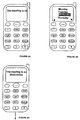
- Figures 4A to 4C shows the front face of a mobile telephone in order to show the display changes during entry of a text message.
- the phrase "The meeting is on” has been entered using the keypad in a conventional manner.
- the user now wishes to enter a word which is stored in the memory. To do this, the user presses the "#" key to call up a list of pre-programmed words which, as shown in Figure 4B, is a list of the days in the week. To select the required day, the user scrolls through the list using the # key until the required day is highlighted. In the present case, "Wednesday" is shown highlighted in Figure 4B.
- the # key is pressed again or alternatively, the word is automatically entered after it remains highlighted for a predetermined length of time or when the user's finger is removed from the button, as explained above.
- a different word or phrase is assigned to each button of the keypad 4.
- the user presses the keys in the conventional manner described in the introduction to the specification.
- the user selects the cursor position at which the word or phrase is to be entered and presses a designated button on the keypad 4 and holds it down for a sufficient length of time to recall the word or phrase assigned to that particular button.
- the required word or phrase is then entered and displayed on the display 5 at the selected position. Manual text entry can then be continued, as before.
- Step S10 the user selects the text message entry mode. If no pre-stored word or phrase is to be entered, the user proceeds to enter the text message by selecting each letter individually in accordance with the conventional method (step S11). If a pre-stored word or phrase is to be entered, the user presses a specific key which has been pre-programmed with the particular word or phrase. The phrase is then entered in the body of the text message (Step S12). When the message is complete, the user can then send the message (Step S13).
- the word or phrase assigned to a particular key may be displayed on the display before it is input and displayed at the selected text entry or cursor position.
- a further press of the same button may then input and display the phrase at the selected position.
- the user may see the displayed phrase and, if they want to input it and display it at the selected text entry position, they maintain the key in a pressed state for a predetermined time period. If the finger is removed before expiry of the time period, the phrase is not input and displayed at the selected text entry position.
- Figures 6A and 6B shows the front face of a mobile telephone to illustrate how the display changes during entry of a text message according to the sequence of events described with reference to Figure 5.
- the user enters the phrase "The meeting is on” in a conventional manner.
- the user presses the button to which this particular word has been assigned for a predetermined length of time sufficient to enter the word in the body of the message.
- the word "Wednesday” has been assigned to the button marked “8tuv” and so this button is pressed and held for a predetermined time period to enter the word "Wednesday", as shown in Figure 6B.
- the word may be displayed before it is entered into the body of the message in which case a further press of the button may be required.
Landscapes
- Engineering & Computer Science (AREA)
- General Engineering & Computer Science (AREA)
- Theoretical Computer Science (AREA)
- Human Computer Interaction (AREA)
- Physics & Mathematics (AREA)
- General Physics & Mathematics (AREA)
- Telephone Function (AREA)
- Mobile Radio Communication Systems (AREA)
- Input From Keyboards Or The Like (AREA)
- Telephone Set Structure (AREA)
- User Interface Of Digital Computer (AREA)
Applications Claiming Priority (2)
| Application Number | Priority Date | Filing Date | Title |
|---|---|---|---|
| GB0021479A GB2366698A (en) | 2000-09-01 | 2000-09-01 | Insertion of pre-stored text strings |
| GB0214791 | 2000-09-01 |
Publications (2)
| Publication Number | Publication Date |
|---|---|
| EP1184775A2 true EP1184775A2 (de) | 2002-03-06 |
| EP1184775A3 EP1184775A3 (de) | 2003-06-18 |
Family
ID=9898658
Family Applications (1)
| Application Number | Title | Priority Date | Filing Date |
|---|---|---|---|
| EP01306132A Withdrawn EP1184775A3 (de) | 2000-09-01 | 2001-07-17 | Verfahren zur Texteingabe für eine elektronische Vorrichtung |
Country Status (4)
| Country | Link |
|---|---|
| US (1) | US20020028697A1 (de) |
| EP (1) | EP1184775A3 (de) |
| JP (1) | JP2002189555A (de) |
| GB (1) | GB2366698A (de) |
Cited By (1)
| Publication number | Priority date | Publication date | Assignee | Title |
|---|---|---|---|---|
| CN102761637A (zh) * | 2012-06-28 | 2012-10-31 | 惠州Tcl移动通信有限公司 | 一种移动通讯设备 |
Families Citing this family (17)
| Publication number | Priority date | Publication date | Assignee | Title |
|---|---|---|---|---|
| US8706747B2 (en) | 2000-07-06 | 2014-04-22 | Google Inc. | Systems and methods for searching using queries written in a different character-set and/or language from the target pages |
| US6907273B1 (en) * | 2000-07-07 | 2005-06-14 | Openwave Systems Inc. | Method and system for processing overloaded keys of a mobile device |
| JP4383864B2 (ja) * | 2001-09-05 | 2009-12-16 | 徹 大田 | 文字入力機能を有する装置 |
| JP2004246603A (ja) * | 2003-02-13 | 2004-09-02 | Sony Corp | 情報処理装置 |
| US7369988B1 (en) * | 2003-02-24 | 2008-05-06 | Sprint Spectrum L.P. | Method and system for voice-enabled text entry |
| WO2005081894A2 (en) * | 2004-02-23 | 2005-09-09 | Hillcrest Laboratories, Inc. | Keyboardless text entry |
| US8972444B2 (en) * | 2004-06-25 | 2015-03-03 | Google Inc. | Nonstandard locality-based text entry |
| US8392453B2 (en) * | 2004-06-25 | 2013-03-05 | Google Inc. | Nonstandard text entry |
| US7798885B2 (en) * | 2004-08-04 | 2010-09-21 | Mattel, Inc. | Instant message toy phone |
| US7619615B1 (en) * | 2004-08-31 | 2009-11-17 | Sun Microsystems, Inc. | Method and apparatus for soft keys of an electronic device |
| US20060085749A1 (en) * | 2004-10-15 | 2006-04-20 | Daniel Stuart W | System and method for using customizable phrasebooks on multi-function devices |
| JP4102383B2 (ja) * | 2005-05-10 | 2008-06-18 | 株式会社東芝 | 移動無線端末装置 |
| US8188976B2 (en) * | 2005-09-14 | 2012-05-29 | Ntt Docomo, Inc. | Mobile terminal device and program used in mobile terminal device |
| US20070076862A1 (en) * | 2005-09-30 | 2007-04-05 | Chatterjee Manjirnath A | System and method for abbreviated text messaging |
| KR100806866B1 (ko) * | 2006-01-04 | 2008-02-22 | 삼성전자주식회사 | 복합기 및 그의 제어방법 및 그의 동작 방법 |
| KR101452704B1 (ko) * | 2007-02-14 | 2014-10-23 | 삼성전자주식회사 | 복수의 버튼을 갖는 휴대용 디바이스에서의 패스워드 설정방법 및 패스 워드 인증 방법 |
| JP4713532B2 (ja) * | 2007-03-29 | 2011-06-29 | 株式会社エヌ・ティ・ティ・ドコモ | 通信端末及びそのプログラム |
Family Cites Families (13)
| Publication number | Priority date | Publication date | Assignee | Title |
|---|---|---|---|---|
| JPH0934621A (ja) * | 1995-07-21 | 1997-02-07 | Sony Corp | 携帯通信端末装置 |
| EP0842463B1 (de) * | 1995-07-26 | 2000-03-29 | Tegic Communications, Inc. | System zur unterdrückung der vieldeutigkeit in einer verringerten tastatur |
| US5778404A (en) * | 1995-08-07 | 1998-07-07 | Apple Computer, Inc. | String inserter for pen-based computer systems and method for providing same |
| JP4243344B2 (ja) * | 1997-05-23 | 2009-03-25 | 株式会社Access | 移動通信機器 |
| US6580917B1 (en) * | 1997-05-27 | 2003-06-17 | Siemens Aktiengesellschaft | Mobile station for use in mobile radio systems |
| GB2333386B (en) * | 1998-01-14 | 2002-06-12 | Nokia Mobile Phones Ltd | Method and apparatus for inputting information |
| CN1266592A (zh) * | 1998-03-06 | 2000-09-13 | 索尼公司 | 携带式信息终端装置及其设定方法 |
| FR2779608B1 (fr) * | 1998-06-08 | 2000-07-13 | Alsthom Cge Alcatel | Appareil de radiocommunication programme pour une saisie automatique de donnees d'un repertoire |
| US6212412B1 (en) * | 1998-06-09 | 2001-04-03 | Qualcomm Incorporated | System and method for character case control in a wireless communication device |
| FI109756B (fi) * | 1998-09-21 | 2002-09-30 | Nokia Corp | Menetelmä tiedonsiirtojärjestelmässä paikallisten resurssien hyödyntämiseksi, tiedonsiirtojärjestelmä ja langaton viestin |
| GB2347247A (en) * | 1999-02-22 | 2000-08-30 | Nokia Mobile Phones Ltd | Communication terminal with predictive editor |
| SE9900710L (sv) * | 1999-02-25 | 2000-08-26 | Ericsson Telefon Ab L M | Metod och anordning som avser kommunikationsnätverk för mobiltelefoner |
| US6205342B1 (en) * | 1999-03-31 | 2001-03-20 | Sony Corporation | User interface for text message creation |
-
2000
- 2000-09-01 GB GB0021479A patent/GB2366698A/en not_active Withdrawn
-
2001
- 2001-07-17 EP EP01306132A patent/EP1184775A3/de not_active Withdrawn
- 2001-08-17 US US09/932,632 patent/US20020028697A1/en not_active Abandoned
- 2001-08-31 JP JP2001262922A patent/JP2002189555A/ja not_active Withdrawn
Cited By (2)
| Publication number | Priority date | Publication date | Assignee | Title |
|---|---|---|---|---|
| CN102761637A (zh) * | 2012-06-28 | 2012-10-31 | 惠州Tcl移动通信有限公司 | 一种移动通讯设备 |
| CN102761637B (zh) * | 2012-06-28 | 2015-11-25 | 惠州Tcl移动通信有限公司 | 一种移动通讯设备 |
Also Published As
| Publication number | Publication date |
|---|---|
| EP1184775A3 (de) | 2003-06-18 |
| GB0021479D0 (en) | 2000-10-18 |
| US20020028697A1 (en) | 2002-03-07 |
| JP2002189555A (ja) | 2002-07-05 |
| GB2366698A (en) | 2002-03-13 |
Similar Documents
| Publication | Publication Date | Title |
|---|---|---|
| EP1184775A2 (de) | Verfahren zur Texteingabe für eine elektronische Vorrichtung | |
| US7512399B2 (en) | Mobile telecommunications device | |
| EP0979569B1 (de) | Kommunikationsendgerät und verfahren zur selektierung von optionen mit einer drehknopfvorrichtung | |
| EP1031913B1 (de) | Kommunikationsendgerät mit prädiktiver Editor-Anwendung | |
| US5852783A (en) | Information tools with multi-functional information key | |
| EP1107544A2 (de) | Verfahren zur Definition von programmierbaren Tasten zur Auswahl von gewünschten Funktionnen durch einen Benutzer eines Kommunikationsendgeräts | |
| US6931258B1 (en) | Radiophone provided with an operation key with multiple functionality for handling access to a menu structure | |
| EP1225505A1 (de) | Tragbares kommunikationsendgerät | |
| EP1603312B1 (de) | Verfahren zum Ausführen von Funktionen unter Verwendung einer recherchierten Telefonnummer in einem Mobilendgerät | |
| US20030036411A1 (en) | Method of entering characters into a text string and a text-editing terminal using the method | |
| US7058417B2 (en) | Method for inputting address of receiver in messaging service | |
| US7710293B2 (en) | Method for accessing contact information | |
| KR100651384B1 (ko) | 휴대용 단말기의 키 입력 방법 및 장치 | |
| GB2369750A (en) | Retrieving address book text using disambiguation of ambiguous key sequences | |
| KR20040044824A (ko) | 접두번호 자동설정방법 및 그 방법을 구현하는 이동통신단말기 | |
| KR100581827B1 (ko) | 이동 통신 단말기의 전화 번호 검색 방법 | |
| KR20010011028A (ko) | 이동무선 단말기에서 영어단어 학습방법 | |
| US6751469B1 (en) | Method of outputting a list of information in a portable cellular telephone using a single function key | |
| WO2007054764A2 (en) | Improved mobile communication terminal and method therefor | |
| KR0174618B1 (ko) | 무선 호출기의 개선된 수신정보 확인회로 및 방법 | |
| KR0181111B1 (ko) | 페이저의 문자편집 방법 | |
| JP2000270115A (ja) | 移動体通信端末 | |
| KR101179467B1 (ko) | 이동통신 단말기에서 문장 호출 방법 | |
| EP1750207A1 (de) | Tragbares elektronisches Gerät und Verfahren zur assistierten Eingabe von Kontaktinformationen | |
| EP1744237A1 (de) | System und Verfahren zur Eingabe von Daten bei mehrdeutigen Tasten |
Legal Events
| Date | Code | Title | Description |
|---|---|---|---|
| PUAI | Public reference made under article 153(3) epc to a published international application that has entered the european phase |
Free format text: ORIGINAL CODE: 0009012 |
|
| AK | Designated contracting states |
Kind code of ref document: A2 Designated state(s): AT BE CH CY DE DK ES FI FR GB GR IE IT LI LU MC NL PT SE TR |
|
| AX | Request for extension of the european patent |
Free format text: AL;LT;LV;MK;RO;SI |
|
| RAP1 | Party data changed (applicant data changed or rights of an application transferred) |
Owner name: NOKIA CORPORATION |
|
| PUAL | Search report despatched |
Free format text: ORIGINAL CODE: 0009013 |
|
| STAA | Information on the status of an ep patent application or granted ep patent |
Free format text: STATUS: THE APPLICATION HAS BEEN WITHDRAWN |
|
| AK | Designated contracting states |
Designated state(s): AT BE CH CY DE DK ES FI FR GB GR IE IT LI LU MC NL PT SE TR |
|
| AX | Request for extension of the european patent |
Extension state: AL LT LV MK RO SI |
|
| 18W | Application withdrawn |
Effective date: 20030516 |