EP1184398B1 - Oligomer for media to entrap microorganism, oligomer-polymerized hydrous gel, and oligomer-polymerized hydrous gel entrapping microrganism - Google Patents
Oligomer for media to entrap microorganism, oligomer-polymerized hydrous gel, and oligomer-polymerized hydrous gel entrapping microrganism Download PDFInfo
- Publication number
- EP1184398B1 EP1184398B1 EP20000118897 EP00118897A EP1184398B1 EP 1184398 B1 EP1184398 B1 EP 1184398B1 EP 20000118897 EP20000118897 EP 20000118897 EP 00118897 A EP00118897 A EP 00118897A EP 1184398 B1 EP1184398 B1 EP 1184398B1
- Authority
- EP
- European Patent Office
- Prior art keywords
- oligomer
- denotes
- microorganisms
- media
- entrapping
- Prior art date
- Legal status (The legal status is an assumption and is not a legal conclusion. Google has not performed a legal analysis and makes no representation as to the accuracy of the status listed.)
- Expired - Lifetime
Links
- 244000005700 microbiome Species 0.000 title claims description 139
- IAYPIBMASNFSPL-UHFFFAOYSA-N Ethylene oxide Chemical group C1CO1 IAYPIBMASNFSPL-UHFFFAOYSA-N 0.000 claims description 40
- 238000006116 polymerization reaction Methods 0.000 claims description 22
- -1 propyleneoxy Chemical group 0.000 claims description 19
- 229920001515 polyalkylene glycol Polymers 0.000 claims description 14
- 125000004432 carbon atom Chemical group C* 0.000 claims description 11
- 238000000034 method Methods 0.000 claims description 11
- IQPQWNKOIGAROB-UHFFFAOYSA-N isocyanate group Chemical group [N-]=C=O IQPQWNKOIGAROB-UHFFFAOYSA-N 0.000 claims description 8
- 125000005529 alkyleneoxy group Chemical group 0.000 claims description 7
- 238000007348 radical reaction Methods 0.000 claims description 6
- 125000002887 hydroxy group Chemical group [H]O* 0.000 claims description 4
- 125000003647 acryloyl group Chemical group O=C([*])C([H])=C([H])[H] 0.000 claims description 3
- 125000002947 alkylene group Chemical group 0.000 claims description 3
- 125000005442 diisocyanate group Chemical group 0.000 claims description 3
- 125000006838 isophorone group Chemical group 0.000 claims description 3
- 230000000379 polymerizing effect Effects 0.000 claims description 2
- 238000004519 manufacturing process Methods 0.000 claims 1
- 239000000499 gel Substances 0.000 description 37
- IISBACLAFKSPIT-UHFFFAOYSA-N bisphenol A Chemical compound C=1C=C(O)C=CC=1C(C)(C)C1=CC=C(O)C=C1 IISBACLAFKSPIT-UHFFFAOYSA-N 0.000 description 31
- 230000000052 comparative effect Effects 0.000 description 27
- 239000002351 wastewater Substances 0.000 description 21
- 150000002013 dioxins Chemical class 0.000 description 18
- 230000006835 compression Effects 0.000 description 15
- 238000007906 compression Methods 0.000 description 15
- XLYOFNOQVPJJNP-UHFFFAOYSA-N water Substances O XLYOFNOQVPJJNP-UHFFFAOYSA-N 0.000 description 14
- 238000006243 chemical reaction Methods 0.000 description 13
- 239000000463 material Substances 0.000 description 11
- 239000000126 substance Substances 0.000 description 11
- XKMRRTOUMJRJIA-UHFFFAOYSA-N ammonia nh3 Chemical compound N.N XKMRRTOUMJRJIA-UHFFFAOYSA-N 0.000 description 10
- 238000002425 crystallisation Methods 0.000 description 10
- 230000008025 crystallization Effects 0.000 description 10
- 238000000354 decomposition reaction Methods 0.000 description 8
- 239000010802 sludge Substances 0.000 description 7
- 241000894006 Bacteria Species 0.000 description 6
- 230000007423 decrease Effects 0.000 description 6
- 230000007062 hydrolysis Effects 0.000 description 6
- 238000006460 hydrolysis reaction Methods 0.000 description 6
- 239000000243 solution Substances 0.000 description 6
- 239000000598 endocrine disruptor Substances 0.000 description 5
- 239000003505 polymerization initiator Substances 0.000 description 5
- AZQWKYJCGOJGHM-UHFFFAOYSA-N 1,4-benzoquinone Chemical compound O=C1C=CC(=O)C=C1 AZQWKYJCGOJGHM-UHFFFAOYSA-N 0.000 description 4
- 238000009825 accumulation Methods 0.000 description 4
- 239000007864 aqueous solution Substances 0.000 description 4
- 230000003628 erosive effect Effects 0.000 description 4
- 230000002209 hydrophobic effect Effects 0.000 description 4
- 230000001546 nitrifying effect Effects 0.000 description 4
- 229920000642 polymer Polymers 0.000 description 4
- 239000005058 Isophorone diisocyanate Substances 0.000 description 3
- 230000015572 biosynthetic process Effects 0.000 description 3
- 230000003247 decreasing effect Effects 0.000 description 3
- 239000003112 inhibitor Substances 0.000 description 3
- NIMLQBUJDJZYEJ-UHFFFAOYSA-N isophorone diisocyanate Chemical compound CC1(C)CC(N=C=O)CC(C)(CN=C=O)C1 NIMLQBUJDJZYEJ-UHFFFAOYSA-N 0.000 description 3
- NWVVVBRKAWDGAB-UHFFFAOYSA-N p-methoxyphenol Chemical compound COC1=CC=C(O)C=C1 NWVVVBRKAWDGAB-UHFFFAOYSA-N 0.000 description 3
- 238000012856 packing Methods 0.000 description 3
- 238000003756 stirring Methods 0.000 description 3
- DVKJHBMWWAPEIU-UHFFFAOYSA-N toluene 2,4-diisocyanate Chemical group CC1=CC=C(N=C=O)C=C1N=C=O DVKJHBMWWAPEIU-UHFFFAOYSA-N 0.000 description 3
- JOYRKODLDBILNP-UHFFFAOYSA-N urethane group Chemical group NC(=O)OCC JOYRKODLDBILNP-UHFFFAOYSA-N 0.000 description 3
- VTWDKFNVVLAELH-UHFFFAOYSA-N 2-methylcyclohexa-2,5-diene-1,4-dione Chemical compound CC1=CC(=O)C=CC1=O VTWDKFNVVLAELH-UHFFFAOYSA-N 0.000 description 2
- UPMLOUAZCHDJJD-UHFFFAOYSA-N 4,4'-Diphenylmethane Diisocyanate Chemical group C1=CC(N=C=O)=CC=C1CC1=CC=C(N=C=O)C=C1 UPMLOUAZCHDJJD-UHFFFAOYSA-N 0.000 description 2
- NIXOWILDQLNWCW-UHFFFAOYSA-M Acrylate Chemical compound [O-]C(=O)C=C NIXOWILDQLNWCW-UHFFFAOYSA-M 0.000 description 2
- QGZKDVFQNNGYKY-UHFFFAOYSA-N Ammonia Chemical compound N QGZKDVFQNNGYKY-UHFFFAOYSA-N 0.000 description 2
- QIGBRXMKCJKVMJ-UHFFFAOYSA-N Hydroquinone Chemical compound OC1=CC=C(O)C=C1 QIGBRXMKCJKVMJ-UHFFFAOYSA-N 0.000 description 2
- 239000002202 Polyethylene glycol Substances 0.000 description 2
- 239000003795 chemical substances by application Substances 0.000 description 2
- 238000013329 compounding Methods 0.000 description 2
- 150000001875 compounds Chemical class 0.000 description 2
- 238000010276 construction Methods 0.000 description 2
- 229920001223 polyethylene glycol Polymers 0.000 description 2
- 239000004814 polyurethane Substances 0.000 description 2
- 229920002635 polyurethane Polymers 0.000 description 2
- 239000010865 sewage Substances 0.000 description 2
- CNHDIAIOKMXOLK-UHFFFAOYSA-N toluquinol Chemical compound CC1=CC(O)=CC=C1O CNHDIAIOKMXOLK-UHFFFAOYSA-N 0.000 description 2
- HVLLSGMXQDNUAL-UHFFFAOYSA-N triphenyl phosphite Chemical compound C=1C=CC=CC=1OP(OC=1C=CC=CC=1)OC1=CC=CC=C1 HVLLSGMXQDNUAL-UHFFFAOYSA-N 0.000 description 2
- NNOZGCICXAYKLW-UHFFFAOYSA-N 1,2-bis(2-isocyanatopropan-2-yl)benzene Chemical compound O=C=NC(C)(C)C1=CC=CC=C1C(C)(C)N=C=O NNOZGCICXAYKLW-UHFFFAOYSA-N 0.000 description 1
- RTTZISZSHSCFRH-UHFFFAOYSA-N 1,3-bis(isocyanatomethyl)benzene Chemical compound O=C=NCC1=CC=CC(CN=C=O)=C1 RTTZISZSHSCFRH-UHFFFAOYSA-N 0.000 description 1
- KVGZZAHHUNAVKZ-UHFFFAOYSA-N 1,4-Dioxin Chemical compound O1C=COC=C1 KVGZZAHHUNAVKZ-UHFFFAOYSA-N 0.000 description 1
- VZXPHDGHQXLXJC-UHFFFAOYSA-N 1,6-diisocyanato-5,6-dimethylheptane Chemical compound O=C=NC(C)(C)C(C)CCCCN=C=O VZXPHDGHQXLXJC-UHFFFAOYSA-N 0.000 description 1
- VETPHHXZEJAYOB-UHFFFAOYSA-N 1-n,4-n-dinaphthalen-2-ylbenzene-1,4-diamine Chemical compound C1=CC=CC2=CC(NC=3C=CC(NC=4C=C5C=CC=CC5=CC=4)=CC=3)=CC=C21 VETPHHXZEJAYOB-UHFFFAOYSA-N 0.000 description 1
- WJFKNYWRSNBZNX-UHFFFAOYSA-N 10H-phenothiazine Chemical compound C1=CC=C2NC3=CC=CC=C3SC2=C1 WJFKNYWRSNBZNX-UHFFFAOYSA-N 0.000 description 1
- KGRVJHAUYBGFFP-UHFFFAOYSA-N 2,2'-Methylenebis(4-methyl-6-tert-butylphenol) Chemical compound CC(C)(C)C1=CC(C)=CC(CC=2C(=C(C=C(C)C=2)C(C)(C)C)O)=C1O KGRVJHAUYBGFFP-UHFFFAOYSA-N 0.000 description 1
- LDXJRKWFNNFDSA-UHFFFAOYSA-N 2-(2,4,6,7-tetrahydrotriazolo[4,5-c]pyridin-5-yl)-1-[4-[2-[[3-(trifluoromethoxy)phenyl]methylamino]pyrimidin-5-yl]piperazin-1-yl]ethanone Chemical compound C1CN(CC2=NNN=C21)CC(=O)N3CCN(CC3)C4=CN=C(N=C4)NCC5=CC(=CC=C5)OC(F)(F)F LDXJRKWFNNFDSA-UHFFFAOYSA-N 0.000 description 1
- YLZOPXRUQYQQID-UHFFFAOYSA-N 3-(2,4,6,7-tetrahydrotriazolo[4,5-c]pyridin-5-yl)-1-[4-[2-[[3-(trifluoromethoxy)phenyl]methylamino]pyrimidin-5-yl]piperazin-1-yl]propan-1-one Chemical compound N1N=NC=2CN(CCC=21)CCC(=O)N1CCN(CC1)C=1C=NC(=NC=1)NCC1=CC(=CC=C1)OC(F)(F)F YLZOPXRUQYQQID-UHFFFAOYSA-N 0.000 description 1
- NLZUEZXRPGMBCV-UHFFFAOYSA-N Butylhydroxytoluene Chemical compound CC1=CC(C(C)(C)C)=C(O)C(C(C)(C)C)=C1 NLZUEZXRPGMBCV-UHFFFAOYSA-N 0.000 description 1
- LCGLNKUTAGEVQW-UHFFFAOYSA-N Dimethyl ether Chemical compound COC LCGLNKUTAGEVQW-UHFFFAOYSA-N 0.000 description 1
- 239000005057 Hexamethylene diisocyanate Substances 0.000 description 1
- WOBHKFSMXKNTIM-UHFFFAOYSA-N Hydroxyethyl methacrylate Chemical compound CC(=C)C(=O)OCCO WOBHKFSMXKNTIM-UHFFFAOYSA-N 0.000 description 1
- CERQOIWHTDAKMF-UHFFFAOYSA-M Methacrylate Chemical compound CC(=C)C([O-])=O CERQOIWHTDAKMF-UHFFFAOYSA-M 0.000 description 1
- MKYBYDHXWVHEJW-UHFFFAOYSA-N N-[1-oxo-1-(2,4,6,7-tetrahydrotriazolo[4,5-c]pyridin-5-yl)propan-2-yl]-2-[[3-(trifluoromethoxy)phenyl]methylamino]pyrimidine-5-carboxamide Chemical compound O=C(C(C)NC(=O)C=1C=NC(=NC=1)NCC1=CC(=CC=C1)OC(F)(F)F)N1CC2=C(CC1)NN=N2 MKYBYDHXWVHEJW-UHFFFAOYSA-N 0.000 description 1
- 239000004372 Polyvinyl alcohol Substances 0.000 description 1
- 241000227971 Pseudomonas sp. 5 Species 0.000 description 1
- BGNXCDMCOKJUMV-UHFFFAOYSA-N Tert-Butylhydroquinone Chemical compound CC(C)(C)C1=CC(O)=CC=C1O BGNXCDMCOKJUMV-UHFFFAOYSA-N 0.000 description 1
- JAWMENYCRQKKJY-UHFFFAOYSA-N [3-(2,4,6,7-tetrahydrotriazolo[4,5-c]pyridin-5-ylmethyl)-1-oxa-2,8-diazaspiro[4.5]dec-2-en-8-yl]-[2-[[3-(trifluoromethoxy)phenyl]methylamino]pyrimidin-5-yl]methanone Chemical compound N1N=NC=2CN(CCC=21)CC1=NOC2(C1)CCN(CC2)C(=O)C=1C=NC(=NC=1)NCC1=CC(=CC=C1)OC(F)(F)F JAWMENYCRQKKJY-UHFFFAOYSA-N 0.000 description 1
- UKLDJPRMSDWDSL-UHFFFAOYSA-L [dibutyl(dodecanoyloxy)stannyl] dodecanoate Chemical compound CCCCCCCCCCCC(=O)O[Sn](CCCC)(CCCC)OC(=O)CCCCCCCCCCC UKLDJPRMSDWDSL-UHFFFAOYSA-L 0.000 description 1
- 229910021529 ammonia Inorganic materials 0.000 description 1
- QVGXLLKOCUKJST-UHFFFAOYSA-N atomic oxygen Chemical compound [O] QVGXLLKOCUKJST-UHFFFAOYSA-N 0.000 description 1
- JGCWKVKYRNXTMD-UHFFFAOYSA-N bicyclo[2.2.1]heptane;isocyanic acid Chemical compound N=C=O.N=C=O.C1CC2CCC1C2 JGCWKVKYRNXTMD-UHFFFAOYSA-N 0.000 description 1
- 229920001400 block copolymer Polymers 0.000 description 1
- 235000010354 butylated hydroxytoluene Nutrition 0.000 description 1
- 238000001816 cooling Methods 0.000 description 1
- 239000003431 cross linking reagent Substances 0.000 description 1
- 230000000694 effects Effects 0.000 description 1
- 239000003344 environmental pollutant Substances 0.000 description 1
- 239000007789 gas Substances 0.000 description 1
- RRAMGCGOFNQTLD-UHFFFAOYSA-N hexamethylene diisocyanate Chemical compound O=C=NCCCCCCN=C=O RRAMGCGOFNQTLD-UHFFFAOYSA-N 0.000 description 1
- BHEPBYXIRTUNPN-UHFFFAOYSA-N hydridophosphorus(.) (triplet) Chemical class [PH] BHEPBYXIRTUNPN-UHFFFAOYSA-N 0.000 description 1
- 239000000017 hydrogel Substances 0.000 description 1
- 150000002484 inorganic compounds Chemical class 0.000 description 1
- 238000003780 insertion Methods 0.000 description 1
- 230000037431 insertion Effects 0.000 description 1
- 230000004060 metabolic process Effects 0.000 description 1
- 238000002156 mixing Methods 0.000 description 1
- 150000002894 organic compounds Chemical class 0.000 description 1
- 239000001301 oxygen Substances 0.000 description 1
- 229910052760 oxygen Inorganic materials 0.000 description 1
- 150000002989 phenols Chemical class 0.000 description 1
- 229950000688 phenothiazine Drugs 0.000 description 1
- OJMIONKXNSYLSR-UHFFFAOYSA-N phosphorous acid Chemical compound OP(O)O OJMIONKXNSYLSR-UHFFFAOYSA-N 0.000 description 1
- 239000005056 polyisocyanate Substances 0.000 description 1
- 229920001228 polyisocyanate Polymers 0.000 description 1
- 229920002451 polyvinyl alcohol Polymers 0.000 description 1
- 229920005604 random copolymer Polymers 0.000 description 1
- 239000002994 raw material Substances 0.000 description 1
- 239000011347 resin Substances 0.000 description 1
- 229920005989 resin Polymers 0.000 description 1
- 239000004250 tert-Butylhydroquinone Substances 0.000 description 1
- 235000019281 tert-butylhydroquinone Nutrition 0.000 description 1
- 125000000391 vinyl group Chemical group [H]C([*])=C([H])[H] 0.000 description 1
Images

Classifications
-
- C—CHEMISTRY; METALLURGY
- C02—TREATMENT OF WATER, WASTE WATER, SEWAGE, OR SLUDGE
- C02F—TREATMENT OF WATER, WASTE WATER, SEWAGE, OR SLUDGE
- C02F3/00—Biological treatment of water, waste water, or sewage
- C02F3/02—Aerobic processes
- C02F3/10—Packings; Fillings; Grids
- C02F3/105—Characterized by the chemical composition
- C02F3/108—Immobilising gels, polymers or the like
-
- C—CHEMISTRY; METALLURGY
- C08—ORGANIC MACROMOLECULAR COMPOUNDS; THEIR PREPARATION OR CHEMICAL WORKING-UP; COMPOSITIONS BASED THEREON
- C08G—MACROMOLECULAR COMPOUNDS OBTAINED OTHERWISE THAN BY REACTIONS ONLY INVOLVING UNSATURATED CARBON-TO-CARBON BONDS
- C08G18/00—Polymeric products of isocyanates or isothiocyanates
- C08G18/06—Polymeric products of isocyanates or isothiocyanates with compounds having active hydrogen
- C08G18/28—Polymeric products of isocyanates or isothiocyanates with compounds having active hydrogen characterised by the compounds used containing active hydrogen
- C08G18/67—Unsaturated compounds having active hydrogen
- C08G18/671—Unsaturated compounds having only one group containing active hydrogen
- C08G18/672—Esters of acrylic or alkyl acrylic acid having only one group containing active hydrogen
-
- C—CHEMISTRY; METALLURGY
- C12—BIOCHEMISTRY; BEER; SPIRITS; WINE; VINEGAR; MICROBIOLOGY; ENZYMOLOGY; MUTATION OR GENETIC ENGINEERING
- C12N—MICROORGANISMS OR ENZYMES; COMPOSITIONS THEREOF; PROPAGATING, PRESERVING, OR MAINTAINING MICROORGANISMS; MUTATION OR GENETIC ENGINEERING; CULTURE MEDIA
- C12N11/00—Carrier-bound or immobilised enzymes; Carrier-bound or immobilised microbial cells; Preparation thereof
- C12N11/02—Enzymes or microbial cells immobilised on or in an organic carrier
- C12N11/08—Enzymes or microbial cells immobilised on or in an organic carrier the carrier being a synthetic polymer
- C12N11/089—Enzymes or microbial cells immobilised on or in an organic carrier the carrier being a synthetic polymer obtained otherwise than by reactions only involving carbon-to-carbon unsaturated bonds
- C12N11/093—Polyurethanes
-
- C—CHEMISTRY; METALLURGY
- C12—BIOCHEMISTRY; BEER; SPIRITS; WINE; VINEGAR; MICROBIOLOGY; ENZYMOLOGY; MUTATION OR GENETIC ENGINEERING
- C12N—MICROORGANISMS OR ENZYMES; COMPOSITIONS THEREOF; PROPAGATING, PRESERVING, OR MAINTAINING MICROORGANISMS; MUTATION OR GENETIC ENGINEERING; CULTURE MEDIA
- C12N11/00—Carrier-bound or immobilised enzymes; Carrier-bound or immobilised microbial cells; Preparation thereof
- C12N11/02—Enzymes or microbial cells immobilised on or in an organic carrier
- C12N11/08—Enzymes or microbial cells immobilised on or in an organic carrier the carrier being a synthetic polymer
- C12N11/098—Enzymes or microbial cells immobilised on or in an organic carrier the carrier being a synthetic polymer formed in the presence of the enzymes or microbial cells
-
- C—CHEMISTRY; METALLURGY
- C08—ORGANIC MACROMOLECULAR COMPOUNDS; THEIR PREPARATION OR CHEMICAL WORKING-UP; COMPOSITIONS BASED THEREON
- C08G—MACROMOLECULAR COMPOUNDS OBTAINED OTHERWISE THAN BY REACTIONS ONLY INVOLVING UNSATURATED CARBON-TO-CARBON BONDS
- C08G2210/00—Compositions for preparing hydrogels
-
- Y—GENERAL TAGGING OF NEW TECHNOLOGICAL DEVELOPMENTS; GENERAL TAGGING OF CROSS-SECTIONAL TECHNOLOGIES SPANNING OVER SEVERAL SECTIONS OF THE IPC; TECHNICAL SUBJECTS COVERED BY FORMER USPC CROSS-REFERENCE ART COLLECTIONS [XRACs] AND DIGESTS
- Y02—TECHNOLOGIES OR APPLICATIONS FOR MITIGATION OR ADAPTATION AGAINST CLIMATE CHANGE
- Y02W—CLIMATE CHANGE MITIGATION TECHNOLOGIES RELATED TO WASTEWATER TREATMENT OR WASTE MANAGEMENT
- Y02W10/00—Technologies for wastewater treatment
- Y02W10/10—Biological treatment of water, waste water, or sewage
Definitions
- the present invention relates to an oligomer for media to entrap microorganisms, an oligomer-polymerized hydrous gel for the media to entrap the microorganisms, and an oligomer-polymerized hydrous gel entrapping the microorganisms. More particularly, the present invention relates to an oligomer for the media to inclusively entrap the microorganisms, an oligomer-polymerized hydrous gel thereof, and an oligomer-polymerized hydrous gel entrapping the microorganisms in order to biologically treat either inorganic or organic compounds, or to treat both compounds in waste water.
- Biological treatment of waste water and sewage is widely employed, because the cost thereof is relatively lower than the cost treated chemically or physically.
- certain microorganisms grow slowly, or are easily poisoned.
- Some microorganisms hardly grow in the environment thereof. Therefore, the biological treatment is not necessarily an efficient one.
- a treating method in which media adhering the microorganisms on the surfaces thereof are added in waste water, or media inclusively entrapping certain microorganisms are charged in the waste water has already been put into practical use.
- a gel material entrapping the microorganisms needs to have characteristics to be harmless to the natural environment, not to be degenerated or decomposed by the microorganisms, to be mechanically strengthened, and to have a great capacity to entrap a lot of microorganism.
- Japanese Patent Application No. 60-44131 discloses a polyethylene glycol oligomer and a polyvinyl alcohol oligomer.
- the oligomers are polymerized to produce hydrous gel for media to entrap microorganisms.
- a typical oligomer construction comprises a main structure made of polyethylene glycol and polymeric double bond groups at both ends.
- the conventional hydrous gel for the media to entrap microorganisms made of polymerized oligomers is superior in entrapping nitrifying bacteria for treating ammonia nitrogen, so that it has been widely utilized.
- US 5,268,397 discloses water-compatible crosslinkable associative polymers prepared from hydrophilic hydroxyl compounds, hydrophobic polyisocyanates and hydroxyl-functionalized vinyl compounds.
- EP 0 094 222 A1 discloses bandages comprising compounds prepared from hydrophilic prepolymers.
- US 4,605,622 discloses a granular fixed molded article comprising a hydrophilic photocurable resin.
- an object of the present invention is to provide an oligomer for media to entrap microorganisms, hydrous gel polymerized the oligomers for the media to entrap the microorganisms, and the oligomer-polymerized hydrous gel entrapping the microorganisms, the oligomers having a remarkably greater capacity to entrap a lot of microorganisms, having characteristics not to be degenerated or decomposed by the microorganisms, being mechanically strengthened, and being harmless to the natural environment.
- An aspect of the present invention is an oligomer comprising: a main structure made of a polyalkylene glycol; a polymerizable double bond group arranged at both ends of the main structure; and a sub-structure, the sub-structure being composed of a urethane bond and an ethyleneoxy, or a urethane bond, an ethyleneoxy and a propyleneoxy, and being arranged between the main structure and the polymeric double bond groups, wherein the polyalkylene glycol is composed of the ethyleneoxy (EO)m and alkyleneoxy (RO)n having three to four carbon atoms, in denoting an integer ranging from 20 to 100 and or denoting an integer ranging from 10 to 50.
- EO ethyleneoxy
- RO alkyleneoxy
- a main structure is lengthened by inserting the sub-structures composed of urethane bonds and ethyleneoxy or urethane bonds, ethyleneoxy, and propyleneoxy between the main structure made of polyalkylene glycol and the polymerizable double bond groups arranged at both ends of the main structure.
- the introduction of the urethane bonds causes crystallization (network formation) with the urethane double bonds themselves, so that the hydrous gel becomes flexible and the strength and the erosion resistance thereof are significantly increased.
- the main structure is lengthened to increase the capacity to entrap a lot of microorganisms, the strength of the hydrous gel does not reduce. Since the hydrophobicity of the urethane regions prevents the inclusive entrapment of the microorganisms, the hydrophobicity is weakened by ethyleneoxy.
- hydrophobic alkyleneoxy is introduced between the ethyleneoxy straight structures at a constant ratio as the polyalkylene glycol in the above described aspect of the present invention.
- the decomposition of the hydrous gel by the microorganisms can be prevented by the introduction of alkyleneoxy, even though ethyleneoxy having a strong affinity for microorganisms is lengthened to increase a capacity to entrap a lot of microorganisms.
- Another aspect of the present invention is an oligomer comprising a following formula, (AA-O)k-B-O(EO)p(PO)q-UA-[O(EO)m(RO)n-UA]e-O(PO)q(EO)p-B-(O-AA)k, where
- hydrous gel of the polymerized the above described oligomers allows microorganisms to adhere and grow on the surface thereof.
- the hydrous gel according to the present invention is polymerized after mixing the oligomers and the microorganisms and can be a medium to inclusively entrap the microorganisms.
- oligomer for media to entrap microorganisms oligomer-polymerized hydrous gel for the media to entrap the microorganisms
- hydrous gel of the polymerized the oligomers entrapping the microorganisms in accordance with the present invention will be described in detail below.
- the present invention attempts to increase an amount of entrapped microorganisms by enlarging the internal space of the hydrous gel entrapping the microorganism so as to enlarge the size of the microorganisms colonies.
- the following improvements are performed for this attempt not only to increase the amount of entrapped microorganisms by enlarging the internal space of the hydrous gel but also to satisfactorily have characteristics to be harmless to the natural environment, not to be degenerated or decomposed by the microorganisms, to be mechanically strengthened, the characteristics required as hydrous gel entrapping the microorganisms.
- Ethleneoxy (-CH 2 CH 2 -O-) has been a main structure of polyalkylene glycol which forms a main structure of the conventional oligomers having a molecular weight ranging from 800 to 1200.
- the above mentioned main structure is lengthened to have a molecular weight which is several times greater than the conventional structure so as to form hydrous gel having larger internal space.
- the hydrous gel easily deteriorates due to the microorganisms.
- polyalkylene glycol which forms a main structure is composed of block copolymers or random copolymers formed by ethyleneoxy and hydrophobic alkyleneoxy having three carbon atoms (propyleneoxy) or four carbon atoms (butyleneoxy, tetrahydrofuran) rather than ethyleneoxy alone.
- the improvement of the ends of the oligomers is performed by arranging sub-structures composed of a urethane bond and ethyleneoxy (-CH 2 CH 2 -O-)p, or a urethane bond, ethyleneoxy, and propyleneoxy (-CH 2 -CH(CH 3 )-O-) between the main structure and the polymerizable double bond groups. That is, the insertion of the urethane bonds between the main structure and the polymerizable double bond groups can crystallize (network formation) with the urethane double bonds themselves after the formation of the hydrous gel by polymerization, so that the hydrous gel can be flexible and the strength and the erosion resistance thereof can be significantly increased.
- the hydrophobicity of the urethane regions remarkably acts by simply arranging the urethane bonds between the main structure and the polymerizable double bond groups.
- the oligomers and the microorganisms separate, so that the adhesion or inclusive entrapment is impossible.
- the inventors of the present invention insert an appropriate amount of hydrophilic ethyleneoxy alone, or ethyleneoxy and propyleneoxy between the urethane bonds and the polymerizable double bond groups . In this case, a compounding ratio of propyleneoxy is required to be smaller than that of ethyleneoxy.
- an affinity to the microorganisms can increase in spite of the urethane bonds between the main structure and the polymerizable double bond groups, so that a hydrous gel which has not only flexibility, strength, and erosion resistance but also a great capacity to adhere and/or entrap a lot of microorganisms can be obtained.
- urethane crosslinking agent which forms urethane bonds
- organic isocyanate groups such as tolylene diisocyanate, 4,4'-diphenylmethane diisocyanate, naphthylene diisocyanate, hydrogenated 4,4'-diphenylmethane diisocyanate, trimethyl hexamethylene diisocyanate, hexamethylene diisocyanate, m-xylylene diisocyanate, tetramethyl xylylene diisocyanate, isophorone diisocyanate, norbornane diisocyanate. These may be used alone or used in combination with not less than two agents.
- an oligomer for media to entrap microorganisms in accordance with the present invention is obtained by improvements of the main structure and ends thereof.
- the oligomer includes a main structure composed of a polyalkylene glycol; polymerizable double bond groups arranged at both ends of the main structure; and sub-structures composed of urethane bonds and ethyleneoxy, or urethane bonds , ethyleneoxy, and propyleneoxy, which are arranged between the main structure and the polymerizable double bond groups.
- the polyalkylene glycol is the ethyleneoxy (EO)m and alkyleneoxy (RO)n having three or four carbon atoms , m denotes an integer ranging from 20 to 100, and n denotes an integer ranging from 10 to 50.
- the polymerizable double bond groups are preferably acrylate or methacrylate.
- one example of the improved concrete formula of the main structure and ends of the above described oligomers includes, (AA-O)k-B-O(EO)p(PO)q-UA-[O(EO)m(RO)n-UA]e-O(PO)q(EO)p-B-(O-AA)k (1) wherein
- B is preferably -CH 2 -CH 2 -, and simultaneously -I- is preferably isophorone group.
- An oligomer-polymerized hydrous gel to adhere or to inclusively entrap the microorganisms (hereafter referred to as a medium) is formed by polymerizing the oligomers having the above described construction with a radical reaction added with a polymerization accelerator, a polymerization initiator, a polymerization retarder, and the like.
- the hydrous gel of the polymerized the oligomers which inclusively entraps the microorganisms is obtained by suspending microorganisms or activated sludge in an oligomer aqueous solution at a concentration ranging from 5 to 70% to polymerize the oligomers with the radical reaction added with the polymerization accelerator, the polymerization initiator, the polymerization retarder, and the like.
- a known method can be utilized as a polymerization method of the oligomers.
- the media entrapping microorganisms can be obtained by improving the main structure and the ends which are materials for inclusive entrapment of microorganisms.
- the obtained medium has a high concentration of the microorganisms through accumulation, is not degenerated or decomposed by the microorganisms, has superior strength and the erosion resistance than the conventional medium, and is harmless to the natural environment.
- this oligomer structure is highly permeable to ammonia, trichlene, and dioxins; oxides thereof; gases generated by the metabolism thereof; oxygen; and the like, so that it is preferable as a gel material for a medium entrapping microorganisms utilized for treating waste water.
- polymerization terminator examples of the polymerization terminator, the polymerization inhibitor, and the polymerization retarder will be shown below. These may be used alone or used in combination with not less than two agents.
- quinone polymerization inhibitors such as hydroquinone, hydroquinone monomethylether, p-benzoquinone, methyl-p-benzoquinone, methyl-hydroquinone, and tert-butyl hydroquinone; amine compounds such as phenothiazine and N,N'-di-2-naphthyl-p-phenylenediamine; phenolic compounds such as 2,6-di-tert-butyl-4-methylphenol and 2,2'-methylenebis(4-methyl-6-tert-butyl phenol); and phosphorous compounds such as triphenyl phosphite and trisnonylphenyl phosphite.
- quinone polymerization inhibitors such as hydroquinone, hydroquinone monomethylether, p-benzoquinone, methyl-p-benzoquinone, methyl-hydroquinone, and tert-butyl hydroquinone
- amine compounds
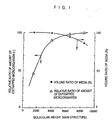
- FIG. 1 shows a relationship between a molecular weight of a main structure (-(EO)m(RO)n-) and a relative ratio of an amount of entrapped microorganisms in the case where nitrifying bacteria are inclusively entrapped; and a relationship between a molecular weight of a main structure (-(EO)m(RO)n-) and a volume ratio of a medium which represents decomposition of the medium with respect to the oligomer having the structural formula represented by (AA-O)k-B-O(EO)p(PO)q-UA-[O(EO)m(RO)n-UA]e-O(PO)q(EO)p-B-(O-AA)k in accordance with the present invention.
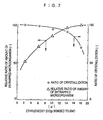
- FIG. 2 shows a relationship between the number of p in ethyleneoxy (EO)p and a relative ratio of an amount of entrapped microorganisms, and a relationship between the number of p and a ratio of crystallization, when a sub-structure is composed of urethane bonds and ethyleneoxy (EO)p.
- the ratio of crystallization represents a physical stability of the medium. When a ratio of crystallization is low, there is a problem in that a medium is easily abrasive or the like.
- a relative ratio of an amount of entrapped microorganisms [A], a volume ratio of a medium [B], and a ratio of crystallization [C] are represented as following equation. Criteria of denominators for the relative ratio of an amount of entrapped microorganisms are different from each other in FIG. 1 and FIG. 2.
- Criteria of denominators for the relative ratio of an amount of entrapped microorganisms are different from each other in FIG. 1 and FIG. 2.
- the number of microorganisms entrapped with the medium made of a material with a molecular weight of 8400 (the main structure) denoted in the transverse axis is defined to be 100, the number of microorganisms is relatively compared.
- the main structure the main structure
- FIG . 1 The number of microorganisms immobilized with the carrier made of a material with each molecular weight The number of microorganisms immobilized with the carrier made of a material with a molecular weight of 8400 ⁇ 100 A in FIG .
- a molecular weight of polyalkylene glycol which forms a main structure ranges preferably from 1500 to 7000.
- the number of p in the ethyleneoxy (-(EO)p-) ranges preferably from 2 to 15.
- sub-structures are composed of urethane bonds, ethyleneoxy, and propyleneoxy, that is, when an appropriate amount of propyleneoxy (-(PO)p-) is mixed with ethyleneoxy (-(EO)p-), the decrease in the ratio of crystallization is suppressed, so that the number of p can further increase. In this case, a compounding ratio of propyleneoxy needs to be smaller than that of ethyleneoxy.
- the medium in accordance with the present invention is utilized not only as a medium to inclusively entrap the microorganism but also as a medium to adhere microorganisms on the surface thereof.
- bisphenol A which was one of endocrine disrupter related substances was treated using media entrapping microorganisms in accordance with the present invention which inclusively entrapped decomposer of bisphenol A (Sphingomanas sp., 5 ⁇ 10 6 cells/mL).
- Example 1 The structure model and a method of producing the oligomers used in Example 1 will be described below.
- the structure model was represented as AA-O(EO)p-UA-O(EO)m(RO)n-UA-(EO)p-O-AA; in which p ⁇ 8, m ⁇ 54, n ⁇ 11, AA denoted metacryloyl, EO denoted ethyleneoxy, PO denoted propyleneoxy, and UA denoted -OCHN-I-NHCO- (in which -I-denoted isophorone diisocyanate except for isocyanate group).
- Polyetherpolyol composed of propyleneoxy and ethyleneoxy (trade name: Adekanol 25R-2, Asahi Denka Kogyo K.K.) at an amount of 3100 g (1 mol) and 444 g (2 mol) of isophorone diisocyanate were placed into a 5 L flask equipped with a stirrer, a thermometer, and an air cooling tube, and were stirred. Then, 1.3 g of di-n-butyltindilaurate was added. Although heat of reaction was generated, a reaction temperature was kept ranging from 80 to 90°C and the synthetic reaction continued for three hours.
- the reaction solution was cooled to 70°C with stirring, and 0.44 g (100 ppm) of hydroxynone monomethylether (MEHQ) was added with stirring. Then, polyalkylene glycol monomethacrylate (trade name: Blemmer-PE-350, NOF Corporation) at 868 g (2 mol) was stepwisely added for 30 minutes with stirring. Although heat of reaction was generated, a reaction temperature was kept ranging from 80 to 90°C and the reaction continued for four hours. Aliquot of the content in the reaction series was taken and subjected to an infrared analyzer (hereafter referred to as IR). Since wavelength corresponding to isocyanate group (2270 cm -1 ) was not detected, the reaction was considered to be completed. The synthesized substance was yellowish solution.
- IR infrared analyzer
- the decomposer of bisphenol A for inclusive entrapment was suspended in the above synthesized 10% oligomer aqueous solution.
- a polymerization accelerator, a polymerization initiator, a polymerization retarder, and the like were added into this solution for polymerization by a radical reaction, so that media entrapping microorganisms which inclusively entrapped the decomposer of bisphenol A were obtained.
- Comparative example 1 the conventional oligomer structure in Comparative example 1 was represented as AA-O(EO)m-AA, in which m denoted 16.
- a method of inclusive entrapment of the decomposer of bisphenol A was same as Example 1.
- Example 1 With respect to Example 1 and Comparative example 1, the number of microorganisms and compression strength (mechanical strength) after 1-month accumulation in the medium were shown in Table 1. [Table 1] The number of bacteria entrapped by media Compression strength Example 1 8 ⁇ 10 10 cells/mL 4.0 Comparative Example 1 4 ⁇ 10 9 cells/mL 3.2
- the media entrapping microorganisms in Example 1 in which the oligomers in accordance with the present invention were polymerized for inclusive entrapment of the decomposer of bisphenol A, entrapped more microorganisms and had greater compression strength compared with the media entrapping microorganisms in Comparative example 1, in which the conventional oligomers were polymerized for inclusive entrapment of the decomposer of bisphenol A.
- the media entrapping microorganisms in Comparative example 1 generated deformation thereof, hydrolysis, and the like due to extended utilization for eight months, so that the compression strength decreased.
- the media entrapping microorganisms in Example 1 did not generate deformation thereof and hydrolysis, so that the compression strength did not decrease.
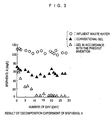
- FIG. 3 shows treatment results, in which waste water containing bisphenol A was treated with the media entrapping microorganisms in Example 1 and the media entrapping microorganisms in Comparative example 1.
- a packing ratio of the media entrapping microorganisms in a reaction vessel was set at 10%, and a residence time was set at 18 hours.
- a mark O represented changes over time of the concentrations of bisphenol A in influent waste water, the changes ranging from 100 to 110 mg/L.
- a mark ⁇ represented concentrations of bisphenol A in the treated water, when the media entrapping microorganisms in Example 1 were used.
- a mark ⁇ represented concentrations of bisphenol A in the treated water, when the media entrapping microorganisms in Comparative example 1 were used.
- the concentrations of bisphenol A in the treated water ranged from 50 to 70 mg/L in Comparative example 1.
- a remove ratio of bisphenol A was about 50%, which was unsatisfactory.
- dioxins were treated using media entrapping microorganisms in accordance with the present invention which inclusively entrapped decomposer of dioxins (Pseudomonas sp. 5 ⁇ 10 6 cells/mL).
- the decomposer of dioxins for inclusive entrapment was suspended in the above synthesized 10% oligomer aqueous solution.
- a polymerization accelerator, a polymerization initiator, a polymerization retarder, and the like were added into this solution for polymerization by a radical reaction, so that media entrapping microorganisms which inclusively entrapped the decomposer of dioxins were obtained.
- a method of producing the oligomers was basically same as that in Example 1.
- Comparative example 2 the conventional oligomer structure in Comparative example 2 was represented as AA-O(EO)m-AA, in which m denoted 16.
- a method of inclusive entrapment of the decomposer of dioxins was same as Example 2.
- Example 2 With respect to Example 2 and Comparative example 2, the number of microorganisms and compression strength after 1-month accumulation in the medium were shown in Table 2. [Table 2] The number of bacteria entrapped by media Compression strength Example 2 9 ⁇ 10 10 cells/mL 4.5 Comparative Example 2 2 ⁇ 10 8 cells/mL 3.5
- the media entrapping microorganisms in Example 2 in which the oligomers in accordance with the present invention were polymerized for inclusive entrapment of the decomposer of dioxins, entrapped more microorganisms and had greater compression strength compared with the media entrapping microorganisms in Comparative example 2, in which the conventional oligomers were polymerized for inclusive entrapment of the decomposer of dioxins.
- the media entrapping microorganisms in Comparative example 2 generated deformation thereof, hydrolysis, and the like due to extended utilization for eight months, so that the compression strength decreased.
- the media entrapping microorganisms in Example 2 did not generate deformation thereof and hydrolysis, so that the compression strength did not decrease.
- FIG. 4 shows treatment results, in which waste water containing dioxins was treated with the media entrapping microorganisms in Example 2 and the media entrapping microorganisms in Comparative example 2.
- a packing ratio of the media entrapping microorganisms in a reaction vessel was set at 10%, and a residence time was set at 24 hours.
- Ten kinds of dioxins shown in FIG. 4 were examined in this example.
- FIG. 4 shows dioxin concentrations in influent waste water, those in treated water using a medium entrapping microorganisms in Comparative example 2, and those in treated water using media entrapping microorganisms in Example 2, each group of bar charts representing the concentrations of the above three kinds of treatment.
- the concentrations of removed dioxins in the treated water ranged from 10 to 30% compared with those in the influent waste water in Comparative example 2.
- the remove performance of dioxins was unsatisfactory.
- Example 2 the concentrations of dioxins in the treated water in Example 2 were reduced to about 1-half of those in the influent waste water even in the case of dioxins which were hardly removed.
- waste water containing ammonia nitrogen was treated using media entrapping microorganisms in accordance with the present invention which inclusively entrapped activated sludge (MLSS: 20000 mg/L) collected from a sewage disposal plant.
- MMS media entrapping microorganisms in accordance with the present invention which inclusively entrapped activated sludge (MLSS: 20000 mg/L) collected from a sewage disposal plant.
- the activated sludge for inclusive entrapment was suspended in the above synthesized 10% oligomer aqueous solution.
- a polymerization accelerator and a polymerization initiator were added into this solution for polymerization by a radical reaction, so that media entrapping microorganisms which inclusively entrapped nitrifying bacteria were obtained.
- a method of producing the oligomers was basically same as those in Examples 1 and 2.
- Comparative example 3 the conventional oligomer structure in Comparative example 3 was represented as AA-O(EO)m-AA, in which m denoted 14.
- a method of inclusive entrapment of the activated sludge was same as Example 3.
- Example 3 With respect to Example 3 and Comparative example 3, the number of microorganisms and compression strength after 1-month accumulation in the medium were shown in Table 3. [Table 3] The number of bacteria entrapped by media Compression strength Example 3 3 ⁇ 10 10 cells/mL 5.0 Comparative Example 3 2 ⁇ 10 9 cells/mL 3.8
- the media inclusively entrapping microorganisms in Example 3 in which the oligomers in accordance with the present invention were polymerized for inclusive entrapment of the activated sludge, entrapped more microorganisms and had greater compression strength compared with the media entrapping microorganisms in Comparative example 3, in which the conventional oligomers were polymerized for inclusive entrapment of the activated sludge.
- the media entrapping microorganisms in Comparative example 3 generated deformation thereof, hydrolysis, and the like due to extended utilization for six months, so that the compression strength decreased.
- the media entrapping microorganisms in Example 3 did not generate deformation thereof and hydrolysis, so that the compression strength did not decrease.
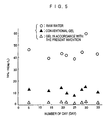
- FIG. 5 shows treatment results, in which waste water containing ammonia nitrogen was treated with the media entrapping microorganisms in Example 3 and the media entrapping microorganisms in Comparative example 3.
- a packing ratio of the media entrapping microorganisms in a reaction vessel was set at 10%, and a residence time was set at 1.2 hours.
- the temperature of the waste water ranged from 13 to 15°C.
- a mark ⁇ represented changes over time of the concentrations of ammonia nitrogen in influent waste water, the changes ranging from 38 to 60 mg/L.
- a mark ⁇ represented concentrations of ammonia nitrogen in the treated water, when the media entrapping microorganisms in Example 3 were used.
- a mark ⁇ represented concentrations of ammonia nitrogen in the treated water, when the media entrapping microorganisms in Comparative example 3 were used.
- the concentrations of ammonia nitrogen in the treated water were about 10 mg/L in Comparative example 3.
- the concentrations of ammonia nitrogen in the treated water ranged from 1 to 2 mg/L in Example 1, being low level. A stable nitrifying reaction could occur even in the waste water with low temperature.
- an oligomer for a medium to entrap a microorganism As described above, an oligomer for a medium to entrap a microorganism, an oligomer-polymerized hydrous gel, and oligomer-polymerized hydrous gel entrapping the microorganism in accordance with the present invention have a remarkably greater capacity to entrap a lot of microorganism, characteristics not to be degenerated or decomposed by the microorganisms, are mechanically strengthened, and are harmless to a natural environment.
- ammonia nitrogen but also organochlorine substances, endocrine disrupter related substances, dioxins, and the like can be biologically decomposed with high efficiency.
Landscapes
- Chemical & Material Sciences (AREA)
- Life Sciences & Earth Sciences (AREA)
- Organic Chemistry (AREA)
- Engineering & Computer Science (AREA)
- Health & Medical Sciences (AREA)
- Zoology (AREA)
- Bioinformatics & Cheminformatics (AREA)
- Genetics & Genomics (AREA)
- Wood Science & Technology (AREA)
- Microbiology (AREA)
- Biotechnology (AREA)
- Biochemistry (AREA)
- General Engineering & Computer Science (AREA)
- General Health & Medical Sciences (AREA)
- Biomedical Technology (AREA)
- Chemical Kinetics & Catalysis (AREA)
- General Chemical & Material Sciences (AREA)
- Polymers & Plastics (AREA)
- Medicinal Chemistry (AREA)
- Biodiversity & Conservation Biology (AREA)
- Hydrology & Water Resources (AREA)
- Environmental & Geological Engineering (AREA)
- Water Supply & Treatment (AREA)
- Polyurethanes Or Polyureas (AREA)
- Biological Treatment Of Waste Water (AREA)
- Macromonomer-Based Addition Polymer (AREA)
- Immobilizing And Processing Of Enzymes And Microorganisms (AREA)
- Micro-Organisms Or Cultivation Processes Thereof (AREA)
- Polyethers (AREA)
Priority Applications (6)
| Application Number | Priority Date | Filing Date | Title |
|---|---|---|---|
| JP2000172171A JP3775174B2 (ja) | 2000-06-08 | 2000-06-08 | 微生物が包括固定化された微生物固定化担体 |
| US09/645,358 US6576451B1 (en) | 2000-06-08 | 2000-08-25 | Oligomers for polymerizing to produce hydrous gels entrapping microorganisms |
| CA 2316750 CA2316750C (en) | 2000-06-08 | 2000-08-28 | Oligomer for media to entrap microorganism, oligomer-polymerized hydrous gel, and oligomer-polymerized hydrous gel entrapping microorganism |
| EP20000118897 EP1184398B1 (en) | 2000-06-08 | 2000-08-31 | Oligomer for media to entrap microorganism, oligomer-polymerized hydrous gel, and oligomer-polymerized hydrous gel entrapping microrganism |
| DE2000631668 DE60031668T2 (de) | 2000-06-08 | 2000-08-31 | Oligomer für Gegenstände zum Abfangen von Mikroorganismen, oligomerpolymerisiertes Hydrogel und oligomerpolymerisiertes Mikroorganismus abfangendes Hydrogel |
| DK00118897T DK1184398T3 (da) | 2000-06-08 | 2000-08-31 | Oligomer til medier til indfangning af mikroorganismer, oligomerpolymeriseret vandholdig gel og oligomerpolymeriseret mikroorganismeindfangende gel |
Applications Claiming Priority (4)
| Application Number | Priority Date | Filing Date | Title |
|---|---|---|---|
| JP2000172171A JP3775174B2 (ja) | 2000-06-08 | 2000-06-08 | 微生物が包括固定化された微生物固定化担体 |
| US09/645,358 US6576451B1 (en) | 2000-06-08 | 2000-08-25 | Oligomers for polymerizing to produce hydrous gels entrapping microorganisms |
| CA 2316750 CA2316750C (en) | 2000-06-08 | 2000-08-28 | Oligomer for media to entrap microorganism, oligomer-polymerized hydrous gel, and oligomer-polymerized hydrous gel entrapping microorganism |
| EP20000118897 EP1184398B1 (en) | 2000-06-08 | 2000-08-31 | Oligomer for media to entrap microorganism, oligomer-polymerized hydrous gel, and oligomer-polymerized hydrous gel entrapping microrganism |
Publications (2)
| Publication Number | Publication Date |
|---|---|
| EP1184398A1 EP1184398A1 (en) | 2002-03-06 |
| EP1184398B1 true EP1184398B1 (en) | 2006-11-02 |
Family
ID=49033702
Family Applications (1)
| Application Number | Title | Priority Date | Filing Date |
|---|---|---|---|
| EP20000118897 Expired - Lifetime EP1184398B1 (en) | 2000-06-08 | 2000-08-31 | Oligomer for media to entrap microorganism, oligomer-polymerized hydrous gel, and oligomer-polymerized hydrous gel entrapping microrganism |
Country Status (6)
| Country | Link |
|---|---|
| US (1) | US6576451B1 (enExample) |
| EP (1) | EP1184398B1 (enExample) |
| JP (1) | JP3775174B2 (enExample) |
| CA (1) | CA2316750C (enExample) |
| DE (1) | DE60031668T2 (enExample) |
| DK (1) | DK1184398T3 (enExample) |
Families Citing this family (7)
| Publication number | Priority date | Publication date | Assignee | Title |
|---|---|---|---|---|
| KR20020063098A (ko) | 2001-01-26 | 2002-08-01 | 히다찌 플랜트 겐세쓰 가부시키가이샤 | 수중의 외인성 내분비교란화학물질의 제거방법 |
| JP3969031B2 (ja) * | 2001-01-26 | 2007-08-29 | 株式会社日立プラントテクノロジー | 水中の外因性内分泌攪乱化学物質の除去方法 |
| KR101299485B1 (ko) * | 2006-07-06 | 2013-08-29 | 가부시키가이샤 히다찌 플랜트 테크놀로지 | 포괄 고정화 담체, 포괄 고정화 담체를 이용한 폐수처리 장치 및 폐수처리 방법 |
| JP6584105B2 (ja) * | 2015-03-19 | 2019-10-02 | 株式会社日立製作所 | 微生物固定化担体及び微生物固定化担体の製造方法 |
| JP6512532B2 (ja) * | 2015-06-05 | 2019-05-15 | 日油株式会社 | ウレタン(メタ)アクリレートおよびドライフィルムレジスト用感光性樹脂組成物 |
| CN108699330B (zh) * | 2016-03-31 | 2021-01-15 | 株式会社Lg化学 | 化合物 |
| CN108017143A (zh) * | 2017-12-29 | 2018-05-11 | 南京师范大学 | 一种利用聚氨酯海绵辅助苯酚降解菌对高浓度苯酚进行增效生物降解的应用 |
Family Cites Families (4)
| Publication number | Priority date | Publication date | Assignee | Title |
|---|---|---|---|---|
| US5268397A (en) | 1982-03-01 | 1993-12-07 | Rohm And Haas Company | Crosslinkable associative polymers prepared from polyisocyanates and hydroxyl-functional compounds |
| IE54942B1 (en) | 1982-05-06 | 1990-03-28 | Smith & Nephew Ass | Bandages, components thereof and use |
| DE69227909T2 (de) | 1991-08-07 | 1999-07-01 | Alliedsignal Inc., Morristown, N.J. | Verfarhen zur beseitigung organischer schadstoffe aus abwasser |
| US5354835A (en) | 1993-07-23 | 1994-10-11 | Saudi Basic Industries Corporation | Desalination process |
-
2000
- 2000-06-08 JP JP2000172171A patent/JP3775174B2/ja not_active Expired - Lifetime
- 2000-08-25 US US09/645,358 patent/US6576451B1/en not_active Expired - Lifetime
- 2000-08-28 CA CA 2316750 patent/CA2316750C/en not_active Expired - Lifetime
- 2000-08-31 DE DE2000631668 patent/DE60031668T2/de not_active Expired - Lifetime
- 2000-08-31 EP EP20000118897 patent/EP1184398B1/en not_active Expired - Lifetime
- 2000-08-31 DK DK00118897T patent/DK1184398T3/da active
Also Published As
| Publication number | Publication date |
|---|---|
| CA2316750A1 (en) | 2002-02-28 |
| EP1184398A1 (en) | 2002-03-06 |
| DE60031668D1 (de) | 2006-12-14 |
| DK1184398T3 (da) | 2007-02-26 |
| US6576451B1 (en) | 2003-06-10 |
| DE60031668T2 (de) | 2007-02-08 |
| CA2316750C (en) | 2009-12-29 |
| JP3775174B2 (ja) | 2006-05-17 |
| JP2001346575A (ja) | 2001-12-18 |
Similar Documents
| Publication | Publication Date | Title |
|---|---|---|
| CN1102603C (zh) | 聚氨酯泡沫体的制备方法 | |
| US4791061A (en) | Immobilization of microorganisms by entrapment | |
| CN1111555C (zh) | 微孔弹性聚氨基甲酸酯泡沫体 | |
| US3905923A (en) | Poly (urea-urethane) foams containing immobilized active enzymes | |
| US6576451B1 (en) | Oligomers for polymerizing to produce hydrous gels entrapping microorganisms | |
| Yang et al. | Immobilized mixed microbial cells for wastewater treatment | |
| RU2005105698A (ru) | Форполимер, полиольная композиция и способ получения эластичного пеноматериала | |
| Sevillano et al. | Feasibility study of degradation of phenol in a fluidized bed bioreactor with a cyclodextrin polymer as biofilm carrier | |
| KR20030040154A (ko) | 효소 또는 미생물 균체 고정화용 입상 성형물의 제조 방법 | |
| US6569337B2 (en) | Bioreactor carrier, process for producing the carrier and method for using the same | |
| US8030041B2 (en) | Process for producing pellets entrapping and immobilizing microorganisms | |
| EP1160317A1 (en) | Bioreactor carrier, process for producing the carrier and method for using the same | |
| GB1584321A (en) | Polyol/polymer grafts and polyurethanes prepared therefrom | |
| JP5493123B2 (ja) | 微生物固定化用担体 | |
| KR100451105B1 (ko) | 미생물 고정화 담체용 올리고머 및 그 올리고머 중합 함수겔 및 미생물이 고정화된 올리고머 중합 함수겔 | |
| US5543052A (en) | Process for removal of organic pollutants from waste water | |
| US4910256A (en) | Mixtures of poly(alkylene carbonate) polyols and polymers of ethylenically unsaturated esters | |
| US10633475B2 (en) | Immobilizing carrier, polyether compound used for producing same and method for producing immobilization carrier | |
| EP0600989B1 (en) | Process for removal of organic pollutants from wastewater | |
| KR100494566B1 (ko) | 미생물 고정화용 에스테르계 광경화성 프리폴리머 및 이의 제조방법 및 이를 이용한 미생물 고정화 방법 | |
| KR100523235B1 (ko) | 미생물 고정화용 에스테르계 광경화성 프리폴리머 및 이의제조방법 | |
| KR100523236B1 (ko) | 미생물 고정화용 에스테르계 광경화성 프리폴리머 및 이의제조방법 | |
| JP4430254B2 (ja) | 微生物菌体固定化用粒状成形物の製造方法 | |
| JPH0832328B2 (ja) | 廃水処理方法 | |
| KR20000031644A (ko) | 미생물 고정화용 폴리아미드계 광경화성 프리폴리머 및 이의 제조 방법 |
Legal Events
| Date | Code | Title | Description |
|---|---|---|---|
| PUAI | Public reference made under article 153(3) epc to a published international application that has entered the european phase |
Free format text: ORIGINAL CODE: 0009012 |
|
| AK | Designated contracting states |
Kind code of ref document: A1 Designated state(s): DE DK FR GB NL Kind code of ref document: A1 Designated state(s): AT BE CH CY DE DK ES FI FR GB GR IE IT LI LU MC NL PT SE |
|
| AX | Request for extension of the european patent |
Free format text: AL;LT;LV;MK;RO;SI |
|
| 17P | Request for examination filed |
Effective date: 20020531 |
|
| AKX | Designation fees paid |
Free format text: DE DK FR GB NL |
|
| 17Q | First examination report despatched |
Effective date: 20040521 |
|
| GRAP | Despatch of communication of intention to grant a patent |
Free format text: ORIGINAL CODE: EPIDOSNIGR1 |
|
| GRAC | Information related to communication of intention to grant a patent modified |
Free format text: ORIGINAL CODE: EPIDOSCIGR1 |
|
| GRAS | Grant fee paid |
Free format text: ORIGINAL CODE: EPIDOSNIGR3 |
|
| GRAA | (expected) grant |
Free format text: ORIGINAL CODE: 0009210 |
|
| AK | Designated contracting states |
Kind code of ref document: B1 Designated state(s): DE DK FR GB NL |
|
| REG | Reference to a national code |
Ref country code: GB Ref legal event code: FG4D |
|
| REF | Corresponds to: |
Ref document number: 60031668 Country of ref document: DE Date of ref document: 20061214 Kind code of ref document: P |
|
| REG | Reference to a national code |
Ref country code: DK Ref legal event code: T3 |
|
| ET | Fr: translation filed | ||
| PLBE | No opposition filed within time limit |
Free format text: ORIGINAL CODE: 0009261 |
|
| STAA | Information on the status of an ep patent application or granted ep patent |
Free format text: STATUS: NO OPPOSITION FILED WITHIN TIME LIMIT |
|
| NLT1 | Nl: modifications of names registered in virtue of documents presented to the patent office pursuant to art. 16 a, paragraph 1 |
Owner name: HITACHI PLANT TECHNOLOGIES, LTD. |
|
| 26N | No opposition filed |
Effective date: 20070803 |
|
| REG | Reference to a national code |
Ref country code: FR Ref legal event code: CA Ref country code: FR Ref legal event code: CD |
|
| REG | Reference to a national code |
Ref country code: DE Ref legal event code: R082 Ref document number: 60031668 Country of ref document: DE Representative=s name: GRUENECKER, KINKELDEY, STOCKMAIR & SCHWANHAEUS, DE |
|
| REG | Reference to a national code |
Ref country code: NL Ref legal event code: SD Effective date: 20140226 |
|
| REG | Reference to a national code |
Ref country code: GB Ref legal event code: 732E Free format text: REGISTERED BETWEEN 20140220 AND 20140226 |
|
| REG | Reference to a national code |
Ref country code: DE Ref legal event code: R081 Ref document number: 60031668 Country of ref document: DE Owner name: HITACHI, LTD., JP Free format text: FORMER OWNER: HITACHI PLANT TECHNOLOGIES, LTD, SHIN-NAKAMURA CHEMICAL CO., LTD, , JP Effective date: 20140218 Ref country code: DE Ref legal event code: R082 Ref document number: 60031668 Country of ref document: DE Representative=s name: GRUENECKER, KINKELDEY, STOCKMAIR & SCHWANHAEUS, DE Effective date: 20140218 Ref country code: DE Ref legal event code: R081 Ref document number: 60031668 Country of ref document: DE Owner name: SHIN-NAKAMURA CHEMICAL CO., LTD., JP Free format text: FORMER OWNER: HITACHI PLANT TECHNOLOGIES, LTD, SHIN-NAKAMURA CHEMICAL CO., LTD, , JP Effective date: 20140218 Ref country code: DE Ref legal event code: R081 Ref document number: 60031668 Country of ref document: DE Owner name: HITACHI, LTD., JP Free format text: FORMER OWNERS: HITACHI PLANT TECHNOLOGIES, LTD., TOKYO, JP; SHIN-NAKAMURA CHEMICAL CO., LTD., WAKAYAMA, JP Effective date: 20140218 Ref country code: DE Ref legal event code: R082 Ref document number: 60031668 Country of ref document: DE Representative=s name: GRUENECKER PATENT- UND RECHTSANWAELTE PARTG MB, DE Effective date: 20140218 Ref country code: DE Ref legal event code: R081 Ref document number: 60031668 Country of ref document: DE Owner name: SHIN-NAKAMURA CHEMICAL CO., LTD., JP Free format text: FORMER OWNERS: HITACHI PLANT TECHNOLOGIES, LTD., TOKYO, JP; SHIN-NAKAMURA CHEMICAL CO., LTD., WAKAYAMA, JP Effective date: 20140218 |
|
| REG | Reference to a national code |
Ref country code: GB Ref legal event code: 732E Free format text: REGISTERED BETWEEN 20140313 AND 20140319 |
|
| REG | Reference to a national code |
Ref country code: FR Ref legal event code: TQ Owner name: HITACHI, LTD., JP Effective date: 20140612 Ref country code: FR Ref legal event code: TQ Owner name: SHIN-NAKAMURA CHEMICAL CO., LTD., JP Effective date: 20140612 |
|
| REG | Reference to a national code |
Ref country code: FR Ref legal event code: PLFP Year of fee payment: 17 |
|
| REG | Reference to a national code |
Ref country code: FR Ref legal event code: PLFP Year of fee payment: 18 |
|
| REG | Reference to a national code |
Ref country code: FR Ref legal event code: PLFP Year of fee payment: 19 |
|
| PGFP | Annual fee paid to national office [announced via postgrant information from national office to epo] |
Ref country code: NL Payment date: 20190712 Year of fee payment: 20 |
|
| PGFP | Annual fee paid to national office [announced via postgrant information from national office to epo] |
Ref country code: DE Payment date: 20190820 Year of fee payment: 20 Ref country code: DK Payment date: 20190813 Year of fee payment: 20 Ref country code: FR Payment date: 20190711 Year of fee payment: 20 |
|
| PGFP | Annual fee paid to national office [announced via postgrant information from national office to epo] |
Ref country code: GB Payment date: 20190830 Year of fee payment: 20 |
|
| REG | Reference to a national code |
Ref country code: DE Ref legal event code: R071 Ref document number: 60031668 Country of ref document: DE |
|
| REG | Reference to a national code |
Ref country code: NL Ref legal event code: MK Effective date: 20200830 |
|
| REG | Reference to a national code |
Ref country code: DK Ref legal event code: EUP Expiry date: 20200831 |
|
| REG | Reference to a national code |
Ref country code: GB Ref legal event code: PE20 Expiry date: 20200830 |
|
| PG25 | Lapsed in a contracting state [announced via postgrant information from national office to epo] |
Ref country code: GB Free format text: LAPSE BECAUSE OF EXPIRATION OF PROTECTION Effective date: 20200830 |