EP1182456A2 - Biosensors with porous chromatographic membranes - Google Patents
Biosensors with porous chromatographic membranes Download PDFInfo
- Publication number
- EP1182456A2 EP1182456A2 EP01306225A EP01306225A EP1182456A2 EP 1182456 A2 EP1182456 A2 EP 1182456A2 EP 01306225 A EP01306225 A EP 01306225A EP 01306225 A EP01306225 A EP 01306225A EP 1182456 A2 EP1182456 A2 EP 1182456A2
- Authority
- EP
- European Patent Office
- Prior art keywords
- electrode
- biosensor
- porous membrane
- upper substrate
- lower substrate
- Prior art date
- Legal status (The legal status is an assumption and is not a legal conclusion. Google has not performed a legal analysis and makes no representation as to the accuracy of the status listed.)
- Granted
Links
- 239000012528 membrane Substances 0.000 title claims abstract description 219
- 239000000758 substrate Substances 0.000 claims abstract description 282
- 239000012212 insulator Substances 0.000 claims abstract description 46
- 210000004369 blood Anatomy 0.000 claims abstract description 34
- 239000008280 blood Substances 0.000 claims abstract description 34
- 210000002381 plasma Anatomy 0.000 claims abstract description 11
- 239000000853 adhesive Substances 0.000 claims description 95
- 230000001070 adhesive effect Effects 0.000 claims description 95
- 230000027756 respiratory electron transport chain Effects 0.000 claims description 49
- 108090000854 Oxidoreductases Proteins 0.000 claims description 29
- 102000004316 Oxidoreductases Human genes 0.000 claims description 29
- OKTJSMMVPCPJKN-UHFFFAOYSA-N Carbon Chemical compound [C] OKTJSMMVPCPJKN-UHFFFAOYSA-N 0.000 claims description 27
- 229910052799 carbon Inorganic materials 0.000 claims description 26
- 239000000463 material Substances 0.000 claims description 25
- 230000002452 interceptive effect Effects 0.000 claims description 18
- 229920000728 polyester Polymers 0.000 claims description 16
- 230000001681 protective effect Effects 0.000 claims description 16
- 108010015776 Glucose oxidase Proteins 0.000 claims description 15
- 239000004366 Glucose oxidase Substances 0.000 claims description 15
- 229940116332 glucose oxidase Drugs 0.000 claims description 15
- 235000019420 glucose oxidase Nutrition 0.000 claims description 15
- RLFWWDJHLFCNIJ-UHFFFAOYSA-N 4-aminoantipyrine Chemical compound CN1C(C)=C(N)C(=O)N1C1=CC=CC=C1 RLFWWDJHLFCNIJ-UHFFFAOYSA-N 0.000 claims description 14
- 238000000034 method Methods 0.000 claims description 12
- 239000000835 fiber Substances 0.000 claims description 10
- -1 polytetrafluoroethylene Polymers 0.000 claims description 9
- VEXZGXHMUGYJMC-UHFFFAOYSA-M Chloride anion Chemical compound [Cl-] VEXZGXHMUGYJMC-UHFFFAOYSA-M 0.000 claims description 6
- 229920000620 organic polymer Polymers 0.000 claims description 6
- 239000000919 ceramic Substances 0.000 claims description 5
- QIGBRXMKCJKVMJ-UHFFFAOYSA-N Hydroquinone Chemical compound OC1=CC=C(O)C=C1 QIGBRXMKCJKVMJ-UHFFFAOYSA-N 0.000 claims description 4
- 239000000020 Nitrocellulose Substances 0.000 claims description 4
- 239000011248 coating agent Substances 0.000 claims description 4
- 238000000576 coating method Methods 0.000 claims description 4
- 150000001875 compounds Chemical class 0.000 claims description 4
- RRAFCDWBNXTKKO-UHFFFAOYSA-N eugenol Chemical compound COC1=CC(CC=C)=CC=C1O RRAFCDWBNXTKKO-UHFFFAOYSA-N 0.000 claims description 4
- KYMNSBSWJPFUJH-UHFFFAOYSA-N iron;5-methylcyclopenta-1,3-diene;methylcyclopentane Chemical compound [Fe].C[C-]1C=CC=C1.C[C-]1[CH-][CH-][CH-][CH-]1 KYMNSBSWJPFUJH-UHFFFAOYSA-N 0.000 claims description 4
- 229920001220 nitrocellulos Polymers 0.000 claims description 4
- RNVCVTLRINQCPJ-UHFFFAOYSA-N o-toluidine Chemical compound CC1=CC=CC=C1N RNVCVTLRINQCPJ-UHFFFAOYSA-N 0.000 claims description 4
- 229920003023 plastic Polymers 0.000 claims description 4
- 239000004033 plastic Substances 0.000 claims description 4
- 229920000642 polymer Polymers 0.000 claims description 4
- 229920000915 polyvinyl chloride Polymers 0.000 claims description 4
- 239000004800 polyvinyl chloride Substances 0.000 claims description 4
- 239000011148 porous material Substances 0.000 claims description 4
- FHCPAXDKURNIOZ-UHFFFAOYSA-N tetrathiafulvalene Chemical compound S1C=CSC1=C1SC=CS1 FHCPAXDKURNIOZ-UHFFFAOYSA-N 0.000 claims description 4
- 239000004417 polycarbonate Substances 0.000 claims description 3
- 229920000515 polycarbonate Polymers 0.000 claims description 3
- 230000008569 process Effects 0.000 claims description 3
- 238000011002 quantification Methods 0.000 claims description 3
- 239000004094 surface-active agent Substances 0.000 claims description 3
- HFZWRUODUSTPEG-UHFFFAOYSA-N 2,4-dichlorophenol Chemical compound OC1=CC=C(Cl)C=C1Cl HFZWRUODUSTPEG-UHFFFAOYSA-N 0.000 claims description 2
- UAIUNKRWKOVEES-UHFFFAOYSA-N 3,3',5,5'-tetramethylbenzidine Chemical compound CC1=C(N)C(C)=CC(C=2C=C(C)C(N)=C(C)C=2)=C1 UAIUNKRWKOVEES-UHFFFAOYSA-N 0.000 claims description 2
- JRBJSXQPQWSCCF-UHFFFAOYSA-N 3,3'-Dimethoxybenzidine Chemical compound C1=C(N)C(OC)=CC(C=2C=C(OC)C(N)=CC=2)=C1 JRBJSXQPQWSCCF-UHFFFAOYSA-N 0.000 claims description 2
- NEGFNJRAUMCZMY-UHFFFAOYSA-N 3-(dimethylamino)benzoic acid Chemical compound CN(C)C1=CC=CC(C(O)=O)=C1 NEGFNJRAUMCZMY-UHFFFAOYSA-N 0.000 claims description 2
- BOTGCZBEERTTDQ-UHFFFAOYSA-N 4-Methoxy-1-naphthol Chemical compound C1=CC=C2C(OC)=CC=C(O)C2=C1 BOTGCZBEERTTDQ-UHFFFAOYSA-N 0.000 claims description 2
- KBZALDXXIMXRBJ-UHFFFAOYSA-N 5-methylphenazin-5-ium Chemical compound C1=CC=C2[N+](C)=C(C=CC=C3)C3=NC2=C1 KBZALDXXIMXRBJ-UHFFFAOYSA-N 0.000 claims description 2
- NLZUEZXRPGMBCV-UHFFFAOYSA-N Butylhydroxytoluene Chemical compound CC1=CC(C(C)(C)C)=C(O)C(C(C)(C)C)=C1 NLZUEZXRPGMBCV-UHFFFAOYSA-N 0.000 claims description 2
- KRHYYFGTRYWZRS-UHFFFAOYSA-M Fluoride anion Chemical compound [F-] KRHYYFGTRYWZRS-UHFFFAOYSA-M 0.000 claims description 2
- JLTDJTHDQAWBAV-UHFFFAOYSA-N N,N-dimethylaniline Chemical compound CN(C)C1=CC=CC=C1 JLTDJTHDQAWBAV-UHFFFAOYSA-N 0.000 claims description 2
- 239000004677 Nylon Substances 0.000 claims description 2
- PNEYBMLMFCGWSK-UHFFFAOYSA-N aluminium oxide Inorganic materials [O-2].[O-2].[O-2].[Al+3].[Al+3] PNEYBMLMFCGWSK-UHFFFAOYSA-N 0.000 claims description 2
- HFACYLZERDEVSX-UHFFFAOYSA-N benzidine Chemical compound C1=CC(N)=CC=C1C1=CC=C(N)C=C1 HFACYLZERDEVSX-UHFFFAOYSA-N 0.000 claims description 2
- 229920002678 cellulose Polymers 0.000 claims description 2
- KZPXREABEBSAQM-UHFFFAOYSA-N cyclopenta-1,3-diene;nickel(2+) Chemical compound [Ni+2].C=1C=C[CH-]C=1.C=1C=C[CH-]C=1 KZPXREABEBSAQM-UHFFFAOYSA-N 0.000 claims description 2
- 239000011521 glass Substances 0.000 claims description 2
- 239000003365 glass fiber Substances 0.000 claims description 2
- 229930195712 glutamate Natural products 0.000 claims description 2
- 150000007857 hydrazones Chemical class 0.000 claims description 2
- 150000002500 ions Chemical class 0.000 claims description 2
- DCYOBGZUOMKFPA-UHFFFAOYSA-N iron(2+);iron(3+);octadecacyanide Chemical compound [Fe+2].[Fe+2].[Fe+2].[Fe+3].[Fe+3].[Fe+3].[Fe+3].N#[C-].N#[C-].N#[C-].N#[C-].N#[C-].N#[C-].N#[C-].N#[C-].N#[C-].N#[C-].N#[C-].N#[C-].N#[C-].N#[C-].N#[C-].N#[C-].N#[C-].N#[C-] DCYOBGZUOMKFPA-UHFFFAOYSA-N 0.000 claims description 2
- 238000005259 measurement Methods 0.000 claims description 2
- 229920001778 nylon Polymers 0.000 claims description 2
- 229920001343 polytetrafluoroethylene Polymers 0.000 claims description 2
- 239000004810 polytetrafluoroethylene Substances 0.000 claims description 2
- 239000000276 potassium ferrocyanide Substances 0.000 claims description 2
- 229960003351 prussian blue Drugs 0.000 claims description 2
- 239000013225 prussian blue Substances 0.000 claims description 2
- 239000010703 silicon Substances 0.000 claims description 2
- 229910052710 silicon Inorganic materials 0.000 claims description 2
- BDHFUVZGWQCTTF-UHFFFAOYSA-M sulfonate Chemical compound [O-]S(=O)=O BDHFUVZGWQCTTF-UHFFFAOYSA-M 0.000 claims description 2
- 150000003457 sulfones Chemical class 0.000 claims description 2
- PCCVSPMFGIFTHU-UHFFFAOYSA-N tetracyanoquinodimethane Chemical compound N#CC(C#N)=C1C=CC(=C(C#N)C#N)C=C1 PCCVSPMFGIFTHU-UHFFFAOYSA-N 0.000 claims description 2
- XOGGUFAVLNCTRS-UHFFFAOYSA-N tetrapotassium;iron(2+);hexacyanide Chemical compound [K+].[K+].[K+].[K+].[Fe+2].N#[C-].N#[C-].N#[C-].N#[C-].N#[C-].N#[C-] XOGGUFAVLNCTRS-UHFFFAOYSA-N 0.000 claims description 2
- 108010025188 Alcohol oxidase Proteins 0.000 claims 1
- 108010089254 Cholesterol oxidase Proteins 0.000 claims 1
- 108010001336 Horseradish Peroxidase Proteins 0.000 claims 1
- 108010073450 Lactate 2-monooxygenase Proteins 0.000 claims 1
- 239000000654 additive Substances 0.000 claims 1
- 238000005137 deposition process Methods 0.000 claims 1
- 239000000126 substance Substances 0.000 claims 1
- 238000001771 vacuum deposition Methods 0.000 claims 1
- WQZGKKKJIJFFOK-GASJEMHNSA-N Glucose Natural products OC[C@H]1OC(O)[C@H](O)[C@@H](O)[C@@H]1O WQZGKKKJIJFFOK-GASJEMHNSA-N 0.000 description 69
- 239000008103 glucose Substances 0.000 description 69
- BQCADISMDOOEFD-UHFFFAOYSA-N Silver Chemical compound [Ag] BQCADISMDOOEFD-UHFFFAOYSA-N 0.000 description 23
- 239000004332 silver Substances 0.000 description 23
- 229910052709 silver Inorganic materials 0.000 description 22
- 238000004519 manufacturing process Methods 0.000 description 17
- CIWBSHSKHKDKBQ-JLAZNSOCSA-N Ascorbic acid Chemical compound OC[C@H](O)[C@H]1OC(=O)C(O)=C1O CIWBSHSKHKDKBQ-JLAZNSOCSA-N 0.000 description 14
- 239000006072 paste Substances 0.000 description 13
- 210000002966 serum Anatomy 0.000 description 12
- 229910021607 Silver chloride Inorganic materials 0.000 description 11
- 230000035945 sensitivity Effects 0.000 description 10
- HKZLPVFGJNLROG-UHFFFAOYSA-M silver monochloride Chemical compound [Cl-].[Ag+] HKZLPVFGJNLROG-UHFFFAOYSA-M 0.000 description 10
- 238000011088 calibration curve Methods 0.000 description 9
- 238000007639 printing Methods 0.000 description 9
- 239000012086 standard solution Substances 0.000 description 9
- RGHNJXZEOKUKBD-SQOUGZDYSA-N D-gluconic acid Chemical compound OC[C@@H](O)[C@@H](O)[C@H](O)[C@@H](O)C(O)=O RGHNJXZEOKUKBD-SQOUGZDYSA-N 0.000 description 8
- MHAJPDPJQMAIIY-UHFFFAOYSA-N Hydrogen peroxide Chemical compound OO MHAJPDPJQMAIIY-UHFFFAOYSA-N 0.000 description 8
- LEHOTFFKMJEONL-UHFFFAOYSA-N Uric Acid Chemical compound N1C(=O)NC(=O)C2=C1NC(=O)N2 LEHOTFFKMJEONL-UHFFFAOYSA-N 0.000 description 8
- 229910052760 oxygen Inorganic materials 0.000 description 8
- 239000001301 oxygen Substances 0.000 description 8
- TVWHNULVHGKJHS-UHFFFAOYSA-N Uric acid Natural products N1C(=O)NC(=O)C2NC(=O)NC21 TVWHNULVHGKJHS-UHFFFAOYSA-N 0.000 description 7
- 229960005070 ascorbic acid Drugs 0.000 description 7
- 235000010323 ascorbic acid Nutrition 0.000 description 7
- 239000011668 ascorbic acid Substances 0.000 description 7
- QVGXLLKOCUKJST-UHFFFAOYSA-N atomic oxygen Chemical compound [O] QVGXLLKOCUKJST-UHFFFAOYSA-N 0.000 description 7
- 230000008901 benefit Effects 0.000 description 7
- 239000011714 flavin adenine dinucleotide Substances 0.000 description 7
- 238000007650 screen-printing Methods 0.000 description 7
- 229940116269 uric acid Drugs 0.000 description 7
- 230000002159 abnormal effect Effects 0.000 description 6
- 238000006243 chemical reaction Methods 0.000 description 6
- 238000005534 hematocrit Methods 0.000 description 6
- 230000003647 oxidation Effects 0.000 description 6
- 238000007254 oxidation reaction Methods 0.000 description 6
- BASFCYQUMIYNBI-UHFFFAOYSA-N platinum Chemical compound [Pt] BASFCYQUMIYNBI-UHFFFAOYSA-N 0.000 description 6
- RZVAJINKPMORJF-UHFFFAOYSA-N Acetaminophen Chemical compound CC(=O)NC1=CC=C(O)C=C1 RZVAJINKPMORJF-UHFFFAOYSA-N 0.000 description 5
- 108091003079 Bovine Serum Albumin Proteins 0.000 description 5
- 239000002390 adhesive tape Substances 0.000 description 5
- 229940098773 bovine serum albumin Drugs 0.000 description 5
- 239000007772 electrode material Substances 0.000 description 5
- RGHNJXZEOKUKBD-UHFFFAOYSA-N D-gluconic acid Natural products OCC(O)C(O)C(O)C(O)C(O)=O RGHNJXZEOKUKBD-UHFFFAOYSA-N 0.000 description 4
- KDLHZDBZIXYQEI-UHFFFAOYSA-N Palladium Chemical compound [Pd] KDLHZDBZIXYQEI-UHFFFAOYSA-N 0.000 description 4
- FAPWRFPIFSIZLT-UHFFFAOYSA-M Sodium chloride Chemical compound [Na+].[Cl-] FAPWRFPIFSIZLT-UHFFFAOYSA-M 0.000 description 4
- 238000006555 catalytic reaction Methods 0.000 description 4
- 230000008859 change Effects 0.000 description 4
- 238000004737 colorimetric analysis Methods 0.000 description 4
- VWWQXMAJTJZDQX-UYBVJOGSSA-N flavin adenine dinucleotide Chemical compound C1=NC2=C(N)N=CN=C2N1[C@@H]([C@H](O)[C@@H]1O)O[C@@H]1CO[P@](O)(=O)O[P@@](O)(=O)OC[C@@H](O)[C@@H](O)[C@@H](O)CN1C2=NC(=O)NC(=O)C2=NC2=C1C=C(C)C(C)=C2 VWWQXMAJTJZDQX-UYBVJOGSSA-N 0.000 description 4
- 235000019162 flavin adenine dinucleotide Nutrition 0.000 description 4
- 229940093632 flavin-adenine dinucleotide Drugs 0.000 description 4
- 239000000174 gluconic acid Substances 0.000 description 4
- 235000012208 gluconic acid Nutrition 0.000 description 4
- 229920002134 Carboxymethyl cellulose Polymers 0.000 description 3
- 102000004190 Enzymes Human genes 0.000 description 3
- 108090000790 Enzymes Proteins 0.000 description 3
- OKKJLVBELUTLKV-UHFFFAOYSA-N Methanol Chemical compound OC OKKJLVBELUTLKV-UHFFFAOYSA-N 0.000 description 3
- KJTLSVCANCCWHF-UHFFFAOYSA-N Ruthenium Chemical compound [Ru] KJTLSVCANCCWHF-UHFFFAOYSA-N 0.000 description 3
- 239000013504 Triton X-100 Substances 0.000 description 3
- 229920004890 Triton X-100 Polymers 0.000 description 3
- 238000004458 analytical method Methods 0.000 description 3
- 210000000601 blood cell Anatomy 0.000 description 3
- 239000007853 buffer solution Substances 0.000 description 3
- 239000001768 carboxy methyl cellulose Substances 0.000 description 3
- 235000010948 carboxy methyl cellulose Nutrition 0.000 description 3
- 239000008112 carboxymethyl-cellulose Substances 0.000 description 3
- 230000005684 electric field Effects 0.000 description 3
- 229940088598 enzyme Drugs 0.000 description 3
- PCHJSUWPFVWCPO-UHFFFAOYSA-N gold Chemical compound [Au] PCHJSUWPFVWCPO-UHFFFAOYSA-N 0.000 description 3
- 229910052737 gold Inorganic materials 0.000 description 3
- 239000010931 gold Substances 0.000 description 3
- 239000002207 metabolite Substances 0.000 description 3
- 229910052697 platinum Inorganic materials 0.000 description 3
- 229910052707 ruthenium Inorganic materials 0.000 description 3
- 239000011540 sensing material Substances 0.000 description 3
- BPYKTIZUTYGOLE-IFADSCNNSA-N Bilirubin Chemical compound N1C(=O)C(C)=C(C=C)\C1=C\C1=C(C)C(CCC(O)=O)=C(CC2=C(C(C)=C(\C=C/3C(=C(C=C)C(=O)N\3)C)N2)CCC(O)=O)N1 BPYKTIZUTYGOLE-IFADSCNNSA-N 0.000 description 2
- 239000004593 Epoxy Substances 0.000 description 2
- 102000003992 Peroxidases Human genes 0.000 description 2
- 239000004372 Polyvinyl alcohol Substances 0.000 description 2
- 101710098398 Probable alanine aminotransferase, mitochondrial Proteins 0.000 description 2
- FOIXSVOLVBLSDH-UHFFFAOYSA-N Silver ion Chemical compound [Ag+] FOIXSVOLVBLSDH-UHFFFAOYSA-N 0.000 description 2
- 230000036765 blood level Effects 0.000 description 2
- HVYWMOMLDIMFJA-DPAQBDIFSA-N cholesterol Chemical compound C1C=C2C[C@@H](O)CC[C@]2(C)[C@@H]2[C@@H]1[C@@H]1CC[C@H]([C@H](C)CCCC(C)C)[C@@]1(C)CC2 HVYWMOMLDIMFJA-DPAQBDIFSA-N 0.000 description 2
- DDRJAANPRJIHGJ-UHFFFAOYSA-N creatinine Chemical compound CN1CC(=O)NC1=N DDRJAANPRJIHGJ-UHFFFAOYSA-N 0.000 description 2
- 238000001514 detection method Methods 0.000 description 2
- 201000010099 disease Diseases 0.000 description 2
- 208000037265 diseases, disorders, signs and symptoms Diseases 0.000 description 2
- 239000002270 dispersing agent Substances 0.000 description 2
- 238000000840 electrochemical analysis Methods 0.000 description 2
- KTWOOEGAPBSYNW-UHFFFAOYSA-N ferrocene Chemical compound [Fe+2].C=1C=C[CH-]C=1.C=1C=C[CH-]C=1 KTWOOEGAPBSYNW-UHFFFAOYSA-N 0.000 description 2
- UKWHYYKOEPRTIC-UHFFFAOYSA-N mercury(ii) oxide Chemical compound [Hg]=O UKWHYYKOEPRTIC-UHFFFAOYSA-N 0.000 description 2
- 229910052763 palladium Inorganic materials 0.000 description 2
- 108040007629 peroxidase activity proteins Proteins 0.000 description 2
- 229920002451 polyvinyl alcohol Polymers 0.000 description 2
- 235000019422 polyvinyl alcohol Nutrition 0.000 description 2
- 229920000036 polyvinylpyrrolidone Polymers 0.000 description 2
- 239000001267 polyvinylpyrrolidone Substances 0.000 description 2
- 235000013855 polyvinylpyrrolidone Nutrition 0.000 description 2
- 238000002203 pretreatment Methods 0.000 description 2
- 239000011780 sodium chloride Substances 0.000 description 2
- 239000013077 target material Substances 0.000 description 2
- 238000007669 thermal treatment Methods 0.000 description 2
- 108010017384 Blood Proteins Proteins 0.000 description 1
- 102000004506 Blood Proteins Human genes 0.000 description 1
- RYGMFSIKBFXOCR-UHFFFAOYSA-N Copper Chemical compound [Cu] RYGMFSIKBFXOCR-UHFFFAOYSA-N 0.000 description 1
- 108091006149 Electron carriers Proteins 0.000 description 1
- YPZRHBJKEMOYQH-UYBVJOGSSA-L FADH2(2-) Chemical compound C1=NC2=C(N)N=CN=C2N1[C@@H]([C@H](O)[C@@H]1O)O[C@@H]1COP([O-])(=O)OP([O-])(=O)OC[C@@H](O)[C@@H](O)[C@@H](O)CN1C(NC(=O)NC2=O)=C2NC2=C1C=C(C)C(C)=C2 YPZRHBJKEMOYQH-UYBVJOGSSA-L 0.000 description 1
- 108010093096 Immobilized Enzymes Proteins 0.000 description 1
- WHUUTDBJXJRKMK-VKHMYHEASA-N L-glutamic acid Chemical compound OC(=O)[C@@H](N)CCC(O)=O WHUUTDBJXJRKMK-VKHMYHEASA-N 0.000 description 1
- JVTAAEKCZFNVCJ-UHFFFAOYSA-M Lactate Chemical compound CC(O)C([O-])=O JVTAAEKCZFNVCJ-UHFFFAOYSA-M 0.000 description 1
- QPFYXYFORQJZEC-FOCLMDBBSA-N Phenazopyridine Chemical compound NC1=NC(N)=CC=C1\N=N\C1=CC=CC=C1 QPFYXYFORQJZEC-FOCLMDBBSA-N 0.000 description 1
- 239000002202 Polyethylene glycol Substances 0.000 description 1
- 102000003929 Transaminases Human genes 0.000 description 1
- 108090000340 Transaminases Proteins 0.000 description 1
- 238000010521 absorption reaction Methods 0.000 description 1
- 230000009471 action Effects 0.000 description 1
- 239000012773 agricultural material Substances 0.000 description 1
- 150000001298 alcohols Chemical class 0.000 description 1
- 150000001413 amino acids Chemical class 0.000 description 1
- 239000003945 anionic surfactant Substances 0.000 description 1
- 239000007864 aqueous solution Substances 0.000 description 1
- 238000003556 assay Methods 0.000 description 1
- 239000012620 biological material Substances 0.000 description 1
- 230000015572 biosynthetic process Effects 0.000 description 1
- 230000023555 blood coagulation Effects 0.000 description 1
- 229910002090 carbon oxide Inorganic materials 0.000 description 1
- 230000003197 catalytic effect Effects 0.000 description 1
- 239000003093 cationic surfactant Substances 0.000 description 1
- 235000012000 cholesterol Nutrition 0.000 description 1
- MPMSMUBQXQALQI-UHFFFAOYSA-N cobalt phthalocyanine Chemical compound [Co+2].C12=CC=CC=C2C(N=C2[N-]C(C3=CC=CC=C32)=N2)=NC1=NC([C]1C=CC=CC1=1)=NC=1N=C1[C]3C=CC=CC3=C2[N-]1 MPMSMUBQXQALQI-UHFFFAOYSA-N 0.000 description 1
- 230000006835 compression Effects 0.000 description 1
- 238000007906 compression Methods 0.000 description 1
- 229910052802 copper Inorganic materials 0.000 description 1
- 239000010949 copper Substances 0.000 description 1
- 229940109239 creatinine Drugs 0.000 description 1
- 239000008367 deionised water Substances 0.000 description 1
- 229910021641 deionized water Inorganic materials 0.000 description 1
- 206010012601 diabetes mellitus Diseases 0.000 description 1
- 238000003745 diagnosis Methods 0.000 description 1
- 238000010586 diagram Methods 0.000 description 1
- 230000000694 effects Effects 0.000 description 1
- 230000005518 electrochemistry Effects 0.000 description 1
- 239000005447 environmental material Substances 0.000 description 1
- 238000002474 experimental method Methods 0.000 description 1
- 235000013305 food Nutrition 0.000 description 1
- 229910003439 heavy metal oxide Inorganic materials 0.000 description 1
- XLYOFNOQVPJJNP-ZSJDYOACSA-N heavy water Substances [2H]O[2H] XLYOFNOQVPJJNP-ZSJDYOACSA-N 0.000 description 1
- 229920001477 hydrophilic polymer Polymers 0.000 description 1
- 230000002209 hydrophobic effect Effects 0.000 description 1
- 239000012770 industrial material Substances 0.000 description 1
- 230000007246 mechanism Effects 0.000 description 1
- 229940101209 mercuric oxide Drugs 0.000 description 1
- QSHDDOUJBYECFT-UHFFFAOYSA-N mercury Chemical compound [Hg] QSHDDOUJBYECFT-UHFFFAOYSA-N 0.000 description 1
- 229910000474 mercury oxide Inorganic materials 0.000 description 1
- 238000012986 modification Methods 0.000 description 1
- 230000004048 modification Effects 0.000 description 1
- 238000012544 monitoring process Methods 0.000 description 1
- 239000002736 nonionic surfactant Substances 0.000 description 1
- KHPXUQMNIQBQEV-UHFFFAOYSA-N oxaloacetic acid Chemical compound OC(=O)CC(=O)C(O)=O KHPXUQMNIQBQEV-UHFFFAOYSA-N 0.000 description 1
- 238000005375 photometry Methods 0.000 description 1
- 238000005240 physical vapour deposition Methods 0.000 description 1
- 229920001223 polyethylene glycol Polymers 0.000 description 1
- 238000003825 pressing Methods 0.000 description 1
- 230000002035 prolonged effect Effects 0.000 description 1
- 238000011321 prophylaxis Methods 0.000 description 1
- 102000004169 proteins and genes Human genes 0.000 description 1
- 108090000623 proteins and genes Proteins 0.000 description 1
- 229940070891 pyridium Drugs 0.000 description 1
- 238000004445 quantitative analysis Methods 0.000 description 1
- 150000004059 quinone derivatives Chemical class 0.000 description 1
- 150000004053 quinones Chemical class 0.000 description 1
- 230000035484 reaction time Effects 0.000 description 1
- 230000009257 reactivity Effects 0.000 description 1
- 238000011160 research Methods 0.000 description 1
- 230000002441 reversible effect Effects 0.000 description 1
- 150000003839 salts Chemical class 0.000 description 1
- XZTJQQLJJCXOLP-UHFFFAOYSA-M sodium;decyl sulfate Chemical compound [Na+].CCCCCCCCCCOS([O-])(=O)=O XZTJQQLJJCXOLP-UHFFFAOYSA-M 0.000 description 1
- 239000000243 solution Substances 0.000 description 1
- 238000001179 sorption measurement Methods 0.000 description 1
- 238000012360 testing method Methods 0.000 description 1
- 238000012546 transfer Methods 0.000 description 1
- 238000011282 treatment Methods 0.000 description 1
- XLYOFNOQVPJJNP-UHFFFAOYSA-N water Chemical compound O XLYOFNOQVPJJNP-UHFFFAOYSA-N 0.000 description 1
Images






Classifications
-
- G—PHYSICS
- G01—MEASURING; TESTING
- G01N—INVESTIGATING OR ANALYSING MATERIALS BY DETERMINING THEIR CHEMICAL OR PHYSICAL PROPERTIES
- G01N27/00—Investigating or analysing materials by the use of electric, electrochemical, or magnetic means
- G01N27/26—Investigating or analysing materials by the use of electric, electrochemical, or magnetic means by investigating electrochemical variables; by using electrolysis or electrophoresis
- G01N27/28—Electrolytic cell components
- G01N27/30—Electrodes, e.g. test electrodes; Half-cells
- G01N27/327—Biochemical electrodes, e.g. electrical or mechanical details for in vitro measurements
- G01N27/3271—Amperometric enzyme electrodes for analytes in body fluids, e.g. glucose in blood
- G01N27/3272—Test elements therefor, i.e. disposable laminated substrates with electrodes, reagent and channels
-
- C—CHEMISTRY; METALLURGY
- C12—BIOCHEMISTRY; BEER; SPIRITS; WINE; VINEGAR; MICROBIOLOGY; ENZYMOLOGY; MUTATION OR GENETIC ENGINEERING
- C12Q—MEASURING OR TESTING PROCESSES INVOLVING ENZYMES, NUCLEIC ACIDS OR MICROORGANISMS; COMPOSITIONS OR TEST PAPERS THEREFOR; PROCESSES OF PREPARING SUCH COMPOSITIONS; CONDITION-RESPONSIVE CONTROL IN MICROBIOLOGICAL OR ENZYMOLOGICAL PROCESSES
- C12Q1/00—Measuring or testing processes involving enzymes, nucleic acids or microorganisms; Compositions therefor; Processes of preparing such compositions
- C12Q1/001—Enzyme electrodes
- C12Q1/004—Enzyme electrodes mediator-assisted
-
- C—CHEMISTRY; METALLURGY
- C12—BIOCHEMISTRY; BEER; SPIRITS; WINE; VINEGAR; MICROBIOLOGY; ENZYMOLOGY; MUTATION OR GENETIC ENGINEERING
- C12Q—MEASURING OR TESTING PROCESSES INVOLVING ENZYMES, NUCLEIC ACIDS OR MICROORGANISMS; COMPOSITIONS OR TEST PAPERS THEREFOR; PROCESSES OF PREPARING SUCH COMPOSITIONS; CONDITION-RESPONSIVE CONTROL IN MICROBIOLOGICAL OR ENZYMOLOGICAL PROCESSES
- C12Q1/00—Measuring or testing processes involving enzymes, nucleic acids or microorganisms; Compositions therefor; Processes of preparing such compositions
- C12Q1/001—Enzyme electrodes
- C12Q1/005—Enzyme electrodes involving specific analytes or enzymes
- C12Q1/006—Enzyme electrodes involving specific analytes or enzymes for glucose
-
- C—CHEMISTRY; METALLURGY
- C12—BIOCHEMISTRY; BEER; SPIRITS; WINE; VINEGAR; MICROBIOLOGY; ENZYMOLOGY; MUTATION OR GENETIC ENGINEERING
- C12Q—MEASURING OR TESTING PROCESSES INVOLVING ENZYMES, NUCLEIC ACIDS OR MICROORGANISMS; COMPOSITIONS OR TEST PAPERS THEREFOR; PROCESSES OF PREPARING SUCH COMPOSITIONS; CONDITION-RESPONSIVE CONTROL IN MICROBIOLOGICAL OR ENZYMOLOGICAL PROCESSES
- C12Q1/00—Measuring or testing processes involving enzymes, nucleic acids or microorganisms; Compositions therefor; Processes of preparing such compositions
- C12Q1/26—Measuring or testing processes involving enzymes, nucleic acids or microorganisms; Compositions therefor; Processes of preparing such compositions involving oxidoreductase
-
- G—PHYSICS
- G01—MEASURING; TESTING
- G01N—INVESTIGATING OR ANALYSING MATERIALS BY DETERMINING THEIR CHEMICAL OR PHYSICAL PROPERTIES
- G01N30/00—Investigating or analysing materials by separation into components using adsorption, absorption or similar phenomena or using ion-exchange, e.g. chromatography or field flow fractionation
- G01N30/90—Plate chromatography, e.g. thin layer or paper chromatography
-
- G—PHYSICS
- G01—MEASURING; TESTING
- G01N—INVESTIGATING OR ANALYSING MATERIALS BY DETERMINING THEIR CHEMICAL OR PHYSICAL PROPERTIES
- G01N33/00—Investigating or analysing materials by specific methods not covered by groups G01N1/00 - G01N31/00
- G01N33/48—Biological material, e.g. blood, urine; Haemocytometers
- G01N33/483—Physical analysis of biological material
- G01N33/487—Physical analysis of biological material of liquid biological material
- G01N33/49—Blood
- G01N33/491—Blood by separating the blood components
Definitions
- the present invention relates to biosensors with porous membranes.
- Periodical monitoring of blood glucose levels is needed for the diagnosis and prophylaxis of diabetes mellitus.
- Adopting colorimetry or electrochemistry as their operation principle, strip type analyzers are conventionally used to determine glucose levels in blood.
- reaction formula 1 Glucose + O 2 ⁇ Gluconic acid + H 2 O 2 (Glucose Oxidase Catalysis) H 2 O 2 + Oxygen Receptor ⁇ (oxidized) Oxygen Receptor + 2H 2 O (Peroxidase Catalysis)
- glucose is oxidized with the aid of glucose oxidase to produce gluconic acid and hydrogen peroxide.
- oxygen molecules are transferred to an oxygen receptor (chromophore) by the catalysis of peroxidase.
- chromophore oxygen receptor
- the chromophore changes color, and its color intensity is the basis of the quantitative analysis of blood glucose levels.
- electroanalytical methods were chemistry was introduced to biosensors.
- the electrochemical biosensors have the advantage of being higher in selectivity and sensitivity, being able to measure the colored or turbid samples, without pre-treatment, and being able to perform accurate analysis within a short period of time.
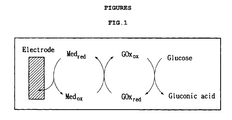
- the electroanalytical chemistry on which the second-generation biosensor will be described in conjunction with the following formula 2 and Fig. 1.
- the second-generation biosensor takes advantage of an electron transfer mediator selected from the group comprising ferrocene, ferrocene derivatives, quinones, quinone derivatives, organic conducting salts, and viologen.
- an electron transfer mediator selected from the group comprising ferrocene, ferrocene derivatives, quinones, quinone derivatives, organic conducting salts, and viologen.
- Reaction Formula 2 Glucose + GO x -FAD ⁇ Gluconic acid + GO x -FADH 2 GO x -FADH 2 + Electron Transfer Mediator (Oxidized) ⁇ GO x -FAD + Electron Transfer Mediator (Reduced)
- GO x represents glucose oxidase
- GO x -FAD and GO x -FADH 2 are the oxidized and reduced forms of the glucose oxidase, respectively, because FAD (flavin adenine dinucleotide) is the active site of glucose oxidase.
- FAD flavin adenine dinucleotide
- Fig. 6 there is an electron transfer system for the electrochemical analysis of blood glucose levels, in which glucose oxidase and ruthenium are used as electron carriers from glucose to an electrode.
- Glucose is oxidized to gluconic acid by the catalytic action of glucose oxidase while the active site, FAD, of the glucose oxidase is reduced to FADH 2 , which transfers its electron, in turn, to the electron transfer mediator while being returned to the oxidized form FAD.
- the reduced electron transfer mediator ruthenium is diffused to the surface of an electrode. At the surface of the electrode, measured is the current generated when the oxidation potential of the reduced electron transfer mediator is applied.
- the oxidation potential is in the range of -0.2 to 0.2 V versus a reference electrode, so that the influence of ascorbic acid and uric acid, which have oxidation potentials higher than 0.3 V and 0.4 V, respectively, can be excluded.
- the second-generation biosensor is not affected by oxygen.
- the second-generation biosensor enables the non-selective catalysis of an oxidase and uses an electron transfer mediator, which has such appropriate redox potentials as to reduce the error caused by interfering materials, so that the measured potentials can be used to accurately determine the analytical quantity of interest.
- problems are also found in the second-generation biosensor. Because the electron transfer mediator, after the electron transfer to and from the oxidase, must diffuse to the surface of the electrode to detect the electrochemical change, a large quantity of the electron transfer mediator is needed. The abundance of the electron transfer mediator may alter the three-dimensional structure of the oxidase, resulting in a decrease in the activity of the enzyme. Another problem with most electron transfer mediators is high reactivity with electrode-activating materials in the blood.
- glucose sensors which are commercially available to date, follow the principle of the second-generation biosensors. Since the electron transfer mediators employed in most commercially available glucose sensors to be oxidized at potentials similar to oxidation potentials of the interfering materials within blood, such as ascorbic acid, acetaminophene and uric acid, the influence of the interfering materials within blood is not completely eliminated. To circumvent these problems, some commercially available glucose sensors take advantage of capillarity in introducing blood samples thereinto, but suffer from the disadvantage that their fabrication is complicated because there is required the process of coating hydrophilic polymers onto hydrophobic supports to achieve the introduction.
- an immunochromatographic biosensor a porous membrane is provided to form an electrode in its upper part and a sample pretreatment layer in its lower part. Without additional operations for pretreatment, the sample was moved through chromatographic action, during which a target material of the sample can be quantitatively determined by the change in electrical quantity of the target material (Cui, G., Kim, S. J., Choi, S. H., Nam, H., Cha, G. S, and Paeng, K. J., Anal. Chem ., 2000 , 72 , 1925-1929; Cha, G. S. et al., U. S. Pat. No. 09/381788; Farm, M.
- the present inventors offered a biosensor having a structure in which a porous membrane capable of chromatographically separating blood cells and blood plasma is positioned on an electrode while being pressurized against the electrode by a cover (KR 10-2000-041962).
- This biosensor is advantageous in that a ruthenium based electron transfer mediator is deposited on the porous membrane to lower the oxidation potential, thereby reducing the error attributable to interfering material.
- this porous membrane-built-in biosensor enjoys the advantage of significantly reducing errors attributable to blood cell/blood plasma ratios and to easily oxidized materials.
- Another advantage of this biosensor resides in its structure, which has immobilized enzymes and electrode-active materials intercalated between two closed boards and thus isolated from external air, so that their lifetime can be prolonged without using separate packages.
- a serious problem with this biosensor is to make it difficult to introduce viscous blood samples thereinto.
- a biosensor comprises: (a) at least one substrate; (b) an electrode system, formed on one end of the substrate, having a sensing material; (c) an insulator, formed on parts of the electrode layer, for electrically separating the electrode system from a circuit connector; (d) a porous membrane, covered with the surface of the electrode system, having an oxidase and an electron transfer mediator; and (e) a protective membrane as large as the porous membrane and/or an upper substrate equipped with a sample inlet, are laminated in sequence, can filter samples chromatographically through the pores of the porous membrane, be preserved for a long period of time because the sensor materials and porous membrane are closed by the upper substrate, and conduct maximum performance without being disturbed by interfering components of samples.
- the biosensor structure can introduce samples at constant rates to the electrodes without pretreatment, to quantify levels of samples rapidly, and to sense changes in sample level with high consistency. Further to these, the biosensors are found to allow patients to detect blood levels of metabolites associated with various diseases accurately irrespective of interfering materials and by themselves.
- a biosensor which composes: (a) at least one substrate; (b) an electrode system, formed on one end of the substrate, having a sensing material; (c) an insulator, formed on parts of the electrode layer, for electrically separating the electrode system from a circuit connector; (d) a porous membrane, formed on the electrode system, having an oxidase and an electron transfer mediator; and (e) a protective membrane for protecting the porous membrane.
- a differential flat type biosensor with a three-compartment electrode.
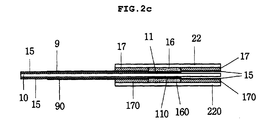
- the differential flat type biosensor of the present invention comprises: (a) a lower substrate 10 ; (b) a plurality of first spaced circuit connector 9; formed on the lower substrate 10 , (c) three-electrode system consisting of a working electrode 11, a counter electrode 12, and a reference electrode 13, all electrodes being established on the circuit connectors at a predetermined region (d) an insulator 15 covering the surface of the lower substrate 10 except said the electrode system and plurality of spaced first circuit connectors exposed on terminal region of the lower substrate 10; (e) a porous membrane 16, formed on the exposed area of the electrode system, having the same dimension as the exposed area of the electrode system; and (f) an protective membrane 22 large enough to cover the intermediate membrane for protecting porous membrane 16 via an adhesive 17 which is not applied to the electrode system, (g) plurality of differential circuit connectors 90 formed below the lower substrate 10 ; (h) a differential electrode system consisting of a differential working electrode 110 , a differential counter electrode 120, and a differential reference electrode 130
- a differential flat type biosensor with a two-electrode system which is the same structure as previously described a differential flat type biosensor with a three-electrode system with exception that the electrode system is composed of a working electrode and a counter electrode.
- Fig. 3 there is shown as a differential face-to-face type biosensor with a three-electrode system.
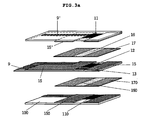
- the differential face-to-face type biosensor with three-electrode system comprises: (a) a lower substrate 10 ; (b) a plurality of spaced first circuit connector 9 ; formed on the lower substrate 10 , (c) a counter electrode 12 and a reference electrode 13 , both being coated on the circuit connectors 9 at a predetermined region; (d) an insulator 15 covering the surface of the lower substrate 10 exception of the electrode system containing a counter electrode 12 and a reference electrode 13; and plurality of spaced first circuit connectors 9 exposed on terminal region of the lower substrate 10 ; (e) a porous membrane 16 located on the electrode system containing a counter electrode 12 and a reference electrode 13, having the same dimension as the exposed area of the electrode system with a counter electrode 12 and a reference electrode 13; (f) an adhesive 17 deposited over the exception of the porous membrane 16, fixing the resulting structure; (g) a working electrode 11 atop the porous membrane 16; (h) a second circuit connector 9' expanding to the working
- a differential face-to-face type biosensor with a two-electrode system, consisting of the counter electrode 12 on the first circuit connector 9 on the lower substrate 10 and the working electrode 11 formed on second circuit connector 9' on the upper substrate 10' . Except said the electrode system, it has the same structure as differential face-to-face type biosensor in the three-electrode system.
- glucose oxidase and an electron transfer mediator may be immobilized onto the porous membrane 16 while bovine serum albumin is fixed onto the differential porous membrane 160 .
- a face-to-face and a flat type biosensors comprising: (a) a lower substrate; (b) an electrode system patterned on the lower substrate; (c) an adhesive covered over the lower substrate the exception of porous membrane, serving as an insulator; (d) a porous membrane being intercalated between the counter electrode and the working electrode, fixed with an adhesive; (e) a electrode positioned facing on the porous membrane, and a hole of upper substrate; and (f) an upper substrate containing a sample inlet for protecting the porous membrane as well as being introducible samples to the biosensor.
- FIG. 4 With reference to Fig. 4, there is shown a face-to-face type biosensor adopting a three-electrode system.
- the face-to-face type biosensor comprises: (a) a lower substrate 10 ; (b) an electrode system formed on the lower substrate 10 , consisting of a J-shaped working electrode connector strip 11' with a working electrode 11 established thereon, a counter electrode connector strip 12', and a reference electrode connector strip 13' with a reference electrode 13 established thereon; (c) a porous membrane 16, either said porous membrane 16 or the working electrode 11 having an oxidase and an electron transfer mediator immobilized thereto; (d) an adhesive 17 covered over the lower substrate 10 with the exception of the porous membrane 16; (e) a Y-shaped circuit connector strip 20 with a counter electrode 12 on the branched line ends, and (f) an upper substrate 10', fixed by the adhesive 17, having a hole of upper substrate 18 through which samples are introduced inside the biosensor.
- the working electrode connector strip 11' is fabricated by printing silver ink, followed by printing carbon ink on the silver line to form the working electrode 11.
- Silver ink is printed to form the reference electrode connector strip 13' on which silver chloride is coated to form the reference electrode 13.
- the counter electrode connector strip 12' is also printed with silver ink.
- the counter electrode 12 it is fabricated by printing carbon ink on branched line end areas of the Y-shaped electrode connector strip 20.
- the porous membrane 16 intercalated between the upper substrate 10' and lower substrate 10 removes platelets and blood cells from the whole blood sample at the A region while blood plasma is separated at the B region to reach the working electrode 11 and the counter electrode 12, which face each other.
- This porous membrane built-in biosensor may comprise a sample inlet, so that the amount of samples absorbed to the porous membrane is constantly controlled.
- detection signals which are amplified by 2 to 5 times can be provided by the symmetrically distributed electrode having a Y-shape.
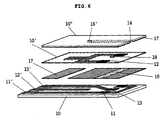
- FIG. 5 there is shown as a face-to-face type biosensor with a three-electrode system, which has a sample inlet 14 formed in the transverse direction of the electrode.
- the face-to-face type biosensor comprises: (a) a lower substrate 10 ; (b) an electrode system formed on the lower substrate 10 , consisting of a J-shaped working electrode connector strip 11' with a working electrode 11 established thereon, a counter electrode connector strip 12', and a reference electrode connector strip 13' with a reference electrode 13 established thereon; (c) a porous membrane 16, either said porous membrane 16 or the working electrode 11 having an oxidase and an electron transfer mediator immobilized thereto; ( ⁇ ) an adhesive 17 covered over the lower substrate 10 with the exception of the porous membrane 16; (e) a Y-shaped circuit connector strip 20 with a counter electrode 12 on the branched line ends, and (f) an upper substrate 10' , fixed by the adhesive 17, having a hole of upper substrate 18; and (g) a second upper substrate 10", fixed to the first upper substrate 10' via an adhesive 17, having a sample inlet 14, which is formed in the direction traversing the electrode system, wherein the sample in
- the working electrode connector strip 11' is fabricated by printing silver ink, followed by printing carbon ink on the silver line to form the working electrode 11.
- Silver ink is printed to form the reference electrode connector strip 13' on which silver chloride is coated to form the reference electrode 13.
- the counter electrode connector strip 12' is also printed with silver ink.
- the counter electrode 12 it is fabricated by printing carbon ink on branched end areas of the Y-shaped electrode connector strip 20.
- the sample inlet 14 of the biosensor may be formed by pressing a second upper substrate 10" made of a plastic in a mold or coating, over the first upper substrate 10', an adhesive, such as double-sided adhesive tape, having an opening as wide as the porous membrane 16.
- a blood sample is brought into contact with one end of the sample inlet 14.
- This biosensor requires only 3 ⁇ l or less of the sample to fill the sample inlet 14. This sample is transferred into the porous membrane 16 through the hole of upper substrate 18.
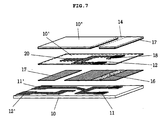
- the face-to-face type biosensor employing a three-electrode system, which has a sample inlet formed in the lengthwise direction of the electrode.
- the face-to-face type biosensor comprises: (a) a lower substrate 10 ; (b) an electrode system formed on the lower substrate 10, consisting of a J-shaped working electrode connector strip 11' with a working electrode 11 established thereon, a counter electrode connector strip 12', and a reference electrode connector strip 13' with a reference electrode 13 established thereon; (c) a porous membrane 16, either said porous membrane 16 or the working electrode 11 having an oxidase and an electron transfer mediator immobilized thereto; (d) an adhesive 17 covered over the lower substrate 10 with the exception of the porous membrane 16; (e) a Y-shaped circuit connector strip 20 with a counter electrode 12 on the branched line ends, and (f) an upper substrate 10', via the adhesive 17, having a hole of upper substrate 18; and (g)
- the biosensor of this embodiment has a sample inlet extending from one end of the second upper substrate 10" to a predetermined point. Also, this embodiment is characterized by the presence of the second hole of upper substrate 18' to make easy the introduction of samples from the sensor end.
- the face-to-face type biosensor employing a two-electrode system, which has a sample inlet formed in the transverse of the electrode.
- the face-to-face type biosensor comprises: (a) a lower substrate 10 ; (b) an electrode system formed on the lower substrate 10 , consisting of a Y-shaped working electrode connector strip 11' with a working electrode 11 established thereon and a counter electrode connector strip 12' , the latter it is connected to one end portion of the circuit connector strip 20 on the upper substrate 10' ; (c) a porous membrane 16, either said porous membrane 16 or the working electrode 11 having an oxidase and an electron transfer mediator immobilized thereto; (d) an adhesive 17 covered over the lower substrate 10 with the exception of the porous membrane 16; (e) a Y-shaped circuit connector strip 20 with a counter electrode 12 on the branched line ends, and (f) an upper substrate 10', via the adhesive 17, having a hole of
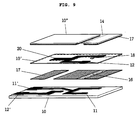
- the biosensor of Fig. 8 adopts a two-electrode system, which has a sample inlet 14 formed in the same direction of the electrode.
- the face-to-face type biosensor comprises: (a) a lower substrate 10 ; (b) an electrode system formed on the lower substrate 10 , consisting of a Y-shaped working electrode connector strip 11' with a working electrode 11 established thereon and a counter electrode connector strip 12' established thereon; (c) a porous membrane 16, either said porous membrane 16 or the working electrode 11 having an oxidase and an electron transfer mediator immobilized thereto; (d) an adhesive 17 covered over the lower substrate 10 with the exception of the porous membrane 16; (e) a Y-shaped circuit connector strip 20 with a counter electrode 12 on the branched line ends, (f) an upper substrate 10', fixed by the adhesive 17, having a hole of upper substrate 18; and (g) a second upper substrate 10" with a second hole of upper substrate 18',
- the biosensor of Fig. 8 is a face-to-face type biosensor adopting a two-electrode system.
- a sample inlet 14, with an opening as wide as the porous membrane 16, may be fabricated from an adhesive 17 which is not applied to the second upper substrate 10". Samples can be introduced to the biosensor from the end thereof. After being introduced through the sample inlet 14, the sample is transferred to the porous membrane 16 through the hole upper substrate 18.
- a face-to-face type biosensor adopting a two-electrode system, in which a sample inlet extends in the transverse direction and the all electrode system is formed of only carbon ink.
- a sample inlet extends in the transverse direction and the all electrode system is formed of only carbon ink.
- a lower substrate 10 comprises: (a) a lower substrate 10 ; (b) an electrode system formed on the lower substrate 10, consisting of a Y-shaped working electrode connector strip 11' with a working electrode 11 established thereon and a counter electrode connector strip 12' ; (c) a porous membrane 16, either said porous membrane 16 or the working electrode 11 having an oxidase and an electron transfer mediator immobilized thereto; (d) an adhesive 17 covered over the lower substrate 10 with the exception of the porous membrane 16 ; (e) a Y-shaped circuit connector strip 20 with a counter electrode 12 on the branched line ends, (f) an upper substrate 10', formed on the adhesive 17, having a hole of upper substrate 18; and (g) a second upper substrate 10", having a sample inlet 14, fixed to the first upper substrate 10' via an adhesive 17, wherein said a sample inlet 14 is formed in the direction traversing the electrode system, wherein the sample inlet has two opposite open ends through which samples are introduced to the biosensor.
- An oxidase and an electron transfer mediator may be immobilized on the porous membrane 16 or the working electrode 11.
- a sample can be introduced from both the left and right side ends of the biosensor.
- the working electrode connector strip 11' is fabricated from carbon ink by printing.
- the counter electrode connector strip 12' to be connected to the electrode connector strip 20 is also printed with carbon ink.
- the intermediate membrane is formed in such a pattern that it has openings at one of which the porous membrane 16 is present and through one of which the counter electrode connector strip 12' is contacted with one end portion of the electrode connector strip 20.
- This biosensor is characterized in that all electrodes are made of carbon ink only, without using silver ink.
- This porous membrane built-in biosensor may comprise a sample inlet 14, so that the amount of sample absorbed to the porous membrane is constantly controlled.
- Fig. 10 illustrates a face-to-face type biosensor adopting a two-electrode system; characterized in that a sample inlet 14 is formed in an upper substrate 10' not in a second upper substrate 10" and all electrodes are fabricated by carbon ink.
- This face-to-face type biosensor comprises: (a) a lower substrate 10 ; (b) an electrode system formed on the lower substrate 10 , consisting of a Y-shaped working electrode connector strip 11' with a working electrode 11 established thereon and a counter electrode connector strip 12', all of the electrodes coating carbon ink only; (c) a porous membrane 16, formed on a predetermined area of the electrode system, covering the working electrode 11; (d) an adhesive 17 covered over the lower substrate 10 with the exception of the porous membrane 16; (e) a Y-shaped circuit connector strip 20 with a counter electrode 12 coated with carbon ink only, (f) an upper substrate 10' , fixed by the adhesive 17, having a sample inlet 14 extending in the lengthwise direction to one end of the upper substrate 10' from a mid point and thus having an open end; and (g) a second upper substrate 10", fixed to the first upper substrate 10' via an adhesive 17, having a second hole of upper substrate 18'.
- All of the electrodes are made of carbon ink.
- An oxidase and an electron transfer mediator may be immobilized on the porous membrane 16 or the working electrode 11. In this structure, a sample can be introduced from the end of the sensors of the biosensor.
- a sample inlet 14, with an opening as wide as the porous membrane 16, may be fabricated from an adhesive 17 which is not applied to the upper substrate 10' .
- the sample inlet 14 enables the introduction of samples at the end of the biosensor.
- the present invention provides a biosensor with a modified sample inlet capable of rapidly introducing a predetermined amount of blood samples and increasing accuracy and reproducibility.
- a face-to-face biosensor adopting a three-electrode system, characterized by providing a circular space for a sample inlet.
- the biosensor comprises: (a) a lower substrate 10; (b) an electrode system formed on the lower substrate 10 , consisting of a J-shaped working electrode connector strip 11' with a working electrode 11 established thereon, a counter electrode connector strip 12', and a reference electrode connector strip 13' with a reference electrode 13 established thereon; (c) a porous membrane 16, either said porous membrane 16 or the working electrode 11 having an oxidase and an electron transfer mediator immobilized thereto; (d) an adhesive 17 covered over the lower substrate 10 with the exception of the porous membrane 16; (e) a Y-shaped circuit connector strip 20 with a counter electrode 12 on the branched line ends, (f) an upper substrate 10' , fixed by the adhesive 17, having a hole of upper substrate 18 through which samples are introduced inside the biosensor. (g) a circular second upper substrate 10
- This biosensor may fabricated by fixing the circular second upper substrate 10" to the biosensor of Fig. 5a by use of the adhesive 17, said the second upper substrate 10" being provided with a modified sample inlet 14.
- a two-electrode system biosensor which has the same structure as in this biosensor, with exception that a counter electrode connector strip 12' and a J-shaped working electrode connector strip 11' with a working electrode 11 established on its branched end line area are formed on the lower substrate and a counter electrode 12 is formed on the upper substrate 10' .
- a flat type biosensor adopting a three-electrode system, characterized by the sample inlet, which is formed in the second upper substrate 10", extending from a mid point to one end of the substrate.
- the biosensor comprises: (a) a lower substrate 10 ; (b) a electrode system, formed on the lower substrate 10 , consisting of a working electrode connector strip 11' with a working electrode 11 established thereon, a counter electrode connector strip 12' with a J-shaped counter electrode 12 established thereon, and a reference electrode connector strip 13' with a reference electrode 13 established thereon; (c) a porous membrane 16, formed on a predetermined area of the electrode system, covering the working electrode 11, and an adhesive 17 deposited over the intermediate membrane with the exception of the porous membrane 16; (d) a upper substrate 10' with a hole upper substrate 18 fixed to the lower substrate 10 via the adhesive 17; and (e) a second upper substrate 10" with a second hole of upper substrate 18', having a sample inlet 14, fixed
- the working electrode connector strip 11', the counter electrode connector strip 12', and the reference electrode connector strip 13' are printed with silver ink while the working electrode 11 and the counter electrode 12 are fabricated from carbon ink by printing.
- the reference electrode 13 is fabricated from silver chloride.
- a sample inlet 14, with an opening as wide as the porous membrane 16 may be fabricated from an adhesive 17 which is not applied to the second upper substrate 10" .
- the first upper substrate 10' is provided with the hole upper substrate 18 through which samples are introduced into the biosensor, being covered with a second upper substrate 10" having the sample inlet 14 which has one open end through which samples are introduced to the biosensor.
- a flat type biosensor with two-electrode system which has the same structure as in this biosensor, with exception that a counter electrode connector strip 12' with a counter electrode 12 established thereon and a working electrode connector strip 11' with a working electrode 11 established on thereon are formed on lower substrate 10 .
- Fig. 13 shows a flat type biosensor which has a porous membrane as a substrate and a sample inlet running in the widthwise direction.
- the flat type biosensor comprises: (a) a lower substrate made of a porous membrane 16 ; (b) an insulator 15 formed on one half portion of the lower substrate 16, an electrode system, formed on the insulator 15, consisting of a working electrode connector strip 11' with a working electrode 11 established thereon, a counter electrode connector strip 12' with a counter electrode 12 established thereon, and a reference electrode connector strip 13' with a reference electrode 13 established thereon, and a pretreatment layer 19 adjacent to the insulator 15; and (c) an upper substrate 10' fixed onto the another half portion of the porous membrane 16 via an adhesive 17, having an sample inlet 14 which is formed in the direction traversing the electrode system and has two open ends. Through the sample inlet having two open ends, samples can be introduced from both the left and right ends of the biosensor adopting the three-electrod
- a porous membrane 16 is used as a lower substrate.
- an insulator is established to insulate samples and connector strips 11', 12' and 13' from one another.
- the working electrode 11 and the counter electrode 12 are formed of carbon ink by printing while the reference electrode is printed with silver chloride.
- an insulator is printed again.
- a sample inlet 14 through which a predetermined amount of samples is introduced into the biosensor is provided to the upper substrate 10' .
- a blood sample is separated into its components by the porous membrane 16 before reaching the working electrode 11, so that only plasma components are detected. Functioning to oxidize interfering materials before a sample is introduced to the electrodes, the pretreatment layer ensures the accurate quantitative measurement of only a component of interest.
- flat type biosensor with a two-electrode system which has the same structure as in this biosensor, with exception that only a counter electrode connector strip 12' with a counter electrode 12 established thereon and a working electrode connector strip 11' with a working electrode 11 established thereon are formed on the lower substrate 10 .
- Substrates for use in the biosensors described above may be formed of ceramic, plastics, silicon, alumina glass plates or polymeric materials with preference for an organic polymer selected from the group consisting of polyester, polyvinyl chloride, and polycarbonate.
- electrodes such as reference electrodes, working electrodes and counter electrodes
- silver, silver epoxy, palladium, copper, gold, platinum, silver/silver chloride, silver/silver ion, mercury/mercuric oxide, conductive carbon, and heavy metal oxides may be used.
- a reference electrode material is selected form silver, silver epoxy, silver/silver chloride and silver/silver ion, a working electrode material from conductive carbon, cobalt phthalocyanine paste, gold, platinum, and palladium, and a counter electrode material from conductive carbon, gold and platinum.
- These materials may be formed into reference, counter and working electrodes by a screen-printing method or a physical vapor deposition method.
- Preferred is a screen-printing method by virtue of its ability to treat various electrode materials with economical advantages, reproduce electrodes with consistency and make highly sensitive electrodes.
- constant force is applied to a squeegee against open patterns to print ink or paste on predetermined areas of a substrate, thereby enabling the introduction of patterns in sequence.
- Another advantage with the screen-printing method is to activate the printed electrodes.
- the dielectric layer 15 may be formed by screen-printing insulating polymer pastes followed by thermal treatment. Covered with the dielectric layers, the electrodes are maintained constant in their areas and thus improved in analytical reproducibility.
- the protective membrane 22 functions to physically protect porous membrane 16 immobilized to the oxidase and electron transfer mediator and is prepared from an organic polymer of good process ability, such as polyester, polyvinyl chloride or polycarbonate.
- an adhesive 17 suitable to firmly fix the porous membrane 16 and the protective membrane 22 to the electrode body a double-sided adhesive tape or a conventional strong adhesive may be used.
- a double-sided adhesive tape which is as thick as the porous membrane.
- Said an adhesive 17 include to intermediate membrane, which has a gap at one of which the porous membrane 16 is present and through one of which the counter electrode connector strip 12' is contacted with one end portion of the electrode connector strip 20.
- the porous membrane 16 is formed of a paper, a hydrophilic organic polymer or a hygroscopic ceramic polymer, which is selected from the group consisting of nylon, hydrophilic polyester sulfone membranes, hydrophilic mixed cellulose esters, polytetrafluoroethylene membranes, polyvinylidine fluoride membranes, ion-selective membranes, glass fiber, polyester fiber or its modified fiber membranes. More Preferably, nitrocellulose paper, polyester fiber or its modified fiber membranes or similar filter paper may be used for the porous membrane.
- Requirements for the electron transfer mediators immobilized to the porous membrane are that (1) their oxidized-reduced states in aqueous solution should be stable and reversible; (2) reduced electron transfer mediators should be non-reactive to oxygen; (3) their formal potentials should be low enough to exclude the influence of interfering materials to as large an extent as possible because their working potentials are determined by the formal potentials; (4) reduced electron transfer mediators should be oxidized relatively irrespective of pH; and (5) they should be non-reactive to electrochemically interfering materials, such as ascorbic acid, acetaminophene and uric acid.
- the electron transfer mediators satisfying the requirements include hexaamineruthenium (III) chloride, potassium ferricyanide, potassium ferrocyanide, dimethylferrocene (DMF), ferricinium, ferocene-monocarboxylic acid (FCOOH), 7,7,8,8-tetracyanoquinodimethane (TCNQ), tetrathiafulvalene (TTF), nickelocene (Nc), N-methyl acidinium (NMA + ), tetrathiatetracene (TTT), N-methylphenazinium (NMP + ), hydroquinone, 3-dimethylaminobenzoic acid (MBTHDMAB), 3-methyl-2-benzothiozolinone hydrazone, 2-methoxy-4-allylphenol, 4-aminoantipyrine (AAP), dimethylaniline, 4-aminoantipyrene, 4-methoxynaphthol, 3,3',5,5'-tetramethyl benzidine (TM
- Examples of materials for use in fabrication of the sample inlet 14 include polyester and polyvinyl chloride with preference for polyester.
- surfactant is used to move samples quickly.
- non-ionic surfactants such as polyethylene glycol, oxyethylated alkylphenols (neonols), Triton X-100 and polyoxyethylated compounds; anionic surfactants such as sodium decyl sulfate; and cationic surfactants such as decylpuridium chloride, tetradecypyridium and pyridium.
- Triton X-100 is commercially used.
- CMC carboxymethylcellulose
- PVP polyvinylpyrrolidone
- PVA polyvinylalcohol
- biosensors for analysis of blood glucose levels can introduce appropriate enzymes and electron transfer mediator to the porous membrane so that a variety of samples, including bio-materials, such as metabolites, e.g., cholesterol, lactate, creatinine, proteins, hydrogen peroxide, alcohols, amino acids, and enzymes, e.g., GPT (glutamate pyruvate transaminase) and GOT (glutamate oxaloacetate transaminase), environmental materials, agricultural and industrial materials, and food materials can be quantitatively analyzed.
- bio-materials such as metabolites, e.g., cholesterol, lactate, creatinine, proteins, hydrogen peroxide, alcohols, amino acids, and enzymes, e.g., GPT (glutamate pyruvate transaminase) and GOT (glutamate oxaloacetate transaminase)
- Silver/silver chloride paste was screen-printed on a polyester substrate 10 to give circuit connectors 9 and a reference electrode 13. Afterwards, a working electrode 11 and a counter electrode 12 were formed from conductive carbon paste through a screen-printing method, followed by the formation of a dielectric layer 15 from insulator paste (brand name: LS-405). Thermal treatment at 140 °C for 5 min yielded a single electrode body for a flat type biosensor.
- Step 2 Fabrication of Flat Type Glucose Sensor
- a porous nitrocellulose membrane (2 x 10mm) was treated with MeOH for 30 min, washed with deionized water, and dried for about 1 hour.
- the porous nitrocellulose membrane or polyester fiber or its modified fiber membrane thus activated was soaked in a solution containing 100 mM hexaamineruthenium (III) chloride, a 0.5 % (w/w) dispersant (carboxymethylcellulose), a 0.2 % (w/w) surfactant (Triton X-100) and 10 mg/ml glucose oxidase for 1 ⁇ 2 hours with the aim of adsorbing the compounds thereto, and then allowed to stand for 16 hours at 24 ⁇ 26 °C at a humidity of 50 ⁇ 55 % in a desiccator.
- the resulting porous membrane was overlaid on the area-on-electrode of the flat type single electrode body prepared in step 1., and covered with a protective membrane 22 of polyester. Via a double-sided adhesive tape, the protective membrane was attached to the dielectric layer on the single electrode body to fabricate a flat type glucose sensor.
- Step 3 Fabrication of Differential Flat Type Glucose Sensor
- a flat type glucose sensor equipped prepared in step 2 of Example 1 contained a porous membrane 16 to which 100 mM potassium ferricyanide and glucose oxidase were immobilized.
- a structure similar to that of the flat type glucose sensor except that a differential porous membrane 160 to which 100 mM potassium ferricyanide and 10 mg/mL BSA (bovine serum albumin) were immobilized was provided, as shown in Fig. 2a to 2c.
- BSA bovine serum albumin
- Step 1 Fabrication of Double Electrode Body
- the first electrode module As shown in Figs. 3a to 3d, all components of the first electrode module, except for the working electrode, were formed in the same manner as in the single electrode body of the flat type glucose sensor.
- the second electrode module As for the second electrode module, its fabrication was as follows. On a polyester upper substrate 10' , silver/silver chloride paste was screen-printed in the lengthwise direction to form second circuit connectors 9' on one end of which a working electrode 11 was formed from conductive carbon paste through a screen-printing method.
- Step 2 Fabrication of Face-to-Face Type Glucose Sensor
- a porous membrane 16 to which hexaamineruthenium (III) chloride and glucose oxidase were immobilized was prepared in the same manner as in step 2 of Example 1.
- the porous membrane was placed on the counter electrode 12 and reference electrode 13 of the first electrode module, after the second electrode module was superimposed over the first electrode module in such a way that the working electrode 11 of the second electrode module faced the porous membrane 16. With the aid of a double-sided adhesive tape 17, the second electrode module was attached to the dielectric layer 15 on the first electrode module.
- Step 3 Fabrication of Differential Face-to-Face Type Glucose Sensor
- a face-to-face type glucose sensor equipped with a porous membrane 16 to which 100 mM potassium ferricyanide and glucose oxidase were immobilized was prepared in the same manner as in step 2 of Example 1.
- a working electrode connector strip 11' On a lower substrate 10 of polyester, silver paste was printed to form the working electrode connector strip 11', the counter electrode connector strip 12' and the reference electrode strip 13'.
- a working electrode 11 and a reference electrode 13 were fabricated from conducting carbon paste and silver paste, respectively, to form a first electrode module.
- an electrode connector strip 20 was fabricated by silver paste and a counter electrode 12 was prepared by conducting carbon paste respectively, to form a second electrode module.
- a hole with a dimension of 1 x 2 mm was provided for use as a passage for sample.
- the porous membrane 16 fabricated in Step 2 of Example 1 was overlaid on the first electrode module.
- the second electrode module was superposed to overlap the working electrode of the second electrode module with the porous membrane 16 and then, attached to the insulator 15 of the first electrode module via an adhesive 17 by compression.
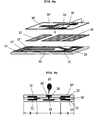
- An adhesive 17 was applied onto the second electrode module with a sample inlet, followed by bonding a upper substrate with a sample to the adhesive to give a glucose sensor (Fig. 4a and 4b).
- the sample amount introduced to the sensor was measured to be 2.38 ⁇ L on average as a result of using 20 sensors in total, with a standard deviation of ⁇ 0.11 ⁇ L, which demonstrated that the sample was introduced with very high accuracy.
- Dynamic curves which show the influence of interfering materials such as ascorbic acid, acetaminophene and uric acid and a buffer solution, are depicted in Fig. 15.
- the flat type glucose sensor fabricated in Example 1 was measured for current change when the application potential versus the potential of a reference electrode (Ag/AgCl) was increased in the presence of 200 mg/dL glucose (11.1 mM) (a), 570 ⁇ M ascorbic acid (b), 660 ⁇ M acetaminophene (c), 916 ⁇ M uric acid (d) and a buffer solution (140 mM NaCl, PBS, pH 7.4) (e).
- the sensor is affected only insignificantly at an application potential versus the reference electrode (Ag/AgCl) by the interfering materials.
- Chronoamperometric curves which show the influence of blood hematocrit on the flat type glucose sensor in step 2 of Example 1, are depicted in Fig. 16.
- the flat type glucose sensor was measured for current change at an application potential of 0.35 V vs. reference electrode in a buffer solution (140 mM NaCl, PBS pH 7.4) (a), whole blood (b), and plasma (c).
- the curve (b) for whole blood that contains blood hematocrits is almost identical to the curve (c) for plasma, which is deprived of blood hematocrits.
- the reason is that blood hematocrits are removed, in advance, in the glucose sensor because they cannot pass through pores of the sensor during the chromatographic motion of samples. Accordingly, the biosensor of the present invention was found to surmount the problem of conventional biosensors, in which detection reliability is poor because of the disturbance resulting from the adsorption of blood hematocrits to electrode surfaces.
- the flat type glucose sensor prepared in step 2 of Example 1 was assayed for sensitivity in glucose standard solutions with glucose concentrations of 0, 50, 100, 150, 200, 250, 300, 350 and 400 mg/dL.
- current values were measured 10 times at each concentration under the electrical field of an application potential of 0.0 V vs. reference electrode.
- the calibration curve thus obtained is depicted in Fig. 17. Demonstrating that the flat type glucose sensor of the present invention is reliable, the curve was calculated to have a slope of 0.0298 [ ⁇ A/(mg/dL)] and a linearity of as high as 0.996.
- the differential flat type glucose sensor prepared in Example 1 was assayed for sensitivity in glucose standard solutions with glucose concentrations of 0, 50, 100, 150, 200, 250, 300, 350 and 400 mg/dL.
- current values were measured 5 times at each concentration under the electrical field of an application potential of 0.35 V vs. reference electrode in the presence of an interfering material (1 mM acetaminophene, 1 mM ascorbic acid, or 0.8 mM uric acid).
- the calibration curve thus obtained is depicted in Fig. 18.
- the curve was calculated to have a slope of 0.0333 [ ⁇ A/(mg/dL)] and a linearity of as high as 0.996 irrespective of the interfering materials.
- the differential flat type glucose sensor of the present invention was found to be accurate and precise as coefficients of variation was measured to be 5.1 % and 5.2 % for the normal serum and the abnormal serum, respectively.
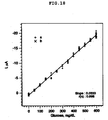
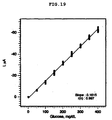
- the face-to-face type glucose sensor prepared in step 2 of Example 2 was assayed for sensitivity in glucose standard solutions with glucose concentrations of 0, 50, 100, 150, 200, 250, 300, 350 and 400 mg/dL.
- current values were measured 10 times at each concentration under the electrical field of an application potential of 0.0 V vs. reference electrode.
- the calibration curve thus obtained is depicted in Fig. 19. Demonstrating that the glucose sensor of the present invention is reliable, the curve was calculated to have a slope of 0.1615 [ ⁇ A/(mg/dL)] and a linearity of as high as 0.997.
- the differential flat type glucose sensor of the present invention was found to be accurate and precise as coefficients of variation were measured to be 5.5 % and 4.0 % for the normal serum and the abnormal serum, respectively.
- the porous membrane built-in biosensors of the present invention are provided with sample inlets which can be introduced samples in a constant quantity and rate to the biosensors without pretreatment.
- the biosensors of the present invention can be fabricated with ease and produced on mass production at low cost. Further to these, the biosensors of the present invention allow patients to detect blood levels of metabolites associated with various diseases accurately irrespective of interfering materials and by themselves. Therefore, the biosensors can find numerous applications in accurate and precise quantification apparatuses.
Landscapes
- Chemical & Material Sciences (AREA)
- Life Sciences & Earth Sciences (AREA)
- Health & Medical Sciences (AREA)
- Organic Chemistry (AREA)
- Wood Science & Technology (AREA)
- Zoology (AREA)
- Proteomics, Peptides & Aminoacids (AREA)
- Engineering & Computer Science (AREA)
- Biophysics (AREA)
- General Health & Medical Sciences (AREA)
- Immunology (AREA)
- Analytical Chemistry (AREA)
- Molecular Biology (AREA)
- Physics & Mathematics (AREA)
- Biochemistry (AREA)
- Bioinformatics & Cheminformatics (AREA)
- Genetics & Genomics (AREA)
- Microbiology (AREA)
- General Engineering & Computer Science (AREA)
- Biotechnology (AREA)
- Chemical Kinetics & Catalysis (AREA)
- Hematology (AREA)
- Emergency Medicine (AREA)
- Electrochemistry (AREA)
- General Physics & Mathematics (AREA)
- Pathology (AREA)
- Investigating Or Analysing Biological Materials (AREA)
- Measuring Or Testing Involving Enzymes Or Micro-Organisms (AREA)
- Apparatus Associated With Microorganisms And Enzymes (AREA)
- Peptides Or Proteins (AREA)
Abstract
Description
Glucose + O2 → Gluconic acid + H2O2 (Glucose Oxidase Catalysis)
H2O2 + Oxygen Receptor → (oxidized) Oxygen Receptor + 2H2O (Peroxidase Catalysis)
Glucose + GOx-FAD → Gluconic acid + GOx-FADH2
GOx-FADH2 + Electron Transfer Mediator (Oxidized) →
GOx-FAD + Electron Transfer Mediator (Reduced)
- 9: plurality of spaced first circuit connectors
- 9': second circuit connectors
- 10: lower substrate
- 11: working electrode 12: counter electrode
- 13: reference electrode 14: sample inlet
- 15: insulator 16: porous membrane
- 17: adhesive 18: hole of upper substrate
- 19: pretreatment layer 20: electrode connector
- 21: sample 22: protective membrane
- 10' :
upper substrate 10": second upper substrate - 11': working electrode connector
- 12': counter electrode connector
- 13' : reference electrode connector
- 15' : second insulator
- 18' : second hole of upper substrate
- 90: plurality of differential circuit connectors
- 90': second differential circuit connector
- 100: differential substrate
- 110: differential working electrode
- 120: differential counter electrode
- 130: differential reference electrode
- 150: differential insulator
- 150': differential second insulator
- 160: differential porous membrane
- 170: differential adhesive
- 220: differential protective membrane
| Normal serum | Abnormal serum | |
| Average, mg/dL | 91.6 | 298.5 |
| 2 SD, mg/dL | 9.4 | 30.9 |
| Coefficient of variation, % | 5.1 | 5.2 |
| Reference value, mg/dL | 91.9 ± 8.3 | 304.5 ± 31.0 |
| Normal serum | Abnormal serum | |
| Average, mg/dL | 91.4 | 291.9 |
| 2 SD, mg/dL | 5.0 | 11.8 |
| Coefficient of variation, % | 5.5 | 4.0 |
| Reference value, mg/dL | 91.1 ± 8.2 | 302.2 ± 30.7 |
Claims (32)
- A biosensor with porous membranes, comprising:(a) at least one substrate;(b) an electrode layer patterned on the substrate, consisting of an electrode system and a circuit connector;(c) an insulator, for separating the electrode system and a circuit connector formed on parts of the electrode layer; and(d) a porous membrane covered with the surface of electrode system by the insulator; wherein, when a whole blood sample is introduced to the biosensor, the whole blood sample is separated into its components during the chromatographic motion through the porous membrane so that only blood plasma can be contacted with the electrode system.
- The biosensor as set forth in claim 1, further containing upper substrate comprising a protective membrane for protecting the porous membrane, formed onto the porous membrane, or a sample inlet for protecting the porous membrane as well as being introducible samples to the biosensor.
- The biosensor as set forth in claim 1, wherein the biosensor comprises:(a) a lower substrate;(b) an first electrode system patterned on the lower substrate;(c) an adhesive formed over the electrode layer exception of porous membrane to define the area of the electrode, serving as an insulator;(d) a porous membrane being intercalated between the counter electrode 12 and the working electrode 11, fixed with an adhesive;(e) a second electrode positioned facing on the porous membrane, and a hole of upper substrate; and(f) an upper substrate containing a sample inlet for protecting the porous membrane as well as being introducible samples to the biosensor, wherein either the electrode system or the porous membrane has oxidase and an electron transfer mediator immobilized thereto, when a whole blood sample is introduced to the biosensor, the whole blood sample is separated into its components during the chromatographic motion through the porous membrane so that only blood plasma can be contacted with the electrode system.
- The biosensor as set forth in claim 1, wherein said biosensor is a differential flat type with a three-electrode system, comprising:(a) a lower substrate 10;(b) a plurality of first spaced circuit connector 9; formed on the lower substrate 10,(c) three-electrode system consisting of a working electrode 11, a counter electrode 12, and a reference electrode 13, all electrodes being established on the circuit connectors at a predetermined region(d) an insulator 15 covering the surface of the lower substrate 10 except said the electrode system and plurality of spaced first circuit connectors exposed on terminal region of the lower substrate 10;(e) a porous membrane 16, formed on the exposed area of the electrode system, having the same dimension as the exposed area of the electrode system; and(f) an protective membrane 22 large enough to cover the intermediate membrane for protecting porous membrane 16 via an adhesive 17 which is not applied to the electrode system,(g) plurality of differential circuit connectors 90 formed below the lower substrate 10;(h) a differential electrode system consisting of a differential working electrode 110, a differential counter electrode 120, and a differential reference electrode 130;(i) a differential insulator 150;(j) a differential porous membrane 160;(k) a differential adhesive 170 covering the resulting structure with the exception of the porous membrane; and(l) a differential protective membrane 220; each of the differential component, established on symmetry with respect to the lower substrate 10, which functions in the same pattern as that of its corresponding one in the opposite module.
- The biosensor as set forth in claim 1, wherein said biosensor is a differential flat type with a two-electrode system, comprising:(a) a lower substrate 10;(b) a plurality of first spaced circuit connector 9; formed on the lower substrate 10,(c) a two-electrode system consisting of a working electrode 11 and a counter electrode 12, all electrodes being established on the circuit connectors at a predetermined region;(d) an insulator 15 covering the surface of the lower substrate 10 except said the electrode system and plurality of spaced first circuit connectors exposed on terminal region of the lower substrate 10;(e) a porous membrane 16, formed on the exposed area of the electrode system, having the same dimension as the exposed area of the electrode system; and(f) an protective membrane 22 large enough to cover the intermediate membrane for protecting porous membrane 16 via an adhesive 17 which is not applied to the electrode system,(g) plurality of differential circuit connectors 90 formed below lower substrate 10;(h) a differential electrode system consisting of a differential working electrode 110 and a differential counter electrode 120;(i) a differential insulator 150;(j) a differential porous membrane 160;(k) a differential adhesive 170 covering the resulting structure with the exception of the porous membrane; and(l) a differential protective membrane 220; each of the differential component, established on symmetry with respect to the lower substrate 10, which functions in the same pattern as that of its corresponding one in the opposite module.
- The biosensor as set forth in claim 1, wherein said biosensor is a differential face-to face type with a three-electrode system, comprising:(a) a lower substrate 10;(b) a plurality of spaced first circuit connector 9; formed on the lower substrate 10,(c) a counter electrode 12 and a reference electrode 13, both being coated on the circuit connectors 9 at a predetermined region;(d) an insulator 15 covering the surface of the lower substrate 10 exception of the electrode system containing a counter electrode 12 and a reference electrode 13; and plurality of spaced first circuit connectors 9 exposed on terminal region of the lower substrate 10;(e) a porous membrane 16 located on the electrode system containing a counter electrode 12 and a reference electrode 13, having the same dimension as the exposed area of the electrode system with a counter electrode 12 and a reference electrode 13;(f) an adhesive 17 deposited over the exception of the porous membrane 16, fixing the resulting structure;(g) a working electrode 11 atop the porous membrane 16;(h) a second circuit connector 9' expanding to the working electrode 11;(i) upper substrate 10' covering with a second insulator 15' while exposing exception of the working electrode 11;(j) a plurality of differential circuit connectors 90 formed below the lower substrate 10;(k) a differential counter electrode 120 and a differential reference electrode 130;(l) a differential insulator 150 formed on the differential circuit connectors 90;(m) a differential porous membrane 160;(n) a differential adhesive 170 with the exception of the porous membrane 160;(o) a differential working electrode 110 atop the differential porous membrane 160;(p) a second differential circuit connector 90' with the differential adhesive 170;(q) a differential second insulator 150'; and(r) a differential upper substrate 100, each of the differential component, established on symmetry with respect to the lower substrate 10, which functions in the same pattern as that of its corresponding one in the opposite module.
- The biosensor as set forth in claim 1, wherein said biosensor is a differential face-to-face type with a two-electrode system, comprising:(a) a lower substrate 10;(b) a plurality of spaced first circuit connector 9; formed on the lower substrate 10,(c) a counter electrode 12 and a reference electrode 13, both being coated on the circuit connectors 9 at a predetermined region;(d) an insulator 15 covering the surface of the lower substrate 10 exception of the electrode 12; and plurality of spaced first circuit connectors 9 exposed on terminal region of the lower substrate 10;(e) a porous membrane 16 located on the electrode system containing a counter electrode 12, having the same dimension as the exposed area of the electrode system with a counter electrode;(f) an adhesive 17 deposited over the lower substrate 10 with the exception of the porous membrane 16, fixing the resulting structure;(g) a working electrode 11 atop the porous membrane 16;(h) a second circuit connector 9' expanding to the working electrode 11;(i) upper substrate 10' covering with a second insulator 15' while exposing exception of the working electrode 11;(j) a plurality of differential circuit connectors 90 formed below the lower substrate 10;(k) a differential counter electrode 120;(l) a differential insulator 150 formed on the differential circuit connectors 90;(m) a differential porous membrane 160;(n) a differential adhesive 170 with the exception of the porous membrane 160;(o) a differential working electrode 110 atop the differential porous membrane 160;(p) a second differential circuit connector 90' with the differential adhesive 170;(q) a differential second insulator 150'; and(r) a differential upper substrate 100, each of the differential component, established on symmetry with respect to the lower substrate 10, which functions in the same pattern as that of its corresponding one in the opposite module.
- The biosensor as set forth in claim 3, wherein said biosensor is a face-to-face type with a three-electrode system, comprising:(a) a lower substrate 10;(b) an electrode system formed on the lower substrate 10, consisting of a J-shaped working electrode connector strip 11' with a working electrode 11 established thereon, a counter electrode connector strip 12', and a reference electrode connector strip 13' with a reference electrode 13 established thereon;(c) a porous membrane 16, either said porous membrane 16 or the working electrode 11 having an oxidase and an electron transfer mediator immobilized thereto;(d) an adhesive 17 covered over the lower substrate 10 with the exception of the porous membrane 16;(e) a Y-shaped circuit connector strip 20 with a counter electrode 12 on the branched line ends, and(f) an upper substrate 10', fixed by the adhesive 17, having a hole of upper substrate 18 through which samples are introduced inside the biosensor.
- The biosensor as set forth in claim 3, wherein said biosensor is a face-to-face type with a three-electrode system, comprising:(a) a lower substrate 10;(b) an electrode system formed on the lower substrate 10, consisting of a J-shaped working electrode connector strip 11' with a working electrode 11 established thereon, a counter electrode connector strip 12', and a reference electrode connector strip 13' with a reference electrode 13 established thereon;(c) a porous membrane 16, either said porous membrane 16 or the working electrode 11 having an oxidase and an electron transfer mediator immobilized thereto;(d) an adhesive 17 covered over the lower substrate 10 with the exception of the porous membrane 16;(e) a Y-shaped circuit connector strip 20 with a counter electrode 12 on the branched line ends, and(f) an upper substrate 10', fixed by the adhesive 17, having a hole of upper substrate 18; and(g) a second upper substrate 10", fixed to the first upper substrate 10' via an adhesive 17, having a sample inlet 14, which is formed in the direction traversing the electrode system, wherein the sample inlet has two opposite open ends through which samples are introduced to the biosensor.
- The biosensor as set forth in claim 3, wherein said biosensor is a face-to-face type with a three-electrode system, comprising:(a) a lower substrate 10;(b) an electrode system formed on the lower substrate 10, consisting of a J-shaped working electrode connector strip 11' with a working electrode 11 established thereon, a counter electrode connector strip 12', and a reference electrode connector strip 13' with a reference electrode 13 established thereon;(c) a porous membrane 16, either said porous membrane 16 or the working electrode 11 having an oxidase and an electron transfer mediator immobilized thereto;(d) an adhesive 17 covered over the lower substrate 10 with the exception of the porous membrane 16;(e) a Y-shaped circuit connector strip 20 with a counter electrode 12 on the branched line ends, and(f) an upper substrate 10', via the adhesive 17, having a hole of upper substrate 18; and(g) a second upper substrate 10" with a second hole of upper substrate 18' fixed to the first upper substrate 10' via an adhesive 17, having a sample inlet 14 which is formed in the same direction as in the electrode system, extending from a mid point to an end of the second upper substrate 10", wherein the sample inlet has one open end through which samples are introduced to the biosensor.
- The biosensor as set forth in claim 3, wherein said biosensor is a face-to-face type employing a two-electrode system, comprising:(a) a lower substrate 10;(b) an electrode system formed on the lower substrate 10, consisting of a Y-shaped working electrode connector strip 11' with a working electrode 11 established thereon and a counter electrode connector strip 12' the latter it is connected to one end portion of the circuit connector strip 20 on the upper substrate 10';(c) a porous membrane 16, either said porous membrane 16 or the working electrode 11 having an oxidase and an electron transfer mediator immobilized thereto;(d) an adhesive 17 covered over the lower substrate 10 with the exception of the porous membrane 16;(e) a Y-shaped circuit connector strip 20 with a counter electrode 12 on the branched line ends, and(f) an upper substrate 10', via the adhesive 17, having a hole of upper substrate 18; and(g) a second upper substrate 10", having a sample inlet, fixed to the first upper substrate 10' 14 via an adhesive 17. Wherein said a sample inlet 14 is formed in the direction traversing the electrode system, wherein the sample inlet has two opposite open ends through which samples are introduced to the biosensor.
- The biosensor as set forth in claim 3, wherein said biosensor is a face-to-face type with a two-electrode system, comprising:(a) a lower substrate 10;(b) an electrode system formed on the lower substrate 10, consisting of a Y-shaped working electrode connector strip 11' with a working electrode 11 established thereon and a counter electrode connector strip 12' established thereon;(c) a porous membrane 16, either said porous membrane 16 or the working electrode 11 having an oxidase and an electron transfer mediator immobilized thereto;(d) an adhesive 17 covered over the lower substrate 10 with the exception of the porous membrane 16;(e) a Y-shaped circuit connector strip 20 with a counter electrode 12 on the branched line ends,(f) an upper substrate 10', fixed by the adhesive 17, having a hole of upper substrate 18; and(g) a second upper substrate 10" with a second hole of upper substrate 18', having a sample inlet 14, fixed to the first upper substrate 10' via an adhesive 17, wherein said a sample inlet 14 is formed in the same direction as in the electrode system, wherein the sample inlet has one open end through which samples are introduced to the biosensor.
- The biosensor as set forth in claim 3, wherein said biosensor is a face-to-face type employing a two-electrode system, all of the electrodes being made of carbon ink only, comprising:(a) a lower substrate 10;(b) an electrode system formed on the lower substrate 10, consisting of a Y-shaped working electrode connector strip 11' with a working electrode 11 established thereon and a counter electrode connector strip 12';(c) a porous membrane 16, either said porous membrane 16 or the working electrode 11 having an oxidase and an electron transfer mediator immobilized thereto;(d) an adhesive 17 covered over the lower substrate 10 with the exception of the porous membrane 16;(e) a Y-shaped circuit connector strip 20 with a counter electrode 12 on the branched line ends,(f) an upper substrate 10', formed on the adhesive 17, having a hole of upper substrate 18; and(g) a second upper substrate 10", having a sample inlet 14, fixed to the first upper substrate 10' via an adhesive 17, wherein said a sample inlet 14 is formed in the direction traversing the electrode system, wherein the sample inlet has two opposite open ends through which samples are introduced to the biosensor.
- The biosensor as set forth in claim 3, wherein said biosensor is a face-to-face type employing a two-electrode system, characterized in that a sample inlet 14 is formed in an upper substrate 10 not in a second upper substrate 10" and all electrodes are fabricated by carbon ink only, comprising:(a) a lower substrate 10;(b) an electrode system formed on the lower substrate 10, consisting of a Y-shaped working electrode connector strip 11' with a working electrode 11 established thereon and a counter electrode connector strip 12', all of the electrodes coating carbon ink only;(c) a porous membrane 16, formed on a predetermined area of the electrode system, covering the working electrode 11;(d) an adhesive 17 covered over the lower substrate 10 with the exception of the porous membrane 16;(e) a Y-shaped circuit connector strip 20 with a counter electrode 12 coated with carbon ink only,(f) an upper substrate 10', fixed by the adhesive 17, having a sample inlet 14 extending in the lengthwise direction to one end of the upper substrate 10' from a mid point and thus having an open end; and(g) a second upper substrate 10", fixed to the first upper substrate 10' via an adhesive 17, having a second hole of upper substrate 18'.
- The biosensor as set forth in claim 3, wherein said biosensor is a face-to-face type with a three-electrode system characterized by providing a circular space for a sample inlet. Comprising:(a) a lower substrate 10;(b) an electrode system formed on the lower substrate 10, consisting of a J-shaped working electrode connector strip 11' with a working electrode 11 established thereon, a counter electrode connector strip 12', and a reference electrode connector strip 13' with a reference electrode 13 established thereon;(c) a porous membrane 16, either said porous membrane 16 or the working electrode 11 having an oxidase and an electron transfer mediator immobilized thereto;(d) an adhesive 17 covered over the lower substrate 10 with the exception of the porous membrane 16;(e) a Y-shaped circuit connector strip 20 with a counter electrode 12 on the branched line ends,(f) an upper substrate 10', fixed by the adhesive 17, having a hole of upper substrate 18 through which samples are introduced inside the biosensor.(g) a circular second upper substrate 10" with a circular sample inlet 14, fixed to the first upper substrate 10' via an adhesive 17.
- The biosensor as set forth in claim 3, wherein said biosensor is a face-to-face type with a two-electrode system characterized by providing a circular space for a sample inlet. Comprising:(a) a lower substrate 10;(b) an electrode system formed on the lower substrate 10, consisting of a J-shaped working electrode connector strip 11' with a working electrode 11 established thereon, a counter electrode connector strip 12', the latter it is connected to one end portion circuit connector strip 20 on the upper substrate 10';(c) a porous membrane 16, either said porous membrane 16 or the working electrode 11 having an oxidase and an electron transfer mediator immobilized thereto;(d) an adhesive 17 covered over the lower substrate 10 with the exception of the porous membrane 16;(e) a Y-shaped circuit connector strip 20 with a counter electrode 12 on the branched line ends,(f) an upper substrate 10', fixed by the adhesive 17, having a hole of upper substrate 18 through which samples are introduced inside the biosensor.(g) a circular second upper substrate 10" with a circular sample inlet 14, fixed to the first upper substrate 10' via an adhesive 17.
- The biosensor as set forth in claim 3, wherein said biosensor is a flat type adopting a three-electrode system, comprising:(a) a lower substrate 10;(b) a electrode system, formed on the lower substrate 10, consisting of a working electrode connector strip 11' with a working electrode 11 established thereon, a counter electrode connector strip 12' with a J-shaped counter electrode 12 established thereon, and a reference electrode connector strip 13' with a reference electrode 13 established thereon;(c) a porous membrane 16, formed on a predetermined area of the electrode system, covering the working electrode 11, and an adhesive 17 deposited over the intermediate membrane with the exception of the porous membrane 16;(d) a upper substrate 10' with a hole upper substrate 18 fixed to the lower substrate 10 via the adhesive 17; and(e) a second upper substrate 10" with a second hole of upper substrate 18', having a sample inlet, fixed to the first upper substrate 10' 14 via an adhesive 17, wherein said a sample inlet 14 is formed straightly extending from a mid point to one end of the second upper substrate 10" and is introduced samples to the biosensor.
- The biosensor as set forth in claim 3, wherein said biosensor is a flat type employing a two-electrode system, comprising:wherein said a sample inlet 14 is formed straightly extending from a mid point to one end of the second upper substrate 10" and is introduced samples to the biosensor.(a) a lower substrate 10;(b) an electrode system, formed on the substrate 10, consisting of a working electrode connector strip 11' with a working electrode 11 established thereon and a counter electrode connector strip 12' with a J-shaped counter electrode 12 established thereon;(c) a porous membrane 16, formed on a predetermined area of the electrode system, covering the working electrode 11, and an adhesive 17 deposited over the intermediate membrane with the exception of the porous membrane 16;(d) a upper substrate 10' with a hole upper substrate 18 fixed to the lower substrate 10 via the adhesive 17; and(e) a second upper substrate 10" with a second hole of upper substrate 18', having a sample inlet 14, fixed to the first upper substrate 10' via an adhesive 17,
- The biosensor as set forth in claim 3, wherein said biosensor is a flat type employing a three-electrode system, which has a porous membrane as a lower substrate, comprising:(a) a lower substrate made of a porous membrane 16;(b) an insulator 15 formed on one half portion of the lower substrate 16, an electrode system, formed on the insulator 15, consisting of a working electrode connector strip 11' with a working electrode 11 established thereon, a counter electrode connector strip 12' with a counter electrode 12 established thereon, and a reference electrode connector strip 13' with a reference electrode 13 established thereon, and a pretreatment layer 19 adjacent to the insulator 15; and(c) an upper substrate 10' fixed onto the another half portion of the porous membrane 16 via an adhesive 17, having an sample inlet 14 which is formed in the direction traversing the electrode system and has two open ends. Through the sample inlet having two open ends, samples can be introduced from both the left and right ends of the biosensor adopting the three-electrode system.
- The biosensor as set forth in claim 3, wherein said biosensor is a flat type employing a two-electrode system, which has a porous membrane as a lower substrate, comprising:(a) a lower substrate made of a porous membrane 16;(b) an insulator 15 formed on one half portion of the lower substrate 16, an electrode system, formed on the insulator 15, consisting of a working electrode connector strip 11' with a working electrode 11 established thereon and a counter electrode connector strip 12' with a counter electrode 12 established thereon and a pretreatment layer 19 adjacent to the insulator 15; and(c) an upper substrate 10' fixed onto the another half portion of the porous membrane 16 via an adhesive 17, having an sample inlet 14 which is formed in the direction traversing the electrode system and has two open ends. Through the sample inlet having two open ends, samples can be introduced from both the left and right ends of the biosensor adopting the three-electrode system.
- The biosensor as set forth in claim 1, wherein the porous membrane 16 contains pores ranging from 5 to 20 µm in diameter.
- The biosensor as set forth in claim 1, wherein the porous membrane 16 is selected from paper, a hydrophilic organic polymer or a hygroscopic ceramic polymer.
- The biosensor as set forth in claim 22, wherein a hydrophilic organic polymer or a hygroscopic ceramic polymer is selected from the group consisting of nylon, hydrophilic polyester sulfone membranes, hydrophilic mixed cellulose esters, polytetrafluoroethylene membranes, polyvinylidine fluoride membranes, ion-selective membranes, glass fiber, polyester fiber or its modified fiber membranes.
- The biosensor as set forth in claim 1, wherein the porous membrane 16 is preferable use of nitrocellulose paper, polyester fiber or its modified fiber membranes or similar filter paper.
- The biosensor as set forth in claim 1, wherein the oxidase is selected from the group consisting of glucose oxidase, lactate oxidase, cholesterol oxidase, glutamate oxidase, horse radish peroxidase and alcohol oxidase.
- The biosensor as set forth in claim 1, wherein the electron transfer mediator is selected from the group consisting of hexaamineruthenium (III) chloride, potassium ferricyanide, potassium ferrocyanide, dimethylferrocene (DMF), ferricinium, ferocene-monocarboxylic acid (FCOOH), 7,7,8,8-tetracyanoquinodimethane (TCNQ), tetrathiafulvalene (TTF), nickelocene (Nc), N-methylacidinium (NMA+), tetrathiatetracene (TTT), N-methylphenazinium (NMP+), hydroquinone, 3-dimethylaminobenzoic acid (MBTHDMAB), 3-methyl-2-benzothiozolinone hydrazone, 2-methoxy-4-allylphenol, 4-aminoantipyrine (AAP), dimethylaniline, 4-aminoantipyrene, 4-methoxynaphthol, 3,3',5,5'-tetramethylbenzidine (TMB), 2,2-azino-di-[3-ethylbenzothizoline sulfonate], o-dianisidine, o-toluidine, 2,4-dichloro phenol, 4-aminophenazone, benzidine, prussian blue as mixed-valence compounds capable of forming redox couples.
- The biosensor as set forth in claim 1, wherein the substrate is formed of ceramic, plastic, silicon, alumina glass plates, or polymeric materials.
- The biosensor as set forth in claim 1, wherein the protective membrane 22 is formed of an organic polymer selected from the group consisting of polyester, polyvinyl chloride, and polycarbonate.
- The biosensor as set forth in claim 1, wherein the electrode is fabricated in a direct chemical vacuum deposition process or in a plasma deposition process.
- The biosensor as set forth in claim 3, wherein the sample inlet 14 is modified with a surfactant or by additives to improve the mobility of the whole blood sample through the porous membrane.
- The biosensor as set forth in claim 3, wherein the sample inlet 14 is modified in morphology and size by applying grooves to the sample inlet or the hole.
- The biosensor as set forth in claim 3, wherein the pretreatment layer 19 is provided with a sample inlet for removing various interfering materials, whereby the quantification of samples of interest can be improved in measurement convenience, accuracy and precision.
Priority Applications (1)
| Application Number | Priority Date | Filing Date | Title |
|---|---|---|---|
| EP09004694.7A EP2071331B1 (en) | 2000-07-21 | 2001-07-19 | Biosensors with porous chromatographic membranes |
Applications Claiming Priority (4)
| Application Number | Priority Date | Filing Date | Title |
|---|---|---|---|
| KR10-2000-0041962A KR100364199B1 (en) | 2000-07-21 | 2000-07-21 | Biosensors with porous chromatographic membranes |
| KR2000041962 | 2000-07-21 | ||
| KR2001027117 | 2001-05-18 | ||
| KR10-2001-0027117A KR100446468B1 (en) | 2001-05-18 | 2001-05-18 | Biosensors with porous chromatographic membranes and enhanced sampling capability |
Related Child Applications (1)
| Application Number | Title | Priority Date | Filing Date |
|---|---|---|---|
| EP09004694.7A Division EP2071331B1 (en) | 2000-07-21 | 2001-07-19 | Biosensors with porous chromatographic membranes |
Publications (3)
| Publication Number | Publication Date |
|---|---|
| EP1182456A2 true EP1182456A2 (en) | 2002-02-27 |
| EP1182456A3 EP1182456A3 (en) | 2003-02-05 |
| EP1182456B1 EP1182456B1 (en) | 2009-11-11 |
Family
ID=26638234
Family Applications (2)
| Application Number | Title | Priority Date | Filing Date |
|---|---|---|---|
| EP09004694.7A Expired - Lifetime EP2071331B1 (en) | 2000-07-21 | 2001-07-19 | Biosensors with porous chromatographic membranes |
| EP01306225A Expired - Lifetime EP1182456B1 (en) | 2000-07-21 | 2001-07-19 | Biosensors with porous chromatographic membranes |
Family Applications Before (1)
| Application Number | Title | Priority Date | Filing Date |
|---|---|---|---|
| EP09004694.7A Expired - Lifetime EP2071331B1 (en) | 2000-07-21 | 2001-07-19 | Biosensors with porous chromatographic membranes |
Country Status (6)
| Country | Link |
|---|---|
| US (1) | US6726818B2 (en) |
| EP (2) | EP2071331B1 (en) |
| JP (1) | JP3842989B2 (en) |
| CN (1) | CN1188697C (en) |
| AT (1) | ATE448480T1 (en) |
| DE (1) | DE60140410D1 (en) |
Cited By (12)
| Publication number | Priority date | Publication date | Assignee | Title |
|---|---|---|---|---|
| EP1223425A4 (en) * | 2000-07-31 | 2003-06-04 | Matsushita Electric Industrial Co Ltd | BIOSENSOR |
| WO2004027083A3 (en) * | 2002-09-20 | 2004-05-21 | Medinnov Inc | An analyzer for the simultaneous enzymatic detection of closely related analytes |
| EP1484599A1 (en) * | 2003-06-03 | 2004-12-08 | C.R.F. Società Consortile per Azioni | An optical biosensor |
| EP1486778A3 (en) * | 2003-06-09 | 2005-01-05 | I-Sens, Inc. | Electrochemical biosensor |
| WO2009057917A1 (en) * | 2007-10-29 | 2009-05-07 | I-Sens, Inc. | Electrochemical biosensor with sample introduction channel capable of uniform introduction of small amount of sample |
| DE102008009185A1 (en) * | 2008-02-15 | 2009-09-24 | Siemens Aktiengesellschaft | Apparatus and method for detecting liquids or substances from liquids and use of the apparatus |
| EP2653866A1 (en) * | 2012-04-19 | 2013-10-23 | Bioptik Technology, Inc. | Filter test strip |
| CN103575773A (en) * | 2012-08-07 | 2014-02-12 | 达尔生技股份有限公司 | Bioassay test strip and its system |
| GB2565430A (en) * | 2017-07-10 | 2019-02-13 | Bailrigg Diagnostics Ltd | Biomarker sensor apparatus and method of measuring biomarker in blood |
| CN111316072A (en) * | 2017-11-17 | 2020-06-19 | 美国西门子医学诊断股份有限公司 | Sensor assembly and method of using the same |
| WO2022101164A1 (en) | 2020-11-12 | 2022-05-19 | F. Hoffmann-La Roche Ag | Method for producing an analyte sensor, an analyte sensor, and a use thereof |
| WO2022200643A1 (en) * | 2021-03-26 | 2022-09-29 | Thalictrum Global Health, S.L. | System for the analysis of biomarkers in biological samples |
Families Citing this family (120)
| Publication number | Priority date | Publication date | Assignee | Title |
|---|---|---|---|---|
| US6036924A (en) | 1997-12-04 | 2000-03-14 | Hewlett-Packard Company | Cassette of lancet cartridges for sampling blood |
| US6391005B1 (en) | 1998-03-30 | 2002-05-21 | Agilent Technologies, Inc. | Apparatus and method for penetration with shaft having a sensor for sensing penetration depth |
| US8641644B2 (en) | 2000-11-21 | 2014-02-04 | Sanofi-Aventis Deutschland Gmbh | Blood testing apparatus having a rotatable cartridge with multiple lancing elements and testing means |
| WO2002100460A2 (en) | 2001-06-12 | 2002-12-19 | Pelikan Technologies, Inc. | Electric lancet actuator |
| CA2448902C (en) | 2001-06-12 | 2010-09-07 | Pelikan Technologies, Inc. | Self optimizing lancing device with adaptation means to temporal variations in cutaneous properties |
| US7981056B2 (en) | 2002-04-19 | 2011-07-19 | Pelikan Technologies, Inc. | Methods and apparatus for lancet actuation |
| WO2002100461A2 (en) | 2001-06-12 | 2002-12-19 | Pelikan Technologies, Inc. | Method and apparatus for improving success rate of blood yield from a fingerstick |
| AU2002348683A1 (en) | 2001-06-12 | 2002-12-23 | Pelikan Technologies, Inc. | Method and apparatus for lancet launching device integrated onto a blood-sampling cartridge |
| US7682318B2 (en) | 2001-06-12 | 2010-03-23 | Pelikan Technologies, Inc. | Blood sampling apparatus and method |
| US7537571B2 (en) | 2001-06-12 | 2009-05-26 | Pelikan Technologies, Inc. | Integrated blood sampling analysis system with multi-use sampling module |
| US9427532B2 (en) | 2001-06-12 | 2016-08-30 | Sanofi-Aventis Deutschland Gmbh | Tissue penetration device |
| US7041068B2 (en) | 2001-06-12 | 2006-05-09 | Pelikan Technologies, Inc. | Sampling module device and method |
| US9226699B2 (en) | 2002-04-19 | 2016-01-05 | Sanofi-Aventis Deutschland Gmbh | Body fluid sampling module with a continuous compression tissue interface surface |
| US7344507B2 (en) | 2002-04-19 | 2008-03-18 | Pelikan Technologies, Inc. | Method and apparatus for lancet actuation |
| US8337419B2 (en) | 2002-04-19 | 2012-12-25 | Sanofi-Aventis Deutschland Gmbh | Tissue penetration device |
| US9795747B2 (en) | 2010-06-02 | 2017-10-24 | Sanofi-Aventis Deutschland Gmbh | Methods and apparatus for lancet actuation |
| ATE505724T1 (en) | 2001-09-14 | 2011-04-15 | Arkray Inc | METHOD, APPARATUS AND APPARATUS FOR CONCENTRATION MEASUREMENT |
| US7344894B2 (en) | 2001-10-16 | 2008-03-18 | Agilent Technologies, Inc. | Thermal regulation of fluidic samples within a diagnostic cartridge |
| WO2003042679A1 (en) * | 2001-11-14 | 2003-05-22 | Matsushita Electric Industrial Co., Ltd. | Biosensor |
| US7201831B2 (en) * | 2002-02-22 | 2007-04-10 | Water Security And Technology, Inc. | Impurity detection device |
| EP1482307B1 (en) * | 2002-03-01 | 2007-10-03 | Matsushita Electric Industrial Co., Ltd. | Biosensor |
| US7297122B2 (en) | 2002-04-19 | 2007-11-20 | Pelikan Technologies, Inc. | Method and apparatus for penetrating tissue |
| US7717863B2 (en) | 2002-04-19 | 2010-05-18 | Pelikan Technologies, Inc. | Method and apparatus for penetrating tissue |
| US8267870B2 (en) | 2002-04-19 | 2012-09-18 | Sanofi-Aventis Deutschland Gmbh | Method and apparatus for body fluid sampling with hybrid actuation |
| US7141058B2 (en) | 2002-04-19 | 2006-11-28 | Pelikan Technologies, Inc. | Method and apparatus for a body fluid sampling device using illumination |
| US7491178B2 (en) | 2002-04-19 | 2009-02-17 | Pelikan Technologies, Inc. | Method and apparatus for penetrating tissue |
| US7229458B2 (en) | 2002-04-19 | 2007-06-12 | Pelikan Technologies, Inc. | Method and apparatus for penetrating tissue |
| US7563232B2 (en) | 2002-04-19 | 2009-07-21 | Pelikan Technologies, Inc. | Method and apparatus for penetrating tissue |
| US7374544B2 (en) | 2002-04-19 | 2008-05-20 | Pelikan Technologies, Inc. | Method and apparatus for penetrating tissue |
| US8221334B2 (en) | 2002-04-19 | 2012-07-17 | Sanofi-Aventis Deutschland Gmbh | Method and apparatus for penetrating tissue |
| US7547287B2 (en) | 2002-04-19 | 2009-06-16 | Pelikan Technologies, Inc. | Method and apparatus for penetrating tissue |
| US7582099B2 (en) | 2002-04-19 | 2009-09-01 | Pelikan Technologies, Inc | Method and apparatus for penetrating tissue |
| US7892185B2 (en) | 2002-04-19 | 2011-02-22 | Pelikan Technologies, Inc. | Method and apparatus for body fluid sampling and analyte sensing |
| US8784335B2 (en) | 2002-04-19 | 2014-07-22 | Sanofi-Aventis Deutschland Gmbh | Body fluid sampling device with a capacitive sensor |
| US7524293B2 (en) | 2002-04-19 | 2009-04-28 | Pelikan Technologies, Inc. | Method and apparatus for penetrating tissue |
| US7674232B2 (en) | 2002-04-19 | 2010-03-09 | Pelikan Technologies, Inc. | Method and apparatus for penetrating tissue |
| US7371247B2 (en) | 2002-04-19 | 2008-05-13 | Pelikan Technologies, Inc | Method and apparatus for penetrating tissue |
| US9314194B2 (en) | 2002-04-19 | 2016-04-19 | Sanofi-Aventis Deutschland Gmbh | Tissue penetration device |
| US7976476B2 (en) | 2002-04-19 | 2011-07-12 | Pelikan Technologies, Inc. | Device and method for variable speed lancet |
| AU2003231749A1 (en) | 2002-04-19 | 2003-11-03 | Pelikan Technologies, Inc. | Device and method for variable speed lancet |
| US8360992B2 (en) | 2002-04-19 | 2013-01-29 | Sanofi-Aventis Deutschland Gmbh | Method and apparatus for penetrating tissue |
| US7410468B2 (en) | 2002-04-19 | 2008-08-12 | Pelikan Technologies, Inc. | Method and apparatus for penetrating tissue |
| US8579831B2 (en) | 2002-04-19 | 2013-11-12 | Sanofi-Aventis Deutschland Gmbh | Method and apparatus for penetrating tissue |
| US7909778B2 (en) | 2002-04-19 | 2011-03-22 | Pelikan Technologies, Inc. | Method and apparatus for penetrating tissue |
| US9248267B2 (en) | 2002-04-19 | 2016-02-02 | Sanofi-Aventis Deustchland Gmbh | Tissue penetration device |
| US7485128B2 (en) | 2002-04-19 | 2009-02-03 | Pelikan Technologies, Inc. | Method and apparatus for penetrating tissue |
| US7244265B2 (en) | 2002-04-19 | 2007-07-17 | Pelikan Technologies, Inc. | Method and apparatus for penetrating tissue |
| US8702624B2 (en) | 2006-09-29 | 2014-04-22 | Sanofi-Aventis Deutschland Gmbh | Analyte measurement device with a single shot actuator |
| US7226461B2 (en) | 2002-04-19 | 2007-06-05 | Pelikan Technologies, Inc. | Method and apparatus for a multi-use body fluid sampling device with sterility barrier release |
| US9795334B2 (en) | 2002-04-19 | 2017-10-24 | Sanofi-Aventis Deutschland Gmbh | Method and apparatus for penetrating tissue |
| US7648468B2 (en) | 2002-04-19 | 2010-01-19 | Pelikon Technologies, Inc. | Method and apparatus for penetrating tissue |
| US7892183B2 (en) | 2002-04-19 | 2011-02-22 | Pelikan Technologies, Inc. | Method and apparatus for body fluid sampling and analyte sensing |
| US7291117B2 (en) | 2002-04-19 | 2007-11-06 | Pelikan Technologies, Inc. | Method and apparatus for penetrating tissue |
| US7901362B2 (en) | 2002-04-19 | 2011-03-08 | Pelikan Technologies, Inc. | Method and apparatus for penetrating tissue |
| US7232451B2 (en) | 2002-04-19 | 2007-06-19 | Pelikan Technologies, Inc. | Method and apparatus for penetrating tissue |
| US7331931B2 (en) | 2002-04-19 | 2008-02-19 | Pelikan Technologies, Inc. | Method and apparatus for penetrating tissue |
| GB0211449D0 (en) * | 2002-05-17 | 2002-06-26 | Oxford Biosensors Ltd | Analyte measurement |
| ATE368748T1 (en) * | 2002-11-01 | 2007-08-15 | Arkray Inc | MEASURING INSTRUMENT EQUIPPED WITH SOLD COMPONENTS CONCENTRATION AGENTS |
| CA3122193C (en) * | 2002-12-26 | 2025-05-06 | Meso Scale Technologies, Llc. | Assay cartridges and methods of using the same |
| US8574895B2 (en) | 2002-12-30 | 2013-11-05 | Sanofi-Aventis Deutschland Gmbh | Method and apparatus using optical techniques to measure analyte levels |
| EP2238892A3 (en) | 2003-05-30 | 2011-02-09 | Pelikan Technologies Inc. | Apparatus for body fluid sampling |
| ES2490740T3 (en) | 2003-06-06 | 2014-09-04 | Sanofi-Aventis Deutschland Gmbh | Apparatus for blood fluid sampling and analyte detection |
| WO2006001797A1 (en) | 2004-06-14 | 2006-01-05 | Pelikan Technologies, Inc. | Low pain penetrating |
| US7604592B2 (en) | 2003-06-13 | 2009-10-20 | Pelikan Technologies, Inc. | Method and apparatus for a point of care device |
| EP1671096A4 (en) | 2003-09-29 | 2009-09-16 | Pelikan Technologies Inc | METHOD AND APPARATUS FOR AN IMPROVED SAMPLING INTERFERENCE DEVICE |
| EP1680014A4 (en) | 2003-10-14 | 2009-01-21 | Pelikan Technologies Inc | METHOD AND APPARATUS PROVIDING A VARIABLE USER INTERFACE |
| US7822454B1 (en) | 2005-01-03 | 2010-10-26 | Pelikan Technologies, Inc. | Fluid sampling device with improved analyte detecting member configuration |
| WO2005065414A2 (en) | 2003-12-31 | 2005-07-21 | Pelikan Technologies, Inc. | Method and apparatus for improving fluidic flow and sample capture |
| US8828203B2 (en) | 2004-05-20 | 2014-09-09 | Sanofi-Aventis Deutschland Gmbh | Printable hydrogels for biosensors |
| CN102778484B (en) * | 2004-05-21 | 2015-04-01 | 埃葛梅崔克斯股份有限公司 | Electrochemical cell and method of making an electrochemical cell |
| US9775553B2 (en) | 2004-06-03 | 2017-10-03 | Sanofi-Aventis Deutschland Gmbh | Method and apparatus for a fluid sampling device |
| EP1765194A4 (en) | 2004-06-03 | 2010-09-29 | Pelikan Technologies Inc | METHOD AND APPARATUS FOR MANUFACTURING A DEVICE FOR SAMPLING LIQUIDS |
| AU2012203435B2 (en) * | 2004-10-12 | 2014-09-11 | Ascensia Diabetes Care Holdings Ag | Concentration determination in a diffusion barrier layer |
| CA2887517C (en) * | 2004-10-12 | 2017-09-12 | Bayer Healthcare Llc | Concentration determination in a diffusion barrier layer |
| DE102004056516A1 (en) * | 2004-11-24 | 2006-06-01 | Drägerwerk AG | Method for attaching flexible, electrochemical sensors |
| US8652831B2 (en) | 2004-12-30 | 2014-02-18 | Sanofi-Aventis Deutschland Gmbh | Method and apparatus for analyte measurement test time |
| CA2614299C (en) * | 2005-06-13 | 2014-06-03 | Nippon Kayaku Kabushiki Kaisha | Method of assaying blood component by using whole blood and measurement kit |
| KR100692783B1 (en) * | 2005-07-19 | 2007-03-12 | 케이엠에이치 주식회사 | Patch for extracting glucose |
| JP2009518644A (en) * | 2005-12-12 | 2009-05-07 | コーニンクレッカ フィリップス エレクトロニクス エヌ ヴィ | Substrate material for fluid analysis |
| WO2007088811A1 (en) * | 2006-02-02 | 2007-08-09 | Tokyo University Of Marine Science And Technology | Biosensor and method for manufacturing the same |
| JP2007212215A (en) * | 2006-02-08 | 2007-08-23 | Matsushita Electric Ind Co Ltd | Porous carrier and method for producing porous carrier |
| TWI314211B (en) * | 2006-04-14 | 2009-09-01 | Univ Tamkang | Method and electrochemical sensing strip with screen-printed three electrodes for determining concentration of dissolved oxygen in a solution |
| FI20060602A0 (en) * | 2006-06-19 | 2006-06-19 | Valtion Teknillinen | New thin film structures |
| JP5166284B2 (en) * | 2006-12-14 | 2013-03-21 | 日本化薬株式会社 | Method for measuring 1,5-anhydroglucitol in whole blood, sensor chip and measurement kit used therefor |
| US8021528B2 (en) * | 2007-03-07 | 2011-09-20 | Yong-Sang Jang | Biosensor |
| EP2254458A1 (en) | 2008-02-04 | 2010-12-01 | Bayer HealthCare, LLC | Semiconductor based analyte sensors and methods |
| IL197532A0 (en) * | 2008-03-21 | 2009-12-24 | Lifescan Scotland Ltd | Analyte testing method and system |
| EP2265324B1 (en) | 2008-04-11 | 2015-01-28 | Sanofi-Aventis Deutschland GmbH | Integrated analyte measurement system |
| US8343427B2 (en) * | 2008-05-26 | 2013-01-01 | Panasonic Corporation | Biosensor |
| JP5204590B2 (en) * | 2008-08-28 | 2013-06-05 | 株式会社タニタ | Glucose sensor and manufacturing method thereof |
| US9309551B2 (en) * | 2008-09-19 | 2016-04-12 | Ascensia Diabetes Care Holdings Ag | Electrical devices with enhanced electrochemical activity and manufacturing methods thereof |
| CA2735670A1 (en) | 2008-09-19 | 2010-03-25 | Swetha Chinnayelka | Analyte sensors, systems, testing apparatus and manufacturing methods |
| US8187864B2 (en) * | 2008-10-01 | 2012-05-29 | The Governing Council Of The University Of Toronto | Exchangeable sheets pre-loaded with reagent depots for digital microfluidics |
| US9375169B2 (en) | 2009-01-30 | 2016-06-28 | Sanofi-Aventis Deutschland Gmbh | Cam drive for managing disposable penetrating member actions with a single motor and motor and control system |
| GR1007310B (en) * | 2009-03-09 | 2011-06-10 | Αχιλλεας Τσουκαλης | Implantable biosensor with automatic calibration |
| EP2474825B1 (en) * | 2009-08-31 | 2018-07-04 | Panasonic Healthcare Holdings Co., Ltd. | Sensor and concentration measurement method |
| EP2534720B1 (en) | 2010-02-12 | 2017-09-06 | Washington State University | Lithium-ion batteries with nanostructured electrodes and associated methods of making |
| RU2420740C1 (en) * | 2010-03-24 | 2011-06-10 | Федеральное Государственное Унитарное Предприятие "Государственный научно-исследовательский институт биологического приборостроения" (ФГУП Гос НИИ БП) | Method of immunoassay for analyte detection in sample |
| US8965476B2 (en) | 2010-04-16 | 2015-02-24 | Sanofi-Aventis Deutschland Gmbh | Tissue penetration device |
| WO2012170311A2 (en) | 2011-06-06 | 2012-12-13 | Washington State University Research Foundation | Batteries with nanostructured electrodes and associated methods |
| WO2012173592A1 (en) | 2011-06-13 | 2012-12-20 | Empire Technology Development Llc | Programmable membrane system |
| US9738984B2 (en) * | 2011-06-13 | 2017-08-22 | Empire Technology Development Llc | Reliable point of use membrane modification |
| WO2012173591A1 (en) | 2011-06-13 | 2012-12-20 | Empire Technology Development Llc | Functional and reusable electrodeposited coatings on porous membranes |
| KR101355127B1 (en) * | 2011-09-30 | 2014-01-29 | 주식회사 아이센스 | Composition of redox-reagents for electrochemical biosensor and biosensor comprising the same |
| DE102012201843A1 (en) | 2012-02-08 | 2013-08-08 | Siemens Aktiengesellschaft | Arrangement and method for the electrical detection of liquid samples with lateral flow assays |
| KR20140066377A (en) * | 2012-11-23 | 2014-06-02 | 삼성전자주식회사 | Bio-sensor |
| JP5365752B2 (en) * | 2013-01-24 | 2013-12-11 | 株式会社タニタ | Biosensor and manufacturing method thereof |
| WO2014126705A1 (en) | 2013-01-29 | 2014-08-21 | Washington State University Research Foundation | Lithium-ion batteries with nanostructured electrodes |
| CN104111296B (en) * | 2014-07-29 | 2015-10-28 | 云南中烟工业有限责任公司 | The detection method of phenol in a kind of hot melt adhesive |
| US9658190B2 (en) * | 2014-12-18 | 2017-05-23 | Genia Technologies, Inc. | Printed electrode |
| KR101707002B1 (en) * | 2015-03-04 | 2017-02-15 | 숭실대학교산학협력단 | Multimodal sensor and manufacturing method thereof |
| JP6612651B2 (en) * | 2016-02-25 | 2019-11-27 | 新日本無線株式会社 | Manufacturing method of biosensor chip |
| KR20190104041A (en) * | 2016-12-29 | 2019-09-05 | 아도르 디아그노스틱스 에스.알.엘. | Electrophoresis chip for electrophoretic applications |
| EP3714787B1 (en) * | 2017-11-21 | 2024-07-17 | BBB Inc. | Biosensor |
| CN108508074A (en) * | 2018-04-29 | 2018-09-07 | 浙江大学山东工业技术研究院 | A kind of anti-interference dual-port screen printing electrode |
| CN113226177B (en) | 2018-11-13 | 2025-02-25 | 尼克斯股份有限公司 | Wearable systems, devices and methods for measuring and analyzing body fluids |
| CN109270136B (en) * | 2018-11-20 | 2022-01-11 | 中国科学院大学 | Glucose sensor of anti HCT interference |
| KR102468586B1 (en) | 2019-04-18 | 2022-11-17 | 주식회사 엘지화학 | Method of detecting aldehydes or ketones |
| US20250261881A1 (en) * | 2022-05-03 | 2025-08-21 | Massachusetts Institute Of Technology | Flexible electronics for analyte detection |
| CN116008374A (en) * | 2023-03-28 | 2023-04-25 | 北京大学 | Biosensor and method for manufacturing biosensor |
Family Cites Families (17)
| Publication number | Priority date | Publication date | Assignee | Title |
|---|---|---|---|---|
| JP2543057B2 (en) * | 1986-12-05 | 1996-10-16 | 松下電器産業株式会社 | Biosensor manufacturing method and biosensor electrode plate manufacturing method |
| JPH0750063B2 (en) * | 1987-12-09 | 1995-05-31 | 日本電気株式会社 | Biosensor |
| US5200051A (en) * | 1988-11-14 | 1993-04-06 | I-Stat Corporation | Wholly microfabricated biosensors and process for the manufacture and use thereof |
| US5165406A (en) * | 1990-09-13 | 1992-11-24 | Via Medical Corporation | Electrochemical sensor apparatus and method |
| US5264103A (en) * | 1991-10-18 | 1993-11-23 | Matsushita Electric Industrial Co., Ltd. | Biosensor and a method for measuring a concentration of a substrate in a sample |
| US5789154A (en) * | 1993-10-12 | 1998-08-04 | Cornell Research Foundation, Inc. | Liposome-enhanced immunoassay and test device |
| JP3437016B2 (en) * | 1995-07-31 | 2003-08-18 | 松下電器産業株式会社 | Biosensor and method of quantifying substrate using the same |
| JPH09159644A (en) * | 1995-12-11 | 1997-06-20 | Dainippon Printing Co Ltd | Biosensor and manufacturing method thereof |
| US5922188A (en) | 1996-03-12 | 1999-07-13 | Matsushita Electric Industrial Co., Ltd. | Biosensor and method for quantitating biochemical substrate using the same |
| KR100241928B1 (en) * | 1997-03-31 | 2000-03-02 | 박종근 | Determination device in which the electrode is integrally formed on the porous thin film and the quantification method using the same |
| US6309526B1 (en) * | 1997-07-10 | 2001-10-30 | Matsushita Electric Industrial Co., Ltd. | Biosensor |
| DE69820471T2 (en) * | 1997-09-30 | 2004-06-09 | Amira Medical, Scotts Valley | MEMBRANE-BASED ELECTROCHEMICAL TEST DEVICE AND RELATED METHODS |
| CO5040209A1 (en) * | 1997-10-16 | 2001-05-29 | Abbott Lab | BIOSENSOR ELECTRODES MEDIATORS OF COFACTOR REGENERATION |
| US6134461A (en) * | 1998-03-04 | 2000-10-17 | E. Heller & Company | Electrochemical analyte |
| WO2000000827A1 (en) | 1998-06-26 | 2000-01-06 | Moorlodge Biotech Ventures Limited | Analyte assay device |
| US6521182B1 (en) * | 1998-07-20 | 2003-02-18 | Lifescan, Inc. | Fluidic device for medical diagnostics |
| US6287451B1 (en) * | 1999-06-02 | 2001-09-11 | Handani Winarta | Disposable sensor and method of making |
-
2001
- 2001-07-13 US US09/904,930 patent/US6726818B2/en not_active Expired - Fee Related
- 2001-07-19 EP EP09004694.7A patent/EP2071331B1/en not_active Expired - Lifetime
- 2001-07-19 AT AT01306225T patent/ATE448480T1/en not_active IP Right Cessation
- 2001-07-19 EP EP01306225A patent/EP1182456B1/en not_active Expired - Lifetime
- 2001-07-19 JP JP2001220711A patent/JP3842989B2/en not_active Expired - Fee Related
- 2001-07-19 DE DE60140410T patent/DE60140410D1/en not_active Expired - Lifetime
- 2001-07-20 CN CNB011205504A patent/CN1188697C/en not_active Expired - Fee Related
Cited By (24)
| Publication number | Priority date | Publication date | Assignee | Title |
|---|---|---|---|---|
| EP1223425A4 (en) * | 2000-07-31 | 2003-06-04 | Matsushita Electric Industrial Co Ltd | BIOSENSOR |
| US6776888B2 (en) | 2000-07-31 | 2004-08-17 | Matsushita Electric Industrial Co., Ltd. | Biosensor |
| WO2004027083A3 (en) * | 2002-09-20 | 2004-05-21 | Medinnov Inc | An analyzer for the simultaneous enzymatic detection of closely related analytes |
| US7335514B2 (en) | 2003-06-03 | 2008-02-26 | Crf Societa Consortile Per Azioni | Optical biosensor |
| US7858398B2 (en) | 2003-06-03 | 2010-12-28 | Crf Societa Consortile Per Azioni | Optical biosensor |
| EP1484599A1 (en) * | 2003-06-03 | 2004-12-08 | C.R.F. Società Consortile per Azioni | An optical biosensor |
| EP1486778A3 (en) * | 2003-06-09 | 2005-01-05 | I-Sens, Inc. | Electrochemical biosensor |
| US7288174B2 (en) * | 2003-06-09 | 2007-10-30 | I-Sens, Inc. | Electrochemical biosensor |
| US9512458B2 (en) | 2007-10-29 | 2016-12-06 | I-Sens, Inc. | Electrochemical biosensor with sample introduction channel capable of uniform introduction of small amount of sample |
| WO2009057917A1 (en) * | 2007-10-29 | 2009-05-07 | I-Sens, Inc. | Electrochemical biosensor with sample introduction channel capable of uniform introduction of small amount of sample |
| CN101842702A (en) * | 2007-10-29 | 2010-09-22 | 爱-森斯株式会社 | Lectrochemical biosensor with sample introduction channel capable of uniform introduction of small amount of sample |
| AU2008319654B2 (en) * | 2007-10-29 | 2011-12-08 | I-Sens, Inc. | Electrochemical biosensor with sample introduction channel capable of uniform introduction of small amount of sample |
| DE102008009185A1 (en) * | 2008-02-15 | 2009-09-24 | Siemens Aktiengesellschaft | Apparatus and method for detecting liquids or substances from liquids and use of the apparatus |
| EP2653866A1 (en) * | 2012-04-19 | 2013-10-23 | Bioptik Technology, Inc. | Filter test strip |
| CN103575773A (en) * | 2012-08-07 | 2014-02-12 | 达尔生技股份有限公司 | Bioassay test strip and its system |
| GB2565430A (en) * | 2017-07-10 | 2019-02-13 | Bailrigg Diagnostics Ltd | Biomarker sensor apparatus and method of measuring biomarker in blood |
| GB2565430B (en) * | 2017-07-10 | 2019-12-04 | Bailrigg Diagnostics Ltd | Biomarker sensor apparatus and method of measuring biomarker in blood |
| CN111316072A (en) * | 2017-11-17 | 2020-06-19 | 美国西门子医学诊断股份有限公司 | Sensor assembly and method of using the same |
| EP3710790A4 (en) * | 2017-11-17 | 2021-01-20 | Siemens Healthcare Diagnostics, Inc. | SENSOR ASSEMBLY AND METHOD USING THE SAME |
| CN111316072B (en) * | 2017-11-17 | 2021-12-07 | 美国西门子医学诊断股份有限公司 | Sensor assembly and method of using the same |
| US12072311B2 (en) | 2017-11-17 | 2024-08-27 | Siemens Healthcare Diagnostics Inc. | Sensor assembly and method of using same |
| WO2022101164A1 (en) | 2020-11-12 | 2022-05-19 | F. Hoffmann-La Roche Ag | Method for producing an analyte sensor, an analyte sensor, and a use thereof |
| EP4000514A1 (en) * | 2020-11-12 | 2022-05-25 | Roche Diabetes Care GmbH | Method for producing an analyte sensor, an analyte sensor, and a use thereof |
| WO2022200643A1 (en) * | 2021-03-26 | 2022-09-29 | Thalictrum Global Health, S.L. | System for the analysis of biomarkers in biological samples |
Also Published As
| Publication number | Publication date |
|---|---|
| EP2071331B1 (en) | 2013-10-16 |
| DE60140410D1 (en) | 2009-12-24 |
| JP2002090331A (en) | 2002-03-27 |
| JP3842989B2 (en) | 2006-11-08 |
| EP1182456B1 (en) | 2009-11-11 |
| US6726818B2 (en) | 2004-04-27 |
| CN1334460A (en) | 2002-02-06 |
| EP1182456A3 (en) | 2003-02-05 |
| US20020027072A1 (en) | 2002-03-07 |
| ATE448480T1 (en) | 2009-11-15 |
| EP2071331A2 (en) | 2009-06-17 |
| CN1188697C (en) | 2005-02-09 |
| EP2071331A3 (en) | 2011-09-14 |
Similar Documents
| Publication | Publication Date | Title |
|---|---|---|
| US6726818B2 (en) | Biosensors with porous chromatographic membranes | |
| CN1239901C (en) | Biological sensor | |
| CA2474912C (en) | Electrochemical biosensor strip for analysis of liquid samples | |
| KR100554649B1 (en) | Electrochemical Biosensor | |
| JP4177662B2 (en) | Biosensor | |
| US7258769B2 (en) | Electrochemical biosensors | |
| US7022218B2 (en) | Biosensor with interdigitated electrodes | |
| KR100698961B1 (en) | Electrochemical Biosensor | |
| JP2001183330A (en) | Biosensor | |
| KR100446468B1 (en) | Biosensors with porous chromatographic membranes and enhanced sampling capability | |
| CA2416249A1 (en) | Antioxidant sensor | |
| JP3267933B2 (en) | Substrate quantification method | |
| US20040020771A1 (en) | Biosensor, adapter used therefor, and measuring device | |
| EP1702075A1 (en) | Biosensor and method of manufacture | |
| KR100364199B1 (en) | Biosensors with porous chromatographic membranes | |
| JP2004004057A (en) | Biosensor, adapter used therefor, and measuring device | |
| JP4036883B2 (en) | Biosensor | |
| JPH08338824A (en) | Biosensor, method for manufacturing biosensor, and method for quantifying specific compound |
Legal Events
| Date | Code | Title | Description |
|---|---|---|---|
| PUAI | Public reference made under article 153(3) epc to a published international application that has entered the european phase |
Free format text: ORIGINAL CODE: 0009012 |
|
| 17P | Request for examination filed |
Effective date: 20010803 |
|
| AK | Designated contracting states |
Kind code of ref document: A2 Designated state(s): AT BE CH CY DE DK ES FI FR GB GR IE IT LI LU MC NL PT SE TR |
|
| AX | Request for extension of the european patent |
Free format text: AL;LT;LV;MK;RO;SI |
|
| RIN1 | Information on inventor provided before grant (corrected) |
Inventor name: YOO, JAE-HYUN 301 OKWOI-KWAN DEPT. CHEMISTRY Inventor name: NAM, HAKHYUN Inventor name: CUI, GANG Inventor name: OH, HYUN JOON Inventor name: WOO, BYUNG WOOK Inventor name: CHA, GEUN SIG Inventor name: KIM, MOON HWAN |
|
| PUAL | Search report despatched |
Free format text: ORIGINAL CODE: 0009013 |
|
| RIC1 | Information provided on ipc code assigned before grant |
Free format text: 7G 01N 33/487 A, 7G 01N 33/48 B, 7G 01N 33/49 B, 7G 01N 33/50 B, 7C 12Q 1/00 B, 7C 12Q 1/26 B, 7G 01N 27/30 B, 7G 01N 27/403 B |
|
| AK | Designated contracting states |
Designated state(s): AT BE CH CY DE DK ES FI FR GB GR IE IT LI LU MC NL PT SE TR |
|
| AX | Request for extension of the european patent |
Extension state: AL LT LV MK RO SI |
|
| AKX | Designation fees paid |
Designated state(s): AT BE CH CY DE DK ES FI FR GB GR IE IT LI LU MC NL PT SE TR |
|
| 17Q | First examination report despatched |
Effective date: 20060911 |
|
| RIN1 | Information on inventor provided before grant (corrected) |
Inventor name: YOO, JAE-HYUN3 Inventor name: NAM, HAKHYUN Inventor name: KIM, MOON HWAN Inventor name: WOO, BYUNG WOOK Inventor name: OH, HYUN JOON Inventor name: CUI, GANG Inventor name: CHA, GEUN SIG |
|
| GRAP | Despatch of communication of intention to grant a patent |
Free format text: ORIGINAL CODE: EPIDOSNIGR1 |
|
| GRAS | Grant fee paid |
Free format text: ORIGINAL CODE: EPIDOSNIGR3 |
|
| GRAA | (expected) grant |
Free format text: ORIGINAL CODE: 0009210 |
|
| AK | Designated contracting states |
Kind code of ref document: B1 Designated state(s): AT BE CH CY DE DK ES FI FR GB GR IE IT LI LU MC NL PT SE TR |
|
| REG | Reference to a national code |
Ref country code: GB Ref legal event code: FG4D |
|
| REG | Reference to a national code |
Ref country code: CH Ref legal event code: EP |
|
| REG | Reference to a national code |
Ref country code: IE Ref legal event code: FG4D |
|
| REF | Corresponds to: |
Ref document number: 60140410 Country of ref document: DE Date of ref document: 20091224 Kind code of ref document: P |
|
| NLV1 | Nl: lapsed or annulled due to failure to fulfill the requirements of art. 29p and 29m of the patents act | ||
| PG25 | Lapsed in a contracting state [announced via postgrant information from national office to epo] |
Ref country code: FI Free format text: LAPSE BECAUSE OF FAILURE TO SUBMIT A TRANSLATION OF THE DESCRIPTION OR TO PAY THE FEE WITHIN THE PRESCRIBED TIME-LIMIT Effective date: 20091111 Ref country code: ES Free format text: LAPSE BECAUSE OF FAILURE TO SUBMIT A TRANSLATION OF THE DESCRIPTION OR TO PAY THE FEE WITHIN THE PRESCRIBED TIME-LIMIT Effective date: 20100222 Ref country code: SE Free format text: LAPSE BECAUSE OF FAILURE TO SUBMIT A TRANSLATION OF THE DESCRIPTION OR TO PAY THE FEE WITHIN THE PRESCRIBED TIME-LIMIT Effective date: 20091111 Ref country code: PT Free format text: LAPSE BECAUSE OF FAILURE TO SUBMIT A TRANSLATION OF THE DESCRIPTION OR TO PAY THE FEE WITHIN THE PRESCRIBED TIME-LIMIT Effective date: 20100311 |
|
| PG25 | Lapsed in a contracting state [announced via postgrant information from national office to epo] |
Ref country code: CY Free format text: LAPSE BECAUSE OF FAILURE TO SUBMIT A TRANSLATION OF THE DESCRIPTION OR TO PAY THE FEE WITHIN THE PRESCRIBED TIME-LIMIT Effective date: 20091111 |
|
| PG25 | Lapsed in a contracting state [announced via postgrant information from national office to epo] |
Ref country code: AT Free format text: LAPSE BECAUSE OF FAILURE TO SUBMIT A TRANSLATION OF THE DESCRIPTION OR TO PAY THE FEE WITHIN THE PRESCRIBED TIME-LIMIT Effective date: 20091111 Ref country code: BE Free format text: LAPSE BECAUSE OF FAILURE TO SUBMIT A TRANSLATION OF THE DESCRIPTION OR TO PAY THE FEE WITHIN THE PRESCRIBED TIME-LIMIT Effective date: 20091111 |
|
| PG25 | Lapsed in a contracting state [announced via postgrant information from national office to epo] |
Ref country code: DK Free format text: LAPSE BECAUSE OF FAILURE TO SUBMIT A TRANSLATION OF THE DESCRIPTION OR TO PAY THE FEE WITHIN THE PRESCRIBED TIME-LIMIT Effective date: 20091111 |
|
| PLBE | No opposition filed within time limit |
Free format text: ORIGINAL CODE: 0009261 |
|
| STAA | Information on the status of an ep patent application or granted ep patent |
Free format text: STATUS: NO OPPOSITION FILED WITHIN TIME LIMIT |
|
| 26N | No opposition filed |
Effective date: 20100812 |
|
| PG25 | Lapsed in a contracting state [announced via postgrant information from national office to epo] |
Ref country code: GR Free format text: LAPSE BECAUSE OF FAILURE TO SUBMIT A TRANSLATION OF THE DESCRIPTION OR TO PAY THE FEE WITHIN THE PRESCRIBED TIME-LIMIT Effective date: 20100212 |
|
| PG25 | Lapsed in a contracting state [announced via postgrant information from national office to epo] |
Ref country code: MC Free format text: LAPSE BECAUSE OF NON-PAYMENT OF DUE FEES Effective date: 20100731 |
|
| REG | Reference to a national code |
Ref country code: CH Ref legal event code: PL |
|
| PG25 | Lapsed in a contracting state [announced via postgrant information from national office to epo] |
Ref country code: IT Free format text: LAPSE BECAUSE OF FAILURE TO SUBMIT A TRANSLATION OF THE DESCRIPTION OR TO PAY THE FEE WITHIN THE PRESCRIBED TIME-LIMIT Effective date: 20091111 |
|
| REG | Reference to a national code |
Ref country code: FR Ref legal event code: ST Effective date: 20110331 |
|
| PG25 | Lapsed in a contracting state [announced via postgrant information from national office to epo] |
Ref country code: CH Free format text: LAPSE BECAUSE OF NON-PAYMENT OF DUE FEES Effective date: 20100731 Ref country code: LI Free format text: LAPSE BECAUSE OF NON-PAYMENT OF DUE FEES Effective date: 20100731 |
|
| PG25 | Lapsed in a contracting state [announced via postgrant information from national office to epo] |
Ref country code: FR Free format text: LAPSE BECAUSE OF NON-PAYMENT OF DUE FEES Effective date: 20100802 |
|
| PG25 | Lapsed in a contracting state [announced via postgrant information from national office to epo] |
Ref country code: IE Free format text: LAPSE BECAUSE OF NON-PAYMENT OF DUE FEES Effective date: 20100719 |
|
| PG25 | Lapsed in a contracting state [announced via postgrant information from national office to epo] |
Ref country code: LU Free format text: LAPSE BECAUSE OF NON-PAYMENT OF DUE FEES Effective date: 20100719 Ref country code: NL Free format text: LAPSE BECAUSE OF FAILURE TO SUBMIT A TRANSLATION OF THE DESCRIPTION OR TO PAY THE FEE WITHIN THE PRESCRIBED TIME-LIMIT Effective date: 20091111 |
|
| PG25 | Lapsed in a contracting state [announced via postgrant information from national office to epo] |
Ref country code: TR Free format text: LAPSE BECAUSE OF FAILURE TO SUBMIT A TRANSLATION OF THE DESCRIPTION OR TO PAY THE FEE WITHIN THE PRESCRIBED TIME-LIMIT Effective date: 20091111 |
|
| PGFP | Annual fee paid to national office [announced via postgrant information from national office to epo] |
Ref country code: DE Payment date: 20150714 Year of fee payment: 15 |
|
| REG | Reference to a national code |
Ref country code: DE Ref legal event code: R082 Ref document number: 60140410 Country of ref document: DE Representative=s name: SCHWABE SANDMAIR MARX PATENTANWAELTE RECHTSANW, DE |
|
| REG | Reference to a national code |
Ref country code: DE Ref legal event code: R119 Ref document number: 60140410 Country of ref document: DE |
|
| PG25 | Lapsed in a contracting state [announced via postgrant information from national office to epo] |
Ref country code: DE Free format text: LAPSE BECAUSE OF NON-PAYMENT OF DUE FEES Effective date: 20170201 |
|
| PGFP | Annual fee paid to national office [announced via postgrant information from national office to epo] |
Ref country code: GB Payment date: 20180718 Year of fee payment: 18 |
|
| GBPC | Gb: european patent ceased through non-payment of renewal fee |
Effective date: 20190719 |
|
| PG25 | Lapsed in a contracting state [announced via postgrant information from national office to epo] |
Ref country code: GB Free format text: LAPSE BECAUSE OF NON-PAYMENT OF DUE FEES Effective date: 20190719 |