EP1182268A1 - High strength, high toughness, seamless steel pipe for line pipe - Google Patents
High strength, high toughness, seamless steel pipe for line pipe Download PDFInfo
- Publication number
- EP1182268A1 EP1182268A1 EP01902659A EP01902659A EP1182268A1 EP 1182268 A1 EP1182268 A1 EP 1182268A1 EP 01902659 A EP01902659 A EP 01902659A EP 01902659 A EP01902659 A EP 01902659A EP 1182268 A1 EP1182268 A1 EP 1182268A1
- Authority
- EP
- European Patent Office
- Prior art keywords
- pipe
- strength
- steel pipe
- tempering
- toughness
- Prior art date
- Legal status (The legal status is an assumption and is not a legal conclusion. Google has not performed a legal analysis and makes no representation as to the accuracy of the status listed.)
- Granted
Links
Classifications
-
- C—CHEMISTRY; METALLURGY
- C22—METALLURGY; FERROUS OR NON-FERROUS ALLOYS; TREATMENT OF ALLOYS OR NON-FERROUS METALS
- C22C—ALLOYS
- C22C38/00—Ferrous alloys, e.g. steel alloys
- C22C38/04—Ferrous alloys, e.g. steel alloys containing manganese
-
- C—CHEMISTRY; METALLURGY
- C21—METALLURGY OF IRON
- C21D—MODIFYING THE PHYSICAL STRUCTURE OF FERROUS METALS; GENERAL DEVICES FOR HEAT TREATMENT OF FERROUS OR NON-FERROUS METALS OR ALLOYS; MAKING METAL MALLEABLE, e.g. BY DECARBURISATION OR TEMPERING
- C21D8/00—Modifying the physical properties of ferrous metals or ferrous alloys by deformation combined with, or followed by, heat treatment
- C21D8/10—Modifying the physical properties of ferrous metals or ferrous alloys by deformation combined with, or followed by, heat treatment during manufacturing of tubular bodies
-
- C—CHEMISTRY; METALLURGY
- C22—METALLURGY; FERROUS OR NON-FERROUS ALLOYS; TREATMENT OF ALLOYS OR NON-FERROUS METALS
- C22C—ALLOYS
- C22C38/00—Ferrous alloys, e.g. steel alloys
- C22C38/08—Ferrous alloys, e.g. steel alloys containing nickel
-
- C—CHEMISTRY; METALLURGY
- C22—METALLURGY; FERROUS OR NON-FERROUS ALLOYS; TREATMENT OF ALLOYS OR NON-FERROUS METALS
- C22C—ALLOYS
- C22C38/00—Ferrous alloys, e.g. steel alloys
- C22C38/12—Ferrous alloys, e.g. steel alloys containing tungsten, tantalum, molybdenum, vanadium, or niobium
-
- C—CHEMISTRY; METALLURGY
- C22—METALLURGY; FERROUS OR NON-FERROUS ALLOYS; TREATMENT OF ALLOYS OR NON-FERROUS METALS
- C22C—ALLOYS
- C22C38/00—Ferrous alloys, e.g. steel alloys
- C22C38/14—Ferrous alloys, e.g. steel alloys containing titanium or zirconium
-
- F—MECHANICAL ENGINEERING; LIGHTING; HEATING; WEAPONS; BLASTING
- F16—ENGINEERING ELEMENTS AND UNITS; GENERAL MEASURES FOR PRODUCING AND MAINTAINING EFFECTIVE FUNCTIONING OF MACHINES OR INSTALLATIONS; THERMAL INSULATION IN GENERAL
- F16L—PIPES; JOINTS OR FITTINGS FOR PIPES; SUPPORTS FOR PIPES, CABLES OR PROTECTIVE TUBING; MEANS FOR THERMAL INSULATION IN GENERAL
- F16L9/00—Rigid pipes
- F16L9/02—Rigid pipes of metal
-
- C—CHEMISTRY; METALLURGY
- C21—METALLURGY OF IRON
- C21D—MODIFYING THE PHYSICAL STRUCTURE OF FERROUS METALS; GENERAL DEVICES FOR HEAT TREATMENT OF FERROUS OR NON-FERROUS METALS OR ALLOYS; MAKING METAL MALLEABLE, e.g. BY DECARBURISATION OR TEMPERING
- C21D1/00—General methods or devices for heat treatment, e.g. annealing, hardening, quenching or tempering
- C21D1/18—Hardening; Quenching with or without subsequent tempering
Definitions
- the present invention relates to high-strength, high-toughness seamless steel pipes used for line pipes, and more particularly, the invention relates to a high-strength, high-toughness seamless steel pipe used for a grade X80 line pipe according to the API-5L and to a method for producing the same.
- Grade X80 seamless steel pipes have been developed for pipelines and risers used for transporting crude oil and natural gas.
- heat treatment is usually carried out either by:
- the addition of a slight amount of B is effective in improving hardenability of low C steel.
- B has a side effect, namely, B adversely affects toughness of welded joints.
- the effect is greatly influenced by the contents of precipitation generating elements, such as N and Ti, it is difficult to stably ensure toughness by the addition of a slight amount of B.
- the target toughness is set at a vTrs (50% fracture appearance transition temperature) of -60°C or less in the base metal and at a vTrs of -40°C or less in the HAZ ( H eat A ffected Z one at the welded joint).
- tempering conditions must be adjusted for each size.
- resistance to temper softening is excessively large, it is difficult to stably ensure the strength unless the chemical composition is changed for each size.
- a high-strength, high-toughness seamless steel pipe used for a line pipe contains 0.03 to 0.06% of C, 0.05 to 0.15% of Si, 1.6 to 2.0% of Mn, 0.010 to 0.10% of Al, 0.3 to 0.7% of Ni, 0.10 to 0.40% of Mo, 0.01 to 0.06% of V, 0.003 to 0.03% of Nb, 0.003 to 0.020% of Ti, and 0.0010 to 0.0100% of N, the relationships Mo + 5V ⁇ 0.4% and 2Nb - V ⁇ 0% being satisfied, and the balance being Fe and incidental impurities.
- the difference in yield strength or tensile strength between after tempering at 600°C and after tempering at 650°C is 40 MPa or more.
- the yield strength, the tensile strength, and the 50% fracture appearance transition temperature in a Charpy impact test for the steel pipe which is hot rolled, quenched, and tempered have the following characteristic values:
- a method for producing a high-strength, high-toughness seamless steel pipe used for a line pipe a material for the steel pipe being a steel containing 0.03 to 0.06% of C, 0.05 to 0.15% of Si, 1.6 to 2.0% of Mn, 0.010 to 0.10% of Al, 0.3 to 0.7% of Ni, 0.10 to 0.40% of Mo, 0.01 to 0.06% of V, 0.003 to 0.03% of Nb, 0.003 to 0.020% of Ti, and 0.0010 to 0.0100% of N, the relationships Mo + 5V ⁇ 0.4% and 2Nb - V ⁇ 0% being satisfied, and the balance being Fe and incidental impurities, the method including the steps of:
- the method for producing a high-strength, high-toughness seamless steel pipe used for a line pipe by hot rolling using the material for the steel pipe having the characteristics in that, when hot rolling is performed, followed by quenching and tempering, the difference in yield strength or tensile strength between after tempering at 600°C and after tempering at 650°C is 40 MPa or more, and after quenching is performed, by changing the tempering temperature, the seamless steel pipe having desired yield strength, tensile strength, and toughness is obtained.
- the yield strength, the tensile strength, and the 50% fracture appearance transition temperature in a Charpy impact test obtained by the method for producing a high-strength, high-toughness seamless steel pipe used for a line pipe are as follows:
- C is an important element affecting the strength of the steel.
- the C content must be 0.03% or more in order to improve hardenability so that grade X80 strength is ensured. If the C content exceeds 0.06%, the steel becomes more susceptible to weld-cracking. Therefore, the C content is set at 0.03 to 0.06%.
- Si is necessary as a deoxidizer in steelmaking and for increasing strength. If the Si content is less than 0.05%, the effects thereof are insufficient. If the Si content exceeds 0.15%, the toughness in the base metal and HAZ, and weldability are degraded. Therefore, the Si content is set at 0.05 to 0.15%. Mn: 1.6 to 2.0%
- Mn is necessary for increasing hardenability to obtain higher strength, and Mn also improves the toughness in the base metal and HAZ. If the Mn content is less than 1.6%, it is difficult to obtain such effects, and if the Mn content exceeds 2.0%, the effects are saturated. Therefore, the Mn content is set at 1.6 to 2.0%. Al: 0.010 to 0.10%
- Al acts as a deoxidizer in steelmaking and also refines grains by combining with N to form AlN, thereby improving toughness.
- the Al content must be 0.010% or more.
- the Al content is set at 0.010 to 0.10%.
- the Al content is preferably set at 0.010 to 0.050%. Ni: 0.3 to 0.7%
- Ni improves toughness in the base metal and HAZ. The effect thereof is exhibited by addition of 0.3% or more of Ni. However, even if the Ni content exceeds 0.7%, the effect of improving toughness and corrosion resistance is saturated, resulting in an increase in costs, which is disadvantageous. Therefore, the Ni content is set at 0.3 to 0.7%. Mo: 0.10 to 0.40%
- Mo content is essential for improving hardenability and hardening solid solution, and in order to exert the effect thereof, the Mo content must be 0.10% or more. If the Mo content exceeds 0.40%, toughness in the welded joint is particularly degraded. Therefore, the Mo content is set at 0.10 to 0.40%. V: 0.01 to 0.06%
- V is essential because V is precipitated as carbonitrides in the matrix, thereby optimizing resistance to temper softening. If the V content exceeds 0.06%, toughness in the welded joint, in particular, is degraded. Therefore, the V content is limited to 0.06% or less.
- the reason for setting the lower limit at 0.01% is that if the V content is less than 0.01%, it is not possible to increase strength by the precipitation of carbonitrides. Nb: 0.003 to 0.03%
- Nb is essential because Nb is precipitated as carbonitrides in the matrix, thereby optimizing resistance to temper softening. If the Nb content exceeds 0.03%, resistance to temper softening becomes excessive. Therefore, the Nb content is limited to 0.03% or less.
- the reason for setting the lower limit at 0.003% is that if the Nb content is less than 0.003%, it is not possible to increase strength by the precipitation of carbonitrides. Ti: 0.003 to 0.020%
- Ti refines grains by forming carbides, thereby improving toughness, and also precipitates in the matrix to increase strength, thereby contributing to higher strength. The effects thereof are exhibited by addition of 0.003% or more of Ti. However, if the Ti content exceeds 0.020%, it is difficult to ensure hardenability, and toughness is degraded. Therefore, the Ti content is set at 0.003 to 0.020%, and more preferably, at 0.010 to 0.018%. N: 0.0010 to 0.0100%
- the N content must be 0.0010% or more in order to form AlN and carbonitrides of V and Nb. However, if the N content exceeds 0.0100%, toughness in the HAZ is degraded. Therefore, the N content is set at 0.0010 to 0.0100%, and more preferably, at 0.0030 to 0.0080%. Mo + 5V ⁇ 0.4%
- the Nb content and the V content must satisfy the relationship 2Nb - V ⁇ 0%.
- P, S, and O are contained as incidental impurities, in view of ensuring the toughness of the base metal, the contents thereof are preferably reduced where possible. Additionally, P , S, and O are permissible up to contents of 0.03%, 0.01%, and 0.01%, respectively.
- Steel having the composition described above is melted in a converter or an electric furnace, and molten steel is solidified by a continuous casting method or an ingot casting method to obtain a cast slab.
- ladle refining, vacuum degassing, etc. may be performed on the molten steel as necessary.
- the obtained cast slab itself is treated as a material for the steel pipe or is further subjected to hot rolling to form a material for the steel pipe.
- the material for the steel pipe is heated to Ac 3 point or higher, and a seamless steel pipe is made by hot rolling, such as a plug mill process or a mandrel mill process, and then, optionally, the pipe is formed into a desired size while being in the hot state using a sizer or a stretch reducer.
- Quenching (Q) may be performed either by direct quenching (DQ) in which, immediately after the pipe is made while the pipe is in the hot state, cooling to the Ms point or lower (approximately 200°C or lower) is performed, or by reheating quenching (RQ) in which, after the pipe is made, air cooling to the vicinity of room temperature is performed, and then reheating to the ⁇ (austenite) region and cooling to the Ms point or lower are performed.
- DQ direct quenching
- RQ reheating quenching
- quenching is performed from the temperature in the ⁇ range, preferably at a cooling rate of 20°C/s or more, and then tempering is performed at the temperature appropriately set in the range below the Ac 1 point (preferably, 550°C or higher).
- the holding time at the tempering temperature may be appropriately set, and usually, set at approximately 10 to 120 min.
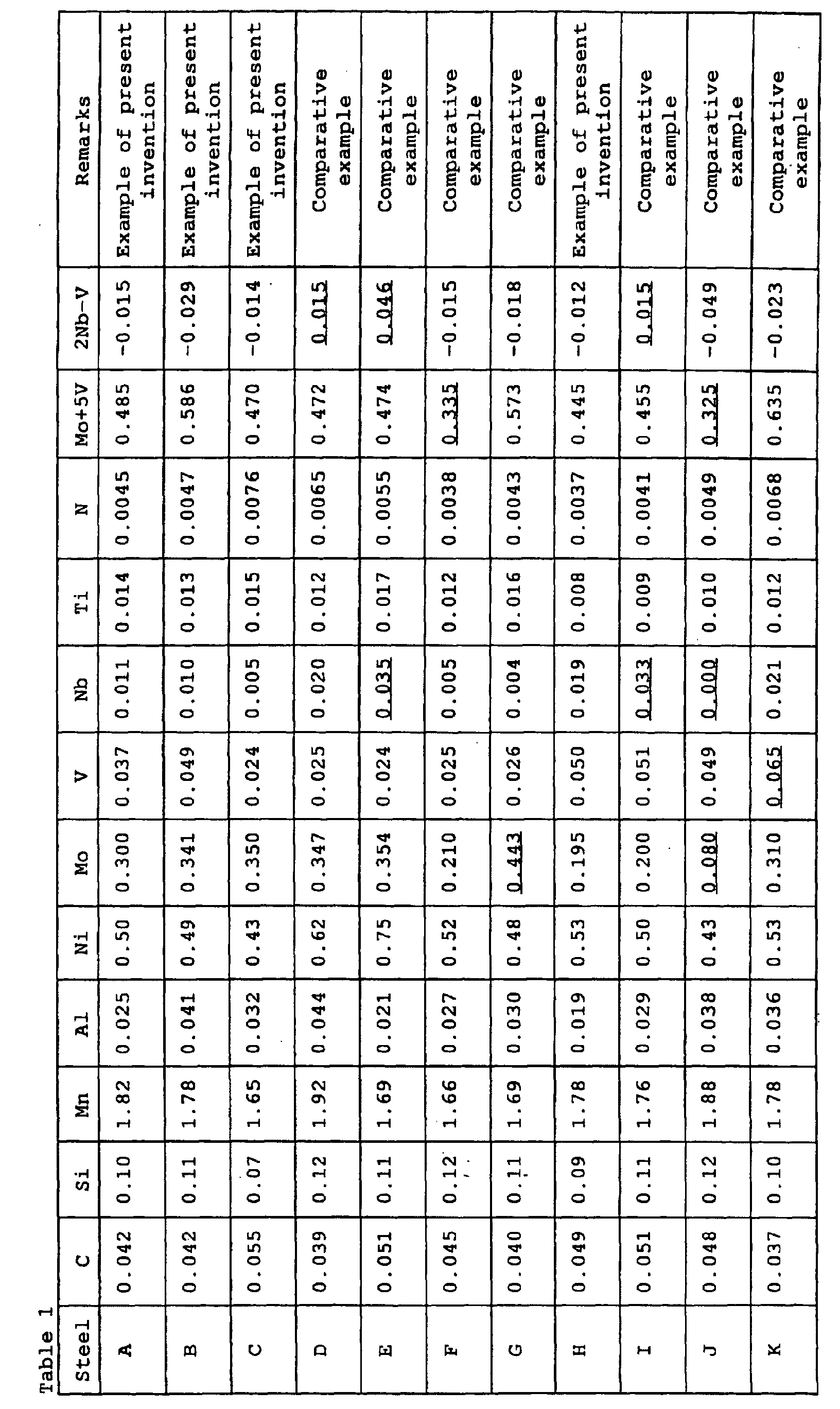
- Each of the steel having the composition shown in Table 1 was melted in a converter, vacuum degassing treatment was performed, and the molten steel was solidified by a continuous casing method to produce a cast slab.
- the cast slab thus obtained was subjected to billet rolling to produce a material for a steel pipe.
- the material for the steel pipe was formed into a seamless steel pipe with an outer diameter of 219 mm and a wall thickness of 11.1 mm using pipe-making equipment of Mannesman-plug mill type.
- the steel pipe was heat-treated under the conditions shown in Table 2, and hardness after quenching (in the wall thickness central part of a C cross section), tensile characteristics after tempering (according to API5L standard, strength: YS, TS, elongation: El), and vTrs (50% fracture appearance transition temperature) in a Charpy impact test (in which a test piece with 10 ⁇ 10 ⁇ 55 mm taken from the wall thickness central part in the L direction of the steel pipe was notched in the center in the longitudinal direction with a depth of 2 mm) were investigated.
- the dependence of strength on tempering temperature is greater than that in Comparative examples.
- the tempering temperature was increased from 600°C to 650°C
- the decrease in YS in Steel C and Steel H in Examples of the present invention were 44 MPa and 60 MPa, respectively.
- the decreases in YS in Steel D, Steel E, and Steel I in comparative Examples were 16 MPa, 21 MPa, and 17 MPa, respectively, which were less than half of those in Examples of the present invention. That is, in Examples of the present invention, the resistance to temper softening is more optimized in comparison with Comparative Examples. Therefore, even if hardenability was changed in accordance with the size of the steel pipe, it is possible to easily obtain desired strength by changing the tempering temperature.
- a difference in yield strength or tensile strength between after tempering at 600°C and after tempering at 650°C is 40 MPa or more.
- a high-strength, high-toughness seamless steel pipe used for a line pipe of the present invention has grade X80 strength and stable toughness, in which the target strength can be easily attained regardless of the size. Thereby, excellent effects are exhibited in that the compositions of steel pipes of plural sizes can be integrated, resulting in a reduction in costs.
Landscapes
- Chemical & Material Sciences (AREA)
- Engineering & Computer Science (AREA)
- Mechanical Engineering (AREA)
- Materials Engineering (AREA)
- Metallurgy (AREA)
- Organic Chemistry (AREA)
- General Engineering & Computer Science (AREA)
- Manufacturing & Machinery (AREA)
- Thermal Sciences (AREA)
- Crystallography & Structural Chemistry (AREA)
- Physics & Mathematics (AREA)
- Heat Treatment Of Articles (AREA)
- Heat Treatment Of Steel (AREA)
- Metal Extraction Processes (AREA)
Abstract
Description
C: 0.03 to 0.06%
Si: 0.05 to 0.15%
Mn: 1.6 to 2.0%
Al: 0.010 to 0.10%
Ni: 0.3 to 0.7%
Mo: 0.10 to 0.40%
V: 0.01 to 0.06%
Nb: 0.003 to 0.03%
Ti: 0.003 to 0.020%
N: 0.0010 to 0.0100%
Mo + 5V ≥ 0.4%

Claims (7)
- A high-strength, high-toughness seamless steel pipe used for a line pipe comprising 0.03 to 0.06% of C, 0.05 to 0.15% of Si, 1.6 to 2.0% of Mn, 0.010 to 0.10% of Al, 0.3 to 0.7% of Ni, 0.10 to 0.40% of Mo, 0.01 to 0.06% of V, 0.003 to 0.03% of Nb, 0.003 to 0.020% of Ti, and 0.0010 to 0.0100% of N, the relationships Mo + 5V ≥ 0.4% and 2Nb - V ≤ 0% being satisfied, and the balance being Fe and incidental impurities.
- A high-strength, high-toughness seamless steel pipe used for a line pipe according to Claim 1, wherein, when a material for the steel pipe is hot rolled, quenched, and tempered, the difference in yield strength or tensile strength between after tempering at 600°C and after tempering at 650°C is 40 MPa or more.
- A high-strength, high-toughness seamless steel pipe used for a line pipe according to Claim 1, wherein the yield strength, the tensile strength, and the 50% fracture appearance transition temperature in a Charpy impact test after a material for the steel pipe is hot rolled, quenched, and tempered, have the following characteristic values:YS (yield strength) ≥ 551 MPaTS (tensile strength): 620 to 827 MPavTrs (base metal) ≤ -60°CvTrs (welded joint HAZ: 1 mm from junction) ≤ -40°C.
- A method for producing a high-strength, high-toughness seamless steel pipe used for a line pipe, a material for the steel pipe being a steel comprising 0.03 to 0.06% of C, 0.05 to 0.15% of Si, 1.6 to 2.0% of Mn, 0.010 to 0.10% of Al, 0.3 to 0.7% of Ni, 0.10 to 0.40% of Mo, 0.01 to 0.06% of V, 0.003 to 0.03% of Nb, 0.003 to 0.020% of Ti, and 0.0010 to 0.0100% of N, the relationships Mo + 5V ≥ 0.4% and 2Nb - V ≤ 0% being satisfied, and the balance being Fe and incidental impurities, the method comprising the steps of:heating the material for the steel pipe to the Ac3 point or higher;making a pipe by hot rolling;performing direct quenching (DQ) of the pipe for cooling the pipe to the Ms point or lower immediately after the pipe-making step; andtempering the pipe at a temperature lower than the Ac1 point.
- A method for producing a high-strength, high-toughness seamless steel pipe used for a line pipe, a material for the steel pipe being a steel comprising 0.03 to 0.06% of C, 0.05 to 0.15% of Si, 1.6 to 2.0% of Mn, 0.010 to 0.10% of Al, 0.3 to 0.7% of Ni, 0.10 to 0.40% of Mo, 0.01 to 0.06% of V, 0.003 to 0.03% of Nb, 0.003 to 0.020% of Ti, and 0.0010 to 0.0100% of N, the relationships Mo + 5V ≥ 0.4% and 2Nb - V ≤ 0% being satisfied, and the balance being Fe and incidental impurities, the method comprising the steps of:heating the material for the steel pipe to the Ac3 point or higher;making a pipe by hot rolling;air-cooling the pipe to the vicinity of room temperature;performing reheating quenching (RQ) of the pipe for reheating the pipe to the Ac3 point or higher and cooling the pipe to the Ms point or lower; andtempering the pipe at a temperature range lower than the Ac1 point.
- A method for producing a high-strength, high-toughness seamless steel pipe used for a line pipe according to either Claim 4 or 5, wherein, by performing hot rolling using the material for the steel pipe having the characteristics in that, when hot rolling is performed, followed by quenching and tempering, the difference in yield strength or tensile strength between after tempering at 600°C and after tempering at 650°C is 40 MPa or more, and after quenching is performed, by changing the tempering temperature, the seamless steel pipe having desired yield strength, tensile strength, and toughness is obtained.
- A method for producing a high-strength, high-toughness seamless steel pipe used for a line pipe according to any one of Claims 4 to 6, wherein the yield strength, the tensile strength, and the 50% fracture appearance transition temperature in a Charpy impact test obtained by said method are as follows:YS (yield strength) ≥ 551 MPaTS (tensile strength): 620 to 827 MPavTrs (base metal) ≤ -60°CvTrs (welded joint HAZ: 1 mm from junction) ≤ -40°C.
Applications Claiming Priority (3)
| Application Number | Priority Date | Filing Date | Title |
|---|---|---|---|
| JP2000025158 | 2000-02-02 | ||
| JP2000025158 | 2000-02-02 | ||
| PCT/JP2001/000505 WO2001057286A1 (en) | 2000-02-02 | 2001-01-26 | High strength, high toughness, seamless steel pipe for line pipe |
Publications (3)
| Publication Number | Publication Date |
|---|---|
| EP1182268A1 true EP1182268A1 (en) | 2002-02-27 |
| EP1182268A4 EP1182268A4 (en) | 2002-11-20 |
| EP1182268B1 EP1182268B1 (en) | 2004-09-29 |
Family
ID=18551053
Family Applications (1)
| Application Number | Title | Priority Date | Filing Date |
|---|---|---|---|
| EP01902659A Expired - Lifetime EP1182268B1 (en) | 2000-02-02 | 2001-01-26 | High strength, high toughness, seamless steel pipe for line pipe |
Country Status (6)
| Country | Link |
|---|---|
| US (1) | US6540848B2 (en) |
| EP (1) | EP1182268B1 (en) |
| JP (1) | JP4013549B2 (en) |
| DE (1) | DE60105929T2 (en) |
| NO (1) | NO334883B1 (en) |
| WO (1) | WO2001057286A1 (en) |
Cited By (9)
| Publication number | Priority date | Publication date | Assignee | Title |
|---|---|---|---|---|
| WO2006011618A1 (en) * | 2004-07-28 | 2006-02-02 | Nippon Steel Corporation | Shaped steel excellent in fire resistance and producing method therefor |
| US9644248B2 (en) | 2013-04-08 | 2017-05-09 | Dalmine S.P.A. | Heavy wall quenched and tempered seamless steel pipes and related method for manufacturing said steel pipes |
| US9657365B2 (en) | 2013-04-08 | 2017-05-23 | Dalmine S.P.A. | High strength medium wall quenched and tempered seamless steel pipes and related method for manufacturing said steel pipes |
| EP1627931B1 (en) * | 2003-04-25 | 2017-05-31 | Tubos De Acero De Mexico, S.A. | Seamless steel tube which is intended to be used as a guide pipe and production method thereof |
| US9803256B2 (en) | 2013-03-14 | 2017-10-31 | Tenaris Coiled Tubes, Llc | High performance material for coiled tubing applications and the method of producing the same |
| US11105501B2 (en) | 2013-06-25 | 2021-08-31 | Tenaris Connections B.V. | High-chromium heat-resistant steel |
| US11124852B2 (en) | 2016-08-12 | 2021-09-21 | Tenaris Coiled Tubes, Llc | Method and system for manufacturing coiled tubing |
| US11952648B2 (en) | 2011-01-25 | 2024-04-09 | Tenaris Coiled Tubes, Llc | Method of forming and heat treating coiled tubing |
| US12129533B2 (en) | 2015-04-14 | 2024-10-29 | Tenaris Connections B.V. | Ultra-fine grained steels having corrosion- fatigue resistance |
Families Citing this family (12)
| Publication number | Priority date | Publication date | Assignee | Title |
|---|---|---|---|---|
| AR027650A1 (en) * | 2001-03-13 | 2003-04-09 | Siderca Sa Ind & Com | LOW-ALLOY CARBON STEEL FOR THE MANUFACTURE OF PIPES FOR EXPLORATION AND PRODUCTION OF PETROLEUM AND / OR NATURAL GAS, WITH IMPROVED LACORROSION RESISTANCE, PROCEDURE FOR MANUFACTURING SEAMLESS PIPES AND SEWLESS TUBES OBTAINED |
| WO2004003241A1 (en) * | 2002-06-26 | 2004-01-08 | Jfe Steel Corporation | Method for producing seamless steel pipe for inflator of air bag |
| US20050115649A1 (en) * | 2003-03-27 | 2005-06-02 | Tokarz Christopher A. | Thermomechanical processing routes in compact strip production of high-strength low-alloy steel |
| JP4706183B2 (en) * | 2004-05-07 | 2011-06-22 | 住友金属工業株式会社 | Seamless steel pipe and manufacturing method thereof |
| JP5119574B2 (en) * | 2005-04-26 | 2013-01-16 | Jfeスチール株式会社 | Heat treatment method for seamless steel pipe made of Ti-added low carbon steel |
| JP4945946B2 (en) * | 2005-07-26 | 2012-06-06 | 住友金属工業株式会社 | Seamless steel pipe and manufacturing method thereof |
| MXPA05008339A (en) * | 2005-08-04 | 2007-02-05 | Tenaris Connections Ag | HIGH RESISTANCE STEEL FOR SOLDABLE AND SEAMLESS STEEL PIPES. |
| JP5442456B2 (en) | 2007-02-27 | 2014-03-12 | エクソンモービル アップストリーム リサーチ カンパニー | Corrosion-resistant alloy welds in carbon steel structures and pipelines adapted to large axial plastic strain |
| US20100136369A1 (en) * | 2008-11-18 | 2010-06-03 | Raghavan Ayer | High strength and toughness steel structures by friction stir welding |
| WO2015174424A1 (en) | 2014-05-16 | 2015-11-19 | 新日鐵住金株式会社 | Seamless steel pipe for line pipe, and method for producing same |
| US10434554B2 (en) | 2017-01-17 | 2019-10-08 | Forum Us, Inc. | Method of manufacturing a coiled tubing string |
| CN110306120B (en) * | 2018-03-20 | 2020-08-11 | 中国石油天然气集团有限公司 | X80 steel grade D1422mm seamless bent pipe and manufacturing method thereof |
Family Cites Families (13)
| Publication number | Priority date | Publication date | Assignee | Title |
|---|---|---|---|---|
| JPS5458615A (en) * | 1977-10-18 | 1979-05-11 | Kobe Steel Ltd | Niobium-containing line pipe steel with superior weldability |
| JPH07122098B2 (en) * | 1989-08-18 | 1995-12-25 | 川崎製鉄株式会社 | Manufacturing method of high strength ERW steel pipe excellent in low temperature toughness |
| JPH06184636A (en) * | 1992-12-18 | 1994-07-05 | Nippon Steel Corp | Production of high strength and high toughness seamless steel pipe excellent in weldability |
| JP3249210B2 (en) * | 1992-12-22 | 2002-01-21 | 新日本製鐵株式会社 | Method for producing low hardness and high toughness seamless steel pipe with excellent SSC resistance |
| JP3046183B2 (en) * | 1993-07-09 | 2000-05-29 | 新日本製鐵株式会社 | Manufacturing method of low hardness and high toughness seamless steel pipe with excellent SSC resistance |
| JP3059993B2 (en) * | 1993-07-21 | 2000-07-04 | 新日本製鐵株式会社 | Manufacturing method of low alloy seamless steel pipe with fine grain structure |
| EP0828007B1 (en) * | 1995-05-15 | 2001-11-14 | Sumitomo Metal Industries, Ltd. | Process for producing high-strength seamless steel pipe having excellent sulfide stress cracking resistance |
| JPH09111343A (en) | 1995-10-18 | 1997-04-28 | Nippon Steel Corp | High strength low yield ratio seamless steel pipe manufacturing method |
| JPH09235617A (en) * | 1996-02-29 | 1997-09-09 | Sumitomo Metal Ind Ltd | Manufacturing method of seamless steel pipe |
| JP3855300B2 (en) | 1996-04-19 | 2006-12-06 | 住友金属工業株式会社 | Manufacturing method and equipment for seamless steel pipe |
| CA2230396C (en) * | 1997-02-25 | 2001-11-20 | Sumitomo Metal Industries, Ltd. | High-toughness, high-tensile-strength steel and method of manufacturing the same |
| JPH10237583A (en) | 1997-02-27 | 1998-09-08 | Sumitomo Metal Ind Ltd | High tensile steel and method for producing the same |
| WO1999005334A1 (en) * | 1997-07-28 | 1999-02-04 | Exxonmobil Upstream Research Company | Ultra-high strength, weldable, essentially boron-free steels wit h superior toughness |
-
2001
- 2001-01-26 US US09/914,503 patent/US6540848B2/en not_active Expired - Lifetime
- 2001-01-26 JP JP2001555908A patent/JP4013549B2/en not_active Expired - Fee Related
- 2001-01-26 WO PCT/JP2001/000505 patent/WO2001057286A1/en not_active Ceased
- 2001-01-26 EP EP01902659A patent/EP1182268B1/en not_active Expired - Lifetime
- 2001-01-26 DE DE60105929T patent/DE60105929T2/en not_active Expired - Lifetime
- 2001-10-01 NO NO20014761A patent/NO334883B1/en not_active IP Right Cessation
Cited By (12)
| Publication number | Priority date | Publication date | Assignee | Title |
|---|---|---|---|---|
| EP1627931B1 (en) * | 2003-04-25 | 2017-05-31 | Tubos De Acero De Mexico, S.A. | Seamless steel tube which is intended to be used as a guide pipe and production method thereof |
| WO2006011618A1 (en) * | 2004-07-28 | 2006-02-02 | Nippon Steel Corporation | Shaped steel excellent in fire resistance and producing method therefor |
| US11952648B2 (en) | 2011-01-25 | 2024-04-09 | Tenaris Coiled Tubes, Llc | Method of forming and heat treating coiled tubing |
| US9803256B2 (en) | 2013-03-14 | 2017-10-31 | Tenaris Coiled Tubes, Llc | High performance material for coiled tubing applications and the method of producing the same |
| US10378074B2 (en) | 2013-03-14 | 2019-08-13 | Tenaris Coiled Tubes, Llc | High performance material for coiled tubing applications and the method of producing the same |
| US10378075B2 (en) | 2013-03-14 | 2019-08-13 | Tenaris Coiled Tubes, Llc | High performance material for coiled tubing applications and the method of producing the same |
| US11377704B2 (en) | 2013-03-14 | 2022-07-05 | Tenaris Coiled Tubes, Llc | High performance material for coiled tubing applications and the method of producing the same |
| US9644248B2 (en) | 2013-04-08 | 2017-05-09 | Dalmine S.P.A. | Heavy wall quenched and tempered seamless steel pipes and related method for manufacturing said steel pipes |
| US9657365B2 (en) | 2013-04-08 | 2017-05-23 | Dalmine S.P.A. | High strength medium wall quenched and tempered seamless steel pipes and related method for manufacturing said steel pipes |
| US11105501B2 (en) | 2013-06-25 | 2021-08-31 | Tenaris Connections B.V. | High-chromium heat-resistant steel |
| US12129533B2 (en) | 2015-04-14 | 2024-10-29 | Tenaris Connections B.V. | Ultra-fine grained steels having corrosion- fatigue resistance |
| US11124852B2 (en) | 2016-08-12 | 2021-09-21 | Tenaris Coiled Tubes, Llc | Method and system for manufacturing coiled tubing |
Also Published As
| Publication number | Publication date |
|---|---|
| EP1182268A4 (en) | 2002-11-20 |
| JP4013549B2 (en) | 2007-11-28 |
| WO2001057286A1 (en) | 2001-08-09 |
| DE60105929D1 (en) | 2004-11-04 |
| EP1182268B1 (en) | 2004-09-29 |
| NO334883B1 (en) | 2014-06-30 |
| US6540848B2 (en) | 2003-04-01 |
| NO20014761L (en) | 2001-10-01 |
| NO20014761D0 (en) | 2001-10-01 |
| DE60105929T2 (en) | 2005-02-03 |
| US20020170637A1 (en) | 2002-11-21 |
Similar Documents
| Publication | Publication Date | Title |
|---|---|---|
| EP1182268B1 (en) | High strength, high toughness, seamless steel pipe for line pipe | |
| JP4475440B1 (en) | Seamless steel pipe and manufacturing method thereof | |
| US8333851B2 (en) | Method for producing two-phase stainless steel pipe | |
| JP7411072B2 (en) | High-strength, extra-thick steel material with excellent low-temperature impact toughness and method for producing the same | |
| US12195817B2 (en) | Hot-rolled steel sheet and weld joint, and methods for producing same | |
| JP3969328B2 (en) | Non-tempered seamless steel pipe | |
| WO2013044640A1 (en) | Steel plate with low yield ratio high toughness and manufacturing method thereof | |
| WO2015088040A1 (en) | Steel sheet and method for manufacturing same | |
| CA2980012A1 (en) | X80 pipeline steel with good strain-aging performance, pipeline tube and method for producing same | |
| JP5445723B1 (en) | Ultra high strength steel plate for welding | |
| JP7016345B2 (en) | Microalloy steel and its steel production method | |
| JPWO2001057286A1 (en) | High-strength, high-toughness seamless steel pipe for line pipe and manufacturing method thereof | |
| CN115161553A (en) | Hot-rolled H-shaped steel with yield strength of 550MPa and-20 ℃ longitudinal and transverse low-temperature impact toughness and production method thereof | |
| CN100352962C (en) | Method for producing X80 pipeline steel having anti-HIC property and its hot-rolled plate | |
| CN107429346A (en) | Steel plate for structural pipe, manufacturing method of steel plate for structural pipe, and structural pipe | |
| JP5157030B2 (en) | Manufacturing method of high strength line pipe steel with excellent HIC resistance | |
| JPH08209287A (en) | High strength line pipe steel with low yield ratio and excellent low temperature toughness | |
| JPWO2019050010A1 (en) | Steel sheet and manufacturing method thereof | |
| JPH06184636A (en) | Production of high strength and high toughness seamless steel pipe excellent in weldability | |
| JP3491148B2 (en) | High strength and high toughness seamless steel pipe for line pipe | |
| Sage | Effect of rolling schedules on structure and properties of 0-45% vanadium weldable steel for X70 pipelines | |
| JP4264296B2 (en) | Low yield ratio 570 MPa class high strength steel with excellent weld toughness and slitting characteristics and method for producing the same | |
| JP2000104116A (en) | Manufacturing method of steel with excellent strength and toughness | |
| CN112795842A (en) | A kind of steel for submarine quick connection pipeline and production method thereof | |
| JPH06172855A (en) | Low Yield Ratio High Toughness Seamless Steel Pipe Manufacturing Method |
Legal Events
| Date | Code | Title | Description |
|---|---|---|---|
| PUAI | Public reference made under article 153(3) epc to a published international application that has entered the european phase |
Free format text: ORIGINAL CODE: 0009012 |
|
| 17P | Request for examination filed |
Effective date: 20010913 |
|
| AK | Designated contracting states |
Kind code of ref document: A1 Designated state(s): AT BE CH CY DE DK ES FI FR GB GR IE IT LI LU MC NL PT SE TR |
|
| A4 | Supplementary search report drawn up and despatched |
Effective date: 20021009 |
|
| AK | Designated contracting states |
Kind code of ref document: A4 Designated state(s): AT BE CH CY DE DK ES FI FR GB GR IE IT LI LU MC NL PT SE TR |
|
| RAP1 | Party data changed (applicant data changed or rights of an application transferred) |
Owner name: JFE STEEL CORPORATION |
|
| GRAP | Despatch of communication of intention to grant a patent |
Free format text: ORIGINAL CODE: EPIDOSNIGR1 |
|
| RBV | Designated contracting states (corrected) |
Designated state(s): DE FR GB IT NL |
|
| GRAS | Grant fee paid |
Free format text: ORIGINAL CODE: EPIDOSNIGR3 |
|
| GRAA | (expected) grant |
Free format text: ORIGINAL CODE: 0009210 |
|
| AK | Designated contracting states |
Kind code of ref document: B1 Designated state(s): DE FR GB IT NL |
|
| REG | Reference to a national code |
Ref country code: GB Ref legal event code: FG4D |
|
| REG | Reference to a national code |
Ref country code: IE Ref legal event code: FG4D |
|
| REF | Corresponds to: |
Ref document number: 60105929 Country of ref document: DE Date of ref document: 20041104 Kind code of ref document: P |
|
| PLBE | No opposition filed within time limit |
Free format text: ORIGINAL CODE: 0009261 |
|
| STAA | Information on the status of an ep patent application or granted ep patent |
Free format text: STATUS: NO OPPOSITION FILED WITHIN TIME LIMIT |
|
| ET | Fr: translation filed | ||
| 26N | No opposition filed |
Effective date: 20050630 |
|
| PGFP | Annual fee paid to national office [announced via postgrant information from national office to epo] |
Ref country code: GB Payment date: 20080123 Year of fee payment: 8 Ref country code: NL Payment date: 20080115 Year of fee payment: 8 |
|
| GBPC | Gb: european patent ceased through non-payment of renewal fee |
Effective date: 20090126 |
|
| NLV4 | Nl: lapsed or anulled due to non-payment of the annual fee |
Effective date: 20090801 |
|
| PG25 | Lapsed in a contracting state [announced via postgrant information from national office to epo] |
Ref country code: NL Free format text: LAPSE BECAUSE OF NON-PAYMENT OF DUE FEES Effective date: 20090801 Ref country code: GB Free format text: LAPSE BECAUSE OF NON-PAYMENT OF DUE FEES Effective date: 20090126 |
|
| REG | Reference to a national code |
Ref country code: FR Ref legal event code: PLFP Year of fee payment: 16 |
|
| REG | Reference to a national code |
Ref country code: FR Ref legal event code: PLFP Year of fee payment: 17 |
|
| REG | Reference to a national code |
Ref country code: FR Ref legal event code: PLFP Year of fee payment: 18 |
|
| PGFP | Annual fee paid to national office [announced via postgrant information from national office to epo] |
Ref country code: FR Payment date: 20191216 Year of fee payment: 20 |
|
| PGFP | Annual fee paid to national office [announced via postgrant information from national office to epo] |
Ref country code: DE Payment date: 20200114 Year of fee payment: 20 Ref country code: IT Payment date: 20200114 Year of fee payment: 20 |
|
| REG | Reference to a national code |
Ref country code: DE Ref legal event code: R071 Ref document number: 60105929 Country of ref document: DE |