EP1180327A2 - Packaged cooked meat and low pH sauce having extended refrigerated shelf life - Google Patents
Packaged cooked meat and low pH sauce having extended refrigerated shelf life Download PDFInfo
- Publication number
- EP1180327A2 EP1180327A2 EP01306964A EP01306964A EP1180327A2 EP 1180327 A2 EP1180327 A2 EP 1180327A2 EP 01306964 A EP01306964 A EP 01306964A EP 01306964 A EP01306964 A EP 01306964A EP 1180327 A2 EP1180327 A2 EP 1180327A2
- Authority
- EP
- European Patent Office
- Prior art keywords
- sauce
- meat
- refrigerated
- low
- tray
- Prior art date
- Legal status (The legal status is an assumption and is not a legal conclusion. Google has not performed a legal analysis and makes no representation as to the accuracy of the status listed.)
- Granted
Links
Images

Classifications
-
- B—PERFORMING OPERATIONS; TRANSPORTING
- B65—CONVEYING; PACKING; STORING; HANDLING THIN OR FILAMENTARY MATERIAL
- B65D—CONTAINERS FOR STORAGE OR TRANSPORT OF ARTICLES OR MATERIALS, e.g. BAGS, BARRELS, BOTTLES, BOXES, CANS, CARTONS, CRATES, DRUMS, JARS, TANKS, HOPPERS, FORWARDING CONTAINERS; ACCESSORIES, CLOSURES, OR FITTINGS THEREFOR; PACKAGING ELEMENTS; PACKAGES
- B65D77/00—Packages formed by enclosing articles or materials in preformed containers, e.g. boxes, cartons, sacks or bags
- B65D77/02—Wrapped articles enclosed in rigid or semi-rigid containers
-
- A—HUMAN NECESSITIES
- A23—FOODS OR FOODSTUFFS; TREATMENT THEREOF, NOT COVERED BY OTHER CLASSES
- A23B—PRESERVATION OF FOODS, FOODSTUFFS OR NON-ALCOHOLIC BEVERAGES; CHEMICAL RIPENING OF FRUIT OR VEGETABLES
- A23B4/00—Preservation of meat, sausages, fish or fish products
- A23B4/06—Freezing; Subsequent thawing; Cooling
- A23B4/066—Freezing; Subsequent thawing; Cooling the materials not being transported through or in the apparatus with or without shaping, e.g. in the form of powder, granules or flakes
- A23B4/068—Freezing; Subsequent thawing; Cooling the materials not being transported through or in the apparatus with or without shaping, e.g. in the form of powder, granules or flakes with packages or with shaping in the form of blocks or portions
-
- A—HUMAN NECESSITIES
- A23—FOODS OR FOODSTUFFS; TREATMENT THEREOF, NOT COVERED BY OTHER CLASSES
- A23L—FOODS, FOODSTUFFS OR NON-ALCOHOLIC BEVERAGES, NOT OTHERWISE PROVIDED FOR; PREPARATION OR TREATMENT THEREOF
- A23L13/00—Meat products; Meat meal; Preparation or treatment thereof
- A23L13/06—Meat products; Meat meal; Preparation or treatment thereof with gravy or sauce
-
- A—HUMAN NECESSITIES
- A23—FOODS OR FOODSTUFFS; TREATMENT THEREOF, NOT COVERED BY OTHER CLASSES
- A23L—FOODS, FOODSTUFFS OR NON-ALCOHOLIC BEVERAGES, NOT OTHERWISE PROVIDED FOR; PREPARATION OR TREATMENT THEREOF
- A23L13/00—Meat products; Meat meal; Preparation or treatment thereof
- A23L13/50—Poultry products, e.g. poultry sausages
- A23L13/55—Treatment of original pieces or parts
-
- A—HUMAN NECESSITIES
- A23—FOODS OR FOODSTUFFS; TREATMENT THEREOF, NOT COVERED BY OTHER CLASSES
- A23L—FOODS, FOODSTUFFS OR NON-ALCOHOLIC BEVERAGES, NOT OTHERWISE PROVIDED FOR; PREPARATION OR TREATMENT THEREOF
- A23L13/00—Meat products; Meat meal; Preparation or treatment thereof
- A23L13/70—Tenderised or flavoured meat pieces; Macerating or marinating solutions specially adapted therefor
- A23L13/72—Tenderised or flavoured meat pieces; Macerating or marinating solutions specially adapted therefor using additives, e.g. by injection of solutions
- A23L13/75—Tenderised or flavoured meat pieces; Macerating or marinating solutions specially adapted therefor using additives, e.g. by injection of solutions using macerating or marinating solutions, e.g. marinades containing spices, acids, condiments or flavouring agents
Definitions
- the invention generally relates to packaged precooked meat which is able to be stored under refrigerated conditions for extended time periods without developing a wet and soft texture, off-flavors, or undesired microbial growth. More particularly, the present invention relates to cooked meat cuts which are precooked and sealed into a pouch together with a low-pH sauce to provide a non-frozen packaged meat product having an extended refrigerated shelf life.
- Refrigerated, non-frozen meat products are widely distributed in refrigerated food cases. Often, such products are in the nature of butchershop products which are pre-cut or pre-portioned and typically packaged in a simple manner suitable for self-serve refrigerated meat cases. These types of refrigerated meat cases are generally recognized as a fine source of so-called fresh meat products. The refrigerated shelf life of meat products marketed in this manner is necessarily relatively short and can require special handling and maintenance.
- pre-cooked meat products within refrigerated, non-freezing marketing display cabinets are of the pre-cooked variety. It has been found that pre-cooked meat products can be especially problematic in terms of maintaining flavor without developing characteristic and often unacceptable off-flavors. Refrigerated, non-frozen meat products likewise can be problematic in terms of microbial growth control. This is the case for even cooked meat products. In fact, cooked meat products are especially problematic when it comes to avoiding the development of off-flavors when stored under non-freezing refrigeration, even when that storage is for a relatively short time, for as short as a few days or even only several hours. Characteristic warmed-over flavors develop which render precooked meat products undesirable, even after they are heated during meal preparation.
- Brotsky U.S. Patent No. 4,788,070 describes meat emulsions including common salt and other components, which are then shaped and cooked, with attention being paid to low interior acid levels for meat products of this general type.
- This patent indicates the importance of rapid treatment of the meat particles in the emulsion, which are to be of a size smaller than meat cubes of intact muscle.
- Tonner U.S. Patent No. 4,262,027 relates to ground meat with an acid source having a slow release characteristic which will acidify after heating is initiated.
- Bernatovicz U.S. Patent No. 3,985,904 relates to ground meat products having fillers. The use of citric acid in cooked ground meat products is discussed.
- Szczesniak U.S. Patent No. 4,075,357 relates to intermediate moisture meats having a preservation system including a common chloride salt with certain organic salts, while recognizing that it can be useful to lower the pH of meats from the near-neutral range of from 5.5 to 8.0 down to a pH of as low as 3.0 by the use of food grade acids.
- Anders U.S. Patent No. 4,888,191 recognized that Clostridium botulinum can be addressed in fish and poultry through the use of lactate salts, either alone or combined with agents such as sodium chloride or sodium nitrite. Included are turkey breasts injected with a brine solution, as well as the lactate salt.
- Ruzek U.S. Patent No. 5,780,085 describes treating fresh pork cuts with a treatment solution having a lactate buffer salt, a phosphate sequestrate, and a diacetate flavor enhancement agent.
- meat quality decline can involve three principal aspects. Microbial quality typically deteriorates under refrigeration, especially under conditions at which the cooked cut is neither frozen nor cured. Psychotropic bacteria can multiply during refrigerated storage and reduce acceptable shelf life of the meat.
- a third meat quality deterioration can occur when providing meat cuts which are flavored or which are otherwise treated with relatively low pH compositions. It has been found that precooked products within this general category can be faced with a problem of excess tenderness or a mealy feel and appearance, thereby providing a product which is not of a satisfactory texture characteristic of a freshly cooked meat cut. It is believed that this disagreeable characteristic is due to a reduction in the water holding capacity of the cooked meat. This water holding capacity reduction is believed to lead to water purge and resulting yield loss, as well as the mealy and soft, tending toward slimy feel and appearance of such packaged precooked meat cuts. It is generally believed that cooking with a low pH sauce or component moves the meat to near or at its isoelectric point. Meat pH reduction which occurs prior to cooking reduces water holding capacity of the meat, causes it to lose water and thus yield.
- the present invention is directed to a refrigerated packaged food product and process for preparing the food product.
- Meat cuts are processed and packaged with a selection from a variety of sauces and to provide precooked meat cuts in sauces in a form which has an extended shelf life of months for meat cuts which exhibit and maintain control of microbial growth and avoid mealy, wetter and softer texture characteristics, while maintaining good flavor attributes and retarding warmed over flavor development.
- Unfrozen meat cuts are treated with a marinade, followed by cooking and chilling. Thereafter, the cooked, uncured cuts are placed into a pouch, together with a low pH sauce, which pouch is then sealed and placed into a refrigerated, non-frozen environment.
- the product is marketed and sold.
- the pouch containing the food product is placed within a tray which is also sealed and part of the refrigerated package.
- Another aspect of the present invention is to provide improved precooked and uncured meat products, processes for preparing and using same, and kits incorporating same, which meat products retard microbial growth, off-flavor development, and mealy characteristics.
- Another aspect of this invention is to provide refrigerated, never frozen, precooked and uncured meat cuts in a form suitable for sale to consumers through retail markets by imparting microbial and flavor shelfstability for lengths of time suitable for retail markets and channels of trade and without causing water transfer out of the meat, which would result in mealy, wet texture and yield loss.
- Another aspect of the present invention is to combine formulation, processing and packaging features in preparing cooked meat products having a shelf life of at least 60 days, the formulation features including treatment with a marinade, and the processing including full cooking prior to the addition of an acidic sauce.
- Another aspect of this invention is to provide non-frozen whole muscle meat cuts or portions which, although unground, maintain long-term shelf stability and flavor maintenance and texture maintenance without subjecting same to freezing.
- a marinade formulation including a lactate, a phosphate, and a common salt treats an unfrozen meat cut prior to searing, cooking and chilling, done prior to the addition of any low pH sauce for contact with the meat.
- Originating meat cuts according to the invention are most advantageously from poultry sources, including chicken, turkey and other fowl.
- White meat cuts are especially advantageous meat cut sources. Examples include breast fillets, strips and portions, including pre-severed strips and chunks.
- the invention finds particularly useful application when the originating meat cuts have length or width dimensions of at least one inch (2.54 cm).
- the meat cuts can originate from never frozen sources.
- the sources will be whole muscle pieces or portions.
- the meat sources themselves will be of the fresh variety.
- the meat cuts are not cured, either before, during or after processing according to the invention.
- the invention is particularly unique in its ability to improve the shelf stability, flavor stability and texture maintenance of meat cuts which are not ground or comminuted sources. Whatever the ultimate origin of the meat cuts, they will begin the process as unfrozen cuts.
- these unfrozen meat cuts are treated with a marinade which has been found to be especially suitable when used in combination with the other major features of the process.
- the marinade treatment is carried out in accordance with acceptable food-processing procedures. These include tumbling and contacting the surfaces of the meat cuts with the marinade. The length of treating or contacting should be adequate such that the components of the marinade penetrate into and typically through the external surfaces of the meat cuts. An important objective of this treatment is to have the marinade components remain with the meat cuts during subsequent treatment, especially during the cooking operation.
- a preferred marinade formulation is comprised of one or more lactate salts, a diacetate salt, and a common inorganic salt. This is an aqueous composition, and typically the majority of the marinade is water. Another component which can be included is a phosphate salt or complex phosphate salt. While not an essential component, flavoring agents can be included, such as chicken flavor, as can be binding agents or sweetening agents, an example of other possible agents being dextrose.
- the lactate salts usually comprise either or both of sodium lactate and potassium lactate. Because many lactate products are available as a syrup, this form of lactate addition typically is practiced. A typical syrup will be a 60 percent solution of the lactate salt within water.
- the lactate will be present in the marinade at levels of between 0.01 weight percent and up to the legal limit for lactate in meat products, which is 4.8 weight percent. These percentages are based upon the total weight of the meat cuts and the marinade. When considered in terms of the marinade itself, the lactate can be present at a level of between about 0.06 weight percent and about 28.8 weight percent.
- the amount of lactate is between about 1.5 and about 3 weight percent, based upon the total weight of the meat and marinade. This is between about 9 and 18 weight percent, based upon the total weight of the marinade.
- Diacetate salt levels are between about 0.01 weight percent and up to the legal limit of a diacetate in meat products, namely 0.25 weight percent. These are based upon the weight of the total meat and marinade composition.
- the diacetate component When considered in terms of the marinade alone, the diacetate component is present at a level of between about 0.06 weight percent and about 1.5 weight percent.
- the preferred range for this component is between about 0.05 and about 0.2 weight percent, based upon the total weight of the meat and marinade. Based upon the total weight of the marinade itself, the preferred level is between about 0.3 and about 1.2 weight percent.
- Suitable inorganic salts are typically sodium chloride, potassium chloride and the like, generally identified herein as common inorganic salts.
- the common inorganic salt component is present at a level of between about 0.01 and about 3 weight percent, based upon the total weight of the meat and marinade. Based upon the weight of the marinade alone these levels are between about 0.06 and about 18 weight percent.
- the common organic salt component is present at between about 0.75 and about 1.5 weight percent, based upon the total weight of the meat and marinade. Based upon the weight of the marinade alone, the common inorganic salt component is present at between about 4.5 and about 9 weight percent.
- a typical marinade will have a water content of between about 8 and 20 weight percent, based upon the total weight of the meat and marinade. When considered in terms based on the weight of the marinade only, water is present at between about 50 and about 85 weight percent. It will be appreciated that some of the water content can be contributed by other components, most notably by the lactate syrup component. Preferred water ranges are between about 10 and about 15 weight percent, based upon the total weight of the meat and marinade. Based upon the weight of the marinade only, water ranges between about 55 and about 80 weight percent.
- the marinade compositions can include a phosphate salt, often a complex phosphate salt.
- this phosphate component is a compound such as sodium tripolyphosphate
- this component will be present at a level of between about 0.1 and about 2 weight percent. This is based upon the total weight of the meat and marinade. Based upon the weight of the marinade alone, this phosphate component would be present at levels of between about 0.6 and about 12 weight percent.
- the phosphate component will be at a level of between about 0.2 and about 1 weight percent, based upon the total weight of meat and marinade. Based upon the weight of the marinade alone, this component would be present at between about 1.2 and about 6 weight percent.
- a typical flavoring component or combination of flavoring components can be present at between about 0.5 and about 3 weight percent, based upon the total weight of the meat and marinade. When based upon the weight of the marinade alone, this will be between about 3 and about 18 weight percent.
- Other additives such as humectants, thickeners, sweetening agents and the like can be present.
- An example of an additional ingredient is dextrose. When present, levels are between about 0.1 and about 2 weight percent, based upon the weight of the meat and marinade, or between about 0.6 and about 12 weight percent based upon the weight of the marinade only.
- the marinade will be combined with the meat cuts at suitable levels so as to achieve the needed marinating function.
- the marinade will comprise between about 10 and about 25 weight percent, while the meat cuts will comprise between about 75 and about 90 weight percent of the total meat and marinade composition within the mixture added to the mixing container.
- caramel component or formulation Before cooking the marinated meat cuts, they can be treated with a caramel component or formulation.
- a commercially available formulation which is suitable in this regard is Maillose® , of Red Arrow Products Co., Inc. This formulation is an aqueous solution of caramel coloring produced according to food regulations. Usage levels can vary between about 0.3 and about 3 weight percent, based upon the weight of the marinated meat cuts. Typically, this component will be applied as a solution (such as for spraying) having a ratio of 2:1 of Maillose: water.
- the marinated meat cuts are cooked.
- the cooking includes an initial high-heat searing of the meat cuts. Cooking will proceed thereafter so as to achieve full cook characteristics as required by food processing regulations.
- the searing operation is done rapidly and at high temperature so as to provide a denatured protein skin barrier. This has been found to assist in reducing water transfer out of the meat.
- Full cooking is typically indicated when the internal temperature of the meat reaches 155°F or higher (68.3°C). Any industrial oven, such as one suitable for industrial flow-through cooking, can be used.
- the cooked meat cuts are subjected to chilling in accordance with procedures suitable for industrial handling of meat products.
- a spiral freezer will chill fully cooked chicken fillets down to about 27°F (-2.8°C) in about one half an hour. Cooling is accomplished in accordance with controlling governmental regulations. The chilling does not freeze the meat, although a so-called crusting can take place.
- the objective of the chilling step is not to freeze the meat cuts, but to rapidly chill in accordance with good meat handling practices.
- the precooked and thus chilled meat cuts are next to combined with a low pH sauce.
- the sauce provides a variety of flavors to the meat cuts, depending upon the particular product being prepared. These can be, for example, barbecue flavored, teriyaki flavored, garlic flavored, herb flavored, either alone or combined with other flavorings such as lemon or citrus, pepper, or the like.
- a principal feature of the sauce is that it has a low pH, meaning a pH of below about 4.5, typically of about 4.2 or below, preferably of about 4.0 or below. This is the pH of the sauce prior to its addition to the fully cooked meat cuts.
- This low pH characteristic is provided by including a food grade acid within the sauce. Often, this is achieved by having vinegar within the sauce.
- a typical vinegar includes acetic acid.
- An example of a vinegar which is instrumental in providing an adequately low pH to such sauces is 120 grain vinegar.
- Many suitable sauces will have a pH of 4.1 or below.
- Other suitable sauces will have a pH of 3.8 or below.
- a typical pH range for the sauce prior to its addition to the meat cuts is 2.5 to 4.2.
- a preferred range is 3 to 4.0.
- Another preferred range is 3 to 3.5 pH.
- a typical low pH sauce will include between about 40 weight percent and about 65 weight percent water, based upon the total weight of the sauce.
- Typical sauce water activities will be on the order of about 0.92 or lower.
- beneficial effects according to the invention will be achieved by low pH sauces having a low water activity.
- sauce water activity will be below 0.92.
- Some sauce water activities will be at about 0.9 or below.
- An advantageous common inorganic salt level is between about 2 and about 3 weight percent, based on the total weight of the sauce. It will be especially advantageous to have sauces with a combination of these pH values, water activities and salt levels.
- Various low pH sauces are available commercially. Examples include Kraft® Honey Hickory BBQ sauce, Bulls-Eye® teriyaki sauce, McCormick® Golden Dip teriyaki sauce, sauce formulations including flavoring from Firmenich® , Bulls-Eye® garlic herb grilling sauce, lemon pepper flavored sauces, as well as various other commercially available sauces or other sauces formulated to have the desired flavor, while exhibiting the requisite low pH.
- a typical sauce formulation will include water, vinegar, starch, vegetable oil, flavoring, sweetener, gums and other typical sauce formulation components.
- Adding the low pH sauce to the fully cooked product is an important feature of the process. Especially suitable in this regard is adding the low pH sauce to the cooked and chilled meat cuts shortly before hermetic packaging together of the cooked meat cuts and low pH sauce. It will be appreciated that the cooked meat pieces most often will have a pH considerably higher than that of the sauce with which they are combined. Such combined pH values will be on the order of about 5 to about 6.3 once a generally equilibrated condition is reached. To a limited extent, the low pH value required of the sauce will depend somewhat upon the condition of the meat cuts prior to the combining step. Examples of relevant meat condition factors are pH, microbial activity, temperature and the like. For most meat cuts, the sauce pH values of the sauces noted herein will be adequate. It is also preferred that the temperature of the sauce be on the order of that of the cooked and chilled meat cuts, typically at or below 40°F (4°C).
- the hermetic sealing together of the fully cooked meat cuts and the low pH sauce will be under so-called vacuum conditions.
- Packaging can be carried out on commercially available form, fill and seal equipment, or simply within suitable vacuum packaging commercial equipment. When equipment is used which incorporates a forming operation, usually both a forming film and a non-forming film will be used.
- a suitable forming film is a Curlon® forming film available from Curwood, a preferred example being Curlon 1251.
- a typically suitable non-forming film is Curlon 1915G.
- the hermetically sealed pouch has a peelable seal, such as one provided by an adhesive, by mating strips, and the like. Typical peel adhesive formulations also are available from Curwood.
- the thus vacuum packaged fully cooked meat cuts and low pH sauce are ready for entering commercial distribution channels.
- the invention permits the equipment of these distribution channels and the cases of the marketing and sales channels to be refrigerated and not frozen. This allows the provision of unfrozen meat cuts which are ready to use, with or without heating. Typically, however, the meat cuts will be heated, such as in a consumer microwave oven, prior to cooking, whether with the sauce or without.
- Another aspect of the packaging which can be used in connection with the fully cooked meat cuts and low pH sauce is to provide a protective tray within which the hermetically sealed pouch is placed.
- This protective tray physically protects the hermetically sealed pouch, both from unintentional damage and potentially intentional tampering.
- the tray which itself includes a sealing lid, also provides assistance in maintaining the refrigerated temperature in storage. There will be “dead air” or gas space, often merely air space, between the outside of the pouch and the interior surface of the tray. Once chilled, this gas provides an additional buffer or sink for maintaining a desired refrigerated, non-frozen temperature.
- the tray also can provide the function of a convenient cooking tray during microwave heating of the food product prior to consumption.
- the food product whether only the cooked meat cuts or the cuts within the low pH sauce, will be opened, and the contents poured in the tray, while its lid is peeled back, opened or removed.
- Refrigerated temperatures for the products are consistent with those provided in wholesale storage and transportation facilities and vehicles. They also will be in accordance with temperatures and air flow conditions of refrigerated retail storage cases. Generally speaking, these refrigerated conditions are such that the packaged products remain unfrozen.
- a typical refrigerated temperature is between about 32°F (0°C) and about 44°F (7°C), typically on the order of about 40°F (4.4°C).
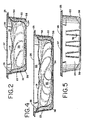
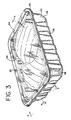
- FIG. 1 through FIG. 5 generally show at 21 a refrigerated packaged food product.
- a tray 22 having an internal volume defined by a sidewall 23 and a bottom wall 24.
- Sidewall 23 can include ridges 36 for added rigidity of the tray.
- Sidewall 23 includes an annular rim 25.
- Closure of the tray in this illustrated embodiment is accomplished by a lid 26.
- a typical lid is a polymeric lidding sheet which is flexible and releaseably sealed to the annular rim 25.
- a sleeve 27 provides added mechanical protection and barrier properties, for example reducing photo-oxidation. Sleeve 27 also provides a convenient means for packaging graphics. The tray and sleeve, as well as the sealed lid and the oxygen barrier pouch reduce oxygen penetration and exposure of the food.
- a pouch 31 Positioned within the volume of the tray and between the tray and the lid is a pouch 31 containing the food product. It will be noted that, even with the pouch within the tray sealed by the lid, free space 32 remains. This free space provides an opportunity for gas, typically, air, to provide a sink or buffer volume as generally discussed herein.
- gas typically, air
- Pouch 31 includes fully cooked meat cuts 33 and a low pH sauce 34.
- the pouch is vacuum sealed and securely closed by suitable conventional approaches. Sealing may be accomplished by an adhesive, especially a peelable adhesive, or by suitable mechanical arrangements. An interlocking seal strip arrangement 35 is suitable in this regard.
- the combined meat cuts and sauce remain hermetically sealed and refrigerated within the pouch until such time as heating and serving are desired.
- the seal 35 is broken, the pouch is opened, and the meat cuts and sauce are removed from the pouch. They can be placed within a suitable heating container. If desired, only the meat cuts can be heated for serving, when it is desired to not utilize the combination of sauce and meat. It has been found that the sauce flavor is delivered to the meat cuts in their mutual chilled environment, and the sauce flavor is evident in the meat cuts even after washed from the surfaces of the cooked meat cuts which had been refrigerated with the sauce.
- the tray 22 serves well as a heating container for heating within a microwave oven, for example.
- the desired content from the pouch is emptied into the tray.
- the lid 26 can be re-positioned onto the annular rim 25 for spattering protection and heat maintenance in accordance with typical microwave heating practice.
- annular rim 25 includes a depression 37 to facilitate venting when the lid is secured to the annular rim, including during re-heating.
- the tray When the tray is used as a container for heating the edible contents, it preferably includes ramped corners 38 to facilitate movement of the sauce away from the bottom corners of the tray and towards the center of the tray. These slanted corner ramps also increase corner strength.
- the tray component When the tray component is provided, it preferably is made of a high performance polymer which will withstand household microwave heating, as well as show resistance to damage during storage, transport, display and general handling.
- a suitable material is a blended copolymer and homopolymer of polypropylene. Polymers of this type are available from Curwood.
- Chicken breast fillets were treated with a marinade according to the invention and were seared on both sides. They were thereafter sprayed with a 2:1 Maillose:water solution. These fillets were placed in a combination oven which was set on heat plus steam at 400°F (204°C). The fillets reached an internal temperature of at least 160°F (71°C) and were then chilled. The cooked fillets were packaged in vacuum pouches with three different sauces. Several packages contained Kraft® honey hickory barbecue sauce (pH of 3.2). Several other pouches contained McCormick® golden dip teriyaki sauce (pH of 4.2). After six days storage under refrigerated, non-frozen conditions, the fillets were removed from the pouches.
- a marinade was prepared and combined with chicken breast fillets.
- the weight percents of the components were as follows, each percent being based upon the total weight of the chicken breast fillets and the marinade components: chicken breast fillets 83.33 percent; water 9.92 percent; chicken flavoring 1.25 percent; sodium lactate 2.45 percent; potassium lactate 1.00 percent; sodium chloride salt 1.10 percent; dextrose 0.51 percent; sodium tripolyphosphate 0.334 percent; and sodium diacetate 0.10 percent.
- chicken breast fillets 83.33 percent; water 9.92 percent; chicken flavoring 1.25 percent; sodium lactate 2.45 percent; potassium lactate 1.00 percent; sodium chloride salt 1.10 percent; dextrose 0.51 percent; sodium tripolyphosphate 0.334 percent; and sodium diacetate 0.10 percent.
- These were 4 ounce (113.4 g) fillets, and the marinated fillets were cooked and chilled. The chilled yield average was observed to be 77.1 weight percent.
- Fillets were marinated substantially in accordance with Example 2, cooked and chilled. These were combined with one of three different sauces, a Kraft® honey hickory barbecue sauce at a pH of 3.2, and a teriyaki sauce at a pH of 4.2. They were vacuum packaged in pouches and stored under refrigeration for three months. Other pouches were control products which were identical except no sauce was added prior to vacuum packaging. The control fillets showed an increase in microbial activity from 4 weeks through to 10 weeks of refrigerated, vacuum sealed storage. The increase was from one Log CFU/gm at 4 weeks, 2.5 Log CFU/gm at 8 weeks, and 3 Log CFU/gm at 10 weeks.
- the teriyaki sauce treated fillets were at about one Log CFU/gm at 4 weeks, and remained at that level, both at 8 weeks and 10 weeks.
- the low pH barbecue sauce treated fillets were at about 1 Log CFU/gm at 4 weeks, and were at about the same value at 8 weeks and at 10 weeks.
- the three low pH sauces had less then 10 col. after 10 to 13 weeks.
- a marinade formulation was prepared as follows: 70.07 weight percent water, 14.70 weight percent sodium lactate, 6 weight percent potassium lactate, 6.6 weight percent sodium chloride, 2 weight percent sodium tripolyphosphate, and 0.6 weight percent sodium diacetate, each being based upon the total weight of the marinade.
- This marinade was vacuum tumbled with chicken breast fillets at a weight ratio of 5:1 of fillets:marinade. These fillets were seared and cooked until the internal temperature was about 160°F (71°C). The fillets were cooled and packaged with a variety of low pH sauces.
- Uncooked chicken strips were treated with a marinade together with a teriyaki flavor, such being a low pH treatment prior to cooking. After cooking and chilling, the chicken cuts were observed to have a mealy, wetter and softer texture than before cooking. Removing the low pH teriyaki prior to cooking, and moving it to addition promptly after cooking and chilling avoided these negative developments. Chicken cuts having the low pH sauce added after cooking resulted in little, if any detrimental affects to the texture.
Landscapes
- Engineering & Computer Science (AREA)
- Life Sciences & Earth Sciences (AREA)
- Polymers & Plastics (AREA)
- Chemical & Material Sciences (AREA)
- Food Science & Technology (AREA)
- Nutrition Science (AREA)
- Health & Medical Sciences (AREA)
- Mechanical Engineering (AREA)
- Wood Science & Technology (AREA)
- Zoology (AREA)
- Meat, Egg Or Seafood Products (AREA)
- Seeds, Soups, And Other Foods (AREA)
- Packages (AREA)
Abstract
Description
Freezing generally preserves flavor attributes and texture during reasonably long frozen storage periods.
Claims (23)
- A process for preparing a non-frozen packaged meat product having an extended refrigerated shelf life, comprising:selecting an uncooked meat cut having an outer surface;treating the uncooked meat cut with a marinade containing an organic salt, a lactate salt and a diacetate salt;searing a substantial portion of said outer surface of the meat cut, and cooking the meat cut to provide a cooked meat cut having an internal temperature of at least 155°F (68°C);cooling said cooked meat product to below room temperature and without internally freezing the cooked meat product;placing the thus cooled cooked meat product into a pouch, and placing a low pH sauce into said pouch, said sauce having a pH of less than about 4.5;sealing the pouch with the cooked meat product and the low pH sauce therewithin to provide a sealed pouch containing the cooked meat and low pH sauce; andmarketing said sealed pouch having a cooked meat and low pH sauce in a refrigerated, non-frozen condition, said meat and sauce having an extended refrigerated life.
- A process according to claim 1, wherein said sauce has a pH of 4.2 or lower.
- A process according to claim 1 or claim 2, wherein said sauce has a pH of 4.0 or lower.
- A process according to any one of claims 1 to 3, wherein said sauce has a pH of 3.8 or lower.
- A process according to any one of claims 1 to 4, further including adding a caramel composition to said outer surface of the meat cut before completion of the cooking operation.
- A process according to any one of claims 1 to 5, wherein said treating with a marinade includes treating with a phosphate salt.
- A process according to any one of claims 1 to 6, wherein said extended refrigerated shelf life of said marketing is at least 60 days.
- A process according to any one of claims 1 to 7, wherein said extended refrigerated shelf life of said marketing is at least 90 days.
- A process according to any one of claims 1 to 8, wherein said uncooked meat cuts have a length no less than one inch (2.54 cm).
- A process according to any one of claims 1 to 9, wherein said meat cuts comprise poultry whole muscle.
- A process according to any one of claims 1 to 10, wherein said sauce has a water activity of about 0.92 or below.
- A process according to any one of claims 1 to 11, wherein said sauce has a water activity of about 0.9 or below.
- A process according to any one of claims 1 to 12, further including the steps of:providing a tray sized to accommodate said sealed pouch having the cooked meat and low pH sauce, and inserting said sealed pouch into said tray; andclosing said tray so as to seal said pouch therewithin to provide a packaged cooked meat and sauce product.
- A process according to claim 13, further including adding a sleeve over at least a portion of said packaged cooked meat and sauce product to provide a sleeved packaged food product as the packaged food product having an extended refrigerated shelf life.
- A process according to claim 13 or claim 14, wherein said tray has an internal volume which is sized in a manner to provide gas space between said sealed pouch and said tray.
- A refrigerated packaged food product (21), comprising:a tray (22) having a bottom wall (24), an annular rim (25) and a sidewall (23) joining together said bottom wall (24) and said annular rim (25), said tray (22) being made of a material suitable for heating food therewithin by a microwave oven;an indent (37) within said annular rim (25) of the tray (22);a lid (26) removably secured onto said annular rim (25) of the tray (22) and over said indent (37);a releasably sealed pouch (31) positioned within said tray (22) with said lid (26) secured onto said annular rim (25);a food product including cooked meat (33) and a sauce (34) having a low pH prior to its combination with the cooked meat, said food product being sealed within said pouch (31), said food product being at an unfrozen, refrigerated temperature;free space (32) between said sealed pouch (31) and said tray (22) sealed with the lid (25); anda sleeve portion (27) over said tray (22) which has the lid (25) sealed thereonto.
- A refrigerated packaged food product according to claim 16, wherein said low pH sauce (34) has a pH of not greater than about 4.5.
- A refrigerated packaged food product according to claim 16 or claim 17, wherein said low pH sauce (34) has a pH of not greater than about 4.2.
- A refrigerated packaged food product according to any one of claims 16 to 18, wherein said low pH sauce (34) has a pH of not greater than about 4.0.
- A refrigerated packaged food product according to any one of claims 16 to 19, wherein said cooked meat (33) comprises a meat cut having a length of at least about 1 inch (2.54 cm).
- A refrigerated packaged food product according to any one of claims 16 to 20, wherein said cooked meat (33) is a poultry whole muscle cut.
- A refrigerated packaged food product according to any one of claims 16 to 21, wherein said low pH sauce (34) has a water activity of about 0.92 or below.
- A refrigerated packaged food product according to any one of claims 16 to 22, wherein said low pH sauce (34) includes an inorganic salt at between about 2 and about 3 weight percent, based on the total weight of the low pH sauce.
Applications Claiming Priority (2)
| Application Number | Priority Date | Filing Date | Title |
|---|---|---|---|
| US09/639,530 US6579549B1 (en) | 2000-08-16 | 2000-08-16 | Packaged cooked meat and low pH sauce |
| US639530 | 2000-08-16 |
Publications (3)
| Publication Number | Publication Date |
|---|---|
| EP1180327A2 true EP1180327A2 (en) | 2002-02-20 |
| EP1180327A3 EP1180327A3 (en) | 2003-06-25 |
| EP1180327B1 EP1180327B1 (en) | 2005-06-08 |
Family
ID=24564481
Family Applications (1)
| Application Number | Title | Priority Date | Filing Date |
|---|---|---|---|
| EP01306964A Expired - Lifetime EP1180327B1 (en) | 2000-08-16 | 2001-08-16 | Packaged cooked meat and low pH sauce having extended refrigerated shelf life |
Country Status (6)
| Country | Link |
|---|---|
| US (2) | US6579549B1 (en) |
| EP (1) | EP1180327B1 (en) |
| AT (1) | ATE297123T1 (en) |
| CA (1) | CA2355415C (en) |
| DE (1) | DE60111313T2 (en) |
| ES (1) | ES2243407T3 (en) |
Cited By (8)
| Publication number | Priority date | Publication date | Assignee | Title |
|---|---|---|---|---|
| EP1449790A1 (en) * | 2003-02-20 | 2004-08-25 | Industrie Rolli Alimentari S.p.A. | A package for frozen food products and a packaging process |
| EP1565069A4 (en) * | 2002-11-18 | 2006-01-04 | Mars Inc | Canned pet food with sliced meat analogue |
| AU2003283052B2 (en) * | 2002-11-18 | 2007-03-08 | Mars Incorporated | Canned pet food with sliced meat analogue |
| EP1920660A2 (en) * | 2006-11-07 | 2008-05-14 | Azienda Agricola Scaglia di Paolo , Graziano e Mauro S.S. | Process for working pieces of meat |
| FR2936934A1 (en) * | 2008-10-15 | 2010-04-16 | Fleury Michon | Non-pasteurized, ready to heat, cooking dish comprises a container made of fibers with plastic coating, a cooked food product, with no preservatives added, housed in container, and a protective film disposed partially around the container |
| WO2011023576A1 (en) * | 2009-08-26 | 2011-03-03 | Chemische Fabrik Budenheim Kg | Foodstuff treatment composition |
| WO2021136860A1 (en) * | 2019-12-31 | 2021-07-08 | Roler España, S.L.U. | Packaging for food products |
| IT202300011139A1 (en) * | 2023-05-31 | 2024-12-01 | Lab Srl | PROCEDURE FOR PREPARING A COMBINED FOOD KIT |
Families Citing this family (25)
| Publication number | Priority date | Publication date | Assignee | Title |
|---|---|---|---|---|
| US6579549B1 (en) * | 2000-08-16 | 2003-06-17 | Kraft Foods Holdings, Inc. | Packaged cooked meat and low pH sauce |
| JP2005526670A (en) * | 2001-10-24 | 2005-09-08 | パクティブ コーポレイション | System and method for packaging meat products in a low oxygen concentration environment |
| WO2006121540A2 (en) * | 2005-04-05 | 2006-11-16 | Ocean Technology, Inc. | Process for packaging foods and packaged product |
| DE202006021115U1 (en) | 2005-04-28 | 2012-09-07 | Torus Pak Research And Development S.A R.L. | Food packaging |
| US20070160742A1 (en) * | 2006-01-09 | 2007-07-12 | Plum C T | Methods and materials for inhibiting the development of warmed-over flavor in meat |
| US20080063760A1 (en) * | 2006-09-13 | 2008-03-13 | Raymond Megan N | Packaging System for Storage and Microwave Heating of Food Products |
| US20080063759A1 (en) * | 2006-09-13 | 2008-03-13 | Raymond Megan N | Packaging Method for Storage and Microwave Heating of Food Products |
| US8354131B2 (en) | 2006-09-13 | 2013-01-15 | Kraft Foods Global Brands Llc | Microwavable food products |
| US8057832B2 (en) | 2006-09-13 | 2011-11-15 | Kraft Foods Global Brands Llc | Microwavable food products |
| US7851730B2 (en) * | 2006-10-02 | 2010-12-14 | Kraft Foods Global Brands Llc | Apparatus for microwave cooking of a food product |
| BRPI0801053A2 (en) * | 2008-02-11 | 2009-11-17 | Pascoal Sante Caruso | food production and preservation process valid for up to four years |
| CA2655426A1 (en) | 2009-02-18 | 2010-08-18 | Richard F. Ablett | Methods and apparatus for smoke-infusing proteinaceous foods and smoke-infused such proteinaceous food product so-obtained |
| US9974820B2 (en) | 2009-02-18 | 2018-05-22 | Crustocean Technologies Limited | Method and apparatus for smoke-infusing proteinaceous foods and smoked-infused such proteinaceous food product so-obtained |
| DE202009015231U1 (en) * | 2009-11-10 | 2011-03-24 | Müller, Wolfgang | Packaging for the storage, transport and heating of food |
| SE1050529A1 (en) * | 2010-05-27 | 2012-01-31 | Innovative Design Of Scandinavia Ab | Food packaging with extra food container |
| US8496112B2 (en) | 2011-08-12 | 2013-07-30 | Handi-Foil Corporation | Pan having secured thereto roasting materials |
| US8881905B2 (en) | 2011-08-12 | 2014-11-11 | Handi-Foil Corporation | Pan having secured thereto roasting materials |
| RU2503282C1 (en) * | 2012-08-17 | 2014-01-10 | Олег Иванович Квасенков | Method for manufacture of preserves "game with garnish and red main sauce" |
| RU2521421C1 (en) * | 2013-04-10 | 2014-06-27 | Олег Иванович Квасенков | Method for production of preserved product "chopped turkey cutlets with garnish and white sauce with vegetables" |
| ES2466541B1 (en) * | 2014-01-30 | 2015-03-18 | Grupo Empresarial Palacios Alimentación, S.A. | Procedure for preparing and packing roast chicken for later distribution |
| WO2016133909A1 (en) | 2015-02-16 | 2016-08-25 | Mars, Incorporated | Interlocking kibble |
| US20210235733A1 (en) | 2020-02-04 | 2021-08-05 | Memphis Meats, Inc. | Characteristics of meat products |
| WO2023240152A1 (en) | 2022-06-07 | 2023-12-14 | Upside Foods, Inc. | Engineering cell lines capable of proliferation in growth factor free media formulations |
| US12258203B1 (en) * | 2023-09-26 | 2025-03-25 | Tekni-Plex, Inc. | Combination semi-closed winged tray and sleeve for packaging and displaying food articles |
| KR102885518B1 (en) * | 2025-09-16 | 2025-11-12 | 최희정 | How to Make Easy Shrimp Dishes Using Stick Sauce |
Family Cites Families (35)
| Publication number | Priority date | Publication date | Assignee | Title |
|---|---|---|---|---|
| US2933399A (en) | 1956-04-05 | 1960-04-19 | Dirigo Sales Corp | Treatment of processed animal tissue |
| US3132029A (en) * | 1961-06-02 | 1964-05-05 | Beck Nicholas Robert | Method of providing a cooked meat and sauce package |
| GB1127487A (en) * | 1966-04-07 | 1968-09-18 | Monsanto Chemicals | Containers formed with gas passages |
| US3852486A (en) * | 1967-02-13 | 1974-12-03 | E Walker | Process of preserving shellfish meat, and product of said process |
| US3634104A (en) * | 1968-09-10 | 1972-01-11 | Gen Foods Corp | Microbial stabilization of combined foods and liquids |
| US3658551A (en) * | 1968-11-27 | 1972-04-25 | Beatrice Foods Co | Mink feed |
| US3694233A (en) * | 1970-07-29 | 1972-09-26 | Gen Foods Corp | Stabilization of combined foods and liquids |
| US3985904A (en) | 1974-03-25 | 1976-10-12 | The Quaker Oats Company | Shelf stable, high moisture, meat-containing food product |
| US4075357A (en) | 1976-03-31 | 1978-02-21 | General Foods Corporation | Intermediate moisture meats |
| GB1579926A (en) * | 1976-06-17 | 1980-11-26 | Mars Ltd | Preserved food product and process |
| US4191787A (en) * | 1978-07-24 | 1980-03-04 | Horace W. Longacre, Inc. | Process for preparing a pasteurized meat-containing salad |
| US4262027A (en) | 1979-04-23 | 1981-04-14 | Carnation Company | Method of processing meat |
| US5004624A (en) * | 1983-03-14 | 1991-04-02 | Star-Kist Foods, Inc. | Semi-moist pet food having free gravy and process for preparation thereof |
| US4597974A (en) * | 1984-09-20 | 1986-07-01 | Fleury Michon | Sauce and gravy compositions |
| US4612203A (en) * | 1984-10-31 | 1986-09-16 | The Procter & Gamble Company | Acidified meat analog products |
| US4888191A (en) | 1985-12-12 | 1989-12-19 | Oscar Mayer Foods Corporation | Method for delaying Clostridium botulinum growth in fish and poultry |
| US4788070A (en) | 1986-09-05 | 1988-11-29 | Stauffer Chemical Company Division Of Rhone-Poulenc, Inc. | Process for acidifying ground meats |
| US4780327A (en) * | 1986-10-02 | 1988-10-25 | Oscar Mayer Foods Corporation | Method of producing cooked meat product suitable for shreading |
| US5045332A (en) * | 1989-10-10 | 1991-09-03 | The Pillsbury Company | Methods and materials for inhibiting the development of warmed-over flavor in meat |
| US5219603A (en) | 1990-04-24 | 1993-06-15 | Quest International Flavors And Food Ingredients Company A Divison Of Indopco, Inc. | Composition for extending the shelf life of processed meats |
| GB9019035D0 (en) * | 1990-08-31 | 1990-10-17 | Mars Inc | Shelf-stable meat products and their preparation |
| DE69102432T2 (en) * | 1991-07-01 | 1994-09-29 | Frisco Findus Ag | Ready-to-eat frozen meat containing meat. |
| US5298270A (en) * | 1992-03-30 | 1994-03-29 | Doug Morgan | Barbecue cooking, processing, packaging and storage system |
| US6123973A (en) * | 1993-07-30 | 2000-09-26 | Tillin, Inc. | Methods of preparation and using antimicrobial products |
| US5863578A (en) * | 1996-04-25 | 1999-01-26 | Carnival Brand Seafood Company | Microwaveable vacuum packed seafood package and process |
| US6068864A (en) * | 1996-07-12 | 2000-05-30 | Kraft Foods, Inc. | Method of imparting resistance to moisture and texture degradation to a baked product |
| JPH1080262A (en) * | 1996-07-17 | 1998-03-31 | Kao Corp | Retort processing method of seafood and retort seafood |
| US5780085A (en) | 1996-10-04 | 1998-07-14 | Hormel Foods Corporation | Chemical treatment and packaging process to improve the appearance and shelf life of fresh pork |
| US5985342A (en) * | 1996-10-04 | 1999-11-16 | Hormel Foods Corporation | Chemical treatment and packaging system to improve the appearance and shelf life of fresh pork |
| US5989610A (en) * | 1996-10-04 | 1999-11-23 | Hormel Foods Corporation | Chemical treatment and packaging process to improve the appearance and shelf life of fresh meat |
| US5900263A (en) * | 1997-06-26 | 1999-05-04 | Gics & Vermee, L.P. | Food package having a rigid leg member for displaying the front panel thereof |
| US5985345A (en) * | 1997-12-12 | 1999-11-16 | Kalamazoo Holdings, Inc. | High temperature extraction of spices and herbs |
| CA2281102A1 (en) * | 1998-08-31 | 2000-02-29 | Kraft Foods, Inc. | Stabilization of cooked meat compositions using whey from nisin-producing cultures |
| US6261616B1 (en) * | 1999-08-05 | 2001-07-17 | Bordon Foods Corporation | Microwavable meal kit and food packaging system |
| US6579549B1 (en) * | 2000-08-16 | 2003-06-17 | Kraft Foods Holdings, Inc. | Packaged cooked meat and low pH sauce |
-
2000
- 2000-08-16 US US09/639,530 patent/US6579549B1/en not_active Expired - Fee Related
-
2001
- 2001-08-15 CA CA002355415A patent/CA2355415C/en not_active Expired - Fee Related
- 2001-08-16 EP EP01306964A patent/EP1180327B1/en not_active Expired - Lifetime
- 2001-08-16 ES ES01306964T patent/ES2243407T3/en not_active Expired - Lifetime
- 2001-08-16 DE DE60111313T patent/DE60111313T2/en not_active Expired - Fee Related
- 2001-08-16 AT AT01306964T patent/ATE297123T1/en not_active IP Right Cessation
-
2003
- 2003-04-15 US US10/414,121 patent/US20030203079A1/en not_active Abandoned
Cited By (9)
| Publication number | Priority date | Publication date | Assignee | Title |
|---|---|---|---|---|
| EP1565069A4 (en) * | 2002-11-18 | 2006-01-04 | Mars Inc | Canned pet food with sliced meat analogue |
| AU2003283052B2 (en) * | 2002-11-18 | 2007-03-08 | Mars Incorporated | Canned pet food with sliced meat analogue |
| EP1449790A1 (en) * | 2003-02-20 | 2004-08-25 | Industrie Rolli Alimentari S.p.A. | A package for frozen food products and a packaging process |
| EP1920660A2 (en) * | 2006-11-07 | 2008-05-14 | Azienda Agricola Scaglia di Paolo , Graziano e Mauro S.S. | Process for working pieces of meat |
| FR2936934A1 (en) * | 2008-10-15 | 2010-04-16 | Fleury Michon | Non-pasteurized, ready to heat, cooking dish comprises a container made of fibers with plastic coating, a cooked food product, with no preservatives added, housed in container, and a protective film disposed partially around the container |
| WO2011023576A1 (en) * | 2009-08-26 | 2011-03-03 | Chemische Fabrik Budenheim Kg | Foodstuff treatment composition |
| EP2298089A1 (en) * | 2009-08-26 | 2011-03-23 | Chemische Fabrik Budenheim KG | Foodstuff treatment composition |
| WO2021136860A1 (en) * | 2019-12-31 | 2021-07-08 | Roler España, S.L.U. | Packaging for food products |
| IT202300011139A1 (en) * | 2023-05-31 | 2024-12-01 | Lab Srl | PROCEDURE FOR PREPARING A COMBINED FOOD KIT |
Also Published As
| Publication number | Publication date |
|---|---|
| US20030203079A1 (en) | 2003-10-30 |
| ES2243407T3 (en) | 2005-12-01 |
| EP1180327A3 (en) | 2003-06-25 |
| EP1180327B1 (en) | 2005-06-08 |
| DE60111313D1 (en) | 2005-07-14 |
| ATE297123T1 (en) | 2005-06-15 |
| US6579549B1 (en) | 2003-06-17 |
| CA2355415A1 (en) | 2002-02-16 |
| CA2355415C (en) | 2005-02-15 |
| DE60111313T2 (en) | 2006-03-23 |
Similar Documents
| Publication | Publication Date | Title |
|---|---|---|
| US6579549B1 (en) | Packaged cooked meat and low pH sauce | |
| US3607312A (en) | Method of preparing and preserving ready-to-eat foods | |
| Espinosa et al. | Quality characteristics of sous vide ready to eat seabream processed by high pressure | |
| US5415883A (en) | Method for preparing pre-cooked meat | |
| US4207347A (en) | Fat based preservative coating and method for preserving foods | |
| JP2022133269A (en) | Process for maintaining freshness of vegetable pieces | |
| Venugopal et al. | Traditional methods to process underutilized fish species for human consumption | |
| KR102003459B1 (en) | Method for Manufacture of processed food | |
| AU716328B2 (en) | Improved process for preparing a shellfish product and product obtained | |
| CN104664416A (en) | Rabbit meat product and preparation method thereof | |
| Brewer et al. | Effect of packaging on physical and sensory characteristics of ground pork in long‐term frozen storage | |
| US11064708B2 (en) | Process to produce safe pasteurized shrimp and other shellfish of high sensory quality and extended refrigerated shelf-life | |
| US5268189A (en) | Process for extending the shelf-life of shellfish products | |
| US5298270A (en) | Barbecue cooking, processing, packaging and storage system | |
| EP1526091B1 (en) | Method for packaging crabmeat | |
| US5045332A (en) | Methods and materials for inhibiting the development of warmed-over flavor in meat | |
| EP0549642A1 (en) | Shelf-stable proteinaceous products and processes for their production | |
| US5503867A (en) | Comminuted meat product containing ground cherries | |
| US4961945A (en) | Food preservative | |
| Banwart | Control of microorganisms by retarding growth | |
| Bechtel | Snack foods of animal origin | |
| CA2279054A1 (en) | Precooked meat for long-term refrigerated storage | |
| Raksakulthai et al. | Production and storage of Chinese style fish sausage from hybrid Clarias catfish | |
| KR20250059857A (en) | Processed foods comprising chicken breast | |
| KR20250059884A (en) | Processed foods comprising chicken breast |
Legal Events
| Date | Code | Title | Description |
|---|---|---|---|
| PUAI | Public reference made under article 153(3) epc to a published international application that has entered the european phase |
Free format text: ORIGINAL CODE: 0009012 |
|
| 17P | Request for examination filed |
Effective date: 20010827 |
|
| AK | Designated contracting states |
Kind code of ref document: A2 Designated state(s): AT BE CH CY DE DK ES FI FR GB GR IE IT LI LU MC NL PT SE TR |
|
| AX | Request for extension of the european patent |
Free format text: AL;LT;LV;MK;RO;SI |
|
| PUAL | Search report despatched |
Free format text: ORIGINAL CODE: 0009013 |
|
| AK | Designated contracting states |
Designated state(s): AT BE CH CY DE DK ES FI FR GB GR IE IT LI LU MC NL PT SE TR |
|
| AX | Request for extension of the european patent |
Extension state: AL LT LV MK RO SI |
|
| RIC1 | Information provided on ipc code assigned before grant |
Ipc: 7A 23B 4/00 B Ipc: 7A 23L 1/31 B Ipc: 7A 23L 1/318 B Ipc: 7B 65D 77/02 B Ipc: 7A 23B 4/06 A Ipc: 7B 65D 77/00 B Ipc: 7B 65D 81/34 B |
|
| AKX | Designation fees paid |
Designated state(s): AT BE CH CY DE DK ES FI FR GB GR IE IT LI LU MC NL PT SE TR |
|
| 17Q | First examination report despatched |
Effective date: 20040310 |
|
| GRAP | Despatch of communication of intention to grant a patent |
Free format text: ORIGINAL CODE: EPIDOSNIGR1 |
|
| GRAS | Grant fee paid |
Free format text: ORIGINAL CODE: EPIDOSNIGR3 |
|
| GRAA | (expected) grant |
Free format text: ORIGINAL CODE: 0009210 |
|
| AK | Designated contracting states |
Kind code of ref document: B1 Designated state(s): AT BE CH CY DE DK ES FI FR GB GR IE IT LI LU MC NL PT SE TR |
|
| PG25 | Lapsed in a contracting state [announced via postgrant information from national office to epo] |
Ref country code: LI Free format text: LAPSE BECAUSE OF FAILURE TO SUBMIT A TRANSLATION OF THE DESCRIPTION OR TO PAY THE FEE WITHIN THE PRESCRIBED TIME-LIMIT Effective date: 20050608 Ref country code: CH Free format text: LAPSE BECAUSE OF FAILURE TO SUBMIT A TRANSLATION OF THE DESCRIPTION OR TO PAY THE FEE WITHIN THE PRESCRIBED TIME-LIMIT Effective date: 20050608 Ref country code: TR Free format text: LAPSE BECAUSE OF FAILURE TO SUBMIT A TRANSLATION OF THE DESCRIPTION OR TO PAY THE FEE WITHIN THE PRESCRIBED TIME-LIMIT Effective date: 20050608 Ref country code: AT Free format text: LAPSE BECAUSE OF FAILURE TO SUBMIT A TRANSLATION OF THE DESCRIPTION OR TO PAY THE FEE WITHIN THE PRESCRIBED TIME-LIMIT Effective date: 20050608 Ref country code: FI Free format text: LAPSE BECAUSE OF FAILURE TO SUBMIT A TRANSLATION OF THE DESCRIPTION OR TO PAY THE FEE WITHIN THE PRESCRIBED TIME-LIMIT Effective date: 20050608 Ref country code: NL Free format text: LAPSE BECAUSE OF FAILURE TO SUBMIT A TRANSLATION OF THE DESCRIPTION OR TO PAY THE FEE WITHIN THE PRESCRIBED TIME-LIMIT Effective date: 20050608 |
|
| REG | Reference to a national code |
Ref country code: GB Ref legal event code: FG4D |
|
| REG | Reference to a national code |
Ref country code: CH Ref legal event code: EP |
|
| REF | Corresponds to: |
Ref document number: 60111313 Country of ref document: DE Date of ref document: 20050714 Kind code of ref document: P |
|
| REG | Reference to a national code |
Ref country code: IE Ref legal event code: FG4D |
|
| PG25 | Lapsed in a contracting state [announced via postgrant information from national office to epo] |
Ref country code: IE Free format text: LAPSE BECAUSE OF NON-PAYMENT OF DUE FEES Effective date: 20050816 Ref country code: LU Free format text: LAPSE BECAUSE OF NON-PAYMENT OF DUE FEES Effective date: 20050816 Ref country code: CY Free format text: LAPSE BECAUSE OF FAILURE TO SUBMIT A TRANSLATION OF THE DESCRIPTION OR TO PAY THE FEE WITHIN THE PRESCRIBED TIME-LIMIT Effective date: 20050816 |
|
| PG25 | Lapsed in a contracting state [announced via postgrant information from national office to epo] |
Ref country code: MC Free format text: LAPSE BECAUSE OF NON-PAYMENT OF DUE FEES Effective date: 20050831 |
|
| PG25 | Lapsed in a contracting state [announced via postgrant information from national office to epo] |
Ref country code: DK Free format text: LAPSE BECAUSE OF FAILURE TO SUBMIT A TRANSLATION OF THE DESCRIPTION OR TO PAY THE FEE WITHIN THE PRESCRIBED TIME-LIMIT Effective date: 20050908 Ref country code: SE Free format text: LAPSE BECAUSE OF FAILURE TO SUBMIT A TRANSLATION OF THE DESCRIPTION OR TO PAY THE FEE WITHIN THE PRESCRIBED TIME-LIMIT Effective date: 20050908 Ref country code: GR Free format text: LAPSE BECAUSE OF FAILURE TO SUBMIT A TRANSLATION OF THE DESCRIPTION OR TO PAY THE FEE WITHIN THE PRESCRIBED TIME-LIMIT Effective date: 20050908 |
|
| PG25 | Lapsed in a contracting state [announced via postgrant information from national office to epo] |
Ref country code: PT Free format text: LAPSE BECAUSE OF FAILURE TO SUBMIT A TRANSLATION OF THE DESCRIPTION OR TO PAY THE FEE WITHIN THE PRESCRIBED TIME-LIMIT Effective date: 20051114 |
|
| NLV1 | Nl: lapsed or annulled due to failure to fulfill the requirements of art. 29p and 29m of the patents act | ||
| REG | Reference to a national code |
Ref country code: ES Ref legal event code: FG2A Ref document number: 2243407 Country of ref document: ES Kind code of ref document: T3 |
|
| REG | Reference to a national code |
Ref country code: CH Ref legal event code: PL |
|
| ET | Fr: translation filed | ||
| PLBE | No opposition filed within time limit |
Free format text: ORIGINAL CODE: 0009261 |
|
| STAA | Information on the status of an ep patent application or granted ep patent |
Free format text: STATUS: NO OPPOSITION FILED WITHIN TIME LIMIT |
|
| REG | Reference to a national code |
Ref country code: IE Ref legal event code: MM4A |
|
| 26N | No opposition filed |
Effective date: 20060309 |
|
| PGFP | Annual fee paid to national office [announced via postgrant information from national office to epo] |
Ref country code: FR Payment date: 20060831 Year of fee payment: 6 |
|
| PGFP | Annual fee paid to national office [announced via postgrant information from national office to epo] |
Ref country code: ES Payment date: 20070827 Year of fee payment: 7 |
|
| PGFP | Annual fee paid to national office [announced via postgrant information from national office to epo] |
Ref country code: GB Payment date: 20070830 Year of fee payment: 7 |
|
| PGFP | Annual fee paid to national office [announced via postgrant information from national office to epo] |
Ref country code: DE Payment date: 20071001 Year of fee payment: 7 Ref country code: IT Payment date: 20070828 Year of fee payment: 7 |
|
| PGFP | Annual fee paid to national office [announced via postgrant information from national office to epo] |
Ref country code: BE Payment date: 20071003 Year of fee payment: 7 |
|
| REG | Reference to a national code |
Ref country code: FR Ref legal event code: ST Effective date: 20080430 |
|
| PG25 | Lapsed in a contracting state [announced via postgrant information from national office to epo] |
Ref country code: FR Free format text: LAPSE BECAUSE OF NON-PAYMENT OF DUE FEES Effective date: 20070831 |
|
| GBPC | Gb: european patent ceased through non-payment of renewal fee |
Effective date: 20080816 |
|
| PG25 | Lapsed in a contracting state [announced via postgrant information from national office to epo] |
Ref country code: BE Free format text: LAPSE BECAUSE OF NON-PAYMENT OF DUE FEES Effective date: 20080831 |
|
| PG25 | Lapsed in a contracting state [announced via postgrant information from national office to epo] |
Ref country code: DE Free format text: LAPSE BECAUSE OF NON-PAYMENT OF DUE FEES Effective date: 20090303 Ref country code: IT Free format text: LAPSE BECAUSE OF NON-PAYMENT OF DUE FEES Effective date: 20080816 |
|
| REG | Reference to a national code |
Ref country code: ES Ref legal event code: FD2A Effective date: 20080818 |
|
| PG25 | Lapsed in a contracting state [announced via postgrant information from national office to epo] |
Ref country code: GB Free format text: LAPSE BECAUSE OF NON-PAYMENT OF DUE FEES Effective date: 20080816 |
|
| PG25 | Lapsed in a contracting state [announced via postgrant information from national office to epo] |
Ref country code: ES Free format text: LAPSE BECAUSE OF NON-PAYMENT OF DUE FEES Effective date: 20080818 |