EP1178062A1 - Method and apparatus for producing polyester polyol and polyurethane foam therefrom - Google Patents
Method and apparatus for producing polyester polyol and polyurethane foam therefrom Download PDFInfo
- Publication number
- EP1178062A1 EP1178062A1 EP01118206A EP01118206A EP1178062A1 EP 1178062 A1 EP1178062 A1 EP 1178062A1 EP 01118206 A EP01118206 A EP 01118206A EP 01118206 A EP01118206 A EP 01118206A EP 1178062 A1 EP1178062 A1 EP 1178062A1
- Authority
- EP
- European Patent Office
- Prior art keywords
- polyol
- polyester polyol
- ethylene glycol
- reaction
- raw
- Prior art date
- Legal status (The legal status is an assumption and is not a legal conclusion. Google has not performed a legal analysis and makes no representation as to the accuracy of the status listed.)
- Granted
Links
Images

Classifications
-
- C—CHEMISTRY; METALLURGY
- C08—ORGANIC MACROMOLECULAR COMPOUNDS; THEIR PREPARATION OR CHEMICAL WORKING-UP; COMPOSITIONS BASED THEREON
- C08G—MACROMOLECULAR COMPOUNDS OBTAINED OTHERWISE THAN BY REACTIONS ONLY INVOLVING UNSATURATED CARBON-TO-CARBON BONDS
- C08G18/00—Polymeric products of isocyanates or isothiocyanates
- C08G18/06—Polymeric products of isocyanates or isothiocyanates with compounds having active hydrogen
- C08G18/28—Polymeric products of isocyanates or isothiocyanates with compounds having active hydrogen characterised by the compounds used containing active hydrogen
- C08G18/40—High-molecular-weight compounds
- C08G18/42—Polycondensates having carboxylic or carbonic ester groups in the main chain
- C08G18/4244—Polycondensates having carboxylic or carbonic ester groups in the main chain containing oxygen in the form of ether groups
- C08G18/4247—Polycondensates having carboxylic or carbonic ester groups in the main chain containing oxygen in the form of ether groups derived from polyols containing at least one ether group and polycarboxylic acids
- C08G18/4252—Polycondensates having carboxylic or carbonic ester groups in the main chain containing oxygen in the form of ether groups derived from polyols containing at least one ether group and polycarboxylic acids derived from polyols containing polyether groups and polycarboxylic acids
-
- C—CHEMISTRY; METALLURGY
- C08—ORGANIC MACROMOLECULAR COMPOUNDS; THEIR PREPARATION OR CHEMICAL WORKING-UP; COMPOSITIONS BASED THEREON
- C08G—MACROMOLECULAR COMPOUNDS OBTAINED OTHERWISE THAN BY REACTIONS ONLY INVOLVING UNSATURATED CARBON-TO-CARBON BONDS
- C08G63/00—Macromolecular compounds obtained by reactions forming a carboxylic ester link in the main chain of the macromolecule
- C08G63/78—Preparation processes
-
- C—CHEMISTRY; METALLURGY
- C08—ORGANIC MACROMOLECULAR COMPOUNDS; THEIR PREPARATION OR CHEMICAL WORKING-UP; COMPOSITIONS BASED THEREON
- C08G—MACROMOLECULAR COMPOUNDS OBTAINED OTHERWISE THAN BY REACTIONS ONLY INVOLVING UNSATURATED CARBON-TO-CARBON BONDS
- C08G63/00—Macromolecular compounds obtained by reactions forming a carboxylic ester link in the main chain of the macromolecule
- C08G63/78—Preparation processes
- C08G63/785—Preparation processes characterised by the apparatus used
-
- C—CHEMISTRY; METALLURGY
- C08—ORGANIC MACROMOLECULAR COMPOUNDS; THEIR PREPARATION OR CHEMICAL WORKING-UP; COMPOSITIONS BASED THEREON
- C08G—MACROMOLECULAR COMPOUNDS OBTAINED OTHERWISE THAN BY REACTIONS ONLY INVOLVING UNSATURATED CARBON-TO-CARBON BONDS
- C08G63/00—Macromolecular compounds obtained by reactions forming a carboxylic ester link in the main chain of the macromolecule
- C08G63/91—Polymers modified by chemical after-treatment
- C08G63/914—Polymers modified by chemical after-treatment derived from polycarboxylic acids and polyhydroxy compounds
- C08G63/916—Dicarboxylic acids and dihydroxy compounds
-
- C—CHEMISTRY; METALLURGY
- C08—ORGANIC MACROMOLECULAR COMPOUNDS; THEIR PREPARATION OR CHEMICAL WORKING-UP; COMPOSITIONS BASED THEREON
- C08G—MACROMOLECULAR COMPOUNDS OBTAINED OTHERWISE THAN BY REACTIONS ONLY INVOLVING UNSATURATED CARBON-TO-CARBON BONDS
- C08G2110/00—Foam properties
- C08G2110/0025—Foam properties rigid
-
- C—CHEMISTRY; METALLURGY
- C08—ORGANIC MACROMOLECULAR COMPOUNDS; THEIR PREPARATION OR CHEMICAL WORKING-UP; COMPOSITIONS BASED THEREON
- C08G—MACROMOLECULAR COMPOUNDS OBTAINED OTHERWISE THAN BY REACTIONS ONLY INVOLVING UNSATURATED CARBON-TO-CARBON BONDS
- C08G2110/00—Foam properties
- C08G2110/0041—Foam properties having specified density
- C08G2110/005—< 50kg/m3
Definitions
- the present invention relates to a method for producing polyester polyol, to an apparatus for producing polyester polyol by means of the producing method, to a polyester polyol produced by the producing method, and to a polyurethane foam obtained by use of the polyester polyol thus produced.
- polyester polyols in which an aromatic compound is introduced as a polyol component of the raw material of rigid polyurethane foam can be used to improve the flame retardance of the rigid polyurethane foam.
- polyester polyols can be obtained by reaction of e.g. short-chain glycol, such as ethylene glycol and diethylene glycol, and dibasic acid, such as phthalic acid.
- dibasic acid such as phthalic acid.
- the flame retardance of the rigid polyurethane foam can be improved to a large extent. Due to this, the polyester polyols in which the terephtalic acid is introduced are widely used as the polyol component of the raw material of the rigid polyurethane foam.
- polyester polyols using terephtalic acid as the raw material of the rigid polyurethane foam are significantly high in crystallinity, and as such may cause defects, such as reduction in mutual solubility with other components and reduction in workability, in the process of producing the rigid polyurethane foam.
- polyester polyol obtained keeps its normal quality during the originally intended period from the production, some fine difference in prescription for preparation of the diethylene glycol and the at least one of the other oxyalkylene glycols used as the raw material could cause the polyester polyol to vary with age and consequently the polyester polyol may produce white turbidity, increase in viscosity or be crystallized.
- the present invention provides a novel method for producing polyester polyol by reaction of polyethylene terephthalate and raw polyol, wherein ethylene glycol which is a by-product of the reaction of polyethylene terephthalate and raw polyol is modified and the modified ethylene glycol is used as the raw polyol.
- the ethylene glycol of the by-product is modified with alkylene oxide.
- low-molecular-weight polyol may be used as the raw polyol, together with the modified ethylene glycol. It is preferable that a hydroxyl value of the raw polyol is in the range of 400-1,000mgKOH/g.
- the present invention provides a novel apparatus for producing polyester polyol, which comprises a reaction vessel for allowing polyethylene terephthalate and raw polyol to react; a modifying vessel for modifying ethylene glycol distilled off from the reaction vessel; and a supply line for supplying the ethylene glycol modified in the modifying vessel to the reaction vessel as the raw polyol.
- the present invention covers polyester polyol produced by reaction of polyethylene terephthalate and raw polyol, wherein the raw polyol comprises a modified ethylene glycol which is obtained by modifying ethylene glycol which is a by-product of the reaction of polyethylene terephthalate and raw polyol.
- the present invention covers polyurethane foam obtained by reaction of a polyol component comprising polyester polyol and a polyisocyanate component, wherein the polyester polyol is obtained by reaction of polyethylene terephthalate and raw polyol, and wherein the raw polyol comprises a modified ethylene glycol which is obtained by modifying ethylene glycol which is a by-product of the reaction of polyethylene terephthalate and raw polyol.
- the method for producing polyester polyol of the present invention can provide the result of recycling the recovery polyethylene terephthalate effectively. Further, since the raw polyether is also reused from the distillate, wastes can be reduced by making good use of the raw polyol, thus providing an environmentally friendly result. Furthermore, the method of the present invention can provide the simple process requiring no post-treatment process of the distillate, so that the production efficiency can be improved to a large extent.
- the apparatus for producing polyester polyol of the present invention requires no facility for the post-treatment of the distillate, the apparatus is simple as a whole for the recycling facility. Besides, since there is provided the facility for modifying the distillate, efficient use of the raw polyol can be achieved.
- polyester polyol of the present invention quality variation with age is hardly caused and the good quality is always ensured.
- the polyurethane foam of the present invention produced by use of the polyester polyol of the present invention can provide the fine cells, and can provide enhanced heat insulating efficiency.
- the polyester polyol is produced by reaction of polyethylene terephthalate and raw polyol.
- Polyethylene terephthalates that may be used in the present invention include, for example, virgin polyethylene terephthalate and recovery polyethylene terephthalate after use. It is preferable, however, to use the recovery polyethylene terephthalate from the point of view of recycling.
- the recovery polyethylene terephthalates of various forms, such as recovery PET bottles, recovery PET films or waste PET materials from factories, can be used without limiting to any particular forms. For practical use, the recovery polyethylene terephthalates of cut, fractured or pulverized forms are preferable.
- the raw polyols used in the present invention include at least modified ethylene glycol obtained by modifying ethylene glycol which is a by-product of the reaction of the raw polyol and the polyethylene terephthalate.
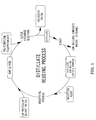
- the raw polyol of the present invention is reused as the raw glycol in a process as shown in FIG. 1 wherein the distillate containing ethylene glycol, which is a by-product of the reaction of the raw polyol and the polyethylene terephthalate, is stripped, and then the ethylene glycol contained in the distillate is modified.
- the distillate resulting from the reaction contains low boiling contents such as water, dioxane and methanol in addition to ethylene glycol and ethylene glycol derivatives such as diethylene glycol. Accordingly, the low boiling contents are stripped in advance, for example, at 90-180°C, or preferably at 100-150°C. Under temperature of lower than 90°C, the low boiling contents cannot be removed effectively, while, under temperature of higher than 180°C, ethylene glycol may be distilled off. In the strip process, a nitrogen bubbling may be performed to remove the low boiling contents further effectively.
- the striping process should preferably be performed to provide the ethylene glycol, which is contained in the range of 40-90 weight%, or preferably 50-80 weight% in the distillate after the low boiling contents are removed therefrom, having: the average polymerization degree n in the range of 1.50-1.05, or preferably 1.40-1.09, and the hydroxyl value in the range of 1,300-1,750mgKOH/g, or preferably 1,400-1,700mgKOH/g.
- the distillate from which the low boiling contents were removed is subjected to a modification process.
- ethylene glycol is modified by adding modifying agent thereto, so that when the ethylene glycol is reused as the raw glycol, it can have the property of inhibiting the crystallization of the polyester polyol obtained.
- the modification processes that may be used include, for example, an alkylene oxide modification process in which alkylene oxide used as the modifying agent is added to ethylene glycol, to produce the alkylene-oxide adducts of the ethylene glycol, and an epoxy modification process in which glycidyl ether used as the modifying agent is added to ethylene glycol, to allow it to react with the ethylene glycol.
- the alkylene oxide modification process is used in that it can provide the simple and stable modification process.
- the alkylene oxide modification process can be performed in the manner that for example ethylene oxide, propylene oxide and butylene oxide used as the alkylene oxide are continuously fed to the distillate in the presence of a known alkali catalyst at a reaction temperature of 90-130 °C and a reaction pressure of 0.05-1.00MPa.
- ethylene oxide and/or the propylene oxide are continuously fed to the distillate.
- the ethylene glycol modified by this modification process is made to have a hydroxyl value in the range of 300-800mgKOH/g, or preferably 400-700mgKOH/g.
- the distillate containing the modified ethylene glycol thus obtained is used as the raw polyol.
- low-molecular-weight polyol is preferably mixed with that distillate to adjust the hydroxyl value.
- the low-molecular-weight polyols that may be mixed include low-molecular-weight polyols except ethylene glycol.
- glycols such as diethylene glycol, triethylene glycol, tetraethylene glycol, polyethylene glycol, propylene glycol, dipropylene glycol, tripropylene glycol, polypropylene glycol, 1,4-butanediol, 1,3-butanediol, 2,3-butanediol, 1,5-pentanediol, and 1,6-hexanediol
- polyfunctional polyols of at least trifunctional polyol such as glycerin, trimethylolpropane, diglycerin, pentaerythritol and methyl glucoside, can be cited as the low-molecular-weight polyols to be mixed.
- diethylene glycol is preferably used.
- the raw polyol in which this additional low-molecular-weight polyol is adequately mixed as needed is made to have a hydroxyl value in the range of 400-1,000mgKOH/g, or preferably 500-900mgKOH/g.
- the hydroxyl value of higher than that there remains ethylene glycol and diethylene glycol so much that the crystallization of polyester polyol cannot be inhibited.
- the hydroxyl value of lower than that the proportion of high-molecular-weight polyol becomes high, so that the flame retardance of the polyurethane foam produced by use of the polyester polyol obtained may deteriorate, and further a quantity of alkylene oxide to be fed may increase, causing an economical disadvantage
- the low-molecular-weight polyol may be mixed in or with the distillate as was subjected to the modification process, as shown in FIG. 1.
- the low-molecular-weight polyol may be premixed in the distillate before being subjected to the modification process, first, and then subjected to the modification process together with that distillate, though not shown in FIG. 1.
- the raw polyol obtained is allowed to react with the polyethylene terephthalate again by the ester exchange reaction as mentioned above.
- this reaction can be performed continuously in an atmosphere of nitrogen at a reaction temperature of 180-250°C, so that the proportion of the raw polyol to the polyethylene terephthalate is in the range of 90-200 parts by weight, or preferably 100-150 parts by weight, of raw polyol per 100 parts by weight of polyethylene terephthalate.
- acetates or carbonates of lead, zinc, manganese, calcium, cobalt and cadmium, oxides of lead, zinc and antimony, and known esterifying catalysts, such as organic titanium compound, Lewis acid, sulfuric acid and hydrochloric acid, are preferably used for the reaction as a catalyst.
- the polyester polyol obtained by the reaction has a hydroxyl value in the range of 100-500mgKOH/g, and more preferably 200-400mgKOH/g.
- the hydroxyl value of higher than that unreacted raw polyol in the polyester polyol increases, so that for example the substantial property of the polyurethane foam obtained by use of the polyester polyol obtained may not be provided.
- the hydroxyl value of lower than that the viscosity increases, so that for example workability and moldability in the process of producing the polyurethane foam by use of the polyester polyol obtained may be lowered.
- the method for producing polyester polyol of the present invention can provide the result of recycling the recovery polyethylene terephthalate effectively. Further, since the raw polyol is also reused from the distillate, wastes can be reduced by making good use of the raw polyol, thus providing an environmentally friendly result. Furthermore, the method of the present invention can provide the simple process requiring no post-treatment process of the distillate, so that the production efficiency can be improved to a large extent.
- the distillate is modified for reuse repeatedly, quality of the raw polyol can be kept unchanged and stable supply of the raw polyol can be achieved.
- This can provide the result of producing the polyester polyol of stable in quality.
- the polyester polyol keeps its normal quality during the originally intended period from the production, some fine difference in quality of the raw polyol could cause the polyester polyol to vary with age to produce white turbidity, increased viscosity or crystallization.
- the polyester polyol obtained by the method of the present invention such quality variation with age is hardly caused and the good quality is kept unchanged for a long term.
- FIG. 2 is a schematic block diagram of an embodiment of an apparatus for producing the polyester polyol by use of the producing method of the present invention
- the apparatus includes a reaction vessel 1, a rectification column 2, a modifying vessel 3, a modified ethylene glycol storage vessel 4, a low-molecular-weight polyol storage vessel 5 and a recovery PET (polyethylene glycol) storage vessel 6.
- a connection line such as a piping and the like.
- the reaction vessel 1 is connected with the modified ethylene glycol storage vessel 4 via a supply line 9 such as piping and the like.
- the reaction vessel 1, the rectification column 2, the modifying vessel 3, and the modified ethylene glycol storage vessel 4 are connected in the form of a closed line.
- the low-molecular-weight polyol storage vessel 5 and the recovery PET storage vessel 6 are connected with the reaction vessel 1 independently via their respective connection lines such as piping and the like.
- the modified ethylene glycol is stored in the modified ethylene glycol storage vessel 4.
- the low-molecular-weight polyol is stored in the low-molecular-weight polyol storage vessel 5.
- the pulverized recovery polyethylene terephthalate is stored in the recovery PET storage vessel 6.
- the modified ethylene glycol from the modified ethylene glycol storage vessel 4 the low-molecular-weight polyol from the low-molecular-weight polyol storage vessel 5 and the recovery polyethylene terephthalate from the recovery PET storage vessel 6 are sequentially supplied to the reaction vessel 1 in the above-mentioned proportions respectively, so that the polyester polyol is synthesized in the reaction vessel 1 by the ester exchange reaction mentioned above.
- the polyester polyol obtained is taken out from the reaction vessel 1, and the distillate containing the ethylene glycol which is a by-product of the reaction process is fed to the rectification column 2.
- the modifying vessel 3 comprises, for example, an epoxy synthesizing device and an alkylene oxide adding/synthesizing device, as mentioned above.
- Glycidyl ethers in the case of epoxy modification
- alkylene oxides in the case of alkylene oxide modification
- the distillate containing the modified ethylene glycol is returned to the modified ethylene glycol storage vessel 4 and then is fed again therefrom to the reaction vessel 1 via the supply line 9 by means of a pump 7.
- the distillated ethylene glycol is modified to be reused as the raw polyol, so that there is no need to provide the facility for subjecting the distillate to the post-treatment.
- the facility for modifying the distillate is needed, since the efficient use of the raw polyol is provided by that facility, wastes can be reduced on a environmentally-friendly basis. Besides, since the process is simplified, improvement of the production efficiency can be achieved to a large extent.
- the polyester polyol of the present invention thus produced can be applied to polyurethane resins, and rigid, semi-rigid and flexible polyurethane foams without any limitation.
- the polyester polyol of the present invention can be effectively used as a polyol component of the raw material of the rigid polyurethane foam.
- the polyester polyol of the present invention has good mutual solubility with other components well, and can provide improved workability and also can provide improved flame retardance of the rigid polyurethane foam obtained.
- the polyester polyol of the present invention when used as a polyol component of the raw material of the rigid polyurethane foam, there can be provided fine cells to enhance the heat insulating efficiency of the rigid polyurethane foam.
- Polyester polyol is generally poor in mutual solubility with cyclopentane or CFCs substitutes such as HFC-245fa and HFC-365mfc.
- the ethylene glycol as the by-product was modified with alkylene oxide and the like and this modified ethylene glycol is used as the raw material for producing the polyester polyol.
- the polyester polyol of the present invention is good enough in mutual solubility with cyclopentane or CFCs substitutes to be mixed at a high ratio.
- the use of the polyester polyol of the present invention can provide an increased heat insulating efficiency for the rigid polyurethane foam obtained.
- the rigid polyurethane foam can be formed in any known conventional way without limiting to any particular way.
- a polyol component including the polyester polyol of the present invention and a polyisocyanate component may be foamed in the presence of a reactive catalyst, a blowing agent and a foam stabilizer, and an addition agent, if necessary.
- polyester polyol of the present invention as an essential polyol component, a polyol component commonly used as the raw material of the rigid polyurethane foam may be mixed with it, depending on an intended purpose or application.
- the polyol components that may be used include, for example, polyether polyol and polyester polyol.
- the polyether polyol can be obtained, for example, by a low-molecular-weight polyol and/or a low-molecular-weight polyamine having 2-8 active hydrogen groups and being used as an initiator to subject ethylene oxide and/or propylene oxide to ring-opening addition polymerization with the initiator.
- the polyether polyol having the hydroxyl value of the order of 300-700mgKOH/g is preferably used.
- the polyester polyol can be obtained, for example, by dibasic acid, such as adipic acid, phthalic acid, isophthalic acid, terephthalic acid and maleic acid, or anhydrides thereof, being polymerized with glycol or triol, such as ethylene glycol, diethylene glycol, triethylene glycol, propylene glycol, dipropylene glycol, 1,4-butanediol, glycerin, and trimethylolpropane.
- the polyester polyol having the hydroxyl value of the order of 200-450mgKOH/g is preferably used.
- phenol resins having a reactive methylol group may be used as the polyol component.
- the polyol components (homogeneousness or heterogeneousness) can be used singly or in combination.
- the polyester polyol of the present invention is preferably mixed with the other polyether polyol, depending on an intended purpose or application.
- a quantity of polyester polyol mixed is preferably in the range of e.g. 5-90 parts by weight, or preferably 10-70 parts by weight, of polyester polyol per 100 parts by weight of polyol component.
- polyisocyanate component it can be used without any particular limitation, as long as it is commonly used as the raw material of the rigid polyurethane foam.
- Polymethylene polyphenyl polyisocyanate Polymeric MDI; Crude MDI
- TDI tolylene diisocyanate
- MDI diphenylmethane diisocyanate
- modified polyols modified trimmers, modified carbodiimides, modified biurets, modified allophanates and modified uretdions
- These polyisocyanate components (homogeneousness or heterogeneousness) can be used singly or in combination.
- the quantity of polyisocyanate components used is in the range of e.g. 1.0-3.0 equivalents (NCO/OH) of isocyanate group of the polyisoyanate component to the hydroxyl group of the polyol component.
- the reactive catalyst it can be used without any particular limitation, as long as it is commonly used as the catalyst of the rigid polyurethane foam.
- Those that may be used as the reactive catalyst include, for example, tertiary amines, such as dimethylhexylamine, dimethylcyclohexylamine, pentamethyldiethylenetriamine, dimethylethanolamine, tetramethylethylenediamine, tetramethylhexamethylenediamine, triethylenediamine and tetramethylpropanediamine, and their carboxylates or quaternary ammonium salts, and organic metallic compounds such as dibutyltin dilaurate, lead octylate, potassium acetate and potassium octylate.
- These catalysts can be used singly or in combination.
- the quantity of catalyst used is in the order of e.g. 0.01-20 parts by weight per 100 parts by weight of polyol component.
- the blowing agent it can be used without any particular limitation, as long as it is commonly used as the blowing agent of the rigid polyurethane foam.
- flon (chlorofluorocarbon) compounds CFCs substitute
- low-boiling-point hydrocarbon compounds such as cyclopentane, n-pentane, iso-pentane, and n-butane are used.
- These blowing agents can be used singly or in combination.
- the quantity of blowing agent used is in the order of e.g. 5-50 parts by weight per 100 parts by weight of polyol component.
- water may be used in combination with these blowing agents.
- the use of water can provide improvements in flowability, strength, heat resistance and dimensional stability under low temperature of the foam.
- carbon dioxide is produced by reaction of water and the isocyanate group and, simultaneously, urea bond is produced by the reaction.
- the urea bond can produce increased polar groups to provide enhanced strength and heat resistance of the foam bone structure.
- the urea bond can also permit the produced carbon dioxide to present in the form of gas in the cells even under refrigerating temperature as low as -30°C, so that the pressure in the cell is held, thus providing improvement in dimensional stability under low temperature of the foam.
- blowing agent per 100 parts by weight of polyol is preferably used for the rigid polyurethane foam of a normal degree of about 25-50kg/m 3 , thought it depends on the density and heat insulating efficiency of the final product.
- the foam stabilizer it can be used without any particular limitation, as long as it is commonly used as the foam stabilizer of the rigid polyurethane foam.
- the so-called silicon surface active agents having polydimethylsiloxane and polyoxyalkylene chains are used.
- the quantity of the foam stabilizer used is in the order of e.g. 0.2-10 parts by weight per 100 parts by weight of the polyol component.
- a viscosity adjusting agent such as propylene carbonate, an oxidation inhibitor and a flame retardant are suitably used for the intended purpose and application for the purposes of adjusting the viscosity and the mixing ratio between premix and polyisocyanate component, of providing anti-scorch at the foam molding and of providing flame retardance for the foam.
- the rigid polyurethane foam may be produced by any known foaming method without any particular limitation. Specifically, it may be produced, for example, by the process that after all components except the polyisocyanate component, i.e., the polyol component, the reactive catalyst, the blowing agent and the foam stabilizer, and additionally the adding agent, if necessary, are premixed to prepare a premix, the premix and the polyisocyanate component are mixed by means of a foaming gear and the like and then the mixture is injected into a specific mold for the foaming.
- the polyisocyanate component i.e., the polyol component, the reactive catalyst, the blowing agent and the foam stabilizer, and additionally the adding agent, if necessary
- the polyurethane foam of the present invention produced by use of the polyester polyol of the present invention can provide the fine cells, and can provide enhanced heat insulating efficiency.
- PET bottle flake IFN-10 available from ARK Co., Ltd.
- 465g of diethylene glycol were added into a 1,000ml four-necked flask to which an agitator, a thermometer, a nitrogen in-lead tube and a rectification column were connected and were allowed to react by agitation, while nitrogen was injected therein at 220-240°C in the presence of 200ppm of titanium tetrabutoxide.
- the PET bottle flake started to be dissolved from around 220°C.
- the by-product of ethylene glycol was distilled off with nitrogen, and after 20 hours, the reaction was stopped by cooling.
- the distillate obtained was 150g.
- the distillate had the composition comprising 6% of water, 70% of ethylene glycol, 22% of diethylene glycol, and 2% of dioxane. After the low boiling contents were forcibly stripped from the distillate with nitrogen at 130°C for 30 minutes, the distillate became 135g and had the hydroxyl value of 1,500mgKOH/g.
- 127g of ethylene oxide was continuously added to 100g of the distillate thus obtained in the presence of 2.5g of N-ethyl morpholine at 130°C and 0.25MPa, for the addition reaction. After the reaction, the hydroxyl value was measured. The hydroxyl value was 660mgKOH/g.
- PET bottle flake IFN-10 available from ARK Co., Ltd.
- 130g of the modified ethylene oxide solution mentioned above hydroxyl value of 660mgKOH/g
- 130g of diethylene glycol were added into the 1,000ml four-necked flask to which the agitator, the thermometer, the nitrogen in-lead tube and the rectification column were connected and were allowed to react by agitation, while nitrogen was injected therein at 220-240°C in the presence of 200ppm of titanium tetrabutoxide.
- the PET bottle flake started to be dissolved from around 220°C.
- the by-product of ethylene glycol was distilled off with nitrogen, and after 20 hours, the reaction was stopped by cooling.
- the distillate obtained was 60g.
- the polyester polyol obtained was transparent brown liquid having the hydroxyl value of 250mgKOH/g and the viscosity of 5,700mPa • s/25°C. Any of white turbidity, increased viscosity and crystallization did not occur in the polyester polyol when stored for 3 months at room temperature.
- PET bottle flake IFN-10 available from ARK Co., Ltd.
- 140g of the modified ethylene oxide solution obtained in the polyester polyol producing process of Example 1 hydroxyl value of 660mgKOH/g
- 140g of diethylene glycol were added into the 1,000ml four-necked flask to which the agitator, the thermometer, the nitrogen in-lead tube and the rectification column were connected and were allowed to react by agitation, while nitrogen was injected therein at 220-240°C in the presence of 200ppm of titanium tetrabutoxide.
- the PET bottle flake started to be dissolved from around 220°C.
- the by-product of ethylene glycol was distilled off with nitrogen, and after 20 hours, the reaction was stopped by cooling.
- the distillate obtained was 70g.
- the polyester polyol obtained was transparent brown liquid having the hydroxyl value of 310mgKOH/g and the viscosity of 1,800mPa • s/25°C. Any of the white turbidity, the increased viscosity and the crystallization did not occur in the polyester polyol when stored for 3 months at room temperature.
- PET bottle flake IFN-10 available from ARK Co., Ltd.
- 260g of glycol mixture mentioned above were added into the 1,000ml four-necked flask to which the agitator, the thermometer, the nitrogen in-lead tube and the rectification column were connected and were allowed to react by agitation, while nitrogen was injected therein at 220-240°C in the presence of 200ppm of titanium tetrabutoxide.
- the PET bottle flake started to be dissolved from around 220°C.
- the by-product of ethylene glycol was distilled off with nitrogen, and after 20 hours, the reaction was stopped by cooling.
- the distillate obtained was 60g.
- the polyester polyol obtained was transparent brown liquid having the hydroxyl value of 248mgKOH/g and the viscosity of 5,400mPa • s/25°C. Any of the white turbidity, the increased viscosity and the crystallization did not occur in the polyester polyol when stored for 3 months at room temperature.
- the rigid polyurethane foams as prescribed in TABLE 2 were produced as Producing Examples 1-3.
- the rigid polyurethane foam in which none of the polyester polyols obtained in the respective Examples was mixed was produced as Comparative Example 1 in the same manner.
- the polyol component, the reactive catalyst, the blowing agent, and the foam stabilizer were mixed in the proportion shown in TABLE 2 and were prepared to 25°C.
- the polyisocyanate component as prepared to 25°C was added to the mixture by the part number shown in TABLE 2 and agitated up for 6 seconds. Thereafter, the mixture was injected into a wooden box (25cm ⁇ 25cm ⁇ 25cm) to foam the rigid polyurethane foam.
- Actcol GR-36B 90 90 90 100 Polyester polyol of Example 1 10 Polyester polyol of Example 2 10 Polyester polyol of Example 3 10 DMCHA 3.0 3.0 4.0 2.9 PMDETA 0.3 0.3 0.4 0.3 H 2 O 1.5 1.5 1.5 1.5 CP 16 16 16 18 B-8462 2.0 2.0 2.0 2.0 4040MC (Index 110) 128 129 128 132 CT (sec) 4 4 4 4 GT (sec) 30 29 32 31 RT (sec) 49 48 52 50 Df (kg/m 3 ) 25.6 25.6 25.9 25.5 Kf (W/mK) 0.0181 0.0180 0.0182 0.0186 Actcol GR-36B: aromatic sucrose-based polyol having hydroxyl value of 420mgKOH/g available from Mitsui Takeda Chemicals, Inc.
- DMCHA Dimethylcyclohexylamine
- PMDETA Pentamethyldiethylenetriamine
- CP cyclopentane
- B-8462 Silicon foam stabilizer available from Goldshmidte AG
- 4040MC Mixture of Crude TDI and Crude MDI available from Mitsui Takeda Chemicals, Inc.
- the rigid polyurethane foams using compositions shown in TABLE 3 were produced as Producing Examples 4-7.
- the rigid polyurethane foams in which Actcol ES-40 of a commercially available polyester polyol product was mixed were produced as Producing Comparative Examples 2 and 3 in the same manner.
- the polyol component, the reactive catalyst, the blowing agent, and the foam stabilizer were mixed in the proportion shown in TABLE 3 given below and were prepared to 25°C.
- the isocyanate component as prepared to 25°C was added to the mixture by the part number shown in TABLE 3 and agitated up for 6 seconds. Thereafter, the mixture was injected into the wooden box (25cm ⁇ 25cm ⁇ 25cm) to foam the rigid polyurethane foam.
- Actcol ES-40 Diethylene phthalate having hydroxyl value of 260mgKOH/g available from Mitsui Takeda Chemicals, Inc.
- TMHDA Tetramethylhexamethylenediamine
- K-13 Potassium octylate
- SH-193 Silicon foam stabilizer available from Dow Corning Toray Silicone Co., Ltd.
- M-200 Crude MDI available from Mitsui Takeda Chemicals, Inc.
Landscapes
- Chemical & Material Sciences (AREA)
- Health & Medical Sciences (AREA)
- Chemical Kinetics & Catalysis (AREA)
- Medicinal Chemistry (AREA)
- Polymers & Plastics (AREA)
- Organic Chemistry (AREA)
- General Chemical & Material Sciences (AREA)
- Polyurethanes Or Polyureas (AREA)
- Polyesters Or Polycarbonates (AREA)
Abstract
Description
| Polyester polyol | Example 1 | Example 3 | Actcol ES-40 |
| cyclopentane | Dissolved part number | 10 | |
| | 5 | 20 | 5 |
| HFC-245fa | Dissolved part number | 30 | 150 |
| Separated Part number | 40 | 160 | 5 |
| HFC-365mfc | Dissolved | 5 | 70 |
| Separated part number | 10 | 80 | 5 |
| Prescription | Producing Example 1 | Producing Example 2 | Producing Example 3 | Producing Compara. Ex. 1 |
| Actcol GR-36B | 90 | 90 | 90 | 100 |
| Polyester polyol of Example 1 | 10 | |||
| Polyester polyol of Example 2 | 10 | |||
| Polyester polyol of Example 3 | 10 | |||
| DMCHA | 3.0 | 3.0 | 4.0 | 2.9 |
| PMDETA | 0.3 | 0.3 | 0.4 | 0.3 |
| H2O | 1.5 | 1.5 | 1.5 | 1.5 |
| CP | 16 | 16 | 16 | 18 |
| B-8462 | 2.0 | 2.0 | 2.0 | 2.0 |
| 4040MC (Index 110) | 128 | 129 | 128 | 132 |
| CT (sec) | 4 | 4 | 4 | 4 |
| GT (sec) | 30 | 29 | 32 | 31 |
| RT (sec) | 49 | 48 | 52 | 50 |
| Df (kg/m3) | 25.6 | 25.6 | 25.9 | 25.5 |
| Kf (W/mK) | 0.0181 | 0.0180 | 0.0182 | 0.0186 |
| Actcol GR-36B: aromatic sucrose-based polyol having hydroxyl value of 420mgKOH/g available from Mitsui Takeda Chemicals, Inc. DMCHA: Dimethylcyclohexylamine PMDETA: Pentamethyldiethylenetriamine CP: cyclopentane B-8462: Silicon foam stabilizer available from Goldshmidte AG 4040MC: Mixture of Crude TDI and Crude MDI available from Mitsui Takeda Chemicals, Inc. |
| Prescription | Producing Example 4 | Producing Example 5 | Producing Compara. Ex. 2 | Producing Example 6 | Producing Example 7 | Producing Compara. Ex. 3 |
| Actcol IR-45 | 30 | 30 | 30 | 30 | 30 | 30 |
| Polyester polyol of Example 1 | 70 | 70 | ||||
| Polyester polyol of Example 3 | 70 | 70 | ||||
| Actcol ES-40 | 70 | 70 | ||||
| TMHDA | 0.5 | 0.6 | 0.5 | 0.5 | 0.6 | 0.5 |
| K-13 | 3.0 | 3.6 | 3.0 | 3.0 | 3.6 | 3.0 |
| H2O | 1.5 | 1.5 | 1.5 | 1.5 | 1.5 | 1.5 |
| HFC-245fa | 35 | 35 | 35 | |||
| HFC-365mfc | 35 | 35 | 35 | |||
| SH-193 | 2.0 | 2.0 | 2.0 | 2.0 | 2.0 | 2.0 |
| Mutual Solubility | Good | Good | No good | Good | Good | No good |
| M-200 (Index 150) | 155 | 155 | 155 | 155 | 155 | 155 |
| CT (sec) | 7 | 9 | 7 | 18 | 20 | 19 |
| GT (sec) | 42 | 44 | 43 | 45 | 46 | 46 |
| Df (kg/m3) | 28.3 | 28.8 | 32.0 | 33.2 | 34.1 | 36.7 |
| Roughness of Cell | None | None | Observed | None | None | Observed |
| Actcol IR-45: Ethylenediamine-based polyol having hydroxyl value of 510mgKOH/g available from Mitsui Takeda Chemicals, Inc. Actcol ES-40: Diethylene phthalate having hydroxyl value of 260mgKOH/g available from Mitsui Takeda Chemicals, Inc. TMHDA: Tetramethylhexamethylenediamine K-13: Potassium octylate SH-193: Silicon foam stabilizer available from Dow Corning Toray Silicone Co., Ltd. M-200: Crude MDI available from Mitsui Takeda Chemicals, Inc. |
Claims (7)
- A method for producing polyester polyol by reaction of polyethylene terephthalate and raw polyol, wherein ethylene glycol which is a by-product of the reaction of polyethylene terephthalate and raw polyol is modified and the modified ethylene glycol is used as the raw polyol.
- The method for producing polyester polyol according to Claim 1, wherein the ethylene glycol of the by-product is modified with alkylene oxide.
- The method for producing polyester polyol according to Claim 1, wherein low-molecular-weight polyol is used as the raw polyol, together with the modified ethylene glycol.
- The method for producing polyester polyol according to Claim 1, wherein hydroxyl value of the raw polyol is in the range of 400-1,000mgKOH/g.
- An apparatus for producing polyester polyol, which comprises:a reaction vessel for allowing polyethylene terephthalate and raw polyol to react;a modifying vessel for modifying ethylene glycol distilled off from the reaction vessel; anda supply line for supplying the ethylene glycol modified in the modifying vessel to the reaction vessel as the raw polyol.
- Polyester polyol produced by reaction of polyethylene terephthalate and raw polyol, wherein the raw polyol comprises a modified ethylene glycol which is obtained by modifying ethylene glycol which is a by-product of the reaction of polyethylene terephthalate and raw polyol.
- Polyurethane foam obtained by reaction of a polyol component comprising polyester polyol and a polyisocyanate component, wherein the polyester polyol is obtained by reaction of polyethylene terephthalate and raw polyol, and wherein the raw polyol comprises a modified ethylene glycol which is obtained by modifying ethylene glycol which is a by-product of the reaction of polyethylene terephthalate and raw polyol.
Applications Claiming Priority (2)
| Application Number | Priority Date | Filing Date | Title |
|---|---|---|---|
| JP2000230534 | 2000-07-31 | ||
| JP2000230534 | 2000-07-31 |
Publications (2)
| Publication Number | Publication Date |
|---|---|
| EP1178062A1 true EP1178062A1 (en) | 2002-02-06 |
| EP1178062B1 EP1178062B1 (en) | 2008-07-30 |
Family
ID=18723480
Family Applications (1)
| Application Number | Title | Priority Date | Filing Date |
|---|---|---|---|
| EP01118206A Expired - Lifetime EP1178062B1 (en) | 2000-07-31 | 2001-07-28 | Method and apparatus for producing polyester polyol |
Country Status (8)
| Country | Link |
|---|---|
| US (1) | US6667416B2 (en) |
| EP (1) | EP1178062B1 (en) |
| KR (1) | KR20020011118A (en) |
| CN (1) | CN1221588C (en) |
| AT (1) | ATE402966T1 (en) |
| CA (1) | CA2354252C (en) |
| DE (1) | DE60135069D1 (en) |
| TW (1) | TWI290933B (en) |
Cited By (9)
| Publication number | Priority date | Publication date | Assignee | Title |
|---|---|---|---|---|
| WO2003089510A1 (en) * | 2002-04-16 | 2003-10-30 | Honeywell International Inc. | Compositions of pentafluoropropane, pentafluorobutane and water |
| WO2004065447A1 (en) * | 2003-01-17 | 2004-08-05 | Lg Electronics Inc. | Composition for preparing rigid polyurethane foam and rigid polyurethane foam made therefrom |
| WO2014114758A1 (en) | 2013-01-25 | 2014-07-31 | Henkel Ag & Co. Kgaa | Moisture-curing polyurethane composition comprising renewable raw materials |
| WO2016149001A1 (en) * | 2015-03-13 | 2016-09-22 | Basf Se | Method of forming a polyrethane foam article |
| WO2016168043A1 (en) * | 2015-04-14 | 2016-10-20 | Resinate Materials Group, Inc. | Polyester polyols with increased clarity |
| CN106496533A (en) * | 2016-10-20 | 2017-03-15 | 中国石油化工股份有限公司 | The method that PEPA is prepared by PTA residues and ethylene oxide/ethylene glycol plant kettle residual liquid |
| PL423486A1 (en) * | 2017-11-17 | 2019-05-20 | Gor Stal Spolka Z Ograniczona Odpowiedzialnoscia | Ecological low-hydroxyl polyol and method for producing polyol |
| EP3957665A1 (en) | 2020-08-20 | 2022-02-23 | Covestro Deutschland AG | Polyol formulations which are stable in storage |
| EP4230670A1 (en) | 2022-02-18 | 2023-08-23 | Covestro Deutschland AG | Storage-stable polyol formulations |
Families Citing this family (10)
| Publication number | Priority date | Publication date | Assignee | Title |
|---|---|---|---|---|
| CN1302035C (en) * | 2005-02-24 | 2007-02-28 | 烟台万华聚氨酯股份有限公司 | Polymer polyester polyol, its producing process and its use |
| ES2336925T3 (en) * | 2005-04-27 | 2010-04-19 | Kingspan Holdings (Irl) Limited | PLASTIFIER FOR PHELONIC FOAM, AND A PROCESS TO PRODUCE THE PHELONIC FOAM. |
| ITMI20081480A1 (en) * | 2008-08-06 | 2010-02-06 | Dow Global Technologies Inc | AROMATIC POLYESTERS, PALIOLIC MIXTURES THAT INCLUDE THEM AND THE RESULTING PRODUCTS |
| CN103059283B (en) * | 2013-01-23 | 2014-12-10 | 常熟理工学院 | Method for preparing polyester polyol by taking waste polyester bottles as main raw materials |
| CN103881074B (en) * | 2014-01-23 | 2016-01-06 | 单成敏 | A kind of preparation method of biomass polyester polyvalent alcohol |
| WO2015171433A1 (en) | 2014-05-05 | 2015-11-12 | Resinate Materials Group, Inc. | Polyester polyols from thermoplastic polyesters and dimer fatty acids |
| CN107513149A (en) * | 2017-08-31 | 2017-12-26 | 苏州市苏真床垫有限公司 | A kind of preparation method of terylene foaming mattress |
| CN110387032B (en) * | 2019-07-25 | 2021-07-23 | 万华化学集团股份有限公司 | A kind of polyetherester polyol, its preparation method and its prepared polyurethane elastomer |
| US11845863B2 (en) | 2020-05-04 | 2023-12-19 | Carlisle Construction Materials, LLC | Polyurethane dispersions and their use to produce coatings and adhesives |
| CN114276516B (en) * | 2022-01-14 | 2022-11-18 | 浙江佳人新材料有限公司 | Method for preparing hard polyurethane foam by using byproducts of waste textile chemical method regeneration process |
Citations (5)
| Publication number | Priority date | Publication date | Assignee | Title |
|---|---|---|---|---|
| EP0112013A1 (en) * | 1982-11-22 | 1984-06-27 | ARCO Chemical Company | Ester-functional polyols and rigid polyurethane and polyisocyanurate foams obtainable therefrom |
| US4469824A (en) * | 1983-11-18 | 1984-09-04 | Texaco, Inc. | Liquid terephthalic ester polyols and polyisocyanurate foams therefrom |
| JPH0211625A (en) * | 1988-06-28 | 1990-01-16 | Nippon Ester Co Ltd | Production of modified polyester |
| US5360900A (en) * | 1993-08-12 | 1994-11-01 | Oxid, Inc. | Aromatic polyester polyol |
| JP2000191756A (en) * | 1998-12-24 | 2000-07-11 | Mitsui Chemicals Inc | Method for producing aromatic polyester polyol |
Family Cites Families (1)
| Publication number | Priority date | Publication date | Assignee | Title |
|---|---|---|---|---|
| JP2000017058A (en) | 1998-07-04 | 2000-01-18 | Hokoku Seiyu Kk | Polyol for polyurethane |
-
2001
- 2001-07-25 TW TW090118117A patent/TWI290933B/en not_active IP Right Cessation
- 2001-07-26 US US09/912,312 patent/US6667416B2/en not_active Expired - Lifetime
- 2001-07-27 CA CA2354252A patent/CA2354252C/en not_active Expired - Fee Related
- 2001-07-28 AT AT01118206T patent/ATE402966T1/en not_active IP Right Cessation
- 2001-07-28 EP EP01118206A patent/EP1178062B1/en not_active Expired - Lifetime
- 2001-07-28 DE DE60135069T patent/DE60135069D1/en not_active Expired - Lifetime
- 2001-07-31 CN CNB011328959A patent/CN1221588C/en not_active Expired - Fee Related
- 2001-07-31 KR KR1020010046203A patent/KR20020011118A/en not_active Withdrawn
Patent Citations (6)
| Publication number | Priority date | Publication date | Assignee | Title |
|---|---|---|---|---|
| EP0112013A1 (en) * | 1982-11-22 | 1984-06-27 | ARCO Chemical Company | Ester-functional polyols and rigid polyurethane and polyisocyanurate foams obtainable therefrom |
| US4469824A (en) * | 1983-11-18 | 1984-09-04 | Texaco, Inc. | Liquid terephthalic ester polyols and polyisocyanurate foams therefrom |
| JPS60130620A (en) * | 1983-11-18 | 1985-07-12 | アルコ・ケミカル・カンパニー | Manufacture of liquid terephthalic acid ester polyol |
| JPH0211625A (en) * | 1988-06-28 | 1990-01-16 | Nippon Ester Co Ltd | Production of modified polyester |
| US5360900A (en) * | 1993-08-12 | 1994-11-01 | Oxid, Inc. | Aromatic polyester polyol |
| JP2000191756A (en) * | 1998-12-24 | 2000-07-11 | Mitsui Chemicals Inc | Method for producing aromatic polyester polyol |
Non-Patent Citations (2)
| Title |
|---|
| PATENT ABSTRACTS OF JAPAN vol. 014, no. 137 (C - 0702) 15 March 1990 (1990-03-15) * |
| PATENT ABSTRACTS OF JAPAN vol. 2000, no. 10 17 November 2000 (2000-11-17) * |
Cited By (17)
| Publication number | Priority date | Publication date | Assignee | Title |
|---|---|---|---|---|
| WO2003089510A1 (en) * | 2002-04-16 | 2003-10-30 | Honeywell International Inc. | Compositions of pentafluoropropane, pentafluorobutane and water |
| US6784150B2 (en) | 2002-04-16 | 2004-08-31 | Honeywell International Inc. | Composition of pentafluoropropane, pentafluoropropane and water |
| WO2004065447A1 (en) * | 2003-01-17 | 2004-08-05 | Lg Electronics Inc. | Composition for preparing rigid polyurethane foam and rigid polyurethane foam made therefrom |
| GB2412376A (en) * | 2003-01-17 | 2005-09-28 | Lg Electronics Inc | Composition for preparing rigid polyurethane foam and rigid polyurethane foam made therefrom |
| GB2412376B (en) * | 2003-01-17 | 2006-06-14 | Lg Electronics Inc | Composition for preparing rigid polyurethane foam and rigid polyurethane foam made therefrom |
| WO2014114758A1 (en) | 2013-01-25 | 2014-07-31 | Henkel Ag & Co. Kgaa | Moisture-curing polyurethane composition comprising renewable raw materials |
| US10894857B2 (en) | 2015-03-13 | 2021-01-19 | Basf Se | Method of forming a polyurethane foam article |
| WO2016149001A1 (en) * | 2015-03-13 | 2016-09-22 | Basf Se | Method of forming a polyrethane foam article |
| WO2016168043A1 (en) * | 2015-04-14 | 2016-10-20 | Resinate Materials Group, Inc. | Polyester polyols with increased clarity |
| US20180030202A1 (en) * | 2015-04-14 | 2018-02-01 | Resinate Materials Group, Inc. | Polyester polyols with increased clarity |
| US10934390B2 (en) | 2015-04-14 | 2021-03-02 | Resinate Materials Group, Inc. | Polyester polyols with increased clarity |
| CN106496533A (en) * | 2016-10-20 | 2017-03-15 | 中国石油化工股份有限公司 | The method that PEPA is prepared by PTA residues and ethylene oxide/ethylene glycol plant kettle residual liquid |
| PL423486A1 (en) * | 2017-11-17 | 2019-05-20 | Gor Stal Spolka Z Ograniczona Odpowiedzialnoscia | Ecological low-hydroxyl polyol and method for producing polyol |
| PL233298B1 (en) * | 2017-11-17 | 2019-09-30 | Gor Stal Spolka Z Ograniczona Odpowiedzialnoscia | Ecological low-hydroxyl polyol and method for producing polyol |
| EP3957665A1 (en) | 2020-08-20 | 2022-02-23 | Covestro Deutschland AG | Polyol formulations which are stable in storage |
| WO2022038050A1 (en) | 2020-08-20 | 2022-02-24 | Covestro Deutschland Ag | Storage-stable polyol formulations |
| EP4230670A1 (en) | 2022-02-18 | 2023-08-23 | Covestro Deutschland AG | Storage-stable polyol formulations |
Also Published As
| Publication number | Publication date |
|---|---|
| US20020035166A1 (en) | 2002-03-21 |
| TWI290933B (en) | 2007-12-11 |
| DE60135069D1 (en) | 2008-09-11 |
| CA2354252C (en) | 2010-05-25 |
| KR20020011118A (en) | 2002-02-07 |
| CN1221588C (en) | 2005-10-05 |
| CN1339516A (en) | 2002-03-13 |
| US6667416B2 (en) | 2003-12-23 |
| CA2354252A1 (en) | 2002-01-31 |
| ATE402966T1 (en) | 2008-08-15 |
| EP1178062B1 (en) | 2008-07-30 |
Similar Documents
| Publication | Publication Date | Title |
|---|---|---|
| CA2354252C (en) | Method and apparatus for producing polyester polyol, polyester polyol and polyurethane foam | |
| JP5278246B2 (en) | Catalyst composition for producing rigid polyurethane foam and isocyanurate-modified rigid polyurethane foam, and raw material blending composition using the same | |
| JP5560553B2 (en) | Amine catalyst composition for producing polyurethane resin and method for producing polyurethane resin using the same | |
| WO1994013725A1 (en) | Process for the production of polyurethane foams | |
| JP4396465B2 (en) | Catalyst composition for producing rigid polyurethane foam and isocyanurate-modified rigid polyurethane foam, and raw material blending composition using the same | |
| JP5365482B2 (en) | Amine catalyst composition for producing polyurethane resin and method for producing polyurethane resin using the same | |
| JP7380274B2 (en) | Polyol composition for forming rigid polyurethane foam | |
| JP2013151635A (en) | Raw material blending composition for manufacturing polyurethane foam | |
| JP2008239725A (en) | Polyisocyanate composition for rigid polyurethane foam and method for producing rigid polyurethane foam | |
| JP4746787B2 (en) | Polyester polyol production method and polyester polyol production apparatus | |
| JP4614041B2 (en) | Rigid polyurethane slab foam composition and method for producing rigid polyurethane slab foam | |
| EP4602099A1 (en) | Chemolysis process for polyisocyanurate foams | |
| JPH11217431A (en) | Method for producing phenolic polyol, and method for producing polyurethane resin and polyurethane foam | |
| JP5440127B2 (en) | Amine catalyst composition for producing polyurethane resin and method for producing polyurethane resin using the same | |
| US20060069175A1 (en) | Aromatic polyester polyols | |
| US6262136B1 (en) | Storage stable foam-forming system | |
| JP3732328B2 (en) | Polyol composition and method for producing the same | |
| JP2004352891A (en) | Method for producing polyester polyol | |
| JP5927905B2 (en) | Raw material composition for polyurethane foam production | |
| JPH10182785A (en) | Composition for rigid polyurethane foam, and method for producing rigid polyurethane foam using the composition | |
| JPH11349659A (en) | Manufacturing method of rigid foam synthetic resin | |
| JP5873653B2 (en) | Strength improver for polyurethane foam production | |
| KR100676118B1 (en) | Semi-rigid polyurethane foam | |
| JPH04370108A (en) | Polyol and use thereof | |
| JP2700521B2 (en) | Manufacturing method of rigid polyurethane foam |
Legal Events
| Date | Code | Title | Description |
|---|---|---|---|
| PUAI | Public reference made under article 153(3) epc to a published international application that has entered the european phase |
Free format text: ORIGINAL CODE: 0009012 |
|
| AK | Designated contracting states |
Kind code of ref document: A1 Designated state(s): AT BE CH CY DE DK ES FI FR GB GR IE IT LI LU MC NL PT SE TR |
|
| AX | Request for extension of the european patent |
Free format text: AL;LT;LV;MK;RO;SI |
|
| 17P | Request for examination filed |
Effective date: 20020425 |
|
| AKX | Designation fees paid |
Free format text: AT BE CH CY DE DK ES FI FR GB GR IE IT LI LU MC NL PT SE TR |
|
| 17Q | First examination report despatched |
Effective date: 20040804 |
|
| RAP1 | Party data changed (applicant data changed or rights of an application transferred) |
Owner name: MITSUI TAKEDA CHEMICALS, INC. |
|
| 17Q | First examination report despatched |
Effective date: 20040804 |
|
| GRAP | Despatch of communication of intention to grant a patent |
Free format text: ORIGINAL CODE: EPIDOSNIGR1 |
|
| RTI1 | Title (correction) |
Free format text: METHOD AND APPARATUS FOR PRODUCING POLYESTER POLYOL |
|
| GRAS | Grant fee paid |
Free format text: ORIGINAL CODE: EPIDOSNIGR3 |
|
| GRAA | (expected) grant |
Free format text: ORIGINAL CODE: 0009210 |
|
| RAP1 | Party data changed (applicant data changed or rights of an application transferred) |
Owner name: MITSUI CHEMICALS POLYURETHANES, INC. |
|
| AK | Designated contracting states |
Kind code of ref document: B1 Designated state(s): AT BE CH CY DE DK ES FI FR GB GR IE IT LI LU MC NL PT SE TR |
|
| REG | Reference to a national code |
Ref country code: GB Ref legal event code: FG4D |
|
| REG | Reference to a national code |
Ref country code: CH Ref legal event code: NV Representative=s name: BOHEST AG Ref country code: CH Ref legal event code: EP |
|
| REF | Corresponds to: |
Ref document number: 60135069 Country of ref document: DE Date of ref document: 20080911 Kind code of ref document: P |
|
| REG | Reference to a national code |
Ref country code: IE Ref legal event code: FG4D |
|
| PG25 | Lapsed in a contracting state [announced via postgrant information from national office to epo] |
Ref country code: ES Free format text: LAPSE BECAUSE OF FAILURE TO SUBMIT A TRANSLATION OF THE DESCRIPTION OR TO PAY THE FEE WITHIN THE PRESCRIBED TIME-LIMIT Effective date: 20081110 Ref country code: PT Free format text: LAPSE BECAUSE OF FAILURE TO SUBMIT A TRANSLATION OF THE DESCRIPTION OR TO PAY THE FEE WITHIN THE PRESCRIBED TIME-LIMIT Effective date: 20081230 |
|
| PG25 | Lapsed in a contracting state [announced via postgrant information from national office to epo] |
Ref country code: AT Free format text: LAPSE BECAUSE OF FAILURE TO SUBMIT A TRANSLATION OF THE DESCRIPTION OR TO PAY THE FEE WITHIN THE PRESCRIBED TIME-LIMIT Effective date: 20080730 Ref country code: FI Free format text: LAPSE BECAUSE OF FAILURE TO SUBMIT A TRANSLATION OF THE DESCRIPTION OR TO PAY THE FEE WITHIN THE PRESCRIBED TIME-LIMIT Effective date: 20080730 |
|
| PG25 | Lapsed in a contracting state [announced via postgrant information from national office to epo] |
Ref country code: DK Free format text: LAPSE BECAUSE OF FAILURE TO SUBMIT A TRANSLATION OF THE DESCRIPTION OR TO PAY THE FEE WITHIN THE PRESCRIBED TIME-LIMIT Effective date: 20080730 |
|
| PLBE | No opposition filed within time limit |
Free format text: ORIGINAL CODE: 0009261 |
|
| STAA | Information on the status of an ep patent application or granted ep patent |
Free format text: STATUS: NO OPPOSITION FILED WITHIN TIME LIMIT |
|
| 26N | No opposition filed |
Effective date: 20090506 |
|
| PG25 | Lapsed in a contracting state [announced via postgrant information from national office to epo] |
Ref country code: SE Free format text: LAPSE BECAUSE OF FAILURE TO SUBMIT A TRANSLATION OF THE DESCRIPTION OR TO PAY THE FEE WITHIN THE PRESCRIBED TIME-LIMIT Effective date: 20081030 |
|
| PG25 | Lapsed in a contracting state [announced via postgrant information from national office to epo] |
Ref country code: MC Free format text: LAPSE BECAUSE OF NON-PAYMENT OF DUE FEES Effective date: 20090731 |
|
| REG | Reference to a national code |
Ref country code: IE Ref legal event code: MM4A |
|
| PG25 | Lapsed in a contracting state [announced via postgrant information from national office to epo] |
Ref country code: IE Free format text: LAPSE BECAUSE OF NON-PAYMENT OF DUE FEES Effective date: 20090728 |
|
| PG25 | Lapsed in a contracting state [announced via postgrant information from national office to epo] |
Ref country code: GR Free format text: LAPSE BECAUSE OF FAILURE TO SUBMIT A TRANSLATION OF THE DESCRIPTION OR TO PAY THE FEE WITHIN THE PRESCRIBED TIME-LIMIT Effective date: 20081031 |
|
| PG25 | Lapsed in a contracting state [announced via postgrant information from national office to epo] |
Ref country code: LU Free format text: LAPSE BECAUSE OF NON-PAYMENT OF DUE FEES Effective date: 20090728 |
|
| PG25 | Lapsed in a contracting state [announced via postgrant information from national office to epo] |
Ref country code: TR Free format text: LAPSE BECAUSE OF FAILURE TO SUBMIT A TRANSLATION OF THE DESCRIPTION OR TO PAY THE FEE WITHIN THE PRESCRIBED TIME-LIMIT Effective date: 20080730 |
|
| PG25 | Lapsed in a contracting state [announced via postgrant information from national office to epo] |
Ref country code: CY Free format text: LAPSE BECAUSE OF FAILURE TO SUBMIT A TRANSLATION OF THE DESCRIPTION OR TO PAY THE FEE WITHIN THE PRESCRIBED TIME-LIMIT Effective date: 20080730 |
|
| REG | Reference to a national code |
Ref country code: CH Ref legal event code: PCAR Free format text: NEW ADDRESS: HOLBEINSTRASSE 36-38, 4051 BASEL (CH) |
|
| REG | Reference to a national code |
Ref country code: FR Ref legal event code: PLFP Year of fee payment: 15 |
|
| REG | Reference to a national code |
Ref country code: DE Ref legal event code: R082 Ref document number: 60135069 Country of ref document: DE Representative=s name: VON KREISLER SELTING WERNER - PARTNERSCHAFT VO, DE Ref country code: DE Ref legal event code: R081 Ref document number: 60135069 Country of ref document: DE Owner name: MITSUI CHEMICALS & SKC POLYURETHANES INC., JP Free format text: FORMER OWNER: MITSUI CHEMICALS POLYURETHANES, INC., TOKYO, JP Ref country code: DE Ref legal event code: R082 Ref document number: 60135069 Country of ref document: DE Representative=s name: DOMPATENT VON KREISLER SELTING WERNER - PARTNE, DE |
|
| REG | Reference to a national code |
Ref country code: CH Ref legal event code: PFUS Owner name: MITSUI CHEMICALS, INC., JP Free format text: FORMER OWNER: MITSUI CHEMICALS POLYURETHANES, INC., JP |
|
| REG | Reference to a national code |
Ref country code: CH Ref legal event code: PUE Owner name: MITSUI CHEMICALS AND SKC POLYURETHANES INC., JP Free format text: FORMER OWNER: MITSUI CHEMICALS, INC., JP |
|
| REG | Reference to a national code |
Ref country code: GB Ref legal event code: 732E Free format text: REGISTERED BETWEEN 20160331 AND 20160406 |
|
| REG | Reference to a national code |
Ref country code: GB Ref legal event code: 732E Free format text: REGISTERED BETWEEN 20160407 AND 20160413 |
|
| REG | Reference to a national code |
Ref country code: NL Ref legal event code: PD Owner name: MITSUI CHEMICALS, INC.; JP Free format text: DETAILS ASSIGNMENT: VERANDERING VAN EIGENAAR(S), SAMENVOEGEN; FORMER OWNER NAME: MITSUI CHEMICALS POLYURETHANES, INC. Effective date: 20160218 |
|
| REG | Reference to a national code |
Ref country code: FR Ref legal event code: TP Owner name: MITSUI CHEMICALS, INC., JP Effective date: 20160525 |
|
| REG | Reference to a national code |
Ref country code: FR Ref legal event code: PLFP Year of fee payment: 16 |
|
| REG | Reference to a national code |
Ref country code: FR Ref legal event code: TP Owner name: MITSUI CHEMICALS & SKC POLYURETHANES INC., JP Effective date: 20160825 |
|
| REG | Reference to a national code |
Ref country code: NL Ref legal event code: PD Owner name: MITSUI CHEMICALS & SKC POLYURETHANES INC.; JP Free format text: DETAILS ASSIGNMENT: VERANDERING VAN EIGENAAR(S), OVERDRACHT; FORMER OWNER NAME: MITSUI CHEMICALS, INC. Effective date: 20160810 |
|
| REG | Reference to a national code |
Ref country code: FR Ref legal event code: PLFP Year of fee payment: 17 |
|
| REG | Reference to a national code |
Ref country code: FR Ref legal event code: PLFP Year of fee payment: 18 |
|
| PGFP | Annual fee paid to national office [announced via postgrant information from national office to epo] |
Ref country code: IT Payment date: 20180724 Year of fee payment: 18 Ref country code: FR Payment date: 20180725 Year of fee payment: 18 Ref country code: NL Payment date: 20180719 Year of fee payment: 18 Ref country code: DE Payment date: 20180723 Year of fee payment: 18 |
|
| PGFP | Annual fee paid to national office [announced via postgrant information from national office to epo] |
Ref country code: GB Payment date: 20180719 Year of fee payment: 18 Ref country code: CH Payment date: 20180719 Year of fee payment: 18 Ref country code: BE Payment date: 20180718 Year of fee payment: 18 |
|
| REG | Reference to a national code |
Ref country code: DE Ref legal event code: R119 Ref document number: 60135069 Country of ref document: DE |
|
| REG | Reference to a national code |
Ref country code: CH Ref legal event code: PL |
|
| GBPC | Gb: european patent ceased through non-payment of renewal fee |
Effective date: 20190728 |
|
| REG | Reference to a national code |
Ref country code: BE Ref legal event code: MM Effective date: 20190731 |
|
| PG25 | Lapsed in a contracting state [announced via postgrant information from national office to epo] |
Ref country code: GB Free format text: LAPSE BECAUSE OF NON-PAYMENT OF DUE FEES Effective date: 20190728 Ref country code: NL Free format text: LAPSE BECAUSE OF NON-PAYMENT OF DUE FEES Effective date: 20190801 Ref country code: DE Free format text: LAPSE BECAUSE OF NON-PAYMENT OF DUE FEES Effective date: 20200201 |
|
| REG | Reference to a national code |
Ref country code: NL Ref legal event code: MM Effective date: 20190801 |
|
| PG25 | Lapsed in a contracting state [announced via postgrant information from national office to epo] |
Ref country code: BE Free format text: LAPSE BECAUSE OF NON-PAYMENT OF DUE FEES Effective date: 20190731 Ref country code: CH Free format text: LAPSE BECAUSE OF NON-PAYMENT OF DUE FEES Effective date: 20190731 Ref country code: LI Free format text: LAPSE BECAUSE OF NON-PAYMENT OF DUE FEES Effective date: 20190731 |
|
| PG25 | Lapsed in a contracting state [announced via postgrant information from national office to epo] |
Ref country code: FR Free format text: LAPSE BECAUSE OF NON-PAYMENT OF DUE FEES Effective date: 20190731 |
|
| PG25 | Lapsed in a contracting state [announced via postgrant information from national office to epo] |
Ref country code: IT Free format text: LAPSE BECAUSE OF NON-PAYMENT OF DUE FEES Effective date: 20190728 |