EP1177819A2 - Game machine, method of controlling operation of the game machine, and computer readable medium for controlling the game machine - Google Patents
Game machine, method of controlling operation of the game machine, and computer readable medium for controlling the game machine Download PDFInfo
- Publication number
- EP1177819A2 EP1177819A2 EP01305125A EP01305125A EP1177819A2 EP 1177819 A2 EP1177819 A2 EP 1177819A2 EP 01305125 A EP01305125 A EP 01305125A EP 01305125 A EP01305125 A EP 01305125A EP 1177819 A2 EP1177819 A2 EP 1177819A2
- Authority
- EP
- European Patent Office
- Prior art keywords
- battle
- player
- cards
- game machine
- card
- Prior art date
- Legal status (The legal status is an assumption and is not a legal conclusion. Google has not performed a legal analysis and makes no representation as to the accuracy of the status listed.)
- Ceased
Links
- 238000000034 method Methods 0.000 title claims description 13
- 230000000694 effects Effects 0.000 claims description 5
- 230000007123 defense Effects 0.000 description 22
- 230000004927 fusion Effects 0.000 description 7
- 238000004891 communication Methods 0.000 description 4
- 230000006872 improvement Effects 0.000 description 3
- 239000007787 solid Substances 0.000 description 3
- 230000008901 benefit Effects 0.000 description 2
- 230000015572 biosynthetic process Effects 0.000 description 2
- 238000010586 diagram Methods 0.000 description 2
- 230000003287 optical effect Effects 0.000 description 2
- 239000004065 semiconductor Substances 0.000 description 2
- 230000003213 activating effect Effects 0.000 description 1
- 230000004075 alteration Effects 0.000 description 1
- 230000008859 change Effects 0.000 description 1
- 239000004973 liquid crystal related substance Substances 0.000 description 1
- 239000000463 material Substances 0.000 description 1
- 238000012986 modification Methods 0.000 description 1
- 230000004048 modification Effects 0.000 description 1
- 230000004044 response Effects 0.000 description 1
Images




Classifications
-
- A—HUMAN NECESSITIES
- A63—SPORTS; GAMES; AMUSEMENTS
- A63F—CARD, BOARD, OR ROULETTE GAMES; INDOOR GAMES USING SMALL MOVING PLAYING BODIES; VIDEO GAMES; GAMES NOT OTHERWISE PROVIDED FOR
- A63F3/00—Board games; Raffle games
- A63F3/00643—Electric board games; Electric features of board games
-
- A—HUMAN NECESSITIES
- A63—SPORTS; GAMES; AMUSEMENTS
- A63F—CARD, BOARD, OR ROULETTE GAMES; INDOOR GAMES USING SMALL MOVING PLAYING BODIES; VIDEO GAMES; GAMES NOT OTHERWISE PROVIDED FOR
- A63F3/00—Board games; Raffle games
- A63F3/00003—Types of board games
- A63F3/00075—War games
-
- A—HUMAN NECESSITIES
- A63—SPORTS; GAMES; AMUSEMENTS
- A63F—CARD, BOARD, OR ROULETTE GAMES; INDOOR GAMES USING SMALL MOVING PLAYING BODIES; VIDEO GAMES; GAMES NOT OTHERWISE PROVIDED FOR
- A63F1/00—Card games
- A63F1/04—Card games combined with other games
- A63F2001/0441—Card games combined with other games with a written message or sentence, e.g. chance or instruction cards
-
- A—HUMAN NECESSITIES
- A63—SPORTS; GAMES; AMUSEMENTS
- A63F—CARD, BOARD, OR ROULETTE GAMES; INDOOR GAMES USING SMALL MOVING PLAYING BODIES; VIDEO GAMES; GAMES NOT OTHERWISE PROVIDED FOR
- A63F2300/00—Features of games using an electronically generated display having two or more dimensions, e.g. on a television screen, showing representations related to the game
- A63F2300/20—Features of games using an electronically generated display having two or more dimensions, e.g. on a television screen, showing representations related to the game characterised by details of the game platform
- A63F2300/204—Features of games using an electronically generated display having two or more dimensions, e.g. on a television screen, showing representations related to the game characterised by details of the game platform the platform being a handheld device
Definitions
- the present invention relates to an improvement in a game machine which enables a player and an opponent to play a battle by way of laying down their cards on a game screen. Also, the present invention relates to an improvement in a method of controlling the operation of the game machine. Further, the present invention relates to an improvement in a recording medium, such as a computer readable medium, having recorded thereon an operation control program for controlling the game machine.
- entertainment value is increased as the number of cards capable of being stored in a deck are stored in the baggage is increased.
- the number of cards usable in a battle is increased, by way of purchasing several from among an abundance of available recording mediums having card information recorded thereon.
- the present invention has been conceived to solve a drawback of the game machine of the related art.
- the present invention is aimed at providing a game machine which enables a player to increase the number of cards usable in a battle while enjoying a game.
- the present invention is aimed at providing a method of controlling the operation of the game machine, and a recording medium, such as a computer readable medium, having recorded thereon an operation control program for controlling the game machine.
- a game machine which enables a player and an opponent to play a battle by laying down their cards in a game screen.
- the game machine comprises a control means which increases the number of cards available in a battle when the player continues winning.
- the player can increase the number of cards available in a battle while enjoying a game.
- the control means may set a plurality of stages in which a plurality of opposing characters which are opponents in a battle are able to appear.
- the control means may cause the player to advance to a next stage after having won over respective opposing characters in a certain stage.
- the control means may increase the number of cards available in a battle.
- control means may set a plurality of stages in which a plurality of opposing characters which are opponents in a battle are able to appear, and increase the number of cards available in a battle when the player has won over the opposing characters at least a predetermined number of times in a certain stage.
- control means enables loading of, on a per-unit-card-information-set basis, a plurality of card information sets pertaining to a plurality of cards recorded on a computer readable medium, thereby enabling the player to increase the number of cards available in a battle.
- control means sets a read enable flag for a card information set for which loading has been permitted.
- the plurality of card information sets are set so as to differ from each other because the entertainment value of the game is increased correspondingly.
- the computer readable medium includes an external computer readable medium removably attached to the game machine, and a setting region for the read enable flag is formed on the external computer readable medium. Accordingly, formation of a read enable flag setting region is facilitated.
- control means may include a means which updates time information pertaining to the world of a game every time the player plays a battle with an opposing character, and which effects contents of an event when requirements for occurrence of an event are satisfied if the updated time corresponds to a predetermined date and time at which an event is to arise.
- the entertainment value of a game can be enhanced much greater.
- the control means causes the player to acquire a new card available in a battle when the player has won over an opposing character, when the player's winning over an opposing character is defined as a requirement for occurrence of an event.
- the entertainment value of a game can be enhanced much greater.
- a method of controlling operation of a game machine which enables a player and an opponent to play a battle by laying down their cards.
- the method comprises the steps of:
- the player advances to higher stages, the number of cards available in a battle is increased. Consequently, the player can increase the number of cards available in a battle while enjoying a game.
- a method of controlling operation of a game machine which enables a player and an opponent to play a battle by laying down their cards .
- the method comprises the steps of:
- the player if the player has won over opposing characters in a certain stage a predetermined number of times or more, the number of cards available in a battle is increased. Hence, the player can increase the number of his cards available in a battle while enjoying a game.
- the method according to any one of the tenth and eleventh aspects may further comprise the steps of:
- the entertainment value of a game is increased to a much greater extent.
- a computer readable medium having recorded thereon an operation control program for controlling operation of a game machine which enables a player and an opponent to play a battle by laying down their cards.
- the operation control program comprises a processing routine for increasing the number of cards available in a battle when the player continues winning.
- the processing routine of the thirteenth aspect may include:
- the processing routine of the thirteenth aspect may include:
- the aforementioned computer readable medium may include a recording medium which enables recording and reading of digital contents. More specifically, such the computer readable medium includes, for example, a semiconductor recording medium such as a ROM (i.e., Read Only Memory), a semiconductor IC (i.e., Integrated Circuit), etc., an optical recording medium such as a DVD-ROM (i.e., Digital Versatile Disk-Read Only Memory), a CD-ROM (i.e., Compact Disc-Read Only Memory), etc., a magnetic recording medium such as a flexible disk etc., and a magneto-optical medium such as an MO (i.e., Magneto Optical Disk) etc..
- a semiconductor recording medium such as a ROM (i.e., Read Only Memory), a semiconductor IC (i.e., Integrated Circuit), etc.
- an optical recording medium such as a DVD-ROM (i.e., Digital Versatile Disk-Read Only Memory), a CD-ROM (i.e., Compact
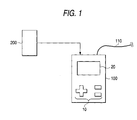
- Fig. 1 is an external view of a game machine 100 according to embodiments of the present invention.
- Control buttons 10 used for performing various operations and a display section 20 on which a game screen is to be displayed are provided on the front surface of the game machine 100.
- the game machine 100 is constructed such that a cassette 200 serving as an external recording medium having recorded thereon an operation control program for executing a card game is removably attached to the game machine 100.
- the game machine 100 enables execution of a card game with a game machine (not shown) of the same type by way of a communications cable 110 while required information is exchanged therebetween.
- a player can play a battle against the game machine 100 (CPU) (i.e., a player can enjoy playing a card game alone) .
- a player can select either a battle against a human opponent or a battle against the game machine 100.
- Fig. 1 shows a case where a cable method using the communications cable 110 is employed, exchange of desired information may be established in any form, such as ultrasonic vibration, infrared rays, or radio communication such as that via a radio wave.
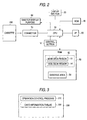
- Fig. 2 is a block diagram showing the game machine 100 and the cassette 200 removably attached to the game machine 100.
- the game machine 100 comprises control buttons 10 used for performing various operations; a display section 20 embodied by a liquid-crystal display; a CPU 30 which effects a primary control operation such as execution of a card game; ROM 40 for recording basic software used for activating the CPU 30; RAM (i.e., Random Access Memory) 50 acting as a work area; RAM 60 for display purpose for storing display data to be displayed on the display section 20; a connector 70 for establishing electrical connection with the cassette 200; and an interface (I/F) 80 for establishing connection with the communications cable 110.
- a deck area 53 and a baggage area 54 are formed in the RAM 50. Further, the deck area 53 has a main deck region 51 capable of storing card information pertaining to forty or more cards, and a side deck region 52 capable of storing card information pertaining to, e.g., fifteen cards.
- the cassette 200 has recorded thereon an operation control program 210 for effecting a card game, and a card information table 220 for storing card information items concerning cards.
- the card information table 220 stores eight types of card information sets; that is, a set of initial card information items (called “initial card information set”) and second through eighth sets of card information items (called “second through eighth card information sets”) , and read enable flags assigned to respective card information sets.
- card names, fields, and card image data are stored in one card information set so as to be associated with each other.
- the illustrated example shows an initial card information set, in which information pertaining to cards "a” through “b” (i.e., card information items) are stored.
- the term “Field” means a game environment set in a card game.
- an “Offense” power index and a “Defense” power index are numerically set for each of the fields.
- An “Offense” power index is called an offense power index
- a "Defense” power index is called a defense power index. Details of a game using these power indices will be described later.
- the offense power index of a certain card usually differs from the defense power index of the same card even in an identical field. Further, the power indices of a certain card may change from field to field.
- image data a character set for each card name appears.
- the card information sets are used when a player has selected either "ATTACK” or "DEFEND" in any one of the seven types of fields.
- a read enable flag shown in Fig. 4 assumes a value of "1," the CPU 30 loads a corresponding card information set into the baggage area 54 and reads desired card information items from the card information set and loads the same into the main deck region 51 and the side deck region 52, thus constructing a deck.
- the read enable flag assumes a value of "0” the CPU 30 is not allowed to load a corresponding card information set into the baggage area 54.
- the CPU 30 When the cassette 200 is attached to the game machine 100, the CPU 30 is electrically connected to the connector 70, and a player actuates the control button 10 to thereby instruct resetting or turning on of power, the CPU 30 operates in accordance with basic software recorded in the ROM 40, reads the operation control program 201 from the cassette 200, and de-archives the thus-loaded operation control program 201 in the RAM 30. Since a read enable flag assigned to the initial card information set assumes a value of "1," the CPU 30 reads a card name, image data, and a field (and a card number (not shown) as well) described in the initial card information set shown in Fig. 5 and stores the thus-read information items into the baggage area 54 of the RAM 51.
- the CPU 30 executes a game through use of the operation control program 201 de-archived in the RAM 30 and the initial card information set stored in the baggage area 54.
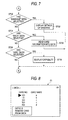
- "Baggage" is selected by actuation of the control button 10 while a guide menu shown in Fig. 6 is displayed in the display area 21, to thereby move a solid triangular mark (YES is selected in step S700).
- step S702 shown in Fig. 7 a card name, offense and defense power indices, and a card number, which are assigned to each card stored in the baggage area 54, are displayed in the display area 21 (not shown).
- step S704 When “Baggage” is not selected (NO is selected in step S700), a determination is made in step S704 as to whether or not "Deck” has been selected by actuation of the control button 10. When “Deck” has not been selected (NO is selected in step S704), processing proceeds to step S708. In contrast, when "Deck” has been selected (YES is selected in step S704), in step S706 data sets pertaining to, e.g., 40 cards are read from the baggage area 54. The thus-read data sets are stored in the main deck region 51. Further, ten card information items may be read and stored in the side deck region 52. Alternatively, the CPU 30 may read data sets in accordance with an instruction entered by way of the control button 10 or the CPU 30 may automatically load card information.
- Card information items stored in the deck area 53 are used for a card game.
- Fig. 8 shows a display screen appearing on the display area 21 immediately after a reading operation pertaining to step S706 has been performed.
- Card numbers and card names belonging to card information items stored in the main deck region 51 appear in the center of the display area 21.
- a guidance menu appears in a position below the card numbers and the card names .
- the CPU 30 displays detailed data pertaining to a card specified by the solid triangular mark; that is, offense and defense power indices of a character provided in the card in respective fields.
- the CPU 30 When "Remove a card from the deck” is selected by actuation of the control button 10, the CPU 30 returns, to the baggage area 54, the card information item pertaining to the card specified by the solid triangular mark. "1/8" appearing at the upper right corner represents that the current screen is the first page of a total of 8 pages.
- the CPU 30 increments or decrements the page number by actuation of the control button 10, thereby sequentially providing, in the display area 21, five card numbers and their card names belonging to a currently-displayed page.
- the cards stored in the deck area 53 can be ascertained.
- the CPU 30 exchanges the card information pertaining to the instructed number of cards between the main deck region 51 and the side deck region 52.
- the exchange of cards is possible during each battle (which may also be stated as a duel).
- step S708 When processing returns to step S708 shown in Fig. 7 and "Duel" is selected by actuation of the control button 10 (YES is selected in step S708), the CPU 30 displays card information items pertaining to respective cards in the display area 21 (step S710). As mentioned above, details on "Baggage” are displayed by actuation of the control button 10, or card information items are stored in the deck area 53, thereby enabling display of detailed information, such as capability of each card.
- the CPU 30 arranges cards which yield special effects, such as magic cards differing from ordinary cards and trap cards, in a magic-and-trap card zone located above the specific zone.
- Magic cards are classified into “normal magic cards,” which, unless otherwise labeled “Eternal,” are essentially to be destroyed after invocation, many of such normal magic cards having great strength; “armament magic cards,” which are present eternally while being assigned to a monster; “field magic cards, “which continuously affect the overall field after have been laid down until the cards are removed from the field; and “fast-break magic cards,” which have a feature of an ordinary magic and a feature of a trap and can be employed from a player's hand during the player's current turn. Further, trap cards are classified into “normal trap cards” which, unless otherwise labeled “Eternal,” are destroyed after invocation, and “counter trap cards,” which neutralize the effect of a card such as a magic card. Either a magic card or a trap card is laid down in a magic and trap zone designated by 300f shown in Fig. 9, thus playing a battle. A field magic card is arranged in a field zone at the left of the display area 21.
- a fusion monster card When use of a fusion monster card is instructed, the CPU 30 arranges a fusion monster card in a fusion deck zone at the lower left of the display area 21.
- a fusion monster card can be laid down when a material monster and a magic "fusion" card, which are required for effecting fusion, make a pair in a field or a hand.
- a fusion monster card can be used in combination with two or more other cards.
- the CPU 30 displays a life point total (8,000 points in this embodiment) assigned to the player, in a lower left section (340) within the display area 21. Similarly, a life point total (8,000 points in this embodiment) assigned to the opponent is displayed in an upper left section (310) within the display area 21.
- the CPU 30 indicates information about a field at that point in a section (320) located at a slightly upper left point within the display area 21 ("normal" in the embodiment shown in Fig. 7).
- the player selects one card from his hand by actuation of the control button 10.
- the CPU 30 displays the thus-selected card in a conspicuous manner by enclosing the card with dotted lines.
- Image data pertaining to the selected card are displayed in a center section (a card contents display area 350) of the display area 21. Further, detailed information is displayed in a left center section (330) of the display area 21.
- the detailed information displayed in the left center section 330 includes a card name and offense and defense power indices.
- Fig. 9 The embodiment shown in Fig. 9 is intended to represent that the player selects the rightmost card 300e from the five cards in his hand.
- the name of this card is "a,” and the card has an offense power index of "400” and a defense power index of "300.”
- the player can ascertain information about his card by actuation of the control button 10 but cannot see any information about the opponent's card.
- the card selected through actuation of the control button 10 is instructed to be laid in an area called "Field" located at the center of the display area 21.
- the CPU 30 displays the thus-selected card in the field in a conspicuous manner by enclosing the card with dotted lines.
- Fig. 10 is a display example where the player has selected and laid the card 300e in the field.
- the CPU 30 displays, in the area 330, detailed information about the card 300e laid down in the field, and, in the card contents display area 350, image data pertaining to the card 300e.
- the opponent cannot see information about the card laid in the field.
- step S1100 When it is determined that "Offense" has been selected in the state shown in Fig. 10 by actuation of the control button 10 (YES is selected in step S1100 shown in Fig. 11), processing proceeds to step S1110, where an offense display is provided. Otherwise (i.e., NO is selected in step S1100), processing proceeds to step S1120. As shown in Fig. 12, the CPU 30 displays the card for which "Offense” has been selected in a vertically-oriented manner in the field, by enclosing the hand with dotted lines so as to make the card conspicuous, thereby effecting an offense display.
- step S1120 when it is determined that "Defense” has been selected by actuation of the control button 10 (YES is selected in step S1120), processing proceeds to step S1130, thus effecting a defense display. Otherwise (i.e., when NO is selected in step S1120), processing is terminated. As shown in Fig. 13, the CPU 30 displays the card for which "Defense” has been selected, in a horizontally-oriented manner in the field, by enclosing the card with dotted lines so as to make the card conspicuous, thereby effecting an offense display.
- the CPU 30 displays the name and power index of the player's card in an area 360 and the name and power index of the opponent's card in an area 361, as shown in Fig. 14.
- the image data pertaining to the cards are displayed in areas 370 and 371, respectively.
- life points assigned to the player are displayed in an area 380
- life points assigned to the opponent are displayed in an area 381, thus causing the player and the opponent to enter battle.
- a winner and a loser are determined in accordance with the power indices.
- the CPU 30 provides a display shown in Fig. 12, thereby leaving the winner' s card remaining in the field face up. In contrast, the loser' s card is caused to disappear from the display area 21.
- An object of offense can be arbitrarily selected from the cards arranged in the field of the other.
- the CPU 30 replenishes a hand by selection of cards from the main deck region 51 such that five cards become available. Through continuous execution of these operations, the CPU 30 displays the player who has lost all his life points as a loser and the remaining player as a winner (not shown).
- the game of this type is explained in more detail with reference to a flowchart.
- the following description is given on the assumption that the player plays a game against a game machine (also called an "opponent") and that each side has completed establishment of a deck.
- the CPU 30 arbitrary selects five cards from the main deck region 51 of the player and from the main deck region 51 of the opponent. Further, a field is determined by lottery (step S1500 shown in Fig. 15).
- the preceding player After having determined either the player or the opponent as one who makes the first move in a game (a preceding player) and the remaining as one who makes the second move (a subsequent player), the preceding player lays one card from his hand in the field.
- the preceding player selects either "Offense” or "Defense” in connection with the thus-selected card.
- the CPU 30 displays the card in a vertically-oriented manner as shown in Fig. 12.
- "Defense” has been selected, the CPU 30 displays the card in a horizontally-oriented manner as shown in Fig. 13. Since the preceding player has laid one card in the field, the hand of the preceding player is replenished with a card selected from the main deck region 51 such that five cards are available (step S1510).
- the subsequent player lays one card from his hand into the field. Now, a battle between the preceding and subsequent players is commenced. After completion of the battle, the hand of the subsequent player is replenished with a card selected from the main deck region 51 such that five cards are available (step S1520). As described in connection with step S1530, the battle is continued until one of the players loses all his life points (i.e., has a life point total of 0).
- step S1520 The battle pertaining to step S1520 is processed in such a manner as shown in Fig. 16.
- "Offense” or "Defense” has been selected for all the cards laid in the field in step S1600 (YES is selected in step S1600)
- the CPU 30 terminates processing. Processing returns to step S1520, and cards are alternately laid down in the field. Otherwise, processing proceeds to step S1610.
- step S1610 either "Offense” or “Defense” is selected in connection with a card of the preceding or subsequent player.
- the CPU 30 determines a winner and a loser (step S1620).
- step S1620 processing proceeds to step S1600.
- "Offense” or "Defense” has been selected in connection with all the cards laid in the field (YES is selected in step S1600), a battle is over.
- Fig. 17 is a table for describing determination of a winner and a loser performed by the CPU 30. If “Offense” and “Offense” have been selected, the number of life points equal to a difference between the offense power indices of both cards is subtracted from the life point total of the loser, and the loser's card is caused to disappear from the display area 21. In the case of “Offense” and “Defense” having been selected, if “Offense” has won the battle (i.e., the offense power index exceeds the defense power index), the loser's card is caused to disappear from the display area 21.
- the CPU 30 causes a plurality of opposing characters to appear on the field in each of first through fourth stages.
- a first stage five types of duelists; i.e., duelists 1 through 5, appear and play a battle in the first stage.
- Opposing characters can be selected in an arbitrary sequence by actuation of the control buttons 10.
- the CPU 30 causes the player to proceed to a second stage (when YES is selected in step S2000 shown in Fig. 20).
- a read enable flag corresponding to the second card information set in the card information table shown in Fig. 2 is switched from 0 to 1. Consequently, as indicated by reference symbol A shown in Fig. 19, the player can read card information items also fromthe second card information set.
- the CPU 30 stores a larger number of cards into the baggage area 54. The cards are made available in the deck area 53, thus increasing the number of cards available in a battle.
- the CPU 30 causes the player to proceed to a third stage (when YES is selected in step S2020 shown in Fig. 20).
- a read enable flag corresponding to the fourth card information set in the card information table shown in Fig. 2 is switched from 0 to 1.
- card information items can be read also from the fourth card information set. Consequently, the CPU 30 stores a much larger number of cards into the baggage area 54. The cards are made available in the deck region 53, thus increasing the number of cards available in a battle.
- the CPU 30 causes the player to proceed to the fourth stage (when YES is selected in step S2040 shown in Fig. 20).
- step S2050 shown in Fig. 20 a read enable flag corresponding to the sixth card information set in the card information table shown in Fig. 2 is switched from 0 to 1. Consequently, as indicated by reference symbol C shown in Fig. 10, card information items can be read from the sixth card information set. Consequently, the CPU 30 stores a larger number of cards into the baggage area 54. The cards are available in the deck area 53, and the number of cards available in a battle is increased.
- a plurality of stages are set, wherein a plurality of opposing characters which become opponents in a battle appear.
- the player proceeds to the next stage, and the number of cards which the player can use in a battle is increased.
- the player can increase the number of cards available in a battle while enjoying a game.
- the read enable flag corresponding to the first card information set in the card information table shown in Fig. 2 is switched from 0 to 1, as indicated by step S2110. Therefore, as indicated by reference symbol E shown in Fig. 109, card information items can be read from the third card information set. Consequently, the CPU 30 stores a greater number of cards into the baggage area 54, and the cards are made available in the deck area 53, thus increasing the number of cards available in a battle.
- a read enable flag corresponding to the fifth card information set in the card information table shown in Fig. 2 is switched from 0 to 1, as indicated by step S2130.
- card information items can be read also from the fifth card information set. Consequently, the CPU 30 stores a much larger number of cards into the baggage area 54. The cards are made available in the deck region 53, thus increasing the number of cards available in a battle.
- a plurality of stages are set, wherein a plurality of opposing characters which are to become opponents in a battle become able to appear.
- the player has won over the opposing characters a predetermined number of times in a certain stage, the number of cards which can be used by the player in a battle is increased.
- the player can increase the number of cards available in a battle while enjoying a game.
- the CPU 30 enables loading of a plurality of card information sets, which are information items pertaining to a plurality of cards recorded in a card information table 220 stored in the cassette 200, on a per-unit-card-information-set basis.
- a read enable flag is set for a card information set for which loading has been allowed. Loading of a card information set and enabling of reading operation can be performed readily.
- the cassette 200 (recording medium) is embodied in the form of an external recording medium removably attached to a game machine. Hence, storage of card information is easy. If a read enable flag setting area is formed in the external recording medium, formation of a read enable flat setting region becomes easy.
- the CPU 30 performs the operation described in connection with operation example 1 and the operation described in connection with operation example 2.
- the CPU 30 sets a plurality of stages in which a plurality of opposing characters which are to become opponents in a battle become able to appear. When the player has won over the opposing characters in a certain stage, the CPU 30 causes the player to proceed to the next stage, thereby increasing the number of cards which the player can use in a battle.
- an event table 230 shown in Fig. 22 is stored in the cassette 200. Dates of occurrence of events, event items, details of events, opposing characters, and fields to be set are stored in the event table 230 so as to become associated with each other.
- the CPU 30 sets January 1 st as an initial date and time (step S2300).
- the CPU 30 causes processing to proceed to step S2320. Otherwise (when NO is selected in step S2310), the CPU 30 enters a wait mode in step S2310.
- step S2320 the CPU 30 updates a date and time. Updating of a date and time means updating of a date and time in the world of a game. Every time a battle with a duelist is performed, the date and time are advanced only one day.
- step S2330 the thus-updated time and date are stored in the event table 230. If the updated time and date correspond to a date of occurrence of any event (when YES is selected in step S2330), processing proceeds to step S2340. Otherwise, processing returns to step S2310. If the updated time and date are September 15, the date and time are handled as a date of occurrence of an event; that is, Respect-for-the-Aged Day.
- step S2340 the CPU 30 makes a determination as to whether or not the CPU 30 has satisfied requirements for occurrence of an event. If requirement for occurrence of an event are satisfied, processing proceeds to step S2350, and details of the event are executed. Otherwise, processing returns to step S2310.
- an updated date and time is September 15, the date corresponds to a date of occurrence of an event as Respect-for-the-Aged Day.
- the event represents that "You get a card if you win a game.”
- the player has played a battle with Pandora in field "Darkness" and won over Pandora, the player can acquire a card.
- the thus-acquired card is added to the baggage area 54 by the CPU 30.
- the player can increase card available in a battle while enjoying a game.
- the CPU 30 updates information about a date and time in the world of a game every time the player plays a battle with an opposing character.
- an event is performed if requirements for occurrence of the event are satisfied.
- the player's winning over an opposing character is a requirement for occurrence of an event, when the player has won over the opposing character, the player acquires a new card available in a battle.
- the entertainment of a game is increased further.
- the CPU 30 increases the number of cards available in a battle as the player continues winning.
- the player can increase the number of cards available in a battle while enjoying a game.
- the embodiments are susceptible to variations or alterations within the scope of the invention. For example, any card information items may be added to the card information sets shown in Fig. 5, or contents of events may be changed to contents other than those shown in Fig. 22.
- the number of cards available in a battle is increased as the player continues winning.
Landscapes
- Engineering & Computer Science (AREA)
- Multimedia (AREA)
- General Engineering & Computer Science (AREA)
- Educational Technology (AREA)
- Toys (AREA)
- Pinball Game Machines (AREA)
- Slot Machines And Peripheral Devices (AREA)
- Credit Cards Or The Like (AREA)
- Management, Administration, Business Operations System, And Electronic Commerce (AREA)
Abstract
Description
- The present invention relates to an improvement in a game machine which enables a player and an opponent to play a battle by way of laying down their cards on a game screen. Also, the present invention relates to an improvement in a method of controlling the operation of the game machine. Further, the present invention relates to an improvement in a recording medium, such as a computer readable medium, having recorded thereon an operation control program for controlling the game machine.
- The present application is based on Japanese Patent Application No. 2000-230124, which is incorporated herein by reference.
- There has been in vogue a game in which a player and an opponent play a battle by way of laying their cards in a predetermined area on a display section of a game machine through actuation of operation buttons. In a game machine of the type, a plurality of cards capable of being used for a battle are stored in a memory location called "baggage." A predetermined number of cards chosen from the cards are stored in a memory location called a "deck." Card information is read directly from the deck, and a card game is effected.
- In a game of the type, entertainment value is increased as the number of cards capable of being stored in a deck are stored in the baggage is increased. To this end, it is considered that the number of cards usable in a battle is increased, by way of purchasing several from among an abundance of available recording mediums having card information recorded thereon.
- Even when the number of cards usable in a battle is increased in such a way, no additional entertainment value is found in the manner of increasing the number of cards. Therefore, there has existed a desire for increasing the number of cards usable in a battle while a player is enjoying a game.
- The present invention has been conceived to solve a drawback of the game machine of the related art. Thus, the present invention is aimed at providing a game machine which enables a player to increase the number of cards usable in a battle while enjoying a game. Further, the present invention is aimed at providing a method of controlling the operation of the game machine, and a recording medium, such as a computer readable medium, having recorded thereon an operation control program for controlling the game machine.
- To achieve the object, according to a first aspect of the present invention, there is provided a game machine which enables a player and an opponent to play a battle by laying down their cards in a game screen. The game machine comprises a control means which increases the number of cards available in a battle when the player continues winning.
- In accordance with the first aspect of the present invention, the player can increase the number of cards available in a battle while enjoying a game.
- According to a second aspect of the present invention, the control means may set a plurality of stages in which a plurality of opposing characters which are opponents in a battle are able to appear. In this case, the control means may cause the player to advance to a next stage after having won over respective opposing characters in a certain stage. Also, in this case, the control means may increase the number of cards available in a battle.
- According to a third aspect of the present invention, the control means may set a plurality of stages in which a plurality of opposing characters which are opponents in a battle are able to appear, and increase the number of cards available in a battle when the player has won over the opposing characters at least a predetermined number of times in a certain stage.
- According to a fourth aspect of the present invention, it is preferable that the control means enables loading of, on a per-unit-card-information-set basis, a plurality of card information sets pertaining to a plurality of cards recorded on a computer readable medium, thereby enabling the player to increase the number of cards available in a battle.
- According to a fifth aspect of the present invention, it is preferable that the control means sets a read enable flag for a card information set for which loading has been permitted.
- According to a sixth aspect of the present invention, it is preferable that the plurality of card information sets are set so as to differ from each other because the entertainment value of the game is increased correspondingly.
- According to a seventh aspect of the present invention, it is preferable that the computer readable medium includes an external computer readable medium removably attached to the game machine, and a setting region for the read enable flag is formed on the external computer readable medium. Accordingly, formation of a read enable flag setting region is facilitated.
- According to an eighth aspect of the present invention, the control means may include a means which updates time information pertaining to the world of a game every time the player plays a battle with an opposing character, and which effects contents of an event when requirements for occurrence of an event are satisfied if the updated time corresponds to a predetermined date and time at which an event is to arise. Thus, the entertainment value of a game can be enhanced much greater.
- According to a ninth aspect of the present invention, the control means causes the player to acquire a new card available in a battle when the player has won over an opposing character, when the player's winning over an opposing character is defined as a requirement for occurrence of an event. Thus, the entertainment value of a game can be enhanced much greater.
- Furthermore, to achieve the object, according to a tenth aspect of the present invention, there is provided a method of controlling operation of a game machine which enables a player and an opponent to play a battle by laying down their cards. The method comprises the steps of:
- setting a plurality of stages in which a plurality of opposing characters which are opponents in a battle are able to appear; and
- causing the player to proceed to the next stage when having won over the opposing characters in a certain stage, thereby increasing the number of cards available in a battle.
-
- In accordance with the tenth aspect of the present invention, as the player advances to higher stages, the number of cards available in a battle is increased. Consequently, the player can increase the number of cards available in a battle while enjoying a game.
- Furthermore, to achieve the object, according to an eleventh aspect of the present invention, there is provided a method of controlling operation of a game machine which enables a player and an opponent to play a battle by laying down their cards . The method comprises the steps of:
- setting a plurality of stages in which a plurality of opposing characters which are opponents in a battle are able to appear; and
- increasing the number of cards available in a battle when the player has won over the opposing characters at least a predetermined number of times in a certain stage.
-
- In accordance with the eleventh aspect of the present invention, if the player has won over opposing characters in a certain stage a predetermined number of times or more, the number of cards available in a battle is increased. Hence, the player can increase the number of his cards available in a battle while enjoying a game.
- According to a twelfth aspect of the present invention, the method according to any one of the tenth and eleventh aspects may further comprise the steps of:
- updating time information pertaining to the world of a game every time the player plays a battle with an opposing character; and
- effecting details of an event when requirements for occurrence of an event have been satisfied if the updated date and time corresponds to a predetermined date and time at which a certain event is to arise.
-
- In accordance with the twelfth aspect of the present invention, the entertainment value of a game is increased to a much greater extent.
- Furthermore, to achieve the object, according to a thirteenth aspect of the present invention, there is provided a computer readable medium having recorded thereon an operation control program for controlling operation of a game machine which enables a player and an opponent to play a battle by laying down their cards. The operation control program comprises a processing routine for increasing the number of cards available in a battle when the player continues winning.
- In accordance with the thirteenth aspect of the present invention, when a computer executes an operation control program, there is performed processing of increasing the number of player's cards available in a battle as the player advances to next stages. Hence, the player can increase the number of cards available in a battle while enjoying a game.
- According to a fourteenth aspect of the present invention, the processing routine of the thirteenth aspect may include:
- setting a plurality of stages in which a plurality of opposing characters which are opponents in a battle are able to appear, and
- causing the player to proceed to the next stage when having won over the opposing characters in a certain stage, thereby increasing the number of cards available in a battle.
-
- According to a fifteenth aspect of the present invention, the processing routine of the thirteenth aspect may include:
- setting a plurality of stages in which a plurality of opposing characters which are opponents in a battle are able to appear, and
- increasing the number of cards available in a battle when the player has won over the opposing characters at least a predetermined number of times in a certain stage.
-
- It should be noted that the aforementioned computer readable medium may include a recording medium which enables recording and reading of digital contents. More specifically, such the computer readable medium includes, for example, a semiconductor recording medium such as a ROM (i.e., Read Only Memory), a semiconductor IC (i.e., Integrated Circuit), etc., an optical recording medium such as a DVD-ROM (i.e., Digital Versatile Disk-Read Only Memory), a CD-ROM (i.e., Compact Disc-Read Only Memory), etc., a magnetic recording medium such as a flexible disk etc., and a magneto-optical medium such as an MO (i.e., Magneto Optical Disk) etc..
- The above and other objects and advantages of the present invention will become more apparent by describing in detail preferred embodiments thereof with reference to the accompanying drawings, wherein:
- Fig. 1 is an external view of a game machine of an embodiment according to the present invention;
- Fig. 2 is a block diagram of the game machine of the embodiment according to the present invention;
- Fig. 3 is a descriptive view showing contents
of data recorded in a
cassette 200; - Fig. 4 is a descriptive view of the card information table 220;
- Fig. 5 is a descriptive view of sets of card information items;
- Fig. 6 is a descriptive view showing an example
of a display screen appearing in a
display area 21 on adisplay section 20; - Fig. 7 is a flowchart for explaining the operation of the game machine of the embodiment according to the present invention;
- Fig. 8 is a descriptive view showing an example
of a display screen appearing in a
display area 21 on adisplay section 20; - Fig. 9 is a descriptive view showing an example
of a display screen appearing in a
display area 21 on adisplay section 20; - Fig. 10 is a descriptive view showing an example
of a display screen appearing in a
display area 21 on adisplay section 20; - Fig. 11 is a flowchart for explaining the operation of the game machine of the embodiment according to the present invention;
- Fig. 12 is a descriptive view showing an example
of a display screen appearing in a
display area 21 on adisplay section 20; - Fig. 13 is a descriptive view showing an example
of a display screen appearing in a
display area 21 on adisplay section 20; - Fig. 14 is a descriptive view showing an example
of a display screen appearing in a
display area 21 on adisplay section 20; - Fig. 15 is a flowchart for explaining the operation of the game machine of the embodiment according to the present invention;
- Fig. 16 is a flowchart for explaining the operation of the game machine of the embodiment according to the present invention;
- Fig. 17 is a descriptive view for explaining a winning/losing determination processing;
- Fig . 18 is a descriptive view showing an embodiment according to the present invention;
- Fig. 19 is a descriptive view for explaining the principal part of the present invention;
- Fig. 20 is a flowchart for explaining the operation of the principal section of a game machine of the embodiment according to the present invention;
- Fig. 21 is a flowchart for explaining the operation of the principal section of a game machine of the embodiment according to the present invention;
- Fig. 22 is a descriptive view of an event table 230; and
- Fig. 23 is a flowchart for explaining the operation of a game machine of another embodiment according to the present invention.
-
- Preferred embodiments of the present invention now will be described with reference to the accompanying drawings. First, the "configuration" of a game machine according to embodiments of a present invention will be described. Next, "general operations and contents" of a game of this type will be described. Finally, the "principal feature" of the present invention will be described for facilitating comprehension of the present invention.
- Fig. 1 is an external view of a
game machine 100 according to embodiments of the present invention.Control buttons 10 used for performing various operations and adisplay section 20 on which a game screen is to be displayed are provided on the front surface of thegame machine 100. Thegame machine 100 is constructed such that acassette 200 serving as an external recording medium having recorded thereon an operation control program for executing a card game is removably attached to thegame machine 100. Thegame machine 100 enables execution of a card game with a game machine (not shown) of the same type by way of acommunications cable 110 while required information is exchanged therebetween. - As a matter of course, a player can play a battle against the game machine 100 (CPU) (i.e., a player can enjoy playing a card game alone) . Thus, a player can select either a battle against a human opponent or a battle against the
game machine 100. Although Fig. 1 shows a case where a cable method using thecommunications cable 110 is employed, exchange of desired information may be established in any form, such as ultrasonic vibration, infrared rays, or radio communication such as that via a radio wave. - Fig. 2 is a block diagram showing the
game machine 100 and thecassette 200 removably attached to thegame machine 100. Thegame machine 100 comprisescontrol buttons 10 used for performing various operations; adisplay section 20 embodied by a liquid-crystal display; aCPU 30 which effects a primary control operation such as execution of a card game;ROM 40 for recording basic software used for activating theCPU 30; RAM (i.e., Random Access Memory) 50 acting as a work area;RAM 60 for display purpose for storing display data to be displayed on thedisplay section 20; aconnector 70 for establishing electrical connection with thecassette 200; and an interface (I/F) 80 for establishing connection with thecommunications cable 110. Adeck area 53 and abaggage area 54 are formed in theRAM 50. Further, thedeck area 53 has amain deck region 51 capable of storing card information pertaining to forty or more cards, and aside deck region 52 capable of storing card information pertaining to, e.g., fifteen cards. - As shown in Fig. 3, the
cassette 200 has recorded thereon anoperation control program 210 for effecting a card game, and a card information table 220 for storing card information items concerning cards. As shown in Fig. 4, the card information table 220 stores eight types of card information sets; that is, a set of initial card information items (called "initial card information set") and second through eighth sets of card information items (called "second through eighth card information sets") , and read enable flags assigned to respective card information sets. - As shown in Fig. 5, card names, fields, and card image data are stored in one card information set so as to be associated with each other. The illustrated example shows an initial card information set, in which information pertaining to cards "a" through "b" (i.e., card information items) are stored. Here, the term "Field" means a game environment set in a card game. In this example, there are set seven types of fields; that is, "Normal," "Forest," "Wilderness," "Mountains," "Green Field," "Ocean," and "Darkness." Further, an "Offense" power index and a "Defense" power index are numerically set for each of the fields. An "Offense" power index is called an offense power index, and a "Defense" power index is called a defense power index. Details of a game using these power indices will be described later.
- As can be seen from the card information sets, the offense power index of a certain card usually differs from the defense power index of the same card even in an identical field. Further, the power indices of a certain card may change from field to field. In connection with image data, a character set for each card name appears. In this card game, the card information sets are used when a player has selected either "ATTACK" or "DEFEND" in any one of the seven types of fields.
- When a read enable flag shown in Fig. 4 assumes a value of "1," the
CPU 30 loads a corresponding card information set into thebaggage area 54 and reads desired card information items from the card information set and loads the same into themain deck region 51 and theside deck region 52, thus constructing a deck. When the read enable flag assumes a value of "0," theCPU 30 is not allowed to load a corresponding card information set into thebaggage area 54. - When the
cassette 200 is attached to thegame machine 100, theCPU 30 is electrically connected to theconnector 70, and a player actuates thecontrol button 10 to thereby instruct resetting or turning on of power, theCPU 30 operates in accordance with basic software recorded in theROM 40, reads the operation control program 201 from thecassette 200, and de-archives the thus-loaded operation control program 201 in theRAM 30. Since a read enable flag assigned to the initial card information set assumes a value of "1," theCPU 30 reads a card name, image data, and a field (and a card number (not shown) as well) described in the initial card information set shown in Fig. 5 and stores the thus-read information items into thebaggage area 54 of theRAM 51. - The
CPU 30 executes a game through use of the operation control program 201 de-archived in theRAM 30 and the initial card information set stored in thebaggage area 54. "Baggage" is selected by actuation of thecontrol button 10 while a guide menu shown in Fig. 6 is displayed in thedisplay area 21, to thereby move a solid triangular mark (YES is selected in step S700). In step S702 shown in Fig. 7, a card name, offense and defense power indices, and a card number, which are assigned to each card stored in thebaggage area 54, are displayed in the display area 21 (not shown). - When "Baggage" is not selected (NO is selected in step S700), a determination is made in step S704 as to whether or not "Deck" has been selected by actuation of the
control button 10. When "Deck" has not been selected (NO is selected in step S704), processing proceeds to step S708. In contrast, when "Deck" has been selected (YES is selected in step S704), in step S706 data sets pertaining to, e.g., 40 cards are read from thebaggage area 54. The thus-read data sets are stored in themain deck region 51. Further, ten card information items may be read and stored in theside deck region 52. Alternatively, theCPU 30 may read data sets in accordance with an instruction entered by way of thecontrol button 10 or theCPU 30 may automatically load card information. - Card information items stored in the
deck area 53 are used for a card game. Fig. 8 shows a display screen appearing on thedisplay area 21 immediately after a reading operation pertaining to step S706 has been performed. Card numbers and card names belonging to card information items stored in themain deck region 51 appear in the center of thedisplay area 21. A guidance menu appears in a position below the card numbers and the card names . When "Details" is selected by actuation of thecontrol button 10, theCPU 30 displays detailed data pertaining to a card specified by the solid triangular mark; that is, offense and defense power indices of a character provided in the card in respective fields. - When "Remove a card from the deck" is selected by actuation of the
control button 10, theCPU 30 returns, to thebaggage area 54, the card information item pertaining to the card specified by the solid triangular mark. "1/8" appearing at the upper right corner represents that the current screen is the first page of a total of 8 pages. TheCPU 30 increments or decrements the page number by actuation of thecontrol button 10, thereby sequentially providing, in thedisplay area 21, five card numbers and their card names belonging to a currently-displayed page. Thus, the cards stored in thedeck area 53 can be ascertained. - When an exchange of cards between the
main deck region 51 and theside deck region 52 is instructed by thecontrol button 10, theCPU 30 exchanges the card information pertaining to the instructed number of cards between themain deck region 51 and theside deck region 52. The exchange of cards is possible during each battle (which may also be stated as a duel). - When processing returns to step S708 shown in Fig. 7 and "Duel" is selected by actuation of the control button 10 (YES is selected in step S708), the
CPU 30 displays card information items pertaining to respective cards in the display area 21 (step S710). As mentioned above, details on "Baggage" are displayed by actuation of thecontrol button 10, or card information items are stored in thedeck area 53, thereby enabling display of detailed information, such as capability of each card. - Next, operations required for playing a real game will be described. After each of a player and an opponent has established a deck, they enter battle. When having entered battle, the
CPU 30 selects five cards from the player's deck and five cards from the opponent's deck by way of lottery. The thus-selected cards are delivered to a specific zone within thedisplay area 21 while remaining face down (Fig. 9). The thus-delivered cards are called a "hand." TheCPU 30 arranges the player's hand into a specific zone located below the display area 21 (i.e., 300a through 300e), and the opponent's hand into another specific zone located above the display area 21 (not shown) such that the opponent's hand can be seen through scrolling of thedisplay area 21. - In accordance with a player's instruction, the
CPU 30 arranges cards which yield special effects, such as magic cards differing from ordinary cards and trap cards, in a magic-and-trap card zone located above the specific zone. - Magic cards are classified into "normal magic cards," which, unless otherwise labeled "Eternal," are essentially to be destroyed after invocation, many of such normal magic cards having great strength; "armament magic cards," which are present eternally while being assigned to a monster; "field magic cards, " which continuously affect the overall field after have been laid down until the cards are removed from the field; and "fast-break magic cards," which have a feature of an ordinary magic and a feature of a trap and can be employed from a player's hand during the player's current turn. Further, trap cards are classified into "normal trap cards" which, unless otherwise labeled "Eternal," are destroyed after invocation, and "counter trap cards," which neutralize the effect of a card such as a magic card. Either a magic card or a trap card is laid down in a magic and trap zone designated by 300f shown in Fig. 9, thus playing a battle. A field magic card is arranged in a field zone at the left of the
display area 21. - When use of a fusion monster card is instructed, the
CPU 30 arranges a fusion monster card in a fusion deck zone at the lower left of thedisplay area 21. A fusion monster card can be laid down when a material monster and a magic "fusion" card, which are required for effecting fusion, make a pair in a field or a hand. A fusion monster card can be used in combination with two or more other cards. - The
CPU 30 displays a life point total (8,000 points in this embodiment) assigned to the player, in a lower left section (340) within thedisplay area 21. Similarly, a life point total (8,000 points in this embodiment) assigned to the opponent is displayed in an upper left section (310) within thedisplay area 21. TheCPU 30 indicates information about a field at that point in a section (320) located at a slightly upper left point within the display area 21 ("normal" in the embodiment shown in Fig. 7). - In this state, the player selects one card from his hand by actuation of the
control button 10. TheCPU 30 displays the thus-selected card in a conspicuous manner by enclosing the card with dotted lines. Image data pertaining to the selected card are displayed in a center section (a card contents display area 350) of thedisplay area 21. Further, detailed information is displayed in a left center section (330) of thedisplay area 21. The detailed information displayed in theleft center section 330 includes a card name and offense and defense power indices. - The embodiment shown in Fig. 9 is intended to represent that the player selects the
rightmost card 300e from the five cards in his hand. The name of this card is "a," and the card has an offense power index of "400" and a defense power index of "300." The player can ascertain information about his card by actuation of thecontrol button 10 but cannot see any information about the opponent's card. - As shown in Fig. 10, the card selected through actuation of the
control button 10 is instructed to be laid in an area called "Field" located at the center of thedisplay area 21. In response to this instruction, theCPU 30 displays the thus-selected card in the field in a conspicuous manner by enclosing the card with dotted lines. Fig. 10 is a display example where the player has selected and laid thecard 300e in the field. TheCPU 30 displays, in thearea 330, detailed information about thecard 300e laid down in the field, and, in the card contents displayarea 350, image data pertaining to thecard 300e. As a matter of course, the opponent cannot see information about the card laid in the field. - When it is determined that "Offense" has been selected in the state shown in Fig. 10 by actuation of the control button 10 (YES is selected in step S1100 shown in Fig. 11), processing proceeds to step S1110, where an offense display is provided. Otherwise (i.e., NO is selected in step S1100), processing proceeds to step S1120. As shown in Fig. 12, the
CPU 30 displays the card for which "Offense" has been selected in a vertically-oriented manner in the field, by enclosing the hand with dotted lines so as to make the card conspicuous, thereby effecting an offense display. - In contrast, when it is determined that "Defense" has been selected by actuation of the control button 10 (YES is selected in step S1120), processing proceeds to step S1130, thus effecting a defense display. Otherwise (i.e., when NO is selected in step S1120), processing is terminated. As shown in Fig. 13, the
CPU 30 displays the card for which "Defense" has been selected, in a horizontally-oriented manner in the field, by enclosing the card with dotted lines so as to make the card conspicuous, thereby effecting an offense display. - In the statuses shown in Figs. 12 and 13, only one card is laid in the field. There may be a case where a plurality of cards or no cards are laid in the field. For example, if the player or the opponent continues selecting only "Defense, " the number of cards displayed in the field increases continuously. Alternatively, even when either of the player and the opponent continuously scores wins, the number of cards laid in the field increases. In any event, when one or more cards are displayed in the field, the player can select either "Offense" or "Defense" for each of the cards.
- If the opponent also lays a card in the field in the statuses shown in Figs. 12 and 13 and if either the player or the opponent selects "Offense," the
CPU 30 displays the name and power index of the player's card in anarea 360 and the name and power index of the opponent's card in anarea 361, as shown in Fig. 14. The image data pertaining to the cards are displayed inareas area 380, and life points assigned to the opponent are displayed in anarea 381, thus causing the player and the opponent to enter battle. A winner and a loser are determined in accordance with the power indices. After completion of the battle, theCPU 30 provides a display shown in Fig. 12, thereby leaving the winner' s card remaining in the field face up. In contrast, the loser' s card is caused to disappear from thedisplay area 21. An object of offense can be arbitrarily selected from the cards arranged in the field of the other. - After completion of one battle, the
CPU 30 replenishes a hand by selection of cards from themain deck region 51 such that five cards become available. Through continuous execution of these operations, theCPU 30 displays the player who has lost all his life points as a loser and the remaining player as a winner (not shown). - The game of this type is explained in more detail with reference to a flowchart. The following description is given on the assumption that the player plays a game against a game machine (also called an "opponent") and that each side has completed establishment of a deck. The
CPU 30 arbitrary selects five cards from themain deck region 51 of the player and from themain deck region 51 of the opponent. Further, a field is determined by lottery (step S1500 shown in Fig. 15). - After having determined either the player or the opponent as one who makes the first move in a game (a preceding player) and the remaining as one who makes the second move (a subsequent player), the preceding player lays one card from his hand in the field. The preceding player selects either "Offense" or "Defense" in connection with the thus-selected card. Moreover, when "Offense" has been selected, the
CPU 30 displays the card in a vertically-oriented manner as shown in Fig. 12. When "Defense" has been selected, theCPU 30 displays the card in a horizontally-oriented manner as shown in Fig. 13. Since the preceding player has laid one card in the field, the hand of the preceding player is replenished with a card selected from themain deck region 51 such that five cards are available (step S1510). - As in the case of the preceding player, the subsequent player lays one card from his hand into the field. Now, a battle between the preceding and subsequent players is commenced. After completion of the battle, the hand of the subsequent player is replenished with a card selected from the
main deck region 51 such that five cards are available (step S1520). As described in connection with step S1530, the battle is continued until one of the players loses all his life points (i.e., has a life point total of 0). - The battle pertaining to step S1520 is processed in such a manner as shown in Fig. 16. When "Offense" or "Defense" has been selected for all the cards laid in the field in step S1600 (YES is selected in step S1600), the
CPU 30 terminates processing. Processing returns to step S1520, and cards are alternately laid down in the field. Otherwise, processing proceeds to step S1610. - Next, either "Offense" or "Defense" is selected in connection with a card of the preceding or subsequent player (step S1610). When "Offense" is selected, the
CPU 30 determines a winner and a loser (step S1620). When neither side has selected "Offense," processing proceeds to step S1600. When "Offense" or "Defense" has been selected in connection with all the cards laid in the field (YES is selected in step S1600), a battle is over. - Fig. 17 is a table for describing determination of a winner and a loser performed by the
CPU 30. If "Offense" and "Offense" have been selected, the number of life points equal to a difference between the offense power indices of both cards is subtracted from the life point total of the loser, and the loser's card is caused to disappear from thedisplay area 21. In the case of "Offense" and "Defense" having been selected, if "Offense" has won the battle (i.e., the offense power index exceeds the defense power index), the loser's card is caused to disappear from thedisplay area 21. In contrast, if "Defense" has won the battle (i.e., the defense power index exceeds the offense power index), the number of life points equal to a difference between the power indices of both cards is subtracted from the life point total of the loser. If "Attack" and "No card in field" have been selected, the number of life points corresponding to the offense power index are subtracted from the life point total of the player who has laid no card in the field. - When one of the players has lost all his life points (i.e., has a life point total of 0) after having continued battles in the manner as mentioned above, the player is determined to be a loser, and the other player is determined to be a winner. Thus, a round of card games is completed. Such a winner and a loser are determined through a battle in which three battles are fought. A player who has two wins and one loss or one win and two draws is determined to be a winner. A draw arises when life point totals of both players become zero concurrently.
- The principal feature of the present invention will next be described. In the present embodiment, as shown in Fig. 18, the
CPU 30 causes a plurality of opposing characters to appear on the field in each of first through fourth stages. In a first stage, five types of duelists; i.e.,duelists 1 through 5, appear and play a battle in the first stage. Opposing characters can be selected in an arbitrary sequence by actuation of thecontrol buttons 10. - When the player has won over all the duelists in the first stage after having played a battle with
duelists 1 through 5, theCPU 30 causes the player to proceed to a second stage (when YES is selected in step S2000 shown in Fig. 20). As indicated in step S2010 shown in Fig. 20, a read enable flag corresponding to the second card information set in the card information table shown in Fig. 2 is switched from 0 to 1. Consequently, as indicated by reference symbol A shown in Fig. 19, the player can read card information items also fromthe second card information set. Hence, theCPU 30 stores a larger number of cards into thebaggage area 54. The cards are made available in thedeck area 53, thus increasing the number of cards available in a battle. - When the player has won over all the duelists in the second stage after having played a battle with duelists A through E, the
CPU 30 causes the player to proceed to a third stage (when YES is selected in step S2020 shown in Fig. 20). At this time, as indicated by step S2030 shown in Fig. 20, a read enable flag corresponding to the fourth card information set in the card information table shown in Fig. 2 is switched from 0 to 1. As a result, as indicated by reference symbol B shown in Fig. 19, card information items can be read also from the fourth card information set. Consequently, theCPU 30 stores a much larger number of cards into thebaggage area 54. The cards are made available in thedeck region 53, thus increasing the number of cards available in a battle. - Next, when the player has won over all the duelists in the third stage having played a battle with duelists (1) through (5), the
CPU 30 causes the player to proceed to the fourth stage (when YES is selected in step S2040 shown in Fig. 20). At this time, as indicated in step S2050 shown in Fig. 20, a read enable flag corresponding to the sixth card information set in the card information table shown in Fig. 2 is switched from 0 to 1. Consequently, as indicated by reference symbol C shown in Fig. 10, card information items can be read from the sixth card information set. Consequently, theCPU 30 stores a larger number of cards into thebaggage area 54. The cards are available in thedeck area 53, and the number of cards available in a battle is increased. - When the player has won over all the duelists in the fourth stage after having played a battle with duelists "SHIRDY," "ISHIZU," "MARK," and "SIMON" (when YES is selected in step S2060 shown in Fig. 20), a read enable flag corresponding to the eighth card information set in the card information table shown in Fig. 2 is switched from 0 to 1, as indicated by step S2070 shown in Fig. 20. Consequently, as indicated by reference symbol D shown in Fig. 19, card information items can be read also from the sixth card information set. Thus, the
CPU 30 stores a much greater number of cards in thebaggage area 54, and the cards are made available in thedeck area 53, thus increasing the number of cards available in a battle. - According to operation example 1, a plurality of stages are set, wherein a plurality of opposing characters which become opponents in a battle appear. When a player has won over opposing characters in a certain stage, the player proceeds to the next stage, and the number of cards which the player can use in a battle is increased. Thus, the player can increase the number of cards available in a battle while enjoying a game.
- Next, operation example 2 will be described. Five types of opposing characters; i.e.,
duelists 1 through 5, appear in the first stage. Opposing characters can be selected in an arbitrary sequence by actuation of thecontrol button 10. - When having won five times over the duelists after having played a battle with all the
duelists 1 through 5 in the first stage (when YES is selected in step S2100 shown in Fig. 21), the read enable flag corresponding to the first card information set in the card information table shown in Fig. 2 is switched from 0 to 1, as indicated by step S2110. Therefore, as indicated by reference symbol E shown in Fig. 109, card information items can be read from the third card information set. Consequently, theCPU 30 stores a greater number of cards into thebaggage area 54, and the cards are made available in thedeck area 53, thus increasing the number of cards available in a battle. - When the player has won five times or more over all the duelists in the second stage after having played a battle with duelists A through E (when YES is selected in step S2120 shown in Fig. 21), a read enable flag corresponding to the fifth card information set in the card information table shown in Fig. 2 is switched from 0 to 1, as indicated by step S2130. As a result, as indicated by reference symbol F shown in Fig. 19, card information items can be read also from the fifth card information set. Consequently, the
CPU 30 stores a much larger number of cards into thebaggage area 54. The cards are made available in thedeck region 53, thus increasing the number of cards available in a battle. - When the player has won five times or more over all the duelists in the third stage after having played a battle with duelists (1) through (5) (when YES is selected in step S2140 shown in Fig. 21), a read enable flag corresponding to the seventh card information set in the card information table shown in Fig. 2 is switched from 0 to 1, as indicated by step S2150. As a result, as indicated by reference symbol G shown in Fig. 19, card information items can be read also from the seventh card information set. Consequently, the
CPU 30 stores a much larger number of cards into thebaggage area 54. The cards are made available in thedeck region 53, thus increasing the number of cards available in a battle. - In operation example 2, a plurality of stages are set, wherein a plurality of opposing characters which are to become opponents in a battle become able to appear. When the player has won over the opposing characters a predetermined number of times in a certain stage, the number of cards which can be used by the player in a battle is increased. Thus, the player can increase the number of cards available in a battle while enjoying a game.
- The
CPU 30 enables loading of a plurality of card information sets, which are information items pertaining to a plurality of cards recorded in a card information table 220 stored in thecassette 200, on a per-unit-card-information-set basis. Thus, the number of cards which the player can use in a battle is increased, and a read enable flag is set for a card information set for which loading has been allowed. Loading of a card information set and enabling of reading operation can be performed readily. - If a plurality of card information sets are set such that contents of the information sets differ from each other, the entertainment value of a card game is increased correspondingly. Further, the cassette 200 (recording medium) is embodied in the form of an external recording medium removably attached to a game machine. Hence, storage of card information is easy. If a read enable flag setting area is formed in the external recording medium, formation of a read enable flat setting region becomes easy.
- The
CPU 30 performs the operation described in connection with operation example 1 and the operation described in connection with operation example 2. TheCPU 30 sets a plurality of stages in which a plurality of opposing characters which are to become opponents in a battle become able to appear. When the player has won over the opposing characters in a certain stage, theCPU 30 causes the player to proceed to the next stage, thereby increasing the number of cards which the player can use in a battle. Alternatively, there may be set a plurality of stages in which a plurality of opposing characters become opponents in a battle. When the player has won over the opposing characters at least a predetermined number of times in a certain stage, the number of cards which the player can use in a battle may be increased. - In the present embodiment, an event table 230 shown in Fig. 22 is stored in the
cassette 200. Dates of occurrence of events, event items, details of events, opposing characters, and fields to be set are stored in the event table 230 so as to become associated with each other. - As shown in Fig. 23, the
CPU 30 sets January 1st as an initial date and time (step S2300). When the player has played a battle with a duelist (when YES is selected in step S2310), theCPU 30 causes processing to proceed to step S2320. Otherwise (when NO is selected in step S2310), theCPU 30 enters a wait mode in step S2310. - In step S2320, the
CPU 30 updates a date and time. Updating of a date and time means updating of a date and time in the world of a game. Every time a battle with a duelist is performed, the date and time are advanced only one day. In step S2330 the thus-updated time and date are stored in the event table 230. If the updated time and date correspond to a date of occurrence of any event (when YES is selected in step S2330), processing proceeds to step S2340. Otherwise, processing returns to step S2310. If the updated time and date are September 15, the date and time are handled as a date of occurrence of an event; that is, Respect-for-the-Aged Day. - In step S2340, the
CPU 30 makes a determination as to whether or not theCPU 30 has satisfied requirements for occurrence of an event. If requirement for occurrence of an event are satisfied, processing proceeds to step S2350, and details of the event are executed. Otherwise, processing returns to step S2310. - If an updated date and time is September 15, the date corresponds to a date of occurrence of an event as Respect-for-the-Aged Day. The event represents that "You get a card if you win a game." If the player has played a battle with Pandora in field "Darkness" and won over Pandora, the player can acquire a card. The thus-acquired card is added to the
baggage area 54 by theCPU 30. Thus, the player can increase card available in a battle while enjoying a game. - In the present embodiment, the
CPU 30 updates information about a date and time in the world of a game every time the player plays a battle with an opposing character. When the thus-updated date and time battle a predetermined date of occurrence of an event, an event is performed if requirements for occurrence of the event are satisfied. Further, if the player's winning over an opposing character is a requirement for occurrence of an event, when the player has won over the opposing character, the player acquires a new card available in a battle. Thus, the entertainment of a game is increased further. - As has been described, according to the present embodiment, the
CPU 30 increases the number of cards available in a battle as the player continues winning. Thus, the player can increase the number of cards available in a battle while enjoying a game. The embodiments are susceptible to variations or alterations within the scope of the invention. For example, any card information items may be added to the card information sets shown in Fig. 5, or contents of events may be changed to contents other than those shown in Fig. 22. - As described above, according to the present invention, the number of cards available in a battle is increased as the player continues winning. Thus, there is yielded an advantage of the player being able to increase the number of cards available in a battle while enjoying a game.
- It is contemplated that numerous modifications may be made to the game machine, the method of controlling the operation of the game machine, and the recording medium, such as a computer readable medium, having recorded thereon an operation control program for controlling the game machine, of the present invention without departing from the spirit and scope of the invention as defined in the following claims.
Claims (15)
- A game machine which enables a player and an opponent to play a battle by laying down their cards in a game screen, the game machine comprising:a control means which increases the number of cards available in a battle when the player continues winning.
- The game machine of claim 1, wherein the control means sets a plurality of stages in which a plurality of opposing characters which are opponents in a battle are able to appear, causes the player to advance to a next stage after having won over respective opposing characters in a certain stage, and increases the number of cards available in a battle.
- The game machine of claim 1, wherein the control means sets a plurality of stages in which a plurality of opposing characters which are opponents in a battle are able to appear, and increases the number of cards available in a battle when the player has won over the opposing characters at least a predetermined number of times in a certain stage.
- The game machine according to any one of claims 1, 2, and 3, wherein the control means enables loading of, on a per-unit-card-information-set basis, a plurality of card information sets pertaining to a plurality of cards recorded on a computer readable medium, thereby enabling the player to increase the number of cards available in a battle.
- The game machine of claim 4, wherein the control means sets a read enable flag for a card information set for which loading has been permitted.
- The game machine according to any one of claims 4 and 5, wherein the plurality of card information sets are set so as to differ from each other.
- The game machine according to any one of claims 4 and 5, wherein the computer readable medium includes an external computer readable medium removably attached to the game machine, and a setting region for the read enable flag is formed on the external computer readable medium.
- The game machine according to any one of claims 1 through 7, wherein the control means includes a means which updates time information pertaining to the world of a game every time the player plays a battle with an opposing character, and which effects contents of an event when requirements for occurrence of an event are satisfied if the updated time corresponds to a predetermined date and time at which an event is to arise.
- The game machine of claim 8, wherein the control means causes the player to acquire a new card available in a battle when the player has won over an opposing character, when the player's winning over an opposing character is defined as a requirement for occurrence of an event.
- Amethod of controlling operation of a game machine which enables a player and an opponent to play a battle by laying down their cards, the method comprising the steps of:setting a plurality of stages in which a plurality of opposing characters which are opponents in a battle are able to appear; andcausing the player to proceed to the next stage when having won over the opposing characters in a certain stage, thereby increasing the number of cards available in a battle.
- Amethod of controlling operation of a game machine which enables a player and an opponent to play a battle by laying down their cards, the method comprising the steps of:setting a plurality of stages in which a plurality of opposing characters which are opponents in a battle are able to appear; andincreasing the number of cards available in a battle when the player has won over the opposing characters at least a predetermined number of times in a certain stage.
- The method according to any one of claims 10 and 11, further comprising the steps of:updating time information pertaining to the world of a game every time the player plays a battle with an opposing character; andeffecting details of an event when requirements for occurrence of an event have been satisfied if the updated date and time corresponds to a predetermined date and time at which a certain event is to arise.
- A computer readable medium having recorded thereon an operation control program for controlling operation of a game machine which enables a player and an opponent to play a battle by laying down their cards, the operation control program comprising:a processing routine for increasing the number of cards available in a battle when the player continues winning.
- The computer readable medium of claim 13, wherein the processing routine includes:setting a plurality of stages in which a plurality of opposing characters which are opponents in a battle are able to appear, andcausing the player to proceed to the next stage when having won over the opposing characters in a certain stage, thereby increasing the number of cards available in a battle.
- The computer readable medium of claim 13, wherein the processing routine includes:setting a plurality of stages in which a plurality of opposing characters which are opponents in a battle are able to appear, andincreasing the number of cards available in a battle when the player has won over the opposing characters at least a predetermined number of times in a certain stage.
Applications Claiming Priority (2)
| Application Number | Priority Date | Filing Date | Title |
|---|---|---|---|
| JP2000230124 | 2000-07-31 | ||
| JP2000230124A JP2002035414A (en) | 2000-07-31 | 2000-07-31 | Game machine, action control method of game machine and recording midium |
Publications (2)
| Publication Number | Publication Date |
|---|---|
| EP1177819A2 true EP1177819A2 (en) | 2002-02-06 |
| EP1177819A3 EP1177819A3 (en) | 2002-06-19 |
Family
ID=18723130
Family Applications (1)
| Application Number | Title | Priority Date | Filing Date |
|---|---|---|---|
| EP01305125A Ceased EP1177819A3 (en) | 2000-07-31 | 2001-06-13 | Game machine, method of controlling operation of the game machine, and computer readable medium for controlling the game machine |
Country Status (6)
| Country | Link |
|---|---|
| US (1) | US7108604B2 (en) |
| EP (1) | EP1177819A3 (en) |
| JP (1) | JP2002035414A (en) |
| KR (1) | KR100464747B1 (en) |
| HK (1) | HK1042262A1 (en) |
| TW (1) | TW592762B (en) |
Cited By (1)
| Publication number | Priority date | Publication date | Assignee | Title |
|---|---|---|---|---|
| EP2146490A1 (en) * | 2008-07-18 | 2010-01-20 | Alcatel, Lucent | User device for gesture based exchange of information, methods for gesture based exchange of information between a plurality of user devices, and related devices and systems |
Families Citing this family (13)
| Publication number | Priority date | Publication date | Assignee | Title |
|---|---|---|---|---|
| JP3835797B2 (en) * | 2002-09-02 | 2006-10-18 | 株式会社コナミデジタルエンタテインメント | Bingo game machine |
| JP4006343B2 (en) * | 2003-01-23 | 2007-11-14 | 株式会社バンダイナムコゲームス | PROGRAM, INFORMATION STORAGE MEDIUM, AND GAME DEVICE |
| JP4133641B2 (en) * | 2003-07-17 | 2008-08-13 | 株式会社バンダイナムコゲームス | GAME DEVICE, GAME CONTROL PROGRAM, AND RECORDING MEDIUM CONTAINING THE PROGRAM |
| US8168435B2 (en) | 2003-07-17 | 2012-05-01 | Namco Ltd. | Apparatus, method and storing medium for a virtual role playing game control |
| US20070243916A1 (en) * | 2006-04-14 | 2007-10-18 | Lee Ren E | Objective oriented reality horror survival game |
| US20080088088A1 (en) | 2006-10-17 | 2008-04-17 | Edmund Gress | Role-playing game |
| JP2007144227A (en) * | 2007-03-13 | 2007-06-14 | Sun Corp | Puzzle game program |
| JP5535386B1 (en) | 2013-09-30 | 2014-07-02 | グリー株式会社 | Control method and program for executing the control method |
| JP5793592B2 (en) | 2014-02-25 | 2015-10-14 | グリー株式会社 | GAME CONTROL METHOD, SERVER DEVICE, AND PROGRAM |
| JP6240359B1 (en) * | 2017-06-29 | 2017-11-29 | グリー株式会社 | Program, control method, and information processing apparatus |
| JP6882141B2 (en) * | 2017-11-02 | 2021-06-02 | グリー株式会社 | Programs, control methods, and information processing equipment |
| JP6652676B1 (en) * | 2019-09-03 | 2020-02-26 | 株式会社Cygames | Information processing system, information processing method, and information processing program |
| JP7129712B2 (en) * | 2020-02-14 | 2022-09-02 | 株式会社コナミデジタルエンタテインメント | Game system, computer program used therefor, and control method |
Citations (2)
| Publication number | Priority date | Publication date | Assignee | Title |
|---|---|---|---|---|
| US5145173A (en) * | 1991-04-15 | 1992-09-08 | The Pent Corporation | Baseball game |
| JP2000230124A (en) | 1999-02-10 | 2000-08-22 | Otsuka Chem Co Ltd | Thermoplastic resin composition |
Family Cites Families (16)
| Publication number | Priority date | Publication date | Assignee | Title |
|---|---|---|---|---|
| US5163688A (en) * | 1990-09-18 | 1992-11-17 | Simms Cosmian E | Method of playing a card game simulating wrestling |
| JPH0763525B2 (en) * | 1992-03-11 | 1995-07-12 | 株式会社スダックス | Game card |
| CA2128634C (en) * | 1994-06-22 | 2005-09-27 | Richard Channing Garfield | Trading card game components and method of play |
| US6200216B1 (en) * | 1995-03-06 | 2001-03-13 | Tyler Peppel | Electronic trading card |
| US5810666A (en) * | 1996-05-08 | 1998-09-22 | Mero; George T. | Role playing game |
| JPH11226257A (en) * | 1998-02-16 | 1999-08-24 | Sony Computer Entertainment Inc | Portable electronic appliance, entertainment system, and recording medium |
| JP3228216B2 (en) * | 1998-03-05 | 2001-11-12 | ヤマハ株式会社 | Card game system |
| JP2000042248A (en) * | 1998-07-31 | 2000-02-15 | Fujitsu Ltd | Game control method, game device, and recording medium |
| JP3054948B2 (en) * | 1998-09-25 | 2000-06-19 | コナミ株式会社 | Recording medium, storage device, and game device |
| JP2000157721A (en) * | 1998-11-26 | 2000-06-13 | Namco Ltd | Game device and information storage medium |
| JP2000157444A (en) * | 1998-11-26 | 2000-06-13 | Yasuo Miyanishi | Toilet paper holder |
| US6283854B1 (en) * | 1999-03-23 | 2001-09-04 | Square Co., Ltd. | Video game apparatus, video game method and storage medium |
| JP3281332B2 (en) * | 1999-07-01 | 2002-05-13 | 株式会社スクウェア | Computer-readable recording medium, game control method, and game device |
| JP3184186B2 (en) * | 1999-07-14 | 2001-07-09 | 株式会社スクウェア | Player character action ability control method, recording medium storing action ability control program, and game device |
| CN1641677A (en) * | 1999-07-14 | 2005-07-20 | 迈特尔股份有限公司 | Computer game and playing method thereof |
| US6623010B1 (en) * | 2000-03-16 | 2003-09-23 | Decipher, Inc. | Method of building a deck of collectible cards |
-
2000
- 2000-07-31 JP JP2000230124A patent/JP2002035414A/en active Pending
-
2001
- 2001-06-13 EP EP01305125A patent/EP1177819A3/en not_active Ceased
- 2001-06-15 US US09/880,833 patent/US7108604B2/en not_active Expired - Lifetime
- 2001-06-21 TW TW090115163A patent/TW592762B/en not_active IP Right Cessation
- 2001-06-25 KR KR10-2001-0036153A patent/KR100464747B1/en not_active Expired - Fee Related
-
2002
- 2002-05-31 HK HK02104144.5A patent/HK1042262A1/en unknown
Patent Citations (2)
| Publication number | Priority date | Publication date | Assignee | Title |
|---|---|---|---|---|
| US5145173A (en) * | 1991-04-15 | 1992-09-08 | The Pent Corporation | Baseball game |
| JP2000230124A (en) | 1999-02-10 | 2000-08-22 | Otsuka Chem Co Ltd | Thermoplastic resin composition |
Non-Patent Citations (1)
| Title |
|---|
| NINTENDO: "Legend of Zelda instruction booklet.", 1987 * |
Cited By (2)
| Publication number | Priority date | Publication date | Assignee | Title |
|---|---|---|---|---|
| EP2146490A1 (en) * | 2008-07-18 | 2010-01-20 | Alcatel, Lucent | User device for gesture based exchange of information, methods for gesture based exchange of information between a plurality of user devices, and related devices and systems |
| WO2010006791A1 (en) * | 2008-07-18 | 2010-01-21 | Alcatel Lucent | User device for gesture based exchange of information, method for gesture based exchange of information between a plurality of user devices, and related devices and systems |
Also Published As
| Publication number | Publication date |
|---|---|
| HK1042262A1 (en) | 2002-08-09 |
| KR20020010856A (en) | 2002-02-06 |
| TW592762B (en) | 2004-06-21 |
| KR100464747B1 (en) | 2005-01-05 |
| US20020013168A1 (en) | 2002-01-31 |
| JP2002035414A (en) | 2002-02-05 |
| EP1177819A3 (en) | 2002-06-19 |
| US7108604B2 (en) | 2006-09-19 |
Similar Documents
| Publication | Publication Date | Title |
|---|---|---|
| EP1036580B1 (en) | Game device and computer-readable storage medium | |
| JP3054948B2 (en) | Recording medium, storage device, and game device | |
| US6419584B1 (en) | Game apparatus for playing an electronic game based on a deck of cards | |
| US7108604B2 (en) | Game machine, method of controlling operation of the game machine, and computer readable medium having recorded thereon operation control program for controlling the game machine | |
| US20240181329A1 (en) | Toy for a game and program therefor | |
| US6547662B2 (en) | Game machine, method of controlling operation of the game machine, and computer readable medium having recorded thereon operation control program for controlling the game machine | |
| US6843477B2 (en) | Rock, paper, scissors card game and methods of play | |
| JP3863437B2 (en) | GAME DEVICE, GAME CONTROL PROGRAM, AND RECORDING MEDIUM CONTAINING THE PROGRAM | |
| JP4150478B2 (en) | Game device and storage medium used therefor | |
| KR20250127706A (en) | Program, game device, and providing management device | |
| US6070877A (en) | Deck of cards having six sets of six suits | |
| US20240325868A1 (en) | Game toy | |
| JP7349177B2 (en) | Information processing device, server device, game control method and program | |
| JP2001347069A (en) | Storage medium, storage device and game device | |
| US20060261555A1 (en) | Word travels | |
| JP2000157747A (en) | Recording medium, storage device, and game device | |
| JP7691476B1 (en) | Game toys and programs | |
| KR20060051892A (en) | Game server and game system | |
| CA3286702A1 (en) | Game toy | |
| JP2025157618A (en) | Game toys | |
| KR20250136722A (en) | Computer-readable recording medium and game device | |
| JP2002143550A (en) | Competition type game card and game system using the competition type game card | |
| JP2002143551A (en) | Competition type game card and game system using the competition type game card |
Legal Events
| Date | Code | Title | Description |
|---|---|---|---|
| PUAI | Public reference made under article 153(3) epc to a published international application that has entered the european phase |
Free format text: ORIGINAL CODE: 0009012 |
|
| AK | Designated contracting states |
Kind code of ref document: A2 Designated state(s): AT BE CH CY DE DK ES FI FR GB GR IE IT LI LU MC NL PT SE TR |
|
| AX | Request for extension of the european patent |
Free format text: AL;LT;LV;MK;RO;SI |
|
| PUAL | Search report despatched |
Free format text: ORIGINAL CODE: 0009013 |
|
| AK | Designated contracting states |
Kind code of ref document: A3 Designated state(s): AT BE CH CY DE DK ES FI FR GB GR IE IT LI LU MC NL PT SE TR |
|
| AX | Request for extension of the european patent |
Free format text: AL;LT;LV;MK;RO;SI |
|
| RIC1 | Information provided on ipc code assigned before grant |
Free format text: 7A 63F 13/00 A, 7A 63F 1/00 B |
|
| RAP1 | Party data changed (applicant data changed or rights of an application transferred) |
Owner name: KONAMI CORPORATION |
|
| 17P | Request for examination filed |
Effective date: 20021125 |
|
| AKX | Designation fees paid |
Designated state(s): DE FR GB |
|
| 17Q | First examination report despatched |
Effective date: 20040928 |
|
| STAA | Information on the status of an ep patent application or granted ep patent |
Free format text: STATUS: THE APPLICATION HAS BEEN REFUSED |
|
| 18R | Application refused |
Effective date: 20060920 |
|
| REG | Reference to a national code |
Ref country code: HK Ref legal event code: WD Ref document number: 1042262 Country of ref document: HK |