EP1173427B1 - Hydroxamic acid derivative - Google Patents
Hydroxamic acid derivative Download PDFInfo
- Publication number
- EP1173427B1 EP1173427B1 EP00922291A EP00922291A EP1173427B1 EP 1173427 B1 EP1173427 B1 EP 1173427B1 EP 00922291 A EP00922291 A EP 00922291A EP 00922291 A EP00922291 A EP 00922291A EP 1173427 B1 EP1173427 B1 EP 1173427B1
- Authority
- EP
- European Patent Office
- Prior art keywords
- con
- optionally substituted
- alkyl
- son
- ocon
- Prior art date
- Legal status (The legal status is an assumption and is not a legal conclusion. Google has not performed a legal analysis and makes no representation as to the accuracy of the status listed.)
- Expired - Lifetime
Links
- 0 *c1ccc(CC2Sc3ccccc3NC2=O)cc1 Chemical compound *c1ccc(CC2Sc3ccccc3NC2=O)cc1 0.000 description 11
- WMTQDIUTMIYPFW-UHFFFAOYSA-N CC1(Cc2ccccc2)Sc(cc(cc2)F)c2N(CC(O)=O)C1=O Chemical compound CC1(Cc2ccccc2)Sc(cc(cc2)F)c2N(CC(O)=O)C1=O WMTQDIUTMIYPFW-UHFFFAOYSA-N 0.000 description 1
- JFGQTQGYKQUAOI-UHFFFAOYSA-N CCN1c(ccc(NC)c2)c2SC(Cc(cc2)ccc2OC)C1=O Chemical compound CCN1c(ccc(NC)c2)c2SC(Cc(cc2)ccc2OC)C1=O JFGQTQGYKQUAOI-UHFFFAOYSA-N 0.000 description 1
- JOVBUGBHKGNOGN-UHFFFAOYSA-N COC(CN1c(ccc(F)c2)c2SC(Cc2ccccc2)C1=O)=O Chemical compound COC(CN1c(ccc(F)c2)c2SC(Cc2ccccc2)C1=O)=O JOVBUGBHKGNOGN-UHFFFAOYSA-N 0.000 description 1
- HTQKXQMHISPNMU-UHFFFAOYSA-N COc1ccc(CC(C(N(CC(O)=O)c2c3cccc2)=O)S3(=O)=O)cc1 Chemical compound COc1ccc(CC(C(N(CC(O)=O)c2c3cccc2)=O)S3(=O)=O)cc1 HTQKXQMHISPNMU-UHFFFAOYSA-N 0.000 description 1
- BGWQTPLQZZZKSH-UHFFFAOYSA-N COc1ccc(CC2Oc3ccccc3NC2=O)cc1 Chemical compound COc1ccc(CC2Oc3ccccc3NC2=O)cc1 BGWQTPLQZZZKSH-UHFFFAOYSA-N 0.000 description 1
- CDAWCLOXVUBKRW-UHFFFAOYSA-N Nc1ccccc1O Chemical compound Nc1ccccc1O CDAWCLOXVUBKRW-UHFFFAOYSA-N 0.000 description 1
Classifications
-
- C—CHEMISTRY; METALLURGY
- C07—ORGANIC CHEMISTRY
- C07D—HETEROCYCLIC COMPOUNDS
- C07D417/00—Heterocyclic compounds containing two or more hetero rings, at least one ring having nitrogen and sulfur atoms as the only ring hetero atoms, not provided for by group C07D415/00
- C07D417/02—Heterocyclic compounds containing two or more hetero rings, at least one ring having nitrogen and sulfur atoms as the only ring hetero atoms, not provided for by group C07D415/00 containing two hetero rings
- C07D417/04—Heterocyclic compounds containing two or more hetero rings, at least one ring having nitrogen and sulfur atoms as the only ring hetero atoms, not provided for by group C07D415/00 containing two hetero rings directly linked by a ring-member-to-ring-member bond
-
- A—HUMAN NECESSITIES
- A61—MEDICAL OR VETERINARY SCIENCE; HYGIENE
- A61P—SPECIFIC THERAPEUTIC ACTIVITY OF CHEMICAL COMPOUNDS OR MEDICINAL PREPARATIONS
- A61P1/00—Drugs for disorders of the alimentary tract or the digestive system
- A61P1/02—Stomatological preparations, e.g. drugs for caries, aphtae, periodontitis
-
- A—HUMAN NECESSITIES
- A61—MEDICAL OR VETERINARY SCIENCE; HYGIENE
- A61P—SPECIFIC THERAPEUTIC ACTIVITY OF CHEMICAL COMPOUNDS OR MEDICINAL PREPARATIONS
- A61P19/00—Drugs for skeletal disorders
- A61P19/02—Drugs for skeletal disorders for joint disorders, e.g. arthritis, arthrosis
-
- A—HUMAN NECESSITIES
- A61—MEDICAL OR VETERINARY SCIENCE; HYGIENE
- A61P—SPECIFIC THERAPEUTIC ACTIVITY OF CHEMICAL COMPOUNDS OR MEDICINAL PREPARATIONS
- A61P29/00—Non-central analgesic, antipyretic or antiinflammatory agents, e.g. antirheumatic agents; Non-steroidal antiinflammatory drugs [NSAID]
-
- A—HUMAN NECESSITIES
- A61—MEDICAL OR VETERINARY SCIENCE; HYGIENE
- A61P—SPECIFIC THERAPEUTIC ACTIVITY OF CHEMICAL COMPOUNDS OR MEDICINAL PREPARATIONS
- A61P35/00—Antineoplastic agents
- A61P35/04—Antineoplastic agents specific for metastasis
-
- A—HUMAN NECESSITIES
- A61—MEDICAL OR VETERINARY SCIENCE; HYGIENE
- A61P—SPECIFIC THERAPEUTIC ACTIVITY OF CHEMICAL COMPOUNDS OR MEDICINAL PREPARATIONS
- A61P43/00—Drugs for specific purposes, not provided for in groups A61P1/00-A61P41/00
-
- C—CHEMISTRY; METALLURGY
- C07—ORGANIC CHEMISTRY
- C07D—HETEROCYCLIC COMPOUNDS
- C07D277/00—Heterocyclic compounds containing 1,3-thiazole or hydrogenated 1,3-thiazole rings
- C07D277/02—Heterocyclic compounds containing 1,3-thiazole or hydrogenated 1,3-thiazole rings not condensed with other rings
- C07D277/08—Heterocyclic compounds containing 1,3-thiazole or hydrogenated 1,3-thiazole rings not condensed with other rings having one double bond between ring members or between a ring member and a non-ring member
- C07D277/12—Heterocyclic compounds containing 1,3-thiazole or hydrogenated 1,3-thiazole rings not condensed with other rings having one double bond between ring members or between a ring member and a non-ring member with hetero atoms or with carbon atoms having three bonds to hetero atoms with at the most one bond to halogen, e.g. ester or nitrile radicals, directly attached to ring carbon atoms
- C07D277/14—Oxygen atoms
-
- C—CHEMISTRY; METALLURGY
- C07—ORGANIC CHEMISTRY
- C07D—HETEROCYCLIC COMPOUNDS
- C07D279/00—Heterocyclic compounds containing six-membered rings having one nitrogen atom and one sulfur atom as the only ring hetero atoms
- C07D279/10—1,4-Thiazines; Hydrogenated 1,4-thiazines
- C07D279/14—1,4-Thiazines; Hydrogenated 1,4-thiazines condensed with carbocyclic rings or ring systems
- C07D279/16—1,4-Thiazines; Hydrogenated 1,4-thiazines condensed with carbocyclic rings or ring systems condensed with one six-membered ring
-
- C—CHEMISTRY; METALLURGY
- C07—ORGANIC CHEMISTRY
- C07D—HETEROCYCLIC COMPOUNDS
- C07D417/00—Heterocyclic compounds containing two or more hetero rings, at least one ring having nitrogen and sulfur atoms as the only ring hetero atoms, not provided for by group C07D415/00
- C07D417/02—Heterocyclic compounds containing two or more hetero rings, at least one ring having nitrogen and sulfur atoms as the only ring hetero atoms, not provided for by group C07D415/00 containing two hetero rings
- C07D417/06—Heterocyclic compounds containing two or more hetero rings, at least one ring having nitrogen and sulfur atoms as the only ring hetero atoms, not provided for by group C07D415/00 containing two hetero rings linked by a carbon chain containing only aliphatic carbon atoms
-
- C—CHEMISTRY; METALLURGY
- C07—ORGANIC CHEMISTRY
- C07D—HETEROCYCLIC COMPOUNDS
- C07D417/00—Heterocyclic compounds containing two or more hetero rings, at least one ring having nitrogen and sulfur atoms as the only ring hetero atoms, not provided for by group C07D415/00
- C07D417/02—Heterocyclic compounds containing two or more hetero rings, at least one ring having nitrogen and sulfur atoms as the only ring hetero atoms, not provided for by group C07D415/00 containing two hetero rings
- C07D417/12—Heterocyclic compounds containing two or more hetero rings, at least one ring having nitrogen and sulfur atoms as the only ring hetero atoms, not provided for by group C07D415/00 containing two hetero rings linked by a chain containing hetero atoms as chain links
-
- C—CHEMISTRY; METALLURGY
- C07—ORGANIC CHEMISTRY
- C07D—HETEROCYCLIC COMPOUNDS
- C07D417/00—Heterocyclic compounds containing two or more hetero rings, at least one ring having nitrogen and sulfur atoms as the only ring hetero atoms, not provided for by group C07D415/00
- C07D417/14—Heterocyclic compounds containing two or more hetero rings, at least one ring having nitrogen and sulfur atoms as the only ring hetero atoms, not provided for by group C07D415/00 containing three or more hetero rings
-
- C—CHEMISTRY; METALLURGY
- C07—ORGANIC CHEMISTRY
- C07D—HETEROCYCLIC COMPOUNDS
- C07D513/00—Heterocyclic compounds containing in the condensed system at least one hetero ring having nitrogen and sulfur atoms as the only ring hetero atoms, not provided for in groups C07D463/00, C07D477/00 or C07D499/00 - C07D507/00
- C07D513/02—Heterocyclic compounds containing in the condensed system at least one hetero ring having nitrogen and sulfur atoms as the only ring hetero atoms, not provided for in groups C07D463/00, C07D477/00 or C07D499/00 - C07D507/00 in which the condensed system contains two hetero rings
- C07D513/04—Ortho-condensed systems
Definitions
- the present invention relates to hydroxamic acid derivatives useful as matrix metallo-proteinase inhibitors.
- matrix metallo-proteinases Extra cellular matrix, composition of connective tissue, is metabolized by a family of proteinases termed matrix metallo-proteinases. It is known that there exist 16 kinds of matrix metallo-proteinases such as collagenase (matrix metallo-proteinase-1: MMP-1), gelatinase A (matrix metallo-proteinase-2: MMP-2), stromelysin (metallo-proteinase-3: MHP-3), gelatinase B (matrix metallo-proteinase-9: MMP-9) and collagenase-3 (matrix metallo-proteinase-13: MMP-13).
- matrix metallo-proteinases such as collagenase (matrix metallo-proteinase-1: MMP-1), gelatinase A (matrix metallo-proteinase-2: MMP-2), stromelysin (metallo-proteinase-3: MHP-3), ge
- Extra cellular matrix is under tight control by the expression and secretion of these matrix metallo-proteinases or endogenous inhibitors such as tissue inhibitor of matrix metallo-proteinases in normal.
- tissue inhibitor of matrix metallo-proteinases in normal.
- Collagenase-3 (matrix metalloproteinase-13: MMP-13) is expressed in synovia of rheumatoid arthritis and chondrocyte of human osteoarthritis (J.Clin.Iavest., 97, 2011-2019(1996); J.Rheumatol., 23, 509-595(1996); J.Biol.Chem., 271, 23577-23581(1996); J.Clin.Invest-, 97, 761-768(1996)).
- MMP-13 has a strong enzyme activity against type II collagen and aggrecan.
- MMP-13 plays an important role in osteoarthritis and rheumatoid arthritis (J.Biol.Chem., 271, 1544-1550(1996); FEBS Lett., 380, 17-20(1996)). Therefore, inhibitors to matrix metallo-proteinase are useful as therapeutic agents or prophylactic drugs for joint diseases such as osteoarthritis, rheumatoid arthritis, metastasis of tumor cell and gingivitis.
- Matrix metallo-proteinases are also concerned with conversion from the latent form of tumor necrosis factor-a to the mature form (Nature, 370, 555-557(1994)), degradation of a 1-antitrypsin (FEBS Lett., 279, 191-194(1991)) and processing of other matrix metalloproteinases (Biochemistry, 29, 10261-10670(1990); J.Biol.Chem., 267, 21712-21719(1992)). Therefore, inhibitors to matrix metalloproteinase are useful as antiinflammatory agents.
- WO 96/20936 disclose novel thiazolidin-4-one derivatives which inhibit platelet-activating factor and/or 5-lipoxygenase. But, it does not disclose the compounds can inhibit matrix metallo-proteinases.
- WO 96/33176 relates to hydroxamic acids and carbocyclic acids and derivatives thereof and to pharmaceutical compositions and methods of use of these compounds for the inhibition of matrix metaloproteinases such as stromelysin. Said compounds also inhibit the production of tumor necrosis factor (TNF).
- TNF tumor necrosis factor
- DE-A-195 42 189 refers to cyclic N-substituted ⁇ -imino-hydroxamic acid derivatives for the preparation of a medicament for preventing or treating diseases associated with excess matrix metalloproteinases.
- EP-A-0 606 046 provides arylsulfonamido-substituted hydroxamic acid derivatives which are useful for the preparation of a pharmaceutical composition for the treatment of stromelysin and collagenase dependent conditions.
- the present invention is intended to provide novel compounds useful as matrix metallo-proteinase inhibitors.
- hydroxamic acid derivatives have excellent inhibition activity against matrix metallo-proteinases such as MMP-3, MMP-13 and the like.
- MMP-3 matrix metallo-proteinases
- MMP-13 matrix metallo-proteinases
- the present invention is as follows:
- C 6-10 ortho-arylene are ortho -phenylene, 1,2-naphthalenediyl, 2,3-naphthalenediyl and the like. Preferable is ortho -phenylene.
- Mono or bicyclic 5-membered ortho- heteroarylene includes, for example, monocyclic 5-membered ortho- heteroarylene containing 1 to 3 atoms selected independently from nitrogen atoms, sulfur atoms and oxygen atoms such as pyrrole-2,3-diyl, pyrrole-3,4-diyl, thiophen-2,3-diyl, thiophen-3,4-diyl, furan-2,3-diyl, imidazole-4,5-diyl, pyrazole-3,4-diyl, thiazole-2,3-diyl, oxazole-2,3-diyl, isothiazole-3,4-diyl, isoxazole-3,4-diyl, is
- Mono or bicyclic 6-membered ortho -heteroarylene includes, for example, monocyclic 6-membered ortho -heteroarylene containing 1 to 3 nitrogen atoms such as pyridine-2,3-diyl, pyridine-3,4-diyl, pyrazine-2,3-diyl, pyrimidine-4,5-diyl, pyridazine-3,4-diyl and the like; bicyclic 6-membered ortho- heteroarylene containing 1 to 3 nitrogen atoms such as quinoline-2,3-diyl, isoquinoline-3,4-diyl, naphthyridine-3,4-diyl, quinoxaline-2,3-diyl and the like; and the like.
- Preferable ortho -heteroarylene is monocyclic 5, or 6-membered ortho -heteroarylene.
- C 6-10 aryl are phenyl, 1-naphthyl, 2-naphthyl and the like.
- Mono or bicyclic 5-membered heteroaryl includes, for example, monocyclic 5-membewed heteroaryl containing 1 to 5 atoms selected independently from nitrogen atoms, sulfur atoms and oxygen atoms such as pyrrolyl, thienyl, furyl, imidazolyl, pyrazolyl, isothiazolyl, isoxazolyl, furazanyl, oxazolyl, thiazplyl, triazoiyi, tatrazolyl, and the like; bicyclic 5-membered heteroaryl containing 1 to 5 atoms selected independently from nitrogen atoms, sulfur atoms and oxygen atoms such as indolyl, isoindolyl, benzofuryl, benzothienyl, thieno[2,3- b ]thienyl and the like; and the like.
- Mono or bicyolio 6-membered heteroaryl includes, for example, monocyclic 6-membered heteroaryl containing 1 to nitrogen atoms such as pyridyl, pyrazinyl, pyrimidinyl, pyridazinyl, triazinyl and the like; bicyclic 6-membered heteroaryl containing 1 to 5 nitrogen atoms such as quinolyl, phthalazinyl, isoquinolyl, naphthyridinyl, quinoxalinyl and the like; and the like.
- the number of "substituent" of the substituted aryl, the substituted heteroaryl, the substituted ortho-arylene and substituted ortho-heteroarylene, and the number of "substituent” of R 8 and R 9 are one, or three, preferably one or two.
- Alkyl includes straight or branched C 1 -C 6 alkyl. Typical examples are methyl, ethyl, propyl, 2-methylethyl, butyl, 2-methylpropyl, 1-methylpropyl, 1,1-dimethylethyl, 2,2-dimethylpropyl, pentyl, hexyl and the like.
- Halogenated alkyl includes straight or branched C 1 -C 6 alkyl substituted by one or more of halogens. Typical examples are trifluoromethyl, pentafluoroethyl, 2-chloroethyl, 3-bromopropyl, 5-fluoropentyl, 4-iodohexyl and the like.
- Alkoxy includes straight or branched C 1 -C 6 alkoxy. Typical examples are methoxy, ethoxy, propoxy, 2-methylethoxy, butoxy, 2-methylpropoxy, 1-methylpropoxy, 1,1-dimethylethoxy, 2,2-dimethylpropoxy, pentyloxy, hexyloxy, and the like.
- Alkylthio includes straight or branched C 1 -C 6 alkylthio. Typical examples are methylthio, ethylthio, propylthio, 2-methylethylthio, butylthio, 2-methylpropylthio, 1-methylpropylthio, 1,1-dimethylethlthio, 2,2-dimethylpropylthio, pentylthio, hexylthio, and the like.
- Alkenyl includes straight or branched C 2 -C 6 alkenyl. Typical examples are vinyl, allyl, 1-propenyl, 2-butenyl and the like.
- Alkynyl includes straight or branched C 2 -C 6 alkynyl. Typical examples are ethynyl, propargyl, 1-propynyl, 2-butynyl, pentynyl and the like.
- Alkylene includes straight or branched C 1 -C 6 alkylene. Typical examples are methylene, ethylene, trimethylene, 2-methyltrimethylene, tetramethylene, pentamethylene, hexamethylene and the like.
- Alkenylene includes straight or branched C 2 -C 6 alkenylene. Typical examples are vinylene, propenylene, 2-butenylene, 2-methyl-2-butenylene, 3-pentenylene, 3-hexenylene and the like.
- Alkynylene includes straight or branched C 2 -C 6 alkynylene. Typical examples are ethynylene, propynylene, 2-butynylene, 3-pentyuylene, 2-methyl-3-pentynylene, 3-hexynylene and the like.
- C 1 -C 2 alkylene is methylene or ethylene.
- C 1 -C 10 alkylidene includes straight or branched C 1 -C 10 alkylidene, preferably straight or branched C 1 -C 6 alkylidene. Typical examples are mothylidene, ethylidene, propylidene, butylidene, 2-methylbutylidene, hexylidene, octylidene, nonylidene, decylidene and the like. Preferable is methylidene.
- Cycloalkane includes C 3 -C 8 cycloalkane, which can be containing 0-2 carbonyl group. Typical examples are cyclopropane, cyclobutane, cyclopentane, cyclohexane, cycloheptane, cyclooctane, cyclohexanone and the like.
- Heterocycloalkane may also be containing 0-2 carbonyl groups.
- Typical examples of 5-membered heterocycloalkane containing 1 to 3 atoms selected independently from nitrogen atoms, sulfur atoms and oxygen atoms, are pyrrolidine, imidazolidine, pyrazolidine, totrahydrofuran, tetrahydrothiophene, dioxolane, pyrrolidinone, and the like.
- Typical examples are 6-membered heterocycloalkane containing 1 to 3 atoms selected independently from nitrogen atoms, sulfur atoms and oxygen atoms, are piperidine, piperazine, morpholine, tetrahydropyran, dioxane, thiomorpholine, 4-piperidone and the like.
- Cycloalkyl includes C 3 -C 8 cycloalkyl, which may contain 0-2 carbonyl group. Typical examples are cyclopropyl, cyclobutyl, cyclopentyl; cyclohexyl, cycloheptyl, cyclooctyl, cyclohexanone-4-yl and the like.
- Cycloalkenyl includes C 3 -C 8 cycloalkenyl, which may contain 0-2 carbonyl group. Typical examples are cyclopentanyl, cyclohexenyl, cycloheptenyl, cyclooctenyl, cyclopenten-3-one-yl and the like.
- Heterocycloalkyl may also be containing 0-2 carbonyl groups. Typical examples are 5-membered heterocycloalkyl containing 1 to 3 atoms selected independently from nitrogen atoms, sulfur atoms and oxygen atoms, are pyrrolidinyl, 2-pyrrolidinone-1-yl, imidazolidinyl, pyrazolidinyl, tatrabydrofuryl, tetrahydrothienyl, dioxolanyl and the like.
- Typical examples are 6-membered heterocycloalkyl containing 1 or 3 atoms selected independently from nitrogen atoms, sulfur atoms and oxygen atoms, are piperidyl, piperazinyl, morpholinyl, tetrahydropyranyl, dioxanyl, thiomorpholinyl, 4-piperidone-1-yl and the like.
- Heterocycloalkenyl may also be containing 0-2 carbonyl groups. Typical examples are 5-membered beterocycloalkenyl containing 1 to 3 atoms selected independently from nitrogen atoms, sulfur atoms and oxygen atoms, are pyrrolinyl, imidazolinyl, pyrazolinyl, dihydrofuryl, 5-pyrazolone-4-yl and the like. Typical examples are 6-membered heterocycloalkyl containing 1 to 3 atoms selected independently from nitrogen atoms, sulfur atoms and oxygen atoms, are 2,3-dihydropyridyl-, 4-pyridone-1-yl and the like.
- Substituent of the substituted alkyl, the substituted alkenyl, the substituted alkynyl, the substituted alkoxy, the substituted alkylthio, the substituted cycloalkyl, the substituted heterocycloalkyl, the cycloalkenyl, the substituted heterocycloalkenyl, the substituted cycloalkane, the substituted heterocycloalkane and the substituted C 1 -C 10 alkylidene includes, for example, the following groups: halogen; -Ar 5 ; -Cy 3 ; -N(Q 5 )Q 6 ; -N(Q 6 )Ar 5 ; -N(Q 6 )Cy 3 ; -NQ 8- C(NQ 7 )N(Q 6 )Q 5 ; -NQ 8 -C(NQ 7 )N(Q 6 )Ar 5 ; -NQ 8 -C(NQ 7 )N(Q 6 )A
- Ar 5 and Ar 6 are independently aryl or heteroaryl, wherein the aryl and the heteroaryl are optionally substituted by one or two groups which are the same as the "substituent" of the substituted aryl, the substituted heteroaryl, and a "substituent" of R 8 and R 9 ;
- Cy 3 and Cy 4 are independently cycloalkyl, cycloalkenyl, heterocycloalkyl, or heterocycloalkenyl, wherein the cycloalkyl, the cycloalkenyl, the heterocycloalkyl, and the heterocycloalkenyl are optionally substituted by one or two groups which are the same as the substituent of the substituted phenyl as used in Ar 3 or Ar 4 .
- the number of "substituent" of substituted alkyl is one to five, preferably one, two, or three.
- R 1 is -(CHR 4 ) n -(CR 5 R 6 )-CO-NHOH in formula 1,-(CHR 4 ) n1 -(CR 5 R 6 )-CONHOH in formula 2, -(CHR 4 ) n2 -(CR 5 R 6 )-CO-NHOH in formula 3 and R 5 or R 6 are 1-substituted alkyl in formula 1, 2, and 3, the subsitituents of R 5 or R 6 do not include the following groups:
- Halogen includes fluorine, chlorine, bromine and iodine. Typical examples are chlorine and fluorine.
- R 5 in formula [1"] or [3] is hydrogen, optionally substituted alkyl, optionally substituted cycloalkyl, and optionally substituted heterocycloalkyl, and more preferably hydrogen or optionally substituted alkyl; or wherein R 5 in formula [1'] or [2] is the optionally substituted alkyl; n3 is an integer of 0 to 3; n4 is an integer of 0 to 2, and more preferable n3 and n4 is 0; A 3 is cyclopentane or cyclohexane; and A 4 is cyclopentane,
- the preferable R 6 in formula 1, 2 and 3 is hydrogen or C 1 -C 3 alkyl such as methyl, ethyl.
- R 5 in formula 3 is hydrogen or alkyl such as methyl, ethyl, propyl, and isopropyl.
- hydroxamic acid derivative represented by formula 1 are the derivatives wherein R 1 is -(CHR 4 ) n -(CR 5 R 6 )-CONHOH; and R 3 is hydrogen, or optionally substituted alkyl ; and wherein n, R 4 , R 5 , and R 6 are as defined above.
- R 2 in formula 1; R 10 in formula 2; and R 12 in formula 3 are hydrogen or alkyl such as methyl and ethyl.
- hydroxamio acid derivative represented by formula 2 are the derivatives wherein R 11 is hydrogen or optionally substituted alkyl, such as methyl, ethyl, propyl or butyl in which the "substituents" are selected from the following group; -NQ 6 -COOQ 5 ; -NQ 6 -COOAr 5 ; -NQ 6 -COOCy 3 ; -NQ 6 -COQ 5 ; -NQ 6- COAr 5 ; -NQ 6 -COCy 3 ; -NQ 6 -SOQ 5 ; -NQ 6 -SOAr 5 ; -NQ 6 -SOCy 3 ; -NQ 6 -SO 2 Q 5 -: -NQ 6 -SO 2 Ar 5 ; -NQ 6 -SO 2 Cy 3 ; -COOQ 5 -; -COOAr 5 -; -COOCy 3 -; -CON(
- the more preferable "substituents” are selected from the following group; -COOQ 5 ; -COOAr 5 ; -COOCy 3 ; -CON(Q 6 )Q 5 ; -CON(Q 6 )Ar 5 ; -CON(Q 6 )Cy 3 ; -COH(Q 6 )OQ 5 ; -CON(Q 6 )OAr 5 ; -CON(Q 6 )OCy 3 ; -CO-Q 5 ; -CO-Ar 5 ; -CO-Cy 3 ; -COO-Q 5 ; -COO-Ar 5 ; -COO-Cy 3 ; wherein Ar 5 , Cy 3 , Q 5 and Q 6 are described above.
- the preferable example of the hydroxamic acid derivative represented by formula 3 are the derivatives wherein R 13 is optionally substituted alkyl, such as methyl, ethyl, or propyl.
- the "substituents" are selected from the following groups; -Ar 5 ; -Cy 3 ; -O-Q 9 ; -OAr 5 ; -N(Q 5 )Ar 5 ; -S-Q 9 ; -SAr 5 ; wherein Ar 5 Cy 3 , and Q 5 are described above; Q 9 is alkyl, alkenyl or alkynyl wherein the alkyl, the alkenyl and the alkynyl are substituted by one or more groups selected from the following group:
- the preferable Ar 4 and Ar 6 in R 13 in formula 3 are optionally substituted phenyl or optionally substituted monocyclio heteroaryl such as pyridyl, thienyl, furyl and pyrrolyl.
- the preferable "substituents" are selected from the following groups; halogen; halogenated alkyl; -OQ 1 ; -OAr 3 ; -SQ 1 ; or -SAr 3 wherein Q 1 and Ar 3 are as defined above.
- the preferable positions of the substituents of the substituted phenyl and the substituted monocyclic heteroaryl in R 13 in formula 3 are m -position or p- position, especially p -position.
- the preferable Ar 2 in formula 2 are optionally substituted phenyl, optionally substituted naphthyl, optionally substituted monocyclic heteroaryl, or optionally substituted bicyclic heteroaryl, wherein the "substituents" are selected from the following groups; halogen, alkyl, halogenated alkyl, -OQ 1 , -OAr 3 , -SQ 1 , -SAr 3 , -SOQ 1 , -SOAr 3 , -SO 2 Q 1 , -SO 2 Ar 3 ; wherein Ar 3 and Q 1 are defined above.
- the preferable positions of the substituent of the substituted phenyl and the substituted monocyclic heteroaryl as used in Ar 2 in formula 2 are m -position or p- position, especially p -position. More preferable Ar 2 in formula 2 are phenyl or monocylic heteroaryl.
- the preferable Al in formula 3 are phenylene or monocyclio heteroarylene, such as pyrazole-3,4-diyl, imidazole-4,5-diyl, and thiophene-2,3-diyl.
- the preferable positions of R 8 or R 9 in formula 3 are 6th and/or 7th positions.
- hydroxamic acid derivatives can be prepared through three processes:
- the order of three processes may be the same as or different from the order [A], [B] and [C] as long as the hydroxamic acid derivatives can be prepared.
- protective groups may be used through these processes to protect functional groups in the hydroxamic acid derivative.
- Protective groups include well known groups described in "Protective Groups in Organic Syntheses" 2nd ed. T.W.Greene and P.G.M. Wuts, John Wiley & Sons, Inc. 1991.
- R A , R B and R L are independently hydrogen atom or substituent; and Y 2 is -O- or -S-.
- 5-Membered ring can be formed for example by cyclization reaction of imine with mercapto- or hydroxy-carboxylic acid by the same method as ones described in Chem. Rev., Vol.81, 175 (1981).
- One to 5 equivalents of mercapto- or hydroxy-carboxylic acid per equivalent of the imine is preferably used.
- dehydration agent such as molecular sieves 3A (MS 3A) or triethyl orthoformate may be added.
- Reaction solvent includes for example ether such as THF; halogenated hydrocarbon such as chloroform, dichloromethane; amide such as DMF, N-methylpyrrolidone; sulfone or sulfoxide such as tetramethylene solfone, DMSO; hydrocarbon such as benzene, toluene, xylene, heptane, hexane; or mixture thereof.
- Reaction temperature is usually 50 °C to boiling point of the solvent.
- the imine can be prepared by a conventional method.
- 6-Membered ring can be formed for example by the same methods as ones described in EP 162776 A ; Chem. Pharm. Bull., 39, 2888 (1991); ibid., 42, 1264 (1994); ibid., 44, 2055 (1996).
- R C , R D and R M are independently hydrogen atom or substituent, or R C -C-C-R D is optionally substituted ortho- arylene or optionally substituted ortho -heteroarylene; and
- X 1 is chlorine, bromine or iodine.
- 6-Membered ring can be formed by amidation reaction of hydroxy-amine with halo-carboxylic acid or halo-ester, followed by ether formation reaction.
- Amidation reaction can be performed by a conventional method such as dehydration method, mixed anhydride method, activated ester method and the like ("The Peptides Analysis, Synthesis, Biology", Vol.1, 2, 3, 5, ed. by E. Gross, J. Meinhofer Academic Press (1979)).
- Dehydration agent used in the dehydration method includes dicyolohexylcarbodiimide, N,N-dimethylamiaopropyl-N'-ethyloarbodiimide, 2-ethoxy-1-ethoxycarbonyl-1,2-dihydroquinoline, O-(7-azabenzotriazol-1-yl)-1,1,3,3-tetramethyluronium hexafluorophosphate.
- Acylation agent used in mixed anhydride method includes isobutyl chloroformate, pivaloyl chloride and the like. Ether formation reaction can be carried out by a conventional method. wherein R C , R D , R M and X 1 are as defined above; and R E is hydrogen or alkyl.
- 6-Hembered ring can be formed by thioether formation reaction of meroaptoamine and halide, followed by amidation reaction.
- Thioether formation reaction may be performed in the presence of base such as K 2 CO 3 , NaOH and triethylamine.
- 2-Mercapto-anilines may be commercially available or can be prepared from 2-aminothiazoles, 2-methylthiazoles, or dithiazolium chloride by the same method as one described in Chem. Pharm. Bull., 39, 2888 (1991); ibid, 42, 1264 (1994); ibid, 44, 2055 (1996); J. Chem. Soc., 1948, 870.
- the amidation reaction can be carried out by heating in the presence of acid such as HCl, HBr, H 2 SO 4 , acetic acid and methanesulfonic acid, or by a conventional method described above.
- acid such as HCl, HBr, H 2 SO 4 , acetic acid and methanesulfonic acid, or by a conventional method described above.
- 6-Membered ring can be formed by ether or thioether formation reaction of nitrohalide and thiol or alcohol, followed by reduction and amidation reaction.
- Ether or thioether formation reaction may be performed in the presence of base such as K 2 CO 3 , NaOH and triethylamine.
- Reduction may be carried out by a conventional method.
- Amidation reaction may be carried out by heating in the presence of acid or by a conventional method described above.
- 6-Membered ring can be formed by ether or thioether formation reaction of alcohol or thiol and halide, followed by cyclization reaction.
- Ether or thioether formation reaction can be carried out by the method described above.
- Cyclization reaction can be performed in the presence of Pd catalyst by the same method as one described in J. Am. Chem. Soc., 119, 8451-8458 (1997).
- Base such as Cs 2 CO 3 may be added in this reaction.
- Alkylation may be performed by reacting with corresponding alkyl halide, preferably alkyl iodide or bromide, in the presence of base such as NaH, NaOHe, potassium t -butoxide and Na 2 CO 3 .
- Reaction solvent is for example ether such as THF; amide such as DMF; sulfoxide such as DMSO or mixture thereof, preferably THF and DMF.
- Reaction temperature is usually 0 °C to 160 °C.
- R 2 and R 3 in the formula [1] can be performed for example by aldol reaction, Wittig reaction, alkylation, Michael reaction and the like.
- R 1 , X and Y are as defined above; and R G is hydrogen or substituent.
- Aldol reaction may be performed by reacting with the corresponding aldehyde in the presence of base or acid (J. Med. Chem., 20, 729 (1977), EP 657444 (A), JP 7-233155 (A)).
- base or acid J. Med. Chem., 20, 729 (1977), EP 657444 (A), JP 7-233155 (A)
- R 1 , X, Y and R G are as defined above.
- Wittig reaction may be performed by reacting with the corresponding aldehyde (J. Org. Chem., 40, 1731 (1975), US 3873535, US 3923709).
- Introduction of sulfoxide can be carried out by oxidizing thioether group with mild oxidizing agent such as hydrogen peroxide, sodium periodate and the like.
- Introduction of sulfone can be carried out by oxidizing thioether or sulfoxide with oxidizing agent such as m- chloroperbenzoic acid( m -CPBA) and potassium peroxymonosulfate.
- Hydroxamic acid group can be formed for example by (1) amidation of ester group with hydroxylamine (J. Med. Chem., 40, 2525 (1997)) or (2) condensation of carboxylic acid group with protected hydroxylamine followed by deprotection (J. Med. Chem., 41, 1209 (1998); Ibid., 41, 1745 (1998); Ibid., 38, 2570 (1995)).
- R H is optionally substituted alkyl such as methyl, ethyl and benzyl.
- R H is methyl or ethyl.
- Reaction solvent is for example alcohol such as methanol, ethanol; amide such as DMF; sulfoxide such as DMSO; ketone such as acetone; water or mixture thereof, especially alcohol.
- Reaction temperature is usually 0 °C to 80 °C.
- R J is a protective group of hydroxylamine such as t -butyldimethylsilyl, trimethylsilyl, t -butyl, benzyl, 4-methoxybenzyl and tetrahydropyranyl.
- Condensation of carboxylic acid group with protected hydroxylamine can be performed by a conventional method as described above.
- the protective group of the protected hydroxamic acid group can be removed by a conventional method ("Protective Groups in Organic Syntheses" 2nd ed. T.W.Greene and P.G.M. Wuts, John Wiley & Sons, Inc. 1991).
- the prodrug of the hydroxamic acid derivative includes the prodrugs described in Chemistry and Industry, 1980, 435; Advanced Drug Discovery Reviews 3, 39(1989).
- the typical examples are biohydrolyzable esters such as acyloxymethyl esters, glycolates, lactates and morpholinoethyl ester of carboxyl group; hemiglutarates of phenolic hydroxyl group; N-morpholinomethyl amides; N-acyloxymethyl amines; N-ayloxyalkoxycarbonylamines.
- the present invention includes every isomers such as diastereomers, enantiomers, and geometrical isomers, if the hydroxamic acid derivative has such isomers.
- Method of optical resolution of a present invention compound or an intermediate thereof which has acidic group comprises steps of
- Examples of the solvent forming a salt are an alcohol solvent (such as methanol, ethanol 2-propanol and the like), an ether solvent (such as diethyl ether and the like), an aromatic hydrocarbon solvent (such as toluene and the like), an aprotic solvent (such as acetonitrile), and a mixture of the solvent described before.
- Examples of the optical active base are an organic amine (such as ⁇ -phenetylamine, quinine, quinidine, cinchonidine, cinchonine, strychnine, and the like), and the like.
- Method of optical resolution of a present invention compound or an intermediate thereof which has basic group comprises steps of
- Examples of the solvent forming a salt are an alcohol solvent (such as methanol, ethanol 2-propanol and the like), an ether solvent (such as diethyl ether and the like), an aromatic hydrocarbon solvent (such as toluene and the like), an aprotic solvent (such as acetonitrile), and a mixture of the solvent described before.
- an alcohol solvent such as methanol, ethanol 2-propanol and the like
- an ether solvent such as diethyl ether and the like
- an aromatic hydrocarbon solvent such as toluene and the like
- an aprotic solvent such as acetonitrile
- optical active acid examples include a monocarboxylic acid (such as mandelic acid, N-benzyl alanine, lactic acid and the like), a dicarboxylic acid (such as tartaric acid, O-diisopropylidene tartaric acid, malic acid and the like), a sulfonic acid (such as camphor sulfonic acid, bromocamphor sulfonic acid and the like), and the like.
- a monocarboxylic acid such as mandelic acid, N-benzyl alanine, lactic acid and the like
- dicarboxylic acid such as tartaric acid, O-diisopropylidene tartaric acid, malic acid and the like
- a sulfonic acid such as camphor sulfonic acid, bromocamphor sulfonic acid and the like
- Temperature of forming the salt is selected from the range from about room temperature to about boiling point of the solvent. To increase the purity of optical isomer, it is preferable to heat the solution of salts to around the boiling point of solvent.
- a molar rate of optically active acid and the compound or the intermediate is selected from the range of about 0.5 to about 2.0, preferably around 1.0. If it is necessary to improve the optical purity, it is possible to repeat recrystallization in the solvent described before.
- the present invention also includes solvates such as the hydrate and the like, of the hydroxamic acid derivative or the prodrug thereof, or the pharmaceutically acceptable salt thereof.
- the pharmaceutically acceptable salts of the hydroxamic acid derivative or the prodrug thereof include, for example, salts with inorganic acids such as the hydrochloride, hydrobromide, sulfate, phosphate and the like; salts with organic acids such as the acetate, oxalate, citrate, lactate, tartrate, malonate, fumarate, maleate, mathanesulfonate and the like; salts with inorganic metals such as the lithium salt, sodium salt, potassium salt, magnesium salt, aluminum salt, barium salt and the like; salts with organic bases such as the ammonium salt, triethylammonium salt, tetrabutylammonium salt, pyridinium salt, pyrrolidinium salt, piperidinium salt and the like.
- inorganic acids such as the hydrochloride, hydrobromide, sulfate, phosphate and the like
- organic acids such as the acetate, oxalate, citrate, lactate, tart
- hydroxamic acid derivatives or the prodrug thereof, or the pharmaceutically acceptable salt thereof of the present invention are useful as matrix metallo-proteinase inhibitors. Therefore, they may be used to treat or prevent a disease associated with excess or undesired matrix metallo-proteinases.
- the diseases associated with excess or undesired matrix metallo-proteinases include, for example, the following diseases:
- hydroxamic acid derivative or the prodrug thereof, or the pharmaceutically acceptable salt thereof may be administered orally or parenterally.
- Pharmaceutical forms for oral administration include for example tablets, pills, capsules, powders, granules, suspensions, emulsions, syrups and the like.
- Pharmaceutical forms for parenteral administration include for example intravenous injections such as drops, intramuscular injections, subcutaneous injections, intranasal preparations, eye drops, suppository, percutaneous preparations such as ointments, creams, lotions, and the like.
- the solid compositions such as tablets can be prepared by mixing the active compound with pharmaceutically acceptable conventional carriers or excipients such as lactose, sucrose, corn starch or the like; binders such as hydroxypropylcellulose, polyvinylpyrrolidone, hydroxypropylmethylcellulose or the like; disintegrating agents such as sodium carboxymethylcellulose, sodium starch glycolate or the like; lubricants such as stearic acid, magnesium stearate or the like; or preservatives or the like.
- pharmaceutically acceptable conventional carriers or excipients such as lactose, sucrose, corn starch or the like
- binders such as hydroxypropylcellulose, polyvinylpyrrolidone, hydroxypropylmethylcellulose or the like
- disintegrating agents such as sodium carboxymethylcellulose, sodium starch glycolate or the like
- lubricants such as stearic acid, magnesium stearate or the like; or preservatives or the like.
- the active compound can be dissolved or suspended in a physiologically acceptable carrier such as water, saline, oil, dextrose solution or the like, which may contain auxiliary agents such as emulsifiers, stabilizers, salts for influencing osmotic pressure or buffers, if desired.
- a physiologically acceptable carrier such as water, saline, oil, dextrose solution or the like, which may contain auxiliary agents such as emulsifiers, stabilizers, salts for influencing osmotic pressure or buffers, if desired.
- the dose for administration varies widely depending on the grade of the symptoms, the patient's age, body weight, sex, administration route, and the like.
- the hydroxamic acid derivative is usually administered to an adult (ca. 60kg) in a dose of approximately 1 - 1,000 mg, preferably 5 - 300 mg once or several times per day, by the oral route.
- the hydroxamic acid derivative is usually administered to an adult (ca. 60kg) in a dose of approximately 0.1 - 200 mg, preferably 0.3 - 100 mg once or several times per day.
- Step 2 2-[2-(2-Fluorophenyl)-3-(2-phenylethyl)-4-oxo-thiazolidin-5-yl]-acetic acid N-hydroxyamide
- Step 1 2-(4-Methoxyphenyl)-3-[(1 S )-methoxycarbonyl-3-methylbutyl]-1,3-thiazolidine-4-one
- Step 2 3-[(1 S )-(N-Hydroxyaminocarbonyl)-3-methylbutyl]-2-(4-methoxyphenyl)-1,3-thiazolidine-4-one
- Step 1 2-(4-Methoxyphenyl)-3-[(1 S )-methoxycarbonyl-2-phenylethyl]-4-oxo-thiazolidin-5-yl)-acetic acid
- Step 2 (2-(4-Methoxyphenyl)-3-[(1 S )-methoxycarbonyl-2-phenylethyl]-4-oxo-thiazolidin-5-yl)-acetic acid N-methylamide
- Step 3 2-[3-[(1 S )-(N-Hydrosycarbamoyl)-2-phenylethyl]-2-(4-methoxyphenyl)-4-oxo-thiazolidin-5-yl]]-N-methylacetamide
- Step 1 2 H -2(Z)-(4-Methozybenzylidene)-1,4-benzothiazin-3(4 H )-one
- Step 2 2 H -2(Z)-(4-Methoxybenzylidene)-4-(N-ethoxycarbonylmethyl)-1,4-benzothiazin-3(4 H )-one
- Step 3 2 H -2(Z)-(4-Methoxybenzylidene)-1,4-benzothiazin-3(4 H )-one-4-yl-acetic acid
- Step 4 2 H -2(Z)-(4-Methozybenzylidene)-1,4-benzothiazin-3(4 H )-one-4-yl-acetic acid N-hydroxylamide
- Step 1 2 H -2-(4-Methoxybenzyl)-1,4-benzothiazin-3(4 H )-one
- Step 2 2 H -2-(4-methozybenzyl)-1,4-benzothiazin-3(4 H )-one-4-yl-acetic acid
- Step 3 2 H -2-(4-Methoxybenzyl)-1,4-benzothiazin-3(4 H )-one-4-yl-acetic acid N-hydroxyamide
- Step 1 2 H -2-(4-Hydroxybenzyl)-1,4-benzothiazin-3(4 H )-one-4-yl-acetic acid N-hydroxyamide
- Step 1 Ethyl [2 H -2Z-(4-methybenzylidene)-1,4-benzothiazin-3(4 H )-one-4-yl]acetate
- Step 1 2H -2-(4-Methozybenzyl)-7-methyl-1,4-benzothlazin-3(4 H )-one
- Step 2 2 H -2-(4-Methoxylbenzyl)-7-methyl-1,4-benzothiazin-3(4 H )-one-4-yl-acetic acid N-hydroxyamide
- Step 1 The product of Step 1 was converted to hydroxamic acid as described in Example 405(step 2 and 3).
- Step 1 2 H -2-(p-methozybenzyl)-1,4-pyrido[3,4- e ]thiazin-3(4 H )-one
- Step 2 2 H -2-(p-methoxybenzyl)-1,4-pyrido[3,4- e ]thiazin-3(4 H )-one-4-yl-acetic acid ethyl ester
- Step 3 2 H -2-(p-methoxybenzyl)-1,4-pyrido[3,4- e ]thiazin-3(4 H )-one-4-yl-acetic acid N-hydroxyamide
- the compound obtained above was treated with 5N NaOH (0.8 mL) in HeOH (8 mL) for 1 hr at r.t.
- the reaction mixture was concentrated in vacuo, diluted with water and the pH was adjusted to 5.2 by 1N HCl. Lyophilization gave the corresponding carboxylic acid as a white powder.
- Step 2 Ethyl (2S)-2-[2 H -2-(4-methoxybenzyl)-1,4-benzothiazin-3(4 H )-one-4-yl]-4-methylpentanoate
- Step 3 (2S)-2-[2 H -2-(4-Methoxybenzyl)-1,4-benzothiazin-3(4 H )-one-4-yl]-4-methylpentanoic acid N-hydroxyamide
- Step 1 2 H -2-(4-Mathoxybenzyl)-1,4-benzothiazin-3(4 H )-one-4-yl-acetic acid t-butyl ester
- Step 2 2 H -2-(4-Methoxybenzyl)-1,4-benzothiazin-3(4 H )-one-4-yl-acetic acid t-butyl ester 1-oxide and 1,1-dioxide
- Step 3 2 H -2-(4-Methoxybenzyl)-1,4-benzothiazin-3(4 H )-one-4-yl-acetic acid 1,1-dioxide
- Step 4 2 H -2-(4-Methozybenzyl)-1,4-benzothiazin-3(4 H )-one-4-yl-acetlc acid N-hydroxyamide 1,1-dioxide
- Step 1 2 H -2-(4-Methoxybenzyl)-1,4-benzothiazin-3(4 H )-one-4-yl-acetic acid 1-oxide
- Example 439 The product (290 mg) was obtained as colorless precipitate from the sulfoxide (370 mg) of Example 439 (Step 2) by the method described in Example 439 (Step 3).
- Step 2 2 H -2-(4-Methoxybenzyl)-1,4-benzothiazin-3(4 H )-one-4-yl-acetic acid N-hydroxyamide 1-oxide
- Step1 2 H -2-(Ethoxycarbonylmethyl)-1,4-benzothiazin-3(4 H )-one-4-yl-acetic acid t-butyl ester
- Step2 2 H -2-[N'-(4-methoxyphenyl)carbamoylmethyl)-1,4-benzothiazin-3(4 H )-one-4-yl-acetic acid t-butyl ester
- Step3 2 H -2-[N'-(4-Methoxyphenyl)-carbamoylmethyl]-1,4-benzothiazin-3(4 H )-one-4-yl-acetic acid N-hydroxylamide
- Step 2 The product of Step 2 was converted to the hydroxamic acid as described in Example 439 to give 141mg of the product.
- Step 1 2 H -2-(4-Methoxybenzyl)-1,4-benzoxazin-3(4 H )-one
- Step 2 2 H -2-(4-Methoxybenzyl)-1,4-benzoxazin-3(4 H )-one-4-yl-acetic acid N-hydroxyamide
- Step 1 3-[2 H -2-(4-Methozybenzyl)-1,4-benzothiazin-3(4 H )-one-4-yl]propanoic acid
- Step 1 The product of Step 1 was converted to hydroxamic acid by the method described in example 405 (step 3 and 4).
- 1 H-NMR (DMSO-d 6 , ⁇ ) 2.30(2H. m),2.63(1H, m), 3.03(1H, m), 3.72(3H, s), 3.77(1H, m), 4.11(2H, m), 6.84(2H, d, J 8.04Hz), 7.06-7.11(3H, m), 7.32-7.42(3H, m), 8.82(1H, s), 10.53(1H, s)
- Step 1 4-Methyl-2-( S )-[2-( RS )-(4-chlorophenyl)-4-oxo-thiazolidin-3-yl]-pentanoic acid methyl ester
- the reaction mixture was filtered to remove the molecular sieves.
- the organic layer was diluted with ethyl acetate (100 ml), washed twice with 60 ml of saturated solution of sodium carbonate, twice with aqueous 1N HCl and once with water.
- the organic layer was dried with MgSO 4 and evaporated to give a residue that was carried out to the next step without further purification.
- Step 2 4-Methyl-2-( S )-12-( RS) -(4-chlorophenyl)-4-oxo-thiazo lidin-3-yl]-pentanoic acid
- step 1 The residue obtained in step 1 was dissolved in dioxane (50 ml). 30 ml of saturated solution of LiOH were added and the mixture was stirred at room temperature for 3h (analytical LC/MS showed no traces of starting material). The mixture was acidified with conc. HCl until acidic pH and diluted with ethyl acetate (50 ml). The 2 layers were separated and the aqueous layer was extracted 3 times with ethyl acetate (30 ml). The organic layers were combined, dried with MgSO 4 , filtered and evaporated to give an oil that solidified upon standing.
- reaction mixture was further purified column by chromathography with hexane-ethyl acetate (from 95:5 to 1:1) to give 14.4 g (yield for 2 steps: 80%) of the desired product as a 60:40 mixture of diastereoisomers.
- Step 4 4-Methyl-2-( S )-[2-( S )-(4-chlorophenyl)-1,4-dioso-thi azolidin-3-yl]-pentanoic acid N-hydroxyamide
- the crystal obtained in Step 3 (500 mg, 1.52 mmol) was dissolved in methanol (200ml). A solution of sodium periodate (326 mg, 1.5 mmol) in 25 ml of water was added and the heterogeneous mixture was stirred at room temperature for 3 days. When no starting material was observed by LC/HS, the reaction mixture was concentrated to 80% of its volume, acidified with acetic acid (2 ml) and diluted with water (10 ml) and ethyl acetate (25 ml). The 2 layers were separated and the water layer extracted 2 additionnal times with ethyl acetate (2X 20 ml). The organic layers were combined, dried with MgSO 4 , evaporated under dryness to give the product as a white solid that was taken to the next step without purification.
- Step 1 4-Methyl-2-( S )-[2-( S )-(4-chlorophenyl)-1,1,4-trioxo-thiazolidin-3-yl]-pentanoic acid N-hydroxyamide
- Step 1 t-Butyl 2 H -2-(4-methoxybenzyl)-1,4-benzo-thiazin-3( 4 H)-one-6-carboxylate
- Step 2 Ethyl 6-t-butoxycarbonyl-2 H -2-(4-methoxy-benzyl)-1,4 -benzothiazin-3(4 H )-one-4-yl-acetate
- Step 3 6-Carboxyl-2 H -2-(4-methoxybenzyl)-1,4-benzo-thiazin-3( 4 H)-one-4-yl-acetic acid N-hydrozyamide
- Step 1 Ethyl 2 H -2-(4-methoxybenzyl)-1,4-benzothiazin-3(4 H )-one-6-carboxylate
- Ethyl 4-chloro-3-nitrobenzoate (8g) was dissolved in ethanol (100mL) and potassium carbonate (9.67g) was added.
- Ethanol (50mL) solution of 3-(4-methoxyphenyl)-2-mercaptopropanoic acid (7.43g) was added at 4°C, and potassium fluoride(2.0g) was added.
- the reaction mixture was heated under reflux for 3 hrs, and concentrated under reduced pressure. 1N-hydrochloric acid was added and extracted with EtOAc. The organic layer was washed with brine, dried over MgSO 4 and concentrated under reduced pressure.
- Step 2 t-Butyl 6-ethoxycarboxyl-2 H -2-(4-Methoxy-benzyl)-1,4 -benzothiazin-3( 4H) -one-4-yl-acetate
- Step 3 6-Carboxy-2 H -2-(4-methoxybenzyl)-1,4-benzo-thiazin-3 ( 4 H)-one-4-yl-acetic acid N-hydroxyamide
- Step 2 The product of Step 2 was converted to hydroxamic acid by the method described in example 777 (step 3).
- Step 1 6-Ethoxycarbonyl-2 H -1,4-benzothiazin-3( 4 H)-one
- Step 2 6-Ethoxycarbonyl-2 H -2-diethylphosphoryl-1,4-benzothiazin-3( 4 H)-one
- Step 4 6-Ethoxycarbonyl-2 H -2-(4-phenoxybenzyl)-1,4-benzothiazin-3( 4 H)-one-4-ylacetic acid N- t -butoxyamide
- Step 1 Ethyl 6-carboxy-2 H -2-(4-methoxybenzyl)-1,4-benzothiazin-3(4 H )-one-4-ylacetate
- Ethyl 6-t-butoxycarbonyl-2 H -2-(4-methoxybenzyl)-1,4-benzothiazin-3(4 H )-one-4-ylacetate (32.9 g) was dissolved in 5%-ethanedithiol in TFA (100mL) and stood at r.t. for 1.5hrs. Toluene (100mL) was added and concentrated under reduced pressure. The residue was washed with mixed solvent of ether and hexane to give 30.2 g of ethyl 6-carboxy- 2H -2-(4-methoxybenzyl)-1,4-benzothiazin-3( 4 H)-one-4-ylacetate as pale yellow solid.
- Step 2 Ethyl 6-isopropylcarbamoyl-2 H -2-(4-methoxy-benzyl)-1,4-benzothiazin-3(4 H )-one-4-ylacetate
- Ethyl 6-carboxyl-2 H -2-(4-methoxybenzyl)-1,4-benzo-thiazin-3( 4 H)-one-4-ylacete (2 g) was dissolved in dichloromethane (20mL), and oxalyl chloride (1.22 g) was added at 4°C. 1 drop of DMF was added and warmed to r.t., and stirred for 3hrs. Toluene (20mL) was added and concentrated under reduced pressure. This acid chloride was dissolved in dichloromethane (15mL), and added to dichloromethane (10mL) solution of diisopropylamine (299mg) and triethylamine (511mg) at 4°C.
- reaction mixture was stirred for 4hrs at r.t., diluted with 5% KHSO 4 aq., and extracted with ethyl acetate.
- the organic layer was washed with sat. NaHCO 3 aq. and brine, and dried over MgSO 4 .
- the solution was concentrated under reduced pressure.
- the residue was purified by silica gel column chromatography to give 1.47g of ethyl 6-isopropylcarbamoyl-2 H -2-(4-methoxy-benzyl)-1,4-benzothiazin-3( 4 H)-one-4-ylacetate as pale yellow oil.
- Step 3 6-Isopropylcarbamoyl-2 H -2-(4-methoxybenzyl)-1,4-benzothiazin-3( 4 H)-one-4-ylacetio acid N-hydroxy-amide
- Step 2 The product of Step 2 was converted to hydroxamic acid by the method described in example 777 (step 3).
- Step 1 Methyl 6-hydroxymethyl-2 H -2-(4-methoxy-benzyl)-1,4-benzothiazin-3( 4 H)-one-4-ylacetate
- Step 2 Methyl 6-t-butyldimethylsiloxymethyl-2 H -2-(4-methoxybenzyl) -1,4-benzothiazin-3 (4 H )-one-4-ylacetate
- Step 3 6-Hydroxymethyl-2 H -2-(4-methoxybenzyl)-1,4-benzothiazin-3(4 H )-one-4-ylacatic acid N-hydroxyamide
- Step 1 6-Methoxymethyl-2 H -2-(4-methoxybenzyl)-1,4-benzothiazin-3(4 H )-one-4-ylacetic acid
- Step 2 6-Methoxymethyl-2 H -2-(4-methoxybenzyl)-1,4-benzothiazin-3( 4 H)-one-4-ylacetic acid N-hydroxyamide
- step 1 The crude product (305 mg) of step 1 was dissolved in dichloromethane (4 mL) and pyridine (3 mL) and pentafluorophenyl trifluoroacetate (664 mg) was added. After 3 hours stirring, O -TBDMS-hydoxylamine (465 mg) was slowly added. The reaction mixture was stirred at r.t. overnight. The solvent was removed and the residue was dissolved in EtOAc. The organic layer was washed with 1N HCl and water, dried over Na 2 SO 4 and concentrated under reduced pressure. The residue was purified with preparative thin layer chromatography on silica gel (EtOAc) to give the hydroxamic acid (190 mg, 60% in 2 steps) as a pale orange solid.
- EtOAc silica gel
- Step 1 6-Methoxycarbonyl-3 H -1,2,3-benzodithiazole-2-oxide
- Step 2 t -Butyl 7-methozycarbonyl-2 H -2-(4-methoxy-benzyl)-1,4-benzothiazin-3(4 H )-one-4-ylacetate
- Step 3 7-Carboxy-2 H -2-(4-methoxybenzyl)-1,4-benzo-thiazin-3( 4 H)-ono-4-ylacetic acid N-hydroxamide
- Step 1 7-Carboxy-2 H -2-(4-methoxybenzyl)-1,4-benzothiazin-3( 4 H)-one-4-ylacetic acid N-allyloxyamide
- Step 2 7-Isopropylcarbamoyl-2 H -2-(4-methoxybenzyl)-1,4-benzothiazin-3(4 H )-one-4-ylacetic acid N-hydroxyamide
- Step 1 7-Amino-2 H -2-(4-methoxybenzyl)-1,4-benzo-thiazin-3(4 H )-one-4-ylacetic acid N-hydroxyamide
- Example 757 The product in Example 757(400mg) was dissolved in MeOH (10mL) and AcOH (1 mL). 10% Pd/C (200 mg) was added and the reaction mixture was vigorously stirred at r.t. for 5hrs under H 2 . The catalyst was removed by filtration, and the filtrate was concentrated under reduced pressure. The residue was purified by silica gel column chromatography (chloroform/MeOH, 30/1, 10/1) to give the product as a pale yellow solid (162mg).
- Step 1 Ethyl 6-azidomethyl- 2H -2-(4-methoxybenzyl)-1,4-benzothiazin-3( 4 H)-one-4-ylacetate
- Ethyl 6-hydrospmethyl-2 H -2-(4-methoxybenzyl)-1,4-benzothlazin-3( 4 H)-one-4-ylacetate (1.75 g), prepared by the procedure described in Example 835 (Step 1), was dissolved in THF (16mL), and trlethylamine(0.93ml) and methanesulfonyl chloride (0.51ml) were slowly added at 0 °C. The reaction mixture was stirred at 0°C for 2 hrs. The reaction mixture was concentrated under reduced pressure. The residue was dissolved in DMF (30ml), and sodium azide(636mg)was added at 0 °C.
- Step 2 Ethyl 6-N-t-butoxycarbonylaminomethyl-2 H -2-(4-methoxybenzyl)-1,4-benzothiazin-3( 4 H)-one-4-ylacetate
- Step 3 6-N-t-Butoxycarbonylaminomethyl-2 H -2-(4-methoxybenzyl)-1,4-benzothiazin-3 (4 H )-one-4-ylacetic acid N-hydroxyamide
- step 2 The compound in step 2 was converted to 600mg of the hydroxamic acid by the reactions analogous to those described in Example 777.
- Step 4 6-Aminomethyl-2 H -2-(4-methoxybenzyl)-1,4-benzothiazin-3( 4 H)-one-4-ylacetic acid N-hydroxyamide hydrochloride
- step 3 To a solution of the compound in step 3 (485 mg) in 4N HCl/dioxane (3 mL) was stirred for 1hr at 0 °C. The reaction mixture was diluted with Et 2 O and the precipitate was filtered and washed with Et 2 O. 300mg of the product was obtained as pale yellow solid.
- Step 1 Ethyl 6-tetrazolyl-2 H -2-(4-methoxybenzyl)-1,4-benzothiazin-3( 4 H)-one-4-ylacetate
- Step 2 6-Tetrazolyl-2 H -2-benzyl-1,4-benzothiazin-3(4 H )-one-4-ylacetic acid N-hydroxyamide
- step 1 The compound in step 1 was converted to 594mg of the product by the procedure analogous to Example 777.
- Step 1 Ethyl 6-(2,3-di-t-butoxycarbonylguanidino)-methyl-2 H -2-(4-methoxybenzyl)-1,4-benzothiazin-3(4 H )-one-4-ylacetate
- Example 869 The compound, obtained in Example 869 (Step 2), was dissolved in THF (2 mL) and H 2 O (0.04 mL). The N,N'-di-t-butoxycarbonyl-S-methylisothiourea (369 mg) and triethylamine (89 ul) were added at r.t. and the stirring was continued for 2hrs at 50 °C. The reaction mixture was concentrated under reduced pressure, and the residue was purified with silica gel column chromatography (Eluent: hexane/EtOAc, 8/1, 6/1). 200 mg of the product was obtained as oil.
- Step 2 6-(2,3-Di-t-butoxycarbonylguanidino)methyl-2 H -2-(4-methoxybenzyl)-1,4-benzothiazin-3(4 H )-one-4-yl-acetic acid N-hydroxyamide
- step 1 The compound in step 1 was converted to 510 mg of the hydroxamic acid by the procedure analogous to Example 777.
- Step 3 6-Guanidinomethyl-2 H -2-(4-methoxybenzyl)-1,4-benzothiazin-3( 4 H)-one-4-ylacetic acid hydroxyamide
- Step 2 The compound in Step 2 (110 mg) was dissolved in TFA (3 ml)-ethanedithiol (100 ul) at 0°C, and stirred at r.t. for 1hr. The reaction mixture was diluted with Et 2 O-Toluene (4:1) and, the product (29mg) was obtained as precipitate.
- Step 1 2-Methyl-5 H -5-(4-chlorobenzyl)-pyrazolo[4,3- b ]thiazin-6(7 H )-one
- Step 2 t -Butyl 2-methyl-5 H -5-(4-chlorobenzyl)-pyrazolo[4,3- b ]thiazin-6( 7 H)-one-7-ylacetate
- Step 3 2-Methyl-5 H -5-(4-chlorobenzyl)-pyrazolo[4,3- b ]thiazin-6( 7 H)-one-7-ylacetic acid N-hydroxyamide
- Step 2 The product of Step 2 (0.32 g) was solved in TFA (15 mL) at r.t.. The mixture was stirred for 2 hours. The solvent was removed under reduced pressure. The crude product(0.28 g) was used in the following step without purification.
- Step 1 t -Butyl 2-(3-amino-1-methyl-4-pyrazolylthio)-3-(4-chlorophenyl)propanoate
- Step 2 t -Butyl 2-(3-iodo-1-methyl-4-pyrazolylthio)-3-(4-chlorophenyl)propanoate
- Step 3 Methyl 2-(S)-[2-methyl-5 H -5-(4-chlorobenzyl)-pyrazolo[4,3- b ]thiazin-6( 7 H)-one-7-yl]-propanoate
- Step 2 The product of Step 2 (335 mg) was dissolved in TFA (10 mL). The mixture was stirred at r.t. for 2 hrs. The solvent was removed under reduced pressure. To the solution of the residue (347 mg) and L-alanine methyl ester•HCl (215 mg) in DMF (10 mL), Et 3 N (290 uL), HOBT (235 mg) and EDC•HCl, (295 mg) were added. The reaction mixture was stirred at r.t. for 2days. The solvent was removed under reduced pressure. The residue was dissolved in EtOAc and washed with 1N HCl, 5% Na 2 CO 3 aq. And brine. The organic layer was dried over Na 2 SO 4 and concentrated. The residue was purified with silica gel column chromatography (eluent: toluene/EtOAc, 2/1) to give the alanine derivative (316 mg, 89% in 2 steps).
- Step 4 2-(S)-[2-Methyl-5 H -5-(4-chlorobenzyl)-pyrazolo[4,3- b ]thiazin-6( 7 H)-one-7-yl]-propanoic acid N-hydroxyamide
- Step 1 7-Allyloxy-2 H -2-(4-methoxybenzyl)-1,4-benzothiazin-3(4 H )-one
- Step 2 7-Allyloxy-2 H -2-(4-methoxybenzyl)-1,4-benzothiazin-3( 4 H)-one-4-ylacetic acid N-allyloxyamide
- Step 1 The product of Step 1 (560 mg) was converted to 7-allyloxy-2 H -2-(4-methoxybenzyl)-1,4-benzothiazin-3( 4 H)-one-4-ylacetic acid N-allyloxyamide as described in Example 777.
- the product (650 mg) was obtained as oil.
- Step 3 7-Hydroxy-2 H -2-(4-methoxybenzyl)-1,4-benzo-thiazin-3(4 H )-one-4-ylacetic acid N-hydroxylamide
- Step 2 7-Fluoro-2H-2-benzyl-2-methyl-1,4-benzo-thiazin-3(4H)-one-4-yl-acetic acid
- step 1 compound in step 1 was dissolved in dioxane (2 ml) and saturated solution of lithium hydroxide (2 ml). The mixture was stirred at room temperature for 12 hours, then acidified with conc.HCl and extracted with ethyl acetate, dried with MgSO 4 and evaporated to give product 3 as a solid.
- Step 1 Methyl [2H-2-benzyl-6-N-methylcarbamoyl-3(4H)-oxo-1,4-banzothiazine-4-yl]-acetate
- reaction mixture was diluted in DCM (5 ml) and washed with 1N HCl (2 x 2 ml), water (2 ml) and brine (2 ml). The organic layer was concentrated in vacuo and the crude amide was used directly in the next step.
- Step 1 Methyl 7-acetoamino-2H-2-(4-methoxybenzyl)-3(4H)-oxo-1,4-benzothiazine-4-yl-acetate
- Step 1 Methyl 2H-2-(4-methoxybenzyl)-6-methylsulfonylamino-3(4H)-oxo-1,4-benzothiazine-4-yl-acetate
- Step 2 2H-2-(4-methoxybenzyl)-6-methylsulfonylamino-3(4H)-oxo-1,4-benzothiazine-4-yl-acetic acid N-hydroxyamide
- Potassium hydroxide (109 mg, 1.93 mmol) and hydroxylamine hydrochloride (85 mg, 1.22 mmol) were dissolved in methanol (0.53 ml and 0.9 ml respectively) at room temperature. Once a solution was obtained the potassium hydroxide solution was poured into the hydroxylamine solution at 0 °C and the mixture was maintained at this temperature for 1 hour. The precipitate (potassium chloride) was filtered off, the liquid added into the solution of the methyl ester in methanol (1 ml) and stirring was continued for an additional 3 hours. Acetic acid (0.5 ml) was added to the mixture and the solvent was evaporated to dryness. The residue was then dissolved in water and extracted with ethyl acetate (2 x 3ml). The combined organic extracts were evaporated to dryness, re-dissolved in DHSO and purified by reverse phase chromatography.
- Step 1 Methyl 2H-2-(4-methoxybenzyl)-7-(N'-methylureido)-3(4H)-oxo-1,4-benzothiazine-4-yl-acetate
- Step 2 2H-2-(4-methoxybenzyl)-7-(N'-methylureido)-3(4H)-oxo-1,4-benzothlazine-4-yl-acetic acid N-hydroxyamide
- Potassium hydroxide (109 mg, 1.93 mmol) and hydroxylamine hydrochloride (85 mg, 1.22 mmol) were dissolved in methanol (0.53 ml and 0.9 ml respectively) at room temperature. Once a solution was obtained the potassium hydroxide solution was poured into the hydroxylamine solution at 0 °C and the mixture was maintained at this temperature for 1 hour. The precipitate (potassium chloride) was filtered off, the liquid added into the solution of the methyl ester, obtained in Step 1, in methanol (1 ml) and stirring was continued for an additional 3 hours. Acetic acid (0.5 ml) was added to the mixture and the solvent was evaporated to dryness. The residue was then dissolved in water and extracted with ethyl acetate (2 x 3ml). The combined organic extracts were evaporated to dryness, re-dissolved in DMSO and purified by reverse phase chromatography.
- Step 1 Methyl 7-benzylamino-2H-2-(4-methoxybenzyl)-3(4H)-oxo-1,4-benzothiazine-4-yl-acetate
- reaction mixture was diluted in DCM (5 ml) and washed with saturated Na 2 CO 3 (2 x 2 ml), water (2 ml) and brine (2 ml). The organic layer was concentrated in vacuo and the crude amine was used directly in the next step.
- Step 2 7-Benzylamino-2H-2-(4-methoxybenzyl)-3(4H)-oxo-1,4-benzothiazine-4-yl-acetic acid N-hydroxyamide
- Potassium hydroxide (109 mg, 1.93 mmol) and hydroxylamine hydrochloride (85 mg, 1.22 mmol) were dissolved in methanol (0.53 ml and 0.9 ml respectively) at room temperature. Once a solution was obtained the potassium hydroxide solution was poured into the hydroxylamine solution at 0 °C and the mixture was maintained at this temperature for 1 hour. The precipitate (potassium chloride) was filtered off, the liquid added into the solution of the methyl ester, obtained in Step 1, in methanol (1 ml) and stirring was continued for an additional 3 hours. Acetic acid (0.5 ml) was added to the mixture and the solvent was evaporated to dryness. The residue was then dissolved in water and extracted with ethyl acetate (2 x 3ml). The combined organic extracts were evaporated to dryness, re-dissolved in DMSO and purified by reverse phase chromatography.
- MMP-3 Mesethyl metalloproteinase-3, Stromelysin-1
- proMMP-3 C-terminal truncated form of human prostromelysin cDNA (proMMP-3, cDNA sequence in Nature, 348 , 699-704 (1990)) was subcloned, expressed in E.coli and purified as described previously ( Biochemistry 30, 6476-6483 (1991)). Activation of proMMP-3 was achieved by treatment with 1 mM 4-aminophenylmercuric acetate at 37°C for 60 min.
- MMP-13 (Matrix metalloproteinase-13, Collagenase-3)
- procollagenase-3 proMMP-13
- proMMP-13 procollagenase-3
- two synthetic oligonucleotide primer (5'-GGAATT CCATATG CTGCCGCTGCCGAGTGGTGGTGATGAAGATG-3' and 5'-TTT GGATCCTTA GCCGTACAGGCTTTGAATACCTTGTACATCGTCATCAGG-3' :the former incorporates sequences for a unique Nde I site (underlined) including initial methionine, and the latter has sequences for a stop codon and Bam HI site (underlined)) were used with human chondrocyte cDNA library (CLONTECH) in PCR.
- the extract was dialyzed against 20 mM Tris-HCl(pH7.2)/5mM CaCl 2 /0.02% NaN 3 and applied to a SP-Sepharose HP column (1.6 x 10 cm, Amersham-Pharmacia Biotech), and elution was performed with 50 mL linear gradient of 0 to 0.3 M NaCl (partially purified proMMP-13 was eluted at 0.2 M approximately).
- the fraction was dialyzed against 20 mM Tris-HCl(pH7.9)/5mM CaCl 2 ,/200 mM (NH 4 ) 2 SO 4 /0.02% NaN 3 and applied to a Phenyl Sepharose HP column (1.6 x 5cm, Amersham-Pharmacia Biotech), and elution was performed with 20 mL linear gradient of 0.2 to 0 M (NH 4 ) 2 SO 4 (pure proMMP-13 was eluted at 50 mM approximately).
- the fraction was concentrated by YM-5 ultrafiltration membrane and activated with 4-aminophenylmercuric acetate and active MMP-13 was separated from propeptide fragments by gel filtration chromatography as described in Biochemistry.
- Enzymatic assays were performed in accordance with C. G. Knight's method ( FEBS Lett ., 296 (3), 263-266 (1992)).
- the fluorescent MCA-labeled substrate, (7-methoxycumaline-4-yl)-Pro-Leu-Gly-Leu-L-[N-(2,4-dinitrophenyl)-L-2,3-diaminopropionyl]-Ala-Arg-NH 2 (Peptide Institute. Inc.) was used for measuring the kinetics of inhibition for each tested compound.
- the substrate was incubated at 37 °C for 1.5 hours (MMP-1; for 24 hours) with active HMP (at 20 nM, except MHP-13 at 5 nM) and a test compound in assay buffer containing 100 mM Tris-HCl (pH7.5), 10 mM CaCl 2 , 100 mM NaCl and 0.05% Brij-35. After the mixture was plated at 100 ⁇ L/well onto a 96-well microtiter plate and incubated at 37°C, enzymatic activity in the presence of the compound was estimated by measuring the fluorescence intensity ( ⁇ ex 320nm, ⁇ em 405nm) and IC 50 was determined.
- TWF- ⁇ Tumor Necrosis Factor- ⁇
- RAW 267.4 (derived from mouse monocytes) was seeded in RPMI1640 containing 10% of FBS (GIBCO BRL) at 100 ⁇ L/well (5 x 10 5 cells/mL) onto 96-well microplates and cultured at 37°C, 5% CO 2 . After culturing for 4 hours, each test compound diluted in RPMI1640 was added at 50 ⁇ L/well. 15 minutes later, 4 ⁇ g/ ⁇ L LPS (DIFCO) diluted in RPMI1640 was added at 50 ⁇ L/well and cultured for 24 hours.
Landscapes
- Chemical & Material Sciences (AREA)
- Organic Chemistry (AREA)
- Health & Medical Sciences (AREA)
- Veterinary Medicine (AREA)
- Chemical Kinetics & Catalysis (AREA)
- General Chemical & Material Sciences (AREA)
- Medicinal Chemistry (AREA)
- Nuclear Medicine, Radiotherapy & Molecular Imaging (AREA)
- Pharmacology & Pharmacy (AREA)
- Life Sciences & Earth Sciences (AREA)
- Animal Behavior & Ethology (AREA)
- General Health & Medical Sciences (AREA)
- Public Health (AREA)
- Bioinformatics & Cheminformatics (AREA)
- Engineering & Computer Science (AREA)
- Rheumatology (AREA)
- Pain & Pain Management (AREA)
- Oncology (AREA)
- Immunology (AREA)
- Orthopedic Medicine & Surgery (AREA)
- Physical Education & Sports Medicine (AREA)
- Pharmaceuticals Containing Other Organic And Inorganic Compounds (AREA)
- Organic Low-Molecular-Weight Compounds And Preparation Thereof (AREA)
- Acyclic And Carbocyclic Compounds In Medicinal Compositions (AREA)
- Plural Heterocyclic Compounds (AREA)
- Heterocyclic Carbon Compounds Containing A Hetero Ring Having Oxygen Or Sulfur (AREA)
- Nitrogen And Oxygen Or Sulfur-Condensed Heterocyclic Ring Systems (AREA)
- Thiazole And Isothizaole Compounds (AREA)
- Nitrogen- Or Sulfur-Containing Heterocyclic Ring Compounds With Rings Of Six Or More Members (AREA)
- Heterocyclic Carbon Compounds Containing A Hetero Ring Having Nitrogen And Oxygen As The Only Ring Hetero Atoms (AREA)
- Food Preservation Except Freezing, Refrigeration, And Drying (AREA)
Abstract
Description
- The present invention relates to hydroxamic acid derivatives useful as matrix metallo-proteinase inhibitors.
- Extra cellular matrix, composition of connective tissue, is metabolized by a family of proteinases termed matrix metallo-proteinases. It is known that there exist 16 kinds of matrix metallo-proteinases such as collagenase (matrix metallo-proteinase-1: MMP-1), gelatinase A (matrix metallo-proteinase-2: MMP-2), stromelysin (metallo-proteinase-3: MHP-3), gelatinase B (matrix metallo-proteinase-9: MMP-9) and collagenase-3 (matrix metallo-proteinase-13: MMP-13). Extra cellular matrix is under tight control by the expression and secretion of these matrix metallo-proteinases or endogenous inhibitors such as tissue inhibitor of matrix metallo-proteinases in normal. There are many reports about relationships between diseases characterized by excessive tissue disruption and elevated activities of matrix metallo-proteinases derived form the breakdown of these control.
- Elevated levels of matrix metallo-proteinases, particularly collagenase and stromelysin, have been detected in joints of osteoarthritic humans or that of rheumatoid arthritis (Arthr. Rheum., 33, 388-97 (1990); S.M. Krane et. al., "Modulation of matrix synthesis and in The Control of degradation in joint inflammation. The Control of Tissue Damage", A.B. Glauert (ed.), Elsevier Sci. Publ., Amsterdam, 1988, Ch. 14, pp 179-95; Clin.Chim.Acta, 185, 73-80(1989); Arthr.Rheum., 27, 305-312(1984); J.Clin.Invest., 84, 678-685(1989)).
- Secreted proteinases such as stromelysin, collagenase and gelatinase play an important role in processes involved in the movement of cells during metastatic tumor invasion. Indeed, there is also evidence that the matrix metallo-proteinases are overexpressed in certain metastatic tumor cell line. In this context, the enzyme functions to penetrate underlying basement membranes and allow the tumor cell to escape from the site of primary tumor formation and enter circulation (FEBS J., 5, 2145-2154(1991); Trends Genet., 6, 121-125(1990); Cancer Res., 46, 1-7(1986); Cell, 64, 327-336(1990); Cancer and Metastasis Rev., 9, 305-319(1990)).
- Both collagenase and stromelysin activities are observed in fibroblasts isolated from inflamed gingiva (J. Periodontal Res., 16, 417-424(1981)). Enzyme levels have been correlated to the severity of gum disease (J. Periodontal Res., 22, 81-88 (1987)).
- Collagenase-3 (matrix metalloproteinase-13: MMP-13) is expressed in synovia of rheumatoid arthritis and chondrocyte of human osteoarthritis (J.Clin.Iavest., 97, 2011-2019(1996); J.Rheumatol., 23, 509-595(1996); J.Biol.Chem., 271, 23577-23581(1996); J.Clin.Invest-, 97, 761-768(1996)). MMP-13 has a strong enzyme activity against type II collagen and aggrecan. Thus, it is suggested that MMP-13 plays an important role in osteoarthritis and rheumatoid arthritis (J.Biol.Chem., 271, 1544-1550(1996); FEBS Lett., 380, 17-20(1996)). Therefore, inhibitors to matrix metallo-proteinase are useful as therapeutic agents or prophylactic drugs for joint diseases such as osteoarthritis, rheumatoid arthritis, metastasis of tumor cell and gingivitis.
- Matrix metallo-proteinases are also concerned with conversion from the latent form of tumor necrosis factor-a to the mature form (Nature, 370, 555-557(1994)), degradation of a 1-antitrypsin (FEBS Lett., 279, 191-194(1991)) and processing of other matrix metalloproteinases (Biochemistry, 29, 10261-10670(1990); J.Biol.Chem., 267, 21712-21719(1992)). Therefore, inhibitors to matrix metalloproteinase are useful as antiinflammatory agents.
- WO 96/20936 disclose novel thiazolidin-4-one derivatives which inhibit platelet-activating factor and/or 5-lipoxygenase. But, it does not disclose the compounds can inhibit matrix metallo-proteinases.
- WO 96/33176 relates to hydroxamic acids and carbocyclic acids and derivatives thereof and to pharmaceutical compositions and methods of use of these compounds for the inhibition of matrix metaloproteinases such as stromelysin. Said compounds also inhibit the production of tumor necrosis factor (TNF).
- DE-A-195 42 189 refers to cyclic N-substituted α-imino-hydroxamic acid derivatives for the preparation of a medicament for preventing or treating diseases associated with excess matrix metalloproteinases.
- EP-A-0 606 046 provides arylsulfonamido-substituted hydroxamic acid derivatives which are useful for the preparation of a pharmaceutical composition for the treatment of stromelysin and collagenase dependent conditions.
- The present invention is intended to provide novel compounds useful as matrix metallo-proteinase inhibitors.
- The present inventors have earnestly examined and found that hydroxamic acid derivatives have excellent inhibition activity against matrix metallo-proteinases such as MMP-3, MMP-13 and the like. Thus, the present invention has been accomplished.
- That is, the present invention is as follows:
- (1) A hydroxamic acid derivative represented by the formula [1] or a pharmaceutically acceptable salt thereof:

X is one of the groups represented by the formulae [1'] and [1"]:
A1 is ortho-phenylene or monocyclic ortho-heteroarylene;
R8 and R9 are independently hydrogen or substituent of the ortho-arylene and the ortho-heteroarylene;
Y1 is -O-, -S-, -S(O)- or -S(O)2-;
Y2 is O, or S;
R1 is -(CHR4)n-(CR5R6)-CO-NHOH;
R3 is hydrogen, optionally substituted alkyl, or optionally substituted cycloalkyl;
R2 is hydrogen, optionally substituted alkyl, optionally substituted alkenyl, optionally substituted alkynyl, optionally substituted cycloalkyl, optionally substituted heterocycloalkyl; or R2 and R3 may be taken together to be optionally substituted C1-C10 alkylidene;
when X is represented by formula [1'],
R4 and R6 are independently hydrogen, optionally substituted alkyl, optionally substituted alkenyl, optionally substituted alkynyl, optionally substituted alkoxy, optionally substituted alkylthio, optionally substituted cycloalkyl, optionally substituted heterocycloalkyl, optionally substituted aryl, or optionally substituted heteraryl, and R5 is optionally substituted alkyl;
when X is represented by formula [1"],
R4, R5 and R6 are independently hydrogen, optionally substituted alkyl, optionally substituted alkenyl, optionally substituted alkynyl, optionally substituted alkoxy, optionally substituted alkylthio, optionally substituted cycloalkyl, optionally substituted heterocycloalkyl, optionally substituted aryl, or optionally substituted heteraryl; or
R5 may be joined with R4 or R6 to form, with the carbon atom which they attach, optionally substituted cycloalkane or optionally substituted heterocycloalkane;
n is an integer of 0 to 4;
provided that when R2 and R3 are taken together to be optionally substituted C1-C10 alkylidene, X. is not methylene substituted by a phenyl or a pyridyl wherein the phenyl and the pyridyl are optionally substituted by methyl or methoxy;
wherein
said alkyl is C1-6 alkyl;
said alkenyl is C2-6 alkenyl;
said alkynyl is C2-6 alkynyl;
said alkoxy is C1-6 alkoxy;
said allcylthio is C1-6 alkylthio;
said alkylene is C1-6 alkylene;
said alkenylene is C2-6 alkenylene;
said alkynylene is C2-6 alkynylene;
said cycloalkyl is C3-8 cycloalkyl containing 0-2 carbonyl group;
said cycloalkenyl is C3-8 cycloalkenyl containing 0-2 carbonyl group;
said heterocycloalkyl is 5- or 6-membered heterocycloalkyl containing 1 to 5 atoms selected independently from nitrogen atoms, sulfur atoms, and oxygen atoms, wherein said sulfur atoms may be oxidized to form sulfoxide or sulfone;
said heterocycloalkenyl is 5- or 6-membered heterocycloalkenyl containing 1 to 5 atoms selected independently from nitrogen atoms, sulfur atoms, and oxygen atoms, wherein said sulfur atoms may be oxidized to form sulfoxide or sulfone;
said aryl is C6-10 aryl;
said ortho-arylene is C6-10 ortho-arylene;
said heteroaryl is mono or bicyclic 5- or 6-membered heteroaryl containing 1 to 5 atoms selected independently from nitrogen atoms, sulfur atoms, and oxygen atoms;
said ortho-heteroarylene is mono or bicyclic 5- or 6-membered ortho-heteroarylene containing 1 to 3 atoms selected independently from nitrogen atoms, sulfur atoms, and oxygen atoms;
said cycloalkane is C3-8 cycloalkane containing 0-2 carbonyl group;
said heterocycloalkane is 5- or 6-membered heterocycloalkane containing 1 to 3 atoms selected independently from nitrogen atoms, sulfur atoms, and oxygen atoms, wherein said sulfur atoms may be oxidized to form sulfoxide or sulfone;
a substituent of said substituted aryl and said substituted heteroaryl, and a substituent represented by R8 and R9 are selected from the group consisting of
halogen; alkyl; alkenyl; alkynyl; halogenated alkyl; -Z1-Ar3; -Z1-Cy1; -Z1-N(Q2)Q1; -Z1-N(Q2)Ar3; -Z1-N(Q2)Cy1; -Z1-NQ4-C(NQ3)N(Q2)Q1; Z1NQ4-C(NQ3)N(Q2)Ar3; -Z1-NQ4-C(NQ3)N(Q2)Cy1; -Z1-NQ3-CON(Q2)Q1; -Z1-NQ3-CON(Q2)Ar3; -Z1-NQ3-CON(Q2)Cy1; -Z1-NQ2-COOQ1; Z1-NQ2-COOAr3; -Z1-NQ2-COOCy1; -Z1-OCON(Q1)Q2; -Z1-OCON(Q2)Ar3; -Z1-OCON(Q2)Cy1; -Z1-OCOOQ1; -Z1-OCOOAr3; -Z1-OCOOCy1; -Z1-NQ2-COQ1; -Z1-NQ2-COAr3; -Z1-NQ2-COCy1; -Z1-NQ2-SOQ1; -Z1-NQ2-SOAr3; -Z1-NQ2-SOCy1; -Z1-NQ2-SO2Q1; -Z1-NQ2-SO2Ar3; -Z1-NQ2-SO2Cy1; -Z1-OQ1; -Z1-OAr3; -Z1-O-Cy1; -Z1-OCOQ1; -Z1-OCOAr3; -Z1-OCOCy1; -Z1-COOQ1; -Z1-COOAr3; -Z1-COOCy1; -Z1-CON(Q1)Q2; -Z1-CON(Q2)Ar3; -Z1-CON(Q2)Cy1; -Z1-CON(Q2)OQ1; -Z1-CON(Q2)OAr3; -Z1-CON(Q2)OCy1; -Z1-COQ1; -Z1-COAr3; -Z1-CO-Cy1; -Z1-C(NQ3)N(Q1)Q2; -C(NQ3)N(Q2)Ar3; -Z1-C(NQ3)N(Q2)Cy1; -Z1-SQ1; -Z1-SAr3; -Z1-Cy1; -Z1-SOQ1; -Z1-SOAr3; -Z1-SOCy1; -Z1-SO2Q1; -Z1-SO2Ar3; Z1-SO2Cy1; -Z1-SON(Q1)Q2; -Z1-SON(Q2)Ar3; -Z1-SON(Q2)Cy1; -Z1-SO2N(Q1)Q2; -Z1-SO2N(Q2)Ar3; -Z1-SO2N(Q2)Cy1; -Z1-SO3H; -Z1-OSO3H; -Z1-NO2; Z1-CN; and -CHO;
wherein
Z1 is a single bond, alkylene, allcenylene or alkynylene;
Q1, Q2, Q3, Q4 are independently hydrogen, alkyl, alkenyl, or alkynyl, wherein the alkyl, the alkenyl and the alkynyl are optionally substituted by one or more substituents selected from the group consisting of
halogen; -Ar4; -Cy2;-N(R21)R22; -N(R22)Ar4; -N(R22)Cy2; -NR24-C(NR23)N(R22)R21; -NR24-C(NR23)N(R22)Ar4; -NR24-C(NR23)N(R22)Cy2; -NR23-CON(R22)R21; -NR23-CON(R22)Ar4; -NR23-CON(R22)Cy2; NR22-COOR21; -NR22-COOAr4; NR22-COOCy2; -OCON(R22)R21; -OCON(R22)Ar4; -OCON(R22)Cr; -OCOOR21; -OCOOAr4; -OCOOCy2; -NR22-COR21; -NR22-COAr4; -NR22-COCy2; -NR22-SOR21; NR22-SOAr4; -NR22-SOCy2; NR22-SO2R21; -NR22-SO2Ar4; -NR22-SO2Cy2; -OR21; -OAr4; -OCy2; -OGOR21; -OCOAr4; -OCOCy2; -COOR21; -COOAr4; -COOCy2; -CON(R21)R22; -CON(R22)Ar4; -CON(R22)Cy; -CON(R22)OR21; -CON(R22)OAr4; -CON(R22)OCy2; -COR21; -COAr4; -COCy2; -SR21; -SAr4; -SCy2; -SOR21; -SOAr4; -SOCy2; -SO2R21; -SO2Ar4; -SO2Cy2; -SON(R22)R21; -SON(R22)Ar4; -SON(R22)Cy2; -SO2N(R22)R21; -SO2N(R22)Ar4; -SO2N(R22)Cy2; -SO3H; -OSO3H; -NO2; -CN; and -CHO;
or Q1 may be jointed with Q2 or Q3 to form optionally substituted heterocycloalkane, with the carbon atom which they attach;
Ar3 and Ar4 are independently phenyl or heteroaryl, wherein the phenyl and the heteroaryl are optionally substituted by one or two substituents selected from the group consisting of halogen; alkyl; alkenyl; alkynyl; halogenated alkyl; -Z2-N(R25)R26; -Z2-NR28-C(NR27)N(R26)R25; -Z2-NR27-CON(R26)R25; -Z2-NR26-COOR25; -Z2-OCON(R26)R25; -Z2-NR26-COR25; -Z2-NR26-SOR25; -Z2-NR26-SO2R25; Z2-OR25; -Z2-COOR25; -Z2-OCOR25; -Z2-OCOOR25; -Z2-CON(R26)R25; -Z2-CON(R26)OR25; -Z2-COR25; -Z2-C(NR27)N(R26)R25; -Z2-SR25; -Z2-SOR25; -Z2-SO2R25;
-Z2-SON(R25)R26; -Z2-SO2N(R26)R25; -Z2-SO3H; -Z2-OSO3H; -Z2-NO2; -Z2-CN; -CHO-O-CH2-O-; -O-CH2-CH2-O-; -O-CH2-CH2-; -CH2-CH2-O-CO-; and -CH2-O-CO-;
wherein
Z2 is a single bond, alkylene, alkenylene or alkynylene;
R21, R22, R23, R24, R25, R26, R27, and R28 are independently hydrogen, alkyl, alkenyl, alkynyl, wherein R21 may be jointed with R22 or R23 to form heterocycloalkane with the carbon atom which they attach, or R25 may be jointed with R26 or R27 to form heterocycloalkane with the carbon atom which they attach;
Cy1 and Cy2 are independently cycloalkyl, cycloalkenyl, heterocycloalkyl, or heterocycloalkenyl, wherein the cycloalkyl, the cycloalkenyl, the heterocycloalkyl, and the heterocycloalkenyl are optionally substituted by one or two substituents which are selected from the same group as the substituents of Ar3 and Ar4;
a substituent of said substituted alkyl, said substituted alkenyl, said substituted alkynyl, said substituted alkoxy, said substituted alkylthio, said substituted cycloalkyl, said substituted heterocycloalkyl, and said substituted C1-C10 alkylidene is selected from the group consisting of
halogen; -Ar5; -Cy3; -N(Q5)Q6; -N(Q6)Ar5; N(Q6)Cy3; NQ8-C(NQ7)N(Q6)Q5; -NQ8-C(NQ7)N(Q6)Ar5; -NQ8-C(NQ7)N(Q6)Cy3; -NQ7-CON(Q6)Q5; -NQ6-CON(Q5)Ar5; -NQ7-CON(Q6)Cy3; -NQ7-COOQ6; -NQ7-COOAr5; -NQ7-COOCy3; -OCON(Q6)Q5; -OCON(Q6)Ar5; -OCON(Q6)Cy3; NQ6-COQ5; NQ6-COAr5; -NQ6-COCy3; NQ6-SOQ5; NQ6-SOAr5; NQ6-SOCy3; NQ6-SO2Q5; NQ6 SO2Ar5; NQ6-SO2Cy3; -OQ5; -OAr5; -OCy3; -OCOQ5; -OCOAr5; -OCOCy3; -COOQ5; -COOAr5; -COOCy3; -OCOOQ5; -OCOOAr5; -OCOOCy3; -CON(Q6)Q5; -CON(Q6)Ar5; -CON(Q)Cy3; -CON(Q6)OQ5; -CON(Q6)OAr5; -CON(Q6)OCy3; -COQ5; -COAr5; -COCy3; -SQ5; -SAr5; -SCy3; -SOQ5; -SOAr5; -SOCy3; -SO2Q5; -SO2Ar5; -SO2Cy3; -SON(Q6)Q5; -SON(Q6)Ar5; -SON(Q6)Cy3; -SO2N(Q6)Q5; -SO2N(Q6)Ar5; -SO2N(Q6)Cy3; -SO3H; NO2; and -CN;
wherein
Q5, Q6, Q7, and Q8 are independently hydrogen, alkyl, alkenyl and alkynyl wherein the alkyl, the alkenyl and the alkynyl are optionally substituted by one or more substituents selected from the group consisting of
halogen; Ar6; -Cy4; -N(R29)R30; -N(R30)Ar6; N(R30)Cy4; -NR32-C(NR31)N(R30)R29; -NR32-C(NR31)N(R30)Ar6; -NR32-C(NR31)N(R30)Cy4; -NR31-CON(R31)R29; -NR31-CON(R30)Ar6; -NR31-CON(R30)Cy4; -NR30-COOR29; -NR30-COOAr6; -NR30-COOCy4; -OCON(R30)R29; -OCON(R31)Ar6; -OCON(R30)Cy4; -NR30-COR29; -NR30-COAr6; -NR30-COCy4; -NR30-SOR29; -NR30-SOAr6; -NR30-SOCy4; -NR30-SO2R29; -NR30-SO2Ar6; -NR30-SO2Cy4; -OR29; -OAr6; -OCy4; -COOR29; -COOAr6; -COOCy4; -OCOR29; -COAr5; -OCOCy3; -OCOOR29; -OCOOAr6; -Z1-OCOOCy4; -CON(R30)R29; -CON(R30)Ar6; -CON(R30)Cy4; -CON(R30)OR29; -CON(R30)OAr6; -CON(R30)OCy4; -COR29; -COAr6; -COCy4; -SR29; -SAr6; -SCy4; -SOR29 -SOAr6; -SOCy4; -SO2R29; -SO2Ar6; -SO2Cy4; -SON(R30)R29; -SON(R30)Ar6; -SON(R30)Cy4; -SO2N(R30)R29; -SO2N(R30)Ar6; -SO2N(R30)Cy4; -SO3H; -NO2; and -CN;
or Q5 may be jointed with Q6 or Q7 to form heterocycloalkane with the carbon atom which they attach, wherein
R29, R30, R31, and R32 are independently hydrogen, alkyl, alkenyl, or alkynyl;
Ar5 and Ar6 are independently optionally substituted aryl or optionally substituted heteroaryl;
Cy3 and Cy4 are independently cycloalkyl, cycloalkenyl, heterocycloalkyl, or heterocycloalkenyl; wherein the cycloalkyl, the cylcoalkenyl, the heterocycloalkyl, and the heterocycloalkenyl are optionally substituted by one or two substituents which are are the same as the substituent of Ar3 or Ar4;
a substituent of said substituted cycloalkane and said substituted heterocycloalkane is selected from the group consisting of
halogen; -Ar5; -Cy3; -N(Q5')Q6'; -N(Q6')Ar5; -N(Q6')Cy3; -NQ8'-C(NQ7')N(Q6')Q5'; -NQ8'-C(NQ7')N(Q6')Ar5; -NQ8'-C(NQ7')N(Q6')Cy3'; -NQ7'-CON(Q6')Q5'; NQ6'-CON(Q5')Ar5; -NQ7'-CON(Q6')Cy3; -NQ7'-COOQ6'; -NQ7'-COOAr5; -NQ7'-COOCy3; -OCON(Q6')Q5'; -OCON(Q6')Ar5; -OCON(Q6')Cy3; -NQ6'-COQ5'; -NQ6'-COAr5; -NQ6'-COCy3; -NQ6'-SOQ5'; -NQ6'-SOAr5; -NQ6'-SOCy3; -NQ6'-SO2Q5'; -NQ6'-SO2Ar5; -NQ6'-SO2Cy3; -OQ5'; -OAr5; -OCy3; -OCOQ5'; -OCOAr5; -OCOCy3; -COOQ5'; -COOAr5; -COOCy3; -OCOOQ5'; -OCOOAr5; -OCOOCy3; -CON(Q6')Q5'; -CON(Q6')Ar5; -CON(Q6')Cy3; -CON(Q6')OQ5'; -CON(Q6')OAr5; -CON(Q6')OCy3; -COQ5'; -COAr5; -COCy3; -SQ5'; -SAr5; -SCy3; -SOQ5'; -SOAr5; -SOCy3; -SO2Q5'; -SO2Ar5; -SO2Cy3; -SON(Q6')Q5'; -SON(Q6')Ar5; -SON(Q6')Cy3; -SO2N(Q6')Q5'; -SO2N(Q6')At5; -SO2N(Q6')Cy3; -SO3H; NO2; and-CN;
wherein
Q5', Q6', Q7', and Q8' are independently hydrogen, alkyl, alkenyl or alkynyl; Ar5, Ar6, Cy3, and Cy4 are the same as defined above. - (2) A hydroxamic acid derivative according to (1), or a pharmaceutically acceptable salt thereof, wherein Y1 is -S-, -S(O)- or -S(O)2-.
- (3) A hydroxamic acid derivative according to (1) or 2, or a pharmaceutically acceptable salt thereof, wherein n is 0, 1 or 2.
- (4) A hydroxamic acid derivative according to any one of (1)-(3), or a pharmaceutically acceptable salt thereof, wherein n is 0.
- (5) A hydroxamic acid derivative according to (1) represented by the formula [2] or a pharmaceutically acceptable salt thereof:

Y2, R4, R5 and R6 are as defined in (1);
Ar2 is optionally substituted phenyl; optionally substituted naphthyl; or optionally substituted mono or bicyclic heteroaryl:
Y3 is -S-, -S(O)- or -S(O)2-;
R10 and R21 are independently hydrogen or optionally substituted alkyl;
n1 is an integer of 0, 1 or 2. - (6) A hydroxamio acid derivative according to (5) or a pharmaceutically acceptable salt thereof,
wherein n1 is 0. - (7) A hydroxamic acid derivative according to (1) represented by the formula [3] or a pharmaceutically acceptable salt thereof :

Y2, R4, R5, R6 A1, R8, and R9 are as defined in (1);
R12 and R13 are independently hydrogen or optionally substituted alkyl;
Y3 is -S-, -S(O)- or -S(O)2-;
n2 is an integer of 0, 1 or 2. - (8) A hydroxamio acid derivative according to (7) or a pharmaceutically acceptable salt thereof:
wherein n2 is 0, and R12 and R13 are independently hydrogen or substituted alkyl group. - (9) A hydroxamic acid derivative according to any one of (1) to (8) or a pharmaceutically acceptable salt thereof, wherein Y2 is -O-.
- (10) A pharmaceutical composition containing a hydroxamic acid derivative according to any one of (1)-(9) or a pharmaceutically acceptable salt thereof, and a pharmaceutically acceptable carrier or diluent.
- (11) Use of a hydroxamic acid derivative according to anyone of (1) to (9) or a pharmaceutically acceptable salt thereof, in the preparation of a medicament.
- (12) Use according to (11), wherein the medicament is a medicament for inhibiting matrix metallo-proteinases thereby treating a disease selected from osteoathritis, rheumatoid arthritis, metastasis of tumor cell and ginginitis.
- Typical examples of "C6-10 ortho-arylene" are ortho-phenylene, 1,2-naphthalenediyl, 2,3-naphthalenediyl and the like. Preferable is ortho-phenylene. Mono or bicyclic 5-membered ortho-heteroarylene includes, for example, monocyclic 5-membered ortho-heteroarylene containing 1 to 3 atoms selected independently from nitrogen atoms, sulfur atoms and oxygen atoms such as pyrrole-2,3-diyl, pyrrole-3,4-diyl, thiophen-2,3-diyl, thiophen-3,4-diyl, furan-2,3-diyl, imidazole-4,5-diyl, pyrazole-3,4-diyl, thiazole-2,3-diyl, oxazole-2,3-diyl, isothiazole-3,4-diyl, isoxazole-3,4-diyl and the like; bicyclic 5-membered ortho-heteroarylene containing 1 or 2 atoms selected independently from nitrogen atoms, sulfur atoms and oxygen atoms such as indole-2,3-diyl, benzofuran-diyl, benzothiophendiyl and the like; and the like. Mono or bicyclic 6-membered ortho-heteroarylene includes, for example, monocyclic 6-membered ortho-heteroarylene containing 1 to 3 nitrogen atoms such as pyridine-2,3-diyl, pyridine-3,4-diyl, pyrazine-2,3-diyl, pyrimidine-4,5-diyl, pyridazine-3,4-diyl and the like; bicyclic 6-membered ortho-heteroarylene containing 1 to 3 nitrogen atoms such as quinoline-2,3-diyl, isoquinoline-3,4-diyl, naphthyridine-3,4-diyl, quinoxaline-2,3-diyl and the like; and the like. Preferable ortho-heteroarylene is monocyclic 5, or 6-membered ortho-heteroarylene.
- Typical examples of C6-10 aryl are phenyl, 1-naphthyl, 2-naphthyl and the like.
- Mono or bicyclic 5-membered heteroaryl includes, for example, monocyclic 5-membewed heteroaryl containing 1 to 5 atoms selected independently from nitrogen atoms, sulfur atoms and oxygen atoms such as pyrrolyl, thienyl, furyl, imidazolyl, pyrazolyl, isothiazolyl, isoxazolyl, furazanyl, oxazolyl, thiazplyl, triazoiyi, tatrazolyl, and the like; bicyclic 5-membered heteroaryl containing 1 to 5 atoms selected independently from nitrogen atoms, sulfur atoms and oxygen atoms such as indolyl, isoindolyl, benzofuryl, benzothienyl, thieno[2,3-b]thienyl and the like; and the like. Mono or bicyolio 6-membered heteroaryl includes, for example, monocyclic 6-membered heteroaryl containing 1 to nitrogen atoms such as pyridyl, pyrazinyl, pyrimidinyl, pyridazinyl, triazinyl and the like; bicyclic 6-membered heteroaryl containing 1 to 5 nitrogen atoms such as quinolyl, phthalazinyl, isoquinolyl, naphthyridinyl, quinoxalinyl and the like; and the like.
- "Substituents" of R8 and R9 may also selected from the following groups:
- -O-CH2-O-; -O-CH2-CH2-O·; -O-CH2-CH2-, -CH2-CH2-O-CO-, -CH2-O-CO-
- The number of "substituent" of the substituted aryl, the substituted heteroaryl, the substituted ortho-arylene and substituted ortho-heteroarylene, and the number of "substituent" of R8 and R9, are one, or three, preferably one or two.
- "Alkyl" includes straight or branched C1-C6 alkyl. Typical examples are methyl, ethyl, propyl, 2-methylethyl, butyl, 2-methylpropyl, 1-methylpropyl, 1,1-dimethylethyl, 2,2-dimethylpropyl, pentyl, hexyl and the like.
- "Halogenated alkyl" includes straight or branched C1-C6 alkyl substituted by one or more of halogens. Typical examples are trifluoromethyl, pentafluoroethyl, 2-chloroethyl, 3-bromopropyl, 5-fluoropentyl, 4-iodohexyl and the like.
- "Alkoxy" includes straight or branched C1-C6 alkoxy. Typical examples are methoxy, ethoxy, propoxy, 2-methylethoxy, butoxy, 2-methylpropoxy, 1-methylpropoxy, 1,1-dimethylethoxy, 2,2-dimethylpropoxy, pentyloxy, hexyloxy, and the like.
- "Alkylthio" includes straight or branched C1-C6 alkylthio. Typical examples are methylthio, ethylthio, propylthio, 2-methylethylthio, butylthio, 2-methylpropylthio, 1-methylpropylthio, 1,1-dimethylethlthio, 2,2-dimethylpropylthio, pentylthio, hexylthio, and the like.
- "Alkenyl" includes straight or branched C2-C6 alkenyl. Typical examples are vinyl, allyl, 1-propenyl, 2-butenyl and the like.
- "Alkynyl" includes straight or branched C2-C6 alkynyl. Typical examples are ethynyl, propargyl, 1-propynyl, 2-butynyl, pentynyl and the like.
- "Alkylene" includes straight or branched C1-C6 alkylene. Typical examples are methylene, ethylene, trimethylene, 2-methyltrimethylene, tetramethylene, pentamethylene, hexamethylene and the like.
- "Alkenylene" includes straight or branched C2-C6 alkenylene. Typical examples are vinylene, propenylene, 2-butenylene, 2-methyl-2-butenylene, 3-pentenylene, 3-hexenylene and the like.
- "Alkynylene" includes straight or branched C2-C6 alkynylene. Typical examples are ethynylene, propynylene, 2-butynylene, 3-pentyuylene, 2-methyl-3-pentynylene, 3-hexynylene and the like.
- "C1-C2 alkylene" is methylene or ethylene.
- "C1-C10 alkylidene" includes straight or branched C1-C10 alkylidene, preferably straight or branched C1-C6 alkylidene. Typical examples are mothylidene, ethylidene, propylidene, butylidene, 2-methylbutylidene, hexylidene, octylidene, nonylidene, decylidene and the like. Preferable is methylidene.
- "Cycloalkane" includes C3-C8 cycloalkane, which can be containing 0-2 carbonyl group. Typical examples are cyclopropane, cyclobutane, cyclopentane, cyclohexane, cycloheptane, cyclooctane, cyclohexanone and the like.
- "Heterocycloalkane" may also be containing 0-2 carbonyl groups. Typical examples of 5-membered heterocycloalkane containing 1 to 3 atoms selected independently from nitrogen atoms, sulfur atoms and oxygen atoms, are pyrrolidine, imidazolidine, pyrazolidine, totrahydrofuran, tetrahydrothiophene, dioxolane, pyrrolidinone, and the like. Typical examples are 6-membered heterocycloalkane containing 1 to 3 atoms selected independently from nitrogen atoms, sulfur atoms and oxygen atoms, are piperidine, piperazine, morpholine, tetrahydropyran, dioxane, thiomorpholine, 4-piperidone and the like.
- "Cycloalkyl" includes C3-C8 cycloalkyl, which may contain 0-2 carbonyl group. Typical examples are cyclopropyl, cyclobutyl, cyclopentyl; cyclohexyl, cycloheptyl, cyclooctyl, cyclohexanone-4-yl and the like.
- "Cycloalkenyl" includes C3-C8 cycloalkenyl, which may contain 0-2 carbonyl group. Typical examples are cyclopentanyl, cyclohexenyl, cycloheptenyl, cyclooctenyl, cyclopenten-3-one-yl and the like.
- "Heterocycloalkyl" may also be containing 0-2 carbonyl groups. Typical examples are 5-membered heterocycloalkyl containing 1 to 3 atoms selected independently from nitrogen atoms, sulfur atoms and oxygen atoms, are pyrrolidinyl, 2-pyrrolidinone-1-yl, imidazolidinyl, pyrazolidinyl, tatrabydrofuryl, tetrahydrothienyl, dioxolanyl and the like. Typical examples are 6-membered heterocycloalkyl containing 1 or 3 atoms selected independently from nitrogen atoms, sulfur atoms and oxygen atoms, are piperidyl, piperazinyl, morpholinyl, tetrahydropyranyl, dioxanyl, thiomorpholinyl, 4-piperidone-1-yl and the like.
- "Heterocycloalkenyl" may also be containing 0-2 carbonyl groups. Typical examples are 5-membered beterocycloalkenyl containing 1 to 3 atoms selected independently from nitrogen atoms, sulfur atoms and oxygen atoms, are pyrrolinyl, imidazolinyl, pyrazolinyl, dihydrofuryl, 5-pyrazolone-4-yl and the like. Typical examples are 6-membered heterocycloalkyl containing 1 to 3 atoms selected independently from nitrogen atoms, sulfur atoms and oxygen atoms, are 2,3-dihydropyridyl-, 4-pyridone-1-yl and the like.
- "Substituent" of the substituted alkyl, the substituted alkenyl, the substituted alkynyl, the substituted alkoxy, the substituted alkylthio, the substituted cycloalkyl, the substituted heterocycloalkyl, the cycloalkenyl, the substituted heterocycloalkenyl, the substituted cycloalkane, the substituted heterocycloalkane and the substituted C1-C10 alkylidene includes, for example, the following groups: halogen; -Ar5; -Cy3; -N(Q5)Q6; -N(Q6)Ar5; -N(Q6)Cy3; -NQ8-C(NQ7)N(Q6)Q5; -NQ8-C(NQ7)N(Q6)Ar5; -NQ8-C(NQ7)N(Q6)Cy3; -NQ7-CON(Q6)Q5; -NQ6-CON(Q5)Ar5; -NQ7-CON(Q6)Cy3; -NQ7-COOQ6; -NQ7-COOAr5; -NQ7-COOCy3; -OCON(Q6)Q5; -OCON(Q6)Ar5: -OCON(Q6)Cy3; -NQ6-COQ5; -NQ6-COAr5; -NQ6-COCy3; -NQ6-SOQ5; -NQ6-SOAr5; -NQ6-SOCy3; -NQ6-SO2Q5; -NQ 6-SO2Ar5; -NQ6-SO2Cy3; -OQ5; -OAr5; -OCy3; -OCOQ5; -OCOAr5; -OCOCy3; -COOQ5; -COOAr5; -COOCy3; -OCOOQ5; -OCOOAr5; -OCOOCy3; -CON(Q6)Q5; -CON(Q6)Ar5; -CON(Q6)Cy3; -CON(Q6)OQ5;-CON(Q6)OAr5; -CON(Q6)OCy3; -COQ5; -COAr5; -COCy3; -SQ5; -SAr5; -SCy3; -SOQ5 -SOAr5; -SOCy3; -SO2Q5; -SO2Ar5; -SO2Cy3; -SON(Q6)Q5; -SON(Q6)Ar5; -SON(Q6)Cy3; -SO2N(Q6)Q5; -SO2N(Q6)Ar5; -SO2N(Q6)Cy3; -SO3H; -NO2; -CN;
wherein
R29 R30, R31, and R32 are independently hydrogen, alkyl, alkenyl, alkynyl;
Q5, Q6, Q7 and Q8 are independently hydrogen, alkyl, alkenyl and alkynyl wherein the alkyl, the alkenyl and the alkynyl are optionally substituted by one or more groups selected from the following group: halogen; -Ar6; -Cy4; -N(R29)R30; -N(R30)Ar6; -N(R30)Cy4; -NR32-C(NR31 )N(R30)R29; -NR32-C(NR31)N(R30)Ar6; -NR32-C(NR31)N(R30)Cy4; -NR31-CON(R30)R29; -NR31-CON(R33)Ar6; -NR31-CON(R30)Cy4; -NR30-COOR29; -NR30-COOAr6; -NR30-COOCy4; -OCON(R30) R29; -OCON(R30)Ar6; -OCON(R30)Cy4; -NR30-COR29; -NR30-COAr6; -NR30-COCy4; -NR30-SOR29; -NR30-SOAr6; -NR30-SOCy4; -NR30-SO2R29; -NR30-SO2Ar6; -NR30-SO2Cy4; -OR29; -OAr6; -OCy4; -COOR29; -COOAr6; -COOCy4; -OCOR29; -COAr5; -OCOCy3; -OCOOR29; -OCOOAr6; -Z1-OCOOCy4; -CON(R30)R29; -CON(R30)Ar6; -CON(R30)Cy4; -CON(R30)OR29; -CON(R30)OAr6; -CON(R30)OCy4; -COR29; -COAr6; -COCy4; -SR29; -SAr6; -SCy4; -SOR29; -SOAr6; -SOCy4; -SO2R29; -SO2Ar6; -SO2Cy4; -SON(R30)R29; -SON(R30)Ar6; -SON(R30)Cy4; -SO2N(R30)R29; -SO2N(R30)Ar6; -SO2N(R30) Cy4; -SO3H; -NO2; -CN;
or Q5 may be jointed with Q6 or Q7 to form, with the carbon atom which they attach, optionally substituted heterocycloakane.
Ar5 and Ar6 are independently aryl or heteroaryl, wherein the aryl and the heteroaryl are optionally substituted by one or two groups which are the same as the "substituent" of the substituted aryl, the substituted heteroaryl, and a "substituent" of R8 and R9;
Cy3 and Cy4 are independently cycloalkyl, cycloalkenyl, heterocycloalkyl, or heterocycloalkenyl, wherein the cycloalkyl, the cycloalkenyl, the heterocycloalkyl, and the heterocycloalkenyl are optionally substituted by one or two groups which are the same as the substituent of the substituted phenyl as used in Ar3 or Ar4. - The number of "substituent" of substituted alkyl is one to five, preferably one, two, or three.
- When R1 is -(CHR4)n-(CR5R6)-CO-NHOH in formula 1,-(CHR4)n1-(CR5R6)-CONHOH in formula 2, -(CHR4)n2-(CR5R6)-CO-NHOH in formula 3 and R5 or R6 are 1-substituted alkyl in formula 1, 2, and 3, the subsitituents of R5 or R6 do not include the following groups:
- CON(Q6)Q5; -CON(Q6)Ar5; -CON(Q6)Cy3 -CON(Q6)OQ5; -CON(Q6)OAr5; -CON(Q6)OCy3; -CO-Q5
- "Halogen" includes fluorine, chlorine, bromine and iodine. Typical examples are chlorine and fluorine.
- The preferable examples of -(CHR4)n-(CR5R6)-CO-NHOH as used in R1 in formula 1; -(CHR4)n1-(CR5R6)-CO-NHOH as used in formula 2; or -(CHR4)n2-(CR5R6)-CO-NHOH as used in formula 3 are


n3 is an integer of 0 to 3; n4 is an integer of 0 to 2, and more preferable n3 and n4 is 0;
A3 is cyclopentane or cyclohexane;
and A4 is cyclopentane, cyclohexane, tetrahydropyrane, piperazine and the like. - The preferable R6 in formula 1, 2 and 3 is hydrogen or C1-C3 alkyl such as methyl, ethyl.
- The functional groups of the "substituents" of substituted alkyl, such as hydroxy, carboxyl, amino, or thiol, may be protected with typical protective groups described in "protective groups in organic synthesis 2nd edition by W.Greene (John Wiley & Sons, INC.)".
- The more preferable R5 in formula 3 is hydrogen or alkyl such as methyl, ethyl, propyl, and isopropyl.
- The preferable examples of the hydroxamic acid derivative represented by formula 1 are the derivatives wherein R1 is -(CHR4)n-(CR5R6)-CONHOH; and R3 is hydrogen, or optionally substituted alkyl ; and
wherein n, R4, R5, and R6 are as defined above. - The preferable example of R2 in formula 1; R10 in formula 2; and R12 in formula 3 are hydrogen or alkyl such as methyl and ethyl.
- The preferable examples of the hydroxamio acid derivative represented by formula 2 are the derivatives wherein R11 is hydrogen or optionally substituted alkyl, such as methyl, ethyl, propyl or butyl in which the "substituents" are selected from the following group;
-NQ6-COOQ5; -NQ6-COOAr5; -NQ6-COOCy3; -NQ6-COQ5; -NQ6-COAr5; -NQ6-COCy3; -NQ6-SOQ5; -NQ6-SOAr5; -NQ6-SOCy3; -NQ6-SO2Q5-: -NQ6-SO2Ar5; -NQ6-SO2Cy3; -COOQ5-; -COOAr5-; -COOCy3-; -CON(Q6)Q5; -CON(Q6)Ar5; -CON(Q6)Cy3 CON(Q6)OQ5;-CON(Q6)OAr5; -CON(Q6)OCy3; -COQ5; -COAr5; -COCy3; -SO-Q5; -SO-Ar5; -SO-Cy3; -SO2-Q5; -SO2-Ar5; -SO2-Cy3; -SON(Q6)-Q5; SON(Q6)-Ar5; SON(Q6)-Cy3; -SO2N(Q6)-Q5; -SO2N(Q6)-Ar5;-SO2N(Q6)Cy3;
wherein
Ar5, Cy3, Q5 and Q6 are described above. - The more preferable "substituents" are selected from the following group;
-COOQ5; -COOAr5; -COOCy3; -CON(Q6)Q5; -CON(Q6)Ar5; -CON(Q6)Cy3; -COH(Q6)OQ5; -CON(Q6)OAr5; -CON(Q6)OCy3; -CO-Q5; -CO-Ar5; -CO-Cy3; -COO-Q5; -COO-Ar5; -COO-Cy3;
wherein
Ar5, Cy3, Q5 and Q6 are described above. - The preferable example of the hydroxamic acid derivative represented by formula 3 are the derivatives wherein R13 is optionally substituted alkyl, such as methyl, ethyl, or propyl. The "substituents" are selected from the following groups;
-Ar5; -Cy3; -O-Q9; -OAr5; -N(Q5)Ar5; -S-Q9; -SAr5;
wherein
Ar5 Cy3, and Q5 are described above;
Q9 is alkyl, alkenyl or alkynyl wherein the alkyl, the alkenyl and the alkynyl are substituted by one or more groups selected from the following group: - -Ar6; Cy4; -OAr6; -SAr6;
- The preferable Ar4 and Ar6 in R13 in formula 3 are optionally substituted phenyl or optionally substituted monocyclio heteroaryl such as pyridyl, thienyl, furyl and pyrrolyl. The preferable "substituents" are selected from the following groups;
halogen; halogenated alkyl; -OQ1; -OAr3; -SQ1; or -SAr3 wherein Q1 and Ar3 are as defined above. - The preferable positions of the substituents of the substituted phenyl and the substituted monocyclic heteroaryl in R13 in formula 3 are m-position or p-position, especially p-position.
- The preferable Ar2 in formula 2 are optionally substituted phenyl, optionally substituted naphthyl, optionally substituted monocyclic heteroaryl, or optionally substituted bicyclic heteroaryl, wherein the "substituents" are selected from the following groups;
halogen, alkyl, halogenated alkyl, -OQ1, -OAr3, -SQ1, -SAr3, -SOQ1, -SOAr3, -SO2Q1, -SO2Ar3;
wherein
Ar3 and Q1 are defined above. - The preferable positions of the substituent of the substituted phenyl and the substituted monocyclic heteroaryl as used in Ar2 in formula 2 are m-position or p-position, especially p-position. More preferable Ar2 in formula 2 are phenyl or monocylic heteroaryl.
- The preferable Al in formula 3 are phenylene or monocyclio heteroarylene, such as pyrazole-3,4-diyl, imidazole-4,5-diyl, and thiophene-2,3-diyl.
- When the Al in formula 3 is phenylene, the preferable positions of R8 or R9 in formula 3 are 6th and/or 7th positions.

- The hydroxamic acid derivatives can be prepared through three processes:
- [A] cyclization process;
- [B] substitution process;
- [C] process of forming hydroxamic acid group.
- The order of three processes may be the same as or different from the order [A], [B] and [C] as long as the hydroxamic acid derivatives can be prepared. And protective groups may be used through these processes to protect functional groups in the hydroxamic acid derivative. Protective groups include well known groups described in "Protective Groups in Organic Syntheses" 2nd ed. T.W.Greene and P.G.M. Wuts, John Wiley & Sons, Inc. 1991.
-

- 5-Membered ring can be formed for example by cyclization reaction of imine with mercapto- or hydroxy-carboxylic acid by the same method as ones described in Chem. Rev., Vol.81, 175 (1981). One to 5 equivalents of mercapto- or hydroxy-carboxylic acid per equivalent of the imine is preferably used. In this reaction, dehydration agent such as molecular sieves 3A (MS 3A) or triethyl orthoformate may be added. Reaction solvent includes for example ether such as THF; halogenated hydrocarbon such as chloroform, dichloromethane; amide such as DMF, N-methylpyrrolidone; sulfone or sulfoxide such as tetramethylene solfone, DMSO; hydrocarbon such as benzene, toluene, xylene, heptane, hexane; or mixture thereof. Reaction temperature is usually 50 °C to boiling point of the solvent. The imine can be prepared by a conventional method.
- 6-Membered ring can be formed for example by the same methods as ones described in EP 162776 A ; Chem. Pharm. Bull., 39, 2888 (1991); ibid., 42, 1264 (1994); ibid., 44, 2055 (1996).

- 6-Membered ring can be formed by amidation reaction of hydroxy-amine with halo-carboxylic acid or halo-ester, followed by ether formation reaction. Amidation reaction can be performed by a conventional method such as dehydration method, mixed anhydride method, activated ester method and the like ("The Peptides Analysis, Synthesis, Biology", Vol.1, 2, 3, 5, ed. by E. Gross, J. Meinhofer Academic Press (1979)). Dehydration agent used in the dehydration method includes dicyolohexylcarbodiimide, N,N-dimethylamiaopropyl-N'-ethyloarbodiimide, 2-ethoxy-1-ethoxycarbonyl-1,2-dihydroquinoline, O-(7-azabenzotriazol-1-yl)-1,1,3,3-tetramethyluronium hexafluorophosphate. Acylation agent used in mixed anhydride method includes isobutyl chloroformate, pivaloyl chloride and the like. Ether formation reaction can be carried out by a conventional method.

- 6-Hembered ring can be formed by thioether formation reaction of meroaptoamine and halide, followed by amidation reaction. Thioether formation reaction may be performed in the presence of base such as K2CO3, NaOH and triethylamine. 2-Mercapto-anilines may be commercially available or can be prepared from 2-aminothiazoles, 2-methylthiazoles, or dithiazolium chloride by the same method as one described in Chem. Pharm. Bull., 39, 2888 (1991); ibid, 42, 1264 (1994); ibid, 44, 2055 (1996); J. Chem. Soc., 1948, 870. The amidation reaction can be carried out by heating in the presence of acid such as HCl, HBr, H2SO4, acetic acid and methanesulfonic acid, or by a conventional method described above.

- 6-Membered ring can be formed by ether or thioether formation reaction of nitrohalide and thiol or alcohol, followed by reduction and amidation reaction. Ether or thioether formation reaction may be performed in the presence of base such as K2CO3, NaOH and triethylamine. Reduction may be carried out by a conventional method. Amidation reaction may be carried out by heating in the presence of acid or by a conventional method described above.

- 6-Membered ring can be formed by ether or thioether formation reaction of alcohol or thiol and halide, followed by cyclization reaction. Ether or thioether formation reaction can be carried out by the method described above. Cyclization reaction can be performed in the presence of Pd catalyst by the same method as one described in J. Am. Chem. Soc., 119, 8451-8458 (1997). Base such as Cs2CO3 may be added in this reaction.
- Introducing a substituent at the position of R1 in the formula [1] can be performed for example by alkylation. Alkylation may be performed by reacting with corresponding alkyl halide, preferably alkyl iodide or bromide, in the presence of base such as NaH, NaOHe, potassium t-butoxide and Na2CO3. Reaction solvent is for example ether such as THF; amide such as DMF; sulfoxide such as DMSO or mixture thereof, preferably THF and DMF. Reaction temperature is usually 0 °C to 160 °C.
- Introducing substituent(s) at the position of R2 and R3 in the formula [1] can be performed for example by aldol reaction, Wittig reaction, alkylation, Michael reaction and the like.

- Aldol reaction may be performed by reacting with the corresponding aldehyde in the presence of base or acid (J. Med. Chem., 20, 729 (1977), EP 657444 (A), JP 7-233155 (A)).

- Wittig reaction may be performed by reacting with the corresponding aldehyde (J. Org. Chem., 40, 1731 (1975), US 3873535, US 3923709).
- Introduction of sulfoxide can be carried out by oxidizing thioether group with mild oxidizing agent such as hydrogen peroxide, sodium periodate and the like. Introduction of sulfone can be carried out by oxidizing thioether or sulfoxide with oxidizing agent such as m-chloroperbenzoic acid(m-CPBA) and potassium peroxymonosulfate.
- Hydroxamic acid group can be formed for example by (1) amidation of ester group with hydroxylamine (J. Med. Chem., 40, 2525 (1997)) or (2) condensation of carboxylic acid group with protected hydroxylamine followed by deprotection (J. Med. Chem., 41, 1209 (1998); Ibid., 41, 1745 (1998); Ibid., 38, 2570 (1995)).
-
-CO2RH + NH2OH → -CONHOH
wherein RH is optionally substituted alkyl such as methyl, ethyl and benzyl. - Preferred RH is methyl or ethyl. Two to 50 equivalents of hydroxylamine per equivalent of the ester group is preferably used. Reaction solvent is for example alcohol such as methanol, ethanol; amide such as DMF; sulfoxide such as DMSO; ketone such as acetone; water or mixture thereof, especially alcohol. Reaction temperature is usually 0 °C to 80 °C.
-
-CO2H + NH2ORJ → -CONHOH
wherein RJ is a protective group of hydroxylamine such as t-butyldimethylsilyl, trimethylsilyl, t-butyl, benzyl, 4-methoxybenzyl and tetrahydropyranyl. - Condensation of carboxylic acid group with protected hydroxylamine can be performed by a conventional method as described above. The protective group of the protected hydroxamic acid group can be removed by a conventional method ("Protective Groups in Organic Syntheses" 2nd ed. T.W.Greene and P.G.M. Wuts, John Wiley & Sons, Inc. 1991).
- The prodrug of the hydroxamic acid derivative includes the prodrugs described in Chemistry and Industry, 1980, 435; Advanced Drug Discovery Reviews 3, 39(1989). The typical examples are biohydrolyzable esters such as acyloxymethyl esters, glycolates, lactates and morpholinoethyl ester of carboxyl group; hemiglutarates of phenolic hydroxyl group; N-morpholinomethyl amides; N-acyloxymethyl amines; N-ayloxyalkoxycarbonylamines.
- The present invention includes every isomers such as diastereomers, enantiomers, and geometrical isomers, if the hydroxamic acid derivative has such isomers.
- Method of optical resolution of a present invention compound or an intermediate thereof which has acidic group comprises steps of
- (1) a step of forming a salt of a compound of present invention or intermediate thereof and an optically active base;
- (2) a step of recrystallization.
- Examples of the solvent forming a salt are an alcohol solvent (such as methanol, ethanol 2-propanol and the like), an ether solvent (such as diethyl ether and the like), an aromatic hydrocarbon solvent (such as toluene and the like), an aprotic solvent (such as acetonitrile), and a mixture of the solvent described before. Examples of the optical active base are an organic amine (such as α-phenetylamine, quinine, quinidine, cinchonidine, cinchonine, strychnine, and the like), and the like.
- Method of optical resolution of a present invention compound or an intermediate thereof which has basic group comprises steps of
- (1) a step of forming a salt of a compound of present invention or intermediate thereof and an optically active acid;
- (2) a step of recrystallization.
- Examples of the solvent forming a salt are an alcohol solvent (such as methanol, ethanol 2-propanol and the like), an ether solvent (such as diethyl ether and the like), an aromatic hydrocarbon solvent (such as toluene and the like), an aprotic solvent (such as acetonitrile), and a mixture of the solvent described before. Examples of the optical active acid are a monocarboxylic acid (such as mandelic acid, N-benzyl alanine, lactic acid and the like), a dicarboxylic acid (such as tartaric acid, O-diisopropylidene tartaric acid, malic acid and the like), a sulfonic acid (such as camphor sulfonic acid, bromocamphor sulfonic acid and the like), and the like.
- Temperature of forming the salt is selected from the range from about room temperature to about boiling point of the solvent. To increase the purity of optical isomer, it is preferable to heat the solution of salts to around the boiling point of solvent. A molar rate of optically active acid and the compound or the intermediate is selected from the range of about 0.5 to about 2.0, preferably around 1.0. If it is necessary to improve the optical purity, it is possible to repeat recrystallization in the solvent described before.
- The present invention also includes solvates such as the hydrate and the like, of the hydroxamic acid derivative or the prodrug thereof, or the pharmaceutically acceptable salt thereof.
- The pharmaceutically acceptable salts of the hydroxamic acid derivative or the prodrug thereof include, for example, salts with inorganic acids such as the hydrochloride, hydrobromide, sulfate, phosphate and the like; salts with organic acids such as the acetate, oxalate, citrate, lactate, tartrate, malonate, fumarate, maleate, mathanesulfonate and the like; salts with inorganic metals such as the lithium salt, sodium salt, potassium salt, magnesium salt, aluminum salt, barium salt and the like; salts with organic bases such as the ammonium salt, triethylammonium salt, tetrabutylammonium salt, pyridinium salt, pyrrolidinium salt, piperidinium salt and the like.
- The hydroxamic acid derivatives or the prodrug thereof, or the pharmaceutically acceptable salt thereof of the present invention are useful as matrix metallo-proteinase inhibitors. Therefore, they may be used to treat or prevent a disease associated with excess or undesired matrix metallo-proteinases.
- The diseases associated with excess or undesired matrix metallo-proteinases include, for example, the following diseases:
- Abnormal wound healing, acne, acute coronary syndrome, acute infection, AIDS, alcoholism, allergic conjunctivitis, allergic reactions, allergic rhinitis, ALS, Alzheimer's diseases, anaphylaxis, aneurysmal aortic disease, angina, angiofibromas, anorexia, aortic aneurysm, ARDS, aspirin-independent anti-thrombosis, asthma, atherosclerosis, atherosclerotic plaque rupture, atopic dermatitis, benign hyperplasia, bleeding, bone fractures, bronchitis, burns, cachexia, cancer, cardiac infarction, cardiac insufficiency, cardiomyopathy, cerebral hemorrhaging, cerebral ischemia, cerebral vascular dementia, CHF, chronic bronchitis, chronic dermal wounds, chronic obstructive pulmonary disease, cirrhosis, congestive heart failure, corneal injury, coronary thrombosis, Crohn's disease, cystic fibrosis, decubitis ulcer, diabetic peripheral neuropathy, diabetic retinopathy, diabetic ulcers, Duchenne's muscular dystrophy, emphysema, endometriosis, endosclerosis, epidermolysis bullosa, eye disorders, fibrosis, gastritis, gingivitis, glomerular diseases, glomerulonephritis, gout, graft rejection, gum disease, GVHD, Hashimoto's thyroiditis, head trauma, headaches, heart attacks, heart failure, hemangiomas, hemorrhage, hepatitis, hirsutism, Huntington's disease, hypertension, insulin resistance, interstitial nephritis, ischemia, ischemic heart disease, Raposi's sarcoma, keratinization, keratitis, kidney failure, leishmaniasis, leprosy, leukemia, leukocyte infiltration, liver cirrhosis, loss of appetite, macular degeneration, malaria, mandibular joint disease, memory impairment, meningitis, migraine, miscarriage, multi-infarct dementia, multiple sclerosis, muscular dystrophy, myalgia, myasthenia gravis, myelinic degradation, myocardial infarction, myopia, neovascular glaucoma, neuroinfalmmation, ocular tumors, optic neuritis, osteoarthritis, osteopenia, Paget's disease, pain, pancreatitis, Parkinson's disease, periodontitis, peripheral vascular disease, polyarteritis nodositas, polychondritis, premature childbirth, premature rupture of fetal membranes, prion disease, proliferative retinopathies, proteinurea, pseudogout, psoriasis, pterygium, pulmonary emphysema, radiation damage, rattle snake bite, Reiter's syndrome, renal fibrosis, reocclusion, reperfusion injury, restenosis, soleritis, scleroderma, senile dementia, senility, sepsis, septic shock, Sharp syndrome, Sjoegren's syndrome, SLE, spondylosis, stenosis, sterility, stroke, system sclerosis, thrombosis, toxic effects of chemotherapy, toxic shock, tuberculosis, ulcerations (corneal, epidermal, gastric), ulcertive colitis, uremia, vasculitis, ventricular dilation, vesicular epidermolysis.
- The hydroxamic acid derivative or the prodrug thereof, or the pharmaceutically acceptable salt thereof may be administered orally or parenterally. Pharmaceutical forms for oral administration include for example tablets, pills, capsules, powders, granules, suspensions, emulsions, syrups and the like. Pharmaceutical forms for parenteral administration include for example intravenous injections such as drops, intramuscular injections, subcutaneous injections, intranasal preparations, eye drops, suppository, percutaneous preparations such as ointments, creams, lotions, and the like.
- The solid compositions such as tablets can be prepared by mixing the active compound with pharmaceutically acceptable conventional carriers or excipients such as lactose, sucrose, corn starch or the like; binders such as hydroxypropylcellulose, polyvinylpyrrolidone, hydroxypropylmethylcellulose or the like; disintegrating agents such as sodium carboxymethylcellulose, sodium starch glycolate or the like; lubricants such as stearic acid, magnesium stearate or the like; or preservatives or the like.
- For parenteral administration, the active compound can be dissolved or suspended in a physiologically acceptable carrier such as water, saline, oil, dextrose solution or the like, which may contain auxiliary agents such as emulsifiers, stabilizers, salts for influencing osmotic pressure or buffers, if desired.
- The dose for administration varies widely depending on the grade of the symptoms, the patient's age, body weight, sex, administration route, and the like. But the hydroxamic acid derivative is usually administered to an adult (ca. 60kg) in a dose of approximately 1 - 1,000 mg, preferably 5 - 300 mg once or several times per day, by the oral route. By the parenteral route, the hydroxamic acid derivative is usually administered to an adult (ca. 60kg) in a dose of approximately 0.1 - 200 mg, preferably 0.3 - 100 mg once or several times per day.
- The present invention is explained below precisely with examples but is, of course, not limited by them. The mass and purity of the samples were determined by LC/MS using a column of 4.6 x 50 mm from YMC(ODS-A column). The flow rate through the column was 3.5 ml/minute. About 100 µl/min were split into the mass-spectrometer. The mass scan ranged from 200 to 700 amu. The determination of the purity of the samples was assigned through an UV detector (wavelengths: 220 and 254 nm). The gradient employed was from 10 to 99% of mobile phase B (0.035% of TFA in acetonitrile) during a period of 5 minutes (see table below).
Duration (min) Mobile Phase A Mobile Phase B 0.1 90 10 0.5 90 10 3.7 1 99 0.2 1 99 1 90 10 1 90 10 Solvent system:Mobile phase A: 0.05% TFA in water Mobile phase B: 0.035% TFA in acetonitrile -

- A solution of phenylethylamine (85 µl), 2-fluorobenzaldehyde (143 µl) and mercaptosuccinic acid (306 mg) and trimethyl orthoformate (0.5 mL) in THF (3 mL) was heated at 80 °C for 4 hrs. The reaction mixture was cooled, diluted with EtOAc (2 mL) and washed twice with 2 ml of 1N HCl. The organic layer was concentrated to give a residue that was used in the next step without further purification.
- The residue from the previous step was dissolved in dry CH2Cl2 (1.5 mL) and pyridine (0.5 mL). Pentafluorophenyl trifluoroacetate (175 µl) was added and the mixture was stirred at room temperature for 1 hour. O-TBS-hydroxylamine (200 mg) was added and the agitation was continued at room temperature for 12 hours. The reaction was diluted with CH2Cl2 (3 mL) and quenched by adding 6N HCl (1.5 mL). The organic layer was washed with 2N HCl(2 mL). The crude reaction mixture was purified by HPLC.
- The following compounds listed in the Table 1 were prepared in a similar manner.

-

- A solution of amino acid methyl ester (0.68 mmol) in 1 mL of THF was poured into a sealed tube containing molecular sieves 3A and a solution of the aldehyde (1.5 mmol) in dioxane (1 mL). The mixture was heated at 80 °C for 4 hours. Mercaptoacetic acid (17 µl, 2.5 mmol, 3.7 equiv.) was added to the mixture and the heating was continued for additional 12 hours. The reaction mixture was cooled down, diluted with EtOAc (2 mL) and filtered to remove the molecular sieves. The filtrate was washed twice with 2 mL of aq Na2CO3 and evaporated to give an oil that was used in the next step without further purification.
- KOH (435 mg) and hydroxylamine•HCl (340.2 mg) were dissolved in MeOH (2.14 mL and 3.4 mL respectively) at room temperature. Once a solution was obtained the KOH solution was poured into the hydroxylamine solution at 0 °C and the mixture was maintained at this temperature for 1 hour. The precipitate (KCl) was filtered off, and the filtrate was poured into the solution of the methyl ester (0.68 mmol) in MeOH (2 mL) and stirring was continued for additional 3 hours. Acetic acid (0.5 mL) was added to the mixture and the volume of the reaction was reduced to one third. The resulting viscous solution was diluted with water (2 mL) and EtOAc (5 mL). The organic layer was separated, evaporated and purified by HPLC.
- The following compounds listed in the Tables 2, 2' and 2" and Table 3 were prepared in a similar manner.


-

- A suspension of (L)-phenylalanine methyl ester (147 mg) and triethylamine (95 µl) in 1 mL of THF was stirred at room temperature for 5 minutes. The solution was filtrated and then poured into a sealed tube containing 3A molecular sieves and a solution of p-methoxybenzaldehyde (183 µl) in dioxane (1 mL). The mixture was heated at 80 °C for 4 hours. Morcaptosuccinic acid (375 mg) was added to the mixture and the heating was continued for an additional 12 hours. The reaction was cooled, diluted with EtOAc (2 mL) and filtered to remove the molecular sieves. The filtrate was washed twice with 2 ml of 1N HCl and evaporated to give a solid residue that was used in the next step without further purification.
- The crude carboxylic acid from step 1, diisopropylethylamine (178 µl), HOBT (138 mg) and EDC.HCl (196 mg) were dissolved in CH2Cl2 (2 mL) and the reaction mixture was stirred at room temperature for 1 hour. Methylamine (254 µl, 8.03 M in ethanol) was added to the mixture and stirring was continued for an additional 12 hours. The reaction was diluted with CH2Cl2 (5 mL) and washed with 1N HCl (2 x 1.5 mL), water (1.5 mL) and brine (1.5 mL). The organic layer was concentrated in vacuo and the crude product was used in the next step.
- KOH (435 mg) and hydroxylamine•HCl (340 mg) were dissolved in MeOH (2.14 mL and 3.4 mL respectively) at room temperature. Once a solution was obtained, the KOH solution was poured into the hydroxylamine solution at 0 °C and the mixture was maintained at this temperature for 1 hour. The precipitate (KCl) was filtered off. The filtrate was added into the solution of the methyl ester (obtained in step 2) in HeOR (2 mL) and stirring was continued for an additional 3 hours. Acetic acid (0.5 mL) was added to the mixture and the volume of the reaction was reduced to one third. The resulting viscous solution was diluted with water (2 mL) and EtOAc (5 mL). The organic layer was separated, evaporated and purified by HPLC.
- The following compounds listed in the Tables 4, 4' and 4" were prepared in a similar manner.


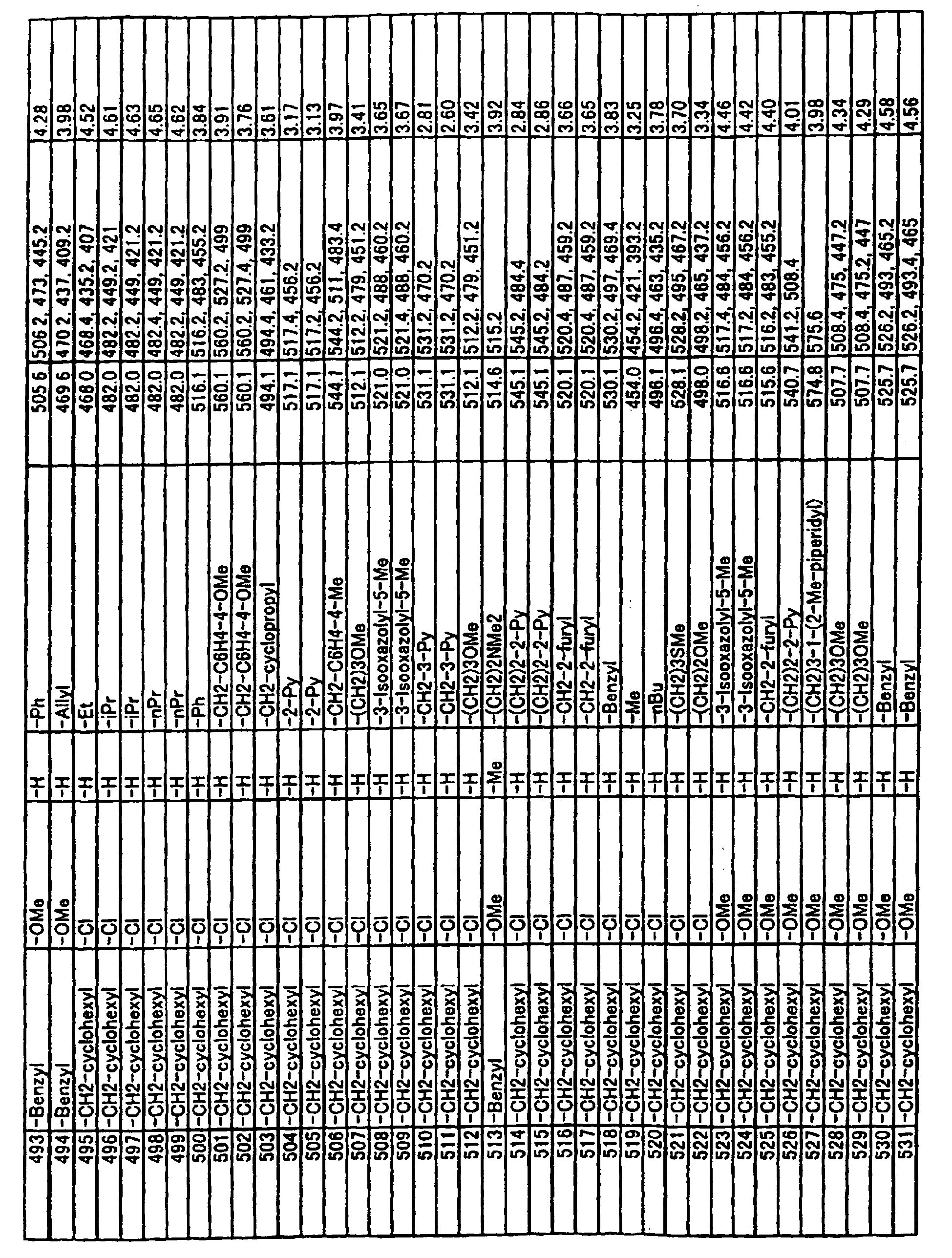


-

- A mixture of 2H-1,4-benzothiazin-3(4H)-one (5 g), p-anisaldehyde (6.6 g), and sodium methoxide (11.63 g) in 260 mL of DMF was heated to reflux for 15 hrs. The reaction mixture was cooled down to r.t., and water was added. The resulting precipitate was filtered and washed with water and ethanol to give the product.
- To a DMF (60 mL) solution of 2H-2(Z)-(4-methoxybenzylidene)-1,4-benzothiazin-3(4H)-one (1.4 g), NaH (160 mg) was added at 4 °C. After 1 hr's stirring, ethyl bromoacetate (684 mg) was added and the reaction mixture was warmed to room temperature. After 2 hrs' additional stirring, the reaction mixture was added ethyl bromoacetate (68 mg) and left at r.t. overnight. The reaction mixture was added 5% KHSO4 aq. and extracted with EtOAc. The organic layer was washed with sat. NaHCO3 aq. and brine, and dried over MgSO4 and concentrated under reduced pressure. The residue was purified by silica gel column chromatography to give the product.
- 2H-2(Z)-(4-methoxybenzylidene)-4-(N-ethoxyoarbonylmethyl)-1,4-benzothiazin-3(4H)-one (1.4 g) was dissolved in ethanol (20 mL) and THF (20 mL). 5N NaOH aq. was added to the solution at room temperature and stirred for 3 hrs. The reaction mixture was added 5% KHSO4 aq. and extracted with EtOAc. The organic layer was washed with brine, dried over MgSO4 and concentrated under reduced pressure to give the product.
- Isobutyl chloroformate (477 mg) was added dropwise to a THF (40 mL) solution of 2H-2(Z)-(4-methozybenzylidene)-1,4-benzothiazin-3(4H)-one-4-yl-acetic acid (1.19 g) and N-methylmorpholine (353 mg) at -15 to -20 °C. THF (10 mL) solution of O-TBDHS-hydoxylamine (565 mg) was added after additional 5 minutes' stirring. The mixture was warmed to r.t. with stirring, and stood overnight. The reaction mixture was quenched with sat. Na2CO3 aq. and extracted with EtOAc. The organic layer was washed with 1N HCl and brine, dried over MgSO4 and concentrated under reduced pressure. The residue was purified by recrystallization from mixed solvent of THF and hexane to give 1.2 g of the hydroxamic acid as colorless solid.
1H-NMR (DHSO-d6, δ) 1.82(s, 3H), 4.60(s, 1.6H), 4.88(s, 0.4H), 7.07(d, J=8.8Hz, 2H), 7.04-7.11(m, 1H), 7.27(dt, J=1.4Hz, 8.2Hz, 1H), 7.38(dd, J=1.1Hz, 7.7Hz, 1H), 7.68(d, J=8.8Hz, 2H), 7.73(s, 1H), 8.98(s. 0.8H), 9.43(s, 0.2H), 10.3(s, 0.2H), 10.8(s, 0.8H) - The following compounds listed in the Table 5 were prepared in a similar manner.


-

- 2H-2(Z)-(4-methoxybenzylidene)-1,4-benzothlazin-3(4H)-one (142 mg) was dissolved in MeOH (5 mL) and THF (20 mL). 10% Pd/C (350 mg) was added. The reaction mixture was vigorously stirred at r.t. for 4 hours under H2. The catalyst was removed by filtration, and the filtrate was concentrated under reduced pressure. The residue was purified by preparative thin layer chromatography on silica gel (EtOAc/toluene, 1/4) to give the product as a white solid (133.5 mg).
- To a solution of 2H-2-(4-methoxybenzyl)-1,4-bonzothiazin-3(4H)-one (428 mg) in DMF (20 mL), NaH (66 mg, 60% in oil) was added. After 1 hour's stirring, ethyl bromoacetate (263 mg, 1.57 mmol) was slowly added. The reaction mixture was stirred at r.t. overnight. The solvent was removed under reduced pressure and the residue was dissolved in EtOAc and washed with 1N HCl, 5% Na2CO3 aq., and brine. The organic layer was dried over Na2SO4 and concentrated. The crude product was used in the following step without purification.
- To a solution of ethyl ester (515 mg) in MeOH (10 mL), 1N NaOH (2.58 mL) was slowly added at 0 °C. After 30 minutes' stirring, the mixture was warmed to room temperature and left overnight. The reaction mixture was concentrated under reduced pressure. The residue was dissolved in 5% Na2CO3 aq., and washed with Et2O. The aqueous layer was acidified with 4N HCl, and the product was extracted with EtOAc. The organic layer was dried over Na2SO4 and concentrated to give the acetic acid (451 mg, 88%) as a white solid.
- The acetic acid (343 mg), obtained as above, was dissolved in CH2Cl2 (4 mL) and pyridine (4 mL) and pentafluorophenyl trifluoroacetate (560 mg) was added. After 3 hours' stirring, O-TBDMS-hydroxylamine (736 mg) was added. The reaction mixture was stirred at r.t. overnight. The solvent was removed and the residue was dissolved in EtOAc. The organic layer was washed with 1N HCl and brine, dried over Na2SO4 and concentrated under reduced pressure. The residue was purified by preparative thin layer chromatography on silica gel (CHCl3/MeOH, 10/1) to give hydroxamic acid (323 mg) as a pale orange solid. 1H-NMR (DMSO-d6,δ) 2.69(1H, m), 3.16(1H, m), 3.76(3H, s), 3.83(1H, m), 4.52(2H, m), 6.87(2H, d, J=7.0), 7.09-7.18(4H, m), 7.33-7.40(2H, m), 9.06(1H, br-s), 10.83(1H, 8).
-

- 2H-2-(4-methozybenzyl)-1,4-benzothiazin-3(4H)-one-4-yl-acetic acid N-hydroxyamide (373 mg) was dissolved in CH2Cl2 (10 mL). BBr3 (1M solution in CH2Cl2, 5 ml) was added and the reaction mixture was stirred at r.t. overnight. The solvent was removed under reduced pressure, and the residue was dissolved in EtOAc. The organic layer was washed with 1N HCl and brine, dried over Na2SO4 and concentrated under reduced pressure. The residue was purified by preparative thin layer chromatography on silica gel (CHCl3/MeOH, 10/1) to give hydroxamic acid (161 mg) as a pale yellow solid.
1H-NMR (DMSO-d6, δ) 2.58(1H, m), 3.06(1H, m), 3.75(1H, s), 4.37-4.83(2H, m), 6.66(2H, d, J=7.86Hz), 6.97-7.13(4H, m), 7.27-7.38(2H, m), 8.99(1H, s), 9.26(1H, s), 10.77(1H, s) -

- To a stirred solution of p-tolualdehyde (48 mg) and 2H-2-diethylphosphonyl-1,4-benzothiazlne-3(4H)-one-4-ylacetic acid ethyl ester (78 mg) in ethanol (3 mL), which was prepared by Worley's method (J. Org. Chem., 40, 1731 (1975)), was added a solution of sodium ethoxide (28 mg, 0.42 mmol) in ethanol (1 mL). The reaction mixture was stirred at r.t. overnight. The solvent was removed under reduced pressure. The residue was dissolved in BtOAc and washed with sat. NaHCO3 aq., 1N HCl, and brine. The organic layer was dried over Na2SO4 and concentrated. The residue was purified by preparative thin layer chromatography on silica gel (CHCl3/MeOH, 15/1) to give a yellow solid (37 mg, 52%).
- This compound was converted to 2H-2-(4-Methylbenzyl)-1,4-benzothiazin-3(4H)-one-4-yl-acetic acid N-hydroxyamide by the reactions analogous to those described in Example 405.
- The following compounds listed in the Tables 6 and 6' were prepared in a similar manner.


-

- A mixture of 2-amino-6-methylbenzothiazole (657 mg) in 20% NaOH aq. (10 mL) was heated at 180 °C in an autoclave for 5 hours. The mixture was cooled to 80 °C and a solution of 2-bromo-3-(4-mathoxyphenyl)proplontc acid (1.088 g) in 10% NaOH aq. (10 mL) was added and the temperature was maintained at 80 °C for 1 hour. The mixture was cooled to r.t. and concentrated under reduced pressure. The residue was dissolved in AcOH (40 mL) and heated at 100 °C for 4 hours. The reaction mixture was cooled to r.t. and concentrated under reduced pressure. The residue was dissolved in EtOAc and washed with water and 5% Na2CO3 aq. The organic layer was dried over Na2SO4 and concentrated. The residue was purified by recrystallization from Et2O and hexane to give a white solid (805 mg).
- The product of Step 1 was converted to hydroxamic acid as described in Example 405(step 2 and 3).
- The following compounds listed in the Tables 7, 7' and 7" were prepared in a similar manner.


-

- To a mixture of 3-Amino-4-mercaptopyridine•2HCl (400 mg) and 2-bromo-3-(p-methoxyphenyl)propionic acid(520 mg) in DMF (8 mL) was added K2CO3 (1.38 gr) and the mixture was stirred for 3 hrs at r.t. EDC•HCl (800 mg) and 1-hydroxybenzotriazole (900 mg) were added to the reaction mixture and the stirring was continued overnight. The reaction mixture was diluted with aq. NaHCO3 and extracted with EtOAc 3 times. The combined organic layers were washed with aq. NaHCO3, aq. NaH2PO4 and brine. Column chromatography on silica gel (eluent;CHCl3/MeOH=40/l) gave the product as a white solid (390 mg).
- To a THF(15 mL) solution of 2H-2-(p-methoxybenzyl)-1,4-pyrido[3,4-e]thiazin-3(4H)-one (385 mg) was added NaH (60% in oil, 39 mg) at 0 °C, and the mixture was stirred for 30 min. at the same temperature and for 30 min at r.t. After the reaction mixture was cooled to 0°C, ethyl bromoacetate (164 µL) was added and the reaction mixture was stirred for 3 hrs at r.t. The reaction was quenched by the addition of aq. NaH2PO4 and extracted with EtOAc several times. Column chromatography on silica gel (eluent; CHCl3/EtOAc=5/1) gave the product almost quantitatively as a colorless oil.
- The compound obtained above was treated with 5N NaOH (0.8 mL) in HeOH (8 mL) for 1 hr at r.t. The reaction mixture was concentrated in vacuo, diluted with water and the pH was adjusted to 5.2 by 1N HCl. Lyophilization gave the corresponding carboxylic acid as a white powder.
- The white powder in CH2Cl2 (15 mL) and pyridine (0.8 mL) was treated with pentafluorophenyl trifluoroacetate (400 µL) for 3 hrs at r.t., and the resulting mixture was treated with O-TMS-hydroxylamine (320 µL) and stirred overnight at r.t. The reaction mixture was concentrated in vacuo and the residue was dispersed in water and cyclohexane. The white precipitate was filtered and purified on silica gel (eluent: CHCl3/MeOH=20/1), affording the product as a white solid. (315 mg)
NMR(d6-DMSO, δ): 2.70(1H,dd,J=14.3, 9.0), 3.11(1H,dd,J=14.3, 6.1), 3.72(3H,s), 3.99(1H,dd,J=9.0, 6.1), 4.57(2H,s), 6.83(2H,d,J=8.6), 7.13(2H,d,J=8.6), 7.42(1H,d,J=5.1), 8.18(1H,d,J=5.1), 8.35(1H,s), 9.00(1H,s), 10.81(1H,s) -

- To a solution of 2-(2-bromophenyl)thio-3-(4-methoxyphenyl)propanoic acid (1.102 g) and L-leucine ethyl ester•HCl (704 mg) in DMF (10 mL), HOBt (551 mg) and EDC•HCl (690 mg) were added. The reaction mixture was stirred at r.t. overnight. The solvent was removed under reduced pressure. The residue was dissolved in EtOAc and washed with 1N HCl, 5% Na2CO3 aq. and brine. The organic layer was dried over Na2SO4 and concentrated to give the pure product as a pale yellow oil (1.561 g, quant.).
- The product obtained in Step 1 (763 mg), Pd2(dba)3•CHCl3 (78 mg), P(o-tolyl)3 (92 mg), and CS2CO3 (977 mg) in toluene (12 mL) were heated to 100°C in a culture tube (PYREXPLUS®) under nitrogen for 40 hrs. The reaction mixture was then cooled to r.t., diluted with EtOAc, filtered, and the filtrate was concentrated under reduced pressure. The residue was purified by preparative thin layer chromatography on silica gel (toluene/EtOAc, 20/1) to give the product as a pale yellow oil (274 mg).
- To a solution of the compound obtained in Step 2 (274 mg) in ethanol (5 mL) and THF (5 mL), 1N NaOH (2.56 mL) was slowly added at 0 °C. After 30 minutes' stirring, the mixture was warmed to room temperature and left over 1 day. The reaction mixture was concentrated under reduced pressure and the residue was dissolved in EtOAc and washed with 1N HCl. The organic layer was dried over Na2SO4 and concentrated. The crude acid was used in the following step. The acid (204 mg) was dissolved in CH2Cl2 (3 mL) and pyridine (3 mL) and pentafluorophenyl trifluoroacetate (716 mg) was added. After 3 hours' stirring, O-TBDMS-hydoxylamine (452 mg) was added. The reaction mixture was stirred at r.t. overnight. The solvent was removed under reduced pressure, and the residue was dissolved in EtOAc. The organic layer was washed with 1N HCl and brine, and dried over Na2SO4 and concentrated under reduced pressure. The residue was purified by preparative thin layer chromatography on silica gel (toluene/EtOAc=1/1) to give the hydroxamic acid (208 mg) as a pale orange solid.
- The following compounds listed in the Table 8 were prepared in a similar manner.

-

- To a solution of 2H-2-(4-methoxybenzyl)-1,4-benzothiazin-3(4H)-one (2 g) in THF (20 mL), NaH (304 mg) and subsequently t-butyl bromoacetate (1.13 mL) were added at 0 - 5 °C. The mixture was stirred at the same temperature for 5 minutes and at r.t. for 30 minutes. The reaction was quenched by adding 150 mL of water, and extracted with EtOAc. The organic layer was washed with brine, and dried over MgSO4 and concentrated under the reduced pressure, and residue was purified by silica gel column chromatography (Eluent: Hexane:EtOAc=10:1) to give 3.0 g of the product as oil.
- Product in Step 1 (500 mg) was dissolved in MeOH (10 mL) and m-CPBA (432 mg) was added at 0 - 5 °C. The mixture was stirred at the same temperature for 5 min. and warmed to r.t. After stirred for 1 hour, 100 mL of water was added and extracted with EtOAc. The organic layer was washed with sat. NaHCO3 aq. and brine, and dried over MgSO4 and concentrated under the reduced pressure, and the residue was purified with silica gel column chromatography (Eluent: Hexane:EtOAc=5:1) to give 270 mg of 1,1-dioxide and 370 mg of 1-oxide as oil.
- To the sulfone of Step 2 (270 mg), was added TFA (2 mL) at 0 - 5 °C. The mixture was warmed to r.t. and stirred for 2 hrs. 100 mL of Et2O was added and the resulting precipitate was filtered and washed with Et2O, giving 245 mg of the corresponding acid.
- The product of Step 3 was converted to hydroxamic acid by the method described in Example 405, giving 95.6 mg of the product as colorless solid.
1H-NMR (DMSO-d6,δ) 3.06(1H,dd,J=8.6Hz,14.6Hz), 3.21(1H,dd,J=4.0Hz, 14.6Hz), 3.70(3H,s), 4.51(1H,d,J=17Hz), 4.57(1H,d,J=17Hz), 4.99(1H,dd, J=4.0Hz,8.6Hz), 6.80(2H,d,J=8.4Hz), 7.20(2H,d,J=8.4Hz), 7.38(2H,m), 7.78(1H,t,J=7.3Hz), 7.88(2H,d,J=7.1Hz), 9.03(0.8H,bs), 9.42(0.2H,bs), 10.43(0.2H,bs), 10.79(0.8H,bs). -

- The product (290 mg) was obtained as colorless precipitate from the sulfoxide (370 mg) of Example 439 (Step 2) by the method described in Example 439 (Step 3).
- The product of Step 1 was converted to hydroxamic acid as described in Example 439 to give 95 mg of the product. 1H-NMR (DMSO-d6, δ) 3.09(1H,m), 3.49(1H,b), 3.76(3H,m), 4.40-5.00(3H,m), 6.30-6.50(2H,m), 7.00-7.50(4H,m), 7.60-7.90(2H,m), 9.04-9.45(1H,m), 10.78-10.87(1H,m).
-

- To a solution of 2H-2-(ethoxyoarbonylmethyl)-1,4-benzothiazin-3(4H)-one (2 g) in THF (20 mL) was added sodium hydride (335 mg), and t-butyl bromoacetate (1.23 mL) was added dropwise at 0 - 5 °C. The mixture was stirred for 5 min. at the same temperature and for 30 minutes at r.t. 150 mL of water was added and extracted with EtOAc. The organic layer was washed with brine, and dried over MgSO4 and concentrated under the reduced pressure to give 3.1 g of the product as oil.
- To a solution of the product of step1 in MeOH (20 ml), 1N NaOH (7.96 ml) was added at 0 °C. Stirring was continued for 3 hrs. The reaction mixture was diluted with water, and washed with Et2O. The aqueous layer was acidified with 1N HCl and the product was extracted with EtOAc. The organic layer was dried over Na2SO4 and concentrated to give the corresponding acetic acid (2.79 g) as oil.
- To the solution of the acetic acid (200 mg) in DMF (20 ml), 4-anisidine (77 mg) and EDC•HCl (119 mg) were added at 0 °C. Stirring was continued for 5 hours. The reaction mixture was diluted with water and extracted with EtOAc. The organic layer was washed with 1N HCl, sat. NaHCO3 and brine, dried over MgSO4 and concentrated under the reduced pressure. The residue was purified with silica gel column chromatography (Eluent: Hexane:EtOAC=3:1) to give the product (220 mg).
- The product of Step 2 was converted to the hydroxamic acid as described in Example 439 to give 141mg of the product.
- The following compounds listed in the Table 9 were prepared in a similar manner.

-

- To a solution of 2-bromo-3-(4-methoxyphenyl)propionic acid (1.6 g) in DMF (10 ml), 2-aminophenol (731 mg), SDC•HCl (1.54 g), and HOBt (500 mg) were added at 0 °C. Stirring was continued for 2 hrs. The reaction mixture was diluted with water and extracted with EtOAc. The organic layer was washed with 1N HCl, sat. NaHCO3 and brine, dried over MgSO4 and concentrated under reduced pressure. The residue was purified with silica gel column chromatography (Eluent: Hexane:EtOAc=5:1).
- To a solution of the obtained crystal (547 mg) in DMF (3 ml), K2CO3 (300 mg) was added at 0 °C. Stirring was continued at room temperature for 2 hrs. The reaction mixture was diluted with water and extracted with EtOAc. The organic layer was washed with brine, dried over MgSO4 and concentrated under reduced pressure. The residue was purified with silica gel column chromatography (Eluent: Toluene:EtOAc=6:1). 266 mg of the product was obtained as oil.
- The compound obtained in Step 1 (266 mg) was converted to the hydroxamic acid derivative by the method described above and 152 mg of the product was obtained as colorless precipitate.
1H-NMR (DMSO-d6, δ) 2.90(1H,dd,J=9.0Hz,14Hz), 3.06(1H,dd,J=4.2Hz, 14Hz), 3.71(3H,s), 4.41(1H,d,J=16Hz), 4.47(1H,d,J=16Hz), 4.83(1H,dd, J=4.2Hz,9.0Hz), 6.89(2H,d,J=8.6Hz), 6.89- 7.03(4H,m), 7.15(2H,d,J=8.6 Hz), 8.98,(0.8H,bs), 9.40(0.2H,bs), 10.35(0.2H, bs), 10.80(0.8H,bs). -

- To a solution of 2H-2-(4-methoxybenzyl)-1,4-benzothiazin-3(4H)-one (570 mg) in THF (20 mL), NaOH powder (84 mg) was added. After 10 minutes' stirring, ethyl acrylate (600 mg) was slowly added. The reaction mixture was stirred at room temperature for 5 hours. The solvent was removed under reduced pressure and the residue was acidified with 4N HCl. The product was extracted with EtOAc and the organic layer was dried over Na2SO4 and concentrated. The crude product was used in the following step without purification.
- To a solution of the ethyl ester in MeOH (20 mL), 1N NaOH (2.0 mL) was slowly added. The mixture was stirred at r.t. overnight and concentrated under reduced pressure. The residue was dissolved in water, and the aqueous solution was washed with Et2O and acidified with 4N HCl. The product was extracted with EtOAc. The organic layer was dried over Na2SO4 and concentrated to give the propanoic acid (618 mg) as a white solid.
- The product of Step 1 was converted to hydroxamic acid by the method described in example 405 (step 3 and 4).
1H-NMR (DMSO-d6,δ) 2.30(2H. m),2.63(1H, m), 3.03(1H, m), 3.72(3H, s), 3.77(1H, m), 4.11(2H, m), 6.84(2H, d, J=8.04Hz), 7.06-7.11(3H, m), 7.32-7.42(3H, m), 8.82(1H, s), 10.53(1H, s) -

- The reaction procedure of Step 1 and 2 were similar to the example 445 (Step 1 and 2).
LC-MS: MS(m/e) 371.0, 338.0, 296.2 (M.W.=370.4); Retention Time= 3.07 min. -

- A suspension of (L)-leucine methyl ester (10 g, 55 mmol) and triethylamine (7.7 ml, 55 mmol) in 120 ml of dioxane was stirred at room temperature for 5 minutes. 3 A molecular sieves were added followed by p-chlorobenzaldehyde (17 g, 121 mmol). The mixture was heated at 80°C for 4 hrs. Mercaptoacetic acid (14.2 ml, 203.5 mmol) was added to the mixture and the heating was continued for an additional 12 hrs. The reaction mixture was cooled to room temperature, and diluted with ethyl acetate (40 ml) and water (30 ml). The reaction mixture was filtered to remove the molecular sieves. The organic layer was diluted with ethyl acetate (100 ml), washed twice with 60 ml of saturated solution of sodium carbonate, twice with aqueous 1N HCl and once with water. The organic layer was dried with MgSO4 and evaporated to give a residue that was carried out to the next step without further purification.
- The residue obtained in step 1 was dissolved in dioxane (50 ml). 30 ml of saturated solution of LiOH were added and the mixture was stirred at room temperature for 3h (analytical LC/MS showed no traces of starting material). The mixture was acidified with conc. HCl until acidic pH and diluted with ethyl acetate (50 ml). The 2 layers were separated and the aqueous layer was extracted 3 times with ethyl acetate (30 ml). The organic layers were combined, dried with MgSO4, filtered and evaporated to give an oil that solidified upon standing. The reaction mixture was further purified column by chromathography with hexane-ethyl acetate (from 95:5 to 1:1) to give 14.4 g (yield for 2 steps: 80%) of the desired product as a 60:40 mixture of diastereoisomers.
- The mixture of pure acids obtained in Step 2 was dissolved in refluxing toluene. Upon cooling 2g of the minor isomer crystallized out of the mixture and were used for further transformations.
- The crystal obtained in Step 3 (500 mg, 1.52 mmol) was dissolved in methanol (200ml). A solution of sodium periodate (326 mg, 1.5 mmol) in 25 ml of water was added and the heterogeneous mixture was stirred at room temperature for 3 days. When no starting material was observed by LC/HS, the reaction mixture was concentrated to 80% of its volume, acidified with acetic acid (2 ml) and diluted with water (10 ml) and ethyl acetate (25 ml). The 2 layers were separated and the water layer extracted 2 additionnal times with ethyl acetate (2X 20 ml). The organic layers were combined, dried with MgSO4, evaporated under dryness to give the product as a white solid that was taken to the next step without purification.
- To a solution of the product in 5 ml of CH2Cl2 (DCM) and 2 ml of pyridine was added pentafluorophenol trifluoroacetate (914 ml, 5.32 mmol). The solution was stirred at room temperature for 1 h. O-(tert-Butyldimethylsilyl)-hydroxylamine (1.2 g, 7.6 mmol) in 2 ml of CH2Cl2 was added to the activated ester and the mixture was stirred at room temperature for an additional 12 h. The reaction mixture was acidified with HCl (to cleave the TBDMS protective group) and stirred at room temperature for 1h. After dilution with DCM (4ml) and water (2ml), the 2 layers were separated, the organic layer dried with MgSO4, filtered and evaporated to give an oil that was dissolved in DMSO (3 ml) and purified by reverse phase HPLC. The Product (141 mg, 26%) was obtained with 98% purity.
- The following compounds listed in the Table 13 were prepared in a similar manner.

-

- The crystal obtained from Example 730, Step 3 (100 mg, 0.30 mmol) was dissolved in acetic acid (2ml). A solution of potassium permanganate (66.4 mg, 0.42 mmol) in 2 ml of water was added dropwise during a period of 1 hour at 0 °C. The mixture was stirred at room temperature and followed by LC/MS. After 1h, no starting material was observed; the color of the reaction was removed with NaHS2O3, diluted with water and extracted with EtOAc. The 2 layers were separated and the water layer extracted 2 additional times with ethyl acetate (2X 20 ml). The organic layers were combined, dried with MgSO4. evaporated under dryness to give the product as a white solid that was taken to the next step without purification.
- To a solution of this solid in 1 ml of DCM and 0.5 ml of pyridine was added pentafluorophenol trifluoroacetate (231 ml, 1.34 mmol). The solution was stirred at room temperature for 1 h. O-(tert-Butyldimethylsilyl)-hydroxylamine (270 mg, 1.83 mmol) in 1 ml of DCM was added to the activated ester and the mixture was stirred at room temperature for an additional 12 h. The reaction was acidified with HCl (to cleave the TBDMS protective group) and stirred at room temperature for 1h. After dilution with DCH (4ml) and water (2ml), the 2 layers were separated, the organic layer dried with MgSO4, filtered and evaporated to give an oil that was dissolved in DMSO (2 ml) and purified by reverse phase HPLC to yield the hydroxamic acid as a white solid.
- The following compounds listed in the Table 14 were prepared in a similar manner.

-

- To 2-mercapto-3-(4-methoxyphenyl)propionic acid (14g) in ethanol(100m1), t-butyl 4-chloro-3-nitrobenzoate(17g), and potassium fluoride(3.8g) were added at O °C. Potassium carbonate(9.1g) was slowly added at 0°C and the mixture was heated under reflux for 7 hrs. The solvent was removed under the reduced pressure and the residue was diluted with water. The solution was washed with Et2O and extracted with EtOAc. The organic layer was washed with brine, and dried over MgSO4 and concentrated under the reduced pressure. The solution of the residue in MeOH(120ml) was added dropwise to the suspension of Fe powder(11.4g) in MeOH(50ml)-NH4Claq.(17.6g/80ml of water) at r.t. The mixture was stirred at 80°C for 3 hrs. AcOH(50ml) was added to the reaction mixture, and the stirring was continued for 3 hrs at 80°C. The reaction mixture was cooled to room temperature, poored into ice-water, and extracted with EtOAc. The organic layer was washed with brine, dried over MgSO4 and concentrated under the reduced pressure. The residue was purified with silica gel column chromatography (eluent: hexane/EtOAc, 8/1,5/1,3/1) to give the product as oil. This was crystalized from EtOAc-Hexane to give a colorless crystal(12.7g).
- To sodium hydride (3.32g) suspended with THF (30 mL)was added a solution of the product of Step 1 (30.5 g) in THF (240 mL), and ethyl bromoacetate (13.1 mL) were added dropwise at 0-5 °C. The mixture was warmed to r.t. and left at r.t. overnight. Saturated aqueous ammonium chloride was added and extracted with EtOAc. The organic layer was washed with water and brine, dried over MgSO4, and concentrated under the reduced pressure to give 37 g of the product as oil.
- To a solution of ethyl 6-t-butoxycarbonyl-2H-2-(4-methoxy-benzyl)-1,4-benzothiazin-3(4H)-one-4-yl-acetate (3g) was added 5N-aqueous sodium hydroxide (1.44mL) at r.t. and stirred for 4hr at r.t. The reaction mixture was concentrated under reduced pressure. 5% KHSO4 aq. was added, and extracted with EtOAc. The organic layer was washed with brine, and dried over MgSO4 and concentrated under reduced pressure to give 6-t-butoxycarbonyl-2H-2-(4-methoxybenzyl)-1,4-benzothiazin-3(4H)-one-4-yl acetic acid as oil. Isobutyl chloroformate (1.04 g) was added dropwise to a THF (30 mL) solution of 6-t-butoxycarbonyl-2H-2-(4-Methoxybenzyl)-1,4-benzo-thiazin-3(4H)-one-4-yl acetic acid and N-methylmorpholine (769 mg) at -15 to -20 °C. O-TMS-hydoxylamine (1.09 g) was added after additional 15 minutes' stirring. The mixture was warmed to r.t. with stirring, and stood overnight. The reaction mixture was quenched with sat.NaHCO3 aq. and extracted with EtOAc. The organic layer was washed with 1N HCl, sat.NaHCO3 aq. and brine, dried over MgSO4 and concentrated under reduced pressure to give 2.25 g of 6-t-butosycarboxyl-2H-2-(4-methoxybenzyl)-1,4-benzo-thiazin-3(4H)-one-4-ylacetic acid N-hydroxyamide as pale yellow oil. 5%-ethanedithiol in TFA (10mL) was added to dissolve 6-t-butoxycarboxyl-2H-2-(4-methoxybenzyl)-1,4-benzo-thiazin-3(4H)-one-4-ylacetic acid N-hydroxyamide, and stood at r.t. for 2hrs. Toluene (10mL) was added and concentrated under reduced pressure. The residue was purified by recrystallization from mixed solvent of THF and hexane to give 1.2 g of the hydroxamic acid as colorless solid.
- The following compounds listed in the Tables 15, and 15' were prepared in a similar manner.


-

- Ethyl 4-chloro-3-nitrobenzoate (8g) was dissolved in ethanol (100mL) and potassium carbonate (9.67g) was added. Ethanol (50mL) solution of 3-(4-methoxyphenyl)-2-mercaptopropanoic acid (7.43g) was added at 4°C, and potassium fluoride(2.0g) was added. The reaction mixture was heated under reflux for 3 hrs, and concentrated under reduced pressure. 1N-hydrochloric acid was added and extracted with EtOAc. The organic layer was washed with brine, dried over MgSO4 and concentrated under reduced pressure. The residue was dissolved in AcOH (100mL), and added to the suspension of Fe (6.1g) in AcOH(50mL) at 60-70°C. The reaction mixture was filtered and precipitate was washed with AcOH. Filtrate was added to water, and precipitate was collected and washed with mixed solvent of THF and hexane to give 5.9g of the product as white solid.
- To sodium hydride (3.3g) suspended in THF (30 mL)was added a solution of ethyl 2H-2-(4-methoxybenzyl)-1,4-benzothiazjm-3(4H)-one-6-carboxylate (3g) in THF (250 mL), and t-butyl bromoacetate (1.7 mL) was added dropwise at 0 - 5 °C. The mixture was warmed to r.t. and left at r.t. overnight. Saturated aqueous ammonium chloride was added and extracted with EtOAc. The organic layer was washed with water and brine, and dried over MgSO4 and concentrated under the reduced pressure. The residue was purified by silica gel column chromatography to give 3.9 g of the product as oil.
- The product of Step 2 was converted to hydroxamic acid by the method described in example 777 (step 3).
- The following compounds listed in the Tables 16 and 16' w ere prepared in a similar manner.


-

- To a mixture of thioglycolic acid (10.75 g) and K2CO3 (65.00 g) in DMF (300 mL), a solution of ethyl 4-chloro-3-nitrobenzoate (28.12 g) in DMF (100 mL) was added and heated at 80 °C. The mixture was stirred at 80 °C for 6 hrs. The solid of K2CO3 was filtered off, and the filtrate was concentrated under reduced pressure. To the residue, diethyl ether(50 mL) and water(100 mL) was added and the yellow solid product was collected by filtration. The product was acidified with 4N HCl and extracted with ethyl acetate. The organic layer was dried over Na2SO4 and concentrated. The product (27.634 g, 83%) was used in the following step.
- To a solution of the product (12.956 g) in THF (300 mL), 10% Pd/C (13.00 g) was added. The reaction mixture was vigorously stirred at r.t. for 9 hrs under H2. The catalyst was removed by filtration, and the filtrate was concentrated under reduced pressure. To a solution of the crude product (9.345 g) and HOBt (5.88 g) in DMF (200 mL), EDC•HCl (7.37 g) was added. The reaction mixture was stirred at r.t. overnight. The solvent was removed under reduced pressure. The residue was dissolved in ethyl acetate and washed with 1N HCl, 5% Na2CO3 aq., and brine. The organic layer was dried over Na2SO4 and concentrated. The residue was purified by recrystallization from diethyl ether and hexane to give the product (8.502 g, 79% in 2 steps) as a white solid.
- To a solution of the 6-ethoxycarbonyl-2H-1,4-benzothlazin-3(4H)-one (8.432 g) in dichloromethane (80 mL), sulfuryl chloride (4.79 g) was added dropwise. The reaction mixture was stirred at r.t. for 6 hours. The solvent was removed under reduced pressure. The residue was purified by recrystallization from chloroform and hexane to give the product (8.80 g, 91%) as a white solid.
- A mixture of 6-ethoxycarbonyl-2H-2-chloro-1,4-benzothiazin-3(4H)-one (8.724 g) and triethyl phosphite (11.74 g) was heated at 120 °C and stirred for 10 hrs. The solvent was removed under reduced pressure. The residue was purified by recrystallization from THF and diethyl ether to give the product (10.534 g, 88%) as a pale yellow solid. Step 3: t-Butyl 6-ethoxycarbonyl-2H-2-(4-phenoxybenzyl)-1,4-benzothiazln-3(4H)-one-4-ylacetate
- To a stirred solution of p-phenoxybenzaldehyde (796 mg) and 6-ethoxycarbonyl 2H-2-diethylphosphoryl-1,4-benzothiazine-3(4H)-one (1.00 g) in 80 % ethanol aq. (10 mL) and THF (10 mL), a solution of sodium ethoxide (400 mg) in ethanol (5 mL) was added dropwise. The reaction mixture was stirred at r.t. overnight. The solvent was removed under reduced pressure. To the residue, ethyl acetate(5 ml) and water(10 ml) was added and the solid product was collected by filtration. After drying under reduced pressure, the product(980 mg, 88%) was given as a yellow solid.
- To a solution of 6-ethoxycarbonyl-2H-2-(4-phenoxybenzylidene)-1,4-benzothiazin-3(4H)-one (980 mg) was dissolved in methanol (40 mL) and THF (40 mL), 10% Pd/C (1.00 g) was added. The reaction mixture was vigorously stirred at r.t. for 4 hrs under H2. The catalyst was removed by filtration, and the filtrate was concentrated under reduced pressure. The product (936 mg, 95%) was used in the following step without purification.
- To a solution of 6-ethoxycarbonyl-2H-2-(4-phenoxybenzyl)-1,4-benzothiazin-3(4H)-one (925 mg) in DMF (15 mL), potassium t-butoxide (495 mg) was added at r.t.. After 20 minutes' stirring, t-buthyl bromoacetate (645 mg) was slowly added. The reaction mixture was stirred at r.t. overnight. The solvent was removed under reduced pressure and the residue was dissolved in ethyl acetate and washed with water. The organic layer was dried over Na2SO4 and concentrated. The residue was purified with silica gel column chromatography (eluent: toluene/ethyl acetate, 30/1) to give the product(677 mg, 58%).
- t-Butyl 6-ethoxycarbonyl-2H-2-(4-phenoxybenzyl)-1,4-benzothiazin-3(4H)-one-4-ylacetate (677 mg) was dissolved in TFA (10 mL). The mixture was stirred r.t. for 2 hrs. The solvent was removed under reduced pressure. The residue was purified with silica gel column chromatography (eluent: chloroform/methanol, 10/1) to give the product (428 mg, 71%).
- Isobutyl chloroformate (133 mg) was added dropwise to a THF (10 mL) solution of 6-ethoxycarbonyl-2H-2(Z)-(4-phethoxybenzylidene)-1,4-benzothiazin-3(4H)-one-4-yl-acetic acid (422 mg) and N-methylmorpholine (98 mg) at -5 °C. A solution of O-t-butyl-hydoxylamine hydrochloride (133 mg) and N-methylmorpholine (107 mg) in THF (2 mL) was added dropwise after additional 20 minutes' stirring. The mixture was warmed to r.t. with stirring, and stood overnight. The reaction mixture was concentrated under reduced pressure, acidified with 0.5N citric acid, and extracted with ethyl acetate. The organic layer was dried over Na2SO4 and concentrated under reduced pressure. The residue was purified with silica gel column chromatography (eluent: chloroform/methanol, 5/1) to give the product (260 mg, 54%). Step 5: 6-carboxy-2H-2-(4-phenoxybenzyl)-1,4-benzo-thiazin-3(4H)-one-4-ylacetic acid N-hydroxyamide
- To a solution of 6-ethozycarbonyl-2H-2-(4-phenoxybenzyl)-1,4-benzothiazin-3(4H)-one-4-ylacetic acid N-t-butoxyamide (256 mg) in ethanol (5 mL) and THF (5 mL), 1N NaOH (560 uL) was slowly added at 0 °C. After 30 minutes' stirring, the mixture was warmed to room temperature and left overnight. The reaction mixture was concentrated under reduced pressure and acidified with 1N citric acid, and the product was extracted with ethyl acetate. The organic layer was dried over Na2SO4 and concentrated. The crude product (241 mg) was used in the following step without purification.
- 6-Carboxy-2H-2-(4-phenoxybenzyl)-1,4-benzothiazin-3(4H)-one-4-ylacetic acid N-t-butoxyamide (124 mg) was dissolved in TFA (10 mL). The mixture was stirred at r.t. for 2 days. The solvent was removed under reduced pressure. The residue was purified by preparative thin layer chromatography on silica gel (eluent: chloroform/methanol, 5/1) to give the hydroxamic acid (99 mg, 46% in 2 steps).
- The following compounds listed in the Tables 17, 17', and 17" were prepared in a similar manner.


-

- Ethyl 6-t-butoxycarbonyl-2H-2-(4-methoxybenzyl)-1,4-benzothiazin-3(4H)-one-4-ylacetate (32.9 g) was dissolved in 5%-ethanedithiol in TFA (100mL) and stood at r.t. for 1.5hrs. Toluene (100mL) was added and concentrated under reduced pressure. The residue was washed with mixed solvent of ether and hexane to give 30.2 g of ethyl 6-carboxy-2H-2-(4-methoxybenzyl)-1,4-benzothiazin-3(4H)-one-4-ylacetate as pale yellow solid.
- Ethyl 6-carboxyl-2H-2-(4-methoxybenzyl)-1,4-benzo-thiazin-3(4H)-one-4-ylacete (2 g) was dissolved in dichloromethane (20mL), and oxalyl chloride (1.22 g) was added at 4°C. 1 drop of DMF was added and warmed to r.t., and stirred for 3hrs. Toluene (20mL) was added and concentrated under reduced pressure. This acid chloride was dissolved in dichloromethane (15mL), and added to dichloromethane (10mL) solution of diisopropylamine (299mg) and triethylamine (511mg) at 4°C. The reaction mixture was stirred for 4hrs at r.t., diluted with 5% KHSO4 aq., and extracted with ethyl acetate. The organic layer was washed with sat. NaHCO3 aq. and brine, and dried over MgSO4. The solution was concentrated under reduced pressure. The residue was purified by silica gel column chromatography to give 1.47g of ethyl 6-isopropylcarbamoyl-2H-2-(4-methoxy-benzyl)-1,4-benzothiazin-3(4H)-one-4-ylacetate as pale yellow oil.
- The product of Step 2 was converted to hydroxamic acid by the method described in example 777 (step 3).
- The following compounds listed in the Table 18 were prepared in a similar manner.


-

- Ethyl chloroformate (3.475 g) was added dropwise to a THF (30 mL) solution of methyl 6-carboxy-2H-2-(4-methoxybenzyl)-1,4-benzothiazin-3(4H) -one-4-ylacetate (2.795 g) and triethylamine (3.241 g) at 0 °C. A solution of sodium borohydride (3.160 g) in water (5 mL) was added dropwise after additional 1 hour's stirring. The reaction mixture was stirred at 0 °C for 1 hr. The reaction mixture was quenched with acetic acid and concentrated under reduced pressure. The residue was dissolved in ethyl acetate and washed with water. The organic layer was dried over Na2SO4 and concentrated. The residue was purified with silica gel column chromatography (eluent: toluene/EtOAc, 4/1) to give the product (2.294 g, 79%).
- To a solution of methyl 6-hydroxymethyl-2H-2-(4-methoxybenzyl)-1,4-benzothiazin-3(4H)-one-4-ylacetate (2.294 g) and imidazole(1.612 g) in DMF (30 mL), a solution of TBDHSC1 (2.665 g) in DMF (5 ml) was slowly added. The reaction mixture was stirred at r.t. for 2 days and quenched with water. The solvent was removed under reduced pressure, and the residue was dissolved in chloroform, dried over Na2SO4. and concentrated. The residue was purified with silica gel column chromatography (eluent: toluene/EtOAc, 50/1) to give the product (2.966 g, quant.).
- To a solution of the methyl ester (2.966 g) in methanol (20 mL), 1N NaOH (8.86 mL) was slowly added at 0 °C. After 30 minutes' stirring, the mixture was warmed to room temperature and left overnight. The reaction mixture was concentrated under reduced pressure. The residue was dissolved in ethyl acetate and water. After the pH was adjusted to 6 with acetic acid, the product was extracted with EtOAc. The organic layer was dried over Na2SO4 and concentrated to give the product (1.208 g, 42%) as a white solid.
- Isobutyl chloroformate (373 mg) was added dropwise to a THP (10 mL) solution of 6-t-butyldimethylsiloxymethyl-2H-2-(4-methoxybenzyl)-1,4-benzothiazin-3(4H)-one-4-ylacetic acid (1.208g) and N-methylmorpholine (276 mg) at -5°C. THF (1 mL) solution of O-TMS-hydoxylamine (313 mg) was added after additional 20 minutes' stirring. The mixture was stirred at -5 °C for 2 hrs, gradually warmed to r.t. with stirring, and stood overnight. The reaction mixture was quenched with water and extracted with EtOAc. The organic layer was washed with 1N HCl and brine, dried over Na2SO4 and concentrated under reduced pressure. The residue was purified with silica gel column chromatography (eluent: chloroform/methanol, 10/1) to give the hydroxamic acid(645 mg, 70%) as a white powder.
- The following compounds listed in the Table 19 were prepared in a similar manner.

-

- To a solution of methyl 6-hydroxymethyl-2H-2-(4-methoxybenzyl)-1,4-benzothiazin-3(4H)-one-4-yl-acetate(335 mg) and tetra-n-buthylammonium iodide (133 mg) in toluene (10 mL), 50% NaOH aq.(5 mL) was added. After 30 minutes' stirring, dimethyl sulfate (1.47 g) was slowly added. The reaction mixture was vigorously stirred at r.t. overnight. The solvent was removed under reduced pressure, and the residue was acidified with 4N HCl and extracted with ethyl acetate. The organic layer was dried over Na2SO4 and concentrated. The crude product(346 mg) was used in the following step without purification.
- The crude product (305 mg) of step 1 was dissolved in dichloromethane (4 mL) and pyridine (3 mL) and pentafluorophenyl trifluoroacetate (664 mg) was added. After 3 hours stirring, O-TBDMS-hydoxylamine (465 mg) was slowly added. The reaction mixture was stirred at r.t. overnight. The solvent was removed and the residue was dissolved in EtOAc. The organic layer was washed with 1N HCl and water, dried over Na2SO4 and concentrated under reduced pressure. The residue was purified with preparative thin layer chromatography on silica gel (EtOAc) to give the hydroxamic acid (190 mg, 60% in 2 steps) as a pale orange solid.
1H-NMR (DHSO-d6,δ); 2.65(1H, m), 3.10(1H, m), 3.30(3H, s), 3.72(3H, m), 3.80(1H, m), 4.39(2H, m), 4.46(2H, m), 6.84(2H, d, J=8.61Hz), 7.02(1H, d, J=8.25Hz), 7.12(3H, m), 7.34(1H, d, J=7.89Hz), 9.00(1H, s), 10.77(1H, s) -

- To sulphur monochloride (170 mL), a solution of methyl 4-aminobenzoate in acetic acid (200 mL) was slowly added at 0 to 10 °C. The reaction mixture was stirred at 65 °C for 4 hrs. To the cooled mixture, toluene(300 mL) was added, the solid product was collected by filtration and washed with toluene three times. After drying under reduced pressure, this solid (30.888 g, 94 %) was dissolved in 5% sodium acetate aq. and the solution was stirred at r.t. for 2 hrs. The solid product was collected by filtration and washed with water and toluene. After drying under reduced pressure, the product (28.028 g, 98%) was obtained.
:Sawhney's procedure (Indian J. chem. 33B, 280 (1994)). - To a Solution of 6-methoxpcarbonyl-3H-1,2,3-benzodithiazole-2-oxide (11.46 g) and 2-bromo-3-(4-methoxyphenyl)propionic acid (12.96 g) in 50% MeOH aq. (100 mL), triethylamine(50 mL) was slowly added at 70 °C. The reaction mixture was stirred at 70 °C for 2 hrs. The mixture was cooled to r.t. and concentrated under reduced pressure. The residue was dissolved in EtOAc and washed with 5% Na2CO3 aq. and 1N HCl. The organic layer was dried over Na2SO4 and concentrated. The residue was purified by recrystallization from Bt2O and hexane to give the product (15.131 g, 88%) as a white powder.
- To a solution of 7-methoxycarbonyl-2H-2-(4-methoxybenzyl)-1,4-benzothiazin-3(4H)-one (7.00 g) in DMF (40 mL), NaH (1.47 g, 60% in oil) was added at r.t.. After 20 minutes' stirring, t-buthyl bromoacetate (5.56 g) was slowly added. The reaction mixture was stirred at r.t. overnight. The solvent was removed under reduced pressure and the residue was dissolved in EtOAc and washed with water. The organic layer was dried over Na2SO4 and concentrated. The residue was purified with silica gel column chromatography (eluent: toluene/EtOAc, 20/1) to give the product (6.994 g, 64%).
- t-Butyl 7-methoxycarbonyl-2H-2-(4-methoxybenzyl)-1,4-benzothiazin-3(4H)-one-4-ylacetate (4.81 g) was dissolved in TFA (19 mL) and ethanedithiol(1 mL). The mixture was stirred at r.t. for 2 hrs. The solvent was removed under reduced pressure, and the residue was diluted with 5% Na2CO3, washed with Et2O. The aquaous layer was acidified with 4N HCl and extracted with EtOAc. The organic layer was dried over Na2SO4 and concentrated. The residue was purified with silica gel column chromatography (eluent: EtOAc) to give the product (3.522 g, 83%).
- Isobutyl chloroformate (1.304 g) was added dropwise to a THF (20 mL) solution of 7-methoxycarbonyl-2H-2-(4-methoxybenzyl)-1,4-benzothiazin-3(4H)-one-4-ylacetic acid (3.484 g) and N-methylmorpholine (0.966 g) at -5°C. THF (1 mL) solution of O-TMS-hydoxylamine (1.096 g) was added after additional 20 minutes' stirring. The mixture was stirred at -5 °C for 2 hrs, gradually warmed to r.t. with stirring, and stood overnight. The reaction mixture was quenched with water and extracted with EtOAc. The organic layer was washed with 1N HCl and water, dried over Na2SO4 and concentrated under reduced pressure. The residue was purified with silica gel column chromatography (eluent: toluene/EtOAc, 3/1) to give the hydroxamic acid (2.943 g, 81%) as a white powder.
- To a solution of 7-methoxycarbonyl-2H-2-(4-methoxybenzyl)-1,4-benzothiazin-3(4H)-one-4-ylacetic acid N-hydroxamide (2.827 g) in methanol (10 mL)and THF (10 mL), 1N NaOH (13.6 mL) was slowly added at 0 °C. After 30 minutes' stirring, the mixture was warmed to room temperature and left overnight. The reaction mixture was concentrated under reduced pressure. The residue was dissolved in 5% Na2CO3 aq., and washed with Et2O. The aqueous layer was acidified with 4N HCl, and the product was extracted with EtOAc. The organic layer was dried over Na2SO4 and concentrated. The residue was purified by recrystallization from EtOAc to give the hydroxamic acid (1.234 g, 45%) as a white solid.
- The following compounds listed in the Tables 20, and 20' were prepared in a similar manner.


-

- To a solution of 7-methoxycarbonyl-2H-2-(4-methoxybenzyl)-1,4-benzothiazin-3(4H)-one-4-ylacetic acid N-allyloxyamide (5.067 g) in methanol (15 mL) and THF (15 mL), 1N NaOH (16.65 mL) was slowly added at 0 °C. After 30 minutes' stirring, the mixture was warmed to room temperature and left overnight. The reaction mixture was concentrated under reduced pressure. The residue was dissolved in 5% Na2CO3 aq., and washed with Et2O. The aqueous layer was acidified with 4N HCl, and the product was extracted with EtOAc. The organic layer was dried over Na2SO4 and concentrated to give the product (4.748 g, 97%) as a white solid.
- To a solution of 7-carboxy-2H-2-(4-methoxybenzyl)-1,4-benzothiazin-3(4H)-one-4-ylacetic acid N-allyl-oxyamide (221 mg) and isopropylamine (36 mg) in DMF (10 mL), HOBt (552 mg) and 1-ethyl-3-(3-dimethylaminopropyl)carbodiimide-HCl(EDC•HCl) (690 mg) were added. The reaction mixture was stirred at r.t. overnight. The solvent was removed under reduced pressure. The residue was dissolved in EtOAc and washed with 1N HCl, 5% Na2CO3 aq. and brine. The organic layer was dried over Na2SO4 and concentrated. The crude product was used in the following step without purification.
- To a solution of the crude product of 7-isopropylcarbamoyl-2H-2-(4-methoxybenzyl)-1,4-benzo-thiazin-3(4H)-one-4-ylacetic acid N-allyloxyamide in 80% ethanol aq. (8 mL), Pd(OAc)2 (12 mg), PPh3 (53 mg), and formic acid (69 mg) were added. The reaction mixture was heated at 80 °C under nitrogen for 1 hr. The solvent was removed and the residue was dissolved in EtOAc. The organic layer was washed with water, dried over Na2SO4 and concentrated under reduced pressure. The residue was purified by preparative thin layer chromatography on silica gel (chloroform/methanol, 8/1) to give the hydroxamic acid (207 mg, 93 % in 2 steps) as a pale orange solid.
- The following compounds listed in the Tables 21 were prepared in a similar manner.


-

- The product in Example 757(400mg) was dissolved in MeOH (10mL) and AcOH (1 mL). 10% Pd/C (200 mg) was added and the reaction mixture was vigorously stirred at r.t. for 5hrs under H2. The catalyst was removed by filtration, and the filtrate was concentrated under reduced pressure. The residue was purified by silica gel column chromatography (chloroform/MeOH, 30/1, 10/1) to give the product as a pale yellow solid (162mg).
- The following compounds listed in the Table 22 were prepared in a similar manner.

-

- Ethyl 6-hydrospmethyl-2H-2-(4-methoxybenzyl)-1,4-benzothlazin-3(4H)-one-4-ylacetate (1.75 g), prepared by the procedure described in Example 835 (Step 1), was dissolved in THF (16mL), and trlethylamine(0.93ml) and methanesulfonyl chloride (0.51ml) were slowly added at 0 °C. The reaction mixture was stirred at 0°C for 2 hrs. The reaction mixture was concentrated under reduced pressure. The residue was dissolved in DMF (30ml), and sodium azide(636mg)was added at 0 °C. Stirring was continued for 1hr at 0 °C and for 2hrs at r.t.. The reaction mixture was diluted with water and extracted with EtOAc. The organic layer was washed with brine, dried over MgSO4 and concentrated under reduced pressure. The residue was purified with silica gel column chromatography (eluent: hexane:EtOAc = 5:1, 3:1). 1.83g of the product was obtained as oil.
- The compound obtained in Step 1 (1.07 g) was dissolved in methanol(20 mL) and EtOAc(5 mL). 10% Pd/C(300 mg) was added, and the reaction mixture was vigorously stirred at r.t. for 2hrs under H2. The catalyst was removed by filtration, and the filtrate was concentrated under reduced pressure. The residue was dissolved in MeOH (20 ml), di-t-butyldicarbonate (0.74 g) and NaHCO3 (0.21 g) were added at 0 °C. The reaction mixture was stirred at r.t. overnight. The reaction mixture was diluted with water and extracted with EtOAc. The organic layer was washed with brine, dried over MgSO4 and concentrated under reduced pressure. The residue was purified with silica gel column chromatography (Eluent: Hexane/EtOAc. 5/1, 3/1, 2/1). 0.67g of the product was obtained as oil.
- The compound in step 2 was converted to 600mg of the hydroxamic acid by the reactions analogous to those described in Example 777.
- To a solution of the compound in step 3 (485 mg) in 4N HCl/dioxane (3 mL) was stirred for 1hr at 0 °C. The reaction mixture was diluted with Et2O and the precipitate was filtered and washed with Et2O. 300mg of the product was obtained as pale yellow solid.
- The following compounds listed in the Table 23 were prepared in a similar manner.

-

- Ethyl 6-cyano-2H-2-(4-methoxybenzyl)-1,4-benzo-thiazin-3(4H)-one-4-ylacetate (700 mg) was dissolved in DMF (5 mL), and sodium azide (573 mg), ammonium chloride (641 mg) were added at r. t.. The reaction mixture was stirred at 90°C for 24 hrs, diluted with water (50 ml) and 1N HCl (5 ml), and extracted with EtOAc. The organic layer was washed with brine, dried over MgSO4, and concentrated under reduced pressure. The residue was purified with silica gel column chromatography (Eluent: chloroform/MeOH, 30/1, 20/1, chloroform/MeOH/AcOH=20/1/0.1). 800mg of the product was obtained as oil.
- The compound in step 1 was converted to 594mg of the product by the procedure analogous to Example 777.
- The following compounds listed in the Table 24 were prepared in a similar manner.

-

- The compound, obtained in Example 869 (Step 2), was dissolved in THF (2 mL) and H2O (0.04 mL). The N,N'-di-t-butoxycarbonyl-S-methylisothiourea (369 mg) and triethylamine (89 ul) were added at r.t. and the stirring was continued for 2hrs at 50 °C. The reaction mixture was concentrated under reduced pressure, and the residue was purified with silica gel column chromatography (Eluent: hexane/EtOAc, 8/1, 6/1). 200 mg of the product was obtained as oil.
- The compound in step 1 was converted to 510 mg of the hydroxamic acid by the procedure analogous to Example 777.
- The compound in Step 2 (110 mg) was dissolved in TFA (3 ml)-ethanedithiol (100 ul) at 0°C, and stirred at r.t. for 1hr. The reaction mixture was diluted with Et2O-Toluene (4:1) and, the product (29mg) was obtained as precipitate. 1H-NMR (DHSO-d6,δ); 2.62(1H,dd,J=9Hz,14Hz), 3.08(1H,dd, J=6,14Hz),3.78(3H,s),3.78(1H,dd,J=6Hz,9Hz),4.34(2H,d,J=6Hz), 4.45-4.90(2H,m),6.83(2R,d,J=8.4Hz),6.98(1H,d, J=8Hz),7.10(2H,d,J=8.4Hz),7.16(1H,s),7.30(4H,bs),7.38(1H,d, J=8Hz),8.00(1H,t,J=6Hz),8.97,9.42(1H,bs),10.31,10.80(1H,bs)
-

- A solution of 5-methylpyrazolo[3,4-d]dithiazolium chloride (930 mg), which was prepared by Chenard's procedure (J. Org. Chem. 49, 1224 (1984)), in 20% NaOH aq. (15 mL) was heated at 80 °C for 1 hr. A solution of 2-bromo-3-(4-chlorophenyl)propionic acid (1.05 g) in 20% NaOH aq. (10 mL) was added at 80 °C and the temperature was maintained at 80°C for 1.5 hrs. The mixture was cooled to r.t. and concentrated under reduced pressure. The residue was dissolved in acetic acid (50 mL) and heated at 80 °C for 2.5 hours. The reaction mixture was cooled to r.t. and concentrated under reduced pressure. The residue was dissolved in EtOAc and washed with water, 5% Na2CO3 aq. and brine. The organic layer was dried over Na2SO4 and concentrated. The residue was purified by recrystallization from Et2O to give the product (512 mg, 44%).
- To a solution of the product of Step 1 (235 mg) in DMF (10 mL), NaH (52 mg, 60% in oil) was added. After 30 minutes' stirring, t-buthyl bromoacetate (203 mg) was slowly added. The reaction mixture was stirred at r.t. overnight. The solvent was removed under reduced pressure and the residue was dissolved in EtOAc and washed with 1N HCl, 5% Na2CO3 aq., and brine. The organic layer was dried over Na2SO4 and concentrated. The residue was purified with silica gel column chromatography (eluent: toluene/EtOAc, 20/1) to give the product(0.33 g, quant.).
- The product of Step 2 (0.32 g) was solved in TFA (15 mL) at r.t.. The mixture was stirred for 2 hours. The solvent was removed under reduced pressure. The crude product(0.28 g) was used in the following step without purification.
- Isobutyl chloroformate (120 mg) was added dropwise to a THF (10 mL) solution of 2-metbyl-5H-5-(4-chlorobenzyl)-pyrazolo[4,3-b]thiazin-6(7H)-one-7-ylacetic acid (0.28 g) and N-methylmorpholine (170 mg) at -5 °C. THF (1 mL) solution of O-TMS-hydoxylamine (101 mg) was added after additional 20 minutes' stirring. The mixture was stirred at -5°C for 2 hrs, gradually warmed to r.t. with stirring, and stood overnight. The reaction mixture was quenched with water and extracted with EtOAc. The organic layer was washed with saturated NaHCO3, 1N HCl, and brine, dried over Na2SO4 and concentrated under reduced pressure. The residue was purified by recrystallization from Et2O to give the hydroxamic acid (221.3 mg, 77% in 2 steps) as a white powder.
- The following compounds listed in the Table 25 were prepared in a similar manner.

-
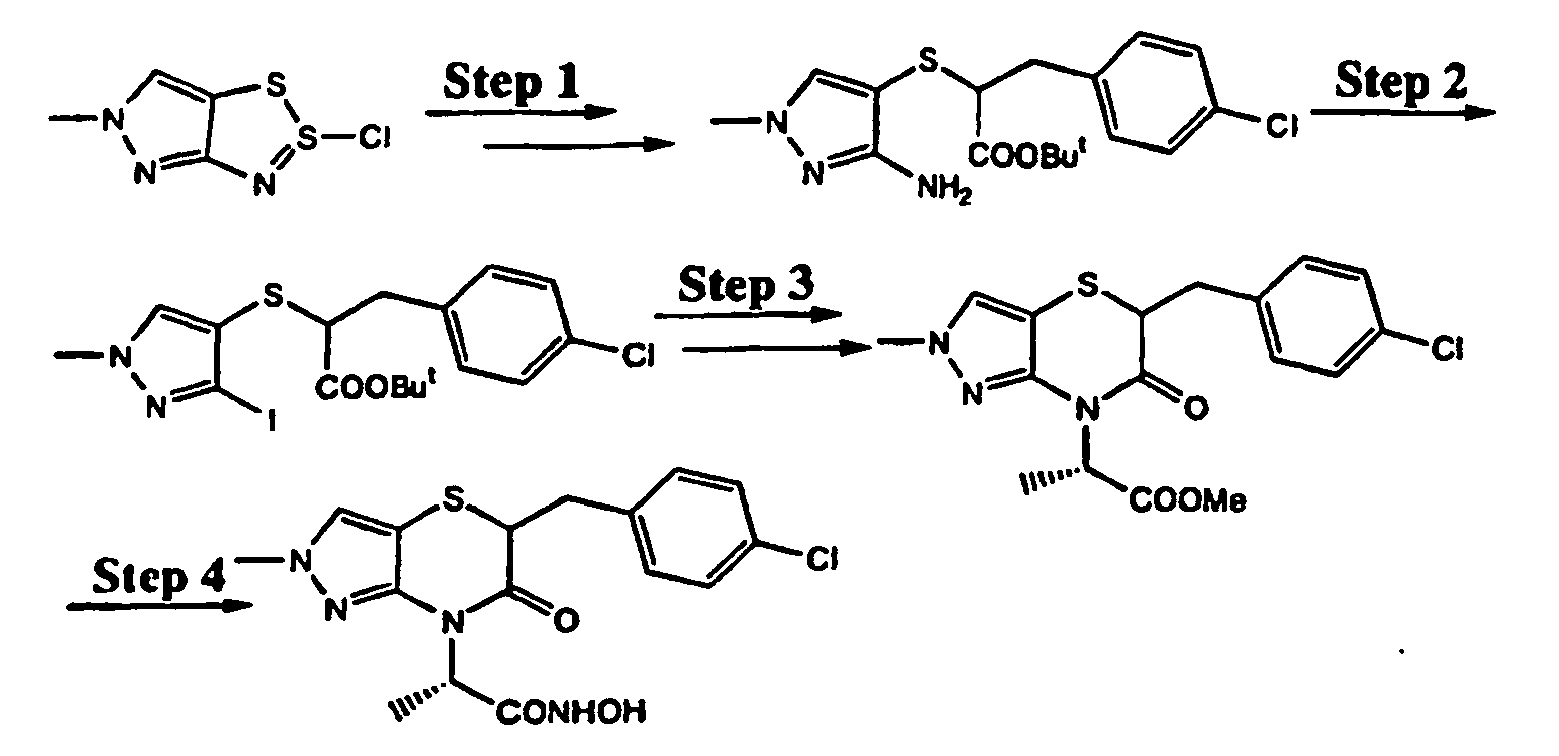
- A solution of 5-methylpyrazolo[3,4-d]dithiazolium chloride (880 mg), which was prepared by Chenard's procedure (J. Org. Chem. 49, 1224 (1984)), in 20% NaOH aq. (15 mL) was heated at 90 °C for 1.5 hrs. The mixture was cooled to r.t. and the pH was adjusted to 6.0 with AcOH, and adjusted to 10 by Na2CO3 sat.. To a mixture of the crude product and Na2CO3 (1.20 g), a solution of t-buthyl 2-bromo-3-(4-chlorophenyl)propionate (1.21 g) in DMF (20 mL) was added. The mixture was stirred at r.t. overnight and concentrated under reduced pressure. The residue was dissolved in EtOAc and washed with water and brine. The organic layer was dried over Na2SO4 and concentrated. The residue was purified with silica gel column chromatography (eluent: toluene/EtOAc, 2/1) to give the product(820 mg, 59%).
- To a solution of isoamyl nitrite (605 mg) in diiodomethane (5 mL) at 100 °C, a solution of the product of Step 1 (380 mg) in dichloromethane (2 mL) were added dropwise. The reaction mixture was stirred at 100 °C for 1 hr. The solvent was removed under reduced pressure. The residue was purified with silica gel column chromatography (eluent: toluene/EtOAc, 20/1) to give the product(417 mg, 84%).
- The product of Step 2 (335 mg) was dissolved in TFA (10 mL). The mixture was stirred at r.t. for 2 hrs. The solvent was removed under reduced pressure. To the solution of the residue (347 mg) and L-alanine methyl ester•HCl (215 mg) in DMF (10 mL), Et3N (290 uL), HOBT (235 mg) and EDC•HCl, (295 mg) were added. The reaction mixture was stirred at r.t. for 2days. The solvent was removed under reduced pressure. The residue was dissolved in EtOAc and washed with 1N HCl, 5% Na2CO3 aq. And brine. The organic layer was dried over Na2SO4 and concentrated. The residue was purified with silica gel column chromatography (eluent: toluene/EtOAc, 2/1) to give the alanine derivative (316 mg, 89% in 2 steps).
- To a solution of the alanine derivative (205 mg) and in DMF (10 mL), K2CO3 (112 mg), Cu powder (128 mg) were added. The reaction mixture was heated to 140 °C and stirred for 3 hrs. The mixture was diluted with EtOAc and filtered. The solvent was removed under reduced pressure. The residue was purified with silica gel column chromatography (eluent: toluene/EtOAc, 10/1) to give the product (128 mg, 83%).
- To a solution of the product of Step 3 (141 mg) in methanol (10 mL), 1N NaOH (2.0 mL) was slowly added at 0 °C. After 30 minutes' stirring, the mixture was warmed to r.t. and left overnight. The reaction mixture was concentrated under reduced pressure. The residue was dissolved in EtOAc and water, washed with 1N HCl and water. The organic layer was dried over Na2SO4 and concentrated. To a THF (10 mL) solution of the crude product(151 mg)and N-methylmorpholine (45 mg), isobutyl chloroformate (61 mg) was added dropwise at -5 °C. THF (0.5 mL) solution of O-TMS-hydoxylamine (51 mg) was added after additional 30 minutes' stirring. The mixture was stirred at -5 °C for 2 hrs, gradually warmed to r.t. with stirring, and stood overnight. The reaction mixture was quenched with water, concentrated under reduced pressure, and dissolved in EtOAc. The organic layer was washed with 1N HCl and brine, dried over Na2SO4 and concentrated under reduced pressure. The residue was purified by recrystallization from chloroform, Et2O, and hexane to give the hydroxamic acid(110 mg, 78% in 2 steps) as a white powder.
- The following compounds listed in the Table 33 were prepared in a similar manner.

-

- To a solution of 7-metoxymethyloxy-2H-2-(4-methoxy benzyl)-1,4-benzothiazin-3(4H)-one (1 g) in MeOH (20 ml), 4N HCl-dioxane (2 ml) was added at r.t. and stirring was continued for 24hrs. The reaction mixture was concentrated and Et2O was added. The colorless crystal (800mg) was filtered.
- The product was dissolved in DMF (5 mL), and allyl bromide (252 ul) and K2CO3 (366 mg) were added at 0 °C. The reaction mixture was stirred at r.t. for 24hrs, diluted with water, and extracted with EtOAc. The organic layer was washed with brine, dried over MgSO4 and concentrated under reduced pressure. The residue was purified with silica gel column chromatography (Eluent: hexane/EtOAc, 4/1, 3/1). 560mg of the product was obtained as oil.
- The product of Step 1 (560 mg) was converted to 7-allyloxy-2H-2-(4-methoxybenzyl)-1,4-benzothiazin-3(4H)-one-4-ylacetic acid N-allyloxyamide as described in Example 777. The product (650 mg) was obtained as oil.
- To a solution of the product of Step 2 (650 mg) was dissolved in EtOH (8 ml) and H2O (2 ml), tetrakistriphenylphosphine palladium (175 mg) and formic acid (108 ul) were added at r.t. The mixture was stirred under reflux for 2hrs. The reaction mixture was diluted with water and extracted with EtOAc. The organic layer was washed with sat.NaHCO3, brine, 1N HCl, and brine, dried over MgSO4 and concentrated under reduced pressure. The residue was purified with silica gel column chromatography (Eluent: chloroform/MeOH, 50/1, 30/1). The oily residue was crystalized in toluene-Et2O, and the product (345 mg) was obtained as pale yellow crystal.
- The following compounds listed in the Table 26 were prepared in a similar manner.

-

- Methyl 7-fluoro-2H-2-benzyl-1,4-benzothiazin-3(4H)-one-4-yl-acetate(100 mg, 0.29 mmol) was dissolved in THF (5 mL) at -78 ° C and lithium hexamethyl disilazane 1M solution in THF (0.64 mmol, 0.64 ml) was added. The mixture was stirred for 1 hr and methyl iodide (39.7 ml, 0.64 mmol) was added. The mixture was allowed to warm to r.t., then poured into saturated solution of sodium carbonate (5 ml), diluted with EtOAc. The 2 layers were separated and the water layer extracted 2 additional times with ethyl acetate. The combined organic layers were dried with MgSO4, evaporated and carried out to the next step with no further purification.
- compound in step 1 was dissolved in dioxane (2 ml) and saturated solution of lithium hydroxide (2 ml). The mixture was stirred at room temperature for 12 hours, then acidified with conc.HCl and extracted with ethyl acetate, dried with MgSO4 and evaporated to give product 3 as a solid.
- Acid obtained obtained in step 2 was dissolved in 1 ml of DCM and 1 ml of pyridine. Pentafluorophenol trifluoroacetate (74.7 ml, 0.43 mmol) was added and the mixture stirred at room temperature for 1 hour. Then, 0-TBDMSNH2OH (129 mg, 0.87 mmol) was added, the mixture stirred for an additional 12 hours then acidified until pH = 1 with cHCl, diluted with DCM (3 ml) and water (2 ml). The organic layer was separated and then evaporated, the solid obtained re-dissolved in DMSO and purified using reverse phase HPLC.
Retention time of BPLC analysis: 2.69min
Mass: 361.2, 328.0 (H.W. =360) -
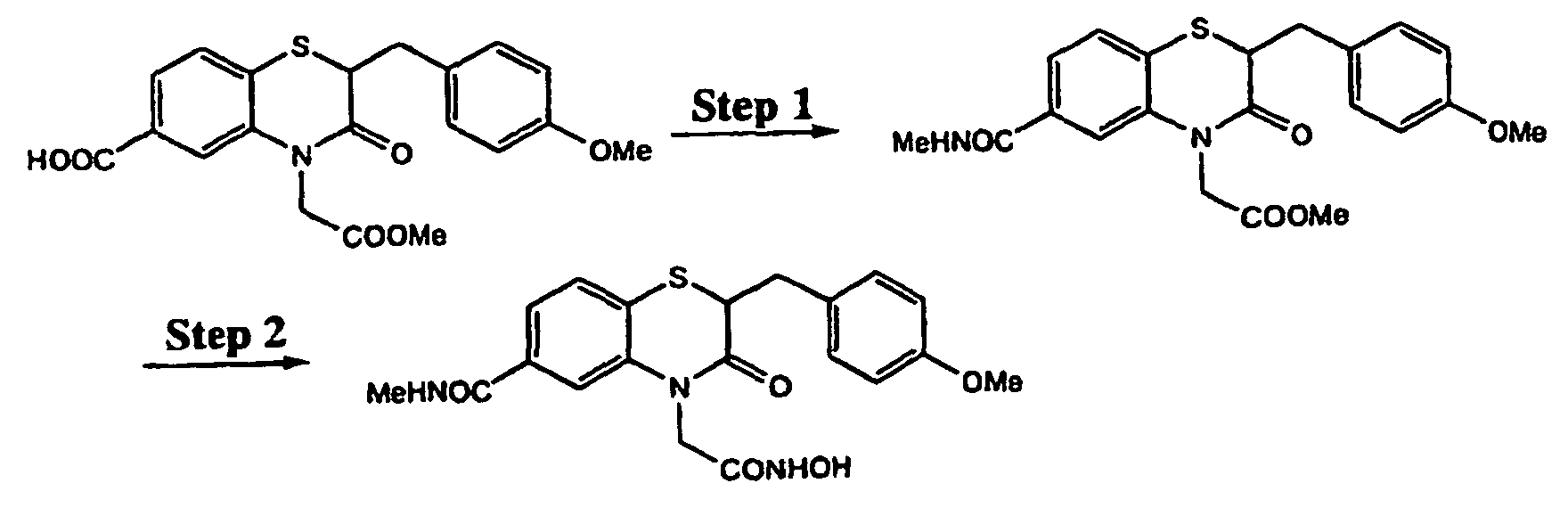
- Methyl [2H-2-benzyl-6-carboxyl-3(4H)-oxo-1,4-benzothiazine-4-yl]acetate(62mg,0.17mmol), diisopropylethylamine (45 ml, 0.25 mmol), HOBT (35 mg, 0.25 mmol) and EDC.HCl (50 mg, 0.25 mmol) were dissolved in DCM (2 ml) and the reaction mixture was stirred at room temperature for 1 hour. Methylamine (64 ml, 0.51 mmol) (8.03 M in ethanol) was added to the mixture and stirring was continued for an additional 12 hours. The reaction mixture was diluted in DCM (5 ml) and washed with 1N HCl (2 x 2 ml), water (2 ml) and brine (2 ml). The organic layer was concentrated in vacuo and the crude amide was used directly in the next step.
- Potassium hydroxide (109 mg, 1.93 mmol) and hydroxylamine hydrochloride (85 mg, 1.22 mmol) were dissolved in methanol (0.53 ml and 0.9 ml respectively) at room temperature. Once a solution was obtained the potassium hydroxide solution was poured into the hydroxylamine solution at 0 °C and the mixture was maintained at this temperature for 1 hour. The precipitate (potassium chloride) was filtered off, the liquid added into the solution of the methyl ester, obtained in step 1, (in methanol (1 ml) and stirring was continued for an additional 3 hours. Acetic acid (0.5 ml) was added to the mixture and the solvent was evaporated to dryness. The residue was then re-dissolved in water and extracted with ethyl acetate (2 x 3ml). The combined organic extracts were evaporated to dryness, re-dissolved in DHSO and purified via reverse phase chromatography to yield the major product of the reaction together with small amount of the sulfoxide.
- The following compounds listed in the Table 27 and 28 were prepared in a similar manner.


-

- Methyl 7-amino-2H-2-(4-methoxybenzyl)-3(4H)-oxo-1,4-benzothiazine-4-yl-acetate (63 mg, 0.17 mmol), was dissolved in DCM (2 ml). Triethylamine (24 ml, 0.17 mmol) was added followed by acetyl chloride (12 ml, 0.17 mmol), and the reaction mixture was stirred at room temperature for 1 hour. The reaction mixture was diluted in DCM (5 ml) and washed with saturated Na2CO3 (2 x 2 ml), water (2 ml) and brine (2 ml). The organic layer was concentrated in vacuo and the crude amide was used directly in the next step.
- Potassium hydroxide (109 mg, 1.93 mmol) and hydroxylamine hydrochloride (85 mg, 1.22 mmol) were dissolved in methanol (0.53 ml and 0.9 ml respectively) at room temperature. Once a solution was obtained the potassium hydroxide solution was poured into the hydroxylamine solution at 0 °C and the mixture was maintained at this temperature for 1 hour. The precipitate (potassium chloride) was filtered off, the liquid added into the solution of the methyl ester obtained in step 1 in methanol (1 ml) and stirring was continued for an additional 3 hours. Acetic acid (0.5 ml) was added to the mixture and the solvent was evaporated to dryness. The residue was then re-dissolved in water and extracted with ethyl acetate (2 x 3ml). The combined organic extracts were evaporated to dryness, dissolved in DMSO and purified by reverse phase chromatography to yield the major product of the reaction together with small amount of the sulfoxide.
- The following compounds listed in the Table 29 were prepared in a similar manner.

-

- Methyl 6-amino-2H-2-(4-methoxybenzyl)-3(4H)-oxo-1,4-benzothiazine-4-yl-acetate(63 mg, 0.16 mmol), was dissolved in DCM (2 ml) and pyridine (0.5 ml). Methyl sulfonylchloride (20 ml, 0.26 mmol) was added and the reaction mixture was stirred at room temperature for 3 hour. The reaction mixture was diluted in DCM (5 ml) and washed with 1N HCl (2 x 2 ml), water (2 ml) and brine (2 ml). The organic layer was concentrated in vacuo and the crude sulfonamide was used directly in the next step.
- Potassium hydroxide (109 mg, 1.93 mmol) and hydroxylamine hydrochloride (85 mg, 1.22 mmol) were dissolved in methanol (0.53 ml and 0.9 ml respectively) at room temperature. Once a solution was obtained the potassium hydroxide solution was poured into the hydroxylamine solution at 0 °C and the mixture was maintained at this temperature for 1 hour. The precipitate (potassium chloride) was filtered off, the liquid added into the solution of the methyl ester in methanol (1 ml) and stirring was continued for an additional 3 hours. Acetic acid (0.5 ml) was added to the mixture and the solvent was evaporated to dryness. The residue was then dissolved in water and extracted with ethyl acetate (2 x 3ml). The combined organic extracts were evaporated to dryness, re-dissolved in DHSO and purified by reverse phase chromatography.
- The following compounds listed in the Table 30 were prepared in a similar manner.

-

- Methyl 7-amino-2H-2-(4-methoxybenzyl)-3(4H)-oxo-1,4-benzothiazine-4-yl-acetate(63 mg, 0.16 mmol) was dissolved in DCM (2 ml) and pyridine (0.5 ml). Methyl isocyanate (15 mg, 0.26 mmol) was added and the reaction mixture was stirred at room temperature for 3 hour. The reaction mixture was diluted in DCM (5 ml) and washed with saturated Na2CO3 (2x2 ml), water (2 ml) and brine (2 ml). The organic layer was concentrated in vacuo and the crude urea was carried directly to the next step.
- Potassium hydroxide (109 mg, 1.93 mmol) and hydroxylamine hydrochloride (85 mg, 1.22 mmol) were dissolved in methanol (0.53 ml and 0.9 ml respectively) at room temperature. Once a solution was obtained the potassium hydroxide solution was poured into the hydroxylamine solution at 0 °C and the mixture was maintained at this temperature for 1 hour. The precipitate (potassium chloride) was filtered off, the liquid added into the solution of the methyl ester, obtained in Step 1, in methanol (1 ml) and stirring was continued for an additional 3 hours. Acetic acid (0.5 ml) was added to the mixture and the solvent was evaporated to dryness. The residue was then dissolved in water and extracted with ethyl acetate (2 x 3ml). The combined organic extracts were evaporated to dryness, re-dissolved in DMSO and purified by reverse phase chromatography.
- The following compounds listed in the Table 31 were prepared in a similar manner.

-

- Methyl 7-amino-2H-2-(4-methoxybenzyl)-3(4H)-oxo-1,4-benzothiazine-4-yl-acetate(63 mg, 0.17 mmol) and diisopropylethylamine (45.5 ml, 0.27mmol) were dissolved in DCM (2 ml. Benzaldehyde (27 ml, 0.26 mmol) and sodium triacetoxyborohydride (58 mg, 0.26 mmol) were added to the solution resulting in a suspension that was stirred at room temperature for 3 hour. The reaction mixture was diluted in DCM (5 ml) and washed with saturated Na2CO3 (2 x 2 ml), water (2 ml) and brine (2 ml). The organic layer was concentrated in vacuo and the crude amine was used directly in the next step.
- Potassium hydroxide (109 mg, 1.93 mmol) and hydroxylamine hydrochloride (85 mg, 1.22 mmol) were dissolved in methanol (0.53 ml and 0.9 ml respectively) at room temperature. Once a solution was obtained the potassium hydroxide solution was poured into the hydroxylamine solution at 0 °C and the mixture was maintained at this temperature for 1 hour. The precipitate (potassium chloride) was filtered off, the liquid added into the solution of the methyl ester, obtained in Step 1, in methanol (1 ml) and stirring was continued for an additional 3 hours. Acetic acid (0.5 ml) was added to the mixture and the solvent was evaporated to dryness. The residue was then dissolved in water and extracted with ethyl acetate (2 x 3ml). The combined organic extracts were evaporated to dryness, re-dissolved in DMSO and purified by reverse phase chromatography.
- The following compounds listed in the Table 32 were prepared in a similar manner.

- The results of biological testing of some compounds are described below.
- Metallo-proteinases used and inhibition assay protocols are described below.
- Both enzymes were commercially available as active forms (Yagai-Cosmobio) and were used for inhibition assays.
- C-terminal truncated form of human prostromelysin cDNA (proMMP-3, cDNA sequence in Nature, 348, 699-704 (1990)) was subcloned, expressed in E.coli and purified as described previously (Biochemistry 30, 6476-6483 (1991)). Activation of proMMP-3 was achieved by treatment with 1 mM 4-aminophenylmercuric acetate at 37°C for 60 min.
- To subclone C-terminal truncated form of procollagenase-3 (proMMP-13) cDNA (J.Biol.Chem., 269(24), 16766-16773 (1994)),two synthetic oligonucleotide primer (5'-GGAATTCCATATGCTGCCGCTGCCGAGTGGTGGTGATGAAGATG-3' and 5'-TTTGGATCCTTAGCCGTACAGGCTTTGAATACCTTGTACATCGTCATCAGG-3' :the former incorporates sequences for a unique NdeI site (underlined) including initial methionine, and the latter has sequences for a stop codon and BamHI site (underlined)) were used with human chondrocyte cDNA library (CLONTECH) in PCR. With these primers and Pfu DNA polymerase (STRATAGENE) in PCR, 767 bp fragment was generated, which encodes 84 amino acid prosequence and 164 amino acids of mature MMP-13. The fragment was digested with NdaI and BamHI, ligated into the NdeI and BamHI sites of pETlla (STRATAGENE), transformed in E.coli BL21(DE3) and cultured. The crude cell extract was prepared as described in Biochemistry. The extract was dialyzed against 20 mM Tris-HCl(pH7.2)/5mM CaCl2/0.02% NaN3 and applied to a SP-Sepharose HP column (1.6 x 10 cm, Amersham-Pharmacia Biotech), and elution was performed with 50 mL linear gradient of 0 to 0.3 M NaCl (partially purified proMMP-13 was eluted at 0.2 M approximately). The fraction was dialyzed against 20 mM Tris-HCl(pH7.9)/5mM CaCl2,/200 mM (NH4)2SO4/0.02% NaN3 and applied to a Phenyl Sepharose HP column (1.6 x 5cm, Amersham-Pharmacia Biotech), and elution was performed with 20 mL linear gradient of 0.2 to 0 M (NH4)2SO4 (pure proMMP-13 was eluted at 50 mM approximately). The fraction was concentrated by YM-5 ultrafiltration membrane and activated with 4-aminophenylmercuric acetate and active MMP-13 was separated from propeptide fragments by gel filtration chromatography as described in Biochemistry.
- Enzymatic assays were performed in accordance with C. G. Knight's method (FEBS Lett., 296(3), 263-266 (1992)). The fluorescent MCA-labeled substrate, (7-methoxycumaline-4-yl)-Pro-Leu-Gly-Leu-L-[N-(2,4-dinitrophenyl)-L-2,3-diaminopropionyl]-Ala-Arg-NH2 (Peptide Institute. Inc.) was used for measuring the kinetics of inhibition for each tested compound.
- The substrate was incubated at 37 °C for 1.5 hours (MMP-1; for 24 hours) with active HMP (at 20 nM, except MHP-13 at 5 nM) and a test compound in assay buffer containing 100 mM Tris-HCl (pH7.5), 10 mM CaCl2, 100 mM NaCl and 0.05% Brij-35. After the mixture was plated at 100 µL/well onto a 96-well microtiter plate and incubated at 37°C, enzymatic activity in the presence of the compound was estimated by measuring the fluorescence intensity (λex 320nm, λem 405nm) and IC50 was determined.
-
Table 10 IC50 (µM) Example No. MMP3 MMP13 Ref. 10 31.6 5.3 Ref. 13 >50 13.2 Ref. 19 1 >50 42 >10 0.759 46 0.894 0.134 71 9.071 0.249 88 3.798 0.062 92 0.794 0.048 105 6.717 0.231 109 0.599 0.043 121 2.547 0.128 130 1.141 0.056 143 1.268 0.064 175 1.140 0.112 176 1.057 0.100 195 1.892 0.119 211 0.895 0.108 218 0.422 0.056 239 0.274 0.035 255 1.203 0.106 257 0.267 0.023 262 0.850 0.066 283 0.614 0.037 306 0.987 0.122 316 0.442 0.026 324 0.733 0.063 329 0.155 0.011 330 0.745 0.066 333 0.794 0.070 361 0.446 0.053 368 1.5 0.036 370 1.2 0.035 371 0.88 0.036 378 >50 16 388 23 1.6 389 >50 29 406 3.228 0.257 407 0.433 0.024 409 0.279 0.012 419 0.514 0.063 422 >10 4.815 423 5.134 1.216 426 0.375 0.038 429 5.616 3.601 431 0.238 0.013 436 0.938 0.671 438 1.665 0.375 441 2.959 0.118 740 0.459 0.012 479 0.27 0.019 739 0.301 0.017 784 0.026 0.001 865 0.053 0.0049 Table 11 IC50 (µM) Example No. MMP-2 MMP-9 21 1.0 >1 365 0.32 0.11 368 0.30 <0.01 369 >1 0.20 - RAW 267.4 (derived from mouse monocytes) was seeded in RPMI1640 containing 10% of FBS (GIBCO BRL) at 100 µL/well (5 x 10⁵ cells/mL) onto 96-well microplates and cultured at 37°C, 5% CO2. After culturing for 4 hours, each test compound diluted in RPMI1640 was added at 50 µL/well. 15 minutes later, 4 µg/µL LPS (DIFCO) diluted in RPMI1640 was added at 50 µL/well and cultured for 24 hours.
- TNP-α produced was measured by ELISA as usual. (For example; J. Cellular Physiol. 154, 479 (1993)) Absorbance at 450 nm (normalized at 620 nm) was measured and percentage of the amount of TNF-α release for each tested compound (n=2) was determined (0% for untreated control (n=4), and 100% for LPS stimulation (n=4)).
Table 12 lnhibition of TNF production Example No. at 5 µM (%) 365 20 367 68 368 30 387 68
Q5, Q6, Ar5, and Cy3 are described above.
Ar6, and Cy4 are described above;
Claims (15)
- A hydroxamic acid derivative represented by the formula [1] or a pharmaceutically acceptable salt thereof:

X is one of the groups represented by the formulae [1'] and [1"]:
A1 is ortho-phenylene or monocyclic ortho-heteroarylene;
R8 and R9 are independently hydrogen or substituent of the ortho-arylene and the ortho-heteroarylene;
Y1 is -O-, -S-, -S(O)- or -S(O)2-;
Y2 is O, or S;
R1 is -(CHR4)n(CR5R6)-CO-NHOH;
R3 is hydrogen, optionally substituted alkyl, or optionally substituted cycloalkyl;
R2 is hydrogen, optionally substituted alkyl, optionally substituted alkenyl, optionally substituted alkynyl, optionally substituted cycloalkyl, optionally substituted heterocycloalkyl; or R2 and R3 may be taken together to be optionally substituted C1-C10 alkylidene;
when X is represented by formula [1'],
R4 and R6 are independently hydrogen, optionally substituted alkyl, optionally substituted alkenyl, optionally substituted alkynyl, optionally substituted alkoxy, optionally substituted alkylthio, optionally substituted cycloalkyl, optionally substituted heterocycloalkyl, optionally substituted aryl, or optionally substituted heteraryl, and R5 is optionally substituted alkyl;
when X is represented by formula [1"],
R4, R5 and R6 are independently hydrogen, optionally substituted alkyl, optionally substituted alkenyl, optionally substituted alkynyl, optionally substituted alkoxy, optionally substituted alkylthio, optionally substituted cycloalkyl, optionally substituted heterocycloalkyl, optionally substituted aryl, or optionally substituted heteraryl; or
R5 may be joined with R4 or R6 to form, with the carbon atom which they attach, optionally substituted cycloalkane or optionally substituted heterocycloalkane;
n is an integer of 0 to 4;
provided that when R2 and R3 are taken together to be optionally substituted C1-C10 alkylidene, X is not methylene substituted by a phenyl or a pyridyl wherein the phenyl and the pyridyl are optionally substituted by methyl or methoxy;
wherein
said alkyl is C1-6 alkyl;
said alkenyl is C2-6 alkenyl;
said alkynyl is C2-6 alkynyl;
said alkoxy is C1-6 alkoxy;
said alkylthio is C 1-6 alkylthio;
said alkylene is C1-6 alkylene;
said allcenylene is C2-6 alkenylene;
said alkynylene is C2-6 alkynylene;
said cycloalkyl is C3-8 cycloalkyl containing 0-2 carbonyl group;
said cycloalkenyl is C3-8 cycloalkenyl containing 0-2 carbonyl group;
said heterocycloalkyl is 5- or 6-membered heterocycloalkyl containing 1 to 5 atoms selected independently from nitrogen atoms, sulfur atoms, and oxygen atoms, wherein said sulfur atoms may be oxidized to form sulfoxide or sulfone;
said heterocycloalkenyl is 5- or 6-membered heterocycloalkenyl containing 1 to 5 atoms selected independently from nitrogen atoms, sulfur atoms, and oxygen atoms, wherein said sulfur atoms may be oxidized to form sulfoxide or sulfone;
said aryl is C6-10 aryl;
said ortho-arylene is C6-10 ortho-arylene;
said heteroaryl is mono or bicyclic 5- or 6-membered heteroaryl containing 1 to 5 atoms selected independently from nitrogen atoms, sulfur atoms, and oxygen atoms;
said ortho-heteroarylene is mono or bicyclic 5- or 6-membered ortho-heteroarylene containing 1 to 3 atoms selected independently from nitrogen atoms, sulfur atoms, and oxygen atoms;
said cycloalkane is C3-8 cycloalkane containing 0-2 carbonyl group;
said heterocycloalkane is 5- or 6-membered heterocycloalkane containing 1 to 3 atoms selected independently from nitrogen atoms, sulfur atoms, and oxygen atoms, wherein said sulfur atoms may be oxidized to form sulfoxide or sulfone,
a substituent of said substituted aryl and said substituted heteroaryl, and a substituent represented by R8 and R9 are selected from the group consisting of halogen; alkyl; alkenyl; alkynyl; halogenated alkyl; -Z1-Ar3; -Z1-Cy1; -Z1-N(Q2)Q1; -Z1-N(Q2)Ar3; -Z1-N(Q2)Cy1; -Z1-NQ4-C(NQ3)N(Q2)Q1;-Z1-NQ4-C(NQ3)N(Q2)Ar3; -Z1-NQ4-C(NQ3)N(Q2)Cy1; -Z1-NQ3-CON(Q2)Q1; -Z1-NQ3-CON(Q2)Ar3; -Z1-NQ3-CON(Q2)Cy1; -Z1-NQ2-COOQ1; -Z1-NQ2-COOAr3; -Z1-NQ2-COOCy1; -Z1-OCON(Q1)Q2; -Z1-OCON(Q2)Ar3; -Z1-OCON(Q2)Cy1; -Z1-OCOOQ1; Z1-OCOOAr3; -Z1-OCOQCy1; -Z1-NQ2-COQ1; -Z1-NQ2-COAr3; -Z1-NQ2-COCy1; -Z1-NQ2-SOQ1; -Z1-NQ2-SOAr3; -Z1NQ2-SOCy1; -Z1-NQ2-SO2Q1; -Z1-NQ2-SO2Ar3; -Z1-NQ2-SO2Cy1; Z1-OQ1; -Z1-OAr3 -Z1-O-Cy1; -Z1-OCOQ1; -Z1-OCOAr3; -Z1-OCOCy1; -Z1-COOQ1; -Z1-COOAr3; -Z1-COOCy1; -Z1-CON(Q1)Q2; -Z1-CON(Q2)Ar3; -Z1-CON(Q2)Cy1; -Z1-CON(Q2)OQ1; -Z1-CON(Q2)OAr3; -Z1-CON(Q2)OCy1; -Z1-COQ1;-Z1-COAr3; -Z1-CO-Cy1; -Z1-C(NQ3)N(Q1)Q2; -C(NQ3)N(Q2)Ar3; -Z1-C(NQ3)N(Q2)Cy1; -Z1-SQ1; Z1-SAr3; -Z1-S-Cy1; -Z1-SOQ1; -Z1-SOAr3; -Z1-SOCy1; -Z1-SO2Q1; -Z1-SO2Ar3; Z1-SO2Cy1; -Z1-SON(Q1)Q2; -Z1-SON(Q2)Ar3; -Z1-SON(Q2)Cy1; -Z1-SO2N(Q1)Q2; -Z1-SO2N(Q2)Ar3; -Z1-SO2N(Q2)Cy1; -Z1-SO3H; -Z1-OSO3H; -Z1-NO2; -Z1-CN; and -CHO;
wherein
Z1 is a single bond, alkylene, alkenylene or alkynylene;
Q1, Q2, Q3, Q4 are independently hydrogen, alkyl, alkenyl, or alkynyl, wherein the alkyl, the alkenyl and the alkynyl are optionally substituted by one or more substituents selected from the group consisting of halogen; Ar4; -Cy2; -N(R21)R22;-N(R22)Ar4; -N(R22)Cy2; NR24-C(NR23)N(R22)R21; -NR24-C(NR23)N(R22)Ar4; -NR24-C(NR23)N(R22)Cy2; -NR23-CON(R22)R21; -NR23-CON(R22)Ar4; -NR23-CON(R22)Cy2; -NR22-COOR21; -NR22-COOAr4; NR22-COOCy2; -OCON(R22)R21; -OCON(R22)Ar4; -OCON(R22)Cr2; -OCOOR21; -OCOOAr4; -OCOOCy2; -NR22-COR21; -NR22-COAr4; -NR22-COCy2; -NR22-SOR21; NR22-SOAr4; -NR22-SOCy2; -NR22-SO2R21; -NR22-SO2Ar4; -NR22-SO2Cy2; -OR21; -OAr4; -OCy2; -OCOR21; -OCOAr4; -OCOCy2; -COOR21; -COOAr4; -COOCy2; -CON(R21)R22; -CON(R22)Ar4; -CON(R22)Cy2; -CON(R22)OR21; -CON(R22)OAr4; -CON(R22)OCy2; -COR21; -COAr4; -COCy2; -SR21; -SAr4; -SCy2; -SOR21; -SOAr4; -SOCy2; -SO2R21; -SO2Ar4; -SO2Cy2; -SON(R22)R21; -SON(R22)Ar4; -SON(R22)Cy2; -SO2N(R22)R21; -SO2N(R22)Ar4; -SO2N(R22)Cy2; -SO3H; -OSO3H; -NO2; -CN; and -CHO;
or Q1 may be jointed with Q2 or Q3 to form optionally substituted heterocycloalkane, with the carbon atom which they attach;
Ar3 and Ar4 are independently phenyl or heteroaryl, wherein the phenyl and the heteroaryl are optionally substituted by one or two substituents selected from the group consisting of halogen; alkyl; alkenyl; alkynyl; halogenated alkyl; -Z2-N(R25)R26; -Z2-NR28-C(NR27)N(R26)R25; -Z2-NR27-CON(R26)R25; -Z2-NR26-COOR25; -Z2-OCON(R26)R25; -Z2-NR26-COR25; -Z2-NR26-SOR25; -Z2-NR26-SO2R25; -Z2-OR25; -Z2-COOR25; -Z2-OCOR25; -Z2-OCOOR25; -Z2-CON(R26)R25; -Z2-CON(R26)OR25;-Z2-COR25; -Z2-C(NR27)N(R26)R25; -Z2-SR25; -Z2-SOR25; -Z2-SO2R25;
-Z2-SON(R25)R26; -Z2-SO2N(R26)R25; -Z2-SO3H; -Z2-OSO3H; -Z2-NO2; -Z2-CN; -CHO-O-CH2-O-; -O-CH2-CH2-O-; -O-CH2-CH2-; -CH2-CH2-O-CO-; and -CH2-O-CO-;
wherein
Z2 is a single bond, alkylene, alkenylene or alkynylene;
R21, R22, R23, R24, R25, R26, R27, and R28 are independently hydrogen, alkyl, alkenyl, alkynyl, wherein R21 may be jointed with R22 or R23 to form heterocycloalkane with the carbon atom which they attach, or R25 may be jointed with R26 or R27 to form heterocycloalkane with the carbon atom which they attach;
Cy1 and Cy2 are independently cycloalkyl, cycloalkenyl, heterocycloalkyl, or heterocycloalkenyl, wherein the cycloalkyl, the cycloalkenyl, the heterocycloalkyl, and the beterocycloalkenyl are optionally substituted by one or two substituents which are selected from the same group as the substituents of Ar3 and Ar4;
a substituent of said substituted alkyl, said substituted alkenyl, said substituted alkynyl, said substituted alkoxy, said substituted alkylthio, said substituted cycloalkyl, said substituted heterocycloalkyl, and said substituted C1-C10 alkylidene is selected from the group consisting of
halogen; Ar5; -Cy3; -N(Q5)Q6; -N(Q6)Ar5; -N(Q6)Cy3; -NQ8-(NQ7)N(Q6)Q5; -NQ8-C(NQ7)N(Q6)Ar5; -NQ8-C(NQ7)N(Q6)Cy3; -NQ7-CON(Q6)Q5; -NQ6-CON(Q5)Ar5; -NQ7-CON(Q6)Cy3; -NQ7-COOQ6; -NQ7-COOAr5; -NQ7-COOCy3; -OCON(Q6)Q5; -OCON(Q6)Ar5; -OCON(Q6)Cy3; -NQ6-COQ5; -NQ6-COAr5; -NQ6-COCy3; -NQ6-SOQ5; -NQ6-SOAr5; -NQ6-SOCy3; -NQ6-SO2Q5; -NQ6-SO2Ar5; -NQ6-SO2Cy3; -OQ5; -OAr5; -OCy3; -OCOQ5; -OCOAr5; -OCOCy3; -COOQ5; -COOAr5; -COOCy3; -OCOOQ5; -OCOOAr5; -OCOOCy3; -CON(Q6)Q5; -CON(Q6)Ar5; -CON(Q6)Cy3; -CON(Q6)OQ5; -CON(Q6)OAr5; -CON(Q6)OCy3; -COQ5; -COAr5; -COCy3; -SQ5; -SAr5; -SCy3; -SOQ5; -SOAr5; -SOCy3; -SO2Q5; -SO2Ar5; -SO2Cy3; -SON(Q6)Q5; -SON(Q6)Ar5; -SON(Q6)Cy3; -SO2N(Q6)Q5; -SO2N(Q6)Ar5; -SO2N(Q6)Cy3; -SO3H; -NO2; and -CN;
wherein
Q5, Q6, Q7, and Q8 are independently hydrogen, alkyl, alkenyl and alkynyl wherein the alkyl, the alkenyl and the alkynyl are optionally substituted by one or more substituents selected from the group consisting of
halogen; -Ar6; -Cy4; -N(R29)R30; -N(R30)Ar6; -N(R30)Cy4; -NR32-C(NR31)N(R30)R29; -NR32-C(NR31)N(R30)Ar6; -NR32-C(NR31)N(R30)Cy4; - -NR31-CON(R30)R29; -NR31-CON(R30)Ar6; -NR31-CON(R30)Cy4; -NR30-COOR29; -NR30-COOAr6; -NR30-COOCy4; -OCON(R30)R29; -OCON(R30)Ar6; -OCON(R30)Cy4; -NR30-COR29; -NR30-COAr6; NR30-COCy4; -NR30-SOR29; -NR30-SOAr6; NR30-SOCy4; -NR30-SO2R29; -NR30-SO2Ar6; NR30-SO2Cy4; -OR29; -OAr6; -OCy4; -COOR29; -COOAr6; -COOCy4; -OCOR29; -COAr5; -OCOCy3; -OCOOR29; -OCOOAr6; -Z1-OCOOCy4; -CON(R30)R29; -CON(R30)Ar6; -CON(R30)Cy4; -CON(R30)OR29; -CON(R30)OAr6; -CON(R30)OCy4; -COR29; -COAr6; -COCy4; -SR29; -SAr6; -SCy4; -SOR29; -SOAr6; -SOCy4; -SO2R29; -SO2Ar6; -SO2Cy4; -SON(R30)R29; -SON(R30)Ar6; -SON(R30)Cy4; -SO2N(R30)R29; -SO2N(R30)Ar6; -SO2N(R30)Cy4; -SO3H;-NO2; and-CN;
or Q5 may be jointed with Q6 or Q7 to form heterocycloalkane with the carbon atom which they attach, wherein
R29, R30, R31, and R32 are independently hydrogen, alkyl, alkenyl, or alkynyl; Ar5 and Ar6 are independently optionally substituted aryl or optionally substituted heteroaryl;
Cy3 and Cy4 are independently cycloalkyl, cycloalkenyl, heterocycloalkyl, or heterocycloalkenyl, wherein the cycloalkyl, the cylcoalkenyl, the heterocycloalkyl, and the heterocycloalkenyl are optionally substituted by one or two substituents which are the same as the substituent of Ar3 or Ar4;
a substituent of said substituted cycloalkane and said substituted heterocycloalkane is selected from the group consisting of
halogen; -Ar5; -Cy3; -N(Q5')Q6'; -N(Q6')Ar5; -N(Q6')Cy3; -NQ8'-C(NQ7')N(Q6')Q-5'; -NQ8'-C(NQ7')N(Q6')Ar5; -NQ8'-C(NQ7')N(Q6')Cy3; -NQ7'-CQN(Q6')Q5'; -NQ6'-CON(Q5')Ar5; -NQ7'-CON(Q6')Cy3; -NQ7'7OOQ6'; -NQ7'COOAr5; -NQ7'-COOCy3; -OCON(Q6')Q5'; -OCON(Q6')Ar5; -OCON(Q6')Cy3; -NQ6'-COQ5'; -NQ6'-COAr5; -NQ6'-COCy3; -NQ6'-SOQ5'; -NQ6'-SOAr5; -NQ6'-SOCy3; -NQ6'-SO2Q5'; -NQ6'-SO2Ar5; -NQ6'-SO2Cy3; -OQ5'; -OAr5; -OCy3; -OCOQ5'; -OCOAr5; -OCOCy3; -COOQ5'; -COOAr5; -COOCy3; -OCOOQ5'; -OCOOAr5; -OCOOCy3; -CON(Q6')Q5'; -CON(Q6')Ar5; -CON(Q6')Cy3; -CON(Q6')OQ5'; -CON(Q6')OAr5; -CON(Q6')OCy3; -COQ5'; -COAr5; -COCy3; -SQ5'; -SAr5; -SCy3; -SOQ5'; -SOAr5; -SOCy3; -SO2Q5'; -SO2Ar5; -SO2Cy3; -SON(Q6')Q5'; -SON(Q6')Ar5; -SON(Q6')Cy3; -SO2N(Q6')Q5'; -SO2N(Q6')Ar5; -SO2N(Q6')Cy3; -SO3H;-NO2; and-CN;
wherein
Q5', Q6', Q7', and Q8' are independently hydrogen, alkyl, alkenyl or alkynyl;
Ar5, Ar6, Cy3, and Cy4 are the same as defined above. - A hydroxamic acid derivative according to claim 1 or a pharmaceutically acceptable salt thereof, wherein Y1 is -S-, -S(O)- or -S(O)2-.
- A hydroxamic acid derivative according to claim 1 or 2 or a pharmaceutically acceptable salt thereof, wherein n is 0, 1 or 2.
- A hydroxamic acid derivative according to any one of claims 1 to 3 or a pharmaceutically acceptable salt thereof, wherein n is 0.
- A hydroxamic acid derivative according to claim 1 represented by the formula [2] or a pharmaceutically acceptable salt thereof

Y2, R4, R5 and R6 are as defined in claim 1;
Ar2 is optionally substituted phenyl; optionally substituted naphthyl; or optionally substituted mono or bicyclic heteroaryl;
Y3 is -S-, -S(O)- or -S(O)2-;
R10 and R11 are independently hydrogen or optionally substituted alkyl;
n1 is an integer of 0, 1 or 2. - A hydroxamic acid derivative according to claim 5 or a pharmaceutically acceptable salt thereof,
wherein n1 is 0. - A hydroxamic acid derivative according to claim 1 represented by the formula [3] or a pharmaceutically acceptable salt thereof:

Y2, R4, R5, R6, A1, R8, and R9 are as defined in claim 1;
R12 and R13 are independently hydrogen or optionally substituted alkyl;
Y3 is -S-, -S(O)-or-S(O)2-;
n2 is an integer of 0, 1 or 2. - A hydroxamic acid derivative according to claim 7 or a pharmaceutically acceptable salt thereof;
wherein n2 is 0, and R12 and R13 are independently hydrogen or substituted alkyl. - A hydroxamic acid derivative according to any one of claims 1 to 8 or a pharmaceutically acceptable salt thereof, wherein Y2 is -O-.
- A hydroxamic acid derivative according to claim 7 represented by the formula [3] or a pharmaceutically acceptable salt thereof,
wherein R4, R5 and R6 are hydrogen. - A pharmaceutical composition containing a hydroxamic acid derivative according to any one of claims 1 to 10 or a pharmaceutically acceptable salt thereof, and a pharmaceutically acceptable carrier or diluent.
- Use of a hydroxamic acid derivative according to any one of claims 1 to 10 or a pharmaceutically acceptable salt thereof, in the preparation of a medicament.
- Use according to claim 12, wherein the medicament is a medicament for treating a disease selected from osteoarthritis, rheumatoid arthritis, metastasis of tumor cell and gingivitis.
- The use according to claim 13, wherein the medicament is a medicament for treating osteoarthritis.
- The use according to claim 13, wherein the medicament is a medicament for treating rheumatoid arthritis.
Applications Claiming Priority (3)
| Application Number | Priority Date | Filing Date | Title |
|---|---|---|---|
| US12993399P | 1999-04-19 | 1999-04-19 | |
| US129933P | 1999-04-19 | ||
| PCT/US2000/010383 WO2000063197A1 (en) | 1999-04-19 | 2000-04-19 | Hydroxamic acid derivative |
Publications (2)
| Publication Number | Publication Date |
|---|---|
| EP1173427A1 EP1173427A1 (en) | 2002-01-23 |
| EP1173427B1 true EP1173427B1 (en) | 2006-04-05 |
Family
ID=22442278
Family Applications (1)
| Application Number | Title | Priority Date | Filing Date |
|---|---|---|---|
| EP00922291A Expired - Lifetime EP1173427B1 (en) | 1999-04-19 | 2000-04-19 | Hydroxamic acid derivative |
Country Status (8)
| Country | Link |
|---|---|
| EP (1) | EP1173427B1 (en) |
| JP (1) | JP4652580B2 (en) |
| AT (1) | ATE322487T1 (en) |
| AU (1) | AU4249700A (en) |
| CA (1) | CA2369947C (en) |
| DE (1) | DE60027144T2 (en) |
| ES (1) | ES2261196T3 (en) |
| WO (1) | WO2000063197A1 (en) |
Families Citing this family (21)
| Publication number | Priority date | Publication date | Assignee | Title |
|---|---|---|---|---|
| CN1481377A (en) | 2000-03-17 | 2004-03-10 | ����˹�ж�-����˹˹����ҩƷ��˾ | Cyclic β-amino acid derivatives as inhibitors of matrix metalloproteinases and TNF-α |
| CA2439539A1 (en) * | 2001-03-15 | 2002-09-26 | Matthew E. Voss | Spiro-cyclic beta-amino acid derivatives as inhibitors of matrix metalloproteinases and tnf-alpha converting enzyme (tage) |
| CA2453633A1 (en) | 2001-07-16 | 2003-01-30 | Euro-Celtique S.A. | Aryl substituted thiazolidinones and the use thereof |
| PE20030701A1 (en) | 2001-12-20 | 2003-08-21 | Schering Corp | COMPOUNDS FOR THE TREATMENT OF INFLAMMATORY DISORDERS |
| US7504537B2 (en) | 2001-12-27 | 2009-03-17 | Dainippon Sumitomo Pharma Co., Ltd. | Hydroxamic acid derivative and MMP inhibitor containing the same as active ingredient |
| AU2003249534A1 (en) * | 2002-08-13 | 2004-02-25 | Warner-Lambert Company Llc | 6,6-fused heteroaryl derivatives as matrix metalloproteinase inhibitors |
| AU2003253149A1 (en) * | 2002-08-13 | 2004-02-25 | Warner-Lambert Company Llc | 3,4-dihydroquinolin-2-one, 5,6-fused oxazin-3-one, and 5,6-fused thiazin-3-one derivatives as matrix metalloproteinase inhibitors |
| AU2003255844A1 (en) * | 2002-08-23 | 2004-03-11 | Ionix Pharmaceuticals Limited | Five-membered heterocyclic compounds in the treatment of chronic and acute pain |
| JP5269281B2 (en) | 2002-12-30 | 2013-08-21 | セルジーン コーポレイション | Fluoroalkoxy-substituted 1,3-dihydroisoindolyl compounds and their use as pharmaceuticals |
| CA2533824A1 (en) | 2003-07-31 | 2005-02-10 | Irm, Llc | Bicyclic compounds and compositions as pdf inhibitors |
| EP1726587B1 (en) * | 2004-03-02 | 2010-09-01 | Dainippon Sumitomo Pharma Co., Ltd. | Benzothiazin-3-one compound and intermediate therefor |
| GB0509223D0 (en) | 2005-05-05 | 2005-06-15 | Chroma Therapeutics Ltd | Enzyme inhibitors |
| WO2008090356A1 (en) * | 2007-01-25 | 2008-07-31 | Betagenon Ab | Thiazolidinone derivatives useful in the treatment of cancer and disorders caused by excess adiposity |
| JP5746860B2 (en) | 2007-04-09 | 2015-07-08 | メチルジーン インコーポレイテッド | Histone deacetylase inhibitor |
| UA105182C2 (en) | 2008-07-03 | 2014-04-25 | Ньюрексон, Інк. | Benzoxazines, benzothiazines, and related compounds having nos inhibitory activity |
| CA2733390A1 (en) * | 2008-08-01 | 2010-02-04 | Bioxiness Pharmaceuticals, Inc. | Methionine analogs and methods of using same |
| WO2011024987A1 (en) * | 2009-08-31 | 2011-03-03 | 塩野義製薬株式会社 | Aromatic fused heterocyclic derivative and pharmaceutical composition containing same |
| AU2012262489A1 (en) | 2011-05-27 | 2013-04-04 | Icahn School Of Medicine At Mount Sinai | Substituted 2-benzylidene-2H-benzo[b][1,4]thiazin-3(4H)-ones, derivatives thereof, and therapeutic uses thereof |
| US9428447B2 (en) | 2011-12-21 | 2016-08-30 | The Royal Institution For The Advancement Of Learning/Mcgill University | Bis-(aryl/heteroaryl)-methylene compounds, pharmaceutical compositions containing same and their use for treating cancer |
| CN104447608B (en) * | 2014-11-10 | 2017-01-11 | 华东师范大学 | Hydroxamic acid micromolecule organic compound with thaizolidinone structure as well as derivatives, application and preparation method of hydroxamic acid micromolecule organic compounds |
| CN119490449B (en) * | 2023-08-16 | 2025-11-21 | 沈阳药科大学 | Hydroxamic acid compound containing N-benzyl-2- (5-phenylpyridin-2-yl) acetamide and preparation method and application thereof |
Family Cites Families (5)
| Publication number | Priority date | Publication date | Assignee | Title |
|---|---|---|---|---|
| JPS5531022A (en) * | 1978-08-24 | 1980-03-05 | Yoshitomi Pharmaceut Ind Ltd | Hydroxamic acid derivative and its preparation |
| US5455258A (en) * | 1993-01-06 | 1995-10-03 | Ciba-Geigy Corporation | Arylsulfonamido-substituted hydroxamic acids |
| KR960022486A (en) * | 1994-12-29 | 1996-07-18 | 김준웅 | New Thiazolidin-4-one Derivatives |
| US5703092A (en) * | 1995-04-18 | 1997-12-30 | The Dupont Merck Pharmaceutical Company | Hydroxamic acid compounds as metalloprotease and TNF inhibitors |
| DE19542189A1 (en) * | 1995-11-13 | 1997-05-15 | Hoechst Ag | New cyclic alpha-imino:hydroxamic acid derivatives |
-
2000
- 2000-04-10 AU AU42497/00A patent/AU4249700A/en not_active Abandoned
- 2000-04-19 ES ES00922291T patent/ES2261196T3/en not_active Expired - Lifetime
- 2000-04-19 JP JP2000612289A patent/JP4652580B2/en not_active Expired - Fee Related
- 2000-04-19 WO PCT/US2000/010383 patent/WO2000063197A1/en not_active Ceased
- 2000-04-19 DE DE60027144T patent/DE60027144T2/en not_active Expired - Lifetime
- 2000-04-19 CA CA002369947A patent/CA2369947C/en not_active Expired - Fee Related
- 2000-04-19 AT AT00922291T patent/ATE322487T1/en not_active IP Right Cessation
- 2000-04-19 EP EP00922291A patent/EP1173427B1/en not_active Expired - Lifetime
Also Published As
| Publication number | Publication date |
|---|---|
| JP4652580B2 (en) | 2011-03-16 |
| DE60027144T2 (en) | 2007-02-01 |
| ATE322487T1 (en) | 2006-04-15 |
| AU4249700A (en) | 2000-11-02 |
| EP1173427A1 (en) | 2002-01-23 |
| DE60027144D1 (en) | 2006-05-18 |
| CA2369947C (en) | 2008-06-17 |
| JP2002542238A (en) | 2002-12-10 |
| WO2000063197A1 (en) | 2000-10-26 |
| ES2261196T3 (en) | 2006-11-16 |
| CA2369947A1 (en) | 2000-10-26 |
Similar Documents
| Publication | Publication Date | Title |
|---|---|---|
| EP1173427A1 (en) | Hydroxamic acid derivative | |
| EP3262051B1 (en) | Selective bace1 inhibitors | |
| TWI690318B (en) | 2-amino-6-(difluoromethyl)-5,5-difluoro-6-phenyl-3,4,5,6-tetrahydropyridines as bace1 inhibitors | |
| WO2007079199A2 (en) | Substituted bis-amide metalloprotease inhibitors | |
| EP2305672A1 (en) | SULFUR-CONTAINING HETEROCYCLIC DERIVATIVE HAVING ß-SECRETASE-INHIBITING ACTIVITY | |
| WO2008087611A2 (en) | Pyrrolidine- and piperidine- bis-amide derivatives | |
| AU758237B2 (en) | Thrombin inhibitors | |
| PT1489078E (en) | Benzofuran derivative | |
| IL203956A (en) | Indol-2-one derivatives disubstituted in the 3-position, preparation thereof and use thereof for preparation of medicaments | |
| US6713477B1 (en) | Hydroxamic acid derivatives | |
| WO2012037351A1 (en) | Compounds | |
| WO2012037349A2 (en) | Compounds | |
| JP2003505367A (en) | 3-arylsulfonyl-2- (substituted methyl) propanoic acid derivatives as matrix metalloproteinase inhibitors | |
| EP3288949B1 (en) | Tetrahydrofurane-fused aminohydrothiazine derivatives which are useful in the treatment of alzheimer's disease | |
| US20030191142A1 (en) | Thieno[2,3-d]pyrimidinediones, their preparation and use in therapy | |
| AU2010212704B2 (en) | Substituted 3-benzofuranyl-indol-2-one-3-acetamidopiperazine derivatives, preparation thereof, and therapeutic use thereof | |
| AU2010212705B2 (en) | 3-benzofuranyl-indol-2-one derivatives substituted at the 3 position, preparation thereof, and therapeutic use thereof | |
| US6469014B1 (en) | Thieno[2,3-d] pyrimidinediones, their preparation and use in therapy | |
| JP2008517907A (en) | New use | |
| WO2003055851A1 (en) | Hydroxamic acid derivative and mmp inhibitor containing the same as active ingredient | |
| IL128186A (en) | Intermediates for the preparation of 2-imidazoline-5-ones | |
| JP4871273B2 (en) | 4-trifluoromethoxyphenoxybenzol-4'-sulfonic acid, process for its preparation and use as a medicament | |
| CA2609161A1 (en) | Peptidomimetics selective for the somatostatin receptor subtypes 1 and/or 4 | |
| US5847122A (en) | Process for preparing 1,5-benzothiazepine derivative | |
| WO2001040263A1 (en) | 1,3,4-oxadiazolin-2-one derivatives and drugs containing these derivatives as the active ingredient |
Legal Events
| Date | Code | Title | Description |
|---|---|---|---|
| PUAI | Public reference made under article 153(3) epc to a published international application that has entered the european phase |
Free format text: ORIGINAL CODE: 0009012 |
|
| 17P | Request for examination filed |
Effective date: 20011116 |
|
| AK | Designated contracting states |
Kind code of ref document: A1 Designated state(s): AT BE CH CY DE DK ES FI FR GB GR IE IT LI LU MC NL PT SE |
|
| AX | Request for extension of the european patent |
Free format text: AL;LT;LV;MK;RO;SI |
|
| 17Q | First examination report despatched |
Effective date: 20030917 |
|
| GRAP | Despatch of communication of intention to grant a patent |
Free format text: ORIGINAL CODE: EPIDOSNIGR1 |
|
| RAP1 | Party data changed (applicant data changed or rights of an application transferred) |
Owner name: DAINIPPON SUMITOMO PHARMA CO., LTD. |
|
| GRAS | Grant fee paid |
Free format text: ORIGINAL CODE: EPIDOSNIGR3 |
|
| GRAA | (expected) grant |
Free format text: ORIGINAL CODE: 0009210 |
|
| AK | Designated contracting states |
Kind code of ref document: B1 Designated state(s): AT BE CH CY DE DK ES FI FR GB GR IE IT LI LU MC NL PT SE |
|
| PG25 | Lapsed in a contracting state [announced via postgrant information from national office to epo] |
Ref country code: AT Free format text: LAPSE BECAUSE OF FAILURE TO SUBMIT A TRANSLATION OF THE DESCRIPTION OR TO PAY THE FEE WITHIN THE PRESCRIBED TIME-LIMIT Effective date: 20060405 Ref country code: BE Free format text: LAPSE BECAUSE OF FAILURE TO SUBMIT A TRANSLATION OF THE DESCRIPTION OR TO PAY THE FEE WITHIN THE PRESCRIBED TIME-LIMIT Effective date: 20060405 Ref country code: FI Free format text: LAPSE BECAUSE OF FAILURE TO SUBMIT A TRANSLATION OF THE DESCRIPTION OR TO PAY THE FEE WITHIN THE PRESCRIBED TIME-LIMIT Effective date: 20060405 Ref country code: NL Free format text: LAPSE BECAUSE OF FAILURE TO SUBMIT A TRANSLATION OF THE DESCRIPTION OR TO PAY THE FEE WITHIN THE PRESCRIBED TIME-LIMIT Effective date: 20060405 |
|
| REG | Reference to a national code |
Ref country code: GB Ref legal event code: FG4D |
|
| REG | Reference to a national code |
Ref country code: CH Ref legal event code: EP |
|
| PG25 | Lapsed in a contracting state [announced via postgrant information from national office to epo] |
Ref country code: MC Free format text: LAPSE BECAUSE OF NON-PAYMENT OF DUE FEES Effective date: 20060430 |
|
| REG | Reference to a national code |
Ref country code: IE Ref legal event code: FG4D |
|
| REF | Corresponds to: |
Ref document number: 60027144 Country of ref document: DE Date of ref document: 20060518 Kind code of ref document: P |
|
| PG25 | Lapsed in a contracting state [announced via postgrant information from national office to epo] |
Ref country code: DK Free format text: LAPSE BECAUSE OF FAILURE TO SUBMIT A TRANSLATION OF THE DESCRIPTION OR TO PAY THE FEE WITHIN THE PRESCRIBED TIME-LIMIT Effective date: 20060705 |
|
| REG | Reference to a national code |
Ref country code: SE Ref legal event code: TRGR |
|
| REG | Reference to a national code |
Ref country code: CH Ref legal event code: NV Representative=s name: A. BRAUN, BRAUN, HERITIER, ESCHMANN AG PATENTANWAE |
|
| PG25 | Lapsed in a contracting state [announced via postgrant information from national office to epo] |
Ref country code: PT Free format text: LAPSE BECAUSE OF FAILURE TO SUBMIT A TRANSLATION OF THE DESCRIPTION OR TO PAY THE FEE WITHIN THE PRESCRIBED TIME-LIMIT Effective date: 20060905 |
|
| NLV1 | Nl: lapsed or annulled due to failure to fulfill the requirements of art. 29p and 29m of the patents act | ||
| REG | Reference to a national code |
Ref country code: ES Ref legal event code: FG2A Ref document number: 2261196 Country of ref document: ES Kind code of ref document: T3 |
|
| ET | Fr: translation filed | ||
| PLBE | No opposition filed within time limit |
Free format text: ORIGINAL CODE: 0009261 |
|
| STAA | Information on the status of an ep patent application or granted ep patent |
Free format text: STATUS: NO OPPOSITION FILED WITHIN TIME LIMIT |
|
| 26N | No opposition filed |
Effective date: 20070108 |
|
| PG25 | Lapsed in a contracting state [announced via postgrant information from national office to epo] |
Ref country code: GR Free format text: LAPSE BECAUSE OF FAILURE TO SUBMIT A TRANSLATION OF THE DESCRIPTION OR TO PAY THE FEE WITHIN THE PRESCRIBED TIME-LIMIT Effective date: 20060706 |
|
| REG | Reference to a national code |
Ref country code: CH Ref legal event code: PFA Owner name: DAINIPPON SUMITOMO PHARMA CO., LTD. Free format text: DAINIPPON SUMITOMO PHARMA CO., LTD.#6-8, DOSHO-MACHI 2-CHOME CHUO-KU OSAKA-SHI#OSAKA 541-8524 (JP) -TRANSFER TO- DAINIPPON SUMITOMO PHARMA CO., LTD.#6-8, DOSHO-MACHI 2-CHOME CHUO-KU OSAKA-SHI#OSAKA 541-8524 (JP) |
|
| PG25 | Lapsed in a contracting state [announced via postgrant information from national office to epo] |
Ref country code: LU Free format text: LAPSE BECAUSE OF NON-PAYMENT OF DUE FEES Effective date: 20060419 |
|
| PG25 | Lapsed in a contracting state [announced via postgrant information from national office to epo] |
Ref country code: CY Free format text: LAPSE BECAUSE OF FAILURE TO SUBMIT A TRANSLATION OF THE DESCRIPTION OR TO PAY THE FEE WITHIN THE PRESCRIBED TIME-LIMIT Effective date: 20060405 |
|
| PGFP | Annual fee paid to national office [announced via postgrant information from national office to epo] |
Ref country code: CH Payment date: 20120412 Year of fee payment: 13 Ref country code: IE Payment date: 20120411 Year of fee payment: 13 Ref country code: DE Payment date: 20120425 Year of fee payment: 13 |
|
| PGFP | Annual fee paid to national office [announced via postgrant information from national office to epo] |
Ref country code: SE Payment date: 20120411 Year of fee payment: 13 Ref country code: FR Payment date: 20120504 Year of fee payment: 13 Ref country code: GB Payment date: 20120418 Year of fee payment: 13 |
|
| PGFP | Annual fee paid to national office [announced via postgrant information from national office to epo] |
Ref country code: IT Payment date: 20120420 Year of fee payment: 13 |
|
| PGFP | Annual fee paid to national office [announced via postgrant information from national office to epo] |
Ref country code: ES Payment date: 20120510 Year of fee payment: 13 |
|
| REG | Reference to a national code |
Ref country code: CH Ref legal event code: PL |
|
| REG | Reference to a national code |
Ref country code: SE Ref legal event code: EUG |
|
| GBPC | Gb: european patent ceased through non-payment of renewal fee |
Effective date: 20130419 |
|
| REG | Reference to a national code |
Ref country code: IE Ref legal event code: MM4A |
|
| PG25 | Lapsed in a contracting state [announced via postgrant information from national office to epo] |
Ref country code: SE Free format text: LAPSE BECAUSE OF NON-PAYMENT OF DUE FEES Effective date: 20130420 Ref country code: CH Free format text: LAPSE BECAUSE OF NON-PAYMENT OF DUE FEES Effective date: 20130430 Ref country code: LI Free format text: LAPSE BECAUSE OF NON-PAYMENT OF DUE FEES Effective date: 20130430 Ref country code: DE Free format text: LAPSE BECAUSE OF NON-PAYMENT OF DUE FEES Effective date: 20131101 Ref country code: GB Free format text: LAPSE BECAUSE OF NON-PAYMENT OF DUE FEES Effective date: 20130419 |
|
| REG | Reference to a national code |
Ref country code: FR Ref legal event code: ST Effective date: 20131231 |
|
| REG | Reference to a national code |
Ref country code: DE Ref legal event code: R119 Ref document number: 60027144 Country of ref document: DE Effective date: 20131101 |
|
| PG25 | Lapsed in a contracting state [announced via postgrant information from national office to epo] |
Ref country code: FR Free format text: LAPSE BECAUSE OF NON-PAYMENT OF DUE FEES Effective date: 20130430 Ref country code: IT Free format text: LAPSE BECAUSE OF NON-PAYMENT OF DUE FEES Effective date: 20130419 |
|
| PG25 | Lapsed in a contracting state [announced via postgrant information from national office to epo] |
Ref country code: IE Free format text: LAPSE BECAUSE OF NON-PAYMENT OF DUE FEES Effective date: 20130419 |
|
| REG | Reference to a national code |
Ref country code: ES Ref legal event code: FD2A Effective date: 20140606 |
|
| PG25 | Lapsed in a contracting state [announced via postgrant information from national office to epo] |
Ref country code: ES Free format text: LAPSE BECAUSE OF NON-PAYMENT OF DUE FEES Effective date: 20130420 |