EP1172973B1 - Improved internet protocol packet router - Google Patents
Improved internet protocol packet router Download PDFInfo
- Publication number
- EP1172973B1 EP1172973B1 EP01304499A EP01304499A EP1172973B1 EP 1172973 B1 EP1172973 B1 EP 1172973B1 EP 01304499 A EP01304499 A EP 01304499A EP 01304499 A EP01304499 A EP 01304499A EP 1172973 B1 EP1172973 B1 EP 1172973B1
- Authority
- EP
- European Patent Office
- Prior art keywords
- routing
- packets
- packet
- module
- routing module
- Prior art date
- Legal status (The legal status is an assumption and is not a legal conclusion. Google has not performed a legal analysis and makes no representation as to the accuracy of the status listed.)
- Expired - Lifetime
Links
Images


Classifications
-
- H—ELECTRICITY
- H04—ELECTRIC COMMUNICATION TECHNIQUE
- H04L—TRANSMISSION OF DIGITAL INFORMATION, e.g. TELEGRAPHIC COMMUNICATION
- H04L45/00—Routing or path finding of packets in data switching networks
-
- H—ELECTRICITY
- H04—ELECTRIC COMMUNICATION TECHNIQUE
- H04L—TRANSMISSION OF DIGITAL INFORMATION, e.g. TELEGRAPHIC COMMUNICATION
- H04L45/00—Routing or path finding of packets in data switching networks
- H04L45/54—Organization of routing tables
Definitions
- This invention relates to apparatus for routing packets, and to methods of routing packets.
- An Internet protocol packet (Datagram) router accepts input packets from many sources and headed for many destinations. Each packet has a header that includes a destination address. Since many of the destinations are frequently encountered in many packets, a router maintains, for a list of frequently used destination addresses, the identity of the output port of the router which is currently being used for routing packets toward that destination.
- a content addressable memory is used for storing the output port corresponding to the most frequently encountered destination addresses. When this content addressable memory is accessed with the identity of a destination address, if the content addressable memory finds a match between that address and one of its entries, it will provide directly or indirectly the identity of the port to which the packet should be routed.
- a second level memory is provided which stores these destination addresses and the corresponding port identifications. The second level memory can be searched using techniques such as a hash access to find any particular entry.
- a query is sent to neighboring Internet protocol routers to see if they have stored this destination address, and if so, to get some information as to how a packet to that destination address is to be routed. If this query fails, then the packet is sent to a backbone router which has access to a still larger set of destination addresses. Finally, if all else fails, the packet is simply discarded. The large variation in time required to process different packets results in a variation of delay in passing through a router. Further, the total throughput of a router is significantly decreased by the occasional hard-to-route packet
- US-A-6069895 discloses arrangements for a large packet switch.
- the packet switch contains a plurality of intelligent line cards for routing packets whose routing information is stored in the line card.
- the routing tables of each line card are updated under the control of a central controller.
- a packet router such as an Internet protocol packet router has two kinds of routing modules: a simple routing module capable of routing packets whose addresses are stored in rapidly accessible memory, and which can, therefore, route such packets based on the result of this rapid memory search, and a default router module, which receives all other packets from the first type of routing modules and processes these packets.
- the default router module can have a very large memory, a sophisticated processing complex for processing such packets and for handling overall router functions, such as controlling the updating of the routing tables of the simpler routing modules, and can have a large buffer for storing the packets that it is processing during the tine that queries to other routers are being made.
- the simple routing modules can be designed to handle a very large number of packets without being concerned that a flurry of packets for which they have no routing information will swamp their ability to handle the bulk of their packets; packets for which they have no routing information are simply sent to the default router module for processing by that module.
- the overflow load from all of the simple routing modules is directed to the default routing module so that if one of the simple modules has an unusually large number of packets which it cannot process, (i.e., packets for which a destination port has not been stored in the router module), the default router can take advantage of the fact that not all of the simple modules are sending a heavy load simultaneously.
- the default module(s) control the updating of the forwarding tables of the simple modules.
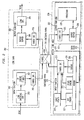
- FIG. 1 shows a prior art backbone router with line cards 100 and 120 connected to a fabric 110.
- the line card 100 consists of an input function 101 that consists of a receive line interface 103, a fabric interface 105 and hardware circuitry that implements the IP routing engine 107.
- the line card 100 also has an output function (102) that has a fabric interface function 106, and output buffer 108, and a line interface 104.
- the other line card shown also has an input function 121, and an output function 122.
- the router would have an OAM&P, (Operations, Administration, Maintenance and Provisioning) process, (not shown), but there is no centralized routing processor.
- OAM&P Operations, Administration, Maintenance and Provisioning
- the IP routing engine Because the IP routing engine is implemented in hard-ware, it does not contain a large library of support routines found in a typical software based router.
- the IP routing engine uses data stored in the line card memory and maintained by the OAM&P processor.
- the fabric 110 connects any input function to any output function and the fabric is configured, in one preferred embodiment, every 200 nsec. In Figure 1, the input function 101 is connected by path 111 to output function 122. When the fabric is configured, the packet currently being processed in the IP engine 107 is transferred to the output buffer 128.
- one of the line cards has been replaced with a special line card 220 that provides a number of special routing functions, including the default route function.
- Line card 220 does not have any external line interfaces, and obtains and disposes of its traffic via the fabric 210.
- Fabric 210 switches the output of fabric interfaces 205 and 232 of simple routing module 200 and default routing module 220, to fabric interfaces 206 and 231 of simple routing module 200, (or another such simple routing module, not shown), and of default routing module 220.
- the special line card 220 has a large packet buffer (228) and a general purpose processor (229) that is used to execute many of the support protocols not provided in Figure 1.
- the general purpose processor has control of the look-up lists stored in the memory 226.
- This memory can be accessed by the IP engine in the same manner used in line card 200.
- an engine (227) to handle the BGP, (Border Gateway Protocol), which is commonly used to share routing tables between routers and networks.
- the special line card also has a table update function (223) that sends periodic updates to the routing table in the other line cards, as required by the protocol.
- each simple module maintains information on the usage, and time of usage, of entries in its routing table. Update information then replaces present entries, or, in the case of new entries, replaces the oldest/least used of present entries in the simple module.
- this packet cannot be routed by the IP engine 207, and it is therefore routed over path 211 in fabric 210 to the default router 220, and therein, to the fabric interface 231 of the special line card 220 output function 222, where it is placed in the output buffer 228.
- the processor 229 examines the packet. If the packet is a routing table update packet, it updates the memory 226. If the packet is an IP data packet, it determines the final route, updates the memory 226, sends the packet over data path 233 to input function 221, and schedules the packet for routing by the IP engine 224 via fabric interface 232 and, over switched path 211 network fabric 210.
- update information is sent to line card 200 so as to update memory of the routing engine 207. If the processor can not determine the route, it will prepare a query to other routers for information about the address and schedule this to be routed by the BGP engine. If the query is successful, the processor 229 will update the memory 226 and schedule the packet to be processed by the IP engine 224. If the Processor 229 still can not route the packet, it is dropped.
- the Processor 229 instructs the table update function (223) to send the changes to the memory 226 to the other line cards.
- table update function (223) to send the changes to the memory 226 to the other line cards.
- the table updated in line card 200 can be launched in real time to limit the load on line card 220.
- the decision to use a periodic table update or a real time update can be based upon monitors of the occupancy of the processor 229, or the usage of the buffer 228 on line card 220.
- the decision to real time update can be selective, with the decision based on the number of line cards sending traffic for a particular address, or on the amount of traffic to a particular address. This selective update can be augmented with a selective clear that would allow traffic to a specific address to be routed to the special line card 220 for special study or data wiretap purposes.
- Wiretap or other monitoring can be implemented by requesting the simple routers to route to wiretap equipment; by requesting the simple routers to route to the default router for multi-casting to wiretap equipment and the destination; and to route to the default router for checking and analysis in one of the "other engines" 225.
- FIG. 3 is a detailed diagram of one embodiment of processor 229.
- the default routing module of Applicants' invention performs all the searches for packets whose destination addresses are not found in a routing table of one of the simple routers, therefore, it is constantly making searches over a large table whose contents cannot be stored in a content addressable memory or a cache type memory. Since it is a special-ist router, it can be made to store a very large routing table, and can be more expensive in its use of resources than the simple routers.
- the processor 229 receives inputs from output buffer 228, (which has received a packet from one of the simple routing modules via the fabric interface 231.
- the output buffer is fed into an IO processor 240, which communicates with a central control processor 242.
- the central control processor has access to two versions of the routing table.
- a first version containing the entire routing table in memory 244, is used for the purpose of updating the routing table that is used in the search process.
- the search is thus made in parallel by each pair of memory control processors such as 250, and corresponding routing table sub-sets such as 260.
- the results of the search are communicated to the central control processor 242, which communicates with the output buffer 228 via the IO processor 240.
- the result of the search is then used either to forward the packet to the output portion of a simple routing module, such as 202, for transmission to the next packet node on the path to the destination, or is sent to a default node for further searching, or is discarded.
- the central control processor 242 arranges to send a control packet to the simple routing module that had requested that the packet be rowed by the default routing module in order to update the routing table of that simple routing module.
- the contents of the entire routing table 244 are transmitted to the various routing table sub-set memories 260,..., 262.
- the memory control processors 250, ... , 252 can perform searches for different destinations at any particular time. Thus, if one of the routing table sub-sets is particularly heavily used, its control processor can process a smaller number of address searches during a particular period of time. Consequently, during the update of the routing table sub-sets, the central control processor 242 can arrange that an overloaded routing table sub-set be populated with less frequently searched routing table addresses.
- the simple router which transmitted the packet has its address routing table updated. This is done by sending a control packet from the default router to the simple router. The packet is sent via one of the paths, (not shown), between an output portion 202 of a simple router, and the input portion 201 of the simple router that had sent the packet to the complex router.
- the complex router may request routing information from other routing nodes of the packet network. This request is generated as a packet sent from the default router 220 to one or more other routing nodes. Responses from these other routing nodes are routed to the default router of this node.
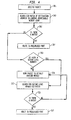
- FIG. 4 illustrates the actions performed in a simple routing module.
- the routing module receives a packet, (Action Block 301).
- the module searches for a match of the destination address of the packet in its content addressable memory, (Action Block 303). For example, this could be a search of the IPV6 (Internet Protocol Version 6). "Flow Field”.
- Test 305 tests whether a match was found. If so, then the packet is routed to the port prescribed in the information associated with the match of the content addressable memory, (Action Block 307).
- Test 309 represents a test of whether or not the simple modules also contain a second level memory, such as a cache, or random access memory.
- the engineering decision of whether these modules should also search a second level memory is a complex one, and likely to be determined only after extensive simulation or testing, possibly augmented by field experience. It may well turn out that the net performance of the overall router is adversely affected by having a second level memory in each of the simple modules. If so, no second level memory will be provided, and the result of Test 309 is negative; the packet is then sent to the default routing module for further processing in accordance with the flow diagram of Figure 4. If a second level memory is provided in the simple routing modules, then a search is made of the second level memory to see if there is a match with the destination address, (Action Block 313).
- Test 315 checks whether a match was found. If not, then the packet is sent to the default routing module, (Action Block 311), previously described. If a match was found, then the packet is routed to the prescribed port, (Action Block 317).
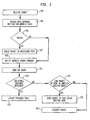
- Figure 5 illustrates the actions performed in the default routing module in response to receipt of a packet from one of the simple routing modules.
- the default routing module receives the packet, (Action Block 401).
- the module searches over its own expanded destination address table, (Action Block 403).
- Test 405 is used to determine whether a match was found in the search. If match was found, then the packet is routed to the prescribed port, (Action Block 407), and the address update program is notified of this match, (Action Block 409). If enough matches with a particular address are found in a relatively short time, then the routing tables of one or more of the simple modules can be updated.
- Test 423 determines whether a successful response to the query was received. If so, then the expanded table is updated, (Action Block 425), and Action Block 407 previously described, to route the packet and subsequently, notify the address update program is performed.
- Test 427 determines whether a packet can be sent to another router. This is possible if there is another router at the same or higher level in the hierarchy of the routers, and if that router has not previously sent a message indicating that no further packets are to be sent to that router. If the packet can be sent, (positive result of Test 427), the packet is routed to that other node (Action Block 429). Finally, if the result of Test 427 is negative, then the packet is simply discarded, (Action Block 431).
- the simple routing modules (200) route most packets very quickly and route any packets that they cannot readily route to a complex routing module (220).
- the complex routing module 220 has a large address table and implements the BGP function for obtaining address information from other routing systems.
- the complex routing module will either find an address and transmit the packet to a simple routing module for transmission to the network, or it will send the packet to a default routing node of the packet network, or will discard the packet.
- the complex routing module maintains traffic counts for addresses of packets routed to that module, for updating the routing tables of the simple modules.
- the simple modules maintain counts of packet address usage so that addresses which are rarely encountered can be deleted in favor of new addresses provided by the complex routing module.
Landscapes
- Engineering & Computer Science (AREA)
- Computer Networks & Wireless Communication (AREA)
- Signal Processing (AREA)
- Data Exchanges In Wide-Area Networks (AREA)
- Small-Scale Networks (AREA)
Applications Claiming Priority (2)
| Application Number | Priority Date | Filing Date | Title |
|---|---|---|---|
| US613672 | 2000-07-11 | ||
| US09/613,672 US6801525B1 (en) | 2000-07-11 | 2000-07-11 | Internet protocol packet router |
Publications (2)
| Publication Number | Publication Date |
|---|---|
| EP1172973A1 EP1172973A1 (en) | 2002-01-16 |
| EP1172973B1 true EP1172973B1 (en) | 2003-10-08 |
Family
ID=24458239
Family Applications (1)
| Application Number | Title | Priority Date | Filing Date |
|---|---|---|---|
| EP01304499A Expired - Lifetime EP1172973B1 (en) | 2000-07-11 | 2001-05-22 | Improved internet protocol packet router |
Country Status (5)
| Country | Link |
|---|---|
| US (1) | US6801525B1 (enExample) |
| EP (1) | EP1172973B1 (enExample) |
| JP (1) | JP3875521B2 (enExample) |
| CA (1) | CA2347998C (enExample) |
| DE (1) | DE60100927T2 (enExample) |
Families Citing this family (25)
| Publication number | Priority date | Publication date | Assignee | Title |
|---|---|---|---|---|
| US20020089983A1 (en) * | 2000-12-18 | 2002-07-11 | Zarlink Semiconductor V.N. Inc. | Switching database cache management system |
| US7200107B2 (en) * | 2001-01-06 | 2007-04-03 | Mindspeed Technologies, Inc. | Method and apparatus for lossless switchover in a redundant switch fabric |
| TWI276336B (en) * | 2001-05-02 | 2007-03-11 | Acute Technology Corp | Internet address pre-lookup method |
| US20020168014A1 (en) * | 2001-05-04 | 2002-11-14 | Dunn James Patrick | Communications with minimized propagation delay |
| US20030084186A1 (en) * | 2001-10-04 | 2003-05-01 | Satoshi Yoshizawa | Method and apparatus for programmable network router and switch |
| US7035256B1 (en) * | 2001-10-31 | 2006-04-25 | Redback Networks Inc. | Method and apparatus for a routing information base |
| US7209449B2 (en) * | 2002-03-27 | 2007-04-24 | Intel Corporation | Systems and methods for updating routing and forwarding information |
| US7688823B2 (en) * | 2002-06-04 | 2010-03-30 | Alcatel-Lucent Usa Inc. | Efficient mechanism for wire-tapping network traffic |
| US7565399B1 (en) * | 2002-08-26 | 2009-07-21 | Netapp, Inc. | Caching web objects transformed by a pipeline of adaptation services |
| ES2253067B1 (es) * | 2004-04-06 | 2007-07-16 | Colaboradores En Tecnologia Para La Empresa, S.L | Metodo para la utilizacion como mando a distancia de un telefono movil o agenda electronica. |
| US8966551B2 (en) | 2007-11-01 | 2015-02-24 | Cisco Technology, Inc. | Locating points of interest using references to media frames within a packet flow |
| US9197857B2 (en) | 2004-09-24 | 2015-11-24 | Cisco Technology, Inc. | IP-based stream splicing with content-specific splice points |
| FR2877797B1 (fr) * | 2004-11-10 | 2006-12-15 | Cit Alcatel | Dispositif de selection d'informations de routage pour un routeur d'un reseau de communication |
| US8352590B2 (en) * | 2006-02-21 | 2013-01-08 | Cisco Technology, Inc. | Method and system for network management using wire tapping |
| US8023419B2 (en) * | 2007-05-14 | 2011-09-20 | Cisco Technology, Inc. | Remote monitoring of real-time internet protocol media streams |
| US7936695B2 (en) | 2007-05-14 | 2011-05-03 | Cisco Technology, Inc. | Tunneling reports for real-time internet protocol media streams |
| US7835406B2 (en) * | 2007-06-18 | 2010-11-16 | Cisco Technology, Inc. | Surrogate stream for monitoring realtime media |
| US7817546B2 (en) * | 2007-07-06 | 2010-10-19 | Cisco Technology, Inc. | Quasi RTP metrics for non-RTP media flows |
| US8301982B2 (en) | 2009-11-18 | 2012-10-30 | Cisco Technology, Inc. | RTP-based loss recovery and quality monitoring for non-IP and raw-IP MPEG transport flows |
| US8379522B2 (en) * | 2010-01-15 | 2013-02-19 | Alcatel Lucent | Link aggregation flood control |
| US8819714B2 (en) | 2010-05-19 | 2014-08-26 | Cisco Technology, Inc. | Ratings and quality measurements for digital broadcast viewers |
| US8654652B2 (en) * | 2011-05-30 | 2014-02-18 | Hewlett-Packard Development Company, L.P. | System for managing the size of a hardware routing table |
| CN103458479A (zh) * | 2013-09-17 | 2013-12-18 | 清华大学 | Wsn中基于内容的路由表的数据路由方法及系统 |
| CN104468398A (zh) * | 2014-11-11 | 2015-03-25 | 上海斐讯数据通信技术有限公司 | 路由信息快速写入交换芯片的方法 |
| JP6743771B2 (ja) | 2017-06-23 | 2020-08-19 | 株式会社デンソー | ネットワークスイッチ |
Family Cites Families (5)
| Publication number | Priority date | Publication date | Assignee | Title |
|---|---|---|---|---|
| US5740175A (en) * | 1995-10-03 | 1998-04-14 | National Semiconductor Corporation | Forwarding database cache for integrated switch controller |
| US5938736A (en) * | 1997-06-30 | 1999-08-17 | Sun Microsystems, Inc. | Search engine architecture for a high performance multi-layer switch element |
| US6069895A (en) * | 1997-08-29 | 2000-05-30 | Nortel Networks Corporation | Distributed route server |
| US6157644A (en) * | 1997-10-07 | 2000-12-05 | Northern Telecom Limited | Method and apparatus for accelerating OSI layer 3 routers |
| US6396833B1 (en) * | 1998-12-02 | 2002-05-28 | Cisco Technology, Inc. | Per user and network routing tables |
-
2000
- 2000-07-11 US US09/613,672 patent/US6801525B1/en not_active Expired - Lifetime
-
2001
- 2001-05-22 EP EP01304499A patent/EP1172973B1/en not_active Expired - Lifetime
- 2001-05-22 CA CA002347998A patent/CA2347998C/en not_active Expired - Fee Related
- 2001-05-22 DE DE60100927T patent/DE60100927T2/de not_active Expired - Lifetime
- 2001-07-11 JP JP2001210299A patent/JP3875521B2/ja not_active Expired - Fee Related
Also Published As
| Publication number | Publication date |
|---|---|
| DE60100927T2 (de) | 2004-08-12 |
| JP2002057716A (ja) | 2002-02-22 |
| EP1172973A1 (en) | 2002-01-16 |
| CA2347998A1 (en) | 2002-01-11 |
| JP3875521B2 (ja) | 2007-01-31 |
| DE60100927D1 (de) | 2003-11-13 |
| US6801525B1 (en) | 2004-10-05 |
| CA2347998C (en) | 2005-12-06 |
Similar Documents
| Publication | Publication Date | Title |
|---|---|---|
| US6801525B1 (en) | Internet protocol packet router | |
| US6738862B1 (en) | Block mask ternary CAM | |
| EP1209876B1 (en) | Dynamic load balancer | |
| US6674769B1 (en) | Simultaneous searching of layer 3 policy filter and policy cache in a network switch port | |
| JP4384048B2 (ja) | ソフトウェアおよびハードウェア・パケット・フロー転送を行うルータまたはスイッチ、およびその方法 | |
| US6539432B1 (en) | Network manager, nodes and network management system | |
| US7620040B2 (en) | Application non disruptive task migration in a network edge switch | |
| US8599721B2 (en) | Composite next hops for forwarding data in a network switching device | |
| US7948985B2 (en) | Methods, systems, and computer program products for source-aware IP routing at a media gateway | |
| US8761182B2 (en) | Targeted flow sampling | |
| EP0993164B1 (en) | Apparatus and method for caching of network contents | |
| US7124196B2 (en) | Processing a network packet using queues | |
| US20050169281A1 (en) | Distributed router | |
| JPH05219065A (ja) | メッセージ経路指定装置 | |
| CN106470158B (zh) | 报文转发方法及装置 | |
| US9306835B2 (en) | Scalable forwarding table with overflow address learning | |
| AU772252B2 (en) | Method and system for managing forwarding tables | |
| KR100612315B1 (ko) | 핑퐁 방지 기능이 구비된 분산형 라우터 및 그를 이용한핑퐁 방지 방법 | |
| CN109474534B (zh) | 基于fpga的路由加速转发系统、路由器及转发方法 | |
| US10972402B1 (en) | Dynamic management of inline entries in hardware across protocols in a scaled environment | |
| US20060227779A1 (en) | Network based routing scheme | |
| US6310878B1 (en) | Large packet switch router | |
| US6052736A (en) | Adaptive message routing in a multiple network environment with a master router | |
| CN100444586C (zh) | 报文转发方法及设备 | |
| US20010015976A1 (en) | Table-type data retrieval mechanism, packet processing system using the same, and table-type data retrieval method for said packet processing system |
Legal Events
| Date | Code | Title | Description |
|---|---|---|---|
| PUAI | Public reference made under article 153(3) epc to a published international application that has entered the european phase |
Free format text: ORIGINAL CODE: 0009012 |
|
| 17P | Request for examination filed |
Effective date: 20010531 |
|
| AK | Designated contracting states |
Kind code of ref document: A1 Designated state(s): DE FR GB SE Kind code of ref document: A1 Designated state(s): AT BE CH CY DE DK ES FI FR GB GR IE IT LI LU MC NL PT SE TR |
|
| AX | Request for extension of the european patent |
Free format text: AL;LT;LV;MK;RO;SI |
|
| AKX | Designation fees paid |
Free format text: DE FR GB SE |
|
| GRAH | Despatch of communication of intention to grant a patent |
Free format text: ORIGINAL CODE: EPIDOS IGRA |
|
| GRAS | Grant fee paid |
Free format text: ORIGINAL CODE: EPIDOSNIGR3 |
|
| GRAA | (expected) grant |
Free format text: ORIGINAL CODE: 0009210 |
|
| AK | Designated contracting states |
Kind code of ref document: B1 Designated state(s): DE FR GB SE |
|
| REG | Reference to a national code |
Ref country code: GB Ref legal event code: FG4D |
|
| REG | Reference to a national code |
Ref country code: IE Ref legal event code: FG4D |
|
| REF | Corresponds to: |
Ref document number: 60100927 Country of ref document: DE Date of ref document: 20031113 Kind code of ref document: P |
|
| PG25 | Lapsed in a contracting state [announced via postgrant information from national office to epo] |
Ref country code: SE Free format text: LAPSE BECAUSE OF FAILURE TO SUBMIT A TRANSLATION OF THE DESCRIPTION OR TO PAY THE FEE WITHIN THE PRESCRIBED TIME-LIMIT Effective date: 20040108 |
|
| ET | Fr: translation filed | ||
| PLBE | No opposition filed within time limit |
Free format text: ORIGINAL CODE: 0009261 |
|
| STAA | Information on the status of an ep patent application or granted ep patent |
Free format text: STATUS: NO OPPOSITION FILED WITHIN TIME LIMIT |
|
| 26N | No opposition filed |
Effective date: 20040709 |
|
| REG | Reference to a national code |
Ref country code: IE Ref legal event code: MM4A |
|
| REG | Reference to a national code |
Ref country code: GB Ref legal event code: 732E Free format text: REGISTERED BETWEEN 20131107 AND 20131113 |
|
| REG | Reference to a national code |
Ref country code: FR Ref legal event code: CD Owner name: ALCATEL-LUCENT USA INC. Effective date: 20131122 |
|
| REG | Reference to a national code |
Ref country code: FR Ref legal event code: GC Effective date: 20140410 |
|
| REG | Reference to a national code |
Ref country code: FR Ref legal event code: RG Effective date: 20141015 |
|
| REG | Reference to a national code |
Ref country code: FR Ref legal event code: PLFP Year of fee payment: 15 |
|
| REG | Reference to a national code |
Ref country code: FR Ref legal event code: PLFP Year of fee payment: 16 |
|
| REG | Reference to a national code |
Ref country code: FR Ref legal event code: PLFP Year of fee payment: 17 |
|
| REG | Reference to a national code |
Ref country code: FR Ref legal event code: PLFP Year of fee payment: 18 |
|
| PGFP | Annual fee paid to national office [announced via postgrant information from national office to epo] |
Ref country code: GB Payment date: 20180518 Year of fee payment: 18 |
|
| PGFP | Annual fee paid to national office [announced via postgrant information from national office to epo] |
Ref country code: FR Payment date: 20190410 Year of fee payment: 19 |
|
| GBPC | Gb: european patent ceased through non-payment of renewal fee |
Effective date: 20190522 |
|
| PG25 | Lapsed in a contracting state [announced via postgrant information from national office to epo] |
Ref country code: GB Free format text: LAPSE BECAUSE OF NON-PAYMENT OF DUE FEES Effective date: 20190522 |
|
| PGFP | Annual fee paid to national office [announced via postgrant information from national office to epo] |
Ref country code: DE Payment date: 20200512 Year of fee payment: 20 |
|
| PG25 | Lapsed in a contracting state [announced via postgrant information from national office to epo] |
Ref country code: FR Free format text: LAPSE BECAUSE OF NON-PAYMENT OF DUE FEES Effective date: 20200531 |
|
| REG | Reference to a national code |
Ref country code: DE Ref legal event code: R071 Ref document number: 60100927 Country of ref document: DE |