EP1171994B1 - Method and apparatus to extend dynamic range of time delay and integrate charge coupled devices - Google Patents
Method and apparatus to extend dynamic range of time delay and integrate charge coupled devices Download PDFInfo
- Publication number
- EP1171994B1 EP1171994B1 EP00918227A EP00918227A EP1171994B1 EP 1171994 B1 EP1171994 B1 EP 1171994B1 EP 00918227 A EP00918227 A EP 00918227A EP 00918227 A EP00918227 A EP 00918227A EP 1171994 B1 EP1171994 B1 EP 1171994B1
- Authority
- EP
- European Patent Office
- Prior art keywords
- charge
- barrier
- channel
- stage
- recited
- Prior art date
- Legal status (The legal status is an assumption and is not a legal conclusion. Google has not performed a legal analysis and makes no representation as to the accuracy of the status listed.)
- Expired - Lifetime
Links
Images


Classifications
-
- H—ELECTRICITY
- H10—SEMICONDUCTOR DEVICES; ELECTRIC SOLID-STATE DEVICES NOT OTHERWISE PROVIDED FOR
- H10F—INORGANIC SEMICONDUCTOR DEVICES SENSITIVE TO INFRARED RADIATION, LIGHT, ELECTROMAGNETIC RADIATION OF SHORTER WAVELENGTH OR CORPUSCULAR RADIATION
- H10F39/00—Integrated devices, or assemblies of multiple devices, comprising at least one element covered by group H10F30/00, e.g. radiation detectors comprising photodiode arrays
- H10F39/10—Integrated devices
- H10F39/12—Image sensors
- H10F39/15—Charge-coupled device [CCD] image sensors
- H10F39/153—Two-dimensional or three-dimensional array CCD image sensors
- H10F39/1538—Time-delay and integration
-
- H—ELECTRICITY
- H04—ELECTRIC COMMUNICATION TECHNIQUE
- H04N—PICTORIAL COMMUNICATION, e.g. TELEVISION
- H04N25/00—Circuitry of solid-state image sensors [SSIS]; Control thereof
- H04N25/50—Control of the SSIS exposure
- H04N25/57—Control of the dynamic range
- H04N25/571—Control of the dynamic range involving a non-linear response
- H04N25/575—Control of the dynamic range involving a non-linear response with a response composed of multiple slopes
-
- H—ELECTRICITY
- H04—ELECTRIC COMMUNICATION TECHNIQUE
- H04N—PICTORIAL COMMUNICATION, e.g. TELEVISION
- H04N25/00—Circuitry of solid-state image sensors [SSIS]; Control thereof
- H04N25/60—Noise processing, e.g. detecting, correcting, reducing or removing noise
- H04N25/62—Detection or reduction of noise due to excess charges produced by the exposure, e.g. smear, blooming, ghost image, crosstalk or leakage between pixels
- H04N25/621—Detection or reduction of noise due to excess charges produced by the exposure, e.g. smear, blooming, ghost image, crosstalk or leakage between pixels for the control of blooming
- H04N25/622—Detection or reduction of noise due to excess charges produced by the exposure, e.g. smear, blooming, ghost image, crosstalk or leakage between pixels for the control of blooming by controlling anti-blooming drains
-
- H—ELECTRICITY
- H04—ELECTRIC COMMUNICATION TECHNIQUE
- H04N—PICTORIAL COMMUNICATION, e.g. TELEVISION
- H04N25/00—Circuitry of solid-state image sensors [SSIS]; Control thereof
- H04N25/70—SSIS architectures; Circuits associated therewith
- H04N25/71—Charge-coupled device [CCD] sensors; Charge-transfer registers specially adapted for CCD sensors
- H04N25/711—Time delay and integration [TDI] registers; TDI shift registers
-
- H—ELECTRICITY
- H10—SEMICONDUCTOR DEVICES; ELECTRIC SOLID-STATE DEVICES NOT OTHERWISE PROVIDED FOR
- H10F—INORGANIC SEMICONDUCTOR DEVICES SENSITIVE TO INFRARED RADIATION, LIGHT, ELECTROMAGNETIC RADIATION OF SHORTER WAVELENGTH OR CORPUSCULAR RADIATION
- H10F39/00—Integrated devices, or assemblies of multiple devices, comprising at least one element covered by group H10F30/00, e.g. radiation detectors comprising photodiode arrays
- H10F39/10—Integrated devices
- H10F39/12—Image sensors
- H10F39/15—Charge-coupled device [CCD] image sensors
- H10F39/158—Charge-coupled device [CCD] image sensors having arrangements for blooming suppression
Definitions
- the present invention is related to the field of imaging devices.
- An embodiment of the invention relates to extending the dynamic range of Time Delay and Integrate (TDI) imagers.
- TDI Time Delay and Integrate
- Typical single line imagers for example, Charge Couple Device (CCD) imagers, incorporate a single row of photosensitive electric devices, such as photodetectors, to collect photonic charge.
- a photo-detector converts the collected photonic charge into an electrical charge that is related to the amount of photonic charge collected.
- a Time Delay & Integration (TDI) method of operating CCD imagers incorporates multiple single row CCD scanners in an imaging array. Each row in the array collects image data for a finite period of time as the target image and the imager move relative to each other.
- TDI Time Delay & Integration
- TDI-CCD scanners offer an advantage over single line scanners in that TDI-CCD devices provide for longer times to collect and integrate photonic charge from the target image. The longer collection time also increases the sensitivity of the imager.
- Another method to avoid excess charge-accumulation problems is to reduce the amount of time that is used in collecting an image.
- This method has the disadvantage of reducing sensitivity of the imaging device. Thus, dark images remain relatively dark.
- TDI-CCD devices that allows for the collection of sufficient image data to view dark images while not losing data from relatively bright images.
- US-A-5 114 237 discloses a photosensitive sensor including multilinear arrays of n lines of cells which operate by charge integration and time delay by successive observations of the same image line by the n lines in the array and by accumulation of the corresponding n observations in the cells of the sensor.
- the number of lines between which the charge integration and delays are performed is programmed to be between 1 and n. This programming is performed as a function of the average illumination of the image analysed. To do so, the electrodes of certain lines of cells are used, and potentials are applied to them; either the normal charge transfer potentials or a blocking potential which isolates the lines beyond this blocking electrode from a reading stage.
- a method that increases the intra-scene dynamic range of a TDI-CCD device by selectively limiting the amount of charge collected in each stage by selectively setting blooming barrier levels.
- the maximum accumulated charge collected in each cell is incrementally increased as the charge is passed from one cell to a subsequent cell.
- the level of the barrier is set in a step-wise increasing manner that limits the amount of charge collected in each stage while allowing for the accumulation of progressively greater amounts of collected charge in subsequent cells.
- a step-wise increase in the barrier levels changes the reference level at which charge is accumulated in a cell.
- TDI-CCD array imagers As would be understood the principles of the invention disclosed are related to TDI-CCD array imagers. However, the principles of the invention may also be applied to other solid-state TDI imaging devices, for example, CMOS TDI-APS devices.
- FIG. 1 illustrates an exemplary schematic diagram of an 8-stage TDI-CCD device 100. Only four photosensitive devices (pixel cells) 115, among a plurality of cells in each stage are shown to describe the operation of the TDI-CCD device.
- the photonic charge from a target image is collected beginning in pixel cells 115 associated with the first stage -- i.e., stage 101.
- stage 101 the first stage
- stage 101 the image moves past the pixel cells in a next stage (102).
- the cells in this stage then collect photonic charge from the target image.
- the charge collected in previous cells is added to the charge collected in the currently-imaging cell.
- the charge collected in pixel cell 115 associated with stage 101 is added or transferred to pixel cell 115 associated with stage 102, as the image moves past stage 102.
- the accumulated charge in pixel cell 115 associated with stage 102 is added to the charge collected in pixel cell 115 associated with stage 103, as the image moves past stage 103.
- This transferring of accumulated photonic charge from a cell in one stage to a cell in a subsequent stage continues, one stage at a time, until an end stage is reached -- in this case, stage 108.
- the photonic charge collected for the image is accumulated and integrated over the depth of the TDI-CCD device, -- i.e., stages 101-108.
- the accumulated charge is read out from the TDI-CCD device.
- the charge is transferred along a channel of pixel cells 115, known as a transfer channel, illustrated for one channel of pixel cells as 120.
- a transfer channel illustrated for one channel of pixel cells as 120.
- the excess energy would normally overflow the cell and "spread" into an adjacent cell.
- channels are isolated from one another by blooming drains 125 and barriers 130. The level at which accumulated charge is deemed excessive is determined by barrier 130 that exists between, for example, transfer channel 120 and drain 125.
- barrier 130 The greater the level, or potential, of barrier 130, the greater the amount of accumulated charge that may be collected in each cell 115.
- the levels of barrier 130 are set to achieve the maximum accumulation of charge - i.e., saturation level -- in a pixel cell.
- barrier 130 is positioned horizontally adjacent to channel 120 and 121.
- barrier 130 may also be positioned vertically adjacent to channels 120 and 121 to limit the charge capacity of pixel cell 115.
- Figure 2 illustrates the operation of barrier 130 in controlling excessive charge.
- pixel cell 115 fills to a value that is set by barrier 130.
- the excess as represented by charge 140, is directed into drain 125.
- any further charge that may be collected is simply discarded. The maximum level of barrier 130 thus limits the accumulated charge.
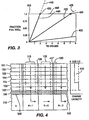
- Figure 3 illustrates an exemplary performance characteristic of TDI-CCD device of Figure 1 for three images of different brightness levels.
- the charge collected by the imager is represented by response characteristic 400.
- each pixel cell 115 in a stage adds a substantially similar amount of charge to pixel cell 115 in the next subsequent stage as the imager and target image move past each other.
- the accumulated charge collected increases proportionally to the number of stages in the imager.
- the total amount of charge collected after the eight stages remains below the barrier level 465 set by barrier 130.
- the charge collected is represented by response characteristic 420.
- the charge of an even brighter image is collected.
- the response to this brighter image is represented by response characteristic 440.
- the brightness of the image causes the accumulated charge to exceed the maximum level set by barrier 130 (at level 465 ) after scanning of the image by only about two of the CCD stages. Were the accumulated charge permitted to accumulate through continuing CCD stages, that charge would be represented by the dashed line portion 445 of response characteristic 440, but the charge is limited by barrier level 465. Barrier level 465 thus limits the response characteristic of the imager. Charge above barrier level 465 is simply discarded into drain 125 and the accumulated charge for this third exemplary image thus remains limited at level 465 as represented by response characteristic 460.
- Figure 4 illustrates an 8-stage TDI-CCD in accordance with the principles of the invention.
- barrier 130 is selectively set in accordance with the capacity charge curve 510. Accordingly, the amount of charge accumulated and retained in each stage is incremental increased.
- barrier 130 is set to limit the accumulated charge to twenty-five per cent (0.25) of maximum barrier level 465 in stages 101-105 of the imager, and fifty percent of that level for stages 106 and 107.
- the level of barrier 130 is set to the maximum barrier level 465.
- the maximum barrier level may be set independently of the maximum capacity of pixel cell 115, but is typically set substantially equal to the maximum capacity of the pixel cell.
- barrier 130 is selectively set in an step-wise pattern that limits the amount of data collected in the early stages of collection while allowing for incrementally greater amounts of charge in latter stages.
- stages 101-105 accumulate 25 percent of the charge that could be collected.
- Stages 106 and 107 accumulate 50 percent of the charge that could be collected, and stage 108 allows for the accumulation of a maximum amount of charge.
- the maximum amount of charge may be collected without causing a saturation of pixel cell 115.
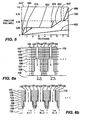
- Figure 5 illustrates the response characteristics of a TDI-CCD device having barrier characteristics selectively set in accordance with the exemplary characteristics illustrated in Figure 4 for the three exemplary images discussed in regard to Figure 3.
- the charge collected is represented by response characteristic 600.
- Response characteristic 600 is similar to the response characteristic 400 of Figure 3, as the accumulated charge does not exceed the selectively set barrier levels of stages 101-105, 106-107 or 108. Accordingly, the response characteristic is not altered and the accumulated charge is not limited.
- the accumulated charge is shown to exceed the first barrier level while charge is collected in stage 102. That is, the accumulation of the charge collected in stage 101 and the charge being collected in stage 102 exceeds the barrier level selectively set for stages 101 through 105. Any additional charge collected in stages 103 through 105 would, accordingly, cause the accumulated charge to exceed the level of barrier 130 and is thus drained off.
- the accumulated charge in stages 103 through 105 remains limited to 25 percent of the charge that may be collected, as represented by response characteristic 620.
- the level of barrier 130 is increased to 50 percent of the maximum barrier level to allow an incremental increase in the charge collected.
- stage 106 As stage 106 moves past the target image, charge is accumulated in pixel cells 115 associated with stage 106. The increase in accumulated charge is represented by response characteristic 630. As shown, the accumulated charge exceeds the level of barrier 130 during the charge collection of stage 107 and the excess charge is drained off. The accumulated charge remains limited to the 50 percent level, as represented by response characteristic 640. At stage 108, the level of barrier 130 is increased to allow an incremental increase in the charge collected. As stage 108 moves past the target image, charge is accumulated, as represented by response characteristic 650. The charge level continues to accumulate until the collected charge is read out in stage 110.
- the accumulated charge level is substantially less than the maximum level; hence, the brightest image data is not lost because the image data is compressed.
- an imager incorporating a step-wise increase in the level of barrier 130 causes alterations or shifts in reference points that are used by subsequent cells to accumulate charge. These alterations in the reference points allow for the collection of more data from brighter images.
- the brightness of the image causes the charge collected to exceed the first level of barrier 130 during the collection phase of stage 101. Any charge collected as the target image moves past stages 101 through 105 is thus drained off.
- the level of the accumulated charge remains fixed at the barrier level as represented by response characteristic 620.
- the level of barrier 130 is increased.
- charge is again accumulated in pixel cell 115 associated with stage 106, as represented by response characteristic 670.
- the brightness of the image causes the accumulated charge to quickly exceed the increased barrier level.
- any charge collected after this increased barrier level is exceeded is drained off.
- the accumulated charge level remains limited during stage 106 and continuing through stage 107, as represented by response characteristic 640.
- the level of barrier 130 is incrementally increased and charge is again accumulated, as represented by the response characteristic 680.
- the brightest portions of the image are collected and the brightest portions of the image are not lost.
- the altered reference points compress the image data to allow pixel cells to accumulate charge that would otherwise be greater than their maximum capability. These alterations in the reference points allow for the collection of image data from brighter images that would otherwise be lost without affecting low light level performance.
- the dynamic range of a TDI-CCD device is extended by selectively setting levels of barriers that limit the charge collection capability.
- the selectively set barrier levels shift the reference point of accumulated charge.
- the altered, or shifted, reference point causes the imager to compress brighter portions of an image while not influencing the lower intensity portions of the same image.
- the scope of the invention is not limited to the step-wise increase in charge capacity in the exemplary 8-stage TDI-CCD device illustrated. Rather the method of setting progressive barrier levels, and thereby progressively accumulating charge in a TDI-CCD device, may also be determined using, for example, exponential, logarithmic, inverse logarithmic, geometric or polynomial functions. Furtherstill, the number of barrier levels also may be increased commensurate with the number of stages in a TDI-CCD device. Thus, the number of different barrier levels may be set substantially equal to the number of stages.
- Figure 6a illustrates one embodiment for fabricating a TDI-CCD imager having a charge capacity illustrated in Figure 4.
- the barrier level 130 is set to limit the amount of charge collected.
- barrier levels are set to limit pixel cell 115 associated with stages 101 through 105 to collect only twenty-five (25) percent of full capacity of pixel cell 115 -- i.e., maximum level 465.
- barrier levels are set to limit pixel cell 115 associated with stages 106 and 107 to collect and retain an accumulated charge that corresponds to fifty (50) percent of full capacity.
- the barrier levels are set to the full width of pixel cell 115 to collect and retain an accumulated charge that is substantially equal to full capacity.
- Figure 6b illustrates a second embodiment for fabricating a TDI-CCD imager having a charge capacity illustrated in Figure 4.
- the barrier levels, or potentials are constant but are positioned to adjust the width of pixel cells 115 to limit the charge collected. In this case, the amount of charge collected is limited by the size of the pixel cells. Further, the width of barrier level 130 remains substantially constant.
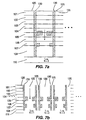
- Figure 7a illustrates a second embodiment of fabricating a TDI-CCD device to achieve the exemplary step-wise accumulated charge characteristics illustrated in Figure 4.
- the pixel cell charge capacity is set in designated stages to limit the accumulated charge.
- the width of pixel 115 in stages 101 through 104 is set at a maximum level 465 -- i.e., full collection capacity.
- the width of pixel 115 is reduced to twenty-five (25) percent of maximum level 465.
- the width of pixel 115 is again increased to maximum level 465, and at stage 107, the width of pixel 115 is reduced to fifty (50) percent of maximum level 465.
- FIG. 108 the width of pixel 115 is again increased to maximum level 465.
- the narrow channel regions at stages 105 and 107 act as charge clippers.
- Figure 7b illustrates another embodiment, similar to that described in regard to Figure 7a, wherein the width of barrier 130 is remains substantially constant. This embodiment is advantageous as the width of drain 125 is correspondingly increased when the size of pixel 115 is decreased. This increase in drain 125 allows for the draining of excessive accumulated charge.
- the depth of the pixel cell 115 may also be used to control pixel charge capacity.
- the depth of pixel cells 115 associated with stages 101-105 may be set to collect twenty-five percent of full charge capacity.
- the depth of pixel cells 115 associated with stages 106-107 may be set to collect fifty percent of full charge capacity and the depth of pixel cell 115 associated with stage 108 may be set to accumulate a full charge.
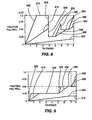
- Figure 8 illustrates the response characteristics of this embodiment of the invention to the three exemplary images discussed in regard to Figure 3 and Figure 5.
- the response characteristic to the first exemplary image is represented by the response characteristic 800.
- the accumulated charge in stages 101 through 108 remains lower than the associated barrier levels.
- the selectively set levels do not influence the response characteristic of the TDI-CCD device to this first exemplary image.
- the charge accumulated in stages 101 through 104 as represented by response 810, rises to maximum level 465.
- the charge capacity of pixel cell 115 is set to twenty-five percent of maximum level 465.
- the accumulated charge above this twenty-five percent level is drained off, as represented by response 820. Furthermore, any additional charge collected during stage 105 is also drained off. Thus, the accumulated charge remains limited, as represented by response characteristic 830.
- the charge capacity of pixel cell 115 is again increased to maximum level 465 and charge is again accumulated, as represented by response characteristic 840.
- the charge capacity of the associated pixel cell 115 is reduced to fifty percent. Any charge collected above this fifty-percent level is, accordingly, drained off and the accumulated charge remains at a fixed level, as is represented by response characteristic 850.
- stage 108 the charge capacity of the associated pixel cell 115 increased to maximum level 465 and charge again is accumulated, as represented by response characteristic 860. Accordingly, the brighter portions of the imager are again captured in the imaging device similar to that illustrated in Figure 5.
- the accumulated charge quickly rises to maximum level 465, as illustrated by response characteristic 865.
- Any additional charge that may be collected in stages 102 - 104 is drained off, as represented by response characteristic 870.
- the charge capacity of the associated pixel cell 115 is set at twenty five percent and any accumulated charge above this level is drained off, as represented by response characteristic 875. Further, any additional charge collected is similarly drained off and the accumulated charge level remains constant, as represented by response characteristic 830.
- the charge capacity of the associated pixel cell 115 is again increased to maximum level 465. The charge is again accumulated, as represented by response characteristic 880.
- the charge capacity of the associated pixel cell 115 is again reduced to fifty percent, and the accumulated charge above this reduced level is again drained off, as represented by response characteristic 885.
- the accumulated charge remains fixed at this level as any additional charge collected is drained off, as represented by response characteristic 850.
- the charge capacity of the associated pixel cell 115 is again increased and the accumulated charge again increases, as represented by response 890.
- the brightest portions of this third exemplary image are thus captured in a manner similar to that illustrated in Figure 5.
- the representation of the transfer channel having varying size is intended merely to illustrate different methods of achieving the exemplary model of varying barrier levels. Other methods may also be used to achieve similar increases in accumulated charge.
- a further means of increasing dynamic range is achieved by placing a filtering element over at least one stage of a TDI-CCD device.
- Filter elements are used to further extend dynamic range by reducing the intensity of an image as the image moves with respect to the collection stages.
- Figure 4 illustrates the placement of filter 500 over stage 108.
- filter 500 is used to reduce the image intensity as the image passes stage 108.
- Filter 500 may be, for example, a neutral-density filter, or a slotted metal filter. Filtering is well known in the art and need not be discussed in detail herein.
- Figure 9 illustrates the response characteristic of the TDI-CCD imager illustrated in Figure 4 with filter 500 positioned over stage 108.
- the response to the three exemplary images is similar to the responses illustrated in Figure 5, except for the response in the filtered stage. That is, the response of this embodiment to the first exemplary image is similar to response characteristic 600 of Figure 5.
- the imposed filter 500 causes the image intensity to decrease during charge collection at stage 108. The amount of charge collected is thus reduced and this reduction in the accumulated charge is represented by response characteristic 910.
- the responses of the second and third exemplary images, as illustrated in Figure 9 are equivalent to corresponding responses illustrated in Figure 5, except for the response during stage 108.
- dynamic range of TDI-CCD is further extended by selectively using filters over at least one collection stage to collect highly intense images.
- Figure 10a illustrates a cross-sectional view of an exemplary embodiment of an 8-stage back-illuminated TDI-CCD imager incorporating filtering over one stage (stage 108 ).
- Figure 10b illustrates a cross-sectional view of a second exemplary embodiment of an 8-stage back-illuminated TDI-CCD imager incorporating filtering over one stage (stage 108 ).
- Figure 10c illustrates a cross-sectional view of an exemplary embodiment of an 8-stage top-illuminated TDI-CCD imager incorporating filtering over one stage (stage 108 ).
- TDI-CCD imager 1010 is composed of eight (8) stages, -- i . e ., stages 101-108. Stages 101-108 are formed in wafer 1000, which is typically made of a semi-conductor material, such as silicon or GaAs.
- Block 1020 provides support and protection for wafer 1010.
- block 1020 is an optically transparent material.
- block 1020 may be constructed of materials such as glass, plastic, acrylic or polymer, that allows light 1040 to pass without significant degradation or loss.
- block 1020 may be constructed of materials such as silicon.
- block 1020 may be materials such as quartz and calcium chloride.
- Filter 1030 is positioned on surface 1070 between block 1020 and wafer 1010.
- Filter 1030 similar to filter 500 discussed previously, is positioned over stage 108 to reduce the charge collected in this stage.
- the placement of filter 1030 is not limited to surface 1070, as illustrated. Rather, filter 1030 may be placed, for example, on surface 1060, or may even be incorporated within block 1020 to achieve a reduction in the intensity of the image.
- a filter may be included within block 1020, by altering the index of reflective of the material of block 1020. The altered index of reflective reduces the intensity of light that traverses block 1020 and is collected in stages 101-108 in wafer 1000. Further still, filter 1030 may be incorporated onto wafer 1010. However, placing filter 1030 on wafer 1010 has the disadvantage that when a change of filtering is necessary wafer 1010 is affected. Accordingly, incorporating filter 1030 onto block 1020 allows for filter changes without affecting wafer 1010.
- Filters may be used over a plurality of stages and each of these filters need not cause the same reduction in image intensity.
- filters may be graduated along the depth of a TDI-CCD such that no filtering occurs in the earlier collection stages while significant reductions of intensity occurs in the latter collection stages.
- Graduated filtering thus, does not affect the low intensity portions of any image but will affect the brighter portions, as illustrated in Figure 9.
Landscapes
- Engineering & Computer Science (AREA)
- Multimedia (AREA)
- Signal Processing (AREA)
- Physics & Mathematics (AREA)
- Nonlinear Science (AREA)
- Solid State Image Pick-Up Elements (AREA)
- Transforming Light Signals Into Electric Signals (AREA)
- Facsimile Heads (AREA)
Applications Claiming Priority (5)
| Application Number | Priority Date | Filing Date | Title |
|---|---|---|---|
| US12567099P | 1999-03-22 | 1999-03-22 | |
| US125670P | 1999-03-22 | ||
| US528818 | 2000-03-20 | ||
| US09/528,818 US6472653B1 (en) | 1999-03-22 | 2000-03-20 | Method and apparatus to extend dynamic range of time delay and integrate charge coupled devices |
| PCT/US2000/007523 WO2000057633A1 (en) | 1999-03-22 | 2000-03-21 | Method and apparatus to extend dynamic range of time delay and integrate charge coupled devices |
Publications (3)
| Publication Number | Publication Date |
|---|---|
| EP1171994A1 EP1171994A1 (en) | 2002-01-16 |
| EP1171994A4 EP1171994A4 (en) | 2002-06-05 |
| EP1171994B1 true EP1171994B1 (en) | 2005-10-26 |
Family
ID=26823811
Family Applications (1)
| Application Number | Title | Priority Date | Filing Date |
|---|---|---|---|
| EP00918227A Expired - Lifetime EP1171994B1 (en) | 1999-03-22 | 2000-03-21 | Method and apparatus to extend dynamic range of time delay and integrate charge coupled devices |
Country Status (6)
| Country | Link |
|---|---|
| US (1) | US6472653B1 (enExample) |
| EP (1) | EP1171994B1 (enExample) |
| JP (1) | JP4393715B2 (enExample) |
| AU (1) | AU3907600A (enExample) |
| DE (1) | DE60023482D1 (enExample) |
| WO (1) | WO2000057633A1 (enExample) |
Cited By (1)
| Publication number | Priority date | Publication date | Assignee | Title |
|---|---|---|---|---|
| EP3520392A4 (en) * | 2016-09-30 | 2020-05-13 | Planet Labs Inc. | SYSTEMS AND METHODS FOR IMPLEMENTING TIME DELAY INTEGRATION IMAGING TECHNIQUES IN CONNECTION WITH DIFFERENT IMAGING REGIONS ON A MONOLITHIC CHARGED DEVICE IMAGE SENSOR |
Families Citing this family (12)
| Publication number | Priority date | Publication date | Assignee | Title |
|---|---|---|---|---|
| US6909459B2 (en) | 2002-08-21 | 2005-06-21 | Alpha Innotech Corporation | Method of and apparatus for extending signal ranges of digital images |
| WO2004066814A2 (en) * | 2003-01-24 | 2004-08-12 | Proteus Biomedical Inc. | Method and system for remote hemodynamic monitoring |
| WO2005084327A2 (en) * | 2004-03-02 | 2005-09-15 | Sarnoff Corporation | Spectroscopy imager methods and apparatus having extended dynamic range |
| US7378634B2 (en) * | 2004-07-27 | 2008-05-27 | Sarnoff Corporation | Imaging methods and apparatus having extended dynamic range |
| US7259413B2 (en) * | 2004-09-28 | 2007-08-21 | Micron Technology, Inc. | High dynamic range image sensor |
| FR2880732B1 (fr) * | 2005-01-13 | 2007-04-06 | St Microelectronics Sa | Capteur d'images |
| FR2932635B1 (fr) * | 2008-06-17 | 2011-03-18 | Centre Nat Etd Spatiales | Capteur d'image du type tdi a dynamique auto adaptee par point image |
| JP5302073B2 (ja) * | 2009-04-01 | 2013-10-02 | 浜松ホトニクス株式会社 | 固体撮像装置 |
| JP5300577B2 (ja) * | 2009-04-23 | 2013-09-25 | 三菱電機株式会社 | Tdi方式のイメージセンサ、及び該イメージセンサの駆動方法 |
| US8736924B2 (en) | 2011-09-28 | 2014-05-27 | Truesense Imaging, Inc. | Time-delay-and-integrate image sensors having variable integration times |
| FR3047112B1 (fr) * | 2016-01-22 | 2018-01-19 | Teledyne E2V Semiconductors Sas | Capteur d'image multilineaire a transfert de charges a reglage de temps d'integration |
| EP3668084A1 (en) | 2018-12-14 | 2020-06-17 | IMEC vzw | A method for controlling time delay and integration imaging and an imaging sensor for time delay and integration imaging |
Family Cites Families (10)
| Publication number | Priority date | Publication date | Assignee | Title |
|---|---|---|---|---|
| US3953733A (en) * | 1975-05-21 | 1976-04-27 | Rca Corporation | Method of operating imagers |
| US4627084A (en) | 1979-11-15 | 1986-12-02 | Trw Inc. | Differentiation and integration utilizing charge-coupled devices |
| JPS6115475A (ja) * | 1984-07-01 | 1986-01-23 | Canon Inc | 撮像素子及び撮像装置 |
| FR2577340B1 (fr) | 1985-02-12 | 1987-03-06 | Thomson Csf | Dispositif de lecture avec accumulation de charges de detecteurs photosensibles |
| JPS62126667A (ja) * | 1985-11-27 | 1987-06-08 | Mitsubishi Electric Corp | 固体撮像素子 |
| FR2653626A1 (fr) | 1989-10-24 | 1991-04-26 | Thomson Composants Militaires | Capteur photosensible a temps d'integration programmable. |
| FR2656756B1 (fr) | 1989-12-29 | 1994-01-07 | Commissariat A Energie Atomique | Dispositif pour prises de vues a circuits de balayage integres. |
| US5276520A (en) * | 1991-06-07 | 1994-01-04 | Eastman Kodak Company | Enhancing exposure latitude of image sensors |
| EP0563846A1 (en) | 1992-03-30 | 1993-10-06 | Matsushita Electric Industrial Co., Ltd. | Dynamic peaking aperture correction for use with a CCD camera |
| US6101294A (en) * | 1997-06-02 | 2000-08-08 | Sarnoff Corporation | Extended dynamic imaging system and method |
-
2000
- 2000-03-20 US US09/528,818 patent/US6472653B1/en not_active Expired - Lifetime
- 2000-03-21 DE DE60023482T patent/DE60023482D1/de not_active Expired - Lifetime
- 2000-03-21 WO PCT/US2000/007523 patent/WO2000057633A1/en not_active Ceased
- 2000-03-21 JP JP2000607404A patent/JP4393715B2/ja not_active Expired - Fee Related
- 2000-03-21 EP EP00918227A patent/EP1171994B1/en not_active Expired - Lifetime
- 2000-03-21 AU AU39076/00A patent/AU3907600A/en not_active Abandoned
Cited By (1)
| Publication number | Priority date | Publication date | Assignee | Title |
|---|---|---|---|---|
| EP3520392A4 (en) * | 2016-09-30 | 2020-05-13 | Planet Labs Inc. | SYSTEMS AND METHODS FOR IMPLEMENTING TIME DELAY INTEGRATION IMAGING TECHNIQUES IN CONNECTION WITH DIFFERENT IMAGING REGIONS ON A MONOLITHIC CHARGED DEVICE IMAGE SENSOR |
Also Published As
| Publication number | Publication date |
|---|---|
| JP4393715B2 (ja) | 2010-01-06 |
| EP1171994A4 (en) | 2002-06-05 |
| US6472653B1 (en) | 2002-10-29 |
| DE60023482D1 (de) | 2005-12-01 |
| WO2000057633A1 (en) | 2000-09-28 |
| EP1171994A1 (en) | 2002-01-16 |
| AU3907600A (en) | 2000-10-09 |
| JP2003521837A (ja) | 2003-07-15 |
Similar Documents
| Publication | Publication Date | Title |
|---|---|---|
| US6472653B1 (en) | Method and apparatus to extend dynamic range of time delay and integrate charge coupled devices | |
| KR101867609B1 (ko) | 고체 촬상 장치 및 전자 기기 | |
| US9088743B2 (en) | Scanning circuit for image pickup apparatus | |
| US6747808B2 (en) | Electronic imaging device focusing | |
| JP2000125209A (ja) | 固体撮像装置および信号読出し方法 | |
| JP3318814B2 (ja) | 固体撮像装置及びその駆動方法 | |
| US5276520A (en) | Enhancing exposure latitude of image sensors | |
| JP2662455B2 (ja) | 固体撮像装置 | |
| US5428420A (en) | Focus detecting apparatus having photoelectric area sensors | |
| US20050052557A1 (en) | Image-sensing apparatus | |
| US20020027189A1 (en) | Solid-state image pick-up device and image pick-up method therefor | |
| US6778215B1 (en) | Driving method of solid-state image pickup device and image pickup system | |
| KR20040093455A (ko) | 포토다이오드의 리니어 특성을 개선하고 감도를 향상시킨고체촬상장치 및 그 구동방법 | |
| US20060237751A1 (en) | Image pickup device, image pickup unit and image pickup apparatus | |
| EP0515663A1 (en) | Image device with photodiode having real time readout property | |
| US7265828B2 (en) | Spectroscopy imager methods and apparatus having extended dynamic range | |
| EP0103023A1 (en) | Solid-state image pickup device | |
| KR950001761B1 (ko) | 고체촬상소자 | |
| JPH01103378A (ja) | 固体撮像素子の露出制御回路 | |
| KR100645964B1 (ko) | 확장된 동적 범위를 갖는 이미지 센싱 소자 및 이를이용한 촬상장치 | |
| JP2554621B2 (ja) | 固体撮像装置 | |
| JP3366634B2 (ja) | 電荷結合デバイス用集積化電子シャッタ | |
| JP3109862B2 (ja) | オートフォーカス装置 | |
| EP2698986B1 (en) | Multimode interline ccd imaging methods | |
| JP3639491B2 (ja) | 撮像装置 |
Legal Events
| Date | Code | Title | Description |
|---|---|---|---|
| PUAI | Public reference made under article 153(3) epc to a published international application that has entered the european phase |
Free format text: ORIGINAL CODE: 0009012 |
|
| 17P | Request for examination filed |
Effective date: 20011004 |
|
| AK | Designated contracting states |
Kind code of ref document: A1 Designated state(s): AT BE CH CY DE DK ES FI FR GB GR IE IT LI LU MC NL PT SE |
|
| A4 | Supplementary search report drawn up and despatched |
Effective date: 20020424 |
|
| AK | Designated contracting states |
Kind code of ref document: A4 Designated state(s): AT BE CH CY DE DK ES FI FR GB GR IE IT LI LU MC NL PT SE |
|
| RIC1 | Information provided on ipc code assigned before grant |
Free format text: 7H 04N 3/14 A, 7H 04N 5/335 B, 7H 04N 3/15 B |
|
| 17Q | First examination report despatched |
Effective date: 20030603 |
|
| RBV | Designated contracting states (corrected) |
Designated state(s): DE FR GB IT NL |
|
| GRAP | Despatch of communication of intention to grant a patent |
Free format text: ORIGINAL CODE: EPIDOSNIGR1 |
|
| GRAS | Grant fee paid |
Free format text: ORIGINAL CODE: EPIDOSNIGR3 |
|
| GRAA | (expected) grant |
Free format text: ORIGINAL CODE: 0009210 |
|
| AK | Designated contracting states |
Kind code of ref document: B1 Designated state(s): DE FR GB IT NL |
|
| PG25 | Lapsed in a contracting state [announced via postgrant information from national office to epo] |
Ref country code: IT Free format text: LAPSE BECAUSE OF FAILURE TO SUBMIT A TRANSLATION OF THE DESCRIPTION OR TO PAY THE FEE WITHIN THE PRESCRIBED TIME-LIMIT;WARNING: LAPSES OF ITALIAN PATENTS WITH EFFECTIVE DATE BEFORE 2007 MAY HAVE OCCURRED AT ANY TIME BEFORE 2007. THE CORRECT EFFECTIVE DATE MAY BE DIFFERENT FROM THE ONE RECORDED. Effective date: 20051026 Ref country code: NL Free format text: LAPSE BECAUSE OF FAILURE TO SUBMIT A TRANSLATION OF THE DESCRIPTION OR TO PAY THE FEE WITHIN THE PRESCRIBED TIME-LIMIT Effective date: 20051026 |
|
| REG | Reference to a national code |
Ref country code: GB Ref legal event code: FG4D |
|
| REF | Corresponds to: |
Ref document number: 60023482 Country of ref document: DE Date of ref document: 20051201 Kind code of ref document: P |
|
| PG25 | Lapsed in a contracting state [announced via postgrant information from national office to epo] |
Ref country code: DE Free format text: LAPSE BECAUSE OF FAILURE TO SUBMIT A TRANSLATION OF THE DESCRIPTION OR TO PAY THE FEE WITHIN THE PRESCRIBED TIME-LIMIT Effective date: 20060127 |
|
| NLV1 | Nl: lapsed or annulled due to failure to fulfill the requirements of art. 29p and 29m of the patents act | ||
| PLBE | No opposition filed within time limit |
Free format text: ORIGINAL CODE: 0009261 |
|
| STAA | Information on the status of an ep patent application or granted ep patent |
Free format text: STATUS: NO OPPOSITION FILED WITHIN TIME LIMIT |
|
| 26N | No opposition filed |
Effective date: 20060727 |
|
| EN | Fr: translation not filed | ||
| PG25 | Lapsed in a contracting state [announced via postgrant information from national office to epo] |
Ref country code: FR Free format text: LAPSE BECAUSE OF FAILURE TO SUBMIT A TRANSLATION OF THE DESCRIPTION OR TO PAY THE FEE WITHIN THE PRESCRIBED TIME-LIMIT Effective date: 20061215 |
|
| PG25 | Lapsed in a contracting state [announced via postgrant information from national office to epo] |
Ref country code: FR Free format text: LAPSE BECAUSE OF FAILURE TO SUBMIT A TRANSLATION OF THE DESCRIPTION OR TO PAY THE FEE WITHIN THE PRESCRIBED TIME-LIMIT Effective date: 20051026 |
|
| PGFP | Annual fee paid to national office [announced via postgrant information from national office to epo] |
Ref country code: GB Payment date: 20150327 Year of fee payment: 16 |
|
| GBPC | Gb: european patent ceased through non-payment of renewal fee |
Effective date: 20160321 |
|
| PG25 | Lapsed in a contracting state [announced via postgrant information from national office to epo] |
Ref country code: GB Free format text: LAPSE BECAUSE OF NON-PAYMENT OF DUE FEES Effective date: 20160321 |