EP1170390A1 - Hot-rolled steel sheet having high tensile strength and method for production thereof - Google Patents
Hot-rolled steel sheet having high tensile strength and method for production thereof Download PDFInfo
- Publication number
- EP1170390A1 EP1170390A1 EP00962865A EP00962865A EP1170390A1 EP 1170390 A1 EP1170390 A1 EP 1170390A1 EP 00962865 A EP00962865 A EP 00962865A EP 00962865 A EP00962865 A EP 00962865A EP 1170390 A1 EP1170390 A1 EP 1170390A1
- Authority
- EP
- European Patent Office
- Prior art keywords
- less
- steel sheet
- rolled steel
- tensile strength
- hot
- Prior art date
- Legal status (The legal status is an assumption and is not a legal conclusion. Google has not performed a legal analysis and makes no representation as to the accuracy of the status listed.)
- Withdrawn
Links
Images


Classifications
-
- H—ELECTRICITY
- H01—ELECTRIC ELEMENTS
- H01F—MAGNETS; INDUCTANCES; TRANSFORMERS; SELECTION OF MATERIALS FOR THEIR MAGNETIC PROPERTIES
- H01F1/00—Magnets or magnetic bodies characterised by the magnetic materials therefor; Selection of materials for their magnetic properties
- H01F1/01—Magnets or magnetic bodies characterised by the magnetic materials therefor; Selection of materials for their magnetic properties of inorganic materials
- H01F1/03—Magnets or magnetic bodies characterised by the magnetic materials therefor; Selection of materials for their magnetic properties of inorganic materials characterised by their coercivity
- H01F1/12—Magnets or magnetic bodies characterised by the magnetic materials therefor; Selection of materials for their magnetic properties of inorganic materials characterised by their coercivity of soft-magnetic materials
- H01F1/14—Magnets or magnetic bodies characterised by the magnetic materials therefor; Selection of materials for their magnetic properties of inorganic materials characterised by their coercivity of soft-magnetic materials metals or alloys
- H01F1/16—Magnets or magnetic bodies characterised by the magnetic materials therefor; Selection of materials for their magnetic properties of inorganic materials characterised by their coercivity of soft-magnetic materials metals or alloys in the form of sheets
-
- C—CHEMISTRY; METALLURGY
- C21—METALLURGY OF IRON
- C21D—MODIFYING THE PHYSICAL STRUCTURE OF FERROUS METALS; GENERAL DEVICES FOR HEAT TREATMENT OF FERROUS OR NON-FERROUS METALS OR ALLOYS; MAKING METAL MALLEABLE, e.g. BY DECARBURISATION OR TEMPERING
- C21D8/00—Modifying the physical properties of ferrous metals or ferrous alloys by deformation combined with, or followed by, heat treatment
- C21D8/12—Modifying the physical properties of ferrous metals or ferrous alloys by deformation combined with, or followed by, heat treatment during manufacturing of articles with special electromagnetic properties
- C21D8/1216—Modifying the physical properties of ferrous metals or ferrous alloys by deformation combined with, or followed by, heat treatment during manufacturing of articles with special electromagnetic properties characterised by the working steps
- C21D8/1222—Hot rolling
-
- C—CHEMISTRY; METALLURGY
- C22—METALLURGY; FERROUS OR NON-FERROUS ALLOYS; TREATMENT OF ALLOYS OR NON-FERROUS METALS
- C22C—ALLOYS
- C22C38/00—Ferrous alloys, e.g. steel alloys
- C22C38/008—Ferrous alloys, e.g. steel alloys containing tin
-
- C—CHEMISTRY; METALLURGY
- C22—METALLURGY; FERROUS OR NON-FERROUS ALLOYS; TREATMENT OF ALLOYS OR NON-FERROUS METALS
- C22C—ALLOYS
- C22C38/00—Ferrous alloys, e.g. steel alloys
- C22C38/04—Ferrous alloys, e.g. steel alloys containing manganese
-
- C—CHEMISTRY; METALLURGY
- C22—METALLURGY; FERROUS OR NON-FERROUS ALLOYS; TREATMENT OF ALLOYS OR NON-FERROUS METALS
- C22C—ALLOYS
- C22C38/00—Ferrous alloys, e.g. steel alloys
- C22C38/12—Ferrous alloys, e.g. steel alloys containing tungsten, tantalum, molybdenum, vanadium, or niobium
-
- C—CHEMISTRY; METALLURGY
- C22—METALLURGY; FERROUS OR NON-FERROUS ALLOYS; TREATMENT OF ALLOYS OR NON-FERROUS METALS
- C22C—ALLOYS
- C22C38/00—Ferrous alloys, e.g. steel alloys
- C22C38/14—Ferrous alloys, e.g. steel alloys containing titanium or zirconium
-
- C—CHEMISTRY; METALLURGY
- C22—METALLURGY; FERROUS OR NON-FERROUS ALLOYS; TREATMENT OF ALLOYS OR NON-FERROUS METALS
- C22C—ALLOYS
- C22C38/00—Ferrous alloys, e.g. steel alloys
- C22C38/16—Ferrous alloys, e.g. steel alloys containing copper
-
- C—CHEMISTRY; METALLURGY
- C21—METALLURGY OF IRON
- C21D—MODIFYING THE PHYSICAL STRUCTURE OF FERROUS METALS; GENERAL DEVICES FOR HEAT TREATMENT OF FERROUS OR NON-FERROUS METALS OR ALLOYS; MAKING METAL MALLEABLE, e.g. BY DECARBURISATION OR TEMPERING
- C21D8/00—Modifying the physical properties of ferrous metals or ferrous alloys by deformation combined with, or followed by, heat treatment
- C21D8/02—Modifying the physical properties of ferrous metals or ferrous alloys by deformation combined with, or followed by, heat treatment during manufacturing of plates or strips
- C21D8/0221—Modifying the physical properties of ferrous metals or ferrous alloys by deformation combined with, or followed by, heat treatment during manufacturing of plates or strips characterised by the working steps
- C21D8/0226—Hot rolling
-
- C—CHEMISTRY; METALLURGY
- C21—METALLURGY OF IRON
- C21D—MODIFYING THE PHYSICAL STRUCTURE OF FERROUS METALS; GENERAL DEVICES FOR HEAT TREATMENT OF FERROUS OR NON-FERROUS METALS OR ALLOYS; MAKING METAL MALLEABLE, e.g. BY DECARBURISATION OR TEMPERING
- C21D8/00—Modifying the physical properties of ferrous metals or ferrous alloys by deformation combined with, or followed by, heat treatment
- C21D8/12—Modifying the physical properties of ferrous metals or ferrous alloys by deformation combined with, or followed by, heat treatment during manufacturing of articles with special electromagnetic properties
- C21D8/1244—Modifying the physical properties of ferrous metals or ferrous alloys by deformation combined with, or followed by, heat treatment during manufacturing of articles with special electromagnetic properties characterised by the heat treatment
- C21D8/1261—Modifying the physical properties of ferrous metals or ferrous alloys by deformation combined with, or followed by, heat treatment during manufacturing of articles with special electromagnetic properties characterised by the heat treatment following hot rolling
-
- Y—GENERAL TAGGING OF NEW TECHNOLOGICAL DEVELOPMENTS; GENERAL TAGGING OF CROSS-SECTIONAL TECHNOLOGIES SPANNING OVER SEVERAL SECTIONS OF THE IPC; TECHNICAL SUBJECTS COVERED BY FORMER USPC CROSS-REFERENCE ART COLLECTIONS [XRACs] AND DIGESTS
- Y02—TECHNOLOGIES OR APPLICATIONS FOR MITIGATION OR ADAPTATION AGAINST CLIMATE CHANGE
- Y02P—CLIMATE CHANGE MITIGATION TECHNOLOGIES IN THE PRODUCTION OR PROCESSING OF GOODS
- Y02P10/00—Technologies related to metal processing
- Y02P10/20—Recycling
Definitions
- the present invention relates to a high tensile strength hot-rolled steel sheet to be used in large electric equipment such as a rotor of generator, particularly to a high tensile strength hot-rolled steel sheet having excellent workability, high magnetic permeability and high magnetic flux density in a strong magnetic field, and strength of at least 490 MPa, and relates to a method for manufacturing thereof.
- the steel sheet to be used therein is requested, in recent years, to have, adding to mechanical characteristics, high magnetic permeability and high magnetic flux density in a strong magnetic field, for example, 2.00 Tesla (T) or higher magnetic flux density B300 in a magnetic field of 30 kA/m. Since the magnetic permeability of a steel sheet increases with a decrease in precipitates and with an increase in crystal grain size, and since the magnetic flux density thereof increases with a decrease in amount of non-magnetic elements, a high tensile strength hot-rolled steel sheet based on a very low carbon steel added with large amount of solid solution strengthening elements Si, A1, and P has been used for the use of the large electric equipment.
- JP-B-8-26433 discloses a high tensile strength hot-rolled steel sheet consisting mainly of 0.03 to 0.05 % C and 0.10 to 0.20 % Ti, with improved workability by controlling the volume of both pearlites and low temperature transformation phase.
- JP-A-63-166931 discloses a method for manufacturing a high tensile strength hot-rolled steel sheet having high magnetic flux density on the base of a Si-Mn steel containing Ti and B.
- JP-A-63-166931 B is added to improve the hardenability, and a bainitic structure is formed by cooling the hot-rolled steel sheet at a cooling speed of 30 °C /sec or more. And the combination of transformation strengthening and TiC precipitation strengthening is utilized to attain both high tensile strength and high magnetic flux density.
- JP-A-58-91121 discloses a method for manufacturing a high tensile strength hot-rolled steel sheet having high magnetic flux density with the addition of Ti, where the content of Si is limited to 0.10 % or less, and the tensile strength is increased by TiC precipitation strengthening.
- the high tensile strength hot-rolled steel sheet according to Literature No.1 does not have high magnetic permeability because of the large amount of Ti.
- the high tensile strength hot-rolled steel sheet according to JP-B-8-26433 shows low magnetic permeability due to the existence of pearlites and of low temperature transformation phase.
- the method of JP-A-63-166931 fails to give high magnetic permeability because of the large content of Si and Mn. Particularly, the significantly large content of 0.21 to 0.30 % Si and 1.22 to 1.90 % Mn induces problems in surface properties and weldability.
- An object of the present invention is to provide a high tensile strength hot-rolled steel sheet having good workability, high magnetic permeability, high magnetic flux density in a strong magnetic field, and having strength of at least 490 MPa, and to provide a method for manufacturing thereof.
- the object is attained by a high tensile strength hot-rolled steel sheet, which comprises 0.04 to 0.09 % C, 0.1 % or less Si, 0.5 to 1.5% Mn, 0.02 % or less P, 0.01 % or less S, 0.1 % or less Al, 0.001 to 0.008 % N, and 0.01 to 0.15 % Ti, by mass%, the content of ingredient thereeach satisfies the following equation (1), and the ferritic grain size ⁇ ( ⁇ m) satisfies the following equation (2): [C] + 7 ⁇ [Si] + 0.1 ⁇ [Mn] + [P] + 14 ⁇ [S] + 1.75 ⁇ [Al] + 23 ⁇ [N] + [Ti] + 18 ⁇ [O] + 7 ⁇ [Cu] + 18 ⁇ [Sn] + 7 ⁇ [Mo] + 1.7 ⁇ [Cr] + 70 ⁇ [B] + 7 ⁇ [Ca] + 14 ⁇ [Zr] + 14 ⁇
- a preferred high tensile strength hot-rolled steel sheet is the one which comprises 0.04 to 0.09 % C, 0.1 % or less Si, 0.5 to 1.5 % Mn, 0.02 % or less P, 0.01 % or less S, 0.1 % or less Al, 0.001 to 0.008 % N, 0.2 % or less Mo, and 0.4 % Cr, and at least one selected from 0.01 to 0.15 % Ti and 0.005 to 0.05 % Nb, by mass%, the content of ingredient thereeach satisfies the above equation (1), and the ferritic grain size ⁇ ( ⁇ m) satisfies the following equations (3) and (4): 3 ⁇ ⁇ ⁇ 60 ⁇ ([Ti] + [Nb]) + 8 [Mn] + 6 ⁇ [Cr] + 15 ⁇ [Mo] - 0.05 ⁇ ⁇ ⁇ 2
- the same effect is obtained with a high tensile strength hot-rolled steel sheet comprising 0.04 to 0.09 % C, 0.1 % or less Si, 0.5 to 1.5 % Mn, 0.02 % or less P, 0.01 % or less S, 0.1 % or less Al, 0.001 to 0.008 % N, and 0.01 to 0.15 % Ti, by mass%, or with a high tensile strength hot-rolled steel sheet comprising 0.04 to 0.09 % C, 0.1 % or less Si, 0.5 to 1.5 % Mn, 0.02 % or less P, 0.01 % or less S, 0.1 % or less Al, 0.001 to 0.008 % N, 0.2 % or less Mo, and 0.4 % Cr, and at least one selected from 0.01 to 0.15 % Ti and 0.005 to 0.05 % Nb, by mass%, wherein the pearlite area percentage is 5 % or less.
- That type of high tensile strength hot-rolled steel sheet can be manufactured by a method comprising the steps of: preparing a slab of steel comprising the chemical compositions described above; hot-rolling the slab at a finishing temperature of from Ar 3 transformation point to 880 °C; cooling the hot-rolled steel sheet to a temperature range of from 630 to 680 °C at an average cooling speed of from 15 to 35 °C/sec.
- that type of high tensile strength hot-rolled steel sheet can be manufactured by a method comprising the steps of: preparing a slab of steel comprising the chemical compositions described above; hot-rolling the slab at a finishing temperature of from Ar 3 transformation point to 880 °C; cooling the hot-rolled steel sheet to 680 °C at an average cooling speed of 15 °C/sec or more; and coiling the cooled steel sheet at a coiling temperature of from 500 to 650 °C.
- a steel comprising mainly of 0.05 to 0.08 % C, 0.01 % Si, 0.5 to 0.95 % Mn, 0.010 % P, 0.003 % S, 0.04 % Al, 0.0030 % N, and 0.01 to 0.16 % Ti was prepared by melting process, then hot-rolled at a finishing temperature of 840 °C of, and coiled at 600 °C, thus producing hot-rolled steel sheets having 4.5 mm in thickness. The contents of Mn and Ti and the cooling speed after the hot-rolling were varied to change the ferritic grain size.
- Fig. 1 The values outside of parentheses indicate the magnetic permeability, and the values inside of parentheses indicate the balance between strength and ductility (TS x El).
- Carbon is an element to form Ti and Nb fine carbides, thus increasing the tensile strength of steel.
- the C content is necessary to be 0.04 % or more.
- the C content exceeds 0.09 %, a large amount of cementites precipitate, significantly degrading the magnetic permeability, the magnetic flux density, and the El. Consequently, the C content is specified to a range of from 0.04 to 0.09 %, preferably from 0.05 to 0.08 %.
- Silicon is an effective element to increase the tensile strength of steel. If, however, the Si content exceeds 0.1 %, reddish scale is formed to degrade the surface quality. Therefore, the Si content is specified to 0.1 % or less , preferably 0.03 % or less.
- Manganese is an effective element to increase the tensile strength of steel and the heat-affected zone of welded section through the solid solution strengthening, and thus an essential element according to the present invention.
- the Mn content is required to be 0.5 % or more. If, however, the Mn content exceeds 1.5 %, the El significantly decreases, and the magnetic characteristics also degrade. As a result, the Mn content is specified to a range of from 0.5 to 1.5 %, preferably from 0.5 to 1.0 %.
- the P content is specified to 0.02 % or less.
- the S content is specified to 0.01 % or less, preferably 0.005 % or less, and more preferably 0.003 % or less.
- Aluminum is added as a deoxidizer normally to 0.01 % or more. If, however, the Al content exceeds 0.1 %, the magnetic permeability and the workability degrade. Consequently, the Al content is specified to 0.1 % or less, preferably from 0.01 to 0.05 %.
- Nitrogen is precipitated as a nitride to prevent the formation of coarse grains during welding, thus improving the toughness at welded section.
- the N content is necessary to be 0.001 % or more. If, however, the N content exceeds 0.008 %, a large amount of nitrides precipitate to reduce the El. Therefore, the N content is specified to a range of from 0.001 to 0.008 %.
- Titanium is precipitated as TiC to strengthen the steel. If, however, the Ti content is less than 0.01 %, the effect is not sufficient, and if it exceeds 0.15 %, the solid solution Ti increases to degrade the magnetic permeability. Consequently, the Ti content is specified to a range of from 0.01 to 0.15 %, preferably from 0.035 to 0.15 %.
- the high tensile strength hot-rolled steel sheet containing Ti may cause the softening of HAZ.
- Nb may be added to a range of from 0.005 to 0.05 %.
- the ferritic grain size ⁇ is required to satisfy the equation (3) as shown in Fig. 2.
- ferritic grain size by the equations (2) and (3) is explained in view of metallurgy in the following. If the ferritic grain size is less than 3 ⁇ m, the fine grain size fails to provide sufficient level of magnetic permeability. On the other hand, if the ferritic grain size exceeds the upper limit, the TS x El significantly decreases. This is because, when TS is unchanged, the ferritic grain size above the upper limit makes the El reduce in an exponential pattern.
- the reason that the upper limit of ferritic grain size depends on the Ti amount or the (Ti + Nb) amount is that the ferritic grain size necessary to assure the TS by the amount of Ti or of Nb varies. For example, if the amount of Ti or of (Ti + Nb) is increased, the precipitates of NbC, TiC, or compound of them are finely dispersed even when the ferritic grain becomes coarse to some extent, so that the TS can be assured. If, however, the amount of Ti or of Nb is excessive, the amount of solid solution Ti and of solid solution Nb increases to degrade the magnetic permeability. On the other hand, if the amount of Ti or of (Ti + Nb) is small, the TS cannot be secured, and the amount of pearlites increases to significantly decrease the El, thus degrading the TS x El.
- the pearlite area percentage is specified to 5 % or less, preferably 2 % or less, instead of the above-described control of ferritic grain size. If the pearlite area percentage exceeds 5 %, C is enriched in the pearlite to decrease the precipitates of TiC and NbC, which not only induces the reduction in TS but also increases the amount of solid solution Ti and solid solution Nb to result in the degradation of magnetic permeability. In this case, it is not necessary for the amount of ingredients including impurities to satisfy the equation (1). However, if the ferritic grain size satisfies the equation (2) or the equation (3), higher magnetic permeability and higher TS x El can be obtained.
- the term "pearlite area percentage" referred to herein means the percentage of pearlite in a view area under an optical microscope or an electron microscope, expressing in area percentage.
- a high tensile strength hot-rolled steel sheet according to the present invention can be manufactured by a method which comprises the steps of: preparing a slab of steel containing the above-described chemical compositions; hot-rolling the slab at a finishing temperature of from Ar 3 transformation point to 880 °C; cooling the hot-rolled steel sheet to a temperature range of from 630 to 680 °C at an average cooling speed of from 15 to 35 °C /sec.
- finishing temperature If the finishing temperature is lower than the Ar 3 transformation point, the ferrite recrystallizes in a state of TiC precipitation, which results in a mixed grain structure, thus degrading the workability. If the finishing temperature exceeds 880 °C, a local recovery of austenite ( ⁇ ) occurs before the transformation, which results in a non-homogeneous structure. By controlling the finish temperature to 880 °C or below, the transformation occurs before the deformed ⁇ recovers, so that the ferritic grain size after the transformation becomes homogeneous, thus improving the El.
- the cooling condition immediately after the finish rolling is extremely important to maximize the characteristics of high tensile strength hot-rolled steel sheet according to the present invention.
- the average cooling speed is set to 15 °C/sec or more, the amount of cementites decreases, and the TS x El improves.
- the average cooling speed is set to 35 °C/sec or less, the Ti and Nb precipitate as carbides, leaving no solid solution Ti and Nb, so that the magnetic permeability and the magnetic flux density increase. If the cooling end temperature exceeds 680 °C, the grains become coarse and the amount of cementites increases, and the TS and the El decrease.
- the coiling temperature is not specifically limited. However, the coiling temperature is preferably 500 °C or above to have a good coil shape.
- a high tensile strength hot-rolled steel sheet according to the present invention can also be manufactured by a method which comprises the steps of: preparing a slab of steel containing the above-described chemical compositions; hot-rolling the slab at a finishing temperature of from Ar 3 transformation point to 880 °C; cooling the hot-rolled steel sheet to 680 °C at an average cooling speed of 15 °C/sec or more; and coiling the cooled steel sheet at a coiling temperature of from 500 to 650 °C.
- the upper limit of average cooling speed is not specified, as above, high magnetic permeability and TS of 490 MPa or more can be surely attained if only the steel is cooled to 680 °C immediately after the finish rolling at an average cooling speed of 15 °C/sec or more, preferably 100 °C/sec or more, then the cooled steel sheet is coiled at a temperature of from 500 to 650 °C, because no solid solution Ti and Nb remains, no large amount of pearlites is formed, and no coarse carbide of Ti and Nb exists.
- the preparation of the steel for high tensile strength hot-rolled steel sheet according to the present invention may be carried out in a converter or in an electric furnace.
- the cast slab may be subjected to direct rolling immediately or after heated to some extent in order to make up heat.
- the same effect of the present invention can be obtained also by heating the slab between rough rolling and finish rolling, or by continuously rolling the slab wherein the sheet bars after rough rolling are joined. In this case, if the reduction rate at the final pass of finish rolling is set to less than 30 %, the steel sheet after rolling has a good shape, and thus succeeding shape correction is not required, which prevents the degradation of magnetic characteristics.
- the high tensile strength hot-rolled steel sheet according to the present invention does not change the characteristics even in a state of scale existence or in a state after descaled.
- temper rolling no special limitation is given if only the normal practice is applied.
- hot dip galvanizing can be applied to the steel sheet with scale or without scale.
- the steels No. 1 through 14 having the chemical compositions shown in Table 1 were prepared by melting process. Using these steels, the hot-rolled steel sheets No. 1 through 14 having 4.5 mm in thickness were manufactured under the conditions of finishing temperatures of from 820 to 840 °C, coiling temperatures of from 400 to 600°C, and the average cooling speeds of from 5 to 100 °C/sec in a range of from immediately after the finish rolling to the temperatures of from 630 to 680 °C.
- the steel sheets Nos. 1 through 6 are the ones having different Ti content.
- the steel sheets Nos. 8 through 13 are the ones containing almost equal contents of main compositions and having various ferritic grain sizes.
- the steel sheets Nos. 7 and 14 are a conventional high tensile strength hot-rolled steel sheet containing large amount of C.
- Table 2 shows the results of the tensile characteristics (TS, El), the magnetic permeability, and the magnetic flux density B500 of the steel sheets.
- the Example steel sheets Nos. 2 through 4 according to the present invention provide higher El, higher magnetic permeability, and higher magnetic flux density than the Conventional example steel sheets.
- Comparative example steel sheet No. 1 less amount of Ti gives coarse ferritic grains, low TS value, and poor TS x El owing to the pearlite precipitation.
- Comparative example steel sheet No. 5 large amount of Ti gives poor TS x El, low magnetic permeability, and low magnetic flux density.
- large total amount of all compositions gives low magnetic permeability and low magnetic flux density.
- the Conventional example steel sheet No. 7 gives poor TS x El, low magnetic permeability, and low magnetic flux density.
- the Example steel sheets Nos. 9 through 11 having various ferritic grain sizes give higher TS and El, higher magnetic permeability, and higher magnetic flux density than the Conventional example steel sheets.
- the Comparative example steel sheet No. 8 fails to attain sufficient magnetic flux density and magnetic permeability because of the fine ferritic grain size.
- the Comparative example steel sheet No. 12 gives poor TS x El due to the ferritic grain size exceeding the range of the present invention.
- large total amount of all compositions gives low magnetic permeability and low magnetic flux density.
- the Conventional example steel sheet No. 14 the TS x El is poor. No.
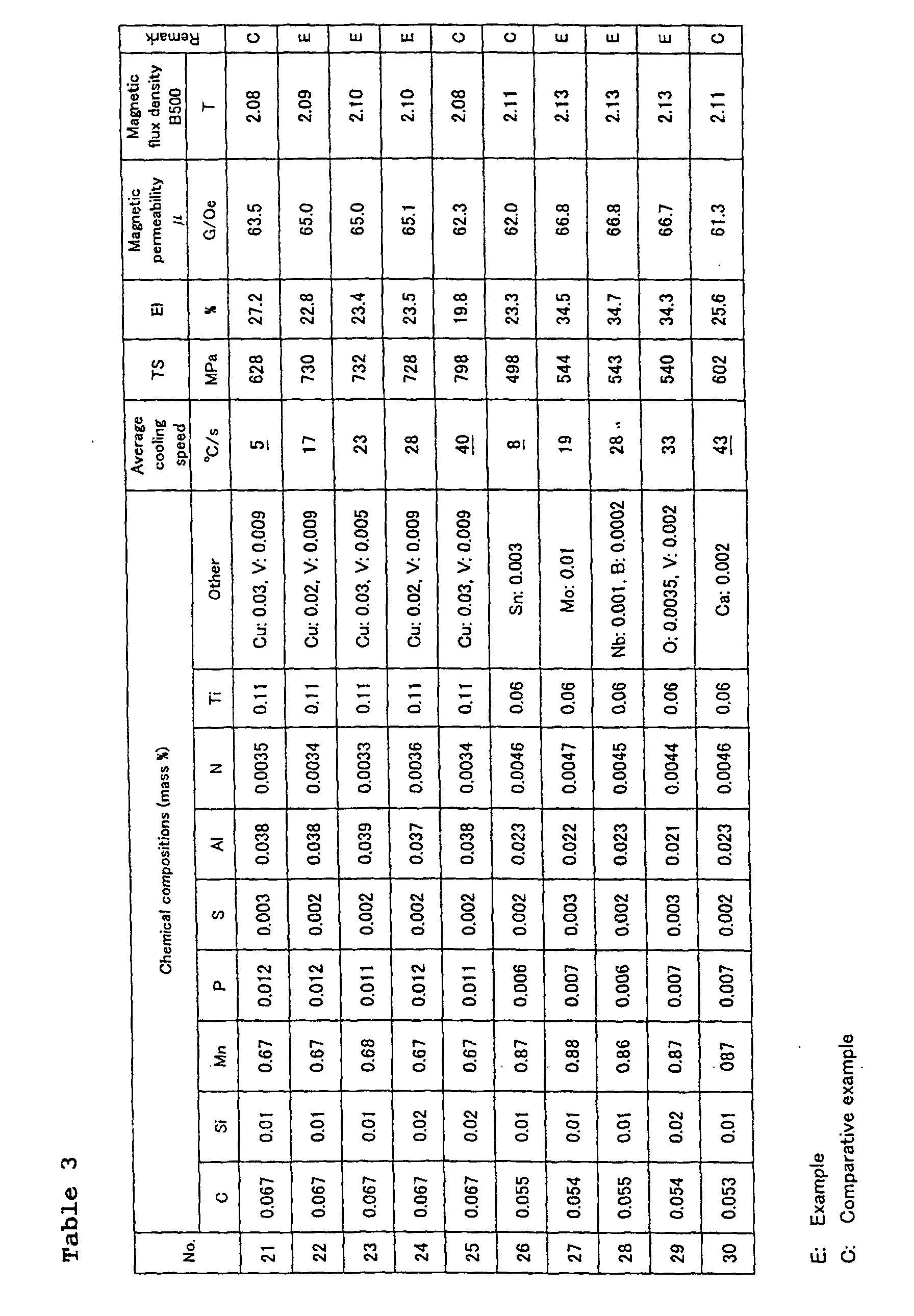
- the hot-rolled steel sheets No. 21 through 30 having the chemical compositions shown in Table 3 and 4.5 mm in thickness were manufactured under the conditions of a finishing temperature of 850 °C, a coiling temperature of 560 °C, and the various average cooling speeds in a range of from immediately after the finish rolling to the temperatures of from 630 to 680 °C.
- Table 3 shows the results.
- the steel sheets Nos. 21 through 25, and Nos. 26 through 30 were the ones sheets having the same chemical compositions and cooled at different average cooling speeds.
- Example steel sheets Nos. 22 through 24 and Nos. 27 through 29 of the present invention high El, high magnetic permeability, and high magnetic flux density are attained because the average cooling speed was in a range of from 15 to 35 °C/sec, which is within the range of the present invention.
- the steels No. 31 through 42 having the chemical compositions shown in Table 4 were prepared by melting process.
- the steels Nos. 31 through 37 are the Example steels.
- the steels Nos. 38 through 42 are the Comparative example steels.
- the steel No. 38 has the C content out of the range of the present invention.
- the steels Nos. 39 and 40 do not satisfy the equation (3).
- the steel No. 41 has the Mn content out of the range of the present invention.
- the steel No. 42 has the Ti content out of the range of the present invention. Using these steels, the hot-rolled steel sheets No.
- 31 through 42 having 4.5 mm in thickness were manufactured under the conditions of finishing temperatures of from 820 to 840 °C, coiling temperatures of from 530 to 630 °C, and the average cooling speeds of from 15 to 40 °C/sec in a range of from immediately after the finish rolling to the temperatures of 680 °C or lower.
- each of thus manufactured steel sheets was tested to determine the tensile characteristics, the magnetic permeability, and the magnetic flux density B300. Furthermore, after reduced the sheet thickness to 3.2 mm, each of the steel sheets was tested to determine the hardness reduction ⁇ Hv (0.2 kg of load) at HAZ after the TIG bead-on welding (heat input of 6 kJ/cm).
- both the TS x El and the magnetic flux density are high, and the value of ⁇ Hv is as low as 40 or less.
- the magnetic flux density and the magnetic permeability are extremely high.
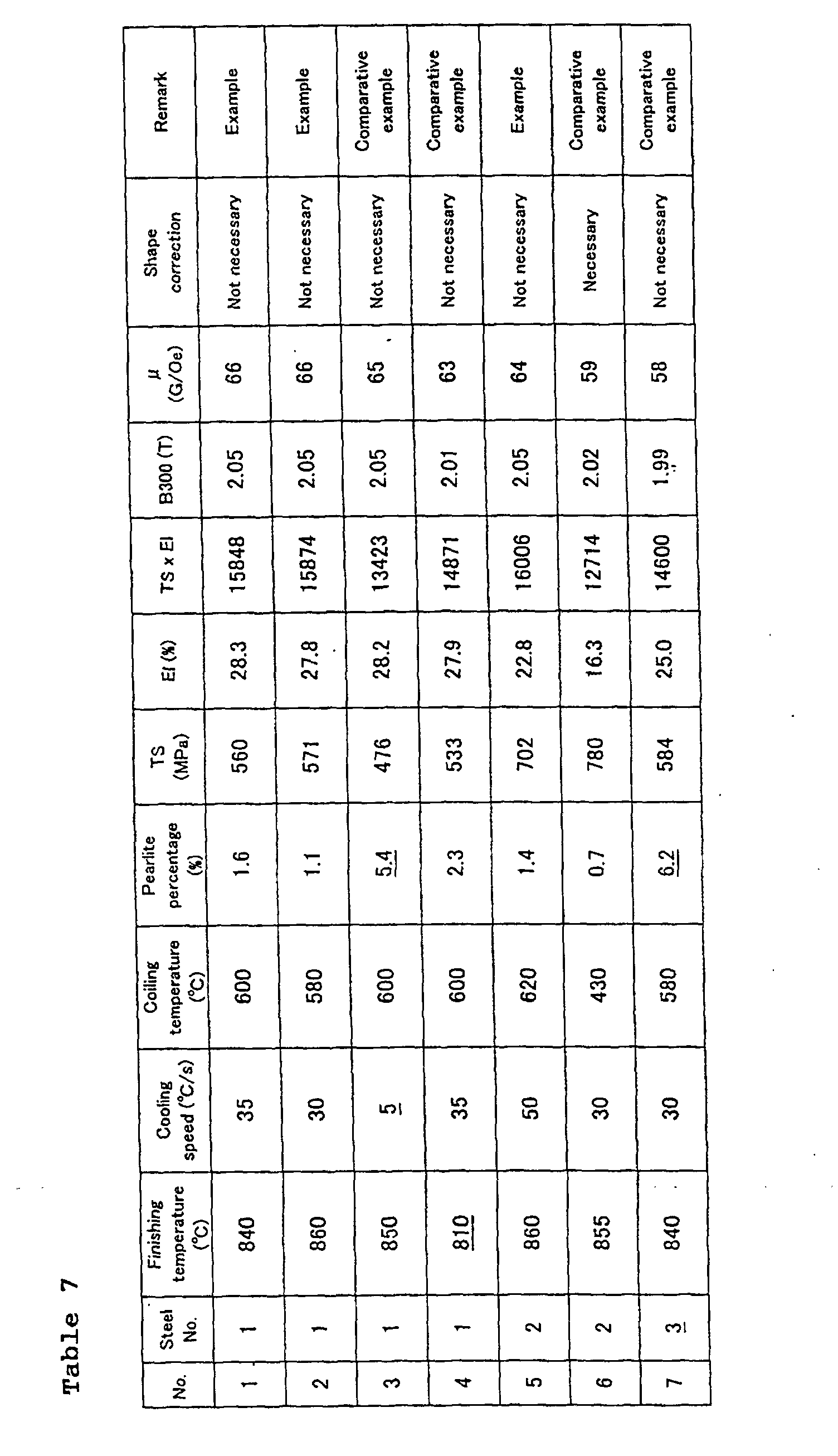
- the steels No. 1 through 3 having the chemical compositions shown in Table 6 were prepared by melting process. Using these steels, the hot-rolled steel sheets No. 1 through 7 having 4.5 mm in thickness were manufactured under the conditions of finishing temperatures of from 810 to 860 °C, coiling temperatures of from 400 to 600 °C, the reduction rate at a final pass of finish rolling of 12 %, and the average cooling speeds of from 5 to 50 °C /sec in a range of from immediately after the finish rolling to the temperatures of from 630 to 680 °C.
- Example steel sheets Nos. 1, 2 and 5 For the Example steel sheets Nos. 1, 2 and 5, the TS x El, the magnetic permeability, and the magnetic flux density are high.
- the TS is low.
- the Comparative example steel sheet No. 6 gives low El and low magnetic permeability, and poor shape of the sheet.
- the Comparative example steel sheet No. 7 gives low magnetic permeability and low magnetic flux density. (mass %) Steel No. C Si Mn P S Al N Ti Remark 1 0.068 0.01 0.86 0.01 0.003 0.044 0.003 0.05
- Example 2 0.079 0.02 0.62 0.01 0.003 0.036 0.003 0.12
Landscapes
- Chemical & Material Sciences (AREA)
- Engineering & Computer Science (AREA)
- Mechanical Engineering (AREA)
- Organic Chemistry (AREA)
- Metallurgy (AREA)
- Materials Engineering (AREA)
- Physics & Mathematics (AREA)
- Thermal Sciences (AREA)
- Crystallography & Structural Chemistry (AREA)
- Manufacturing & Machinery (AREA)
- Electromagnetism (AREA)
- Dispersion Chemistry (AREA)
- Power Engineering (AREA)
- Heat Treatment Of Sheet Steel (AREA)
- Heat Treatment Of Steel (AREA)
- Manufacturing Of Steel Electrode Plates (AREA)
Abstract
Description

| No. | Value in eq.(1) | Ferritic grain size | TS | El | TS x El | Magnetic permeability µ | Magnetic flux density B500 | Remark |
| µm | MPa | % | G/Oe | T | ||||
| 1 | 0.59 | 15 | 468 | 29.8 | 13946 | 66.7 | 2.12 | Comparative example |
| 2 | 0.71 | 12 | 588 | 26.9 | 15817 | 66.7 | 2.12 | Example |
| 3 | 0.93 | 11 | 608 | 26.3 | 15990 | 66.5 | 2.12 | Example |
| 4 | 0.85 | 11 | 630 | 25.1 | 15813 | 66.4 | 2.11 | Example |
| 5 | 0.71 | 10 | 653 | 20.1 | 13125 | 60.1 | 2.06 | Comparative example |
| 6 | 2.15 | 10 | 635 | 24.9 | 15812 | 58.3 | 2.01 | Comparative example |
| 7 | 1.01 | - | 631 | 20.8 | 13125 | 53.5 | 2.05 | Conventional example |
| 8 | 0.77 | 2 | 789 | 21.6 | 17042 | 61.5 | 2.06 | Comparative example |
| 9 | 0.80 | 5 | 740 | 23.2 | 17168 | 65.1 | 2.10 | Example |
| 10 | 0.77 | 10 | 732 | 23.5 | 17202 | 65.0 | 2.10 | Example |
| 11 | 0.85 | 12 | 728 | 23.6 | 17181 | 65.2 | 2.10 | Example |
| 12 | 0.77 | 18 | 710 | 20.3 | 14413 | 65.0 | 2.10 | Comparative example |
| 13 | 2.32 | 11 | 730 | 23.5 | 17155 | 55.4 | 1.89 | Comparative example |
| 14 | 0.94 | - | 705 | 20.8 | 14664 | 53.0 | 2.01 | Conventional example |

| No. | TS MPa | El % | TS x El | B300 T | µ G/Oe | ΔHv | Remark |
| 31 | 599 | 28.3 | 17000 | 2.02 | 63 | 18 | Example |
| 32 | 831 | 19.6 | 16300 | 2.02 | 63 | 20 | Example |
| 33 | 705 | 24.0 | 16900 | 2.05 | 66 | 32 | Example |
| 34 | 743 | 22.1 | 16400 | 2.00 | 63 | 18 | Example |
| 35 | 658 | 25.4 | 16700 | 2.02 | 62 | 26 | Example |
| 36 | 694 | 24.3 | 16900 | 2.01 | 62 | 24 | Example |
| 37 | 615 | 28.0 | 17200 | 2.02 | 64 | 22 | Example |
| 38 | 685 | 18.7 | 12800 | 1.98 | 60 | 24 | Comparative example |
| 39 | 820 | 19.5 | 16000 | 1.94 | 57 | 14 | Comparative example |
| 40 | 832 | 20.8 | 17300 | 1.92 | 57 | 0 | Comparative example |
| 41 | 682 | 24.6 | 16800 | 2.04 | 64 | 84 | Comparative example |
| 42 | 736 | 22.6 | 16600 | 2.00 | 59 | 38 | Comparative example |
| (mass %) | |||||||||
| Steel No. | C | Si | Mn | P | S | Al | N | Ti | Remark |
| 1 | 0.068 | 0.01 | 0.86 | 0.01 | 0.003 | 0.044 | 0.003 | 0.05 | Example |
| 2 | 0.079 | 0.02 | 0.62 | 0.01 | 0.003 | 0.036 | 0.003 | 0.12 | Example |
| 3 | 0.086 | 0.24 | 1.31 | 0.01 | 0.002 | 0.041 | 0.003 | 0.08 | Comparative example |
Claims (10)
- A high tensile strength hot-rolled steel sheet comprising 0.04 to 0.0 9% C, 0.1 % or less Si, 0.5 to 1.5 % Mn, 0.02 % or less P, 0.01 % or less S, 0.1 % or less Al, 0.001 to 0.008 % N, and 0.01 to 0.15 % Ti, by mass%, the content of ingredient thereeach satisfying the following equation (1), and the ferritic grain size α (µm) satisfying the following equation (2):
- A high tensile strength hot-rolled steel sheet comprising 0.04 to 0.09 % C, 0.1 % or less Si, 0.5 to 1.5 % Mn, 0.02 % or less P, 0.01 % or less S, 0.1 % or less Al, 0.001 to 0.008 % N, 0.2 % or less Mo, and 0.4 % Cr, and at least one selected from 0.01 to 0.15 % Ti and 0.005 to 0.05 % Nb, by mass%, the content of ingredient thereeach satisfying the equation (1) given in claim 1, and the ferritic grain size α (µm) satisfying the following equations (3) and (4):
- A high tensile strength hot-rolled steel sheet comprising 0.04 to 0.09 % C, 0.1 % or less Si, 0.5 to 1.5 % Mn, 0.02 % or less P, 0.01 % or less S, 0.1 % or less Al, 0.001 to 0.008 % N, and 0.01 to 0.15 % Ti, by mass%, and the pearlite area percentage being 5 % or less.
- A high tensile strength hot-rolled steel sheet comprising 0.04 to 0.09 % C, 0.1 % or less Si, 0.5 to 1.5 % Mn, 0.02 % or less P, 0.01 % or less S, 0.1 % or less Al, 0.001 to 0.008 % N, 0.2 % or less Mo, and 0.4 % Cr, and at least one selected from 0.01 to 0.15% Ti and 0.005 to 0.05% Nb, by mass%, and the pearlite area percentage being 5 % or less.
- A method for manufacturing a high tensile strength hot-rolled steel sheet comprising the steps of: preparing a slab of steel comprising the chemical compositions described in claim 1 or claim 2; hot-rolling the slab at a finishing temperature of from Ar3 transformation point to 880 °C; cooling the hot-rolled steel sheet to a temperature range of from 630 to 680 °C at an average cooling speed of from 15 to 35 °C/sec.
- A method for manufacturing a high tensile strength hot-rolled steel sheet comprising the steps of:preparing a slab of steel comprising the chemical compositions described in claim 1 or claim 2;hot-rolling the slab at a finishing temperature of from Ar3 transformation point to 880 °C;cooling the hot-rolled steel sheet to 680 °C at an average cooling speed of 15 °C/sec or more;and coiling the cooled steel sheet at a coiling temperature of from 500 to 650 °C.
- A rotor of generator, using the high tensile strength hot-rolled steel sheet described in claim 1.
- A rotor of generator, using the high tensile strength hot-rolled steel sheet described in claim 2.
- A rotor of generator, using the high tensile strength hot-rolled steel sheet described in claim 3.
- A rotor of generator, using the high tensile strength hot-rolled steel sheet described in claim 4.
Applications Claiming Priority (5)
| Application Number | Priority Date | Filing Date | Title |
|---|---|---|---|
| JP27350499 | 1999-09-28 | ||
| JP27350499 | 1999-09-28 | ||
| JP2000279594 | 2000-09-14 | ||
| JP2000279594 | 2000-09-14 | ||
| PCT/JP2000/006641 WO2001023632A1 (en) | 1999-09-28 | 2000-09-27 | Hot-rolled steel sheet having high tensile strength and method for production thereof |
Publications (2)
| Publication Number | Publication Date |
|---|---|
| EP1170390A1 true EP1170390A1 (en) | 2002-01-09 |
| EP1170390A4 EP1170390A4 (en) | 2005-02-23 |
Family
ID=26550686
Family Applications (1)
| Application Number | Title | Priority Date | Filing Date |
|---|---|---|---|
| EP00962865A Withdrawn EP1170390A4 (en) | 1999-09-28 | 2000-09-27 | Hot-rolled steel sheet having high tensile strength and method for production thereof |
Country Status (6)
| Country | Link |
|---|---|
| US (1) | US6632295B2 (en) |
| EP (1) | EP1170390A4 (en) |
| JP (1) | JP4265133B2 (en) |
| KR (1) | KR100419080B1 (en) |
| CN (1) | CN1117880C (en) |
| WO (1) | WO2001023632A1 (en) |
Cited By (5)
| Publication number | Priority date | Publication date | Assignee | Title |
|---|---|---|---|---|
| EP1662010A1 (en) * | 2004-11-24 | 2006-05-31 | ARVEDI, Giovanni | Hot steel strip particularly suited for the production of electromagnetic lamination packs |
| RU2510803C2 (en) * | 2012-01-26 | 2014-04-10 | ДжФЕ СТИЛ КОРПОРЕЙШН | High-strength hot-rolled steel plate with excellent fatigue strength and its manufacturing method |
| EP2843075A4 (en) * | 2012-04-26 | 2016-02-24 | Jfe Steel Corp | HIGH-STRENGTH HOT-ROLLED STEEL PLATE WITH GOOD DUCTILITY, GOOD CAPACITY TO FORM EDGES BY STRETCHING AND GOOD QUALITY OF MATERIAL QUALITY, AND MANUFACTURING METHOD THEREOF |
| US10077489B2 (en) | 2012-06-27 | 2018-09-18 | Jfe Steel Corporation | Steel sheet for soft-nitriding and method for manufacturing the same |
| US10202667B2 (en) | 2013-06-27 | 2019-02-12 | Jfe Steel Corporation | High strength hot rolled steel sheet and method for manufacturing the same |
Families Citing this family (29)
| Publication number | Priority date | Publication date | Assignee | Title |
|---|---|---|---|---|
| US6420364B1 (en) * | 1999-09-13 | 2002-07-16 | Boehringer Ingelheim Pharmaceuticals, Inc. | Compound useful as reversible inhibitors of cysteine proteases |
| DE60044180D1 (en) * | 1999-09-16 | 2010-05-27 | Jfe Steel Corp | METHOD FOR PRODUCING A THIN STAINLESS STEEL PLATE WITH HIGH STRENGTH |
| ATE490349T1 (en) * | 1999-09-29 | 2010-12-15 | Jfe Steel Corp | STEEL SHEET AND METHOD FOR THE PRODUCTION THEREOF |
| WO2001023624A1 (en) * | 1999-09-29 | 2001-04-05 | Nkk Corporation | Sheet steel and method for producing sheet steel |
| CN100591789C (en) * | 2002-12-24 | 2010-02-24 | 新日本制铁株式会社 | High-strength steel sheet having excellent softening resistance and excellent burring workability in weld heat-affected zone and method for producing same |
| JP4305216B2 (en) * | 2004-02-24 | 2009-07-29 | Jfeスチール株式会社 | Hot-rolled steel sheet for sour-resistant high-strength ERW steel pipe with excellent weld toughness and method for producing the same |
| US7171114B2 (en) * | 2004-07-12 | 2007-01-30 | Milton Curtis A | Mirror-mimicking video system |
| KR100711356B1 (en) * | 2005-08-25 | 2007-04-27 | 주식회사 포스코 | Galvanized steel sheet with excellent workability and its manufacturing method |
| ATE432376T1 (en) * | 2006-10-30 | 2009-06-15 | Thyssenkrupp Steel Ag | METHOD FOR PRODUCING FLAT STEEL PRODUCTS FROM A MULTIPHASE STEEL MICRO-ALLOYED WITH BORON |
| CN100557060C (en) * | 2007-01-12 | 2009-11-04 | 武汉钢铁(集团)公司 | The manufacture method of C-Mn-Ti series hot-rolled high strength high magnetic induction performance steel |
| CN100491574C (en) * | 2007-01-12 | 2009-05-27 | 武汉钢铁(集团)公司 | C-Mn-Ti-Nb series hot-rolled high strength high magnetic induction performance steel and manufacturing method thereof |
| CN101397626B (en) * | 2007-12-07 | 2012-04-11 | 江苏沙钢集团有限公司 | High-strength and high-toughness hot-rolled steel plate and production method thereof |
| US8657970B2 (en) * | 2008-03-26 | 2014-02-25 | Nippon Steel & Sumitomo Metal Corporation | Hot-rolled steel sheet excellent in fatigue properties and stretch-flange formability and method for manufacturing the same |
| CN102365125B (en) | 2009-03-26 | 2015-07-08 | Bl科技公司 | Non-woven reinforced hollow fiber membrane |
| CN101503779B (en) * | 2009-03-27 | 2011-04-20 | 攀钢集团研究院有限公司 | Hot rolling low carbon mild steel and production method thereof |
| CN101509102B (en) * | 2009-03-27 | 2011-01-05 | 攀钢集团研究院有限公司 | Steel for hot-rolled low carbon punching and producing method thereof |
| EP2384835B1 (en) * | 2010-05-06 | 2013-03-13 | Siemens Aktiengesellschaft | Method for manufacturing a rotor for a generator |
| JP5609786B2 (en) * | 2010-06-25 | 2014-10-22 | Jfeスチール株式会社 | High-tensile hot-rolled steel sheet excellent in workability and manufacturing method thereof |
| AU2011302393B2 (en) | 2010-09-15 | 2016-09-08 | Bl Technologies, Inc. | Method to make a yarn-reinforced hollow fibre membranes around a soluble core |
| US8529814B2 (en) | 2010-12-15 | 2013-09-10 | General Electric Company | Supported hollow fiber membrane |
| US9321014B2 (en) | 2011-12-16 | 2016-04-26 | Bl Technologies, Inc. | Hollow fiber membrane with compatible reinforcements |
| CN102560245B (en) * | 2011-12-30 | 2014-07-16 | 中信重工机械股份有限公司 | Microalloying and heat treatment method for 300MW turbonator rotor material |
| US9022229B2 (en) | 2012-03-09 | 2015-05-05 | General Electric Company | Composite membrane with compatible support filaments |
| US8999454B2 (en) | 2012-03-22 | 2015-04-07 | General Electric Company | Device and process for producing a reinforced hollow fibre membrane |
| WO2014002288A1 (en) * | 2012-06-27 | 2014-01-03 | Jfeスチール株式会社 | Steel sheet for soft nitriding and process for producing same |
| US9227362B2 (en) | 2012-08-23 | 2016-01-05 | General Electric Company | Braid welding |
| CN102978521A (en) * | 2012-11-22 | 2013-03-20 | 宁波得利时泵业有限公司 | Stator and rotor of homogeneous mixing pump and method for preparing same |
| CN103712995B (en) * | 2013-12-16 | 2015-09-09 | 丹东奥龙射线仪器集团有限公司 | X ray foundry goods automatic detection device |
| CN106834948A (en) * | 2017-03-03 | 2017-06-13 | 内蒙古包钢钢联股份有限公司 | Longitudinal yield strength 700MPa grades of hot rolled strip and preparation method thereof |
Family Cites Families (10)
| Publication number | Priority date | Publication date | Assignee | Title |
|---|---|---|---|---|
| JPS5891121A (en) | 1981-11-21 | 1983-05-31 | Kawasaki Steel Corp | Production of high-tensile hot-rolled steel plate having high magnetic flux density |
| JPS6086210A (en) * | 1983-10-18 | 1985-05-15 | Kawasaki Steel Corp | Manufacture of high-tension electromagnetic hot-rolled steel plate |
| JPS63166931A (en) * | 1986-12-27 | 1988-07-11 | Nippon Steel Corp | Manufacture of high tension hot rolled steel sheet having high magnetic flux density |
| US5074926A (en) * | 1989-11-16 | 1991-12-24 | Kawasaki Steel Corp. | High tensile cold rolled steel sheet and high tensile hot dip galvanized steel sheet having improved stretch flanging property and process for producing same |
| JPH0826433B2 (en) * | 1992-12-28 | 1996-03-13 | 株式会社神戸製鋼所 | High strength hot rolled steel sheet with excellent stretch flangeability |
| JP2879530B2 (en) | 1994-07-21 | 1999-04-05 | 株式会社大仁工業 | Roller device for roller conveyor |
| JP3900619B2 (en) * | 1996-10-31 | 2007-04-04 | Jfeスチール株式会社 | Hot rolled steel sheet, plated steel sheet, and hot rolled steel sheet manufacturing method excellent in bake hardenability and room temperature aging resistance |
| JP3941173B2 (en) * | 1997-07-25 | 2007-07-04 | 住友金属工業株式会社 | Manufacturing method of hot-rolled steel sheet with excellent scale adhesion and corrosion resistance |
| JP3885314B2 (en) * | 1997-09-29 | 2007-02-21 | Jfeスチール株式会社 | Method for producing high-strength hot-rolled steel sheet having excellent shape and workability |
| JP3514158B2 (en) * | 1999-03-19 | 2004-03-31 | Jfeスチール株式会社 | Manufacturing method of high tensile strength hot rolled steel sheet with excellent stretch flangeability and material stability |
-
2000
- 2000-09-27 WO PCT/JP2000/006641 patent/WO2001023632A1/en not_active Ceased
- 2000-09-27 EP EP00962865A patent/EP1170390A4/en not_active Withdrawn
- 2000-09-27 CN CN00802071A patent/CN1117880C/en not_active Expired - Fee Related
- 2000-09-27 KR KR10-2001-7005222A patent/KR100419080B1/en not_active Expired - Fee Related
- 2000-09-27 JP JP2001527011A patent/JP4265133B2/en not_active Expired - Fee Related
-
2001
- 2001-05-24 US US09/864,473 patent/US6632295B2/en not_active Expired - Lifetime
Cited By (6)
| Publication number | Priority date | Publication date | Assignee | Title |
|---|---|---|---|---|
| EP1662010A1 (en) * | 2004-11-24 | 2006-05-31 | ARVEDI, Giovanni | Hot steel strip particularly suited for the production of electromagnetic lamination packs |
| RU2510803C2 (en) * | 2012-01-26 | 2014-04-10 | ДжФЕ СТИЛ КОРПОРЕЙШН | High-strength hot-rolled steel plate with excellent fatigue strength and its manufacturing method |
| EP2843075A4 (en) * | 2012-04-26 | 2016-02-24 | Jfe Steel Corp | HIGH-STRENGTH HOT-ROLLED STEEL PLATE WITH GOOD DUCTILITY, GOOD CAPACITY TO FORM EDGES BY STRETCHING AND GOOD QUALITY OF MATERIAL QUALITY, AND MANUFACTURING METHOD THEREOF |
| US9657380B2 (en) | 2012-04-26 | 2017-05-23 | Jfe Steel Corporation | High strength hot-rolled steel sheet having excellent ductility, stretch flangeability and uniformity and method of manufacturing the same |
| US10077489B2 (en) | 2012-06-27 | 2018-09-18 | Jfe Steel Corporation | Steel sheet for soft-nitriding and method for manufacturing the same |
| US10202667B2 (en) | 2013-06-27 | 2019-02-12 | Jfe Steel Corporation | High strength hot rolled steel sheet and method for manufacturing the same |
Also Published As
| Publication number | Publication date |
|---|---|
| CN1322256A (en) | 2001-11-14 |
| WO2001023632A1 (en) | 2001-04-05 |
| EP1170390A4 (en) | 2005-02-23 |
| US6632295B2 (en) | 2003-10-14 |
| KR100419080B1 (en) | 2004-02-18 |
| JP4265133B2 (en) | 2009-05-20 |
| CN1117880C (en) | 2003-08-13 |
| KR20010080334A (en) | 2001-08-22 |
| US20020029828A1 (en) | 2002-03-14 |
Similar Documents
| Publication | Publication Date | Title |
|---|---|---|
| US6632295B2 (en) | High tensile strength hot-rolled steel sheet and method for manufacturing the same | |
| EP1559797A1 (en) | High strength steel sheet and method for manufacturing same | |
| EP1254275B1 (en) | STEEL PLATE TO BE PRECIPITATING TiN + ZrN FOR WELDED STRUCTURES, METHOD FOR MANUFACTURING THE SAME AND WELDING FABRIC USING THE SAME | |
| JPWO2001023632A1 (en) | High-tensile hot-rolled steel sheet and method for manufacturing the same | |
| WO2003042420A1 (en) | Steel plate having superior toughness in weld heat-affected zone and method for manufacturing the same, welding fabric using the same | |
| JP3233743B2 (en) | High strength hot rolled steel sheet with excellent stretch flangeability | |
| US20030131914A1 (en) | Steel plate to be precipitating tinfor weleded structures, method for manufacturing the same, welding fabric using the same | |
| EP1337678B1 (en) | Steel plate to be precipitating tin+mns for welded structures, method for manufacturing the same and welding fabric using the same | |
| KR102400036B1 (en) | Steel sheet having excellent low temperature toughness and low yield ratio and method of manufacturing the same | |
| JPH06128688A (en) | Hot-rolled steel sheet having excellent fatigue properties and method for producing the same | |
| EP1052303A2 (en) | High tensile strength steel product for high heat input welding, having excellent toughness in heat-affected zone | |
| JPH11140542A (en) | Method for producing high-strength hot-rolled steel sheet having high ductility and excellent material uniformity | |
| WO2007075008A1 (en) | Method for manufacturing high strength steel strips with superior formability and excellent coatability | |
| JP3885314B2 (en) | Method for producing high-strength hot-rolled steel sheet having excellent shape and workability | |
| JPH09256037A (en) | Method for manufacturing thick high-strength steel sheet for stress relief annealing | |
| JP4273768B2 (en) | Hot-rolled steel sheet for iron core of rotating machine and manufacturing method thereof | |
| JP3464567B2 (en) | Welded structural steel with excellent toughness in the heat affected zone | |
| JPH0629480B2 (en) | Hot-rolled high-strength steel sheet excellent in strength, ductility, toughness, and fatigue characteristics, and method for producing the same | |
| JPH083636A (en) | Method of manufacturing low yield ratio high toughness steel | |
| JP2718550B2 (en) | Method for producing high-strength hot-rolled steel sheet for strong working with excellent fatigue properties | |
| JPH0756053B2 (en) | Manufacturing method of galvanized hot rolled steel sheet with excellent workability | |
| KR100256357B1 (en) | Manufacturing method of copper precipitation strengthening type high tensile strength steel with excellent low temperature toughness | |
| JP3237861B2 (en) | Manufacturing method of high strength and high toughness structural steel sheet | |
| JPH05331538A (en) | Manufacturing method for thick-walled, high-toughness, high-strength steel sheets with excellent toughness in the center of the thickness | |
| JP2004244651A (en) | High-strength hot-rolled steel sheet excellent in hole expandability and ductility and method for producing the same |
Legal Events
| Date | Code | Title | Description |
|---|---|---|---|
| PUAI | Public reference made under article 153(3) epc to a published international application that has entered the european phase |
Free format text: ORIGINAL CODE: 0009012 |
|
| 17P | Request for examination filed |
Effective date: 20010620 |
|
| AK | Designated contracting states |
Kind code of ref document: A1 Designated state(s): AT BE CH CY DE DK ES FI FR GB GR IE IT LI LU MC NL PT SE |
|
| RAP1 | Party data changed (applicant data changed or rights of an application transferred) |
Owner name: JFE STEEL CORPORATION |
|
| RBV | Designated contracting states (corrected) |
Designated state(s): DE FR GB |
|
| A4 | Supplementary search report drawn up and despatched |
Effective date: 20050111 |
|
| RIC1 | Information provided on ipc code assigned before grant |
Ipc: 7C 22C 38/14 B Ipc: 7C 21D 8/12 B Ipc: 7C 22C 38/12 B Ipc: 7C 21D 9/46 B Ipc: 7C 21D 8/02 B Ipc: 7C 22C 38/00 A Ipc: 7C 21D 8/04 B Ipc: 7C 22C 38/04 B |
|
| STAA | Information on the status of an ep patent application or granted ep patent |
Free format text: STATUS: THE APPLICATION IS DEEMED TO BE WITHDRAWN |
|
| 18D | Application deemed to be withdrawn |
Effective date: 20070331 |