EP1170384A1 - Facilities for reducing metal oxide, method for operating the facilities and moldings as law material to be charged to reduction furnace - Google Patents
Facilities for reducing metal oxide, method for operating the facilities and moldings as law material to be charged to reduction furnace Download PDFInfo
- Publication number
- EP1170384A1 EP1170384A1 EP00980059A EP00980059A EP1170384A1 EP 1170384 A1 EP1170384 A1 EP 1170384A1 EP 00980059 A EP00980059 A EP 00980059A EP 00980059 A EP00980059 A EP 00980059A EP 1170384 A1 EP1170384 A1 EP 1170384A1
- Authority
- EP
- European Patent Office
- Prior art keywords
- powder
- metal oxide
- reducing
- shaped article
- dehydrator
- Prior art date
- Legal status (The legal status is an assumption and is not a legal conclusion. Google has not performed a legal analysis and makes no representation as to the accuracy of the status listed.)
- Granted
Links
Images


Classifications
-
- C—CHEMISTRY; METALLURGY
- C21—METALLURGY OF IRON
- C21B—MANUFACTURE OF IRON OR STEEL
- C21B13/00—Making spongy iron or liquid steel, by direct processes
- C21B13/10—Making spongy iron or liquid steel, by direct processes in hearth-type furnaces
- C21B13/105—Rotary hearth-type furnaces
-
- C—CHEMISTRY; METALLURGY
- C21—METALLURGY OF IRON
- C21B—MANUFACTURE OF IRON OR STEEL
- C21B13/00—Making spongy iron or liquid steel, by direct processes
- C21B13/10—Making spongy iron or liquid steel, by direct processes in hearth-type furnaces
-
- Y—GENERAL TAGGING OF NEW TECHNOLOGICAL DEVELOPMENTS; GENERAL TAGGING OF CROSS-SECTIONAL TECHNOLOGIES SPANNING OVER SEVERAL SECTIONS OF THE IPC; TECHNICAL SUBJECTS COVERED BY FORMER USPC CROSS-REFERENCE ART COLLECTIONS [XRACs] AND DIGESTS
- Y02—TECHNOLOGIES OR APPLICATIONS FOR MITIGATION OR ADAPTATION AGAINST CLIMATE CHANGE
- Y02P—CLIMATE CHANGE MITIGATION TECHNOLOGIES IN THE PRODUCTION OR PROCESSING OF GOODS
- Y02P10/00—Technologies related to metal processing
- Y02P10/20—Recycling
Definitions
- the present invention relates to a facility for reducing metal oxides, a rotary hearth reducing furnace which is the facility mentioned above, a method for reducing a metal oxide using the same, and to a method for reducing metal oxide-containing dusts and sludge generated by the metal refining or processing industry.
- a process of high productivity that includes the use of a rotary hearth reducing furnace, with which the reduction of a metal is effected.
- the essential part of this process is the use of a rotary hearth reducing furnace for reducing a metal oxide, the furnace being a firing furnace of the type in which, under a fixed fire resistant ceiling and side walls, a center-lacking-disk-shaped fire resistant hearth rotates along a rail at a constant speed (hereafter, referred to as a rotary furnace).
- the diameter of the disk-shaped hearth is from 10 meters to 50 meters, and its width is 2 meters to 6 meters.
- a metal oxide-containing powder as a raw material is pelletized to make raw material pellets and fed to the rotary hearth.
- the raw material pellets are spread all over the hearth. Since the raw material pellets are held stationary in relation to the hearth, this process has the advantage that the raw material pellets are hardly broken up in the furnace and therefore it is free from the problem of the raw material breaking up to form a powder which sticks to the fire resistant hearth. Moreover, this process has the advantage of high agglomerate production yield. Furthermore, since its productivity is high and a less expensive coal-based reducing agent and powdered raw materials can be employed, in recent years, the number of cases employing this method are increasing.
- the rotary hearth method is also effective in reducing dusts generated through the process of steel manufacture in blast furnaces, basic oxygen furnaces, and electric arc furnaces, and in reducing thickener sludge generated in a rolling step, and in removing impurities therefrom. This method has been adopted for treating dusts and is effective in recycling materials.
- the pellets thus obtained are fed onto the hearth of a rotary furnace in layers.
- the pellets spread all over the hearth are quickly heated and calcined at temperatures as high as 1100 to 1300°C for 5 to 20 minutes, whereby the metal oxide is reduced by the reducing agent mixed in with the pellets to provide a metal.
- the degree of metallization varies. In the case of iron, nickel, or manganese, the degree of metallization reaches 95% or higher. Even if the metal to be reduced is chromium, the reduction of which is difficult, the degree of metallization reaches or exceeds 50%.
- the method for reducing metal or dusts generated in the process of steel manufacture through the use of a rotary hearth it is necessary to pelletize the raw material and the reducing agent. It is also essential that, as a pretreatment of the raw materials, the mixture of a powdered metal oxide and a reducing agent as the raw material be brought into a condition suitable for granulation. As the pretreatment, milling of the raw materials, kneading with a ball mill, or any of a variety of techniques are carried out.
- the reduction of a metal oxide with the use of a rotary hearth method using a conventional method is excellent with respect to productivity or production cost, so that a metal is produced economically.
- a microfine powder raw material was employed for saving the cost of milling.
- particle size in the selection of the raw material due to the strict limitations on, e.g., particle size in the selection of the raw material, such a method was not in wide use.
- the use of a wet-beneficiated powdery ore or thickener dusts generated in a blast furnace or basic oxygen furnace, scale pit sludge produced in the rolling step, or sedimentary sludge generated in the acid cleaning step is effective.
- the moisture content of such raw materials was so high that it was hard to granulate them.
- these raw materials are finely divided powders each having a particle size of from about 1 micron or less up to a hundred microns and thus liable to be sludgy when moisturized, even if dehydrated by a vacuum dehydrator or filter presser, their moisture content cannot be lower than 20 to 50%.
- the moisture content of the raw material upon pelletization is suitably about 8 to 13% by mass and therefore these raw materials collected according to the wet process were too moist to be granulated as they were.
- Japanese Patent Laid-Open Publication No. Hei. 11-12619 there has been proposed a method including using a raw material in a rotary hearth-type reducing furnace without granulation, in which the raw material is shaped in the form of tiles by a compression molding machine and the resulting tiles are used in the rotary hearth reducing furnace.
- the use of a raw material containing a large amount of moisture had problems. That is, the method disclosed by Japanese Patent Laid-Open Publication No. Hei. 11-12624 also required the moisture content of a raw material in the form of tiles to be adjusted to 6 to 18%.
- the conventional method entailed a lot of complicated devices for drying or shaping the raw material and thus had a problem of a high construction cost.
- the conventional method had economical problems related to both plant investment and operation cost, and a facility which realizes a novel method capable of solving these problems has been demanded.
- wet raw materials in the form of tiles have. a problem with respect to their tendency towards explosive-cracking. Although they are less explosive than pellets, yet those with a high moisture content of 12 to 18% by mass such as described in Japanese Patent Laid-Open Publication No. Hei. 11-12621 tend to explode easily. This is because, if the raw material is in the form of tiles, water vapor does not move in a lateral direction. In other words, if the raw material is in the form of tiles, due to their length being extremely long in a lateral direction spatially, water vapor is discharged only in a vertical direction, causing a rise in passage resistance to facilitate their explosive-cracking.
- the present invention relates to a rotary hearth reducing furnace facility for effecting a reduction reaction with the use of a moisture-rich metal oxide containing powder as a raw material, a method for operating the same, and to a raw material for use in a reducing furnace, and the present invention is carried out in the manner described below.
- the reduction process of a metal oxide according to the rotary hearth method based on the present invention is illustrated in Fig. 1.
- the powdery raw material is a mixture of a metal oxide-containing powder and a carbon-containing powder.
- the metal oxide-containing powder include pellet feed which is finely divided iron ore, and manganese or chromium ore in a powder form.
- electric arc furnace dusts, blast furnace gas sludge, basic oxygen furnace dusts, neutral sludge generated upon acid cleaning of iron products, powdery products generated in the refining or processing of metal such as mill scales resulted from the hot-rolling of steel, and others are also available.
- a carbon-based powder such as oil coke, coke breeze, char, powdery coal, or any other fixed carbon-containing powder (hereafter, referred to as carbon powder) is mixed into the powdery raw material.
- the metal oxide-containing powder is conveyed by a grab bucket crane or slurry transportation.
- the material For evenly stirring the powdery raw material in a slurry state within a short period of time, the material needs to contain a large amount of water.
- a variety of experiments performed by the inventors have revealed that a high moisture content makes the mixing of the powdery raw material smoother. That is, a high water content and its consequent high fluidity make the time taken to mix the raw material homogeneously shorter, resulting in a saving in power required therefore.
- the inventors have also found that, with moisture content of 100% or more relative to the total mass of the powders, the fluidity of the slurry becomes higher.
- the particle size of each powder is small. By stirring stronger, the use of a powder of relatively large particle size is made possible. However, if the particle size of the metal oxide powder is 100 microns and that of the carbon powder is 180 microns or smaller and thus the mean particle size figured out with their mixing ratio taken into account is 120 microns or less, at a moisture content of 100% by mass, it is made possible to homogeneously mix the slurry at a rate of, usually, about 10 to 30 rotations per minute.
- the powdery raw material in a slurry state is sent by a slurry pump 3 to a dehydrator 4.
- the raw material is dehydrated to a moisture content of, relative to the mass of the powder, 15 to 30%, preferably 16 to 23%.
- an ordinary dehydrator for example, a vacuum dehydrator, a press filter, a centrifugal decanter, or the like can be employed.
- the facility is composed of a unit for pre-milling a raw material, a unit for mixing a raw material, a granulating unit, a pellet-drying unit, a rotary hearth reducing furnace, an exhaust gas treating unit, and a reduced pellet cooling unit.
- an apparatus for pelletizing a raw material and a reducing agent As in the case of a rotary hearth reducing furnace, an apparatus for pelletizing a raw material and a reducing agent.
- a unit for pretreating the raw material and a unit for bringing the mixture of a powdery metal oxide raw material and a reducing agent into a condition suitable for granulation are also important, and therefore, the facility incorporated a variety of apparatuses for pre-milling the raw material or a ball mill for kneading.
- a dehydrator illustrated in Fig. 3 is suitable, and it includes a filter 23 for receiving a slurry and twin rolls 25 between which the filter is sandwiched.
- a slurry 26 is cast on the filter 23 incorporated therein like an endless belt, and the filter is then sandwiched between the compression twin rolls 26 for dehydration. If the moisture content of the slurry is high, pre-dehydration of the slurry in front of the compression twin rolls 26 by a vacuum suction apparatus 24 provided under the filter will facilitate an efficient dehydration.
- a vertical centrifuge is also effective.
- This centrifuge is a centrifugal dehydrator including a cylindrical slurry holder the bottom of which is tapered inward and a screw-type powder discharge mechanism inside the holder.
- the difference in rotation rate between the slurry holder and the powder discharge mechanism is 2 to 30 rotations per minute, and the centrifugal force exerted on the slurry holder is 500G or more.
- the performance of a single dehydrator itself is not so high, due to the centrifugal force, its separation efficiency is good and this dehydrator is suitable for the dehydration of a moisture-rich fine powder.
- a high pressure press dehydrator including a device for pressing the slurry-receiving filter from both sides with a force of 10 6 N/m 2 or greater.
- a high pressure press dehydrator including a device for pressing the slurry-receiving filter from both sides with a force of 10 6 N/m 2 or greater.
- it is inferior in dehydration performance and therefore it is preferred to be employed for the case of relatively crude powders having a particle size of 100 microns or so.
- the wet powder dehydrated to a moisture content of 15 to 30% by mass, preferably 16 to 26% by mass is conveyed to a compression molding machine 6 by a sludge transporting conveyer 5, at which the powder is shaped.
- a compression molding machine 6 include, typically, a molding machine of the type shown in Fig. 4 in which a wet powder is pressed into holes (hereafter, referred to as a hole-type pelleter) and a briquette molding machine illustrated in Fig. 5 in which a wet powder is pressed against the concavities provided on the twin rolls.
- the wet material is extruded from the holes in the form of cylinders.
- the raw material is fed from a raw material feeding port 28 and pressed into a number of holes 34 provided on a bottom plate 33 by a roller 32 driven by a driving device 29, a drive power transmitting mechanism 30, and a driving shaft 31 to be shaped into shaped articles 35.
- a pelleter employing a different mechanism there can be mentioned a pelleter of the type including a screw-type pressing mechanism in its body with which the material is pressed against a plate provided with holes.
- the briquette molding machine is such an apparatus as is illustrated in Fig. 5, in which a powder is fed from a raw material feeding part 36 and compression-molded by rollers 37 provided with concavities 38.
- the pan pellet production method which is a conventional molding method, is a method in which shaped articles are grown by rolling a powder on a slope to provide new powder layers thereon.
- the powder filling rate of the pellets produced according to this method is as high as about 0.65 to 0.75, showing it is the very dense shaped article.
- the dense shaped articles tend to crack explosively at an area of 900°C or higher in the raw material feeding part of the rotary hearth. If the diameter of the pellets is about 10 mm and the moisture content is 3% by mass or higher, the pellets explosively crack as soon as they are fed to the furnace.
- the powder filling rate is the rate of the powder volume contained in the volume of a shaped article.
- the inventors have repeatedly made experiments on the conditions under which explosive-cracking of wet shaped articles directly fed to the furnace is caused, and finally have found that, for preventing the explosion-cracking of shaped articles, it is important that the powder filling density of the shaped articles is relatively low. That is, the cause of explosive-cracking in a reducing furnace with a rotary hearth is that the shaped articles are supplied to the furnace heated up to as high as 900°C or higher and water contained therein quickly evaporates, resulting in a rise in the internal pressure of the shaped articles.
- the inventors of the present invention performed a variety of experiments and finally have found that the explosive-cracking phenomenon is greatly influenced by both the powder filling density and the moisture content of the shaped articles.
- the powder filling rate is the percentage of the powder occupying inside of a shaped article.
- the production of shaped articles according to a compression molding method has the advantage that shaped articles produced thereby have a low powder filling rate being a condition for less-explosiveness.
- the existence of many gaps between the particles constituting the powder is important.
- Fig. 6 shows the influence that the powder filling rate exerts on the explosive-cracking marginal moisture content when shaped articles having a diameter of 20 mm are fed to an atmosphere of 1170°C. If the powder filling rate decreases, the explosive-cracking marginal moisture content increases. When the powder filling rate was 0.58 or less, even with a moisture content of 18% by mass, neither explosive-cracking nor partial powdering occurred. A moisture content of 23 to 26% by mass led to the surface peeling phenomenon, but explosive-cracking did not occur. Moreover, in the case of a powder filling rate of 0.55 or less, even with a moisture content of 23 to 30% by mass or so, the surface peeling phenomenon did not occur.
- the powder filling rate is 0.58 or less.
- the explosive-cracking marginal moisture content of shaped articles with a low powder filling rate shows a tendency to keep level at 23 to 26% by mass.
- the inventors have found that the conditions under which the explosive-cracking phenomenon occurs are different for different shaped article, depending on the shape thereof. Firstly, even if their powder filling rate was 0.58, tile-shape articles 20 mm in thickness and 150 mm in length and width explosively cracked at a moisture content of 17%. On the other hand, despite their having a powder filling rate of 0.58, cylindrical shaped articles having a diameter of 15 mm and a length of 25 mm produced by a hole-type pelleter did not explode until their moisture content reached 25%. Moreover, 20mm thick almond shape articles having a powder filing rate of 0.58 and a side of 40 mm and produced by a briquette molding machine were free from explosive-cracking up to a moisture content of 23%. That is , in contrast to plate shape articles that easily explode, cylindrical or granular shaped articles are less susceptible to explosive-cracking. Thus, in the present invention, the shape of the shaped articles is specified as cylindrical or granular.
- the thickness of the raw material is compressed, the density of sides of the briquette shaped article does not rise, consequently allowing water vapor to be readily discharged therefrom.
- the inventors have found that the explosiveness of shaped articles is influenced by their sizes. Even in the case of cylindrical or granular shaped articles, under certain conditions, if the size is 30 mm or more, they explosively crack in the furnace of 1170°C in spite of their moisture content of 26% by mass. Therefore, it is desired that the thickness or diameter of the shaped articles is 30 mm or less.
- a center-lacking-disk-shape hearth rotates.
- the hearth passes through a calcination/reducing zone and, in the zone at which shaped articles are discharged, reduced shaped articles are discharged. Thereafter, the hearth arrives to a shaped article supplying part. From the fact that the temperature of the hearth at this point of time is 1150 to 1300°C, it can be seen that, in a normal operation, the temperature of the shaped article supplying part is 1000 to 1250°C. That is, under certain operation conditions, the temperature of the shaped article supplying part can be 1170°C or higher.
- the temperature is adjusted to 1170°C or lower by cooling the shaped article supplying part.
- the important characteristic the shaped articles are required to have is a high drop resistance.
- the shaped articles In the course of conveyance from the molding machine to the hearth, when passed from one conveyer to another conveyer and fed to the hearth, the shaped articles are dropped several times by a distance of about 0.5 to 2 m. Therefore, they are required to be high in drop resistance (expressed by the total drop distance taken to spoil the shape of the shaped articles). In the case of a rotary hearth reducing furnace, a value of about 4 to 5 meters or more is required. That the drop resistance of shaped articles having a low powder filling rate is generally low is incompatible with the above described conditions under which explosive-cracking is inhibited from occurring. The inventors made studies to improve the drop resistance of shaped articles with a low powder filling rate and have found that, if their moisture content is of a certain value or higher, even if dropped and impacted, the shaped articles are not broken and are only distorted.
- the studies on the influence of the moisture content on the drop resistance the inventors made have revealed that, with a moisture content of 16% by mass or more, the drop resistance of shaped articles having a powder filling rate of not less than 0.43 will be 4.2 meters or more. However, when the powder filling rate was 0.43 or less, regardless of its moisture content, the drop resistance was as low as 2 to 4 meters or so. Thus, for assuring a suitable drop resistance, it is desired that the moisture content is 16% by mass or more and the powder filling rate is 0.43 or more.
- the inventors have found that, as the requirements of the shaped articles, it is desired that the moisture content falls within the range of 15 to 30% by mass, preferably 16 to 26% by mass and the powder filling rate is in the range of 0.43 to 0.58, and that the above mentioned hole-type pelleter and the briquette molding machine are the most effective apparatuses.
- the hole-type pelleter and briquette molding machine produce shaped articles of high performance at low cost and therefore are the most effective apparatuses.
- the shaped articles formed according to the method described above are, in their as-wet condition, supplied to a rotary hearth reducing furnace 9 by a swing conveyer 8 via a shaped article transporting conveyer 7, the swing conveyer 8 being a shaped article supplying device.
- the temperature of the shaped article supplying part of the rotary hearth reducing agent 9 is 1170°C or lower.
- the wet shaped articles are fed to a zone the atmospheric temperature at which is 1170°C or lower. If the atmospheric temperature is 1170°C, even those produced under such conditions as are specified in the present invention may explode, for the pace of increase in the internal temperature of the shaped articles is so high that the water vapor pressure gets high. Therefore, the temperature of this zone needs to be 1170°C or lower.
- the shaped articles are calcined at about 1100 to 1350°C, and the metal oxide is reduced by carbon contained in the shaped articles. Since the raw material is stirred and mixed in a moisture-rich condition and therefore the metal oxide and carbon contained in the shaped articles formed therefrom are homogeneously mixed, the raw material mixing method of the present invention has the effect of helping the reaction to be carried out efficiently.
- the inventors have found the importance of controlling the ratio of carbon in the reduction of iron oxide.
- the amount of carbon is insufficient, in some cases, the reduction is not effected completely, resulting in a decrease in the degree of metallization.
- excess carbon reacts with iron to form cementite (Fe 3 C) and, at 1200°C or so, the reduced shaped articles start melting in the furnace. Since the hearth or discharging device of an ordinary rotary hearth reducing furnace is not designed for molten iron, if iron melts, there arises the problem that the hearth is damaged.
- the amount of fixed carbon contained in the shaped articles is 1.5 times or less the molar number of fixed carbon figured out on the assumption that it reacts with oxygen combined with iron oxide to produce carbon monoxide (hereafter, referred to as calculated molar amount of carbon), the above mentioned problems of incomplete reduction and molten iron do not occur.
- the inventors have found that in the reaction among the reaction to produce carbon monoxide and the reaction to produce carbon dioxide, 10 to 70% of the carbon atoms reactive with iron oxide are reacted to produce carbon dioxide though it changes for different conditions. As a result, if the amount of fixed carbon is half the calculated carbon molar amount or more, there can be obtained reduction products the degree of metallization of which is 70% or higher.
- the degree of metallization of iron is about 80% and therefore the resulting product is somehow susceptible of direct use as reduced iron.
- the degree of metalization is as high as 97%.
- the amount of residual carbon was about 2.5% relative to the amount of reduced iron at this time. Accordingly, even if the whole residual carbon has been carburized with iron, the melting point of the resulting product is kept at 1300°C or higher. Therefore, in the rotary hearth reducing furnace the internal temperature of which is, at the highest, about 1300°C, the problem that the reduced product melts does not occur.
- the reduced shaped articles are discharged from the rotary hearth reducing furnace 9 and cooled to normal temperature in a product cooling device 13.
- the shaped articles the temperature of which is as high as 900°C may be subjected to a melting step as they are.
- exhaust gas generated upon combustion in the rotary hearth reducing furnace 9 is exhausted to atmosphere through a chimney 12.
- the shaped articles of raw materials for use in a rotary hearth reducing furnace need only be cylindrical or granular ones that are produced by compression-molding the mixture of a metal oxide-containing powder and a carbon-containing powder and have a water content of 15 to 30% by mass, preferably 16 to 26% by mass, a powder filling rate of 0.43 to 0.58, and a thickness or diameter of 30 mm or less, and they are not necessarily required to be produced in accordance with the process described above. Even with those produced by a different technique, if they satisfy the requirements, the reduction can be effected in such a manner as to meet the object of the present invention.
- a facility employed in a conventional method is shown in Fig. 2.
- the raw material is conveyed by a sludgy powder transporting conveyer 15 to a powder dryer 16, at which the raw material is dried to a moisture content of 5 to 10% by mass.
- the raw material is pelletized by a granulator 17.
- the resulting pellets are sent to a pellet dryer 20 by a pellet transporting conveyer 19, at which they are dried to a moisture content of about 2% by mass.
- the pellets are reduced through calcination by a rotary hearth reducing furnace.
- the operation by a conventional method includes many steps and its process is complicated as compared with that of the present invention.
- a large amount of energy is consumed in a series of moisture controlling steps of dehydration, drying, hydration, and dehydration, proving the facility according to the present invention to be effective in comparison with the operation by a conventional method.
- the present invention provides a technique for producing reduction-use shaped articles from a wet raw material in the easiest manner.
- the shaped articles which are produced by a compression molding machine are cylindrical or granular and have a thickness or diameter of 30 mm or less, a moisture content of 15 to 30% by mass, preferably 16 to 26% by mass, and a powder filling rate of 0.43 to 0.58.
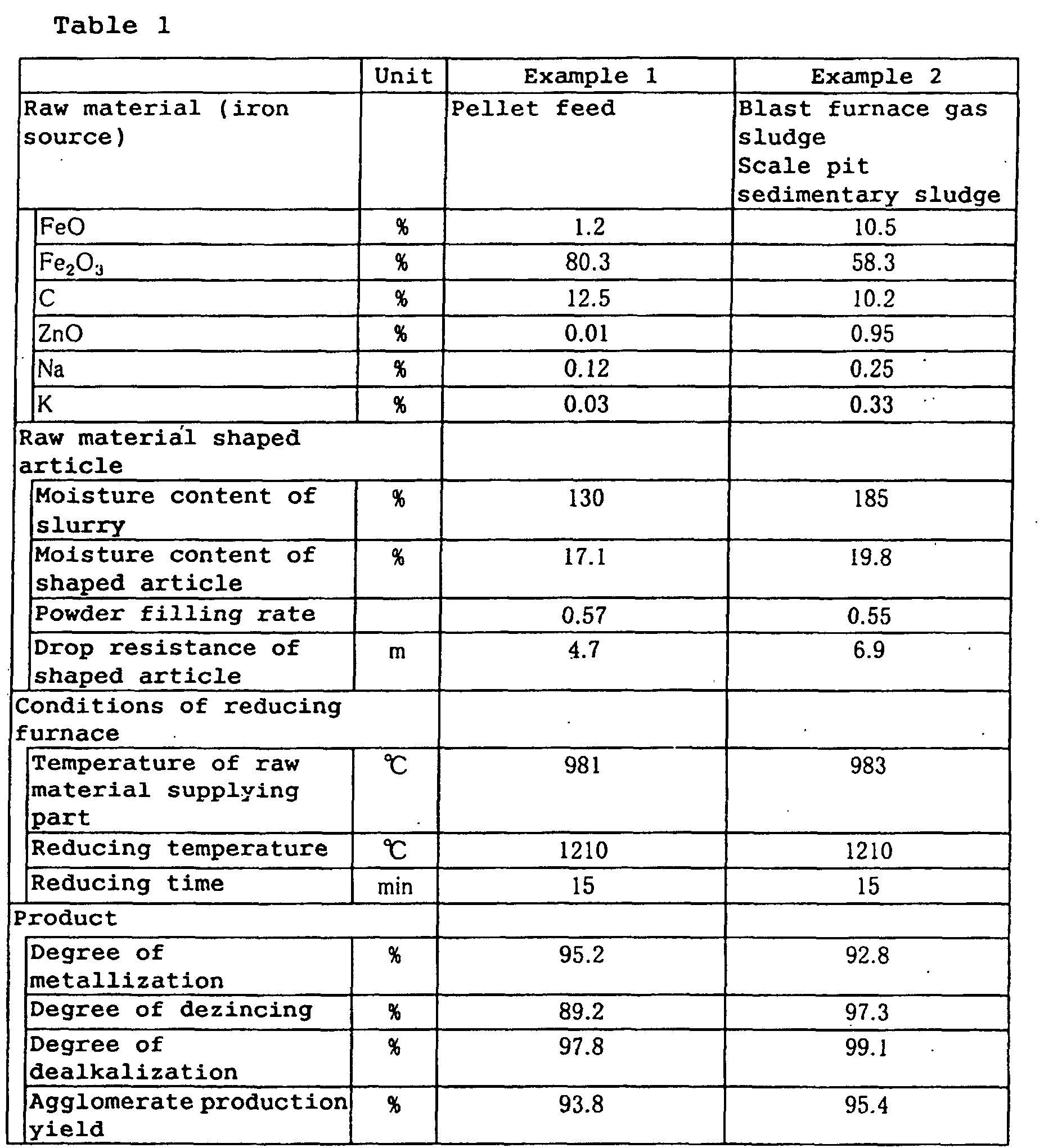
- Table 1 Examples in which operations were carried out in accordance with the present invention are shown in Table 1.
- the facility employed is one that is illustrated in Fig. 1, the reduction performance of which is, in terms of the amount of wet shaped articles, 10 tons per hour.
- As the dehydrator a dehydrator of the twin roll-type was employed, and a hole-type pelleter was used as the molding machine.
- the mixture of pellet feed being microfine powdery ore and coke breeze of 1 mm or less
- the mixture of blast furnace gas sludge from a plant of through-steel manufacture, sedimentary sludge of scale pit generated by the hot rolling, and coke breeze of 1 mm or less were employed.
- the operation conditions are as shown in Table 1.
- the moisture content of the raw material in the mixing vessel 1 is 130 to 185% relative to the mass of the powder, and that of the raw material before molding is 17 to 20% relative to the mass of the powder.
- the powder filling rate is within the range specified in the present invention.
- the diameter and length of each shaped article are 15 mm and 25 mm, respectively.
- the furnace temperature of the shaped article supplying part is about 980°C.
- the furnace temperature of the reduction zone is 1210°C.
- the reduction time is 15 minutes.
- Example 1 is the case of an operation which used pellet feed. Since the carbon mixing ratio was appropriate, its productivity was high. The operation was performed at a degree of metallization of as high as 97% and was substantially free from powdering due to a fall and explosive-cracking, so that its agglomerate production yield was as high as 94%.
- Example 2 is the case of operation with the use of blast furnace gas sludge and sedimentary sludge of scale pit generated by the hot rolling, aiming at not only reduction but also dezincification and dealkalization. In this operation, the degree of metallization was 91% , the degree of dezincification was 97.5%, and the degree of dealkalization was 99%. As can be seen from these figures, impurities were effectively eliminated. This case was also substantially free from powdering due to a fall and explosive-cracking, so that its agglomerate production yield was as high as 95%.
- the reduction according to the present invention and that according to a conventional method employing the facility as illustrated in Fig. 2 were compared from an economical viewpoint.
- the cost of pretreatment of the raw material since the pretreatment of the raw material is composed only of a mixing step, a dehydration step, and a molding step, the cost of pretreatment of the raw material does not exceed approximately 30% of that in the comparative example.
- the present invention provides a saving of about 15% in the amount of money cost throughout the process.
- the construction cost was reduced by about 10%, because the pretreatment in the present invention is simpler than that in the comparative example.
- the rotary hearth reducing furnace facility employing a wet powder according to the present invention is free from such operation related problems as explosive-cracking of shaped articles of raw materials.
- the construction cost of this facility is low, and it is possible to operate the facility at low cost, including savings in energy consumption and other operation related costs.
- the cost of maintenance of the facility according to the present invention is low and the facility enables a metal oxide to be reduced economically. Particularly, since it is possible to omit a powder drying step and a device used therein, its effect of reducing the equipment cost is great.
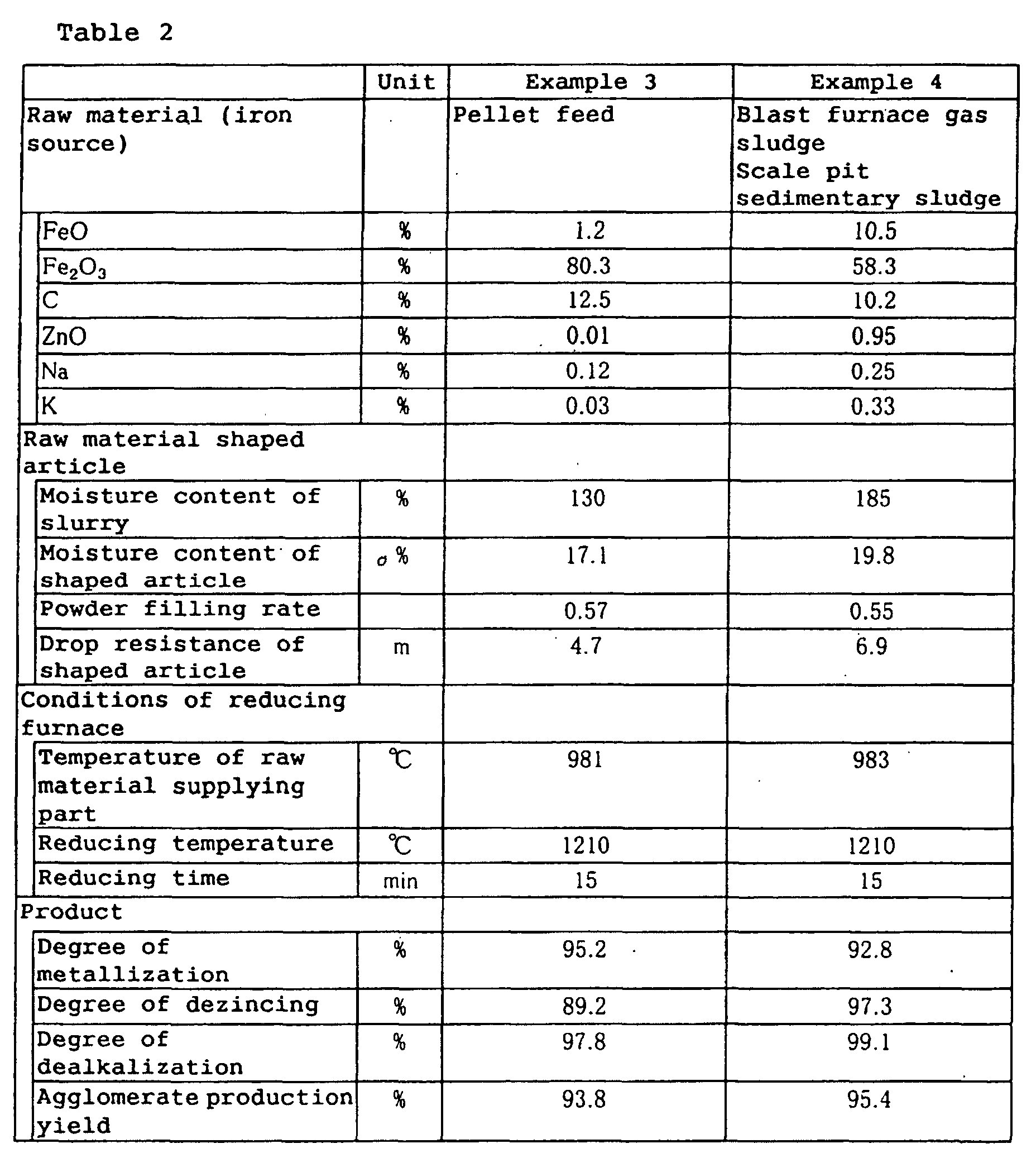
- the operation conditions are as shown in Table 2.
- the moisture content of the raw material in the mixing vessel 1 is 120 to 200% of the mass of the powder, and that of the raw material before molding is 17 to 20% of the mass of the powder.
- the powder filling rate is within the range specified in the present invention.
- the diameter and length of each shaped article are 15 mm and 25 mm, respectively.
- the furnace temperature of the shaped article supplying part is about 980°C.
- the furnace temperature of the reduction zone is 1210°C.
- the reduction time is 15 minutes.
- Example 3 is the case of an operation which used pellet feed. Since the carbon mixing ratio was appropriate, its productivity was high. The operation was performed at a degree of metallization of as high as 97% and was substantially free from powdering due to a fall and explosive-cracking, so that its agglomerate production yield was as high as 94%.
- Example 4 is the case of operation with the use of blast furnace gas sludge and sedimentary sludge of scale pit generated by the hot rolling, aiming at not only reduction but also dezincification and dealkalization. In this operation, the degree of metallization was 91%, the degree of dezincification was 97.5%, and the degree of dealkalization was 99%. As can be seen from these figures, impurities were effectively eliminated. This case was also substantially free from powdering due to a fall and explosive-cracking, so that its agglomerate production yield was as high as 95%.
- the reduction according to the present invention and that according to a conventional method employing the facility as illustrated in Fig. 2 were compared from an economical viewpoint.
- the cost of pretreatment of the raw material since the pretreatment of the raw material is composed only of a mixing step, a dehydration step, and a molding step, the cost of pretreatment of the raw material does not exceed approximately 30% of that in the comparative example.
- the present invention provides a saving of 15% in the amount of money cost throughout the process.
- the operation with the use of a wet powder according to the present invention is free from such operation related problems such as explosive-cracking of shaped articles of raw materials.
- the construction cost of this facility is low, and it is possible to operate at low cost, including savings in energy consumption and other operation related costs.
- reduction of ores and powders such as metal oxide-containing dusts or sludge by a rotary hearth reducing furnace was economically carried out.
- the present invention in a rotary reducing furnace method, with the use of a wet powdery raw material, it is possible to effect the reduction of a metal oxide thereby to produce a metal.
- the present invention is effective in economically treating metal oxide-containing dusts or sludge generated by the metal manufacturing industry, and reduction of a moisture-rich metal oxide containing powder or treatment of metal oxide-containing dusts or sludge generated in the process of metal refining or processing are economically effected through a small number of steps by a facility for reducing a metal oxide, incorporating a rotary hearth reducing furnace.
- the operation by the present invention is particularly effective in treating dusts or sludge containing a large amount of moisture.
Landscapes
- Engineering & Computer Science (AREA)
- Chemical & Material Sciences (AREA)
- Manufacturing & Machinery (AREA)
- Materials Engineering (AREA)
- Metallurgy (AREA)
- Organic Chemistry (AREA)
- Manufacture And Refinement Of Metals (AREA)
- Manufacture Of Iron (AREA)
Abstract
Description
Claims (25)
- A facility for reducing a metal oxide, characterized by comprising a compression molding machine for shaping a mixture of a water containing powder containing metal oxide and a powder containing carbon into a cylindrical or granular shaped article; a shaped article transporting conveyer; a shaped article feeding device; and a rotary hearth reducing furnace, wherein these are placed in this order and connected to each other by transporting means.
- A facility for reducing a metal oxide, characterized by comprising a device for mixing a powder containing metal oxide and a carbon-based powder in a water containing condition; a slurry transporting device; a dehydrator; a compression molding machine for producing a cylindrical or granular shaped article; a shaped article transporting conveyer; a shaped article feeding device; and a rotary hearth reducing furnace, wherein these are placed in this order and connected to each other by a transporting means.
- The facility for reducing a metal oxide according to claim 2, characterized by using, as the dehydrator, a dehydrator having a belt-like filter for receiving the water containing mixture of a metal oxide-containing powder and a carbon-based powder; and twin rolls between which said filter is sandwiched and compressed.
- The facility for reducing a metal oxide according to claim 2, characterized by using, as the dehydrator, a centrifugal dehydrator having a vertically cylindrical slurry holder a bottom of which is tapered inward and a screw-type powder discharge mechanism provided inside the holder, wherein the difference in rotation rate between said slurry holder and said powder discharge mechanism is 2 to 30 rotations per minute, and the centrifugal force exerted on said slurry holder is 500G or more.
- The facility for reducing a metal oxide according to claim 2, characterized by using, as the dehydrator, a dehydrator having a device for, from both sides, pressing a filter for receiving the mixture of the powder containing the metal oxide and the powder containing carbon in their water containing condition with a force of 106N/m2 or more.
- The facility for reducing a metal oxide according to claim 1 or 2, characterized by using, as the molding machine, a compression molding machine of a type which extrudes a wet powder from holes each having a diameter of 30 mm or less.
- The facility for reducing a metal oxide according to claim 1 or 2, characterized by using, as the molding machine, a briquette molding machine a maximum thickness of each concavity of which is 30 mm or less.
- The facility for reducing a metal oxide according to claim 1 or 2, characterized in that, in the course of transportation from a shaped article manufacturing machine to a hearth of a rotary furnace, a total drop distance of the shaped article is 4.1 m or less.
- The facility for reducing a metal oxide according to claim 1 or 2, characterized by using, as the shaped article feeding device, a swing-type belt conveyer or a vibration feeder.
- The facility for reducing a metal oxide according to claim 2, characterized in that the powder containing the metal oxide and the carbon-based powder are supplied to the device for mixing from a plurality of tanks storing water-containing powders by a grab bucket crane and/or slurry transportation in such a condition as to have a moisture content of 100% or higher relative to the total mass of the powders.
- The facility for reducing a metal oxide according to claim 1 or 2, characterized by comprising a mechanism for controlling an atmospheric temperature of a shaped article supplying zone in the rotary hearth reducing furnace so as to be 1170°C or lower.
- A method of operating a rotary hearth reducing furnace, characterized by dehydrating a powdery mixture containing a metal oxide, carbon, and water to a moisture content of 15 to 30% by mass relative to the whole mixture; shaping said mixture into a plurality of cylindrical or granular shaped articles by compression molding; and directly feeding the resulting shaped articles to the reducing furnace for reducing through calcination.
- A method of operating a rotary hearth reducing furnace, characterized by feeding a shaped article having a powder filling rate of 0.43 to 0.58 produced by mixing a powder containing metal oxide and carbon in such a condition as to have a moisture content of 100% or higher relative to the total powder mass, dehydrating the mixture by a dehydrator to a moisture content of 16 to 26% by mass, and shaping the mixture by a compression molding machine to a zone in the furnace the atmospheric temperature at which is 1170°C or lower, and then reducing the shaped article through calcination at temperatures of 1200°C or higher.
- The method of operating a rotary hearth reducing furnace according to claim 12 or 13, characterized by using, as the dehydrator, a dehydrator having a belt-like filter for receiving a water containing powder and twin rolls between which said filter is compressed in a vertical direction.
- The method of operating a rotary hearth reducing furnace according to claim 12 or 13, characterized by using, as the dehydrator, a centrifugal dehydrator having a vertically cylindrical water containing powder holder a bottom of which is tapered inward and a screw-type powder discharge mechanism provided inside the holder in which a difference in rotation rate between said holder and said powder discharge mechanism is 2 to 30 rotations per minute and a centrifugal force exerted on the holder is 500G or more.
- The method of operating a rotary hearth reducing furnace according to claim 12 or 13, characterized by dehydrating with the use of, as the dehydrator, a dehydrator having a device for, from both sides, pressing a filter holding a water containing powder with a force of 106N/m2 or more.
- A method of operating a rotary hearth reducing furnace, characterized by feeding a cylindrical or circular shaped article having a moisture content of 16 to 26% by mass, a thickness or diameter of 30 mm or less, and a powder filling rate of 0.43 to 0.58 and produced by compression-molding a mixture of a metal oxide-containing powder and a carbon-containing powder to a zone in the furnace the atmospheric temperature at which is 1170°C or lower, and reducing the shaped article through calcination at temperatures of 1200°C or higher.
- The method of operating a rotary hearth reducing furnace according to claim 12 or 17, characterized by using, as the compression molding machine, an extrusion compression molding machine provided with a device for pushing a wet powder and a hole from which the wet powder is extruded.
- The method of operating a rotary hearth reducing furnace according to claim 12, 13, or 17, characterized by using, as the compression molding machine, a briquette molding machine in which the wet powder is pressed against concavities provided on surfaces of twin rolls to be shaped.
- The method of operating a rotary hearth reducing furnace according to claim 17, characterized by reducing the cylindrical or granular shaped article having a thickness or diameter of 30 mm or less and produced by compression-molding the mixture of the metal oxide-containing powder and the carbon-containing powder.
- The method of operating a rotary hearth reducing furnace according to claim 12, 13, or 17, characterized by reducing the shaped article an atomic molar amount of fixed carbon of which is 0.5 to 1.5 times an atomic molar amount of oxygen combined with iron oxide when an iron oxide-containing powder is employed as the metal oxide-containing powder.
- The method of operating a rotary hearth reducing furnace according to claim 12, 13, or 17, characterized by feeding the cylindrical or granular shaped article formed by a compression molding machine to a zone an atmospheric temperature at which is lower than the other areas inside the furnace, and reducing it through calcination.
- A shaped article of a raw material for use in a reducing furnace, characterized in that the shaped article is a cylindrical or granular shaped article of 30 mm or less formed by dehydrating a powdery mixture containing a metal oxide, carbon, and water to a moisture content of 15 to 30% by mass relative to the whole mixture and then compression-molding said mixture.
- A shaped article of a raw material for use in a reducing furnace, characterized in that the shaped article is a cylindrical or granular shaped article with a moisture content of 16 to 26% by mass, a thickness or diameter of 30 mm or less, and a powder filling rate of 0.43 to 0.58 obtained by compression-molding a mixture of a metal oxide-containing powder and a carbon-containing powder.
- The shaped article of a raw material for use in a reducing furnace according to claim 23 or 24, characterized in that an atomic molar amount of fixed carbon is 0.5 to 1.5 times an atomic molar amount of oxygen combined with iron oxide when an iron oxide-containing powder is employed as the metal oxide-containing powder.
Applications Claiming Priority (9)
| Application Number | Priority Date | Filing Date | Title |
|---|---|---|---|
| JP35343499 | 1999-12-13 | ||
| JP35343499 | 1999-12-13 | ||
| JP35701299 | 1999-12-16 | ||
| JP35701299 | 1999-12-16 | ||
| JP2000372019A JP3779873B2 (en) | 1999-12-16 | 2000-12-06 | Operation method of rotary hearth reduction furnace |
| JP2000372016 | 2000-12-06 | ||
| JP2000372016A JP3579652B2 (en) | 1999-12-13 | 2000-12-06 | Metal oxide reduction equipment |
| JP2000372019 | 2000-12-06 | ||
| PCT/JP2000/008771 WO2001042516A1 (en) | 1999-12-13 | 2000-12-12 | Facilities for reducing metal oxide, method for operating the facilities and moldings as law material to be charged to reduction furnace |
Publications (3)
| Publication Number | Publication Date |
|---|---|
| EP1170384A1 true EP1170384A1 (en) | 2002-01-09 |
| EP1170384A4 EP1170384A4 (en) | 2004-04-28 |
| EP1170384B1 EP1170384B1 (en) | 2010-04-07 |
Family
ID=27480730
Family Applications (1)
| Application Number | Title | Priority Date | Filing Date |
|---|---|---|---|
| EP20000980059 Expired - Lifetime EP1170384B1 (en) | 1999-12-13 | 2000-12-12 | A method of operating a rotary hearth reducing furnace |
Country Status (7)
| Country | Link |
|---|---|
| US (2) | US6755888B2 (en) |
| EP (1) | EP1170384B1 (en) |
| KR (1) | KR100673785B1 (en) |
| CN (1) | CN1262676C (en) |
| AU (1) | AU1736801A (en) |
| TW (1) | TW527423B (en) |
| WO (1) | WO2001042516A1 (en) |
Cited By (4)
| Publication number | Priority date | Publication date | Assignee | Title |
|---|---|---|---|---|
| WO2006088121A1 (en) * | 2005-02-18 | 2006-08-24 | Ntn Corporation | Solidification product of dust generated during steel making and method for production thereof |
| EP1813685A3 (en) * | 2000-11-10 | 2007-10-03 | Nippon Steel Corporation | Method of operation of reducing rotary hearth furnace and reducing rotary hearth furnace facility |
| EP1561829A4 (en) * | 2002-09-13 | 2007-12-26 | Nippon Steel Corp | PROCESS FOR TREATMENT BY REDUCTION OF METAL OXIDE OR IRON PRODUCTION WASTE AND METHOD OF CONCENTRATING AND / OR RECOVERING ZINC AND / OR LEAD |
| EP1426451A4 (en) * | 2001-09-14 | 2008-07-16 | Nippon Steel Corp | PROCESS FOR PRODUCING REDUCED IRON AGGREGATE IN A ROTATING SOLE REDUCTION FURNACE, REDUCED IRON AGGREGATE, AND PROCESS FOR PRODUCING RAW CAST IRON |
Families Citing this family (10)
| Publication number | Priority date | Publication date | Assignee | Title |
|---|---|---|---|---|
| EP1170384B1 (en) * | 1999-12-13 | 2010-04-07 | Nippon Steel Corporation | A method of operating a rotary hearth reducing furnace |
| EP1439236B1 (en) | 2001-09-27 | 2012-12-05 | Nippon Steel Corporation | Method for drying molding containing oxidized metal, method for reducing oxidized metal and rotary hearth type metal reduction furnace |
| CA2423166C (en) * | 2002-04-03 | 2008-11-25 | Kabushiki Kaisha Kobe Seiko Sho (Kobe Steel, Ltd.) | Method for making reduced iron |
| JP4307849B2 (en) * | 2003-01-07 | 2009-08-05 | 株式会社神戸製鋼所 | Method for reducing chromium-containing raw materials |
| CA2590259C (en) * | 2004-12-07 | 2016-02-16 | Nu-Iron Technology, Llc | Method and system for producing metallic iron nuggets |
| US8034283B2 (en) * | 2005-10-31 | 2011-10-11 | Kobe Steel, Ltd. | Rotary hearth furnace and method of operating the same |
| JP4348387B2 (en) * | 2007-10-19 | 2009-10-21 | 新日本製鐵株式会社 | Method for producing pre-reduced iron |
| CN102388153B (en) * | 2009-05-15 | 2013-09-18 | 株式会社神户制钢所 | Method for producing high-density reduced iron and apparatus for producing high-density reduced iron |
| KR101322638B1 (en) * | 2012-05-22 | 2013-10-28 | 주식회사 포스코 | Device and method of processing pre-reduction of finex sludge |
| US9534275B2 (en) | 2013-03-06 | 2017-01-03 | Midrex Technologies, Inc. | Methods and systems for reducing chromium containing raw material |
Family Cites Families (15)
| Publication number | Priority date | Publication date | Assignee | Title |
|---|---|---|---|---|
| US2793109A (en) * | 1954-04-09 | 1957-05-21 | Surface Combustion Corp | Induration process for powdered iron oxide containing material |
| JPS4312496Y1 (en) | 1965-08-03 | 1968-05-29 | ||
| US3443931A (en) * | 1965-09-10 | 1969-05-13 | Midland Ross Corp | Process for making metallized pellets from iron oxide containing material |
| JPS5245518A (en) | 1975-10-08 | 1977-04-11 | Chikara Hidaka | Production process of pellets using iron ore dust generated from raw m aterial for iron manufacture as raw material |
| US4133756A (en) * | 1976-02-20 | 1979-01-09 | Sumitomo Heavy Industries, Ltd. | Method for dehydrating a mixed dust slurry |
| JPS5939095A (en) | 1982-08-27 | 1984-03-03 | 株式会社東芝 | Method of producing printed multilayer circuit board |
| JPS5939095U (en) * | 1982-09-03 | 1984-03-12 | 荏原インフイルコ株式会社 | Screw press type dehydrator |
| JP2951499B2 (en) | 1993-01-08 | 1999-09-20 | トウフク株式会社 | Two-stage slurry processing method and apparatus |
| JPH0919607A (en) | 1995-07-04 | 1997-01-21 | Kubota Corp | Operation control method for belt press type dehydrator |
| JPH1112619A (en) | 1997-06-26 | 1999-01-19 | Sumitomo Metal Ind Ltd | Method for producing reduced iron |
| JP4022941B2 (en) * | 1997-06-27 | 2007-12-19 | 住友金属工業株式会社 | Method for forming reduced iron production raw material |
| JPH1112621A (en) * | 1997-06-27 | 1999-01-19 | Sumitomo Metal Ind Ltd | Method and apparatus for charging reduced iron production raw material |
| US6120577A (en) * | 1998-03-25 | 2000-09-19 | Ltv Steel Company, Inc. | Treatment of steel mill waste metal oxides |
| EP1170384B1 (en) * | 1999-12-13 | 2010-04-07 | Nippon Steel Corporation | A method of operating a rotary hearth reducing furnace |
| JP3635256B2 (en) * | 2001-09-14 | 2005-04-06 | 新日本製鐵株式会社 | Reduction method of iron oxide |
-
2000
- 2000-12-12 EP EP20000980059 patent/EP1170384B1/en not_active Expired - Lifetime
- 2000-12-12 KR KR1020017010263A patent/KR100673785B1/en not_active Expired - Fee Related
- 2000-12-12 CN CNB008058164A patent/CN1262676C/en not_active Expired - Fee Related
- 2000-12-12 US US09/913,287 patent/US6755888B2/en not_active Expired - Lifetime
- 2000-12-12 TW TW89126496A patent/TW527423B/en not_active IP Right Cessation
- 2000-12-12 AU AU17368/01A patent/AU1736801A/en not_active Abandoned
- 2000-12-12 WO PCT/JP2000/008771 patent/WO2001042516A1/en not_active Ceased
-
2004
- 2004-04-30 US US10/834,870 patent/US7192552B2/en not_active Expired - Lifetime
Cited By (8)
| Publication number | Priority date | Publication date | Assignee | Title |
|---|---|---|---|---|
| EP1813685A3 (en) * | 2000-11-10 | 2007-10-03 | Nippon Steel Corporation | Method of operation of reducing rotary hearth furnace and reducing rotary hearth furnace facility |
| EP1426451A4 (en) * | 2001-09-14 | 2008-07-16 | Nippon Steel Corp | PROCESS FOR PRODUCING REDUCED IRON AGGREGATE IN A ROTATING SOLE REDUCTION FURNACE, REDUCED IRON AGGREGATE, AND PROCESS FOR PRODUCING RAW CAST IRON |
| EP1561829A4 (en) * | 2002-09-13 | 2007-12-26 | Nippon Steel Corp | PROCESS FOR TREATMENT BY REDUCTION OF METAL OXIDE OR IRON PRODUCTION WASTE AND METHOD OF CONCENTRATING AND / OR RECOVERING ZINC AND / OR LEAD |
| EP2100978A1 (en) * | 2002-09-13 | 2009-09-16 | Nippon Steel Corporation | Method of reduction treatment of metal oxides or steelmaking waste and method of concentrating and recovering zinc and/or lead |
| US7879132B2 (en) | 2002-09-13 | 2011-02-01 | Nippon Steel Corporation | Method for reduction treatment of metal oxide or ironmaking waste and method for concentration and recovery zinc and/or lead |
| US8308844B2 (en) | 2002-09-13 | 2012-11-13 | Nippon Steel Corporation | Method of reduction treatment of metal oxides or steelmaking waste and method of concentrating and recovering zinc and/or lead |
| WO2006088121A1 (en) * | 2005-02-18 | 2006-08-24 | Ntn Corporation | Solidification product of dust generated during steel making and method for production thereof |
| US7842119B2 (en) | 2005-02-18 | 2010-11-30 | Ntn Corporation | Solidification product of dust generated during steel making and method for production thereof |
Also Published As
| Publication number | Publication date |
|---|---|
| EP1170384A4 (en) | 2004-04-28 |
| EP1170384B1 (en) | 2010-04-07 |
| CN1262676C (en) | 2006-07-05 |
| KR100673785B1 (en) | 2007-01-23 |
| AU1736801A (en) | 2001-06-18 |
| CN1345380A (en) | 2002-04-17 |
| US6755888B2 (en) | 2004-06-29 |
| WO2001042516A1 (en) | 2001-06-14 |
| US20020174745A1 (en) | 2002-11-28 |
| US7192552B2 (en) | 2007-03-20 |
| TW527423B (en) | 2003-04-11 |
| KR20010109293A (en) | 2001-12-08 |
| US20040201140A1 (en) | 2004-10-14 |
Similar Documents
| Publication | Publication Date | Title |
|---|---|---|
| US5972066A (en) | Mixed bed iron reduction process | |
| US7964014B2 (en) | Metal oxide-bearing green pellets for reducing furnace, method of production of same, method of reduction of same, and reduction facility | |
| US6755888B2 (en) | Facility for reducing metal oxide, method for operating the facilities and moldings as raw material to be charged to reduction furnace | |
| US8262766B2 (en) | Method for reducing chromium containing raw material | |
| US8419824B2 (en) | Method for producing briquette, method for producing reduced metal, and method for separating zinc or lead | |
| EP1408124B1 (en) | Method for producing feed material for molten metal production and method for producing molten metal | |
| CN113774215A (en) | Method for recovering valuable metals in high-zinc high-lead smelting slag | |
| EP1561829B1 (en) | Method for reduction treatment of metal oxide or ironmaking waste, and method for concentration and/or recovery of zinc and/or lead. | |
| CN117545859A (en) | System and method for producing Hot Briquette Iron (HBI) containing fluxing agents and/or carbonaceous materials | |
| JP3737928B2 (en) | Operation method of rotary hearth type reduction furnace and metal oxide reduction equipment | |
| JP3779873B2 (en) | Operation method of rotary hearth reduction furnace | |
| JP3579652B2 (en) | Metal oxide reduction equipment | |
| RU105625U1 (en) | TECHNOLOGICAL LINE FOR THE PRODUCTION OF IRON IRON HIGH QUALITY GRANULATED | |
| JP5551347B2 (en) | Manufacturing method of briquette with carbonaceous materials using oil-containing steelworks dust | |
| RU107158U1 (en) | TECHNOLOGICAL LINE FOR THE PRODUCTION OF IRON IRON HIGH QUALITY GRANULATED | |
| EP1017858A1 (en) | Mixed bed iron reduction process | |
| JP2001032005A (en) | Operation method of rotary hearth method for reduction | |
| CN1067453A (en) | The method of transport of sponge iron | |
| JP3820677B2 (en) | Method and apparatus for charging reduced iron production raw material | |
| KR20100028260A (en) | Apparatus and process for producing reduced iron from materals comprising iron oxide | |
| WO2004081240A1 (en) | Method for recycling converter dust to rotary hearth reducing furnace |
Legal Events
| Date | Code | Title | Description |
|---|---|---|---|
| PUAI | Public reference made under article 153(3) epc to a published international application that has entered the european phase |
Free format text: ORIGINAL CODE: 0009012 |
|
| 17P | Request for examination filed |
Effective date: 20010905 |
|
| AK | Designated contracting states |
Kind code of ref document: A1 Designated state(s): FR GB |
|
| A4 | Supplementary search report drawn up and despatched |
Effective date: 20040316 |
|
| 17Q | First examination report despatched |
Effective date: 20050414 |
|
| 17Q | First examination report despatched |
Effective date: 20050414 |
|
| GRAP | Despatch of communication of intention to grant a patent |
Free format text: ORIGINAL CODE: EPIDOSNIGR1 |
|
| GRAS | Grant fee paid |
Free format text: ORIGINAL CODE: EPIDOSNIGR3 |
|
| RTI1 | Title (correction) |
Free format text: METHOR OF OPERATING FACILITY FOR REDUCING METAL OXIDE. |
|
| RTI1 | Title (correction) |
Free format text: A METHOD OF OPERATING A ROTARY HEARTH REDUCING FURNACE |
|
| GRAA | (expected) grant |
Free format text: ORIGINAL CODE: 0009210 |
|
| AK | Designated contracting states |
Kind code of ref document: B1 Designated state(s): FR GB |
|
| REG | Reference to a national code |
Ref country code: GB Ref legal event code: FG4D |
|
| PLBE | No opposition filed within time limit |
Free format text: ORIGINAL CODE: 0009261 |
|
| STAA | Information on the status of an ep patent application or granted ep patent |
Free format text: STATUS: NO OPPOSITION FILED WITHIN TIME LIMIT |
|
| 26N | No opposition filed |
Effective date: 20110110 |
|
| REG | Reference to a national code |
Ref country code: FR Ref legal event code: CD Owner name: NIPPON STEEL & SUMITOMO METAL CORPORATION, JP Effective date: 20130913 Ref country code: FR Ref legal event code: CA Effective date: 20130913 |
|
| REG | Reference to a national code |
Ref country code: FR Ref legal event code: PLFP Year of fee payment: 16 |
|
| REG | Reference to a national code |
Ref country code: FR Ref legal event code: PLFP Year of fee payment: 17 |
|
| REG | Reference to a national code |
Ref country code: FR Ref legal event code: PLFP Year of fee payment: 18 |
|
| PGFP | Annual fee paid to national office [announced via postgrant information from national office to epo] |
Ref country code: FR Payment date: 20181121 Year of fee payment: 19 Ref country code: GB Payment date: 20181212 Year of fee payment: 19 |
|
| GBPC | Gb: european patent ceased through non-payment of renewal fee |
Effective date: 20191212 |
|
| PG25 | Lapsed in a contracting state [announced via postgrant information from national office to epo] |
Ref country code: GB Free format text: LAPSE BECAUSE OF NON-PAYMENT OF DUE FEES Effective date: 20191212 Ref country code: FR Free format text: LAPSE BECAUSE OF NON-PAYMENT OF DUE FEES Effective date: 20191231 |