EP1166667A1 - Tige de confort pour article chaussant - Google Patents

Tige de confort pour article chaussant Download PDF

Info

Publication number
EP1166667A1
EP1166667A1 EP01112199A EP01112199A EP1166667A1 EP 1166667 A1 EP1166667 A1 EP 1166667A1 EP 01112199 A EP01112199 A EP 01112199A EP 01112199 A EP01112199 A EP 01112199A EP 1166667 A1 EP1166667 A1 EP 1166667A1
Authority
EP
European Patent Office
Prior art keywords
reinforcement
rod
foot
comfort
perforations
Prior art date
Legal status (The legal status is an assumption and is not a legal conclusion. Google has not performed a legal analysis and makes no representation as to the accuracy of the status listed.)
Withdrawn
Application number
EP01112199A
Other languages
German (de)
English (en)
Inventor
Mario Bordin
Mariarosa Romanato
Current Assignee (The listed assignees may be inaccurate. Google has not performed a legal analysis and makes no representation or warranty as to the accuracy of the list.)
Salomon SAS
Original Assignee
Salomon SAS
Priority date (The priority date is an assumption and is not a legal conclusion. Google has not performed a legal analysis and makes no representation as to the accuracy of the date listed.)
Filing date
Publication date
Application filed by Salomon SAS filed Critical Salomon SAS
Publication of EP1166667A1 publication Critical patent/EP1166667A1/fr
Withdrawn legal-status Critical Current

Links

Images

Classifications

    • AHUMAN NECESSITIES
    • A43FOOTWEAR
    • A43BCHARACTERISTIC FEATURES OF FOOTWEAR; PARTS OF FOOTWEAR
    • A43B23/00Uppers; Boot legs; Stiffeners; Other single parts of footwear
    • A43B23/08Heel stiffeners; Toe stiffeners
    • A43B23/16Heel stiffeners; Toe stiffeners made of impregnated fabrics, plastics or the like
    • AHUMAN NECESSITIES
    • A43FOOTWEAR
    • A43BCHARACTERISTIC FEATURES OF FOOTWEAR; PARTS OF FOOTWEAR
    • A43B5/00Footwear for sporting purposes
    • A43B5/04Ski or like boots
    • A43B5/0405Linings, paddings or insertions; Inner boots
    • AHUMAN NECESSITIES
    • A43FOOTWEAR
    • A43BCHARACTERISTIC FEATURES OF FOOTWEAR; PARTS OF FOOTWEAR
    • A43B5/00Footwear for sporting purposes
    • A43B5/04Ski or like boots
    • A43B5/0496Ski or like boots boots for touring or hiking skis
    • AHUMAN NECESSITIES
    • A63SPORTS; GAMES; AMUSEMENTS
    • A63CSKATES; SKIS; ROLLER SKATES; DESIGN OR LAYOUT OF COURTS, RINKS OR THE LIKE
    • A63C2201/00Use of skates, skis, roller-skates, snowboards and courts
    • A63C2201/06Telemark

Definitions

  • the present invention relates to a comfort rod for footwear intended in particular, but in a limiting manner, to the practice of sport such as alpine skiing, cross-country skiing telemark, snowboarding, inline skating and ice skating, as well as a shoe for cross-country skiing and snowshoeing.
  • thermoformable liner systems that fill the volume between the foot of the user and the interior of a rigid shell which constitutes the external framework of the shoe.
  • the variation in the volume of the liner for adjustment to the foot of the user can be obtained mainly in two ways. On the one hand, one can obtain by heating the expansion of a previously thermo-compressed material. On the other hand, the foot can come simply compress a heated material which cools while retaining the shape printed by the foot, this operation can be carried out in store, ie at the point of sale.
  • the liner is made entirely of material thermoformable, and the slipper is heated in an oven.
  • the slipper punctually includes thermoformable inserts inserted into a conventional structure of liner, heating is done only inside the liner so that the heat does not does not damage the outer lining of the liner.
  • Document FR 2 746 743 also improves this system by describing micro perforations in the thermoformable foam which is inserted in this type of liner. This process optimizes the preheating of the foam.
  • thermoformable liners which are currently mainly used in alpine ski boots and in-line skates ie shoes with rigid upper or outer shell, are incompatible with any reinforcements bringing a certain rigidity to the liner.
  • the traditional reinforcements used for be inserted into the slippers or shoes, are generally made of material plastic not thermoformable and therefore not adaptable to the foot of the user.
  • some reinforcements can be shaped by thermoforming during manufacturing before the assembly of the liner, they conform to a standard foot which does not correspond necessarily to the specific morphology of the foot of each user.
  • thermoformable slippers cannot be equipped with a system tightening such as laces because the thermoformable materials used are of the foam type, are flexible and are therefore not able to withstand traction. In addition, they do not have a sufficient rigidity to properly distribute the point pressures generated by the lacing at the level of the yaw references. This technological achievement does not allow the realization internal comfort thermoforming liners fitted with a lacing system. Now this guy slippers would be particularly suitable for shoes, with a flexible or semi-rigid upper, used especially in snowboarding.
  • One of the aims of the present invention is therefore to propose a comfort rod for an article. footwear, in particular with flexible or semi-rigid external rod which allows to adapt to the foot morphology by thermoforming while having a certain rigidity.
  • Another object of the invention is to propose a rod which makes it possible to distribute comfortably the localized pressure generated by a clamping system associated with the rod footwear.
  • the upper of the footwear includes a reinforcement which is produced made of thermoformable material capable of being shaped around the foot of the user. This reinforcement is positioned between the inner lining, in contact with the foot, and the outer covering of footwear.
  • the upper includes a comfort element, positioned between the internal lining and reinforcement, which can be made of thermoformable material.
  • the reinforcement comprises at least one branch, the end of which is positioned substantially under said fastener.
  • the comfort element includes perforations that allow the hot air to heat the reinforcement to ensure good thermoforming conditions.
  • the perforations open onto the reinforcement.
  • the perforations being located outside the reinforcement, lead to an airy layer which is positioned between the reinforcement and the external covering.
  • FIG. 1 schematically represents a side view of an internal liner, the upper of which, which conforms to the first embodiment, is torn off at the ankle.
  • Figure 2 schematically shows a side view of an inner boot with a torn from the rod at the ankle in which is represented another torn from the reinforcement, the rod being in accordance with the first embodiment.
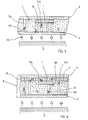
  • Figure 3 illustrates a section along the thickness of the rod according to the first mode of production.
  • Figure 4 illustrates a section along the thickness of the rod according to the second mode of production.
  • FIG. 1 illustrates an article of footwear CH which is represented by an internal shoe in flexible material used in particular in snowboard boots.
  • said CH liner could be used for alpine skiing, ski touring, cross-country skiing telemark, inline skating and ice skating, and more generally for all practices where a slipper is surrounded by an envelope, not shown, which can be rigid or flexible.
  • the CH shoe includes a rod O which surmounts a sole 300.
  • Said rod O comprises a external covering 3 surrounding an internal lining in contact with the foot P which is here shown in broken lines.
  • the internal lining has a comfort function for contact with the foot P, while the external covering 3 ensures a certain hold of the CH liner, as well as abrasion resistance with respect to the envelope in which the CH liner is inserted.
  • the rod O also includes a reinforcement 1, positioned between the internal lining and the outer covering 3, which is made of thermoformable material.
  • thermoformable here means a material which has the property of being deformed at a predetermined temperature under the effect of an external stress, and to keep this deformation, or at least part of this deformation, on cooling. Moreover, said predetermined temperature must not be too high so as not to cause foot burns.
  • the reinforcement 1, pressed into the thickness of the rod O has a flattened geometry of which the thickness is positioned in the thickness of the rod O.
  • the geometry, presenting the width pressed into the rod O has greater inertia in the preferred direction efforts in particular in forward bending.
  • Reinforcement 1 therefore makes it possible to provide a certain stiffness in the CH liner, especially since it can advantageously be more rigid than the external coating 3.
  • the thermoformable nature of the reinforcement 1 makes it possible to adjust the rod O of the shoe CH at the foot P of the user, and thus personalize the footwear.
  • the reinforcement 1 can be made of textile material impregnated with thermoplastic resin, such as for example the material marketed under the name Rhenoflexe®, of a thickness between 0.5 and 3 mm.
  • the rod O comprises a comfort element 4 which is positioned between the reinforcement 1 and the internal lining, and therefore positioned under the reinforcement 1.
  • the comfort element 4 is made of less hard material than the material constituting the reinforcement 1 in order to ensure its role of comfort.
  • This comfort element 4 can advantageously extend under the reinforcement 1 as well as along the periphery of the reinforcement 1 in order to attenuate the changes in rigidity between the edge of the reinforcement 1 and areas not equipped with the reinforcement.
  • the element comfort 4 could advantageously be made of thermoformable foam-type material, produced for example by a mixture of a first polyethylene compound and a second composed of Ethylene vinyl acetate, from 1 to 10 mm thick.
  • the reinforcement 1 and the comfort element 4 may be fixed by means of attachment known to the outer covering 3 of the upper O of the footwear CH.
  • Said attachment means can be glue, which resists thermoforming, or an assembly by sewing.
  • the thermoforming is generally obtained after a rise in temperature of the material to thermoform between about 100 ° c and 140 ° c.
  • the CH shoe needs to be stiffened at the ankle joint 100, in particular in order to limit the forward bending.
  • the reinforcement 1 is positioned laterally on the rod O, at the ankle joint 100, thus having its greatest inertia in the direction of forward bending.
  • the reinforcement 1 may advantageously be shaped symmetrically with respect to the foot P.
  • the reinforcement 1 may also include at least one branch 13 which extends from the ankle 100 to substantially the metatarsophalangeal joint 101 of the foot P.
  • This branch 13 allows in particular to distribute the bending forces, taken up by the reinforcement 1, at ankle level 100 over a larger area of the foot P. Respect for these constructive provisions makes it possible to stiffen the CH liner, while respecting the biomechanics of flexion of the foot P and of the ankle 100, as well as limiting the twists of the knee.
  • the reinforcement 1 also makes it possible to stabilize laterally the dowel 100 even if the reinforcement 1 has its thickness in this direction and so its little inertia. In order to obtain this rigidity, one can opt for two solutions.
  • the reinforcement 1 will advantageously include a recess 12 at the level of the malleolus 102 of the ankle 100.
  • This obviously 12 may be covered by the element of comfort 4 to provide the best possible comfort in this sensitive area that is the malleolus 102.
  • This obviously 12 will advantageously extend beyond the theoretical zone of the malleolus 102 for a standard foot in order to take account of the statistical dispersion of the malleolus 102 according to the foot P of the users.
  • the reinforcements 1 arranged laterally and symmetrically with respect to the foot P can be joined by at least one strip 14, 15.
  • the strip 14 may advantageously be positioned, substantially horizontally, above the heel 103 so as not to create hard point on the heel.
  • the comfort element 4 can also be advantageously positioned and extend on the upper O at the heel 103.
  • rod O can advantageously be fitted with a clamping system 200.
  • the clamping system 200 comprises, in known manner, at least one fastener 201 disposed on one of the parts 90 of the rod O to reconcile.
  • at least one other fastener is disposed on the other part of the rod in order to be able, by known clamping means such as a lace 202, to bring the two together parts 90 of the rod O.
  • the clamping system 200 makes it possible in particular to obtain a better contact of the shoe CH on the foot P and by the same a better precision of the shoe, especially if the shoe can precisely envelop the CH liner, in particular thanks to a another clamping system positioned on the envelope.
  • the reinforcement 1 may therefore advantageously include at least one branch 10, the end 11 of which is positioned substantially under the fastener 201.
  • the fastener 90 on which the tightening system 200 pulls no longer punches punctually the shoe CH, but rests on the reinforcement 1.
  • the reinforcement 1 then distributes the pressures more evenly on the foot P.
  • the reinforcement 1 comprises, on at least one lateral face of the rod O, a main body 17 which extends vertically behind the malleolus 12.
  • the body main 17 extends forwards, above the malleolus 102 along branch 10, to go to the clamp 201 of the clamping system.
  • the main body 17 of the reinforcement 1 extends, at the branch 10, backwards along a strip 15 which joins the two main bodies 17 arranged at the rear symmetrically with respect to the foot P.
  • the main body 17 extends forwards according to the branch 13 which passes under the malleolus 102.
  • the upper part 13a of the branch 13 extends substantially under the fasteners 203 of the clamping system 200 which are located on the area of the kick 104.
  • the branch 13 also comprises a lower part 13b separated from the upper part 13a by a recess 16. This recess 16 positioned substantially according to the horizontal at the lateral edge of the foot allows not to exert pressure in that area of the P foot that would be painful.
  • the main body 17 of the reinforcement 1 may also advantageously extend downwards by a leg 18 which is anchored to the sole 300.
  • This leg 18 is attached forwards to branch 13 and does not extend too far to the rear in order to leave a free space at the level of the heel 103.
  • This leg 18 is located, along the vertical, substantially perpendicular to the malleolus 102 or slightly backwards according to a balance positioned between the malleolus 102 and the heel 103.
  • the leg 18 of the reinforcement 1 may advantageously be connected to the branch 14 at level of connection with the main body 17.
  • the article of footwear CH is always illustrated by an internal shoe with a shoe used in particular for the practice of snowboarding.
  • the upper O of the shoe CH has a first torn off at the outer covering 3 which reveals the reinforcement 1 as well as the comfort element 4.
  • a second torn off at the level of reinforcement 1 allows to visualize the portion of the comfort element 4 which is located under the reinforcement 1.
  • the element of comfort 4 includes perforations 5 which are preferably through. These perforations 5 allow the hot air from the thermoforming, diffused from the inside of the CH liner, to penetrate the material, in particular at the level of the comfort element 4, when the latter is made of thermoformable material.
  • the perforations 5 may advantageously be arranged under the reinforcement 1, as presently illustrated, so that the perforations 5 lead to the reinforcement 1.
  • the hot air from the thermoforming therefore warms up directly the reinforcement 1 by circulating in the perforations 5.
  • These perforations 5 allow the reinforcement 1 reach the temperature necessary for its thermoforming without other materials, especially the inner lining, do not experience excessive heat. So the foot P, which is placed in the CH liner for shaping during cooling, will not be burned by the internal lining.
  • perforation 5 are suitable for air supply reinforcement 1 hot.
  • the perforations 5, with an average diameter of between 1 and 3 mm favor the rapidity of heating of the reinforcement 1.
  • the perforations 5 akin to micro perforations with an average diameter of between 0.1 and 1 mm, allow better distribution of heat in comfort element 4 while heating also reinforcement 1.
  • FIG. 3 represents a cross section according to the thickness, of the boot illustrated in previous figures, and specifies the path of the thermoforming heat through thickness.
  • a heating device C inside the liner, which propels hot air 150.
  • the thermoforming process as well as the heater C necessary for the realization of the thermoforming are known and described in particular in document US 5,894,680.
  • This air warm 150 heats the inside of the liner and enters the inner lining 2, then a portion 151 of the hot air 150 penetrates into perforations 5b which do not lead to the reinforcements.
  • This portion 151 of hot air makes it possible to heat the material constituting the comfort element 4 to bring it to the temperature necessary for possible thermoforming.
  • the perforations 5b can pass through the comfort element 4 right through, or else understand their end, positioned on the side of the outer covering 3, which is blocked. This latter arrangement makes it possible in particular to heat the comfort element 4 without heating the outer coating 3. Nevertheless, this process is a little more difficult to implement than through perforations.
  • Another portion 152 of the hot air 150 enters perforations Sa which pass through the comfort element 4, and which lead to the reinforcement 1 for warm it up and bring it to the optimum temperature to carry out the thermoforming.
  • FIG. 4 represents a cross section which illustrates the path of the hot air during the heating phase of thermoforming for a rod O according to the second embodiment.
  • the reinforcing element 4 comprises at least a fraction 5c of all of the perforations 5c, 5d, which is situated outside the reinforcement 1.
  • the perforations 5c open at one of their ends on the inner lining 2 which is in direct contact with the heating device C arranged inside the liner.
  • These perforations open at their other ends onto an airy layer 30 which is positioned sandwiched between the comfort element 4 and the covering external 3.
  • the ventilated layer 30 is positioned between the reinforcement 1 and the external coating 3.
  • This ventilated layer 30 has a certain thickness and is permeable to the air mainly in the direction of its length.
  • the hot air 153 which circulates in the perforations 5c coming from the heating device C, diffuses and circulates through a component 154 in the thickness of the aerated layer 30.
  • This hot air 154 circulating parallel to the rod O, comes to heat the reinforcement 1 from above.
  • 5d perforations positioned under the reinforcement 1, allow the hot air 155 coming from the device heating C to heat the reinforcement 1 from below.
  • the ventilated layer 30 can advantageously be made of three-dimensional textile of a thickness between approximately 1 to 3 mm.
  • the use of this ventilated layer 30 is more particularly suitable for the use of comfort elements 4 of thermoformable type. Indeed, we uses the thickness of the aerated layer 30 during the heating phase, then said thickness becomes practically zero due to the expansion of the material of the comfort element 4 during the cooling phase of thermoforming. Thus, during the practice of sport, the layer ventilated 30 is compressed and does not cause inaccuracy or play between the liner and the shoe that wraps the liner.

Landscapes

  • Health & Medical Sciences (AREA)
  • General Health & Medical Sciences (AREA)
  • Physical Education & Sports Medicine (AREA)
  • Footwear And Its Accessory, Manufacturing Method And Apparatuses (AREA)

Abstract

La présente invention concerne une tige de confort (O), pour article chaussant (CH), destinée notamment à équiper une chaussure de sport et un chausson interne de chaussure de sport. La tige (O) comprend un renfort (1), positionné entre la doublure interne et le revêtement extérieur (3), qui est réalisé en matériau thermoformable. La tige comprend également un élément de confort (4), positionné entre la doublure interne et le renfort (1), qui est moins dur que le renfort et qui est éventuellement réalisé en matériau thermoformable. Cet élément de confort (4) comprend des perforations (5) permettant le thermoformage du renfort par impulsion d'air chaud à l'intérieur de l'article chaussant (CH). <IMAGE>

Description

La présente invention concerne une tige de confort pour article chaussant destiné notamment, mais de façon limitative, à la pratique du sport tel que le ski alpin, ski de télémark, surf des neiges, patin en ligne et patin à glace, ainsi qu'en tant que chaussure pour la pratique du ski de fond et de la raquette à neige.
Dans l'état de l'art antérieur notamment en chaussure de ski alpin il existe de nombreux systèmes de chaussons thermoformables qui permettent de combler le volume situé entre le pied de l'utilisateur et l'intérieur d'une coque rigide qui constitue l'ossature externe de la chaussure. La variation du volume du chausson pour l'ajustement au pied de l'utilisateur peut être obtenue principalement de deux manières. D'une part, on peut obtenir par chauffage la détente d'un matériau préalablement thermo-compressé. D'autre part, le pied peut venir simplement comprimer un matériau chauffé qui refroidit en conservant la forme imprimée par le pied, cette opération pouvant être réalisée en magasin, c'est à dire sur le lieu de vente.
Selon une autre technique, le chausson est entièrement constitué de matériau thermoformable, et le chausson est chauffé dans un four. Au contraire, si le chausson comprend ponctuellement des inserts thermoformables insérés dans une structure classique de chausson, le chauffage se fait uniquement par l'intérieur du chausson afin que la chaleur ne détériore pas le revêtement externe du chausson.
Le document FR 2 746 743 améliore d'ailleurs ce système en décrivant des micro perforations dans la mousse thermoformable qui est insérée dans ce type de chausson. Ce procédé permet d'optimiser le préchauffage de la mousse.
Cependant, les chaussons thermoformables précédemment décrits, qui sont actuellement principalement utilisés dans les chaussures de ski alpin et des patins en ligne c'est à dire des chaussures à tige ou coque externe rigide, sont incompatibles avec d'éventuels renforts apportant une certaine rigidité au chausson. En effet, les renforts traditionnels, utilisés pour être insérés dans les chaussons ou les chaussures, sont généralement réalisés en matière plastique non thermoformable et donc non adaptables au pied de l'utilisateur. Et même si certains renforts peuvent être mis en forme par thermoformage à la fabrication avant l'assemblage du chausson, ils sont conformes à un pied standard qui ne correspond par forcément à la morphologie spécifique du pied de chaque utilisateur.
De plus, actuellement les chaussons thermoformables ne peuvent être équipés d'un système de serrage tel que des lacets car les matériaux thermoformables utilisés sont du type mousse, sont souples et ne sont donc pas aptes à résister en traction. De plus, ils ne possèdent pas une rigidité suffisante pour répartir convenablement les pressions ponctuelles engendrées par le laçage au niveau des renvois de lacet. Cette réalisé technologique ne permet pas la réalisation de chaussons internes de confort par thermoformage équipés de système de laçage. Or, ce type de chausson serait particulièrement adapté à des chaussures, à tige souple ou semi-rigide, utilisées notamment en surf des neiges.
Un des buts de la présente invention est donc de proposer une tige de confort pour article chaussant, notamment à tige externe souple ou semi-rigide qui permette de s'adapter à la morphologie du pied par thermoformage tout en présentant une certaine rigidité.
Un autre but de l'invention est de proposer une tige qui permette de répartir confortablement la pression localisée engendrée par un système de serrage associé à la tige de l'article chaussant.
Pour atteindre ces objectifs, la tige de l'article chaussant comprend un renfort qui est réalisé en matériau thermoformable apte à être conformé autour du pied de l'utilisateur. Ce renfort est positionné entre la doublure interne, en contact avec le pied, et le revêtement extérieur de l'article chaussant. De plus, la tige comprend un élément de confort, positionné entre la doublure interne et le renfort, qui peut être réalisé en matériau thermoformable. Afin de mieux répartir les pressions générées par l'attache du système de serrage, qui est disposé sur une des parties de la tige à rapprocher, le renfort comprend au moins une branche dont l'extrémité est positionnée sensiblement sous ladite attache. De plus, l'élément de confort comprend des perforations qui permettent à l'air chaud de réchauffer le renfort afin d'assurer de bonnes conditions de thermoformage.
Dans un premier mode de réalisation, les perforations débouchent sur le renfort.
Dans un deuxième mode de réalisation, les perforations, étant situées en dehors du renfort, débouchent sur une couche aérée qui est positionnée entre le renfort et le revêtement externe.
L'invention sera mieux comprise et d'autres avantages de celle-ci apparaítront à l'aide de la description qui fait référence aux dessins en annexe. La description illustre à titre d'exemples non limitatifs certains modes de réalisation préférés.
La figure 1 représente schématiquement une vue de côté d'un chausson interne dont la tige, qui est conforme au premier mode de réalisation, est arrachée au niveau de la cheville.
La figure 2 représente schématiquement une vue de côté d'un chausson interne avec un arraché de la tige au niveau de la cheville dans lequel est représenté un autre arraché du renfort, la tige étant conforme au premier mode de réalisation.
La figure 3 illustre une coupe selon l'épaisseur de la tige selon le premier mode de réalisation.
La figure 4 illustre une coupe selon l'épaisseur de la tige selon le second mode de réalisation.
La figure 1 illustre un article chaussant CH qui est représenté par un chausson interne en matériau souple utilisé notamment dans les chaussures de surf des neiges. Bien entendu, ledit chausson CH pourrait être utilisé pour la pratique du ski alpin, du ski de randonnée, du ski de télémark, du patin en ligne et du patin à glace, et plus généralement pour toutes pratiques où un chausson est entouré d'une enveloppe, non représentée, qui peut être rigide ou souple. Le chausson CH comprend une tige O qui surmonte une semelle 300. Ladite tige O comprend un revêtement externe 3 entourant une doublure interne en contact avec le pied P qui est ici représenté en trait interrompu. La doublure interne a une fonction de confort pour le contact avec le pied P, alors que le revêtement externe 3 permet d'assurer une certaine tenue du chausson CH, ainsi qu'une résistance à l'abrasion vis à vis de l'enveloppe dans laquelle le chausson CH est inséré.
La tige O comprend également un renfort 1, positionné entre la doublure interne et le revêtement extérieur 3, qui est réalisé en matériau thermoformable.
On entend ici par thermoformable un matériau qui possède la propriété de se déformer à une température prédéterminée sous l'effet d'une sollicitation externe, et de conserver cette déformation, ou tout au moins une partie de cette déformation, en se refroidissant. De plus, ladite température prédéterminée ne doit pas être trop élevée afin de ne pas provoquer des brûlures du pied.
Le renfort 1, plaqué dans l'épaisseur de la tige O, présente une géométrie aplatie dont l'épaisseur est positionnée dans l'épaisseur de la tige O. Ainsi, la géométrie, présentant la largeur plaquée dans la tige O, comporte une plus grande inertie selon la direction privilégiée des efforts notamment en flexion vers l'avant. Le renfort 1 permet donc d'apporter une certaine rigidité au chausson CH, d'autant plus qu'il pourra être avantageusement plus rigide que le revêtement externe 3. Le caractère thermoformable du renfort 1 permet d'ajuster au mieux la tige O du chausson CH au pied P de l'utilisateur, et ainsi de personnaliser le chaussant.
Le renfort 1 peut être réalisé en matière textile imprégnée de résine thermoplastique, comme par exemple la matière commercialisée sous la dénomination Rhenoflexe®, d'une épaisseur comprise entre 0,5 et 3 mm.
La tige O comprend un élément de confort 4 qui est positionné entre le renfort 1 et la doublure interne, et donc positionné sous le renfort 1. L'élément de confort 4 est réalisé en matériau moins dur que le matériau constitutif du renfort 1 afin d'assurer son rôle de confort. Cet élément de confort 4 peut s'étendre avantageusement sous le renfort 1 ainsi que le long de la périphérie du renfort 1 afin d'atténuer les changements de rigidité entre le bord du renfort 1 et les zones non équipées du renfort. De plus, pour améliorer le confort de la tige O, l'élément de confort 4 pourra être avantageusement réalisé en matériau thermoformable de type mousse, réalisée par exemple par un mélange d'un premier composé de polyéthylène et d'un second composé d'Ethylène-Acéthate de vinyle, de 1 à 10 mm d'épaisseur.
Le renfort 1 et l'élément de confort 4 pourront être fixés par un moyen d'accroche connu au revêtement extérieur 3 de la tige O de l'article chaussant CH. Ledit moyen d'accroche peut être de la colle, qui résiste au thermoformage, ou bien un assemblage par couture. Le thermoformage est généralement obtenu après une élévation de température du matériau à thermoformer entre environ 100°c et 140°c.
Dans les sports pratiqués susceptibles d'utiliser la présente tige O, le chausson CH a besoin d'être rigidifié au niveau de l'articulation de la cheville 100, notamment afin de limiter la flexion vers l'avant. Pour atteindre cet objectif, le renfort 1 est positionné latéralement sur la tige O, au niveau de l'articulation de la cheville 100, présentant ainsi sa plus grande inertie dans le sens de la flexion vers l'avant. De même, afin que le renfort 1 n'induise pas une torsion parasite au cours de la flexion vers l'avant, le renfort 1 pourra être avantageusement conformé symétriquement par rapport au pied P.
Le renfort 1 pourra également comprendre au moins une branche 13 qui s'étend de la cheville 100 jusqu'à sensiblement l'articulation métatarsophalangienne 101 du pied P. Cette branche 13 permet notamment de répartir les efforts de flexion, repris par le renfort 1, au niveau de la cheville 100 sur une zone du pied P plus importante. Le respect de ces dispositions constructives permet de rigidifier le chausson CH, tout en respectant la biomécanique de flexion du pied P et de la cheville 100, ainsi qu'en limitant les torsions du genou.
Pour la pratique de certains sports comme le patin en ligne, il est intéressant de rigidifier fortement le chausson CH au niveau latéral. Or, le renfort 1 permet également de stabiliser latéralement la cheville 100 même si le renfort 1 présente dans cette direction son épaisseur et donc sa petite inertie. Afin d'obtenir cette rigidité, on peut opter pour deux solutions.
D'une part, on peut chercher à étendre latéralement, le long du chausson CH, au maximum le renfort 1. Dans ce cas, le renfort 1 comprendra avantageusement un évidement 12 au niveau de la malléole 102 de la cheville 100. Cet évidemment 12 pourra être couvert par l'élément de confort 4 afin de procurer le meilleur confort possible au niveau de cette zone sensible qu'est la malléole 102. Cet évidemment 12 s'étendra avantageusement au delà de la zone théorique de la malléole 102 pour un pied standard afin de tenir compte de la dispersion statistique de la malléole 102 selon le pied P des utilisateurs.
D'autre part, les renforts 1 disposés latéralement et de façon symétrique par rapport au pied P peuvent être joints par au moins une bande 14, 15. La bande 14 pourra être avantageusement positionnée, sensiblement selon l'horizontale, au-dessus du talon 103 afin de ne pas créer de point dur sur le talon. L'élément de confort 4 peut être également avantageusement positionné et d'étendre sur la tige O au niveau du talon 103.
Durant la pratique de certains sports, notamment ceux où l'on utilise une enveloppe souple ou semi rigide entourant le chausson tel que le surf des neiges, le ski de télémark, la tige O peut être avantageusement équipée d'un système de serrage 200. Le système de serrage 200 comporte, de façon connue, au moins une attache 201 disposée sur une des parties 90 de la tige O à rapprocher. De même, au moins une autre attache est disposée sur l'autre partie de la tige afin de pouvoir, par un moyen connu de serrage tel qu'un lacet 202, rapprocher les deux parties 90 de la tige O. Le système de serrage 200 permet notamment d'obtenir un meilleur contact du chausson CH sur le pied P et par la même une meilleure précision de la chaussure, surtout si la chaussure peut envelopper précisément le chausson CH, notamment grâce à un autre système de serrage positionné sur l'enveloppe.
Compte-tenu des problèmes évoqués dans l'art antérieur pour les systèmes de serrage sur un chausson thermoformable, il est intéressant d'utiliser la rigidité du renfort 1 pour répartir sur le pied P, à travers le chausson CH, la pression ponctuelle engendrée par le système de serrage 200 sur les attaches 201. Le renfort 1 pourra donc avantageusement comprendre au moins une branche 10 dont l'extrémité 11 est positionnée sensiblement sous l'attache 201. Ainsi, l'attache 90 sur laquelle tire le système de serrage 200 ne vient plus poinçonner ponctuellement le chausson CH, mais s'appuie sur le renfort 1. Le renfort 1 répartit alors les pressions de façon plus homogène sur le pied P.
Dans la géométrie préférée, le renfort 1 comprend, sur au moins une face latérale de la tige O, un corps principal 17 qui s'étend selon la verticale en arrière de la malléole 12. Le corps principal 17 se prolonge vers l'avant, au-dessus de la malléole 102 selon la branche 10, pour aller au niveau de l'attache 201 du système de serrage.
Avantageusement, le corps principal 17 du renfort 1 s'étend, au niveau de la branche 10, vers l'arrière selon une bande 15 qui joint par l'arrière les deux corps principaux 17 disposés symétriquement par rapport au pied P. De plus, le corps principal 17 s'étend vers l'avant selon la branche 13 qui passe sous la malléole 102. La partie supérieure 13a de la branche 13 s'étend sensiblement sous les attaches 203 du système de serrage 200 qui sont situés sur la zone du coup de pied 104. La branche 13 comprend également une partie inférieure 13b séparée de la partie supérieure 13a par un évidemment 16. Cet évidemment 16 positionné sensiblement selon l'horizontale au niveau de l'arête latérale du pied permet de ne pas exercer de pression dans cette zone du pied P qui serait douloureuse.
Le corps principal 17 du renfort 1 pourra également avantageusement s'étendre vers le bas par une jambe 18 qui vient s'ancrer à la semelle 300. Cette jambe 18 est rattachée vers l'avant à la branche 13 et ne s'étend pas trop vers l'arrière afin de laisser un espace libre au niveau du talon 103. Cette jambe 18 se situe, selon la verticale, sensiblement à l'aplomb de la malléole 102 ou bien légèrement en arrière selon un aplomb positionné entre la malléole 102 et le talon 103. De plus, la jambe 18 du renfort 1 pourra être avantageusement reliée à la branche 14 au niveau de la liaison avec le corps principal 17.
Sur la figure 2, l'article chaussant CH est toujours illustré par un chausson interne à une chaussure utilisée notamment pour la pratique du surf des neiges. La tige O du chausson CH présente un premier arraché au niveau du revêtement extérieur 3 qui laisse apparaítre le renfort 1 ainsi que l'élément de confort 4. Un deuxième arraché au niveau du renfort 1 permet de visualiser la portion de l'élément de confort 4 qui se situe sous le renfort 1. L'élément de confort 4 comprend des perforations 5 qui sont préférablement traversantes. Ces perforations 5 permettent à l'air chaud du thermoformage, diffusé par l'intérieur du chausson CH, de pénétrer la matière, notamment au niveau de l'élément de confort 4, lorsque ce dernier est réalisé en matériau thermoformable. De plus, les perforations 5 pourront être avantageusement disposées sous le renfort 1, comme présentement illustré, afin que les perforations 5 débouchent sur le renfort 1. L'air chaud du thermoformage vient donc réchauffer directement le renfort 1 en circulant dans les perforations 5. Ces perforations 5 permettent au renfort 1 d'atteindre la température nécessaire à son thermoformage sans que les autres matériaux, notamment la doublure interne, ne subissent une chaleur excessive. Ainsi, le pied P, qui est placé dans le chausson CH pour la mise en forme lors du refroidissement, ne sera pas brûlé par la doublure interne.
Les essais ont montré que tous les types de perforation 5 convenaient à l'alimentation en air chaud du renfort 1. D'un côté, les perforations 5, d'un diamètre moyen compris entre 1 et 3 mm, privilégient la rapidité d'échauffement du renfort 1. D'un autre côté, les perforations 5 s'apparentant à des micro perforations d'un diamètre moyen compris entre 0,1 et 1 mm, permettent de mieux diffuser la chaleur dans l'élément de confort 4 tout en échauffant également le renfort 1.
La figure 3 représente une coupe transversale selon l'épaisseur, du chausson illustré aux figures précédentes, et précise le trajet de la chaleur du thermoformage au travers de l'épaisseur. Pour effectuer la phase de chauffe du thermoformage en magasin, on introduit un dispositif de chauffage C, à l'intérieur du chausson, qui propulse de l'air chaud 150. Le procédé de thermoformage ainsi que l'appareil de chauffage C nécessaire à la réalisation du thermoformage sont connus et décrit notamment dans le document US 5 894 680. Cet air chaud 150 réchauffe l'intérieur du chausson et pénètre dans la doublure interne 2, puis une portion 151 de l'air chaud 150 pénètre dans des perforations 5b qui ne débouchent pas sur les renforts. Cette portion 151 d'air chaud permet de réchauffer le matériau constitutif de l'élément de confort 4 pour l'amener à la température nécessaire à un éventuel thermoformage.
Les perforations 5b peuvent traverser l'élément de confort 4 de part en part, ou bien comprendre leur extrémité, positionnée du côté du revêtement extérieur 3, qui est bouchée. Cette dernière disposition permet notamment de chauffer l'élément de confort 4 sans chauffer le revêtement extérieur 3. Néanmoins, ce procédé est un peu plus difficile à mettre en oeuvre que des perforations traversantes. Une autre portion 152 de l'air chaud 150 pénètre dans des perforations Sa qui traversent l'élément de confort 4, et qui débouchent sur le renfort 1 pour venir le réchauffer et le mettre à la température optimale pour réaliser le procédé de thermoformage.
Afin de mettre en oeuvre le premier mode de réalisation de la tige O illustré notamment en figure 3, il est nécessaire qu'au moins une fraction Sa de l'ensemble des perforations 5a, 5b, de l'élément de confort 4 débouchent sur le renfort 1. Bien entendu, les perforations 5a débouchent à l'autre extrémité sur la doublure 2 qui présente une bonne perméabilité à l'air.
La figure 4 représente une coupe transversale qui illustre le trajet de l'air chaud durant la phase de chauffage du thermoformage pour une tige O selon le second mode de réalisation. Ce mode cherche à optimiser la rapidité de l'échauffement du renfort 1 pour son thermoformage. L'élément de renfort 4 comprend au moins une fraction 5c de l'ensemble des perforations 5c, 5d, qui est située en dehors du renfort 1. Les perforations 5c débouchent à une de leurs extrémités sur la doublure interne 2 qui est en contact direct avec le dispositif de chauffage C disposé à l'intérieur du chausson. Ces perforations débouchent à leurs autres extrémités sur une couche aérée 30 qui est positionnée intercalée entre l'élément de confort 4 et le revêtement externe 3. Au niveau du renfort 1, la couche aérée 30 est positionnée entre le renfort 1 et le revêtement externe 3. Cette couche aérée 30 présente une certaine épaisseur et est perméable à l'air principalement dans le sens de sa longueur. Ainsi, l'air chaud 153, qui circule dans les perforations 5c en provenance du dispositif de chauffage C, se diffuse et circule par une composante 154 dans l'épaisseur de la couche aérée 30. Cet air chaud 154, circulant parallèlement à la tige O, vient réchauffer le renfort 1 par le haut. De plus, des perforations 5d, positionnées sous le renfort 1, permettent à l'air chaud 155 en provenance du dispositif de chauffage C de chauffer le renfort 1 par le bas.
La couche aérée 30 pourra avantageusement être réalisée en textile tridimensionnel d'une épaisseur comprise entre environ 1 à 3 mm. L'usage de cette couche aérée 30 est plus particulièrement adapté à l'usage d'éléments de confort 4 de type thermoformable. En effet, on utilise l'épaisseur de la couche aérée 30 durant la phase de chauffe, puis ladite épaisseur devient pratiquement nulle à cause de l'expansion du matériau de l'élément de confort 4 durant la phase de refroidissement du thermoformage. Ainsi, durant la pratique du sport, la couche aérée 30 est comprimée et n'engendre pas d'imprécision ou de jeux entre le chausson et la chaussure qui enveloppe le chausson.
Bien entendu, la présente invention n'est pas limitée aux modes de réalisation décrits ci-avant, qui ne sont donnés qu'à titre indicatif, mais englobe tous les modes de réalisation similaires ou équivalents s'appliquant notamment à toute sorte d'article chaussant comprenant une tige et une semelle.

Claims (11)

  1. Tige (O) de confort pour article chaussant (CH) comprenant :
    une doublure interne (2) en contact avec le pied (P),
    un revêtement extérieur (3),
    caractérisée en ce qu'elle comprend un renfort (1), positionné entre la doublure interne (2) et le revêtement extérieur (3), qui est réalisé en matériau thermoformable apte à être conformé au contour du pied de l'utilisateur.
  2. Tige (O) selon la revendication 1, caractérisée en ce qu'elle comprend au moins un élément de confort (4), positionné entre la doublure interne (2) et le renfort (1), qui est moins dur que le renfort (1), et en ce que l'élément de confort (4) comprend des perforations (5, Sa, 5b, 5c, 5d).
  3. Tige (O) selon la revendications 2, caractérisée en ce que l'élément de confort (4) est réalisé en matériau thermoformable.
  4. Tige (O) selon l'une des revendications 2 à 3, caractérisée en ce qu'au moins une fraction (5a) de l'ensemble des perforations (Sa, 5b) de l'élément de confort (4) débouche sur le renfort (1).
  5. Tige (O) selon l'une des revendications 1 à 4, caractérisée en ce que le renfort (1) est positionné latéralement sur la tige (O) au niveau de l'articulation de la cheville (100).
  6. Tige (O) selon l'une des revendications 1 à 5, caractérisée en ce que le renfort (1) est conformé symétriquement par rapport au pied (P).
  7. Tige (O) selon l'une des revendications 1 à 6, caractérisée en ce qu'elle comprend un système de serrage (200) comportant aux moins une attache (201) disposée sur une des parties (90) de la tige (O) à rapprocher, et en ce que le renfort (1) comprend au moins une branche (10) dont l'extrémité (11) est positionnée sensiblement sous l'attache (90).
  8. Tige (O) selon l'une des revendications 1 à 7, caractérisée en ce que le renfort (1) comprend au moins un évidement (12) au niveau de la malléole (102) de la cheville (100).
  9. Tige selon l'une des revendications 1 à 8, caractérisée en ce que la température de thermoformage est comprise entre 100 et 140°.
  10. Chausson, interne à une chaussure, comprenant une tige (O) selon l'une des revendications 1 à 9.
  11. Chaussure comprenant une tige (O) selon l'une des revendications 1 à 9.
EP01112199A 2000-06-27 2001-05-18 Tige de confort pour article chaussant Withdrawn EP1166667A1 (fr)

Applications Claiming Priority (2)

Application Number Priority Date Filing Date Title
FR0008350 2000-06-27
FR0008350A FR2810510B1 (fr) 2000-06-27 2000-06-27 Tige de confort pour article chaussant

Publications (1)

Publication Number Publication Date
EP1166667A1 true EP1166667A1 (fr) 2002-01-02

Family

ID=8851830

Family Applications (1)

Application Number Title Priority Date Filing Date
EP01112199A Withdrawn EP1166667A1 (fr) 2000-06-27 2001-05-18 Tige de confort pour article chaussant

Country Status (3)

Country Link
US (1) US6732455B2 (fr)
EP (1) EP1166667A1 (fr)
FR (1) FR2810510B1 (fr)

Cited By (3)

* Cited by examiner, † Cited by third party
Publication number Priority date Publication date Assignee Title
US6952891B2 (en) 2003-02-07 2005-10-11 Shimano Inc. Boot liner
EP2674049A1 (fr) * 2012-06-13 2013-12-18 Salomon S.A.S. Chausson interne pour chaussure de sport
EP4085783A1 (fr) * 2021-05-07 2022-11-09 Rossignol Lange S.R.L. Chausson thermoformable avec film de maintien

Families Citing this family (34)

* Cited by examiner, † Cited by third party
Publication number Priority date Publication date Assignee Title
US20040020081A1 (en) * 2002-08-01 2004-02-05 Symons Dominic Paul Sport boot
FR2851891B1 (fr) * 2003-03-06 2005-07-08 Rossignol Sa Chaussure de sport a tige haute
AT413929B (de) * 2003-05-07 2006-07-15 Fischer Gmbh Innenschuh für sportschuhe, insbesondere skischuhe
US7363765B2 (en) * 2005-09-20 2008-04-29 United States Of America As Represented By The Secretary Of The Army Article of footwear with temperature regulation means
AT505989B1 (de) * 2007-10-12 2010-06-15 Fischer Sports Gmbh Verfahren zur herstellung eines an den fuss eines benützers angepassten schuhs
IT1393928B1 (it) * 2008-07-25 2012-05-17 Alpinestars Res Srl Calzatura per uso sportivo.
IT1391203B1 (it) * 2008-08-13 2011-11-18 Alpinestars Res Srl Calzatura, in particolare stivale da motociclismo, a struttura ventilata.
US20110078922A1 (en) * 2009-10-02 2011-04-07 Nike, Inc. Thermoforming upper process with reinforcement
US9185946B2 (en) 2009-10-14 2015-11-17 Reebok International Limited Form-fitting articles and method for customizing articles to be form-fitted
US9339078B2 (en) 2009-10-14 2016-05-17 Reebok International Limited Form-fitting articles and method for customizing articles to be form-fitted
WO2011058614A1 (fr) * 2009-11-16 2011-05-19 株式会社アシックス Chaussure présentant une meilleure performance d'ajustement au talon
US8302329B2 (en) 2009-11-18 2012-11-06 Nike, Inc. Footwear with counter-supplementing strap
US9402437B2 (en) * 2010-06-21 2016-08-02 Under Armour, Inc. Foot support article
US9707119B2 (en) 2010-06-21 2017-07-18 Under Armour, Inc. Foot support article
US8857077B2 (en) 2010-09-30 2014-10-14 Nike, Inc. Footwear with internal harness
US11026473B2 (en) 2011-05-19 2021-06-08 Under Armour, Inc. Foot support article
FR2976161B1 (fr) * 2011-06-09 2015-07-31 Salomon Sas Chaussure a tige ameliore.
DE102012206062B4 (de) 2012-04-13 2019-09-12 Adidas Ag Schuhoberteil
DE102013207155B4 (de) 2013-04-19 2020-04-23 Adidas Ag Schuhoberteil
US11666113B2 (en) 2013-04-19 2023-06-06 Adidas Ag Shoe with knitted outer sole
DE102013207156B4 (de) 2013-04-19 2025-12-24 Adidas Ag Schuh, insbesondere ein Sportschuh
DE102013207163B4 (de) 2013-04-19 2022-09-22 Adidas Ag Schuhoberteil
US12250994B2 (en) 2013-04-19 2025-03-18 Adidas Ag Shoe
ITTO20130372A1 (it) * 2013-05-09 2014-11-10 Tecnica Group Spa Inserto per la personalizzazione di un articolo sportivo o medicale, articolo sportivo o medicale personalizzabile e metodo per la personalizzazione di un articolo sportivo o medicale.
DE102014202432B4 (de) 2014-02-11 2017-07-27 Adidas Ag Verbesserter Fußballschuh
DE102014220087B4 (de) 2014-10-02 2016-05-12 Adidas Ag Flachgestricktes Schuhoberteil für Sportschuhe
AT517606B1 (de) * 2015-12-22 2017-03-15 Fischer Sports Gmbh Innenschuh
EP3463209A1 (fr) 2016-06-03 2019-04-10 Shock Doctor, Inc. Dispositifs d'attelle de cheville, systèmes et procédés
EP3856094B1 (fr) 2018-09-27 2025-10-15 Shock Doctor, Inc. Attelle pour cheville
USD1033862S1 (en) 2022-03-23 2024-07-09 Mountain Origins Design LLC Footwear
USD1007825S1 (en) 2022-03-23 2023-12-19 Mountain Origins Design LLC Footwear
USD1007826S1 (en) 2022-03-23 2023-12-19 Mountain Origins Design LLC Footwear
USD1007110S1 (en) 2022-03-23 2023-12-12 Mountain Origins Design LLC Footwear
USD1008611S1 (en) 2022-03-23 2023-12-26 Mountain Origins Design LLC Footwear

Citations (5)

* Cited by examiner, † Cited by third party
Publication number Priority date Publication date Assignee Title
FR2726743A1 (fr) * 1994-11-10 1996-05-15 Salomon Sa Chausson de confort pour chaussure de ski
FR2738999A1 (fr) * 1995-09-25 1997-03-28 Sidas Sa Chausson interieur pour chaussure de sport a coque
EP0769258A1 (fr) * 1995-10-18 1997-04-23 Alpinestars S.p.A. Procédé de fabrication d'éléments de protection pour chaussures de sport et/ou vêtements, et produits ainsi fabriqués
FR2746743A1 (fr) 1996-03-29 1997-10-03 Valeo Systemes Dessuyage Bras d'essuie-glace, notamment pour vehicule automobile
EP0861609A1 (fr) * 1997-02-19 1998-09-02 Salomon S.A. Chaussure de sport à ossature rigide

Family Cites Families (14)

* Cited by examiner, † Cited by third party
Publication number Priority date Publication date Assignee Title
US3616170A (en) * 1969-08-05 1971-10-26 Addison W Closson Jr Foamed sheet for making stiffening elements
US3778251A (en) * 1971-03-17 1973-12-11 Bixby Box Toe Co Inc Shoe stiffener materials
IT995585B (it) * 1973-10-04 1975-11-20 Garmont Calzaturificio Imbottitura automodellante in particolare per scarponi da sci
US4229546A (en) * 1978-07-27 1980-10-21 Hanson Industries Incorporated Viscous, flowable, pressure-compensating fitting compositions having therein both glass and resinous microbeads
CH645255A5 (fr) * 1982-02-22 1984-09-28 Lange Int Sa Garniture interieure pour chaussure de sport a coque rigide ou semi-rigide.
US4562607A (en) * 1983-07-28 1986-01-07 Bixby International Corporation Shoe stiffener
ES2132221T3 (es) * 1992-01-31 1999-08-16 Ogden Inc Material en lamina resistente al deslizamiento.
US6168172B1 (en) * 1993-07-19 2001-01-02 K-2 Corporation In-line roller skate
DE4333503C2 (de) * 1993-10-01 1995-07-27 Usp Markeing & Vertriebs Gmbh Snowboard-Stiefel
US6079128A (en) * 1993-11-30 2000-06-27 Bauer Nike Hockey Inc. Skate boot construction with integral plastic insert
JP2768643B2 (ja) * 1994-12-28 1998-06-25 株式会社シマノ スノーボード用ブーツ
IT1293380B1 (it) * 1997-07-08 1999-02-25 Benetton Sportsystem Spa Pattino a confortevolezza migliorata
FR2787682B1 (fr) * 1998-12-23 2001-01-26 Salomon Sa Chaussure de sport
US6189172B1 (en) * 2000-01-14 2001-02-20 Dc Shoes, Inc. Removable liner and inflatable bladder for snowboard boots and method of manufacture

Patent Citations (5)

* Cited by examiner, † Cited by third party
Publication number Priority date Publication date Assignee Title
FR2726743A1 (fr) * 1994-11-10 1996-05-15 Salomon Sa Chausson de confort pour chaussure de ski
FR2738999A1 (fr) * 1995-09-25 1997-03-28 Sidas Sa Chausson interieur pour chaussure de sport a coque
EP0769258A1 (fr) * 1995-10-18 1997-04-23 Alpinestars S.p.A. Procédé de fabrication d'éléments de protection pour chaussures de sport et/ou vêtements, et produits ainsi fabriqués
FR2746743A1 (fr) 1996-03-29 1997-10-03 Valeo Systemes Dessuyage Bras d'essuie-glace, notamment pour vehicule automobile
EP0861609A1 (fr) * 1997-02-19 1998-09-02 Salomon S.A. Chaussure de sport à ossature rigide

Cited By (4)

* Cited by examiner, † Cited by third party
Publication number Priority date Publication date Assignee Title
US6952891B2 (en) 2003-02-07 2005-10-11 Shimano Inc. Boot liner
EP2674049A1 (fr) * 2012-06-13 2013-12-18 Salomon S.A.S. Chausson interne pour chaussure de sport
FR2991854A1 (fr) * 2012-06-13 2013-12-20 Salomon Sas Chausson interne pour chaussure de sport
EP4085783A1 (fr) * 2021-05-07 2022-11-09 Rossignol Lange S.R.L. Chausson thermoformable avec film de maintien

Also Published As

Publication number Publication date
US20010054240A1 (en) 2001-12-27
FR2810510A1 (fr) 2001-12-28
US6732455B2 (en) 2004-05-11
FR2810510B1 (fr) 2002-10-11

Similar Documents

Publication Publication Date Title
EP1166667A1 (fr) Tige de confort pour article chaussant
EP0790788B1 (fr) Garniture interieure pour chaussure
EP0710451B1 (fr) Chaussure de sport
EP1174048B1 (fr) Dispositif de serrage pour article chaussant
EP0802764B2 (fr) Procede et dispositif de chauffage d&#39;une garniture interieure de chaussure
EP1040768A1 (fr) Chaussure de sport à ossature souple
FR2532529A1 (fr) Chaussure de ski de fond
FR2814918A1 (fr) Dispositif de serrage interne pour article chaussant
FR2816177A1 (fr) Element de renfort de tige
EP2580978A1 (fr) Chaussure à serrage de tige amélioré
EP3387938A1 (fr) Chaussure à tige améliorée
EP0774218B1 (fr) Patin à roulettes
FR2534459A1 (fr) Chaussure de ski de fond
EP0916273B1 (fr) Chaussure de ski
EP3020300B1 (fr) Chausson pour chaussure de sport
EP1438904A1 (fr) Semelle interne
EP3673761B1 (fr) Elément de chaussure de ski de fond obtenu par co-injection
EP0972462B1 (fr) Chaussure de sport
EP0702907B1 (fr) Chausson de confort pour chaussure de ski
FR2788672A1 (fr) Chaussure a longueur de tige reglable destinee a la pratique du patinage
FR2776896A1 (fr) Chaussure de sport a ossature rigide partiellement recouverte
FR3044525B1 (fr) Languette pour chausson interieur de chaussure de sport
EP0970629A1 (fr) Chaussure avec contrefort de serrage
EP0756832A1 (fr) Chaussure pour la pratique d&#39;un sport de glisse
FR2590130A1 (fr) Chaussure de sport, notamment pour la pratique du ski de fond

Legal Events

Date Code Title Description
PUAI Public reference made under article 153(3) epc to a published international application that has entered the european phase

Free format text: ORIGINAL CODE: 0009012

AK Designated contracting states

Kind code of ref document: A1

Designated state(s): AT BE CH CY DE DK ES FI FR GB GR IE IT LI LU MC NL PT SE TR

AX Request for extension of the european patent

Free format text: AL;LT;LV;MK;RO;SI

17P Request for examination filed

Effective date: 20020628

AKX Designation fees paid

Free format text: AT BE CH CY DE DK ES FI FR GB GR IE IT LI LU MC NL PT SE TR

17Q First examination report despatched

Effective date: 20040216

STAA Information on the status of an ep patent application or granted ep patent

Free format text: STATUS: THE APPLICATION IS DEEMED TO BE WITHDRAWN

18D Application deemed to be withdrawn

Effective date: 20050319