EP1162542B1 - Directory-based prediction method and apparatus for shared-memory multiprocessor systems - Google Patents
Directory-based prediction method and apparatus for shared-memory multiprocessor systems Download PDFInfo
- Publication number
- EP1162542B1 EP1162542B1 EP01304340A EP01304340A EP1162542B1 EP 1162542 B1 EP1162542 B1 EP 1162542B1 EP 01304340 A EP01304340 A EP 01304340A EP 01304340 A EP01304340 A EP 01304340A EP 1162542 B1 EP1162542 B1 EP 1162542B1
- Authority
- EP
- European Patent Office
- Prior art keywords
- readers
- directory
- data block
- predicted
- global history
- Prior art date
- Legal status (The legal status is an assumption and is not a legal conclusion. Google has not performed a legal analysis and makes no representation as to the accuracy of the status listed.)
- Expired - Lifetime
Links
Images



Classifications
-
- G—PHYSICS
- G06—COMPUTING OR CALCULATING; COUNTING
- G06F—ELECTRIC DIGITAL DATA PROCESSING
- G06F12/00—Accessing, addressing or allocating within memory systems or architectures
- G06F12/02—Addressing or allocation; Relocation
- G06F12/08—Addressing or allocation; Relocation in hierarchically structured memory systems, e.g. virtual memory systems
- G06F12/0802—Addressing of a memory level in which the access to the desired data or data block requires associative addressing means, e.g. caches
- G06F12/0806—Multiuser, multiprocessor or multiprocessing cache systems
- G06F12/0815—Cache consistency protocols
- G06F12/0817—Cache consistency protocols using directory methods
Definitions
- the present invention relates generally to multiprocessor computers and other types of processing systems which include multiple processors, and more particularly to memory prediction techniques suitable for use in such systems.
- Prediction techniques have been used to reduce access latency in distributed shared-memory systems by attempting to move data from their creation point to their expected use points as early as possible. These prediction techniques typically supplement the normal shared-memory coherence protocol, which is concerned primarily with correct operation and secondarily with performance.
- the coherence protocol which is typically directory-based, keeps processor caches coherent and transfers data among the processor nodes. In essence, the coherence protocol carries out all communication in the system. Coherence protocols can either invalidate or update shared copies of a data block whenever the data block is written. Updating involves forwarding data from producer nodes to consumer nodes but does not provide a feedback mechanism to determine the usefulness of data forwarding. Invalidation provides a natural feedback mechanism, in that invalidated readers must have used the data, but invalidation provides no means to forward data to its destination.
- Falsafi "Memory Sharing Predictor: The Key to a Speculative Coherent DSM," Proceedings of the 26th Annual ISCA, May 1999, describe how these 2-level predictors can be modified to use less space, by coalescing messages from different nodes into bitmaps, and show how the modified predictors can be used to accelerate reading of data.
- Another set of known prediction techniques described in S. Kaxiras and J.R. Goodman, "Improving CC-NUMA Performance Using Instruction-Based Prediction," Proceedings of the 5th Annual IEEE Symposium on High-Performance Computer Architecture (HPCA), January 1999 , provides instruction-based prediction for migratory sharing, wide sharing and producer-consumer sharing. Since static instructions are far fewer than data blocks, instruction-based predictors require less space to capture sharing patterns.
- the invention provides improved techniques for determining a set of predicted readers of a data block subject to a write request in a shared-memory multiprocessor system.
- a current set of readers of the data block are determined, and then the set of predicted readers is generated based on the current set of readers and at least one additional set of readers representative of at least a portion of a global history of a directory associated with the data block.
- the set of predicted readers are generated by applying a function to the current set of readers and one or more additional sets of readers.
- the function may be, for example, a union function, an intersection function or a pattern-based function
- the directory and data block may be elements of a memory associated with a particular processor node of the multiprocessor system.
- the global history of the directory comprises multiple sets of previous readers processed by the directory, with the total number of sets of previous readers corresponding to a designated history depth associated with generation of the set of predicted readers.
- the global history may be maintained, for example, in a shift register having a number of storage locations corresponding to the designated history depth.
- the history depth is preferably selected as a value greater than two, such as four.
- the directory or other processor node element associated with the data block subject to the write request sends an invalidation request to each of the readers in the current set of readers, and upon receipt of an invalidation acknowledgment from each of the readers in the current set of readers, sends a valid copy of the data block to a writer which generated the write request.
- Each reader in the system may maintain an accessed bit for each of a number of data blocks, the accessed bit of a particular reader for a given data block indicating whether the particular reader has actually read the given data block.
- the accessed bit information may be sent by the particular reader to the directory in conjunction with an invalidation acknowledgment.
- the resulting data block is sent to each of the readers in the set of predicted readers.
- the above-noted function may be selected dynamically.
- the function may be selected on a per-program basis, such that each of a number of programs running in the multiprocessor system can independently determine the function to be applied to determine the set of predicted readers.
- the function may be selected under program control at run time by a given program running on the multiprocessor system.
- the function may be selected on a per-page basis, such that the function applied can be determined independently for each of a number of memory pages, each of which may include multiple data blocks.
- the function may be selected based at least in part on information regarding network utilization. Various combinations of these and other types of information may also be used in the dynamic selection of the above-noted function.
- the prediction process in accordance with the present invention may use additional information in conjunction with the above-described directory information, such as a designated subset of cache address information, processor node identification information, or program counter information.
- the prediction techniques of the present invention provide improved prediction accuracy, both in terms of fewer false positives and fewer false negatives, relative to conventional techniques.
- multiprocessor system as used herein is intended to include any device in which retrieved instructions are executed using one or more processors.
- Exemplary processors in accordance with the invention may include, for example, microprocessors, central processing units (CPUs), very long instruction word (VLIW) processors, single-issue processors, multi-issue processors, digital signal processors, application-specific integrated circuits (ASICs), personal computers, mainframe computers, network computers, workstations and servers, and other types of data processing devices, as well as portions and combinations of these and other devices.
- CPUs central processing units
- VLIW very long instruction word
- ASICs application-specific integrated circuits
- personal computers mainframe computers, network computers, workstations and servers, and other types of data processing devices, as well as portions and combinations of these and other devices.
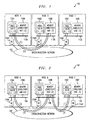
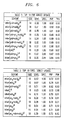
- FIGS. 1 and 2 illustrate the handling of example read and write requests, respectively, in a distributed shared-memory multiprocessor system 100.
- the system 100 is an example of one type of system in which the directory-based prediction of the present invention may be implemented.
- the system 100 includes nodes A, B and C, which are connected to an interconnection network 102 via corresponding network interfaces (NIs) 104A, 104B and 104C, respectively.
- the nodes A, B and C include processors 106A, 106B and 106C, memories 108A, 108B and 108C, and buses 110A, 110B and 110C, respectively, arranged as shown.
- i A, B, C
- the processor 106 i , memory 108 i and network interface 104 i are each coupled to and communicate over the corresponding bus 110 i .
- each of the processors 106i in the system 100 is a set of caches L1 and L2, and associated with each of the memories 108 i is a directory and a cache L3.
- Each of the memories 108i is managed by its corresponding unique directory.
- the memories 108i or portions thereof are referred to herein as data blocks or simply blocks.
- each block in this illustrative embodiment is managed by just one of them. If a would-be reader or would-be writer does not have an up-to-date copy of a block, it asks the corresponding directory to find the most recent version of the block.
- the directory may have to invalidate one or more current copies of the block in order to answer a request.
- FIG. 1 Also illustrated in FIG. 1 is an example of a read operation in which processor 106A of node A reads data from memory 108B of node B.
- read request (1) goes from node A to node B
- reply (2) returns from node B to node A.
- Node A caches the data in its local cache hierarchy, i.e., caches L1, L2 and L3.
- the directory in node B stores an indication that node A has a copy of the data.
- Other nodes read data from node B in the same manner.
- reader and "writer” as used herein are intended to include without limitation a given processor node or its associated processor, as well as elements or portions of a processor node or its associated processor.
- FIG. 2 shows a write operation in which processor 106C of node C writes the same data residing in memory 108B of node B.
- write request (1) goes from node C to node B.
- the directory in node B knows that node A has a copy of the data, it sends an invalidation request (2) to node A.
- Node A sends an acknowledgment (3) of the invalidation of its copy of the data.
- Node B then sends the data (4) to node C for writing since there are no more copies in the system.
- a given memory block in the system 100 thus may be viewed as alternating between phases of being written by a single processor and being read by one or more processors.
- the directory associated with the given block manages these alternating phases, maintaining a consistent version of the block at all times.
- FIGS. 1 and 2 are examples only, and should not be construed as limiting the scope of the present invention in any way.
- the invention may be implemented using a wide variety of different cache architectures or multiprocessor system configurations.
- FIG. 3 illustrates an example of these alternating phases for a single block in a system having five nodes denoted 1, 2, 3, 4 and 5.
- the left side of the figure shows the raw sequence of read and write events relating to the single block, and the right side of the figure shows a summary of the above-noted phases.
- it is generally safe for multiple readers to examine the most-recently-generated version of a block.
- the present invention in an illustrative embodiment provides a directory-based prediction mechanism which predicts the next set of readers of a block when a write request goes from the writer to the directory associated with the block.
- the mechanism predicts a likely set of readers of the value produced by the writer, and after the writer has finished writing, this prediction is used to forward the data to all the predicted readers.
- the prediction mechanism of the present invention merges together multiple sets of readers for multiple blocks served by the directory. This information is referred to herein as the global history of the directory.
- a history depth of four is used, i.e., the predicted set of readers generated for a current write operation on a given block is determined as a function of the current set of readers of that block and the three other most recent sets of readers stored in a predictor shift register.
- FIG. 4 shows an example of the operation of a directory-based predictor in the illustrative embodiment of the invention.
- a write request is received for a data block X associated with a memory and directory 120.
- the current readers of the data block X are a set of nodes ⁇ a, b, c ⁇ of a multiprocessor system which includes nodes denoted a, b, c, d, e, f, g, h, i, j, k, l, m, etc.
- Each of the nodes may represent a node of a multiprocessor system such as that illustrated in conjunction with FIGS. 1 and 2.
- the predictor in this example uses a shift register 122 in a manner to be described below.
- FIG. 5 shows a flow diagram of the general processing operations of the directory-based predictor of the FIG. 4 example. The general operations will first be described with reference to FIG. 5, and then the application of the general operations to the FIG. 4 example will be described in detail.
- a writer sends a write request message to the directory of the block to be written.
- the directory in step 202 invalidates the current readers.
- Steps 204 and 206 are then performed by each of the readers.
- a given node corresponding to a potential reader receives the invalidation from the directory.
- the node returns an "accessed bit" with an acknowledgment of the invalidation.
- the directory waits for invalidation acknowledgments from the readers.
- a set of true readers is determined as the set of invalidated nodes for which the returned accessed bit is set.
- the directory in step 210 provides information identifying the set of true readers to the predictor.
- the predictor then adds the set of true readers to its shift register (step 212), discards the oldest set of previous readers in the shift register (step 214), predicts a function of the sets using an intersection or union operation (step 216), and sends the prediction to the writer (step 218).
- the directory in step 220 sends a valid copy of the block to the writer. This copy may be sent to the writer along with the prediction of step 218.
- the choice of union or intersection function in step 216 of FIG. 5 generally depends on desired degree of aggressiveness in the data forwarding. For example, in high-bandwidth systems, the more aggressive data forwarding associated with the union function may be more appropriate, while for low-bandwidth systems, the intersection function may be more appropriate.
- these functions are given by way of example only, and the invention can be implemented using other types of functions.
- pattern-based functions can be used in conjunction with the present invention. Such functions are described in greater detail in, e.g., T. Yeh and Y. Patt, "Two-Level Adaptive Branch Prediction," Proceedings of the 24th Annual ACM/IEEE International Symposium and Workshop on Microarchitecture, Los Alamitos, CA, November 1991 , which is incorporated by reference herein.
- the choice between union, intersection or other functions in step 216 can be made on a dynamic basis.
- the choice may be made on a per-program basis, such that each program can set its own mode of operation.
- the choice of function may be implemented under program control, such that programs can change the mode of operation at run-time according to their needs.
- the choice could alternatively be made on a per-page basis, with each memory page, which may be comprised of multiple data blocks, having its own mode. In this case, an operating system may notify the predictor about the mode of operation of various pages.
- the choice of function could be made in accordance with network utilization, e.g., with low network utilization calling for the union function, and high network utilization calling for the intersection function. In this case, a network monitor device may be used to supply feedback to the prediction mechanism.
- the current readers are the processors in the set ⁇ a, b, c ⁇ .
- the predictor shift register 122 is shifted by one as shown, and the set ⁇ a, b, c ⁇ is installed in the top slot, denoted slot 0.
- slots 1, 2 and 3 contain the sets ⁇ a, c, e, f, g ⁇ , ⁇ a, c, d ⁇ and ⁇ a, h, i, c ⁇ , respectively, and the set ⁇ k, l, m ⁇ is dropped from the shift register.
- the current contents of the shift register 122 at a given point in time represent the global history of the corresponding directory.
- the directory invalidates the current readers by sending invalidation requests to the nodes a, b and c, waits for acknowledgment of the invalidation, and later sends a valid copy of data block X to the requesting writer.
- the predictor determines the union or the intersection of the sets in the shift register 122, in accordance with step 216 of FIG. 5, choosing union or intersection based on one or more of the factors described above.
- the union of the sets in the shift register is the set ⁇ a, b, c, d, e, f, g, h, i ⁇ , while the intersection of the sets in the shift register is the set ⁇ a, c ⁇ .
- the result is a set of predicted readers which is sent by the predictor to the writer. After the write operation on data block X is completed, the writer forwards the new block to each of the predicted readers.
- the triggering of the data forwarding can be based on a timer, or by the next write to the directory regardless of which data block is written, or by the next read to data block X, or by other suitable techniques.
- the data forwarding may be implemented by the directory fetching a copy of the data from the writer and sending it to the predicted reader nodes.
- the predictor in the FIG. 4 example uses a history depth of four, i.e., the shift register 122 stores the four most recent sets of readers for a given data block
- the present invention can be implemented using other history depths, including history depths greater or less than four.
- Conventional predictors generally utilize a history depth no greater than two.
- each reader In order to provide accurate feedback to the above-described prediction mechanism, each reader generally must be able to distinguish between a predicted read and an actual read.
- a multiprocessor system in accordance with the invention predicts the future set of readers of the block, then ensures that copies of the block are forwarded to those predicted readers after the write has completed.
- the system In order to close the feedback loop, the system must find out how many of those predicted readers actually used the block. To tell whether this is the case, each reader in the system may maintain the above-noted "accessed bit" for each locally cached line.
- This accessed bit is similar to the so-called "dirty bit" kept for paging in a virtual memory system, except that the accessed bit will be set when a cache block is read, rather than when it is written. Also, the accessed bit should be maintained at cache block granularity, while dirty bits are typically maintained at page granularity.
- each reader piggybacks the accessed bit information on the invalidation acknowledgment. The system can then use the accessed bits to update its state for the next prediction.
- processing operations referred to herein as being performed or otherwise implemented by a directory may be performed or otherwise implemented by an associated element of a processor node, such as by a processor under program control.
- the directory information can be supplemented by other information in order to provide further performance improvements.
- the directory information can be supplemented with a designated subset of cache-block-address information.
- such an arrangement uses less information than conventional address-based prediction techniques, while also achieving a higher prediction accuracy.
- the directory information with or without the subset of the cache address information can be combined with other types of information, such as processor node and program counter information.
- the invention may utilize various combinations of directory, address, processor node and program counter information in the process of determining a set of predicted readers for a given write request.
- the "global history" of a directory is intended to include not only a history based on directory information alone, but also a history which includes directory information as well as an amount of additional information, such as address, processor node or program counter information, which is less than the full available amount of such additional information.
- a global history may include directory information supplemented with a small number of address bits, i.e., an amount of address bits less than a full set of available address bits.
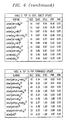
- FIG. 6 shows a set of six tables listing examples of predictors in accordance with the invention and corresponding performance simulation results.
- the predictors shown are based on various combinations of one or more of directory (dir), address (add), processor node (pid) and program counter (pc) information.
- the predictor names are of the form prediction-function(index) depth , where prediction-function indicates the function used to update the predictor, index indicates the particular combination of directory, address, processor node and program counter information used by the predictor, and depth is the history depth.
- address (add) or program counter (pc) information the corresponding identifier includes a subscript indicating the corresponding number of bits of information.
- the predictors shown in FIG. 6 are also classified as either direct or forwarded to indicate the particular update mechanism used.
- a direct update mechanism each time a data block is written, the set of invalidated true readers are used as history to generate the new prediction.
- a forwarded update mechanism when a writer invalidates a set of readers associated with another node, it forwards this history to the appropriate predictor entry so it can be used by the correct writer. Forwarded update thus requires last-writer information for each data block so invalidated readers can be associated with a specific writer.
- Tables 1, 2 and 3 of FIG. 6 list predictors which utilize a direct update mechanism, while Tables 4, 5 and 6 list predictors which utilize a forwarded update mechanism.
- the predictor union(pid+dir+add 4 ) 4 in Table 6 represents a prediction scheme using direct update, indexing its prediction state using the processor number, directory node, and four bits of data-block address, and unioning the last two sharing bitmaps to predict the next one for each index.
- a last-bitmap predictor indexed by directory node and eight bits of address information may be denoted union(dir+add 8 ) 1 or inter(dir+add 8 ) 1 , depending on the particular function used. It should be noted that a union-based or intersection-based predictor with a history depth of one is the same as a last-bitmap predictor.
- the predictor size is measured as log 2 of the number of bits utilized by the predictor.
- Sensitivity is the ratio of correct predictions to the sum of correct predictions and omitted predictions, and indicates how well the predictor predicts sharing when sharing will indeed take place.
- a sensitive predictor is good at finding and exploiting opportunities for sharing, while an insensitive predictor misses many opportunities.
- Specificity is the ratio of avoided predictions to the sum of avoided predictions and extra predictions, and indicates the likelihood that no resources will be wasted on unshared data.
- PVP is the ratio of correct predictions to the sum of correct and extra predictions, and provides an indication of the percentage of useful data-forwarding traffic out of all data-forwarding traffic.
- PVN is the ratio of avoided predictions to the sum of avoided predictions and omitted predictions, and provides an indication as to how likely an unshared block is to be correctly predicted not to be shared.
- Tables 1 and 4 show the ten predictors with the highest PVPs under direct update and forwarded update, respectively, of a set of possible predictors for which performance was simulated. All of the predictors in this group are deep-history intersection predictors, which will maximize PVP by speculating only on very stable sharing relationships. Two of the top-ten schemes are common to the two tables. It can be seen that direct update and forwarded update have very little influence on PVP. However, the forwarded schemes on average are more sensitive. None of the high-PVP schemes is sensitive compared to a last-bitmap or union-predictor scheme. This means that they will generate very productive traffic, but they will miss many opportunities for sharing.
- Table 2 shows the ten most sensitive schemes in the set of possible predictors using direct update. All are union schemes with the maximum history depth used in this example, i.e., a history depth of 4. All schemes are roughly comparable in sensitivity, but with different values of PVP. It is interesting to note that by far the least expensive scheme (union(dir+add 2 ) 4 ) is fifth-best overall in terms of sensitivity.
- Table 3 shows the ten most sensitive schemes in the set of possible predictors using forwarded update. There is very little difference between the direct- and forwarded-update schemes. Six of the top ten schemes are common to the two lists, and the statistics differ little from column to column.
- Tables 5 and 6 show the top ten predictors in the set of possible forwarded update predictors in terms of specificity and sensitivity, respectively.
- predictors shown in FIG. 6 are examples only, and the invention may be implemented using other types of predictors.
- maximum history depth in the FIG. 6 examples is four, other predictors may use greater history depths.
- the present invention may be configured to meet the requirements of a variety of different processing applications and environments, using any desired types and arrangements of processors.
- the above-described embodiments of the invention are therefore intended to be illustrative only. Numerous alternative embodiments within the scope of the following claims will be apparent to those skilled in the art.
Landscapes
- Engineering & Computer Science (AREA)
- Theoretical Computer Science (AREA)
- Physics & Mathematics (AREA)
- General Engineering & Computer Science (AREA)
- General Physics & Mathematics (AREA)
- Memory System Of A Hierarchy Structure (AREA)
- Memory System (AREA)
Applications Claiming Priority (2)
| Application Number | Priority Date | Filing Date | Title |
|---|---|---|---|
| US591918 | 2000-06-09 | ||
| US09/591,918 US6889293B1 (en) | 2000-06-09 | 2000-06-09 | Directory-based prediction methods and apparatus for shared-memory multiprocessor systems |
Publications (2)
| Publication Number | Publication Date |
|---|---|
| EP1162542A1 EP1162542A1 (en) | 2001-12-12 |
| EP1162542B1 true EP1162542B1 (en) | 2008-01-02 |
Family
ID=24368495
Family Applications (1)
| Application Number | Title | Priority Date | Filing Date |
|---|---|---|---|
| EP01304340A Expired - Lifetime EP1162542B1 (en) | 2000-06-09 | 2001-05-16 | Directory-based prediction method and apparatus for shared-memory multiprocessor systems |
Country Status (4)
| Country | Link |
|---|---|
| US (1) | US6889293B1 (enExample) |
| EP (1) | EP1162542B1 (enExample) |
| JP (1) | JP4496455B2 (enExample) |
| DE (1) | DE60132132T2 (enExample) |
Cited By (1)
| Publication number | Priority date | Publication date | Assignee | Title |
|---|---|---|---|---|
| RU2459241C1 (ru) * | 2011-03-29 | 2012-08-20 | Государственное образовательное учреждение высшего профессионального образования "Казанский государственный энергетический университет" (КГЭУ) | Цифровое прогнозирующее устройство |
Families Citing this family (14)
| Publication number | Priority date | Publication date | Assignee | Title |
|---|---|---|---|---|
| US7398282B2 (en) * | 2000-06-16 | 2008-07-08 | Fujitsu Limited | System for recording process information of a plurality of systems |
| US7017015B2 (en) * | 2002-12-20 | 2006-03-21 | Rockwell Automation Technologies, Inc. | Method and system for coordinating the access of data by two computer processes |
| US7340565B2 (en) * | 2004-01-13 | 2008-03-04 | Hewlett-Packard Development Company, L.P. | Source request arbitration |
| US7240165B2 (en) | 2004-01-15 | 2007-07-03 | Hewlett-Packard Development Company, L.P. | System and method for providing parallel data requests |
| US7962696B2 (en) | 2004-01-15 | 2011-06-14 | Hewlett-Packard Development Company, L.P. | System and method for updating owner predictors |
| US7363435B1 (en) * | 2005-04-27 | 2008-04-22 | Sun Microsystems, Inc. | System and method for coherence prediction |
| US7395376B2 (en) | 2005-07-19 | 2008-07-01 | International Business Machines Corporation | Method, apparatus, and computer program product for a cache coherency protocol state that predicts locations of shared memory blocks |
| WO2007096979A1 (ja) | 2006-02-24 | 2007-08-30 | Fujitsu Limited | 情報処理装置およびデータ転送方法 |
| JP4945611B2 (ja) * | 2009-09-04 | 2012-06-06 | 株式会社東芝 | マルチプロセッサ |
| WO2013042240A1 (ja) * | 2011-09-22 | 2013-03-28 | 富士通株式会社 | 情報処理装置及び情報処理装置の制御方法 |
| US10996989B2 (en) * | 2016-06-13 | 2021-05-04 | International Business Machines Corporation | Flexible optimized data handling in systems with multiple memories |
| US10528471B2 (en) * | 2016-12-27 | 2020-01-07 | Eta Scale Ab | System and method for self-invalidation, self-downgrade cachecoherence protocols |
| US9691019B1 (en) * | 2017-03-07 | 2017-06-27 | Google Inc. | Depth concatenation using a matrix computation unit |
| US10896367B2 (en) | 2017-03-07 | 2021-01-19 | Google Llc | Depth concatenation using a matrix computation unit |
Family Cites Families (3)
| Publication number | Priority date | Publication date | Assignee | Title |
|---|---|---|---|---|
| US5214766A (en) * | 1989-04-28 | 1993-05-25 | International Business Machines Corporation | Data prefetching based on store information in multi-processor caches |
| EP0394642A3 (en) | 1989-04-28 | 1992-07-15 | International Business Machines Corporation | Data prefetching in caches |
| US6032228A (en) * | 1997-11-26 | 2000-02-29 | International Business Machines Corporation | Flexible cache-coherency mechanism |
-
2000
- 2000-06-09 US US09/591,918 patent/US6889293B1/en not_active Expired - Fee Related
-
2001
- 2001-05-16 EP EP01304340A patent/EP1162542B1/en not_active Expired - Lifetime
- 2001-05-16 DE DE60132132T patent/DE60132132T2/de not_active Expired - Lifetime
- 2001-06-08 JP JP2001174337A patent/JP4496455B2/ja not_active Expired - Fee Related
Cited By (1)
| Publication number | Priority date | Publication date | Assignee | Title |
|---|---|---|---|---|
| RU2459241C1 (ru) * | 2011-03-29 | 2012-08-20 | Государственное образовательное учреждение высшего профессионального образования "Казанский государственный энергетический университет" (КГЭУ) | Цифровое прогнозирующее устройство |
Also Published As
| Publication number | Publication date |
|---|---|
| DE60132132D1 (de) | 2008-02-14 |
| JP4496455B2 (ja) | 2010-07-07 |
| EP1162542A1 (en) | 2001-12-12 |
| US6889293B1 (en) | 2005-05-03 |
| DE60132132T2 (de) | 2009-01-02 |
| JP2002049600A (ja) | 2002-02-15 |
Similar Documents
| Publication | Publication Date | Title |
|---|---|---|
| Fillo et al. | The m-machine multicomputer | |
| US20050144399A1 (en) | Multiprocessor system, and consistency control device and consistency control method in multiprocessor system | |
| EP1162542B1 (en) | Directory-based prediction method and apparatus for shared-memory multiprocessor systems | |
| US11734192B2 (en) | Identifying location of data granules in global virtual address space | |
| CN100390758C (zh) | 缩短与高速缓存相关性目录遗漏关联的延迟的方法和系统 | |
| Feeley et al. | Implementing global memory management in a workstation cluster | |
| US11200168B2 (en) | Caching data from remote memories | |
| US5537569A (en) | Multiprocessor system utilizing a directory memory and including grouped processing elements each having cache | |
| US7818514B2 (en) | Low latency memory access and synchronization | |
| JP3963372B2 (ja) | マルチプロセッサ・システム | |
| CN101354682B (zh) | 一种用于解决多处理器访问目录冲突的装置和方法 | |
| US11016908B2 (en) | Distributed directory of named data elements in coordination namespace | |
| US20200183836A1 (en) | Metadata for state information of distributed memory | |
| US11288194B2 (en) | Global virtual address space consistency model | |
| US5802563A (en) | Efficient storage of data in computer system with multiple cache levels | |
| US6950906B2 (en) | System for and method of operating a cache | |
| JP2002049600A5 (enExample) | ||
| US6965972B2 (en) | Real time emulation of coherence directories using global sparse directories | |
| Leventhal et al. | Perceptron based consumer prediction in shared-memory multiprocessors | |
| Johnson | The virtual port memory multiprocessor architecture | |
| Abraham | Cache memories for multiprocessor dataflow architectures | |
| EP0652520A1 (en) | Cache control system for managing validity status of data stored in a cache memory | |
| Interface | Scalable Coherent Interface | |
| HK40033747A (en) | Logging cache influxes by request to a higher-level cache | |
| Milutinovic | Some Solutions for Critical Problems in the Theory and Practise of Distributed Shared Memory: New Ideas to Analyse |
Legal Events
| Date | Code | Title | Description |
|---|---|---|---|
| PUAI | Public reference made under article 153(3) epc to a published international application that has entered the european phase |
Free format text: ORIGINAL CODE: 0009012 |
|
| AK | Designated contracting states |
Kind code of ref document: A1 Designated state(s): DE FR GB Kind code of ref document: A1 Designated state(s): AT BE CH CY DE DK ES FI FR GB GR IE IT LI LU MC NL PT SE TR |
|
| AX | Request for extension of the european patent |
Free format text: AL;LT;LV;MK;RO;SI |
|
| 17P | Request for examination filed |
Effective date: 20020612 |
|
| AKX | Designation fees paid |
Free format text: DE FR GB |
|
| GRAP | Despatch of communication of intention to grant a patent |
Free format text: ORIGINAL CODE: EPIDOSNIGR1 |
|
| GRAS | Grant fee paid |
Free format text: ORIGINAL CODE: EPIDOSNIGR3 |
|
| GRAA | (expected) grant |
Free format text: ORIGINAL CODE: 0009210 |
|
| AK | Designated contracting states |
Kind code of ref document: B1 Designated state(s): DE FR GB |
|
| REG | Reference to a national code |
Ref country code: GB Ref legal event code: FG4D |
|
| REF | Corresponds to: |
Ref document number: 60132132 Country of ref document: DE Date of ref document: 20080214 Kind code of ref document: P |
|
| PLBE | No opposition filed within time limit |
Free format text: ORIGINAL CODE: 0009261 |
|
| STAA | Information on the status of an ep patent application or granted ep patent |
Free format text: STATUS: NO OPPOSITION FILED WITHIN TIME LIMIT |
|
| 26N | No opposition filed |
Effective date: 20081003 |
|
| PGFP | Annual fee paid to national office [announced via postgrant information from national office to epo] |
Ref country code: FR Payment date: 20140509 Year of fee payment: 14 |
|
| REG | Reference to a national code |
Ref country code: DE Ref legal event code: R082 Ref document number: 60132132 Country of ref document: DE Representative=s name: DILG HAEUSLER SCHINDELMANN PATENTANWALTSGESELL, DE |
|
| PGFP | Annual fee paid to national office [announced via postgrant information from national office to epo] |
Ref country code: GB Payment date: 20150424 Year of fee payment: 15 |
|
| REG | Reference to a national code |
Ref country code: FR Ref legal event code: ST Effective date: 20160129 |
|
| PG25 | Lapsed in a contracting state [announced via postgrant information from national office to epo] |
Ref country code: FR Free format text: LAPSE BECAUSE OF NON-PAYMENT OF DUE FEES Effective date: 20150601 |
|
| REG | Reference to a national code |
Ref country code: DE Ref legal event code: R082 Ref document number: 60132132 Country of ref document: DE Representative=s name: DILG HAEUSLER SCHINDELMANN PATENTANWALTSGESELL, DE Ref country code: DE Ref legal event code: R081 Ref document number: 60132132 Country of ref document: DE Owner name: AVAGO TECHNOLOGIES GENERAL IP (SINGAPORE) PTE., SG Free format text: FORMER OWNER: AGERE SYSTEMS GUARDIAN CORP., ORLANDO, FLA., US |
|
| PGFP | Annual fee paid to national office [announced via postgrant information from national office to epo] |
Ref country code: DE Payment date: 20160421 Year of fee payment: 16 |
|
| GBPC | Gb: european patent ceased through non-payment of renewal fee |
Effective date: 20160516 |
|
| PG25 | Lapsed in a contracting state [announced via postgrant information from national office to epo] |
Ref country code: GB Free format text: LAPSE BECAUSE OF NON-PAYMENT OF DUE FEES Effective date: 20160516 |
|
| REG | Reference to a national code |
Ref country code: DE Ref legal event code: R119 Ref document number: 60132132 Country of ref document: DE |
|
| PG25 | Lapsed in a contracting state [announced via postgrant information from national office to epo] |
Ref country code: DE Free format text: LAPSE BECAUSE OF NON-PAYMENT OF DUE FEES Effective date: 20171201 |